


Introduction
Climate change and other anthropogenic factors responsible for global change are leading to habitat degradation and accelerating biodiversity loss (Dirzo et al. Reference Dirzo, Young, Galetti, Ceballos, Isaac and Collen2014; Habibullah et al. Reference Habibullah, Din, Tan and Zahid2022; Sage Reference Sage2020; Urban Reference Urban2015). This decline in wildlife populations through habitat deterioration is a complex phenomenon with multiple and interrelated causes, resulting in numerous impacts that affect the functioning of the entire ecosystem including the ability of species to survive and reproduce successfully (Pautasso Reference Pautasso2012). Over the past decades, significant decreases in bird populations have been observed worldwide (Gaston and Fuller Reference Gaston and Fuller2008; Hallmann et al. Reference Hallmann, Foppen, van Turnhout, de Kroon and Jongejans2014; Inger et al. Reference Inger, Gregory, Duffy, Stott, Voříšek and Gaston2015; Şekercioğlu et al. Reference Şekercioğlu, Daily and Ehrlich2004), many of which have been closely linked to ecosystem alterations and to effects of climate change, such as rising temperatures or reduced precipitation (Figarski and Kajtoch Reference Figarski and Kajtoch2015; Martínez-Ruiz et al. Reference Martínez-Ruiz, Dykstra, Booms and Henderson2023). These changes can affect food availability and the timing of key events in the annual cycle of birds, such as migration and reproduction (Jones and Cresswell Reference Jones and Cresswell2010; Pearce-Higgins et al. Reference Pearce-Higgins, Brown, Douglas, Alves, Bellio and Bocher2017). Habitat loss and degradation is also a major cause of bird decline. Urban sprawl, deforestation, intensive agriculture, and other human activities have reduced and fragmented natural bird habitats (Marzluff and Ewing Reference Marzluff, Ewing, Marzluff, Shulenberger, Endlicher, Alberti, Bradley and Ryan2008; McKee et al. Reference McKee, Chambers and Guseman2013; Stanton et al. Reference Stanton, Morrissey and Clark2018; Virkkala Reference Virkkala2016).
The effects of global change and biodiversity loss on islands are much greater than on the mainland and have been widely studied and documented (Cardillo et al. Reference Cardillo, Mace, Gittleman and Purvis2006; Frankham Reference Frankham1998; Nogué et al. Reference Nogué, Santos, Birks, Svante, Castilla-Beltrán and Connor2021; Ricketts et al. Reference Ricketts, Dinerstein, Boucher, Brooks, Butchart and Hoffmann2005; Russell and Kueffer Reference Russell and Kueffer2019). Islands usually show a high degree of endemicity and are often biodiversity hotspots, contributing significantly to global biodiversity. Of 221 endemic bird areas in the world, 50% are found on islands (Whittaker and Knight Reference Whittaker and Knight1998). However, the virtual absence of the rescue effect (i.e. the arrival of individuals of the same species from elsewhere) in these regions causes a notable impoverishment of the fauna and high rates of extinction (Brown and Kodric-Brown Reference Brown and Kodric-Brown1977).
This study focuses on the analysis of factors that have brought an endemic island bird, the Canarian Houbara Bustard Chlamydotis undulata fuertaventurae, hereafter Canarian houbara, to the brink of extinction on the island that was once its main stronghold. The houbara is classified globally as “Vulnerable” according to International Union for Conservation of Nature (IUCN) criteria (BirdLife International 2021), and as “Endangered” in the Spanish Red List of Birds (Ucero et al. Reference Ucero, Abril-Colón, Palacín, Alonso and López-Jiménez2021). Based on chronicles of the fifteenth century, we know that houbaras were abundant in the eastern islands of the archipelago (P. Bontier and J. Le Verrier 1402–1404, cited in Collar Reference Collar1983). At that time and in the following centuries the species was probably hunted for food, as can be inferred from the ornithological literature of the nineteenth and early twentieth centuries, which report on regular hunting, capture of females at the nest, and egg collection (Bannerman Reference Bannerman1914; Collar Reference Collar1983; Meade-Waldo Reference Meade-Waldo1889, Reference Meade-Waldo1890; Polatzek Reference Polatzek1909; von Thanner et al. Reference von Thanner1905; Webb et al. Reference Webb, Berthelot, Moquin-Tandon and Webb1842). This caused population declines to the point of near extinction (15–20 individuals in Lanzarote, 80–100 in Fuerteventura the late 1970s; Lack Reference Lack1979), producing genetic bottlenecks and affecting the genetic structure of the species in these islands (Horreo et al. Reference Horreo, Ucero, Palacín, López-Solano, Abril-Colón and Alonso2023). Human persecution diminished afterwards, and finally the hunting ban allowed the population to recover. However, while this demographic recovery has lasted until today in Lanzarote (440–452 individuals in 2018; Alonso et al. Reference Alonso, Palacín and Abril-Colón2020), available data suggest that in Fuerteventura the population could have reached a maximum of c.460 houbaras in 2004 (Lorenzo et al. Reference Lorenzo, González and Hernández2007). Subsequently, it again started a significant decline, which has brought it to the brink of extinction in that island (85–109 houbaras in 2021; Ucero et al. Reference Ucero, Abril-Colón, Palacín, Alonso and López-Jiménez2021), threatening to represent a first step towards total extinction in the Canary Islands. This last decline has usually been attributed to habitat destruction caused by human activities and to mortality due to collision with powerlines and roadkills (Lorenzo Reference Lorenzo2004; Schuster and Iglesias-Lebrija Reference Schuster and Iglesias-Lebrija2012; Ucero et al. Reference Ucero, Abril-Colón, Palacín, Alonso and López-Jiménez2021). For example, habitat loss has been estimated at around 13% for the period 1996–2011, and an additional loss of 20–28% is predicted until 2025 (Banos-González et al. Reference Banos-González, Terrer, Martínez-Fernández, Esteve-Selma and Carrascal2016). As for powerline casualties, various studies have confirmed that the Canarian houbara is one of the species with the highest recorded deaths due to collisions (Gómez-Catasús et al. Reference Gómez-Catasús, Carrascal, Moraleda, Colsa, Garcés and Schuster2020; GREFA 2016; Lorenzo Reference Lorenzo1995; Lorenzo and Ginovés Reference Lorenzo and Ginoves2007; Lorenzo et al. Reference Lorenzo, Linares and Abreu1997).
In the present study, we quantify the recent decline of the Canarian houbara population in Fuerteventura and investigate the main causes and their relative importance including all potentially influential variables identified in the island. As in other species of the bustard family, the mating system of Houbara Bustards seems to meet the definition of an exploded lek, where males display in their territories maintaining inter-individual distances of several hundred metres, and females visit them to mate (Alonso et al. Reference Alonso, Palacín and Abril-Colón2020, 2022a; Collins Reference Collins1984; Hellmich Reference Hellmich2003; Hingrat and Saint Jalme 2005; Hingrat et al. Reference Hingrat, Saint Jalme, Ysnel, Lacroix, Seabury and Rautureau2004, Reference Hingrat, Saint Jalme, Chalah, Orhant and Lacroix2008; Ucero et al. Reference Ucero, Alonso, Palacín and Álvarez-Martínez2023). Display sites are places that male houbaras select for courting females. These sites have certain microhabitat and landscape scale characteristics and are used year after year by the same male (Ucero et al. Reference Ucero, Alonso, Palacín and Álvarez-Martínez2023). This means that their occupation or abandonment is a key indicator of the state of the houbara population on Fuerteventura. We compared the number and distribution of males on the island in 1997–1998 (Hellmich Reference Hellmich1998) with those obtained in a census carried out in 2020–2021 (present study), and associate the permanence or disappearance of each display site over that time interval with the presence of each of the influencing variables at that particular site. Counts of displaying males have been used in similar species to estimate population trends because they are highly visible and faithful to their display sites during the mating season, whereas females are much more cryptic, mobile, and elusive (e.g. Bretagnolle et al. Reference Bretagnolle, Traba and Morales2022; Mahood et al. Reference Mahood, Hong, Virak, Sum and Garnett2020). Although it is true that numerous estimates of the Fuerteventura houbara population have been published in recent decades (Supplementary material Table S1), only Hellmich (Reference Hellmich1998) conducted a proper census. All other published data are density values based on multiple line transects, which require complex extrapolations to reach a reliable population estimate, and do not allow the identification of sexes or the exact location of houbara territories (see discussion on advantages and disadvantages of the different houbara census methods in Alonso et al. Reference Alonso, Palacín and Abril-Colón2020). Our main hypothesis was that the decrease in the number of male Canarian houbaras during the last two decades on Fuerteventura would have been mainly due to causes derived from human activities. Specifically, the following predictions have been tested. (1) The construction of new infrastructures (powerlines, roads, buildings etc.) and disturbances derived from human activities may have caused the abandonment of some of the display sites occupied by males in 1998. (2) The amount of food resources, estimated through the Normalised Difference Vegetation Index (NDVI) derived from times series of Landsat imagery, and the presence of other steppe birds, are good indicators of habitat quality, so lower values for these variables are expected at those display sites that have been abandoned. (3) Since Canarian Ravens Corvus corax canariensis predate on Canarian houbara eggs and chicks, we would expect a higher presence of ravens in areas where display sites are still occupied. (4) Finally, environmental protection, such as Natural Parks and Special Protection Areas (SPAs), should have potentially contributed to the permanence of males at their display sites.
Methods
Study species
The Canarian subspecies of African Houbara Bustard Chlamydotis undulata is endemic to the three easternmost islands of the Canary archipelago (i.e. Fuerteventura, Lanzarote, and La Graciosa), with an occasional occurrence in Lobos (Martín and Lorenzo Reference Martín and Lorenzo2001). It was also present in the past in Gran Canaria (Martín and Lorenzo Reference Martín and Lorenzo2001; Meade-Waldo Reference Meade-Waldo1893; Medina Reference Medina1999) and possibly inhabited Tenerife (Collar Reference Collar1983; Rando Reference Rando1995). Following paleontological data, the Canary archipelago was colonised by African Houbara Bustards from Morocco 130,000–170,000 years ago (Ancochea et al. Reference Ancochea, Fuster, Ibarrola, Cendrero, Coello and Hernan1990; Rando Reference Rando1995), although according to mitochondrial DNA analysis, both subspecies, African and Canarian, diverged genetically around 20,000–25,000 years ago (Idaghdour et al. Reference Idaghdour, Broderick, Korrida and Chbel2004). The nominate subspecies is distributed in northern Africa from Mauritania to the Nile Valley (BirdLife International 2021; del Hoyo et al. Reference del Hoyo, Elliott, Sargatel and Christie2018). Males defend their display sites against intruding neighbours and remain loyal to their territories throughout the breeding season and year after year (Alonso et al. Reference Alonso, Abril-Colón, Palacín, Ucero and Álvarez-Martínez2022a; Hingrat et al. Reference Hingrat, Saint Jalme, Ysnel, Lacroix, Seabury and Rautureau2004, Reference Hingrat, Saint Jalme, Chalah, Orhant and Lacroix2008; Ucero et al. Reference Ucero, Alonso, Palacín and Álvarez-Martínez2023).
Study area
The Canary Islands are located in the Atlantic Ocean, 140 km off the north-west African coast (Figure 1). Our work focused on the island of Fuerteventura (28°24’, 14°00’W, 1,660 km2), the only island for which a reliable census of display sites is available that is sufficiently separated in time from our current census (respectively, Hellmich Reference Hellmich1998; Ucero et al. Reference Ucero, Abril-Colón, Palacín, Alonso and López-Jiménez2021), enabling us to establish a population trend and evaluate its causes. Fuerteventura is a volcanic island with a low altitudinal relief, in which the valleys and plains dominant relief explains an annual rainfall regime of only about 98 mm because of low cloud retention. Due to these characteristics, the predominant biotopes in Fuerteventura are sandy formations (jable), more or less shrubby, basaltic soils from volcanic eruptions, and stony soils with sparse vegetation. These areas are characterised by the presence of different herbaceous species (i.e. grasses, therophytes, and herbaceous perennials) and shrubs (i.e. Salsola vermiculata, Launaea arborescens, Lycium intricatum, Suaeda spp., and Euphorbia spp.), which constitute the main habitat of the species. In addition, Canarian houbaras use marginal environments, such as the edges of lava fields (malpaíses) or cultivated areas (Martín and Lorenzo Reference Martín and Lorenzo2001), showing a preference for a mosaic of Launaea shrubland, cultivated lands, pastures, and fallows where they spend the hottest and driest months of the year (Abril-Colón et al. Reference Abril-Colón, Alonso, Palacín, Ucero and Álvarez-Martínez2022b; Ucero et al. Reference Ucero, Abril-Colón, Palacín, Alonso and López-Jiménez2021), as well as the gavias (traditional agricultural fields in Fuerteventura that are designed to retain rain and runoff water) (Medina Reference Medina1999; Ucero et al. Reference Ucero, Abril-Colón, Palacín, Alonso and López-Jiménez2021). The basis of the current island economy is tourism, which has replaced the agricultural and livestock economy of past centuries. These islands now represent important tourist destinations and their natural areas, including numerous protected sites with endemic species of flora and fauna, are threatened by a potentially unsustainable development.
Abandoned and occupied display sites of Canarian Houbara Bustard Chlamydotis undulata fuertaventurae. Map showing the distribution of display sites that were abandoned between 1998 and 2021 (red dots) and those that are still occupied (green dots). The areas coloured in light yellow represent the protected areas declared before the Hellmich census in 1998, while the orange areas represent the protected areas established after 1998. Many of the display sites that have been abandoned are located in areas that do not have any legal protection, as well as in the Llanos y cuchillos de Antigua Special Protected Area (SPA) declared in 2001, in the centre-east of the island.

Census of male Canarian houbaras and location of display sites
The methods used in Hellmich’s study and in the present study to census Canarian houbaras were the same. In both studies, car surveys were performed during the display season in all areas of the island with suitable habitats for the species, with frequent and prolonged stops at vantage points to search for houbaras with telescopes (Hellmich Reference Hellmich1998). These surveys were carried out during the first and last hours of daylight with a stop in the middle of the day, when houbaras are usually lying down and difficult to see. All censuses were carried out during the peak courtship season (January and February). The census carried out in 2020–2021 was conducted by two teams with two observers each. More details on census techniques can be found in Alonso et al. (Reference Alonso, Palacín and Abril-Colón2020). The main objective was to locate all males on the island by recording both displaying and non-displaying males in all areas suitable for the species. Once a male was located, the observer waited some minutes to give time for the male to perform display. Although some males did not display, through the monitoring of GPS-tagged individuals, we know that males occupy their display territory even in years when they are not displaying (e.g. in years with low rainfall; Abril-Colón et al. Reference Abril-Colón, Alonso, Palacín, Álvarez-Martínez and Ucero2022a; Alonso et al. Reference Alonso, Abril-Colón, Palacín, Ucero and Álvarez-Martínez2022a; Ucero et al. Reference Ucero, Alonso, Palacín and Álvarez-Martínez2023). Therefore, we can be reasonably sure that with our census method we detected practically all males, both those that were displaying and those that were not. We used the accelerometer sequences of a sample of display runs identified and verified in the field through field observations of some focal males during the 2020 breeding season to train the AcceleRater software (Resheff et al. Reference Resheff, Rotics, Harel, Spiegel and Nathan2014), and later obtained display runs automatically for the 2021 breeding season (Abril-Colón et al. Reference Abril-Colón, Alonso, Ucero and Palacín2023). Once all display runs were quantified and located on a map, we checked that their modal values for each male matched the 2020 and 2021 locations.
In both studies, the census was repeated in two consecutive years (1997 and 1998; Hellmich Reference Hellmich1998: 2020 and 2021; present study) to confirm the locations and numbers of males sighted in the first year (Figure 1, Supplementary material Figure S1). Hellmich (Reference Hellmich1998) saw 64 displaying males in 1997 and 83 displaying plus four subadult males in 1998. In order to quantify the current number of males and the permanence or abandonment of display sites identified in 1997–1998 (Hellmich Reference Hellmich1998), two surveys were carried out, 7–13 January 2020 and 18–28 January 2021, covering the entire range of the species on Fuerteventura, and including the display sites of the 83 males seen by Hellmich in 1997–1998 (Figure 1). After locating and observing each male, we noted the males which performed circular display runs. The exact display site was determined by two observers, one of whom fixed the display site with a telescope, while the other walked to the site where the male had just been observed displaying, both communicating by mobile phone to ensure that the correct co-ordinate of the display site was collected. On arrival at the site, the trail was often quite visible on the ground and traces of droppings and feathers were found, confirming a regular use of the site by the male. As a rule, a display site was considered to be still occupied if, during the 2020 and 2021 surveys, a male was seen in the area, whether displaying or not, and a display site was considered to have disappeared if no male was seen within 500 m of one of the display sites sighted in 1997–1998. In the event that a male was observed at a distance of more than 500 m from the nearest display site sighted in 1997–1998, we considered that male to have been displaced. When display locations were available for the same male in both surveys (1997 and 1998), we used the 1998 data because in 1997 courtship ceased earlier due to unfavourable weather conditions (Hellmich Reference Hellmich1998). Likewise, when repeated locations were available from both current censuses (2020 and 2021), we used data from 2021, when more males were seen displaying.
Variables used
To characterise the sites we used (1) variables related to habitat quality (amount of food resources using NDVI as a proxy, see below, densities of houbaras, other steppe birds and ravens, degree of protection of the area, e.g. Natural Park, SPA or non-protected area, and (2) variables measuring the nearest distance to different types of infrastructure and their density (e.g. roads, buildings, urban nuclei, powerlines, and mines) (Table 1 and Figure 2).
Differences (Mann–Whitney test) in habitat quality and presence of human infrastructure between occupied and abandoned display sites of male Canarian Houbara Bustards Chlamydotis undulata fuertaventurae over the period 1998–2021 in Fuerteventura island. Sample size = 83 sites (29 occupied, 54 abandoned). See Methods for definition of variables. NDVI = Normalised Difference Vegetation Index

1 NDVI is a dimensionless variable.
2 See methods for details on the calculation of units in this variable.
Examples of extant and extinct Canarian Houbara Bustard Chlamydotis undulata fuertaventurae male display sites in Fuerteventura. The maps show two sectors of the study area to illustrate the effect of habitat quality and existence of human infrastructure on the permanence or abandonment of display sites. Map A shows three display sites that were still occupied in 2020 and 2021 (green dots) with their respective 1,000-m buffers. Within each buffer, lighter grey tones reflect higher Normalised Difference Vegetation Index (NDVI) values; there are also some females or groups of females (white dots) and no human infrastructures. Furthermore, this is a protected area, i.e. Jandía Natural Park and Special Protected Area (SPA). Map B shows six display sites abandoned between 1998 and 2021 (red dots), located in a non-protected area. The grey colour in the buffers is darker in many sectors, reflecting lower averaged NDVI values. In addition, several types of infrastructure can be seen within these buffers: buildings (white aligned patterns at the top of the buffers), powerlines (yellow lines), busy roads and paths (black lines), and part of the FV-1 highway built in 2005 (red line), probably the infrastructure that had the greatest impact on the abandonment of these display sites. The base of the figures corresponds to the terrain illumination model derived from the Digital Elevation Model (DEM).

Variables related to habitat quality
(a) Estimation of food resources available to the species
As an indicator of the quality of the vegetation at a display site we used the NDVI, measured at the beginning and at the end of the study period. The NDVI represents a measure of total photosynthesis and aboveground net primary production (Pettorelli et al. Reference Pettorelli, Vik, Mysterud, Gaillard, Tucker and Stenseth2005), providing meaningful ecological information about vegetation greenness in the landscape matrix of base soil, arid environment of the island. This indicator is a widely accepted proxy of the habitat quality and food availability in breeding and post-breeding areas, useful to link animal distribution and available resources (Álvarez-Martínez et al. Reference Álvarez-Martínez, Suárez-Seoane, Palacín, Sanz and Alonso2015; Bro-Jørgensen et al. Reference Bro-Jørgensen, Brown and Pettorelli2008; Pettorelli et al. Reference Pettorelli, Ryan, Mueller, Bunnefeld, Jędrzejewska and Lima2011; Wiegand et al. Reference Wiegand, Naves, Garbulsky and Fernández2008). This non-invasive and efficient method allows researchers to assess habitat quality, aiding in understanding animal behaviour, population dynamics, and the impact of environmental changes on food availability (Boult et al. Reference Boult, Quaife, Fishlock, Moss, Lee and Sibly2018; Zlinszky et al. Reference Zlinszky, Heilmeier, Balzter, Czúcz and Pfeifer2015). In the case of the Canarian houbara, its diet is mainly composed of annual plants, flowers and fruits of shrubs, and insects (Collins Reference Collins1993; Martín and Lorenzo Reference Martín and Lorenzo2001; Medina Reference Medina1999), so this species depends on herbaceous vegetation for its diet, and therefore the NDVI can be used as a good indicator of habitat quality. NDVI can also capture the inter-annual variation in the development of herbaceous vegetation, which is quite pronounced in the eastern Canary Islands, because rainfall on these islands is much lower and unpredictable than on the western islands of the archipelago (García et al. Reference Garcia-Herrera, Gallego and Hernandez2001). This means that the productivity of the Canarian houbara varies greatly between years, depending on rainfall (Alonso et al. Reference Alonso, Ucero, Abril-Colón and Palacín2022c), as is the case with other species in arid ecosystems (Bolger et al. Reference Bolger, Patten and Bostock2005; Currier and Sala Reference Currier and Sala2022; Marcelino et al. Reference Marcelino, Silva, Gameiro, Silva, Rego, Moreira and Catry2020).
Single NDVI products obtained from each scene and year were combined in order to produce a single spatially continuous cloud-free product following a maximum-value composite (MVC) method (Holben Reference Holben1986). This approach generates MVC products that transform a series of multi-temporal, geo-referenced satellite data into single NDVI images for a particular period of time and defined space. In this work, we selected MVC for the four years with best NDVI values at the beginning and at the end of the study period (respectively, 1998, 2001, 2002, and 2004, which we called “initial NDVI”, and 2018–2021, which we called “final NDVI”).
To get this data set, we downloaded all available Landsat 5 TM, Landsat 7 ETM+, Landsat 8, and Landsat 9 OLI images from 1998 to 2022 matching the nominal frames path 205 – row 40, path 205 – row 41, path 206 – row 40, and path 206 – row 41, covering the island of Fuerteventura. Data were obtained from the Earth Explorer catalogue of the US Geological Survey as standard processed Level 1 Product Generation System (L1T) and Level 2 global surface reflectance products (L2A). Yearly images corresponded preferably to January and February to collect information after the main annual rainfall period in the island (Peñate et al. Reference Peñate, Martín-González, Rodríguez and Cianca2013), although in some years we included December and March because of data quality and availability (i.e. cloud coverage in rainfall months or sea haze from the coast). In total, we selected 148 images from 1998 to 2022 that allowed reducing missing data for the entire area of interest, as explained above. A complementary Digital Elevation Model (DEM) was obtained from Light Detection and Ranging (LiDAR) data at 2 m pixel size, resampled to 30 m using a bilinear interpolation to match the Landsat imagery pixel size. Raw digital values of satellite imagery cannot be used directly in quantitative applications because of interferences related to sensor calibration, solar zenith angle, atmosphere, and topography, making it necessary to apply pre-processing steps prior to image assessments. We used the correction procedures described in Álvarez-Martínez et al. (Reference Álvarez-Martínez, Stoorvogel, Suárez-Seoane and Calabuig2010, Reference Álvarez-Martínez, Silió-Calzada and Barquín2018) to obtain suitable surface-reflectance values through time, converting L1T and L2A data into atmospherically and topographically earth surface reflectance values belonging to range [0–1]. Even if surface reflectance values obtained after correction could not be validated on the ground, we applied a detailed qualitative inspection of the post-processed images and their histograms across topographical constraints represented by the slope, derived from the DEM. The inclusion of such constraints was intended for enhancing differences among land cover types with similar spectral responses but located in different topographical sites (Álvarez-Martínez et al. Reference Álvarez-Martínez, Silió-Calzada and Barquín2018). All atmospherically and topographically corrected images were processed afterwards to generate the yearly time series of NDVI. NDVI values are produced from visible and near-infrared reflectance measurements of vegetation (Rouse et al. Reference Rouse, Haas, Schell and Deering1973) as follows:
 $$ \mathrm{NDVI}=\left(\mathrm{Bnir}\hskip0.3em \hbox{-} \hskip0.3em \mathrm{Bred}\right)/\left(\mathrm{Bnir}\hskip0.3em +\hskip0.3em \mathrm{Bred}\right) $$
where Bnir and Bred are the reflectance values of the Landsat near infrared and red bands, respectively.
(b) Other variables related to habitat quality
In addition to NDVI, the following variables were also considered good indicators of habitat quality.
-
(1) Density of male Canarian houbaras: number of male houbaras in a 5,000-m buffer zone around each display site. The density of males may be interpreted as an indicator of habitat quality in lekking species, since a higher aggregation of males is associated with a higher density of females (i.e. a hotspot; Hingrat et al. Reference Hingrat, Saint Jalme, Chalah, Orhant and Lacroix2008). A distance of 5,000 m was chosen to allow sufficient variability in male numbers, given that in Fuerteventura males are separated from each other by a distance of c.650–700 m on average (Hellmich Reference Hellmich2003, Reference Hellmich2012).
-
(2) Density of all houbara individuals including all sexes and ages: number of houbaras in a 5,000-m buffer around each display site (2020–2021 census) (same reasoning as for 1).
-
(3) Mean Kilometre Abundance Index (KAI) of Canarian Ravens Corvus corax canariensis: the raven is a generalist predator that feeds on carrion as well as on live individuals of small vertebrates and large invertebrates. Thus, it could be used as an indicator of habitat quality, assuming that better habitats attract higher densities of individuals of a variety of animal species. Alternatively, ravens could indicate poor habitat quality, as they often feed on waste and use human infrastructure for nesting. Finally, since ravens predate on eggs, chicks, and even occasionally adult houbaras (Ucero et al. Reference Ucero, Abril-Colón, Palacín, Alonso and López-Jiménez2021), they could exert a negative influence and represent a factor inducing a lower breeding success of houbara, i.e. contributing to the disappearance of houbara territories in the long term. The raven density was taken from the surveys carried out by Siverio et al. (Reference Siverio, Siverio, Cabrera and Rodríguez2019) in a 5 × 5 km grid containing the display site.
-
(4) Abundance of other steppe bird species in 1998: measured in the vicinity of each display site, according to the zones defined by Hellmich (Reference Hellmich1998) (see Table S2 and Figure S1). We assumed that a higher density of other steppe bird species was a good indicator of a higher habitat quality. To quantify this variable we took into account numbers of individuals of Eurasian Stone-curlew Burhinus oedicnemus insularum, Black-bellied Sandgrouse Pterocles orientalis, and Saharan Runner cream-coloured courser, creating six categories: 0 (no steppe species); 1 (presence of one steppe species at low density; we defined high and low density of a species as that which, respectively, exceeds or does not reach the mean density value for that species); 2 (presence of two steppe species or presence of one steppe species with high density); 3 (presence of three steppe species or presence of two steppe species, one of them with high density); 4 (presence of three steppe species, one of them at high density, or presence of two steppe species, both at high density); 5 (presence of three steppe species, two of them at high density); 6 (presence of three steppe species, all at high density). Data on number of species and densities by zones were obtained from Hellmich (Reference Hellmich1998). We defined “high” density as the density that exceeded the average density of each species in the range of 83 display sites, assigning a value of 2 to the presence of a steppe species with high density and a value of 1 to the presence of a steppe species with low density. The sum of this value (1 or 2) for each of the three steppe species present in the different census areas defined by Hellmich (Reference Hellmich1998) on Fuerteventura provided the final value used in our analyses. A value of 0 was assigned to a display site when none of the three steppe species was present in that area.
-
(5) Abundance of other steppe bird species present in the surroundings of each display site: we used the censuses from Carrascal and Colsa (Reference Carrascal and Colsa2020), and the categories and calculation procedures mentioned in (4) (Table S3).
-
(6) Environmental protection figures: this variable could be interpreted either as a factor promoting habitat quality, or as a consequence of habitat quality (see Discussion). Two categories were defined: 1 (unprotected area), and 2 (protected area; either only qualified as an SPA, or as an SPA and Natural Park). The location of the 83 display sites in relation to protected areas is shown in Figure 1 and also which of them were protected before and after Hellmich’s Reference Hellmich1998 census.
Variables related to presence of infrastructure
The following variables were considered as factors potentially contributing to the reduction of habitat quality, some of which also to an increase in mortality.
-
(1) Distance to nearest powerline (for all distances we measured the straight-line distance): from a display site to the nearest powerline (includes the main transmission line and distribution lines).
-
(2) Distance to the nearest road or busy track: from a display site to the nearest road (highway, main or secondary asphalt road) or busy track (unpaved road, main track – unpaved roads with traffic volume similar to local, secondary asphalt roads).
-
(3) Distance to nearest building: from a display site to the nearest building (country house, farmhouse, tack room etc.).
-
(4) Distance to nearest urban nucleus: from a display site to the nearest city, town, or urbanised area.
-
(5) Distance to nearest mine: from a display site to the nearest mine.
-
(6) Density of powerlines: average density of powerlines in a buffer zone of 1,000 m around the display location.
-
(7) Density of roads and busy tracks: average density of roads and busy tracks in a buffer of 1,000 m around the display location.
-
(8) Density of buildings: average density of houses in a buffer of 1,000 m around the display location. Knowing the home ranges of the males marked with GPS data loggers, we calculated that the average radius of a male territory was 371 m. Thus, with a buffer of 1,000 m we could consider the disturbances generated by the presence of infrastructures both in the territory of the male and in its immediate surroundings. A 1,000-m radius was also used in previous studies (Ucero et al. Reference Ucero, Alonso, Palacín and Álvarez-Martínez2023).
The GIS database of human infrastructures (BTN25) was obtained at a scale of 1:200,000 from the Centro Nacional de Información Geográfica (CNIG) (2021) http://centrodedescargas.cnig.es/CentroDescargas/index.jsp. This database was updated, including or excluding elements, with the aim of representing as faithfully as possible the current state of the island’s infrastructure. ArcGIS Pro version 2.9 (ESRI 2021) was used to calculate the densities and distances to all defined infrastructures.
Statistical analyses
In a first step, for all predictor variables defined above we performed a univariate comparison between the display sites occupied in 1998 (Hellmich Reference Hellmich1998) and in 2021. We used Mann–Whitney U tests because data were in general not normally distributed (Kolmogorov–Smirnov and Shapiro–Wilk, P <0.01). A chi-squared test was used to analyse how protected areas affect the occupation or abandonment of the display site. With these data we also calculated the percentage of display site abandonment and the percentage decrease in male numbers between 1998 and 2021 (Figure S1 and Table S2). In a second step, we built generalised linear models (GLMs) with binomial distribution and logit link function (McCullagh and Nelder Reference McCullagh and Nelder1989) to identify the most important predictor variables. The response variable was the permanence/disappearance of the display site between 1998 and 2021. Untransformed variables were used for GLM analyses, as normality is not required (Guisan and Zimmermann Reference Guisan and Zimmermann2000). To reduce collinearity, we first obtained a correlation matrix including all predictors and excluded the one with the lowest biological significance from all pairs of correlated variables (r S >0.7, Spearman’s correlation) (Randin et al. Reference Randin, Dirnböck, Dullinger, Zimmermann, Zappa and Guisan2006). All possible subsets of predictor variables were analysed and corrected Akaike information criterion (AICc) was used to select the best subset. The values of ΔAICc and corrected Akaike’s weight (ωAICc) were also calculated. Models with ΔAICc <2 are considered to be substantially supported by the data and similar to the best model in their empirical support (Burnham and Anderson Reference Burnham and Anderson2002; Heinze et al. Reference Heinze, Wallisch and Dunkler2018). With all candidate models, we performed a model averaging, in which the parameter estimates of all models were combined by taking into account their corresponding ωAICc (Burnham and Anderson Reference Burnham and Anderson2002). Finally, to estimate the relative importance of each variable, we calculated, for each predictor, the sum of the Akaike weights of the models in which the predictor was present (∑), the mean and standard deviations of the regression coefficient (b), the Z-value (Z), the P-value (P), and the mean values of the 95% confidence interval (CI) for b. GLMs were carried out using the “glmer” of package “lme4” (Bates et al. Reference Bates, Maechler, Bolker and Walker2015). There were no collinearity problems with the variables. Statistical analyses were performed using IBM SPSS Statistics 19 (IBM Company 2010) and R software version 3.6.3 (https://www.r-project.org), packages “rhr” (Signer and Balkenhol Reference Signer and Balkenhol2015), “MuMIn” (Barton Reference Barton2016), and “lme4” (Bates et al. Reference Bates, Maechler, Bolker and Walker2015).
Results
We found 26 males in 2020 and 30 in 2021, of which, respectively, 11 and 16 were on display at the time of observation. Combining both censuses, 37 different males were identified. Compared with the 87 males seen in 1998 (83 adult plus four subadult males; Hellmich Reference Hellmich1998) these data represent a 57.5% reduction in the total number of males on Fuerteventura over the last two decades (Table S2). As for display sites, of the 83 locations identified in 1998, only 29 (34.9%) were still occupied in 2021 (Table S2). Four new display sites were detected in 2021 within a relatively short distance (534–2,011 m) of four sites that were occupied in 1998. The rates of abandonment of display sites in the different areas of the island are detailed in Table S2.
The univariate analysis of the differences found in variables describing habitat quality showed significantly higher NDVI values in sites that remained occupied in 2021 than in abandoned sites, both at the start and end of the study period (respectively, initial and final NDVI; Table 1). Display sites that were still occupied in 2021 had a higher density of Canarian houbaras (both males and total individuals) than those that had been abandoned (Table 1). The abundance of ravens was significantly higher in areas where display sites were still occupied (Table 1). As for the abundance of other steppe bird species, in 1998 there was a marginally significant trend towards a higher density on sites that would later remain occupied. These differences were more pronounced and became significant in 2021, at the end of the study period (Table 1).
In relation to human infrastructure, display sites that are still occupied today are farther away from buildings, roads, busy tracks, and powerlines than abandoned display sites, the latter difference being only marginally significant (Table 1). Occupied and abandoned display sites did not differ in distance to urban nuclei and mines (Table 1). The density of powerlines, buildings, roads, and busy tracks was significantly higher on abandoned display sites than on those still occupied (Table 1). Finally, significantly more display sites disappeared over the study period in areas that were not protected compared with protected areas (Fisher’s exact probability test, P = 0.0498).
The results of the GLM analyses showed four plausible candidate models (Table 2 and Table S4). The most plausible model had an AICc weight of 0.35 (Table 2). This model retained final NDVI and density of powerlines as predictor variables. These two variables appear in the four most plausible models (all of them with ΔAICc ≤2). After model averaging, final NDVI was the only significant variable, with density of powerlines remaining as marginally significant (P = 0.056) (Table 3). Density of buildings appears in the second-best model, which is almost as plausible as the first (ΔAICc = 0.60), having a similar weight (ωAICc in the first model = 0.35, ωAICc in the second model = 0.29). Density of houbaras and density of roads and busy tracks were retained in the third and fourth models, respectively (Table 2).
Candidate generalised linear models (GLMs) analysing the effect of human infrastructure and habitat quality on the permanence or abandonment of display sites of male Canarian Houbara Bustards Chlamydotis undulata fuertaventurae on Fuerteventura island
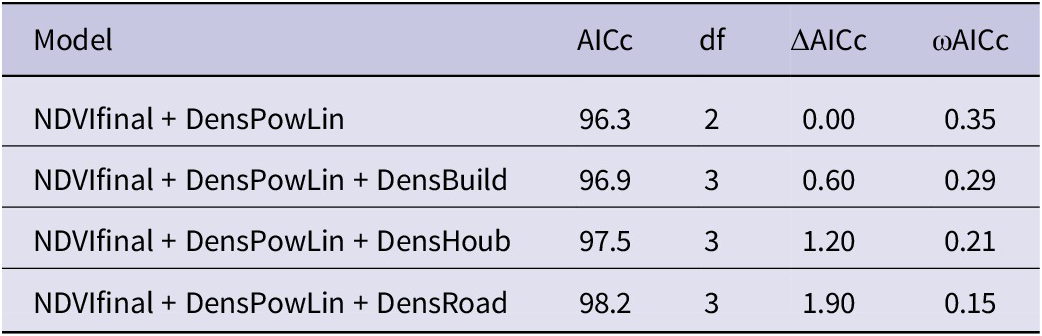
Sample of 83 display sites (29 occupied, 54 abandoned). We show the four best models ordered from best to worst according to ΔAICc (AICc ≤2). The corrected Akaike’s information criterion values (AICc), degrees of freedom (df), differences in AICc (ΔAICc), and corrected Akaike’s weights (ωAICc) are indicated. The following predictors were included in these GLMs: Normalised Difference Vegetation Index (NDVI) at the end of the study period (2018–2021) (NDVIfinal), density of powerlines (DensPowLin), density of buildings (DensBuild), density of houbaras (DensHoub), density of roads and busy tracks (DensRoad) (see Methods for details).
Model-averaged estimates of the display site predictor variables selected in the four most plausible models listed in Table 2
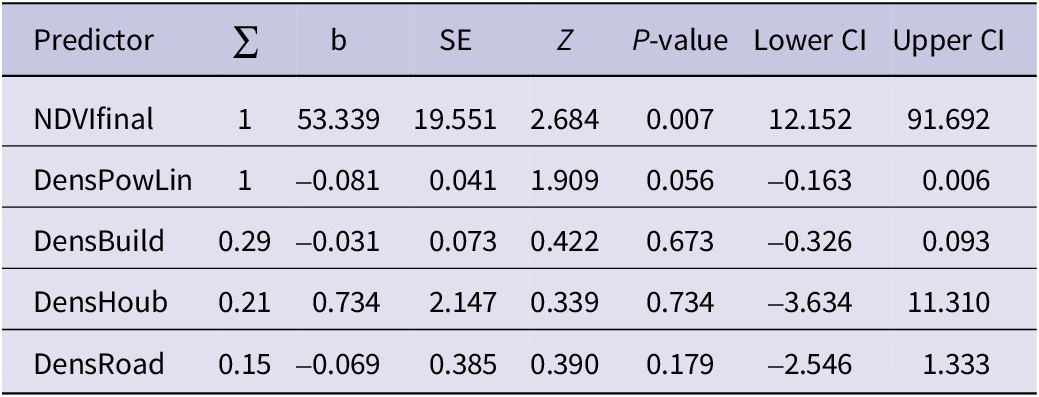
Values given indicate the relative importance of each predictor (∑, sum of the Akaike weights of the models in which the predictor was present), regression coefficients (b), standard errors (SE), P-values, Z-values (Z). and 95% confidence intervals for b (CI). See definitions of variables in Table 2.
Discussion
This study represents the first detailed analysis of the recent population decline of the Canarian houbara in Fuerteventura, the island that once represented the main stronghold of this endangered subspecies. Our study is relevant because it identifies the main factors that have contributed to the decline of this subspecies in Fuerteventura, and this information could be useful to avoid similar declines, both on this island and on other islands where the species is currently found. To quantify the decline, we compared the number of males counted on the island in 1998 with those counted in 2021. We found that male numbers had decreased by 58% over the last 23 years in Fuerteventura, and that 65% of the display sites identified in 1998 have been abandoned. We also investigated the relative importance of possible causes of population decline by comparing their incidence at all display sites occupied at the beginning of the study period and analysing which of these sites have disappeared and which remain occupied. Among all predictor variables analysed, two appeared to be of particular relevance for the observed population reduction, namely NDVI and density of powerlines.
We found significantly higher NDVI values at display sites that remained occupied until 2021 than at sites that were abandoned. Since NDVI is a measure of net primary production and thus a widely accepted proxy of habitat quality for birds that depend on herbaceous vegetation to feed and survive (Álvarez-Martínez et al. Reference Álvarez-Martínez, Suárez-Seoane, Palacín, Sanz and Alonso2015; Pettorelli et al. Reference Pettorelli, Vik, Mysterud, Gaillard, Tucker and Stenseth2005; Weber et al. Reference Weber, Schaepman-Strub and Ecker2018; Wiegand Reference Wiegand, Naves, Garbulsky and Fernández2008), this result indicates that males have remained in areas with a higher availability of food resources. Around display sites that remained occupied we also found higher densities of houbaras. Male houbaras aggregate on exploded leks, where females are attracted by food resources that are critical for breeding (Collins Reference Collins1984; Hellmich Reference Hellmich2003; Hingrat and Saint Jalme Reference Hingrat and Saint Jalme2005; Hingrat et al. Reference Hingrat, Saint Jalme, Ysnel, Lacroix, Seabury and Rautureau2004, Reference Hingrat, Saint Jalme, Chalah, Orhant and Lacroix2008; Ucero et al. Reference Ucero, Alonso, Palacín and Álvarez-Martínez2023). This would explain why display sites that have remained occupied show both a higher NDVI and a higher density of houbaras than sites that have been abandoned. Such a process has been described for Great Bustards Otis tarda at the scale of their whole distribution in the Iberian Peninsula (Álvarez-Martínez et al. Reference Álvarez-Martínez, Suárez-Seoane, Palacín, Sanz and Alonso2015). We discarded that this permanence in places with better habitat quality was the result of an aggregation of houbaras coming from other places on the island over the study period for two reasons. First, male and female houbaras are very faithful to their territories, and only a few females occasionally change their nesting site (Alonso et al. Reference Alonso, Abril-Colón, Palacín, Ucero and Álvarez-Martínez2022a,Reference Alonso, Abril-Colón, Palacín, Ucero and Álvarez-Martínezb; Ucero et al. Reference Ucero, Alonso, Palacín and Álvarez-Martínez2023; own unpublished data). Second, none of the male density values were higher in 2020–2021 than in 1997–1998. All values decreased, except one (Parque Natural de Jandia, in the south of the island), where the number of males remained the same (Table S2).
The significant differences shown between initial and final NDVI of occupied and abandoned display sites indicate that those display sites that remain occupied after the 23-year study period already had higher NDVI values at the beginning of that period. These results suggest that, two decades ago, currently occupied areas already had better habitat conditions and thus a higher carrying capacity than currently abandoned areas, which could have been crucial for the permanence of houbaras at these sites. This can also help to explain the variation in the abundance of other steppe bird species and the density of ravens at display sites occupied across the study period. In 1998, there was already a marginally significant trend towards a higher density of steppe birds around houbara display sites that two decades later remain occupied. In 2021, these differences between occupied and abandoned sites were more pronounced, suggesting that the extinction process is related to the local conditions of each site. In only two decades, differences in habitat quality related to food resource availability have increased steppe bird abundance at display sites occupied today, and this higher density of birds would have attracted ravens. All these results support our interpretation that differences in habitat quality between areas have been a major factor determining the permanence or abandonment of houbara territories in Fuerteventura.
The process that has led to the abandonment of breeding sites in areas with poor habitat may have been aggravated by the aridification of the landscape in Fuerteventura in recent years (Martin et al. Reference Martin, Santana and Nazco2013, Martín Esquivel et al. Reference Martín Esquivel, Marrero Gómez, Del Arco Aguilar, Garzon, Herrera and Zavala2015; Máyer and Marzol Reference Máyer and Marzol2016). Throughout the Macaronesian region, including the Canarian archipelago, there has been an increase in temperature over the last decades (Cropper and Hanna Reference Cropper and Hanna2014; Dorta et al Reference Dorta, López and Díaz2018). This increase is most evident in the eastern Canary Islands (Cropper, Reference Cropper2013; Dorta et al Reference Dorta, López and Díaz2018), and, specifically, Fuerteventura is the island in the entire Canarian archipelago where the greatest increase in temperature has been observed between 1970 and 2020, with values of 4.5ºC/100 years in mean temperature and 5.1ºC/100 years in minimum temperature (Machín and González Reference Machín and González2020). Fuerteventura is also the island with the steepest decrease in winter precipitation during that period, with a negative trend of -74.7 mm/100 years (Machín and González Reference Machín and González2020). The short-term outlook is by no means optimistic, since a further increase in the duration and severity of droughts in the Canary Islands is expected in the coming decades (Carrillo Reference Carrillo, Hernández-Barrera, Expósito, Díaz, González and Pérez2023; Cropper Reference Cropper2013; De Castro Reference De Castro, Martin Vide, Alonso and Moreno2005; IPCC Reference Lee and Romero2023), Fuerteventura being the island of the Canarian archipelago for which the highest increase in temperature and steepest decrease in precipitation are expected in the near future (Machín and González Reference Machín and González2020). This could accelerate the current extinction process of houbaras, since this is not a typical desert species, but rather one of arid and semi-arid environments, and therefore particularly sensitive to changes in precipitation regimes. Studies on the island of Lanzarote show that one third of houbaras migrate in summer to irrigated farmland, where they can find food resources absent in many breeding areas at that time of year, which appears to be critical for survival (Abril-Colón et al. Reference Abril-Colón, Alonso, Palacín, Álvarez-Martínez and Ucero2022a,Reference Abril-Colón, Alonso, Palacín, Ucero and Álvarez-Martínezb). Rising temperatures and decreasing rainfall in recent years only exacerbate this lack of food resources in summer. In Fuerteventura, many houbaras select the gavias as feeding sites, which may be considered equivalent to modern irrigation systems (Medina Reference Medina1999). However, agriculture on this island has suffered progressive abandonment since the middle of the last century (90% of the 7,456 ha of cultivated fields have been abandoned between 1960 and 1982; González-Morales Reference González-Morales1989). Many abandoned gavias still retain rainwater and show relatively abundant herbaceous and shrub cover (Launaea arborescens), which has probably helped to maintain a few houbara groups during some decades (Emmerson et al. Reference Emmerson, Barone, Lorenzo, Martín, Naranjo and Nogales1989, Reference Emmerson, Barone, Carrillo, Delgado, Lorenzo and Naranjo1990, Reference Emmerson, Barone, García, Lorenzo, Romero and Torrens1992; Hellmich Reference Hellmich1998; Martín et al. Reference Martín, Lorenzo, Hernández, Nogales, Medina and Delgado1997; Medina Reference Medina1999). Today, however, with the continued lack of maintenance, gavias have started to break down and have lost their capacity to retain water, which could have reduced their vegetation cover; in other cases, natural herbaceous or shrub vegetation has been removed by local farmers. This could have decreased substantially the available food for houbaras, ultimately affecting their annual productivity of juveniles, as suggested by the poor NDVI values recorded in abandoned display sites. These ideas require additional confirmation by a more detailed analysis relating NDVI with both habitat type and agricultural management, as well as with the annual productivity of juveniles in the population. Unfortunately, the annual series of productivity values available is too short to be related to changes in NDVI, but sufficient to state that juvenile productivity in Fuerteventura is significantly lower than in Lanzarote (Alonso et al. Reference Alonso, Ucero, Abril-Colón and Palacín2022c, Reference Alonso, Abril-Colón, Ucero and Palacín2024).
As for human infrastructure, overhead powerlines appear to be the main cause of abandonment detected in the analyses. Certain large-sized birds, such as cranes and bustards, are particularly vulnerable to collision with powerlines (Barrientos et al. Reference Barrientos, Ponce, Palacín, Martin, Martin and Alonso2012; Bernardino et al. Reference Bernardino, Bevanger, Barrientos, Dwyer, Marques and Martins2018; Janss and Ferrer Reference Janss and Ferrer2000; Jenkins et al. Reference Jenkins, Shaw, Smallie, Gibbons, Visagie and Ryan2011; Marcelino et al. Reference Marcelino, Moreira, Mañosa, Cuscó, Morales and García de la Morena2018; Raab et al. Reference Raab, Julius, Greis, Schütz, Spakovsky and Steindl2014; Silva et al. Reference Silva, Marques, Bernardino, Allinson, Andryushenko and Dutta2023; Uddin et al. Reference Uddin, Dutta, Kolipakam, Sharma, Usmani and Jhala2021; Vadász and Lóránt Reference Vadász and Lóránt2014), as they have lower manoeuvrability in flight and reduced frontal visibility compared with other birds (Martin Reference Martin2011; Martin and Shaw Reference Martin and Shaw2010). In species of the family Otididae, collision with powerlines represents the main cause of anthropogenic mortality (Alonso et al. Reference Alonso, Alonso and Muñoz-Pulido1994; Collar et al. Reference Collar, Baral, Batbayar, Bhardwaj, Brama and Burnside2017; Jenkins et al. Reference Jenkins, Shaw, Smallie, Gibbons, Visagie and Ryan2011; Marcelino et al. Reference Marcelino, Moreira, Mañosa, Cuscó, Morales and García de la Morena2018; Marques et al. Reference Marques, Martins, Silva, Palmeirim and Moreira2021; Palacín et al. Reference Palacín, Alonso, Martín and Alonso2017; Shaw Reference Shaw, Reid, Schutgens, Jenkins and Ryan2018; Silva et al. Reference Silva, Santos, Queirós, Leitäo, Moreira and Pinto2010, Reference Silva, Marques, Bernardino, Allinson, Andryushenko and Dutta2023; Uddin et al. Reference Uddin, Dutta, Kolipakam, Sharma, Usmani and Jhala2021). Powerlines have been cited as a major cause of mortality also in the Canarian houbara (García del Rey and Rodríguez-Lorenzo Reference Garcia-del-Rey and Rodriguez-Lorenzo2011; GREFA 2016; Gómez-Catasús et al. Reference Gómez-Catasús, Carrascal, Moraleda, Colsa, Garcés and Schuster2020; Lorenzo Reference Lorenzo1995; Lorenzo and Ginovés Reference Lorenzo and Ginoves2007; Lorenzo et al. Reference Lorenzo, Linares and Abreu1997), and a recent study with marked birds has confirmed the importance of powerline casualties in this species (Alonso et al. Reference Alonso, Abril-Colón, Ucero and Palacín2022b, Reference Alonso, Abril-Colón, Ucero and Palacín2024), suggesting that this factor is affecting the demography of the Canarian houbaras, especially in Fuerteventura, where juvenile productivity is very low (Alonso et al. Reference Alonso, Ucero, Abril-Colón and Palacín2022c, Reference Alonso, Abril-Colón, Ucero and Palacín2024). There are studies showing how the presence of powerlines can lead to the extinction of local populations of other bustard species. A Great Bustard lek with 15 males disappeared in a few years in central Spain due to the high mortality caused by a single powerline that crossed the main display area (Alonso et al. Reference Alonso, Martín, Palacín, Magaña and Martín2003), and in Portugal, Little Bustard Tetrax tetrax populations may be displaced by the construction of powerlines, which acting in synergy with other habitat degradation factors, can ultimately cause local extinctions (Silva et al. Reference Silva, Santos, Queirós, Leitäo, Moreira and Pinto2010).
In addition to powerlines, roads were also retained as a significant factor determining display site abandonment in some of the plausible models developed. A study with tagged houbaras showed that roadkills are the second leading cause of anthropogenic mortality of the species (Alonso et al. Reference Alonso, Abril-Colón, Ucero and Palacín2024), confirming the importance of this mortality source (Tejera et al. Reference Tejera, Rodríguez, Armas and Rodríguez2018). Roadkills added to powerline casualties might have well contributed to the disappearance of many display sites over the last 23 years in Fuerteventura, particularly where the habitat has already been deteriorated. With regard to buildings and urban nuclei, our study detected the displacement of four display sites from their initial locations in 1998 following the construction of new, or expansion of nearby urban areas. Previous habitat selection studies found that human settlements affect houbara distribution in northern Africa and the Canary archipelago (Carrascal et al. Reference Carrascal, Seoane, Palomino and Alonso2006, Reference Carrascal, Palomino, Seoane and Alonso2008; Chammem et al. Reference Chammem, Selmi, Khorchani and Nouira2012; Hingrat et al. Reference Hingrat, Saint Jalme, Chalah, Orhant and Lacroix2008; Le Cuziat et al. Reference Le Cuziat, Lacroix, Roche, Vidal, Médail and Orhant2005; Schuster and Iglesias-Lebrija Reference Schuster and Iglesias-Lebrija2012) and that males select display sites far from this infrastructure (Ucero et al. Reference Ucero, Alonso, Palacín and Álvarez-Martínez2023).
Finally, although there has been a notable decrease in the number of houbara birds over the study period in practically all areas of the island, the three areas showing the lowest declines were the Tindaya plains, Corralejo Natural Park, and Jandia Natural Park. These three areas already had a protected status at the beginning of the study period (SPA and/or Natural Park; Table S2 and Figure 1). Although the conservation authorities probably decided to protect those areas of the island that already had a higher number of Canarian houbaras and other steppe birds more than two decades ago (see Table S2), our results show that over the study period houbara numbers still benefitted from that protection status.
Conclusions and Recommendations
In sum, our study shows that the main causes of the Canarian houbara decline in Fuerteventura have been poor habitat quality in many areas on the one hand, and the construction of various human infrastructures on the other. In many areas, habitat quality could have deteriorated in recent years by the extreme aridification of the terrain in the eastern Canary Islands because of recent climatic events linked to global change, which have especially affected Fuerteventura, the most arid island of the whole archipelago. This has undoubtedly contributed to a drastic reduction in the breeding productivity of houbaras in this island. As for the effect of infrastructures, the negative effects of powerlines stand out, increasing adult mortality in an already decimated Canarian houbara population.
The Canarian houbara is currently on the brink of extinction in Fuerteventura. Any further decline is extremely dangerous, as the current population is close to the minimum viability size (Alonso et al. Reference Alonso, Abril-Colón, Ucero and Palacín2024). In the neighbouring island of Lanzarote, where houbara densities are higher (Alonso et al. Reference Alonso, Palacín and Abril-Colón2020), display sites abandoned due to the death of a male are immediately occupied by another male (Alonso et al. Reference Alonso, Abril-Colón, Palacín, Ucero and Álvarez-Martínez2022a), however this is not the case in Fuerteventura where numbers are already too low. To ensure houbara survival, the following conservation measures aimed at improving habitat quality and reducing anthropogenic mortality should be urgently implemented. First, an appropriate cover of Launaea arborescens shrubland needs to be restored in many areas of the island where the breeding habitat has been degraded over many decades. Concurrently, many other areas, at serious risk of degradation, need to be maintained in order to ensure a sufficient habitat quality for houbaras to breed successfully. Second, the damaged gavias should be restored, and fields of alfalfa or other leguminous plants should be cultivated in several areas to increase food availability especially in summer, the most critical season for the survival of Canarian houbaras. A mosaic of scrubland, irrigated cultivated fields, and fallow fields has been found to be the best habitat for the Canarian houbara in summer (Abril-Colón et al. Reference Abril-Colón, Alonso, Ucero and Palacín2023), and such habitat should also be provided to houbaras in Fuerteventura. Third, in particular in the main houbara core areas, all telephone lines and at least the most dangerous sectors of powerlines should be buried, and the construction of new powerlines should be avoided. If undergrounding of powerlines is delayed at some of these dangerous sectors for cost reasons, these sectors should be marked with anti-collision devices that are effective at night, because houbaras are nocturnal migrants. For this purpose, research on nocturnal specific fight diverters should be carried out to find the best cost-effective option to mitigate nocturnal collisions of Canarian houbaras. Another measure that could reduce collisions would be the replacement of multiple-wire lines by a single braided wire. However, we caution that neither the marking of lines nor the replacement of multi-wire lines with a single stranded wire can be taken as definitive measures, as they are not as effective as required, given the extremely critical situation of houbaras in Fuerteventura, and we strongly recommend the undergrounding of dangerous sections as the only safe measure. Fourth, planning of new energy infrastructure should take into account the home range and flight movements of Canarian houbaras, both inside and outside SPAs, as recommended in other bustard species (Palacín et al. Reference Palacín, Farias and Alonso2023). Fifth, traffic speed limitations should be implemented at some sectors of roads crossing the most important breeding aggregations of the species in the island. All other road sectors where houbaras are likely to be run over should be identified and mapped, and appropriate traffic signs to inform drivers and advise them to reduce speed should be located. Furthermore, the creation of new roads and tracks should be limited and restrictions on vehicle traffic on certain tracks during the breeding season should be considered. Finally, the proliferation of scattered buildings in areas with houbaras should be prohibited and urban sprawl should be controlled. This would prevent further habitat loss and degradation through the construction of infrastructure and minimise disturbance to the birds during the breeding period. As an additional tool to control the effectiveness of these measures, surveillance should be increased in all houbara regions of the island, especially in protected areas, and surveys of the breeding population and juvenile productivity should be carried out each year to monitor the demographic trends of this endangered population.
Once all these in situ conservation measures have been implemented to eliminate the causes of population decline discussed in this and previous studies, the question of whether to reinforce the Fuerteventura houbara population through measures such as captive breeding, or translocation of individuals from Lanzarote, could be addressed. Captive breeding should not be addressed before the effectiveness of the above in situ measures has been demonstrated. As for translocation, it cannot be considered at present, as demographic models for Lanzarote also predict a decline in the houbara population on that island, where the productivity of young is higher than on Fuerteventura, but not enough to allow individuals to be removed to reinforce the Fuerteventura population (Alonso et al. Reference Alonso, Abril-Colón, Ucero and Palacín2024).
Supplementary material
The supplementary material for this article can be found at http://doi.org/10.1017/S0959270924000212.
Acknowledgements
We thank Joachim Hellmich, who passed away on September 2021, for his pioneering work and dedication to the study of the Canarian Houbara Bustard for many years. We would like to dedicate this paper to him. We also thank M.A. Cabrera and A. Delgado for the capture permits, and S. Menéndez, N. Guerra, and the rangers of the Cabildo of Fuerteventura for their collaboration. We thank the authorities of the Cabildo de Fuerteventura and the Consejería de Transición Ecológica, Lucha Contra el Cambio Climático y Planificación Territorial of the Canarian regional government for the permits to work with Canarian Houbara Bustards. Author contributions: AU: conceptualisation (equal), methodology (equal), formal analysis (lead), investigation (lead), data curation (lead), writing – original draft, writing – review and editing (equal); JCA: conceptualisation (lead), methodology (equal), research (equal), resources, writing – review and editing (equallead), supervision, project management, funding acquisition. CP: conceptualisation (supporting), methodology (supporting), investigation (equal), writing – review and editing (supporting). IA-C: investigation (equal), writing – review and editing (supporting); JM. Á-M: formal analysis (supporting), investigation (supporting), data curation (supporting), writing – review and editing (supporting). This work was supported by Red Eléctrica de España (REE) through contract 20164379 with Agencia Estatal Consejo Superior de Investigaciones Científicas (CSIC), and by CSIC project 202030E303, both awarded to JCA. AU was supported by a FPU predoctoral contract from the Ministerio de Ciencia, Innovación y Universidades (FPU18/06389). Data availability: data will be made available on request.


 Open access

