


Introduction
Collision with powerlines is recognised as a major source of direct anthropogenic mortality of birds (Loss et al. Reference Loss, Will and Marra2015), which is expected to increase due to the current global expansion of electric grids (Bernardino et al. Reference Bernardino, Bevanger, Barrientos, Dwyer, Marques and Martins2018). Although this mortality factor has been referenced in the scientific literature since the early 1970s, its mitigation is not fully effective, particularly in collision-prone species (Barrientos et al. Reference Barrientos, Ponc, Palací, Martín, Martín and Alonso2012; Bernardino et al. Reference Bernardino, Bevanger, Barrientos, Dwyer, Marques and Martins2018, Reference Bernardino, Martins, Bispo and Moreira2019; Shaw et al. Reference Shaw, Reid, Gibbons, Pretorius, Jenkins and Visagie2021; Silva et al. Reference Silva, Marques, Bernardino, Allinson, Andryushchenko and Dutta2023). Despite their smaller magnitude, collision with fences is also a mortality factor for some bird species (Drewitt and Langston Reference Drewitt and Langston2008).
Powerlines bisecting open areas such as steppe habitats pose high collision risk (Bernardino et al. Reference Bernardino, Bevanger, Barrientos, Dwyer, Marques and Martins2018) and several threatened steppe bird species, such as bustards and sandgrouse, are known to be impacted by collisions with these infrastructures. Bustards are highly susceptible to collision with powerlines, as they combine multiple behavioural and morphological traits that significantly increase their risk of collision (Silva et al. Reference Silva, Marques, Bernardino, Allinson, Andryushchenko and Dutta2023). As bustards encompass several endangered species, many studies have focused on understanding patterns of mortality and finding efficient mitigation measures. However, due to the uncertainty of the mitigation measures, burying the powerlines or routing them away from bustards are the most recommended solutions to avoid mortality (Silva et al. Reference Silva, Marques, Bernardino, Allinson, Andryushchenko and Dutta2023). Similarly, collisions with powerlines have also been reported for different threatened sandgrouse species (Barrientos et al. Reference Barrientos, Ponc, Palací, Martín, Martín and Alonso2012; Gómez-Catasús et al. Reference Gómez-Catasús, Carrascal, Moraleda, Colsa, Garcés and Schuster2020; Purevdorj and Sundev Reference Purevdorj and Sundev2012). Collisions with fences have been recorded for bustards (Silva et al. Reference Silva, Marques, Bernardino, Allinson, Andryushchenko and Dutta2023) and sandgrouse (C. Pacheco, personal data), but they appear to be less common.
The use of high-resolution tracking technology has contributed to our increased knowledge of birds’ interactions with anthropogenic infrastructures by providing detailed temporal and spatial information on birds’ movement patterns. Key information includes precise data on mortality rates (Marcelino et al. Reference Marcelino, Moreira, Mañosa, Cuscó, Morales and García de la Morena2017; Sergio et al. Reference Sergio, Tavecchia, Tanferna, Blas, Blanco and Hiraldo2019b), predictions of collision risk (Murgatroyd et al. Reference Murgatroyd, Bouten and Amar2021; Schaub et al. Reference Schaub, Klaassen, Bouten, Schlaich and Koks2020), characterisation of bird displacement (Marques et al. Reference Marques, Batalha and Bernardino2021), and response behaviours in close proximity to the structures (Jiguet et al. Reference Jiguet, Schwemmer, Rousseau and Bocher2021). However, to our knowledge, no studies have assessed the timing of collisions even though modern tags provide almost “real-time” monitoring (Sergio et al. Reference Sergio, Tanferna, Blas, Blanco and Hiraldo2019a). In this study, we present, for the first time, evidence on the timing of collision with powerlines and fences of three threatened steppe birds, i.e. Little Bustard Tetrax tetrax, previously identified as a collision-prone species, Black-bellied Sandgrouse Pterocles orientalis, and Pin-tailed Sandgrouse Pterocles alchata. We discuss the implications of our findings for the mitigation of collisions.
Methods
In this study, we used three GPS tracking data sets one of which was a long-term data set of 93 Little Bustards tagged in Alentejo (Portugal) and Extremadura (Spain) from 2009 to 2022. Little Bustards were fitted with different tracking devices: 30 g solar GPS ARGOS Platform Transmitter Terminals (PTT tags) (https://www.microwavetelemetry.com/) and solar GPS/GSM tags from Movetech Telemetry (25 g; https://movetech-telemetry.com/), 25 g E-Obs (https://e-obs.de/), and 15 g, 20 g, and 25 g from Ornitela OT (https://www.ornitela.com/). The devices were set to collect GPS information at different temporal resolutions, from 20 minutes up to 2 hours. PTT devices contained a sensor that indicated when movement ceased to be obtained, while all the remaining devices were equipped with a 3D accelerometer, measuring acceleration of surge, sway, and heave at a frequency between 1 Hz and 20 Hz for bursts of 10 and 4 seconds, respectively. A fraction of the mortality data set of the Little Bustard, representing two collision events with powerlines from 2009 to 2013, was previously reported in a study on the species survival in the Iberian Peninsula (Marcelino et al. Reference Marcelino, Moreira, Mañosa, Cuscó, Morales and García de la Morena2017).
A total of 38 Black-bellied Sandgrouse were tracked in Extremadura and Castilla-La Mancha (Spain) and Alentejo (Portugal) in 2021 and 2022 using 10 g Ornitela OT and 6 g Druid loggers (https://interrex-tracking.com/), set with 10-minute or 30-minute resolution. Ornitela OT delivered 3D accelerometer data at 20 Hz frequency for 4-second bursts, and Druid provided overall dynamic body acceleration (ODBA) from an accelerometer recording acceleration at 25 Hz frequency for bursts of 3 seconds.
In addition, a total of 29 Pin-tailed Sandgrouse were tagged in Extremadura in 2021 and 2022 using 5 g and 6 g Druid loggers set to a minimum of 30-minute resolution. These devices provided ODBA data derived from an accelerometer recording acceleration at 25 Hz frequency for bursts of 3 seconds.
Devices were deployed using a similar attachment method for the three species which was a full thoracic harness made of ribbon Teflon, representing less than 3.1% and 4.7% of the weight of sandgrouse and Little Bustard, respectively.
In all cases, the tracking devices transmitted data at least once per day, allowing daily checks on the birds’ movements and activity, and to confirm that each bird was alive. The mortality of the bird was considered probable when: (1) the tracking signal was lost for a long period; (2) overlapping locations were registered; (3) the mortality sensor was activated; (4) the accelerometer readings indicated immobility for a long period of time (Burnside et al. Reference Burnside, Collar, Scotland and Dolman2016) (Figure 1). In these cases, the last GPS position of each bird was checked in the field, confirming mortality by locating the bird’s remains and tag, and, whenever possible, identifying the cause of death. Collisions with powerlines or fences were considered the cause of mortality when the bird remains was found near or underneath a powerline or fence, with clear signs of trauma (Marcelino et al. Reference Marcelino, Moreira, Mañosa, Cuscó, Morales and García de la Morena2017).
Examples of collisions with powerlines detected by analysis of GPS tracking data.

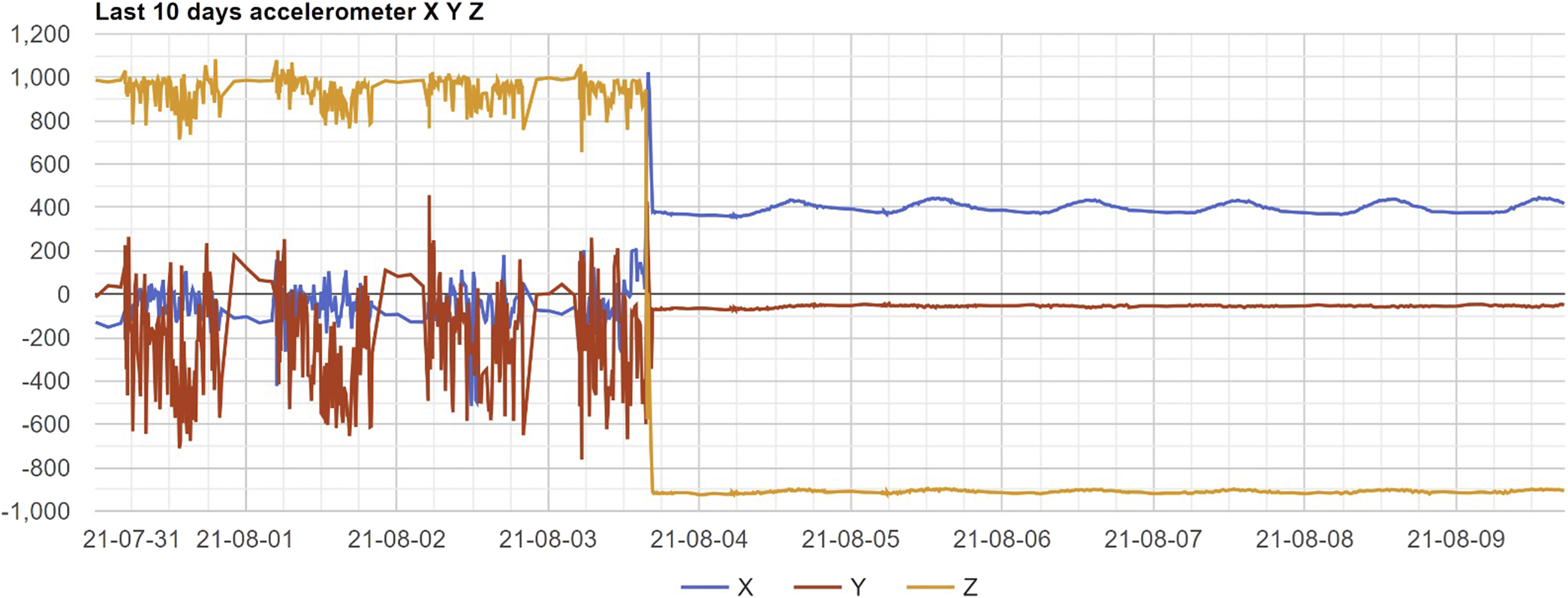
The time of collision was assigned to the time-period between the last GPS-fix with the last evidence that the bird was alive and the first GPS-fix with a suspicion of mortality. When tracking devices included an accelerometer, we used the data delivered by this sensor to identify the hour of bird death more accurately, as mortality can be easily spotted by the lack of acceleration values in the X, Y, and Z axis (Figure 2).
Example of an accelerometer signature of a mortality generated at the Ornitrack website (https://cpanel.glosendas.net/).
Results
Out of a data set of 160 tracked individuals, we detected eight collisions involving adult birds, six Little Bustards, one Black-bellied Sandgrouse, and one Pin-tailed Sandgrouse (Table 1). Six collisions were with powerlines (five Little Bustards and one Pin-tailed Sandgrouse); four in distribution powerlines and two in transmission powerlines. There was one collision in a fence (a Little Bustard) and, in one case, it was not possible to confirm if the collision occurred in a fence or in a powerline (a Black-bellied Sandgrouse).
Summary of collisions between steppe birds and powerlines (PL) or fences, recorded using tracking data. The path from the last GPS-fix with evidence that the bird was alive to the first GPS-fix with a suspicion of mortality was used to determine heading. For infrastructure both minimum and maximum heights (below and top wire levels) are presented. W = winter; PB = post-breeding; B = breeding

* Number of sets of wires arranged at different heights.
The height of the structures ranged from 1.2 m to 46.6 m, demonstrating a wide variety of collision risk heights. Two of the transmission powerlines had large spirals (30 cm diameter) as wire marking devices. Both fences were 1.2 m and used for sheep herding, and one of them had two barbed wire rows on top of the fence. Further details on the infrastructure’s features can be found in Table 1.
Mortality was recorded throughout the year, with four events occurring during the post-breeding (summer) season, two events during breeding, and another two during winter. It was possible to trace the hour of collision in seven of the eight events, and with a precision of less than two hours: five collisions occurred during daytime and one at night. In two other cases it was not possible to discern if the collision occurred at sunset/sunrise or during the night. The data collected suggest that no movement at the origin of a collision was performed in counter-light, as indicated by the direction of the movement path (Table 1).
Discussion
In this study, we present the first data on hour of bird collisions with powerlines or fences using GPS tracking data. Using a large GPS tracking sample size, the number of collisions found was relatively small but revealed the potential of using tracking data to better understand the interactions of birds with anthropogenic infrastructures, such as powerlines or fences. From eight events, we were able to determine precisely the hour of seven collisions (87.5%), even with devices programmed to collect information at a relatively coarse sampling frequency (every two hours). Precision is related to the settings of the tracking devices, such as sampling frequency, which can be greatly improved if GPS location is used in combination with raw accelerometer data or processed ODBA estimates that can be provided at a higher rate, which have limited impact on the tag battery (Brown et al. Reference Brown, LaPoint, Kays, Heidrich, Kümmeth and Wikelski2012). Birds were tagged in accordance with the best practices and guidelines described for the target species (Casas et al. Reference Casas, Benítez-López, García, Martín, Viñuela and Mougeot2015; Ponjoan et al. Reference Ponjoan, Bota and Mañosa2010), and we did not foresee any obvious effect of the GPS devices and respective attachments that would favour collisions on powerlines or fences, unless they increased the area for collision and so could increase the risk of collision.
Collision risk has been described as increasing with bad weather and poor light conditions (Anderson Reference Anderson1978; Bernardino et al. Reference Bernardino, Bevanger, Barrientos, Dwyer, Marques and Martins2018; McNeil et al. Reference McNeil, Rodriguez and Ouellet1985). However, our data indicate that this is not the case for the studied species: five of the eight incidents (62.5%) occurred during the day, and four of those occurred during the summer (n = 3) and spring (n = 1), when visibility is usually favourable in the studied areas. This highlights the fact that visual perception plays an important role in the collision risk of these species (Bernardino et al. Reference Bernardino, Bevanger, Barrientos, Dwyer, Marques and Martins2018; Martin Reference Martin2011; Martin and Shaw Reference Martin and Shaw2010), putting them at risk of collision irrespective of the visibility conditions.
Regarding collisions with powerlines, we found more collisions in distribution lines than in transmission lines, which supports earlier suspicions that the distribution network could be responsible for a higher number of fatalities (Marques et al. Reference Marques, Martins, Silva, Palmeirim and Moreira2020; Silva et al. Reference Silva, Marques, Bernardino, Allinson, Andryushchenko and Dutta2023). Most studies on bird collisions have focused on transmission networks (that carry electricity at high voltages from electrical production plants to substations), as these are larger and taller infrastructures, resulting in a larger number of collisions per kilometre of line (Bernardino et al. Reference Bernardino, Bevanger, Barrientos, Dwyer, Marques and Martins2018; Silva et al. Reference Silva, Marques, Bernardino, Allinson, Andryushchenko and Dutta2023). The larger and more dispersed distribution networks (that deliver electricity at lower voltages to individual consumers), however, increase the likelihood of a collision with a distribution line.
For the Little Bustard, a collision-prone species, our results suggest that collisions occur throughout the year, as previously described (Marques et al. Reference Marques, Martins, Silva, Palmeirim and Moreira2020), and at different hours of the day, even in periods of good visibility. This pattern of sporadic mortality throughout the year and the day makes minimising impacts more complex. Little Bustards are mostly migratory in Iberia, performing movements between specific breeding, summering, and/or wintering sites (García de la Morena et al. Reference García de la Morena, Morales, Bota, Silva, Ponjoan and Suárez2015), and using stop-overs in between areas (Alonso et al. Reference Alonso, Correia, Marques, Palmeirim, Moreira and Silva2020). Also, Little Bustards are night migrants (Villers et al. Reference Villers, Millon, Jiguet, Lett, Attie and Morales2010), performing nocturnal flights interspersed with frequent stops, and do not appear to avoid areas with powerlines as stop-over sites (Alonso et al. Reference Alonso, Correia, Marques, Palmeirim, Moreira and Silva2020), making collision during migration a potential hazard. Therefore, it is essential that mitigation actions consider the species’ whole range.
Whenever building a new overhead powerline, the most effective strategy to mitigate bustards’ collisions lies in careful and adequate route planning to avoid areas used by these birds (Marques et al. Reference Marques, Martins, Silva, Palmeirim and Moreira2020; Silva et al. Reference Silva, Marques, Bernardino, Allinson, Andryushchenko and Dutta2023). Wire marking is a common mitigation measure, but its effectiveness is highly variable and dependent on the type of marker (Barrientos et al. Reference Barrientos, Ponc, Palací, Martín, Martín and Alonso2012; Ferrer et al. Reference Ferrer, Morandini, Baumbusch, Muriel, De Lucas and Calabuig2020; Marques et al. Reference Marques, Martins, Silva, Palmeirim and Moreira2020; Shaw et al. Reference Shaw, Reid, Gibbons, Pretorius, Jenkins and Visagie2021; Silva et al. Reference Silva, Marques, Bernardino, Allinson, Andryushchenko and Dutta2023). In fact, in the present study we found two mortality events at powerlines marked with large spirals. However, when deploying “bird flight diverters” (BFDs), i.e. devices fitted to wires to increase the visibility of the cables, in powerlines routed in areas with Little Bustards, devices should incorporate (1) reflective and/or luminescent parts to signal the powerline during night-time, with the aim of reducing collision risk during this period and (2) dynamic/moving parts to increase birds’ awareness of the structure in both good and bad visibility periods. Our data also highlighted that fences can be a threat to steppe birds, increasing the anthropogenic mortality of these species. Therefore, barbed wire fences should be avoided or marked in key steppe areas. Steppe bird collision with fences is an overlooked topic and should be the object of future studies.
The data presented in this study provide additional evidence on the risk of collision of steppe birds with powerlines, adding to previous studies on this topic (e.g. Janss and Ferrer Reference Janss and Ferrer2000; Marques et al. Reference Marques, Martins, Silva, Palmeirim and Moreira2020; Silva et al. Reference Silva, Marques, Bernardino, Allinson, Andryushchenko and Dutta2023). Little Bustard fatalities are documented across the entire species’ range (Silva et al. Reference Silva, Arroyo, Marques, Morales, Devoucoux, Mougeot, Bretagnolle, Traba and Morales2022), with an estimated adult yearly mortality rate of 3.4–3.8% in the Iberian Peninsula (Marcelino et al. Reference Marcelino, Moreira, Mañosa, Cuscó, Morales and García de la Morena2017), one of the highest mortality rates due to collision ever recorded (Silva et al. Reference Silva, Arroyo, Marques, Morales, Devoucoux, Mougeot, Bretagnolle, Traba and Morales2022). Such high figures suggest that collisions have the potential to affect the population dynamics of the species and are considered a significant threat to Little Bustards (Morales and Bretagnolle Reference Morales and Bretagnolle2022). Iberian sandgrouse populations have a very low productivity (Mougeot et al. Reference Mougeot, Fernández-Tizón, Jiménez and López-Jiménez2021a, Reference Mougeot, Fernández-Tizón, Jiménez and López-Jiménez2021b) and any additional mortality is also likely to have a significant impact on the viability of their declining populations. This work highlights the value of high-resolution tracking studies to better understand and mitigate anthropogenic mortalities in steppe birds and other threatened species.
Acknowledgements
We would like to thank all the colleagues, field technicians, and volunteers that have participated in the capture and tagging campaigns of the Steppe Bird Move group since 2009. We particularly thank Mario Fernandez-Tizón for his help with the fieldwork in Spain. We would also like to acknowledge Junta de Extremadura for the joint long-term tracking project of the Little Bustard. This work was co-funded by the project NORTE-01-0246-FEDER-000063, supported by Norte Portugal Regional Operational Programme (NORTE2020), under the PORTUGAL 2020 Partnership Agreement, through the European Regional Development Fund (ERDF). Bird tracking was funded by: EDP S.A. “Fundação para a Biodiversidade”; 0620_BIOTRANS_4_E “Gestión Integrada de la Biodiversidad en el Área Transfronteriza”; Movetech Telemetry; Enel, Green Power España, SL; EcoEnergías del Guadiana S.A.; NATURGY RENOVABLES, SLU; the Project TED2021-130352B-I00 (funded by MCIN/AEI/10.13039/ 501100011033 and the EU “NextGenerationEU”/PRTR»), and SEO/Birdlife (Migra, Fundación Iberdrola).


 Open access

