





In his chapter titled “The Propaganda of History,” W.E.B. DuBois (Reference Du Bois and Levering Lewis1935) admonished the “Columbia School” of historians, some of whom DuBois outed as former confederate soldiers, for arguing that Black citizens’ deficiencies brought the end of Reconstruction. While this debate unfolded a century ago, the specter of propaganda continues to haunt social science pertaining to race, law, and the redistribution of public resources. This is especially relevant in debates over police funding, where media studies scholars have invoked propaganda through the concept “Copaganda,” to describe “fictional media that normalizes the power, presence, and violent practices of the police” (Hatrick and González Reference Hatrick and González2022, 3). Like in the period after Reconstruction, academics play a role in debates over police funding by asking research questions and evaluating claims made by elected officials and activists.
History indicates that academics are far from neutral actors in these debates. Social scientists have produced criminalized racial categories (Muhammad Reference Muhammad2019), and legitimized public investment in policing (Balto Reference Balto2019; Schrader Reference Schrader2019) and prisons (Hinton Reference Hinton2016; Murakawa Reference Murakawa2014). But a question remains: what role have academics played in shielding police from social movement pressure for abolition in the Black Lives Matter era? Scholars have begun to investigate this through critiques of the “evidence-based paradigm” in criminological research (Collins Reference Collins2022), the operationalization of race in policing studies (Butler Reference Butler2017; Carbado Reference Carbado2022; Obasogie and Provenzano Reference Obasogie and Provenzano2023), the overemphasis on training as solutions to policing problems (Vitale Reference Vitale2018), and scholars’ uncritical adoption of “cop thinking” in their research (Piston et al., Reference Piston, Harris, Hedlund, Johnson, Tatz and WalkerForthcoming 2025). Revisiting social science’s relationship with policing is a fertile ground for advancing empirical critical race theory, specifically the enterprise of extrapolating hidden ways that race constructs law and vice versa through knowledge production (Obasogie Reference Obasogie2013).
We examine this question through a mixed method content analysis of 143 studies of policing published between 2011 and 2022. We obtained our sample of studies by scraping publicly listed grants made to researchers for studying police from Arnold Ventures, the MacArthur Foundation, and the National Institute of Justice (NIJ). We then collected policing studies produced from these grants using the Web of Science database, which enabled us to find publications by funder or grant number. We sampled from these prestigious funding agencies to produce a body of high quality and rigorous studies, as each funder undergoes some form of peer review or evaluation before awarding funds to researchers. After reading and coding all 143 studies, we combined the dataset with media mention data from Alt-metric (a data science company that tracks and compiles data on where published research is mentioned online) to analyze the quantity and quality of news media coverage for each study. Finally, we filed Freedom of Information Act (FOIA) Requests to all police departments involved in the studies in our sample for contracts signed between researchers and police departments that made many of these studies possible.
Findings revealed a type of policing social science that we call Academic Copaganda, which we define as studies contesting abolitionist claims by authors (1) masking their conflicts of interest, or (2) espousing police epistemology. Academic Copaganda accounted for 21% of the studies in our sample (30 out of 143) but accounted for most media coverage of policing research after 2020. A network of national police organizations, academic institutions, public relations firms, and funding agencies produced and distributed Academic Copaganda.
This article makes several contributions. We advance critical race studies of science by illuminating new methods, such as the use of the FOIA, for gathering evidence on research practices legitimizing the racialized institution of policing. Academic Copaganda represents an additional manner whereby social science, under the guise of positivism, assists police in warding off pressure for change. For the field of law and society, our paper advances efforts to better understand the forces legitimating policing in the face of social movement pressure or public legitimacy crises (Cheng Reference Cheng2024; Schwartz Reference Schwartz2023). We highlight ways that segments of academia contribute to shielding police from pressure to outsource their functions to other agencies or organizations. Academic Copaganda should be a concern for scholars invested in evidence-based policy research, reform, and abolition, because it distorts knowledge about public safety innovation and may further erode trust in social science.
Social science and racialized control through criminal institutions
Scholarship on the intersection of critical race theory and science studies have long documented a troubling and persistent relationship that has biologized race (Duster Reference Duster2005; Morning Reference Morning2011; Roberts Reference Roberts2012), neglected the health of Black communities (Benjamin Reference Benjamin2013; Nelson Reference Nelson2013; Washington Reference Washington2008), and naturalized racial inequality (Fischer et al. Reference Fischer, Hout, Sánchez Jankowski, Lucas, Swidler and Voss1996). The relationship between social science and policing, however, has its own unique and rich history. The seed of this relationship starts with the advent of eugenics and social Darwinism in the late 19th century, which provided justification for racial stratification in seemingly democratic societies (Zuberi Reference Zuberi2001). Through a critical reading of social statistics’ founding figures, Zuberi (Reference Zuberi2001) found that scholars like Thomas Malthus, Herbert Spencer, and Frances Galton pursued arguments to quantify and legitimize human difference based on race and class.
Eugenics and social Darwinism served as the basis for Frederick L. Hoffman’s infamous book Race Traits and Tendencies of the American Negro (Reference Hoffman1896), which Muhammad described at length as the first major study to racially criminalize Black people through statistics. Hoffman emphasized the “innate self-destructive tendencies of Black people” as the explanation for their social standing and downplayed the role of social and economic conditions (Muhammad Reference Muhammad2019, 35). Hoffman’s use of crime statistics helped racists at the time overcome perceptions of a “proslavery bias,” as Hoffman was a German-born immigrant who presented himself to white audiences as more objective and distant from the charged debate (Muhammad Reference Muhammad2019). Hoffman’s research provided the positivist discourse necessary for white elites to deflect abolitionists’ demands for legal and economic equality.
After World War II, social science continued supporting the development of institutions for maintaining racialized social control. Specifically, social science began supporting the expansion of policing by pathologizing Black people. Although social scientists increasingly rejected biological racism, scholars advanced a “culture of poverty” discourse about Black criminality that influenced national policy and served as the intellectual foundation for mass incarceration (Hinton Reference Hinton2016). In 1960, liberal sociologists Richard Cloward and Lloyd Ohlin argued that crime committed by Blacks and Latinos was the product of “systemic barriers” rather than individual behavior (Cloward and Ohlin Reference Cloward and Ohlin1960), a claim which policy advocates used to argue for new institutions to better serve low-income communities.
These evidence-based calls for social investment served as the basis for President Lyndon B. Johnson’s war on poverty programs which, according to Hinton (Reference Hinton2016), served as the foundation for the exponential increase in incarceration through the system of federal-local government partnerships it created. As the war on poverty evolved into a war on crime under Republican President Richard Nixon, the federal-local government relationship that originally funneled resources to local social services now funneled federal resources to local police departments for surveillance and repression (Hinton Reference Hinton2016).
With policing and incarceration growing rapidly, the relationship between social science and policing evolved into an enterprise of helping the state manage communities of color. For example, Schrader (Reference Schrader2019) found that the most influential policing researchers honed their approaches to police management during their time in the military, which involved policing American colonies like the Philippines. August Vollmer and his PhD student Orlando Wilson at the UC Berkeley School of Criminology applied lessons learned from managing police in Manila and post-World War II Japanese cities to managing police in U.S. cities. Wilson applied these lessons in Chicago, where he left his position as Dean of the Berkeley School of Criminology to become Police Chief in 1960 (Balto Reference Balto2019). Wilson was the first to apply proactive policing in Chicago, which entailed enforcing police infractions no matter how small and using crime statistics to justify them (Balto Reference Balto2019). The ascendance of policing science, which was tightly interwoven with policymaking, in the 1950s and 1960s pathologized Black and Brown communities to legitimize investment in carceral institutions of social control.
In the 1980s, the task of managing police extended to a select group of Black social scientists. Forman (Reference Forman2017) found that some historically Black colleges and universities like Howard University advocated for carceral responses to crime by hosting crime conferences in collaboration with local policymakers to build Black support for tough on crime approaches. For Forman (Reference Forman2017), racism constrained Black people’s choices for addressing crime. Although Black leaders supported both tough-on-crime policies and investment in social services, the federal government more heavily invested in the former.
The 1980s, 1990s, and 2000s, saw yet another evolution of social scientists’ role in managing police that Feeley and Simon (Reference Feeley and Simon1992) called the “New Penology,” an administrative criminology that is technocratic, behaviorist, and realistic in tone and oriented toward devising techniques for managing crime. Rooted in the 1968 Safe Streets Act, this new social science helped institutionalize law and order discourse in the 1980s and 1990s (Beckett Reference Beckett1997; Cohen Reference Cohen2017). Presidentially appointed commissions on crime and public safety exemplified Feeley and Simon’s (Reference Feeley and Simon1992) notion of the new penology, as they were often filled with representatives from law enforcement, the private sector, and academia to technocratically manage social problems. The civil rights commission appointed by President Lyndon B. Johnson in 1960, for example, called for funding science on crime and policing under the belief that police can be trained to be fair (Murakawa Reference Murakawa2014). The commission, which consisted of John A. Hannah (Michigan State University President), Erwin Griswold (Dean of Harvard Law), Theodore Hesburgh (President of University of Notre Dame), and Robert S. Ranking (Professor of Political Science at Duke University), viewed police violence as stemming from white officer behavior and officer misperceptions of Black people (Murakawa Reference Murakawa2014).
Liberal commissions like these, according to Murakawa (Reference Murakawa2014), became bipartisan vehicles for expanding the carceral state that modernized police instead of improving community material conditions. Similar critiques have been written on the Ferguson Commission (Maher Reference Maher2021) and President Barack Obama’s Task Force on 21st Century Policing (Gascón and Roussell Reference Gascón and Roussell2019; Vitale Reference Vitale2018). Commissions tend to call for increased education, training, and technology for officers, while arguing for restoring trust between police and communities (Gascón and Roussell Reference Gascón and Roussell2019, 14).
Overall, the literature suggests that the relationship between social science and policing has historically leveraged positivist discourse to pathologize crime in Black and Brown communities, with select social scientists working closely with federal and local government actors to administer institutions of social control. The emergence of the Black Lives Matter movement in the 2010s, however, saw an unprecedented demand for government redistribution of resources away from policing and toward the social safety net or other worldbuilding enterprises (Gilmore Reference Gilmore2023; Kaba Reference Kaba2021; Purnell Reference Purnell2022). This included research-based arguments around removing police from duties like traffic enforcement, most 911 emergency calls, or mental health service provision. Even some in the law enforcement community conceded that police officers were being asked to do “too much,” and that investment in policing alternatives would be beneficial to police (McCowan Reference McCowan2023). These calls for radical change from inside and outside the police posed the strongest challenge to the policing status quo in decades. Thus, the relationship between social science and police evolved to meet this challenge.
Academic Copaganda
The term propaganda should not be used carelessly. It is, therefore, worth elaborating on why “Academic Copaganda” was the most accurate concept to describe our findings. To be clear, we did not design this study to theorize Academic Copaganda from the outset, nor are we the first to analyze bias or propaganda on topics involving groups that stand to materially win or lose from research. Scholars have long documented how powerful interests have shaped the science of climate change (Oreskes and Conway Reference Oreskes and Conway2011), tobacco (Brandt Reference Brandt2007), and lead (Denworth Reference Denworth2008). In medicine, scholars have grappled with pharmaceutical sponsored research by requiring journals to use tools assessing the risk of bias in clinical trials (Higgins et al. Reference Higgins, Altman, Gøtzsche, Moher, Oxman, Savović, Schulz, Weeks and Sterne2011).
In 2020, Vargas (lead author) published an opinion piece criticizing the University of Chicago’s Crime Lab for lack of transparency and publication bias in its work and research with the Chicago Police Department (CPD) (Vargas Reference Vargas2020). After publishing this piece, Chicago community members alerted the lead author to data contracts signed between the Crime Lab and CPD that raised questions about the consequences of data user agreements for academic freedom in the study of policing. The lead author, then, devised a sampling scheme to produce a dataset of high-quality studies on police. To be fair to all study authors, we filed public records requests for all studies to obtain contracts or documentation between researchers and police departments that made these studies possible. The idea was to generate a sample with variation and not sample on the dependent variable because we assumed that we would be less likely to find problematic contracts from Arnold, MacArthur, or NIJ than more partisan funders such as the Charles Koch Foundation, Kenneth C. Griffin, or the Heritage Foundation.Footnote 1 The discoveries we made by analyzing the contracts, however, resulted in our use theorizing of “Academic Copaganda.”
Philosophers and political theorists have defined propaganda in several ways including: “biased speech that irrationally closes off certain options that should be considered” (Herman and Chomsky Reference Herman and Chomsky1988), or “manipulation of the rational will to close off debate” (Marlin Reference Marlin2002). In our study, we rely on Stanley’s (Reference Stanley2015) definition because it describes a type of “masking propaganda” that can be produced with or without individual intention. For Stanley (Reference Stanley2015, 51), propaganda is the use of liberal democratic ideals to cover up significant gaps between one’s own ideals and reality. It is a “masking propaganda” because it masks the gap between ideal and reality through the propagandistic use of that very ideal.
To describe “masking propaganda,” Stanley (Reference Stanley2015, 51) used the example of Harvard political scientist Samuel Huntington’s contribution to a report titled “The Crisis of Democracy” (Reference Crozier, Huntington and Watanuki1975). Huntington questioned whether the “democratic surge of the 60s” had “swung the pendulum too far” by weakening authority and elevating university students “who lacked expertise” into important decision-making roles. Huntington recommended that the United States reinstall obedience to authority by moving from a democratic to technocratic form of governance where experts are employed to make the masses feel unqualified to make autonomous decisions. For Stanley (Reference Stanley2015, 51), this exemplified masking propaganda because:
Huntington is calling for the language of objective science to be strategically used. In particular, he is calling for people to claim expertise over matters of value, with the result that citizens defer their autonomous judgment to these so-called experts. This is to use an attractive and admirable ideal, the ideal of objectivity, in a nonobjective way, a way that tends to undermine trust in objectivity. How could one grow up naively into adulthood in a state that professes to follow liberal democratic ideals, but in which there is overwhelmingly illiberal practice? To maintain stability, the propagandistic use of the liberal democratic ideals will be required to cover up the significant gap between ideals and reality.
We build on Stanley’s (Reference Stanley2015) work and integrate it with research on Copaganda from media studies (Hatrick and González Reference Hatrick and González2022) by arguing that Academic Copaganda is a masking propaganda authored by academics who exploit the ideal of objectivity to produce the appearance of police effectiveness or contest abolitionist critique.Footnote 2 Integrating Stanley’s (Reference Stanley2015) definition of propaganda with the definition of “Copaganda” from media studies provided us the most appropriate theoretical framing for our empirical findings. The origins of the term “Copaganda” are difficult to discern, but Hatrick and González (Reference Hatrick and González2022, 3), describe it as “fictional media that normalizes the power, presence, and violent practices of the police.” For Hatrick and González (Reference Hatrick and González2022), Copaganda justifies police power, violence, and presence through the positive portrayal of law enforcement in the media, both in fictional and non-fictional contexts (Bernabo Reference Bernabo2022; Cheng Reference Cheng2021; Karakatsanis Forthcoming Reference Karakatsanis2025; Wood and McGovern Reference Wood and McGovern2021).
We build on the study of copaganda and critical race theory by defining Academic Copaganda as studies contesting abolitionist claims by authors (1) masking their conflicts of interest, or (2) espousing police epistemology. By epistemology, we refer to “the ways in which knowledge is produced and certified” (Glaesar Reference Glaeser2011, 13). Police epistemology reflects “cop-thinking” that takes the institution of police for granted, accepts police officer perceptions uncritically as truth, and frames problems of policing as problems of citizen perception (Piston et al., Reference Piston, Harris, Hedlund, Johnson, Tatz and WalkerForthcoming). Abolitionists describe this epistemology as “reformism” which entrenches rather than substitutes a fundamentally flawed institution (Akbar Reference Akbar2023). As Akbar (Reference Akbar2023, 2519) argued, “reformism shields the status quo and its protectorate from ongoing challenges necessary to contest their power and build another world.” For instance, the scholarly emphasis placed on citizen cynicism toward police centers reform around the task of restoring citizen trust in police as opposed to investing in alternative modes of producing safety and community well-being (Piston et al., Reference Piston, Harris, Hedlund, Johnson, Tatz and WalkerForthcoming). Police epistemology also involves the use of police preferred terms like “officer-involved shootings” or “use of force” as opposed to “police violence,” “police racism,” or “police abuse.”
The language of positivism and objective science is the other key component of Academic Copaganda. Critical race theorists have long argued that claims to objectivity serve as “a camouflage for the self-interest, power, and privilege of dominant groups in U.S. society” (Bell Reference Bell1987; Solórzano and Delgado Bernal Reference Solórzano and Delgado Bernal2001, 313). Our paper advances empirical critical race theory by providing a falsifiable approach to measuring Academic Copaganda through evidence revealing the masked gap between policing researchers’ positivist ideals and reality. Specifically, filing FOIA requests for researcher-police department data contracts can unveil undisclosed biases or researcher conflicts of interest in the production of purportedly objective policing studies.
Definitions for conflicts of interest vary by institution, but several scientific associations make use of a definition that refers to not only “financial disclosures,” but also “outside professional activities” that could reasonably appear to affect the design, conduct, or reporting of research (ASA 1999; Law and Society Association 2021; NASEM 2021; NIH 2023; USOGE 2024). For our study, the most relevant conflict of interest came in the form of researchers’ employment (and prospective employment) in the same industry benefiting from the research. This manifested via academics positioned in the dual role of evaluators of police departments and paid consultants or contractors to police departments. These researchers, we argue, have material interests at stake in the outcome of their research, particularly through the prospect of future consulting or contract work opportunities with police departments. Public records request and searches for academic authors’ names in local government contracting databases are methods for identifying the masking component of Academic Copaganda.
Finally, we limit the scope of our definition of academic copaganda to studies responding to abolitionist claims. The policing studies in our sample published from 2011–2022 reflect a specific period when the institution of policing faced some of the strongest and most publicized arguments for its abolition. Questions about the quantity and quality of Academic Copaganda prior to 2011 remain open for future exploration. While focusing on responses to abolition makes our definition of Academic Copaganda narrower, it allows us to specify what is not Academic Copaganda, such as studies that do not engage in masking of conflicts of interest or are not in direct response to abolitionist demands. For example, Casady et al.’s (Reference Casady, Cottingham, Paulo Ramirez, Samal, Tomkins, Farrell, Hamm, Rosenbaum and Shank2014) NIJ funded study of law enforcement smartphone and laptop use was not Academic Copaganda. The study evaluated law enforcement use of a GIS-enabled application that claimed to help police identify the location of gang members, sex offenders, or parolees. FOIA’d contracts for the study indicated that the authors did not give police superintendents the power to choose participants in the experiment, nor did it include stipulations for coordinated media response. The authors of the study were also transparent about their former affiliations with the police department in Lincoln, Nebraska.
To be clear, we do not argue that abolitionist claims should not be critiqued or contested, nor do we argue that police officers cannot study policing. Instead, we argue it is important to differentiate between critiques of abolition from dishonest critiques that (1) do not cite abolitionist scholars, (2) do not disclose authors’ conflicts of interest, and (3) make use of coordinated media outreach strategies to publicly disseminate the dishonest critique.
Methods
This study is a content analysis of high-quality policing research from 2011–2022. To collect our sample of 143 policing studies, we followed sampling procedures put forth by scholars of research synthesis, a formal method for evaluating scientific literatures (Cooper, Hedges, and Valentine Reference Cooper, Hedges and Valentine2009). In contrast to a typical literature review or annual review article which depends on authors’ subjective selection of studies to include, research synthesis calls for making one’s method of retrieving studies explicit (White Reference White, Cooper, Hedges and Valentine2009). This is important because the process of determining which studies to include in a sample is prone to errors (Borenstein et al. Reference Borenstein, Hedges, Higgins and Rothstein2009).
For these reasons, we collected policing studies by sampling not from policing journals but from three of the largest funders of policing research: (1) the NIJ, (2) Arnold Ventures, (3) and the MacArthur Foundation. Identifying the largest funders of policing research was difficult, especially as private funders were not equally transparent about funding practices. For example, billionaires Ken Griffin and Howard Buffett have donated millions to various police research enterprises through financial instruments that make it impossible to trace (Hodai Reference Hodai2019; Main Reference Main2022). To survey the world of police research funding, we searched the websites, annual reports, and tax returns for as many funding agencies we could find that issued grants for at least one policing study. We arrived at our three funding agencies since each of these funders appeared repeatedly as policing research funders across multiple sources, and because they kept detailed records of what they have funded as far back as 2011.
Sampling by funding agency allowed us to search and retrieve studies produced through grants awarded from these funders. Although this sampling method is still affected by publication bias, the ability to include peer-reviewed and non-peer-reviewed studies in our sample enabled us to collect a more heterogeneous collection of policing studies. Some scholars of research synthesis might shudder at the thought of including non-peer-reviewed studies in a systematic review, but for the purposes of this study we are not concerned with distinguishing “good” from “bad” studies to produce a summary effect via meta-analysis (Borenstein et al. Reference Borenstein, Hedges, Higgins and Rothstein2009). Rather, in accordance with empirical critical race theory (Barnes Reference Barnes2016; Gómez Reference Gómez2012), we are concerned with examining the consequences of the “bad” studies and identifying the processes whereby they are produced and disseminated to the public. This means, however, that our sample is not representative of the entire field of policing research, or representative of the funding agencies who invest in numerous scientific fields. Instead, our paper aspires for the more modest aim of introducing and developing a concept, Academic Copaganda, that future researchers can test with other sampling schemes.
To gather our sample of policing studies from funding agencies, we scraped all publicly available information about grants awarded to academics for policing research from each funder’s website. We retrieved grants related to policing by performing keyword searches for policing or law enforcement in the grant titles and descriptions. Next, we collected publications produced from these grants by using the Web of Science database, which enabled publication searches based on the reported funding agency and grant number. Additionally, we searched the University of Chicago Library and Google Scholar for any publications we may have missed. Finally, we cleaned the dataset of studies to ensure that all were, in fact, focused on policing. Specifically, we defined policing studies as papers where police or law enforcement appeared in the title or abstract of the study, and where policing was the independent or dependent variable in the study. We omitted studies that made use of police records to examine topics such as crime victim behavior, as these were studies using police records but not studying the police. From this process, we arrived at a final sample of 143 studies.
To analyze the 143 studies, we conducted a content analysis using an abductive analytical approach. Abduction refers to a “creative inferential process aimed at producing new hypotheses and theories based on surprising research evidence” (Timmermans and Tavory Reference Timmermans and Tavory2012, 170). We coded each paper’s research question, journal outlet, study locations, outcomes, interventions, methodology, the primary intervention’s affect direction (positive, negative, or null), and author affiliations. Most crucially, we coded for what we called ideal-reality mismatch, or when the study’s methodology written in the paper did not match the reality of what was written in the contract signed between academics and police that made the study possible. It was at this stage that we began discovering studies relying on police opinion as measures of police behavior, and studies using public relations firms to make stronger claims than what the authors had written in the paper. We then filed additional public records requests and conducted web searches to confirm that these mismatches constituted masking of conflicts of interest.
After discovering these ideal-reality mismatches, we conducted a second round of coding to categorize studies’ research questions. The result was six research question categories: (1) tools, (2) health, (3) evaluation, (4) deviance, (5) behavioral, and (6) police standpoint. Tools were research questions describing or evaluating technologies for assisting police. Health were research questions describing or explaining police officer health conditions. Evaluation were research questions assessing the effects of interventions to improve officer behavior or performance. Deviance were research questions describing or explaining police misconduct or excessive use of force. Behavioral were research questions describing or explaining individual officer behavior such as seat belt use, body camera usage, or police firearm usage. The final category was police standpoint research questions which asked what police officers or executives thought about a topic such as body cameras, community policing, or use of force. Initially, we coded this category as descriptive research questions, but upon closer reading these studies were using police opinions as either evidence of behavior or as the basis of policy recommendations.
It was at this stage in the analysis that we went back and forth between analyzing data and reading the academic literature on publication bias, science studies, and propaganda to discern the most appropriate theoretical conceptualization for our empirical discoveries. We also reread the studies in our sample to code for additional information such as more detailed descriptions of study findings and conclusions. After finalizing our definition of Academic Copaganda, we reread and analyzed the studies a third time to investigate these studies’ epistemic infrastructure. We coded for where and how the authors acquired their data, the role that funding agencies played in the research production process, as well media coverage of the studies after publication. We obtained data on media coverage by using Alt-Metric, a database that compiles academic citations and media mentions for publications with a digital object identifier (DOI). Unfortunately, we could not systematically retrieve information about media coverage of non-peer-reviewed policy reports. This means that our media mention metrics reflect coverage of peer-reviewed journal articles produced from funded research. Our concept of Academic Copaganda emerged from this multistage abductive analytical approach. All the studies in our sample are listed in Appendix B. The codes we created for our analysis are all posted publicly on our website for replication purposes.
Finally, we analyzed documents obtained through FOIA requests involving academics and police departments that made many of the studies in our sample possible. We worded our FOIA requests as following: “All data user agreements (alternatively called data sharing agreements, master services agreements, memoranda of understanding) or contracts governing the use of data in relation to this research study.” We listed the study title and authors in the request as well. FOIA requests of all 143 studies in our sample generated documents for 54 studies that included data user agreements, nondisclosure agreements, memoranda of understanding, letters of support, ethical guidelines, and privacy certificates. All documents are available to view on our Github page.
Findings
Descriptive statistics
Table 1 contains descriptive statistics of the study sample organized by whether they were or were not Academic Copaganda. Moreover, 21% of the studies in our sample were Academic Copaganda. Most policing research in both categories were descriptive, which meant the study did not produce results that could be classified as positive, negative, or null. Fourteen percent of the studies in the sample were a randomized control trial (RCT) or employed quasi-experimental methodologies such as differences in differences or interrupted time-series modeling, but just one Academic Copaganda paper employed such methods. The table also displays the effect or association direction of the study (positive, negative, null, or mixed). Although Academic Copaganda studies reported a similar percentage of findings with positive effects compared to non-Copaganda studies, not a single Academic Copaganda study reported a null or negative effect. The vast majority of Academic Copaganda studies were descriptive studies that did not make use of experimental designs. Academic Copaganda studies with positive effect directions were mostly studies applying regression modeling.
Descriptive statistics on sample of studies
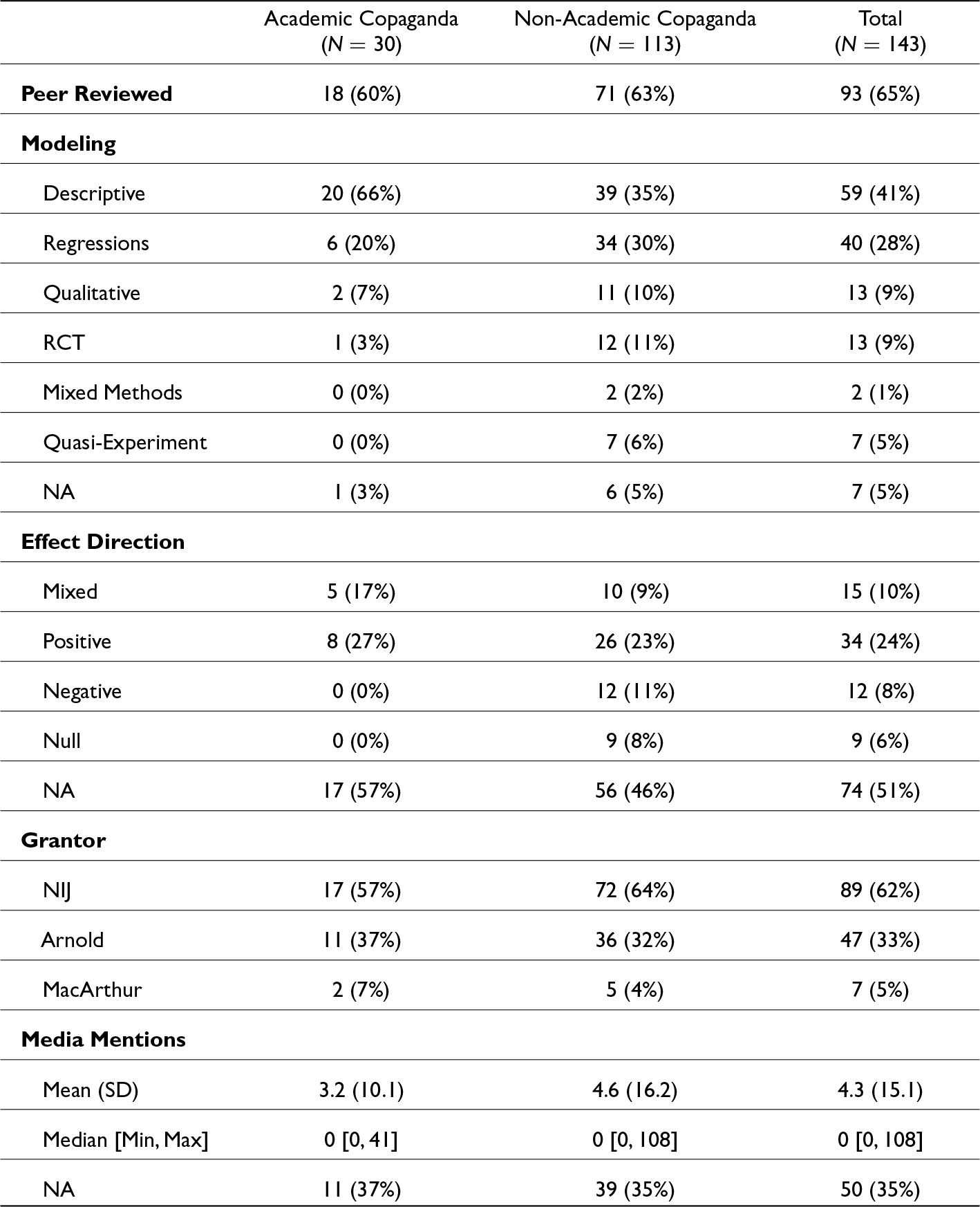
Note: Academic Copaganda refers to all papers we identified as Copaganda and Non-Academic Copaganda refers to all papers not identified as Copaganda regardless of whether the paper was peer reviewed or not. For media mentions all papers lacking a DOI (typically non-peer reviewed) are excluded because Alt-metric could not provide data for those papers.
Prior to 2020, Academic Copaganda studies received little media attention; however, two Academic Copaganda studies (which we expand upon in the following sections) published after 2020 generated significant media attention. These studies accounted for 55% of all media mentions from 2021–2022. It is important to note that media mentions only reflect coverage of peer-reviewed journal articles with a DOI. Alt-metric does not provide media mention data for policy reports and other non-peer-reviewed writings.
Masking conflicts of interest
The first example of authors masking a conflict of interest was the Lum, Koper, and Wu (Reference Lum, Koper and Xiaoyun2021) study titled “Can we really defund the police? A Nine-Agency Study of Police Response to Calls for Service.” The study provided a descriptive analysis of millions of 911 calls for services in nine police agencies and concluded that most of these calls were “not obviously transferable to other organizations or government sectors without significant resource expenditures or adjustments” (Lum, Koper, and Wu Reference Lum, Koper and Xiaoyun2021, 258). Authors argued that the debate over defunding police proceeded without adequate research about the scale or nature of police responsibilities. This argument was only partially accurate, as the authors did not engage with or cite any academic research scrutinizing police emergency response (Bell et al. Reference Bell, Beckett and Stuart2020; Kaba Reference Kaba2021). The study also claimed to have found that only 1.3% of 911 calls to police were related to “mental distress,” a finding they argued casts doubt over the logic of replacing police with mental health workers for emergency response.
In the paper, the authors leverage objectivity discourse to mask their conflict of interest and cast abolitionists as biased in the debate over police funding. In their introduction, they wrote “As scientists, we do not advocate for or against defunding the police” (Lum, Koper and Wu Reference Lum, Koper and Xiaoyun2021, 257). By positioning themselves as “scientists,” the authors distinguish themselves from the “protest movement” as actors with no stake in this debate. In September of 2018, however, the study’s lead author won a multi-million-dollar contract to work alongside law enforcement through the Washington/Baltimore High Intensity Drug Trafficking program (HIDTA) (McClain Reference McClain2018). The contract was not just for research. As described by a George Mason University news article, the HIDTA program allows GMU to provide intelligence analysis for law enforcement agencies to combat crime, drug money laundering, and gang activity (McClain Reference McClain2018). Although the GMU news described the HIDTA program as integrating practice and research, the GMU-affiliated authors did not disclose their receipt of government contract funding in their paper. If one were to take seriously the scientific associations that define a conflict of interest as “outside professional activities” that could reasonably appear to affect the design, conduct, or reporting of research (National Institutes of Health 2023; United States Office of Government Ethics 2024; National Academies of Science, Engineering, and Medicine 2021; American Sociological Association 1999), then the authors did, in fact, have a stake in the debate over police funding.
In addition, the contract signed between the study authors and the Prince William County Police Department (one of the nine police departments in this study) also included a stipulation on page 1 that the data are “not to be used for any other purposes without express written permission from PWCPD.” The contract also states on page 3 that PWCPD can “refuse any future request for criminal information from the requestor,” a stipulation incentivizing study authors to carefully disclose research findings about PWCPD, especially if the researchers wished to continue their research and practice partnership.
By positioning themselves as “scientists” and not acknowledging their material interest in police contract work, the authors masked their conflict of interest in a study that received extensive media coverage. The Lum, Koper, and Wu (Reference Lum, Koper and Xiaoyun2021) article received 160 media mentions, and was featured in a press release from the American Society of Criminology that declared the defund movement as not being “guided by research” (ASC 2021). Most notably, the press release also explicitly mentioned Lum, Koper, and Wu’s estimate that only 1.3% of 911 calls to police were related to “mental distress.” Numerous media outlets such as Vox, Time Magazine, and the Washington Post quoted this 1.3% figure. The 1.3% figure was even cited in a debate between Mayoral candidates Paul Vallas and Brandon Johnson in Chicago (Myers Reference Myers2023) to question the utility of investment in mental health infrastructure.
Many studies have since contested the 1.3% figure (Vera 2022; Watson and El-Sabawai Reference Watson and El-Sabawi2023). A 2022 study looking at the percentage of calls for service to police that involve PwPMI (Persons with Perceived Mental Illness) critiqued this figure as underestimating the amount of mental health related calls for service because dispatchers cannot correctly identify mental illness, and because most data on calls for service do not have a mental health categorical designation (Koziarski et al. Reference Koziarski, Ferguson and Huey2022). Instead, Koziarski et al. (Reference Koziarski, Ferguson and Huey2022) estimate that the figure is likely closer to 10%. While Lum, Koper and Wu (Reference Lum, Koper and Xiaoyun2021) acknowledged data shortcomings in their own paper, agreeing that calls can sometimes be misclassified, these limitations did not stop the authors from confidently asserting the 1.3% figure in Washington Post op/ed (Lum and Koper Reference Lum and Koper2021). Additionally, their conclusions ignored the fact that mental health events are not the only types of call that could be diverted away from the police.
Using public relations firms to manufacture external validity
A 2022 RCT of procedural justice training in the Houston, Cambridge, and Tucson police department also revealed evidence of masking. In the introduction, the authors motivated their study by mentioning “criticism of police” but not citing any critics, particularly critics who have laid out detailed critiques of police training (Purnell Reference Purnell2022; Vitale Reference Vitale2018). They also motivated the study by referencing a 2018 National Academies of Sciences report that questioned the quality of evidence supporting the benefits of procedural justice training. The RCT, by Weisburd et al. (Reference Weisburd, Telep, Vovak, Zastrow, Braga and Turchan2022), claimed to find a host of positive effects from procedural justice training on outcomes such as officer attitudes, behavior, as well as crime on the blocks assigned to officers who received training. The authors also acknowledged, however, no effects on citizen perception of police legitimacy.
The RCT had limitations that were all noted by the authors and these were limitations that plague most RCTs. For example, police officers in the study were chosen to participate by police leaders with guidance from study authors (Weisburd et al. Reference Weisburd, Telep, Vovak, Zastrow, Braga and Turchan2022b, 4). Scholars and methodologists disagree over the extent to which this kind of selection bias affects the strength of an RCT. We do not take a hard stance on the selection bias issue. Instead, we argue that the study’s limitations weaken the study’s external validity and that readers should be cautious before applying the study’s conclusions to cities beyond Houston, Cambridge, and Tucson.
The study’s 40 media mentions, however, ignored its weak external validity and suggested that police departments all over the country should adopt procedural justice training. The subheading of a news media article published by Philanthropy News Digest read “Specialized training of police officers leads to reduced crime, fewer arrests, and more positive interactions and community evaluations, a study published by the Proceedings of the National Academy of Sciences” (Philanthropy News Digest 2022). The news article quoted a representative from Arnold Ventures as saying, “police departments across the country should learn from these results and require high-quality procedural justice training” (Philanthropy News Digest 2022).
To be clear, the authors of the Weisburd et al. (Reference Weisburd, Telep, Vovak, Zastrow, Braga and Turchan2022) study did not make such far reaching arguments in the study itself, and it is fair to ask: was the media coverage simply bad journalism? A closer look at the media mentions and DUA that made the study possible revealed evidence of masking propaganda, as the contract required police and authors to coordinate media engagement for the study. The third author of the Weisburd et al. (Reference Weisburd, Telep, Vovak, Zastrow, Braga and Turchan2022) RCT was affiliated with the National Policing Institute (NPI), a nonprofit organization dedicated to advancing policing innovation through research.
Eighty-three percent of the media mentions (34 of 41) on the Weisburd et al. (Reference Weisburd, Telep, Vovak, Zastrow, Braga and Turchan2022) study named Jane Mott-Palmer as either author or point of contact for the news article. A close reading of all 34 news articles, however, revealed that the words in each article were identical, suggesting it was one article published in 34 websites. A web search for Mott-Palmer revealed she was not a journalist but Chief of Staff for NPI, an institutional co-author of the study. All 34 of the Jane Mott-Palmer authored media mentions also listed PR News Wire as distributor. PR News Wire is a public relations agency that generates media mentions for its clients.
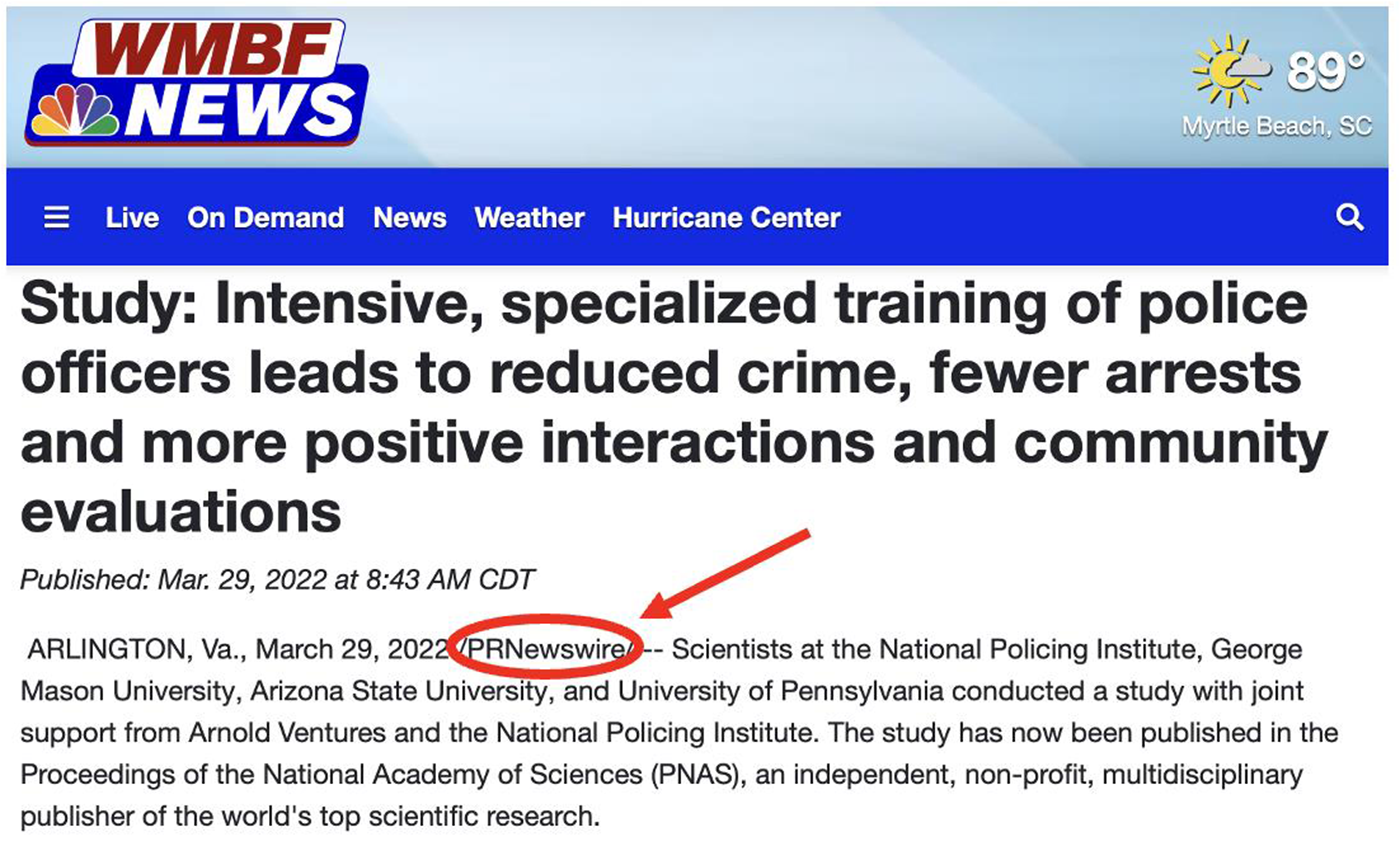
Closer inspection of the 34 media mentions revealed that they were a press release that appear like a local news story. Figure 1 shows a screenshot of a headline from a media mention of the study published in WMBF News (local affiliate of NBC news in Myrtle Beach, South Carolina). The headline masks NPI as authors of the article, although PR News Wire is listed next to the date. To learn the author’s name, the reader must scroll all the way to the bottom of the page where Jane Mott-Palmer is listed as either author or point of contact for the article. In our exchange with a sales representative at PR News Wire, we learned that they charge clients $970 for their US1 service, which consists of publishing a single article in several local media outlets nationwide. This service also helps clients target specific regions of the USA.
Media mention from PR Newswire.
An MOU signed between the NPI (a study coauthor) and the Houston Police Department indicated that coordinated media response to the study was negotiated as a condition of researchers’ access to police data for the study. Section 5.1 of the contract stipulated “Parties agree that they will communicate with each other when a press inquiry is made with regard to the research described in this Agreement, and shall, to the extent permissible, consult with one another before making statements to the press regarding the research.” The MOU also stipulated, in section 2 bullet point 3, that the Houston Police Department would identify officers to participate in the experiment.
The full text of this MOU, and all MOUs for the studies in our sample, is available to view on our GitHub page. Readers may note that point 5.2 declares that the “researchers shall be free to publish the results of their research in their exclusive discretion and as they see fit without approval or interference by HPD or anyone associated with HPD.” It is crucial to note, however, that sections 2 and 5.1 in the contract indicate that the study authors are free to publish the results on the conditions that HPD (1) selects participants in the experiment and (2) coordinates responses to media inquiries. In other words, reading the contract in its entirety illuminates that the academic freedom described in section 5.2 is conditional on sections 2 and 5.1.
To be clear, we do not advocate against the use of public relations firms by researchers to disseminate research findings. The practice is common in social science. The problem is that the NPI positioned themselves as both objective scientist and objective journalist. A conflation that resulted in the dissemination of media coverage about a study exaggerating the benefits of police training at a time when calls to abolish police were at an all-time high (Purnell Reference Purnell2022; Vitale Reference Vitale2018).
Some might argue that the practices and contract used by Weisburd et al. (Reference Weisburd, Telep, Vovak, Zastrow, Braga and Turchan2022) are common not only in policing evaluations, but all evaluations generally. This, we argue, is an empirical question, and we are unaware of studies that demonstrate the commonality of such contractual language in evaluation research of public agencies. However, the data user agreements we obtained from our sample of 143 studies indicate that the data user agreement for Weisburd et al. (Reference Weisburd, Telep, Vovak, Zastrow, Braga and Turchan2022) was not common, even for policing RCTs. For example, an Arnold Ventures funded study of police 911 calls by the Vera Institute of Justice (Neusteter et al. Reference Neusteter, O’Toole, Khogali, Rad, Wunschel, Scaffidi, Sinkewicz, Mapolski, DeGrandis, Bodah and Pineda2020) had a data user agreement with the Camden County Police Department that contained an open data stipulation. The contract stipulated that anonymized data from the study will be uploaded to the Open Science Framework Server for replication, and that Vera was not “obligated” to include feedback on the study from police.
Similarly, another Arnold Ventures funded RCT of police body cameras in Washington DC (Yokum, Ravishankar, and Coppock Reference Yokum, Ravishankar and Coppock2019) contained a data user agreement with no stipulations about coordinating media coverage or the police chief’s selection of study participants. Instead, the researchers used a random number generator to assign officers to treatment and control groups from a complete list of officers in the Washington DC police force. Police supervisors had no say in the selection of study participants. The Neusteter et al. (Reference Neusteter, O’Toole, Khogali, Rad, Wunschel, Scaffidi, Sinkewicz, Mapolski, DeGrandis, Bodah and Pineda2020) and Yokum et al. (Reference Yokum, Ravishankar and Coppock2019) studies were not Academic Copaganda, but they did not have nearly as many media mentions as the Weisburd et al. (Reference Weisburd, Telep, Vovak, Zastrow, Braga and Turchan2022) or Lum, Koper, and Wu (Reference Lum, Koper and Xiaoyun2021) studies.
To be clear, we are not advocating for the abandonment or abolition of data user agreements. We also do not argue that police officers, former police officers, or police organizations like NPI should be prohibited from studying policing or police interventions. Studies in our sample that we did not identify as Academic Copaganda had authors who were affiliated (or formerly affiliated) with police departments. Instead, we argue that researchers need to be more transparent about the terms by which their study of police was made possible, especially when authors position themselves as “objective scientists” responding to biased critics or activists. The lack of transparency around these contractual arrangements allows Academic Copaganda to be more easily masked, produced, and disseminated, and ultimately undermines the credibility of evidence-based policy research on important topics like procedural justice training or mental health emergency responders.
Espousing police epistemology
The other way Academic Copaganda appeared was through studies that espoused police epistemology in response to abolitionist discourse around juvenile justice, police training, community policing, police involvement in traffic enforcement, and police homicide clearance rates. In relation to juvenile justice, a MacArthur Foundation funded initiative sought to integrate law enforcement with community-based efforts to advance juvenile justice reform. As the president of the International Association of Chiefs of Police (IACP) at the time stated, “Law enforcement has not always been seen as a group to invite to the table when high-level policy issues are being discussed, and that’s the historic mistake we’re here to fix today” (IACP Reference John and Catherine2013, 1). The project issued a report on Juvenile Justice Innovation, published by IACP (Reference John and Catherine2013), based on a survey of police agency executives. Not surprisingly, when asked if they believed their juvenile justice policies were effective, 84% of police executives responded yes. The report gathered police executives’ recommendations on how to strengthen their approach to juvenile justice and, again, they recommended that the juvenile justice system incorporate more law enforcement input. Survey answers included the following quotes from officers (IACP Reference John and Catherine2013, 28): “Often the system does not provide meaningful deterrence to prevent crime,” “Frequently juveniles are not sanctioned in a timely manner.”
These responses reflect police epistemology. At no point did the report question the appropriateness or validity of police executives’ opinion. In fact, the report concluded by describing the results as “compelling” and that it should “guide the IACP’s work with the MacArthur Foundation” (IACP Reference John and Catherine2013, 31-32).
The MacArthur collaboration with IACP was part of the MacArthur Foundation’s broader “Models for Change” initiative, which sought to accelerate juvenile justice reforms and promote fairer, more effective, and more developmentally appropriate juvenile justice systems through the United States (Stevens et al. Reference Stevens, Sattar, Morzuch, Young, Ruttner, Stein, Hargreaves and Foster2016, 5). An evaluation of the initiative conducted by Mathematica revealed more evidence of police epistemology through police-preferred terminology used throughout the initiative. Focus groups indicated that “unnamed stakeholders” did not want to talk about the role of race in juvenile justice reform (Stevens et al. Reference Stevens, Sattar, Morzuch, Young, Ruttner, Stein, Hargreaves and Foster2016). The terms “race” and “ethnicity” were swapped out for “disproportionate minority contact” throughout the initiative (Stevens et al. Reference Stevens, Sattar, Morzuch, Young, Ruttner, Stein, Hargreaves and Foster2016, 5). The result was an inability for stakeholders to even talk about racial disparities, one of the central objectives of this MacArthur funded initiative. According to the evaluation (Stevens et al. Reference Stevens, Sattar, Morzuch, Young, Ruttner, Stein, Hargreaves and Foster2016, 5):
An unavoidable challenge that confronted the network’s members was the sensitivity of the topic of disproportionate minority contact and the need to address it directly. Members noted that the network’s coordinating organization adeptly made finger pointing off-limits. Nonetheless, respondents noted that several key players in their sites were not ready to engage in a productive conversation about the over-representation of youth of color in the system. Attempts to engage people in the conversation were sometimes futile; respondents in a few sites as well as the network coordinator described encountering hostile and/or defensive attitudes. Respondents worked to address this challenge by focusing on conversations on issues related to increasing equality in the juvenile justice system as opposed to working to eliminate racial bias.
This effort, undergirded by police epistemology, failed to name let alone address racial disparities in juvenile arrests. When police epistemology is the basis for imagining evidence-based policy agendas, concerns about race and racism are set aside while emphasis gets placed on improving young people’s misconceptions of police officers.
At a time when social movement discourse proposed the idea of removing police officers from traffic enforcement (Vera Institute of Justice 2021), another form of Academic Copaganda came out that overstated police effects on traffic accidents. Specifically, Wu, Lum, and Koper (Reference Lum and Koper2021) examined whether proactive policing activities reduced vehicle crashes. The study began with the premise that police play a central role in preventing vehicle accidents and traffic related events, even though entire literatures in public health, urban planning, and economic development focus on factors such as driver inattention, drunk driving, or poor road conditions as causes of vehicle crashes and deaths (Elvik Reference Elvik2012). The authors were selective in drawing their sample. Rather than asking whether police affect traffic accidents generally, they asked whether increased police traffic enforcement reduced traffic accidents at accident hotspots (N = 188) in an anonymized suburban county police department. The authors noted that these hotspots accounted for less than 2% of the census blocks in the suburban jurisdiction (Lum and Koper Reference Lum and Koper2021, 3). In one instance, they found that traffic enforcement activities not only failed to reduce vehicle crashes, but they also appeared to lead to increases in vehicle crashes. Nevertheless, the authors claimed to have found more positive results when examining vehicle crashes in the highest risk hotspots (e.g. 96 of the 288 hotspots in their sample). When the authors looked only at the highest risk hotspots, they found that police proactivity led to a significant reduction in vehicle crashes, albeit for just 1 month as the effect quickly dissipated.
While the paper found positive, negative, and null effects, the authors concluded “regular practice of daily proactive work has a deterrent effect on traffic accidents, but only at the highest risk locations (as opposed to modest-risk places) and only for a short period of time” (Lum and Koper Reference Lum and Koper2021, 6). The key analytical distinctions enabling the authors to draw this conclusion were (1) taking police involvement in traffic incidents for granted, and (2) drawing these conclusions from a selected subsample of the data.
Police epistemology also arose in studies responding to abolitionist critique of police departments’ low clearance rates, which refer to the percentage of crimes solved by police. Abolitionists point to low clearance rates as one of many pieces of evidence for why public safety alternatives must be pursued (Purnell Reference Purnell2022). This form of Academic Copaganda transformed the research question from asking whether police cleared crimes to how can police improve clearance rates? This shift in research question orientation toward police clearance rates exemplifies police epistemology because it transformed a research enterprise aimed at assessing the value of policing to a research enterprise that took the value of policing for granted. Asking “how can police improve clearance rates” assumes the value of police for investigating crimes.
Academic Copaganda of police clearance rates, thus, produced findings that selected on the dependent variable by highlighting select police departments whose clearance rates have improved and deflecting attention from the overall trend among police departments that clearance rates remain stubbornly low. Scott et al. (Reference Scott, Wellford, Lum and Vovak2019, 85) framed their study by citing the famous study by the RAND Corporation which found that police investigations had little effect on clearance rates (Greenwood and Petersilia Reference Greenwood and Petersilia1975) – a finding that other studies supported (Eck Reference Eck1983; Skogan and Antunes Reference Skogan and Antunes1979). The authors, then, disaggregated time trends in police agency clearance rates to identify agencies that experienced increases in their clearance rates. “Studying the average trends in police clearance rates,” Scott et al. (Reference Scott, Wellford, Lum and Vovak2019, 85) argued, “mask unique variations in individual agency performance over time, which could offer clues as to why some agencies perform better than others.”
This quote is important because it obscures the epistemic question of whether police are capable of improving clearance rates and, more broadly, whether police ought to be the primary providers of public safety. Instead, the paper focuses on why some agencies have “better” clearance rates than others. This epistemic choice shifts readers’ orientation away from questions about the value of police for investigations or safety, and instead places an emphasis on improving police clearance rates.
While the goal of improving police clearance rates appears logical at face-value, it is important to acknowledge the broader context of evidence-based policy research where a large emphasis is placed on investing in interventions that “work.” Some have called for the abandonment of social interventions that do not demonstrate positive effects, regardless of the intervention’s political popularity (MacDonald Reference MacDonald2023). Applying the logic of prioritizing evidence over politics, however, wilts when it comes to policing. Despite decades of research describing police departments’ low clearance rates as well as alternative approaches like restorative justice (oriented toward repairing harm over solving crimes), criminologists do not consider abandoning efforts to improve police clearance rates. Meanwhile, a negative result from a program evaluation on a popular community-based violence prevention program results in criminologists devoting a special issue debating the general enterprise of violence prevention programs (Skogan Reference Skogan2011).
Asking “how do we improve police clearance rates” reflects a normative orientation that police are worthy of investment despite significant evidence suggesting the counter. Such discourse has also been used by other troubled industries to alter debate concerning their regulation. The coal industry, for example, has sought to undermine nation-states’ efforts to achieve net-zero carbon emissions by funding research to advance the production of “clean coal” (Oreskes and Conway Reference Oreskes and Conway2011).
Central to Scott et al.’s argument was their finding that 40% of agencies in their sample of 92 demonstrated an increasing clearance rate over time. Scott et al. (Reference Scott, Wellford, Lum and Vovak2019, 102) concluded that their findings “suggest there are ways for departments to improve their clearance rates,” and that more research is needed to “discern why agencies vary” (Scott et al. Reference Scott, Wellford, Lum and Vovak2019, 104). These findings and conclusions reflect police epistemology. The authors did not acknowledge that the magnitude of clearance rate improvement in their 40% of agencies was small, and that total number of agencies that improved clearance rates amounted to 36 out of the 92 agencies in their sample. The United States is home to thousands of police agencies (Banks et al. Reference Banks, Hendrix, Hickman and Kyckelhahn2016). The authors also underemphasize the fact that most of their findings demonstrate that most police agencies in their sample are experiencing decreases or no change in clearance rates. While it is true that it may be possible to improve police clearance rates, the authors do not attempt to persuade the reader on why this would be a worthwhile enterprise. Police epistemology is taken for granted.
Wellford et al.’s (Reference Wellford, Lum, Scott, Vovak and Amber Scherer2019) study of clearance rates made a similar argument. It also applied trajectory analysis to identify police agencies with increasing clearance rates. They found approximately 40% of agencies improved their clearance rate based on a sample of the “100 largest” police agencies. Next, they relied on data from homicide case files from eight police agencies to explain why some agencies have better clearance rates than others. They interviewed 155 individuals across the eight agencies but were unable to interview detectives about how they investigated homicides. The authors then provided a bullet point list of what they deemed as “best practices” without providing any insight or speculation on how these practices contributed to closing cases. Instead, they ran logistic regression models with the total number of cases at the unit of analysis (N = 242) and used police agency characteristics to identify predictors of whether police cleared the case. The authors concluded “investigative efforts as well as organizational characteristics, net of all other dimensions, add to the explanation of clearance” (Wellford et al. Reference Wellford, Lum, Scott, Vovak and Amber Scherer2019, 595).
Conclusion
Academic Copaganda helps manage abolitionist critique of police under the guise of objective science. The question of whether Academic Copaganda affects policymaking or the material conditions of communities remains open. However, research on media-based forms of Copaganda show that it skews public opinion in a positive direction for police (Rackstraw Reference Rackstraw2023), a finding which suggests that Academic Copaganda likely does the same, though this has yet to be confirmed by research.
Academic Copaganda advances empirical critical race research on the racialized use of science broadly and the intersectional structures legitimizing police. Our findings illuminate how the weaponization of objectivity discourse, as historians like Muhammad (Reference Muhammad2019) have powerfully documented, are not merely remnants of the past but a continued practice in the present. A crucial difference between the present moment and the early 20th century that Muhammad (Reference Muhammad2019) documented is the prevalence and acceptance of evidence-based policy research in contemporary criminology. Our paper, however, reveals that Academic Copaganda operates more like “politics-based evidence making” masquerading as “evidence-based policy research.” When groups make a powerful critique of police (such as their low clearance rates), Academic Copaganda provides the public with studies on how to improve police clearance rates. When groups critique police trainings, Academic Copaganda disseminates media messaging about the positive effects of police training.
The good news is that Academic Copaganda leaves a paper trail that can be identified through public records requests. Thus, our paper methodologically advances Obasogie’s (Reference Obasogie2013, 185) call for e-CRT to “extrapolate the hidden ways race gets constructed in law” by using FOIA requests to disclose researchers’ and police departments’ masked co-production of social scientific knowledge about policing. The contracts governing researchers’ access to police data are public documents that journals and funders do not require public disclosure. Through FOIA, we not only showed the police department’s hand in designing a study (by choosing officers who participated in the experiment), we also showed a coordinated media relations strategy agreed to by the study authors and police administrators. Using FOIA for contracts and other forms of government data is an underutilized methodology for e-CRT scholars to study powerful institutions. FOIA may be a powerful tool, particularly for the study of public-private partnerships. Critics might argue that such relations between researchers and the organizations they evaluate are common; however, we contend that this is an empirical question. The sample of contracts we gathered for this study indicated that relations between researchers and the organizations they evaluate vary considerably.
Our paper also contributes to a growing law and society literature seeking to understand the forces that impede change within police departments. Although these scholars do not ground their work in abolition, our findings on Academic Copaganda have implications for scholars, funders, and governments invested in modest police reforms. Scholars have identified barriers to basic reform such as the U.S. constitution (Schwartz Reference Schwartz2023), policing political machine (Cheng Reference Cheng2024), counterinsurgency tactics (Schrader Reference Schrader2019), and the creation of police produced media (Cheng Reference Cheng2021; Gordon and Nadel Reference Gordon and Nadel2023; Grunwald et al. Reference Grunwald, Nyarko and Rappaport2022). We add Academic Copaganda to this list of formidable structures insulating police from change, whether it be incremental reformist change or radical abolitionist change. Our use of FOIA for data collection may also prove useful for future law and society researchers seeking to uncover hidden coordination among actors across public and private institutions working to shield police.
We offer some ideas on what scholars, policymakers, and advocates can do about Academic Copaganda. The easiest step would be for social scientific journals to require researchers conducting any kind of evaluation to upload their contracts or memoranda of understanding with the organization they are evaluating. As more journals are requiring authors to make their data and code publicly available for replication, it would not be difficult to additionally require the uploading of contracts. These measures would enhance transparency and help ensure that policing research, and media coverage of policing research, are aligned with the highest standards of integrity. Fields like medicine and education have already made progress in this enterprise (Higgins et al. Reference Higgins, Altman, Gøtzsche, Moher, Oxman, Savović, Schulz, Weeks and Sterne2011).
Historical examples of scholars like Ida B. Wells and W.E.B. DuBois illuminate how, today, scholars will need to challenge Academic Copaganda to counter the network of institutions seeking to delegitimize investment in policing alternatives from both reformers and abolitionists. National police organizations such as the NPI and Police Executive Research Forum especially merit attention because they broker relationships between academics and police departments. This is a source of bias that, like industry sponsored research, should be disclosed in studies, especially as police departments are actively resisting efforts by cities to outsource police tasks to violence prevention organizations or civilian emergency response teams.
The role of funding agencies is also important but complex. Arnold Ventures funded 34% of the Academic Copaganda in our study (totaling $1.5 million), NIJ funded 60% ($3.5 million), and MacArthur funded 6% (less than $1 million). These dollar amounts are just a tiny fraction of these organizations’ overall funding portfolio. Although these funders support specific research projects and academics, the academics receiving the funding have flexibility to use the funds differently from the funder’s original intention. For example, the Arnold funded study on “Can we Really Defund the Police?” was not a grant made for the purposes of evaluating the defund movement. Rather, the grant was awarded to George Mason faculty to compile data on 911 emergency response. George Mason faculty used the data compiled from the funding (awarded from 2017–2020) to conduct a study in response to the defund movement in 2022. None of our evidence indicate that funders are intentionally supporting Academic Copaganda. However, we hope to encourage funders to pay greater attention to the contractual agreements that make evaluations possible.
Our study is certainly not without limitations. Our sample is not a representative sample of police scholarship, or the sources that fund police scholarship. In addition, the total dollar amount of research grants made to Academic Copaganda studies constituted a fraction of each funder’s overall reported grantmaking. Except for the NIJ, which is required to report all its financials, it is unclear whether all the private funders in our study publicly reported all the scholarship they supported. In addition, not all scholars publicly disclose funding sources on their CVs or in the papers’ Acknowledgements section. Thus, questions about the scale and quality of Academic Copaganda and its epistemic infrastructure remain unanswered. It is also unclear whether a complete census of policing research is possible as current laws permit private donations for research to be made anonymously. Despite these limitations, we hope this study introduces a concept for scholars to scrutinize research on public safety, and spur new thinking for combatting propaganda when the next major police legitimacy crisis reignites debate over investment in police and policing alternatives.
Supplementary material
The supplementary material for this article can be found at https://doi.org/10.1017/S0023921625000015.
Acknowledgements
We thank Alec Karakatansis, Andreas Glaesar, Bocar Ba, Eric Chandler, Tony Cheng, Karin Knorr-Cetina, Julian Go, Kavi Bhalla, Nicole Marwell, Nico Marchio, Tracey Meares, Jennifer Mosley, and Beth Tipton for comments on earlier drafts of this paper. The paper also benefited from audiences at the Columbia Justice Lab, the Harvard Kennedy School of Government, UC-Irvine, and the Penn Urban Studies Program. This paper was made possible by a gift made in the memory of Morris and Gayle Janowitz. Replication materials are available at https://github.com/uchicago-justice-project/academic_copaganda.


 Open access

