


1. Introduction
Large language models are increasingly embedded in engineering design workflows, from early briefing to documentation. Their effectiveness appears to depend less on model capacity than on how prompts are structured: role specification, context, output format and reasoning scaffolds all shape the relevance and depth of responses (Reference Chen, Zhang, Langrené and ZhuChen et al., 2025; Reference Schulhoff, Ilie, Balepur, Kahadze, Liu, Si, Li, Gupta, Han, Schulhoff, Dulepet, Vidyadhara, Ki, Agrawal, Pham, Kroiz, Li, Tao, Srivastava and ResnikSchulhoff et al., 2025). As LLMs begin to act as design partners rather than passive tools, designers need ways of expressing problems, constraints and evaluation criteria that are legible to the model and consistent with established design methods and Design for X (DfX) reasoning.
Existing work shows that LLMs can support conceptual design and DfX-related analysis, but current prompt canvases, pattern catalogues and taxonomies remain general-purpose and oriented around interactional properties rather than engineering design cognition or Multi-X structures (Reference Hewing and LeinhosHewing & Leinhos, 2024; Reference Schulhoff, Ilie, Balepur, Kahadze, Liu, Si, Li, Gupta, Han, Schulhoff, Dulepet, Vidyadhara, Ki, Agrawal, Pham, Kroiz, Li, Tao, Srivastava and ResnikSchulhoff et al., 2025; Reference Tian, Liu, Dai, Nagato and NakaoTian et al., 2024). This gap is particularly acute in assistive and healthcare devices, where prosthetics must be manufacturable, maintainable, sustainable and safe while remaining usable and acceptable under evolving clinical and regulatory constraints (Reference Hara, Kawamura, Goto and OtaHara et al., 2025). Although prompt engineering is framed as a twenty-first-century skill involving iterative query formulation, explicit constraint setting and critical evaluation (Reference Federiakin, Molerov, Zlatkin-Troitschanskaia and MaurFederiakin, 2024), there is still no explicit prompt structure that encodes Multi-X lenses within LLM interactions during early problem analysis. “This paper introduces a Multi-X-oriented structured prompt template aligned with Roozenburg and Eekels’ design cycle (N. F. M. Reference Roozenburg and EekelsRoozenburg & J. Eekels, 1995), reports an exploratory comparative study contrasting generic and structured prompting for a prosthetic knee-cover design task, and discusses design cognitive implications and practical guidance for deploying structured prompts in engineering design.”
2. Background
2.1. Prompt engineering and structured prompt templates
Recent work frames prompt engineering as a transferable AI literacy skill involving the articulation of problems, context and constraints to large language models, together with iterative refinement of outputs (Reference Federiakin, Molerov, Zlatkin-Troitschanskaia and MaurFederiakin et al., 2024; Reference Knoth, Tolzin, Janson and LeimeisterKnoth et al., 2024). Structured frameworks such as the Prompt Report, Prompt Canvas and LangGPT identify recurring components including task roles, delimiters, output schemas and evaluation criteria (Reference Hewing and LeinhosHewing & Leinhos, 2024; Reference Schulhoff, Ilie, Balepur, Kahadze, Liu, Si, Li, Gupta, Han, Schulhoff, Dulepet, Vidyadhara, Ki, Agrawal, Pham, Kroiz, Li, Tao, Srivastava and ResnikSchulhoff et al., 2025; Reference Wang, Liu, Liang, Li, Huang, Zhang, Shen, Guan, Wang, Feng, Zhang, Zhang, Zheng and ZhangWang et al., 2024). Template-level studies show that explicit components and control patterns (e.g., chain-of-thought, self-consistency, structured schemas) can improve reasoning quality, instruction following and hallucination control (Reference Chen, Zhang, Langrené and ZhuChen et al., 2025; Reference Mao, He and ChenMao et al., n.d.; Reference Viveros-Muñoz, Carrasco-Sáez, Contreras-Saavedra, San-Martín-Quiroga and Contreras-SaavedraViveros-Muñoz et al., 2025). Comparative work further indicates that focused single task prompts often outperform broader multitask formulations, underscoring the importance of scope and syntactic organisation (Reference Gozzi and Di MaioGozzi & Di Maio, 2024).
These frameworks, however, remain largely domain-general: they target broad task families (e.g. coding, summarisation) rather than the specific reasoning patterns of engineering design, and no widely adopted prompt structure yet encodes the logic of the engineering design cycle or explicitly supports Design-for-Multi-X reasoning (Reference Schulhoff, Ilie, Balepur, Kahadze, Liu, Si, Li, Gupta, Han, Schulhoff, Dulepet, Vidyadhara, Ki, Agrawal, Pham, Kroiz, Li, Tao, Srivastava and ResnikSchulhoff et al., 2025).
2.2. Prompting in engineering design
In engineering design, LLMs are explored for conceptual design, education and early modelling. Structured or synthesised prompts have been shown to increase idea novelty and diversity, and guideline-linked systems can support DfX-oriented learning (Reference Hara, Kawamura, Goto and OtaHara et al., 2025; Reference Tian, Liu, Dai, Nagato and NakaoTian et al., 2024). LLMs have also been used to generate specifications, morphological charts and use-case diagrams from natural-language requirements, though prompts often remain informal and outputs generic (Reference Federiakin, Molerov, Zlatkin-Troitschanskaia and MaurFederiakin et al., 2024; Reference Schleifer, Lungu, Kruse, van Putten, Goetz and WartzackSchleifer et al., 2024). GENAI-DFX further integrates LLMs and image models to embed manufacturability, sustainability and serviceability into ideation (El-Hend, n.d.). Despite these advances, prompting in engineering design remains largely ad hoc and rarely aligned with phase-based design processes or a domain-specific prompt language linked to established (Reference Hara, Kawamura, Goto and OtaHara et al., 2025; Reference Tian, Liu, Dai, Nagato and NakaoTian et al., 2024).
2.3. Multi-X reasoning and trade-offs in assistive and healthcare devices
Multi-X (DfX) integrates manufacturing, assembly, sustainability, usability and maintenance considerations into early design decisions (Reference Kuo, Huang and ZhangKuo et al., 2001). In prosthetic and assistive devices, such trade-offs are particularly acute: systems must balance lightweight yet robust structures, safe body interfaces, manufacturability, serviceability, cost and psychosocial acceptance (Reference Berettoni, Driessen, Puliti, Barresi, De Benedictis, Ferraresi and LaffranchiBerettoni et al., 2025). Reviews of semi-powered knee prostheses illustrate tensions between increased assistance and user demands for low weight, low noise and simple maintenance (Reference Berettoni, Driessen, Puliti, Barresi, De Benedictis, Ferraresi and LaffranchiBerettoni et al., 2025). Emerging DfX-oriented GenAI frameworks such as GENAI-DFX embed manufacturability and sustainability feedback into generative workflows (El-Hend, n.d.). However, current LLM-based tools for prosthetics typically address isolated subtasks rather than structured, multi-lens trade-off reasoning across early design phases. Designers continue to articulate tensions (e.g., lightweight vs strength, aesthetics vs printability) informally rather than through an explicit prompt structure that organises LLM support (Reference Berettoni, Driessen, Puliti, Barresi, De Benedictis, Ferraresi and LaffranchiBerettoni et al., 2025).
2.4. Research gap
Across the prompt engineering literature, substantial progress has been made in defining general prompting techniques, component taxonomies and development templates (Reference Schulhoff, Ilie, Balepur, Kahadze, Liu, Si, Li, Gupta, Han, Schulhoff, Dulepet, Vidyadhara, Ki, Agrawal, Pham, Kroiz, Li, Tao, Srivastava and ResnikSchulhoff et al., 2025). In engineering design, LLMs are increasingly integrated into conceptual design and DfX education, and design-specific prompt classes have been proposed (Reference Tian, Liu, Dai, Nagato and NakaoTian et al., 2024). At the same time, the DfX tradition and recent GenAI–DfX frameworks emphasise encoding multiple lifecycle lenses and trade-offs early in product development, including for prosthetic and assistive devices (Reference El-HendEl-Hend, n.d.; Reference Kuo, Huang and ZhangKuo et al., 2001). What remains missing is an explicit connection between prompt-structure engineering and Multi-X trade-off reasoning in medical and assistive design. Existing prompt frameworks do not encode DfX lenses as named fields aligned with a design-cycle structure, nor have empirical studies directly compared designers’ self-authored generic prompts with a deliberately engineered, DfX-aligned prompt template mirroring design activities. This study addresses that gap.
2.5. Research questions
On this basis, the present study addresses the following research questions:
RQ1. How can a structured prompt be designed, grounded in the Roozenburg and Eekels design cycle, to explicitly capture and scaffold Multi-X (DfX-related) reasoning during the design stage of a prosthetic-device design?
RQ2. Compared with designers’ self-authored generic prompts, does this Multi-X Structured Prompt Template improve the coverage and articulation of Multi-X/DfX constraints, assumptions and trade-offs in LLM-supported early-stage design activities?
RQ3. How do engineering designers engage with and experience this Multi-X Structured Prompt Template in practice, including perceived benefits and tensions between structured prompting and creative freedom when working with LLMs?
3. Theoretical foundation: designing the structured multi-X prompt template
This study examines a structured prompt template for supporting Multi-X (DfX) reasoning in engineering design. Existing prompt frameworks are largely domain-general: they focus on interactional features such as roles, examples and output formats rather than on design processes or lifecycle DfX thinking, so LLMs are often used through ad hoc prompts and DfX issues remain downstream filters. We instead propose a compact template aligned with Roozenburg and Eekels’ four design activities and key Multi-X lenses. It has seven recurring components, instantiated as three-prompt sequences per activity, with a human decision point at the end of each sequence so that final choices remain with the engineer. The next subsections outline its theoretical basis, components and activity-specific specialisation.
3.1. Design principles and origin of the template
The structured Multi-X prompt template is grounded in Roozenburg and Eekels’ design cycle and Design-for-X (DfX) practice. The cycle distinguishes analysis, synthesis, simulation and evaluation as iterative, decision-linked activities and emphasises early clarification of context, constraints and criteria (Reference Roozenburg and EekelsRoozenburg & Eekels, 1995). Although DfX approaches such as Design for Manufacture and Assembly advocate bringing manufacturability and assembly considerations into early phases, many current LLM uses in design remain ad hoc, treating DfX as a late-stage filter rather than a formative constraint. Prompt-engineering reviews show that LLM performance is highly sensitive to framing and increasingly benefits from reusable templates with explicit roles, structured inputs, defined outputs and decision points (Reference Chen, Zhang, Langrené and ZhuChen et al., 2025; Reference Mao, He and ChenMao et al., n.d.; Reference Schulhoff, Ilie, Balepur, Kahadze, Liu, Si, Li, Gupta, Han, Schulhoff, Dulepet, Vidyadhara, Ki, Agrawal, Pham, Kroiz, Li, Tao, Srivastava and ResnikSchulhoff et al., 2025). Building on this, we propose a reusable Multi-X prompt template aligned with the Roozenburg and Eekels cycle that foregrounds DfX lenses and trade-offs while scripting human decision points (Reference Roozenburg and EekelsRoozenburg & Eekels, 1995). The template comprises four surfaced elements, Role and intent, Input structure, Task logic and Output format, together with a human Decision node and two supporting components: a Carry-forward artefact and global Rules (Section 3.2).
3.2. Repeatable 7-component template
Building on these principles, each instance of the Structured Multi-X template uses the same seven components (Figure 1a). Four are mainly model-facing: 1) Role and intent assigns the model a design persona and goal; 2) Input structure organises information into labelled fields (user, context, constraints); 3) Task logic encodes the core reasoning pattern (for example, “review and extract”, “compare and rank”); and 4) Output format specifies how results are returned. Together they stabilise behaviour in line with work on reusable prompt templates (Reference Chen, Zhang, Langrené and ZhuChen et al., 2025; Reference Mao, He and ChenMao et al., n.d.; Reference Schulhoff, Ilie, Balepur, Kahadze, Liu, Si, Li, Gupta, Han, Schulhoff, Dulepet, Vidyadhara, Ki, Agrawal, Pham, Kroiz, Li, Tao, Srivastava and ResnikSchulhoff et al., 2025). A fifth component, the 5) Decision node, is executed by the human designer, who reviews and selects or merges options so that commitment remains explicitly theirs. Two cross-cutting elements coordinate prompts: the 6) Carry-forward artefact packages the chosen option as structured input to the next prompt, maintaining a traceable reasoning chain, while the 7) Rules set global constraints on tone, length, DfX emphasis and handling of assumptions without altering the underlying seven-part structure (Reference Hewing and LeinhosHewing & Leinhos, 2024). Figure 1b depicts how one structured prompt can look like.
a) Human-AI prompt interaction for the Multi-X Structured template b) example of prompt structure

Figure 1 Long description
Panel A: A flowchart depicting the human-AI prompt interaction for the Multi-X Structured template. The process starts with the prompt, which includes role and intent, input structure, task logic, and output format. The designer manipulates prompts, which are then reviewed. If accepted, the prompt is carried forward by the AI, with the output result acting as input for the following prompt. The flowchart includes labels for prompt model-facing structure, designer review, and supporting elements. Panel B: An example of a prompt structure for a design researcher initiating the Problem Analysis phase for a 3D-printed prosthetic knee cover. The prompt includes sections for role and intent, input, task, and output, detailing the context, aim, user context, and specific tasks to be reviewed.
3.3. Pattern across the design activities
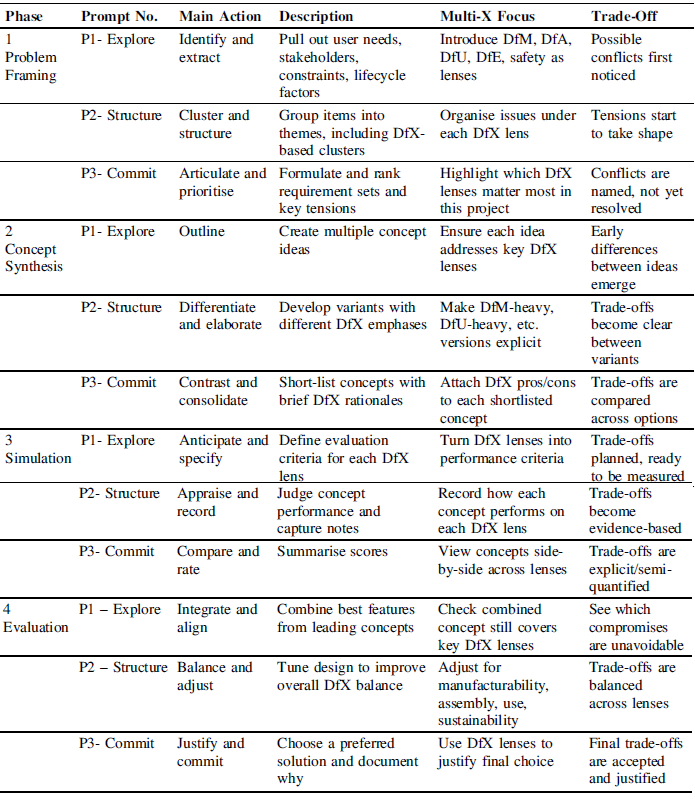
Each design activity instantiates the seven-component template as a three-prompt scaffold moving from exploration to commitment. Prompt 1 explores the space (e.g., extracting needs or generating concepts); Prompt 2 structures the material (grouping, differentiating or appraising); and Prompt 3 supports commitment by prioritising, short-listing or justifying decisions. After each response, the engineer applies a Decision node to select or merge alternatives and reformulates the outcome as a Carry-forward artefact that seeds the next step. This pattern recurs across the analysis, synthesis, simulation and decision stages of Roozenburg and Eekels’ design cycle. Table 1 summarises the phase-specific prompts and the progressive integration of Multi-X lenses and trade-off depth from problem framing to solution refinement.
Three prompt structure per phase, with multi-X and trade-off focus

4. Methodology – exploratory comparative study
4.1. Study design and participants
An exploratory within-participant study examined how a structured Multi-X prompt template influenced LLM-supported engineering design reasoning. Six mechanical design engineers (two universities, beginner–intermediate AI experience) addressed the same prosthetic knee-cover case—a 3D-printed transfemoral cover requiring lightweight protection, FDM compatibility, aesthetic integration and maintenance access. Work followed four activities aligned with Roozenburg and Eekels’ design cycle: problem framing, concept synthesis, simulation/evaluation and refinement.
Each participant completed the task under two conditions using the same ChatGPT-5 base model (OpenAI web interface, temperature 0.7). In the generic condition (always first), prompts were freely authored; in the structured condition, the case was revisited using the seven-component Multi-X template (Section 3). The fixed order limited template-driven prompting bias but introduced potential learning and fatigue effects; results are therefore interpreted as exploratory rather than causal.
4.2. Procedure and data collection
In both conditions participants worked through the four activities with the LLM until they judged each step complete. In the generic condition, prompts and follow-up questions were formulated without constraints. In the structured condition, phase-specific instances of the template were created by populating input slots with case details and Multi-X information, invoking the supplied role and task instructions, and applying the human Decision node after each response to select or merge options and generate the carry-forward artefact for the next prompt.
All prompts and LLM outputs were exported, yielding paired generic and structured transcripts for every participant and activity. After completing both runs, a short questionnaire was administered comprising 5-point Likert-type items on perceived clarity, cognitive effort, support for Multi-X reasoning and perceived impact on creativity and control.
4.3. Analysis
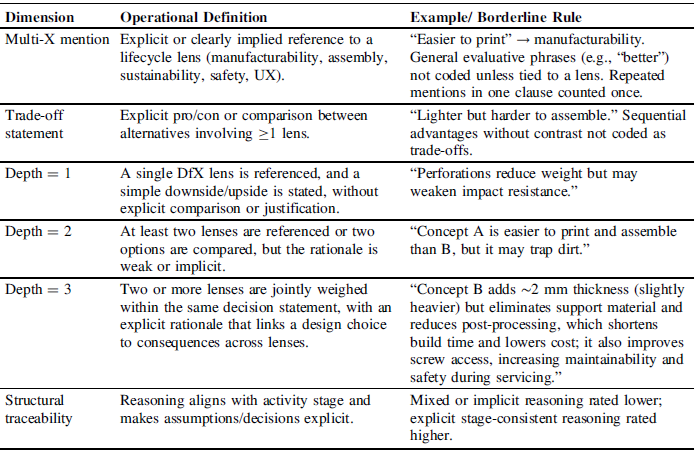
Transcript data were analysed using directed content analysis centred on three dimensions derived from Section 3. A predefined codebook operationalised Multi-X coverage, trade-off articulation and structural traceability. Coding criteria and illustrative examples are summarised in Table 2. Coding was carried out by the first author using this rubric; reliance on a single coder is acknowledged as a limitation.
Coding codebook excerpt and operational definitions

5. Results
5.1. Dataset and metrics
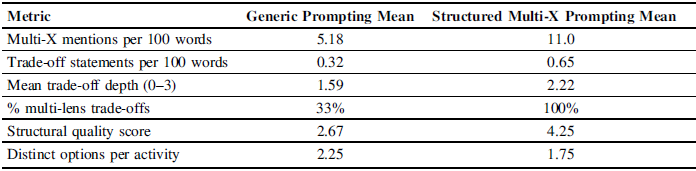
The final dataset comprised 48 activity-level transcripts (six participants × four activities × two conditions). Each transcript was coded using the dimensions described in Section 4.3. As summarised in Table 3, the structured Multi-X prompting condition showed higher rates of Multi-X mentions and trade-off statements per 100 words, higher mean trade-off depth and higher structural quality scores, while the mean number of distinct options per activity was slightly lower than under generic prompting.
While several metrics were normalised per 100 words to reduce raw verbosity effects, it is important to consider potential stylistic confounds. Structured prompting encourages explicit enumeration of lenses and constraints, which may increase the visibility of Multi-X mentions independent of deeper reasoning. However, the consistent increases in trade-off depth, percentage of multi-lens trade-offs, and structural quality scores suggest that differences cannot be attributed solely to output length or list-like expansion. Rather, structured prompting appears to shift how lenses are integrated and justified within decision points.
Descriptive summary of core metrics by prompting condition (generic vs structured prompting)

5.2. Qualitative themes on designer’s experience vs the structured multi-X prompt template
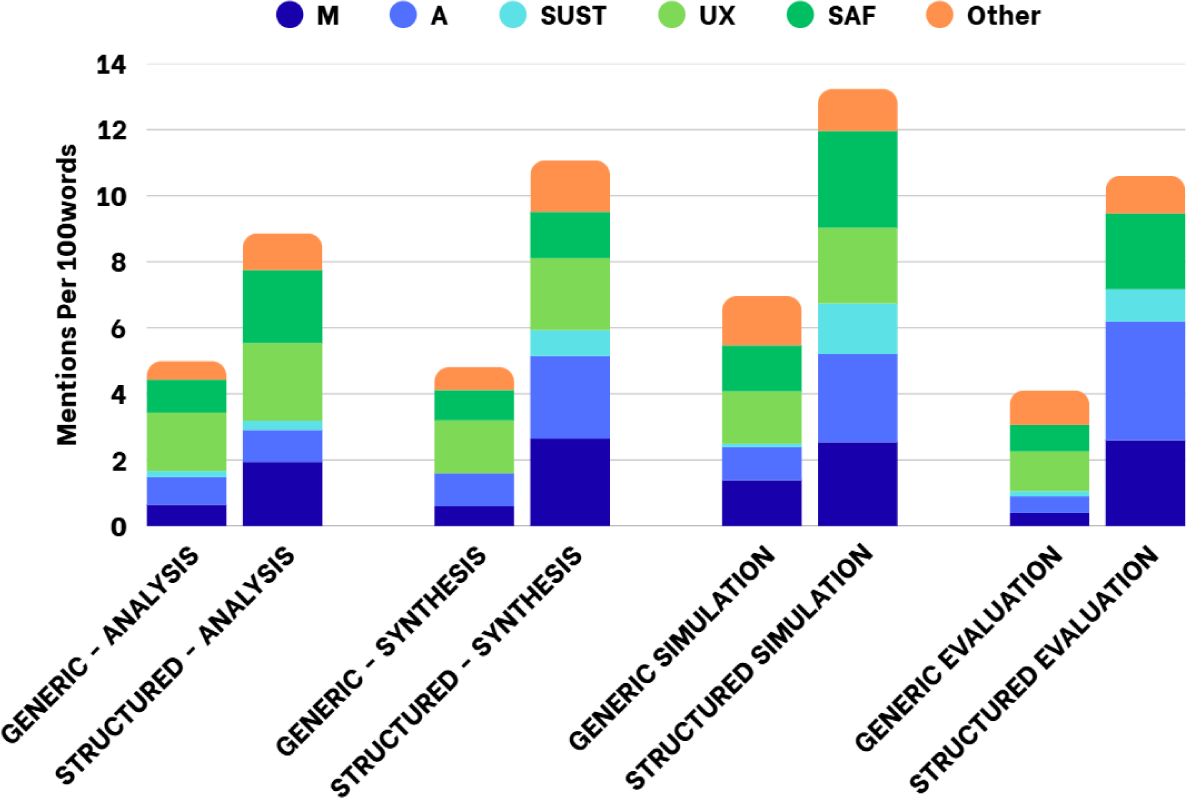
Figure 2 shows Multi-X mentions per 100 words by lens and activity. Across all four activities, structured prompting produced higher normalised Multi-X rates than generic prompting. The composition of lenses also changed. Under generic prompting, user experience and safety dominated, while manufacturability, assemblability and sustainability were infrequent and sometimes absent. Under the structured template, mentions of manufacturability, assembly and sustainability increased substantially so that, together, they accounted for roughly half of all Multi-X references, while user and safety lenses remained prominent and “other” DfX mentions decreased. These patterns suggest that the template redistributed attention towards lifecycle-oriented lenses without displacing user and safety related reasoning.
Multi-X mentions per 100 words for each design activity

5.3. Effects on trade-off articulation, structural traceability and idea fluency
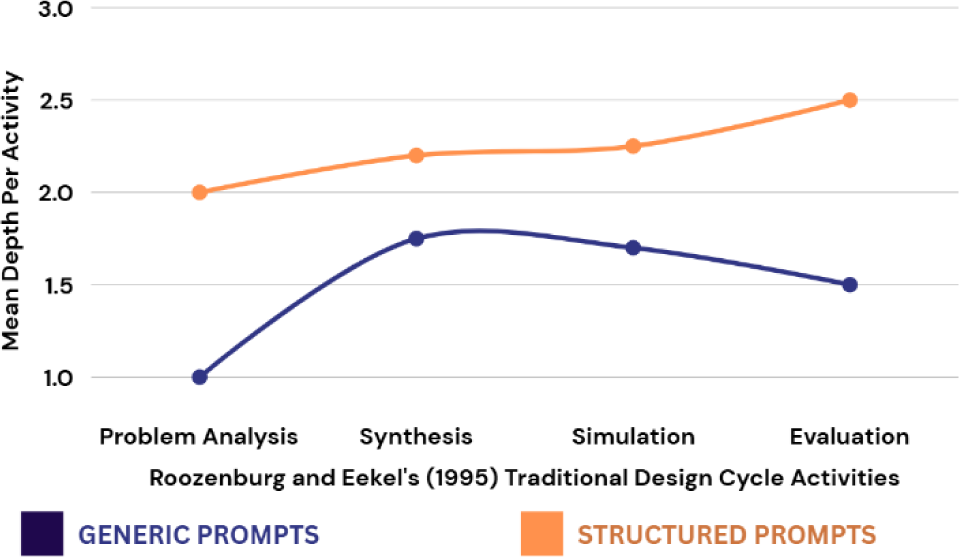
Figure 3 shows mean trade-off depth across the four activities. Depth was scored 0–3 as mentioned in Table 2 above, where higher values indicate more explicit, multi-lens comparisons. Structured prompting achieved higher depth in every activity. Under generic prompting, trade-offs appeared mainly in simulation and were often brief single-lens remarks (typically user experience or safety). With the structured template, trade-offs appeared in all activities and were consistently multi-lens, commonly combining manufacturability, assembly, sustainability and safety. Overall, structured prompting shifted trade-off reasoning from sparse and late to earlier, more frequent and better justified.
Structural traceability showed a similar pattern. Generic transcripts often mixed framing, concept generation and evaluation in the same passage and left assumptions or selection rationales implicit. Structured transcripts more clearly separated activities: analysis captured requirements and constraints, synthesis listed and contrasted concepts, simulation described and interpreted model behaviour, and evaluation justified final choices. This made the reasoning easier to follow and to link back to decisions.
Idea fluency, measured as the number of distinct options per activity, showed a smaller trade-off. Generic prompting tended to produce slightly more options during concept generation, whereas structured prompting yielded fewer but more fully elaborated alternatives. By the evaluation stage, both conditions considered a similar number of options, but structured prompting retained richer Multi-X reasoning around each option.
Future analyses could complement length-normalised metrics with structure-sensitive measures such as the number of unique lenses invoked, lens balance indices, or trade-off density per explicit decision point, further reducing potential verbosity confounds.
Mean trade-off depth

5.4. Designer experience with generic and structured prompting
Designer perceptions of the two prompting modes were assessed on three composite Likert scales: prompt effectiveness, cognitive support for design thinking, and usability and cognitive load. As summarised in Table 4, the structured Multi-X prompt template received higher mean ratings than generic prompting on prompt effectiveness and on cognitive support, indicating that it was experienced as producing more useful outputs and providing stronger support for organising reasoning. In contrast, generic prompting received higher ratings on usability and cognitive load, suggesting that it was perceived as easier and less mentally demanding to use. Open-text comments echoed these patterns, typically describing the template as “more work but more structured”. Overall, the structured template was experienced as more effective and cognitively supportive, but at the cost of increased effort and reduced perceived ease of use.
Mean Likert ratings from engineering designers

6. Discussion and conclusion
6.1. Effects on Multi-X reasoning and trade-off articulation
The findings for RQ1 and RQ2 indicated that the Multi-X-oriented structured prompt template did more than standardise LLM interactions; it altered which lifecycle lenses were discussed, when they appeared and how they were related. Compared with generic prompting, structured prompting produced earlier and more frequent references to manufacturability, assembly and sustainability alongside user experience and safety, so that these issues became first-class elements of problem framing and concept synthesis rather than late filters. This pattern echoed DfX studies showing that disassembly, recyclability and maintenance are often under-represented unless foregrounded through structured artefacts such as checklists and forms (Reference Kuo, Huang and ZhangKuo et al., 2001), suggesting that the Multi-X fields acted as a prompt-level analogue of such forms within LLM-mediated design.
The value of foregrounding manufacturability early in prosthetic design is not merely a generic DfX assumption. Studies of lower-limb prosthetic development report long delivery times for standard components, labour-intensive and skill-dependent socket fabrication, limited mechanical customisation, and high device costs often requiring repeated replacement over a lifetime (Reference Patiniott, Borg, Francalanza, Gatt, Vella, Zammit and PaetzoldPatiniott et al., 2022). These factors indicate that manufacturability, modularity and serviceability directly influence affordability, waiting time and lifecycle accessibility for amputees. In this context, early consideration of manufacturability is intertwined with user outcomes rather than opposed to them.
The template also supported deeper, more integrated trade-off articulation: trade-offs were more frequent, achieved higher depth scores and shifted from predominantly single-lens remarks to consistently multi-lens comparisons. By separating options, DfX implications and trade-off commentary within the prompt structure, it encouraged designers to link alternatives to their consequences across several lenses rather than confining trade-offs to brief comments in a single dimension, consistent with prompt-engineering surveys reporting that prompts with explicit components and reasoning slots tend to elicit more transparent, multi-step justifications than flat task descriptions (Reference Hewing and LeinhosHewing & Leinhos, 2024; Reference Schulhoff, Ilie, Balepur, Kahadze, Liu, Si, Li, Gupta, Han, Schulhoff, Dulepet, Vidyadhara, Ki, Agrawal, Pham, Kroiz, Li, Tao, Srivastava and ResnikSchulhoff et al., 2025).
6.2. Design cognitive implications and designer perceptions
From a design-cognitive perspective, the structured template functioned as an attention-guiding scaffold mirroring analysis–synthesis–evaluation stages. By naming DfX lenses within specific prompt segments, it prompted designers to revisit manufacturability, assembly and sustainability at key decision points and carry forward selected baselines, creating a lightweight and reconstructable rationale. This aligns with work framing prompt engineering as structuring context, constraints and evaluation criteria (Reference Federiakin, Molerov, Zlatkin-Troitschanskaia and MaurFederiakin et al., 2024; Reference Knoth, Tolzin, Janson and LeimeisterKnoth et al., 2024) and with guideline-linked systems shown to enhance traceability in design for environment (Reference Hara, Kawamura, Goto and OtaHara et al., 2025). Designer feedback revealed a tension between depth and breadth. While the template produced more useful and better-organised outputs, it was perceived as more cognitively demanding and less conducive to rapid exploration. Similar trade-offs have been reported in conceptual design studies where structured prompts improved feasibility but reduced novelty (Reference Tian, Liu, Dai, Nagato and NakaoTian et al., 2024). These findings suggest a two-mode workflow: open prompts support divergent exploration, while the structured Multi-X template supports convergence, trade-off articulation and decision traceability. User experience remains central in assistive-device design. Generic prompting prioritised UX and safety, reflecting the importance of user acceptance. However, abandonment is often linked not only to comfort and aesthetics but also to weight, durability, maintenance burden, noise, cost and reliability. The structured template did not displace UX reasoning; it redistributed attention across lifecycle lenses. By surfacing cross-lens trade-offs early, Multi-X structuring may support long-term usability rather than detract from it.
6.3. Limitations and future work
For the exploratory phase of this research we have for this time being resorted to engineering design researchers, future work will involve practicing design engineers in a healthcare sector. The ordering of conditions was fixed, with generic prompting always preceding structured prompting, introducing potential order effects. Learning effects may have inflated performance in the structured condition, as participants could have refined their understanding of the task, evaluation lenses, or LLM interaction strategies during the first phase. Conversely, fatigue effects may have reduced cognitive engagement in the second phase, potentially suppressing novelty or diversity scores. The observed improvements in Multi-X coverage and constraint articulation under structured prompting therefore represent either a partially confounded or conservative estimate of its effect. Additionally, only one LLM configuration, one prompt template, and a coarse structural rubric were examined, and evaluation was limited to early conceptual phases.
Future work should employ counterbalanced or between-subject designs to isolate prompt structure effects from sequencing bias. Further research should widen the range of designers, products and DfX foci, compare alternative prompt structures and deployment modes, and link Multi-X prompts more tightly with CAD and generative tools, evolving this template into a modular Multi-X prompt framework spanning the assistive-device lifecycle.
6.4. Concluding remarks
Within these bounds, this study makes an initial contribution to prompt engineering for engineering design by operationalising and empirically probing a Multi-X-oriented structured prompt template aligned with the design cycle. The results provide indicative evidence that, relative to generic prompting, such a template can bring manufacturability, assembly and sustainability into earlier and more explicit focus, support richer multi-lens trade-off articulation and improve phase-to-phase traceability, while introducing a modest learning effort and a small reduction in perceived ease and idea fluency. Conceptually, this reinforces the view of prompt structure as an active design-cognitive tool that embeds DfX and lifecycle reasoning into human–LLM interaction and marks a first step towards a broader Multi-X co-design framework for assistive devices.



 Open access

