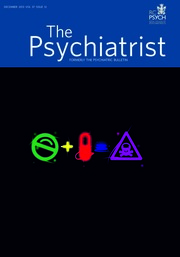


Antipsychotic polypharmacy, it seems, will not just go away. Two papers in this issue re-emphasise that antipsychotic polypharmacy is widespread, poorly supported and very probably dangerous. Reference Langan and Shajahan1,Reference Tungaraza, Gupta, Jones, Poole and Slegg2 Yet the practice continues and is resistant to all kinds of quality improvement interventions. Reference Paton, Barnes, Cavanagh, Taylor and Lelliott3
Polypharmacy – is it ever justified?
In any area of medicine, the practice of polypharmacy arises as a result of the failure of single-drug regimens. Examples include the treatment of hypertension, Parkinson's disease, tuberculosis and HIV infection. In multi-episode schizophrenia, treatment failure is commonplace, with only a small proportion of patients showing a marked response to a single antipsychotic – a placebo-adjusted response rate of less than 20% is not unusual. Reference Beasley, Sanger, Satterlee, Tollefson, Tran and Hamilton4,Reference Borison, Arvanitis and Miller5 Adding another antipsychotic is one way of ‘doing something’ (or appearing to do something) to improve on this mediocre response. However, whereas the use of polypharmacy in, for example, tuberculosis has a rational pharmacological basis and a solid clinical evidence base, antipsychotic polypharmacy might be said to have neither.
Some facts about antipsychotics…
What do we know for certain about antipsychotics? They work acutely for some people and prevent relapse for others; they cause adverse effects for most people; they share an ability to modify central dopaminergic transmission; clozapine is more effective than other antipsychotics. This is the sum of what is certain. Everything else (e.g. other neurotransmitter involvement, negative symptom response, cognitive changes) is a subject of disagreement, conjecture and, one might say, some confusion.
… and popular beliefs
A good example of the type of thinking that arises from this confusion is the idea, often heard expressed on ward rounds, that increasing dopamine D2 blockade in people taking clozapine will in some way improve response. This well-meaning practice survives alongside a body of evidence which suggests that this is not the case. People on clozapine will already have been subjected to multiple antipsychotics and polypharmacy, often at high dose, and failed to respond. Reference Taylor, Young and Paton6 Also, individuals switched from a long-acting injectable antipsychotic to clozapine show no difference in response characteristics to those switched from oral antipsychotics. Reference Carpenter, Zito, Vitrai and Volavka7 Clozapine saturates D2 receptors in extra-striatal areas at normal clinical doses Reference Pilowsky, Mulligan, Acton, Ell, Costa and Kerwin8 and clinical trial evidence either suggests no advantage for clozapine–antipsychotic co-therapy, Reference Barbui, Signoretti, Mule, Boso and Cipriani9 or a minute effect not in any way clearly linked to D2-related activity. Reference Taylor and Smith10 A Cochrane review suggests that clozapine augmentation remains of uncertain value and that more research is needed. Reference Cipriani, Boso and Barbui11 Thus adding another antipsychotic to clozapine is, at least at the moment, of dubious benefit and any benefit seen is unlikely to be a result of increased D2 blockade.
Research evidence
Antipsychotic polypharmacy in general has a similar dearth of cogent support from the literature, notwithstanding the numerous individual clinical observations of clear benefit. A large meta-analysis including a number of studies from the Chinese literature Reference Correll, Rummel-Kluge, Corves, Kane and Leucht12 found a slight therapeutic advantage for antipsychotic co-therapy, but noted clear publication bias in favour of positive studies. In practice, clinicians appear to perceive antipsychotic polypharmacy to be ineffective for persistent, treatment-resistant positive psychotic symptoms. Reference Kreyenbuhl, Marcus, West, Wilk and Olfson13 The combination of typical and atypical antipsychotics seems to produce a typical response (i.e. high rates of movement disorder). Reference Taylor, Holmes, Hilton and Paton14,Reference Taylor, Mace, Mir and Kerwin15 Also, as Langan & Shajahan Reference Langan and Shajahan1 point out, antipsychotic polypharmacy very probably increases overall mortality. Reference Waddington, Youssef and Kinsella16 Other evidence suggests antipsychotic polypharmacy increases time in hospital Reference Centorrino, Goren, Hennen, Salvatore, Kelleher and Baldessarini17 and decreases cognitive performance. Reference Elie, Poirier, Chianetta, Durand, Gregoire and Grignon18 There is more contentious evidence that polypharmacy increases the risk of metabolic disturbances. Reference Taylor, Young, Esop, Paton and Walwyn19–Reference Paton, Esop, Young and Taylor22 Worryingly, this apparently dangerous and poorly supported practice may be more common in Black and minority ethnic patients than in White patients. Reference Taylor, Young, Mohamed, Paton and Walwyn23
Antipsychotic dose–response: guidelines v. practice
Prescribers seem also to be confused about the dose–response relationship of antipsychotics, as practice seems to suggest that many believe that ‘more is better’. This is true up to a point, but the ‘point’ is not where you might think it is. The most efficacious dose of risperidone is 4 mg a day, Reference Correll, Frederickson, Kane and Manu24 for aripiprazole 10 mg a day, Reference Connolly and Taylor25 for haloperidol 5 mg a day, Reference Ezewuzie and Taylor26 for quetiapine 300 mg a day Reference Mace and Taylor27 and for haloperidol decanoate 100 mg a month. Reference Van Putten, Marder, Mintz and Poland28 The largest fixed-dose study to date showed olanzapine 10 mg to be just as effective as 20 mg and 40 mg a day. Reference Sparshatt, Jones and Taylor29 These observations of a low ceiling of effect tie in nicely with receptor occupancy studies suggesting saturation of receptors at low doses. Reference Taylor30 Thus, more is not better once a certain dose is reached, at least with antipsychotics used as single agents. To then assume that adding a second antipsychotic (very probably with an identical mode of action) will bring about improvement is, some might say, a leap of faith beyond reason and logic.
Nonetheless, antipsychotic polypharmacy can represent logical and advantageous prescribing practice in certain instances. For example, when switching from one antipsychotic to another, cross-tapering of antipsychotics seems entirely sensible. There is also a modicum of support for the use of as needed (p.r.n.) antipsychotics (in addition to regular antipsychotics) in rapid tranquillisation. Reference Kinon, Volavka, Stauffer, Edwards, Liu-Seifert and Chen31 Perhaps more intriguingly, although adding aripiprazole to clozapine does not improve efficacy, it does cause patients to lose weight and may also improve other metabolic parameters. Reference Agid, Mamo, Ginovart, Vitcu, Wilson and Zipursky32 Co-therapy with aripiprazole and haloperidol has been shown to normalise prolactin levels in those formerly treated with haloperidol alone. Reference Taylor, Paton and Kerwin33 Aripiprazole's very high affinity for D2 receptors Reference Fleischhacker, Heikkinen, Olie, Landsberg, Dewaele and McQuade34 provides a partial explanation for these effects and both practices represent rational prescribing likely to be of benefit to patients.
Need for more research
Clearly, confusion will continue to reign until robust clinical trials are conducted to establish the merits or otherwise of antipsychotic polypharmacy. However, there is almost no financial impetus for studies of this type to be undertaken and, in any case, proof that a particular combination has advantages over a single drug would tell us nothing about other combinations and other drugs. Moreover, the artificial clinical environment created for clinical trials might, as is always the case, tell us less than we might want to know about drug effects in the real clinical setting.
Conclusions
I was last asked to write an editorial for The Psychiatric Bulletin (the predecessor of The Psychiatrist) on antipsychotic polypharmacy in 2002. Reference Shim, Shin, Kelly, Jung, Seo and Liu35 Since then, rates of antipsychotic polypharmacy seem not to have changed. What has changed is that evidence supporting antipsychotic polypharmacy has, if anything, diminished and evidence suggesting or demonstrating harm has grown. This mounting awareness of the probable futility of antipsychotic polypharmacy is reflected in the latest guidance issued by the National Institute for Health and Clinical Excellence (NICE). Reference Burris, Molski, Xu, Ryan, Tottori and Kikuchi36 One has to hope that the audit processes demanded by NICE guidelines will at last go some way finally to reducing the extent of antipsychotic polypharmacy in UK mental health units.

 Open access


eLetters
No eLetters have been published for this article.