

INTRODUCTION
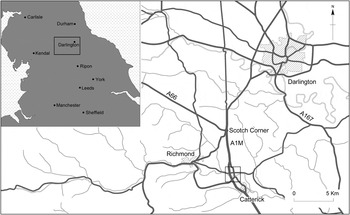
Excavations at the Hollow Banks Quarry, Scorton (N Yorks.) in 1998–2000 revealed 15 late Roman inhumation graves, preliminarily dated to the fourth century (figs 1–3). These late burials are separated from the Roman fort and town of Catterick to the south only by the river Swale,Footnote 1 making a connection between the two likely. Immediately to the north-west, but set spatially apart from the Roman burials, lies a much larger (105 burials) Anglian cemetery. A number of the burials from Scorton were equipped with crossbow brooches and/or belt sets, suggesting a military association and possibly a continental origin for the individuals.Footnote 2 With a grant from the Roman Research Trust, multi-isotope analyses (carbon, nitrogen, oxygen and strontium) of nine individuals (and carbon and nitrogen isotope analysis only of a tenth) were carried out in order to investigate this possibility and to explore differences or similarities to burials from nearby Catterick.Footnote 3
Location map.
The site of Scorton.

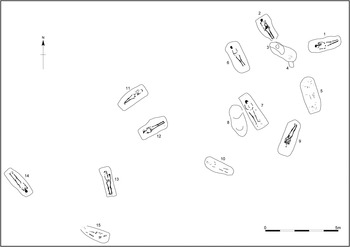
Plan of the Roman cemetery.
Isotope analysis has now been applied to a considerable number of Romano-British burials.Footnote 4 The isotopic systems traditionally employed to reconstruct past mobility are oxygen and strontium; however, dietary (carbon and nitrogen) isotopes have also been shown to be extremely useful in the identification of incomers to Roman Britain.Footnote 5 Since the isotopic range of the Romano-British diet can by now be relatively well defined, it is likely that individuals with extremely different, ‘exotic’ diets in early life moved to Britain from abroad.Footnote 6 Previous work on Roman burials from Britain has demonstrated that many later Roman towns had very diverse populations, although there is no simplistic relationship between unusual grave goods and the origin of the individuals buried with them. Immigrants came both from warmer/more coastal and cooler, more continental areas, and it was not only men that travelled in their roles as soldiers, administrators or traders but also women and children. These findings support and enhance epigraphic and historical research which has long posited that the Roman Empire as a whole was characterised by high levels of mobility.Footnote 7 Previous isotope studies have also highlighted the current limitations of the method for studying migration to Roman Britain, namely that the isotopic ‘profiles’ of individuals growing up in Britain can also be expected to match other parts of the Empire, especially areas in Western Europe and the Northern Mediterranean, and migrants from these areas may be invisible to the isotopic methods which are currently conventionally employed.Footnote 8 Multi-isotopic studies, which employ various different isotopic systems, are therefore the best way to achieve conclusive results.Footnote 9
It is within this context that the current study was conceived. This paper will discuss the isotope data from Scorton in the context of archaeological analyses of the artefacts and burial rites in order to explore the complex relationships between biological and social identity in late Roman Britain.
THE LATE ROMAN BURIALS AT HOLLOW BANKS QUARRY
The excavations at Hollow Banks Farm were undertaken in 1998–2000 by Northern Archaeological Associates Ltd on behalf of Tilcon (North) Ltd in advance of sand and gravel extraction. Initial post-excavation analysis was funded by Tarmac Northern Ltd, with additional funding for the analysis of the cemetery assemblage provided by English Heritage from the Aggregate Sustainability Levy Fund.
The excavated area at Hollow Banks Farm, Scorton lies immediately across the parish boundary within Brompton-upon-Swale, N Yorks., and only 200 m north-east of Catterick Bridge, with the Roman cemetery centred at SE 22850 99660 (figs 1–2). The burials lay within a multi-period palimpsest of archaeological features including Neolithic ‘ritual’ monuments, a Beaker barrow and Iron Age settlement. However, during the Roman period the area seems to have been under agricultural use, laid out in large rectangular fields, and there is no evidence to suggest that any of the earlier features were still recognisable. Later use of the site included the large Anglian cemetery located 30 m to the north-west, which is further discussed below; otherwise, the area has subsequently remained in agricultural usage.
The solid geology of the area is complex. Although the site itself overlies Carboniferous Millstone Grit,Footnote 10 this is covered by deposits of fluvio-glacial sands and gravels accumulated during early deglaciation.Footnote 11 The soils across the site are mapped as Wick 1 Association, which comprises deep, well-drained, coarse loamy earth.Footnote 12 Work by Taylor and MacklinFootnote 13 has shown that until c. 2000 bp the Swale floodplain had been occupied by shallow channels characteristic of a ‘braided’ river system and accumulating alluvial deposits. These were subsequently incised by a single-thread meandering channel which has produced a series of lower-level terraces and resulted in substantial lowering of the floodplain surface. To the south, the river has been constrained by a limestone outcrop forming the hill on which the Roman fort and town were located.
The Hollow Banks Farm Roman cemetery was located on a slight promontory (65.5 m AOD) at the edge of the upper terrace gravels, which was created by former river channels approaching successively from the north-west and south-west. From finds recovered at Hollow BanksFootnote 14 and successive phases of riverside revetment excavated at Catterick Bridge,Footnote 15 these channels were active throughout much of the Roman period. The burials were thus originally near the riverbank (despite now lying over 200 m from the river) and visible from the raised vantage points of the Roman town wall and fort on the hill, which lay respectively only 400 m and 650 m to the south-west. Roman Dere Street, the main road linking York with Hadrian's Wall, passes 400 m to the west.
The remains of the late Roman cemetery occupied an area measuring 24 m from north-east to south-west and 10 m from north to south (fig. 3). Ten of the fifteen features lay in a fairly dense cluster at the north-eastern end of the cemetery, while the other five formed a more dispersed scatter to the south-west. The graves ranged in size from 1.75 to 2.65 m in length and 0.80 to 1.0 m in width and had surviving depths of 0.20 to 0.72 m. Bone preservation varied considerably, from good to non-existent, between (and even within) graves. In two cases (Nos 3 and 8) only grave-shaped cuts survived, with or without grave goods, but with no preserved skeletal remains. In another (No. 4), a shallow feature containing two bangles and three iron nails may have been part of a disturbed grave or, alternatively, a votive offering.
The cemetery population is almost exclusively male, with four individuals sexed as male, three as probably male and only one as female; a further three are likely to be male on the basis of their grave goods. There are no children or adolescents and most individuals fall either within an age range of 17–25 years (×3) or 25–35 years (×9). Apart from a few incidences of caries (Nos 1 and 2) and mild enamel hypoplasia (Nos 1, 6, 10, 13 and 15), the only significant pathological lesion observed was a healed but misaligned fracture of the tibia and fibula (No. 13).Footnote 16 Overall, this small Roman cemetery is characterised by a number of features, notably an unusual gender distribution, the presence of a high number of crossbow brooches and belts and the overall homogeneity of the individuals themselves, in terms of their age-distribution and (skeletal) health status, as well as their grave goods.
All bodies were found in an extended supine position, usually with the arms folded across the abdomen; in a few cases the arms were extended along the side of the body. Most if not all of the individuals were placed in wooden coffins, of which substantial iron nails survive in many graves. In two cases (Nos 11 and 14) rounded stones were also placed inside the grave cut. While similar in these ways, the graves were not arranged in a consistent pattern or orientation; heads were aligned to the north (×5), west (×3), and south-east, east or south (×4). The excavators note that female No. 11 and male No. 12 were buried in parallel graves, sharing a unique orientation within the cemetery and suggesting a possible connection; their heads, however, were at opposite ends (No. 11 to the east and No. 12 to the west). A connection between the two individuals may be supported by the fact that these are the only two graves within this small cemetery that contained bronze bracelets. Late Roman parallel burials with opposing head alignments occur at nearby Catterick Bridge (Graves 163/191 and 1001/1003),Footnote 17 perhaps suggesting that this was a local custom.
Of the fifteen burials, only nine had skeletal elements with suitable preservation to allow isotope analysis. These nine individuals were sampled for strontium, oxygen, carbon and nitrogen isotope analysis, and a tenth was sampled for carbon and nitrogen isotope analysis only. Summary information on these individuals can be found in Table 1 and it is these graves that the present paper is mainly concerned with.
ARCHAEOLOGICAL, OSTEOLOGICAL AND ISOTOPIC DATA ON THE INDIVIDUALS FROM HOLLOW BANKS CEMETERY, SCORTON, ANALYSED FOR THIS STUDY

ARCHAEOLOGICAL ANALYSIS OF CROSSBOW BROOCHES AND BELT FITTINGS
A striking feature of the Hollow Banks late Roman cemetery is the frequency with which crossbow brooches and belt buckles occur. No less than four graves (Nos 1, 5, 7 and 14) have crossbow brooches and six have belt fittings (Nos 1, 5, 6, 7, 12 and 14: see figs 4–8). Crossbow brooches appear to have been worn by males in positions of authority and in the later Roman period may have been associated specifically with administrators rather than just military men.Footnote 18 Archaeological evidence, for example from Lankhills (Winchester), confirms the overwhelming association with male burials and adults.Footnote 19 The relative proportion of burials with crossbow brooches at Scorton (4/15) is highly unusual for Roman Britain. In general, and relative to the Continent, Britain has few of these types of furnished inhumations. Lankhills is the only other Romano-British cemetery for which high numbers of crossbow brooches have been reported, but there the equivalent numbers are 6/306 from the recent and 8/444 from the old, 1970s, excavations.Footnote 20 For the classification of crossbow brooches, continental typologies are usually followed; however, Swift'sFootnote 21 analysis provides an excellent summary of the Romano-British material and makes some interesting suggestions about the production of these striking brooches.Footnote 22 Crossbow brooches in the northern British ‘frontier zone’ broadly follow the typological patterns established by SwiftFootnote 23 for Roman Britain, but sites on Hadrian's Wall display a distinctive profile, which may be due to ‘decreasing levels of contact between the frontier and central imperial authorities’.Footnote 24
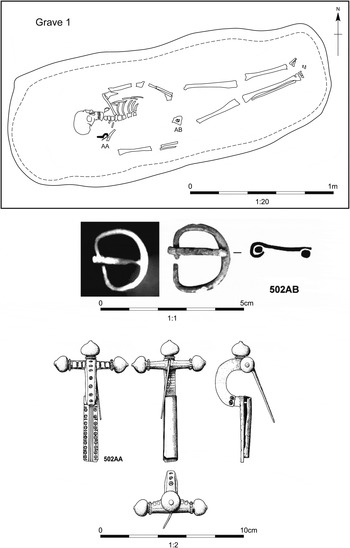
Grave 1: plan and selected grave goods.
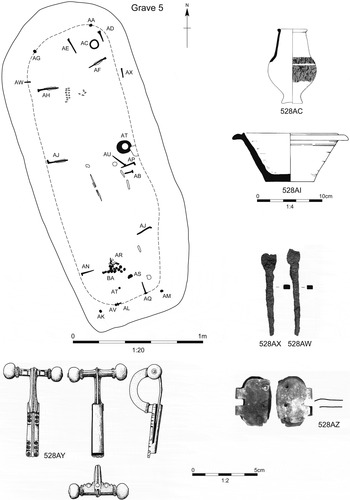
Grave 5: plan and grave goods.
Grave 7: plan and selected grave goods.

Grave 14: plan and selected grave goods.

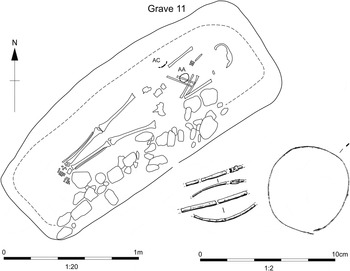
Grave 11: plan and selected grave goods.
The Scorton crossbow brooches are broadly of Keller/Pröttel Type 3/4,Footnote 25 but one (514AB from Grave 14) has elements of Keller Type 2, while another (571AV from Grave 7) may have elements of his Type 5.Footnote 26 Crossbow brooches of Keller Type 3/4 are usually dated to the last two thirds of the fourth century and into the fifth century (a.d. 350–410).Footnote 27 However, crossbow brooches may have had long ‘lives’ and biographies; thus we may note the broken example in a young individual's grave at Lankhills and general evidence for repairs.Footnote 28 A recent example of a very worn crossbow brooch deposited in an unusual context comes from the villa at Ingleby Barwick (Stockton-on-Tees), where a gilt example was uncovered in a pit with Anglo-Saxon pottery and an articulated dog burial.Footnote 29 Without examining the Scorton brooches directly it is difficult to identify wear, but the crossbow brooch from Grave 5 lacks the central knob, so may have been old when buried. This is especially interesting as the grave also contained an assemblage of coins thought to have been deposited shortly after a.d. 353–6.Footnote 30 While it is difficult to distinguish possible local products from certain imports, it is possible that the brooch from Grave 5 (528AY) was from the Continent due to its similarities to common continental frontier zone examples (see below). However, this brooch also has a close parallel from Chorley in Lancashire.Footnote 31 Brooch 502AA from Grave 1 on the other hand, with its atypical decoration, may have been produced away from the main production areas, perhaps in Britain or Gaul.Footnote 32
Of the crossbow brooches in graves across the Empire, 48 per cent were found in situ on the right shoulder, 10 per cent on the left shoulder and 5 per cent on the breast, while 37 per cent were evidently not worn but placed in the grave.Footnote 33 At Scorton, two were on the right shoulder (Graves 1 and 7), one (Grave 14) was on the left chest and another (Grave 5) was found with the coins at the feet of the skeleton.Footnote 34
Crossbow brooch 502AA from Grave 1 (fig. 4) has a foot which is longer than the bow; the knobs are onion-shaped with ribbed mouldings at the base; the arms have two longitudinal perforations each and are ridged at the top. The bow is decorated with a row of circle-and-dots, a decoration that is not paralleled in Swift.Footnote 35 The side of the bow has a pair of circle-and-dot designs, which again is unusual. The foot is decorated by 20 circle-and-dot motifs arranged in facing pairs with a horizontal line between each set of four. This foot decoration is not listed in SwiftFootnote 36 (but cf. her fig. 48) but crossbow brooches where the entire foot is decorated with circle-and-dot motifs are known from continental sites.Footnote 37
Crossbow brooch 528AY from Grave 5 (fig. 5) has a foot which is longer than the bow; the knobs are rounded rather than fully onion-shaped. These knobs may have been onion-shaped originally but damaged or modified; the central knob is missing. The knobs have ribbed mouldings at the base and the arms have one longitudinal perforation each (sometimes described as a facetted cross arm with openwork decoration). The foot is decorated with circle-and-dot design (Swift b2 foot decoration)Footnote 38 and the bow with stamped triangles (Swift A2 bow decoration). The b2 foot design has a wide distribution, with numerous examples known at Augst, Lauriacum, Dunapentele and Ságvár.Footnote 39 A number of examples from Britain and the Continent share the b2 foot design but have onion-shaped knobs and bow design Swift I9;Footnote 40 see also Grave 27 from Oudenburg.Footnote 41 Of the latter sub-type, dated Romano-British parallels are the brooch from a Richborough ditch fill dated to a.d. 400+ and the brooch from Grave 81 in Lankhills dated to a.d. 350–70.Footnote 42 A good parallel, unfortunately a metal-detected find without context, is from Chorley in Lancashire.Footnote 43 Also in Grave 5 was a purse hoard containing coins thought to have been removed from circulation (and probably deposited) shortly after a.d. 353–6.Footnote 44
Crossbow brooch 571AV from Grave 7 (fig. 6) has a foot which is longer than the bow and onion-shaped knobs with ribbed mouldings at the base. It is of a solid shape with a wide bow and foot. There are diagonal lines on the bow and a herringbone design on the centre of the foot, which is also decorated with neat facetting (two pairs at the top and two at the base). We are not aware of very close parallels, but there are some similar examples, for example from Alem and Tongeren in the Netherlands.Footnote 45
Crossbow brooch 514AB from Grave 14 (fig. 7) has elements of Keller Type 2/3, with a slight design and a longer bow. There are three onion- to poppy-headed knobs, with plain mouldings at the base. The brooch has a facetted but otherwise undecorated bow and the foot is decorated with neat facets. This brooch may be slightly earlier than the others from Scorton. Similar brooches are known from, for example, Krefeld Gellep.Footnote 46
As noted above, when compared with the Continent, late Roman belt equipment is not very common in Romano-British cemeteries, with the exception of Lankhills and Scorton, where belts are associated mainly with adult males.Footnote 47 Belts were important symbols of power in the later Roman world.Footnote 48 At Scorton there are six graves with belt fittings (Nos 1, 5, 6, 7 (see fig. 6), 12 and 14 (see fig. 7)). With the exception of the belt in Grave 5, which was placed with a brooch and a coin hoard near the foot, they appear to have been worn in death. In Graves 1, 12 and 14 the belt buckle was on the right hip or waist, with the pin facing right, while in Graves 6 and 7 it was on the left thigh.Footnote 49 In terms of typology, the belt fittings in Graves 6, 7, 12 and 14 all have an oval belt plate with two, or more usually, three rivets and a D-shaped buckle. These buckles are of a common type which, in Britain, appears to date to the mid- to late fourth century.Footnote 50 In Grave 1 (fig. 4) only a D-shaped buckle and its pin were found, in a position on the right hip suggesting that it was worn. The belt fitting from Grave 5 (fig. 5) lacks both the buckle loop and the pin and the plate is unusual in having an oval top plate and an angular plate on the underside, fixed by three rivets and still containing traces of mineralised leather. This plate design is similar to the example found in Grave 1925 at Lankhills.Footnote 51 The absence of the loop and pin may suggest that this belt was no longer fully functional, but was placed into the grave as an old and treasured possession. Interestingly, the associated crossbow brooch also shows signs of wear.
Previous isotopic studies have found no clear-cut relationship between the presence of a crossbow brooch or belt, and whether or not equipment was worn, and the geographical origin of its wearer. For example, of individuals with belt fittings at Lankhills, 1175 has a British-made belt but is, according to the isotopic evidence, certainly not from Britain, but from a cooler, probably more continental climate.Footnote 52 On the other hand, the two individuals from Lankhills with the combination of buckles with an oval plate and a heart-shaped strap-end (Graves 81 and 426) are both isotopically foreign,Footnote 53 which suggests that such an ensemble may therefore be an indication of foreign origin. It is regrettable that Grave 14 from Scorton, which also has such a combination (fig. 7), was not available in time for full multi-isotopic analysis; however, the results of the dietary reconstruction still lend some support to Cool's hypothesis (see below). Heart-shaped strap-ends are dated to a.d. 340–70 by ClarkeFootnote 54 and on the basis of the example from Lankhills Grave 745, from the new excavations, their use may extend into the late fourth centuryFootnote 55. The strap-end from Scorton Grave 14 is decorated with a pair of stamped circle-and-dot designs divided by a line of incised herringboneFootnote 56 and was found at the middle of the left femur.Footnote 57 Overall, belt fittings were clearly an important part of high-status male costume but more research is required to untangle their social implications.
Other grave goods at Scorton include copper-alloy and bone bracelets. Grave 11, the only burial identified as that of a woman, contained two fragmentary bracelets (fig. 8). A plain bronze strip bracelet appears to have been placed above the right forearm while a curved, fragmentary bone object with an iron rivet and some copper-alloy staining was found near the right elbow. The latter is a bone bracelet of Clarke's Type B, with bone strips ending in butt terminals with a metal sleeve held by a rivet. Clarke dates these to c. a.d. 350–70 but more recent finds may suggest a bias towards the later fourth and even into the fifth century.Footnote 58 In Grave 12 a fragmentary copper-alloy bracelet was found at the left side of the skull of an adult male, together with a purse hoard (fig. 9). This appears to be a strip bracelet with one hooked terminal surviving; it is decorated with an S-shape or herringbone design. Swift has a number of bracelets with similar designs (cf. her decoration d5 and d6, although the Scorton example lacks the central line found on those parallels).Footnote 59 The example belongs to Cool's Bracelet Group XX, sub-group B.Footnote 60 Published examples include a bracelet with S-shaped decoration from a late fourth-century grave at Butt Road, ColchesterFootnote 61 and two examples from Gadebridge Park.Footnote 62
Grave 12: plan and selected grave goods.

The original interpretation of two iron objects in Grave 5 as styli is unlikely on grounds of their shape, so the function of these two objects remains unknown. Two graves (Nos 5 and 12) contained hoards of 44 and 24 coins respectively; both were in organic containers or purses with one placed near the feet and the other beside the right shoulder. Coins do occur in graves in other late Roman cemeteries such as at Lankhills, but there the largest number of coins in a single grave was seven.Footnote 63 In general, coins in graves are thought to become more common from the mid-fourth century, as is the deposition of multiple (but usually <12) coins.Footnote 64 By contrast, large coin groups as found at Scorton are rare, although a good parallel is provided by Grave 2 at Frilford, where 34 coins (ending with the House of Theodosius) were found placed c. 30 cm above the head of a young adult male buried without other grave goods.Footnote 65
A number of graves (Nos 3, 5, 7, 14 and 15) contained pottery vessels, either a Nene Valley beaker on its own or combined with a dish or bowl. A drink offering thus seems to have been important, while food may only have been included occasionally. Grave 7 contained a poorly preserved animal jaw bone and in Grave 5 the mineralised organic remains included hazelnuts and legume seed pods. Grave 7 is the only one to contain a glass vessel, an ovoid flask of a form apparently unique in Britain but paralleled in northern France.Footnote 66
After examining both their grave goods and burial rite, we may be tempted to speculate as to the geographical origin of the people buried at Hollow Banks. In particular, we may consider the criteria first employed by Clarke for the late Roman cemetery at Lankhills, Winchester to distinguish between ‘local’ and ‘intrusive’ burials, which focused in particular on whether brooches, belts and bangles were worn in death or placed into the grave.Footnote 67 While the wearing of personal ornaments in death can no longer be taken as a reliable indicator of an immigrant burial,Footnote 68 its application at Hollow Banks would still suggest that five individuals (Nos 1, 6, 7, 12 and 14) may be described as ‘intrusive’ archaeologically in that they appear to have been buried dressed and, in particular, wearing a belt and/or crossbow brooch. The male No. 7 also has an unusual, clearly imported glass flask. The female No. 11 and male No. 5 on the other hand had objects placed into the grave in a rite which has been viewed as indicative of local traditions,Footnote 69 although it should be noted that No. 5 has both a belt and a crossbow brooch, just like the males Nos 1 and 7. Individuals Nos 2, 10 and 13 had no grave goods.
Whatever the meaning of worn or placed grave goods, the small Hollow Banks cemetery is clearly very different from nearby late Roman burials. The Hollow Banks site at Scorton is located only about 650 m from the fort and associated small town of Catterick (Cataractonium) in North Yorkshire.Footnote 70 Military occupation begins here around a.d. 80 and forts were re-established twice between the second and early fourth centuries. The adjacent civilian settlement eventually developed into a walled small town and settlement activity at Cataractonium is thought to have continued until at least the fifth century.Footnote 71 Recently, isotope analysis of 26 individuals from sites around Catterick fort and town and from the roadside settlement at Bainesse, including the famous ‘eunuch’,Footnote 72 was carried out.Footnote 73 In contrast with the mainly urban sites also examined as part of the ‘Diasporas in Roman Britain’ project,Footnote 74 the population at Catterick appears to have been much less heterogeneous. Most of the Catterick population have isotope signatures compatible with a UK origin; indeed significant numbers probably had a local upbringing. Only two individuals, including the possible eunuch, may have had foreign origins. Chenery et al. note an interesting difference between the somewhat earlier Bainesse burials, where individuals displayed greater variation in oxygen and strontium values, and the more homogeneous later (fourth-century) burials from the town and fort.Footnote 75 This may be related to changes in the recruitment policy of the Roman army and/or a significant downturn in traffic along Dere Street.
Below, isotope signatures from the newly analysed burials from Scorton will be compared to those from Catterick, and to other isotope data which have recently become available. Of particular interest are burials of males buried with similar belt fittings and crossbow brooches, such as those from Lankhills.Footnote 76 There are also men buried with crossbow brooches and very distinctive chip-carved belts, often interpreted as ‘Germanic’ foederati and dated to the later fourth to early fifth century and thus slightly later than the men at Scorton. One such individual is known from Grave 538 in the eastern London cemetery and there is a small group from Dyke Hills, Dorchester.Footnote 77 At the latter site, in addition to antiquarian finds of burials with chip-carved metalwork,Footnote 78 a recently discovered burial has a chip-carved belt fitting and an iron axe.Footnote 79 Parallels for both suggest a continental origin for this 30–40-year-old male. The isotope analysis suggests that this individual's oxygen isotope ratio is outside the British range and consistent with a continental origin.Footnote 80 Finally, there is the so-called Gloucester Goth, an adult male buried with a silver belt buckle, silver shoe buckle, two silver strap-ends and a knife; his grave goods are paralleled in south-eastern Europe and south Russia, leading to the suggestion that this man was a Gothic immigrant, probably buried in the later fourth or early fifth century.Footnote 81 The results of recent isotope analysis are broadly consistent with such an origin.Footnote 82
ISOTOPE ANALYSIS OF SKELETAL REMAINS FOR DIET AND MOBILITY RECONSTRUCTION
Isotopes are atoms of the same element but of slightly different mass. Their relative abundance in nature varies systematically and predictably between different environments, so that individual substances can be traced back to the environments they came from based on their isotopic composition. Isotope analysis of skeletal remains is based on the principle that all body tissues, including the skeleton, are formed from the basic molecular components of the food and drink ingested by the individual. They therefore contain the ‘isotopic signatures’ of the types of food consumed and also of the environments they were grown in, allowing for the reconstruction of diet and mobility of individuals.Footnote 83
Carbon and nitrogen stable isotopes of skeletal collagen are well established as reflecting the main sources of dietary protein consumed by an individual.Footnote 84 Measured in bone, they reflect diet over the last 10 to 30+ years prior to death, while dentine preserves the dietary signal at the time of tooth formation in childhood or early adolescence.Footnote 85 Meaningful differences between bone and dentine isotope values therefore indicate a significant change in diet in the life-time of an individual, which could be explained by a change in location.Footnote 86 Carbon stable isotope ratios (13C/12C or δ13C values) vary substantially between plants using the C3 and C4 photosynthetic pathways as well as their consumers in a food-web; most plants in temperate environments belong to the C3 group while C4 plants are mostly tropical grasses as well as the cultigens maize, millet, sorghum and sugarcane. δ13C values also distinguish between terrestrial (C3) and marine foods. Nitrogen isotope values (15N/14N or δ15N values) provide information about trophic level and therefore the relative importance of animal protein in a person's diet, although this relationship can be obscured by various environmental and metabolic factors.Footnote 87
Strontium and oxygen form two independent isotopic systems which vary systematically according to local geology and climate respectively.Footnote 88 Both elements are incorporated in dental enamel at the time of crown formation. Enamel undergoes little remodelling thereafter and therefore retains an isotopic ‘signature’ of a person's place of residence in childhood, allowing archaeologists to reconstruct patterns of mobility in the past.Footnote 89
Oxygen in human skeletal tissues is derived primarily from ingested fluids, with smaller contributions from food and atmospheric oxygen. Most drinking water is ultimately derived from rainwater and, provided that water was not transported over long distances, its oxygen isotope composition (18O/16O or δ18O values) should therefore indirectly reflect the isotopic value of local meteoric water.Footnote 90 Like other light stable isotopes, oxygen isotope ratios are subject to change through various metabolic processes between ingested oxygen and its incorporation in skeletal tissues.Footnote 91 This so-called ‘fractionation’ is fairly well understood and therefore allows estimating the isotopic composition of the drinking water (δ18Ow) from the isotope ratios measured in enamel phosphate (δ18Op) by applying a water-to-phosphate conversion equation. The computed δ18Ow can then be used to constrain an individual's place of origin, assuming that documented modern drinking water values are not significantly different from past values.Footnote 92 The signficant uncertainty (i.e. statistical error) attached to such conversions is often understatedFootnote 93 and the isotopic composition of ingested oxygen can also be modified by cultural practices, such as methods of food and drink preparation, and may therefore be population-dependent,Footnote 94 although we are only just beginning to understand the significance of this for bioarchaeological interpretations. Because of these complications, many researchers prefer to estimate the ‘local range’ of oxygen isotope ratios directly from the δ18Op of a group of humans who are assumed to be local, without a conversion to drinking water values and this method is also employed below.Footnote 95
Strontium in skeletal tissues is derived from both solid and liquid foods and the strontium isotope composition (87Sr/86Sr) of bone and teeth directly relates to that of bioavailable strontium in the soils where the food was produced, without metabolic fractionation. While most strontium isotope variation is dependent on age and type of the bedrock, differential weathering, sediment formation and drift as well as strontium transferred through dust or rainwater can have a marked effect on biosphere 87Sr/86Sr and consequently on local values. Wherever possible, strontium isotope studies for human mobility should therefore undertake an assessment of the local range using biosphere samples, such as plants or animal remains.Footnote 96
MATERIALS AND METHODS
Of the 15 burials from the Scorton Roman cemetery, only nine had skeletal remains which were well enough preserved for isotope analyses and/or were available for sampling. Of each of these, a tooth (preferentially a second molar or second premolar) and a bone sample (preferentially rib or, if not available, long bone) were obtained and prepared for strontium and oxygen isotope analysis of tooth enamel for the reconstruction of mobility and carbon and nitrogen isotope analysis of root dentine and bone collagen for the reconstruction of childhood and adult diet, respectively. Samples of a tenth individual (No. 14) became available later and were processed for carbon and nitrogen isotope analysis of dentine and bone only.
Sample preparation and analysis were carried out at the NERC Isotope Geoscience Laboratory at the British Geological Service in Keyworth (for strontium and oxygen isotopes) and at the University of Reading (for carbon and nitrogen isotopes) following the protocols described in Evans et al. and Müldner et al.Footnote 97 Analytical errors were as follows. For oxygen, the reproducibility of the internal phosphate standard (NBS120C) during the set of analyses was ± 0.16‰ (1 s.d.). δ18Op analyses were done in triplicate and the average standard deviation of the triplicates was ± 0.09‰. For strontium, the international standard for 87Sr/86Sr, NBS987, gave a value of 0.710250 ± 0.000006 (n = 8, 2 s.d.) during the analysis of these samples. Blank values were in the region of 100 pg. For carbon and nitrogen, repeat analysis of internal collagen standards calibrated to internationally certified reference material over the period of analysis gave an error of ± 0.2‰ (1 s.d.) for both elements.
RESULTS
Individual data are shown in Table 1. δ18Op values range from 15.0‰ to 19.9‰ (range 4.9‰), with a mean of 16.7 ± 1.5‰ (all 1 s.d.). 87Sr/86Sr gave a narrow range between 0.7088 and 0.7104 (range 0.0016) with a mean of 0.7096 ± 0.0007. Strontium isotope analysis of one of the samples (No. 2) failed on grounds of poorly preserved enamel.
Carbon isotope ratios of dentinal collagen extend from −16.9‰ to −19.5‰ (range 2.6‰), with a mean of −18.3 ± 0.9‰, while δ15N values of the same samples range from 9.3‰ to 13.2‰ (range 3.9‰), with a mean of 10.9 ± 1.3‰. δ13C values of bone collagen extend from −18.5‰ to −19.5‰ (range 1.0‰), with a mean of −19.0 ± 0.4‰, and nitrogen isotope ratios range from 8.4‰ to 12.3‰ (range 3.9‰), with a mean of 10.4 ± 1.0‰.
DISCUSSION
Strontium and oxygen isotopes
fig. 10 depicts strontium and oxygen isotope data from Scorton in comparison with human isotope values from Catterick and strontium biosphere data from modern plants from the Vale of York and surrounding areas.Footnote 98 Also shown is the 2 standard deviations range of phosphate oxygen isotope ratios for 615 archaeological individuals from Britain,Footnote 99 which is taken as an estimate for δ18Op values consistent with British origins. This range is wider and therefore more conservative than the estimate used in Chenery et al.,Footnote 100 but it can be regarded as more robust as it is based on a much larger number of samples than were previously available.Footnote 101
Oxygen and strontium isotope data for humans from Scorton compared to humans from Roman Catterick as well as the estimated 87Sr/86Sr range for the Catterick area (after Chenery et al. Reference Chenery, Eckardt and Müldner2011). Also shown is the range of δ18Op values estimated as consistent with a childhood in Britain (after Evans et al. Reference Evans, Chenery and Montgomery2012). Note that a valid 87Sr/86Sr value for Scorton Grave 2 could not be obtained. In order to show the sample on a bivariate graph, a generic strontium isotope value of 0.7092 was chosen.
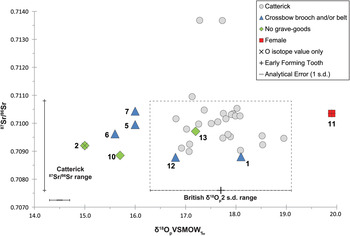
The strontium isotope ratios for eight individuals from Scorton (87Sr/86Sr for No. 2 could not be determined) are all well within the estimated local range for the Catterick area (0.7076–0.7108).Footnote 102 The strontium isotope values from Scorton are therefore all consistent with a local upbringing. It should be noted, however, that 87Sr/86Sr like those observed here are relatively generic and fit a range of mostly Mesozoic terrains which are very commonly encountered in Britain and on the European mainland.Footnote 103 While a local origin of the Scorton individuals would therefore be the simplest explanation based on the strontium isotope data, they could equally have moved from areas of similar geology in Britain or abroad. The oxygen isotope values indeed indicate the latter.
When the oxygen isotope data are examined, there are only three individuals (Nos 1, 12 and 13) with δ18Op values within the estimated British range and for whom a local upbringing therefore seems easily possible. (Note that for at least one of these, No. 1, a British origin is nevertheless unlikely on grounds of his carbon isotope values, see below). No. 11, the only female in the group, has a significantly elevated δ18Op value of 19.9‰; however, since the sample was taken from a first molar, a tooth whose crown formation is complete in the first years of life,Footnote 104 this value is probably artificially elevated by the consumption of breast milk.Footnote 105 A local or at least British origin, possibly in southern or western England, where oxygen isotope ratios of drinking water are higher than in the north-east,Footnote 106 is therefore quite possible for this individual.
Five individuals from Scorton (Nos 2, 5, 6, 7 and 10) have δ18Op outside and lower than the estimated British range, making origins in a cooler, more continental climate likely. Conversion of the skeletal data into drinking water values using the equation by Longinelli gives δ18Ow between −10.0‰ and −11.5‰Footnote 107 (± ~1‰ typical 95% CI).Footnote 108 These values would be consistent with an origin in Central/Eastern Europe or with access to drinking water from higher altitudes.Footnote 109
Carbon and nitrogen isotopes
fig. 11 shows carbon and nitrogen isotope values for the Scorton humans (dentinal and bone collagen, reflecting childhood diet and long-term dietary average, respectively) compared to human and faunal data from nearby Catterick. It is easily evident that there is very little overlap between the two sites and that the Scorton humans display significantly higher carbon isotope ratios than those from Catterick in both their bone and dentine.Footnote 110 These differences demonstrate that the Scorton individuals, as a group, consumed diets which were isotopically different from the average.
Carbon and nitrogen stable isotope data for tooth dentine and bone collagen from Scorton individuals compared to humans and animals (mean ± 1 s.d.) from Roman Catterick (after Chenery et al. Reference Chenery, Eckardt and Müldner2011). Arrows connect dentine (childhood diet) and bone (long-term dietary average) data from the same individuals where differences exceed 0.5‰ for δ13C and/or 1.0‰ for δ15N (see text). Error bars around the Catterick mean indicate 2 and 3 standard deviations.
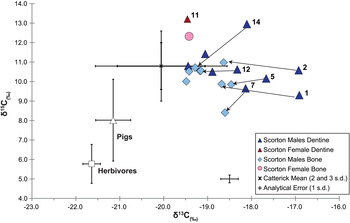
Further detail is gleaned when dentine and bone isotope ratios from the same individuals are compared: at Catterick where most individuals are thought to have been local, differences between the two tissues are typically small and in any case no greater than 0.5‰ for δ13C and 1.0‰ for δ15N.Footnote 111 If these values are taken as indicative of the variation expected between bone and dentine of individuals on homogeneous diets, then more than half of the Scorton males (Nos 1, 2, 5, 7, 12 and 14) appear to have undergone measurable dietary change between the time when their tooth roots formed in their early teens and their time of death (fig. 11).Footnote 112 In each case the shift (0.8–1.8‰ for carbon and 1.2–2.3‰ for nitrogen) is towards more negative δ13C values in later life, and therefore towards the C3-ecosystem dominated isotope values observed for the Catterick humans. These results suggest that the isotopic composition of the bone collagen, which is replaced only slowly after the end of adolescence,Footnote 113 was at the time of death, still in transition between their variably 13C-enriched childhood diets and local values.
While the early diets of the Scorton males indicated by these data are also primarily based on C3-plant derived protein, they contain varying but sufficiently large contributions from high δ13C- (C4-plant or marine) foods to make them stand out in the Catterick context. Compared to isotope data from some larger Romano-British towns, e.g. the provincial capital of York, where diets were predictably more diverse and included a greater proportion of aquatic and marine protein (fig. 12), they are less unusual. Nevertheless, a number of the Scorton individuals still plot on the very margins of the distribution in terms of δ13C even then (close to or outside the 2 standard deviations range) and two of the Scorton males (Nos 1 and 2) are even more than 3 standard deviations from the York average, and therefore en par with other extreme outliers for whom it has been argued that a British origin is very unlikely on account of their ‘exotic’ diets.Footnote 114 The isotope values of these two, unusually high carbon isotope values combined with no observable rise in δ15N, could result from a mixture of C3-terrestrial foods and low-trophic level marine resources.Footnote 115 However, given the ‘continental’ oxygen isotope signature of No. 2, at least his dietary signal may be best explained by the consumption of C4-plants or C4-derived protein. This was most likely from millet which was the only C4-cultigen grown on the European continent (but not in Britain) at the time.Footnote 116 In the Roman period combinations of carbon and nitrogen isotope values such as in Scorton Nos 1 and 2 have so far only been reported in isolated individuals, most likely also migrants, but not in whole populations.Footnote 117 The exception is a second-century cemetery of the Wielbark culture in Rogowo, Central Poland where mean δ13C and δ15N values of −17.7 ± 0.7‰ and 9.7 ± 0.5‰ (1 s.d., n = 30) were measured (maximum δ13C was −16.4‰).Footnote 118 It is important to emphasise that this comparison is not meant to suggest any direct connection between Scorton and the area of modern-day Poland. It is merely meant to demonstrate that dietary values like those observed at Scorton existed in Roman-period Central Europe, a region which is also consistent with the oxygen and strontium isotope values of several of the Scorton individuals (although not easily No. 1). Since there is some evidence from Germany, France and the Low Countries that cultivation of millet declined on their integration into the Roman Empire,Footnote 119 it would be tempting to suggest that isotopic evidence for millet consumption could, in this particular context, indicate origins outside the Imperium Romanum; however, as we are only just beginning to understand dietary variation in the Roman world, this would be little more than speculation at this point.Footnote 120
Carbon and nitrogen stable isotope data from Scorton (dentine/childhood diet only) compared to humans and animals from Roman York (after Müldner Reference Müldner2013). Error bars indicate 2 and 3 standard deviations from the York mean (n = 172).

In summary, the results of the isotope analysis confirm that the Scorton group is highly unusual, not only in the context of Roman Catterick, but most of them also in Roman Britain as a whole. Oxygen isotope data suggest a continental origin for five of the eight Scorton males tested (Nos 2, 5, 6, 7 and 10) and for another (No. 1) a childhood in Britain is extremely unlikely on account of his highly unusual diet. The childhood dietary (carbon and nitrogen isotope) values of Nos 12 and 14 are not as ‘exotic’ in a wider Romano-British context as those of Nos 1 and 2. They are most similar to individuals from the high-status group at Poundbury, Dorset, whose origins have unfortunately never been tested.Footnote 121 Nevertheless, they also plot sufficiently on the margins of even larger, urban datasets (i.e. only just in or outside 2 standard deviations from the mean δ13C of York (see fig. 12) and Lankhills/Winchester (n = 124))Footnote 122 to allow us to at least question a British origin. In any case, these two have childhood diets which are distinct enough from the Catterick population (i.e. more than 3 standard deviations from the mean, see fig. 11) to render at least a local origin very unlikely.
Of ten individuals, there remain therefore only two, a male without grave-goods (No. 13) and the only woman in the group (No. 11) for whom the isotope data are easily consistent with upbringings in the Catterick area. Even for these it must be remembered that isotope analysis can only ever exclude but not confirm local origins.
Isotopes and archaeology
It is now widely accepted that the relationship between socially and culturally constructed identities as expressed through artefacts and burial rite on the one hand and biological identities such as sex and geographic origin on the other is highly complex.Footnote 123 A detailed discussion is beyond the scope of this paper, but it is clear that while ethnicity was initially seen as biologically determined and fixed, it is now usually viewed as dynamic and historically contingent.Footnote 124 Increasingly, ethnicity is seen as an ideological construct, often negotiated through strategies of distinction such as the wearing of particular kinds of objects that can be created, reinforced and challenged by groups and individuals.Footnote 125 How diverse populations were and whether or how differences were experienced and expressed is a question of particular importance to the Roman world, a society probably characterised by unprecedented levels of mobility.Footnote 126 While initially lagging behind, for example, early medieval archaeology, these issues are now being addressed for the Roman period, not just through the exceptionally rich epigraphic materialFootnote 127 but also through careful analysis of later Roman material culture.Footnote 128 Recent isotope work on several Romano-British sites has now highlighted that burials identified on archaeological grounds as intrusive sometimes indeed appear to be the graves of people who spent their childhoods in significantly warmer or colder, continental climates, or who consumed unusual diets that suggest origins outside of Britain.Footnote 129 Equally, there are individuals whose burial rites appear to follow local traditions and whose isotope signatures match the local ones. On the other hand, we are also confronted with individuals who appear local archaeologically but are clearly intrusive isotopically, while others look ‘foreign’ archaeologically but appear to be local isotopically. We have argued previously that these complexities should be expected as identities involve multiple aspects of a person and evolve over time, while burial goods were, of course, chosen by the mourners, adding another layer of mediacy.Footnote 130 In some cases we may also see the effect of intermarriage or may even be able to identify second-generation migrants such as the girl from Winchester who was buried according to what appears to be a continental rite and with some unusual grave goods but whose isotopic signature is fully consistent with a childhood in Winchester.Footnote 131
The new data from Scorton further illuminate the complex ways in which individuals expressed aspects of their identities in life and death. Using archaeological criteria such as grave goods and burial rite, five individuals (Nos 1, 6, 7, 12 and 14) were thought to have been ‘incomers’ in that they were buried wearing belted tunics and/or cloaks fastened by crossbow brooches. One of these (No. 7) also had an unusual glass flask of a type that is currently unique in Britain, but can be paralleled in northern France.Footnote 132 The female No. 11 and male No. 5 had grave goods placed into the grave rather than worn, following a rite that has been seen as indicative of local traditions, although No. 5's grave goods (belt and crossbow brooch) are just like those of males Nos 1 and 7. Individuals 2, 10 and 13 had no grave goods. What can be deduced once we contrast these archaeological indicators with the results of the isotope analysis?
Three of the individuals actually wearing belts and brooches (Nos 1, 6 and 7) are indeed isotopically not local (in the case of No. 1, this was determined on the basis of an unusual dietary signature, not oxygen/strontium, with the latter indicating that he is from a climate and geology that is similar to that of Scorton/Catterick). Interestingly, this incoming male (No. 1) is thus from a different region to the other intrusive men, but judging by his grave goods and burial rite he served in a similar role within the late Roman military and administration. His crossbow brooch has unusual decoration, and may have been made in Britain or Gaul. While the unusual glass vessel may hint at an origin in northern France for No. 7, there is currently not enough isotope data available from that region to verify this suggestion and in any case the differences between northern France or Germany and southern or eastern Britain would probably not be marked enough to make such an identification possible.Footnote 133
The probable male No. 5, who is buried with what may well be an imported crossbow brooch and a belt, is also foreign isotopically, even though these objects were placed into the grave (not worn), in a rite that is often thought to be British. We could speculate that we see here the impact of those responsible for the actual funeral, for example a local wife burying her husband undressed in a shroud (or dressed but not wearing the brooch and belt) and placing these important objects by his feet. Alternatively of course, we may simply see variation within burial rites related to factors that we cannot now determine. Grave 5 is also distinguished by the presence of a large purse hoard, as is Grave 12.
Female No. 11 again is thought by the excavators to have been buried in a shroud and had bracelets placed above the right arm and elbow; such a rite might again be thought to indicate local British origin. While the oxygen isotope value for this individual initially appears to be too high to be local or even British, the analyses were conducted on a first molar and the isotope ratio is therefore likely artificially elevated by the consumption of breast milk;Footnote 134 this woman may thus well be one of the few native Romano-Britons in the group.
Male No. 12 has a worn brooch and belt that make him look foreign archaeologically. The deposition of a bracelet in this grave is also unusual, but together with the alignment might point to a personal relationship with the woman buried in Grave 11. Isotopically, his profile is not clear-cut; while an upbringing in and around Catterick appears unlikely on account of his diet, an origin elsewhere in Britain cannot be excluded (although areas with a similar climate and geology abroad are equally possible). Like the intrusive male No. 5, he was also buried with a large purse hoard. This may be an individual who joined the administration or army and followed the traditions he may have observed for his fellow officers or administrators who had originated from other parts of the Empire, but who was in fact British. In other words, we may see an example here where status in the sense of a professional identity and as expressed through objects which are almost like insignia of office was more important than geographical origin or ethnicity.Footnote 135 It is often necessary to look very closely at the type of crossbow brooch and belt fitting, with some representing imports and others British products. At Lankhills, both imported and possibly British-made ‘hybrid’ crossbow brooches were associated with isotopically foreign individuals, illustrating that it was the symbol of office and status itself that was important and not necessarily the origin of the brooch or indeed the individual.Footnote 136 The chip-carved belt set and axe at Dorchester and the silver buckles at Gloucester may be even more distinctive archaeological indicators of immigrant males, as in both cases the men are not from Britain isotopically.Footnote 137
The isotopic profile for Scorton No. 14 is unfortunately incomplete and although the palaeodietary data are sufficient to raise a question about a British origin, they are ultimately inconclusive. The grave goods, in particular the combination of a buckle with an oval plate and a heart-shaped strap-end, have been taken as indicators of foreign origin at LankhillsFootnote 138 and given the dietary data, this seems likely for this individual from Scorton, too, although we are in danger of a circular argument here. Ultimately, we can only hope to resolve this question by future oxygen and strontium analysis, which was not possible within the timeframe of this project.
Of the three individuals buried without any (surviving) grave goods, two (Nos 2 and 10) are isotopically foreign while one (No. 13) was probably local. Again, this illustrates that aspects of identity other than origin were highlighted in death; for example, the absence of surviving grave goods might indicate a lower professional status.
Another aspect to consider is the question of change over time. While this small cemetery is strikingly homogeneous and all graves can be broadly dated to the mid- to late fourth century, the burials clearly did not all occur at exactly the same time. The two burials with coin hoards give the most precise dates: Grave 12 is the earlier, with a possible deposition date in the early a.d. 340s (341/2?), while Grave 5 is perhaps ten or so years later, with a suggested deposition date of a.d. 354–6.Footnote 139 The artefacts are more difficult to sequence. Generally, the crossbow brooches date to the last two thirds of the fourth century and possibly into the fifth century; the belt fittings are of mid- to late fourth-century date and the bracelets probably belong to the mid- to later fourth and into the fifth century. The eight pottery vessels from the cemetery have a date range of the very late third to the fourth century, but are thought most likely to date to the middle of the fourth century.Footnote 140 The latest vessel is a simple-rimmed Nene Valley colour-coated dish from Grave 7 thought to post-date a.d. 350. Price suggests that a date after a.d. 360 is appropriate for the unusual glass vessel from the same grave and the crossbow brooch may be the latest of the Scorton examples typologically; this may suggest that Grave 7 is amongst the latest in this small cemetery.Footnote 141 The issue of dating is complicated by the deposition of objects that may have been quite old when placed in the grave; this is especially noticeable for Grave 5. Interestingly, the later Graves 5 and 7 are on roughly the same alignment, while the early Grave 12 is aligned with Grave 11; unfortunately there are no stratigraphic relationships that would allow us to recreate the burial sequence further.
Overall, the Scorton isotope data are very different from those from nearby Catterick. There, isotope analysis revealed a relatively homogeneous population who, with the exception of the so-called eunuch, were not buried with unusual grave goods and are characterised by isotope signatures that are on the whole compatible with British, or indeed local Yorkshire, origins.Footnote 142 Chenery et al. detect a difference between the burials from the roadside settlement at Bainesse and those more closely associated with the fort and town, which they attribute to possible political and economic factors leading to a decline in migration into the area.Footnote 143 The new data from Scorton demonstrate that such migration, probably from colder and more continental parts of Europe, did occur in the later fourth century and, judging from the grave goods, that this movement of young men was closely associated with the late Roman administration and army. It is tempting to see the Scorton men as members of the late Roman field army (comitatenses), as has been suggested for individuals buried with chip-carved belts.Footnote 144 The comitatenses included regiments of barbarians, sometimes described as foederati or allies, who are thought to have been equipped by the government; they ‘may have differed visually from regular Roman regiments but if so, we do not know how’.Footnote 145 In other words, it may simply not be possible to distinguish between the types of army personnel attested historically in the archaeological record; indeed the same may apply to the visual distinctions between administrators and officials and the army. We may note that the late Roman military activity at Catterick is not exceptional in the region and is indeed paralleled at Piercebridge and Binchester, both also located on Dere Street. Interestingly, neither Piercebridge nor Catterick are listed in the Notitia Dignitatum, though this may well be due to the nature of this complex document.Footnote 146
In general, the Scorton data, like those from Winchester and York, highlight that late Roman populations (and the army in particular) were isotopically very diverse and that the Roman period was characterised by high levels of mobility. Of course, the skeletons studied from Roman Britain so far are not a representative sample, as they were largely chosen because they are archaeologically unusual, and there is now an urgent need to sample rural and ‘unremarkable’ individuals.Footnote 147
Another interesting question to explore in future work is whether the presence of male incomers from the Continent in the very late Roman period also has implications for our understanding of the Anglian period in the Catterick area. It is now clear that the area of the town was certainly occupied beyond a.d. 400 and it has been suggested that, as at other sites such as Birdoswald, members of the late Roman army may have taken control of strongholds and local food supply systems once central pay stopped.Footnote 148 At Catterick, the presence of Anglian immigrants is attested by material culture, Grubenhäuser and funerary evidence possibly from a.d. 500 and certainly from a.d. 600.Footnote 149 Catterick has also been equated with Catraeth, the place of the famous battle in c. a.d. 600 between Britons and Anglians described in Y Gododdin, a poem dating to between the seventh and eleventh centuries and surviving in one later thirteenth-century manuscript.Footnote 150 The dating of the Anglian burials at Scorton remains debatedFootnote 151 but our work shows that already in the later Roman period significant numbers of the Catterick population may have arrived from the European continent and conversely, not all individuals buried with Anglian grave goods are likely to have been incomers, as demonstrated at West Heslerton.Footnote 152 In addition to the full publication of the Anglian phase at Scorton, isotope analysis of the Anglian burials is thus highly desirable.
Returning to the late Roman burials, once again there is no clear-cut relationship between cultural and biological identities; in some cases the archaeological indicators such as grave goods and burial rite ‘match’ the geographic origin reflected in the isotopic signatures but in others they do not. This is not surprising and in fact is what makes the analysis of late Romano-British burials so interesting. At Scorton and other sites there is a suggestion that geographical origin probably was not the most important aspect of identity for people, perhaps both in life and death. What seems to have been particularly emphasised through dress accessories is status and, in this case, an official role specifically.Footnote 153 It may be that such conspicuous consumption in burials is a sign of competition and ‘insecure’ élites within a local context.Footnote 154 Gender and age are clearly also important, as reflected in the strong association of worn bead strings and bracelets with young girls at LankhillsFootnote 155 and in the strikingly homogeneous association of crossbow brooches and belts with adult men at Scorton.
CONCLUSION
Multi-isotope analysis at Scorton suggests that at least six of the nine individuals tested were indeed immigrants, probably from the European continent. As in other recent studies which have compared artefactual evidence to isotopic signatures, the relationship between geographical origin and burial rite is not straightforward; several individuals that look archaeologically foreign display non-local isotope signatures, yet there is also an individual buried in what may be described as an intrusive style who may have spent his childhood in Britain, if not in Catterick itself. Other factors such as age, gender and status clearly played an important part, as did the cultural identity of the partners, parents, children and friends who were presumably responsible for the burials. The study demonstrates that it is crucial for all aspects of identity to be examined in a contextual, multi-proxy analysis as only critical comparison of a combination of factors can begin to disentangle the relationships between personal identity and archaeological remains in what was clearly a complex and highly mobile society.
ACKNOWLEDGEMENTS
Greg Speed would like to thank Richard Fraser of Northern Archaeological Associates Ltd both for access to the Scorton archive in advance of full publication and also for material assistance in the preparation of this paper. The site plans were prepared at NAA by Damien Ronan and Andrew Durkin, while the finds drawings are by Roger Simpson. X-radiography was undertaken by Jennifer Jones at the Conservation Laboratory in the Department of Archaeology, Durham University, and the additional scans of finds were carried out by Louise Cooke at The Landscape Research Centre.
Thanks are due to Hilary Cool for bringing us together, to Richard Bradley for thoughts on Anglian battles and long lunches and to Ellen Swift for information on crossbow brooches and consultation of her PhD card index. The research was funded by a grant from the Roman Research Trust and samples were processed at NIGL and the University of Reading and we would like to thank Jane Evans and Tina Moriarty for their help. We would also like to thank Rob Collins, Nina Crummy, Mike Fulford, Vince Van Thienen and Pete Wilson for commenting on an early draft of the paper. Sarah Lambert-Gates helped with the final formatting of the images and Zoe Knapp with the formatting of the text.



