

Introduction
Roman law and custom required the dead to be buried extra muros, beyond the pomerium, the boundary of the town or city.Footnote 1 Despite this, human remains have been found in Britain within the walls of its major Roman towns and cities, or within those settlements before fortification. In his meticulous cataloguing of the human remains from within the colonia of Augusta Raurica (Kaiseraugst) beside the Rhine in Switzerland, the first Roman town to have had a comprehensive study of this kind, Kramis has brought together numerous other examples from major towns in the north-west provinces as well as from fortresses, forts, vici and rural settlements along the Rhine frontier to provide a wider context for this phenomenon.Footnote 2 The great majority of the remains from Kaiseraugst are of neonates and perinates, some 600 in all, but there are also adult remains, including of complete individuals. Contextual evidence suggests that the latter are for the most part later Roman, third century, in date.
Neonate and perinate burials are common in Britain within settlements of every kind throughout the Roman period.Footnote 3 They are frequently documented and will not be considered further here. On the other hand, the remains of children, young adults and adults, whether as complete or partly articulated skeletons, or in disarticulated form as single bones, are rare within urban settlements, but they do occur in all types of rural settlement in Roman Britain, mainly in the South, Central Belt, East and North-East regions.Footnote 4 Any occurrence needs to be considered against the background where, in lowland Britain, as a general rule, cremation was customary in the first and second centuries a.d., and inhumation in the third and fourth centuries.Footnote 5 For south-east England cremation was also the norm for the late Iron Age, the first century b.c./first century a.d.Footnote 6 While the primary date of burial of complete individuals can often be reliably derived from the evidence of associated Roman material culture and context, this is not necessarily the case with single bones or partial articulated skeletons which may be curated in skeletonised form for some years before deposition or re-deposited in much later contexts. Using radiocarbon dating, the purpose of this paper is to determine the incidence over time of disarticulated human remains from within one major late Iron Age and Roman town in Britain, Silchester (Calleva Atrebatum).
Given the normal expectation of Roman burial in extramural cemeteries, how might we account for human remains buried within a town? Kramis rehearses a wide range of scenarios, noting how difficult it is to argue for one explanation rather than another.Footnote 7 For example, in the case of articulated remains, bodies — victims of homicide — might well have been disposed of clandestinely to conceal them from family, friends and authority, but in multiple instances, those skeletons from late or post-Roman Britain might also have been the victims of raids by barbarian groups with no survivors to give them a formal burial, or from other socially marginalised/deviant people. Absence of evidence of violence inflicted by sword, knife or blunt instrument by no means precludes a violent death. Disarticulation could result from accidental disturbances of burials preceding the foundation of the town, such as from the later digging of foundations, rubbish pits or wells, with bones or body parts potentially being redeposited higher in the stratigraphic sequence. Execution and/or preferential selection for trophy, ritual or other reasons may account for the high incidence of crania,Footnote 8 but they are also less easily missed on excavation than other parts or fragments of parts of the human skeleton. Some elements of the skeleton may have been deliberately curated for personal or religious reasons and may have been introduced as such to the site before deposition. At Wroxeter some of the cranial fragments appear to have been anointed with oil; one trimmed perhaps for use as a ‘skull cap’.Footnote 9 In London, at Paternoster Square, a cranium was buried upturned with two mortaria in a pit dug after the Hadrianic fire.Footnote 10 Such pieces may be much earlier in date than their archaeological context. Special treatment of disarticulated remains is also evident at Silchester, where the mandible of a young adult female had been carefully placed in the foundations of a late first-/early second-century house in Insula IX (Table 1, no. 7).Footnote 11 At some point before disposal some teeth had become loose and had been replaced in the wrong sockets. In the early Roman recut ditch of the defensive late Iron Age ‘Inner Earthwork’ where it runs beside the bath house, the cranium of a young adult male was placed on a triangular stretcher made of poles woven together which was itself laid across the early fills of the feature (Table 1, no. 10). A little lower in the fill, but close by and probably associated with the stretcher, were a canine mandible and three crania of dogs.Footnote 12
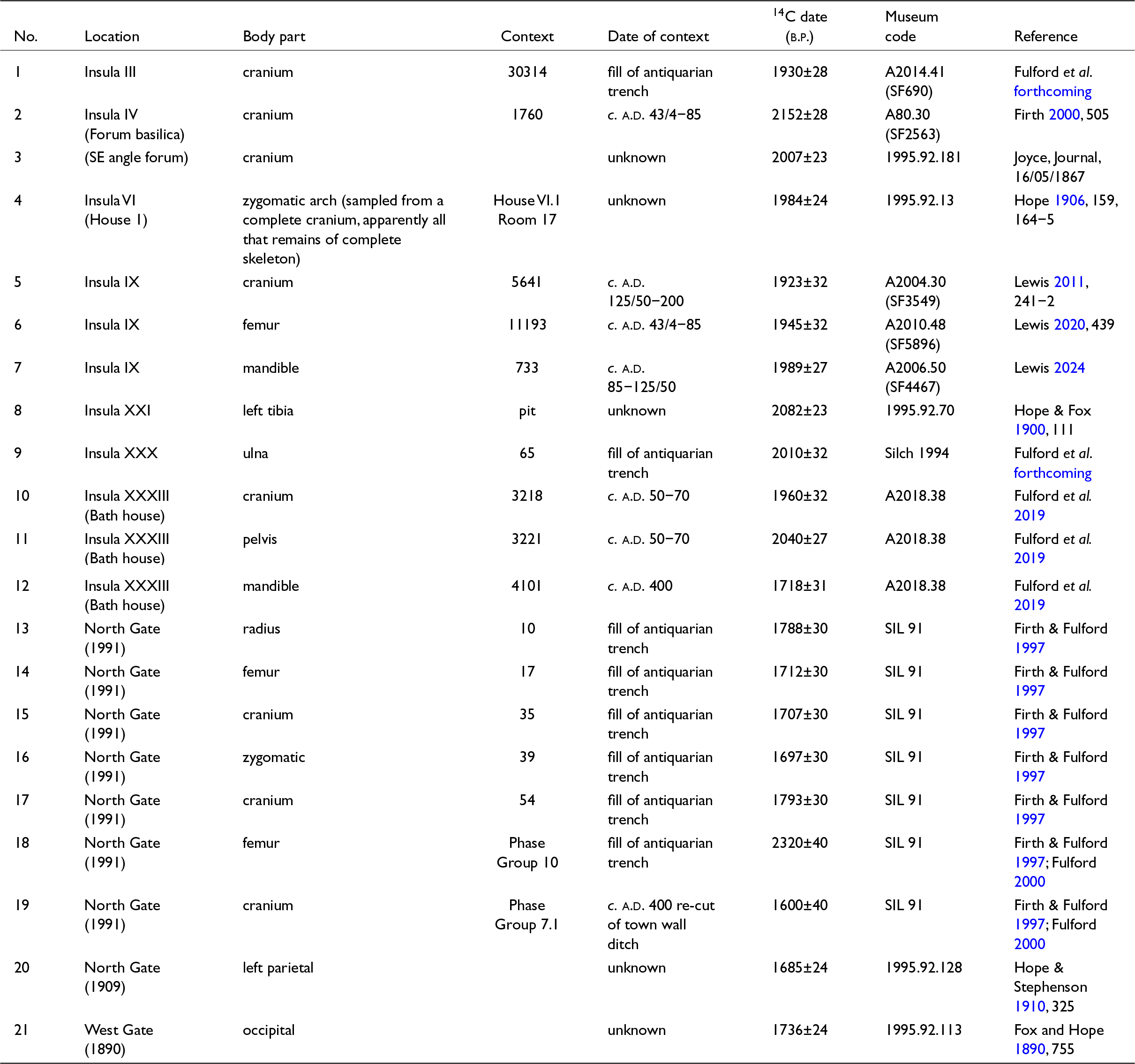
Silchester: Human bone with radiocarbon dates. See Table 2 for full details of the radiocarbon dates and associated stable isotope measurements.

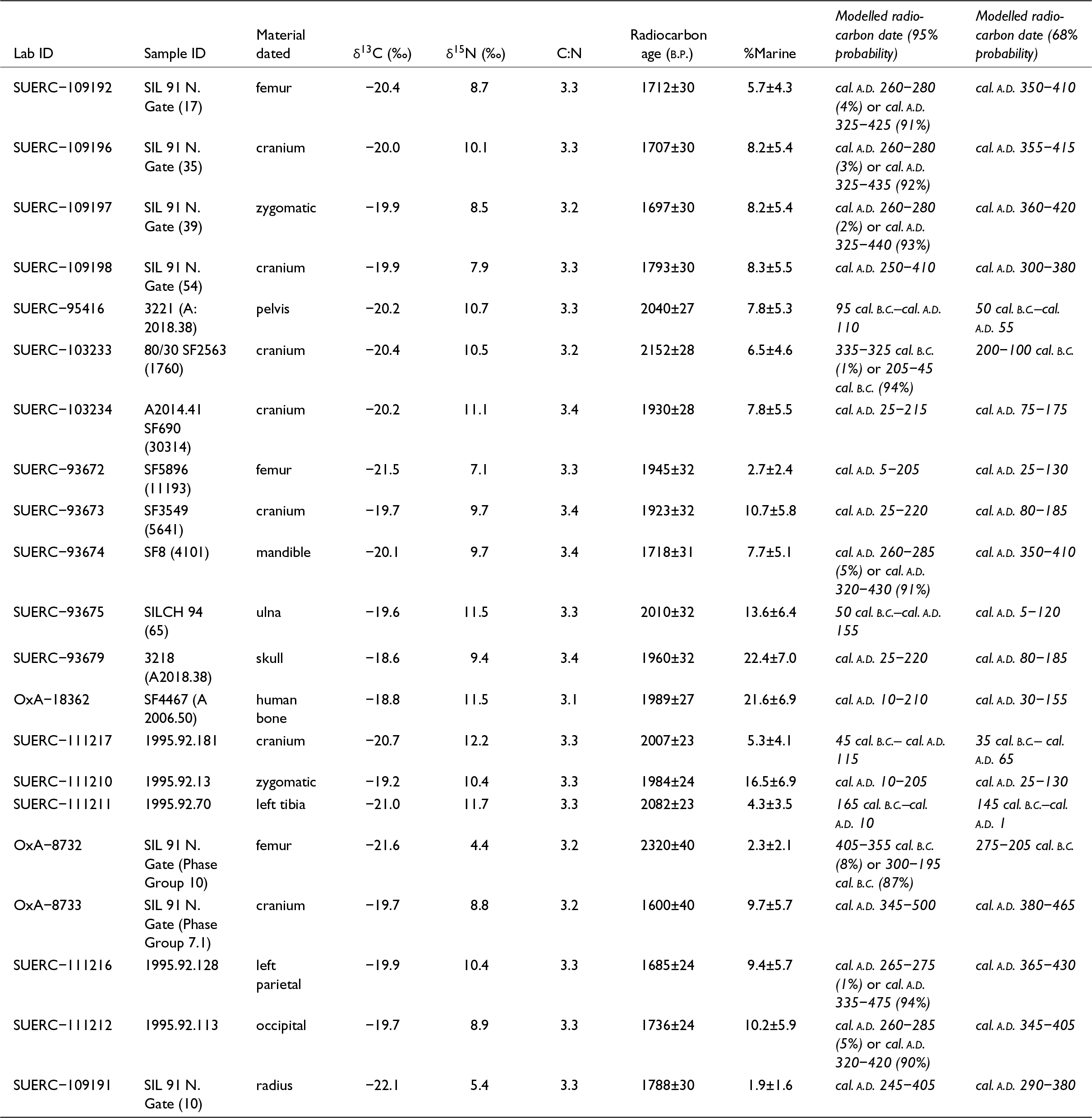
Radiocarbon dates and associated isotope results on inhumed human bone from Silchester.

Roman Britain
There are reports of finds of both articulated and disarticulated human remains from within Roman towns in Britain, including Silchester, from the nineteenth century to the present day. However, most of the early finds have little or no information about context. Best known, perhaps, are the numerous finds of crania recovered from the Walbrook valley in London and the middle and lower reaches of the River Thames. Once thought to be the heads of victims of the Boudican rebellion,Footnote 13 their interpretation has subsequently proved to be much more complex and interpretations include the practice of Celtic cults of the head, excarnation, the results of fluvial erosion from an upstream cemetery, executions or trophies associated with historic events such as the Boudican rebellion or Hadrian’s war, victims of gladiatorial combat and routine judicial executions.Footnote 14 Radiocarbon dating of some crania from these riverine contexts has introduced a much longer chronology with examples dating from the Neolithic, the Bronze Age and through to the medieval period, though all the examples from the Walbrook returned a late Iron Age/Roman date.Footnote 15 A further programme of radiocarbon dating has now been applied to 16 (27%) samples taken from two groups of crania, totalling 59 altogether, from stratified contexts from recent excavation in the upper Walbrook valley. While most of the dates were consistent with the second-century dates suggested by their archaeological context, at least two were earlier than their date of deposition.Footnote 16
As problematic as dating is the definition of context in relation to settlement. With Roman London’s expansion between its foundation in the mid-first century and its peak around the mid-second century, it is difficult to determine at any one time what might have been deposited within the settlement and what was buried in an acknowledged cemetery outside it, the situation only becoming clear with the construction of the town wall c. a.d. 200. Even though some of the finds of crania and other disarticulated remains from the upper Walbrook valley lie inside the town walls, at the time of burial the location might be thought to lie outside what might reasonably have been regarded at the time as the settlement.Footnote 17 Nevertheless, both crania and other disarticulated human remains have been found demonstrably elsewhere within the town and its suburb, Southwark, south of the river, and have been dated by context rather than by radiocarbon dating between the mid-first century, including a possible association with the Boudican revolt, and the later second century.Footnote 18 To give examples: there is the inverted cranium from Paternoster Square (see above), while at Queen Street a human cranium was found in the fill of a first-/second-century well;Footnote 19 and eight post-cranial fragments from at least three individuals were recovered from late first-/early second-century dumped material behind the waterfront at Billingsgate Buildings.Footnote 20 From a similar type of context but more closely dated to c. a.d. 60/1–80 and interpreted by the excavators as victims of the Boudican revolt are the finds at Regis House of disarticulated human bone from at least three individuals.Footnote 21 A slightly different pattern emerges in the later fourth century when, from recent excavations, inhumation burials containing complete, articulated skeletons have been found in and around the amphitheatre within the walled city as well as in Southwark south of the river.Footnote 22
Beyond London, human remains have also been found within the walls of seven civitas capitals, including Silchester, and two coloniae. Where evidence of date is available, the great majority of occurrences are from late or immediately post-Roman contexts, and there are a few instances of an early Roman date. Examples of the latter occur at Colchester, where the legionary fortress was succeeded by the foundation of a colonia (Camulodunum). Here, the remains of six individuals, represented by six crania and 24 post-cranial bones, were found in the ditch of the legionary fortress (a.d. 44–49) at Balkerne Lane, Colchester and a further, chopped human humerus was found on Site V at Balkerne Lane.Footnote 23 These finds therefore relate to the activities of the legion and pre-date the founding of the city. From the colonia disarticulated human remains have been found in Boudican contexts from the Fenwick excavation and the earlier Telephone Exchange excavation and, possibly a Boudican context, at Lion Walk.Footnote 24 Military action may explain the find of part of a pelvis from a mid/late first-century context at Cirencester, Glos., where an auxiliary fort preceded the foundation of the civitas capital in the late first century.Footnote 25 At Leicester (Ratae), civitas capital of the Coritani, leg bones, one with evidence of trauma, and an almost complete skull were found in Causeway Lane in the north-east quarter of the town in Phase 3 and 4 ditch and pit fills spanning the period between the mid-second and the mid-third century.Footnote 26 From the Roman civitas capital at Wroxeter (Viroconium), Shropshire, also formerly a legionary fortress, Bushe-Fox reported the find of part of a cranium in pit 64 associated with late first- and early second-century pottery.Footnote 27
Evidence for late and immediate post-Roman deposition of articulated and disarticulated human bone in the major towns of Roman Britain is more plentiful. However, the first case is the most problematic. Caerwent (Isca Silurum), civitas capital of the Silures, was, like Silchester, extensively but superficially excavated at the beginning of the twentieth century and, while descriptions of location within the town and of the general context, e.g. from a pit or well, are generally good, the citing of associated dating evidence, such as of coins or pottery, is almost non-existent. Remains at depth from the closure fills of deep wells include the bones ‘of two or more adult individuals … covered by a number of large stones’ from one well,Footnote 28 ‘two or three fragments of a human skull’ from the lower fills of a second,Footnote 29 ‘fragments of a human skull, part of the lower jaw, arm-bones and ribs’ with ‘more human bones’ a little further down from a third.Footnote 30 The remains from the latter well were also found beneath building material: stone roofing-tiles, rough blocks of building stone, a column drum and base. Two human skulls were found in a pit (probably a well) at depths of 12 and 15 ft.Footnote 31 Other remains found in more superficial contexts include fragments of human skull outside the base of a wall of House III,Footnote 32 a whole human skeleton under a wall of Block A,Footnote 33 part of a human skeleton at the broken or unfinished end of the apse of House IN,Footnote 34 upper and lower jaws of a human were found above an opus signinum floor in House XII,Footnote 35 and the lower jaw of a human skull from just above the early foundations of House XXN.Footnote 36 The above contexts are suggestive of late or post-Roman dates, but without radiocarbon dating, we cannot be more certain.
From within the civitas capital at Caistor-by-Norwich (Venta Icenorum) around 130 fragments of crania, predominantly of vaults and amounting to about 35 individuals, were found in Building IV loosely associated with a Theodosian coin hoard.Footnote 37 These remains were unfortunately destroyed in World War II. Across the province to the west at Cirencester (Corinium Dobunnorum) and from late Roman to early post-Roman contexts in Insulae V and VI in the heart of the town, we have a human skull from an intrusion cutting the latest floor surface of Room 5 of shop V.4 and ‘some disarticulated human bone’ from a robber trench associated with possible sub-Roman pottery in Building VI.3.Footnote 38 On the rampart of the town’s defences and in third-/fourth-century deposits arm and leg bones and a fragment of skull are recorded.Footnote 39 We should also note the ‘human skeleton’ and the upper torso of a human skeleton from two different locations in the silts of the main thoroughfare, Ermine Street, within the walls.Footnote 40 Some eight late Roman burials have been recorded from within the walls at Colchester, ‘the remains rest on or slightly cut into the latest Roman levels’.Footnote 41 These include two inhumations which were found under the north aisle of Building 127 with radiocarbon dates suggesting contemporaneity with the life of the building and a date range of a.d. 225–375, and two inhumations from East Hill House which had been decapitated post mortem and were also late Roman in date.Footnote 42
At Leicester the excavations at Causeway Lane also produced, from Phase 5 and 6 contexts ranging in date between the late second century and the mid/late fourth century, two human trochanters, a fragment of a femur, a vertebra and two adult skull fragments.Footnote 43 At the colonia of Lincoln (Lindum), besides the find of part of a human jaw bone in mid-Roman, probably early third-century,Footnote 44 rampart dumps at Silver Street, other finds of human remains come from deposits loosely dated between the very late Roman and the late Saxon have been recovered from deposits at Saltergate and Hungate, both also in the Lower City. From the former were found the disarticulated remains of a young adult sealing very late fourth-century riverine deposits which had built up against the city wall;Footnote 45 from the latter, a fragment of human skull from dumps of ‘dark earth’ over the remains of Structure 2 with a further fragment of human skull and an adult femur, probably from the upcast from the digging of an adjacent late Saxon pit.Footnote 46 If the above remains survive and can be located, they would clearly merit radiocarbon dating.
From the 1961–71 excavations in Winchester (Venta Belgarum) several finds of human bone were found from late and post-Roman (fifth- to seventh-century) contexts: a fragment of an adult human cranium was found among occupation material dated to the mid- to late third century which had been dumped on the late second-century town rampart at Tower Street, near the North Gate,Footnote 47 while bones of an adult female were found in a dark loam sealing the mid-fourth century destruction of Building 1B.Footnote 48 The other finds, mostly of cranial fragments and potentially of late Roman date through their association with late Roman material culture, but from post-Roman contexts, were reported from the South Gate, Cathedral Green, Wolvesey Palace and Lower Brook Street.Footnote 49
Atkinson reported both complete skeletons and disarticulated remains from his excavations of the forum basilica at Wroxeter.Footnote 50 Information on context is very limited and he assumed that they were all late Roman, although one skeleton was recovered at depth. Earlier, Bushe-Fox had reported a partial and a complete inhumation in courtyard 32 of Site VI, which he thought could be post-Roman.Footnote 51 Other disarticulated human remains were found close by, west of room 37.Footnote 52 Without independent dates we cannot be certain whether these finds are residual from the legionary fortress or are associated with the life of the town.Footnote 53 More recently at Wroxeter excavations of the baths’ basilica produced some 60 cranial fragments as well as six further fragments of human bone from late fourth- to sixth-century dumps and surfaces, although these were perhaps derived from fourth-century (or earlier) deposits elsewhere in the town.Footnote 54 The cranial fragments represented at least nine individuals and, as noted above, the fragments were contaminated, perhaps deliberately anointed, with organic oils. A few fragments have evidence of knife or sword cuts, one of scalping and one, as we have seen above, may have been turned into a ‘skull cap’.Footnote 55 Three cranial fragments were radiocarbon dated, returning Roman rather than the late or post-Roman dates which would be consistent with their stratigraphic contexts.Footnote 56 In the 1860s, the antiquarian Thomas Wright found a dozen burials in the hypocaust around the frigidarium of the bath house, either very late Roman or post-Roman in date.Footnote 57
Silchester
At Silchester the antiquarian reports mention a few complete skeletons of adults as well as infants and partial skeletons, and disarticulated remains including ‘skulls’ (crania).Footnote 58 They are all undated but were attributed to the period around the end of the Roman town.Footnote 59 A male skeleton was found in the cold plunge-bath of the bath house of the mansio in 1833 with a suggested date of burial in the 430s, while the greater part of a skeleton was found in the 1860s by Joyce in the (forum) basilica from a context later than the supposed destruction horizon. From the same general location were two or three cranium fragments with further pieces from the North and West Gates. In addition to a complete skeleton from House 1 in Insula VI, part of the body of a child was found in a well in the same insula. Unfortunately, only a few items among the surviving human remains in Reading Museum thought to come from Silchester are marked with a provenance from within the town.
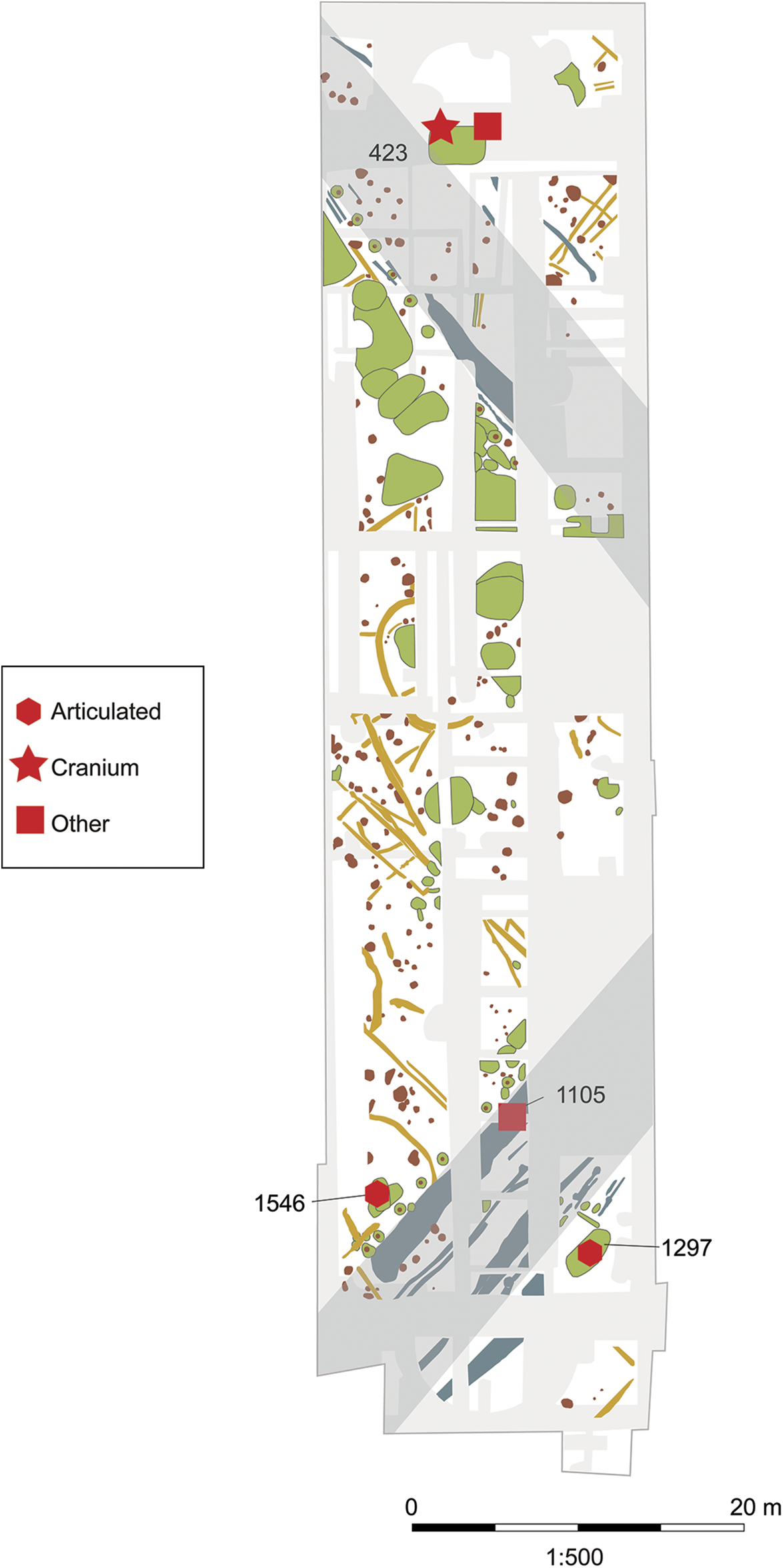
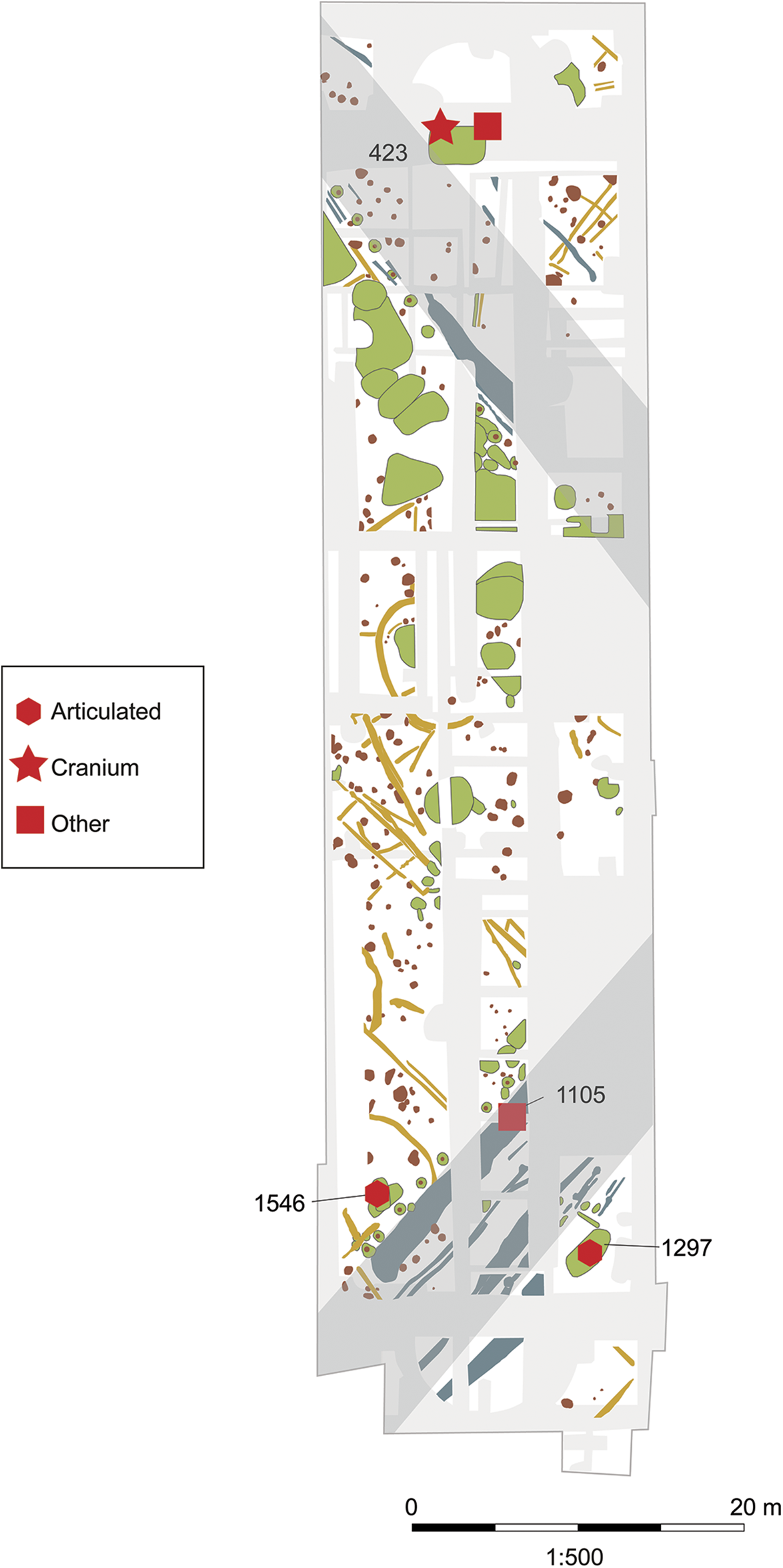
The more recent excavations, two of which involved total excavation to the geological subsoil, have provided better contextual information. From beneath the forum basilica in Insula IV a complete adult skeleton, a partial skeleton and other disarticulated remains were found in the ditches and shallow pits either side of the north-east/south-west-aligned late Iron Age street, c. 15 b.c.–a.d. 40/60 (Fig. 1). Other disarticulated remains including a cranium fragment were found in a late Iron Age well with further disarticulated remains from Claudio-Neronian contexts.Footnote 60 From the total excavation of the north-east quarter of Insula IX came three pieces: a femoral head of a young adult from a Claudio-Neronian pit,Footnote 61 a mandible from a female adult aged 25–35 buried in the floor of one of the late first-/early second-century timber buildings (see above),Footnote 62 and cranium fragments of an adult from an early second-century context in an adjacent timber building.Footnote 63 Excavation at the North Gate in 1991 produced two adult cranium fragments from a fourth-century context in the gateway, a further, partial cranium from the late fourth-century fills of the town wall ditch and a radius from late fourth-century middening south of the gate. A further cranium fragment and fragments of arm and leg bones, including a femur with a cut across the trochanter, were recovered from the backfill of antiquarian excavation trenches.Footnote 64 Two bones were radiocarbon dated: the femur gave an Iron Age date (2320±40 b.p.; Table 1, no. 18) while the partial cranium from the late Roman ditch dated to the fifth century (1600±40; Table 1, no. 19).Footnote 65 Most recently, unpublished excavations next to the public bath house have produced an adult mandible from a late Roman context and the cranium and pelvis fragment from the mid-first-century a.d. re-cut of the late Iron Age defensive ditch known as the ‘Inner Earthwork’ (see above).Footnote 66 An earlier excavation across this ditch at the north-east corner of Insula XXIII produced three cranial fragments from the fill.Footnote 67 Further fragments were also recovered from the backfill of antiquarian trenches in unpublished excavations in Insula III and XXX (Table 1, nos 1 and 9).
Silchester: conquest-period human remains on the site of the forum-basilica (forum-basilica outline in light grey and late Iron Age ‘lanes’ in dark grey). North at top of image.
The great majority of the stratified occurrences of disarticulated bone from modern excavations at Silchester have occurred in contexts dated between the end of the first century b.c. and c. a.d. 200 with only a couple from fourth-century or potentially post-Roman contexts. Just as radiocarbon dating of human remains from Roman London and from Wroxeter, too (discussed above), has indicated that some are earlier than their date of final deposition, the question of the extent of residuality also arises in the case of Silchester. To resolve this, it was decided to embark on a programme of radiocarbon dating of disarticulated human remains from modern excavations, viz. at Insulas III (1), IV (forum basilica) (1), IX (3), XXX (temple enclosure) (1), XXXIII (3) (the public bath house) and the North Gate (7) (Table 1). In addition, all five unstratified pieces with provenance from antiquarian excavations (Insulas IV, VI, XXI and the North and West Gates), which are archived in Reading Museum, were also included (Table 1). Altogether 21 samples of human bone from Silchester have now been radiocarbon dated.
Radiocarbon dating and chronological modelling
The radiocarbon dates from the 21 bone samples were processed at the laboratories at the University of Oxford (OxA-) and the University of Glasgow (SUERC-). They were pretreated and measured following the methods described by Brock et al. and Dunbar et al., respectively.Footnote 68 The radiocarbon results (Table 2) are conventional radiocarbon ages.Footnote 69 While a radiocarbon measurement is an accurate reflection of the amount of radiocarbon in a sample, the actual amount can be affected by carbon from non-terrestrial reservoirs, which has the potential to make a sample appear to be older than it is. The stable isotopes from most of the people indicate measurable levels of marine resource consumption, which is well-known to induce a radiocarbon age offset in the consumer.Footnote 70
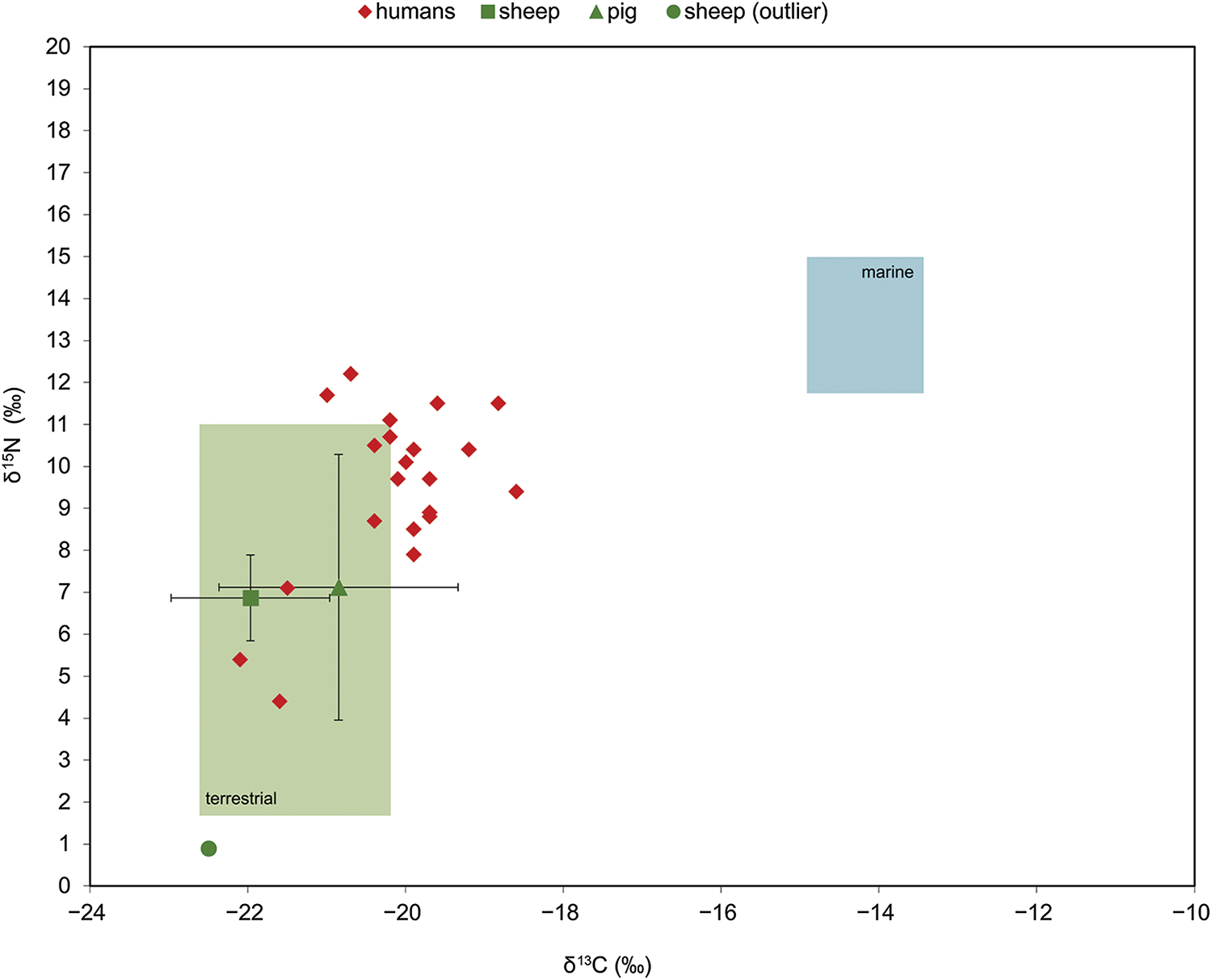
The plot of the δ13C versus δ15N values for the Silchester inhumations (Fig. 2; Table 3) shows the trend toward the incorporation of some degree of marine protein in the diet. While a shift toward heavier (i.e. less negative) δ13C values can be indicative of the incorporation of C4 plants in the diet, data from modern millet suggest δ15N values of 3–4‰ can be expected,Footnote 71 which would result in lighter observed δ15N values in the human population. Although it is possible that some of the dietary isotopic signal observed is derived from the consumption of C4 plants, such as millet, the pattern observed strongly suggests that many of the individuals were consuming marine protein, with most perhaps receiving around 5–8% of their dietary protein from marine foods, and two potentially receiving more than 20% of their diet from marine protein (Table 1, nos 7 and 10).
Plot of the δ13C versus δ15N values for the Silchester burials. The boxes represent the typical area where terrestrial mammals and marine fish and mammals would be expected to fall, while measurements made on sheep and pig bone from Silchester are given with 95% error bars (data are given in Table 3). This provides a general representation of how a linear mixing model might be used to determine where along that gradient for δ13C each individual can be determined to lie.

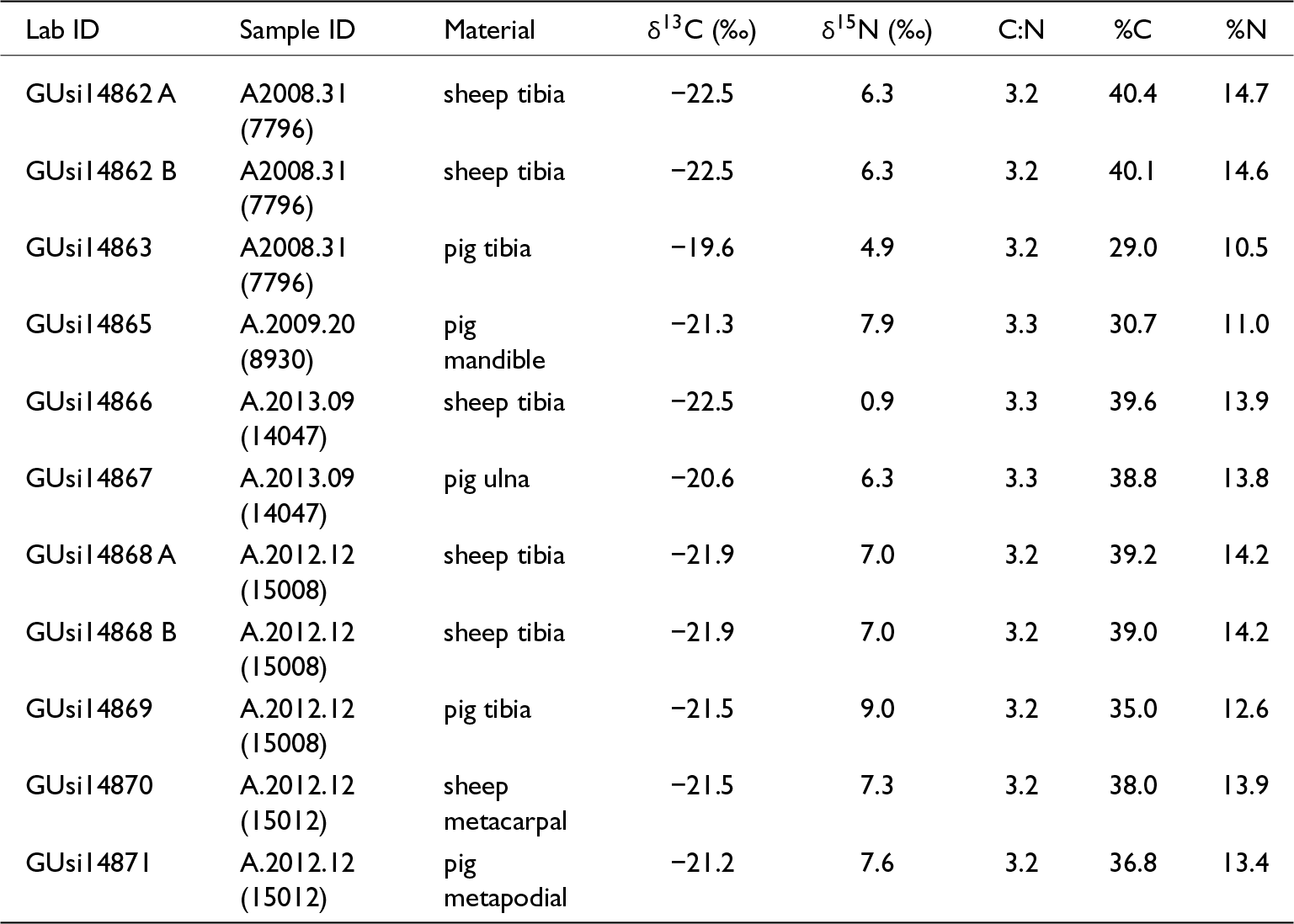
Stable isotope measurements from faunal remains at Silchester used to develop the local terrestrial diet baseline.

In order to determine the ‘percent marine diet’ for the inhumations, the methodology described in Sayle et al. Footnote 72 was employed using the FRUITS software package for unmixing the diet for each individual following a Bayesian approach.Footnote 73 This has a benefit over using a simple linear mixing modelFootnote 74 because it allows the error to be quantified for each person. The δ13C and δ15N values used were, respectively: Terrestrial: –21.4±0.6‰ and +6.3±2.3‰ and Marine: –14.3±0.4‰ and 13.4±0.8‰. The trophic offset used for producer collagen to consumer collagen was 1.0±0.2‰ for δ13C and 4.0±0.5‰ for δ15N. These values are similar to those used in Sayle et al. Footnote 75 and reflect the expected ranges given by Bocherens and Drucker.Footnote 76
The estimated percent marine value is used for the modelled calibration that mixes the international terrestrial and marine radiocarbon calibration curves of Reimer et al. and Heaton et al., respectively.Footnote 77 Since the offset between these two curves is both spatially and temporally dependent, a further ΔR correction of –150±52 years was applied, calculated as the average ΔR around the coast of Britain using the Calib.org Marine Reservoir database (http://calib.org/marine/).
Within OxCal, the %Marine value with percentage error calculated using FRUITS was used with the Mix Curves parameter to develop a modelled calibration curve that is individualised for each sample result. An unfortunate side-effect of marine reservoir correction is that the modelled dates will decrease in precision with the ‘mixing’ of the two calibration curves and the increased errors that produces. However, Bayesian chronological modelling has been shown to account accurately for these negative effects and produce accurate chronological frameworks in even the most extreme cases.Footnote 78
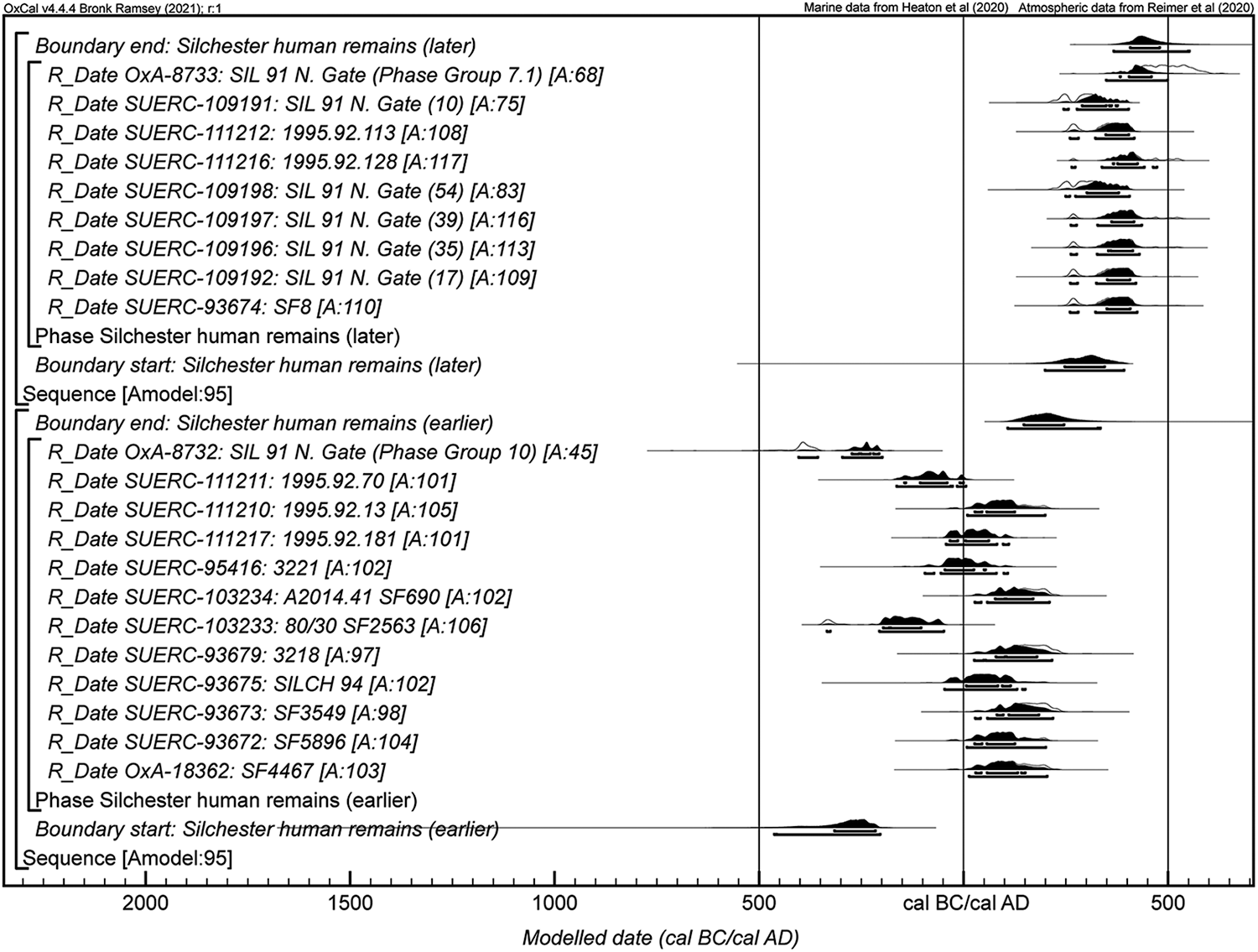
A Bayesian approach was applied to the radiocarbon-dated human remains from SilchesterFootnote 79 using the computer program OxCal v4.4.Footnote 80 The algorithm used in the models can be derived from the OxCal keywords and bracket structure shown in Fig. 3. In summary, while there were no stratigraphic relationships noted between individual find locations, it was felt the samples could be grouped based on the relative phase/level, which a cursory view of the results suggested might hold up as being temporally significant. The first group included all the remains, except one piece, excavated from around the North Gate of Silchester in 1991, as well as single finds from antiquarian excavations at both the West and the North Gate, and a mandible from an undisturbed late deposit adjacent to the bath house (Fig. 6). The remaining samples came from a mix of deposit types: well stratified contexts dating between the mid-first and the late second or early third century a.d. (Insulas IV, IX and XXXIII), stratified but from the backfill of antiquarian excavations (III, XXX and N. Gate); and from antiquarian excavations (IV, VI and XXI) (Fig. 5). The model, therefore, has grouped these two sets into an earlier and later group of results and modelled each group completely independently of one another.
Probability distributions and chronological model for the human inhumations at Silchester. Each distribution represents the relative probability that an event occurred at some particular time. For each of the radiocarbon measurements two distributions have been plotted, one in outline, which is the result of simple radiocarbon calibration, and a solid one, which is based on the chronological model used. The large square ‘brackets’ along with the OxCal keywords define the overall model exactly.

The model has good agreement between the groupings and the dates (Amodel=95). It estimates the earlier group of inhumed remains are indicative of activity beginning in 465–205 cal. b.c. (95% probability; Fig. 3; start: Silchester human remains (earlier)) or 320–215 cal. b.c. (68% probability). This period of dated activity ended in cal. a.d. 105–335 (95% probability; Fig. 3; end: Silchester human remains (earlier)) or cal. a.d. 145–250 (68% probability). The overall span of the earlier period is estimated at 345–730 years (95% probability; Fig. 4; span: Silchester human remains (earlier)) or 390–565 years (68% probability).
Span of the dated periods of inhumation at Silchester. The spans are derived from the modelling shown in Fig. 3.

The model estimates the later group of inhumed remains are indicative of activity beginning in cal. a.d. 200–395 (95% probability; Fig. 3; start: Silchester human remains (later)) or cal. a.d. 245–345 (68% probability). The later period of dated activity ended in cal. a.d. 365–555 (95% probability; Fig. 3; end: Silchester human remains (later)) or in cal. a.d. 405–480 (68% probability). The overall span of the later period is estimated at 1–310 years (95% probability; Fig. 4; span: Silchester human remains (later)) or 70–230 years (68% probability).
Discussion
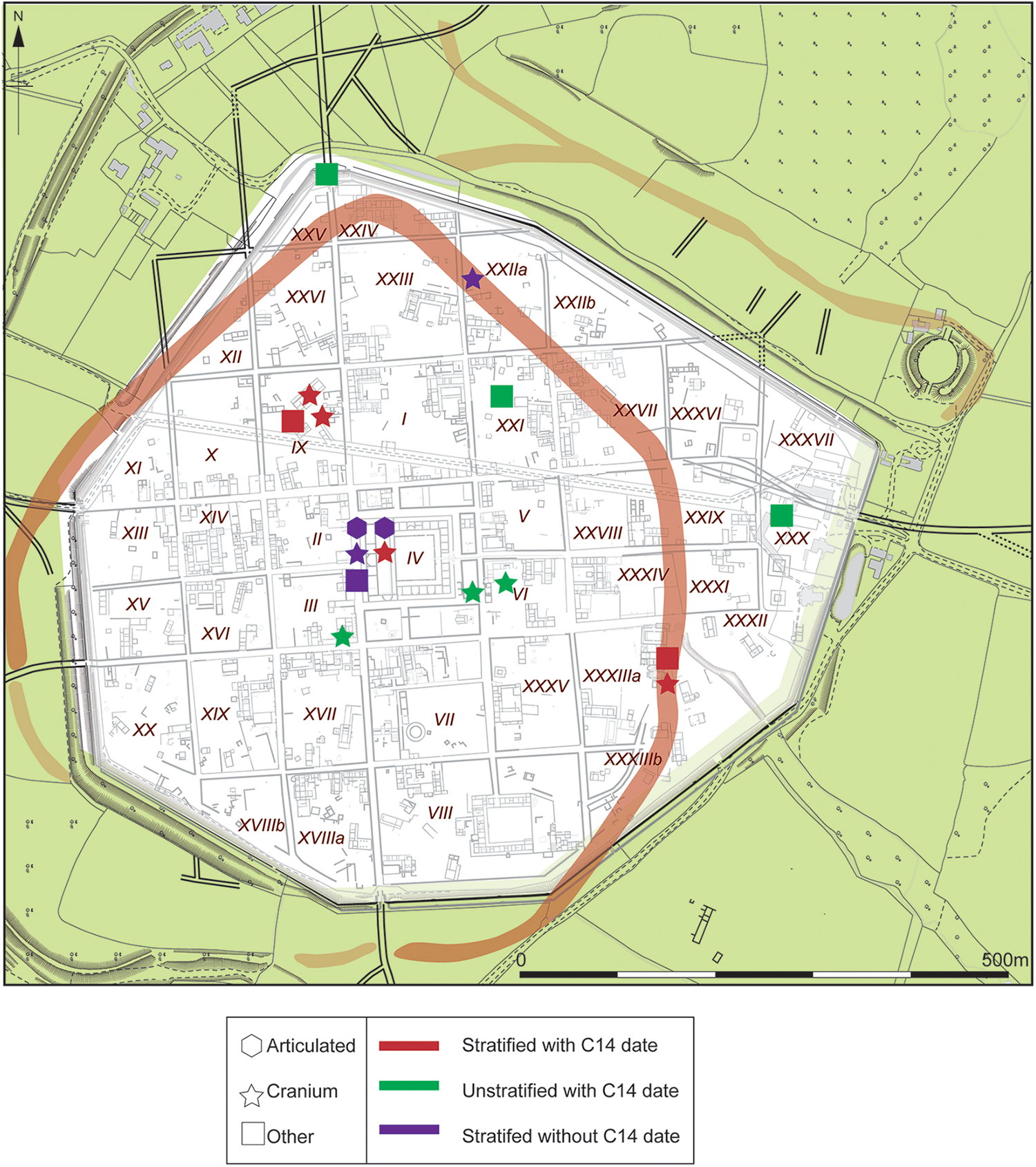
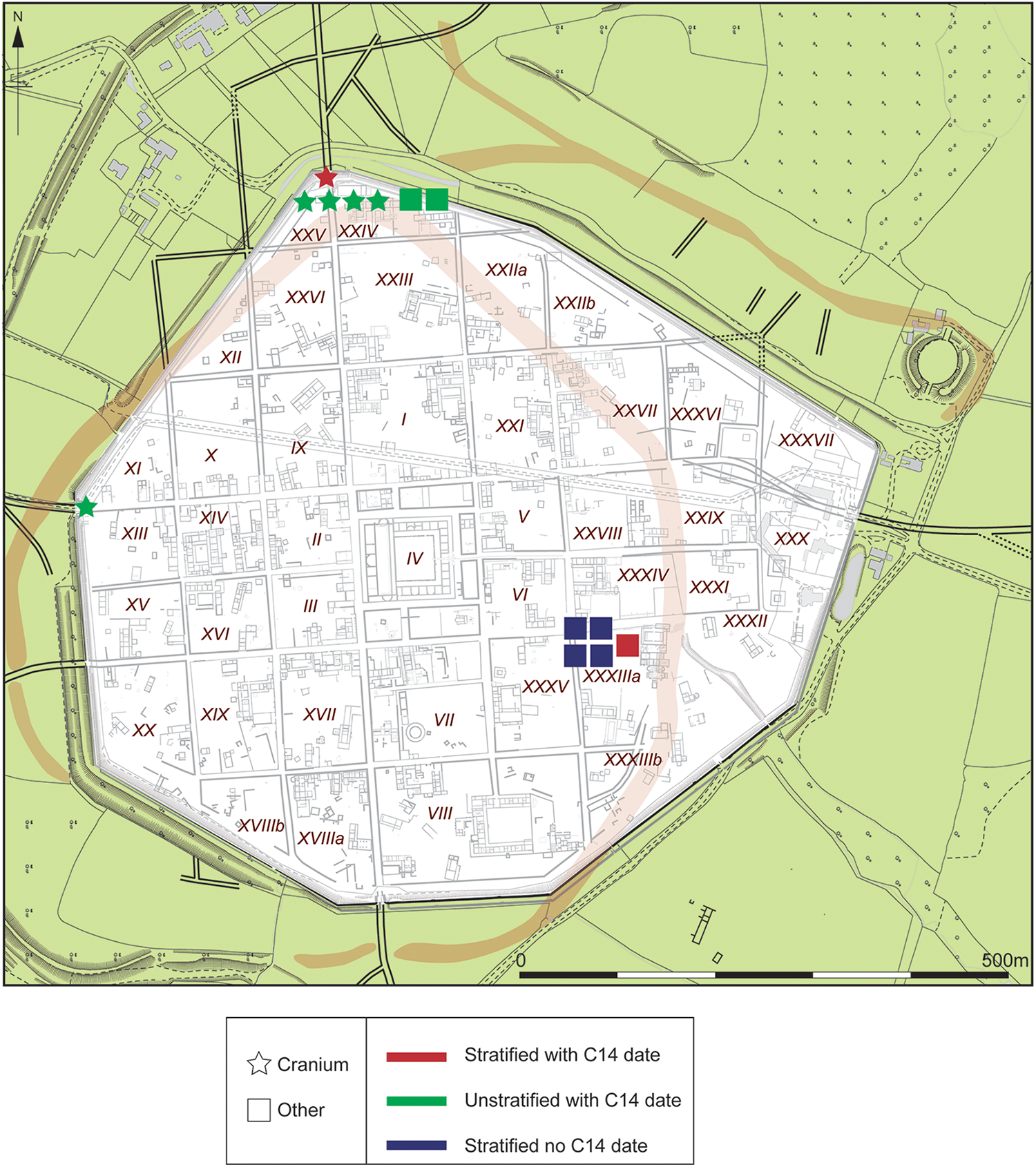
The distributions of the two groups are plotted on Figs 5 and 6. They are almost mutually exclusive. With one exception adjacent to but outside the North Gate, the findspots of the early group are otherwise to be found within the town rampart and later walls,Footnote 81 while, with one exception from beside the bath house in Insula XXXIII, all the late dates are to be found at the North and West Gates with a cluster at the former. Whereas the early group divides evenly between six crania or cranial fragments, including the Insula IX mandible, and six post-cranial bones, the late group comprises seven cranial fragments as well as the mandible from beside the bath house and two post-cranial bones.
Silchester: distribution of the early Roman group including articulated and disarticulated human remains.

Silchester: the distribution of the late Roman group of disarticulated human bone.

The early group includes three outliers with Iron Age dates: a cranial fragment from a pre- or early Flavian context from beneath the forum basilica (Table 1, no. 2), a tibia from an otherwise undated pit in Insula XXI (no. 8) and — the earliest of the three — a femur from the backfill of an antiquarian trench outside the North Gate (no. 18). Two of the early group of radiocarbon-dated bone (nos 10 and 11) were stratified in the lower fills of the late Iron Age Inner Earthwork defensive ditch where it was sectioned beside the bath house in Insula XXXIII and are associated with a small assemblage of pottery of Claudio-Neronian date. The radiocarbon-dated pieces from Insula IX (nos 5–7) are from slightly later contexts: late first- to end of second-/beginning of third-century contexts. Other early, but not radiocarbon-dated remains include cranial fragments from a section of the Inner Earthwork ditch between Insulas XXIII and XXIIa associated with Claudio-Neronian potteryFootnote 82 and from beneath the forum basilica. The latter include a complete and a partial skeleton from pits beside the late Iron Age lanes and dated to the Tiberian-Claudian period as well as other cranial and post-cranial fragments from Claudio-Neronian contexts.Footnote 83 Of these, the complete adult male skeleton recalls the complete skeleton from Insula VI, House 1 whose cranium we have dated here. The latter was found at a depth of two feet below the foundations of Room 17 and four feet below the ground surface, an equivalent depth to that of the human remains from beneath the forum basilica, and so quite possibly from a Late Iron Age or earliest Roman context. Given the likelihood that the foundation trench was no wider than the foundations, we should not be too concerned by Newton’s opinion that its proximity to the wall of the room precluded it being earlier than the house.Footnote 84
To conclude, all the insulas (III, IV, IX, XXX, XXXIII) which have been sampled by modern excavation (i.e. post 1950) have produced at least one fragment of human skeleton which belongs to our early radiocarbon-dated group. The early radiocarbon-dated antiquarian finds have added a further two insulas, VI and XXI, and a second location in Insula IV. To these we might arguably add the three other instances of finds of disarticulated human bone reported by the antiquarians but which cannot be identified among the surviving pieces in the Reading Museum collection. These include a cranium fragment found in the south of Insula I in 1890,Footnote 85 the arm bones and part of the cranium of a 12–14-year-old individual found in a ‘wooden tub’ at the bottom of a well in Insula VIFootnote 86 and an adult mandible found in either the southern part of Insula XXVIII or in Insula XXXV.Footnote 87
In this particular context we should not take the relative lack of records of finds from the extensive antiquarian excavations compared with those from the modern investigations too literally. Despite their apparent completeness, the early excavations within the town walls were superficial: shallow trenching identified the remains of masonry buildings each of whose full ground-plan was then revealed immediately below the ploughsoil, leaving, as the excavations within Insula IX have demonstrated, the archaeology between and under the buildings untouched. While, as the record shows, the workmen employed by the antiquarians could recognise (and retain) complete or partial human skeletons and human crania, this was not the case with disarticulated post-cranial human bone as the modern finds from the fills of antiquarian trenches around the North Gate and in Insulas III and XXX demonstrate (Table 1, nos 1, 9, 13–18). The difficulty of recognising disarticulated human bone during the excavation and the onsite finds processing is also a feature of contemporary excavations at Silchester, where all the isolated fragments except crania and mandibles were only recognised when the faunal assemblages were submitted for analysis. This in turn raises the question of recognition more widely, particularly before the last decades of the twentieth century, when animal bone was more routinely retained and subjected to analysis; the Silchester experience is unlikely to be unique. Thus, we can only be confident of being positive about absence in those instances where the animal bone has been retained, analysed and the results reported. By comparison with the antiquarian investigations, the total excavations to the geological subsoil in Insula IX and beneath the forum basilica in Insula IV give a better idea of the potential for future finds. We should also note that, of the three narrow trenches dug in modern times through the ditch of the late Iron Age Inner Earthwork, together representing less than one per cent of the whole length of the ditch, two have produced human remains. These, as we have seen above, are stratigraphically contemporaneous. On the basis of the finds made so far to date, we can safely predict further investigations within the town walls are highly likely to produce more disarticulated remains to be associated with our early group.
Although the radiocarbon dates allow us to distinguish an ‘early’ and a ‘late’ group of disarticulated human remains, we cannot presume that they correspond with particular short-lived episodes within the life of the town which left bodies, whether as victims of disease or of violence, but without formal burial outside the pomerium, to become disarticulated through the urban processes of pit, ditch, well and foundation digging. Nevertheless, we cannot overlook the two historically documented events in the first century, the Roman invasion of a.d. 43 and the ensuing conquest of southern Britain, and the Boudican rebellion of a.d. 60/61 and its subsequent suppression. The majority of our ‘early’ group could be associated with either or both of these events, but perhaps the more likely context is the first years after the initial Roman invasion of a.d. 43 when Suetonius tells us that the future emperor Vespasian, operating with legio ii Augusta in the south of Britain, reduced to submission two powerful tribes and 20 oppida.Footnote 88 Given its association with Caratacus, Calleva (Silchester) is likely to have been one of the latter.Footnote 89 Conversely, Calleva is not listed among the towns destroyed in the Boudican rebellion nor has evidence of a destructive phase of that date.
Given the death toll alleged by ancient historians in the three towns and cities destroyed by the Boudican revolt, Colchester, London and St Albans (Verulamium), one might have expected a corresponding spread of articulated and disarticulated human remains from within their settlements, yet this so far appears not to be the case at Colchester and Verulamium, despite the numerous modern excavations which have taken place in them. London, however, is different. As we have seen above, and setting aside the debatable context of remains found in the Walbrook, there are several finds and findspots of disarticulated human bone from London which have been associated with the Boudican rebellion. On the other hand, apart from the recent case of several pieces of disarticulated bone from Boudican contexts from the Fenwick excavation and the adjacent, but earlier, Telephone Exchange excavation, there are no other published records from Colchester,Footnote 90 and there is nothing yet from Verulamium. There are several possible explanations for this apparent lack of evidence, not least a relative lack of analysed and published faunal assemblages, the most likely source of disarticulated human bone (see above).Footnote 91 In this context we should be very cautious about the apparent absence of finds from Verulamium since all the published twentieth-century intramural excavations took place before animal bone was systematically retained. We should also acknowledge the (considerable) exaggeration of numbers on the part of the ancient writers and/or the possibility of the recovery and formal burial of victims outside the town after the disaster. For now, then, the finds potentially attributable to the Boudican destruction of London represent the closest parallel to what we envisage in terms of the number and spread of pieces of disarticulated bone as a conquest-period event at Silchester (our ‘early’ group). However, we do not have a methodology for converting these finds into the actual numbers of the dead and it would certainly not be appropriate to leave the reader thinking the numbers of dead at Silchester related in any way to the potential numbers killed in the Boudican assault on London.
With its concentration at the gates through the town wall (Table 1, nos 13–21), the group of ‘late’ dates presents a very different picture to that of the ‘early’ group. Unlike the latter with its wide distribution across the town, the focus at the gates suggests deliberate positioning, presumably by decision of the governing ordo of the town. The postulated involvement of an urban authority in the placing of crania at the gates suggests the likelihood that their owners were victims of justice, the placing of their heads at the gates to be a visible deterrent to others. The radiocarbon dates give a potential spread from the beginning of the third century, by which time the first, earthen defences and gates had been constructed — the succeeding masonry wall and gates dating from the late third century — through to c. 500, or 465, the modelled date.Footnote 92 However, five of the nine late (modelled) dates lie between the early fourth century and 410 (Table 2). Only one cranial fragment (no. 19) (and, possibly, a second, antiquarian find, no. 20) is from a well-stratified context dating to the beginning of the fifth century from a re-cut of the town ditch at the North Gate. No. 19 is also the latest dated piece of the group. As we have seen, the majority are cranial fragments, which were perhaps originally displayed above the gates for all to see entering or leaving the town, before reaching their final point of deposition in the wall ditch below the gate or elsewhere close by. While London offers a locational parallel with groups of crania deposited on the northern margins of the settled area in the early Roman period, both Caistor-by-Norwich and Wroxeter offer parallels for deposits or, more likely, re-deposits within the town of late Roman groups of disarticulated human bone dominated by cranial fragments, in the former in a house on the northern edge of the town, in the latter in the basilica attached to the public bath house. We have seen above that other towns, notably Cirencester, Leicester, Lincoln and Winchester, have produced isolated finds from modern excavations of near-complete skulls or fragments of skulls which were stratified in late or sub-Roman contexts in a variety of locations within the town walls and with no emphasis on the gates. Moreover, it is clear from the record of the above four towns that disarticulated pieces of post-cranial bone as well as complete or near-complete skeletons were as, or more, common than crania or fragments of crania. Colchester and London stand out for the number of late Roman inhumations within the walls. We do see post-cranial bone at Silchester at the North Gate and at the bath house, but the evidence from the four towns cited above suggests that we might expect to find a more extensive distribution at Silchester in the future.
Concluding discussion
Modelling of 21 radiocarbon-dated disarticulated human bones points to two chronologically discrete groups at Silchester, one early, the other late Roman, with mutually exclusive distributions within and on the margin of the town. We have set these results against the context of finds of similar material from several of the other major towns of Roman Britain and noted the very variable quality of the evidence. This ranges from towns like Caerwent, where antiquarian discoveries lack the reporting of associated dating evidence but point to an interesting, potentially late and/or sub-Roman pattern of deposition, to those like Verulamium, where there appears to be a complete absence of evidence but, when set in the context of finds-retention practice of the twentieth-century excavations, a negative which cannot be taken literally. The situation improves markedly with excavations undertaken from the 1970s onwards, as we have seen with the records of stratified finds from Cirencester, Colchester, Leicester, Lincoln, London, Silchester and Wroxeter. There is also a clear correlation between the systematic retention and analysis of faunal assemblages and the identification of isolated finds of disarticulated human bone. Notwithstanding much better contextualisation there is, as our case study has shown, a need for the independent dating of finds to address issues of residuality and of contexts and periods where there is a lack of datable material culture. Given our dependence on Roman coins, this is a particular issue for the period after new coin ceased to be brought regularly into Britain at the beginning of the fifth century. As we have seen, radiocarbon dating has proved to be effective in resolving the dating of finds at the ‘top’ of the Roman sequence.
In interpreting the results from Silchester, we note that, with the exception of London, no other town in Britain has a comparable incidence and spread of early Roman finds. Besides noting the late Iron Age background at Silchester, we have suggested a possible connection with the conquest of the south of Britain following the Roman invasion of a.d. 43. In terms of disarticulated remains, London stands out for the number of crania for the early Roman period, particularly from second-century contexts on the northern edge of the town, for which a number of interpretations have been offered (discussed above). Elsewhere we find deposits containing both post-cranial disarticulated human bone and almost complete crania or fragments of crania at Cirencester from third–fourth-century contexts at Trinity Road and at Leicester from the mid-second/early third century at Causeway Lane. Complete or near complete skeletons have been found in several towns at the interface of latest Roman and earliest medieval, but only at Colchester and London do we seem to have secure evidence of intramural interments in the fourth century. And it is in similar stratigraphic contexts that we find disarticulated post-cranial and cranial bone at other towns such as Cirencester, Lincoln, London and Wroxeter. The radiocarbon dates from Silchester of fragments from both stratified and unstratified contexts give ranges between the early third and the early fifth century. Thus, even though many more remains need to be radiocarbon dated, from the sample of evidence that we currently have, it is reasonably clear that the disposal of human remains was taking place within towns, at least intermittently, in the later Roman period (and at the same time that regular burials were taking place in extramural cemeteries). No longer can such remains be seen to be synonymous with the period after the breakdown of Roman authority at the beginning of the fifth century, or attributable to plagues in the fifth or sixth century.Footnote 93
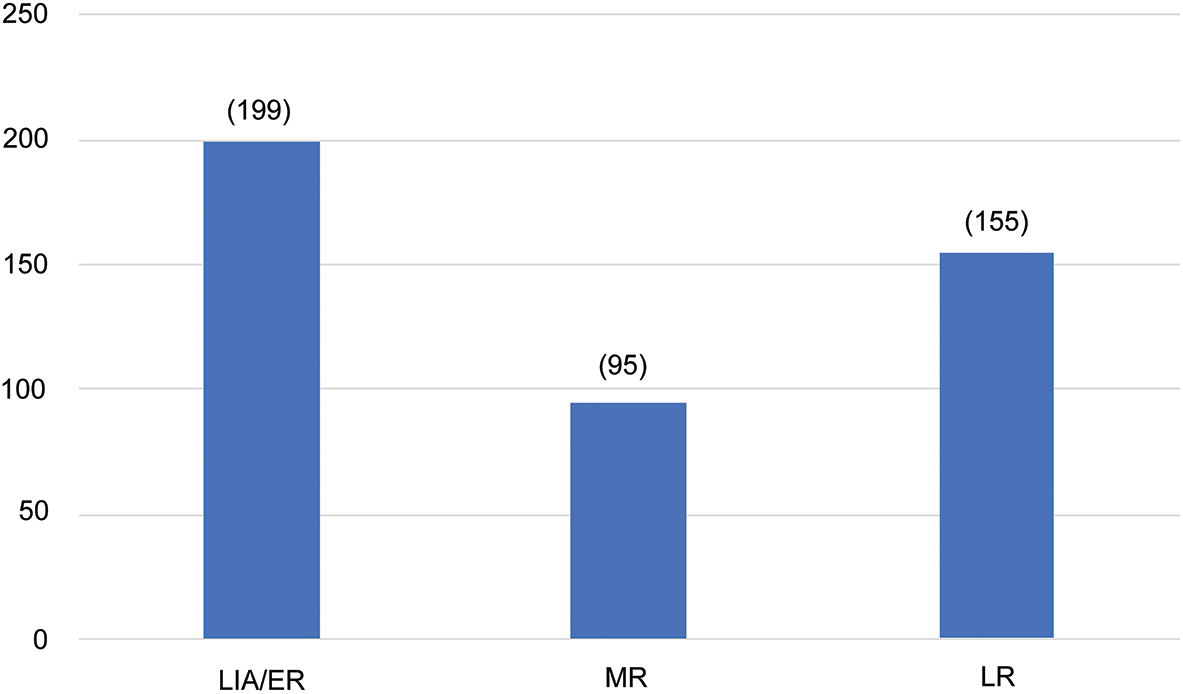
How do we account for this change of behaviour? While there are probably multiple explanations, the incidence of crania, notably at Caistor, Silchester and Wroxeter, and with their disposition at the gates at Silchester, points to changing attitudes to the administration of justice in late Roman Britain. At Silchester, are we looking at judicial executions leading to the display of heads at the town gates? In this context, we should note the frequency of decapitation among late Roman inhumations both in town cemeteries, such as at Lankhills, WinchesterFootnote 94 or in isolated burials and cemeteries in the countryside, though in these cases the head tends to be buried with the rest of the body.Footnote 95 Wiseman et al. have recently made the case for judicial executions at Knobb’s Farm in late Roman Cambridgeshire.Footnote 96 However, more generally, the countryside provides the best parallel for the chronological grouping of the disarticulated human remains at Silchester. With its early and late clustering, Fig. 7 shows the chronological incidence of disarticulated human remains as derived from the Rural Settlement of Roman Britain dataset and dated by context.Footnote 97 While this dataset deserves a detailed contextual review associated with a programme of radiocarbon dating, if we take the urban and rural datasets together, we may be seeing, on the one hand, traces of the violent beginnings of the Roman occupation of southern Britain and, on the other, after a relatively quiet middle period within the province, a more violent later Roman Britain. While the governor had responsibility for determining all cases involving capital punishment and non-citizens in the early empire, it would appear that, by the fourth century, authority had been delegated to the civitates, or perhaps even to individual landowners, as the Cambridgeshire evidence would suggest.Footnote 98
The chronological distribution of disarticulated human remains from the countryside of Roman Britain (data from Allen et al. Reference Allen, Blick, Brindle, Evans, Fulford, Holbrook, Lodwick, Richards and Smith2015).

Acknowledgements
We thank Ross Turle at the Hampshire Cultural Trust and Angela Houghton at Reading Museum for permission to sample the specimens in their respective collections. We are very grateful to Dr Ellen Green, Professor Mary Lewis and Dr Gundula Müldner for identifying the human bone, helping with sampling and, with Professor Hella Eckardt and Dr Alex Smith, very helpfully commenting on this paper. We thank Nicholas Pankhurst for preparing Figs 1 and 5–7.


 Open access

