


1. Introduction
The healthcare sector is a major contributor to the climate change crisis (Reference Zikhathile, Atagana, Bwapwa and SawtellZikhathile et al., 2022). The ecological footprint of healthcare institutions (including hospitals, psychiatric institutions, residential care centres and institutions for disabled care) in Belgium is 5.5% of the national ecological footprint (Reference Karliner and SlotterbackKarliner & Slotterback, 2019). Hospitals have a disproportionate impact in this group due to their size, energy-intensive processes, resource consumption and waste production. Between 20% to 30% of this waste produced in the 107 hospitals across Belgium comes from the operating theatres alone (Reference Wu and CerceoWu & Cerceo, 2021). This contribution is mainly because large numbers of single-use products are used in the operating theatre, even though it has already been shown that these have a greater environmental impact both in production and usage (Reference Drew, Christie, Rainham and RizanDrew et al., 2022). Disposable materials play a role in the healthcare sector’s production of approximately 15kg of waste per patient bed per day or around 5.9 million tons of waste annually. Among these materials, polypropylene, used in the production of gowns, drapes and other single-use products stands out as the most significant by weight, followed by cotton (Reference Campion, Thiel, Woods, Swanzy, Landis and BilecCampion et al., 2015). Single-use devices (SUDs) are frequently included alongside other medical products, tools, and supplies in pre-assembled surgical kits. According to established protocols, once a surgical kit is opened, all its contents must be discarded, regardless of whether they were used. Consequently, numerous SUDs are disposed of without ever being fully utilized (Reference Campion, Thiel, Woods, Swanzy, Landis and BilecCampion et al., 2015).
A primary strategy to reduce the waste production in a circular economy is to extend the lifespan of products through reuse (Ellen McArthur Foundation, 2024). The reliance on single-use medical products lies in their role of maintaining patient safety and reducing the risk of healthcare-associated infections (Reference Gautam and SahneyGautam & Sahney, 2020). Reusing single-use devices (SUDs) is complex, involving regulatory, technical, economic, ethical, and safety debates (Reference Costa and AuxiliadoraCosta & Auxiliadora, 2020). Although the European Medical Device Regulation (MDR) allows reprocessing of SUDs, healthcare professionals remain uncertain and call for evidence-based guidelines and safe cleaning methods before considering multi-use options (Reference McClurg, Coyle, Long, Moore, Cottenden, May and FaderMcClurg et al., 2017).
This study explores how design engineering van contribute to reducing operating room waste by resetting SUDs for reuse. Resetting involves quality assessment, repackaging, re-sterilization, and redeployment. While reusable medical devices are preferable, resetting SUDs is a first step towards sustainability, optimizing future device designs and quality assurance tests. Through a structured quality assessment and validation process, design engineers can facilitate this transition by integrating reusability considerations into product development and ensuring compliance with safety standards. The aim of this research is to determine how medical device quality can be assessed and maintained to guarantee safe reuse within clinical settings. Not all SUDs are permitted to be reused, therefore understanding how to select a SUD that is suitable is also part of this research. Consequently, the research is organized as follows: In order to understand “What sort of SUDs are theoretically suitable for resetting for reuse in a medical context” a theoretical framework was build based on legislation and existing literature. As we aim to examine if these SUDs can be reused in a medical context, the second part of this research focusses on adapting and employing a test protocol to ensure the quality of the SUD after resetting them. This protocol follows a logical order and consists of four steps; a visual check, a mass and size comparison, a functional check, and a material check. To reset the SUD we use steam sterilisation, since this is the most common method in Central Sterilisation Departments (CSD) of hospitals. This leads to the research questions: “Can unused SUDs be reset through steam sterilization to ensure safe reuse in a medical context?” and furthermore “Can we develop a testing protocol that enables safe reuse of medical devices after sterilisation?”.
By integrating design engineering principles into reusability assessments, this research aims to bridge the gap between technical feasibility and practical implementation, providing a structured approach to reducing medical waste while maintaining patient safety.
2. Theoretical framework
2.1. Theoretical product selection for reuse
In the European Union, any entity that reprocesses a single-use medical device for reuse is considered the manufacturer and must comply with all manufacturer obligations, including traceability requirements as outlined in Article 17 (European Parliament & Council, 2017). However, exemptions are possible for single-use medical devices reused within healthcare institutions, provided that the safety and performance of the reprocessed devices are equivalent to the original ones. Specific requirements for resetting include risk management, validation procedures, quality management, incident reporting, and traceability. Only disposable devices placed on the market according to European regulations may be reprocessed, and only if they are deemed safe based on the latest scientific findings (European Parliament & Council, 2017). In this MDR Article 17, the European Parliament has also introduced guidelines for resetting of single-use medical devices, the specific requirements and regulations: To ensure that the performance and safety of the reprocessed single-use device remain equivalent to the original, the maximum number of resetting cycles without compromising performance and safety must be determined. Healthcare institutions must have systems in place to collect information on incidents involving such devices and report serious incidents to the competent authority. They should also have mechanisms to monitor the number of resetting cycles and ensure the proper disposal of reprocessed single-use devices. Before assessing the suitability for resetting a single-use device, healthcare institutions must verify that the device bears a CE marking, indicating compliance with European safety, health, and environmental protection requirements. They must also analyse the properties of the single-use device, considering all available documentation and information to ensure sufficient insight and know-how regarding design, manufacturing-related properties, material characteristics, functional properties, and other risk factors associated with the resetting of the single-use device, including its prior use (European Parliament & Council, 2017). In Belgium, the Superior Health Council also stresses the need for healthcare institutions to implement robust quality management systems, including risk management, validation procedures, and incident reporting, to maintain high standards of patient care (FPS Public Health, 2017). Based on the MDR (2017) and the Belgian Superior Health Council (2017) a reasoning framework was generated to understand if a single-use medical device is theoretically suitable for resetting. This framework aims to support healthcare institutions in making informed decisions regarding the potential reuse of specific devices. A diagram of this reasoning is shown below (Figure 1).
Reasoning framework for the resetting of an SUD, based on an interpretation of the MDR and guidance from the Belgian Superior Health Council

2.2. Theoretical evaluation protocol for reuse quality assurance
Although quality assessment in reuse is key, there is little published data on how the quality of an SUD can be evaluated after resetting them for reuse. Van Loon and Du Bois (2023) introduced a protocol for evaluating reusability and quality to ensure optimal cleaning and resetting for the reuse of labware. As a lab environment has comparable safety and performance requirements compared to medical settings, we reason that this protocol can be used for evaluating the reset ability of an SUD. This protocol emphasizes the importance of achieving full cleanliness, sometimes even sterility, and the optimal preservation of both shape and material conditions. This protocol contains four steps: a visual check, a mass and size comparison of a decontaminated model, a leak test, and a chemical stability test. After passing these steps the prototype being tested can be marked as acceptable for further proceedings in the (re)use cycle.
The conditions of the resetting process and the material properties of the products being decontaminated in our research are similar to the research of Reference Van Loon and Du BoisVan Loon and Du Bois (2023). However, there is a need for a protocol that is suitable for a broader scope of products and industries. Since the medical device and healthcare industry is highly regulated as well, we decided this was a suitable protocol to base our own evaluation protocol upon. The objective is to enable healthcare institutions or external reprocessing facilities to assess whether a SUD retains its quality after re-sterilization and can therefore be safely reused in a clinical setting. In the adapted version (Figure 2) of the protocol, four testing steps had been generalized to make it applicable to different products and functionalities. In the materials and methods section of this research paper we will go more into detail on the test method being used for each step of the protocol.
Evaluation protocol for acceptance for reuse after resetting (adapted from Reference Van Loon and Du BoisVan Loon & Du Bois, 2023b)

3. Materials and methods
3.1. Method
Based on the reasoning framework, two medical instruments were selected to be reset. Both instruments selected are commonly used single use devices during surgical procedures; 5” (12.7 cm) anatomical tweezers and a 30-ml volume measuring cup, shown in Figure 3. The frequency with which these are used within the hospital kits and the material they are made of, polypropylene, makes them interesting product cases.
A demonstration study approach was adopted to validate the evaluation protocol. While the study adopts an experimental approach in terms of data collection, its primary aim is to demonstrate the feasibility of resetting SUDs that are theoretically suitable for reuse, contributing to the broader discussion on medical device sustainability. The experimental approach involves pre- and post-sterilization assessments to detect any significant changes in quality of these products.
The decontamination technique used is steam sterilization. This is commonly performed using an autoclave which utilizes thermal energy to sterilize objects. This process involves saturated steam under pressure permeating the item (Reference Tranquillo, Goldberg and AllenTranquillo et al., 2022; Reference Wendt, Frei and WidmerWendt et al., 1980).
The experimental study was conducted under controlled conditions. Different test set ups were built and used for each product being tested. Furthermore, the conditions of the autoclave were according to a standard with a temperature of 121°C for 15 minutes and a pressure of 3.3 bar.
The manipulation of variables included the sterilization process as the independent variable, while the dependent variables were the material and functional properties of the medical instruments post-sterilization. These properties included visual changes, changes in mass and size, mechanical properties, and chemical stability.
To ensure reliability and validity, the test was conducted involving two repeated measuring trials, each measuring 15 instruments, resulting in a total of 30 instruments per product category were being assessed. Hypothesis testing was employed to align with the research aim, which was to determine the impact of the sterilization process on the quality of the medical instruments.
As a statistical approach, the Paired t-test was employed. This test is designed to determine whether a significant difference exists between the mean values of two related quantities. In the context of this study, these quantities refer to the values measured before and after the sterilization process. The Paired t-test was applied to the data using Excel, and the findings were graphically represented to illustrate the impact of the sterilization process on the quality of the medical instruments. In addition to determining whether a statistically significant difference was observed before and after sterilization, steps were taken to ensure that systematic measurement error introduced through repeated handlings was understood. For example, two users performed 20 repeated measurements on the same product to determine realistic user-attributable systematic error. This revealed that while the digital callipers had a measurement uncertainty of ±0.01 mm, the measurement error for two users measuring these products 20 times each had an average measurement error in the order of ±0.5 mm. Likewise, the digital scale used in the experiments has a measurement uncertainty of ±0.001 g, whereas the average measurement error for two users was around ±0,005 g. Therefore, measurement uncertainty is important to consider before concluding that the product is adversely effected post-sterilization.
This rigorous approach ensures that any observed changes in quality can be attributed to the sterilization process under the specified controlled conditions.
3.2. Data collection procedure
3.2.1. Visual check
During the visual check one unused item was utilized as a reference. After the sterilization process all the other items were compared to this sample. For the anatomical tweezers focus was placed on visible deformation, discoloration, sharpness of the tweezers, grip relief and position of the legs. For the measuring cup focus was put on transparency of the cup, the clarity of the volume indication and deformation. For both products, visual confirmation with the naked eye of these factors was perfectly possible for both products. A more thorough method involving the comparison of photographs before and after sterilization was trialled, but this was unnecessarily complicated compared to the visual check.
3.2.2. Mass and size comparison
The mass and size of the anatomical tweezers were compared using 30 baseline and 30 experimental measurements. Measurements of the right and left legs, as well as the distance between the tips in a released state, were taken with a digital caliper (Mitutoyo, 500-171-30, Japan, 0.01 nm measurement uncertainty), shown in Figures 3(a) and 3(b). Mass was determined using a precision scale (OEM, 50g/0.001g professional digital mini scale TL series, China, 0.001 g measurement uncertainty). The same procedure was repeated for all samples.
For the measuring cups, the same steps were followed. Heights and diameters, shown in Figures 3(c) and 3(d), were measured with the digital caliper, and mass was recorded with the precision scale. Both baseline and experimental readings were conducted for all 30 cups.
(left) The measurement locations of the anatomical tweezers, including (a) the length of the legs and (b) distance between the tips of the non-tensioned tweezers, and (right) measurement locations for the measuring cup, including (c) height, (d) internal diameter and (e) the material thickness

3.2.3. Functional check
The functional check of the anatomical tweezers consisted of 30 baseline tests followed by 30 experimental trials. As shown in Figure 4, the tweezers (A) were placed in a test fixture (E) with a stopper ensuring consistent alignment. A 5 kg mass (B) was applied to close the tweezers, simulating a strong grip strength. A piece of reinforced silicone rubber (C) was positioned between the tips, and a dynamometer (Vernier, DFS-BTA, USA, 0.01 N measurement accuracy; D) was attached to the rubber. The rubber was moved horizontally until it detached from the tweezer’s tips, and the maximum dynamometer reading was recorded. This process was identical for baseline and experimental trials.
Functional check test setup for the anatomical tweezers (left) the schematic setup, with A: anatomical tweezer, B: Mass of 5 kg, C: rubber piece, D: dynamometer, E: test fixture, and (right) the experimental setup

The functional check of the measuring cup involved 30 baseline and 30 experimental tests. The cup was filled with 20 ml of water using a syringe, ensuring accurate volume measurement. Leakage and the combined weight of the filled cup were assessed for consistency. All tests adhered to the same protocol as the baseline.
3.2.4. Material check
The data collection procedure of the material check entailed 15 baseline measurement and 30 experimental measurements. A protractor was employed to measure the angle between the legs of the tweezers in the non-tensioned state. The legs were separated from each other until a white mark to appeared in the joint between the legs, indicating plastic deformation. The angle at which plastic deformation occurred was recorded. The difference between these angles represented the deformation. This procedure was repeated for each experimental trial, adhering to the same steps as those employed in the baseline measurement.
A baseline material test for the measuring cup is conducted 30 times, followed by 30 experimental measurements. The thickness of the material is measured, to prevent the degradation of the material or absorption of the steam. This is measured again with a digital calliper, as shown in Figure 6(e). This procedure is repeated for every measuring cup, following the same steps as in the baseline measurement.
4. Results
4.1. Anatomical tweezers
The visual check demonstrates that after the sterilization process 25 out of 30 (83.3%) anatomical tweezers exhibited visible discoloration. In addition, 13 out of 30 (43%) tweezers showed a difference in the position of the legs. A smaller subset of tweezers, 6 out of 30 (20%) showed no visible changes.
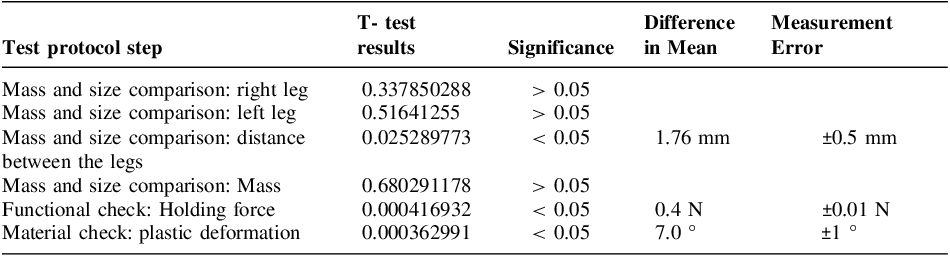
During the mass and size comparison length of the legs, both right and left, were measured, and analysed using a paired t-test to determine if there were significant differences before and after the sterilization process. For both the left and right leg, the null hypothesis was not rejected, indicating no significant difference in the length before and after sterilization. In contrast, the distance between the legs showed a significant difference post-sterilization. A boxplot analysis (Figure 5 (d)) further revealed that the median distance between the legs increased after sterilization, suggesting a greater distance post-sterilization. Additionally, the spread of the data was smaller after sterilization, indicating less variation in the measurements. One outlier was observed in the post-sterilization data. The t-test for leg separation revealed a statistically significant difference before and after sterilization, and additionally the analysis in Table 1 shows the mean difference of the measurements before and after sterilization (1.76 mm) is also significantly larger than the measurement error (±0.5 mm), indicating that this difference is unlikely to be to due to systematic measurement error. For the mass of the tweezers the null hypothesis was not rejected, indicating no significant difference in the weight of the tweezers before and after sterilization.
During the functional check the grip strength of the tweezer’s legs, measured in Newtons (N), was analysed to determine the impact of the sterilization process. The results of the t-test (Table 1) reject of the null hypothesis. This indicates a significant difference in grip strength before and after sterilization. Again, the analysis of the difference in mean force values (0.4 N) and the measurement error (±0.01 N) suggests that this large difference is attributable to the independent variable (steam sterilization). A boxplot analysis (Figure 5 (f)) showed that the median grip strength increased after sterilization, suggesting that more force was required post-sterilization. Additionally, the spread of the data was larger, indicating greater variability in the measurements. Outliers were observed to be further from the minimum and maximum values after sterilization.
For the material check, the distance between the legs at the angle of plastic deformation, measured in degrees, was analysed. The t-test (Table 1) rejects the null hypothesis. This indicates a significant difference in the angle required to cause plastic deformation before and after sterilization (7°) is attributable to the sterilization and not to measurement error (±1°). A boxplot analysis (Figure 5 (g)) revealed that the median angle decreased after sterilization, suggesting that a smaller angle was needed to cause plastic deformation post-sterilization. Additionally, the spread of the data was smaller, indicating less variation in the measurements.
Boxplot diagrams comparing the geometric and functional aspects of 30 single-use anatomical tweezers before and after steam sterilization

Statistical results of the anatomical tweezers

4.2. Measuring cup
The visual check shows no visible differences in any of the 30 samples before and after the sterilization process. During the mass and size comparison of the measuring cup, both the height and diameter were measured in millimetres (mm) and analysed to determine the impact of the sterilization process. However, a measurement error of 0.5 mm was present for both the height and diameter. Given this level of measurement error, the significant differences detected by the t-test (Table 2) in both height and diameter may not be reliable, as the error margin exceeds the observed changes. This error reduces the precision of the measurements and makes it difficult to conclude that the differences are truly significant. Therefore, despite the t-test rejecting the null hypothesis, the actual impact of the sterilization process on these dimensions may not be as pronounced as the analysis suggests. The presence of measurement error could explain some of the variation and outliers in the data, as shown in the boxplot analysis (Figure 6 (b,c)), which might otherwise be attributed to the sterilization process itself.
The mass of the measuring cup, measured in grams (g), was analysed to determine the impact of the sterilization process. The t-test result (Table 2) does not reject the null hypothesis. This indicates no significant difference in the mass of the measuring cup before and after sterilization. Additionally, the spread of the data was larger, indicating greater variability in the measurements.
During the functional check, the volume of the measuring cup, measured in millilitres (ml), was analysed to determine the impact of the sterilization process. The null hypothesis was not rejected, indicating no significant difference in the volume of the measuring cup before and after sterilization.
For the material check the material thickness was measured in millimetres (mm) and analysed to determine the impact of the sterilization process. All values were the same before and after sterilization, indicating no significant difference in material thickness. t-tests cannot be performed on identical data, so no statistical conclusion can be drawn here.
Boxplot diagrams comparing the geometric and functional aspects of 30 single-use measuring cups before and after steam sterilization

Statistical results of the measuring cup

5. Discussion
5.1. Interpretation of the results
For the anatomical tweezers, significant changes were observed at every step of the protocol. The majority of the tweezers exhibited a lighter colour, which may be attributed to a lack of chemical resistance of the product. Additionally, the distance between the legs of the tweezers increased, suggesting deformation likely due to limited resistance to heat deflection. The gripping force of the tweezers also increased, indicating that the resting mass on the legs had a greater effect on the holding force of the tweezer. From a handling perspective, the tweezers were noticeably stiffer post-sterilisation, leading to this stronger holding force due to reduced flexibility in the legs of the tweezer. Furthermore, a smaller angle between the legs was required to induce plastic deformation, which occurred more readily, potentially due to insufficient chemical resistance. After combining the test results of the anatomical tweezers (highlighted in blue) on the evaluation protocol as seen in Figure 7, all protocol steps lead to failure and there is a clear need for a alternative reset method than steam sterilization. Even though the evaluation protocol indicated a failure after one of the initial checks, we proceeded with the remaining assessments to gain a comprehensive understanding of the product’s overall performance. It is crucial to consider the intended function of each item when evaluating the feasibility of reuse. Further research is essential to determine the performance limits for each medical device before starting any reset evaluation.
Regarding the measuring cup, no significant changes were noted. Applying the test results of the measuring cup (highlighted in red) on the evaluation protocol, also presented in Figure 7, we can conclude it is acceptable for reuse.
The application of the evaluation protocol reveals a discrepancy between the theoretical feasibility of resetting SUD and its actual practicability. This finding highlights the necessity for more practically oriented protocols to bridge this gap.
Evaluation protocol after mapping the test results. The four stages of the protocol are shown here for the anatomical tweezers (blue) and the measuring cups (red)

5.2. Increasing reusability of Single Use Devices
Enhancing the reusability of single-use medical devices (SUDs) represents a transitional phase towards fully reusable medical products. Achieving this shift requires systemic changes, where designers serve as intermediaries between manufacturers, hospitals, and users to facilitate transformation. This study highlights two key aspects of this transition.
First, ensuring patient safety is paramount for the feasibility of reuse systems in healthcare. Designers can integrate control mechanisms at various stages of the reuse process to assure qualitative reuse. For hospitals to be allowed to reset SUD, the manufacturer should include a proper reset protocol in the procurement tender. By designing the SUD and its reset procedure simultaneously, designers can account for practical hospital constraints, including sterilization methods. For instance, while steam sterilization is standard in hospitals, chemical sterilization may necessitate outsourcing, impacting feasibility. In other words, the decision of a hospital to reset internally or with a third party is depended on the reset protocol. Qualitative reuse also depends on aligning product performance with clinical requirements. The evaluation protocol proposed in this research outlines generalized steps, but designers should define user scenarios to tailor product-specific testing within each protocol stage. This approach ensures that reuse assessments reflect real-world conditions.
Secondly, designers play a crucial role in defining product features and product quality. Incorporating reusability considerations during the design phase aligns with the Ecodesign for Sustainable Products Regulation (ESPR). Design strategies such as shape optimization and the use of high-quality materials can enhance durability and extend the number of sterilization cycles, improving product lifetime.
6. Conclusion
This study investigated how to select single use medical devices (SUD) that are permitted to be reset and how to assess the quality to ensure its safe reuse in a clinical context. Based on existing legislation and literature, a theoretical framework for resetting SUD was generated, including a product selection diagram and an evaluation protocol. This protocol includes four assessment criteria: a visual check, mass and size comparison, functional check, and material check. By conducting these assessments and determining whether each criterion is met, we can conclude whether a reset SUD maintains sufficient quality to be safely reused in a clinical setting. We conducted a demonstration study involving the re-sterilization of anatomical tweezers and a measuring cup through steam sterilization to evaluate the protocol. Based on the research we found that:
-
There is a discrepancy between the theoretical product selection diagram and the outcomes of the evaluation protocol. Even though, both selected products were suitable for resetting according to legislation the anatomical tweezers exhibit significant changes post-sterilization. Meaning they are unsuitable for reuse in their current form, using steam sterilisation and according to current performance criteria. The measuring cups exhibit no significant changes and are suitable for reuse within a clinical context.
-
To increase reusability, designers can integrate control mechanisms taking into account practical constrains like sterilization methods and making a trade-off between accuracy of the measurements and product performance lower the threshold for reuse and assure quality in a healthcare setting.
-
To increase reusability, designers play a role in defining design strategies to align with the ESPR to extend product lifetime in a qualitative manner.
Future research should focus on refining the evaluation protocol by expanding the range of SUDs (and reusable devices) being tested, employing different sterilization methods, and understanding the exact performance limitations by including user scenarios and user testing. Establishing collaborative relationships between manufacturers and hospitals could provide deeper insights into the material properties, sterilization processes and practical implications, enhancing the accuracy and applicability of future studies. Furthermore, also the role of third-party resetting should be explored to understand how reuse can be facilitated, and hospitals can be relieved by externalising services.
Acknowledgements
We want to acknowledge Maria Pavlova, Kain Meurrens, Maarten Heuninck, Lukas Van Den Audenaerde and Charlotte Harding for their contributions during the experiments. Further, we acknowledge financial support from the Flemish agency Flanders Innovation & Entrepreneurship, (TETRA funds, HBC.2021.1025) and (Living Labs, VNS.2023.0112), Belgium






 Open access

