


1 Introduction
Much advertising is generally based on the assumption of a strong link between brand recognition and consumer preferences (Reference HauserHauser, 2011). Consider Benetton’s controversial but successful advertising campaigns in which the company’s brand was juxtaposed with shocking images (Reference GigerenzerGigerenzer, 2007). Many studies have shown that subjects prefer stimuli they have previously seen even if they were not aware of them (Reference ZajoncZajonc, 1968, Reference BornsteinBornstein, 1989) and that people prefer things they are familiar with (Reference Hoyer and BrownHoyer and Brown, 1990; Reference Macdonald and SharpMacdonald and Sharp, 2000, Reference Coates, Butler and BerryCoates, Butler, & Berry, 2004, 2006).
The strong effect that recognition can have on people’s judgment has also been demonstrated in psychological decision-making literature. The Recognition Heuristic (RH), proposed by Gigerenzer, Todd and the ABC Research Group (1999; Reference Goldstein and GigerenzerGoldstein & Gigerenzer, 2002) suggests that, if one of two objects is recognized and the other is not, people usually infer that the recognized item has the higher criterion value regarding the particular judgment in question and thus choose it over the unrecognised one. The RH was originally tested by asking American subjects which of two German cities had more inhabitants (Reference Goldstein and GigerenzerGoldstein & Gigerenzer, 2002). Given a pair in which they knew one but not the other city (as was likely in this task for American students), subjects predominantly chose the recognised city—a sensible and also successful strategy, because recognition in this task has a high validity in terms of city size judgment (recognised towns tend to be more populous, Reference Todd and GigerenzerTodd & Gigerenzer, 2000). Consequently the RH is a non-compensatory decision mechanism because it relies on only one cue—recognition—even if other cues are available. For example, subjects had earlier been told which cities had major league soccer teams, a fact that would be a useful cue for making an inferential choice regarding the population size criterion. If subjects use the RH they should choose the recognized city regardless of whether it possesses a major league soccer team. The results indicated that subjects did indeed follow recognition alone, choosing the recognized city 92% of the time. Footnote 1 Other work has also shown that the RH seems to explain decision-making in inferential choices when subjects have to determine the size of endowments of American colleges (Reference Hertwig, Todd, Hardman and MacchiHertwig & Todd, 2003), the incidence rate of diseases (Reference Pachur and HertwigPachur & Hertwig, 2006), the prediction of success in sports (Reference Pachur and BielePachur & Biele, 2007; Reference Serwe and FringsSerwe & Frings, 2006), and the wealth of billionaires and record sales of musicians (Reference Hertwig, Herzog, Schooler and ReimerHertwig, Herzog, Schooler, & Reimer, 2008).
The assertion that recognition affects inferential choice in a non-compensatory way as proposed with the RH was subsequently criticised and investigated. Numerous studies have produced results showing that other cues can have significant effects on inferential choices instead of, or in addition to, recognition (Reference OppenheimerOppenheimer 2003; Reference Newell and ShanksNewell & Shanks, 2004; Reference Newell and FernandezNewell & Fernandez, 2006; Bröder & Eichler, 2006; Reference PohlPohl, 2006; Reference Richter and SpäthRichter & Späth, 2006; Reference Oeusoonthornwattana and ShanksOeusoonthornwattana & Shanks, 2010; Hochman et al, 2010). Reference Newell and FernandezNewell and Fernandez (2006) noted that Goldstein and Gigerenzer (in their original 2002 study) analyzed only what were the “critical” pairs in which the recognised city did not have a soccer team. Analysing “corresponding cue pairs” in which the recognised city was also known to have a soccer team, Newell and Fernandez found that subjects were significantly more likely to choose the recognized city in this situation than when it was known not to have a soccer team—thereby challenging the notion that recognition is always employed in a non-compensatory manner.
Reference Gigerenzer and GoldsteinGigerenzer and Goldstein (2011) recently reviewed the research published in the decade following their initial work on the RH. They summarised the state of the evidence concluding that the basic assumptions of the RH have withstood numerous tests, provided three conditions were fulfilled and the RH was tested in its “domain”. These conditions were 1. that there is substantial recognition validity; 2. that inferences are made from memory, rather than from givens; and 3. that recognition stems from a person’s natural environment (Reference Gigerenzer and GoldsteinGigerenzer & Goldstein, 2011, p. 101). Regarding the question of when the RH is applied (which includes the issue of non-compensatory mechanisms) they state that: “We postulate that individual recognition memory is the basis for the first of two steps by which an individual decides whether to rely on the recognition heuristic for solving a given task. The state of recognition memory determines whether it can be applied, while an evaluation process … determines whether it should be applied” (p. 104). The authors therefore delineate the use of the RH not as an all-purpose mechanism, but rather as a mechanism selected “in an adaptive way that depends on the environment” (p. 104) to be used only if the ecological situation warrants it.
Following Goldstein and Gigerenzer’s original paradigm, the bulk of research on the RH has largely focused on inferential choice—the realm in which it was originally conceived to apply. Subjects have been asked which cities are larger, which stock will have most value, which team will win and which college is richer. But they have not been asked about their preferences: which one do you like; which one would you buy? Given the apparent importance of the ecological validity of recognition in decision-making, it is important to investigate whether the RH applies in the preferential realm of—for example—consumer choice, with Gigerenzer and Goldstein themselves suggesting that the RH could also “serve as a model for preferences.” (Reference Gigerenzer and GoldsteinGigerenzer & Goldstein, 2011, p.113.)
One recent example is a study by Reference Oeusoonthornwattana and ShanksOeusoonthornwatta and Shanks (2010) who tested the non-compensatory nature of the RH in the context of consumer preferences. In their experiments subjects were told to memorize positive or negative statements about a range of consumer products (including tennis racquets, potato crisps, chocolates, ear phones and shower gels). The statements were extracted from the media and frequently referred to the ethical practices of a company Footnote 2—while others spoke strictly of quality and performance. Footnote 3 After this information subjects were then tested on the recall of the positive and negative statements. Finally subjects were asked to perform an alternative forced-choice task in which they were shown pairs of images of consumer products of the same category (e.g., two brands of ear phones) from which they had to indicate which of the two items they were most likely to purchase. Of the ninety pairs thirty were critical pairs, in which a famous brand was presented alongside an obscure one. In ten of these, the famous brand had been preceded in the learning phase by a positive comment; in another ten the famous brand had been preceded by a negative comment; and in the final ten, the control pairs, no comment had preceded the famous brand.
According to the original notion of the RH as a strictly non-compensatory decision strategy, the cue information should have no effect on subjects’ choices, as only recognition should affect the subject’s decision. However, the results showed that the proportion of recognised options chosen were higher for positive than for negative critical pairs. The investigators concluded: “Thus contrary to the RH, recognition of consumer products is a compensatory rather than a non-compensatory cue.” (Reference Oeusoonthornwattana and ShanksOeusoonthornwattana & Shanks, 2010, p. 315.) This conclusion fits with data from marketing science in which research shows that, although recognition is an important factor in consumer choice, it is frequently only one of a number of cues considered (Reference HauserHauser, 2011).
However, the case against RH predictions from Oeusoonthornwatta and Shanks’ (2010) data is arguably not very strong. The mean proportion of choices for the recognised brand was only 63% across the three conditions. According to Goldstein and Gigerenzer’s (2011) definition of “boundary conditions” for the use of RH this may be interpreted as a result of low recognition validity: brand recognition did not correlate with subjects’ preference criterion (e.g., quality or desirability) to a substantial degree, and therefore the RH may not have been employed. In their review, Reference Gigerenzer and GoldsteinGigerenzer and Goldstein (2011) report 48 studies on the RH, and in almost all of these studies—as far as they fall in the RH domain - recognition validity was above 70%. Although it is difficult to obtain a measure of recognition validity for preferential choice, conclusions about the use and non-compensatory nature of RH in this experiment may be limited—subjects may simply not have used the RH to a great degree in the first place because of the lack of “substantial recognition validity” (Reference Gigerenzer and GoldsteinGigerenzer & Goldstein, 2011, p. 104). In such a case people may resort to a “recognition plus evaluation” mechanism (Reference Gigerenzer and GoldsteinGigerenzer & Goldstein, 2011) in which they may overrule the recognition heuristic and look for other cues.
A further factor mentioned in Gigerenzer and Goldstein’s review for the applicability of the RH is the presence of representative sampling and a well-defined reference class. In the Oeusoonthornwattana and Shanks’ study the products were from unrelated categories such as crisps, tennis racquets, chocolates, soaps and earphones. Thus, it could be argued that their subjects did not have a well-defined reference class, which would relate to a common (preference) criterion. Footnote 4
Another possible criticism of this type of study concerns the experimental paradigm. Reference Oeusoonthornwattana and ShanksOeusoonthornwattana and Shanks (2010) taught their subjects a series of positive and negative statements about the recognised brands, and then tested recall of the statements before running the choice trials, to make sure they had memorised the taught information. If subjects failed this test, they were then required to re-learn and be re-tested on the information before trials would be conducted. This procedure is likely to have produced possible task demand effects (subjects may have expected to utilise the laboriously learned ethical cues at a later stage), and conflicts with Reference Gigerenzer and GoldsteinGigerenzer and Goldstein’s (2011) notion that the RH should occur from natural memory rather than be experimentally induced.
Another aspect of the study by Reference Oeusoonthornwattana and ShanksOeusoonthornwattana and Shanks (2010) that warrants further investigation relates to the results: the compensatory effect of the given positive or negative information was not very strong. For example, the difference between the control condition and the negative condition was not significant (Experiment 1). Therefore, the conclusion that recognition is used in a compensatory way might appear overly strong to defenders of the RH.
One way to address these issues—and put the role of recognition in view of other cues in perspective—is to look at response times. For example, investigations in marketing science relate that negative information in particular causes increased deliberation (Reference Hauser, Urban and WeinbergHauser, et al., 1993). Reference Pachur and HertwigPachur and Hertwig (2006) employed response times in inferential tasks to measure whether the RH was used or whether recognition was integrated with other information, in which case subjects took longer for making their choices (because it takes time to retrieve additional information from memory). Measuring response times for choices will also better inform us as to whether subjects’ recognition works as an all-or-nothing decision-making process as originally proposed by Goldstein and Gigerenzer.
Reference Newell and FernandezNewell & Fernandez (2006) correlated decision latencies and subjects’ proportion of choosing the recognised city to see whether the ease of recognition determines their decision. If the RH is correct, any variation in response times should be random. However, Reference Newell and FernandezNewell and Fernandez (2006) found that there was a significant correlation between the time it took to recognise a city and whether it was later chosen from a critical pair.
This finding was interpreted as a serious challenge to the RH—because in this case it would appear that other heuristics that rely on more effortful memory retrieval instead of recognition could also explain the effects attributed to the RH. For example, the availability heuristic (Reference Tversky and KahnemanTversky & Kahneman, 1973) and fluency heuristic (e.g., Reference Jacoby and WhitehouseJacoby & Whitehouse, 1989, Reference Schooler and HertwigSchooler & Hertwig, 2005) also propose that familiarity with items in memory influences recognition. If the ease with which an item is recognised or retrieved from memory determines its choice, then Reference Goldstein and GigerenzerGoldstein and Gigerenzer’s (2002) claim that the RH employs “recognition as a binary, all-or-none distinction” (p. 77) cannot be upheld (see Reference Newell and FernandezNewell & Fernandez, 2006, and Reference Gigerenzer and GoldsteinGigerenzer & Goldstein, 2011, for discussions).
Therefore, the current study seeks to investigate the RH in a preference choice domain, following Reference Oeusoonthornwattana and ShanksOeusoonthornwattana and Shanks (2010) but with some significant modifications to their experiment to address the issues mentioned above. As in the original study we ask people to indicate their preference for one out of a pair of consumer products, and our particular interest is in preference choices for pairs that have a famous (recognised) and an obscure (non-recognised brand).
In contrast to Reference Oeusoonthornwattana and ShanksOeusoonthornwattana and Shanks (2010) in the current study the positive, neutral or negative cues for the consumer products were given directly as “consumer ratings,” which were presented as star ratings similar to those found in internet commerce. By so doing, we have arguably changed the context to a more ecologically relevant one, and this procedure did not induce any artificially rehearsed memories. Second, the product categories were changed to mostly technical long-lasting consumer items (laptops, mobile phones, earphones, but also tennis racquets) to create a more homogeneous reference class. Thirdly, we also record decision times to assess whether recognition is used as an (additional) information cue rather than an all-or-none heuristic (Reference Newell and ShanksNewell & Shanks, 2004), for which we predict (following Reference Newell and FernandezNewell & Fernandez, 2006) that neutral conditions (in which recognition is the only differentiating cue) are responded to faster than in the positive or negative conditions. Therefore we asked the following questions:
-
1. Do people use compensatory strategies in simple preferential choice problems that involve recognition? In line with Reference Oeusoonthornwattana and ShanksOeusoonthornwattana and Shanks (2010) we would expect to find significant modulations of the proportion of recognised items chosen from a pair depending on the number of stars in the ratings.
-
2. Will response times indicate compensatory decision processes for all (positive and negative) conditions with an information cue (compared to a neutral cue)? According to the original conception of RH (Reference Goldstein and GigerenzerGoldstein & Gigerenzer, 2002) recognition is the only cue and we would expect no differences in decision latencies whether the famous brand is accompanied by 5 stars, 3 stars or only one star (see also Reference Pachur and HertwigPachur & Hertwig, 2006). In contrast, work from marketing research seems to imply that mainly negative information causes increased response latencies.
-
3. Are decision latencies and choices based on recognition correlated across trials? According to Reference Newell and FernandezNewell and Fernandez (2006), if recognition-based decisions were based on feelings of familiarity, then we would expect a negative correlation between the proportion of chosen items and response times, whereas the RH would predict no such relationship.
2 Method
2.1 Subjects
62 people participated in the study (mean age=32.2 years, SD 8.74), 40 of whom were female. Subjects were recruited from the student body and members of the public at the University of East London. Subjects were not paid for their time. The experiment was run for each subject individually in meeting rooms on campus.
2.2 Design and measures
The study employed a within-subjects design measuring choice preferences using a two-alternative-forced choice procedure. The independent variable was the valence of cue information (positive, control, and negative) regarding the recognised item, and the dependent variable were subjects’ choice responses and corresponding response times.
2.3 Materials and procedure
The experiment was written on E-Prime and run on a laptop computer. Each subject viewed 90 pairs of consumer products, one after another. Thirty of these were critical pairs, of which there were three kinds: control, positive, and negative. Every critical pair contained the image of a famous recognized brand, such as Apple, against the image of a more obscure one, such as Kyocera. The brand name was always beneath the image. The critical pairs are listed in the Appendix.
The products were selected from five categories: headphones, tennis racquets, laptop computers, cell phones, and cameras. Six famous brands were selected from each category to be compared with 6 obscure brands from the same category to make 30 critical pairs. The resulting 30 pairs were divided into three sets of 10 products, each containing 2 exemplars of each category. The sets were either presented with positiv, neutral, or negative information regarding the famous brand. The particular items in each set were rotated for each subject so that a brand would be exhibited in all three conditions across subjects. For the control pairs, both the famous and the non-famous brands were presented with three black stars (out of a possible five) underneath the brand name and image. For the positive pairs, the famous brand was presented with five stars and the non-famous brand with one star. In the negative pairs, the famous brand was presented with one star and the non-famous brand with five stars.
Before the program began, the subjects read that they would see 90 pairs of consumer items, presented one after the other. Underneath each item would be the name of the manufacturer and a number of stars reflecting the popularity of the item. They were then instructed to decide which product they were most likely to buy in each pair. Each subject saw not only the thirty critical pairs but also sixty non-critical pairs randomly mixed in with the thirty, so as to obscure the purpose of the experiment. The non-critical pairs contained either two famous products or two obscure ones. As with the critical pairs, the image of the products was presented with the brand name beneath the appropriate picture, and the star ratings beneath the brand name. After they had completed the task the subjects were asked to complete a recognition check. They were given a list of all the brands (on a sheet of paper) presented in the choice task and asked to tick which of the brands they had been aware of before they began the test.
3 Results
3.1 Recognition check
In order to test whether the Recognition Heuristic operates in the parameters described by Reference Goldstein and GigerenzerGoldstein and Gigerenzer (2002), one item in the critical pair had to be recognised, and the other unrecognized. Following the preference choice phase of the experiment, we used a recognition test to remove critical trials from the analysis in which the famous product was not recognized, or the non-famous item was recognised. On average, 27% of the critical pairs were discarded because of this correction (compared to 30% in Reference Oeusoonthornwattana and ShanksOeusoonthornwattana & Shanks, 2010). The mean numbers of pairs left after correction were 7.38 (SD = 1.39) for positive pairs, 7.23 for negative pairs (SD = 1.46), and 7.24 (SD = 1.45) for control pairs.
3.2 Effect of the star ratings on choice
For each of the conditions with critical trial pairs the mean proportion of choices of the recognized brand was calculated for each subject. (See Figure 1 for the general means in each condition across subjects.) An analysis of variance (ANOVA) was performed with subjects as cases and mean choice proportions in each of the three conditions (5, 3, or 1 star for the famous item) as repeated measures. Mauchly’s test indicated that the assumption of sphericity had been violated, χ 2 (2) = 10.33, p = .006, therefore degrees of freedom were corrected using Greenhouse-Geisser estimates of sphericity (є = .86). A within-subjects ANOVA on mean proportion of chosen recognized brands revealed a significant main effect of condition (valence: positive, neutral, negative), F(1.73, 105.34) = 17.48, p < .001. There was a significant linear trend of condition (across the three valences), F(1, 61) = 28.22, p < 0.001. The quadratic trend was not significant, F(1, 61) = 2.68, p = .11.
Mean proportion (and standard errors) of the recognized product chosen in each type of critical pair (comprising a recognized and an unrecognized brands). Subjects were shown star ratings for both items in a critical pair to result in positive, neutral, or negative additional information for the recognized brand.
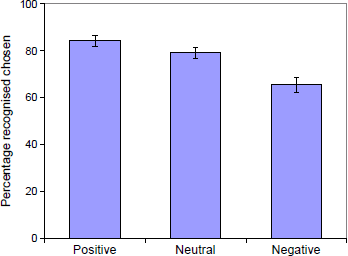
Tests of within-subjects contrasts revealed that the mean proportion of choices of recognized items was significantly higher in the positive (M = 84%) than in the control (M = 79%) pairs, F(1, 61) = 4.02, p = 0.49. The difference between the control and negative (M = 65%) pairs was also significant F(1, 61) = 23.99, p < .001. We further examined whether recognized items in neutral and negative conditions were chosen more often than chance (50%) by one-sample t-tests. In both cases the proportion was significantly higher than chance, t (61) = 12.18, p < .001 (neutral), and t (61) = 4.98, p < .001.
In summary, the results show that subjects chose the recognized brand significantly more often when they were accompanied by five stars (positive) than when they were accompanied by three (control) or one (negative). They were also significantly less likely to choose the recognized brand when it was accompanied by one star than when it had 3 (control pairs).
3.3 Individual differences
Reference Oeusoonthornwattana and ShanksOeusoonthornwattana and Shanks (2010) also tested for individual differences to check for the possibility that group averages could mask important individual differences (Reference Gigerenzer and BrightonGigerenzer & Brighton, 2009; Reference Pachur, Broder and MarewskiPachur et al., 2008). Reference Gigerenzer and BrightonGigerenzer and Brighton (2009) reanalyzed the data of Reference Richter and SpäthRichter and Späth (2006) and found that, although the experiment reported lower mean adherence to the RH at the group level, the majority of subjects were in fact using the RH to make decisions. In other words, a small number of subjects using an aggressively compensatory strategy might distort the overall means for the group, giving the false impression that a majority did not follow the RH, when in fact they did.
To prevent such a distortion in the results, we performed an analysis of individual choice strategies as suggested by Reference Oeusoonthornwattana and ShanksOeusoonthornwattana and Shanks, (2010). A difference score ranging between −1 to 1 was calculated for each subject, based on the difference in the proportion of choices of the recognized brand between the positive and negative conditions. This score measures the compensatory effect of additional information—in this experiment the star ratings—beyond the effect of recognition for every subject. If subjects follow the RH—meaning recognition is employed in a non-compensatory manner—then the majority of subjects should show no difference in their proportion of choices between situations in which the recognized brand received 5 stars (positive) and situations where the recognized brand received one star (negative); that is, most subjects should have a difference score of zero.
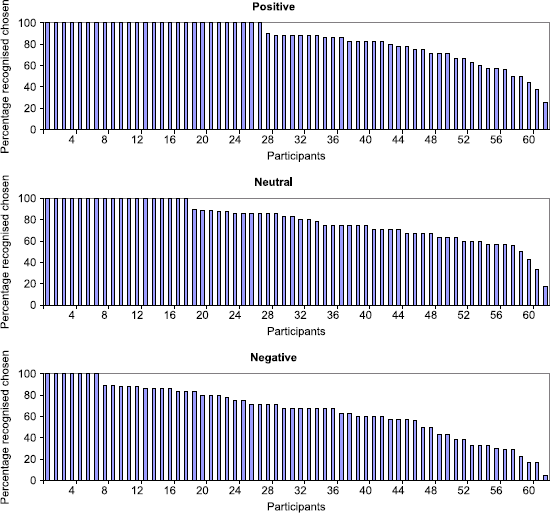
However, the majority (43/62) had difference scores above zero and only 19/62 had difference scores less than or equal to zero. A sign test showed that the difference between the number of positive and negative scores was different from chance (p = 0.003). This confirms that the group level effect reported in Reference Gigerenzer and BrightonGigerenzer and Brighton (2009) did not occur here, similar to the results of Reference Oeusoonthornwattana and ShanksOeusoonthornwattana and Shanks (2010). Hence, in both studies, a majority of subjects did not follow the RH—that is, they did not consistently use recognition in a non-compensatory way (see Figure 2).
Mean individual preferences according to the proportion of recognised items chosen in critical pairs (following Reference Gigerenzer and GoldsteinGigerenzer & Goldstein, 2011). Each bar represents one subject, with the height showing the proportion of preferences (% from 0 to 100%). The top, middle, and bottom panels depict how often each subject chose a recognized product over an unrecognized one when the former was shown with a positive, a neutral cue, or a negative cue.
In a final analysis we compared recognition adherence rates for the five different brand categories. A 3 (valence) × 5 (category) repeated measures ANOVA was run (missing data were replaced with column means). There was a significant effect of valence, F(1.74, 106.10) = 20.41, p < .001 (dfs Geisser-Greenhouse corrected), but not Category, F(4, 244) = 1.32, p = .26, and no significant interaction, F(8, 488) = 1.23, p = .28. Crucially, choice rates for recognised items in critical trials were significantly higher than chance in all conditions (all ps < .05, one-tailed), meaning that choice was based on recognition across all product-categories.
3.4 Response times
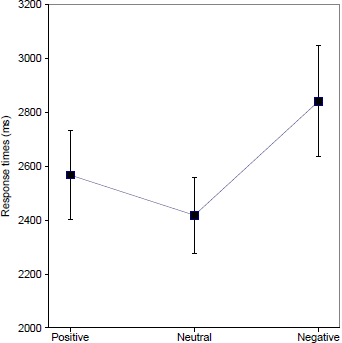
To assess whether subjects took longer in certain situations to make their choices in the critical trials, the mean response times (see Figure 3) were calculated for the three valence conditions. Only trials in which subjects chose the famous items were analysed. Footnote 5 The mean response times were greater for negative (M = 2841 ms, SE = 207 ms), than control (M = 2418 ms, SE = 140 ms) and positive (M = 2567 ms, SE = 165 ms) conditions. A repeated measures analysis of variance (ANOVA) was performed (with subjects as cases) on log-transformed latency means with average trial-number (indicating the average position in which critical items rather than filler items would appear for a subject) as a covariate. Mauchly’s test indicated that the assumption of sphericity had been violated (Greenhouse Geisser epsilon = 0.85), therefore degrees of freedom were corrected using Greenhouse-Geisser estimates of sphericity. There was a main effect of valence, F(1.67, 99.76) = 5.08, p = .008. Planned contrasts revealed that the mean (log-transformed) response time for decisions made when the famous brand was shown in the positive condition (accompanied by 5 stars) was not significantly different from the mean response time when the famous brand was in the neutral condition, p = 0.36. Importantly for our hypothesis however, the mean response time for decisions made when the famous brand was in the negative condition (accompanied by one star), was significantly greater than the control condition, p = 0.009. This confirms our hypothesis that subjects would take longer to make a choice when the famous/recognized brand was accompanied by negative information, and indicates a compensatory nature of their decision-making in this situation. Footnote 6 It also supports other reports suggesting that negative information about a product is given more consideration than positive information (e.g., Hauser et al, 1993).
Mean latencies in milliseconds (and standard errors) for each of the conditions in which a recognised item was chosen in a critical pair.
To see whether subjects’ decision style regarding the compensatory or non-compensatory use of recognition as measured by the differences score (proportion of positive minus negative choices) had an influence on response times we ran an additional ANOVA as above, but including difference score as a continuous variable. Results were very similar to above, with a main effect of valence, F(1.64, 95.57) = 4.973, p = .013. Crucially, there was no interaction between difference score and valence, F(1.64, 95.57) = 1.42, p = .25. We thus found no evidence for a differential effect of valence as a function of whether or not subjects’ choices could be predicted entirely from recognition.
Finally, we sought to assess whether adherence to familiarity-based choices depends on the time it takes to recognise items, and by extension whether recognition is based on an all-or-none process (Reference Gigerenzer and GoldsteinGigerenzer & Goldstein, 2011). We followed the example of Reference Newell and FernandezNewell and Fernandez (2006) who used the time it took subjects to recognize a word as the name of a city as an operational measure of the ease of retrieval of the recognized cities in the classic task by Reference Goldstein and GigerenzerGoldstein and Gigerenzer (2002). They found that subjects’ reaction time to recognize a city name (gathered in a separate experiment) correlated negatively with the proportion of recognised items subjects chose in the inferential task. This result was taken to indicate that fluency or ease-of-recognition rather than an all-or-none recognition heuristic is related to subjects’ choices.
We did not use a separate task (independent of the choice situation) to assess how fast subjects recognised a famous item but instead we emulated Reference Newell and FernandezNewell and Fernandez’ (2006) analysis by correlating the mean preference for each of the famous objects with the corresponding mean response time for that object in the neutral conditions only. Thus, for each famous item in the critical pairs we calculated two data points: the mean (log-transformed) response time in the neutral condition trials in which the object appeared and the mean proportion of how often that item was chosen. There was a significant negative correlation across items, r = −0.33, p = 0.046 (1-tailed) between response time for a (correctly recognized) familiar item and its preference proportion. Thus, the faster a famous item in the neutral critical trial-pairs was chosen the higher was its mean preference proportion. Footnote 7 Therefore, following the logic of Reference Newell and FernandezNewell & Fernandez (2006), the recognition processes related to choice observed in this study may not rely on binary decision qualities (or an all-or-none recognition process) but possibly on the ease of which items are recognised, that is the availability or fluency of recognition (Reference Schooler and HertwigSchooler & Hertwig, 2005).”
Discussion
The current study investigated the role of recognition in preferential choice, in particular whether there is evidence for a non-compensatory RH as proposed by its proponents (Reference Goldstein and GigerenzerGoldstein & Gigerenzer, 2002; Reference Gigerenzer and GoldsteinGigerenzer & Goldstein, 2011). The results showed that subjects rely to a substantial degree on recognition when making preferential decisions about consumer products. However, there was also evidence that recognition was used in a compensatory way: the presence of another cue—star ratings—significantly affected the number of times the recognized brands were chosen if one of the two items was famous. The results are broadly consistent with previous studies that found evidence for compensatory use of recognition in inferential choice (Reference OppenheimerOppenheimer, 2003; Reference Newell and FernandezNewell & Fernandez, 2006; Reference Broder and EichlerBröder and Eichler, 2006; Reference Hochman, Ayal and GlocknerHochman, et al., 2010) and consumer preference (Reference Oeusoonthornwattana and ShanksOeusoonthornwattana & Shanks, 2010). At the same time, there are indications that, although the presence of additional cues affects preferential choice, recognition seems to be more than just another cue, contrary to what has been argued before (e.g., Reference Newell and ShanksNewell & Shanks, 2004). First, recognized items are substantially preferred over unrecognised brands even if associated information about the former is clearly negative in comparison. Second, positive star ratings had only a limited effect on the proportion of recognised items chosen, compared to the neutral condition. And, third, response times to critical pairs in these conditions are equivalent. We will return to these points after discussing how the data fit with previous research on the RH and how our results relate more generally to observed effects of recognition in consumer choice.
There are some immediate concerns why the results of the current study may not extend to conclusions for the RH. First, the RH was formulated in the realm of inferential, not preferential choice (Reference Goldstein and GigerenzerGoldstein & Gigerenzer, 2002, Reference Gigerenzer and GoldsteinGigerenzer & Goldstein, 2011) and tests of the recognition heuristic have usually elicited judgments from subjects by using memory cues only. The current study employed a slightly different paradigm, by examining preferential choice and using cue information that did not have to be memorized by subjects. However, we argue that, along with previous work that has also presented cues not drawn from memory (Reference Ayton, Onkal and McReynoldsAyton, Onkal, & McReynolds, 2011), the present findings are valuable for theoretical considerations of the RH. Gigerenzer and Goldstein themselves promote the testing of the RH outside its original domain, arguing the importance of defining “boundary conditions”, and have also noted the possibility that the RH might be applied to consumer choice (Reference Gigerenzer and GoldsteinGigerenzer & Goldstein, 2011, pp. 101,113). Furthermore, the current study provided an ecologically valid context to examine whether the RH works in the preferential realm, because subjects found themselves in a situation that was very similar to a real-world situation—i.e., an online shopping experience—with information presented to them in the form of ratings or recommendations. The popularity of product-comparison websites suggests that people seek situations in which they have cues presented to them rather than having to rely on memory alone.
Another possible criticism is related to one of the conditions deemed necessary for the RH to work—recognition validity. This means that recognition is used successfully only if it correlates with the criterion (e.g., that recognised towns tend to be more populous, Reference Todd and GigerenzerTodd & Gigerenzer, 2000). As we followed Reference Oeusoonthornwattana and ShanksOeusoonthornwattana and Shanks (2010) by using consumer products and asking subjects to indicate preferences, we have no clearly defined criterion that could be objectively used to assess recognition validity. However, given that we asked our subjects to choose which item they were likely to buy, it seems plausible to suggest that our subjects were trying to find an answer to the criterion: “which item is better?”
To obtain a proxy for the recognition validity in the current study we examined actual consumer rating scores from the AMAZON UK website (a large online retail website on which consumers can leave ratings for products they purchased using a scale from 1 to 5). Of the 30 critical pairs we found aggregate ratings for both items in 14 pairs. Of these 14 pairs, the famous brand scored higher than the non-famous brand in 13 instances, indicating that recognition for the current item-set relates to an external preference criterion.
On the other side of the theoretical argument, Reference Newell and FernandezNewell and Fernandez (2006) previously tested the RH using a version of the city size task. In addition to examining the compensatory nature of recognition, their critical question was whether the RH could be distinguished from other heuristics relying on familiarity such as the availability heuristic (Reference Tversky and KahnemanTversky & Kahneman, 1973) and the fluency heuristic (e.g., Reference Jacoby and WhitehouseJacoby & Whitehouse, 1989; Reference Schooler and HertwigSchooler & Hertwig, 2005). In their study Newell and Fernandez found that the proportion of recognised cities chosen was negatively correlated with the time it took subjects to recognise a famous city in a separate task (see also Reference Marewski and SchoolerMarewski & Schooler, 2011). This was taken as evidence against the RH which proposes a binary (“all-or-nothing”) rather than a graded use of recognition. Although our test may admittedly be not as convincing as that of Reference Newell and FernandezNewell & Fernandez (2006)—because we did not measure recognition times separately from choice situations—there is some support for this notion in our data: the average time it took to choose an item from a (neutral) critical pair and the proportion of famous items chosen were negatively correlated; that is, the faster a famous item was recognised, the more often it was chosen. This result points to graded recognition processes instead of the supposed binary nature of the RH (Reference Gigerenzer and GoldsteinGigerenzer & Goldstein, 2011).
The current results are broadly consistent with the study of Reference Oeusoonthornwattana and ShanksOeusoonthornwattana and Shanks (2010) indicating that recognition is not used as the sole cue in the realm of preferential consumer choice: people consider other information, whether positive or negative statements or consumer ratings, when making a decision. Subjects do not follow the RH—that is, they do not use recognition in a strictly non-compensatory, all-or-none way. However, the compensatory effect observed in this study is arguably not fully consistent with a simple cue integration model either. In such a model cues are integrated by a tallying or a weighted evaluation of the alternatives (Reference DawesDawes, 1979), and therefore recognition would just be regarded as one cue that is qualitatively not different than other cues. In the present study, in contrast, there was only a small difference in the proportion of recognised items chosen between the control and positive conditions, while at the same time a considerable difference was obtained between the neutral and negative conditions. The effect size for the latter comparison (Cohen’s d = .30) was considerably greater than for the former (d = .12). Of course one could argue that this difference could be explained by the well-known positive-negative asymmetry: a long list of studies report that negative information (items, events, personality traits, etc.) have more impact than positive (see reviews by Reference BornsteinBaumeister, Bratslavsky, Finkenauer, & Vohs, 2001; and Reference Rozin and RoyzmanRozin & Royzman, 2001). Although this effect may play a role, it would still not diminish the special role of recognition, because subjects in the current (and in the Oeusoonthornwattana & Shanks) study overall preferred the recognised brand even in the negative conditions, and this was true for all product categories.
Furthermore, we found no difference in choice latency between the positive and neutral conditions, while in the negative condition decision-making took significantly longer. If recognition and cue information were used as equivalent cues, then we would expect decision times to be longer in the positive condition to allow for the integration of these two pieces of information (compared to only one in the neutral condition). Importantly, we also found no interaction between effects of product category and valence, indicating that any additional information subjects may have derived from category-membership (e.g., price range) did not interfere with recognition effects.
The present study has produced results compatible with a two-stage decision-making process: Overall, subjects made swift decisions following recognition, provided there was no cue to contradict it, in which case response times were longer (as found by Hauser et al., 1993) and recognition had less of an effect on preferences. In a recent description of the RH model, Reference Gigerenzer and GoldsteinGigerenzer and Goldstein (2011) propose an “evaluation” stage following the recognition of an object. However, while this notion of an evaluation stage mainly depends on the degree of ecological validity (i.e., a meaningful reference class, representative sampling of options, and sufficient recognition validity) the current data clearly show that recognition-based choices are modulated by the valence of cue information, rather than only by the adaptive value of the object set in consideration.
4 Conclusion
This study sought to determine whether the RH can account for how consumers make their decisions and whether recognition is used in a non-compensatory way (Reference Goldstein and GigerenzerGoldstein & Gigerenzer, 2002). It partially replicated a previous study (Reference Oeusoonthornwattana and ShanksOeusoonthornwattana & Shanks, 2010) and found that at least for given negative cues, subjects take longer and are relying less on recognition in preferential choice. However, recognition is a strong determinant of choice in all conditions. This has implications for model building in preferential (and possibly inferential) choice, in particular whether choices are made over multiple stages. Future studies should measure recognition latencies and choice times separately to establish if and at which point other information such as brand attitude and price are considered.
Appendix: The 30 critical pairs (recognised brand marked with “+”)
Headphones:
V-Moda and Apple+;; Bose+ and Thomson; Klipsche and Pioneer+; Sennheiser+ and Goldring; Belkin and Shure+; Sony+ and Ultimate.
Tennis Racquets:
Babolat+ and Donnay; Gamma and Dunlop+; Head+ and Prokennex; Snauwaert and Prince+; Wilson+ and Greys; Power Angle and Yonex+.
Cameras:
Canon+ and Contour; Vivitar and Sony+; Olympus+ and Mamiya; Sigma and Panasonic+; Nikon+ and Aigo; Veho and JVC+.
Cell Phones:
Apple+ and Kyocera; ZTE and Siemens+; Blackberry+ and Qualcomm; Huawei and Sony Ericsson+; Samsung+ and Verizon; TCL and Motorola+.
Laptops:
Lenovo and Dell+; Sony+ and Hasee; Apple+ and Positivo Informatico; Asus and Toshiba+; Hewlett-Packard+ and Micro-Star International; Itautec and IBM+.


 Open access

