Introduction
Permafrost or negative ground temperature throughout the year is characteristic of many high-mountain areas of the world (Cheng and Dramis, 1992; Reference Haeberli, Hoelzle, Keller, Schmid, Vonder Mühll and WagnerHaeberli and others, 1993). With such ground thermal conditions, large amounts of ice beneath the surface can exist over extended time periods. Ice supersaturation and the existence of massive ice strongly affect geotechnical properties of the frequently occurring perennially frozen scree and moraine deposits, leading to slow viscous flow and the formation of lava-stream-like landforms usually termed rock glaciers (Reference Wahrhaftig and CoxWahrhaftig and Cox, 1959; Reference HaeberliHaeberli, 1985; Reference BarschBarsch, 1996). Evidence from outcrops, drillings, borehole logging and geophysical soundings indicates that the ground ice concerned is most likely to be polygenetic in origin, with interstitial, segregation and buried snow-bank ice probably being the predominant components. Measured electrical d.c. resistivity values — a key indicator for variable ice origins — together with the coupled thermodynamic conditions of ice formation and preservation lead to the assumption that the ice types concerned must systematically vary along flow trajectories and form, over characteristic time periods of millennia, on top (permafrost table) of as well as at the bottom (permafrost base) of the creeping rock glaciers (Haeberli and Reference Haeberli and Vonder MühllVonder Mühll, 1996).
In 1987, scientific core-drilling was carried out through the active rock glacier Murtèl–Corvatsch (Figs 1 and 2), eastern Swiss Alps (cf. Reference Haeberli, Huder, Keusen, Pika and SennesetHaeberli and others, 1988, for information about site selection, goals, drilling logistics and first results). The borehole is situated on the central flowline, about halfway from the headwall to the front, and reaches bedrock. One of the primary goals of this project was to search for organic remains within the recovered cores in order to directly date ice from mountain permafrost and to acquire evidence about the age of the investigated ground ice. This age determination would be independent of earlier estimates from kinematic considerations. Surprisingly enough, only one layer within massive ice contained moss remains at a depth of about 6 m below surface. The results from 14C dating and botanical analyses confirm the concepts developed so far about the creep of mountain permafrost and enable some general conclusions to be drawn about long-term flow velocities, landform genesis, rates of ice formation, rockfall activity and cliff retreat at an active rock glacier. The present contribution reviews the background of the drill site and core-sampling, documents the botanical/bryological analysis of the recovered moss remains with their pollen spectra, reports on the 14C dating (cf. early 14C datings of Arctic permafrost by Reference BrownBrown, 1965) and briefly discusses the geomorphological and glaciological implications of the result obtained.
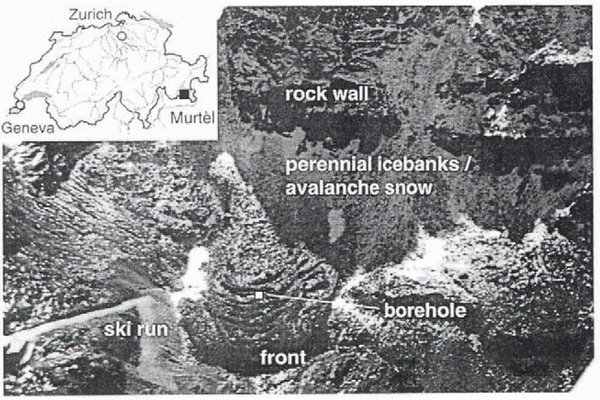
Location map and oblique view of the Murtèl rock glacier. Photograph taken by M. Hoelzle, 1994.

Aerial photograph of Murièl rock glacier taken by the Swiss Federal Office of Cadastral Surveys on 11 September 1996, flight-line 066155, photo 2435.

Site and sampling
The active Murtèl–Corvatsch rock glacier has developed within a former cirque from perennially frozen, northwesterly exposed scree slopes at 2850–2620 m a.s.l. Extending flow characterizes the upper part of the rock glacier, whereas longitudinal compression causes pronounced ogive-like transverse ridges in the lower part. The steep, approximately 20 m high front is largely free of vegetation and slowly advances over permafrost-free granodiorite bedrock. High-resolution vertical aerial photographs were taken by the Swiss Federal Office of Cadastral Surveys in the fall of the years 1987 and 1996. Using special computer-aided photogrammetric techniques (Reference Kääb, Haeberli and GudmundssonKääb and others, 1997), the horizontal velocity field (Fig. 3, left side) as well as area-wide changes in surface elevation were determined from these photographs. Horizontal velocities reach maximum values of 15 cm a-1 and more in the upper part of the rock glacier just below the rock wall delimiting the creeping permafrost. Along the flowlines, they decrease to about 5 cm a-1 behind the front, where increasing surface slopes and sliding or tilting of individual rocks lead to higher surface velocities again. In full agreement with borehole deformation measurements (Reference WagnerWagner, 1992; Reference Haeberli and Vonder MühllVonder Mühll, 1996), the photogrammetric compilations show horizontal surface velocities of about 6–7 cm a-1 at the borehole. The changes in surface elevation at the front hint at an advance rate of the rock glacier Murtèl of about 1.5–2 cm a-1 over the period 1987–96. Assuming constant creep rates through the last millennia, trajectories were computed from the velocity field 1987–96 for a number of manually selected points (Fig. 3, right side). These trajectories show the time it takes for a particle to travel down the rock-glacier surface under present-day conditions. Because flow must have been quite different from today at the beginning of rock-glacier evolution (Reference OlyphantOlyphant, 1983, 1987), such a calculation allows only for a rough (probably minimum) age estimate (cf. discussion at the end of the paper).
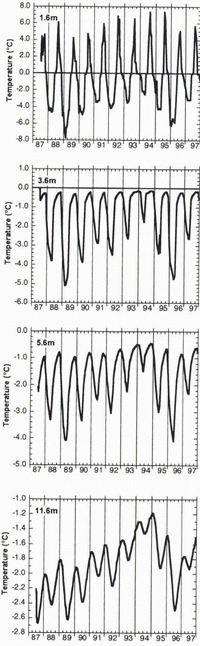
The 60 m deep borehole on the active rock glacier Murièl was placed at 2670 m a.s.l. Alpine permafrost in the area surrounding the drill site exhibits a discontinuous distribution pattern (Reference HoelzleHoelzle, 1996). Core analyses and borehole measurements (Fig. 4; Reference Vonder Mühll and HaeberliVonder Mühll and Haeberli, 1990; Reference Vonder MühllVonder Mühll and Holub, 1992; Reference WagnerWagner, 1992; Vender Mühll, 1996) showed that the permafrost underneath the 3 m thick active layer essentially consists of two layers: an upper one with an extremely high ice content (90–100% by volume), and a lower one consisting of coarse blocks with ice-filled pores but almost completely without fine rock particles. Seventy-five per rent of the total horizontal displacement (6 cm a-1 at the surface) takes place within the transition zone between the two layers at 28–30 m depth, with the upper (strongly supersaturated) layer undergoing steady-state creep and overriding the non-deforming (structured) lower layer. Mean annual ground temperature at 11 m depth increased from –2.3°C (1987) to –1.4°C (1994) but was intermittently cooling again due to thin snow cover in the winters of 1994–95 and 1995–96 (Fig. 5; Vonder Mühll and others, in press). It is reasonable to assume that permafrost conditions existed at the drill site throughout the younger Holocene time period at least. At 52–58 m depth, temperature variations around 0°C are observed in a seasonal talik (Reference Vonder MühllVonder Mühll, 1992). Total permafrost thickness reaches far into the bedrock which underlies the rock-glacier sediments, and is estimated at about 100 m. This is in sharp contrast with the absence of permafrost in front of the rock glacier and indicates marked horizontal gradients in ground thermal conditions. Electrical d.c. resistivity of the perennially frozen material is up to 2 MΩm in the massive ice, decreasing to around 10 kΩm or even less above bedrock. Together with the short distance (200 m) between the rock wall and the drill site, such resistivities exclude the possibility of a predominant sedimentary (“firn”) origin for the massive ice encountered (Haeberli and Reference Haeberli and Vonder MühllVonder Mühll, 1996). It is much more plausible to assume a polygenetic origin of the massive ice with burial of superimposed ice from small perennial snow banks fed by snow avalanches (Figs 1 and 2), probably in combination with later addition of ice from secondary frost heave within the permafrost and from freezing processes taking place at the permafrost table (cf. Haeberli and Reference Haeberli and Vonder MühllVonder Mühll, 1996; Reference Elconin and LaChapelleElconin and LaChapelle, 1997).
Surface velocities of rock glacier Murtèl over the period 1986–96, determined by computer-aided photogrammetry (left), and trajectories/surface ages computed from this velocity field (right).

Careful visual inspection connected to the melting of ice-core samples for water isotope analyses revealed one piece of moss remains within core Murtèl 2/11/4 at a depth of 5.94 m below surface. The sample was put into double-distilled water within a cleaned, dried and sealed small glass bottle and sent to the Department of Botany of the University of Basel for further analysis. Moss identification was performed at the Botanical Garden of Geneva. Thereafter, the moss remains were prepared for radiocarbon dating at the Institute of Environmental Physics of the University of Heidelberg, Analysis of the final target was done at ETH Zürich.
Principal results from core analyses and borehole measurements at the active rock glacier Murtèl–Corvatsch. Underneath the 3 m thick active layer with coarse blocks, the density log (γ – γ) and the stratigraphy show two main layers: (1) massive ice (90–100% ice content by volume) with thin layers of ice-rich sand down to 28 m, and (2) coarse blocks with ice filled pores but almost completely without fine rock particles down to bedrock at about 57 m depth. Three-quarters of the total horizontal displacement (6 cm a-1 at the surface) takes place within a pronounced shear horizon in the transition zone between the two layers at 28–30 m depth as revealed by the borehole deformation. The upper (strongly supersaturated) layer undergoing steady-state creep thereby overrides the non-deforming (structured) lower layer. Seasonal temperature variations are well developed within approximately the uppermost 20 m, and mean annual permafrost temperature at the permafrost table (3 m depth) is estimated at –2.5° to –3°C.

Borehole temperatures within the active Murtèl– Corvatsch rock glacier between July 1987 and July 1997, at depths of 1.6 m (active layer), 3.6 m (underneath the permafrost table), 5.6 m (nearest thermistor with respect to the moss) and 11.6 m (time-phase lag about half a year). Permafrost temperatures are strongly influenced by snow conditions in individual years (especially thin snow cover in 1988–89 and 1995–96).

Botanical/Bryologigal Analysis
Subfossil stem remains of seven different bryophyte species were found. Table 1 lists the number of individuals counted for each species, together with short descriptions of their ecological preferences following Reference Amann, Meylan and CulmannAmann and others (1918) and Reference MeylanMeylan (1924), as well as personal observations by one of the authors (P.G.). All considered species commonly occur within Alpine to nival altitude belts. The composition of the moss species points to the growth of the recovered mosses in the nearest surroundings of the drill site Murtèl. Although the individual ecological preferences reflect different habitats, the small-scale density of bryophyte niches may well allow the conclusion that the seven moss species grew close together before they were eroded and subsequently embedded within the rock-glacier permafrost by a process which is not known (snow avalanche, soil erosion, debris flow, rockfall?). Since the sample was found in good preservation conditions, the mosses appear to have been trapped in the ice of the rock-glacier permafrost immediately after deposition. The large amount of Blindia acuta remains may indicate that the main original stand was a moist rock.
All stems found were photographed after identification and before being used for pollen analysis and 14C dating. Figure 6 shows the species Distichium inclinatum as an example. The extremely good preservation of the moss remains within the permafrost core is obvious: the steins still carry remains of leaflets, showing that secondary processes of deformation were minimal during and after sedimentation. Because leafy mosses serve as ideal pollen traps by concentrating pollen and spores in between leaflets and stems, a pollen analysis was performed on detritic material extracted by a paint-brush, following classical palynological techniques (Reference Moore, Webb and CollinsonMoore and others, 1991) at a magnification of 400 and 630 by using phase-contrast microscopy.
A total of 127 pollen and spores representing 23 taxa were determined (Table 2). Percentages of 58% arboreal pollen and 31% non-arboreal pollen and spores (ferns and mosses) were found. This ratio represents well the pollen flora typical for sites above timberline in the region (Reference HeitzHeitz, 1975). The arboreal pollen had, therefore, all been blown up to the study site from lower altitudes and represents the regional vegetation composition during the time of sedimentation. The local vegetation during deposition time must be characterized as a moss-rich alpine grassland meadow rich in Cyperaceae, Poaceae, Chenopodiaceae and Asteraceae, comparable to the flora present around the study site today.
This glimpse into the former vegetation mosaic facilitated the characterization of the relative importance of arboreal and non-arboreal pollen influx, and the dating of the moss remains by comparison with results from pollen-analytical investigations on past vegetation at nearby sites (Kleiber, 1971; Reference HeitzHeitz, 1975; Reference WeltenWelten, 1982; Reference PunchakunnelPunchakunnel, 1983; Zoller and Brombacher, 1984; Reference BurgaBurga, 1987). The appearance of pollen from fir (Abies alba) and spruce (Picea abies) made it possible to set a maximum age of the moss remains at approximately 8000 BP. Based on the lack of plant species typical for the Roman Age Period, such as walnut (Juglans regia) and chestnut (Castanea sativa) — both very well distributed by atmospheric currents (Reference Peeters and ZollerPeeters and Zoller, 1988) — a minimum age of 2000 BP was attributed to the moss remains. This younger age limit was later confirmed by the 14C dating of the moss remains to the Iron Age Period.

During the Iron Age (2800–2000 BP), the upper tree limit was composed of larch (Larix decidua), pine (Pinus cembra) and birch (Betula spec.) and must have been at an altitude of < 2300 m a.s.l. At that time, it was already heavily influenced by human activities and grazing (Reference Zoller and HaasZoller and Haas, 1995).
Radiocarbon Dating
In order to narrow down the botanical age estimates of the moss sample, an attempt was made to date the specimen instrumentally by the 14C method. In this process, the age is determined from the decay of the cosmogenic 14C isotope incorporated by the moss during its assimilation period and from an assumption about the original 14C content of the atmospheric CO2. In our case, specific error sources to be accounted for relate to possible sample contaminations by other carbon pools (carbonate and organic soil components). Furthermore, due to the small sample mass (about 0.5 mg Carbon content) positive or negative age shifts may arise from very old or from modern laboratory blanks, respectively. For 14C analysis, accelerator mass spectrometry (AMS) had to be used instead of conventional beta-counting due to the small sample size. The sample preparation procedure and carbon isotope analyses outlined below were carefully cross-checked by processing a series of auxiliary samples (modern sugar coal, 14C free charcoal and recent moss species) along with the Murtèl sample.
Moss stems of Distichum inclinatum from the permafrost core drilling Murtèl–Corvatsch found at a depth of 5.94 m. (Magnification 6.)

According to various test runs on recent moss specimens, the following procedure was applied for the Murtèl sample at the Heidelberg Laboratory:
-
1. pooling of all plant fragments into one bulk sample which was then washed, dried, weighted and ground in a mortar to a fine powder;
-
2. acid treatment of the powder in diluted HCl to remove carbonates. More rigorous steps to extract the organic fraction not associated with the moss (pollen) matrix were avoided in order not to dissolve the sample;
-
3. stepwise transfer of the suspension onto two small, prefired quartz fiber filters which were gently heated under purified air until dry.
In this way, two practically identical aliquots of the Murtèl moss were obtained with a dry weight of 2.9 and 2.7 mg, respectively. Combustion of the quartz filter samples within a pure O2 atmosphere was initiated by an external heat source. The resulting CO2 amount was manometrically determined after purification by an activated charcoal trap and then cryogenically transferred into a glass vial for subsequent δ13C analysis. Pilot runs on recent moss samples from the Heidelberg area gave yields of approximately 65–98%, with a systematic enrichment of the δ13 C values towards higher yields by up to 0.5 per mil. No large isotope-fractionation effects were observed otherwise. Elemental carbon required for the AMS measurement was obtained by catalytic reduction of the CO2 sample in H2 at 570°C (Reference SchlosserSchlosser and others, 1987). Procedures for preparation and analysis of the final target at the ETH Zürich AMS facility are described by Reference SuterSuter (1990).

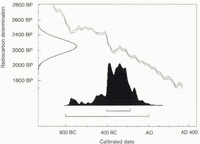
The carbon-isotope results from the two Murtèl moss subsamples are summarized in Table 3 along with the respective reference samples. As illustrated by Figure 7, the mean conventional 14C age of the Murtèl moss of 2250 ± 100 years (1 σ variability) corresponds to ranges in the calibrated calendar age of 470–170 BC and 800 BC to AD 0 at statistical probabilities of 68% and 95%, respectively. The δ14C values from the recent moss and the recent sugar-coal reference sample appear to be underestimated by up to 60%0, suggesting a contamination by some old carbon components. This systematic deviation was depicted from comparisons with the current atmospheric l4CO2 record at Heidelberg (personal communication from I. Levin, 1995) and with low-level counting results giving δ14C = 362%0 ± 3%0 for the sugar-coal sample (personal communication from B. Kramer, 1995). As shown by the low process blank of the 14C free Tremonia coal, no significant contamination by modern carbon has to be considered, however. On the other hand, referring to the adopted overall analytical uncertainty in the 14C analysis of approximately 10 per mil, there is perfect agreement between the 14C values of the two Murtèl aliquots, making random contamination less likely. For this reason, no downward correction of the Murtèl 14C ages due to dead carbon contamination (which would account for a maximum of 500 years) was performed.

Calibration of conventional 14C age of moss sample (2250 ± 100 BP) after Reference Stuiver and ReimerStuiver and Reimer (1993) giving calibrated date ranges of 400 BC–160 BC at 1σ (short horizontal bar) and 800 BC – AD 0 at 2σ (long bar) confidence levels; normally distributed 14C ages are indicated at the ordinate.

The relatively well-preserved habitus of the moss remains as well as of the pollen scavenged by them suggests an insignificant residence time of the material on the rock-glacier surface before becoming ultimately isolated from its ambient environment by incorporation into the ice matrix. Hence, the 14C age of the moss may not be much influenced by other carbon pools and is expected to be well representative of the age of the hosting ice layer. Although no further macroscopic plant fragments have been detected so far in the Murtèl cores, micro-plant debris may be abundant (though not easily recognized on visual inspection). Hence, extracting this material by selective concentration steps would lead to bulk particulate organic carbon (POC) samples, sufficiently large for further AMS 14C datings. The same is expected for dissolved organic carbon (DOC) components eventually washed down from overlying soil patches or even from sparsely colonized rock debris.
Geomorphological and Glagiological Interpretation
The 14C dating of the moss remains found in the permafrost core recovered from the active rock glacier Murtèl now constitutes the first absolute age determination of creeping Alpine permafrost available: ground ice at the site of the core-drilling within Murtèl rock glacier has existed for at least 2000 years. Earlier estimates from flow considerations are, thus, clearly confirmed: the ice within active rock glaciers is thousands of years old and by far predates recent climatic events such as the Little Ice Age. Moreover, this absolute age determination of a permafrost layer allows some general conclusions to be drawn about long-term flow velocities, landform genesis, rates of ice formation, rockfall activity and cliff retreat at an active rock glacier as well as about conditions for preservation of old ice in cold mountain areas.
With the time of existence of the sample being known, the average flow velocity of the creeping permafrost during the considered time period can be estimated if the place of moss deposition and, hence, the travel distance to the drill site can be defined. A (hardly realistic) minimum travel distance and long-term flow velocity (both 0) are given by the assumption that the moss had been directly deposited at the drill site in its present-day position. A corresponding maximum limit can be established by assuming that the moss had been deposited at the very foot of the rock wall at the head of the rock glacier and then traveled by permafrost creep over the full distance to today’s borehole. In such a case, the average flow velocity along the trajectory to the borehole would have been some 25% higher than at present. The most plausible case is in between the two extremes: the moss may have been transported from the headwall to the rock-glacier surface by a rockfall event or a snow avalanche traveling over some runout distance but not reaching the drill site in the current position. The present-day flow field (Fig. 3), in fact, indicates that the moss remains may have been deposited some 100 m from the foot of the rock wall. In any case, the characteristic average long-term flow velocity is in the range of cm a-1, closely corresponding to values measured at present.
Such an estimated long-term surface velocity of a few cm a-1 confirms that the flow of the rock-glacier permafrost indeed corresponds to a secondary (steady-state) viscous-flow mode of ice-supersaturated debris, where constant stress leads to constant strain rates (Reference OlyphantOlyphant, 1983, 1987; Reference HaeberliHaeberli, 1985; Reference WagnerWagner, 1992). The constant rate of the flow over long time periods thereby indicates that, during the past two millennia, dramatic changes in rheological characteristics as influenced by material properties or thermal conditions are unlikely to have taken place and that surface slope and permafrost thickness which exert a predominant influence on the stress field within the creeping ice/rock mixture must have remained quite similar to the present ones. The rock glacier as a landform expressing the cumulative straining of perennially frozen, ice-rich debris must, therefore, be considerably older than 2000 years.
The total age of the rock glacier, i.e. the beginning of its formation, can be estimated only roughly. In terms of specifics, many questions remain unanswered. Estimates can be based on (1) consideration of the obvious inertia and long-term stability of the flow field, and (2) extrapolation of the vertical time-scale to greater depth. The photogrammetrically determined velocities along the central trajectories of Murtèl rock glacier indicate a surface age of about 3000 years at the borehole, where the moss remains were found, and a surface age of about 6000 years at the actively advancing front. Integration of the currently measured ratio between the rate of advance and the surface velocities over present flow trajectories yields an age estimate for the Murtèl rock glacier of roughly 104 years. Assuming that 6 m of ice (3 m) and debris (3 m) had accumulated above the moss remains and that the rate of ice and debris accumulation (3 mm a-1) remained constant through time, the age of the layers within the shear horizon at 30 m depths can, again, be estimated at some 104 years. It appears quite reasonable to assume that rock-glacier formation may have started during the final stages of the last Ice Age or with the onset of the Holocene. The bulk of the creeping ice/rock mixture is likely to be several thousand years old.
Ice formation above the moss remains could have taken place at a characteristic rate of mm a-1 by means of freezing processes at the permafrost table during the building up of the surficial debris layer (at a comparable rate of mm a-1). This part of ground ice formation would represent syngenetic permafrost aggradation. The most likely process thereby invoked is refreezing of snow meltwater percolating into the still cold active layer during spring (Reference Haeberli, Hoelzle, Keller, Schmid, Vonder Mühll and WagnerKeller and Gubler, 1993) and producing high-resistivity ice with a relatively low ion content (Haeberli and Reference Haeberli and Vonder MühllVonder Mühll, 1996). Taking into account the porosity of the coarse blocks at the surface, the ice content by volume over the total ice/debris thickness above the moss remains is about 50–70%. Such a supersaturation is commonly observed in Alpine permafrost boreholes (Reference Vonder MühllVonder Mühll and Holub, 1992; Reference Haeberli and Vonder MühllVonder Mühll, 1996) and constitutes the basis for the observed steady-stale creep of the rock-glacier permafrost. The amount of debris which has been deposited at the rock-glacier surface over the past 2000 years along the central flowline to the borehole roughly corresponds to a retreat of the 200 m high rock headwall of 3 m or 1–2 mm a-l. Based on an average width of the rock glacier and the rock head-wall of 150–250 m, some 30–100 m3 of rocks are likely to have fallen onto the rock-glacier surface every year. During the entire Holocene time period, this would add up to a total of 300 000–1 000 000 m3 of debris. Assuming that the rock-glacier permafrost acts as a perfect sediment trap (no loss of rock material from meltwater erosion) and comparing it with a total rock-glacier volume of 2–3 × 10⁶ m3 provides again a characteristic ice content by volume of 50–90%.
The largest and most conspicuous ice bodies in the Alps are the surface ice masses of the numerous glaciers. With characteristic lengths of kilometers and characteristic flow velocities of meters to tens of meters per year, however, the age of such ice in glaciers is usually limited to a few centuries. Much older ice can be found in cold-based parts of glaciers on wind-exposed crests and at very high altitudes. Examples are the summit ice of Titlis (Reference Lorrain and HaeberliLorrain and Haeberli, 1990), the ice-core drilling site on Colle Gnifetti, Monte Rosa (Reference HaeberliHaeberli, 1994; Reference WagenbachWagenbach, 1994; Reference WagnerWagner, 1994), or the ice on saddles, which, for instance, contained the Ötztal ice man at Hauslabjoch or the archeological bows at Lötschental (Reference HaeberliHaeberli, 1994; Reference Baroni and OrombelliBaroni and Orombelli, 1996). Ice considerably older than a few centuries has also been detected in perennial snow banks of the Japanese. Alps (Reference Yamamoto and YoshidaYamamoto and Yoshida, 1987; Reference Yoshida, Yamamoto, Higuchi, Iida, Ohata and NakamuraYoshida and others, 1990). All these occurrences concern surface ice within an environment of mountain permafrost. The present study confirms that old ice also exists within the permafrost itself. The scientific investigation of such old ice archives in mountain areas is at its very beginning and deserves more attention.
Acknowledgements
Thanks are due to I. Levin and B. Kromer for letting us use their AMS target preparation devices and for invaluable discussions. We also thank G. Bonani and M. Suter for the AMS analysis at the Institut für Mittelenergiephysik, ETH Zürich, Switzerland. The photogrammetric investigations are based on the aerial photographs taken by the Swiss Federal Office of Cadastral Surveys (Eidgenössische Vermessungsdirektion) and were performed using the analytical plotter of the Laboratory of Hydraulics, Hydrology and Glaciology, ETH Zürich. Core-drilling, core analysis and borehole measurements in the permafrost of the active rock glacier Murtèl-Corvatsch were supported by ETH research grants. Photogrammetric analysis of Murtèl rock glacier is a contribution to the permafrost-monitoring scheme of the Glaciological Commission within the Swiss Academy of Sciences (SANW).