





Impact statement
As mining expands globally to meet growing minerals demand and its impacts on biodiversity are increasingly more significant and widespread, established policies such as mine site rehabilitation become insufficient to mitigate those impacts. With the mining industry committing itself to more ambitious goals, aligned with global targets which call for conservation and restoration of at least 30% of biodiversity worldwide, actions are required throughout a mine’s life cycle.
The declared aspirations for biodiversity in development projects have become more ambitious, evolving from seeking to minimize losses through environmental impact assessment, to offsetting significant residual impacts to, more recently, delivering a positive legacy for nature. Restoring a mine site is no longer sufficient. It is necessary to implement conservation actions outside of the mine site – such as protecting and restoring ecosystems in the wider region. Thus, collaboration with communities and others is essential. Companies must take a leading role in engaging with relevant stakeholders not only to ensure their social license to operate, but for the future common good. This is certainly no easy task, especially for decades-long mine ventures that undergo management and ownership change.
How to ensure that benefits are lasting? This paper explains the key challenges in mine closure planning to meet Nature Positive expectations over the full mining life cycle, including post-closure. To address the Nature Positive challenge, it is necessary to look beyond the mine site and include landscape-level collaborative conservation actions.
The contribution of this paper is international in scope. Key policy initiatives globally as well as relevant international academic literature and some choice examples from practice are addressed. The work is thus relevant to practitioners and researchers alike. We call attention to the novelty for mining companies represented by the Nature Positive challenge and the necessary mindset change in mine closure planning.
Introduction
The global biodiversity crisis is worsening fast, driven by expanding economic activities, the growing need for mineral resources and climate change, among others (Rockström et al., Reference Rockström, Steffen and Noone2009, WWF, Reference Almond, Grooten, Juffe Bignoli and Petersen2022). Governments, civil society organizations and businesses have been proposing responses to halt and reverse biodiversity decline – sometimes synthesized as “bending the curve” (Leclère et al., Reference Leclère, Obersteiner, Barrett, Butchart, Chaudhary, de Palma, DeClerck, di Marco, Doelman, Dürauer, Freeman, Harfoot, Hasegawa, Hellweg, Hilbers, Hill, Humpenöder, Jenningsm, Krisztin, Mace, Ohashi, Popp, Purvis, Schipper, Tabeau, Valin, van Meijl, van Zeist, Visconti, Alkemade, Almond, Bunting, Burgess, Cornell, di Fulvio, Ferrier, Fritz, Fujimori, Grooten, Harwood, Havlík, Herrero, Hoskins, Jung, Kram, Lotze-Campen, Matsui, Meyer, Nel, Newbold, Schmidt-Traub, Stehfest, Strassburg, van Vuuren, Ware, Watson, Wu and Young2020) – that requires concerted and collaborative actions by multiple actors. All development activity and responsible parties will need to take positive action for achieving positive outcomes for biodiversity. In this paper, we specifically focus on the challenges this will pose for mine closure planning.
The mining industry certainly has an important role to play, considering the extent of its impacts on the environment at large (Sánchez and Franks, Reference Sánchez, Franks, Yakovleva and Nickless2022) and on biodiversity in particular, including terrestrial (Lamb et al., Reference Lamb, Massam, Mills, Bryant and Edwards2024) and aquatic (Rentier and Cammeraat, Reference Rentier and Cammeraat2022) ecosystems. Consideration must be given to both direct (Giljum et al., Reference Giljum, Maus, Kuschnig, Luckeneder, Tost, Sonter and Bebbington2022) and indirect (Sonter et al., Reference Sonter, Ali and Watson2018) impacts, in particular from operations in biodiversity hotspots or areas of high conservation value (Murguía et al., Reference Murguía, Bringezu and Schaldach2016).
In terms of international policy development, a particularly noteworthy recent initiative is the Global Biodiversity Framework (GBF), the set of targets and tools agreed upon by the 15th Conference of the Parties to the Convention on Biological Diversity (UNEP, 2022). GBF is particularly known for its “30 by 30” targets, i.e. achieving two broad goals by 2030, namely (UNEP, 2022, p9):
TARGET 2: Ensure that by 2030 at least 30 per cent of areas of degraded terrestrial, inland water, and coastal and marine ecosystems are under effective restoration, in order to enhance biodiversity and ecosystem functions and services, ecological integrity and connectivity.
TARGET 3: Ensure and enable that by 2030 at least 30 per cent of terrestrial, inland water, and of coastal and marine areas, especially areas of particular importance for biodiversity and ecosystem functions and services, are effectively conserved and managed (…).
In this paper, we refer to this initiative and further policy positions arising from it as Nature Positive (which we further define and discuss in the next section). To meet those ambitious targets, governments are invited to develop, strengthen and enforce their own policies. As an example, early in 2024, England updated its Town and Country Planning Act 1990 (UK Public General Acts, 2024) to stipulate a “biodiversity gain objective” (Schedule 7A, s2) of 10% for “every planning permission granted for the development of land” (Schedule 7A, s13(1)) Where this cannot be met on the development site itself, offsets and other external conservation actions can be employed.
For the private sector, Target 15 of the GBF calls businesses to “progressively reduce negative impacts on biodiversity.” Some companies have been making commitments with biodiversity targets, albeit at a slow pace (McKinsey, 2023). Mining companies have pioneered some initiatives and commitments (Boiral and Heras-Saizarbitoria, Reference Boiral and Heras-Saizarbitoria2017). The 2024 version of the global risk report, prepared annually for the World Economic Forum (WEF) in Davos, Switzerland, emphasizes that the biodiversity crisis is a risk for businesses:
“respondents disagree about the urgency of environmental risks, in particular Biodiversity loss and ecosystem collapse and Critical change to Earth systems. Younger respondents tend to rank these risks far more highly over the two-year period compared to older age groups, with both risks featuring in their top 10 rankings in the short term. The private sector highlights these risks as top concerns over the longer term, in contrast to respondents from civil society or government who prioritize these risks over shorter time frames” (WEF, 2024).
In January 17 2024, during the WEF, the International Council on Mining and Metals (ICMM) made an important announcement, a commitment to support a “nature positive future”. This somewhat echoes long-standing calls in the literature for finding ways in which mining and especially post-mining restoration activities can re-establish and increase biodiversity (e.g. Prach and Tolvanen, Reference Prach and Tolvanen2016; Gann et al., Reference Gann, McDonald, Walder, Aronson, Nelson, Jonson, Hallett, Eisenberg, Guariguata, Liu, Hua, Echeverría, Gonzales, Shaw, Decleer and Dixon2019). Although such an ambitious goal is certainly relevant for planning and managing mine sites operating in different environmental settings, from tropical forests to rural settings, there are important implications for mine closure planning and the delivery of closure objectives that we will explore in this paper.
The aim of this paper is thus to conceptualize and explain what is necessary in mine closure planning and implementation to meaningfully contribute to Nature Positive goals. We commence by discussing the meanings of “nature positive” (section 2), before briefly outlining the challenges inherent in incorporating nature positive outcomes into mine closure planning. In Section 4, we more specifically examine the implications of nature positive commitments for mine closure planning. We close by presenting conclusions and insights for the way ahead for mining companies, including additional policy measures within the sector that may be necessary to realize Nature Positive goals in mine closure planning and transition.
Concepts of nature positive
A Nature Positive Initiative was launched on 6 Sept 2023 by a group of international non-government organizations, the United Nations’ Principles for Responsible Investment and others. They define nature positive as “halting and reversing biodiversity loss, through measurable gains in the health, abundance, diversity and resilience of species, ecosystems and nature processes” (Nature Positive Initiative, 2024).
The International Union for Conservation of Nature (IUCN), one of the organizations that has been promoting the concept, defines nature positive as “a global and societal goal to halt and reverse the loss of nature across all four realms (water, biodiversity, air/climate, and soil/land, for the benefit of human and planetary well-being)” (Baggaley et al., Reference Baggaley, Johnston, Dimitrijevic, Le Guen, Howard, Murphy, Booth and Starkey2023, p7). Further to the two targets for biodiversity conservation outlined previously for the conservation and restoration of at least 30 per cent of biodiversity and ecosystems (UNEP, 2022), a coalition of 27 of the world’s largest nature conservation organizations) call for nature positive actions to “halt and reverse nature loss by 2030 on a 2020 baseline, and achieve full recovery by 2050” (Nature Positive Initiative, 2024).
As Baggaley et al. (Reference Baggaley, Johnston, Dimitrijevic, Le Guen, Howard, Murphy, Booth and Starkey2023, p7) note: “halting and reversing is about avoiding and minimizing impacts, and, in addition, restoring and regenerating nature”. For the mining sector, avoiding impacts on biodiversity will necessitate an acknowledgement of ‘no go’ areas meaning that mineral reserves may not be fully recovered (Siqueira-Gay and Sánchez, Reference Siqueira-Gay and Sánchez2020). This should apply in circumstances of high and irreplaceable biodiversity values (Murguía et al., Reference Murguía, Bringezu and Schaldach2016), meaning that preservation becomes the priority. This is in accordance with Principle 2 of BBOP (2012) thus:
Limits to what can be offset: There are situations where residual impacts cannot be fully compensated for by a biodiversity offset because of the irreplaceability or vulnerability of the biodiversity affected.
Box 1 presents an example that illustrates the difficulty for mining to fully preserve or restore biodiversity, relative to seeking broader nature positive returns.
In this paper, our focus is upon mine closure and thus the ‘restoring and regenerating’ aspect of Nature Positive initiatives. Such activities will take place on mine sites undergoing closure and rehabilitation as well as on offsetting and other conservation initiatives undertaken by mining proponents at other sites to counterbalance residual biodiversity impacts from mining. In the spirit of best practice mine closure planning (ICMM, 2019), there are range of key considerations for nature positive goals to be realized by mining companies and it is this we now focus our attention on.
Biodiversity restoration challenge from local endemism
The restoration of biodiversity poses a particular challenge for miners, especially in biodiversity hotspots and where local endemism (i.e. a species or unique genetic variation is found only in a single defined geographic location) is high (Fernandes et al., Reference Fernandes, Santos, Gontijo, Silva Filho, Castilho and Sánchez2023; Morrison-Saunders and Sanchez, Reference Morrison-Saunders and Sánchez2024). Biodiversity conservation (e.g. internationally under the Convention on Biological Diversity, https://www.cbd.int/) envisages protecting all species on the planet, preventing them from becoming extinct due to human activities. In contrast, the notion of Nature Positive is comparatively vague (Milner-Gulland, Reference Milner-Gulland2022; zu Ermgassen, et al., Reference zu Ermgassen, Howard, Bennun, Addison, Bull, Loveridge and Starkey2022). It may be feasible through restoration and other activity at a mine site to accomplish net positive ‘nature’ (or natural environmental areas), but not necessarily to maintain all biodiversity as the following example from Western Australia illustrates.
During environmental impact assessment (EIA) for the Yeelirrie uranium mining proposal, 12 species of subterranean fauna (tiny animals living in groundwater – stygofauna, or below the ground but above the water table – troglofauna) were found beneath the project site and restricted to the area proposed for mining pits (EPA, 2016a). The EIA process in Western Australia has long accounted for subterranean fauna and dealing with short range endemic species, with technical guidance for assessment practices (EPA, 2016b). The almost certain extinction of these species that would ensue with the Yeelirrie mine led to the EPA (2016a) recommending to the government not to proceed with the development. However, the government did authorize the mining operation (Minister for the Environment, 2017) and subsequently, there was an unsuccessful attempt by conservation groups to overturn this decision in court (CONSERVATION COUNCIL OF WESTERN AUSTRALIA (INC) -v- THE HON STEPHEN DAWSON MLC [2018] WASC 34) because of the connection between mining authorization and failure to conserve biodiversity.
In short, for the Yeelirrie project, there is nothing the mining company or anyone else can do to maintain these species if the project proceeds. This biodiversity challenge means there must be an ability to ‘say no’ to mining development (Morrison-Saunders and Sanchez, Reference Morrison-Saunders and Sánchez2024). Thus, the caveat of Prach and Tolvanen (Reference Prach and Tolvanen2016) applies, that mining can only hope to increase biodiversity of a landscape if it first does not destroy them. The study of Murguía et al. (Reference Murguía, Bringezu and Schaldach2016) suggests some potential for opening new mines in areas of low biodiversity to meet global metal demands while Fernandes et al. (Reference Fernandes, Santos, Gontijo, Silva Filho, Castilho and Sánchez2023) present search strategies to enlarge the known distribution of species to reduce extinction risk.
Challenges for incorporation nature-positive outcomes into mine closure planning
The ICMM committed to “achieving no net loss of biodiversity at all mine site by closure against a 2020 baseline” (ICMM, 2024b). It is well understood, however, that successfully meeting mine closure objectives – including delivering nature positive outcomes – requires a life of mine approach (ICMM, 2019), in this case explicitly geared to deliver positive legacies to nature and its contributions to people (Díaz et al., Reference Díaz, Pascual and Stenseke2018).
We posit that to achieve nature positive outcomes at mine closure, it is necessary: (1) to define a baseline with appropriate indicators; (2) to set goals in relation to the baseline; (3) to be able to measure losses and gains. Such needs are aligned with much of what is found in the literature about biodiversity offsets (Souza et al., Reference Souza, Rosa, Campos and Sánchez2023) that establishes that it is important to acknowledge that it is necessary to understand the biodiversity impacts at each mine site, because it is fundamental to make it clear: no net loss exactly of what? For that purpose, the following questions should be clarified and will be discussed in this section:
-
(a) Does nature positive mean offsetting all impacts?
-
(b) Are tradeoffs acceptable (e.g. net negative effects on one particular biodiversity feature are accepted in exchange for net positive effects on another)?
-
(c) Are the impacts of associated facilities to be included in a losses and gains accounting? Or only the impacts on the mine site?
-
(d) Are indirect impacts to be considered?
-
(e) How to ensure that nature positive benefits are lasting?
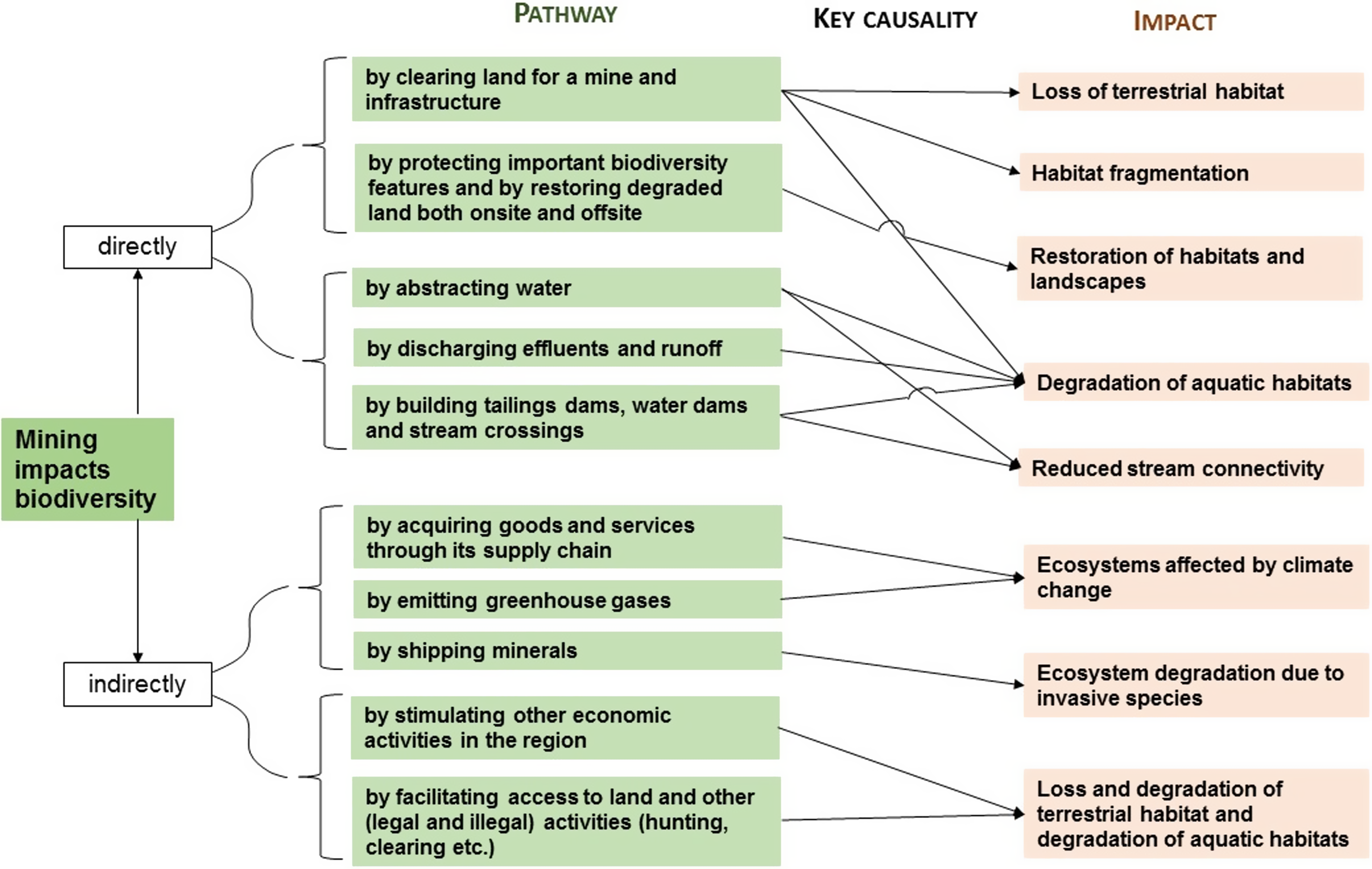
A summary of impacts of mining on biodiversity is shown in Figure 1. Mining affects biodiversity through various pathways and not all of them are usually accounted for. Most offset schemes, for example, cater for direct habitat loss, a widely recognized and easy to detect impact (González-González et al., Reference González-González, Clerici and Quesada2021), but not for other impacts (Salès et al., Reference Salès, Marty and Frascaria-Lacoste2023). For example, mining can cause important impacts on aquatic habitats downstream of mining sites (Affandi and Ishak, Reference Affandi and Ishak2019; Rentier and Cammeraat, Reference Rentier and Cammeraat2022), that are not always considered in offsetting schemes. Are all impacts to be accounted for in planning for nature positive outcomes? If not, could significant impacts or proxies be used?
Direct and indirect impacts of mining on biodiversity.
Source: Sánchez, L.E. Unpublished teaching notes.
Setting a baseline and measuring losses and gains
Much has been written about biodiversity metrics (Borges-Matos et al., Reference Borges-Matos, Metzger and Maron2023) and how difficult it is to capture complex ecosystem processes into a small set of indexes without oversimplifying. This is often contrasted with greenhouse gases metrics, condensed into the carbon dioxide equivalent unit. The lack of a common “currency” is a practical difficulty for planning for offsetting (Mayfield et al., Reference Mayfield, Bird, Cox, Dutson, Eyre, Raiter, Ringma and Maron2022), a hurdle that is carried on to commitments towards net zero or nature positive outcomes. Nevertheless, such hardship does not prevent offsetting schemes from being implemented and there is an enormous scope for learning from offsets implementation to advance effecting nature positive commitments. Thus, it will be an important inclusion within future mine closure plans to explicitly set out the metrics necessary to demonstrate nature positive outcomes will be attained.
Tradeoffs
If nature positive means more than biodiversity, and encompasses different realms (water, biodiversity, air/climate, and soil/land, Baggaley et al., Reference Baggaley, Johnston, Dimitrijevic, Le Guen, Howard, Murphy, Booth and Starkey2023), it is not necessarily the case that gains in one realm will represent gains in another. Protection of biodiversity is certainly positive for enhancing water quality and quantity, air quality and climate, as well as soil quality, but the reverse may not hold. This is because restoration or enhancement of these physical components of the environment does not always require return of native species. For example, a fast-growing tree plantation might simultaneously stabilize soil or slopes prone to erosion, extract carbon from the atmosphere and quickly contribute to micro-climatic benefits (e.g. cooling effects) but offer little biodiversity benefit.
Trade-offs will need to be managed carefully and may warrant formal establishment of protocols or trade-off decision-making rules along the lines of those advocated by Gibson (Reference Gibson2006) in the context of sustainability assessment thinking. Such trade-off rules or considerations might make for a useful addition to the ICMM (2024a) principles to be incorporated into mine closure planning.
Associated facilities
Transmission lines, power plants, access roads, pipelines, railways, ports and terminals and housing may be necessary to implement a new mine, especially in the case of large projects. The International Finance Corporation, in its Performance Standards on Environmental and Social Sustainability (IFC, 2012) defines associated facilities as “facilities that are not funded as part of the project and that would not have been constructed or expanded if the project did not exist and without which the project would not be viable.” Although in many countries, the impacts of associated facilities are assessed separately, because the project developer may be different from the mining company or because it may fall into another jurisdiction, the impacts of associated facilities add up to the impacts of the main project. Hence it is pertinent to ask, when establishing nature positive commitments, whether those impacts will be accounted for to devise compensatory measures and to incorporate this content into mine closure plans accordingly.
Furthermore, and similarly to the main mining project, the construction of such facilities affects biodiversity directly, indirectly and cumulatively (Siqueira-Gay et al., Reference Siqueira-Gay, Santos, Nascimento, Souza Filho and Sánchez2022), and that’s why it is pertinent to include another question to define the scope of actions aimed at delivering nature positive outcomes, featured below.
Indirect and induced impacts
Indirect impacts of mining, especially those arising from the facilitated land access resulting from mining infrastructure deployed by large mining projects, can be significant (Giljum et al., Reference Giljum, Maus, Kuschnig, Luckeneder, Tost, Sonter and Bebbington2022). “No mine is an island” (IUCN, 2021) and its impacts cannot be dissociated from transportation and other infrastructure necessary. In the Brazilian Amazon, Souza Filho et al. (Reference Souza Filho, de Souza, Silva, Nascimento, de Mendonça, Guimarães, Dall’Agnol and Siqueira2016) found that 52 % of a watershed in Eastern Amazon was deforested in a 40-year period following the construction of infrastructure to serve mining development. Although the agents of deforestation are third parties, their action is either triggered or facilitated by transportation infrastructure set in place by mining. Best practice mine closure planning aimed at delivering nature positive outcomes will attempt to forecast and appropriately account for these indirect and induced impacts.
Ensuring the permanence of gains
This issue is of utmost importance to make mine closure planning contribute to the delivery of nature positive outcomes. Biodiversity and other gains resulting from offsetting, additional conservation actions and other initiatives may not be lasting if not properly cared and maintained. Restored areas, for example, can be threatened by fires, droughts, poaching, cattle and human invasion. That’s why offsetting should ensure not only that gains are equivalent and additional to losses, but also that they are permanent, what requires long-term governance (Damiens et al., Reference Damiens, Basckstrom and Gordon2021).
This issue is tightly connected with mine closure planning. It is important that closure plans contain provisions to ensure that the positive legacy of mining is maintained. Particularly in terms of nature gains, it is the responsibility of the mining company to prepare for and to develop appropriate mechanisms, in consultation and partnership with relevant parties, to warrant the permanence of gains. It also requires working on a regional, landscape or ecosystem scale, not just at the mine site itself (e.g. Sonter et al., Reference Sonter, Ali and Watson2018), as acknowledged in the abovementioned ICMM Position Statement.
In cases where a mining company sponsors the establishment of private protected areas, and it cares or funds the management of such area during its operations, it is necessary to warrant there will be funds to ensure they are effectively protected after closure. Means to guarantee that enough resources will be available may include, for example, creating trust funds with appropriate governance mechanisms. In the cases where a mining company contributes to establishing, enlarging or enhancing public or community-protected areas, the mine closure plan should also consider how the benefits and services provided by such areas will be maintained when the mine closes and the mining company is no longer present.
It is important to note that the permanence requirement applies to all conservation outcomes associated with Nature Positive actions. As most such actions are conducted offsite, it is necessary to ensure that appropriate mechanisms are in place to warrant their permanence. In the Minas-Rio iron ore project in Southeastern Brazil, Souza et al. (Reference Souza, Rosa, Campos and Sánchez2023) found that the company used an array of tools and approaches adapted to both meeting legal requirements and more ambitious corporate policies, including provision of technical assistance to local landowners to restore riparian vegetation, the establishment of private protected areas with covenants linked to the land title, and the provision of funds for long-term management of such areas in an update of their mine closure plan.
There is no one-size-fits-all solution to ensure that nature positive outcomes eventually achieved at mine closure will last. Legislation, land tenure, costs and governance are only some factors to be considered in a life-of-mine approach to nature positive legacies.
Implications for mine closure planning
If the industry is to deliver nature positive outcomes, actions are necessary throughout the life cycle of a mine and a post-closure period, to warrant that gains will outlast the retirement of the company as well as possible divestment. We find it useful to frame these actions with respect to biodiversity goal attainment and social impact and community acceptance. The former largely evokes predominantly technical considerations, and the latter relates to the consequences of mining, restoration, offsetting and other conservation activities of mining proponents on local communities. We address each in turn.
Achieving biodiversity goals
Delivering nature positive outcomes will require working along the full spectrum of the mitigation hierarchy, from avoidance to compensation of harmful impacts (Maron et al., Reference Maron, Quétier, Sarmiento, Ten Kate, Evans, Bull, Jones, zu Ermgassen, Milner-Gulland, Brownlie, Treweek and von Hase2023). However, impact avoidance in mining projects is hampered by the frequent co-localization of mineral deposits and important biodiversity features (Sánchez and Franks, Reference Sánchez, Franks, Yakovleva and Nickless2022), as well as the current low ambition of impact assessment regulations, that accept loss of nature in exchange for scheduled socioeconomic gains (Morrison-Saunders and Sánchez, Reference Morrison-Saunders and Sánchez2024) meaning that if a project is to go ahead, losses are likely. Impact assessments and closure plans should ideally explain how the mitigation hierarchy is being or will be applied for the life time of mining projects with emphasis on positive biodiversity outcomes ultimately being delivered.
Impact correction through mine rehabilitation can certainly contribute to nature positive outcomes. However, rehabilitation is not always aimed at ecological restoration, but at site redevelopment or repurposing (e.g. Purtill, Reference Purtill2024).
In the case that ecological restoration is the rehabilitation goal, its achievement can be limited by insufficient knowledge to restore certain biodiversity values, for example, mountaintop grasslands in iron ore mines in Brazil (Arruda et al., Reference Arruda, Medeiros, Fiorini, Ordóñez-Parra, Dayrell, Messeder, Zanetti, Wardil, Paiva, Kozovits, Buisson, Le Stradic and Silveira2023). In all cases, there is a time lag between biodiversity losses from mine construction and expansion and gains obtained from site restoration (Fernandes et al., Reference Fernandes, Santos, Gontijo, Silva Filho, Castilho and Sánchez2023), as represented in Figure 2. This poses a particular challenge to the mining sector in regards the ‘30-by-30’ goal of Nature Positive. Additionally, there are managerial risks associated with the long time-frames needed to meet completion criteria, such as changes in company ownership and policies (Sánchez et al., Reference Sánchez, Silva-Sánchez and Neri2014) and loss or organization memory (Neri and Sánchez, Reference Neri and Sánchez2010).
Time lag between biodiversity losses in mining and gains resulting from mine site ecological restoration.
Source: Modified from Fernandes et al. (Reference Fernandes, Santos, Gontijo, Silva Filho, Castilho and Sánchez2023).
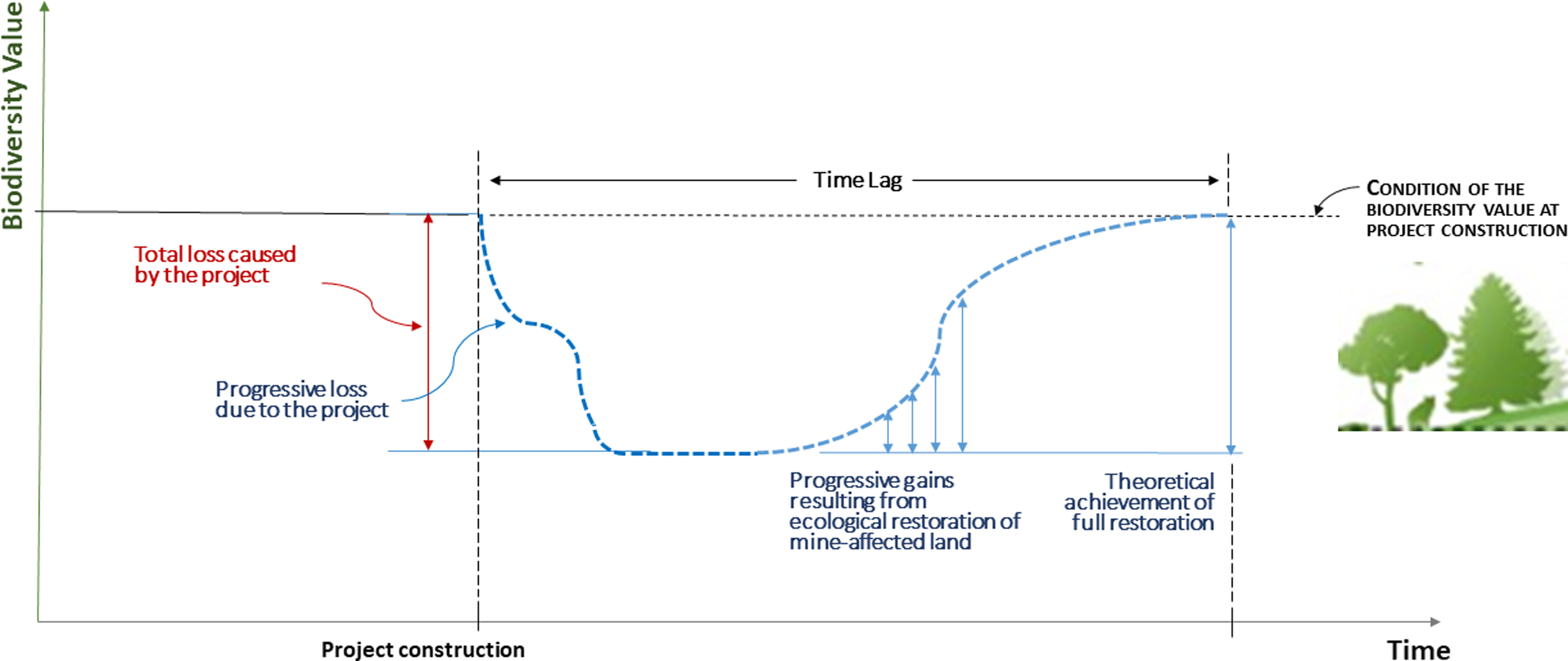
Rehabilitation of mined land is a classical topic related to mine closure. There is a lot written about mine rehabilitation, including widely acknowledged guidance on ecological restoration of mine sites (Gann et al., Reference Gann, McDonald, Walder, Aronson, Nelson, Jonson, Hallett, Eisenberg, Guariguata, Liu, Hua, Echeverría, Gonzales, Shaw, Decleer and Dixon2019). However, the time lag is inherent to mine site restoration. In sites where the pre-mining condition of ecosystems is good, even the best possible and the most successful ecological restoration actions will not deliver benefits equivalent to those preceding mining before several years or decades (Figure 1).
Delivering nature positive outcomes may require compensatory measures such as biodiversity offsets as a means of filling in the time lag (Sánchez et al., Reference Sánchez, Souza, Siqueira-Gay, Valetich and Rosa2022), as well as additional conservation actions, which are implemented offsite and can be conducive to net gains in terms of biodiversity (BBOP, 2012).
Social impacts and community acceptance
While our framing of nature positive goals at the outset of this paper was largely in terms of biodiversity outcomes and related benefits for nature, carefully considering the social impacts of conservation actions is extremely important to their success along with other social consequences of mining and closure more generally (Galo et al., Reference Galo, dos Anjos and Sánchez2022; Measham et al., Reference Measham, Walker, McKenzie, Kirby, Williams, D’Urso and Boggs2024). If nothing else, development approval and mine closure planning processes should be carried out in consultation with affected communities and interested parties, meaning that the solutions and ways forward for achieving biodiversity conservation and restoration must be socially acceptable.
Some recent studies of offsetting practices, which have a tendency to focus only or mostly upon the biodiversity outcomes to be achieved, have highlighted some of the social tensions that have emerged. A chief concern is the relocation of nature away from people (e.g. Kalliolevo et al., Reference Kalliolevo, Gordon, Sharma, Bull and Bekessy2021), a situation that is largely unavoidable for local residents living close to development areas given that by definition an offset site is located in some other place separate from the development site (Pope et al., Reference Pope, Morrison-Saunders, Bond and Retief2021). Other social impacts associated with offsetting are recorded in Bidaud et al. (Reference Bidaud, Schreckenberg and Jones2018, p43) who conclude that “real challenges of addressing the local costs of this novel conservation approach need to be resolved”. Similarly, in seeking to understand the social impacts associated with offsetting practice Tupala et al. (Reference Tupala, Huttunen and Halme2022, p1) note that it is “unclear if there are offsetting protocols which are acceptable both socially and in terms of biodiversity”.
We anticipate the same tensions arising for mine closure planning, especially because to address the time lag problem outlined previously it will be necessary to utilize offsetting approaches in the early phases of mine design and operation if nature positive goals are to be realized by mine closure.
An additional longer-term consideration for mine closure planning is the question of whether post-mining land should revert to its former status (e.g. rehabilitate the biodiversity impacted by mining) or to be repurposed to find alternative uses of the infrastructure established for mining as part of continued economic development (Keenan and Holcombe, Reference Keenan and Holcombe2021; Measham et al., Reference Measham, Walker, McKenzie, Kirby, Williams, D’Urso and Boggs2024). We note that a key principle within ICMM (2024a, p. 6) for mine closure planning and nature positive is “Collaborating and building capacity with local and regional partners, including Indigenous Peoples, land-connected peoples and local communities, to support and enhance healthy, resilient ecosystems and the livelihoods and wellbeing of people that depend on them”. It is clear that mine closure is and must be a social process that is procedurally fair and underpinned by good governance to meet these needs for affected communities (Measham et al., Reference Measham, Walker, McKenzie, Kirby, Williams, D’Urso and Boggs2024). Negotiating Nature Positive outcomes now becomes part of the process.
The way ahead
The challenges of delivering nature positive outcomes at mine closure should not be underestimated. We do not dispute the genuine intent and commitment of ICMM and its member companies in establishing their nature positive initiative. “Good mine closure” (Littleboy et al., Reference Littleboy, Marais and Baumgartl2024) should aim at delivering lasting positive legacies. However, other corporate commitments have been proved easier to talk about than to materialize into real achievements. For example, recent research shows that carbon net zero voluntary commitments of European banks have not led to divestment from target sectors or changing their lending practice (Sastry et al., Reference Sastry, Verner and Marques-Ibanez2024) while the emissions from so-called big tech companies keep rising, despite their net zero commitments (Ghaffary, Reference Ghaffary2024).
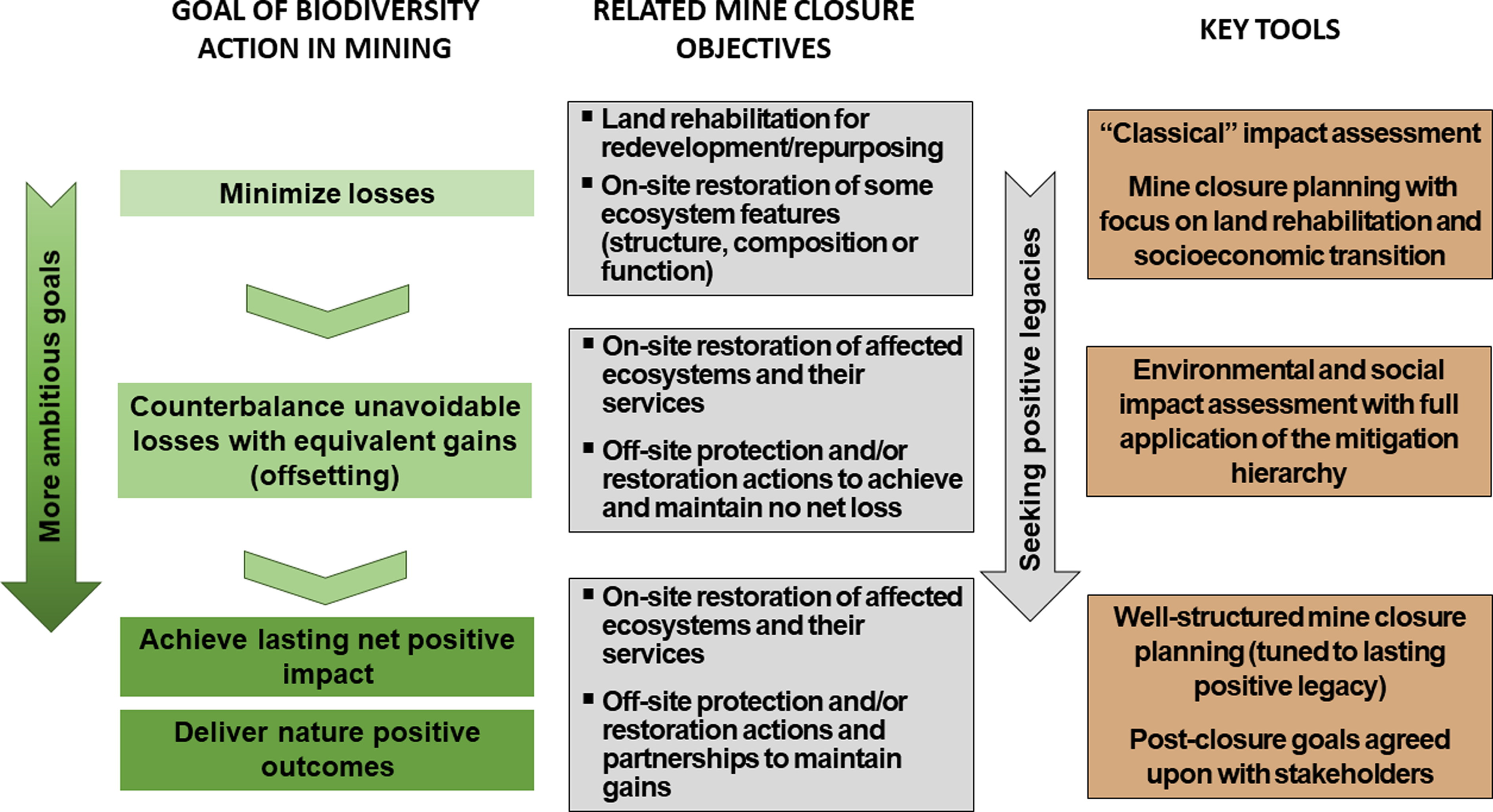
We conceptualize the nature positive goal in mining as an evolution of goals whose achievement requires well-tuned and updated tools. Our view is shown in Figure 3, which is provided here to serve as a snapshot summary of mine closure objectives and key tools that can be employed to address biodiversity goals. The declared aspirations of biodiversity action in development projects have become more ambitious, evolving from seeking to minimize losses through environmental impact assessment, to offset significant residual impacts to, more recently, delivering a positive legacy for nature. We relate those goals to mine closure objectives, historically looking only at onsite rehabilitation or restoration of biodiversity features (Sánchez and Franks, Reference Sánchez, Franks, Yakovleva and Nickless2022) to providing ecosystem services to communities (Rosa et al., Reference Rosa, Morrison-Saunders, Hughes and Sánchez2022), and progressively taking a landscape approach and acknowledging the importance for a mining company to act in partnership with stakeholders.
More ambitious mine closure objectives and related planning tools.
Our research has sought to highlight the key challenges the Nature Positive agenda poses for mine closure planning. Given the scientific evidence for ongoing biodiversity decline and the 30% restoration and protection target of Nature Positive, the imperative for effective action is needed. We hope our arguments and suggestions for how mine closure planning can deliver nature positive outcomes provide stimulation and inspiration for practitioners and researchers alike.
Data availability statement
Data sharing not applicable – no new data generated.
Acknowledgements
A preliminary version of the contents of this paper was presented by the first author at the “Dig Deeper Webinar Series” hosted by the Cooperative Research Centre Transformations in Mining Economy CRC-TiME, Perth, Western Australia, 20 February 2024.
LES thanks the support of the Foundation for the Technological Development of Engineering (grant #1686) for the research project “From assessment to mitigation of impacts on biodiversity and ecosystem services: How to reach net positive impact?”, funded by Anglo American Minério de Ferro Brasil. AMS thanks the Centre for People, Place & Planet, Edith Cowan University, Australia and the Environment Institute of Australia and New Zealand for hosting seminar events on impact assessment and Nature Positive for which some ideas for this research were developed.
Authors contributions
Both authors contributed equally on conceptualization, writing the original draft and writing – review and editing. LES acquired funds for the research project which originated this paper.
Financial support
This research was partly supported by the Foundation for the Technological Development of Engineering, São Paulo, Brazil (grant #1686), under the research project “From assessment to mitigation of impacts on biodiversity and ecosystem services: How to reach net positive impact?” funded by Anglo American Minério de Ferro Brasil.
Competing interests
Authors declare no conflict of interest.
Ethics statement
Ethical approval and consent are not relevant to this article type.


 Open access




Comments
No accompanying comment.