





1 Introduction
Log-analytic functions have been defined by Lion and Rolin in their seminal paper [Reference Lion and Rolin8]. They are iterated compositions from either side of globally subanalytic functions and the global logarithm and allow a preparation theorem.
An important subclass is given by the so-called constructible functions. This notion has been coined by Cluckers and Miller in their work on parametric integration of globally subanalytic functions [Reference Cluckers and Miller2–Reference Cluckers and Miller4], succeeding the work of Lion and Rolin [Reference Lion and Rolin9] and Comte et al. [Reference Comte, Lion and Rolin5]. A function on a globally subanalytic set is called constructible if it is a finite sum of finite products of globally subanalytic functions and the logarithm of positive globally subanalytic functions. The key property of the class of constructible functions is its closedness under parametric integration. For establishing this, Cluckers and Miller have also proved a preparation theorem and a decay result in this setting.
In [Reference Kaiser and Opris7], it was shown that the derivative of a differentiable log-analytic function is again log-analytic. In this note, we show that the subclass of constructible functions is also stable under taking derivatives. Here is the main result.
Theorem 1 Let $U\subset \mathbb R^n$
be an open and globally subanalytic set and let
$U\subset \mathbb R^n$
be an open and globally subanalytic set and let $f:U\to \mathbb R$
be constructible. Let
$f:U\to \mathbb R$
be constructible. Let $i\in \{1,\ldots ,n\}$
be such that f is differentiable with respect to the variable
$i\in \{1,\ldots ,n\}$
be such that f is differentiable with respect to the variable $x_i$
on U. Then
$x_i$
on U. Then $\partial f/\partial x_i$
is constructible.
$\partial f/\partial x_i$
is constructible.
This result is a necessary ingredient in the recent work of Huber et al. [Reference Huber, Kaiser and Oswal6], establishing a constructible de Rham theorem in the globally subanalytic setting. The proof of the theorem here adapts the strategy of [Reference Kaiser and Opris7, Theorem A], establishing a suitable preparation theorem for constructible functions on so-called simple cells. The preparation theorem is an appropriate variant of the one formulated in [Reference Cluckers and Miller3, Corollary 3.5]. Aizenbud et al. follow in their preprint [Reference Aizenbud, Cluckers, Raibaut and Servi1, Propositions 2.7 and 4.12] a similar approach to show that a much larger class called $\mathcal {C}^{\mathrm {exp}}$
is stable under taking limits and derivatives.
$\mathcal {C}^{\mathrm {exp}}$
is stable under taking limits and derivatives.
2 Notations and preliminaries
The empty sum is by definition $0$
and the empty product is by definition
$0$
and the empty product is by definition $1$
.
$1$
.
By $\mathbb N=\{1,2,\ldots \}$
we denote the set of natural numbers and by
$\mathbb N=\{1,2,\ldots \}$
we denote the set of natural numbers and by $\mathbb N_0=\{0,1,2,\ldots \}$
the set of nonnegative integers.
$\mathbb N_0=\{0,1,2,\ldots \}$
the set of nonnegative integers.
We set $\mathbb R_{>0}:=\{x\in \mathbb R\mid x>0\}$
. For
$\mathbb R_{>0}:=\{x\in \mathbb R\mid x>0\}$
. For $a,b\in \mathbb R$
with
$a,b\in \mathbb R$
with $a\leq b,$
we denote by
$a\leq b,$
we denote by $[a,b]$
the closed interval and by
$[a,b]$
the closed interval and by $(a,b)$
the open interval with endpoints
$(a,b)$
the open interval with endpoints $a,b$
, respectively. By
$a,b$
, respectively. By $|\;\;|$
we denote the Euclidean norm on
$|\;\;|$
we denote the Euclidean norm on $\mathbb R^n.$
We assume familiarity with the notion of o-minimal structures and of globally subanalytic sets and functions (see, e.g., van den Dries [Reference van den Dries10] or van den Dries and Miller [Reference van den Dries and Miller11]; see also the preliminaries of [Reference Kaiser and Opris7]).
We give the definition of a constructible function established by Cluckers and Miller in [Reference Cluckers and Miller2].
Definition Let $X \subset \mathbb R^n$
be a globally subanalytic set. A function
$X \subset \mathbb R^n$
be a globally subanalytic set. A function $f:X \to \mathbb R$
is called constructible (on X) if there are
$f:X \to \mathbb R$
is called constructible (on X) if there are $k,l\in \mathbb N_0$
and globally subanalytic functions
$k,l\in \mathbb N_0$
and globally subanalytic functions $(f_i:X\to \mathbb R)_{1\leq i\leq k}$
and
$(f_i:X\to \mathbb R)_{1\leq i\leq k}$
and $(g_{ij}:X\to \mathbb R_{>0})_{1\leq i\leq k, 1\leq j\leq l}$
such that
$(g_{ij}:X\to \mathbb R_{>0})_{1\leq i\leq k, 1\leq j\leq l}$
such that
 $$ \begin{align*}f=\sum_{i=1}^k f_i\prod_{j=1}^l \log(g_{ij}).\end{align*} $$
Note that a constructible function is definable in the structure $\mathbb R_{\mathrm {an},{\mathrm {exp}}}$
and that the set of constructible functions on a given globally subanalytic set is a ring with respect to pointwise addition and multiplication which contains the globally subanalytic functions on that set. Note also that the class of constructible functions is closed under plugging in globally subanalytic maps.
$\mathbb R_{\mathrm {an},{\mathrm {exp}}}$
and that the set of constructible functions on a given globally subanalytic set is a ring with respect to pointwise addition and multiplication which contains the globally subanalytic functions on that set. Note also that the class of constructible functions is closed under plugging in globally subanalytic maps.
3 Results
We let $x=(x_1,\ldots ,x_n)$
range over
$x=(x_1,\ldots ,x_n)$
range over $\mathbb R^n$
and y over
$\mathbb R^n$
and y over $\mathbb R$
. We set
$\mathbb R$
. We set $\pi :\mathbb R^n\times \mathbb R\to \mathbb R^n, (x,y)\mapsto x$
.
$\pi :\mathbb R^n\times \mathbb R\to \mathbb R^n, (x,y)\mapsto x$
.
For the following definition compare with [Reference Cluckers and Miller2, Reference Lion and Rolin8] and also with van den Dries and Speissegger [Reference van den Dries and Speissegger12]. Let $C\subset \mathbb R^n\times \mathbb R$
be globally subanalytic.
$C\subset \mathbb R^n\times \mathbb R$
be globally subanalytic.
Definition 1 A function $\widetilde {y}:C\to \mathbb R$
is called a globally subanalytic y-coordinate on C with center
$\widetilde {y}:C\to \mathbb R$
is called a globally subanalytic y-coordinate on C with center $\Theta $
if the following holds:
$\Theta $
if the following holds:
-
(a) We have $\widetilde {y}>0$
or
$\widetilde {y}<0$
on C.
$\widetilde {y}>0$
or
$\widetilde {y}<0$
on C. -
(b) The function
$\Theta $
is a globally subanalytic function on
$\pi (C)$
. -
(c) We have
$\widetilde {y}(x,y)=y-\Theta (x)$
. -
(d) There is
$\varepsilon \in (0,1)$
such that
$0<|\widetilde {y}(x,y)|<\varepsilon |y|$
for all
$(x,y) \in C$
or
$\Theta = 0$
.







Note that $\Theta $
is uniquely determined by
$\Theta $
is uniquely determined by $\widetilde {y}$
.
$\widetilde {y}$
.
Remark 2 Note that Cluckers and Miller omit condition (d) in their results [Reference Cluckers and Miller3, Theorem 3.4 and Corollary 3.5]. But we can add it without problems by the original formulation of the globally subanalytic preparation theorem in [Reference Lion and Rolin8, p. 862] or [Reference van den Dries and Speissegger12, Theorem 2.4].
We give the notion of so-called strong functions (cf. [Reference Cluckers and Miller3, Definition 3.3]).
Definition 3 A function $u:C \to \mathbb R$
is called strong on C with globally subanalytic y-coordinate
$u:C \to \mathbb R$
is called strong on C with globally subanalytic y-coordinate $\widetilde {y}$
on C if
$\widetilde {y}$
on C if $u=v \circ \varphi $
where the following holds:
$u=v \circ \varphi $
where the following holds:
-
(a) The function
$\varphi $
is given by where
$$ \begin{align*} \varphi:C &\to [-1,1]^s, \\ \varphi(x,y) &=\Big(b_1(x),\ldots,b_{s-2}(x),b_{s-1}(x)|\widetilde{y}|^p,b_s(x)|\widetilde{y}|^{-p}\Big), \end{align*} $$
$s\in \mathbb N_0$
,
$p \in \mathbb Q,$
and
$b_1,\ldots ,b_s$
are globally subanalytic functions on
$\pi (C)$
.
-
(b) The function v is a power series which converges on a neighborhood of
$[-1,1]^s$
.


Note that a strong function is globally subanalytic and bounded.
Given $x\in \mathbb R^n$
, we set
$x\in \mathbb R^n$
, we set $C_x:=\{y\in \mathbb R\mid (x,y)\in C\}$
. We introduce the notion of a simple cell (see [Reference Kaiser and Opris7, Definition 2.15]).
$C_x:=\{y\in \mathbb R\mid (x,y)\in C\}$
. We introduce the notion of a simple cell (see [Reference Kaiser and Opris7, Definition 2.15]).
Definition 4 We call C simple if, for every $x\in \pi (C),$
we have
$x\in \pi (C),$
we have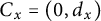 $C_x=(0,d_x)$
for some
$C_x=(0,d_x)$
for some $0<d_x<+\infty $
.
$0<d_x<+\infty $
.
Remark 5 Let $X\subset \mathbb R^n$
be a globally subanalytic set and let
$X\subset \mathbb R^n$
be a globally subanalytic set and let $\mathcal {C}$
be a globally subanalytic cell decomposition of
$\mathcal {C}$
be a globally subanalytic cell decomposition of $X\times (0,1)$
. Then
$X\times (0,1)$
. Then
 $$ \begin{align*}X=\bigcup\{\pi(C)\mid C\in\mathcal{C}\mbox{ simple}\}.\end{align*} $$
Remark 6 Let C be simple. Then y is the only globally subanalytic y-coordinate on C.
Proof That y is a globally subanalytic y-coordinate on C is clear. Let $\widetilde {y}$
be a globally subanalytic y-coordinate on C with center
$\widetilde {y}$
be a globally subanalytic y-coordinate on C with center $\Theta $
. Assume that
$\Theta $
. Assume that $\Theta \neq 0$
. Then, by Definition 3, there is
$\Theta \neq 0$
. Then, by Definition 3, there is $\varepsilon \in (0,1)$
such that
$\varepsilon \in (0,1)$
such that
 $$ \begin{align*}|y-\Theta(x)| < \varepsilon|y|\end{align*} $$
for all $(x,y) \in C$
. Let
$(x,y) \in C$
. Let $x \in \pi (C)$
be such that
$x \in \pi (C)$
be such that $\Theta (x) \neq 0$
. Then we obtain
$\Theta (x) \neq 0$
. Then we obtain
 $$ \begin{align*}+\infty=\lim_{y\searrow 0}\Big\vert 1-\frac{\Theta(x)}{y}\Big\vert\leq \varepsilon,\end{align*} $$
which is a contradiction.
Theorem 7 Let $X\subset \mathbb R^n$
be a globally subanalytic set and let
$X\subset \mathbb R^n$
be a globally subanalytic set and let $F:X\times (0,1)$
be a constructible function. Then there exists a cell decomposition
$F:X\times (0,1)$
be a constructible function. Then there exists a cell decomposition $\mathcal {C}$
of
$\mathcal {C}$
of $X\times (0,1)$
such that, for every
$X\times (0,1)$
such that, for every $C\in \mathcal {C}$
which is simple, the following holds:
$C\in \mathcal {C}$
which is simple, the following holds:
-
(1) We have
where
$$ \begin{align*}f|_C(x,y)=\sum_{i=1}^M a_i(x)u_i(x,y) y^{p_i} |\log y|^{l_i},\end{align*} $$
$M\in \mathbb N_0$
and for each
$i\in \{1,\ldots ,M\}$
,
$a_i:\pi (C)\to \mathbb R$
is constructible,
$u_i:C\to \mathbb R$
is strong,
$p_i\in \mathbb Q,$
and
$l_i\in \mathbb N_0$
.
-
(2) For each
$i\in \{1,\ldots ,M\},$
we have
$u_i=1$
or
$p_i>0$
. -
(3) The pairs
$(p_i,l_i)$
where
$p_i\leq 0$
are pairwise distinct.









Proof By [Reference Cluckers and Miller3, Corollary 3.5] in connection with Remarks 2 and 6, we get such a cell decomposition such that Property (1) holds. Applying the additional statement of [Reference Cluckers and Miller3, Corollary 3.5], we immediately obtain a presentation such that, for each $i,$
we have
$i,$
we have $u_i=1$
or
$u_i=1$
or $p_i>-1$
. But the proof thereof can be exactly used to obtain also Property (2). Property (3) is then in view of Property (2) easily obtained by collecting summands.
$p_i>-1$
. But the proof thereof can be exactly used to obtain also Property (2). Property (3) is then in view of Property (2) easily obtained by collecting summands.
Theorem 8 Let $X \subset \mathbb R^n$
be globally subanalytic and let
$X \subset \mathbb R^n$
be globally subanalytic and let $F:X\times (0,1)\to \mathbb R$
be constructible. Assume that, for every
$F:X\times (0,1)\to \mathbb R$
be constructible. Assume that, for every $x\in X,$
we have that
$x\in X,$
we have that $\lim _{y\searrow 0}F(x,y)$
exists and is finite. Then the function
$\lim _{y\searrow 0}F(x,y)$
exists and is finite. Then the function $h:X\to \mathbb R, x\mapsto \lim _{y\searrow 0}F(x,y),$
is constructible.
$h:X\to \mathbb R, x\mapsto \lim _{y\searrow 0}F(x,y),$
is constructible.
Proof By Theorem 7, we find a cell decomposition $\mathcal {C}$
of
$\mathcal {C}$
of $X\times (0,1)$
such that, for every simple
$X\times (0,1)$
such that, for every simple $C\in \mathcal {C,}$
we have
$C\in \mathcal {C,}$
we have
 $$ \begin{align*}F|_C(x,y)=\sum_{i=1}^M a_i(x)u_i(x,y) y^{p_i} |\log y|^{l_i}\end{align*} $$
with the properties mentioned therein. We show that $h|_{\pi (C)}$
is constructible for such
$h|_{\pi (C)}$
is constructible for such $C,$
and we are done by Remark 5. For
$C,$
and we are done by Remark 5. For $x\in \pi (C)$
and
$x\in \pi (C)$
and $i\in \{1,\ldots ,M\}$
with
$i\in \{1,\ldots ,M\}$
with $p_i>0,$
we have
$p_i>0,$
we have
 $$ \begin{align*}\lim_{y\searrow 0} a_i(x)u_i(x,y) |y|^{p_i}|\log y|^{l_i}=0.\end{align*} $$
Hence, we can replace $F|_C$
by
$F|_C$
by
 $$ \begin{align*}\sum_{p_i\leq 0} a_i(x)u_i(x,y) y^{p_i} |\log y|^{l_i}=\sum_{p_i\leq 0} a_i(x) y^{p_i} |\log y|^{l_i}.\end{align*} $$
We can therefore assume that a priori $p_i\leq 0$
for all
$p_i\leq 0$
for all $i\in \{1,\ldots ,M\}$
. We may also assume that
$i\in \{1,\ldots ,M\}$
. We may also assume that $M\geq 1$
and that
$M\geq 1$
and that $a_i$
does not vanish identically for each
$a_i$
does not vanish identically for each $i\in \{1,\ldots ,M\}$
. We may further assume that
$i\in \{1,\ldots ,M\}$
. We may further assume that $p_1$
is minimal among the
$p_1$
is minimal among the $p_i$
and that
$p_i$
and that $l_1$
is maximal among those
$l_1$
is maximal among those $l_i$
for which
$l_i$
for which $p_i=p_1$
. Then
$p_i=p_1$
. Then
 $$ \begin{align*}\lim_{y\searrow 0} \frac{y^{p_i}|\log y|^{l_i}}{y^{p_1}|\log y|^{l_1}}=0\end{align*} $$
for every $i>1$
. Since
$i>1$
. Since $a_1$
does not vanish identically, we obtain by the assumption
$a_1$
does not vanish identically, we obtain by the assumption $\lim _{y\searrow 0} F(x,y)\in \mathbb R$
for every
$\lim _{y\searrow 0} F(x,y)\in \mathbb R$
for every $x\in \pi (C)$
that
$x\in \pi (C)$
that $(p_1,l_1)=(0,0)$
(and that
$(p_1,l_1)=(0,0)$
(and that $M=1$
). We conclude that
$M=1$
). We conclude that $h|_{\pi (C)}=a_1$
and are done.
$h|_{\pi (C)}=a_1$
and are done.
With the above theorem, we are able to establish our main result (compare the proof of [Reference Kaiser and Opris7, Theorem A]).
Theorem 9 Let $U\subset \mathbb R^n$
be an open and globally subanalytic set and let
$U\subset \mathbb R^n$
be an open and globally subanalytic set and let $f:U\to \mathbb R$
be constructible. Let
$f:U\to \mathbb R$
be constructible. Let $i\in \{1,\ldots ,n\}$
be such that f is differentiable with respect to the variable
$i\in \{1,\ldots ,n\}$
be such that f is differentiable with respect to the variable $x_i$
on U. Then
$x_i$
on U. Then $\partial f/\partial x_i$
is constructible.
$\partial f/\partial x_i$
is constructible.
Proof We may assume that f is differentiable with respect to the last variable $x_n$
. We have to show that
$x_n$
. We have to show that $\partial f/\partial x_n$
is constructible. Let
$\partial f/\partial x_n$
is constructible. Let $e_n:=(0,\ldots ,0,1)\in \mathbb R^n$
be the
$e_n:=(0,\ldots ,0,1)\in \mathbb R^n$
be the $n^{\mathrm {th}}$
unit vector. We define
$n^{\mathrm {th}}$
unit vector. We define
 $$\begin{align*}F:U\times (0,1)\to \mathbb R, (x,y)\mapsto \left\{\begin{array}{@{}ccc} \frac{f(x+ye_n)-f(x)}{y},&& x+ye_n\in U,\\ &\mbox{if}&\\ 0,&& x+ye_n\notin U. \end{array} \right.\end{align*}$$
Then F is constructible. Since
 $$ \begin{align*}\frac{\partial f}{\partial x_n}(x)=\lim_{y\searrow 0}F(x,y)\end{align*} $$
for $x\in U,$
we are done by Theorem 8.
$x\in U,$
we are done by Theorem 8.


 Open access

