

Introduction
The prehistoric occupation of the Central Anatolian plateau, with its barely forested, hilly landscape and dry, grassland steppes remained largely obscure until the 1930s, when the first generation of Turkish archaeologists explored numerous Bronze Age sites in the vicinity of Ankara and Çorum (see Özdoğan 2005: 34-6 for a recent account). The most famous harvest of these expeditions is still the evidence from the site of Alaca Höyük, an Early Bronze Age centre that was later transformed into a Hittite town. The late-third-millennium 'royal burials' (c. 2300/2250-2000/1950 BC) are still unrivalled in their artistic splendour and the use of a great variety of precious and rare materials, including gold, silver, iron (!) and karneol (see Reference GerberGerber 2006 for bibliography).
After the first wave of excavations and surveys in this region in the mid-twentieth century, however, little was done to highlight prehistoric occupation in the periphery of Early Bronze Age centres like Alaca. Only recently have new surveys and excavations in the Çorum region contributed substantially to our knowledge of settlement policy and funeral customs of the 'commoners' living close to the centres of the local elites in the third millenium BC (Ipek & Zimmermann 2007: 49).
The cemetery of Resuloğlu
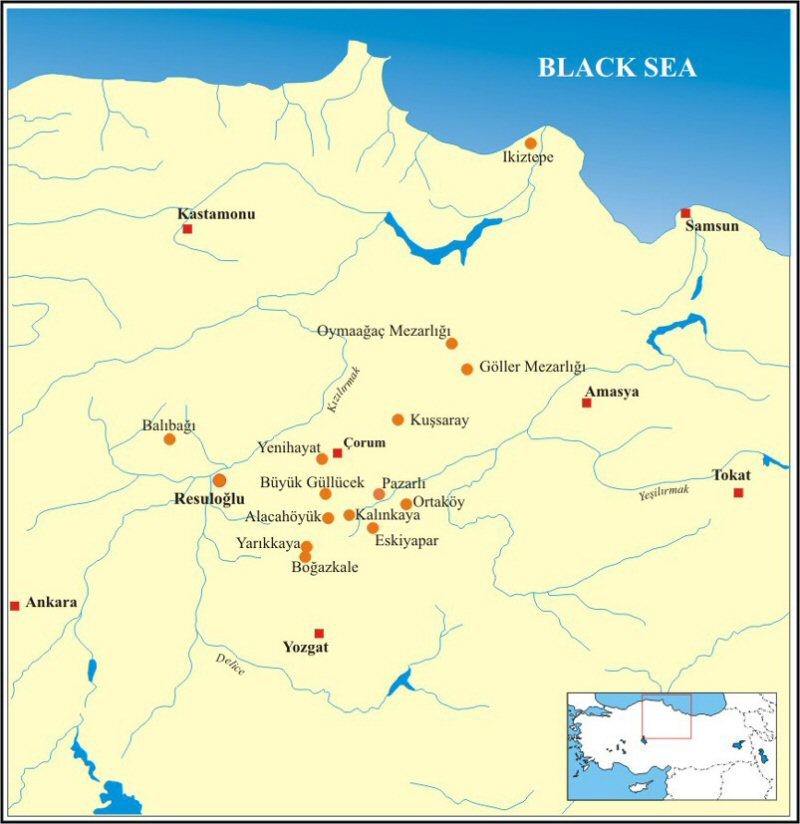
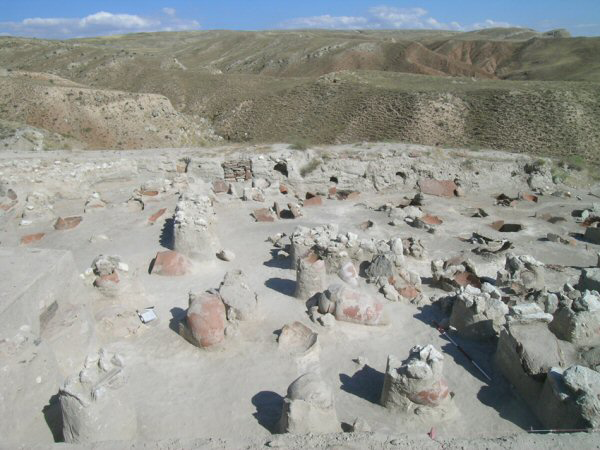
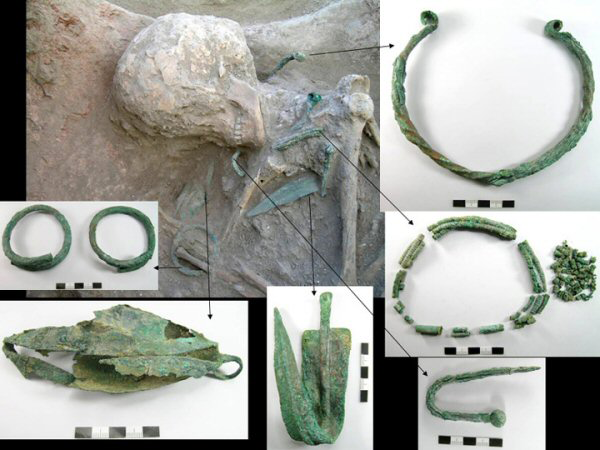
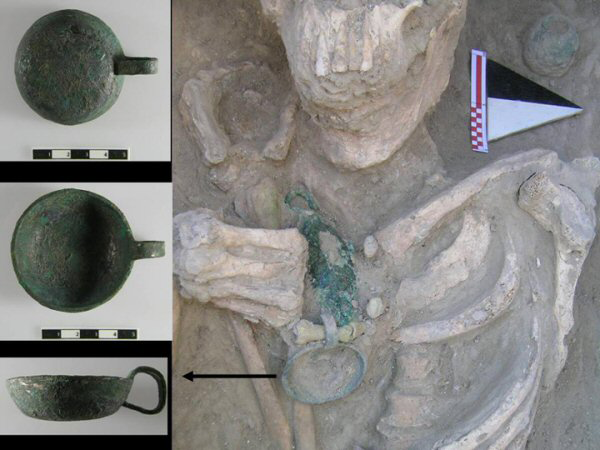
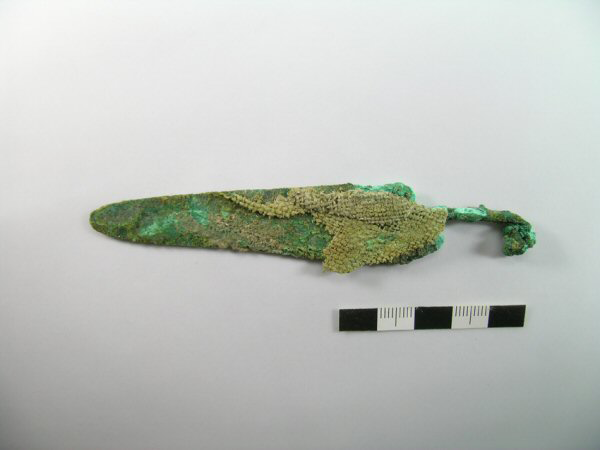
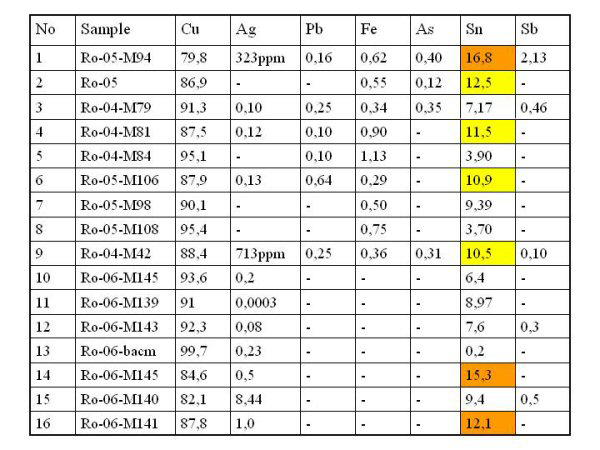
The cemetery of Resuloğlu, under excavation since 2003 (for reports see Reference YildirimYıldırım 2006; Reference YildirimYıldırım & Zimmermann 2006) (Figures 1 and 2), continues to provide new insights into burial rites and raw material consumption of a local Early Bronze Age population. The phenomenon of bucrania being placed on top of the monumental stone cists at Alaca Höyük (cf. Reference MansfeldMansfeld 2001: 27, Figure 5) can for example now also be observed at Resuloğlu, here in connection with richly equipped pithos burials. The preservation of burial goods, especially of the metal items, is extraordinarily good (Figures 3 and 4): For that reason, larger pieces of cloth carefully wrapped around a dagger have recently be analysed, confirming its fabric as dyed and woven linen with traces of brownish colour (Tütüncüler in press) (Figure 5). The fruitful collaboration with experts from the Sarayköy Nuclear Research Facilities (see Reference YildirimYıldırım & Zimmermann 2006 for details) was also maintained. Here the phenomenon that selected bronze items exhibit high tin values sketched in our previous Project Gallery contribution (Reference YildirimYıldırım & Zimmermann 2006) manifested itself further to become an almost common feature for bronze jewellery at Resuloğlu. Figure 6 illustrates a selection of samples analysed with destructive X-Ray fluorescence (XRF), displaying tin amounts up to 16.8 per cent.
Map showing the site of Resuloğlu and several other EBA centres in Central Anatolia.

View of Resuloğlu cemetery in its current state of excavation.

Burial M 107 with in situ position of selected, partly intentionally bent and broken metal objects.

Burial M 141 with dagger and small metal cup attached to the little finger.

Bronze dagger with preserved pieces of cloth wrapping.

XRF analysis chart of selected bronze jewellery from Resuloğlu, with the highest tin values highlighted.

Tin added in such high values has no more positive effect on the smelting, alloying or hardening process of the object. Therefore the reason must be either an attempt to manipulate the object's colour to receive a more 'silvery' sheen (cf. Reference HoslerHosler 1995: 100-01, 103-04), or some kind of sublime 'conspicuous consumption', in terms of processing rare or expensive raw materials in large quantities to display economic and social prestige. The lavish expenditure of alloying agents in high demand such as tin also touches on the hotly debated question of its possible origin (cf. Reference YenerYener et al. 1989; Reference PernickaPernicka et al. 1992; Reference MuhlyMuhly 1993; Reference YenerYener & Vandiver 1993; Reference KaniuthKaniuth 2007: 23-4). With respect to this frequent and expensive consumption of tin even in a small Early Bronze Age community like Resuloğlu, we consider the idea of exploiting nearby small sources of tin or tin-related minerals as a reasonable alternative to the theory of long-distance tin trade from the Middle East in the third millennium BC. It is, however, not possible at this stage of our research to contribute directly to this discussion.
Continued surveying and mineral probing along the banks of the Yeşilırmak and Kızılırmak rivers might contribute further to the patchy picture we have for local Early Bronze Age metal economies in Central Anatolia so far (cf. Reference KaptanKaptan 1983: 167-70).