

Greiz is a town along the White Eister River on the eastern edge of Thuringia, a few kilometers from Saxony and 50 kilometers from the Czech Republic. The town square is next to an expansive English garden, with a castle looming on the hill above. This region of Thuringia is known for its many forests and mountains. It is also known for its ancient cities and the Wartburg Castle, which is now a UNESCO World Heritage Site.
In 1936, Richard arranged a work transfer from his chemical company in Lahnstein to the branch of Zschimmer and Schwarz in the Greiz area. He was in his mid-30s, divorced, with the custody of two young sons, fleeing his home. It was too uncomfortable, and possibly dangerous, for Richard to remain in Oberlahnstein. As stated in the divorce decree, Richard had “social contacts with Jewish people.” Else was a Jewish sympathizer and had fled to Belgium. In Greiz, 400 km away, no one knew Richard or Else. It was a fresh start. Richard’s cousin, called Tante Minna by the boys, moved with Richard and the boys to Greiz. Minna had lost her husband in the First World War and, as a widow, was eager to help Richard with the boys. Tante Minna was loving and provided needed care in the absence of Dieter and Peter’s mother.
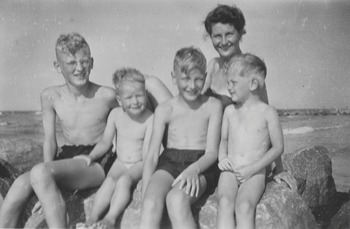
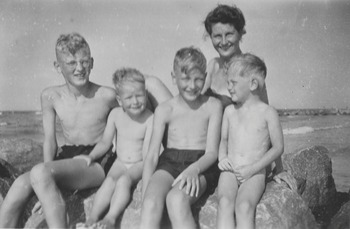
Shortly after arriving in Greiz, Richard met Charlotte Limmer, the 19-year-old daughter of a fabric maker in Greiz. Once again, the romance was fast and they were married in 1937. Peter’s brother Wolfgang arrived in 1937 and Götz in 1940. Germany, having taken over Czechoslovakia, invaded Poland in the interim. Charlotte became the young mother of four boys in the midst of a war that was increasing in scale. Germany conducted blitzkrieg invasions of Belgium and France in 1940, and France surrendered just six weeks later. The bombing of London occurred in the fall of 1940. Wolfgang described Richard as a “family man” who tried to make things as “normal” as possible for the children. Richard arranged summer trips for the family in Zingst, on the sea, with Tante Minna. Photographs show the four boys, with Charlotte, playing on the beach in 1941 (Figure 5.1). Peter was 10 years old. This was the last time the family traveled on holiday, although the boys continued to play in makeshift forts that they made near their home in Greiz.
Else sent food and gifts from the United States, wisely directing gifts to all four boys. Wolfgang recalled their excitement opening packages from Else. As a nine-year-old boy, Peter wrote the following to his mother (February 1940): “Liebe Mama, After a long break I am very happy for your letter dated January 15, today. And get the same day a chocolate gift from uncle Julie. For both I say my heartfelt thanks. You see, the latter was normal post and your letter, airmail, and what a tremendous difference lies in the travel duration. Yours, Peter.”
By 1936, all children six years and older had to join a Nazi youth group. And so, shortly after arriving in Greiz at age six, Peter joined a Nazi youth group. At the younger age, the group focused on sports, hiking and camping to make it “fun” for young boys. At age 10, Peter was required to join Jungvolk (young people) and, at age 14, the boys were “promoted” to Hitler Youth. Peter dreaded the Jungvolk and Youth meetings. When he skipped meetings, as punishment he had to crawl “for hours” around the perimeter of a field, regardless of the weather. His communist friend also skipped meetings. Sometimes, they would crawl together and talk; they became good friends. At one of the Jungvolk meetings, when the group was soon to graduate to Hitler Youth, the boys were told “if anyone is unwilling to fight for their country, step forward.” Everyone stood still, quiet. Peter’s communist friend stepped forward, and Peter said, “somehow he lived.” It was a dangerous thing to do, even as a young boy. You had to be careful what you said and did. One of the members of the local youth group reported that his father said “Hitler is an idiot,” and his father was taken away by the authorities.
Food was rationed during the war. Peter, always hungry, told of once stealing bread from the slim shared family ration. His stepmother discovered his theft and scolded him. And, in response, Peter decided to get more food for the family by starting a garden and learning to bake. At 11 years old, he started growing potatoes and other vegetables. During his Greiz years he spent “all of his time” gardening and working on the farm of family friends in the summers to bring more food (including meat) into the household. Years later, as an adult in the United States, two of his favorite hobbies were gardening and baking.
Richard specialized in the chemistry of soaps and surfactants; his contributions to his field were documented in many patents both before and after the war. He was a lead chemist at Zschimmer and Schwarz in Greiz. As the years progressed into the 1940s, the chemical company in Greiz was taken over to aid the war effort. Albert Speer, the high-ranking Nazi party official and a Nuremberg trials criminal, was in charge of the chemists and physicists for the enforced generation of ammunition and war production.
During these years, Wolfgang described that the situation became increasingly tenuous for Richard. He led 200 workers at the chemical factory and his important leadership role protected him but also made him visible. His refusal to join the party and attend official meetings put him in danger. Richard hated the National Socialists and spoke openly within his family about his feelings. In 1933, the Nazis had issued a decree known as “For the Defense against Malicious Attacks against the Government,” which required Germans to turn in anyone who spoke out against the party or its leaders. If the children spoke of their father’s dissent, he would be put in a “KC” (concentration camp). It was particularly dangerous because Charlotte’s father was an active Nazi and Richard at times argued with his father-in-law about the topic. Despite substantial pressure from his father-in-law, he continued to refuse to join the party. Charlotte pleaded with Richard to remain quiet.
Peter and his brothers remembered that Richard did many small things to prevent his sons from absorbing the nationalistic tendencies. For example, Richard had fenced in college and Peter was particularly interested in learning to fence, but fencing had come to be associated with nationalistic tendencies, “Deutschland über alles.” When the boys expressed interest in fencing their father forbade it.
As the war progressed, younger children were recruited to fight, and Dieter was recruited before he turned 16. Richard tried to delay his deployment, and at first hid Dieter in their basement. But this became increasingly dangerous, as the penalty for avoiding service was execution by hanging. This was documented in a later family letter to Else, where Richard explained, “the penalty for such an offense was death” – hanging in the center of town – shortly before the end of the war, when they lived in Greiz. When Peter’s “stepmother sent him into town he saw dead bodies of young men hanging in the center of town, and this made him very scared.” So, at age 16, toward the end of the war, Dieter joined the anti-aircraft division, part of the German Air Force. His job was to “run” ammunitions for the Air Force. At the end of the war, as things became increasingly chaotic, Dieter deserted his military team and returned to live with his family in the countryside. In 1947, Richard wrote to Else about Dieter: “But you have to consider … that you are dealing with a person who at 16 years of age was put in with soldiers and even as a child had to deal with bombs.”
The End of the War
The course of the war changed dramatically when Britain and the United States stormed Omaha Beach in Normandy, France, beginning to push the Nazis and their collaborators back. Dieter and Peter first heard about this June 6, 1944 event, “D-Day”, listening to the BBC on Radio Europe. They had spent the months before learning English by regularly listening to the BBC. D-Day was codenamed Operation Overlord. Allied forces invaded with over 150,000 troops by air, ship and land. Dieter and Peter cheered; it was the beginning of the end of the war. However, the war, at that time, was still far from over.
In the following months, Richard knew that the war was almost over and that the Allied forces would soon be invading, bombing towns and cities across Germany, including Greiz. He took Peter and Dieter to see Dresden five months before the war ended. He wanted his sons to see the beautiful and ancient city of Dresden before it was bombed and destroyed, and indeed, at the end of the war, Dresden would be flattened.
Toward the end of the war, Richard had additional visits from the Nazis about joining the party and serving the war effort as a scientist. Richard continued to walk the fine line between doing his job and refusing to join the Nazi party despite significant pressure. Greiz was a likely target for Allied forces since it was home to a large chemical company in the neighboring valley, and hundreds of prisoners of war worked in forced labor in Sorgwald (near Thalbach, 2 km southeast of Greiz). In addition, the district hospital was a site where hundreds of people were forcibly sterilized by Nazis and where many chronically ill and elderly patients in care facilities were submitted to the euthanasia program “Aktion T4.” As pressure increased, Richard hatched a scheme to placate the authorities and to get his family out of Greiz.
The story of how Richard moved the family to the country and bombed a hillside became family lore. Richard’s scheme involved him convincing the Nazis that, as a chemist, he could generate a dynamite apparatus to “save” Germany, a type of “Copenhagen” bomb. To do this safely he would need to work in a remote farmhouse. One was chosen outside the small village of Neumühle, accessible to Greiz by small country trains that traveled through the woods. The officials agreed with his plan and gave him the dynamite to work on his war contraption. The family was moved to Neumühle for the months before the war ended. It was remote and safe, but there was also limited food available for the family. Peter walked from the farm, through the woods, to neighboring towns with a wheelbarrow, looking for food and supplies. As he traveled through the woods, Peter recalled seeing many German army deserters in tattered clothing and hungry, hiding in the woods.
Richard stored the dynamite in the basement of the farmhouse. As the Allied forces advanced, there was increasing bombing in the area. Richard realized that if the farmhouse was bombed, they would all certainly blow up because of all of the dynamite. He decided the dynamite had to be destroyed. He moved all of the explosives to a field far from the house and blew it up. The explosion was much larger than he expected, and it dug a large hole into the ground. It also caused all of the windows in the farmhouse to shatter. In the area at this time, there were many Russian and American soldiers roaming the region near Greiz. In this case, the American soldiers responded to the large explosion and came running across the field with their guns in hand. The children (Peter, his brothers and other farm children) were out in the field picking dandelions and were terrified as they watched the approaching American soldiers. Richard ran toward the children and the soldiers, and “miraculously” was able to speak fluent English to the soldiers. They had a friendly chat. He seemed to explain the situation to the Americans, who laughed and shook his hand jovially. The American soldiers smiled and gave the children chocolate candies. The children never knew exactly what their father said to the Americans.
Peter never spoke about what these explosives were actually used for, if anything. However, tales from family members after his death suggest that Dieter and Richard aided the Allied forces and set some of the explosives along rail lines that were used by the Nazis, to disable the tracks. At the end of the war, they blew up the explosives because they did not know if the Nazis, Russians or Americans would be the first to arrive at the farmhouse. Was Richard a “good” German? It is unclear if Richard had this kind of moral compass. However, one thing is clear. Somehow, despite significant pressure, he managed to both avoid joining the Nazi party and avoid getting into trouble with Nazi authorities. But even after the war, Richard’s role during the war was not discussed. Even as a grandchild many years later, you knew not to ask this question.
In the later months of the war, Allied forces bombed Greiz but the damage was not extensive. The bombs destroyed the family garage and car, and heavily damaged the fields next to their home. Bombs largely destroyed Peter’s school, as well as several bridges, but the old city center was largely spared. When the bombing ebbed and the Neumühle location became difficult to inhabit, the family moved back to their home in the Greiz. They found their home intact, but debris and bombs surrounded the area. Occasional lighter bombing also continued.
In order to stop the advance of the Americans, the Nazis systematically destroyed bridges. Some citizens in Greiz staged an uprising to block the Nazis and aid the advance of the Americans. A monument in Greiz recognizes an officer, Kurt von Westernhagen, who refused to follow Nazi orders to defend the town against the Allied forces and disbanded his soldiers. He took off his uniform and marched out of Greiz in support of Allied efforts. On his departure from Greiz the “deserter” von Westernhagen was shot and killed by the Gestapo, in April 1945.
After the War, Greiz in the Russian Zone
Peter was 14 years old in 1945. Their house, Clos Strasse 13 in Greiz, had been spared. Their garage was bombed, the fields next to their home were bombed, their school was bombed. In the days and months after the war moved beyond Greiz, the kids continued to play, as kids do, in the areas littered with rubble.
The family was hopeful. The Americans were now in charge. The war was ending. It was a time for celebration! But then the Russian soldiers moved in. Saxonia and Turin became part of the Soviet zone.
The change was fast. In 1945, the Russians started gathering German scientists to move them to the Soviet Union. Richard managed to be one step ahead. One night, with no warning to his children, Richard fled to the west alone, by freight train. Peter later learned that, in the middle of the night, Russian soldiers would arrive with machine guns and take scientists away – to Siberia or other areas of the Soviet Union. As the Russian initiative became more organized it was referred to as Operation Osoaviakhim. A few thousand scientists and their families were moved from the eastern occupied zones of Germany to the Soviet Union. The plan was to have them work as scientists for the Russians. But at the time, what Peter knew was that his father had left his family behind.
Richard traveled by freight train to Braubach, a small village along the Rhine in the west of Germany, close to where they had lived before the war. He hoped to find a job again at Zschimmer and Schwarz, his former chemical company near Lahnstein. Dieter, and then Peter, uncertain and eager to reunite with their father, wrote letters in November 1945. First from Dieter:
Dear Father,
Now that it is allowed to write letters, I would like to use this Sunday to write you. Hopefully you can read because I am only allowed to write in Latin language – and it is difficult for me. We just came back from our Sunday afternoon walk through the park and back home. Everyone sits around the dinner table – mom is knitting, Wolfi makes homework and Peter helps him. And Götz sits on his chair and looks at picture books. We are all still healthy and even the food is good. Nobody is leaving the table hungry but everyone has to work for the food. Mother is driving to Russeldorf and Peter goes in the countryside scavenging for food. And Wolfi is collecting horse manure so next year we have more in our garden. I still go to Ritters and I don’t know any more how our house looks at daylight. In the morning I leave in the dark and I return in the dark. In our room lives now a married couple and mother does not like it when she comes in the kitchen and listens to the complaints of the couple. Thank God they are looking for a different apartment because we don’t help them enough, and they are “poor refugees.” They are leaving because we are not helpful to the “poor” refugee. If everyone would be as rich as they are none of us would be in trouble. Everywhere we notice your absence and particularly on Sundays we think about you – and the whole day we say how nice it would be if dad were here to eat with us. Now I will finish in hopes of seeing you soon.
Dear father
Hopefully you will soon visit us because we miss you everywhere. Wolfi told me to tell you to come soon because a screw broke on his bicycle. Please write us soon. We are healthy; only mom was not feeling too well yesterday. Maybe because Frau Lindemann (the “refugee”) was the whole day in the kitchen. Herr Oberst comes in and reads the newspaper “how one should treat the poor refugees” – I feel really sick from it. My school started one week ago but we have it only 3 days per week and they dismissed almost all of the teachers. It costs 300 Marks per year. We still scavenge potatoes and I went a few times to Dobia and I found some food there. Hopefully we hear from you soon.
The refugees were part of a large exodus of Germans who were expelled from Poland and Hungary. They moved in with German families in the eastern zone, and there was no choice but to host these refugees in the months after the war ended.
After there was no word from Richard, Dieter decided to leave in search of their father. He traveled to Braubach, by freight train. At age 14, Peter for the first time was left without his mother Else, father Richard or brother Dieter. It had been a long time since they had last seen or heard from their father. It was not clear if he would return, or if they would see him again. Peter’s stepmother Charlotte was lonely and scared, and was also increasingly absent. Peter was often left alone to take care of his younger brothers. Wolfgang recalled at that time receiving a bad head injury, which left a scar on his forehead. Peter was alone with the boys and took care of him, cleaning and bandaging his wound. As Wolfgang later said, “Peter always helped me.” This caregiving role likely contributed to his later interest in becoming a physician who cared for children.
Peter had a strained relationship with his stepmother at that time. He did not trust her and felt he needed to know where she was going, in case he needed her help. So, on one of her outings, he followed her and discovered a secret tryst. He hid and watched until she emerged from the house. Maybe she knew he was watching. Peter thought his stepmother never liked him, except for the gardening:
December 12, 1945
Dear Father Your letter to Dieter and me arrived earlier this week and thank you. I hope Dieter arrived safely at your place. Since he will be with you, I hope you will not be lonely. Last day of school – Christmas holiday until January 3. We now have the old subjects except history and geography. Russian is now taught starting in 6th grade. Now we have all 9 grades. In the garden we have a good harvest; mostly pears abundant on our tree. I think more than last year. Also, Spätkraut (cabbage) was plentiful. We even have enough to make sauerkraut. We have red beets. The carrots we put in a sandbox in the basement. I asked the house manager if we will have more storage next year. The man was very angry and said it was due to the communists. But now here, it is good to be a communist.
Wolfi was also helpful and he collected horse manure which I will put on the strawberries and make sure we will have a double harvest next year. I already prepared the garden. We cannot get cow manure. We have enough potatoes and you do not need to be worried about us. We got our winter potatoes and this will be enough for us for the winter. Unfortunately, they were not as good as last year’s potatoes. I went to Dobia because it was the farthest away from the city. I hid some of the food away in the country. The toy village that I built for Götz was completed; for Wolfi I built a bird house but it is not completed. It is not so shabby as the one we built a few years ago. In addition to glue, I also nailed it together. We don’t have any winter weather and the last days were very warm.
I wish you a nice Christmas. And best regards from your
Peter
In 1946, the conditions in Greiz deteriorated. Movement also became more difficult, and Russian enforcement increased. Charlotte decided it was time to try to flee to the west to join Richard and Dieter. Travel with children was difficult. Peter was 14, Wolfgang was 8, and Götz was 6 years old. The countryside near Greiz was littered with debris and fleeing people. Bridges had been destroyed and roads were often impassable. Charlotte arranged their night passage on a freight train, in exchange for their car. They drove in darkness to the train, with the headlights off, and turned over the keys to the car. At the train they joined other people also fleeing to the west. Before they were allowed in the cattle car, they all had to strip down, including Charlotte, and were sprayed with disinfectant for delousing. They tried to sleep on the hard floor of the cattle car, crowded with other people all fleeing to the west. It was a tough trip but timely because they fled, as Wolfgang later put it, two years before the “metal” between the east and west was erected and it became nearly impossible to leave the east. They had made it out of the Soviet zone.