





Introduction
Mood, defined as a slowly changing background affective state that can be of more positive or negative valence (Forgas, Reference Forgas and Jeon2017), has been shown to modulate cognitive mechanisms engaged in language comprehension (e.g., Pinheiro et al., Reference Pinheiro, del Re, Nestor, McCarley, Gonçalves and Niznikiewicz2013; Vissers et al., Reference Vissers, Chwilla, Egger and Chwilla2013; Wang et al., Reference Wang, Zhou, Zhou and Yang2016; see Naranowicz, Reference Naranowicz2022 for a review). While a positive mood has been indicated to trigger a broad and heuristics-based processing of semantic information, a negative mood has been linked with a more analytical (i.e., detail-oriented) and narrow processing style. Crucially, recent evidence has indicated that the degree of such effects is likely to be modulated by the language of operation (native [L1] vs. second language [L2]; Kissler & Bromberek-Dyzman, Reference Kissler and Bromberek-Dyzman2021; Jankowiak et al., Reference Jankowiak, Naranowicz and Thierry2022; Naranowicz et al., Reference Naranowicz, Jankowiak, Kakuba, Bromberek-Dyzman and Thierry2022a, Reference Naranowicz, Jankowiak and Behnke2022b, Reference Naranowicz, Jankowiak and Bromberek-Dyzman2023). To the best of our knowledge, however, the influence that mood exerts on semantic processes in bilingualism has not yet been studied by means of comparing different depths of semantic processing. Such investigation might provide crucial insights into how one’s affective state influences different levels of semantic processing engaged in meaning analysis in L1 versus L2. Therefore, in two behavioral experiments, we tested how a positive and negative mood modulates shallow and deep semantic mechanisms while processing sentences of different semantic complexity. To this end, Polish–English bilinguals were presented with three types of L1 and L2 sentences that differed on the semantic complexity continuum—literal, novel metaphoric, and anomalous sentences—and performed either a lexical decision task (LDT; marking shallow semantic processing; Experiment 1) or a semantic decision task (SDT; marking deep semantic processing; Experiment 2).
Levels of semantic processing
In line with the levels of processing view (Craik & Lockhart, Reference Craik and Lockhart1972), human memory is organized in a hierarchical manner, with different levels of perceptual processing. While preliminary stages involve the analyses of physical and sensory features of the stimulus, later stages are responsible for meaning extraction and consequently require a greater degree of semantic analysis (Craik & Lockhart, Reference Craik and Lockhart1972). The activation of semantic attributes of a linguistic input (be it a word or a sentence) is a highly automatic process that is triggered unconsciously and results in the meaning of a stimulus being accessed instantaneously (MacLeod, Reference MacLeod1991; Schnuerch et al., Reference Schnuerch, Kreitz, Gibbons and Memmert2016). Yet, the depth of meaning processing (i.e., the extent of semantic analysis) is assumed to be modulated by higher-level cognitive influences, including top-down attention, intentions, and task requirements (Kiefer & Martens, Reference Kiefer and Martens2010; Kreitz et al., Reference Kreitz, Schnuerch, Furley, Gibbons and Memmert2015; Vachon et al., Reference Vachon, Marsh and Labonte2019). For instance, the tasks that direct attention to non-semantic properties of the stimulus have been shown to attenuate semantic priming effects, therefore indicating that the degree of semantic activation is influenced by task specificity (Besner et al., Reference Besner, Stolz and Boutilier1997; Vachon & Jolicœur, Reference Vachon and Jolicœur2012; Vachon et al., Reference Vachon, Marsh and Labonte2019).
The two tasks that are frequently compared against one another in how deep versus shallow semantic processes they evoke are an SDT and an LDT, respectively. In an SDT, participants decide whether the presented sentence is meaningful or meaningless, which thus requires the activation of stored semantic representations from long-term memory, leading to an overt (deep) semantic analysis (Craik & Lockhart, Reference Craik and Lockhart1972; Vachon et al., Reference Vachon, Marsh and Labonte2019). In an LDT, on the other hand, participants decide whether a string of letters represents a real word or a non-word, therefore activating only implicit (shallow) semantic processing (Rissman et al., Reference Rissman, Eliassen and Blumstein2003). Consequently, semantics-driven effects have been found to be less pronounced in an LDT relative to an SDT, as reflected in shorter semantic priming effects (Becker et al., Reference Becker, Moscovitch, Behrmann and Joordens1997) or lack thereof (Perea & Rosa, Reference Perea and Rosa2002; Vigliocco et al., Reference Vigliocco, Vinson, Lewis and Garrett2004) when participants performed an LDT. Consequently, it has been postulated that an SDT, compared to an LDT, evokes more qualitative semantic judgments, due to the greater depth of semantic analysis it evokes (Rotaru et al., Reference Rotaru, Vigliocco and Frank2018).
Mood and semantic processing in L1 and L2
Previous research on mood and language processing has indicated that both a positive and negative mood may lead to processing advantages, depending on situational needs and task requirements. On the one hand, behavioral and electrophysiological (EEG) evidence has demonstrated that a positive relative to negative mood may enhance the mechanisms engaged in semantic processing (see Naranowicz, Reference Naranowicz2022 for a review). Such a processing advantage in a positive mood is consistent with the affect-as-information framework (Schwarz & Clore, Reference Schwarz and Clore1983), and has been linked to stronger activation of semantic associations (e.g., Bolte et al., Reference Bolte, Goschke and Kuhl2003; Pinheiro et al., Reference Pinheiro, del Re, Nestor, McCarley, Gonçalves and Niznikiewicz2013), a greater breadth of attentional focus (e.g., Chwilla et al., Reference Chwilla, Virgillito and Vissers2011; Sakaki et al., Reference Sakaki, Gorlick and Mather2011), directing attention to critical contextual information (e.g., Vissers et al., Reference Vissers, Chwilla, Egger and Chwilla2013; Wang et al., Reference Wang, Zhou, Zhou and Yang2016), and reliance on general knowledge structures (e.g., Bless et al., Reference Bless, Schwarz, Clore, Golisano, Rabe and Wölk1996; Vissers et al., Reference Vissers, Chwilla, Egger and Chwilla2013). On the other hand, a negative mood has also been found to facilitate information processing (see Forgas Reference Forgas2013, Reference Forgas and Jeon2017 for reviews), including semantic processing (see Naranowicz, Reference Naranowicz2022 for a review), when a task at hand requires constructing systematic semantic associations (Hesse & Spies, Reference Hesse and Spies1996), reliance on previous knowledge (Vissers et al., Reference Vissers, Chwilla, Egger and Chwilla2013; Jankowiak et al., Reference Jankowiak, Naranowicz and Thierry2022), reliance on stereotypes (Unkelbach et al., Reference Unkelbach, Forgas and Denson2008), or greater attention to incoming information (Forgas, Reference Forgas2015). Consequently, it might be hypothesized that the facilitatory effect of a negative mood, as compared to a positive mood, on cognitive performance may be modulated by task complexity, with a negative mood potentially facilitating deep semantic analysis.
Mood–semantics interactions have recently been studied in a bilingual context, revealing that L1 and L2 comprehension may also be altered by a bilingual’s affective state (e.g., García-Palacios et al., Reference García-Palacios, Costa, Castilla, del Río, Casaponsa and Duñabeitia2018; Kissler & Bromberek-Dyzman, Reference Kissler and Bromberek-Dyzman2021; Jankowiak et al., Reference Jankowiak, Naranowicz and Thierry2022; Naranowicz et al., Reference Naranowicz, Jankowiak, Kakuba, Bromberek-Dyzman and Thierry2022a, Reference Naranowicz, Jankowiak and Behnke2022b, Reference Naranowicz, Jankowiak and Bromberek-Dyzman2023). For instance, in an SDT-based experiment, Jankowiak et al. (Reference Jankowiak, Naranowicz and Thierry2022) tested how a film-induced positive and negative mood affects EEG responses to L1 and L2 literal, novel metaphoric, and anomalous sentences in proficient Polish–English bilinguals. They found that anomalous sentences, built upon general knowledge violations, required attenuated semantic integration and re-analysis mechanisms in both L1 and L2 in a negative but not positive mood. Such results point to a negative mood inhibiting heuristics-based and promoting analytical and effort-maximizing processing (Bless, Reference Bless2001; Vissers et al., Reference Vissers, Chwilla, Egger and Chwilla2013), thus decreasing meaning re-evaluation, irrespective of the language of operation. Crucially, though growing evidence has pointed to differential mood effects on semantic processing in a monolingual and bilingual context, it remains an open question if and how the relationship between mood and semantic processing can be affected by the depth of semantic processing.
Importantly, studying semantic processing benefits from extending the traditional approach, which focused almost exclusively on a binary comparison between semantically correct and incorrect conditions, to the investigation of different levels of semantic complexity. Research examining the role of semantic complexity in language processing mostly employs, in addition to the classical meaningful (literal) and meaningless (anomalous) items, (unfamiliar) metaphoric language, whose processing requires complex cross-domain mappings (Gibbs & Colston, Reference Gibbs and Colston2012; Jankowiak et al., Reference Jankowiak, Naranowicz and Thierry2022). Consequently, novel metaphors elicit more complex semantic analyses relative to literal sentences, though both conditions represent meaningful items. Such a graded effect of semantic complexity was previously reported in event-related potential (ERP) studies, whereby a linear effect from literal to novel metaphoric and finally to anomalous sentences was observed at the stage of both lexico-semantic access (marked by the N400 ERP component) and final meaning integration (indexed by the late positive complex; e.g., Tang et al., Reference Tang, Qi, Wang, Jia and Ren2017; Jankowiak et al., Reference Jankowiak, Naranowicz and Rataj2021; Wang & Jankowiak, Reference Wang and Jankowiak2023). Therefore, in the present study, we aim to test semantic mechanisms from the perspective of different levels of both semantic processing (deep vs. shallow tasks) and semantic complexity (literal vs. novel metaphoric vs. anomalous sentences), thus offering thorough insights into how mood can modulate meaning comprehension.
The present study
Building upon previous research, here we make the first attempt to investigate how a positive and negative mood modulates shallow and deep semantic mechanisms when participants process sentences of different semantic complexity. To this end, we elicited a positive and negative mood with affectively evocative films in Polish–English bilinguals, who performed either an LDT marking shallow semantic processing (Experiment 1) or an SDT marking deep semantic processing (Experiment 2) with L1 and L2 literal, novel metaphoric, and anomalous sentences. The three sentence types, representing varying semantic complexity, ensured that deep semantic processing was activated, increasing cognitive demands invested in their semantic analysis. Building upon previous research, we predicted that a positive and negative mood may differently affect shallow and deep semantic processing, which may further be modulated by the language of operation. First, a positive as opposed to negative mood was expected to facilitate shallow semantic processing regardless of the language of operation, which would be indicative of the activation of semantic associations (e.g., Bolte et al., Reference Bolte, Goschke and Kuhl2003; Pinheiro et al., Reference Pinheiro, del Re, Nestor, McCarley, Gonçalves and Niznikiewicz2013) as well as attention-driven mechanisms (e.g., Chwilla et al., Reference Chwilla, Virgillito and Vissers2011; Sakaki et al., Reference Sakaki, Gorlick and Mather2011) in a positive mood. In Experiment 1, such an effect was expected to be reflected in enhanced behavioral responses in a positive relative to negative mood in both L1 and L2 in an LDT (Hypothesis 1). Then, a negative as opposed to positive mood was predicted to facilitate deep semantic processing, which would indicate the activation of analytical and effort-maximizing processing and inhibited reliance on prior knowledge and heuristics (e.g., Vissers et al., Reference Vissers, Chwilla, Egger and Chwilla2013; Jankowiak et al., Reference Jankowiak, Naranowicz and Thierry2022) in a negative mood (see Naranowicz, Reference Naranowicz2022 for a review). Given that L2 relative to L1 processing is overall more cognitively taxing in L1-dominant bilinguals (Iacozza et al., Reference Iacozza, Costa and Duñabeitia2017; García-Palacios et al., Reference García-Palacios, Costa, Castilla, del Río, Casaponsa and Duñabeitia2018; Naranowicz et al., Reference Naranowicz, Jankowiak and Behnke2022b), this negative mood-driven facilitatory effect was predicted to be stronger in L2 than L1. In Experiment 2, this would be reflected in enhanced behavioral responses in a negative relative to positive mood in an SDT, with the effect being more pronounced in L2 than L1 (Hypothesis 2).
Methods
Participants
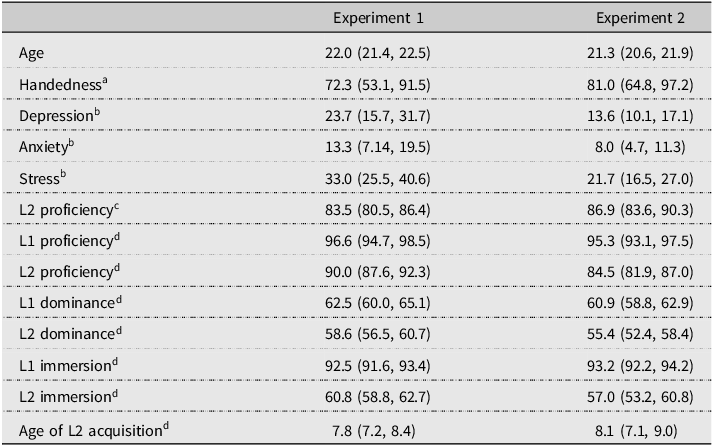
Seventy-four Polish (L1) learners of English (L2) were randomly assigned to either shallow semantic processing-based Experiment 1 (n = 36) or deep semantic processing-based Experiment 2 (n = 38), 4 of whom were excluded from the analyses due to very low overall response accuracy (i.e., below 20%). Consequently, the final sample included 35 participants aged 18–27 years in each experiment (see Table 1). Note that the power analysis suitable for statistical models with crossed-random structure (Westfall et al., Reference Westfall, Kenny and Judd2014) indicated that participation of 15 bilinguals would yield a power of .80 to detect medium-to-large effects (Cohen’s d > .50). All participants were women, given the previous studies pointing to sex-dependent mood effects on language processing (Federmeier et al., Reference Federmeier, Kirson, Moreno and Kutas2001; Naranowicz et al., Reference Naranowicz, Jankowiak and Bromberek-Dyzman2023). In line with de Groot (2011), participants were classified as proficient L1-dominant Polish–English bilinguals, who had acquired English in a formal learning context and had never lived in the L2 environment (see Table 1). All participants had normal or corrected-to-normal vision and hearing and no neurological, mood, psychiatric, or language disorders. Moreover, they were in a generally good affective state, as corroborated by the Depression, Anxiety and Stress Scale – 21 Items (DASS-21; Lovibond & Lovibond, Reference Lovibond and Lovibond1995; see Table 1). For their participation, participants received extra credit points.
Participants’ demographic and linguistic data (means with 95% confidence intervals)

Note: The table includes only the data for the final sample.
a Edinburgh Handedness Inventory (Oldfield, Reference Oldfield1971): left-handedness (–100 to –28), ambidexterity (–29–48), and right-handedness (48–100).
b DASS-21 (Lovibond & Lovibond, Reference Lovibond and Lovibond1995, translated into Polish by Makara-Studzińska et al.): normal (0–21), mild (22–31), moderate (32–48), severe (49–64), and extremely severe (65–100) levels of depression, anxiety, and stress (percentages).
c LexTALE (Lemhöfer & Broersma, Reference Lemhöfer and Broersma2012; percentages).
d Language History Questionnaire 3.0 (Li et al., Reference Li, Zhang, Yu and Zhao2020, as translated into Polish by Naranowicz & Witczak): the proficiency, dominance, and immersion scores (percentages); age of acquisition (years).
Materials
Mood-inducing stimuli
To experimentally induce the targeted positive and negative mood, participants were exposed to 11 positive and 11 negative mood-inducing films in Experiment 1 (shallow semantic processing) and 8 positive and 8 negative mood-inducing films in Experiment 2 (deep semantic processing). These were 90-second, physiologically arousing, non-narrative, and affectively evocative animated films. They were adapted from Naranowicz et al. (Reference Naranowicz, Jankowiak and Bromberek-Dyzman2023), where they were rated on 7-point valence (1 = inducing a very negative mood, 7 = inducing a very positive mood) and arousal (1 = very physiologically unarousing, 7 = very physiologically arousing) scales. The positive compared to negative mood-inducing films employed in Experiment 1 were rated significantly higher on the valence scale (M PositiveFilms = 5.05, 95% CI [4.65, 5.45]; M NegativeFilms = 2.10, 95% CI [1.72, 2.49]), b = –2.95, SE = .25, t(22.2) = –11.50, p < .001, with no difference between the two film types in arousal ratings (M PositiveFilms = 4.19, 95% CI [3.71, 4.67]; M NegativeFilms = 4.27, 95% CI [3.82, 4.72]), b = .08, SE = .27, t(23.4) = .29, p = .773. Similarly, the positive compared to negative mood-inducing films employed in Experiment 2 were also rated significantly higher on the valence scale (M PositiveFilms = 5.07, 95% CI [4.63, 5.50]; M NegativeFilms = 2.09, 95% CI [1.66, 2.52]), b = –2.98, SE = .28, t(16.4) = –10.70, p < .001, with no difference between the two film types in arousal ratings (M PositiveFilms = 4.15, 95% CI [3.63, 4.67]; M NegativeFilms = 4.27, 95% CI [3.77, 4.78]), b = .12, SE = .30, t(17.5) = .41, p = .683. To sustain the evoked targeted mood, each selected film was additionally divided into two 45-second fragments, which resulted in the presentation of 44 film fragments in both mood conditions in Experiment 1 (i.e., 33 minutes) and 32 film fragments in both mood conditions in Experiment 2 (i.e., 24 minutes).
Linguistic stimuli
The linguistic stimuli included 180 Polish (L1) and 180 English (L2) sentences divided into three categories: 60 novel metaphors (e.g., My heart is a drawer.; Bacteria are fighters.; Motivation is an engine.), 60 literal sentences (e.g., This piece of furniture is a drawer.; These boxers are fighters.; This machine is an engine.), and 60 anomalous sentences (e.g., A bug is a drawer.; Gifts are fighters. A frog is an engine.) in each language. The linguistic stimuli were adopted from a database by Jankowiak (Reference Jankowiak2020) that provides a set of pre-tested novel metaphors and literal and anomalous sentences. The stimuli were controlled for their level of meaningfulness, familiarity, and metaphoricity in norming tests on Polish and English native speakers. Furthermore, critical words were all concrete nouns and were controlled for their frequency (SUBTLEX-PL, Mandera et al., Reference Mandera, Keuleers, Wodniecka and Brysbaert2015; SUBTLEX-UK, van Heuven et al., Reference van Heuven, Mandera, Keuleers and Brysbaert2014; M = 3.93, SD = .56), the number of letters (M = 6.57, SD = 1.45), and syllables (M = 2.34, SD = .48), as well as a cognate status (Jankowiak, Reference Jankowiak2020). All sentences were declarative and emotionally neutral. The mean sentence lengths of the stimuli ranged from 3 to 5 (novel nominal metaphors: M = 3.28, SD = .50; literal sentences: M = 4.00, SD = .18; anomalous sentences: M = 3.71, SD = .57).
In shallow semantic processing-based Experiment 1, in addition to the original 180 critical words per language, we added 180 pronounceable non-words in Polish (adopted from Imbir, Reference Imbir2015) and 180 pronounceable non-words in English (adopted from Balota et al., Reference Balota, Yap, Cortese, Hutchison, Kessler, Loftis, Neely, Nelson, Simpson and Treiman2007). All of the non-words were controlled for the number of letters (M = 7.14, SD = 1.47).
Procedure
The procedure applied in the experiments was approved by the Ethics Committee for Research Involving Human Participants of Adam Mickiewicz University, Poznań. Informed consents were obtained from all participants involved in the study. Participants were first randomly assigned to either Experiment 1 (shallow semantic processing) or Experiment 2 (deep semantic processing). In both experiments, participants were seated 75 cm away from an LED monitor with a screen resolution of 1280 × 1024 pixels in dimly lit and quiet booths. E-Prime 3.0 was employed to present all stimuli and collect behavioral data.
Participants were presented with 22 positive and 22 negative mood-inducing film fragments in two separate mood blocks in Experiment 1 and 16 positive and 16 negative mood-inducing film fragments in Experiment 2. The film fragments were presented in random order in each mood block. Additionally, participants watched a 5-minute fragment of a low-arousing non-narrative nature documentary before the second mood block to neutralize their mood state. To strengthen the induced mood states, participants were additionally instructed to put themselves in the targeted mood (Rottenberg et al., Reference Rottenberg, Kovacs and Yaroslavsky2018) and imagine themselves as one of the protagonists (Werner-Seidler & Moulds, Reference Werner-Seidler and Moulds2012). Participants were asked to rate their current emotional state before and after each mood block. In both experiments, participants first watched 4 film fragments to elicit the targeted mood and then alternately read 20 sentences and were presented with another film fragment to sustain the evoked mood state. For this reason, participants were presented with a greater number of mood-inducing stimuli in Experiment 1 (shallow semantic processing) than in Experiment 2 (deep semantic processing).
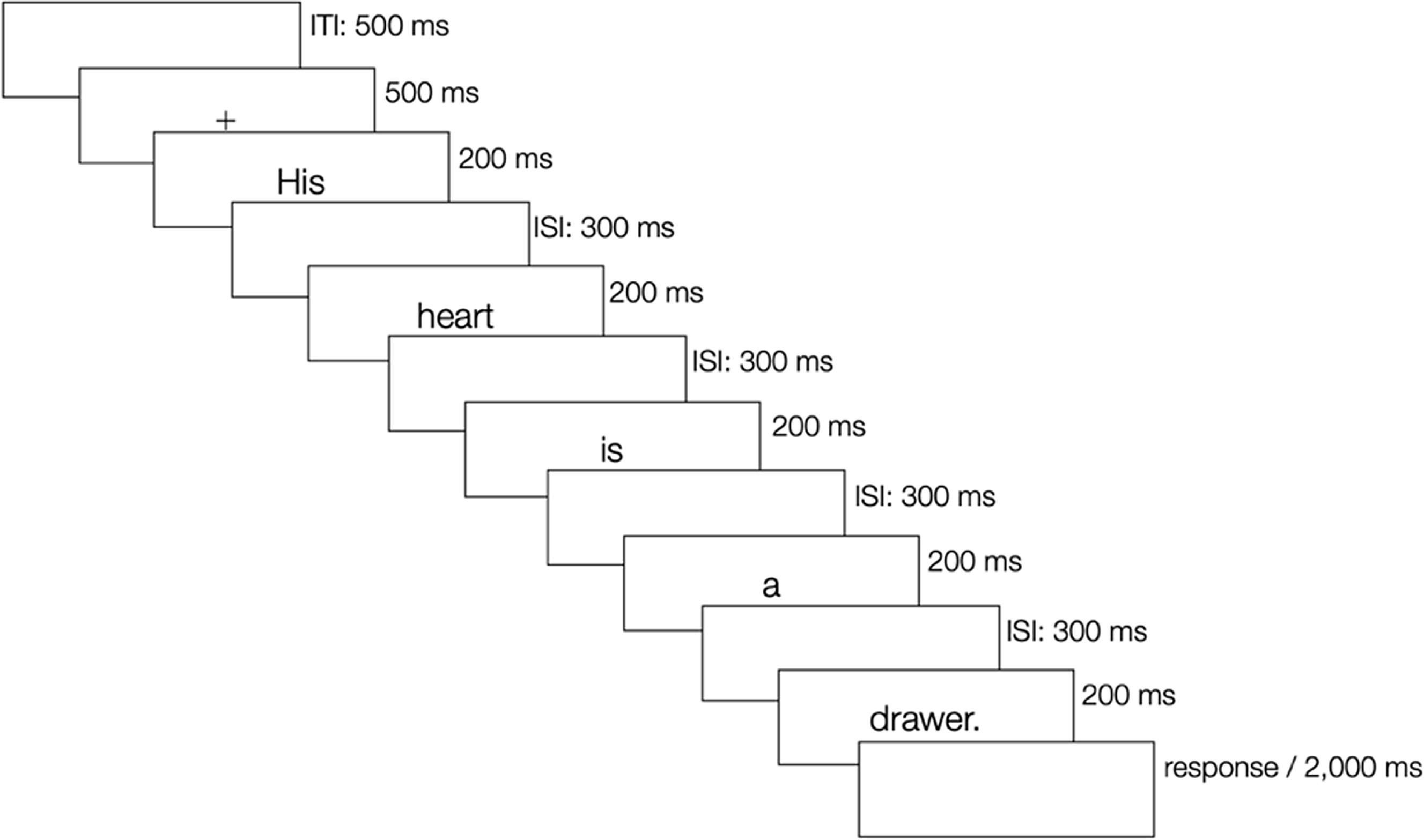
In Experiment 1 (shallow semantic processing), participants performed an LDT, wherein they decided whether or not the final string of letters in each sentence was a real word in Polish or English. Crucially, even though participants made lexical decisions only about the final strings of letters, they were asked to read the whole sentences. In Experiment 2 (deep semantic processing), participants performed an SDT, wherein they decided if each presented sentence was meaningful or meaningless. In both experiments, participants read the same set of 180 Polish and 180 English sentences in separate language blocks, each including 60 literal, 60 anomalous, and 60 novel metaphoric sentences presented in random order. In Experiment 1, 180 Polish and 180 English filler sentences were added, each including a pronounceable non-word placed in a sentence-final position. In Experiment 2, 60 Polish and 60 English filler anomalous sentences were added to reach the same number of semantically meaningful (i.e., literal and novel metaphoric) and meaningless (i.e., anomalous) sentences. In total, participants read 720 sentences in Experiment 1 and 480 sentences in Experiment 2, half of which was presented in each mood block. The order of the mood and language blocks as well as key designation were counterbalanced across participants. The time sequence of stimuli presentation is provided in Figure 1.
Time sequence of stimuli presentation in both experiments (ITI, inter-trial interval; ISI, interstimulus interval).

Data analysis
All statistical analyses were performed in R (R Core Team, 2020). In both experiments, the mood rating data analysis conformed to a 2 (Time of measure: Before vs. After mood induction) × 2 (Mood: Positive vs. Negative) within-subject design. Participants rated their current affective state using three measures: 7-point mood valence and arousal scales (i.e., bipolar dimensions) as well as the Positive and Negative Affect Schedule (PANAS; Watson et al., Reference Watson, Clark and Tellegen1988, adapted into Polish by Fajkowska & Marszał-Wiśniewska, Reference Fajkowska and Marszał-Wiśniewska2009), employing 10 positive adjectives (i.e., positive affect) and 10 negative adjectives (i.e., negative affect; i.e., unipolar dimensions). The summed positive affect and negative affect scores were presented as a ratio to make them comparable to mood valence ratings. To ensure the effectiveness of our mood manipulation, we conducted planned comparisons by separately comparing mood ratings after induction to those before induction within each mood condition. We expected to observe increased/comparable mood ratings in the positive mood condition along with decreased mood ratings in the negative mood condition (see Naranowicz, Reference Naranowicz2022 for a review).
In both experiments, the reaction times (RTs) and accuracy rates data analyses conformed to a 2 (Mood: Positive vs. Negative) × 2 (Language: Polish [L1] vs. English [L2]) × 3 Sentence type (Literal vs. Anomalous vs. Novel metaphoric sentences) within-subject design. RTs below 200 ms and above 1,500 ms as well as those falling outside the value of 1.5 interquartile range were discarded from further analyses, altogether resulting in the final rejection of 5.03% of RT and accuracy rates data in Experiment 1 (shallow semantic processing) and 3.25% in Experiment 2 (deep semantic processing).
In both experiments, the mood ratings and RT data were analyzed with linear mixed-effects models (Baayen et al., Reference Baayen, Davidson and Bates2008; Jaeger, Reference Jaeger2008; Barr et al., Reference Barr, Levy, Scheepers and Tily2013; Barr, Reference Barr2013) and response accuracy with generalized (logistic) linear mixed-effects model (Baayen et al., Reference Baayen, Davidson and Bates2008; Barr, Reference Barr2013; Barr et al., Reference Barr, Levy, Scheepers and Tily2013; Jaeger, Reference Jaeger2008), using the lme4 package (Bates et al., Reference Bates, Mächler, Bolker and Walker2015). Sum contrasts were applied to all categorical factors. A maximal model was first computed with a full random-effect structure, including participant- and item-related variance components for intercepts and by-participant and by-item random slopes for fixed effects (Barr et al., Reference Barr, Levy, Scheepers and Tily2013). When the data did not support the execution of the maximal model random structure, we reduced the model complexity to arrive at a parsimonious model (Bates et al., Reference Bates, Mächler, Bolker and Walker2015). To do so, we computed principal component analyses of the random structure and then kept the number of principal components that cumulatively accounted for 100% of the variance. b estimates and significance of fixed effects and interactions (p-values) were based on the Satterthwaite approximation for mixed-effects models (the lmerTest package; Kuznetsova et al., Reference Kuznetsova, Brockhoff and Christensen2017). Planned and post hoc comparisons were calculated using the emmeans package (Lenth et al., Reference Lenth, Buerkner, Herve, Love, Miguez, Riebl and Singmann2022). All data, research materials, and analysis codes (i.e., R scripts) are available at https://osf.io/4tm5a/.
Experiment 1: lexical decision task
Results
Mood ratings
In Experiment 1, the analysis of the valence ratings showed a fixed effect of Time of measure, b = –1.07, SE = .14, t(102.0) = –7.45, p < .001, along with a Mood × Time of measure interaction, b = –2.49, SE = .29, t(102.0) = –8.64, p < .001. As expected, planned comparisons showed a decrease in the valence ratings after compared to before mood induction in the negative mood condition (M BeforeMI = 5.23, 95% CI [4.88, 5.58]; M AfterMI = 2.91, 95% CI [2.57, 3.26]), b = 2.31, SE = .20, t(102.0) = 11.38 p < .001, with no difference in the valence ratings in the positive mood condition (M BeforeMI = 5.17, 95% CI [4.82, 5.52]; M AfterMI = 5.34, 95% CI [5.00, 5.69]), b = –.17, SE = .20, t(102.0) = –.84, p = .401 (see Figure 2).
Experiment 1 (shallow semantic processing): The valence (left), PANAS (center), and physiological arousal (right) ratings before and after mood induction (MI) with 95% confidence intervals.

Similarly, the analysis of the PANAS ratings revealed a fixed effect of Time of measure, b = –.26, SE = .06, t(102.0) = –4.06, p < .001, along with a Mood × Time of measure interaction, b = –.76, SE = .13, t(102.0) = –5.90, p < .001. As expected, planned comparisons showed a decrease in the PANAS ratings after compared to before mood induction in the negative mood condition (M BeforeMI = 1.52, 95% CI [1.36, 1.69]; M AfterMI = .88, 95% CI [.72, 1.04]), b = .64, SE = .09, t(102.0) = 7.04, p < .001, with no difference in the positive mood condition (M BeforeMI = 1.46, 95% CI [1.30, 1.63]; M AfterMI = 1.58, 95% CI [1.42, 1.75]), b = –.12, SE = .09, t(102.0) = –1.30, p = .196 (see Figure 2).
The analysis of the arousal ratings showed only a fixed effect of Time of measure, whereby participants reported feeling more physiologically aroused after relative to before mood induction (M BeforeMI = 3.26, 95% CI [2.88, 3.63]; M AfterMI = 3.70, 95% CI [3.32, 4.08]), b = .44, SE = .17, t(102.0) = 2.60, p = .011 (see Figure 2). All the remaining differences in the valence, PANAS, and arousal ratings were statistically non-significant, ps > .05.
Response accuracy
The analysis of response accuracy did not show any statistically significant differences, ps > .05.
Reaction times
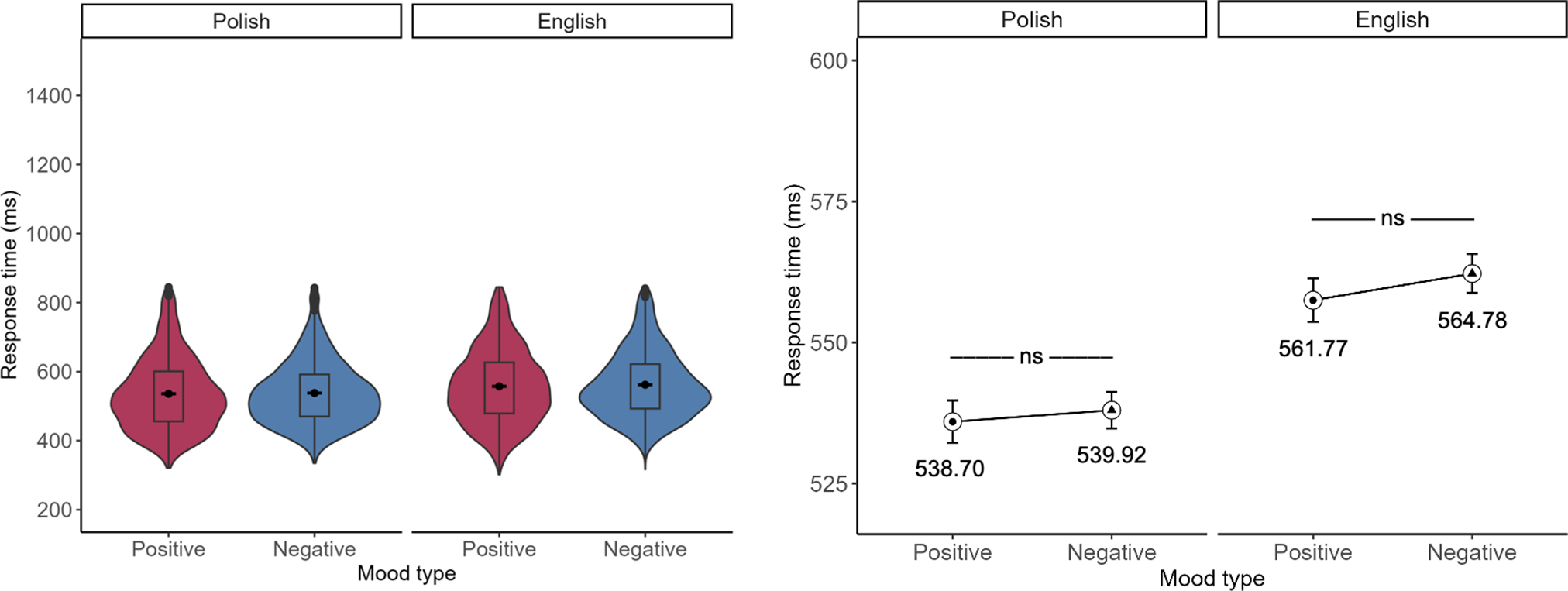
The analysis of RTs revealed a fixed effect of Sentence type, such that literal sentences (M = 537.97 ms, 95% CI [520.12, 555.82]) were responded to faster than both anomalous sentences (M = 558.68 ms, 95% CI [540.83, 576.54]), b = 20.71, SE = 4.17, t(350.9) = 4.96, p < .001, and novel metaphors (M = 557.22 ms, 95% CI [539.37, 575.07]), b = 19.25, SE = 4.18, t(350.8) = 4.60, p < .001. Yet, there was no difference in RTs between anomalous and novel metaphoric sentences, b = –1.46, SE = 4.18, t(351.4) = –.35, p = .727. There was also a fixed effect of Language, whereby Polish (L1) sentences (M = 539.31 ms, 95% CI [521.06, 557.55]) were responded to faster than English (L2) sentences (M = 563.28 ms, 95% CI [545.32, 581.24]), b = 23.97, SE = 5.72, t(65.4) = 4.19, p < .001.
However, the analysis did not reveal a Mood × Language interaction. Planned comparisons confirmed that there were no statistically significant differences in RTs between the positive and negative mood conditions for both Polish (L1) (M NegativeMood = 539.92 ms, 95% CI [521.55, 558.28]; M PositiveMood = 538.70 ms, 95% CI [520.34, 557.05]), b = 1.22, SE = 2.08, t(11536.4) = .59, p = .558, and English (L2) sentences (M NegativeMood = 564.78 ms, 95% CI [546.71, 582.86]; M PositiveMood = 561.77 ms, 95% CI [543.69, 579.86]), b = –3.01, SE = 2.10, t(11538.6) = –1.43, p = .152 (see Figure 3). All remaining differences in RTs were statistically non-significant, ps > .05.
Experiment 1 (shallow semantic processing): Response times (ms) with 95% confidence intervals, showing the relationship between the language of operation and mood types. The violin plot (left) represents data distribution, and the line plot (right) represents the observed interactive effect.

Discussion
In Experiment 1, targeting shallow semantic processing, Polish–English bilinguals induced into a positive and negative mood made lexical judgments regarding critical words and non-words embedded in a sentence-final position of literal, novel metaphoric, and anomalous sentences in their L1 and L2.
First, the results showed no effect of either a positive or negative mood on participants’ performance in the LDT, regardless of the language of operation. Such findings seem interesting, given that self-reported mood ratings confirmed that participants were in the targeted positive and negative mood states and were feeling more physiologically aroused after the employed mood manipulation as compared to the baseline state. This consequently indicates that despite the effective mood manipulations, bilinguals’ current affective state might not have modulated language processing patterns when performing a task requiring shallow semantic analysis.
Second, lexical judgments of the words embedded in literal sentences were faster than the ones embedded in both anomalous and novel metaphoric sentences. This indicates that though the task directed participants’ attention to lexical properties only, they must have still evaluated the semantic attributes of the sentences. Consequently, when exposed to the two sentence types that potentially required meaning re-evaluation (i.e., novel metaphoric and anomalous sentences), participants needed more time to decide on whether a critical word represented a real word or a non-word. Crucially, as expected, the presence of temporal differences in responses to the three sentence types also indicates that participants implicitly processed the meaning of the entire sentences, even though the LDT at hand required making decisions only about the final string of letters (i.e., a target word or a non-word).
Finally, participants’ lexical judgments of the words embedded in Polish (L1) sentences were faster than those embedded in English (L2) sentences. This pattern is in line with previous research consistently showing longer processing time in L2 than L1 (e.g., de Groot et al., Reference De Groot, Borgwaldt, Bos and van den Eijnden2002; Jankowiak, Reference Jankowiak2019) due to the slower and less automatic activation of L2 representations (Dijkstra & van Heuven, Reference Dijkstra and van Heuven2002).
The aim of Experiment 2 was to further test how participants’ mood modulates L1 and L2 processing when performing a task requiring deep semantic analysis (i.e., an SDT).
Experiment 2: semantic decision task
Results
Mood ratings
In Experiment 2, the analysis of the valence ratings showed fixed effects of both Mood, b = –1.13, SE = .14, t(102.0) = –7.84, p < .001, and Time of measure, b = –1.01, SE = .14, t(102.0) = –7.04, p < .001, along with a Mood × Time of measure interaction, b = –3.40, SE = .29, t(102.0) = –11.81, p < .001. As expected, planned comparisons showed a decrease in the mood valence ratings after compared to before mood induction in the negative mood condition (M BeforeMI = 5.37, 95% CI [5.04, 5.50]; M AfterMI = 2.66, 95% CI [2.33, 2.98]), b = –2.71, SE = .20, t(102.0) = –13.33, p < .001, along with an increase after compared to before mood induction in the positive mood condition (M BeforeMI = 4.80, 95% CI [4.47, 5.13]; M AfterMI = 5.49, 95% CI [5.16, 5.81]), b = .69, SE = .20, t(102.0) = 3.37, p < .001 (see Figure 4).
Experiment 2 (deep semantic processing): The valence (left), PANAS (center), and physiological arousal (right) ratings before and after mood induction (MI) with 95% confidence intervals.

Similarly, the analysis of the PANAS ratings revealed fixed effects of both Mood, b = –.17, SE = .06, t(102.0) = –2.83, p = .005, and Time of measure, b = –.25, SE = .06, t(102.0) = –4.16, p < .001, along with a Mood × Time of measure interaction, b = –.99, SE = .12, t(102.0) = –8.22, p < .001. As expected, planned comparisons showed a decrease in the PANAS ratings after compared to before mood induction in the negative mood condition (M BeforeMI = 1.66, 95% CI [1.49, 1.84]; M AfterMI = .92, 95% CI [.75, 1.09]), b = –.75, SE = .09, t(102.0) = –8.75, p < .001, along with an increase after compared to before mood induction in the positive mood condition (M BeforeMI = 1.34, 95% CI [1.17, 1.51]; M AfterMI = 1.58, 95% CI [1.41, 1.76]), b = .24, SE = .09, t(102.0) = 2.87, p < .001 (see Figure 4).
The analysis of the arousal ratings showed only a fixed effect of Time of measure, whereby participants reported feeling more physiologically aroused before relative to after mood induction (M BeforeMI = 3.11, 95% CI [2.71, 3.52]; M AfterMI = 3.57, 95% CI [3.17, 3.97]), b = .46, SE = .21, t(102.0) = 2.21, p = .030 (see Figure 4). All the remaining differences in the valence, PANAS, and arousal ratings were statistically non-significant, p > .05.
Response accuracy
The analysis of response accuracy showed a fixed effect of Sentence type, such that anomalous sentences (M = 98.44%, 95% CI [98.01, 98.89]) were responded to with greater accuracy than both literal sentences (M = 85.84%, 95% CI [84.78, 86.92]), b = 3.56, SE = .46, z = 7.67, p < .001, and novel metaphors (M = 37.63%, 95% CI [36.11, 39.18]), b = –6.83, SE = .57, z = –12.03, p < .001. Moreover, literal sentences were also responded to with greater accuracy than novel metaphors, b = –3.28, SE = .46, z = –12.70, p < .001.
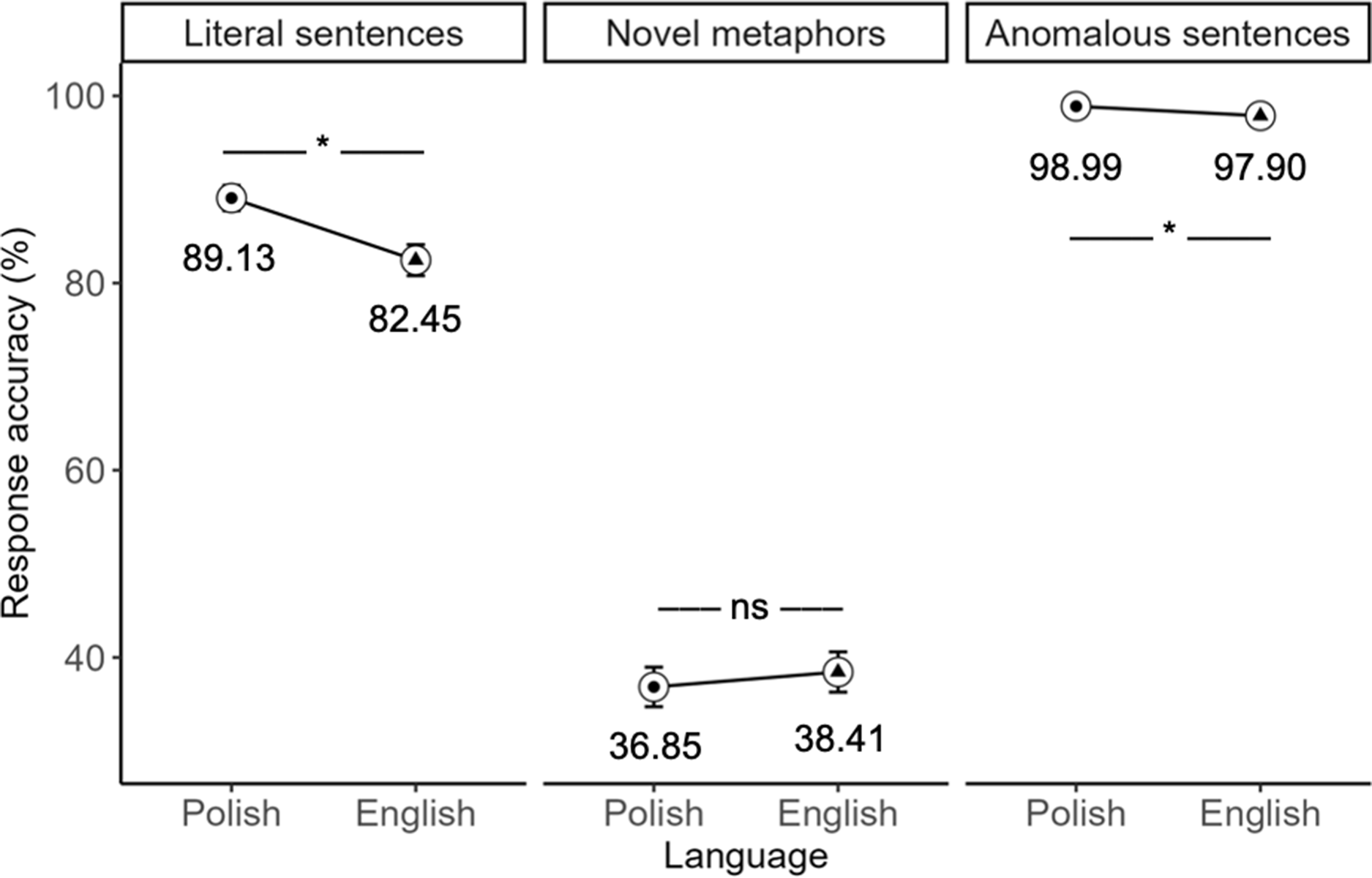
Moreover, the analysis showed a Sentence type × Language interaction. Post hoc comparisons revealed that Polish (L1) literal sentences were responded to with greater accuracy than English (L2) literal sentences (M Polish = 89.13%, 95% CI [87.78, 90.48]; M English = 82.45%, 95% CI [80.80, 84.10]), b = –.64, SE = .27, z = –2.35, p = .019. Then, Polish (L1) anomalous sentences were responded to with greater accuracy than English (L2) anomalous sentences (M Polish = 98.99%, 95% CI [98.49, 99.39]; M English = 97.90%, 95% CI [97.22, 98.51]), b = –.82, SE = .40, z = –2.05, p = .040. However, there was no difference in response accuracy between Polish (L1) and English (L2) novel metaphors (M Polish = 36.85%, 95% CI [34.76, 39.04]; M English = 38.41%, 95% CI [36.30, 40.62]), b = .12, SE = .26, z = .45, p = .655 (see Figure 5). All remaining differences in response accuracy were statistically non-significant, ps > .05.
Experiment 2 (deep semantic processing): Accuracy rates (%) with 95% confidence intervals, showing the relationship between the language of operation and sentence types.

Reaction times
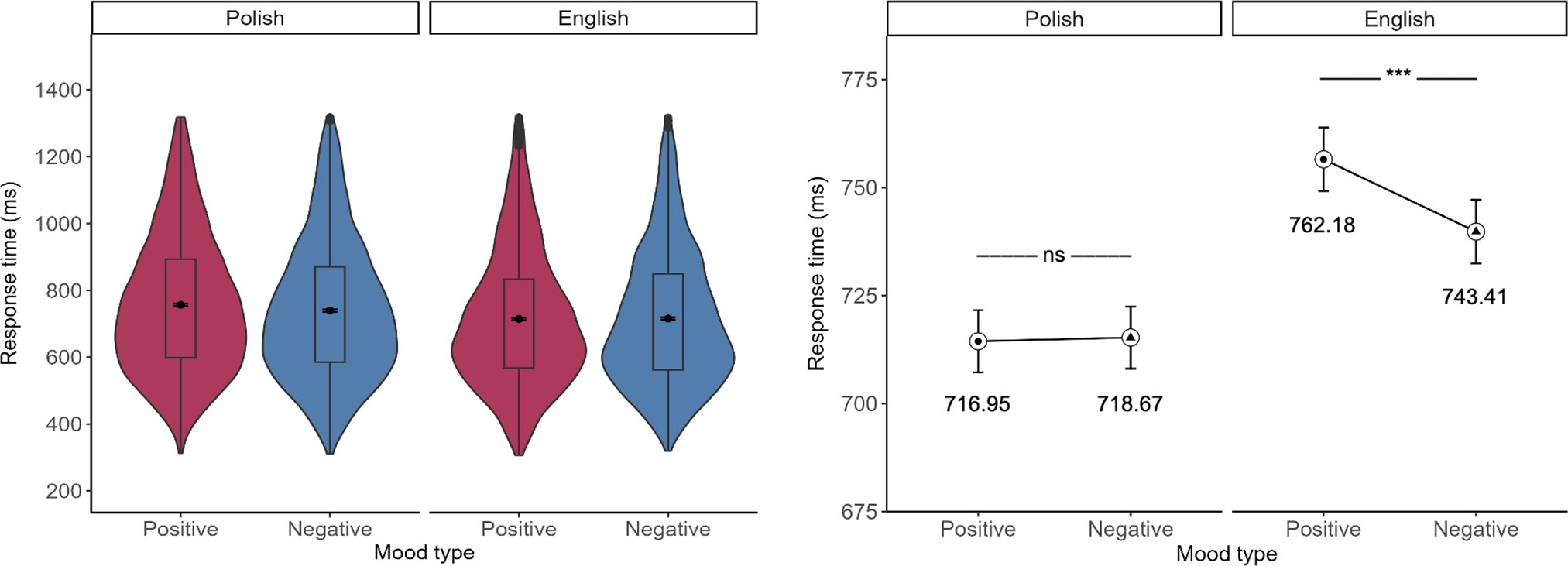
The analysis of RTs revealed a fixed effect of Sentence type, such that novel metaphors (M = 790.57 ms, 95% CI [748.71, 832.43]) were responded to slower than both literal sentences (M = 712.11 ms, 95% CI [678.31, 745.90]), b = 78.46, SE = 9.87, t(86.7) = 7.94, p < .001, and anomalous sentences (M = 703.23 ms, 95% CI [664.80, 741.66]), b = 87.34, SE = 9.26, t(101.2) = 9.44, p < .001. Yet, there was no difference in RTs between literal and anomalous sentences, b = –8.88, SE = 9.98, t(85.0) = –.89, p = .377. There was also a fixed effect of Language, whereby Polish (L1) sentences (M = 717.81 ms, 95% CI [680.80, 754.81]) were responded to faster than English (L2) sentences (M = 752.79 ms, 95% CI [715.79, 789.80]), b = 34.99, SE = 5.87, t(354.1) = 5.96, p < .001. The analysis also revealed a fixed effect of Mood, such that participants responded faster in the negative (M = 731.04 ms, 95% CI [694.37, 767.71]) than positive mood condition (M = 739.56 ms, 95% CI [702.89, 776.23]), b = 8.53, SE = 2.95, t(11770) = 2.89, p = .004.
Furthermore, the analysis also showed a Mood × Language interaction. Planned comparisons revealed that English (L2) sentences were responded to faster in the negative than positive mood condition (M NegativeMood = 743.41 ms, 95% CI [706.18, 780.64]; M PositiveMood = 762.18 ms, 95% CI [724.94, 799.42]), b = 18.77, SE = 4.18, t(11772.7) = 4.49, p < .001. Yet, there was no between-mood difference in RTs for Polish (L1) sentences (M NegativeMood = 718.67 ms, 95% CI [681.44, 755.90]; M PositiveMood = 716.95 ms, 95% CI [679.72, 754.18]), b = –1.72, SE = 4.16, t(11766.5) = –.41, p = .679 (see Figure 6). All remaining differences in RTs were statistically non-significant, ps > .05.
Experiment 2 (deep semantic processing): Response times (ms) with 95% confidence intervals, showing the relationship between the language of operation and mood types. The violin plot (left) represents data distribution, and the line plot (right) represents the observed interactive effect.

Discussion
In Experiment 2, targeting deep semantic processing, Polish–English bilinguals induced into a positive and negative mood made semantic judgments of literal, novel metaphoric, and anomalous sentences in their L1 and L2.
The results revealed a facilitatory effect of a negative as opposed to positive mood on RTs, therefore indicating that a negative mood might have promoted analytical and effort-maximizing processing (see Naranowicz, Reference Naranowicz2022 for a review). Moreover, such facilitation of RTs may be related to inhibited heuristics-based thinking and reduced reliance on prior knowledge in a negative relative to positive mood (Vissers et al., Reference Vissers, Chwilla, Egger and Chwilla2013; Jankowiak et al., Reference Jankowiak, Naranowicz and Thierry2022), leading to overall faster semantic judgments. Also, the results demonstrated that such temporal facilitation of semantic judgments in a negative mood may be dependent upon the language of operation, given that the effect was particularly driven by between-mood differences in L2. Similar to Experiment 1, targeting shallow semantic processing, self-reported mood ratings confirmed that participants were induced into the targeted mood states in both L1 and L2, also showing increased physiological arousal in both mood conditions, therefore confirming effective both positive and negative mood manipulations.
Furthermore, the results showed a general effect of sentence types, whereby literal and anomalous sentences were similarly faster to respond to relative to novel metaphoric sentences. Such findings are contradictory to those observed in Experiment 1, where novel metaphors converged behaviorally with anomalous sentences, eliciting significantly longer RTs than the literal condition. This might therefore be indicative of more attention directed towards the semantic attributes of the presented sentences in the case of an SDT, as a result of which participants were quicker to categorize literal and anomalous sentences as meaningful and meaningless, respectively. Novel metaphors, on the other hand, remained more cognitively taxing and required meaning re-analyses in both shallow and deep semantic tasks.
Finally, the semantic judgments of Polish (L1) as compared to English (L2) sentences were faster as well as more accurate for all sentence types except for novel metaphors, which were comparably difficult to categorize as meaningful in both languages. This is in line with previous research suggesting that novel metaphoric meanings, due to their high creativity and low familiarity, are cognitively taxing irrespective of the language of operation (Jankowiak et al., Reference Jankowiak, Rataj and Naskręcki2017; Jankowiak, Reference Jankowiak2019).
General discussion
The aim of the two present experiments was to test how a positive and negative mood modulates shallow as compared to deep semantic mechanisms. To this end, Polish (L1)–English (L2) bilinguals performed either an LDT (marking shallow processing; Experiment 1) or an SDT (marking deep processing; Experiment 2) with three types of L1 and L2 sentences that differed in their semantic complexity: literal, novel metaphoric, and anomalous sentences.
Hypothesis 1 predicted that a positive relative to negative mood would facilitate shallow semantic processing, regardless of the language of operation. This would align with previous studies that have suggested the activation of semantic associations (e.g., Bolte et al., Reference Bolte, Goschke and Kuhl2003; Pinheiro et al., Reference Pinheiro, del Re, Nestor, McCarley, Gonçalves and Niznikiewicz2013) as well as attention-driven mechanisms (e.g., Chwilla et al., Reference Chwilla, Virgillito and Vissers2011; Sakaki et al., Reference Sakaki, Gorlick and Mather2011) in a positive mood. However, contrary to our expectations, the results of Experiment 1 revealed no mood effect on the measured behavioral responses (i.e., response accuracy and times). A possible explanation for this discrepancy lies in the specific nature of the employed LDT. In Experiment 1, we took a less conventional approach to an LDT to ensure that participants engaged only in surface-level processing of sentence meanings. Specifically, participants were asked to make lexical judgments regarding the final strings of letters (i.e., words and non-words) embedded in sentential contexts instead of single decontextualized items. In contrast, prior research pointing to facilitatory effects of a positive mood on semantic processing employed an LDT in combination with semantic priming (Storbeck & Clore, Reference Storbeck and Clore2008), a remote association task (Bolte et al., Reference Bolte, Goschke and Kuhl2003), a semantic association task (Sakaki et al., Reference Sakaki, Gorlick and Mather2011), a semantic decision task (Pinheiro et al., Reference Pinheiro, del Re, Nestor, McCarley, Gonçalves and Niznikiewicz2013; Wang et al., Reference Wang, Zhou, Zhou and Yang2016), and reading for comprehension (Van Berkum et al., Reference Van Berkum, De Goede, Van Alphen, Mulder and Kerstholt2013; Vissers et al., Reference Vissers, Chwilla, Egger and Chwilla2013). Note also that the presence of a general effect of sentence types in Experiment 1 indicates that participants read the presented sentences, as instructed, while the observed mood ratings indicate that they were in the targeted mood states. Together, such findings suggest that implicit (i.e., surface-level) processing of sentence meanings may insufficiently activate lexico-semantic representations for a positive mood effect to have a discernible behavioral effect on semantic memory. Future research could also employ neuroimaging techniques, particularly EEG, to further test if there is an observable positive mood effect on shallow semantic processing at a neurophysiological level.
Hypothesis 2 predicted that deep semantic processing would benefit behaviorally from a negative mood that promotes a more analytical, vigilant, and effort-maximizing processing style (see Naranowicz, Reference Naranowicz2022 for a review). Such a facilitatory effect of a negative mood was also hypothesized to be more robust in L2 than L1 due to L2 being more cognitively taxing (Iacozza et al., Reference Iacozza, Costa and Duñabeitia2017; García-Palacios et al., Reference García-Palacios, Costa, Castilla, del Río, Casaponsa and Duñabeitia2018; Naranowicz et al., Reference Naranowicz, Jankowiak and Behnke2022b). Our results supported this hypothesis, showing overall faster semantic judgments in the negative relative to the positive mood condition in L2 but not L1 in an SDT (Experiment 2). Such a negative mood-driven facilitatory effect on deep semantic processing is in accordance with previous research suggesting that a negative mood may lead to a processing advantage when a task at hand involves controlled processing of systematic stimuli (Hesse & Spies, Reference Hesse and Spies1996) or reliance on prior knowledge (Vissers et al., Reference Vissers, Chwilla, Egger and Chwilla2013; Jankowiak et al., Reference Jankowiak, Naranowicz and Thierry2022). In Experiment 2, our participants were presented with L1 and L2 sentences of a systematic structure (X is Y, e.g., This machine is an engine.), including highly figurative novel expressions (e.g., Motivation is an engine.) and semantic anomalies violating pre-existing knowledge (e.g., A frog is an engine.). Thus, making semantic judgments about such semantically complex sentences required deep semantic processing, which was found to be enhanced behaviorally by a negative mood.
Similar to the present study, Jankowiak et al. (Reference Jankowiak, Naranowicz and Thierry2022) tested EEG responses to literal, novel metaphoric, and anomalous sentences in Polish–English bilinguals induced into a positive and negative mood. They observed decreased cognitive efforts invested in semantic integration and re-evaluation of anomalous sentences (i.e., the semantic violations built upon pre-existing knowledge) in a negative but not positive mood in both L1 and L2. Such results suggest that a negative mood may inhibit heuristics-based and assimilative processing, typically associated with a positive mood, and instead promote analytical and accommodative processing (the mood-and-general-knowledge hypothesis; Bless, Reference Bless2001; Vissers et al., Reference Vissers, Chwilla, Egger and Chwilla2013), irrespective of the language of operation. Bearing in mind the methodological similarities between the two pieces of research, the processing advantage at the semantic integration and re-analysis stage observed in a negative mood by Jankowiak et al. (Reference Jankowiak, Naranowicz and Thierry2022) could translate further into overall faster semantic judgments in a negative compared to positive mood, as observed in Experiment 2, targeting deep semantic processing.
Moreover, the observed findings showing that mood modulations on semantic processing were only evident in an SDT and not in an LDT can be interpreted in the context of previous research on semantic effects that has employed these two tasks. Such studies have consistently demonstrated more robust semantics-driven effects in an SDT compared to an LDT (Becker et al., Reference Becker, Moscovitch, Behrmann and Joordens1997; Perea & Rosa, Reference Perea and Rosa2002; Vigliocco et al., Reference Vigliocco, Vinson, Lewis and Garrett2004), which can be attributed to the nature of the tasks themselves. Namely, unlike an LDT, an SDT requires participants to engage in deep semantic analysis and activate stored semantic representations from long-term memory (Craik & Lockhart, Reference Craik and Lockhart1972; Vachon et al., Reference Vachon, Marsh and Labonte2019). As a result, an SDT is assumed to promote more comprehensive and in-depth semantic processing compared to an LDT (Rotaru et al., Reference Rotaru, Vigliocco and Frank2018). Therefore, it appears that mood effects on semantic processing are more likely to manifest themselves when a task at hand taps into deep semantic processing.
Notably, consistent with Hypothesis 2, our findings revealed a significant processing advantage associated with deep semantic processing under a negative mood state in L2 relative to L1. This advantage was manifested in faster semantic judgments in the negative mood condition in L2, indicating a more robust facilitatory effect of a negative mood on deep semantic processing in L2 than in L1. The observed temporal advantage in semantic judgments in L2 can be linked to generally higher cognitive demands imposed by L2 semantic processing relative to L1 (Iacozza et al., Reference Iacozza, Costa and Duñabeitia2017; García-Palacios et al., Reference García-Palacios, Costa, Castilla, del Río, Casaponsa and Duñabeitia2018; Naranowicz et al., Reference Naranowicz, Jankowiak and Behnke2022b). For instance, previous physiological research has pointed to increased physiological responding when L1-dominant bilinguals perform semantic tasks in an L2 relative to L1 mode, reflecting higher cognitive demands inherent in processing information in L2 (García-Palacios et al., Reference García-Palacios, Costa, Castilla, del Río, Casaponsa and Duñabeitia2018; Naranowicz et al., Reference Naranowicz, Jankowiak and Behnke2022b). Therefore, the present study provides novel evidence elucidating the behavioral benefits derived from processing information in L2 when bilinguals experience a negative mood, particularly in semantically complex contexts.
Moreover, the results from both Experiment 1 (shallow semantic processing) and Experiment 2 (deep semantic processing) revealed significant main effects of sentence type, yet the patterns differed for the three types of sentences. In an LDT, literal sentences evoked faster RTs compared to both anomalous and novel metaphoric sentences. In contrast, in an SDT, RTs for literal and anomalous sentences converged and were faster relative to novel metaphoric sentences. First, these findings indicate that novel metaphors might have required more cognitive effort to process compared to literal sentences, regardless of the task requirements. It therefore seems that participants engaged in semantic analysis even though the task at hand required them to focus on lexical properties only. This finding supports the notion of high automaticity in the cross-domain mapping mechanisms involved in constructing novel metaphoric meanings, which leads to increased processing demands, and consequently longer behavioral responses (Gibbs & Colston, Reference Gibbs and Colston2012; Jankowiak, Reference Jankowiak2019). Second, the more challenging processing of anomalous sentences in an LDT compared to an SDT suggests that deep semantic processing, as activated in an SDT, facilitated the categorization of anomalous sentences as meaningless. Deeper semantic analyses might have therefore aided participants in recognizing meaning violations in anomalous sentences more efficiently.
Interestingly, the aforementioned effects of sentence types were independent of the language of operation only in Experiment 1 (shallow semantic processing). In Experiment 2 (deep semantic processing), in contrast, literal and anomalous sentence processing was facilitated in L1 relative to L2, yet this advantage did not extend to the comprehension of novel metaphors, which posed similar challenges in both languages. First, the facilitated processing of L1 relative to L2 literal and anomalous sentences in Experiment 2 suggests that deep semantic analyses may enhance the retrieval of lexical and conceptual representations from the semantic network, particularly in L1, where these links are inherently more robust (Dijkstra & van Heuven, Reference Dijkstra and van Heuven2002). Second, the continuous difficulty of novel metaphor processing irrespective of the language of operation aligns with previous research emphasizing the comparable cognitive resources involved in the processing of novel metaphorical meanings in both L1 and L2. Such high cognitive load invested in novel metaphor processing is attributed to the low familiarity and high creativity inherent in novel metaphors across languages (Jankowiak et al., Reference Jankowiak, Rataj and Naskręcki2017; Jankowiak, Reference Jankowiak2019).
It is important to note that the low familiarity of novel metaphors, as tested here and in previous research, is typically associated with low accuracy rates on the SDT. Given the relatively high variability in participants’ creativity, paradigms employing novel metaphors often report accuracy rates close to the chance level. To address this potential limitation, we adopted a database of novel metaphors (Jankowiak, Reference Jankowiak2020) that were pretested and normed for their meaningfulness level, among other factors. Despite this, the low accuracy rates for novel metaphors in our participant sample suggest that they found it challenging to make a binary decision on whether the novel metaphor should be classified as meaningful or not. Therefore, future research should employ a multiple-choice decision task, where participants judge how much sense a given metaphor makes on a scale (e.g., from 1 to 4, indicating perfect sense, some sense, little sense, and no sense; Lai et al., Reference Lai, Curran and Menn2009). This approach would allow for examining the degree of sensicality of the presented metaphors in more detail (Lai et al., Reference Lai, Curran and Menn2009; Lai & Curran, Reference Lai and Curran2013; see also Wang & Jankowiak, Reference Wang and Jankowiak2023).
Conclusion
The aim of the two behavioral experiments was to elucidate the interaction between a positive and negative mood and varying levels of semantic processing, while also considering the influence of the language of operation (a native vs. a second language). The findings shed light on the differential modulation of shallow and deep semantic processing under a negative mood state in both participants’ L1 and L2. Notably, a facilitative effect of a negative mood on language processing was observed in an SDT, indicating that deep semantic processes may exhibit heightened susceptibility to negative mood effects, in contrast to the shallow processes involved in an LDT. Crucially, this effect was particularly evident when operating in L2, thus suggesting that a negative mood might activate more analytical and effort-maximizing cognitive processes in L2, hindering heuristics-based thinking and reliance on prior knowledge. Altogether, the two present experiments uncover intriguing insights into the interplay between a negative mood, semantic processing, and bilingualism, revealing the potential cognitive advantages of processing information in L2 under emotionally challenging circumstances. These insights offer valuable implications for theories of emotion–cognition interactions and bilingualism research.
Replication package
All data, research materials, and analysis codes (i.e., R scripts) are available at https://osf.io/4tm5a/.
Author contribution statement
MN: conceptualization; methodology; software; validation; formal analysis; visualization; investigation; data curation; writing—original draft; writing—review and editing. KJ: conceptualization; methodology; validation; writing—original draft; writing—review and editing
Competing interests
The authors declare no conflict of interest.



 Open access

