




Introduction
The cultivation of improved cultivars of medicinal plants is critical for optimizing both agronomic performance and the quality of the bioactive compounds they produce. To achieve these goals, a range of strategies has been explored, with genetic improvement emerging as a particularly rational and economical method for enhancing agricultural traits and product quality (Pahlavani et al., Reference Pahlavani, Razavi, Mirizadeh and Vakili2008). Among the genetic approaches available, polyploid induction – the process of increasing the chromosome number beyond the diploid level – has gained prominence for its potential to boost secondary metabolite production and improve adaptability to diverse environmental conditions (Dhooghe et al., Reference Dhooghe, Van Laere, Eeckhaut, Leus and Van Huylenbroeck2011).
Polyploidy, characterized by more than two complete sets of chromosomes in somatic cells, plays a central role in speciation, genome evolution, and biodiversity (Ramsey and Ramsey, Reference Ramsey and Ramsey2014). It can trigger the so-called gigas effect, which manifests as cell enlargement, increased organ size and heightened metabolic activities (Astuti et al., Reference Astuti, Pratesi, Peruzzi and Carta2020; Iannicelli et al., Reference Iannicelli, Guariniello, Tossi, Regalado, Di Ciaccio, Van Baren, Pitta Álvarez and Escandón2020). These shifts frequently translate into enhanced stress tolerance, greater biomass production and improved seed attributes, thereby conferring a competitive advantage in challenging environments (Godfree et al., Reference Godfree, Marshall, Young, Miller and Mathews2017; Stevens et al., Reference Stevens, Nicotra, Godfree and Guja2020; Chan et al., Reference Chan, Ooi and Guja2022). Empirical studies indicate that polyploids often outperform diploids in harsh conditions, partly due to altered resource allocation and gene expression (Akinroluyo et al., Reference Akinroluyo, Kemešytė, Jaškūnė and Statkevičiūtė2021). In addition, research on various crops has shown that artificially induced polyploidy can significantly enhance secondary metabolite concentrations, organ size and stress tolerance (Dhawan and Lavania, Reference Dhawan and Lavania1996; Dhooghe et al., Reference Dhooghe, Van Laere, Eeckhaut, Leus and Van Huylenbroeck2011; Sanaei-Hoveida et al., Reference Sanaei-Hoveida, Mortazavian, Norouzi and Sadat-Noori2024).
Alongside these broader benefits, seed-related traits are particularly influenced by polyploidy. Parameters such as seed size, dormancy status, viability, and germination speed are integral to plant fitness and agricultural value (Selvi and Vivona, Reference Selvi and Vivona2022; Stevens et al., Reference Stevens, Nicotra, Godfree and Guja2020). Larger seeds often contain greater nutrient reserves that promote more robust seedling establishment, although trade-offs may exist in terms of total seed output (Chimonyo and Modi, Reference Chimonyo and Modi2013; Ambika et al., Reference Ambika, Manonmani and Somasundaram2014). Environmental cues – such as temperature and moisture – also remain pivotal in regulating seed dormancy release and germination (Hidayati et al., Reference Hidayati, Walck and Taylor2010; M. Liu et al., Reference Liu, Childs, Loos, Taylor, Smart and Abbaspourrad2023; X. Liu et al., Reference Liu, Xiao, Ling, Liao, Wang, Wang, Liang, Li and Chen2023; Munshaw et al., Reference Munshaw, Layton, Stewart, Philley, Beasley and Lemus2014). In members of the Apiaceae family with underdeveloped embryos, cold stratification and other treatments can effectively enhance germination (Rahimi et al., Reference Rahimi, Rezanejad, Ayatollahi, Sharifi-Sirchi and Rahimi2024). However, despite a well-documented relationship between polyploidy and seed performance in several species (e.g., Odontarrhena bertolonii, guayule and Lolium multiflorum), few studies have directly explored how polyploidy impacts seed germination and early growth in Cuminum cyminum L. (cumin) (Akinroluyo et al., 2021; Selvi and Vivona, 2021).
Cumin is an annual diploid (2n = 2x = 14) from the Apiaceae family (Sharma and Ghosh, Reference Sharma and Ghosh1954) that is economically, medicinally and culinarily significant (Mnif and Aifa, Reference Mnif and Aifa2015; Wilson, Reference Wilson2016). Its global importance is underscored by extensive cultivation in regions including Iran, Turkey, India, Egypt and China (Kafi et al., Reference Kafi, Rashed-Mohase, Koocheki and Nassiri2006; Safari et al., Reference Safari, Mortazavian, Sadat-Noori and Foghi2015). In Iran – where it is regarded as one of the most valuable domestic medicinal plants – cumin is cultivated in multiple provinces, contributing substantially to rural development and economic sustainability. The global export of medicinal plants, including cumin, was estimated at approximately USD 60 billion in 2017, with an annual growth rate of about 6% (Zahra et al., Reference Zahra, Rai, Birla, Singh, Rathore, Dilnashin, Keswani and Singh2019; Parvin et al., Reference Parvin, Reza, Das, Miah and Karim2023). Cumin fruits (commonly referred to as seeds) are rich in terpenes, phenols and flavonoids, making them beneficial for managing conditions such as hyperlipidemia, cancer and diabetes (Bagchi and Srivastava, Reference Bagchi and Srivastava2003; Mnif and Aifa, Reference Mnif and Aifa2015). Furthermore, cumin’s distinctive aroma and flavour have solidified its status as the second most popular spice worldwide, following black pepper (Lodha and Mawar, Reference Lodha and Mawar2014; Wilson, Reference Wilson2016).
Seed quality parameters – such as germination percentage (GP), germination speed, and seedling vigour – are crucial for ensuring uniform stand establishment and high yield (Ma et al., Reference Ma, Bykova and Igamberdiev2017; Stevens et al., Reference Stevens, Nicotra, Godfree and Guja2020). Measurement of germination provides valuable information about the onset, rate, uniformity and final percentage of germination. For example, two seed lots can have the same GP but differ in speed or uniformity. Therefore, total percentage germination after a specific period of time does not give a full explanation of the dynamics of germination (Joosen et al., Reference Joosen, Kodde, Willems, Ligterink, van der Plas and Hilhorst2010). Germination initiates when the embryo resumes active growth, involving catabolic degradation of stored materials and anabolic synthesis in the embryo (Ghassemi-Golazani and Dalil, Reference Ghassemi-Golazani and Dalil2010). Germination in the Apiaceae family involves complex interactions between environmental conditions, seed dormancy types, and hormonal regulation and embryonic development usually occurs prior to germination (Walker et al., Reference Walker, Pérez, Steinbrecher, Gawthrop, Pavlović, Novák, Tarkowská, Strnad, Marone, Nakabayashi and Leubner-Metzger2021).
Assessing these germination dynamics offers insights into optimal seed production strategies and can clarify how genetic and physiological factors influence early growth (Adewale et al., Reference Adewale, Kehinde, Aremu, Popoola and Dumet2010; Williams et al., Reference Williams, Vander Schoor, Butler, Hecht and Weller2024). Although the genotype-specific response of cumin to environmental conditions and agronomic practices is relatively well known (Pahlavani et al., Reference Pahlavani, Razavi, Mirizadeh and Vakili2008; Safari et al., Reference Safari, Mortazavian, Sadat-Noori and Foghi2015), the potential influence of polyploidy on germination traits remains largely unexplored. Early experiments with colchicine-induced polyploidy in cumin have shown promise for boosting essential oil content and altering chemical compositions (Sanaei-Hoveida et al., Reference Sanaei-Hoveida, Mortazavian, Norouzi and Sadat-Noori2024), hinting at broader applications for improving stress tolerance and yield stability (Dijkstra and Speckmann, Reference Dijkstra and Speckmann1980; Lavania and Srivastava, Reference Lavania and Srivastava1990).
Accordingly, this study aimed to (1) investigate the GP and speed in five selected genotypes of cumin at both diploid and tetraploid levels, (2) assess other germination parameters and seedling vigour in these genotypes, (3) explore potential genotype-by-ploidy interactions, (4) compare root growth trajectories under diploid and tetraploid conditions, (5) evaluate seed and embryo size in relation to germination parameters, and (6) comparing seed morphological and germination parameters between diploid and tetraploid Cumin genotypes. By integrating perspectives from plant breeding, seed ecophysiology, and agronomy, these findings may inform breeding programmes for enhanced stress tolerance, improved germination, and higher-quality yields in cumin. Ultimately, clarifying the effects of polyploidy on seed traits could strengthen the sustainable production and medicinal value of this globally important crop.
Materials and methods
Plant materials
This study was conducted using seeds from five selected cumin (Cuminum cyminum) genotypes at two ploidy levels, diploid and tetraploid. The experiments were performed in the Central Laboratory of the College of Aburaihan, University of Tehran. The five genotypes (YAR1, KBA4, SKD6, SIV8 and NKM9) were selected based on previous findings by Kazemi et al. (Reference Kazemi, Mortazavian and Ghorbani-Javid2018), Mortazavian et al. (Reference Mortazavian, Safari, Sadat Noori and Foghi2018) and Safari et al. (Reference Safari, Mortazavian, Sadat-Noori and Foghi2015).
Diploid and tetraploid seeds were obtained from the study of Sanaei-Hoveida et al. (Reference Sanaei-Hoveida, Mortazavian, Norouzi and Sadat-Noori2024). Prior to the germination experiments, all seeds were stored in the gene bank at the College of Aburaihan, University of Tehran, under dark conditions at a constant temperature of 25°C for a period of three months. A factorial design was used in a completely randomized experimental layout, combining genotype and ploidy level.
Fifteen healthy, disinfected seeds from each genotype were placed in 8 cm diameter sterile Petri dishes on filter paper. Seed disinfection was achieved by treating the seeds with 0.2% sodium hypochlorite solution for 5 minutes, followed by multiple rinses with distilled water. Each treatment was replicated four times (4 Petri dishes per treatment), and seeds were selected randomly. The distilled water used for the experiment was analyzed to ensure pH (7.3) and electrical conductivity (EC; 0.53 dS/m) were consistent.
To prevent contamination, filter papers were replaced daily, and 2 mL of distilled water was added to each Petri dish. All Petri dishes were incubated in a germinator under controlled conditions of 3000 lux light intensity, 16°C temperature, a photoperiod of 16 hours light/8 hours darkness, and 50% relative humidity for 14 days.
Soltani et al. (Reference Soltani, Mortazavian, Faghihi and Akbari2019) reported that cumin seeds exhibit non-deep, simple morphophysiological dormancy, with optimal germination occurring within a temperature range of 5–20 °C. In our preliminary (unpublished) trials conducted prior to this experiment, we tested several diploid genotypes at temperatures between 15 and 20°C and observed the highest GP at 16°C. Based on these results, we selected 16°C as the incubation temperature in the current study to provide optimal and consistent conditions for evaluating germination traits across genotypes and ploidy levels. Also, all seeds were harvested in the same year under uniform conditions to minimize environmental and physiological variability.
Seed germination evaluation
Seed germination was monitored daily at a fixed time to ensure consistency. The emergence of a radicle of at least 1 mm was considered evidence of germination. Germinated seeds were recorded daily until the end of the experiment, based on the method described by Ghassemi-Ghassemi-Golazani and Dalil (Reference Ghassemi-Golazani and Dalil2010). Germination was recorded daily for 14 days. At the end of the experiment, each seedling was individually assessed for root length (RL) and shoot length (SL) using a millimetre ruler. Fresh weight (Wt) and dry weight (Wd) of each seedling were also measured individually using a digital scale with a precision of 0.0001 g. Dry weight was recorded after drying the samples at 70°C for 48 hours.
Germination parameters
Germination percentage (GP): According to the International Seed Testing Association guidelines, GP refers to the proportion of seeds capable of producing normal seedlings under specific conditions and duration. Germination was defined as the emergence of a radicle 1 mm in length, and G% was calculated using the following formula:
 \begin{equation*}{\text{GP}} = ({\text{S}}/T) \times {\text{100}}.\end{equation*}
where S is the number of germinated seeds and T is the total number of seeds sown (Scott et al., Reference Scott, Jones and Williams1984; Salehzade et al., Reference Salehzade, Shishvan, Ghiyasi, Forouzin and Siyahjani2009).
Due to the limited availability of tetraploid seeds, viability testing (e.g., cut test) could not be performed.
Germination rate (RS): Germination rate was calculated as
 \begin{equation*}{\text{RS}} = \sum\limits_{i = 1}^n {\frac{{Si}}{{Di}}} ,\end{equation*}
where Si is the number of seeds germinated at each count and Di is the number of days until the ith count and n is the total number of counts.
Mean germination time (MGT):
 \begin{equation*}{\text{MGT}} = \frac{{\sum {Dn} }}{{\sum {{n}} }},\end{equation*}
where n is the number of seeds germinated on day D and D is the number of days after germination began.
Time to 50% germination (T50):
Although mean germination time (MGT) is commonly used to estimate germination speed, it is not a direct measure of the time required for 50% of seeds to germinate, and may not accurately reflect germination dynamics, especially at high GPs. Therefore, in this study, we used T50 (time to 50% germination) as a more appropriate indicator of germination speed, in accordance with the recommendation by Soltani et al. (Reference Soltani, Ghaderi-Far, Baskin and Baskin2015). T50 was calculated using the Germin software developed by Soltani et al. (Reference Soltani, Soltani and Oveisi2013).
Coefficient of velocity of germination (CVG):
 \begin{equation*}{\text{CVG}} = \sum\limits_{i = 1}^n {\frac{{Gi}}{{\left( {1 + G1} \right) + \left( {2 + G2} \right) + \ldots + \left( {n + Gn} \right)}}} ,\end{equation*}
where G1 to Gn represent the number of seeds germinated from the first to the last day of the test.
Mean daily germination (MDG):
 \begin{equation*}{\text{MDG}}\, = \,{\text{FGP}}/{\text{D}},\end{equation*}
where FGP is the final GP and D is the number of days required to reach maximum germination (Hamidi et al., Reference Hamidi, Rudi, Asgari and Hajilui2009).
Seed vigour index (VI):
 \begin{equation*}{\text{VI}} = ({\text{GP}}/100) \times {\text{mean plumule length}}.\end{equation*}
The length of the plumule was measured from the junction of the hypocotyl and radicle up to the base of the cotyledons using a millimetre ruler.
Seed and embryo morphometric analysis
Seed length, width, perimeter and area, as well as embryo morphometric features, were analyzed for four seeds from each genotype at diploid and tetraploid levels. For this purpose, seeds were soaked on filter paper in Petri dishes for 24 hours at room temperature and then longitudinally sectioned using a sterile scalpel. Digital images of the seed and embryo sections were captured using a Nikon stereomicroscope equipped with a monitor. Measurements were obtained using Digimizer software (version 6.4), and the morphometric parameters were calculated and subjected to statistical analysis.
Root growth kinetics
To evaluate root growth kinetics, radicle length was measured daily for two seeds per Petri dish that germinated specifically on day 6, ensuring consistency in developmental stage. These seeds were tracked until the end of the experiment. The following exponential equation was used to model root growth:
 \begin{equation*}E\left( \% \right)\, = \,a{(1 - {\text{exp}}( - bY))^c},\end{equation*}
where E is the percentage of root length growth, Y is time (days), a is the maximum growth, b is the growth rate (days) and c is a shape parameter (Soltani et al., Reference Soltani, Soltani and Oveisi2013). The shape parameter c defines the curvature of the growth trajectory – values greater than 1 indicate a sigmoidal pattern with a lag phase, while values less than 1 indicate rapid early growth.
Statistical analysis
Prior to analysis, data were tested for normality using the Shapiro–Wilk test. For traits that did not meet normality assumptions, logarithmic transformation was applied. GP data, which are binomial in nature, were analyzed using logistic regression with a logit link function. For other traits, analysis of variance (ANOVA) was conducted using SAS software, and mean comparisons were performed using Duncan’s multiple range test at the 5% significance level. Correlation analyses between seed and germination traits were performed using Pearson’s correlation coefficient. Graphs were generated in Microsoft Excel, and seed/embryo morphometric measurements were processed using Digimizer software (version 6.4). The number of replicates and detailed experimental structure are provided in the Materials and Methods section.
Results
Germination characteristics and seed vigour
Analysis of variance and mean comparison of germination parameters
The analysis of variance (Table 1) showed that genotype significantly affected all germination traits, such as GP, germination rate, MGT, time to 50% germination (T50), radicle and plumule length, and seed vigour index (VI). The significant interaction between genotype and ploidy level (genotype × ploidy) observed for most traits highlights the differential response of genotypes to ploidy changes.
Analysis of variance (ANOVA) for the effects of ploidy levels on germination parameters in various cumin genotypes

C.V%: Coefficient of variation; ns: non-significant;
*, **, ***: Significant at 5, 1 and 0.1% probability level, respectively.
GP, Germination percentage; RS, Germination rate; T50, Time to 50% germination; RL, Root length; SL, Shoot length; WtR, Fresh weight of root; WtS, Fresh weight of shoot; VI, Vigour index; R/S, Root-to-shoot length ratio.
The comparison of means (Table 2) indicated that most genotypes exhibited higher GPs at the diploid level. For instance, SKD6(D) and SIV8(D) achieved approximately 98% germination, leading among the genotypes. Additionally, there were no statistically significant differences in GPs among the genotypes at the diploid level. At the tetraploid level, genotype SKD6 showed the highest germination speed, outperforming its diploid counterpart. Genotypes such as SKD6 (at both ploidy levels) and SIV8 (especially at the diploid level) consistently performed better in various traits, including GP, fresh weight of roots and shoots, radicle and hypocotyl lengths, and seed VI. Conversely, KBA4 performed below average in certain traits. While diploid genotypes generally showed enhanced GPs, tetraploid genotypes such as SKD6 displayed increased germination rate and fresh weight in specific traits. This finding highlights the interaction between ploidy levels and genotypic effects on germination quality and patterns.
Mean comparison of ploidy effects on germination parameters in various cumin genotypes

Values are presented as mean ± standard error. Means with different letters indicate significant differences at p ≤ 0.05.
The highest and lowest values in each column are underlined.
T, tetraploid; D, diploid; GP, germination percentage; RS, germination rate; T50, time to 50% germination; RL, root length; SL, shoot length; WtR, fresh weight of root; WtS, fresh weight of shoot; VI, vigour index; R/S, root-to-shoot length ratio.
The significant effects of ploidy level on most traits demonstrated that the shift from diploid to tetraploid influenced germination performance, dry matter allocation, and early seedling growth. However, not all traits were influenced by ploidy; for example, MGT and root-to-shoot ratio (R/S) were not significantly impacted.
Note: Further details are provided in the Supplementary data file.
Correlations between germination traits
The total correlation analysis (Fig. 1) revealed strong negative relationships between germination speed indices (RS, CVG, MDG) and MGT, confirming the classic inverse association of speed and duration. An additional noteworthy pattern is the slightly positive correlation between GP and the fresh‐to‐dry weight ratio of roots (X). Although one might expect higher germination to coincide with denser radicles, the data suggest that seeds with high GP exhibit a greater fresh weight component. Beyond GP and speed indices, seed VI emerges as an integrative parameter that is strongly and positively correlated with RL, SL and daily germination metrics (MDG), while being negatively correlated with MGT, indicating that high‐vigour seeds tend to germinate faster and produce more robust seedling structures. Similarly, root‐to‐shoot ratio (R/S), fresh/dry weight metrics of roots and shoots (WtR, WdR, WtS, WdS), and their ratios (X, Y) generally show positive linkages to the speed‐based measures (RS, CVG, MDG) and VI, suggesting that seedlings emerging rapidly also allocate biomass efficiently to both root and shoot tissues, a trait important for competing for water and nutrients in challenging conditions.
Total correlation coefficients Heatmap between germination parameters. Parameters: GP: germination percentage; RS: germination rate; MGT: mean germination time; CVG: coefficient of velocity of germination; MDG: mean daily germination; RL: root length; SL: shoot length; WtR, WtS, WdR, WdS: fresh and dry weights of root and shoot; VI: vigour index; R/S: root-to-shoot length ratio; X, Y: Ratios of fresh to dry weights root and stem, respectively.

The correlation coefficients of germination traits for diploid and tetraploid genotypes were analyzed separately (Fig. 2). The analysis revealed notable differences in the correlation patterns between the two genotypes. Specifically, for diploid genotypes, negative correlations were observed between GP and SL, fresh weight of root (WtR), fresh weight of shoot (WtS), and dry weight of shoot (WdS). In contrast, these same traits exhibited positive correlations in tetraploid genotypes. These contrasting patterns suggest that the relationship between germination-related traits is influenced by ploidy level. The negative correlation between GP and SL, WtR, WtS, and WdS in diploid genotypes implies that as the GP increases, shoot and root growth parameters tend to be lower. This could be due to resource allocation during germination, where higher GP might be associated with faster, but less extensive, growth. On the other hand, the positive correlations observed in tetraploid genotypes suggest that the physiological mechanisms underlying germination and growth are altered with an increased ploidy level, possibly leading to more robust root and shoot development as germination progresses.
Heatmap showing the correlation coefficients between germination parameters in diploid (upper triangle) and tetraploid (lower triangle) genotypes.

Radicle growth and its kinetics
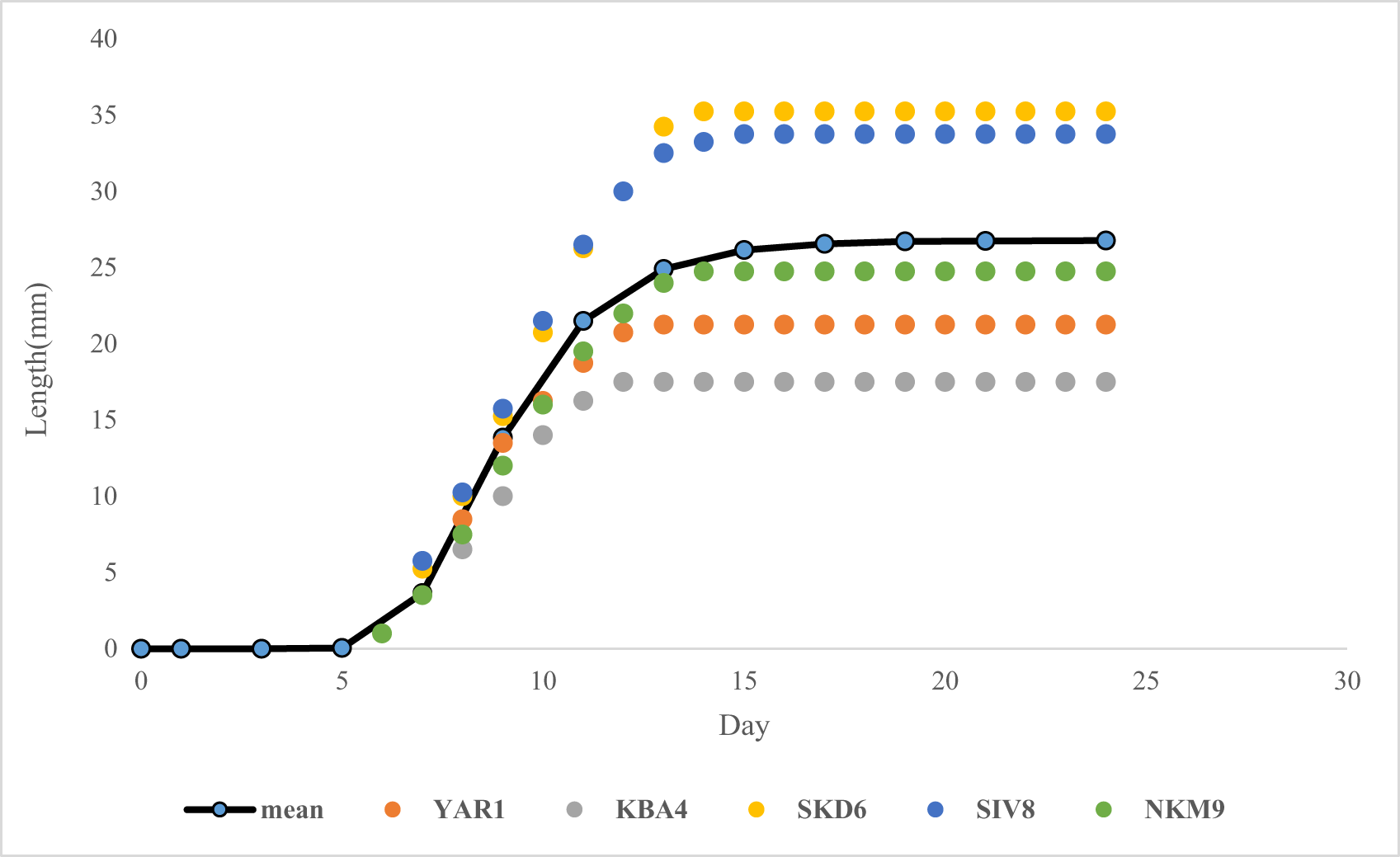
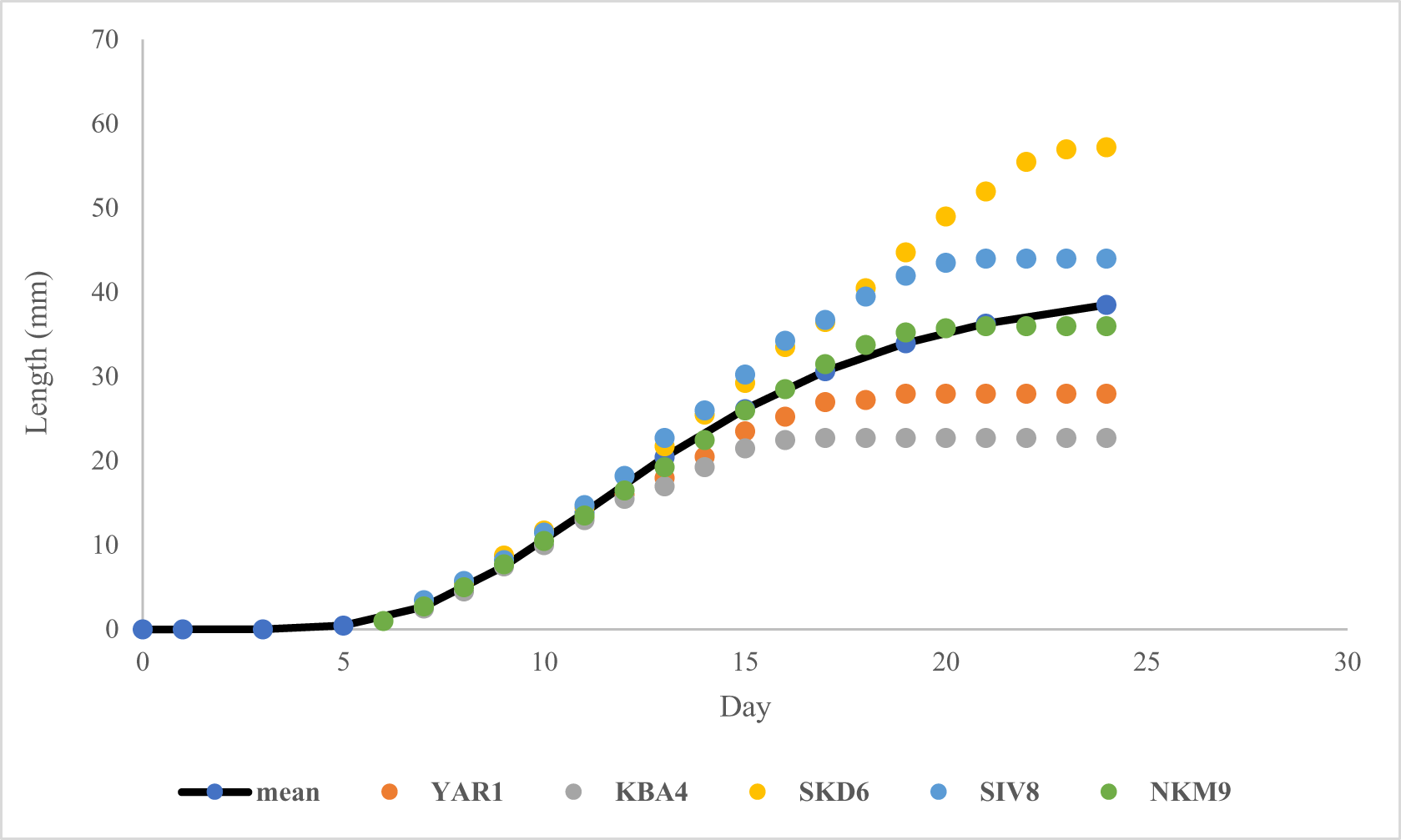
This study provided a detailed analysis of the daily radicle growth trends in cumin, recording growth patterns for the first time (Figs. 3 and 4). Across both ploidy levels, the radicle growth followed an approximately logistic trend. The rapid growth phase occurred between days 5 and 10, after which the growth curve plateaued, indicating a saturation point. Tetraploid genotypes generally exhibited higher final radicle lengths than their diploid counterparts, demonstrating the impact of increased chromosome levels on root growth potential. For instance, SKD6(T) displayed radicles that exceeded 60 mm in length, compared to approximately 35–40 mm for the diploid SKD6(D). The significant differences in radicle growth between diploid and tetraploid genotypes highlight the role of polyploidy in enhancing growth dynamics. However, this enhancement was not uniform across all genotypes. Genotypes such as KBA4 showed less pronounced differences in radicle length between diploid and tetraploid states, emphasizing the interaction of genetic factors and ploidy effects.
Growth dynamics of radicle length across different diploid genotypes over time. The mean growth trend is represented by the black line, while individual genotypic data points are colour-coded: YAR1 (orange), KBA4 (grey), SKD6 (yellow), SIV8 (blue) and NKM9 (green). The length is expressed in millimetres (mm) over the course of 30 days.

Growth dynamics of radicle length across different tetraploid genotypes over time. The mean growth trend is depicted by the black line, with individual genotypic data points represented as follows: YAR1 (orange), KBA4 (grey), SKD6 (yellow), SIV8 (blue) and NKM9 (green). Radicle length is expressed in millimetres (mm) over the course of 30 days.

Seed and embryo morphometric characteristic and internal seed structure
Analysis of variance and mean comparison of seed morphological traits
The analysis of variance (Table 3) indicated that genotype and ploidy level significantly affected all seed and embryo morphological traits, including seed area, seed perimeter, seed length, seed width, embryo area, embryo perimeter, embryo length, embryo width and seed-to-embryo length and area ratios (Q, Z). These findings reflect substantial genetic variability among cumin genotypes and the influence of polyploidy on seed and embryo dimensions. Interestingly, the genotype × ploidy interaction was not significant for some traits, suggesting that for these traits, the genotypic response was relatively consistent across ploidy levels.
Analysis of variance (ANOVA) results for the effects of ploidy levels and different genotypes on seed morphological parameters in cumin (Cuminum cyminum L.)

The significance levels are indicated as follows: ns (non-significant),
* (significant at 5% probability level), **(significant at 1% probability level) and ***(significant at 0.1% probability level).
AS, seed area; PS, seed perimeter; LS, seed length; WS, seed width; AE, embryo area; PE, embryo perimeter; LE, embryo length; WE, embryo width; Q, ratio of embryo length to seed length; Z, ratio of embryo area to seed area.
The mean comparison (Table 4) showed a significant increase in seed and embryo morphometric parameters in tetraploid genotypes across most traits. SKD6(T) exhibited the largest seed area, seed length and seed perimeter, while maintaining relatively high seed-to-embryo length and area ratios (Q, Z), indicating a proportional enlargement of both seed and embryo. This proportionality may explain the superior germination potential and seedling vigour observed in SKD6(T). Conversely, diploid genotypes such as YAR1(D) and NKM9(D) exhibited the lowest values for most morphometric parameters. While these genotypes showed increases in seed and embryo dimensions at the tetraploid level, they remained statistically smaller than SKD6(T) and SIV8(T). Interestingly, YAR1(T) displayed the highest seed width among all genotypes, suggesting that ploidy effects on seed dimensions are not uniform. Also, may be due to genetic modifications made to the tetraploid genotypes, which have improved the growth and development characteristics of the embryo compared to its diploids. These improvements could have positive effects on later stages of seed production and agricultural yield.
Mean comparison of the effects of ploidy levels and different genotypes on seed morphological traits in cumin (Cuminum cyminum L.)

AS, seed area; PS, seed perimeter; LS, seed length; WS, seed width; AE, embryo area; PE, embryo perimeter; LE, embryo length; WE, embryo width; Q, ratio of embryo length to seed length; Z, ratio of embryo area to seed area. Means with the same letter within a column are not significantly different (based on a specific post-hoc test, e.g., Duncan’s or Tukey’s test). (T) represents tetraploid genotypes, and (D) represents diploid genotypes.
Longitudinal seed section and embryo position
Longitudinal section images (Fig. 5) revealed that tetraploid genotypes, such as SKD6 and SIV8, exhibited bulkier embryos and thicker endosperms compared to their diploid counterparts. This structural difference likely reflects an increase in storage reserves, which may account for the higher seed vigour and enhanced germination performance observed in these genotypes. Conversely, genotypes like KBA4 and YAR1 showed minimal differences between ploidy levels, indicating that ploidy-induced changes in seed structure may depend on genotype-specific factors.
Longitudinal sections of seeds showing the embryo and endosperm in diploid and tetraploid cumin (Cuminum cyminum L.) genotypes. Scale bar: 1 mm. (a) Tetraploid genotype SIV8, (b) tetraploid genotype NKM9, (c) tetraploid genotype SKD6, (d) tetraploid genotype KBA4, (e) tetraploid genotype YAR1, (f) diploid genotype SIV8, (g) diploid genotype NKM9, (h) diploid genotype SKD6, (i) diploid genotype KBA4 and (j) diploid genotype YAR1.

Seedling shape and seeds without embryos
Figure 6 illustrates the morphology of seedlings derived from diploid and tetraploid genotypes. Notably, a proportion of tetraploid seeds (e.g., images a and b) were found to lack embryos, resulting in failed germination. This observation suggests that the induction of tetraploidy may increase the incidence of embryo-less seeds, potentially due to meiotic irregularities or other cytological disturbances associated with chromosome doubling. However, when embryos were present and well-developed, as in SKD6(T) (Fig. 5, image h), the resulting seedlings displayed longer radicles and hypocotyls and exhibited superior vigour compared to their diploid counterparts. These results underscore the importance of selecting genotypes that respond favourably to ploidy enhancement.
Seedlings of diploid and tetraploid cumin (Cuminum cyminum L.) genotypes. Scale bar: 1 mm.(a) and (b) Tetraploid seeds without embryos. (c) Diploid genotype NKM9. (d) Tetraploid genotype NKM9. (e) Diploid genotype SIV8. (f) Tetraploid genotype SIV8. (g) Diploid genotype SKD6. (h) Tetraploid genotype SKD6. (i) Diploid genotype KBA4. (j) Tetraploid genotype KBA4. (k) Diploid genotype YAR1. (l) Tetraploid genotype YAR1.

Discussion
Insights into germination characteristics and seed vigour
The significant interaction between genotype and ploidy level (genotype × ploidy) variability underscores the importance of genotype-specific evaluations when selecting for optimal ploidy levels in breeding programmes (Sonnleitner et al., Reference Sonnleitner, Weis, Flatscher, García, Suda, Krejčíková, Schneeweiss, Winkler, Schönswetter and Hülber2013). Genotypes exhibiting elevated germination rates and enhanced vigour indices possess the capability to establish more rapidly and efficiently during the initial phases of development, which holds particular significance in cumin breeding and utilization programmes. These results are further supported by findings in Lolium multiflorum, where tetraploid lines exhibited genotype-specific improvements in germination traits (Akinroluyo et al., 2021).
The decrease in seed VI due to an increase in the MGT MGT and T50 confirms that seed masses with a shorter germination time have greater strength and viability for establishment in the field. Many studies have shown that MGT cannot be the average (or median) germination time and does not represent the time to 50 % germination (T50). Therefore, T50 is widely recognized as an indicator of germination speed in studies that report high final germination rates (Sulaiman et al., Reference Sulaiman, Ullah, Saud, Liu, Tom Harrison, Hassan, Nawaz, Zeeshan, Nasar, Khan, Liu, Adnan, Kumar, Ishtiaq Ali, Jamal, Zhu, Ali, Ali, El-Kahtany and Fahad2023; Luo et al., Reference Luo, Cheng, Yan, Zhang and Zhang2022). Actually, T50 provides a specific measure of the time required for 50% of the seeds to germinate, while MGT offers a broader perspective on the overall germination duration across a seed population. T50 is particularly useful for assessing the speed of germination under optimal conditions whereas MGT is effective for evaluating the consistency of germination across varying environmental factors. These results indicate considerable genetic variation in germination and early growth potential among genotypes, an essential consideration for breeding programmes targeting specific traits and genotypes (Sonnleitner et al., Reference Sonnleitner, Weis, Flatscher, García, Suda, Krejčíková, Schneeweiss, Winkler, Schönswetter and Hülber2013; Munshaw et al., Reference Munshaw, Layton, Stewart, Philley, Beasley and Lemus2014; Sulaiman et al., Reference Sulaiman, Ullah, Saud, Liu, Tom Harrison, Hassan, Nawaz, Zeeshan, Nasar, Khan, Liu, Adnan, Kumar, Ishtiaq Ali, Jamal, Zhu, Ali, Ali, El-Kahtany and Fahad2023).
These genotype-dependent enhancements align with the ‘gigas effect’ typically observed in polyploids, whereby larger seeds and enhanced vigour emerge due to increased storage reserves (Eliášová and Münzbergová, Reference Eliášová and Münzbergová2014; Stevens et al., Reference Stevens, Nicotra, Godfree and Guja2020). In cumin, these findings echo similar genotype-specific trends reported by Bahmankar et al., (Reference Bahmankar, Mortazavian, Tohidfar, Sadat Noori, Izadi and Al-fekaiki2019), who found variations in biochemical profiles, such as proteins and antioxidant enzymes, among Iranian landraces, which likely affect embryonic and seed development. Research on rice has shown that while certain quantitative trait loci (QTLs) are linked to improved germination under low-temperature conditions, the presence of additional chromosomes does not uniformly enhance germination traits. Specifically, one study identified QTLs on chromosome 4 that increased low-temperature germinability, but these effects were not consistent across all germination conditions, suggesting that increased chromosome numbers do not guarantee improved germination traits in all contexts (Fujino et al., Reference Fujino, Sekiguchi, Sato, Kiuchi, Nonoue, Takeuchi and Yano2003; Ji et al., Reference Ji, Jiang, Wang, Zhang, Liu, Liu and Wan2009). Additionally, the effects of environmental conditions on germination traits further complicate the relationship between ploidy level and germination behaviour. Similarly, Chan et al., (Reference Chan, Ooi and Guja2022) observed that while polyploid Pomaderris seeds had significantly larger mass and faster germination (T50), traits like seed survival at certain temperatures showed less consistent ploidy-related advantages.
The variability observed among genotypes and traits supports the notion that ploidy effects are not uniform. For example, the gigas effect observed in polyploids typically enhances biomass and early vigour but does not universally improve GP (Stevens et al., Reference Stevens, Nicotra, Godfree and Guja2020). Similarly, Bahmankar et al., (Reference Bahmankar, Mortazavian, Tohidfar, Sadat Noori, Izadi and Al-fekaiki2019) reported that morphological and biochemical variations between Iranian cumin landraces could influence somatic embryogenesis and developmental outcomes. By analogy, these genotype-dependent biochemical properties may also explain why some ploidy-genotype combinations (e.g., SKD6(T)) respond more favourably in seed vigour than others. These findings highlight the importance of genotype-specific evaluations when optimizing ploidy effects in breeding programmes.
The observed genotype-ploidy interactions align with studies on Pomaderris, where polyploids consistently produced heavier seeds that germinated faster than diploids but exhibited variable impacts on seedling traits such as shoot:root ratio (Chan et al., Reference Chan, Ooi and Guja2022). Enhanced germination rates in tetraploid genotypes align with findings in Odontarrhena bertolonii, where tetraploid seeds exhibited faster germination and greater vigour due to their larger size and higher metabolic activity. These observations further emphasize the role of polyploidy in enhancing germination through increased resource allocation (Selvi and Vivona, Reference Selvi and Vivona2022). Similar patterns of genotype-specific responses were observed in Vicia cracca, where autotetraploid populations displayed varying seed masses and germination rates depending on population origin and local environmental conditions (Eliášová and Münzbergová, Reference Eliášová and Münzbergová2014). These results suggest that the genetic background strongly influences how polyploidy impacts germination traits, a pattern consistent with the varying responses among cumin genotypes like SKD6 and SIV8.
Specifically, seeds that germinate more quickly (higher RS, CVG, MDG) exhibit a lower MGT, underscoring the ecological and agronomic advantage of rapid seedling establishment in environments prone to stress or competition (Stevens et al., Reference Stevens, Nicotra, Godfree and Guja2020). Consistent with these findings, GP shows moderate to high positive correlations with several growth‐related parameters, notably radicle length (RL), suggesting that seeds with higher GP tend to produce longer radicles and benefit from superior resource mobilization (Eliášová and Münzbergová, Reference Eliášová and Münzbergová2014; Selvi and Vivona, Reference Selvi and Vivona2022).
The positive correlation between GP and the fresh‐to‐dry weight ratio of roots (X) possibly reflecting stronger water uptake and expansion that promotes early radicle elongation – an attribute reported for heavier seeds or polyploid germplasm investing in substantial early growth (Eliášová and Münzbergová, Reference Eliášová and Münzbergová2014; Chan et al., Reference Chan, Ooi and Guja2022). This observation parallels studies on Hopea chinensis, where larger seeds with high water retention achieved accelerated radicle elongation (X. Liu et al., Reference Liu, Xiao, Ling, Liao, Wang, Wang, Liang, Li and Chen2023), and in Lagenaria siceraria, where enhanced radicle length correlated positively with seedling vigour (Chimonyo and Modi, Reference Chimonyo and Modi2013). Collectively, these correlations underscore the value of selecting genotypes with faster germination rates (low MGT) and higher GP, as they tend to produce more robust seedlings with balanced biomass allocation, enhanced root and shoot growth, and improved stand establishment (Sonnleitner et al., Reference Sonnleitner, Weis, Flatscher, García, Suda, Krejčíková, Schneeweiss, Winkler, Schönswetter and Hülber2013; Stevens et al., Reference Stevens, Nicotra, Godfree and Guja2020).
The differing correlation patterns between diploid and tetraploid genotypes suggest that ploidy level plays a significant role in shaping the interrelationships of germination traits. The changes in these correlations may be attributed to various factors associated with increased chromosome size, such as altered gene expression, metabolic pathways, and stress response mechanisms. Tetraploids often exhibit more complex gene interactions, which could lead to different physiological responses compared to diploids, thereby affecting the relationships between traits. These findings highlight the importance of considering ploidy level when studying germination traits, as it may influence the interpretation of genetic, metabolic, and ecological factors in plant development.
Physiological implications of radicle growth
Results from the study of Radicle Growth and Its Kinetics are consistent with findings in other polyploid systems, where larger seeds and increased storage reserves have been associated with enhanced radicle elongation (Eliášová and Münzbergová, Reference Eliášová and Münzbergová2014).
Enhanced radicle growth in tetraploid genotypes aligns with the ‘gigas effect’ typically observed in polyploid plants, where increased cell size and metabolic activity drive superior growth outcomes (Stevens et al., Reference Stevens, Nicotra, Godfree and Guja2020). This trend has also been observed in Carum carvi, where tetraploid seeds showed superior radicle elongation due to increased nutrient reserves and metabolic efficiency (Dijkstra and Speckmann, Reference Dijkstra and Speckmann1980).
These genotype-specific patterns mirror observations in other systems, such as Vicia cracca, where tetraploid populations exhibited greater competitive advantages in early seedling growth under dense vegetation, attributed to the gigas effect (Eliášová and Münzbergová, Reference Eliášová and Münzbergová2014). These findings underscore the importance of considering both genotype and ploidy level when selecting for root growth traits in breeding programmes.
Seed and embryo morphometric characteristic
These results of seed morphological traits echo findings in Vicia cracca, where seed enlargement patterns in autotetraploid populations were variable and influenced by population origin and genetic background (Eliášová and Münzbergová, Reference Eliášová and Münzbergová2014). Also, the observed increase in seed dimensions at the tetraploid level aligns with previous findings in polyploid species such as Capsicum annuum and Carum carvi, where larger seeds were associated with improved germination and early vigour (Dijkstra and Speckmann, Reference Dijkstra and Speckmann1980; Samarah et al., Reference Samarah, Wang and Welbaum2016). Overall, the increase in seed and embryo size due to tetraploidy supports the hypothesis that polyploidy enhances seed quality through increased storage reserves. These results are further supported by Dhawan and Lavania (Reference Dhawan and Lavania1996), who noted that increased ploidy levels in medicinal plants were associated with larger seed sizes and improved biochemical profiles. The observed non-uniformity in seed shape and size across genotypes highlights the complexity of genotype-ploidy interactions. Similar variability has been noted in Odontarrhena bertolonii, where tetraploid seeds exhibited enhanced germination traits without uniform improvements across all dimensions (Selvi and Vivona, Reference Selvi and Vivona2022). These findings underscore the importance of tailoring ploidy manipulations to specific genotypes to optimize seed quality traits.
The enhanced seed structure observed in tetraploids aligns with findings in Carum carvi, where increased endosperm thickness contributed to improved early growth potential (Dijkstra and Speckmann, Reference Dijkstra and Speckmann1980). These results support the notion that polyploidy alone is not sufficient to enhance seed structural attributes universally. Instead, the interaction between genotype and ploidy level plays a critical role in determining the degree of enhancement in embryo and endosperm development. This finding echoes similar trends in Vicia cracca and other polyploid systems, where seed and embryo traits were significantly influenced by both genetic background and environmental context (Eliášová and Münzbergová, Reference Eliášová and Münzbergová2014).
The observed variability in embryo development among tetraploid genotypes is consistent with findings in autotetraploid Carum carvi, where meiotic disturbances and seed sterility were noted in early generations of tetraploids but were subsequently minimized through selective breeding (Dijkstra and Speckmann, Reference Dijkstra and Speckmann1980). Additionally, Lavania and Srivastava (Reference Lavania and Srivastava1990) highlighted that careful selection of genotypes with stable meiotic behaviour is critical for harnessing the benefits of polyploidy while minimizing trade-offs such as sterility or seed defects.
Conclusion
This study highlights the pivotal role of genotype and ploidy level in shaping cumin seed quality, germination potential, and early seedling growth. Tetraploid genotypes such as SKD6 and SIV8 demonstrated substantial improvements in seed dimensions, germination speed, time required to reach 50% of the total seed population (T50), and seedling vigour compared to their diploid counterparts, underscoring the potential of polyploidy to enhance key agronomic traits. However, challenges such as the occurrence of embryo-less seeds and variability in genotypic responses emphasize the need for genotype-specific selection and careful management of ploidy effects in breeding programmes.
Comparable genotype-based differences have been reported in Vicia cracca (Eliášová and Münzbergová, Reference Eliášová and Münzbergová2014) and Iranian cumin landraces (Bahmankar et al., Reference Bahmankar, Mortazavian, Tohidfar, Sadat Noori, Izadi, Salehi and Rao2018), where variations in morphological and biochemical traits significantly influenced developmental outcomes. These findings suggest that leveraging polyploidy for breeding requires a nuanced understanding of the interactions between genotype, ploidy level, and environmental conditions.
The practical implications of these findings are significant. By integrating genotype selection with ploidy enhancement, breeders can develop robust cumin cultivars with superior germination rates, early vigour, and resilience under diverse environmental conditions. This approach provides a pathway to improve seed quality, enhance early establishment, and boost overall productivity in cumin and related crops.
Acknowledgements
The authors sincerely appreciate the valuable guidance and support of Dr. Elias Soltani. We acknowledge the use of artificial intelligence tools (ChatGPT) for grammar checking and language refinement during the manuscript preparation. These tools were not used to generate original content, and the authors take full responsibility for the accuracy and integrity of the work.
Author contribution
Zahra Sanaei Hoveida: Material preparation, data collection, analysis, Writing – original draft, Visualization, Methodology, Investigation, Data curation and Funding, Methodology; and Seyed Mohammad Mahdi Mortazavian: Review & editing, Validation, Supervision and Conceptualization.
Funding statement
This research received no specific grant from any funding agency in the public, commercial or not-for-profit sectors.
Competing interests
The author(s) declare none.
Data availability
All data generated or analyzed during this study are included in the article. Please contact the corresponding author for more data requests.
Abbreviations
- GP
Germination percentage
- RS
Germination rate
- MGT
Mean germination time
- T50
Time to 50% germination
- CVG
Coefficient of velocity of germination
- MDG
Mean daily germination
- FGP
final germination percentage
- RL
Root length
- SL
Shoot length
- WtR
Fresh weight of root
- WtS
Fresh weight of shoot
- WdR
dry weight of root
- WdS
dry weight of shoot
- VI
Vigour index
- R/S
Root-to-shoot length ratio
- X, Y
Ratios of fresh to dry weights root and stem, respectively
- QTLs
quantitative trait loci
- D
diploid level
- T
tetraploid level
- AS
Seed area
- PS
Seed perimeter
- LS
Seed length
- WS
Seed width
- AE
Embryo area
- PE
Embryo perimeter
- LE
Embryo length
- WE
Embryo width
- Q
Ratio of embryo length to seed length
- Z
Ratio of embryo area to seed area.




 Open access

