

The series of challenges pertaining to the organization, sharing, and reuse of archaeological data, which are often collectively referred to as the discipline’s “curation crisis” or “data deluge,” have highlighted the wide array of practices that underlie data’s construction, management, dissemination, and reuse (Bevan Reference Bevan and Bonacchi2012; Huggett Reference Huggett and Garstki2022a, Reference Huggett2022b). Numerous studies have complicated the common imagination of data—which considers them as concise, corpuscular, discrete, and inherently truthful records—by demonstrating how, in practice, they are messy, incomplete, and nonreductive (see Batist Reference Batist2024; Dallas Reference Dallas2015; Huggett Reference Huggett2022b; Voss Reference Voss2012). In fact, archaeologists create data while anticipating their utility as records that inform certain kinds of analysis, whereas those who apply data in analytical contexts simultaneously reconcile their own use-cases with the conditions under which the data were originally created (Dallas Reference Dallas2015:190–191).
This is reflected in the ways in which archaeologists reuse data. Faniel and coworkers (Reference Faniel, Kansa, Kansa, Barrera-Gomez and Yakel2013) and Atici and colleagues (Reference Atici, Kansa, Lev-Tov and Kansa2013) documented how those who reuse data seek out additional contextual information about the circumstances of a dataset’s creation by communicating directly with the dataset’s originators, thereby establishing a discursive collaborative tie. Alternatively, many data analysts who operate at a distance from the contexts in which data originate prefer to trust in the models that give the data concrete structure, thereby offloading the acts of reconciliation to those who produced the data (Huggett Reference Huggett and Garstki2022a). In other words, reusing data involves establishing trust, which can be achieved through mutual understanding of the challenges that had to be overcome to get observations to fit within discrete data structures, and relying on mechanisms of control to ensure that data are collected and maintained in a consistent manner.
This article demonstrates some of the strategies that establish trust in data. Through analysis of an example of archaeological documentation in fieldwork, I show how data capture is not merely a sensory experience whereby nature is recorded on a one-to-one basis but is in fact structured by models and power relations that legitimize data and make them useful.
Background
This work builds on prior studies of archaeological documentation in fieldwork settings, particularly Edgeworth’s (Reference Edgeworth1991:28) dissertation that documented “the transaction between the subject and the object, as it takes place in the act of discovery”: his work was an attempt to ground theoretical discourse concerning the objectivity of the archaeological record in the practical “intersubjective work or labor upon material objects.” This extremely polyvalent work touched on various aspects of archaeological practice, highlighting the collective and discursive process of archaeological knowledge production in various settings. Edgeworth closely examined the physical acts of excavation, the mindsets of the people doing this work, the sensory and conceptual apparatus through which objects are uncovered and made meaningful, and the social transactions that surround and permeate life on the project. His work drew attention to the social and professional interactions taking place at an archaeological excavation and those that occur as archaeologists articulate an object as a meaningful or discrete entity and make it official. Crucially, Edgeworth highlighted how archaeological records are produced through improvised, semistructured, and discursive actions feasible given practical concerns and limited by the prior experiences held by those doing the work.
Similarly, Goodwin (Reference Goodwin1994, Reference Goodwin, Malafouris and Renfrew2010) observed how the formation of concrete records in fieldwork settings relates to the establishment of professional frameworks, which lend authoritative legitimacy to the meanings on which archaeologists eventually settle. Gero (Reference Gero and Wright1996) made similar observations, noting how certain ways to delimit features—which corresponded with gendered experiences—were deemed more legitimate than others. Mickel (Reference Mickel2021) and Yarrow (Reference Yarrow, Knappett and Malafouris2008) documented that archaeological laborers (including local laborers and undergraduate students) are less able to contribute as interpretive agents in the production of lasting records about the things they recover.
Thorpe (Reference Thorpe, Cobb, Harris, Jones and Richardson2012) also argued that the broader social and political circumstances—neoliberal austerity, in particular—in which archaeological fieldwork tends to operate significantly affects how interpretations are made and arguments are extended by effectively curtailing fieldworkers’ creative agency. Huggett (Reference Huggett and Garstki2022a), Caraher (Reference Caraher2019), Batist and colleagues (Reference Batist, Masters, Torma, Carter, Ferris, Huvila, Ross and Dallas2021), and Batist (Reference Batist2025) similarly draw attention to how digital workflows effectively segregate acts of recording from acts of analysis and interpretation by putting significant epistemic distance between those who hold creative agency in analytical and interpretive domains and those who occupy the domain of fieldwork; they further demonstrate how the latter domain is leveraged by the former to produce a clear and concise basis on which formal analytical methods rest. Moreover, Batist (Reference Batist2024) and Hacigüzeller and colleagues (Reference Hacıgüzeller, Taylor and Perry2021) point out that the formal and transactional paradigm that dominates discourse on what data are and how they should be handled poses problems for communicating what was actually encountered while excavating a feature, including tentative thoughts, desires, and apprehensions that are left out of official records.
In what follows, I extend this critique by showcasing the improvised nature of data construction in fieldwork settings and by demonstrating how rough encounters with archaeological remains are stabilized and made more legitimate through documentation practices.
Methods and Materials
This article draws from observations of and interviews with archaeologists at work, as well as the documents that they produced. Specifically, I articulate how archaeologists enacted various activities and how their actions were situated as part of broader systems of knowledge production. My involvement with this project constituted a longitudinal investigation of archaeological practice that contributed to my doctoral dissertation (see Batist Reference Batist2023).
Case
This article draws from observations of and interviews with members of an archaeological project: it focuses on on the pragmatic and multifaceted ways in which participants engaged with the project’s information system. I recorded interviews with archaeologists as they worked during the summer field seasons from 2017 to 2019 and conducted additional interviews between fieldwork sessions. The project’s director gave me access to all documents and records for the purpose of this research.
This research project, which excavated a prehistoric site in southern Europe, was directed by a foreign professor affiliated with a North American university and who had extensive experience working in the region. The director coordinated various specialists whom he recruited for their expertise in the interpretation of finds, trench supervisors who led excavation and data-collection activities, and excavators who operated under the guidance of their assigned trench supervisors. This research project involved archaeologists with varying degrees of experience and diverse professional backgrounds, including those with extensive experience in the commercial sector (see the Supplementary Material 1 for brief summaries of these individuals’ background). It was not a field school but did rely on labor provided by undergraduate and graduate students and, as such, provided on-the-job training.
The informal and situated learning experiences I observed represent instances of legitimate peripheral participation, whereby newcomers are introduced to the norms and expectations that govern the archaeological community of practice. These scenarios provide valuable opportunities to ascertain the value ascribed to observed practices and information outcomes conveyed by teachers and adopted by learners through active and productive tutelage. There is a strong precedent for this approach to the study of archaeological practice (see Everill Reference Everill2007; Goodwin Reference Goodwin1994, Reference Goodwin, Malafouris and Renfrew2010; Morgan and Wright Reference Morgan and Wright2018), including in contexts of continual, lifelong learning among experienced archaeologists (see Edgeworth Reference Edgeworth1991; Gero Reference Gero1994; Graham Reference Graham2019).
This project served as one of three cases I investigated for my doctoral dissertation, which documents how archaeological information systems scaffold the collaborative and epistemic commitments that govern professional research practices (Batist Reference Batist2023). The observations and elicitations I present here illustrate a specific phenomenon with a more refined scope than what is accounted for in that more comprehensive work and in other research outcomes deriving from it (see Batist Reference Batist2024, Reference Batist2025; Batist et al. Reference Batist, Masters, Torma, Carter, Ferris, Huvila, Ross and Dallas2021). It draws from a relatively small portion of the entire set of observations and interviews that largely pertains to fieldwork recording practices, processing and analysis of finds, records management, interdisciplinary collaboration, decisions regarding writing and publication of findings, and discussions of how data and findings are presented, evaluated, and revised among broader research communities.
I actively contributed to the project for several years, primarily serving as a database manager. This provided me a greater awareness of its organizational and institutional history, a deep familiarity with all the people involved, and a privileged outlook on how team members structure information, how they typically use data, and what circumstantial events or motivating factors frame such concerns. My participatory engagement with this project enabled me to develop an understanding of the intricate social relations as they developed over time and to examine methods that were used over the course of several field seasons.
In case-study research, cases represent discrete instances of a phenomenon relating to a researcher’s interest (Ragin Reference Ragin, Charles and Howard1992). Therefore, cases are not the subjects of inquiry but instead the vehicles through which phenomena of interest are manifested in an observable way. I recognize that all archaeological projects are informed by their own histories, memberships, sets of tools, methods, and social or political circumstances, which in turn inform distinct traditions of practice, and that it is not possible to generalize across the whole discipline through a single case study. In other words, my findings are shaped by the informants whose actions and attitudes I sought to articulate and by my own perspective as a scholar of the culture and practice of archaeology and of the media and infrastructures that support it. Commercial archaeology, which comprises the vast majority of archaeological work in North America and Europe, is outside the study’s scope, because the case represents a research project and I have very limited experience with and knowledge about commercial archaeology. However, Chadwick (Reference Chadwick1998), Thorpe (Reference Thorpe, Cobb, Harris, Jones and Richardson2012), and Zorzin (Reference Zorzin2015) present similar research pertaining to commercial archaeology, which produced complementary findings to those presented here.
Nevertheless, this single case study does articulate some significant factors that contribute to the decisions and behaviors that archaeologists commonly make and enact, make more visible certain underappreciated social and collaborative commitments that underlie common tools and practices, and draw attention to certain patterns of practice that relate to the contemporary discourse on the nature of archaeological data and the ongoing development of information infrastructures.
Data
My dataset includes recorded observations, embedded interviews, retrospective interviews, archaeological documentation, and ethnographic and reflexive fieldnotes. Observational data comprise records of participants’ behaviors as they performed various archaeological activities and take the form of video, audio, and textual files. They enable me to document how practices are performed, in addition to the fact that they are performed. Thus, these data allow me to document what participants actually did, as opposed to what they thought or said they did. For instance, to consider how activities occurring at various times or in various contexts indirectly relate to, compare with, or inform each other, I situated activities in relation to broader systems, even when participants were unaware that they were contributing to these systems. I observed 66 hours of work from this case, which were typically recorded using three cameras—including cameras placed on participants’ foreheads—to obtain different perspectives on the recorded activities. Some of the primary foci that guided my observations were the processes that resulted in archaeological records; people’s use of information objects or interfaces, which sometimes differed from expected behavior; how subjects implemented unconventional solutions or “hacks” as workarounds; how the context of an activity affected its implementation; and how local or idiosyncratic terms, concepts, and gestures became established in a research community.
Embedded interviews comprise conversational inquiries with participants in the context of their work; they are meant to account for participants’ perspectives regarding how and why they acted as they did, given the immediate constraints of the situation at hand. Embedded interviews provide insight into the practicalities of work in the moment from the practitioners’ perspective (Flick Reference Flick1997, Reference Flick, Bauer and Gaskell2000; Witzel Reference Witzel2000). They are also useful for comparing participants’ responses with observational records to interrogate how and why participants’ observed actions may differ from the rationales elucidated from embedded interviews. The fact that embedded interviews occurred while observing work practices makes it difficult to distinguish these interactions from their broader contexts, and it is therefore impractical to quantify how much data were collected in this way. Embedded interviews focused on how participants identified problems or challenges in their work and found ways to resolve them; how certain people gained recognition as domain experts or authorities with specialized knowledge; and how specialists related their contributions to the contributions of others and their situated perspectives to centralized knowledge repositories.
Retrospective interviews are longer semistructured interviews conducted outside work settings with select participants to contextualize data collected by other means and to determine their views on more general or relatively unobservable aspects of archaeological research, such as planning, publishing, collaboration, and the like. I selected participants to be interviewed based on the potential to triangulate different perspectives on objects, themes, or situations whose significance was emerging throughout the research (Morse and Clark Reference Morse, Clark, Bryant and Charmaz2019). I conducted 13 retrospective interviews; some included more than one participant, and some participants sat for more than one interview. These interviews helped me gain insight into how participants situated themselves as members of and in relation to research communities, which may be characterized by different regimes of value and methodological protocols or argumentation strategies. They were meant to highlight participants’ perspectives on the value of various kinds of research outputs, what they valued in their work and the work of others, the major constraints and challenges that they and their communities faced, and how they might resolve them.
I examined documents and media (such as forms, photographs, labels, databases, datasets, reports, instructional media, and field manuals) to gain insight into institutional norms or expectations (see Batist [Reference Batist2025] for more in-depth analysis of how people interacted with and valued these documents). I approached these documents and media as means for encapsulating and communicating meanings among users across space and over time. This helped me understand the vectors through which participants either tacitly form collective experiences or directly collaborate among themselves (Huvila Reference Huvila2011, Reference Huvila2016; Yarrow Reference Yarrow, Knappett and Malafouris2008). Document analysis emphasized understanding how document design and media capture protocols anticipated certain methods; how various activities referred to recorded information; the reasons why team members ignored certain equipment and forms of documentation, despite their availability; how recordkeeping was controlled through the explicit or implicit imposition of limitations or constraints; why certain records played a more central role than others; and how different archaeologists recorded the same objects in different ways.
Finally, my field notes comprise reflexive journal entries that I wrote between observational sessions or interviews. They also include moments from observational sessions or interviews that I deemed particularly important, as well as descriptive accounts of unrecorded activities or conversations that I later considered to be useful data in their own right.
I obtained informed consent from all individuals included in this study in compliance with the University of Toronto’s Social Sciences, Humanities, and Education Research Ethics Board, Protocol 34526. To ensure that participants could speak freely about their personal and professional relationships while minimizing risk to their personal and professional reputations, I committed to refrain from publishing any personally identifying information. I referred to all participants, affiliated organizations, and mentioned individuals or organizations using pseudonyms. I also edited visual media to obscure participants’ faces and other information that might reveal their identities and took care to edit or avoid using direct quotations that were cited in other published work that follows a more permissive protocol regarding the dissemination of participants’ identifying information.
Analysis
I analyzed recorded observations and interviews and interrogated the roles and affordances of various tools and documents using qualitative data analysis methods. More specifically, I drew from the “constellation of methods” that Charmaz (Reference Charmaz2014:14–15) associated with grounded theory; namely, coding and memo-ing. Coding involves defining what data are about in terms (or codes) that are relevant to the theoretical frameworks that inform research, as well as identifying instances of these concepts (codings) as they appear throughout the text (Charmaz Reference Charmaz2014:43). Memo-ing entails more open-ended exploration of and reflection on latent ideas to crystallize them into new avenues to pursue; it constitutes a relatively flexible way of engaging with data and serves as fertile ground for honing new ideas (Charmaz Reference Charmaz2014:72). By creating memos that relate and elaborate series of encoded observations and that situate observed experiences in relation to broader theoretical frameworks, I was able to form more robust and thematic arguments about the phenomena of interest while remaining firmly grounded in the empirical data. See Batist (Reference Batist2024:9–10) for a more comprehensive overview of the analytical methods used in the project from which this article emerges.
Codes were generated through iterative analysis of recorded observations, transcribed interviews, and scans of documents and field notes. An initial “open” coding phase involved generating codes in an open-ended manner to identify common themes and sensitizing concepts (Bowen Reference Bowen2006; Charmaz Reference Charmaz2014:30–31). Subsequent coding was scaffolded by a provisional taxonomic code system that was informed by a loose conceptual model, which broadly encompassed codes about specific activities, participants’ figurations, and theoretical concepts concerning the collective constitution of scientific knowledge (see Batist [Reference Batist2023], including Appendix B, for an overview of the code system). The study is therefore aligned with Charmaz’s (Reference Charmaz, Norman and Yvonna2000) constructivist approach to grounded theory, in that it orients the work by the analyst’s prior understandings, rather than having the codes emerge organically.
I refer to specific observations or interview segments throughout the rest of this article using endnotes that are indexed in the Supplementary Material 2.
Findings
I focus on a string of episodes during which Jane, a promising trench assistant working at an archaeological project, learned to identify, differentiate, and document parts of a stratigraphic sequence. This illustrates how the constitution of the archaeological record and the internalization of archaeological knowledge occurred as part of project frameworks and collaborative relations that were structured by divisions of labor.
Learning to See Like an Archaeologist
As illustrated in Figure 1, Jane explained to me how she identified and differentiated a new context that she was beginning to expose in her trench, using a series of gestures paired with speech to help convey what she meant to say.A1 Jane kicked the boulders as she referred to them, literally pointed out relations to previous experiences that she deemed relevant, and described certain aspects of the soil by miming the ways that she would interact with them. She referred to common nomenclature outlined in the project’s standard recording schema and used by more experienced personnel, drawing from her experiences working in other trenches that others may have shared. More generally, she described the context change only in terms of her interactions with it and as framed by her specific role in the project.
Explanation of a potential context change using gestures and speech.

Figure 1 Long description
The image is an annotated instructional graphic. On the left, a numbered dialogue between Jane and Zack discusses soil changes. Key phrases include “texture,” “colour,” “there’s a layer of big boulders,” “what we had there,” and “perfect floor.” Annotations highlight gestures like pointing, kicking and miming a brushing motion. Labels note using common dimensions versus vague terms and hint at assumptions about aims. The right side features a grid of close-up photos showing hands interacting with soil, illustrating Jane′s observations. The layout emphasizes the dialogue′s instructional nature and the visual sequence′s purpose.
Afterward, and as illustrated in Figure 2, Jane consulted with Basil, who supervised work in this trench and who is also the project director, regarding her interpretation of the soil in it.A2 Jane explained what she saw in terms of her encounters with the entities she identified, punctuating her observations with physical gestures that underscored her certainty that the entities she was observing actually existed. Basil moved to the trench to take a closer look and translated Jane’s situated experiences into more nominal and normalized terms that distance the observer from the observed entities. Basil then identified a series of actions that Jane had to implement and summarized the situation by joining what was observed with what was to be done about it—in effect, rendering a conclusive and well-reasoned decision. All the while, Jane confirmed her understanding of Basil’s corrections and of his specific instructions.
Discussion of a potential context change using gestures and speech.

Figure 2 Long description
A document style textual illustration with a two column, line numbered transcript and two stacked embedded photos in the centre column. The left column shows line numbers 1 to 30 with speaker labels and bracketed stage directions. A large bracketed callout note sits beside the upper left text block. Another bracketed callout note sits beside the lower left text block. The centre column contains two rectangular photos stacked vertically. The upper photo shows a trench with a person standing inside it. The lower photo shows a trench with a person inside it, with one arm extended toward the trench wall. The right column shows line numbers 31 to 59 with speaker labels and bracketed responses. Three bracketed callout notes appear along the right side. Language: English. Visible transcript text includes: 1 Jane colon So, this is like still kind of a dark, dark 2 brown, going into the sand, but it′s like really 3 tough, like hard to dig through, kind of. So I think 4 maybe it′s just context left parenthesis question mark right parenthesis. left parenthesis gesturing towards 5 other side of the trench right parenthesis And then this is like really 6 light grey, left parenthesis bobs hand up and down to emphasize 7 these last three words right parenthesis and I thought it was just 8 cuz it had just dried out and I hadn′t done this 9 kind of left parenthesis fill right parenthesis, but it′s also really hard to dig and 10 like a really light grey, so I don′t know if it′s just 11 remnants of this part, or what... 13 left parenthesis Basil gets in the trench to take a closer look right parenthesis 15 Jane colon Or like maybe this is like, would it be 16 possible that that′s like an older hearth, like the 17 other that was leached out? 19 Basil colon Yeah, hmm. So the colour here is the same 20 as what you were digging, but the consistency 21 has changed? 23 Jane colon Yeah. 25 Basil colon I would clean up, maybe just straighten 26 that section a bit, left parenthesis 27 Jane colon yeah 28 just to the path that you started at for this 29 context, left parenthesis 30 Jane colon yeah 31 and then we′ll clean up and carry on with... you 32 know we can just write in the text that, you know, 33 these are the differences, left parenthesis 34 Jane colon yeah 35 but you know what, after we start to dig it, it 36 might change back to something much more 37 familiar, left parenthesis 38 Jane colon yea 39 and we can just say oh, it′s like some kind of 40 differential lens of material within it, left parenthesis 41 Jane colon right 42 yea, or quite possibly a continuation of what we 43 had before... 44 left parenthesis Jane colon okay 46 Jane colon Okay, so just clean up the walls and then 47 keep going, okay. 49 Basil colon Yeah, but we can photograph, change 50 numbers 51 Jane colon Oh, okay. 53 Basil colon We′ll treat it as something different, you 54 know we can write in the notes that there is a 55 very good chance that it′s still the same stuff, but 56 the consistency changed left parenthesis 57 Jane colon right 59 so, just to be careful. Visible callout note text includes: Similar kinds of gestures used to locate and relate objects of interests to others; gestures underscore certainty that an entity actually exists Supervisor translates experience into more nominal and normalized terms Confirmation of understanding after every component of the detailed work plan is stated Confirmation of understanding after every component of the detailed work plan is stated Supervisor translates future plans into actionable tasks Joins what was observed with what is to be done about it, renders it a conclusive and well-reasoned decision.
When Jane explained her interpretation of the soil to her supervisor, he responded with tentative agreement; his words were paired with his own gestures and intonations that subtly communicated his agreement or disagreement. The conversation between Jane and Basil therefore served as a means of calibrating their experiences, using an independent framework as a common reference point. In effect, Basil attempted to align Jane’s emerging perspective with a professional outlook on the sediment’s character.
As Jane stated in a subsequent interview (Figure 3), she initially found it difficult to “train her eye to see what they’re seeing”: “they” seems to refer here to more senior and specialized archaeologists, including her supervisor, who is also the project director, and Alfred, one of the field directors.A3 By talking through their observations in an explicit manner and in the presence of the entities of mutual concern and also referencing concrete characteristics of the soil, Basil trained Jane to see things in a way that corresponds to a formal model of how to differentiate contexts as an natural extension of that ability. This made him more confident in Jane’s ability to recognize and report her experiences, which Basil depends on; as he recalled in a separate interview, Basil came to trust Jane “to either make her own decisions or be responsible enough to ask other people to help her make decisions for those moments when I’m not there.”A4 This trust was possible because Jane became capable of deciding for herself when and how to distinguish between sediments, having internalized a conceptual framework that gave professional legitimacy to her observational techniques.
Jane describes how she learned to recognize differences in the soil.

Jane’s internalization of the broader conceptual framework accomplished several important things: (a) it aligned her own vision with a collectively held way of perceiving the world, which is led by authoritative actors who exhibit greater creative control; (b) it rendered her own unique experiences as generic contributions to the project’s information commons, which has the effect of reducing her individual agency while also drawing her into a class of related agents serving similar data-collection functions, such as student laborers; and (c) it reframed her embodied and sensory experience as a form of information modeling that occurs outside material space and circumstantial moments in time. By clarifying relatively ambiguous perceptions through a carefully calibrated prism, the project may obtain sharper and more well-defined outlines of the things its participants target for observation, while correcting for and making it easier to dismiss the specific embodied experiences that are collectively focused through the aggregative lens.
Shedding the Body
I should note that Jane did not object to the reduction of her situated experience into more generic forms of representing the stratigraphy. In fact, this conformed with a pattern of behavior—which was enacted by all the fieldworkers I spoke with—by which they tried not to think too much while excavating, opting instead to operate in the moment, face the task at hand, and deal with what is immediately in front of them, literally and figuratively.A5, A6 This conformed with the expectation that the things an excavator uncovers will gradually reveal themselves and that she should passively follow what is occurring in the earth before her.
To help accomplish this mindset, fieldworkers modified the environments in which they worked. For instance, some focused better while listening to music or while blocking out social distractions.A7, A8 Ben, who worked as an assistant in a separate trench, said that listening to music helped him avoid being too self-aware,A7 and Jane agreed by expressing that she listened to music to help her “get lost in digging.”A8 Even when music was not used or when it is forbidden on-site, fieldworkers are expected to remain focused as they work.A9 For instance, Basil recalled what he characterized as “old-fashioned” archaeological fieldwork practices, which dictate that “the only sound you should hear is trowel on stone.”A8
Having all the necessary tools at hand was another way to facilitate an uninterrupted focus during fieldwork.A10 This helped eliminate peripheral sensory distractions created when getting up or reaching for tools placed farther away. In effect, fieldworkers were trained to become disembodied sensing devices attuned to one thing and one thing only: the soil immediately in front of them. This notion was further underscored by my unrecorded but frequent observations of supervisors having to force assistants to take breaks, drink water, and apply sunscreen, and remind them that they have bodies worth cherishing and protecting.
In some cases, fieldworkers found certain kinds of externally derived information useful as they excavated. For instance, knowing about similar stratigraphy in nearby trenches enabled excavators to work at a quicker pace, because this provided a general understanding of the order and depth of the stratigraphy under them.A11, A12 Moreover, when finds specialists reported back to fieldworkers about the contents of their ongoing trenches, these preliminary findings sometimes influenced the care with which the fieldworkers excavated and recorded the trench.A13, A14 For example, Theo (a trench supervisor who eventually became a field director) indicated that knowing about the properties of lithic artifacts that lithics specialists deemed important helped him undertake his work in a manner that better suited the project’s overall aims; yet he presented this notion in very broad terms and refrained from indicating specific practical impacts when prompted.A13 Moreover, Ben dismissed the input provided by paleobotanical experts as useless to him because he was unable to “see” the archaeobotanical traces as he worked.A15 This may merely reflect the limited value proposition of making microscopic archaeobotanical visible to fieldworkers, in relation to the project’s specific research objectives; it is actually quite feasible to provide fieldworkers with a basic magnifying loupe and instructing them on how to characterize pollen grains using a reference guide—similar to how Jane learned to characterize soil samples. However, this would require a more comprehensive partnership between specialists and fieldworkers, broadening the extreme focus that fieldworkers honed for themselves.
In general, I observed aspects of fieldwork practice that both complement and contradict efforts to enhance reflexivity in fieldwork. The professed desire not to overthink while excavating pushes back against impulses to provide more information to fieldworkers during the moment of excavation (see Berggren Reference Berggren2012; Berggren et al. Reference Berggren, Dell’Unto, Forte, Haddow, Hodder, Issavi and Lercari2015). According to Theo and Ben, fieldworkers operate in a strictly separate role from those who interpret and write about finds, and this boundary feels natural to them.A16, A17, A18 Rather than ingest loads of additional information, which involves learning how to make sense of it all and find it meaningful in a practical sense,A19 the fieldworkers I spoke with went in the opposite direction; they valued their extremely focused experiences with the material, which present them with a unique and proprietary way of knowing that dissipates as they are, as Edgeworth (Reference Edgeworth2003:115) put it, forced to detach themselves “from the task-in-hand to consider the material field from a distance.” This means of engagement feels more natural to them, as if they are unmuddied by reflexive thought, and the fieldworkers I spoke with perceived this as a strength.
At the same time, the fieldworkers were very aware that all observation is subjective and that all records carry biases imposed by the practical circumstances of their creation; they were deeply involved in navigating these practical circumstances and in devising ways to control their environments to foster the illusion of objectivity. All that I described was in service of a broader systemic framework, which is informed by a (flawed) conception of the nature of archaeological data and of what constitutes proper or legitimate archaeological reasoning (Batist Reference Batist2025).
In other words, fieldworkers’ efforts to shed their embodied experiences was a strategy for coping with an “epistemic anxiety” caused by the tension between the drive to produce confident records and their intuitive understanding that their own observations are inherently situated (Batist Reference Batist2024; Huggett Reference Huggett2022b:274–278; Lucas Reference Lucas2019:55–57; Wylie Reference Wylie2017). This is supported by systems that effectively reassign creative agency from fieldworkers to data managers (Batist Reference Batist2024, Reference Batist2025). For instance, I previously noted that database managers, who were tasked with translating messy observations into concrete data structures, generally lacked an adequate understanding of the contexts in which data were initially recorded; to overcome this challenge, they attempted to enforce standards, workflows, and rule sets among fieldworkers so that they could obtain greater control over the data (Batist Reference Batist2024).
It should also be emphasized that this is a systemic issue and does not reflect individual archaeologists’ skills and abilities. This is evident by the remarkable consistency across responses by and observations of all the archaeologists I engaged with on this matter, regardless of their degree of experience: everyone was both intuitively and explicitly aware of these concerns, but they were unable to grapple with them or enact change through their own individual actions. Nor are these observations intended to demonize or pass negative judgment on the projects’ leaders and database managers, who are similarly constrained by systemic pressures to generate forms of knowledge that are valued by the scientific enterprise. They must balance the sharing of concrete records about archaeological observations while accounting for the situated decisions and actions that contributed their creation.
Leaving Traces in the Subsequent Record
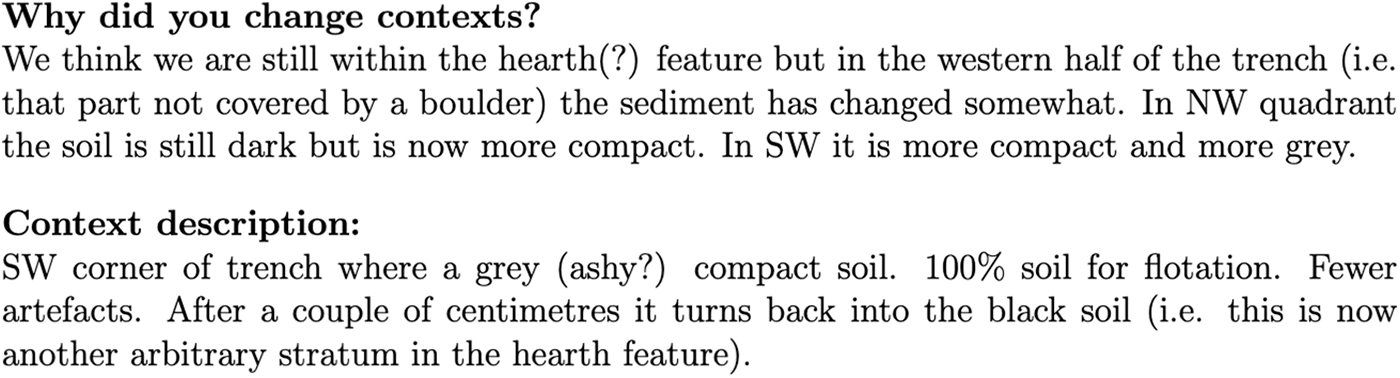
Returning to the specific observations of archaeological fieldwork, Basil’s prediction that the context would not change came to fruition. However, the tentative decision to proceed as if a change in context was imminent left residual traces on recording sheets, in the database, and in the final trench report (see Figures 4 and 5).
Transcribed section of a recording sheet describing the context addressed in the observed episode.

Sketch of the base of a trench, portraying the context addressed in the observed episode, boxed in red.

In particular, the tentativeness and ambiguity that Jane and Basil experienced while excavating this trench was one of its notable properties, as elicited in the final trench report (see Figure 6). Additionally, the report described how the contexts were eventually lumped together into a more concretely defined “lithostratigraphic unit,” which was formally delimited using nominal and standardized terminology. In this way, the report switched back and forth between ambiguous and concrete representations that conveyed experiential and distant perspectives, respectively. This resembles the tone switching that occurred in the conversation between Jane and Basil, whereby Basil, as the supervisor responsible for creating formal documentation, re-presented Jane’s experiences using more formal terms. As such, this reflects an implicit recognition that there is immense value in being able to share more nuanced perspectives on the elements that make up the archaeological record. At the same time, and in contrast with truly situated records like those maintained in field journals (see Batist Reference Batist2024), the language documenting such tentativeness in the report remained largely impersonal and observations were de-situated and disembodied.
Section of a trench report describing the context addressed in the observed episode and situating it as part of a lithostratigraphic unit.

It is notable that situated experiences were recorded in the report-writing phase and only by those acting in authoritative roles. This parallels how field journals—which are also records of situated experiences—are exclusively maintained by supervising personnel (Batist Reference Batist2024). These observations reflect the different kinds of agency held by different actors in the project. Fieldworkers were encouraged to shape their behavior so that the information they obtained was born as formal entities from the start, whereas those responsible for presenting the record as part of a broader scope of work re-situated the data as products of data-collection processes that they designed and dictated. Recognizing the situatedness of data while they were being collected would have required recognition of their limitations, which fieldworkers believed would enable undisciplined data-collection behavior.A20
In other words, the constitution of archaeological records involved temporarily suspending disbelief regarding the stability of archaeological observations among fieldworkers and then the reintegration of storied accounts about the record’s origins by supervisors who were granted greater creative agency. However, this was conditioned by using language that rendered prior work as generic and nonsituated processes, thereby obscuring the agency of those whose work the report was based on. Although not specifically targeted for this study, similar tendencies may also be casually observed while recontextualizing prior work as part of broader narratives at various scales—in summaries about a trench, an area, a site, and even an entire region.
Discussion and Conclusion
This article’s findings demonstrate how the production of stable and concrete archaeological records involves characterizing the phenomena of interest in nominal terms while downplaying the situated and embodied experiences that informed the records’ creation. More specifically, it documents a tendency to enforce formally defined records in support of analytical tasks down the line, which present fieldwork as a means to an end and fieldworkers as instruments that can be wielded to support future analytic endeavors. It shows how these values are instilled through the social and material experiences in which fieldwork is embedded, which inform fieldworkers about how their labor and its outcomes contribute to collective efforts. In other words, it reveals how the management of archaeological data and of archaeological labor is inherently intertwined and draws attention to some mechanisms through which certain voices are rendered more visible than others when constituting the archaeological record.
Moreover, the fieldworkers I observed and spoke with played into the roles they were assigned, even though this meant they had less creative agency. In fact, they generally valued their contributions as sensory devices, which is linked to the notion that they were capable of seeing things as they really are: as material entities that seemingly have not yet been ascribed stable meaning. As such, fieldworkers actively contributed to honing the illusion of their objectivity, which enhanced their value as members of the project and as domain specialists with their own unique cognitive skills. At the same time, it was also clear that they knew, on an intuitive level, that any claim of objectivity is overstated (as per complementary work published in Batist Reference Batist2024:12). However, their positions as responsive rather than creative actors ensured that they were not responsible for resolving this tension (see Batist Reference Batist2025).
These findings complement other empirical research examining archaeological data management as collective interpretive action. For instance, Batist and coworkers (Reference Batist, Masters, Torma, Carter, Ferris, Huvila, Ross and Dallas2021) and Batist (Reference Batist2025) note that rote fieldwork practices tend to be assigned to relatively junior project personnel, who become ensnared in workflows that discipline their actions. Similarly, Morgan and Wright (Reference Morgan and Wright2018), who compare analog and digital field drawing techniques, reveal how the act of transcribing archaeological deposits on a blank surface increases the understanding of students more than when they participate as a cog in a broader digital apparatus, because of the different degrees of creative interpretive agency that each method affords them. Moreover, Yarrow (Reference Yarrow, Knappett and Malafouris2008), who examines the meaning, materiality, and agency in archaeological recording practices, draws attention to expressions of resignation among fieldworkers who were more aware that the information they recorded did not hold special meaning, based on their prior understanding of how these records would actually be used later. Edgeworth (Reference Edgeworth1991), Zorzin (Reference Zorzin2010), Thorpe (Reference Thorpe, Cobb, Harris, Jones and Richardson2012), and Watson (Reference Watson2019) highlight similar perspectives in their critical investigations of agentic relationships and knowledge production in commercial archaeology.
This article has clear implications for thinking about data documentation and the potential for data to be reused in secondary research contexts at greater distance from their contexts of creation. Surveys and experiments by Faniel and colleagues (Reference Faniel, Kansa, Kansa, Barrera-Gomez and Yakel2013:299–301), Atici and coworkers (Reference Atici, Kansa, Lev-Tov and Kansa2013:676–77); Kansa and Whitcher Kansa (Reference Kansa and Kansa2013:90–91), and Chapman and Wylie (Reference Chapman and Wylie2016:213), which investigated the needs of data reusers, highlighted their desires to communicate directly with datasets’ creators to ascertain the subtext hidden between the lines of their formal documentation. This aligns with investigations of attempts to enhance archaeological documentation by Huvila and coworkers (Reference Huvila, Börjesson and Sköld2022), Austin and colleagues (Reference Austin, Faniel, Brannon and Kansa2024), and Opitz and others (Reference Opitz, Strawhacker, Buckland, Cothren, Dawson, Dugmore and Hambrecht2021), who suggest that such efforts should be directed by specific contexts of reuse. A common thread across these investigations on either end of the archive is that effective data sharing must involve some discursive relationship between those who produce and reuse data, thereby bridging the epistemic distance imposed by layers of abstraction (Huggett Reference Huggett2022b). Strategies for enhancing data’s reuse potential across the continuum of archaeological practice thereby embody Dallas’s (Reference Dallas2015) notion of curation as simultaneous acts of reconciliation and anticipation, whereby meanings are negotiated in relation to prior and future objectives and circumstances.
However, the systemic drive to produce certain kinds of information outcomes based on confident and stable data sources is not fully compatible with this need to acknowledge the complex and storied histories of data. This tension between distinct notions of data, as concrete and disembodied records in one sense, and as situated products of decisions, actions, and circumstances in another, produces an epistemic anxiety that archaeologists must cope with. It is unclear how or even whether this epistemic tension can be resolved, but the drive to achieve a state of objectivity in fieldwork, which is facilitated by systemic distributions of agency, persists—despite its impossibility—as one coping mechanism.
To be clear, the instrumentalization of archaeological labor is often necessary to derive concrete and confident records that are suitable for analytical methods that comply with modern scientific quality standards. Moreover, information commons, such as the pool of knowledge accumulated throughout an archaeological project, do not necessarily have to be egalitarian: they are always governed by norms and expectations concerning who may contribute to and extract from communal resources and in what ways these interactions should occur. But rather than lean in to the illusion of archaeological objectivity, which is a value built in to most contemporary data management systems, it may be prudent to try an alternative approach that fosters a commensal attitude toward data; namely, one that more fully recognizes data work occurring throughout the continuum of archaeological practice, including in domains that are not typically recognized for their capacity to work with data, such as fieldwork.
Acknowledgments
I extend warm thanks to Costis Dallas, Matt Ratto, Ted Banning, Jeremy Huggett, and Ed Swenson for supervising my work and providing critical feedback as I conducted my doctoral research, on which this article is based. I am also very grateful to the anonymous reviewers for their constructive evaluation. Of course, this work would not have been possible without the anonymous research participants who allowed me to observe and interview them as they worked and to articulate their actions and outlooks. Permits were not required for this research.
Funding Statement
This work is derived from the author’s doctoral dissertation, “Archaeological Data Work as Continuous and Collaborative Practice” (Batist Reference Batist2023), which was supported by the Canadian Social Sciences and Humanities Research Council Doctoral Fellowship (Award ID: 752-2019-2233).
Data Availability Statement
The data generated and analyzed during the current study are included in this published article’s supplementary files.
Competing Interests
The author states none.
Supplementary Material
The supplementary material for this article can be found at https://doi.org/10.1017/aap.2025.10101.
Supplementary Material 1. Brief summaries of participants’ backgrounds (text).
Supplementary Material 2. Specific observations or interview segments referenced throughout this article (text).




 Open access

