


Impact statement
The Arabian Peninsula is a large terrestrial landmass with strong cultural roots based on semi-mobile pastoralism. Although managed sustainably for centuries, large areas of the peninsula are now degraded due to excessive livestock grazing pressure and human-induced disturbance. In this perspective, we explore potential opportunities to improve the outcomes for rangelands and their peoples in the Arabian Peninsula, with a focus on the Kingdom of Saudi Arabia. We describe four key pillars of sustainable rangeland science that aim to strengthen rangeland management, promote value chains for livestock, invest in human capital, and strengthen rangeland governance. Foremost among these is the need to invest in the science and management of grazing, to incorporate elements of traditional pastoral systems and to build capacity and capability in organisations and individuals charged with managing rangelands.
Introduction
“Trust in God, but tie up your camel” – Islamic proverb.
«توكّل على الله، ولكن اربط جملك.»
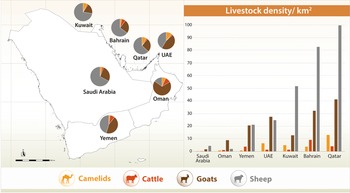
The Arabian Peninsula occupies an area of 3.2 million km2 and is home to about 78 million people (26 inhabitants km−2) across Bahrain, Kuwait, Yemen, United Arab Emirates (UAE), Qatar, Oman, and the Kingdom of Saudi Arabia (hereafter Saudi Arabia, World Population Review, 2026). Much of the Arabian Peninsula is extremely dry: approximately 32% of its area is hyper-arid, 67% arid and only ~1–2% semi-arid, with virtually no sub-humid zones (Kotwicki and Al Sulaimani, Reference Kotwicki and Al Sulaimani2009; Figure 1). Pastoralism represents the dominant land use, and less than 2% of the land supports crop production (Abdullah et al., Reference Abdullah, Bakhashwain, Basuhail and Aslam2015). The region is dominated by rangelands, even though the combined agriculture, forestry and fishing sectors contribute relatively little to national GDP (Yemen: 28.7%, Saudi Arabia and Oman: 2.7%, remaining countries: 0.2–0.7%; https://data.worldbank.org/indicator/). Sheep and goats constitute more than half of the livestock population across the region, and livestock density declines with increasing land area (Figure 2). Despite widespread livestock husbandry, countries of the Arabian Peninsula import a very high share of their total food requirements (including grains, pulses and animal products). For example, Saudi Arabia imports nearly 80% of its food, and the Gulf Cooperation Council states more broadly rely on imports for more than 85% of staple food consumption (Al-Handhali and Miniaoui, Reference Al-Handhali, Miniaoui and Miniaoui2020; World Economic Forum, 2025).
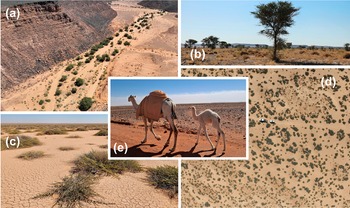
(a)–(d) Rangeland landscapes in the Kingdom of Saudi Arabia (King Salman Bin Abdulaziz Royal Reserve: Photographs: Kasper Johansen); (e) camels are critically important animals in Arab culture, but high densities have been blamed for overgrazing (Photograph: David J Eldridge).

Relative proportion of different livestock types and their density across the seven countries of the Arabian Peninsula. Data sources: Bahrain: https://www.data.gov.bh/explore/dataset/02-statistics-of-livestock-indicators/table/; Kuwait: https://rr-middleeast.woah.org/en/about-us/regional-members-of-woah/kuwait/; Yemen: https://rr-middleeast.woah.org/en/about-us/regional-members-of-woah/yemen/; UAE: https://www.statista.com/statistics/1379629/uae-number-of-livestock-by-type/; Qatar: https://www.statista.com/statistics/1378314/qatar-number-of-livestock-by-type/; Oman: https://rr-middleeast.woah.org/en/about-us/regional-members-of-woah/oman/; Saudi Arabia: https://rr-middleeast.woah.org/en/about-us/regional-members-of-woah/saudi-arabia/.

Despite its modest economic contribution today, livestock husbandry remains central to cultural identity and social cohesion across the Arabian Peninsula, linking contemporary livelihoods with centuries-old Bedouin traditions and shaping the region’s relationship with its arid landscapes (Gardner and Finan, Reference Gardner and Finan2004). For more than a millennium, pastoral societies relied on adaptive nomadic and transhumant systems grounded in customary institutions such as al hima. In Arabic, hima literally means ‘to bring under protection’ and refers to a protected grazing reserve established by a village or tribal group (Vincent, Reference Vincent2008) that regulated access to grazing lands, water and fuelwood, and maintained ecological balance in inherently low-productivity environments (Gari, Reference Gari2006; Kilani et al., Reference Kilani, Serhal and Llewellyn2007). Classical hima governance required legitimate authority, a clear public benefit and rules that avoided undue hardship to local users; the system was deliberately designed to be flexible and adaptable to local needs. Documented variants of al hima include complete grazing bans with permitted fodder cutting in drought years, seasonal access regimes, limits on the number/type of livestock, beekeeping reserves with flowering-season exclusions and forest/woody protection hima where tree cutting is tightly restricted (Vincent, Reference Vincent2008).
Since the mid-20th century, however, profound social, economic and policy transformations have disrupted these institutions. Mobile herding systems managed by Bedouin families have increasingly been replaced by larger, more sedentary and capital-intensive operations, often dependent on hired labour and subsidised feed (Al-Eisa, Reference Al-Eisa, Squires and Sidahmed1998; Finan and Al Haratani, Reference Finan, Al Haratani, Squires and Sidahmed1998; Cole, Reference Cole and Niblock2015). Government support for barley and other inputs has encouraged herd expansion and reduced reliance on seasonal mobility, effectively decoupling livestock numbers from local forage availability (Al-Eisa, Reference Al-Eisa, Squires and Sidahmed1998). At the same time, the erosion of tribal control over grazing and water resources, restrictions on herd movement, mechanised transport, and improved communications have facilitated access to distant rangelands while undermining traditional rotational practices (Meir and Tsoar, Reference Meir and Tsoar1996). Increasing sedentarisation near urban centres for access to services, together with reliance on road transport and foreign labour, has further weakened the mobility that historically sustained rangeland productivity (Blench, Reference Blench, Squires and Sidahmed1998; Bourn, Reference Bourn2003).
The ecological consequences of these changes have been profound. Over the past half-century, the decline of the al hima system has coincided with extensive degradation driven by chronic overgrazing from unmanaged herds of goats, sheep and camels (Al-Rowaily et al., Reference Al-Rowaily, El-Bana and Al-Dujain2012, Ball and Tzanopoulos, Reference Ball and Tzanopoulos2020, Finan and Al Haritani Finan and Al Haratani, Reference Finan, Al Haratani, Squires and Sidahmed1998). Many rangelands are now dominated by unpalatable species, while formerly diverse shrublands – crucial for maintaining soil function and habitat quality (Eldridge et al., Reference Eldridge, Ding, Dorrough, Delgado-Baquerizo, Sala, Gross, le Bagousse-Pinguet, Mallen-Cooper, Saiz, Asensio, Ochoa, Gozalo, Guirado, García-Gómez, Valencia, Martínez-Valderrama, Plaza, Abedi, Ahmadian, Ahumada, Alcántara, Amghar, Azevedo, Ben Salem, Berdugo, Blaum, Boldgiv, Bowker, Bran, Bu, Canessa, Castillo-Monroy, Castro, Castro-Quezada, Cesarz, Chibani, Conceição, Darrouzet-Nardi, Davila, Deák, Díaz-Martínez, Donoso, Dougill, Durán, Eisenhauer, Ejtehadi, Espinosa, Fajardo, Farzam, Foronda, Franzese, Fraser, Gaitán, Geissler, Gonzalez, Gusman-Montalvan, Hernández, Hölzel, Hughes, Jadan, Jentsch, Ju, Kaseke, Köbel, Lehmann, Liancourt, Linstädter, Louw, Ma, Mabaso, Maggs-Kölling, Makhalanyane, Issa, Marais, M, Mendoza, Mokoka, Mora, Moreno, Munson, Nunes, Oliva, Oñatibia, Osborne, Peter, Pierre, Pueyo, Emiliano Quiroga, Reed, Rey, Rey, Gómez, Rolo, Rillig, le Roux, Ruppert, Salah, Sebei, Sharkhuu, Stavi, Stephens, Teixido, Thomas, Tielbörger, Robles, Travers, Valkó, van den Brink, Velbert, von Heßberg, Wamiti, Wang, Wang, Wardle, Yahdjian, Zaady, Zhang, Zhou and Maestre2024) – have declined due to excessive browsing by camels (Gallacher and Hill, Reference Gallacher and Hill2006) and unsustainable fuelwood collection (Amin, Reference Amin2004). This has led to reductions in vegetation structure and habitat quality (Ball and Tzanopoulos, Reference Ball and Tzanopoulos2020; Belgacem et al., Reference Belgacem, Alharbi, Alhajoj, Alruwaili and Njeru2023). Today, more than 60% of the area of rangelands are moderately to severely degraded (Al-Rowaily et al., Reference Al-Rowaily, El-Bana, Al-Bakre, Assaeed, Hegazy and Ali2015) due to heavy and prolonged pressure from overgrazing, fuelwood cutting and cultivation (Al-Rowaily et al., Reference Al-Rowaily, Assaeed, Al-Khateeb, Al-Qarawi and Al Arifi2018). This degradation also undermines conservation efforts, as loss of forage limits the recovery and reintroduction of native ungulates such as the Arabian and Nubian oryx (Abuzinada, Reference Abuzinada2003; Al Kharusi et al., Reference Al Kharusi, AlZahlawi, AlDhaheri and Javed2017; Alatawi, Reference Alatawi2022). Furthermore, the large number of livestock grazers also put at risk ongoing greening efforts being carried out across the Arabian Peninsula, such as the Saudi and Middle East Greening Initiatives (Blanco-Sacristán et al., Reference Blanco-Sacristán, García, Johansen, Maestre, Duarte and McCabe2024).
Traditionally, most countries in the region lacked national policy frameworks for sustainable rangeland management. However, policy responses are now evolving, particularly in Saudi Arabia, which occupies about two-thirds of the Peninsula and has an outsized influence on regional land use. The adoption of sustainable practices in livestock management is increasing in Saudi Arabia (Yusuf et al., Reference Yusuf, Kooli, Khoj and Bajnaid2025), and the establishment of the National Center for Vegetation Cover and Desertification Control and its General Department of Natural Rangelands signals renewed commitment to protecting and restoring Saudi rangelands (https://ncvc.gov.sa/en/AboutCenter/Overview/Pages/default.aspx). At the same time, food-security strategies are also driving investments in large-scale livestock production (e.g. the planned Hafr Al-Batin ‘livestock city’ expected to supply ~30% of national red-meat demand; SAB, 2025), potentially shifting attention away from rangeland-based pastoral systems.
A new vision for pastoralism in the Arabian Peninsula is needed to improve rangeland condition, ecosystem sustainability, ensure food security, and improve the livelihood of pastoralists and the health of their livestock (Alnafissa et al., Reference Alnafissa, Alotaibi, Aldawdahi, Imran and Muddassir2024). These activities are also essential to address land degradation in the region and to meet national targets related to biodiversity, climate change and desertification (Maestre et al., Reference Maestre, Guirado, Armenteras, Beck, AlShalan, Al-Saud, Chami, Fu, Gichenje, Huber-Sannwald, Speranza, Martínez-Valderrama, McCabe, Orr, Tang, Metternicht, Miess, Reynolds, Stringer, Wada and Duarte2025). Emerging experience within the region and worldwide suggests that the most suitable way to manage rangelands is through sustainable pastoral livestock production incentivised for both livestock and non-livestock values (Koocheki and Gliessman, Reference Koocheki and Gliessman2005; Louhaichi et al., Reference Louhaichi, Belgacem and Gamoun2021). This vision requires a change in livestock sector strategies to promote sustainable intensification of pastoralism that strengthens the productivity and resilience of herding communities while safeguarding the ecosystem services that underpin livestock production and contribute to wider societal benefits.
In this perspective, we discuss how pastoralism in the Arabian Peninsula has evolved and how it can transition toward sustainability under contemporary pressures. These pressures are immense and diverse, and include the effects of regional power politics, tribal loyalties and religious rivalry on local politics (Bano, Reference Bano2024), potential fears that Saudi Arabia’s Vision 2030 will reshape the kingdom cultural and economic identity, changing allegiances among the Gulf States (Al-Khulaifi, Reference Al-Khulaifi2025), and apprehension over the pace of change across many large cities in the Peninsula (Al Mokdad, Reference Al Mokdad and Al Mokdad2025). We examine the historical foundations of nomadic and transhumant systems, particularly the al hima tradition, and analyse the drivers that have reshaped them, including policy reforms, demographic shifts, technological change and climate stress. We identify the ecological and social impediments to sustainable pastoralism and consider some actions that could enhance outcomes for rangelands, livestock and conservation in the extensive rangelands of the Arabian Peninsula. Our context is the seven countries that make up the Peninsula, but due to its geographical extent and geopolitical influence (Chaziza and Lutmar, Reference Chaziza and Lutmar2025), we pay particular attention to Saudi Arabia. Our overarching aim is to provide a framework for sustainable pastoralism that aligns ecological resilience, cultural heritage and socio-economic viability, while identifying key priorities for research, policy and management to guide rangeland stewardship across the Arabian Peninsula in the coming decades.
The material presented in this perspective is based on the authors’ extensive experience in the Middle East with UN agencies, NGOs, government organisations and consultancy groups, and supported by limited literature searches. We did not undertake an exhaustive meta-analysis of existing data. Rather, we used the Web of Science with the keywords Saudi Arabia/Arabian Peninsula and the terms ‘rangeland’, ‘grazing’, ‘hima’, ‘degradation’ to search for current relevant literature on the biophysical attributes of the Arabian Peninsula and their links to social and economic factors. From a total pool of 10,843 publications, we identified 208 suitable publications from which we drew the most relevant material.
Towards sustainable pastoralism in the Arabian Peninsula
Rangeland development actions during the latter half of the 20th century focused on restricting pastoral mobility and promoting privatisation of communal rangelands (Niamir-Fuller, Reference Niamir-Fuller1999). By the 1990s, however, recognition of the ecological and economic value of herd mobility began to grow, leading to renewed efforts to support communal herding systems in countries such as Mongolia, Kyrgyzstan, Ethiopia and Kenya (Davies et al., Reference Davies, Ogali, Laban and Metternicht2015). Similar opportunities now exist in the Arabian Peninsula to reconcile mobility with modern land governance, particularly as urban expansion and market access have concentrated herds around towns and water points, reducing both autonomy and resilience among herders (Cole, Reference Cole and Niblock2015).
In recent decades, new insights from ecology and social science have reinforced the logic of mobility and collective management (Turner and Schlecht, Reference Turner and Schlecht2019; Manzano et al., Reference Manzano, Kathleen and Cabeza2020). Ecological studies highlight the central role of herbivores (generally ungulates) in maintaining rangeland function and the importance of balancing grazing with rest periods to sustain productive vegetation (Briske et al., Reference Briske, Fuhlendorf and Smeins2005; Gillson and Hoffman, Reference Gillson and Hoffman2007; di Virgilio et al., Reference di Virgilio, Lambertucci and Morales2019; Behnke, Reference Behnke2021). Economic research also demonstrates that communal governance and flexible herd movements enable pastoralists to cope with environmental variability and resource uncertainty, supporting long-term livelihood security (Roe et al., Reference Roe, Huntsinger and Labnow1998; Scoones, Reference Scoones2023). Despite major transformations in pastoral practices, livestock production will remain the dominant land use across the Peninsula (Bourn, Reference Bourn2003), with mobility continuing to offer the best means of exploiting variable rainfall and forage availability (Ahmad, Reference Ahmad, Squires and Sidahmed1998).
To ensure that pastoralism remains both viable and sustainable, a new generation of policies and institutions is required (Blench, Reference Blench2001). These include strategies that combine pastoralism and conservation, ecologically sensitive tourism that integrates indigenous knowledge, and the development of niche pastoral products. Equally important are clear national strategies for the livestock sector, improved education and training to strengthen local scientific capacity, and land-tenure reforms that respect traditional Bedouin customs while clarifying rights and responsibilities. A deeper understanding of rangeland dynamics – through frameworks such as state-and-transition models and improved diagnosis of degradation types – will also help design cost-effective restoration and herding strategies adapted to local conditions.
Recent developments in rangeland ecology highlight promising synergies between livestock production and biodiversity conservation that remain underdeveloped in the region. Well-managed grazing can enhance ecological processes such as nutrient cycling, seed dispersal and removal of senescent biomass (Oba et al., Reference Oba, Stenseth and Lusigi2000), yet these benefits depend on grazing intensity, herbivore assemblage and historical adaptation of ecosystems to grazing (Toulmin et al., Reference Toulmin, Hesse and Cotula2004; Oba, Reference Oba2012; Nori and Scoones, Reference Nori and Scoones2023). Conservation of biodiversity in the Arabian Peninsula currently sees livestock as a problem to be prevented, rather than as a potential solution to be enabled (Alatawi, Reference Alatawi2022). Lessons from other regions (e.g. Metera et al., Reference Metera, Sakowski, Słoniewski and Romanowicz2010), together with growing acceptance of Other Effective Area-based Conservation Measures, that is, areas that provide biodiversity benefits but where conservation is not necessarily the primary management objective (Brodie et al., Reference Brodie, Deith, Burns, Goetz, Cunningham, Hill, Reynolds and Mohd-Azlan2025), can inspire new approaches to community-based restoration and conservation that are more compatible with the livelihood goals of pastoralists.
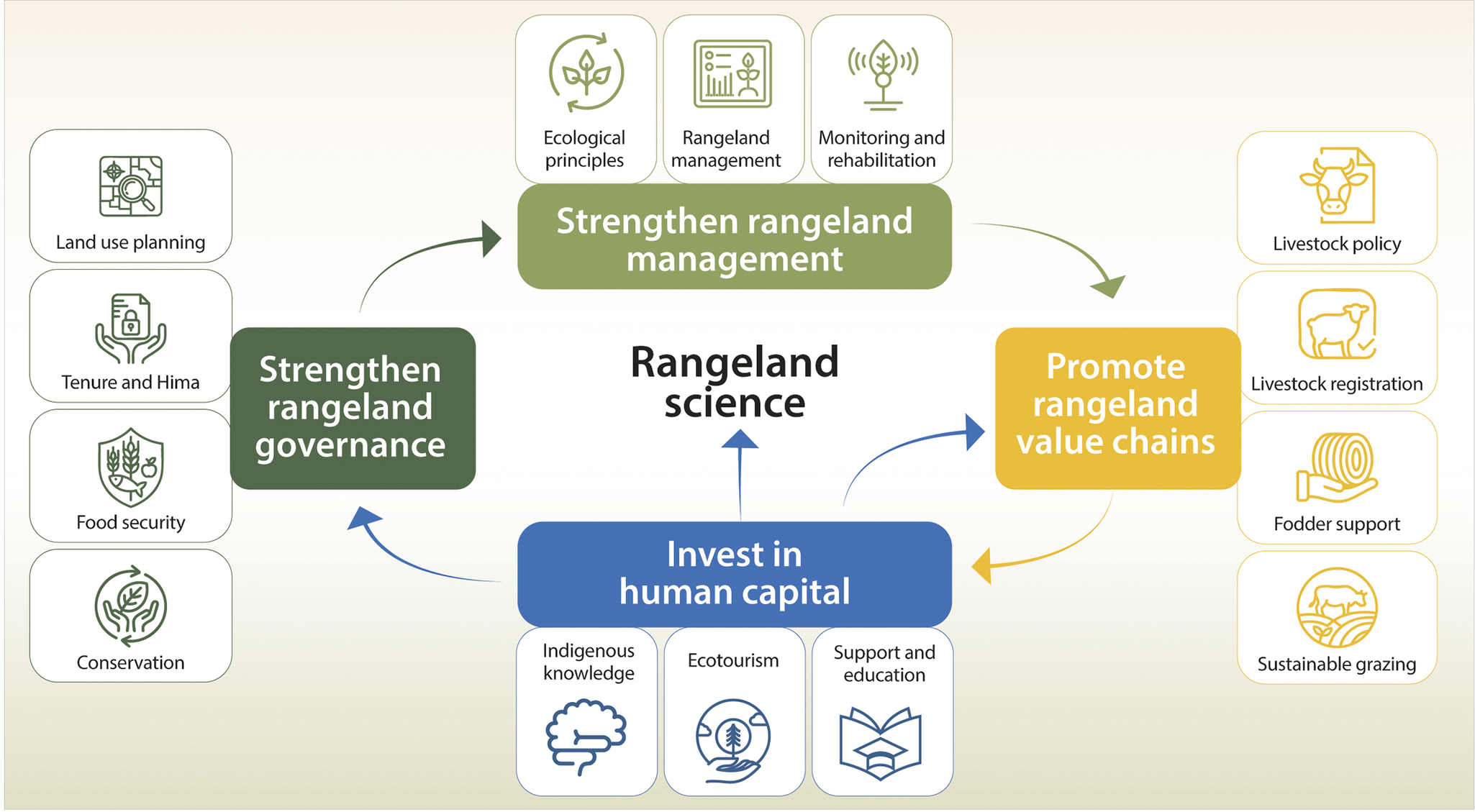
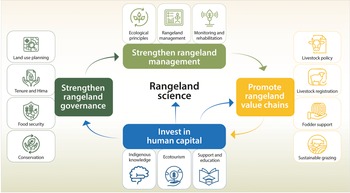
Below we present a simple framework to guide actions for sustainable rangeland management in the Arabian Peninsula (Figure 3). This framework centres on four mutually reinforcing pillars: (1) develop the science of rangeland management and restoration, (2) strengthen communal governance of rangeland resources, (3) promote value chains for livestock and non-livestock products, and (4) build human and institutional capacity. Collectively, these pillars provide a roadmap for revitalising pastoralism in the region – one that integrates ecological knowledge, social equity and long-term economic sustainability.
The four pillars of sustainable rangelands: strengthen rangeland management, promote value chains for livestock and non-livestock products, invest in human capital and infrastructural support, and strengthen rangeland governance.
Strengthen rangeland science in the Arabian Peninsula
Robust environmental monitoring of rangeland status (condition) and degree of change (trend) is critical to detect and reverse degradation while avoiding the ‘shifting baseline’ syndrome (Soga and Gaston, Reference Soga and Gaston2024). Without explicit reference conditions and intergenerational knowledge, each generation normalises a degraded state and sets weak targets, limiting true rehabilitation. Baselines should therefore be defined for each ecosystem type and region, grounded in historical records, oral histories and early remote-sensing data (e.g. the Landsat archive, Wulder et al., Reference Wulder, White, Loveland, Woodcock, Belward, Cohen, Fosnight, Shaw, Masek and Roy2016), and expressed as dynamic ranges rather than fixed values. Adaptive management provides the framework for using these baselines effectively, viewing management as an iterative process of learning by doing (Holling, Reference Holling1978). Within this framework, state-and-transition models operationalise adaptive management by documenting alternative ecosystem states, thresholds and reversible shifts, linking field indicators to specific management decisions (Bestelmeyer et al., Reference Bestelmeyer, Ash, Brown, Densambuu, Fernández-Giménez, Johanson, Levi, Lopez, Peinetti, Rumpff, Shaver and Briske2017).
State-and-transition models help distinguish between (i) truly degraded systems that require substantial external inputs, such as erosion control, reseeding, or biocrust protection, and (ii) sub-optimal but stable states that can recover naturally under improved grazing regimes (e.g. Briske et al., Reference Briske, Fuhlendorf and Smeins2005, Bestelmeyer et al., Reference Bestelmeyer, Ash, Brown, Densambuu, Fernández-Giménez, Johanson, Levi, Lopez, Peinetti, Rumpff, Shaver and Briske2017). The ecological case for sustained investment in monitoring is clear. Establishing standardised surveys is essential for setting sustainable stocking targets, assessing restoration outcomes, and evaluating climate and land-use impacts (e.g. Herrick et al., Reference Herrick, Schuman and Rango2006; Tongway, Reference Tongway2010; Tongway and Ludwig, Reference Tongway and Ludwig2011). Yet, despite the multiple botanical, zoological and ecological studies conducted in the region since the 1960s (discussed in Blanco-Sacristán et al., Reference Blanco-Sacristán, García, Johansen, Maestre, Duarte and McCabe2024), the Arabian Peninsula still lacks coordinated, national and region-wide monitoring networks. This is an important gap that must be addressed in the region. In section Improve organisational capacity and capability in local scientists, we discuss the importance of capacity building to establish locally led monitoring programmes.
Within this adaptive management framework, rehabilitation becomes a pragmatic objective for many degraded drylands. Expectations must be realistic: once ecological thresholds have been crossed, heavily degraded systems are unlikely to return to their historical states. Rather than attempting to recreate past vegetation compositions, the goal should be to guide systems toward functional, stable states – potentially novel or semi-natural – capable of sustaining key ecosystem processes and pastoral livelihoods (Aronson et al., Reference Aronson, Floret, Le Floc’h, Ovalle and Pontanier1993). In hyper-arid and arid rangelands of Saudi Arabia, this perspective is increasingly reflected in management strategies that prioritise restoring ecosystem function – such as forage provision, soil stability, and hydrological regulation – over re-establishing historical vegetation assemblages that may no longer be attainable under current climatic and socio-economic conditions (Sayed et al., Reference Sayed, Masrahi and Remesh2026).
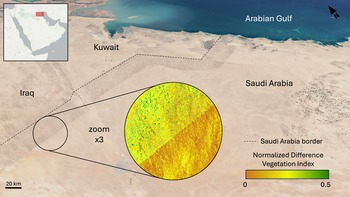
In addition to developing rangeland monitoring approaches in the Arabian Peninsula, further research is needed to identify economically feasible options for sustainable intensification as an alternative to attempting full restoration of former vegetation states. Rangelands of the Arabian Peninsula often prove to be surprisingly resilient, but only where grazing pressure tracks rainfall and resting periods are respected (Al-Rowaily et al., Reference Al-Rowaily, El-Bana, Al-Bakre, Assaeed, Hegazy and Ali2015). For example, shrub-annual pasture systems dominated by Haloxylon salicornicum on gravel and shallow substrates can regenerate rapidly when pressure is reduced, exhibiting classic “nurse” effects and multi-year recovery dynamics (Gomaa et al., Reference Gomaa, Hegazy and Latef2020). However, in central Saudi Arabia, Haloxylon communities are under increasing pressure from chronic overuse, which reinforces the need for adaptive grazing and site-specific resting regimes (Al-Rowaily et al., Reference Al-Rowaily, El-Bana, Al-Bakre, Assaeed, Hegazy and Ali2015). Longitudinal studies across Gulf states and northern Arabia confirm that intensive camel grazing suppresses shrubs and small perennials, whereas mixed-herbivore assemblages or reductions in stocking promote faster recovery. For example, in northern Saudi Arabia, an experiment at Al-Mayla found that short-period grazing by mixed camel and sheep herds on a long-enclosed rangeland did not significantly damage vegetation cover or productivity, likely because the grazing pressure was carefully managed relative to available forage (Belgacem et al., Reference Belgacem, Alharbi, Alhajoj, Alruwaili and Njeru2023). Similarly, exclosure and fenceline studies in the UAE (Gallacher and Hill, Reference Gallacher and Hill2006; El-Keblawy et al., Reference El-Keblawy, Ksiksi and El Alqamy2009) and remote-sensing observations along the Kuwait-Saudi Arabia border (Figure 4) demonstrate that vegetation can rebound quickly once heavy livestock grazing is curtailed. Such studies also show that many sandy and gravel soils retain high recovery potential if given sufficient rest, even though full species composition may take years to decades to return (Gallacher and Hill, Reference Gallacher and Hill2006). These findings bolster the view that many Arabian drylands are grazing adapted but not grazing dependent. Rainfall variability remains the primary driver, consistent with non-equilibrium theory and global grazing models (Vetter, Reference Vetter2005).
A section of the border between Kuwait and Saudi Arabia showing the 20-km-wide exclusion zone. Inset shows the major difference in NDVI in the exclusion zone resulting from greater plant cover.

Extending this functional and adaptive perspective to restoration initiatives is particularly important in current conservation and “re-greening” agendas. Tree planting is often promoted as a rapid method to rehabilitate degraded drylands (Blilou and Hirt, Reference Blilou and Hirt2023; Ellison and Speranza, Reference Ellison and Speranza2020). However, from state-and-transition and ecosystem function perspectives, indiscriminate afforestation can push open rangelands into alternative states that are neither historically accurate nor ecologically desirable, as they can generate serious ecological and hydrological consequences (Cao, Reference Cao2008; Lu et al., Reference Lu, Zhao, Shi and Cao2018). National tree-cover targets can unintentionally harm non-forest rangelands if they incentivise afforestation where grassy or shrub-steppe ecosystems are natural (Fesenmyer et al., Reference Fesenmyer, Poor, Terasaki Hart, Veldman, Fleischman, Choksi, Archibald, Armani, Fagan, Fricke and Terrer2025). Global syntheses suggest that tree planting in open biomes can reduce biodiversity and water yields, particularly in drylands (Veldman et al., Reference Veldman, Overbeck, Negreiros, Mahy, Le Stradic, Fernandes, Durigan, Buisson, Putz and Bond2015; Moyano et al., Reference Moyano, Dimarco, Paritsis, Peterson, Peltzer, Crawford, McCary, Davis, Pauchard and Nuñez2024). Hydrologic analyses show that streamflow, water runoff, and soil moisture can decline after afforestation (Farley et al., Reference Farley, Jobbágy and Jackson2005; Veldman et al., Reference Veldman, Overbeck, Negreiros, Mahy, Le Stradic, Fernandes, Durigan, Buisson, Putz and Bond2015; Zhang et al., Reference Zhang, Yang, Yang, Piao, Yang, Lei and Fu2018), highlighting a fundamental trade-off that is especially critical where water scarcity already constrains ecosystem function and pastoral livelihoods.
In contrast, approaches that align with adaptive grazing management and historical ecosystem structure are more consistent with realistic rehabilitation goals. Supporting the regeneration of historically present trees and woodlands at ecologically appropriate densities can enhance ecosystem function without fundamentally transforming open rangelands (Assèdé et al., Reference Assèdé, Sileshi, Chirwa, Orou, Syampungani, Chirwa, Syampungani and Mwamba2024). For example, Farmer-Managed Natural Regeneration has proven highly successful across African drylands by enabling farmers and pastoralists to protect and manage naturally regenerating trees within agro-pastoral systems (Opoku-Mensah et al., Reference Opoku-Mensah, Ibrahim, Jacobs, Cunningham, Owusu-Ansah and Adjei2024). Comparable strategies are emerging in arid rangelands of the Middle East, including Saudi Arabia, where controlled grazing, resting periods and assisted natural regeneration promote woody recovery while maintaining rangeland function (Al-Rowaily et al., Reference Al-Rowaily, El-Bana, Al-Bakre, Assaeed, Hegazy and Ali2015; Sayed et al., Reference Sayed, Masrahi and Remesh2026). In dryland systems, maintaining scattered trees at densities resembling natural vegetation structure is particularly important. Such trees provide shade and thermal refuge for livestock and pastoralists, buffer extreme heat, and create favourable microclimates (De et al., Reference De, Sharma, Kumawat, Kumar, Mohapatra and Sahoo2020), while avoiding the excessive water consumption associated with dense plantations (Lu et al., Reference Lu, Zhao, Shi and Cao2018). Greening initiatives in the Arabian Peninsula should therefore prioritise natural regeneration and mimic historical tree and shrub densities, ensuring that efforts to increase vegetation cover reinforce – rather than compromise – rangeland resilience and water security.
Promote sustainable pastoralism and value chains for livestock and non-livestock products
Traditionally, Bedouin pastoralists maintained long-distance herd movements following seasonal and inter-annual patterns of precipitation, which were highly unpredictable due to the aridity of their environment. Nomadic and transhumant practices were underpinned by tribal control over range resources, including enforcement of grazing restrictions on key sites at certain times of year (Al-Rowaily, Reference Al-Rowaily1999). Herding communities divided their rangeland landscapes into distinct regions and moved animals between them according to available pasture and water, a rotational grazing system called Ahmieh. Rotating herds between these regions protected them from overgrazing (Abo-Hassan, Reference Abo-Hassan1981).
The traditional nomadic system has broken down since a 1953 government decree to abolish the old nomadic al hima system leading to open access to all rangelands. Loss of mobility and concentration of herds in specific locations was exacerbated by provision of supplementary feed and water tankers. Mechanised transport allowed animals to be moved rapidly to remote pastures and sustained there for longer periods than was sustainable. Furthermore, new national boundaries, privatisation of land, land fencing and conversion of small but vital resource areas to crop cultivation have all restricted pastoralist movements (Al-Rowaily, Reference Al-Rowaily1999).
Subsidies for Bedouins have been an important mechanism to compensate them for foregoing a previous nomadic life and a regular income during the country’s rapid period of urbanisation (Mann, Reference Mann2015), releasing them from their rigid tribal structure (Jetter, Reference Jetter2008). With the Bedouin population in Saudi Arabia now estimated at 1.21 million (~3.4% of the total) (Mann, Reference Mann2015), the role of subsidies is deeply entrenched. While eliminating subsidies outright is politically and socially fraught, a more viable pathway would be to restructure or redirect subsidies towards incentives for sustainable grazing. Rather than unconditional support for fodder, payments could be tied to metrics such as vegetation cover, rotational grazing compliance, plot rest periods, or participation in rangeland restoration practices. In effect, the same fiscal resources could reward good stewardship rather than indiscriminate livestock concentration. In Jordan, for example, reducing barley subsidies in 2007 did lead to a roughly 50% decline in sheep numbers in the Northern Badia (Jetter, Reference Jetter2008). This suggests that subsidised fodder does influence herd size, but it also illustrates the risks of blunt subsidy removal for pastoral livelihoods. A better alternative may lie in performance-based subsidies, or payments for ecosystem services that reward pastoralists who adopt management practices consistent with rangeland health. Sustainable pastoral management must also be supported by the development of value chains for livestock and non-livestock goods and services, to provide pastoralists with food and income security, and to encourage the management of rangelands for both food and environmental outcomes (Davies et al., Reference Davies, Ogali, Laban and Metternicht2015).
As discussed above, excluding livestock and wild herbivores may also be a mechanism to improve rangeland function and condition (e.g. Al-Rowaily et al., Reference Al-Rowaily, El-Bana, Al-Bakre, Assaeed, Hegazy and Ali2015). The effects of this are apparent when one considers areas that have been excluded from grazing for security and other reasons (Figure 4). However, this will be practical in most cases and could only be feasible in small or particular (e.g. National Parks) areas. A system of opportunistic grazing for 90 days in spring may be a more effective way to reduce degradation and control overgrazing (Ahmad, Reference Ahmad, Squires and Sidahmed1998; Gari, Reference Gari2006) across the Arabian Peninsula, as long as grazing pressure is matched to available pasture production. Indeed high-intensity, short-duration grazing with mixed camel herds and sheep herds has been shown to have both rangeland production and social benefits for semi-sedentary pastoralists (Belgacem et al., Reference Belgacem, Alharbi, Alhajoj, Alruwaili and Njeru2023). Similarly, deferred grazing systems, which incorporate rest periods to allow vegetation regeneration, have demonstrated positive outcomes for both rangeland condition and pastoral livelihoods (Gamoun et al., Reference Gamoun, Patton and Hanchi2015). By contrast, livestock exclusion may serve as a longer-term restoration option for severely degraded sites (Shaltout et al., Reference Shaltout, El-Halawany and El-Kady1996; Al-Yasi, Reference Al-Yasi2024), though the ecological advantages of exclosures often diminish over extended periods once initial recovery plateaus (El-Keblawy and Alsharhan, Reference El-Keblawy and Alsharhan2003). A mosaic approach that combines temporary resting, adaptive stocking and selective exclusion therefore offers the greatest potential for balancing rangeland recovery with pastoral sustainability across the Arabian Peninsula. In many respects, the traditional al hima system embodied core principles of adaptive management, including flexible access rules, seasonal resting and locally enforced compliance mechanisms that adjusted to environmental variability (Vincent, Reference Vincent2008).
Sustainable pastoral management was traditionally communal and has been undermined by limited legal recognition and insufficient institutional support for commons governance institutions (Haddad, Reference Haddad, Herrera, Davies and Baena2014; Herrera et al., Reference Herrera, Davies and Manzano Baena2014). Historically, government agencies and researchers tended to view commons as fostering unclear land ownership and ambiguous responsibility (Ngaido, Reference Ngaido1997). However, recognition of the strengthen of customary institutions for commons governance has developed strongly since publication of Ostrom’s Nobel Prize winning work (Ostrom, Reference Ostrom2014). For example, the FAO Technical Guide to implementing the Voluntary Guidelines on Responsible Governance of Tenure in pastoral lands (Davies et al., Reference Davies, Herrera, Ruiz-Mirazo, Mohamed-Katerere, Hannam and Nuesiri2016) emphasises the importance of the commons for pastoralist resilience and recommends securing rangeland commons as a cornerstone to achieving sustainable development. This guide highlights the complexity of commons governance and the emergence of legal recognition for customary institutions that have traditionally enabled commons to be managed effectively.
Across the Arabian Peninsula, the challenge is therefore not simply institutional capacity but institutional alignment. Responsibilities for rangelands are often distributed among different government entities responsible for agriculture, environment, conservation, water management and forestry, which can complicate the establishment of coordinated planning and actions. Catchment-level management, mobility corridors and seasonal grazing reserves frequently fall between sectoral mandates. At the same time, pastoralist communities in some areas face tenure insecurity or limited participation in formal decision-making processes, constraining their ability to invest in long-term stewardship (Boutaleb and Firmian, Reference Boutaleb, Firmian, Herrera, Davies and Baena2014; Herrera et al., Reference Herrera, Davies and Manzano Baena2014). Strengthening sustainable pastoralism in the region will therefore require clearer cross-sector coordination, formal recognition of communal grazing arrangements where appropriate, and policy frameworks that integrate customary governance with national restoration and development strategies.
Tenure insecurity in the Arab region is reportedly the highest in the world, and State land is poorly defined in Arab countries. An estimated 70–80 per cent of all land in the region is considered public or government-owned, although data on state land distribution are unreliable. There is a gap between de jure and de facto land rights and use rights on public land and many countries have overlapping institutional mandates. Particular gaps are found in the recognition and registration of women’s land rights (Zimmermann, Reference Zimmermann2022).
Gaps in land institutions erode communal ownership and customary land governance and enable inequitable land acquisitions. Public institutions in most Arab countries have weak financial and technical capacities, weak coordination mechanisms, and outdated regulatory frameworks governing land. Many countries experience legal plurality with contradictory statutory, customary and religious laws, which creates an environment in which disputes over land and natural resources can constitute a major threat to tenure security. Much rangeland in the region is not legally documented, although data on the exact proportion are uncertain (Kechen and Samaha, Reference Kechen and Samaha2022).
Sustainable management of rangelands is frequently obstructed by weaknesses in governance. Public decision-making in several countries is constrained by overlapping institutional mandates and weak institutional capacity, as discussed above. Community decision-making over the management of the commons may be constrained by land-tenure insecurity or lack of legitimacy of local organisations. Pastoralists are marginalised populations in many countries and face constraints to their capacity and opportunity to participate in public consultations and decision-making (Herrera et al., Reference Herrera, Davies and Manzano Baena2014; Boutaleb and Firmian, Reference Boutaleb, Firmian, Herrera, Davies and Baena2014).
Build institutional capacity, networks, monitoring systems and local capability
Sustainable pastoral management across the Arabian Peninsula requires a decisive shift towards training and mentoring national scientists and front-line government staff. This will ensure that critical projects are designed, executed and analysed locally rather than outsourced, and that data retained in the host country. An important focus of a new pastoral regime would be to build capacity in land management within organisations such as the Ministry of Environment, Water and Agriculture (Saudi Arabia), the Ministry of Climate Change and Environment (UAE), and the Environment Authority (Oman), and to improve capability of their staff. The aim of this learning and co-learning is to remove environmental organisations and their agencies from the burden of employing consultants to undertake environmental work associated with pastoral enterprises. Strengthening local capacity can enhance local ownership, control, continuity and long-term stewardship of rangelands rather than relying on international experts. We focus here on two key initiatives: (1) environmental training for local experts and (2) empowering Bedouins to take a greater role in environmental assessment and rangeland management.
Improve organisational capacity and capability in local scientists
Across the Arabian Peninsula, and much of the Middle East – North Africa (MENA) region, capacity in terrestrial ecology has grown far more slowly than in the marine sciences, where institutions such as King Abdullah University of Science and Technology (KAUST) have become leading centres of marine biodiversity research and sustainable resource management. This imbalance has left major knowledge gaps on how rangelands are changing under the combined pressures of grazing and climate stress.
New national and regional initiatives are beginning to address this gap. Saudi Arabia’s National Center for Vegetation Cover and Desertification Control (NCVC) and KAUST launched SAUDINet in 2025 to create a coordinated network for the study of terrestrial ecosystems across this country (https://spa.gov.sa/en/N2279335), with the explicit aim to train NCVC’s workforce and generate decision-quality evidence for land managers and policy makers. Embedding SAUDINet’s protocols, adapted from monitoring frameworks rigorously tested in drylands worldwide (Maestre et al., Reference Maestre, Le Bagousse-Pinguet, Delgado-Baquerizo, Eldridge, Saiz, Berdugo, Gozalo, Ochoa, Guirado, García-Gómez and Valencia2022; Eldridge et al., Reference Eldridge, Ding, Dorrough, Delgado-Baquerizo, Sala, Gross, le Bagousse-Pinguet, Mallen-Cooper, Saiz, Asensio, Ochoa, Gozalo, Guirado, García-Gómez, Valencia, Martínez-Valderrama, Plaza, Abedi, Ahmadian, Ahumada, Alcántara, Amghar, Azevedo, Ben Salem, Berdugo, Blaum, Boldgiv, Bowker, Bran, Bu, Canessa, Castillo-Monroy, Castro, Castro-Quezada, Cesarz, Chibani, Conceição, Darrouzet-Nardi, Davila, Deák, Díaz-Martínez, Donoso, Dougill, Durán, Eisenhauer, Ejtehadi, Espinosa, Fajardo, Farzam, Foronda, Franzese, Fraser, Gaitán, Geissler, Gonzalez, Gusman-Montalvan, Hernández, Hölzel, Hughes, Jadan, Jentsch, Ju, Kaseke, Köbel, Lehmann, Liancourt, Linstädter, Louw, Ma, Mabaso, Maggs-Kölling, Makhalanyane, Issa, Marais, M, Mendoza, Mokoka, Mora, Moreno, Munson, Nunes, Oliva, Oñatibia, Osborne, Peter, Pierre, Pueyo, Emiliano Quiroga, Reed, Rey, Rey, Gómez, Rolo, Rillig, le Roux, Ruppert, Salah, Sebei, Sharkhuu, Stavi, Stephens, Teixido, Thomas, Tielbörger, Robles, Travers, Valkó, van den Brink, Velbert, von Heßberg, Wamiti, Wang, Wang, Wardle, Yahdjian, Zaady, Zhang, Zhou and Maestre2024; Gross et al., Reference Gross, Maestre, Liancourt, Berdugo, Martin, Gozalo, Ochoa, Delgado-Baquerizo, Maire, Saiz, Soliveres, Valencia, Eldridge, Guirado, Jabot, Asensio, Gaitán, García-Gómez, Martínez, Martínez-Valderrama, Mendoza, Moreno-Jiménez, Pescador, Plaza, Pijuan, Abedi, Ahumada, Amghar, Arroyo, Bahalkeh, Bailey, Ben Salem, Blaum, Boldgiv, Bowker, Branquinho, van den Brink, Bu, Canessa, ADP, Castro, Castro, Chibani, Conceição, Darrouzet-Nardi, Davila, Deák, Donoso, Durán, Espinosa, Fajardo, Farzam, Ferrante, Franzese, Fraser, Gonzalez, Gusman-Montalvan, Hernández-Hernández, Hölzel, Huber-Sannwald, Jadan, Jeltsch, Jentsch, Ju, Kaseke, Kindermann, le Roux, Linstädter, Louw, Mabaso, Maggs-Kölling, Makhalanyane, Issa, Manzaneda, Marais, Margerie, Hughes, JVS, Mora, Moreno, Munson, Nunes, Oliva, Oñatibia, Peter, Pueyo, Quiroga, Ramírez-Iglesias, Reed, Rey, Reyes Gómez, Rodríguez, Rolo, Rubalcaba, Ruppert, Sala, Salah, Sebei, Stavi, Stephens, Teixido, Thomas, Throop, Tielbörger, Travers, Undrakhbold, Val, Valkó, Velbert, Wamiti, Wang, Wang, Wardle, Wolff, Yahdjian, Yari, Zaady, Zeberio, Zhang, Zhou and le Bagousse-Pinguet2024), within NCVC’s procedures and regional centres, and coupling them with hands-on mentoring, would rapidly expand the cadre of Saudi specialists capable of conducting rangeland inventories, grazing assessments and restoration monitoring. Initiatives such as SaudiNet can be easily expanded to include other national and regional organisations and extrapolated to other countries within the Arabian Peninsula and the MENA region.
Currently, much of the on-the-ground ecological assessment is carried out by international consultancies or foreign teams usually working over short periods in the field. This pattern parallels the region’s broader reliance on expatriate labour, including skilled professional services, documented across the Gulf economies (Wagle, Reference Wagle2024). International firms are also prominent within the environmental-consulting market in countries like Saudi Arabia. While these actors add capacity, an overreliance on foreign teams can keep methods opaque, inflate costs and limit institutional memory inside agencies (Collington and Mazzucato, Reference Collington and Mazzucato2024). Capacity-building programmes designed around locally lead fieldwork, open protocols and mentoring can directly solve or at least minimise these problems.
There is strong evidence that training local indigenous staff improves both data quality and management outcomes in rangelands and other ecosystems. For example, participatory rangeland management programmes in Ethiopia have not only strengthened local institutions but have also enhanced rangeland productivity (Flintan et al., Reference Flintan, Ebro, Eba, Assefa, Getahun, Reytar, Irwin, Yehualashet, Abdulahi, Gebreyohannes, Awgichew and Gudina2019). Targeted training in southern Tunisia has resulted in improved local capacity for rangeland monitoring and assessment, enabling more reliable assessments of vegetation and grazing impacts (Nefzaoui et al., Reference Nefzaoui, El Mourid and Louhaichi2014). Structured monitoring courses in the United States of America have also shown how formal training increases the accuracy and decision-relevance of ecosystem condition assessments (Herrick et al., Reference Herrick, Schuman and Rango2006). Participatory or community-based monitoring conducted by appropriately trained locals produces data that track professional surveys while increasing spatial and temporal coverage and can even influence user behaviour (Danielsen et al., Reference Danielsen, Pirhofer-Walzl, Adrian, Kapijimpanga, Burgess, Jensen, Bonney, Funder, Landa, Levermann and Madsen2014; Pocock et al., Reference Pocock, Roy, August, Kuria, Barasa, Bett, Githiru, Kairo, Kimani, Kinuthia and Kissui2019; Mandeville et al., Reference Mandeville, Nilsen, Herfindal and Finstad2023). Building such approaches into national agencies through tiered certification, mentoring by university partners and clear career pathways would create a durable national monitoring corps and future job opportunities for local people. Consultancy contracts should also include minimum national participation requirements and mandate open access to raw data, code and survey designs. Accrediting national laboratories and regional hubs to manage soil, plant and remote-sensing workflows could also reduce reliance on foreign facilities and accelerate data processing.
Initiatives such as SAUDINet could provide the foundation for a national framework with standardised plot designs, soil and vegetation protocols, and integrated data systems. In Saudi Arabia, there is a clear opportunity to transform pastoral system knowledge into a nationally owned asset by training and mentoring early-career Saudi scientists and government staff through joint university–agency teams under SAUDINet and allied programmes. Such investments would foster consistent data collection and analysis, build rewarding scientific careers, and reduce dependency on external consultants. Most importantly, they would generate the sustained, standardised evidence base required for adaptive pastoral management and ensure that scientific knowledge remains embedded within national institutions – strengthening long-term capacity for evidence-based rangeland governance.
Empower local communities to manage their own natural resources
Organisations such as the Arab Pastoral Communities Network (https://iucn.org/our-work/region/west-asia/our-work/drylands-livelihood-and-gender-programme/arabian-pastoralist-communitiesapcn-network) support projects run by local communities to promote sustainable rangeland management and biodiversity conservation by reviving and developing traditional Arab pastoral knowledge. These models are similar to the Campfire model in South Africa and aim to empower local communities to benefit from managing their own local resources (Hasler, Reference Hasler1999). Bedouin communities in Jordan and Egypt have been supported to establish rangeland reserves through capacity building and organisational development. These reserves are communally managed, and communities depend on being granted long-term management rights by the relevant public bodies that hold the legal title (Haddad, Reference Haddad, Herrera, Davies and Baena2014).
Improving the integration of local knowledge and local people such as the Bedouins into conservation programmes is already happening in the Prince Mohammed bin Salman Royal Reserve in Saudi Arabia. This reserve has established the first female ranger core, with 34% of female rangers (Arab News, https://www.arabnews.com/node/2592922/saudi-arabia). Other examples of local assimilation programmes include the ranger training programme at AlUla, where local Bedouins are trained in wildlife management, remote sensing and ecology. At the Sharab Nature Reserve, rangers of Bedouin heritage undertake patrols and monitoring of environmental and cultural sites after completing training with the College of African Wildlife Management. There are other programmes run by the International Union for the Conservation of Nature (IUCN), designed to build local capacity in reserve management and conservation and are strongly aligned with the Saudi Vision 2030 (https://www.vision2030.gov.sa). Empowering local communities to manage protected areas, potentially as livestock-moulded landscapes, can lead to reductions in livestock numbers and general herd management based on ecological principles to promote natural regeneration. The community can then promote a combination of cultural tourism and ecotourism, so visitors are expecting to experience the Bedouin lifestyle, rather than seeing it as an intrusion.
An alternative to granting communities rights and responsibilities over state managed protected areas is for the state to give legal recognition to community-managed protected areas. These areas are sometimes called Indigenous and Community Conserved Areas and qualify as Other Effective Area-based Conservation Measures under the Kunming-Montreal Biodiversity Framework (Kunming-Montreal Global Biodiversity Framework 2022). While this approach is less developed in the region, it would align well with efforts to re-establish al hima (Abd-ar-Rahman Llewellyn, Reference Abd-ar-Rahman Llewellyn2013).
Strengthen communal governance of rangeland resources
Sustainable recovery of Arabian rangelands depends on revitalising communal governance and restoring the social foundations of land stewardship. Below we discuss how strengthening local institutions, recognising customary management systems, and aligning modern policy with traditional practices can reconnect pastoral livelihoods with rangeland health and resilience. Of particular importance is the revival of historical models such as al hima, which illustrate how community-based management can balance resource use with long-term ecological sustainability in the Arabian Peninsula.
Improve support for pastoral groups
Stronger legislation is needed to support local natural resource governance institutions, such as herder associations. For example, the Arab Pastoral Communities Network aims to revive traditional pastoral knowledge and to build capacity in pastoral groups in the Arab region to promote participatory management of rangelands (Fagouri, Reference Fagouri, López-Francos, Jouven, Porqueddu, Ben Salem, Keli, Araba and Chentouf2021). The lack of formal recognition for customary land governance and traditional practices leads to a lack of legal protection for nomadic pastoralists, community displacement and restricts pastoralist access to markets and development aid. Networks such as this aim to encourage a participatory approach to issues facing pastoral communities, including a partnership approach to landscape planning (Davies et al., Reference Davies, Herrera, Ruiz-Mirazo, Mohamed-Katerere, Hannam and Nuesiri2016).
Ensure that land management is socially grounded
Management must be socially grounded. Livestock, particularly camels, carry strong cultural prestige in the Arabian Peninsula (Khan, Reference Khan2022), yet modern conditions such as the use of supplementary feeding and fencing have decoupled stocking rates from rainfall, leading to chronic pressure on land and soil. Rather than opposing pastoral values, policy can redirect prestige, for example, by rewarding communities for ‘beautiful rangelands’ (e.g. rangeland stewardship certifications or premium value chains for products from well-managed pastures) so status accrues to land condition rather than herd size (e.g. Zhao et al., Reference Zhao, Chang, Zhou, Zhang and Wang2024). Coupled with participatory monitoring, such incentives can align cultural pride with desirable ecological outcomes.
Re-activate pastoral systems managed by locals
Al hima was one model that ensured communal governance over large areas of arid rangelands across the Arabian Peninsula. Practiced in Jordan, Syria, Yemen and Saudi Arabia, al hima was a system of tribal ownership of land and water resources that maintained highly productive rangelands (Gari, Reference Gari2006). It comprised various scenarios whereby different activities (grazing, plant removal, beekeeping, tree protection) were restricted and offenders were prosecuted (Eben-Salah Eben-Saleh, Reference Eben-Saleh1998). In Saudi Arabia, the period between the discontinuation of al hima and the establishment of the National Commission for Wildlife Conservation and Development in 1986 – the body charged with managing the kingdom’s natural resources – was characterised by substantial overgrazing, tree removal and extirpation of native animals through hunting (Gari, Reference Gari2006).
Importantly, Saudi Arabia’s contemporary protected area strategy explicitly recognises the cultural and institutional significance of the al hima system. The National Center for Wildlife’s Protected Area System Plan (NCW, 2024) notes that sacred sanctuaries and historical himas form part of the Kingdom’s conservation heritage and should be considered within the broader framework of protected areas and Other Effective Area-based Conservation Measures (OECMs). The Plan further emphasises that indigenous Arabian conservation institutions such as al hima should be given greater prominence in site selection, governance design and long-term stewardship models, aligning customary practice with international conservation standards and national 30 × 30 commitments (NCW, 2024).
The al hima system integrates traditional ecological knowledge with cultural heritage preservation and embodies a social dimension that fosters intergenerational knowledge transfer. The system emphasises a balance between human land-use, resource usage and ecological conservation (Alshami et al., Reference Alshami, Bryant and Toland2025), often incorporating modern ecological principles and community involvement. The number of hima across the peninsula has declined markedly since the 1960s (Kilani et al., Reference Kilani, Serhal and Llewellyn2007), and today there are thought to be very few (Vincent, Reference Vincent2008). Indeed, and despite the official recognition of the role that himas can play in current conservation gaps, currently designated protected areas include no functioning himas and few that could readily be revived under existing governance arrangements (NCW, 2024). This highlights a significant opportunity to better integrate customary institutions into modern conservation policy.
Co-invest in conservation and pastoralism
The region has clear opportunities for rewarding biodiversity conservation in pastoral rangelands, through community-based ecotourism and cultural tourism. Other market-based approaches may also play a role, such as developing value chains for rangeland natural products, such as gums, medicinal plants or honey. Other ecosystem services, such as carbon sequestration and drought risk reduction, may be potential targets for incentive payments, potentially alongside public payments to reward the societal value and public-goods nature of these services.
Other initiatives to enhance ecosystem functions and maintain healthy vibrant rangelands include integrating conservation and production, with greater local involvement such as occurs with local Bedouin rangers in protected areas. These include, for example, mixed landscapes with significant ecological, biological, cultural and scenic values managed for both conservation and pastoralism, and potentially, culinary ecotourism (Almansouri et al., Reference Almansouri, Bajrai, Al Sarraj, Al Muhanna, Mohamed, Alshammari, Alhelal and Hakeem2026). Currently, the extent of protected areas in the Arabian Peninsula ranges from 11.7% in Bahrain to 22% in Oman (Saudi Arabia sits at about 19%).
Under the Saudi Vision 2030 initiative, the Kingdom aims to conserve 30% of the terrestrial land area by 2030, part of it within royal reserves (e.g. Prince Mohammed bin Salman Royal Reserve, Imam Turki bin Abdullah Royal Nature Reserve, King Khalid Royal Reserve). These reserves aim to integrate sustainable development, conservation and ecotourism, and typically involve some form of livestock grazing. These protected areas have effectively assumed the role of the traditional hima system and are making substantial efforts to control grazing pressure within their domains. Embedding hima-like principles within these governance models would enhance both ecological effectiveness and cultural legitimacy of protected areas across the Arabian Peninsula. However, there is often tension between the development of reintroduction programmes and tourist-based nature conservation, as embodied, for example, in the AlUla Masterplan (AFALULA, 2019), and cultural practices such as hunting that have survived for centuries (Alshami et al., Reference Alshami, Bryant and Toland2025). As previously discussed in the Protected Area System Plan of Saudi Arabia (NCW, 2024), it is important that protected areas deliver equitable benefits to local communities to minimise and overcome potential tensions. Protected areas should also incorporate collaborative governance arrangements, including co-management and community conserved areas, thereby strengthening the social foundations of conservation.
To strengthen their ecological and social outcomes, grazing within protected areas should be guided by adaptive management plans that align stocking rates and resting periods with local rainfall patterns and vegetation dynamics. Deferred grazing until after seed set and managing livestock movements around rainfall pulses are examples of low-cost interventions that can promote recovery. Involving local herding communities in monitoring and decision-making would help reconcile conservation goals with traditional livelihoods, ensuring that protected areas remain both ecologically functional and culturally meaningful. Many of these practices have elements closely related to al hima.
Conclusions
The Arabian Peninsula stands at a crossroads where ancient pastoral traditions meet the pressures of modernity and climate change. This paper has traced the historical and ecological evolution of pastoralism in the region, documenting the decline of the al hima system, the rise of intensive livestock management and the resulting degradation of vast rangeland areas. At the same time, it identifies encouraging signs of renewal: an emerging scientific infrastructure, a growing recognition of communal governance and new regional initiatives aligning conservation with livelihood security.
We propose a four-pillar framework – investment in rangeland science, strengthening communal governance, developing diversified value chains and building human capacity – as the foundation for a renewed pastoral vision in the Arabian Peninsula. Implementing this vision requires restoring the social legitimacy of traditional management systems, establishing clear ecological baselines and embedding adaptive management within local institutions. Reviving al hima-like systems within modern legal and governance frameworks could bridge the gap between traditional stewardship and contemporary conservation goals. National conservation planning now explicitly provides a policy window for such revival, with the Protected Area System Plan of Saudi Arabia calling for greater integration of indigenous conservation institutions and recognition of himas within OECM and Indigenous and Community Conservation Area frameworks (NCW, 2024). Realising this opportunity will depend on translating policy recognition into legally secure, community-empowered governance arrangements that reconnect pastoral mobility, conservation targets and ecosystem function.
Future research should focus on (i) quantifying the ecological outcomes of mixed grazing and deferred-use systems in hyper-arid settings, (ii) evaluating socio-economic incentives (e.g. subsidy reform, payments for ecosystem services) that align pastoral livelihoods with land restoration, (iii) integrating remote sensing and participatory monitoring to develop real-time decision-support tools for herders and (iv) expanding cross-country collaborations, such as SAUDINet, to create a unified regional rangeland observatory.
The Arabian Peninsula provides a unique natural laboratory for understanding how pastoral systems adapt to extreme aridity, rapid socio-economic change and environmental stress (Blanco-Sacristán et al., Reference Blanco-Sacristán, García, Johansen, Maestre, Duarte and McCabe2024). Its combination of ancient pastoral traditions, accelerating modernisation and intensifying climate pressures mirrors transitions occurring across hyper-arid regions worldwide, from the Sahel to Central Asia (Sternberg and Chatty, Reference Sternberg and Chatty2016; Sidahmed, Reference Sidahmed, Gaur and Squires2017). Studying these dynamics offers critical insights into how dryland societies balance livestock production, mobility and ecological stewardship under conditions of chronic water scarcity and land degradation. Lessons learned here can therefore provide crucial insights into global efforts to redesign pastoral systems that are both resilient to climate change and compatible with biodiversity conservation and sustainable development goals.
Open peer review
For open peer review materials, please visit http://doi.org/10.1017/dry.2026.10025.
Data availability statement
This manuscript has no associated data.
Acknowledgements
Fernando T. Maestre acknowledges support by King Abdullah University of Science and Technology (KAUST). This publication is based upon work supported by KAUST under Award No. ORFS-CRG12-2024-6408. We thank Zubaydah Alahmadi for revising and editing the Arabic abstract, Isabel Sáez for drafting Figures 2 and 3, and Emilio Guirado for drafting Figure 4.
Author contribution
D.J.E.: Writing – conception, original draft preparation, review and editing. J.D.: conception, review and editing. V.R.S.: review and editing. F.T.M.: review and editing.
Financial support
King Abdullah University of Science and Technology (KAUST) provided financial support to Fernando T. Maestre.
Competing interests
The authors declare no competing interest.

 Open access


Comments
The Editors-in-Chief
PRISMS Drylands
Dear Editors
We would be grateful if you would consider our manuscript entitled Reviving the desert: pastoral transitions and rangeland management in the Arabian Peninsula as a Perspective piece for publication in PRISMS Drylands. The manuscript has been written by four authors who have considerable experience in drylands and/or pastoral industries. It is an invited paper.
Our study examines pastoral activities in the seven countries that make up the Arabian Peninsula. We use a conceptual model to discuss four main pillars that are it required if there is to be substantial change in rangeland management across the Arabian Peninsula. These pillars are strengthening rangeland management, promoting value chains for livestock, investing in human capital, and strengthening rangeland governance.
We believed that the manuscript would be well received by policymakers, planners and scientists working across the extensive terrestrial landscape of the Peninsula.
The material presented here has been submitted for publication elsewhere, and none of the authors has any perceived conflicts of interest.
We believe that the most appropriate handling editor would be Nathan Sayer or Yurui Li.
Kind regards
David Eldridge
For the authors
November 12, 2025