


1. Introduction
In order to grow high quality heterostructures of nitride semiconductors, such as GaN/AlN/GaN SIS structures, or GaN/AlN superlattices and superalloys, it is important to control the strain relaxation mechanism of GaN on AlN, and conversely of AlN on GaN, for which the mismatch is 2.5%. Until now studies dealing with this problem have been scarce. For example, Bykhovski et al. Reference Bykhovski, Gelmont and Shur[1] calculated a critical thickness, but to the best of our knowledge, the mechanism of strain relaxation and its kinetics has never been studied in detail. In particular, the point of whether the relaxation process is totally plastic or also elastic needs to be clarified.
Elastic relaxation through 3D islanding, or Stransky Krastanov (SK) growth mode, is commonly observed in a large variety of systems, the most widely studied being InAs/GaAs Reference Moison, Houzay, Barthe, Leprince, Andre and Vatel[2]. GaN islands formation has already been reported by Tanaka et. al. Reference Tanaka, Iwai and Aoyagi[3], but in this case the growth, that was undertaken by CVD, was not controlled by an intrinsic SK mode, and the size of the dots was rather large (typically 40 nm).
Self-organized and controlled growth of quantum dots is of primary interest in the case of nitrides. In particular, the luminescence properties of laser diodes are believed to originate from InGaN quantum dots Reference Narukawa, Kawakami, Funato, Fujita, Fujita and Nakamura[4], and controlled formation of such structures would be a way to improve the properties of the devices.
In this article, we study the strain relaxation process of GaN grown on AlN by Molecular Beam Epitaxy, using in situ RHEED analysis, and we demonstrate that the formation of GaN dots on AlN can be controlled by a careful adjustment of the growth parameters.
2. Experimental
The growth is carried out using a commercial Meca 2000 Molecular Beam Epitaxy system, equipped with Al and Ga effusion cells. Active nitrogen is produced by a EPI – Unibulb RF plasma source. The (0001) sapphire plane is used for the growth of GaN and AlN. The substrates are degreased in a standard way, and cleaned using a hot mixture of H2SO4 : H3PO4 / 3 : 1 during 10 minutes. They are then heated at 750°C in the deposition chamber, and exposed during 90 minutes to the nitrogen plasma. From the observation of the RHEED pattern during this nitridation step, it is believed that the Al2O3 surface is transformed into a thin layer with an in-plane lattice parameter about 3% smaller than that of AlN Reference Daudin and Widmann[5]. On this nitrided Al2O3 surface, a 250 Å thick AlN buffer layer is grown at a temperature of 550°C. The temperature is then raised to 720 °C for further growth of the AlN layer. This nucleation process allows for the formation of a very smooth AlN surface, immediately after the deposition of the first monolayers. The AlN thickness is about 5000 Å, which is high enough for the layer to be fully relaxed.
The growth of GaN on the AlN layer is followed by RHEED. The RHEED pattern is recorded during the whole growth process using a videotape recorder. The intensity profiles of the (10) and

3. Results
Before starting GaN growth, the AlN surface is exposed to the nitrogen flux, at the GaN growth temperature (680°C). It exhibits a smooth RHEED pattern, with intense and thin streaks. A two-fold reconstruction is observable, which has been assigned to a nitrogen-stabilized surface Reference Hacke, Feuillet, Okumura and Yoshida[7].
During the first 10 seconds of growth, no diffraction spots are observed : the growth remains two-dimensional (Figure 1). After 10 seconds, a transition occurs : the roughness increases abruptly, and at the same time the lattice parameter rises towards a value closer to that of relaxed GaN. This behavior is assigned to island formation, following the completion of two monolayers critical thickness, corresponding to the first of 10 seconds of the growth. Before the transition, the growing GaN layer is strained and two-dimensional. After the transition, the strain is relaxed elastically through the free surface of the islands. This relaxation is not complete, since the variation is only 1.5% instead of 2.5 %, as would be expected if GaN were totally relaxed on AlN. The size of the island might be of importance for whether all or only part of the strain is relaxed.
Variation, as a function of time, of the in-plane lattice parameter deduced from the spacing between the RHEED streaks (red dots) and of the 3D character of the growth, deduced from the intensity of a Bragg diffraction spot (black line). Growth rate is 0.25 ML /s.
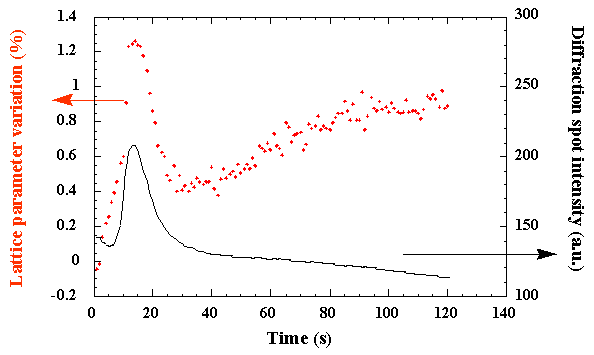
This process of elastic strain relaxation through 3D islanding after completion of a thin 2D wetting layer is typical of a Stransky-Krastanov growth mode, as already observed in other systems Reference Moison, Houzay, Barthe, Leprince, Andre and Vatel[2] Reference Eaglesham and Cerullo[8].
After island formation, one can observe that the roughness, as well as the lattice parameter, decreases. This is assigned to the coalescence of the islands, which smoothes the surface. The free surface of the islands is reduced during their coalescence, and therefore the layer is strained again, leading to a decrease of the in-plane lattice parameter.
For the reverse case of AlN grown on GaN, no elastic relaxation has been observed, and the growth remains two-dimensional from the beginning.
The GaN relaxation process during the first stages of growth is temperature dependent. At high temperature, the 2D-3D transition occurs, but after the islands coalescence, the growth remains 3-dimensional. At lower temperature, the transition is almost absent, and the layer remains 2-dimensional and strained. More details about the effect of temperature on the 2D-3D transition are given in Reference Daudin, Widmann, Feuillet, Adelmann, Samson, Arlery and Rouviere[9].
To study the islands, the growth was stopped just after the 2D-3D transition, at the roughness maximum. The growth temperature was 710 °C, and the equivalent of about 4 monolayers of GaN were deposited. The dots obtained have been observed using Atomic Force Microscopy (Figure 2). The density was very high (6.1011 cm−2), and dots were estimated around 7 nm wide. and 1.8 to 2 nm high, taking into account the radius of curvature of the tip apex.
AFM Image (tapping mode) of GaN dots grown on AlN, at a temperature of 710 °C, without post-growth reorganization under nitrogen plasma.

To change the size and the density of the islands, dots grown in the same conditions as above have been exposed to nitrogen plasma during one minute just after their growth. The density, about 5.1010 cm−2, is lower than in the previous case (Figure 3). The size is also bigger (around 25nm wide and 4.5nm high), which suggests that during the exposure to an active nitrogen flux, the larger dots grow to the expense of the smaller ones. The size of the dots could thus be controlled by changing the exposure time under nitrogen plasma, but can also be varied with the substrate temperature and the amount of deposited GaN.
As the dots and the tip apex exhibit similar radius, AFM is not very precise for determining the shape of the dots. In the RHEED pattern of the dots along the

AFM image (tapping mode) of GaN dots grown on AlN at 710 °C, and exposed during 50 s to nitrogen plasma after growth.

RHEED pattern of GaN dots after exposure to nitrogen flux, revealing the presence of facets at 30° from the surface. The electron beam is along the

Schematic view of a GaN island, deduced from RHEED and AFM observations.

Transmission Electron Microscopy (TEM) has been carried out on a sample which consisted in a stacking of 3 layers of GaN dots, separated with 160 Å thick AlN spacer layer (Figure 6). The growth conditions correspond to the ones of the small dots observed by AFM. A careful analysis of High Resolution Electron Microsopy images allows us to measure the thickness of the two-dimensional GaN wetting layer. We find that the wetting thickness varies slightly from 1 to 3 monolayers, which is in good agreement with RHEED measurements. The interfaces between the AlN layers and the GaN wetting monolayers are flat, which confirms that the growth of AlN on GaN is two-dimensional, and that it is possible to smooth the surface by capping the islands with AlN. The sizes of the islands observed by TEM are in agreement to the ones deduced from AFM.
TEM image of GaN dots embedded in AlN. The dots have been grown at 710°C, by depositing the equivalent of 4 monolayers of GaN, and have been capped with AlN immediately after their growth.

4. Conclusion
It was demonstrated, using quantitative RHEED analysis, that the strain of a GaN layer grown on AlN is relaxed through a Stransky-Krastanov growth mode, with 3D islanding occurring after a critical thickness of 2 monolayers. After this elastic relaxation that occurs during the first stages of growth, it is believed that a slower plastic relaxation takes place.
Using this SK behavior, GaN dots of a nanometric size where obtained, from which quantum confinement effects are expected Reference Daudin, Widmann, Feuillet, Adelmann, Samson, Arlery and Rouviere[9]. They have been characterized using AFM and TEM. The size and the density of the dots can be controlled by precise adjustment of the growth parameters : substrate temperature, deposition and nitridation times.
Further work will concern the photoluminescence and cathodoluminescence of the GaN dots. Calculations have to be performed in order to correlate their optical and morphological properties.



