




Introduction
The Lamiaceae is a large family of plants that contain approximately 236 genera and 7000 species, many of which are aromatic and have been used extensively as medicinal and culinary herbs (Harley et al., Reference Harley, Atkins, Budantsev, Cantino, Conn, Grayer, Harley, de Kok, Krestovskaja, Morales, Paton, Ryding, Kubitzki and Kadereit2004). The genus Leonurus includes 24 species, all of which have a native range in the Old World (POWO, 2024). Common motherwort, Leonurus cardiaca L., is a perennial herbaceous species native to Europe and adjacent parts of Asia, but it was introduced and has become widespread and well-established throughout most of the continental United States (except California and Florida) and the adjacent Canadian provinces (except Newfoundland and Labrador) (Voss and Reznicek, Reference Voss and Reznicek2012; USDA and NRCS, 2024). It is often associated with disturbed ground, and it can occupy a wide variety of wet and dry habitats, including roadsides, railroads, parking lots, dumps, open forests, floodplains, river banks and fields (Voss and Reznicek, Reference Voss and Reznicek2012).
In its native geographic range, the aerial portions of wild-harvested and field-cultivated plants of L. cardiaca have been used for medicinal purposes for centuries (Wojtyniak et al., Reference Wojtyniak, Szymański and Mathawska2013). In a comprehensive review of the phytochemistry and pharmacology of the 24 species in the genus Leonurus, Zhang et al. (Reference Zhang, Liu, Da-Song, Zhang and Sun2018) catalogued a great variety of secondary metabolites that have been isolated most extensively from L. cardiaca, as well as, in particular, the congeners, L. japonicus Houtt and L. sibiricus L. Isolated phytochemicals from L. cardiaca included alkaloids (e.g., stachydrine), diterpenoids (e.g., leocardin), triterpenoids (e.g., oleanic acid, corosolic acid, euscaphic acid, ilelatifol D and ursolic acid), phenylpropanoid glycosides (e.g., caffeic acid 4-rutinoside and lavandulifolioside), iridoid glycosides (e.g., leonuridine and stegioside I) and a variety of flavonoids and steroidal glycosides. Clinical applications of L. cardiaca have included its use (a) to relieve anxiety and sleep disorders (Ovanesov et al., Reference Ovanesov, Ovanesova and Arushanian2006; Shikov et al., Reference Shikov, Pozharitskaya, Makarov, Demchenko and Shikh2011), (b) as a cardiotonic with anti-arrhythmic potential (Milkowska-Leyck et al., Reference Milkowska-Leyck, Filipek and Strzelecka2002; Ritter et al., Reference Ritter, Melichar, Strahler, Kuchta, Schulte, Sartiani, Cerbai, Mugelli, Mohr, Rauwald and Dhein2010), (c) as an anti-inflammatory agent (Ali et al., Reference Ali, Ibrahim, Jalil and Choudhary2007) and (d) as an anti-microbial agent (Ali et al., Reference Ali, Ibrahim, Jalil and Choudhary2007).
Previous studies on the seed dormancy status of members of the Lamiaceae have reported, in general, that non-deep physiological dormancy is common (Baskin and Baskin, Reference Baskin and Baskin2014). Given the long-term and widespread interest in using L. cardiaca and other Leonurus species for medicinal purposes, there is surprisingly very little information available about the seed germination ecology of members of this genus. One study that analyzed the cytological and karyotypic variation among populations of L. cardiaca in Iran indicated that its seeds were capable of germinating at a constant temperature of 25°C in an alternating photoperiod of 14 h light/10 h darkness, but neither germination percentages nor rates were reported (Soorni et al., Reference Soorni, Nazeri, Fattahi and Khadivi-Khub2014). Another germination study evaluated the effects of gibberellins on several species of Lamiaceae and reported germination percentages of 64–70% for seeds of L. cardiaca sown in soil at a constant temperature of 20°C under an alternating photoperiod of 15 h light/9 h darkness in the absence or presence of gibberellin 3 (GA3) (at concentrations ranging from 0 to 100 mg/L) (Thompson, Reference Thompson1969). The seeds used in that study were collected from plants grown in the collections of Royal Botanical Gardens; however, unfortunately, their geographic origin was not disclosed. Very little is also known about the germination requirements of the other medicinal congeners of Leonurus, although there are reports that L. japonicus seeds exhibited optimal germination at alternating temperature regimes between 35/25 and 30/20°C (Bhatt et al., Reference Bhatt, Mercedes Caron, Chen, Yu and Niu2022), whereas the germination of seeds of L. sibiricus had the highest germination percentages at a constant temperature of 20°C and at alternating temperatures of 25/20, 30/20 and 30/25°C (Almeida et al., Reference Almeida, Polleto, Pinho and Delachiave2011). Both studies found that alternating light/dark photoperiods enhanced germination in comparison to seeds sown in dark conditions.
To understand how to cultivate L. cardiaca from seeds, we need to know how its seeds respond to varied edaphic and climatic conditions, such as light, temperature, pH, nutrient and moisture content, all of which may influence seed dormancy states and seed germination timing and success (Baskin and Baskin, Reference Baskin and Baskin2014). Hence, the two main objectives of this study were (a) to determine whether the seeds of L. cardiaca possess dormancy at maturity and, if so, to identify the kind of seed dormancy and (b) to assess the effects of environmental factors, such as light, temperature, pH, osmotic stress and depth of burial, on seed germination and seedling emergence.
Materials and methods
Study species
L. cardiaca has stiff, four-sided, erect stems that may be branched or unbranched, reaching heights of 0.5–1.5 m. In southern Canada and the midwestern United States, flowering typically occurs from July through September. During this period, multiple verticels, each containing five or more flowers, are borne in the axils of the paired, opposite leaves situated along the upper thirds of stems. Individual flowers have an upper, white, villous, entire lip and a lower, pink, three-lobed lip. The flowers are protandrous and self-compatible, although some studies suggest that the species likely functions as a facultative outcrosser (Borna et al., Reference Borna, Ahmad, Luo and Trethowan2016; Shekari et al., Reference Shekari, Mahdipour, Nazeri and Shokrpour2017, Reference Shekari, Mahdipour, Nazeri and Shokrpour2018). The fruit is a schizocarp that splits at maturity into four segments, each of which may have a single, hard, oblong, dark brown nutlet. A nutlet, hereafter referred to as a seed, is about 2 mm-long and has three sides and a truncate, hairy apex.
Seed collection and general seed germination test procedures
On September 15 and 16, 2022, seeds of L. cardiaca were collected from three populations, with one located in southwestern Ontario (MP), one in northern Indiana (ID) and one in central Ohio (QP) (Table 1). All fruits present on plants were bulk harvested from 42 individuals at MP, 18 individuals at ID and 27 individuals at QP. Prior to the start of any experiments, seeds were separated from fruits and stored dry in paper bags at room temperature (approximately 22°C) for 3 or 4 days before initiating all germination/emergence experiments. Unless stated otherwise, a similar experimental setup was employed for each of the seed germination experiments as follows. Germination experiments were conducted in 9-cm diameter plastic Petri dishes lined with one sheet of 9-cm diameter Whatman #1 filter paper. A single replicate consisted of 50 seeds placed in a dish. The paper substrate was initially moistened with 5 ml of either distilled water or a test solution. Additional applications of a few ml of a given solution were made as needed to maintain appropriate solution availability throughout the entirety of the experiment. Each dish was also placed inside a polyurethane bag to minimize desiccation. Petri dishes were placed inside growth chambers programmed with daily alternating temperature and light regimes that consisted of 12 h of a daytime high temperature in light followed by a nighttime low temperature in darkness. Fluorescent lighting inside the chamber amounted to a photosynthetic photon flux of 100 μmol m−2 s−1. Relative humidity was maintained at 50%. If the experiment required that dishes be maintained in continuous darkness, then they were wrapped in two layers of aluminium foil. These dishes were examined for germination in a dark room equipped with a green safety light. Inside a growth chamber, dishes were placed randomly on shelves, and their positions were rearranged daily when germination was assessed. Germination was monitored daily for 21 days. The emergence of the radicle 1 mm from the seed coat was used as the criterion for seed germination. Tetrazolium tests for seed viability were performed on non-germinated seeds in all Petri dish experiments. Each experiment was repeated for a total of two trials.
Populations where seeds of L. cardiaca were collected

a Annual temperature and precipitation data (1981–2010) were obtained from the Government of Canada (https://climate.weather.gc.ca/).
b Annual temperature and precipitation data (2006–2020) were obtained from the National Centers for Environmental Information (https://www.ncei.noaa.gov/).
Effects of temperature and light
To determine how temperature and light influenced the germination of L. cardiaca, seeds from each study population were placed in Petri dishes moistened with distilled water and then incubated at four temperature regimes (15/5, 20/10, 25/15 or 30/20°C) in environmental chambers. Each regime was paired with a coinciding photoperiod of 12 h light/12 h darkness. Six replicates, each containing 50 seeds, were assigned to each of the four environmental chambers for a total of 24 replicates per population. Three of the six replicates were wrapped in aluminium foil and kept in continuous darkness.
Effect of moist cold stratification
To evaluate how cold stratification affected seed germination for each study population, seeds were sown in Petri dishes moistened with distilled water, which were then placed in a refrigerator at 4°C. Twelve replicates, each containing 50 seeds, were assigned to each of the five cold stratification periods (0, 4, 8, 12 or 16 weeks) for a total of 60 replicates per population. Immediately following a respective chilling period, the 12 replicates were transferred to growth chambers where they were incubated at four temperature regimes (15/5, 20/10, 25/15 or 30/20°C) with a coinciding photoperiod of 12 h light/12 h darkness. Three replicates were assigned to each of the four incubation temperature regimes.
Effect of pH
To evaluate how solution pH influenced seed germination for each study population, seven test solutions were prepared with pH values of 4, 5, 6, 7, 8, 9 or 10 using either 0.1 M potassium hydrogen phthalate (for solutions with pH 3–6) or 25 mM borax (for solutions with pH 7–10) as per the guidelines of Shaw et al. (Reference Shaw, Mack and Smith1991). Buffer solutions were adjusted as needed with 1.0 M HCl or 0.5 M NaOH to the appropriate solution pH. A distilled water solution (pH 6.5) served as a control. For each treatment, replicates were moistened with a respective pH solution and then placed in an environmental chamber set at 25/15°C with a coinciding photoperiod of 12 h light/12 h darkness. Three replicates were assigned to each of the eight pH treatments for a total of 24 replicates per population.
Effect of osmotic stress
To determine how osmotic stress influenced seed germination for each study population, solutions with osmotic potentials of 0 (control), −0.2, −0.4, −0.6, −0.8, −1.0 or −1.2 MPa were prepared by dissolving polyethylene glycol (PEG 8000) in 1 L of distilled water using the equations of Michel (Reference Michel1983). All dishes were placed in an environmental chamber set at 25/15°C with a coinciding photoperiod of 12 h light/12 h darkness. For each treatment, replicates were moistened with a respective solution and then placed in an environmental chamber set at 25/15°C with a coinciding photoperiod of 12 h light/12 h darkness. Three replicates were assigned to each of the seven osmotic stress treatments for a total of 21 replicates per population.
Effect of planting depth
To assess how depth of burial influenced seedling emergence of seeds of L. cardiaca for each study population, seeds were buried in square plastic pots (10.2 cm × 10.2 × 8.9 cm) to the following depths below the soil surface: 0, 0.5, 1, 2, 5 or 10 cm. Three pots, each containing 50 seeds, were assigned to each of the six burial treatments for a total of 18 pots per population. The soil medium used was a general-purpose Pro-Mix BX potting soil. All pots were placed randomly in an environmental chamber set at 25/15°C with a coinciding photoperiod of 12 h light/12 h darkness. At the outset of the experiment, all pots were sub-irrigated, but, subsequently, they were surface irrigated to field capacity and rearranged within the growth chamber on a daily basis. Seedling emergence was monitored daily for 28 days.
Statistical analyses
Mean cumulative percentage germination values are reported herein. Since seed germination follows a binomial distribution, generalized linear model analyses were performed with a logit link function and a binomial error structure using BLOGIT (binary logistic regression) in the statistical software application SYSTAT 13 (Inpixon, Palo Alto, CA). Since no significant trial-by-treatment interactions was identified in any experiment, data were pooled from the two trials. Initial models included all main factors and interactions. However, treatments in which the variance of all replicates is zero (i.e., no seeds germinate or all seeds germinate) must be excluded from logistic regression models (Hosmer and Lemeshow, Reference Hosmer and Lemeshow2000). Since no seeds germinated in the coolest temperature regime (15/5°C), this temperature treatment was omitted from the reduced models. One model fitted experimental parameters, such as populations, temperature regime, light regime and their interactions as explanatory variables. A second model fitted the experimental parameters populations, cold stratification period, temperature regime and their interactions as explanatory variables. Nonlinear regression analyses were also performed in SYSTAT 13 to estimate the relationships between (a) percentage germination and solution pH, (b) percentage germination and solution osmotic potential and (c) percentage seedling emergence and the depth of burial of seeds.
Results
Effects of temperature and light
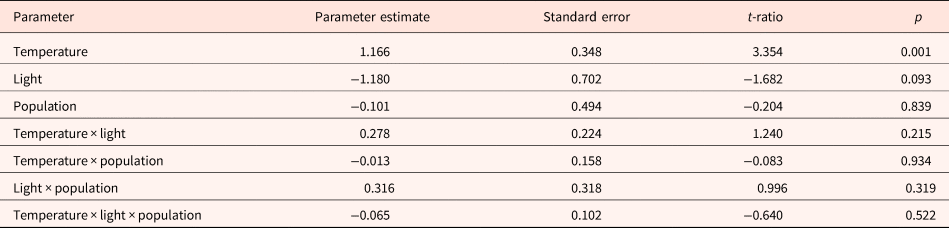
Warmer incubation temperatures increased the germination of L. cardiaca (Table 2). The temperature regime was the only significant term in the analysis of seed germination; light regime, population and the interactions between factors were all non-significant (Table 3). Among study populations, mean germination percentages were highest in the two warmest temperature regimes at either 25/15°C in alternating light/darkness (65–73%) vs. continuous darkness (53–70%) or 30/20°C in alternating light/darkness (64–72%) vs. continuous darkness (66–78%) (Table 2). However, germination was much lower among populations in the 20/10°C temperature regime in alternating light/darkness (6–18%) vs. continuous darkness (5–9%). The time to the onset of germination was also longer at 20/10°C compared to warmer temperature regimes (data not shown). No germination was observed at 15/5°C for any of the study populations. The inability of seeds to germinate at the coolest temperature regime could not be attributed to low viability, since tetrazolium tests indicated that >95% of the non-germinated seeds were still viable.
Mean germination percentages [lower, upper 95% binomial confidence intervals] for seeds of L. cardiaca from three populations (MP, ID and QP) when incubated at four temperature regimes (15/5, 20/10, 25/15 or 30/20°C for 12 h /12 h) with two coinciding light regimes (L/D – alternating 12 h light/ 12 h darkness; D – 24 h darkness) for 21 days

Results of logistic regression analysis of incubation temperature regime, light regime and study population on seed germination of L. cardiaca
Effect of moist cold stratification
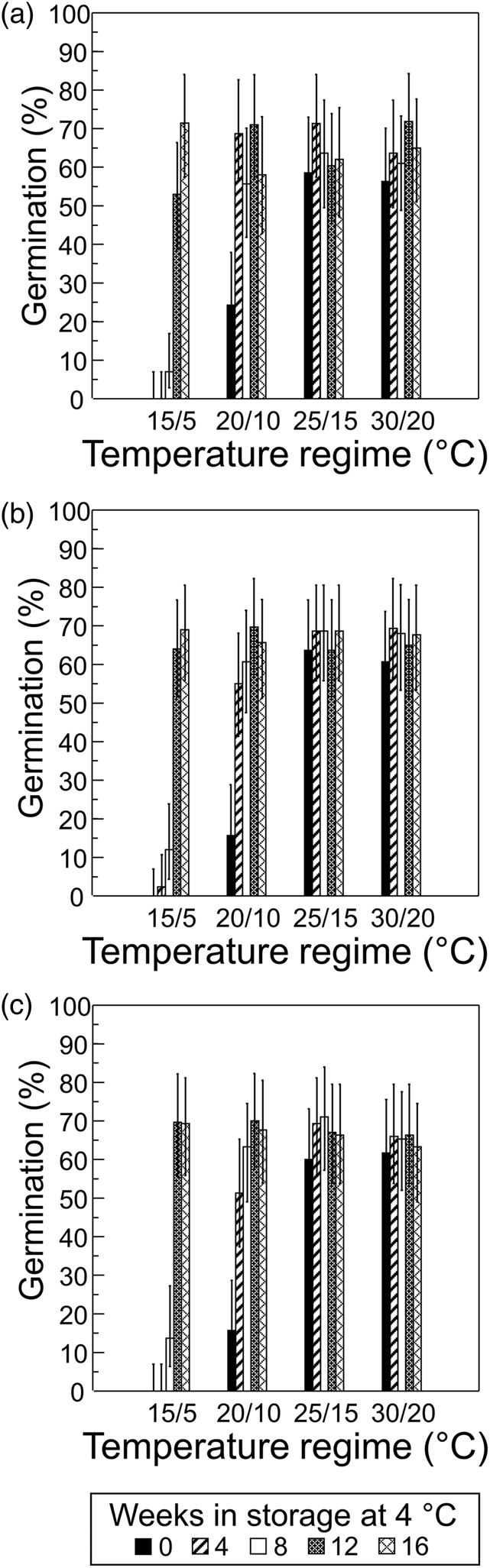
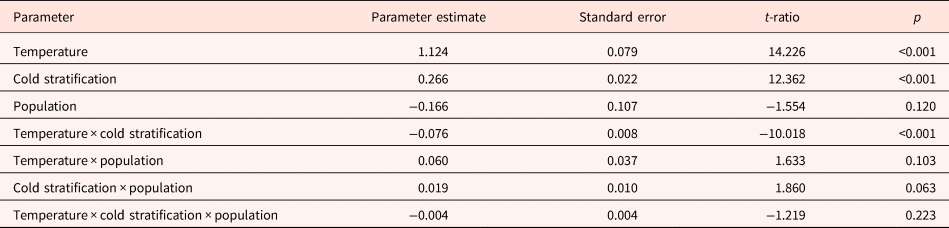
Cold stratification increased the germination of L. cardiaca (Fig. 1), and this was a significant term along with an incubation temperature regime in the analysis of seed germination (Table 4). Furthermore, only the first-order interaction between cold stratification duration and incubation temperature regime on germination was determined to be significant, whereas the main effect of populations, as well as all other interactions, was not significant. Thus, overall, the effect of cold stratification on seed germination varied with respect to the temperature regime and the duration of chilling. Seeds from all three study populations incubated at the two warmest temperature regimes (≥25/15°C) germinated to similar, high percentages whether or not they were cold stratified (Fig. 1). However, without cold stratification, seeds in the coolest temperature regime (15/5°C) failed to germinate. Furthermore, seeds incubated at the two lowest temperature regimes (15/5 and 20/10°C) germinated to higher percentages with increased durations of cold stratification, and eventually, their germination percentages peaked after 12–16 or 8–12 weeks of chilling, respectively, at similar levels compared to those for the two warmest temperature regimes.
Effect of cold stratification at 4°C in darkness treatments (0, 4, 8, 12 or 16 weeks) and subsequent temperature regimes (15/5, 20/10, 25/15 or 30/20°C) in an alternating photoperiod (12 h light/12 h dark) on percentage germination (±95% binomial confidence intervals) of seeds of L. cardiaca after 21 days for three study populations (A) MP, (B) ID, and (C) QP.
Results of logistic regression analysis of incubation temperature regime, cold stratification period and study population on seed germination of L. cardiaca
Effect of pH
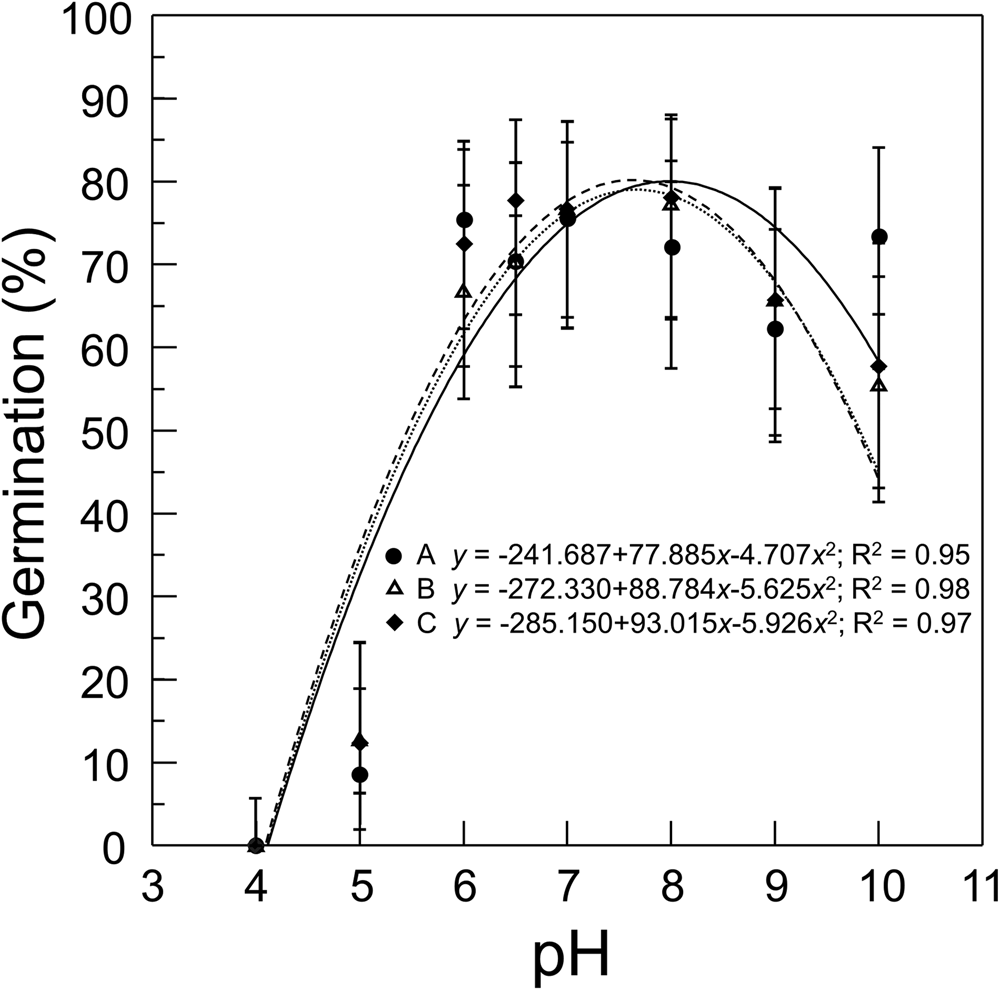
Nonlinear, quadratic regressions best described how germination percentages of L. cardiaca seeds were influenced by solution pH for the populations MP (y = −241.687 + 77.855x−4.707x 2; R 2 = 0.95); ID (y = −272.330 + 88.784x−5.625x 2; R 2 = 0.98) and QP (y = −284.150 + 93.015x−5.926x 2; R 2 = 0.97) (Fig. 2). Germination occurred over a wide range of solution pH (from pH 5 to 10), but not at pH 4. Whereas percentage germination at pH 5 was very low (8–13%) among populations, it was also above 50% (ranging from about 55 to 78%) for seeds sown at pH 6–10 for all populations.
The relationship between solution pH and percentage germination (±95% binomial confidence intervals) of seeds of L. cardiaca when incubated at 25/15°C in an alternating photoperiod (12 h light/12 h dark) for 21 days for three study populations (MP, ID and QP).
Effect of osmotic stress
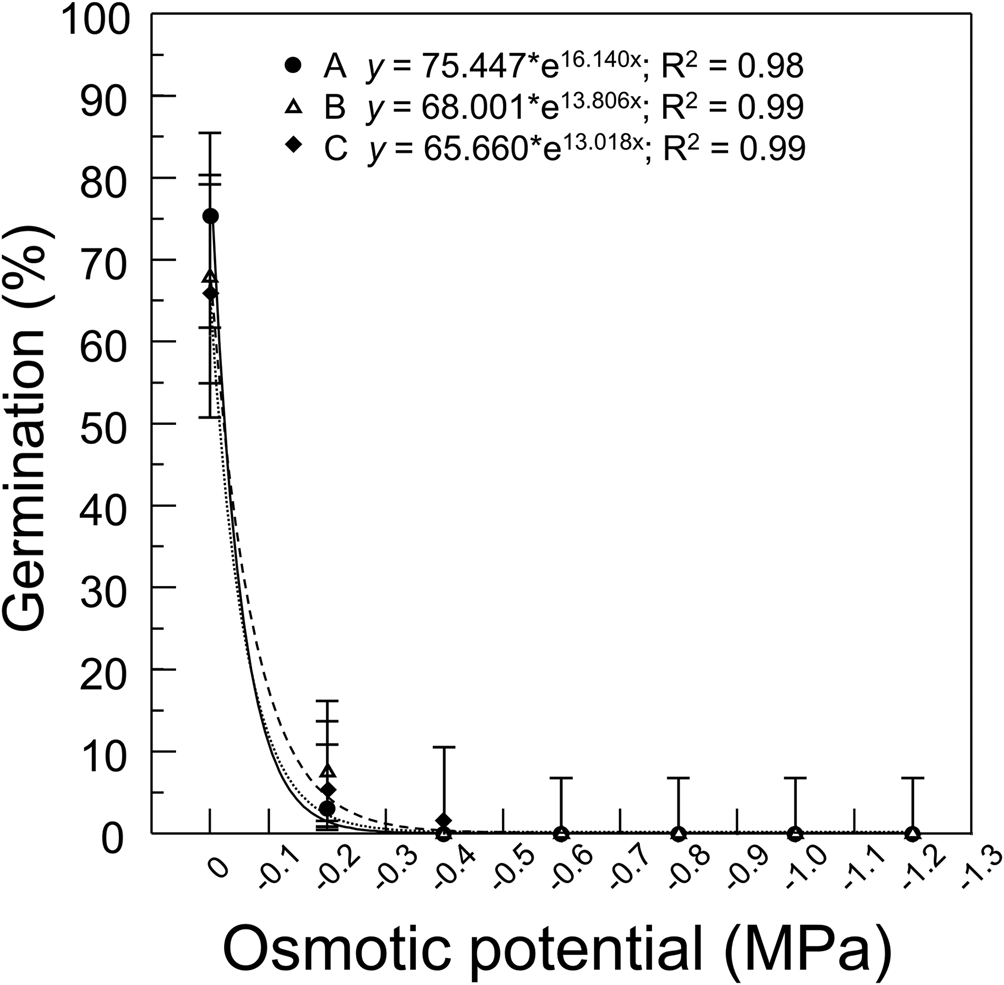
Exponential decay models described how seed germination of L. cardiaca was restricted by water stress for populations MP (y = 75.447 × e16.140x; R 2 = 0.99), ID (y = 68.001 × e13.806x; R 2 = 0.99) and QP (y = 65.660 × e13.018x; R 2 = 0.99) (Fig. 3). In the absence of water stress (i.e. distilled water), seeds from each population germinated readily (66–75%). However, only 3–8% of seeds germinated among populations at −0.2 MPA, and only 2% of seeds germinated for a single population (ID) at −0.4 MPa. None of the seeds from any of the populations germinated in solutions with osmotic potentials of −0.6 MPa or lower.
The relationship between osmotic potential and percentage germination (±95% binomial confidence intervals) of seeds of L. cardiaca when incubated at 25/15°C in an alternating photoperiod (12 h light/12 h dark) for 21 days for three study populations (MP, ID and QP).
Effect of planting depth
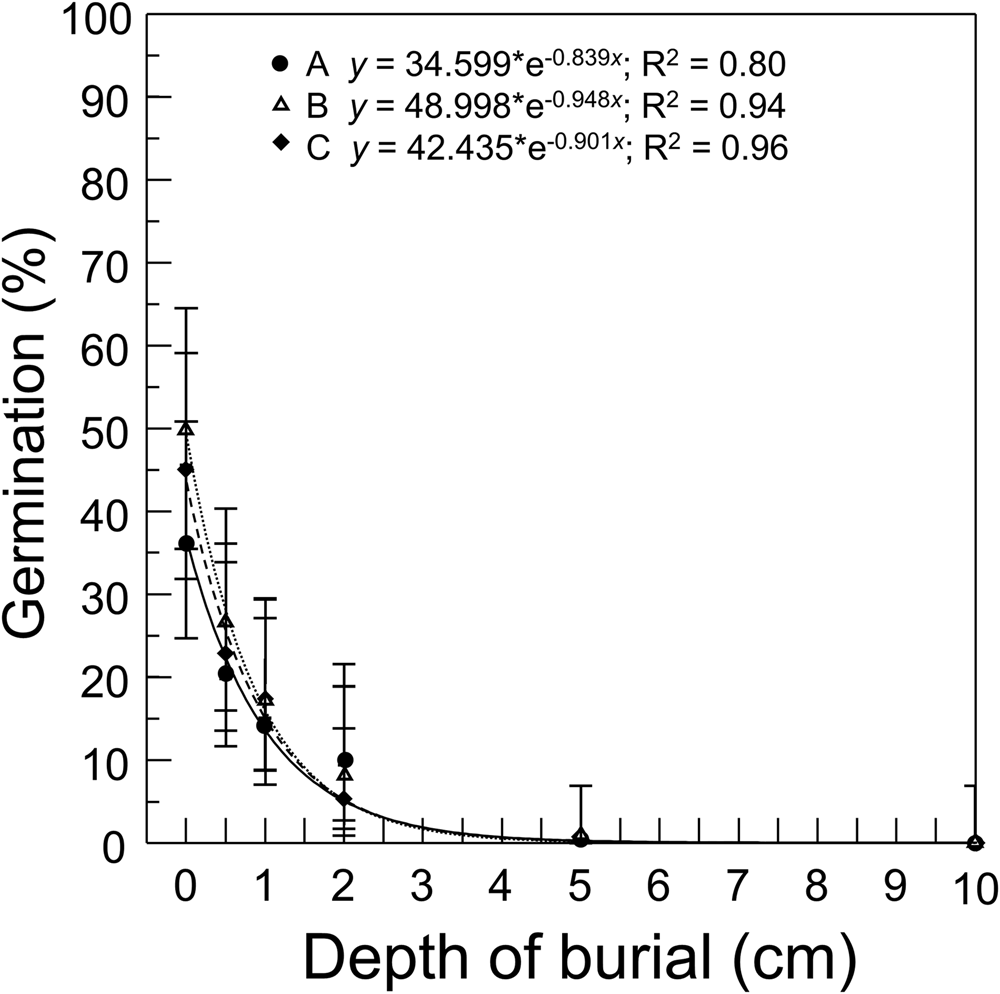
Exponential decay models best described how the emergence of seedlings decreased with increased depth of seed burial for populations MP (y = 34.599 × e−0.839x; R 2 = 0.80), ID (y = 48.998 × e−0.948x; R 2 = 0.94) and QP (y = 42.435 × e−0.901x; R 2 = 0.96) (Fig. 4). Seedling emergence was restricted to burial depths from 0 to 5 cm, and it was greatest (ranging from 36 to 51%) at the soil surface for each population. In comparison to seeds sown on Petri dishes at similar temperature conditions, seed germination percentages on the soil surface in pots were lower by a third or more. The lower germination of the seeds sown on soil is likely due to poor soil-seed contact and lower hydraulic conductivity in comparison to seeds sown on filter paper (Ghorbani et al., Reference Ghorbani, Seel and Leifert1999). As depth of burial increased, seedling emergence decreased to 20–27% at 0.5 cm, 14–17% at 1 cm, 10–13% at 2 cm and 1–4% at 5 cm among populations. No seedlings emerged from a burial depth of 10 cm for any population.
The relationship between the depth of burial of seeds and percentage emergence (± 95% binomial confidence intervals) of seedlings of L. cardiaca when incubated at 25/15°C in an alternating photoperiod (12 h light/12 h dark) for 28 days for three study populations (MP, ID and QP).
Discussion
The results of the germination experiments indicate that the seeds of L. cardiaca have non-deep physiological dormancy upon seed maturation. Species with this kind of seed dormancy have seeds that are conditionally dormant at maturity when they are only able to germinate at high temperatures, but not at cool temperatures (Baskin and Baskin, Reference Baskin and Baskin2014). Furthermore, the enhanced ability of seeds to germinate at the two lowest temperature regimes as the duration of cold stratification increased indicates that the seeds specifically possess type 2 non-deep physiological dormancy, as per the Nikolaeva–Baskin classification system (Baskin and Baskin, Reference Baskin and Baskin2021). Species with type 2 non-deep physiological dormancy have seeds that can germinate over a temperature range that widens from higher to lower temperatures during the period of dormancy break as a result of after-ripening either indoors due to artificial cold stratification treatments or outdoors as a result of natural exposure to colder winter temperatures (Susko and Hussein, Reference Susko and Hussein2008; Porceddu et al., Reference Porceddu, Mattan, Pritchard and Bacchetta2013; Baskin and Baskin, Reference Baskin and Baskin2014; Hawkins, Reference Hawkins2019; An et al., Reference An, Yang, Baskin, Li, Zhu, Jiao, Wu and Zhang2022; Peng et al., Reference Peng, Geng, Qin, Yang, Baskin and Baskin2023). For L. cardiaca specifically, it is expected that following cold stratification outdoors at cold winter temperatures, its seeds will become nondormant and be able to germinate over a wider range of temperature conditions, including cooler temperatures, in the spring.
The availability and quality of light can provide environmental information about the ideal timing for germination and subsequent seedling establishment (Baskin and Baskin, Reference Baskin and Baskin2014; Carta et al., Reference Carta, Skourti, Mattana, Vandelook and Thanos2017). In the congeners L. japonicus (Bhatt et al., Reference Bhatt, Mercedes Caron, Chen, Yu and Niu2022) and L. sibiricus (Almeida et al., Reference Almeida, Polleto, Pinho and Delachiave2011) exposure to light enhanced germination in comparison to seeds treated with continuous darkness, indicating a positive photoblastic response in both species. In contrast, the seeds of L. cardiaca germinated about equally well in alternating light/darkness or continuous darkness, which indicates that they did not require light to germinate. As a result, the seeds should be capable of germinating in low or no light conditions, such as when they are situated in shade, under litter, or if they are buried in soil. In the depth of burial experiment, seedling emergence occurred at burial depths as great as 5 cm, but the greatest emergence was observed for seeds sown on the soil surface. Optimum seedling emergence on the soil surface along with decreased emergence with greater planting depths of seeds is consistent with reports for many other similar burial studies (Chauhan et al., Reference Chauhan, Gill and Preston2006; Rao et al., Reference Rao, Dong, Li and Zhang2008; Wang et al., Reference Wang, Ferrell, MacDonald and Sellers2009; Li et al., Reference Li, Tan, Li, Yuan, Du, Ma and Wang2015). In small-seeded species, like L. cardiaca, reduced seedling emergence with increased depth of burial in soil has been attributed to seedlings exhausting their limited carbohydrate reserves before reaching the soil surface (Teasdale et al., Reference Teasdale, Beste and Potts1991; Baskin and Baskin, Reference Baskin and Baskin2014). Alternatively, seeds buried to greater depths in the soil in pots may experience less pronounced daily fluctuations in soil temperature than seeds situated closer to the soil surface. If fluctuating temperatures trigger germination, then deeply buried seeds may simply fail to germinate. Since seed germination responses to constant temperatures were not assessed in the present study, it is unknown whether fluctuating temperatures are required for germination of L. cardiaca seeds from populations in North America, although Soorni et al. (Reference Soorni, Nazeri, Fattahi and Khadivi-Khub2014) and Thompson (Reference Thompson1969) reported that germination occurred for seeds from populations in Iran or England when they were incubated at a constant temperature of 25 or 20°C, respectively.
The seeds of L. cardiaca were capable of germinating across a wide range of solution pH (5–10). High seed germination over a broad range of pH is common in many species (Li et al., Reference Li, Tan, Li, Yuan, Du, Ma and Wang2015; Fernando et al., Reference Fernando, Humphries, Florentine and Chauhan2016; Mahmood et al., Reference Mahmood, Florentine, Chauhan, McLaren, Palmer and Wright2016; Mahajan et al., Reference Mahajan, Matloob, Walsh and Chauhan2018; Wang et al., Reference Wang, Zhao, Li, Chen, Liu and Wang2020). Whereas soil pH should not be a limiting factor for seed germination of L. cardiaca in most soils, germination may not occur or be severely limited in ultra- to very strongly acidic soils. On the other hand, L. cardiaca seeds were shown to be sensitive to water stress, since no seed germination was observed in solutions with osmotic potentials below −0.4 MPa. Several other species, including trumpet creeper (Campsis radicans (L.) Seem ex. Bureau) (Chachalis and Reddy, Reference Chachalis and Reddy2000), cadillo (Urena lobata L.) (Wang et al., Reference Wang, Ferrell, MacDonald and Sellers2009), tall morning glory ((Ipomoea purpurea (L.) Roth) (Singh et al., Reference Singh, Ramirez, Sharma and Jhala2012) and feather fingergrass (Chloris virgata Sw.) (Fernando et al., Reference Fernando, Humphries, Florentine and Chauhan2016), were also shown to be quite sensitive to low water potential, with none of these species germinating at water potentials below −0.4 MPa. Seeds of species with such sensitivity to water stress are not expected to tolerate dry, well-drained soils; hence, germination of their seeds may be restricted to moist soil conditions. Even though the results of the pH experiment suggested that L. cardiaca seeds may be capable of germinating over a wide range of solution pH values, strongly alkaline soils typically have low hydraulic conductivity and low total available water (Ellis and Foth, Reference Ellis and Foth1997). Given the sensitivity of L. cardiaca seeds to even low levels of water stress, this suggests that their seeds may be unlikely to germinate in high-pH soils.
In conclusion, the results of the germination experiments indicate that seeds of L. cardiaca collected from individuals in non-indigenous populations in southern Canada and the midwestern United States possess type 2 non-deep physiological dormancy upon seed release from the maternal plant in autumn. Freshly matured seeds are conditionally dormant and can germinate primarily in warm temperature regimes ≥25/15°C. However, they are significantly less so or not at all at cooler ones ≤20/10°C. However, seeds emerged from dormancy after prolonged exposure to cold stratification, so that by 16 weeks of moist, cold stratification, seeds germinated about equally well at all incubation temperature conditions. Overall, seed germination and seedling emergence of L. cardiaca were possible over a wide range of environmental conditions, including the presence or absence of light, a broad range of pH levels and when seeds were situated at or within 5 cm of the soil surface. A notable limiting factor for seed germination, however, was that seeds only germinated when they experienced no or low levels of water stress. Future studies are needed to confirm whether the germination characteristics of L cardiaca seeds determined in the present study are similar to those of populations of the species in its native European range.
Acknowledgements
The author thanks three anonymous reviewers for their constructive comments on earlier versions of the manuscript. The author also thanks Farah Bazzi for assistance with some preliminary studies on the seed germination requirements of L. cardiaca.
Funding statement
This research was supported by the University of Michigan-Dearborn Faculty Research Grant (G006291) to D.J.S.
Competing interests
The author declares none.


 Open access

