





1 Introduction
In recent years, there has been renewed interest in studying automorphisms of cubic fourfolds from a Hodge theoretic perspective. The automorphisms of a cubic fourfold are linear, and those of prime order are classified in [Reference González-Aguilera and LiendoGAL11], where an explicit description of the families of cubic fourfolds admitting such an automorphism is given (see also [Reference Yu and ZhengYZ20]). If $X\subset \mathbb {P}^5$
is a cubic fourfold, there is a Hodge decomposition
$X\subset \mathbb {P}^5$
is a cubic fourfold, there is a Hodge decomposition $H^4(X,\mathbb {C})=H^{3,1}(X)\oplus H^{2,2}(X)\oplus H^{1,3}(X)$
with
$H^4(X,\mathbb {C})=H^{3,1}(X)\oplus H^{2,2}(X)\oplus H^{1,3}(X)$
with $h^{3,1}=1$
. Much of the geometric information about the cubic fourfold is retained in the algebraic lattice
$h^{3,1}=1$
. Much of the geometric information about the cubic fourfold is retained in the algebraic lattice $A(X)=H^4(X,\mathbb {Z})\cap H^{2,2}$
and in the transcendental lattice
$A(X)=H^4(X,\mathbb {Z})\cap H^{2,2}$
and in the transcendental lattice $T(X)=A(X)^\perp $
. Every automorphism of a cubic fourfold induces an isometry on the
$T(X)=A(X)^\perp $
. Every automorphism of a cubic fourfold induces an isometry on the $H^4(X,\mathbb {Z})$
, and automorphisms acting trivially on
$H^4(X,\mathbb {Z})$
, and automorphisms acting trivially on $ H^{3,1}(X)$
are called symplectic, they are called non-symplectic otherwise. A symplectic automorphism of a cubic fourfold X induces a symplectic automorphism of the Fano variety of lines,
$ H^{3,1}(X)$
are called symplectic, they are called non-symplectic otherwise. A symplectic automorphism of a cubic fourfold X induces a symplectic automorphism of the Fano variety of lines, $F(X)$
, which is an irreducible holomorphic symplectic (IHS) manifold [Reference Beauville and DonagiBD85]. Cubic fourfolds with a symplectic automorphism are studied in [Reference FuFu16], and groups of symplectic automorphisms are classified in [Reference Laza and ZhengLZ22]. The algebraic and transcendental lattices of a cubic fourfold with an involution are determined in [Reference MarquandMar23], where the geometry of such cubic fourfolds is intensively studied. A similar approach is carried out in [Reference Billi and GrossiBG25] to determine the algebraic and transcendental lattice, and describe the geometry of cubic fourfolds with a non-symplectic automorphism of higher order. A family of very symmetric cubic fourfolds with a symplectic automorphism of order three is considered in [Reference KoikeKoi22], where it is showed that such cubic fourfolds contain many planes that generate the algebraic lattice.
$F(X)$
, which is an irreducible holomorphic symplectic (IHS) manifold [Reference Beauville and DonagiBD85]. Cubic fourfolds with a symplectic automorphism are studied in [Reference FuFu16], and groups of symplectic automorphisms are classified in [Reference Laza and ZhengLZ22]. The algebraic and transcendental lattices of a cubic fourfold with an involution are determined in [Reference MarquandMar23], where the geometry of such cubic fourfolds is intensively studied. A similar approach is carried out in [Reference Billi and GrossiBG25] to determine the algebraic and transcendental lattice, and describe the geometry of cubic fourfolds with a non-symplectic automorphism of higher order. A family of very symmetric cubic fourfolds with a symplectic automorphism of order three is considered in [Reference KoikeKoi22], where it is showed that such cubic fourfolds contain many planes that generate the algebraic lattice.
The current article determines the algebraic and transcendental lattices of a cubic fourfold with a symplectic automorphism of prime order greater than two, and studies the geometry of such a cubic. This is a natural continuation of the mentioned series of works, and pursues the goal to have a completed geometrical and lattice theoretical picture.
Theorem 1.1 (Theorem3.5)
Let X be a general cubic fourfold among the ones admitting a symplectic automorphism $\phi $
of prime order
$\phi $
of prime order $p \geq 3$
. Then, the Gram matrix of the lattice
$p \geq 3$
. Then, the Gram matrix of the lattice $A(X)$
is described in Appendix A and the lattice
$A(X)$
is described in Appendix A and the lattice $T(X)$
appears in Table 1.
$T(X)$
appears in Table 1.
Description of the pairs $(A(X),T(X))$
for a general cubic fourfold
$(A(X),T(X))$
for a general cubic fourfold $X\in F_p^i$
with a symplectic automorphism
$X\in F_p^i$
with a symplectic automorphism $\phi _p^i$
of prime order p. The lattices
$\phi _p^i$
of prime order p. The lattices $A(X)$
are in Appendix A.
$A(X)$
are in Appendix A.

Moreover, starting from the structure of the algebraic lattice $A(X)$
of a cubic fourfold with a symplectic automorphism of prime order at least three, we prove that it is generated by the square of the hyperplane class and by classes of cubic scrolls (Section 4) or planes (Section 5). We obtain the following result.
$A(X)$
of a cubic fourfold with a symplectic automorphism of prime order at least three, we prove that it is generated by the square of the hyperplane class and by classes of cubic scrolls (Section 4) or planes (Section 5). We obtain the following result.
Corollary 1.2 (Propositions 4.1, 5.1, and 5.2)
Let X be a general cubic fourfold among the ones admitting a symplectic automorphism $\phi $
of prime order
$\phi $
of prime order $p\geq 3$
. Then, the algebraic lattice
$p\geq 3$
. Then, the algebraic lattice $A(X)$
is generated by the square of the hyperplane class, along with either classes of cubic scrolls or planes.
$A(X)$
is generated by the square of the hyperplane class, along with either classes of cubic scrolls or planes.
The same phenomenon is already known to happen for any automorphism of order $p=2$
by [Reference MarquandMar23] (with exception of one case where
$p=2$
by [Reference MarquandMar23] (with exception of one case where $\mathbb {Q}$
-coefficients are needed) and for non-symplectic automorphisms of order
$\mathbb {Q}$
-coefficients are needed) and for non-symplectic automorphisms of order $p\geq 3$
by [Reference Billi and GrossiBG25].
$p\geq 3$
by [Reference Billi and GrossiBG25].
One of the most challenging and intriguing problems about cubic fourfolds is to determine whether they are rational or not. It is conjectured that a very general cubic fourfold is not rational, but no examples of not rational cubic fourfolds are known. Moreover, in [Reference HassettHas00, Reference KuznetsovKuz16], it is conjectured that a cubic fourfold is rational if and only if it has an associated K3 surface (i.e., its transcendental lattice is isometric to the transcendental lattice of a K3 surface). It was proved in [Reference OuchiOuc21] (see also Remark 3.6) that a cubic fourfold with a symplectic automorphism of prime order $p\geq 3$
has an associated K3 surface. As a consequence of our previous theorem, we prove the following result.
$p\geq 3$
has an associated K3 surface. As a consequence of our previous theorem, we prove the following result.
Corollary 1.3 (Corollary 3.7)
Let X be a cubic fourfold admitting a symplectic automorphism of prime order $p\geq 3$
, then X is rational.
$p\geq 3$
, then X is rational.
Due to the presence of a group action, one can investigate an equivariant version of rationality and these conjectures, i.e., the G-rationality for $G\subset \operatorname {\mathrm {Aut}}(X)$
. More precisely, if
$G\subset \operatorname {\mathrm {Aut}}(X)$
. More precisely, if $G\subseteq \operatorname {\mathrm {Aut}}(X)$
is a group of automorphisms of a cubic fourfold X, then X is said to be G-rational (or G-linearizable) if
$G\subseteq \operatorname {\mathrm {Aut}}(X)$
is a group of automorphisms of a cubic fourfold X, then X is said to be G-rational (or G-linearizable) if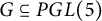 $G \subseteq PGL(5)$
is linear, and X admits a G-equivariant birational map to
$G \subseteq PGL(5)$
is linear, and X admits a G-equivariant birational map to $\mathbb {P}^{4}$
. Moreover, in [Reference Böhning, von Bothmer and TschinkelBvBT24, Theorem 1], the authors provide an example of a rational cubic fourfold that is not G-rational, where G is its group of symplectic automorphisms. We provide two families of symmetric cubics that are rational, but not G-rational.
$\mathbb {P}^{4}$
. Moreover, in [Reference Böhning, von Bothmer and TschinkelBvBT24, Theorem 1], the authors provide an example of a rational cubic fourfold that is not G-rational, where G is its group of symplectic automorphisms. We provide two families of symmetric cubics that are rational, but not G-rational.
Theorem 1.4 (Theorem 6.1)
Let X be a cubic fourfold with a symplectic automorphism of order three of type $\phi _3^3$
or
$\phi _3^3$
or $\phi _3^4$
(see notation in Theorem 2.2) and let
$\phi _3^4$
(see notation in Theorem 2.2) and let $G=\operatorname {\mathrm {Aut}}(X)$
. Then, X is rational, but not G-rational.
$G=\operatorname {\mathrm {Aut}}(X)$
. Then, X is rational, but not G-rational.
In a different vein, one can construct many examples of IHS manifolds from a cubic fourfold X and study birational transformations that are induced from the cubic. In particular, the families parametrizing $1$
-cycles of degree zero and degree one on hyperplane sections of a cubic fourfold admit a compactification (see [Reference Laza, Saccà and VoisinLSV17, Reference SaccàSac23, Reference VoisinVoi18]) which are IHS manifolds deformation equivalent to the O’Grady ten-dimensional sporadic example [Reference O’GradyO’G99], i.e., it is an IHS manifold of OG10 type. If X is a cubic fourfold, we refer to these constructions as
$1$
-cycles of degree zero and degree one on hyperplane sections of a cubic fourfold admit a compactification (see [Reference Laza, Saccà and VoisinLSV17, Reference SaccàSac23, Reference VoisinVoi18]) which are IHS manifolds deformation equivalent to the O’Grady ten-dimensional sporadic example [Reference O’GradyO’G99], i.e., it is an IHS manifold of OG10 type. If X is a cubic fourfold, we refer to these constructions as $J(X)$
a Laza–Saccà–Voisin (LSV) manifold (the case of cycles of degree zero) and
$J(X)$
a Laza–Saccà–Voisin (LSV) manifold (the case of cycles of degree zero) and $J^t(X)$
a twisted Laza–Saccà–Voisin (twisted LSV) manifold (the case of cycles of degree one).
$J^t(X)$
a twisted Laza–Saccà–Voisin (twisted LSV) manifold (the case of cycles of degree one).
An automorphism of a cubic fourfold induces a birational transformation of the corresponding OG10-type manifold. Symplectic birational transformations of IHS manifolds of OG10 type are classified in [Reference Marquand and MullerMM25a, Reference Marquand and MullerMM25b] lattice-theoretically, and the authors classify those groups that are induced from a group of automorphisms of a cubic fourfold (see [Reference Marquand and MullerMM25b, Theorem 6.1]). Further, in [Reference Felisetti, Giovenzana and GrossiFGG24, Section 6], the authors give a characterization of symplectic birational transformations the ones that are induced from a K3 surface. As an application of our results, we determine the Néron–Severi and transcendental lattices for a (twisted) LSV manifold associated with a cubic fourfold with a symplectic automorphism of prime order, strengthening the result of [Reference Marquand and MullerMM25b, Theorem 6.1] in the prime order case.
Theorem 1.5 (Theorem 7.3)
Let X be a general cubic fourfold among the ones admitting a symplectic automorphism $\phi \in \operatorname {\mathrm {Aut}}(X)$
of prime order, then the Néron–Severi lattice and the transcendental lattice of the manifolds
$\phi \in \operatorname {\mathrm {Aut}}(X)$
of prime order, then the Néron–Severi lattice and the transcendental lattice of the manifolds $J(X)$
and
$J(X)$
and $J^t(X)$
are given in Table 2.
$J^t(X)$
are given in Table 2.
Pairs $(\operatorname {\mathrm {NS}},T)$
for
$(\operatorname {\mathrm {NS}},T)$
for $J(X),J^t(X)$
with birational action induced by a general cubic fourfold with a symplectic automorphism
$J(X),J^t(X)$
with birational action induced by a general cubic fourfold with a symplectic automorphism $\phi $
of prime order p.
$\phi $
of prime order p.

Remark 1.6 According to the theoretical obstruction proved in [Reference Giovenzana, Grossi, Onorati and VenianiGGOV24, Theorem 1.1], any non-trivial symplectic birational automorphism does not extend to a regular automorphism on an IHS manifold of OG10 type. By [Reference SaccàSac23, Proposition 3.11], the Lagrangian fibration of an LSV manifold will have a reducible fiber. We prove that any cubic fourfold with a symplectic automorphism contains planes or cubic scrolls, implying the existence of a reducible fiber by [Reference BrosnanBro18, Reference Marquand and ViktorovaMV25].
Outline: In Section 2, we collect preliminaries about lattices and cubic fourfolds. In Section 3, we compute the lattices $A(X)$
and
$A(X)$
and $T(X)$
for a general cubic fourfold X with a prime order symplectic automorphism. In Sections 4 and 5, we study cubic fourfolds with a prime order symplectic automorphisms for which the lattice
$T(X)$
for a general cubic fourfold X with a prime order symplectic automorphism. In Sections 4 and 5, we study cubic fourfolds with a prime order symplectic automorphisms for which the lattice $A(X)$
is generated by the square of a hyperplane class along with cubic scrolls or planes, respectively. In Section 6, we prove that if X is a cubic fourfold with an automorphism belonging to one of two particular families, then X is rational but it is not
$A(X)$
is generated by the square of a hyperplane class along with cubic scrolls or planes, respectively. In Section 6, we prove that if X is a cubic fourfold with an automorphism belonging to one of two particular families, then X is rational but it is not $\operatorname {\mathrm {Aut}}(X)$
-equivariantly rational. In Section 7, we determine the cohomological action of prime order symplectic automorphisms on manifolds of OG10 type that are induced by automorphisms of cubic fourfolds via the LSV constructions. In Appendix A, we display the matrices of the lattices
$\operatorname {\mathrm {Aut}}(X)$
-equivariantly rational. In Section 7, we determine the cohomological action of prime order symplectic automorphisms on manifolds of OG10 type that are induced by automorphisms of cubic fourfolds via the LSV constructions. In Appendix A, we display the matrices of the lattices $A(X)$
.
$A(X)$
.
2 Preliminaries
2.1 Lattices
A lattice L is a free $\mathbb {Z}$
-module of finite rank, with an integral symmetric bilinear form
$\mathbb {Z}$
-module of finite rank, with an integral symmetric bilinear form $ L\times L\to \mathbb {Z}$
which is non-degenerate. We use the notation
$ L\times L\to \mathbb {Z}$
which is non-degenerate. We use the notation $x\cdot y\in \mathbb {Z}$
and
$x\cdot y\in \mathbb {Z}$
and $x^2= x\cdot x$
for
$x^2= x\cdot x$
for $x,y\in L$
. A lattice L is called even if
$x,y\in L$
. A lattice L is called even if $x^2\in 2\mathbb {Z}$
for any
$x^2\in 2\mathbb {Z}$
for any $x\in L$
, it is called odd otherwise. The signature of L is the signature of its real extension. The divisibility of
$x\in L$
, it is called odd otherwise. The signature of L is the signature of its real extension. The divisibility of $x\in L$
is the positive generator of the ideal
$x\in L$
is the positive generator of the ideal $x\cdot L\subseteq \mathbb {Z}$
. Let
$x\cdot L\subseteq \mathbb {Z}$
. Let $L^\vee =\hom (L,\mathbb {Z})$
, then the finite group
$L^\vee =\hom (L,\mathbb {Z})$
, then the finite group $D(L)=L^\vee /L$
is called the discriminant group. We call discriminant the quantity
$D(L)=L^\vee /L$
is called the discriminant group. We call discriminant the quantity $d(L):=|D(L)|$
, it coincides with the absolute value of the determinant of a Gram matrix of L. The length
$d(L):=|D(L)|$
, it coincides with the absolute value of the determinant of a Gram matrix of L. The length $l(D(L))$
is the minimum number of generators of
$l(D(L))$
is the minimum number of generators of $D(L)$
, if p is a prime number, then the p-length
$D(L)$
, if p is a prime number, then the p-length $l_p(D(L))$
is the minimum number of generators of
$l_p(D(L))$
is the minimum number of generators of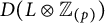 $D(L\otimes \mathbb {Z}_{(p)})$
. The bilinear form of L descends to a well-defined bilinear form
$D(L\otimes \mathbb {Z}_{(p)})$
. The bilinear form of L descends to a well-defined bilinear form $D(L)\times D(L)\to \mathbb {Q}/\mathbb {Z}$
. A lattice is called unimodular if the discriminant group is trivial. A lattice L is called p-elementary if
$D(L)\times D(L)\to \mathbb {Q}/\mathbb {Z}$
. A lattice is called unimodular if the discriminant group is trivial. A lattice L is called p-elementary if $D(L)\cong (\mathbb {Z}/p\mathbb {Z})^{\oplus a}$
for some integer
$D(L)\cong (\mathbb {Z}/p\mathbb {Z})^{\oplus a}$
for some integer $a\geq 0$
, in this case, one has
$a\geq 0$
, in this case, one has $l(D(L))=l_p(D(L))$
. The genus of a lattice is the data of its parity, its signature, and its discriminant form. Isometric lattices must have the same genus, but lattices with the same genus can be not isometric.
$l(D(L))=l_p(D(L))$
. The genus of a lattice is the data of its parity, its signature, and its discriminant form. Isometric lattices must have the same genus, but lattices with the same genus can be not isometric.
An embedding of lattices $L\hookrightarrow M$
is an injective linear map that preserves the quadratic forms of the lattices L and M. An embedding of lattices
$L\hookrightarrow M$
is an injective linear map that preserves the quadratic forms of the lattices L and M. An embedding of lattices $L\hookrightarrow M$
is primitive if
$L\hookrightarrow M$
is primitive if $M/L$
is a free abelian group and, in this case, we denote by
$M/L$
is a free abelian group and, in this case, we denote by $L^{\perp }$
the orthogonal complement of L in M. If the embedding has finite index, we say that M is an overlattice of L. There is a correspondence between finite index overlattices of L and isotropic subgroups of
$L^{\perp }$
the orthogonal complement of L in M. If the embedding has finite index, we say that M is an overlattice of L. There is a correspondence between finite index overlattices of L and isotropic subgroups of $D(L)$
, by [Reference NikulinNik79b, Theorem 1.4.1].
$D(L)$
, by [Reference NikulinNik79b, Theorem 1.4.1].
A primitive embedding $L\hookrightarrow M$
is determined by a group
$L\hookrightarrow M$
is determined by a group $H \subseteq D(M)$
called the embedding subgroup, an isometry
$H \subseteq D(M)$
called the embedding subgroup, an isometry $\gamma \colon H\to H'\subseteq D(L)$
called the embedding isometry. Similarly, by [Reference NikulinNik79b, Proposition 1.5.1], a primitive embedding
$\gamma \colon H\to H'\subseteq D(L)$
called the embedding isometry. Similarly, by [Reference NikulinNik79b, Proposition 1.5.1], a primitive embedding $L\hookrightarrow M$
with
$L\hookrightarrow M$
with $L^\perp =T$
can be determined by a subgroup
$L^\perp =T$
can be determined by a subgroup $K\subseteq D(L)$
called the gluing subgroup and an isometry
$K\subseteq D(L)$
called the gluing subgroup and an isometry $\gamma \colon K\to K'\subseteq D(T(-1))$
called the gluing isometry. We refer to [Reference NikulinNik79b, Propositions 1.5.1 and 1.15.1] for more details on embedding of lattices.
$\gamma \colon K\to K'\subseteq D(T(-1))$
called the gluing isometry. We refer to [Reference NikulinNik79b, Propositions 1.5.1 and 1.15.1] for more details on embedding of lattices.
The group of isometries of a lattice L is denoted by $O(L)$
. If
$O(L)$
. If $\phi \in O(L)$
is an isometry of
$\phi \in O(L)$
is an isometry of $L,$
then we let
$L,$
then we let $L^\phi =\{x\in L\mid \phi (x)=x\}$
be the invariant lattice and
$L^\phi =\{x\in L\mid \phi (x)=x\}$
be the invariant lattice and $L_\phi =(L^\phi )^\perp \subset L$
the coinvariant lattice. They are primitive sublattices of L, and if the isometry
$L_\phi =(L^\phi )^\perp \subset L$
the coinvariant lattice. They are primitive sublattices of L, and if the isometry $\phi $
is of finite order, then
$\phi $
is of finite order, then $L^\phi \oplus L_\phi \hookrightarrow L$
is a finite index embedding.
$L^\phi \oplus L_\phi \hookrightarrow L$
is a finite index embedding.
We denote by $[k]$
the rank one lattice generated by an element of square
$[k]$
the rank one lattice generated by an element of square $k\in \mathbb {Z}$
. We denote by
$k\in \mathbb {Z}$
. We denote by $\mathbf U$
the even unimodular lattice of rank two, which is of signature
$\mathbf U$
the even unimodular lattice of rank two, which is of signature $(1,1)$
. We also denote by
$(1,1)$
. We also denote by $\mathbf A_n,\mathbf E_n,\mathbf D_n$
the rank n positive-definite lattices associated with the Dynkin diagrams ADE. For an odd integer
$\mathbf A_n,\mathbf E_n,\mathbf D_n$
the rank n positive-definite lattices associated with the Dynkin diagrams ADE. For an odd integer $n\geq 3$
, we consider the indefinite lattice
$n\geq 3$
, we consider the indefinite lattice
 $$\begin{align*}\mathbf H_n=\begin{pmatrix} -2 & 1\\ 1 & (n-1)/2 \end{pmatrix},\end{align*}$$
which is even whenever $n\equiv 3(4)$
. Finally, if L is a lattice and k an integer, we denote by
$n\equiv 3(4)$
. Finally, if L is a lattice and k an integer, we denote by $L(k)$
the lattice whose bilinear form is obtained from the one of L multiplied by k.
$L(k)$
the lattice whose bilinear form is obtained from the one of L multiplied by k.
2.2 Cubic fourfolds
Let $X\subset \mathbb {P}^5$
be a smooth cubic fourfold. The cohomology group
$X\subset \mathbb {P}^5$
be a smooth cubic fourfold. The cohomology group $H^4(X,\mathbb {Z})$
with the natural intersection pairing is the unique unimodular odd lattice
$H^4(X,\mathbb {Z})$
with the natural intersection pairing is the unique unimodular odd lattice $[1]^{\oplus 21}\oplus [-1]^{\oplus 2}$
of signature
$[1]^{\oplus 21}\oplus [-1]^{\oplus 2}$
of signature $(21,2)$
. We denote by
$(21,2)$
. We denote by $\eta _X\in H^4(X,\mathbb {Z})$
the square of the hyperplane class, and consider the primitive cohomology group
$\eta _X\in H^4(X,\mathbb {Z})$
the square of the hyperplane class, and consider the primitive cohomology group $H^4_{\mathrm{prim}}(X,\mathbb {Z})=\langle \eta _X\rangle ^\perp $
. Notice that
$H^4_{\mathrm{prim}}(X,\mathbb {Z})=\langle \eta _X\rangle ^\perp $
. Notice that ${\langle \eta _X\rangle =[3],}$
and the lattice
${\langle \eta _X\rangle =[3],}$
and the lattice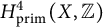 $H^4_{\mathrm{prim}}(X,\mathbb {Z})$
is even. The primitive cohomology carries a polarized Hodge structure with Hodge numbers
$H^4_{\mathrm{prim}}(X,\mathbb {Z})$
is even. The primitive cohomology carries a polarized Hodge structure with Hodge numbers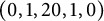 $(0,1,20,1,0)$
, and we have an isometry of lattices
$(0,1,20,1,0)$
, and we have an isometry of lattices
 $$\begin{align*}H^4_{\mathrm{prim}}(X,\mathbb{Z})\cong \mathbf U^{\oplus2}\oplus \mathbf E_8^{\oplus2}\oplus \mathbf A_2.\end{align*}$$
The algebraic lattice is the lattice $A(X)=H^4(X,\mathbb {Z})\cap H^{2,2}(X)$
and the transcendental lattice is its orthogonal complement
$A(X)=H^4(X,\mathbb {Z})\cap H^{2,2}(X)$
and the transcendental lattice is its orthogonal complement $T(X)=A(X)^{\perp }\subseteq H^4(X,\mathbb {Z})$
. The primitive algebraic lattice is given by
$T(X)=A(X)^{\perp }\subseteq H^4(X,\mathbb {Z})$
. The primitive algebraic lattice is given by $A_{\mathrm{prim}}(X)=A(X)\cap H^4_{\mathrm{prim}}(X,\mathbb {Z})\subseteq H^4_{\mathrm{prim}}(X,\mathbb {Z})$
.
$A_{\mathrm{prim}}(X)=A(X)\cap H^4_{\mathrm{prim}}(X,\mathbb {Z})\subseteq H^4_{\mathrm{prim}}(X,\mathbb {Z})$
.
Remark 2.1 Note that for a smooth cubic fourfold X, there does not exist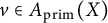 $v\in A_{\mathrm{prim}}(X)$
with
$v\in A_{\mathrm{prim}}(X)$
with $v^2=2$
(a short root) or with
$v^2=2$
(a short root) or with $v^2=6$
and divisibility 3 in the lattice
$v^2=6$
and divisibility 3 in the lattice $H^4(X,\mathbb {Z})$
(a long root). This follows from the description of the image of the period map [Reference LazaLaz10, Theorem 1.1].
$H^4(X,\mathbb {Z})$
(a long root). This follows from the description of the image of the period map [Reference LazaLaz10, Theorem 1.1].
Let $\phi \in \operatorname {\mathrm {Aut}}(X),$
and consider the induced action
$\phi \in \operatorname {\mathrm {Aut}}(X),$
and consider the induced action $\phi ^*\in O(H^4(X,\mathbb {Z})).$
We thus obtain a map
$\phi ^*\in O(H^4(X,\mathbb {Z})).$
We thus obtain a map
 $$\begin{align*}\operatorname{\mathrm{Aut}}(X)\to O(H^4(X,\mathbb{Z})),\end{align*}$$
which is injective (combine [Reference Javanpeykar and LoughranJL17, Proposition 2.12] and [Reference Matsumura and MonskyMM64]). Further, we have that $\operatorname {\mathrm {Aut}}(X)\cong O_{Hdg}(H^4(X,\mathbb {Z}),\eta _X)$
, the group of Hodge isometries preserving the class
$\operatorname {\mathrm {Aut}}(X)\cong O_{Hdg}(H^4(X,\mathbb {Z}),\eta _X)$
, the group of Hodge isometries preserving the class $\eta _X$
by [Reference ZhengZhe21].
$\eta _X$
by [Reference ZhengZhe21].
Definition 2.1 An automorphism $\phi \in \operatorname {\mathrm {Aut}}(X)$
is called symplectic if it acts trivially on
$\phi \in \operatorname {\mathrm {Aut}}(X)$
is called symplectic if it acts trivially on $H^{3,1}(X,\mathbb {Z})$
, non-symplectic otherwise.
$H^{3,1}(X,\mathbb {Z})$
, non-symplectic otherwise.
We denote by $\operatorname {\mathrm {Aut}}_S(X)$
the subgroup of
$\operatorname {\mathrm {Aut}}_S(X)$
the subgroup of $\operatorname {\mathrm {Aut}}(X)$
consisting of symplectic automorphisms. According to [Reference Laza and ZhengLZ22, Section 4.1] (see also [Reference NikulinNik79a, Section 3] for the similar case of
$\operatorname {\mathrm {Aut}}(X)$
consisting of symplectic automorphisms. According to [Reference Laza and ZhengLZ22, Section 4.1] (see also [Reference NikulinNik79a, Section 3] for the similar case of $K3$
surfaces), we have
$K3$
surfaces), we have $H^4_{\mathrm{prim}}(X,\mathbb {Z})_\phi \subseteq A_{\mathrm{prim}}(X)$
(and hence
$H^4_{\mathrm{prim}}(X,\mathbb {Z})_\phi \subseteq A_{\mathrm{prim}}(X)$
(and hence $T(X)\subseteq H^4_{\mathrm{prim}}(X,\mathbb {Z})^\phi $
) if
$T(X)\subseteq H^4_{\mathrm{prim}}(X,\mathbb {Z})^\phi $
) if $\phi $
is symplectic. We say that the cubic fourfold X endowed with the action of an automorphism
$\phi $
is symplectic. We say that the cubic fourfold X endowed with the action of an automorphism $\phi \in \operatorname {\mathrm {Aut}}(X)$
is general if the previous inclusion is an equality.
$\phi \in \operatorname {\mathrm {Aut}}(X)$
is general if the previous inclusion is an equality.
The group of automorphisms of a cubic fourfold is a finite group of linear automorphisms [Reference Matsumura and MonskyMM64]. A complete classification of automorphisms of prime order is obtained in [Reference González-Aguilera and LiendoGAL11]. In the following, we recall the classification of symplectic automorphisms of prime order of a cubic fourfold (see also [Reference FuFu16]).
Theorem 2.2 (See [Reference González-Aguilera and LiendoGAL11] and [Reference Yu and ZhengYZ20, Proposition 6.1])
Let $X = \{F=0\} \subset \mathbb {P}^5$
be a smooth cubic fourfold with a symplectic automorphism
$X = \{F=0\} \subset \mathbb {P}^5$
be a smooth cubic fourfold with a symplectic automorphism $\phi \in \operatorname {\mathrm {Aut}}(X)$
of prime order p. After a linear change of coordinates that diagonalizes
$\phi \in \operatorname {\mathrm {Aut}}(X)$
of prime order p. After a linear change of coordinates that diagonalizes $\phi $
, we have
$\phi $
, we have $\phi (x_0:\dots :x_5)=(\xi ^{\sigma _0} x_0:\dots :\xi ^{\sigma _5} x_5)$
and we denote by
$\phi (x_0:\dots :x_5)=(\xi ^{\sigma _0} x_0:\dots :\xi ^{\sigma _5} x_5)$
and we denote by $(\sigma _0, \ldots , \sigma _5)$
such an action. If d denotes the dimension of the family
$(\sigma _0, \ldots , \sigma _5)$
such an action. If d denotes the dimension of the family $F_p^i$
of cubic fourfolds endowed with the automorphism
$F_p^i$
of cubic fourfolds endowed with the automorphism $\phi _p^i$
, then we have the following possibilities:
$\phi _p^i$
, then we have the following possibilities:
-
• $\phi _2^2$
:
$p=2$
,
$\sigma =(0,0,0,0,1,1)$
,
$d=12$
,
$$\begin{align*}F=L_3(x_0,\dots,x_3)+x_4^2 L_1(x_0,\dots,x_3)+x_4x_5M_1(x_0,\dots,x_3)+x_5^2 N_1(x_0,\dots,x_3),\end{align*}$$
$\phi _2^2$
:
$p=2$
,
$\sigma =(0,0,0,0,1,1)$
,
$d=12$
,
$$\begin{align*}F=L_3(x_0,\dots,x_3)+x_4^2 L_1(x_0,\dots,x_3)+x_4x_5M_1(x_0,\dots,x_3)+x_5^2 N_1(x_0,\dots,x_3),\end{align*}$$
-
•
$\phi _3^3$
:
$p=3$
,
$\sigma =(0,0,0,0,1,2)$
,
$d=8$
,
$$\begin{align*}F=L_3(x_0,\dots,x_3)+x_4^3+x_5^3+x_4x_5M_1(x_0,\dots,x_3),\end{align*}$$
-
•
$\phi _3^4$
:
$p=3$
,
$\sigma =(0,0,0,1,1,1)$
,
$d=2$
,
$$\begin{align*}F=L_3(x_0,x_1,x_2)+M_3(x_3,x_4,x_5),\end{align*}$$
-
•
$\phi _3^6$
:
$p=3$
,
$\sigma =(0,0,1,1,2,2)$
,
$d=8$
,
$$\begin{align*}F=L_3(x_0,x_1)+M_3(x_2,x_3)+N_3(x_4,x_5)+\sum_{i=0,1;j=2,3;k=4,5}a_{i,j,k}x_ix_jx_k,\end{align*}$$
-
•
$\phi _5^1$
:
$p=5$
,
$\sigma =(0,0,1,2,3,4)$
,
$d=4$
,
$$\begin{align*}F=L_3(x_0,x_1)+x_2x_5L_1(x_0,x_1)+x_3x_4M_1(x_0,x_1)+x_2^2x_4+x_2x_3^2+x_3x_5^2+x_4^2x_5,\end{align*}$$
-
•
$\phi _7^1$
:
$p=7$
,
$\sigma =(1,2,3,4,5,6)$
,
$d=2$
$$\begin{align*}F=x_0^2x_4+x_1^2x_2+x_0x_2^2+x_3^2x_5+x_3x_4^2+x_1x_5^2+ax_0x_1x_3+bx_2x_4x_5\end{align*}$$
-
•
$\phi _{11}^1$
:
$p=11$
,
$\sigma =(0,1,3,4,5,9)$
,
$d=0$
,
$$\begin{align*}F=x_0^3+x_1^2x_5+x_2^2x_4+x_2x_3^2+x_1x_4^2+x_3x_5^2,\end{align*}$$

















where $L_i,M_i,N_i$
, and
$L_i,M_i,N_i$
, and $O_i$
are homogeneous polynomials of degree i,
$O_i$
are homogeneous polynomials of degree i, $a_{i,j,k},a,b \in \mathbb {C}$
.
$a_{i,j,k},a,b \in \mathbb {C}$
.
For a smooth cubic fourfold $X\subset \mathbb {P}^5$
, the Fano variety of lines
$X\subset \mathbb {P}^5$
, the Fano variety of lines $F(X)$
is an IHS fourfold, which is of
$F(X)$
is an IHS fourfold, which is of $K3^{[2]}$
-type [Reference Beauville and DonagiBD85]. The second cohomology
$K3^{[2]}$
-type [Reference Beauville and DonagiBD85]. The second cohomology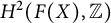 $H^2(F(X),\mathbb {Z})$
is equipped with the Beauville–Bogomolov–Fujiki form q, which is an integral bilinear quadratic form. We let
$H^2(F(X),\mathbb {Z})$
is equipped with the Beauville–Bogomolov–Fujiki form q, which is an integral bilinear quadratic form. We let $H^2_{\mathrm{prim}}(F(X),\mathbb {Z}):=g^\perp \subset H^2(F(X),\mathbb {Z})$
, where g is the Plücker polarisation, satisfying
$H^2_{\mathrm{prim}}(F(X),\mathbb {Z}):=g^\perp \subset H^2(F(X),\mathbb {Z})$
, where g is the Plücker polarisation, satisfying $q(g)=-6$
. The Abel–Jacobi map
$q(g)=-6$
. The Abel–Jacobi map $\alpha \colon H^4(X,\mathbb {Z})\rightarrow H^2(F(X),\mathbb {Z})$
restricts to an isomorphism of Hodge structures
$\alpha \colon H^4(X,\mathbb {Z})\rightarrow H^2(F(X),\mathbb {Z})$
restricts to an isomorphism of Hodge structures
 $$\begin{align*}H^4_{\mathrm{prim}}(X,\mathbb{Z})\rightarrow H^2_{\mathrm{prim}}(F(X),\mathbb{Z})\end{align*}$$
satisfying $q(\alpha (x), \alpha (y))=-x\cdot y$
for
$q(\alpha (x), \alpha (y))=-x\cdot y$
for $x,y\in H^4_{\mathrm{prim}}(X,\mathbb {Z}).$
Remark 2.3 Note that an automorphism f of X induces an automorphism of $F(X),$
which is symplectic if and only if
$F(X),$
which is symplectic if and only if $f\in \mathrm {Aut}_S(X)$
, by the discussion above.
$f\in \mathrm {Aut}_S(X)$
, by the discussion above.
3 The algebraic lattice
In this section, we compute the algebraic lattice $A(X)$
and the transcendental lattice
$A(X)$
and the transcendental lattice $T(X)$
for a cubic fourfold X which is general in a family
$T(X)$
for a cubic fourfold X which is general in a family $F_p^i$
as in Theorem 2.2. The primitive algebraic lattice
$F_p^i$
as in Theorem 2.2. The primitive algebraic lattice $A_{\mathrm{prim}}(X)$
has been classified in [Reference Laza and ZhengLZ22], we need to understand the relation of
$A_{\mathrm{prim}}(X)$
has been classified in [Reference Laza and ZhengLZ22], we need to understand the relation of $A(X)$
with the sublattice
$A(X)$
with the sublattice $A_{\mathrm{prim}}(X)$
.
$A_{\mathrm{prim}}(X)$
.
Denote by ${C}_d$
the irreducible Hassett divisor of cubic fourfolds X admitting a primitive rank
${C}_d$
the irreducible Hassett divisor of cubic fourfolds X admitting a primitive rank $2$
sublattice
$2$
sublattice $\eta _X\in K\subseteq A(X)$
of discriminant
$\eta _X\in K\subseteq A(X)$
of discriminant $d\in \mathbb {Z}_{\geq 0}$
and recall that
$d\in \mathbb {Z}_{\geq 0}$
and recall that ${C}_d$
is non-empty if and only if
${C}_d$
is non-empty if and only if $d\equiv 0 (6)$
or
$d\equiv 0 (6)$
or $d\equiv 2 (6)$
(see [Reference HassettHas00]).
$d\equiv 2 (6)$
(see [Reference HassettHas00]).
Lemma 3.1 Let X be a cubic fourfold, and let $\Gamma \subseteq H_{\mathrm{prim}}^4(X,\mathbb {Z}) $
be a primitive sublattice. Then, there exists a proper overlattice
$\Gamma \subseteq H_{\mathrm{prim}}^4(X,\mathbb {Z}) $
be a primitive sublattice. Then, there exists a proper overlattice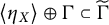 $\langle \eta _X\rangle \oplus \Gamma \subset \widetilde {\Gamma } $
obtained by gluing the discriminant form of
$\langle \eta _X\rangle \oplus \Gamma \subset \widetilde {\Gamma } $
obtained by gluing the discriminant form of $\langle \eta _X\rangle $
if and only if
$\langle \eta _X\rangle $
if and only if $D(\Gamma )$
admits a subgroup isomorphic to
$D(\Gamma )$
admits a subgroup isomorphic to $\mathbb {Z}/3\mathbb {Z}$
with discriminant form
$\mathbb {Z}/3\mathbb {Z}$
with discriminant form $\frac {-1}{3}$
. In this case, the overlattice
$\frac {-1}{3}$
. In this case, the overlattice $\Gamma \oplus \langle \eta _X\rangle \subset \widetilde {\Gamma }$
has index
$\Gamma \oplus \langle \eta _X\rangle \subset \widetilde {\Gamma }$
has index $3$
and
$3$
and $d(\Gamma )=3 \cdot d(\widetilde {\Gamma })$
.
$d(\Gamma )=3 \cdot d(\widetilde {\Gamma })$
.
Proof Assume there is such an overlattice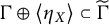 $\Gamma \oplus \langle \eta _X\rangle \subset \widetilde {\Gamma }$
. Then,
$\Gamma \oplus \langle \eta _X\rangle \subset \widetilde {\Gamma }$
. Then, $\widetilde {\Gamma }$
is generated by
$\widetilde {\Gamma }$
is generated by $\eta _X$
, the generators of
$\eta _X$
, the generators of $\Gamma $
, and a vector
$\Gamma $
, and a vector
 $$\begin{align*}v=\frac{k \eta_X+\omega}{r}\end{align*}$$
with $\omega \in \Gamma $
,
$\omega \in \Gamma $
, $r,k \in \mathbb {N}$
such that
$r,k \in \mathbb {N}$
such that $r\not =0,1$
. In this case, r is the index of
$r\not =0,1$
. In this case, r is the index of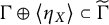 $\Gamma \oplus \langle \eta _X\rangle \subset \widetilde {\Gamma }$
. Note that
$\Gamma \oplus \langle \eta _X\rangle \subset \widetilde {\Gamma }$
. Note that $v\cdot \eta _X=\frac {3k}{r}$
is an integer and, by fact that
$v\cdot \eta _X=\frac {3k}{r}$
is an integer and, by fact that $\Gamma $
is primitive in
$\Gamma $
is primitive in $\widetilde {\Gamma }$
, we see that r cannot divide k. In other words,
$\widetilde {\Gamma }$
, we see that r cannot divide k. In other words, $\frac {k\eta _X}{r}$
must be a non-trivial element of
$\frac {k\eta _X}{r}$
must be a non-trivial element of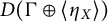 $D(\Gamma \oplus \langle \eta _X\rangle )$
, hence,
$D(\Gamma \oplus \langle \eta _X\rangle )$
, hence, $k\not \equiv 0 (3)$
and
$k\not \equiv 0 (3)$
and $r=3$
. As a consequence, we can choose v of the form
$r=3$
. As a consequence, we can choose v of the form $v=\frac {\eta _X+\omega }{3}$
(substituting v with
$v=\frac {\eta _X+\omega }{3}$
(substituting v with $-2v+\eta _X$
when
$-2v+\eta _X$
when $k\equiv 2 (3)$
) and, since for any
$k\equiv 2 (3)$
) and, since for any $x\in \Gamma ,$
we have
$x\in \Gamma ,$
we have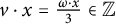 $v\cdot x=\frac {\omega \cdot x}{3}\in \mathbb {Z}$
, we deduce that
$v\cdot x=\frac {\omega \cdot x}{3}\in \mathbb {Z}$
, we deduce that
 $$\begin{align*}\gamma:= \frac{\omega}{3}\in D(\Gamma)\end{align*}$$
is well defined of order $3$
. We compute
$3$
. We compute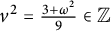 $v^2=\frac {3+\omega ^2}{9}\in \mathbb {Z}$
, which implies that
$v^2=\frac {3+\omega ^2}{9}\in \mathbb {Z}$
, which implies that
 $$\begin{align*}\gamma^{2}=\frac{\omega^2}{9}=\frac{-1}{3} \quad\mod \mathbb{Z}\end{align*}$$
since $\omega ^2\equiv -3 (9)$
. From the fact that taking a finite index r overlattice the discriminant is divided by
$\omega ^2\equiv -3 (9)$
. From the fact that taking a finite index r overlattice the discriminant is divided by $r^2$
, we have
$r^2$
, we have
 $$\begin{align*}\frac{ d(\widetilde{\Gamma})}{9}=\frac{d(\langle\eta_X\rangle\oplus \Gamma)}{9}=\frac{3 d(\Gamma)}{9}\end{align*}$$
from which we deduce that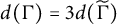 $d(\Gamma )=3 d(\widetilde {\Gamma })$
.
$d(\Gamma )=3 d(\widetilde {\Gamma })$
.
Conversely, following the same proof, the existence of such an element $\gamma \in D(\Gamma )$
gives a vector
$\gamma \in D(\Gamma )$
gives a vector $v=\frac {\eta _X}{3}+\gamma $
which determines the overlattice
$v=\frac {\eta _X}{3}+\gamma $
which determines the overlattice $\widetilde {\Gamma }$
with the required properties.
$\widetilde {\Gamma }$
with the required properties.
Remark 3.2 Note that the overlattice $\widetilde {\Gamma }$
as in the previous lemma may or may not be contained in
$\widetilde {\Gamma }$
as in the previous lemma may or may not be contained in $H^4(X,\mathbb {Z})$
. This situation will be clarified by analyzing the cases
$H^4(X,\mathbb {Z})$
. This situation will be clarified by analyzing the cases $\phi _3^3$
and
$\phi _3^3$
and $\phi _3^6$
, respectively.
$\phi _3^6$
, respectively.
Lemma 3.3 Let X be a cubic fourfold, then $A(X)$
is a proper overlattice of
$A(X)$
is a proper overlattice of ${\langle \eta _X\rangle \oplus A_{\mathrm{prim}}(X)}$
if and only if
${\langle \eta _X\rangle \oplus A_{\mathrm{prim}}(X)}$
if and only if $X\in C_d$
for some
$X\in C_d$
for some $d\equiv 2 (6)$
. In this case, the embedding of lattices
$d\equiv 2 (6)$
. In this case, the embedding of lattices $\langle \eta _X\rangle \oplus A_{\mathrm{prim}}(X) \subset A(X)$
has index
$\langle \eta _X\rangle \oplus A_{\mathrm{prim}}(X) \subset A(X)$
has index $3$
and
$3$
and $3\cdot d(A(X))= d(A_{\mathrm{prim}}(X))$
.
$3\cdot d(A(X))= d(A_{\mathrm{prim}}(X))$
.
Proof Clearly, we assume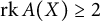 $\operatorname {\mathrm {rk}} A(X)\geq 2$
, since otherwise
$\operatorname {\mathrm {rk}} A(X)\geq 2$
, since otherwise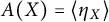 $A(X)=\langle \eta _X\rangle $
and there is nothing to prove. Let
$A(X)=\langle \eta _X\rangle $
and there is nothing to prove. Let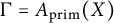 $\Gamma =A_{\mathrm{prim}}(X)$
then, by Lemma 3.1 and its proof, there exists a proper overlattice
$\Gamma =A_{\mathrm{prim}}(X)$
then, by Lemma 3.1 and its proof, there exists a proper overlattice $\widetilde {\Gamma }$
of
$\widetilde {\Gamma }$
of $\langle \eta _X\rangle \oplus A_{\mathrm{prim}}(X)$
obtained by gluing the discriminant group of
$\langle \eta _X\rangle \oplus A_{\mathrm{prim}}(X)$
obtained by gluing the discriminant group of $\langle \eta _X\rangle $
if and only if there exists an element
$\langle \eta _X\rangle $
if and only if there exists an element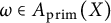 $\omega \in A_{\mathrm{prim}}(X)$
such that
$\omega \in A_{\mathrm{prim}}(X)$
such that $\omega ^2\equiv -3 (9)$
. In this case, the overlattice
$\omega ^2\equiv -3 (9)$
. In this case, the overlattice $\widetilde {\Gamma }$
coincides with
$\widetilde {\Gamma }$
coincides with $A(X)$
if and only if it is contained in
$A(X)$
if and only if it is contained in $H^4(X,\mathbb {Z})$
.
$H^4(X,\mathbb {Z})$
.
Suppose first that $A(X)=\langle \eta _X\rangle \oplus A_{\mathrm{prim}}(X)$
and let
$A(X)=\langle \eta _X\rangle \oplus A_{\mathrm{prim}}(X)$
and let $\eta _X \in K\subseteq A(X) $
be a primitive sublattice of rank
$\eta _X \in K\subseteq A(X) $
be a primitive sublattice of rank $2$
. Then,
$2$
. Then, $K=\langle \eta _X,a \eta _X+v\rangle $
for
$K=\langle \eta _X,a \eta _X+v\rangle $
for $0\not =v\in A_{\mathrm{prim}}(X)$
and
$0\not =v\in A_{\mathrm{prim}}(X)$
and $a\in \mathbb {Z}$
. We can suppose
$a\in \mathbb {Z}$
. We can suppose $K=\langle \eta _X,v\rangle $
after applying a linear transformation. The discriminant of K is given by
$K=\langle \eta _X,v\rangle $
after applying a linear transformation. The discriminant of K is given by $d=3k$
for
$d=3k$
for $k\in 2\mathbb {Z}$
, and hence
$k\in 2\mathbb {Z}$
, and hence $d\equiv 0 (6)$
. This proves that if
$d\equiv 0 (6)$
. This proves that if $X\in {C}_d$
for
$X\in {C}_d$
for ${d\equiv 2 (6)}$
, then
${d\equiv 2 (6)}$
, then $A(X)$
is a proper overlattice of
$A(X)$
is a proper overlattice of $\langle \eta _X\rangle \oplus A_{\mathrm{prim}}(X)$
. Thus, we now assume that
$\langle \eta _X\rangle \oplus A_{\mathrm{prim}}(X)$
. Thus, we now assume that $A(X)$
is a proper overlattice of
$A(X)$
is a proper overlattice of $\langle \eta _X\rangle \oplus A_{\mathrm{prim}}(X)$
, and we will prove that
$\langle \eta _X\rangle \oplus A_{\mathrm{prim}}(X)$
, and we will prove that $X\in {C}_d$
for some
$X\in {C}_d$
for some $d\equiv 2(6)$
.
$d\equiv 2(6)$
.
By the previous discussion, the finite index embedding $\langle \eta _X\rangle \oplus A_{\mathrm{prim}}(X)\subset A(X)$
must be of index
$\langle \eta _X\rangle \oplus A_{\mathrm{prim}}(X)\subset A(X)$
must be of index $3$
and
$3$
and $3\cdot d(A(X))= d(A_{\mathrm{prim}}(X))$
. Let
$3\cdot d(A(X))= d(A_{\mathrm{prim}}(X))$
. Let $ \omega \in A_{\mathrm{prim}}(X)$
be the element determining the finite index embedding as in the proof of Lemma 3.1, then write
$ \omega \in A_{\mathrm{prim}}(X)$
be the element determining the finite index embedding as in the proof of Lemma 3.1, then write $\omega = s H$
for a primitive vector
$\omega = s H$
for a primitive vector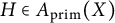 $H\in A_{\mathrm{prim}}(X)$
and
$H\in A_{\mathrm{prim}}(X)$
and $s\in \mathbb {Z}$
. We have that
$s\in \mathbb {Z}$
. We have that $H^2=2a$
for
$H^2=2a$
for $a\in \mathbb {Z}$
since
$a\in \mathbb {Z}$
since $A_{\mathrm{prim}}(X)$
is an even lattice.
$A_{\mathrm{prim}}(X)$
is an even lattice.
On the one hand, we have that $\omega ^2=s^2 2a$
, and on the other hand, we know that
$\omega ^2=s^2 2a$
, and on the other hand, we know that $\omega ^2\equiv -3(9)$
so that
$\omega ^2\equiv -3(9)$
so that $\omega ^2=-3+9(2h+1)=6+18h$
for
$\omega ^2=-3+9(2h+1)=6+18h$
for $h\in \mathbb {Z}$
. The squares modulo
$h\in \mathbb {Z}$
. The squares modulo $9$
are
$9$
are $0,1,4,7$
, and hence
$0,1,4,7$
, and hence $s^2 2a=6+18h$
if and only if
$s^2 2a=6+18h$
if and only if $a\equiv 3 (9)$
or
$a\equiv 3 (9)$
or $ a\equiv 12(36)$
. In these cases, we see that there exists an overlattice
$ a\equiv 12(36)$
. In these cases, we see that there exists an overlattice $K\subseteq A(X)$
of
$K\subseteq A(X)$
of $\langle \eta _X,H\rangle $
whose discriminant is
$\langle \eta _X,H\rangle $
whose discriminant is
 $$\begin{align*}d=\frac{d(\langle H\rangle)}{3}=\frac{2a}{3},\end{align*}$$
by applying again Lemma 3.1 for $\Gamma =\langle H\rangle $
together with the fact that in this case
$\Gamma =\langle H\rangle $
together with the fact that in this case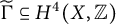 $\widetilde {\Gamma }\subseteq H^4(X,\mathbb {Z})$
. Now, from
$\widetilde {\Gamma }\subseteq H^4(X,\mathbb {Z})$
. Now, from $a=3+9k$
,
$a=3+9k$
, $k\in \mathbb {Z,}$
we get
$k\in \mathbb {Z,}$
we get
 $$\begin{align*}d=\frac{2(3+9k)}{3}=2+6k,\end{align*}$$
and from $a=12+36k$
,
$a=12+36k$
, $k\in \mathbb {Z,}$
we get
$k\in \mathbb {Z,}$
we get
 $$\begin{align*}d=\frac{2(12+36k)}{3}=2+6(4k+1),\end{align*}$$
so that, in any case, $d\equiv 2(6)$
.
$d\equiv 2(6)$
.
As a consequence, we see that when X admits an automorphism of prime order different from three, the lattice $A_{\mathrm{prim}}(X)$
determines the lattice
$A_{\mathrm{prim}}(X)$
determines the lattice $A(X)$
.
$A(X)$
.
Proposition 3.4 Let X be a cubic fourfold with a symplectic automorphism $\phi _p^i$
of prime order
$\phi _p^i$
of prime order $p\not =3$
, which is general in the family
$p\not =3$
, which is general in the family $F_p^i$
. Then, we have
$F_p^i$
. Then, we have $A(X)=\langle \eta _X\rangle \oplus A_{\mathrm{prim}}(X)$
and
$A(X)=\langle \eta _X\rangle \oplus A_{\mathrm{prim}}(X)$
and $X\not \in \bigcup _{d\equiv 2(6)}{C}_d$
.
$X\not \in \bigcup _{d\equiv 2(6)}{C}_d$
.
Proof We know that if X is general and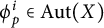 $\phi _p^i\in \operatorname {\mathrm {Aut}}(X)$
is symplectic, then
$\phi _p^i\in \operatorname {\mathrm {Aut}}(X)$
is symplectic, then $A_{\mathrm{prim}}(X)=H^4(X,\mathbb {Z})_{\phi _p^i}$
. Moreover, since
$A_{\mathrm{prim}}(X)=H^4(X,\mathbb {Z})_{\phi _p^i}$
. Moreover, since $\phi _p^i$
has prime order
$\phi _p^i$
has prime order $p,$
then
$p,$
then $A_{\mathrm{prim}}(X)$
is p-elementary by [Reference Mongardi, Tari and WandelMTW18, Lemma 1.8]. We observe that either
$A_{\mathrm{prim}}(X)$
is p-elementary by [Reference Mongardi, Tari and WandelMTW18, Lemma 1.8]. We observe that either $A(X)=\langle \eta _X\rangle \oplus A_{\mathrm{prim}}(X)$
or
$A(X)=\langle \eta _X\rangle \oplus A_{\mathrm{prim}}(X)$
or $A(X)$
is a proper overlattice of
$A(X)$
is a proper overlattice of $\langle \eta _X\rangle \oplus A_{\mathrm{prim}}(X)$
obtained by gluing the discriminant form of
$\langle \eta _X\rangle \oplus A_{\mathrm{prim}}(X)$
obtained by gluing the discriminant form of $\langle \eta _X\rangle $
. As a consequence, if
$\langle \eta _X\rangle $
. As a consequence, if $p\not = 3,$
then
$p\not = 3,$
then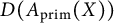 $D(A_{\mathrm{prim}}(X))$
has no subgroup isomorphic to
$D(A_{\mathrm{prim}}(X))$
has no subgroup isomorphic to $\mathbb {Z}/3\mathbb {Z}$
so that, by Lemma 3.1, we have
$\mathbb {Z}/3\mathbb {Z}$
so that, by Lemma 3.1, we have $A(X)=\langle \eta _X\rangle \oplus A_{\mathrm{prim}}(X)$
and by Lemma 3.3, it follows that
$A(X)=\langle \eta _X\rangle \oplus A_{\mathrm{prim}}(X)$
and by Lemma 3.3, it follows that $X\not \in \bigcup _{d\equiv 2(6)}{C}_d$
.
$X\not \in \bigcup _{d\equiv 2(6)}{C}_d$
.
Theorem 3.5 Let X be a cubic fourfold with a symplectic automorphism $\phi _p^i$
of prime order p, which is general in the family
$\phi _p^i$
of prime order p, which is general in the family $F_p^i$
. Then, the lattice
$F_p^i$
. Then, the lattice $A(X)$
has a Gram matrix as in Appendix A and the lattice
$A(X)$
has a Gram matrix as in Appendix A and the lattice $T(X)$
is displayed in Table 1.
$T(X)$
is displayed in Table 1.
Proof The automorphism $\phi _p^i$
induces an isometry on
$\phi _p^i$
induces an isometry on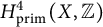 $H_{\mathrm{prim}}^4(X,\mathbb {Z})$
and
$H_{\mathrm{prim}}^4(X,\mathbb {Z})$
and $(\phi _p^i,H_{\mathrm{prim}}^4 (X,\mathbb {Z})_{\phi _p^i})$
is a Leech pair (cf. [Reference Laza and ZhengLZ22, Definition 3.3]). Note that for a general cubic fourfold with the action of
$(\phi _p^i,H_{\mathrm{prim}}^4 (X,\mathbb {Z})_{\phi _p^i})$
is a Leech pair (cf. [Reference Laza and ZhengLZ22, Definition 3.3]). Note that for a general cubic fourfold with the action of $\phi _p^i$
, it holds that
$\phi _p^i$
, it holds that $A_{\mathrm{prim}}(X)=H_{\mathrm{prim}}^4(X,\mathbb {Z})_{\phi _p^i}$
and the lattice is in the classification [Reference Laza and ZhengLZ22, Theorem 1.2]. We recall that the Leech lattice has no vectors of square
$A_{\mathrm{prim}}(X)=H_{\mathrm{prim}}^4(X,\mathbb {Z})_{\phi _p^i}$
and the lattice is in the classification [Reference Laza and ZhengLZ22, Theorem 1.2]. We recall that the Leech lattice has no vectors of square $2$
, ensuring that
$2$
, ensuring that $A_{\mathrm{prim}}(X)$
contains no short roots accordingly to Remark 2.1, while the condition of not containing long roots has its relevance in the computation of
$A_{\mathrm{prim}}(X)$
contains no short roots accordingly to Remark 2.1, while the condition of not containing long roots has its relevance in the computation of $A(X)$
. The lattice
$A(X)$
. The lattice $A_{\mathrm{prim}}(X)$
is p-elementary and it corresponds to the cases No. 20, 52, and 120 of [Reference Höhn and MasonHM16, Table 1] for the primes
$A_{\mathrm{prim}}(X)$
is p-elementary and it corresponds to the cases No. 20, 52, and 120 of [Reference Höhn and MasonHM16, Table 1] for the primes $5,7$
, and
$5,7$
, and $11$
. By Proposition 3.4, we deduce that
$11$
. By Proposition 3.4, we deduce that $A(X)=\langle \eta _X \rangle \oplus A_{\mathrm{prim}}(X)$
whenever
$A(X)=\langle \eta _X \rangle \oplus A_{\mathrm{prim}}(X)$
whenever $p\not =3$
. It remains to discuss automorphisms of order
$p\not =3$
. It remains to discuss automorphisms of order $p=3$
. Here, we use a case-by-case analysis.
$p=3$
. Here, we use a case-by-case analysis.
-
(1) Consider the Leech pair
$(G,S)$
no.
$4$
in [Reference Höhn and MasonHM16, Table 1] with G of order three. The lattice S is the coinvariant lattice with respect to a Leech pair
$(G,S),$
where G is a group of order three and S has rank
$12$
. The lattice S is uniquely determined up to isometry and it turns out to be the same for the action of
$\phi _3^3$
and
$\phi _3^6$
on general cubic fourfolds in the families
$F_3^3$
and
$F_3^6$
. We have
$S \cong A_{\mathrm{prim}}(X_3^3)=A_{\mathrm{prim}}(X_3^6),$
where
$X_3^3\in F_3^3$
and
$X_3^6\in F_3^6$
are general cubic fourfold in the families with automorphisms
$\phi _3^3$
and
$\phi _3^6$
, respectively. There are two possibilities for the algebraic lattice: it is either isometric to
$[3]\oplus S$
or to an index
$3$
overlattice of that. We observe that the cubic
$X_3^3$
contains planes (see Proposition 5.1 for more details), and hence
$X_3^3\in {C}_8$
. By Lemmas 3.1 and 3.3, it follows that the embedding
$\langle \eta _{X_3^3}\rangle \oplus A_{\mathrm{prim}}(X_3^3) \subset A(X_3^3) $
is of index
$3$
. To compute the lattice
$A(X_3^3)$
, we compute the possible extensions of index
$3$
of
$\langle \eta _{X_3^3}\rangle \oplus A_{\mathrm{prim}}(X_3^3)$
and exclude the cases where there are vectors of square
$1$
, which correspond to having long roots in
$A_{\mathrm{prim}}(X)$
by [Reference Billi and GrossiBG25, Lemma 4.4], according to Remark 2.1. This can be easily done, for example, using [OSC24], however,
$A(X_3^3)$
is the only index three extension of
$\langle \eta _{X_3^3}\rangle \oplus A_{\mathrm{prim}}(X_3^3)$
with no vectors of square
$1$
and hence it suffices to exhibit such a lattice. We deduce that
$X_3^6$
corresponds to the other case, for which we have
$A(X_3^6)=\langle \eta _{X_3^6}\rangle \oplus A_{\mathrm{prim}}(X_3^6)$
. -
(2) Consider the Leech pair
$(G,S)$
no. 35 in [Reference Höhn and MasonHM16, Table 1] with G of order three. Let
$X_3^4$
be a general cubic fourfold in
$F_3^4$
; we have that
$A_{\mathrm{prim}}(X_3^4)\cong S$
has rank
$18$
and it is
$3$
-elementary with
$l(D(A_{\mathrm{prim}}(X_3^4)))=5$
. In this case, the transcendental lattice
$T(X_3^4)$
has rank
$4$
and, as a consequence, its orthogonal complement
$A(X_3^4)$
in the unimodular lattice
$H^4(X_3^4,\mathbb {Z})$
must have length
$l(D(A(X)))\leq 4$
. It follows that the discriminant form of
$\langle \eta _X\rangle $
must be glued and
$\langle \eta _X\rangle \oplus A_{\mathrm{prim}}(X_3^4)\subset A(X_3^4,\mathbb {Z})$
has index
$3$
, as in Lemma 3.3. We compute the lattice
$A(X_3^4)$
by the same technique as before. Alternatively, we also know that the cubic
$X_3^4$
contains planes, see [Reference KoikeKoi22], and we can argue as before.

















We computed the lattice $A(X)$
for any general cubic fourfold
$A(X)$
for any general cubic fourfold $X\in F_p^i$
, and the transcendental lattice
$X\in F_p^i$
, and the transcendental lattice $T(X)$
is uniquely determined by the rank and the discriminant form of
$T(X)$
is uniquely determined by the rank and the discriminant form of $A(X)$
. In fact, we see that, in all cases except
$A(X)$
. In fact, we see that, in all cases except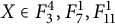 $X\in F_3^4, F_7^1,F_{11}^1$
, the lattice
$X\in F_3^4, F_7^1,F_{11}^1$
, the lattice $T(X)$
is indefinite with
$T(X)$
is indefinite with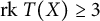 $\operatorname {\mathrm {rk}} T(X)\geq 3$
and
$\operatorname {\mathrm {rk}} T(X)\geq 3$
and $\operatorname {\mathrm {rk}} T(X)\geq l_q(T(X))+2$
for any prime q, so that by [Reference NikulinNik79b, Theorem 1.13.2], the lattice
$\operatorname {\mathrm {rk}} T(X)\geq l_q(T(X))+2$
for any prime q, so that by [Reference NikulinNik79b, Theorem 1.13.2], the lattice $T(X)$
is uniquely determined. For the remaining cases, we need to argue separately. From
$T(X)$
is uniquely determined. For the remaining cases, we need to argue separately. From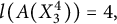 $l(A(X_3^4))=4,$
we know that
$l(A(X_3^4))=4,$
we know that $T(X_3^4)$
is 3-elementary with
$T(X_3^4)$
is 3-elementary with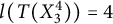 $l(T(X_3^4))=4$
, moreover, we know that the discriminant form
$l(T(X_3^4))=4$
, moreover, we know that the discriminant form $\delta _p$
of
$\delta _p$
of $D(T(X_{p}^1))$
is anti-isometric to the one of
$D(T(X_{p}^1))$
is anti-isometric to the one of $ D(A(X_{p}^1))\oplus D([3])$
for
$ D(A(X_{p}^1))\oplus D([3])$
for ${p=7,11}$
. We now use again [OSC24] to check the following: there is only one genus of even 3-elementary lattices of signature
${p=7,11}$
. We now use again [OSC24] to check the following: there is only one genus of even 3-elementary lattices of signature $(2,2)$
and length
$(2,2)$
and length $4$
with a unique isometry representative, there is a unique even lattice of signature
$4$
with a unique isometry representative, there is a unique even lattice of signature $(2,2)$
with discriminant form
$(2,2)$
with discriminant form $\delta _7$
, and there is a unique even lattice of signature
$\delta _7$
, and there is a unique even lattice of signature $(0,2)$
with discriminant form
$(0,2)$
with discriminant form $\delta _{11}$
.
$\delta _{11}$
.
Remark 3.6 In particular, one can see that, in all cases, there is a cohomologically associated K3 surface. It was already proved in [Reference OuchiOuc21] that a cubic fourfold admitting a symplectic automorphism of order different from two has an associated K3 surface in the derived sense. This is equivalent to have an associated K3 surface in the cohomological sense by [Reference Addington and ThomasAT14, Theorem 1.1] and [Reference Bayer, Lahoz, Macrì, Nuer, Perry and StellariBLM+21, Corollary 1.7].
Corollary 3.7 Let X be a cubic fourfold admitting a symplectic automorphism of prime order $p\geq 3$
, then X is rational.
$p\geq 3$
, then X is rational.
Proof We use the description of the Gram matrix $A(X)$
in Appendix A for a general cubic fourfold X in one of the families
$A(X)$
in Appendix A for a general cubic fourfold X in one of the families $F_p^i$
to show that
$F_p^i$
to show that $X\in {C}_{14}$
or
$X\in {C}_{14}$
or $X\in {C}_{42}$
. By [Reference Bolognesi, Russo and StaglianòBRS19] and [Reference Russo and StaglianòRS22], we know that cubic fourfolds in these Hassett divisors are rational. If
$X\in {C}_{42}$
. By [Reference Bolognesi, Russo and StaglianòBRS19] and [Reference Russo and StaglianòRS22], we know that cubic fourfolds in these Hassett divisors are rational. If $X\in F_3^3$
or
$X\in F_3^3$
or $X\in F_3^4$
, then X contains disjoint planes by Propositions 5.1 and 5.2, hence, X is rational and, in particular,
$X\in F_3^4$
, then X contains disjoint planes by Propositions 5.1 and 5.2, hence, X is rational and, in particular, $X\in {C}_{14}$
. In all the other cases, we have
$X\in {C}_{14}$
. In all the other cases, we have $A(X)=\langle \eta _X \rangle \oplus A_{\mathrm{prim}}(X)$
and
$A(X)=\langle \eta _X \rangle \oplus A_{\mathrm{prim}}(X)$
and $X\not \in {C}_{14}$
, but it is easy to find a primitive sublattice of
$X\not \in {C}_{14}$
, but it is easy to find a primitive sublattice of $A_{\mathrm{prim}}(X)$
with Gram matrix
$A_{\mathrm{prim}}(X)$
with Gram matrix
 $$\begin{align*}\begin{pmatrix} 4 & 1 & 0 \\ 1 &4 & 0\\ 0 & 0 & 4 \end{pmatrix},\end{align*}$$
the sum of the generators is a vector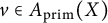 $v\in A_{\mathrm{prim}}(X)$
with
$v\in A_{\mathrm{prim}}(X)$
with $v^2=14$
and the lattice
$v^2=14$
and the lattice ${K=\langle \eta _X,v\rangle \subseteq A(X)}$
gives
${K=\langle \eta _X,v\rangle \subseteq A(X)}$
gives $X\in {C}_{42}$
.
$X\in {C}_{42}$
.
4 Cubic fourfolds containing cubic scrolls
All the cubic fourfolds with a symplectic automorphism of prime order belong to the divisor ${C}_{12}$
, which is the closure of the locus of cubic fourfolds containing a cubic scroll. By Lemma 3.3, Proposition 3.4, and Theorem 3.5, the general cubic with automorphism
${C}_{12}$
, which is the closure of the locus of cubic fourfolds containing a cubic scroll. By Lemma 3.3, Proposition 3.4, and Theorem 3.5, the general cubic with automorphism $\phi _3^6,\phi _5^1,\phi _5^1$
, or
$\phi _3^6,\phi _5^1,\phi _5^1$
, or $\phi _{11}^1$
does not belong to
$\phi _{11}^1$
does not belong to ${C}_8$
and hence it does not contain planes. In the following, we prove that these cubics contain cubic scrolls, and their classes generate the algebraic lattice.
${C}_8$
and hence it does not contain planes. In the following, we prove that these cubics contain cubic scrolls, and their classes generate the algebraic lattice.
Proposition 4.1 Let X be a general cubic fourfold in one of the families $F_3^6,F_5^1,F_7^1$
, or
$F_3^6,F_5^1,F_7^1$
, or $F_{11}^1$
. Then, X contains k families of cubic scrolls
$F_{11}^1$
. Then, X contains k families of cubic scrolls $\{T_i,T^\vee _i\}^{k}_{i=1}$
such that
$\{T_i,T^\vee _i\}^{k}_{i=1}$
such that $[T_i]+[T^\vee _i]=2\eta _X,$
where
$[T_i]+[T^\vee _i]=2\eta _X,$
where $k=378, 1,320, 2,709,$
or
$k=378, 1,320, 2,709,$
or $6,270,$
respectively. Moreover, the algebraic lattice
$6,270,$
respectively. Moreover, the algebraic lattice $A(X)$
is generated by the classes
$A(X)$
is generated by the classes $[T_i]$
for
$[T_i]$
for $i=1,\dots ,k$
.
$i=1,\dots ,k$
.
Proof We argue as in the proofs of [Reference Billi and GrossiBG25, Propositions 4.10 and 4.11]: using the proof of [Reference Brooke, Frei, Marquand and QinBFMQ25, Lemma 2.11] classes of cubic scrolls in X correspond to classes of extremal rational curves in the Fano variety of lines $F(X)$
with the right numerical properties, i.e., square
$F(X)$
with the right numerical properties, i.e., square $-10$
and divisibility
$-10$
and divisibility $2$
in
$2$
in $H^{1,1}(F(X),\mathbb {Z})_{\mathrm{prim}}$
which correspond to vectors of square
$H^{1,1}(F(X),\mathbb {Z})_{\mathrm{prim}}$
which correspond to vectors of square $4$
in
$4$
in $A_{\mathrm{prim}}(X)$
. The families of cubic scrolls come in pairs and, using the matrix description of the lattice
$A_{\mathrm{prim}}(X)$
. The families of cubic scrolls come in pairs and, using the matrix description of the lattice $A_{\mathrm{prim}}(X)=\langle \eta _X\rangle ^{\perp _{A(X)}}$
in Theorem 3.5, it is easy to check (using a computer) that there are
$A_{\mathrm{prim}}(X)=\langle \eta _X\rangle ^{\perp _{A(X)}}$
in Theorem 3.5, it is easy to check (using a computer) that there are $2k$
such vectors which generate the entire lattice.
$2k$
such vectors which generate the entire lattice.
Remark 4.2 The number of families of cubic scrolls was also computed implicitly in [Reference Marquand and MullerMM25b, Table 5].
The group of symplectic automorphisms of the cubic we consider is known by lattice theoretical arguments (see [Reference Laza and ZhengLZ22]). For a general cubic fourfold X in the family $F_3^6$
, we have that
$F_3^6$
, we have that $\operatorname {\mathrm {Aut}}_S(X)=\langle \phi _3^6\rangle $
, but in the other cases, the group of symplectic automorphisms is bigger and we give explicit generators for the group.
$\operatorname {\mathrm {Aut}}_S(X)=\langle \phi _3^6\rangle $
, but in the other cases, the group of symplectic automorphisms is bigger and we give explicit generators for the group.
Proposition 4.3 There is the following description of automorphism groups:
-
• Let X be a general cubic fourfold in the family
$F_5^1$
, then
$\operatorname {\mathrm {Aut}}_S(X)\cong D_5$
the dihedral group (of
$ten$
elements) and it is generated by
$\phi _5^1$
together with the symplectic involution In particular, there is an inclusion of families
$$\begin{align*}\tau=\begin{pmatrix} 1 & 0 & 0 & 0 & 0 & 0 \\ 0 & 1 & 0 & 0 & 0 & 0\\ 0 & 0 & 0 & 0 & 0 & 1\\ 0 & 0 & 0 & 0 & 1 & 0\\ 0 & 0 & 0 & 1 & 0 & 0\\ 0 & 0 & 1 & 0 & 0 & 0 \end{pmatrix}. \end{align*}$$
$F_5^1\subset F_2^2$
.
-
• Let X be a general cubic in the family
$F_7^1$
, then
$\operatorname {\mathrm {Aut}}_S(X)= \langle \phi _7^1\rangle \rtimes \langle \tau \rangle , $
where is an order three symplectic automorphism. In particular, there is an inclusion of families
$$\begin{align*}\tau=\begin{pmatrix} 0 & 1 & 0 & 0 & 0 & 0 \\ 0 & 0 & 0 & 1 & 0 & 0\\ 0 & 0 & 0 & 0 & 0 & 1\\ 1 & 0 & 0 & 0 & 0 & 0\\ 0 & 0 & 1 & 0 & 0 & 0\\ 0 & 0 & 0 & 0 & 1 & 0 \end{pmatrix}\end{align*}$$
$F_7^1\subset F_3^6$
.
-
• Let X be a general cubic fourfold in the family
$F_{11}^1$
, then
$\operatorname {\mathrm {Aut}}_S(X)\cong L_2(11),$
it is generated by
$\phi _{11}^1$
and the symplectic automorphism of order five Moreover, we have that
$$\begin{align*}\tau=\begin{pmatrix} 1 & 0 & 0 & 0 & 0 & 0 \\ 0 & 0 & 1 & 0 & 0 & 0\\ 0 & 0 & 0 & 0 & 0 & 1\\ 0 & 1 & 0 & 0 & 0 & 0\\ 0 & 0 & 0 & 1 & 0 & 0\\ 0 & 0 & 0 & 0 & 1 & 0 \end{pmatrix}.\end{align*}$$
$ X\in F_2^2\cap F_3^6 \cap F_5^1$
.








Proof It is easy to check that, in all cases, $\tau $
is symplectic, it has the wanted order, and that it satisfies the group relations. We consider the case of the automorphism
$\tau $
is symplectic, it has the wanted order, and that it satisfies the group relations. We consider the case of the automorphism $\phi ^1_{11}$
, where the statement is not as direct as the other cases. The matrix description is deduced by the description of its unique irreducible five-dimensional representation (see, for example, [Reference Wilson, Walsh, Tripp, Suleiman, Parker, Norton, Nickerson, Linton, Bray and AbbottWWT+]). The symplectic automorphism
$\phi ^1_{11}$
, where the statement is not as direct as the other cases. The matrix description is deduced by the description of its unique irreducible five-dimensional representation (see, for example, [Reference Wilson, Walsh, Tripp, Suleiman, Parker, Norton, Nickerson, Linton, Bray and AbbottWWT+]). The symplectic automorphism $\tau $
has order
$\tau $
has order $5$
, hence,
$5$
, hence, $X\in F_5^1$
. The group
$X\in F_5^1$
. The group $L_2(11)$
has order
$L_2(11)$
has order $660$
, hence, it admits symplectic automorphisms of order
$660$
, hence, it admits symplectic automorphisms of order $2$
and
$2$
and $3$
. It follows that
$3$
. It follows that $X\in F_2^2$
and that
$X\in F_2^2$
and that $X\in F_3^6$
since cubic fourfolds in
$X\in F_3^6$
since cubic fourfolds in $F_3^3$
and
$F_3^3$
and $F_3^4$
contain planes, but
$F_3^4$
contain planes, but $X\not \in {C}_8$
by Proposition 3.4.
$X\not \in {C}_8$
by Proposition 3.4.
Remark 4.4 Recently, the possibilities for the full group of automorphisms for a cubic fourfold in the family $F_7^1$
have been classified [Reference He, Li, Wang and ZhengHLWZ25].
$F_7^1$
have been classified [Reference He, Li, Wang and ZhengHLWZ25].
Remark 4.5 Note that if $F(X)$
admits a symplectic automorphism of order
$F(X)$
admits a symplectic automorphism of order $p=5,7,11$
that is induced by an automorphism of cubic fourfold X, then the entire group
$p=5,7,11$
that is induced by an automorphism of cubic fourfold X, then the entire group $G=D_{10}, C_7:C_3,L_2(11)$
is a symplectic group of automorphisms of
$G=D_{10}, C_7:C_3,L_2(11)$
is a symplectic group of automorphisms of $F(X)$
and is completely induced by automorphisms of X. Induced automorphisms on IHS varieties of
$F(X)$
and is completely induced by automorphisms of X. Induced automorphisms on IHS varieties of $K3^{[2]}$
type have been well studied, for more examples, see [Reference FuFu16, Reference Höhn and MasonHM19, Reference MongardiMon13].
$K3^{[2]}$
type have been well studied, for more examples, see [Reference FuFu16, Reference Höhn and MasonHM19, Reference MongardiMon13].
The cubic X with automorphism $\phi _{11}^1$
is the triple cover of
$\phi _{11}^1$
is the triple cover of $\mathbb {P}^4$
ramified on the Klein cubic threefold, the group of symplectic automorphisms is known to be isomorphic to
$\mathbb {P}^4$
ramified on the Klein cubic threefold, the group of symplectic automorphisms is known to be isomorphic to $L_2(11)=\operatorname {\mathrm {PSL}}(2,\mathbb {F}_{11})$
(see [Reference AdlerAdl78, Reference Laza and ZhengLZ22]). The group
$L_2(11)=\operatorname {\mathrm {PSL}}(2,\mathbb {F}_{11})$
(see [Reference AdlerAdl78, Reference Laza and ZhengLZ22]). The group $\operatorname {\mathrm {Aut}}(X)/\operatorname {\mathrm {Aut}}_S(X)$
has order three generated by the covering automorphism, in particular,
$\operatorname {\mathrm {Aut}}(X)/\operatorname {\mathrm {Aut}}_S(X)$
has order three generated by the covering automorphism, in particular, $X\in F_3^1$
.
$X\in F_3^1$
.
We denote by $Y_A$
the double EPW-sextic associated with the Klein Lagrangian A as in [Reference Debarre and MongardiDM22], with symplectic group of polarized automorphisms given by
$Y_A$
the double EPW-sextic associated with the Klein Lagrangian A as in [Reference Debarre and MongardiDM22], with symplectic group of polarized automorphisms given by $L_2(11)$
. We also observe that for a cubic fourfold X with automorphism
$L_2(11)$
. We also observe that for a cubic fourfold X with automorphism $\phi _{11}^1$
, the group of symplectic polarized automorphisms of the Fano variety of lines
$\phi _{11}^1$
, the group of symplectic polarized automorphisms of the Fano variety of lines $F(X)$
is also given by
$F(X)$
is also given by $L_2(11)$
.
$L_2(11)$
.
Proposition 4.6 Let X be a cubic fourfold with automorphism $\phi _{11}^1$
. Then, the Fano variety of lines
$\phi _{11}^1$
. Then, the Fano variety of lines $F(X)$
is not birational to the double EPW-sextic
$F(X)$
is not birational to the double EPW-sextic $Y_A$
.
$Y_A$
.
Proof According to [Reference Debarre and MongardiDM22], the transcendental lattice of $Y_A$
is given by
$Y_A$
is given by
 $$\begin{align*}T(Y_A)\cong[22]\oplus[22]\cong\begin{pmatrix} 22 & 0 \\ 0 &22 \end{pmatrix},\end{align*}$$
while the transcendental lattice of $F(X)$
is
$F(X)$
is
 $$\begin{align*}T(F(X))\cong\mathbf A_2(11)\cong \begin{pmatrix} 22 & 11 \\ 11 &22 \end{pmatrix}.\\[-41pt]\end{align*}$$
5 Cubic fourfolds containing planes
In this section, we study cubic fourfolds with automorphisms $\phi _3^3$
and
$\phi _3^3$
and $\phi _3^4$
. We prove that the general such cubic contains disjoint planes, and hence is rational. In fact, we prove that a cubic fourfold with the automorphism
$\phi _3^4$
. We prove that the general such cubic contains disjoint planes, and hence is rational. In fact, we prove that a cubic fourfold with the automorphism $\phi _3^4$
also admits the automorphism
$\phi _3^4$
also admits the automorphism $\phi _3^3$
. The existence of planes in such cubic fourfolds is due to the existence of Eckardt points. By studying the Eckardt points, we can deduce information on the configuration of the corresponding planes.
$\phi _3^3$
. The existence of planes in such cubic fourfolds is due to the existence of Eckardt points. By studying the Eckardt points, we can deduce information on the configuration of the corresponding planes.
Definition 5.1 Let X be a smooth cubic fourfold. We say that $P\in X$
is an Eckardt point if P has multiplicity
$P\in X$
is an Eckardt point if P has multiplicity $3$
in
$3$
in $T_PX\cap X$
, equivalently if
$T_PX\cap X$
, equivalently if $T_PX\cap X$
is a cone with vertex P over a cubic surface.
$T_PX\cap X$
is a cone with vertex P over a cubic surface.
It is proved in [Reference Laza, Pearlstein and ZhangLPZ18] that, for a cubic fourfold X, having an Eckardt point $P\in X$
is equivalent to being invariant for the anti-symplectic involution
$P\in X$
is equivalent to being invariant for the anti-symplectic involution $[x_0:\dots :x_4:x_5]\mapsto [x_0:\dots :x_4:-x_5]$
after a suitable change of coordinates, where the Eckardt point is given by
$[x_0:\dots :x_4:x_5]\mapsto [x_0:\dots :x_4:-x_5]$
after a suitable change of coordinates, where the Eckardt point is given by $P=[0:\dots :0:1]$
. We will refer to such an involution as an Eckardt involution, this is of the form
$P=[0:\dots :0:1]$
. We will refer to such an involution as an Eckardt involution, this is of the form $\phi _1$
referring to [Reference MarquandMar23].
$\phi _1$
referring to [Reference MarquandMar23].
According to [Reference Laza and ZhengLZ22], for a general cubic fourfold with automorphism $\phi _3^3$
, we have
$\phi _3^3$
, we have $\operatorname {\mathrm {Aut}}_S(X)=\langle \phi _3^3\rangle $
.
$\operatorname {\mathrm {Aut}}_S(X)=\langle \phi _3^3\rangle $
.
Proposition 5.1 A general cubic fourfold X in the family $F_3^3$
contains three Eckardt points. It contains exactly
$F_3^3$
contains three Eckardt points. It contains exactly $81$
planes that generate the lattice
$81$
planes that generate the lattice $A(X)$
. Moreover, X contains two disjoint planes and it is rational.
$A(X)$
. Moreover, X contains two disjoint planes and it is rational.
Proof Recall from Theorem 2.2 that the equation for a general such X is given as:
 $$\begin{align*}L_3(x_0,\dots,x_3)+x_4^3+x_5^3+x_4x_5M_1(x_0,\dots,x_3)=0.\end{align*}$$
One can see that X admits an involution that exchanges the two variables $x_4$
and
$x_4$
and $x_5$
. After the change of basis given by
$x_5$
. After the change of basis given by $y_4=x_4+x_5$
and
$y_4=x_4+x_5$
and $y_5=x_4-x_5$
, the involution is realized as
$y_5=x_4-x_5$
, the involution is realized as $y_5\mapsto -y_5$
and is an Eckardt involution. In the original coordinates, the involution has an Eckardt point
$y_5\mapsto -y_5$
and is an Eckardt involution. In the original coordinates, the involution has an Eckardt point $P_1=[0:\dots :1:-1]$
; we see two other Eckardt points in the orbit of
$P_1=[0:\dots :1:-1]$
; we see two other Eckardt points in the orbit of $P_1$
under
$P_1$
under $\phi _3^3$
. More explicitly, they are given by coordinates
$\phi _3^3$
. More explicitly, they are given by coordinates $\phi _3^3(P_1)=P_2=[0:\dots :1:-\xi _3]$
and
$\phi _3^3(P_1)=P_2=[0:\dots :1:-\xi _3]$
and $\phi _3^3(P_2)=P_3=[0:\dots :1:-\xi _3^2]$
.
$\phi _3^3(P_2)=P_3=[0:\dots :1:-\xi _3^2]$
.
Each Eckardt point $P_i$
determines a cone
$P_i$
determines a cone $X\cap T_{P_i}X=\mathrm{Cone}_i\subset X$
over a cubic surface
$X\cap T_{P_i}X=\mathrm{Cone}_i\subset X$
over a cubic surface $S_i$
for
$S_i$
for $i=1,2,3$
, moreover, one can see that
$i=1,2,3$
, moreover, one can see that $P_i\not \in T_{P_j}X$
for
$P_i\not \in T_{P_j}X$
for $i\not =j$
. This shows the existence of the
$i\not =j$
. This shows the existence of the $81$
planes in X, each generated by an Eckardt point
$81$
planes in X, each generated by an Eckardt point $P_i$
,
$P_i$
, $i=1,2,3$
and one of the
$i=1,2,3$
and one of the $27$
lines on the cubic surface
$27$
lines on the cubic surface $S_i$
. For
$S_i$
. For $i\not = j$
, we have that
$i\not = j$
, we have that $T_{P_i}X\cap T_{P_j}X\cong \mathbb {P}^3$
, this determines a cubic surface
$T_{P_i}X\cap T_{P_j}X\cong \mathbb {P}^3$
, this determines a cubic surface $S_{ij}=X\cap T_{P_i}X\cap T_{P_j}X$
contained in
$S_{ij}=X\cap T_{P_i}X\cap T_{P_j}X$
contained in $\mathrm{Cone}_i\cap \mathrm{Cone}_j$
and not containing the points
$\mathrm{Cone}_i\cap \mathrm{Cone}_j$
and not containing the points $P_i, P_j$
. As a consequence, there are at least two disjoint lines in the cubic surface
$P_i, P_j$
. As a consequence, there are at least two disjoint lines in the cubic surface $S_{ij}$
that span two disjoint planes, one plane in the cone with vertex
$S_{ij}$
that span two disjoint planes, one plane in the cone with vertex $P_i$
and one in a cone with vertex another Eckardt point
$P_i$
and one in a cone with vertex another Eckardt point $P_j$
, and hence X is rational (in general, a cubic fourfold with at least two Eckardt points is rational, see [Reference GammelgaardGam18, Corollary 6.4.2]). It is easily checked using the matrix description of Theorem 3.5 that there are exactly
$P_j$
, and hence X is rational (in general, a cubic fourfold with at least two Eckardt points is rational, see [Reference GammelgaardGam18, Corollary 6.4.2]). It is easily checked using the matrix description of Theorem 3.5 that there are exactly $81$
classes
$81$
classes $\alpha $
in
$\alpha $
in $A(X)$
such that
$A(X)$
such that $\alpha ^2=3$
and
$\alpha ^2=3$
and $\alpha \cdot \eta _X=1$
, moreover, these generate the entire lattice (this can be checked using a computer).
$\alpha \cdot \eta _X=1$
, moreover, these generate the entire lattice (this can be checked using a computer).
A general cubic fourfolds X in the family $F_3^4$
is studied in [Reference KoikeKoi22], where it is proved that it contains
$F_3^4$
is studied in [Reference KoikeKoi22], where it is proved that it contains $243$
planes. The group
$243$
planes. The group $\operatorname {\mathrm {Aut}}_S(X)$
was described in [Reference Laza and ZhengLZ22] and explicit generators of
$\operatorname {\mathrm {Aut}}_S(X)$
was described in [Reference Laza and ZhengLZ22] and explicit generators of $\operatorname {\mathrm {Aut}}(X)$
are given in [Reference KoikeKoi22].
$\operatorname {\mathrm {Aut}}(X)$
are given in [Reference KoikeKoi22].
Proposition 5.2 A general cubic fourfold X in the family $F_3^4$
belongs to the families
$F_3^4$
belongs to the families $F_2^1, F_2^2, F_3^3$
, and
$F_2^1, F_2^2, F_3^3$
, and $F_3^6$
. It contains 18 Eckardt points and it contains exactly
$F_3^6$
. It contains 18 Eckardt points and it contains exactly $243$
planes that generate the lattice
$243$
planes that generate the lattice $A(X)$
. Moreover, X contains disjoint planes and it is rational.
$A(X)$
. Moreover, X contains disjoint planes and it is rational.
Proof Recall that, from Theorem 2.2, the equation of such an X is given by $L_3(x_0,x_1,x_2)+M_3(x_3, x_4, x_5)=0$
. The cubic curves determined by
$L_3(x_0,x_1,x_2)+M_3(x_3, x_4, x_5)=0$
. The cubic curves determined by $L_3$
and
$L_3$
and $M_3$
can be put in the Hesse normal form: there exist
$M_3$
can be put in the Hesse normal form: there exist $\lambda ,\mu \in \mathbb {C}$
with
$\lambda ,\mu \in \mathbb {C}$
with $\lambda ^3\not =1$
and
$\lambda ^3\not =1$
and $\mu ^3\not =1$
such that the equation of X is of the form
$\mu ^3\not =1$
such that the equation of X is of the form
 $$\begin{align*}x_0^3+x_1^3+x_2^3 -\lambda x_0x_1x_2=x_3^3+x_4^3+x_5^3 -\mu x_3x_4x_5.\end{align*}$$
One can see that
 $$\begin{align*}\operatorname{\mathrm{Aut}}(X)\cong \operatorname{\mathrm{Aut}}(L_3)\times\operatorname{\mathrm{Aut}}(M_3)\times \langle \phi_3^4\rangle,\end{align*}$$
where $\operatorname {\mathrm {Aut}}(L_3)$
and
$\operatorname {\mathrm {Aut}}(L_3)$
and $\operatorname {\mathrm {Aut}}(M_3)$
are of order
$\operatorname {\mathrm {Aut}}(M_3)$
are of order $18$
generated by the permutations of variables and
$18$
generated by the permutations of variables and
 $$\begin{align*}L=\begin{pmatrix} 1 & 0 & 0\\ 0 & \xi_3 &0\\ 0 & 0 & \xi_3^2 \end{pmatrix}.\end{align*}$$
The group of symplectic automorphisms $\operatorname {\mathrm {Aut}}_S(X)$
is the subgroup of index
$\operatorname {\mathrm {Aut}}_S(X)$
is the subgroup of index $2$
given by automorphisms of determinant
$2$
given by automorphisms of determinant $1$
(only even permutations). From this description, we see that the cubic belongs to the families
$1$
(only even permutations). From this description, we see that the cubic belongs to the families $F_2^1, F_2^2, F_3^3$
, and
$F_2^1, F_2^2, F_3^3$
, and $F_3^6$
.
$F_3^6$
.
With the variables of the Hesse normal form, we see that any of the nine points in the $\operatorname {\mathrm {Aut}}(L_3)$
-orbit of
$\operatorname {\mathrm {Aut}}(L_3)$
-orbit of $P=[1:-1:0:\dots :0]$
is an Eckardt point. More precisely, any point
$P=[1:-1:0:\dots :0]$
is an Eckardt point. More precisely, any point $P_i$
in the orbit is the vertex of the cone
$P_i$
in the orbit is the vertex of the cone $\mathrm{Cone}_i=X\cap T_{P_i} X$
over a cubic surface
$\mathrm{Cone}_i=X\cap T_{P_i} X$
over a cubic surface $S_i$
for
$S_i$
for $i \in \{1, \dots , 9\}$
and one can directly see from the equations that for a general choice of
$i \in \{1, \dots , 9\}$
and one can directly see from the equations that for a general choice of $\lambda ,$
we have
$\lambda ,$
we have $P_j\not \in T_{P_i} X$
whenever
$P_j\not \in T_{P_i} X$
whenever $i\not =j$
. Thus, any choice of a line l in
$i\not =j$
. Thus, any choice of a line l in $S_i$
gives a distinct plane as a cone over l with vertex the point
$S_i$
gives a distinct plane as a cone over l with vertex the point $P_i$
.
$P_i$
.
Any of the nine Eckardt points $P_i$
,
$P_i$
,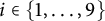 $i \in \{1, \dots , 9\}$
determines
$i \in \{1, \dots , 9\}$
determines $27$
planes in X, then we find
$27$
planes in X, then we find $243$
planes in X. From the matrix description of the lattice
$243$
planes in X. From the matrix description of the lattice $A(X)$
in Theorem 3.5, one can see that there are exactly
$A(X)$
in Theorem 3.5, one can see that there are exactly $243$
classes
$243$
classes $\alpha $
such that
$\alpha $
such that $\alpha ^2=3$
and
$\alpha ^2=3$
and $\alpha \cdot \eta _X=1$
. Each such class is represented by a unique plane, which generates the entire lattice. We have that
$\alpha \cdot \eta _X=1$
. Each such class is represented by a unique plane, which generates the entire lattice. We have that $T_{P_i}X \cap T_{P_j}X \cong \mathbb {P}^3$
for
$T_{P_i}X \cap T_{P_j}X \cong \mathbb {P}^3$
for $i\not =j$
, hence,
$i\not =j$
, hence, $S_{ij}=X\cap T_{P_i}X \cap T_{P_j}X$
is a cubic surface contained in the intersection of the cones
$S_{ij}=X\cap T_{P_i}X \cap T_{P_j}X$
is a cubic surface contained in the intersection of the cones $\mathrm{Cone}_i\cap \mathrm{Cone}_j$
. Taking the cones over two disjoint lines
$\mathrm{Cone}_i\cap \mathrm{Cone}_j$
. Taking the cones over two disjoint lines $l_i, l_j\in S_{ij}$
with vertices
$l_i, l_j\in S_{ij}$
with vertices $P_i$
and
$P_i$
and $P_j$
, respectively, we find disjoint planes in X and then X is rational.
$P_j$
, respectively, we find disjoint planes in X and then X is rational.
There are nine other Eckardt points in X corresponding to the $\operatorname {\mathrm {Aut}}(M_3)$
-orbit of the point
$\operatorname {\mathrm {Aut}}(M_3)$
-orbit of the point $Q=[0:\dots :1:-1:0]$
, but they determine the same planes as the previous Eckardt points. In fact, let Cone be the cone over a cubic surface associated with a point in the orbit of P and
$Q=[0:\dots :1:-1:0]$
, but they determine the same planes as the previous Eckardt points. In fact, let Cone be the cone over a cubic surface associated with a point in the orbit of P and $\mathrm{Cone}'$
the cone associated with a point in the orbit of Q. The intersection
$\mathrm{Cone}'$
the cone associated with a point in the orbit of Q. The intersection $\mathrm{Cone}\cap \mathrm{Cone}'$
consist of three distinct planes – indeed, after a suitable change of coordinated the equation of X can be re-written as
$\mathrm{Cone}\cap \mathrm{Cone}'$
consist of three distinct planes – indeed, after a suitable change of coordinated the equation of X can be re-written as
 $$\begin{align*}y_0y_1^2+y_2^3= y_3 y_4^2+y_5^3 .\end{align*}$$
The cones are given by $\mathrm{Cone}=X\cap \{y_0=0\}$
,
$\mathrm{Cone}=X\cap \{y_0=0\}$
, $\mathrm{Cone}'=X\cap \{y_3=0\}$
and the intersection is
$\mathrm{Cone}'=X\cap \{y_3=0\}$
and the intersection is $\mathrm{Cone}\cap \mathrm{Cone}'=\{y_2^3=y_5^3\}\subset \mathbb {P}^3$
. From the fact that there are nine points in each orbit, it follows that the
$\mathrm{Cone}\cap \mathrm{Cone}'=\{y_2^3=y_5^3\}\subset \mathbb {P}^3$
. From the fact that there are nine points in each orbit, it follows that the $27$
planes associated with an Eckardt point are contained in the nine cones corresponding to Eckardt points in the other orbit.
$27$
planes associated with an Eckardt point are contained in the nine cones corresponding to Eckardt points in the other orbit.
6 G-rationality
One of the guiding questions in the theory of cubic fourfolds is to determine if a cubic fourfold is rational. In the presence of a group action, it is natural to ask whether rationality holds in the equivariant context. This has been recently explored in [Reference Böhning, von Bothmer and TschinkelBvBT24], who provided a counter example to the equivariant analogs of existing rationality conjectures. In particular, the authors provide an example of a rational cubic fourfold (a Pfaffian cubic) with a large group action that is not G-rational. In this section, we provide two more examples or rational cubic fourfolds, which are not G-rational for $G=\operatorname {\mathrm {Aut}}(X)$
.
$G=\operatorname {\mathrm {Aut}}(X)$
.
Definition 6.1 Let G be a group, then a G-variety is a variety X with an inclusion $G\subseteq \operatorname {\mathrm {Aut}}(X)$
. Two G-varieties are said to be G-birational if there is a G-equivariant birational morphisms between them. A G-variety is said to be G-rational if it is G-birational to
$G\subseteq \operatorname {\mathrm {Aut}}(X)$
. Two G-varieties are said to be G-birational if there is a G-equivariant birational morphisms between them. A G-variety is said to be G-rational if it is G-birational to $\mathbb {P}^n$
.
$\mathbb {P}^n$
.
Clearly, if a group G cannot be realized as a group of linear transformation of $\mathbb {P}^n$
then no variety of dimension n can be G-rational. We now introduce the invariant that will allow us to determine that a cubic fourfold is not G-rational, following, for example, [Reference Tschinkel, Yang and ZhangTYZ24]. The same definitions could be given for an arbitrary ground field, but for simplicity, we stick to the case of complex numbers.
$\mathbb {P}^n$
then no variety of dimension n can be G-rational. We now introduce the invariant that will allow us to determine that a cubic fourfold is not G-rational, following, for example, [Reference Tschinkel, Yang and ZhangTYZ24]. The same definitions could be given for an arbitrary ground field, but for simplicity, we stick to the case of complex numbers.
Let G be a group and $n\in \mathbb {N}$
, denote by
$n\in \mathbb {N}$
, denote by $\operatorname {\mathrm {Symb}}_n(G)$
the free abelian group generated by symbols
$\operatorname {\mathrm {Symb}}_n(G)$
the free abelian group generated by symbols  where
where
-
•
$H\subseteq G$
is an abelian subgroup; -
•
$Y\subseteq Z_G(H)/H$
is a subgroup, where
$Z_G(H)$
denotes the centralizer of H in G; -
• K is a finitely generated field extension of
$\mathbb {C}$
of transcendence degree
$d\subseteq n$
with a faithful action of Y; -
•
$\beta =(\beta _1,\dots ,\beta _{n-d})$
is a sequence of nontrivial characters of H generating
$H^\vee $
.






The equivariant Burnside group $\operatorname {\mathrm {Burn}}_n(G)$
is obtained as a quotient of
$\operatorname {\mathrm {Burn}}_n(G)$
is obtained as a quotient of $\operatorname {\mathrm {Symb}}_n(G)$
by certain (slightly technical) equivalence relations, which we omit but are precisely described in [Reference Tschinkel, Yang and ZhangTYZ24, Section 3.3]. The relation which will be relevant for us is the blow-up relation:
$\operatorname {\mathrm {Symb}}_n(G)$
by certain (slightly technical) equivalence relations, which we omit but are precisely described in [Reference Tschinkel, Yang and ZhangTYZ24, Section 3.3]. The relation which will be relevant for us is the blow-up relation:  , where

Here, $\bar{H}=\operatorname {\mathrm {Ker}}(b_1-b_2)\subset H$
,
$\bar{H}=\operatorname {\mathrm {Ker}}(b_1-b_2)\subset H$
, $\beta $
is the image of characters in
$\beta $
is the image of characters in $\bar{H}^\vee $
,
$\bar{H}^\vee $
, $\beta _1=(b_1-b_2, b_2,b_3,\dots ,b_n)$
and
$\beta _1=(b_1-b_2, b_2,b_3,\dots ,b_n)$
and $\beta _2=(b_1,b_2-b_1,b_3,\dots ,b_n)$
. We remark that this is the only relation that involves extensions with different transcendence degrees.
$\beta _2=(b_1,b_2-b_1,b_3,\dots ,b_n)$
. We remark that this is the only relation that involves extensions with different transcendence degrees.
For X a G-variety of dimension n, following [Reference Kresch and TschinkelKT20, Reference Tschinkel, Yang and ZhangTYZ24], we consider the symbol:

Here, the sum is over the conjugacy classes of stabilizers H of maximal strata $F\subset X$
with these stabilizers, induced action of a subgroup
$F\subset X$
with these stabilizers, induced action of a subgroup $Y\subseteq Z_G(H)/H$
on the field of functions
$Y\subseteq Z_G(H)/H$
on the field of functions $\mathbb {C}(F)$
and corresponding weights
$\mathbb {C}(F)$
and corresponding weights $\beta _F$
of H in the normal bundle of F. The symbol
$\beta _F$
of H in the normal bundle of F. The symbol  is well-defined and is a G-birational invariant.
Theorem 6.1 Let X be a cubic fourfold with automorphism $\phi _3^3$
or
$\phi _3^3$
or $\phi _3^4$
and let
$\phi _3^4$
and let ${G=\operatorname {\mathrm {Aut}}(X)}$
. Then, X is rational but not G-rational.
${G=\operatorname {\mathrm {Aut}}(X)}$
. Then, X is rational but not G-rational.
Proof Suppose that X is G-rational, i.e., there is a G-equivariant birational morphism between X and $\mathbb {P}^4$
. Then, by [Reference Kresch and TschinkelKT20, Theorem 5.15], we have equality
$\mathbb {P}^4$
. Then, by [Reference Kresch and TschinkelKT20, Theorem 5.15], we have equality

and by [Reference Tschinkel, Yang and ZhangTYZ24, Corollary 6.1], for every summand in  the stratum F is birational to a product $\Pi _j \mathbb {P}(W_j)$
of linear space where the induced action on each factor is birational to a projective linear action.
$\Pi _j \mathbb {P}(W_j)$
of linear space where the induced action on each factor is birational to a projective linear action.
In any case, there is an involution of X point-wise fixing an Eckardt point and smooth cubic threefold $F\subset X$
which gives a symbol
$F\subset X$
which gives a symbol  appearing as a summand in
  , we argue that this gives a contradiction to the equality
  . In fact, the cubic threefold F is irrational, and the associated symbol is different from any symbol appearing in
  . Moreover, the symbol associated with the cubic threefold is not subject to the blow-up relation with any of the symbols appearing in
  because the associated strata are rational, and the blow-up relation preserves rationality.
Remark 6.2 One can use the same techniques of Theorem 6.1 to show that the general cubic fourfold X admitting an Eckardt involution is not G-rational for $G=\mathbb {Z}/2\mathbb {Z}$
, as suggested by Tschinkel. However, such a cubic is conjecturely irrational (see [Reference MarquandMar23] for a discussion).
$G=\mathbb {Z}/2\mathbb {Z}$
, as suggested by Tschinkel. However, such a cubic is conjecturely irrational (see [Reference MarquandMar23] for a discussion).
7 Birational transformations of LSV manifolds
In this section, we consider a cubic fourfold X with a symplectic automorphism of prime order and study the cohomological action of the induced birational transformation on associated LSV manifolds $J(X)$
and associated twisted LSV manifolds
$J(X)$
and associated twisted LSV manifolds $J^t(X)$
. The classification of groups of birational transformations of an IHS of OG10 type that can be induced from automorphisms of a cubic fourfold was completed in [Reference Marquand and MullerMM25b, Theorem 6.1] (see also [Reference Marquand and MullerMM25a] for the case of involutions). Here, we are able to identify the Néron–Severi and transcendental lattices of
$J^t(X)$
. The classification of groups of birational transformations of an IHS of OG10 type that can be induced from automorphisms of a cubic fourfold was completed in [Reference Marquand and MullerMM25b, Theorem 6.1] (see also [Reference Marquand and MullerMM25a] for the case of involutions). Here, we are able to identify the Néron–Severi and transcendental lattices of $J(X)$
and
$J(X)$
and $J^t(X)$
, complimenting the above results.
$J^t(X)$
, complimenting the above results.
Recall that an IHS manifold is a compact Kähler manifold which is simply connected and whose space of holomorphic two forms is generated by a non-degenerate form (see [Reference BeauvilleBea83]). One can construct smooth IHS manifolds from a cubic fourfold – we briefly recall the construction of [Reference Laza, Saccà and VoisinLSV17, Reference SaccàSac23, Reference VoisinVoi18].
Let $X\subset \mathbb {P}^5$
be a smooth cubic fourfold, and consider the intermediate Jacobian fibration
$X\subset \mathbb {P}^5$
be a smooth cubic fourfold, and consider the intermediate Jacobian fibration $\pi _U:J_U(X)\to U\subset (\mathbb P^5)^\vee $
over the locus U of smooth hyperplane sections, whose fibers are intermediate Jacobians. Similarly, there is a fibration
$\pi _U:J_U(X)\to U\subset (\mathbb P^5)^\vee $
over the locus U of smooth hyperplane sections, whose fibers are intermediate Jacobians. Similarly, there is a fibration $\pi _U^t:J^t_U(X)\to U$
whose fibers are twisted intermediate Jacobians (parameterizing degree
$\pi _U^t:J^t_U(X)\to U$
whose fibers are twisted intermediate Jacobians (parameterizing degree $1$
cycles). We recall the following result.
$1$
cycles). We recall the following result.
Theorem 7.1 [Reference Laza, Saccà and VoisinLSV17, Reference SaccàSac23, Reference VoisinVoi18]
Let X be a smooth cubic fourfold, then there exists compactifications $J(X)\to (\mathbb {P}^5)^\vee $
and
$J(X)\to (\mathbb {P}^5)^\vee $
and $J^t(X)\to (\mathbb {P}^5)^\vee $
such that
$J^t(X)\to (\mathbb {P}^5)^\vee $
such that $J(X)$
and
$J(X)$
and $J^t(X)$
are irreducible symplectic manifolds of OG10 type.
$J^t(X)$
are irreducible symplectic manifolds of OG10 type.
Such an IHS compactification $J(X)$
is called an LSV manifold, and
$J(X)$
is called an LSV manifold, and $J^t(X)$
is called a twisted LSV.
$J^t(X)$
is called a twisted LSV.
There are two algebraic classes which are always present, namely, the pullback of the hyperplane class that we denote by L and $L^t$
and the relative theta divisor that we denote by
$L^t$
and the relative theta divisor that we denote by $\Theta $
and
$\Theta $
and $\Theta ^t$
, respectively. These classes span a lattice
$\Theta ^t$
, respectively. These classes span a lattice
 $$\begin{align*}\mathbf U_X=\langle L, \Theta\rangle\subseteq \operatorname{\mathrm{NS}}(J(X))\end{align*}$$
that is isometric to the hyperbolic plane $\mathbf U$
, and a lattice
$\mathbf U$
, and a lattice
 $$\begin{align*}\mathbf U^t_X=\langle L^t, \Theta^t\rangle\subseteq \operatorname{\mathrm{NS}}(J(X))\end{align*}$$
that is isometric to the rescaled hyperbolic plane $\mathbf U(3)$
(see [Reference Mongardi and OnoratiMO22]). Moreover, there are isometries
$\mathbf U(3)$
(see [Reference Mongardi and OnoratiMO22]). Moreover, there are isometries
 $$\begin{align*}\mathbf U_X^{\perp}\cong H^4_{\mathrm{prim}}(X,\mathbb{Z})(-1)\cong (\mathbf U_X^t)^{\perp},\end{align*}$$
where the orthogonal complements are taken in $H^2(J(X),\mathbb {Z})$
and
$H^2(J(X),\mathbb {Z})$
and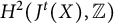 $H^2(J^t(X),\mathbb {Z})$
, respectively.
$H^2(J^t(X),\mathbb {Z})$
, respectively.
We firstly establish the relation between the coinvariant lattice for X and the coinvariant lattices for $J(X)$
and
$J(X)$
and $J^t(X)$
, this allows us to also deduce a relation between the algebraic lattices when X is general.
$J^t(X)$
, this allows us to also deduce a relation between the algebraic lattices when X is general.
Proposition 7.2 Let X be a cubic fourfold which is general among the ones admitting a symplectic automorphism $\phi \in \operatorname {\mathrm {Aut}}(X)$
of finite order and let
$\phi \in \operatorname {\mathrm {Aut}}(X)$
of finite order and let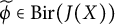 $\widetilde {\phi }\in \operatorname {\mathrm {Bir}}(J(X))$
and
$\widetilde {\phi }\in \operatorname {\mathrm {Bir}}(J(X))$
and $\widetilde {\phi }^t\in \operatorname {\mathrm {Bir}}(J^t(X))$
be the induced birational transformations on the manifolds
$\widetilde {\phi }^t\in \operatorname {\mathrm {Bir}}(J^t(X))$
be the induced birational transformations on the manifolds $J(X)$
and
$J(X)$
and $J^t(X)$
.
$J^t(X)$
.
Then, we have:
-
• an isometry
$H_{\mathrm{prim}}^4(X,\mathbb {Z})_\phi (-1)\cong H^2(J(X),\mathbb {Z})_{\widetilde {\phi }}$
, -
• an isometry
$H_{\mathrm{prim}}^4(X,\mathbb {Z})_\phi (-1)\cong H^2(J^t(X),\mathbb {Z})_{\widetilde {\phi }^t},$
-
• an equality
$ \mathbf U_X\oplus H^2(J(X),\mathbb {Z})_{\widetilde {\phi }}=\operatorname {\mathrm {NS}}(J(X)) $
, -
• an embedding
$ \mathbf U_X^t\oplus H^2(J^t(X),\mathbb {Z})_{\widetilde {\phi }^t}\subseteq \operatorname {\mathrm {NS}}(J^t(X)) $
,




where the last embedding is of index $3$
if
$3$
if $X\in {C}_d$
for some
$X\in {C}_d$
for some $d\equiv 2(6)$
, and it is primitive (and hence an equality) otherwise.
$d\equiv 2(6)$
, and it is primitive (and hence an equality) otherwise.
Proof We argue as in the proof of [Reference Billi and GrossiBG25, Proposition 5.6]: there is an equivariant isogeny of Hodge structures
 $$\begin{align*}\widetilde{\alpha} \colon H_{\mathrm{prim}}^4(X,\mathbb{Z})(-1) \rightarrow \mathbf U_X^\perp\subset H^2(J(X),\mathbb{Z}).\end{align*}$$
It follows that $H_{\mathrm{prim}}^4(X,\mathbb {Z})_{\phi }(-N) \subseteq (\mathbf U_X^{\perp })_{\widetilde {\phi }}= H^2(J(X),\mathbb {Z})_{\widetilde {\phi }}$
for some integer
$H_{\mathrm{prim}}^4(X,\mathbb {Z})_{\phi }(-N) \subseteq (\mathbf U_X^{\perp })_{\widetilde {\phi }}= H^2(J(X),\mathbb {Z})_{\widetilde {\phi }}$
for some integer $N>0$
. Since the cubic fourfold is general, we have
$N>0$
. Since the cubic fourfold is general, we have $H_{\mathrm{prim}}^4(X,\mathbb {Z})_{\phi } \cong A_{\mathrm{prim}}(X)$
and there are finite index embeddings
$H_{\mathrm{prim}}^4(X,\mathbb {Z})_{\phi } \cong A_{\mathrm{prim}}(X)$
and there are finite index embeddings
 $$\begin{align*}A_{\mathrm{prim}}(X)(-N) \cong H_{\mathrm{prim}}^4(X,\mathbb{Z})_{\phi}(-N) \subseteq (\mathbf U_X^{\perp})_{\widetilde{\phi}} \subseteq (\mathbf U_X^{\perp})^{1,1},\end{align*}$$
from which we conclude that $ H^2(J(X),\mathbb {Z})_{\widetilde {\phi }}=(\mathbf U_X^{\perp })_{\widetilde {\phi }}= (\mathbf U_X^{\perp })^{1,1}$
by observing that the last embedding is primitive and the lattices have the same rank. We obtained an embedding
$ H^2(J(X),\mathbb {Z})_{\widetilde {\phi }}=(\mathbf U_X^{\perp })_{\widetilde {\phi }}= (\mathbf U_X^{\perp })^{1,1}$
by observing that the last embedding is primitive and the lattices have the same rank. We obtained an embedding $\mathbf U_X\oplus H^2(J(X),\mathbb {Z})_{\widetilde {\phi }}\subseteq \operatorname {\mathrm {NS}}(J(X))$
and the same argument gives an embedding
$\mathbf U_X\oplus H^2(J(X),\mathbb {Z})_{\widetilde {\phi }}\subseteq \operatorname {\mathrm {NS}}(J(X))$
and the same argument gives an embedding $\mathbf U^t_X\oplus H^2(J^t(X),\mathbb {Z})_{\widetilde {\phi }}\subseteq \operatorname {\mathrm {NS}}(J^t(X))$
. In the first case, the embedding is primitive and hence an equality, whereas in the second case, the lattice
$\mathbf U^t_X\oplus H^2(J^t(X),\mathbb {Z})_{\widetilde {\phi }}\subseteq \operatorname {\mathrm {NS}}(J^t(X))$
. In the first case, the embedding is primitive and hence an equality, whereas in the second case, the lattice $\mathbf U_X^t\cong \mathbf U(3)$
has gluing subgroup
$\mathbf U_X^t\cong \mathbf U(3)$
has gluing subgroup $\mathbb {Z}/3\mathbb {Z}$
with its orthogonal in
$\mathbb {Z}/3\mathbb {Z}$
with its orthogonal in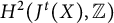 $H^2(J^t(X),\mathbb {Z})$
. By Lemmas 3.1 and 3.3, the gluing subgroup
$H^2(J^t(X),\mathbb {Z})$
. By Lemmas 3.1 and 3.3, the gluing subgroup $\mathbb {Z}/3\mathbb {Z}$
lies in
$\mathbb {Z}/3\mathbb {Z}$
lies in $A_{\mathrm{prim}}(X)=H_{\mathrm{prim}}^4(X,\mathbb {Z})_{\phi }$
in the case
$A_{\mathrm{prim}}(X)=H_{\mathrm{prim}}^4(X,\mathbb {Z})_{\phi }$
in the case $X\in {C}_d$
for some
$X\in {C}_d$
for some $d\equiv 2(6)$
, otherwise, it lies in
$d\equiv 2(6)$
, otherwise, it lies in $T(X)$
.
$T(X)$
.
The isometry $H_{\mathrm{prim}}^4(X,\mathbb {Z})_\phi (-1)\cong H^2(J^t(X),\mathbb {Z})_{\widetilde {\phi }^t}$
directly follows from [Reference Billi and GrossiBG25, Proposition 5.1] together with the generality assumption
$H_{\mathrm{prim}}^4(X,\mathbb {Z})_\phi (-1)\cong H^2(J^t(X),\mathbb {Z})_{\widetilde {\phi }^t}$
directly follows from [Reference Billi and GrossiBG25, Proposition 5.1] together with the generality assumption $A_{\mathrm{prim}}(X)=H_{\mathrm{prim}}^4(X,\mathbb {Z})_\phi $
. From the reasoning above, we know that there is an embedding
$A_{\mathrm{prim}}(X)=H_{\mathrm{prim}}^4(X,\mathbb {Z})_\phi $
. From the reasoning above, we know that there is an embedding $H_{\mathrm{prim}}^4(X,\mathbb {Z})_{\phi }(-N)\subseteq H^2(J(X),\mathbb {Z})_{\widetilde {\phi }}$
. Moreover, the lattices
$H_{\mathrm{prim}}^4(X,\mathbb {Z})_{\phi }(-N)\subseteq H^2(J(X),\mathbb {Z})_{\widetilde {\phi }}$
. Moreover, the lattices $H_{\mathrm{prim}}^4(X,\mathbb {Z})_{\phi }(-1)$
and
$H_{\mathrm{prim}}^4(X,\mathbb {Z})_{\phi }(-1)$
and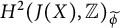 $H^2(J(X),\mathbb {Z})_{\widetilde {\phi }}$
are p-elementary with the same rank and admit a fix-point free isometry of order p. We now have two cases:
$H^2(J(X),\mathbb {Z})_{\widetilde {\phi }}$
are p-elementary with the same rank and admit a fix-point free isometry of order p. We now have two cases:
-
• A cubic X fourfold with automorphism
$\phi _3^3$
or
$\phi _3^4$
contains planes and
$X\in {C}_8$
: this implies that
$J(X)$
is birational to
$J^t(X)$
by [Reference Li, Pertusi and ZhaoLPZ22, Theorem 1.3] and [Reference Giovenzana, Giovenzana and OnoratiGGO24, Theorem 4.3]. Hence, there is a Hodge isometry
$H^2(J(X),\mathbb {Z})\cong H^2(J^t(X),\mathbb {Z})$
. -
• For a cubic fourfold with automorphism
$\phi \in \{\phi _2^2, \phi _3^6, \phi _5^1,\phi _7^1,\phi _{11}^1\}$
, the conditions in [Reference Brandhorst and CattaneoBC23, Proposition 2.16] show that the inequality is satisfied and [Reference Laza and ZhengLZ22, Proposition 3.3] implies that the coinvariant lattice
$$\begin{align*}\operatorname{\mathrm{rk}}(H^2(J(X),\mathbb{Z})_{\widetilde{\phi}})+l(H^2(J(X),\mathbb{Z})_{\widetilde{\phi}})\leq 24\end{align*}$$
$H^2(J(X),\mathbb {Z})_{\widetilde {\phi }}$
with the isometry
$ \widetilde {\phi }$
form a Leech pair. Leech pairs are classified in [Reference Höhn and MasonHM16], and there is a unique pair with a p-elementary lattice of given rank.






In all cases, we see that when $\phi \in \operatorname {\mathrm {Aut}}(X)$
is symplectic of prime order, we have an isometry
$\phi \in \operatorname {\mathrm {Aut}}(X)$
is symplectic of prime order, we have an isometry $H_{\mathrm{prim}}^4(X,\mathbb {Z})_\phi (-1)\cong H^2(J(X),\mathbb {Z})_{\widetilde {\phi }}$
and this concludes the proof.
$H_{\mathrm{prim}}^4(X,\mathbb {Z})_\phi (-1)\cong H^2(J(X),\mathbb {Z})_{\widetilde {\phi }}$
and this concludes the proof.
In particular, if X is general among the cubic fourfolds with a symplectic automorphism $\phi $
of prime order, then we have equalities
$\phi $
of prime order, then we have equalities
 $$\begin{align*}\operatorname{\mathrm{NS}}(J(X))=\mathbf U_X\oplus H^2(J(X),\mathbb{Z})_{\widetilde{\phi}}\text{, }\operatorname{\mathrm{NS}}(J^t(X))=(\mathbf U_X^t\oplus H^2(J^t(X),\mathbb{Z})_{\widetilde{\phi}^t})_{\mathrm{sat}} \end{align*}$$
and
 $$\begin{align*}T(J(X))= \mathbf U_X^\perp \subset H^2(J(X),\mathbb{Z})^{\tilde{\phi}} \text{, }T(J^t(X))=(\mathbf U_X^t)^\perp\subset H^2(J^t(X),\mathbb{Z})^{\widetilde{\phi}^t},\end{align*}$$
i.e., $J(X)$
and
$J(X)$
and $J^t(X)$
are also general. Here,
$J^t(X)$
are also general. Here, $(-)_{\mathrm{sat}}$
denotes the operation of taking the smaller primitive lattice in
$(-)_{\mathrm{sat}}$
denotes the operation of taking the smaller primitive lattice in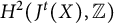 $H^2(J^t(X),\mathbb {Z})$
containing the given lattice, namely, its saturation. As a direct application, together with the classification of the invariant and coinvariant lattices for cubic fourfolds, we determine the algebraic lattices of the associated LSV and twisted LSV manifolds.
$H^2(J^t(X),\mathbb {Z})$
containing the given lattice, namely, its saturation. As a direct application, together with the classification of the invariant and coinvariant lattices for cubic fourfolds, we determine the algebraic lattices of the associated LSV and twisted LSV manifolds.
Theorem 7.3 Let X be a cubic fourfold which is general among the ones admitting a symplectic automorphism $\phi \in \operatorname {\mathrm {Aut}}(X)$
of prime order, then the Néron–Severi lattice and the transcendental lattice of the manifolds
$\phi \in \operatorname {\mathrm {Aut}}(X)$
of prime order, then the Néron–Severi lattice and the transcendental lattice of the manifolds $J(X)$
and
$J(X)$
and $J^t(X)$
are given in Table 2.
$J^t(X)$
are given in Table 2.
Proof The lattices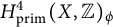 $H_{\mathrm{prim}}^4(X,\mathbb {Z})_\phi $
and
$H_{\mathrm{prim}}^4(X,\mathbb {Z})_\phi $
and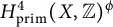 $H_{\mathrm{prim}}^4(X,\mathbb {Z})^\phi $
are classified in Theorem 3.5, while the lattices
$H_{\mathrm{prim}}^4(X,\mathbb {Z})^\phi $
are classified in Theorem 3.5, while the lattices $\operatorname {\mathrm {NS}}(J(X))$
and
$\operatorname {\mathrm {NS}}(J(X))$
and $\operatorname {\mathrm {NS}}(J^t(X))$
can be computed using Proposition 7.2. We notice that
$\operatorname {\mathrm {NS}}(J^t(X))$
can be computed using Proposition 7.2. We notice that $\operatorname {\mathrm {NS}}$
is unique in its genus in all the cases by [Reference NikulinNik79b, Proposition 1.14.2], and it also determines T uniquely.
$\operatorname {\mathrm {NS}}$
is unique in its genus in all the cases by [Reference NikulinNik79b, Proposition 1.14.2], and it also determines T uniquely.
A Gram matrices of the algebraic lattices
In this appendix, we describe the lattice $A(X)$
for a cubic fourfold X which is general among the ones admitting a symplectic automorphism of prime order. The lattice
$A(X)$
for a cubic fourfold X which is general among the ones admitting a symplectic automorphism of prime order. The lattice $A(X)$
is not unique in its genus and to describe it, we need to determine its isometry class; to do that, we give the associated Gram matrix. Also, we provide the coordinates of the class
$A(X)$
is not unique in its genus and to describe it, we need to determine its isometry class; to do that, we give the associated Gram matrix. Also, we provide the coordinates of the class $\eta _X$
, which allows to recover the matrix of
$\eta _X$
, which allows to recover the matrix of $A_{\mathrm{prim}}(X)$
from the one of
$A_{\mathrm{prim}}(X)$
from the one of $A(X)$
. It turns out that lattices
$A(X)$
. It turns out that lattices $A_{\mathrm{prim}}(X)$
are known in the literature, and then we refer to them precisely in each section.
$A_{\mathrm{prim}}(X)$
are known in the literature, and then we refer to them precisely in each section.
For the reader’s convenience, we collect in Table A1 the genera of the lattices $A(X),A_{\mathrm{prim}}(X),$
and
$A(X),A_{\mathrm{prim}}(X),$
and $T(X)$
, according to Conway–Sloane notation [Reference Conway and SloaneCS99, Chapter 15].
$T(X)$
, according to Conway–Sloane notation [Reference Conway and SloaneCS99, Chapter 15].
A.1 The automorphism
$\phi _3^3$

We have
 $$\begin{align*}A(X_3^3)= \begin{pmatrix} 3& 1& -1 &-1& -1& -1&-1& -1& -1& 0& 0& -1& -1\\ 1 &3 &-1& 0& 1& -1& -1& 0 &0 &1& 1& 1& -1\\ -1& -1& 3 &1& 0& 1& 1& 1& 1& 1& 1& 1& 1\\ -1& 0& 1& 3& 0& 1& 1& 1& 1& -1& -1& 1& 1\\ -1& 1& 0& 0& 3& 1& 1& 0& 0& 0& 0& 1& -1\\ -1&-1& 1& 1& 1& 3& 1& 1& 1& -1& -1& 0& 0\\ -1& -1& 1& 1& 1& 1& 3& 1& 1& -1& 0& 0& 0\\ -1& 0& 1& 1& 0& 1& 1& 3& 1& 1& 1& 0& 0\\ -1& 0& 1& 1& 0& 1& 1& 1& 3& 0& 1& 1& 0\\ 0& 1& 1& -1& 0 &-1& -1& 1& 0& 4 &2 &1& 0\\ 0& 1& 1& -1& 0& -1& 0& 1& 1& 2& 4 &1 &0\\ -1& 1& 1& 1& 1& 0& 0& 0& 1& 1& 1& 3& 0\\ -1& -1& 1& 1& -1& 0& 0& 0& 0& 0& 0& 0& 3\\ \end{pmatrix} \end{align*}$$
with $\eta _{X_3^3}=(1,0,0,0,0,0,0,0,0,0,0,0,0)$
. The lattice
$\eta _{X_3^3}=(1,0,0,0,0,0,0,0,0,0,0,0,0)$
. The lattice $A(X_3^3)$
is the only index
$A(X_3^3)$
is the only index $3$
overlattice of
$3$
overlattice of $\langle \eta _{X_3^3}\rangle \oplus A_{\mathrm{prim}}(X_3^3)$
not containing vectors of square
$\langle \eta _{X_3^3}\rangle \oplus A_{\mathrm{prim}}(X_3^3)$
not containing vectors of square $1$
which is obtained as in Lemmas 3.1 and 3.3. Moreover,
$1$
which is obtained as in Lemmas 3.1 and 3.3. Moreover, $A_{\mathrm{prim}}(X_3^3)\cong A_{\mathrm{prim}}(X_3^6)$
.
$A_{\mathrm{prim}}(X_3^3)\cong A_{\mathrm{prim}}(X_3^6)$
.
Genera of triples $(A(X),A_{\mathrm{prim}}(X),T(X))$
for a general cubic fourfold
$(A(X),A_{\mathrm{prim}}(X),T(X))$
for a general cubic fourfold $X\in F_p^i$
with a symplectic automorphism
$X\in F_p^i$
with a symplectic automorphism $\phi _p^i$
of prime order p.
$\phi _p^i$
of prime order p.

A.2 The automorphism
$\phi _3^6$

We have $A(X_3^6)=\langle \eta _{X_3^6}\rangle \oplus A_{\mathrm{prim}}(X_3^6)$
and
$A(X_3^6)=\langle \eta _{X_3^6}\rangle \oplus A_{\mathrm{prim}}(X_3^6)$
and
 $$\begin{align*}A_{\mathrm{prim}}(X_3^6)=\begin{pmatrix} 4 & 1 &-2 & 2 & 2 & 1 &-2 & 2 &-1& 1& 2 &-2\\1 & 4 &0 & 2 &-1 &-1 & 1& -1 &-2& 2& -1& 1\\-2 &0 & 4 &-1& -2 & 0 & 2 & 0 &-1 & 1 & 0 & 0\\ 2 & 2 &-1 & 4 & 0 &-1 & 0 & 0 &0 &2 & 0 &-1\\2 &-1 &-2 & 0 & 4 & 0 &-2 & 2 & 1& 0 & 2& -2\\1 &-1 & 0 &-1 & 0 & 4 &-2 & 2 & 0& -1 & 0 &-1\\-2 & 1& 2 & 0& -2 &-2 & 4 &-2 & 0& 0 &-1 & 2\\ 2 &-1 & 0 & 0 & 2 & 2& -2 & 4 & 0& 1 & 2 &-2\\-1 &-2& -1 & 0& 1 & 0 & 0 & 0 & 4& -1 &-1 & 0\\1 & 2 &1 & 2 &0 &-1 & 0 & 1 &-1& 4 & 1 &-1\\ 2 &-1 & 0 & 0 & 2 & 0& -1 & 2 &-1& 1 & 4 &-2\\-2 & 1& 0 &-1& -2 &-1& 2 &-2 & 0& -1& -2 & 4\end{pmatrix}.\end{align*}$$
Remark A.1 The lattice $A_{\mathrm{prim}}(X_3^6)\cong A_{\mathrm{prim}}(X_3^3) \cong K_{12} \cong \Omega _3$
, where
$A_{\mathrm{prim}}(X_3^6)\cong A_{\mathrm{prim}}(X_3^3) \cong K_{12} \cong \Omega _3$
, where $K_{12}$
is the one in [Reference Plesken and PohstPP93] (see also the database [Neb]) and
$K_{12}$
is the one in [Reference Plesken and PohstPP93] (see also the database [Neb]) and $\Omega _3$
is the one in [Reference Garbagnati and SartiGS07, Proposition 4.2]. This lattice is famously known as the Coxeter–Todd lattice and it appeared for the first time in [Reference Coxeter and ToddCT53].
$\Omega _3$
is the one in [Reference Garbagnati and SartiGS07, Proposition 4.2]. This lattice is famously known as the Coxeter–Todd lattice and it appeared for the first time in [Reference Coxeter and ToddCT53].
A.3 The automorphism
$\phi _3^4$

We have

with $\eta _{X_3^4}=(1,0,0,0,0,0,0,0,0,0,0,0,0,0,0,0,0,0,0)$
. The lattice
$\eta _{X_3^4}=(1,0,0,0,0,0,0,0,0,0,0,0,0,0,0,0,0,0,0)$
. The lattice $A(X_4^3)$
is the only index
$A(X_4^3)$
is the only index $3$
overlattice of
$3$
overlattice of $\langle \eta _{X_4^3}\rangle \oplus A_{\mathrm{prim}}(X_4^3)$
not containing vectors of square
$\langle \eta _{X_4^3}\rangle \oplus A_{\mathrm{prim}}(X_4^3)$
not containing vectors of square $1$
which is obtained as in Lemmas 3.1 and 3.3.
$1$
which is obtained as in Lemmas 3.1 and 3.3.
Remark A.2 In this case, the primitive algebraic lattice $A_{\mathrm{prim}}(X_3^4) \cong \langle \eta _{X_3^4} \rangle ^{\perp } \subset A(X)$
is isometric to the lattice
$A_{\mathrm{prim}}(X_3^4) \cong \langle \eta _{X_3^4} \rangle ^{\perp } \subset A(X)$
is isometric to the lattice $K_{18}$
and a matrix for this lattice is available at [Reference Plesken and PohstPP93] (see also the database [Neb]).
$K_{18}$
and a matrix for this lattice is available at [Reference Plesken and PohstPP93] (see also the database [Neb]).
A.4 The automorphism
$\phi _5^1$

We have $A(X_5^1)=\langle \eta _{X_5^1}\rangle \oplus A_{\mathrm{prim}}(X_5^1)$
and
$A(X_5^1)=\langle \eta _{X_5^1}\rangle \oplus A_{\mathrm{prim}}(X_5^1)$
and

Remark A.3 The lattice $A_{\mathrm{prim}}(X_5^1)\cong \Omega _5 \cong DIH_{16}(10)$
, where
$A_{\mathrm{prim}}(X_5^1)\cong \Omega _5 \cong DIH_{16}(10)$
, where $\Omega _5$
is the lattice described in [Reference Garbagnati and SartiGS07, Proposition 4.4] and
$\Omega _5$
is the lattice described in [Reference Garbagnati and SartiGS07, Proposition 4.4] and $DIH_{16}(10)$
in [Reference Griess and LamJL08].
$DIH_{16}(10)$
in [Reference Griess and LamJL08].
A.5 The automorphism
$\phi _7^1$

We have $A(X_7^1)=\langle \eta _{X_7^1}\rangle \oplus A_{\mathrm{prim}}(X_7^1)$
and
$A(X_7^1)=\langle \eta _{X_7^1}\rangle \oplus A_{\mathrm{prim}}(X_7^1)$
and

Remark A.4 We have $A_{\mathrm{prim}}(X_7^1)\cong \Omega _7$
, where
$A_{\mathrm{prim}}(X_7^1)\cong \Omega _7$
, where $\Omega _7$
is the lattice described in [Reference Garbagnati and SartiGS07, Proposition 4.6].
$\Omega _7$
is the lattice described in [Reference Garbagnati and SartiGS07, Proposition 4.6].
A.6 The automorphism
$\phi _{11}^1$

We have $A(X_{11}^1)=\langle \eta _{X_{11}^1}\rangle \oplus A_{\mathrm{prim}}(X_{11}^1)$
and
$A(X_{11}^1)=\langle \eta _{X_{11}^1}\rangle \oplus A_{\mathrm{prim}}(X_{11}^1)$
and

Remark A.5 The lattice $A_{\mathrm{prim}}(X_{11}^1)\cong S_{11,K3^{[2]}} \cong A_{11}\otimes ^{(3)}A_2$
, where
$A_{\mathrm{prim}}(X_{11}^1)\cong S_{11,K3^{[2]}} \cong A_{11}\otimes ^{(3)}A_2$
, where $S_{11,K3^{[2]}}$
is the lattice defined in [Reference MongardiMon13, Example 2.9] and
$S_{11,K3^{[2]}}$
is the lattice defined in [Reference MongardiMon13, Example 2.9] and $A_{11}\otimes ^{(3)}A_2$
is defined in [Reference NebeNeb98]. This lattice is the Mordell–Weil lattice of an elliptic curve over a field of characteristic
$A_{11}\otimes ^{(3)}A_2$
is defined in [Reference NebeNeb98]. This lattice is the Mordell–Weil lattice of an elliptic curve over a field of characteristic $11$
[Reference ShiodaShi91] (see also [Neb]).
$11$
[Reference ShiodaShi91] (see also [Neb]).
Acknowledgements
We would like to thank Stevell Muller for discussions about lattice computations and for pointing out useful functions of [OSC24]. We also would like to thank Yuri Tschinkel for suggesting that the general cubic fourfold with an Eckardt involution is not linearizable, and Howard Nuer for valuable discussions on arrangements of planes. We are grateful to the referee for useful comments that improved this article, in particular for suggesting parts of the general Lemma 3.1, Lemma 3.3, and their proofs, and also many properties of the lattices in Appendix A.


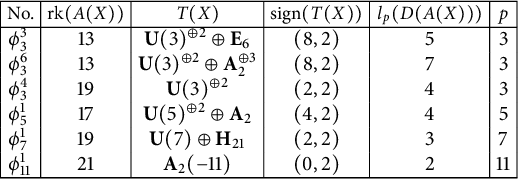


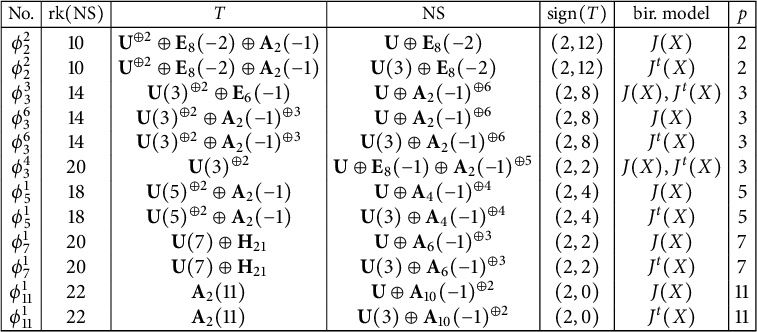


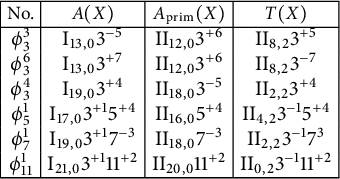


 Open access

