

The Central Highland area is part of the eastern margin of central Thailand, and given the area's rich natural resources (Department of Mineral Resources 1989, 2001; Pongsabutra 1991), it has been assumed that it was a prime area for prehistoric settlement (Reference HOHo 1992). However, little archaeological research has been conducted in this area. As the few previous studies (e.g., Reference BhumadhonBhumadhon 1986; Reference MaleipanMaleipan 1979; Reference NatapintuNatapintu 2003) show, this area has great potential for further archaeological investigation. In 2001-2002, I thus initiated archaeological field investigations at the stratified site of Sab Champa (Lertrit et al. 2001), part of my ongoing research project on early complex societies in Thailand.
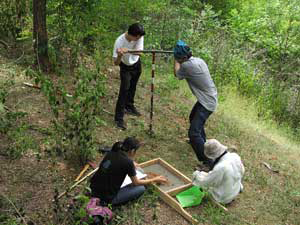
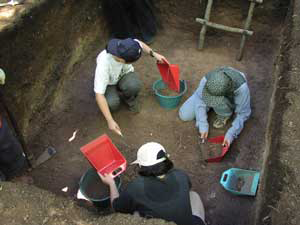
Sab Champa is about 15 kilometres east of the Pa Sak River (15°03' N and 101°14' E), and is located on a high limestone terrace at about 180 m above present mean sea level. The site measuring 834x704m is bounded by a moat (dating to Dvaravati Period), which sits between two high walls (Figure 1). Field investigation methods included pedestrian survey, auger coring, and test excavation (Figures 2-3). Research suggests it was successively occupied for three periods, starting during the Late Bronze Age (600 BC), if not earlier, followed by the Iron Age occupation (500 BC-AD 570), and finally the early Dvaravati period (6th-8th centuries AD).
The moated town of Sab Champa as seen from the air. .

Auger coring.

A test excavation in progress.

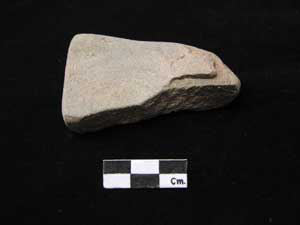
Excavated artifacts include fragments of bracelets, stone adzes, ear-rings, grinding stones, stone flakes, resharpening or whetstones, and stone disks made of different kinds of stone including limestone, marble, rhyolitic tuff, andesetic tuff, sandstone, and basalt (Figures 4-6). The presence of manufacturing by-product suggests that craft production was the key economic activity during the early settlements.
A polished stone tool found during excavation.

A resharpening stone made of sandstone.

Stone flakes.

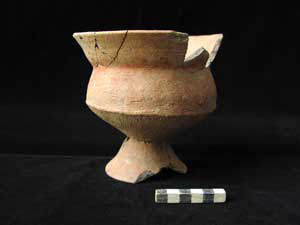
In the Bronze Age, the site was occupied by a small group with a self-reliant economy. Two Bronze Age extended supine adult male burials were excavated. One was interred with a wealth of grave goods including a variety of large and small complete and broken vessels (Figures 7-8), a bronze socketed axe, a bronze figurine, and animal bones.
A cord-marked round-based pot.

A red-painted pedetal vessel interred in a human grave.

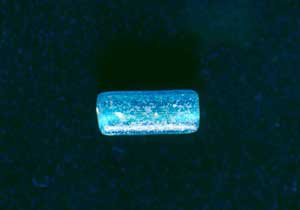
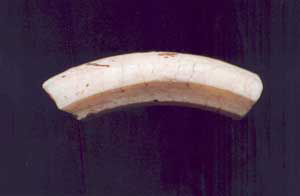
The Iron Age saw intensification of craft production, exchange networks; a specialized activity area, probably workshop, for craft production is located about 2 km southwest of the site where a large number of white marbles disks and bracelets/rings/bangles fragments have been recorded, and glass beads and marine shells were present (see Figures 9-10). There was also an increased habitation area within the site.
A tube glass bead.

A fregment of shell bracelet.

During the Dvaravati Period, there appears to have been an increase in population as suggested by an increase in construction, including large walls and a wide moat. The middle portion of the site might have been reserved for religious activities as three structures believed to have been religious monuments were found.
Major sources of protein for early inhabitants were large terrestrial animals including wild boar, a wide variety of deer, wild bovid, and perhaps tiger and elephant. Shell and fish remains were rarely found, and among the aquatic animals, found turtles appeared more frequently in the excavation units.
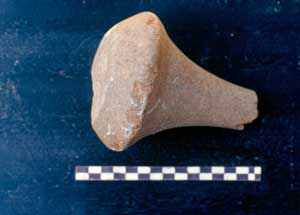
Subsistence patterns shifted from a primary dependency on animals to a major reliance on plants in the Dvaravati period. Grinding stones of various sizes (see Figure 11) are more numerous than in previous period suggesting that people ate foods derived from cereal crops. The faunal assemblage is comprised mainly of small to medium animals including dog, rabbit, monkey, chicken, and bird. Fish bones appear in higher frequency than earlier periods, but still comprise a small percentage of the total faunal assemblage. Rice consumption was very common during this time and rice chaff is commonly found as temper in bricks.
A grinding stone.

Craft production during the Bronze Age was carried out for intra- and inter-regional exchange. Imported items include copper ingots, marine shells, pottery vessels, and beads. Intra-regional exchange is inferred from the discovery of pottery vessels produced at such lowland sites such as Chaibadan and Puek Ree (Reference LertritLertrit 2002, 2003) were found at Sab Champa. Copper ingots are believed to have been brought from the Khao Wong Prachan area, about 70 km west of Sab Champa, where there were large-scale copper productions during the 1100-300 B.C. (Pigott et al. 1997). Sab Champa's inter-regional trade networks included regions as far away as the Khorat Plateau in the Northeast, about 200 kilometers east of Sab Champa, and the eastern coastal area (e.g., Higham & Thosarat 1998). Large finished grinding stones and the Buddhist Wheel of the Law made of andesite and green sandstones were probably imported from other regions.
The 2001-02 excavations demonstrate that Sab Champa is an important site for understanding the late Bronze Age to early state period of Thailand. As a stratified site containing successive occupation layers, it is particularly useful for the study of complex society in Thailand, and interrelations between socio-political changes, craft production, and inter-and intra-regional exchanges. More fieldwork at this site is planned for the next two years to recover more data. In addition to this, pollen analysis and detailed faunal identification are currently performed.
Acknowledgements
This research project was funded by the Thailand Research Fund (TRF). I would like to thank Professor Phasook Indrawooth for her moral support and academic advice. Additional comments from Elisabeth Bacus helped improve the paper. I extend my sincere thanks to my colleagues and graduate students who participated in the 2001-2002 fieldwork: Prasobchai Saengprapa, Jirassa Kachachiva, Pariwat Thammapreechakorn, Sitthichoke Puangbangpo, Jidaporn Saengnil, Thachsorn Tantiwong, Kamolthip Tharnsawangdamrong, Manorot Sutthisamdaeng, Suparat Teekakul, Preeyanuch Jumprom, Anan Klinpoklab, Wannakorn La-orsuwan, Wiriya Utthisen, and Laksamana Boonruang. Mr. Kham Panthong, head of Sab Champa village, graciously provided us with some facilities and logistics. My special thanks to Professor Jong Chan Kim, Seoul National University, Korea for his assistance with AMS dating and Dr. Supaporn Nakbunlung from Chiang Mai University for her analysis of human remains.