

Introduction
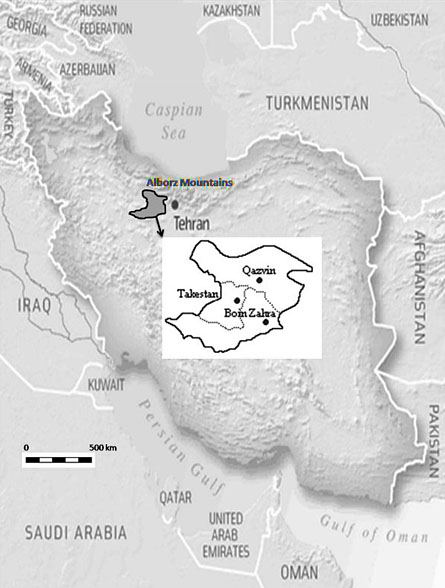
The plain of Qazvin is located on the southern slopes of the Alborz Mountains about 250km west of Tehran (Figure 1). It has seen archaeological activity for almost four decades. There are several important archeological sites located in this region such as Tepe Zagheh, Tepe Ghabrestan and Tepe Sagzabad, which suggest that human occupation of this region goes back to around the seventh millennium BC (Reference Malek ShahmirzadiMalek Shahmirzadi 1977; Reference NegahbanNegahban 1977 & 1979; Reference TalaiTalai 1983; Reference Fazeli NashliFazeli et al. 2005; Schmidt & Fazeli 2007).
Map showing the location of the Alborz area with (inset) the Qazvin plain and Boeen Zahra.

In contrast to the northern part, the southern part of the Qazvin plain, including the Boeen Zahra plain (Figure 1) has not received proper attention by archaeologists. Our survey was in fact the first systematic archaeological research conducted in this region. Unlike the Alborz Mountains in the north, the Boeen Zahra plain has mild winters and longer spring and summer seasons. In addition, this region seems more accessible than the Alborz Mountains to human migratory paths.
A key question in the minds of archaeologists who have excavated on the Qazvin plain has been to find the roots of its Neolithic settlers. Our research was designed to address this question and to find the footprints of Pleistocene societies which might have preceded the Neolithic population.
Location
The southern part of the Qazvin plain is divided in two distinct mountain and plain zones. Mount Ramand is the highest peak at 2555m above sea level); the lowest elevation is the Boeen Zahra plain (1178m above sea level). The main river is the Haji-Arab, which runs even in the driest summers. The mountain ranges run in an East-Southeast to West-Northwest direction. The southern portion of the Qazvin plain is made of volcanic rock formations filled by sedimentary layers.
Archaeological background
For the Palaeolithic, the southern slopes of the Alborz Mountains have seen little investigation. Although the significance of Alborz as a dwelling place for Pleistocene societies has been known since the 1950s, so far most Palaeolithic surveys and excavations have concentrated on the northern regions which are located closer to the Caspian Sea (Reference CoonCoon 1951, Reference Coon1952 & Reference Coon1957; Reference McburneyMcBurney 1968 & Reference Mcburney1970; Reference Vahdati NasabVahdati Nasab 1999; Reference Berillon, GBérillon et al. 2007 & Reference Berillon, G2008; Reference Vahdati NasabVahdati Nasab et al. 2008b).
During recent years there have been some reports of new Palaeolithic sites in the southern Alborz as well. Amirloo reported on an Upper Palaeolithic open site in Ghaleh Asgar near by Mount Demavand (Reference AmirlooAmirloo 1990). The French-Iranian Paleoanthropological Project (FIPP) has located several Palaeolithic sites in the southern Alborz including, for the Middle Palaeolithic period, Moghanak and Otchounak (Reference Berillon, GBérillon et al. 2007). The latest systematic survey of the southern Alborz has revealed a huge Palaeolithic site at Delazian (Mirak1), which is currently under investigation (Reference Vahdati NasabVahdati Nasab et al. 2008a).
Lithic material
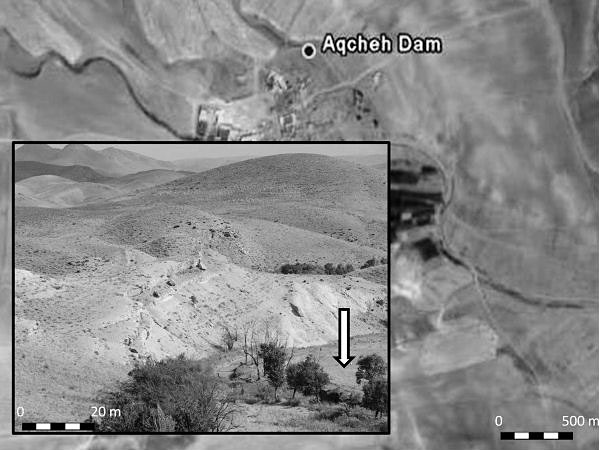
During the surveys conducted in 2007 and 2008, several sites in the Boeen Zahra plain produced Palaeolithic material. The most distinctive lithic material came from the site of Sepid-Dasht on the banks of the Agh-Che-Dâm creek (Figure 2). Although these sites are not very rich in terms of quantities of artefacts, the presence of such features as the Levallois technique is an indicator of the Middle Palaeolithic.
Location of the site of Sepid-Dasht in the Boeen Zahra plain.

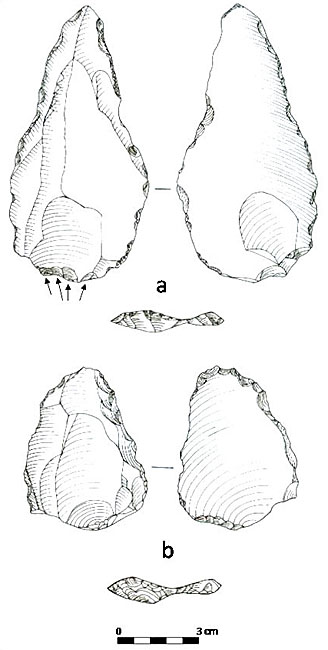
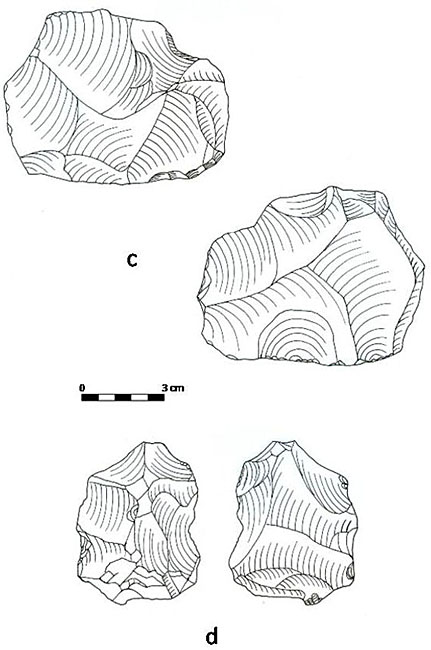
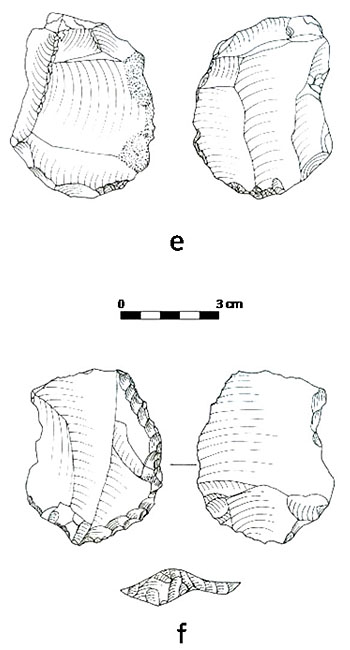
Some of the most distinctive stone artefacts collected from the Sepid-Dasht area are illustrated in Figures 3 to 5. They are:
-
a. Point with truncated faceting made on brown flint. In contrast to the points reported from the Zagros (Reference DibbleDibble 1984; Baumler & Speth 1993), this piece does not show stepped retouching; instead, it has transverse light retouching on both edges, plus signs of preparation on the platform. On the mirror side of the bulb of percussion there is an indication of knapping implying its possible use as a hafted element (Reference SheaShea 2006). Considering the size (95mm x 48mm), modification on the mirror side of the bulb of percussion, and light retouch, it seems reasonable, pending the results of use-wear analysis, to suggest that this Mousterian point could have been used as spearhead (Figure 3 (a)).
-
b. Convergent scraper with medium retouch on both edges made on flint. This piece is made on a Levallois flake and demonstrates a type of platform known as chapeau-de-gendarme (Figure 3 (b)).
-
c. Bifacial Levallois core with centripetal flake detachments made with recurrent centripetal Levallois technique (Figure 4 (c)).
-
d. Notch with prepared platform, made on recurrent centripetal Levallois flake (Figure 4 (d)).
-
e. Levallois core with single platform, made with recurrent unipolar technique (Figure 5 (e)).
-
f. Side scraper with signs of medium retouch on both edges and chapeau-de-gendarme platform (Figure 5 (f)).
Point and scraper from Sepid-Dasht.

Core and flake from Sepid-Dasht.

Core and side scraper from Sepid-Dasht.

Conclusions
Although identifying and partitioning different periods of the Palaeolithic on the presence of index fossils has been a subject of debate (Reference OlszewskiOlszewski & Dibble 1994 & Reference Olszewski2006; Reference AmbroseAmbrose 2001; Reference RoebroeksRoebroeks & Corbey 2001; Reference MellarsMellars 2006: 55; Reference MonnierMonnier 2006), the Levallois technique and core preparation technology appear to be accepted as two major indicators of the Middle Palaeolithic (Reference BordesBordes 1961; Reference ClarkClark 1969; Reference KleinKlein 1999: 411; Reference RoebroeksRoebroeks & Tuffreau 1999: 121).
From this preliminary analysis (bearing in mind that almost all of the collected lithic material shows to some extent technological aspects assigned to Middle Palaeolithic industries, i.e. Levallois technique and core preparation technology), it seems reasonable to suggest that the southern Qazvin plain in general and the Boeen Zahra region in particular have seen occupation by Upper Pleistocene hunter-gatherers.
Acknowledgments
We are indebted to Dr. Bahramzadeh, director of the Cultural Heritage office of Qazvin province at the time of survey, for granting us access to the site. Special Thanks to Mr. Rezapour current director of the Cultural Heritage office of Qazvin province. Final thanks go to Mr. Chenari for his assistance with site access and artifact collection.