


Introduction
Technology brought progress and opportunities, but also pain and conflicts (Estlund Reference Estlund2018). Most recently, in May 2024, in Wuhan, a city of about ten million people in central China, Baidu, the Chinese counterpart of Google, launched a test run of 400 driverless taxis, the success of which caused panic and resistance among local taxi drivers worried about losing their jobs (Sanlian Life Weekly 2024). Baidu planned to launch such services in ten cities, including Beijing and Shenzhen, within the next year or so (Sanlian Life Weekly 2024). How would taxi drivers in these cities respond? How should the government navigate in-between, pushing forward progress without neglecting the pain? We have not studied driverless taxis, but we have studied Chinese taxi drivers’ earlier response to the rise of online ride-hailing, or, in other words, Uber/Didi-style platform economy, to address the aforementioned questions.
This article illustrates how, in a party-state regime, stakeholders of the industry to be replaced by the platform economy, including taxi drivers and their companies, can exert pressure on the government and shape policymaking vis-à-vis the platform economy. Western city governments clamp down on e-hailing due to opposition from local stakeholders, particularly labor unions representing taxi drivers and license owners (Krauss Reference Krauss2015), who control votes and can lobby. Does the party-state in China, which is not subject to Western democratic accountability mechanisms, respond to public pressure and care about the interests of economically-lesser groups—i.e., taxi drivers—over those of internet platforms, which may have various channels to influence the government’s policy? If yes, how? How does it strike a balance between supporting technological and industrial transition and addressing concerns of the players who are left behind by such transitions?
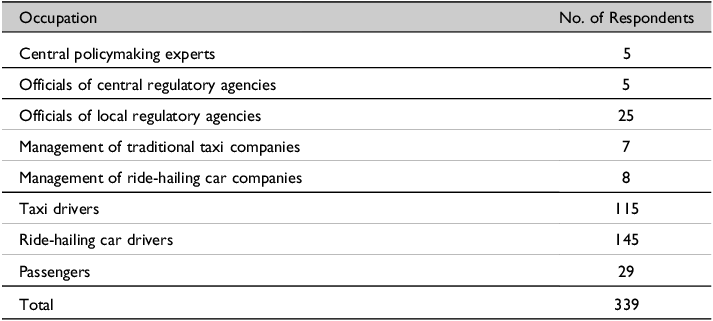
We provide the first-ever ethnographic account of the political economy behind the transition from traditional taxis to Didi-style ride-hailing. Our four-year fieldwork included 339 interviews with traditional taxi and e-hailed car drivers, officials from both local and central regulatory authorities, and the senior managers of leading e-hailing platforms and traditional taxi companies in China (Table 1). Our fieldwork reveals that the Chinese government, though not facing Western election pressure or lobbying from left-behind taxi drivers, has tried to strike a balance between the new industry and the old industry, instead of embracing the technology-driven platform economy without hesitation. This careful balancing resulted in ambiguous wording of the central government regulations about the e-hailed car services. This approach of careful balancing is also shared by local governments across the country, which have adopted various policies to address the concerns of taxi drivers and their companies. Among such policies, some Chinese local governments engineered strategies that can align the interests of the to-be-replaced individuals and companies with the government’s industrial policy to support technological and industrial upgrade. For example, several Chinese local governments subsidized taxi drivers to buy electrical vehicles (“EVs”) to “kill three birds with one stone”: compensating taxi drivers to reduce their opposition to the industrial transition, improving taxi drivers’ competitiveness on the e-hailed car service platforms, and giving a boost to their local EV industry.
Interviewees by Occupation

This approach of careful balancing is driven by the Chinese government’s concern about not only economic development but also social stability. The social stability concern is also entrenched in both central and local decision making through bureaucrats whose careers are tied to the existence and interest of the old industries and those whose careers can be impacted by social instability.Footnote 1 In such a context, effective collective actions that can cause official or public media attention proved to be crucial for the government to consider the interests of those economically-lesser groups.Footnote 2
To argue that the Chinese government is responsive to disadvantaged groups’ concerns is not entirely new. However, to understand why and how the Chinese government carefully balances economic and technological progress and the interests of economically-lesser groups is an important and insufficiently explored topic in the literature.Footnote 3 The rise of the platform economy accelerates industrial transitions and upgrades, and intensifies the conflict between technology and workers and investors left behind. What the Chinese government has done seems to be more sophisticated than and goes beyond what the governments in Western liberal democracies have done, partly because of the deeper involvement of the Chinese government in business and society, and therefore it can take actions that are not purely legal and often mix things together. For example, only until very recently (September 2022), New York City arranged over $225 million in debt relief for taxi medallion owners to aid an industry battered by competition from Uber-style car services (Bloomberg 2022), a subject that has not been analyzed by scholars. The Chinese government’s sophisticated approach of balancing, particularly through policies granting taxi drivers and their companies a head-start in the platform economy and subsidizing taxi drivers with discounts to buy EVs, demonstrates a different approach to regulating the platform economy and handling the industrial transition.
The remainder of the article is organized as follows. Part I reviews the literature. Part II analyzes the organization and voice of the Chinese taxi industry during the transition. Part III examines how the concern about the traditional taxi industry shaped the central government’s policy regarding ride-hailed car services. Part IV investigates local governments’ approaches to balancing between the new platform economy and the old taxi industry, particularly their various strategies and reasons behind such strategies. Part V concludes.
PART I: LITERATURE REVIEW
In a fight between technology platforms that represent a new economy and stakeholders of an obsolete economy, whose side would a government pick? In a liberal democracy, trade unions of an obsolete economy control votes and can lobby the government to clamp down on e-hailing platforms (Seidl Reference Seidl2022). In South Korea, Uber was once outlawed due to “severe opposition by the taxi industry and local authorities” (Hyunhong Choi et al. Reference Choi2022).Footnote 4 In Denmark, Uber suspended its operations in 2017 due to stringent regulations the Denmark authority had introduced (Thelen Reference Thelen2018). Transport for London, the public authority overseeing the UK capital’s transport regulation, refused to renew Uber’s operating license in 2019 (Amaxopoulou et al. Reference Amaxopoulou, Durovic and Lech2021). In liberal democracies, stakeholders of the old industry can also use litigation to exert pressure on the government. For example, in the USA, taxi license holders in multiple cities sued the local administrations, claiming that the legalization of Uber was unconstitutional for its adverse impact on the value of their property, i.e., taxi licenses.Footnote 5
In China, the government is not facing direct election pressure; workers of an obsolete industry cannot, therefore, directly impact government policy through their votes. They do not have resources or access to lobby the government either. Chinese courts are not available for disadvantaged groups to challenge government policies (Mao and Qiao Reference Mao and Qiao2021). The past three decades have witnessed that employees of state-owned enterprises were laid off without sufficient compensation in China’s efforts to increase the efficiency of its economy in the 1990s (Cai Reference Cai2002; Chen Reference Chen2003), peasants lost their land to developers without being properly compensated in China’s urbanization process in the 2000s (Qiao Reference Qiao2018), and workers and enterprises of high-pollution and low-tech industries were replaced by workers and enterprises of high-tech and low-pollution industries in the 2010s (Lei Reference Lei2023). Overall, the existing literature depicts a developmental state that favors efficiency and growth over the protection of economically and politically disadvantaged groups.
The burgeoning literature on Chinese platform capitalism has not touched upon the tension between the old industries and business and the new platform economy, which has overall been considered a positive force that breaks administrative barriers, eliminates poverty, and unifies the market. (Liu and Weingast Reference Liu and Weingast2018; Liu Reference Liu2024) The literature that touches upon platform economy and inequality focuses on platforms’ exploitation of their own workers through algorithms and market power (Lei Reference Lei2021).
In explaining divergence of local regulations of e-hailing platforms across China, scholars assume that policymakers are ideal agents, free from exterior constraints in achieving certain policy goals, and focus on variables such as population and traffic congestion (Sharif and Xing Reference Sharif and Xing2019). A few scholars acknowledge that the stringent stance taken by some cities could be explained by the opposition from the taxi industry, but present no empirical evidence to support their proposition (Jiang and Zhang Reference Jiang and Zhang2019). As Li and Ma (Reference Li and Ma2019) have pointed out, such research “provide[d] some preliminary clues that could be further investigated by supplementing with other methods such as in-depth case studies.”
Across the world, the rise of online ride-hailing has faced legal and regulatory challenges. The literature on the regulation of online ride-hailing focuses on whether such ride-hailing platforms as Uber should be legalized or how they should be regulated (Posen Reference Posen2015; Wyman Reference Wyman2017b; Rauch and Schleicher Reference Rauch and Schleicher2015; Seidl Reference Seidl2022; Matsui Reference Matsui2019), and in the case of legalization, whether taxi license holders are entitled to compensation from the government which had issued them licenses of significant market value (Wyman Reference Wyman2017a; Epstein Reference Epstein2016; Jacobs Reference Jacobs2021).
PART II: ORGANIZATION AND VOICE OF OLD ECONOMY
The rise of ride-hailing platforms increased the supply of car-service providers on the road and diverted business away from taxi drivers. This diversion resulted in two things: the reduction of taxi drivers’ daily income and the reduction of the market value of taxi licenses. In Qingdao, the rise of online ride-hailing caused the trading price of a taxi license to fall by half, from RMB 600,000 (in 2013) to RMB 300,000 (in mid-2015).Footnote 6
What’s the response from the Chinese taxi industry? Taxi companies can directly influence government policies as the government either directly owns such companies or serves as a regulator, but also guardian of such companies, not to mention the possibility that individual and corrupt regulators can personally benefit from owning shares in such companies (Ye Reference Ye2013). Taxi drivers can exert their influence through both the aforementioned taxi companies when companies’ interest align with the drivers,’ and collective actions such as blocking roads or refusing to accept riding orders during traffic peak time, which can put significant pressure on government agencies in charge of transportation and force them to take a restrictive approach to the ride-hailing platforms. The Chinese government is concerned about both the disturbance of public transportation caused by the taxi drivers’ strike and also their public demonstration, which is considered a threat to social stability.
Organization: Formal and Informal
Taxi drivers can organize themselves both formally and informally. Formally, taxi companies can represent their interests in the government. Informally, taxi drivers are often from the same county or even the same village, and develop a sense of strong solidarity in their daily business, which is full of uncertainties and needs mutual support from fellows on the road. This community bond facilitates collective action among taxi drivers.
Chinese local governments in cities such as Beijing and Shanghai used to rely on taxi companies, many of which were state-owned in the beginning, to provide employment opportunities for workers laid off from state-owned enterprises in the 1990s and peasants who lost their land to government expropriation. Back then, the taxi industry was a solution to Chinese local governments in their balancing of old and new interests in economic and social transition. Now, with the rise of Didi, the Chinese counterpart of Uber, the tide has turned against the taxi industry itself. Nevertheless, these local hukou holders carry a bigger weight in the local government’s calculus than migrant workers who moved to big cities from other provinces.
Taxis carry a significant portion of a city’s transportation. Local governments often need taxi companies’ cooperation to maintain the smooth operation of public transportation. Moreover, the market of taxis is often monopolized by a dozen taxi companies. For example, among the 70,000 taxis in Beijing, only 1,000 are run as individuals, and most of them are run under taxi companies (Zhao and Liu Reference Zhao and Liu2022; You, Cheng and Yao Reference You2014). Among these, less than 300 taxi companies, the top ten companies own almost 60 percent of the taxis, with each of them owning 1,000–7,000 taxis.Footnote 7 In this sense, a taxi company can represent several thousand taxi drivers and have a certain degree of bargaining power with the local government. These companies are also incentivized to bargain on behalf of taxi drivers, as the taxi business is their main source of income despite past disputes between companies and drivers about the division of revenue. The rise of ride-hailing businesses not only directly threatened taxi drivers, but also taxi companies and bureaucrats, and business executives who are behind them. Peking University Professor Zhang Weiying, one of the most well-known pro-market economists in China, commented that it was these vested interests that had held back the progress of the ride-hailing business in China at the cost of missing opportunities to improve public transportation (Dong Reference Dong2016).
Taxi drivers can also organize themselves informally and launch collective resistance when their interests are not adequately protected by taxi companies. This is particularly true in cities where taxi drivers are migrant workers and their connections with the local political and business interests are weaker than in cities where most taxi drivers are local hukou holders (i.e., laid-off SoE workers and suburban peasants who lost land to expropriation). It was reported that over 40 percent of taxi drivers in Shenzhen used to come from You County of Hunan Province (Southern Metropolis Daily 2014). These taxi drivers often lived in the same intra-city villages in Shenzhen. For example, in Shixia, an intra-city village near Shenzhen’s central business district, over 3,000 taxi drivers from You County lived there (China Youth Daily 2014). They also developed their own groups and communication channels to provide mutual support and assistance on the road. One driver reported that once he was threatened by a passenger and called for help in the community communication channel, and within half an hour, twenty fellow You county taxi drivers showed up (China Youth Daily 2014). These groups of taxi drivers held collective actions even before the rise of ride-hailing platforms, often against taxi companies for charging them too much monthly fees (China Youth Daily 2014).
Shenzhen is not unique. There are similar patterns of taxi drivers forming solidarity groups based on where they come from. Tangxia Village in Guangzhou witnesses a similar immigration story, where more than ten thousand taxi drivers from Henan Province lived (Fengmian News 2016). In smaller cities such as Qingdao, taxi drivers are not necessarily from neighboring provinces but from neighboring cities of the same province, but a similar pattern emerges: taxi drivers from the same county or village form communities of mutual help and collective resistance against outside pressure, often with leaders.Footnote 8
Voice
Taxi drivers have employed various tactics—including strikes, demonstrations, and the blocking of important roads—to pressure local authorities into passing regulations restraining the operation of online ride-hailing. Taxi drivers’ strikes can be a big disturbance to urban transportation and exert significant pressure on the local government. Taxi drivers’ collective demonstrations are hard to prevent due to the mobility of taxis and their prevalent presence in cities, particularly in urban centers, but are easily noticed and therefore influential once they happen. Taxi drivers also take advantage of strategic moments, such as during traffic peak hours and periods such as when a city is hosting a big event, to maximize the pressure on the local government.
Chinese taxi drivers have frequently resorted to strikes in response to the rapid rise of online ride-hailing services such as Didi. China Labour Bulletin’s Strike Map has recorded 1,204 collective actions related to taxi drivers and online ride-hailing from January 2014 to October 2024 (China Labour Bulletin 2015).
One particularly significant example occurred in Beijing in late 2015, when a large-scale pubic demonstration erupted at Didi’s headquarters. Taxi drivers, frustrated by the competition from private cars operating through ride-hailing platforms, staged a public demonstration that turned into a major social stability incident. Beijing taxi drivers complained that Didi allowed private vehicles to operate without the costly licenses and strict regulations imposed on traditional taxis (Masha Borak Reference Borak2019). This incident put immense pressure on the Beijing city government, which responded by imposing stringent regulations on online ride-hailed car services. Given that Beijing is the nation’s capital, the incident was not only a local matter but likely influenced policy discussions at the national level, particularly within the Chinese Ministry of Transportation.Footnote 9
Beyond Beijing, several other cities have seen major strikes that have drawn attention to the growing tensions between taxi drivers and ride-hailing platforms. In Shenzhen in 2015, for instance, thousands of taxi drivers blocked key roads to express their opposition against ride-hailing platforms, leading to clashes with the police (Kondalamahanty 2016).Footnote 10 In Nanjing, a strike in June 2015 brought the city to a standstill, with drivers demanding government action against what they saw as unfair competition from online ride-hailing cars (China Labour Bulletin 2015). Similarly, Chengdu witnessed a major taxi strike in 2015, where drivers called for stricter enforcement of regulations to ensure that ride-hailing platforms adhered to the same standards as traditional taxis.Footnote 11
In these cities, the strikes resulted in local governments introducing new rules aimed at curbing the perceived advantages of ride-hailing services, such as requiring commercial licenses for drivers and placing caps on the number of vehicles that could operate on ride-hailing platforms (Radio Free Asia Reference Rogers2016).
Our interviews in Qingdao, a big coastal city of over 10 million people in northern China, and in Shenzhen, a coastal megacity in southern China, reveal the tremendous pressure taxi drivers can exert on local transportation officials through collective resistance and that the local government often responds with policy changes. For local government officials, mass incidents that threaten social stability can result in the immediate removal of officials in charge.Footnote 12 Qingdao was also the host of the 2018 Shanghai Cooperation Organization (“SCO”) Summit, before and during the Summit, maintaining social stability and avoiding disturbance to the public transportation became quite sensitive issues. Not only local officials but taxi drivers were aware of this sensitivity. Unfortunately for the local officials, it was in the same period that the conflict between the traditional taxi industry and the online ride-hailing businesses intensified. Taxi drivers took the sensitivity of timing as an opportunity to exert pressure on the local government, and organized public demonstrations and strikes during this sensitive period. In an effective citywide strike, taxis basically disappeared from the main roads of the central districts of Qingdao. Taxi drivers also held rallies in sensitive locations such as near the airport or railway station. In another case, over 100 taxi drivers started driving to Beijing together to petition.Footnote 13
For these non-violent public assemblies and strikes, what these taxi drivers did was simply driving or not driving in a certain place at a certain moment; it was quite hard for the local government to punish taxi drivers who participated in such events. Punishing organizers of such actions without a proper legal ground might trigger even bigger reactions, which the local government would prefer to avoid. The local government also sought to exert pressure on taxi drivers through taxi companies, but it was not always effective. At the end, the local government negotiated with taxi drivers and imposed severe constraints on online ride-hailing in Qingdao.Footnote 14
In Shenzhen, taxi drivers formed solidarity groups and had a tradition of taking collective actions even before the rise of online ride-hailing platforms, including against increasing the number of taxi licenses.Footnote 15 As one local official commented, “the government must take it seriously when these taxi drivers made troubles. After all, in China, stability is the top priority.”Footnote 16 The Shenzhen city bureau of transportation even put an official who had been in the police in charge of “maintaining stability,” dealing with taxi drivers’ demonstrations and strikes. “Local government leaders were concerned that mass incidents that threatened social stability would impact their career[s] and prefer to leave the trouble of reform to their successors.”Footnote 17 After a mass incident by taxi drivers, the Shenzhen city government established a small leading group headed by a deputy mayor in charge of maintaining social stability in the taxi industry, and took measures to address taxi drivers’ concerns. Such stability concerns can override concerns about innovation and development. When the National Development and Reform Commission (“NDRC”), the central government commission that was supportive of the platform economy, encouraged the Shenzhen city government to take a similar approach, one local official responded that “we local government know better than central government agencies which should mind their own business. If we relax regulations on online ride-hailing, taxi drivers will make trouble, and it would be we, the local government, that takes the hit.”Footnote 18
PART III: BALANCING AT THE CENTRAL GOVERNMENT
Ride-hailing platforms such as Uber and DiDi have demonstrated immense capacity to improve urban transportation, unambiguously making the world easier to navigate (Epstein Reference Epstein2016; Rogers Reference Rogers2015). By enabling private cars to serve the public, Uber and DiDi have significantly supplemented large cities’ transportation options, boosting both urban transportation efficiency and consumer welfare. Hence, the Chinese government, facing severe urban transportation shortages in its big cities, should have enthusiastically embraced this new form of platform economy without hesitation.
To add to the incentives of a regime that has built its legitimacy on economic performance and satisfying its citizens’ materials needs, millions of middle-class consumers in China’s megacities and those reflecting their voices, including intellectuals and media pundits, have shown enthusiasm about the new ride-hailing businesses as they had been “tortured” by the difficulty of getting a taxi in transportation peak hours, the smell, and not-that-great services of taxi drivers that they had needed to tolerate. Ride-hailing platforms improved transportation supply and services without increasing the cost- how could a middle-class professional in Beijing, Shanghai, or Shenzhen not like it?
The online ride-hailing business is subject to regulation by multiple central government agencies that cannot be assumed to pursue a unified policy goal. Instead, different central agencies may hold divergent regulatory orientations, reflecting different governance considerations of the Chinese government, but also distinctive departmental interests and preferences. The most relevant central regulatory agency, the Ministry of Transportation (“MoT”), has adopted a restrictive and decentralized approach to online ride-hailing even after receiving explicit and severe critique of this approach from both the public and peer central government agencies.
In 2015, the MoT promulgated a draft regulation on ride-hailing services for public consultation and triggered public outcry from middle-class consumers in megacities and intellectuals and media professionals who shared and conveyed their message: the MoT was more interested in constraining and regulating the new ride-hailing business than promoting it. From the perspective of its critics, the MoT seemed to be totally out of touch with reality.
Chinese news media described the MoT’s Draft Provisional Measures for the Management of Internet-based Taxi Operations and Services (Draft for Comments) (hereinafter, the Draft Provisional Measures) as “cutting the feet” of e-hailing services to fit them into the regulatory “shoes” designed for traditional taxis. (Pengpai News 2015) Several commentators even satirized the draft law as a reproduction of the 1865 Red Flag Act (Lu Reference Lu2022), a notorious British regulation on the use of mechanically propelled vehicles on public roads that required all motorized vehicles, automobiles included, to travel at a maximum speed of 4 mph (6.4 km/h) in the countryside and 2 mph (3.2 km/h) in the city. At such a speed limit, motor vehicles could travel no faster than horse-drawn carriages (Baldwin and Baldwin Reference Baldwin and Baldwin2004).
On October 15, 2015, the Peking University Center for Law and Economics hosted a symposium during which several renowned economists and legal scholars shared their unanimous critical view of the Draft Provisional Measures (Sohu 2015). Senior officials from the MoT were invited and present. Xue Zhaofeng, then Director of the Peking University Center for Law and Economics, remarked that the MoT should not regulate the economy of the Internet era with the mindset of the pre-Internet era (Sohu 2015).
Further, in December 2015, Caijing magazine, alongside the law schools and research centers of renowned universities and prominent legal scholars, jointly released Guidelines on the Regulation of the Taxi Service Industry (Model Law) (Deng Reference Deng2015). This joint effort provided a blueprint for e-hailing regulation and made clear that the media and academia welcomed this novel form of transportation as a supplement to the current means of commuting.
Critiques from scholars and media pundits exerted considerable pressure on MoT. If that’s not enough, the MoT also faced opposition from other central government departments, most notably, the NDRC, which is interested in promoting a dynamic and competitive digital economy across China and has criticized the MoT for its conservative approach too.Footnote 19 In NDRC’s view, excluding ride-hailing car services would count as anti-market behaviors, and local regulations prohibiting and limiting ride-hailing services, therefore, can potentially violate China’s anti-monopoly law. The NDRC even initiated a formal investigation of ride-hailing regulations in Lanzhou and Quanzhou for potential violations of the Chinese Price Law and the Chinese Anti-Monopoly Law (Guangming Daily 2017).
As a result, the MoT, joined by six other ministries, promulgated the Provisional Measures for the Management of Internet-based Taxi Operations and Services (hereinafter Provisional Measures) on July 27, 2016. Although they removed many restrictions on the registration and operation of e-hailing businesses, the Provisional Measures retained the highly ambiguous phrase “high-quality services and differentiated operations” (高品质服务、差异化经营) as the guiding principle of e-hailing regulation, granting local governments autonomy to translate it into concrete rules in accordance with local circumstances.
On the surface, the Provisional Measures “encourage cities to adopt policies that express a generally less stringent and more open attitude towards e-hailing.” Accordingly, even those opinion leaders who had been highly critical of the draft made positive remarks about the final measures. At another high-profile symposium on the regulation of the local online ride-hailing industry, hosted by Peking University’s National School of Development on October 17, 2016, most of the attendees acknowledged the MoT’s change in regulatory tone and voiced their expectation that the Provisional Measures would open a pathway for the legalization of the online ride-hailing industry in China. For instance, Xue Zhaofeng, who organized the symposium, commented that the Provisional Measures manifested and substantially progressed the philosophy of innovation, openness, flexibility, and sharing (Netease 2017).
Nevertheless, the MoT has maintained a still quite stringent approach to regulating e-hailing to curb what then Vice Minister Liu Xiaoming of the MoT called the “reckless burgeoning” of e-hailed car services (People’s Daily Aug. 2, 2016). What was the reason for the MoT to take a restrictive approach to the ride-hailing platforms? A regulatory mindset, as criticized by Chinese academics, can be one reason. However, there is another equally important and probably more important reason, which is to reduce the disruptive shocks to the traditional taxi industry. The guiding principle for the online ride-hailing business, as laid out by the MoT, is “high-quality services and differentiated operations.” This principle reflects the MoT’s major concern about the impact of competition from online ride-hailing on the traditional taxi industry. Traditional taxis do not have to provide high-quality services—they provide convenient and affordable services to middle-class urbanites. This is the policy origin that many local governments required that cars on ride-hailing platforms be luxury cars. The term “differentiated operations” is even more explicit- online ride-hailing services should be different from traditional taxis and therefore not competing with traditional taxis.
This is not just a scholarly interpretation of the MoT regulations. The Vice Minister of the MoT has made it clear that the above principle confines the new entrants’ service domains to the high-end transportation service market and therefore serves as an effective means of preventing the new entrants’ disruptive shocks to traditional taxi drivers (Xinhua News 2016; People’s Daily Oct 13, 2016).
But why do the MoT care about some lowly taxi drivers across the country? In any case, China’s political system operates on principles distinct from Western liberal democracies, and these taxi drivers do not have a say about MoT officials’ careers or salaries. The collective resistances we have discussed in Part II mostly happened at the local level.
However, to argue that central government agencies are not accountable as there are no Western-style elections would be an oversimplification, to say the very least. Firstly, demonstrations and strikes, although mostly localized, are clearly a nationwide phenomenon. For the MoT, if its policy causes trouble, its officials can potentially be held accountable. Even taxi drivers pointed to Beijing as the ultimate destination of petitionFootnote 20 —so the central government, which the MoT is part of, is not off the hook.Footnote 21 Since it’s the MoT’s authority to make decisions, it prefers to minimize the risks of its policies.Footnote 22 Secondly, as discussed earlier about a confrontation between a local official in Shenzhen and the NDRC, local officials not only communicated with central government agencies but also complained—and their complaints can exert bigger pressure on the bureaucrats in Beijing than those of taxi drivers. When local officials across the country were worried about taxi drivers’ demonstrations and strikes, they conveyed such a major concern to their peers in Beijing, who needed to consider this concern too. This is also a reason that, eventually, in the Provisional Measures, the MoT left the decisions to local governments, as it might not want to take the blame either way.
IV: BALANCING AT THE LOCAL GOVERNMENT
The MoT delegated the power to regulate online ride-hailing to Chinese local governments, which, facing direct pressure from taxi drivers and taxi companies, have adopted various measures ranging from law enforcement against online ride-hailing, imposing restrictions, to compensating taxi drivers and their companies to offset their opposition. The main ways of constraint, including requiring a local hukou for providers of online ride-hailing services and luxury cars for online ride-hailing services, have been designed to reduce the impact of online ride-hailing on the existing taxi drivers. It is also consistent with the MoT’s approach that taxi drivers and online ride-hailing should serve different customers, high-end customers for the latter and ordinary customers for the former. In cases where local governments gained significant economic support from the online ride-hailing platforms or related car manufactory industries, a couple of local governments were able to compensate the taxi industry with a limited amount of cash, extra taxi licenses, or, most interestingly, subsidies to purchase EVs from local manufacturers.
Law Enforcement Against Online Ride-Hailing
The local government can refuse to issue business licenses to ride-hailing platforms. According to Article 10 of the Provisional Measures, e-hailing platforms must obtain a business license from the local transportation authorities to legally provide online ride-hailing services. In the absence of a business license, ride-hailing services comprise an illegal business operation, and the parties involved could be fined and forced to cease operations.
Without a business license, there is no difference in legal status between e-hailed cars and “black taxis” (unlicensed and illegal taxis), as one local official informed us, which allows law enforcement officials to punish e-hailing drivers as they deem necessary, and often as an immediate response to taxi drivers’ demonstrations against online ride-hailing.Footnote 23
The law enforcement division of the Qingdao Bureau of Transportation, for instance, intensified its inspection of e-hailed cars and launched a 100-day “random inspection” campaign in the downtown area from February to May 2019 in response to taxi drivers’ strong resistance (Yang Reference Yang2019). In exceptional cases, law enforcement officials have adopted an entrapment tactic to impose hefty fines on e-hailing drivers and ride-hailing platforms. In Hefei City, for example, ride-hailing platforms’ development has effectively been throttled since the second half of 2017, largely because of the imposition of harsh fines for regulatory violations.Footnote 24
Quota, Hukou, and Vehicle Class
Another way of controlling the number of e-hailed cars is to impose a direct limit on ride-hailing platforms. Lanzhou City in Gansu province adopted such a system in 2016 (Liu Reference Liu2016). However, such systems are not common practice due to their susceptibility to competition law enforcement. The NDRC initiated an antitrust investigation against local administrative limits on the number of e-hailed cars on ride-hailing platforms. (Yu and Kong Reference Yu and Xiaoqi2017).
As regards mandates on converting personal-use vehicles into operational vehicles in the register books of local transportation, authorities impose another limit on the number of cars available on the ride-hailing platforms. Operational vehicles are subject to a much stricter scrappage policy. Vehicles that have been in operation for longer than eight years must be scrapped as per the law in China, whereas personal-use vehicles can continue to be driven for longer as long as they pass an annual safety test. Vehicle owners who do not intend to work in the online ride-hailing business for the long term or full time are therefore unlikely to register as ride-hailing drivers.Footnote 25
Many other cities, such as Beijing and Shanghai, have imposed hukou requirements as part of driver eligibility for e-hailing businesses (Yu Reference Yu2019). This imposes a barrier on new entrants as a hukou is extremely expensive and difficult to obtain for a migrant worker in Beijing or Shanghai, therefore preventing them from providing ride-hailing car services against the traditional taxi drivers who are usually peasants in the suburban areas and who lost their land to local government expropriation and hold hukou. Chinese scholars and media pundits criticized this hukou requirement. The NPCSC Office of Legal Affairs had even initiated a review of the legality of local regulations that required hukou for ride-hailing drivers (Zhu Reference Zhu2021). Nevertheless, many local governments such as those in Beijing and Shanghai have maintained the hukou requirement (Wu Reference Wu2021) for the political logic behind: it was probably one of the easiest and most visible ways to signal to taxi drivers that their voice had been heard and interest considered and therefore should not resort to demonstrations.
Technical requirements for vehicles—e.g., size, fuel efficiency, and purchase price—also constitute significant barriers. Qingdao, for example, stipulates that only limousines are qualified to provide online ride-hailing services, and other cities exclude economy vehicles from such services by restricting e-hailing vehicles’ length and wheelbase. Among the 252 cities whose local regulatory measures we analyzed by early 2020, all but two imposed vehicle class requirements. Of those that do, 52.4 percent set a minimum purchase price for vehicles used in online ride-hailing services; the rest set vehicle class requirements based on wheelbase, fuel efficiency, or equivalent indicators.
More specifically, 50 percent of the cities that regulate vehicle purchase prices state that the purchase price of e-hailing vehicles should be no less than 1.2–1.3 times that of traditional taxis or that the wheelbase should be no less than 2,650 mm, an equivalent standard. Another 25.6 percent require that the purchase price of e-hailing vehicles be no less than 1.5 times that of traditional taxis or impose an equivalent wheelbase requirement (i.e., no less than 2,700 mm), and 3.6 percent require e-hailed vehicles to be purchased at a price of no less than twice that of traditional taxis.Footnote 26
Compensation
When online ride-hailing platforms provided significant support to the local autonomy or helped with the local car manufacturing industry, local governments could respond to taxi drivers’ resistance with monetary subsidies to them, instead of imposing constraints on the online ride-hailing. In the case that the primary purpose was to support the local car manufacturing industry, the compensation took the form of subsidizing taxi drivers to replace their old cars with electric vehicles (“EVs”) manufactured locally. Various forms of compensation reduced taxi drivers’ resistance to the platform economy. This compensation often did not have direct legal basis and was mostly politically driven, but may shed light on how other cities in China and beyond can address the challenge of regulating the platform economy in the future.
The local government of a few cities where the EV industry is an important part of the local economy took the rise of the online ride-hailing services as an opportunity to boost the consumption of locally manufactured EVs. These cities have adopted a policy to support online ride-hailing and have compensated traditional taxi drivers to offset their opposition. The two examples that we will discuss in detail in the next subsection are Taiyuan and Shenzhen, where BYD, China’s leading EV manufacturer, has a significant presence.
In 2015, BYD, China’s leading EV manufacturer, signed a strategic cooperation agreement with the Taiyuan city government to invest heavily in the city (International Energy Network 2024). The Taiyuan city government was eager to make the cooperation successful. Moreover, the Taiyuan city government also got an incentive to support Didi, which proposed a full package of economic projects, including the establishment of DiDi’s Midwest Customer Service Center in Taiyuan and a branch company that would manage Didi’s businesses all across the Shanxi province, of which Taiyuan is the capital city, contributing hundreds of new jobs and millions of RMB in tax revenue to the Taiyuan city government.Footnote 27
To reduce taxi drivers’ opposition to Didi, the Taiyuan city government figured out a way of compensating taxi drivers and supporting its local economy, both regarding the Didi investment and, more importantly, the BYD EV business. In 2016, the Taiyuan city government issued a new regulation stipulating that all 8,200 traditional petrol-fueled taxis had to be upgraded to EVs produced by BYD, which were priced at RMB 300,000. Taxi drivers received up to RMB 220,000 in subsidies from both state and local governments to replace their vehicles with EVs. With their previous jalopies now replaced by brand-new EVs, taxi drivers’ fixed assets appreciated considerably, with no aggravation of their financial burden. They also saw a marked rise in their market competitiveness, with passengers perceiving the new electric taxis as standing on equal terms with e-hailing vehicles. During our random street-hailing of taxis in Taiyuan in the summer of 2019, five taxi drivers acknowledged that their ride orders had experienced a noticeable upsurge compared to when e-hailing cars first hit the market.
The end result was that incumbent taxi drivers’ resistance to Didi was mitigated, while Taiyuan’s government was able to promote its policy agenda of supporting the local car manufacturing industry.
Shenzhen is where the BYD headquarters are located, and BYD has contributed a significant amount of revenue and jobs to Shenzhen in the past decades (Ogan and Chen Reference Ogan and Chen2016). The rise of the online ride-hailing businesses boosted the demand for new cars and was good for BYD. This was largely why the Shenzhen government was willing to issue taxi drivers monthly subsidies in the amount of about RMB 1,000 per month to offset their opposition. More than that, in 2017, the Shenzhen city government launched an initiative to replace petrol-fueled taxis with EVs. To encourage taxi license holders, many of which are taxi companies, to replace their petrol-fueled vehicles, additional taxi licenses were issued to them, resulting in a surge in the purchase of EVs manufactured by BYD in Shenzhen.
A former senior official at the Shenzhen Bureau of Transportation spoke highly of the vehicle replacement initiative, describing it as “killing three birds with one stone.”Footnote 28 First, the city government asked for the lowering of the contracting fees that taxi companies charged from taxi drivers in return for issuing new licenses to taxi companies. As a result, taxi drivers became less likely to demonstrate as they can keep a bigger portion of their income in their own pockets because of the lowered contracting fees. Second, taxi companies also became less likely to demonstrate against the city government that issued extra licenses to them. Third, the new EVs increased taxi drivers’ competitiveness to some extent.Footnote 29
PART V: CONCLUSION
We explain why and how, in a party-state regime, stakeholders from industries threatened by the platform economy can exert pressure on the government and shape policy making in response. Faced with such pressure, the Chinese central government adopted an ambivalent approach, emphasizing protection of the taxi industry from the disruptions caused by online ride-hailing. Meanwhile, Chinese local governments pursued varied strategies, ranging from law enforcement against ride-hailing platforms and regulatory constraints to compensating taxi drivers and their companies to mitigate opposition to the platform economy.
Taxi drivers’ success, though limited in resisting the platform economy, is an exception as compared to laid-off workers of state-owned enterprises in the 1990s, peasants who lost their land to developers in the 2000s, and workers and entrepreneurs who were phased out in China’s industry upgrades in the 2010s. In all these previous cases, the Chinese government is often depicted as pro-development and pro-capital, and ruthless against individuals and businesses that are considered outdated. This case study highlights, however, that the Chinese government, to maintain social stability, may materially consider the pressure from and the interests of economically and politically disadvantaged groups.
This paper also extends the literature on the regulation of Uber-style platforms, which primarily focuses on legalization, compensation issues, or exploitation of platform workers, to highlight the complex interplay between state regulation and industry stakeholders in a transforming economy.
Appendix: Description of Data Collection
From 2018 to 2020, with help from our RAs, we constructed a data pool of city regulations on the class of e-hailing cars among the 252 cities analyzed (indicated in grey in Figure 1), of which only Chengdu and Luzhou did not adopt such regulatory measures. We further conducted 339 interviews in 21 of these cities (marked with stars in Figure 1). Of all these interviews, 78 were conducted in Beijing, 17 in Shanghai, 21 in Chengdu, 17 in Chongqing, 21 in Kunming, 36 in Qingdao, 19 in Taiyuan, 8 in Hefei, 6 in Changchun, 5 in Tonghua, 6 in Shenyang, 15 in Guangzhou, 30 in Shenzhen, 1 in Sanya, 8 in Xi’an, 8 in Lanzhou, 16 in Ganzhou, 6 in Suzhou, 8 in Hangzhou, 6 in Fuzhou, and 7 in Shangrao. The interviewees came from different sectors of the traditional taxi and e-hailing industries, including legal and economic experts, governmental officials, company managers, drivers, and passengers. Most interviews were conducted in person, while a few were conducted over the telephone.
Cities Analyzed

Acknowledgements
We are grateful to Feng Deng, Liang Ma, Arm Tungnirun, Jun Wang, and participants at the 2018 Chicago-Tsinghua Young Faculty Forum on Law & Social Science, the 2019 IGLP Scholars Workshop jointly held by the Institute for Global Law and Policy at Harvard Law School and the Thailand Institute of Justice, and the 2022 Asian Law and Economics Association Webinar Series on Analytical Methods in Law and Economics. We thank Min Cai, Zizhuo Zhou, Chenyan Lu, Xinmiao Lai, Meng Wei, and Jinlin Fan among many other RAs for their excellent research assistance throughout this long research project.
Funding statement
This work was supported in part by a Major Project of National Social Sciences Foundation of China, The Civil Code and the Modernization of State Governance System (24&ZD126).

 Open access

