








1 Introduction
The theory of variable exponent Lebesgue spaces has matured from a topic of abstract interest into an indispensable tool in partial differential equations, fluid dynamics, and harmonic analysis. Unlike their classical counterparts, these spaces allow the exponent to vary with the spatial variable, providing a natural and powerful framework for modeling phenomena with localized behavior, such as electrorheological fluids or materials with inhomogeneous properties. The rich structure of these spaces is deeply intertwined with the properties of the exponent function. In this article, we regard these spaces from a functional analysis perspective.
Within the study of the geometry of Banach spaces, the structure of basic sequences is a fundamental topic already present in Banach’s book [Reference Banach5]. In these early years, specialists were confident of achieving structural results valid for all Banach spaces. In particular, they sought to prove that every Banach space contains an isomorphic copy of
$c_0$
 or
$\ell _p$
or
$\ell _p$
 for some
$1\le p<\infty $
for some
$1\le p<\infty $
 . Since the canonical bases of these spaces are symmetric, the study naturally evolved to determining the structure of symmetric basic sequences of Banach spaces. Any symmetric basis is subsymmetric, that is, unconditional and equivalent to all its subsequences. As a matter of fact, the only feature of symmetric sequences that one needs in many situations is their subsymmetry. Partly because of this, and partly because spreading models of null sequences are subsymmetric, the researchers went on to seek subsymmetric basic sequences.
The study of the basic sequence structure of Banach spaces is part of the study of their subspace structure or, following Banach [Reference Banach5], that of the “linear dimension” of Banach spaces. We point out that the mere existence of an isomorphic copy of a Banach space
$\mathbb {X}$
 within another Banach space
$\mathbb {Y}$
within another Banach space
$\mathbb {Y}$
 does not entitle us to claim that
$\mathbb {X}$
does not entitle us to claim that
$\mathbb {X}$
 is in a block from which
$\mathbb {Y}$
is in a block from which
$\mathbb {Y}$
 is constructed. To fairly assert this, we must assume that
$\mathbb {X}$
is constructed. To fairly assert this, we must assume that
$\mathbb {X}$
 can be placed into
$\mathbb {Y}$
can be placed into
$\mathbb {Y}$
 in a complementary manner, so that
$\mathbb {Y}$
in a complementary manner, so that
$\mathbb {Y}$
 is isomorphic to the direct sum of
$\mathbb {X}$
is isomorphic to the direct sum of
$\mathbb {X}$
 and a third Banach space. So, the study of the complemented basic sequence structure of Banach spaces is of special interest.
We refer the reader to [Reference Ansorena and Bello2] for a summary of advances in understanding the structure of subsymmetric basic sequences of Banach spaces. Regarding Lebesgue spaces
$L_p$
 , the first milestone within this topic is [Reference Paley23], where Paley solved some problems posed in [Reference Banach5]. Namely, he proved that given p,
$q\in [1,\infty )$
, the first milestone within this topic is [Reference Paley23], where Paley solved some problems posed in [Reference Banach5]. Namely, he proved that given p,
$q\in [1,\infty )$
 ,
$\ell _q$
,
$\ell _q$
 does not embed in
$L_p$
does not embed in
$L_p$
 unless
$q=2$
unless
$q=2$
 or
$p\le q\le 2$
or
$p\le q\le 2$
 . The fact that
$\ell _2$
. The fact that
$\ell _2$
 embeds into
$L_p$
embeds into
$L_p$
 is a ready consequence of Khintchine’s inequalities [Reference Khintchine16]. Kadets [Reference Kadets12] completed the study by showing that if
$p< q< 2,$
is a ready consequence of Khintchine’s inequalities [Reference Khintchine16]. Kadets [Reference Kadets12] completed the study by showing that if
$p< q< 2,$
 then
$\ell _q$
then
$\ell _q$
 do embeds into
$L_p$
do embeds into
$L_p$
 .
.
By duality,
$\ell _q$
 is not a complemented subspace of
$L_p$
is not a complemented subspace of
$L_p$
 unless
$p=1$
unless
$p=1$
 or
$q\in \{2, p\}$
or
$q\in \{2, p\}$
 . Clearly,
$\ell _p$
. Clearly,
$\ell _p$
 is a complemented subspace of
$L_p$
is a complemented subspace of
$L_p$
 for any
$1\le p<\infty $
for any
$1\le p<\infty $
 . Pełczyński [Reference Pełczyński25] proved that
$\ell _2$
. Pełczyński [Reference Pełczyński25] proved that
$\ell _2$
 is a complemented subspace of
$L_p$
is a complemented subspace of
$L_p$
 for any
$1<p<\infty $
for any
$1<p<\infty $
 . Lindenstrauss and Pełczyński [Reference Lindenstrauss and Pełczyński17] completed the picture by proving that any unconditional basic sequence complemented in
$L_1$
. Lindenstrauss and Pełczyński [Reference Lindenstrauss and Pełczyński17] completed the picture by proving that any unconditional basic sequence complemented in
$L_1$
 is equivalent to the
$\ell _1$
is equivalent to the
$\ell _1$
 -basis.
Kadets and Pełczyński [Reference Kadets and Pełczyński13] carried out a systematic study of basic sequences in Lebesgue spaces. Among other results, they proved that, if
$2<p<\infty $
 , the canonical bases of
$\ell _2$
, the canonical bases of
$\ell _2$
 and
$\ell _p$
and
$\ell _p$
 are the only subsymmetric basic sequences of
$L_p$
are the only subsymmetric basic sequences of
$L_p$
 . In contrast, if
$1\le p < 2$
. In contrast, if
$1\le p < 2$
 , there exist symmetric basic sequences in
$L_p$
, there exist symmetric basic sequences in
$L_p$
 other than the canonical
$\ell _q$
other than the canonical
$\ell _q$
 -basis for
$p\le q\le 2$
-basis for
$p\le q\le 2$
 . Indeed, Bretagnolle and Dacunha-Castelle [Reference Bretagnolle and Dacunha-Castelle8] proved the following result (also see [Reference Lindenstrauss and Tzafriri18, Reference Schütt27]).
Theorem 1.1 (See [Reference Bretagnolle and Dacunha-Castelle8])
Let
$1\le p\le 2$
 . A Banach space
$\mathbb {S}$
. A Banach space
$\mathbb {S}$
 with a symmetric basis isomorphically embeds into
$L_p$
with a symmetric basis isomorphically embeds into
$L_p$
 if and only if
$\mathbb {S}=\ell _F$
if and only if
$\mathbb {S}=\ell _F$
 for some Orlicz function F with

The article that initiated the study of variable exponent Lebesgue spaces by basic sequence techniques was [Reference Hernández and Ruiz11] (see also [Reference Flores, Hernández, Ruiz and Sanchiz10]). In it, the authors characterized in terms of the essential range of the variable exponent
$\boldsymbol {P}$
 the indices
$q\in [1,\infty )$
the indices
$q\in [1,\infty )$
 such that
$\ell _q$
such that
$\ell _q$
 isomorphically embeds into a variable exponent Lebesgue
$L_{\boldsymbol {P}}$
isomorphically embeds into a variable exponent Lebesgue
$L_{\boldsymbol {P}}$
 over the unit interval. Hernández and Ruiz also proved that
$\ell _q$
over the unit interval. Hernández and Ruiz also proved that
$\ell _q$
 complementably embeds into
$L_{\boldsymbol {P}}$
complementably embeds into
$L_{\boldsymbol {P}}$
 provided that q belongs to the essential range of
$\boldsymbol {P}$
provided that q belongs to the essential range of
$\boldsymbol {P}$
 .
.
In this article, we complement the study carried out in [Reference Hernández and Ruiz11] by proving that, if
$q\not =2$
 , being q in the essential range of
$\boldsymbol {P}$
, being q in the essential range of
$\boldsymbol {P}$
 is a necessary condition for
$\ell _q$
is a necessary condition for
$\ell _q$
 to be a complemented subspace of
$L_{\boldsymbol {P}}$
to be a complemented subspace of
$L_{\boldsymbol {P}}$
 . Besides, we widen the scope of the study by considering not only
$\ell _q$
. Besides, we widen the scope of the study by considering not only
$\ell _q$
 -spaces but also subsymmetric basic sequences. Specifically, we characterize both the subsymmetric basic sequence structure and the complemented subsymmetric basic sequence structure of Lebesgue spaces with variable exponent essentially bounded. Oddly enough, we find out that, while symmetric basic sequences other than
$\ell _q$
-spaces but also subsymmetric basic sequences. Specifically, we characterize both the subsymmetric basic sequence structure and the complemented subsymmetric basic sequence structure of Lebesgue spaces with variable exponent essentially bounded. Oddly enough, we find out that, while symmetric basic sequences other than
$\ell _q$
 -bases are contained in these spaces, they fail to be complemented unless they are
$\ell _q$
-bases are contained in these spaces, they fail to be complemented unless they are
$\ell _q$
 -bases. Also, we go forward with the study of variable exponent atomic spaces, that is, Nakano spaces, initiated in [Reference Peirats and Ruiz24].
To conclude this introductory section, we outline the structure of the article. In Section 2, we establish the notation about variable Lebesgue spaces that will be used throughout the article. We see these spaces from the perspective of Musielak–Orlicz spaces, including nonconvex spaces. Without intending to tackle an exhaustive study of these spaces, we sketch the more relevant ideas to our purposes. We revisit some well-known results from our perspective and also prove new ones. In Section 3, we study certain Orlicz functions (those that arise as convex combinations of power functions) that naturally appear when studying the geometry of variable Lebesgue spaces. The study of subsymmetric basic sequences in these spaces is addressed in Sections 4 and 5, which contain the main results of the article. While in Section 5, we study complemented basic sequences, in Section 4, we give the results achieved without imposing complementability.
2 Musielak–Orlicz function spaces
Given a measure space
$(\Omega ,\Sigma ,\mu )$
 , we denote by
$\Sigma (\mu )$
, we denote by
$\Sigma (\mu )$
 the set of all measurable sets with finite measure. Let
$L(\mu )$
the set of all measurable sets with finite measure. Let
$L(\mu )$
 be the vector space of all measurable functions with values in the real or complex field
$\mathbb {F}$
be the vector space of all measurable functions with values in the real or complex field
$\mathbb {F}$
 . As it is customary, we identify functions and sets that differ on a null set. We say that
$\mu $
. As it is customary, we identify functions and sets that differ on a null set. We say that
$\mu $
 is separable if the metric space
$(\Sigma (\mu ),d_\mu )$
is separable if the metric space
$(\Sigma (\mu ),d_\mu )$
 is separable, where
$d_\mu $
is separable, where
$d_\mu $
 is the distance given by

We endow
$L(\mu )$
 with the topology associated with the convergence in measure on finite-measure sets, so
$L(\mu )$
with the topology associated with the convergence in measure on finite-measure sets, so
$L(\mu )$
 becomes a complete topological vector space. We denote by
$\mathcal {S}(\mu )$
becomes a complete topological vector space. We denote by
$\mathcal {S}(\mu )$
 the vector space of all simple integrable functions, that is, the linear span of

A function space over
$(\Omega ,\Sigma ,\mu )$
 will be a quasi-Banach lattice
$(\mathbb {X},\left \lVert \cdot \right \rVert _{\mathbb {X}})$
will be a quasi-Banach lattice
$(\mathbb {X},\left \lVert \cdot \right \rVert _{\mathbb {X}})$
 such that
-
• $\mathbb {X}\subseteq L(\mu )$
 continuously,
 -
• $\mathcal {S}(\mu )\subseteq \mathbb {X}$
, and -
• there is a constant $\boldsymbol {C}\in [0,\infty )$
such that if a sequence
$(f_n)_{n=1}^\infty $
in
$\mathbb {X}$
converges to
$f\, \mu $
-a.e. and
$S:=\limsup _n \left \lVert f_n\right \rVert _{\mathbb {X}}<\infty $
, then
$f\in \mathbb {X}$
and
$\left \lVert f\right \rVert _{\mathbb {X}}\le \boldsymbol {C} S$
.





Let
$L^+(\mu )$
 be the cone of all measurable functions with values in
$[0,\infty ]$
be the cone of all measurable functions with values in
$[0,\infty ]$
 . Following [Reference Ansorena and Bello1], a function quasi-norm will be a homogeneous map

such that
-
(F.1) If $f\le g\, \mu $
-a.e., then
$\rho (f)\le \rho (g)$
. -
(F.2) There is $\boldsymbol {k}\in [1,\infty )$
, such that, for all f,
$g\in L^+(\mu )$
, $$\begin{align*}\rho(f+g)\le\boldsymbol{k} \left( \rho( f)+\rho( g)\right). \end{align*}$$
-
(F.3) $\rho ( \chi _E)<\infty $
for all
$E\in \Sigma (\mu )$
. -
(F.4) For every $E\in \Sigma (\mu )$
and
$\varepsilon>0$
there is
$\delta>0$
such that
$\mu (A)\le \varepsilon $
whenever
$A\in \Sigma $
satisfies
$A\subseteq E$
and
$\rho (\chi _A)\le \delta $
. -
(F.5) There is $\boldsymbol {C} \in [1,\infty )$
such that
$\rho (\lim _n f_n)\le \boldsymbol {C} \lim _n \rho (f_n)$
for all non-decreasing sequences
$(f_n)_{n=1}^\infty $
in
$L^+(\mu )$
.








Let
$0<r\le 1$
 . If the function quasi-norm
$\rho $
. If the function quasi-norm
$\rho $
 satisfies
-
(F.6) $\rho ^r (f+g)\le \rho ^r( f)+\rho ^r( g)$
for all f,
$g\in L^+(\mu )$


we call it a function r-nom (function norm if
$r=1$
 ). Note that (F.6) implies (F.2) with
$\boldsymbol {k}=2^{1/r-1}$
). Note that (F.6) implies (F.2) with
$\boldsymbol {k}=2^{1/r-1}$
 .
.
Given a function quasi-norm
$\rho $
 the set

endowed with the quasi-norm
$\left \lVert \cdot \right \rVert _\rho $
 is a function space. The other way around, if
$(\mathbb {X}, \left \lVert \cdot \right \rVert _{\mathbb {X}})$
is a function space. The other way around, if
$(\mathbb {X}, \left \lVert \cdot \right \rVert _{\mathbb {X}})$
 is a function space, then
$\mathbb {X}=\boldsymbol {L}_{\rho }$
is a function space, then
$\mathbb {X}=\boldsymbol {L}_{\rho }$
 , where
$\rho $
, where
$\rho $
 is defined by
$\rho (f)=\left \lVert f\right \rVert _{\mathbb {X}}$
is defined by
$\rho (f)=\left \lVert f\right \rVert _{\mathbb {X}}$
 if
$f\in \mathbb {X}$
if
$f\in \mathbb {X}$
 and
$\rho (f)=\infty $
and
$\rho (f)=\infty $
 otherwise.
Given
$0<r<\infty $
 , a function quasi-norm
$\rho ,$
, a function quasi-norm
$\rho ,$
 and a family
$\mathcal { F}=(f_j)_{j\in J}$
and a family
$\mathcal { F}=(f_j)_{j\in J}$
 in
$L^+(\mu ),$
in
$L^+(\mu ),$
 we set

We say that
$\mathbb {X}=\boldsymbol {L}_\rho $
 is lattice r-convex (resp. r-concave) if there is a constant C such that
$N_{\rho }(\mathcal { F};r)\le C M_{\rho }(\mathcal { F};r)$
is lattice r-convex (resp. r-concave) if there is a constant C such that
$N_{\rho }(\mathcal { F};r)\le C M_{\rho }(\mathcal { F};r)$
 (resp.
$M_{\rho }(\mathcal { F};r) \le C N_{\rho }(\mathcal { F};r)$
(resp.
$M_{\rho }(\mathcal { F};r) \le C N_{\rho }(\mathcal { F};r)$
 ) for all families
$\mathcal { F}$
) for all families
$\mathcal { F}$
 in
$L^+(\mu )$
in
$L^+(\mu )$
 . We say that
$\mathbb {X}$
. We say that
$\mathbb {X}$
 is L-convex if there is
$\varepsilon>0$
is L-convex if there is
$\varepsilon>0$
 such that
$\sup _j \rho (f_j) \ge \varepsilon $
such that
$\sup _j \rho (f_j) \ge \varepsilon $
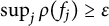 provided that
$(f_j)_{j\in J}$
provided that
$(f_j)_{j\in J}$
 is a finite family in
$L^+(\mu )$
is a finite family in
$L^+(\mu )$
 for which there is
$f\in L^+(\mu )$
for which there is
$f\in L^+(\mu )$
 such that
$\rho (f)=1$
such that
$\rho (f)=1$
 ,
$f_j\le f$
,
$f_j\le f$
 for all
$j\in J$
for all
$j\in J$
 , and
, and
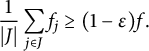
Since any quasi-Banach is locally p-convex for some
$p\in (0,1]$
 by the Aoki–Rolewicz theorem (see [Reference Aoki4, Reference Rolewicz26]), the function space
$\mathbb {X}$
by the Aoki–Rolewicz theorem (see [Reference Aoki4, Reference Rolewicz26]), the function space
$\mathbb {X}$
 is L-convex if and only if it is r-convex for some
$r\in (0,\infty )$
is L-convex if and only if it is r-convex for some
$r\in (0,\infty )$
 (see [Reference Kalton14, Theorem 2.2]). If
$\mathbb {X}$
(see [Reference Kalton14, Theorem 2.2]). If
$\mathbb {X}$
 is r-concave for some
$r\in (0,\infty )$
is r-concave for some
$r\in (0,\infty )$
 , we say that
$\mathbb {X}$
, we say that
$\mathbb {X}$
 is L-concave. We say that
$\mathbb {X}$
is L-concave. We say that
$\mathbb {X}$
 is absolutely continuous if
-
(F.7) $\lim _n \rho (f_n)=0$
for all non-increasing sequences
$(f_n)_{n=1}^\infty $
in
$L^+(\mu )$
with
$\rho (f_1)<\infty $
and
$\lim _n f_n=0$
.



Let
$\mathbb {X}_0$
 be the closure of
$\mathcal {S}(\mu )$
be the closure of
$\mathcal {S}(\mu )$
 in
$\mathbb {X}$
in
$\mathbb {X}$
 . We say that
$\mathbb {X}$
. We say that
$\mathbb {X}$
 is minimal if
$\mathbb {X}_0=\mathbb {X}$
is minimal if
$\mathbb {X}_0=\mathbb {X}$
 . If
$\mathbb {X}$
. If
$\mathbb {X}$
 is L-concave, then
$\mathbb {X}$
is L-concave, then
$\mathbb {X}$
 is absolutely continuous. In turn, if
$\mathbb {X}$
is absolutely continuous. In turn, if
$\mathbb {X}$
 is absolutely continuous, then
$\mathbb {X}$
is absolutely continuous, then
$\mathbb {X}$
 is minimal (see, e.g., [Reference Ansorena and Bello2]).
Given a function quasi-norm
$\rho $
 on
$L^+(\mu ),$
on
$L^+(\mu ),$
 we consider the gauge
$\rho ^*$
we consider the gauge
$\rho ^*$
 defined by

If
-
(F.8) for every $E\in \Sigma (\mu ),$
there is
$C_E\in (0,\infty )$
such that $$\begin{align*}\int_E f\, d\mu\le C_E \rho(f), \quad f\in L^+(\mu), \end{align*}$$



then
$\rho ^*$
 is a function norm. Note that (F.8) implies (F.4) and that
$\rho ^*$
is a function norm. Note that (F.8) implies (F.4) and that
$\rho ^*$
 always satisfies (F.8) as well. We say that
$\rho ^*$
always satisfies (F.8) as well. We say that
$\rho ^*$
 is the dual function norm of
$\rho $
is the dual function norm of
$\rho $
 . The function space built from
$\rho ^*$
. The function space built from
$\rho ^*$
 is called the conjugate space of
$\mathbb {X}=\boldsymbol {L}_\rho $
is called the conjugate space of
$\mathbb {X}=\boldsymbol {L}_\rho $
 and denoted by
$\mathbb {X}'$
and denoted by
$\mathbb {X}'$
 . If
$\mathbb {X}$
. If
$\mathbb {X}$
 is locally convex, then
$\mathbb {X}"=\mathbb {X}$
is locally convex, then
$\mathbb {X}"=\mathbb {X}$
 (see [Reference Bennett and Sharpley6]). We can regard
$\mathbb {X}'$
(see [Reference Bennett and Sharpley6]). We can regard
$\mathbb {X}'$
 as a closed subspace of the dual space
$\mathbb {X}^*$
as a closed subspace of the dual space
$\mathbb {X}^*$
 . If
$\mathbb {X}$
. If
$\mathbb {X}$
 is absolutely continuous, then
$\mathbb {X}'=\mathbb {X}^*$
is absolutely continuous, then
$\mathbb {X}'=\mathbb {X}^*$
 (see [Reference Bennett and Sharpley6]).
For
$j=1$
 ,
$2$
,
$2$
 , let
$\mathbb {X}_j$
, let
$\mathbb {X}_j$
 be a function space over a
$\sigma $
be a function space over a
$\sigma $
 -finite measure space
$(\Omega _j,\Sigma _j,\mu _j)$
-finite measure space
$(\Omega _j,\Sigma _j,\mu _j)$
 . Let
. Let

be a measurable function. Suppose there is a bounded linear operator
$T\colon \mathbb {X}_1 \to \mathbb {X}_2$
 given by

Then, there is a bounded linear operator
$T'\colon \mathbb {X}_2' \to \mathbb {X}_1'$
 given by

We say that T is a kernel operator and that
$T'$
 is the adjoint operator of T.
Given a measurable function
$f\colon \Omega \to G$
 , where G is a topological commutative monoid (for instance,
$G=[0,\infty ]$
, where G is a topological commutative monoid (for instance,
$G=[0,\infty ]$
 or G a vector space), we set

Given a function space
$\mathbb {X}$
 over a
$\sigma $
over a
$\sigma $
 -finite measure space
$(\Omega ,\Sigma ,\mu )$
-finite measure space
$(\Omega ,\Sigma ,\mu )$
 , and a pairwise disjointly supported sequence
$\mathcal {X}=(x_n)_{n=1}^\infty $
, and a pairwise disjointly supported sequence
$\mathcal {X}=(x_n)_{n=1}^\infty $
 in
$\mathbb {X}\setminus \{0\}$
in
$\mathbb {X}\setminus \{0\}$
 , we set

and we endow
$\mathbb {S}[\mathbb {X},\mathcal {X}]$
 with the topology it inherits from
$\mathbb {X}$
with the topology it inherits from
$\mathbb {X}$
 .
.
An Orlicz function will be a non-decreasing left-continuous function

such that
$\lim _{t\to 0^+} F(t)=0$
 and
$F(\infty ):=\lim _{t\to \infty } F(t)>0$
and
$F(\infty ):=\lim _{t\to \infty } F(t)>0$
 . Note that we allow Orlicz functions to take the value
$\infty $
. Note that we allow Orlicz functions to take the value
$\infty $
 . If it is the case for the Orlicz function F, then there is
$0<c<\infty $
. If it is the case for the Orlicz function F, then there is
$0<c<\infty $
 such that
$F^{-1}(\infty )=(c,\infty )$
such that
$F^{-1}(\infty )=(c,\infty )$
 .
.
Given a
$\sigma $
 -finite measure space
$(\Omega ,\Sigma ,\mu )$
-finite measure space
$(\Omega ,\Sigma ,\mu )$
 , a function

and
$t\in [0,\infty )$
 , we denote by
$\nu _M(\cdot ,t)$
, we denote by
$\nu _M(\cdot ,t)$
 the measure on
$(\Omega ,\Sigma )$
the measure on
$(\Omega ,\Sigma )$
 given by

We say that M is a Musielak–Orlicz function (cf. [Reference Musielak21, Chapter 7]) if
-
• $M(\omega ,\cdot )$
is an Orlicz function for all
$\omega \in \Omega $
, and -
• for every $E\in \Sigma (\mu ),$
there exists
$t_E\in (0,\infty )$
such that
$\nu _M(E,t_E)<\infty $
and
$M(\omega ,t_E)>0$
for all
$\omega \in E$
.





If
$f\in L^+(\mu )$
 and M is a Musielak–Orlicz function, then
$M(\cdot ,f(\cdot ))$
and M is a Musielak–Orlicz function, then
$M(\cdot ,f(\cdot ))$
 is a measurable function. Hence, associated with
$M,$
is a measurable function. Hence, associated with
$M,$
 there is a gauge, usually called a modular,

Consider the sets

and, given
$\varepsilon>0$
 ,
,

The modular
$\rho =\rho _M$
 satisfies properties (F.1), (F.4), (F.5), and (F.7), property (F.9) below instead of (F.2), and property (F.10) below instead of (F.3).
-
(F.9) There are $\boldsymbol {k}$
and
$\boldsymbol {r}$
in
$(0,\infty )$
such that, for all f,
$g\in L^+(\mu )$
, $$\begin{align*}\rho(f+g)\le\boldsymbol{k} \left( \rho( \boldsymbol{r} f)+\rho(\boldsymbol{r} g)\right). \end{align*}$$
-
(F.10) For every $E\in \Sigma (\mu ),$
there is
$u_E\in (0,\infty )$
such that
$\rho (u_E \chi _E)<\infty $
.



In fact, we can choose
$\boldsymbol {C}=1$
 in (F.5),
$\boldsymbol {k}=1$
in (F.5),
$\boldsymbol {k}=1$
 and
$\boldsymbol {r}=2$
and
$\boldsymbol {r}=2$
 in (F.9), and
$u_E=t_E$
in (F.9), and
$u_E=t_E$
 in (F.10). Consequently,

is a neighborhood basis at the origin for a complete vector topology on
$L_M$
 . Besides, the F-space
$L_M$
. Besides, the F-space
$L_M$
 continuously embeds into
$L(\mu )$
continuously embeds into
$L(\mu )$
 . We say that
$L_M$
. We say that
$L_M$
 is the Musielak–Orlicz space over
$(\Omega ,\Sigma ,\mu )$
is the Musielak–Orlicz space over
$(\Omega ,\Sigma ,\mu )$
 built from M. We denote by
$L_M^0$
built from M. We denote by
$L_M^0$
 the closed subspace of
$L_M$
the closed subspace of
$L_M$
 generated by simple integrable functions.
By property (F.7), the dominated convergence theorem holds in
$L_M$
 for sequences dominated by a function in
$H_M^+$
for sequences dominated by a function in
$H_M^+$
 . We infer that
$H_M$
. We infer that
$H_M$
 is the closed linear span of

Hence,
$H_M\subseteq L_M^0\subseteq L_M$
 , and
$L_M^0=H_{M}$
, and
$L_M^0=H_{M}$
 if and only if
$\chi _E\in H^+_{M}$
if and only if
$\chi _E\in H^+_{M}$
 for all
$E\in \Sigma (\mu )$
for all
$E\in \Sigma (\mu )$
 . Consequently,
$H_{M}=L_M^0$
. Consequently,
$H_{M}=L_M^0$
 provided that
-
(F.11) there are C, $D\in (1,\infty )$
such that $$ \begin{align*} M(\omega,Dt)\le C M(\omega,t), \quad (\omega,t)\in\Omega\times[0,\infty). \end{align*} $$


If
-
(F.12) there are c, $d\in (0,1)$
such that $$ \begin{align*} M(\omega,dt)\le c M(\omega,t), \quad (\omega,t)\in\Omega\times[0,\infty), \end{align*} $$


then
$L_M$
 is a function space. Indeed, the Luxemburg map

besides being homogeneous, inherits from
$\rho _M$
 the properties (F.1), (F.4), (F.5), (F.9), and (F.10). Hence,
$\rho _M^L$
the properties (F.1), (F.4), (F.5), (F.9), and (F.10). Hence,
$\rho _M^L$
 is a function quasi-norm such that
$L_M=\boldsymbol {L}_{\rho ^L_M}$
is a function quasi-norm such that
$L_M=\boldsymbol {L}_{\rho ^L_M}$
 .
.
Let
$0<r<\infty $
 and M be a Musielak–Orlicz function. If M is r-convex, that is, the mapping

defines a convex function for all
$\omega \in \Omega $
 , then (F.12) holds, and the function space
$L_M$
, then (F.12) holds, and the function space
$L_M$
 is lattice r-convex. Let
$0<s<\infty $
is lattice r-convex. Let
$0<s<\infty $
 . If M is s-concave, that is, the mapping

defines a concave function for all
$\omega \in \Omega $
 , then it satisfies (F.11). Therefore, if M is s-concave and satisfies (F.12), then
$L_M$
, then it satisfies (F.11). Therefore, if M is s-concave and satisfies (F.12), then
$L_M$
 is a lattice s-concave absolutely continuous function space, and
$H_M=L_M$
is a lattice s-concave absolutely continuous function space, and
$H_M=L_M$
 .
.
We will use the following two results, whose straightforward proofs we omit.
Lemma 2.1 Let M be a Musielak–Orlicz function satisfying (F.12). Let
$f\in L_M\setminus \{0\}$
 and
$a=1/\left \lVert f\right \rVert _M$
and
$a=1/\left \lVert f\right \rVert _M$
 . Then, either
-
(a) $\rho _M(a\left \lvert f\right \rvert )=1$
or -
(b) $\rho _M(a\left \lvert f\right \rvert )<1$
and
$\rho _M (t\left \lvert f\right \rvert )=\infty $
for all
$t\in (a,\infty )$
.
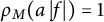
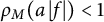


In particular, (a) holds for all
$f\in H_M$
 .
.
Theorem 2.2 (See [Reference Ansorena and Marcos3])
Let M and N be Musielak–Orlicz functions on a
$\sigma $
 -finite measure space
$(\Omega ,\Sigma ,\mu )$
-finite measure space
$(\Omega ,\Sigma ,\mu )$
 . Suppose that there is
$c\in (0,\infty )$
. Suppose that there is
$c\in (0,\infty )$
 such that
-
• $\max \left \lbrace \nu _M(\Omega ,c),\nu _N(\Omega ,c)\right \rbrace <\infty $
, -
• $\min \left \lbrace M(\omega ,c), N(\omega ,c)\right \rbrace>0$
for all
$\omega \in \Omega $
, and -
• $M(\omega ,t)\le N(\omega ,t)$
for all
$\omega \in \Omega $
and
$t\in [c,\infty )$
.






Then
$L_N(\mu )\subseteq L_M(\mu )$
 continuously.
Next, we detail three types of Musielak–Orlicz spaces we will deal with.
2.1 Musielak–Orlicz sequence spaces
We regard Musielak–Orlicz functions over
$\mathbb {N}$
 , which we call Musielak–Orlicz sequences, as sequences of Orlicz functions. Given a Musielak–Orlicz sequence
$\boldsymbol {F}=(F_n)_{n=1}^\infty $
, which we call Musielak–Orlicz sequences, as sequences of Orlicz functions. Given a Musielak–Orlicz sequence
$\boldsymbol {F}=(F_n)_{n=1}^\infty $
 , we denote by
$\ell _{\boldsymbol {F}}$
, we denote by
$\ell _{\boldsymbol {F}}$
 the Musielak–Orlicz sequence space built from
$\boldsymbol {F}$
the Musielak–Orlicz sequence space built from
$\boldsymbol {F}$
 . These Musielak–Orlicz atomic spaces naturally appear when studying the unconditional basic sequence structure of Musielak–Orlicz function spaces. Indeed, if M is a Musielak–Orlicz function over a
$\sigma $
. These Musielak–Orlicz atomic spaces naturally appear when studying the unconditional basic sequence structure of Musielak–Orlicz function spaces. Indeed, if M is a Musielak–Orlicz function over a
$\sigma $
 -finite measure space
$(\Omega ,\Sigma ,\mu )$
-finite measure space
$(\Omega ,\Sigma ,\mu )$
 , and
$\mathcal {X}=(x_n)_{n=1}^\infty $
, and
$\mathcal {X}=(x_n)_{n=1}^\infty $
 is a pairwise disjointly supported sequence in
$L_M\setminus \{0\}$
is a pairwise disjointly supported sequence in
$L_M\setminus \{0\}$
 , then
$\mathbb {S}[L_M,\mathcal {X}]=\ell _{\boldsymbol {F}}$
, then
$\mathbb {S}[L_M,\mathcal {X}]=\ell _{\boldsymbol {F}}$
 , where
$\boldsymbol {F}=(F_n)_{n=1}^\infty $
, where
$\boldsymbol {F}=(F_n)_{n=1}^\infty $
 is given by

We bring up a result in Musielak’s memoir [Reference Musielak21] that we will use.
Theorem 2.3 [Reference Musielak21, Theorem 8.11]
Consider two Musielak–Orlicz sequences
$\boldsymbol {F}=(F_n)_{n=1}^\infty $
 and
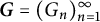
$\boldsymbol {G}=(G_n)_{n=1}^\infty $
and
$\boldsymbol {G}=(G_n)_{n=1}^\infty $
 . Then,
$\ell _{\boldsymbol {F}} \subseteq \ell _{\boldsymbol {G}}$
. Then,
$\ell _{\boldsymbol {F}} \subseteq \ell _{\boldsymbol {G}}$
 continuously if and only if there exist
$\boldsymbol {a}=(a_n)_{n=1}^\infty \in \ell _1$
continuously if and only if there exist
$\boldsymbol {a}=(a_n)_{n=1}^\infty \in \ell _1$
 and
$\delta ,b,$
and
$\delta ,b,$
 and C in
$(0,\infty )$
and C in
$(0,\infty )$
 such that

for all
$n\in \mathbb {N}$
 and all
$t\in (0,\infty )$
and all
$t\in (0,\infty )$
 with
$F_n(t)< \delta $
with
$F_n(t)< \delta $
 .
.
2.2 Orlicz sequence spaces
Given an Orlicz function F and a measure space
$(\Omega ,\Sigma ,\mu )$
 , the Orlicz space
$L_F(\mu )$
, the Orlicz space
$L_F(\mu )$
 is the Musielak–Orlicz space built from the Musielak–Orlicz function M over
$(\Omega ,\Sigma ,\mu )$
is the Musielak–Orlicz space built from the Musielak–Orlicz function M over
$(\Omega ,\Sigma ,\mu )$
 given by
$M(\omega ,t)=F(t)$
given by
$M(\omega ,t)=F(t)$
 for all
$\omega \in \Omega $
for all
$\omega \in \Omega $
 and
$t\in [0,\infty )$
and
$t\in [0,\infty )$
 . If
$\mu $
. If
$\mu $
 is the counting measure on
$\mathbb {N}$
is the counting measure on
$\mathbb {N}$
 , we set
$\ell _F=L_F(\mu )$
, we set
$\ell _F=L_F(\mu )$
 , and we call
$\ell _F$
, and we call
$\ell _F$
 the Orlicz sequence space built from F. Orlicz sequence spaces are Musielak–Orlicz sequence spaces built from constant Musielak–Orlicz sequences. Applying Theorem 2.3 in this particular situation yields the following well-known result.
Corollary 2.4 Given two Orlicz functions F and G, then
$\ell _F\subseteq \ell _G$
 if and only if there are b,
$c,$
if and only if there are b,
$c,$
 and C in
$(0,\infty )$
and C in
$(0,\infty )$
 such that

Given a convex Orlicz function F, we define its conjugate function
$F^*\colon [0,\infty )\to [0,\infty ]$
 as the optimal function G such that

$F^*$
 is a convex Orlicz function, and the conjugate space of
$L_F(\mu )$
is a convex Orlicz function, and the conjugate space of
$L_F(\mu )$
 is
$L_{F^*}(\mu )$
is
$L_{F^*}(\mu )$
 . We record some properties of the mapping
$F\mapsto F^*$
. We record some properties of the mapping
$F\mapsto F^*$
 that we will need.
Given
$p\in (0,\infty ],$
 we consider the power Orlicz functions

with the convention that
$1^\infty =0$
 . If
$p\ge 1$
. If
$p\ge 1$
 , so that
$\boldsymbol {\Phi }_p$
, so that
$\boldsymbol {\Phi }_p$
 and
$\boldsymbol {\Psi }_p$
and
$\boldsymbol {\Psi }_p$
 are convex, we denote by
$p'$
are convex, we denote by
$p'$
 its conjugate exponent defined by
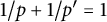
$1/p+1/p'=1$
its conjugate exponent defined by
$1/p+1/p'=1$
 . Note that
$\boldsymbol {\Phi }_\infty =\boldsymbol {\Psi }_\infty =\infty \chi _{(1,\infty )} $
. Note that
$\boldsymbol {\Phi }_\infty =\boldsymbol {\Psi }_\infty =\infty \chi _{(1,\infty )} $
 .
.
We record a couple of lemmas about Orlicz functions. The first of them is clear and well-known.
Lemma 2.5
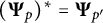
$(\boldsymbol {\Psi }_p)^*=\boldsymbol {\Psi }_{p'}$
 for all
$p\in [1,\infty ]$
for all
$p\in [1,\infty ]$
 .
.
Lemma 2.6 Let F be a convex Orlicz function. Let c, C,
$A,$
 and v in
$(0,\infty )$
and v in
$(0,\infty )$
 be such that

Then,
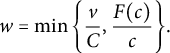
$F^*(w)\le A/C$
 , where
Proof On the one hand, if
$u\in [0,c]$
 ,
,
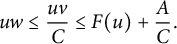
On the other hand, if
$u\in [c,\infty )$
 , by convexity,

2.3 Variable exponent Lebesgue spaces
A variable exponent on a measure space
$(\Omega ,\Sigma ,\mu )$
 will be a measurable function

The variable exponent Lebesgue space
$L_{\boldsymbol {P}}$
 associated with
$\boldsymbol {P}$
associated with
$\boldsymbol {P}$
 will be the F-space over
$\Omega $
will be the F-space over
$\Omega $
 built from the Musielak–Orlicz function

that is,
$L_{\boldsymbol {P}}=L_{M_{\boldsymbol {P}}}$
 . We denote by
$\rho _{\boldsymbol {P}}:=\rho _{M_{\boldsymbol {P}}}$
. We denote by
$\rho _{\boldsymbol {P}}:=\rho _{M_{\boldsymbol {P}}}$
 the modular constructed from
$M_{\boldsymbol {P}}$
the modular constructed from
$M_{\boldsymbol {P}}$
 . If the implicit measure
$\mu $
. If the implicit measure
$\mu $
 over
$(\Omega ,\Sigma )$
over
$(\Omega ,\Sigma )$
 we are considering could be in doubt, we put
$L_{\boldsymbol {P}}=L_{\boldsymbol {P}}(\mu )$
we are considering could be in doubt, we put
$L_{\boldsymbol {P}}=L_{\boldsymbol {P}}(\mu )$
 . Set also
$H_{\boldsymbol {P}}=H_{M_{\boldsymbol {P}}}$
. Set also
$H_{\boldsymbol {P}}=H_{M_{\boldsymbol {P}}}$
 .
.
Recall that the support of a Borel measure
$\nu $
 on a Lindelöf space X, denoted by
$\operatorname {\mathrm {supp}}(\nu )$
on a Lindelöf space X, denoted by
$\operatorname {\mathrm {supp}}(\nu )$
 , is the smallest closed set K such that
$\nu (X\setminus K)=0$
, is the smallest closed set K such that
$\nu (X\setminus K)=0$
 . Let
$\mu \circ \boldsymbol {P}^{-1}$
. Let
$\mu \circ \boldsymbol {P}^{-1}$
 be the pushforward of
$\mu $
be the pushforward of
$\mu $
 by
$\boldsymbol {P}$
by
$\boldsymbol {P}$
 . Let
. Let

be the essential range of
$\boldsymbol {P}$
 , that is, the set of all
$p\in [0,\infty ]$
, that is, the set of all
$p\in [0,\infty ]$
 such that
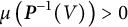
for all measurable neighborhoods V of p. Set

Suppose that
$\boldsymbol {P}^->0$
 . Then,
$M_{\boldsymbol {P}}$
. Then,
$M_{\boldsymbol {P}}$
 is
$\boldsymbol {P}^-$
is
$\boldsymbol {P}^-$
 -convex, whence
$L_{\boldsymbol {P}}$
-convex, whence
$L_{\boldsymbol {P}}$
 is a lattice
$\boldsymbol {P}^-$
is a lattice
$\boldsymbol {P}^-$
 -convex function space over
$(\Omega ,\Sigma ,\mu )$
-convex function space over
$(\Omega ,\Sigma ,\mu )$
 . We denote by
$\rho ^L_{\boldsymbol {P}}$
. We denote by
$\rho ^L_{\boldsymbol {P}}$
 the function quasi-norm constructed from
$\rho _{\boldsymbol {P}}$
the function quasi-norm constructed from
$\rho _{\boldsymbol {P}}$
 .
.
We will also consider the Musielak–Orlicz function over
$(\Omega ,\Sigma ,\mu )$
 given by

Let
$\rho ^a_{\boldsymbol {P}}$
 be the modular associated with
$M^a_{\boldsymbol {P}}$
be the modular associated with
$M^a_{\boldsymbol {P}}$
 . In turn, let
$\rho _{\boldsymbol {P}}^{L,a}$
. In turn, let
$\rho _{\boldsymbol {P}}^{L,a}$
 be the function quasi-norm constructed from
$\rho ^a_{\boldsymbol {P}}$
be the function quasi-norm constructed from
$\rho ^a_{\boldsymbol {P}}$
 . Since
$p^{1/p}$
. Since
$p^{1/p}$
 is bounded away from zero at infinity as long as p is bounded away from zero, the function quasi-norms
$\rho ^L_{\boldsymbol {P}}$
is bounded away from zero at infinity as long as p is bounded away from zero, the function quasi-norms
$\rho ^L_{\boldsymbol {P}}$
 and
$\rho _{\boldsymbol {P}}^{L,a}$
and
$\rho _{\boldsymbol {P}}^{L,a}$
 are equivalent. In fact,

Thus, there are two natural quasi-norms
$L_{\boldsymbol {P}}$
 can be equipped with, namely, those constructed from
$\rho ^L_{\boldsymbol {P}}$
can be equipped with, namely, those constructed from
$\rho ^L_{\boldsymbol {P}}$
 and
$\rho _{\boldsymbol {P}}^{L,a}$
and
$\rho _{\boldsymbol {P}}^{L,a}$
 . We denote by
$\left \lVert \cdot \right \rVert _{\boldsymbol {P}}$
. We denote by
$\left \lVert \cdot \right \rVert _{\boldsymbol {P}}$
 the one constructed from the former function quasi-norm, that is,
$\left \lVert f\right \rVert _{\boldsymbol {P}}=\rho _{\boldsymbol {P}}^L\left (\left \lvert f\right \rvert \right )$
the one constructed from the former function quasi-norm, that is,
$\left \lVert f\right \rVert _{\boldsymbol {P}}=\rho _{\boldsymbol {P}}^L\left (\left \lvert f\right \rvert \right )$
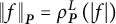 for all
$f\in L_{\boldsymbol {P}}$
for all
$f\in L_{\boldsymbol {P}}$
 .
.
Both
$\rho ^L_{\boldsymbol {P}}$
 and
$\rho ^{L,a}_{\boldsymbol {P}}$
and
$\rho ^{L,a}_{\boldsymbol {P}}$
 satisfy (F.6) with

In other words,
$\rho ^L_{\boldsymbol {P}}$
 and
$\rho ^{L,a}_{\boldsymbol {P}}$
and
$\rho ^{L,a}_{\boldsymbol {P}}$
 are function
$\boldsymbol {P}^c$
are function
$\boldsymbol {P}^c$
 -norms.
When dealing with variable exponent Lebesgue spaces, we must be aware that the identity

breaks down when
$p=\infty $
 and
$0\le s <1 <t <\infty $
and
$0\le s <1 <t <\infty $
 . So, we must pay attention to the set

In fact, for any
$f\in L^+(\mu )$
 , if
$\left \lVert \cdot \right \rVert _{\infty }$
, if
$\left \lVert \cdot \right \rVert _{\infty }$
 denotes the norm of
$L_\infty ({\left . \mu \right |{}_{{\Omega ^{\boldsymbol {P}}_\infty }}})$
denotes the norm of
$L_\infty ({\left . \mu \right |{}_{{\Omega ^{\boldsymbol {P}}_\infty }}})$
 ,
,

If
$\boldsymbol {P}^+<\infty $
 , then
$L_{\boldsymbol {P}}$
, then
$L_{\boldsymbol {P}}$
 is
$\boldsymbol {P}^+$
is
$\boldsymbol {P}^+$
 -concave. Consequently, if
$\boldsymbol {P}^->0$
-concave. Consequently, if
$\boldsymbol {P}^->0$
 and
$\boldsymbol {P}^+<\infty $
and
$\boldsymbol {P}^+<\infty $
 , then
$L_{\boldsymbol {P}}$
, then
$L_{\boldsymbol {P}}$
 is lattice
$\boldsymbol {P}^+$
is lattice
$\boldsymbol {P}^+$
 -concave, whence
$H_{\boldsymbol {P}}=L_{\boldsymbol {P}}$
-concave, whence
$H_{\boldsymbol {P}}=L_{\boldsymbol {P}}$
 and
$L_{\boldsymbol {P}}$
and
$L_{\boldsymbol {P}}$
 is absolutely continuous.
If
$\mu $
 is a finite measure and
$\boldsymbol {P}$
is a finite measure and
$\boldsymbol {P}$
 and
$\boldsymbol {Q}$
and
$\boldsymbol {Q}$
 are variable exponents over
$(\Omega ,\Sigma ,\mu )$
are variable exponents over
$(\Omega ,\Sigma ,\mu )$
 with
$\boldsymbol {P}\le \boldsymbol {Q}$
with
$\boldsymbol {P}\le \boldsymbol {Q}$
 , then
$L_{\boldsymbol {Q}} \subseteq L_{\boldsymbol {P}}$
, then
$L_{\boldsymbol {Q}} \subseteq L_{\boldsymbol {P}}$
 continuously by Theorem 2.2.
Given a measurable function
$h\colon \Omega \to (0,\infty )$
 , the pointwise multiplier

defines an isomorphism from
$L_{\boldsymbol {P}}(\nu )$
 onto
$L_{\boldsymbol {P}}(\mu )$
onto
$L_{\boldsymbol {P}}(\mu )$
 , where

Since we can choose h so that
$\int _\Omega h_{\boldsymbol {P}} \, d\mu =1$
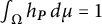 , any variable exponent Lebesgue space is isomorphic to a variable exponent Lebesgue space over a probability space. If this probability space is nonatomic and separable, then, by [Reference Carathéodory9], the corresponding variable exponent Lebesgue space is isomorphic to a variable exponent Lebesgue space over
$[0,1]$
, any variable exponent Lebesgue space is isomorphic to a variable exponent Lebesgue space over a probability space. If this probability space is nonatomic and separable, then, by [Reference Carathéodory9], the corresponding variable exponent Lebesgue space is isomorphic to a variable exponent Lebesgue space over
$[0,1]$
 .
.
To understand the structure of a variable exponent Lebesgue space we must take into account that if
$(\Omega _j)_{j=1}^2$
 is a partition of the measure space
$(\Omega ,\Sigma ,\mu )$
is a partition of the measure space
$(\Omega ,\Sigma ,\mu )$
 then, for any variable exponent
$\boldsymbol {P}\colon \Omega \to (0,\infty ]$
then, for any variable exponent
$\boldsymbol {P}\colon \Omega \to (0,\infty ]$
 , setting
$\boldsymbol {P}_j={\left . \boldsymbol {P} \right |{}_{{\Omega _j}}}$
, setting
$\boldsymbol {P}_j={\left . \boldsymbol {P} \right |{}_{{\Omega _j}}}$
 and
$\mu _j={\left . \mu \right |{}_{{\Omega _j}}}$
and
$\mu _j={\left . \mu \right |{}_{{\Omega _j}}}$
 for
$j=1$
for
$j=1$
 ,
$2$
,
$2$
 ,
,

If J is a countable set and
$\boldsymbol {Q}\colon J\to (0,\infty ]$
 is a function, we denote by
$\ell _{\boldsymbol {Q}}$
is a function, we denote by
$\ell _{\boldsymbol {Q}}$
 the variable exponent Lebesgue space over the counting measure on J associated with the variable exponent
$\boldsymbol {Q}$
the variable exponent Lebesgue space over the counting measure on J associated with the variable exponent
$\boldsymbol {Q}$
 . These variable exponent Lebesgue atomic spaces were introduced by Nakano [Reference Nakano22] in the case when
$\boldsymbol {Q}^{-}\ge 1$
. These variable exponent Lebesgue atomic spaces were introduced by Nakano [Reference Nakano22] in the case when
$\boldsymbol {Q}^{-}\ge 1$
 , and by Bourgin [Reference Bourgin7] in the case when
$\boldsymbol {Q}^{+}\le 1$
, and by Bourgin [Reference Bourgin7] in the case when
$\boldsymbol {Q}^{+}\le 1$
 . In general, as is customary, we will call them Nakano sequence spaces.
Splitting
$\sigma $
 -finite measures into their purely atomic part and their nonatomic part, we infer that any variable exponent Lebesgue space is isomorphic to

for some nonatomic probability measure space
$(\Omega ,\Sigma ,\mu )$
 , some countable set J and some variable exponents
$\boldsymbol {P}\colon \Omega \to (0,\infty ]$
, some countable set J and some variable exponents
$\boldsymbol {P}\colon \Omega \to (0,\infty ]$
 and
$\boldsymbol {Q}\colon J \to (0,\infty ]$
and
$\boldsymbol {Q}\colon J \to (0,\infty ]$
 . Summing up, any variable exponent Lebesgue space over any separable
$\sigma $
. Summing up, any variable exponent Lebesgue space over any separable
$\sigma $
 -finite measure space is isomorphic to
$L_{\boldsymbol {P}}\oplus \ell _{\boldsymbol {Q}}$
-finite measure space is isomorphic to
$L_{\boldsymbol {P}}\oplus \ell _{\boldsymbol {Q}}$
 for some countable set J and some variable exponents
$\boldsymbol {P}\colon [0,1]\to (0,\infty ]$
for some countable set J and some variable exponents
$\boldsymbol {P}\colon [0,1]\to (0,\infty ]$
 and
$\boldsymbol {Q}\colon J\to (0,\infty ]$
and
$\boldsymbol {Q}\colon J\to (0,\infty ]$
 .
.
The dual space of
$L_{\boldsymbol {P}}$
 only depends on the behavior of
$\boldsymbol {P}$
only depends on the behavior of
$\boldsymbol {P}$
 on
on

Indeed, we have the following.
Proposition 2.7 Let
$\boldsymbol {P}\colon \Omega \to (0,1)$
 be a variable exponent on a nonatomic
$\sigma $
be a variable exponent on a nonatomic
$\sigma $
 -finite measure space
$(\Omega ,\Sigma ,\mu )$
-finite measure space
$(\Omega ,\Sigma ,\mu )$
 . Then, the dual space of
$L_{\boldsymbol {P}}$
. Then, the dual space of
$L_{\boldsymbol {P}}$
 is null.
Proof Set
$\Omega _{p,A}=\boldsymbol {P}^{-1}((0,p]) \cap A$
 for each
$p\in (0,1)$
for each
$p\in (0,1)$
 and
$A\in \Sigma (\mu )$
and
$A\in \Sigma (\mu )$
 . Since
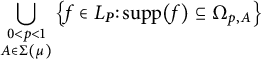
is dense in
$L_{\boldsymbol {P}}$
 , it suffices to prove the result in the case when
$\mu $
, it suffices to prove the result in the case when
$\mu $
 is finite and
$\boldsymbol {P}(\Omega )\subseteq (0,p]$
is finite and
$\boldsymbol {P}(\Omega )\subseteq (0,p]$
 for some
$0<p<1$
for some
$0<p<1$
 . In this case, since
$L_p(\mu )\subseteq L_{\boldsymbol {P}}$
. In this case, since
$L_p(\mu )\subseteq L_{\boldsymbol {P}}$
 continuously and
$\mathcal {S}(\mu )$
continuously and
$\mathcal {S}(\mu )$
 is dense in
$L_{\boldsymbol {P}}$
is dense in
$L_{\boldsymbol {P}}$
 , the result follows from the fact that
$(L_p(\mu ))^*=\{0\}$
, the result follows from the fact that
$(L_p(\mu ))^*=\{0\}$
 .
.
We say that a variable exponent
$\boldsymbol {P}$
 over a
$\sigma $
over a
$\sigma $
 -finite measure space
$(\Omega ,\Sigma ,\mu )$
-finite measure space
$(\Omega ,\Sigma ,\mu )$
 is convex if
$\boldsymbol {P}(\Omega )\subseteq [1,\infty ]$
is convex if
$\boldsymbol {P}(\Omega )\subseteq [1,\infty ]$
 . The conjugate variable exponent of
$\boldsymbol {P}$
. The conjugate variable exponent of
$\boldsymbol {P}$
 is the convex variable exponent
$\boldsymbol {Q}$
is the convex variable exponent
$\boldsymbol {Q}$
 over
$(\Omega ,\Sigma ,\mu )$
over
$(\Omega ,\Sigma ,\mu )$
 defined by

The well-known duality relation between
$L_{\boldsymbol {P}}$
 and
$L_{\boldsymbol {Q}}$
and
$L_{\boldsymbol {Q}}$
 relies on the following lemma.
Lemma 2.8 Let
$\boldsymbol {Q}$
 be the conjugate variable exponent of a variable exponent
$\boldsymbol {P}$
be the conjugate variable exponent of a variable exponent
$\boldsymbol {P}$
 over a
$\sigma $
over a
$\sigma $
 -finite measure space
$(\Omega ,\Sigma ,\mu )$
-finite measure space
$(\Omega ,\Sigma ,\mu )$
 . Let
$g\in L^+(\mu )$
. Let
$g\in L^+(\mu )$
 with
$\rho ^L_{\boldsymbol {Q}}(g)=1$
with
$\rho ^L_{\boldsymbol {Q}}(g)=1$
 and
$\operatorname {\mathrm {supp}}(g)\subseteq \boldsymbol {P}^{-1}([p,\infty ])$
and
$\operatorname {\mathrm {supp}}(g)\subseteq \boldsymbol {P}^{-1}([p,\infty ])$
 for some
$p>1$
for some
$p>1$
 . Set
$f={g^{\boldsymbol {Q}-1}}$
. Set
$f={g^{\boldsymbol {Q}-1}}$
 , with the convention that
$0^0=0$
, with the convention that
$0^0=0$
 . Then,

Proof Our conditions on g yields
$g\in H^{+}_{\boldsymbol {Q}}$
 , whence
$\rho _{\boldsymbol {Q}}(g)=1$
, whence
$\rho _{\boldsymbol {Q}}(g)=1$
 by Lemma 2.1. Since
$fg=f^{\boldsymbol {P}}=g^{\boldsymbol {Q}}$
by Lemma 2.1. Since
$fg=f^{\boldsymbol {P}}=g^{\boldsymbol {Q}}$
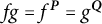 , we are done.
With the information we have gathered, proving that the conjugate space of
$L_{\boldsymbol {P}}$
 is
$L_{\boldsymbol {Q}}$
is
$L_{\boldsymbol {Q}}$
 takes little effort. On the one hand, by Lemma 2.5,

Therefore, the dual function norm
$\rho ^*$
 of
$\rho _{\boldsymbol {Q}}^L$
of
$\rho _{\boldsymbol {Q}}^L$
 satisfies
$\rho ^*\le 2 \rho _{\boldsymbol {Q}}^{L,a}$
satisfies
$\rho ^*\le 2 \rho _{\boldsymbol {Q}}^{L,a}$
 . On the other hand, by Lemma 2.8 and homogeneity,
$\rho ^*(g)\ge \rho ^L_{\boldsymbol {Q}}(g)$
. On the other hand, by Lemma 2.8 and homogeneity,
$\rho ^*(g)\ge \rho ^L_{\boldsymbol {Q}}(g)$
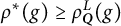 for all
$g\in L^+(\mu )$
for all
$g\in L^+(\mu )$
 with
$\operatorname {\mathrm {supp}}(g)\subseteq \boldsymbol {P}^{-1}([p,\infty ])$
with
$\operatorname {\mathrm {supp}}(g)\subseteq \boldsymbol {P}^{-1}([p,\infty ])$
 for some
$p>1$
for some
$p>1$
 . By the Fatou property, this inequality extends to any
$g\in L^+(\mu )$
. By the Fatou property, this inequality extends to any
$g\in L^+(\mu )$
 with
$\operatorname {\mathrm {supp}}(g)\subseteq \boldsymbol {P}^{-1}((1,\infty ])$
with
$\operatorname {\mathrm {supp}}(g)\subseteq \boldsymbol {P}^{-1}((1,\infty ])$
 . Since the conjugate space of
$L_1(\Omega ^{\boldsymbol {Q}}_\infty )$
. Since the conjugate space of
$L_1(\Omega ^{\boldsymbol {Q}}_\infty )$
 is
$L_\infty (\Omega ^{\boldsymbol {Q}}_\infty )$
is
$L_\infty (\Omega ^{\boldsymbol {Q}}_\infty )$
 , the inequality extends to any
$g\in L^+(\mu )$
, the inequality extends to any
$g\in L^+(\mu )$
 .
.
We close this section with a result that connects variable exponent Lebesgue spaces to classical Lebesgue spaces. Given
$0<p\le 2$
 and
$t\in (0,\infty )$
and
$t\in (0,\infty )$
 , we say that a random variable is p-stablewith parameter t if its characteristic function is

Note that if
$s\in (0,\infty )$
 and X is a p-stable random variable with parameter t, then
$sX$
and X is a p-stable random variable with parameter t, then
$sX$
 is a p-stable random variable with parameter
$s^p t$
is a p-stable random variable with parameter
$s^p t$
 . We say that a continuous-time stochastic process
$(X_t)_{t\in [0,1]}$
. We say that a continuous-time stochastic process
$(X_t)_{t\in [0,1]}$
 is p-stable if
$X_0=0$
is p-stable if
$X_0=0$
 a.e., it has stationary and independent increments, and, for all
$0\le s <t\le 1$
a.e., it has stationary and independent increments, and, for all
$0\le s <t\le 1$
 ,
$X_t-X_s$
,
$X_t-X_s$
 is a p-stable random variable with parameter
$t-s$
is a p-stable random variable with parameter
$t-s$
 .
.
Proposition 2.9 Let
$\boldsymbol {P}$
 be a variable exponent on a nonatomic
$\sigma $
be a variable exponent on a nonatomic
$\sigma $
 -finite measure space
$(\Omega ,\Sigma ,\mu )$
-finite measure space
$(\Omega ,\Sigma ,\mu )$
 . Suppose that
$\boldsymbol {P}^-<2$
. Suppose that
$\boldsymbol {P}^-<2$
 . Then,
$L_p$
. Then,
$L_p$
 is almost isometrically isomorphic to a subspace of
$L_{\boldsymbol {P}}$
is almost isometrically isomorphic to a subspace of
$L_{\boldsymbol {P}}$
 for all
$p\in (\boldsymbol {P}^-,2]$
for all
$p\in (\boldsymbol {P}^-,2]$
 .
.
Proof For each
$0<s<\infty $
 , let
$C_{p,s}\in (0,\infty ]$
, let
$C_{p,s}\in (0,\infty ]$
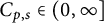 be the s-norm of a p-stable random variable with parameter one. Pick
$r:=\boldsymbol {P}^-<q<p$
be the s-norm of a p-stable random variable with parameter one. Pick
$r:=\boldsymbol {P}^-<q<p$
 . By (2.1), we can assume that
$P(\omega )\in [\boldsymbol {P}^-,q]$
. By (2.1), we can assume that
$P(\omega )\in [\boldsymbol {P}^-,q]$
 for all
$\omega \in \Omega $
for all
$\omega \in \Omega $
 . We can also assume that
$\mu $
. We can also assume that
$\mu $
 is a probability measure and that there is a p-stable continuous-time stochastic process on
$(\Omega ,\Sigma ,\mu )$
is a probability measure and that there is a p-stable continuous-time stochastic process on
$(\Omega ,\Sigma ,\mu )$
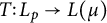
 (see, e.g., [Reference Kanter15, Section 4]). Then, there is a linear map
$T\colon L_p \to L(\mu )$
(see, e.g., [Reference Kanter15, Section 4]). Then, there is a linear map
$T\colon L_p \to L(\mu )$
 such that, for all
$f\in L_p$
such that, for all
$f\in L_p$
 ,
$T(f)$
,
$T(f)$
 is a p-stable random variable with parameter
$\left \lVert f\right \rVert _p^p$
is a p-stable random variable with parameter
$\left \lVert f\right \rVert _p^p$
 (see, e.g., [Reference Kanter15, Section 5]). Therefore,
$\left \lVert T(f)\right \rVert _s=C_{p,s} \left \lVert f\right \rVert _p$
(see, e.g., [Reference Kanter15, Section 5]). Therefore,
$\left \lVert T(f)\right \rVert _s=C_{p,s} \left \lVert f\right \rVert _p$
 for all
$0<s<p$
for all
$0<s<p$
 and
$f\in L_p$
and
$f\in L_p$
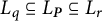
 . Since
$L_q\subseteq L_{\boldsymbol {P}} \subseteq L_r$
. Since
$L_q\subseteq L_{\boldsymbol {P}} \subseteq L_r$
 and
$C_{p,s}<\infty $
and
$C_{p,s}<\infty $
 for all
$0<s<p$
for all
$0<s<p$
 (see, e.g., [Reference Kanter15, Section 5]),

Consequently,
$L_p$
 is
$(C_{p,q}/C_{p,r})$
is
$(C_{p,q}/C_{p,r})$
 -isomorphic to a subspace of
$L_{\boldsymbol {P}}$
-isomorphic to a subspace of
$L_{\boldsymbol {P}}$
 . Since
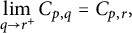
we are done.
3 Orlicz functions generated near zero by power functions
Given a signed measure
$\mu $
 on
$(0,\infty ],$
on
$(0,\infty ],$
 we define

Let
$\delta _p$
 be the Dirac measure on
$p\in (0,\infty ]$
be the Dirac measure on
$p\in (0,\infty ]$
 . We have

We will use the elementary inequality

several times.
Lemma 3.1 The mapping
$p\mapsto H(p):= \boldsymbol {\psi }_p$
 defines a nonincreasing continuous function from
$(0,\infty ]$
defines a nonincreasing continuous function from
$(0,\infty ]$
 into the Banach lattice
$\mathcal {C}([0,1])$
into the Banach lattice
$\mathcal {C}([0,1])$
 .
.
Proof Applying (3.1) with
$u=0$
 gives that H is nonincreasing. This inequality also gives

Definition 3.2 Given
$R\subseteq (0,\infty ]$
 nonempty, we denote by
$\mathcal {K}(R)$
nonempty, we denote by
$\mathcal {K}(R)$
 the the closed convex hull in
$\mathcal {C}([0,1])$
the the closed convex hull in
$\mathcal {C}([0,1])$
 of
$\{\boldsymbol {\psi }_p \colon p\in R\}$
of
$\{\boldsymbol {\psi }_p \colon p\in R\}$
 . We denote by
$\mathcal {O}(R)$
. We denote by
$\mathcal {O}(R)$
 the set of all Orlicz functions F for which there are
$0<c\le 1$
the set of all Orlicz functions F for which there are
$0<c\le 1$
 and
$\varphi \in \mathcal {K}(R)$
and
$\varphi \in \mathcal {K}(R)$
 such that

Put

Given
$r\in (0,\infty ],$
 we set

Finally, we put
$\mathcal {O}(r)=\mathcal {O}(\{r\})$
 and
$\mathcal {O}(r^+)=\mathcal {O}([r,\infty ],r^+)$
and
$\mathcal {O}(r^+)=\mathcal {O}([r,\infty ],r^+)$
 .
.
Note that
$\mathcal {O}(\infty )=\mathcal {O}(\infty ^+)$
 consists of all Orlicz functions that are null in a neighborhood of the origin.
Lemma 3.3 Let
$R\subseteq (0,\infty ]$
 be closed, nonempty, and bounded away from zero. Then, any function in
$\mathcal {K}(R)$
be closed, nonempty, and bounded away from zero. Then, any function in
$\mathcal {K}(R)$
 extends to a function in
$\mathcal {O}(R)$
extends to a function in
$\mathcal {O}(R)$
 .
.
Proof Just notice that any function
$F\in \mathcal {K}(R)$
 is nondecreasing, continuous, and satisfies
$F(0)=0$
is nondecreasing, continuous, and satisfies
$F(0)=0$
 .
.
Given
$f\colon [0,1] \to \mathbb {R}$
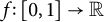 and
$p\in (0,\infty ],$
and
$p\in (0,\infty ],$
 we consider the function

Definition 3.4 Let
$ 0<r\le s\le \infty $
 . We denote by
$\mathcal {K}_{r,s}$
. We denote by
$\mathcal {K}_{r,s}$
 the set consisting of all nondecreasing functions
$\varphi \colon [0,1]\to [0,\infty )$
the set consisting of all nondecreasing functions
$\varphi \colon [0,1]\to [0,\infty )$
 such that
$\pi _r(\varphi )$
such that
$\pi _r(\varphi )$
 is convex,
$\pi _s(\varphi )$
is convex,
$\pi _s(\varphi )$
 is concave,

and

Lemma 3.5 Let
$R\subseteq (0,\infty ]$
 be closed, nonempty, and bounded away from zero. Set
$r=\min (R)$
be closed, nonempty, and bounded away from zero. Set
$r=\min (R)$
 and
$s=\max (R)$
and
$s=\max (R)$
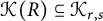
 . Then
$\mathcal {K}(R) \subseteq \mathcal {K}_{r,s}$
. Then
$\mathcal {K}(R) \subseteq \mathcal {K}_{r,s}$
 .
.
Proof We infer from inequality (3.1) that
$\boldsymbol {\psi }_p\in \mathcal {K}_{r,s}$
 for all
$p\in R$
for all
$p\in R$
 . Since
$\mathcal {K}_{r,s}$
. Since
$\mathcal {K}_{r,s}$
 is convex and closed, we are done.
Lemma 3.6 For
$j=1$
 ,
$2,$
,
$2,$
 let
$R_j\subseteq (0,\infty ]$
let
$R_j\subseteq (0,\infty ]$
 be closed, nonempty, and bounded away from zero. Set
$r_1:=\max (R_1)$
be closed, nonempty, and bounded away from zero. Set
$r_1:=\max (R_1)$
 and
$r_2:=\min (R_2)$
and
$r_2:=\min (R_2)$
 .
.
-
(i) If $r_1=r_2$
, then
$\mathcal {O}(R_1)\cap \mathcal {O}(R_2) =\mathcal {O}(r_1)$
. -
(ii) If $r_1<r_2$
, then
$\mathcal {O}(R_1)\cap \mathcal {O}(R_2) =\emptyset $
.




Proof Pick
$F\in \mathcal {O}(R_1)\cap \mathcal {O}(R_2)$
 and
$r_1\le r \le s\le r_2$
and
$r_1\le r \le s\le r_2$
 . There are
$0<c\le 1$
. There are
$0<c\le 1$
 ,
$\varphi _j\in \mathcal {O}(R_j),$
,
$\varphi _j\in \mathcal {O}(R_j),$
 and
$C_j\in (0,\infty )$
and
$C_j\in (0,\infty )$
 ,
$j=1$
,
$j=1$
 ,
$2$
,
$2$
 , such that

By Lemma 3.5,

Consequently,
$r\ge s$
 .
.
Lemma 3.7 Let
$0<q<r\le \infty $
 . Then,
$\mathcal {O}(q^+)\cap \mathcal {O}(r^+)=\emptyset $
. Then,
$\mathcal {O}(q^+)\cap \mathcal {O}(r^+)=\emptyset $
 .
.
Proof Choose
$q<s_1<r<s_2$
 . Since
$\mathcal {O}(q^+)\cap \mathcal {O}(r^+)\subseteq \mathcal {O}([q,s_1]) \cap \mathcal {O}([r,s_2])$
. Since
$\mathcal {O}(q^+)\cap \mathcal {O}(r^+)\subseteq \mathcal {O}([q,s_1]) \cap \mathcal {O}([r,s_2])$
 , the result follows from Lemma 3.6.
Proposition 3.8 Let
$R\subseteq (0,\infty ]$
 be closed, nonempty, and bounded away from zero.
-
(i) $\varphi \in \mathcal {K}(R)$
if and only if there is a probability measure
$\mu $
over R such that
$\varphi =\boldsymbol {\psi }_\mu $
. -
(ii) $\mathcal {K}(R)$
is a compact set.


Proof Let us identify the space
$\mathcal {M}(R)$
 of all signed measures over R with the dual space of
$\mathcal {C}(R)$
of all signed measures over R with the dual space of
$\mathcal {C}(R)$
 . The set
$\mathcal {P}(R)$
. The set
$\mathcal {P}(R)$
 of all probability measures over R is a convex subspace of
$\mathcal {M}(R)$
of all probability measures over R is a convex subspace of
$\mathcal {M}(R)$
 . Besides,
$\mathcal {P}(R)$
. Besides,
$\mathcal {P}(R)$
 is closed relative to the weak* topology, and

is the set of extreme points of
$\mathcal {P}(R)$
 .
.
By (3.1), the map

is continuous. Consequently, the map

is continuous. We infer that the map

besides linear, is continuous. Note that
$E(\delta _p)=\boldsymbol {\psi }_p$
 for all
$p\in R$
for all
$p\in R$
 and that

Therefore,
$\mathcal {L}(R)$
 is compact by the Banach–Alaoglu theorem, and the convex hull of
$\{\boldsymbol {\psi }_p\colon p\in R\}$
is compact by the Banach–Alaoglu theorem, and the convex hull of
$\{\boldsymbol {\psi }_p\colon p\in R\}$
 is dense in
$\mathcal {L}(R)$
is dense in
$\mathcal {L}(R)$
 by the Krein–Milman theorem. Consequently,
$\mathcal {L}(R)=\mathcal {K}(R)$
by the Krein–Milman theorem. Consequently,
$\mathcal {L}(R)=\mathcal {K}(R)$
 .
.
Example 3.9 Let
$0<r<\infty $
 and
$a\in \mathbb {R}$
and
$a\in \mathbb {R}$
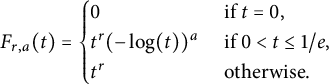
 . Define
$F_{r,a}\colon [0,\infty )\to [0,\infty )$
. Define
$F_{r,a}\colon [0,\infty )\to [0,\infty )$
 by
by
Suppose that
$a>0$
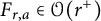
 . Aiming to prove that
$F_{r,a} \in \mathcal {O}(r^+)$
. Aiming to prove that
$F_{r,a} \in \mathcal {O}(r^+)$
 , we fix
$s>r$
, we fix
$s>r$
 and consider the probability measure
$\mu _{a,r,s}$
and consider the probability measure
$\mu _{a,r,s}$
 on
$(0,\infty )$
on
$(0,\infty )$
 given by

By definition,
$\mu _{a,r,s}$
 is supported on
$[r,s]$
is supported on
$[r,s]$
 . Set
$\varphi _{a,r,s}=\boldsymbol {\psi }_{\mu _{a,r,s}}$
. Set
$\varphi _{a,r,s}=\boldsymbol {\psi }_{\mu _{a,r,s}}$
 . We have

for all
$0\le t< 1$
 , where

Fix
$0\le c<1$
 . Since
$C(t)$
. Since
$C(t)$
 is bounded away from zero and infinity when t runs over
$[0,c]$
is bounded away from zero and infinity when t runs over
$[0,c]$
 ,
$\varphi _{a,r,s}\approx F_{r,a}$
,
$\varphi _{a,r,s}\approx F_{r,a}$
 on
$[0,c]$
on
$[0,c]$
 . Therefore,
$F_{r,a} \in \mathcal {O}([r,s])$
. Therefore,
$F_{r,a} \in \mathcal {O}([r,s])$
 .
.
Lemma 3.10 Let
$R\subseteq (0,\infty ]$
 be closed, nonempty, and bounded away from zero. Let
$\mu \in \mathcal {P}(R)$
be closed, nonempty, and bounded away from zero. Let
$\mu \in \mathcal {P}(R)$
 and F be an Orlicz function with
$F\approx \boldsymbol {\psi }_\mu $
and F be an Orlicz function with
$F\approx \boldsymbol {\psi }_\mu $
 . If
$r=\min (\operatorname {\mathrm {supp}}(\mu ))$
. If
$r=\min (\operatorname {\mathrm {supp}}(\mu ))$
 , then
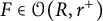
$F\in \mathcal {O}(R,r^+)$
, then
$F\in \mathcal {O}(R,r^+)$
 .
.
Proof Fix
$s>r$
 . We have

Let
$\nu $
 be the probability measure obtained by restricting
$\mu /\lambda $
be the probability measure obtained by restricting
$\mu /\lambda $
 to
$[r,s]$
to
$[r,s]$
 . Let
$0<t\le 1$
. Let
$0<t\le 1$
 . By Lemma 3.1,

Since
$\nu \in \mathcal {P} (R\cap [r,s])$
 , we are done.
Corollary 3.11 Let
$R\subseteq (0,\infty ]$
 be closed, nonempty, and bounded away from zero. Let
$F\in \mathcal {O}(R)$
be closed, nonempty, and bounded away from zero. Let
$F\in \mathcal {O}(R)$
 and
$b\in (0,\infty )$
and
$b\in (0,\infty )$
 . Then, there is
$c\in (0,\infty )$
. Then, there is
$c\in (0,\infty )$
 such that
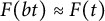
$F(bt)\approx F(t)$
such that
$F(bt)\approx F(t)$
 for
$0\le t \le c$
for
$0\le t \le c$
 .
.
Proof If
$F\in \mathcal {O}(\infty )$
 , the result is clear. Otherwise, there are
$0<r<s<\infty $
, the result is clear. Otherwise, there are
$0<r<s<\infty $
 such that
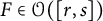
$F\in \mathcal {O}([r,s])$
such that
$F\in \mathcal {O}([r,s])$
 . Applying Lemma 3.5 puts an end to the proof.
Lemma 3.12 Suppose that a decreasing sequence
$(r_n)_{n=1}^\infty $
 in
$(0,\infty )$
in
$(0,\infty )$
 converges to
$r>0$
converges to
$r>0$
 . Set
$R=\{r\}\cup \left \lbrace r_n \colon n\in \mathbb {N}\right \rbrace $
. Set
$R=\{r\}\cup \left \lbrace r_n \colon n\in \mathbb {N}\right \rbrace $
 . Let
$(b_n)_{n=1}^\infty $
. Let
$(b_n)_{n=1}^\infty $
 be a positive sequence with
$\sum _{n=1}^\infty b_n=1$
be a positive sequence with
$\sum _{n=1}^\infty b_n=1$
 . Define
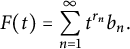
$F\colon [0,\infty )\to [0,\infty ]$
. Define
$F\colon [0,\infty )\to [0,\infty ]$
 by
by
Then,
$F\in \mathcal {O}(R,r^+)\setminus \mathcal {O}(r)$
 .
.
Proof By Lemma 3.10,
$F\in \mathcal {O}(R,r^+)$
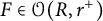 . By the dominated convergence theorem,
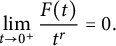
Hence,
$F\notin \mathcal {O}(r)$
 .
.
Recall that
$r\in [0,\infty ]$
 is an accumulation point of a set
$R\subseteq [0,\infty ]$
is an accumulation point of a set
$R\subseteq [0,\infty ]$
 if
$R\cap(V\setminus \{r\})\not =\emptyset $
if
$R\cap(V\setminus \{r\})\not =\emptyset $
 for every neighborhood V of r. If
$R\cap (r,s)\not =\emptyset $
for every neighborhood V of r. If
$R\cap (r,s)\not =\emptyset $
 for all
$s>r$
for all
$s>r$
 , we say that r is a right-sided accumulation point of R.
Proposition 3.13 Let
$R\subseteq (0,\infty ]$
 be closed, nonempty, and bounded away from zero. Given
$r\in R$
be closed, nonempty, and bounded away from zero. Given
$r\in R$
 ,
$\mathcal {O}(R,r^+)\setminus \mathcal {O}(r)$
,
$\mathcal {O}(R,r^+)\setminus \mathcal {O}(r)$
 is nonempty if and only if r is a right-sided accumulation point of R.
Proof Let
$F\notin \mathcal {O}(r)$
 be such that
$F\in \mathcal {O}(R\cap [r,s])$
be such that
$F\in \mathcal {O}(R\cap [r,s])$
 for all
$s>r$
for all
$s>r$
 . Then,
$\{r\}\subsetneq R\cap [r,s]$
. Then,
$\{r\}\subsetneq R\cap [r,s]$
 for all
$s>r$
for all
$s>r$
 .
.
Suppose that r is a right-sided accumulation point of R. Let
$(r_n)_{n=1}^\infty $
 in R be decreasing to r. Pick
$(b_n)_{n=1}^\infty $
in R be decreasing to r. Pick
$(b_n)_{n=1}^\infty $
 with
$\sum _{n=1}^\infty b_n=1$
with
$\sum _{n=1}^\infty b_n=1$
 . If F is as in Lemma 3.12,
$F\in \mathcal {O}(R\cap [r,s])$
. If F is as in Lemma 3.12,
$F\in \mathcal {O}(R\cap [r,s])$
 for all
$s>r$
for all
$s>r$
 .
.
Corollary 3.14 Let
$R\subseteq (0,\infty ]$
 be closed, nonempty, and bounded away from zero. The following are equivalent:
-
• $\mathcal {O}(R)=\cup _{r\in R} \mathcal {O}(r)$
. -
• R has no right-sided accumulation point.

Proposition 3.15 Let
$R\subseteq (0,\infty ]$
 be closed, nonempty, and bounded away from zero. Then,

is a partition of
$\mathcal {O}(R)$
 .
.
Corollary 3.16
$\mathcal {O}(r^{-}) :=\cap _{s<r} \mathcal {O}([s,r]) =\mathcal {O}(r)$
 for all
$r\in (0,\infty ]$
for all
$r\in (0,\infty ]$
 .
.
Proof Let
$F\in \mathcal {O}(r^{-})$
 . By Lemma 3.15, for each
$s<r,$
. By Lemma 3.15, for each
$s<r,$
 there is
$p(s)\in [s,r]$
there is
$p(s)\in [s,r]$
 such that
$F\in \mathcal {O}(p(s)^+)$
such that
$F\in \mathcal {O}(p(s)^+)$
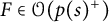 . By Lemma 3.7,
$p(s)=r$
. By Lemma 3.7,
$p(s)=r$
 for all
$s<r$
for all
$s<r$
 . Applying Lemma 3.6(i) puts an end to the proof.
Corollary 3.17 Let
$q\in (0,\infty ]$
 . Let
$R\subseteq (0,\infty ]$
. Let
$R\subseteq (0,\infty ]$
 be closed, nonempty, and bounded away from zero. Then
$\boldsymbol {\Psi }_q\in \mathcal {O}(R)$
be closed, nonempty, and bounded away from zero. Then
$\boldsymbol {\Psi }_q\in \mathcal {O}(R)$
 if and only if
$q\in R$
if and only if
$q\in R$
 .
.
Proof Suppose that
$\boldsymbol {\Psi }_q\in \mathcal {O}(R)$
 . By Proposition 3.15, there is
$r\in R$
. By Proposition 3.15, there is
$r\in R$
 such that
$\boldsymbol {\Psi }_q\in \mathcal {O}(r^+)$
such that
$\boldsymbol {\Psi }_q\in \mathcal {O}(r^+)$
 . By Lemma 3.7,
$q=r$
. By Lemma 3.7,
$q=r$
 .
.
Example 3.18 Let
$0<p<\infty $
 and the functions
$F_{p,a}$
and the functions
$F_{p,a}$
 of Example 3.9 with
$a<0$
of Example 3.9 with
$a<0$
 . Then,
$F_{p,a}$
. Then,
$F_{p,a}$
 does not belong to
$\mathcal {O}(R)$
does not belong to
$\mathcal {O}(R)$
 for any set
$R\subseteq (0,\infty ]$
for any set
$R\subseteq (0,\infty ]$
 . Otherwise, by Proposition 3.15 and Lemma 3.5, there would be
$r\in (0,\infty )$
. Otherwise, by Proposition 3.15 and Lemma 3.5, there would be
$r\in (0,\infty )$
 and
$(C_s)_{s\ge r}$
and
$(C_s)_{s\ge r}$
 in
$(0,\infty )$
in
$(0,\infty )$
 such that

The right-hand inequality would yield
$p>r$
 . Then, applying the left-hand inequality with
$r<s<p,$
. Then, applying the left-hand inequality with
$r<s<p,$
 we would reach an absurdity.
Theorem 3.19 Let
$R\subseteq (0,\infty ]$
 be closed, nonempty, and bounded away from zero. Let F be a convex Orlicz function such that
$F\in \mathcal {O}(R)$
be closed, nonempty, and bounded away from zero. Let F be a convex Orlicz function such that
$F\in \mathcal {O}(R)$
 and
$F^* \in \mathcal {O}((0,\infty ])$
and
$F^* \in \mathcal {O}((0,\infty ])$
 . Then, there is
$r\in R \cap [1,\infty ]$
. Then, there is
$r\in R \cap [1,\infty ]$
 such that
$F\in \mathcal {O}(r)$
such that
$F\in \mathcal {O}(r)$
 .
.
Proof By Proposition 3.15, there are
$r\in R$
 and
$q\in (0,\infty ]$
and
$q\in (0,\infty ]$
 such that
$F\in \mathcal {O}(r^+)$
such that
$F\in \mathcal {O}(r^+)$
 and
$F^*\in \mathcal {O}(q^+)$
and
$F^*\in \mathcal {O}(q^+)$
 . Since F and
$F^*$
. Since F and
$F^*$
 are convex, there are
$0<c<1$
are convex, there are
$0<c<1$
 and
$0<C<\infty $
and
$0<C<\infty $
 such that
$\max \{F(t), F^*(t)\} \le Ct$
such that
$\max \{F(t), F^*(t)\} \le Ct$
 for all
$t\in [0,c]$
for all
$t\in [0,c]$
 . By Lemma 3.5, r,
$q\in [1,\infty ]$
. By Lemma 3.5, r,
$q\in [1,\infty ]$
 .
.
By Lemma 3.5, there are
$0<c_1<1$
 and
$0<C_1<\infty $
and
$0<C_1<\infty $
 such that
$F^*(t) \le C_1 \boldsymbol {\Psi }_q(t)$
such that
$F^*(t) \le C_1 \boldsymbol {\Psi }_q(t)$
 for all
$0 \le t \le c_1$
for all
$0 \le t \le c_1$
 . Hence,

By Lemmas 2.5 and 2.6 and Corollary 3.11, there are
$0<c_2<1$
 and
$0<C_2<\infty $
and
$0<C_2<\infty $
 such that
$\boldsymbol {\Psi }_{q'}(t) \le C_2 F(t)$
such that
$\boldsymbol {\Psi }_{q'}(t) \le C_2 F(t)$
 for all
$t\in [0,c_2]$
for all
$t\in [0,c_2]$
 . By Lemma 3.5,
$r\le q'$
. By Lemma 3.5,
$r\le q'$
 .
.
Pick
$s>q$
 . By Lemma 3.5, there are
$0<c_3<1$
. By Lemma 3.5, there are
$0<c_3<1$
 and
$0<C_3<\infty $
and
$0<C_3<\infty $
 such that
$\boldsymbol {\Psi }_s(t)\le C_3 F^*(t)$
such that
$\boldsymbol {\Psi }_s(t)\le C_3 F^*(t)$
 for all
$0 \le t \le c_3$
for all
$0 \le t \le c_3$
 . By Lemma 2.5,

By Lemma 2.6 and Corollary 3.11, there are
$0<c_4<1$
 and
$0<C_4<\infty $
and
$0<C_4<\infty $
 such that
$F(t) \le C_4 \boldsymbol {\Psi }_{s'}(t)$
such that
$F(t) \le C_4 \boldsymbol {\Psi }_{s'}(t)$
 for all
$t\in [0,c_4]$
for all
$t\in [0,c_4]$
 . By Lemma 3.5,
$s'\le s_1$
. By Lemma 3.5,
$s'\le s_1$
 for all
$s_1>r$
for all
$s_1>r$
 . Consequently,
$q'\le r$
. Consequently,
$q'\le r$
 .
.
We have proved that
$q'=r$
 and that
$\boldsymbol {\Psi }_{r}(t) \le C_2 F(t)$
and that
$\boldsymbol {\Psi }_{r}(t) \le C_2 F(t)$
 for all
$t\in [0,c_2]$
for all
$t\in [0,c_2]$
 . By Lemma 3.5, a reverse inequality holds, that is, there are
$0<c_5<1$
. By Lemma 3.5, a reverse inequality holds, that is, there are
$0<c_5<1$
 and
$0<C_5<\infty $
and
$0<C_5<\infty $
 such that
$F(t) \le C_5 \boldsymbol {\Psi }_{r}(t)$
such that
$F(t) \le C_5 \boldsymbol {\Psi }_{r}(t)$
 for all
$t\in [0,c_5]$
for all
$t\in [0,c_5]$
 .
.
4 Subsymmetric sequences in variable exponent Lebesgue spaces
A sequence space, say
$(\mathbb {S}, \left \lVert \cdot \right \rVert _{\mathbb {S}})$
 , will be a function space over
$\mathbb {N}$
, will be a function space over
$\mathbb {N}$
 endowed with the counting measure. Let
$(\boldsymbol {e}_n)_{n=1}^\infty $
endowed with the counting measure. Let
$(\boldsymbol {e}_n)_{n=1}^\infty $
 denote the unit vectors of
$\mathbb {F}^{\mathbb {N}}$
denote the unit vectors of
$\mathbb {F}^{\mathbb {N}}$
 . If
$\left \lVert \boldsymbol {e}_n\right \rVert _{\mathbb {S}}\approx 1$
. If
$\left \lVert \boldsymbol {e}_n\right \rVert _{\mathbb {S}}\approx 1$
 for
$n\in \mathbb {N}$
for
$n\in \mathbb {N}$
 , we say that
$\mathbb {S}$
, we say that
$\mathbb {S}$
 is semi-normalized. If the mapping
$T_\pi $
is semi-normalized. If the mapping
$T_\pi $
 given by

defines an isometry of
$\mathbb {S}$
 for any permutation
$\pi $
for any permutation
$\pi $
 of
$\mathbb {N}$
of
$\mathbb {N}$
 , we say that
$\mathbb {S}$
, we say that
$\mathbb {S}$
 is a symmetric sequence space. In turn, if
$T_{\pi }$
is a symmetric sequence space. In turn, if
$T_{\pi }$
 defines an isometry from

onto
$\mathbb {S}$
 for every increasing map
$\pi \colon \mathbb {N}\to \mathbb {N}$
for every increasing map
$\pi \colon \mathbb {N}\to \mathbb {N}$
 , we say that
$\mathbb {S}$
, we say that
$\mathbb {S}$
 is a subsymmetric sequence space. Any symmetric sequence space is subsymmetric.
We say that a sequence space
$\mathbb {S}$
 embeds into a function space
$\mathbb {X}$
embeds into a function space
$\mathbb {X}$
 if there is an isomorphic embedding
$T\colon \mathbb {S}\to \mathbb {X}$
if there is an isomorphic embedding
$T\colon \mathbb {S}\to \mathbb {X}$
 . If
$(T(\boldsymbol {e}_n))_{n=1}^\infty $
. If
$(T(\boldsymbol {e}_n))_{n=1}^\infty $
 are pairwise disjointly supported, we say that
$\mathbb {S}$
are pairwise disjointly supported, we say that
$\mathbb {S}$
 disjointly embeds into
$\mathbb {X}$
disjointly embeds into
$\mathbb {X}$
 . Note that the following are equivalent:
-
• $\mathbb {S}$
disjointly embeds into
$\mathbb {X}$
. -
• There is an isomorphic embedding $T_0\colon \mathbb {S}_0\to \mathbb {X}$
such that
$\left (T(\boldsymbol {e}_n)\right )_{n=1}^\infty $
is disjointly supported, that is, the unit vector system of
$\mathbb {S}$
is equivalent to a disjointly supported sequence in
$\mathbb {X}_0$
. -
• There is a pairwise disjointly supported sequence $\mathcal {X}$
in
$\mathbb {X}\setminus \{0\}$
such that
$\mathbb {S}=\mathbb {S}[\mathbb {X},\mathcal {X}]$
.


Proposition 4.1 Let
$\boldsymbol {P}$
 be a variable exponent on a
$\sigma $
be a variable exponent on a
$\sigma $
 -finite measure space
$(\Omega ,\Sigma ,\mu )$
-finite measure space
$(\Omega ,\Sigma ,\mu )$
 . Assume that
$\boldsymbol {P}^{-}>0$
. Assume that
$\boldsymbol {P}^{-}>0$
 . Let
$\mathcal {X}=(x_n)_{n=1}^\infty $
. Let
$\mathcal {X}=(x_n)_{n=1}^\infty $
 be a disjointly supported semi-normalized sequence in
$L_{\boldsymbol {P}}$
be a disjointly supported semi-normalized sequence in
$L_{\boldsymbol {P}}$
 . Then,
$\mathcal {X}$
. Then,
$\mathcal {X}$
 has a subsequence
$\mathcal {Y}$
has a subsequence
$\mathcal {Y}$
 such that
$\mathbb {S}[L_{\boldsymbol {P}},\mathcal {Y}]=\ell _F$
such that
$\mathbb {S}[L_{\boldsymbol {P}},\mathcal {Y}]=\ell _F$
 for some Orlicz function
$F\in \mathcal {O}(R(\boldsymbol {P}))$
for some Orlicz function
$F\in \mathcal {O}(R(\boldsymbol {P}))$
 .
.
Proof We have
$L_{\boldsymbol {P}}[\mathcal {X}]=\ell _{\boldsymbol {F}}$
 , where
$\boldsymbol {F}=(F_n)_{n=1}^\infty $
, where
$\boldsymbol {F}=(F_n)_{n=1}^\infty $
 is given by

We have
$b=\sup _n \rho _M^L\left (\left \lvert x_n\right \rvert \right )<\infty $
 . For each
$n\in \mathbb {N,}$
. For each
$n\in \mathbb {N,}$
 we define

Since
$\left \lVert {\left . x_n \right |{}_{{\Omega ^{\boldsymbol {P}}_\infty }}}\right \rVert _\infty \le b$
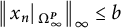 for all
$n\in \mathbb {N}$
for all
$n\in \mathbb {N}$
 ,
$F_n(t)=G_n(tb)$
,
$F_n(t)=G_n(tb)$
 for all
$t\in [0,1/b]$
for all
$t\in [0,1/b]$
 . Besides,

Consider the following dichotomy:
-
• $\limsup _n c_n>0$
. -
• $\limsup _n c_n=0$
.


In the former case, passing to a subsequence, we can assume that
$\inf _n c_n>0$
 . By Proposition 3.8 and Lemma 3.3, passing to a further subsequence, we can assume that there exists an Orlicz function
$F\in \mathcal {O}(R(\boldsymbol {P}))$
. By Proposition 3.8 and Lemma 3.3, passing to a further subsequence, we can assume that there exists an Orlicz function
$F\in \mathcal {O}(R(\boldsymbol {P}))$
 such that
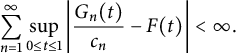
By Theorem 2.3, we deduce that
$\ell _{\boldsymbol {F}}=\ell _F$
 .
.
In the latter case, passing to a subsequence, we can assume that
$\sum _{n=1}^\infty c_n<\infty $
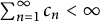 . Since

$\ell _{\boldsymbol {F}}=\ell _\infty $
 by Theorem 2.3. It remains to be shown that
$\infty \in R(\boldsymbol {P})$
by Theorem 2.3. It remains to be shown that
$\infty \in R(\boldsymbol {P})$
 . Assume by contradiction that it is not the case. Then,
$\boldsymbol {P}^{+}<\infty $
. Assume by contradiction that it is not the case. Then,
$\boldsymbol {P}^{+}<\infty $
 and
$\Omega ^{\boldsymbol {P}}_\infty $
and
$\Omega ^{\boldsymbol {P}}_\infty $
 is a null set. If
$0<a<\inf _n \rho _M^L\left (\left \lvert x_n\right \rvert \right )$
is a null set. If
$0<a<\inf _n \rho _M^L\left (\left \lvert x_n\right \rvert \right )$
 ,
,

We reach an absurdity, and the proof is over.
The following result generalizes [Reference Hernández and Ruiz11, Proposition 4.5].
Lemma 4.2 Let
$\boldsymbol {P}$
 be a variable exponent over a
$\sigma $
be a variable exponent over a
$\sigma $
 -finite nonatomic measure space
$(\Omega ,\Sigma ,\mu )$
-finite nonatomic measure space
$(\Omega ,\Sigma ,\mu )$
 . For each
$n\in \mathbb {N}$
. For each
$n\in \mathbb {N}$
 , let
$A_n$
, let
$A_n$
 be a finite subset of
$R(\boldsymbol {P})$
be a finite subset of
$R(\boldsymbol {P})$
 . Set
. Set

For each
$(n,p)\in \mathcal {N}$
 , let
$U_{n,p}$
, let
$U_{n,p}$
 be a neighborhood of p. Then, there is a family
$(\Omega _{n,p})_{(n,p)\in \mathcal {N}}$
be a neighborhood of p. Then, there is a family
$(\Omega _{n,p})_{(n,p)\in \mathcal {N}}$
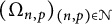 of pairwise disjoint measurable sets such that
$\mu (\Omega _{n,p})>0$
of pairwise disjoint measurable sets such that
$\mu (\Omega _{n,p})>0$
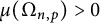 and
$\boldsymbol {P}(\Omega _{n,p})\subseteq U_{n,p}$
and
$\boldsymbol {P}(\Omega _{n,p})\subseteq U_{n,p}$
 for all
$(n,p)\in \mathcal {N}$
for all
$(n,p)\in \mathcal {N}$
 .
.
Proof Assume without loss of generality that
$(A_n)_{n=1}^\infty $
 is nondecreasing. Set
$A_0=\emptyset $
is nondecreasing. Set
$A_0=\emptyset $
 ,
$A=\cup _{n=1}^\infty A_n$
,
$A=\cup _{n=1}^\infty A_n$
 ,
,

Let
$n_0$
 be the smallest
$n\in \mathbb {N}$
be the smallest
$n\in \mathbb {N}$
 such that
$B_n:=A_{n}\cap B\not =\emptyset $
such that
$B_n:=A_{n}\cap B\not =\emptyset $
 . We recursively construct for each
$n\in \mathbb {N}$
. We recursively construct for each
$n\in \mathbb {N}$
 a pairwise disjoint family

such that
$V_{n,p}\subseteq U_{n,p}$
 is a measurable neighborhood of p for all
$p\in B_n$
is a measurable neighborhood of p for all
$p\in B_n$
 , and the set
$D_n:=\bigcup _{p\in B_n} V_{n,p}$
, and the set
$D_n:=\bigcup _{p\in B_n} V_{n,p}$
 satisfies

as long as
$n\ge n_0+1$
 . Set
$E_n=\cup _{k=n}^\infty D_k$
. Set
$E_n=\cup _{k=n}^\infty D_k$
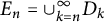 for all
$n\in \mathbb {N}$
for all
$n\in \mathbb {N}$
 . Since
$\boldsymbol {P}(\mu ) \left (D_{n+1}\right )\le \boldsymbol {P}(\mu ) \left (D_{n}\right )/2$
. Since
$\boldsymbol {P}(\mu ) \left (D_{n+1}\right )\le \boldsymbol {P}(\mu ) \left (D_{n}\right )/2$
 for all
$n\in \mathbb {N}$
for all
$n\in \mathbb {N}$
 ,
$n\ge n_0$
,
$n\ge n_0$
 ,
$\mu \circ \boldsymbol {P}^{-1}(E_n)\le 2 \mu \circ \boldsymbol {P}^{-1}(D_n)$
,
$\mu \circ \boldsymbol {P}^{-1}(E_n)\le 2 \mu \circ \boldsymbol {P}^{-1}(D_n)$
 for all
$n\in \mathbb {N}$
for all
$n\in \mathbb {N}$
 ,
$n\ge n_0$
,
$n\ge n_0$
 . Consequently,
$\mu \circ \boldsymbol {P}^{-1}(E_{n+1})<\mu \circ \boldsymbol {P}^{-1}\left (V_ {n,p}\right )$
. Consequently,
$\mu \circ \boldsymbol {P}^{-1}(E_{n+1})<\mu \circ \boldsymbol {P}^{-1}\left (V_ {n,p}\right )$
 for all
$n\in \mathbb {N}$
for all
$n\in \mathbb {N}$
 and
$p\in B_n$
and
$p\in B_n$
 . Set
. Set

The family
$(W_{n,p})_{(n,p)\in \mathcal {M}}$
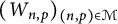 is pairwise disjoint, and
$\mu \circ \boldsymbol {P}^{-1}(W_{n,p})>0$
is pairwise disjoint, and
$\mu \circ \boldsymbol {P}^{-1}(W_{n,p})>0$
 for all
$(n,p)\in \mathcal {M}$
for all
$(n,p)\in \mathcal {M}$
 . Consider the set

Let
$\pi \colon \mathcal {N}\setminus \mathcal {L}\to A\setminus B$
 be such that
$\pi (n,p)=p$
be such that
$\pi (n,p)=p$
 for all
$(n,p)\in \mathcal {N}\setminus \mathcal {M}$
for all
$(n,p)\in \mathcal {N}\setminus \mathcal {M}$
 , and
$\pi (n,p)\in W_{n,p}$
, and
$\pi (n,p)\in W_{n,p}$
 for all
$(n,p)\in \mathcal {M}\setminus \mathcal {L}$
for all
$(n,p)\in \mathcal {M}\setminus \mathcal {L}$
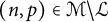 . Since
$\mu $
. Since
$\mu $
 is nonatomic, for each
$q\in A\setminus B,$
is nonatomic, for each
$q\in A\setminus B,$
 there is a pairwise disjoint family

of nonnull measurable subsets of
$\boldsymbol {P}^{-1}(p)$
 . If for each
$(n,p)\in \mathcal {L,}$
. If for each
$(n,p)\in \mathcal {L,}$
 we choose

the family
$(\Omega _{n,p})_{(n,p)\in \mathcal {N}}$
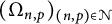 satisfies the desired conditions.
Proposition 4.3 Let
$\boldsymbol {P}$
 be a variable exponent on a nonatomic
$\sigma $
be a variable exponent on a nonatomic
$\sigma $
 -finite measure space
$(\Omega ,\Sigma ,\mu )$
-finite measure space
$(\Omega ,\Sigma ,\mu )$
 . Assume that
$\boldsymbol {P}^{-}>0$
. Assume that
$\boldsymbol {P}^{-}>0$
 . Let
$\mathbb {S}$
. Let
$\mathbb {S}$
 be a subsymmetric sequence space. The following are equivalent:
-
• $\mathbb {S}$
disjointly embeds into
$L_{\boldsymbol {P}}$
. -
• $\mathbb {S}=\ell _F$
for some
$F\in \mathcal {O}(R(\boldsymbol {P}))$
.



Proof Bearing in mind Proposition 4.1, it suffices to prove that for any Orlicz function F such that
${\left . F \right |{}_{{[0,1]}}}\in \mathcal {K}(R(\boldsymbol {P})),$
 there exists a disjointly supported sequence
$\mathcal {X}$
there exists a disjointly supported sequence
$\mathcal {X}$
 in
$L_{\boldsymbol {P}}^0$
in
$L_{\boldsymbol {P}}^0$
 with
$L_{\boldsymbol {P}}[\mathcal {X}]=\ell _F$
with
$L_{\boldsymbol {P}}[\mathcal {X}]=\ell _F$
 . Choose a positive sequence
$(\varepsilon _n)_{n=1}^\infty $
. Choose a positive sequence
$(\varepsilon _n)_{n=1}^\infty $
 with
$\sum _{n=1}^\infty \varepsilon _n<\infty $
with
$\sum _{n=1}^\infty \varepsilon _n<\infty $
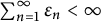 . Let
$(F_n)_{n=1}^\infty $
. Let
$(F_n)_{n=1}^\infty $
 be such that, for all
$n\in \mathbb {N}$
be such that, for all
$n\in \mathbb {N}$
 ,
$F_n$
,
$F_n$
 belongs to convex hull of
$\left \lbrace \boldsymbol {\Psi }_p\colon p\in R(\boldsymbol {P})\right \rbrace $
belongs to convex hull of
$\left \lbrace \boldsymbol {\Psi }_p\colon p\in R(\boldsymbol {P})\right \rbrace $
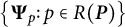 , and
, and

Let
$(A_n)_{n=1}^\infty $
 be a sequence of finite subsets of
$R(\boldsymbol {P})$
be a sequence of finite subsets of
$R(\boldsymbol {P})$
 such that for each
$n\in \mathbb {N,}$
such that for each
$n\in \mathbb {N,}$
 there is
$(a_{n,p})_{p\in A_n}$
there is
$(a_{n,p})_{p\in A_n}$
 in
$(0,\infty )$
in
$(0,\infty )$
 such that

By Lemma 3.1, for each
$n\in \mathbb {N}$
 and
$p\in A_n$
and
$p\in A_n$
 , there is a neighborhood
$U_{n,p}$
, there is a neighborhood
$U_{n,p}$
 of p such that
$\left \lVert \boldsymbol {\psi }_p-\boldsymbol {\psi }_q\right \rVert \le \varepsilon _n$
of p such that
$\left \lVert \boldsymbol {\psi }_p-\boldsymbol {\psi }_q\right \rVert \le \varepsilon _n$
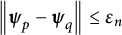 for all
$q\in U_{n,p}$
for all
$q\in U_{n,p}$
 . Let
$(\Omega _{n,p})_{(n,p)\in \mathcal {N}}$
. Let
$(\Omega _{n,p})_{(n,p)\in \mathcal {N}}$
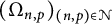 be the family of sets provided by Lemma 4.2. Choose, for each
$(n,p)\in \mathcal {N}$
be the family of sets provided by Lemma 4.2. Choose, for each
$(n,p)\in \mathcal {N}$
 ,
$f_{n,p}\colon \Omega \to [0,\infty )$
,
$f_{n,p}\colon \Omega \to [0,\infty )$
 with
$\operatorname {\mathrm {supp}}(f_{n,p})=\Omega _{n,p}$
with
$\operatorname {\mathrm {supp}}(f_{n,p})=\Omega _{n,p}$
 and
$\int _\Omega f_{n,p}\, d\mu =1$
and
$\int _\Omega f_{n,p}\, d\mu =1$
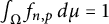 . Set
. Set

Note that, if
$0\le t \le 1$
 ,
,

Since

the Musielak–Orlicz sequence
$\boldsymbol {G}=(G_n)_{n=1}^\infty $
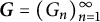 given by

satisfies
$\max _{0\le t \le 1} \left \lvert G_n(t)-F(t)\right \rvert \le 2 \varepsilon _n$
 for all
$n\in \mathbb {N}$
for all
$n\in \mathbb {N}$
 . By Theorem 2.3,
$\ell _F=\ell _{\boldsymbol {G}}$
. By Theorem 2.3,
$\ell _F=\ell _{\boldsymbol {G}}$
 . If we set

then for every
$n\in \mathbb {N}$
 and
$0\le t \le 1,$
and
$0\le t \le 1,$
 we have

Consequently,
$\mathcal {X}=(x_n)_{n=1}^\infty $
 is a pairwise disjointly supported sequence with
$L_{\boldsymbol {P}}[\mathcal {X}]=\ell _{\boldsymbol {G}}=\ell _F$
is a pairwise disjointly supported sequence with
$L_{\boldsymbol {P}}[\mathcal {X}]=\ell _{\boldsymbol {G}}=\ell _F$
 .
.
Corollary 4.4 (See [Reference Hernández and Ruiz11, Theorem 3.5])
Let
$q\in (0,\infty ]$
 and
$\boldsymbol {P}$
and
$\boldsymbol {P}$
 be a variable exponent over a nonatomic
$\sigma $
be a variable exponent over a nonatomic
$\sigma $
 -finite measure space. Assume that
$\boldsymbol {P}^{-}>0$
-finite measure space. Assume that
$\boldsymbol {P}^{-}>0$
 . Then,
$L_{\boldsymbol {P}}$
. Then,
$L_{\boldsymbol {P}}$
 has a disjointly supported sequence equivalent to the unit vector system of
$\ell _q$
has a disjointly supported sequence equivalent to the unit vector system of
$\ell _q$
 if and only if
$q\in R(\boldsymbol {P})$
if and only if
$q\in R(\boldsymbol {P})$
 .
.
Given a function space
$\mathbb {X}$
 , the following are equivalent:
-
• $\mathbb {X}$
fails to be absolutely continuous; -
• $\ell _\infty $
embeds into
$\mathbb {X}$
; -
• $\ell _\infty $
disjointly embeds into
$\mathbb {X}$


(see [Reference Lindenstrauss and Tzafriri20, Proposition 1.a.7]). Since any separable Banach space linearly embeds into
$\ell _\infty $
 by the Hahn–Banach theorem, the subsymmetric embedding problem for locally convex function spaces splits into two issues. Namely,
-
• determining which nonseparable subsymmetric sequence spaces embed into a given non absolutely continuous function space, and
-
• determining which separable subsymmetric sequence spaces embed into a given absolutely continuous function space.
We give now a result for variable exponent Lebesgue spaces framed in the latter problem.
Theorem 4.5 Let
$\boldsymbol {P}$
 be a variable exponent over a
$\sigma $
be a variable exponent over a
$\sigma $
 -finite nonatomic measure space
$\mu $
-finite nonatomic measure space
$\mu $
 . Suppose that
$\boldsymbol {P}^{-}\ge 2$
. Suppose that
$\boldsymbol {P}^{-}\ge 2$
 and
$q:=\boldsymbol {P}^{+}<\infty $
and
$q:=\boldsymbol {P}^{+}<\infty $
 . Let
$\mathbb {S}$
. Let
$\mathbb {S}$
 be a subsymmetric sequence space. Then,
$\mathbb {S}$
be a subsymmetric sequence space. Then,
$\mathbb {S}$
 embeds into
$L_{\boldsymbol {P}}(\mu )$
embeds into
$L_{\boldsymbol {P}}(\mu )$
 if and only if
$\mathbb {S}=\ell _2$
if and only if
$\mathbb {S}=\ell _2$
 or
$\mathbb {S}=\ell _F$
or
$\mathbb {S}=\ell _F$
 for some
$F\in \mathcal {O}(R(\boldsymbol {P}))$
for some
$F\in \mathcal {O}(R(\boldsymbol {P}))$
 .
.
Proof Assume without loss of generality that
$\mu $
 is finite. Suppose that a symmetric sequence space
$\mathbb {S}$
is finite. Suppose that a symmetric sequence space
$\mathbb {S}$
 other than
$\ell _2$
other than
$\ell _2$
 embeds into
$L_{\boldsymbol {P}}(\mu )$
embeds into
$L_{\boldsymbol {P}}(\mu )$
 . By [Reference Ansorena and Bello2, Theorem 4.2],
$L_{\boldsymbol {P}}(\mu )$
. By [Reference Ansorena and Bello2, Theorem 4.2],
$L_{\boldsymbol {P}}(\mu )$
 contains a disjointly supported sequence equivalent to the canonical basis of
$\mathbb {S}$
contains a disjointly supported sequence equivalent to the canonical basis of
$\mathbb {S}$
 , and, by Proposition 4.3,
$\mathbb {S}=\ell _F$
, and, by Proposition 4.3,
$\mathbb {S}=\ell _F$
 for some
$F\in \mathcal {O}(R(\boldsymbol {P}))$
for some
$F\in \mathcal {O}(R(\boldsymbol {P}))$
 .
.
Proposition 4.3 also gives that
$\ell _F$
 embeds into
$L_{\boldsymbol {P}}(\mu )$
embeds into
$L_{\boldsymbol {P}}(\mu )$
 for any
$F\in \mathcal {O}(R(\boldsymbol {P}))$
for any
$F\in \mathcal {O}(R(\boldsymbol {P}))$
 . We close the proof by noticing that, since
$L_q(\mu )\subseteq L_{\boldsymbol {P}}(\mu )\subseteq L_2(\mu )$
. We close the proof by noticing that, since
$L_q(\mu )\subseteq L_{\boldsymbol {P}}(\mu )\subseteq L_2(\mu )$
 , any Rademacher sequence over
$\Omega $
, any Rademacher sequence over
$\Omega $
 is equivalent to the canonical
$\ell _2$
is equivalent to the canonical
$\ell _2$
 -basis by Khintchine’s inequalities.
The behavior of variable exponent Lebesgue spaces
$L_{\boldsymbol {P}}$
 in the case where
$\boldsymbol {P}^{-}<2$
in the case where
$\boldsymbol {P}^{-}<2$
 dramatically opposes that described in Theorem 4.5.
Proposition 4.6 Let
$\boldsymbol {P}$
 be a variable exponent over a
$\sigma $
be a variable exponent over a
$\sigma $
 -finite nonatomic measure space
$\mu $
-finite nonatomic measure space
$\mu $
 . Suppose that
$\boldsymbol {P}^{-}<2$
. Suppose that
$\boldsymbol {P}^{-}<2$
 . Let F be an Orlicz function satisfying (1.1) for some
$p\in (\boldsymbol {P}^{-},\infty )\cap [1,2]$
. Let F be an Orlicz function satisfying (1.1) for some
$p\in (\boldsymbol {P}^{-},\infty )\cap [1,2]$
 . Then
$\ell _F$
. Then
$\ell _F$
 isomorphically embeds into
$L_{\boldsymbol {P}}$
isomorphically embeds into
$L_{\boldsymbol {P}}$
 .
.
We now pass to the discrete case. To compare the behavior of non-atomic variable exponent Lebesgue spaces with that of atomic ones, we adapt Peirats–Ruiz’s results from [Reference Peirats and Ruiz24] on the latter spaces to our language. Given a sequence
$\boldsymbol {P}\colon \mathbb {N}\to (0,\infty ]$
 , we set
$\boldsymbol {P}_m=(p_{n+m-1})_{n=1}^\infty $
, we set
$\boldsymbol {P}_m=(p_{n+m-1})_{n=1}^\infty $
 for all
$m\in \mathbb {N}$
for all
$m\in \mathbb {N}$
 . Consider the set of Orlicz functions
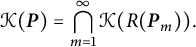
We denote by
$\mathcal {O}(\boldsymbol {P})$
 the set of all Orlicz functions for which there is
$\varphi \in \mathcal {K}(\boldsymbol {P})$
the set of all Orlicz functions for which there is
$\varphi \in \mathcal {K}(\boldsymbol {P})$
 and
$0\le c\le 1$
and
$0\le c\le 1$
 such that
$F(t)\approx \varphi (t)$
such that
$F(t)\approx \varphi (t)$
 for all
$0\le t\le c$
for all
$0\le t\le c$
 .
.
Denote by
$A(\boldsymbol {P})$
 the set of all limit points of
$\boldsymbol {P}$
the set of all limit points of
$\boldsymbol {P}$
 , that is,

Note that any accumulation point of
$R(\boldsymbol {P})$
 is a limit point of
$\boldsymbol {P}$
is a limit point of
$\boldsymbol {P}$
 , but the converse does not hold.
Theorem 4.7 (cf. [Reference Peirats and Ruiz24, Proposition 2.3])
Let
$\boldsymbol {P}=(p_n)_{n=1}^\infty $
 be a variable exponent with
$\boldsymbol {P}^{-}>0$
be a variable exponent with
$\boldsymbol {P}^{-}>0$
 and
$\boldsymbol {P}^{+}<\infty $
and
$\boldsymbol {P}^{+}<\infty $
 . Let
$\mathbb {S}$
. Let
$\mathbb {S}$
 be a subsymmetric sequence space. Then,
$\mathbb {S}$
be a subsymmetric sequence space. Then,
$\mathbb {S}$
 isomorphically embeds into
$\ell _{\boldsymbol {P}}$
isomorphically embeds into
$\ell _{\boldsymbol {P}}$
 if and only if
$\mathbb {S}=\ell _F$
if and only if
$\mathbb {S}=\ell _F$
 for some Orlicz function
$F\in \mathcal {O}(\boldsymbol {P})$
for some Orlicz function
$F\in \mathcal {O}(\boldsymbol {P})$
 . Further, for each
$F\in \mathcal {O}(\boldsymbol {P}),$
. Further, for each
$F\in \mathcal {O}(\boldsymbol {P}),$
 there is
$r\in A(\boldsymbol {P})$
there is
$r\in A(\boldsymbol {P})$
 such that
$F\in \mathcal {O}(r^+)$
such that
$F\in \mathcal {O}(r^+)$
 .
.
Proof Applying [Reference Peirats and Ruiz24, Proposition 2.3] to the case where the Musielak–Orlicz sequence consists of power Orlicz functions yields the wished-for characterization of isomorphic embeddability. Assume that
$F\in \mathcal {O}(\boldsymbol {P})$
 . By Proposition 3.15, for each
$m\in \mathbb {N,}$
. By Proposition 3.15, for each
$m\in \mathbb {N,}$
 there is
$r_m\in R(\boldsymbol {P}_m)$
there is
$r_m\in R(\boldsymbol {P}_m)$
 such that
$F\in \mathcal {O}(R(\boldsymbol {P}_m),r_m^+)$
such that
$F\in \mathcal {O}(R(\boldsymbol {P}_m),r_m^+)$
 . By Lemma 3.7, there is
$r\in (0,\infty ]$
. By Lemma 3.7, there is
$r\in (0,\infty ]$
 such that
$r=r_m$
such that
$r=r_m$
 for all
$m\in \mathbb {N}$
for all
$m\in \mathbb {N}$
 .
.
Theorem 4.7 implies that if a subsymmetric sequence space
$\mathbb {S}$
 isomorphically embeds into the Nakano space
$\ell _{\boldsymbol {P}}$
isomorphically embeds into the Nakano space
$\ell _{\boldsymbol {P}}$
 , then there are
$r\in A(\boldsymbol {P})$
, then there are
$r\in A(\boldsymbol {P})$
 and
$F\in \mathcal {O}(R(\boldsymbol {P}), r^+)$
and
$F\in \mathcal {O}(R(\boldsymbol {P}), r^+)$
 such that
$\mathbb {S}=\ell _F$
such that
$\mathbb {S}=\ell _F$
 . The following example shows that this condition does not characterize isomorphic embeddability.
Example 4.8 Let
$\boldsymbol {P}=(p_n)_{n=1}^\infty $
 be a variable exponent for which there exists
$\lim _n p_n=p\in (0,\infty )$
be a variable exponent for which there exists
$\lim _n p_n=p\in (0,\infty )$
 . Lemma 3.12 implies that, despite
$A(\boldsymbol {P})=\{p\}$
. Lemma 3.12 implies that, despite
$A(\boldsymbol {P})=\{p\}$
 ,
$\mathcal {O}(R(\boldsymbol {P}))$
,
$\mathcal {O}(R(\boldsymbol {P}))$
 contains Orlicz functions that are not equivalent to the potential Orlicz function
$\boldsymbol {\Psi }_p$
contains Orlicz functions that are not equivalent to the potential Orlicz function
$\boldsymbol {\Psi }_p$
 near the origin. However,
$\ell _p$
near the origin. However,
$\ell _p$
 is the unique subsymmetric space that embeds into
$\ell _{\boldsymbol {P}}$
is the unique subsymmetric space that embeds into
$\ell _{\boldsymbol {P}}$
 . Indeed, if
$\varphi \in \mathcal {K}(\boldsymbol {P})$
. Indeed, if
$\varphi \in \mathcal {K}(\boldsymbol {P})$
 , then, by Lemma 3.5,

Letting m tend to infinity, we get
$\varphi (t)= \boldsymbol {\Psi }_p(t)$
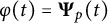 for all
$0\le t \le 1$
for all
$0\le t \le 1$
 .
.
To close this section, we provide a Nakano space that exhibits a behavior opposed to that of the Nakano space in Example 4.8.
Example 4.9 Let
$\boldsymbol {Q}=(q_j)_{j=1}^\infty $
 be a sequence in
$(0,\infty )$
be a sequence in
$(0,\infty )$
 decreasing to
$q\in (0,\infty )$
decreasing to
$q\in (0,\infty )$
 . We have

Let
$\sigma \colon \mathbb {N}^2\to \mathbb {N}$
 be a bijection. Let
$\beta \colon \mathbb {N}\to \mathbb {N}$
be a bijection. Let
$\beta \colon \mathbb {N}\to \mathbb {N}$
 be the second component of the inverse of
$\sigma $
be the second component of the inverse of
$\sigma $
 . Consider the variable exponent
$\boldsymbol {P}=(p_n)_{n=1}^\infty $
. Consider the variable exponent
$\boldsymbol {P}=(p_n)_{n=1}^\infty $
 given by

We have
$\mathcal {K}(\boldsymbol {P})=\mathcal {K}(R)$
 . Hence,
$\ell _{\boldsymbol {P}}$
. Hence,
$\ell _{\boldsymbol {P}}$
 contains an isomorphic copy of
$\ell _F$
contains an isomorphic copy of
$\ell _F$
 for every
$F\in \mathcal {O}(R)$
for every
$F\in \mathcal {O}(R)$
 . Further,
$A(\boldsymbol {P})=R$
. Further,
$A(\boldsymbol {P})=R$
 .
.
5 Complemented sequences in variable exponent Lebesgue spaces
Let
$\mathbb {X} $
 be a function space over a
$\sigma $
be a function space over a
$\sigma $
 -finite measure space
$(\Omega ,\Sigma ,\mu )$
-finite measure space
$(\Omega ,\Sigma ,\mu )$
 . We say that a sequence space
$\mathbb {S}$
. We say that a sequence space
$\mathbb {S}$
 complementably embeds into
$\mathbb {X}$
complementably embeds into
$\mathbb {X}$
 if there are bounded linear maps
$T\colon \mathbb {S}\to \mathbb {X}$
if there are bounded linear maps
$T\colon \mathbb {S}\to \mathbb {X}$
 and
$P\colon \mathbb {X}\to \mathbb {S}$
and
$P\colon \mathbb {X}\to \mathbb {S}$
 such that
$P\circ T=\mathrm {Id}_{\mathbb {S}}$
such that
$P\circ T=\mathrm {Id}_{\mathbb {S}}$
 . If,
$\mathbb {S}$
. If,
$\mathbb {S}$
 complementably embeds into
$\mathbb {X}$
complementably embeds into
$\mathbb {X}$
 , then there are
$\mathcal {X}=(x_n)_{n=1}^\infty $
, then there are
$\mathcal {X}=(x_n)_{n=1}^\infty $
 in
$\mathbb {X}$
in
$\mathbb {X}$
 and
$\mathcal {X}^*=(x_n^*)_{n=1}^\infty $
and
$\mathcal {X}^*=(x_n^*)_{n=1}^\infty $
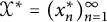 in
$\mathbb {X}^*$
in
$\mathbb {X}^*$
 , called projecting functionals for
$\mathcal {X}$
, called projecting functionals for
$\mathcal {X}$
 , such that the unit vector system of
$\mathbb {S}$
, such that the unit vector system of
$\mathbb {S}$
 is equivalent to
$\mathcal {X}$
is equivalent to
$\mathcal {X}$
 ,
$(\mathcal {X},\mathcal {X}^*)$
,
$(\mathcal {X},\mathcal {X}^*)$
 is a biorthogonal system, and the mapping

defines a bounded operator from
$\mathbb {X}$
 into
$\mathbb {X}$
into
$\mathbb {X}$
 . Besides, if
$\mathbb {S}$
. Besides, if
$\mathbb {S}$
 is absolutely continuous or
$\mathcal {X}$
is absolutely continuous or
$\mathcal {X}$
 is disjointly supported, then the converse also holds. If
$\mathcal {X}$
is disjointly supported, then the converse also holds. If
$\mathcal {X}$
 is disjointly supported and
$\mathcal {X}^*$
is disjointly supported and
$\mathcal {X}^*$
 is a disjointly supported sequence in
$\mathbb {X}'$
is a disjointly supported sequence in
$\mathbb {X}'$
 , we say that
$\mathbb {S}$
, we say that
$\mathbb {S}$
 disjointly complementably embeds into
$\mathbb {X}$
disjointly complementably embeds into
$\mathbb {X}$
 .
.
Lemma 5.1 Let
$\mathbb {X} $
 be a function space and
$\mathbb {S}$
be a function space and
$\mathbb {S}$
 be a sequence space. Suppose that
$\mathbb {X}$
be a sequence space. Suppose that
$\mathbb {X}$
 is L-convex. Suppose that there is a disjointly supported sequence
$\mathcal {X}=(x_n)_{n=1}^\infty $
is L-convex. Suppose that there is a disjointly supported sequence
$\mathcal {X}=(x_n)_{n=1}^\infty $
 in
$\mathcal {X}$
in
$\mathcal {X}$
 with projecting functionals
$\mathcal {X}^*$
with projecting functionals
$\mathcal {X}^*$
 in
$\mathbb {X}'$
in
$\mathbb {X}'$
 such that
$\mathbb {S}=\mathbb {S}[\mathbb {X},\mathcal {X}]$
such that
$\mathbb {S}=\mathbb {S}[\mathbb {X},\mathcal {X}]$
 . Then,
$\mathbb {S}$
. Then,
$\mathbb {S}$
 complementably disjointly embeds into
$\mathbb {X}$
complementably disjointly embeds into
$\mathbb {X}$
 .
.
Proof Let P be the endomorphism of
$\mathbb {X}$
 given by

By [Reference Kalton14, Theorem 3.3], there is a constant C such that

for every family
$(f_j)_{j\in J}$
 in
$\mathbb {X}$
in
$\mathbb {X}$
 . Pick a partition
$(A_n)_{n=1}^\infty $
. Pick a partition
$(A_n)_{n=1}^\infty $
 of
$(\Omega ,\Sigma ,\mu )$
of
$(\Omega ,\Sigma ,\mu )$
 so that
$\operatorname {\mathrm {supp}}(x_n)\subseteq A_n$
so that
$\operatorname {\mathrm {supp}}(x_n)\subseteq A_n$
 for all
$n\in \mathbb {N}$
for all
$n\in \mathbb {N}$
 . Set
$y_n^*=x_n^* \chi _{A_n}$
. Set
$y_n^*=x_n^* \chi _{A_n}$
 for all
$n\in \mathbb {N}$
for all
$n\in \mathbb {N}$
 . Given
$f\in \mathbb {X}$
. Given
$f\in \mathbb {X}$
 , applying the above estimate to
$\left (f\chi _{A_n}\right )_{n=1}^\infty $
, applying the above estimate to
$\left (f\chi _{A_n}\right )_{n=1}^\infty $
 , we obtain

Consequently,
$(y_n^*)_{n=1}^\infty $
 are projecting functionals for
$\mathcal {X}$
are projecting functionals for
$\mathcal {X}$
 .
.
Proposition 5.2 Let
$\boldsymbol {P}$
 be a variable exponent over a
$\sigma $
be a variable exponent over a
$\sigma $
 -finite measure space
$(\Omega ,\Sigma ,\mu )$
-finite measure space
$(\Omega ,\Sigma ,\mu )$
 . Suppose that
$1\le \boldsymbol {P}^-\le \boldsymbol {P}^+<\infty $
. Suppose that
$1\le \boldsymbol {P}^-\le \boldsymbol {P}^+<\infty $
 and that a subsymmetric sequence space
$\mathbb {S}$
and that a subsymmetric sequence space
$\mathbb {S}$
 complementably disjointly embeds into
$\boldsymbol {L}_{\boldsymbol {P}}$
complementably disjointly embeds into
$\boldsymbol {L}_{\boldsymbol {P}}$
 . Then,
$\mathbb {S}=\ell _q$
. Then,
$\mathbb {S}=\ell _q$
 for some
$q\in R(\boldsymbol {P})$
for some
$q\in R(\boldsymbol {P})$
 .
.
Proof There are pairwise disjointly supported sequences
$\mathcal {X}=(x_n)_{n=1}^\infty $
 in
$\boldsymbol {L}_{\boldsymbol {P}}$
in
$\boldsymbol {L}_{\boldsymbol {P}}$
 and
$\mathcal {X}'=(x_n')_{n=1}^\infty $
and
$\mathcal {X}'=(x_n')_{n=1}^\infty $
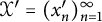 in
$\boldsymbol {L}_{\boldsymbol {P}'}$
in
$\boldsymbol {L}_{\boldsymbol {P}'}$
 such that
$\mathcal {X}$
such that
$\mathcal {X}$
 is equivalent to the unit vector system of
$\mathbb {S}$
is equivalent to the unit vector system of
$\mathbb {S}$
 and
$\mathcal {X}'$
and
$\mathcal {X}'$
 is equivalent to the unit vector system of
$\mathbb {S}'$
is equivalent to the unit vector system of
$\mathbb {S}'$
 . By Proposition 4.1, there are
$F\in \mathcal {O}(R(\boldsymbol {P}))$
. By Proposition 4.1, there are
$F\in \mathcal {O}(R(\boldsymbol {P}))$
 and
$G\in \mathcal {O}(R(\boldsymbol {P}'))$
and
$G\in \mathcal {O}(R(\boldsymbol {P}'))$
 such that
$\mathbb {S}=\ell _F$
such that
$\mathbb {S}=\ell _F$
 and
$\mathbb {S}'=\ell _G$
and
$\mathbb {S}'=\ell _G$
 . We have
$\ell _{F^*}=\ell _G$
. We have
$\ell _{F^*}=\ell _G$
 , whence, by Corollary 3.11,
$F^*\approx G$
, whence, by Corollary 3.11,
$F^*\approx G$
 near the origin. Consequently,
$F^*\in \mathcal {O}(R(\boldsymbol {P}'))$
near the origin. Consequently,
$F^*\in \mathcal {O}(R(\boldsymbol {P}'))$
 . By Theorem 3.19,
$F\in \mathcal {O}(q)$
. By Theorem 3.19,
$F\in \mathcal {O}(q)$
 for some
$q\in R(\boldsymbol {P})$
for some
$q\in R(\boldsymbol {P})$
 . Hence,
$F\approx t^q$
. Hence,
$F\approx t^q$
 .
.
Lemma 5.3 Let
$\boldsymbol {P}$
 be a variable exponent over a nonatomic
$\sigma $
be a variable exponent over a nonatomic
$\sigma $
 -finite measure space
$(\Omega ,\Sigma ,\mu )$
-finite measure space
$(\Omega ,\Sigma ,\mu )$
 . Suppose that
$\boldsymbol {P}^{-}>0$
. Suppose that
$\boldsymbol {P}^{-}>0$
 . Let
$\mathbb {S}$
. Let
$\mathbb {S}$
 be a subsymmetric sequence space. Set
$\boldsymbol {P}_c={\left . \boldsymbol {P} \right |{}_{{\Omega ^{\boldsymbol {P}}_c}}}$
be a subsymmetric sequence space. Set
$\boldsymbol {P}_c={\left . \boldsymbol {P} \right |{}_{{\Omega ^{\boldsymbol {P}}_c}}}$
 . Then,
$\mathbb {S}$
. Then,
$\mathbb {S}$
 complementably embeds into
$L_{\boldsymbol {P}}$
complementably embeds into
$L_{\boldsymbol {P}}$
 if and only if it complementably embeds into
$L_{\boldsymbol {P}_c}$
if and only if it complementably embeds into
$L_{\boldsymbol {P}_c}$
 .
.
Proof Let
$T\colon \mathbb {S}\to L_{\boldsymbol {P}}$
 and
$P\colon L_{\boldsymbol {P}}\to \mathbb {S}$
and
$P\colon L_{\boldsymbol {P}}\to \mathbb {S}$
 be such that
$P\circ T=\mathrm {Id}_{\mathbb {S}}$
be such that
$P\circ T=\mathrm {Id}_{\mathbb {S}}$
 . Let J be the canonical embedding of
$L_{\boldsymbol {P}_c}$
. Let J be the canonical embedding of
$L_{\boldsymbol {P}_c}$
 into
$L_{\boldsymbol {P}}$
into
$L_{\boldsymbol {P}}$
 , and Q be the canonical projection from
$L_{\boldsymbol {P}}$
, and Q be the canonical projection from
$L_{\boldsymbol {P}}$
 into
$L_{\boldsymbol {P}_c}$
into
$L_{\boldsymbol {P}_c}$
 . By Proposition 2.7,
$P=P\circ J\circ Q$
. By Proposition 2.7,
$P=P\circ J\circ Q$
 . Consequently,
$\mathbb {S}$
. Consequently,
$\mathbb {S}$
 complementably embeds into
$L_{\boldsymbol {P}_c}$
complementably embeds into
$L_{\boldsymbol {P}_c}$
 .
.
Theorem 5.4 Let
$\boldsymbol {P}$
 be a variable exponent over a nonatomic
$\sigma $
be a variable exponent over a nonatomic
$\sigma $
 -finite measure space
$(\Omega ,\Sigma ,\mu )$
-finite measure space
$(\Omega ,\Sigma ,\mu )$
 . Suppose that
$\boldsymbol {P}^{-}>0$
. Suppose that
$\boldsymbol {P}^{-}>0$
 and
$q:=\boldsymbol {P}^{+}<\infty $
and
$q:=\boldsymbol {P}^{+}<\infty $
 and that
$\boldsymbol {P}^{-1}((1,\infty ))$
and that
$\boldsymbol {P}^{-1}((1,\infty ))$
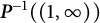 is not null. Let
$\mathbb {S}$
is not null. Let
$\mathbb {S}$
 be a subsymmetric sequence space. Set
$\boldsymbol {P}_c={\left . \boldsymbol {P} \right |{}_{{\Omega ^{\boldsymbol {P}}_c}}}$
be a subsymmetric sequence space. Set
$\boldsymbol {P}_c={\left . \boldsymbol {P} \right |{}_{{\Omega ^{\boldsymbol {P}}_c}}}$
 . The following are equivalent:
-
(a) $\mathbb {S}$
complementably embeds into
$L_{\boldsymbol {P}}$
. -
(b) $\mathbb {S}=\ell _2$
or
$\mathbb {S}$
complementably disjointly embeds into
$L_{\boldsymbol {P}}$
. -
(c) $\mathbb {S}=\ell _r$
for some
$r\in \{2\} \cup R(\boldsymbol {P}_c)$
.



Proof There is
$p>1$
 such that
$\Omega _0:=\boldsymbol {P}^{-1}([p,q])$
such that
$\Omega _0:=\boldsymbol {P}^{-1}([p,q])$
 is not null. We can, without loss of generality, assume that
$\mu $
is not null. We can, without loss of generality, assume that
$\mu $
 is finite and
$\mu (\Omega _0)=1$
is finite and
$\mu (\Omega _0)=1$
 .
.
Let
$(r_n)_{n=1}^\infty $
 be a Rademacher sequence over
$\Omega _0$
be a Rademacher sequence over
$\Omega _0$
 . Let S be the associated embedding of
$\ell _2$
. Let S be the associated embedding of
$\ell _2$
 into
$L_q(\Omega _0)$
into
$L_q(\Omega _0)$
 , and Q the associated projection from
$L_p(\Omega _0)$
, and Q the associated projection from
$L_p(\Omega _0)$
 onto
$\ell _2$
onto
$\ell _2$
 . Let J be the canonical map from
$L_q(\Omega _0)$
. Let J be the canonical map from
$L_q(\Omega _0)$
 into
$L_{\boldsymbol {P}}$
into
$L_{\boldsymbol {P}}$
 , and P be the canonical map from
$L_{\boldsymbol {P}}$
, and P be the canonical map from
$L_{\boldsymbol {P}}$
 into
$L_p(\Omega _0)$
into
$L_p(\Omega _0)$
 . The maps
$J\circ S$
. The maps
$J\circ S$
 and
$Q\circ P$
and
$Q\circ P$
 witness that
$\ell _2$
witness that
$\ell _2$
 complementably embeds into
$L_{\boldsymbol {P}}$
complementably embeds into
$L_{\boldsymbol {P}}$
 .
.
Suppose a subsymmetric space
$\mathbb {S}$
 other than
$\ell _2$
other than
$\ell _2$
 complementably embeds into
$\mathbb {X}:=L_{\boldsymbol {P}}$
complementably embeds into
$\mathbb {X}:=L_{\boldsymbol {P}}$
 . Set
$\Omega _1=\boldsymbol {P}^{-1}([1,2))$
. Set
$\Omega _1=\boldsymbol {P}^{-1}([1,2))$
 and
$\Omega _2=\boldsymbol {P}^{-1}([2,\infty ))$
and
$\Omega _2=\boldsymbol {P}^{-1}([2,\infty ))$
 and
$\boldsymbol {P}_j={\left . \boldsymbol {P} \right |{}_{{\Omega _j}}}$
and
$\boldsymbol {P}_j={\left . \boldsymbol {P} \right |{}_{{\Omega _j}}}$
 ,
$j=1$
,
$j=1$
 ,
$2$
,
$2$
 . By Lemma 5.3 and [Reference Ansorena and Bello2, Theorem 5.2], there is
$a\in \{1,2\}$
. By Lemma 5.3 and [Reference Ansorena and Bello2, Theorem 5.2], there is
$a\in \{1,2\}$
 such that
$\Omega _a$
such that
$\Omega _a$
 is nonnull and
$\mathbb {S}$
is nonnull and
$\mathbb {S}$
 complementably disjointly embeds into
$L_{\boldsymbol {P}_a}$
complementably disjointly embeds into
$L_{\boldsymbol {P}_a}$
 . By Proposition 5.2,
$F\in \mathcal {O}(r)$
. By Proposition 5.2,
$F\in \mathcal {O}(r)$
 for some
$r\in R(\boldsymbol {P}_a)$
for some
$r\in R(\boldsymbol {P}_a)$
 .
.
In [Reference Hernández and Ruiz11, Proposition 4.4] it is proved that
$\ell _r$
 complementably embeds into
$L_{\boldsymbol {P}}$
complementably embeds into
$L_{\boldsymbol {P}}$
 for every
$r\in R(\boldsymbol {P}_c)$
for every
$r\in R(\boldsymbol {P}_c)$
 . For the sake of completeness and clarity, we use our approach to variable exponent Lebesgue spaces to reprove this result. Choose
$(\varepsilon _n)_{n=1}^\infty $
. For the sake of completeness and clarity, we use our approach to variable exponent Lebesgue spaces to reprove this result. Choose
$(\varepsilon _n)_{n=1}^\infty $
 in
$(0,\infty )$
in
$(0,\infty )$
 with
$\sum _{n=1}^\infty \varepsilon _n<\infty $
with
$\sum _{n=1}^\infty \varepsilon _n<\infty $
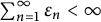 . By Lemma 3.1, there is a sequence
$(V_n)_{n=1}^\infty $
. By Lemma 3.1, there is a sequence
$(V_n)_{n=1}^\infty $
 of neighborhoods of r such that

for all
$n\in \mathbb {N}$
 and
$p\in V_{n}$
and
$p\in V_{n}$
 . Use Lemma 4.2 to choose pairwise disjoint measurable sets
$(\Omega _n)_{n=1}^\infty $
. Use Lemma 4.2 to choose pairwise disjoint measurable sets
$(\Omega _n)_{n=1}^\infty $
 such that
$0<\mu (\Omega _n)<\infty $
such that
$0<\mu (\Omega _n)<\infty $
 and
$\boldsymbol {P}(\Omega _n) \subseteq V_n\cap [1,\infty ]$
and
$\boldsymbol {P}(\Omega _n) \subseteq V_n\cap [1,\infty ]$
 for all
$n\in \mathbb {N}$
for all
$n\in \mathbb {N}$
 . Use Lemma 2.8 to pick sequences
$(f_n)_{n=1}^\infty $
. Use Lemma 2.8 to pick sequences
$(f_n)_{n=1}^\infty $
 and
$(g_n)_{n=1}^\infty $
and
$(g_n)_{n=1}^\infty $
 of nonnegative measurable functions such that
$\operatorname {\mathrm {supp}}(f_n)=\operatorname {\mathrm {supp}}(g_n)\subseteq \Omega _n$
of nonnegative measurable functions such that
$\operatorname {\mathrm {supp}}(f_n)=\operatorname {\mathrm {supp}}(g_n)\subseteq \Omega _n$
 and
and

for all
$n\in \mathbb {N}$
 . By Proposition 4.3, there are bounded linear maps

given by

respectively. The map S is a kernel operator whose conjugate map
$S'\colon L_{\boldsymbol {P}} \to \ell _r$
 is given by

for
$n\in \mathbb {N}$
 . Since
$S'\circ T=\mathrm {Id}_{\ell _r}$
. Since
$S'\circ T=\mathrm {Id}_{\ell _r}$
 , we are done.
Theorem 5.5 Let
$\boldsymbol {P}$
 be a variable exponent over a nonatomic
$\sigma $
be a variable exponent over a nonatomic
$\sigma $
 -finite measure space
$(\Omega ,\Sigma ,\mu )$
-finite measure space
$(\Omega ,\Sigma ,\mu )$
 . Suppose
$0<\boldsymbol {P}^{-}\le \boldsymbol {P}^{+}\le 1$
. Suppose
$0<\boldsymbol {P}^{-}\le \boldsymbol {P}^{+}\le 1$
 . Given a semi-normalized subsymmetric sequence space
$\mathbb {S}$
. Given a semi-normalized subsymmetric sequence space
$\mathbb {S}$
 , the following are equivalent:
-
• $\mathbb {S}$
complementably embeds into
$L_{\boldsymbol {P}}$
. -
• $\mathbb {S}$
complementably disjointly embeds into
$L_{\boldsymbol {P}}$
. -
• $\mathbb {S}=\ell _1$
and
$\Omega _1:=\boldsymbol {P}^{-1}(1)$
is not null.


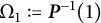
Proof Set
$\mu _1={\left . \mu \right |{}_{{\Omega _1}}}$
 and
$\boldsymbol {P}_1={\left . \boldsymbol {P} \right |{}_{{\Omega _1}}}$
and
$\boldsymbol {P}_1={\left . \boldsymbol {P} \right |{}_{{\Omega _1}}}$
 . If
$\Omega _1$
. If
$\Omega _1$
 is nonnull, then
$L_{\boldsymbol {P}_1}=L_1(\mu _1)$
is nonnull, then
$L_{\boldsymbol {P}_1}=L_1(\mu _1)$
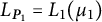 .
.
Suppose that
$\mathbb {S}$
 complementably embeds into
$L_{\boldsymbol {P}}$
complementably embeds into
$L_{\boldsymbol {P}}$
 . By Lemma 5.3,
$\Omega _1$
. By Lemma 5.3,
$\Omega _1$
 is nonnull and
$\mathbb {S}$
is nonnull and
$\mathbb {S}$
 complementably embeds into
$L_1(\mu _1)$
complementably embeds into
$L_1(\mu _1)$
 . By [Reference Lindenstrauss and Pełczyński17],
$\mathbb {S}=\ell _1$
. By [Reference Lindenstrauss and Pełczyński17],
$\mathbb {S}=\ell _1$
 .
.
Conversely, if
$\Omega _1$
 is not null, it is well-known that
$\ell _1$
is not null, it is well-known that
$\ell _1$
 complementably disjointly embeds into
$L_1(\mu _1)$
complementably disjointly embeds into
$L_1(\mu _1)$
 .
.
Lemma 5.6 Suppose a subsymmetric sequence space
$\mathbb {S}$
 complementably embeds into an absolutely continuous sequence space
$\mathbb {X}$
complementably embeds into an absolutely continuous sequence space
$\mathbb {X}$
 over
$\mathbb {N}$
over
$\mathbb {N}$
 . Then,
$\mathbb {S}$
. Then,
$\mathbb {S}$
 complementably disjointly embeds into
$\mathbb {X}$
complementably disjointly embeds into
$\mathbb {X}$
 .
.
Proof Let
$\mathcal {X}=(x_n)_{n=1}^\infty $
 in
$\mathbb {X}$
in
$\mathbb {X}$
 with projecting functionals
$\mathcal {X}^*=(x_n^*)_{n=1}^\infty $
with projecting functionals
$\mathcal {X}^*=(x_n^*)_{n=1}^\infty $
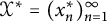 be equivalent to the unit vector system of
$\mathbb {S}$
be equivalent to the unit vector system of
$\mathbb {S}$
 . By the Cantor diagonal technique, passing to a subsequence, we can assume that
$\mathcal {X}$
. By the Cantor diagonal technique, passing to a subsequence, we can assume that
$\mathcal {X}$
 converges pointwise. Since
$(x_{2n-1})_{n=1}^\infty $
converges pointwise. Since
$(x_{2n-1})_{n=1}^\infty $
 is equivalent to
$(x_{2n})_{n=1}^\infty $
is equivalent to
$(x_{2n})_{n=1}^\infty $
 , the mapping

defines an endomorphism of
$\mathbb {X}$
 . Consequently, we can replace
$\mathcal {X}$
. Consequently, we can replace
$\mathcal {X}$
 by
by

and
$\mathcal {X}^*$
 by
by

In this way, we can assume that
$\mathcal {X}$
 converges to zero pointwise. By the gliding-hump technique (see [Reference Lindenstrauss and Tzafriri19, Proposition 1.a.9] or [Reference Ansorena and Bello2, Lemma 3.5]), passing to a subsequence, we can assume that
$\mathcal {X}$
converges to zero pointwise. By the gliding-hump technique (see [Reference Lindenstrauss and Tzafriri19, Proposition 1.a.9] or [Reference Ansorena and Bello2, Lemma 3.5]), passing to a subsequence, we can assume that
$\mathcal {X}$
 is finitely disjointly supported. We conclude the proof by applying Lemma 5.1.
Our latest result improves upon a Peirats–Ruiz’s achievement from [Reference Peirats and Ruiz24].
Theorem 5.7 (cf. [Reference Peirats and Ruiz24, Theorem 2.9])
Let
$\boldsymbol {P}\colon \mathbb {N}\to (0,\infty )$
 be a variable exponent with
$\boldsymbol {P}^{-}>0$
be a variable exponent with
$\boldsymbol {P}^{-}>0$
 and
$\boldsymbol {P}^{+}<\infty $
and
$\boldsymbol {P}^{+}<\infty $
 . Let
$\mathbb {S}$
. Let
$\mathbb {S}$
 be a subsymmetric sequence space. The following are equivalent:
-
(i) $\mathbb {S}$
complementably embeds into
$\ell _{\boldsymbol {P}}$
. -
(ii) $\mathbb {S}=\ell _r$
for some
$r\in A(\boldsymbol {P})$
. -
(iii) There is a subsequence $\boldsymbol {Q}$
of
$\boldsymbol {P}$
such that
$\mathbb {S}=\ell _{\boldsymbol {Q}}$
.


Data availability statement
Data sharing does not apply to this article as no datasets were generated or analyzed during the current study.
Competing interests
The authors have no competing interests to declare that are relevant to the content of this article.


 Open access

