
In a recent paper in Antiquity, Reference LevyLevy et al. (2004) publish what they claim are 'less biased' high-precision radiocarbon dates from Khirbat en-Nahas in southern Jordan, and on the basis of those dates make wider claims for the dating and development of the Iron Age of southern Jordan (the kingdom of Edom). However, there are serious problems with the dates they present and their methodology.
Levy et al. present two sets of data. The first set are the standard calibrated radiocarbon dates (using the INTCAL calibration curve), which are presented in a table (Reference LevyLevy et al. 2004: 870, Table 1). The second set, which is consistently referred to within their text, are Bayesian calibrated dates. The Bayesian calibration tool (Reference BuckBuck et al. 1996, http://bcal.sheffield.ac.uk/) has been developed as a means to combine calibrated radiocarbon dates with a priori chronological information such as stratigraphic sequences of layers, or absolute dating information from other sources (such as texts). Using this information the BCal program can narrow down or modify the radiocarbon ranges and make them more reliable.
Clearly, the results of the BCal calibration are completely dependent on the nature of the other chronological data, and the way they have been fed into the programme. A 'normal' result would be a narrowing down of the calibrated radiocarbon dates by the BCal tool. Even then, given the sensitivity of the programme, it is essential to specify which additional data have been used and how.
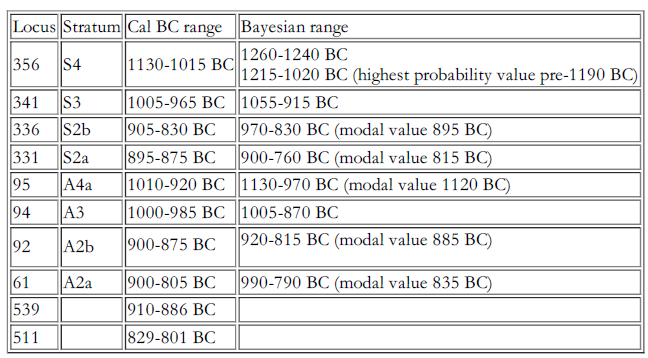
In the case of Khirbat en-Nahas, the BCal results are the opposite of what one would expect: not only are the BCal ranges wider than the 'normal' calibrated ranges, but they are also consistently earlier (see Table 1 here).

Take, for example, the 'fortress' in Area A: the calibrated 14C range of Stratum A4a, which predates the construction of the 'fortress', is 1010-920 BC. The BCal date range for Stratum A4a according to the text (Reference LevyLevy et al. 2004: 871) is 1130-970 BC, with a modal (highest probability) value of 1120 BC. This modal value is 110 years earlier than the earliest limit of the 'normal' calibrated radiocarbon range, with no explanation provided.
The earliest phase in Area S (S4), a cooking installation, has a calibrated 14C range of 1130-1015 BC. According to the text, the BCal results date this stratum to 1260-1240 BC and 1215-1012 BC, with a modal value dated to pre-1190 (Reference LevyLevy et al. 2004: 873), over half a century earlier than the earliest limit of the radiocarbon range. This phase is followed by a heavy layer of metal waste (S3), dated to 1005-965 (normal calibration) or 1055-915 (BCal). On top of this was a four-room building (S2b), dated to 905-830 (normal calibration) or 970-830 (BCal).
At each step, Levy et al. are attempting to push the dates as early as possible, on average about a hundred years or so earlier than the calibrated radiocarbon evidence allows for. They do not specify what additional sources they have used to reach these results, and the present authors are unaware of any reliable evidence that would allow such results.
Reference LevyLevy et al. (2004: 874-6) provide one clue as to what sort of data they used to enter into the Bayesian programme: they refer to scarabs and ceramics which they claim corroborate their early, twelfth century BC dates, although all this material was found in later contexts. They tentatively date two Egyptian scarabs from the twelfth century BC on, but accept that they are probably residual. This is likely to be the case, especially since much earlier, Middle Bronze Age scarabs were found in their own excavations at the nearby WF40 cemetery radiocarbon-dated to the tenth century BC (Levy et al. 1999). The scarabs should not, therefore, be used to amend the radiocarbon dates. The ceramic evidence cited by Reference LevyLevy et al. (2004) is the so-called 'Negebite Ware' and 'Midianite pottery' (the latter also known as Qurayyah painted ware). Although it is not disputed that these wares occur as early as the twelfth century BC, in fact both have long lifespans well into the Iron II period: 'Negebite Ware' continues at least as late as the seventh century BC, and 'Midianite pottery' has been found in a context at Barqa el-Hetiye, near Khirbat en-Nahas, radiocarbon-dated to the ninth century BC, and at Tawilan stratified with otherwise purely seventh/sixth-century BC material (Reference BienkowskiBienkowski 2001). Neither type of pottery can therefore be used to amend the radiocarbon dates, rather the reverse: the calibrated radiocarbon dates should properly be used to fix the precise dates of the pottery.
It is clear that any unbiased treatment of the evidence suggests that the calibrated radiocarbon dates should be taken at face value, and not pushed artificially to about a century earlier. Levy et al. conclude that there is radiocarbon and ceramic evidence for a main phase of metal production in the twelfth-eleventh centuries BC, preceding the construction of the 'fortress' in the tenth century BC. In our opinion, their own calibrated radiocarbon dates, and a proper reading of the ceramics, indicate instead cooking activity in Area S between the (late?) twelfth and tenth centuries BC (aceramic, non-settled, therefore possibly mining by pastoralist groups who are known to have inhabited the area at that time), and some mining activity at the very end of the eleventh century. The Area A 'fortress' was apparently an isolated, short-lived phenomenon, since it went out of use at the end of the tenth century, when the first building in Area S was constructed. This latter scenario is supported by all the other evidence from this region, and is nothing new, having already been discussed by the present authors in 2001 (Reference BienkowskiBienkowski & van der Steen 2001: 23, notes 2, 3).
What is puzzling is why Levy et al. feel the need to push the dates artificially earlier. Their paper clearly manipulates the dates according to chronological assumptions that are not articulated. Put simply: what is their agenda? They claim that their 'high-precision radiocarbon dating is liberating us from chronological assumptions based on Biblical research' (Reference LevyLevy et al. 2004: 865). This is demonstrably nonsense, since the conceptual and chronological framework for the Iron Age of southern Jordan is exclusively grounded in archaeological evidence, including the available radiocarbon dates, and the Bible is explicitly excluded as evidence (for example Bienkowski & van der Steen 2001; Reference BienkowskiBienkowski 2001). Ironically, it is Levy et al. themselves who consistently refer to 'biblical' Edom and claim that their work is of key importance for understanding Edom 'known from biblical sources' (2004: 866). This insistence on relating to the biblical sources may explain their need for earlier dates: pushing the archaeological dates back would link with the earliest mention of Edom in the Hebrew Bible according to the dating by conservative biblical scholars (based on their published Antiquity paper, Levy et al. issued a press release highlighting the links between their early dates and the Bible, resulting in the publication of newspaper stories in North America and Israel on the theme of 'Archaeology Confirms Biblical Edom', for example, Jerusalem Post, 22 February 2005, p. 6 (archived at http://pqasb.pqarchiver.com/jpost/)).Paradoxically, for all their talk of general processes of social evolutionary change, it is Levy et al. who are unable to conceptualise Edom outside the biblical paradigm.
Response to van der Steen & Bienkowski by Thomas E. Levy, Thomas Higham & Mohammad Najjar
Response
See the article below, also published in Antiquity 307, for a response to this article Thomas E. Levy, Thomas Higham and Mohammad Najjar.