1 Introduction
Parasite! When the South Korean (hereafter, Republic of Korea, or Korea) movie was announced as the winner of Best Picture at the 92nd Academy Awards Ceremony on February 9, 2020, it sent ripples of awe around the world. This was the first time a non-English-language film had ever been awarded the highest honor since the first Academy Awards were held in 1929. The movie also won the award for best international feature film. Prior to Parasite, no non-English-language film had ever won both the Best Picture and Best International Feature Film categories at the Academy Awards. In fact, English films had dominated the Academy Awards prior to Parasite. This historic win indicates the clear success of Korean film at the global level and implies a forthcoming change in the worldwide cinema landscape. The moment was not only a celebration of a Korean film’s victory but also the pinnacle of the global popularity of Korean cultural products.
Han Kang, a Korean writer, won the Nobel Prize in Literature in 2024. She is the first Asian, not to mention Korean, woman to win the award. After the award announcement was made, her books, such as The Vegetarian, Human Acts, Greek Lessons, We Do Not Part, and The White Book became bestsellers around the world. Her winning the Nobel Prize in literature implies the acknowledgment of Korean (Asian) female writers. The New York Times wrote that Han Kang’s literary Nobel Prize win is “another validation of the outsize soft power of the South Korean cultural juggernaut” (Rich and Choe Reference Rich and Choe2024).
BTS, a South Korean boy band that enjoys global popularity, visited the White House at the invitation of the then US President Joe Biden on June 1, 2022. The visit was convened to address the significant increase in hate crimes, particularly those targeting Asian Americans, which escalated in the aftermath of the COVID-19 pandemic. During the press conference preceding the group’s visit, White House Press Secretary Karine Jean-Pierre highlighted the group’s role as youth ambassadors, promoting a message centered on respect and positivity. BTS also addressed the United Nations General Assembly in 2018, 2020, and 2021. BTS is the only musical group that has spoken multiple times at the UN General Assembly in the history of the UN.
“Squid Game,” a Korean survival thriller TV series that aired on Netflix worldwide in 2021, was a blockbuster hit around the world. It is the most-watched TV series on Netflix. The series won six categories of the Primetime Emmy Awards, including Outstanding Lead Actor. An animated movie, K-pop Demon Hunters, is another Netflix product that enjoyed worldwide popularity. Although it is a musical fantasy animation inspired by Korean cultural heritage, such as demonology and mythology, it became the most watched original title in Netflix history. K-pop Demon Hunters won numerous awards and made history at the 68th Grammy Awards in 2026 by winning Best Song Written for Visual Media for the song “Golden.”
These are some of the culminating examples of the contemporary success of Korean cultural products and performers at the global level, a phenomenon commonly known as the Korean Wave in English or Hallyu in Korean (Jin Reference Jin2016; Kang Reference Kang2020; Shim Reference Shim2004; Song Reference Song2020). Due to the unprecedented success of Korean cultural products and entertainers, there is a plethora of studies on the Korean Wave. Many of them regard the Korean Wave as Korea’s soft power, a concept introduced by political scientist Joseph Nye (Reference Nye1990a, Reference Nye1990b), which has generated scholarly debates.
Due to the lack of consensus on the concept of soft power, there is a wealth of political science research on soft power. Some scholars (e.g., Bae and Lee Reference Bae and Wook Lee2019; Hahm et al. Reference Hahm, Heo and Song2025; Hahm and Song Reference Hahm and Song2021; Rothman Reference Rothman2011) welcome Nye’s assertion that influence based on attraction may work better in today’s world. By contrast, other scholars (e.g., Chatin and Gallarotti Reference Chatin and Gallarotti2016; Goldsmith and Horiuchi Reference Goldsmith and Horiuchi2012; Hayden Reference Hayden2015) argue that soft power is a concept that does not exist in the real world because attraction and influence are not feasible without hard power. Moreover, the impact of soft power is nearly impossible to estimate empirically, as soft power is intangible. In other words, the critique of soft power needs to be taken into account in the discussion of the Korean Wave as Korea’s soft power.
Despite the debate on the soft power concept, previous studies on the Korean Wave as Korea’s soft power did not couch their argument in the context of theoretical debate in the political science literature. In other words, there is a missing link between literature on the Korean Wave and that of soft power in the context of international relations. It may be because most of the studies on the Korean Wave were done by scholars in communication, cultural studies, and sociology, calling for the dire need of interdisciplinary work on the Korean Wave as Korea’s soft power.
Previous studies on the Korean Wave explored questions such as what made the Korean Wave possible or what factors facilitated the success of Korean cultural products and artists (e.g., Jin Reference Jin2016, Reference Jin2021a, Reference Jin2021b; Kang Reference Kang2020), how the Korean Wave has changed over time (e.g., Jin Reference Jin2016; Kang Reference Kang2020; Song Reference Song2020), what benefits the Korean Wave has generated (e.g., Cho Reference Cho2021; Hahm and Song Reference Hahm and Song2021; Sung Reference Sung2010), and so on. Despite the vast volume of studies on the Korean Wave, most focus on a single type of Korean cultural product, such as TV dramas, films, or K-pop, or on a specific period or phase of the Korean Wave, such as Korean Wave 2.0 or new Hallyu, or on a specific country or region. Few studies provide a concise history of the Korean Wave from the beginning to the present to provide a big picture of the evolution of the Korean Wave.
Furthermore, critiques of the concept of soft power argue that the concept of soft power is not real, as it is not possible without the aid of hard power. Soft power would be real only if the effect of soft power is realized without the aid of hard power. To fill the gap in the literature, in this study, we ask the following questions: (1) Is soft power real? Can soft power be generated without the aid of hard power? If it is possible for a country to generate soft power without a marvelous national image and strong hard power, what is the theoretical mechanism of the soft power function? (2) What is the Korean Wave, and how has it evolved over time? (3) Is the Korean Wave Korea’s soft power, and what positive externalities have been produced?
The contribution of this study is sixfold: (1) discuss the debates on soft power in the context of the national power literature; (2) propose a theoretical mechanism of soft power that is not supported by hard power and a splendid national image; (3) provide a succinct history of the Korean Wave; (4) analyze how the Korean Wave evolved over time and what made it successful; (5) examine what benefits the Korean Wave has produced; and finally (6) investigate if the Korean Wave is really Korea’s soft power, meaning leading to policy changes in other countries.
This Element has five sections. Following the introduction, in Section 2, we discuss the theoretical debate on the concept of soft power in the context of the national power literature. We also introduce a theoretical mechanism that describes soft power generation, soft power function, and soft power externalities without hard power support. In Section 3, we provide a concise history of the Korean Wave and analyze what made Korean cultural products successful. Section 4 presents an empirical analysis of the proposed theoretical mechanism of soft power. It consists of global-level analysis and two case studies – the Korean Wave in Taiwan and Mexico – to present empirical evidence supporting the theoretical framework. Finally, we summarize our findings and discuss the implications and limits of this study in Section 5.
2 Power in International Relations Theories
Power is one of the most important concepts in studying international relations.Footnote 1 This is because power significantly affects national behavior in international affairs. Therefore, most international relations theories take into consideration power in some form. According to political scientists Harold Lasswell and Morton Kaplan (Reference Lasswell and Kaplan1950: 75), power is “the most fundamental [concept] in the whole of political science.”
Despite its importance, the notion of power is one of the most difficult concepts to explicate and comprehend due to its intricate nature and various aspects. Consequently, there is no consensus on the definition of power, not to mention its nature and function. Even scholars from the same schools of thought tend not to agree on the concept of power, indicating the complexity of power (Baldwin Reference Baldwin, Carlsnaes, Risse and Simons2013: 273).
According to Gilpin (Reference Gilpin1981: 13), “the concept of power is one of the most troublesome in the field of international relations.” Two decades later, Walt (Reference Walt, Katznelson and Milner2002: 222) agrees with Gilpin about the difficulty with defining power and writes, “There is still little agreement on how it should be conceived and measured. We still lack a firm conceptual foundation on which to base valid measures of national power.”
Among international relations theories, realism focuses on the concept of power more than any other theory. According to Walt (Reference Walt, Katznelson and Milner2002: 222), “the concept of power is central to realist theory.” Morgenthau (Reference Morgenthau1948: 13), one of the most prominent proponents of realism, depicted world politics as “a struggle for power.” He argues that power is the end of world politics rather than a means. His reason for the characterization is based on the realists’ perception of human nature that people are inherently motivated to promote their own interests, which puts pressure on national leaders to act in ways that will best serve those interests. In other words, because states are governed by individuals whose behavior is shaped by inherent tendencies toward self-interest, realism posits that nations constantly try to expand their power instead of maintaining the status quo (Morgenthau Reference Morgenthau1948).
The realist perspective places power at the core of the theory because it assumes that the world is anarchic, in addition to selfish human nature. Assuming the world is anarchic, according to realists, power is the only measure to envisage security. Neorealist Joseph Grieco (Reference Grieco, Doyle and Ikenberry1997: 163) wrote, “Realist international theory has been at the heart of the study of world politics in the United States.” Walt (Reference Walt, Katznelson and Milner2002) also argues that “the realist tradition remains the single most important approach for understanding international relations … no serious scholars can safely disregard its arguments and implications” (recited from Baldwin Reference Baldwin2016: 134).
By contrast, opponents of realism criticize the theory due to the Hobbesian way of thinking about the world. They do not see the world as chaotic or anarchical, as nations do not constantly try to enhance their power. Despite the disagreement, few denounce the importance of realist ways of thinking in studying international relations. For instance, one of the critics of realism, Keohane (Reference Keohane and Keohane1986), acknowledges the contribution of realist ways of thinking to the development of international relations theories.
Nonetheless, liberalism disputes realists’ notion of world politics being a struggle for power.Footnote 2 Proponents of liberalism do not agree that nations continuously attempt to augment their power for offensive or defensive purposes, considering historical evidence of international cooperation. Although neoliberals agree with the anarchical nature of world politics due to the lack of a world government, they still emphasize the importance of collaboration in world politics rather than power struggles because few nations can survive without international cooperation, particularly in today’s interdependent world. Liberals believe that nations do not focus on relative gains in international relations from the zero-sum perspective. Instead, they value mutual, absolute gains, principally in the economic sphere. Moreover, international cooperation brings benefits that attract other nations to join. This is because international cooperation (1) brings down coordination costs, (2) increases cheating costs, and (3) helps diffuse information (Keohane Reference Keohane1984).
Post–Cold War globalization has empirically shown that nations do not necessarily see world politics as a power struggle and the nature of power-seeking national behaviors as zero-sum (Gallarotti Reference Gallarotti2011: 27). Nye and Keohane (Reference Keohane and Nye1977) contend that there are multiple factors that shape international relations besides military power, including economic interdependence, transnational social linkages, and the increasing role of non-state actors. They maintain that international interdependence promotes sustained cooperation through international regimes and institutions. Similarly, Gartzke (Reference Gartzke2007) introduces the “capitalist peace” argument, asserting that market economies and free trade promote economic development and financial interdependence worldwide, which considerably reduces the structural incentives for waging war.
One of the most widely cited conceptual definitions of power in the political science literature is by Jeffrey Hart (Reference Hart1976). To define the concept of power that covers all aspects, Hart (Reference Hart1976) classified it into three dimensions: (1) control over resources, (2) control over actors, and (3) control over events and outcomes. Each category reflects a distinct aspect through which power can be exercised in international relations. Although these dimensions are analytically separated based on different aspects of power, they are closely interconnected.
Power as control over resources can be referred to as “hard power” because it focuses on how many resources a nation possesses. Neorealist perspectives particularly center around this concept of power. For example, Mearsheimer (Reference 78Mearsheimer2001: 57) argues that power is “nothing more than specific assets or material resources that are available to a state.” The resources include armed forces, gross national product, capital, population, territory, natural resources, technology, and so on (see Cline Reference Cline1977; Knorr Reference Knorr1975). This aspect of power is empirically useful, as it is easier to measure than other aspects of power.
The notion of power as control over actors is a nation’s ability to have another nation act in the way the power-sender nation desires, although that may be contrary to the receiver nation’s wishes (Dahl Reference Dahl1957: 202). This relational aspect of power has been noted by early studies. For instance, sociologist Max Weber (Reference Weber1947: 152) defined power in a social relationship as “the probability that one actor … will be in a position to carry out his own will despite resistance.” Herbert Simon (Reference Simon1957: 5), a Nobel laureate, also characterized the power relationship between two actors in a similar way. According to him, if actor A’s actions lead to actor B’s behavioral changes, we can conclude that A has power over B. Since nations with abundant resources can use them to coerce or induce other nations to achieve what they want through security threats, military support, sanctions, economic aid, or investment and trade increase, power as control over actors may stem from power as control over resources. The foreign policy compliance literature provides substantial evidence illustrating these dynamics (see DeRouen and Heo Reference DeRouen and Uk2004; Moon Reference Moon1985; Richardson and Kegley Reference Richardson and Kegley1980).
There is a caveat to this aspect of power. In order to assess whether power plays a role in the relationship between nations A and B, we need to know the preferences of nations A and B, particularly power-receiver nation B. Otherwise, we cannot be certain whether power-receiver nation B’s policy was altered on its own initiative (or based on its national interest) or in response to pressure from the power-sender nation A. Since it is extremely difficult to know what other nations want, knowing concurrently if nation B changed its policy due to nation A’s pressure or influence is extremely difficult to achieve. Given the past policies of power-receiver nation B, we might be able to infer with some degree of certainty whether power played a role in the process of policy change. Or historians may be able to evaluate the role of power decades later. However, contemporaneous assessment of power roles between two nations with respect to policy change is very hard to achieve, indicating a measuring issue with this aspect of power (Nye Reference Nye1990b: 26).
Power as control over events and outcomes is the objective- or outcome-oriented definition of power. This aspect of the power concept stems from Coleman’s (Reference Coleman1973) notion that the ultimate goal of wielding power is achieving the desired outcome. Morriss (Reference Morriss2002) also emphasizes this aspect of power in his book Power: A Philosophical Analysis. According to him, power is nothing but a capability to obtain a power user’s desired outcome. Nations utilize their resources and abilities to enforce, lure, or influence other nations to get the outcome the power wielder desires, such as economic benefits or the power-receiver nation’s policy change that benefits the power-sender nation (Hart Reference Hart1976). However, it is not always clear what the objective of the power-sending nation’s policy or power usage is. Therefore, this aspect of power also has measurement difficulties, just like power as control over actors.
Although these categories of power concepts are categorized separately for analytical purposes, they are not mutually exclusive. Power as control over events or outcomes can be materialized when a nation that has abundant resources – control over resources – utilizes them to move another nation in the direction they desire – control over actors – to achieve the outcome they wish – control over events. As noted, however, except for the power as control over resources, other aspects of Hart’s (Reference Hart1976) definition of the power concept are difficult to estimate empirically.
In spite of measuring issues, Hart’s definition is theoretically meaningful, as it depicts the nature of power, leading to the modification of another nation’s policy to achieve its own goal by using resources and/or abilities. In essence, a policy change of the power-receiving nation that can be inferred to be the outcome of the power exerted by the power-sender nation may be required to empirically substantiate the claim that power played a role in international relations despite the difficulties embedded in the empirical demonstration of policy change. There are two ways to have other nations alter their policies to achieve the power-sender nation’s goal: (1) coercion or enforcement (threats or stick) and (2) inducement (rewards or carrots) (Lukes Reference Lukes2021).
As noted earlier, a nation with abundant resources is likely to have a large economy. The country with a large economy can afford to invest a significant portion of its annual budget in the military (Heo Reference Heo1998; Heo and Kim Reference Heo and Kim2000; Heo and Roehrig Reference 74Heo and Roehrig2010). This is because national security constitutes a necessary prerequisite for national survival. Without national security, it is virtually impossible for the nation to pursue economic prosperity and other national objectives. This is the reason that the military sector typically receives a large portion of national budgetary resources in many countries (Heo and Ye Reference Heo and Ye2016: 774).
A strong military can put pressure on another country to change their policies. Countries with a large economy can also provide foreign aid. The foreign aid donor may be able to make the recipient state modify their policies by threatening to end the aid. Or the donor nation can offer to increase its aid to the recipient state as a reward for foreign policy compliance (see DeRouen and Heo Reference DeRouen and Uk2004; Choi and Heo Reference Choi and Heo2024). Great power countries that are equipped with strong economies and world-class armed forces can use their resources to achieve what they want in the international political arena because their resources provide both types of foreign policy tools: carrots (inducement or reward) and sticks (pressure or punishment).Footnote 3
In contrast to the direct way (stick and carrot) of getting another nation to change its policies in the direction that the power-sender nation desires, there is another way to achieve the same goal, an indirect way. Nye (Reference Nye1990b: 31) writes,
Command power can rest on inducements (“carrots”) or threats (“sticks”). But there is also an indirect way to exercise power. A country may achieve the outcome it prefers in world politics because other countries want to follow it or have agreed to a system that produces such effects. In this sense, it is just as important to set the agenda and structure the situations in world politics as it is to get others to change in particular situations. This aspect of power – that is, getting others to want what you want – might be called indirect or co-optive power behavior. It is in contrast to the active command power behavior of getting others to do what you want.
According to Nye (Reference Nye1990a), this co-optive power became more important than coercive power today because of the changed nature of world politics. He contends that traditional power resources, or hard power, are less effective in achieving a goal in the international political arena today because private actors and small nations have become more important than before due to “economic interdependence, transnational actors, nationalism in weak states, the spread of technology, and changing political issues” (Nye Reference Nye1990a: 160). Significant progress in transportation and communication technologies reduced the transportation cost of economic activities across national borders and expedited international communication, resulting in power diffusion at the global level. Given the heightened economic value of international trade, extensive government intervention in the market could have considerably harmful effects on the country’s economy. For these reasons, the ability of the nations with abundant hard power to wield their power over other nations has noticeably diminished, although one can refute the argument based on the Trump administration’s attack on Venezuela and Iran as well as recent tariff policies.
Nye (Reference Nye1990a: 164) also asserts that “power is passing from the ‘capital-rich’ to the ‘information-rich.’” According to him, the importance of information has significantly increased, reducing the value of hard power in international relations. This is because the heightened international interdependence made information diffusion easy and inexpensive. At the same time, technological progress heightened the value of information. Therefore, Nye (Reference Nye1990a) argues that the nature of power has shifted from capital-based to information-based, and thus exercising hard power is less attractive in world politics than before.
Furthermore, realist measures of power, such as hard power, do not fully explain a state’s influence on another state. A state can increase its influence on other countries through the country’s cultural appeal, such as exports of cultural goods, including TV shows, cinemas, sporting events, and music videos that portray the country with affluence, lifestyle, justice, economic institutions, social customs, tradition, and class. Political appeal is also possible if the country has a democratic government system, respecting human rights and implementing the rule of law, including the preservation of individual property rights. A nation can have a foreign policy appeal, too, with peace and development promotion activities including economic aid and foreign direct investment that create local employment. In other words, in today’s world, according to Nye (Reference Nye1990b), it may be possible for a nation to achieve what it wants by attracting other nations to follow voluntarily. This type of co-optive, indirect power is what Joseph Nye (Reference Nye1990b) refers to as “soft power.”
Soft Power
Political scientist Joseph Nye (Reference Nye1990b) first introduced the term “soft power” in his book Bound to Lead: The Changing Nature of American Power. To argue that American power has not declined in the context of a scholarly debate, Nye (Reference Nye1990b) differentiates noncoercive or indirect power from traditional notions of hard power – conventional understanding of national power – which works by putting pressure on the recipient government to change their policies. He highlights the significance of indirect force, noncoercive power, in international relations, such as influence through attraction. He (Reference Nye1990b: 166) writes, “When one country gets other countries to want what it wants, it might be called co-optive or soft power in contrast with the hard or command power of ordering others to do what it wants.”
According to Nye (Reference 79Nye2008: 94), “Soft power is the ability to affect others to obtain the outcomes one wants through attraction rather than coercion or payment … A country may obtain the outcomes it wants in world politics because other countries want to follow it, admitting its values, emulating its example, and/or aspiring to its level of prosperity and openness.” Soft power focuses on attracting others to do what you want without resorting to enforcement. To this end, scholars have suggested various sources of soft power, such as information (Armistead Reference Armistead2004) and philanthropy (Jenkins Reference 75Jenkins2007).
According to Rothman (Reference Rothman2011), the concept of soft power has been expanded to any type of influence on other countries without hard power-based coercion. Since hard power stems from the use of carrots or sticks using material items (i.e., economic aid or threat to use force), soft power sources are anything that has the ability to entice, influence, attract, or induce others to do what the power-sender nation desires without using economic power or military might (Nye Reference Nye2004, Reference 79Nye2008, Reference Nye2011). Enticement or attraction, rather than buying or coercion, is the key component in soft power’s functional mechanism. This is why Nye (Reference 79Nye2008: 95) writes, “Soft power is attractive power.”
Nye and Kim (Reference Nye, Kim and Kim2013: 32) introduce three main sources of a country’s soft power: (1) cultural attraction; (2) practice of the rule of law domestically and internationally; and (3) political values of legitimate and ethical foreign policy practice. Hill and Beadle (Reference Hill and Beadle2014: 11–12) list two elements that are critical in making soft power successful as a policy strategy: (1) creating a positive national image that other countries wish to emulate and (2) global awareness of a country that has a positive national image and the soft power qualities that contribute to the image. Integrating these theories suggests the necessary condition for the generation of soft power: a positive national image. For superpower countries, this can be easily met, as people in other countries often admire them. However, it is not always easy for non-superpower countries to have an attractive national image.
Soft power can come from anything that stimulates the attraction of foreign citizens for the soft power-sender nation (Nye Reference Nye1990a, Reference Nye1990b). Soft power works by inducing others to like what you desire voluntarily. Thus, in principle, anything that attracts foreign citizens to like what the soft power-sender nation desires can be the source of soft power. They may include grand nature, historical sites, political institutions, economic establishments, domestic and foreign policies promoting legitimacy and justice, diplomatic capabilities, cultural objects, social values and attitudes, educational systems, and so on (Nye Reference Nye2004: 31). Among them, cultural products, such as music, film, TV dramas, cuisine, and literature, often generate soft power, as they shape the perceptions and images of the country that establish affinity with foreign audiences. Moreover, any nation, regardless of size and affluence, can produce appealing cultural products. This is why Nye (Reference Nye2004: 256) writes, “Soft power arises from the attractiveness of a country’s culture, political ideals, and policies.”
Benefits of Soft Power
Theoretically, soft power generates multiple benefits with respect to foreign policy and economic performance. Soft power promotes the cultural values of the soft power-sender nation, resulting in an enhanced national image. Soft power also facilitates cultural diplomacy. Cultural diplomacy and the boosted national image help build positive relationships with other countries by fostering mutual understanding and building trust between the two nations over time (Melissen Reference Melissen and Jan2005). The improved relationship with other countries gives way to political and economic cooperation, which further enhances the power-sender nation’s image. In other words, there is a recursive relationship in a virtuous cycle of an improved national image, a boosted ability of cultural diplomacy, further political and economic cooperation, and an even better national image.
The foreign policy benefits of soft power can also translate into the soft power-sender nation’s economic gains through increased tourism, trade expansion, and augmented educational exchanges (Carminati Reference Carminati2022). Countries with an admirable national image are likely to attract foreign tourists. This is because cultural exports that enjoy global success significantly enhance perceptions of the country’s culture, values, and society. This improved national image in turn stimulates interest in visiting the country. A prominent example is the United States. The global popularity of Hollywood films and television shows has substantially contributed to the enhancement of the visibility and appeal of American culture and society, helping maintain the country’s position as one of the world’s top tourist destinations.
Another economic benefit expected from the success of cultural products is trade expansion. Once the soft power-sender nation’s cultural products become popular in other countries, overall interest in the soft power-sender nation, including cuisine, fashion, cosmetics, social values, educational systems, and so on, increases among citizens of other countries. As a result, exports of the soft power-sender nation surge, as foreign imports of the soft power-sender nation’s food items, fashion products, cosmetics, and other export items will rise. Since cultural diplomacy facilitates improving foreign relations, international interactions with the countries that have a positive perception of the soft power-sender nation will also rise, which will lead to the augmentation of total trade.
There is an additional economic benefit that stemmed from soft power, attracting foreign students to the soft power-sender nation and international cooperation in higher education. This is because international students make financial contributions through tuition payments as well as expenditures associated with living costs during the course of their education. Those students who studied in the soft power-sender nation tend to have a positive view of the country as well, generating long-term benefits, such as a positive national image and the facilitation of future international cooperation.
Critiques of Soft Power
A group of scholars (e.g., Chatin and Gallarotti Reference Chatin and Gallarotti2016; Goldsmith and Horiuchi Reference Goldsmith and Horiuchi2012; Lukes Reference Lukes2021) denounced the concept of soft power because it is ambiguous and difficult to separate from hard power. They argue that soft power cannot be generated without the aid of hard power, and they are not exclusive to each other. Wilson (Reference Wilson2015) acknowledges the existence of soft power but disputes its exclusive influence, as it is extremely difficult to extract soft power from hard power. According to him, soft and hard power are supplementary in nature, and the boundary between attraction and coercion is not clear in international affairs.Footnote 4
A prime example is the soft power of superpowers, such as the United States, which enjoys its soft power. The US reached its status thanks to its hard power and enjoys foreign admiration, one of the sources of US soft power. There could be three reasons for that. First, since the US is one of the most powerful countries in the world with economic affluence and military capability, its national image is admirable to many foreign citizens. Second, US cultural products, including Hollywood movies and TV dramas, show the lavish lifestyle of American people. They also portray that American society and political system are based on equity, justice, and the rule of law, and US foreign policies are fair and righteous to serve justice in the world. Finally, US higher educational institutions are known for their quality. They spend tremendous amounts of research funds to advance knowledge in various fields and produce a considerable number of Nobel Laureates every year. Thus, many foreign students come to the US for higher education (Hahm et al. Reference Hahm, Heo and Song2025).
However, the US hard power, such as the largest economy in the world, the incomparable budget amount of Hollywood products, and elite higher educational institutions with unparalleled budgets and outlays, makes it possible to obtain its soft power. In other words, the US soft power is a byproduct of the US hard power (Carminati Reference Carminati2022). It is theoretically implausible to claim that soft power is generated without the aid of hard power for a superpower country such as the United States (Hahm et al. Reference Hahm, Heo and Song2025).Footnote 5 The US case indicates that nations with abundant hard power may be able to attract, influence, or induce other nations to get what they desire. However, the US case also demonstrates the link between soft power and hard power.
Hayden (Reference Hayden2015: 332) denounces the concept of soft power, asserting that the soft power theory is nothing but Nye’s claim due to the weak theoretical basis and lack of empirical evidence. Lukes (Reference Lukes2021) echoes Hayden’s (Reference Hayden2015) claim that soft power cannot be clearly defined or specified. Melissen (Reference Melissen and Jan2005) joins the critique, arguing that the soft power theory is based on the overestimation of the role of cultural appeal in international affairs. Cultural attractions are subtle rather than clear-cut, especially in international relations. Thus, it is virtually impossible to measure and empirically test. Hence, the argument of the cultural appeal of a nation to another nation and its positive externality effects is theoretically possible at the conceptual level, but it is extremely difficult to empirically estimate and prove, which fails to meet the requirements of a scientific theory.
Goldsmith and Horiuchi (Reference Goldsmith and Horiuchi2012) raise a question on the timing of empirical assessment. According to them, the soft power theory does not postulate when the benefits of soft power become materialized. This is because it is extremely difficult to justify how long it takes for soft power to work to generate the policy changes of the power-receiver nation in the direction the soft power-sender nation desires. Various factors, such as cultural affinity, history between the soft power-sender and receiver nations, level of interdependence, geographical proximity, and level of implicit pressure generated by soft power, may affect how quickly the soft power of sender nation may be socialized in the receiver nation.
Nye’s (Reference Nye2004, Reference 79Nye2008) response concerning the timing of empirical assessment is that it varies case by case, considering the idiosyncrasy of each case. The length of time required for soft power to work is not the same in all countries due to the uniqueness of each country with respect to culture, history, and relations between the power-sender and power-receiver nations. This problem becomes further complicated by the difficulties embedded in estimating the cultural attraction of a country and its impact on another nation.
Another problem of the soft power theory is the ambiguity of soft power sources. Nye argues that soft power can be generated from anything that attracts the people of the soft power-receiver nation. The indistinctiveness of soft power sources further complicates the issue that stemmed from the lack of a clear definition of soft power. In other words, the process of soft power generation is not clearly specified, requiring theoretical refinement. Therefore, it is extremely difficult to empirically demonstrate the unequivocal role of soft power and its effect in international affairs (Hayden Reference Hayden2015).
In summary, issues of the soft power theory center around two essential questions: (1) Is it possible for a nation to generate soft power without the aid of hard power? and (2) Can the function of soft power be shown empirically in the international relations context? To this end, we introduce a theoretical mechanism of soft power that works without hard power support and how it may work in international relations.
Theoretical Mechanism of Soft Power without Hard Power Support
To flesh out how soft power works without hard power support, we need to theoretically describe how soft power is generated without the aid of hard power and how it functions. To this end, we start with the national image of a country at a certain time point. National image is how the citizens of other countries perceive a nation based on their processing of information and knowledge obtained from various sources regarding the nation (Kotler et al. Reference Kotler, Haider and Rein1993). The knowledge and information include directly observable elements, such as territory, history, living standard, natural attraction, historic sites, and military size, as well as abstract characteristics, including culture, social values, tradition, political institutions, economic systems, and cultural products (Hosany et al. Reference Hosany, Ekinci and Uysal2006). In other words, national image is a formed opinion of people about a country based on the information they obtained concerning physical and metaphysical elements of the country.
People use national image in making a judgment on the country, which creates preconceptions (Dutton and Dukerich Reference Dutton and Dukerich1991: 52). National image drives one’s attitudes toward another country, its people, and its products (Anholt Reference Anholt2009). If the national image of nation A is positive among people in nation B, nation A may be able to form alliances with nation B without difficulties. This is because people in nation B are likely to interpret nation A’s policies positively and consider nation A trustworthy thanks to the positive national image. By contrast, there is a higher chance of having a crisis or military conflict between the two countries that have a negative national image toward each other (Kunczik Reference Kunczik1997).Footnote 6 Since national image considerably affects foreign policies, tourism, investment, and economic trade, many governments strive to improve their national image, the so-called national branding (Hosany et al. Reference Hosany, Ekinci and Uysal2006; Kotler and Gertner Reference Kotler and Gertner2002).
Although abstract characteristics contribute to the formation of a national image along with hard power elements, the latter plays a far greater role in people’s forming the national image of a country. For instance, the United States has well-known abstract characteristics, such as democratic governance, freedom, human rights promotion, puritanism, and the rule of law. Nevertheless, the first sentence of the BBC country profile of the US is, “The USA is the world’s foremost economic and military power, with global interests and an unmatched global reach.”Footnote 7 The US national income is approximately 25 percent of the world total, and US military expenditures are about the same as the rest of the world’s military expenditures combined (BBC Country Profile).Footnote 8
The BBC’s description of the US includes Hollywood films and TV shows along with the separation of power in the government system. However, the highlights focus on its hard power, economic size and military expenditures, two main pillars of hard power. The BBC country profile is a symbolic statement of the US national image, the most powerful nation with the largest economy in the world. This national image influences people’s perception of the country and their judgment of country-related policies or issues.
In addition, hard power-based US policies help solidify the US national image of the superpower. For instance, the top three recipients of US economic and military aid in 2023 were Ukraine, Israel, and Ethiopia. They received US$16.6 billion, US$3.3 billion, and US$1.8 billion, respectively, which was greater than any other country’s aid provided to these countries. Putting that in perspective, Ukraine’s GDP in the same year was US$178.8 billion, meaning US economic and military aid to the country constituted almost 1/10th of the country’s economy. Although US aid to Israel was primarily military assistance, which was only about 0.6 percent of the country’s GDP (US$513.6 billion), the US aid to Ethiopia was almost 11 percent of the country’s GDP (US$163.7 billion).
However, the total amount of foreign aid to these three countries accounts for only about 30 percent of total US foreign aid. According to the USAID (United States Agency for International Development) and the US State Department, 88 percent of countries in the world received some amount of foreign aid from the US government. The United States provides more economic and military aid to less developed countries than any other country in the world (USA Facts).Footnote 9
The US military role in international affairs, such as the intervention in Haiti in 1991 to reinstate the democratically elected president after a military coup and the intervention in Somalia in 1992 for humanitarian reasons, also contributes to the forming of a positive US national image. The role of the US military in UN peacekeeping operations (i.e., by far the largest UN peacekeeping operations budget contributor, provider of military training and logistical support, military observer, and UN police in eight peacekeeping missions) does the same (US Department of State).Footnote 10
Unlike the United States, however, most non-superpower nations do not have a national image that the US has. Their economies are smaller than the US economy, and their militaries are weaker than the US military. Thus, they cannot provide as much foreign aid to other countries, and their militaries can play only a limited role in international affairs. In other words, it is difficult for non-superpower nations to create an admirable national image like the US’s.
For the same reason, soft power sources, such as political and economic institutions, government policies, or educational systems, may not contribute to generating a positive national image like those of the US do. Rothman (Reference Rothman2011) argues that nations without large economies or strong militaries still can have soft power through norm diffusion along with rhetoric and discourse domination. However, superpowers set the norm and dominate discourse in international affairs, meaning it is difficult to generate soft power without hard power support for non-superpowers.
One thing a non-superpower country may be able to do without a world-class economy and military is make their cultural products attractive to foreign audiences. According to former French Foreign Minister Hubert Vedrine, Hollywood movies and TV shows boost the national image of the United States, which is already attractive. The national image of the US enhanced by US cultural products stimulates young people in other countries to fantasize about visiting or migrating to the US (Vedirine and Moisi Reference Verdine and Moisi2001: 3).
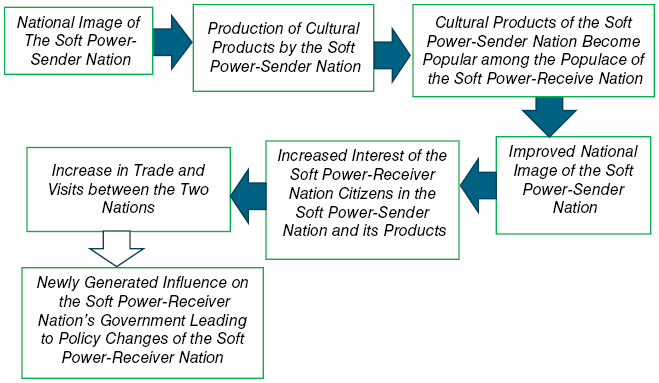
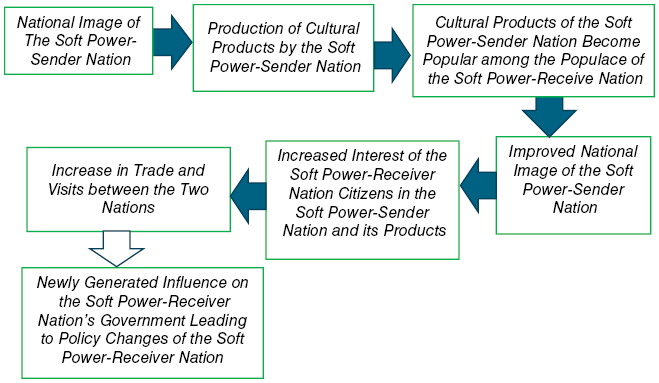
In conclusion, in order for the soft power of a non-superpower nation to work, the following path must be in place. First, nation A, a non-superpower country, produces cultural products that promote its cultural values, social customs, traditions, history, and lifestyle so that the society and culture of the country are portrayed positively overseas. Just like Hollywood films, TV shows and films of any country can have significant cultural impact on international audiences because of the embedded messages (Maisuwong Reference Maisuwong2012: 3).
If the cultural products by the power-sender nation appeal to the people in nation B (power-receiver nation), they go through socialization and become popular among the public. If the popularity is sustained for a prolonged period and spreads widely in the power-receiver nation, the national image of the sender nation among the populace of the power-receiver nation is enhanced. Given the enduring nature of national image, public interest of the power-receiver nation in the power-sender nation is likely to rise subsequently. In that case, we can theoretically argue that soft power has been generated without the aid of hard power (Anholt Reference Anholt2009; Goldsmith and Horiuchi Reference Goldsmith and Horiuchi2012).
The enhanced national image of the power-sender nation and the increased interest in the power-sender nation by the public of the power-receiver nation are likely to lead to the surge of visits by the people of the power-receiver nation, the trade amount between the two countries, and the number of citizens of the power-receiver nation who wish to learn the soft power-sender nation’s language. Increased interactions between the citizens of the two nations, along with enhanced public diplomacy, generate implicit pressure on the government of the power-receiver nation to alter its policies toward the power-sender nation in the direction that the power-sender government desires (Bae and Lee Reference Bae and Wook Lee2019; Hahm and Song Reference Hahm and Song2021; Nye Reference Nye2004, Reference 79Nye2008, Reference Nye2011).
However, there are significant difficulties with empirical tests of this theory, even with case studies, due to the lack of clarity in the soft power definition. Nye (Reference Nye1990b: 166) initially defined soft power as “one country gets other countries to want what it wants … in contrast with the hard or command power of ordering others to do what it wants.” He differentiated the concept of soft power from the conventional definition of power, hard power. As long as the soft power-receiver nation wants the same thing that the power-sender nation wants, he argued soft power was generated, which is different from the conventional definition of power that requires policy changes of the power-receiver nation.
Nye’s (Reference Nye1990b) definition of soft power is problematic. Regardless of hard or soft power, a nation’s capabilities become power only if they can alter another nation’s policy so that the power-receiver nation’s policy will align with the power-sender nation’s strategic interests, according to the conventional definition of power. Otherwise, it may not be defined as power because of the lack of empirical evidence.
Later, Nye (Reference 79Nye2008: 94) refined and modified the soft power definition as “the ability to affect others to obtain the outcomes one wants through attraction rather than coercion or payment.” This definition is based on loosening some assumptions of the conventional definition of power. According to the conventional definition of power, a nation’s ability becomes a power only if it can get another nation to do certain things (i.e., policy change) against its will. Nye (Reference 79Nye2008) refined his definition of soft power by omitting the policy change requisite of the conventional power definition. Thus, if the soft power-sender nation wants to expand its relationship with the soft power-receiver nation to generate economic benefits, its desired outcome is the expansion of the interaction between the two nations, including trade and tourism expansion. Thus, if the trade amount between the two countries increases, according to Nye’s (Reference 79Nye2008) definition, the power-sender nation has soft power.
However, if the desired outcome of the soft power-sender nation is the soft power-receiver nation’s policy change, a typical goal of power wielding according to the conventional definition of power, we cannot conclude that soft power is really generated based on the expanded international interactions. The issue here is, as noted earlier, that it is extremely difficult to know concurrently what outcome the soft power-sender nation wants to obtain.
Moreover, due to the lack of explicit requirement of policy change against the power-receiver nation’s wish, Nye’s (Reference 79Nye2008) refined definition of soft power may not be acceptable to proponents of the conventional definition of power.
Based on the discussion on how soft power works, we describe the theoretical mechanism of soft power generation and soft power function in Figure 1. Due to the difference in the definition of soft power between Nye’s and the conventional ones, we use a white arrow for the final step of the theoretical mechanism, policy change, instead of the dark ones used in other steps.
Theoretical mechanism of soft power without hard power support
3 The Korean Wave
There are three theories concerning the origin of the term “Korean Wave.” One is the Chinese origin theory, which asserts that the term “Korean Wave” was introduced by a Chinese media, the Beijing Youth Daily. The second theory is that the word “Korean Wave” was first commenced in Taiwanese media before it was adopted by Chinese media (Chen Reference Chen2019; Hong and Lim Reference Hong and Lim2018). Another theory is that the Korean Ministry of Culture and Tourism coined the expression to promote Korean cultural products when it produced compact discs containing Korean pop music (Jang Reference Jang2011). Regardless of the origin, the term is globally used nowadays to describe the worldwide popularity of Korean cultural products and entertainers (Kang Reference Kang2020).Footnote 11
Scholars have classified the evolution of the Korean Wave into two or three phases. Those scholars who categorize the development of the Korean Wave into two phases focus on regions that Korean cultural products enjoyed popularity in. This is due to the fact that Korean cultural products enjoyed popularity only in Asia at first, and it became a global phenomenon later. Thus, the first generation of the Korean Wave is the period when Korean cultural products were popular in only Asian countries (from the late 1990s to 2010). During the first generation of the Korean Wave, TV dramas took the lead in popularizing Korean cultural products.
The second generation is the period when the Korean Wave became a global phenomenon (from 2011 to present). Unlike the first generation of the Korean Wave, K-pop was the driving engine of the Korean Wave during the second generation. After that, films, TV dramas, and other products, such as beauty products, fashion clothes, online games, and food items, enjoyed popularity around the world, including in Europe, Latin America, and North America (Jin Reference Jin2016; Lee Reference Lee, Lee and Nornes2015).
By contrast, some scholars classify the Korean Wave into three phases based on the changes in the types of popular cultural products (Cho and Sim Reference Cho and Sim2013; Ko Reference Ko2009; Song Reference Song2020). The first generation of the Korean Wave, or Hallyu 1.0, is from 1997 to the early 2000s. During this period, the Korean Wave started with the popularity of Korean TV dramas and pop music in Asia. During that period, the primary distribution media were cable TV and satellite TV. The popularity of Korean cultural products, however, was geographically limited to Asian countries.
The second generation of the Korean Wave, or Hallyu 2.0, is from the early 2000s to the late 2000s. During this period, Korean pop music took the lead, although TV dramas continued to be popular, and cinema as well as computer games also enjoyed popularity. One of the main differences between Hallyu 1.0 and Hallyu 2.0 is that Korean cultural items began to be popular outside of Asia, including in the Middle East and Europe. Another difference is that the primary distribution media during this period were social media, including YouTube, iTunes, Facebook, Blogs, and Twitter.
Finally, the third generation of the Korean Wave, or Hallyu 3.0, began in the 2010s. During this period, Korean cultural products that enjoyed popularity were diversified, including animation, food items, cosmetics, and the Korean language, in addition to TV dramas, cinema, pop music, and computer games. The Korean Wave also became a true global phenomenon, as many Korean products and entertainers enjoyed explosive popularity worldwide through all media, such as YouTube, iTunes, Facebook, Instagram, Blogs, and Netflix (Ko Reference Ko2009; Song Reference Song2020). We will describe the history of the Korean Wave, conflating both classifications.
Foundation of the Korean Wave
It is impossible to pinpoint the inception of the Korean Wave, as it gradually took place over some time. Nevertheless, it is reasonable to assume that the Korean Wave started when Korean TV dramas were broadcast in East and Southeast Asia in the late 1990s. This is because in the late 1990s, Korean media goods began to rise and enjoy prominence (Jin Reference Jin2016; Song Reference Song2020). Before that time, Korean cultural products were hardly exported to foreign countries. What triggered Korean cultural products to be exported to other countries was the financial crisis that broke out in 1997. The Korean people underwent hardships throughout the crisis, but it led to changes in the mindset of Korean cultural industries. Prior to the crisis, Korean cultural industries targeted mainly domestic audiences, but after the crisis, they started exporting their products to foreign countries, shifting the primary target from domestic to international audiences. This is because domestic demand for cultural products substantially declined due to the financial difficulties they were experiencing. Shifting the main target was necessary for Korean cultural industries because cultural products are not necessities for everyday life when the economy is struggling.
The financial crisis started as South Korea encountered a dire shortage of foreign currency reserves in 1997. As a result, the exchange rate of the Korean won against the US dollar jumped from approximately 900 to 1,500 in a six-month period. Foreign investors pulled out their investment, and the stock market crashed. On November 21, 1997, the South Korean government requested a bailout fund from the International Monetary Fund (IMF). The IMF provided South Korea with a rescue package of US$56 billion to deal with the foreign exchange crisis. Despite the IMF bailout, the shortage of foreign exchange reserves was not quickly resolved, and the exchange rate between the Korean won and US dollar rose steadily, reaching 1,900 won to one US dollar at the end of 1997 (Heo Reference Heo, Horowitz and Heo2001; Heo and Kim Reference Heo and Kim2000; Jesse et al. Reference Jesse, Heo and DeRouen2002; Heo and Roehrig Reference 74Heo and Roehrig2010).
Although the IMF rescue package prevented South Korea from declaring default on their debt payment, the fund was not without conditions. The IMF required tight fiscal policies and high interest rates. Thus, the Korean government had to cut down on government expenditures while maintaining high interest rates (Heo and Roehrig Reference 74Heo and Roehrig2010, Reference Heo and Roehrig2014). According to the Bank of Korea’s Economic Statistics System, the interest rate after the IMF provided a rescue fund went up to 25.63 percent in January 1998 (Bank of Korea 2025). As a result, many small- and medium-sized companies had difficulties accessing capital resources, resulting in bankruptcy. Economic conditions deteriorated, and the unemployment rate skyrocketed, reaching 7.0 percent in 1998. As a result, suicide rates climbed up by 42 percent.Footnote 12 The country’s economic growth rates plummeted, reaching −5.8 percent in 1998 (Heo Reference Heo, Horowitz and Heo2001; Heo and Kim Reference Heo and Kim2000; Jesse et al. Reference Jesse, Heo and DeRouen2002). The effects of the financial crisis are well indicated in Korea’s per capita GDP. In 1995, prior to the crisis, South Korea’s per capita GDP was little over US$10,000, but in 1998, right after the crisis broke out, it declined to approximately US$6,500 (Lee Reference Lee1999: 84).
Due to poor economic performance, domestic consumption plummeted. Since cultural products and entertainments are not essential for day-to-day living, cultural industries suffered more than any other industries. Korean cultural industries realized that they could not rely on domestic markets any longer, meaning exporting their goods to foreign countries was the best and only way to survive.Footnote 13 In other words, the primary target audience for Korean cultural products became foreigners rather than Korean people after the 1997 financial crisis (Kang Reference Kang2020). This is why some scholars argue that the Korean Wave, which began in the late 1990s, is not accidental (Lee Reference Lee2006).
Although the 1997 financial crisis nearly killed the domestic market for Korean cultural industries, it presented some advantages as well, which is ironic. Thanks to the skyrocketed exchange rate, South Korean cultural items started enjoying price competitiveness in overseas markets. To take advantage of the reasonable cost of Korean cultural products, networks in Vietnam and Taiwan began to substitute Japanese and Hong Kong TV dramas they used to air with Korean TV shows (Chu Reference Chu2016; Kang Reference Kang2020; Kim Reference Kim2005; Sung Reference Sung2010). At that time, on average, Japanese TV dramas were four times more expensive than Korean products, and Hong Kong shows were ten times more expensive than Korean ones (Shim Reference Shim2004; Straits Times 2003; Song Reference Song2020, Reference 81Song2023).
Although Korean cultural products attracted foreign buyers due to the reasonable price, that was not the only reason. Korean cultural products were also high quality. In terms of improving the quality of Korean cultural products, Korean national leaders played a key role. President Kim Young-sam, who came to office in 1992, embarked on many policy initiatives. One of them was enhancing Korea’s cultural richness to improve the quality of life. President Kim considered the country’s cultural richness part of public welfare. He introduced the concept of cultural welfare, which refers to public policies and private activities that develop the aesthetic sensibility and cultural creativity of the people. For cultural welfare, the Kim administration strived to enhance the quality of cultural products. To this end, the Kim Young-sam administration upgraded the infrastructure of cultural industries, which provided the foundation of the Korean Wave (Song Reference 81Song2023).
The Kim Young-sam administration also recognized the economic value of culture, as entertainment commodities can be a source of economic gains. Noticing that American film industries account for approximately three percent of US GDP annually, the Kim administration wished to emulate the US model (Jin Reference Jin2016; Shim Reference Shim2006; Song Reference Song2020, Reference 81Song2023). In January 1994, after the annual report from the Ministry of Culture, Sports, and Tourism, President Kim Young-sam stated, “In the twenty-first century, the cultural industry itself will be the largest industry through the advancement of diverse audio-visual media. Since Western countries compete with each other in the cultural sector, we must develop new cultural products to meet global senses, and big corporations have to invest in the realm of culture” (recited from Jin Reference Jin2016: 28). To promote exports of cultural products, President Kim wanted to provide systematic government support to cultural industries. To this end, he created the Department of Cultural Industry under the Ministry of Culture, Sports, and Tourism (Moon Reference Moon2020; Song Reference 81Song2023).
The Kim Young-sam administration’s efforts to upgrade the cultural industry in appreciation of the economic value of cultural products were the first step toward the Korean Wave. To support the Kim administration’s efforts, the Korean National Assembly passed the Motion Picture Promotion Law in 1995, which enabled the Kim administration to induce big business conglomerates, chaebol, into the cultural industry by providing tax incentives for investing in filmmaking (Shim Reference Shim2006). Since financial constraints were the primary challenge faced by Korean filmmakers and drama producers, the investment of Chaebol removed a main barrier to advancing the quality of their cultural products. The companies that joined the film industry at that time include Samsung, Hyundai, LG, and CJ (Song Reference Song2020, Reference 81Song2023).Footnote 14
President Kim Dae-jung, who succeeded Kim Young-sam, continued the government support for cultural industries, despite the fiscal difficulties resulting from the financial crisis (Hahm and Song Reference Hahm and Song2021; Nye and Kim Reference Nye, Kim and Kim2013). To this end, the Kim Dae-jung government substantially increased the budget of the Ministry of Culture and Tourism, which implemented its first five-year plan to enhance the cultural industry’s competitiveness, such as encouraging colleges to open cultural product-related departments with financial support. With the opening of the cultural market to Japan, the Kim Dae-jung administration expedited the transformation of the cultural industry to compete for global markets. To this end, the government established the Institute for Korean Culture and Tourism Policy Studies. The government also invested in the improvement of cultural content and creativity (Jin Reference Jin2016).
Unlike other countries that typically leave the production of entertainment commodities to the private sector, the Korean government took the leadership in the advancement of cultural industries, which continued through the following administrations. Because of the sustained government support for cultural industries, Danish brand strategist and management consultant Martin Roll stated that South Korea is the only nation in the world that aspires to be the top exporter of cultural goods (Roll Reference Roll2021; see also Istad and Gibson Reference Istad and Gibson2025).
In essence, there are two factors that made the inception of the Korean Wave possible. The first element is the Kim Young-sam administration’s vision for cultural industries and supporting policies that helped significantly enhance the quality of Korean cultural products as well as the infrastructure of the industry. Because of the Kim administration’s campaign to transform cultural goods from domestic entertainment commodities to export items, the industry began to produce cinemas and TV dramas while considering the possibility of exporting them. The Kim Dae-jung administration sustained government support to the cultural industry, providing US$148.5 million in subsidies to continue its efforts to enhance the quality of products (Nye and Kim Reference Nye, Kim and Kim2013). Thanks to the government’s support, the quality of Korean cultural products substantially progressed.
The second element is the plummeted value of the Korean currency resulting from the 1997 financial crisis. The highly inflated exchange rates of the Korean currency provided a significant price advantage to Korean cultural products. Quality products with reasonable prices made Korean cultural products attractive, particularly in Asian markets (Jin Reference Jin2016; Song Reference Song2020).
Early Phase of the Korean Wave
Among Korean cultural products, what led to the success in the Asian markets at the early stage of the Korean Wave was TV dramas, including soap operas and fictional mini-series. They were successful in the Asian market and considerably improved the reputation and prestige of Korean cultural products (Kim and Kim Reference Kim, Kim, Kim and Kim2011). One of the first exported Korean TV shows was “Feeling,” which aired on Vietnam national TV in 1997. Since it was well received by the Vietnamese audience, Ho Chi Minh TV broadcast “Doctors” in the following year. “Doctors” enjoyed explosive popularity in Vietnam, and the main character Jang Dong-gun became extremely popular in Vietnam (Kang Reference Kang2020). With the success of “Feeling” and “Doctors,” other TV shows, including “Daejanggeum (Jewel in the Palace)” and “Winter Sonata,” were imported to Vietnam, as their quality was already known while their prices were still reasonable compared to the Japanese or Hong Kong products.
One of the reasons for the success of these TV dramas can be attributed to their themes. They include issues in family struggle, including friction between siblings and in-laws, romance in the context of both sides of families as well as the love story itself, and filial piety in the context of generational changes. These issues are not limited to the Korean people. It happens almost everywhere, and Vietnamese audiences could easily relate to them. With the popularity of Korean TV shows, Vietnamese people became interested in other Korean cultural products as well, including Korean food, culture, history, and language (West Reference West2008). In 1999 alone, forty-five Korean TV shows were aired in Vietnam, which increased to sixty in the following year (Kang Reference Kang2020). Since 1999, every TV channel that broadcasts in Ho Chi Minh City has aired some Korean TV dramas (Cho Reference Cho1999).
Taiwan is another country that imported Korean TV dramas in the late 1990s. Taiwanese audiences were used to Japanese TV shows, but Korean TV dramas appealed more to Taiwanese audiences due to the uniqueness of Korean TV shows compared to Japanese ones. For instance, romantic story dramas of Japanese dramas tend to focus on the love story itself without involving other issues, such as family and work. However, Korean TV dramas connect young people’s love stories to family issues (i.e., parents’ opposition to the relationship) and jobs (i.e., stress for promotion, pressure for promotion, friction with colleagues, or harassment from the boss). Korean dramas also raised social issues, such as friendship between an adult man and woman in the context of a love story, which made Taiwanese audiences more relatable to Korean TV shows than Japanese dramas (Kim et al. Reference Kim, Chen and Su2009).
A great example is the Korean TV show “Fireworks,” which dealt with young people’s love, friendship, and jealousy. The show presented the emotional struggle between friendship and love for an adult man and woman by raising a question whether it is possible to have friendship between an adult man and woman. At that time, Asian societies did not easily accept the friendship between an adult man and woman, but it began to change with Western influence. Thus, Asian young men and women began to face the issue. Since Korea and Taiwan were experiencing the issue, Taiwanese audiences were empathetic to the theme of the show, which was appealing to them.
The success of “Fireworks” led to the demand for more South Korean TV dramas and shows in Taiwan. As a result, many Korean TV shows were imported and aired in Taiwan, accounting for about a quarter of South Korean TV drama exports in the early 2000s (Kim et al. Reference Kim, Chen and Su2009). TV Dramas, such as “Meteor Garden” and “Stairway to Heaven,” led to the Korean drama boom in Taiwan. As a result, the price of Korean TV shows skyrocketed. The price per episode of “A Tale of Autumn” in 2000 was US$2,000, but it went up to US$22,000 per episode for “Lovers in Paris” in 2005 and US$40,000 for “Doctors” in 2016 (Ahn Reference Ahn2016). With the increased popularity of Korean TV shows over time, cable TV stations in Taiwan gradually replaced Japanese programs with Korean products (Heo and Kim Reference Heo and Kim2012; Kim Reference Kim2005; Sung Reference Sung2010).
The success of Korean TV dramas in Taiwan opened another door for Korean cultural industries. To attract all ages of viewers, TV stations that aired Korean dramas in Taiwan dubbed them in Mandarin. The dubbing made the millions of Chinese diasporas in Southeast Asian countries, Taiwanese audiences, and the Chinese audience in mainland China readily access Korean TV dramas. From mouth to mouth, the popularity of Korean TV dramas quickly spread to mainland China from the beginning, giving way to the introduction of Korean cultural products in China (Kang Reference Kang2020; Sung Reference Sung2010).
The first Korean TV drama aired in China was “What Is Love?” It was aired in 1997 and received a viewership rating of 4.2 percent, an impressive record considering it was the first Korean TV show broadcast in China. The drama “What Is Love?” appealed to Chinese viewers because it showed liberal social milieu and self-expression, which were novel to Chinese audiences as they had not seen such material on TV before. Since the first Korean TV drama was well received by the Chinese audience, Chinese TV stations imported other Korean TV shows. The drama “Autumn in My Heart” ignited a Korean drama fandom in China. The success of these Korean TV dramas led to the imports of more Korean TV dramas, including “Men of the Bathroom,” “My Lovely Samsoon,” “Daejanggeum,” “Winter Sonata,” and so on (Hu Reference Hu2010). The romantic plots, emotional depth, and exceptional value of Korean dramas drew in the Chinese audience. By the early 2000s, Chinese viewers of Korean TV dramas were massive.
The popularity of Korean TV dramas soon spread to other Asian countries, including the Philippines, Indonesia, Malaysia, and Singapore. The first Korean TV drama to air in the Philippines was “Autumn in My Heart.” It was broadcast in 2003 and became widely popular across the country. After that, other TV shows like “Full House,” “Daejanggeum (Jewel in the Palace),” “My Sassy Girl,” “Winter Sonata,” and “Lovers in Paris” were aired in the country. They were well received by the Chinese audience. The sustained popularity of Korean TV dramas led to heightened interests in other Korean cultural products, including cinema and K-pop music, as well as the Korean language (Arpon Reference Arpon2008).
In Malaysia, “Winter Sonata” was the first Korean TV drama aired. Since then, many Korean TV dramas have been broadcast in the country. For example, “Autumn in My Heart,” “Joyful Girl’s Success Story,” “Lovers in Paris,” and “Daejanggeum (Jewel in the Palace).” All these TV dramas enjoyed explosive popularity in Malaysia. Thus, Mopilin (Reference Mopilin2008: 78) described this phenomenon as a cultural tsunami. The popularity of Korean TV dramas led to interest in other Korean cultural products.
Many of these Korean TV dramas had a common theme: romance, family issues, and good versus evil, although some history-based TV mini-series without these themes also gained unprecedented popularity. They appealed to Asian audiences because the theme in Korean TV shows can be related to a wide range of audiences, from women to men and people of all ages. The dramas had quality scripts along with touching characters (Kim and Kim Reference Kim, Kim, Kim and Kim2011). Onish (Reference Onish2005) wrote in the New York Times, “[South Korea] is emerging as the pop culture leader of Asia … From well-packaged television dramas to slick movies, from pop music to online games, South Korean companies and stars are increasingly defining what the disparate people in East Asia watch, listen to, and play.”
Unlike other Asian countries, in Japan, Korean movies, instead of TV dramas, became popular first. “Shiri,” released in February 1999, was a big hit.Footnote 15 It was one of the first blockbuster films produced in Korea, breaking most of the Korean film records at that time. With the unprecedented domestic popularity, the movie was exported to Japan, Hong Kong, Germany, France, Russia, and India. In Japan, 1.25 million people watched “Shiri.” After the success of “Shiri,” dozens of Korean movies were exported to Japan annually, including “Joint Security Area (JSA),” “Lies,” “Wonderful Days,” “Tell Me Something,” and “Attack the Gas Station.” Initially, Korean films were sold for a very reasonable price, but the price gradually climbed up over time (Kang Reference Kang2020).
Although the popularity of Korean cultural products started with cinemas in Japan, it peaked with the TV drama “Winter Sonta,” which flared up the attractiveness of Korean TV shows in Japan. The drama was so popular that Japanese TV station NHK published the script of “Winter Sonata” in the Japanese language. More than a million copies of the script were sold. Moreover, there was a strong public demand for rebroadcasting of “Winter Sonata,” and thus NHK broadcast Winter Sonata one more time. Main characters Yongjoon Bae and Jiwoo Choi particularly enjoyed the popularity in Japan. Following “Winter Sonata,” many Korean TV dramas, including “Daejanggeum (Jewel in the Palace),” “Autumn in My Heart,” and “Summer Scent,” were exported to Japan as well as other Asian countries (Kang Reference Kang2020).
In summary, the popularity of Korean cultural products at the early stage of the Korean Wave in most countries was led by TV dramas and geographically limited to Asia. Thus, despite the Korean cultural industry’s efforts to transform itself to appeal to international audiences, Ainslie (Reference Ainslie2016: 7) contends that the success of Korean cultural products was largely based on “inter-Asian affinity.”
Korean cultural products were easily accepted by many Asian people without a lot of difficulties because Asian audiences could easily relate to the themes of Korean TV dramas. They have similar experiences due to cultural similarities as well as geographical proximity. In addition, they did not see the Korean Wave from the aspect of cultural intrusion or cultural dominance on the grounds that Korea is not a superpower. Thus, they did not see Korea, unlike the United States, as a potential imperialist in the culture fields.
The success of TV dramas in Asian countries during the early period of the Korean Wave was followed by the popularity of Korean cinemas and pop music in most Asian countries. Shiri and JSA (Joint Security Area) were two of the most successful films that led the Korean Wave in the early phase of the Korean Wave in most Asian countries. Following these two movies, the films My Wife Is a Gangster and My Sassy Girl also achieved the top spot at the box office in many Asian countries. The popularity of Korean films continued with A Tale of Two Sisters and Old Boy (Jin Reference Jin2016).
The success of Korean cultural products was not limited to TV dramas and cinemas. Korean popular music was also popular. Korean pop music, often referred to as K-pop, particularly dance music singers or groups, such as H.O.T., CLON, NRG, S.E.S., Baby V.O.X, Shinhwa, and so on, enjoyed explosive popularity in China and Southeast Asian countries. Concerts by NRG and H.O.T. in China in 2000 were filled with Chinese young people, clearly showing how popular they were in China. They also topped Chinese music charts (Kim Reference Kim2007).
Due to the explosive popularity, the Beijing Traffic Broadcasting station aired a daily show, “Night at the Han River,” which discusses Korean culture and plays Korean music. The Beijing Music Channel also broadcasts Korean music every day. The explosive fame of Korean dance groups, such as NRG, H.O.T., Baby Vox, and Clon, was described with the term “The Korean Wave” in China by the Beijing Youth Weekly in 1999 (Sun and Liew Reference Sun and Khiun Liew2019). Thus, Shin (Reference Shin, Shin and Stringer2009: 507; recited from Jin Reference Jin2016: 115) wrote, “As the danceable rhythm and catchy melody performed by good-looking singers and groups swept across East- and Southeast Asia, Korean pop music became one of the main components of the Korean Wave.” In addition, according to analysts, structural details of the music and the refreshing outlook of the singers appealed to young Chinese audiences (Sun and Liew Reference Sun and Khiun Liew2019; Donga Ilbo Reference Donga2000).
These dance music singers were different in music style compared to conventional Korean pop singers. Prior to the introduction of dance music, throughout the 1980s, the Korean music genre was dominated by ballad-style love songs. This trend changed in the late 1980s and early 1990s, as younger musicians (e.g., Kim Gun Mo, Seo Taeji and Boys) introduced dance music, integrating hip-hop and rap, which immediately became popular among younger generations in Korea. One of the key elements that made Korean dance music appeal to foreign audiences is hybridizing Korean sentiments with international genres (hip-hop and rap music). In other words, Korean dance music is the product of blending foreign music styles with traditional Korean pop music. The prime time of the first generation of Korean dance musicians was prior to the inception of the Korean Wave. However, they paved the way for the popularity of the next generation of dance musicians, which later will lead to the globalization of the Korean Wave (Jin Reference Jin2016; Jung Reference Jung, Nornes and Lee2015).
The next generation of dance musicians were typically idol groups created by entertainment companies. They were created through the audition process and a significant period of training managed by entertainment companies, such as SM, YG, and JYP. Former Korean pop singer Suman Lee founded the first entertainment company, SM Entertainment, in 1995, which introduced a systematic process to select candidates for an idol group, train them professionally for a lengthy period, and market them strategically. This system was adopted by the following entertainment companies, such as YG Entertainment and JYP Entertainment. These entertainment companies were the driving engine of the Korean pop music industries (Jin Reference Jin2016).
Overall, the Korean Wave at the early phase was a unidirectional flow from artists to fans in Asia through Korean media and artists performances without much interaction between entertainers and fans. Fans simply watched Korean cultural products and developed their love and admiration for the actors, actresses, and singers along with Korean culture. As noted earlier, the popularity of Korean cultural products and entertainers led to increased interest in Korea in general. As a result, tourist visits to Korea from other countries considerably increased, and exports also surged as the Korean Wave expanded (Lee Reference Lee, Lee and Nornes2015; Nornes Reference Nornes, Lee and Nornes2015; Shin Reference Shin2005; Song Reference Song2020). For instance, the number of foreign tourists visiting Korea in 1996 was a mere 3.68 million. By 2019, approximately two decades later, the number had risen to 17.5 million, an increase of almost five times. Korea’s exports also increased from approximately US$72 billion in 1991 to US$683 billion in 2024, about a tenfold increase in little over two decades.
Globalization of the Korean Wave
The geographical limitation of the Korean Wave was lifted in the late 2000s, as Korean cultural products began to appeal to audiences outside of Asia (Lee Reference Lee, Lee and Nornes2015; Hu Reference Hu2010; Jin Reference Jin2016). The first region that experienced the ripple effects of the Korean Wave was the Middle East. The Korean TV show “Daejanggeum (Jewel in the Palace),” which aired in 2006, was one of the first K-dramas that enjoyed considerable popularity in the Middle East. The drama was top-rated in Iraq, marking a significant advancement for Korean dramas in the region. Since then, dramas such as “Mr. Sunshine,” “Bloodhounds,” “The Glory,” “Sweet Home,” and “D.P.” have been well received in the Middle East. One of the reasons for the popularity of Korean TV dramas in the region was shared common social values, as the contents of Korean TV dramas were conservative with minimal violence, sexual nudity, and foul language, aligning well with cultural values in these countries. According to Mohamed Elaskary, Professor of the Hankuk University of Foreign Studies in Seoul, similarity in cultural values between Korea and Arab countries, such as family bonds, implicit love stories, friendship, and altruism, played a key role in the success of Korean cultural products in the Middle East (Arab News 2023).
Unlike Asia and the Middle East, the driving engine of the Korean Wave in Europe was not TV shows but Korean pop music labeled K-pop (Lee Reference Lee, Lee and Nornes2015). However, the success of K-pop in Europe did not happen overnight, as Korean music was comparatively unknown to the world market outside of Asia. To trace the evolution and globalization of K-pop, we need to start with BoA, who was one of the first Korean musicians popular in Japan. She debuted in Japan at the age of fifteen. But her first album, “Listen to My Heart,” received a sensational welcome in Japan and rose to the top of the Japanese music chart, Oricon, in 2002 (Kim Reference Kim2007). What made BoA so successful is that she is a product of cultural hybridization. Jung (Reference Jung, Lorna and Lent2013: 111) describes BoA as “a combination of elements from both American and Japanese pop music, evident in the singing and dancing styles strikingly influenced by American artists, such as Michael Jackson and Janet Jackson, and a look drawn from Japanese pop idol visual styling, such as those of Amuro Namie and Hamasaki Ayumi.” Thus, Jin (Reference Jin2016: 116) wrote, “Korean cultural products are nothing but Korean versions of American popular culture, and the Korean Wave phenomenon is nothing but a result of how Korea’s export-driven industrial system of the manufacturing sector has extended into the popular cultural sector.”
After BoA’s success, other Korean musicians debuted and enjoyed popularity in Japan. For instance, TVXQ and Girls Generation reached the top of the Oricon Chart respectively, not too long after their debut. There are two reasons for that. First, with BoA’s success, the Japanese audience was already somewhat familiar with K-pop, and thus it was not foreign to them any longer. Second, the progress in social media has made access to any music easier than before. Realizing the common use of social media, singers upload their music on social media instead of on their homepages. Entertainment companies that singers were associated with produced high-quality music videos so that audiences could enjoy high-quality music videos without difficulties (Cho and Sim Reference Cho and Sim2013).
BoA’s success in Japan led to the persistent trend of blending Western music with Korean style. The success in Japan continued, as Korean boy bands TVXQ and Big Bang as well as girl groups KARA and Girl’s Generation enjoyed popularity, indicating that K-pop broke into the Japanese music market. Entertainment companies, such as SM, YG, and JYP, continued manufacturing idol groups, such as Wonder Girls, 2AM, 2PM, Miss A, The Grace, Super Junior, and 2NE1. To make these groups attractive to foreign, particularly American and European, audiences, entertainment agencies hired well-known Western music composers and producers for K-pop singers. Over the years the collaboration between Korean and Western musicians and producers deepened (Oh Reference Oh2011). As a result, K-pop includes various types of music, including Euro-beat, R&B, rap, hip-hop, and soft rock. Thus, Jin (Reference Jin2016: 118) wrote, “Hybrid K-pop developed its own ground to be a significant cultural form for the New Korean Wave.” In other words, K-pop music evolved to appeal to Western audiences.
Before K-pop groups became popular in Europe, they enjoyed popularity in Turkey and Uzbekistan first, as these countries are culturally and geographically closer to Korea than other European countries. After the success in these countries, in the late 2000s, the popularity of K-pop reached France and the United Kingdom. K-pop groups held concerts in Paris in 2011 that attracted the tremendous fervor of European fans, a beginning of the Korean Wave in European countries. There were two differences in the Korean Wave of Asia and Europe: (1) TV dramas led the Korean Wave in Asia while K-pop was the driving engine of the Korean Wave in Europe; and (2) most fans of Korean TV dramas in Asia were middle-aged women, whereas European fans of K-pop tend to be in their twenties or even teens (Hu Reference Hu2010; Song Reference Song2020).
The ultimate goal of K-pop music was opening the US market, due to its size and the stature of US cultural industries in the world. Despite the heavy investment by Korean music industries in K-pop for success in the US market, the US market was not opened easily. Over time, K-pop was able to appeal to the American audience thanks to the confluence of market strategies along with the increased popularity of social media for social interactions around the world, particularly for the younger generation (Khiun Reference Khiun and Kim2013).
Progress in information technology led to the younger generation’s heavy usage of social media, such as Facebook, Twitter, iTunes, blogs, YouTube, and Instagram. The younger generation that is used to modern information technologies actively used social media for communication and information sharing. Among social media, YouTube provided an express way for cultural products to reach any markets in the world, as anybody could upload their performance or products for free, and anyone who has access to the internet could easily enjoy the product online, as these were available for free (Jin Reference Jin2016; Song Reference Song2020).
This mechanism of social media gave way to global exchanges of cultural products as well as various information and opinions. People delivered news information and shared their take on certain political issues. In other words, social media played the role of a forum for discussing issues and sharing information, including music and other entertainment products. At the same time, social media provides a stage for anyone who wants to share their performance at no cost. Since cyberspace has no limit in terms of geographical reach, no market was behind walls. Since YouTube was available for free, there were no paywalls either, which provided a marketplace for any cultural products. Korean cultural products were one of the greatest beneficiaries of this system (Jung Reference Jung, Nornes and Lee2015; Song Reference Song2020).
People around the world watched Korean music videos on YouTube and shared them with their friends through Facebook and later Instagram. Since social media allows communication around the world, global fan groups were easily created. They shared information about the entertainer or product they like. These fan groups voluntarily promoted their stars, which further enhanced their popularity. This mechanism of social networking eliminated traditional huddles in getting into foreign markets, and K-pop fans considerably increased around the world in a relatively short period. For example, in 2010, the number of YouTube views of K-pop music videos was 800 million, but it increased to 2.28 billion in 2011, almost three times in a year.Footnote 16
Although unintended, the functions of subtitles and automatic captions based on the speech-recognition technology on YouTube nearly removed the language barrier, which was also a big help for the success of K-pop (Jin Reference Jin2016: 121–122). CNBC described the role social media played in the Korean Wave as follows: “Online social networks are the biggest medium that K-pop fans around the world use to follow their favorite bands” (Naidu-Ghelani Reference Naidu-Ghelani2012).
One of the apex examples of the YouTube contribution to the success of K-pop music is the mega hit of “Gangnam Style” by PSY. On July 12, 2012, “Gangnam Style” was released through PSY’s YouTube account. In about a month after the release, the song’s popularity exploded worldwide, becoming the number one music video on YouTube. By the end of the year, “Gangnam Style” reached the number one spot on more than thirty countries’ music charts, including those of the United Kingdom, France, Germany, Spain, and Canada, despite all the lyrics being in the Korean language. Since PSY’s dance in the music video became sensational, he was invited to perform in many TV shows around the world. In addition, “Gangnam Style” became the first music video in YouTube history to reach 1 billion views on December 21, 2012 (Kang Reference Kang2020). As of February 2026, “Gangnam Style” is the fourth most viewed music video in the history of YouTube, with 5.8 billion views.Footnote 17
The success of “Gangnam Style” opened the door for other Korean musicians in the US market. Thanks to PSY’s success and appearance in many TV shows in the US, K-pop music was introduced to American and European audiences. Thus, other K-pop musicians, such as Big Bang, Girls’ Generation, Wonder Girls, f(x), and BTS, were able to appeal to them without too much trouble. These musicians also benefited from YouTube in terms of introducing their music to international audiences.
Overall, there are three elements that assisted the globalization of the Korean Wave. The first element is the worldwide popularity of social media among young people, which facilitated the global spread of Korean cultural products, particularly K-pop music. Geographical distance or cultural differences become meaningless in cyberspace. Since social media is readily available for free, it has become a primary mechanism of communication among the youth. The digital mechanism of social media and information sharing provided a platform for Korean cultural products to introduce themselves to the world (Cho and Sim Reference Cho and Sim2013; Huang Reference Huang2017).
Global usage of social media, particularly by young people, helped the Korean Wave to be globalized in two ways. One, social media expanded the types of media content supply. Thus, audiences were able to choose whatever they wanted. Due to no paywall, cultural industries around the world could access any markets around the world. As a result, the world became smaller in terms of cultural connections. Two, since anyone could easily access the products available online, Korean cultural products had exposure to Western audiences. Thanks to the high quality, they became successful in Western markets (Chen Reference Chen, Lee and Nornes2015). Thus, Kang (Reference Kang2020: 336) wrote that the globalization of the Korean Wave is a gift from social media.
The second element that helped the globalization of the Korean Wave is the attractiveness of K-pop. Just because K-pop is easily accessible on YouTube does not mean it will appeal to global audiences. What made K-pop attractive to many young people around the world was the characteristics of the music based on the hybridity of Western features with Korean style (Jin and Ryoo Reference Jin and Ryoo2012; Pieterse Reference Pieterse2009). K-pop music is unique in style, as the role of each member of K-pop groups is specified (i.e., lead vocalist, rapper, dancer, and visual). This is a distinctive feature of K-pop groups unfound in Western music groups. At the same time, K-pop music groups exhibit the integration of tradition and modernity as well as the amalgamation of Eastern and Western values and characteristics, which make them attractive. This is because the rhizomorphic nature of blending various temporal and spatial elements made K-pop music unique but relatable to the audience with a spectrum of ethnic and cultural backgrounds (Jang and Kim Reference Jang and Kim2013). In other words, the hybridity by integrating Western and Korean characteristics and style appealed to Western audiences because they are dissimilar to Western pop groups, such as The Vamps, Spice Girls, and Backstreet Boys, in terms of outfits, lyrics, and dancing styles, but still relatable, as it is not completely foreign to them (Ryoo Reference Ryoo2019; Ono and Kwon Reference Ono, Kwon and Kim2013; Shim Reference Shim2006).
In addition to the hybridity of K-pop music, Jang and Kim (Reference Jang and Kim2013) argue that the success of K-pop can be attributed to the unique features of K-pop: (1) idiosyncratic music, including inimitable melody and rhythm; synchronized group dancing; futuristic stage settings; and a high level of musicality and (2) a multi-phase production process. The production process includes (1) creating melody, beat, and lyrics; (2) coating the initial input with preproduction works, such as choreography and revision of the initial input, along with making arrangements for production and marketing; (3) studio production that records the music and edits the music video; and (4) album production and dissemination of the products along with arranging concerts (Choi Reference Choi, Lee and Nornes2015). In this process, domestic and international composers, choreographers, writers, producers, and distributors collaborate and play their individual roles to make the product successful.
The third element is that the intentional involvement of the South Korean government played an important role in globalizing the Korean Wave. In particular, the Lee Myung-bak administration designated the Korean Wave as a new growth engine and strategized cultural policies to facilitate the success of cultural industries. To this end, the Lee administration employed a government-led cultural industry development approach and provided government support through various organizations and promoted the involvement of chaebol. The Lee administration perceived the Korean Wave as a new source of export income as well as an inducement of foreign tourism (Choi Reference Choi2013; Jin Reference Jin2016).
The Korean Wave to the Next Level
The globalization of the Korean Wave did not end with just the geographical expansion of the popularity of Korean cultural products and performers. The Korean Wave evolved and upgraded to the next level. For instance, the popularity of BTS around the world reached an unprecedented level. BBC referenced the boy group as the 1960s global icon Beatles for the twenty-first century on their X (formerly Twitter) account.Footnote 18 In addition, the format of Korean content, Mukbang, was adopted globally to take advantage of its explosive popularity worldwide. Moreover, the success of Korean cultural industries led to international collaboration in producing films and TV content. For instance, the international culture giant Netflix invested in Korean cultural industries to produce Netflix original movies and TV series.
The triumph of Korean cultural products and artists has been repeatedly recognized by international media. The French newspaper Le Monde was one of the first international media outlets that recognized the popularity of Korean cultural products in Europe. In 2011, Le Monde published an article covering the popularity of Korean cultural products in Europe (recited from Chang and Lee Reference Chang and Lee2017: 2). On April 8, 2023, Le Monde published another article, “After K-pop, K-food is Conquering France,” which indicates the continuing popularity of Korean products in France.Footnote 19
A decade later, the US newspaper the New York Times published an article, “From BTS to ‘Squid Game’: How South Korea Became a Cultural Juggernaut?” indicating South Korea has become a global powerhouse in the cultural industry (Choe Reference Choe2021). The report was the first US media recognition of the popularity of Korean cultural products around the world as well as in the US. The article stated, “The country was once largely known for cars and smartphones, but a global audience has become mesmerized by its entertainment, and creators say success didn’t happen overnight.” In 2022, the British newspaper The Guardian had coverage of the Korean Wave with the article “K-Everything: the Rise and Rise of Korean Culture.” In the article, the Guardian wrote, “From music to movies, technology to food, the world has fallen in love with everything South Korean” (Adams Reference Adams2022). These media coverages demonstrate that the Korean Wave, which encompasses almost everything about Korea, including cultural products and entertainers, is real on a global scale.
Unprecedented Popularity of BTS
BTS, also known as 방탄소년단 in Korean, literally meaning “Bulletproof Boy Scouts,” is a boy band comprised of seven members. The group debuted in 2010. Their initial music style was hip hop, but it expanded its music genre over time. BTS’s explosive popularity worldwide has been at an unprecedented level. Unlike other K-pop singers, BTS received greater attention from North America and West European countries than from Korea at first. This is because BTS was not created by one of the three major entertainment companies like SM, YG, and JYP. Instead, the seven-member singer group was created by Big Hit Entertainment (it changed the name to HYBE later). Because of that, they had less media exposure in Korea compared to other groups created by the major entertainment companies at that time.
What separates BTS from other K-pop groups is that the group sustained its global popularity for a prolonged time period with consecutive hits (e.g., “Epilogue: Young Forever,” “The Most Beautiful Moment in Life: Young Forever,” “Blood Sweat Tears,” “Mic Drop,” “DNA,” “Fake Love,” “Intro: Serendipity,” “Love Yourself: Her,” “Spring Day: You Never Walk Alone,” and so on). The BTS songs on YouTube enjoyed millions of views. The boy band became the third group after the Beatles and the Monkees to have 3 number-one albums on the Billboard 200 charts within a 12-month period, and the first group to spend 5 weeks at the top of the Billboard Artist 100 chart. Thus, CNN described BTS as the Beatles in the 2000s (Hollingsworth Reference Hollingsworth2019), and the Guardian wrote that BTS is the world’s biggest boy band today (Glasby Reference 73Glasby2018).
The group hit the top of US album charts repeatedly, and their songs enjoyed global popularity. According to BBC (2020), “They’ve been number one on iTunes in over 91 countries and regions with their latest album Map of The Soul: 7, have got over 26 million subscribers on YouTube, and are the first K-pop band EVER to top the US album charts. It’s fair to say, BTS is the K-pop band that is taking over the world.”Footnote 20 BTS appeared on TV talk shows in the US, such as The Saturday Night Show, The Ellen DeGeneres Show, Jimmy Kimmel Live, and The Late Late Show with James Corden (Song Reference Song2020).
BTS holds many records. They are the first K-pop group that spoke at the United Nations, as they addressed the UN in September 2018. Thanks to their global popularity and the lesson included in their songs of the “Love Yourself” series, they were invited to the UN to deliver the message to young people to love themselves and find peace by overcoming fear and insecurities (BBC 2020). They did that two more times in 2020 and 2021, respectively.
BTS also won the Top Social Artist Award in 2017, 2018, 2019, 2020, and 2021 from the Billboard Music Award, beating famous artists such as Justin Bieber, Ariana Grande, and Selena Gomez. In 2017 and 2018, they performed in the award ceremony televised worldwide. They also performed at the American Music Awards in 2017, which made them the first Korean musicians to perform at the ceremony (BBC 2020). The International Federation of the Phonographic Industry, which represents the global recorded music business, has named BTS the best-selling musician of 2020. This achievement was particularly impressive for two reasons. First, they are the first non-Western act to win the award, which makes it special considering that the lyrics of their songs are not primarily English. Second, the previous year’s winner was Taylor Swift, who was beaten into second place by the boy band, which shows the group’s stature at the global level (BBC 2021).Footnote 21
The explosive popularity of BTS is shown at their performance in sports stadiums around the world. In 2018, the group had a world tour and performed at Citi Field (capacity of 40,000) in New York, Wrigley Field (capacity of 40,000) in Chicago, Rose Bowl Stadium (capacity of 90,000) in Los Angeles, Wembley Stadium in London (capacity of 90,000), and Stade de France (capacity of 80,000) in Paris. Tickets were sold out very quickly despite the huge size of the stadium and high price (Song Reference Song2020).
They also hold two world records according to the 2019 edition of Guinness World Records: (1) Twitter engagements and (2) most viewed music video online within 24 hours of the first release. According to Twitter, each of BTS’s tweets has 330,623 retweets on average. When the song “Idol” was released in August 2018, within 24 hours of release, more than 45 million views were recorded, exceeding Taylor Swift’s record of 43.2 million views in 2017 with her song “Look What You Made Me Do” (BBC 2020).
On June 1, 2022, BTS visited the White House on the then President Joseph Biden’s invitation to discuss the surging hate crimes in the United States, particularly those crimes targeting Asian Americans, in the wake of the COVID-19 pandemic. In the press conference held before the group’s visit, White House press secretary Karine Jean-Pierre said in her introduction of BTS, “While many of you may know BTS as Grammy-nominated international icons, they also play an important role as youth ambassadors, promoting a message of respect and positivity” (CNN 2022). Her introductory statement, as well as US President Biden’s invitation to the White House, clearly displays the international stature of the group.Footnote 22
According to BBC, there are four reasons for their success: (1) the music; (2) their performance; (3) the internet; and (4) the fans (BBC 2020). The style of BTS music is unique, integrating hip-hop with Korean emotion and melody with synchronized dancing. In addition, BTS talks about social issues, such as bullying, elitism, and mental health, in their songs in contrast to the common music theme of romance. With the lyrics of their songs, they deliver positive messages to young people around the world to discuss agony, hope, desire, peace, self-esteem, and motivation, separating themselves from other hip-hop musicians (Song Reference Song2020). In essence, their songs are unique, as they contain lessons. Still, their songs are globally popular, making BTS special and influential. According to BTS’s fan base known as ARMY, the music and lyrics are not the only reason for their love of the group. They indicate that BTS’s stream of visual content, such as behind-the-scenes recordings and reality show programming, appealed to them due to the distinctive personalities of the group members (Glasby Reference 73Glasby2018).
The message BTS tries to deliver becomes stronger with their performance and setting examples. The military style of slick dancing along with harmonious singing produced impressive music videos. The BTS performance in music videos presents the aesthetic appeal of being sophisticated, modern, and polished. Their peculiarity was attractive to many young people around the world and made them extremely popular. BTS also demonstrates their hard work ethic and modesty while maintaining liveliness and enthusiasm in their performance and talk show appearances (BBC 2020; Song Reference Song2020).
Social media is another element that has helped the success of BTS, as it allows easy access to BTS music videos. In addition, through social media, all members of the group connect with their fans around the world at a personal level, which strengthens their fanbase. According to the BTS official account, BTS has approximately 47 million followers on X (formerly Twitter) and 78.1 million on Instagram as of February 2026. BTS fans are known for their loyalty and dedication. BTS fans translated the lyrics of BTS songs into their languages to share the messages contained in the music. The messages impress and attract additional fans, augmenting the fanbase (BBC 2020; Huang Reference Huang2017; Romano Reference 80Romano2019).
BTS officially paused their activities in June 2022 to fulfill their military obligation in Korea. After the entire seven members of the group completed their military service, in June 2025, BTS announced the resumption of their activities, beginning with a concert in Seoul in March 2026. This concert will inaugurate the group’s first world tour (named the Arirang World Tour) after their comeback, exhibiting the boy band’s formal return to the international stage. The tour includes concerts in thirty-four cities in twenty-three countries, including New York, Chicago, San Francisco, Stanford, Dallas, Las Vegas, London, Paris, Munich, Madrid, Brussels, Toronto, Mexico City, Sydney, Tokyo, and so on. Tickets were sold out within a few hours (Sirikul Reference Sirikul2026). Billboard estimates that BTS and its management company Hybe are projected to make more than US$1 billion from the tour (NG Reference Ng2026).
Official name of BTS fans is ARMY (Adorable Representative M.C. for Youth). ARMY is a cyber-based BTS fan community that has 90 to 100 million members around the world. It promotes BTS music by sharing it through social media. For example, ARMY members share BTS music through their online gathering spaces, “BTS Nation” on Facebook and “BTS National” on Twitter. ARMY is very protective of BTS on social media and has shown the ability to mobilize to support BTS through fan projects, such as creating fan-made art and music videos, charity initiatives, and discussing BTS-related topics on social media, including Reddit, Twitter, and fan forums. ARMY members also traveled to attend BTS concerts around the world to show their love and support for BTS (Bruner Reference Bruner2018; Jin Reference Jin2021a).
Due to the extreme loyalty of ARMY and the explosive popularity of Korean cultural products and entertainers in cyberspace, Lyan (Reference Lyan2019) describes the Korean Wave from the cyber-nationalism perspective. According to Jin (Reference Jin2021b: 36), cyber-nationalism is “a work of imagination envisioned by fans through performances of popular national culture to construct a positive image of the nation, fandom, and fans.” Because cyberspace is open to anyone in the world and the Korean Wave has benefited from the global popularity of social media, particularly among young people, Lyan (Reference Lyan2019: 3765–3766) contends that many Korean Wave fans have “replaced ethnic Koreans in performing nationalism beyond Korea’s borders.”
International Adoption of Korean Content Mukbang
Another difference in this phase of the Korean Wave compared to earlier phases is the introduction of a new type of TV program called “Mukbang (meaning eating broadcast)” that became popular on YouTube. The term “Mukbang” means broadcasting an eating or cooking act. The contents of “Mukbang” involve “either watching or eating along with other people as they gorge, talk, and sometimes cook in front of the camera” (Bryant Reference Bryant2016). The host talks about the food quality or recipes. They also giggle while eating or cooking various Korean foods to create an atmosphere that their online viewers may feel like joining them in. This type of content became so popular that many new “Mukbang” programs were introduced on YouTube. Some popular “Mukbang” programs became lucrative as viewers increased worldwide, and hosts of them accumulated significant wealth through sponsorships, advertising, and viewers’ donations (McCarthy Reference McCarthy2017; see also Gibbs Reference Gibbs2015).
With the success of Korean “Mukbang” programs, many people around the world, including in the United States, began to air their own programs. For example, Trisha Paytas, known as the Mukbang Queen, created her own Mukbang program, and it enjoys more than five million subscribers and has garnered approximately one billion views of her shows. There are many other Mukbang YouTubers with more than 700,000 Mukbang videos on YouTube and 27 million Instagram video clips (Bryant Reference Bryant2016).Footnote 23 Thus, Bryant (Reference Bryant2016) in the British newspaper Daily Mail wrote, “Who said that dinner for one had to be lonely! Men and women share videos of themselves binge eating online – to the delight of THOUSANDS – as the bizarre South Korean ‘mukbang’ trend hits the US.”
As the popularity of Mukbang programs hits the world, the contents have also evolved, showing conversations with their friends while eating together or integrating the characteristics of Western culinary shows, such as showcasing various dishes with diverse cooking techniques as well as the preparation of the food ingredients and discussion of flavor profiles to make the cooking an entertainment.
Mukbang content has two distinctive differences compared to culinary TV shows and films. Since it is a live show, there is two-way communication between the host and viewers, enhancing interactions between them. They also become pseudo-reality shows, as viewers feel like engaging with globally popular hosts through eating, cooking, and conversing (Song Reference Song2020). Thus, Schwegler-Castarier (Reference Schwegler-Castarier2018) asserts that Mukbang allows viewers to fantasize about having an affluent lifestyle, which makes this type of content globally popular.
International Collaboration
The worldwide success of Korean TV shows and cinemas attracted American cultural industry giant Netflix to invest in Korean cultural industries to produce TV shows and movies. Netflix has also purchased licenses of many Korean TV dramas and cinemas for its streaming service since Netflix started its business in South Korea in 2016. In addition to streaming service, Netflix has gradually increased its involvement in making Korean TV programs and films. To this end, Netflix established its operation business system in Korea to produce new Netflix original TV shows and movies as well as adding more dramas and cinemas for its streaming service (Frater Reference Frater2019).
Netflix also began co-producing movies and TV shows with Korean companies. The collaboration is a win–win for Korean cultural industries and Netflix. It is good for Korean cultural industries because Korean products receive global exposure and spotlight through the Netflix streaming service around the world, which would not be possible without the collaboration with Netflix. The collaboration is also good for Netflix, as it may garner lucrative profits. This collaboration includes Netflix funding to Korean directors to produce Netflix original movies and TV series, such as Okja by Korean director Bong Joon Ho in 2017 and a TV series “Kingdom” in 2019. The series “Kingdom” was offered with dubbing in twelve languages and subtitles in twenty-seven languages. The success of Netflix investment in Korean cultural industries increased the interest in Korean products, leading to the purchase of the copyright of some Korean movies (e.g., My Sassy Girl, Old Boy, Siwol Ae (Lake House), etc.) and TV series (e.g., “The Good Doctor,” “Better Late Than Never,” “The Masked Singer,” “Grandpas Over Flowers,” etc.) for showing and/or remaking (Baek Reference Baek2019).
One of the most successful products coproduced by Netflix and Korean companies is “Squid Game,” a Korean survival thriller TV series. It was aired on Netflix worldwide in 2021. The series was a blockbuster hit around the world, reaching number one in Netflix’s most-watched TV shows in ninety-four countries, including the United States. Thanks to its success, Netflix broadcast seasons two and three in 2025. It is the most watched TV series on Netflix in Netflix history, with approximately 600 million views, combining all three seasons, as of April 2026.
Not only did the series enjoy worldwide popularity, but it was also nominated in the Primetime Emmy Award’s fourteen categories, including Outstanding Drama Series. “Squid Game” is the first non-English-language TV series to be nominated in this category. The main character, Lee Jung-jae, won the award for Outstanding Lead Actor in a Drama Series. Lee is the first Asian actor to win this award in Emmy Award history. That is particularly impressive, as he won it with non-English-language acts. In addition, “Squid Game” won six categories of the Primetime Emmy Award, including Outstanding Directing (Hwang Dong-hyuk), Guest Actress (Lee Yoo-mi), Production Design, Special Visual Effects, and Stunt Performance.
K-pop Demon Hunters is another Netflix product that enjoyed unprecedented popularity around the world. K-pop Demon Hunters is a musical fantasy animation inspired by Korean heritage, referencing aspects of demonology and mythology. It started streaming on June 20, 2025. Despite being an animation, it became the most watched original title in Netflix history with 518.2 million views as of February 2026, passing the record of “Squid Game.” Songs from the film have had more than 2 billion views, and the soundtrack has earned over 10 billion streams worldwide, as of February 2026. The song “Golden” particularly enjoyed historic success and became the first K-pop song to win a Grammy. It won Best Song Written for Visual Media at the 68th Grammy Awards and Best Original Song at the 2026 Golden Globes. The animation has also been nominated for two categories of the 2026 Academy Awards: Best Animated Feature Film and Best Original Song for “Golden.”
One noticeable element of the production of K-pop Demon Hunters is that a majority of people who made this film are Korean diaspora. In other words, foreign creators inspired by Korean history and culture joined the Korean Wave with respect to producing Korea-related content. Thus, Park Hyuk-tae, head of the Korea Creative Content Agency’s industry policy team, said, “We are now at a stage where K-content is attempting to leap into the global mainstream … The focus is expanding from ‘Made in Korea’ to ‘Made with Korea.’” Korea Times wrote, “The global frenzy around “K-Pop Demon Hunters” is increasing anticipation of a ‘Next K’ era” rather than another generation of the Korean Wave.Footnote 24
Netflix is not the only company that collaborates with Korean cultural industries. Park Chan-wook directed an HBO original TV series, “The Sympathizer,” in 2024, and Kim Hong-sun directed “Gangs of London Season 3,” which started airing on British TV Channel Sky Atlantic in March 2025. In addition, Warner Bros. Pictures worked with Oscar-winning movie director Bong Joon ho to produce a Hollywood movie, The Mickey 17, which was released in May 2025.
The global success of Korean cultural products and entertainers elevated Korea as a cultural powerhouse, leading to international collaboration. The Korean Wave indicates the transformation of cultural outlook, from the dominance of American cultural products to cultural polarization stemmed from the rise of regional cultures (Dator and Seo Reference Dator and Seo2004; Chadha and Kavoori Reference Chadha and Kavoori2000) or the decentralization of cultural dominance.
The popularity of Korean cultural products also led to interest in other Korean products, such as cosmetics, fashion products, computer games, and so on. In 2024, Korea became the number one exporter of beauty products to the US (Lee Reference Lee2025). Thus, Song (Reference Song2020) contends that the globalization of the Korean Wave expanded the horizon of the Korean Wave and led to the global recognition of the “Korea” brand name, which may be a beginning of reverse orientalism (see also Song and Kim Reference Song and Kim2022).
4 Empirical Analysis
It is extremely difficult to estimate soft power and its effects quantitatively, as noted earlier. However, it is still possible to empirically demonstrate the soft power of a country and its effects using statistical data and case studies. In this section, we examine whether the Korean Wave is Korea’s soft power.
Application of the Theoretical Mechanism of Soft Power to the Korean Wave
We introduced the theoretical mechanism of soft power without hard power support in Figure 1 in Section 2. In this section, we apply it to the Korean case to empirically test if the Korean Wave is South Korea’s soft power that was not supported by its hard power. To this end, we begin the discussion on the national image of South Korea. According to surveys conducted in the 1980s, prior to the Korean Wave, South Korea’s national image was rather poor. When foreigners were asked about the image of the country, commonly mentioned words included the Korean War, divided country, poverty, cheap goods, military dictatorship, and protests (Tudor Reference Tudor2012; Yeom Reference Yeom2003).
In 1992, Korea Gallup conducted a survey on Korea’s national image. By that time, the Korean economy had developed, with its per capita GDP reaching US$8,126 (World Bank National Accounts Data).Footnote 25 South Korea even hosted an Olympic Games in 1988. With the end of the Cold War in 1989, globalization started occurring, and international travel and migration became easier.Footnote 26 Thus, the number of foreigners residing in Korea increased. Korea Gallup, in its survey, asked 209 foreign residents in Korea what the first word that comes to their mind is when they think of Korea. Their answers include kind, crowded, disorder, nature, cuisine, economic growth, pollution, history, and so on (Gallup 1992). Although no one mentioned soft power, cultural products, or affluence, there was no mention of poverty either. Moreover, some people mentioned economic growth, food, kindness, and friendliness, indicating a marginal improvement of Korea’s national image, although it was far from being admirable.
The Korean Wave first started in Asia, and the popularity of Korean cultural products in the region changed the national image of Korea among Asian people. According to the survey conducted by NHK 8 in September 2004, 26 percent of the 2,200 Japanese who watched the Korean TV drama “Winter Sonata” changed their perception of Korea’s national image. Twenty-two percent of the respondents also stated that their interest in Korea increased (Park Reference Park2008). Noticing the explosive popularity of Korean cultural products in Asia, the New York Times wrote in 2005, “The booming South Korean presence on television and in the movies has spurred Asians to buy up South Korean goods and to travel to South Korea, traditionally not a popular tourist destination. The images that Asians traditionally have associated with the country – violent student marches, the demilitarized zone, division – have given way to trendy entertainers and cutting-edge technology”Footnote 27 (Onish Reference Onish2005).
In 2010, one of the major newspapers in South Korea, Chosun Ilbo, conducted a survey in four countries (USA, UK, France, and Japan), asking respondents if South Korea is a desirable country to live in. Since they did the same survey in 1988, they were able to show the improvement of Korea’s national image over time. In 1988, the percentage of respondents saying “yes” to the question was 20.1 percent in the US, 12.4 percent in the UK, 14.7 percent in France, and 12.4 percent in Japan, respectively. In 2010, prior to the Korean Wave in Europe and North America, the number went up to 32.1 percent in the US, 30.2 percent in the UK, 27.7 percent in France, and 31.1 percent in Japan (Hong Reference Hong2010). The survey results show that South Korea’s national image improved over time, perhaps thanks to its economic development. However, still more than two-thirds of survey respondents thought South Korea was not a desirable country to live in, indicating that the national image of the country lasts long (see Anholt Reference Anholt2009).
There is another example that shows the limited enhancement of Korea’s national image. Magnusson et al. (Reference Magnusson, Westjohn and Zdravkovic.2011) conducted an online survey in 2010 to examine the relationship between the brand name and the country of origin, including two famous Korean brands, Samsung and LG. That year, South Korea’s per capita GDP was US$23,079, and its economic size was the tenth largest in the world, with US$1.14 trillion. That was fourteen years after South Korea became a member of the OECD, an international organization typically regarded as a forum for advanced countries. Nevertheless, the economic development of Korea did not seem recognized in the United States. Samsung and LG are two of the most famous Korean brands that are known for quality home appliances and computer chips. Nonetheless, when American consumers were surveyed online, only about 16 and 25 percent of the respective usable responses accurately indicated that LG and Samsung were South Korean companies (Magnusson et al. Reference Magnusson, Westjohn and Zdravkovic.2011). Due to the rather poor national image of South Korea and the long-lasting nature of national image, many American consumers did not connect the quality brands with Korea. In other words, the national image of Korea was not very attractive prior to the Korean Wave, meaning enhancement of Korea’s national image due to the Korean Wave empirically demonstrate that the first step of soft power generation was met without the aid of hard power.
It is reasonable to assume that PSY’s K-pop song “Gangnam Style,” released in July 2012, initiated the Korean Wave in the United States. In Europe, Korean cultural products already began to be popular, but the popularity of PSY’s song “Gangnam Style” expedited the Korean Wave in Europe. Thanks to the global popularity of “Gangnam Style,” the singer PSY appeared in many TV shows around the world. PSY’s global popularity opened the door for other K-pop musicians, such as Big Bang, Girls’ Generation, Wonder Girls, f(x), BTS, and Blackpink, who debuted in the US. The unprecedented success of “Gangnam Style” led to the creation of KCON, an annual convention made up of K-pop concerts and Korean exhibitions. Initially, KCON was designed to bring all types of Korean cultural products and entertainers to the American fanbase, but the target changed to global fans. The first KCON was held on October 13, 2012, in Irvine, California. Since then, it has been held annually around the world.
In 2013, the Korea Trade-Investment Promotion Agency (KOTRA) conducted a survey in Europe to explorer Korea’s national image. The survey asked respondents to name two words that describe Korea. A total of 481 Europeans (249 ordinary citizens and 232 professionals such as executives, journalists, and professors) in seven countries, including France, Germany, Spain, and the United Kingdom, participated in the survey. The two words that were most mentioned by the survey respondents were “Samsung” and “Gangnam Style” (Park Reference Park2013). Samsung Electronics boasts the second-largest revenue among technology companies in the world, only next to the US company Apple, and Gangnam Style is a song that enjoyed global popularity in 2012 that refers to the affluent lifestyle of the residents in the wealthiest area of Seoul. Since the Korean Wave hit Europe earlier than the United States, the national image of South Korea in Europe seemed to have enhanced, considering that the two words, Samsung and Gangnam Style, symbolize Korea’s advanced technology and economic wealth, respectively (Song Reference Song2020).
Turning to the national image of Korea in the US, in 1991, 47 percent of American people had a favorable view of Korea, and 23 percent of Americans had no opinion on Korea, indicating about one in four Americans was not familiar with Korea. However, the survey by Gallup in 2018 showed 77 percent of Americans had a favorable view of Korea, and only 2 percent of the respondents had no opinion on Korea (Gallup 2018).
To examine how the national image of Korea changed after the Korean Wave worldwide, the Korean Ministry of Culture, Sports, and Tourism conducted an online survey in 2024. A total of 12,500 respondents from 25 countries (500 people per country) participated in the survey from September 3 to September 25 in 2024.Footnote 28 The survey results reveal that 79 percent of all the respondents around the world expressed a positive view of Korea, and only 5.8 percent had a negative view. Moreover, the positive view of Korea is not geographically limited to Asia. The percentage of respondents who indicated a positive view of Korea is 79.4 percent in North America, 84.5 percent in the Middle East and Africa, 73.9 percent in Europe, and 76.8 percent in the Asia Pacific region, respectively. Countries that showed a positive view of Korea higher than 75 percent (three quarters of the respondents) include Thailand, Indonesia, Vietnam, the Philippines, India, Malaysia, the UK, France, Sweden, the USA, Mexico, Argentina, Brazil, Turkey, the UAE, Egypt, South Africa, Australia, and Kazakhstan. The percentages of positive views of Korea in Germany and Spain were not too far apart, as 74.2 percent and 73.8 percent of the respondents expressed a positive view of Korea, respectively (Ministry of Culture, Sports, and Tourism 2024).
The same survey had a question of what element contributed to their positive view of the country. Almost three-quarters of the respondents who expressed a positive view of Korea, 74.1 percent to be exact, included culture or cultural products in their response (Ministry of Culture, Sports, and Tourism 2024). This survey result empirically demonstrates that the Korean Wave significantly improved the national image of Korea.
Due to the lack of time-series surveys that ask the same questions over time, it is virtually impossible to show exactly how much the national image of Korea has improved over time. Nevertheless, various survey results presented in this study demonstrate that the national image of Korea has improved over time, particularly after the Korean Wave. Moreover, a significant portion of the survey respondents indicate that the Korean Wave influenced their perception of Korea, empirical evidence of the Korean Wave making significant contributions to the enhancement of Korea’s national image. As we argued in the theoretical mechanism of soft power in Section 2, the popularity of Korean cultural products abroad, a source of soft power, did improve Korea’s national image.
According to the theoretical mechanism of soft power in Figure 1, enhanced national image increases foreign citizens’ interest in the soft power-sender country. As the theoretical mechanism posits, the Korean wave led to increased interest in Korea. For example, in 1996, prior to the Korean Wave, the number of foreign tourists that visited Korea was 3.68 million. In 2019, after the Korean Wave became a global phenomenon, the number increased to 17.5 million, an increase of almost five times in a little over two decades.Footnote 29 During the same period, the number of international students studying in Korean higher educational institutions also increased from a mere 2,143 to 160,165, an almost 75-fold increase.Footnote 30
Another piece of evidence of the Korean Wave leading to the increased interest in Korea is the amplified demand for Korean language courses. According to Hoon and Kuntjara (Reference Hoon and Kuntjara2019), interests in a foreign country tend to lead to the heightened interest of learning the country’s language. The National Public Radio (NPR) in the United States reports that the number of students studying Korean in US higher educational institutions went up by 78 percent from 2009 to 2016 (Ahn Reference Ahn2022). This data is impressive because, during the same period, demand for other foreign language courses, including Spanish, French, and German, stayed stagnant. Moreover, from 2016 to 2021, Korean language enrollments in US universities and colleges increased by 38.3 percent, while enrollments for all other foreign languages declined (Kingson Reference Kingson2023). The NPR report explains the reason for the increased demand for Korean language class as foreign students’ desire to be involved in their interest in Korean popular culture, implying that many young foreigners want to learn the Korean language thanks to the Korean Wave (Ahn Reference Ahn2022).
Increased interest in Korea led to interest in other Korean products, such as beauty products, food, fashion items, and computer software including games (Huh et al. Reference Huh and Wu2017). Prior to the Korean wave, Korea was not known for quality cosmetics. Thus, exports of Korean cosmetics in 2000 were US$850 million. After the Korean Wave went global, Korea’s exports of beauty products increased to US$10.28 billion in 2024, ranked as the world’s third-largest cosmetics exporter only after France and the US (Chae Reference Chae2025). Computer software, including games, is another product that enjoyed the benefits of the Korean Wave. In 2011, when the Korean Wave began to go global, Korea’s export of computer software, including games, was US$39 million. In 2022, it reached US$20.9 billion.Footnote 31 Korea is one of the top five computer software exporters in the world today.
Food industries also enjoyed the benefits of the Korean Wave, as foreign interest in Korean cuisine considerably increased. For instance, Korea’s food export increased from US$3.1 billion in 1999 to US$13.05 billion in 2024.Footnote 32 In November 2024, Korean food and entertainment giant CJ conducted a survey on 6,800 residents in 24 cities of 12 countries in North America, Asia, Europe, and the Middle East to examine whether they consume Korean food items. More than 55 percent of the respondents who are familiar with Korean cultural products responded that they consume Korean food at least once a week, demonstrating the link between the Korean Wave and the consumption of Korean food items (Lee Reference Lee2025).
Table 1 shows the export increase of Korean media products, software, food items, cosmetics, along with the increase of tourist visits, to empirically show the effects of the Korean Wave.
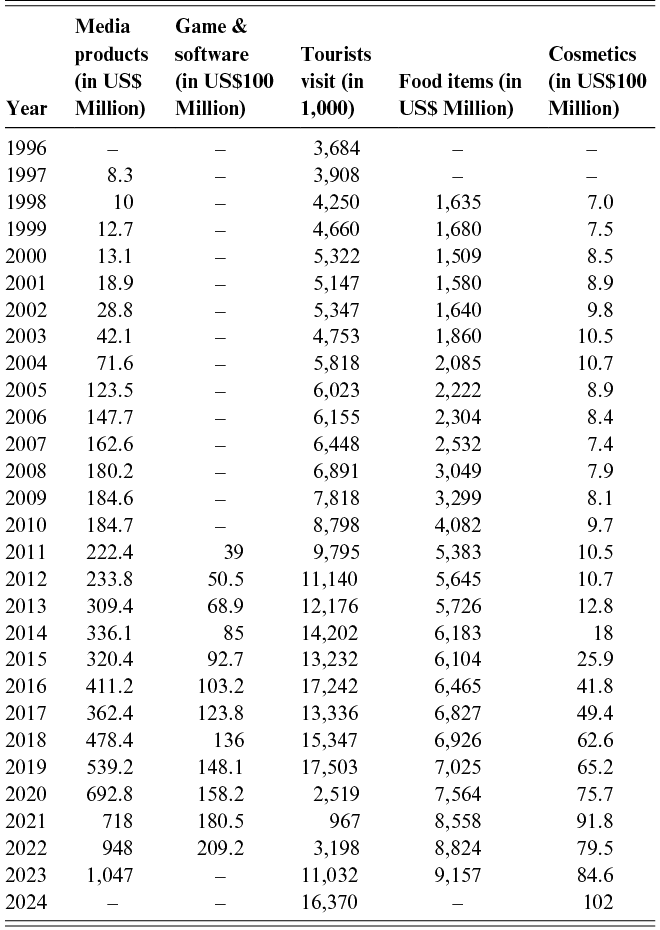
Table 1 Long description
The table mentions the following data.
Media products (million dollars). 1997: 8.3. 1998: 10. 1999: 12.7. 2000: 13.1. 2001: 18.9. 2002: 28.8. 2003: 42.1. 2004: 71.6. 2005: 123.5. 2006: 147.7. 2007: 162.6. 2008: 180.2. 2009: 184.6. 2010: 184.7. 2011: 222.4. 2012: 233.8. 2013: 309.4. 2014: 336.1. 2015: 320.4. 2016: 411.2. 2017: 362.4. 2018: 478.4. 2019: 539.2. 2020: 692.8. 2021: 718. 2022: 948. 2023: 1,047.
Game and software (hundred million dollars). 2011: 39. 2012: 50.5. 2013: 68.9. 2014: 85. 2015: 92.7. 2016: 103.2. 2017: 123.8. 2018: 136. 2019: 148.1. 2020: 158.2. 2021: 180.5. 2022: 209.2.
Tourist visits (thousands) 1996: 3,684. 1997: 3,908. 1998: 4,250. 1999: 4,660. 2000: 5,322. 2001: 5,147. 2002: 5,347. 2003: 4,753. 2004: 5,818. 2005: 6,023. 2006: 6,155. 2007: 6,448. 2008: 6,891. 2009: 7,818. 2010: 8,798. 2011: 9,795. 2012: 11,140. 2013: 12,176. 2014: 14,202. 2015: 13,232. 2016: 17,242. 2017: 13,336. 2018: 15,347. 2019: 17,503. 2020: 2,519. 2021: 967. 2022: 3,198. 2023: 11,032. 2024: 16,370.
Food items (million dollars). 1998: 1,635. 1999: 1,680. 2000: 1,509. 2001: 1,580. 2002: 1,640. 2003: 1,860. 2004: 2,085. 2005: 2,222. 2006: 2,304. 2007: 2,532. 2008: 3,049. 2009: 3,299. 2010: 4,082. 2011: 5,383. 2012: 5,645. 2013: 5,726. 2014: 6,183. 2015: 6,104. 2016: 6,465. 2017: 6,827. 2018: 6,926. 2019: 7,025. 2020: 7,564. 2021: 8,558. 2022: 8,824. 2023: 9,157.
Cosmetics (hundred million dollars). 1998: 7.0. 1999: 7.5. 2000: 8.5. 2001: 8.9. 2002: 9.8. 2003: 10.5. 2004: 10.7. 2005: 8.9. 2006: 8.4. 2007: 7.4. 2008: 7.9. 2009: 8.1. 2010: 9.7. 2011: 10.5. 2012: 10.7. 2013: 12.8. 2014: 18. 2015: 25.9. 2016: 41.8. 2017: 49.4. 2018: 62.6. 2019: 65.2. 2020: 75.7. 2021: 91.8. 2022: 79.5. 2023: 84.6. 2024: 102.
Data for Cosmetics export are from The Ministry of Food and Drug Safety (www.mfds.go.kr/brd/m_99/view.do?seq=48798&srchFr=&srchTo=&srchWord=&srchTp=&itm_seq_1=0&itm_seq_2=0&multi_itm_seq=0&company_cd=&company_nm=&Data_stts=A&page=1) and The Korea Cosmetic Industry Institute (http://kcii.re.kr/trade/total)
As our theoretical mechanism of soft power presented in Section 2 posits, the popularity of Korean cultural products led to the enhanced national image of Korea, which in turn increased interest in Korea, resulting in the growth of export and trade as shown in Table 1. Huh and Wu (Reference Huh and Wu2017) conducted a statistical analysis on the impact of the Korean Wave measured by the export of Korean cultural products on the export of consumer goods to Korea’s top 40 trading partners. They find a statistically significant and positive effect of the Korean Wave on the export of consumer goods. They also provide empirical evidence of the positive impact of the Korean Wave on the number of tourists coming to Korea.
Kim et al. (Reference 76Kim, Kim, Chang and Park2021) also find the positive effect of the Korean Wave on the export of consumer goods. According to their analyses of the effect of cultural goods exports on the export of consumer goods in 102 countries of Korea’s trade partners from 2001 to 2007, a one percent increase in exports of cultural products increased consumer goods exports by 0.136 percent (see also Cho Reference Cho2021).
Figure 2 presents the growth of Korean exports and trade amounts, which increased from US$65 billion to US$683 billion and from US$135 billion to US$1.3 trillion from 1990 to 2024 respectively.
Korea’s total trade amount and exports 1990–2024 (Unit: US$1,000)
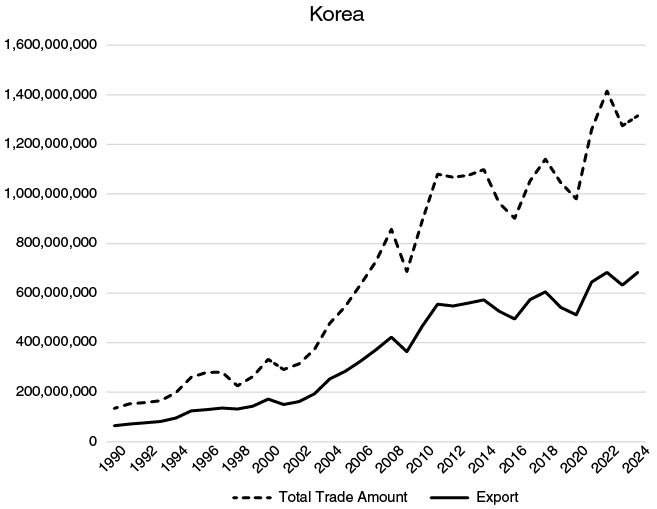
As our theoretical mechanism posits, the Korean Wave spawned a positive national image and led to the enhancement of general interest in Korea and other Korean products. Therefore, the number of international students studying at Korean universities also increased, foreign tourist visits soared, and exports and trade expanded. The Korean case empirically demonstrates that soft power can be generated without hard power support, according to Nye’s (Reference 79Nye2008) definition of soft power, which does not require the power-receiver nation’s policy change as a condition of power in international relations.
Since we are unable to demonstrate policy changes – one of the requirements to be power according to the conventional definition of power – at the global level that resulted from the Korean Wave, we present two case studies, the Korean Wave in Taiwan and Mexico, to bolster the empirical evidence of our theoretical mechanism of soft power without hard power support. We chose Taiwan because Taiwan was one of the first countries that was hit by the Korean Wave. Taiwan has a longer history of the Korean Wave than many other countries and presents empirical evidence of soft power without hard power support, including policy changes.
Our selection of Mexico as another case study is based on three reasons: (1) Mexico is geographically outside of Asia, meaning there is a lack of cultural affinity, and thereby the Mexican case provides evidence that the Korean Wave is a global phenomenon, and it is not based on cultural affinity; (2) the Mexican government changed its stance towards North Korea’s nuclear development after the Korean Wave and wants to resume free trade agreement negotiations with Korea today. These developments indicate a clear shift in Mexican government policy, considering Mexico’s relatively low value of Korea prior to the Korean Wave. Notably, it took twenty-five years for the Mexican government to send a resident ambassador to Korea even after the establishment of diplomatic relations; and (3) the Korean Wave is stronger in Mexico than in any other country in Latin America, although the country is a cultural powerhouse with respect to producing Spanish-language media products. In fact, Spanish language-based music and films produced in Mexico enjoy global popularity (Vogel Reference Vogel, Heijin Lee, Mehta and Ji-Song Ku2019).
Case Study: Taiwan
South Korea and Taiwan (Republic of China) established a formal relationship in 1948. Due to the similar political and security circumstances, divided countries and facing a security threat from communists, the two countries maintained a close relationship throughout the Cold War. Both countries also focused on economic development, as the leaders of the two countries perceived economic development as a necessary condition for national security. To facilitate bilateral cooperation, the two countries signed multiple agreements, including the Aviation Agreement of 1952, Trade Agreement of 1961, Cultural Agreement of 1963, Agreement on Maritime Transport of 1983, and Air Transport Agreement of 1986. Taiwanese President Chiang Kai-shek visited Seoul in 1949, and South Korean President Park Chung-hee returned the visit in 1966. The close relationship between South Korea and Taiwan lasted until South Korea normalized its relationship with the People’s Republic of China in 1992 (Heo and Kim Reference Heo and Kim2012).
After the end of the Cold War, the ROK government wanted to expand its diplomatic horizon with its northern policy (Nordpolitik). To this end, Korea normalized its relationship with Russia in 1990 along with former communist countries in Eastern Europe, including Hungary, Poland, Yugoslavia, Czechoslovakia, Bulgaria, and Romania. Seoul also wanted to normalize its relationship with Beijing. However, China demanded that South Korea sever its official ties with Taiwan as a condition to normalize the relationship. Considering the economic potential of the Chinese market, Seoul terminated its official relationship with Taipei (Heo and Roehrig Reference Heo and Roehrig2014).
The ROK government’s decision to shift its tie with China instead of Taiwan deeply disappointed the Taiwanese people, resulting in the rise of anti-Korean sentiment in Taiwan. In response to Seoul’s policy change, Taipei immediately announced the severance of official relationships with Seoul and the abolition of all official diplomatic and cooperative agreements, including the Trade Agreement and the Aviation Agreement, banning direct flights between the two countries. The cooling of the relationship and the repeal of the aviation agreement led to the immediate decline of Taiwanese visits to Seoul (Hahm and Song Reference Hahm and Song2021; Heo and Kim Reference Heo and Kim2012).
In addition, anti-dumping lawsuits against Korean companies mounted up, and the Taipei city government left out Korean construction companies from its subway projects. At the same time, bilateral trade amounts descended. These changes were the reflection of Taiwan’s feeling of betrayal toward Korea. This cold relationship between Korea and Taiwan lasted throughout the 1990s (Hahm and Song Reference Hahm and Song2021; Heo and Kim Reference Heo and Kim2012).
However, the relationship between Korea and Taiwan started thawing with the popularity of Korean cultural products, the Korean Wave, in Taiwan. Two factors facilitated the Korean Wave in Taiwan. First, in 1994, the Taiwanese government began to grant permission to cable TV stations to liberalize its cultural industry. Due to the twenty-four-hour-broadcasting nature of cable TV, newly opened cable TV stations had a dire need for TV programs to fill their around-the-clock schedule (Shim Reference Shim2006). Since the production of Taiwanese TV dramas and shows was not sufficient to fill the schedule of all cable TV stations and broadcasting companies, newly started cable TV stations imported Japanese and Hong Kong TV shows and films despite the high price (Chu Reference Chu2016). In other words, there was a need for imported cultural products in Taiwan, starting in the mid-1990s.
Second, in the late 1990s, South Korea experienced a financial crisis. The exchange rate of the Korean won against the US dollar skyrocketed. As a result, Korean cultural products were available for very reasonable prices. Since Taiwanese cable TV stations were looking for other options than Japanese or Hong Kong products due to the high prices, they aired Korean TV shows and dramas, as they were reasonably priced (Chu Reference Chu2016; Kim Reference Kim2005; Sung Reference Sung2010). At that time, the average price of Japanese TV shows was four times more expensive than Korean ones, and Hong Kong TV shows and films were ten times more expensive than Korean products (Straits Times 2003).
Although Korean TV shows were imported to Taiwan for reasonable prices, they soon became highly popular in Taiwan thanks to the good quality. They were popular particularly among middle-aged women. Regarding the reason for the popularity, Kim (Reference Kim2005: 192) argues that Korean TV dramas often include a male character who is handsome and wealthy but completely devoted to the woman he loves. Korean male characters also liberally express their feelings toward their women, which is often discouraged in many Confucian societies. Since Korea was perceived as a male-dominant society based on Confucianism, just like Taiwan, male characters’ behavior on Korean TV dramas was refreshing and intriguing to many Taiwanese women (Kim Reference Kim2005).
Another factor that helped Korean TV dramas in Taiwan to become popular is that cable TV stations in Taiwan dubbed the shows in Mandarin. Dubbing in Mandarin not only helped the Taiwanese audience digest Korean dramas easily but also minimized the sense of heterogeneity, as both Taiwanese and Koreans are Asians in terms of race.
The popularity of Korean TV dramas in Taiwan drove up the demand, raising the price. When the Korean TV drama “A Tale of Autumn,” one of the first Korean TV shows imported to Taiwan in 2000, was released, the price was US$2,000 per episode. In 2004, another Korean TV show, “Lovers in Paris,” was imported; Taiwan had to pay US$22,000 per episode, an eleven-fold price hike. When the Korean TV drama “Doctors” was imported in 2016, the price was US$40,000 per episode (Ahn Reference Ahn2016). Despite the price hike, Taiwan cable TV stations and broadcasting networks imported Korean TV dramas to meet the public demand.
TV dramas were not the only Korean cultural product that was popular in Taiwan. About the same time Korean TV dramas were aired in Taiwan, Korean music was also introduced. Among them, a South Korean dance music duo, CLON, particularly enjoyed its explosive popularity among Taiwanese young women in their twenties and thirties. CLON’s success led to Taiwan’s interest in other Korean musicians, such as H.O.T., Shinhwa, Wonder Girls, and Super Junior (Sung Reference Sung2010). Korean TV dramas and musicians were so popular that one of the major commercial television networks in Taiwan, GTV (Gala Television Corporation), opened Channel K in 2006 to broadcast only Korean TV programs.
As our theoretical mechanism of soft power presented in Section 2 posits, the success of Korean cultural products, musicians, and entertainers led to the enhancement of Korea’s national image among the Taiwanese people. According to Kim (Reference Kim2005: 189), prior to the Korean wave, Taiwan’s perception of Korea was “a country ruled by political unrest and male-centrism.” In general, Korea was viewed as an impoverished country characterized by violence and lack of cultural refinement. Korea’s normalization with China and severance of its ties with Taiwan aggravated Korea’s national image in Taiwan by adding rage and the feeling of betrayal to the already poor national image of Korea (Sung Reference Sung2010).
However, the sour feeling toward Korea slowly waned over time, as Korean cultural products and entertainers gained popularity. At the same time, the image of a prosperous society where handsome men are devoted to their women replaced Korea’s previous national image of a pauperized country with a male-centric culture (Kim et al. Reference Kim, Chen and Su2009). In other words, the Korean Wave modified the national image of Korea in Taiwan to a trendy nation with confidence and strong nationalism that enjoys material affluence and cultural richness (Sung Reference Sung2010). The survey by the Taipei branches of the Korea Trade and Investment Promotion Organization and the Korea Tourism Organization in 2008 empirically supports the claim, as 72 percent of Taiwanese respondents said that their perception of Korea’s national image changed positively due to Korean cultural products (Hahm and Song Reference Hahm and Song2021).
The socialization of Korea’s soft power, Korean cultural products, not only improved Korea’s national image in Taiwan but also expanded Taiwanese people’s interest in Korea and other Korean products, as our theoretical mechanism of soft power posits. For instance, the Taiwanese people’s interest in Korean food, fashion products, and language surged, as the Korean Wave in Taiwan was sustained. The Taiwanese people became interested in the fashion styles and accessories of popular South Korean actors, actresses, and singers. After the TV drama “A Jewel in the Palace” was aired, Taiwan people’s interest in Korean food also soared (Jin Reference Jin2016). In addition, the popularity of Korean cultural products and entertainers led to increased interest in learning the Korean language. As the number of people who wished to learn the Korean language rose, the Taiwan Cultural University opened a Department of Korean Language and Literature and a degree program in 2012 (Yonhap News 2012).
The number of Taiwanese visiting Korea also significantly increased.Footnote 33 According to the Tourism Statistics Database of the Tourism Administration, the number of Taiwanese visiting Korea in 1997, prior to the Korean Wave, was a mere 88,244. As Korean TV dramas became popular in Taiwan, particularly after “A Jewel in the Palace” and “Winter Sonata” aired in Taiwan, the number of Taiwanese women who visited the shooting sites of the dramas in Korea skyrocketed. Many tour packages included the locations, as a significant portion of the visitors were women who came to Korea to visit the sites, evidence of the positive effect of the Korean Wave (Korea Tourism Organization).Footnote 34
With the continuing success of Korean cultural products, tourist visits from Taiwan consistently increased, reaching 179,893 in 2003. Realizing the demand and pressure from the public, the Taiwanese government reinstated the Civil Aviation Agreement with Korea in 2004, allowing direct flights between the two countries. There are ten direct flights daily between Taipei and Korean cities today. Furthermore, to facilitate the visits and exchanges of the two countries, the governments of Korea and Taiwan agreed to two policy changes: (1) extend the length of stay permitted without a visa to ninety days in 2012 and (2) establish an automatic immigration inspection system for travelers between the two countries in 2012. With these changes, the number of Taiwanese visitors to Korea reached 1 million in 2018 and almost 1.5 million in 2024.Footnote 35
The success of Korean cultural products, the Korean Wave, also raised the Taiwanese people’s interest in other products of Korea. As demand for Korean products rises, the Taiwanese government modified its policy toward Korea and signed an Authorized Economic Operator Mutual Recognition Agreement with Korea to facilitate and expedite customs inspection of trading items. As a result of the changes, South Korea’s export to Taiwan, along with the total trade amount, sharply increased. For example, Korea’s export to Taiwan and the total trade amount between the two countries in 1990 were US$1.25 billion and US$2.7 billion, respectively. In 2024, Korea’s export to Taiwan increased to US$25.09 billion, and the total trade amount between the two countries reached US$64.19 billion. In twenty-four years, both Korea’s export and the total trade amount between Korea and Taiwan increased more than twenty times, empirical evidence of the Korean Wave leading to the augmentation of exports and trade. Korea’s exports to Taiwan and the bilateral trade amount between the two countries are described in Figure 3 (K-stat).
Korea’s total trade amount and exports to Taiwan 1990–2024 (Unit: US$1,000)
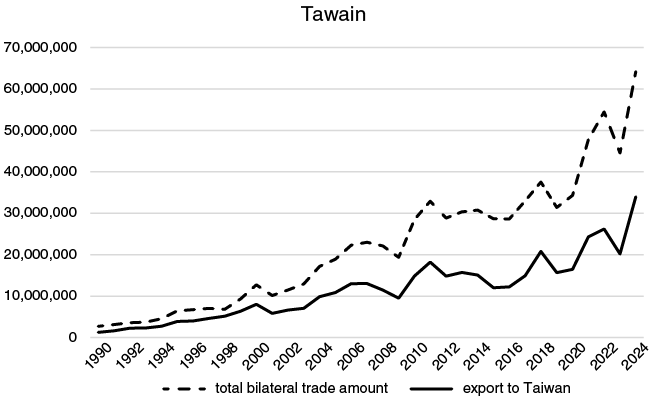
In conclusion, Taiwan severed the official ties with Korea along with the abolition of all official agreements, including the Aviation agreement and the Trade Agreement, after Seoul normalized its relationship with Beijing. However, the success of Korean cultural products and entertainers improved Korea’s national image in Taiwan, and the Taiwanese people’s interest in Korea and other Korean products mounted. With the increased public interest in Korea, the trade between the two countries and tourism soared. Realizing the changes along with the implicit public pressure, the Taiwanese government altered its policies and allowed direct flights between the two countries through the reinstatement of the Aviation Agreement. The Taiwan government also facilitated trade expansion via the Authorized Economic Operator Mutual Recognition Agreement. These policy changes constitute empirical evidence of soft power, even when assessed against the conventional definition of power. This shift in the Taiwanese government’s policy stance toward Korea following the Korean Wave in Taiwan demonstrates how soft power can be translated into tangible outcomes in international relations.
Case Study: Mexico
The contact between Korea and Mexico started with the immigration of 257 Korean families to Mexico for farming in 1905. Despite Korean farmers’ immigration to Mexico, the two countries did not establish a formal relationship until 1962, when the Korean government opened its embassy in Mexico. Although the two countries normalized the relationship and Korea opened its embassy in Mexico City, the Mexican government did not open its embassy in Seoul right away, as the two countries had minimal contact with no trade. It seems obvious that the Mexican government did not value Korea highly, and Korea was not known to the Mexican people at that time. In 1966, the two countries signed a trade agreement to facilitate trade, and Mexico began to export agricultural products and minerals such as lead, zinc, and copper.
However, trade between Korea and Mexico stayed low, and in 1972, the trade balance between the two countries even reversed, as Korea’s exports to Mexico exceeded Korea’s imports from Mexico for the first time. Since then, Mexico has experienced a trade deficit while the bilateral trade amount gradually increased. As the trade amount between the two countries slowly increased, although the trade amount between the two countries was still very low considering the size of both economies, the Mexican government opened its embassy in Seoul in 1978 without appointing the ambassador. The first Mexican ambassador to Korea was Cassio Luiselli, who was appointed in 1987, but he served in the post as a non-resident diplomat. At that time, the Mexican Ambassador to Japan held concurrently the position of the Mexican Ambassador to Korea (Kim et al. Reference Kim, Lee and Shin2016).
In 1989, the two governments signed an Agreement on Economic, Scientific, and Technical Cooperation. As the Korean economy took off, Korea wanted to amplify its trade with Mexico given the size of the population and the amount of natural resource reserved, and Mexico was interested in learning from Korea’s experience of economic development. With the agreement, Korea’s investment in Mexico began to rise, as Korean companies, including Samsung and Hyundai, invested in Mexico by building their production facilities in Tijuana, followed by LG and Daewoo opening their plants in Mexicali (Chenou Reference Chenou2021).
After the agreement, the trade amount between the two countries increased. For example, in 1987, prior to the agreement, the trade amount between the two countries was US$314 million. In 1992, after the agreement, the trade amount reached US$1.07 billion, almost a three-fold increase in five years (K-stat).Footnote 36 The bilateral relationship between the two countries started thriving in the 1990s thanks to the North American Free Trade Agreement (NAFTA) in 1994. NAFTA liberalized the Mexican economy and significantly heightened the value of Mexico as a gateway to the US market. In 1996, Mexican President Ernesto Zedillo visited Korea for the first time, opening the path for future high-level visits between the two countries.
Against this backdrop, Korean TV dramas were introduced to Mexico around this time. The first Korean drama to air in Mexico was “Star in My Heart” in 1998. Other TV dramas, including “All About Eve,” “Winter Sonata,” “My Name is Kim Sam-soon,” “Daejanggeum (Jewel in the Palace),” “Stairway to Heaven,” and “My Husband Got a Family,” followed. Among them, “Daejanggeum (Jewel in the Palace)” broadcast in 2009, and “My Husband Got a Family” in 2017, particularly enjoyed explosive popularity (KOFICE 2023; Min Reference Min, Yoon and Jin2017). In addition, there are many Korean TV dramas that were popular in Mexico in the 2010s, including “Boys Over Flowers,” I Hear Your Voice,” “Master’s Sun,” “Good Doctor,” “Secret Garden,” “Heirs,” “The K2,” and so on.
However, many of these dramas were not aired through Mexican TV networks. They became popular as the Mexican people accessed Korean TV dramas on the internet or via fansub communities (Kim et al. Reference Kim, Lee and Shin2016; Dettleff Reference Dettleff2018). In addition to TV dramas, the Korean animation “Pucca,” which aired in 2003, garnered national popularity among both children and adults. The animation was broadcast for ten years (KOFICE 2023). Recently, Korean TV dramas, such as “Guardian: The Great and Lonely God” and “Lovely Runner” were aired on Televisa Univision’s Canal 5, and “Familiar Wife,” “Mr. Queen,” and “Yumi’s Cells” were aired on Imagen Televisión. Streaming services, such as Vix and Netflix, also make access to Korean dramas easier than ever before. Moreover, streaming service ViX broadcasts Korean dramas dubbed in Spanish, facilitating the spread of Korean dramas (Cho Reference Cho2024).
However, what led the Korean Wave in Mexico has been K-pop. Ever since “Gangnam Style” by PSY became popular worldwide in 2012, many young Mexicans have become K-pop fans. Although PSY’s popularity was not sustained after “Gangnam Style,” other K-pop singers, such as Big Bang, 2NE1, CNBLUE, XIA, JYJ, Super Junior, TWICE, Stray Kids, Red Velvet, and so on, enjoyed popularity, contributing to the explosion of K-pop popularity in Mexico. With the growing technology and scale of social media and online streaming services‚ BTS and Blackpink led the Korean Wave around the world, including Mexico, in recent years. According to Son and Bae (Reference Son and Bae2016), K-pop obtained popularity in Mexico because many K-pop songs have similar rhythms to reggaeton, a Spanish dance music blending reggae and hip-hop music styles. In addition, Korean musicians’ dance appeals to the Mexican people, as it is different from Mexican musicians. Mexican musicians tend to be soloists, while Korean singers are mostly groups. Group dancing and singing may be heterogeneous to the Mexican audience, but they are unique and interesting (Son and Bae Reference Son and Bae2016).
The popularity of Korean cultural products increased the number of fans in Mexico. According to a report by the Korea Creative Content Agency, Mexican fans of the Korean Wave was approximately 28 million (Korea Creative Content Agency 2024). Given that the Mexico population is 130.9 million, approximately one in five people in Mexico is a K-pop fan, which is impressive. A large fanbase led to the birth of many fan clubs. In 2011, there were only twenty fan clubs of Korean entertainers in Mexico, but it increased to more than seventy today. There are three types of fan clubs: (1) artist-specific fan clubs, such as BTS Mexico Fanbase; (2) general K-pop fan communities, including Kpop Events Mexico, K-pop Zone Mexico, K-Nights, and Klub Seoul; and (3) region-based fan communities, such as Kpop fans Guadalajara/Jalisco. They often operate via social media, such as YouTube, Instagram, and Facebook. These fan clubs actively promote K-pop, holding charity events and dance competitions (Cho Reference Cho2024; Kim et al. Reference Kim, Lee and Shin2016).
Among K-pop singers, particularly BTS enjoys their explosive popularity in Mexico. For example, BTS scheduled three concerts in Mexico as part of their comeback world tour. Despite the large capacity of each concert site (more than 65,000), tickets were sold out almost instantly. Due to the high demand, Mexican President Claudia Sheinbaum sent a letter to South Korean President Lee Jae Myung to formally request that he help arrange more concerts of BTS in Mexico. In the letter, President Sheinbaum said that BTS is extremely popular in Mexico, and more than a million young people are vying for 150,000 concert tickets (Reuters 2026).
Spotify, one of the largest music streaming service providers in the world, writes about the Korean Wave in Mexico, “What sets Mexican fans apart? It’s not just the hours spent streaming – especially among Gen – but the way they live and breathe K-Pop. Devotees in Mexico organize, create, and celebrate. They fill concert venues, host themed events and bazaars, and build thriving communities. On social media, they’re a force – starting trends, supporting their idols, and spreading K-Pop culture far and wide. And they put their own spin on the movement, weaving Mexican culture into fan art, memes, and other creative content.”Footnote 37
The success of Korean cultural products led to an improved national image of Korea among the Mexican people. According to the National Image Report 2024 by the Ministry of Culture, Sports, and Tourism, which conducted an online survey of 500 people in Mexico, 83.6 percent of the survey respondents indicated a positive view of Korea. When they were asked what contributed to their favorable view of Korea, 52 percent mentioned cultural products. Moreover, 38 percent of the respondents indicated that their view of Korea changed positively thanks to Korean cultural products. When they were asked what comes to their mind when they think of Korea, 40.4 percent said K-pop, 22.4 percent picked Korean TV dramas and films, and 20.6 percent indicated Korean food, respectively (Ministry of Culture, Sports, and Tourism 2024). Due to the lack of data for Korea’s national image among the Mexican people prior to the Korean Wave, it is difficult to provide clear evidence of the enhancement of national image as a result of the Korean Wave. Nevertheless, the survey reveals improvement in Mexican people’s perception of Korea, considering that it took twenty-five years for the Mexican government to appoint its resident ambassador to Korea.
The improved national image led to the increase in trade between the two countries. In 1995, before the Korean Wave started in Mexico, the bilateral trade amount was approximately US$1.25 billion. With the Korean wave, the trade amount has continuously increased, reaching US$21 billion in 2024 (K-stat).Footnote 38 Mexican exports to Korea have surged more than 200 percent over the past decade, and Korea is Mexico’s fourth-largest trading partner, while Mexico is Korea’s largest trading partner in Latin America. While trade amount between the two countries sharply increased, Mexico’s trade deficit with Korea also went up. Thus, Mexico wants to resume negotiations of a free trade agreement with Korea that was stalled after a period of negotiation (Kim Reference Kim2025).
In an interview with a Korean newspaper in September 2025, Mexican Ambassador to Korea Carlos Penafiel Soto said, “Despite the lack of an FTA, the economic relationship between Mexico and Korea has expanded and diversified at an exponential pace. To further expand trade, the two governments need to strike FTA deal.” To this end, he proposed that Korean firms in Mexico further integrate with local businesses and establish Korean Chamber of Commerce and Investment in Mexico. According to him, these changes will be appealing to Mexico given that there are more than 2,000 Korean companies. He also hinted that since Mexican President Claudia Sheinbaum’s “Plan Mexico” focuses on high-tech sectors such as semiconductors, batteries and artificial intelligence (AI), the two countries can easily cooperate given Korean firms’ position in the area (Kim Reference Kim2025).
The annual increase in bilateral trade between the two countries and Korea’s exports to Mexico are described in Figure 4.
Korea’s total trade amount and exports to Mexico 1990–2024 (Unit: US$1,000)
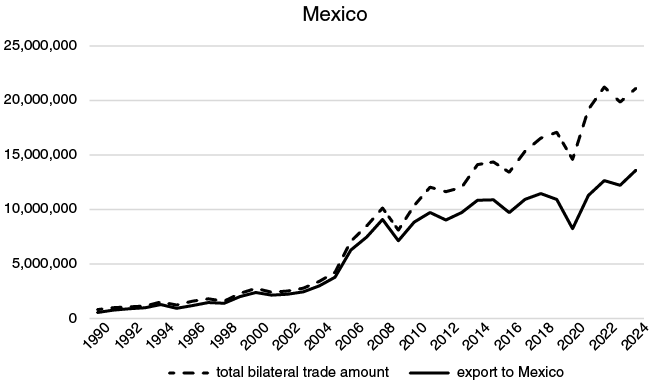
Another effect of the Korean Wave on Mexico is that Mexican tourist visits ascended. In 2009, the number of Mexican tourists who visited Korea was a mere 4,553, and only 80 Mexican students studied in Korea. In 2015, however, the numbers went up to 14,248 and 266, respectively (Son and Bae Reference Son and Bae2016). As the number of tourists increased, Aeromexico launched a direct flight between Mexico City and Incheon/Seoul in July 2017. It is the only Central or South American airline that has a direct flight between Mexico City and Asia except for China Southern Airline’s direct flight from Shenzhen to Mexico City. Although it suspended the flight due to the COVID-19 pandemic in 2020, the direct flight between Mexico City and Inchon/Seoul resumed in August 2024. Since then, the number of Mexican tourists visiting Korea went up. As of September 2025, Mexican visitors increased to 63,000 for the year.Footnote 39 With an increase in the number of Mexican tourists, the Korea Tourism Organization established a “Mexico K-Tourism Travel Mart” in Mexico City to attract tourists from other Latin American countries.
Although it is difficult to establish a direct causal relationship between the Korean Wave and Mexico’s policy changes, we can argue that the Korean Wave contributed to the Mexican government’s more favorable view of Korea given that the FTA negotiations have been stalled since 2008. The increasing popularity of Korean cultural products has coincided with the Mexican government’s enhanced willingness to pursue a free trade agreement with Korea compared to its earlier position.
Mexico’s other policy shift noticeable is its policy toward North Korea. Mexico and North Korea formalized diplomatic relations in 1980, and the relationship between the two countries expanded over time, with Mexico becoming North Korea’s largest trading partner in Latin America. Their relationship had been diplomatic but took a sharp turn in 2017, when the Mexican government expelled the North Korean ambassador, Kim Hyong-gil, following Pyongyang’s sixth nuclear test. This policy shift is surprising given that the Mexican government did not show this type of reaction for the previous five nuclear tests by Pyongyang in 2006, 2009, 2013, and twice in 2016. What triggered the shift in Mexico’s stance on the North Korean nuclear issue remains uncertain. There is no evidence to support a direct link between the Korean Wave in Mexico and the alteration of Mexico’s North Korea policy in 2017. Nevertheless, the temporal sequence of the growing prominence of Korean cultural products and entertainers in Mexico and the Mexican government policy shift on North Korea’s nuclear development may constitute circumstantial evidence of the effects of the Korean Wave on Mexico.
In conclusion, the trade amount between Mexico and Korea began to rise sharply in the 2010s, when the Korean Wave hit Mexico, as you can see in Figure 4. The Korean Wave in Mexico enhanced Korea’s national image, which in turn led to trade expansion and increased tourist visits. As a result, the Mexican government is more interested in signing an FTA with Korea compared to the past. Moreover, there is circumstantial evidence of Mexico’s policy shift toward North Korea, given the temporal convergence of the Korean Wave and Mexico’s reaction to North Korea’s nuclear test, as noted.
Overall, empirical evidence presented in this case study has a limit, as Mexico likely also wanted to increase its trade with Korea due to the benefits of trade. Moreover, there is no clear evidence of policy changes in Mexico led by the Korean Wave, including Mexico’s North Korea policy or any other foreign policies.
5 Conclusion and Discussion
Ever since Korean cultural products and entertainers became popular around the world, the so-called Korean Wave, there has been a plethora of studies on the Korean Wave. Many of them regarded the Korean Wave as Korea’s soft power. This is because the Korean Wave contributed to the enhancement of the Korean national image, and interest in Korea surged, leading to trade expansion.
However, the concept of soft power coined by Nye (Reference Nye1990b) has received a mixed response in the political science literature due to the lack of a clear definition and the difficulties with empirical tests embedded in the definition. The conventional definition of power involves having another nation do certain things (i.e., changing its policy) against its wish. By contrast, Nye’s soft power concept does not clearly involve policy changes. Instead, Nye’s soft power concept includes only getting (Reference Nye1990b: 166) “other countries to want what it wants,” and the outcome the power-sender nation wants to obtain through attraction instead of coercion or buying (Reference 79Nye2008: 94). A problem with this definition is that it is not clear what outcome the power-sender nation wants to achieve. Moreover, opponents of the soft power concept point out that soft power may not be possible without hard power aid.
Despite the debate in political science literature, studies on the Korean Wave took it for granted that the Korean Wave is Korea’s soft power. This is because most studies on the Korean Wave are done by scholars in communication, sociology, and cultural studies. There is a missing link between literature on the Korean Wave and soft power. To fill the gap in the literature, we explored whether the Korean Wave is Korea’s soft power in the context of debate on the soft power concept.
Opponents of the soft power concept contend that soft power is not real, as it is not possible without the support of hard power. Since Nye (Reference Nye1990a) used the United States as an example of soft power, they point out that US soft power is based on its hard power, given the size of the economy and the strength of the military. To make the soft power theory plausible, the evidence of soft power must be presented with a case of non-superpower nation. Moreover, considering the definition of power widely used in political science literature, there must be policy changes as an outcome of soft power. Since Korea is not a superpower, and the Korean Wave is widely considered its soft power, we developed a theoretical mechanism of soft power that is not supported by hard power and applied it to the Korean case.
The Korean Wave is a term that describes the explosive popularity of Korean cultural products and entertainers around the world. To provide background information, we described a brief history of the Korean Wave, including how it progressed and what made it possible. Since Korea was not known for the quality of cultural products, the discussion of the history of the Korean Wave presents insight on how cultural products of a non-superpower can be a nation’s soft power.
To empirical test whether the Korean Wave is Korea’s soft power, we applied our theoretical mechanism to the Korean case, including two case studies, the Korean Wave in Taiwan and Mexico. As expected, with the global popularity of Korean cultural products and entertainers, Korea’s national image has improved from a poor, divided country to an affluent society with cultural richness. An enhanced national image of Korea led to an increase in overall interest in Korea. These changes have given way to trade expansion, including amplified exports of diverse products, such as computer games, cosmetics, fashion products, food items, and so on. If generating these positive externalities, such as trade expansion and an increase in tourism, is the outcome Korea wants with the Korean Wave, the Korean Wave is indeed Korea’s soft power, according to Nye’s definition of soft power. The Korean case also provides empirical evidence that soft power can be produced without hard power support, as Korea is not a superpower and its national image was not attractive prior to the Korean Wave.
However, the conventional definition of power involves more than generating positive externalities. In fact, a common element contained in various conventional power concepts is having another nation change its policy against its wish, although Joseph Nye never included the power-receiver nation’s policy change in his definition of soft power. To provide empirical evidence of soft power based on the traditional concept of power, it is necessary to show policy changes resulted from the influence generated by soft power. To this end, we conducted two case studies: the Korean Wave in Taiwan and Mexico. Taiwan officially severed its ties with Korea in 1992 when Korea normalized its relationship with China. Given the close cooperation throughout the Cold War and the similar political circumstance of facing security threats from the communists, Taiwan felt severe betrayal. Taipei abolished all its agreements with Korea, including the aviation agreement and the trade agreement. Taipei made it clear that Taiwan had no interest in cooperation with Korea.
Despite the Taiwanese government’s adamant stance on Korea policy, as Korean cultural products and entertainers became popular in Taiwan, the number of Taiwanese visits to Korea increased, and the trade amount between the two countries mounted. As a result, it generated implicit pressure on the Taiwanese government to change its policies. As the pressure surges, the Taiwanese government could not ignore the implicit “public demand.” Thus, the Taiwanese government reinstated the aviation agreement and signed an Authorized Economic Operator Mutual Recognition Agreement with Korea to facilitate trade expansion. The Taiwan case provides empirical evidence of soft power without hard power support that led to policy changes of the power-receiver nation.
In contrast to the Taiwan case, the Mexican case is not clear-cut. The popularity of Korean cultural products, particularly K-pop, led to the enhanced national image of Korea, although we cannot present clear evidence due to the lack of data on the previous national image of Korea in Mexico. The number of Mexican fans of Korean cultural products and entertainers soared, and the trade amount skyrocketed. With the changes, the Mexican government wants to resume negotiations on a free trade agreement between the two countries, which was stalled for almost two decades after a period of negotiations (Kim Reference Kim2025).
If trade expansion and an increase in tourism are the outcomes Korea desires with the Korean Wave, Korea has soft power, according to Nye’s definition of soft power. However, Nye’s conceptualization of soft power does not fully align with conventional understandings of power due to the lack of the capacity to cause policy change. Accordingly, for soft power to qualify as power in the conventional sense, the outcome of soft power must extend beyond the enhancement of national image and trade expansion.
The fact that the Mexican government’s interest in signing an FTA with Korea and drastic changes in its policy toward North Korea’s nuclear development after Korean cultural products and entertainers became popular in Mexico may constitute evidence of soft power. However, correlation based on temporal coincidence or sequence does not mean direct causation. Thus, the temporal convergence presented in this study invites further scholarly inquiry into the potential effects of the Korean Wave on Mexico’s policy shift. Overall, it is not clear whether the Korean Wave led to these policy changes despite the circumstantial evidence.
In conclusion, soft power can be real and generated without the support of hard power, as we have shown with the case study of the Korean Wave in Taiwan. Nevertheless, we cannot make the same claim with a firm basis given the absence of clear and systematic evidence in the Mexican case.
Although this study presents some evidence of soft power, we must use the term “soft power” with caution, considering that Nye’s (Reference 79Nye2008) definition of soft power does not align with the conventional definition of power. It does not clearly require policy changes of the power-receiver nation as evidence of power wielding. Moreover, Nye’s (Reference 79Nye2008) power definition does not take into account the power-receiver nation’s will in the reckoning of power.
It is also not clear if soft power works like hard power. The evidence gathered in this study does not demonstrate that soft power will generate force like hard power. In fact, it is contrary. This may be attributed to the fact that the presented outcomes of Korea’s soft power, the Korean Wave and its effects, such as trade expansion, do not undermine the national interests of the soft power-receiver nation. By contrast, hard power can generate outcomes that adversely affect the national interests of the power-receiving nation. For instance, upon Washington’s request, Korea sent its troops to Iraq against the public opposition during the US invasion of Iraq in 2003.
Overall, findings of this study make significant theoretical contributions to literature and have policy implications. However, there are limits in the study as well. Due to the inherent difficulties of empirical testing of soft power generation and its effects, we have not been able to provide universal evidence on what conditions soft power works. Thus, it is desirable to have cross-validation of the findings, and further empirical inquiry is warranted to substantiate and refine the conclusions drawn in this study.
Acknowledgments
This work was supported by the Laboratory Program for Korean Studies of the Ministry of Education of the Republic of Korea and the Korean Studies Promotion Service at the Academy of Korean Studies (AKS-2023-LAB-2230001).
Kai He
Griffith University
Kai He is Professor of International Relations at Griffith University, Australia. He has authored or co-authored six books and edited or co-edited six volumes. Among his notable works are Institutional Balancing in the Asia Pacific (Routledge, 2009), China’s Crisis Behavior: Political Survival and Foreign Policy (Cambridge, 2016), and After Hedging (Cambridge Elements in International Relations in 2023).
Steve Chan
University of Colorado Boulder
Steve Chan is College Professor of Distinction (Emeritus) at the University of Colorado Boulder. His publications include twenty-five books and about two hundred articles and chapters. His most recent book is Culture, Economic Growth, and Interstate Power Shift: Implications for Competition between China and the United States (Cambridge University Press, 2024).
Rumi Aoyama
Waseda University
Rumi Aoyama is Professor at the Graduate School of Asia-Pacific Studies at Waseda University, and director of Waseda Institute of Contemporary Chinese Studies. Her publications include thirteen books and more than one hundred and fifty articles and chapters. Her book, Contemporary China’s Foreign Policy [Gendai chuugoku no gaikou] was honored with the 24th Masayoshi Ohira Foundation Memorial Prize.
Advisory Board
Amitav Acharya, American University
Dewi Fortuna Anwar, National Research and Innovation Agency (BRIN), Indonesia
Mely Caballero-Anthony, Nanyang Technological University
Rosemary Foot, University of Oxford
Evelyn Goh, Australian National University
Deborah Larson, University of California, Los Angeles
T.V. Paul, McGill University
Yan Xuetong, Tsinghua University
About the Series
Elements in Indo-Pacific Security publishes original and authoritative works on diverse security topics, encompassing not only traditional issues of war and peace but also emerging concerns such as space competition and climate change. It also explores interactions among actors within this region and between them and others beyond it.