


Introduction
The 2024 election season was filled with speculation about the shift of Black men from the Democratic Party to Republicanism, and more specifically to the ethos and ideologies of former President Donald Trump (King Reference King2024). There has been much hand-wringing about the loss of Black men in the Democratic Party and what that means for the future of Democratic candidates. This political moment raises questions about overwhelming Black American loyalties to a single party and a possible party realignment among Black voters. Those who are concerned about the potential shift of Black men from the Democratic party are curious as to why the shift is occurring and what issues, circumstances, and sources of news have led Black men, but not Black women, to potentially move away from Democratic party loyalty (Cox Reference Cox2024).
Twice in the past six election cycles, in 2000 and 2016, the Republican candidate won the Electoral college vote and, hence, the presidency, without winning the popular vote. These close elections on the national and even state levels have highlighted the slim margins of victory and the demographics of the groups who have assisted in the wins—and losses—for a particular political party (Campbell Reference Campbell2014). Because of recent close elections, the political behavior of Black men has become increasingly interesting to scholars and pundits alike (Carter Reference Carter2024). Although Black men are still slightly less likely to vote for the Democratic party compared to their Black female counterparts, they are exponentially more likely to vote for the Democratic party compared to all other racial and ethnic groups (Slaughter et al. 2023). However, in recent years, it appears that Black men are at least interested in entertaining the possibility of voting for the Republican party (Rigueur Reference Rigueur2016).
With the anticipated shift of Black men towards the Republican party, questions have arisen as to why the possible movement of Black men away from the Democratic party is occurring at this particular junction. To examine this problem, we ask what role does Black patriarchy play in support of Trump and conservatism. We offer a measure and theory of Black patriarchy to explore the extent to which a combination of hostile sexism and bootstrap racial uplift contributes to conservative ideology. We define Black patriarchy as the intersectional system of domination within Black communities where men, while experiencing the effects of racism and other forms of oppression, also exert power and privilege based on gender, often at the expense of Black women and those who do not conform to dominant gender norms. In turn, a version of hostile sexism contributes to the intersectional system of domination within Black communities.
We aim to explain whether or not Black men differ from Black women and other racial groups in how they consume their news. We begin by examining Black nationalism and counterpublics on African American political thought, spaces that are Black-governed and Black-led. Compared to Black women, Black men disproportionately use Black-led podcasts as counterpublics, spaces outside of mainstream consciousness to discuss issues internal to the Black community. By observing how varying trains of political thought are articulated in the twenty-first century, we can better ascertain the genesis of Black political information. We observe how Black-centered podcasts affect information dissemination to Black men and present a content analysis of popular podcasts catering to a Black male audience. The growing prevalence of podcasts as sources of political information for Black men serves as a focal point in helping listeners to develop, define, and/or reinforce political attitudes. The remainder of the article analyzes the Black Patriarchy Index (BPI). Although ideological diversity exists among Black men and Black women, both groups are still exponentially more likely to support the Democratic party when compared to other groups, regardless of their media consumption.
Gender Gap in Partisanship
Scholars of gender and American politics have long noted the gender gap in partisanship between women and men (Kaufmann Reference Kaufmann2006). It has been assumed that in each presidential election since 1964, a majority of all women have supported the Democratic candidate (Burden Reference Burden2008; Wirls Reference Wirls1986). However, subsequent analysis demonstrates that the changing politics of men actually accounts for the widening gap in partisanship (BoxSteffensmeier, De Boef, and Lin Reference Box-Steffensmeier, Boef and Lin2004; Chaney, Alvarez, and Nagler Reference Chaney, Alvarez and Nagler1998; Kaufmann and Petrocik Reference Kaufmann and Petrocik1999; Norrander Reference Norrander1999). Although there have been marginal changes in the partisanship of women, overtime, white men have become significantly more likely to identify as Republicans (Kaufmann Reference Kaufmann2006; Kaufmann Reference Kaufmann2002).
Recent scholarship in the field of race, ethnicity, and politics complicates our conventional understanding of the gender gap, by arguing that much of the difference in partisanship between men and women can be explained by the political incorporation of women of color into the electorate (Junn Reference Junn2016). The gender gap began to emerge at the same time as the passage of the 1964 Civil Rights Act and the subsequent 1965 Voting Rights Act. With this in mind, people of color were able to turn out to vote for the first time in many places. Jane Junn (Reference Junn2016) demonstrates that when analysis disaggregates white women from women of color, it reveals that women of color drive the gender gap in partisanship. In fact, since 1952, a majority of white women have supported the Democratic candidate for president in only two elections, in 1964 and 1996. Regarding women of color, Black women are a driving source of significant support for the Democratic party (Gillespie and Brown Reference Gillespie and Brown2019; Slaughter et al. 2023). It would follow, then, that the growing gap in partisanship between Black women and Black men may not be explained by the changing politics of Black women, but could be a result of an increase in conservatism among Black men.
If bell hooks is correct in her assertion that “Black males endure the worst impositions of gendered masculine patriarchal identity” (Reference Hooks2004; xii), that may explain the slowly growing increases in Black men in the Republican party and conservative rhetoric. As the GOP moves toward an isolationist policy that places white male supremacy as the primary ideological perspective to be protected and upheld, more voters of color are susceptible to the “us versus them” rhetoric that seeks to maintain control of an increasingly diversifying electorate. “Conservatives and radicals alike seem to be better at talking about the plight of the Black male than they are naming strategies of resistance that would offer hope and meaningful alternatives” (Hooks Reference Hooks2004, xv), which may explain why a small but seemingly growing percentage of Black men possibly vote for Republican candidates who are inherently against collective action and collective uplift of marginalized groups by and large.
A significant majority of Black women and men appear to be immune to the Republican party platform that highlights naked white supremacy, anti-Black racism, patriarchy, and capitalism (Slaughter et al. 2023). However, all other racial and ethnic groups have significant percentages of their electorate identifying with the Republican party. If indeed Black men are slowly moving toward the right, we must note how Black men consume information in different public spaces than those occupied by Black women (Harris-Lacewell Reference Harris-Lacewell2011). We must also carefully examine how race and gender affect how political scientists analyze contemporary Black politics (Alexander-Floyd Reference Alexander-Floyd2007).
Unlike Black women, Black men are not beholden to the Democratic party at the same rates. Although Black men still consistently vote overwhelmingly for the Democratic party candidate, compared to other racial and ethnic groups, they do so at rates roughly 5-7 percentage points less than their Black female counterparts who tend to vote for the Democratic party candidate at rates of roughly 94% (Slaughter et al. 2023). However, Democratic party membership for Blacks is not a default, party selection is a choice (Rigueur Reference Rigueur2016). Although ideology is quite diverse within the Black voting electorate, modern-day party identification rests largely with Democrats due to Republican stances that are perceived as racist, anti-Black, and non-inclusive (Frymer Reference Frymer1999; West Reference West2018). Black membership in the Republican party has steadily decreased over the last half of a century. However, there are indications that Black men are intrigued or at least open to Black Republican conservative ideas and policies. Black Republican conservatism was rooted in 19th-century mores of respectability: protestant work ethic, self-help, personal responsibility, morality, and political involvement (Rigueur Reference Rigueur2016). As preliminary polls and even more anecdotes imply that Black men are moving toward the Republican party, the idea of respectability and self-help politics is once again at the forefront of Black ideological debates (Carter Reference Carter2024; Jefferson Reference Jefferson2023).
New Black Nationalism
The Million Man MarchFootnote 1 was the brainchild of Minister Louis Farrakhan, leader of the Nation of Islam, who convened an estimated 850,000 African American men from across the United States at the National Mall in Washington, D.C. The march was organized by the National African American Leadership Summit and a number of other groups as a response to the Republican-controlled Congress and the conservative-leaning inclinations of Democratic President Bill Clinton. On October 16, 1995, the rally was one of the largest demonstrations in Washington history. Just as the original March on Washington in 1963 was intended to address the issue of jobs and freedom for African Americans, the purpose of the Million Man March was to celebrate family unity and racial and religious harmony. Other issues were of import as well, ranging from abortion, capital punishment, and health care to education, welfare, and Social Security reform, and substance abuse prevention. The organizers of the march also expressed a desire to change the negative imagery of Black men in American society in the wake of the OJ Simpson trial and Mike Tyson’s rape conviction.
The march brought together a diverse group of speakers who addressed the crowd for roughly twelve hours with addresses from Jesse Jackson, Rosa Parks, Cornel West, Maya Angelou, and Martin Luther King, III. However, the display of Black unity and uplift was not universally praised by all. For example, civil rights legend Congressman John Lewis chose to skip the march citing Farrakhan’s history of racist, sexist, and divisive language.Footnote 2 Even though diverse political ideologies exist within the African American electorate, African Americans have consistently served as one of the remaining solidified partisan voting blocs. Because of this, there is an assumption that the overwhelming Black Democratic voting public is comprised of a liberal Black ideology. As Dawson (Reference Dawson2001) notes, a more nuanced understanding suggests a “separatist-assimilationist” ideological divide exists. The ideological divides within the African American electorate have been, in many ways, hiding in plain sight. The determinants of African American preferences and behavior are influenced by diverse Black ideologies (Dawson, Reference Dawson2001). More specifically, Dawson (Reference Dawson2001) claims the media are complicit in homogenizing the opinions of citizens, which dull the nuance of debate, critique, and participation (Habermas Reference Habermas1989; Zizek Reference Žižek1994). Additionally, there are ways that Black nationalism mimics white nationalism in its dominant masculine approach, thus presenting a potentially troubling view of Black politics as Black men consume ideologies that are counterproductive to the overall uplift of Black people and lean toward a cultural nationalism that by and large excludes and demonizes Black women and upholds a particular brand of hegemonic (white) cultural nationalism (Alexander-Floyd Reference Alexander-Floyd2007).
Dawson (Reference Dawson2001) argues that it is “incorrect to assume that a single ideology operates within societies heterogeneous populations have multiple public spheres” (Reference Dawson2001; 50–51). These public spheres give individuals the space to develop ideas counter to the dominant and mainstream narrative of the group, and this ideological diversity may sometimes conflict or diverge from overall perceived group interests.
Dawson (Reference Dawson2001) and Harris-Lacewell (Reference Harris-Lacewell2004) offer us several distinct Black ideologies that capture the breadth of Black political thought. These ideologies coalesce around some variants of Black Liberalism, Black Nationalism, Black Feminism, and Black Conservatism. Black Liberalism is characterized by a form of critique of the racism in American society along with the simultaneous belief that America can live up to its values of freedom and justice (Dawson Reference Dawson2001; Harris-Lacewell Reference Harris-Lacewell2004). Black Nationalism, on the other hand, adheres to a separatist ideology that seeks for African Americans to separate politically and economically from white America. Black Feminism combines antiracism and antisexism to combat both patriarchy and white supremacy. Finally, Black Conservatism is characterized by a reliance on self-help and economic development as the primary tools to lead to bootstrap racial uplift. We suggest that contemporary manifestations of Black Patriarchy combine Black Nationalism and Black Conservatism, manifesting themselves in relatively new Black counterpublics within podcasts. In this paper, we examine the tensions and convergences between these ideologies that lend themselves to distinct political preferences by Black women and Black men.
Black Counterpublics
Black counterpublics are spaces outside of mainstream consciousness where Black people can talk about issues internal to the Black community. Traditionally, in the Black community, Black churches, barbershops, and beauty salons are spaces where people come together to discuss politics and daily life (Harris-Lacewell Reference Harris-Lacewell2011). Dawson (Reference Dawson2001) argues that the most important organization that has been historically tied to the Black counterpublic has been the Black church (Higginbotham Reference Higginbotham1993). The Black church is an instrumental counterpublic for developing ideas and dialogues among Black congregants and often serves as spaces to build necessary resources for politics. However, as more Black Americans, and Americans writ large, move away from regularly attending church (or other religious institutions), Black people find other spaces to gather and exchange ideas and opinions (Rotolo Reference Rotolo2021).
In the twenty-first century, a new Black counterpublic has emerged. The use of podcasts and the space they provide for current political and racial discourse serve as an extension of Harris-Lacewell’s (Reference Harris-Lacewell2004) theory of “everyday citizen talk.” The foundation of much of the Black ideological traditions has been shaped by oral tradition (Henry Reference Henry1990). Therefore, podcasts and radio programs geared toward Black political, economic, and social interests serve as a medium that continues the long-standing communication tradition within Black spheres. If the American tradition has been to provide the space for citizens to cultivate democratic attitudes and actions through conversation, then the Black counterpublic provides a unique racialized space for Black men to, directly and indirectly, discuss political systems (de Tocqueville Reference de Tocqueville1835; Mansbridge Reference Mansbridge1999; Putnam Reference Putnam2000). In many ways, the counterpublic allows citizens to make sense of the political world around them, dissect issues of personal import, and help one attempt to answer questions public opinion leaves unresolved (Gamson Reference Gamson1992; Harris-Lacewell Reference Harris-Lacewell2004).
For Black Americans, politics is not something that is hypothetical or somehow removed from their daily lives and lived experiences (Kelley Reference Kelley1994). The emergence of radio programs and podcasts serves as distinct information network settings that provide a place and space for Black people to engage in dialogue to discuss ideas within their group. Indeed, several different types of Black counterpublics provide a myriad of diverse ideas and ideological perspectives. Currently, Black podcasts serve an important function similar to diverse Black news media, literature, music, and movies in that they provide a space and give voice to varying facets of Black American life encompassing the “controversial, problematic, subjective, or distressing” (Harris-Lacewell Reference Harris-Lacewell2004, 9). Black media has historically provided an authentic space for the exchange of diverse Black ideas. This separate Black sphere has always existed to support Black attitudes that differed from their non-Black counterparts and provide a place for the array of Black intellectual perspectives.
Podcasts as Everyday Talk
Harris-Lacewell’s (Reference Harris-Lacewell2004) theory of everyday talk helps us understand the power of podcasts within the Black community and their ability to affect Black participation in a host of conversations. These interactions allow for the adjustment and a certain level of fluidity to one’s attitudes and opinions depending on the arguments being made (Reference Harris-Lacewell2004). A single ideology does not exist within the Black electorate or the Black populous. Harris-Lacewell argues that Black political ideologies serve the goal of “interpreting truth, reducing complexity, linking individual experiences to group narratives, identifying friends and foes, defining what is desirable, and providing a range of strategies for achieving desired outcomes” (Reference Harris-Lacewell2004;17). We must observe the sources of information and ideology building to understand better the political leanings of Black men in the electorate.
We argue that Black podcasts offer a virtual space that serves as a relatively new Black counterpublic. “The conversational nature of these podcasts and their use of Black American cultural commonplaces, combined with the intimate qualities of radio-style audio, reproduce a sense of being in Black social spaces such as the barber/beauty shop or church” (Florini Reference Florini2019). People regularly tune in to hear commentary on pop culture, music, and politics. For Black men, some of the most widely listened to podcasts include The Joe Budden Podcast, Off the Record with DJ Akademiks, Fresh & Fit, and The Breakfast Club to name a few.Footnote 3 In 2024, Edison Research named The Joe Budden Podcast among the top 10 podcasts among Black listeners. Many of these podcasts are in conversation with one another directly and indirectly. The hosts come onto one another’s shows as guests, and they share heavily overlapping audiences (Florini Reference Florini2019).
In recent years, these largely Black male podcasts have also become increasingly explicitly political. The Breakfast Club has been referred to as a required stop for presidential candidates (Resnick and Tani Reference Resnick and Tani2019). While many of these shows engage with Democratic Party candidates, in 2023 DJ Akademiks announced his endorsement of Donald Trump in an interview for another show. Recent research finds that survey respondents who reported consuming large amounts of podcasts also reported higher levels of personalized politics (Bratcher Reference Bratcher2022). Also, people tend to seek out podcasts that align with their pre-existing political beliefs (Kim and Wang Reference Kim, Kim and Wang2016). With that in mind, people often receive selective exposure to political information through podcasts and do not listen to podcasts that contradict their beliefs.
Podcasts and Echo Chambers
Along with the proliferation of choices within the media, some expected that increased media choices would lead to a better-informed mass public (Bennet and Iyengar Reference Bennett and Iyengar2008). Instead, research finds that an increase in media outlets has actually allowed the mass public to become less politically informed (Prior Reference Prior2007). It has become increasingly easy to disengage from political information altogether, or instead only pay attention to news that confirms pre-existing beliefs (Gerbaudo Reference Gerbaudo2018; Guess, Nylan and Reifler Reference Guess, Nyhan and Reifler2020). People have progressively turned their attention away from traditional news sources towards entertainment (Prior Reference Prior2005). In recent years, the lines between entertainment and news have become blurred (Sunstein Reference Sunstein2018).
As the number of choices that people have to consume information has increased, so too has the advent of echo chambers (Bennet and Iyengar Reference Bennett and Iyengar2008). Even in the face of factual scientific information, directionally motivated reasoning enables people to disregard new information that does not align with their existing beliefs (Druckman and McGrath Reference Druckman and McGrath2019). Essentially, the media that people consume often reinforces their existing political beliefs.
Within the Black community, Black male-led podcasts have extensive influence. Demonstrated in Table 1, these podcasts have millions of subscribers and play a role in shaping the internal political discourse within the Black community. As much as these podcasts shape the ways that Black people talk about politics, they also reflect what those kitchen table conversations look like to a broader audience. We examine the content of a sample of podcast episodes to better understand how Black podcasters talk about politics, which provides insights into how Black people, specifically Black men, engage in these conversations.
Black male-led podcast news sources

Source: YouTube as of March 2024.
Theoretical Expectations
We theorize that Black men, in particular, use podcasts to deliver and receive messages of Black patriarch and political information and engage in political discussions. We expect that podcasts led by Black men embed messages of Black patriarchy in their commentary, which, in turn, is associated with Black male voters’ slight shift into the Republican party, which is historically more socially conservative than the Democratic Party. To that effect, we have three hypotheses:
H1: Black male podcasts spend significantly more time discussing Donald Trump than Joe Biden and Kamala Harris.
H2: Black patriarchy is more prevalent among Black men than Black women.
H3a: Black men with higher levels of Black patriarchy will exhibit greater support for Donald Trump and are more likely to identify as conservative.
H3b: Black men with higher levels of Black patriarchy are less likely to vote for Biden relative to Trump in 2020, but are equally likely to turnout.
Black Patriarchy Index
Our content analysis of Black male podcasts informs our construction of the BPI. We develop an 11-item measure of Black Patriarchy to characterize the nuanced and nouveaux form of twenty-first century Black Patriarchy espoused in non-traditional news media sources like social media (i.e. Twitter, Facebook, Instagram, YouTube), satellite radio, specialized news sources, or discussions in Black male echo chambers. This measure captures three aspects of Black patriarchy: (1) the grievances expressed by Black men that highlight the perception that Black women’s issues receive greater attention, low intersectional solidarity, (2) hostile sexism, and (3) bootstrap racial uplift.
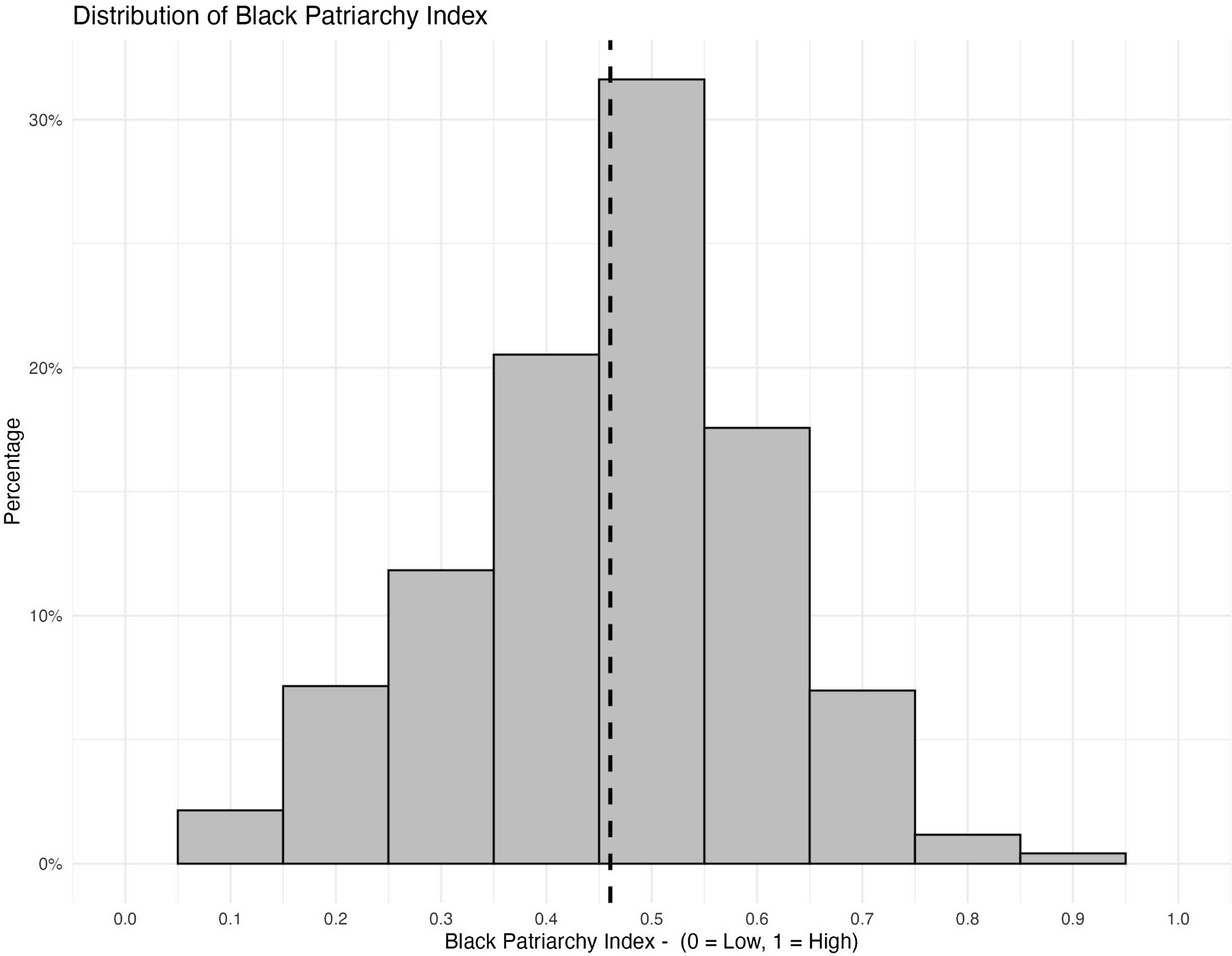
The BPI includes several components, which are shown in Table 2. The first three items of the BPI include measures of Black self-help, Black self-reliance, and new Black nationalism (Brown and Shaw 2002), which we refer to as the bootstrap racial uplift subscale.Footnote 4 The second items are drawn from the intersectional solidarity index, which ascertains how much concern is expressed over another relative group’s struggles (Crowder Reference Crowder2023; Crowder and Smith Reference Crowder and Smith2020), which we refer to as intersectional solidarity. Finally, the remaining items are drawn from the hostile sexism subscale of the ambivalent sexism inventory (Glick and Fiske Reference Glick and Fiske2001).Footnote 5 We argue that the combination of hostile sexism, intersectional solidarity, and Black nationalism best captures the “everyday talk” of non-traditional news outlets’ messaging toward Black men specifically (Harris-Lacewell Reference Harris-Lacewell2004). Together, these 11 items are internally reliable with a high internal consistency (Cronbach’s alpha = 0.72), indicating that the items reliably measure related underlying constructs, though they represent distinct yet interconnected dimensions. The moderate alpha supports the coherence of the overall scale while also affirming the presence of meaningful subdimensions within the broader construct. The BPI items were selected since these three subscales capture the essence of Black males’ orientation to conservative political thought through their relationship with women, views towards economic opportunity, and lack of concern for the plight of Black women; in addition, these items mirror content included in the Joe Budden podcast. The 11-item BPI is normally distributed among Black respondents as shown in Figure 1.
Black Patriarchy Index
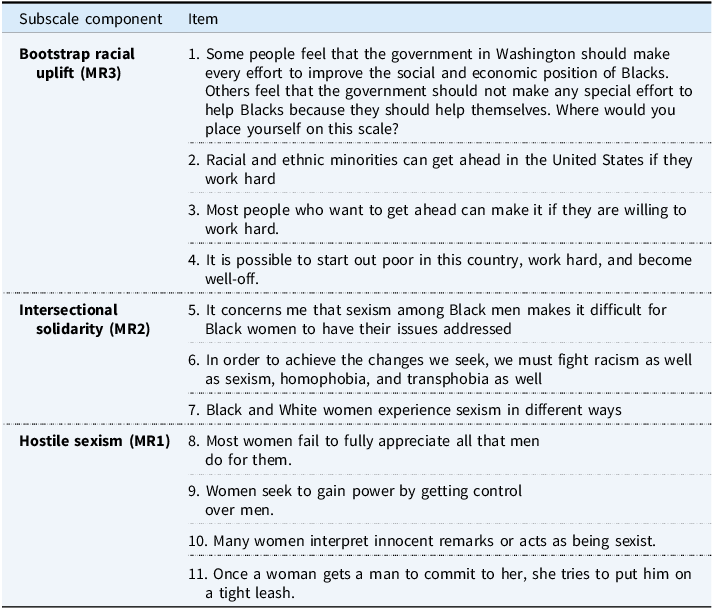
Note: Item 1 1= Government Should Help Blacks, 7 = Blacks should help themselves (rescaled to 0-1). Strongly agree to strongly disagree for items 2–11.
Distribution of the Black Patriarchy Index.

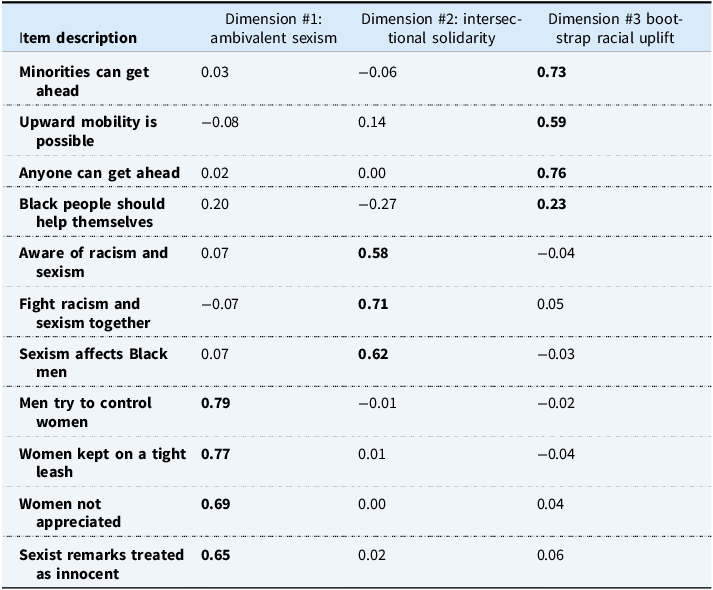
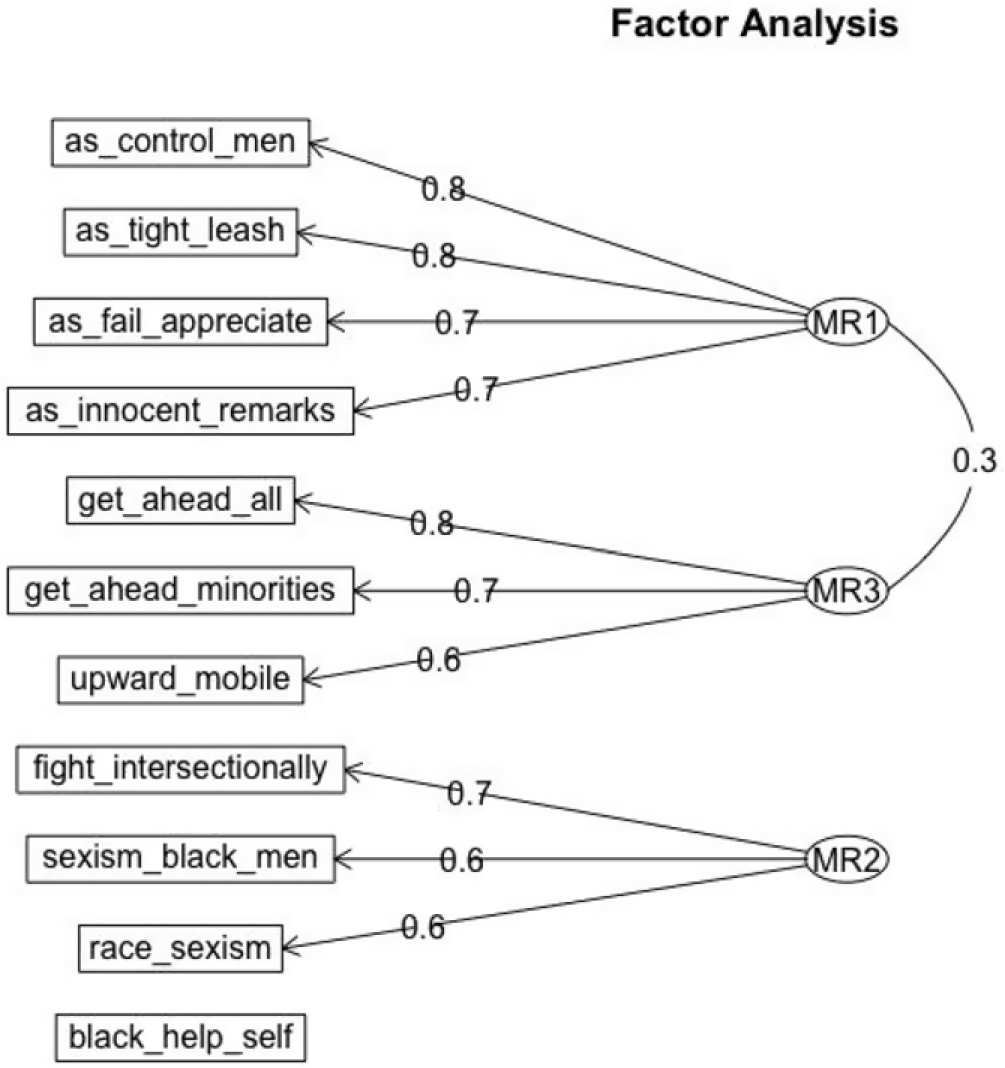
Specifically, the BPI factor structure identifies three interpretable domains: ambivalent sexism (MR1), intersectional solidarity (MR2), and bootstrap racial uplift (MR3) as shown in Table 3. The results of a factor analysis using pro-max oblique rotation in Table 3 reveal that the three theorized components of the BPI are present. The first factor “Bootstrap racial uplift” corresponds to beliefs about mobility and opportunity, and the ability of minorities to succeed in society. Note that the Black help self-item is omitted from Bootstrap Racial uplift factor and included in the intersectional solidarity subscale, which is due to the conservative threshold for the factor structure, which cuts off a 0.3, but this is due to the item weakly loading onto two factors (see Table 3). The third factor is items from the ambivalent sexism inventory, hostile, and benevolent sexism subscale, which reflect gender-based perceptions of sexism and gender role expectations (Glick and Fiske 2011). These items focus on the nuances in the relationship between men and women. The high loadings of these items onto this construct indicate that the perceptions of interactions between men and women are a latent factor. The first and third factors are correlated, indicating that these items share variance. Ultimately, this suggests that perceptions of gender role expectations are related to beliefs about upward mobility, potentially through attitudes about fairness or structural barriers to male advancement. The second factor describes intersectional and structural disadvantage, as well as solidarity. These items emphasize the interconnectedness of racial and gender-based oppression. The intersectional awareness around issues facing the Black community, including Black women, requires mutual support (Crowder Reference Crowder2025). MR2 is the intersectional solidarity index. The factor structure is presented in Table 3. Figure A1 in the appendix includes a scree plot analysis.
Factor structure of Black Patriarchy Index

The BPI is distinct from paternalism or Black nationalism and racial resentment, which are somewhat related constructs on the dominance of one group over another.Footnote 6 The BPI and the racial resentment scale are positively correlated (r = 0.55), indicating a moderate positive relationship between the two constructs. Individuals who score higher on the BPI will also tend to exhibit greater racial resentment. However, these correlations indicate that racial and gendered attitudes are mutually reinforcing and raise questions about how conservative political attitudes undermine racial attitudes.
Data and Methods
To examine our theory and its subsequent hypotheses, we rely on the Joe Budden Podcast (JBP) content analysis along with the 2020 Collaborative Multiracial Post-election Study (CMPS). Using an AI-powered YouTube transcript generator, we generated transcripts for 712 episodes of the Joe Budden Podcast. The JBP is a podcast dedicated to discussing music and culture. It began in February of 2015, and throughout its tenure, the podcasters often take up conversations surrounding politics. The episodes we analyze range from the start date of February 2015 to April 2024. This period of time encompasses 2 years of the Obama administration, 4 years of Donald Trump’s presidency as well as almost 4 years of the Biden presidency. Next, we analyze the text using the “quanteda” package in R to determine the political nature of their conversations (See Tables 4–6).Footnote 7
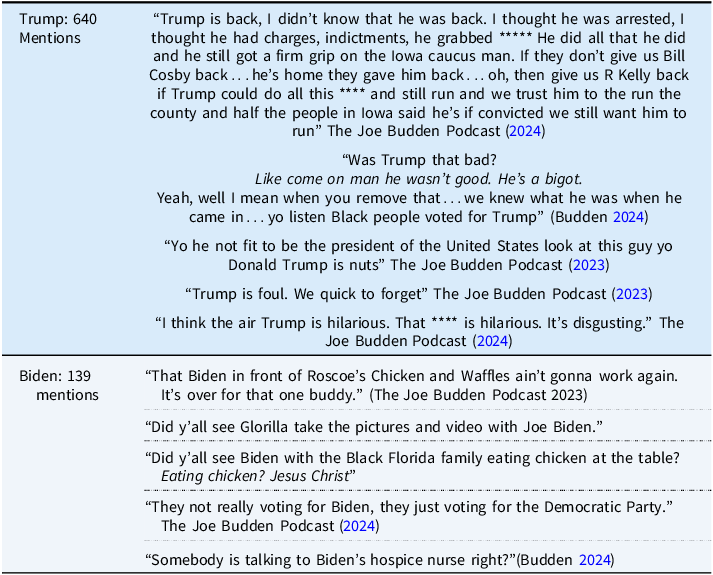
Joe Budden podcast content analysis

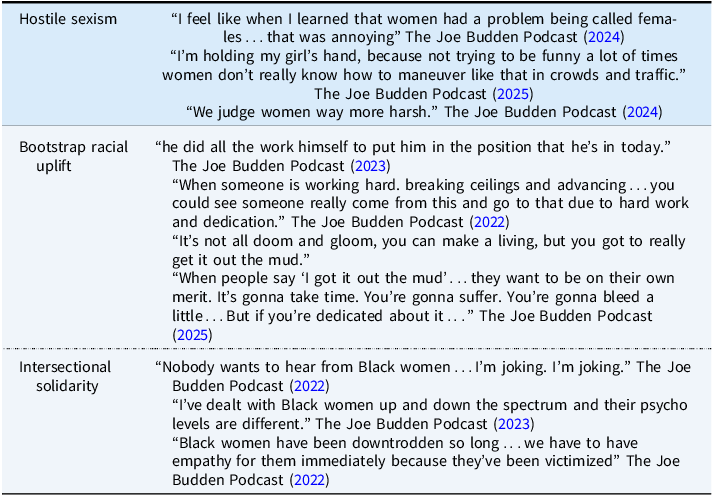
Podcast examples of components of the Black Patriarchy Index

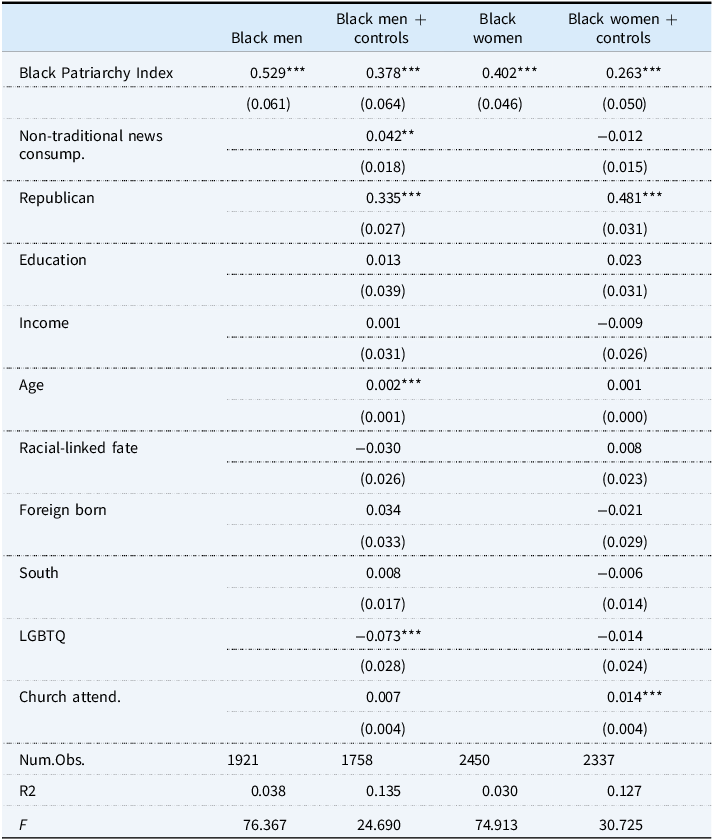
Predictors of conservatism among Black men and Black women

Note: * = 0.1, ** = 0.05, *** = 0.01 2020 CMPS | Black respondents only = 4371 | Data are weighted to fall within the margin of error of the adult population in the 2019 ACS 1-year data file for age, gender, education, nativity, and ancestry.
We supplement our content analysis with observational survey analysis. The 2020 CMPS is an online self-administered survey conducted from April 2, 2021 to October 4, 2021.Footnote 8 The survey boasts over 17,556 respondents. We restrict our analysis to African Americans, with 4,396 Black respondents, including 1,921 Black men. The data include registered and non-registered voters, as well as non-citizens. The full data are weighted to match the adult population in the 2019 ACS 1-year data file for age, gender, education, and nativity. The CMPS measures of Black racial attitudes, media consumption, ideology, political attitudes, and voting behavior.
Each regression includes relevant control variables in addition to the role of the BPI in explaining conservative political identity, voter turnout, and Biden vote choice. We account for political ideology through a Republican indicator, a strong partisanship indicator, and Fox News as the primary news source. For racial attitudes, we include a measure of racial-linked fate. Racial-linked fate is associated with Democratic party identification. For gender attitudes, we include a gendered linked fate measure modeled after the racial-linked fate question. For demographic indicators, included are education (1 = college degree), income (1 = $70,000+), age (1 = 65+), foreign-born status, residence in the south, LGBTQ, church attendance, evangelical, and Protestant religious affiliation. Religion is associated with increased conservative identity for Black Americans (Lewis Reference Lewis2005). In addition, Black ethnics are more persuaded by conservative politics (Greer Reference Greer2013).Footnote 9
Content Analysis of Black Male Podcasts
We examine 712 episodes of The JBP to determine the political nature and content of Black male podcasts in Tables 4 and 5. Within these 712 episodes, Donald Trump is discussed extensively, with 640 mentions. Most references to Trump are negative and allude to his indictments and criminal charges. One podcaster states, “Trump is foul. We quick to forget,” However, there are also discussions of reasons that some Black people support his candidacy. Overall, the general sense is that Black people do not think he is fit to run the country. However, they do see a path to the White House for Trump.
When it comes to Biden, there are 139 mentions of his name. Most of the recent discussion of Biden is related to the ways that he panders to Black audiences. Whether he is taking pictures with rapper Glorilla or eating chicken with a Black family in Florida, the podcast hosts are unenthused by these symbolic gestures. One host says, “That Biden in front of Roscoe’s Chicken and Waffles ain’t gonna work again. It’s over for that one, buddy.” This conversation illuminates how Black people are tired of candidates providing lip service when it comes to Black interests. The podcast hosts also discuss how Black people vote for the Democratic Party, not Biden specifically.Footnote 10 These discussions are reflective of some of the ways that Black people talk about politics in everyday conversation (Harris-Lacewell Reference Harris-Lacewell2004).
When it comes to voting, though the word “vote” was mentioned 409 times, many of the mentions of “vote” relate to music like voting for the Grammys; however, it is mentioned in an electoral context. For example:
“I’m starting to hear…hey when vote time come if we could vote I’m voting for Trump…I hate that…and I think it’s because Trump was cutting checks.”
“He [Biden] better get some shoes fam. He straight told y’all if you do not vote for him you’re not Black.” Footnote 11
These comments reflect the internal conflicts and balancing that occurs when weighing partisan constraints against racial constraints within the Black community regarding vote choice (White and Laird Reference White and Laird2020). On the one hand, Black voters, like all voters, vote retrospectively regarding the economy (Healy and Malhotra Reference Healy and Malhotra2013). On the other hand, Black vote choice is largely predicated on racial group identity as the primary factor (Dawson Reference Dawson1994). The podcast quotes are evidence for our first hypothesis that when Black male-led podcasts discuss politics and voting, they emphasize Republicans more than Democrats. Importantly, while one interpretation may relate to Black patriarchy, it could also reflect Trump’s unique ability to attract attention, both positive and negative.
The Joe Budden Podcast also offers external validity for the components of the BPI. Hostile sexism and bootstrap racial uplift are common aspects of their discussions. Hostile sexism is present in their discussion of women and how the male hosts speak to the only woman on the panel. They often ask if the woman host, Melissa Ford, intentionally misunderstands the male perspective. Also, the male hosts make broad generalizations about women in terms of their abilities and when it comes to their romantic lives. When it comes to bootstrap racial uplift, notions of hard work and doing it on your own are common. The hosts often mention “getting it out the mud.” “Get it out the mud” is a slang term that refers to building work from the ground up. It echoes sentiments of the American creed and the notion that if people work hard enough, they can achieve success. When it comes to intersectional solidarity, references to Black women are mixed. Often, the hosts jokingly reference Black women in negative ways. For example, in one episode, they state, “Nobody wants to hear from Black women…I’m joking. I’m joking.” On the other hand, there are genuine efforts made to empower Black women and implore their listeners to “Protect Black women.” Taken together, the contents of these conversations inform our understanding of Black patriarchy and the construction of the BPI.
Findings: Political Ideology, Candidate Favorability, and Vote Choice
Having established that the BPI is internally consistent, comprising three subscales, and externally valid—evident in the podcast content, we then examine the implications of the BPI for Black men’ s political behavior. We examine three outcomes of interest: political ideology, candidate favorability, and vote choice. In the 2020 CMPS, 56% are democrats (40% as strong democrats), 13% identify as Republican (with 5% as strong Republican), and 31% are independent. Black men are less identified as strong Democrats relative to Black women. A majority of Black women (72%) are Democrats with 54% as strong Democrats, 20% identify as Independent, and only 4% of Black women are Republicans. Black men are most likely to be moderate (38%), followed by liberal (35%) and then conservative (16%). Black women are similar, and the plurality are moderate, and there is a conservative minority. Even though partisanship is a potent force in American politics, we find that most Black male Republicans supported Biden (59%). Among Black male independents, 20% voted for Trump, and 62% voted for Biden. Black women’s voting patterns show stronger support for the Democratic candidates. Black women also express greater warmth towards democrats. Black men show relatively higher, but limited, support for Republicans, which is not the case for Black women voters.
Findings
Black Patriarchy by Gender
Black men score higher on the BPI than Black women (mean = 0.50 vs. 0.42, p < 0.01). Across components, they exhibit greater hostile sexism (0.56 vs. 0.41), intersectional solidarity (0.29 vs. 0.24), and support for bootstrap racial uplift (0.60 vs. 0.56), all significant at p < 0.01.
Predictors of BPI among Black Men
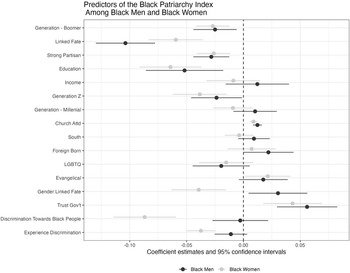
In Figure 2, we assess the factors that contribute to BPI—defined as a preference for bootstrap racial uplift, low intersectional solidarity, and hostile sexism towards women. The regression model includes racial and gendered attitudes that have explained opinion formation including demographics. The results indicate that Black men and women share similar predictors of high BPI scores. Greater levels of racial-linked fate, perceptions of discrimination towards Black people, and trust in government are predictors of Black patriarchy for both Black men and Black women. Black men and women who attend church have slightly higher BPI than those who do not.
Predictors of Black Patriarchy Index among Black men and Black women.
Note: OLS regression coefficients with 95% confidence intervals. 2020 CMPS | Black respondents only

However, some predictors of the BPI are distinct for Black men. Black men who perceive discrimination towards Black men have higher levels of BPI compared to Black women who perceive discrimination towards Black women. Black male weak partisans—both Republican and Democrat—have higher BPI scores relative to strong partisans. These findings indicate that Black patriarchy is not simply a measure of conservatism, nor does it duplicate the measurement of linked fate among Black men. BPI captures a distinct ideology. Black men with lower levels of linked fate, higher perceived racial discrimination, and consumers of Fox News have higher BPI. This confirms the second hypothesis (H2) that Black men have a more prevalent BPI compared to Black women.
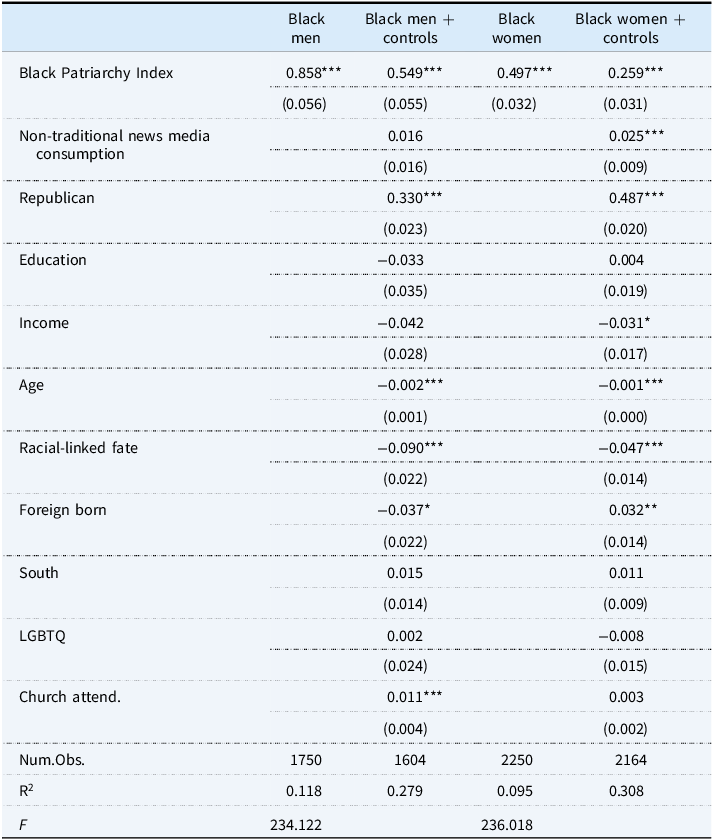
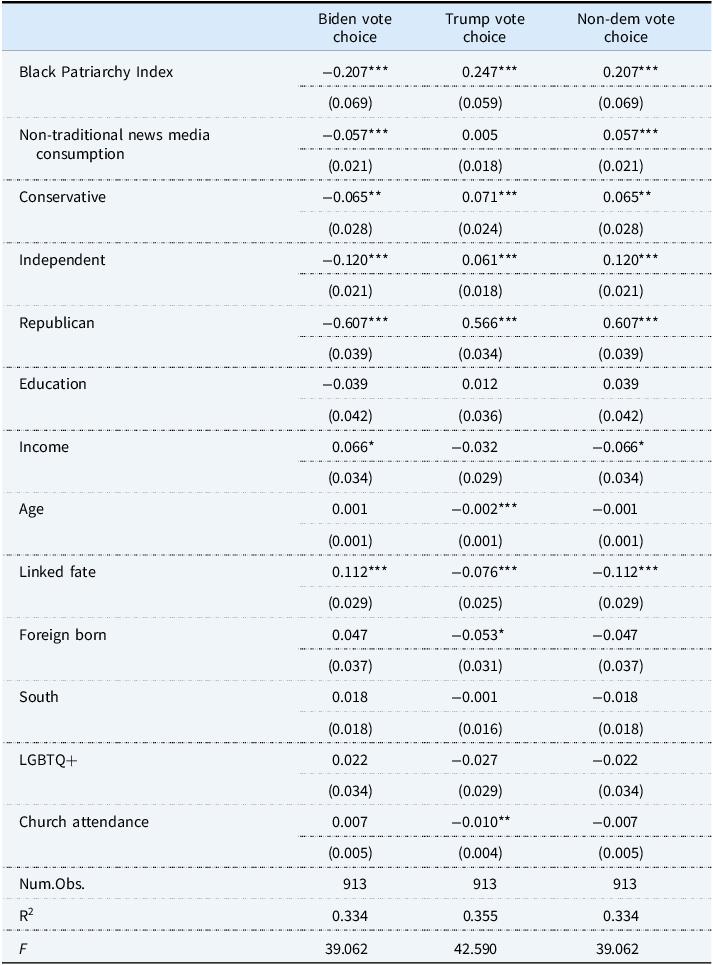
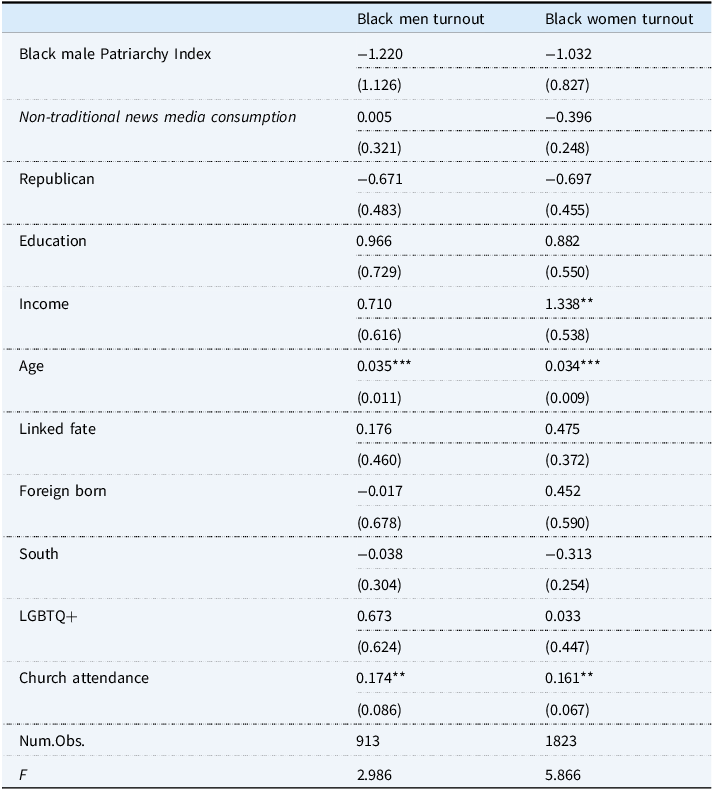
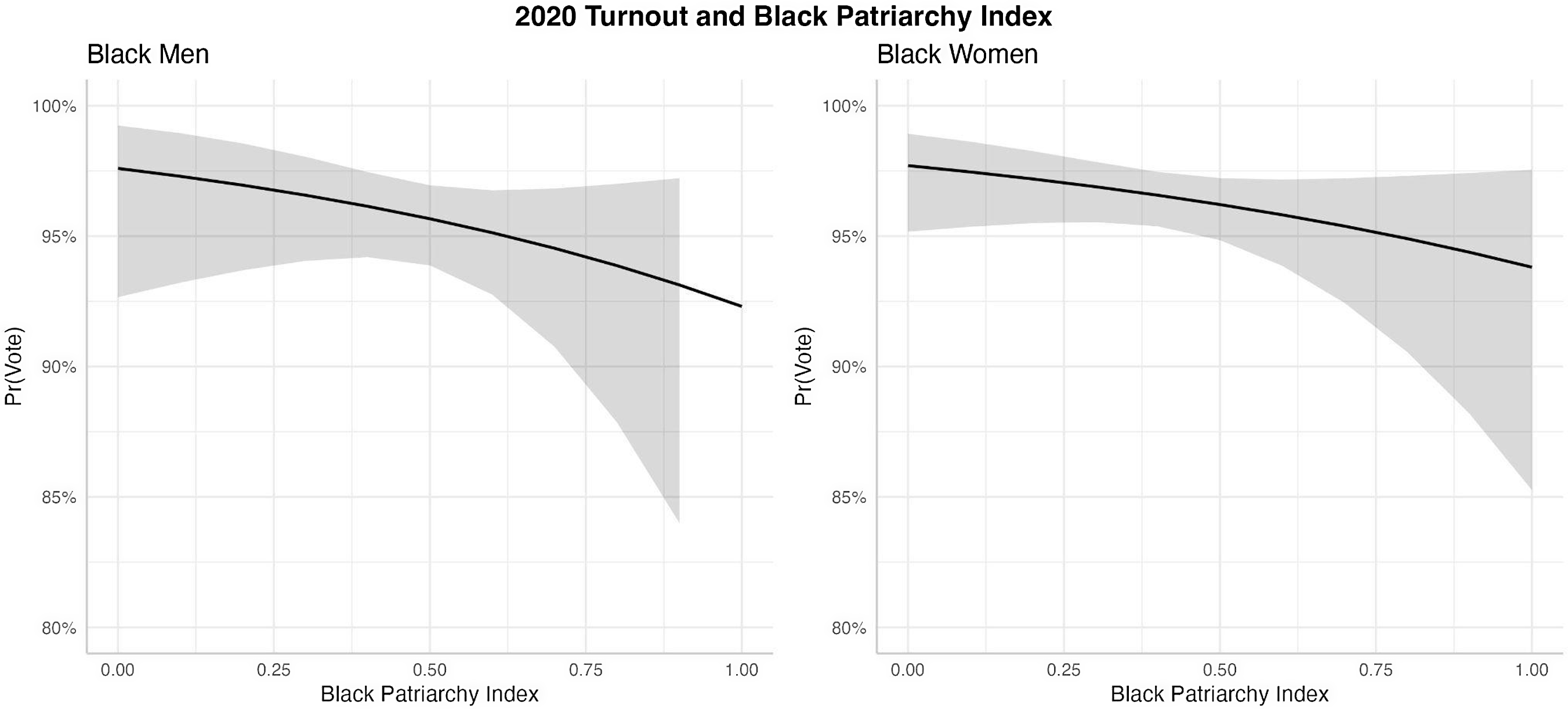
The following tables and figures will present a more detailed analysis of BPI on political attitudes and voting behavior. Table 6 illustrates the relationship between BPI and conservatism. Table 7 presents Trump favorability and Biden favorability. Table 8 and Figure 3 display vote choice, while Table 9 and Figure 4 present the relationship between BPI and validated voter turnout.
Predictors of Trump favorability among Black men and Black women

Note: * = 0.1, ** = 0.05, *** = 0.01 2020 CMPS | Black respondents only = 4371 | Data are weighted to fall within the margin of error of the adult population in the 2019 ACS 1-year data file for age, gender, education, nativity, and ancestry.
Predictors of vote choice among Black men

Note: * = 0.1, ** = 0.05, *** = 0.01 | 2020 CMPS | Registered Black men, n = 1553 | Data are weighted to fall within the margin of error of the adult population in the 2019 ACS 1-year data file for age, gender, education, nativity, and ancestry.
2020 vote choice and Black Patriarchy Index among Black men.

Predictors of voter turnout among Black men and Black women

Note: * = 0.1, ** = 0.05, *** = 0.01 | 2020 CMPS Voter-validated turnout data for 2020 Presidential General Election | Black Americans n = 1553 | Data are weighted to fall within the margin of error of the adult population in the 2019 ACS 1-year data file for age, gender, education, nativity, and ancestry.
2020 voter turnout and Black Patriarchy Index.

Determinants of Conservatism by BPI among Black Men and Women
Table 6 examines how BPI shapes conservatism among Black men and women. Increased BPI is associated with identifying as conservative for Black men and women. In the bivariate and multivariate models, BPI is associated with increased conservatism. Black men and Black women with higher levels of BPI are more conservative. The relationship between BPI and conservatism is statistically significant (p < 0.01); however, when accounting for partisan identity as a Republican, the effect size decreases, and the statistical significance of the BPI decreases (b = 0.258, p < 0.05). Notably, viewing Fox News is positively associated with conservatism. Other measures are weakly, or not, associated with increased conservatism; for example, racial and gender-linked fate is not associated with conservatism. When Black Americans have greater levels of BPI, they are more associated with conservative political ideology. Besides partisanship, no other measure is clearly associated with conservatism, such as the embrace of BPI. This confirms our third hypothesis (H3a), that Black men’s BPI is associated with increased conservatism. The relationship between BPI and conservatism is stronger among Black men, relative to Black women, even when including statistical controls.
In Table 7, the BPI is positively associated with Trump’s favorability for Black men, and to a lesser extent, the BPI is positively associated with Trump’s favorability for Black women. Black men with higher levels of BPI are more favorable to Donald Trump (b = 0.858, p < 0.01). BPI has a positive association with Trump favorability for Black women (b = 0.497, p <0.01); however, when accounting for Republican partisanship and other controls, the effect size dissipates (b = 0.101, p < 0.01). In addition, consuming Fox News is associated with Trump’s favorability for Black men and Black women. Similar to the findings in Table 7, there is no relationship with other demographic measures and is not associated with linked fate. The BPI is strongly associated with support for Trump.
Black Men’s Vote for President
Next, we examine Black men’s 2020 vote choice in Table 8. Since this outcome is dichotomous, we utilize a logistic regression for the multivariate model. Additionally, we incorporate further control measures to account for vote choice.Footnote 12 As expected, the majority of Black Americans (82%) cast their ballots for the Democratic ticket, comprising Joseph Biden and Kamala Harris. However, nearly 20% of registered Black voters did not vote for Democrats, which descriptively contradicts narratives that Black people monolithically support the Democratic Party. For instance, a quarter of Black men (24%) did not vote for the Democratic ticket. Table 8 and Figure 3 show that the BPI is negatively associated with Biden support but positively associated with Trump support and third-party support. However, Black men at the highest level of BPI are more likely to vote for Biden relative to Trump. This confirms our expectations of the relationship between Black patriarchy and vote choice for Black men (H3b).
Table 8 shows that the BPI was significantly related to voting for Donald J. Trump, rather than the Democratic Ticket. Black men with higher BPI scores were more likely to support Trump. These findings support our third hypothesis: Black men are more supportive of Donald Trump but are less likely to vote for him. Similarly, Black men who did not vote for the Democratic ticket (i.e. voted for a third party) were higher on the BPI. Republicans and Independents were less supportive of Biden.
Next, we turn to other variables that account for political orientations that may explain vote choice for Black men. Even when controlling for partisanship, greater levels of BPI influence which candidates Black men support. Partisan identity does not fully explain Black men’s vote choice (b = 0.359, p > 0.01). As we expect, Black men embrace a variety of political ideologies and are not monolithic in their views. We find that Black men with a greater linked fate are more supportive of Biden, and less supportive of Trump and other candidates. We find that linked fate is negatively associated with supporting Trump and other candidates, while perceptions of racial discrimination towards Black Americans are most associated with support for Biden. These findings illustrate that Black men remain engaged in dialogues concerned about race and use racial considerations for their vote choice. This confirms our third hypothesis that Black men with higher levels of BPI remain more likely to vote for Biden compared to Trump (H3).
Next, we explore predictors of voter turnout among Black men and Black women in 2020 utilizing our multivariate analysis in Table 9. Since this outcome is dichotomous, we use a logistic regression for the multivariate model. Using the validated voter data from the 2020 CMPS, we find weak to non-existent relationships between our primary measure of interest—the BPI—and 2020 voter turnout. Unlike the relationship with vote choice and candidate favorability, the BPI does not explain turnout among Black men. However, there are countervailing effects for Black men and Black women. For Black men, political interest is a primary factor in their decision to vote. Other factors, including age, education, and income, which are generally associated with increased civic skills associated with voting, are positively associated with voter turnout.
The voter turnout model in Table 9 has limitations. Not all voters are validated in the CMPS. Therefore, the number of observations in each model is reduced from the number of registered voters. For voter turnout specifically, more research is needed on Black political behavior to understand the effects of BPI and non-traditional media consumption. However, we speculate that our measure of patriarchy offers a starting point to explain the small but important gender gap in partisanship between Black men and Black women. If Black men listen to these podcasts, it shapes how they evaluate political candidates and form political beliefs. To a lesser extent, the podcasts influence whether they participate in the ballot box in 2020. Given the unique circumstances of 2020, the ongoing COVID-19 pandemic, a heightened movement for racial justice, and varied methods for electoral participation, we speculate that the influence of BPI and non-traditional media consumption may have a substantially larger role in future elections.
Discussion and Conclusion
Much of the 2024 political discussion involves the debate as to whether Black men are moving in droves to the Republican party and toward voting for former President Trump. Our findings demonstrate that while Black men are slightly more supportive of Donald Trump and are (on average) more conservative than Black women, Black patriarchy is associated with decreased support for the Democratic party. Black men’s political leanings are shaped by various factors, including their relationships with Black women, their views on bootstrap racial uplift, and rejection of intersectional solidarity. Through examining the prevalence of Black male podcasters discussing politics, we sought to examine whether or not Black American kitchen table debates and conversations about conservative Black men finally manifested themselves into the public sphere and ultimately in the ballot box. We were curious as to whether or not the fervor of Black men moving to the far right was a fact or merely hyperbole. We find that Black men’s engagement with and consumption of political information through podcasts, Fox news, and non-traditional media play a role in shaping their political views and choices.
With this research, we build upon our previous scholarship to not only assess the strength of partisanship among Black men and women in the electorate (Slaughter et al. 2023) but also measure the extent to which their support for Democratic and Republican candidates is affected by Black patriarchy. A central question for many pundits is how the 2024 election showed cracks in the foundation of the Black Democratic electorate. While Black men are generally more favorable towards Republicans and conservative ideologies than Black women, they still overwhelmingly vote for Democratic candidates. Black patriarchy, consumption of Fox News, lower levels of linked fate, and higher perceived racial discrimination are associated with increased conservatism and support for Republican candidates among Black men. The study emphasizes the need for further research to understand the evolving political landscape and the role of non-traditional media in shaping Black men’s political engagement.
One limitation of our analysis exists in the CMPS data. The 2020 CMPS does not ask participants about their consumption of podcasts specifically. As we analyze the non-traditional forms of media that continue to lure Black male conservatives into the political sphere—that is, social media, radio talk news, and discussing with family and friends—a prominent source of information sharing cannot be measured or considered in this dataset. As local and cable news, as well as newspapers become increasingly paywalled, the sources from which Black voters receive their news is an important question for future scholarly inquiry. Evidently, in 2024, we witnessed the draw that Republican candidates have with Latino men and women, whereas a larger gender gap emerged among this group. Latino men, like Black men, are engaging in electoral politics to improve their political and economic conditions, yet our findings indicate that this engageement is not strongly associated with messages traditionally associated with the Democratic Party.
Future intellectual pursuits will hopefully allow for an even more nuanced understanding of Black patriarchy and the factors that contribute to Black men and their relationship with the Democratic party. To date, the BPI measures racial self-reliance, intersectional solidarity, hostile sexism towards women, partisanship, and perceptions of linked fate. Moving forward, future applications of the BPI will hopefully include a larger sample size of Black male participants, more podcasts that center Black men and focus on Black male listenership, as well as a more refined understanding of how foreign-born status affects feelings of patriarchy. Each presidential election season, a small but significant number of Black men identify with Conservative politics, policies, and even parties. Moving forward, the extent to which Black patriarchy serves as a driving force in their decision-making should be assessed.
Acknowledgements
We’d like to thank participants at the 2024 National Conference of Black Political Scientists Annual Meeting, the 2024 CMPS Mini Conference at the Western Political Science Association, and 2024 the American Political Science Association Annual Meeting for their feedback. Please forward comments to Chaya Crowder.
Funding statement
The authors received no financial support for the research and authorship of this article.
Appendix
Black Patriarchy Index Factor Analyses (Accompanies Principal Component Analysis in Paper).




 Open access

