Hostname: page-component-75d7c8f48-ghqh7 Total loading time: 0 Render date: 2026-03-22T15:57:16.839Z Has data issue: false hasContentIssue false

III. Inscriptions

Published online by Cambridge University Press:  23 February 2026

Roger S.O. Tomlin*
Affiliation:
Wolfson College, Oxford University
Rights & Permissions [Opens in a new window]

Abstract

Information

Type
Roman Britain in 2024
Creative Commons
Creative Common License - CCCreative Common License - BY
This is an Open Access article, distributed under the terms of the Creative Commons Attribution licence (http://creativecommons.org/licenses/by/4.0), which permits unrestricted re-use, distribution and reproduction, provided the original article is properly cited.
Copyright
© The Author(s), 2026. Published by Cambridge University Press on behalf of the Society for the Promotion of Roman Studies.

A. MonumentalFootnote 1

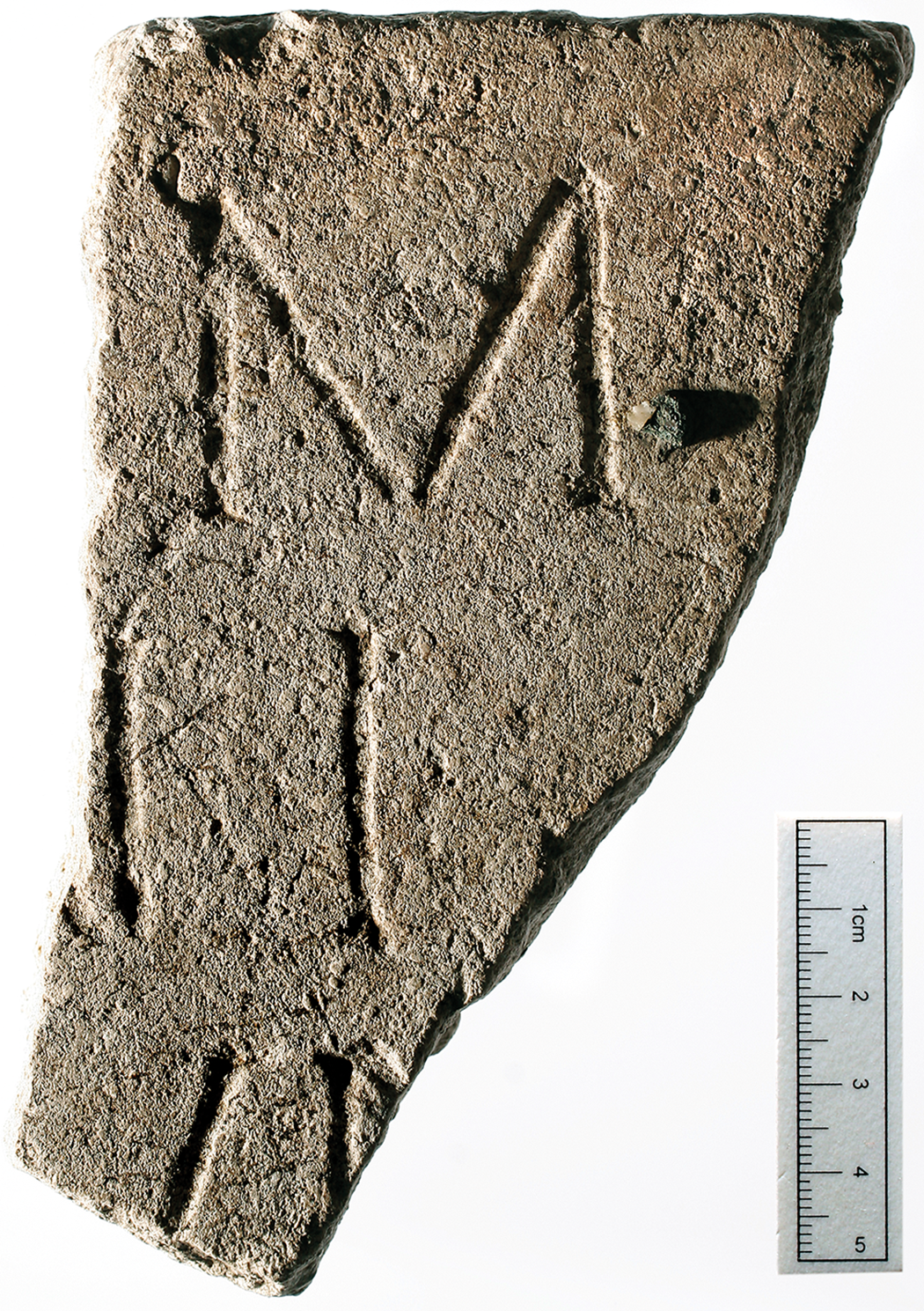
1. Canterbury (Durouernum Cantiacorum, TR 14862 57923) High Street, the Beaney Institute, Kent (Fig. 1). Fragment of oolitic limestone, probably Marquise stone, from a thin slab, 95 by 150 mm, 32.5 mm thick, foundFootnote 2unstratified in 2010. The top edge is original, but the others are broken. Incised: […]M[…] | […]NI […] | […]VM[…] | […], probably [D(is)] M(anibus) | […]ni | [annor]um | […]. ‘To the Shades of the Dead (and) of […]nus, (aged) … years …’

Fig. 1. Canterbury, tombstone fragment (No. 1) (photo: Canterbury Archaeological Trust).

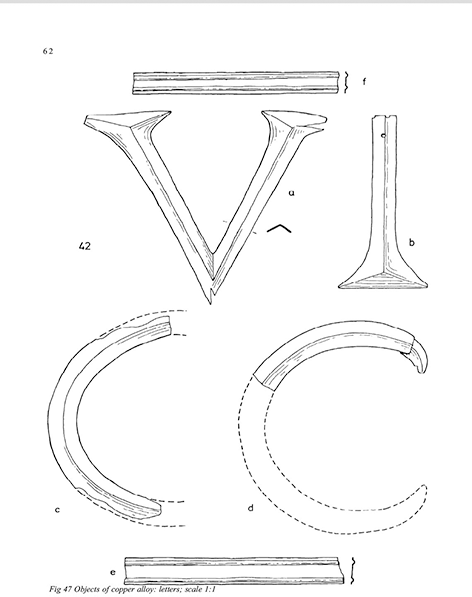
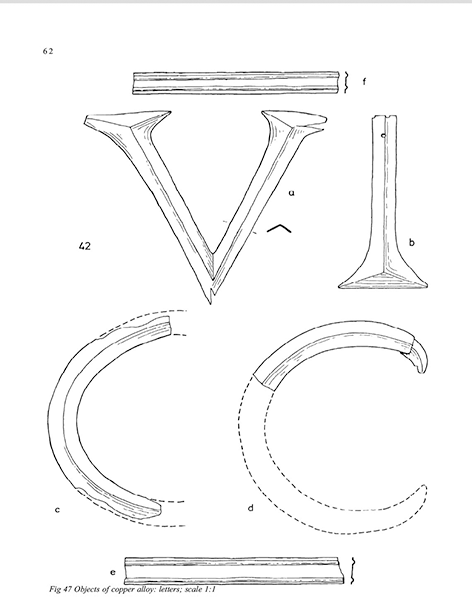
2. Kelvedon (Canonium, TL 864 190), Essex (Fig. 2). Four copper-alloy votive letters, c. 90–100 mm in height, foundFootnote 3in 1971. Only one is complete: V. Another is a vertical stem terminating in a serif: most likely I, but possibly L or T. The other two are semi-circular fragments: one probably C (unless G); the other probably O (unless C, G or Q). Also found were two indeterminate fragments.

Fig. 2. Kelvedon, copper-alloy votive letters (No. 2) (drawing: Council for British Archaeology).
3. Great Walsingham (TF 94 38) Roman temple site, Norfolk. Copper-alloy votive letter, 18 by 46 mm, weight 9.3 g, foundFootnote 4in the 1990s. Narrow V, with two studs behind for attachment.

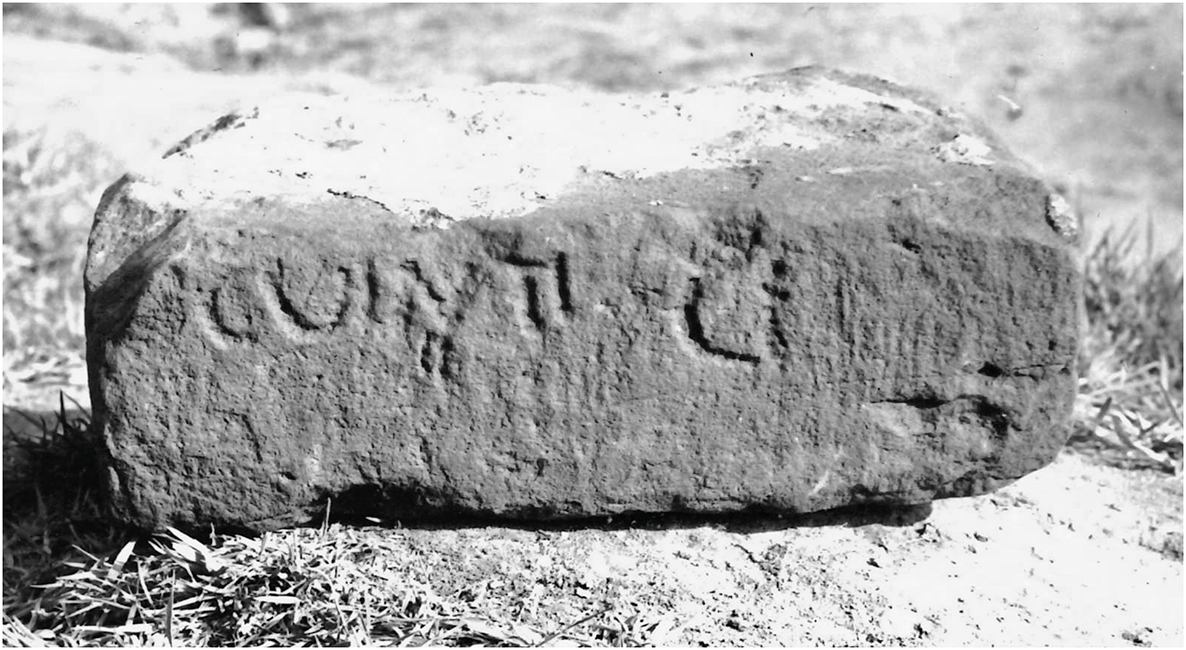
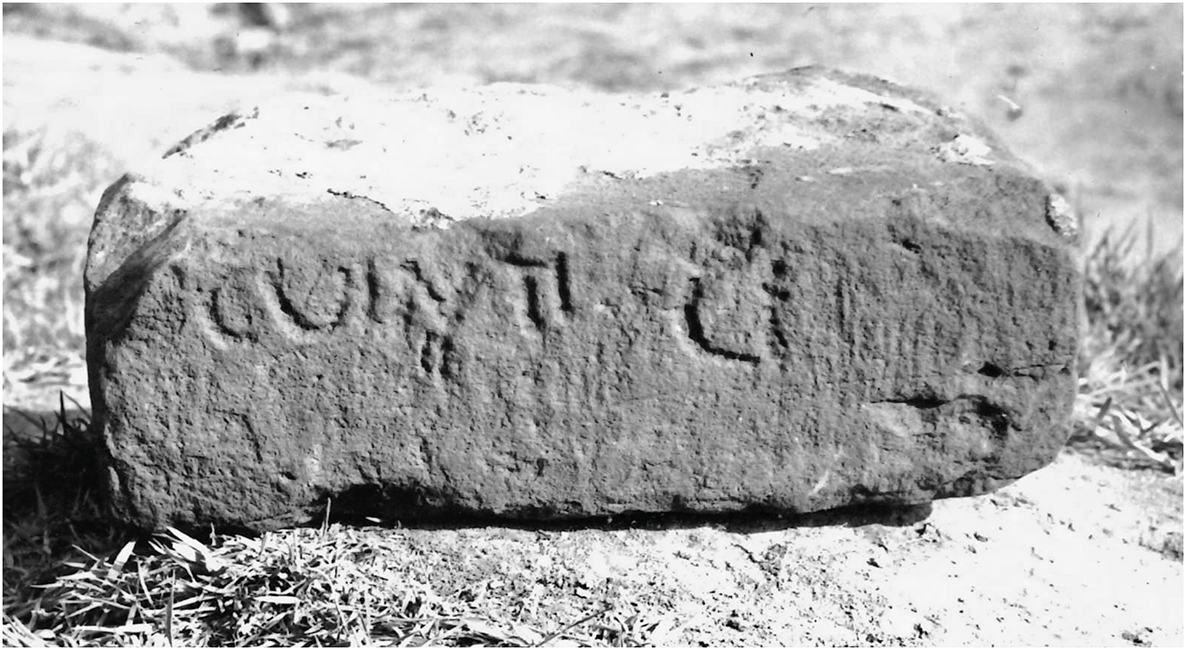
4. Wall (Letocetum, SK 098 066), Staffordshire (Fig. 3). Reddish-brown sandstone building-stone, 0.38 by 0.11 m, foundFootnote 5in 1977. The face is coarsely inscribed: CVINTI ḶỊ, Cuinti LI. ‘[?…] of Quintus …’Footnote 6

Fig. 3. Wall, inscribed building stone (No. 4) (photo: A.A. Round).
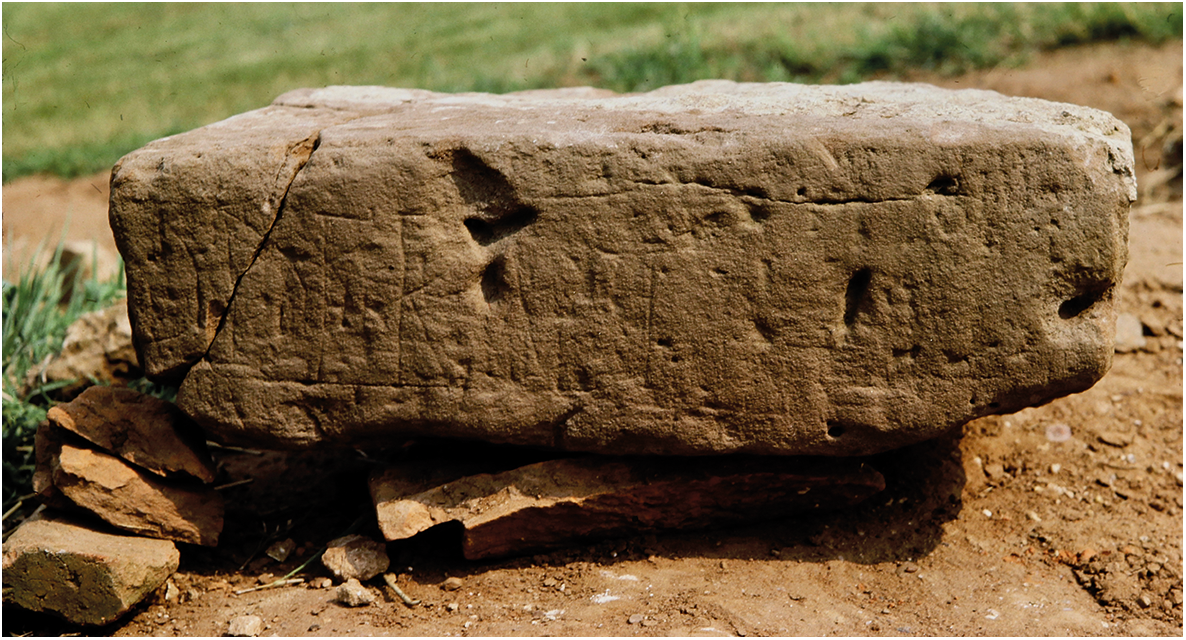
5. Ibid. (Fig. 4). Reddish-brown sandstone building-stone, 0.43 by 0.12 m. Within a panel defined by two parallel lines above and below, thinly inscribed: ↃDỊṚṾṬ[…], (centuria) D… Footnote 7

Fig. 4. Wall, inscribed building stone (No. 5) (photo: A.A. Round).

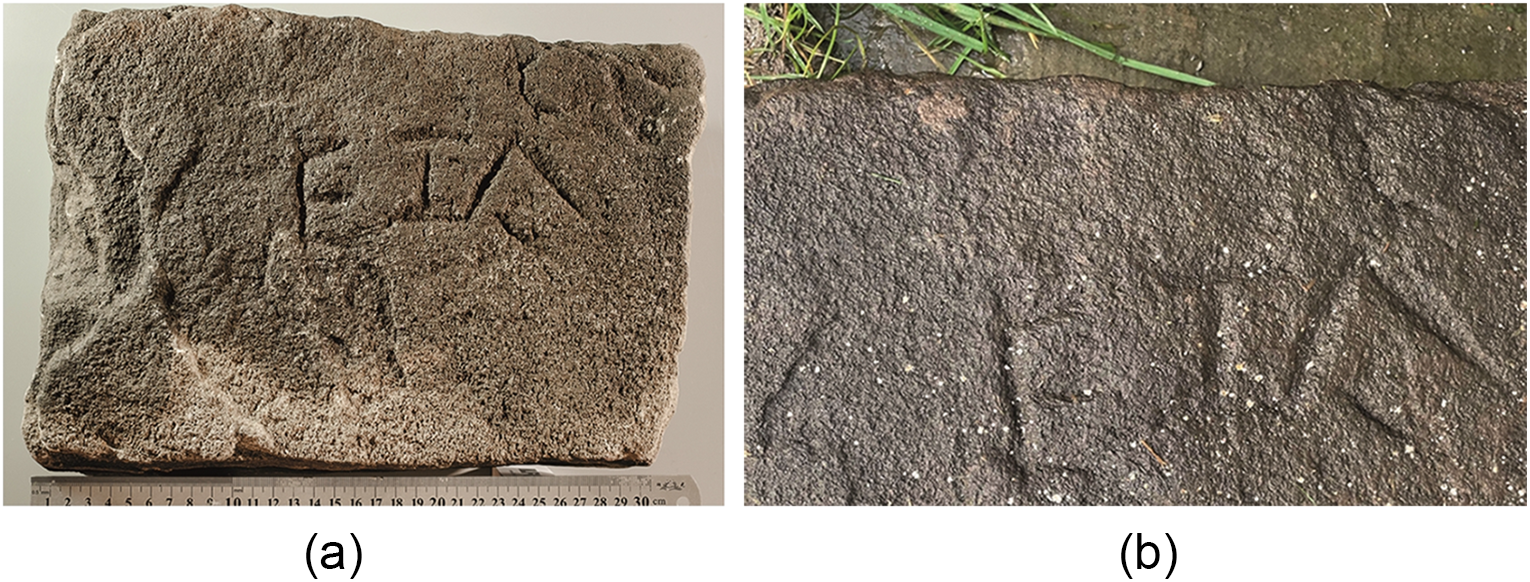
6. Whitley Castle (Epiacum, NY 69824 48683) Roman fort, Northumberland (Fig. 5). Buff sandstone slab, 0.32 by 0.23 m, tapering in thickness from 0.15 m, foundFootnote 8in 2024. One face is coarsely incised: G̣ETA, perhaps Geta.Footnote 9

Fig. 5. (a) Whitley Castle, inscribed slab (No. 6) (photo: Gordon Monk); (b) detail of the lettering (photo: Elaine Edgar).

7. Birdoswald (Banna, NY 6161 6625) Roman fort, Cumbria. Local red sandstone fragment, 0.14 by 0.21 m, 0.19 m deep, foundFootnote 10in 1987–92. It is apparently part of the capital and die of an altar, the capital with a pattern of leaves carved in relief. All that survives of the inscription is two letters at the top of the die: […]OM[…], [I(ovi)] O(ptimo) M(aximo) | […]. ‘To Jupiter Best (and) Greatest …’Footnote 11

B. Instrumentum domesticum

Berkshire

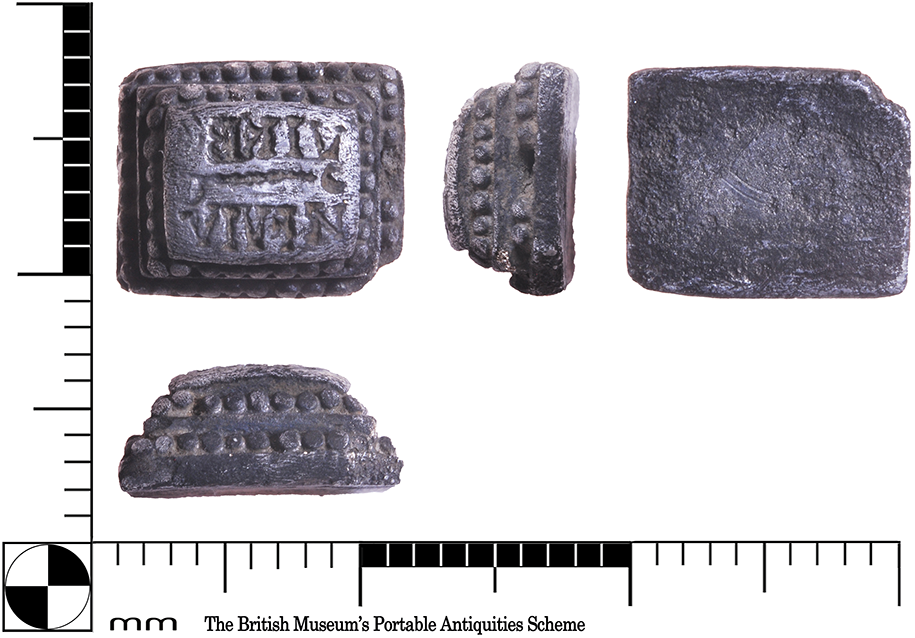
8. Chiseldon, Swindon (SU 17 79) (Fig. 6). Rectangular silver ring bezel, 10.9 by 9.1 mm, 5.2 mm thick, weight 2.94 g, foundFootnote 12in 2024. Incised retrograde: VIRBỌ|NEVIV, uir bo|ne uiu(as). ‘Long life to you, good man.’Footnote 13

Fig. 6. Chiseldon, silver ring bezel (No. 8) (photo: PAS).

Cumbria

9. Carlisle (Luguvalium, NY 397 561). Small off-cut of shoe leather, 47 by 103 mm, foundFootnote 14in 1998–2001, incised with the letters: C C M, C(aius) C(…) M(…) Footnote 15

10. Ibid. Small off-cut of leather, 27 by 125 mm, crudely incised with two sets of letters, now incomplete: (a) C C M, or possibly C V M. (b) C C […]Footnote 16

11. Ibid. Small off-cut of leather thought to be from a tent, 94 by 129 mm, impressed with the stamp: S o D o V, S(extus) D(…) V(…) Footnote 17

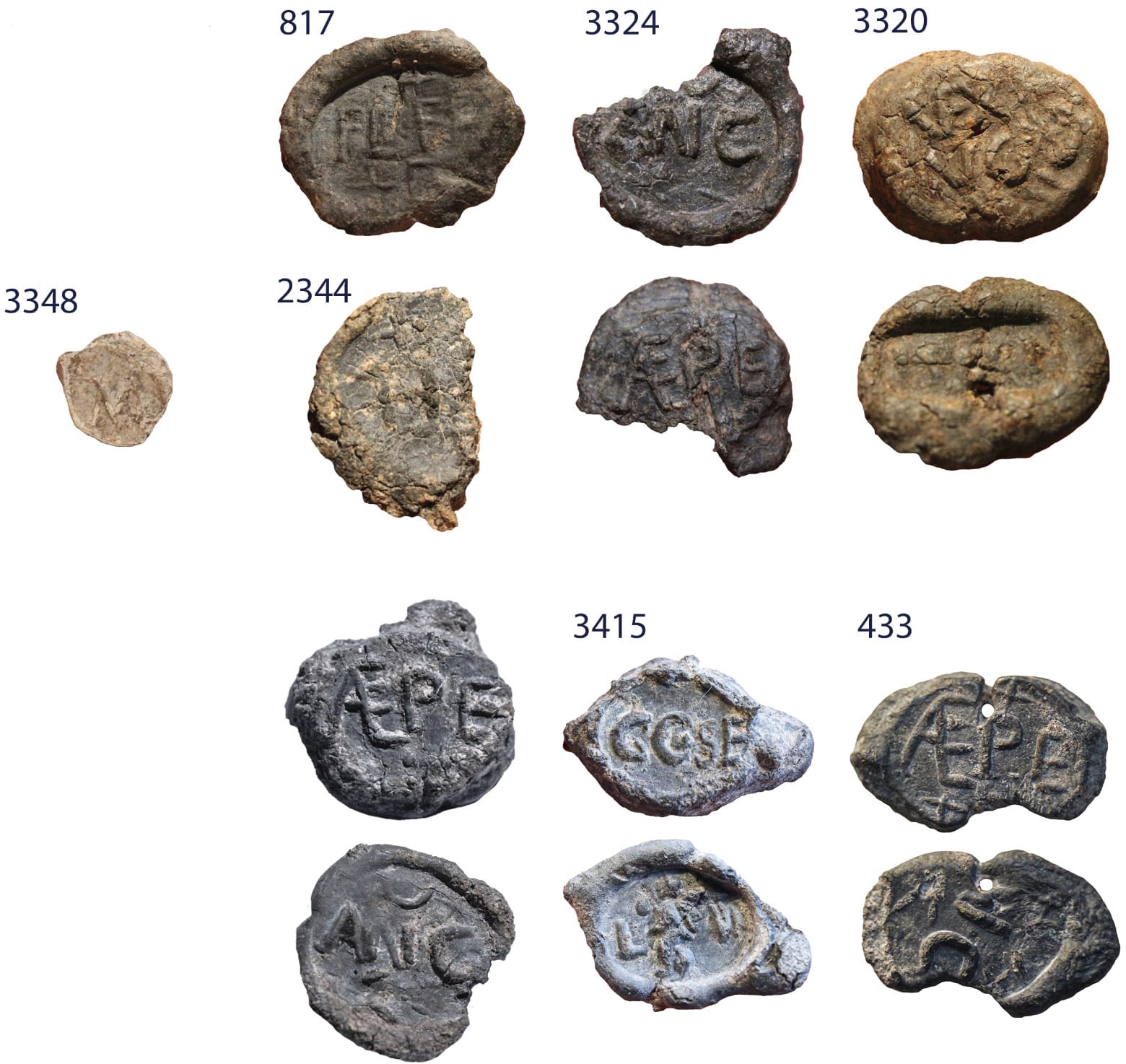
12. Stanwix (Uxelodunum, NY 399 567) Roman fort and uicus (Fig. 7, bottom left, not numbered). Lead sealing foundFootnote 18in c. 2024, impressed on both faces with letters moulded in relief. Obverse: $\overparen{\unicode{x039B}\text{LE}}$ PE, al(a)e Pe(trianae). ‘(Sealing) of the ala Petriana.’Footnote 19Reverse, below a crescent: ANC, probably A(ulus) N(…) C(…). The name of a decurion, abbreviated.Footnote 20

Fig. 7. Stanwix, eight lead sealings (including Nos. 12–17) (photo: Anna Giecco for Wardell Armstrong).

13. Ibid. (Fig. 7, No. 3324). Carlisle Cricket Club, the Roman bath-house. Lead sealing foundFootnote 21in 2017/22, impressed on both faces with letters moulded in relief. Obverse, with a ‘star’ above, the lower ‘star’ now lost: $\overparen{\unicode{x039B}\text{LE}}$ PE, al(a)e Pe(trianae). ‘(Sealing) of the ala Petriana.’ Reverse, below a crescent: ANC, probably A(ulus) N(…) C(…). The name of a decurion, abbreviated. Both dies are the same as in the previous item.

14. Ibid. (Fig. 7, No. 3415). Lead sealing impressed on both faces with letters moulded in relief. Obverse: standing figure of Victory between the letters L and VI, l(egionis) VI. ‘(Sealing) of the Sixth Legion’. Reverse: GC o SE, probably G(aius) C(aledonius) Se(cundus).Footnote 22

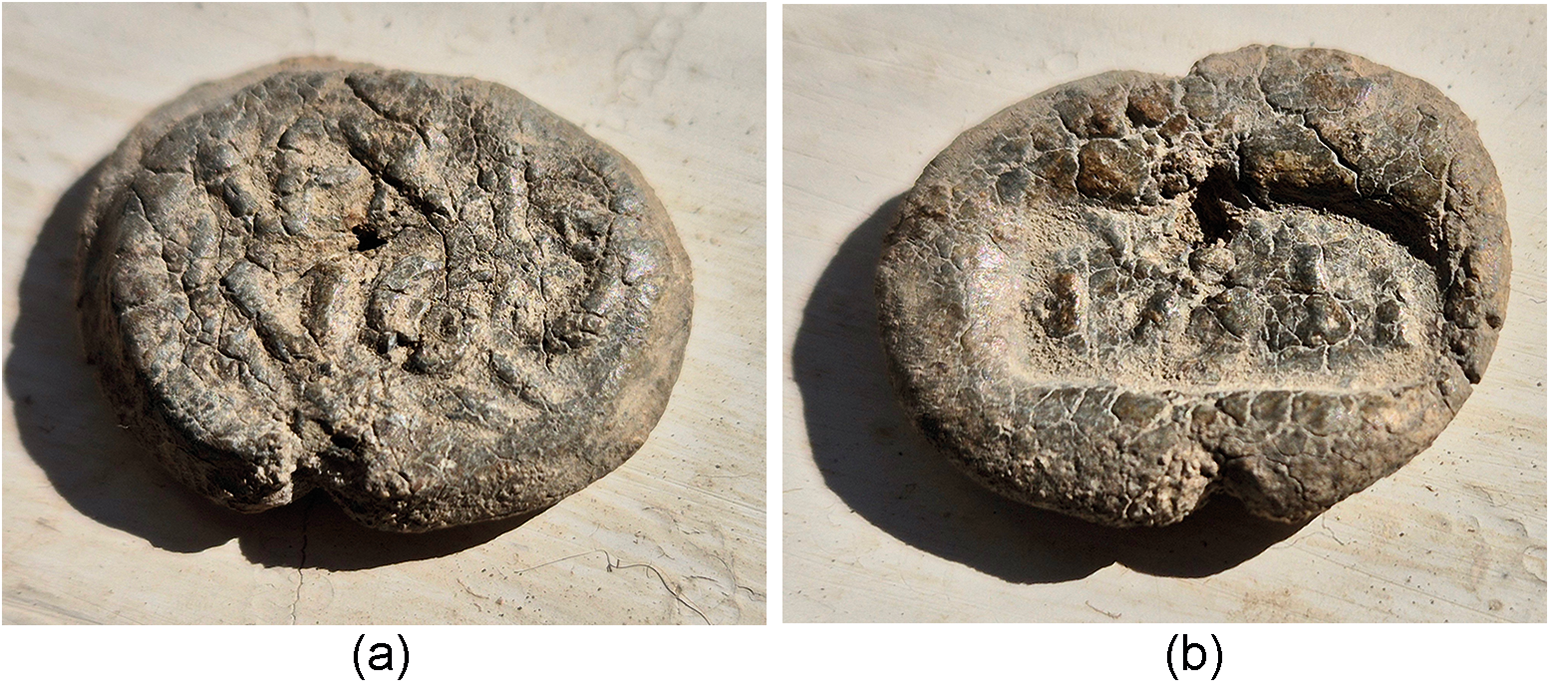
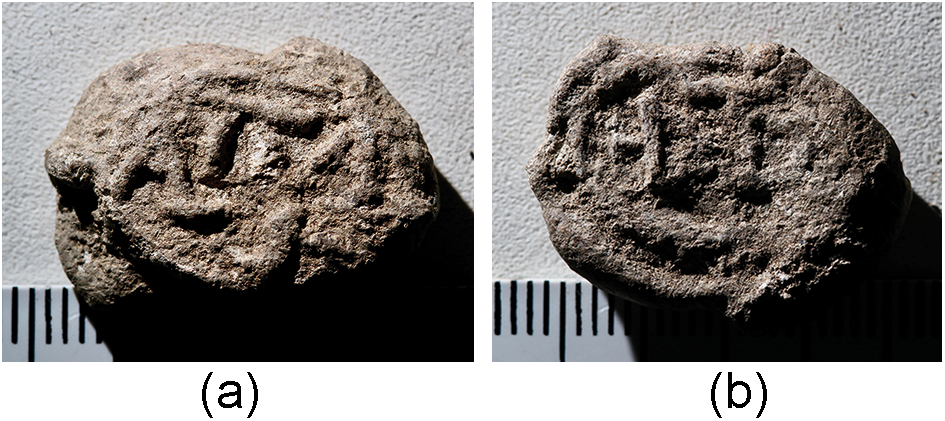
15. Ibid. (Fig. 7, No. 3320; Fig. 8). Lead sealing impressed on both faces with letters moulded in relief. Obverse, above a palm branch: $\overparen{\text{VE}}$X[.] | VC̣Ọ, uex(illatio) … Footnote 23Reverse: rectangular die, almost illegible.Footnote 24

Fig. 8. Stanwix, lead sealing (No. 15), (a) obverse, (b) reverse (photos: Frank Giecco).

16. Ibid. (Fig. 7, No. 2344). Half of a lead sealing impressed on one face. Below a ‘star’, H[…] | D, perhaps H(…) [R(…)] | d(ecurio).Footnote 25

17. Ibid. (Fig. 7, No. 3348). Unusually small round lead sealing, impressed on one face: MFootnote 26

18. Ibid. Hypocaust of the Roman bath-house. Ninety more square tiles were foundFootnote 27in early 2025, all still in place, impressed with the stamp: $\overparen{\text{IMP}}$, probably imp(eratoris). ‘(Property) of the Emperor.’

Derbyshire

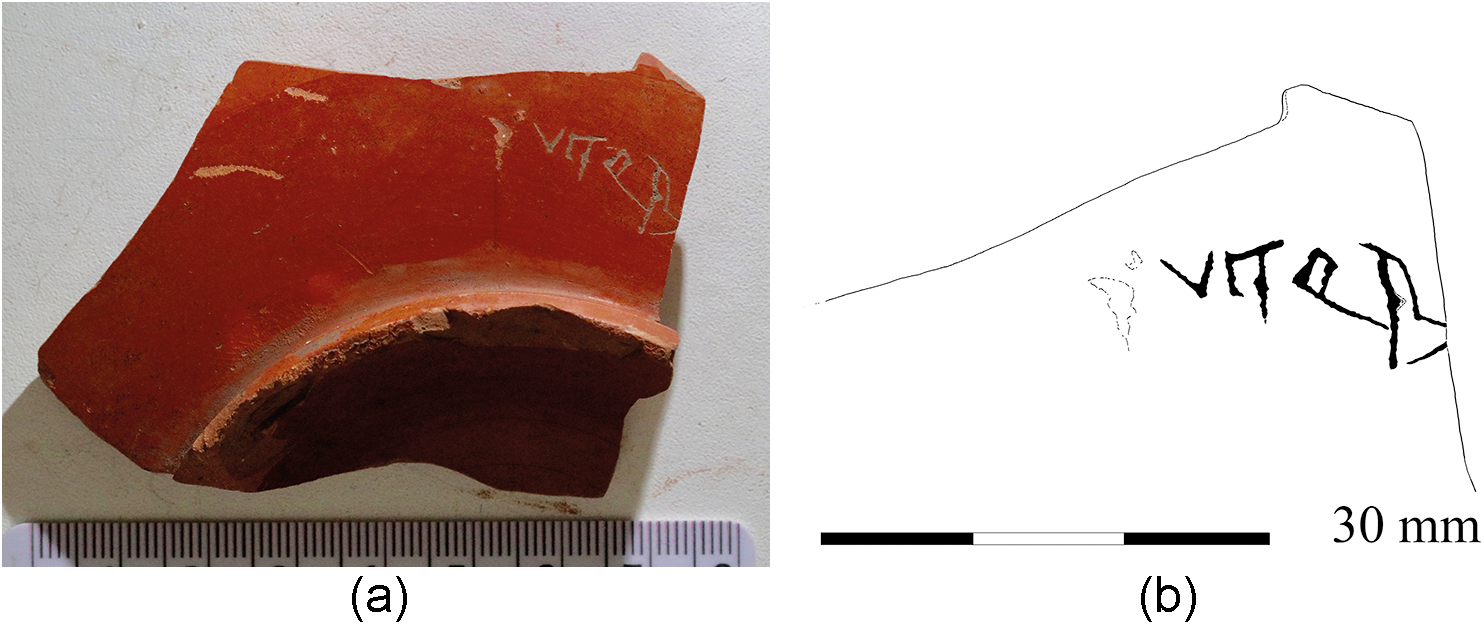
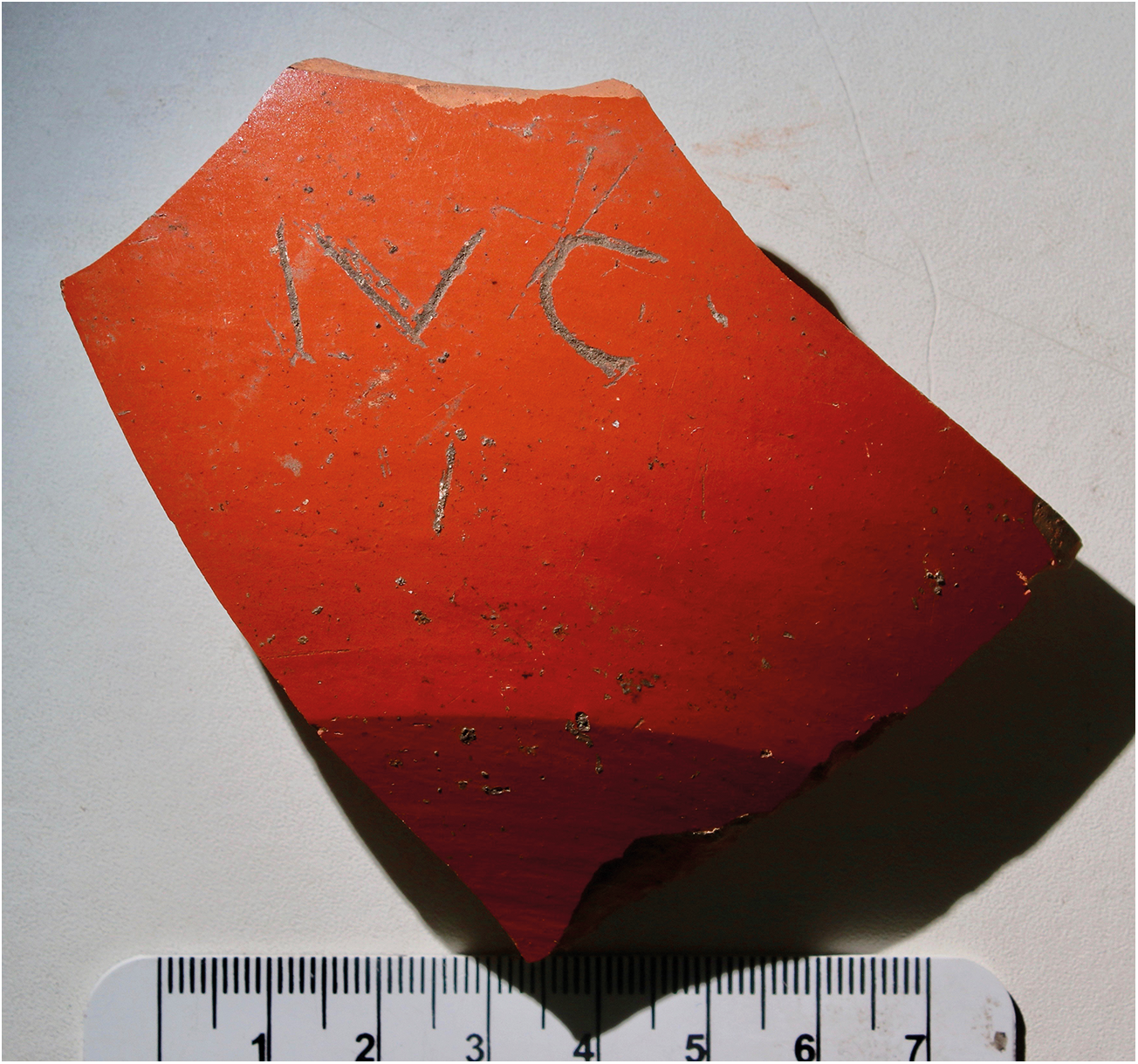
19. Derby (SK 349 373), Strutt’s Park Roman fort (Fig. 9). Base sherd of a samian dish (Dr. 18) foundFootnote 28in 2011 in an early-Flavian pit. Neatly scratched on the wall above the foot-ring, in cursive letters after firing: VITOR[I]Ṣ, Vi<c>tor[i]s. ‘(Property) of Victor.’Footnote 29

Fig. 9. Derby, Strutt’s Park, samian graffito (No. 19) (photographed and drawn by R.S.O. Tomlin).

Devon

20. Topsham (SX 963 895) (Fig. 10). Seven conjoining sherds of a black-burnished cooking pot (south-east Dorset BB1, late-third/early-fourth century), foundFootnote 30in 2024. On the shoulder, coarsely incised after firing: C CɅṆ[…], probably C(…) Can[…] Footnote 31

Fig. 10. Topsham, black-burnished ware graffito (No. 20) (photo: Wessex Archaeology).

Co. Durham

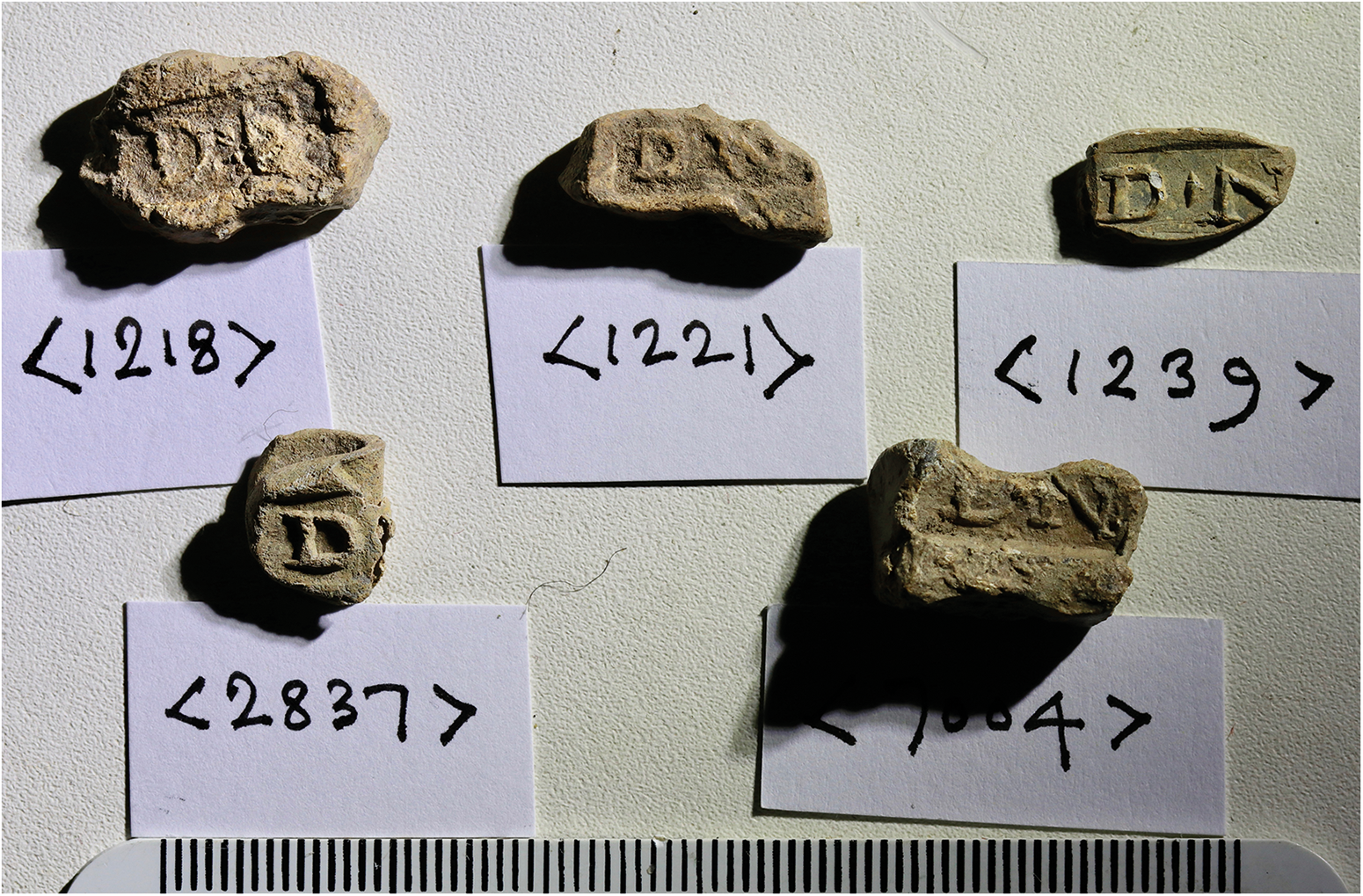
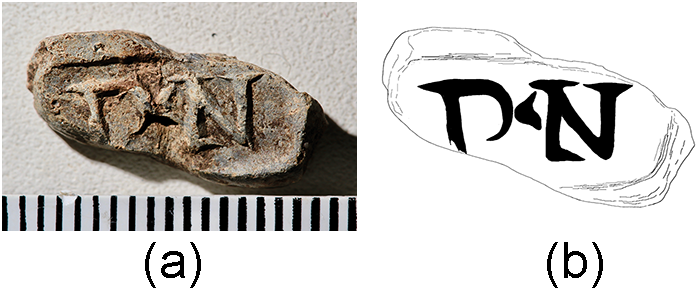
21. Binchester (Vinovia, NZ 2095 3135), Roman fort and uicus (Fig. 11, sf 1218). Lead sealing, 19.33 by 12.48 mm, 4.99 mm thick, weight 5.58 g, foundFootnote 32in 2009–17. Moulded letters in relief within a rectangular panel: D o N, d(omini) n(ostri). ‘(Sealing) of Our Lord (the Emperor).’Footnote 33

Fig. 11. Binchester, five D N lead sealings (Nos. 21–25) (photo: R.S.O. Tomlin).

22. Ibid. (Fig. 11, sf 1221). Lead sealing, 15.53 by 6.52 mm, 4.09 mm thick, weight 3.67 g. Moulded letters in relief within a rectangular panel: D N, d(omini) n(ostri). ‘(Sealing) of Our Lord (the Emperor).’

23. Ibid. (Fig. 11, sf 1239). Lead sealing, 14.04 by 7.25 mm, 2 mm thick, weight 1.46 g. Moulded letters in relief within a rectangular panel: D Δ N, d(omini) n(ostri). ‘(Sealing) of Our Lord (the Emperor).’

24. Ibid. (Fig. 11, sf 2837). Lead sealing folded upon itself, 9.62 by 10.95 mm, 3.39 mm thick, weight 2.00 g. Moulded letters in relief within a rectangular panel: D N, d(omini) n(ostri). ‘(Sealing) of Our Lord (the Emperor).’Footnote 34

25. Ibid. (Fig. 11, sf 7004). Incomplete lead sealing, 16.22 by 10.28 mm, 6.55 mm thick, weight 9.08 g. Moulded letters in relief within a rectangular panel: D o N, d(omini) n(ostri). ‘(Sealing) of Our Lord (the Emperor).’Footnote 35

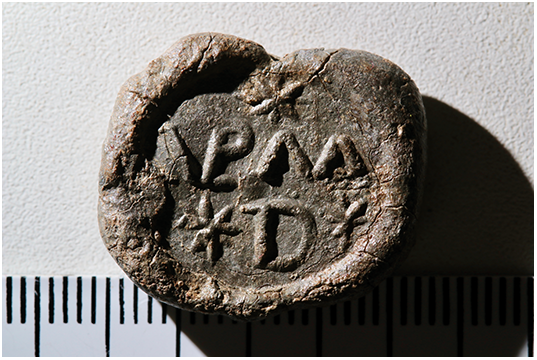
26. Ibid. (Fig. 12). Lead sealing, 23.38 by 17.05 mm, 5.06 mm thick, weight 8.25 g. Moulded letters in relief within an oval panel. Obverse: $\overparen{\text{AL}}$ $\overline{\text{II}}$ A|Ṣ, al(ae) II A|s(turum). Reverse: H T D, H(…) T(…) d(ecurio). ‘(Sealing) of the Second ala Asturum. H(…) T(…) decurion.’ Footnote 36

Fig. 12. Binchester, lead sealing (No. 26), (a) obverse, (b) reverse (photos: R.S.O. Tomlin).

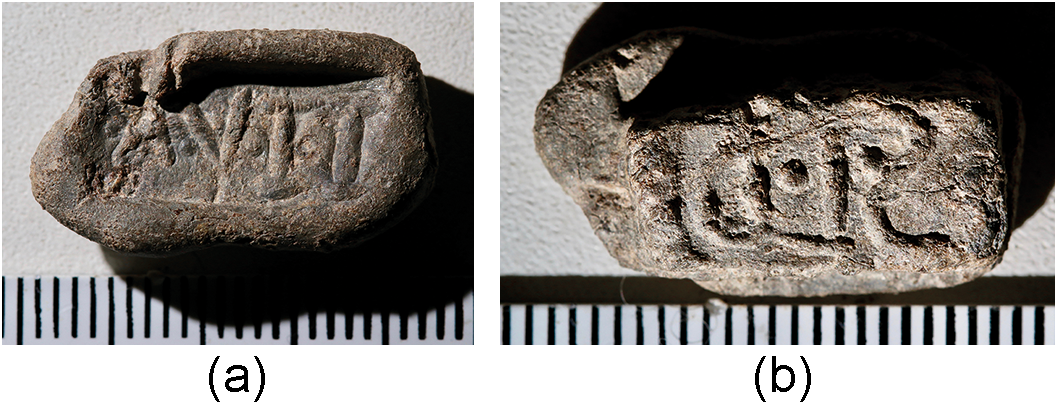
27. Ibid. (Fig. 13). Lead sealing, 21.37 by 11.55 mm, 5.43 mm thick, weight 5.55 g. Moulded letters in relief within a rectangular panel. Obverse: AoVoTT, a(lae) V<e>tt(onum).Footnote 37Reverse: S o L o D retrograde, S(…) L(…) d(ecurio). ‘(Sealing) of the ala Vettonum. S(…) L(…) decurion.’ Footnote 38

Fig. 13. Binchester, lead sealing (No. 27), (a) obverse, (b) reverse (photos: R.S.O. Tomlin).

28. Ibid. (Fig. 14). Lead sealing, 23.62 by 20.83 mm, 6.58 mm thick, weight 11.03 g. Moulded letters in relief within an oval panel. Obverse: ALE | VẸT above a palm branch, al(a)e Vet(tonum). Reverse: $\overparen{\text{VLP}}$ KL above three ‘stars’ and a crescent, below a palm branch, Ulp(ius) Kl(…). ‘(Sealing) of the ala Vettonum. Ulpius Kl(…) (decurion).’Footnote 39

Fig. 14. Binchester, lead sealing (No. 28), (a) obverse, (b) reverse (photos: R.S.O. Tomlin).

29. Ibid. (Fig. 15). Lead sealing, 23.08 by 19.56 mm, 4.21 mm thick, weight 9.71 g. One face is impressed with moulded letters in relief within an oval panel: star | $\overparen{\text{VLP}}$ M | star D star, Ulp(ius) M(…) | d(ecurio). ‘Ulpius M(…), decurion.’Footnote 40

Fig. 15. Binchester, lead sealing (No. 29) (photo: R.S.O. Tomlin).

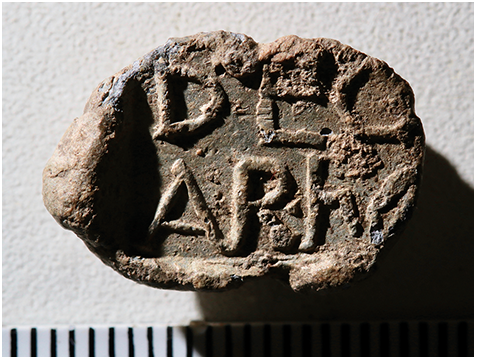
30. Ibid. (Fig. 16). Lead sealing, 19.03 mm by 12.86 mm, 7.36 mm thick, weight 7.39 g. One face is impressed with moulded letters in relief within a rectangular panel: DEC | AR o h., probably dec(urio) | Ar(…) H[o](…). ‘Ar(…) Ho(…), decurion.’Footnote 41

Fig. 16. Binchester, lead sealing (No. 30) (photo: R.S.O. Tomlin).

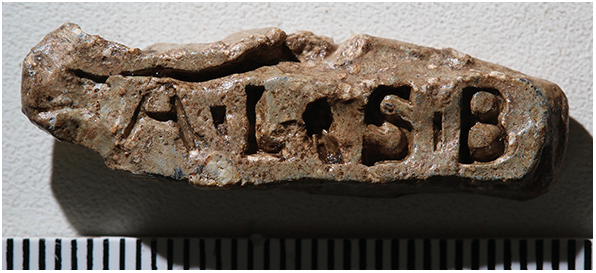
31. Ibid. (Fig. 17). Lead sealing, a narrow rectangular strip 33.75 mm by 9.63 mm, 4.57 mm thick, weight 9.94 g. One face is impressed with four letters, not moulded in relief but incised: A ı L \ S ı B, A(…) L(…) and S(…) B(…) Footnote 42

Fig. 17. Binchester, lead sealing (No. 31) (photo: R.S.O. Tomlin).

Essex

32. Colchester (Camulodunum, TL 991 253), St Mary’s Hospital, Balkerne Hill (Fig. 18). Oculist’s collyrium stamp, foundFootnote 43in 2001, a rectangular die of fine-grained greenish stone, 46.7 by 15.3 mm, 8.6 mm thick, inscribed on three of its four edges in capital letters retrograde. (a) One long edge: CɅLḤ$\overparen{\text{NE}}$B$\overparen{\text{HE}}$Footnote 44 , Cal(…) ?h(ygra) NEB ?h(ygra) ERA. The practitioner’s name abbreviated, and two eye salves.Footnote 45(b) Other long edge: CɅL. The practitioner’s name abbreviated again. (c) One short edge: CHEM, (ad) chem(osim). ‘For chemosis [inflammation of the cornea]’.Footnote 46

Fig. 18. Colchester, oculist’s stamp (No. 32), (a) long edge, (b) other long edge, (c) short edge (drawn by R.S.O. Tomlin from photographs by Colchester Archaeological Trust).

33. Colchester (Camulodunum, TL 99 25) (Fig. 19). Sherd from the shoulder of a Dressel 20 amphora, found before 2001.Footnote 47Incised after firing: GIIM, Gem(inus).Footnote 48

Fig. 19. Colchester, amphora graffito (No. 33) (photo: Colchester Museums).

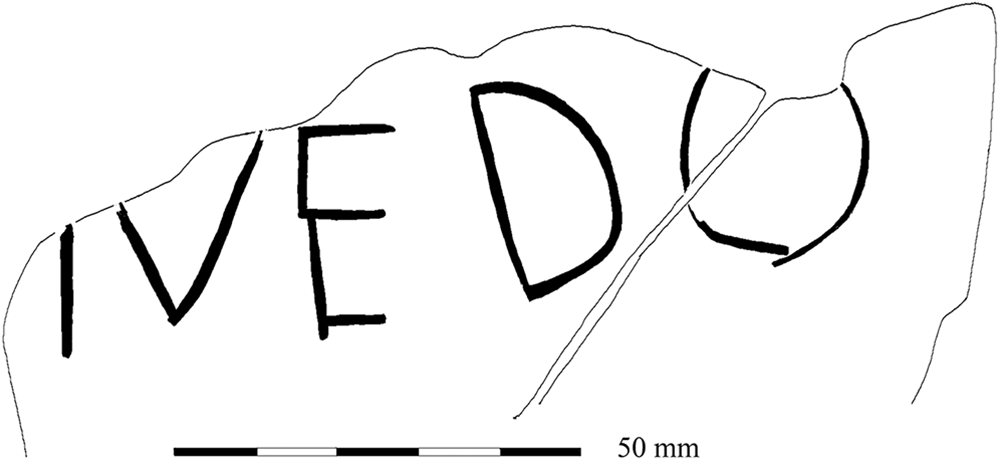
34. Colchester (Camulodunum, TM 00117 24391), Garrison GAL Area (Fig. 20). Three conjoining sherds from the wall of a large storage jar, foundFootnote 49in 2010, incised after firing: […].VEDO, probably [A]vedo.Footnote 50

Fig. 20. Colchester, coarseware graffito (No. 34) (drawn by R.S.O. Tomlin from a rubbing by Mark Hassall).

Kent

35. Richborough (Rutupiae, TR 32 60) Roman fort (Fig. 21). Silver finger-ring, 24 by 25 mm, maximum width 8 mm, weight 6.9 g, foundFootnote 51‘during the 1920s and 1930s’. Brancaster type, late-Roman.Footnote 52Incised on the rectangular bezel, 8 by 10 mm, a monogram formed by five capital letters in a clockwise sequence: BASIA, basia (me). ‘Kiss (me).’Footnote 53

Fig. 21. Richborough, silver ring with monogram (No. 35) (photo: English Heritage).

Leicestershire

36. Narborough, Copt Oak Road (SK 531 977). Samian sherd foundFootnote 54in 1983, said to be ‘inscribed on the inside with the graffito DEO’.Footnote 55

Lincolnshire

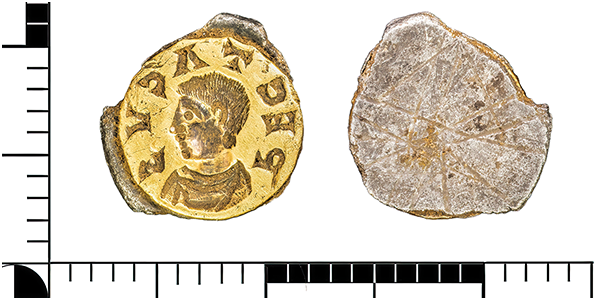
37. Ancaster (SK 98 44) (Fig. 22). Gold and silver bezel of a finger-ring, probably late-Roman Brancaster type.Footnote 56Thin gold disc, 8.82 mm in diameter, soldered onto a larger silver disc now incomplete, total weight 0.91 g, foundFootnote 57in 2024. Incised with a man’s face and shoulders facing left, surrounded by the retrograde letters: PECTɅCVS, Pectacus.Footnote 58

Fig. 22. Ancaster, gold and silver ring bezel (No. 37) (photo: PAS).

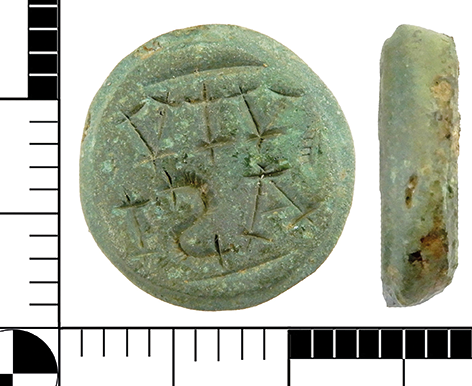
38. Scredington (TF 094 405) (Fig. 23). Square bezel of a silver finger-ring, 16.28 by 14.72 mm, 1.99 mm thick, weight 2.19 g, foundFootnote 59in 2024. Incised: DEO | TOT, deo | To(u)t(ati). ‘To the god Toutatis.’Footnote 60

Fig. 23. Scredington, silver ring bezel (No. 38) (photo: PAS).

North Lincolnshire

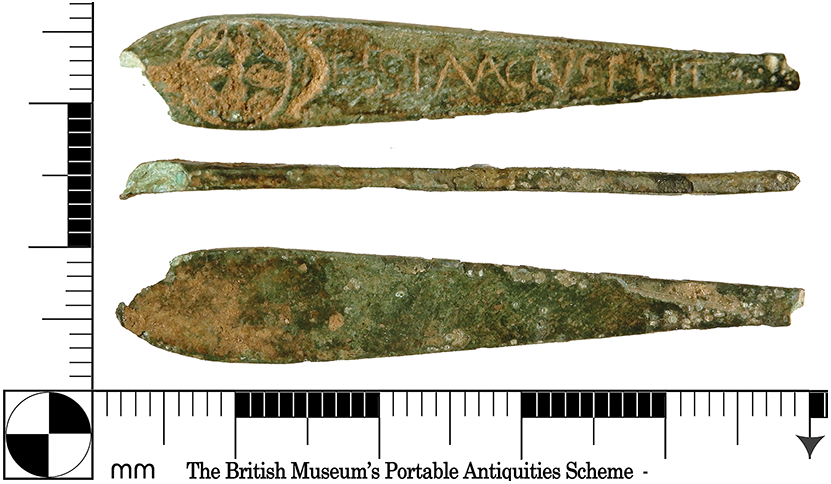
39. Roxby cum Risby (SE 92 15) (Fig. 24). Copper-alloy flat-sided blade tapering to a point now broken, perhaps a nail-cleaner, 48 by 8 mm, foundFootnote 61in 2024. Crudely incised: ḌEṢSI$\overparen{\text{MA}}$GLVSFIC̣IT, Dessimaglus f<e>cit. ‘Dessimaglus made (this).’Footnote 62

Fig. 24. Roxby cum Risby, copper-alloy blade (No. 39) (photo: PAS).

Norfolk

40. Scole (Villa Faustini, TM 146 788) (Fig. 25). Samian rim sherd foundFootnote 63in 1993–4. Incised after firing on the wall: LVNɅRIS, Lunaris.Footnote 64

Fig. 25. Scole, samian graffito (No. 40) (drawing: Norfolk Archaeological Unit).

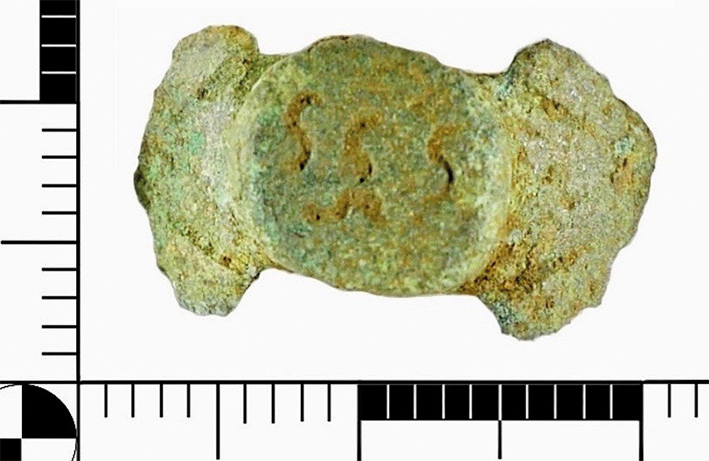
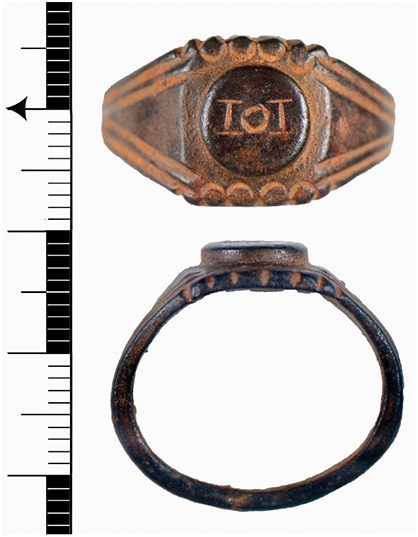
41. Sporle with Palgrave (TF 848 113) (Fig. 26). Part of a copper-alloy finger-ring reportedFootnote 65in 2023. The oval bezel is incised: SSSFootnote 66

Fig. 26. Sporle with Palgrave, copper-alloy ring bezel (No. 41) (photo: PAS).

Northumberland

42. Vindolanda (NY 769 663) (Fig. 27). Three conjoining fragments of a stylus writing-tablet, 112 by 30 mm, foundFootnote 67in 1987. All four edges are broken; the left edge, although still straight, has lost its raised borders front and back. (a) One face is divided by the broad central groove for the witnesses’ seals to a legal document, but was re-used to write this address in cursive letters: (left panel) Coriṣ | Rumano | […] (right panel) ueṇạ[tori] | […]. ‘At Coria [Corbridge], to Rumanus the huntsman …’Footnote 68(b) The other face is inscribed with five lines of cursive letters, but they are a palimpsest and incomplete to the right. A few words are legible, including ut remittas (‘that you may send’), but no continuous text.Footnote 69

Fig. 27. Vindolanda, three fragments of a stylus tablet (No. 42), (a) outer face, (b) inner face (drawn by R.S.O. Tomlin).

Nottinghamshire

43. Stokeham (SK 78 77) (Fig. 28). Copper-alloy finger-ring bezel, 12 mm in diameter, reportedFootnote 70in 2023. Incised retrograde: VIV|ASI, uiu|as i[…]. ‘May you live …’Footnote 71

Fig. 28. Stokeham, copper-alloy ring bezel (No. 43) (photo: PAS).

Oxfordshire

44. Chilson (SP 32 19) (Fig. 29). Copper-alloy potter’s die, its lettered face 33.5 by 10.3 mm, weight 25.1 g, foundFootnote 72in 2024. Moulded letters in relief, retrograde: $\overparen{\text{MA}}$CCIO, Macci o(fficina). ‘Workshop of Maccius.’Footnote 73

Fig. 29. Chilson, copper-alloy potter’s die (No. 44) (photo: PAS).

Somerset

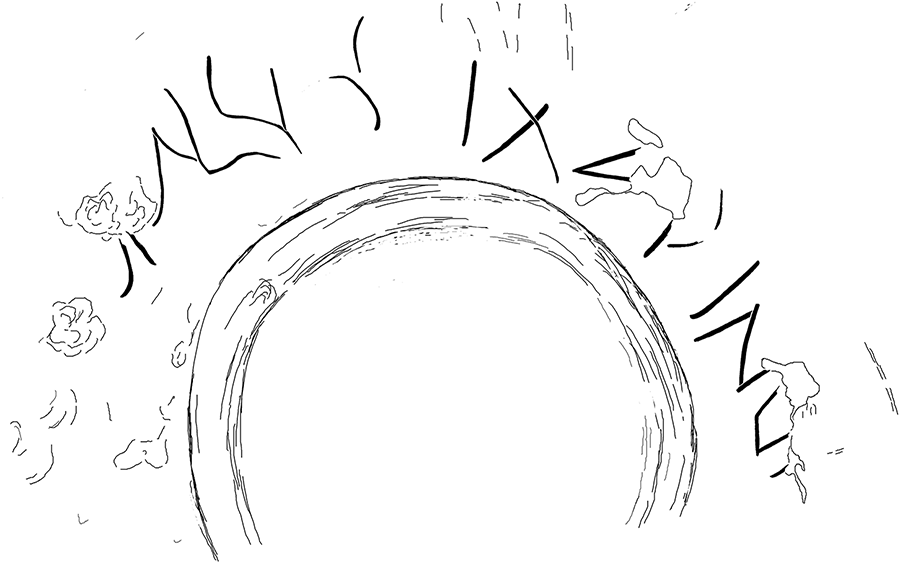
45. Green Ore, Wells, Rookery Farm (ST 5767 5140). Lead ingot or pig, 0.60 by 0.16 m, 0.12 m deep, foundFootnote 74in 1992. It carries four inscriptions. Moulded on top: IMP VESPASIAN AVG, imp(eratoris) Vespasian(i) Aug(usti). ‘(Property) of the Emperor Vespasian Augustus’. Moulded on front: BRIT EX ARG VEB, Brit(annicum) ex arg(entariis) Veb(…). ‘British (lead) from the Veb(…) lead-silver works’. Stamped on back: TI CL [TRIFER], Ti(berius) Cl(audius) [Trifer(na)]. Stamped on one end: [L] RAD.Footnote 75

Suffolk

46. Icklingham (TL 774 727) (Fig. 30). Pewter bowl, 114 mm in diameter, 25 mm deep, foundFootnote 76in 1853. Two graffiti, both incomplete, have been crudely incised on the wall above the foot-ring by different hands: (a) […].ẠLL.S; (b) IXẠ.INṾ.[…], Ixa[r]inu[s] Footnote 77

Fig. 30. Icklingham, pewter graffito (No. 46) (drawn by R.S.O. Tomlin from photographs provided by Ipswich Museum).

47. Ibid. (Fig. 31). Pewter tazza, a pedestal vase with angular rim, 168 mm in diameter, 77 mm deep. Crudely incised underneath within the foot-ring: […]IXẠ[…], probably Ixa[rinus].Footnote 78

Fig. 31. Icklingham, pewter graffito (No. 47) (drawn by R.S.O. Tomlin from photographs provided by Ipswich Museum).

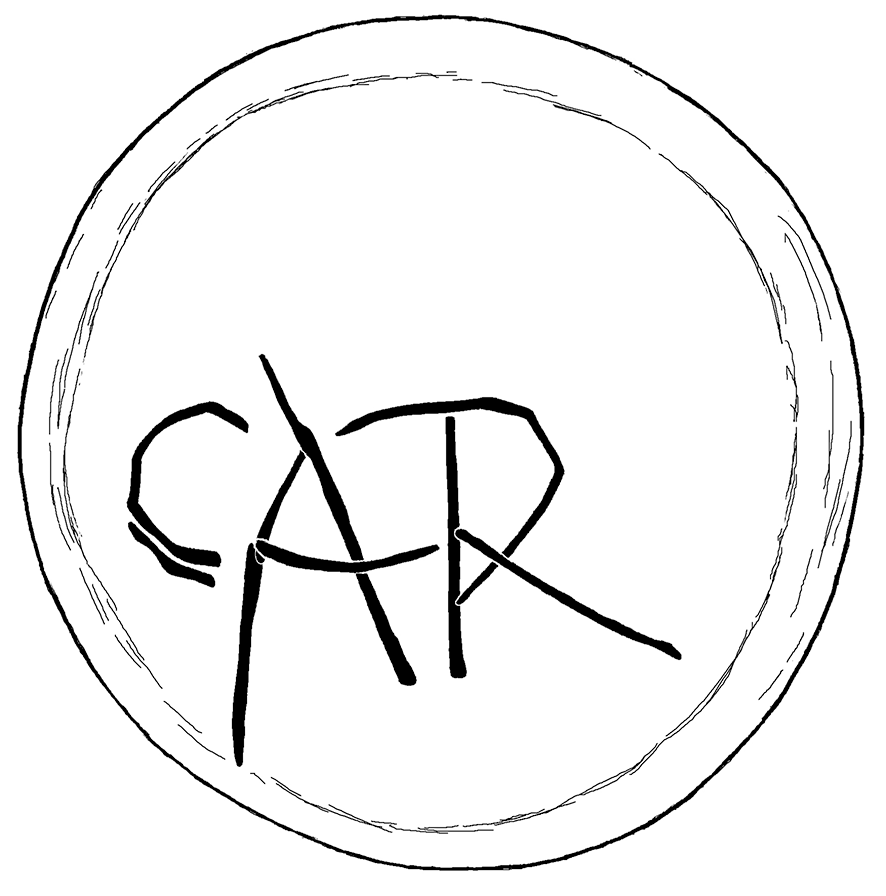
48. Wangford (TM 465 795) (Fig. 32). Pewter bowl, 73 mm in diameter, 23 mm deep, foundFootnote 79before 1936. Incised underneath within the foot-ring: CAR, Car(…).Footnote 80

Fig. 32. Wangford, pewter graffito (No. 48) (drawn by R.S.O. Tomlin from photographs provided by Ipswich Museum).

Surrey

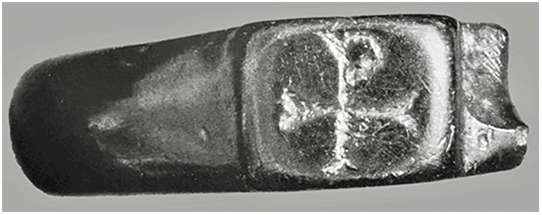
49. Bagshot (SU 9115 6345), 42 London Road (Fig. 33). Jet finger-ring, now incomplete, estimated internal diameter 19 mm, foundFootnote 81in 1993. The rectangular bezel, 9 by 7 mm, is intact. Incised: Rho-Cross, a reduced form of the Chi-Rho ($\overparen{\text{XP}}$) monogram.Footnote 82

Fig. 33. Bagshot, jet ring with incised monogram (No. 49) (photo: Surrey Heath Archaeological and Heritage Trust).

Yorkshire East Riding

50. Elloughton-cum-Brough (SE 94 26) (Fig. 34). Complete silver finger-ring reportedFootnote 83in 2023. The square bezel has a raised central circular panel incised: TOT, To(u)t(atis).Footnote 84

Fig. 34. Elloughton-cum-Brough, silver ring bezel (No. 50) (photo: PAS).

North Yorkshire

51. Aldborough (Isurium Brigantum, SE 4072 6678) (Fig. 35). Lead sealing, 16 by 7 mm, 2 mm thick, foundFootnote 85in 2024 unstratified, c. 70 m outside the North Gate. Within a rectangular panel, DΔN, d(omini) n(ostri). ‘(Sealing) of Our Lord (the Emperor).’Footnote 86

Fig. 35. Aldborough lead sealing (No. 51) (photographed and drawn by R.S.O. Tomlin).

52. Ibid. (Fig. 36). Wall sherd of a samian bowl (Rheinzabern, Ludowici Sb, c. a.d. 150–250), foundFootnote 87in 2024. Neatly incised after firing: IVC, Iuc(undus). The owner’s name, abbreviated.

Fig. 36. Aldborough samian graffito (No. 52) (photo: R.S.O. Tomlin).

53. Cowesby (SE 46 89) (Fig. 37). Incomplete gold finger-ring of Brancaster type (c. AD 350–450) foundFootnote 88in 2023. The integral square bezel is incised: Ʌ $\overparen{\text{XP}}$ [.], α $\overparen{\unicode{x03C7}\unicode{x03C1}}$ [ω]. ‘alpha Chi-Rho omega’.Footnote 89

Fig. 37. Cowesby, gold ring with Chi-Rho (No. 53) (photo: PAS).

C. Addenda et corrigenda

(a) RIB 128(a) (Chedworth Roman villa) (Fig. 38). Stone slab, its lower face deeply incised with a Chi-Rho monogram. On either side is shallowly incised a much smaller (5 mm high) Greek letter, alpha to the left and omega to the right: α $\overparen{\text{XP}}$ ωFootnote 90

Fig. 38. Chedworth, Chi-Rho between alpha and omega (Add. (a)) (photographed and drawn by Stephen Cosh).

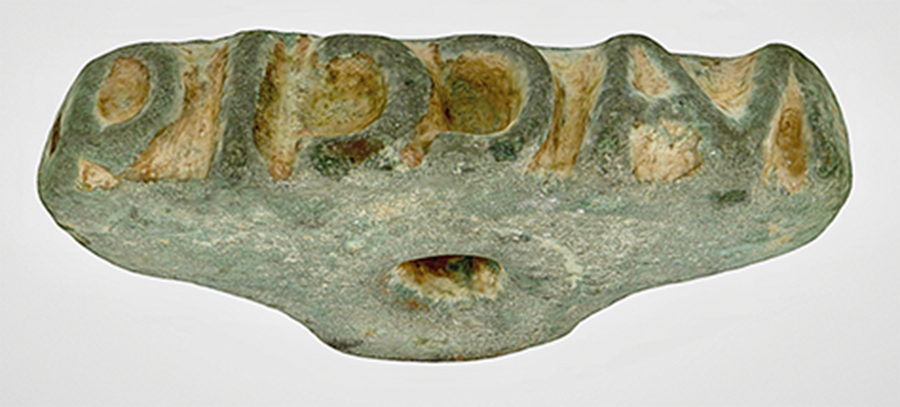
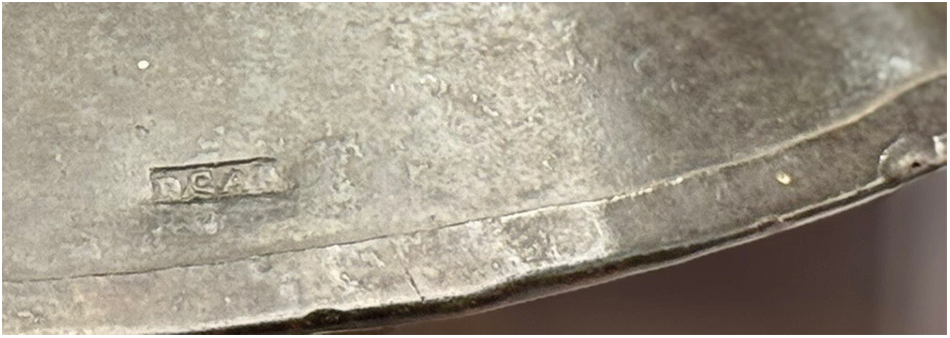
(b) RIB II.3, 2425.9 (Hawkedon) (Fig. 39). Copper-alloy gladiatorial helmet found in Suffolk, stamped on the upper surface of the neck-guard at the back.Footnote 91This ‘much weathered inscription’ was tentatively read as […]OƧ, but comparison with a gladiatorial helmet found at Pompeii suggests a better reading. This is stamped in the same place (Fig. 40): P Δ CARFootnote 92 , which would suggest [P Δ ]CAR for Hawkedon.Footnote 93

Fig. 39. Hawkedon, helmet stamp (Add. (b)) (photo: British Museum).

Fig. 40. Pompeii, helmet stamp (photo: Naples Archaeological Museum).

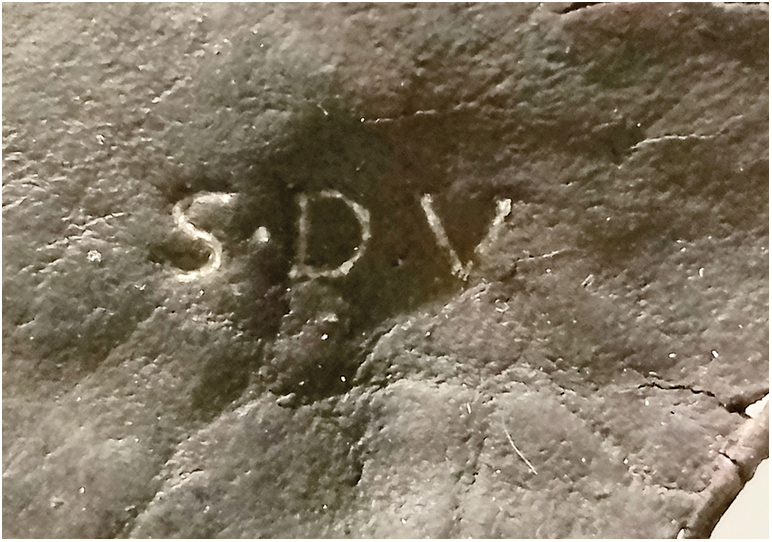
(c) RIB II.4, 2445.12 (Newstead) (Fig. 41). The initials S o D o V stamped on a patch of leather. A recent photograph shows that the letters are less coarse than they were drawn in RIB.Footnote 94

Fig. 41. Newstead, stamped patch of leather (Add. (c)) (photo: Fraser Hunter).

(d) RIB II.8, 2503.119 (Colchester). The ‘Colchester Vase’ has been re-examined.Footnote 95The reading is unchanged, but new photographs show the lettering much better than the drawing in RIB. They illustrate its calligraphic quality, and confirm that the graffito was made before firing, not ‘after firing’ as stated in RIB.

(e) Britannia 27 (1996), 454, No. 42 (South Shields) (Fig. 42). Rim sherd of a black-burnished bowl or dish, foundFootnote 96in 1983. Incised after firing on the outer wall just below the rim: VIC[…], probably Vic[tor].Footnote 97

Fig. 42. South Shields, black-burnished ware graffito (Add. (e)) (photographed and drawn by R.S.O. Tomlin).

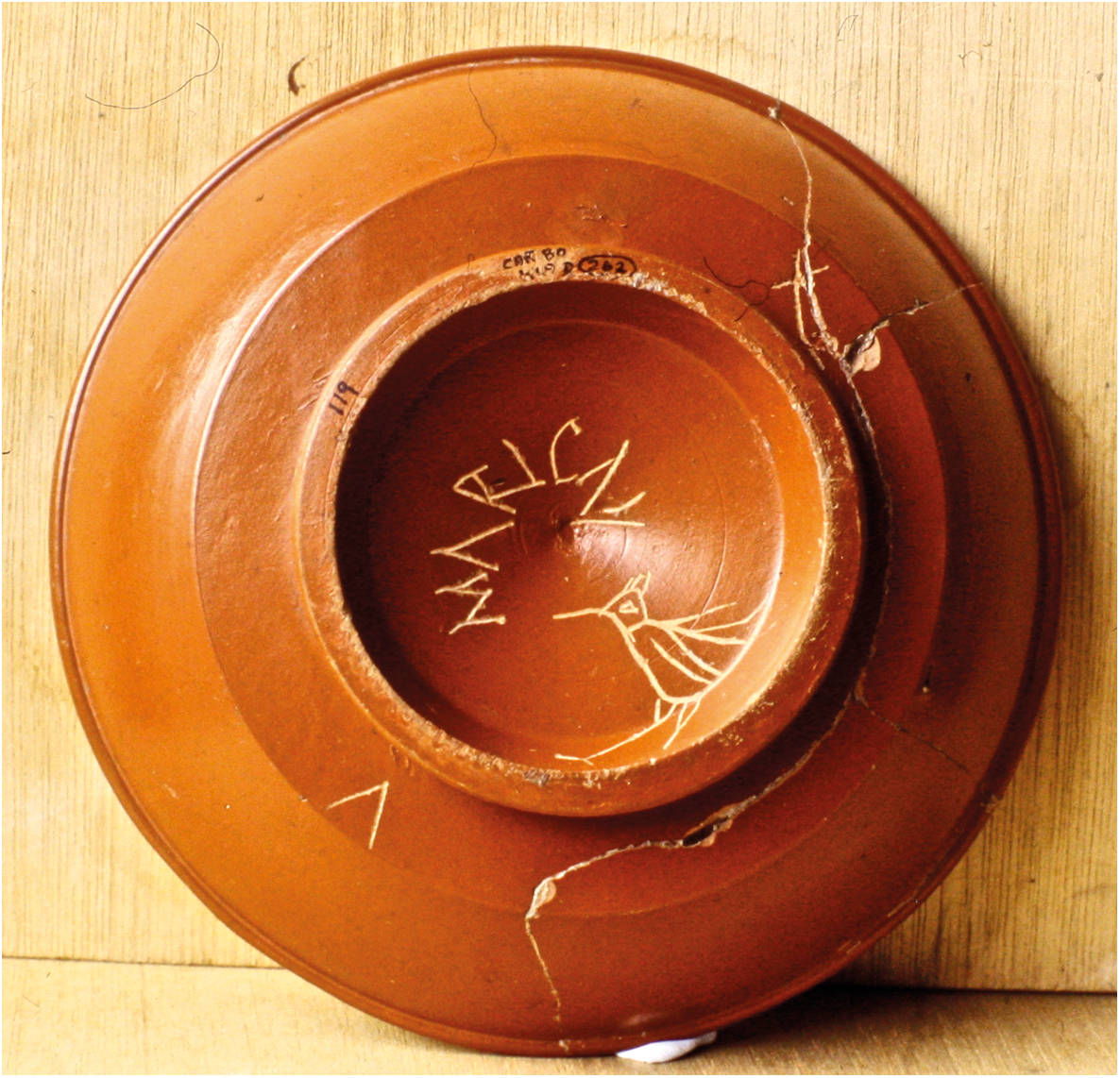
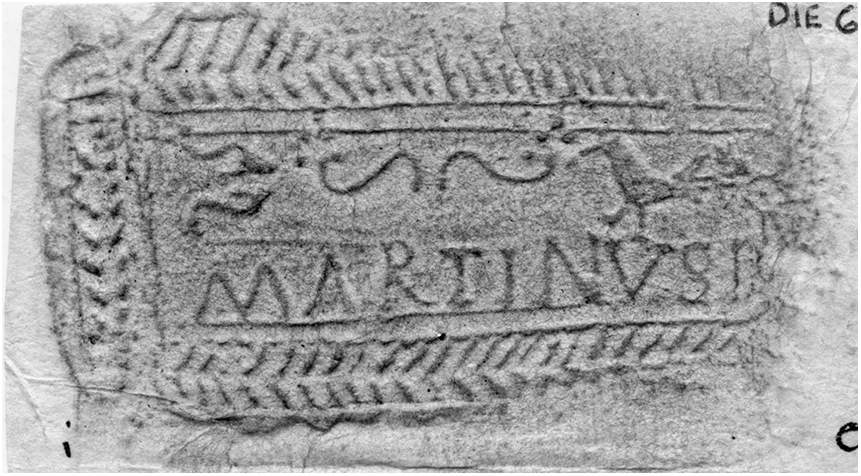
(f) Britannia 28 (1997), 461, No. 20 (Carlisle) (Fig. 43). Samian dish (Drag. 18/31) incised underneath with MɅRICɅII, Maricae, the owner’s name in the genitive, and the drawing of a bird. With its crest and exaggerated beak, it can be seen as a woodpecker (picus), since this bird was sacred to the god Mars.Footnote 98The poet Ovid calls it ‘the bird of Mars’.Footnote 99Depicted on a dish belonging to Marica, it recalled the ‘Mars’ element in her name, like the similar bird (Fig. 44) which accompanies the name of the potter Martinus on his stamped mortarium at Colchester.Footnote 100

Fig. 43. Carlisle, inscribed samian dish (Add. (f)) (photo: Carlisle Archaeological Unit).

Fig. 44. Colchester, mortarium stamp of Martinus (rubbing by Kay Hartley).

(g) Britannia 54 (2023), 435, No. 13 (Stanwix). As noted above, the reverse impression of this lead sealing should be read as [A]NC, [A(ulus] N(…) C(…).Footnote 101

D. Alienum

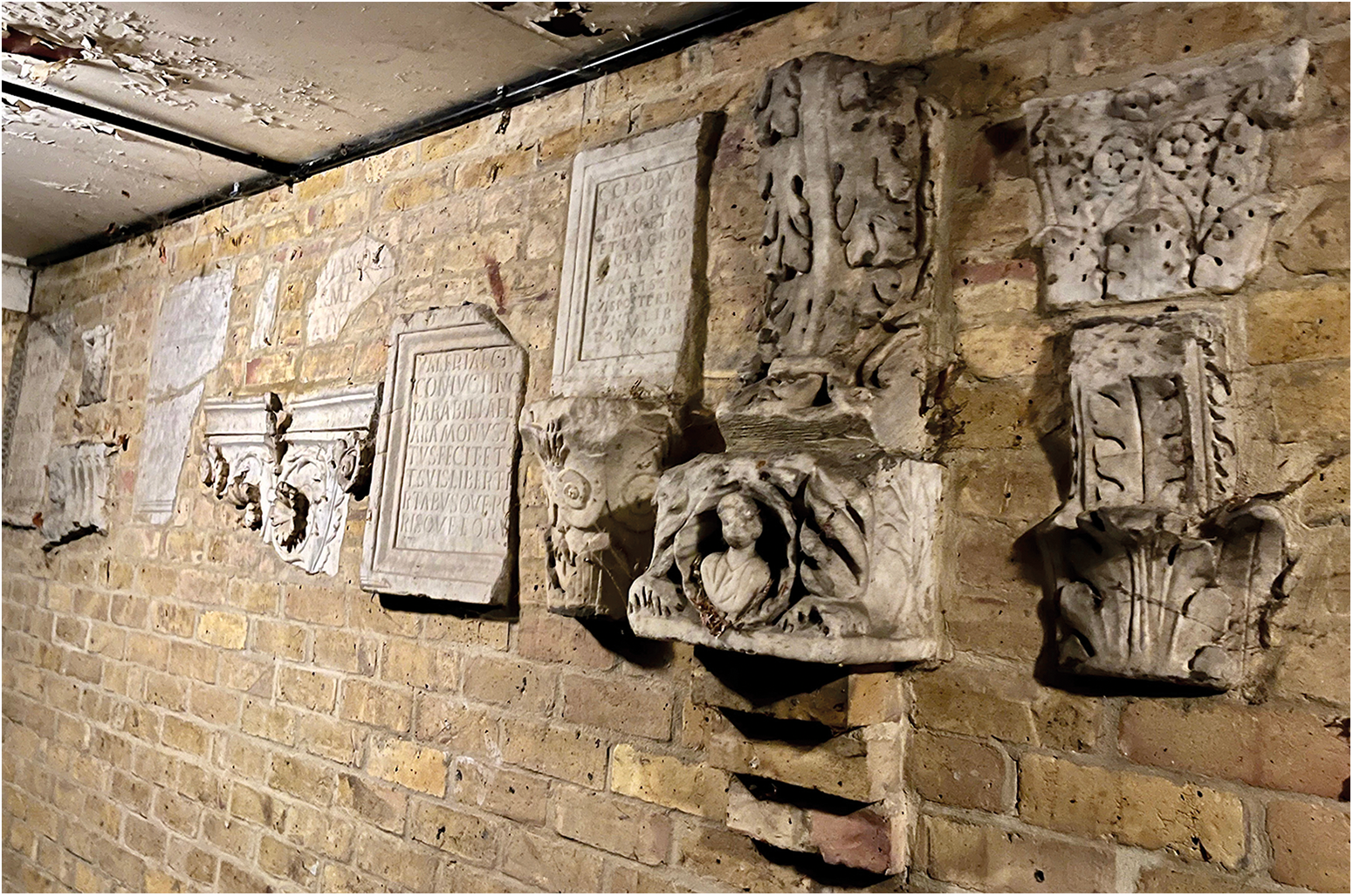
(a) Powell-Cotton Museum, Quex House, Birchington, Kent. Built into a wall are the Roman marble fragments shown in Fig. 45, which include inscribed tombstones. In 1884 they came from the garden of Clarence House, Herne Bay, where they had been owned by William Newton (1786–1861), a civil engineer with antiquarian interests.Footnote 102Like the half-slab in the middle of the top row, they must be ‘Grand Tour souvenirs’ imported from Rome.Footnote 103

Fig. 45. Powell-Cotton Museum, inscribed marble fragments (Alienum (a)) (photo: Ed Griffiths).

E. Falsum

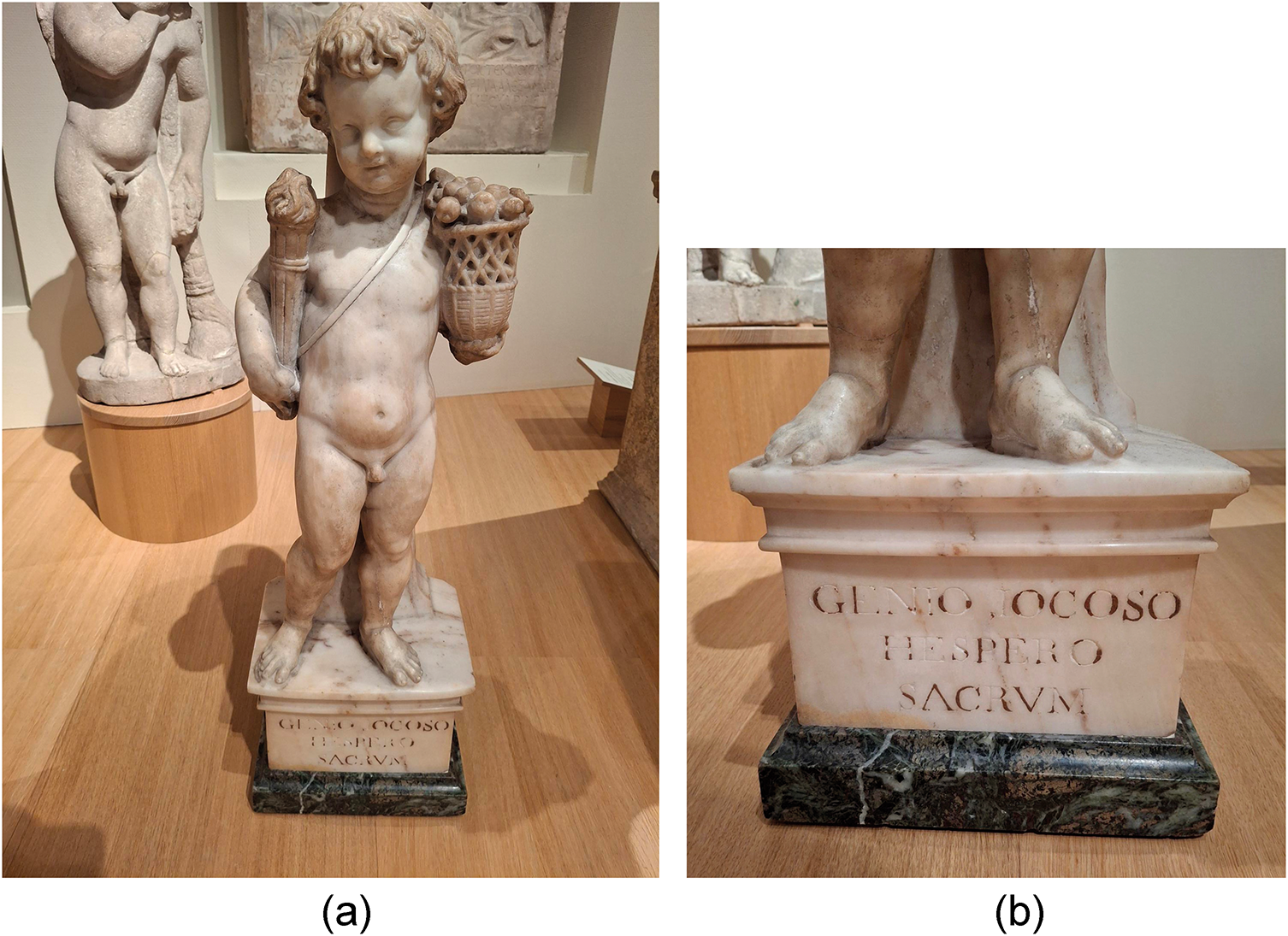
(a) AE 1931, 134 (London, ‘hôtel de Buckingham’) (Fig. 46). Marble statue base inscribed: GENIO IOCOSO | HESPERO | SACRVM, genio iocoso | Hespero | sacrum. ‘Sacred to the cheerful genius Hesperus.’ On it stands the marble figure of a boy with a torch and a basket of fruit, a table-support (trapezophoros) 0.80 m high, restored but probably second-century in date. But the inscription below is not original: it was added in the late-sixteenth/early-seventeenth century, probably in Venice, and is thus not Roman but falsum.Footnote 104

Fig. 46. (a) Marble statue on an inscribed base, seen in London in 1637. (b) Detail of the inscribed base (falsum) (photos: National Museum of Antiquities, Leiden).

References

1 Inscriptions on STONE (‘Monumental’) have been arranged as in the order followed by R.G. Collingwood and R.P. Wright in The Roman Inscriptions of Britain Vol. i (Oxford, 1965) and (slightly modified) by R.S.O. Tomlin, R.P. Wright and M.W.C. Hassall, in The Roman Inscriptions of Britain Vol. iii (Oxford, 2009), which are henceforth cited respectively as RIB (1–2400) and RIB III (3001–3550). Citation is by item and not page number. Inscriptions on PERSONAL BELONGINGS and the like (instrumentum domesticum) have been arranged alphabetically by site under their counties. For each site they have been ordered as in RIB, pp. xiii–xiv. The items of instrumentum domesticum published in the eight fascicules of RIB II (Gloucester and Stroud, 1990–95), edited by S.S. Frere and R.S.O. Tomlin, are cited by fascicule, by the number of their category (RIB 2401–2505) and by their sub-number within it (e.g. RIB II.2, 2415.53). Non-literate graffiti and graffiti with fewer than three complete letters have generally been excluded. When measurements are quoted, the width precedes the height. All the Uley tablets have now (2024) been published by Oxford University Press in its series Oxford Studies in Ancient Documents, as R.S.O. Tomlin, The Uley Tablets: Roman Curse Tablets from the Temple of Mercury at Uley (Gloucestershire). Included are seven tablets from the nearby temple site of Tarlton (Gloucestershire).

2 During excavation by Canterbury Archaeological Trust (Britannia 42 (2011), 393). Tania Wilson and Luke Barber sent details and a photograph.

3 During the excavations published as K.A. Rodwell, Prehistoric and Roman Settlement at Kelvedon (CBA Research Report 63, 1987); the letters are mentioned on pp. 55 and 57, and illustrated on p. 62, as fig. 47 (see Fig. 2, above). They were found in pits associated with the small round building interpreted as a temple destroyed at the end of the second century. In another pit (p. 55) was found the Kelvedon curse tablet (JRS 48 (1958), 150, No. 3) addressed to Mercury, whose name includes the letters C, I and V.

4 By the metal-detectorist Dave Fox, whose collection was catalogued by Jean Bagnall Smith, ‘Votive Objects and Objects of Votive Significance from Great Walsingham’, Britannia 30 (1999), 21–56, where this item is No. 21 (pp. 32–4, with Pl. VIA). Three inscribed rings from the site (p. 32, Nos. 18–20) were reported in Britannia 25 (1994), 306, Nos. 37–9, but not this letter. RIB I, despite its sub-title ‘Inscriptions on Stone’, does include copper-alloy votive letters (RIB 53, 86, 198, 238, 239, 242, 308, 438, 997, 1071 and 2218), but they were excluded from RIB III. Those found since RIB I are Britannia 2 (1971), 289, No. 1 (Springhead); No. 4 (Old Harlow); 3 (1972), 353, No. 7 (Brigstock); 12 (1981), 379, No. 10 (Ivy Chimneys); 18 (1987), 367, No. 4 (Diddington); 21 (1990), 365, No. 1 (Pakenham); 29 (1998), 435, Nos. 3–5 (Wood Eaton); 32 (2001), 387, No. 3 (Dover); 388, Nos. 5–6 (Colchester); No. 8 (Great Chesterford); No. 9 (Hockwold cum Wilton); No. 10 (Alchester); 389, No. 11 (Wood Eaton again).
5 With the next item during the excavation noted in Britannia 9 (1978), 435–6, re-used in the foundations of the Hadrianic ‘villa’. They are the ‘rough inscriptions’ mentioned there, ‘to be reported later’. Graham Webster sent details including photographs. Said to be on loan to Birmingham City Museum.

6 The first letter is certainly C, not Q. [kw] has been reduced to [k] like ecum for equum (‘horse’) in RIB II.5, 2491.151. V is rounded at the bottom like U. There is no sign of the expected centurial symbol to the left, nor indeed space for it, but perhaps it was incised on the adjoining stone. A building stone of ‘the century of Quintus’ is quite likely, but perhaps it is only a mason’s signature, ‘(the stone) of Quintus’. Further to the right are two letters, unexplained. The first is more like L than C (incomplete), the second a vertical stroke. Perhaps a numeral, ‘51’ or ‘101’, but maybe an unfinished attempt at LEG, leg(ionis), if not another name.

7 In form this is a centurial stone, the centurial sign a reversed C. But the centurion’s name is difficult. The first letter is clearly D, its curve echoing that of the centurial sign. Followed by I (unless an incomplete E or F, or even T); then an angular R (unless K); then perhaps V (unless Ʌ), and T with a faint cross-stroke. There is ample space for more letters to the right including I for the genitive ending, but no good trace of them. Since dirutus (‘ruined’) is inherently unlikely, this might be a nomen abbreviated to its first letter or two, followed by a cognomen. For example *Di(dius) Rut[ilianus] in the genitive, but there is no obvious candidate.

8 In a field wall near the fort. Information and photographs from Lindsay Allason-Jones, Steve Bentley and Alastair Robertson. The slab was first photographed by Elaine Edgar, who retains it at Castle Nook Farm.

9 ETA is certain, A being made informally with a diagonal mid-stroke. But these three letters cannot be the initials of tria nomina, and hardly an abbreviated word or personal name; almost the only candidate is Etacontius, which occurs uniquely at Chester (RIB 559). But just to the left of E is a zigzag edge in the surface of the slab (see Fig. 5(b)) which might be the remains of an angular, shallowly-incised G. Geta would then suggest the younger son and colleague of Septimius Severus, who succeeded him as joint-emperor with his brother Caracalla when their father died at York in 211. Both brothers were then in Britain, prompting the conjecture that when Caracalla murdered Geta in December 211 and erased his name from inscriptions throughout the Empire, it was remembered in Britain; and that when Caracalla was honoured as sole Emperor in 213 by many British inscriptions, which included two at Whitley Castle (RIB 1202 and 1203), someone there felt impelled covertly to record the name of Geta.
10 During the excavations published by Tony Wilmott, Birdoswald: Excavations of a Roman fort on Hadrian’s Wall and its successor settlements: 1987–92 (1997). The fragment is fully described on p. 316 (No. 280), but not illustrated. It is now stored by Tullie House, Carlisle (CALMG: 1999.862.280), but could not be located for photography.

11 Many altars dedicated to Jupiter by the First Cohort of Dacians have been found at Birdoswald (RIB 1872–96; III, 3438), and this must be another. But if a letter has been lost to the right of M, then D(olicheno) could be restored, as in RIB 1896.

12 By metal-detector, PAS ref. BERK-90474A. Information from Richard Hobbs and Sally Worrell.

13 After B there is almost no trace of O which, for lack of space, like the loop of R (which resembles ‘K’), was never completed. Neither of the ‘C’-like figures below should be seen as O, since they are linked by a horizontal stroke to divide the two lines of the inscription. N and E are not reversed, nor is E quite finished. Final –AS was omitted, again for lack of space. This same legend is found on silver spoons in the Thetford Treasure (RIB II.2, 2420.47) and the Hoxne Treasure (Britannia 25 (1994), 308, No. 88), which confirms that uir bone is a general invocation, not the vocative of a personal name *Virbonus. Since it is incised here retrograde, it would have greeted the recipient when the ring was used as a signet.

14 With the next two items during excavation by Carlisle Archaeology for the city’s Millennium Project. They were fully published by David Shotter in The Carlisle Millennium Project: Excavations in Carlisle, 1998–2001 (2009), Vol. II, 831, but not reported to Britannia.

15 The initials of the tanner or supplier, like others in RIB II.4, 2445, but this is the first instance of C C M.

16 Again, the initials of the tanner or supplier, in both (a) and (b) probably the same as in the previous item.

17 Illustrated by David Shotter (n. 14 above), pl. 223, who doubted that the die was the same as that which stamped the same initials on a piece of leather found at Newstead (RIB II.4, 2445.12), since ‘the Carlisle stamp is of superior execution’. But a new photograph of the Newstead stamp (Fig. 41 below, with Add. (c)) shows that the letters are finer than they were drawn in RIB, and much like those in the Carlisle stamp. It is still uncertain that V in Newstead has the well-defined serifs of V in Carlisle but, as David Shotter noted, both stamps share an unusual feature: only the first of their two interpuncts is at mid-letter height. So they are probably from the same die.

18 By a local resident while gardening, and now in the care of Frank Giecco, who sent details and a photograph. Its obverse and reverse dies are both the same as those of the next item and of Britannia 54 (2023), 435, No. 13 (Stanwix), but their condition varies. These can be compared with it in Fig. 7, Nos. 3324 and 433 respectively. There is a fourth sealing of the ala, also from Stanwix (RIB II.1, 2411.84), but both its dies are different.

19 The letters A, L and E are ligatured together just as in the other two sealings of the ala in Fig. 7 (Nos. 3324 and 433), but there is almost no trace of the ‘star’ above and below.

20 This reverse explains that of No. 433 already mentioned (Britannia 54 (2023), 435, No. 13), which was mis-read as AXC | ∩ because it was not seen to be at right-angles to the obverse. Its reading should now be corrected to [A]NC.

21 With the next five items during excavation by Wardell Armstrong Archaeology directed by Frank Giecco, who sent details and photographs. For the site and excavation see Britannia 53 (2022), 412–15, where fig. 7 shows that the site is better called ‘Stanwix’ than ‘Carlisle’ (as in Britannia 54 (2023), 435), since it is north of the river and just south-east of Stanwix fort and uicus.

22 Gaius is more often abbreviated to C, and the initial G might be C with a medial stop, but it looks like G, and such a ‘stop’ would be quite unlike the medial point after C. The identification cannot be certain, but this is quite likely the legionary centurion Caledonius Secundus, coh(ortis) VI (legion not stated), in RIB 1679, 1854; III, 3379, 3385.

23 V and E are ligatured, and X quite clear, so this must be the first instance of a lead sealing of a uex(illatio), a detachment taken from a military unit. The unit’s abbreviated name would have followed, but this is difficult. In Fig. 8(a), VEX is apparently followed by part of another letter, perhaps I or A. In the line below, V is clear enough, followed by C (seen better in Fig. 7) and part of another letter, perhaps the curve of O. These traces do not suggest a legion or cohort, but do allow the conjecture of A | VOC for a(lae) Voc(ontiorum), given that the die-cutter working retrograde confused C with O. Three sealings of this ala are known, RIB II.1, 2411.70 and 90; Britannia 47 (2016), 393, No. 6. At Newstead it is attested once by the altar RIB 2121, whereas four altars are dedicated by centurions of the Twentieth Legion (RIB 2120, 2122, 2123 and 2124), which might suggest the fort was garrisoned by detachments of both ala and legion, since RIB 2121 is dedicated by a decurion, not the prefect.

24 Three or four incomplete letters, the abbreviated name of a decurion; perhaps P (with incomplete loop), A (damaged) and D (only two verticals), for P(…) A(…) d(ecurio).

25 Compare RIB II.1, 2411.84 (Stanwix), the fourth sealing of the ala Petriana already mentioned, its reverse reading HRD above two ‘stars’ and a crescent, probably H(…) R(…) d(ecurio). This is not the same die, but both dies may refer to the same decurion.

26 Presumably a personal name abbreviated to its initial letter, M(…). Two of the eight sealings in Fig. 7 have already been published: No. 433, as noted above in n. 20, and No. 817 as Britannia 54 (2023), 435, No. 14: FL FẸ[.] | Ḍ, probably Fl(avius) Fe[l(ix)] | d(ecurio).

27 During excavation by Wardell Armstrong Archaeology directed by Frank Giecco, who sent details including a photograph. Twenty-nine others have already been found there: Britannia 54 (2023), 438, No. 17 (with fig. 17). For this stamp elsewhere in Carlisle, see RIB II.5, 2483 (vi–li).

28 During excavation in Belper Road by York Archaeology, to be reported in Derbyshire Archaeology Journal. Details from Steven Malone, who made the sherd available. It will be deposited in Derby Museum.

29 Below cursive R is the lower tip of S, exaggerated as the final letter; and between them ample room for I, now lost. This layout would have resembled that of the amphora potter Victor’s signature, for which see Britannia 55 (2024), 424, Fig. 18, Victoris. The owner wrote his name as ‘Vitor’, a form found quite often outside Britain as Vitor and Vitorius, but not actually a different name; only a sub-standard spelling of Victor (‘victorious’), a very common name. [kt] has been reduced to [t], a shift hardly found in Britain, but compare the tile stamp RIB II.4, 2460.92, LEG VI VIT PF, with VIT for VI<C>T(RIX).

30 During excavation by Wessex Archaeology for Taylor Wimpey. Information and photographs from Kevin Trott. It will go to the Royal Albert Memorial Museum, Exeter.

31 The first C is much larger than the second C, and somewhat removed from it, which would suggest it was a name abbreviated to its initial letter, whether the praenomen C(aius) or a nomen C(…). The fourth letter, just before the broken edge, is a vertical stroke with possible trace of a diagonal stroke after it, thus N or M. The letters CAN or CAM would then begin a nomen or cognomen in Can– or Cam–, with the rest of it now lost.

32 With the next ten items during excavation by Durham University, Durham County Council and others, now stored in the Department of Archaeology, University of Durham, from where Chris Gerrard made them available with note of their weight and dimensions. Ten other sealings were found, none with two moulded faces. Three of these are so worn as to be illegible; three are figural without lettering (one a standing soldier with spear and shield); and four have two or three initials but are otherwise unidentified. They will all be published in Chris Gerrard’s final report.

33 Many lead sealings with only the letters D N within a rectangular panel have been found since 1986, the cut-off date for RIB II.1, 2411, which has none (but compare 2411.24, where the letters identify an imperial bust). There are three in the Piercebridge river deposit: see Hella Eckardt and Philippa J. Walton, Bridge over Troubled Water: The Roman Finds from the River Tees at Piercebridge in Context (2021), 109–10, Nos. 1–3, where the commentary cites another three from South Shields including RIB II.1, 2411.24, one from Corbridge, and one from Colchester. To these add the two from Aldborough, No. 51 below (with note). The imperial title d(ominus) n(oster) is first used formally in the coinage of Diocletian and his successors, but was used informally in the third century, so it cannot be dated closely.

The five D N sealings from Binchester (Nos. 21–25) may be compared in Fig. 11, where it appears that sf 1218 and 7004 come from the same die, and 1239 and 2837 probably do. Their letters are very close in style, if not quite the same, but this is probably due to a difference in impression rather than different dies. sf 1221 comes from a third die.

34 The break where it is folded has removed any evidence of a medial point. As already noted, this is probably from the same die as sf 1239.

35 As already noted, this is from the same die as sf 1218.

36 sf 20410. For other sealings of the ala II Asturum, with the initials of other decurions, see RIB II.1, 2411.82 (Corbridge) and 83 (Carlisle); Britannia 26 (1995), 382, No. 15 (Chesters); Britannia 51 (2020), 497, No. 34 (Catterick). The ala was posted to Chesters in the Antonine period, where it remained.

37 The decurion’s initials are those of a decurion of the ala Vettonum in the Piercebridge river deposit (Eckardt and Walton (n. 33 above), 116, No. 20), so this ala should be read here. There is apparently a medial point between both A and V, and V and T, with the second point doing duty for the medial horizontal stroke that would have ligatured E to V and T. There is no real sign of this horizontal stroke, but TT (double) is made with exaggerated bottom-serifs, as if to suggest E.

38 sf 5860. As already noted, the ala and the decurion are the same as in a sealing found at the next fort to the south, Piercebridge. The obverse dies are different, but the reverse dies look identical, given that a third medial point (before S) has not registered in the Binchester sealing. The ala Vettonum is well attested at Binchester by RIB 1028, 1032, 1035; III, 3260 and Britannia 45 (2014), 434, No. 4. See also the next two items.

39 sf 4562. The same ala as in the previous item, but the dies are different. KL is for an abbreviated cognomen usually written as Cl(…), such as Clarus or Claudianus. The first letter, with its two short diagonals at mid-letter height, is K, not F.

40 sf 16060. The decurion’s ala is not given, since his sealing was not moulded within the usual matrix that would have made the obverse impression. However, the findspot at Binchester and comparison with the previous item suggest that it was probably the ala Vettonum again. This too is decorated with six-pointed ‘stars’, and VLP is ligatured in just the same way.

41 sf 828. There is a medial point after R, but not after A, indicating that the decurion’s nomen was abbreviated to its first two letters, for example Ar(rius). This would have been balanced by two letters for his cognomen, but the reading is difficult. The first letter is apparently a lower-case H complete, with no sign of being a damaged K or R; then the curve of an incomplete letter, necessarily a vowel, and thus O. As with the previous item, the decurion’s ala is not specified.

42 sf 3206. Two pairs of letters separated by a diagonal stroke; within each pair, the letters are separated by a short vertical medial stroke. The incision of the letters and their format is most unusual, quite unlike any military sealing. Perhaps the only British parallel is a narrow lead strip at Piercebridge, No. 34 in the river deposit cited above (n. 33) and now Britannia 49 (2018), 441, No. 30, bearing the moulded letters G Δ I Δ ET Δ C; understood as the abbreviated names of two business partners. The same may be suggested of the present item.

43 During excavation by Colchester Archaeological Trust (Britannia 33 (2002), 325), sf 455. Information from Nina Crummy, who sent sent photographs and rubbings. She describes it in P. Ottaway (ed.), A Victory Celebration: Papers on the Archaeology of Colchester and Late Iron Age-Roman Britain Presented to Philip Crummy (2006), 61, with fig. 30.2.

44 The letters seem to have been first lightly scratched as a guide to the die-cutter, who failed to complete them all. Hence the faint loops of B and R, the vestigial top-stroke of the second E, and especially both H’s with their two vertical strokes but no linking horizontal; only a short mid-height stroke which does not meet the second vertical.

45 Most oculists’ stamps have a two-line inscription naming the practitioner, his remedy and the eye-condition (for examples see RIB II.4, 2446), but inscription (a) is rather short, with its first three letters being repeated in (b), and the eye-condition specified in (c). This suggests that CAL should be taken separately, as the practitioner’s name abbreviated, and that his remedy (or remedies) was also abbreviated, with the eye-condition being removed to (c). CAL might be Cal(listus) or Cal(listianus), both found as the names of oculists (Gaius Iulius Callistus, CIL xiii 10021, 93; L(ucius) A(…) Callistianus, Carte Archéologique de la Gaule 25/90 (2003), p. 219, Fig. 188), but it is unusual for a practitioner to be attested by more than one stamp.

The remedies are more difficult. The repetition of H, and the impossible sequence HN, suggests it is a one-letter abbreviation, an attractive possibility being h(ygra), which Marcellus Empiricus in his chapter of remedies for eye-conditions (De Medicamentis 8) uses in the sense of ‘eye salve’ (medicamentum liquidum) or collyrium. But the three succeeding letters, NEB and ERA, cannot be resolved by reference to any of his recipes or the remedies found in other collyrium stamps.

46 CHEM is not a Latin sequence, but the Greek word χημωϲιϲ abbreviated, found in Greek medical writers and translated by Liddell and Scott as ‘an affection of the eyes, when the cornea swells like a cockle-shell (χημη) so as to impede sight’. In modern terms this is ‘keratitis’ or a corneal ulcer. It is only the second occurrence of the word in Latin, the first being an oculist’s stamp found in Coca, central Spain (AE 1976, 342): Corneli Alcimi turi|num at(=ad) chemosim | et at(=ad) suppurationes | Corneli Al[ci]mi ica|rium at(=ad) clarita|tem et at(=ad) suffus(iones). It names Cornelius Alcimus and his two remedies, turinum [salve of frankincense] for chemosis and ‘suppurations’ (pus), and icarium for clear vision and cataracts.

47 When it was catalogued by Colchester Museums as COLEM: 2001.99.4. Glynn Davis sent photographs.

48 Below GIIM are two deeply incised lines meeting at an acute angle; not a letter, but perhaps an identifying mark by another owner. To the right, and abutting the broken edge, is the letter C or G, perhaps for G[eminus] again.

49 During the excavations noted in Britannia 43 (2012), 325. Steve Benfield sent details to Mark Hassall, who made the rubbing used for Fig. 20.

50 The first (incomplete) letter is more like I than A, but a name *Ivedo is not attested, whereas Avedo has already occurred at Colchester (RIB II.8, 2503.197).

51 In the Bushe-Fox excavations noticed in Antiquaries Journal 56 (1976), 241. The ring and its reading are published there by Martin Henig, ibid. 242–3. He was sent a drawing by Richard Wright, with whom he discussed the reading, but it was not included in RIB II.3, 2422 (finger-rings). It is now in the Richborough collection (No. 7350352) at Dover Castle, photograph and dimensions sent by Phil Smither.

52 No. 52 in the catalogue of J. Gerrard and M. Henig, ‘Brancaster type signet rings: A study in the material culture of sealing documents in Late Antique Britain’, Bonner Jahrbücher 216 (2017), 225–50. Noted on p. 236, with a drawing in pl. 6.

53 The verticals of B and I terminate in a short, inward diagonal; the cross-bar of A is a short V-shaped ‘chevron’. Basia is a rare personal name, but here it is a verb in the imperative, like the rings inscribed with ama in various ways for ‘love (me)’; in Britain, RIB II.3, 2422.2, 18, 47 and 48.

54 During the excavation noted in Britannia 15 (1984), 290.

55 In the interim report by John Lucas in Leicestershire Archaeological Society Transactions 58 (1982–3), at p. 76. Finds were deposited with Leicestershire Museums, but extensive inquiries by Helen Sharp have not located this sherd, which was not drawn or photographed. Its graffito, whether made before or after firing, can hardly have dedicated the vessel to a god (deo) un-named. DEO is probably an abbreviated personal name, but unless it is a misreading of DEC, no name can be suggested. Perhaps a unique name like Deomiorix (author of the Bath curse tablet Tab. Sulis 99); or a Dio– name mis-spelt, for which compare Deodorus, uniquely in CIL v 2891.

56 For Brancaster rings with one or two human busts on the bezel, some with lettering, see Gerrard and Henig (n. 52 above), 232–4. Another good parallel is Britannia 45 (2014), 446, No. 28, a silver disc with diademed head facing right, with the retrograde legend ANTONI VIVAS IN DEO.

57 By metal-detector, PAS ref. LIN-9CBF81. Lisa Brundle, county Finds Liaison Officer, sent a photograph and other details.

58 This personal name is otherwise unattested, but is probably derived from the same element as the rare name Pectillus (RIB 307 and Tab. Uley 83).

59 By metal-detector, PAS ref. LEIC-A19B9B. Details and photograph from Megan Gard, Finds Liaison Officer for Rutland. It is currently with her at Rutland County Museum, but its final destination is unknown.

60 More than seventy TOT rings, mostly of silver, have now been found, especially in Lincolnshire: see Britannia 50 (2019), 504, Nos. 16–19 (with note of Daubney’s catalogue); 51 (2020), 485, No. 17 and 494, No. 29; 52 (2021), 482, No. 32; and No. 50 below (Elloughton-cum-Brough). The present item, except for one from the Fulbeck area (No. 26 in Daubney’s catalogue, read as DLO | TOT), is the first in which TOT is preceded by DEO. It confirms that TOT rings were dedicated to the god, not intended for use as signets. Compare the rings dedicated to Mercury as ‘god’ (deo) with his name likewise abbreviated: RIB II.3, 2422.20 (DEO | MER); 2422.51 with Britannia 48 (2017), 486, Add. (c) (D ME); Britannia 27 (1996), 451, No. 29 (DEO | MER); Britannia 48 (2017), 477, No. 42 (D ME).

61 PAS ref. NLM-2E0C02.

62 The ‘wheel’-pattern at the broad end is followed by a curved incision which has obscured the first letter of the underlying graffito. After E, the first S is angular and incomplete. A is ligatured within M by a diagonal cross-stroke. E of fecit was never completed, and only the upper curve remains of C. The name Dessimaglus is otherwise unattested, but must combine the Celtic name-element maglus (‘lord’) with the element that lies behind the name Dessius borne by a samian potter (B.R. Hartley and B.M. Dickinson, Names on Terra Sigillata, Vol. 3 (2008), s.v. Dessius).

63 During the excavations by Norfolk Archaeological Unit published by Trevor Ashwin and Andrew Tester, A Romano-British Settlement in the Waveney Valley: Excavations at Scole, 1993–4 (2014). Sixty-two graffiti on coarseware and thirty-one on samian are noted briefly at pp. 297–8, but only this one is illustrated (fig. 6.32, reproduced in Fig. 25 above). Almost all the others are X-like ‘crosses’, notches or single letters/numerals, but a coarseware beaker is said (improbably) to bear the retrograde name ‘CYKINY’.

64 This cognomen is well attested, but not very common; other instances in Britain are all from the north: RIB 786 (Brougham); 620 (Carrawburgh); Britannia 46 (2015), 392, No. 10 (region of Durham); and JRS 11 (1921), 102 (Bordeaux), an altar dedicated by a man from York.

65 PAS ref. LVPL-22C604. Details of this and three other finger-rings (Nos. 43, 50 and 53 below) were sent by Sally Worrell.

66 For other copper-alloy finger-rings incised with SSS, see Britannia 40 (2009), 355. No. 99 (with note); 52 (2021), 466, No. 3 (with note) and 481, No. 29. As suggested there, despite not having a medial line, they are probably ‘Chnoubis’ amulets.

67 During excavation by the Vindolanda Trust directed by Robin Birley. It is now in the British Museum (1988, 1005.279), where it was photographed in 2022 by Alexander Meyer, Alex Mullen and myself, with financial support from the Social Science and Humanities Research Council of Canada and the European Research Council (LatinNow, grant number 715626), together with Britannia 54 (2023), 444, No. 28 and twelve other tablets, which we hope to publish in due course. Nine of them are noticed in E. Birley, R. Birley and A. Birley, Vindolanda Research Reports II, The Early Wooden Forts (1993), where this tablet (Inv. 87.722) is pl. XXII. On p. 43 they read it ‘in part’ as Cerial[     ] and Romano, but in Tab. Vindol. II, p. 364, it is better read by Bowman and Thomas as Coris and Rumano.

68 Any further text below is now lost, but there might have been a note of Rumanus’ military unit at Corbridge, and almost certainly a note of the sender. Notes (i), Coris. For this locative place-name, see Tab. Vindol. 154.7 (with note). It is found in other Vindolanda ink tablets, including two addresses, 312.back 1 and 670.A.address 1 (with note of the present item). (ii), Rumano (which cannot be read as Romano, since the second letter is undoubtedly u) is a personal name otherwise unattested but, like the rare name Ruma, probably comes from the Germanic name-element found in the matronae Rumanehae, goddesses well attested in Lower Germany. (iii), uena[tori]. The third and fourth letters are now incomplete, but their traces accord with a and n in Rumano. In Tab. Vindol. 861.27, the soldier Victor is described as uenator, and the editors comment that the Digest (50.6, 7) includes uenatores in its list of military immunes; for examples see CIL vi 130 (uenatores immun(es) in the Praetorian Guard), iii 7449 (two im(m)unes uen(atores) in Legion XI Claudia), and AE 1975, 160 (immu(ni) uenat[o]r(i) in Legion II Parthica). At Birdoswald are the uenatores Banniess(es) (RIB 1905), and at Vindolanda the prefect Cerialis refers to ‘his’ huntsmen (Tab. Vindol. 615.A.1, uenatores mei).

69 Below the lower tips of a few letters from a line now lost is line 1, which includes the sequence sic. Line 2 apparently reads: am accipiendi et se […]. Line 3 begins with esse. Line 4 ends with ut remittas […] quoted above, and line 5 with the sequence –sem cum u[]. They probably belong to Rumanus’ letter, not the previous legal text, which only contributes confusing traces. It is hoped that the Collaborative Doctoral Partnership (2025–) between the University of Nottingham, the British Museum and the Vindolanda Trust, which will apply generative AI to reading such palimpsests, may help to recover more text.

70 PAS ref. NLM-FB96CB.

71 The letters are cut with exaggerated serifs, top and bottom. The final I (to the left of S) is unexplained. It may have been repeated by mistake or be a blundered uiu|a<t>is (plural), but perhaps it introduced a text which continued round the hoop, now lost: uiuas i[n deo] (‘May you live in God’). This Christian invocation is found on other British rings: RIB II.3, 2422.14, 15, 70; Britannia 45 (2014, 446, No. 28; with XP for (in) Chr(isto), on Britannia 29 (1998), 436, No. 10; and perhaps blundered, on Britannia 46 (2015), 408, No. 48. But uiuas occurs by itself on RIB II.3, 2422.42; and with only a personal name on Britannia 38 (2007), 353, No. 11 and 46 (2015), 408, No. 47. Compare also No. 8 above (Chiseldon).

72 By metal-detector, PAS ref. OXON-2C57AA. Details were sent by Edward Caswell, county Finds Liaison Officer, and comments made by Paul Booth and John Pearce. It has been returned to the finder.

73 Maccius is a well attested name, whereas *Maccio is unknown, so the final O must be for officina (‘workshop’), although this is usually abbreviated to OF. But for o(fficina) compare RIB II.1, 2409.24, a clay die with MOGV|NTIO, Mogunti o(fficina). Pottery stamped OF MACCI or MACCI OF (etc.) has also been found (CIL xiii 10010, 1200), and samian stamped MACCI OFF, MACCIVS F (etc.) is well attested (B.R. Hartley and B.M. Dickinson, Names on Terra Sigillata, Vol. 5 (2009), s.v. Maccius).

74 By the farmer when harrowing. It was bought by Taunton Museum, where it now is. Details from Somerset Historic Environment Record <https://www.somersetheritage.org.uk/record/23209>

75 Compare the almost identical inscriptions on the other four lead pigs found in 1956 in the same field (RIB II.1, 2404.7–10). The stamp on one end, which probably reads [L]RɅD like 2404.8, is unexplained.

76 With the next item, as part of the second (1853) Icklingham hoard of pewter vessels noted in RIB II.2, 2417.3, where it is said that eighteen are in the British Museum and four in Ipswich Museum. This bowl and the tazza (Nos. 46 and 47 above) were part of a collection of antiquities owned by ‘the late W.H. Fenton, Esq, of Heaton House, Suffolk’ from which they were bought at auction by Ipswich Museum in 1936 (acc. nos. 1936.244.16 and 15) together with a third vessel (1936.244.17) from the same hoard, which is not inscribed. Details and photographs were sent by the Museum’s Collections Information Officer, Isobel Keith.

77 The names of successive owners, the end of one name and the beginning of the next distinguished by the difference in lettering-style. The second owner would have begun his name to the right of the first, to avoid overlapping with it, and he can be identified with the Isarninus (etc.) who owned nine other vessels in the 1853 hoard (RIB II.2, 2417.12–20). The first name in (a) probably ended in –allus rather than –allis, since this offers many more possibilities, and there is a space between the vertical stroke which meets the second L, and the final S. But there is no trace here of the second stroke of V. The second name in (b) certainly begins with IX, followed by an incomplete A made with three strokes. It can be read as a variant of the well-attested Isarninus just mentioned, reduced to Ixarinus as in RIB II. II.2, 2417.19 and 20.

78 The 1853 hoard included ‘six pewter cups with pedestals’ inscribed ISARNINVS now in the British Museum (RIB II.2, 2417.12–17), and this may be another of the same form, but with X for S in the name, which was probably reduced to Ixa[rinus] like the previous item. The letter-forms look the same. The surface is quite well preserved without trace of any more letters, but they must have been lost like the third stroke of A.

79 When it was bought by Ipswich Museum (acc. no. 1936.244.18) from the same collection as the other three vessels (Nos. 46 and 47 with n. 76 above). All four are attributed to the Icklingham 1853 hoard by RIB II.2, 2417.3, but ‘Wangford’ is the provenance recorded by the Museum, suggesting that RIB was misled by the vessels being grouped together in the Museum, having all been bought in 1936 from the same collection.

80 An abbreviated personal name, probably Car(us) or one of its derivatives. C is half the height of the next two letters, as if the writer at first intended to write his name in full, but then abbreviated it.

81 During the excavations noted in Britannia 38 (1997), 447, and fully published by Tamasin Graham, ‘A Rho-Cross engraved on a jet finger-ring from Bagshot, Surrey’, Oxford Journal of Archaeology 21.2 (2002), 211–16.

82 The Greek letter Rho with a single, horizontal, cross-stroke. This form occurs on a silver ring from Fifehead Neville, RIB II.3, 2422.45, and (as noted there) is later than the usual $\overparen{\text{XP}}$ form; it dates from the late-fourth or early-fifth century. It appears on twenty items in the Hoxne Treasure (Britannia 25 (1994), 306).

83 PAS ref. YORYM-B6486A.

84 T is made with an exaggerated bottom serif as if to balance the cross-stroke. For other TOT rings, see No. 38 above (Scredington) with note.

85 In excavation for the Aldborough Roman Town Project directed by Rose Ferraby and Martin Millett, who made this and the next item available, with details.

86 D did not register completely, and is now damaged, but is certainly not P. The sealing may be from the same die as another sealing found at the same location in Aldborough in 1989 (Britannia 21 (1990), 376, No. 68), which was little larger and carried the same legend. The present item, with its exaggerated serifs, is very close in style to two of the D N sealings from Binchester, Nos. 23 and 24 above, but its letters are closer together, so the dies are not identical. Other instances of D N are cited there.

87 In the same excavation as the previous item, in a deposit dated to the later third century.

88 By metal-detector, PAS ref. SWYOR-9A0B01.

89 There is no trace of the expected omega in the space for it, whether it has worn away or was omitted by mistake. Unlike two other gold rings with Chi-Rho (RIB II.3, 2422.16 and 17), this inscription is rectograde, as if to ‘dedicate’ the ring rather than making it a signet.

90 The two letters are not drawn or mentioned by RIB, and were first seen by Stephen Cosh, who sent a photograph and drawing (Fig. 38). The slab has since been re-examined and more photographs taken. The contrast between the deeply incised Chi-Rho and the lightly incised alpha and omega may mean that they were added by another hand. Stephen Cosh also sent a photograph of RIB 128(b), which shows that alpha and omega were not added to this Chi-Rho slab. This is probably true of the third slab, RIB 128(c), but it has not yet been possible to check.

91 This addendum was prompted by an inquiry from David Keys, archaeology correspondent of The Independent, who obtained information and photographs from the British Museum and Naples Archaeological Museum with the help of Richard Hobbs and Luciana Jacobelli, author of Gladiators at Pompeii (2003).

92 The reading is that of G. Fiorelli, Catalogo del Museo Nazionale di Napoli. Armi antiche (1869), p. 16, No. 281, and is supported by the photographs from Naples, given that P is rather worn and might be D; and that R is also worn, but is there in outline. C and A are quite certain, with a triangular medial point between P and C.

93 The Hawkedon impression is too damaged to be certain it was made by the same die, but its central letter is more like C than O, with part of the first diagonal and cross-stroke of A to its right, and then the loop and tail of R which might easily be mis-read as Ƨ (S reversed). This is the maker’s name abbreviated: P might be the praenomen P(ublius), but is more likely to be a nomen P(…) followed by the cognomen Car(us) or one of its derivatives. This reading, if accepted, would confirm that the helmet was imported from Campania in the mid-first century a.d., and even that it was worn at gladiatorial games in Colchester; for which compare the ‘Colchester Vase’, Add. (d).

94 Increasing the likelihood that they come from the same die as the same initials stamped on a piece of leather from Carlisle (No. 11 above, with note).

95 Glynn J.C. Davis and John Pearce, ‘Gladiators at Roman Colchester: Re-Interpreting the Colchester Vase’, Britannia 55 (2024), 3–24. For the lettering in particular, see pp. 5–7 with figs. 2–5.

96 During the excavations to be published as Excavations at South Shields Roman Fort, Vol. II. Alex Croom sent the sherd for re-examination, which enabled it to be drawn.

97 The owner’s name in the nominative or genitive (Victoris), Victor or one of its derivatives such as Victorinus. This name is very common, but otherwise not attested at South Shields except as a Spanish amphora potter’s signature (RIB II.6, 2493.77 with Britannia 55 (2024), Add. (b)).

98 Plutarch, Roman Questions, 21.

99 Ovid, Fasti iii 37, Martia picus avis. Compare Pliny, Hist. Nat. x 41, picus Martius.

100 MARTINVS 2, die 6, from the Kay Hartley Mortarium Archive Project (East Anglia).

101 See n. 20 to No. 12 above (Stanwix).

102 Information from Hazel Basford, the Museum archivist, responding to an inquiry from Ed Griffiths, who could not find them on the RIB website. If known to Collingwood and Wright, they would have been ignored as not being true aliena, ‘inscriptions … that have been wrongly ascribed to Roman Britain’, but since they may include unpublished items, it is hoped to examine them more closely. The provenance is also worth recording in detail (see next note).

103 This half-slab can be identified as the left-hand half of CIL vi 38210 (Rome), dedicated by Clodius Euphemus to his deceased foster-children, which was excavated on the Via Appia in 1793 outside the monastery of San Sebastiano fuori le mura. Carlo Labruzzi made a drawing of the excavation, from which comes the etching in Agostino Rem-Picci, Monumenti e Ruderi Antichi … della Via Appia (1844), Tav. 24. In the foreground is a medley of inscriptions found, including the whole of CIL vi 38210, lying in front of two funerary altars now in the Louvre (CIL vi 10958 and 20413). The slab is shown complete, but when it was published in CIL, the entry did not mention that its right-hand half had already been published as CIL 17369, ‘a marble fragment in the Vatican Museum’ without further provenance. Evidently the slab suffered a mishap after it was unearthed, and in the antiquities trade its two halves went in different directions.

104 L’Année Épigraphique locates the inscription from the account by Dubuisson-Aubenay of antiquities in the ‘Hôtels de Buckingham et d’Arundel’ which he saw during his visit to England in 1637. His account is published by Léon Halkin in Serta Leodiensia (1930), 184–6. Dubuisson-Aubenay saw four inscriptions in ‘Buckingamhouse’ (sic), the others being identifiable as CIL vi 10534 (now in Rotterdam, but lost), 10722 (now in Leiden Museum) and 15602 (now in Leiden, but lost). The fourth is AE 1931, 134, which (as Halkin and AE both note) is not recorded by CIL vi (Rome) or vii (Britain). It captioned an Eros-like figure (‘un amoureau’) holding a torch and cornucopia. From Dubuisson-Aubenay’s account it is certain, as Kate Heard has seen, that the location was not ‘Buckingham House’, but York House in the Strand, which was the city residence of George Villiers, first Duke of Buckingham, until his assassination in 1628. It contained his very large collection of Old Master paintings and Roman sculpture, which was catalogued for the second Duke in 1635. This catalogue (Bodleian MSS Rawlinson, A341, ff. 30–41, transcribed by Simon Jervis in Furniture History 33 (1997), 57–74) includes ‘A Stone wth: a Descripcon’, but this must be one of the other inscriptions. AE 1931, 134, is ‘A Naked Boy wth. Fruit’.

The second Duke inherited this collection and exported most of it to Holland in 1648, where he sold it in 1650. It included this statue, whose previous history is traced by Abigail Newman of the Rubenshuis, Antwerp, in the exhibition catalogue Thomas Leysen and Ben van Beneden (eds), Rare and Indispensable Masterpieces from Flemish Collections (2023). First recorded in a Venetian collection in 1577, when a drawing was made to interest possible buyers, it then passed through various hands including Dudley Carleton, ambassador of England to Venice, who sold it in 1618 to the painter Rubens. In 1626, Rubens sold it to the first Duke of Buckingham, and it came to London.

In view of its association with Rubens, the statue has since been bought by the Rubenshuis, Antwerp, but is currently on display in the National Museum of Antiquities, Leiden, from where Ruurd Albertsma sent photographs and other details. The 1577 drawing (see The Rubenianum Quarterly 2021.4, p. 4) shows the statue base as uninscribed, proving that its inscription was added later. This might be deduced, not only from the un-Roman form of the letter E, but from the content. Although dedications (to) genio … sacrum are quite common, there is none genio iocoso, which itself is a phrase unparalleled; and although Hesperus is a well-attested personal name, there is no other dedication known to Hesperus the Evening Star.

Figure 0

Fig. 1. Canterbury, tombstone fragment (No. 1) (photo: Canterbury Archaeological Trust).

Figure 1

Fig. 2. Kelvedon, copper-alloy votive letters (No. 2) (drawing: Council for British Archaeology).

Figure 2

Fig. 3. Wall, inscribed building stone (No. 4) (photo: A.A. Round).

Figure 3

Fig. 4. Wall, inscribed building stone (No. 5) (photo: A.A. Round).

Figure 4

Fig. 5. (a) Whitley Castle, inscribed slab (No. 6) (photo: Gordon Monk); (b) detail of the lettering (photo: Elaine Edgar).

Figure 5

Fig. 6. Chiseldon, silver ring bezel (No. 8) (photo: PAS).

Figure 6

Fig. 7. Stanwix, eight lead sealings (including Nos. 12–17) (photo: Anna Giecco for Wardell Armstrong).

Figure 7

Fig. 8. Stanwix, lead sealing (No. 15), (a) obverse, (b) reverse (photos: Frank Giecco).

Figure 8

Fig. 9. Derby, Strutt’s Park, samian graffito (No. 19) (photographed and drawn by R.S.O. Tomlin).

Figure 9

Fig. 10. Topsham, black-burnished ware graffito (No. 20) (photo: Wessex Archaeology).

Figure 10

Fig. 11. Binchester, five D N lead sealings (Nos. 21–25) (photo: R.S.O. Tomlin).

Figure 11

Fig. 12. Binchester, lead sealing (No. 26), (a) obverse, (b) reverse (photos: R.S.O. Tomlin).

Figure 12

Fig. 13. Binchester, lead sealing (No. 27), (a) obverse, (b) reverse (photos: R.S.O. Tomlin).

Figure 13

Fig. 14. Binchester, lead sealing (No. 28), (a) obverse, (b) reverse (photos: R.S.O. Tomlin).

Figure 14

Fig. 15. Binchester, lead sealing (No. 29) (photo: R.S.O. Tomlin).

Figure 15

Fig. 16. Binchester, lead sealing (No. 30) (photo: R.S.O. Tomlin).

Figure 16

Fig. 17. Binchester, lead sealing (No. 31) (photo: R.S.O. Tomlin).

Figure 17

Fig. 18. Colchester, oculist’s stamp (No. 32), (a) long edge, (b) other long edge, (c) short edge (drawn by R.S.O. Tomlin from photographs by Colchester Archaeological Trust).

Figure 18

Fig. 19. Colchester, amphora graffito (No. 33) (photo: Colchester Museums).

Figure 19

Fig. 20. Colchester, coarseware graffito (No. 34) (drawn by R.S.O. Tomlin from a rubbing by Mark Hassall).

Figure 20

Fig. 21. Richborough, silver ring with monogram (No. 35) (photo: English Heritage).

Figure 21

Fig. 22. Ancaster, gold and silver ring bezel (No. 37) (photo: PAS).

Figure 22

Fig. 23. Scredington, silver ring bezel (No. 38) (photo: PAS).

Figure 23

Fig. 24. Roxby cum Risby, copper-alloy blade (No. 39) (photo: PAS).

Figure 24

Fig. 25. Scole, samian graffito (No. 40) (drawing: Norfolk Archaeological Unit).

Figure 25

Fig. 26. Sporle with Palgrave, copper-alloy ring bezel (No. 41) (photo: PAS).

Figure 26

Fig. 27. Vindolanda, three fragments of a stylus tablet (No. 42), (a) outer face, (b) inner face (drawn by R.S.O. Tomlin).

Figure 27

Fig. 28. Stokeham, copper-alloy ring bezel (No. 43) (photo: PAS).

Figure 28

Fig. 29. Chilson, copper-alloy potter’s die (No. 44) (photo: PAS).

Figure 29

Fig. 30. Icklingham, pewter graffito (No. 46) (drawn by R.S.O. Tomlin from photographs provided by Ipswich Museum).

Figure 30

Fig. 31. Icklingham, pewter graffito (No. 47) (drawn by R.S.O. Tomlin from photographs provided by Ipswich Museum).

Figure 31

Fig. 32. Wangford, pewter graffito (No. 48) (drawn by R.S.O. Tomlin from photographs provided by Ipswich Museum).

Figure 32

Fig. 33. Bagshot, jet ring with incised monogram (No. 49) (photo: Surrey Heath Archaeological and Heritage Trust).

Figure 33

Fig. 34. Elloughton-cum-Brough, silver ring bezel (No. 50) (photo: PAS).

Figure 34

Fig. 35. Aldborough lead sealing (No. 51) (photographed and drawn by R.S.O. Tomlin).

Figure 35

Fig. 36. Aldborough samian graffito (No. 52) (photo: R.S.O. Tomlin).

Figure 36

Fig. 37. Cowesby, gold ring with Chi-Rho (No. 53) (photo: PAS).

Figure 37

Fig. 38. Chedworth, Chi-Rho between alpha and omega (Add. (a)) (photographed and drawn by Stephen Cosh).

Figure 38

Fig. 39. Hawkedon, helmet stamp (Add. (b)) (photo: British Museum).

Figure 39

Fig. 40. Pompeii, helmet stamp (photo: Naples Archaeological Museum).

Figure 40

Fig. 41. Newstead, stamped patch of leather (Add. (c)) (photo: Fraser Hunter).

Figure 41

Fig. 42. South Shields, black-burnished ware graffito (Add. (e)) (photographed and drawn by R.S.O. Tomlin).

Figure 42

Fig. 43. Carlisle, inscribed samian dish (Add. (f)) (photo: Carlisle Archaeological Unit).

Figure 43

Fig. 44. Colchester, mortarium stamp of Martinus (rubbing by Kay Hartley).

Figure 44

Fig. 45. Powell-Cotton Museum, inscribed marble fragments (Alienum (a)) (photo: Ed Griffiths).

Figure 45

Fig. 46. (a) Marble statue on an inscribed base, seen in London in 1637. (b) Detail of the inscribed base (falsum) (photos: National Museum of Antiquities, Leiden).