


1. Introduction
Since the late Early Miocene, significant geodynamic changes have affected the 27–33ºS Andean segment as a consequence of the shallowing of the Nazca plate (Ramos, Cristallini & Perez, Reference Ramos, Cristallini and Perez2002 and references therein; Fig. 1a). Deformation migrated inland, resulting in Andean foreland basin exhumation (Argentine Precordillera) and fragmentation by major block uplift (Sierras Pampeanas and Famatina broken foreland; Isacks et al. Reference Isacks, Jordan, Allmendinger and Ramos1982; Jordan et al. Reference Jordan, Isacks, Ramos and Allmendinger1983; Jordan & Allmendinger, Reference Jordan and Allmendinger1986; Kay & Abbruzzi, Reference Kay and Abbruzzi1996; Ramos, Cristallini & Perez, Reference Ramos, Cristallini and Perez2002). Declining arc-magmatism also migrated towards the foreland and was emplaced along WNW-trending corridors (Urbina & Sruoga, Reference Urbina and Sruoga2009; Japas, Urbina & Sruoga, Reference Japas, Urbina and Sruoga2010; Oriolo et al. Reference Oriolo, Japas, Cristallini, Giménez, Llana-Fúnez, Marcos and Bastida2014).
(a) The Sierra de los Colorados area (SdlC) in the regional context, southern Central Andes (Shuttle Radar Topography Mission image). PFS: Pampean Flat-Slab (27–33ºS). SJ: San Juan city; T: Tucumán city. WP: Western Precordillera; CP: Central Precordillera; EP: Eastern Precordillera; SP: Southern Precordillera; ETF: El Tigre Fault; SSL: Sierra de San Luis. Courtesy NASA / Jet Propulsion Laboratory, California Institute of Technology: http://www2.jpl.nasa.gov/srtm/southAmerica.htm#PIA03388. (b) Simplified geological map from the area (after Caminos et al. Reference Caminos, Nullo, Panza and Ramos1993; Ragona et al. Reference Ragona, Anselmi, González and Vujovich1995; Zapata & Allmendinger, Reference Zapata and Allmendinger1996; SEGEMAR, unpub. data, 2012, http://sig.segemar/gov.ar), and cross-section A–B (after Fauqué et al. Reference Fauqué, Limarino, Vujovich, Cegarra and Escosteguy2016). Abbreviations as for Figure 1a. Rectangles indicated with letters a, b, c and d refer to the regions whose Neogene stratigraphy is summarized in Table 1 (northern Central Precordillera, Transitional zone, western Sierras Pampeanas and Famatina respectively). (c) Oblique transpressional and transtensional belts (modified from Ré, Japas & Barredo, Reference Ré, Japas, Barredo, Cortés, Rossello and Dalla Salda2001; Japas, Oriolo & Sruoga, Reference Japas, Oriolo and Sruoga2012). NPPL: Northern Pie de Palo Lineament. Notice that main NNW-trending belts are coincident with and linked to ancient sutures (the different terranes are shown), recurrently reactivated since the Late Palaeozoic.

Regional transpressional deformation played a main role during Neogene deformation of the Argentine Precordillera (Japas, Reference Japas1998; Ré, Japas & Barredo, Reference Ré, Japas, Barredo, Cortés, Rossello and Dalla Salda2001; Siame et al. Reference Siame, Bellier, Sebrier and Araujo2005; Álvarez-Marrón et al. Reference Álvarez-Marrón, Rodríguez-Fernández, Heredia, Busquets, Colombo and Brown2006; Oriolo et al. Reference Oriolo, Japas, Cristallini, Giménez, Llana-Fúnez, Marcos and Bastida2014, Reference Oriolo, Cristallini, Japas and Yagupsky2015; Japas et al. Reference Japas, Ré, Oriolo, Vilas, Pueyo, Cifelli, Sussman and Oliva-Urcia2015) and the Sierras Pampeanas and Famatina broken foreland (Rossello et al. Reference Rossello, Mozetic, Cobbold, Urreiztieta and Gapais1996; Japas, Reference Japas1998; Ré, Japas & Barredo, Reference Ré, Japas, Barredo, Cortés, Rossello and Dalla Salda2001). Transpression was controlled by oblique convergence (N76ºE defined by DeMets et al. Reference DeMets, Gordon, Argus and Stein1990, onto an approximately N–S margin trend) affecting a strongly anisotropic upper plate (Rossello et al. Reference Rossello, Mozetic, Cobbold, Urreiztieta and Gapais1996; Ré, Japas & Barredo, Reference Ré, Japas, Barredo, Cortés, Rossello and Dalla Salda2001; Japas, Ré & Barredo, Reference Japas, Ré and Barredo2002; Japas & Ré, Reference Japas and Ré2012 a, b; Oriolo et al. Reference Oriolo, Japas, Cristallini, Giménez, Llana-Fúnez, Marcos and Bastida2014, Reference Oriolo, Cristallini, Japas and Yagupsky2015; Perucca & Ruiz, Reference Perucca and Ruiz2014; Japas et al. Reference Japas, Ré, Oriolo, Vilas, Pueyo, Cifelli, Sussman and Oliva-Urcia2015; Ortiz et al. Reference Ortiz, Alvarado, Fosdick, Perucca, Saez and Venerdini2015). These pre-Neogene major inherited structures in the upper plate (Alvarado, Beck & Zandt, Reference Alvarado, Beck and Zandt2007; Gans et al. Reference Gans, Beck, Zandt, Gilbert, Alvarado, Anderson and Linkimer2011; Ammirati et al. Reference Ammirati, Alvarado, Perarnau, Sáez and Monsalvo2013) resulted from a long history of accretion and amalgamation of different terranes (Ramos, Reference Ramos1999; Ramos, Cristallini & Perez, Reference Ramos, Cristallini and Perez2002).
The Argentina Precordillera (hereafter referred to as Precordillera) comprises a nearly N–S-trending fold-and-thrust belt (Baldis & Chebli, Reference Baldis and Chebli1969; Ortiz & Zambrano, Reference Ortiz and Zambrano1981; Baldis et al. Reference Baldis, Beresi, Bordonaro and Vaca1982; Fig. 1). It consists of an E-verging thin-skinned domain (Western and Central Precordillera) and a W-verging thick-skinned domain (Eastern Precordillera; Baldis & Chebli, Reference Baldis and Chebli1969; Ortiz & Zambrano, Reference Ortiz and Zambrano1981; Baldis et al. Reference Baldis, Beresi, Bordonaro and Vaca1982; Fig. 1b), with a thick-skinned triangular zone developed in between (Zapata & Allmendinger, Reference Zapata and Allmendinger1996). Along-strike segmentation allows to define two more morphostructural domains: (i) the Southern Precordillera that resulted from inversion and reactivation of Palaeozoic and Triassic NNW-striking major structures (Cortés, Pasini & Yamín, Reference Cortés, Pasini and Yamín2005; Cortés et al. Reference Cortés, Casa, Pasini, Yamín and Terrizzano2006; Terrizzano et al. Reference Terrizzano, Fazzito, Cortés and Rapalini2010), and (ii) the thick-skinned Northern Precordillera (28°15′–30°S; Cortés et al. Reference Cortés, Casa, Yamín, Pasini and Terrizzano2014; Fig. 1b). In the Western and Central Precordillera, a first stage of Miocene thin-skinned highly partitioned transpressional deformation was followed by deformation along basement-involved WNW-trending transtensional cross-strike structures, and subsequent late Pliocene reactivation of pre-Andean NNW-striking structures. WNW-striking structures controlled the emplacement of the Miocene magmatism during its migration towards the foreland (Oriolo et al. Reference Oriolo, Japas, Cristallini, Giménez, Llana-Fúnez, Marcos and Bastida2014). In the case of the Eastern Precordillera, deformation only resulted from the late Pliocene stage (Japas et al. Reference Japas, Ré, Oriolo, Vilas, Pueyo, Cifelli, Sussman and Oliva-Urcia2015).
The broken foreland comprises the Sierras Pampeanas and the Sierra de Famatina systems, part of a distal thick-skinned deformed foreland composed of basement blocks bounded by reactivated, NNW- and N-trending, high-angle reverse faults (Ramos, Cristallini & Perez, Reference Ramos, Cristallini and Perez2002; Hilley, Blisniuk & Strecker, Reference Hilley, Blisniuk and Strecker2005; Mortimer et al. Reference Mortimer, Carrapa, Coutand, Schoenbohm, Sobel, Sosa-Gómez and Strecker2007; Fig. 1a, b). Both regions share a similar Neogene geodynamical setting and basement block structure, differing in their pre-Cenozoic geological record (Petersen & Leanza, Reference Petersen and Leanza1953). According to Dávila et al. (Reference Dávila, Astini, Jordan and Kay2004), Löbens et al. (Reference Löbens, Bense, Wemmer, Dunkl, Costa, Layer and Siegesmund2011, Reference Löbens, Sobel, Bense, Wemmer, Dunkl and Siegesmund2013 a, b), Wemmer et al. (Reference Wemmer, Steenken, Müller, López de Luchi and Siegesmund2011), Bense et al. (Reference Bense, Löbens, Dunkl, Wemmer and Siegesmund2013, Reference Bense, Wemmer, Löbens and Siegesmund2014) and Ortiz et al. (Reference Ortiz, Alvarado, Fosdick, Perucca, Saez and Venerdini2015), some parts of this foreland region underwent significant exhumation prior to widespread Late Miocene deformation.
To the north of the Pampean flat-slab segment of the Central Andes (Fig. 1a, b) the Sierra de los Colorados area shows a Neogene deformation history linked to the Precordillera and the broken foreland. Traditionally it was considered as part of the Sierras Pampeanas (Turner, Reference Turner1964; Ramos, Reference Ramos1970; Ciccioli et al. Reference Ciccioli, Limarino, Marenssi, Tedesco, Tripaldi, Salfity and Marquillas2011), but recent palaeomagnetic data by G. H. Ré (unpubl. Ph.D. thesis, Univ. de Buenos Aires, 2008) and Japas et al. (Reference Japas, Ré, Oriolo, Vilas, Pueyo, Cifelli, Sussman and Oliva-Urcia2015) allowed an early stage of thin-skinned transpressional deformation to be identified. Based on kinematic, structural and geophysical information, and available chronological data, this contribution will focus on the causes and temporal evolution of Mio-Pliocene thick-skinned deformation overprinting late Middle Miocene, thin-skinned structures in the Sierra de los Colorados area. In this two-staged deformation scenario, the significance of oblique transpressional and transtensional megazones in controlling Neogene deformation will also be analysed.
2. Geological setting
2.a. Geological record
In the Precordillera, unexposed basement rocks are considered as Grenvillian (Leveratto, Reference Leveratto1968; Abbruzzi, Kay & Bickford, Reference Abbruzzi, Kay and Bickford1993; Kay, Orrell & Abruzzi, Reference Kay, Orrell and Abruzzi1996). Palaeozoic rocks record the evolution from a Cambrian–Ordovician passive to a Silurian–Devonian active margin and culminated with a post-collisional history of Carboniferous–Permian active subduction. The Palaeozoic margin was successively deformed during the Middle to Late Ordovician, the Late Devonian and the Early Permian (Famatinian–Ocloyic, Famatinian–Chanic and San Rafael orogenies, respectively). During the Triassic, plate rearrangements resulted in regional rifting. From the inception of the Andean orogeny, this region evolved as part of the Bermejo foreland basin until it began to be deformed at c. 19 Ma (Jordan et al. Reference Jordan, Allmendinger, Damanti and Drake1993; Alonso et al. Reference Alonso, Limarino, Litvak, Poma, Suriano, Remesal, Salfity and Marquillas2011; Table 1).
Cenozoic Stratigraphy of northern Central Precordillera, Sierra de los Colorados, western Sierras Pampeanas and Famatina areas. Data compiled from Malizia, Reynolds & Tabbutt (Reference Malizia, Reynolds and Tabbutt1995), Dávila & Astini (Reference Dávila and Astini2007), Limarino, Ciccioli & Marenssi (Reference Limarino, Ciccioli and Marenssi2010), Ciccioli et al. (Reference Ciccioli, Limarino, Friedman and Marenssi2014), Collo et al. (Reference Collo, Dávila, Ezpeleta and Teixeira2014) and Fauqué et al. (Reference Fauqué, Limarino, Vujovich, Cegarra and Escosteguy2016).
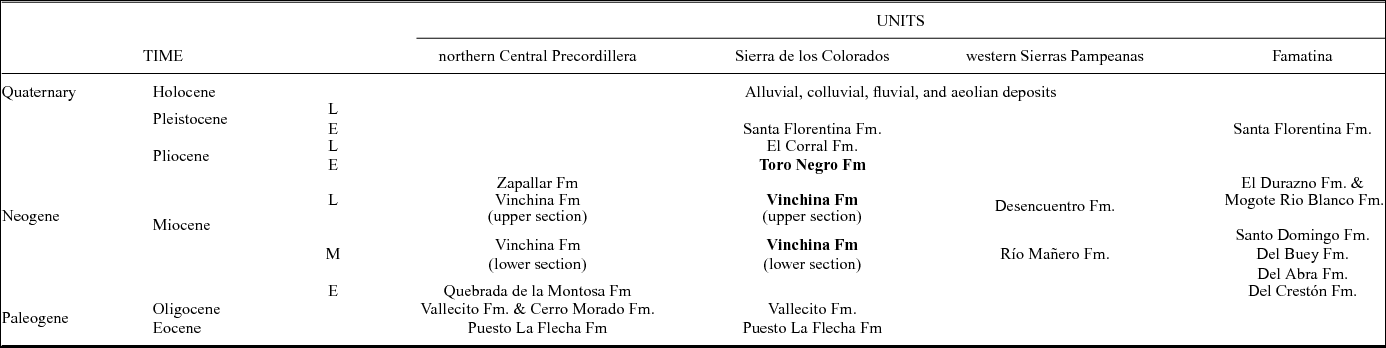
Pre-Cenozoic stratigraphy of the western Sierras Pampeanas consists of Precambrian to Early Palaeozoic metamorphic and plutonic rocks that represent the deeper parts of the Ordovician Famatinian Orogen. Carboniferous to Permian localized transtensional basin deposits (Fernández Seveso et al. Reference Fernández Seveso, Pérez, Brisson and Alvarez1993; Fernández Seveso & Tankard, Reference Fernández Seveso, Tankard, Tankard, Suárez and Welsink1995) were followed by Triassic – Early Jurassic and Cretaceous rifting sequences (Ramos, Reference Ramos1992; Schmidt et al. Reference Schmidt, Astini, Costa, Gardini, Kraemer, Tankard, Suárez and Welsink1995). The Cenozoic record in the western Sierras Pampeanas in the study area is shown in Table 1.
In the Famatina, pre-Cenozoic rocks comprise a Middle to Late Cambrian metamorphic basement overlain by Early Palaeozoic volcano-sedimentary rocks (Aceñolaza, Millar & Toselli, Reference Aceñolaza, Millar and Toselli1996; Candiani et al. Reference Candiani, Astini, Dávila, Collo, Ezpeleta, Alasino and Dahlquist2011), which are intruded by Middle to Late Ordovician igneous bodies resulting from continental-arc magmatism activity (Toselli, Saavedra & Rossi de Toselli, Reference Toselli, Aceñolaza, Miller and Toselli1996; Rapela et al. Reference Rapela, Coira, Toselli, Llambías and Caminos1999). Silurian post-orogenic granites were emplaced and deformed during the Late Devonian – Early Palaeozoic Chanic tectonic phase. Late Palaeozoic and Triassic extensional depocentres include more than 4000 m of continental sediments (Fernández Seveso et al. Reference Fernández Seveso, Pérez, Brisson and Alvarez1993). The Cenozoic record comprises c. 3500 m of alluvial deposits east of the Sierra de Famatina and also Early Pliocene volcanic rocks (Mogote Río Blanco Formation andesites; see Dávila & Astini, Reference Dávila and Astini2007; Zambrano et al. Reference Zambrano, Rapalini, Dávila, Astini and Spagnuolo2011; Table 1).
2.b. Regional structure
The main Neogene structure in these regions comprises NNE–NNW-trending thrusts linked to thin-skinned (Precordillera) and thick-skinned (Eastern Precordillera, Sierras Pampeanas and Famatina) deformation (Jordan & Allmendinger, Reference Jordan and Allmendinger1986; Allmendinger et al. Reference Allmendinger, Figueroa, Snyder, Beer, Mpodozis and Isacks1990; Cristallini & Ramos, Reference Cristallini, Ramos and Ramos1995; Zapata & Allmendinger, Reference Zapata and Allmendinger1996; Ramos, Cristallini & Perez, Reference Ramos, Cristallini and Perez2002). They are controlled and overprinted by localized, oblique- and cross-strike brittle–ductile megashear zones (Japas, Reference Japas1998; Ré, Japas & Barredo, Reference Ré, Japas, Barredo, Cortés, Rossello and Dalla Salda2001; Cortés, Pasini & Yamín, Reference Cortés, Pasini and Yamín2005; Cortés et al. Reference Cortés, Casa, Pasini, Yamín and Terrizzano2006; Japas & Ré, Reference Japas and Ré2012 a, b; Oriolo et al. Reference Oriolo, Japas, Cristallini, Giménez, Llana-Fúnez, Marcos and Bastida2014; Japas et al. Reference Japas, Ré, Oriolo, Vilas, Pueyo, Cifelli, Sussman and Oliva-Urcia2015).
In the Precordillera, cross-strike and oblique structures consist respectively of WNW-trending sinistral transtensional zones (Guandacol; Talacasto or Hualilán; Calingasta or San Juan; Paramillos; Ré, Japas & Barredo, Reference Ré, Japas, Barredo, Cortés, Rossello and Dalla Salda2001; Japas, Ré & Barredo, Reference Japas, Ré and Barredo2002; Oriolo et al. Reference Oriolo, Japas, Cristallini, Giménez, Llana-Fúnez, Marcos and Bastida2014) and NNW-trending sinistral transpressional belts (Valle Fértil; Rodeo–Talacasto; Mendoza Norte or Barreal–Las Peñas; Río Mendoza–Tupungato; Rossello et al. Reference Rossello, Mozetic, Cobbold, Urreiztieta and Gapais1996; Ré, Japas & Barredo, Reference Ré, Japas, Barredo, Cortés, Rossello and Dalla Salda2001; Japas, Ré & Barredo, Reference Japas, Ré and Barredo2002; Cortés & Cegarra, Reference Cortés, Cegarra, Cortés, Rossello and Dalla Salda2004; Japas et al. Reference Japas, Ré, Oriolo, Vilas, Pueyo, Cifelli, Sussman and Oliva-Urcia2015; Fig. 1c).
In the Sierras Pampeanas, the main cross-strike transtensional structures are the NE-trending Tucumán (Mon, Reference Mon1976) and Catamarca (Rossello et al. Reference Rossello, Mozetic, Cobbold, Urreiztieta and Gapais1996; Fig. 1c) structures, and the Tertiary Volcanic Belt in the Eastern Sierras Pampeanas (Urbina, Sruoga & Malvicini, Reference Urbina, Sruoga and Malvicini1995, Reference Urbina, Sruoga and Malvicini1997; Sruoga, Urbina & Malvicini, Reference Sruoga, Urbina and Malvicini1996; Sruoga & Urbina, Reference Sruoga and Urbina2008; Urbina & Sruoga, Reference Urbina and Sruoga2009; Japas, Urbina & Sruoga, Reference Japas, Urbina and Sruoga2010; Japas et al. Reference Japas, Urbina, Sruoga and Gallard2011 a, b). The main NNW-trending oblique Andean structures represent reactivation of major Early Palaeozoic structures, as is the case of the NNW-trending Valle Fértil (Rossello et al. Reference Rossello, Mozetic, Cobbold, Urreiztieta and Gapais1996; Ré, Japas & Barredo, Reference Ré, Japas and Barredo2000, Reference Ré, Japas, Barredo, Cortés, Rossello and Dalla Salda2001; Introcaso & Ruiz, Reference Introcaso and Ruiz2001; Ortiz et al. Reference Ortiz, Alvarado, Fosdick, Perucca, Saez and Venerdini2015), Chilecito–Chepes, Chamical–Sañogasta, Cruz del Eje–San Isidro and Rincón–Deán Funes transpressional belts (Ré, Japas & Barredo, Reference Ré, Japas, Barredo, Cortés, Rossello and Dalla Salda2001; Japas, Ré & Barredo, Reference Japas, Ré and Barredo2002).
The doubly vergent, NNW- to NNE-trending, high-angle basement thrusts of the Sierra de Famatina (Dávila & Astini, Reference Dávila and Astini2002, Reference Dávila and Astini2003; Ramos, Cristallini & Perez, Reference Ramos, Cristallini and Perez2002; F. M. Dávila, unpub. Ph.D. thesis, Univ. Nacional de Córdoba, 2003; Dávila et al. Reference Dávila, Astini, Jordan and Kay2004; Candiani et al. Reference Candiani, Astini, Dávila, Collo, Ezpeleta, Alasino and Dahlquist2011; Fig. 1) also resulted from reactivation of previous basement mechanical anisotropies (Fig. 1b). Uplift of Sierra de Famatina occurred along a set of reverse faults within the range rather than along a system of faults at the range boundary (de Alba, Reference de Alba1979; Jordan & Allmendinger, Reference Jordan and Allmendinger1986). In spite of differences in pre-Cenozoic stratigraphy and structural pattern that includes the range's highest altitude (6200 m), the Sierra de Famatina was deformed and uplifted at the same time and in a mode equivalent to the Sierras Pampeanas. Main oblique structures affecting the Sierra de Famatina are the NNW-trending Chilecito–Chepes, Chamical–Sañogasta megazones (Ré, Japas & Barredo, Reference Ré, Japas, Barredo, Cortés, Rossello and Dalla Salda2001; Japas, Ré & Barredo, Reference Japas, Ré and Barredo2002; Chancaní from Rossello et al. Reference Rossello, Mozetic, Cobbold, Urreiztieta and Gapais1996), the NNE-trending Santa Clara–Paso del Agua Negra and La Poma–Cerro Galán structures and the NE-trending Tucumán zone (Mon, Reference Mon1976; Rossello et al. Reference Rossello, Mozetic, Cobbold, Urreiztieta and Gapais1996; Urreiztieta, Reference Urreiztieta1996; Fig. 1c).
3. Study area
The Sierra de los Colorados is located in La Rioja province, NW Argentina (Fig. 1a, b). Two topographic depressions are placed between this range and the Northern Precordillera to the west, and the Sierra de Famatina to the east. To the N-NE and S-SW, the Sierra de los Colorados is bounded by Sierras Pampeanas basement blocks (Sierra de Toro Negro and Sierra de Umango-Espinal, respectively; Fig. 1b).
As representative of the Neogene Vinchina basin fill, the foreland sequence at the Sierra de los Colorados comprises a distal to proximal, thick synorogenic, alluvial sedimentary pile (Vinchina and Toro Negro Formations; Turner, Reference Turner1964; Ramos, Reference Ramos1970; Fig. 2) that was deposited under semi-arid conditions (Tripaldi et al. Reference Tripaldi, Net, Limarino, Marenssi, Ré and Caselli2001). This Neogene succession reaches an unusually large thickness that was attributed to a combination of flexural subsidence and alternative sublithospheric mechanisms (e.g. dynamic topography; Dávila, Astini & Jordan, Reference Dávila, Astini and Jordan2005; Dávila et al. Reference Dávila, Astini, Jordan, Gehrels and Ezpeleta2007; Dávila, Lithgow-Bertelloni & Giménez, Reference Dávila, Lithgow-Bertelloni and Giménez2010). Approximately 5500 m and c. 2000 m of sediments are documented for the Vinchina and Toro Negro Formations respectively in the quebrada de La Troya section. Along-strike thickness increments were also reported (Ramos, Reference Ramos1970; Marenssi et al. Reference Marenssi, Ciccioli, Limarino, Schencman and Díaz2015).
Geological map from the Sierra de los Colorados region (adapted from Marenssi et al. Reference Marenssi, Ciccioli, Limarino, Schencman and Díaz2015). LTF: La Troya fault.

The age of the Vinchina Formation rocks was constrained by magnetostratigraphic studies (Reynolds et al. Reference Reynolds, Jordan, Johnson and Tabbutt1990; Ré & Barredo, Reference Ré and Barredo1993) as well as by zircon fission-track (K. D. Tabbutt, unpub. Master's thesis, 1986) and U–Pb detrital zircon (Collo et al. Reference Collo, Dávila, Nóbile, Astini and Gehrels2011, Reference Collo, Dávila, Ezpeleta and Teixeira2014; Ciccioli, Limarino & Friedman, Reference Ciccioli, Limarino and Friedman2012; Ciccioli et al. Reference Ciccioli, Limarino, Friedman and Marenssi2014) ages. In the case of the Vinchina Formation lower member, a maximum sedimentation age of 15.6±0.4 Ma was obtained (U–Pb chemical abrasion thermal ionization mass spectrometry (CA-TIMS) detrital zircon data; Ciccioli et al. Reference Ciccioli, Limarino, Friedman and Marenssi2014), whereas a depositional age of 9.24±0.034 Ma was reported for the upper member based on U–Pb CA-TIMS data from volcanic zircons in a tuff layer (Ciccioli et al. Reference Ciccioli, Limarino, Friedman and Marenssi2014). Likewise, Collo et al. (Reference Collo, Dávila, Teixeira, Nóbile, Sant'Anna and Carter2015) reported a maximum sedimentation age of 12.62±0.4 Ma based on U–Pb laser altimetry–inductively coupled plasma–mass spectrometry (LA-ICP-MS) detrital zircon data from the lowest tuffaceous level at c. 5500 m depth. Defined as Late Miocene – Early Pliocene by Rodríguez Brizuela & Tauber (Reference Rodríguez Brizuela and Tauber2006), the tuffaceous level 750 m below the top of the Toro Negro Formation was recently dated at 5.25±0.23 Ma (U–Pb LA-ICP-MS in zircons; Collo et al. Reference Collo, Dávila, Teixeira, Nóbile, Sant'Anna and Carter2015). Unconformably overlying the Neogene sequence, the coarse-grained synorogenic deposits of the El Corral Formation (Furque, Reference Furque1963) represent a diachronic intra-montane unit that resulted from cannibalization of the Neogene basin (Ciccioli et al. Reference Ciccioli, Limarino, Marenssi, Tedesco, Tripaldi, Salfity and Marquillas2011). The flat-lying Pleistocene Santa Florentina Formation completes the local Cenozoic sedimentary column.
The timing of basement block exhumation in the area is not completely constrained, due to the lack of precise dating. The exhumation of the Neogene sequence as a whole was constrained at c. 3.4 Ma (Collo et al. Reference Collo, Dávila, Nóbile, Astini and Gehrels2011).
4. Methods
This contribution will focus on the structural fabric and kinematic analyses at both regional and outcrop scales. Field work was performed at eight accessible key areas of the Sierra de los Colorados region: Norte (N), quebrada de Pozuelos (QP), quebrada de La Troya (QLT), north of Vinchina town (NV), quebradas KB (KB), finca Buenavista (fB), road to Jagüé (rJ) and quebrada del Yeso (QY; Fig. 2). At the outcrop scale, the evaluated fabric elements comprised planar structures such as bedding, brittle–ductile shear zones (following Ramsay & Huber, Reference Ramsay and Huber1987) and fractures (tensional, shear-extensional, etc.). Kinematics was established by the offset of structures, presence of releasing/restraining bends, distribution of en échelon gashes, tensional fractures, rough cleavage and/or Riedel structures (Fig. 3a). When possible, timing of minor structures was defined by cross-cutting, overprinting and reactivation relationships. Three-dimensional kinematic measurements on the minor structures that affect Neogene strata were performed in order to identify the different kinematic events (see Japas, Rubinstein & Kleiman, Reference Japas, Rubinstein and Kleiman2013). Data from kinematic indicators measured in the field were plotted using FaultKinWin software (R. W. Allmendinger, unpub. data, 2001).
(a) Brittle–ductile shear zone at the outcrop scale. R: Riedel shear structure. (b) La Troya fault. (c) La Troya fault and related structures. Black lines show brittle–ductile shear zones parallel to La Troya fault and associated R structures. White lines show minor R shears within the main R structures in black.

5. Sierra de los Colorados structure
5.a. Bedding
The thick Neogene sedimentary pile exposed in the Sierra de los Colorados follows a NNE-trending strip, with beds showing localized and abrupt changes in strike (Fig. 2). Alternating NE–SW and nearly N–S-trending strata define a kink-like structure, in which four structural segments were defined (South, Central, North and North-northeast domains; Fig. 4a). East to the Sierra de Toro Negro, the North-northeast domain is the only exposed area showing NNW-trending beds (N in Fig. 4a).
(a) Bedding in the Sierra de los Colorados domains (lower-hemisphere plot on equal-area stereonet; GEORIENT software by Holcombe, 2005). Sampled key areas are N: Norte; QP: quebrada de Pozuelos; QLT: quebrada de La Troya; NV: north of Vinchina town; KB: quebradas KB; fB: finca Buenavista; rJ: road to Jagüé; QY: quebrada del Yeso. Contours bounding shaded areas represent in N: 6–12%, 12–24%, >24% (max. 41.18%), QP: 10–20%, 20–40%, >40% (max. 50%), QLT: 3–6%, 6–12%, 12–24%, >24% (max. 26.32%), NV: 25–50%, > 50% (max. 75%), KB: 4–8%, 8–16%, 16–32%, > 32% (max. 35.71%), fB: 8–16%, 16–32%, >32% (max. 46.15%), rJ: 8–16%, 16–32%, 32–64%, > 64% (max. 76.92), QY: 6–12%, 12–24%, > 24% (max. 27.78%). (b) Bedding showing decreasing dip angle towards the top of the Neogene sequence (lower-hemisphere plot on equal-area stereonet). (c) Isopach maps for the Vinchina Formation upper member and the Toro Formation lower member (after Ramos, Reference Ramos1970).

The Neogene strata show W-directed decreasing dip angles towards the top of the sequence (Fig. 4b). Along the quebrada de La Troya section, the lowermost beds of the Neogene sequence dip c. 60ºW whereas the uppermost levels dip c. 40ºW (respectively QLT and rJ in Fig. 4a; see also Fig. 4b).
Two bedding plane sets were discriminated at fB and KB localities (Fig. 4a). In fB, they represent minor kink-like structures that are constrained to a relatively wide zone that bounds the Central and South domains (internal kink-like bands; Anderson, Reference Anderson1974; fB in Fig. 4a). This local structure is geometrically concordant with the main kink-like structure as β-axis trends to the NW. At the Sierra de los Colorados scale, some incipient kink-like structures can be also observed in the North domain north of the quebrada la Troya, where minor WNW-trending fractures resemble a localized ‘cleavage-like’ fabric (Fig. 4a). Also linked to a sharp transition zone between domains (Central and South), the two observed sets in KB reflect a different pattern as β trends SW (KB in Fig. 4a).
Additionally, and constrained to the vicinity of the sierra de Umango-Espinal, there are some well-developed folds affecting the Vinchina and Toro Negro formations (southwestern South domain; Fig. 4a), whose amplitude diminishes towards the top of the Neogene sedimentary column.
5.b. Brittle–ductile shear zones
At the range scale, the described kink-like structure is delineated by WNW-trending brittle–ductile shear zones that define wide and narrow zones of localized deformation (Fig. 4a). A nearly E–W-trending normal-sinistral fault (La Troya fault; LTF in Fig. 2) is exposed at the easternmost sector of the quebrada de la Troya as part of the sharp transition zone between the North and Central domains (Fig. 3b, c). This fault disappears to the west where it is replaced by a brittle–ductile shear zone trending WNW. To the east, in locality NV (Fig. 5), lower member rocks of the Vinchina Formation also are affected by dominant WNW-trending brittle–ductile shear zones.
Brittle–ductile shear zones, slip data and kinematic axes measured in the Neogene sequence of the Sierra de los Colorados. Abbreviations as for Figure 4a. FaultKinWin software (R. W. Allmendinger, unpub. data, 2001). Notice that the main brittle–ductile zones affecting the Vinchina Formation lower member present in the N-NE domain is the same set as in other areas but rotated counterclockwise. This is concordant with preliminary palaeomagnetic results in the N-NE domain which reveal null rotation (G. H. Ré et al., unpub. data). Two main populations (A and B) and a poorly defined one (C) were recognized for the lower-middle Vinchina Formation rocks. At the base of the Vinchina Formation, upper member B-population is present whereas the Toro Negro Formation rocks only record population C. In slip-data diagrams, arrows indicate movement of hanging wall. In kinematic diagrams, squares represent individual T-axes (extension), black circles individual P-axes (shortening); black squares 1 (shortening), 2 (intermediate), 3 (extension) refer to the calculated unweighted moment tensor (linked Bingham) axes (R. W. Allmendinger, unpub. data, 2001).

At the outcrop scale, diagrams in Figure 5 show that rocks from the Vinchina Formation lower and middle members display two main sets of brittle–ductile shear zones, one trending NNE and the other, NW–WNW. On the other hand, the Vinchina Formation upper member and the Toro Negro Formation are only affected by the WNW-trending set. In other words, NNE-trending structures were only found at the base of the Neogene sequence while NW- to WNW-trending structures are widely distributed.
6. Kinematic analyses
Figure 5 shows the kinematic axes that resulted from processing the kinematic indicators measured in the field. As previously mentioned, deformation was inhomogeneously distributed in space and time, and therefore the obtained kinematic axes will be described considering the units they affect (Fig. 5).
(1) In three of the five areas where Vinchina Formation lower and middle members were analysed, two main kinematic populations were recognized (A and B populations in N, QLT, fB; Fig. 5). In QLT and fB localities, shortening axes trend NE–SW (A-populations) and NW–SE (B-populations). In the case of locality N, the A-population shortening axis is SE-directed while the B-population shortening axis is SW-directed. In the two other areas, where the Vinchina Formation lower member was analysed (NV and QP in Fig. 5), measurements revealed kinematic axes belonging to the B-population. Dominant WNW-trending brittle–ductile shear zones in NV are linked to the La Troya fault and reveal normal-sinistral components of motions with a kinematic stretching axis trending to the NNE-NE.
(2) The lowermost levels from the Vinchina Formation upper member (western part of QLT) show the development of WNW-trending brittle–ductile shear zones with kinematic axes consistent with the B-population previously defined for the underlying members.
(3) On the other hand, when structures affecting rocks of the uppermost Vinchina Formation beds and the Toro Negro Formation are considered, a single and different kinematic population C could be observed, with kinematic axes disposed horizontally (T-axes; extension) and vertically (P-axes; shortening). The Bingham extension axis trends ENE in the Central domain (rJ), whereas it is oriented NNW in the Southern domain (KB and QY).
Although scarcely represented at the base of the Neogene sedimentary sequence, the C-population (only recognizable by its vertical P-axes; Fig. 5) shows a kinematic pattern coincident with that affecting the Toro Negro Formation which is linked to the position (convex or concave side) of the kink-like structure.
7. Interpretation and discussion
Data in sections 5 and 6 point to significant differences when comparing the lower-middle members of the Vinchina Formation with the Vinchina upper member and Toro Negro formations. From the two sets of NNE- and NW- to WNW-trending brittle–ductile shear zones identified at the base of the Neogene sequence, only the one that trends WNW affects the Vinchina Formation upper member (Fig. 5). This evidence, together with cross-cutting relationships, confirms NNE-striking structures pre-dating NNW-WNW ones.
This deformational scenario also agrees with palaeomagnetic data in the Sierra de los Colorados region since Vinchina Formation lower and middle members record the same number of clockwise rotations, indicating that deformation should have begun almost contemporaneously with the Vinchina Formation middle member deposition (~11–12 Ma; G. H. Ré, unpubl. Ph.D. thesis, Univ. de Buenos Aires, 2008; Japas et al. Reference Japas, Ré, Oriolo, Vilas, Pueyo, Cifelli, Sussman and Oliva-Urcia2015). Clockwise rotation at the base of the Neogene sequence in the Sierra de los Colorados was considered by Aubry et al. (Reference Aubry, Roperch, Urreiztieta, Rossello and Chauvin1996) as the consequence of tectonic activity of the NE-striking Tucumán Zone. However, kinematic axes are more akin to the Central Precordillera kinematic picture because kinematic shortening axes are similar to the NE trend reported by Oriolo et al. (Reference Oriolo, Japas, Cristallini, Giménez, Llana-Fúnez, Marcos and Bastida2014) and do not match the expected E-W referred to by Allmendinger (Reference Allmendinger1986) and Sasso & Clark (Reference Sasso and Clark1998) or the NW–SE determined by Urreiztieta (Reference Urreiztieta1996). This affinity with Central Precordillera deformation style is also supported by the time of the San Roque (c. 10.5 Ma) or Blanquitos (c.11.5 Ma) thrust initiation reported by Jordan et al. (Reference Jordan, Allmendinger, Damanti and Drake1993) and Jordan, Schlunegger & Cardozo (Reference Jordan, Schlunegger and Cardozo2001) considering (e.g. Yáñez et al. Reference Yáñez, Ranero, Von Huene and Díaz2001) or not (Suriano et al. Reference Suriano, Mardonez Catalán, Mahoney, Giambiagi and Mescua2015) a southern migration of the deformation front. Additionally, NNE-striking thrusts pre-dating deformation along NNW-WNW basement-controlled structures were reported by Oriolo et al. (Reference Oriolo, Cristallini, Japas and Yagupsky2015) for the Precordillera.
Previous studies in the Central Precordillera reported an equivalent change from NNE-directed to WNW-directed shortening axes. This reorientation was linked to the inception of basement-involved deformation in the foreland (Japas et al. Reference Japas, Ré, Vilas and Oriolo2014, Reference Japas, Ré, Oriolo, Vilas, Pueyo, Cifelli, Sussman and Oliva-Urcia2015; Oriolo et al. Reference Oriolo, Japas, Cristallini, Giménez, Llana-Fúnez, Marcos and Bastida2014), meaning that the appearance of basement-signature kinematics in the Sierra de los Colorados area occurred during deposition of the upper member of the Vinchina Formation (B-population). Regarding the timing of deformation involving basement, it started earlier in the Sierra de los Colorados area (28ºS) than in the Central Precordillera at 31ºS. Inception of basement deformation is confirmed by uplift of the Sierra de Umango-Espinal indicated by detrital zircon data (Ciccioli et al. Reference Ciccioli, Limarino, Marenssi, Tedesco, Tripaldi, Salfity and Marquillas2011) and consequent local thickness increase of the Vinchina Formation upper member (Ramos, Reference Ramos1970) resulting from topographic loading subsidence (Fig. 4c).
Furthermore, west of the quebrada del Yeso, forced folds affect the whole sequence and become gentler towards the top of the sedimentary column (Ramos, Reference Ramos1970). These folds might be a result of progressive uplift of the Sierra de Umango-Espinal basement block that started during deposition of the upper Vinchina Formation member. Likewise, the presence of (a) three unconformity surfaces in the middle Vinchina Formation section (Marenssi et al. Reference Marenssi, Net, Caselli, Tripaldi and Limarino2000), (b) changes in palaeocurrent patterns, from axial, NNE-directed to SE-directed (Limarino et al. Reference Limarino, Tripaldi, Marenssi, Net, Re and Caselli2001; Tripaldi et al. Reference Tripaldi, Net, Limarino, Marenssi, Ré and Caselli2001), and (c) decreasing bedding-dip angle towards the top of the Neogene sequence (progressive unconformity; Fig. 4b), support the occurrence of a significant change at the beginning of deposition of the Vinchina Formation upper member.
During or shortly after deposition of the uppermost Vinchina Formation and the Toro Negro Formation, the kinematic scenario changed. This new kinematic field is represented by extension (C-population) and, although not yet completely understood, it is proposed that it could be related to kinematic conditions linked to the evolution of a kink-like structure (see Pimenta, Reference Pimenta2008).
It is noteworthy that this kinematic scenario is characterized by three kinematic events (A: affecting the Vinchina lower and middle members; B: deforming all the Vinchina members; and C: affecting the whole sequence but mostly recognizable in the uppermost Vinchina upper member and the Toro Negro formations) and shows striking correspondences with coeval stages proposed by Ciccioli et al. (Reference Ciccioli, Limarino, Marenssi, Tedesco, Tripaldi, Salfity and Marquillas2011, Reference Ciccioli, Gómez O'Connell, Limarino and Marenssi2013 a, b; Table 2) based on tectonostratigraphic analysis.
Tracking basement uplift in the Sierra de los Colorados and neighbouring areas based on stratigraphical and kinematic information.

Data compiled from Ramos (Reference Ramos1999), Limarino et al. (Reference Limarino, Tripaldi, Marenssi, Net, Re and Caselli2001), Tripaldi et al. (Reference Tripaldi, Net, Limarino, Marenssi, Ré and Caselli2001), G. H. Ré (unpubl. Ph.D. thesis, Univ. de Buenos Aires, 2008), Limarino, Ciccioli & Marenssi (Reference Limarino, Ciccioli and Marenssi2010), Collo et al. (Reference Collo, Dávila, Nóbile, Astini and Gehrels2011, Reference Collo, Dávila, Ezpeleta and Teixeira2014), Ciccioli & Marenssi (Reference Ciccioli and Marenssi2012), Ciccioli et al. (Reference Ciccioli, Gómez O'Connell, Limarino and Marenssi2013 b), Japas et al. (Reference Japas, Ré, Oriolo, Vilas, Pueyo, Cifelli, Sussman and Oliva-Urcia2015). WVA: western volcanic arc; Pc: Precordillera; FC: Frontal Cordillera; STN: Sierra de Toro Negro.
7.a. Presence and role of brittle–ductile oblique megashear zones
7.a.1. Regional NNW- and NNE-trending transpressional structures
Regional NNW- and NNE-trending structures comprise transpressional brittle–ductile shear zones (Ré, Japas & Barredo, Reference Ré, Japas, Barredo, Cortés, Rossello and Dalla Salda2001; Cortés & Cegarra, Reference Cortés, Cegarra, Cortés, Rossello and Dalla Salda2004; Japas & Ré, Reference Japas and Ré2012 a, b; Oriolo et al. Reference Oriolo, Japas, Cristallini, Giménez, Llana-Fúnez, Marcos and Bastida2014; Japas et al. Reference Japas, Ré, Oriolo, Vilas, Pueyo, Cifelli, Sussman and Oliva-Urcia2015; Fig. 1c). In the study area, the NNW-trending, sinistral transpressional Valle Fértil zone (linked to the Cuyania – Famatina/Pampia terrane boundary; Gimenez, Martinez & Introcaso, Reference Gimenez, Martinez and Introcaso2000; Introcaso & Ruiz, Reference Introcaso and Ruiz2001), as well as shallow NNE-trending structures (considered as main dextral transpressional structures in the Precordillera region; Oriolo et al. Reference Oriolo, Cristallini, Japas and Yagupsky2015), were confirmed as major structures by gravimetric and magnetometric data by Porcher et al. (Reference Porcher, Fernandes, Vujovich and Chernicoff2004). In a more regional context, these structures as well as other oblique localized deformational belts can also be recognized by regional aeromagnetometry (SEGEMAR, unpub. data, 2012, http://sig.segemar/gov.ar; Fig. 6a). Some of the NNW-trending structures show neotectonic activity (Casa et al. Reference Casa, Yamín, Wright, Costa, Coppolecchia and Cegarra2011; SEGEMAR, unpub. data, 2012, http://sig.segemar/gov.ar).
(a) Regional aeromagnetic map of the magnetic anomaly reduced to pole (SEGEMAR, unpub. data, 2012, http://sig.segemar/gov.ar) showing main lineaments. VL: Vinchina Lineament (Porcher et al. Reference Porcher, Fernandes, Vujovich and Chernicoff2004). Location is shown in (c). (b) Sierra de los Colorados area in the regional context. Star shows the Villa Unión earthquake epicentre (Triep & Cardinali, Reference Triep and Cardinali1984); white circles indicate earthquake epicentres (numbers refer to earthquake depth; United States Geological Survey database, earthquake.usgs.gov); triangles locate the GPS velocity datum sites from Brooks et al. (Reference Brooks and Bevis2003) (TINO: Tinogasta; GNDL: Guandacol). The Vinchina and Guandacol lineaments defined by Porcher et al. (Reference Porcher, Fernandes, Vujovich and Chernicoff2004) are shown. A–A′–B′–B locates the topographic profile. Notice that along-strike changes in altitude are strikingly coincident with the transtensional and transpressional structures referred in the topographic profile. (c) Main regional oblique brittle–ductile shear zones. Lateral components of motions are shown. Rectangle indicates area of (a).

Fault plane solutions of the 34 km deep Villa Unión earthquake (Fig. 6b) indicate a nodal plane steeply dipping to the ENE (Triep & Cardinali, Reference Triep and Cardinali1984), sustaining the transpressional character of the NNW-trending structures as well as their sinistral strike-slip component of motion. Additionally, relative motions derived from scarce available GPS velocity data in the upper plate (Tinogasta and Guandacol sites in Fig. 6b; Brooks et al. Reference Brooks and Bevis2003) confirm left-lateral (and thrust) displacements for the NNW-trending structures.
Based on structural elements at the Sierra de Famatina scale, two transpressional shear zones can be better constrained: the Miranda–Chepes and the Angulos–Patquía belts (Fig. 6c). These two structures substitute Ré, Japas & Barredo's (Reference Ré, Japas, Barredo, Cortés, Rossello and Dalla Salda2001) Chilecito–Chepes and Chamical–Sañogasta zones from Figure 1c. The Angulos–Patquía zone seems to reactivate the western border of the 402–300 Ma Tinogasta–Pituil–Antinaco shear zone (TiPA belt; López & Toselli, Reference López and Toselli1993; Höckenreiner, Söllner & Miller, Reference Höckenreiner, Söllner and Miller2003). Although detailed structural mapping in the Sierra de Famatina is still scarce, regional structures reveal a possible Neogene flower structure controlled by both megashear zones (Fig. 7a, c). This flower structure explains an uplift associated with reverse faults within the range, and not along a fault system at the range boundary (see de Alba, Reference de Alba1979; Jordan & Allmendinger, Reference Jordan and Allmendinger1986), and would also contribute to the higher altitude of the Sierra de Famatina compared to other ranges in NW Sierras Pampeanas.
(a) Geological map of central Sierra de Famatina and northern Sierra de Sañogasta (after Candiani et al. Reference Candiani, Astini, Dávila, Collo, Ezpeleta, Alasino and Dahlquist2011; Fauqué et al. Reference Fauqué, Limarino, Vujovich, Cegarra and Escosteguy2016), and location map. (b) Exposures of Neogene volcanic rocks, fracture fabric and the La Mejicana cross-strike structures. Note in (a) the left-lateral displacement of Early Palaeozoic volcanic and the Late Palaeozoic sedimentary rock exposures at Cuesta de Miranda by the La Mejicana Sur structure. (c) E–W cross-sections: Sierra de Sañogasta (left; after Fauqué et al. Reference Fauqué, Limarino, Vujovich, Cegarra and Escosteguy2016) and central Famatina (right; after Candiani et al. Reference Candiani, Astini, Dávila, Collo, Ezpeleta, Alasino and Dahlquist2011).

7.a.2. Regional transtensional cross-strike structures
WNW-trending structures in the Precordillera region were referred to by Oriolo et al. (Reference Oriolo, Japas, Cristallini, Giménez, Llana-Fúnez, Marcos and Bastida2014) as cross-strike discontinuities, consisting of broad, diffuse zones of faults and fractures cutting the entire fold-and-thrust belt at high angles to its regional strike. They are vertical structures usually originated by strike-slip reactivation of pre-existing basement faults that disrupt strike-parallel structural, geophysical, sedimentological and/or other patterns (Wheeler, Reference Wheeler1980; Berger, Reference Berger2001). Although frequently confused with other structures like tear faults and lateral ramps, they are different. Tear faults comprise small-scale individual strike-slip faults typically confined to a single thrust sheet dying out at the regional décollement, whereas lateral ramps consist of large-scale, high-angle (but not vertical; McClay, Reference McClay1992) faults allowing the overriding thrust sheet to reach a higher stratigraphic level (Berger, Reference Berger2001). In the Precordillera, these basement-involved cross-strike discontinuities were recognized as sinistral transtensional zones (Ré, Japas & Barredo, Reference Ré, Japas, Barredo, Cortés, Rossello and Dalla Salda2001; Oriolo et al. Reference Oriolo, Japas, Cristallini, Giménez, Llana-Fúnez, Marcos and Bastida2014; Yagupsky, Winocur & Cristallini, Reference Yagupsky, Winocur and Cristallini2014; Japas et al. Reference Japas, Ré, Oriolo, Vilas, Pueyo, Cifelli, Sussman and Oliva-Urcia2015) and therefore considered as preferred channels for the rise and extrusion of magma. In the Precordillera and Sierras Pampeanas they seem to be crucial structures controlling volcanism emplacement during the inland migration of arc magmatism, linked mineralization and also some present-day geothermal occurrences linked to convective hydrothermal systems (see Urbina, Sruoga & Malvicini, Reference Urbina, Sruoga and Malvicini1995, Reference Urbina, Sruoga and Malvicini1997; Sruoga, Urbina & Malvicini, Reference Sruoga, Urbina and Malvicini1996; Chernicoff & Nash, Reference Chernicoff and Nash2002; Pesce & Miranda, Reference Pesce and Miranda2003; Sruoga & Urbina, Reference Sruoga and Urbina2008; Urbina & Sruoga, Reference Urbina and Sruoga2009; Japas, Urbina & Sruoga, Reference Japas, Urbina and Sruoga2010; Japas et al. Reference Japas, Urbina, Sruoga and Gallard2011 a, b; Oriolo et al. Reference Oriolo, Japas, Cristallini, Giménez, Llana-Fúnez, Marcos and Bastida2014). The link between magmatism emplacement and cross-strike structures is not restricted to the Pampean flat slab region but was also recognized in the Central and South Southern Volcanic Zone (Southern Andes; Lara et al. Reference Lara, Lavenu, Cembrano and Rodríguez2006), and the Puna region (Ré, Japas & Barredo, Reference Ré, Japas, Barredo, Cortés, Rossello and Dalla Salda2001; Riller et al. Reference Riller, Petrinovic, Ramelow, Strecker and Oncken2001; Chernicoff, Richards & Zappettini, Reference Chernicoff, Richards and Zappettini2002; Roy et al. Reference Roy, Cassard, Cobbold, Rossello, Billa, Bailly and Lips2006), where some of the authors also recognized extensional conditions (see also Sillitoe, Reference Sillitoe1997; Billa et al. Reference Billa, Cassard, Lips, Bouchot, Tourlière, Stein and Guillou-Frottier2004).
The WNW-trending structures in the Sierra de los Colorados show sinistral-normal displacements (NV in Fig. 4a). This WNW-trending brittle–ductile shear zone along the quebrada de La Troya is coincident with the Vinchina Lineament (Fig. 6a, b), a middle Proterozoic main sub-regional structure recognized by Porcher et al. (Reference Porcher, Fernandes, Vujovich and Chernicoff2004) based on regional aeromagnetic and gravimetric data. A similar structural discontinuity south of the Sierra de Umango represents a main structure in the northern Precordillera area that was detected by surface evidence (Guandacol Lineament from Porcher et al. Reference Porcher, Fernandes, Vujovich and Chernicoff2004; see Ré, Japas & Barredo, Reference Ré, Japas and Barredo2000, Reference Ré, Japas, Barredo, Cortés, Rossello and Dalla Salda2001; Chernicoff & Nash, Reference Chernicoff and Nash2002; Oriolo et al. Reference Oriolo, Japas, Cristallini, Giménez, Llana-Fúnez, Marcos and Bastida2014; Japas et al. Reference Japas, Ré, Oriolo, Vilas, Pueyo, Cifelli, Sussman and Oliva-Urcia2015; Figs 1c, 6b). The Vinchina and Guandacol WNW-trending structures separate basement blocks of different magnetic and gravimetric signatures and were referred to by Porcher et al. (Reference Porcher, Fernandes, Vujovich and Chernicoff2004) as representing Grenvillian age suture zones. During the Neogene, these basement structures reactivated, as confirmed by earthquake data showing hypocentres at 35–70 km depth along these structures (Fig. 6b), in contrast with the 15–21 km depth detachment level indicated for the thin-skinned fold-and-thrust belt by Allmendinger et al. (Reference Allmendinger, Figueroa, Snyder, Beer, Mpodozis and Isacks1990), Cristallini & Ramos (Reference Cristallini and Ramos2000), Ammirati et al. (Reference Ammirati, Alvarado, Perarnau, Sáez and Monsalvo2013) and Ammirati, Alvarado & Beck (Reference Ammirati, Alvarado and Beck2015).
The localized WNW-trending cross-strike structures affecting the Sierra de los Colorados are responsible for the kinking of the thick Neogene foreland sequence. Average rheological properties of the Neogene sedimentary sequence in the Sierra de los Colorados permit this thick synorogenic pile to be considered as a composite foliated rock or multilayer. Experimental results by Cobbold, Cosgrove & Summers (Reference Cobbold, Cosgrove and Summers1971), Gay & Weiss (Reference Gay and Weiss1974) and Reches & Johnson (Reference Reches and Johnson1976) reveal that, when compressed, the homogeneous anisotropic nature of such a package should induce internal instabilities and the formation of internal structures controlled by the high degree of anisotropy. These authors showed that at angles of c. 30–45º (Cobbold, Cosgrove & Summers, Reference Cobbold, Cosgrove and Summers1971) and 5–30º (Gay & Weiss, Reference Gay and Weiss1974) between compression and layering, a single set of kinks should develop. The single set of kinks that represents the Sierra de los Colorados conditions is equivalent to the structure in Figure 8, and could explain the apparent inconsistency between normal-sinistral WNW-trending structures and the c. 18% along-strike finite shortening in the Sierra de los Colorados. The late development of this mesoscale kink structure is coherent with the observed vertical rotation pattern since results by G. H. Ré et al. (unpub. data) revealed null rotation in the Central domain where layering would have rotated counterclockwise.
To the east of the Sierra de los Colorados, the WNW-trending structures could be extended into the Sierra de Famatina. Here, two cross-strike discontinuities can be defined: the La Mejicana Sur and La Mejicana Norte structures (Figs 6b, c, 7b). They comprise broad and diffuse zones of faults and fractures controlling both the emplacement of the Mio-Pliocene volcanic rocks from the Mogote Río Blanco Formation and related mineralization (Roy et al. Reference Roy, Cassard, Cobbold, Rossello, Billa, Bailly and Lips2006) and the Pliocene thick volcaniclastic deposition in the Angulos area studied by Dávila & Astini (Reference Dávila and Astini2007; Fig. 6b). As cross-strike structures, they disrupt strike-parallel geophysical (Fig. 6a) and structural patterns, as can be seen for example at Cuesta de Miranda (Fig. 7a, b), where structural differences between the Sierra de Sañogasta and Sierra de Famatina were early highlighted by de Alba (Reference de Alba1979) and Durand, Toselli & Aceñolaza (Reference Durand, Toselli and Aceñolaza1987). At a more regional scale, these WNW-trending oblique structures represent the inland prolongation of the main arc-transverse fault zones defined by Sillitoe & Perelló (Reference Sillitoe, Perelló, Hedenquist, Thompson, Goldfarb and Richards2005): the La Mejicana Sur and La Mejicana Norte structures are strikingly aligned with the southernmost lineament south of Copiapó, while a similar brittle–ductile shear zone north of Famatina would correspond to the foreland extension of the Potrerillos Lineament (Fig. 6c).
Origin of the Sierra de los Colorados kink-like structure (adapted from Reches & Johnson, Reference Reches and Johnson1976).

A main regional NE-trending oblique belt in NW Argentina, the Tucumán Lineament (Mon, Reference Mon1976) or Tucumán Transfer Zone (Rossello et al. Reference Rossello, Mozetic, Cobbold, Urreiztieta and Gapais1996; Urreiztieta, Reference Urreiztieta1996) would have been responsible for the Sierra de Aconquija, northern Famatina range, and the Sierra de Fiambalá uplift. Gravimetric and magnetometric data by Porcher et al. (Reference Porcher, Fernandes, Vujovich and Chernicoff2004) show significant NE-trending fracturing in the Sierra de Umango – Sierra de Maz area. This brittle–ductile structure is also associated with Neogene volcanism far from the trench (the Farallón Negro Volcanic Complex; Llambías, Reference Llambías1970, Reference Llambías1972; Sasso & Clark, Reference Sasso and Clark1998).
7.a.3. Neogene magmatism and cross-strike structures
The Mogote Río Blanco Formation volcanism (6.38±0.37 to 4.24±0.11 Ma, Ar–Ar ages; Toselli, Reference Toselli, Aceñolaza, Miller and Toselli1996) and the epithermal alteration and vein systems linked to this volcanism (4 Ma, hydrogen isotope data by Taylor, McKee & Sillitoe, Reference Taylor, McKee and Sillitoe1997; and 5.3±0.1 to 4.0±0.1 Ma, Ar–Ar plateau ages by Losada-Calderón, McBride & Bloom, Reference Losada-Calderón, McBride and Bloom1994) constrain the age of La Mejicana cross-strike activation between 6 and 4 Ma.
In La Mejicana Mining District, Neogene dacitic porphyries were mostly emplaced along N–S-trending structures (Losada-Calderón & Bloom, Reference Losada-Calderón and Bloom1990), whereas related mineralized veins and the distribution of alteration minerals trend dominantly NW–SE to WNW–ESE and E–W (A. Losada-Calderón, unpub. Ph.D. thesis, Monash Univ., 1992; Losada-Calderón & McPhail, Reference Losada-Calderón, McPhail, Camus, Sillitoe and Petersen1996; Azcurra et al. Reference Azcurra, Castro-Godoy, Candiani, Carrizo and Nakayima2005; Fauqué et al. Reference Fauqué, Caminos, Hermann, Pezzutti, Godeas, Sato and Franchini2006; Pudack et al. Reference Pudack, Halter, Heinrich and Pettke2009; Candiani et al. Reference Candiani, Astini, Dávila, Collo, Ezpeleta, Alasino and Dahlquist2011; Fig. 7a, b). These alteration trends reveal the control of tensional to shear extensional structures. A similar scenario characterized by two sets of structures controlling emplacement of magmatism and linked mineralization was described in different Neogene volcanic zones from the broken foreland. A first magmatism emplacement stage controlled by transpressive / strike-slip structures was immediately followed by a late one controlled by cross-strike transtensional fractures in the Farallón Negro region, in the Faja Volcánica Terciaria from San Luis (Sasso & Clark, Reference Sasso and Clark1998; Japas, Urbina & Sruoga, Reference Japas, Urbina and Sruoga2010; Japas et al. Reference Japas, Urbina, Sruoga and Gallard2011 a, b), but also in the Central Precordillera (Hualilán belt; S. Oriolo, unpub. Trabajo Final de Licenciatura, Univ. de Buenos Aires, 2012). Connection between tectonic and magmatic processes in oblique convergence systems was considered by Saint Blanquat et al. (Reference Saint Blanquat, Tikoff, Teyssier, Vigneresse, Holdsworth, Strachan and Dewey1998) as linked in a positive feedback loop where deformation contributes to magma overpressuring and to connecting regions with pressure gradients (triggering its upward transport), and magma facilitates weakening of rocks and magma-induced deformation.
Cross-strike structures also produce localized accommodation spaces for coeval epi- and volcaniclastic rock accumulation, as was recognized in the Faja Volcánica Terciaria by Japas, Urbina & Sruoga (Reference Japas, Urbina and Sruoga2010). In central Sierra de Famatina, localized subsidence associated with La Mejicana Norte cross-strike structure could thus be an alternative explanation to the volcanic-induced load proposed by Martina, Dávila & Astini (Reference Martina, Dávila and Astini2006) for the volcanic depocentre near Angulos town (El Durazno Formation volcaniclastic rocks, 5.2±0.85 Ma according to Tabbutt, Reference Tabbutt1990). Likewise, it could explain the palaeocurrent change reported by Dávila & Astini (Reference Dávila and Astini2007) at the time of magmatism emplacement, as palaeocurrent turned towards the NE-NNE, perpendicular to the WNW-striking controlling faults. Source area composition also confirms this link as clasts from the underlying Del Buey Formation and Late Miocene – Pliocene volcanic-derived boulders contributed to the deposit (Dávila & Astini, Reference Dávila and Astini2007). The increase in clast size of the El Durazno Formation relative to the underlying sequences and the presence of contrasted compositions when compared with other contemporaneous deposits in the broken foreland (Dávila & Astini, Reference Dávila and Astini2007) would support the existence of a revitalized topography and basin fragmentation at a smaller scale, probably as a consequence of La Mejicana Norte activation.
The presence of Neogene magmatism far from the trench at 27–33ºS would introduce a significant change in the foreland system as it should produce, at least locally, an increase in heat flow and some other magma-related softening processes of the crust. This seems to be concurrent with the fact that with magmatism emplacement, thick-skinned deformation started in the Sierras Pampeanas and Precordillera (Ramos, Cristallini & Perez, Reference Ramos, Cristallini and Perez2002; Japas, Urbina & Sruoga, Reference Japas, Urbina and Sruoga2010; Oriolo et al. Reference Oriolo, Japas, Cristallini, Giménez, Llana-Fúnez, Marcos and Bastida2014). Because information about uplift in the broken foreland comes from a still poorly constrained stratigraphy and low-temperature thermochronology (Nóbile & Dávila, Reference Nóbile and Dávila2012), the precise timing between magmatism emplacement and thick-skinned deformation could not yet be exactly established. One of the proposals about this suggests weakening of the crust enhanced by an increase in heat flow after magmatism emplaced, with consequent development of brittle–ductile transition within the crust and basement-involved deformation (Ramos, Cristallini & Perez, Reference Ramos, Cristallini and Perez2002). However, according to Collo et al. (Reference Collo, Dávila, Nóbile, Astini and Gehrels2011, Reference Collo, Dávila, Teixeira, Nóbile, Sant'Anna and Carter2015) and Dávila & Carter (Reference Dávila and Carter2013), the Neogene basin in the study area does not record any regional thermal increase at least until c. 3.4 Ma. Collo et al. (Reference Collo, Dávila, Teixeira, Nóbile, Sant'Anna and Carter2015) reported a c. 26–42 mW m−2 (geothermal gradient of 15°C km−1; Collo et al. Reference Collo, Dávila, Nóbile, Astini and Gehrels2011) to the east of the Precordillera, which is significantly lower than the heat flow of 60–80 mW m−2 required to position the depth of the brittle–ductile transition into the crust (Kusznir & Park, Reference Kusznir, Park, Coward, Dewey and Hancock1986; Ramos, Cristallini & Perez, Reference Ramos, Cristallini and Perez2002). On the other hand, Nóbile & Dávila (Reference Nóbile and Dávila2012) demonstrated that the Sierra de Aconquija first uplift peak should have occurred at c. 12 Ma, the time of emplacement of the oldest volcanism in the Farallón Negro district. In the same way, La Mejicana district would also reveal simultaneous uplift and magmatism emplacement at c. 6.4 Ma. This concordance of magmatism and uplift ages would support melt-enhanced deformation (‘tectonic surges’ triggered by melt-lubricated shear zones; Hollister & Crawford, Reference Hollister and Crawford1986) rather than heating-enhanced deformation (Coney, Reference Coney1972; Burchfiel & Davis, Reference Burchfiel and Davies1975; Ramos, Cristallini & Perez, Reference Ramos, Cristallini and Perez2002). The active role of magmatism in increasing rock ductility is also supported by brittle–ductile shear zone substituting fault development (see also Kleiman & Japas, Reference Kleiman and Japas2009; Japas, Urbina & Sruoga, Reference Japas, Urbina and Sruoga2010; Oriolo et al. Reference Oriolo, Japas, Cristallini, Giménez, Llana-Fúnez, Marcos and Bastida2014; Sruoga et al. Reference Sruoga, Japas, Salani and Kleiman2014).
7.b. Compartmentalization of the Vinchina basin: timing of basement uplift
In the Sierra de los Colorados area, the Sierra de Umango-Espinal should have begun to be uplifted at c. 9 Ma based on sediment composition (Ciccioli et al. Reference Ciccioli, Gómez O'Connell, Limarino and Marenssi2013 a) and localized high thickness of the Vinchina Formation upper member (Ramos, Reference Ramos1970). This suggests an earlier onset of the broken-foreland stage than that constrained by Jordan, Schlunegger & Cardozo (Reference Jordan, Schlunegger and Cardozo2001) at 6.5 Ma, as previously supported by Dávila & Astini (Reference Dávila and Astini2007), Dávila (Reference Dávila2010) and Zambrano et al. (Reference Zambrano, Rapalini, Dávila, Astini and Spagnuolo2011). Uplift of the Umango-Espinal block would also be active after 4.3 Ma (J. H. Reynolds, unpub. thesis, Dartmouth College, 1987; Ramos et al. Reference Ramos, Reynolds, Jordan and Tabbutt1988), revealing a long, recurrent and episodic history of uplift activity.
Considering the Sierra de Famatina region, fission-track age by Tabbutt (Reference Tabbutt1990), and fission-track ages and magnetic polarity stratigraphy by Malizia, Reynolds & Tabbutt (Reference Malizia, Reynolds and Tabbutt1995) reported uplift at 6.8 Ma (Sierra de Famatina) and 6.1 Ma (Sierra de Tarjados, southern Sierra de Famatina; Fig. 6b), respectively. According to thermal modelling, Coughlin et al. (Reference Coughlin, O'Sullivan, Kohn and Holcombe1998) indicate rapid cooling and exhumation of the Sierra de Famatina at c. 10–5 Ma based on apatite fission-track data. Based on the stratigraphic record in the Sierra de los Colorados, Limarino, Ciccioli & Marenssi (Reference Limarino, Ciccioli and Marenssi2010) and Ciccioli et al. (Reference Ciccioli, Gómez O'Connell, Limarino and Marenssi2013 a, b, Reference Ciccioli, Limarino, Friedman and Marenssi2014) considered that the main Sierra de Famatina uplift phase correlates with the base of the Toro Negro Formation. The sharp incision at the base of the Toro Negro Formation in the quebrada de los Pozuelos area was interpreted as a palaeovalley that developed in response to a base level change triggered by uplift of the Sierra de Famatina (Limarino, Ciccioli & Marenssi, Reference Limarino, Ciccioli and Marenssi2010). This occurred between 9 Ma (Vinchina Formation upper member) and 5.5 Ma (Toro Negro Formation lower-middle members), consistent with the previously considered age of c. 6.1–6.8 Ma. At this time the Sierra de Toro Negro also uplifted (Ciccioli & Marenssi, Reference Ciccioli and Marenssi2012), representing an additional source of subsidence. The Sierra de Toro Negro and the Sierra de Famatina basement blocks are aligned following the NNW-trending Miranda–Chepes transpressional belt that could be then considered active at 6.1–6.8 Ma.
WNW-trending cross-strike structures developed at the same time as, or immediately after, rocks of the Toro Negro Formation deposited. These structures affected the whole Neogene pile in the Sierra de los Colorados area and were contemporaneous with the Late Miocene to Early Pliocene volcanism emplacement in the Sierra de Famatina. To the north of the Sierra de Famatina, left-lateral WNW-trending structures displacing previous NNW-trending basement blocks would support this timing (Fig. 6c).
Thermochronological data constraining basement block exhumation in the broken foreland also confirm Neogene exhumation for the Western Sierras Pampeanas to some extent (Löbens et al. Reference Löbens, Bense, Dunkl, Wemmer, Kley and Siegesmund2013 a, b).
7.c. Proposed kinematic evolution
Identifiable deformation in the Sierra de los Colorados area began at c. 11–12 Ma, since both the lower and middle sections of the Vinchina Formation show the same amount of vertical axis rotation (c. 28º clockwise; G. H. Ré, unpubl. Ph.D. thesis, Univ. de Buenos Aires, 2008; Japas et al. Reference Japas, Ré, Oriolo, Vilas, Pueyo, Cifelli, Sussman and Oliva-Urcia2015). This earlier signal of Andean deformation is interpreted as being related to the Precordillera thin-skinned deformation style because A-population kinematic shortening axes trend NNE and vertical axis rotation is clockwise (Fig. 9a). At c. 9 Ma, tectonic activity of the NE-trending Tucumán oblique structure triggered the Sierra de Umango-Espinal uplift (together with the Sierra de Aconquija, Sierra del Cajón and other related ranges; see Coughlin et al. Reference Coughlin, O'Sullivan, Kohn and Holcombe1998, Sobel & Strecker, Reference Sobel and Strecker2003; Mortimer et al. Reference Mortimer, Carrapa, Coutand, Schoenbohm, Sobel, Sosa-Gómez and Strecker2007; Löbens et al. Reference Löbens, Bense, Dunkl, Wemmer, Kley and Siegesmund2013 a), inducing local topographic loading subsidence during deposition of the Vinchina Formation upper member (Fig. 9b). The activation of this regional oblique structure is also supported by the presence of both the kinematic B-population and the c. 14º clockwise vertical axis rotation. At about 6.1–6.8 Ma, the Miranda–Chepes belt activated and triggered the uplift of the Sierras de Sañogasta, Famatina and Toro Negro, and the left-lateral displacement of the Tucumán oblique megazone (Fig. 9c). At c. 6–4 Ma, the WNW-trending La Mejicana oblique belts controlled emplacement of the Mogotes volcanism in Famatina and induced the Neogene sequence of the Sierra de los Colorados to kink (Fig. 9d).
Schematic block-diagrams showing the Neogene evolution of the Sierra de los Colorados region at 28ºS. (a) c. 11–12 Ma; (b) c. 9 Ma; (c) c. 6.1–6.8 Ma; (d) c. 6 to 4 Ma.

7.d. Thick-skinned overprinting thin-skinned deformation
Several examples of thick-skinned structures overprinting thin-skinned orogens were described in different contractional settings and linked to different causes (Mazzoli et al. Reference Mazzoli, Corrado, De Donatis, Scrocca, Butler, Di Bucci, Naso, Nicolai and Zucconi2000; Lacombe & Mouthereau, Reference Lacombe and Mouthereau2002; Molinaro et al. Reference Molinaro, Leturmy, Guezou and Frizon de Lamotte2005; Madritsch, Schmid & Fabbri, Reference Madritsch, Schmid and Fabbri2008; Bailly et al. Reference Bailly, Pubellier, Ringenbach, de Sigoyer and Sapin2009; Maurin & Rangin, Reference Maurin and Rangin2009; Sapin et al. Reference Sapin, Pubellier, Ringenbach and Bailly2009; Japas & Ré, Reference Japas and Ré2012 a, b; Japas et al. Reference Japas, Ré, Oriolo, Vilas, Pueyo, Cifelli, Sussman and Oliva-Urcia2015). Some authors point directly to critical taper preservation conditions (Molinaro et al. Reference Molinaro, Leturmy, Guezou and Frizon de Lamotte2005; Maurin & Rangin, Reference Maurin and Rangin2009; Kraemer et al. Reference Kraemer, Silvestro, Achilli, Brinkworth, McClay, Shaw and Suppe2011), to increasing friction due to large wedge development (Bailly et al. Reference Bailly, Pubellier, Ringenbach, de Sigoyer and Sapin2009), to the presence of structural obstacles (Japas et al. Reference Japas, Ré, Oriolo, Vilas, Pueyo, Cifelli, Sussman and Oliva-Urcia2015) or/and to changes in subduction parameters (Sapin et al. Reference Sapin, Pubellier, Ringenbach and Bailly2009) such as those linked to ridge indentation and flat subduction (Japas & Ré, Reference Japas and Ré2012 a, b; Japas et al. Reference Japas, Ré, Oriolo, Vilas, Pueyo, Cifelli, Sussman and Oliva-Urcia2015).
A Late Pliocene basement-involved oblique brittle–ductile shear zone was recognized in the northern sector of the thin-skinned Western and Central Precordillera, the Rodeo–Talacasto belt, based on vertical axis rotation data and structures (Japas et al. Reference Japas, Ré, Oriolo, Vilas, Pueyo, Cifelli, Sussman and Oliva-Urcia2015). This late, NNW–SSE-trending left-lateral structure overprinted the regional Miocene N–S / NNE–SSW-trending, dextral transpressional fabric representative of the Central Andes Rotation Pattern (CARP of Somoza, Singer & Coira, Reference Somoza, Singer and Coira1996). Kinematic axes also confirmed the existence of these early thin-skinned and late thick-skinned stages, with E- and NNE-directed shortening (as partitioned; Siame et al. Reference Siame, Bellier, Sebrier and Araujo2005; Oriolo et al. Reference Oriolo, Japas, Cristallini, Giménez, Llana-Fúnez, Marcos and Bastida2014), and WNW- to NW-directed shortening (F. M. Dávila, unpub. Ph.D. thesis, Univ. Nacional de Córdoba, 2003; Japas et al. Reference Japas, Ré, Vilas and Oriolo2014; Oriolo et al. Reference Oriolo, Japas, Cristallini, Giménez, Llana-Fúnez, Marcos and Bastida2014), respectively. Considering the above-mentioned uplift ages for the broken foreland together with data at the northern edge of the Sierra de Valle Fértil (Ortiz et al. Reference Ortiz, Alvarado, Fosdick, Perucca, Saez and Venerdini2015) and the 2.75 Ma age for the activation of the Rodeo–Talacasto belt (Japas et al. Reference Japas, Ré, Oriolo, Vilas, Pueyo, Cifelli, Sussman and Oliva-Urcia2015), the younging-basement-block-uplift-to-the-west proposed by Malizia, Reynolds & Tabbutt, (Reference Malizia, Reynolds and Tabbutt1995) and Coughlin et al. (Reference Coughlin, O'Sullivan, Kohn and Holcombe1998) is confirmed, at least in western Sierras Pampeanas.
Different kinematic shortening axes in the Sierras Pampeanas (see also Japas, Urbina & Sruoga, Reference Japas, Urbina and Sruoga2010) and in the Precordillera, as well as the GPS-derived velocity field from Brooks et al. (Reference Brooks and Bevis2003), reveal mechanical decoupling between the orogen and the broken foreland. Partitioning of motions is controlled by the Late Palaeozoic and Early Palaeozoic fabrics from the Precordillera and the Sierras Pampeanas respectively, which independently controlled the orientation and vergence of the Andean faults in each sector.
Basement-involved deformation involves reactivation of inherited structures, implying some lateral motion. Components of strike-slip displacement were recognized in Neogene structures in the Precordillera (Japas, Reference Japas1998; Ré, Japas & Barredo, Reference Ré, Japas, Barredo, Cortés, Rossello and Dalla Salda2001; Cortés & Cegarra, Reference Cortés, Cegarra, Cortés, Rossello and Dalla Salda2004; Siame et al. Reference Siame, Bellier, Sebrier and Araujo2005; Cortés et al. Reference Cortés, Casa, Pasini, Yamín and Terrizzano2006; Japas & Ré, Reference Japas and Ré2012 a, b; Oriolo et al. Reference Oriolo, Japas, Cristallini, Giménez, Llana-Fúnez, Marcos and Bastida2014; Perucca & Ruiz, Reference Perucca and Ruiz2014; Japas et al. Reference Japas, Ré, Oriolo, Vilas, Pueyo, Cifelli, Sussman and Oliva-Urcia2015) and also in the Sierras Pampeanas (Urreiztieta, Reference Urreiztieta1996; Rossello et al. Reference Rossello, Mozetic, Cobbold, Urreiztieta and Gapais1996; Japas, Reference Japas1998; Ré, Japas & Barredo, Reference Ré, Japas and Barredo2000, Reference Ré, Japas, Barredo, Cortés, Rossello and Dalla Salda2001; Introcaso & Ruiz, Reference Introcaso and Ruiz2001; Japas, Urbina & Sruoga, Reference Japas, Urbina and Sruoga2010). Although GPS data from Brooks et al. (Reference Brooks and Bevis2003) indicate a general ENE-trending convergence direction, some other kinematic indicators show WNW-trending shortening, at least since the Pliocene (Alvarado & Ramos, Reference Alvarado and Ramos2010, Reference Alonso, Limarino, Litvak, Poma, Suriano, Remesal, Salfity and Marquillas2011; Japas, Urbina & Sruoga, Reference Japas, Urbina and Sruoga2010; Giambiagi et al. Reference Giambiagi, Lossada, Mazzitelli, Toural Dapoza, Spagnotto, Moreiras, Gómez, Stahlschmidt and Mescua2014). In the Sierras Pampeanas, Alvarado & Ramos (Reference Alvarado and Ramos2010, Reference Alvarado and Ramos2011) explained the observed obliquity between the average P-axis of the seismic focal mechanism estimations and the GPS velocity orientation by slip partition, fault creeping and/or lower frequency of strike-slip recurrence compared to the c. 30-year instrumental measurement interval. In the Precordillera, this difference was linked to (a) local passive transport towards the ENE through a 10–12 km deep detachment level (Giambiagi et al. Reference Giambiagi, Lossada, Mazzitelli, Toural Dapoza, Spagnotto, Moreiras, Gómez, Stahlschmidt and Mescua2014), or (b) localized transpression associated with brittle–ductile megashear zones controlling basement-involved deformation (Japas et al. Reference Japas, Ré, Oriolo, Vilas, Pueyo, Cifelli, Sussman and Oliva-Urcia2015).
The overprint of thick-skinned structures in the Sierra de los Colorados area reflects the advance of the orogenic front and the incorporation of the Sierras Pampeanas into the foreland deformation scenario since the Late Miocene – Pliocene. This overprint phenomenon occurred earlier in the Sierra de los Colorados region than in the Central Precordillera to the south, reflecting basement deformation migrating in the same direction as migration of the flat slab subduction. Pre-Cenozoic, major, favourably oriented basement structures have strongly controlled the Neogene deformation style in the Sierras Pampeanas, fragmenting the distal foreland into a group of inter-montane basins controlled by basement uplift.
8. Conclusions
Kinematic analyses in the Neogene Sierra de los Colorados sedimentary sequence report three kinematic populations. Represented by NNE-trending structures and NE-directed shortening, the oldest A-population sustains the occurrence of an embryonic thin-skinned deformation stage, lately overprinted by the second B-population (NNW-trending structures, WNW-directed kinematic shortening) starting the broken foreland phase. Although not yet fully understood, the youngest kinematic C-population potentially indicates a late extensional stage linked to strain adjustments associated with the kink structure that is interpreted as a consequence of late basement-involved WNW-trending cross-strike structures.
Kinematic and available palaeomagnetic results constrain the first thin-skinned deformation stage to the Vinchina Formation middle–upper member boundary (c. 11–12 Ma) and the beginning of the basement-involved stage to the Vinchina Formation upper member (c. 9 Ma). This two-staged deformational history indicates that this area is a transitional zone between the Precordillera and the Sierras Pampeanas.
Regional oblique brittle–ductile shear zones play a significant role in broken foreland deformation and during the thick-skinned overprint in the Precordillera region. They comprise the reactivation of inherited ancient structures. Internally, these brittle–ductile shear zones would have controlled the diachronic uplift and tilting of en échelon-distributed single basement blocks. Although also controlled by these Neogene megashear zones, differences in structural pattern in the Sierra de Famatina are linked to the development of a flower structure. This scenario explains the complex diachronic pattern of uplifted basement blocks.
The La Mejicana cross-strike structures are defined in the Famatina region and extended into the Sierra de los Colorados where they were responsible for the local late kink-like structure of the Neogene sequence. As in other regions in the foreland and broken foreland, La Mejicana Norte and La Mejicana Sur cross-strike structures controlled magma emplacement in the Pampean flat-slab segment.
The onset of basement deformation should result from magma-related softening processes and/or high interplate coupling, the latter being most consistent with a flat-slab scenario (with greater contact area between plates, and cooler temperatures / stronger rheology; Gutscher, Reference Gutscher2002). Nevertheless, magma intrusion results in local softening of the crust and strain localization, even when small amounts of melt are introduced (Tommasi et al. Reference Tommasi, Vauchez, Fernández and Porcher1994; Saint Blanquat et al. Reference Saint Blanquat, Tikoff, Teyssier, Vigneresse, Holdsworth, Strachan and Dewey1998). Once weakened the crust, diachronic uplift and exhumation are expected to be linked to both the southwestward regional migration of basement-involved foreland deformation, and to evolution of deformation within each regional brittle–ductile megashear zone.
In the Sierra de los Colorados area, the complex time-spatial interplay of different basement-controlling structures overprinting an early thin-skinned deformation stage results in a mosaic-style structural grain that could explain the heterogeneous pattern of some geological features (e.g. a tectonic block rotation pattern departing from the CARP).
The unusual thickness of the Neogene sedimentary pile in the Sierra de los Colorados area could alternatively be explained by the accumulative effect of recurrent episodes of subsidence, linked to both the Precordillera and the Sierras Pampeanas deformation stages. In this way, alternating regional flexural and local topographic load subsidence as well as sublithospheric mechanisms could have contributed to the thickest sediment accumulation within the Pampean flat-slab segment.
Acknowledgements
This research was funded by the CONICET (M.S.J., grant nos. PIP 6411, PIP 11420100100334) and the Universidad de Buenos Aires (G.H.R., grant no. UBACyT N820020120200157). The authors extend their gratitude to R. Allmendinger and R. Holcombe for free access to structural analysis software, to Luis Fauqué and SEGEMAR for access to recently published data and to Eduardo Urriche for helpful support during fieldwork. We are also grateful to the two anonymous reviewers for constructive reviews, as well as to the editors for the editorial work.



