

1. Introduction
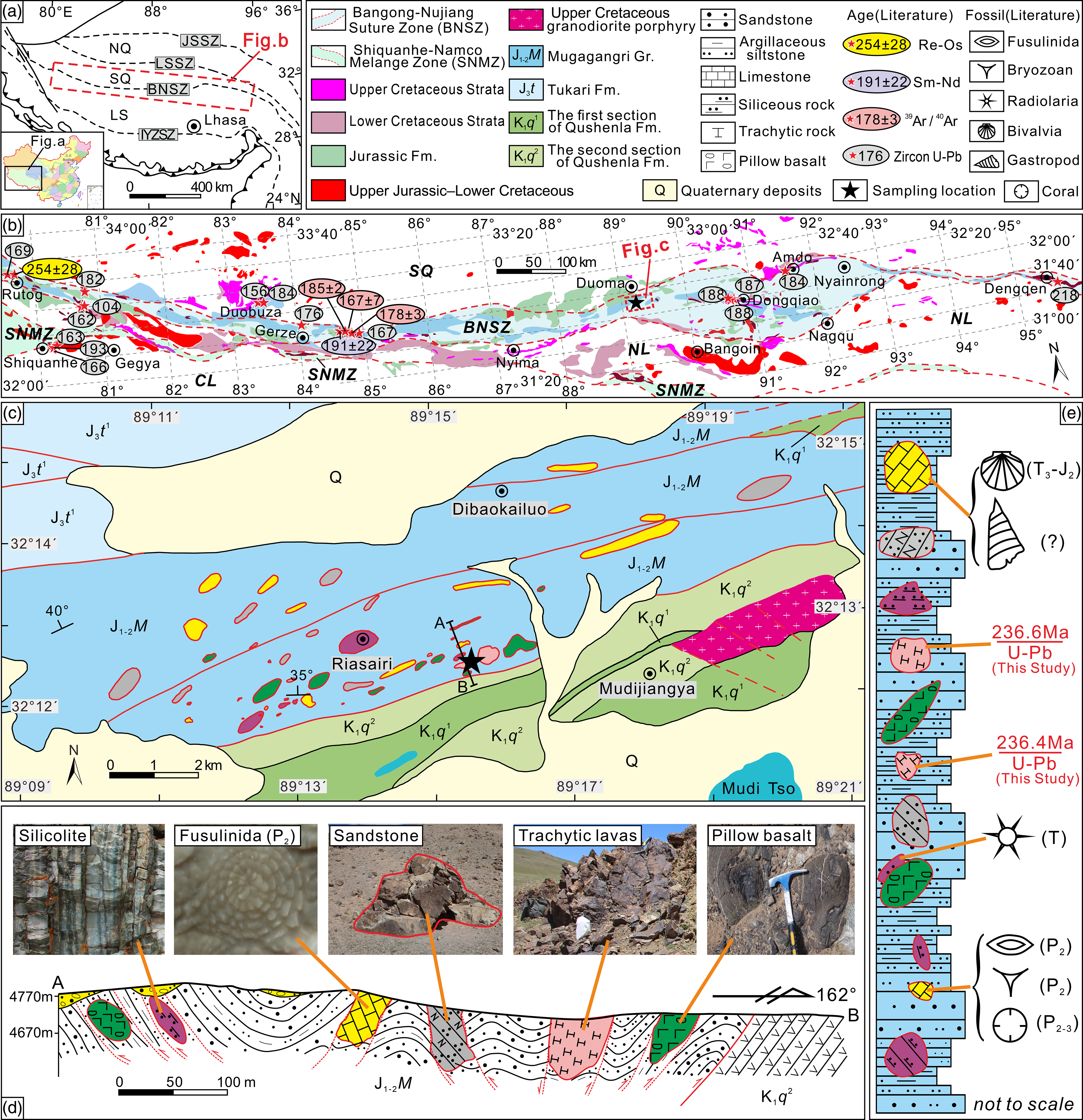
The central Tibetan Plateau consists of the Gondwana-derived Qiangtang and Lhasa terranes that migrated N-wards and sequentially accreted during the Mesozoic Era. The N-wards transfer of these terranes was accommodated by the birth and destruction of major oceanic basins, the remnants of which are now exposed in the Indus–Yarlung Zangbo and Bangong–Nujiang Suture Zone (Dewey & Burke, Reference Dewey and Burke1973; Metcalfe, Reference Metcalfe2011). Reconstructing the evolution of these oceanic domains is difficult because the geological archives are poorly preserved in challenging terrain (Kapp & Decelles, Reference Kapp and Decelles2019; Li et al. Reference Li, Yin, Guilmette, Ding and Zhang2019 c). The Bangong–Nujiang suture zone (BNSZ) in central Tibet is c. 2000 km long trending in an E–W orientation (Fig. 1a, b). This suture zone contains remnants of the Bangong–Nujiang Ocean (BNO) (Allégre et al. Reference Allégre, Courtillot, Tapponnier, Hirn, Mattauer, Coulon, Jaeger, Achache, Schärer, Marcoux, Burg, Girardeau, Armijo, Gariépy, Göpel, Li, Xiao, Chang, Li, Lin, Teng, Wang, Chen, Han, Wang, Den, Sheng, Cao, Zhou, Qiu, Bao, Wang, Wang, Zhou and Xu1984; Yin & Harrison, Reference Yin and Harrison2000; Li et al. Reference Li, Huang, Zhai, Zhu, Yu, Wang and Zeng2006; Pan et al. Reference Pan, Mo, Hou, Zhu, Wang, Li, Zhao, Geng and Liao2006; Zhu et al. Reference Zhu, Zhao, Niu, Mo, Chung, Hou, Wang and Wu2011), and this palaeo-ocean closed during Late Triassic–Early Cretaceous time when the Lhasa and Qiangtang terranes collided (Li et al. Reference Li, Ding, Lippert, Song, Yue and van Hinsbergen2016 b, Reference Li, Yin, Guilmette, Ding and Zhang2019 c).
Tectonic framework of the Tibetan Plateau and the Bangong–Nujiang suture zone (BNSZ). (a) The BNSZ in the context of the Tibetan Plateau. (b) Geological sketch map of the BNSZ. (c) Geological map of the study area. (d) Cross-section of the study area with field photographs showing prominent lithological and structural features. (e) Stratigraphic column of the Mugagangri Group in the study area. JSSZ – Jinsha suture zone; LSSZ – Longmuco–Shuanghu Lancangjiang suture zone; SNMZ – Shiquan River–Nam Tso mélange zone; IYZSZ – Indus–Yarlung Zangbo suture zone; SQ – Southern Qiangtang block; NQ – Northern Qiangtang block; LS – Lhasa terrane; NL – Northern Lhasa block; CL – Central Lhasa block; Fm – Formation; Gr – Group. Literature age data include Qiu et al. (Reference Qiu, Zhou, Deng, Li, Xiao and Cai2004), Huang et al. (Reference Huang, Shi and Ding2012) and Tang et al. (Reference Tang, Zhai, Chung, Hu, Wang, Xiao, Song, Wang and Lee2020).
Due to the poorly preserved rock records within the BNSZ, the initiation of the BNO has not been well constrained. Previous studies employed different lithologies and mineral studies or field observations to constrain the initiation timing, such as ophiolites (Qu et al. Reference Qu, Wang, Duan, Zhang, Wang, Lv, Liu, Li, Feng, Xie, Yu, Jiang, Sun, Li, Liang, Wang and Guo2003; Qiu et al. Reference Qiu, Zhou, Deng, Li, Xiao and Cai2004; Qiangba et al. Reference Qiangba, Xie, Wu, Xie, Li and Qiu2009; Fan et al. Reference Fan, Li, Xie, Wang and Chen2015), abyssal or bathyal sedimentary rocks (Wang et al. Reference Wang, Liu, Li, Yue and Pei2002 a, Reference Wang, Peng, Li and Zhang2019; Pan et al. Reference Pan, Mo, Hou, Zhu, Wang, Li, Zhao, Geng and Liao2006; Hou et al. Reference Hou, Chen, Gao and Wang2018), metamorphic rocks and subducted oceanic crust (Wang et al. Reference Wang, Wang, Xu, Chen, Zhao, Liu, Peng and Li2015; Zhang et al. Reference Zhang, Li, Zhu, Zhang, Yang and Jin2016, Reference Zhang, Wang, Dong, Zhang, Li, Xia and Xu2017), inherited zircons in ophiolites, island-arc assemblages (Fan et al. Reference Fan, Li, Xie, Wang and Chen2015) and stratigraphic unconformities (Yin & Harrison, Reference Yin and Harrison2000; Ren & Xiao, Reference Ren and Xiao2004; Pan et al. Reference Pan, Mo, Hou, Zhu, Wang, Li, Zhao, Geng and Liao2006). The above indicators gave different initiation timings for the BNO spanning over 100 Ma, from Carboniferous–Permian to Early Jurassic time (Li et al. Reference Li, Yin, Guilmette, Ding and Zhang2019 c).
Silicic volcanism is a key component of rift magmatism and is a common product across different rift zones (Hutchison et al. Reference Hutchison, Mather, Pyle, Boyce, Gleeson, Yirgu, Blundy, Ferguson, Vye-Brown, Millar, Sims and Finch2018), such as the East African Rift System (EARS) (Debre Birhan: Feyissa et al. Reference Feyissa, Shinjo, Kitagawa, Meshesha and Nakamura2017; Rungwe: Fontijn et al. Reference Fontijn, Elburg, Nikogosian, van Bergen and Ernst2013; Axum-Adwa: Natali et al. Reference Natali, Beccaluva, Bianchini and Siena2013) and the West Antarctic Rift System (WARS) (Marie Byrd Land: Panter et al. Reference Panter, Kyle and Smellie1997; LeMasurier et al. Reference LeMasurier, Choi, Kawachi, Mukasa and Rogers2011). Such volcanism has a distinct geochemical signature reflecting fractional crystallization from a basaltic parental melt derived from partial melting of asthenospheric depleted mantle, and can therefore be dated using precise radiometric methods.
In this contribution, we focus on our newly discovered trachytic lavas in the BNSZ, which occur as clasts in a sedimentary-matrix mélange at the margin of the BNSZ, possibly recording the evolution of an intra-plate continental rift. We integrate our field observations, petrography, whole-rock geochemistry, zircon U–Pb ages, zircon Lu–Hf isotopes and whole-rock Sr–Nd–Pb isotopic data to evaluate the evolution of the now-vanished BNO to further understand the plate tectonic dance of the Lhasa and Qiangtang terranes, the two main constituents of the Tibetan Plateau.
2. First report of trachytic lava in BNSZ
The BNSZ extends over 2000 km across the central Tibetan Plateau and separates the (southern) Qiangtang terrane to the north and the Lhasa terrane to the south. We focus on the central segment of the BNSZ in Duoma town, Shuanghu County, Tibet (Fig. 1b, c). In this area, faults and structural blocks developed in the strongly deformed tectonic mélange strike NE (Fig. 1c, d). These tectonic mélanges are classified as belonging to the Jurassic Mugagangri Group, which is interpreted as an accretionary prism that formed in response to N-wards subduction of BNO oceanic lithosphere beneath the Qiangtang terrane (Zeng et al. Reference Zeng, Zhang, Cao, Ettensohn, Cheng and Lang2016; Huang et al. Reference Huang, Xu, Chen, Wu and Zeng2017; Li et al. Reference Li, Ding, Guilmette, Fu, Xu, Yue, Hui and Henrique-Pinto2017, Reference Li, Guilmette, Yin, Ding, Zhang, Wang and Baral2019 b). In the study area, near Riasairi, the Mugagangri Group reaches a thickness of up to 3100 m and is a block-in-matrix mélange with strongly deformed deep-sea to bathyal turbidite deposits dominated by generally greyish-green or black-grey graywackes, lithic-quartz sandstones, mudstones and limestone, hosting apparently exotic blocks of basalt, limestone, sandstone and chert, as well as recently discovered trachytic lava blocks (Fig. 1d, e). The basalt blocks are dominated by pillow lavas occurring as a dismembered volcanic–sedimentary sequence with minor chert interlayers. Individual pillows are typically 35 × 55 cm in size (Fig. 1d) and blocks are generally larger than 15 m. Chert blocks are mostly medium- to thin-bedded (with bed thicknesses of 10–30 cm) and purplish-red and greyish-green in colour (Fig. 1d). The cherts contain abundant radiolarians with characteristic Triassic faunae (Xiphosphaera sp., T) (Wang et al. Reference Wang, Wang and Pei2002 b). The limestone occurring as matrix of the sedimentary mélange contains bivalves (T3–J2) and gastropods (Ding, Reference Ding2017). The exotic limestone blocks are mostly recrystallized micrite containing abundant fossils of Permian age, mainly fusulinidas (Fig. 1d) (Yangchienia iniqua Lee, P2; Chusenella tieni Chen, P2), coral (Waagenophyllum indicum frechi Yu, P2-3) and bryozoans (Fistuliramus sp., P2) (Wang et al. Reference Wang, Wang and Pei2002 b). Sandstone blocks are in fault contact with matrix of the Mugagangri Group (Fig. 1c–e). These blocks are generally thicker than 5 m, display a massive structure of light grey colour (Fig. 2e), and are composed of quartz (58%), feldspar (24%) and lithic (volcanic) fragments (18%) (Fig. 2f).
Hand specimens photographs (left) and corresponding thin-section photomicrographs (right) of the Riasairi volcanic rocks. (a, b) Trachyandesite (D2204-1) from the Riasairi lavas. (c, d) Trachyte (D2205-1) from the Riasairi lavas. (e, f) Sandstone block (D2206) within the Mugagangri Group. Pl – plagioclase; Kfs – K-feldspar; Pyx – pyroxene; Q – quartz; Cal – calcite.
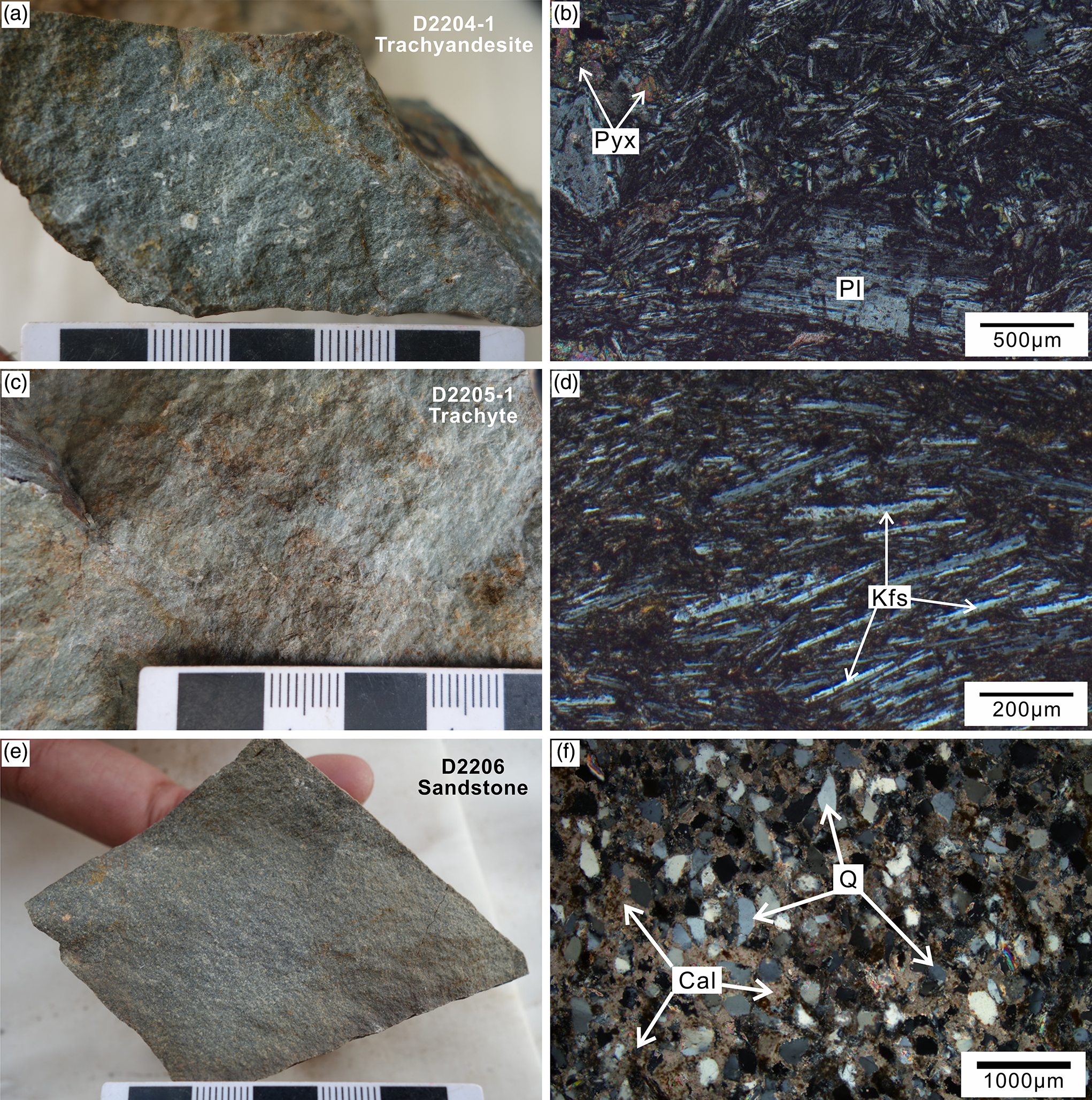
The focal point of this study, the trachytic lava blocks occur as dismembered volcanic sequence within the mélange, with individual blocks generally thicker than 20 m. At the type locality, the main studied block is in fault contact with the clasolite matrix of the Mugagangri Group (Fig. 1c–e). Petrographically, all the volcanic samples selected from the Riasairi area are similar, in that they are predominately trachyte with minor trachyandesite (Fig. 2). The trachyandesites contain abundant plagioclase and rare pyroxene phenocrysts in a matrix of glass and fine-grained plagioclase, pyroxene and opaque minerals (mainly magnetite) (Fig. 2a, b). The trachyte lavas are characterized by the typical trachytic texture, with phenocrysts of alkali feldspar and subordinate plagioclase within a ‘fluidal’ groundmass consisting of unoriented microliths of alkali feldspar, subordinate opaque minerals and rare amphibole (Fig. 2c, d).
3. Analytical methods
Ten representative samples of the trachytic lavas blocks and one sandstone block sample (D2206) in Riasairi area were collected. All trachytic lavas samples were analysed for major and rare earth element (REE) abundance and Sr–Nd–Pb isotope composition. Among those, we extracted zircon from two samples of > 10 kg in order to document their U–Pb and Lu–Hf isotopic compositions. The sandstone block (sample D2206) was collected for detrital zircon U–Pb dating. The trachyte samples were trimmed to remove altered surfaces and were cleaned with deionized water before subsequent crushing into powders of c. 200 meshes (c. 75 μm) in an agate mill for analyses of major and trace elements, and Sr–Nd–Pb isotopes. Zircon grains for analysis of U–Pb and Lu–Hf isotopes were separated using conventional heavy liquid and magnetic techniques at the Langfang Regional Geological Survey, Hebei Province, China. Zircons were hand-picked under a binocular microscope and mounted in an epoxy resin disc before undergoing polishing and gold coating. Zircons were imaged under transmitted and reflected light and cathodoluminescence (CL) at the Guangzhou Institute of Geochemistry, Chinese Academy of Sciences (GIGCAS).
3.a. Whole-rock geochemical analysis
Whole-rock major and trace concentrations were analysed at ALS Minerals & ALS Chemex (Guangzhou) Co. Ltd, China. A calcined or ignited sample (c. 0.9 g) was added to c. 9.0 g lithium borate flux (50–50% Li2B4O7–LiBO2), mixed well and fused in an autofluxer at a temperature of 1050–1100 °C. A flat molten glass disk was prepared from the resulting melt. This disk is then analysed by X-ray fluorescence spectrometry (XRF) for major elements with analytical uncertainties of < 5%. For trace elements, a prepared sample (c. 0.2 g) is added to lithium metaborate flux (c. 0.9 g), mixed well and fused in a furnace at 1000 °C. The resulting melt is then cooled and dissolved in 100 mL of 4% nitric acid. This solution is then analysed by inductively coupled plasma mass spectrometry (ICP-MS) for trace elements. The analytical uncertainties were 10% for elements with abundances of < 10 ppm and approximately 5% for elements with abundances of > 10 ppm. Two standards (plagioclase amphibolite GSR-15, granitic gneiss GSR-14) were simultaneously analysed to monitor the analytical quality.
3.b. Whole-rock Sr–Nd–Pb isotopic analysis
Whole-rock Sr–Nd–Pb isotope analyses were performed at the GIGCAS. Sr and Nd isotopic compositions were determined using a micromass isoprobe multicollector (MC-) ICP-MS. Strontium and neodymium isotopic fractionation was corrected using values of 86Sr/88Sr = 0.1194 and 146Nd/144Nd = 0.7219, respectively. Lead isotopic compositions were measured by thermal ionization mass spectrometry (TIMS). Lead isotopic ratios were corrected for fractionation using replicate analyses of the standard NBS 981. The analytical uncertainties during the period of analysis were 0.006 for 206Pb/204Pb and 207Pb/204Pb, and 0.012 for 208Pb/204Pb.
3.c. Zircon U–Pb dating
The zircons were analysed for U, Th and Pb using laser ablation (LA-) ICP-MS at the Institute of Geology, Chinese Academy of Geological Sciences (IGCAGS). Before LA-ICP-MS analysis, zircon grains with fracture and inclusions were noted and avoided based on observations made using transmitted and reflected light microscopy. Prior to analysis, the surfaces of the grain mounts were then acid-washed in dilute HNO3 and pure alcohol to remove any lead contamination. The spot size was c. 25 μm, and the data were calibrated according to the M127 reference zircon (U: 923 ppm; Th: 439 ppm; Th/U: 0.475). Plesovice zircon, with an age of 337.13 ± 0.37 Ma (2σ), and GJ-1 zircon with an age of 599.8 ± 1.7 Ma (2σ), were used as external standards during U–Pb dating and were analysed at the beginning of the run, then twice each after every five unknowns. The offline raw data selection, integration of background and analyte signals, and time-drift correction and quantitative calibration for U–Pb dating were performed by the ICPMSDataCal program. In all of the analysed zircon grains, a common Pb correction was not necessary due to the low 204Pb signal and high 206Pb/204Pb signal.
3.d. Zircon Lu–Hf isotopic analysis
Before Lu–Hf isotopic analysis, pure alcohol was used to remove any lead contamination. Zircon Hf isotope analysis was conducted using a GeoLasPro 193 nm laser ablation microprobe that was attached to a Neptune MS-ICP-MS at IGCAGS. Lu–Hf isotopic analyses were conducted on the same zircon grains that were initially analysed, with the spot size of 44 μm. High-purity helium was used as a carrier gas to transport the ablated sample from the laser ablation cell to the ICP-MS torch via a mixing chamber that contained argon. Zircon GJ-1 was used as the reference standard during routine analyses. GJ-1 was analysed at the beginning of the run, then twice after every five to six unknowns, yielding a weighted mean 176Hf/177Hf ratio of 0.282007 ± 0.000006 (2σ; n = 14). The calculation of Hf model ages (single-stage model ages) (T DM) was based on a depleted mantle source with a present-day 176Hf/177Hf ratio of 0.28325 and a 176Lu decay constant of 1.865 × 10⁻¹¹ a−1. The calculation of crustal (two-stage) Hf model ages (T DMC) was based on the assumed mean 176Lu/177 Hf value of 0.015 for the average continental crust.
4. Results
4.a. Major-element data
The results of the whole-rock chemical analyses of the Riasairi volcanic rocks are presented in online Supplementary Table S1 (available at http://journals.cambridge.org/geo). Most of the Riasairi lava samples have loss on ignition (LOI) values of < 2 wt%, indicating that they did not undergo significant alteration, as supported by the observation of unaltered matrix and phenocrysts from thin-section photomicrographs (Fig. 2a–d). On the total alkali silica diagram (TAS), all compositions cluster above the alkaline–subalkaline boundary. Most of the selected samples are trachytes, except for two samples (D2204-1, D2204-3) that plot in the trachyandesite field (Fig. 3a).
Classification of the Riasairi volcanic rocks. (a) Total alkali silica diagram after Le Bas et al. (Reference Le Bas, Le Maitre, Streckeisen and Zanettin1986). (b) Co versus Th diagram after Hastie et al. (Reference Hastie, Kerr, Pearce and Mitchell2007). The EARS samples are from Peccerillo et al. (Reference Peccerillo, Barberio, Yirgu, Ayalew, Barbieri and Wu2003), Natali et al. (Reference Natali, Beccaluva, Bianchini and Siena2013), Giordano et al. (Reference Giordano, D’Antonio, Civetta, Tonarini, Orsi, Ayalew, Yirgu, Dell’Erba, Di Vito and Isaia2014), Hutchison et al. (Reference Hutchison, Pyle, Mather, Yirgu, Biggs, Cohen, Barfod and Lewi2016), Feyissa et al. (Reference Feyissa, Shinjo, Kitagawa, Meshesha and Nakamura2017) and Corti et al. (Reference Corti, Sani, Agostini, Philippon, Sokoutis and Willingshofer2018). The WARS samples are from LeMasurier et al. (Reference LeMasurier, Choi, Kawachi, Mukasa and Rogers2011) (see online Supplementary Tables S1 and S2, available at http://journals.cambridge.org/geo, for sample details). The Ir line in (a) is based on Irvine & Baragar (Reference Irvine and Baragar1971).
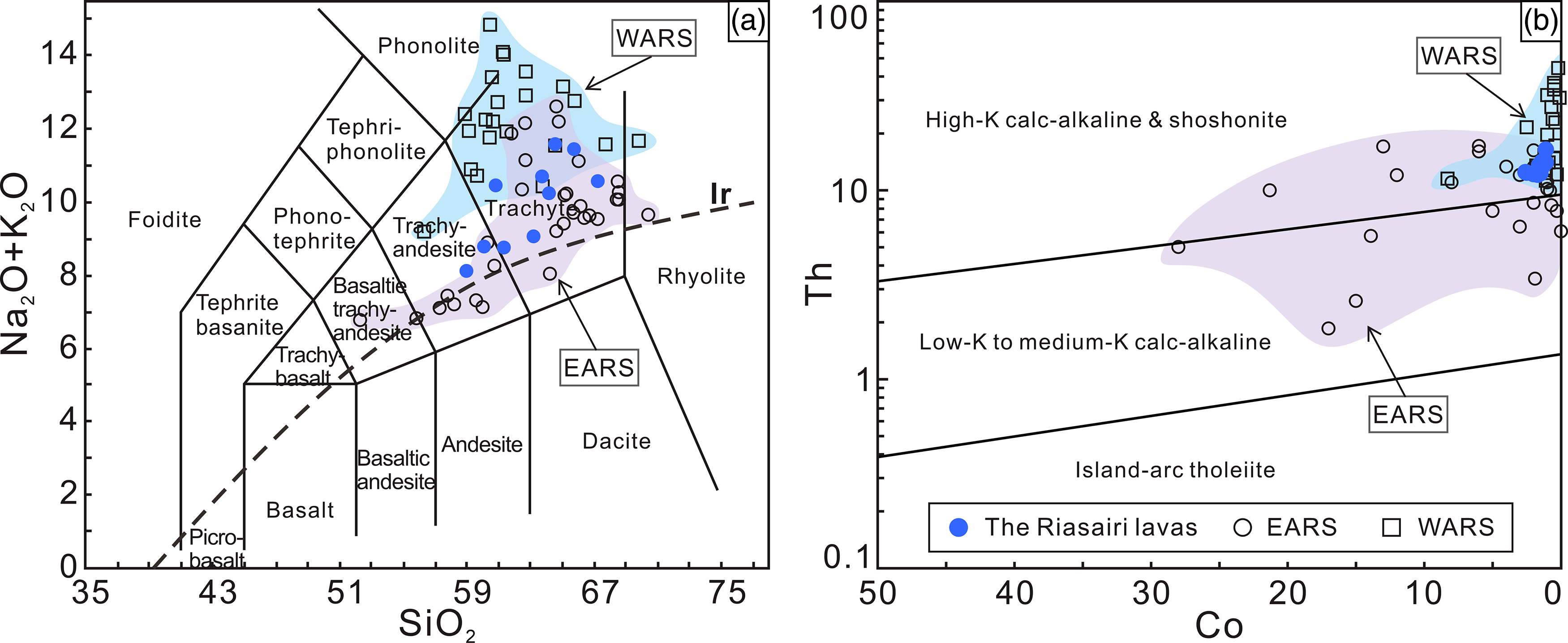
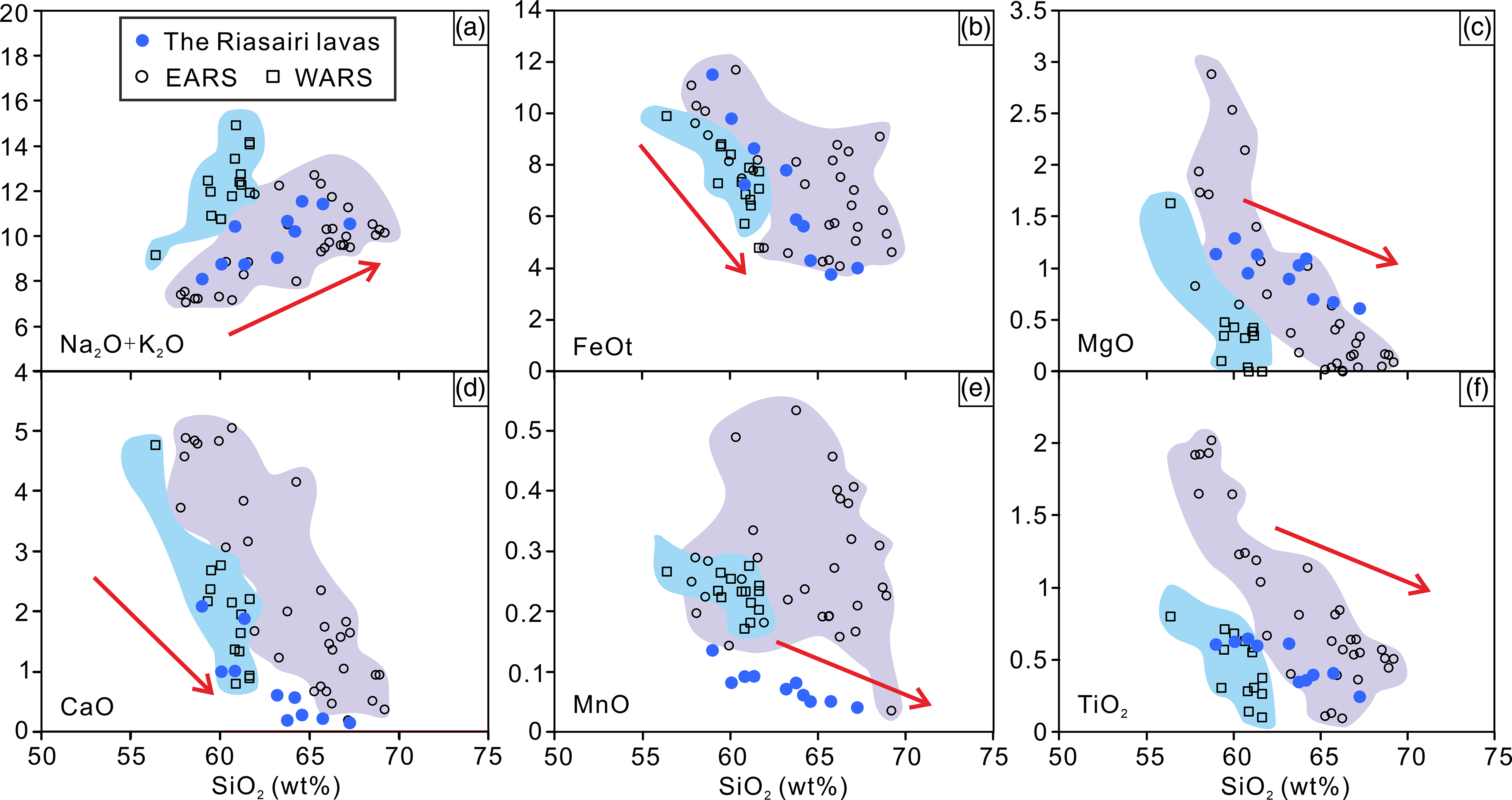
The SiO2 contents of the samples are variable, ranging from 59 to 67 wt%. There is a positive correlation between the total alkali (Na2O + K2O) contents and SiO2 concentrations. Major element oxides, including FeOt, MgO, CaO, MnO and TiO2, exhibit well-defined negative trends when plotted against SiO2. These geochemical trends compare with those of the trachytic rocks from the EARS and WARS (Fig. 4; major- and trace-element data of EARS and WARS are summarized in online Supplementary Table S2, available at http://journals.cambridge.org/geo).
4.b. Trace elements
The Riasairi lava samples have high concentrations of incompatible elements and are enriched in light rare earth elements (LREE) (LaN/YbN = 15.9–25.9), which is a typical feature of intra-plate alkaline magmas (Panter et al. Reference Panter, Kyle and Smellie1997; Chauvet et al. Reference Chauvet, Lapierre, Maury, Bosch, Basile, Cotten, Brunet and Campillo2011). The Riasairi volcanic rocks display narrow REE patterns (Fig. 5a, c) compared with each other and are also similar to the patterns observed in some intra-continental rift setting-related felsic lavas from the EARS (Debre Birhan: Feyissa et al. Reference Feyissa, Shinjo, Kitagawa, Meshesha and Nakamura2017; Rungwe: Fontijn et al. Reference Fontijn, Elburg, Nikogosian, van Bergen and Ernst2013; Axum-Adwa: Natali et al. Reference Natali, Beccaluva, Bianchini and Siena2013) and the WARS (Marie Byrd Land: Panter et al. Reference Panter, Kyle and Smellie1997; LeMasurier et al. Reference LeMasurier, Choi, Kawachi, Mukasa and Rogers2011).
(a, c) Chondrite-normalized REE patterns and (b, d) primitive mantle-normalized trace diagrams for the Riasairi volcanic rocks. Data sources of the EARS and WARS are as for Figure 3. Normalization values and ocean-island, enriched mid-ocean-ridge and normal mid-ocean ridge basalts (OIB, E-MORB and N-MORB) data are from Sun & McDonough (Reference Sun and McDonough1989); Tonga arc data are from Turner et al. (Reference Turner, Caulfield, Rushmer, Turner, Cronin, Smith and Handley2012).
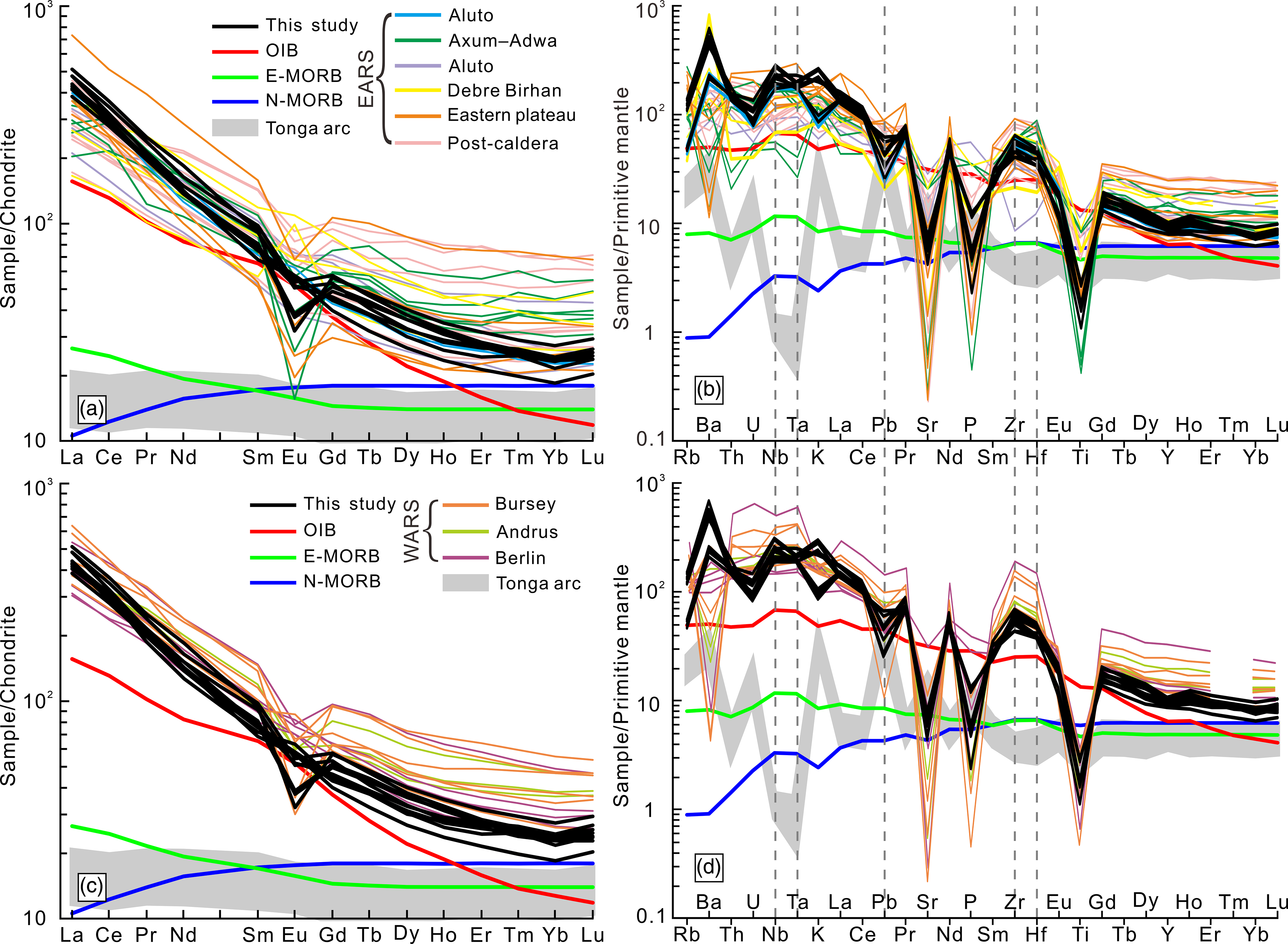
Primitive mantle-normalized incompatible trace-element patterns are shown in Figure 5b and d. Hutchison et al. (Reference Hutchison, Mather, Pyle, Boyce, Gleeson, Yirgu, Blundy, Ferguson, Vye-Brown, Millar, Sims and Finch2018) documented that silicic melts generated in continental rifts by protracted fractional crystallization tend to be enriched in REE, Zr, Hf, Nb and Ta, which is consistent with the Nb–Ta and Zr–Hf positive anomalies and high REE contents (up to 551 ppm, with an average of 469 ppm) observed in the Riasairi lava samples. The REE in the trachytic rocks from the study area are enriched to variable degrees: the light and heavy REE are enriched (LREE/HREE, i.e. La/Yb) by a factor of > 15, but the middle REE (i.e. Sm, Eu) are less enriched, as would be expected from apatite fractionation combined with the incorporation of Eu into feldspar (Cousens et al. Reference Cousens, Clague and Sharp2003).
4.c. Zircon U–Pb geochronology
One trachyandesite (D2204-1) sample and one trachyte (D2205-1) sample were selected for zircon LA-ICP-MS U–Pb dating and Lu–Hf isotopic analysis. These data are listed in online Supplementary Table S3 (available at http://journals.cambridge.org/geo). The U–Pb concordia plots expressed with 1σ errors, CL and transmitted light images of representative zircon grains are shown in Figure 6a and b. The zircon grains from these two samples are colourless and transparent. Most zircons occur as euhedral stubby prismatic crystals with lengths ranging over 150–200 μm and length:width ratios of approximately 2.0. These zircon grains exhibit modest oscillatory or planar zoning in CL images, which is a typical feature of magmatic zircons (Fig. 6a, b). The Th/U ratios of the zircons from samples 2204-1 (trachyandesite) and 2205-1 (trachyte) range from 0.85 to 1.9 and 0.64 to 1.67, respectively, also consistent with a magmatic origin (Hoskin & Black, Reference Hoskin and Black2000). The data obtained from 25 analyses of D2204-1 performed by LA-ICP-MS form a tight cluster on the concordia diagram with 206Pb/238U age ranging over 230.0–242.4 Ma, and yield a weighted mean age of 236.6 ± 1.7 Ma (Fig. 6a; 1σ; MSWD: 0.76), which is interpreted as the crystallization age for this sample. A total of 25 grains from sample D2205-1 were also analysed by LA-ICP-MS; all of the data points cluster together, yielding concordant 206Pb/238U ages of 228–248 Ma with a weighted mean of 236.4 ± 2.5 Ma (Fig. 6b; 1σ; MSWD = 2.5).
(a, b) Representative CL and transmitted light images of dated zircons and zircon U–Pb concordia diagrams of the Riasairi volcanic rocks. (c) Representative CL images and detrital zircon age spectra for sandstone block within the Mugagangri Group. (d, e) ϵHf(t) values for the Riasairi lavas.
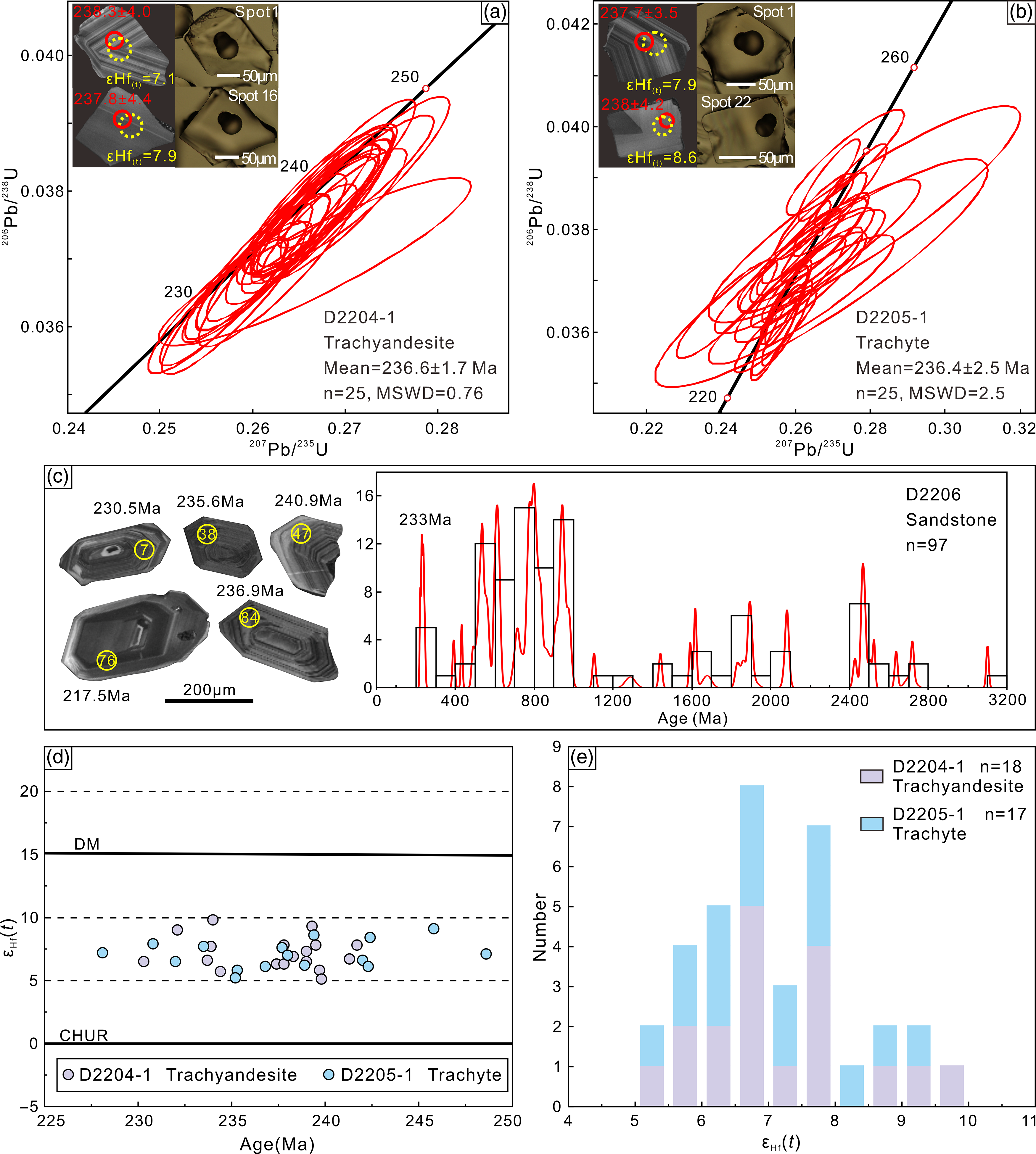
One sandstone sample (D2206, Fig. 2e) was collected for detrital zircon U–Pb dating (online Supplementary Table S4, available at http://journals.cambridge.org/geo). In the weighted mean age calculation using Isoplot (Ludwig, Reference Ludwig2003), 3 of a total of 100 analyses (D2206-18, D2206-30, D2206-31) were excluded due to the low U–Pb age concordance degree; the other 97 analyses display three main age clusters at 200–1000, 1400–2100 and 2400–2750 Ma (Fig. 6c). The youngest age cluster in this sample is 218–242 Ma (n = 5), indicating that the maximum depositional age is Late Triassic. These five zircons exhibit an idiomorphic morphology, suggesting that they have not been transported over long distances. These zircons exhibit typical features of magmatic zircon, with oscillatory zoning demonstrated in CL images and Th/U ratios of greater than 0.4 (Fig. 6c, Hoskin & Black, Reference Hoskin and Black2000).
4.d. Zircon Lu–Hf isotopic compositions
The zircon grains from the two samples (D2204-1 and D2205-1) that underwent U–Pb dating were also used for Lu–Hf isotopic analyses. The analytical results and calculations are shown in Figure 5d, e and in online Supplementary Table S5 (available at http://journals.cambridge.org/geo).
Of the 25 dated zircons from sample D2204-1 (trachyandesite), 18 were analysed for their Hf isotope ratios. This analysis yields 176Hf/177Hf and 176Lu/177Hf ratios ranging over 0.0106–0.0420 and 0.0004–0.0015, respectively, with initial 176Hf/177Hf ratios ranging over 0.281231–0.281379 and ϵHf(t) values varying from +5.1 to +9.8. Such isotopic compositions straddle the mean value of the depleted mantle at 607 Ma (Vervoort & Kemp, Reference Vervoort and Kemp2016). A total of 17 dated spots of the zircon grains from D2205-1 (trachyte) yield 176Lu/177Hf and 176Yb/177Hf ratios ranging over 0.0106–0.0420 and 0.0004–0.0015, respectively, with initial 176Hf/177Hf ratios ranging over 0.281231–0.281379 and ϵHf(t) values from +5.2 to +9.1. Single-stage depleted-mantle Hf model ages (T DM) are 553–695 Ma (online Supplementary Table S5, available at http://journals.cambridge.org/geo).
A total of 35 analytical locations in the two selected samples have similar Hf isotopic compositions, along with similar geochronologic and geochemical data, which demonstrate that they are derived from the same material source. Furthermore, their ϵHf(t) values exhibit a narrow range of variation and are mainly concentrated between +6 and +8, with all values plotting between +5 and +10 (Fig. 6d, e).
4.e. Sr, Nd and Pb isotopic compositions
A total of 10 whole-rock samples were analysed for their Sr, Nd and Pb isotopic compositions (online Supplementary Table S1, available at http://journals.cambridge.org/geo; Fig. 7). The initial Sr, Nd and Pb isotopic ratios were revised using the U–Pb zircon ages of corresponding samples. The initial 87Sr/86Sr ratios exhibit a wide range over 0.70608–0.70897 (Fig. 7a). Their Nd isotopic compositions are relatively homogeneous, with ϵNd(t) values ranging from 3.73 to 4.10 (Fig. 7a). All of the Riasairi lava samples analysed in this study display narrow ranges of (206Pb/204Pb)i (18.326–18.709), (207Pb/204Pb)i (15.548–15.599) and (208Pb/204Pb)i (38.488–39.024) values. The data obtained from the investigated lavas stretch along the mantle array between the depleted mantle and the enriched lithospheric mantle (EM II, Zindler & Hart, Reference Zindler and Hart1986), and they plot distinctly above the Northern Hemisphere Reference Line (NHRL) of Hart (Reference Hart1984) in the Pb–Pb isotope diagrams (Fig. 7b, c).
Whole-rock Sr–Nd–Pb geochemical plots for the Riasairi volcanic rocks. (a) (87Sr/86Sr)i versus ϵNd(t), (b) (206Pb/204Pb)i versus (207Pb/204Pb)i, and (c) (206Pb/204Pb)i versus (208Pb/204Pb)i. A typical uncontaminated asthenospheric mantle composition is marked with a star in the top left corner for (a). The fields of OIB and EMI, EMII, high-μ (HIMU) mantle components are from Zindler & Hart (Reference Zindler and Hart1986). MLC – mean lower crust; BSE – bulk silicate earth; NHRL – Northern Hemisphere reference line, as defined by Hart (Reference Hart1984). The diabase data are from Li et al. (Reference Li, Zhu, Wang, Zhao, Zhang, Liu, Chang, Lu, Dai and Zheng2016 a).

5. Discussion
5.a. Crustal contamination
Ayalew et al. (Reference Ayalew, Jung, Romer, Kersten, Pfänder and Garbe-Schönberg2016) suggested that enrichment of lavas in highly and moderately incompatible elements may either be a consequence of crustal contamination of mantle-derived magma or reflect mantle sources. Negative Nb and Ta anomalies observed in primitive-mantle-normalized multi-element variation diagrams are generally interpreted as subtle tracers of crustal contamination (McClellan & Gazel, Reference McClellan and Gazel2014; Ayalew et al. Reference Ayalew, Jung, Romer, Kersten, Pfänder and Garbe-Schönberg2016; Corti et al. Reference Corti, Sani, Agostini, Philippon, Sokoutis and Willingshofer2018). There are no obvious negative Nb and Ta anomalies in the Riasairi lava samples, compared with the typical intra-oceanic island arc (e.g. Tonga arc; Fig. 5b, d). The decoupling between Th and Ta is also a sensitive indicator of crustal contamination, as this process results in a marked increase in Th/Ta ratios (Condie, Reference Condie1993). All of the Riasairi lavas have relatively low Th/Ta ratios (1.65–1.72), similar to those observed in intra-continental rift setting-related felsic lavas, for example, Marie Byrd Land lavas (WARS, 1.25–2.12, LeMasurier et al. Reference LeMasurier, Choi, Kawachi, Mukasa and Rogers2011), Axum-Adwa lavas (Ethiopian plateau, 1.47–2.48, Natali et al. Reference Natali, Beccaluva, Bianchini and Siena2013), Debre Birhan lavas (Main Ethiopian Rift System, 1.15–1.50, Feyissa et al. Reference Feyissa, Shinjo, Kitagawa, Meshesha and Nakamura2017), Rungwe lavas (Ethiopian Rift System, 1.47–3.10, Fontijn et al. Reference Fontijn, Elburg, Nikogosian, van Bergen and Ernst2013), and Gedemsa and Fanta’Ale lavas (Ethiopian Rift System, 0.74–3.90, Peccerillo et al. Reference Peccerillo, Barberio, Yirgu, Ayalew, Barbieri and Wu2003; Giordano et al. Reference Giordano, D’Antonio, Civetta, Tonarini, Orsi, Ayalew, Yirgu, Dell’Erba, Di Vito and Isaia2014). This provides good evidence for the Riasariri lavas being mantle derived (Th/Ta = 2.3; Condie, Reference Condie1993), rather than from an upper crustal source (Th/Ta > 10). Further, it has been shown that Zr/Nb ratios remain nearly constant during fractional crystallization but change significantly during magma mixing or crustal contamination (Weaver, Reference Weaver1991). The Riasairi lavas show a narrow range of Zr/Nb ratios (2.9–4.9), suggesting negligible to no crustal contamination. The lavas are characterized by high contents of Nb (129–212 ppm) and Ta (7.5–10 ppm), and show Pb depletion in their primitive-mantle-normalized trace-element patterns (Fig. 5b, d), whereas continental crust is characteristically depleted in both Nb and Ta and significantly enriched in Pb. Moreover, both the upper and lower crust are known to have low Ce/Pb ratios of < 5 (Taylor & McLennan, Reference Taylor and McLennan1985), whereas the Ce/Pb value of ocean-island and mid-ocean-ridge basalts (OIB-MORB) is c. 25 and that of the primitive mantle is c. 9 (Hofmann et al. Reference Hofmann, Jochum, Seufert and White1986; Sun & McDonough, Reference Sun and McDonough1989; Feyissa et al. Reference Feyissa, Shinjo, Kitagawa, Meshesha and Nakamura2017). Most of Ce/Pb values of the Riasairi lavas (14.2–29.6) fall within the typical mantle range and are far higher than the Ce/Pb values of the continental crust (< 5). Finally, the Riasairi samples show medium and homogeneously positive ϵHf(t) (+5.1 to +9.8) and ϵNd(t) (+3.73 to +4.10) values, indicating a predominantly mantle-derived melt, rather than a crust-contaminated melt. Based on these lines of evidence, we conclude that the Riasairi lavas did not undergo significant crustal contamination.
5.b. Magma source
The Riasairi lava samples show positive Nb–Ta anomalies in Figure 5, different to felsic lava from intra-oceanic island arc (e.g. Tonga arc: Turner et al. Reference Turner, Caulfield, Rushmer, Turner, Cronin, Smith and Handley2012) but similar to the EARS (McClellan & Gazel, Reference McClellan and Gazel2014; LeMasurier et al. Reference LeMasurier, Choi, Kawachi, Mukasa and Rogers2011; Feyissa et al. Reference Feyissa, Shinjo, Kitagawa, Meshesha and Nakamura2017; Corti et al. Reference Corti, Sani, Agostini, Philippon, Sokoutis and Willingshofer2018; Hutchison et al. Reference Hutchison, Mather, Pyle, Boyce, Gleeson, Yirgu, Blundy, Ferguson, Vye-Brown, Millar, Sims and Finch2018) and the WARS (Panter et al. Reference Panter, Kyle and Smellie1997; LeMasurier et al. Reference LeMasurier, Choi, Kawachi, Mukasa and Rogers2011). This suggests that the Riasairi lavas were derived from depleted asthenospheric mantle, unaffected by subduction imprint and crustal contamination (McClellan & Gazel, Reference McClellan and Gazel2014; Corti et al. Reference Corti, Sani, Agostini, Philippon, Sokoutis and Willingshofer2018). Without the significant role of crustal contamination as shown above, the isotope compositions of the Riasairi lava samples represent the isotopic composition of the magma source. The zircons from the Riasairi lava samples have a narrow range in their ϵHf(t) values (+5.2 to +9.1, mainly concentrated between +6 and +8; Fig. 6d, e); these data, combined with their whole-rock geochemical data, suggest that they were mainly derived from the depleted asthenospheric mantle. In addition, these zircons have lower ϵHf(t) values than that of the depleted mantle (> +12), possibly suggesting a subordinate contribution from an enriched mantle source (e.g. enriched mantle I or II (EMI or EMII)) rather than a crustal source. Sr–Nd–Pb isotopic ratios can also effectively discriminate magma sources because these are not typically modified during fractional crystallization (Shu et al. Reference Shu, Lai, Zhou, Xu and Wu2015; Ayalew et al. Reference Ayalew, Jung, Romer, Kersten, Pfänder and Garbe-Schönberg2016). The medium and homogeneously positive ϵNd(t) values from whole-rock samples are similar to their ϵHf(t) values for analysed zircon grains, further supporting the theory that mixing occurred between the depleted asthenospheric mantle component and an enriched mantle component (Fig. 7a). However, modelling of asthenospheric mantle mixing with EMI does not provide an explanation for their high Sr isotopic ratios (0.706–0.709), considering that normal Sr ratios are generally less than 0.706 (Zindler & Hart, Reference Zindler and Hart1986; Sun & McDonough, Reference Sun and McDonough1989; Weaver, Reference Weaver1991). The proposed model of asthenospheric mantle mixing with EMII therefore provides a reasonable explanation for the origin of the Riasairi magmas within the BNSZ. This model implies the existence of EMII lithospheric mantle in the investigated area, which is support by the occurrence of the Duobuza Late Jurassic basaltic lavas that are also derived from an asthenospheric mantle source with an enriched continental lithospheric mantle (Li et al. Reference Li, Zhu, Wang, Zhao, Zhang, Liu, Chang, Lu, Dai and Zheng2016 a). The Pb isotopic ratios of these samples stretch along the mantle array between the depleted mantle and EMII component (Fig. 7b, c), consistent with our conclusion. This explanation of the magma source being derived from asthenospheric mantle with an enriched continental lithospheric mantle component is supported by the medium and homogeneously positive ϵHf(t) and ϵNd(t) values, high Sr isotopic ratios and moderate Pb isotopic ratios of the samples studied here.
5.c. Petrogenesis
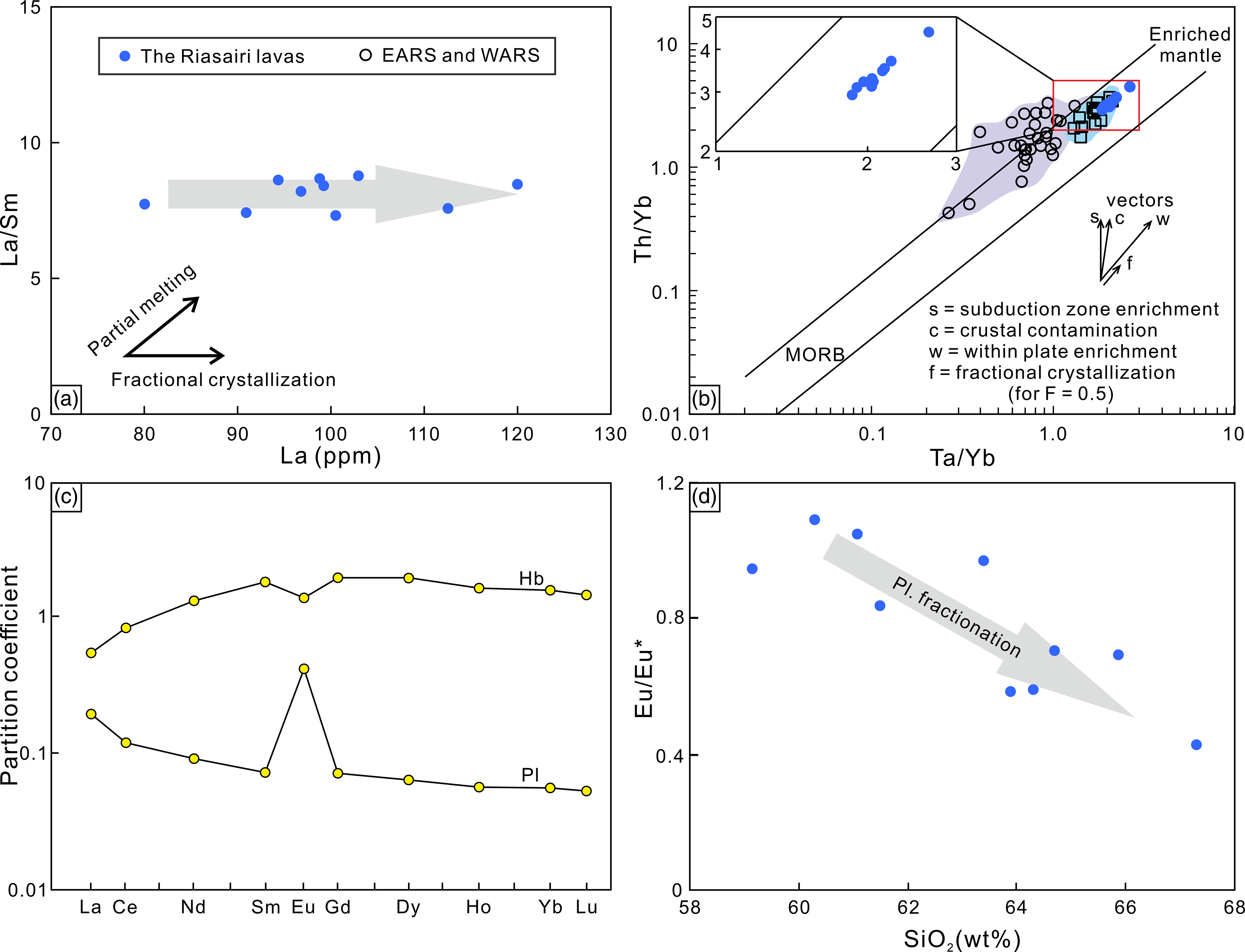
For the genesis of felsic magma in volcanic rift systems, two general models have been proposed: (1) the fractional crystallization of a basaltic parental magma with or without crustal assimilation; and (2) the partial melting of mafic lower crustal rocks with or without subsequent fractional crystallization (Trua et al. Reference Trua, Deniel and Mazzuoli1999; Ayalew et al. Reference Ayalew, Barbey, Marty, Reisberg, Yirgu and Pik2002; Feyissa et al. Reference Feyissa, Shinjo, Kitagawa, Meshesha and Nakamura2017). The Riasairi lavas from central BNSZ following the horizontal fractional trend as shown in a La versus La/Sm diagram (Fig. 8a). In addition, in the Ta/Yb versus Th/Yb diagram (Fig. 8b) the composition of our rocks is undistinguishable from rift volcanic rocks from both the EARS and WARS, and plot in the mantle array field. Based on these, we suggest that the composition of the Riasairi volcanic rocks is best explained by the fractional crystallization of an originally basaltic magma.
(a) La (ppm) versus La/Sm diagram (after Allégre et al. Reference Allégre, Courtillot, Tapponnier, Hirn, Mattauer, Coulon, Jaeger, Achache, Schärer, Marcoux, Burg, Girardeau, Armijo, Gariépy, Göpel, Li, Xiao, Chang, Li, Lin, Teng, Wang, Chen, Han, Wang, Den, Sheng, Cao, Zhou, Qiu, Bao, Wang, Wang, Zhou and Xu1984). (b) Ta/Yb versus Th/Yb diagram (after Pearce, Reference Pearce and Thorpe1982). (c) Plagioclase/melt and amphibole/melt partition coefficients for basalts (after Rollinson, Reference Rollinson1993). (d) SiO2 (wt%) versus Eu/Eu* diagram. The detailed citation data from the EARS and the WARS are given in online Supplementary Table S2 (available at http://journals.cambridge.org/geo).
The major- and trace-element and REE characteristics of our samples are similar to those of the EARS and WARS. In terms of major elements, their lithologies are all intermediate to felsic and high-K calc-alkaline rocks, and major element oxides, including FeOt, MgO, CaO, MnO and TiO2, exhibit well-defined negative trends when plotted against SiO2, and show positive correlation between the total alkali (K2O+Na2O) contents and SiO2 concentrations. In terms of trace elements, the Riasairi volcanic rocks display narrow REE patterns compared with each other and are also similar to those of the EARS and WARS. These similarities further support their evolution from an originally basaltic magma by fractional crystallization without significant assimilation of crustal material (LeMasurier et al. Reference LeMasurier, Choi, Kawachi, Mukasa and Rogers2011; Hutchison et al. Reference Hutchison, Mather, Pyle, Boyce, Gleeson, Yirgu, Blundy, Ferguson, Vye-Brown, Millar, Sims and Finch2018).
Fractional crystallization of basaltic melts to form trachytes is postulated to occur in intra-continental rift settings (i.e. Cousens et al. Reference Cousens, Clague and Sharp2003; Ayalew et al. Reference Ayalew, Jung, Romer, Kersten, Pfänder and Garbe-Schönberg2016): during an initial rift period, primary magma is formed by the mixing between asthenospheric and EMII lithospheric mantle sources. If eruption is prevented (e.g. insufficient thinning of the lithosphere or inadequate formation of magma pathways), such magmas may pond and rapidly fractionate in composition towards trachyte (Cousens et al. Reference Cousens, Clague and Sharp2003). In both the EARS and WARS, trachytes were derived from basaltic magma rather than the mantle-derived magma (LeMasurier et al. Reference LeMasurier, Choi, Kawachi, Mukasa and Rogers2011; Ayalew et al. Reference Ayalew, Jung, Romer, Kersten, Pfänder and Garbe-Schönberg2016), which means that there must have been a lower magma chamber above the lithospheric mantle (Cousens et al. Reference Cousens, Clague and Sharp2003; LeMasurier et al. Reference LeMasurier, Choi, Kawachi, Mukasa and Rogers2011). In this chamber, the mantle-derived magma evolved into basaltic magma after precipitating pyroxene and olivine (Natali et al. Reference Natali, Beccaluva, Bianchini and Siena2011; Ayalew et al. Reference Ayalew, Jung, Romer, Kersten, Pfänder and Garbe-Schönberg2016; Corti et al. Reference Corti, Sani, Agostini, Philippon, Sokoutis and Willingshofer2018). Such an evolution is consistent with the low contents of MgO (0.6–1.26 wt%) and compatible trace elements (Ni = 0.9–6.6 ppm, V < 1–7 ppm, Sc = 3–5.4 ppm) of the Riasairi lava, indicating that these magmas underwent significant fractional crystallization within the lower magma chamber by producing olivine (Ni), Fe–Ti oxides (V) and clinopyroxene (Sc) (Cousens et al. Reference Cousens, Clague and Sharp2003). In addition, the Sr, P and Ti negative anomalies in the investigated lavas (Fig. 5b, d) may be due not to their source characteristics but rather the removal of fractionating phases during the evolution of the magma, namely, plagioclase, apatite and oxides (Cousens et al. Reference Cousens, Clague and Sharp2003; Natali et al. Reference Natali, Beccaluva, Bianchini and Siena2011). These effective differentiation processes imply the existence of shallow magma chambers, which is consistent with the observed phenocryst assemblages (Fig. 2) and supported by the petrogenetic model proposed by Beccaluva et al. (Reference Beccaluva, Bianchini, Natali and Siena2009) and Natali et al. (Reference Natali, Beccaluva, Bianchini and Siena2013), indicating that they were most likely related to the rifting tectonics and block tilting that favoured the trapping of parental magmas, leading to their fractionation towards felsic compositions. The geochemical characteristics of the felsic magma that formed by crystallization differentiation in shallow magma chambers are most closely represented by the rocks with the lowest silica contents. The rocks with low silica contents still have obvious negative Sr anomalies (Fig. 5b, d), potentially indicating the crystallization differentiation of plagioclase in shallow magma chambers, which generally produces notable negative Eu anomalies. We also noticed that four samples (D2204-1, D2204-3, D2204-4, D2205-2) show slightly positive Eu anomalies (Figs 5a, c, 8d). However, as shown in Figure 8c, the crystallization of hornblende will produce a positive anomaly, and the crystallization of a large amount of hornblende will neutralize the negative anomaly caused by the crystallization of plagioclase. The decrease in Eu/Eu* ratios with increasing silica content (Fig. 8d) suggests the occurrence of plagioclase removal during magma crystallization processes (Corti et al. Reference Corti, Sani, Agostini, Philippon, Sokoutis and Willingshofer2018), which is consistent with the petrographic observations of large amounts of plagioclase in trachyandesites and alkali feldspar in trachytes (Fig. 2a–d).
We therefore propose four stages of evolution for the Riasairi lavas of the Bangong–Nuijang rift (Fig. 9). Stage 1: Upwelling asthenosphere was associated with continental rifting. During this stage the magmas mixed with partially melted continental lithospheric mantle, acquiring the unique isotopic characteristics as discussed above. Stage 2: The homogeneously mixed parent magma underwent differentiation by fractional crystallization of pyroxene and olivine to form a dominantly basaltic magma in the lower crust. Stage 3: As this magma continued to accumulate in the lower magma chamber, relatively low-density basaltic magma flooded into an overlying or adjacent shallow magma chamber in the upper crust. During this period, a large amount of hornblende and a small amount of plagioclase were precipitated from the basaltic magma, resulting in the formation of trachytic magma. Stage 4: As magma accumulated and differentiated in the magmatic chamber in the upper crust, tectonic activity or simply overpressure in the chamber resulted in the surface eruption of trachyandesites and trachytes.
Model of the formation of the Bangong–Nujiang rift, including four-stage evolution of the Riasairi lavas.

5.d. Deposition and provenance of host sedimentary rocks
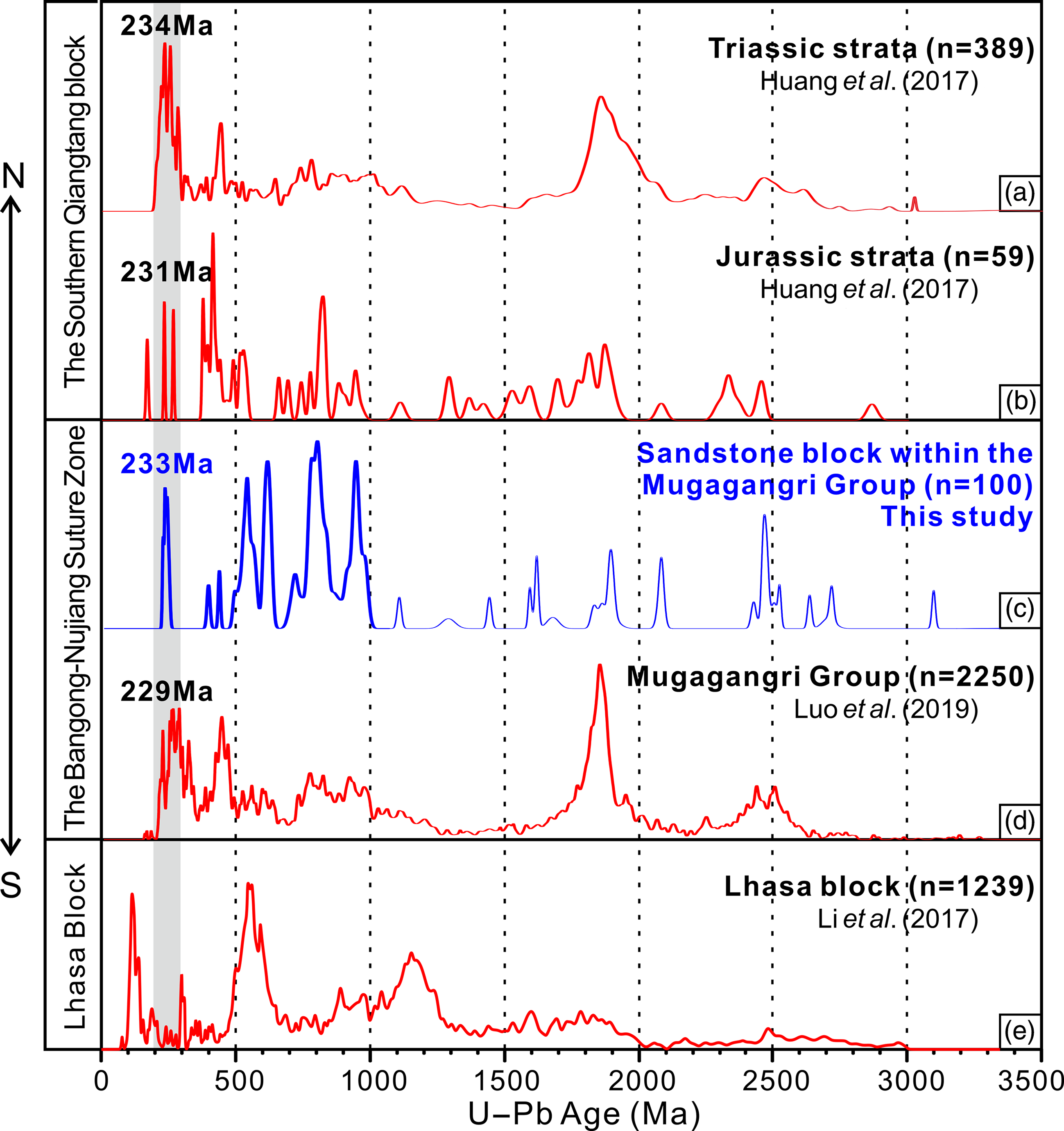
The detrital zircon population of the Mugagangri Group sandstone is marked by several modes spanning Meso-Archean to Late Triassic time (Fig. 10d). These modes are comparable to those of the upper subunit (the Lower Mugagangri Group) described by Li et al. (Reference Li, Ding, Guilmette, Fu, Xu, Yue, Hui and Henrique-Pinto2017), who argued that these strata were deposited in abyssal plain environments close to the Qiangtang passive margin during Late Triassic time and sourced solely from the Southern Qiangtang block. It is noteworthy that the c. 235 Ma mode is present in Riasairi sandstone blocks (Figs 6c, 10c), although no plutons or volcanic rocks of that age have yet been reported in the Southern Qiangtang block (Li et al. Reference Li, Chung, Hou, Chew, Wang, Wang and Wang2019 a). Our data suggest that this Middle–Late Triassic mode might be derived from the erosion of the Riasairi lavas and related intrusives. Rocks formed by this magmatic event are not widely exposed, which can be attributed to the strong weathering and erosion that occurred after their formation, or their burial in the accretionary complex during later subduction and collision events.
Detrital zircon age spectra for representative strata in (a, b) the Southern Qiangtang block, (c, d) BNSZ and (e) Lhasa block. Literature age data include Huang et al. (Reference Huang, Xu, Chen, Wu and Zeng2017), Li et al. (Reference Li, Ding, Guilmette, Fu, Xu, Yue, Hui and Henrique-Pinto2017) and Luo et al. (Reference Luo, Fan, Wang and Zeng2019).
5.e. When was the Bangong–Nujiang Ocean born?
Despite decades of research, interpretation of the earliest geological record of the BNSZ in terms of continental rifting and incipient oceanic crust accretion remains controversial, with timing estimates ranging from the Carboniferous to Early Jurassic (e.g. Li et al. Reference Li, Guilmette, Yin, Ding, Zhang, Wang and Baral2019 b; Peng et al. Reference Peng, Yu, Li, Liu, Santosh, Lv, Li, Xie and Liu2020).
5.e.1. Palaeozoic rifting?
Arguments for Permian rifting are due to the discovery of the Permian mafic dyke swarms within the Qiangtang terrane (Zhai et al. Reference Zhai, Jahn, Su, Ernst, Wang, Zhang, Wang and Tang2013; Xu et al. Reference Xu, Dong, Zhang, Deng and Zhang2016). These magmas are interpreted to have formed during large igneous province (LIP) emplacement (Zhai et al. Reference Zhai, Jahn, Su, Ernst, Wang, Zhang, Wang and Tang2013) and early rifting phases (Xu et al. Reference Xu, Dong, Zhang, Deng and Zhang2016). However, although LIP emplacement is often followed by continental break-up and oceanization (e.g. Dewey & Burke, Reference Dewey and Burke1973; van Hinsbergen et al. Reference van Hinsbergen, Kapp, Dupont-Nivet, Lippert, DeCelles and Torsvik2011), this is certainly not always the case (e.g. Siberian traps LIP), and dyke swarms may be located either near to or far from (up to 2500 km) the centre of a LIP (Ernst & Buchan, Reference Ernst and Buchan1997), making a link to the BNO opening equivocal.
Most constraints on the opening of the BNO are based on U–Pb zircon ages from BNSZ ophiolites. These ages are mostly interpreted as the age of the oceanic crust of the ophiolite, demonstrating the presence of oceanic lithosphere in the Southern Qiangtang block at that time (Qiangba et al. Reference Qiangba, Xie, Wu, Xie, Li and Qiu2009; Wei et al. Reference Wei, Song and Tang2016; Zhang et al. Reference Zhang, Li, Zhu, Zhang, Yang and Jin2016, Reference Zhang, Wang, Dong, Zhang, Li, Xia and Xu2017; Wu et al. Reference Wu, Chen, Qin, Guo, Guo, Zhang and Yang2018). Such ages are therefore considered as a minimum age for rifting. The oldest ophiolitic fragments in the BNSZ are latest Permian to Late Triassic in age, with massifs dated (zircon U–Pb) at c. 252 Ma (Wei et al. Reference Wei, Song and Tang2016), c. 222 Ma (Wu et al. Reference Wu, Chen, Qin, Guo, Guo, Zhang and Yang2018) and 217.8 ± 1.6 Ma (Qiangba et al. Reference Qiangba, Xie, Wu, Xie, Li and Qiu2009). A 254 ± 28 Ma Re–Os pseudo-isochron age (Huang et al. Reference Huang, Shi and Ding2012) from the Bangong Co ophiolite would be consistent with, but not conclusive for, a latest Permian age for the opening of BNO. Protolith ages of metamorphosed subducted oceanic crust also provide a latest Permian minimum age for opening of the BNO with zircon U–Pb dates at 260–242 Ma (Zhang et al. Reference Zhang, Li, Zhu, Zhang, Yang and Jin2016, Reference Zhang, Wang, Dong, Zhang, Li, Xia and Xu2017). However, this 260–240 Ma oceanic crust generation is not reflected in the ophiolitic sedimentary covers. The oldest radiolarian fauna reported from abyssal sedimentary rocks of the BNSZ are of Middle Triassic age in the Naqu area (Pan et al. Reference Pan, Mo, Hou, Zhu, Wang, Li, Zhao, Geng and Liao2006) and of Upper Triassic age in the Dengqen area (Wang et al. Reference Wang, Wang and Pei2002 b). Otherwise, the majority of radiolarian cherts from the BNSZ are of Jurassic age (Zhou et al. Reference Zhou, Malpas, Robinson and Reynolds1997; Wang et al. Reference Wang, Liu, Li, Yue and Pei2002 a, b; Bai et al. Reference Bai, Xu, Zhang, Zhu and Sun2005; Baxter et al. Reference Baxter, Aitchison and Zyabrev2009), as are most ophiolites (see Li et al. Reference Li, Guilmette, Yin, Ding, Zhang, Wang and Baral2019 b for a review). This discrepancy might reflect the presence of inherited zircon in some of the ophiolites. For instance, zircon U–Pb ages for the Dong Co ophiolite alone include populations at 157.6 ± 4.3 Ma (Peng, Reference Peng2016), 167 ± 2 Ma (Wang et al. Reference Wang, Wang, Chung, Chen, Yin, Liu, Li and Chen2016), 222 ± 4.8 Ma (Wu et al. Reference Wu, Chen, Qin, Guo, Guo, Zhang and Yang2018) and 252.1 ± 1.5 Ma (Wei et al. Reference Wei, Song and Tang2016). Although it is not impossible that the ophiolite was the locus of mafic magmatism for 100 Ma, the possibility of inherited zircon populations cannot be ruled out. Late Permian inherited zircon has actually been documented in the Jurassic Kangqiong ophiolite of the BNSZ (Fan et al. Reference Fan, Li, Xie, Wang and Chen2015). In this context, it seems hazardous to consider the zircon ophiolitic record alone to constrain the timing for the birth of the BNO. Additional constraints include the age of the Riganpeico Formation, a pre-Upper Triassic bathyal basin of the Southern Qiangtang block margin (Hou et al. Reference Hou, Chen, Gao and Wang2018; Wang & Fu, Reference Wang and Fu2018) or the Upper Permian angular unconformity between the Upper Permian Longge Formation and the Upper Triassic Riganpeico formation (see Li et al. Reference Li, Yin, Guilmette, Ding and Zhang2019 c for a review). Indirect evidence for rifting (e.g. dyke swarms or unconformities) therefore point to a Permian rifting event, consistent with Late Permian and younger minimum age estimates from oceanic rocks. However, none of the above evidence appears unequivocal, and BNO birth estimates span over 100 Ma, leaving room for alternate hypotheses.
5.e.2. Middle Triassic rifting?
In this paper, the Riasairi trachytic lavas, formed during 238–236 Ma, provide direct geochemical evidence that they derive from intra-continental rifting. These lavas have been incorporated to the Mugagangri Group accretionary prism within the BNSZ as blocks, and must therefore have been eroded from the Southern Qiangtang continental margin. They could also have been offscraped from the BNO subducting oceanic lithosphere, but their isotopic composition is not consistent with an ocean-island origin (Figs 5b, d, 7a). However, the presence of c. 235 Ma detrital zircons in the contemporaneous Riasairi sandstone blocks supports the theory that they were eroded from a terrestrial source. In such a case, it is difficult to see a scenario in which these continental rift-related volcanic rocks would have formed in a setting in which the BNO already existed. These trachytes therefore show that, in the Riasairi area, the oceanization of the BNO post-dated 238–236 Ma.
This inference is consistent with Upper Triassic shallow-marine to bathyal-facies sedimentary formations that are well developed on both sides of the study area (Chen et al. Reference Chen, Chen, Zhang, Zhao, Liu and Suolang2002; Lu et al. Reference Lu, Du, Ren, Zhang, Liu, Pei, Jia, Xie and Li2002; Qu et al. Reference Qu, Wang, Duan, Zhang, Wang, Lv, Liu, Li, Feng, Xie, Yu, Jiang, Sun, Li, Liang, Wang and Guo2003; Zheng et al. Reference Zheng, He, Li, Zou, Zhao, Ci, Zeren and Xu2003; Yao et al. Reference Yao, Duan, Niu, Bai, Wang, Gan, Wei, Duan, Pu, Zhu, Zeng, Sheng, Xu, Zhang, Yuan and Jv2004; Zhu et al. Reference Zhu, Dong, Shi, Li and Ou2005 a, b; Wang et al. Reference Wang, Zhang, Xie, Li, Yu, Zheng, Feng, Wang, Duan, Sun, Li, Lu, Jiang, Lv, Li, Liu and Wang2006 a, b), including the Quehala Group in the Northern Lhasa block and the Riganpeicuo Group in the South Qiangtang block, which are widely distributed (Zhu et al. Reference Zhu, Zhao, Niu, Mo, Chung, Hou, Wang and Wu2011). Both groups are in angular unconformable contact with the lower Permian–Lower Triassic formations (Wang & Fu, Reference Wang and Fu2018), hinting at the existence of a regional tectonic event during Middle–Late Triassic time.
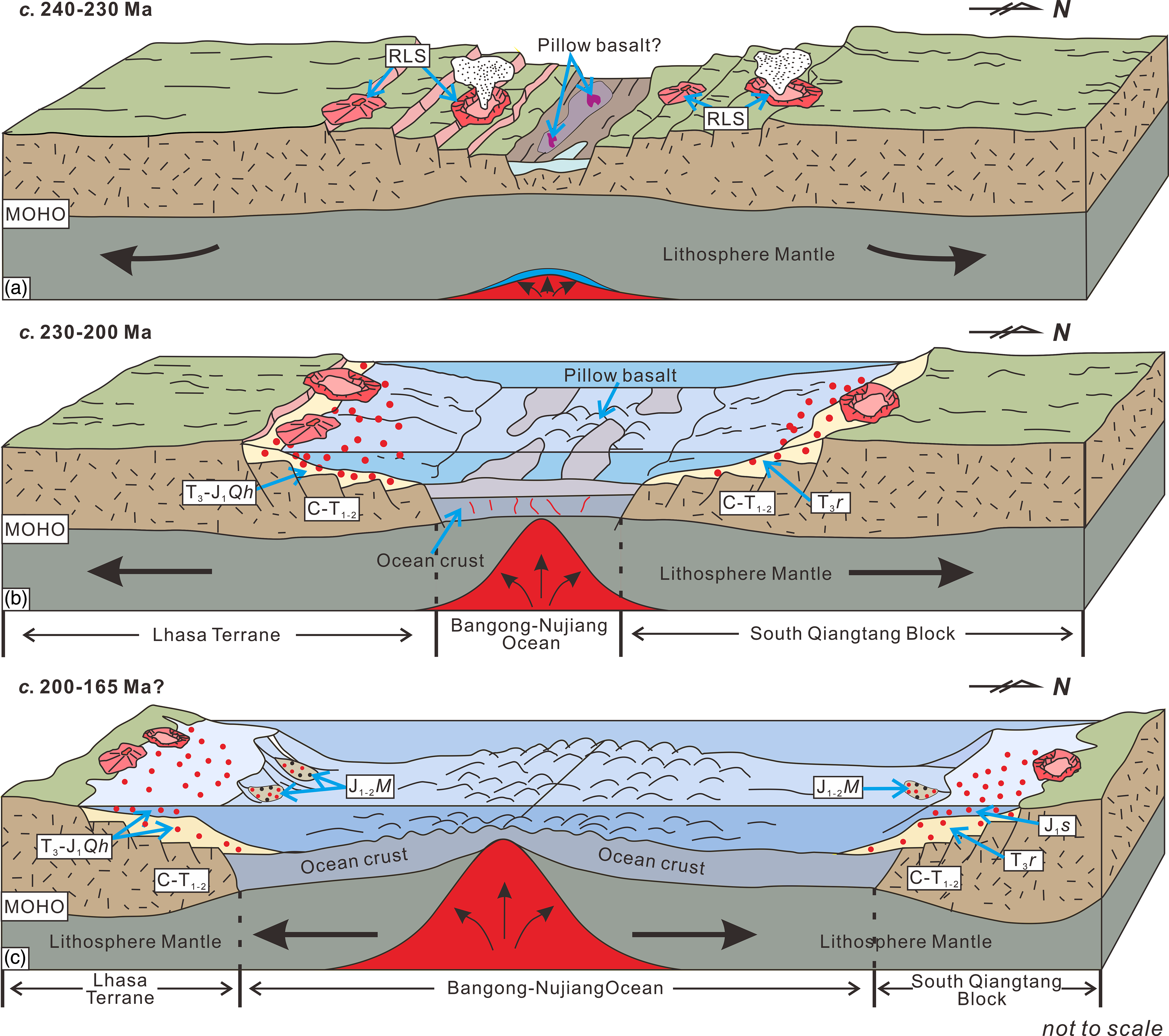
We propose that the BNO formed, in the Riasairi area, during the continental break-up of the southern Qiantang and northern Lhasa terranes during 240–230 Ma (Fig. 11a). From 230–200 Ma, ocean spreading of the BNO occurred allowing the N-wards flight of the Qiangtang continent(s). Shallow-marine sediments represented by the Riganpeicuo Group and the Quehala Group formed in the Southern Qiantang and Northern Lhasa blocks, respectively (Fig. 11b) (Zhu et al. Reference Zhu, Zhao, Niu, Mo, Chung, Hou, Wang and Wu2011; Bo et al. Reference Bo, Wang, Gao, Yao, Wang and Hou2017). In the BNO, the presence of Jurassic abyssal sediments of the (Lower) Mugagangri Group (Li et al. Reference Li, Ding, Guilmette, Fu, Xu, Yue, Hui and Henrique-Pinto2017) and evidence of volcanic activity recorded by the T3–J3 sedimentary rocks verify the tectonism and magmatism represented by the Riasairi rift-related lavas, which further support the opening time of the middle segment of BNO represented by the study area (Fig. 11c).
Evolution of the Bangong–Nujiang Ocean.
6. Conclusions
-
(1) The first reported Middle–Late Triassic Riasairi trachytes presented here are the earliest record of rift-related volcanic in the BNSZ so far. Their geochemical signatures are consistent with having formed in a continental rift setting and are akin to modern rift volcanic sequences (e.g. Eastern African Rift Zone and Antarctic Rift Zone).
-
(2) Isotopic analyses, including whole-rock Sr–Nd–Pb, demonstrate that the magma was sourced from the mixing of depleted asthenospheric mantle and partial melting of the lithospheric mantle before undergoing fractional crystallization.
-
(3) Based on these data, conjunction with the zircon U–Pb age obtained here (c. 236 Ma), we propose that the middle segment of the BNO in the Riasairi area opened during Middle–Late Triassic time.
Supplementary material
To view supplementary material for this article, please visit https://doi.org/10.1017/S0016756821001114
Acknowledgements
Ming Zheng and Yang Song thank the Langfang Regional Geological Survey, Hebei Province, China and ALS Minerals & ALS Chemex (Guangzhou) Co. Ltd, China for sample processing and analysing, and thank D.J.J. van Hinsbergen for help with language. This study was supported by the China Geological Survey (grant no. DD20190167), the National Science and Engineering Research Council of Canada Discovery Grant (to C. Guilmett, grant no. RGPIN-2014-05681) and the Innovative Youth Talents Program, Ministry of Natural Resources (S. Yang, grant no. KY-BR-XZ-202006).
Declaration of interest
The author(s) declare none.


 Open access

