

The British East India Company is credited with great and terrible things. It is said to have had a direct hand in creating global capitalism, while at the same time contributing to modern forms of state.Footnote 1 “The corporation that changed the world” built an infrastructure of armies, ships, fortified port cities and a global financial network that moved vast resources between Britain and Asia.Footnote 2 The “original evil corporation” also forged a modern world economy in which imperialism and free markets went hand in hand.Footnote 3 The Company transformed the political and economic landscape of huge portions of South and Southeast Asia, brought the Chinese Empire into war and left some formerly affluent regions of the Indian subcontinent utterly impoverished. It gave shape to the modern sense of “Britishness” and was instrumental in the creation of the largest, most densely inhabited and possibly dirtiest city the world had yet seen: London c. 1830.
The Company also left its fingerprints all over the making of modern science. This book is about how, as an inextricable part of all the above, the Company shaped the global scientific order, and with lasting consequences. It focuses on the period between the Company’s emergence as a territorial power in 1757 and the dissolution of the Company in 1858. This was a period in which the Company’s empire expanded dramatically, and one in which its 150-year-old monopoly on trade with Asia would also slowly fall apart. This period is sometimes referred to as Britain’s “second scientific revolution,” in which scientific practices, professions, disciplines and theories also underwent radical change. The historical relationship between these two developments has been the subject of many studies. But the role of the East India Company in this history remains poorly understood. One aim of this book is to bring new clarity to that subject.
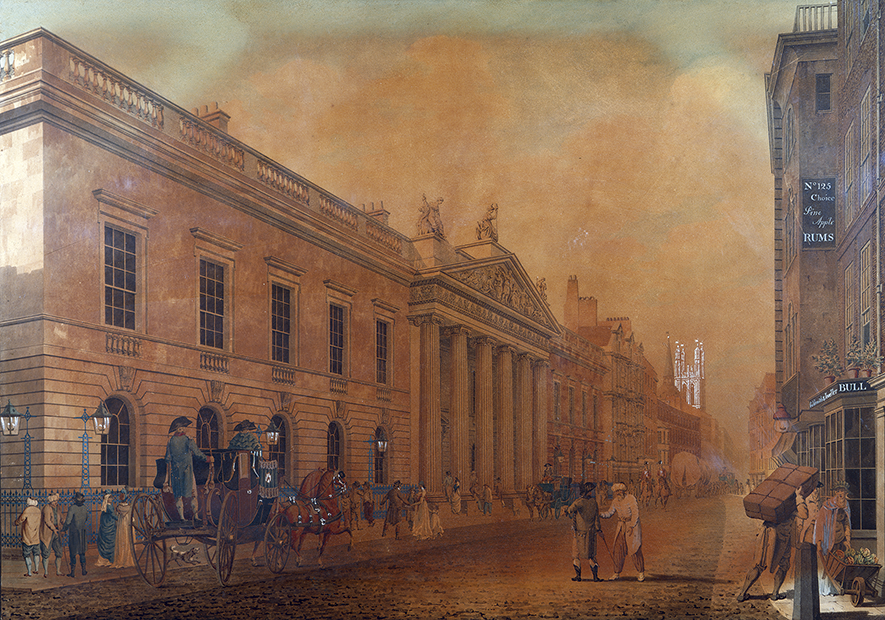
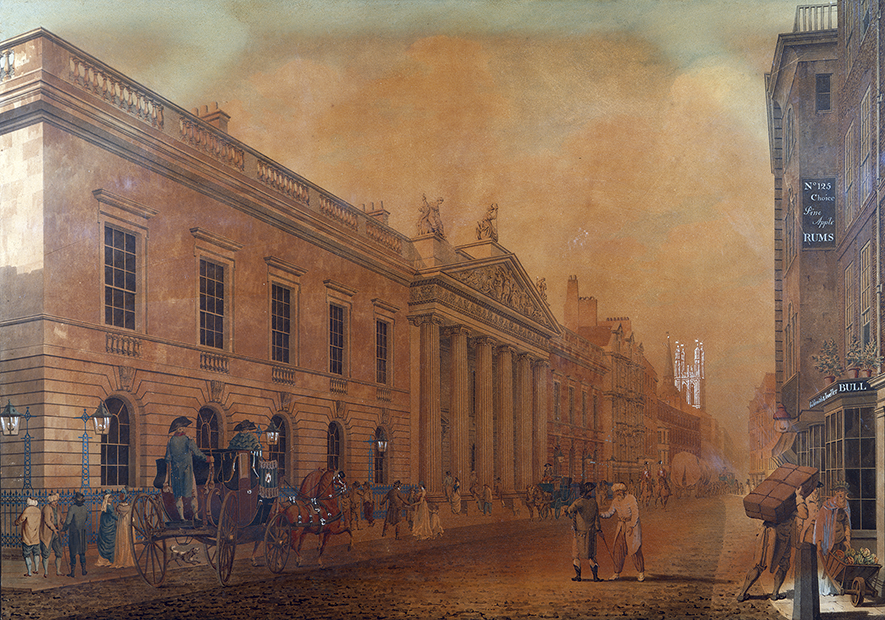
The Company’s headquarters: East India House, Leadenhall Street, from a drawing by T. Malton, c. 1800.
The Company’s monopoly privileges – and its peculiar form of monopoly-based colonial capitalism – are key to understanding the particular dynamic connecting the growth of British science and the growth of the British Empire. From 1600 until 1813 (with some key gaps), the Company held a Crown-granted legal monopoly – one laid out in charter agreements between the Crown and the Company – on all British trade east of the Cape of Good Hope. The Company’s monopoly deeply shaped British access to, and knowledge of, Asia’s nature. In practice, the Company’s control over access and movement and information was far from complete. But it was formidable and would, as we will see, play a significant role in shaping the cultures and practices of science in both Britain and the colonies. Especially in the period covered here, colonial and capitalist expansion coincided with an unprecedented information boom back in Europe.Footnote 4 Many new libraries, museums, botanical gardens and similar institutions for the management of knowledge resources were established in this period, and the expansion of data-intensive empirical practices is often taken as a hallmark of the so-called second scientific revolution.Footnote 5
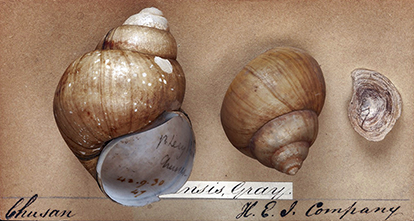
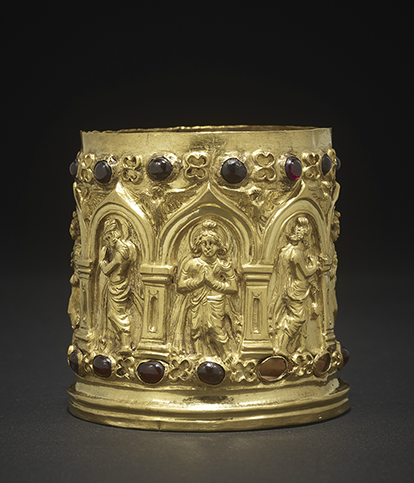
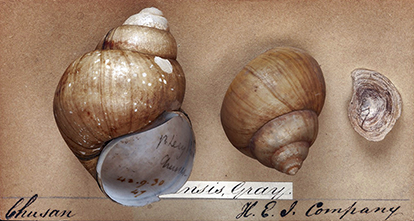
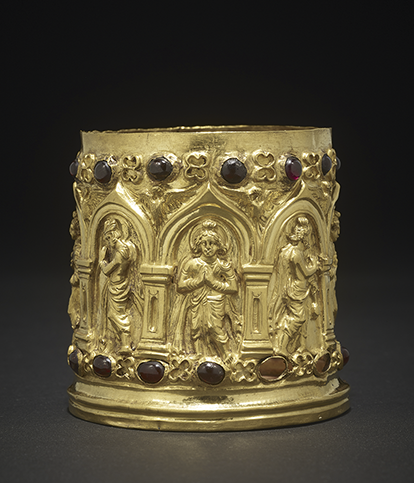
Another aim of this book is therefore to situate the history of Britain’s second scientific revolution within a longer history of the global regulation of trade in knowledge resources. In order to do so, I have focused in particular on the history of the Company’s practices of accumulation, management and production of what might today be called scientific information: manuscripts, books, specimens of natural history, technologies, antiquities, works of art and craft and so on.Footnote 6 As we will see, the Company’s decision to establish a library and museum at its headquarters in London, as well as the founding of two Company colleges in Britain, would mark a major change to the way the Company managed information, and it was both tied to wider changes in British science and a consequence of very particular political and economic changes affecting the accessibility and cost of accumulation. The Company’s collections were accumulated with the monopoly advantage, and its library, museum and colleges were supported by the Company’s tax revenues from the people of India. Those collections are now the property of the people of Britain, divided primarily among the British Museum, Kew Gardens, the British Library, the UK Natural History Museum and the Victoria and Albert Museum (see Figures I.2 and I.3).
Syntypes of Paludina lecythoides, once in the East India Company’s museum, now owned by the Natural History Museum, London.
A circa first-century CE reliquary casket excavated from a Buddhist stupa in Bimaran, Afghanistan by the East India Company agent Charles Masson in c. 1833–1838. Now in the British Museum (1900,0209.1).
A third overall aim of this project has been to provide a view of how scientific practices and cultures are defined and limited by political economic change. This book aims, in other words, to situate a key period in the history of science in Britain within economic history in such a way that we gain a better understanding of how the growth of science has occurred internal to, as part of, wider political economic change.Footnote 7 The essence of that perspective was captured by contemporary observers Karl Marx and Friedrich Engels in an 1845 digression on the relationship between science and commerce: “But where would natural science be without industry and commerce? Even ‘pure’ natural science is provided with an aim, as with its material, only through trade and industry, through the sensuous [i.e. physical] activity of men.”Footnote 8
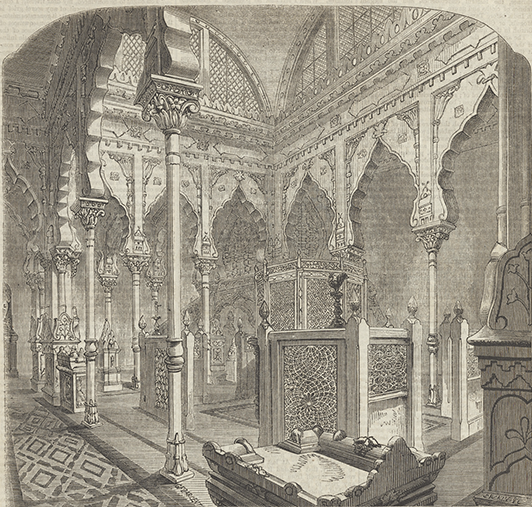
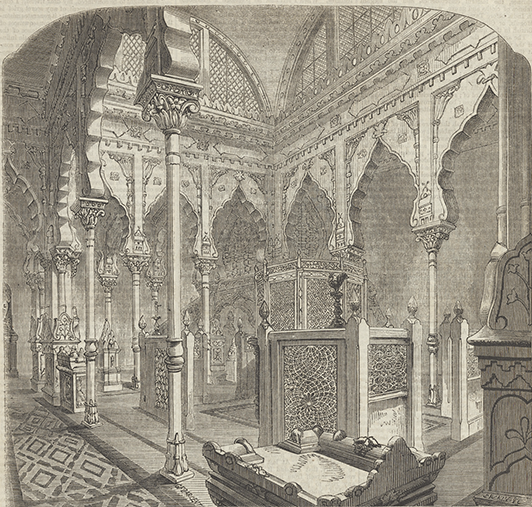
At just around the time that Marx and Engels wrote their now-famous early draft of their materialist philosophy of history, the Company was busy installing new museum galleries within its headquarters at India House (see Figures I.1 and I.4). Where a vast pay office had once been, curators were now busy at work on crateloads of fossils extracted from northern India, carefully cleaning and making plaster casts of the finds before mounting them for public display. A few floors up, another set of offices had been emptied of desks and papers and replaced with glazed cases that would be filled with stuffed birds from Java. An adjacent room was where the Company’s naturalist worked to mount insect collections, pinning beetles to felt boards.
A view of a new gallery of the East India Company’s museum at India House, 1858. From the London
But a corporate-imperial museum is not what Marx and Engels had in their sights. Their comment had a very specific target: a rival materialist talking about “secrets of nature” being revealed only to the eye of the chemist and the physicist, through their specialist instrumentation and experience. Marx and Engels found this type of materialism entirely misguided. They asserted that the real “material basis” of those chemists’ knowledge did not begin and end with the ability to perceive, or even with the specially trained eye and a carefully constructed experiment. One must also, they claimed, take equal account of the laboratory, the building it is housed in, the source of oil and candles for lighting, the sewers, the streets, in fact the entire town in which the laboratory sat, not to mention the food that sustained the scientist, the clothing that kept them warm and so on. The material basis of science, Marx and Engels argued, must be recognized as the entire human/natural world within which those scientists were working, the whole mode of production. To bring the point home, their thought experiment continued, imagine if all the “unceasing … labor and creation … were interrupted only for a year.” What, then, would the chemist be able to perceive? They would find “not only an enormous change in the natural world … the whole world of men and his own perceptive faculty, nay his own existence, [would be] missing.”Footnote 9
For the purposes of this Introduction, what is important about this extremely broad view of the material basis of science is how it describes science as coextensive with and fundamentally shaped by economic activity, but not in a way that suggests that therefore science is shaped or determined by the strategies of economically powerful actors or of economic self- (or corporate) interest. Instead, economic change and scientific change are coextensive because they are the material culture of science writ large, or the “matter at hand,” as Gideon Freudenthal and Peter McLaughlin have described it (paraphrasing Boris Hessen and Henryk Grossman), that determines the conditions of possibility or the horizons of enquiry within which scientific change unfolds.Footnote 10 We thus may similarly ask, what would have happened to British science if its imperial connections had been cut off? Would London, Oxford and Cambridge still have emerged as world centers of scientific production by the start of the twentieth century?
Despite (or maybe because of) the fact that the Company was one of the largest and most important employers in nineteenth-century London, its social and cultural impact in Britain has, until recently, remained “strangely invisible,” as John McAleer puts it.Footnote 11 This could be said for our understanding of the Company’s place in the history of science in Britain as well. Several decades ago, David Arnold highlighted the fact that, because of the peculiarities of the Company-state model, “on the subcontinent the Company and its servants enjoyed a near monopoly over Western scientific activity.”Footnote 12 But this critical topic of the interaction between scientific practice and the Company’s monopoly has not yet been examined in any detail.Footnote 13 McAleer suggests the invisibility of the Company as a cultural force is due to the oversized role it plays as a political economic force. Likewise, for the case of the absence of the Company within the history of science, there seems to have been an inclination among historians to assume that, at the institutional level within the Company, science could only have ever played a very minor role. For example, for Arnold, the Company’s “scientific monopoly” translated into a “laissez-faire” approach that led to only very minor support for science, education or improvement schemes.Footnote 14 Naturalists and orientalists working under the Company in Asia are thus often depicted as having succeeded despite the lack of support or encouragement offered by the Court of Directors. Even histories dealing with the Company’s library and museum in London have largely followed the same line of argument. For example, in his major new study of collecting and the Company, Arthur MacGregor downplays the significance of the political, economic and institutional context for science under the Company by focusing on the personal drive and passion of the individuals associated with the Company and those who built up the collections.Footnote 15 Theodore Binnema, too, takes a similar perspective in his history of science at the Hudson Bay Company, arguing that, while certain aspects of the Hudson Bay Company’s institutional structure were undoubtedly important, the real driver of scientific culture at the Company was down to individual officers’ motivations and interests.Footnote 16 Although Bernard Cohn famously argues that “the establishment of British hegemony in India was also a conquest of knowledge,” he doesn’t relate much of that process to the institutional or regulatory powers of the Company, whose patronage of science he describes as “haphazard,” “filled with false starts” and generally “halted when the bookkeepers in Leadenhall Street became aware of the potential costs, and their ill effects on the balance sheet.”Footnote 17 From this perspective, the Company’s library and museum have generally been interpreted as, most fundamentally, an exercise in imperial image-making or, as Maya Jasanoff put it, “self-advertisement.”Footnote 18
To be sure, all of these perspectives capture elements of a complex picture of the Company’s situation with respect to science in Britain and British India. The point is, however, that since the Court of Directors sat at the head of a company-state that monopolized all trade (including information) and travel (including scholars and scientists) between Britain and Asia, whatever the Court of Directors’ forms of engagement with science (or not) will have had a significant impact on cultures of science in both Britain and British India. I hope to show that not only was there a much richer and more consequential engagement with science within the Company but also that its imprint upon the shape of scientific culture in Britain was much more significant than we have so far assumed.
Recent work has begun to uncover how, even beyond its impact on Britain’s political economy, the Company was deeply intertwined in British culture and society.Footnote 19 Its employees included specialized knowledge workers – librarians, curators, naturalists, surgeons, hydrographers, professors – who worked for the Company but whose professional worlds also intersected with other societies and institutions of science and education around Britain. The sheer size of the Company ensured that, even within the civic, amateur culture of science in nineteenth-century Britain, it was an important source not only of knowledge resources but also of labor and infrastructural support, and an uncountable number of other matters at hand.Footnote 20 And the Company’s internal practices of information management and knowledge production have a complex, varied history, as Huw Bowen, Christopher Bayly and others have shown. This study is indebted to this scholarship and grapples with the British side, and the science dimension, of what Christopher Bayly called the colonial information order.Footnote 21
In what follows, I use the term “knowledge resources” to describe the huge variety of materials being accumulated in the private, corporate and public collections that were growing at this time. The term reflects the fact that such collections were most often presented as aiming to produce useful knowledge, very broadly defined. In fact, the materials being accumulated were put into all kinds of different uses, such as being sold for cash or being given as gifts or bribes. And significant amounts were apparently never used for anything while in the Company’s possession, remaining unpacked in warehouses or cellars for decades.
This book also uses the term “Company science” to capture several distinctions. First, I use it to indicate the narrower focus of this book on natural, philosophical and historical sciences at India House. This study has not attempted to encompass the accumulation and management of resources related to accounting, finances, governance and corporate management; that is, what T. R. Malthus, in his lectures at the Company’s college, called “the branch of the science of a statesman or legislator.”Footnote 22 Importantly, “Company science” at India House was connected to, and embedded within, the rest of the Company administration, and in this book I have tried to follow many of the connections between the library-museum and the “science of a statesman” that occupied the Court of Directors and many other committees. But this work does not come close to dealing with the many places beyond the library-museum and colleges in which “science,” understood in its broad premodern forms, can be found at work within India House.Footnote 23
I also use “Company science” to refer to this study’s focus on a subset of the much broader domain of colonial science. Many important recent studies have examined the rich, multicultural context within which colonial science was practiced in the Asian territories under Company influence or control.Footnote 24 The term “colonial science” has been defined in different ways: in terms of methods (i.e. “field science,” “data collection”); in terms of use or aims (i.e. information produced and deployed as part of the ideological fabric of imperialism); or simply as shorthand for the complex world of scientific production and consumption within colonized territories.Footnote 25 Here, “Company science” refers to a particular colonial relationship of knowledge ownership and management: projects directly funded by the Company and material considered to be directly owned by the Company, and therefore institutionally part of the colonial state. Company science at India House is connected to, and dependent upon, Company science in the colonial governments in British India, the district offices and the moving military frontier at the edge of the Company’s territory. It was constructed between Asia and the home country, but, as part of the colonial political economy, accumulation and management became concentrated back in Britain.
In Part I, I show that the Company’s forms of engagement with scientific knowledge production changed significantly in response to wider political economic changes. The Company moved, over the course of 150 years, from largely outsourcing scientific and orientalist expertise needs to, by around 1800, attempting to centralize control over the accumulation and management, within its London headquarters, of a wide range of this kind of knowledge and expertise. Part II follows the expansion and impact of the Company’s institutions of science in Britain up to the Rebellion of 1857 and the abrupt abolition of the Company. I argue that the Company’s monopoly privileges, and their decay over this period, would leave a distinct impression on the shape of the Company’s science. Company resources would feed directly into the growth of Britain’s second scientific revolution in several key ways. Perhaps most importantly, as the Company itself became nationalized, and as its library and museum collections became Crown property, Company science fed directly and materially into Britain’s growing public museum movement. As we will see, in this period in which the basic categories of “science” and “empire” began to take on distinctly modern terms, part of those developments involved the absorption of “Company science” into “public science.”Footnote 26
By clarifying the place of the East India Company in the history of science in Britain in this period, I hope to have opened up a new perspective on the long, varied and critically important historical connections between markets, states and modes of knowledge production. The Company played a specific and peculiar role in how and why, by the end of the nineteenth century, Britain and a few other regions of Europe had obtained a firm grip on much of the global business of knowledge production and management.

 Open access