





1 Introduction
Recall the mechanism of Shimura varieties: to a Shimura datum $(G, X)$
(here the first entry is a reductive group over
$(G, X)$
(here the first entry is a reductive group over $\mathbb {Q}$
), there is associated a tower of algebraic varieties
$\mathbb {Q}$
), there is associated a tower of algebraic varieties $( \mathrm {Sh}_K(G, X)\mid K\subset G(\mathbb {A} _f))$
over the reflex field
$( \mathrm {Sh}_K(G, X)\mid K\subset G(\mathbb {A} _f))$
over the reflex field $E=E(G, X)$
. Here, K runs through the open compact subgroups of
$E=E(G, X)$
. Here, K runs through the open compact subgroups of $G(\mathbb {A}_f)$
. Furthermore, at least if
$G(\mathbb {A}_f)$
. Furthermore, at least if $(G, X)$
is of PEL-type, there exist integral p-adic models if K is of the form
$(G, X)$
is of PEL-type, there exist integral p-adic models if K is of the form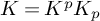 $K=K^p K_p$
, where
$K=K^p K_p$
, where $K_p$
satisfies some additional conditions. More precisely, fix a prime number p and a p-adic place v of E. Then if
$K_p$
satisfies some additional conditions. More precisely, fix a prime number p and a p-adic place v of E. Then if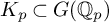 $K_p\subset G(\mathbb {Q}_p)$
is the stabiliser of a point in the extended Bruhat-Tits building of
$K_p\subset G(\mathbb {Q}_p)$
is the stabiliser of a point in the extended Bruhat-Tits building of $G_{\mathbb {Q}_p}$
, there exists in the PEL-type case an integral model
$G_{\mathbb {Q}_p}$
, there exists in the PEL-type case an integral model $\mathscr {S}_K(G, X)$
over
$\mathscr {S}_K(G, X)$
over $O_{E, v}$
. The study of these integral models has been the focus of interest for many years, with spectacular applications in arithmetic. Furthermore, in recent years such models have been constructed even for Shimura varieties of abelian type, comp. [Reference Kisin and PappasKP18], [Reference Kisin and ZhouKZ21], see [Reference PappasPa18]. In the present paper, we are concerned with a local p-adic analogue of this mechanism.
$O_{E, v}$
. The study of these integral models has been the focus of interest for many years, with spectacular applications in arithmetic. Furthermore, in recent years such models have been constructed even for Shimura varieties of abelian type, comp. [Reference Kisin and PappasKP18], [Reference Kisin and ZhouKZ21], see [Reference PappasPa18]. In the present paper, we are concerned with a local p-adic analogue of this mechanism.
We fix a prime number p. There is the notion of a local Shimura datum $(G, b, \mu)$
[Reference Rapoport and ViehmannRV14], a p-adic analogue of the notion of a (global) Shimura datum. Here G is a reductive group over
$(G, b, \mu)$
[Reference Rapoport and ViehmannRV14], a p-adic analogue of the notion of a (global) Shimura datum. Here G is a reductive group over $\mathbb {Q}_p$
, and
$\mathbb {Q}_p$
, and $b\in G(\breve {\mathbb {Q}} _p)$
and
$b\in G(\breve {\mathbb {Q}} _p)$
and $\mu $
is a conjugacy class of minuscule cocharacters of G. Let
$\mu $
is a conjugacy class of minuscule cocharacters of G. Let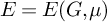 $E=E(G, \mu)$
be the local reflex field. In [Reference Rapoport and ViehmannRV14], it is postulated that there should be an associated tower of rigid-analytic varieties
$E=E(G, \mu)$
be the local reflex field. In [Reference Rapoport and ViehmannRV14], it is postulated that there should be an associated tower of rigid-analytic varieties $( \mathrm { Sht}_K(G, b, \mu)\mid K\subset G(\mathbb {Q}_p))$
over the completion
$( \mathrm { Sht}_K(G, b, \mu)\mid K\subset G(\mathbb {Q}_p))$
over the completion $\breve E$
of the maximal unramified extension of E. This idea was put into reality by P. Scholze, see [Reference ScholzeSch18]. He defined functors on the category
$\breve E$
of the maximal unramified extension of E. This idea was put into reality by P. Scholze, see [Reference ScholzeSch18]. He defined functors on the category $\mathrm { Perfd}_k$
of perfectoid spaces over the residue field k of
$\mathrm { Perfd}_k$
of perfectoid spaces over the residue field k of $\breve E$
and showed that they are representable by rigid-analytic spaces. Furthermore, if
$\breve E$
and showed that they are representable by rigid-analytic spaces. Furthermore, if ${\mathcal {G}}$
is a smooth model of G over
${\mathcal {G}}$
is a smooth model of G over $\mathbb {Z}_p$
, Scholze defines a functor
$\mathbb {Z}_p$
, Scholze defines a functor $\mathcal {M}^{\mathrm {int}}_{{\mathcal {G}}, b, \mu }$
on
$\mathcal {M}^{\mathrm {int}}_{{\mathcal {G}}, b, \mu }$
on $\mathrm {Perfd}_k$
which he shows to be a v-sheaf. Let
$\mathrm {Perfd}_k$
which he shows to be a v-sheaf. Let ${\mathcal {G}}$
be a quasi-parahoric group scheme, in the sense of [Reference Scholze and WeinsteinSW20, §21.5]; see §2.2. This is a natural class of smooth group scheme models over
${\mathcal {G}}$
be a quasi-parahoric group scheme, in the sense of [Reference Scholze and WeinsteinSW20, §21.5]; see §2.2. This is a natural class of smooth group scheme models over $\mathbb {Z}_p$
of G. In the analogous function field case, T. Richarz [Reference RicharzRi16] has proved that quasi-parahoric group schemes can be characterised as those smooth group scheme models of G for which the corresponding affine Grassmannian is ind-proper. Scholze has conjectured that
$\mathbb {Z}_p$
of G. In the analogous function field case, T. Richarz [Reference RicharzRi16] has proved that quasi-parahoric group schemes can be characterised as those smooth group scheme models of G for which the corresponding affine Grassmannian is ind-proper. Scholze has conjectured that $\mathcal {M}^{\mathrm {int}}_{{\mathcal {G}}, b, \mu }$
is representable by a formal scheme
$\mathcal {M}^{\mathrm {int}}_{{\mathcal {G}}, b, \mu }$
is representable by a formal scheme $\mathscr {M}_{{\mathcal {G}}, b, \mu }$
which is normal and flat and locally formally of finite type over
$\mathscr {M}_{{\mathcal {G}}, b, \mu }$
which is normal and flat and locally formally of finite type over $O_{\breve E}$
. Assuming this conjecture, Scholze-Weinstein [Reference Scholze and WeinsteinSW20] show that when
$O_{\breve E}$
. Assuming this conjecture, Scholze-Weinstein [Reference Scholze and WeinsteinSW20] show that when ${\mathcal {G}}$
is a parahoric group scheme for G and
${\mathcal {G}}$
is a parahoric group scheme for G and $K={\mathcal {G}}(\mathbb {Z}_p)$
, then
$K={\mathcal {G}}(\mathbb {Z}_p)$
, then $\mathscr {M}_{{\mathcal {G}}, b, \mu }$
is an integral model of
$\mathscr {M}_{{\mathcal {G}}, b, \mu }$
is an integral model of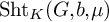 $\mathrm {Sht}_K(G, b, \mu)$
where
$\mathrm {Sht}_K(G, b, \mu)$
where $K={\mathcal {G}} (\mathbb {Z}_p)$
, i.e., the rigid-analytic generic fibre
$K={\mathcal {G}} (\mathbb {Z}_p)$
, i.e., the rigid-analytic generic fibre $\mathscr {M}_{{\mathcal {G}}, b, \mu }^{\mathrm {rig}}$
of
$\mathscr {M}_{{\mathcal {G}}, b, \mu }^{\mathrm {rig}}$
of $\mathcal {M}^{\mathrm {int}}_{{\mathcal {G}}, b, \mu }$
can be identified with
$\mathcal {M}^{\mathrm {int}}_{{\mathcal {G}}, b, \mu }$
can be identified with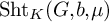 $\mathrm {Sht}_K(G, b, \mu)$
. In [Reference Scholze and WeinsteinSW20] the representability conjecture is proved when
$\mathrm {Sht}_K(G, b, \mu)$
. In [Reference Scholze and WeinsteinSW20] the representability conjecture is proved when $(G, b, \mu)$
is of EL-type, and in many cases when
$(G, b, \mu)$
is of EL-type, and in many cases when $(G, b, \mu)$
is of PEL-type, by relating the functor
$(G, b, \mu)$
is of PEL-type, by relating the functor $\mathcal {M}^{\mathrm {int}}_{{\mathcal {G}}, b, \mu }$
to Rapoport-Zink formal schemes. The rigid-analytic variety
$\mathcal {M}^{\mathrm {int}}_{{\mathcal {G}}, b, \mu }$
to Rapoport-Zink formal schemes. The rigid-analytic variety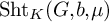 $ \mathrm { Sht}_K(G, b, \mu)$
is called the local Shimura variety (associated to the local Shimura datum
$ \mathrm { Sht}_K(G, b, \mu)$
is called the local Shimura variety (associated to the local Shimura datum $(G, b, \mu)$
and the open compact subgroup K of
$(G, b, \mu)$
and the open compact subgroup K of $G(\mathbb {Q}_p)$
) and the functor
$G(\mathbb {Q}_p)$
) and the functor $\mathcal {M}^{\mathrm {int}}_{{\mathcal {G}}, b, \mu }$
, resp. the formal scheme
$\mathcal {M}^{\mathrm {int}}_{{\mathcal {G}}, b, \mu }$
, resp. the formal scheme $\mathscr {M}_{{\mathcal {G}}, b, \mu }$
the integral local Shimura variety (for the quasi-parahoric group scheme
$\mathscr {M}_{{\mathcal {G}}, b, \mu }$
the integral local Shimura variety (for the quasi-parahoric group scheme ${\mathcal {G}}$
for G).
${\mathcal {G}}$
for G).
It is interesting to observe that the ‘classical’ approach of [Reference Rapoport and ZinkRZ96] proceeds in the reverse way compared to the approach in [Reference Scholze and WeinsteinSW20]. Namely, when $(G, b, \mu)$
arises from (P)EL-data, then for certain quasi-parahorics
$(G, b, \mu)$
arises from (P)EL-data, then for certain quasi-parahorics ${\mathcal {G}}$
for G one constructs a formal scheme
${\mathcal {G}}$
for G one constructs a formal scheme $\mathscr {M}_{{\mathcal {G}}, b, \mu }$
by posing a certain moduli problem of p-divisible groups with additional structure on the category
$\mathscr {M}_{{\mathcal {G}}, b, \mu }$
by posing a certain moduli problem of p-divisible groups with additional structure on the category $\mathrm {Nilp}_{O_{\breve E}}$
. Then
$\mathrm {Nilp}_{O_{\breve E}}$
. Then $\mathrm {Sht}_{{\mathcal {G}} (\mathbb {Z}_p)}(G, b, \mu)$
is defined to be the generic fibre of
$\mathrm {Sht}_{{\mathcal {G}} (\mathbb {Z}_p)}(G, b, \mu)$
is defined to be the generic fibre of $\mathscr {M}_{{\mathcal {G}}, b, \mu }$
and the rest of the tower
$\mathscr {M}_{{\mathcal {G}}, b, \mu }$
and the rest of the tower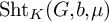 $\mathrm {Sht}_K(G, b, \mu )$
is constructed by imposing level K structures on the p-adic Tate module of the generic fibre of the universal p-divisible group over
$\mathrm {Sht}_K(G, b, \mu )$
is constructed by imposing level K structures on the p-adic Tate module of the generic fibre of the universal p-divisible group over $\mathscr {M}_{{\mathcal {G}}, b, \mu }$
. This definition depends a priori on the choice of (P)EL data and is not obviously functorial in the triple
$\mathscr {M}_{{\mathcal {G}}, b, \mu }$
. This definition depends a priori on the choice of (P)EL data and is not obviously functorial in the triple $({\mathcal {G}}, b, \mu )$
. On the other hand, this approach has the dividend that the structure of the formal schemes
$({\mathcal {G}}, b, \mu )$
. On the other hand, this approach has the dividend that the structure of the formal schemes $\mathscr {M}_{{\mathcal {G}}, b, \mu }$
can be studied by making use of the theory of p-divisible groups. The model for such a structure result is Drinfeld’s description of his integral model of the Drinfeld p-adic halfspace in [Reference DrinfeldDr77]. This approach has been used in a number of problems of arithmetic, e.g., in applications to the Zhang Arithmetic Fundamental Lemma conjecture [Reference ZhangZha12] and the Arithmetic Transfer conjecture [Reference Rapoport, Smithling and ZhangRSZ18] and to the Kudla-Rapoport Divisor Intersection conjecture [Reference Kudla and RapoportKR11]. The Rapoport-Zink approach has been generalised to certain Hodge type cases by W. Kim [Reference KimKim18], Howard-Pappas [Reference Howard and PappasHP17], Hamacher-Kim [Reference Hamacher and KimHK19] and to some abelian type cases by Shen [Reference ShenSh20]. Also, under a mild condition on b, there is a purely group-theoretical definition by Bültel-Pappas [Reference Bültel and PappasBP20] of the moduli problem on
$\mathscr {M}_{{\mathcal {G}}, b, \mu }$
can be studied by making use of the theory of p-divisible groups. The model for such a structure result is Drinfeld’s description of his integral model of the Drinfeld p-adic halfspace in [Reference DrinfeldDr77]. This approach has been used in a number of problems of arithmetic, e.g., in applications to the Zhang Arithmetic Fundamental Lemma conjecture [Reference ZhangZha12] and the Arithmetic Transfer conjecture [Reference Rapoport, Smithling and ZhangRSZ18] and to the Kudla-Rapoport Divisor Intersection conjecture [Reference Kudla and RapoportKR11]. The Rapoport-Zink approach has been generalised to certain Hodge type cases by W. Kim [Reference KimKim18], Howard-Pappas [Reference Howard and PappasHP17], Hamacher-Kim [Reference Hamacher and KimHK19] and to some abelian type cases by Shen [Reference ShenSh20]. Also, under a mild condition on b, there is a purely group-theoretical definition by Bültel-Pappas [Reference Bültel and PappasBP20] of the moduli problem on $\mathrm {Nilp}_{O_{\breve E}}$
for
$\mathrm {Nilp}_{O_{\breve E}}$
for $\mathscr {M}_{{\mathcal {G}}, b, \mu }$
for hyperspecial parahoric group schemes
$\mathscr {M}_{{\mathcal {G}}, b, \mu }$
for hyperspecial parahoric group schemes ${\mathcal {G}} $
. In the Hodge type case, it is shown in [Reference Bültel and PappasBP20] that this moduli problem, restricted to Noetherian test rings, is representable by a formal scheme. It coincides with the formal schemes in [Reference KimKim18], [Reference Howard and PappasHP17] and [Reference Hamacher and KimHK19].
${\mathcal {G}} $
. In the Hodge type case, it is shown in [Reference Bültel and PappasBP20] that this moduli problem, restricted to Noetherian test rings, is representable by a formal scheme. It coincides with the formal schemes in [Reference KimKim18], [Reference Howard and PappasHP17] and [Reference Hamacher and KimHK19].
The Scholze-Weinstein approach has the advantage that the input data are purely group-theoretical and that the result is functorial. In this way, they are able in certain cases to identify two RZ formal schemes for different (P)EL data which define closely related group-theoretical data. For instance, using this approach they prove the conjectures of Rapoport-Zink [Reference Rapoport and ZinkRZ17] and of Kudla-Rapoport-Zink [Reference Kudla, Rapoport and ZinkKRZ20] which postulated such hidden identifications, cf. [Reference Scholze and WeinsteinSW20, §25.4-25.5]. The downside of this approach is that the global structure of the formal schemes $\mathscr {M}_{{\mathcal {G}}, b, \mu }$
is harder to study.
$\mathscr {M}_{{\mathcal {G}}, b, \mu }$
is harder to study.
We note that one expects a precise relation between integral local Shimura varieties and formal completions of global Shimura varieties along isogeny loci of their reduction modulo p. This is provided by the theory of non-archimedean uniformisation in the Rapoport-Zink framework; something analogous is conjectured to hold in the general Scholze-Weinstein context, and is known in the Hodge type case, cf. [Reference Pappas and RapoportPR24, Thm. 1.3.3].
In this paper, we are concerned with passing from the (P)EL case to the more general case when the local Shimura datum $(G, b, \mu )$
is of abelian type. Here the definition of this last term is modeled on the case of (global) Shimura varieties, cf. [Reference He, Pappas and RapoportHPR20], [Reference Haines, Lourenço and RicharzHLR24]. Namely,
$(G, b, \mu )$
is of abelian type. Here the definition of this last term is modeled on the case of (global) Shimura varieties, cf. [Reference He, Pappas and RapoportHPR20], [Reference Haines, Lourenço and RicharzHLR24]. Namely, $(G, b, \mu )$
is of abelian type if the associated adjoint local Shimura datum
$(G, b, \mu )$
is of abelian type if the associated adjoint local Shimura datum $(G_{\mathrm {ad}}, b_{\mathrm {ad}}, \mu _{\mathrm {ad}})$
is isomorphic to the associated adjoint local Shimura datum
$(G_{\mathrm {ad}}, b_{\mathrm {ad}}, \mu _{\mathrm {ad}})$
is isomorphic to the associated adjoint local Shimura datum $(G_{1, {\mathrm {ad}}}, b_{1, {\mathrm {ad}}}, \mu _{1, {\mathrm {ad}}})$
to a local Shimura datum
$(G_{1, {\mathrm {ad}}}, b_{1, {\mathrm {ad}}}, \mu _{1, {\mathrm {ad}}})$
to a local Shimura datum $(G_1, b_1, \mu _1)$
, where
$(G_1, b_1, \mu _1)$
, where $(G_1, b_1, \mu _1)$
is of Hodge type (i.e.,
$(G_1, b_1, \mu _1)$
is of Hodge type (i.e., $(G_1, \mu _1)$
admits an embedding into
$(G_1, \mu _1)$
admits an embedding into $(\mathrm {GL}_n,\mu _d)$
, where
$(\mathrm {GL}_n,\mu _d)$
, where $\mu _d$
is a minuscule coweight of
$\mu _d$
is a minuscule coweight of $\mathrm {GL}_n$
). In particular,
$\mathrm {GL}_n$
). In particular, $G_{\mathrm {ad}}$
is a classical group. We prove that Scholze’s conjecture holds true when
$G_{\mathrm {ad}}$
is a classical group. We prove that Scholze’s conjecture holds true when $(G, b, \mu )$
is of abelian type and either
$(G, b, \mu )$
is of abelian type and either $p\neq 2$
or
$p\neq 2$
or $p=2$
and
$p=2$
and $G_{\mathrm {ad}}$
is of type A or C. We allow here general quasi-parahoric group schemes, even those outside the class singled out in [Reference Scholze and WeinsteinSW20, §25.3] (those for which the group
$G_{\mathrm {ad}}$
is of type A or C. We allow here general quasi-parahoric group schemes, even those outside the class singled out in [Reference Scholze and WeinsteinSW20, §25.3] (those for which the group $\Pi _{{\mathcal {G}}}$
below is trivial). Allowing general quasi-parahorics is important for two related reasons: moduli problems leading to Rapoport-Zink spaces often correspond to quasi-parahorics, and allowing quasi-parahorics is important for devissage in the proofs.
$\Pi _{{\mathcal {G}}}$
below is trivial). Allowing general quasi-parahorics is important for two related reasons: moduli problems leading to Rapoport-Zink spaces often correspond to quasi-parahorics, and allowing quasi-parahorics is important for devissage in the proofs.
We also show that $\mathscr {M}_{{\mathcal {G}}, b, \mu }$
is an integral model of
$\mathscr {M}_{{\mathcal {G}}, b, \mu }$
is an integral model of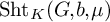 $\mathrm {Sht}_{K}(G, b, \mu ) $
, in the following sense. Let
$\mathrm {Sht}_{K}(G, b, \mu ) $
, in the following sense. Let
 $$ \begin{align} \Pi_{{\mathcal{G}}} =\ker (\mathrm{H}_{\text{\'{e}t}}^1(\mathbb{Z}_p, {\mathcal{G}})\to \mathrm{H}_{\text{\'{e}t}}^1(\mathbb{Q}_p, G) ) , \end{align} $$
a finite abelian group, cf. [Reference Scholze and WeinsteinSW20, 25.3]. To every $\bar {\beta }\in \Pi _{{\mathcal {G}}}$
, we associate a quasi-parahoric group scheme
$\bar {\beta }\in \Pi _{{\mathcal {G}}}$
, we associate a quasi-parahoric group scheme ${\mathcal {G}}_\beta $
for G over
${\mathcal {G}}_\beta $
for G over $\mathbb {Z}_p$
such that
$\mathbb {Z}_p$
such that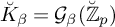 $\breve K_\beta ={\mathcal {G}}_\beta (\breve {\mathbb {Z}}_p)$
is conjugate to
$\breve K_\beta ={\mathcal {G}}_\beta (\breve {\mathbb {Z}}_p)$
is conjugate to $\breve K={\mathcal {G}} (\breve {\mathbb {Z}}_p)$
in
$\breve K={\mathcal {G}} (\breve {\mathbb {Z}}_p)$
in $G(\breve {\mathbb {Q}}_p)$
, and we prove that
$G(\breve {\mathbb {Q}}_p)$
, and we prove that
 $$ \begin{align} {\mathscr{M}_{{\mathcal{G}}, b, \mu}^{\mathrm{rig}}}\simeq \bigsqcup_{\bar{\beta}\in\Pi_{\mathcal{G}}}\mathrm{ Sht}_{K_\beta}(G, b, \mu). \end{align} $$
This formula is reminiscent of the formula of Kottwitz [Reference KottwitzKo92], according to which the generic fibre of a PEL-moduli scheme in [Reference KottwitzKo92] is a disjoint sum of copies of Shimura varieties enumerated by $\ker (\mathrm { H}^1(\mathbb {Q}, G)\to \prod _v\mathrm {H}^1(\mathbb {Q}_v, G) ) $
(these copies are mutually isomorphic in types A and C, but not necessarily in type D).
$\ker (\mathrm { H}^1(\mathbb {Q}, G)\to \prod _v\mathrm {H}^1(\mathbb {Q}_v, G) ) $
(these copies are mutually isomorphic in types A and C, but not necessarily in type D).
In fact, we prove that the decomposition (1.0.2) comes by passing to the generic fibre of a decomposition of functors
 $$ \begin{align} {\mathcal{M}_{{\mathcal{G}}, b, \mu}^{\mathrm{int}}}\simeq \bigsqcup_{\bar{\beta}\in\Pi_{{\mathcal{G}}}}\mathcal{M}^{\mathrm{int}}_{{\mathcal{G}}^o_\beta, b, \mu}/\pi_0({\mathcal{G}_\beta})^\phi. \end{align} $$
Here ${\mathcal {G}^o_{\beta}}$
denotes the parahoric group scheme associated to the quasi-parahoric group scheme
${\mathcal {G}^o_{\beta}}$
denotes the parahoric group scheme associated to the quasi-parahoric group scheme ${\mathcal {G}}_\beta $
(the neutral connected component). This formula also gives a reduction of Scholze’s conjecture from quasi-parahoric group schemes to parahoric group schemes.
${\mathcal {G}}_\beta $
(the neutral connected component). This formula also gives a reduction of Scholze’s conjecture from quasi-parahoric group schemes to parahoric group schemes.
We know quite a bit about the local structure of the formal scheme $\mathscr {M}_{{\mathcal {G}}, b, \mu }$
. Indeed, let
$\mathscr {M}_{{\mathcal {G}}, b, \mu }$
. Indeed, let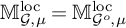 ${\mathbb {M}^{\mathrm {loc}}_{\mathcal {G}, \mu}}={\mathbb {M}^{\mathrm {loc}}_{\mathcal {G}^{o}, \mu }}$
be the local model associated to the parahoric group scheme
${\mathbb {M}^{\mathrm {loc}}_{\mathcal {G}, \mu}}={\mathbb {M}^{\mathrm {loc}}_{\mathcal {G}^{o}, \mu }}$
be the local model associated to the parahoric group scheme ${\mathcal {G}}^o$
associated to
${\mathcal {G}}^o$
associated to ${\mathcal {G}}$
. Here the associated v-sheaf on
${\mathcal {G}}$
. Here the associated v-sheaf on $\mathrm {Perfd}_k$
is defined in [Reference Scholze and WeinsteinSW20, §21] and the representability by a weakly normal scheme
$\mathrm {Perfd}_k$
is defined in [Reference Scholze and WeinsteinSW20, §21] and the representability by a weakly normal scheme $\mathbb {M}^{\mathrm {loc}}_{\mathcal {G}^{o}, \mu }$
flat over
$\mathbb {M}^{\mathrm {loc}}_{\mathcal {G}^{o}, \mu }$
flat over $O_{\breve E}$
is established in the case of a general local Shimura datum by J. Anschütz, I. Gleason, J. Lourenço, T. Richarz in [Reference Anschütz, Gleason, Lourenço and RicharzAGLR22]. In fact,
$O_{\breve E}$
is established in the case of a general local Shimura datum by J. Anschütz, I. Gleason, J. Lourenço, T. Richarz in [Reference Anschütz, Gleason, Lourenço and RicharzAGLR22]. In fact, ${\mathbb{M}^{\mathrm {loc}}_{\mathcal {G}^{o}, \mu }}$
is always normal with reduced special fibre (by [Reference Anschütz, Gleason, Lourenço and RicharzAGLR22] and [Reference Gleason and LourençoGLo24] which settled some remaining cases for
${\mathbb{M}^{\mathrm {loc}}_{\mathcal {G}^{o}, \mu }}$
is always normal with reduced special fibre (by [Reference Anschütz, Gleason, Lourenço and RicharzAGLR22] and [Reference Gleason and LourençoGLo24] which settled some remaining cases for $p=2$
and
$p=2$
and $p=3$
). When
$p=3$
). When $p\neq 2$
, this local model also coincides for local Shimura data of abelian type with the local model in the style of Pappas and Zhu [Reference Pappas and ZhuPZ13] (modified in [Reference He, Pappas and RapoportHPR20]), as extended to groups which arise by restriction of scalars from wild extensions by B. Levin [Reference LevinLe01]. When
$p\neq 2$
, this local model also coincides for local Shimura data of abelian type with the local model in the style of Pappas and Zhu [Reference Pappas and ZhuPZ13] (modified in [Reference He, Pappas and RapoportHPR20]), as extended to groups which arise by restriction of scalars from wild extensions by B. Levin [Reference LevinLe01]. When $p=2$
and
$p=2$
and $G_{\mathrm {ad}}$
is of type A or C, this local model also coincides with the local model obtained by taking the closure of the generic fibre in the naive local model of [Reference Rapoport and ZinkRZ96]. We also know that, if
$G_{\mathrm {ad}}$
is of type A or C, this local model also coincides with the local model obtained by taking the closure of the generic fibre in the naive local model of [Reference Rapoport and ZinkRZ96]. We also know that, if $p\neq 2$
,
$p\neq 2$
, ${\mathbb{M}^{\mathrm {loc}}_{\mathcal {G}, \mu}}$
is Cohen-Macaulay [Reference Haines and RicharzHR23]. Then, under our assumptions above, we prove that for every
${\mathbb{M}^{\mathrm {loc}}_{\mathcal {G}, \mu}}$
is Cohen-Macaulay [Reference Haines and RicharzHR23]. Then, under our assumptions above, we prove that for every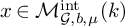 $x\in {\mathcal{M}_{\mathcal {G}, b, \mu }^{\mathrm {int}}}(k)$
, there exists
$x\in {\mathcal{M}_{\mathcal {G}, b, \mu }^{\mathrm {int}}}(k)$
, there exists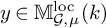 $y\in {\mathbb{M}^{\mathrm {loc}}_{\mathcal {G}, \mu }}(k)$
and an isomorphism of formal completions
$y\in {\mathbb{M}^{\mathrm {loc}}_{\mathcal {G}, \mu }}(k)$
and an isomorphism of formal completions
 $$ \begin{align*}{\mathcal{M}_{\mathcal{G}, b, \mu/x}^{\mathrm{int}}}\simeq {\mathbb{M}^{\mathrm{loc}}_{\mathcal{G},\mu/y}}. \end{align*} $$
When ${\mathcal {G}}$
is a parahoric group scheme, Gleason ([Reference GleasonGl25, Reference GleasonGl21]) has defined the formal completion
${\mathcal {G}}$
is a parahoric group scheme, Gleason ([Reference GleasonGl25, Reference GleasonGl21]) has defined the formal completion ${\mathcal {M}^{\mathrm {int}}_{\mathcal {G}, b, \mu /x}}$
as a v-sheaf. In our approach, we first show that his definition extends to the case of an arbitrary quasi-parahoric group scheme and then show that
${\mathcal {M}^{\mathrm {int}}_{\mathcal {G}, b, \mu /x}}$
as a v-sheaf. In our approach, we first show that his definition extends to the case of an arbitrary quasi-parahoric group scheme and then show that $\mathcal {M}^{\mathrm { int}}_{\mathcal {G}, b, \mu /x}$
is representable (by the formal spectrum of a complete Noetherian local ring which is the completion of a corresponding local model, as above). The representability of
$\mathcal {M}^{\mathrm { int}}_{\mathcal {G}, b, \mu /x}$
is representable (by the formal spectrum of a complete Noetherian local ring which is the completion of a corresponding local model, as above). The representability of $\mathcal {M}^{\mathrm {int}}_{\mathcal {G}, b, \mu /x}$
for all x is closely related to the representability of
$\mathcal {M}^{\mathrm {int}}_{\mathcal {G}, b, \mu /x}$
for all x is closely related to the representability of $\mathcal {M}^{\mathrm {int}}_{\mathcal {G}, b, \mu }$
. In fact, in [Reference Pappas and RapoportPR24], we show in the Hodge type case under certain hypotheses that, conversely, if all formal completions are representable, then so is
$\mathcal {M}^{\mathrm {int}}_{\mathcal {G}, b, \mu }$
. In fact, in [Reference Pappas and RapoportPR24], we show in the Hodge type case under certain hypotheses that, conversely, if all formal completions are representable, then so is $\mathcal {M}^{\mathrm {int}}_{\mathcal {G}, b, \mu }$
. Using this statement, we prove in [Reference Pappas and RapoportPR24] the representability of
$\mathcal {M}^{\mathrm {int}}_{\mathcal {G}, b, \mu }$
. Using this statement, we prove in [Reference Pappas and RapoportPR24] the representability of $\mathcal {M}^{\mathrm {int}}_{{\mathcal {G}}, b, \mu }$
in many cases of Hodge type by using global methods.
$\mathcal {M}^{\mathrm {int}}_{{\mathcal {G}}, b, \mu }$
in many cases of Hodge type by using global methods.
By contrast, the approach in the present paper is purely local and direct, with more general results. The key case for $p>2$
occurs for
$p>2$
occurs for $(G, b,\mu , {\mathcal {G}})$
of Hodge type when the closed immersion
$(G, b,\mu , {\mathcal {G}})$
of Hodge type when the closed immersion $G\hookrightarrow \mathrm {GL}_n$
extends to a closed immersion
$G\hookrightarrow \mathrm {GL}_n$
extends to a closed immersion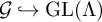 ${\mathcal {G}} \hookrightarrow \mathrm {GL}(\Lambda )$
for a
${\mathcal {G}} \hookrightarrow \mathrm {GL}(\Lambda )$
for a $\mathbb {Z}_p$
-lattice
$\mathbb {Z}_p$
-lattice $\Lambda \subset \mathbb {Q}_p^n$
and satisfies certain additional conditions. In this case, the representability of
$\Lambda \subset \mathbb {Q}_p^n$
and satisfies certain additional conditions. In this case, the representability of $\mathcal {M}^{\mathrm {int}}_{\mathcal {G}, b, \mu }$
is established by imitating the construction in [Reference Kisin and PappasKP18], as extended in [Reference Kisin and ZhouKZ21], [Reference Kisin, Pappas and ZhouKPZ24], of integral models of global Shimura varieties of Hodge type. The crucial step here is the construction of a suitable versal deformation of a p-divisible group equipped with crystalline tensors. This is done by using Zink’s displays and requires the assumption
$\mathcal {M}^{\mathrm {int}}_{\mathcal {G}, b, \mu }$
is established by imitating the construction in [Reference Kisin and PappasKP18], as extended in [Reference Kisin and ZhouKZ21], [Reference Kisin, Pappas and ZhouKPZ24], of integral models of global Shimura varieties of Hodge type. The crucial step here is the construction of a suitable versal deformation of a p-divisible group equipped with crystalline tensors. This is done by using Zink’s displays and requires the assumption $p>2$
. The general Hodge type case is reduced to this case by devissage. In this devissage, there are two steps. In a first step, one shows that the assertion is independent of the quasi-parahoric
$p>2$
. The general Hodge type case is reduced to this case by devissage. In this devissage, there are two steps. In a first step, one shows that the assertion is independent of the quasi-parahoric ${\mathcal {G}}$
within the class of all quasi-parahorics sharing a fixed parahoric as their neutral component. In a second step, one shows that the assertion is independent of the group G within the class of all groups sharing the same adjoint group. In these devissage steps one has to deal with affine Deligne-Lusztig varieties for quasi-parahorics, as already considered by U. Görtz, X. He and S. Nie in [Reference Görtz, He and NieGHN24]. Finally, the general abelian type is reduced to the Hodge type case by following Deligne’s analogous reduction [Reference DeligneDe79] in the case of global Shimura varieties.
${\mathcal {G}}$
within the class of all quasi-parahorics sharing a fixed parahoric as their neutral component. In a second step, one shows that the assertion is independent of the group G within the class of all groups sharing the same adjoint group. In these devissage steps one has to deal with affine Deligne-Lusztig varieties for quasi-parahorics, as already considered by U. Görtz, X. He and S. Nie in [Reference Görtz, He and NieGHN24]. Finally, the general abelian type is reduced to the Hodge type case by following Deligne’s analogous reduction [Reference DeligneDe79] in the case of global Shimura varieties.
What remains to be done for the construction of integral local Shimura varieties and Scholze’s representability conjecture in all generality? For local Shimura data of abelian type, there are still cases open for $p=2$
. Some of these appear accessible but there are several technical complications. Outside the abelian type cases, we have only cases that involve exceptional groups of type
$p=2$
. Some of these appear accessible but there are several technical complications. Outside the abelian type cases, we have only cases that involve exceptional groups of type $E_6$
or
$E_6$
or $E_7$
, even orthogonal groups with cocharacters which are ‘mixed’ of type
$E_7$
, even orthogonal groups with cocharacters which are ‘mixed’ of type ${D}^{\mathbb {R}}$
with
${D}^{\mathbb {R}}$
with ${D}^{\mathbb {H}}$
, and trialitarian forms. These are more mysterious. Especially the cases of exceptional groups are wide open, even though recently the representability of the formal completions
${D}^{\mathbb {H}}$
, and trialitarian forms. These are more mysterious. Especially the cases of exceptional groups are wide open, even though recently the representability of the formal completions $ \mathcal {M}^{\mathrm {int}}_{{\mathcal {G}}, b, \mu /x} $
has been proved in the case that
$ \mathcal {M}^{\mathrm {int}}_{{\mathcal {G}}, b, \mu /x} $
has been proved in the case that ${\mathcal {G}}$
is a hyperspecial parahoric by S. Bartling [Reference BartlingBa22, Thm. 1.4] (for
${\mathcal {G}}$
is a hyperspecial parahoric by S. Bartling [Reference BartlingBa22, Thm. 1.4] (for $p\geq 3$
) and K. Ito [Reference ItoIt25, Thm. 5.3.5].
$p\geq 3$
) and K. Ito [Reference ItoIt25, Thm. 5.3.5].
On the other hand, it is encouraging that the representability of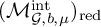 $(\mathcal {M}^{\mathrm {int}}_{{\mathcal {G}}, b, \mu })_{\mathrm {red}} $
is known in general (even when
$(\mathcal {M}^{\mathrm {int}}_{{\mathcal {G}}, b, \mu })_{\mathrm {red}} $
is known in general (even when $\mu $
is not minuscule). More precisely, Gleason [Reference GleasonGl21] defines
$\mu $
is not minuscule). More precisely, Gleason [Reference GleasonGl21] defines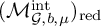 $(\mathcal {M}^{\mathrm {int}}_{{\mathcal {G}}, b, \mu })_{\mathrm {red}} $
as a scheme-theoretic v-sheaf and proves that it is representable by a perfect k-scheme
$(\mathcal {M}^{\mathrm {int}}_{{\mathcal {G}}, b, \mu })_{\mathrm {red}} $
as a scheme-theoretic v-sheaf and proves that it is representable by a perfect k-scheme $X_{{\mathcal {G}}} (b, \mu ^{-1})$
contained in the Witt vector affine Grassmannian
$X_{{\mathcal {G}}} (b, \mu ^{-1})$
contained in the Witt vector affine Grassmannian $X_{{\mathcal {G}}} = LG/L^+{\mathcal {G}}$
(in [Reference GleasonGl21], Gleason assumes that
$X_{{\mathcal {G}}} = LG/L^+{\mathcal {G}}$
(in [Reference GleasonGl21], Gleason assumes that ${\mathcal {G}}$
is parahoric but the result holds for general quasi-parahorics, cf. Proposition 3.3.1). Furthermore,
${\mathcal {G}}$
is parahoric but the result holds for general quasi-parahorics, cf. Proposition 3.3.1). Furthermore,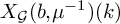 $X_{{\mathcal {G}}} (b, \mu ^{-1})(k)$
can be identified with the corresponding affine Deligne-Lusztig set, cf. (3.3.2). When
$X_{{\mathcal {G}}} (b, \mu ^{-1})(k)$
can be identified with the corresponding affine Deligne-Lusztig set, cf. (3.3.2). When $\mu $
is minuscule, one expects a natural deperfection of
$\mu $
is minuscule, one expects a natural deperfection of $X_{{\mathcal {G}}} (b, \mu ^{-1})$
as a scheme locally of finite type over k but this seems only known as a consequence of the representability of
$X_{{\mathcal {G}}} (b, \mu ^{-1})$
as a scheme locally of finite type over k but this seems only known as a consequence of the representability of $\mathcal {M}^{\mathrm {int}}_{{\mathcal {G}}, b, \mu }$
.
$\mathcal {M}^{\mathrm {int}}_{{\mathcal {G}}, b, \mu }$
.
We thank P. Scholze for helpful comments, and R. Zhou for useful discussions about [Reference Kisin and ZhouKZ21]. The first author also acknowledges support by NSF grant #DMS-2100743.
2 Statements of the main results
2.1 Hodge and Abelian type
Let $(G, b, \{\mu \})$
be a local Shimura datum over
$(G, b, \{\mu \})$
be a local Shimura datum over $\mathbb {Q}_p$
, cf. [Reference Rapoport and ViehmannRV14]. Recall that this means that G is a reductive group, that
$\mathbb {Q}_p$
, cf. [Reference Rapoport and ViehmannRV14]. Recall that this means that G is a reductive group, that $b\in G(\breve {\mathbb {Q}}_p)$
and that
$b\in G(\breve {\mathbb {Q}}_p)$
and that $\{\mu \}$
is a conjugacy class of a minuscule cocharacter
$\{\mu \}$
is a conjugacy class of a minuscule cocharacter $\mu :\mathbb {G}_{m/\bar {\mathbb {Q}}_p}\to G_{\bar {\mathbb {Q}}_p}$
. It is assumed that b is neutral acceptable, i.e., the
$\mu :\mathbb {G}_{m/\bar {\mathbb {Q}}_p}\to G_{\bar {\mathbb {Q}}_p}$
. It is assumed that b is neutral acceptable, i.e., the $\sigma $
-conjugacy class
$\sigma $
-conjugacy class $[b]$
lies in
$[b]$
lies in $B(G, \mu ^{-1})$
. We will often omit the bracket and simply write
$B(G, \mu ^{-1})$
. We will often omit the bracket and simply write $(G, b, \mu )$
.
$(G, b, \mu )$
.
We will be concerned with local Shimura data of a particular type.
Definition 2.1.1. The local Shimura datum $(G, b, \mu )$
is called of Hodge type if there is an embedding
$(G, b, \mu )$
is called of Hodge type if there is an embedding
 $$\begin{align*}i: (G, \mu)\hookrightarrow (\mathrm{GL}_h, \mu_d), \end{align*}$$
for some $0\leq d\leq h$
, where
$0\leq d\leq h$
, where $\mu _d(a)=\operatorname {\mathrm {diag}}(a^{(d)}, 1^{(h-d)})$
is the standard minuscule cocharacter of
$\mu _d(a)=\operatorname {\mathrm {diag}}(a^{(d)}, 1^{(h-d)})$
is the standard minuscule cocharacter of $\mathrm {GL}_h$
.
$\mathrm {GL}_h$
.
Remark 2.1.2. This is the local analogue of the corresponding terminology in the classical theory of Shimura varieties, where one requires an embedding into a similitude symplectic group.
Definition 2.1.3 ([Reference He, Pappas and RapoportHPR20, §2.7], [Reference Haines, Lourenço and RicharzHLR24, Def. 9.6]).
The local Shimura datum $(G, b, \mu )$
is called of abelian type if there is a local Shimura datum
$(G, b, \mu )$
is called of abelian type if there is a local Shimura datum $(G_1, b_1, \mu _1)$
of Hodge type and an isomorphism
$(G_1, b_1, \mu _1)$
of Hodge type and an isomorphism $(G_{1,{\mathrm {ad}}}, b_{1,{\mathrm {ad}}}, \mu _{1, {\mathrm {ad}}})\simeq (G_{\mathrm {ad}}, b_{{\mathrm {ad}}}, \mu _{\mathrm {ad}})$
. In this case,
$(G_{1,{\mathrm {ad}}}, b_{1,{\mathrm {ad}}}, \mu _{1, {\mathrm {ad}}})\simeq (G_{\mathrm {ad}}, b_{{\mathrm {ad}}}, \mu _{\mathrm {ad}})$
. In this case, $ (G_1, b_1, \mu _1)$
is called a central lift of Hodge type for
$ (G_1, b_1, \mu _1)$
is called a central lift of Hodge type for $(G, b, \mu )$
, cf. [Reference Haines, Lourenço and RicharzHLR24, §9].
$(G, b, \mu )$
, cf. [Reference Haines, Lourenço and RicharzHLR24, §9].
Note that the existence of $b_1$
that lifts
$b_1$
that lifts $b_{{\mathrm {ad}}}$
is automatic since
$b_{{\mathrm {ad}}}$
is automatic since $B(G,\mu )\simeq B(G_{{\mathrm {ad}}},\mu _{\mathrm {ad}})$
by [Reference KottwitzKo97, (6.5.1)], so this is really a property of the pair
$B(G,\mu )\simeq B(G_{{\mathrm {ad}}},\mu _{\mathrm {ad}})$
by [Reference KottwitzKo97, (6.5.1)], so this is really a property of the pair $(G, \mu )$
.
$(G, \mu )$
.
Remark 2.1.4. Note that this is weaker than the analogous notion in the global case, where one asks that there is a morphism $(G_1, \mu _1)\to (G_{\mathrm {ad}}, \mu _{\mathrm {ad}})$
such that the induced morphism
$(G_1, \mu _1)\to (G_{\mathrm {ad}}, \mu _{\mathrm {ad}})$
such that the induced morphism $G_{1, \mathrm {der}}\to G_{\mathrm {ad}}$
admits a factorisation through
$G_{1, \mathrm {der}}\to G_{\mathrm {ad}}$
admits a factorisation through $G_{\mathrm {der}}$
and induces an isomorphism
$G_{\mathrm {der}}$
and induces an isomorphism $(G_{1,{\mathrm {ad}}}, \mu _{1, {\mathrm {ad}}})\simeq (G_{\mathrm {ad}}, \mu _{\mathrm {ad}})$
, comp. [Reference Kisin and PappasKP18]. In [Reference He, Pappas and RapoportHPR20], it is this stronger version that is imposed also in the local case; however, in the local case, this stronger notion seems unnecessary, as pointed out in [Reference Haines, Lourenço and RicharzHLR24].
$(G_{1,{\mathrm {ad}}}, \mu _{1, {\mathrm {ad}}})\simeq (G_{\mathrm {ad}}, \mu _{\mathrm {ad}})$
, comp. [Reference Kisin and PappasKP18]. In [Reference He, Pappas and RapoportHPR20], it is this stronger version that is imposed also in the local case; however, in the local case, this stronger notion seems unnecessary, as pointed out in [Reference Haines, Lourenço and RicharzHLR24].
2.2 Quasi-parahoric subgroups
Let $\breve G$
be a reductive group over
$\breve G$
be a reductive group over $\breve {\mathbb {Q}}_p$
. By definition, a quasi-parahoric subgroup of
$\breve {\mathbb {Q}}_p$
. By definition, a quasi-parahoric subgroup of $\breve G(\breve {\mathbb {Q}}_p)$
is a subgroup
$\breve G(\breve {\mathbb {Q}}_p)$
is a subgroup $\breve K$
which is squeezed as
$\breve K$
which is squeezed as
 $$ \begin{align*}\breve G(\breve{\mathbb{Q}}_p)^0\cap \mathrm{Stab}_{\frak F}\subset \breve K\subset \breve G(\breve{\mathbb{Q}}_p)^1\cap \mathrm{Stab}_{\frak F}. \end{align*} $$
Here $\mathrm {Stab}_{\frak F}$
is the stabiliser of a facet
$\mathrm {Stab}_{\frak F}$
is the stabiliser of a facet $\frak F$
in the building
$\frak F$
in the building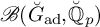 $\mathscr {B} (\breve G_{\mathrm {ad}}, \breve {\mathbb {Q}}_p)$
, and
$\mathscr {B} (\breve G_{\mathrm {ad}}, \breve {\mathbb {Q}}_p)$
, and
 $$ \begin{align*}\breve G(\breve{\mathbb{Q}}_p)^0=\ker(\kappa: \breve G(\breve{\mathbb{Q}}_p)\to \pi_1(\breve G)_I), \quad \breve G(\breve{\mathbb{Q}}_p)^1=\ker(\kappa: \breve G(\breve{\mathbb{Q}}_p)\to \pi_1(\breve G)_I\otimes\mathbb{Q}). \end{align*} $$
Here, $\kappa $
is the Kottwitz homomorphism. Equivalently, it is a subgroup of finite index in
$\kappa $
is the Kottwitz homomorphism. Equivalently, it is a subgroup of finite index in $\breve G(\breve {\mathbb {Q}}_p)^1\cap \mathrm {Stab}_{{\frak F}}$
. Still another way of characterising quasi-parahoric subgroups is to say that they are of finite index in the stabiliser of a point in the extended building
$\breve G(\breve {\mathbb {Q}}_p)^1\cap \mathrm {Stab}_{{\frak F}}$
. Still another way of characterising quasi-parahoric subgroups is to say that they are of finite index in the stabiliser of a point in the extended building $\mathscr {B}^e(\breve G, \breve {\mathbb {Q}}_p)$
. In the case that the quasi-parahoric subgroup coincides with
$\mathscr {B}^e(\breve G, \breve {\mathbb {Q}}_p)$
. In the case that the quasi-parahoric subgroup coincides with $\breve G(\breve {\mathbb {Q}}_p)^1\cap \mathrm {Stab}_{\mathbf {x}}$
, with
$\breve G(\breve {\mathbb {Q}}_p)^1\cap \mathrm {Stab}_{\mathbf {x}}$
, with $\mathbf {x}\in \mathscr {B}(\breve G_{\mathrm {ad}}, \breve {\mathbb {Q}}_p)$
(equivalently, if it coincides with the stabiliser subgroup in
$\mathbf {x}\in \mathscr {B}(\breve G_{\mathrm {ad}}, \breve {\mathbb {Q}}_p)$
(equivalently, if it coincides with the stabiliser subgroup in $\breve G(\breve {\mathbb {Q}}_p)$
of a point in the extended building
$\breve G(\breve {\mathbb {Q}}_p)$
of a point in the extended building $\mathscr {B}^e(\breve G, \breve {\mathbb {Q}}_p)$
), it is called a stabiliser quasi-parahoric. The parahoric subgroup
$\mathscr {B}^e(\breve G, \breve {\mathbb {Q}}_p)$
), it is called a stabiliser quasi-parahoric. The parahoric subgroup $\breve K^o=\breve G(\breve {\mathbb {Q}}_p)^0\cap \mathrm { Stab}_{\frak F}$
is called the parahoric subgroup associated to the quasi-parahoric subgroup
$\breve K^o=\breve G(\breve {\mathbb {Q}}_p)^0\cap \mathrm { Stab}_{\frak F}$
is called the parahoric subgroup associated to the quasi-parahoric subgroup $\breve K$
. Note that if
$\breve K$
. Note that if $\pi _1(\breve G)_I$
is torsion-free, then any quasi-parahoric is a parahoric.
$\pi _1(\breve G)_I$
is torsion-free, then any quasi-parahoric is a parahoric.
By Bruhat-Tits theory [Reference Bruhat and TitsBTII], there is a unique smooth group scheme $\breve {\mathcal {G}}$
over
$\breve {\mathcal {G}}$
over $\breve {\mathbb {Z}}_p$
with generic fibre
$\breve {\mathbb {Z}}_p$
with generic fibre $\breve G$
such that
$\breve G$
such that $\breve {\mathcal {G}} (\breve {\mathbb {Z}}_p)=\breve K$
.
$\breve {\mathcal {G}} (\breve {\mathbb {Z}}_p)=\breve K$
.
Now let G be a reductive group over $\mathbb {Q}_p$
. Then, in analogy with the Bruhat-Tits definition of a
$\mathbb {Q}_p$
. Then, in analogy with the Bruhat-Tits definition of a $\mathbb {Q}_p$
-parahoric subgroup [Reference Bruhat and TitsBTII, right after Def. 5.2.6], there is the notion of a
$\mathbb {Q}_p$
-parahoric subgroup [Reference Bruhat and TitsBTII, right after Def. 5.2.6], there is the notion of a $\mathbb {Q}_p$
-quasi-parahoric subgroup of G. It can be equivalently defined as a quasi-parahoric subgroup
$\mathbb {Q}_p$
-quasi-parahoric subgroup of G. It can be equivalently defined as a quasi-parahoric subgroup $\breve K$
of
$\breve K$
of $G(\breve {\mathbb {Q}}_p)$
which is invariant under Frobenius, or as a subgroup of finite index in
$G(\breve {\mathbb {Q}}_p)$
which is invariant under Frobenius, or as a subgroup of finite index in $G(\breve {\mathbb {Q}}_p)^1\cap \mathrm {Stab}_{{\frak F}}$
, where
$G(\breve {\mathbb {Q}}_p)^1\cap \mathrm {Stab}_{{\frak F}}$
, where $ \mathrm {Stab}_{\frak F}$
is the stabiliser of a facet
$ \mathrm {Stab}_{\frak F}$
is the stabiliser of a facet $\frak F$
in the building
$\frak F$
in the building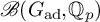 $\mathscr {B} (G_{\mathrm {ad}}, \mathbb {Q}_p)$
. By descent from
$\mathscr {B} (G_{\mathrm {ad}}, \mathbb {Q}_p)$
. By descent from $\breve {\mathbb {Z}}_p$
to
$\breve {\mathbb {Z}}_p$
to $\mathbb {Z}_p$
, we have a corresponding smooth group scheme
$\mathbb {Z}_p$
, we have a corresponding smooth group scheme ${\mathcal {G}} $
over
${\mathcal {G}} $
over $\operatorname {\mbox {Spec }}(\mathbb {Z}_p)$
. Then
$\operatorname {\mbox {Spec }}(\mathbb {Z}_p)$
. Then ${\mathcal {G}} (\mathbb {Z}_p)=\breve K\cap G(\mathbb {Q}_p)$
.
${\mathcal {G}} (\mathbb {Z}_p)=\breve K\cap G(\mathbb {Q}_p)$
.
In the sequel, we simply call ${\mathcal {G}} $
a quasi-parahoric group scheme for G. Note that a parahoric group scheme for G is uniquely defined by its associated subgroup
${\mathcal {G}} $
a quasi-parahoric group scheme for G. Note that a parahoric group scheme for G is uniquely defined by its associated subgroup ${\mathcal {G}} (\mathbb {Z}_p)$
of
${\mathcal {G}} (\mathbb {Z}_p)$
of $G(\mathbb {Q}_p)$
, cf. [Reference Bruhat and TitsBTII, Prop. 5.2.8]. However, for general quasi-parahoric group schemes for G, the association
$G(\mathbb {Q}_p)$
, cf. [Reference Bruhat and TitsBTII, Prop. 5.2.8]. However, for general quasi-parahoric group schemes for G, the association ${\mathcal {G}} \mapsto {\mathcal {G}} (\mathbb {Z}_p)$
ceases to be injective (for instance
${\mathcal {G}} \mapsto {\mathcal {G}} (\mathbb {Z}_p)$
ceases to be injective (for instance ${\mathcal {G}} ^o(\mathbb {Z}_p)= {\mathcal {G}} (\mathbb {Z}_p)$
when
${\mathcal {G}} ^o(\mathbb {Z}_p)= {\mathcal {G}} (\mathbb {Z}_p)$
when $\pi _0({\mathcal {G}} )^\phi $
is trivial, which may happen even when
$\pi _0({\mathcal {G}} )^\phi $
is trivial, which may happen even when $\pi _0({\mathcal {G}} )$
is non-trivial). Still, we write
$\pi _0({\mathcal {G}} )$
is non-trivial). Still, we write $K={\mathcal {G}} (\mathbb {Z}_p)=\breve K\cap G(\mathbb {Q}_p)$
and sometimes use the notation K to refer to our choice of
$K={\mathcal {G}} (\mathbb {Z}_p)=\breve K\cap G(\mathbb {Q}_p)$
and sometimes use the notation K to refer to our choice of ${\mathcal {G}}$
. This does not lead to confusions.
${\mathcal {G}}$
. This does not lead to confusions.
2.3 The local model
RecallFootnote 1 the Scholze-Weinstein v-sheaf local model $\mathbb {M}^v_{{\mathcal {G}}, \mu }$
over
$\mathbb {M}^v_{{\mathcal {G}}, \mu }$
over $\mathrm{Spd}(O_E)$
(in [Reference Scholze and WeinsteinSW20] it is denoted by
$\mathrm{Spd}(O_E)$
(in [Reference Scholze and WeinsteinSW20] it is denoted by $\mathrm {Gr}_{{\mathcal {G}}, \mathrm{Spd}(O_E),\leq \mu }$
).
$\mathrm {Gr}_{{\mathcal {G}}, \mathrm{Spd}(O_E),\leq \mu }$
).
Assume $\mu $
is minuscule. In this case,
$\mu $
is minuscule. In this case, $\mathrm {Gr}_{\mathcal {G}, \mathrm{Spd}(O_E),\leq \mu }=\mathrm {Gr}_{\mathcal {G}, \mathrm{Spd}(O_E), \mu }$
and the v-sheaf local model
$\mathrm {Gr}_{\mathcal {G}, \mathrm{Spd}(O_E),\leq \mu }=\mathrm {Gr}_{\mathcal {G}, \mathrm{Spd}(O_E), \mu }$
and the v-sheaf local model $\mathbb {M}^v_{\mathcal {G}, \mu }=\mathrm {Gr}_{\mathcal {G}, \mathrm{Spd}(O_E), \mu }$
is given as the closure inside the Beilinson-Drinfeld style affine Grassmannian
$\mathbb {M}^v_{\mathcal {G}, \mu }=\mathrm {Gr}_{\mathcal {G}, \mathrm{Spd}(O_E), \mu }$
is given as the closure inside the Beilinson-Drinfeld style affine Grassmannian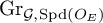 $\mathrm {Gr}_{\mathcal {G}, \mathrm{Spd}(O_E)}$
of the v-sheaf
$\mathrm {Gr}_{\mathcal {G}, \mathrm{Spd}(O_E)}$
of the v-sheaf $X{}_\mu {}^{\Diamond }$
associated to the symmetric space
$X{}_\mu {}^{\Diamond }$
associated to the symmetric space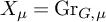 $X_\mu =\mathrm {Gr}_{G,\mu }$
of parabolics of type
$X_\mu =\mathrm {Gr}_{G,\mu }$
of parabolics of type $\mu $
over
$\mu $
over $\operatorname {\mbox {Spec }}(E)$
. Then
$\operatorname {\mbox {Spec }}(E)$
. Then ${\mathbb{M}^{v}_{\mathcal {G}, \mu}}$
is representable by a normal flat projective
${\mathbb{M}^{v}_{\mathcal {G}, \mu}}$
is representable by a normal flat projective $O_E$
-scheme
$O_E$
-scheme ${\mathbb{M}^{\mathrm {loc}}_{\mathcal {G}, \mu}}$
with reduced special fibre. This was conjectured by Scholze-Weinstein [Reference Scholze and WeinsteinSW20, Conj. 21.4.1] and was shown in [Reference Anschütz, Gleason, Lourenço and RicharzAGLR22] and [Reference Gleason and LourençoGLo24] (which settled the normality in some remaining cases in characteristics
${\mathbb{M}^{\mathrm {loc}}_{\mathcal {G}, \mu}}$
with reduced special fibre. This was conjectured by Scholze-Weinstein [Reference Scholze and WeinsteinSW20, Conj. 21.4.1] and was shown in [Reference Anschütz, Gleason, Lourenço and RicharzAGLR22] and [Reference Gleason and LourençoGLo24] (which settled the normality in some remaining cases in characteristics $2$
and
$2$
and $3$
). Here
$3$
). Here ${\mathbb{M}^{\mathrm {loc}}_{\mathcal {G}, \mu}}$
is uniquely determined. Assume in addition that
${\mathbb{M}^{\mathrm {loc}}_{\mathcal {G}, \mu}}$
is uniquely determined. Assume in addition that $(G, \mu )$
is of abelian type and satisfies Condition (A) or (B), cf. Definition 2.5.2 below. Then the normality of
$(G, \mu )$
is of abelian type and satisfies Condition (A) or (B), cf. Definition 2.5.2 below. Then the normality of ${\mathbb{M}^{\mathrm {loc}}_{\mathcal {G}, \mu}}$
is given by [Reference Anschütz, Gleason, Lourenço and RicharzAGLR22, Thm. 7.23]. Furthermore, in the case (A)
${\mathbb{M}^{\mathrm {loc}}_{\mathcal {G}, \mu}}$
is given by [Reference Anschütz, Gleason, Lourenço and RicharzAGLR22, Thm. 7.23]. Furthermore, in the case (A) ${\mathbb{M}^{\mathrm {loc}}_{\mathcal {G}, \mu}}$
can be obtained by the procedure of [Reference Pappas and ZhuPZ13], extended to restrictions of scalars from wild extensions in [Reference LevinLe01] and as modified in [Reference He, Pappas and RapoportHPR20] when
${\mathbb{M}^{\mathrm {loc}}_{\mathcal {G}, \mu}}$
can be obtained by the procedure of [Reference Pappas and ZhuPZ13], extended to restrictions of scalars from wild extensions in [Reference LevinLe01] and as modified in [Reference He, Pappas and RapoportHPR20] when $p\mid |\pi _1(G_{\mathrm {der}})|$
. This statement uses Remark 2.5.3. In the case (B) of Definition 2.5.2,
$p\mid |\pi _1(G_{\mathrm {der}})|$
. This statement uses Remark 2.5.3. In the case (B) of Definition 2.5.2, ${\mathbb{M}^{\mathrm {loc}}_{\mathcal {G}, \mu }}$
can also be obtained by taking the closure of the generic fibre in the naive local model of [Reference Rapoport and ZinkRZ96]. There is no difference when discussing quasi-parahorics because the natural map is an isomorphism,
${\mathbb{M}^{\mathrm {loc}}_{\mathcal {G}, \mu }}$
can also be obtained by taking the closure of the generic fibre in the naive local model of [Reference Rapoport and ZinkRZ96]. There is no difference when discussing quasi-parahorics because the natural map is an isomorphism,

cf. [Reference Scholze and WeinsteinSW20, Prop. 21.4.3]. (This proposition assumes that $\mu $
is minuscule, but the argument applies to general
$\mu $
is minuscule, but the argument applies to general $\mu $
, see also [Reference Anschütz, Gleason, Lourenço and RicharzAGLR22, §4]). If
$\mu $
, see also [Reference Anschütz, Gleason, Lourenço and RicharzAGLR22, §4]). If $\mu $
is minuscule, this also yields an isomorphism for the corresponding scheme local models,
$\mu $
is minuscule, this also yields an isomorphism for the corresponding scheme local models,

2.4 The integral local Shimura variety $\mathcal {M} {}^{\mathrm {int}}_{{\mathcal {G}}, b, \mu }$

Let ${\mathcal {G}} $
be a smooth affine group scheme over
${\mathcal {G}} $
be a smooth affine group scheme over $\mathbb {Z}{}_p$
with generic fibre a reductive group G, let
$\mathbb {Z}{}_p$
with generic fibre a reductive group G, let $b\in G(\breve {\mathbb {Q}}{}_p)$
, and let
$b\in G(\breve {\mathbb {Q}}{}_p)$
, and let $\mu $
be a conjugacy class of cocharacters of G. It is assumed that the Frobenius-conjugacy class of b lies in
$\mu $
be a conjugacy class of cocharacters of G. It is assumed that the Frobenius-conjugacy class of b lies in $B(G, \mu ^{-1})$
. We call the triple
$B(G, \mu ^{-1})$
. We call the triple $({\mathcal {G}}, b, \mu )$
an integral local shtuka datum and
$({\mathcal {G}}, b, \mu )$
an integral local shtuka datum and $(G, b, \mu )$
a rational local shtuka datum. As usual, we denote by E the field of definition of
$(G, b, \mu )$
a rational local shtuka datum. As usual, we denote by E the field of definition of $\mu $
and by
$\mu $
and by $\breve E$
the completion of the maximal unramified extension.
$\breve E$
the completion of the maximal unramified extension.
Then Scholze-Weinstein associate to $({\mathcal {G}}, b, \mu )$
an ‘integral’ moduli space of shtukas
$({\mathcal {G}}, b, \mu )$
an ‘integral’ moduli space of shtukas ${\mathcal {M}^{\mathrm { int}}_{\mathcal {G}, b, \mu }}$
over
${\mathcal {M}^{\mathrm { int}}_{\mathcal {G}, b, \mu }}$
over $O_{\breve E}$
, [Reference Scholze and WeinsteinSW20, Def. 25.1.1]. It is given as a ‘v-sheaf moduli space’ of certain
$O_{\breve E}$
, [Reference Scholze and WeinsteinSW20, Def. 25.1.1]. It is given as a ‘v-sheaf moduli space’ of certain ${\mathcal {G}}$
-shtukas with one leg bounded by
${\mathcal {G}}$
-shtukas with one leg bounded by $\mu $
with a fixed associated Frobenius element, cf. [Reference Scholze and WeinsteinSW20, §§23.1, 23.2, 23.3], as follows.
$\mu $
with a fixed associated Frobenius element, cf. [Reference Scholze and WeinsteinSW20, §§23.1, 23.2, 23.3], as follows.
Definition 2.4.1. The integral moduli space of local shtuka ${\mathcal{M}^{\mathrm {int}}_{\mathcal {G}, b, \mu }}$
is the functor that sends
${\mathcal{M}^{\mathrm {int}}_{\mathcal {G}, b, \mu }}$
is the functor that sends $S\in \mathrm {Perfd}_k$
to the set of isomorphism classes of tuples
$S\in \mathrm {Perfd}_k$
to the set of isomorphism classes of tuples
 $$ \begin{align*} (S^\sharp, \mathscr{P}, \phi_{\mathscr{P}}, i_r) , \end{align*} $$
where
-
1)
$S^\sharp $
is an untilt of S over
$\mathrm{Spa}( O_{\breve E})$
, -
2)
$(\mathscr {P}, \phi _{\mathscr {P}})$
is a
${\mathcal {G}}$
-shtuka over S with one leg along
$S^\sharp $
bounded by
$\mu $
, -
3)
$i_r$
is a ‘framing’, i.e., an isomorphism of G-torsors (2.4.1)for large enough r (for an implicit choice of pseudouniformiser
$$ \begin{align} i_r: G_{\mathcal{Y}{}_{[r,\infty)}(S)}\xrightarrow{\sim} \mathscr{P}{}_{\, |\mathcal{Y}{}_{[r,\infty)}(S)} \end{align} $$
$\varpi $
), under which
$\phi _{\mathscr {P}}$
is identified with
$\phi _b=b\times \mathrm {Frob}_S$
.



Here, $\mathcal {Y}{}_{[r,\infty )}(S)$
is as defined in [Reference Scholze and WeinsteinSW20], [Reference Fargues and ScholzeFS21, II]. We have denoted by
$\mathcal {Y}{}_{[r,\infty )}(S)$
is as defined in [Reference Scholze and WeinsteinSW20], [Reference Fargues and ScholzeFS21, II]. We have denoted by $G_{\mathcal {Y}{}_{[r,\infty )}(S)}$
the trivial G-torsor over
$G_{\mathcal {Y}{}_{[r,\infty )}(S)}$
the trivial G-torsor over ${\mathcal {Y}{}_{[r,\infty )}(S)}$
(denoted
${\mathcal {Y}{}_{[r,\infty )}(S)}$
(denoted $G\times {\mathcal {Y}{}_{[r,\infty )}(S)}$
in [Reference Scholze and WeinsteinSW20, App. to §19]), and by
$G\times {\mathcal {Y}{}_{[r,\infty )}(S)}$
in [Reference Scholze and WeinsteinSW20, App. to §19]), and by
 $$ \begin{align} \phi_b=\phi_{G, b}\colon \phi^*(G_{\mathcal{Y}{}_{[r,\infty)}(S)})=G_{\mathcal{Y}{}_{[\frac{1}{p}r,\infty)}(S)}\xrightarrow{b\phi} G_{\mathcal{Y}{}_{[r,\infty)}(S)} \end{align} $$
the isomorphism given by the $\phi $
-linear isomorphism induced by right multiplication by b (denoted by
$\phi $
-linear isomorphism induced by right multiplication by b (denoted by $b\times \mathrm {Frob}$
in [Reference Scholze and WeinsteinSW20, Def. 23.1.1]). In 3) we mean more precisely an equivalence class, where
$b\times \mathrm {Frob}$
in [Reference Scholze and WeinsteinSW20, Def. 23.1.1]). In 3) we mean more precisely an equivalence class, where $i_r$
and
$i_r$
and $i^{\prime }_{r'}$
are called equivalent if there exists
$i^{\prime }_{r'}$
are called equivalent if there exists $r"\geq r, r'$
such that
$r"\geq r, r'$
such that ${i_r}_{\, |\mathcal {Y} {}_{[r",\infty )}(S)}={i^{\prime }_{r'}}_{\, |\mathcal {Y} {}_{[r",\infty )}(S)}$
. Also, in 2) the precise definition of “bounded by
${i_r}_{\, |\mathcal {Y} {}_{[r",\infty )}(S)}={i^{\prime }_{r'}}_{\, |\mathcal {Y} {}_{[r",\infty )}(S)}$
. Also, in 2) the precise definition of “bounded by $\mu $
” is given via the local model
$\mu $
” is given via the local model $\mathbb {M}{}^v_{{\mathcal {G}}, \mu }$
(see [Reference Scholze and WeinsteinSW20, Def. 25.1.1], [Reference Pappas and RapoportPR24, p. 46]).
$\mathbb {M}{}^v_{{\mathcal {G}}, \mu }$
(see [Reference Scholze and WeinsteinSW20, Def. 25.1.1], [Reference Pappas and RapoportPR24, p. 46]).
Note that the formation of $\mathcal {M}{}^{\mathrm {int}}_{{\mathcal {G}}, b,\mu }$
is functorial, i.e., for a morphism
$\mathcal {M}{}^{\mathrm {int}}_{{\mathcal {G}}, b,\mu }$
is functorial, i.e., for a morphism $({\mathcal {G}}, b, \mu )\to ({\mathcal {G}}', b', \mu ')$
we have
$({\mathcal {G}}, b, \mu )\to ({\mathcal {G}}', b', \mu ')$
we have $\mathcal {M}{}^{\mathrm {int}}_{{\mathcal {G}}, b,\mu }\to \mathcal {M}{}^{\mathrm {int}}_{{\mathcal {G}}', b',\mu '}\times _{\mathrm{Spd}(O_{\breve E})} \mathrm{Spd}(O_{\breve E'})$
. It is also compatible with products, i.e.,
$\mathcal {M}{}^{\mathrm {int}}_{{\mathcal {G}}, b,\mu }\to \mathcal {M}{}^{\mathrm {int}}_{{\mathcal {G}}', b',\mu '}\times _{\mathrm{Spd}(O_{\breve E})} \mathrm{Spd}(O_{\breve E'})$
. It is also compatible with products, i.e., $ \mathcal {M}{}^{\mathrm {int}}_{{\mathcal {G}}{}_1\times {\mathcal {G}}{}_2, b_1\times b_2,\mu _1\times \mu _2}$
is isomorphic to the product
$ \mathcal {M}{}^{\mathrm {int}}_{{\mathcal {G}}{}_1\times {\mathcal {G}}{}_2, b_1\times b_2,\mu _1\times \mu _2}$
is isomorphic to the product $\mathcal {M}{}^{\mathrm {int}}_{{\mathcal {G}}{}_1, b_1,\mu _1}\times \mathcal {M} {}^{\mathrm {int}}_{{\mathcal {G}} {}_2, b_2,\mu _2} $
after base changing to the compositum of the reflex fields (in this, we omit the base changes from the notation, for simplicity). In addition, the
$\mathcal {M}{}^{\mathrm {int}}_{{\mathcal {G}}{}_1, b_1,\mu _1}\times \mathcal {M} {}^{\mathrm {int}}_{{\mathcal {G}} {}_2, b_2,\mu _2} $
after base changing to the compositum of the reflex fields (in this, we omit the base changes from the notation, for simplicity). In addition, the $\phi $
-centraliser group
$\phi $
-centraliser group $J_b(\mathbb {Q} {}_p)$
acts on
$J_b(\mathbb {Q} {}_p)$
acts on $\mathcal {M} {}^{\mathrm {int}}_{{\mathcal {G}}, b,\mu }$
by changing the framing.
$\mathcal {M} {}^{\mathrm {int}}_{{\mathcal {G}}, b,\mu }$
by changing the framing.
By loc. cit., $\mathcal {M} {}^{\mathrm {int}}_{{\mathcal {G}}, b, \mu }$
is a v-sheaf over
$\mathcal {M} {}^{\mathrm {int}}_{{\mathcal {G}}, b, \mu }$
is a v-sheaf over $\mathrm{Spd}( O_{\breve E})$
. In fact, as in [Reference GleasonGl21, Prop. 2.23],
$\mathrm{Spd}( O_{\breve E})$
. In fact, as in [Reference GleasonGl21, Prop. 2.23], $\mathcal {M} {}^{\mathrm{int}}_{{\mathcal {G}}, b, \mu }$
is a small v-sheaf. In addition,
$\mathcal {M} {}^{\mathrm{int}}_{{\mathcal {G}}, b, \mu }$
is a small v-sheaf. In addition, $\mathcal {M} {}^{\mathrm {int}}_{{\mathcal {G}}, b,\mu }$
supports a Weil descent datum from
$\mathcal {M} {}^{\mathrm {int}}_{{\mathcal {G}}, b,\mu }$
supports a Weil descent datum from $\mathcal{O} {}_{\breve E}$
down to
$\mathcal{O} {}_{\breve E}$
down to $O_E$
, as explained in [Reference Pappas and RapoportPR24, §3.1, §3.2]. In this paper, even though this is not always pointed out explicitly, the smooth group scheme
$O_E$
, as explained in [Reference Pappas and RapoportPR24, §3.1, §3.2]. In this paper, even though this is not always pointed out explicitly, the smooth group scheme ${\mathcal {G}}$
will always be a quasi-parahoric group scheme for G.
${\mathcal {G}}$
will always be a quasi-parahoric group scheme for G.
In fact, most of the time we are interested in the case that $(G, b, \mu )$
is a local Shimura datum, i.e., we also assume that
$(G, b, \mu )$
is a local Shimura datum, i.e., we also assume that $\mu $
is minuscule. In addition, we take
$\mu $
is minuscule. In addition, we take ${\mathcal {G}} $
to be a quasi-parahoric group scheme for G. In this case we call
${\mathcal {G}} $
to be a quasi-parahoric group scheme for G. In this case we call ${\mathcal {M} {}^{\mathrm {int}}_{{\mathcal {G}}, b, \mu }}$
the integral local Shimura variety associated to the local Shimura datum
${\mathcal {M} {}^{\mathrm {int}}_{{\mathcal {G}}, b, \mu }}$
the integral local Shimura variety associated to the local Shimura datum $(G, b, \mu )$
and the quasi-parahoric group scheme
$(G, b, \mu )$
and the quasi-parahoric group scheme ${\mathcal {G}} $
.
${\mathcal {G}} $
.
2.5 Statement of the main results
Our concern is with the following conjecture.
Conjecture 2.5.1 (Scholze).
Let $(G, b, \mu )$
be a local Shimura datum and
$(G, b, \mu )$
be a local Shimura datum and ${\mathcal {G}} $
a quasi-parahoric group scheme for G. There exists a formal scheme
${\mathcal {G}} $
a quasi-parahoric group scheme for G. There exists a formal scheme $\mathscr {M} {}_{{\mathcal {G}}, b, \mu }$
which is normal and flat locally formally of finite type over
$\mathscr {M} {}_{{\mathcal {G}}, b, \mu }$
which is normal and flat locally formally of finite type over $O_{\breve E}$
with
$O_{\breve E}$
with
 $$\begin{align*}\mathcal{M}{}^{\mathrm{int}}_{{\mathcal{G}}, b, \mu}=\mathscr{M} {}_{{\mathcal{G}}, b, \mu}^{\Diamond}\end{align*}$$
as v-sheaves over $\mathrm{Spd}(O_{\breve E})$
. Then,
$\mathrm{Spd}(O_{\breve E})$
. Then, $\mathscr {M} {}_{{\mathcal {G}}, b, \mu }$
is unique ([Reference Scholze and WeinsteinSW20, Prop. 18.4.1]).
$\mathscr {M} {}_{{\mathcal {G}}, b, \mu }$
is unique ([Reference Scholze and WeinsteinSW20, Prop. 18.4.1]).
Our main result is a proof of this conjecture when $(G, b, \mu )$
is of abelian type under certain mild hypotheses.
$(G, b, \mu )$
is of abelian type under certain mild hypotheses.
Definition 2.5.2. Let $(G, b, \mu )$
be of abelian type. We introduce two kinds of conditions on p, G and
$(G, b, \mu )$
be of abelian type. We introduce two kinds of conditions on p, G and $\mu $
.
$\mu $
.
-
(A)
$p\neq 2$
. -
(B)
$p=2$
and
$G_{\mathrm {ad}}=\prod _i \mathrm {Res}_{F_i/\mathbb {Q}{}_p}H_i$
, where for each i,
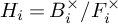
$H_i= B_i^\times /F_i^\times $
with
$B_i$
a simple algebra with centre
$F_i$
, or
$H_i=\mathrm {PGSp}_{2n_i}$
, or the corresponding component
$\mu _{{\mathrm {ad}}, i}$
of
$\mu _{{\mathrm {ad}}}$
is trivial.








Note that if $G=T$
is a torus, T trivially satisfies (A) or (B).
$G=T$
is a torus, T trivially satisfies (A) or (B).
Remark 2.5.3. Recall from [Reference Pappas and RapoportPR24, §5], comp. [Reference Kisin, Pappas and ZhouKPZ24, Def. 3.1.4], that G is called essentially tamely ramified if $G_{\mathrm {ad}}\simeq \prod _i \mathrm {Res}_{F_i/\mathbb {Q}{}_p}H_i$
, where
$G_{\mathrm {ad}}\simeq \prod _i \mathrm {Res}_{F_i/\mathbb {Q}{}_p}H_i$
, where $H_i$
is absolutely simple and splits over a tamely ramified extension of
$H_i$
is absolutely simple and splits over a tamely ramified extension of $F_i$
. Note that G is automatically essentially tamely ramified if
$F_i$
. Note that G is automatically essentially tamely ramified if $p\geq 5$
, cf. [Reference Pappas and RapoportPR24, §5]. Moreover, if
$p\geq 5$
, cf. [Reference Pappas and RapoportPR24, §5]. Moreover, if $p=3$
, the condition of essentially tame ramification only excludes groups whose adjoint groups contain a ramified triality group (type
$p=3$
, the condition of essentially tame ramification only excludes groups whose adjoint groups contain a ramified triality group (type $D_4^{(3)}$
or
$D_4^{(3)}$
or $D_4^{(6)}$
) as a factor. We note that by Serre [Reference SerreSe79, §3, Cor. 2] this last possibility does not occur when
$D_4^{(6)}$
) as a factor. We note that by Serre [Reference SerreSe79, §3, Cor. 2] this last possibility does not occur when $(G, b, \mu )$
is of abelian type, unless the corresponding component of
$(G, b, \mu )$
is of abelian type, unless the corresponding component of $\mu _{\mathrm {ad}}$
is trivial. In other words, Condition (A) implies that the simple factors of
$\mu _{\mathrm {ad}}$
is trivial. In other words, Condition (A) implies that the simple factors of $G_{\mathrm {ad}}$
on which the projections of
$G_{\mathrm {ad}}$
on which the projections of $\mu _{\mathrm {ad}}$
are non-trivial, are essentially tamely ramified. Indeed, let
$\mu _{\mathrm {ad}}$
are non-trivial, are essentially tamely ramified. Indeed, let $(G_1, \mu _1)$
be a central lift of Hodge type for
$(G_1, \mu _1)$
be a central lift of Hodge type for $(G, \mu )$
. Let
$(G, \mu )$
. Let $G_1'$
be the minimal normal subgroup of
$G_1'$
be the minimal normal subgroup of $G_1$
containing the conjugacy class
$G_1$
containing the conjugacy class $\mu _1$
. Then by [Reference SerreSe79, §3, Cor. 2],
$\mu _1$
. Then by [Reference SerreSe79, §3, Cor. 2], $G^{\prime }_{1,{\mathrm {ad}}}$
contains no ramified triality group as a factor. On the other hand,
$G^{\prime }_{1,{\mathrm {ad}}}$
contains no ramified triality group as a factor. On the other hand, $G^{\prime }_{1,{\mathrm {ad}}}=\prod _{\{i\mid \mu _{{\mathrm {ad}}, i}\neq 1\}} \mathrm { Res}_{F_i/\mathbb {Q}{}_p}H_i$
, which proves the claim.
$G^{\prime }_{1,{\mathrm {ad}}}=\prod _{\{i\mid \mu _{{\mathrm {ad}}, i}\neq 1\}} \mathrm { Res}_{F_i/\mathbb {Q}{}_p}H_i$
, which proves the claim.
Theorem 2.5.4. Let $(G, b, \mu )$
be a local Shimura datum of abelian type satisfying Condition (A) or (B), and let
$(G, b, \mu )$
be a local Shimura datum of abelian type satisfying Condition (A) or (B), and let ${\mathcal {G}}$
be a quasi-parahoric group scheme for G. Then
${\mathcal {G}}$
be a quasi-parahoric group scheme for G. Then $\mathcal {M}{}^{\mathrm {int}}_{{\mathcal {G}}, b, \mu }$
satisfies Conjecture 2.5.1.
$\mathcal {M}{}^{\mathrm {int}}_{{\mathcal {G}}, b, \mu }$
satisfies Conjecture 2.5.1.
Theorem 2.5.4 is closely related to the following result. In fact, it was shown in [Reference Pappas and RapoportPR24] that the following result implies Theorem 2.5.4 in the Hodge type case under some mild additional hypotheses, cf. [Reference Pappas and RapoportPR24, proof of Thm. 3.7.1].
Theorem 2.5.5. Let $(G, b, \mu )$
be a local Shimura datum of abelian type satisfying Condition (A) or (B), and let
$(G, b, \mu )$
be a local Shimura datum of abelian type satisfying Condition (A) or (B), and let ${\mathcal {G}} $
be a quasi-parahoric group scheme for G. For any
${\mathcal {G}} $
be a quasi-parahoric group scheme for G. For any $\mathrm{Spd}(k)$
-valued point x of
$\mathrm{Spd}(k)$
-valued point x of $\mathcal {M}{}^{\mathrm {int}}_{{\mathcal {G}}, b, \mu }$
, there is a k-valued point y of
$\mathcal {M}{}^{\mathrm {int}}_{{\mathcal {G}}, b, \mu }$
, there is a k-valued point y of $\mathbb {M}{}^{\mathrm {loc}}_{{\mathcal {G}}, \mu }$
such that
$\mathbb {M}{}^{\mathrm {loc}}_{{\mathcal {G}}, \mu }$
such that
 $$ \begin{align} \mathcal{M}{}^{\mathrm{int}}_{{\mathcal{G}}, b, \mu/x} \simeq (\mathbb{M}{}^{\mathrm{loc}}_{{\mathcal{G}},\mu/y})^{\Diamond}, \end{align} $$
as v-sheaves over $\mathrm{Spd}(O_{\breve E})$
.
$\mathrm{Spd}(O_{\breve E})$
.
In this, y is a k-valued point of $\mathbb {M}{}^{\mathrm {loc}}_{{\mathcal {G}}, \mu }$
obtained by fixing a trivialisation of the
$\mathbb {M}{}^{\mathrm {loc}}_{{\mathcal {G}}, \mu }$
obtained by fixing a trivialisation of the ${\mathcal {G}} $
-torsor underlying the
${\mathcal {G}} $
-torsor underlying the ${\mathcal {G}} $
-shtuka at x (more precisely, y is in the orbit
${\mathcal {G}} $
-shtuka at x (more precisely, y is in the orbit $\ell (x)$
given by (3.4.2)). The notation
$\ell (x)$
given by (3.4.2)). The notation $\mathcal {M}{}^{\mathrm {int}}_{{\mathcal {G}}, b, \mu /x}$
stands for the formal completion of the v-sheaf
$\mathcal {M}{}^{\mathrm {int}}_{{\mathcal {G}}, b, \mu /x}$
stands for the formal completion of the v-sheaf $\mathcal {M}{}^{\mathrm {int}}_{{\mathcal {G}}, b, \mu }$
at x, as defined in [Reference GleasonGl25, Def. 4.18], cf. [Reference Pappas and RapoportPR24, §3.3.1], see also §3.4. On the RHS,
$\mathcal {M}{}^{\mathrm {int}}_{{\mathcal {G}}, b, \mu }$
at x, as defined in [Reference GleasonGl25, Def. 4.18], cf. [Reference Pappas and RapoportPR24, §3.3.1], see also §3.4. On the RHS, $(\mathbb {M}{}^{\mathrm {loc}}_{{\mathcal {G}}, \mu /y})^{\Diamond }$
denotes the v-sheaf attached to the adic space
$(\mathbb {M}{}^{\mathrm {loc}}_{{\mathcal {G}}, \mu /y})^{\Diamond }$
denotes the v-sheaf attached to the adic space $\mathrm{Spa}(A, A)$
, where A is the completion of the local ring of the scheme
$\mathrm{Spa}(A, A)$
, where A is the completion of the local ring of the scheme $\mathbb {M}{}^{\mathrm {loc}}_{{\mathcal {G}}, \mu }$
at y, taken with the topology defined by the maximal ideal.
$\mathbb {M}{}^{\mathrm {loc}}_{{\mathcal {G}}, \mu }$
at y, taken with the topology defined by the maximal ideal.
The combination of these two results also gives
Corollary 2.5.6. Let $(G, b, \mu )$
be a local Shimura datum of abelian type satisfying Condition (A) or (B), and let
$(G, b, \mu )$
be a local Shimura datum of abelian type satisfying Condition (A) or (B), and let ${\mathcal {G}}$
be a quasi-parahoric group scheme for G. Let
${\mathcal {G}}$
be a quasi-parahoric group scheme for G. Let $\mathscr {M}{}_{{\mathcal {G}}, b, \mu }$
be the formal scheme that represents
$\mathscr {M}{}_{{\mathcal {G}}, b, \mu }$
be the formal scheme that represents $\mathcal {M}{}^{\mathrm {int}}_{{\mathcal {G}}, b, \mu }$
by Theorem 2.5.4. For any k-valued point x of
$\mathcal {M}{}^{\mathrm {int}}_{{\mathcal {G}}, b, \mu }$
by Theorem 2.5.4. For any k-valued point x of $\mathscr {M}{}_{{\mathcal {G}}, b, \mu }$
, there is a k-valued point y of
$\mathscr {M}{}_{{\mathcal {G}}, b, \mu }$
, there is a k-valued point y of $\mathbb {M}{}^{\mathrm {loc}}_{{\mathcal {G}}, \mu }$
such that
$\mathbb {M}{}^{\mathrm {loc}}_{{\mathcal {G}}, \mu }$
such that $ \mathscr {M} {}_{{\mathcal {G}}, b, \mu /x} \simeq \mathbb {M} {}^{\mathrm {loc}}_{{\mathcal {G}}, \mu /y}. $
Note here that, by the full-faithfulness result of [Reference Scholze and WeinsteinSW20, Prop. 18.4.1], the Weil descent datum for the v-sheaf $\mathcal {M} {}^{\mathrm {int}}_{{\mathcal {G}}, b,\mu }$
gives a corresponding Weil descent datum for the formal scheme
$\mathcal {M} {}^{\mathrm {int}}_{{\mathcal {G}}, b,\mu }$
gives a corresponding Weil descent datum for the formal scheme $\mathscr {M} {}_{{\mathcal {G}}, b, \mu }$
, from
$\mathscr {M} {}_{{\mathcal {G}}, b, \mu }$
, from $\mathcal {O}{}_{\breve E}$
down to
$\mathcal {O}{}_{\breve E}$
down to $O_E$
.
$O_E$
.
The following result shows that $\mathscr {M} {}_{{\mathcal {G}}, b, \mu }$
is an integral model of the local Shimura variety in a certain sense. Recall from the introduction that to
$\mathscr {M} {}_{{\mathcal {G}}, b, \mu }$
is an integral model of the local Shimura variety in a certain sense. Recall from the introduction that to ${\mathcal {G}}$
is associated the finite abelian group
${\mathcal {G}}$
is associated the finite abelian group $\Pi _{{\mathcal {G}}}$
, and that to every
$\Pi _{{\mathcal {G}}}$
, and that to every $\bar {\beta }\in \Pi _{{\mathcal {G}}}$
, there is associated a quasi-parahoric group scheme
$\bar {\beta }\in \Pi _{{\mathcal {G}}}$
, there is associated a quasi-parahoric group scheme ${\mathcal {G}}{}_\beta $
over
${\mathcal {G}}{}_\beta $
over $\mathbb {Z}{}_p$
, as well as its associated parahoric group scheme
$\mathbb {Z}{}_p$
, as well as its associated parahoric group scheme ${\mathcal {G}}{}^o_\beta $
, and the finite group of its connected components
${\mathcal {G}}{}^o_\beta $
, and the finite group of its connected components $\pi _0({\mathcal {G}}{}_\beta )$
with its action by the Frobenius
$\pi _0({\mathcal {G}}{}_\beta )$
with its action by the Frobenius $\phi $
. Also we let
$\phi $
. Also we let $K_\beta ={\mathcal {G}}{}_\beta (\mathbb {Z} {}_p)$
.
$K_\beta ={\mathcal {G}}{}_\beta (\mathbb {Z} {}_p)$
.
Theorem 2.5.7. Let $(G, b, \mu )$
be a local Shimura datum of abelian type satisfying Condition (A) or (B), and let
$(G, b, \mu )$
be a local Shimura datum of abelian type satisfying Condition (A) or (B), and let ${\mathcal {G}}$
be a quasi-parahoric group scheme for G. There is an isomorphism of rigid-analytic varieties over
${\mathcal {G}}$
be a quasi-parahoric group scheme for G. There is an isomorphism of rigid-analytic varieties over $\breve E$
,
$\breve E$
,
 $$ \begin{align*}\mathscr{M}{}_{{\mathcal{G}}, b, \mu}^{\mathrm{rig}}\simeq \bigsqcup_{\bar{\beta}\in\Pi_{{\mathcal{G}}}}\mathrm{Sht}_{K_\beta}(G, b, \mu). \end{align*} $$
This isomorphism is induced by an isomorphism of formal schemes:
 $$ \begin{align*}\mathscr{M}{}_{{\mathcal{G}}, b, \mu}\simeq \bigsqcup_{\bar{\beta}\in\Pi_{{\mathcal{G}}}}{\mathscr{M}}_{{\mathcal{G}}{}^o_\beta, b, \mu}/\pi_0({\mathcal{G}}{}_\beta)^\phi. \end{align*} $$
We finally mention the following result. Let $(G, b, \mu )$
be a local shtuka datum, and let
$(G, b, \mu )$
be a local shtuka datum, and let ${\mathcal {G}} $
be a quasi-parahoric group scheme for G. Consider the scheme-theoretic v-sheaf
${\mathcal {G}} $
be a quasi-parahoric group scheme for G. Consider the scheme-theoretic v-sheaf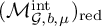 $(\mathcal {M}{}^{\mathrm {int}}_{{\mathcal {G}}, b, \mu })_{\mathrm {red}} $
, cf. [Reference GleasonGl21]. Then
$(\mathcal {M}{}^{\mathrm {int}}_{{\mathcal {G}}, b, \mu })_{\mathrm {red}} $
, cf. [Reference GleasonGl21]. Then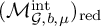 $(\mathcal {M} {}^{\mathrm {int}}_{{\mathcal {G}}, b, \mu })_{\mathrm {red}}$
is representable by a perfect k-scheme
$(\mathcal {M} {}^{\mathrm {int}}_{{\mathcal {G}}, b, \mu })_{\mathrm {red}}$
is representable by a perfect k-scheme $X_{{\mathcal {G}}}(b, \mu ^{-1})$
which can be identified with the admissible set (3.3.2) contained in the Witt vector affine Grassmannian
$X_{{\mathcal {G}}}(b, \mu ^{-1})$
which can be identified with the admissible set (3.3.2) contained in the Witt vector affine Grassmannian $X_{{\mathcal {G}}} =LG/L^+{\mathcal {G}} $
, cf. Proposition 3.3.1. The problem of determining the set of connected components of
$X_{{\mathcal {G}}} =LG/L^+{\mathcal {G}} $
, cf. Proposition 3.3.1. The problem of determining the set of connected components of $X_{{\mathcal {G}}} (b, \mu ^{-1})$
is of considerable interest.
$X_{{\mathcal {G}}} (b, \mu ^{-1})$
is of considerable interest.
Let ${\mathcal {G}} $
be a parahoric. Then there is a surjective map
${\mathcal {G}} $
be a parahoric. Then there is a surjective map
 $$ \begin{align} X_{{\mathcal{G}}} (b, \mu^{-1})\to c_{b, \mu}+\pi_1(G)_I^\phi , \end{align} $$
where $c_{b, \mu }\in \pi _1(G)_I$
is a certain element unique up to
$c_{b, \mu }\in \pi _1(G)_I$
is a certain element unique up to $\pi _1(G)_I^\phi $
, cf. [Reference He and ZhouHZ20, Lem. 6.1]. By a recent result of Gleason-Lim-Xu [Reference Gleason, Lim and XuGLX22, Thm. 1.2], the fibres of (2.5.2) are the connected components of
$\pi _1(G)_I^\phi $
, cf. [Reference He and ZhouHZ20, Lem. 6.1]. By a recent result of Gleason-Lim-Xu [Reference Gleason, Lim and XuGLX22, Thm. 1.2], the fibres of (2.5.2) are the connected components of $X_{{\mathcal {G}}} (b, \mu ^{-1})$
when
$X_{{\mathcal {G}}} (b, \mu ^{-1})$
when $(b, \mu )$
is Hodge-Newton irreducible (proving a conjecture of X. He). The map (2.5.2) is equivariant for the natural action of the
$(b, \mu )$
is Hodge-Newton irreducible (proving a conjecture of X. He). The map (2.5.2) is equivariant for the natural action of the $\phi $
-centraliser group
$\phi $
-centraliser group $J_b(\mathbb {Q} {}_p)$
on source and target. We prove the following result.
$J_b(\mathbb {Q} {}_p)$
on source and target. We prove the following result.
Proposition 2.5.8. Assume that the centre of G is connected. Then the action of $J_b(\mathbb {Q} {}_p)$
on
$J_b(\mathbb {Q} {}_p)$
on $c_{b, \mu }+\pi _1(G)_I^\phi $
is transitive. In particular, any two fibres of the map (2.5.2) are isomorphic.
$c_{b, \mu }+\pi _1(G)_I^\phi $
is transitive. In particular, any two fibres of the map (2.5.2) are isomorphic.
Composing (2.5.2) with the specialisation map (3.4.1) gives a $J_b(\mathbb {Q} {}_p)$
-equivariant map
$J_b(\mathbb {Q} {}_p)$
-equivariant map
 $$ \begin{align} \mathcal{M} {}^{\mathrm{int}}_{{\mathcal{G}}, b, \mu}\to \underline{c_{b, \mu}+\pi_1(G)_I^\phi}, \end{align} $$
where the target is the corresponding constant v-sheaf. Hence, if the centre of G is connected, any two fibres of the map (2.5.3) are also isomorphic.
2.6 The plan of the proof
The proof of the main theorems proceeds in the following steps.
-
• Step 1. We develop a devissage procedure that allows us to pass
a) between
${\mathcal {G}} $
and
${\mathcal {G}}{}^o$
.b) between groups linked via an ad-isomorphism.
In most of the statements in this step, we deal with integral local shtuka data
$({\mathcal {G}}, b, \mu )$
, i.e., we do not assume that
$\mu $
is minuscule. -
• Step 2. We show the results in ‘good’ Hodge type cases: In such cases, the proof follows from the case of
$\mathrm {GL}_n$
(already treated in [Reference Scholze and WeinsteinSW20] by relating to RZ formal schemes) and from the constructions in [Reference Kisin and PappasKP18], [Reference Kisin and ZhouKZ21], [Reference Kisin, Pappas and ZhouKPZ24] (which use Zink displays and Breuil-Kisin modules). -
• Step 3. Using Step 1 we reduce the general case to:
a) the Hodge type cases handled in Step 2, (in case (A)),
b) EL/PEL cases for which we give directly
$\mathscr {M}{}_{{\mathcal {G}}, b,\mu }$
as a Rapoport-Zink formal scheme, (in case (B)).


2.7 The lay-out of the paper
In §3, we generalise the Anschütz purity theorem from parahoric group schemes to quasi-parahoric group schemes, and use this to transfer to this more general context the formalism of specialisation, formal completion and v-sheaf local model diagram that Gleason had established for hyperspecial parahoric ${\mathcal {G}}$
. We also make the link between the reduced locus of
${\mathcal {G}}$
. We also make the link between the reduced locus of $ \mathcal {M}{}^{\mathrm {int}}_{{\mathcal {G}}, b, \mu }$
and affine Deligne-Lusztig varieties for quasi-parahorics. In §4, we study the devissage step of varying the quasi-parahorics with a given associated parahoric. We also prove at this point Theorem 2.5.7. In §5, we study the devissage step of varying the groups with a given adjoint group. In §6 we treat the case when
$ \mathcal {M}{}^{\mathrm {int}}_{{\mathcal {G}}, b, \mu }$
and affine Deligne-Lusztig varieties for quasi-parahorics. In §4, we study the devissage step of varying the quasi-parahorics with a given associated parahoric. We also prove at this point Theorem 2.5.7. In §5, we study the devissage step of varying the groups with a given adjoint group. In §6 we treat the case when $\mu _{\mathrm {ad}}$
is trivial. In §7 we consider the crucial Hodge type case mentioned in the introduction. In §7.2, we develop methods to relate Hodge type cases and abelian type cases to the crucial Hodge type case. Everything comes together in §8, where we give the proofs of Theorems 2.5.4 and 2.5.5; this is done separately for G satisfying Condition (A) and (B).
$\mu _{\mathrm {ad}}$
is trivial. In §7 we consider the crucial Hodge type case mentioned in the introduction. In §7.2, we develop methods to relate Hodge type cases and abelian type cases to the crucial Hodge type case. Everything comes together in §8, where we give the proofs of Theorems 2.5.4 and 2.5.5; this is done separately for G satisfying Condition (A) and (B).
3 Preliminaries
3.1 Torsors under quasi-parahoric group schemes
Let $\Omega =\Omega _G=\pi _1(G)_I$
(coinvariants of the algebraic fundamental group under the inertia group, cf., e.g., [Reference Pappas and RapoportPR08, §3]). We recall the Kottwitz homomorphism
$\Omega =\Omega _G=\pi _1(G)_I$
(coinvariants of the algebraic fundamental group under the inertia group, cf., e.g., [Reference Pappas and RapoportPR08, §3]). We recall the Kottwitz homomorphism
 $$ \begin{align*}\kappa\colon G(\breve{\mathbb{Q}}{}_p)\to \Omega_G. \end{align*} $$
A parahoric subgroup lies in the kernel of $\kappa $
and in fact, the kernel of
$\kappa $
and in fact, the kernel of $\kappa $
is generated by all parahoric subgroups, cf. [Reference Haines and RapoportHR08, Lem. 17]. Also, for any quasi-parahoric subgroup
$\kappa $
is generated by all parahoric subgroups, cf. [Reference Haines and RapoportHR08, Lem. 17]. Also, for any quasi-parahoric subgroup $\breve K$
of
$\breve K$
of $G(\breve {\mathbb {Q}}{}_p)$
with associated parahoric subgroup
$G(\breve {\mathbb {Q}}{}_p)$
with associated parahoric subgroup $\breve K^o$
we have
$\breve K^o$
we have $\breve K^o=\ker (\kappa _{| \breve K}\colon \breve K\to \Omega )$
. Let
$\breve K^o=\ker (\kappa _{| \breve K}\colon \breve K\to \Omega )$
. Let ${\mathcal {G}}$
be the corresponding quasi-parahoric group scheme and consider the injective map
${\mathcal {G}}$
be the corresponding quasi-parahoric group scheme and consider the injective map
 $$ \begin{align} \pi_0({\mathcal{G}})=\breve K/\breve K^o\hookrightarrow \Omega_G. \end{align} $$
In [Reference Scholze and WeinsteinSW20, 25.3.1], Scholze-Weinstein point out the importance of the finite abelian group,
 $$ \begin{align} \Pi_{{\mathcal{G}}}:=\mathrm{ker}(\pi_0({\mathcal{G}})_\phi\to \Omega_\phi) \end{align} $$
(coinvariants under the action of $\phi $
).
$\phi $
).
Lemma 3.1.1. There is a natural isomorphism
 $$\begin{align*}\Pi_{{\mathcal{G}}} \cong \ker(\mathrm{H}^1_{{{{\acute{\mathrm{e}}}\mathrm{t}}}}(\mathbb{Z}_p, {\mathcal{G}})\to \mathrm{ H}^1_{{{{\acute{\mathrm{e}}}\mathrm{t}}}}(\mathbb{Q}_p, G)) \end{align*}$$
Proof. This is sketched in [Reference Scholze and WeinsteinSW20, 25.3]. The exact sequence $0\to \breve K^o\to \breve K\to \pi _0({\mathcal {G}} )\to 0$
induces an exact sequence
$0\to \breve K^o\to \breve K\to \pi _0({\mathcal {G}} )\to 0$
induces an exact sequence
 $$\begin{align*}\mathrm{H}^1_{{\text{\'{e}t}}}(\mathbb{Z}{}_p, {\mathcal{G}}{}^o)\to \mathrm{H}^1_{{\text{\'{e}t}}}(\mathbb{Z}{}_p, {\mathcal{G}})\to \mathrm{H}^1_{{\text{\'{e}t}}}(\mathbb{Z}{}_p, \pi_0({\mathcal{G}})). \end{align*}$$
Here the left term vanishes by Lang’s theorem. The second map is surjective since $\mathrm {H}^1_{{\text {\'{e}t}}}(\mathbb {Z} {}_p, {\mathcal {G}} )=\breve K/_{\!\!\phi }\breve K$
. We therefore obtain
$\mathrm {H}^1_{{\text {\'{e}t}}}(\mathbb {Z} {}_p, {\mathcal {G}} )=\breve K/_{\!\!\phi }\breve K$
. We therefore obtain
 $$ \begin{align*}\mathrm{H}^1_{{\text{\'{e}t}}}(\mathbb{Z} {}_p, {\mathcal{G}} )\simeq \mathrm{H}^1_{{\text{\'{e}t}}}(\mathbb{F} {}_p, \pi_0({\mathcal{G}} ))\simeq \mathrm{H}^1(\langle \phi\rangle, \pi_0({\mathcal{G}} ))\cong \pi_0({\mathcal{G}} )_\phi. \end{align*} $$
On the other hand, we have an injection
 $$ \begin{align} \mathrm{H}^1_{{\text{\'{e}t}}}(\mathbb{Q} {}_p, G)\hookrightarrow \mathrm{H}^1(\langle \phi\rangle, G(\breve{\mathbb{Q}} {}_p))\cong B(G) \end{align} $$
with the image landing in the basic elements $B(G)_{\mathrm {basic}}\subset B(G)$
, cf. [Reference KottwitzKo97]. Now
$B(G)_{\mathrm {basic}}\subset B(G)$
, cf. [Reference KottwitzKo97]. Now
 $$\begin{align*}B(G)_{\mathrm{basic}}\simeq \pi_1(G)_\Gamma=(\pi_1(G)_I)_\phi=\Omega_\phi, \end{align*}$$
and the map (3.1.3) induces an identification
 $$\begin{align*}\mathrm{H}^1_{{\text{\'{e}t}}}(\mathbb{Q}{}_p, G)\simeq \Omega_{\phi, \mathrm{tors}} , \end{align*}$$
where $\Omega _{\phi , \mathrm {tors}}$
is the torsion subgroup of
$\Omega _{\phi , \mathrm {tors}}$
is the torsion subgroup of $\Omega _\phi $
. It remains to observe that the following diagram is commutative,
$\Omega _\phi $
. It remains to observe that the following diagram is commutative,

This commutativity follows from the fact that the vertical homomorphisms on the outer left and the outer right are both induced by the Kottwitz homomorphism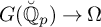 $G(\breve {\mathbb {Q}} {}_p)\to \Omega $
: this is obvious from the construction for the outer left map and follows from [Reference KottwitzKo97, §7.5] for the outer right map.
$G(\breve {\mathbb {Q}} {}_p)\to \Omega $
: this is obvious from the construction for the outer left map and follows from [Reference KottwitzKo97, §7.5] for the outer right map.
3.2 Purity of torsors
The following purity/extension result is crucial. It is a quick generalisation of the corresponding result for parahoric subgroups due to Anschütz ([Reference AnschützAn22]).
Proposition 3.2.1. Suppose ${\mathcal {G}} $
is a quasi-parahoric group scheme over
${\mathcal {G}} $
is a quasi-parahoric group scheme over $\mathbb {Z} {}_p$
, and consider a pair
$\mathbb {Z} {}_p$
, and consider a pair $(C, C^+)$
with C an algebraically closed non-archimedean complete field of characteristic p and
$(C, C^+)$
with C an algebraically closed non-archimedean complete field of characteristic p and $C^+$
an open and bounded valuation ring of C. Then every
$C^+$
an open and bounded valuation ring of C. Then every ${\mathcal {G}} $
-torsor over
${\mathcal {G}} $
-torsor over $U=\operatorname {\mbox {Spec }}(W(C^+))\setminus V(p, [\varpi ])$
extends to a
$U=\operatorname {\mbox {Spec }}(W(C^+))\setminus V(p, [\varpi ])$
extends to a ${\mathcal {G}} $
-torsor over
${\mathcal {G}} $
-torsor over $\operatorname {\mbox {Spec }}(W(C^+))$
and hence is trivial.
$\operatorname {\mbox {Spec }}(W(C^+))$
and hence is trivial.
Here $\varpi $
denotes a pseudouniformiser of
$\varpi $
denotes a pseudouniformiser of $C^+$
.
$C^+$
.
Proof. We have an exact sequence
 $$\begin{align*}1\to {\mathcal{G}} {}^o\to {\mathcal{G}} \to i_*(\pi_0({\mathcal{G}} ))\to 1 \end{align*}$$
of étale sheaves, where $i: \operatorname {\mbox {Spec }}(k)\hookrightarrow \operatorname {\mbox {Spec }}(\breve {\mathbb {Z}} {}_p)$
. Note
$i: \operatorname {\mbox {Spec }}(k)\hookrightarrow \operatorname {\mbox {Spec }}(\breve {\mathbb {Z}} {}_p)$
. Note $U\times _{\operatorname {\mbox {Spec }}(\breve {\mathbb {Z}} {}_p)}\operatorname {\mbox {Spec }}(k)=\operatorname {\mbox {Spec }}(C^+[1/\varpi ])=\operatorname {\mbox {Spec }}(C)$
. This gives the exact sequence
$U\times _{\operatorname {\mbox {Spec }}(\breve {\mathbb {Z}} {}_p)}\operatorname {\mbox {Spec }}(k)=\operatorname {\mbox {Spec }}(C^+[1/\varpi ])=\operatorname {\mbox {Spec }}(C)$
. This gives the exact sequence
 $$\begin{align*}\mathrm{H}^1(U, {\mathcal{G}} {}^o)\to \mathrm{H}^1(U, {\mathcal{G}} )\to \mathrm{H}^1(U, i_*(\pi_0({\mathcal{G}} )))=\mathrm{H}^1(\operatorname{\mbox{Spec }}(C), \pi_0({\mathcal{G}} ))=(0). \end{align*}$$
By Anschütz’s theorem [Reference AnschützAn22], $\mathrm {H}^1(U, {\mathcal {G}} {}^o)=(0)$
and the result follows.
$\mathrm {H}^1(U, {\mathcal {G}} {}^o)=(0)$
and the result follows.
This extends as follows to strictly totally disconnected affinoid perfectoids which are given as ‘products of points’.
Proposition 3.2.2. Let $(R, R^+)$
be a “product of the points
$(R, R^+)$
be a “product of the points $(C_i, C^+_i)$
,
$(C_i, C^+_i)$
, $i\in I$
”, with all
$i\in I$
”, with all $C_i$
algebraically closed of characteristic p, i.e.,
$C_i$
algebraically closed of characteristic p, i.e., $R^+=\prod _{i\in I}C_i^+$
,
$R^+=\prod _{i\in I}C_i^+$
, $R=R^+[1/\varpi ]$
, with the
$R=R^+[1/\varpi ]$
, with the $\varpi $
-topology, where
$\varpi $
-topology, where $\varpi =(\varpi _i)_i$
, with
$\varpi =(\varpi _i)_i$
, with $\varpi _i$
pseudouniformisers of
$\varpi _i$
pseudouniformisers of $C^+_i$
. Then every
$C^+_i$
. Then every ${\mathcal {G}}$
-torsor over
${\mathcal {G}}$
-torsor over $\operatorname {\mbox {Spec }}(W(R^+))\setminus V(p, [\varpi ])$
extends to a
$\operatorname {\mbox {Spec }}(W(R^+))\setminus V(p, [\varpi ])$
extends to a ${\mathcal {G}} $
-torsor over
${\mathcal {G}} $
-torsor over $\operatorname {\mbox {Spec }}(W(R^+))$
and is trivial.
$\operatorname {\mbox {Spec }}(W(R^+))$
and is trivial.
Proof. In the parahoric case ${\mathcal {G}} ={\mathcal {G}} {}^o$
, the extension follows from [Reference AnschützAn22, Prop. 11.5], see also [Reference GleasonGl21, Thm. 2.8]. Observe that all étale covers of
${\mathcal {G}} ={\mathcal {G}} {}^o$
, the extension follows from [Reference AnschützAn22, Prop. 11.5], see also [Reference GleasonGl21, Thm. 2.8]. Observe that all étale covers of
 $$\begin{align*}\operatorname{\mbox{Spec }}(R^+)=\operatorname{\mbox{Spec }}(\prod_{i\in I}C_i^+ ) \end{align*}$$
split. Indeed, as in the proof of [Reference Bhatt and ScholzeBS17, Lem. 6.2], we can consider
 $$\begin{align*}\operatorname{\mbox{Spec }}(\prod_{i\in I}C_i^+)\to \pi_0(\operatorname{\mbox{Spec }}(\prod_i C_i^+))=\pi_0(\operatorname{\mbox{Spec }}(\prod_i k_i))=\beta I \end{align*}$$
where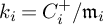 $k_i=C_i^+/\mathfrak {m} {}_i$
is the (algebraically closed) residue field. Here,
$k_i=C_i^+/\mathfrak {m} {}_i$
is the (algebraically closed) residue field. Here, $\beta I$
is the Stone-Čech compactification of the discrete set I. Each connected component of
$\beta I$
is the Stone-Čech compactification of the discrete set I. Each connected component of $\operatorname {\mbox {Spec }}(R^+)$
(i.e., fibre of this map) is the spectrum of a valuation ring V with algebraically closed fraction field K; this valuation ring is an ultraproduct of
$\operatorname {\mbox {Spec }}(R^+)$
(i.e., fibre of this map) is the spectrum of a valuation ring V with algebraically closed fraction field K; this valuation ring is an ultraproduct of $C^+_i$
. It follows that all étale covers of
$C^+_i$
. It follows that all étale covers of $\operatorname {\mbox {Spec }}(V)$
and then also of
$\operatorname {\mbox {Spec }}(V)$
and then also of $\operatorname {\mbox {Spec }}(R^+)$
split. (We see that
$\operatorname {\mbox {Spec }}(R^+)$
split. (We see that $R^+$
is ‘strictly w-local’ in the terminology of [Reference Bhatt and ScholzeBS15, 2.2], and, in fact,
$R^+$
is ‘strictly w-local’ in the terminology of [Reference Bhatt and ScholzeBS15, 2.2], and, in fact, $\operatorname {\mbox {Spec }}(R^+)$
is ‘w-contractible’, [Reference Bhatt and ScholzeBS15, Lem. 2.4.8].)
$\operatorname {\mbox {Spec }}(R^+)$
is ‘w-contractible’, [Reference Bhatt and ScholzeBS15, Lem. 2.4.8].)
A similar picture holds for $R=R^+[1/\varpi ]$
: in this case, we have
$R=R^+[1/\varpi ]$
: in this case, we have
 $$\begin{align*}\pi_0(\operatorname{\mbox{Spec }}(R))\simeq \pi_0(\operatorname{\mbox{Spec }}(R^+))\simeq \beta I\end{align*}$$
(by considering idempotents) and
 $$\begin{align*}\operatorname{\mbox{Spec }}(R)\to \pi_0(\operatorname{\mbox{Spec }}(R))\simeq \beta I, \end{align*}$$
has every fibre isomorphic to $\operatorname {\mbox {Spec }}(V[1/\varpi ])$
, with
$\operatorname {\mbox {Spec }}(V[1/\varpi ])$
, with $V[1/\varpi ]$
a valuation ring with (algebraically closed) fraction field K. Étale covers over each such
$V[1/\varpi ]$
a valuation ring with (algebraically closed) fraction field K. Étale covers over each such $\operatorname {\mbox {Spec }}(V[1/\varpi ])$
split, and then étale covers over
$\operatorname {\mbox {Spec }}(V[1/\varpi ])$
split, and then étale covers over $\operatorname {\mbox {Spec }}(R)$
also split.
$\operatorname {\mbox {Spec }}(R)$
also split.
Now it also follows that every ${\mathcal {G}} $
-torsor over
${\mathcal {G}} $
-torsor over $\operatorname {\mbox {Spec }}(W(R^+))$
is trivial. Indeed, since
$\operatorname {\mbox {Spec }}(W(R^+))$
is trivial. Indeed, since ${\mathcal {G}} $
is smooth and
${\mathcal {G}} $
is smooth and $W(R^+)$
is p-adically complete, it is enough to show that all
$W(R^+)$
is p-adically complete, it is enough to show that all ${\mathcal {G}} $
-torsors over
${\mathcal {G}} $
-torsors over $R^+=\prod _{i\in I} C^+_i$
are trivial. As above, we see that all étale covers of
$R^+=\prod _{i\in I} C^+_i$
are trivial. As above, we see that all étale covers of $\operatorname {\mbox {Spec }}(R^+)$
split and so this follows using the smoothness of
$\operatorname {\mbox {Spec }}(R^+)$
split and so this follows using the smoothness of ${\mathcal {G}} $
; the same applies of course to
${\mathcal {G}} $
; the same applies of course to ${\mathcal {G}} {}^o$
-torsors. The argument in the proof of Proposition 3.2.1 above now extends to
${\mathcal {G}} {}^o$
-torsors. The argument in the proof of Proposition 3.2.1 above now extends to $U=\operatorname {\mbox {Spec }}(W(R^+))\setminus V(p,[\varpi ])$
, to complete the proof.
$U=\operatorname {\mbox {Spec }}(W(R^+))\setminus V(p,[\varpi ])$
, to complete the proof.
3.3 The affine Witt Grassmannian and affine Deligne-Lusztig varieties
Let
 $$ \begin{align} X_{{\mathcal{G}}} :=\mathrm{Gr}^W_{{\mathcal{G}}} =LG/L^+{\mathcal{G}} \end{align} $$
be the Witt vector affine Grassmannian for ${\mathcal {G}} $
, cf. [Reference Bhatt and ScholzeBS17, Reference ZhuZhu17]. Here
${\mathcal {G}} $
, cf. [Reference Bhatt and ScholzeBS17, Reference ZhuZhu17]. Here $LG(R)=G(W(R)[\frac {1}{p}])$
and
$LG(R)=G(W(R)[\frac {1}{p}])$
and $L^+{\mathcal {G}} (R)={\mathcal {G}} (W(R))$
for any perfect k-algebra R. Note that here
$L^+{\mathcal {G}} (R)={\mathcal {G}} (W(R))$
for any perfect k-algebra R. Note that here ${\mathcal {G}} $
is only assumed to be a quasi-parahoric group scheme, whereas in loc. cit. it is assumed that
${\mathcal {G}} $
is only assumed to be a quasi-parahoric group scheme, whereas in loc. cit. it is assumed that ${\mathcal {G}} $
is a parahoric group scheme. Also, note that k-points of
${\mathcal {G}} $
is a parahoric group scheme. Also, note that k-points of $X_{{\mathcal {G}}} $
are given by isomorphism classes of pairs
$X_{{\mathcal {G}}} $
are given by isomorphism classes of pairs $(\mathcal {P}, \alpha )$
of a
$(\mathcal {P}, \alpha )$
of a ${\mathcal {G}} $
-torsor
${\mathcal {G}} $
-torsor $\mathcal {P} $
over
$\mathcal {P} $
over $W(k)$
with a trivialisation
$W(k)$
with a trivialisation $\alpha $
of its restriction to
$\alpha $
of its restriction to $W(k)[1/p]$
.
$W(k)[1/p]$
.
Let $({\mathcal {G}}, b, \mu )$
be an integral local shtuka datum such that
$({\mathcal {G}}, b, \mu )$
be an integral local shtuka datum such that ${\mathcal {G}} $
is a quasi-parahoric group scheme for G. Inside the Witt vector affine Grassmannian we consider the affine Deligne-Lusztig variety
${\mathcal {G}} $
is a quasi-parahoric group scheme for G. Inside the Witt vector affine Grassmannian we consider the affine Deligne-Lusztig variety $X_{{\mathcal {G}} }(b, \mu ^{-1})$
(the
$X_{{\mathcal {G}} }(b, \mu ^{-1})$
(the $\mu ^{-1}$
-admissible locus). This is a perfect scheme which is locally (perfectly) of finite type (cf. [Reference ZhuZhu17], [Reference Hamacher and ViehmannHV20]) over k with
$\mu ^{-1}$
-admissible locus). This is a perfect scheme which is locally (perfectly) of finite type (cf. [Reference ZhuZhu17], [Reference Hamacher and ViehmannHV20]) over k with
 $$ \begin{align} X_{{\mathcal{G}} }(b, \mu^{-1})(k)=\{g\breve K\in G(\breve{\mathbb{Q}} {}_p)/\breve K\mid g^{-1}b\phi(g)\in \mathrm{ {Adm}}^K(\mu^{-1})\}\subset X_{{\mathcal{G}}} (k). \end{align} $$
Here $\mathrm {{Adm}}^K(\mu ^{-1})=\breve K\mathrm {{Adm}}(\mu ^{-1})\breve K$
, where
$\mathrm {{Adm}}^K(\mu ^{-1})=\breve K\mathrm {{Adm}}(\mu ^{-1})\breve K$
, where $\mathrm {{Adm}}(\mu ^{-1})\subset \widetilde W$
is the
$\mathrm {{Adm}}(\mu ^{-1})\subset \widetilde W$
is the $\mu ^{-1}$
-admissible subset of the Iwahori Weyl group of G.
$\mu ^{-1}$
-admissible subset of the Iwahori Weyl group of G.
Proposition 3.3.1. Let $({\mathcal {G}}, b, \mu )$
be an integral local shtuka datum such that
$({\mathcal {G}}, b, \mu )$
be an integral local shtuka datum such that ${\mathcal {G}} $
is a quasi-parahoric group scheme for G. Then the reduced locus
${\mathcal {G}} $
is a quasi-parahoric group scheme for G. Then the reduced locus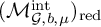 $(\mathcal {M} {}^{\mathrm {int}}_{{\mathcal {G}}, b, \mu })_{\mathrm {red}} $
is represented by the perfect k-scheme
$(\mathcal {M} {}^{\mathrm {int}}_{{\mathcal {G}}, b, \mu })_{\mathrm {red}} $
is represented by the perfect k-scheme $X_{{\mathcal {G}} }(b, \mu ^{-1}) $
, and hence
$X_{{\mathcal {G}} }(b, \mu ^{-1}) $
, and hence
 $$\begin{align*}\mathcal{M} {}^{\mathrm{int}}_{{\mathcal{G}}, b, \mu}(\mathrm{Spd}(k))=X_{{\mathcal{G}}}(b, \mu^{-1})(k). \end{align*}$$
Proof. Here, the reduced locus $\mathcal {F} {}_{\mathrm {red}} $
of a small v-sheaf
$\mathcal {F} {}_{\mathrm {red}} $
of a small v-sheaf $\mathcal {F} $
is a ‘scheme-theoretic’ v-sheaf which is defined as in [Reference GleasonGl25, Def. 3.12]. For parahoric
$\mathcal {F} $
is a ‘scheme-theoretic’ v-sheaf which is defined as in [Reference GleasonGl25, Def. 3.12]. For parahoric ${\mathcal {G}} $
the proposition is shown in [Reference GleasonGl21], cf. [Reference GleasonGl21, Prop. 2.30]. One main ingredient in the proof of this is the Anschütz purity theorem for
${\mathcal {G}} $
the proposition is shown in [Reference GleasonGl21], cf. [Reference GleasonGl21, Prop. 2.30]. One main ingredient in the proof of this is the Anschütz purity theorem for ${\mathcal {G}} $
and its extension to products of points. By Propositions 3.2.1 and 3.2.2, these purity statements remain true for quasi-parahoric group schemes. Also, by [Reference Anschütz, Gleason, Lourenço and RicharzAGLR22, Thm. 6.16] combined with (2.3.1), the reduced locus
${\mathcal {G}} $
and its extension to products of points. By Propositions 3.2.1 and 3.2.2, these purity statements remain true for quasi-parahoric group schemes. Also, by [Reference Anschütz, Gleason, Lourenço and RicharzAGLR22, Thm. 6.16] combined with (2.3.1), the reduced locus $(\mathbb {M} {}^v_{{\mathcal {G}}, \mu })_{\mathrm {red}} $
is represented by the perfect k-scheme which is the
$(\mathbb {M} {}^v_{{\mathcal {G}}, \mu })_{\mathrm {red}} $
is represented by the perfect k-scheme which is the $\mu $
-admissible locus in
$\mu $
-admissible locus in $X_{{\mathcal {G}}} $
. With these ingredients, the proof in [Reference GleasonGl21] now extends to this case.
$X_{{\mathcal {G}}} $
. With these ingredients, the proof in [Reference GleasonGl21] now extends to this case.
Remark 3.3.2. In the identification of Prop. 3.3.1 above, the inverse $\mu ^{-1}$
appears on the RHS because of the convention in the definition of ‘bounded by
$\mu ^{-1}$
appears on the RHS because of the convention in the definition of ‘bounded by $\mu $
’ for
$\mu $
’ for ${\mathcal {G}} $
-shtuka, comp. [Reference Pappas and RapoportPR24, 2.4.4].
${\mathcal {G}} $
-shtuka, comp. [Reference Pappas and RapoportPR24, 2.4.4].
3.4 The specialisation map and formal completions
Gleason explains certain conditions on a small v-sheaf $\mathcal {F} $
to construct a continuous specialisation map on the underlying spaces,
$\mathcal {F} $
to construct a continuous specialisation map on the underlying spaces,
 $$ \begin{align*} { \mathrm sp}_{\mathcal{F}} \colon |\mathcal{F} |\to |\mathcal{F} {}_{\mathrm{red}} | , \end{align*} $$
cf. [Reference GleasonGl25, §4.2], see also [Reference Anschütz, Gleason, Lourenço and RicharzAGLR22, §2.3].
Furthermore, he proves that these conditions are satisfied when $\mathcal {F} =\mathbb {M} {}^v_{{\mathcal {G}}, \mu }$
with
$\mathcal {F} =\mathbb {M} {}^v_{{\mathcal {G}}, \mu }$
with ${\mathcal {G}} $
reductive (hyperspecial parahoric). This result is extended to parahoric
${\mathcal {G}} $
reductive (hyperspecial parahoric). This result is extended to parahoric ${\mathcal {G}} $
by [Reference Anschütz, Gleason, Lourenço and RicharzAGLR22, Prop. 4.14]. In view of (2.3.1), it also holds for quasi-parahoric
${\mathcal {G}} $
by [Reference Anschütz, Gleason, Lourenço and RicharzAGLR22, Prop. 4.14]. In view of (2.3.1), it also holds for quasi-parahoric ${\mathcal {G}} $
. The scheme-theoretic v-sheaf
${\mathcal {G}} $
. The scheme-theoretic v-sheaf $(\mathbb {M} {}^v_{{\mathcal {G}}, \mu })_{\mathrm {red}} $
is represented by a perfect k-scheme (by [Reference Anschütz, Gleason, Lourenço and RicharzAGLR22] this is the
$(\mathbb {M} {}^v_{{\mathcal {G}}, \mu })_{\mathrm {red}} $
is represented by a perfect k-scheme (by [Reference Anschütz, Gleason, Lourenço and RicharzAGLR22] this is the $\mu $
-admissible locus) which is a closed subscheme of the Witt affine Grassmannian
$\mu $
-admissible locus) which is a closed subscheme of the Witt affine Grassmannian $X_{{\mathcal {G}}} =\mathrm {Gr}^W_{{\mathcal {G}}} $
.
$X_{{\mathcal {G}}} =\mathrm {Gr}^W_{{\mathcal {G}}} $
.
By [Reference GleasonGl21, Prop. 2.30], these conditions are also satisfied in the case when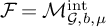 $\mathcal {F} =\mathcal {M} {}^{\mathrm {int}}_{{\mathcal {G}}, b, \mu }$
where
$\mathcal {F} =\mathcal {M} {}^{\mathrm {int}}_{{\mathcal {G}}, b, \mu }$
where ${\mathcal {G}} $
is a hyperspecial parahoric subgroup. Again, one main ingredient is the Anschütz purity theorem for
${\mathcal {G}} $
is a hyperspecial parahoric subgroup. Again, one main ingredient is the Anschütz purity theorem for ${\mathcal {G}} $
and its extension to product of points. By Propositions 3.2.1 and 3.2.2, these purity statements remain true for quasi-parahoric group schemes, and the proof extends.
${\mathcal {G}} $
and its extension to product of points. By Propositions 3.2.1 and 3.2.2, these purity statements remain true for quasi-parahoric group schemes, and the proof extends.
In fact, by Proposition 3.3.1,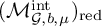 $(\mathcal {M}{}^{\mathrm {int}}_{{\mathcal {G}}, b, \mu })_{\mathrm {red}} $
is represented by the affine Deligne-Lusztig variety (ADLV)
$(\mathcal {M}{}^{\mathrm {int}}_{{\mathcal {G}}, b, \mu })_{\mathrm {red}} $
is represented by the affine Deligne-Lusztig variety (ADLV) $X_{{\mathcal {G}}} (b, \mu ^{-1})$
in the Witt affine Grassmannian
$X_{{\mathcal {G}}} (b, \mu ^{-1})$
in the Witt affine Grassmannian $X_{{\mathcal {G}}} $
. Hence we get a continuous map
$X_{{\mathcal {G}}} $
. Hence we get a continuous map
 $$ \begin{align} \mathrm{sp}_{\mathcal{M} {}^{\mathrm{int}}_{{\mathcal{G}} , b, \mu}}\colon |\mathcal{M} {}^{\mathrm{int}}_{{\mathcal{G}}, b, \mu}|\to |(\mathcal{M} {}^{\mathrm{int}}_{{\mathcal{G}}, b, \mu})_{\mathrm{red}}|=|X_{{\mathcal{G}}}(b,\mu^{-1})|. \end{align} $$
Using this, we define the formal completion of $\mathcal {M} {}^{\mathrm {int}}_{{\mathcal {G}}, b, \mu }$
along a point
$\mathcal {M} {}^{\mathrm {int}}_{{\mathcal {G}}, b, \mu }$
along a point $x\in \mathcal {M} {}^{\mathrm {int}}_{{\mathcal {G}}, b, \mu }(\mathrm{Spd}(k))=X_{{\mathcal {G}}} (b, \mu ^{-1})(k)$
as the sub-v-sheaf of
$x\in \mathcal {M} {}^{\mathrm {int}}_{{\mathcal {G}}, b, \mu }(\mathrm{Spd}(k))=X_{{\mathcal {G}}} (b, \mu ^{-1})(k)$
as the sub-v-sheaf of $\mathcal {M}{}^{\mathrm {int}}_{{\mathcal {G}}, b, \mu }$
, with
$\mathcal {M}{}^{\mathrm {int}}_{{\mathcal {G}}, b, \mu }$
, with
 $$ \begin{align*}\mathcal{M} {}^{\mathrm{int}}_{{\mathcal{G}} , b, \mu/x}(S)=\{y\colon S\to \mathcal{M} {}^{\mathrm{int}}_{{\mathcal{G}} , b, \mu}\mid { \mathrm sp}_{\mathcal{M} {}^{\mathrm{int}}_{{\mathcal{G}} , b, \mu}}\circ y(|S|)\subset \{x\} \}. \end{align*} $$
Similarly, we can define the formal completion $\mathbb {M} {}^v_{{\mathcal {G}}, \mu /y}$
of
$\mathbb {M} {}^v_{{\mathcal {G}}, \mu /y}$
of $\mathbb {M} {}^v_{{\mathcal {G}}, \mu }$
along a point
$\mathbb {M} {}^v_{{\mathcal {G}}, \mu }$
along a point
 $$\begin{align*}y\in \mathbb{M} {}^v_{{\mathcal{G}} , \mu}(\mathrm{Spd}(k))\subset X_{{\mathcal{G}}}(k)=G(W(k)[1/p])/{\mathcal{G}}(W(k)). \end{align*}$$
Using the condition ‘bounded by $\mu $
’, we obtain a map
$\mu $
’, we obtain a map
 $$ \begin{align} \ell: \mathcal{M} {}^{\mathrm{int}}_{{\mathcal{G}} , b, \mu}(\mathrm{Spd}(k))\to {\mathcal{G}}(W(k))\backslash \mathbb{M} {}^v_{{\mathcal{G}} , \mu}(\mathrm{Spd}(k)). \end{align} $$
The set of orbits which appears as the target of $\ell $
is the
$\ell $
is the $\mu $
-admissible set for K. The image of a point in
$\mu $
-admissible set for K. The image of a point in $\mathcal {M} {}^{\mathrm {int}}_{{\mathcal {G}}, b, \mu }(\mathrm{Spd}(k))$
under
$\mathcal {M} {}^{\mathrm {int}}_{{\mathcal {G}}, b, \mu }(\mathrm{Spd}(k))$
under $\ell $
is obtained by choosing a trivialisation of the
$\ell $
is obtained by choosing a trivialisation of the ${\mathcal {G}}$
-shtuka and taking the coset given by the inverse of the Frobenius map.
${\mathcal {G}}$
-shtuka and taking the coset given by the inverse of the Frobenius map.
If $\mu $
is minuscule, then
$\mu $
is minuscule, then $\mathbb {M}{}^v_{{\mathcal {G}}, \mu }$
is representable by the
$\mathbb {M}{}^v_{{\mathcal {G}}, \mu }$
is representable by the $O_E$
-scheme
$O_E$
-scheme $\mathbb {M} {}^{\mathrm {loc}}_{{\mathcal {G}}, \mu }$
([Reference Anschütz, Gleason, Lourenço and RicharzAGLR22]), and the formal completion
$\mathbb {M} {}^{\mathrm {loc}}_{{\mathcal {G}}, \mu }$
([Reference Anschütz, Gleason, Lourenço and RicharzAGLR22]), and the formal completion $\mathbb {M} {}^v_{{\mathcal {G}}, \mu /y}$
is given as
$\mathbb {M} {}^v_{{\mathcal {G}}, \mu /y}$
is given as $\mathrm{Spd}(A, A)$
, where A is the completion of the local ring of
$\mathrm{Spd}(A, A)$
, where A is the completion of the local ring of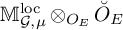 $\mathbb {M} {}^{\mathrm {loc}}_{{\mathcal {G}}, \mu }\otimes _{O_E}{\breve O_E}$
at the corresponding point, taken with the topology given by the maximal ideal. In this case, we also have
$\mathbb {M} {}^{\mathrm {loc}}_{{\mathcal {G}}, \mu }\otimes _{O_E}{\breve O_E}$
at the corresponding point, taken with the topology given by the maximal ideal. In this case, we also have
 $$\begin{align*}{\mathcal{G}} (W(k))\backslash \mathbb{M} {}^v_{{\mathcal{G}} , \mu}(\mathrm{Spd}(k))={\mathcal{G}} (k)\backslash \mathbb{M} {}^{\mathrm{loc}}_{{\mathcal{G}} , \mu}(k), \end{align*}$$
so $\ell (x)$
above can be also considered as a
$\ell (x)$
above can be also considered as a ${\mathcal {G}} (k)$
-orbit in
${\mathcal {G}} (k)$
-orbit in $\mathbb {M} {}^{\mathrm {loc}}_{{\mathcal {G}}, \mu }(k)$
.
$\mathbb {M} {}^{\mathrm {loc}}_{{\mathcal {G}}, \mu }(k)$
.
3.5 Change of base point
Note that, when $b\in \mathrm {Adm}^K(\mu ^{-1})$
, then
$b\in \mathrm {Adm}^K(\mu ^{-1})$
, then $\mathcal {M}{}^{\mathrm {int}}_{{\mathcal {G}}, b, \mu }$
has a canonical
$\mathcal {M}{}^{\mathrm {int}}_{{\mathcal {G}}, b, \mu }$
has a canonical $\mathrm{Spd}(k)$
-valued ‘base point’
$\mathrm{Spd}(k)$
-valued ‘base point’ $x_0$
. Under the identification
$x_0$
. Under the identification $\mathcal {M} {}^{\mathrm {int}}_{{\mathcal {G}}, b, \mu }(\mathrm{Spd}(k))=X_{{\mathcal {G}}} (b, \mu ^{-1})(k)\subset X_{{\mathcal {G}}}(k)$
it corresponds to the ‘base point’ of the ADLV given by the trivial coset.
$\mathcal {M} {}^{\mathrm {int}}_{{\mathcal {G}}, b, \mu }(\mathrm{Spd}(k))=X_{{\mathcal {G}}} (b, \mu ^{-1})(k)\subset X_{{\mathcal {G}}}(k)$
it corresponds to the ‘base point’ of the ADLV given by the trivial coset.
In general, let $x\in \mathcal {M}{}^{\mathrm {int}}_{{\mathcal {G}}, b, \mu }(\mathrm{Spd}(k))=X_{{\mathcal {G}}} (b, \mu ^{-1})(k)\subset X_{{\mathcal {G}}} (k)$
correspond to the isomorphism class of a pair
$x\in \mathcal {M}{}^{\mathrm {int}}_{{\mathcal {G}}, b, \mu }(\mathrm{Spd}(k))=X_{{\mathcal {G}}} (b, \mu ^{-1})(k)\subset X_{{\mathcal {G}}} (k)$
correspond to the isomorphism class of a pair $(\mathcal {P}, \alpha )$
, where
$(\mathcal {P}, \alpha )$
, where $\mathcal {P} $
is a
$\mathcal {P} $
is a ${\mathcal {G}} $
-torsor over
${\mathcal {G}} $
-torsor over $W(k)$
and
$W(k)$
and
 $$\begin{align*}\alpha: \mathcal{P} [1/p] \xrightarrow{\sim} {\mathcal{G}} \times \operatorname{\mbox{Spec }}(W(k)[1/p]) \end{align*}$$
is a trivialisation of the restriction $\mathcal {P} [1/p]$
of
$\mathcal {P} [1/p]$
of $\mathcal {P} $
to
$\mathcal {P} $
to $\operatorname {\mbox {Spec }}(W(k)[1/p])$
such that
$\operatorname {\mbox {Spec }}(W(k)[1/p])$
such that
 $$\begin{align*}\phi_{\mathcal{P}} =\alpha^{-1}\cdot \phi_b\cdot \phi^*(\alpha): \phi^*(\mathcal{P} )[1/p]\xrightarrow{\sim} \mathcal{P}[1/p] \end{align*}$$
has pole at $p=0$
bounded by
$p=0$
bounded by $\mu $
. Choose a trivialisation of the
$\mu $
. Choose a trivialisation of the ${\mathcal {G}} $
-torsor
${\mathcal {G}} $
-torsor $\mathcal {P} $
over
$\mathcal {P} $
over $W(k)$
. Then
$W(k)$
. Then $\alpha $
is given by
$\alpha $
is given by $g\in {\mathcal {G}} (W(k)[1/p])$
and
$g\in {\mathcal {G}} (W(k)[1/p])$
and $\phi _{\mathcal {P}} $
by
$\phi _{\mathcal {P}} $
by $b_x\times \phi \colon {\mathcal {G}} [1/p]\to {\mathcal {G}} [1/p]$
such that
$b_x\times \phi \colon {\mathcal {G}} [1/p]\to {\mathcal {G}} [1/p]$
such that $b_x=g^{-1}b\phi (g)$
. Hence we have
$b_x=g^{-1}b\phi (g)$
. Hence we have $b_x=g^{-1}b\phi (g)\in \mathrm { Adm}^K(\mu ^{-1})$
. We obtain an isomorphism
$b_x=g^{-1}b\phi (g)\in \mathrm { Adm}^K(\mu ^{-1})$
. We obtain an isomorphism
 $$\begin{align*}\tau_g\colon \mathcal{M} {}^{\mathrm{int}}_{{\mathcal{G}} , b, \mu}\to \mathcal{M} {}^{\mathrm{int}}_{{\mathcal{G}} , b_x, \mu} ,\quad (\mathscr{P}, \phi_{\mathscr{P}}, i_r)\mapsto (\mathscr{P} , \phi_{\mathscr{P}} , i_r\circ g^{-1}) \end{align*}$$
which sends x to the base point $x_0$
of
$x_0$
of $\mathcal {M} {}^{\mathrm {int}}_{{\mathcal {G}}, b_x, \mu }$
, cf. [Reference Pappas and RapoportPR24, proof of Prop. 3.4.1]. This gives an isomorphism (depending on our choices)
$\mathcal {M} {}^{\mathrm {int}}_{{\mathcal {G}}, b_x, \mu }$
, cf. [Reference Pappas and RapoportPR24, proof of Prop. 3.4.1]. This gives an isomorphism (depending on our choices)
 $$ \begin{align} \mathcal{M} {}^{\mathrm{int}}_{{\mathcal{G}} , b, \mu/x}\simeq \mathcal{M} {}^{\mathrm{int}}_{{\mathcal{G}} , b_x, \mu/x_0}. \end{align} $$
In particular, $ \mathcal {M} {}^{\mathrm {int}}_{{\mathcal {G}}, b, \mu /x}$
is representable (by a normal complete Noetherian local ring) for given
$ \mathcal {M} {}^{\mathrm {int}}_{{\mathcal {G}}, b, \mu /x}$
is representable (by a normal complete Noetherian local ring) for given ${\mathcal {G}} $
and any b in a given
${\mathcal {G}} $
and any b in a given $\phi $
-conjugacy class in
$\phi $
-conjugacy class in $B(G)$
and arbitrary
$B(G)$
and arbitrary $x\in \mathcal {M} {}^{\mathrm {int}}_{{\mathcal {G}}, b, \mu }(\mathrm{Spd}(k))$
if and only if this holds for the base point
$x\in \mathcal {M} {}^{\mathrm {int}}_{{\mathcal {G}}, b, \mu }(\mathrm{Spd}(k))$
if and only if this holds for the base point $x_0$
of
$x_0$
of $\mathcal {M} {}^{\mathrm {int}}_{{\mathcal {G}}, b, \mu }$
, for given
$\mathcal {M} {}^{\mathrm {int}}_{{\mathcal {G}}, b, \mu }$
, for given ${\mathcal {G}} $
and any
${\mathcal {G}} $
and any $b\in \mathrm {Adm}^K(\mu ^{-1})$
in the given
$b\in \mathrm {Adm}^K(\mu ^{-1})$
in the given $\phi $
-conjugacy class. Note that, by He’s theorem [Reference HeHe16], any
$\phi $
-conjugacy class. Note that, by He’s theorem [Reference HeHe16], any $\phi $
-conjugacy class
$\phi $
-conjugacy class $[b]\in B(G, \mu ^{-1})$
contains elements
$[b]\in B(G, \mu ^{-1})$
contains elements $b\in \mathrm {Adm}^K(\mu ^{-1})$
.
$b\in \mathrm {Adm}^K(\mu ^{-1})$
.
3.6 A v-sheaf ‘local model diagram’
Let $\mathcal {H} $
be an affine group scheme over
$\mathcal {H} $
be an affine group scheme over $\breve {\mathbb {Z}} {}_p$
. For an affinoid perfectoid
$\breve {\mathbb {Z}} {}_p$
. For an affinoid perfectoid $(R, R^+)$
over k, consider
$(R, R^+)$
over k, consider
 $$\begin{align*}\mathbb{W} {}^+\mathcal{H} (\mathrm{Spa}(R, R^+))=\mathcal{H} (W(R^+)), \end{align*}$$
and
 $$\begin{align*}\widehat{\mathbb{W}} {}^+\mathcal{H} (R, R^+)=\{h\in \mathcal{H} (W(R^+))\ |\ h\equiv 1\ \mathrm{mod}\, [\varpi_h]\}, \end{align*}$$
( $\varpi _h$
stands for some pseudouniformiser of
$\varpi _h$
stands for some pseudouniformiser of $R^+$
that depends on h).
$R^+$
that depends on h).
These definitions extend to perfectoid spaces over k and define v-sheaves of groups $\mathbb {W} {}^+\mathcal {H} $
and
$\mathbb {W} {}^+\mathcal {H} $
and $ \widehat {\mathbb {W}} {}^+\mathcal {H} $
on
$ \widehat {\mathbb {W}} {}^+\mathcal {H} $
on $\mathrm {Perfd}_k$
. We set
$\mathrm {Perfd}_k$
. We set
 $$\begin{align*}\widehat {L_W^+}\mathcal{H} = \widehat{\mathbb{W}} {}^+\mathcal{H} \times \mathrm{Spd}(\mathbb{Z} {}_p) \end{align*}$$
which is a v-sheaf of groups over $\mathrm{Spd}(\mathbb {Z} {}_p)$
. (This definition appears in [Reference GleasonGl25, 2.3.15].) We have
$\mathrm{Spd}(\mathbb {Z} {}_p)$
. (This definition appears in [Reference GleasonGl25, 2.3.15].) We have
 $$ \begin{align} \widehat {L_W^+}\mathcal{H} (S)=\{((S^\sharp, y), h)\ |\ h\in \mathcal{H} (W(R^+)),\ h\equiv 1\ {\mathrm {mod}}\, [\varpi_h] \}, \end{align} $$
where $S=\mathrm{Spa}(R, R^+)$
and
$S=\mathrm{Spa}(R, R^+)$
and $(S^\sharp , y)$
is an S-valued point of
$(S^\sharp , y)$
is an S-valued point of $\mathrm{Spd}(\mathbb {Z} {}_p)$
, and where
$\mathrm{Spd}(\mathbb {Z} {}_p)$
, and where $\varpi _h$
is a pseudouniformiser of
$\varpi _h$
is a pseudouniformiser of $R^+$
(that depends on h). Here,
$R^+$
(that depends on h). Here, $S^\sharp =\mathrm{Spa}(R^\sharp ,R^{\sharp +})$
together with
$S^\sharp =\mathrm{Spa}(R^\sharp ,R^{\sharp +})$
together with $y:(S^\sharp )^\flat \xrightarrow {\sim } S$
is an untilt of S, see [Reference Scholze and WeinsteinSW20, Prop. 11.3.1].
$y:(S^\sharp )^\flat \xrightarrow {\sim } S$
is an untilt of S, see [Reference Scholze and WeinsteinSW20, Prop. 11.3.1].
We will later need the following lemma.
Lemma 3.6.1. For each $h\in \widehat {\mathbb {W}} {}^+\mathcal {H} (R, R^+)$
, there is a unique
$h\in \widehat {\mathbb {W}} {}^+\mathcal {H} (R, R^+)$
, there is a unique $\lambda \in \widehat {\mathbb {W}} {}^+\mathcal {H} (R, R^+)$
such that
$\lambda \in \widehat {\mathbb {W}} {}^+\mathcal {H} (R, R^+)$
such that $ h=\lambda ^{-1}\cdot \phi (\lambda ). $
Proof. The ring $W(R^+)$
is complete and separated for the
$W(R^+)$
is complete and separated for the $[\varpi ]$
–topology, where
$[\varpi ]$
–topology, where $\varpi $
is a pseudouniformiser of
$\varpi $
is a pseudouniformiser of $R^+$
. Set inductively
$R^+$
. Set inductively $\lambda _0=1$
,
$\lambda _0=1$
, $\eta _0=h^{-1}$
, and
$\eta _0=h^{-1}$
, and
 $$\begin{align*}\eta_n=\lambda^{-1}_n\phi(\lambda_n)\cdot h^{-1},\quad \lambda_{n+1}=\lambda_n\cdot\eta_n, \end{align*}$$
Then we have
 $$\begin{align*}\eta_{n+1}=h\cdot \phi(\eta_n)\cdot h^{-1}. \end{align*}$$
Since $\eta _0\equiv 1\ \mathrm {mod}\, [\varpi _h]$
, this gives
$\eta _0\equiv 1\ \mathrm {mod}\, [\varpi _h]$
, this gives $\eta _n\equiv 1\ \mathrm {mod}\, [\varpi ^{p^n}_h]$
. Hence,
$\eta _n\equiv 1\ \mathrm {mod}\, [\varpi ^{p^n}_h]$
. Hence, $\eta _n$
converges to
$\eta _n$
converges to $1$
and
$1$
and $\lambda _n$
converges to an element
$\lambda _n$
converges to an element $\lambda $
with
$\lambda $
with
 $$\begin{align*}h=\lambda^{-1}\phi(\lambda), \end{align*}$$
(cf. [Reference GleasonGl21, Lem. 2.15].) If $\lambda =\phi (\lambda )$
with
$\lambda =\phi (\lambda )$
with $\lambda \equiv 1\ \mathrm {mod}\, [\varpi ]$
, then we easily see inductively
$\lambda \equiv 1\ \mathrm {mod}\, [\varpi ]$
, then we easily see inductively $\lambda \equiv 1\ \mathrm {mod}\, [\varpi ^{p^n}]$
for all n, so
$\lambda \equiv 1\ \mathrm {mod}\, [\varpi ^{p^n}]$
for all n, so $\lambda =1$
, so uniqueness follows.
$\lambda =1$
, so uniqueness follows.
Let $({\mathcal {G}}, b, \mu )$
be an integral local shtuka datum such that
$({\mathcal {G}}, b, \mu )$
be an integral local shtuka datum such that ${\mathcal {G}} $
is quasi-parahoric. We define as follows a functor
${\mathcal {G}} $
is quasi-parahoric. We define as follows a functor $\widehat {L{\mathcal {G}} }_{b, \mu }$
on
$\widehat {L{\mathcal {G}} }_{b, \mu }$
on $\mathrm {Perfd}_k$
over
$\mathrm {Perfd}_k$
over $\mathrm{Spd}(O_{\breve E})$
, cf. [Reference GleasonGl21, §2.4]. It assigns to an affinoid perfectoid
$\mathrm{Spd}(O_{\breve E})$
, cf. [Reference GleasonGl21, §2.4]. It assigns to an affinoid perfectoid $S=\mathrm{Spa}(R, R^+)$
over k the set
$S=\mathrm{Spa}(R, R^+)$
over k the set
 $$\begin{align*}\widehat{L{\mathcal{G}} }_{b, \mu}(S)=\{\mathrm{isomorphism\ classes\ of}\ ((S^\sharp, y), \mathcal{P} , \psi, \sigma)\} \end{align*}$$
where
-
•
$(S^\sharp , y)$
is an untilt of S over
$ O_{\breve E}$
, -
•
$\mathcal {P} $
is a
${\mathcal {G}} $
-torsor over
$\operatorname {\mbox {Spec }}(W(R^+))$
, -
•
$ \psi : \mathcal {P} [1/\xi _{R^\sharp }]\xrightarrow {\sim } {\mathcal {G}} \times \operatorname {\mbox {Spec }}(W(R^+)[1/\xi _{R^\sharp }])$
, and
$\sigma : \mathcal {P} \xrightarrow {\sim } \phi ^*({\mathcal {G}} \times \operatorname {\mbox {Spec }}(W(R^+))) $
are both
${\mathcal {G}} $
-isomorphisms such that:1)
$(\mathcal {P}, \psi )$
is bounded by
$\mu $
along
$\xi _{R^\sharp }=0$
,2) there is a pseudouniformiser
$\varpi \in R^+$
such that
$\phi _b \circ \sigma \equiv \psi \ \mathrm {mod}\, [\varpi ]$
.








Here, we denote by $\xi _{R^\sharp }$
a generator of the map
$\xi _{R^\sharp }$
a generator of the map $W(R^+)\to R^{\sharp +}$
given by the untilt
$W(R^+)\to R^{\sharp +}$
given by the untilt $(S^\sharp , y)$
of S. Also ‘bounded by
$(S^\sharp , y)$
of S. Also ‘bounded by $\mu $
’ means, by definition, that the point of the
$\mu $
’ means, by definition, that the point of the ${\mathbb {B} }_{\mathrm {dR}}$
-affine Grassmannian
${\mathbb {B} }_{\mathrm {dR}}$
-affine Grassmannian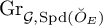 $\mathrm {Gr}_{{\mathcal {G}}, \mathrm{Spd}(\breve O_E)}$
given by
$\mathrm {Gr}_{{\mathcal {G}}, \mathrm{Spd}(\breve O_E)}$
given by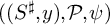 $((S^\sharp , y), \mathcal {P}, \psi )$
factors through the v-sheaf local model
$((S^\sharp , y), \mathcal {P}, \psi )$
factors through the v-sheaf local model $\mathbb {M}{}^v_{{\mathcal {G}}, \mu }\subset \mathrm {Gr}_{{\mathcal {G}}, \mathrm{Spd}(\breve O_E)}$
. More precisely, choose (locally) a section
$\mathbb {M}{}^v_{{\mathcal {G}}, \mu }\subset \mathrm {Gr}_{{\mathcal {G}}, \mathrm{Spd}(\breve O_E)}$
. More precisely, choose (locally) a section $\tau : {\mathcal {G}} \xrightarrow {\sim }\mathcal {P} $
and consider
$\tau : {\mathcal {G}} \xrightarrow {\sim }\mathcal {P} $
and consider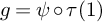 $g=\psi \circ \tau (1)$
; we ask that
$g=\psi \circ \tau (1)$
; we ask that $g^{-1}{\mathcal {G}} ({\mathbb {B} }^+_{\mathrm {dR}}(S^\sharp ))$
lies in
$g^{-1}{\mathcal {G}} ({\mathbb {B} }^+_{\mathrm {dR}}(S^\sharp ))$
lies in $\mathbb {M} {}^v_{{\mathcal {G}}, \mu }(R^\sharp )$
.
$\mathbb {M} {}^v_{{\mathcal {G}}, \mu }(R^\sharp )$
.
As in [Reference GleasonGl21], we can see that $\widehat {L{\mathcal {G}}}_{b, \mu }$
is a v-sheaf over
$\widehat {L{\mathcal {G}}}_{b, \mu }$
is a v-sheaf over $\mathrm{Spd}(O_{\breve E})$
(this v-sheaf is denoted by
$\mathrm{Spd}(O_{\breve E})$
(this v-sheaf is denoted by $\widehat {\mathrm {WSht}}^{\mathcal {D}, \leq \mu }$
in [Reference GleasonGl21, Def. 2.34 (3), (4)], and by
$\widehat {\mathrm {WSht}}^{\mathcal {D}, \leq \mu }$
in [Reference GleasonGl21, Def. 2.34 (3), (4)], and by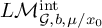 $L\mathcal {M} {}^{\mathrm {int}}_{{\mathcal {G}}, b, \mu /x_0}$
in [Reference Pappas and RapoportPR24]).
$L\mathcal {M} {}^{\mathrm {int}}_{{\mathcal {G}}, b, \mu /x_0}$
in [Reference Pappas and RapoportPR24]).
It is useful to observe that by using the mapping
 $$\begin{align*}(\mathcal{P}, \psi, \sigma)\mapsto h=(\psi\circ \sigma^{-1})(1)\in {\mathcal{G}} (W(R^+)[1/\xi_{R^\sharp}]) , \end{align*}$$
we obtain the following simpler description:
 $$ \begin{align} \widehat{L{\mathcal{G}}}_{b, \mu}(S)=\{((S^\sharp, y), h)\ |\ h\in {\mathcal{G}} (W(R^+)[1/\xi_{R^\sharp}]),\ h \equiv b\ {\mathrm {mod}}\, [\varpi_h], \ [h^{-1}]\in \mathbb{M} {}^v_{{\mathcal{G}}, \mu}(S)\}, \end{align} $$
where $(S^\sharp , y)$
is an untilt of S over
$(S^\sharp , y)$
is an untilt of S over $ O_{\breve E}$
,
$ O_{\breve E}$
, $\varpi _h$
is a pseudouniformiser of
$\varpi _h$
is a pseudouniformiser of $R^+$
, and
$R^+$
, and $[h^{-1}]$
is the S-point of the
$[h^{-1}]$
is the S-point of the ${\mathbb {B}}_{\mathrm {dR}}$
-affine Grassmannian
${\mathbb {B}}_{\mathrm {dR}}$
-affine Grassmannian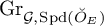 $\mathrm {Gr}_{{\mathcal {G}}, \mathrm{Spd}(\breve O_E)}$
defined by the coset
$\mathrm {Gr}_{{\mathcal {G}}, \mathrm{Spd}(\breve O_E)}$
defined by the coset $h^{-1} {\mathcal {G}} (\mathbb {B} {}^+_{\mathrm {dR}}(R^\sharp ))$
.
$h^{-1} {\mathcal {G}} (\mathbb {B} {}^+_{\mathrm {dR}}(R^\sharp ))$
.
Theorem 3.6.2. There is a diagram of v-sheaves over $\mathrm{Spd }(\breve O_E)$

where both $\pi _{\bullet }$
,
$\pi _{\bullet }$
, $\pi _\star $
are
$\pi _\star $
are $\widehat {{L}^+_W{\mathcal {G}}}$
-torsors (for the v-topology) for two corresponding actions (see (d) below).
$\widehat {{L}^+_W{\mathcal {G}}}$
-torsors (for the v-topology) for two corresponding actions (see (d) below).
a) Here $x_0\in \mathcal {M}{}^{\mathrm {int}}_{{\mathcal {G}}, b, \mu }(\mathrm{Spd}(k))$
denotes the base point as in §3.5 above. Similarly
$x_0\in \mathcal {M}{}^{\mathrm {int}}_{{\mathcal {G}}, b, \mu }(\mathrm{Spd}(k))$
denotes the base point as in §3.5 above. Similarly $y_0\in \mathbb {M} {}^v_{{\mathcal {G}}, \mu }(\mathrm{Spd}(k))$
denotes the corresponding point of
$y_0\in \mathbb {M} {}^v_{{\mathcal {G}}, \mu }(\mathrm{Spd}(k))$
denotes the corresponding point of $\mathbb {M} {}^v_{{\mathcal {G}}, \mu }(\mathrm{Spd}(k))\subset X_{{\mathcal {G}} }(k)$
given by the pair
$\mathbb {M} {}^v_{{\mathcal {G}}, \mu }(\mathrm{Spd}(k))\subset X_{{\mathcal {G}} }(k)$
given by the pair $({\mathcal {G}}, b^{-1})$
, i.e., by the coset
$({\mathcal {G}}, b^{-1})$
, i.e., by the coset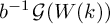 $b^{-1}\,{\mathcal {G}} (W(k))$
. Also,
$b^{-1}\,{\mathcal {G}} (W(k))$
. Also, $\mathcal {M} {}^{\mathrm {int}}_{{\mathcal {G}}, b, \mu /x_0}$
, resp.
$\mathcal {M} {}^{\mathrm {int}}_{{\mathcal {G}}, b, \mu /x_0}$
, resp. $\mathbb {M} {}^v_{{\mathcal {G}}, \mu /y_0}$
, denotes the v-sheaf given by the formal completion of
$\mathbb {M} {}^v_{{\mathcal {G}}, \mu /y_0}$
, denotes the v-sheaf given by the formal completion of $\mathcal {M} {}^{\mathrm {int}}_{{\mathcal {G}}, b, \mu }$
, resp.
$\mathcal {M} {}^{\mathrm {int}}_{{\mathcal {G}}, b, \mu }$
, resp. $\mathbb {M} {}^v_{{\mathcal {G}}, \mu }$
, at these points. (See §3.4 above.)
$\mathbb {M} {}^v_{{\mathcal {G}}, \mu }$
, at these points. (See §3.4 above.)
b) The map $\pi _\star $
is given by
$\pi _\star $
is given by
 $$\begin{align*}\pi_\star(((S^\sharp, y), \mathcal{P}, \psi, \sigma))=((S^\sharp, y), \mathcal{P}, \psi). \end{align*}$$
c) The map $\pi _\bullet $
is given by
$\pi _\bullet $
is given by
 $$\begin{align*}\pi_\bullet((S^\sharp, y), \mathcal{P} \psi, \sigma)=((S^\sharp, y), (\mathscr{P} ,\phi_{\mathscr{P} }), i_r). \end{align*}$$
Here, $(\mathscr {P}, \phi _{\mathscr {P} })$
is the
$(\mathscr {P}, \phi _{\mathscr {P} })$
is the ${\mathcal {G}} $
-shtuka over S with leg at y given as follows: The
${\mathcal {G}} $
-shtuka over S with leg at y given as follows: The ${\mathcal {G}} $
-torsor
${\mathcal {G}} $
-torsor $\mathscr {P} $
is
$\mathscr {P} $
is $(\phi ^{-1})^*(\mathcal {P} )$
restricted to
$(\phi ^{-1})^*(\mathcal {P} )$
restricted to $\mathcal {Y} {}_{[0,\infty )}(S)$
, i.e.,
$\mathcal {Y} {}_{[0,\infty )}(S)$
, i.e.,
 $$\begin{align*}\mathscr{P} =(\phi^{-1})^*(\mathcal{P} )_{|\mathcal{Y} {}_{[0,\infty)}(S)}. \end{align*}$$
The Frobenius $\phi _{\mathscr {P} }$
is given by a similar restriction of the composition
$\phi _{\mathscr {P} }$
is given by a similar restriction of the composition
 $$\begin{align*}\Phi: \mathcal{P} [1/\xi_{R^\sharp}]\xrightarrow{\psi} {\mathcal{G}} \times \operatorname{\mbox{Spec }}(W(R^+)[1/\xi_{R^\sharp}])\xrightarrow{((\phi^{-1})^*\sigma)^{-1}} (\phi^{-1})^*(\mathcal{P} )[1/\xi_{R^\sharp}]. \end{align*}$$
(Note that $\phi ^*(\mathscr {P} )=\mathcal {P} {}_{|\mathcal {Y} {}_{[0,\infty )}(S)}$
.) The framing
$\phi ^*(\mathscr {P} )=\mathcal {P} {}_{|\mathcal {Y} {}_{[0,\infty )}(S)}$
.) The framing $i_r$
is constructed in [Reference GleasonGl21].
$i_r$
is constructed in [Reference GleasonGl21].
d) The v-sheaf of groups $\widehat {{L}^+_W{\mathcal {G}} }$
acts on
$\widehat {{L}^+_W{\mathcal {G}} }$
acts on $\widehat {L{\mathcal {G}} }_{b, \mu } $
on the right by
$\widehat {L{\mathcal {G}} }_{b, \mu } $
on the right by
 $$\begin{align*}( \mathcal{P} , \psi, \sigma)\star g=( \mathcal{P} , \psi, \phi^*(r_{\phi^{-1}(g)})\circ \sigma), \quad ( \mathcal{P}, \psi, \sigma)\bullet g= ( \mathcal{P}, r_{g}\circ \psi, \phi^*(r_{g})\circ\sigma), \end{align*}$$
where, $r_a$
is the map given by right multiplication by a, and, for simplicity, we omit the untilt
$r_a$
is the map given by right multiplication by a, and, for simplicity, we omit the untilt $(S^\sharp , y)$
from the notation.
$(S^\sharp , y)$
from the notation.
Note that the composition $ \Phi : \mathcal {P} [1/\xi _{R^\sharp }] \to (\phi ^{-1})^*(\mathcal {P})[1/\xi _{R^\sharp }] $
in c), is fixed under the
$ \Phi : \mathcal {P} [1/\xi _{R^\sharp }] \to (\phi ^{-1})^*(\mathcal {P})[1/\xi _{R^\sharp }] $
in c), is fixed under the $\bullet $
-action. This follows from the identity
$\bullet $
-action. This follows from the identity
 $$\begin{align*}((\phi^{-1})^*(\phi^*(r_{g})\circ \sigma))^{-1}\circ (r_g\circ \psi)=(r_g\circ (\phi^{-1})^*\sigma)^{-1}\circ r_g\circ \psi=((\phi^{-1})^*\sigma)^{-1}\circ\psi. \end{align*}$$
Proof. The statement of the theorem is shown by Gleason for ${\mathcal {G}} $
parahoric (see [Reference GleasonGl21, Thm. 2.33, Lem. 2.35, Lem. 2.36]). The proof generalises to
${\mathcal {G}} $
parahoric (see [Reference GleasonGl21, Thm. 2.33, Lem. 2.35, Lem. 2.36]). The proof generalises to ${\mathcal {G}} $
quasi-parahoric by using Proposition 3.2.1 and its extension Proposition 3.2.2 to products of points.
${\mathcal {G}} $
quasi-parahoric by using Proposition 3.2.1 and its extension Proposition 3.2.2 to products of points.
It is convenient to express the torsors $\pi _\star $
,
$\pi _\star $
, $\pi _\bullet $
, using the description (3.6.2) of
$\pi _\bullet $
, using the description (3.6.2) of $\widehat {L{\mathcal {G}} }_{b, \mu } $
. In the description (3.6.2),
$\widehat {L{\mathcal {G}} }_{b, \mu } $
. In the description (3.6.2), $\pi _\star $
is given by projection to the coset
$\pi _\star $
is given by projection to the coset $[h^{-1}]=h^{-1} {\mathcal {G}} (\mathbb {B} {}^+_{\mathrm {dR}}(R^\sharp ))$
, and
$[h^{-1}]=h^{-1} {\mathcal {G}} (\mathbb {B} {}^+_{\mathrm {dR}}(R^\sharp ))$
, and $\pi _\bullet $
is given by sending h to the shtuka
$\pi _\bullet $
is given by sending h to the shtuka $\mathscr {P} (h)={\mathcal {G}} \times \mathcal {Y} {}_{[0,\infty )}(S)={\mathcal {G}} {}_{ \mathcal {Y} {}_{[0,\infty )}(S)}$
(the trivial torsor) with Frobenius defined by
$\mathscr {P} (h)={\mathcal {G}} \times \mathcal {Y} {}_{[0,\infty )}(S)={\mathcal {G}} {}_{ \mathcal {Y} {}_{[0,\infty )}(S)}$
(the trivial torsor) with Frobenius defined by $\phi _{\mathscr {P} (h)}=\phi _h=r_h\phi : (\phi ^*{\mathcal {G}} {}_{\mathcal {Y} {}_{[0,\infty )}(S)})[1/\xi _{R^\sharp }]\xrightarrow {\sim } {\mathcal {G}} {}_{\mathcal {Y} {}_{[0,\infty )}(S)}[1/\xi _{R^\sharp }]$
. To check this description of
$\phi _{\mathscr {P} (h)}=\phi _h=r_h\phi : (\phi ^*{\mathcal {G}} {}_{\mathcal {Y} {}_{[0,\infty )}(S)})[1/\xi _{R^\sharp }]\xrightarrow {\sim } {\mathcal {G}} {}_{\mathcal {Y} {}_{[0,\infty )}(S)}[1/\xi _{R^\sharp }]$
. To check this description of $\pi _\bullet $
, note that, since
$\pi _\bullet $
, note that, since $\phi _h=r_h \phi = \psi \circ \sigma ^{-1}$
, and
$\phi _h=r_h \phi = \psi \circ \sigma ^{-1}$
, and $\Phi =((\phi ^{-1})^*(\sigma ))^{-1}\circ \psi $
, the following diagram commutes
$\Phi =((\phi ^{-1})^*(\sigma ))^{-1}\circ \psi $
, the following diagram commutes

Hence, the ${\mathcal {G}} $
-shtukas
${\mathcal {G}} $
-shtukas $(\mathscr {P} (h), \phi _{\mathscr {P} (h)})$
and
$(\mathscr {P} (h), \phi _{\mathscr {P} (h)})$
and $(\mathscr {P}, \phi _{\mathscr {P}} )$
given above, are isomorphic.
$(\mathscr {P}, \phi _{\mathscr {P}} )$
given above, are isomorphic.
Under the above isomorphism, the framing $i_r$
of
$i_r$
of $(\mathscr {P}, \phi _{\mathscr {P}} )$
corresponds to a framing
$(\mathscr {P}, \phi _{\mathscr {P}} )$
corresponds to a framing $i_r(h)$
of
$i_r(h)$
of $(\mathscr {P} (h), \phi _{\mathscr {P} (h)})$
; this is given by the unique lift of the identity trivialisation modulo
$(\mathscr {P} (h), \phi _{\mathscr {P} (h)})$
; this is given by the unique lift of the identity trivialisation modulo $[\varpi _h]$
, cf. Lemma 3.6.1. More precisely, for
$[\varpi _h]$
, cf. Lemma 3.6.1. More precisely, for $((S^\sharp , y), h)\in \widehat {L{\mathcal {G}} }_{b, \mu }(S)$
, the framing of
$((S^\sharp , y), h)\in \widehat {L{\mathcal {G}} }_{b, \mu }(S)$
, the framing of $(\mathscr {P} (h), \phi _{\mathscr {P} (h)})$
is given by the unique element
$(\mathscr {P} (h), \phi _{\mathscr {P} (h)})$
is given by the unique element $ i_r(h)\in G(B^{[r,\infty )}_{(R, R^+)})$
with
$ i_r(h)\in G(B^{[r,\infty )}_{(R, R^+)})$
with $i(h) \equiv 1\ {\mathrm {mod}}\, [\varpi _h]$
and the property
$i(h) \equiv 1\ {\mathrm {mod}}\, [\varpi _h]$
and the property
 $$\begin{align*}h=i_r(h)^{-1}\cdot b\cdot \phi(i_r(h)), \end{align*}$$
(see [Reference GleasonGl21, Lem. 2.15].) Finally, the actions correspond to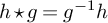 $h\star g=g^{-1}h$
and
$h\star g=g^{-1}h$
and $h\bullet g=\phi (g)^{-1}h g$
. Note that
$h\bullet g=\phi (g)^{-1}h g$
. Note that $[(h\star g)^{-1}]=[(g^{-1}h)^{-1}]=[h^{-1}g]=[h^{-1}]$
.
$[(h\star g)^{-1}]=[(g^{-1}h)^{-1}]=[h^{-1}g]=[h^{-1}]$
.
Remark 3.6.3. a) Gleason calls the diagram (3.6.3) a (v-sheaf) ‘local model diagram’. However, we warn the reader that (3.6.3) does not compare directly to the local model diagrams in the theory of Shimura varieties and of Rapoport-Zink spaces; these are of a different nature. In particular, the group acting there is ${\mathcal {G}} $
which is, in a sense, ‘finite dimensional’, while here we have torsors for
${\mathcal {G}} $
which is, in a sense, ‘finite dimensional’, while here we have torsors for $\widehat {{L}^+_W{\mathcal {G}}}$
.
$\widehat {{L}^+_W{\mathcal {G}}}$
.
b) The existence of the diagram (3.6.3) with the properties listed in the above theorem, does not imply the isomorphism (2.5.1) of Theorem 2.5.5: for example, we cannot deduce from general principles that the torsors $\pi _\star $
and
$\pi _\star $
and $\pi _\bullet $
split, since the formal completions are not ‘sufficiently local’ for the v-topology.
$\pi _\bullet $
split, since the formal completions are not ‘sufficiently local’ for the v-topology.
4 Parahoric vs Quasi-parahoric group schemes
4.1 The aim of this section
The aim of this section is to prove the following devissage result.
Theorem 4.1.1. Let $(G, b, \mu )$
be a local Shimura datum. The following are equivalent:
$(G, b, \mu )$
be a local Shimura datum. The following are equivalent:
-
1)
$\mathcal {M}{}^{\mathrm {int}}_{{\mathcal {G}}, b, \mu }$
satisfies the representability conjecture 2.5.1, for all parahoric
${\mathcal {G}} $
. -
2)
$\mathcal {M} {}^{\mathrm {int}}_{{\mathcal {G}}, b, \mu }$
satisfies the representability conjecture 2.5.1, for all stabiliser group schemes
${\mathcal {G}} $
, -
3)
$\mathcal {M} {}^{\mathrm {int}}_{{\mathcal {G}}, b, \mu }$
satisfies the representability conjecture 2.5.1, for all quasi-parahoric
${\mathcal {G}} $
.


Here by a stabiliser group scheme we understand the BT-group scheme associated to the stabiliser of a point in the extended building $\mathscr {B} {}^e(G, \breve {\mathbb {Q}} {}_p)$
(a particular type of quasi-parahoric group schemes, cf. section 2.2). The proof proceeds by comparing formal completions of
$\mathscr {B} {}^e(G, \breve {\mathbb {Q}} {}_p)$
(a particular type of quasi-parahoric group schemes, cf. section 2.2). The proof proceeds by comparing formal completions of $\mathcal {M} {}^{\mathrm {int}}_{{\mathcal {G}}, b, \mu }$
and of
$\mathcal {M} {}^{\mathrm {int}}_{{\mathcal {G}}, b, \mu }$
and of $\mathcal {M} {}^{\mathrm {int}}_{{\mathcal {G}} {}^o, b, \mu }$
(cf. Section 4.2) and of their underlying reduced schemes (cf. Section 4.3).
$\mathcal {M} {}^{\mathrm {int}}_{{\mathcal {G}} {}^o, b, \mu }$
(cf. Section 4.2) and of their underlying reduced schemes (cf. Section 4.3).
4.2 Formal completions
Let $({\mathcal {G}}, b, \mu )$
be an integral local shtuka datum such that
$({\mathcal {G}}, b, \mu )$
be an integral local shtuka datum such that ${\mathcal {G}} $
is quasi-parahoric. For simplicity of notation, we set
${\mathcal {G}} $
is quasi-parahoric. For simplicity of notation, we set $O=O_{\breve E}$
with residue field
$O=O_{\breve E}$
with residue field $k=\bar k_E$
. We consider the natural v-sheaf morphism
$k=\bar k_E$
. We consider the natural v-sheaf morphism
 $$ \begin{align} \pi: {\mathcal{M} {}^{\mathrm{int}}_{{\mathcal{G}} {}^o, b, \mu}}\to {\mathcal{M} {}^{\mathrm{int}}_{{\mathcal{G}}, b, \mu}} \end{align} $$
over $\mathrm{Spd}(O)$
.
$\mathrm{Spd}(O)$
.
Proposition 4.2.1.
a) The map $\pi $
is qcqs (quasi-compact quasi-separated [Reference ScholzeSch17]).
$\pi $
is qcqs (quasi-compact quasi-separated [Reference ScholzeSch17]).
b) The map $\pi $
induces an isomorphism
$\pi $
induces an isomorphism
 $$\begin{align*}\mathcal{M}{}^{\mathrm{int}}_{{\mathcal{G}} {}^o, b,\mu/x}\xrightarrow{\sim} \mathcal{M} {}^{\mathrm{int}}_{{\mathcal{G}} , b,\mu/\pi(x)} \end{align*}$$
for each $x\in \mathcal {M} {}^{\mathrm {int}}_{{\mathcal {G}} {}^o, b,\mu }(\mathrm{Spd}(k))$
.
$x\in \mathcal {M} {}^{\mathrm {int}}_{{\mathcal {G}} {}^o, b,\mu }(\mathrm{Spd}(k))$
.
Proof. (a) Observe that ${\mathcal {G}} {}^o\to {\mathcal {G}} $
is an isomorphism on the generic fibres and can be identified with the dilation
${\mathcal {G}} {}^o\to {\mathcal {G}} $
is an isomorphism on the generic fibres and can be identified with the dilation ${\mathcal {G}} {}^{\mathrm {dil}}$
of
${\mathcal {G}} {}^{\mathrm {dil}}$
of ${\mathcal {G}} $
along its closed subscheme given by the neutral component
${\mathcal {G}} $
along its closed subscheme given by the neutral component $({\mathcal {G}} \otimes _{\mathbb {Z} {}_p}{\mathbb F}_p)^o$
of the special fibre
$({\mathcal {G}} \otimes _{\mathbb {Z} {}_p}{\mathbb F}_p)^o$
of the special fibre ${\mathcal {G}} \otimes _{\mathbb {Z} {}_p}{\mathbb F}_p$
. (Indeed, both
${\mathcal {G}} \otimes _{\mathbb {Z} {}_p}{\mathbb F}_p$
. (Indeed, both ${\mathcal {G}} {}^o$
and the dilation
${\mathcal {G}} {}^o$
and the dilation ${\mathcal {G}} {}^{\mathrm {dil}}$
are smooth, have the same generic fibre and the same
${\mathcal {G}} {}^{\mathrm {dil}}$
are smooth, have the same generic fibre and the same $\breve {\mathbb {Z}} {}_p$
-points.) In particular, we have
$\breve {\mathbb {Z}} {}_p$
-points.) In particular, we have $\mathcal {O} {}_{{\mathcal {G}} }\hookrightarrow \mathcal {O} {}_{{\mathcal {G}} {}^o}=\mathcal {O} {}_{{\mathcal {G}} }[f_1,\ldots , f_m]$
, and there is
$\mathcal {O} {}_{{\mathcal {G}} }\hookrightarrow \mathcal {O} {}_{{\mathcal {G}} {}^o}=\mathcal {O} {}_{{\mathcal {G}} }[f_1,\ldots , f_m]$
, and there is $N\geq 1$
, such that
$N\geq 1$
, such that $p^Nf_i\in \mathcal {O} {}_{{\mathcal {G}} }$
, for all i. Then the argument in [Reference Pappas and RapoportPR24, proof of Prop. 3.6.2] applies to prove the claim.
$p^Nf_i\in \mathcal {O} {}_{{\mathcal {G}} }$
, for all i. Then the argument in [Reference Pappas and RapoportPR24, proof of Prop. 3.6.2] applies to prove the claim.
(b) As in section 3.5 we have an isomorphism
 $$ \begin{align} \mathcal{M} {}^{\mathrm{int}}_{{\mathcal{G}} , b, \mu/x}\simeq \mathcal{M} {}^{\mathrm{int}}_{{\mathcal{G}} , b_x, \mu/x_0} \end{align} $$
and similarly for ${\mathcal {G}} {}^o$
. Hence it is enough to show the isomorphism for the base point
${\mathcal {G}} {}^o$
. Hence it is enough to show the isomorphism for the base point $x=x_0\in \mathcal {M} {}^{\mathrm {int}}_{{\mathcal {G}} {}^o, b,\mu }(\mathrm{Spd}(k))$
(at the cost of changing
$x=x_0\in \mathcal {M} {}^{\mathrm {int}}_{{\mathcal {G}} {}^o, b,\mu }(\mathrm{Spd}(k))$
(at the cost of changing $b=b_{x_0}$
to
$b=b_{x_0}$
to $b_x$
). By Theorem 3.6.2
$b_x$
). By Theorem 3.6.2
 $$\begin{align*}\widehat{L{\mathcal{G}} }^o_{b,\mu}\to \mathcal{M} {}^{\mathrm{int}}_{{\mathcal{G}} {}^o, b,\mu/x_0} \end{align*}$$
is a $\widehat {\mathbb {W}} {}^+{\mathcal {G}} {}^o\times \mathrm{Spd}(O_{\breve E})$
-torsor. Also,
$\widehat {\mathbb {W}} {}^+{\mathcal {G}} {}^o\times \mathrm{Spd}(O_{\breve E})$
-torsor. Also, $\widehat {L{\mathcal {G}} }^o_{b,\mu }$
is a
$\widehat {L{\mathcal {G}} }^o_{b,\mu }$
is a $\widehat {\mathbb {W}} {}^+{\mathcal {G}} {}^o\times \mathrm{Spd}(O_{\breve E})$
-torsor over
$\widehat {\mathbb {W}} {}^+{\mathcal {G}} {}^o\times \mathrm{Spd}(O_{\breve E})$
-torsor over $\mathbb {M} {}^{v}_{{\mathcal {G}} {}^o, \mu /x_0}$
, and there are corresponding statements for
$\mathbb {M} {}^{v}_{{\mathcal {G}} {}^o, \mu /x_0}$
, and there are corresponding statements for ${\mathcal {G}} $
. By (2.3.1), the natural map
${\mathcal {G}} $
. By (2.3.1), the natural map ${\mathcal {G}} {}^o\to {\mathcal {G}} $
induces an isomorphism
${\mathcal {G}} {}^o\to {\mathcal {G}} $
induces an isomorphism
 $$\begin{align*}\mathbb{M} {}^{v}_{{\mathcal{G}} {}^o, \mu}\xrightarrow{\sim} \mathbb{M} {}^{v}_{{\mathcal{G}} , \mu}. \end{align*}$$
On the other hand, it is easy to see that ${\mathcal {G}} {}^o\to {\mathcal {G}} $
induces
${\mathcal {G}} {}^o\to {\mathcal {G}} $
induces $\widehat {\mathbb {W}} {}^+{\mathcal {G}} {}^o\xrightarrow {\sim } \widehat {\mathbb {W}} {}^+{\mathcal {G}} $
and, hence,
$\widehat {\mathbb {W}} {}^+{\mathcal {G}} {}^o\xrightarrow {\sim } \widehat {\mathbb {W}} {}^+{\mathcal {G}} $
and, hence,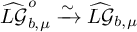 $\widehat {L{\mathcal {G}}}^o_{b,\mu }\xrightarrow {\sim } \widehat {L{\mathcal {G}}}_{b,\mu }$
. The result follows.
$\widehat {L{\mathcal {G}}}^o_{b,\mu }\xrightarrow {\sim } \widehat {L{\mathcal {G}}}_{b,\mu }$
. The result follows.
Remark 4.2.2. Suppose $\kappa $
is an algebraically closed field over k and set
$\kappa $
is an algebraically closed field over k and set $O(\kappa )= O_{\breve E}\otimes _{W(k)}W(\kappa )$
. We can consider the base change
$O(\kappa )= O_{\breve E}\otimes _{W(k)}W(\kappa )$
. We can consider the base change
 $$\begin{align*}(\mathcal{M} {}^{\mathrm{int}}_{{\mathcal{G}} , b, \mu})_{O(\kappa)}:=\mathcal{M}{}^{\mathrm{int}}_{{\mathcal{G}}, b, \mu}\times_{\mathrm{Spd}(O)}\mathrm{Spd}( O(\kappa)), \end{align*}$$
and similarly for ${\mathcal {G}} {}^o$
. Given
${\mathcal {G}} {}^o$
. Given $x\in \mathcal {M} {}^{\mathrm {int}}_{{\mathcal {G}} {}^o, b, \mu }(\mathrm{Spd}(\kappa ))$
, we obtain a corresponding point
$x\in \mathcal {M} {}^{\mathrm {int}}_{{\mathcal {G}} {}^o, b, \mu }(\mathrm{Spd}(\kappa ))$
, we obtain a corresponding point $x\in (\mathcal {M} {}^{\mathrm {int}}_{{\mathcal {G}} {}^o, b, \mu })_{O(\kappa )}(\mathrm{Spd}(\kappa ))$
. The formal completions
$x\in (\mathcal {M} {}^{\mathrm {int}}_{{\mathcal {G}} {}^o, b, \mu })_{O(\kappa )}(\mathrm{Spd}(\kappa ))$
. The formal completions $( \mathcal {M} {}^{\mathrm {int}}_{{\mathcal {G}} {}^o, b, \mu })_{ O(\kappa )/x}$
and
$( \mathcal {M} {}^{\mathrm {int}}_{{\mathcal {G}} {}^o, b, \mu })_{ O(\kappa )/x}$
and $( \mathcal {M} {}^{\mathrm {int}}_{{\mathcal {G}}, b, \mu })_{ O(\kappa )/\pi (x)}$
now make sense and the argument in the proof of (b) above also applies to give
$( \mathcal {M} {}^{\mathrm {int}}_{{\mathcal {G}}, b, \mu })_{ O(\kappa )/\pi (x)}$
now make sense and the argument in the proof of (b) above also applies to give
 $$ \begin{align} ( \mathcal{M} {}^{\mathrm{int}}_{{\mathcal{G}} {}^o, b, \mu})_{ O(\kappa)/x}\xrightarrow{\sim}( \mathcal{M} {}^{\mathrm{int}}_{{\mathcal{G}} , b, \mu})_{ O(\kappa)/\pi(x)}. \end{align} $$
4.3 ADLV for quasi-parahorics
In this subsection, we express the ADLV $X_{{\mathcal {G}} }(b, \mu )$
for a quasi-parahoric
$X_{{\mathcal {G}} }(b, \mu )$
for a quasi-parahoric ${\mathcal {G}} $
in terms of ADLV attached to parahoric subgroups. Note that the results will eventually be applied for
${\mathcal {G}} $
in terms of ADLV attached to parahoric subgroups. Note that the results will eventually be applied for $\mu $
replaced by
$\mu $
replaced by $\mu ^{-1}$
, to relate to integral local Shimura varieties via Prop. 3.3.1.
$\mu ^{-1}$
, to relate to integral local Shimura varieties via Prop. 3.3.1.
Recall the Kottwitz map $\kappa _G: G(\breve {\mathbb {Q}} {}_p)\to \Omega _G$
. This map can be enhanced to a morphism
$\kappa _G: G(\breve {\mathbb {Q}} {}_p)\to \Omega _G$
. This map can be enhanced to a morphism $LG\to \Omega _G$
which factors through
$LG\to \Omega _G$
which factors through $X_{{\mathcal {G}} {}^o}=LG/L^+{\mathcal {G}} {}^o$
, and induces a map with connected fibres,
$X_{{\mathcal {G}} {}^o}=LG/L^+{\mathcal {G}} {}^o$
, and induces a map with connected fibres,
 $$ \begin{align} \kappa_G\colon X_{{\mathcal{G}} {}^o}\to \Omega_G , \end{align} $$
cf. [Reference ZhuZhu17, Prop. 1.21], comp. also [Reference Pappas and RapoportPR08, §5].
Recall $\pi _0({\mathcal {G}} )=\breve K/\breve K^o\subset \Omega $
, cf. (3.1.1). Then
$\pi _0({\mathcal {G}} )=\breve K/\breve K^o\subset \Omega $
, cf. (3.1.1). Then $\pi _0({\mathcal {G}} )$
acts on
$\pi _0({\mathcal {G}} )$
acts on $X_{{\mathcal {G}} {}^o}$
by
$X_{{\mathcal {G}} {}^o}$
by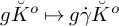 $g\breve K^o\mapsto g\dot \gamma \breve K^o$
, where
$g\breve K^o\mapsto g\dot \gamma \breve K^o$
, where $\dot \gamma \in \breve K$
is a representative of a given element in
$\dot \gamma \in \breve K$
is a representative of a given element in $\pi _0({\mathcal {G}} )$
. This action is permuting connected components and the quotient is
$\pi _0({\mathcal {G}} )$
. This action is permuting connected components and the quotient is $X_{{\mathcal {G}}} $
,
$X_{{\mathcal {G}}} $
,
 $$\begin{align*}X_{{\mathcal{G}} {}^o}\to X_{{\mathcal{G}}} =X_{{\mathcal{G}} {}^o}/\pi_0({\mathcal{G}} ). \end{align*}$$
Each connected component of $X_{{\mathcal {G}} {}^o}$
maps isomorphically to a connected component of
$X_{{\mathcal {G}} {}^o}$
maps isomorphically to a connected component of $X_{{\mathcal {G}}} $
.
$X_{{\mathcal {G}}} $
.
Recall that there exists $c_{b, \mu }\in \Omega $
with
$c_{b, \mu }\in \Omega $
with $\phi (c_{b, \mu })-c_{b, \mu }=\kappa _G(b)-\kappa _G(\mu )$
, comp. [Reference He and ZhouHZ20, §6]. Here
$\phi (c_{b, \mu })-c_{b, \mu }=\kappa _G(b)-\kappa _G(\mu )$
, comp. [Reference He and ZhouHZ20, §6]. Here $\kappa _G(\mu )\in \Omega $
is the element associated to the conjugacy class
$\kappa _G(\mu )\in \Omega $
is the element associated to the conjugacy class $\mu $
, i.e., the residue class of
$\mu $
, i.e., the residue class of $\{\mu \}$
modulo the affine Weyl group. Furthermore, the class modulo
$\{\mu \}$
modulo the affine Weyl group. Furthermore, the class modulo $\Omega ^\phi $
of
$\Omega ^\phi $
of $c_{b, \mu }$
is uniquely determined.
$c_{b, \mu }$
is uniquely determined.
Now $X_{{\mathcal {G}} {}^o}(b, \mu )$
lies in the union of certain connected components of
$X_{{\mathcal {G}} {}^o}(b, \mu )$
lies in the union of certain connected components of $X_{{\mathcal {G}} {}^o}$
. From
$X_{{\mathcal {G}} {}^o}$
. From $-\kappa _G(g)+\phi (\kappa _G(g))=-\kappa _G(b)+\kappa _G(\mu )$
, we obtain
$-\kappa _G(g)+\phi (\kappa _G(g))=-\kappa _G(b)+\kappa _G(\mu )$
, we obtain $\kappa _G(X_{{\mathcal {G}} {}^o}(b, \mu ))\subset c_{b, \mu }+\Omega ^\phi .$
In fact, by [Reference He and ZhouHZ20, Lem. 6.1], we have an equality,
$\kappa _G(X_{{\mathcal {G}} {}^o}(b, \mu ))\subset c_{b, \mu }+\Omega ^\phi .$
In fact, by [Reference He and ZhouHZ20, Lem. 6.1], we have an equality,
 $$ \begin{align} \kappa_G(X_{{\mathcal{G}} {}^o}(b, \mu))= c_{b, \mu}+\Omega^\phi. \end{align} $$
We now extend these considerations to quasi-parahorics. Let $C=C_{{\mathcal {G}}} =\Omega /\pi _0({\mathcal {G}} )$
. Then the Kottwitz homomorphism induces a map
$C=C_{{\mathcal {G}}} =\Omega /\pi _0({\mathcal {G}} )$
. Then the Kottwitz homomorphism induces a map
 $$ \begin{align} \kappa_G\colon X_{{\mathcal{G}}} \to C_{{\mathcal{G}}}. \end{align} $$
The image of $X_{{\mathcal {G}}} (b, \mu )$
in
$X_{{\mathcal {G}}} (b, \mu )$
in $C_\phi $
is equal to the residue class of
$C_\phi $
is equal to the residue class of $\kappa _G(b)-\kappa _G(\mu )$
, so
$\kappa _G(b)-\kappa _G(\mu )$
, so
 $$ \begin{align} \kappa_G(X_{{\mathcal{G}}} (b, \mu))\subset \bar c_{b, \mu}+C^\phi , \end{align} $$
where $\bar c_{b, \mu }\in C_{{\mathcal {G}}} $
is the image of
$\bar c_{b, \mu }\in C_{{\mathcal {G}}} $
is the image of $ c_{b, \mu }$
. This inclusion will turn out to be an equality, cf. Corollary 4.3.6 below.
$ c_{b, \mu }$
. This inclusion will turn out to be an equality, cf. Corollary 4.3.6 below.
Recall $\Pi _{{\mathcal {G}}} =\ker (\pi _0({\mathcal {G}} )_\phi \to \Omega _\phi )$
, cf. (3.1.2). From the exact sequence
$\Pi _{{\mathcal {G}}} =\ker (\pi _0({\mathcal {G}} )_\phi \to \Omega _\phi )$
, cf. (3.1.2). From the exact sequence $0\to \pi _0({\mathcal {G}} )\to \Omega \to C_{{\mathcal {G}}} \to 0$
we have an exact sequence
$0\to \pi _0({\mathcal {G}} )\to \Omega \to C_{{\mathcal {G}}} \to 0$
we have an exact sequence
 $$ \begin{align} 0\to \Omega^\phi/\pi_0({\mathcal{G}} )^\phi\to C_{{\mathcal{G}}} {}^\phi\to \Pi_{{\mathcal{G}}} \to 0. \end{align} $$
Let $\bar {\beta }\in \Pi _{{\mathcal {G}}} $
. Take
$\bar {\beta }\in \Pi _{{\mathcal {G}}} $
. Take $\beta \in \pi _0({\mathcal {G}} )\subset \Omega $
lifting
$\beta \in \pi _0({\mathcal {G}} )\subset \Omega $
lifting $\bar {\beta }$
. Then
$\bar {\beta }$
. Then
 $$\begin{align*}\beta=(1-\phi)\gamma \end{align*}$$
for some $\gamma \in \Omega $
. Note that, since
$\gamma \in \Omega $
. Note that, since $\phi ({\gamma })-{\gamma }$
is in
$\phi ({\gamma })-{\gamma }$
is in $\pi _0({\mathcal {G}} )$
, the image
$\pi _0({\mathcal {G}} )$
, the image $\bar \gamma $
of
$\bar \gamma $
of $\gamma $
in C is
$\gamma $
in C is $\phi $
-invariant and maps to
$\phi $
-invariant and maps to $\bar {\beta }$
under the connecting homomorphism
$\bar {\beta }$
under the connecting homomorphism $C^\phi \to \Pi _{{\mathcal {G}}} $
. Conversely, the image
$C^\phi \to \Pi _{{\mathcal {G}}} $
. Conversely, the image $\bar {\beta }$
of an element
$\bar {\beta }$
of an element $\bar \gamma \in C^\phi $
in
$\bar \gamma \in C^\phi $
in $\Pi _{{\mathcal {G}}} $
is described as follows. Let
$\Pi _{{\mathcal {G}}} $
is described as follows. Let $\gamma \in \Omega $
be a lift of
$\gamma \in \Omega $
be a lift of $\bar \gamma $
. Then
$\bar \gamma $
. Then $\bar {\beta }$
is the class of
$\bar {\beta }$
is the class of $\beta =\phi (\gamma )-\gamma \in \pi _0({\mathcal {G}} )$
.
$\beta =\phi (\gamma )-\gamma \in \pi _0({\mathcal {G}} )$
.
Recall that the quasi-parahoric subgroup $\breve K$
is defined via a point
$\breve K$
is defined via a point $\bf x$
in the building of
$\bf x$
in the building of $G_{\mathrm {ad}}$
. Write the Iwahori-Weyl group as
$G_{\mathrm {ad}}$
. Write the Iwahori-Weyl group as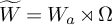 $\widetilde W=W_a\rtimes \Omega $
and
$\widetilde W=W_a\rtimes \Omega $
and
 $$\begin{align*}1\to T(\breve{\mathbb{Q}} {}_p)^0\to N(\breve{\mathbb{Q}} {}_p)\to \widetilde W=W_a\rtimes \Omega\to 1 \end{align*}$$
with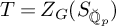 $T=Z_G(S_{\breve {\mathbb {Q}} {}_p})$
as in [Reference Haines and RapoportHR08]. Here the choices are made such that
$T=Z_G(S_{\breve {\mathbb {Q}} {}_p})$
as in [Reference Haines and RapoportHR08]. Here the choices are made such that $\bf x$
is in the base alcove
$\bf x$
is in the base alcove $\frak {a}_0$
of the apartment of S. Then
$\frak {a}_0$
of the apartment of S. Then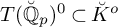 $T(\breve {\mathbb {Q}} {}_p)^0\subset \breve K^o$
. When we consider
$T(\breve {\mathbb {Q}} {}_p)^0\subset \breve K^o$
. When we consider $\Omega $
as a subset of
$\Omega $
as a subset of $\widetilde W$
, we write the group law in a multiplicative way.
$\widetilde W$
, we write the group law in a multiplicative way.
Lemma 4.3.1. Let $\beta \in \pi _0({\mathcal {G}} )$
be of the form
$\beta \in \pi _0({\mathcal {G}} )$
be of the form $\beta =\phi (\gamma )-\gamma $
, for
$\beta =\phi (\gamma )-\gamma $
, for $\gamma \in \Omega $
. There is a lift
$\gamma \in \Omega $
. There is a lift $\dot {\gamma }\in N(\breve {\mathbb {Q}} {}_p)$
of
$\dot {\gamma }\in N(\breve {\mathbb {Q}} {}_p)$
of $\gamma \in \Omega \subset \widetilde W$
such that
$\gamma \in \Omega \subset \widetilde W$
such that
 $$\begin{align*}\phi(\dot{\gamma})^{-1}\dot{\gamma}\in \breve K. \end{align*}$$
Proof. Lift $\gamma \in \Omega $
to
$\gamma \in \Omega $
to $\dot {\gamma }\in N(\breve {\mathbb {Q}} {}_p)$
. Then
$\dot {\gamma }\in N(\breve {\mathbb {Q}} {}_p)$
. Then $\phi (\dot {\gamma })^{-1}\dot {\gamma }$
lifts
$\phi (\dot {\gamma })^{-1}\dot {\gamma }$
lifts $\beta \in \pi _0({\mathcal {G}} )\subset \Omega $
. Now we use the exact sequence
$\beta \in \pi _0({\mathcal {G}} )\subset \Omega $
. Now we use the exact sequence
 $$ \begin{align*}1\to T(\breve{\mathbb{Q}} {}_p)^0\to N(\breve{\mathbb{Q}} {}_p)\cap\breve K\to \pi_0({\mathcal{G}} )\to 1. \end{align*} $$
This holds since, denoting by $U=U_{K^o}$
the pro-unipotent radical of
$U=U_{K^o}$
the pro-unipotent radical of $\breve K^o$
, we have
$\breve K^o$
, we have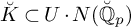 $\breve K\subset U\cdot N(\breve {\mathbb {Q}} {}_p)$
, cf. [Reference Haines and RapoportHR08, proof of Prop. 8]. We can lift
$\breve K\subset U\cdot N(\breve {\mathbb {Q}} {}_p)$
, cf. [Reference Haines and RapoportHR08, proof of Prop. 8]. We can lift $\beta $
to
$\beta $
to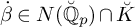 $\dot {\beta }\in N(\breve {\mathbb {Q}} {}_p)\cap \breve K$
. Then
$\dot {\beta }\in N(\breve {\mathbb {Q}} {}_p)\cap \breve K$
. Then $\phi (\dot {\gamma })^{-1}\dot {\gamma }\dot \beta ^{-1}\in T(\breve {\mathbb {Q}} {}_p)^0$
. Since
$\phi (\dot {\gamma })^{-1}\dot {\gamma }\dot \beta ^{-1}\in T(\breve {\mathbb {Q}} {}_p)^0$
. Since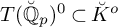 $T(\breve {\mathbb {Q}} {}_p)^0\subset \breve K^o$
, the result follows.
$T(\breve {\mathbb {Q}} {}_p)^0\subset \breve K^o$
, the result follows.
For $\beta $
,
$\beta $
, $\gamma $
,
$\gamma $
, $\dot \gamma $
as above, it follows that
$\dot \gamma $
as above, it follows that
 $$\begin{align*}\breve K\dot{\gamma}^{-1}=\breve K\phi(\dot{\gamma})^{-1}. \end{align*}$$
Consider now the conjugates of $\breve K$
, resp.
$\breve K$
, resp. $\breve K^o$
,
$\breve K^o$
,
 $$ \begin{align} \breve K_\gamma:=\dot{\gamma} \breve K\dot{\gamma}^{-1}, \quad \breve K^o_\gamma:=\dot{\gamma} \breve K^o\dot{\gamma}^{-1}. \end{align} $$
These subgroups of $G(\breve {\mathbb {Q}} {}_p)$
depend only on
$G(\breve {\mathbb {Q}} {}_p)$
depend only on $\gamma $
. Indeed, if
$\gamma $
. Indeed, if $\dot \gamma $
is replaced by
$\dot \gamma $
is replaced by $\dot \gamma \dot \delta $
, with
$\dot \gamma \dot \delta $
, with $\dot \delta \in T(\breve {\mathbb {Q}} {}_p)^0$
, then
$\dot \delta \in T(\breve {\mathbb {Q}} {}_p)^0$
, then $\dot {\gamma } \breve K^o\dot {\gamma }^{-1}$
is replaced by
$\dot {\gamma } \breve K^o\dot {\gamma }^{-1}$
is replaced by $\dot {\gamma } \dot \delta \breve K^o\dot \delta ^{-1} \dot {\gamma }^{-1}=\dot {\gamma } \breve K^o\dot {\gamma }^{-1}$
. We have
$\dot {\gamma } \dot \delta \breve K^o\dot \delta ^{-1} \dot {\gamma }^{-1}=\dot {\gamma } \breve K^o\dot {\gamma }^{-1}$
. We have
 $$\begin{align*}\phi(\dot{\gamma} \breve K\dot{\gamma}^{-1})=\dot{\gamma}\breve K\dot{\gamma}^{-1},\quad \phi(\dot{\gamma} \breve K^o\dot{\gamma}^{-1})=\dot{\gamma} \breve K^o\dot{\gamma}^{-1}. \end{align*}$$
Hence, $\breve K_\gamma $
and
$\breve K_\gamma $
and $\breve K^o_\gamma $
are rational, i.e., correspond to subgroups of
$\breve K^o_\gamma $
are rational, i.e., correspond to subgroups of $G(\mathbb {Q} {}_p)$
. The parahorics
$G(\mathbb {Q} {}_p)$
. The parahorics $ K^o_\gamma $
are conjugate to
$ K^o_\gamma $
are conjugate to $K^o$
in
$K^o$
in $G(\breve {\mathbb {Q}} {}_p)$
but not necessarily in
$G(\breve {\mathbb {Q}} {}_p)$
but not necessarily in $G(\mathbb {Q} {}_p)$
.
$G(\mathbb {Q} {}_p)$
.
Proposition 4.3.2. The $G(\mathbb {Q} {}_p)$
-conjugacy class of
$G(\mathbb {Q} {}_p)$
-conjugacy class of $\breve K_\gamma $
, resp.
$\breve K_\gamma $
, resp. $\breve K^o_\gamma $
, only depends on the class
$\breve K^o_\gamma $
, only depends on the class $\bar {\beta }$
of
$\bar {\beta }$
of $\beta $
in
$\beta $
in $\Pi _{{\mathcal {G}}} $
.
$\Pi _{{\mathcal {G}}} $
.
Proof. We go through all choices made in the construction.
-
• independence of γ: If
$\gamma $
is replaced by
$\gamma '=\gamma +\delta $
, with
$\delta \in \Omega ^\phi $
, then as choice for
$\dot \gamma '$
we can take
$\dot \gamma '=\dot \delta \dot \gamma $
, where
$\dot \delta \in N(\mathbb {Q} {}_p)$
(i.e.,
$\mathbb {Q} {}_p$
-rational). This follows from [Reference Haines and RapoportHR08, Rem. 9]. Hence
$\dot {\gamma } \breve K^o\dot {\gamma }^{-1}$
is replaced by
$ \dot \delta \dot {\gamma }\breve K^o \dot {\gamma }^{-1}\dot \delta ^{-1}$
, hence is conjugate under
$G(\mathbb {Q} {}_p)$
to
$\breve K_\gamma ^o$
. -
• independence of β: If
$\beta $
is replaced by
$\beta +(\phi -1)\delta $
with
$\delta \in \pi _0({\mathcal {G}} )$
, then
$\gamma $
is replaced by
$\gamma +\delta $
. Then we may replace
$\dot \gamma $
by
$\dot \gamma \dot \delta $
, where
$\dot \delta \in N(\breve {\mathbb {Q}} {}_p)\cap \breve K$
. Since
$\dot \delta $
normalises
$\breve K^o$
, the parahoric
$\breve K^o_\gamma $
is unchanged.


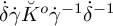


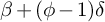


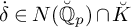


This handles the case of $\breve K^o_\gamma $
; the case of
$\breve K^o_\gamma $
; the case of $\breve K_\gamma $
is the same.
$\breve K_\gamma $
is the same.
Remark 4.3.3. The above proof seems to use that we multiply $\dot \gamma $
by
$\dot \gamma $
by $\dot \delta $
from the right instead of from the left. However,
$\dot \delta $
from the right instead of from the left. However, $\Omega $
is an abelian group and what is being used here is that
$\Omega $
is an abelian group and what is being used here is that $\dot \delta \in T(\breve {\mathbb {Q}} {}_p)^0$
acts trivially on
$\dot \delta \in T(\breve {\mathbb {Q}} {}_p)^0$
acts trivially on $\frak {a}_0$
, and that
$\frak {a}_0$
, and that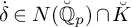 $\dot \delta \in N(\breve {\mathbb {Q}} {}_p)\cap \breve K$
preserves
$\dot \delta \in N(\breve {\mathbb {Q}} {}_p)\cap \breve K$
preserves $\frak {a}_0$
and fixes
$\frak {a}_0$
and fixes $\bf {x}$
and hence also
$\bf {x}$
and hence also $\dot \gamma \bf {x}$
, by the commutativity of
$\dot \gamma \bf {x}$
, by the commutativity of $\Omega $
.
$\Omega $
.
In the sequel, we make a fixed choice of $\dot \gamma $
, for each element
$\dot \gamma $
, for each element $\bar {\beta }\in \Pi _{{\mathcal {G}}} $
. We denote the corresponding groups by
$\bar {\beta }\in \Pi _{{\mathcal {G}}} $
. We denote the corresponding groups by $\breve K_\beta $
, resp.
$\breve K_\beta $
, resp. $\breve {\mathcal {G}} {}_\beta $
, resp.
$\breve {\mathcal {G}} {}_\beta $
, resp. $\breve K^o_\beta $
, resp.
$\breve K^o_\beta $
, resp. $\breve {\mathcal {G}} {}^o_\beta $
, by slightly abusing notation. We consider the map
$\breve {\mathcal {G}} {}^o_\beta $
, by slightly abusing notation. We consider the map
 $$ \begin{align} \begin{aligned} \pi_\gamma: X_{{\mathcal{G}} {}_\gamma}=LG/L^+\breve K_\gamma=LG/&L^+(\dot{\gamma} \breve K\dot{\gamma}^{-1})\to LG/L^+ \breve K=X_{{\mathcal{G}} },\\ & g(\dot{\gamma} \breve K\dot{\gamma}^{-1})\mapsto g\dot{\gamma} \breve K. \end{aligned} \end{align} $$
Let us check the dependency of $\dot \gamma $
. If
$\dot \gamma $
. If $\dot \gamma $
is replaced by
$\dot \gamma $
is replaced by $\dot \gamma '=\dot \gamma \dot \delta $
with
$\dot \gamma '=\dot \gamma \dot \delta $
with $\dot \delta \in T(\breve {\mathbb {Q}} {}_p)^0$
, then
$\dot \delta \in T(\breve {\mathbb {Q}} {}_p)^0$
, then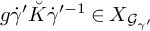 $g\dot \gamma '\breve K\dot \gamma ^{\prime -1}\in X_{{\mathcal {G}} {}_{\gamma '}}$
is mapped under
$g\dot \gamma '\breve K\dot \gamma ^{\prime -1}\in X_{{\mathcal {G}} {}_{\gamma '}}$
is mapped under $\pi _{\gamma '}$
to
$\pi _{\gamma '}$
to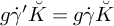 $g\dot \gamma '\breve K=g\dot \gamma \breve K$
; hence
$g\dot \gamma '\breve K=g\dot \gamma \breve K$
; hence $\pi _\gamma =\pi _{\gamma '}$
under the identity identification
$\pi _\gamma =\pi _{\gamma '}$
under the identity identification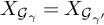 $X_{{\mathcal {G}} {}_\gamma }=X_{{\mathcal {G}} {}_{\gamma '}}$
. Similarly, if
$X_{{\mathcal {G}} {}_\gamma }=X_{{\mathcal {G}} {}_{\gamma '}}$
. Similarly, if $\gamma $
is replaced by
$\gamma $
is replaced by $\gamma +\delta $
with
$\gamma +\delta $
with $\delta \in \Omega ^\phi $
, then, choosing
$\delta \in \Omega ^\phi $
, then, choosing $\dot \gamma '=\dot \delta \dot \gamma $
with
$\dot \gamma '=\dot \delta \dot \gamma $
with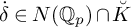 $\dot \delta \in N(\mathbb {Q} {}_p)\cap \breve K$
, we can identify
$\dot \delta \in N(\mathbb {Q} {}_p)\cap \breve K$
, we can identify $X_{{\mathcal {G}} {}_\gamma }$
with
$X_{{\mathcal {G}} {}_\gamma }$
with $X_{{\mathcal {G}} {}_{\gamma '}}$
via
$X_{{\mathcal {G}} {}_{\gamma '}}$
via $g \breve K_\gamma \mapsto g\dot \delta ^{-1} \breve K_{\gamma '}$
. The first element is mapped under
$g \breve K_\gamma \mapsto g\dot \delta ^{-1} \breve K_{\gamma '}$
. The first element is mapped under $\pi _\gamma $
to
$\pi _\gamma $
to $g\dot \gamma \breve K$
, the second element is mapped under
$g\dot \gamma \breve K$
, the second element is mapped under $\pi _{\gamma '}$
to
$\pi _{\gamma '}$
to $(g\dot \delta ^{-1})\dot \gamma '\breve K=g\dot \gamma \breve K$
, hence
$(g\dot \delta ^{-1})\dot \gamma '\breve K=g\dot \gamma \breve K$
, hence $\pi _\gamma =\pi _{\gamma '}$
. Note that
$\pi _\gamma =\pi _{\gamma '}$
. Note that $\dot \delta $
is not unique. But if
$\dot \delta $
is not unique. But if $\dot \delta $
is replaced by
$\dot \delta $
is replaced by $\dot \delta '=\dot \delta \varepsilon $
with
$\dot \delta '=\dot \delta \varepsilon $
with $\varepsilon \in T(\breve {\mathbb {Q}} {}_p)^0$
, then the identification of
$\varepsilon \in T(\breve {\mathbb {Q}} {}_p)^0$
, then the identification of $X_{{\mathcal {G}} {}_\gamma }$
and
$X_{{\mathcal {G}} {}_\gamma }$
and $X_{{\mathcal {G}} {}_{\gamma '}}$
is not affected. Finally, if
$X_{{\mathcal {G}} {}_{\gamma '}}$
is not affected. Finally, if $\beta $
is replaced by
$\beta $
is replaced by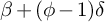 $\beta +(\phi -1)\delta $
with
$\beta +(\phi -1)\delta $
with $\delta \in \pi _0({\mathcal {G}} )$
, then
$\delta \in \pi _0({\mathcal {G}} )$
, then $\gamma $
is replaced by
$\gamma $
is replaced by $\gamma +\delta $
. Then we may replace
$\gamma +\delta $
. Then we may replace $\dot \gamma $
by
$\dot \gamma $
by $\dot \gamma '=\dot \gamma \dot \delta $
, where
$\dot \gamma '=\dot \gamma \dot \delta $
, where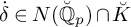 $\dot \delta \in N(\breve {\mathbb {Q}} {}_p)\cap \breve K$
. Since
$\dot \delta \in N(\breve {\mathbb {Q}} {}_p)\cap \breve K$
. Since $\dot \delta $
normalises
$\dot \delta $
normalises $\breve K^o$
, the spaces
$\breve K^o$
, the spaces $X_{{\mathcal {G}} {}_{\gamma }}$
and
$X_{{\mathcal {G}} {}_{\gamma }}$
and $X_{{\mathcal {G}} {}_{\gamma '}}$
are identified compatibly with the maps
$X_{{\mathcal {G}} {}_{\gamma '}}$
are identified compatibly with the maps $\pi _\gamma $
, resp.
$\pi _\gamma $
, resp. $\pi _{\gamma '}$
.
$\pi _{\gamma '}$
.
Proposition 4.3.4. The above map defines by restriction a map
 $$\begin{align*}\pi_\beta: X_{{\mathcal{G}} {}_\beta}(b, \mu)\to X_{{\mathcal{G}}} (b, \mu). \end{align*}$$
Proof. Suppose that $g\breve K_\beta \in X_{{\mathcal {G}} {}_\beta }(b, \mu )$
, i.e.,
$g\breve K_\beta \in X_{{\mathcal {G}} {}_\beta }(b, \mu )$
, i.e.,
 $$\begin{align*}g^{-1}b\phi(g)\in \breve K_\beta \mathrm{{Adm}}(\mu) \breve K_\beta=\dot{\gamma} \breve K\dot{\gamma}^{-1} \mathrm{{Adm}}(\mu) \dot{\gamma} \breve K\dot{\gamma}^{-1}. \end{align*}$$
Since $\mathrm {{Adm}}(\mu )$
is stable under the conjugation action of
$\mathrm {{Adm}}(\mu )$
is stable under the conjugation action of $\Omega $
, we see that
$\Omega $
, we see that
 $$ \begin{align*}\breve K\dot{\gamma}^{-1} \mathrm{{Adm}}(\mu) \dot{\gamma} \breve K=\breve K\mathrm{{Adm}}(\mu) \breve K. \end{align*} $$
Hence
 $$\begin{align*}g^{-1}b\phi(g)\in \dot{\gamma} \breve K \mathrm{{Adm}}(\mu) \breve K\dot{\gamma}^{-1}, \end{align*}$$
so
 $$\begin{align*}\dot{\gamma}^{-1}g^{-1}b\phi(g)\phi(\dot{\gamma})\in \breve K \mathrm{{Adm}}(\mu) \breve K\dot{\gamma}^{-1}\phi(\dot{\gamma})\subset \breve K \mathrm{{Adm}}(\mu) \breve K , \end{align*}$$
since $\breve K\dot {\gamma }^{-1}\phi (\dot {\gamma })=\breve K.$
Hence
$\breve K\dot {\gamma }^{-1}\phi (\dot {\gamma })=\breve K.$
Hence
 $$\begin{align*}(g\dot{\gamma} )^{-1} b\phi(g\dot{\gamma})\in \breve K \mathrm{{Adm}}(\mu) \breve K , \end{align*}$$
i.e.,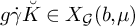 $g\dot {\gamma }\breve K\in X_{{\mathcal {G}}} (b, \mu )$
, as had to be shown.
$g\dot {\gamma }\breve K\in X_{{\mathcal {G}}} (b, \mu )$
, as had to be shown.
Composing the above map with $ X_{{\mathcal {G}} {}^o_\beta }(b, \mu )\to X_{{\mathcal {G}} {}_\beta }(b, \mu )$
and letting
$ X_{{\mathcal {G}} {}^o_\beta }(b, \mu )\to X_{{\mathcal {G}} {}_\beta }(b, \mu )$
and letting $\bar {\beta }$
vary, we obtain the map
$\bar {\beta }$
vary, we obtain the map
 $$ \begin{align} \pi: \bigsqcup_{\bar{\beta}\in \Pi_{{\mathcal{G}}} } X_{{\mathcal{G}} {}^o_{\beta}}(b, \mu)\to X_{{\mathcal{G}}} (b, \mu). \end{align} $$
In the sequel, we call a component of $X_{{\mathcal {G}} {}^o_{\beta }}(b, \mu ) $
, resp. of
$X_{{\mathcal {G}} {}^o_{\beta }}(b, \mu ) $
, resp. of $X_{{\mathcal {G}} }(b, \mu ) $
, the non-empty fibres of the Kottwitz map to
$X_{{\mathcal {G}} }(b, \mu ) $
, the non-empty fibres of the Kottwitz map to $\Omega $
, resp. to
$\Omega $
, resp. to $C_{\mathcal {G}} =\Omega /\pi _0({\mathcal {G}} )$
. In other words, we partition the points of
$C_{\mathcal {G}} =\Omega /\pi _0({\mathcal {G}} )$
. In other words, we partition the points of $X_{{\mathcal {G}} {}^o_{\beta }}(b, \mu ) $
, resp. of
$X_{{\mathcal {G}} {}^o_{\beta }}(b, \mu ) $
, resp. of $X_{{\mathcal {G}} }(b, \mu ) $
, according to which connected component of
$X_{{\mathcal {G}} }(b, \mu ) $
, according to which connected component of $X_{{\mathcal {G}} {}^o_{\beta }}$
, resp. of
$X_{{\mathcal {G}} {}^o_{\beta }}$
, resp. of $X_{{\mathcal {G}} }$
, they lie in.
$X_{{\mathcal {G}} }$
, they lie in.
Proposition 4.3.5.
(i) For $\bar {\beta }_1\neq \bar {\beta }_2$
, the images of
$\bar {\beta }_1\neq \bar {\beta }_2$
, the images of $X_{{\mathcal {G}} {}^o_{\beta _1}}(b, \mu ) $
and
$X_{{\mathcal {G}} {}^o_{\beta _1}}(b, \mu ) $
and $X_{{\mathcal {G}} {}^o_{\beta _2}}(b, \mu ) $
under
$X_{{\mathcal {G}} {}^o_{\beta _2}}(b, \mu ) $
under $\pi $
fall into different components of
$\pi $
fall into different components of $X_{{\mathcal {G}}} (b, \mu )$
.
$X_{{\mathcal {G}}} (b, \mu )$
.
(ii) The map $\pi $
is surjective.
$\pi $
is surjective.
Proof. For (i), let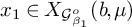 $x_1\in X_{{\mathcal {G}} {}^o_{\beta _1}}(b, \mu )$
and
$x_1\in X_{{\mathcal {G}} {}^o_{\beta _1}}(b, \mu )$
and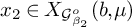 $x_2\in X_{{\mathcal {G}} {}^o_{\beta _2}}(b, \mu )$
be such that their images in
$x_2\in X_{{\mathcal {G}} {}^o_{\beta _2}}(b, \mu )$
be such that their images in $C_{{\mathcal {G}}} $
are the same. We deduce that
$C_{{\mathcal {G}}} $
are the same. We deduce that
 $$ \begin{align*}\kappa_G(x_1)+\gamma_1= \kappa_G(x_2)+\gamma_2\ \mod \pi_0({\mathcal{G}} ). \end{align*} $$
On the other hand, $\kappa _G(x_i)=c_{b, \mu } -\lambda _i$
with
$\kappa _G(x_i)=c_{b, \mu } -\lambda _i$
with $\lambda _i\in \Omega ^\phi $
, for
$\lambda _i\in \Omega ^\phi $
, for $i=1, 2$
. We therefore get
$i=1, 2$
. We therefore get
 $$ \begin{align*}\gamma_1-\gamma_2=\lambda_1-\lambda_2+\mu , \quad \mu\in \pi_0({\mathcal{G}} ). \end{align*} $$
Applying $1-\phi $
to this identity, we obtain
$1-\phi $
to this identity, we obtain
 $$ \begin{align*}\beta_1-\beta_2=(1-\phi)\mu , \end{align*} $$
i.e., $\bar {\beta }_1=\bar {\beta }_2$
, as desired.
$\bar {\beta }_1=\bar {\beta }_2$
, as desired.
For (ii), let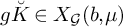 $g\breve K\in X_{{\mathcal {G}}} (b, \mu )$
. By [Reference Görtz, He and NieGHN24, Lem. 5.10, (iii)],
$g\breve K\in X_{{\mathcal {G}}} (b, \mu )$
. By [Reference Görtz, He and NieGHN24, Lem. 5.10, (iii)],
 $$ \begin{align} \breve K^o \mathrm{{Adm}}(\mu) \breve K =\breve K \mathrm{{Adm}}(\mu) \breve K. \end{align} $$
Hence $g^{-1}b\phi (g)\in \breve K\mathrm {{Adm}}(\mu )\breve K=\breve K^o\mathrm {{Adm}}(\mu )\breve K$
. Write accordingly
$g^{-1}b\phi (g)\in \breve K\mathrm {{Adm}}(\mu )\breve K=\breve K^o\mathrm {{Adm}}(\mu )\breve K$
. Write accordingly
 $$\begin{align*}g^{-1}b\phi(g)=k^o_1\omega k. \end{align*}$$
Apply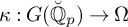 $\kappa : G(\breve {\mathbb {Q}} {}_p)\to \Omega $
to get
$\kappa : G(\breve {\mathbb {Q}} {}_p)\to \Omega $
to get
 $$\begin{align*}(\phi-1)\kappa(g)+\kappa(b)=\kappa(k)+\kappa(\mu). \end{align*}$$
Hence we get
 $$ \begin{align} (\phi-1)\kappa(g)=\kappa(k)-(\phi-1)c_{b,\mu}. \end{align} $$
Let $\beta =-\kappa (k)\in \pi _0({\mathcal {G}} )$
and denote by
$\beta =-\kappa (k)\in \pi _0({\mathcal {G}} )$
and denote by $\bar {\beta }\in \pi _0({\mathcal {G}} )_\phi $
its image. Then the last equation shows that
$\bar {\beta }\in \pi _0({\mathcal {G}} )_\phi $
its image. Then the last equation shows that $\bar {\beta }\in \Pi _{{\mathcal {G}}} $
. We write
$\bar {\beta }\in \Pi _{{\mathcal {G}}} $
. We write $\beta =(1-\phi )\gamma $
with
$\beta =(1-\phi )\gamma $
with $\gamma \in \Omega $
and choose a lift
$\gamma \in \Omega $
and choose a lift $\dot \gamma \in N(\breve {\mathbb {Q}} {}_p)$
as in Lemma 4.3.1. Then
$\dot \gamma \in N(\breve {\mathbb {Q}} {}_p)$
as in Lemma 4.3.1. Then $ g\dot {\gamma }^{-1} (\dot {\gamma } K^o\dot {\gamma }^{-1})$
is in
$ g\dot {\gamma }^{-1} (\dot {\gamma } K^o\dot {\gamma }^{-1})$
is in $X_{\dot {\gamma } K^o\dot {\gamma }^{-1}}(b, \mu )$
and maps to
$X_{\dot {\gamma } K^o\dot {\gamma }^{-1}}(b, \mu )$
and maps to $gK\in X_K(b, \mu )$
. Indeed,
$gK\in X_K(b, \mu )$
. Indeed, $(g\dot {\gamma }^{-1})^{-1} b\phi ( g\dot {\gamma }^{-1})$
lies in
$(g\dot {\gamma }^{-1})^{-1} b\phi ( g\dot {\gamma }^{-1})$
lies in $(\dot {\gamma }K^o\dot {\gamma }^{-1})\mathrm {{Adm}}(\mu )(\dot {\gamma }K^o\dot {\gamma }^{-1}) $
because
$(\dot {\gamma }K^o\dot {\gamma }^{-1})\mathrm {{Adm}}(\mu )(\dot {\gamma }K^o\dot {\gamma }^{-1}) $
because
 $$\begin{align*}(g\dot{\gamma}^{-1})^{-1} b\phi( g\dot{\gamma}^{-1})&=\dot{\gamma} g^{-1}b\phi(g)\phi( \dot{\gamma}^{-1})= \dot{\gamma}k_1^o \omega k \phi( \dot{\gamma}^{-1})\\&= (\dot{\gamma} k^o_1 \dot{\gamma}^{-1})(\dot{\gamma}\omega \dot{\gamma}^{-1}) (\dot{\gamma} k \phi({\dot\gamma}^{-1})). \end{align*}$$
The middle factor lies in $\mathrm {{Adm}}(\mu )$
because conjugation by an element in
$\mathrm {{Adm}}(\mu )$
because conjugation by an element in $\Omega $
preserves
$\Omega $
preserves $\mathrm {{Adm}}(\mu )$
. The last factor lies in
$\mathrm {{Adm}}(\mu )$
. The last factor lies in $\dot {\gamma }\breve K\dot {\gamma }^{-1} $
. The result follows because the last factor lies even in
$\dot {\gamma }\breve K\dot {\gamma }^{-1} $
. The result follows because the last factor lies even in $\dot {\gamma }\breve K^o\dot {\gamma }^{-1} $
because
$\dot {\gamma }\breve K^o\dot {\gamma }^{-1} $
because $\kappa (\dot {\gamma } k \phi ({\dot \gamma }^{-1}))=(1-\phi )\gamma -\beta =0$
.
$\kappa (\dot {\gamma } k \phi ({\dot \gamma }^{-1}))=(1-\phi )\gamma -\beta =0$
.
Corollary 4.3.6. The map $\kappa $
induces a surjective map
$\kappa $
induces a surjective map $X_{{\mathcal {G}}} (b, \mu )\to \bar c_{b, \mu }+C^\phi $
.
$X_{{\mathcal {G}}} (b, \mu )\to \bar c_{b, \mu }+C^\phi $
.
Proof. Let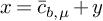 $x=\bar c_{b, \mu }+y$
, where
$x=\bar c_{b, \mu }+y$
, where $y\in C_{{\mathcal {G}}} {}^\phi $
. Let us first assume that the image of y in
$y\in C_{{\mathcal {G}}} {}^\phi $
. Let us first assume that the image of y in $\Pi _{{\mathcal {G}}} $
is trivial, then there exists
$\Pi _{{\mathcal {G}}} $
is trivial, then there exists $\tilde y\in \Omega ^\phi $
mapping to y. Then
$\tilde y\in \Omega ^\phi $
mapping to y. Then
 $$\begin{align*}c_{b, \mu}+\tilde y\in \Omega \end{align*}$$
is a lift of x which, by (4.3.2), can be lifted to a point of $X_{{\mathcal {G}} {}^o}$
which then maps to a lift of x in
$X_{{\mathcal {G}} {}^o}$
which then maps to a lift of x in $X_{{\mathcal {G}} }$
, as required.
$X_{{\mathcal {G}} }$
, as required.
In general, let $\bar {\beta }\in \Pi _{{\mathcal {G}}} $
be the image of x. Let
$\bar {\beta }\in \Pi _{{\mathcal {G}}} $
be the image of x. Let $C^\phi \to \Pi _{{\mathcal {G}}} $
be the natural surjective map from (4.3.5), and let
$C^\phi \to \Pi _{{\mathcal {G}}} $
be the natural surjective map from (4.3.5), and let $(C^\phi )_{\bar {\beta }}$
be the fibre of this map over
$(C^\phi )_{\bar {\beta }}$
be the fibre of this map over $\bar {\beta }\in \Pi _{{\mathcal {G}}} $
. Via our fixed choice of
$\bar {\beta }\in \Pi _{{\mathcal {G}}} $
. Via our fixed choice of $\gamma $
for
$\gamma $
for $\bar {\beta }$
, this can be identified with
$\bar {\beta }$
, this can be identified with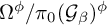 $\Omega ^\phi /\pi _0({\mathcal {G}} {}_\beta )^\phi $
. By (4.3.2), the set of components of the inverse image of
$\Omega ^\phi /\pi _0({\mathcal {G}} {}_\beta )^\phi $
. By (4.3.2), the set of components of the inverse image of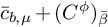 $\bar c_{b, \mu }+(C^\phi )_{\bar {\beta }}$
in
$\bar c_{b, \mu }+(C^\phi )_{\bar {\beta }}$
in $X_{{\mathcal {G}} {}^o_{\beta }}(b, \mu )$
can then be identified with
$X_{{\mathcal {G}} {}^o_{\beta }}(b, \mu )$
can then be identified with $ c_{b, \mu }+\Omega ^\phi $
. The assertion follows.
$ c_{b, \mu }+\Omega ^\phi $
. The assertion follows.
We introduce the intermediate group $K^o\subset K^\prime \subset K$
, corresponding to the subgroup
$K^o\subset K^\prime \subset K$
, corresponding to the subgroup $\pi _0({\mathcal {G}} )^\phi $
of
$\pi _0({\mathcal {G}} )^\phi $
of $\pi _0({\mathcal {G}} )$
. We denote the corresponding group scheme by
$\pi _0({\mathcal {G}} )$
. We denote the corresponding group scheme by ${\mathcal {G}} {}^\prime $
. Then we obtain a factorisation
${\mathcal {G}} {}^\prime $
. Then we obtain a factorisation
 $$ \begin{align*}X_{{\mathcal{G}} {}^o}\to X_{{\mathcal{G}} '}\to X_{{\mathcal{G}}}. \end{align*} $$
Each of the maps induces an isomorphism of a component onto its image. In fact, the first map is the quotient by the finite abelian group $\pi _0({\mathcal {G}} )^\phi $
, the second map is the quotient by the finite abelian group
$\pi _0({\mathcal {G}} )^\phi $
, the second map is the quotient by the finite abelian group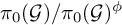 $\pi _0({\mathcal {G}} )/\pi _0({\mathcal {G}} )^\phi $
, and the composed map is the quotient by the finite abelian group
$\pi _0({\mathcal {G}} )/\pi _0({\mathcal {G}} )^\phi $
, and the composed map is the quotient by the finite abelian group $\pi _0({\mathcal {G}} )$
. Here the actions of these covering groups are trivial, in the sense that they only permute connected components.
$\pi _0({\mathcal {G}} )$
. Here the actions of these covering groups are trivial, in the sense that they only permute connected components.
Similarly, for arbitrary $\bar {\beta }\in \Pi _{{\mathcal {G}}} $
, we introduce the intermediate subgroup
$\bar {\beta }\in \Pi _{{\mathcal {G}}} $
, we introduce the intermediate subgroup $K_\beta ^o\subset K_\beta ^\prime \subset K_\beta $
, corresponding to the subgroup
$K_\beta ^o\subset K_\beta ^\prime \subset K_\beta $
, corresponding to the subgroup $\pi _0({\mathcal {G}} {}_\beta )^\phi $
of
$\pi _0({\mathcal {G}} {}_\beta )^\phi $
of $\pi _0({\mathcal {G}} {}_\beta )$
. We obtain a sequence of maps,
$\pi _0({\mathcal {G}} {}_\beta )$
. We obtain a sequence of maps,
 $$ \begin{align} X_{{\mathcal{G}} {}_{\beta}^o}\to X_{{\mathcal{G}} {}^{\prime}_\beta}\to X_{{\mathcal{G}} {}_\beta}, \end{align} $$
where the first map is the quotient by the finite group $\pi _0({\mathcal {G}} {}_\beta )^\phi $
, the second map is the quotient by the finite abelian group
$\pi _0({\mathcal {G}} {}_\beta )^\phi $
, the second map is the quotient by the finite abelian group $\pi _0({\mathcal {G}} {}_\beta )/\pi _0({\mathcal {G}} {}_\beta )^\phi $
, and the composed map is the quotient by the finite abelian group
$\pi _0({\mathcal {G}} {}_\beta )/\pi _0({\mathcal {G}} {}_\beta )^\phi $
, and the composed map is the quotient by the finite abelian group $\pi _0({\mathcal {G}} {}_\beta )$
.
$\pi _0({\mathcal {G}} {}_\beta )$
.
Proposition 4.3.7. Let $({\mathcal {G}}, b, \mu )$
be an integral local shtuka datum such that
$({\mathcal {G}}, b, \mu )$
be an integral local shtuka datum such that ${\mathcal {G}} $
is a quasi-parahoric group scheme for G.
${\mathcal {G}} $
is a quasi-parahoric group scheme for G.
(i) The ADLV $X_{{\mathcal {G}} {}^o_{\beta }}(b, \mu )$
is invariant under the action of
$X_{{\mathcal {G}} {}^o_{\beta }}(b, \mu )$
is invariant under the action of $\pi _0({\mathcal {G}} {}_\beta )^\phi $
.
$\pi _0({\mathcal {G}} {}_\beta )^\phi $
.
(ii) The map (4.3.8) induces an isomorphism

Proof. (i) Let $h\in \breve K_\beta ^\prime $
. Then
$h\in \breve K_\beta ^\prime $
. Then $\phi (h)=hk$
, with
$\phi (h)=hk$
, with $k\in \breve K_\beta ^o$
. The invariance follows from
$k\in \breve K_\beta ^o$
. The invariance follows from
 $$ \begin{align*}(gh)^{-1}b \phi(gh)=h^{-1}g^{-1}b\phi(g)\phi(h)=h^{-1}g^{-1}b\phi(g)h k , \end{align*} $$
because the last element lies in $\breve K_\beta ^oh^{-1}\mathrm {{Adm}}(\mu )h \breve K_\beta ^o=\breve K_\beta ^o\mathrm {{Adm}}(\mu ) \breve K_\beta ^o.$
(ii) The surjectivity follows from Proposition 4.3.5, (ii). For the injectivity, we note that by Proposition 4.3.5, (i), this becomes a question one $\bar {\beta }$
at the time. But if the components of
$\bar {\beta }$
at the time. But if the components of $X_{{\mathcal {G}} {}^o_{\beta }}(b, \mu )$
corresponding to
$X_{{\mathcal {G}} {}^o_{\beta }}(b, \mu )$
corresponding to $\lambda _1$
and
$\lambda _1$
and $\lambda _2$
in
$\lambda _2$
in $\Omega $
go to the same component of
$\Omega $
go to the same component of $X_{{\mathcal {G}}} (b, \mu )$
, it follows that
$X_{{\mathcal {G}}} (b, \mu )$
, it follows that $\lambda _1-\lambda _2\in \pi _0({\mathcal {G}} )$
. But by (4.3.2), this element lies in
$\lambda _1-\lambda _2\in \pi _0({\mathcal {G}} )$
. But by (4.3.2), this element lies in $\Omega ^\phi $
, hence also in
$\Omega ^\phi $
, hence also in $ \pi _0({\mathcal {G}} )^\phi $
.
$ \pi _0({\mathcal {G}} )^\phi $
.
Remark 4.3.8. Proposition 4.3.5 and Corollary 4.3.6 imply that the map $X_{{\mathcal {G}} {}^o}(b, \mu )\to X_{{\mathcal {G}} }(b, \mu )$
is surjective if and only if
$X_{{\mathcal {G}} {}^o}(b, \mu )\to X_{{\mathcal {G}} }(b, \mu )$
is surjective if and only if $\Pi _{{\mathcal {G}}} $
is trivial. The question of the surjectivity of this map is also analysed in [Reference Görtz, He and NieGHN24, §5]. By [Reference Görtz, He and NieGHN24, Prop. 5.11] it holds if there is a product decomposition
$\Pi _{{\mathcal {G}}} $
is trivial. The question of the surjectivity of this map is also analysed in [Reference Görtz, He and NieGHN24, §5]. By [Reference Görtz, He and NieGHN24, Prop. 5.11] it holds if there is a product decomposition $\Omega =\pi _0({\mathcal {G}} )\times C$
into subgroups stable under
$\Omega =\pi _0({\mathcal {G}} )\times C$
into subgroups stable under $\phi $
(then, of course,
$\phi $
(then, of course, $\Pi _{{\mathcal {G}}} =(0)$
). In [Reference Görtz, He and NieGHN24, §5] it is also analysed when
$\Pi _{{\mathcal {G}}} =(0)$
). In [Reference Görtz, He and NieGHN24, §5] it is also analysed when $X_{{\mathcal {G}} {}^o}(b, \mu )$
is the full inverse image of
$X_{{\mathcal {G}} {}^o}(b, \mu )$
is the full inverse image of $ X_{{\mathcal {G}} }(b, \mu )$
under
$ X_{{\mathcal {G}} }(b, \mu )$
under $X_{{\mathcal {G}} {}^o}\to X_{{\mathcal {G}}} $
. By [Reference Görtz, He and NieGHN24, Prop. 5.13] this holds when
$X_{{\mathcal {G}} {}^o}\to X_{{\mathcal {G}}} $
. By [Reference Görtz, He and NieGHN24, Prop. 5.13] this holds when $\pi _0({\mathcal {G}} )^\phi =\pi _0({\mathcal {G}} )$
and
$\pi _0({\mathcal {G}} )^\phi =\pi _0({\mathcal {G}} )$
and $\Omega ^\phi \to C_{{\mathcal {G}}} {}^\phi $
is surjective (again, these conditions imply
$\Omega ^\phi \to C_{{\mathcal {G}}} {}^\phi $
is surjective (again, these conditions imply $\Pi _{{\mathcal {G}}} =(0)$
).
$\Pi _{{\mathcal {G}}} =(0)$
).
4.4 Integral moduli spaces of local shtukas
We first define a morphism of integral LSV
 $$ \begin{align} \mathcal{M} {}^{\mathrm{int}}_{{\mathcal{G}} {}_{\beta}, b, \mu}\to \mathcal{M} {}^{\mathrm{int}}_{{\mathcal{G}} , b, \mu}. \end{align} $$
Recall that
 $$ \begin{align*}\mathcal{M} {}^{\mathrm{int}}_{{\mathcal{G}} {}_\beta, b, \mu}(S)=\{\text{isomorphism classes of } (S^\sharp, \mathcal{P} {}_\beta, \phi_{\mathcal{P} {}_\beta}, i_{r, \beta}) \}. \end{align*} $$
Starting with a point $(S^\sharp , \mathcal {P} {}_\beta , \phi _{\mathcal {P} {}_\beta }, i_{r, \beta })$
of
$(S^\sharp , \mathcal {P} {}_\beta , \phi _{\mathcal {P} {}_\beta }, i_{r, \beta })$
of $\mathcal {M} {}^{\mathrm {int}}_{{\mathcal {G}} {}_\beta , b, \mu }$
, we define a
$\mathcal {M} {}^{\mathrm {int}}_{{\mathcal {G}} {}_\beta , b, \mu }$
, we define a ${\mathcal {G}} $
-torsor
${\mathcal {G}} $
-torsor $\mathcal {P} $
by twisting the
$\mathcal {P} $
by twisting the ${\mathcal {G}} {}_\beta $
-action by
${\mathcal {G}} {}_\beta $
-action by $\dot \gamma $
,
$\dot \gamma $
,
 $$ \begin{align*}g\star x=( \dot\gamma g \dot\gamma^{-1})\cdot x, \quad g\in{\mathcal{G}}, \end{align*} $$
where $\dot \gamma $
is the fixed choice above. This makes sense since
$\dot \gamma $
is the fixed choice above. This makes sense since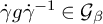 $\dot \gamma g\dot \gamma ^{-1}\in {\mathcal {G}} {}_\beta $
. Let
$\dot \gamma g\dot \gamma ^{-1}\in {\mathcal {G}} {}_\beta $
. Let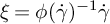 $\xi =\phi (\dot \gamma )^{-1}\dot \gamma $
. Then
$\xi =\phi (\dot \gamma )^{-1}\dot \gamma $
. Then $\xi \in {\mathcal {G}} (\breve {\mathbb {Z}} {}_p)$
, cf. Lemma 4.3.1. We define the new Frobenius
$\xi \in {\mathcal {G}} (\breve {\mathbb {Z}} {}_p)$
, cf. Lemma 4.3.1. We define the new Frobenius $\phi _{\mathcal {P} }$
as
$\phi _{\mathcal {P} }$
as
 $$ \begin{align} \phi_{\mathcal{P}} (x)=\xi\star\phi_{\mathcal{P} {}_\beta}(x). \end{align} $$
This is indeed a morphism of ${\mathcal {G}} $
-torsors: on the one hand
${\mathcal {G}} $
-torsors: on the one hand
 $$ \begin{align*} \begin{aligned} \phi_{\mathcal{P} }(g\star x)&=\xi\star\phi_{\mathcal{P} {}_\beta}(g\star x)= \dot\gamma\xi\dot\gamma^{-1} \phi_{\mathcal{P} {}_\beta}(( \dot\gamma g \dot\gamma^{-1})x)\\&= \dot\gamma(\phi( \dot\gamma)^{-1} \dot\gamma) \dot\gamma^{-1}(\phi( \dot\gamma)\phi(g)\phi( \dot\gamma)^{-1})\phi_{\mathcal{P} {}_\beta}(x)= \dot\gamma\phi(g)\phi( \dot\gamma)^{-1}\phi_{\mathcal{P} {}_\beta}(x). \end{aligned} \end{align*} $$
On the other hand,
 $$ \begin{align*} \begin{aligned} \phi(g)\star\phi_{\mathcal{P}} (x)&=( \dot\gamma \phi(g) \dot\gamma^{-1})( \dot\gamma\xi \dot\gamma^{-1})\phi_{\mathcal{P} {}_\beta}(x)\\&= \dot\gamma \phi(g) (\phi( \dot\gamma)^{-1} \dot\gamma) \dot\gamma^{-1}\phi_{\mathcal{P} {}_\beta}(x) = \dot\gamma \phi(g) \phi( \dot\gamma)^{-1}\phi_{\mathcal{P} {}_\beta}(x), \end{aligned} \end{align*} $$
which proves the claim.
We define the framing $i_r$
as
$i_r$
as
 $$ \begin{align} i_r(x)=i_{r, \beta}( \dot\gamma x). \end{align} $$
This is indeed an isomorphism of ${\mathcal {G}} $
-bundles
${\mathcal {G}} $
-bundles $i_r: G_{\mathcal {Y} {}_{[r, \infty ]}}\to \mathcal {P} {}_{|\mathcal {Y} {}_{[r, \infty ]}}$
: on the one hand
$i_r: G_{\mathcal {Y} {}_{[r, \infty ]}}\to \mathcal {P} {}_{|\mathcal {Y} {}_{[r, \infty ]}}$
: on the one hand
 $$ \begin{align*}i_r(hg)=i_{r, \beta}( \dot\gamma hg)= \dot\gamma h i_{r, \beta}(g). \end{align*} $$
On the other hand,
 $$ \begin{align*}h\star i_r(g)=( \dot\gamma h \dot\gamma^{-1}) i_{r, \beta}( \dot\gamma g)=( \dot\gamma h \dot\gamma^{-1}) \dot\gamma i_{r, \beta}( g)= \dot\gamma h i_{r, \beta}(g). \end{align*} $$
The framing $i_r$
is also compatible with the Frobenius: on the one hand,
$i_r$
is also compatible with the Frobenius: on the one hand,
 $$ \begin{align*} \begin{aligned} \phi_{\mathcal{P}} (i_r(g))&=\xi\star\phi_{\mathcal{P} {}_\beta}(i_{r, \beta}( \dot\gamma g))= \dot\gamma(\phi( \dot\gamma)^{-1} \dot\gamma) \dot\gamma^{-1}\phi_{\mathcal{P} {}_\beta}(i_{r, \beta}( \dot\gamma g))\\ &= ( \dot\gamma\phi( \dot\gamma)^{-1})\phi( \dot\gamma) i_{r, \beta}( b\phi(g))= \dot\gamma i_{r, \beta}( b\phi(g)). \end{aligned} \end{align*} $$
On the other hand,
 $$ \begin{align*} \begin{aligned} i_r(b\phi(g))=i_{r, \beta}( \dot\gamma b\phi(g))= \dot\gamma i_{r, \beta}( b\phi(g)). \end{aligned} \end{align*} $$
The morphism (4.4.1) is now defined by sending $(S^\sharp , \mathcal {P} {}_\beta , \phi _{\mathcal {P} {}_\beta }, i_{r, \beta })$
to
$(S^\sharp , \mathcal {P} {}_\beta , \phi _{\mathcal {P} {}_\beta }, i_{r, \beta })$
to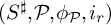 $(S^\sharp , \mathcal {P}, \phi _{\mathcal {P} }, i_{r })$
. We precompose (4.4.1) with the natural morphism
$(S^\sharp , \mathcal {P}, \phi _{\mathcal {P} }, i_{r })$
. We precompose (4.4.1) with the natural morphism $ \mathcal {M} {}^{\mathrm {int}}_{{\mathcal {G}} {}^o_{\beta }, b, \mu }\to \mathcal {M} {}^{\mathrm {int}}_{{\mathcal {G}} {}_\beta , b, \mu }$
to obtain a morphism of integral LSV
$ \mathcal {M} {}^{\mathrm {int}}_{{\mathcal {G}} {}^o_{\beta }, b, \mu }\to \mathcal {M} {}^{\mathrm {int}}_{{\mathcal {G}} {}_\beta , b, \mu }$
to obtain a morphism of integral LSV
 $$ \begin{align*}\mathcal{M} {}^{\mathrm{int}}_{{\mathcal{G}} {}^o_{\beta}, b, \mu}\to \mathcal{M} {}^{\mathrm{int}}_{{\mathcal{G}} , b, \mu} , \end{align*} $$
and hence a morphism
 $$ \begin{align} \pi: \bigsqcup_{\bar{\beta}\in\Pi_{{\mathcal{G}}} }\mathcal{M} {}^{\mathrm{int}}_{{\mathcal{G}} {}^o_{\beta}, b, \mu}\to \mathcal{M} {}^{\mathrm{int}}_{{\mathcal{G}} , b, \mu}. \end{align} $$
This morphism is compatible, via the bijective map of Proposition 3.3.1, with the morphism (4.3.8) for $\mu ^{-1}$
. Indeed, let
$\mu ^{-1}$
. Indeed, let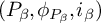 $(P_\beta , \phi _{P_\beta }, i_\beta )$
be an object of
$(P_\beta , \phi _{P_\beta }, i_\beta )$
be an object of $\mathcal {M} {}^{\mathrm {int}}_{{\mathcal {G}} {}_\beta , b, \mu }(\mathrm{Spd}(k))$
, which gives a
$\mathcal {M} {}^{\mathrm {int}}_{{\mathcal {G}} {}_\beta , b, \mu }(\mathrm{Spd}(k))$
, which gives a ${\mathcal {G}} {}_\beta $
-torsor
${\mathcal {G}} {}_\beta $
-torsor $P_\beta $
over
$P_\beta $
over $W(k)$
, a Frobenius and a trivialisation of
$W(k)$
, a Frobenius and a trivialisation of $P_\beta $
over
$P_\beta $
over $W(k)[1/p]$
. The image of
$W(k)[1/p]$
. The image of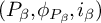 $(P_\beta , \phi _{P_\beta }, i_\beta )$
in
$(P_\beta , \phi _{P_\beta }, i_\beta )$
in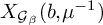 $X_{{\mathcal {G}} {}_\beta }(b, \mu ^{-1})$
is given by the unique element
$X_{{\mathcal {G}} {}_\beta }(b, \mu ^{-1})$
is given by the unique element $g_\beta \in LG(k)/L^+{\mathcal {G}} {}_\beta (k)$
such that
$g_\beta \in LG(k)/L^+{\mathcal {G}} {}_\beta (k)$
such that $i_\beta ^{-1}(P_\beta )=g_\beta ^{-1} \cdot {\mathcal {G}} {}_\beta $
. Let
$i_\beta ^{-1}(P_\beta )=g_\beta ^{-1} \cdot {\mathcal {G}} {}_\beta $
. Let $(P, \phi _{P}, i)\in \mathcal {M} {}^{\mathrm {int}}_{{\mathcal {G}}, b, \mu }(k)$
be the image of
$(P, \phi _{P}, i)\in \mathcal {M} {}^{\mathrm {int}}_{{\mathcal {G}}, b, \mu }(k)$
be the image of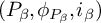 $(P_\beta , \phi _{P_\beta }, i_\beta )$
under (4.4.1). Then
$(P_\beta , \phi _{P_\beta }, i_\beta )$
under (4.4.1). Then $i^{-1}(P)= \dot \gamma ^{-1}i_\beta ^{-1}(P_\beta )$
. Hence the image
$i^{-1}(P)= \dot \gamma ^{-1}i_\beta ^{-1}(P_\beta )$
. Hence the image $g\in LG(k)/L^+{\mathcal {G}} (k)$
of
$g\in LG(k)/L^+{\mathcal {G}} (k)$
of $(P, \phi _{P}, i)$
is equal to
$(P, \phi _{P}, i)$
is equal to $g=g_\beta \gamma $
, as required.
$g=g_\beta \gamma $
, as required.
Theorem 4.4.1. Let $({\mathcal {G}}, b, \mu )$
be an integral local shtuka datum such that
$({\mathcal {G}}, b, \mu )$
be an integral local shtuka datum such that ${\mathcal {G}} $
is a quasi-parahoric group scheme for G. The morphism (4.4.4) induces an isomorphism
${\mathcal {G}} $
is a quasi-parahoric group scheme for G. The morphism (4.4.4) induces an isomorphism

where the quotient is for an action of $\pi _0({\mathcal {G}} {}_\beta )^\phi $
which permutes connected components.
$\pi _0({\mathcal {G}} {}_\beta )^\phi $
which permutes connected components.
Let us first define the action of $\pi _0({\mathcal {G}} {}_\beta )^\phi $
on
$\pi _0({\mathcal {G}} {}_\beta )^\phi $
on $\mathcal {M} {}^{\mathrm {int}}_{{\mathcal {G}} {}^o_{\beta }, b, \mu }$
. We use the exactness of the sequence
$\mathcal {M} {}^{\mathrm {int}}_{{\mathcal {G}} {}^o_{\beta }, b, \mu }$
. We use the exactness of the sequence
 $$ \begin{align*}0\to {\mathcal{G}} {}_{\beta}^o(\mathbb{Z} {}_p)\to {\mathcal{G}} {}_\beta(\mathbb{Z} {}_p)\to \pi_0({\mathcal{G}} {}_\beta)^\phi\to 0. \end{align*} $$
Let $\delta \in G(\mathbb {Q} {}_p)$
be in the normaliser of
$\delta \in G(\mathbb {Q} {}_p)$
be in the normaliser of ${\mathcal {G}} {}_\beta ^o$
. Recall that
${\mathcal {G}} {}_\beta ^o$
. Recall that
 $$ \begin{align*}\mathcal{M} {}^{\mathrm{int}}_{{\mathcal{G}} {}_\beta^o, b, \mu}(S)=\{\text{isomorphism classes of } (S^\sharp, \mathcal{P} , \phi_{\mathcal{P}} , i_r) \} , \end{align*} $$
where $\mathcal {P} $
is a
$\mathcal {P} $
is a ${\mathcal {G}} {}_\beta ^o$
-torsor, etc. We define a new
${\mathcal {G}} {}_\beta ^o$
-torsor, etc. We define a new ${\mathcal {G}} {}_\beta ^o$
-torsor
${\mathcal {G}} {}_\beta ^o$
-torsor $\mathcal {P} '=\mathcal {P} {}_\delta $
by twisting the
$\mathcal {P} '=\mathcal {P} {}_\delta $
by twisting the ${\mathcal {G}} {}_\beta ^o$
-action by
${\mathcal {G}} {}_\beta ^o$
-action by $\delta $
,
$\delta $
,
 $$ \begin{align*}g\star x=(\delta g\delta^{-1})\cdot x. \end{align*} $$
The new Frobenius $\phi _{\mathcal {P} '}$
is taken to be identical to
$\phi _{\mathcal {P} '}$
is taken to be identical to $\phi _{\mathcal {P}} $
. This is indeed a morphism of
$\phi _{\mathcal {P}} $
. This is indeed a morphism of ${\mathcal {G}} {}_\beta ^o$
-torsors since
${\mathcal {G}} {}_\beta ^o$
-torsors since
 $$ \begin{align*}\phi_{\mathcal{P} '}(g\star x)=\phi_{\mathcal{P}} ((\delta g\delta^{-1})\cdot x)=(\delta \phi(g)\delta^{-1})\cdot\phi_{\mathcal{P}} (x)=\phi(g)\star\phi_{\mathcal{P} '}(x), \end{align*} $$
where we used that $\delta \in G(\mathbb {Q} {}_p)$
. Finally, the framing
$\delta \in G(\mathbb {Q} {}_p)$
. Finally, the framing $i^{\prime }_r$
is given by
$i^{\prime }_r$
is given by $i^{\prime }_r(g)=i_r(\delta g)$
. This is indeed an isomorphism of
$i^{\prime }_r(g)=i_r(\delta g)$
. This is indeed an isomorphism of ${\mathcal {G}} {}_\beta ^o$
-bundles, since
${\mathcal {G}} {}_\beta ^o$
-bundles, since
 $$ \begin{align*}i^{\prime}_r(hg)=i_r(\delta hg)=i_r((\delta h\delta^{-1})(\delta g))=(\delta h\delta^{-1})\cdot i_r(\delta g)=h\star i^{\prime}_r(g). \end{align*} $$
The compatibility with the Frobenius follows from
 $$ \begin{align*}\phi_{\mathcal{P} '}(i^{\prime}_r(g))=\phi_{\mathcal{P}} (i_r(\delta g))=\delta \phi_{\mathcal{P}} (i_r(g))=\delta i_r(b\phi(g))=i^{\prime}_r(b\phi(g)). \end{align*} $$
Note that if $\delta \in {\mathcal {G}} {}_\beta ^o(\mathbb {Z} {}_p)$
, then the tuple
$\delta \in {\mathcal {G}} {}_\beta ^o(\mathbb {Z} {}_p)$
, then the tuple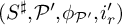 $(S^\sharp , \mathcal {P} ', \phi _{\mathcal {P} '}, i^{\prime }_r)$
is isomorphic to
$(S^\sharp , \mathcal {P} ', \phi _{\mathcal {P} '}, i^{\prime }_r)$
is isomorphic to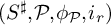 $(S^\sharp , \mathcal {P}, \phi _{\mathcal {P}}, i_r)$
. Indeed, the map
$(S^\sharp , \mathcal {P}, \phi _{\mathcal {P}}, i_r)$
. Indeed, the map $x\mapsto \delta \cdot x$
defines an isomorphism
$x\mapsto \delta \cdot x$
defines an isomorphism $\alpha :\mathcal {P} \to \mathcal {P} '$
compatible with
$\alpha :\mathcal {P} \to \mathcal {P} '$
compatible with $\phi _{\mathcal {P}} $
and
$\phi _{\mathcal {P}} $
and $\phi _{\mathcal {P} '}$
, and with
$\phi _{\mathcal {P} '}$
, and with $i_r$
and
$i_r$
and $i^{\prime }_r$
. For instance
$i^{\prime }_r$
. For instance
 $$ \begin{align*}\phi_{\mathcal{P} '}(\alpha(x))=\phi_{\mathcal{P}} (\delta\cdot x)=\phi(\delta)\cdot\phi_{\mathcal{P}} (x)=\delta\cdot\phi_{\mathcal{P}} (x)=\alpha(\phi_{\mathcal{P}} (x)). \end{align*} $$
Therefore we obtain an action of the factor group $N_{G(\mathbb {Q} {}_p)}({\mathcal {G}} {}_\beta ^o)/{\mathcal {G}} {}_\beta ^o(\mathbb {Z} {}_p)$
on
$N_{G(\mathbb {Q} {}_p)}({\mathcal {G}} {}_\beta ^o)/{\mathcal {G}} {}_\beta ^o(\mathbb {Z} {}_p)$
on $\mathcal {M} {}^{\mathrm {int}}_{{\mathcal {G}} {}^o, b, \mu }$
. Restricting this action to
$\mathcal {M} {}^{\mathrm {int}}_{{\mathcal {G}} {}^o, b, \mu }$
. Restricting this action to ${\mathcal {G}} {}_\beta (\mathbb {Z} {}_p)/{\mathcal {G}} {}_\beta ^o(\mathbb {Z} {}_p)$
, we obtain the desired action of
${\mathcal {G}} {}_\beta (\mathbb {Z} {}_p)/{\mathcal {G}} {}_\beta ^o(\mathbb {Z} {}_p)$
, we obtain the desired action of $\pi _0({\mathcal {G}} )^\phi $
on
$\pi _0({\mathcal {G}} )^\phi $
on $\mathcal {M} {}^{\mathrm {int}}_{{\mathcal {G}} {}^o, b, \mu }$
.
$\mathcal {M} {}^{\mathrm {int}}_{{\mathcal {G}} {}^o, b, \mu }$
.
The same argument as the one above shows that $\delta \in {\mathcal {G}} {}_\beta (\mathbb {Z} {}_p)$
induces an isomorphism between the images of
$\delta \in {\mathcal {G}} {}_\beta (\mathbb {Z} {}_p)$
induces an isomorphism between the images of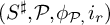 $(S^\sharp , \mathcal {P}, \phi _{\mathcal {P}, } i_r)$
and
$(S^\sharp , \mathcal {P}, \phi _{\mathcal {P}, } i_r)$
and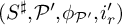 $(S^\sharp , \mathcal {P} ', \phi _{\mathcal {P} '}, i^{\prime }_r)$
in
$(S^\sharp , \mathcal {P} ', \phi _{\mathcal {P} '}, i^{\prime }_r)$
in $\mathcal {M} {}^{\mathrm {int}}_{{\mathcal {G}}, b, \mu }$
under (4.4.1), hence we obtain a morphism
$\mathcal {M} {}^{\mathrm {int}}_{{\mathcal {G}}, b, \mu }$
under (4.4.1), hence we obtain a morphism $\mathcal {M} {}^{\mathrm {int}}_{{\mathcal {G}} {}_\beta ^o, b, \mu }/\pi _0({\mathcal {G}} {}_\beta )^\phi \to \mathcal {M} {}^{\mathrm {int}}_{{\mathcal {G}}, b, \mu }$
. Letting now
$\mathcal {M} {}^{\mathrm {int}}_{{\mathcal {G}} {}_\beta ^o, b, \mu }/\pi _0({\mathcal {G}} {}_\beta )^\phi \to \mathcal {M} {}^{\mathrm {int}}_{{\mathcal {G}}, b, \mu }$
. Letting now $\bar {\beta }$
vary, we obtain a morphism from the LHS to the RHS in Theorem 4.4.1.
$\bar {\beta }$
vary, we obtain a morphism from the LHS to the RHS in Theorem 4.4.1.
Proof of Theorem 4.4.1 .
We deduce from Proposition 3.3.1 and Proposition 4.3.7 that the morphism induces a bijection on the set of $\mathrm{Spd}(\kappa )$
-points, for all algebraically closed extensions
$\mathrm{Spd}(\kappa )$
-points, for all algebraically closed extensions $\kappa /k$
. Also it is qcqs by Proposition 4.2.1 (a). Using relative properness and [Reference Scholze and WeinsteinSW20, Cor. 17.4.10] we see it is enough to check that it gives a bijection on
$\kappa /k$
. Also it is qcqs by Proposition 4.2.1 (a). Using relative properness and [Reference Scholze and WeinsteinSW20, Cor. 17.4.10] we see it is enough to check that it gives a bijection on $\mathrm{Spa}(C, O_C)$
-points. Note that any
$\mathrm{Spa}(C, O_C)$
-points. Note that any $\mathrm{Spa}(C, O_C)$
-point
$\mathrm{Spa}(C, O_C)$
-point $\widetilde x$
of
$\widetilde x$
of $\mathcal {M} {}^{\mathrm {int}}_{{\mathcal {G}}, b, \mu }$
factors through the formal completion
$\mathcal {M} {}^{\mathrm {int}}_{{\mathcal {G}}, b, \mu }$
factors through the formal completion $ (\mathcal {M} {}^{\mathrm {int}}_{{\mathcal {G}}, b, \mu })_{O(k_C)/\bar x} $
of the base change of
$ (\mathcal {M} {}^{\mathrm {int}}_{{\mathcal {G}}, b, \mu })_{O(k_C)/\bar x} $
of the base change of $\mathcal {M} {}^{\mathrm {int}}_{{\mathcal {G}}, b, \mu }$
by
$\mathcal {M} {}^{\mathrm {int}}_{{\mathcal {G}}, b, \mu }$
by $O(k_C)=O_{\breve E}\otimes _{W(k)}W(k_C)$
, at its specialisation at
$O(k_C)=O_{\breve E}\otimes _{W(k)}W(k_C)$
, at its specialisation at $\bar x=\mathrm {sp}(\widetilde x)$
. Here,
$\bar x=\mathrm {sp}(\widetilde x)$
. Here, $k_C=O_C/\mathfrak {m} {}_C$
is the residue field. The corresponding fact is also true for
$k_C=O_C/\mathfrak {m} {}_C$
is the residue field. The corresponding fact is also true for $\mathrm{Spa}(C, O_C)$
-points of
$\mathrm{Spa}(C, O_C)$
-points of $\mathcal {M} {}^{\mathrm {int}}_{{\mathcal {G}} {}_\beta ^o, b, \mu }$
.
$\mathcal {M} {}^{\mathrm {int}}_{{\mathcal {G}} {}_\beta ^o, b, \mu }$
.
We can now complete the proof. First we show injectivity: Suppose $\widetilde x_i$
,
$\widetilde x_i$
, $i=1,2$
, are two points in
$i=1,2$
, are two points in $(\sqcup _{\bar {\beta }\in \Pi _{{\mathcal {G}}} }\mathcal {M} {}^{\mathrm {int}}_{{\mathcal {G}} {}_\beta ^o, b, \mu }/\pi _0({\mathcal {G}} {}_\beta )^\phi )(C, O_C)$
, mapping by
$(\sqcup _{\bar {\beta }\in \Pi _{{\mathcal {G}}} }\mathcal {M} {}^{\mathrm {int}}_{{\mathcal {G}} {}_\beta ^o, b, \mu }/\pi _0({\mathcal {G}} {}_\beta )^\phi )(C, O_C)$
, mapping by $\bar \pi $
to the same point in
$\bar \pi $
to the same point in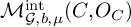 $\mathcal {M} {}^{\mathrm {int}}_{{\mathcal {G}}, b, \mu }(C, O_C)$
. By Proposition 4.3.7, these two points have the same specialisation
$\mathcal {M} {}^{\mathrm {int}}_{{\mathcal {G}}, b, \mu }(C, O_C)$
. By Proposition 4.3.7, these two points have the same specialisation ${\bar x=\bar x_1=\bar x_2}$
. By the above, they factor through the formal completion of (the base change) of
${\bar x=\bar x_1=\bar x_2}$
. By the above, they factor through the formal completion of (the base change) of $\mathcal {M} {}^{\mathrm {int}}_{{\mathcal {G}} {}_\beta ^o, b, \mu }$
at a corresponding
$\mathcal {M} {}^{\mathrm {int}}_{{\mathcal {G}} {}_\beta ^o, b, \mu }$
at a corresponding $\bar x$
, for some common
$\bar x$
, for some common $\bar {\beta }\in \Pi _{{\mathcal {G}}} $
. By (4.2.3) for
$\bar {\beta }\in \Pi _{{\mathcal {G}}} $
. By (4.2.3) for $\kappa =k_C$
, we see that these two points agree in the formal completion of
$\kappa =k_C$
, we see that these two points agree in the formal completion of $\mathcal {M} {}^{\mathrm {int}}_{{\mathcal {G}} {}_\beta ^o, b, \mu }$
at
$\mathcal {M} {}^{\mathrm {int}}_{{\mathcal {G}} {}_\beta ^o, b, \mu }$
at $\bar x$
, and therefore
$\bar x$
, and therefore $\widetilde x_1=\widetilde x_2$
. The proof of surjectivity onto
$\widetilde x_1=\widetilde x_2$
. The proof of surjectivity onto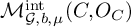 $\mathcal {M} {}^{\mathrm {int}}_{{\mathcal {G}}, b, \mu }(C, O_C)$
is by a similar argument.
$\mathcal {M} {}^{\mathrm {int}}_{{\mathcal {G}}, b, \mu }(C, O_C)$
is by a similar argument.
We define a map of v-sheaves
 $$ \begin{align*}\kappa_G\circ \mathrm{sp}\colon \mathcal{M} {}^{\mathrm{int}}_{{\mathcal{G}} , b, \mu}\to \underline{C_{{\mathcal{G}} }} , \end{align*} $$
where $\mathrm {sp}\colon |\mathcal {M} {}^{\mathrm {int}}_{{\mathcal {G}}, b, \mu }|\to |X_{{\mathcal {G}}} (b, \mu ^{-1})|$
denotes the (continuous) specialisation map under the identification
$\mathrm {sp}\colon |\mathcal {M} {}^{\mathrm {int}}_{{\mathcal {G}}, b, \mu }|\to |X_{{\mathcal {G}}} (b, \mu ^{-1})|$
denotes the (continuous) specialisation map under the identification $(\mathcal {M} {}^{\mathrm {int}}_{{\mathcal {G}}, b, \mu })_{\mathrm {red}} =X_{{\mathcal {G}} }(b, \mu ^{-1} )$
, cf. Proposition 3.3.1. For
$(\mathcal {M} {}^{\mathrm {int}}_{{\mathcal {G}}, b, \mu })_{\mathrm {red}} =X_{{\mathcal {G}} }(b, \mu ^{-1} )$
, cf. Proposition 3.3.1. For $\tau \in C_{{\mathcal {G}} }$
, we denote by
$\tau \in C_{{\mathcal {G}} }$
, we denote by
 $$ \begin{align} \mathcal{M} {}^{\mathrm{int,\tau}}_{{\mathcal{G}} , b, \mu}= \mathcal{M} {}^{\mathrm{int}}_{{\mathcal{G}} , b, \mu}\times_{\underline{C_{{\mathcal{G}} }}}\underline{\{\tau\}}\subset \mathcal{M} {}^{\mathrm{int}}_{{\mathcal{G}} , b, \mu} \end{align} $$
the fibre over $\tau $
. This is an open and closed v-subsheaf of
$\tau $
. This is an open and closed v-subsheaf of $\mathcal {M} {}^{\mathrm {int}}_{{\mathcal {G}}, b, \mu }$
. We call
$\mathcal {M} {}^{\mathrm {int}}_{{\mathcal {G}}, b, \mu }$
. We call $ \mathcal {M} {}^{\mathrm {int,\tau }}_{{\mathcal {G}}, b, \mu }$
the component of
$ \mathcal {M} {}^{\mathrm {int,\tau }}_{{\mathcal {G}}, b, \mu }$
the component of $ \mathcal {M} {}^{\mathrm {int}}_{{\mathcal {G}}, b, \mu }$
corresponding to
$ \mathcal {M} {}^{\mathrm {int}}_{{\mathcal {G}}, b, \mu }$
corresponding to $\tau $
.
$\tau $
.
Corollary 4.4.2. Let $({\mathcal {G}}, b, \mu )$
be an integral local shtuka datum such that
$({\mathcal {G}}, b, \mu )$
be an integral local shtuka datum such that ${\mathcal {G}} $
is a quasi-parahoric group scheme for G and let
${\mathcal {G}} $
is a quasi-parahoric group scheme for G and let ${\mathcal {G}} \to {\mathcal {G}} '$
be a morphism extending the identity morphism of G in the generic fibres of quasi-parahoric group schemes for G with the same associated parahoric group scheme. Then for every
${\mathcal {G}} \to {\mathcal {G}} '$
be a morphism extending the identity morphism of G in the generic fibres of quasi-parahoric group schemes for G with the same associated parahoric group scheme. Then for every $\tau \in \Omega _G/\pi _0({\mathcal {G}} )$
, with image
$\tau \in \Omega _G/\pi _0({\mathcal {G}} )$
, with image ${\tau '\in \Omega _G/\pi _0({\mathcal {G}} ')}$
, the natural morphism
${\tau '\in \Omega _G/\pi _0({\mathcal {G}} ')}$
, the natural morphism $\mathcal {M} {}^{\mathrm {int}}_{{\mathcal {G}}, b, \mu }\to \mathcal {M} {}^{\mathrm {int}}_{{\mathcal {G}} ', b, \mu }$
induces an isomorphism
$\mathcal {M} {}^{\mathrm {int}}_{{\mathcal {G}}, b, \mu }\to \mathcal {M} {}^{\mathrm {int}}_{{\mathcal {G}} ', b, \mu }$
induces an isomorphism

of v-sheaves.
Proof of Theorem 4.1.1 .
For the representability conjecture, we assume that $(G, b, \mu )$
is a local Shimura datum, i.e.,
$(G, b, \mu )$
is a local Shimura datum, i.e., $\mu $
is minuscule. Now
$\mu $
is minuscule. Now $\mathcal {M} {}^{\mathrm {int}}_{{\mathcal {G}}, b, \mu }$
is representable if and only if
$\mathcal {M} {}^{\mathrm {int}}_{{\mathcal {G}}, b, \mu }$
is representable if and only if $\mathcal {M} {}^{\mathrm {int}, \tau }_{{\mathcal {G}}, b, \mu }$
is representable for every
$\mathcal {M} {}^{\mathrm {int}, \tau }_{{\mathcal {G}}, b, \mu }$
is representable for every $\tau \in \Omega _G/\pi _0({\mathcal {G}} )$
. Hence the assertion follows from Corollary 4.4.2 and the fact that every component
$\tau \in \Omega _G/\pi _0({\mathcal {G}} )$
. Hence the assertion follows from Corollary 4.4.2 and the fact that every component $\mathcal {M} {}^{\mathrm {int}, \tau }_{{\mathcal {G}}, b, \mu }$
is isomorphic to a component
$\mathcal {M} {}^{\mathrm {int}, \tau }_{{\mathcal {G}}, b, \mu }$
is isomorphic to a component $\mathcal {M} {}^{\mathrm {int}, \widetilde \tau }_{{\mathcal {G}} {}^o, b, \mu }$
of
$\mathcal {M} {}^{\mathrm {int}, \widetilde \tau }_{{\mathcal {G}} {}^o, b, \mu }$
of $\mathcal {M} {}^{\mathrm { int}}_{{\mathcal {G}} {}^o, b, \mu }$
for
$\mathcal {M} {}^{\mathrm { int}}_{{\mathcal {G}} {}^o, b, \mu }$
for $\widetilde \tau \in \Omega _G$
mapping to
$\widetilde \tau \in \Omega _G$
mapping to $\tau $
and, conversely, every component
$\tau $
and, conversely, every component $\mathcal {M} {}^{\mathrm {int}, \tau }_{{\mathcal {G}} {}^o, b, \mu }$
is isomorphic to the component
$\mathcal {M} {}^{\mathrm {int}, \tau }_{{\mathcal {G}} {}^o, b, \mu }$
is isomorphic to the component $\mathcal {M} {}^{\mathrm { int}, \bar \tau }_{{\mathcal {G}}, b, \mu }$
of
$\mathcal {M} {}^{\mathrm { int}, \bar \tau }_{{\mathcal {G}}, b, \mu }$
of $\mathcal {M} {}^{\mathrm {int}}_{{\mathcal {G}}, b, \mu }$
, where
$\mathcal {M} {}^{\mathrm {int}}_{{\mathcal {G}}, b, \mu }$
, where $\bar \tau \in \Omega _G/\pi _0({\mathcal {G}} )$
is the image of
$\bar \tau \in \Omega _G/\pi _0({\mathcal {G}} )$
is the image of $\tau $
.
$\tau $
.
We also mention the following naturality statement which is used in §8. It concerns the action of the Frobenius centraliser $J_b(\mathbb {Q} {}_p)$
on
$J_b(\mathbb {Q} {}_p)$
on $\mathcal {M} {}^{\mathrm {int}}_{{\mathcal {G}}, b, \mu }$
. Recall that this action is via changes of the framing, i.e.,
$\mathcal {M} {}^{\mathrm {int}}_{{\mathcal {G}}, b, \mu }$
. Recall that this action is via changes of the framing, i.e.,
 $$\begin{align*}g: (S^\sharp, \mathcal{P} , \phi_{\mathcal{P} }, i_{r})\mapsto (S^\sharp, \mathcal{P}, \phi_{\mathcal{P} }, i_{r}\circ g^{-1}), \quad g\in J_b(\mathbb{Q} {}_p). \end{align*}$$
This action is compatible with the action of $J_b(\mathbb {Q} {}_p)$
on
$J_b(\mathbb {Q} {}_p)$
on $\bar c_{b, \mu }+C^\phi $
, via
$\bar c_{b, \mu }+C^\phi $
, via
 $$\begin{align*}g: \tau\mapsto \tau +\tilde\kappa(g) , \end{align*}$$
where $\tilde \kappa $
is induced by the composition of maps
$\tilde \kappa $
is induced by the composition of maps $J_b(\mathbb {Q} {}_p)\hookrightarrow G(\breve {\mathbb {Q}} {}_p)\xrightarrow {\ \kappa _G\ }\Omega _G$
.
$J_b(\mathbb {Q} {}_p)\hookrightarrow G(\breve {\mathbb {Q}} {}_p)\xrightarrow {\ \kappa _G\ }\Omega _G$
.
Proposition 4.4.3. Assume that the centre of G is connected. Then the action of $J_b(\mathbb {Q} {}_p)$
on
$J_b(\mathbb {Q} {}_p)$
on $\Omega _G^\phi $
is transitive. In particular, if
$\Omega _G^\phi $
is transitive. In particular, if ${\mathcal {G}} $
is a parahoric, for any two
${\mathcal {G}} $
is a parahoric, for any two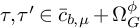 $\tau , \tau '\in \bar c_{b, \mu }+\Omega _G^\phi $
, the v-sheaves
$\tau , \tau '\in \bar c_{b, \mu }+\Omega _G^\phi $
, the v-sheaves $\mathcal {M} {}^{\mathrm {int}, \tau }_{{\mathcal {G}}, b, \mu }$
and
$\mathcal {M} {}^{\mathrm {int}, \tau }_{{\mathcal {G}}, b, \mu }$
and $\mathcal {M} {}^{\mathrm {int}, \tau '}_{{\mathcal {G}}, b, \mu }$
are isomorphic.
$\mathcal {M} {}^{\mathrm {int}, \tau '}_{{\mathcal {G}}, b, \mu }$
are isomorphic.
Proof. If b is basic, then $J_b$
is an inner twist of G. Hence
$J_b$
is an inner twist of G. Hence $\pi _1(J_b)_{I}^\phi =\pi _1(G)_{I}^\phi $
, and the assertion follows from the surjectivity of the map
$\pi _1(J_b)_{I}^\phi =\pi _1(G)_{I}^\phi $
, and the assertion follows from the surjectivity of the map $\kappa _H: H(\mathbb {Q} {}_p)\to \pi _1(H)_{I}^\phi $
, valid for any reductive group H over
$\kappa _H: H(\mathbb {Q} {}_p)\to \pi _1(H)_{I}^\phi $
, valid for any reductive group H over $\mathbb {Q} {}_p$
, cf. [Reference KottwitzKo97, §7.1].
$\mathbb {Q} {}_p$
, cf. [Reference KottwitzKo97, §7.1].
Now let b be arbitrary. Let us first assume that G is quasisplit, and fix a maximal split torus A and a Borel subgroup of G containing A, so that we have the notion of standard parabolics and standard Levi subgroups of G. Then there exists a standard Levi subgroup M and a basic element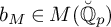 $b_M\in M(\breve {\mathbb {Q}} {}_p)$
which is
$b_M\in M(\breve {\mathbb {Q}} {}_p)$
which is $\phi $
-conjugate to b and such that we have an equality of
$\phi $
-conjugate to b and such that we have an equality of $\phi $
-centraliser groups
$\phi $
-centraliser groups $J_{M, b_M}=J_b$
, cf. [Reference KottwitzKo85, Prop. 6.2]. By the basic case treated above, we are reduced to proving the surjectivity of the map
$J_{M, b_M}=J_b$
, cf. [Reference KottwitzKo85, Prop. 6.2]. By the basic case treated above, we are reduced to proving the surjectivity of the map $\pi _1(M)_{I}^\phi \to \pi _1(G)_{I}^\phi $
. Consider the surjective map
$\pi _1(M)_{I}^\phi \to \pi _1(G)_{I}^\phi $
. Consider the surjective map
 $$\begin{align*}\pi_1(M)\to\pi_1(G). \end{align*}$$
The kernel of this map is equal to $Q:=\mathrm {coker}(X_*(T_{M, \mathrm {sc}})\to X_*(T_{\mathrm {sc}}))$
, where T, resp.
$Q:=\mathrm {coker}(X_*(T_{M, \mathrm {sc}})\to X_*(T_{\mathrm {sc}}))$
, where T, resp. $T_M$
, denotes the centraliser of A in G, resp. in M, and where the index ‘sc’ denotes the inverse image in the simply connected cover of the derived group of G, resp. M. But
$T_M$
, denotes the centraliser of A in G, resp. in M, and where the index ‘sc’ denotes the inverse image in the simply connected cover of the derived group of G, resp. M. But $X_*(T_{ \mathrm {sc}})$
, resp.
$X_*(T_{ \mathrm {sc}})$
, resp. $X_*(T_{M, \mathrm {sc}})$
, has as basis the set of coroots of G, resp. of M. The coroots of G which are not coroots of M give a permutation basis for the representation of
$X_*(T_{M, \mathrm {sc}})$
, has as basis the set of coroots of G, resp. of M. The coroots of G which are not coroots of M give a permutation basis for the representation of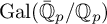 $\mathrm { Gal}(\bar {\mathbb {Q}} {}_p/\mathbb {Q} {}_p)$
on Q. It now follows that the above map continues to be surjective after first taking the coinvariants under the inertia I and then the invariants under
$\mathrm { Gal}(\bar {\mathbb {Q}} {}_p/\mathbb {Q} {}_p)$
on Q. It now follows that the above map continues to be surjective after first taking the coinvariants under the inertia I and then the invariants under $\phi $
.
$\phi $
.
Finally, let us drop the assumption that G is quasi-split. Let $G_0$
be the quasi-split inner form of G. Since the centre of G is connected, there exists
$G_0$
be the quasi-split inner form of G. Since the centre of G is connected, there exists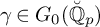 $\gamma \in G_0(\breve {\mathbb {Q}} {}_p)$
and an isomorphism
$\gamma \in G_0(\breve {\mathbb {Q}} {}_p)$
and an isomorphism $\Psi : G_0\otimes \breve {\mathbb {Q}} {}_p\xrightarrow {\sim } G\otimes \breve {\mathbb {Q}} {}_p$
such that the bijection
$\Psi : G_0\otimes \breve {\mathbb {Q}} {}_p\xrightarrow {\sim } G\otimes \breve {\mathbb {Q}} {}_p$
such that the bijection $g\mapsto \Psi (\gamma g)$
is equivariant for the action of the Frobenius on
$g\mapsto \Psi (\gamma g)$
is equivariant for the action of the Frobenius on $G_0(\breve {\mathbb {Q}} {}_p)$
, resp.
$G_0(\breve {\mathbb {Q}} {}_p)$
, resp. $G(\breve {\mathbb {Q}} {}_p)$
. Let
$G(\breve {\mathbb {Q}} {}_p)$
. Let $b_0$
be the preimage of b. Then this map induces an isomorphism of the
$b_0$
be the preimage of b. Then this map induces an isomorphism of the $\phi $
-centralizers
$\phi $
-centralizers $J_{0, b_0}$
and
$J_{0, b_0}$
and $J_b$
. From the quasi-split case, we deduce a surjection
$J_b$
. From the quasi-split case, we deduce a surjection
 $$\begin{align*}J_b(\mathbb{Q} {}_p)=J_{0, b_0}(\mathbb{Q} {}_p)\to\pi_1(G_0)_{I}^\phi=\pi_1(G)_{I}^\phi, \end{align*}$$
as desired.
4.5 Generic fibres
In this subsection, we interpret the induced decomposition in Theorem 4.4.1 in the generic fibres, in the case when $\mu $
is minuscule. Let
$\mu $
is minuscule. Let $(G, b, \mu )$
be a local Shimura datum and let
$(G, b, \mu )$
be a local Shimura datum and let ${\mathcal {G}} $
be a quasi-parahoric for G. We consider the generic fibre
${\mathcal {G}} $
be a quasi-parahoric for G. We consider the generic fibre
 $$\begin{align*}(\mathcal{M} {}^{\mathrm{int}}_{{\mathcal{G}} ,b,\mu})_\eta=\mathcal{M} {}^{\mathrm{int}}_{{\mathcal{G}} ,b,\mu}\times_{\mathrm{Spd}(O_{\breve E})}\mathrm{Spd}(\breve E) \end{align*}$$
of $\mathcal {M} {}^{\mathrm {int}}_{{\mathcal {G}}, b,\mu }$
. Theorem 4.4.1 implies
$\mathcal {M} {}^{\mathrm {int}}_{{\mathcal {G}}, b,\mu }$
. Theorem 4.4.1 implies
 $$ \begin{align} (\mathcal{M} {}^{\mathrm{int}}_{{\mathcal{G}} ,b,\mu})_\eta \simeq \bigsqcup_{\bar{\beta}\in \Pi_{{\mathcal{G}}} } (\mathcal{M} {}^{\mathrm{int}}_{{\mathcal{G}} {}^o_{\beta},b,\mu})_\eta/\pi_0({\mathcal{G}} {}_\beta)^\phi \end{align} $$
Since ${\mathcal {G}} {}^o_{\beta }$
is parahoric, it follows that
${\mathcal {G}} {}^o_{\beta }$
is parahoric, it follows that
 $$\begin{align*}(\mathcal{M} {}^{\mathrm{int}}_{{\mathcal{G}} {}^o_{\beta},b,\mu})_\eta=\mathrm{ Sht}^{\Diamond}_{{\mathcal{G}} {}^o_{\beta}(\mathbb{Z} {}_p)}(G, b, \mu), \end{align*}$$
cf. [Reference Scholze and WeinsteinSW20, §23.3, §25.3]. Here,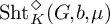 $ \mathrm {Sht}^{\Diamond }_K(G, b, \mu )$
denotes, for any compact open subgroup
$ \mathrm {Sht}^{\Diamond }_K(G, b, \mu )$
denotes, for any compact open subgroup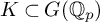 ${K\subset G(\mathbb {Q} {}_p)}$
, the diamond local Shimura variety, represented by a smooth rigid analytic variety over
${K\subset G(\mathbb {Q} {}_p)}$
, the diamond local Shimura variety, represented by a smooth rigid analytic variety over ${\mathrm {Sp}}(\breve E)$
, cf. [Reference Scholze and WeinsteinSW20, §24.1]. We use the notation
${\mathrm {Sp}}(\breve E)$
, cf. [Reference Scholze and WeinsteinSW20, §24.1]. We use the notation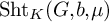 $ \mathrm {Sht}_K(G, b, \mu )$
for the representing rigid-analytic variety. The morphism
$ \mathrm {Sht}_K(G, b, \mu )$
for the representing rigid-analytic variety. The morphism
 $$\begin{align*}\mathrm{Sht}_{{\mathcal{G}} {}^o_{\beta}(\mathbb{Z} {}_p)}(G, b, \mu)\to \mathrm{ Sht}_{{\mathcal{G}} {}_{\beta}(\mathbb{Z} {}_p)}(G, b, \mu) \end{align*}$$
is a Galois étale cover for the finite abelian group
 $$\begin{align*}{\mathcal{G}} {}_{\beta}(\mathbb{Z} {}_p)/{\mathcal{G}} {}^o_{\beta}(\mathbb{Z} {}_p)=({\mathcal{G}} {}_{\beta}(\breve{\mathbb{Z}} {}_p)/{\mathcal{G}} {}^o_{\beta}(\breve{\mathbb{Z}} {}_p))^\phi=\pi_0({\mathcal{G}} {}_\beta)^\phi , \end{align*}$$
cf. [Reference Scholze and WeinsteinSW20, 23.3]. We deduce the following identification which is the desired interpretation of the decomposition in Theorem 4.4.1 in the generic fibre.
Theorem 4.5.1. Let $(G, b, \mu )$
be a local Shimura datum and let
$(G, b, \mu )$
be a local Shimura datum and let ${\mathcal {G}} $
be a quasi-parahoric for G. Then
${\mathcal {G}} $
be a quasi-parahoric for G. Then
 $$ \begin{align*} (\mathcal{M} {}^{\mathrm{int}}_{{\mathcal{G}} ,b,\mu})_\eta \simeq \bigsqcup_{\bar{\beta}\in \Pi_{{\mathcal{G}}} } \mathrm{ Sht}^{\Diamond}_{{\mathcal{G}} {}_{\beta}(\mathbb{Z} {}_p)}(G, b, \mu) , \end{align*} $$
In particular, if $\mathcal {M} {}^{\mathrm {int}}_{{\mathcal {G}}, b,\mu }$
is representable by the formal scheme
$\mathcal {M} {}^{\mathrm {int}}_{{\mathcal {G}}, b,\mu }$
is representable by the formal scheme $\mathscr {M} {}_{{\mathcal {G}}, b,\mu }$
over
$\mathscr {M} {}_{{\mathcal {G}}, b,\mu }$
over $O_{\breve E}$
, then
$O_{\breve E}$
, then
 $$ \begin{align*} \mathscr{M} {}_{{\mathcal{G}} ,b,\mu}^{\mathrm{rig}} \simeq \bigsqcup_{\bar{\beta}\in \Pi_{{\mathcal{G}}} }\mathrm{ Sht}_{{\mathcal{G}} {}_{\beta}(\mathbb{Z} {}_p)}(G, b, \mu). \end{align*} $$
4.6 Interpretation in terms of local systems
Consider a perfectoid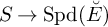 $S\to \mathrm{Spd}(\breve E)$
, i.e., with untilt
$S\to \mathrm{Spd}(\breve E)$
, i.e., with untilt $S^\sharp $
in char.
$S^\sharp $
in char. $0$
. Suppose
$0$
. Suppose $r>0$
is sufficiently small, so that
$r>0$
is sufficiently small, so that $\mathcal {Y} {}_{[0, r]}(S)$
avoids the divisor corresponding to the untilt. A
$\mathcal {Y} {}_{[0, r]}(S)$
avoids the divisor corresponding to the untilt. A ${\mathcal {G}} $
-shtuka over S with leg at
${\mathcal {G}} $
-shtuka over S with leg at $S^\sharp $
, restricts to a vector bundle over
$S^\sharp $
, restricts to a vector bundle over $\mathcal {Y} {}_{[0, r]}(S)$
with an isomorphism covering the action of
$\mathcal {Y} {}_{[0, r]}(S)$
with an isomorphism covering the action of $\phi ^{-1}$
on
$\phi ^{-1}$
on $\mathcal {Y} {}_{[0, r]}(S)$
; as in [Reference Scholze and WeinsteinSW20, §22.1], we call this a
$\mathcal {Y} {}_{[0, r]}(S)$
; as in [Reference Scholze and WeinsteinSW20, §22.1], we call this a $\phi ^{-1}$
– module over
$\phi ^{-1}$
– module over $\mathcal {Y} {}_{[0,r]}(S)$
. We see that an S-point of
$\mathcal {Y} {}_{[0,r]}(S)$
. We see that an S-point of $\mathcal {M} {}^{\mathrm {int}}_{{\mathcal {G}}, b,\mu }$
over
$\mathcal {M} {}^{\mathrm {int}}_{{\mathcal {G}}, b,\mu }$
over $\mathrm{Spd}(\breve E)$
gives an exact tensor functor
$\mathrm{Spd}(\breve E)$
gives an exact tensor functor
 $$ \begin{align*} \mathrm{Rep}_{\mathbb{Z} {}_p}({\mathcal{G}} )\to { \phi^{-1}-\mathrm{mod}/\ \mathcal{Y} {}_{[0, r]}(S)} \end{align*} $$
On the other hand, by [Reference Scholze and WeinsteinSW20, Prop. 22.3.2], we have an exact equivalence of tensor categories,

Here, ${\underline {\mathbb {Z}} {}_p}$
-
${\underline {\mathbb {Z}} {}_p}$
- ${{{\mathrm {Loc}}}(S)}$
stands for the category of pro-étale local systems for
${{{\mathrm {Loc}}}(S)}$
stands for the category of pro-étale local systems for $\underline {\mathbb {Z}} {}_p$
over S, i.e.,
$\underline {\mathbb {Z}} {}_p$
over S, i.e., $\underline {\mathbb {Z}} {}_p$
-torsors for the pro-étale topology on S.
$\underline {\mathbb {Z}} {}_p$
-torsors for the pro-étale topology on S.
Composing these two functors, we obtain an exact tensor functor
 $$ \begin{align} \mathrm{Rep}_{\mathbb{Z} {}_p}({\mathcal{G}} )\to \underline{\mathbb{Z}} {}_p\text{-}{\mathrm{{Loc}}}(S). \end{align} $$
The composition of this functor with $\underline {\mathbb {Z}} {}_p$
-
$\underline {\mathbb {Z}} {}_p$
- ${\mathrm {{Loc}}}(S) \to \underline {\mathbb {Q}} {}_p$
-
${\mathrm {{Loc}}}(S) \to \underline {\mathbb {Q}} {}_p$
- ${\mathrm { {Loc}}}(S)$
is pro-étale locally on S isomorphic to the forgetful functor (so, pro-étale locally, it gives the trivial torsor), cf. [Reference Scholze and WeinsteinSW20, Thm. 22.5.2].
${\mathrm { {Loc}}}(S)$
is pro-étale locally on S isomorphic to the forgetful functor (so, pro-étale locally, it gives the trivial torsor), cf. [Reference Scholze and WeinsteinSW20, Thm. 22.5.2].
This leads to an alternative description of the generic fibre analogous to [Reference Scholze and WeinsteinSW20, Prop. 23.3.1]. In the statement below, $X_{FF, S}:=\mathcal {Y} {}_{(0,\infty )}(S)/\phi ^{\mathbb {Z}} $
denotes the Fargues-Fontaine curve over S, [Reference Fargues and ScholzeFS21]. We will denote by
$X_{FF, S}:=\mathcal {Y} {}_{(0,\infty )}(S)/\phi ^{\mathbb {Z}} $
denotes the Fargues-Fontaine curve over S, [Reference Fargues and ScholzeFS21]. We will denote by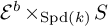 $\mathcal {E} {}^b\times _{\mathrm{Spd}(k)}S$
, or simply
$\mathcal {E} {}^b\times _{\mathrm{Spd}(k)}S$
, or simply $\mathcal {E} {}^b$
, the descent of
$\mathcal {E} {}^b$
, the descent of $(G_{\mathcal {Y} {}_{(r,\infty )}(S)}, \phi _b)$
to
$(G_{\mathcal {Y} {}_{(r,\infty )}(S)}, \phi _b)$
to $X_{FF, S}$
.
$X_{FF, S}$
.
Proposition 4.6.1. The S-points of $(\mathcal {M} {}^{\mathrm {int}}_{{\mathcal {G}}, b,\mu })_\eta $
over
$(\mathcal {M} {}^{\mathrm {int}}_{{\mathcal {G}}, b,\mu })_\eta $
over $\mathrm{Spd}(\breve E)$
are in bijection with isomorphism classes of
$\mathrm{Spd}(\breve E)$
are in bijection with isomorphism classes of $5$
-tuples
$5$
-tuples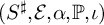 $(S^\sharp , \mathcal {E}, \alpha , \mathbb {P}, \iota )$
where
$(S^\sharp , \mathcal {E}, \alpha , \mathbb {P}, \iota )$
where
-
•
$S^\sharp $
is an untilt of S over
$\breve E$
; -
•
$\mathcal {E} $
is a G-torsor over
$X_{FF, S}$
, trivial at every geometric point of S; -
•
$\alpha $
is a G-torsor isomorphism which is meromorphic along
$$\begin{align*}\mathcal{E} {}_{|{X_{FF, S}\setminus S^\sharp}}\xrightarrow{\ \sim } {\mathcal{E} {}^b}_{|{X_{FF, S}\setminus S^\sharp}}, \end{align*}$$
$S^\sharp $
and bounded by
$\mu $
;
-
•
$\mathbb {P} $
is an exact tensor functor
$$\begin{align*}\mathrm{Rep}_{\mathbb{Z} {}_p}({\mathcal{G}} )\to \underline{\mathbb{Z}} {}_p\text{-}{\mathrm{{Loc}}}(S); \end{align*}$$
-
•
$\iota $
is an isomorphism of the base change of
$\mathbb {P} $
to
$\mathbb {Q} {}_p$
with the functor given by the
$\underline {G(\mathbb {Q} {}_p)}$
-torsor associated to
$\mathcal {E} $
by [Reference Scholze and WeinsteinSW20, Thm. 22.5.2].


Proof. This follows by the argument in the proof of [Reference Scholze and WeinsteinSW20, Prop. 23.3.1]. Observe that, since we do not assume that ${\mathcal {G}} $
has connected fibres,
${\mathcal {G}} $
has connected fibres, ${\mathcal {G}} $
-torsors over
${\mathcal {G}} $
-torsors over $\operatorname {\mbox {Spec }}(\mathbb {Z} {}_p)$
are not necessarily trivial. So instead of
$\operatorname {\mbox {Spec }}(\mathbb {Z} {}_p)$
are not necessarily trivial. So instead of $\underline {{\mathcal {G}} (\mathbb {Z} {}_p)}$
-torsors as in loc. cit., we just obtain functors
$\underline {{\mathcal {G}} (\mathbb {Z} {}_p)}$
-torsors as in loc. cit., we just obtain functors $\mathbb {P} $
as above, compare also to [Reference Scholze and WeinsteinSW20, proof of Prop. 22.6.1].
$\mathbb {P} $
as above, compare also to [Reference Scholze and WeinsteinSW20, proof of Prop. 22.6.1].
We can use Proposition 4.6.1 to reinterpret the isomorphism in Theorem 4.5.1. For S perfectoid over k, we can consider the fibre functor at $s: \mathrm{Spa}(C, O_C)\to S$
,
$s: \mathrm{Spa}(C, O_C)\to S$
,
 $$\begin{align*}F_s: \underline{\mathbb{Z}} {}_p\text{-}{\mathrm{{Loc}}}(S)\to {\mathbb{Z} {}_p-\mathrm{mod}}. \end{align*}$$
Given an S-point of $\mathcal {M} {}^{\mathrm {int}}_{{\mathcal {G}}, b,\mu }$
over
$\mathcal {M} {}^{\mathrm {int}}_{{\mathcal {G}}, b,\mu }$
over $\mathrm{Spd}(\breve E)$
as above, the composition of (4.6.1) and
$\mathrm{Spd}(\breve E)$
as above, the composition of (4.6.1) and $F_s$
defines an exact tensor functor
$F_s$
defines an exact tensor functor
 $$ \begin{align} \mathrm{Rep}_{\mathbb{Z} {}_p}({\mathcal{G}} )\to {\mathbb{Z} {}_p-\mathrm{mod}}. \end{align} $$
It defines a ${\mathcal {G}} $
-torsor
${\mathcal {G}} $
-torsor $\mathcal {T} {}_s$
and we can consider the contracted product
$\mathcal {T} {}_s$
and we can consider the contracted product
 $$\begin{align*}{\mathcal{G}} {}_{s}:=\mathrm{Aut}(\mathcal{T} {}_s)={\mathcal{G}} \wedge^{{\mathcal{G}}} \mathcal{T} {}_s , \end{align*}$$
where ${\mathcal {G}} $
acts on itself by conjugation. Since
${\mathcal {G}} $
acts on itself by conjugation. Since ${\mathcal {G}} $
is smooth, we have
${\mathcal {G}} $
is smooth, we have
 $$\begin{align*}{\mathcal{G}} {}_{s}\otimes_{\mathbb{Z} {}_p}\breve{\mathbb{Z}} {}_p\simeq {\mathcal{G}} \otimes_{\mathbb{Z} {}_p}\breve{\mathbb{Z}} {}_p. \end{align*}$$
The class $[\mathcal {T} {}_s]$
of the torsor
$[\mathcal {T} {}_s]$
of the torsor $\mathcal {T} {}_s$
lies in
$\mathcal {T} {}_s$
lies in $\ker (\mathrm {H}^1(\mathbb {Z} {}_p, {\mathcal {G}} )\to \mathrm {H}^1(\mathbb {Q} {}_p, G))=\Pi _{{\mathcal {G}}}, $
, comp. Lemma 3.1.1.
$\ker (\mathrm {H}^1(\mathbb {Z} {}_p, {\mathcal {G}} )\to \mathrm {H}^1(\mathbb {Q} {}_p, G))=\Pi _{{\mathcal {G}}}, $
, comp. Lemma 3.1.1.
A $4$
-tuple
$4$
-tuple $(S^\sharp , \mathcal {E}, \alpha , \mathbb {P} )\in (\mathcal {M} {}^{\mathrm {int}}_{{\mathcal {G}}, b,\mu })_\eta (S)$
defines now the function
$(S^\sharp , \mathcal {E}, \alpha , \mathbb {P} )\in (\mathcal {M} {}^{\mathrm {int}}_{{\mathcal {G}}, b,\mu })_\eta (S)$
defines now the function
 $$ \begin{align} S\to \Pi_{{\mathcal{G}}}, \quad s\mapsto [\mathcal{T} {}_{s}]. \end{align} $$
Assuming a theory of pro-étale systems in this situation that resembles the classical theory of (étale) $\mathbb {Z} {}_p$
-local systems, it would follow that the isomorphism class of the torsor
$\mathbb {Z} {}_p$
-local systems, it would follow that the isomorphism class of the torsor $\mathcal {T} {}_{s}$
is constant on connected components of S. More precisely, if we choose another point
$\mathcal {T} {}_{s}$
is constant on connected components of S. More precisely, if we choose another point $s'$
of S, then
$s'$
of S, then $F_s\simeq F_{s'}$
(by a “path connecting s to
$F_s\simeq F_{s'}$
(by a “path connecting s to $s'$
) and this should give
$s'$
) and this should give $\mathcal {T} {}_{s}\simeq \mathcal {T} {}_{s'}$
and
$\mathcal {T} {}_{s}\simeq \mathcal {T} {}_{s'}$
and ${\mathcal {G}} {}_{s}(\mathbb {Z} {}_p)={\mathcal {G}} {}_{s'}(\mathbb {Z} {}_p)$
as subgroups of
${\mathcal {G}} {}_{s}(\mathbb {Z} {}_p)={\mathcal {G}} {}_{s'}(\mathbb {Z} {}_p)$
as subgroups of $G(\mathbb {Q} {}_p)$
. This would explain how to associate to a point
$G(\mathbb {Q} {}_p)$
. This would explain how to associate to a point $s\in (\mathcal {M} {}^{\mathrm {int}}_{{\mathcal {G}}, b,\mu })_\eta (C, O_C)$
the index
$s\in (\mathcal {M} {}^{\mathrm {int}}_{{\mathcal {G}}, b,\mu })_\eta (C, O_C)$
the index $\bar {\beta }(s)\in \Pi _{{\mathcal {G}}} $
on the RHS of (4.5.1). It would also explain how to associate to s the point of
$\bar {\beta }(s)\in \Pi _{{\mathcal {G}}} $
on the RHS of (4.5.1). It would also explain how to associate to s the point of $\mathrm { Sht}^{\Diamond }_{{\mathcal {G}} {}_{\beta }(\mathbb {Z} {}_p)}(G, b, \mu )$
on the RHS of (4.5.1) (note that
$\mathrm { Sht}^{\Diamond }_{{\mathcal {G}} {}_{\beta }(\mathbb {Z} {}_p)}(G, b, \mu )$
on the RHS of (4.5.1) (note that ${\mathcal {G}} {}_s={\mathcal {G}} {}_{\beta (s)}$
).
${\mathcal {G}} {}_s={\mathcal {G}} {}_{\beta (s)}$
).
4.7 Comparison with Wintenberger’s theorem
Let us discuss ‘classical’ points $x: \mathrm{Spd}(F)\to (\mathcal {M} {}^{\mathrm {int}}_{{\mathcal {G}}, b,\mu })_\eta $
, where
$x: \mathrm{Spd}(F)\to (\mathcal {M} {}^{\mathrm {int}}_{{\mathcal {G}}, b,\mu })_\eta $
, where $F/\breve E$
is a finite field extension. Consider the crystalline period map
$F/\breve E$
is a finite field extension. Consider the crystalline period map
 $$ \begin{align*}\pi_{\mathrm{GM}}\colon (\mathcal{M} {}^{\mathrm{int}}_{{\mathcal{G}} ,b,\mu})_\eta\to (X_\mu\times_{{\mathrm{Sp}} (E)} {\mathrm{Sp}}(\breve E))^{\Diamond}. \end{align*} $$
Under the identification of Theorem 4.5.1, it is the disjoint sum of the period maps, one for each $\bar {\beta }\in \Pi _{{\mathcal {G}}} $
,
$\bar {\beta }\in \Pi _{{\mathcal {G}}} $
,
 $$ \begin{align} \pi_{\mathrm{GM}, \beta}\colon \mathrm{Sht}_{{\mathcal{G}} {}_{\beta}(\mathbb{Z} {}_p)}(G, b, \mu)\to X_\mu\times_{{\mathrm{Sp}} (E)} {\mathrm{Sp}}(\breve E). \end{align} $$
On the image of $\pi _{\mathrm {GM}, \beta }$
(the admissible locus), there is the corresponding local
$\pi _{\mathrm {GM}, \beta }$
(the admissible locus), there is the corresponding local $G(\mathbb {Q} {}_p)$
-system. Let
$G(\mathbb {Q} {}_p)$
-system. Let $x\in \mathrm {Sht}_{{\mathcal {G}} {}_{\beta }(\mathbb {Z} {}_p)}(G, b, \mu )(F)$
. Specialising this local system at
$x\in \mathrm {Sht}_{{\mathcal {G}} {}_{\beta }(\mathbb {Z} {}_p)}(G, b, \mu )(F)$
. Specialising this local system at $\pi _{\mathrm { GM}, \beta }(x)$
defines a Galois representation
$\pi _{\mathrm { GM}, \beta }(x)$
defines a Galois representation
 $$ \begin{align} \rho_x: \mathrm{Gal}(\bar F/F)\to K_\beta={\mathcal{G}} {}_{\beta}(\mathbb{Z} {}_p)\subset G(\mathbb{Q} {}_p). \end{align} $$
Recall the theorem of Wintenberger (comp. [Reference Kisin and PappasKP18, Prop. 3.3.4]), according to which the image of the Galois representation $\rho _x$
lies in the neutral component
$\rho _x$
lies in the neutral component ${\mathcal {G}} {}^o_{\beta }(\mathbb {Z} {}_p)$
, i.e.,
${\mathcal {G}} {}^o_{\beta }(\mathbb {Z} {}_p)$
, i.e.,
 $$ \begin{align} \rho_x: \mathrm{Gal}(\bar F/F)\to {\mathcal{G}} {}^o_{\beta}(\mathbb{Z} {}_p)\subset G(\mathbb{Q} {}_p). \end{align} $$
This may be surprising at first glance, given the construction of (4.7.2). However, consider the Galois étale cover for the group $\pi _0({\mathcal {G}} )^\phi $
,
$\pi _0({\mathcal {G}} )^\phi $
,
 $$ \begin{align*}\pi: \mathrm{Sht}_{{\mathcal{G}} {}^o_{\beta}(\mathbb{Z} {}_p)}(G, b, \mu)\to \mathrm{ Sht}_{{\mathcal{G}} {}_{\beta}(\mathbb{Z} {}_p)}(G, b, \mu). \end{align*} $$
By our earlier discussion on connected components, this cover is totally split. This fits with the above result of Wintenberger which directly implies that, for every F-valued point of $\mathrm {Sht}_{{\mathcal {G}} {}_{\beta }(\mathbb {Z} {}_p)}(G, b, \mu )$
, the inverse image
$\mathrm {Sht}_{{\mathcal {G}} {}_{\beta }(\mathbb {Z} {}_p)}(G, b, \mu )$
, the inverse image $\pi ^{-1}(x)$
is split over F.
$\pi ^{-1}(x)$
is split over F.
5 Ad-isomorphisms and integral moduli spaces of local shtukas
5.1 Ad-isomorphisms
Recall from [Reference KottwitzKo97] that a homomorphism $f: G\to G'$
is an ad-isomorphism if the centre
$f: G\to G'$
is an ad-isomorphism if the centre $Z_G$
of G is mapped to the centre
$Z_G$
of G is mapped to the centre $Z_{G'}$
of
$Z_{G'}$
of $G'$
and the induced homomorphism
$G'$
and the induced homomorphism $G_{\mathrm {ad}}\to G^{\prime }_{\mathrm {ad}}$
between the adjoint groups is an isomorphism. Equivalently,
$G_{\mathrm {ad}}\to G^{\prime }_{\mathrm {ad}}$
between the adjoint groups is an isomorphism. Equivalently, $\ker f$
is a central subgroup and
$\ker f$
is a central subgroup and $\mathrm {Im} f$
is a normal subgroup of
$\mathrm {Im} f$
is a normal subgroup of $G'$
with torus cokernel.
$G'$
with torus cokernel.
Lemma 5.1.1. An ad-isomorphism is the composition of ad-isomorphisms of one of the following types.
-
(i)
$f: G\to G'$
is the inclusion of a normal subgroup with torus cokernel. -
(ii)
$f: G\to G'$
is a surjection with kernel a central torus which is a product of induced tori (a ‘quasi-trivial’ torus).


Proof. Let $f:G\to G'$
be an ad-isomorphism, and let
$f:G\to G'$
be an ad-isomorphism, and let $Z=\ker f$
. Find an embedding
$Z=\ker f$
. Find an embedding $Z\hookrightarrow T$
where T is a quasi-trivial torus. Consider the push out of
$Z\hookrightarrow T$
where T is a quasi-trivial torus. Consider the push out of
 $$\begin{align*}1\to Z\to G\to G/Z\to 1 \end{align*}$$
by $Z\hookrightarrow T$
. This gives
$Z\hookrightarrow T$
. This gives
 $$\begin{align*}1\to T\to G"\to G/Z\to 1 \end{align*}$$
and we can view $G\to G'$
as a composition of ad-isomorphisms
$G\to G'$
as a composition of ad-isomorphisms
 $$\begin{align*}G\hookrightarrow G"\to G/Z\hookrightarrow G' \end{align*}$$
where the first map is of type (i), the second map of type (ii) and the third map of type (i).
In this section, we consider an ad-isomorphism $f: G\to G'$
and an extension of f to a morphism
$f: G\to G'$
and an extension of f to a morphism $f: {\mathcal {G}} \to {\mathcal {G}} '$
between quasi-parahoric group schemes. It is assumed that the corresponding parahoric group schemes (the neutral connected components)
$f: {\mathcal {G}} \to {\mathcal {G}} '$
between quasi-parahoric group schemes. It is assumed that the corresponding parahoric group schemes (the neutral connected components) ${\mathcal {G}} {}^o$
and
${\mathcal {G}} {}^o$
and $ {\mathcal {G}} {}^{\prime o}$
correspond to the same point in the common building of
$ {\mathcal {G}} {}^{\prime o}$
correspond to the same point in the common building of $G_{\mathrm {ad}}$
and
$G_{\mathrm {ad}}$
and $G^{\prime }_{\mathrm {ad}}$
. Let
$G^{\prime }_{\mathrm {ad}}$
. Let $({\mathcal {G}}, b, \mu )$
and
$({\mathcal {G}}, b, \mu )$
and $({\mathcal {G}} ', b', \mu ')$
be two integral local shtuka data such that
$({\mathcal {G}} ', b', \mu ')$
be two integral local shtuka data such that $f(b)=b'$
and
$f(b)=b'$
and $\{\mu '\}=f(\{\mu \})$
. In this case, we have an inclusion of reflex fields
$\{\mu '\}=f(\{\mu \})$
. In this case, we have an inclusion of reflex fields $E'\subset E$
. We then say that f is an ad-isomorphism of integral local shtuka data. We obtain a morphism
$E'\subset E$
. We then say that f is an ad-isomorphism of integral local shtuka data. We obtain a morphism
 $$ \begin{align} f: \mathcal{M} {}^{\mathrm{int}}_{{\mathcal{G}} , b, \mu}\xrightarrow{\ \ } \mathcal{M} {}^{\mathrm{int}}_{{\mathcal{G}} ', b', \mu'}\times_{\mathrm{Spd}(O')}\mathrm{Spd}(O) \end{align} $$
where $O=O_{\breve E}$
and
$O=O_{\breve E}$
and $O'=O_{\breve E'}$
. Consider the commutative diagram
$O'=O_{\breve E'}$
. Consider the commutative diagram

Composing with the Kottwitz homomorphisms (4.3.3) gives a commutative diagram

Recall the components $\mathcal {M} {}^{\mathrm {int,\tau }}_{{\mathcal {G}}, b, \mu }$
for
$\mathcal {M} {}^{\mathrm {int,\tau }}_{{\mathcal {G}}, b, \mu }$
for $\tau \in C_{{\mathcal {G}}} $
, resp.
$\tau \in C_{{\mathcal {G}}} $
, resp. $\mathcal {M} {}^{\mathrm {int,\tau '}}_{{\mathcal {G}} ', b', \mu '}$
for
$\mathcal {M} {}^{\mathrm {int,\tau '}}_{{\mathcal {G}} ', b', \mu '}$
for $\tau '\in C_{{\mathcal {G}} '}$
, cf. (4.4.5). The aim of this section is to prove the following theorem.
$\tau '\in C_{{\mathcal {G}} '}$
, cf. (4.4.5). The aim of this section is to prove the following theorem.
Theorem 5.1.2. Let $f\colon ({\mathcal {G}}, b, \mu )\to ({\mathcal {G}} ', b', \mu ')$
be an ad-isomorphism of integral local shtuka data. The morphism (5.1.1) induces an isomorphism,
$f\colon ({\mathcal {G}}, b, \mu )\to ({\mathcal {G}} ', b', \mu ')$
be an ad-isomorphism of integral local shtuka data. The morphism (5.1.1) induces an isomorphism,
 $$\begin{align*}f: \mathcal{M} {}^{\mathrm{int,\tau}}_{{\mathcal{G}} , b, \mu}\xrightarrow{\sim} \mathcal{M} {}^{\mathrm{int,\tau'}}_{{\mathcal{G}} ', b', \mu'}\times_{\mathrm{Spd}(O')}\mathrm{Spd}(O), \end{align*}$$
where $\tau '=f(\tau )\in C_{{\mathcal {G}} '}$
.
$\tau '=f(\tau )\in C_{{\mathcal {G}} '}$
.
The proof proceeds in three steps. In subsection 5.3 we show that f induces an isomorphism of formal completions; in subsection 5.4 we analyse the map on ADLV induced by f; in subsection 5.5 we complete the proof by showing that the map in question is qcqs.
We note first that for ad-isomorphisms of type (i) and for the claim of qcqs, there is no need to consider components separately.
Proposition 5.1.3. Assume that f is of type (i). Then the morphism
 $$\begin{align*}f: \mathcal{M} {}^{\mathrm{int}}_{{\mathcal{G}} , b, \mu}\xrightarrow{\ \ } \mathcal{M} {}^{\mathrm{int}}_{{\mathcal{G}} ', b', \mu'}\times_{\mathrm{Spd}(O')}\mathrm{Spd}(O) \end{align*}$$
is qcqs. If in addition ${\mathcal {G}} (\breve {\mathbb {Z}} {}_p)=G(\breve {\mathbb {Q}} {}_p)\cap f^{-1}({\mathcal {G}} '(\breve {\mathbb {Z}} {}_p))$
, it is a closed immersion of v-sheaves.
${\mathcal {G}} (\breve {\mathbb {Z}} {}_p)=G(\breve {\mathbb {Q}} {}_p)\cap f^{-1}({\mathcal {G}} '(\breve {\mathbb {Z}} {}_p))$
, it is a closed immersion of v-sheaves.
Proof. We first show that the morphism is qcqs. Quasi-separateness follows from Lemma 5.5.3 below and the fact that $ \mathcal {M} {}^{\mathrm {int}}_{{\mathcal {G}}, b, \mu }\to \mathrm{Spd}(O_{\breve E})$
is qs (cf. [Reference GleasonGl21, Prop. 2.25]). It remains to show quasi-compactness and the additional statement about closed immersions. Under our assumption of type (i), we have a short exact sequence
$ \mathcal {M} {}^{\mathrm {int}}_{{\mathcal {G}}, b, \mu }\to \mathrm{Spd}(O_{\breve E})$
is qs (cf. [Reference GleasonGl21, Prop. 2.25]). It remains to show quasi-compactness and the additional statement about closed immersions. Under our assumption of type (i), we have a short exact sequence
 $$\begin{align*}1\to G\to G'\to T\to 1 \end{align*}$$
with T a torus. This gives an exact sequence
 $$\begin{align*}1\to \pi_1(G)\to \pi_1(G')\to X_*(T)\to 0. \end{align*}$$
By taking I-coinvariants we obtain an exact sequence
 $$\begin{align*}\Omega_G=\pi_1(G)_I\to \Omega_{G'}=\pi_1(G')_I\to X_*(T)_I\to 0 \end{align*}$$
where the kernel of the first map is a finite abelian group. Hence, the inverse image Y of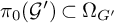 $\pi _0({\mathcal {G}} ')\subset \Omega _{G'}$
in
$\pi _0({\mathcal {G}} ')\subset \Omega _{G'}$
in $\Omega _G$
is a finite group which contains the subgroup
$\Omega _G$
is a finite group which contains the subgroup $\pi _0({\mathcal {G}} )$
 $$\begin{align*}\pi_0({\mathcal{G}} ) \subset Y\subset \Omega_G. \end{align*}$$
Using this and Bruhat-Tits theory, cf. the construction of [Reference Bruhat and TitsBTII, Prop. (4.6.18)], we obtain a quasi-parahoric ${\mathcal {G}} {}_1$
for G with neutral component
${\mathcal {G}} {}_1$
for G with neutral component ${\mathcal {G}} {}^o_1={\mathcal {G}} {}^o$
and
${\mathcal {G}} {}^o_1={\mathcal {G}} {}^o$
and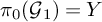 $\pi _0({\mathcal {G}} {}_1)=Y$
. Then,
$\pi _0({\mathcal {G}} {}_1)=Y$
. Then, ${\mathcal {G}} {}_1(\breve {\mathbb {Z}} {}_p)=G(\breve {\mathbb {Q}} {}_p)\cap f^{-1}({\mathcal {G}} '(\breve {\mathbb {Z}} {}_p))$
. We have
${\mathcal {G}} {}_1(\breve {\mathbb {Z}} {}_p)=G(\breve {\mathbb {Q}} {}_p)\cap f^{-1}({\mathcal {G}} '(\breve {\mathbb {Z}} {}_p))$
. We have
 $$\begin{align*}{\mathcal{G}} {}^o_1={\mathcal{G}} {}^o\subset {\mathcal{G}} \subset {\mathcal{G}} {}_1 \end{align*}$$
and ${\mathcal {G}} \to {\mathcal {G}} '$
factors as
${\mathcal {G}} \to {\mathcal {G}} '$
factors as ${\mathcal {G}} \subset {\mathcal {G}} {}_1\to {\mathcal {G}} '$
. By applying Proposition 4.2.1 to
${\mathcal {G}} \subset {\mathcal {G}} {}_1\to {\mathcal {G}} '$
. By applying Proposition 4.2.1 to ${\mathcal {G}} $
and
${\mathcal {G}} $
and $ {\mathcal {G}} {}_1$
, we see that it is enough to show quasi-compactness for the morphism induced by
$ {\mathcal {G}} {}_1$
, we see that it is enough to show quasi-compactness for the morphism induced by ${\mathcal {G}} {}_1\to {\mathcal {G}} '$
. Hence we may assume from the start that
${\mathcal {G}} {}_1\to {\mathcal {G}} '$
. Hence we may assume from the start that ${\mathcal {G}} (\breve {\mathbb {Z}} {}_p)=G(\breve {\mathbb {Q}} {}_p)\cap f^{-1}({\mathcal {G}} '(\breve {\mathbb {Z}} {}_p))$
. Then, as in [Reference Pappas and RapoportPR24, Lem. 3.6.1],
${\mathcal {G}} (\breve {\mathbb {Z}} {}_p)=G(\breve {\mathbb {Q}} {}_p)\cap f^{-1}({\mathcal {G}} '(\breve {\mathbb {Z}} {}_p))$
. Then, as in [Reference Pappas and RapoportPR24, Lem. 3.6.1], $f: {\mathcal {G}} \to {\mathcal {G}} '$
is a dilated immersion of smooth group schemes, i.e., f identifies
$f: {\mathcal {G}} \to {\mathcal {G}} '$
is a dilated immersion of smooth group schemes, i.e., f identifies ${\mathcal {G}} $
with the Neron smoothening of the Zariski closure
${\mathcal {G}} $
with the Neron smoothening of the Zariski closure $\bar {\mathcal {G}} $
of
$\bar {\mathcal {G}} $
of $f(G)$
in
$f(G)$
in ${\mathcal {G}} '$
. Now the proof of [Reference Pappas and RapoportPR24, Prop. 3.6.2] applies to show that under this assumption the morphism is a closed immersion.
${\mathcal {G}} '$
. Now the proof of [Reference Pappas and RapoportPR24, Prop. 3.6.2] applies to show that under this assumption the morphism is a closed immersion.
5.2 Ad-isomorphisms and generic fibres
If $(G, b, \mu )$
is a rational local shtuka datum and
$(G, b, \mu )$
is a rational local shtuka datum and ${\mathcal {G}} $
is a smooth group scheme model over
${\mathcal {G}} $
is a smooth group scheme model over $\mathbb {Z} {}_p$
with connected special fibre, we set, for
$\mathbb {Z} {}_p$
with connected special fibre, we set, for $K={\mathcal {G}} (\mathbb {Z} {}_p)$
,
$K={\mathcal {G}} (\mathbb {Z} {}_p)$
,
 $$\begin{align*}\mathrm{Sht}_K(G, b, \mu)=(\mathcal{M} {}^{\mathrm{int}}_{{\mathcal{G}} , b, \mu})_\eta. \end{align*}$$
This is a locally spatial diamond over $\mathrm{Spd}(\breve E)$
, cf. [Reference Scholze and WeinsteinSW20, §23.3]. Note that here, in contrast to section 4.5,
$\mathrm{Spd}(\breve E)$
, cf. [Reference Scholze and WeinsteinSW20, §23.3]. Note that here, in contrast to section 4.5,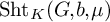 $ \mathrm {Sht}_K(G, b, \mu )$
denotes a diamond which is not representable by a rigid-analytic space, unless
$ \mathrm {Sht}_K(G, b, \mu )$
denotes a diamond which is not representable by a rigid-analytic space, unless $\mu $
is minuscule. We also set
$\mu $
is minuscule. We also set
 $$\begin{align*}\mathrm{Sht}_\infty(G, b, \mu)=\varprojlim_K \mathrm{Sht}_K(G, b, \mu), \end{align*}$$
as in [Reference Scholze and WeinsteinSW20, §23.3].
Proposition 5.2.1. Let $f\colon (G, b, \mu )\to (G', b', \mu ')$
be an ad-isomorphism of rational local shtuka data. The natural morphism
$f\colon (G, b, \mu )\to (G', b', \mu ')$
be an ad-isomorphism of rational local shtuka data. The natural morphism
 $$\begin{align*}\mathrm{Sht}_\infty(G, b, \mu)\to \mathrm{Sht}_\infty(G', b', \mu')\times_{\mathrm{Spd}(\breve E')}\mathrm{Spd}(\breve E) \end{align*}$$
induces an isomorphism of v-sheaves over $\mathrm{Spd}(\breve E)$
,
$\mathrm{Spd}(\breve E)$
,
 $$\begin{align*}\mathrm{Sht}_\infty(G, b, \mu)\buildrel{\underline{G(\mathbb{Q} {}_p)}}\over{\times}\underline{G'(\mathbb{Q} {}_p)}\xrightarrow{\sim} \mathrm{ Sht}_\infty(G', b', \mu')\times_{\mathrm{Spd}(\breve E')}\mathrm{Spd}(\breve E). \end{align*}$$
Proof. In the case of minuscule $\mu $
this is given by [Reference Pappas and RapoportPR24, Prop. 3.1.2]. The argument extends provided we explain that the corresponding admissible loci in the ‘Schubert varieties’
$\mu $
this is given by [Reference Pappas and RapoportPR24, Prop. 3.1.2]. The argument extends provided we explain that the corresponding admissible loci in the ‘Schubert varieties’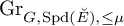 $\mathrm {Gr}_{G,\mathrm{Spd}(\breve E),\leq \mu }$
, resp.
$\mathrm {Gr}_{G,\mathrm{Spd}(\breve E),\leq \mu }$
, resp. $\mathrm {Gr}_{G', \mathrm{Spd}(\breve E'),\leq \mu '}\times _{\mathrm{Spd}(\breve E')}\mathrm{Spd}(\breve E)$
agree. Recall that the latter objects are spatial diamonds [Reference Scholze and WeinsteinSW20, Thm. 19.2.4] which are proper over
$\mathrm {Gr}_{G', \mathrm{Spd}(\breve E'),\leq \mu '}\times _{\mathrm{Spd}(\breve E')}\mathrm{Spd}(\breve E)$
agree. Recall that the latter objects are spatial diamonds [Reference Scholze and WeinsteinSW20, Thm. 19.2.4] which are proper over $\mathrm{Spd}(\breve E)$
, cf. [Reference Scholze and WeinsteinSW20, Prop. 19.2.3]. The admissible loci are open subobjects, cf. [Reference Scholze and WeinsteinSW20, §23.3].
$\mathrm{Spd}(\breve E)$
, cf. [Reference Scholze and WeinsteinSW20, Prop. 19.2.3]. The admissible loci are open subobjects, cf. [Reference Scholze and WeinsteinSW20, §23.3].
Since $G\to G'$
is an ad-isomorphism, the morphism
$G\to G'$
is an ad-isomorphism, the morphism
 $$\begin{align*}\mathrm{Gr}_{G,\mathrm{Spd}(\breve E)}\to\mathrm{Gr}_{G',{\mathrm{Spd}(\breve E')}}\times_{\mathrm{Spd}(\breve E')}\mathrm{Spd}(\breve E) \end{align*}$$
induces an isomorphism between corresponding connected components. In particular, the morphism

is an isomorphism. Therefore, by [Reference ScholzeSch17, Prop. 11.15, or Prop. 12.9], it remains to show that the induced map on admissible loci is bijective on points with values in $\mathrm{Spa}(C, C^+)$
, for any algebraically closed non-archimedean field C and open bounded valuation ring
$\mathrm{Spa}(C, C^+)$
, for any algebraically closed non-archimedean field C and open bounded valuation ring $C^+$
. Consider the following commutative diagram of (pro-systems of) locally spatial diamonds over
$C^+$
. Consider the following commutative diagram of (pro-systems of) locally spatial diamonds over $\breve E$
, in which the vertical arrows are the period maps ([Reference Scholze and WeinsteinSW20, §23.3]),
$\breve E$
, in which the vertical arrows are the period maps ([Reference Scholze and WeinsteinSW20, §23.3]),

The images of the vertical maps are the admissible sets. We claim that under the lower horizontal map the admissible sets correspond to each other. We have $\mathrm {Sht}_K(G, b, \mu )(C, C^+)=\mathrm {Sht}_K(G, b, \mu )(C, O_C)$
and
$\mathrm {Sht}_K(G, b, \mu )(C, C^+)=\mathrm {Sht}_K(G, b, \mu )(C, O_C)$
and $\mathrm {Sht}_{K'}(G', b', \mu ')(C, C^+)=\mathrm {Sht}_{K'}(G', b', \mu ')(C, O_C)$
, by their definitions in terms of shtuka. Hence, it is enough to check that the
$\mathrm {Sht}_{K'}(G', b', \mu ')(C, C^+)=\mathrm {Sht}_{K'}(G', b', \mu ')(C, O_C)$
, by their definitions in terms of shtuka. Hence, it is enough to check that the $\mathrm{Spa}(C, O_C)$
-points of the admissible sets coincide. Now a point x of
$\mathrm{Spa}(C, O_C)$
-points of the admissible sets coincide. Now a point x of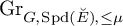 $\mathrm {Gr}_{G,\mathrm{Spd}(\breve E), \leq \mu }$
with values in
$\mathrm {Gr}_{G,\mathrm{Spd}(\breve E), \leq \mu }$
with values in $\mathrm{Spa}(C, O_C)$
lies in the admissible locus if and only if the corresponding modification
$\mathrm{Spa}(C, O_C)$
lies in the admissible locus if and only if the corresponding modification $\mathcal {E} {}^b_{x}$
at
$\mathcal {E} {}^b_{x}$
at $\infty $
of the G-bundle
$\infty $
of the G-bundle $\mathcal {E} {}^b$
over the FF curve is trivial, cf. [Reference Scholze and WeinsteinSW20, Thm. 22.6.2]. This in turn is equivalent to
$\mathcal {E} {}^b$
over the FF curve is trivial, cf. [Reference Scholze and WeinsteinSW20, Thm. 22.6.2]. This in turn is equivalent to $\mathcal {E} {}^b_{x}$
being a semi-stable G-bundle on the FF curve (use
$\mathcal {E} {}^b_{x}$
being a semi-stable G-bundle on the FF curve (use $[b]\in B(G, \mu ^{-1})$
, cf. [Reference Pappas and RapoportPR24, proof of Prop. 3.1.1]). The image of x lies in the admissible set in
$[b]\in B(G, \mu ^{-1})$
, cf. [Reference Pappas and RapoportPR24, proof of Prop. 3.1.1]). The image of x lies in the admissible set in $\mathrm {Gr}_{G',\mathrm{Spd}(\breve E'), \leq \mu '}$
if and only if the
$\mathrm {Gr}_{G',\mathrm{Spd}(\breve E'), \leq \mu '}$
if and only if the $G'$
-bundle
$G'$
-bundle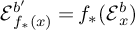 $\mathcal {E} {}^{b'}_{f_*(x)}=f_*(\mathcal {E} {}^{b}_{ x})$
is a semi-stable
$\mathcal {E} {}^{b'}_{f_*(x)}=f_*(\mathcal {E} {}^{b}_{ x})$
is a semi-stable $G'$
-bundle on the FF curve. But since f induces a bijection between parabolic subgroups of G, resp.
$G'$
-bundle on the FF curve. But since f induces a bijection between parabolic subgroups of G, resp. $G'$
, the semi-stability of
$G'$
, the semi-stability of $f_*(\mathcal {E} {}^b_{ x})$
is equivalent to the semi-stability of
$f_*(\mathcal {E} {}^b_{ x})$
is equivalent to the semi-stability of $\mathcal {E} {}^b_x$
(apply this bijection to the Harder-Narasimhan parabolics and the fact that semi-stability is equivalent to the fact that the HN-parabolic is the whole group). Our claim follows. Now consider the following diagram, where in the lower line appears the isomorphism between admissible sets,
$\mathcal {E} {}^b_x$
(apply this bijection to the Harder-Narasimhan parabolics and the fact that semi-stability is equivalent to the fact that the HN-parabolic is the whole group). Our claim follows. Now consider the following diagram, where in the lower line appears the isomorphism between admissible sets,

Now the fibres of the left vertical arrow are identified with $G(\mathbb {Q} {}_p)\times ^{G(\mathbb {Q} {}_p)}G'(\mathbb {Q} {}_p)=G'(\mathbb {Q} {}_p)$
, and hence map bijectively to the fibres of the right vertical arrow.
$G(\mathbb {Q} {}_p)\times ^{G(\mathbb {Q} {}_p)}G'(\mathbb {Q} {}_p)=G'(\mathbb {Q} {}_p)$
, and hence map bijectively to the fibres of the right vertical arrow.
Remark 5.2.2. In [Reference Pappas and RapoportPR24, proof of Prop. 3.1.1], there is a different argument for the proof of the isomorphism between the admissible loci of the lower horizontal map in the last diagram.
5.3 Ad-isomorphisms and formal completions
Proposition 5.3.1. Let $f\colon ({\mathcal {G}}, b, \mu )\to ({\mathcal {G}} ', b', \mu ')$
be an ad-isomorphism of integral local shtuka data. For each
$f\colon ({\mathcal {G}}, b, \mu )\to ({\mathcal {G}} ', b', \mu ')$
be an ad-isomorphism of integral local shtuka data. For each $x\in \mathcal {M} {}^{\mathrm {int}}_{{\mathcal {G}}, b, \mu }(\mathrm{Spd}(k))$
, f induces an isomorphism
$x\in \mathcal {M} {}^{\mathrm {int}}_{{\mathcal {G}}, b, \mu }(\mathrm{Spd}(k))$
, f induces an isomorphism
 $$\begin{align*}\widehat f: \mathcal{M} {}^{\mathrm{int}}_{{\mathcal{G}} , b, \mu/x}\xrightarrow{\sim} \mathcal{M} {}^{\mathrm{int}}_{{\mathcal{G}} ', b', \mu'/x'}\times_{\mathrm{Spd}(O')}\mathrm{Spd}(O), \end{align*}$$
where $x'=f(x)$
.
$x'=f(x)$
.
Proof. As in [Reference Pappas and RapoportPR24, proof of Prop. 3.4.1] we have
 $$\begin{align*}\mathcal{M} {}^{\mathrm{int}}_{{\mathcal{G}} , b, \mu/x}\simeq \mathcal{M} {}^{\mathrm{int}}_{{\mathcal{G}} , b_x, \mu/x_0} \end{align*}$$
and it is enough to show the isomorphism for the base point $x=x_0$
. By Lemma 5.1.1, it is enough to show this when f is of type (i) or of type (ii).
$x=x_0$
. By Lemma 5.1.1, it is enough to show this when f is of type (i) or of type (ii).
Assume first that f is of type (ii). Then we have an exact sequence
 $$\begin{align*}1\to Z\to G\to G'\to 1, \end{align*}$$
with $Z=T$
a quasi-trivial central torus. In this case, we have an exact sequence, where
$Z=T$
a quasi-trivial central torus. In this case, we have an exact sequence, where $\mathcal {Z}, $
is the flat closure of Z,
$\mathcal {Z}, $
is the flat closure of Z,
 $$\begin{align*}1\to \mathcal{Z} \to{\mathcal{G}} \to{\mathcal{G}} '. \end{align*}$$
Note that since $Z=T$
is quasi-trivial, i.e.,
$Z=T$
is quasi-trivial, i.e., $Z\simeq \prod _i\operatorname {\mathrm {Res}}_{K_i/\mathbb {Q} {}_p}\mathbb {G} {}_m$
, we have that
$Z\simeq \prod _i\operatorname {\mathrm {Res}}_{K_i/\mathbb {Q} {}_p}\mathbb {G} {}_m$
, we have that $\Omega _Z=\pi _1(Z)_I $
is torsion free and Z is an R-smooth torus in the sense of [Reference Kisin and ZhouKZ21, Def. 2.4.3]. By [Reference Kisin and ZhouKZ21, Prop. 2.4.12], cf. [Reference Pappas and RapoportPR08, Lem. 6.7], we conclude that
$\Omega _Z=\pi _1(Z)_I $
is torsion free and Z is an R-smooth torus in the sense of [Reference Kisin and ZhouKZ21, Def. 2.4.3]. By [Reference Kisin and ZhouKZ21, Prop. 2.4.12], cf. [Reference Pappas and RapoportPR08, Lem. 6.7], we conclude that $\mathcal {Z} $
is smooth and connected and, in fact, is the connected Neron model of the torus T and that we have a short fppf exact sequence of smooth connected group schemes between the parahoric neutral components,
$\mathcal {Z} $
is smooth and connected and, in fact, is the connected Neron model of the torus T and that we have a short fppf exact sequence of smooth connected group schemes between the parahoric neutral components,
 $$\begin{align*}1\to \mathcal{Z} \to {\mathcal{G}} {}^o\to{\mathcal{G}} {}^{\prime o}\to 1. \end{align*}$$
Note that in this situation $\mathcal {Z} \simeq \prod _i\operatorname {\mathrm {Res}}_{\mathcal {O} {}_{K_i}/\mathbb {Z} {}_p}\mathbb {G} {}_m$
. The image of
$\mathcal {Z} \simeq \prod _i\operatorname {\mathrm {Res}}_{\mathcal {O} {}_{K_i}/\mathbb {Z} {}_p}\mathbb {G} {}_m$
. The image of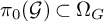 $\pi _0({\mathcal {G}} )\subset \Omega _G$
under
$\pi _0({\mathcal {G}} )\subset \Omega _G$
under $\Omega _G\to \Omega _{G'}$
is a finite subgroup
$\Omega _G\to \Omega _{G'}$
is a finite subgroup $Y'$
of
$Y'$
of $\Omega _{G'}$
. We can find a short fppf exact sequence of (smooth) group schemes
$\Omega _{G'}$
. We can find a short fppf exact sequence of (smooth) group schemes
 $$\begin{align*}1\to \mathcal{Z} \to {\mathcal{G}} \to {\mathcal{G}} {}_1'\to 1 , \end{align*}$$
where ${\mathcal {G}} {}_1'\subset {\mathcal {G}} '$
is a quasi-parahoric group scheme with the same neutral component
${\mathcal {G}} {}_1'\subset {\mathcal {G}} '$
is a quasi-parahoric group scheme with the same neutral component ${\mathcal {G}} {}^{\prime 0}$
and
${\mathcal {G}} {}^{\prime 0}$
and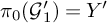 $\pi _0({\mathcal {G}} {}_1')=Y'$
. By Proposition 4.2.1, there is an isomorphism
$\pi _0({\mathcal {G}} {}_1')=Y'$
. By Proposition 4.2.1, there is an isomorphism $\mathcal {M} {}^{\mathrm {int}}_{{\mathcal {G}} {}_1', b^{\prime }_x, \mu '/x^{\prime }_0}\simeq \mathcal {M} {}^{\mathrm {int}}_{{\mathcal {G}} ', b^{\prime }_x, \mu '/x^{\prime }_0}$
. Hence we may replace
$\mathcal {M} {}^{\mathrm {int}}_{{\mathcal {G}} {}_1', b^{\prime }_x, \mu '/x^{\prime }_0}\simeq \mathcal {M} {}^{\mathrm {int}}_{{\mathcal {G}} ', b^{\prime }_x, \mu '/x^{\prime }_0}$
. Hence we may replace ${\mathcal {G}} '$
by
${\mathcal {G}} '$
by ${\mathcal {G}} {}^{\prime }_1$
, i.e., we may assume from the beginning that
${\mathcal {G}} {}^{\prime }_1$
, i.e., we may assume from the beginning that ${\mathcal {G}} \to {\mathcal {G}} '$
is surjective.
${\mathcal {G}} \to {\mathcal {G}} '$
is surjective.
Note that
 $$\begin{align*}\widehat{\mathbb{W}} {}^+{\mathcal{G}} '=\widehat{\mathbb{W}} {}^+{\mathcal{G}} {}^{\prime0}. \end{align*}$$
We obtain a short exact sequence of group v-sheaves
 $$ \begin{align} 1\to \widehat{\mathbb{W}} {}^+\mathcal{Z} \to \widehat{\mathbb{W}} {}^+{\mathcal{G}} \to \widehat{\mathbb{W}} {}^+{\mathcal{G}} '\to 1. \end{align} $$
The local models for $({\mathcal {G}}, \mu )$
and
$({\mathcal {G}}, \mu )$
and $({\mathcal {G}} ', \mu ')$
‘agree’, i.e.,
$({\mathcal {G}} ', \mu ')$
‘agree’, i.e.,
 $$\begin{align*}f: \mathbb{M} {}^{v}_{{\mathcal{G}} , \mu}\xrightarrow{\sim} \mathbb{M} {}^{v}_{{\mathcal{G}} ', \mu'}\times_{\mathrm{Spd}\ O'}\mathrm{Spd}\ O, \end{align*}$$
([Reference Scholze and WeinsteinSW20, 21.5.1]), so we have
 $$\begin{align*}\widehat f_0: \mathbb{M} {}^{v}_{{\mathcal{G}} , \mu /y_0}\xrightarrow{\sim} \mathbb{M} {}^{v}_{{\mathcal{G}} ', \mu' /y_0}\times_{\mathrm{Spd}\ O'}\mathrm{Spd}\ O, \end{align*}$$
for the completions of the local models at their common base point $y_0$
.
$y_0$
.
We now use Theorem 3.6.2 for ${\mathcal {G}} $
and
${\mathcal {G}} $
and ${\mathcal {G}} '$
: The morphism
${\mathcal {G}} '$
: The morphism
 $$\begin{align*}\widehat {L{\mathcal{G}} }_{b,\mu}\to \mathbb{M} {}^{v}_{{\mathcal{G}} , \mu /y_0}\xrightarrow{\sim} \mathbb{M} {}^{v}_{{\mathcal{G}} ', \mu' /y_0}\times_{\mathrm{Spd}\ O'}\mathrm{Spd}\ O \end{align*}$$
is a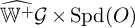 $\widehat {\mathbb {W} {}^+}{\mathcal {G}} \times \mathrm{Spd}(O)$
-torsor and
$\widehat {\mathbb {W} {}^+}{\mathcal {G}} \times \mathrm{Spd}(O)$
-torsor and
 $$\begin{align*}\widehat {L{\mathcal{G}} }^{\prime}_{b',\mu'}\times_{\mathrm{Spd}(O')}\mathrm{Spd}(O)\to \mathbb{M} {}^{v}_{{\mathcal{G}} , \mu /y_0}\xrightarrow{\sim} \mathbb{M} {}^{v}_{{\mathcal{G}} ', \mu' /y_0}\times_{\mathrm{Spd}\ O'}\mathrm{Spd}\ O, \end{align*}$$
a $\widehat {\mathbb {W} {}^+}{\mathcal {G}} '\times _{\mathrm{Spd}(O')}\mathrm{Spd}(O)$
-torsor. Hence, we have an isomorphism of
$\widehat {\mathbb {W} {}^+}{\mathcal {G}} '\times _{\mathrm{Spd}(O')}\mathrm{Spd}(O)$
-torsor. Hence, we have an isomorphism of $\widehat {\mathbb {W} {}^+}{\mathcal {G}} '$
-torsors,
$\widehat {\mathbb {W} {}^+}{\mathcal {G}} '$
-torsors,
 $$ \begin{align} \widehat {L{\mathcal{G}} }^{\prime}_{b',\mu'}\times_{\mathrm{Spd}(O')}\mathrm{Spd}(O)\simeq \widehat {L{\mathcal{G}} }_{b,\mu}\times^{\widehat{\mathbb{W} {}^+}{\mathcal{G}} } \widehat{\mathbb{W} {}^+}{\mathcal{G}} '. \end{align} $$
It follows that, v-locally,
 $$\begin{align*}\widehat {L{\mathcal{G}} }_{b,\mu}= g_0\cdot \widehat{\mathbb{W}} {}^+{\mathcal{G}}, \quad\ \widehat {L{\mathcal{G}} }^{\prime}_{b',\mu'}= g^{\prime}_0\cdot \widehat{\mathbb{W}} {}^+{\mathcal{G}} ' , \end{align*}$$
(after we choose a section $g_0$
of the first torsor). By Theorem 3.6.2 also, we can recover
$g_0$
of the first torsor). By Theorem 3.6.2 also, we can recover $\mathcal {M} {}^{\mathrm {int}}_{{\mathcal {G}}, b, \mu /x_0}$
as the quotient of
$\mathcal {M} {}^{\mathrm {int}}_{{\mathcal {G}}, b, \mu /x_0}$
as the quotient of $\widehat {L{\mathcal {G}} }_{ b,\mu } $
by the
$\widehat {L{\mathcal {G}} }_{ b,\mu } $
by the $\phi $
-conjugation action of
$\phi $
-conjugation action of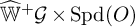 $\widehat {\mathbb {W}} {}^+{\mathcal {G}} \times \mathrm{Spd}(O) $
. More precisely,
$\widehat {\mathbb {W}} {}^+{\mathcal {G}} \times \mathrm{Spd}(O) $
. More precisely,
 $$\begin{align*}\widehat{L{\mathcal{G}} }_{b,\mu} \to \mathcal{M} {}^{\mathrm{int}}_{{\mathcal{G}} , b, \mu /x_0} \end{align*}$$
is a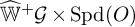 $\widehat {\mathbb {W}} {}^+{\mathcal {G}} \times \mathrm{Spd}(O)$
-torsor for the
$\widehat {\mathbb {W}} {}^+{\mathcal {G}} \times \mathrm{Spd}(O)$
-torsor for the $\phi $
-conjugation action. The corresponding statement for
$\phi $
-conjugation action. The corresponding statement for $({\mathcal {G}} ',b',\mu ')$
also holds. The exact sequence (5.3.1) and the above now implies that the map
$({\mathcal {G}} ',b',\mu ')$
also holds. The exact sequence (5.3.1) and the above now implies that the map $\widehat f_0$
is v-locally surjective.
$\widehat f_0$
is v-locally surjective.
To show that $\widehat f_0$
is injective, it is enough to check injectivity for
$\widehat f_0$
is injective, it is enough to check injectivity for $\phi $
-conjugacy classes as follows (for simplicity, we omit the base change to O from the notation). Suppose that
$\phi $
-conjugacy classes as follows (for simplicity, we omit the base change to O from the notation). Suppose that $g_0\cdot g_1$
and
$g_0\cdot g_1$
and $g_0\cdot g_2\in \widehat {L{\mathcal {G}} }_{b, \mu }(R, R^+)$
map, after replacing
$g_0\cdot g_2\in \widehat {L{\mathcal {G}} }_{b, \mu }(R, R^+)$
map, after replacing $(R, R^+)$
by a v-cover, to the same
$(R, R^+)$
by a v-cover, to the same $\phi $
-conjugacy class (by
$\phi $
-conjugacy class (by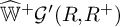 $\widehat {\mathbb {W}} {}^+{\mathcal {G}} '(R, R^+)$
) in
$\widehat {\mathbb {W}} {}^+{\mathcal {G}} '(R, R^+)$
) in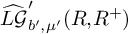 $\widehat {L{\mathcal {G}} }^{\prime }_{ b',\mu '}(R, R^+)$
. Then
$\widehat {L{\mathcal {G}} }^{\prime }_{ b',\mu '}(R, R^+)$
. Then
 $$ \begin{align} g_0\cdot g_1= \phi(g^{\prime+})^{-1}\cdot (g_0\cdot g_2)\cdot g^{\prime+} \in \widehat{L{\mathcal{G}} }^{\prime}_{ b',\mu'}(R, R^+)\subset {\mathcal{G}} '(W(R^+)[1/\xi]), \end{align} $$
for some $g^{\prime +}\in \widehat {\mathbb {W}} {}^+{\mathcal {G}} '(R, R^+)$
. Using (5.3.1), after further replacing
$g^{\prime +}\in \widehat {\mathbb {W}} {}^+{\mathcal {G}} '(R, R^+)$
. Using (5.3.1), after further replacing $(R, R^+)$
by a v-cover, we can lift
$(R, R^+)$
by a v-cover, we can lift $g^{\prime +}$
to
$g^{\prime +}$
to $g^+\in \widehat {\mathbb {W}} {}^+{\mathcal {G}} (R, R^+)$
. The identity (5.3.3) gives
$g^+\in \widehat {\mathbb {W}} {}^+{\mathcal {G}} (R, R^+)$
. The identity (5.3.3) gives
 $$ \begin{align} z=[g_1\cdot (g^+)^{-1} \cdot g_2^{-1} ]\cdot g_0^{-1}\cdot \phi(g^+) \cdot g_0 \end{align} $$
in ${\mathcal {G}} (W(R^+)[1/\xi ])$
with
${\mathcal {G}} (W(R^+)[1/\xi ])$
with $z \in \mathcal {Z} (W(R^+)[1/\xi ])$
(central in
$z \in \mathcal {Z} (W(R^+)[1/\xi ])$
(central in ${\mathcal {G}} (W(R^+)[1/\xi ])$
). In this, the term
${\mathcal {G}} (W(R^+)[1/\xi ])$
). In this, the term $k^+:=g_1\cdot (g^+)^{-1}\cdot g_2^{-1}$
in the bracket belongs to
$k^+:=g_1\cdot (g^+)^{-1}\cdot g_2^{-1}$
in the bracket belongs to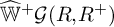 $\widehat {\mathbb {W}} {}^+{\mathcal {G}} (R, R^+)$
. Write the above
$\widehat {\mathbb {W}} {}^+{\mathcal {G}} (R, R^+)$
. Write the above
 $$\begin{align*}z =k^+\cdot (g_0^{-1}\cdot \phi(g^+) \cdot g_0). \end{align*}$$
We claim that this implies that $z=z^+\in \widehat {\mathbb {W}} {}^+\mathcal {Z} (R, R^+)$
. Indeed, for all
$z=z^+\in \widehat {\mathbb {W}} {}^+\mathcal {Z} (R, R^+)$
. Indeed, for all $m\geq 1$
, we obtain
$m\geq 1$
, we obtain
 $$\begin{align*}z^m= (k^+)^m\cdot (g_0^{-1}\cdot \phi(g^+)^m \cdot g_0). \end{align*}$$
Hence, there is $N\geq 1$
depending on
$N\geq 1$
depending on $g_0$
only, such that
$g_0$
only, such that $z^m\in \mathcal {Z} (W(R^+)[1/\xi ])$
has matrix entries (after applying some faithful representation of
$z^m\in \mathcal {Z} (W(R^+)[1/\xi ])$
has matrix entries (after applying some faithful representation of ${\mathcal {G}} $
) with denominators which are powers of
${\mathcal {G}} $
) with denominators which are powers of $\xi $
bounded by N, for all m. This implies that
$\xi $
bounded by N, for all m. This implies that $z\in \mathcal {Z} (W(R^+))$
. Indeed, write
$z\in \mathcal {Z} (W(R^+))$
. Indeed, write $\mathcal {Z} = \prod _{i}\mathrm {Res}_{O_{K_i}/\mathbb {Z} {}_p}\mathbb {G} {}_m$
. Then, if
$\mathcal {Z} = \prod _{i}\mathrm {Res}_{O_{K_i}/\mathbb {Z} {}_p}\mathbb {G} {}_m$
. Then, if $z^m\in (O_{K_i}\otimes _{\mathbb {Z} {}_p} W(R^+)[1/\xi ])^\times $
has bounded denominators for all
$z^m\in (O_{K_i}\otimes _{\mathbb {Z} {}_p} W(R^+)[1/\xi ])^\times $
has bounded denominators for all $m\geq 1$
, then
$m\geq 1$
, then $z\in (O_{K_i}\otimes _{\mathbb {Z} {}_p} W(R^+))^\times $
. We can see using (5.3.4) that we also have
$z\in (O_{K_i}\otimes _{\mathbb {Z} {}_p} W(R^+))^\times $
. We can see using (5.3.4) that we also have $z\equiv 1\ \mathrm {mod}\, [\varpi ]$
, for some pseudouniformiser
$z\equiv 1\ \mathrm {mod}\, [\varpi ]$
, for some pseudouniformiser $\varpi $
of
$\varpi $
of $R^+$
. Hence, we conclude
$R^+$
. Hence, we conclude $z=z^+\in \widehat {\mathbb {W}} {}^+\mathcal {Z} (R, R^+)$
. By applying Lemma 3.6.1 for
$z=z^+\in \widehat {\mathbb {W}} {}^+\mathcal {Z} (R, R^+)$
. By applying Lemma 3.6.1 for $\mathcal {Z} $
to
$\mathcal {Z} $
to $z^+$
, we can write
$z^+$
, we can write $z^+=z_1^+\phi (z_1^+)^{-1}$
. Set
$z^+=z_1^+\phi (z_1^+)^{-1}$
. Set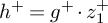 $h^+=g^+\cdot z^+_1$
. Using that Z is central, we can rewrite (5.3.4) as
$h^+=g^+\cdot z^+_1$
. Using that Z is central, we can rewrite (5.3.4) as
 $$\begin{align*}g_0g_1 = \phi(h^+)^{-1}\cdot g_0 g_2\cdot h^+. \end{align*}$$
This gives that $g_0g_1$
and
$g_0g_1$
and $g_0g_2$
are
$g_0g_2$
are $\phi $
-conjugate by
$\phi $
-conjugate by $h^+\in \widehat {\mathbb {W} }^+{\mathcal {G}} (R, R^+)$
. This shows injectivity and concludes the proof.
$h^+\in \widehat {\mathbb {W} }^+{\mathcal {G}} (R, R^+)$
. This shows injectivity and concludes the proof.
Assume now that f is of type (i). Using Proposition 4.2.1, we can replace ${\mathcal {G}} $
,
${\mathcal {G}} $
, ${\mathcal {G}} '$
by their parahoric neutral components
${\mathcal {G}} '$
by their parahoric neutral components ${\mathcal {G}} {}^o$
,
${\mathcal {G}} {}^o$
, ${\mathcal {G}} {}^{\prime o}$
. For these we have
${\mathcal {G}} {}^{\prime o}$
. For these we have ${\mathcal {G}} {}^o(\breve {\mathbb {Z}} {}_p)\subset G(\breve {\mathbb {Q}} {}_p)\cap f^{-1} ({\mathcal {G}} {}^{\prime o}(\breve {\mathbb {Z}} {}_p))$
with the intersection the
${\mathcal {G}} {}^o(\breve {\mathbb {Z}} {}_p)\subset G(\breve {\mathbb {Q}} {}_p)\cap f^{-1} ({\mathcal {G}} {}^{\prime o}(\breve {\mathbb {Z}} {}_p))$
with the intersection the $\breve {\mathbb {Z}} {}_p$
-points of a quasi-parahoric
$\breve {\mathbb {Z}} {}_p$
-points of a quasi-parahoric $\widetilde {\mathcal {G}} $
with
$\widetilde {\mathcal {G}} $
with $\widetilde {\mathcal {G}} {}^o={\mathcal {G}} $
. The morphism f factors
$\widetilde {\mathcal {G}} {}^o={\mathcal {G}} $
. The morphism f factors
 $$\begin{align*}\mathcal{M} {}^{\mathrm{int}}_{{\mathcal{G}} , b, \mu}\to \mathcal{M} {}^{\mathrm{int}}_{\widetilde{\mathcal{G}} , b, \mu}\xrightarrow{\ \widetilde f\ } \mathcal{M} {}^{\mathrm{int}}_{{\mathcal{G}} ', b', \mu'}\times_{\mathrm{Spd}(O')}\mathrm{Spd}(O). \end{align*}$$
By Proposition 5.1.3 applied to $\widetilde {\mathcal {G}} \to {\mathcal {G}} '$
, the morphism
$\widetilde {\mathcal {G}} \to {\mathcal {G}} '$
, the morphism $\widetilde f$
is a closed immersion. Using [Reference GleasonGl25, Prop. 4.20] we see that the base change of
$\widetilde f$
is a closed immersion. Using [Reference GleasonGl25, Prop. 4.20] we see that the base change of $\widetilde f$
along the completion
$\widetilde f$
along the completion $ \mathcal {M} {}^{\mathrm {int}}_{{\mathcal {G}} ', b', \mu ' /x_0'}\to \mathcal {M} {}^{\mathrm {int}}_{{\mathcal {G}} ', b', \mu '}$
is the completion of
$ \mathcal {M} {}^{\mathrm {int}}_{{\mathcal {G}} ', b', \mu ' /x_0'}\to \mathcal {M} {}^{\mathrm {int}}_{{\mathcal {G}} ', b', \mu '}$
is the completion of $\widetilde f$
at the base points
$\widetilde f$
at the base points
 $$\begin{align*}\widehat{{\widetilde f}}_0: \mathcal{M} {}^{\mathrm{int}}_{\widetilde{\mathcal{G}} , b, \mu /\widetilde x_0} \to \mathcal{M} {}^{\mathrm{int}}_{{\mathcal{G}} ', b', \mu' /x^{\prime}_0}\times_{\mathrm{Spd}(O')}\mathrm{Spd}(O). \end{align*}$$
Hence, this is also a closed immersion. By Proposition 4.2.1 applied to the quasi-parahoric $\widetilde {\mathcal {G}} $
we see that the source of this morphism can be identified with
$\widetilde {\mathcal {G}} $
we see that the source of this morphism can be identified with $ \widehat {\mathcal {M} {}^{\mathrm {int}}_{{\mathcal {G}}, b, \mu }}_{/x_0} $
and the morphism with
$ \widehat {\mathcal {M} {}^{\mathrm {int}}_{{\mathcal {G}}, b, \mu }}_{/x_0} $
and the morphism with $\hat f_0$
. Hence,
$\hat f_0$
. Hence, $\hat f_0$
is also a closed immersion.
$\hat f_0$
is also a closed immersion.
Lemma 5.3.2. Suppose $\widetilde x_1$
,
$\widetilde x_1$
, $\widetilde x_2\in ( \mathcal {M} {}^{\mathrm {int}}_{{\mathcal {G}} {}^o, b, \mu /x_0})_\eta (C, O_C)$
have the same image
$\widetilde x_2\in ( \mathcal {M} {}^{\mathrm {int}}_{{\mathcal {G}} {}^o, b, \mu /x_0})_\eta (C, O_C)$
have the same image $\pi (\widetilde x_1)=\pi (\widetilde x_2)$
under the period map. Then there is
$\pi (\widetilde x_1)=\pi (\widetilde x_2)$
under the period map. Then there is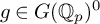 $g\in G(\mathbb {Q} {}_p)^0$
such that
$g\in G(\mathbb {Q} {}_p)^0$
such that $\widetilde x_2=g\cdot \widetilde x_1$
.
$\widetilde x_2=g\cdot \widetilde x_1$
.
Proof. Since the period map $\pi : (\mathcal {M} {}^{\mathrm {int}}_{{\mathcal {G}} {}^o, b, \mu })_\eta \longrightarrow \mathrm { Gr}_{G,\mathrm{Spd}(\breve E), \leq \mu }^{\mathrm {adm}}$
is étale with geometric fibres
$\pi : (\mathcal {M} {}^{\mathrm {int}}_{{\mathcal {G}} {}^o, b, \mu })_\eta \longrightarrow \mathrm { Gr}_{G,\mathrm{Spd}(\breve E), \leq \mu }^{\mathrm {adm}}$
is étale with geometric fibres $G(\mathbb {Q} {}_p)/K^o$
, there is
$G(\mathbb {Q} {}_p)/K^o$
, there is $g\in G(\mathbb {Q} {}_p)$
with
$g\in G(\mathbb {Q} {}_p)$
with $\widetilde x_2=g\cdot \widetilde x_1$
. We have
$\widetilde x_2=g\cdot \widetilde x_1$
. We have $\mathrm {sp}(\widetilde x_1)=\mathrm {sp}(\widetilde x_2)=x$
and it remains to show that
$\mathrm {sp}(\widetilde x_1)=\mathrm {sp}(\widetilde x_2)=x$
and it remains to show that $\kappa _G(g)=1$
. We first observe that the statement is true when
$\kappa _G(g)=1$
. We first observe that the statement is true when $G=T$
is a torus. Indeed, in this case the period map is
$G=T$
is a torus. Indeed, in this case the period map is
 $$\begin{align*}(\mathcal{M} {}^{\mathrm{int}}_{\mathcal{T} {}^o, b, \mu})_\eta\longrightarrow \mathrm{Spd}(\breve E) \end{align*}$$
with geometric fibres given by $\kappa _T: T(\mathbb {Q} {}_p)/\mathcal {T} {}^o(\mathbb {Z} {}_p)\xrightarrow {\simeq } \Omega _T$
while
$\kappa _T: T(\mathbb {Q} {}_p)/\mathcal {T} {}^o(\mathbb {Z} {}_p)\xrightarrow {\simeq } \Omega _T$
while $ (\widehat {\mathcal {M} {}^{\mathrm {int}}_{\mathcal {T} {}^o, b, \mu }}_{/x_0})_\eta \simeq \mathrm{Spd}(\breve E)$
, see [Reference Scholze and WeinsteinSW20, 25.2]. Then, the result follows when
$ (\widehat {\mathcal {M} {}^{\mathrm {int}}_{\mathcal {T} {}^o, b, \mu }}_{/x_0})_\eta \simeq \mathrm{Spd}(\breve E)$
, see [Reference Scholze and WeinsteinSW20, 25.2]. Then, the result follows when $G_{\mathrm {der}}$
is simply connected by applying functoriality to
$G_{\mathrm {der}}$
is simply connected by applying functoriality to $G\to G_{\mathrm {ab}}=D$
and observing that, in this case,
$G\to G_{\mathrm {ab}}=D$
and observing that, in this case, $\Omega _G\simeq \Omega _{D}$
. Finally, we reduce the general case to the case when the derived group is simply connected by employing a z-extension
$\Omega _G\simeq \Omega _{D}$
. Finally, we reduce the general case to the case when the derived group is simply connected by employing a z-extension
 $$\begin{align*}1\to Z\to \widetilde G\to G\to 1 \end{align*}$$
and lifting $({\mathcal {G}} {}^o, b, \mu )$
to a corresponding triple
$({\mathcal {G}} {}^o, b, \mu )$
to a corresponding triple $(\widetilde {\mathcal {G}} {}^o, \widetilde b, \widetilde \mu )$
. Here,
$(\widetilde {\mathcal {G}} {}^o, \widetilde b, \widetilde \mu )$
. Here, $\widetilde G_{\mathrm {der}}$
is simply connected and Z is a quasi-trivial torus. By case (ii) applied to
$\widetilde G_{\mathrm {der}}$
is simply connected and Z is a quasi-trivial torus. By case (ii) applied to $\widetilde G\to G$
we obtain
$\widetilde G\to G$
we obtain
 $$\begin{align*}( \mathcal{M} {}^{\mathrm{int}}_{\widetilde{\mathcal{G}} {}^o,\widetilde b,\widetilde \mu /x_0})_\eta\xrightarrow{\sim} ( \mathcal{M} {}^{\mathrm{int}}_{{\mathcal{G}} {}^o, b, \mu /x_0})_\eta, \end{align*}$$
and the admissible sets for $\widetilde G$
and G coincide by the proof of Proposition 5.2.1. Since we are assuming that the result holds for
$\widetilde G$
and G coincide by the proof of Proposition 5.2.1. Since we are assuming that the result holds for $\widetilde G$
, we deduce it for G.
$\widetilde G$
, we deduce it for G.
Lemma 5.3.3. The map f induces a surjection $ G(\mathbb {Q} {}_p)^0/K^o\to G'(\mathbb {Q} {}_p)^0/K^{\prime o}.$
Proof. For any reductive group G over $\mathbb {Q} {}_p$
we have
$\mathbb {Q} {}_p$
we have
 $$ \begin{align*}G(\mathbb{Q} {}_p)^0=K\cdot \varphi(G_{\mathrm{sc}}(\mathbb{Q} {}_p)), \end{align*} $$
where K is an arbitrary parahoric subgroup of $G(\mathbb {Q} {}_p)$
and
$G(\mathbb {Q} {}_p)$
and $\phi : G_{\mathrm {sc}}\to G_{\mathrm {der}}\to G$
is the natural map. Note that both factors on the RHS are contained in the LHS, and the second factor is a normal subgroup, so the inclusion of the RHS into the LHS is clear. For the other inclusion, we choose an apartment
$\phi : G_{\mathrm {sc}}\to G_{\mathrm {der}}\to G$
is the natural map. Note that both factors on the RHS are contained in the LHS, and the second factor is a normal subgroup, so the inclusion of the RHS into the LHS is clear. For the other inclusion, we choose an apartment $A^\natural $
of the building over
$A^\natural $
of the building over $\mathbb {Q} {}_p$
as in [Reference Bruhat and TitsBTII] such that K fixes a facet in
$\mathbb {Q} {}_p$
as in [Reference Bruhat and TitsBTII] such that K fixes a facet in $A^\natural $
. Associated to
$A^\natural $
. Associated to $A^\natural $
is the smooth connected group scheme
$A^\natural $
is the smooth connected group scheme $\mathscr {Z} {}^o$
over
$\mathscr {Z} {}^o$
over $\mathbb {Z} {}_p$
. Now Bruhat-Tits [Reference Bruhat and TitsBTII] prove the following two facts:
$\mathbb {Z} {}_p$
. Now Bruhat-Tits [Reference Bruhat and TitsBTII] prove the following two facts:
-
•
$G(\mathbb {Q} {}_p)^0= \mathscr {Z} {}^o(\mathbb {Z} {}_p)\cdot \varphi (G_{\mathrm {sc}}(\mathbb {Q} {}_p))$
, cf. last line of [Reference Bruhat and TitsBTII, (5.2.11)]. -
•
$\mathscr {Z} {}^o(\mathbb {Z} {}_p)\subset K$
, cf. first display in [Reference Bruhat and TitsBTII, (5.2.4)].


Hence, we also obtain the other inclusion. By applying the above to $G'$
and
$G'$
and $K^{\prime o}$
and G, noting that
$K^{\prime o}$
and G, noting that $\varphi ': G_{\mathrm {sc}}=G^{\prime }_{\mathrm {sc}}\to G'$
factors through
$\varphi ': G_{\mathrm {sc}}=G^{\prime }_{\mathrm {sc}}\to G'$
factors through $f: G\to G'$
, we obtain
$f: G\to G'$
, we obtain
 $$\begin{align*}G'(\mathbb{Q} {}_p)^0=f(G(\mathbb{Q} {}_p)^0)\cdot K^{\prime o}, \end{align*}$$
which gives the result.
The above two lemmas, together with Proposition 5.2.1, imply that the map
 $$\begin{align*}(\hat f_0)_\eta: ( \mathcal{M} {}^{\mathrm{int}}_{{\mathcal{G}} , b, \mu /x_0})_\eta\to ( \mathcal{M} {}^{\mathrm{int}}_{{\mathcal{G}} ', b', \mu' /x^{\prime}_0})_\eta \end{align*}$$
induced by f, gives a surjection on $(C, O_C)$
-points. Since it is also a closed immersion between partially proper v-sheaves, it then follows that it is an isomorphism.
$(C, O_C)$
-points. Since it is also a closed immersion between partially proper v-sheaves, it then follows that it is an isomorphism.
Both the source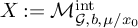 $X:= \mathcal {M} {}^{\mathrm {int}}_{{\mathcal {G}}, b, \mu /x_0}$
and the target
$X:= \mathcal {M} {}^{\mathrm {int}}_{{\mathcal {G}}, b, \mu /x_0}$
and the target $X':= \mathcal {M} {}^{\mathrm {int}}_{{\mathcal {G}} ', b', \mu ' /x_0'}$
of the closed immersion
$X':= \mathcal {M} {}^{\mathrm {int}}_{{\mathcal {G}} ', b', \mu ' /x_0'}$
of the closed immersion
 $$\begin{align*}\widehat f_0: X\to X' \end{align*}$$
are topologically flat by [Reference Pappas and RapoportPR24, Prop. 3.4.9], as extended in [Reference Pappas and RapoportPR24, Rem. 3.4.12] also for the non-minuscule case (this extension uses the results of [Reference Anschütz, Gleason, Lourenço and RicharzAGLR22]). By the definition of topological flatness, this implies that $|X_\eta |$
, resp.
$|X_\eta |$
, resp. $|X^{\prime }_{\eta }|$
, is dense in
$|X^{\prime }_{\eta }|$
, is dense in $|X|$
, resp.
$|X|$
, resp. $|X'|$
. Since
$|X'|$
. Since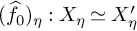 $(\widehat f_0)_\eta : X_\eta \simeq X^{\prime }_\eta $
is an isomorphism, we obtain
$(\widehat f_0)_\eta : X_\eta \simeq X^{\prime }_\eta $
is an isomorphism, we obtain $|X|\simeq |X'|$
. The result that
$|X|\simeq |X'|$
. The result that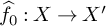 $\widehat f_0: X\to X'$
is an isomorphism now follows from [Reference Scholze and WeinsteinSW20, Lem. 17.4.1].
$\widehat f_0: X\to X'$
is an isomorphism now follows from [Reference Scholze and WeinsteinSW20, Lem. 17.4.1].
5.4 Ad-isomorphisms and ADLV
Let $f\colon ({\mathcal {G}}, b, \mu )\to ({\mathcal {G}} ', b', \mu ')$
be an ad-isomorphism of integral local shtuka data. We have a commutative diagram with surjective vertical arrows,
$f\colon ({\mathcal {G}}, b, \mu )\to ({\mathcal {G}} ', b', \mu ')$
be an ad-isomorphism of integral local shtuka data. We have a commutative diagram with surjective vertical arrows,

where the lower row are discrete schemes (which we treat like sets).
Lemma 5.4.1. The upper arrow induces an isomorphism between corresponding connected components. The diagram is cartesian.
Proof. An ad-isomorphism induces an isomorphism  . This easily implies the first assertion. The second assertion follows since $\pi _0(X_{{\mathcal {G}} {}^o})=\Omega _G$
and
$\pi _0(X_{{\mathcal {G}} {}^o})=\Omega _G$
and $\pi _0(X_{{\mathcal {G}} {}^{\prime o}})=\Omega _{G'}$
.
$\pi _0(X_{{\mathcal {G}} {}^{\prime o}})=\Omega _{G'}$
.
Let us consider the effect of an ad-isomorphism on Iwahori Weyl groups. An ad-isomorphism induces maps $N(\breve {\mathbb {Q}} {}_p)\to N'(\breve {\mathbb {Q}} {}_p)$
, and
$N(\breve {\mathbb {Q}} {}_p)\to N'(\breve {\mathbb {Q}} {}_p)$
, and $T(\breve {\mathbb {Q}} {}_p)^0\to T'(\breve {\mathbb {Q}} {}_p)^0$
, and
$T(\breve {\mathbb {Q}} {}_p)^0\to T'(\breve {\mathbb {Q}} {}_p)^0$
, and $\widetilde W\to \widetilde W'$
and an identification of affine Weyl groups
$\widetilde W\to \widetilde W'$
and an identification of affine Weyl groups $W_a=W^{\prime }_a$
, compatible with the semi-direct product decompositions,
$W_a=W^{\prime }_a$
, compatible with the semi-direct product decompositions,
 $$ \begin{align*}\widetilde W=W_a\rtimes\Omega_{G}\to W_a\rtimes\Omega_{G'}=\widetilde W'. \end{align*} $$
Denoting by $K^o$
, resp.
$K^o$
, resp. $K^{\prime o}$
the parahoric subgroups of
$K^{\prime o}$
the parahoric subgroups of $G(\mathbb {Q} {}_p)$
, resp.
$G(\mathbb {Q} {}_p)$
, resp. $G'(\mathbb {Q} {}_p)$
, we have subgroups
$G'(\mathbb {Q} {}_p)$
, we have subgroups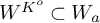 $W^{K^o}\subset W_a$
and
$W^{K^o}\subset W_a$
and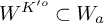 $W^{K^{\prime o}}\subset W_a$
. These subgroups of
$W^{K^{\prime o}}\subset W_a$
. These subgroups of $\widetilde W$
, resp.
$\widetilde W$
, resp. $\widetilde W'$
, can be identified.
$\widetilde W'$
, can be identified.
The admissible sets are contained in a single $W_a$
-coset and hence the map
$W_a$
-coset and hence the map $\widetilde W\to \widetilde W'$
induces a bijection
$\widetilde W\to \widetilde W'$
induces a bijection

Similarly denoting by $\mathrm {{Adm}}_{K^o}(\mu )$
, resp.
$\mathrm {{Adm}}_{K^o}(\mu )$
, resp.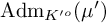 $\mathrm {{Adm}}_{K^{\prime o}}(\mu ')$
, the image of
$\mathrm {{Adm}}_{K^{\prime o}}(\mu ')$
, the image of $\mathrm {{Adm}}(\mu )$
in
$\mathrm {{Adm}}(\mu )$
in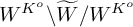 $W^{K^o}\backslash \widetilde W/W^{K^o}$
, resp. of
$W^{K^o}\backslash \widetilde W/W^{K^o}$
, resp. of $\mathrm {{Adm}}(\mu ')$
in
$\mathrm {{Adm}}(\mu ')$
in $W^{K^{\prime o}}\backslash \widetilde W'/W^{K^{\prime o}}$
, we have a bijection
$W^{K^{\prime o}}\backslash \widetilde W'/W^{K^{\prime o}}$
, we have a bijection

The commutative diagram (5.4.1) induces a commutative diagram, cf. (4.3.2),

Lemma 5.4.2. The upper arrow induces an isomorphism between corresponding components. The diagram is cartesian, with surjective vertical arrows.
Proof. Here recall that by a component of $X_{{\mathcal {G}} }(b, \mu )$
, we mean an intersection of
$X_{{\mathcal {G}} }(b, \mu )$
, we mean an intersection of $X_{{\mathcal {G}} }(b, \mu )$
with a connected component of
$X_{{\mathcal {G}} }(b, \mu )$
with a connected component of $X_{{\mathcal {G}} }$
. The surjectivity of the vertical arrows follows from (4.3.2).
$X_{{\mathcal {G}} }$
. The surjectivity of the vertical arrows follows from (4.3.2).
Let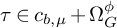 $\tau \in c_{b,\mu }+\Omega _{G}^\phi $
, with image
$\tau \in c_{b,\mu }+\Omega _{G}^\phi $
, with image $\tau '=f(\tau )\in c_{b',\mu '}+\Omega _{G'}^\phi $
. By Lemma 5.4.1, for every
$\tau '=f(\tau )\in c_{b',\mu '}+\Omega _{G'}^\phi $
. By Lemma 5.4.1, for every $g'\breve K^{\prime o}\in X_{{\mathcal {G}} {}^{\prime o}}(b', \mu ')\cap X^{\tau '}_{{\mathcal {G}} {}^{\prime o}}$
, there exists a unique point
$g'\breve K^{\prime o}\in X_{{\mathcal {G}} {}^{\prime o}}(b', \mu ')\cap X^{\tau '}_{{\mathcal {G}} {}^{\prime o}}$
, there exists a unique point $g\breve K^o\in X^\tau _{{\mathcal {G}} {}^o}$
lying over it. We have to compare the double cosets of
$g\breve K^o\in X^\tau _{{\mathcal {G}} {}^o}$
lying over it. We have to compare the double cosets of $h:=g^{-1}b\phi (g)$
in
$h:=g^{-1}b\phi (g)$
in $\breve K^o\backslash G(\breve {\mathbb {Q}} {}_p)/\breve K^o=W^{K^o}\backslash \widetilde W/W^{K^o}$
and of
$\breve K^o\backslash G(\breve {\mathbb {Q}} {}_p)/\breve K^o=W^{K^o}\backslash \widetilde W/W^{K^o}$
and of $f(h)=g^{\prime -1}b'\phi (g')$
in
$f(h)=g^{\prime -1}b'\phi (g')$
in $\breve K^{\prime o}\backslash G(\breve {\mathbb {Q}} {}_p)/\breve K^{\prime o}=W^{K^{\prime o}}\backslash \widetilde W'/W^{K^{\prime o}}$
. But by (5.4.2) it follows that the class of h lies in
$\breve K^{\prime o}\backslash G(\breve {\mathbb {Q}} {}_p)/\breve K^{\prime o}=W^{K^{\prime o}}\backslash \widetilde W'/W^{K^{\prime o}}$
. But by (5.4.2) it follows that the class of h lies in $\mathrm {{Adm}}_{K^o}(\mu )$
if and only if the class of
$\mathrm {{Adm}}_{K^o}(\mu )$
if and only if the class of $f(h)$
lies in
$f(h)$
lies in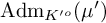 $\mathrm { {Adm}}_{K^{\prime o}}(\mu ')$
. Hence
$\mathrm { {Adm}}_{K^{\prime o}}(\mu ')$
. Hence $g\breve K^o\in X_{{\mathcal {G}} {}^o}(b, \mu )^\tau $
, as desired.
$g\breve K^o\in X_{{\mathcal {G}} {}^o}(b, \mu )^\tau $
, as desired.
Now we pass from the parahorics ${\mathcal {G}} {}^o$
and
${\mathcal {G}} {}^o$
and ${\mathcal {G}} {}^{\prime o}$
to the quasi-parahorics
${\mathcal {G}} {}^{\prime o}$
to the quasi-parahorics ${\mathcal {G}} $
and
${\mathcal {G}} $
and ${\mathcal {G}} '$
. The homomorphism
${\mathcal {G}} '$
. The homomorphism $f: G\to G'$
induces homomorphisms
$f: G\to G'$
induces homomorphisms
 $$ \begin{align*}\Omega_G\to\Omega_{G'}, \quad \pi_0({\mathcal{G}} )\to\pi_0({\mathcal{G}}'),\quad C_{{\mathcal{G}}} \to C_{{\mathcal{G}} '}, \quad \Pi_{{\mathcal{G}}} \to\Pi_{{\mathcal{G}} '}. \end{align*} $$
Here recall that $C_{{\mathcal {G}}} =\Omega _G/\pi _0({\mathcal {G}} )$
and
$C_{{\mathcal {G}}} =\Omega _G/\pi _0({\mathcal {G}} )$
and $C_{{\mathcal {G}} '}=\Omega _{G'}/\pi _0({\mathcal {G}} ')$
, and
$C_{{\mathcal {G}} '}=\Omega _{G'}/\pi _0({\mathcal {G}} ')$
, and $\Pi _{{\mathcal {G}}} =\ker (\pi _0({\mathcal {G}} )_\phi \to \Omega _{G, \phi })$
and
$\Pi _{{\mathcal {G}}} =\ker (\pi _0({\mathcal {G}} )_\phi \to \Omega _{G, \phi })$
and $\Pi _{{\mathcal {G}} '}=\ker (\pi _0({\mathcal {G}} ')_\phi \to \Omega _{G', \phi })$
. We obtain from Corollary 4.3.6 a diagram with surjective vertical arrows,
$\Pi _{{\mathcal {G}} '}=\ker (\pi _0({\mathcal {G}} ')_\phi \to \Omega _{G', \phi })$
. We obtain from Corollary 4.3.6 a diagram with surjective vertical arrows,

Proposition 5.4.3. The upper arrow in (5.4.4) induces an isomorphism between corresponding components. The diagram is cartesian, with surjective vertical arrows.

5.5 Proof of Theorem 5.1.2
The plan of the proof is as follows. We will show in Proposition 5.5.2 below that
 $$\begin{align*}f^\tau: \mathcal{M} {}^{\mathrm{int,\tau}}_{{\mathcal{G}} , b, \mu}\xrightarrow{\ \ } \mathcal{M} {}^{\mathrm{int}}_{{\mathcal{G}} ', b', \mu'}\times_{\mathrm{Spd}(O')}\mathrm{Spd}(O) \end{align*}$$
is qcqs. Since $\mathcal {M} {}^{\mathrm {int, \tau '}}_{{\mathcal {G}} ', b', \mu '}\to \mathcal {M} {}^{\mathrm {int}}_{{\mathcal {G}} ', b', \mu '}$
is an open and closed immersion,
$\mathcal {M} {}^{\mathrm {int, \tau '}}_{{\mathcal {G}} ', b', \mu '}\to \mathcal {M} {}^{\mathrm {int}}_{{\mathcal {G}} ', b', \mu '}$
is an open and closed immersion,
 $$\begin{align*}f^{\tau, \tau'}: \mathcal{M} {}^{\mathrm{int,\tau}}_{{\mathcal{G}} , b, \mu}\xrightarrow{\ \ } \mathcal{M} {}^{\mathrm{int, \tau'}}_{{\mathcal{G}} ', b', \mu'}\times_{\mathrm{Spd}(O')}\mathrm{Spd}(O) \end{align*}$$
is also qcqs (cf. the proof of Lemma 5.5.3 below). Assuming this, by [Reference Scholze and WeinsteinSW20, Cor. 17.4.10] and the partial properness of $\mathcal {M} {}^{\mathrm {int,\tau }}_{{\mathcal {G}}, b, \mu }$
and
$\mathcal {M} {}^{\mathrm {int,\tau }}_{{\mathcal {G}}, b, \mu }$
and $\mathcal {M} {}^{\mathrm {int, \tau '}}_{{\mathcal {G}} ', b', \mu '}$
over
$\mathcal {M} {}^{\mathrm {int, \tau '}}_{{\mathcal {G}} ', b', \mu '}$
over $\mathrm{Spd}(O)$
, resp.
$\mathrm{Spd}(O)$
, resp. $\mathrm{Spd}(O')$
, it is enough to show the following statement.
$\mathrm{Spd}(O')$
, it is enough to show the following statement.
Proposition 5.5.1. Under the above assumptions, $f^{\tau ,\tau '}$
induces a bijection on
$f^{\tau ,\tau '}$
induces a bijection on $\mathrm{Spa}(C, O_C)$
-points.
$\mathrm{Spa}(C, O_C)$
-points.
Proof. By Proposition 3.3.1, if $\kappa $
is a discrete, algebraically closed field of characteristic p, we have bijections
$\kappa $
is a discrete, algebraically closed field of characteristic p, we have bijections
 $$\begin{align*}\mathcal{M} {}^{\mathrm{int,\tau}}_{{\mathcal{G}} , b, \mu}(\mathrm{Spd}(\kappa))=X^{\tau}_{{\mathcal{G}} }(b, \mu^{-1})(\kappa),\quad \mathcal{M} {}^{\mathrm{int,\tau'}}_{{\mathcal{G}} ', b', \mu'}(\mathrm{Spd}(\kappa))=X^{\tau'}_{{\mathcal{G}} '}(b', \mu^{\prime-1})(\kappa) \end{align*}$$
and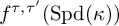 $f^{\tau , \tau '}(\mathrm{Spd}(\kappa ))$
is identified with the corresponding map
$f^{\tau , \tau '}(\mathrm{Spd}(\kappa ))$
is identified with the corresponding map
 $$ \begin{align} X^{\tau}_{{\mathcal{G}} }(b, \mu^{-1})(\kappa) \xrightarrow{} X^{\tau'}_{{\mathcal{G}} '}(b', \mu^{\prime-1})(\kappa). \end{align} $$
But this map is a bijection by Proposition 5.4.3. Hence, $f^{\tau , \tau '}$
induces a bijection on
$f^{\tau , \tau '}$
induces a bijection on $\mathrm{Spd}(\kappa )$
-points. We still have to treat
$\mathrm{Spd}(\kappa )$
-points. We still have to treat $\mathrm{Spa}(C, O_C)$
-points.
$\mathrm{Spa}(C, O_C)$
-points.
Set $O(\kappa )=O\otimes _{W(k)}W(\kappa )$
, and similarly for
$O(\kappa )=O\otimes _{W(k)}W(\kappa )$
, and similarly for $O'(\kappa )$
. Note that the reduced locus of the base change
$O'(\kappa )$
. Note that the reduced locus of the base change
 $$\begin{align*}(\mathcal{M} {}^{\mathrm{int,\tau}}_{{\mathcal{G}} , b, \mu})_{O(\kappa)}:=\mathcal{M} {}^{\mathrm{int,\tau}}_{{\mathcal{G}} , b, \mu}\times_{\mathrm{Spd}(O)}\mathrm{Spd}( O(\kappa)) \end{align*}$$
is $ X^{\tau }_{{\mathcal {G}} }(b, \mu ^{-1})_\kappa :=X^{\tau }_{{\mathcal {G}} }(b, \mu ^{-1})\times _{\operatorname {\mbox {Spec }}(k)}\operatorname {\mbox {Spec }}(\kappa )$
, and similarly for
$ X^{\tau }_{{\mathcal {G}} }(b, \mu ^{-1})_\kappa :=X^{\tau }_{{\mathcal {G}} }(b, \mu ^{-1})\times _{\operatorname {\mbox {Spec }}(k)}\operatorname {\mbox {Spec }}(\kappa )$
, and similarly for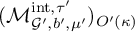 $(\mathcal {M} {}^{\mathrm {int,\tau '}}_{{\mathcal {G}} ', b', \mu '})_{ O'(\kappa )}$
.
$(\mathcal {M} {}^{\mathrm {int,\tau '}}_{{\mathcal {G}} ', b', \mu '})_{ O'(\kappa )}$
.
Now note that any $\mathrm{Spa}(C, O_C)$
-point
$\mathrm{Spa}(C, O_C)$
-point $\tilde x: \mathrm{Spa}(C,O_C)\to \mathcal {M} {}^{\mathrm {int,\tau }}_{{\mathcal {G}}, b, \mu }$
factors through the formal completion
$\tilde x: \mathrm{Spa}(C,O_C)\to \mathcal {M} {}^{\mathrm {int,\tau }}_{{\mathcal {G}}, b, \mu }$
factors through the formal completion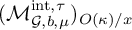 $ ( \mathcal {M} {}^{\mathrm {int,\tau }}_{{\mathcal {G}}, b, \mu })_{ O(\kappa ) /x}$
of
$ ( \mathcal {M} {}^{\mathrm {int,\tau }}_{{\mathcal {G}}, b, \mu })_{ O(\kappa ) /x}$
of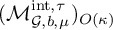 $( \mathcal {M} {}^{\mathrm {int,\tau }}_{{\mathcal {G}}, b, \mu })_{ O(\kappa )}$
at
$( \mathcal {M} {}^{\mathrm {int,\tau }}_{{\mathcal {G}}, b, \mu })_{ O(\kappa )}$
at $x:=\mathrm {sp}(\tilde x)$
, where
$x:=\mathrm {sp}(\tilde x)$
, where $\kappa $
is the residue field
$\kappa $
is the residue field $k(C)=O_C/\mathfrak {m} {}_C$
. (Observe that x now gives a closed point of the reduced locus of
$k(C)=O_C/\mathfrak {m} {}_C$
. (Observe that x now gives a closed point of the reduced locus of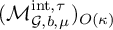 $(\mathcal {M} {}^{\mathrm {int,\tau }}_{{\mathcal {G}}, b, \mu })_{O(\kappa )}$
which is
$(\mathcal {M} {}^{\mathrm {int,\tau }}_{{\mathcal {G}}, b, \mu })_{O(\kappa )}$
which is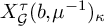 $ X^{\tau }_{{\mathcal {G}} }(b, \mu ^{-1})_\kappa $
.) Similarly, the corresponding fact is true for
$ X^{\tau }_{{\mathcal {G}} }(b, \mu ^{-1})_\kappa $
.) Similarly, the corresponding fact is true for $\mathrm{Spa}(C, O_C)$
-points of
$\mathrm{Spa}(C, O_C)$
-points of $\mathcal {M} {}^{\mathrm {int,\tau '}}_{{\mathcal {G}} ', b', \mu '}$
. If x, resp.
$\mathcal {M} {}^{\mathrm {int,\tau '}}_{{\mathcal {G}} ', b', \mu '}$
. If x, resp. $x'$
, is a
$x'$
, is a $\mathrm{Spd}(\kappa )$
-point of
$\mathrm{Spd}(\kappa )$
-point of $\mathcal {M} {}^{\mathrm {int,\tau }}_{{\mathcal {G}}, b, \mu }$
, resp.
$\mathcal {M} {}^{\mathrm {int,\tau }}_{{\mathcal {G}}, b, \mu }$
, resp. $\mathcal {M} {}^{\mathrm {int,\tau '}}_{{\mathcal {G}} ', b', \mu '}$
, we have
$\mathcal {M} {}^{\mathrm {int,\tau '}}_{{\mathcal {G}} ', b', \mu '}$
, we have
 $$\begin{align*}(\mathcal{M} {}^{\mathrm{int},\tau}_{{\mathcal{G}} , b, \mu})_{O(\kappa) /x} \simeq (\mathcal{M} {}^{\mathrm{int} }_{{\mathcal{G}} , b, \mu})_{O(\kappa) /x}, \quad {\mathrm{resp}.}\ \ (\mathcal{M} {}^{\mathrm{int},\tau'}_{{\mathcal{G}} ', b', \mu'})_{O'(\kappa) /x'} \simeq (\mathcal{M} {}^{\mathrm{int} }_{{\mathcal{G}} ', b', \mu'})_{O'(\kappa) /x'}. \end{align*}$$
The result now follows from a simple extension of Proposition 5.3.1 to the base changes by $W(\kappa )$
. Indeed, this gives
$W(\kappa )$
. Indeed, this gives
 $$\begin{align*}f^{\tau, \tau'}: (\mathcal{M} {}^{\mathrm{int,\tau}}_{{\mathcal{G}} , b, \mu})_{O(\kappa) /x}\xrightarrow{\ \sim\ } (\mathcal{M} {}^{\mathrm{int,\tau'}}_{{\mathcal{G}} ', b', \mu'})_{O'(\kappa) /f(x)}\times_{\mathrm{Spd}(O')}\mathrm{Spd}(O). \end{align*}$$
This, combined with the bijection (5.5.1) above for $\kappa =k(C)$
, implies the result.
$\kappa =k(C)$
, implies the result.
It remains to show the following statement.
Proposition 5.5.2. The map of v-sheaves
 $$\begin{align*}f^\tau: \mathcal{M} {}^{\mathrm{int,\tau}}_{{\mathcal{G}} , b, \mu}\xrightarrow{\ \ } \mathcal{M} {}^{\mathrm{int}}_{{\mathcal{G}} ', b', \mu'}\times_{\mathrm{Spd}(O')}\mathrm{Spd}(O) \end{align*}$$
is qcqs.
Proof. In the following, we occasionally just write $\mathcal {M} {}^{\mathrm {int}}_{{\mathcal {G}}} $
,
$\mathcal {M} {}^{\mathrm {int}}_{{\mathcal {G}}} $
, $\mathcal {M} {}^{\mathrm {int}}_{{\mathcal {G}} '}$
, etc., for notational simplicity. First we show that
$\mathcal {M} {}^{\mathrm {int}}_{{\mathcal {G}} '}$
, etc., for notational simplicity. First we show that $f: \mathcal {M} {}^{\mathrm {int}}_{{\mathcal {G}}} \to \mathcal {M} {}^{\mathrm {int}}_{{\mathcal {G}} '}\times _{\mathrm{Spd}(O')}\mathrm{Spd}(O)$
is quasi-separated (qs). This quickly implies that the same is true for
$f: \mathcal {M} {}^{\mathrm {int}}_{{\mathcal {G}}} \to \mathcal {M} {}^{\mathrm {int}}_{{\mathcal {G}} '}\times _{\mathrm{Spd}(O')}\mathrm{Spd}(O)$
is quasi-separated (qs). This quickly implies that the same is true for $f^\tau $
. For this we use that
$f^\tau $
. For this we use that $f: \mathcal {M} {}^{\mathrm {int}}_{{\mathcal {G}}} \to \mathrm{Spd}(O)$
is qs ([Reference GleasonGl21, Prop. 2.25]) and the following lemma.
$f: \mathcal {M} {}^{\mathrm {int}}_{{\mathcal {G}}} \to \mathrm{Spd}(O)$
is qs ([Reference GleasonGl21, Prop. 2.25]) and the following lemma.
Lemma 5.5.3. Consider morphisms of small v-sheaves
 $$\begin{align*}X\xrightarrow{f}Y\xrightarrow{g} Z. \end{align*}$$
1) If $g\circ f$
is qc and g is qs, then f is qc.
$g\circ f$
is qc and g is qs, then f is qc.
2) If $g\circ f$
is qs, then so is f.
$g\circ f$
is qs, then so is f.
Proof. Note that, by definition, $f: X\to Y$
is called qs when the diagonal
$f: X\to Y$
is called qs when the diagonal $X\to X\times _Y X$
is qc, cf. [Reference ScholzeSch17, §8]. Also note that compositions and base changes of qc, resp. qs, maps are also qc, resp. qs.
$X\to X\times _Y X$
is qc, cf. [Reference ScholzeSch17, §8]. Also note that compositions and base changes of qc, resp. qs, maps are also qc, resp. qs.
Part 1): Write f as the composition $X\to X\times _ZY\to Y$
, where the first map is
$X\to X\times _ZY\to Y$
, where the first map is $\mathrm {id}\times f$
and the second the projection. The projection is qc as the base change of the qc map
$\mathrm {id}\times f$
and the second the projection. The projection is qc as the base change of the qc map $X\to Z$
, while the first map is a section of the projection
$X\to Z$
, while the first map is a section of the projection $X\times _Z Y\to X$
; this projection is qs as the base change of
$X\times _Z Y\to X$
; this projection is qs as the base change of $Y\to Z$
. It remains to observe that a section
$Y\to Z$
. It remains to observe that a section $s: S\to T$
of a qs map
$s: S\to T$
of a qs map $T\to S$
is qc since it can be viewed as the base change of the qc diagonal
$T\to S$
is qc since it can be viewed as the base change of the qc diagonal $T\to T\times _S T$
by
$T\to T\times _S T$
by $s\times \mathrm {id}: T=S\times _S T\to T\times _S T$
.
$s\times \mathrm {id}: T=S\times _S T\to T\times _S T$
.
Part 2): Since $g\circ f: X\to Z$
is qs, the map
$g\circ f: X\to Z$
is qs, the map $X\to X\times _Z X$
is qc. We can write this as a composition
$X\to X\times _Z X$
is qc. We can write this as a composition
 $$\begin{align*}X\to X\times_Y X\to X\times_Z X. \end{align*}$$
Here $X\times _Y X\to X\times _Z X$
is an injection and hence it is qs, since then the diagonal map is an isomorphism. We now apply (a) to this composition to deduce that
$X\times _Y X\to X\times _Z X$
is an injection and hence it is qs, since then the diagonal map is an isomorphism. We now apply (a) to this composition to deduce that $X\to X\times _Y X$
is qc, hence
$X\to X\times _Y X$
is qc, hence $X\to Y$
is qs.
$X\to Y$
is qs.
It remains to show that $f^\tau $
is qc. For this we write again
$f^\tau $
is qc. For this we write again $G\to G'$
as a composition of ad-isomorphisms which are either of type (i), i.e., closed embeddings (with cokernel a torus), or type (ii), i.e., fppf surjections with kernel a central quasi-trivial torus
$G\to G'$
as a composition of ad-isomorphisms which are either of type (i), i.e., closed embeddings (with cokernel a torus), or type (ii), i.e., fppf surjections with kernel a central quasi-trivial torus $Z=T$
. Using functoriality and the fact that compositions of qcqs morphisms are again qcqs, we see that it is enough to treat these two cases separately. In the type (i) case the result follows from Proposition 5.1.3. It remains to deal with cases of type (ii). Then we have an exact
$Z=T$
. Using functoriality and the fact that compositions of qcqs morphisms are again qcqs, we see that it is enough to treat these two cases separately. In the type (i) case the result follows from Proposition 5.1.3. It remains to deal with cases of type (ii). Then we have an exact
 $$\begin{align*}1\to Z\to G\to G'\to 1 \end{align*}$$
with $Z=T$
a quasi-trivial torus. For a morphism
$Z=T$
a quasi-trivial torus. For a morphism ${\mathcal {G}} {}^{\prime }_1\to {\mathcal {G}} '$
of quasi-parahoric group schemes corresponding to a fixed parahoric group scheme for
${\mathcal {G}} {}^{\prime }_1\to {\mathcal {G}} '$
of quasi-parahoric group schemes corresponding to a fixed parahoric group scheme for $G'$
, the morphism
$G'$
, the morphism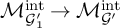 $ \mathcal {M} {}^{\mathrm {int }}_{{\mathcal {G}} {}_1'}\to \mathcal {M} {}^{\mathrm {int }}_{{\mathcal {G}} '}$
is qc. Hence the argument in the proof of Proposition 5.3.1 (for type (ii)) shows that we may assume that the sequence
$ \mathcal {M} {}^{\mathrm {int }}_{{\mathcal {G}} {}_1'}\to \mathcal {M} {}^{\mathrm {int }}_{{\mathcal {G}} '}$
is qc. Hence the argument in the proof of Proposition 5.3.1 (for type (ii)) shows that we may assume that the sequence
 $$\begin{align*}1\to \mathcal{Z} \to {\mathcal{G}} \to {\mathcal{G}} '\to 1 \end{align*}$$
is exact.
To establish quasi-compactness we use a ‘sequence of points’ argument (compare to [Reference Scholze and WeinsteinSW20, proof of Thm. 21.2.1]). Let $Y=\mathrm{Spa}(R, R^+)$
be affinoid perfectoid over k and let
$Y=\mathrm{Spa}(R, R^+)$
be affinoid perfectoid over k and let
 $$\begin{align*}Y\to \mathcal{M} {}^{\mathrm{int}}_{{\mathcal{G}} ', b', \mu'}\times_{\mathrm{Spd}(O')}\mathrm{Spd}(O) \end{align*}$$
be a morphism given by an untilt of Y over O and a ${\mathcal {G}} '$
-shtuka over
${\mathcal {G}} '$
-shtuka over $\mathcal {Y} {}_{[0,\infty )}(R, R^+)$
with a framing. Consider also the small v-sheaf
$\mathcal {Y} {}_{[0,\infty )}(R, R^+)$
with a framing. Consider also the small v-sheaf
 $$\begin{align*}X= Y\times_{(\mathcal{M} {}^{\mathrm{int}}_{{\mathcal{G}} ', b', \mu'}\times_{\mathrm{Spd}(O')}\mathrm{Spd}(O))}\mathcal{M} {}^{\mathrm{int, \tau}}_{{\mathcal{G}} , b, \mu}\to Y. \end{align*}$$
Take $I=|X|$
and, for each
$I=|X|$
and, for each $i\in I$
, choose a point of X given by
$i\in I$
, choose a point of X given by $x_i: \mathrm{Spa}(C_i, C_i^+)\to \mathcal {M} {}^{\mathrm {int, \tau }}_{{\mathcal {G}}, b, \mu }$
and
$x_i: \mathrm{Spa}(C_i, C_i^+)\to \mathcal {M} {}^{\mathrm {int, \tau }}_{{\mathcal {G}}, b, \mu }$
and $y_i: \mathrm{Spa}(C_i, C^+_i)\to Y=\mathrm{Spa}(R, R^+)$
, with matching compositions to
$y_i: \mathrm{Spa}(C_i, C^+_i)\to Y=\mathrm{Spa}(R, R^+)$
, with matching compositions to $\mathcal {M} {}^{\mathrm {int}}_{{\mathcal {G}} ', b', \mu '}\times _{\mathrm{Spd}(O')}\mathrm{Spd}(O)$
, which corresponds to
$\mathcal {M} {}^{\mathrm {int}}_{{\mathcal {G}} ', b', \mu '}\times _{\mathrm{Spd}(O')}\mathrm{Spd}(O)$
, which corresponds to $i\in I=|X|$
. Consider the product of points
$i\in I=|X|$
. Consider the product of points
 $$\begin{align*}(D, D^+)=((\prod_{i\in I}C^+_i)[1/(\varpi_i)], \prod_{i\in I}C^+_i). \end{align*}$$
Here the pseudouniformisers $\varpi _i\in C^+_i$
are given by a pseudouniformiser of
$\varpi _i\in C^+_i$
are given by a pseudouniformiser of $R^+$
. The collection of
$R^+$
. The collection of $y_i$
extends to
$y_i$
extends to $y:\mathrm{Spa}(D, D^+)\to \mathrm{Spa}(R, R^+)$
. The compositions
$y:\mathrm{Spa}(D, D^+)\to \mathrm{Spa}(R, R^+)$
. The compositions
 $$\begin{align*}\mathrm{Spa}(C_i, C^+_i)\to \mathrm{Spa}(D, D^+)\to \mathrm{Spa}(R, R^+)\to \mathrm{Spd}(O) \end{align*}$$
specify untilts of $(C_i, C^+_i)$
given by
$(C_i, C^+_i)$
given by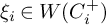 $\xi _i\in W(C^+_i)$
. So, we have a
$\xi _i\in W(C^+_i)$
. So, we have a ${\mathcal {G}} '$
-shtuka
${\mathcal {G}} '$
-shtuka $\mathcal {P} '$
with framing over
$\mathcal {P} '$
with framing over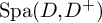 $\mathrm{Spa}(D, D^+)$
obtained from
$\mathrm{Spa}(D, D^+)$
obtained from
 $$\begin{align*}\mathrm{Spa}(D, D^+)\to \mathrm{Spa}(R, R^+)\to \mathcal{M} {}^{\mathrm{int}}_{{\mathcal{G}} ', b', \mu'}\times_{\mathrm{Spd}(O')}\mathrm{Spd}(O), \end{align*}$$
and a collection of ${\mathcal {G}} $
-shtukas
${\mathcal {G}} $
-shtukas $\mathcal {P} {}_i$
with framings over each
$\mathcal {P} {}_i$
with framings over each $(C_i, C^+_i)$
, and with legs at
$(C_i, C^+_i)$
, and with legs at $\xi _i$
, given by
$\xi _i$
, given by $x_i$
. These are compatible via the pushout of torsors by
$x_i$
. These are compatible via the pushout of torsors by ${\mathcal {G}} \to {\mathcal {G}} '$
. We want to show that
${\mathcal {G}} \to {\mathcal {G}} '$
. We want to show that $(x_i)$
extend to
$(x_i)$
extend to
 $$\begin{align*}x: \mathrm{Spa}(D, D^+)\to \mathcal{M} {}^{\mathrm{int}, \tau}_{{\mathcal{G}}} . \end{align*}$$
Since the resulting map
 $$\begin{align*}\mathrm{Spa}(D, D^+)\to X= Y\times_{(\mathcal{M} {}^{\mathrm{int}}_{{\mathcal{G}} ', b', \mu'}\times_{\mathrm{Spd}(O')}\mathrm{Spd}(O))}\mathcal{M} {}^{\mathrm{int, \tau}}_{{\mathcal{G}} , b, \mu} \end{align*}$$
is a v-cover, this fact will imply the quasi-compactness of X and hence of $f^\tau $
.
$f^\tau $
.
In the above, using the partial properness of $\mathcal {M} {}^{\text {int}}_{{\mathcal {G}}} $
and
$\mathcal {M} {}^{\text {int}}_{{\mathcal {G}}} $
and $\mathcal {M} {}^{\text {int}}_{{\mathcal {G}} '}$
, we can replace
$\mathcal {M} {}^{\text {int}}_{{\mathcal {G}} '}$
, we can replace $C_i^+$
by
$C_i^+$
by $O_{C_i}$
. Using Proposition 3.2.1, we see that the pairs
$O_{C_i}$
. Using Proposition 3.2.1, we see that the pairs $(\Phi _i, i_{r_i})$
of
$(\Phi _i, i_{r_i})$
of ${\mathcal {G}} $
-shtuka with framings given by
${\mathcal {G}} $
-shtuka with framings given by $x_i$
, are described by pairs
$x_i$
, are described by pairs $(\Phi _i, g_i)$
, where
$(\Phi _i, g_i)$
, where $\Phi _i\in {\mathcal {G}} (W(O_{C_i})[1/\xi _i])$
and
$\Phi _i\in {\mathcal {G}} (W(O_{C_i})[1/\xi _i])$
and $g_i\in G(\mathcal {Y} {}_{[r_i,\infty ]}(C_i, O_{C_i}))$
. We denote by
$g_i\in G(\mathcal {Y} {}_{[r_i,\infty ]}(C_i, O_{C_i}))$
. We denote by $(\Phi _i', g_i')$
the images of these pairs under the map induced by
$(\Phi _i', g_i')$
the images of these pairs under the map induced by ${\mathcal {G}} \to {\mathcal {G}} '$
. We have
${\mathcal {G}} \to {\mathcal {G}} '$
. We have
 $$ \begin{align} \Phi_i =g_i^{-1} \cdot b\cdot \phi(g_i). \end{align} $$
Set
 $$\begin{align*}\Phi=(\Phi_i)\in \prod_i {\mathcal{G}} (W(O_{C_i})[1/\xi_i])= {\mathcal{G}} (\prod_i (W(O_{C_i})[1/\xi_i])). \end{align*}$$
Since the $\xi _i$
-denominators of
$\xi _i$
-denominators of $\Phi _i$
are uniformly bounded in terms of the coweight
$\Phi _i$
are uniformly bounded in terms of the coweight $\mu $
, we see that
$\mu $
, we see that
 $$\begin{align*}\Phi\in {\mathcal{G}} ((W(\prod_i O_{C_i}))[1/\xi_i])\subset {\mathcal{G}} (\prod_i (W(O_{C_i})[1/\xi_i])). \end{align*}$$
This says
 $$\begin{align*}\Phi\in {\mathcal{G}} (W(D^+)[1/\xi]), \quad\mathrm{with }\quad \xi=(\xi_i)_i. \end{align*}$$
The element $\Phi $
defines a
$\Phi $
defines a ${\mathcal {G}} $
-shtuka
${\mathcal {G}} $
-shtuka $\mathcal {P} (\Phi )$
over
$\mathcal {P} (\Phi )$
over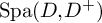 $\mathrm{Spa}(D, D^+)$
. We claim that the corresponding
$\mathrm{Spa}(D, D^+)$
. We claim that the corresponding ${\mathcal {G}} '$
-shtuka
${\mathcal {G}} '$
-shtuka $\mathcal {P} (\Phi ')$
given by
$\mathcal {P} (\Phi ')$
given by $\Phi '$
is isomorphic to the
$\Phi '$
is isomorphic to the ${\mathcal {G}} '$
-shtuka
${\mathcal {G}} '$
-shtuka $\mathcal {P} '$
, given by
$\mathcal {P} '$
, given by $\mathrm{Spa}(D, D^+)\to \mathcal {M} {}^{\text {int}}_{{\mathcal {G}} '}$
above. Indeed, let
$\mathrm{Spa}(D, D^+)\to \mathcal {M} {}^{\text {int}}_{{\mathcal {G}} '}$
above. Indeed, let $\mathcal {P} '$
be given by
$\mathcal {P} '$
be given by $\Psi '\in {\mathcal {G}} '(W(D^+)[1/\xi ])$
(Note that all
$\Psi '\in {\mathcal {G}} '(W(D^+)[1/\xi ])$
(Note that all ${\mathcal {G}} $
-torsors, resp.
${\mathcal {G}} $
-torsors, resp. ${\mathcal {G}} '$
-torsors, over
${\mathcal {G}} '$
-torsors, over $W(D^+)$
are trivial by Prop. 3.2.2.) By construction, the images
$W(D^+)$
are trivial by Prop. 3.2.2.) By construction, the images $\Phi ^{\prime }_i$
,
$\Phi ^{\prime }_i$
, $\Psi _i'$
, or
$\Psi _i'$
, or $\Phi '$
,
$\Phi '$
, $\Psi '$
, under the projections
$\Psi '$
, under the projections $W(D^+)[1/\xi ]\to W(O_{C_i})[1/\xi _i]$
satisfy
$W(D^+)[1/\xi ]\to W(O_{C_i})[1/\xi _i]$
satisfy
 $$\begin{align*}\Phi^{\prime}_i=h^{\prime}_i\cdot \Psi^{\prime}_i\cdot \phi(h^{\prime}_i)^{-1} \end{align*}$$
with $h^{\prime }_i\in {\mathcal {G}} '(W(O_{C_i}))$
. Since
$h^{\prime }_i\in {\mathcal {G}} '(W(O_{C_i}))$
. Since
 $$\begin{align*}W(D^+)[1/\xi]\hookrightarrow \prod_i (W(O_{C_i})[1/\xi_i]). \end{align*}$$
this gives $\Phi '=h'\cdot \Psi '\cdot \phi (h')^{-1}$
, for
$\Phi '=h'\cdot \Psi '\cdot \phi (h')^{-1}$
, for $h'=(h^{\prime }_i)_i$
in
$h'=(h^{\prime }_i)_i$
in ${\mathcal {G}} '(W(D^+))=\prod _i {\mathcal {G}} '(W(O_{C_i}))$
, and the claim follows.
${\mathcal {G}} '(W(D^+))=\prod _i {\mathcal {G}} '(W(O_{C_i}))$
, and the claim follows.
It remains to show that the framings $(i_{r_i})_i$
extend to a framing of
$(i_{r_i})_i$
extend to a framing of $\mathcal {P} (\Phi )$
which lifts the framing
$\mathcal {P} (\Phi )$
which lifts the framing $i^{\prime }_r$
of
$i^{\prime }_r$
of $\mathcal {P} (\Phi ')$
given by our
$\mathcal {P} (\Phi ')$
given by our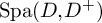 $\mathrm{Spa}(D, D^+)$
-point of
$\mathrm{Spa}(D, D^+)$
-point of $\mathcal {M} {}^{\text {int}}_{{\mathcal {G}} '}$
. We can understand framings as isomorphisms of corresponding G-bundles
$\mathcal {M} {}^{\text {int}}_{{\mathcal {G}} '}$
. We can understand framings as isomorphisms of corresponding G-bundles $\mathcal {E} $
, resp.
$\mathcal {E} $
, resp. $G'$
-bundles
$G'$
-bundles $\mathcal {E} '$
over the Fargues-Fontaine curve. Denote by
$\mathcal {E} '$
over the Fargues-Fontaine curve. Denote by $\mathcal {E} {}^b$
, resp.
$\mathcal {E} {}^b$
, resp. $\mathcal {E} {}^{b'}$
, the G-bundle, resp.
$\mathcal {E} {}^{b'}$
, the G-bundle, resp. $G'$
-bundle, over
$G'$
-bundle, over $X_{FF,\mathrm{Spd}(k)}$
given by b, resp.
$X_{FF,\mathrm{Spd}(k)}$
given by b, resp. $b'$
. Then we have isomorphisms of G-bundles on
$b'$
. Then we have isomorphisms of G-bundles on $X_{FF, \mathrm{Spa}(D, D^+)}$
, resp.
$X_{FF, \mathrm{Spa}(D, D^+)}$
, resp. $X_{FF, \mathrm{Spa}(C_i, O_{C_i})}$
,
$X_{FF, \mathrm{Spa}(C_i, O_{C_i})}$
,
 $$\begin{align*}g': \mathcal{E} '\xrightarrow{\sim} \mathcal{E} {}^{b'} \times_{\mathrm{Spd}(k)} \mathrm{Spa}(D, D^+), \quad g_i: \mathcal{E} {}_i\xrightarrow{\sim} \mathcal{E} {}^b\times_{\mathrm{Spd}(k)} \mathrm{Spa}(C_i, O_{C_i}) , \end{align*}$$
and we would like to find
 $$\begin{align*}g: \mathcal{E} \xrightarrow{\sim} \mathcal{E} {}^{b} \times_{\mathrm{Spd}(k)} \mathrm{Spa}(D, D^+) \end{align*}$$
which lifts $g'$
and projects to
$g'$
and projects to $g_i$
by
$g_i$
by $\mathrm{Spa}(C_i, O_{C_i})\to \mathrm{Spa}(D, D^+)$
, for all
$\mathrm{Spa}(C_i, O_{C_i})\to \mathrm{Spa}(D, D^+)$
, for all $i\in I$
. (Here, we denote these framings again by
$i\in I$
. (Here, we denote these framings again by $g'$
,
$g'$
, $g_i$
, hopefully this does not introduce confusion.) We first show that the G-bundle
$g_i$
, hopefully this does not introduce confusion.) We first show that the G-bundle $\mathcal {E} $
over
$\mathcal {E} $
over $X_{FF, \mathrm{Spd}(D, D^+)}$
has all its geometric fibres isomorphic to
$X_{FF, \mathrm{Spd}(D, D^+)}$
has all its geometric fibres isomorphic to $\mathcal {E} {}^b$
: The G-bundle
$\mathcal {E} {}^b$
: The G-bundle $\mathcal {E} $
gives
$\mathcal {E} $
gives $f: \mathrm{Spa}(D,D^+)\to \mathrm {Bun}_G$
and the desired statement follows if we show that
$f: \mathrm{Spa}(D,D^+)\to \mathrm {Bun}_G$
and the desired statement follows if we show that $f(|\mathrm{Spa}(D,D^+)|)= \{b\}\subset |\mathrm {Bun}_G|\cong B(G)$
.
$f(|\mathrm{Spa}(D,D^+)|)= \{b\}\subset |\mathrm {Bun}_G|\cong B(G)$
.
Let $T=\mathrm{Spa}(D, D^+)$
. For
$T=\mathrm{Spa}(D, D^+)$
. For $i\in I$
, the projection
$i\in I$
, the projection $(D, D^+)\to (C_i, O_{C_i})$
gives
$(D, D^+)\to (C_i, O_{C_i})$
gives $\mathrm{Spa}(C_i, O_{C_i})\to T$
. These combine to give an injection
$\mathrm{Spa}(C_i, O_{C_i})\to T$
. These combine to give an injection
 $$\begin{align*}I\hookrightarrow |T|. \end{align*}$$
This identifies the discrete set I with a dense subspace of $|T|$
and of
$|T|$
and of $\pi _0(|T|)$
. As in the proof of [Reference GleasonGl25, Prop. 1.5], we see that
$\pi _0(|T|)$
. As in the proof of [Reference GleasonGl25, Prop. 1.5], we see that
 $$\begin{align*}\pi_0(|T|)\simeq \beta I \end{align*}$$
is the Stone-Čech compactification of the discrete set I.
Consider the composition $f': \mathrm{Spa}(D, D^+)\to \mathrm {Bun}_{G'}$
of f with the natural map
$f': \mathrm{Spa}(D, D^+)\to \mathrm {Bun}_{G'}$
of f with the natural map $\mathrm {Bun}_G\to \mathrm {Bun}_{G'}$
induced by
$\mathrm {Bun}_G\to \mathrm {Bun}_{G'}$
induced by $G\to G'$
. The construction of
$G\to G'$
. The construction of $\mathcal {E} $
gives that
$\mathcal {E} $
gives that $f'(|T|)=\{b'\}\subset B(G')$
and that
$f'(|T|)=\{b'\}\subset B(G')$
and that $f(|\mathrm{Spa}(C_i,O_{C_i})|)=\{b\}$
, for all
$f(|\mathrm{Spa}(C_i,O_{C_i})|)=\{b\}$
, for all $i\in I$
. As above, the points
$i\in I$
. As above, the points $|\mathrm{Spa}(C_i,O_{C_i})|$
,
$|\mathrm{Spa}(C_i,O_{C_i})|$
, $i\in I$
, are dense in
$i\in I$
, are dense in $|T|=|\mathrm{Spa}(D,D^+)|$
. The result will follow if we establish that any two points of
$|T|=|\mathrm{Spa}(D,D^+)|$
. The result will follow if we establish that any two points of $|\mathrm {Bun}_G|\cong B(G)$
which map to the same
$|\mathrm {Bun}_G|\cong B(G)$
which map to the same $b'\in |\mathrm {Bun}_{G'}|\cong B(G')$
and lie in the same connected component of
$b'\in |\mathrm {Bun}_{G'}|\cong B(G')$
and lie in the same connected component of $|\mathrm {Bun}_G|$
as b, are equal to each other. To see this, we use the commutative diagram
$|\mathrm {Bun}_G|$
as b, are equal to each other. To see this, we use the commutative diagram

Under our assumptions, the second row is exact. The vertical arrows $\kappa _Z$
,
$\kappa _Z$
, $\kappa _G$
,
$\kappa _G$
, $\kappa _{G'}$
are the Kottwitz invariant maps which are locally constant by [Reference Fargues and ScholzeFS21, Thm III.2.7]. Also,
$\kappa _{G'}$
are the Kottwitz invariant maps which are locally constant by [Reference Fargues and ScholzeFS21, Thm III.2.7]. Also, $\kappa _Z$
is a bijection
$\kappa _Z$
is a bijection $B(Z)\xrightarrow {\sim } X_*(Z)_\Gamma $
, the map
$B(Z)\xrightarrow {\sim } X_*(Z)_\Gamma $
, the map $B(G)\to B(G')$
in the top row is surjective and its fibres are identified with
$B(G)\to B(G')$
in the top row is surjective and its fibres are identified with $X_*(Z)_\Gamma $
, see [Reference KottwitzKo97, Prop. 4.10], cf. [Reference Fargues and ScholzeFS21, Lem. III.2.10 and the comment below that lemma]. The result now follows.
$X_*(Z)_\Gamma $
, see [Reference KottwitzKo97, Prop. 4.10], cf. [Reference Fargues and ScholzeFS21, Lem. III.2.10 and the comment below that lemma]. The result now follows.
For a perfectoid space S over k and a G-torsor $\mathcal {E} $
over the FF curve
$\mathcal {E} $
over the FF curve $X_{FF, S}$
which has all geometric fibres isomorphic to
$X_{FF, S}$
which has all geometric fibres isomorphic to $\mathcal {E} {}^b$
, we can consider the torsors over S under
$\mathcal {E} {}^b$
, we can consider the torsors over S under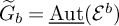 $\widetilde G_b=\underline {\operatorname {\mathrm {Aut}}}(\mathcal {E} {}^b)$
, resp.
$\widetilde G_b=\underline {\operatorname {\mathrm {Aut}}}(\mathcal {E} {}^b)$
, resp.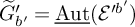 $\widetilde G^{\prime }_{b'}=\underline {\operatorname {\mathrm {Aut}}}(\mathcal {E} {}^{\prime b'})$
,
$\widetilde G^{\prime }_{b'}=\underline {\operatorname {\mathrm {Aut}}}(\mathcal {E} {}^{\prime b'})$
,
 $$\begin{align*}Q_S:=\underline{\mathrm{Isom}}_{\mathrm{fil}}(\mathcal{E}, \mathcal{E} {}^b\times_{\mathrm{Spd}(k)} S), \quad Q^{\prime}_S:= \underline{\mathrm{ Isom}}_{\mathrm{fil}}(\mathcal{E} ', \mathcal{E} {}^{b'}\times_{\mathrm{Spd}(k)} S) , \end{align*}$$
cf. [Reference Fargues and ScholzeFS21, Thm. III.0.2(v)]. Note here that there is a HN filtration on $\mathcal {E} $
and
$\mathcal {E} $
and $\mathcal {E} '$
, see [Reference Fargues and ScholzeFS21, proof of Prop. III. 5.3], and we ask the isomorphisms to respect the filtrations. This preservation is automatic over a point
$\mathcal {E} '$
, see [Reference Fargues and ScholzeFS21, proof of Prop. III. 5.3], and we ask the isomorphisms to respect the filtrations. This preservation is automatic over a point $S=\mathrm{Spa}(C, O_C)$
, and also for
$S=\mathrm{Spa}(C, O_C)$
, and also for $\mathcal {E} '$
over
$\mathcal {E} '$
over $S=\mathrm{Spa}(D, D^+)$
since all the fibres have the same HN polygon given by
$S=\mathrm{Spa}(D, D^+)$
since all the fibres have the same HN polygon given by $b'$
, cf. [Reference Fargues and ScholzeFS21, Thm. II.2.19]. We have a map of torsors
$b'$
, cf. [Reference Fargues and ScholzeFS21, Thm. II.2.19]. We have a map of torsors $Q_S\to Q^{\prime }_S $
covering the homomorphism
$Q_S\to Q^{\prime }_S $
covering the homomorphism $\widetilde G_b\to \widetilde G^{\prime }_{b'}$
By [Reference Fargues and ScholzeFS21, proof of Prop. III.5.3], these are
$\widetilde G_b\to \widetilde G^{\prime }_{b'}$
By [Reference Fargues and ScholzeFS21, proof of Prop. III.5.3], these are $\widetilde G_{b}$
-, resp.
$\widetilde G_{b}$
-, resp. $\widetilde G^{\prime }_{b'}$
-torsors which are trivial pro-étale locally on S.
$\widetilde G^{\prime }_{b'}$
-torsors which are trivial pro-étale locally on S.
In the description of $\widetilde G_b$
and
$\widetilde G_b$
and $\widetilde G^{\prime }_{b'}$
given by [Reference Fargues and ScholzeFS21, Prop. III.5.1], we see that
$\widetilde G^{\prime }_{b'}$
given by [Reference Fargues and ScholzeFS21, Prop. III.5.1], we see that $\widetilde G_b\to \widetilde G^{\prime }_{b'}$
induces an isomorphism
$\widetilde G_b\to \widetilde G^{\prime }_{b'}$
induces an isomorphism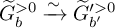 $\widetilde G^{>0}_b\xrightarrow {\sim } \widetilde G^{\prime >0}_{b'}$
. Indeed, the central torus Z acts trivially on
$\widetilde G^{>0}_b\xrightarrow {\sim } \widetilde G^{\prime >0}_{b'}$
. Indeed, the central torus Z acts trivially on $\mathrm {Lie}(G)$
with the adjoint action and so for
$\mathrm {Lie}(G)$
with the adjoint action and so for $\lambda> 0$
, we have
$\lambda> 0$
, we have
 $$\begin{align*}(\mathrm{Lie}(G)\otimes_{\mathbb{Q} {}_p}\breve{\mathbb{Q}} {}_p, \mathrm{Ad}(b)\sigma)^{-\lambda}=(\mathrm{ Lie}(G')\otimes_{\mathbb{Q} {}_p}\breve{\mathbb{Q}} {}_p, \mathrm{Ad}(b')\sigma)^{-\lambda} \end{align*}$$
with the notations as in loc. cit.. It follows by loc. cit. that the kernel of $\widetilde G_b\to \widetilde G^{\prime }_{b'}$
is
$\widetilde G_b\to \widetilde G^{\prime }_{b'}$
is $\underline {Z(\mathbb {Q} {}_p)}$
. This is also the kernel of
$\underline {Z(\mathbb {Q} {}_p)}$
. This is also the kernel of $ \underline {G_b(\mathbb {Q} {}_p)}\to \underline {G^{\prime }_{b'}(\mathbb {Q} {}_p)}. $
Recall we let $T=\mathrm{Spa}(D, D^+)$
. By pulling back the map of torsors
$T=\mathrm{Spa}(D, D^+)$
. By pulling back the map of torsors $f: Q_T\to Q^{\prime }_T$
over T along
$f: Q_T\to Q^{\prime }_T$
over T along
 $$\begin{align*}q: T\to Q^{\prime}_T \end{align*}$$
given by g, we obtain a $\underline {Z(\mathbb {Q} {}_p)}$
-torsor
$\underline {Z(\mathbb {Q} {}_p)}$
-torsor $\mathcal {Q} = T\times _{Q^{\prime }_T}Q_T\to T$
. Since the perfectoid space T is strictly totally disconnected, the
$\mathcal {Q} = T\times _{Q^{\prime }_T}Q_T\to T$
. Since the perfectoid space T is strictly totally disconnected, the $\underline {Z(\mathbb {Q} {}_p)}$
-torsor
$\underline {Z(\mathbb {Q} {}_p)}$
-torsor $\mathcal {Q} $
is trivial, cf. [Reference Fargues and ScholzeFS21, Lem. III.2.6] (see also the argument on top of loc. cit. p. 90.). The framings corresponding to
$\mathcal {Q} $
is trivial, cf. [Reference Fargues and ScholzeFS21, Lem. III.2.6] (see also the argument on top of loc. cit. p. 90.). The framings corresponding to $g_i$
,
$g_i$
, $i\in I$
, give
$i\in I$
, give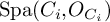 $\mathrm{Spa}(C_i, O_{C_i})$
-points
$\mathrm{Spa}(C_i, O_{C_i})$
-points $q_i$
of
$q_i$
of $\mathcal {Q} $
. We can think of
$\mathcal {Q} $
. We can think of $(q_i)_{i\in I}$
as giving a section of
$(q_i)_{i\in I}$
as giving a section of $\mathcal {Q} $
over I.
$\mathcal {Q} $
over I.
On the other hand, we have a morphism $\widetilde y: \mathcal {Q} \to \mathcal {M} {}^{\mathrm {int}}_{{\mathcal {G}}, b, \mu }$
which lifts the T-point y of
$\widetilde y: \mathcal {Q} \to \mathcal {M} {}^{\mathrm {int}}_{{\mathcal {G}}, b, \mu }$
which lifts the T-point y of $\mathcal {M} {}^{\mathrm {int}}_{{\mathcal {G}} ', b', \mu '}$
, i.e., it fits in a commutative diagram
$\mathcal {M} {}^{\mathrm {int}}_{{\mathcal {G}} ', b', \mu '}$
, i.e., it fits in a commutative diagram

The morphism $\widetilde y$
is obtained by combining the
$\widetilde y$
is obtained by combining the ${\mathcal {G}} $
-shtuka
${\mathcal {G}} $
-shtuka $\mathcal {P} (\Phi )$
with the framing provided by the universal point of
$\mathcal {P} (\Phi )$
with the framing provided by the universal point of $\mathcal {Q} $
. We claim that there is an extension of the given section of
$\mathcal {Q} $
. We claim that there is an extension of the given section of $\mathcal {Q} $
over I to a section of
$\mathcal {Q} $
over I to a section of $\mathcal {Q} $
over T. This would give the desired lift g of the framing
$\mathcal {Q} $
over T. This would give the desired lift g of the framing $g'$
and finish the proof.
$g'$
and finish the proof.
Since $\mathcal {Q} $
is the trivial torsor, such a section is given by a continuous function
$\mathcal {Q} $
is the trivial torsor, such a section is given by a continuous function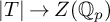 $|T|\to Z(\mathbb {Q} {}_p)$
extending the given function
$|T|\to Z(\mathbb {Q} {}_p)$
extending the given function $I\to Z(\mathbb {Q} {}_p)$
. To construct it, we use a compactness argument. Consider the composition
$I\to Z(\mathbb {Q} {}_p)$
. To construct it, we use a compactness argument. Consider the composition
 $$\begin{align*}\omega: |\mathcal{Q} |\xrightarrow{|\widetilde y|} |\mathcal{M} {}^{\mathrm{int}}_{{\mathcal{G}} , b, \mu}|\xrightarrow{\kappa_G\circ \mathrm{sp}} C_{{\mathcal{G}}} =\Omega_G/\pi_0({\mathcal{G}} ). \end{align*}$$
Note that
 $$\begin{align*}\omega(z\cdot q)=\kappa_G(z)+\omega(q) \end{align*}$$
for $z\in Z(\mathbb {Q} {}_p)$
.
$z\in Z(\mathbb {Q} {}_p)$
.
Now observe that, since the points $x_i$
in our construction lie in
$x_i$
in our construction lie in $\mathcal {M} {}^{\mathrm {int, \tau }}_{{\mathcal {G}}, b, \mu }(\mathrm{Spa}(C_i, O_{C_i}))$
, the corresponding points
$\mathcal {M} {}^{\mathrm {int, \tau }}_{{\mathcal {G}}, b, \mu }(\mathrm{Spa}(C_i, O_{C_i}))$
, the corresponding points $q_i$
of
$q_i$
of $\mathcal {Q} $
satisfy
$\mathcal {Q} $
satisfy $\omega (q_i)=\tau $
, for all
$\omega (q_i)=\tau $
, for all $i\in I$
. Set
$i\in I$
. Set $\mathfrak T:=\omega ^{-1}(\{\tau \})\subset |\mathcal {Q} |$
. This is a quasi-compact subset of
$\mathfrak T:=\omega ^{-1}(\{\tau \})\subset |\mathcal {Q} |$
. This is a quasi-compact subset of $|\mathcal {Q} |$
since
$|\mathcal {Q} |$
since $|\mathcal {Q} |\simeq |T|\times Z(\mathbb {Q} {}_p)$
, where
$|\mathcal {Q} |\simeq |T|\times Z(\mathbb {Q} {}_p)$
, where $|T|$
is quasi-compact, and where the restriction
$|T|$
is quasi-compact, and where the restriction $ Z(\mathbb {Q} {}_p)\to C_{{\mathcal {G}}} $
of
$ Z(\mathbb {Q} {}_p)\to C_{{\mathcal {G}}} $
of $\kappa _G$
has compact fibres. The last fact follows because
$\kappa _G$
has compact fibres. The last fact follows because $\Omega _Z=Z(\mathbb {Q} {}_p)/\mathcal {Z} (\mathbb {Z} {}_p)$
and
$\Omega _Z=Z(\mathbb {Q} {}_p)/\mathcal {Z} (\mathbb {Z} {}_p)$
and $\Omega _Z\to \Omega _G\to C_{{\mathcal {G}}} $
has finite kernel, so each fibre is given by a finite union of cosets of
$\Omega _Z\to \Omega _G\to C_{{\mathcal {G}}} $
has finite kernel, so each fibre is given by a finite union of cosets of $\mathcal {Z} (\mathbb {Z} {}_p)$
in
$\mathcal {Z} (\mathbb {Z} {}_p)$
in $Z(\mathbb {Q} {}_p)$
.
$Z(\mathbb {Q} {}_p)$
.
Since $\pi _0(\mathfrak T)$
is compact, by the universal property of the Stone-Čech compactification we see that the composed map
$\pi _0(\mathfrak T)$
is compact, by the universal property of the Stone-Čech compactification we see that the composed map $I\to \mathfrak T\to \pi _0(\mathfrak T)$
, given by
$I\to \mathfrak T\to \pi _0(\mathfrak T)$
, given by $i\mapsto q_i$
, uniquely extends to a continuous map
$i\mapsto q_i$
, uniquely extends to a continuous map $\beta I\simeq \pi _0(|T|)\to \pi _0(\mathfrak T)\subset \pi _0(|T|)\times Z(\mathbb {Q} {}_p)$
. This corresponds to the desired continuous extension
$\beta I\simeq \pi _0(|T|)\to \pi _0(\mathfrak T)\subset \pi _0(|T|)\times Z(\mathbb {Q} {}_p)$
. This corresponds to the desired continuous extension $|T|\to \pi _0(|T|)\to Z(\mathbb {Q} {}_p)$
. As above, this produces a section
$|T|\to \pi _0(|T|)\to Z(\mathbb {Q} {}_p)$
. As above, this produces a section $T\to \mathcal {Q} $
whose composition with
$T\to \mathcal {Q} $
whose composition with $\widetilde y: \mathcal {Q} \to \mathcal {M} {}^{\mathrm {int}}_{{\mathcal {G}}, b, \mu }$
gives
$\widetilde y: \mathcal {Q} \to \mathcal {M} {}^{\mathrm {int}}_{{\mathcal {G}}, b, \mu }$
gives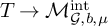 $T\to \mathcal {M} {}^{\mathrm {int}}_{{\mathcal {G}}, b, \mu }$
. This factors through the open and closed
$T\to \mathcal {M} {}^{\mathrm {int}}_{{\mathcal {G}}, b, \mu }$
. This factors through the open and closed $\mathcal {M} {}^{\mathrm {int, \tau }}_{{\mathcal {G}}, b, \mu }\hookrightarrow \mathcal {M} {}^{\mathrm {int}}_{{\mathcal {G}}, b, \mu }$
and provides the desired
$\mathcal {M} {}^{\mathrm {int, \tau }}_{{\mathcal {G}}, b, \mu }\hookrightarrow \mathcal {M} {}^{\mathrm {int}}_{{\mathcal {G}}, b, \mu }$
and provides the desired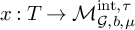 $x: T\to \mathcal {M} {}^{\mathrm {int, \tau }}_{{\mathcal {G}}, b, \mu }$
.
$x: T\to \mathcal {M} {}^{\mathrm {int, \tau }}_{{\mathcal {G}}, b, \mu }$
.
6 The case of trivial
$\mu _{\mathrm {ad}}$

In this section we prove Theorems 2.5.4 and 2.5.5 in the case when $\mu _{\mathrm {ad}}=1$
is trivial. Note that when
$\mu _{\mathrm {ad}}=1$
is trivial. Note that when $\mu _{\mathrm {ad}}=1$
is trivial,
$\mu _{\mathrm {ad}}=1$
is trivial, $B(G, \mu ^{-1})$
consists of the unique basic element contained in it. In this section, b denotes a representative of this unique element.
$B(G, \mu ^{-1})$
consists of the unique basic element contained in it. In this section, b denotes a representative of this unique element.
6.1 The case of trivial
$\mu $

Let first ${\mathcal {G}} $
be a parahoric for G. It follows from the definition that
${\mathcal {G}} $
be a parahoric for G. It follows from the definition that ${\mathbb{M}^{\mathrm {loc}}_{{\mathcal {G}}, 1}}=\operatorname {\mbox {Spec }} (\mathbb {Z} {}_p)$
. Furthermore, we have
${\mathbb{M}^{\mathrm {loc}}_{{\mathcal {G}}, 1}}=\operatorname {\mbox {Spec }} (\mathbb {Z} {}_p)$
. Furthermore, we have
 $$ \begin{align} \mathcal{M} {}^{\mathrm{int}}_{{\mathcal{G}} , 1, 1}\simeq \underline{G(\mathbb{Q} {}_p)/{\mathcal{G}} (\mathbb{Z} {}_p)} \end{align} $$
over $\mathrm{Spd}(\breve {\mathbb {Z}} {}_p)$
, cf. [Reference Scholze and WeinsteinSW20, Prop. 25.2.1] (in loc. cit. only the case of a torus group is considered but the proof is valid in the general case). It follows that
$\mathrm{Spd}(\breve {\mathbb {Z}} {}_p)$
, cf. [Reference Scholze and WeinsteinSW20, Prop. 25.2.1] (in loc. cit. only the case of a torus group is considered but the proof is valid in the general case). It follows that $\mathcal {M} {}^{\mathrm {int}}_{{\mathcal {G}}, 1, 1}$
is representable by the formal scheme
$\mathcal {M} {}^{\mathrm {int}}_{{\mathcal {G}}, 1, 1}$
is representable by the formal scheme
 $$\begin{align*}\mathscr{M} {}_{{\mathcal{G}} , 1,1}=\coprod_{G(\mathbb{Q} {}_p)/{\mathcal{G}} (\mathbb{Z} {}_p)} \mathrm{Spf} (\breve{\mathbb{Z}} {}_p) , \end{align*}$$
and that the formal completion at a k-point is isomorphic to $\breve {\mathbb {Z}} {}_p$
. This proves Theorems 2.5.4 and 2.5.5 in the case when
$\breve {\mathbb {Z}} {}_p$
. This proves Theorems 2.5.4 and 2.5.5 in the case when ${\mathcal {G}} $
is a parahoric group scheme. The case of a general quasi-parahoric follows from Theorem 4.1.1, Proposition 4.2.1 and (2.3.1).
${\mathcal {G}} $
is a parahoric group scheme. The case of a general quasi-parahoric follows from Theorem 4.1.1, Proposition 4.2.1 and (2.3.1).
6.2 The general case
The case when $\mu _{\mathrm {ad}}=1$
is reduced to the case of the adjoint group, as follows. Choose an extension
$\mu _{\mathrm {ad}}=1$
is reduced to the case of the adjoint group, as follows. Choose an extension ${\mathcal {G}} \to {\mathcal {G}} '$
to quasi-parahorics of the natural morphism
${\mathcal {G}} \to {\mathcal {G}} '$
to quasi-parahorics of the natural morphism $G\to G':=G_{\mathrm {ad}}$
. Consider the corresponding morphism of v-sheaves
$G\to G':=G_{\mathrm {ad}}$
. Consider the corresponding morphism of v-sheaves
 $$\begin{align*}\mathcal{M} {}^{\mathrm{int}}_{{\mathcal{G}} , b, \mu}\to \mathcal{M} {}^{\mathrm{int}}_{{\mathcal{G}} ', 1, 1}. \end{align*}$$
We now use the following functorialities:
-
• there is an isomorphism
$f: \mathcal {M} {}^{\mathrm {int,\tau }}_{{\mathcal {G}}, b, \mu }\xrightarrow {\sim } \mathcal {M} {}^{\mathrm {int,\tau '}}_{{\mathcal {G}} ', 1, 1}\times _{\mathrm{Spd}(\breve {\mathbb {Z}} {}_p)}\mathrm{Spd}(O_{\breve E}),$
for each
$\tau \in C_{{\mathcal {G}}}, $
, cf. Theorem 5.1.2. Hence the representability of
$\mathcal {M} {}^{\mathrm { int}}_{{\mathcal {G}} ', 1, 1}$
implies the representability of
$\mathcal {M} {}^{\mathrm {int}}_{{\mathcal {G}}, b, \mu }$
. -
• there is an isomorphism
$\widehat f: \mathcal {M} {}^{\mathrm {int}}_{{\mathcal {G}}, b, \mu /x}\xrightarrow {\sim } \mathcal {M} {}^{\mathrm {int}}_{{\mathcal {G}} ', 1, 1 /x'}\times _{\mathrm{Spd}(\breve {\mathbb {Z}} {}_p)}\mathrm{Spd}(O_{\breve E}),$
for each
$x\in \mathcal {M} {}^{\mathrm {int}}_{{\mathcal {G}}, b, \mu }(\mathrm{Spd}\ k)$
, cf. Proposition 5.3.1. -
• there is an isomorphism
$\mathbb {M} {}^v_{{\mathcal {G}}, \mu }\xrightarrow {\sim } \mathbb {M} {}^v_{{\mathcal {G}} ', 1}\times _{\mathrm{Spd}(\mathbb {Z} {}_p)}\mathrm{Spd}(O_E)$
, cf. [Reference Scholze and WeinsteinSW20, Prop. 21.5.1] (attributed in loc. cit. to J. Lourenço).






Hence the case $({\mathcal {G}} ', 1,1)$
implies the case
$({\mathcal {G}} ', 1,1)$
implies the case $({\mathcal {G}}, b, \mu )$
.
$({\mathcal {G}}, b, \mu )$
.
7 The Hodge type case
We now give the first non-banal cases when we can show the isomorphism of Theorem 2.5.5 and show representability of the formal completions. Let $(G, b, \mu )$
be a local Shimura datum. Also, throughout this section, we let
$(G, b, \mu )$
be a local Shimura datum. Also, throughout this section, we let ${\mathcal {G}} ={\mathcal {G}} {}_{\mathbf {x}}$
be a stabiliser Bruhat-Tits group scheme for a corresponding point
${\mathcal {G}} ={\mathcal {G}} {}_{\mathbf {x}}$
be a stabiliser Bruhat-Tits group scheme for a corresponding point $\bf x$
in the extended building. We denote by
$\bf x$
in the extended building. We denote by ${\mathcal {G}} {}^o$
the corresponding parahoric. We assume we are in case (A), so in particular
${\mathcal {G}} {}^o$
the corresponding parahoric. We assume we are in case (A), so in particular $p>2$
.
$p>2$
.
7.1 The crucial Hodge type case
Let $\iota : (G, \mu )\hookrightarrow (\mathrm {GL}_h, \mu _d)$
be a Hodge embedding. We assume that there is a
$\iota : (G, \mu )\hookrightarrow (\mathrm {GL}_h, \mu _d)$
be a Hodge embedding. We assume that there is a $\mathbb {Z} {}_p$
-lattice
$\mathbb {Z} {}_p$
-lattice $\Lambda \subset \mathbb {Q} {}_p^h$
such that the homomorphism
$\Lambda \subset \mathbb {Q} {}_p^h$
such that the homomorphism $\iota $
extends to a closed immersion
$\iota $
extends to a closed immersion $ \iota : {\mathcal {G}} \hookrightarrow \mathrm {GL}(\Lambda ). $
We then say that
$ \iota : {\mathcal {G}} \hookrightarrow \mathrm {GL}(\Lambda ). $
We then say that $\iota : ({\mathcal {G}}, \mu )\hookrightarrow (\mathrm {GL}(\Lambda ),\mu _d)$
is an integral Hodge embedding. Then we also have
$\iota : ({\mathcal {G}}, \mu )\hookrightarrow (\mathrm {GL}(\Lambda ),\mu _d)$
is an integral Hodge embedding. Then we also have
 $$\begin{align*}{\mathcal{G}} (\breve{\mathbb{Z}} {}_p)=G(\breve{\mathbb{Q}} {}_p)\cap \iota^{-1}(\mathrm{GL}(\Lambda\otimes_{\mathbb{Z} {}_p}\breve{\mathbb{Z}} {}_p)). \end{align*}$$
By [Reference Pappas and RapoportPR24, Prop. 3.6.2], this gives a closed immersion
 $$\begin{align*}\iota: \mathcal{M} {}^{\mathrm{int}}_{{\mathcal{G}} , b, \mu}\hookrightarrow ({\mathcal M}^{\mathrm{int}}_{\mathrm{GL}(\Lambda), \iota(b),\mu_d})_O:= {\mathcal M}^{\mathrm{int}}_{\mathrm{GL}(\Lambda), \iota(b),\mu_d}\times_{\mathrm{Spd}(W(k))}\mathrm{Spd}(O) , \end{align*}$$
where $O=O_{\breve E}$
. The formal completion
$O=O_{\breve E}$
. The formal completion $ \mathcal {M} {}^{\mathrm {int}}_{{\mathcal {G}}, b, \mu /x_0}$
at the base point
$ \mathcal {M} {}^{\mathrm {int}}_{{\mathcal {G}}, b, \mu /x_0}$
at the base point $x_0$
fits in a cartesian diagram
$x_0$
fits in a cartesian diagram

Hence, we also have a closed immersion
 $$\begin{align*}\hat\iota: \mathcal{M} {}^{\mathrm{int}}_{{\mathcal{G}} , b, \mu /x_0}\hookrightarrow {\mathcal M}^{\mathrm{int}}_{\mathrm{GL}(\Lambda), \iota(b),\mu_d /\iota(x_0)}\times_{\mathrm{Spd}(W(k))}\mathrm{Spd}(O). \end{align*}$$
Here, by [Reference Scholze and WeinsteinSW20, Thm. 25.1.2] (relating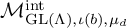 ${\mathcal M}^{\mathrm {int}}_{\mathrm {GL}(\Lambda ), \iota (b),\mu _d}$
to the RZ-space of EL-type
${\mathcal M}^{\mathrm {int}}_{\mathrm {GL}(\Lambda ), \iota (b),\mu _d}$
to the RZ-space of EL-type $\mathcal {M} {}_{\mathbb {X}} $
of p-divisible groups of dimension d and height h) and the definition of formal completion, we have
$\mathcal {M} {}_{\mathbb {X}} $
of p-divisible groups of dimension d and height h) and the definition of formal completion, we have
 $$ \begin{align} {\mathcal M}^{\mathrm{int}}_{\mathrm{GL}(\Lambda), \iota(b),\mu_d /\iota(x_0)}\times_{\mathrm{Spd}(W(k))}\mathrm{Spd}(O)\simeq \mathrm{Spd}(R\otimes_{W(k)} O), \end{align} $$
where $R\simeq W(k)[\![ x_1,\ldots , x_m]\!]$
, for
$R\simeq W(k)[\![ x_1,\ldots , x_m]\!]$
, for $m=d(h-d)$
. The point
$m=d(h-d)$
. The point $\iota (x_0)$
gives a p-divisible group
$\iota (x_0)$
gives a p-divisible group $\mathscr {G} {}_0$
of height h over k and R is naturally identified with the universal formal deformation ring of
$\mathscr {G} {}_0$
of height h over k and R is naturally identified with the universal formal deformation ring of $\mathscr {G} {}_0$
.
$\mathscr {G} {}_0$
.
Proposition 7.1.1. There is a commutative diagram of morphisms of smooth rigid analytic spaces over ${\mathrm {Sp}}(\breve E)$
,
${\mathrm {Sp}}(\breve E)$
,

The vertical maps are the restrictions of the étale period maps to the tubular neighborhoods. The bottom horizontal map is the analytification of the Zariski closed immersion
 $$\begin{align*}X_\mu\hookrightarrow \mathrm{Gr}(d, h)_{E} , \end{align*}$$
which is obtained from $\iota : G\hookrightarrow \mathrm {GL}_h$
. The top horizontal map is a closed immersion.
$\iota : G\hookrightarrow \mathrm {GL}_h$
. The top horizontal map is a closed immersion.
Here $\mathrm{Spf}(R)^{\mathrm {rig}}$
is the rigid analytic generic fibre of
$\mathrm{Spf}(R)^{\mathrm {rig}}$
is the rigid analytic generic fibre of $\mathrm{Spf}(R)$
(in Berthelot’s sense). For simplicity, we use the same symbol for the v-sheaf
$\mathrm{Spf}(R)$
(in Berthelot’s sense). For simplicity, we use the same symbol for the v-sheaf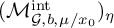 $( \mathcal {M} {}^{\mathrm {int}}_{{\mathcal {G}}, b, \mu /x_0})_\eta $
, and for the smooth rigid analytic space over
$( \mathcal {M} {}^{\mathrm {int}}_{{\mathcal {G}}, b, \mu /x_0})_\eta $
, and for the smooth rigid analytic space over ${\mathrm {Sp}}(\breve E)$
that represents it.
${\mathrm {Sp}}(\breve E)$
that represents it.
Proof. Consider the commutative diagram of v-sheaves

In this, the two horizontal maps are closed immersions. In particular, the bottom horizontal map is represented by a Zariski closed immersion. The two vertical period maps are given by the étale period maps (on the left side we combine the period maps on the components, as in Theorem 4.5.1). Their images are the corresponding open admissible sets and we have
 $$\begin{align*}X_\mu^{\mathrm{adm}}=(\mathrm{Gr}(d, h)\times_{\mathrm{Spd}(\mathbb{Q} {}_p)}\mathrm{Spd}(\breve E))^{\mathrm{adm}}\cap X_\mu, \end{align*}$$
cf. [Reference Pappas and RapoportPR24, proof of Prop. 3.1.1]. Note that $( \mathcal {M} {}^{\mathrm {int}}_{{\mathcal {G}}, b, \mu /x_0})_\eta \hookrightarrow (\mathcal {M} {}^{\mathrm {int}}_{{\mathcal {G}}, b, \mu })_\eta $
is an open immersion by the argument of [Reference GleasonGl25, Prop. 4.22], cf. [Reference GleasonGl21, Lem. 2.31 and its proof]. Hence, all the v-sheaves in (7.1.3) are representable by smooth rigid analytic spaces. By full-faithfulness [Reference Scholze and WeinsteinSW20, Prop. 10.2.3] the top horizontal map is also representable by a morphism of rigid analytic spaces and the result follows.
$( \mathcal {M} {}^{\mathrm {int}}_{{\mathcal {G}}, b, \mu /x_0})_\eta \hookrightarrow (\mathcal {M} {}^{\mathrm {int}}_{{\mathcal {G}}, b, \mu })_\eta $
is an open immersion by the argument of [Reference GleasonGl25, Prop. 4.22], cf. [Reference GleasonGl21, Lem. 2.31 and its proof]. Hence, all the v-sheaves in (7.1.3) are representable by smooth rigid analytic spaces. By full-faithfulness [Reference Scholze and WeinsteinSW20, Prop. 10.2.3] the top horizontal map is also representable by a morphism of rigid analytic spaces and the result follows.
Theorem 7.1.2. Let $(G, b, \mu )$
be a local Shimura datum and let
$(G, b, \mu )$
be a local Shimura datum and let ${\mathcal {G}} $
be a quasi-parahoric stabiliser group scheme for G. Suppose
${\mathcal {G}} $
be a quasi-parahoric stabiliser group scheme for G. Suppose $p>2$
and assume that there exists a Hodge embedding
$p>2$
and assume that there exists a Hodge embedding $\iota : (G, \mu )\hookrightarrow (\mathrm {GL}_h, \mu _d)$
and a
$\iota : (G, \mu )\hookrightarrow (\mathrm {GL}_h, \mu _d)$
and a $\mathbb {Z} {}_p$
-lattice
$\mathbb {Z} {}_p$
-lattice $\Lambda \subset \mathbb {Q} {}_p^h$
such that:
$\Lambda \subset \mathbb {Q} {}_p^h$
such that:
-
a) The homomorphism
$\iota $
extends to a closed immersion
$ \iota : {\mathcal {G}} \hookrightarrow \mathrm {GL}(\Lambda ). $
-
b) The Zariski closure
$\overline {X}_\mu $
of
$X_\mu \subset \mathrm {Gr}(d, h)_{E}$
in
$\mathrm {Gr}(d, \Lambda )_{O_E}$
is normal. -
c) The image
$\iota (G)$
contains the scalars.






Then the following statements hold:
1)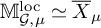 $\mathbb {M} {}^{\mathrm {loc}}_{{\mathcal {G}}, \mu } \simeq \overline {X}_\mu $
.
$\mathbb {M} {}^{\mathrm {loc}}_{{\mathcal {G}}, \mu } \simeq \overline {X}_\mu $
.
2) For any $x\in \mathcal {M} {}^{\mathrm {int}}_{{\mathcal {G}}, b, \mu }(\mathrm{Spd}(k))$
there is
$x\in \mathcal {M} {}^{\mathrm {int}}_{{\mathcal {G}}, b, \mu }(\mathrm{Spd}(k))$
there is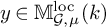 $y\in \mathbb {M} {}^{\mathrm {loc}}_{{\mathcal {G}}, \mu }(k)$
, such that
$y\in \mathbb {M} {}^{\mathrm {loc}}_{{\mathcal {G}}, \mu }(k)$
, such that
 $$ \begin{align} \mathcal{M} {}^{\mathrm{int}}_{{\mathcal{G}} , b, \mu /x} \simeq ( \mathbb{M} {}^{\mathrm{loc}}_{{\mathcal{G}}, \mu /y})^{\Diamond}, \end{align} $$
provided that $\iota : ({\mathcal {G}}, \mu )\hookrightarrow (\mathrm {GL}(\Lambda ),\mu _d)$
is a very good integral Hodge embedding in the sense of [Reference Kisin, Pappas and ZhouKPZ24], see below. In the above, the orbit
$\iota : ({\mathcal {G}}, \mu )\hookrightarrow (\mathrm {GL}(\Lambda ),\mu _d)$
is a very good integral Hodge embedding in the sense of [Reference Kisin, Pappas and ZhouKPZ24], see below. In the above, the orbit ${\mathcal {G}} (k)\cdot y$
is equal to
${\mathcal {G}} (k)\cdot y$
is equal to $\ell (x)$
, cf. (3.4.2).
$\ell (x)$
, cf. (3.4.2).
Proof. By section 3.5, we may assume that $x=x_0$
is the base point. For simplicity, we write
$x=x_0$
is the base point. For simplicity, we write
 $$\begin{align*}{\mathcal{M}}^{\mathrm{int}}_{/x_0}= \mathcal{M} {}^{\mathrm{int}}_{{\mathcal{G}} , b, \mu /x_0}, \qquad \mathbb{M} {}^{\mathrm{ loc}}=\mathbb{M} {}^{\mathrm{loc}}_{{\mathcal{G}} ,\mu}. \end{align*}$$
We first show 1), i.e., $\mathbb {M} {}^{\mathrm {loc}} \simeq \overline {X}_\mu $
. By [Reference Scholze and WeinsteinSW20, Thm. 21.2.1],
$\mathbb {M} {}^{\mathrm {loc}} \simeq \overline {X}_\mu $
. By [Reference Scholze and WeinsteinSW20, Thm. 21.2.1], $\iota $
induces a closed immersion of v-sheaves over
$\iota $
induces a closed immersion of v-sheaves over $\mathrm{Spd}(\mathbb {Z} {}_p)$
,
$\mathrm{Spd}(\mathbb {Z} {}_p)$
,
 $$\begin{align*}\iota: \mathrm{Gr}_{{\mathcal{G}} , \mathrm{Spd}(\mathbb{Z} {}_p)}\to \mathrm{Gr}_{\mathrm{GL}_h, \mathrm{Spd}(\mathbb{Z} {}_p)}. \end{align*}$$
This gives a closed immersion of v-sheaves over $\mathrm{Spd}(O_E)$
,
$\mathrm{Spd}(O_E)$
,
 $$\begin{align*}\mathbb{M} {}^v\to \mathrm{Gr}(d, h)_{O_E}^{\Diamond}. \end{align*}$$
Indeed,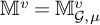 $\mathbb {M} {}^v=\mathbb {M} {}^v_{{\mathcal {G}}, \mu }$
is, by definition, the v-sheaf closure of
$\mathbb {M} {}^v=\mathbb {M} {}^v_{{\mathcal {G}}, \mu }$
is, by definition, the v-sheaf closure of $X_\mu ^{\Diamond }$
in
$X_\mu ^{\Diamond }$
in
 $$\begin{align*}\mathrm{Gr}(d, h)_{O_E}^{\Diamond}\hookrightarrow \mathrm{Gr}_{\mathrm{GL}_h}\times_{\mathrm{Spd}(\mathbb{Z} {}_p)}\mathrm{Spd}( O_E). \end{align*}$$
(See [Reference Anschütz, Gleason, Lourenço and RicharzAGLR22, 2.1] for a discussion of v-sheaf closures.) Since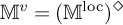 $\mathbb {M} {}^v=(\mathbb {M} {}^{\mathrm {loc}})^{\Diamond }$
and
$\mathbb {M} {}^v=(\mathbb {M} {}^{\mathrm {loc}})^{\Diamond }$
and $\mathbb {M} {}^{\mathrm {loc}}$
is normal, we deduce from full-faithfulness (using [Reference Scholze and WeinsteinSW20, Prop. 18.4.1] and formal GAGA) that the closed immersion
$\mathbb {M} {}^{\mathrm {loc}}$
is normal, we deduce from full-faithfulness (using [Reference Scholze and WeinsteinSW20, Prop. 18.4.1] and formal GAGA) that the closed immersion $\mathbb {M} {}^v\to \mathrm {Gr}(d, h)_{O_E}^{\Diamond }$
is represented by a morphism of schemes,
$\mathbb {M} {}^v\to \mathrm {Gr}(d, h)_{O_E}^{\Diamond }$
is represented by a morphism of schemes,
 $$\begin{align*}\mathbb{M} {}^{\mathrm{loc}}\to \mathrm{Gr}(d, h)_{O_E}. \end{align*}$$
This morphism extends $X_\mu \hookrightarrow \mathrm {Gr}(d, h)_E$
on the generic fibres. Now
$X_\mu \hookrightarrow \mathrm {Gr}(d, h)_E$
on the generic fibres. Now $(\overline X_\mu )^{\Diamond }$
is topologically flat ([Reference Pappas and RapoportPR24, Lem. 3.4.2]) and so it is the v-sheaf closure of the generic fibre
$(\overline X_\mu )^{\Diamond }$
is topologically flat ([Reference Pappas and RapoportPR24, Lem. 3.4.2]) and so it is the v-sheaf closure of the generic fibre $X_\mu ^{\Diamond }$
in
$X_\mu ^{\Diamond }$
in $\mathrm {Gr}(d, h)_{O_E}^{\Diamond }$
. We obtain an isomorphism
$\mathrm {Gr}(d, h)_{O_E}^{\Diamond }$
. We obtain an isomorphism
 $$\begin{align*}\mathbb{M} {}^v=(\mathbb{M} {}^{\mathrm{loc}})^{\Diamond}\xrightarrow{\sim} (\overline X_\mu)^{\Diamond}\hookrightarrow \mathrm{ Gr}(d, h)_{O_E}^{\Diamond}. \end{align*}$$
Since $\mathbb {M} {}^{\mathrm {loc}}$
is normal and we are also assuming that
$\mathbb {M} {}^{\mathrm {loc}}$
is normal and we are also assuming that $\overline X_\mu $
is normal, the isomorphism
$\overline X_\mu $
is normal, the isomorphism $(\mathbb {M} {}^{\mathrm {loc}})^{\Diamond }\xrightarrow {\sim } (\overline X_\mu )^{\Diamond }$
is obtained from an isomorphism
$(\mathbb {M} {}^{\mathrm {loc}})^{\Diamond }\xrightarrow {\sim } (\overline X_\mu )^{\Diamond }$
is obtained from an isomorphism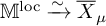 $\mathbb {M} {}^{\mathrm {loc}}\xrightarrow {\sim } \overline X_\mu $
of
$\mathbb {M} {}^{\mathrm {loc}}\xrightarrow {\sim } \overline X_\mu $
of $O_E$
-schemes, as claimed.
$O_E$
-schemes, as claimed.
We now proceed to show 2). By [Reference KisinKi10, Prop. 1.3.2], there is a finite set of tensors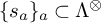 $\{s_a\}_a\subset \Lambda ^\otimes $
, such that
$\{s_a\}_a\subset \Lambda ^\otimes $
, such that ${\mathcal {G}} $
is the scheme theoretic pointwise stabiliser of
${\mathcal {G}} $
is the scheme theoretic pointwise stabiliser of $s_a$
,
$s_a$
,
 $$\begin{align*}{\mathcal{G}} =\{g \in \mathrm{GL}(\Lambda)\ |\ g\cdot s_a=s_a, \forall a\}. \end{align*}$$
By the Tannakian formalism applied to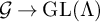 ${\mathcal {G}} \to \mathrm {GL}(\Lambda )$
, each
${\mathcal {G}} \to \mathrm {GL}(\Lambda )$
, each ${\mathcal {G}} $
-torsor over an affine
${\mathcal {G}} $
-torsor over an affine $\mathbb {Z} {}_p$
-scheme
$\mathbb {Z} {}_p$
-scheme $\operatorname {\mbox {Spec }}(A)$
gives a finite projective A-module N of rank equal to
$\operatorname {\mbox {Spec }}(A)$
gives a finite projective A-module N of rank equal to $\mathrm { rank}_{\mathbb {Z} {}_p}(\Lambda )$
with tensors
$\mathrm { rank}_{\mathbb {Z} {}_p}(\Lambda )$
with tensors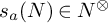 $s_a(N)\in N^{\otimes }$
.
$s_a(N)\in N^{\otimes }$
.
Consider the universal ${\mathcal {G}} $
-shtuka over
${\mathcal {G}} $
-shtuka over $ {\mathcal {M}}^{\mathrm {int}}_{/x_0}$
; its push-out by
$ {\mathcal {M}}^{\mathrm {int}}_{/x_0}$
; its push-out by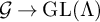 ${\mathcal {G}} \to \mathrm {GL}(\Lambda )$
is the shtuka which is obtained from the Breuil-Kisin-Fargues module of the universal p-divisible group, as in the proof of [Reference Scholze and WeinsteinSW20, Theorem 25.1.2]. By specialising to the base point
${\mathcal {G}} \to \mathrm {GL}(\Lambda )$
is the shtuka which is obtained from the Breuil-Kisin-Fargues module of the universal p-divisible group, as in the proof of [Reference Scholze and WeinsteinSW20, Theorem 25.1.2]. By specialising to the base point $x_0$
and using the Tannakian formalism we see that the
$x_0$
and using the Tannakian formalism we see that the ${\mathcal {G}} $
-shtuka over
${\mathcal {G}} $
-shtuka over $\mathrm{Spd}(k)$
that corresponds to
$\mathrm{Spd}(k)$
that corresponds to $x_0$
equips the Dieudonné module
$x_0$
equips the Dieudonné module $\mathbb {D} :=\mathbb {D} (\mathscr {G} {}_0)(\breve {\mathbb {Z}} {}_p)$
of
$\mathbb {D} :=\mathbb {D} (\mathscr {G} {}_0)(\breve {\mathbb {Z}} {}_p)$
of $\mathscr {G} {}_0$
with Frobenius invariant tensors
$\mathscr {G} {}_0$
with Frobenius invariant tensors $s_{a, 0}\in \mathbb {D} {}^{\otimes }$
.
$s_{a, 0}\in \mathbb {D} {}^{\otimes }$
.
Write $R_G$
for the completion of
$R_G$
for the completion of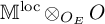 $\mathbb {M} {}^{\mathrm {loc}}\otimes _{O_E}O$
at the corresponding point
$\mathbb {M} {}^{\mathrm {loc}}\otimes _{O_E}O$
at the corresponding point $y_0$
with orbit
$y_0$
with orbit $\ell (x_0)$
and denote by
$\ell (x_0)$
and denote by ${\frak m}_G$
the maximal ideal of
${\frak m}_G$
the maximal ideal of $R_G$
. The O-algebra
$R_G$
. The O-algebra $R_G$
is normal and is a quotient of the formal completion
$R_G$
is normal and is a quotient of the formal completion $R_E\simeq R\otimes _WO$
of the local ring of
$R_E\simeq R\otimes _WO$
of the local ring of $\mathrm {Gr}(d,\Lambda )_{O}$
at
$\mathrm {Gr}(d,\Lambda )_{O}$
at $y_0$
. Note that, since
$y_0$
. Note that, since $\bar X_\mu \simeq \mathbb {M} {}^{\mathrm {loc}}$
, we see that
$\bar X_\mu \simeq \mathbb {M} {}^{\mathrm {loc}}$
, we see that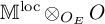 $\mathbb {M} {}^{\mathrm {loc}}\otimes _{O_E}O$
is identified with the reduced Zariski closure of a G-orbit
$\mathbb {M} {}^{\mathrm {loc}}\otimes _{O_E}O$
is identified with the reduced Zariski closure of a G-orbit $G\cdot y$
in
$G\cdot y$
in $\mathrm {Gr}(d, h)_O$
, where y is an F-point that corresponds to a filtration induced by a G-valued cocharacter
$\mathrm {Gr}(d, h)_O$
, where y is an F-point that corresponds to a filtration induced by a G-valued cocharacter $\mu _y$
conjugate to
$\mu _y$
conjugate to $\mu ^{-1}$
. Here F is a finite extension of
$\mu ^{-1}$
. Here F is a finite extension of $\breve {\mathbb {Q}} {}_p$
.
$\breve {\mathbb {Q}} {}_p$
.
Let us now briefly review certain constructions of [Reference Kisin and PappasKP18], [Reference Kisin and ZhouKZ21], [Reference Kisin, Pappas and ZhouKPZ24], and in particular the notion of a very good integral Hodge embedding; we will use the notations of these papers. We continue to assume $p>2$
and that (a), (b), (c) are satisfied.
$p>2$
and that (a), (b), (c) are satisfied.
Set $M=\Lambda \otimes _{\mathbb {Z} {}_p}R_E$
and denote by
$M=\Lambda \otimes _{\mathbb {Z} {}_p}R_E$
and denote by $\hat I_{R_E}M\subset M_1\subset M$
the unique
$\hat I_{R_E}M\subset M_1\subset M$
the unique $\widehat {W}(R_E)$
-submodule corresponding to the universal
$\widehat {W}(R_E)$
-submodule corresponding to the universal $R_E$
-valued point of the Grassmannian. This gives a ‘Dieudonné pair’
$R_E$
-valued point of the Grassmannian. This gives a ‘Dieudonné pair’ $(M, M_1)$
. We will denote by
$(M, M_1)$
. We will denote by $(M_{R_G}, M_{R_G,1})$
the Dieudonné pair of
$(M_{R_G}, M_{R_G,1})$
the Dieudonné pair of $\widehat {W}(R_G)$
-modules which is obtained by base changing
$\widehat {W}(R_G)$
-modules which is obtained by base changing $(M, M_1)$
along
$(M, M_1)$
along $R_E\to R_G$
. We set
$R_E\to R_G$
. We set
 $$\begin{align*}\widetilde M_{R_G,1}:=\mathrm{Im}(\phi^*M_{R_G, 1}\to \phi^*M_{R_G}). \end{align*}$$
Then $\widetilde M_{R_G,1}$
is a finite free
$\widetilde M_{R_G,1}$
is a finite free $\widehat {W}(R_G)$
-module and
$\widehat {W}(R_G)$
-module and
 $$\begin{align*}\widetilde M_{R_G,1}[1/p]=(\phi^*M_{R_G})[1/p]. \end{align*}$$
By the argument of [Reference Kisin and PappasKP18, Cor. 3.2.11] (which extends to this situation using also the main result of [Reference AnschützAn22], cf. Remark 7.1.5), the tensors
 $$\begin{align*}\tilde s_a:=s_a\otimes 1=\phi^*(s_a\otimes 1)\in \Lambda^{\otimes}\otimes_{\mathbb{Z} {}_p} \widehat {W}(R_G)=(\phi^*M_{R_G})^{\otimes}\subset (\phi^*M_{R_G})^{\otimes}[1/p]=\widetilde M_{R_G,1}^{\otimes}[1/p] \end{align*}$$
lie in $\widetilde M_{R_G,1}^{\otimes }$
and the scheme
$\widetilde M_{R_G,1}^{\otimes }$
and the scheme
 $$\begin{align*}\mathcal{T} =\underline{\mathrm{Isom}}_{(\tilde s_a), (s_a)}(\widetilde M_{R_G,1}, \Lambda\otimes_{\mathbb{Z} {}_p}\widehat {W}(R_G)) \end{align*}$$
of isomorphisms that preserve the tensors is a (trivial) ${\mathcal {G}} $
-torsor over
${\mathcal {G}} $
-torsor over $\widehat {W}(R_G)$
. The scheme
$\widehat {W}(R_G)$
. The scheme $\mathcal {T} $
is independent of the choice of the set of tensors
$\mathcal {T} $
is independent of the choice of the set of tensors $(s_a)\subset \Lambda ^\otimes $
that cut out
$(s_a)\subset \Lambda ^\otimes $
that cut out ${\mathcal {G}} $
.
${\mathcal {G}} $
.
Set ${\frak a}_G={\frak m}_G^2+\pi _ER_G\subset R_G$
. There is a canonical isomorphism
${\frak a}_G={\frak m}_G^2+\pi _ER_G\subset R_G$
. There is a canonical isomorphism
 $$ \begin{align} c=c_{y_0}: \widetilde M_{0,1}\otimes_{W(k)}\widehat W(R_G/{\frak a}_G)\xrightarrow{\sim} \widetilde M_{R_G, 1}\otimes_{\widehat W(R_G)}\widehat W(R_G/{\frak a}_G) \end{align} $$
([Reference Kisin and PappasKP18, Lem. 3.1.9], [Reference Kisin, Pappas and ZhouKPZ24, §5.2.1]). Here, $(M_0, M_{0,1})$
is the Dieudonné pair of
$(M_0, M_{0,1})$
is the Dieudonné pair of $W(k)$
-modules obtained from
$W(k)$
-modules obtained from $(M_{R_G}, M_{R_G, 1})$
by the base change given by
$(M_{R_G}, M_{R_G, 1})$
by the base change given by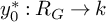 $y_0^*: R_G\to k$
and
$y_0^*: R_G\to k$
and $\widetilde M_{0,1}=\mathrm {Im}(\phi ^*M_{0,1}\to \phi ^*M_0)$
.
$\widetilde M_{0,1}=\mathrm {Im}(\phi ^*M_{0,1}\to \phi ^*M_0)$
.
We say that the tensors $(\tilde s_a)$
are preserved by c if we have
$(\tilde s_a)$
are preserved by c if we have $ c(\tilde s_{a,0}\otimes 1)=\tilde s_a\otimes 1$
, for all a. Then the isomorphism c uniquely descends to an isomorphism of
$ c(\tilde s_{a,0}\otimes 1)=\tilde s_a\otimes 1$
, for all a. Then the isomorphism c uniquely descends to an isomorphism of ${\mathcal {G}} $
-torsors
${\mathcal {G}} $
-torsors
 $$\begin{align*}c^{{\mathcal{G}}} : \mathcal{T} {}_0\otimes_{W(k)}\widehat W(R_G/{\frak a}_G)\xrightarrow{\sim} \mathcal{T} \otimes_{\widehat W(R_{{\mathcal{G}}} )}\widehat W(R_G/{\frak a}_G). \end{align*}$$
We say that the integral Hodge embedding $({\mathcal {G}}, \mu )\hookrightarrow (\mathrm {GL}(\Lambda ),\mu _d)$
is very good at
$({\mathcal {G}}, \mu )\hookrightarrow (\mathrm {GL}(\Lambda ),\mu _d)$
is very good at $y_0$
, if there are tensors
$y_0$
, if there are tensors $(s_a)\subset \Lambda ^{\otimes }$
cutting out
$(s_a)\subset \Lambda ^{\otimes }$
cutting out ${\mathcal {G}} $
in
${\mathcal {G}} $
in $\mathrm {GL}(\Lambda )$
such that
$\mathrm {GL}(\Lambda )$
such that $(\tilde s_a)$
are preserved by
$(\tilde s_a)$
are preserved by $c=c_{y_0}$
, see [Reference Kisin, Pappas and ZhouKPZ24, §5.2]. This is equivalent to asking that c descends to an isomorphism of
$c=c_{y_0}$
, see [Reference Kisin, Pappas and ZhouKPZ24, §5.2]. This is equivalent to asking that c descends to an isomorphism of ${\mathcal {G}} $
-torsors
${\mathcal {G}} $
-torsors $c^{{\mathcal {G}}} $
, as above, and this property does not depend on the choice of
$c^{{\mathcal {G}}} $
, as above, and this property does not depend on the choice of $(s_a)$
. We say that
$(s_a)$
. We say that $({\mathcal {G}}, \mu )\hookrightarrow (\mathrm {GL}(\Lambda ), \mu _d)$
is very good, if it is very good at all
$({\mathcal {G}}, \mu )\hookrightarrow (\mathrm {GL}(\Lambda ), \mu _d)$
is very good, if it is very good at all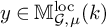 $y\in \mathbb {M} {}^{\mathrm {loc}}_{{\mathcal {G}}, \mu }(k)$
.
$y\in \mathbb {M} {}^{\mathrm {loc}}_{{\mathcal {G}}, \mu }(k)$
.
The following statement encapsulates a construction of [Reference Kisin and PappasKP18], as extended in [Reference Kisin and ZhouKZ21], [Reference Kisin, Pappas and ZhouKPZ24].
Proposition 7.1.3. Let $({\mathcal {G}}, \mu )\hookrightarrow (\mathrm {GL}(\Lambda ),\mu _d)$
be an integral Hodge embedding which satisfies (a), (b), (c) of Theorem 7.1.2 and which is very goodFootnote 2 at a point
$({\mathcal {G}}, \mu )\hookrightarrow (\mathrm {GL}(\Lambda ),\mu _d)$
be an integral Hodge embedding which satisfies (a), (b), (c) of Theorem 7.1.2 and which is very goodFootnote 2 at a point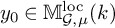 $y_0\in \mathbb {M} {}^{\mathrm {loc}}_{{\mathcal {G}}, \mu }(k)$
corresponding to the base point
$y_0\in \mathbb {M} {}^{\mathrm {loc}}_{{\mathcal {G}}, \mu }(k)$
corresponding to the base point $x_0\in \mathcal {M} {}^{\mathrm {int}}_{{\mathcal {G}}, b, \mu }(\mathrm{Spd}(k))$
. Let
$x_0\in \mathcal {M} {}^{\mathrm {int}}_{{\mathcal {G}}, b, \mu }(\mathrm{Spd}(k))$
. Let $R_E$
be the formal completion of the local ring of
$R_E$
be the formal completion of the local ring of $\mathrm {Gr}(d,\Lambda )_{O}$
at
$\mathrm {Gr}(d,\Lambda )_{O}$
at $y_0$
. There exists a p-divisible group
$y_0$
. There exists a p-divisible group $\mathscr {G} {}^{\mathrm {univ}}$
over
$\mathscr {G} {}^{\mathrm {univ}}$
over $R_E$
which is a versal formal deformation of
$R_E$
which is a versal formal deformation of $\mathscr {G} {}_0$
and which satisfies the following property:
$\mathscr {G} {}_0$
and which satisfies the following property:
Let $K/\breve E$
be a finite field extension and
$K/\breve E$
be a finite field extension and $\widetilde x^*: R_E\to O_K$
a local O-algebra homomorphism satisfying:
$\widetilde x^*: R_E\to O_K$
a local O-algebra homomorphism satisfying:
-
a) The filtration on
$\mathbb {D} \otimes _{\breve {\mathbb {Z}} {}_p} K$
which corresponds to the deformation
$\mathscr {G} {}_{\widetilde x}:={\widetilde x}^*(\mathscr {G} {}^{\mathrm {univ}})$
of the p-divisible group
$\mathscr {G} {}_0$
to
$O_K$
given by base change of
$\mathscr {G} {}^{\mathrm {univ}}$
via
$\widetilde x^*$
, is induced by a G-valued cocharacter which is G-conjugate to
$\mu ^{-1}$
; -
b) The tensors
$s_{\alpha , 0}\in \mathbb {D} {}^{\otimes }$
correspond to tensors
$s_{\alpha , {\text {\'{e}t}}}\in T_p\mathscr {G} {}^{\vee \otimes }_{\widetilde x}$
under the p-adic (étale-crystalline) comparison isomorphism.




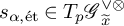
Then the homomorphism $\widetilde x^*: R_E\to O_K$
factors through the quotient
$\widetilde x^*: R_E\to O_K$
factors through the quotient $R_E\to R_G$
.
$R_E\to R_G$
.
Proof. Let us give a very quick overview to orient the reader. The construction of $\mathscr {G} {}^{\mathrm {univ}}$
uses Zink’s theory of displays. By the argument of [Reference Kisin and PappasKP18, §3.2.12] we obtain a ‘Dieudonné display triple’
$\mathscr {G} {}^{\mathrm {univ}}$
uses Zink’s theory of displays. By the argument of [Reference Kisin and PappasKP18, §3.2.12] we obtain a ‘Dieudonné display triple’ $(M_{R_G}, M_{R_G, 1}, \Psi _{R_G})$
, as in loc. cit. (see Remark 7.1.5 below and the proof of [Reference Kisin and ZhouKZ21, Prop. 3.2.7] for the removal of Condition 3.2.2 in [Reference Kisin and PappasKP18]). This triple gives, by [Reference Kisin and PappasKP18, Lem. 3.1.5], a Dieudonné display over
$(M_{R_G}, M_{R_G, 1}, \Psi _{R_G})$
, as in loc. cit. (see Remark 7.1.5 below and the proof of [Reference Kisin and ZhouKZ21, Prop. 3.2.7] for the removal of Condition 3.2.2 in [Reference Kisin and PappasKP18]). This triple gives, by [Reference Kisin and PappasKP18, Lem. 3.1.5], a Dieudonné display over $R_G$
and then one constructs also a versal display
$R_G$
and then one constructs also a versal display $(M_{R}, M_{R, 1}, \Psi _{R})$
over
$(M_{R}, M_{R, 1}, \Psi _{R})$
over $R_E$
which lifts
$R_E$
which lifts $(M_{R_G}, M_{R_G, 1}, \Psi _{R_G})$
. The display
$(M_{R_G}, M_{R_G, 1}, \Psi _{R_G})$
. The display $(M_{R}, M_{R, 1}, \Psi _{R})$
gives the desired versal formal deformation
$(M_{R}, M_{R, 1}, \Psi _{R})$
gives the desired versal formal deformation $\mathscr {G} {}^{\mathrm {univ}}$
of
$\mathscr {G} {}^{\mathrm {univ}}$
of $\mathscr {G} {}_0$
over
$\mathscr {G} {}_0$
over $\mathrm{Spf}(R_E)$
.
$\mathrm{Spf}(R_E)$
.
We can then see that the p-divisible group $\mathscr {G} {}^{\mathrm {univ}}$
, as constructed as above, has the property stated in the proposition. For this first note that, by [Reference Kisin and ZhouKZ21, Prop. 3.2.7], a deformation
$\mathscr {G} {}^{\mathrm {univ}}$
, as constructed as above, has the property stated in the proposition. For this first note that, by [Reference Kisin and ZhouKZ21, Prop. 3.2.7], a deformation $\mathscr {G} {}_{\widetilde x}$
of
$\mathscr {G} {}_{\widetilde x}$
of $\mathscr {G} {}_0$
which satisfies (a) and (b) is a ‘
$\mathscr {G} {}_0$
which satisfies (a) and (b) is a ‘ $({\mathcal {G}}, \mu ^{-1})$
-adapted lifting’ in the sense of [Reference Kisin and ZhouKZ21, Def. 3.2.4]. Then the claim follows from [Reference Kisin and ZhouKZ21, Prop. 3.3.4] (the same statement under additional tameness hypotheses on G also appears in [Reference Kisin and PappasKP18], see [Reference Kisin and PappasKP18, Prop. 3.3.13]).
$({\mathcal {G}}, \mu ^{-1})$
-adapted lifting’ in the sense of [Reference Kisin and ZhouKZ21, Def. 3.2.4]. Then the claim follows from [Reference Kisin and ZhouKZ21, Prop. 3.3.4] (the same statement under additional tameness hypotheses on G also appears in [Reference Kisin and PappasKP18], see [Reference Kisin and PappasKP18, Prop. 3.3.13]).
The versal formal deformation $\mathscr {G} {}^{\mathrm {univ}}$
over
$\mathscr {G} {}^{\mathrm {univ}}$
over $R_E$
of the p-divisible group
$R_E$
of the p-divisible group $\mathscr {G} {}_0$
induces an identification of
$\mathscr {G} {}_0$
induces an identification of $\mathrm{Spd}(R_E)$
with
$\mathrm{Spd}(R_E)$
with $ {\mathcal M}^{\mathrm {int}}_{\mathrm {GL}(\Lambda ), \iota (b),\mu _d /\iota (x_0)}\times _{\mathrm{Spd}(W)}\mathrm{Spd}(O)$
. We will now use Proposition 7.1.3 to check that the rigid analytic closed subspace
$ {\mathcal M}^{\mathrm {int}}_{\mathrm {GL}(\Lambda ), \iota (b),\mu _d /\iota (x_0)}\times _{\mathrm{Spd}(W)}\mathrm{Spd}(O)$
. We will now use Proposition 7.1.3 to check that the rigid analytic closed subspace
 $$\begin{align*}\mathrm{Spf}(R_G)^{\mathrm{rig}}\hookrightarrow \mathrm{Spf}(R_E)^{\mathrm{rig}}=\mathrm{Spf}(R)^{\mathrm{rig}}_{\breve E} \end{align*}$$
agrees with the rigid analytic closed subspace $( {\mathcal {M}}^{\mathrm {int}}_{/x_0})_\eta $
, under the identification induced by diagram (7.1.3).
$( {\mathcal {M}}^{\mathrm {int}}_{/x_0})_\eta $
, under the identification induced by diagram (7.1.3).
Let $K/\breve E$
be a finite extension. We will compare
$K/\breve E$
be a finite extension. We will compare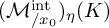 $( {\mathcal {M}}^{\mathrm {int}}_{/x_0})_\eta (K)$
and
$( {\mathcal {M}}^{\mathrm {int}}_{/x_0})_\eta (K)$
and $\mathrm{Spf}(R_G)^{\mathrm {rig}}(K)$
as subsets of
$\mathrm{Spf}(R_G)^{\mathrm {rig}}(K)$
as subsets of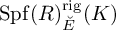 $\mathrm{Spf}(R)^{\mathrm {rig}}_{\breve E}(K)$
.
$\mathrm{Spf}(R)^{\mathrm {rig}}_{\breve E}(K)$
.
Proposition 7.1.4. For all finite field extensions $K/\breve E$
, there is an inclusion
$K/\breve E$
, there is an inclusion
 $$\begin{align*}( {\mathcal{M}}^{\mathrm{int}}_{/x_0})_\eta(K)\subset \mathrm{Spf}(R_G)^{\mathrm{rig}}(K). \end{align*}$$
Proof. A K-point x of $( {\mathcal {M}}^{\mathrm {int}}_{/x_0})_\eta $
gives, after composing with
$( {\mathcal {M}}^{\mathrm {int}}_{/x_0})_\eta $
gives, after composing with $( {\mathcal {M}}^{\mathrm {int}}_{/x_0})_\eta \hookrightarrow \mathrm{Spf}(R_E)^{\mathrm {rig}}$
, a formal scheme morphism
$( {\mathcal {M}}^{\mathrm {int}}_{/x_0})_\eta \hookrightarrow \mathrm{Spf}(R_E)^{\mathrm {rig}}$
, a formal scheme morphism $\widetilde x: \mathrm{Spf}(O_K)\to \mathrm{Spf}(R_E)$
. The point x also gives a crystalline representation
$\widetilde x: \mathrm{Spf}(O_K)\to \mathrm{Spf}(R_E)$
. The point x also gives a crystalline representation
 $$ \begin{align} \rho_x: \operatorname{\mathrm{Gal}}(\bar K/K)\to \mathrm{GL}(T_p(\mathscr{G} {}_{\widetilde x})^\vee) \end{align} $$
on the linear dual of the Tate module of the p-divisible group $\mathscr {G} {}_{\widetilde x}$
obtained from
$\mathscr {G} {}_{\widetilde x}$
obtained from $\mathscr {G} {}^{\mathrm {univ}}$
as above, by pulling back by
$\mathscr {G} {}^{\mathrm {univ}}$
as above, by pulling back by $\widetilde x$
. Take
$\widetilde x$
. Take $C=\widehat {\bar K}$
which supports a
$C=\widehat {\bar K}$
which supports a $\operatorname {\mathrm {Gal}}(\bar K/K)$
-action and consider the corresponding point
$\operatorname {\mathrm {Gal}}(\bar K/K)$
-action and consider the corresponding point $\bar x: \mathrm{Spa}(C, O_C)\to \mathrm{Spd}(K)\to ( {\mathcal {M}}^{\mathrm {int}}_{/x_0})_\eta $
which gives a
$\bar x: \mathrm{Spa}(C, O_C)\to \mathrm{Spd}(K)\to ( {\mathcal {M}}^{\mathrm {int}}_{/x_0})_\eta $
which gives a $({\mathcal {G}}, \mu )$
-shtuka
$({\mathcal {G}}, \mu )$
-shtuka $(\mathscr {P} {}_{\bar x}, \phi _{\mathscr {P} {}_{\bar x}})$
with framing. By Proposition 4.6.1 we obtain a functor
$(\mathscr {P} {}_{\bar x}, \phi _{\mathscr {P} {}_{\bar x}})$
with framing. By Proposition 4.6.1 we obtain a functor
 $$\begin{align*}\mathbb{P} {}_{\bar x}: \mathrm{Rep}_{\mathbb{Z} {}_p}({\mathcal{G}} )\to \underline{\mathbb{Z}} {}_p\text{-Loc } (\mathrm{Spa}(C, O_C))\cong \mathbb{Z} {}_p\text{-mod} \end{align*}$$
such that $\mathbb {P} {}_{\bar x}(\Lambda )=T_p(\mathscr {G} {}_{\widetilde x})^\vee $
. For
$\mathbb {P} {}_{\bar x}(\Lambda )=T_p(\mathscr {G} {}_{\widetilde x})^\vee $
. For $\gamma \in \operatorname {\mathrm {Gal}}(\bar K/K)$
, there is an isomorphism
$\gamma \in \operatorname {\mathrm {Gal}}(\bar K/K)$
, there is an isomorphism ${\mathbb R}_x(\gamma ): \mathbb {P} {}_{\bar x}\simeq \mathbb {P} {}_{\bar x\cdot \gamma }= \mathbb {P} {}_{\bar x}$
giving the Galois action (7.1.7), i.e.,
${\mathbb R}_x(\gamma ): \mathbb {P} {}_{\bar x}\simeq \mathbb {P} {}_{\bar x\cdot \gamma }= \mathbb {P} {}_{\bar x}$
giving the Galois action (7.1.7), i.e., $\mathbb {R} {}_{x}(\gamma )(\Lambda )=\rho _x(\gamma )$
.
$\mathbb {R} {}_{x}(\gamma )(\Lambda )=\rho _x(\gamma )$
.
The ${\mathcal {G}} $
-invariant tensors
${\mathcal {G}} $
-invariant tensors $s_a\in \Lambda ^\otimes $
give, by applying the functor
$s_a\in \Lambda ^\otimes $
give, by applying the functor $\mathbb {P} $
, corresponding tensors
$\mathbb {P} $
, corresponding tensors $s_{a,{\text {\'{e}t}}}\in T_p(\mathscr {G} {}_{\widetilde x})^{\vee \otimes }$
; these are invariant under the action of
$s_{a,{\text {\'{e}t}}}\in T_p(\mathscr {G} {}_{\widetilde x})^{\vee \otimes }$
; these are invariant under the action of $\operatorname {\mathrm {Gal}}(\bar K/K)$
through
$\operatorname {\mathrm {Gal}}(\bar K/K)$
through $\rho _x$
. As in §4.7, we see that the Galois representation
$\rho _x$
. As in §4.7, we see that the Galois representation $\rho _x$
factors
$\rho _x$
factors
 $$\begin{align*}\rho_x: \operatorname{\mathrm{Gal}}(\bar K/K)\to {\mathcal{G}} {}^o_{\beta}(\mathbb{Z} {}_p)\subset {\mathcal{G}} {}_{\beta}(\mathbb{Z} {}_p)\subset G(\mathbb{Q} {}_p), \end{align*}$$
where $\bar {\beta }\in \Pi _{{\mathcal {G}}} $
is such that x lies in the component
$\bar {\beta }\in \Pi _{{\mathcal {G}}} $
is such that x lies in the component $\mathrm { Sh}_{{\mathcal {G}} {}_\beta (\mathbb {Z} {}_p)}(G, b, \mu )$
of
$\mathrm { Sh}_{{\mathcal {G}} {}_\beta (\mathbb {Z} {}_p)}(G, b, \mu )$
of $(\mathcal {M} {}^{\mathrm {int}}_{{\mathcal {G}}, b,\mu })_\eta $
, cf. Theorem 4.5.1. Note that
$(\mathcal {M} {}^{\mathrm {int}}_{{\mathcal {G}}, b,\mu })_\eta $
, cf. Theorem 4.5.1. Note that
 $$\begin{align*}{\mathcal{G}} {}_{\beta}\otimes_{\mathbb{Z} {}_p}\breve{\mathbb{Z}} {}_p\simeq {\mathcal{G}} \otimes_{\mathbb{Z} {}_p}\breve{\mathbb{Z}} {}_p. \end{align*}$$
Choose a uniformiser $\pi _K$
of K and a collection of roots
$\pi _K$
of K and a collection of roots $\pi _K^{1/p^n}$
in
$\pi _K^{1/p^n}$
in $\bar K\subset C$
. We can now see, as in [Reference Pappas and RapoportPR24, §3.5], [Reference Kisin and PappasKP18, (3.3.3)], that the Breuil-Kisin module
$\bar K\subset C$
. We can now see, as in [Reference Pappas and RapoportPR24, §3.5], [Reference Kisin and PappasKP18, (3.3.3)], that the Breuil-Kisin module $\mathfrak {M} {}_{\widetilde x}$
of
$\mathfrak {M} {}_{\widetilde x}$
of $\mathscr {G} {}_{\widetilde x}$
obtained using these choices can be refined to a
$\mathscr {G} {}_{\widetilde x}$
obtained using these choices can be refined to a ${\mathcal {G}} {}^o_{\beta }$
-Breuil-Kisin module. By definition, this is a
${\mathcal {G}} {}^o_{\beta }$
-Breuil-Kisin module. By definition, this is a ${\mathcal {G}} {}^o_{\beta }$
-torsor over
${\mathcal {G}} {}^o_{\beta }$
-torsor over $\operatorname {\mbox {Spec }}(W(k)[\![ u]\!])$
with meromorphic Frobenius structure, see loc. cit.. Refined here is meant in the sense that the push-out by
$\operatorname {\mbox {Spec }}(W(k)[\![ u]\!])$
with meromorphic Frobenius structure, see loc. cit.. Refined here is meant in the sense that the push-out by ${\mathcal {G}} {}^o_{\beta }\otimes _{\mathbb {Z} {}_p}W(k)\to {\mathcal {G}} \otimes _{\mathbb {Z} {}_p}W(k)\to \mathrm {GL}(\Lambda \otimes _{\mathbb {Z} {}_p}W(k))$
recovers the
${\mathcal {G}} {}^o_{\beta }\otimes _{\mathbb {Z} {}_p}W(k)\to {\mathcal {G}} \otimes _{\mathbb {Z} {}_p}W(k)\to \mathrm {GL}(\Lambda \otimes _{\mathbb {Z} {}_p}W(k))$
recovers the $\mathrm {GL}(\Lambda \otimes _{\mathbb {Z} {}_p}W(k))$
-torsor over
$\mathrm {GL}(\Lambda \otimes _{\mathbb {Z} {}_p}W(k))$
-torsor over $\operatorname {\mbox {Spec }}(W(k)[\![ u]\!])$
which corresponds to
$\operatorname {\mbox {Spec }}(W(k)[\![ u]\!])$
which corresponds to $\mathfrak {M} {}_{\widetilde x}$
. By pushing out the torsor by
$\mathfrak {M} {}_{\widetilde x}$
. By pushing out the torsor by ${\mathcal {G}} {}^o_{\beta }\otimes _{\mathbb {Z} {}_p}W(k)\to {\mathcal {G}} \otimes _{\mathbb {Z} {}_p}W(k)$
, we obtain a
${\mathcal {G}} {}^o_{\beta }\otimes _{\mathbb {Z} {}_p}W(k)\to {\mathcal {G}} \otimes _{\mathbb {Z} {}_p}W(k)$
, we obtain a ${\mathcal {G}} $
-Breuil-Kisin module
${\mathcal {G}} $
-Breuil-Kisin module $\mathscr {P} {}_{\mathrm { BK}}$
over
$\mathscr {P} {}_{\mathrm { BK}}$
over $\operatorname {\mbox {Spec }}(W(k)[\![ u]\!])$
. The tensors
$\operatorname {\mbox {Spec }}(W(k)[\![ u]\!])$
. The tensors $s_a$
induce tensors
$s_a$
induce tensors $\widetilde s_a\in \mathfrak {M} {}_{\widetilde x}^\otimes $
over
$\widetilde s_a\in \mathfrak {M} {}_{\widetilde x}^\otimes $
over $W(k)[\![ u]\!]$
, comp. [Reference Kisin and PappasKP18, (3.3.3)]. (Note that after base changing by
$W(k)[\![ u]\!]$
, comp. [Reference Kisin and PappasKP18, (3.3.3)]. (Note that after base changing by $W(k)[\![ u]\!]\to W(O_C)$
given by
$W(k)[\![ u]\!]\to W(O_C)$
given by $(\pi _K^{1/p^n})_n$
,
$(\pi _K^{1/p^n})_n$
, $\mathscr {P} {}_{\mathrm {BK}}$
gives a
$\mathscr {P} {}_{\mathrm {BK}}$
gives a ${\mathcal {G}} $
-Breuil-Kisin-Fargues module. By the proof of [Reference Pappas and RapoportPR24, Prop. 3.5.1], the restriction of this
${\mathcal {G}} $
-Breuil-Kisin-Fargues module. By the proof of [Reference Pappas and RapoportPR24, Prop. 3.5.1], the restriction of this ${\mathcal {G}} $
-Breuil-Kisin-Fargues module from
${\mathcal {G}} $
-Breuil-Kisin-Fargues module from $\operatorname {\mbox {Spec }}(W(O_C))$
to
$\operatorname {\mbox {Spec }}(W(O_C))$
to $\mathcal {Y} {}_{[0,\infty )}(C, O_C)$
is isomorphic to the initial
$\mathcal {Y} {}_{[0,\infty )}(C, O_C)$
is isomorphic to the initial $({\mathcal {G}}, \mu )$
-shtuka
$({\mathcal {G}}, \mu )$
-shtuka $(\mathscr {P} {}_{\bar x}, \phi _{\mathscr {P} {}_{\bar x}})$
which corresponds to the point x.) Recall that the tensors
$(\mathscr {P} {}_{\bar x}, \phi _{\mathscr {P} {}_{\bar x}})$
which corresponds to the point x.) Recall that the tensors $s_a$
also induce
$s_a$
also induce $s_{a, 0}\in \mathbb {D} {}^\otimes $
, where, as above,
$s_{a, 0}\in \mathbb {D} {}^\otimes $
, where, as above,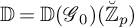 $\mathbb {D} =\mathbb {D} (\mathscr {G} {}_0)(\breve {\mathbb {Z}} {}_p)$
is the Dieudonné module of the special fibre
$\mathbb {D} =\mathbb {D} (\mathscr {G} {}_0)(\breve {\mathbb {Z}} {}_p)$
is the Dieudonné module of the special fibre $\mathscr {G} {}_0=\mathscr {G} {}_{\widetilde x}\otimes _{O_K}k$
. The existence of
$\mathscr {G} {}_0=\mathscr {G} {}_{\widetilde x}\otimes _{O_K}k$
. The existence of $\widetilde s_a$
above, together with the compatibility properties of the Breuil-Kisin functor (see for example, [Reference Kisin and PappasKP18, Thm. 3.3.2, Prop. 3.3.8]), implies that
$\widetilde s_a$
above, together with the compatibility properties of the Breuil-Kisin functor (see for example, [Reference Kisin and PappasKP18, Thm. 3.3.2, Prop. 3.3.8]), implies that $s_{a,{\text {\'{e}t}}}$
and
$s_{a,{\text {\'{e}t}}}$
and $s_{a, 0}$
correspond under the comparison isomorphism between p-adic-étale and crystalline cohomology. It also implies that the Hodge filtration on
$s_{a, 0}$
correspond under the comparison isomorphism between p-adic-étale and crystalline cohomology. It also implies that the Hodge filtration on $\mathbb {D} \otimes _{\breve {\mathbb {Z}} {}_p}K$
which corresponds to the deformation
$\mathbb {D} \otimes _{\breve {\mathbb {Z}} {}_p}K$
which corresponds to the deformation $\mathscr {G} {}_{\widetilde x}$
is induced by a G-cocharacter. The above compatibility of the
$\mathscr {G} {}_{\widetilde x}$
is induced by a G-cocharacter. The above compatibility of the ${\mathcal {G}} $
-Breuil-Kisin module
${\mathcal {G}} $
-Breuil-Kisin module $\mathscr {P} {}_{\mathrm {BK}}$
with the initial
$\mathscr {P} {}_{\mathrm {BK}}$
with the initial $({\mathcal {G}}, \mu )$
-shtuka
$({\mathcal {G}}, \mu )$
-shtuka $(\mathscr {P} {}_{\bar x}, \phi _{\mathscr {P} {}_{\bar x}})$
implies that this cocharacter is conjugate to
$(\mathscr {P} {}_{\bar x}, \phi _{\mathscr {P} {}_{\bar x}})$
implies that this cocharacter is conjugate to $\mu ^{-1}$
.
$\mu ^{-1}$
.
The conditions a) and b) of Proposition 7.1.3 are now satisfied for $\widetilde x^*$
(the p-divisible group
$\widetilde x^*$
(the p-divisible group $\mathscr {G} {}_{\widetilde x}$
is ‘
$\mathscr {G} {}_{\widetilde x}$
is ‘ $({\mathcal {G}}, \mu ^{-1})$
-adapted’, in the terminology of [Reference Kisin and ZhouKZ21]). It follows that the morphism
$({\mathcal {G}}, \mu ^{-1})$
-adapted’, in the terminology of [Reference Kisin and ZhouKZ21]). It follows that the morphism $\widetilde x^*: R_E\to O_K$
inducing
$\widetilde x^*: R_E\to O_K$
inducing $\mathscr {G} {}_{\widetilde x}$
factors through
$\mathscr {G} {}_{\widetilde x}$
factors through $R_G\to O_K$
. This gives a K-valued point of
$R_G\to O_K$
. This gives a K-valued point of $\mathrm{Spf}(R_G)^{\mathrm {rig}}$
and hence x belongs to
$\mathrm{Spf}(R_G)^{\mathrm {rig}}$
and hence x belongs to $\mathrm{Spf}(R_G)^{\mathrm {rig}}(K)$
.
$\mathrm{Spf}(R_G)^{\mathrm {rig}}(K)$
.
Now $( {\mathcal {M}}^{\mathrm {int}}_{/x_0})_\eta $
and
$( {\mathcal {M}}^{\mathrm {int}}_{/x_0})_\eta $
and $\mathrm{Spf}(R_G)^{\mathrm {rig}}$
are both smooth rigid analytic spaces over
$\mathrm{Spf}(R_G)^{\mathrm {rig}}$
are both smooth rigid analytic spaces over ${\mathrm {Sp}}(\breve E)$
of the same dimension, both closed in
${\mathrm {Sp}}(\breve E)$
of the same dimension, both closed in $\mathrm{Spf}(R)^{\mathrm {rig}}_{\breve E}$
. Since
$\mathrm{Spf}(R)^{\mathrm {rig}}_{\breve E}$
. Since $R_G$
is normal,
$R_G$
is normal, $\mathrm{Spf}(R_G)^{\mathrm {rig}}$
is connected, cf. [Reference de JongdeJ95, Lem. 7.3.5]. From Proposition 7.1.4 it now follows that, under our identifications,
$\mathrm{Spf}(R_G)^{\mathrm {rig}}$
is connected, cf. [Reference de JongdeJ95, Lem. 7.3.5]. From Proposition 7.1.4 it now follows that, under our identifications,
 $$ \begin{align} ( {\mathcal{M}}^{\mathrm{int}}_{/x_0})_\eta=\mathrm{Spf}(R_G)^{\mathrm{rig}}. \end{align} $$
Let us now complete the proof. Both $\mathrm{Spd}(R_G)\hookrightarrow \mathrm{Spd}(R_E)$
and
$\mathrm{Spd}(R_G)\hookrightarrow \mathrm{Spd}(R_E)$
and $ {\mathcal {M}}^{\mathrm {int}}_{/x_0}\hookrightarrow \mathrm{Spd}(R_E)$
are closed immersions of v-sheaves. By Proposition 4.2.1 (b) and [Reference Pappas and RapoportPR24, Prop. 3.4.9],
$ {\mathcal {M}}^{\mathrm {int}}_{/x_0}\hookrightarrow \mathrm{Spd}(R_E)$
are closed immersions of v-sheaves. By Proposition 4.2.1 (b) and [Reference Pappas and RapoportPR24, Prop. 3.4.9], $( {\mathcal {M}}^{\mathrm {int}}_{/x_0})_\eta $
is ‘topologically flat’, i.e.,
$( {\mathcal {M}}^{\mathrm {int}}_{/x_0})_\eta $
is ‘topologically flat’, i.e., $|( {\mathcal {M}}^{\mathrm {int}}_{/x_0})_\eta |$
is dense in
$|( {\mathcal {M}}^{\mathrm {int}}_{/x_0})_\eta |$
is dense in $| {\mathcal {M}}^{\mathrm {int}}_{/x_0}|$
. Similarly,
$| {\mathcal {M}}^{\mathrm {int}}_{/x_0}|$
. Similarly, $\mathrm{Spd}(R_G)$
is topologically flat by [Reference Pappas and RapoportPR24, Lem. 3.4.2]. Since by (7.1.8),
$\mathrm{Spd}(R_G)$
is topologically flat by [Reference Pappas and RapoportPR24, Lem. 3.4.2]. Since by (7.1.8), $|( {\mathcal {M}}^{\mathrm {int}}_{/x_0})_\eta |=|\mathrm{Spd}(R_G)_\eta |$
, we deduce that
$|( {\mathcal {M}}^{\mathrm {int}}_{/x_0})_\eta |=|\mathrm{Spd}(R_G)_\eta |$
, we deduce that $| {\mathcal {M}}^{\mathrm {int}}_{/x_0}|=|\mathrm{Spd}(R_G)|$
. Hence, by [Reference Scholze and WeinsteinSW20, Lem. 17.4.1], comp. also [Reference ScholzeSch17, Prop. 12.15 (iii)], we have
$| {\mathcal {M}}^{\mathrm {int}}_{/x_0}|=|\mathrm{Spd}(R_G)|$
. Hence, by [Reference Scholze and WeinsteinSW20, Lem. 17.4.1], comp. also [Reference ScholzeSch17, Prop. 12.15 (iii)], we have
 $$\begin{align*}{\mathcal{M}}^{\mathrm{int}}_{/x_0}=\mathrm{Spd}(R_G), \end{align*}$$
under the identification of $\mathrm{Spd}(R_E)$
with
$\mathrm{Spd}(R_E)$
with $ {\mathcal M}^{\mathrm {int}}_{\mathrm {GL}(\Lambda ), \iota (b),\mu _d /\iota (x_0)}\times _{\mathrm{Spd}(W)}\mathrm{Spd}(O)$
induced by
$ {\mathcal M}^{\mathrm {int}}_{\mathrm {GL}(\Lambda ), \iota (b),\mu _d /\iota (x_0)}\times _{\mathrm{Spd}(W)}\mathrm{Spd}(O)$
induced by $\mathscr {G} {}^{\mathrm {univ}}$
. (Compare to the argument in the proof of Prop. 5.3.1, case (i).)
$\mathscr {G} {}^{\mathrm {univ}}$
. (Compare to the argument in the proof of Prop. 5.3.1, case (i).)
Remark 7.1.5. In [Reference Kisin and PappasKP18, §§3.2, 3.3], there is always the blanket assumption that G splits over a tamely ramified extension of $\mathbb {Q} {}_p$
. This is because essential use is made of ‘purity’ of
$\mathbb {Q} {}_p$
. This is because essential use is made of ‘purity’ of ${\mathcal {G}} {}^o$
-torsors over
${\mathcal {G}} {}^o$
-torsors over $\operatorname {\mbox {Spec }}(W(k)[[u]])\setminus \{(u,p)\}$
which was shown in [Reference Kisin and PappasKP18, Prop. 1.4.3] under this tameness hypothesis on G. This purity is now proven in all cases by Anschütz [Reference AnschützAn22]. With this additional ingredient, the proofs go through, see [Reference Kisin and ZhouKZ21], [Reference Kisin, Pappas and ZhouKPZ24]. Note that when G is essentially tamely ramified, then in [Reference Pappas and RapoportPR24, §5] there is a simpler proof of the purity statement in question.
$\operatorname {\mbox {Spec }}(W(k)[[u]])\setminus \{(u,p)\}$
which was shown in [Reference Kisin and PappasKP18, Prop. 1.4.3] under this tameness hypothesis on G. This purity is now proven in all cases by Anschütz [Reference AnschützAn22]. With this additional ingredient, the proofs go through, see [Reference Kisin and ZhouKZ21], [Reference Kisin, Pappas and ZhouKPZ24]. Note that when G is essentially tamely ramified, then in [Reference Pappas and RapoportPR24, §5] there is a simpler proof of the purity statement in question.
7.2 Reduction to the (very) good Hodge type case
Proposition 7.2.1. Let $(G, b, \mu )$
be a local Shimura datum of abelian type and
$(G, b, \mu )$
be a local Shimura datum of abelian type and $p> 2$
. Let
$p> 2$
. Let ${\mathcal {G}} $
be a quasi-parahoric group scheme of G and let
${\mathcal {G}} $
be a quasi-parahoric group scheme of G and let $\mathbf {x}$
be a point in the building
$\mathbf {x}$
be a point in the building $\mathscr {B} {}^e(G,\mathbb {Q} {}_p)$
such that
$\mathscr {B} {}^e(G,\mathbb {Q} {}_p)$
such that ${\mathcal {G}} {}^\circ ={\mathcal {G}} {}_{\mathbf {x}}^\circ \subset {\mathcal {G}} \subset {\mathcal {G}} {}_{\mathbf {x}}$
. Write
${\mathcal {G}} {}^\circ ={\mathcal {G}} {}_{\mathbf {x}}^\circ \subset {\mathcal {G}} \subset {\mathcal {G}} {}_{\mathbf {x}}$
. Write
 $$ \begin{align} (G_{\mathrm{ad}}, \mu_{\mathrm{ad}})\simeq \prod_{i=1}^m (\mathrm{Res}_{F_i/\mathbb{Q} {}_p} H_i, \mu_i), \end{align} $$
with all $H_i$
absolutely simple. Assume that all
$H_i$
absolutely simple. Assume that all $\mu _i$
are non-trivial. Then there exists a central lift
$\mu _i$
are non-trivial. Then there exists a central lift $(G_1, b_1, \mu _1)$
of Hodge type for
$(G_1, b_1, \mu _1)$
of Hodge type for $(G, b, \mu )$
as in Definition 2.1.3 and a point
$(G, b, \mu )$
as in Definition 2.1.3 and a point $\mathbf {x}_1\in \mathscr {B} {}^e(G_1,\mathbb {Q} {}_p)$
with stabiliser group scheme
$\mathbf {x}_1\in \mathscr {B} {}^e(G_1,\mathbb {Q} {}_p)$
with stabiliser group scheme ${\mathcal {G}} {}_1={\mathcal {G}} {}_{\mathbf {x_1},1}$
, with the following properties:
${\mathcal {G}} {}_1={\mathcal {G}} {}_{\mathbf {x_1},1}$
, with the following properties:
-
1) The images of the points
$\mathbf {x}_1$
and
$\mathbf {x}$
in
$\mathscr {B} (G_{\mathrm {ad}},\mathbb {Q} {}_p)$
define the same parahoric subgroup scheme of
$G_{\mathrm {ad}}$
. -
2)
$E_1=E_{\mathrm {ad}}$
. -
3) There is an integral Hodge embedding
$({\mathcal {G}} {}_1,\mu _1)\hookrightarrow (\mathrm {GL}(\Lambda ), \mu _d)$
which satisfies (a), (b), (c) of Theorem 7.1.2 and which is very good.


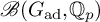



Proof. We first observe that we may assume that $G_{\mathrm {ad}}$
is
$G_{\mathrm {ad}}$
is $\mathbb {Q} {}_p$
-simple. Indeed, we can construct first
$\mathbb {Q} {}_p$
-simple. Indeed, we can construct first $(G_1, \mu _1 )$
and then
$(G_1, \mu _1 )$
and then ${\mathcal {G}} {}_1$
and the integral Hodge embedding, by taking the product over the factors in (7.2.1). From now on let
${\mathcal {G}} {}_1$
and the integral Hodge embedding, by taking the product over the factors in (7.2.1). From now on let $G_{\mathrm {ad}}=\operatorname {\mathrm {Res}}_{F/\mathbb {Q} {}_p}(H)$
, with H absolutely simple over F.
$G_{\mathrm {ad}}=\operatorname {\mathrm {Res}}_{F/\mathbb {Q} {}_p}(H)$
, with H absolutely simple over F.
We index by I the set $\{\phi _v\}_{v\in I}$
of embeddings
$\{\phi _v\}_{v\in I}$
of embeddings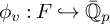 $\phi _v: F\hookrightarrow \bar {\mathbb {Q}} {}_p$
. For each
$\phi _v: F\hookrightarrow \bar {\mathbb {Q}} {}_p$
. For each $v\in I$
, we set
$v\in I$
, we set $\mathscr {D} {}_v$
for the Dynkin diagram of
$\mathscr {D} {}_v$
for the Dynkin diagram of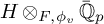 $H\otimes _{F, \phi _v}\bar {\mathbb {Q}} {}_p$
. Also write
$H\otimes _{F, \phi _v}\bar {\mathbb {Q}} {}_p$
. Also write
 $$\begin{align*}\mu: {\mathbb{G} {}_m}_{/\bar{\mathbb{Q}} {}_p}\to (\mathrm{ Res}_{F/\mathbb{Q} {}_p}H)\otimes_{\mathbb{Q} {}_p}{\bar{\mathbb{Q}} {}_p}=\prod_{v\in I} H\otimes_{F, \phi_v}\bar{\mathbb{Q}} {}_p,\quad \mu=(\mu_v)_{v\in I}. \end{align*}$$
By the arguments in [Reference DeligneDe79, 1.3.6, 1.3.8], the condition that $(G_{\mathrm {ad}}, \mu _{\mathrm {ad}})$
is of abelian type implies that for each
$(G_{\mathrm {ad}}, \mu _{\mathrm {ad}})$
is of abelian type implies that for each $v\in I$
,
$v\in I$
, $\mu _v$
is either trivial, or it corresponds to a node
$\mu _v$
is either trivial, or it corresponds to a node $s_v$
in the Dynkin diagram
$s_v$
in the Dynkin diagram $\mathscr {D} {}_v$
which is among the ‘encircled nodes’ of the diagrams displayed in the table [Reference DeligneDe79, 1.3.9]. In fact,
$\mathscr {D} {}_v$
which is among the ‘encircled nodes’ of the diagrams displayed in the table [Reference DeligneDe79, 1.3.9]. In fact, $(G_{\mathrm {ad}}, \mu _{\mathrm {ad}})$
is one of types
$(G_{\mathrm {ad}}, \mu _{\mathrm {ad}})$
is one of types $\mathbf {A}$
,
$\mathbf {A}$
, $\mathbf {B}$
,
$\mathbf {B}$
, $\mathbf {C}$
,
$\mathbf {C}$
, $\mathbf { D}^{\mathbb {R} }$
,
$\mathbf { D}^{\mathbb {R} }$
, $\mathbf {D}^{\mathbb {H} }$
as described in [Reference DeligneDe79, 2.3.8], see also [Reference SerreSe79, §3, Annexe]. For example, if
$\mathbf {D}^{\mathbb {H} }$
as described in [Reference DeligneDe79, 2.3.8], see also [Reference SerreSe79, §3, Annexe]. For example, if $n>4$
,
$n>4$
, $\mathbf {D}^{\mathbb {H} }$
means that each (non-trivial) factor is
$\mathbf {D}^{\mathbb {H} }$
means that each (non-trivial) factor is $(D_n, \omega ^\vee _n)$
or
$(D_n, \omega ^\vee _n)$
or $(D_n, \omega ^\vee _{n-1})$
and
$(D_n, \omega ^\vee _{n-1})$
and $\mathbf {D}^{\mathbb {R} }$
means that each factor is
$\mathbf {D}^{\mathbb {R} }$
means that each factor is $(D_n, \omega ^\vee _1)$
, cf. [Reference Haines, Lourenço and RicharzHLR24, §5]. Note that, by [Reference SerreSe79, §3, Cor. 2], since
$(D_n, \omega ^\vee _1)$
, cf. [Reference Haines, Lourenço and RicharzHLR24, §5]. Note that, by [Reference SerreSe79, §3, Cor. 2], since $\mu $
is not trivial, H cannot be a trialitarian form
$\mu $
is not trivial, H cannot be a trialitarian form $D_4^{(3)}$
or
$D_4^{(3)}$
or $D^{(6)}_4$
. Recall that we assume
$D^{(6)}_4$
. Recall that we assume $p>2$
. Hence, it follows that H splits over a tamely ramified extension of F.
$p>2$
. Hence, it follows that H splits over a tamely ramified extension of F.
Denote by $I_c$
the set of
$I_c$
the set of $v\in I$
for which
$v\in I$
for which $\mu _v$
is trivial and set
$\mu _v$
is trivial and set $I_{nc}=I\setminus I_c$
. Set
$I_{nc}=I\setminus I_c$
. Set
 $$\begin{align*}\mathscr{D} =\sqcup_{v\in I}\mathscr{D} {}_v. \end{align*}$$
The Galois group $\Gamma =\operatorname {\mathrm {Gal}}(\bar {\mathbb {Q}} {}_p/\mathbb {Q} {}_p)$
acts on
$\Gamma =\operatorname {\mathrm {Gal}}(\bar {\mathbb {Q}} {}_p/\mathbb {Q} {}_p)$
acts on $\mathscr {D} $
compatibly with its action on the set of embeddings I.
$\mathscr {D} $
compatibly with its action on the set of embeddings I.
By our assumption $\mu $
is not trivial, so
$\mu $
is not trivial, so $I_{nc}\neq \emptyset $
. Let
$I_{nc}\neq \emptyset $
. Let $S\subset \mathscr {D} $
be a Galois stable subset such that, for each
$S\subset \mathscr {D} $
be a Galois stable subset such that, for each $v\in I_{nc}$
,
$v\in I_{nc}$
, $S\cap \mathscr {D} {}_v=\{\underline s_v\}$
, a node in
$S\cap \mathscr {D} {}_v=\{\underline s_v\}$
, a node in $ \mathscr {D} {}_v$
from the underlined nodes in the table [Reference DeligneDe79, 1.3.9] for
$ \mathscr {D} {}_v$
from the underlined nodes in the table [Reference DeligneDe79, 1.3.9] for $(\mathscr {D} {}_v, s_v)$
.Footnote 3 A node
$(\mathscr {D} {}_v, s_v)$
.Footnote 3 A node $s\in S\cap \mathscr {D} {}_v$
gives an irreducible representation
$s\in S\cap \mathscr {D} {}_v$
gives an irreducible representation
 $$\begin{align*}\rho_{s}: G_{\mathrm{sc}, \bar{\mathbb{Q}} {}_p}\to H_{\mathrm{sc}}\otimes_{F, \phi_v}\bar{\mathbb{Q}} {}_p\to \mathrm{GL}(V(s)) \end{align*}$$
over $\bar {\mathbb {Q}} {}_p$
. Here,
$\bar {\mathbb {Q}} {}_p$
. Here, $ G_{\mathrm {sc}}$
and
$ G_{\mathrm {sc}}$
and $ H_{\mathrm {sc}}$
are the simply connected covers.
$ H_{\mathrm {sc}}$
are the simply connected covers.
If $(G_{\mathrm {ad}},\mu _{\mathrm {ad}})$
is of type
$(G_{\mathrm {ad}},\mu _{\mathrm {ad}})$
is of type $\mathbf {A}_n$
we can choose
$\mathbf {A}_n$
we can choose $\underline s_v$
, for
$\underline s_v$
, for $v\in I_{nc}$
, to be one of the two endpoint nodes; these correspond to the standard representation of
$v\in I_{nc}$
, to be one of the two endpoint nodes; these correspond to the standard representation of $H_{\mathrm {sc}}\otimes _{F, \phi _v}\bar {\mathbb {Q}} {}_p\simeq \mathrm {SL}_{n+1}$
and its dual. In fact, if
$H_{\mathrm {sc}}\otimes _{F, \phi _v}\bar {\mathbb {Q}} {}_p\simeq \mathrm {SL}_{n+1}$
and its dual. In fact, if $H\simeq \mathrm {PGL}_m(D)$
, with D a division algebra over F, then we can and will choose every
$H\simeq \mathrm {PGL}_m(D)$
, with D a division algebra over F, then we can and will choose every $\underline s_v$
, for
$\underline s_v$
, for $v\in I_{nc}$
, to be the node that corresponds to the standard representation. Then,
$v\in I_{nc}$
, to be the node that corresponds to the standard representation. Then, $\underline s_v$
is the node corresponding to the standard representation for all v. If
$\underline s_v$
is the node corresponding to the standard representation for all v. If $(G_{\mathrm {ad}},\mu _{\mathrm {ad}})$
is of type
$(G_{\mathrm {ad}},\mu _{\mathrm {ad}})$
is of type $\mathbf {D}^{\mathbb {H}} {}_n$
, then
$\mathbf {D}^{\mathbb {H}} {}_n$
, then $\underline s_v$
, for each v, is the node given by the simple endpoint of the type
$\underline s_v$
, for each v, is the node given by the simple endpoint of the type $D_n$
Dynkin diagram.
$D_n$
Dynkin diagram.
In all cases, consider
 $$\begin{align*}\bigoplus_{s\in S} V(s)^{\oplus n} \end{align*}$$
which, for sufficiently divisible n, gives a representation V of $ G_{\mathrm {sc}}$
defined over
$ G_{\mathrm {sc}}$
defined over $\mathbb {Q} {}_p$
; denote by
$\mathbb {Q} {}_p$
; denote by $V_s$
the unique irreducible factor of
$V_s$
the unique irreducible factor of $V_{\bar {\mathbb {Q}} {}_p}$
isomorphic to
$V_{\bar {\mathbb {Q}} {}_p}$
isomorphic to $V(s)^{\oplus n}$
; the Galois group
$V(s)^{\oplus n}$
; the Galois group $\Gamma $
permutes the factors
$\Gamma $
permutes the factors $V_s$
by an action compatible with its action on
$V_s$
by an action compatible with its action on $S\subset \mathscr {D} $
. There is a finite étale
$S\subset \mathscr {D} $
. There is a finite étale $\mathbb {Q} {}_p$
-algebra
$\mathbb {Q} {}_p$
-algebra $K_S$
such that
$K_S$
such that $\mathrm {Hom}_{\mathbb {Q} {}_p}(K_S, \bar {\mathbb {Q}} {}_p)\simeq S$
as
$\mathrm {Hom}_{\mathbb {Q} {}_p}(K_S, \bar {\mathbb {Q}} {}_p)\simeq S$
as $\Gamma $
-sets and so the decomposition
$\Gamma $
-sets and so the decomposition
 $$\begin{align*}V\otimes_{\mathbb{Q} {}_p}\bar{\mathbb{Q}} {}_p\simeq \bigoplus_{s\in S} V_s \end{align*}$$
is induced by a corresponding $K_S$
-module structure on V which is such that on
$K_S$
-module structure on V which is such that on $V_s$
,
$V_s$
, $K_S$
acts via the map
$K_S$
acts via the map $K_S\to \bar {\mathbb {Q}} {}_p$
that corresponds to s. Note that since
$K_S\to \bar {\mathbb {Q}} {}_p$
that corresponds to s. Note that since $S\to I$
is
$S\to I$
is $\Gamma $
-equivariant,
$\Gamma $
-equivariant, $K_S$
is naturally an F-algebra. It is a product
$K_S$
is naturally an F-algebra. It is a product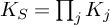 $K_S=\prod _j K_j$
of field extensions
$K_S=\prod _j K_j$
of field extensions $K_j$
of F which are all at most tamely ramified over F. The units
$K_j$
of F which are all at most tamely ramified over F. The units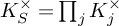 $K_S^\times =\prod _j K^\times _j$
are the points of a torus
$K_S^\times =\prod _j K^\times _j$
are the points of a torus $T'=\mathrm {Res}_{F/\mathbb {Q} {}_p} \prod _j T_j$
with
$T'=\mathrm {Res}_{F/\mathbb {Q} {}_p} \prod _j T_j$
with $T_j/F$
splitting over the tame extension
$T_j/F$
splitting over the tame extension $K_j/F$
. We have
$K_j/F$
. We have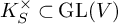 $K^\times _S\subset \mathrm {GL}(V)$
, i.e.,
$K^\times _S\subset \mathrm {GL}(V)$
, i.e.,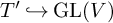 $T'\hookrightarrow \mathrm {GL}(V)$
, and this centralises the map
$T'\hookrightarrow \mathrm {GL}(V)$
, and this centralises the map $G_{\mathrm {sc}}\to \mathrm {GL}(V)$
. Denote by
$G_{\mathrm {sc}}\to \mathrm {GL}(V)$
. Denote by $ G^{\prime }_{\mathrm {sc}}$
the quotient of
$ G^{\prime }_{\mathrm {sc}}$
the quotient of $ G_{\mathrm {sc}}$
which acts faithfully on V; then
$ G_{\mathrm {sc}}$
which acts faithfully on V; then
 $$\begin{align*}G_{\mathrm{sc}}\to G^{\prime}_{\mathrm{sc}}\hookrightarrow \mathrm{GL}(V). \end{align*}$$
The group $ G^{\prime }_{\mathrm {sc}}$
is the restriction of scalars
$ G^{\prime }_{\mathrm {sc}}$
is the restriction of scalars $G^{\prime }_{\mathrm {sc}}=\mathrm {Res}_{F/\mathbb {Q} {}_p} H^{\prime }_{\mathrm {sc}}$
, with
$G^{\prime }_{\mathrm {sc}}=\mathrm {Res}_{F/\mathbb {Q} {}_p} H^{\prime }_{\mathrm {sc}}$
, with $H^{\prime }_{\mathrm {sc}}$
a quotient of
$H^{\prime }_{\mathrm {sc}}$
a quotient of $ H_{\mathrm {sc}}$
. In fact, we see that
$ H_{\mathrm {sc}}$
. In fact, we see that $ H^{\prime }_{\mathrm {sc}}= H_{\mathrm {sc}}$
in all cases, except for groups of type
$ H^{\prime }_{\mathrm {sc}}= H_{\mathrm {sc}}$
in all cases, except for groups of type $\mathbf {D}$
. In the case of type
$\mathbf {D}$
. In the case of type $\mathbf { D}$
, the kernel of
$\mathbf { D}$
, the kernel of $H_{\mathrm {sc}}\to H_{\mathrm {sc}}'$
is either trivial in type
$H_{\mathrm {sc}}\to H_{\mathrm {sc}}'$
is either trivial in type ${\mathbf{D}}_{n}^{\mathbb {R}},$
or of order
${\mathbf{D}}_{n}^{\mathbb {R}},$
or of order $2$
in type
$2$
in type $\mathbf {D}^{\mathbb {H}}_n$
. Set
$\mathbf {D}^{\mathbb {H}}_n$
. Set
 $$\begin{align*}G_1:=G^{\prime}_{\mathrm{sc}}\cdot T'\hookrightarrow \mathrm{GL}(V). \end{align*}$$
We have $G_1=\mathrm {Res}_{F/\mathbb {Q} {}_p} H_1$
, with
$G_1=\mathrm {Res}_{F/\mathbb {Q} {}_p} H_1$
, with $H_1= H_{\mathrm {sc}}'\cdot (\prod _j T_j)$
. As in [Reference DeligneDe79], we see that
$H_1= H_{\mathrm {sc}}'\cdot (\prod _j T_j)$
. As in [Reference DeligneDe79], we see that $\mu : {\mathbb {G} {}_m}_{/\bar {\mathbb {Q}} {}_p}\to (G_{{\mathrm {ad}}})_{\bar {\mathbb {Q}} {}_p}$
lifts to a fractional cocharacter
$\mu : {\mathbb {G} {}_m}_{/\bar {\mathbb {Q}} {}_p}\to (G_{{\mathrm {ad}}})_{\bar {\mathbb {Q}} {}_p}$
lifts to a fractional cocharacter $\mu '$
of
$\mu '$
of $ G^{\prime }_{\mathrm {sc}, \bar {\mathbb {Q}} {}_p}$
. The composition of this fractional cocharacter with
$ G^{\prime }_{\mathrm {sc}, \bar {\mathbb {Q}} {}_p}$
. The composition of this fractional cocharacter with $G^{\prime }_{\mathrm {sc}, \bar {\mathbb {Q}} {}_p}\hookrightarrow \mathrm {GL}(V_{\bar {\mathbb {Q}} {}_p})\to \mathrm {GL}(V_s)$
is trivial when s maps to
$G^{\prime }_{\mathrm {sc}, \bar {\mathbb {Q}} {}_p}\hookrightarrow \mathrm {GL}(V_{\bar {\mathbb {Q}} {}_p})\to \mathrm {GL}(V_s)$
is trivial when s maps to $v\in I_{c}$
, in which case we set
$v\in I_{c}$
, in which case we set $V_s=V_s(0)$
. When s maps to
$V_s=V_s(0)$
. When s maps to $v\in I_{nc}$
, then this composition has exactly two distinct weights
$v\in I_{nc}$
, then this composition has exactly two distinct weights $r_v$
and
$r_v$
and $r_v-1$
, with
$r_v-1$
, with $r_v$
as indicated in the table [Reference DeligneDe79, 1.3.9], so that
$r_v$
as indicated in the table [Reference DeligneDe79, 1.3.9], so that
 $$\begin{align*}V_s=V_s({r_v-1})\oplus V_s({r_v}). \end{align*}$$
We can now consider the direct sum decomposition of $V_{\bar {\mathbb {Q}} {}_p}$
into two summands: one,
$V_{\bar {\mathbb {Q}} {}_p}$
into two summands: one, $V_{\bar {\mathbb {Q}} {}_p}(0)$
, given as the sum of all
$V_{\bar {\mathbb {Q}} {}_p}(0)$
, given as the sum of all $V_s(0)$
and all
$V_s(0)$
and all $V_s({r_v-1})$
, and the other,
$V_s({r_v-1})$
, and the other, $V_{\bar {\mathbb {Q}} {}_p}(1)$
, given as the sum of all
$V_{\bar {\mathbb {Q}} {}_p}(1)$
, given as the sum of all $V_s(r_v)$
. This decomposition defines a cocharacter
$V_s(r_v)$
. This decomposition defines a cocharacter $\mu _1$
of
$\mu _1$
of $\mathrm {GL}(V)_{\bar {\mathbb {Q}} {}_p}$
acting by weights
$\mathrm {GL}(V)_{\bar {\mathbb {Q}} {}_p}$
acting by weights $0$
and
$0$
and $1$
on these two summands and
$1$
on these two summands and $\mu _1$
factors through
$\mu _1$
factors through $(G_1)_{\bar {\mathbb {Q}} {}_p}=(G^{\prime }_{\mathrm {sc}}\cdot T')_{\bar {\mathbb {Q}} {}_p}$
. Then
$(G_1)_{\bar {\mathbb {Q}} {}_p}=(G^{\prime }_{\mathrm {sc}}\cdot T')_{\bar {\mathbb {Q}} {}_p}$
. Then $G_1\hookrightarrow \mathrm {GL}(V)$
gives a Hodge embedding for
$G_1\hookrightarrow \mathrm {GL}(V)$
gives a Hodge embedding for $(G_1,\mu _1)$
and
$(G_1,\mu _1)$
and $(G_{{\mathrm {ad}}, 1},\mu _{{\mathrm {ad}}, 1})\simeq (G_{\mathrm {ad}}, \mu _{\mathrm {ad}})$
.
$(G_{{\mathrm {ad}}, 1},\mu _{{\mathrm {ad}}, 1})\simeq (G_{\mathrm {ad}}, \mu _{\mathrm {ad}})$
.
We will see that the above construction produces a desired $(G_1,\mu _1)$
but we also need to explain how to choose
$(G_1,\mu _1)$
but we also need to explain how to choose $\mathbf {x}_1$
and hence the corresponding stabiliser group scheme
$\mathbf {x}_1$
and hence the corresponding stabiliser group scheme ${\mathcal {G}} {}_1$
for
${\mathcal {G}} {}_1$
for $G_1$
. We let
$G_1$
. We let $\mathbf {x}_{\mathrm {ad}}$
be the point corresponding to
$\mathbf {x}_{\mathrm {ad}}$
be the point corresponding to $\mathbf {x}$
in the building
$\mathbf {x}$
in the building $\mathscr {B} (G,\mathbb {Q} {}_p)=\mathscr {B} {}^e(G_{\mathrm {ad}}, \mathbb {Q} {}_p)$
. Choose a ‘nearby’ point
$\mathscr {B} (G,\mathbb {Q} {}_p)=\mathscr {B} {}^e(G_{\mathrm {ad}}, \mathbb {Q} {}_p)$
. Choose a ‘nearby’ point $\mathbf { x}_{\mathrm {ad}}\in \mathscr {B} (G,\mathbb {Q} {}_p)$
which is generic in its facet and is such that the parahoric group schemes of
$\mathbf { x}_{\mathrm {ad}}\in \mathscr {B} (G,\mathbb {Q} {}_p)$
which is generic in its facet and is such that the parahoric group schemes of $G_{\mathrm {ad}}$
for
$G_{\mathrm {ad}}$
for $\mathbf {x}^{\prime }_{\mathrm {ad}}$
and
$\mathbf {x}^{\prime }_{\mathrm {ad}}$
and $\mathbf {x}_{\mathrm {ad}}$
coincide, i.e., have the same
$\mathbf {x}_{\mathrm {ad}}$
coincide, i.e., have the same $\breve {\mathbb {Z}} {}_p$
-points. Now lift
$\breve {\mathbb {Z}} {}_p$
-points. Now lift $\mathbf {x}^{\prime }_{\mathrm {ad}}$
to
$\mathbf {x}^{\prime }_{\mathrm {ad}}$
to $\mathbf {x}_1$
under the canonical map
$\mathbf {x}_1$
under the canonical map $\mathscr {B} {}^e(G_1, \mathbb {Q} {}_p)\to \mathscr {B} (G_{\mathrm {ad}}, \mathbb {Q} {}_p)$
. This defines the stabiliser group scheme
$\mathscr {B} {}^e(G_1, \mathbb {Q} {}_p)\to \mathscr {B} (G_{\mathrm {ad}}, \mathbb {Q} {}_p)$
. This defines the stabiliser group scheme ${\mathcal {G}} {}_1={\mathcal {G}} {}_{\mathbf {x}_1,1}$
.
${\mathcal {G}} {}_1={\mathcal {G}} {}_{\mathbf {x}_1,1}$
.
We now verify that the pair $(G_1,\mu _1)$
and the point
$(G_1,\mu _1)$
and the point $\mathbf {x}_1\in \mathscr {B} {}^e(G_1, \mathbb {Q} {}_p)$
satisfy the desired conditions (1), (2) and (3). Conditions (1) and (2) follow immediately from the construction, and it remains to explain Condition (3). This calls for the construction of a suitable integral Hodge embedding
$\mathbf {x}_1\in \mathscr {B} {}^e(G_1, \mathbb {Q} {}_p)$
satisfy the desired conditions (1), (2) and (3). Conditions (1) and (2) follow immediately from the construction, and it remains to explain Condition (3). This calls for the construction of a suitable integral Hodge embedding $\iota : ({\mathcal {G}} {}_1,\mu _1)\hookrightarrow (\mathrm {GL}(\Lambda ),\mu _d)$
; we will explain how this can be done by choosing the lattice
$\iota : ({\mathcal {G}} {}_1,\mu _1)\hookrightarrow (\mathrm {GL}(\Lambda ),\mu _d)$
; we will explain how this can be done by choosing the lattice $\Lambda $
in a representation obtained from V above.
$\Lambda $
in a representation obtained from V above.
If $(G_{\mathrm {ad}},\mu _{\mathrm {ad}})$
is of type
$(G_{\mathrm {ad}},\mu _{\mathrm {ad}})$
is of type $\mathbf {A}$
and
$\mathbf {A}$
and $H\simeq \mathrm {PGL}_m(D)$
, with D a division algebra over F, then for the above choices, V is isomorphic to a direct sum of copies of the representation of
$H\simeq \mathrm {PGL}_m(D)$
, with D a division algebra over F, then for the above choices, V is isomorphic to a direct sum of copies of the representation of ${\mathrm {SL}}_m(D)$
given by the action on
${\mathrm {SL}}_m(D)$
given by the action on $D^m$
, considered as a
$D^m$
, considered as a $\mathbb {Q} {}_p$
-vector space; this extends to a representation of
$\mathbb {Q} {}_p$
-vector space; this extends to a representation of $G_1=\operatorname {\mathrm {Res}}_{F/\mathbb {Q} {}_p}\mathrm {GL}_m(D)$
.
$G_1=\operatorname {\mathrm {Res}}_{F/\mathbb {Q} {}_p}\mathrm {GL}_m(D)$
.
If $(G_{\mathrm {ad}},\mu _{\mathrm {ad}})$
is of type
$(G_{\mathrm {ad}},\mu _{\mathrm {ad}})$
is of type $\mathbf {D}_n^{\mathbb {H}} $
, then for the above choices,
$\mathbf {D}_n^{\mathbb {H}} $
, then for the above choices, $G_1=\operatorname {\mathrm {Res}}_{F/\mathbb {Q} {}_p}H_1$
, with
$G_1=\operatorname {\mathrm {Res}}_{F/\mathbb {Q} {}_p}H_1$
, with $H_1$
the neutral component of an orthogonal similitude group over F and V is isomorphic to the restriction of scalars of its standard representation. More precisely, as in [Reference Pappas and ZhuPZ13, §5.3.8], [Reference TitsT79], we see that
$H_1$
the neutral component of an orthogonal similitude group over F and V is isomorphic to the restriction of scalars of its standard representation. More precisely, as in [Reference Pappas and ZhuPZ13, §5.3.8], [Reference TitsT79], we see that $H_1$
and V are as in one of the following cases:
$H_1$
and V are as in one of the following cases:
a) There is an F-vector space $V'\simeq F^{2n}$
and a perfect symmetric F-bilinear
$V'\simeq F^{2n}$
and a perfect symmetric F-bilinear $h': V'\times V'\to F$
such that
$h': V'\times V'\to F$
such that $H_1=\mathrm {GO}^+(V', h')$
where, as usual, for an F-algebra R,
$H_1=\mathrm {GO}^+(V', h')$
where, as usual, for an F-algebra R,
 $$\begin{align*}\mathrm{GO}(V', h')(R)=\{ \mathrm{GL}_{R}(V'\otimes_F R)\ |\ h'( gw, gw')=c(g)\psi(w, w'), \ c(g)\in R^\times\}, \end{align*}$$
and ${}^+$
signifies taking the neutral component. Then the representation space V is a direct sum of copies of
${}^+$
signifies taking the neutral component. Then the representation space V is a direct sum of copies of $V'$
considered as an
$V'$
considered as an $\mathbb {Q} {}_p$
-vector space by restriction of scalars.
$\mathbb {Q} {}_p$
-vector space by restriction of scalars.
b) There is a (left) D-module $W\simeq D^n$
for a division quaternion F-algebra D and a non-degenerate anti-Hermitian form
$W\simeq D^n$
for a division quaternion F-algebra D and a non-degenerate anti-Hermitian form $\phi : W\times W\to D$
for the main involution on D, such that
$\phi : W\times W\to D$
for the main involution on D, such that $H_1=\mathrm {GU}^+(W, \phi )$
, where
$H_1=\mathrm {GU}^+(W, \phi )$
, where $\mathrm {GU}(W, \phi )$
is a unitary similitude group defined as follows: Consider the alternating F-bilinear form
$\mathrm {GU}(W, \phi )$
is a unitary similitude group defined as follows: Consider the alternating F-bilinear form $\psi : W\times W\to F$
given by
$\psi : W\times W\to F$
given by
 $$\begin{align*}\psi(w_1, w_2)=\mathrm{Tr}^0(\phi(w_1, w_2)). \end{align*}$$
where $\mathrm {Tr}^0: D\to F$
is the reduced trace (cf. [Reference Pappas and ZhuPZ13, §5.3.8], [Reference Rapoport and ZinkRZ96, Prop. A.53], applied to
$\mathrm {Tr}^0: D\to F$
is the reduced trace (cf. [Reference Pappas and ZhuPZ13, §5.3.8], [Reference Rapoport and ZinkRZ96, Prop. A.53], applied to $n=1$
.) For an F-algebra R,
$n=1$
.) For an F-algebra R,
 $$\begin{align*}\mathrm{GU}(W, \phi)(R)=\{ \mathrm{GL}_{D\otimes_F R}(W)\ |\ \psi( gw, gw')=c(g)\psi(w, w'), \ c(g)\in R^\times\}. \end{align*}$$
The representation space V is a direct sum of copies of W considered as a $\mathbb {Q} {}_p$
-vector space of dimension
$\mathbb {Q} {}_p$
-vector space of dimension $4n$
by restriction of scalars.
$4n$
by restriction of scalars.
The existence of an integral Hodge embedding $\iota : ({\mathcal {G}} {}_1,\mu _1)\hookrightarrow (\mathrm {GL}(\Lambda ),\mu _d)$
satisfying (a), (b) and (c) of Theorem 7.1.2 and which is very good now follows from [Reference Kisin, Pappas and ZhouKPZ24, §6]: see [Reference Kisin, Pappas and ZhouKPZ24, Thm. 6.1.1] (for ‘non-exceptional cases’, see loc. cit. Remark 6.1.10) and [Reference Kisin, Pappas and ZhouKPZ24, Thm. 6.3.2] (for the remaining cases of type
$\iota : ({\mathcal {G}} {}_1,\mu _1)\hookrightarrow (\mathrm {GL}(\Lambda ),\mu _d)$
satisfying (a), (b) and (c) of Theorem 7.1.2 and which is very good now follows from [Reference Kisin, Pappas and ZhouKPZ24, §6]: see [Reference Kisin, Pappas and ZhouKPZ24, Thm. 6.1.1] (for ‘non-exceptional cases’, see loc. cit. Remark 6.1.10) and [Reference Kisin, Pappas and ZhouKPZ24, Thm. 6.3.2] (for the remaining cases of type ${\mathbf A}$
), and [Reference Kisin, Pappas and ZhouKPZ24, Thm. 6.2.3] (for type
${\mathbf A}$
), and [Reference Kisin, Pappas and ZhouKPZ24, Thm. 6.2.3] (for type ${\mathbf D}^{\mathbb {H}}_{n}$
). In all cases,
${\mathbf D}^{\mathbb {H}}_{n}$
). In all cases, $\Lambda =\oplus _{i=1}^r\Lambda _i\subset V^{\oplus r}$
is a lattice in a direct sum of r copies of the representation V as given above, for some
$\Lambda =\oplus _{i=1}^r\Lambda _i\subset V^{\oplus r}$
is a lattice in a direct sum of r copies of the representation V as given above, for some $r\geq 1$
. The lattice
$r\geq 1$
. The lattice $\Lambda $
is obtained by summing up lattices
$\Lambda $
is obtained by summing up lattices $\Lambda _i\subset V$
in a suitable lattice chain in V.
$\Lambda _i\subset V$
in a suitable lattice chain in V.
8 Proofs of Theorems 2.5.5 and 2.5.4
In this section we prove our main theorems. We treat the cases (A) and (B) separately.
8.1 Proof of Theorem 2.5.5 in case (A)
Let $(G, b, \mu )$
be of abelian type and of type (A), and let
$(G, b, \mu )$
be of abelian type and of type (A), and let ${\mathcal {G}} $
be quasi-parahoric. Write
${\mathcal {G}} $
be quasi-parahoric. Write $(G_{\mathrm {ad}},b_{\mathrm {ad}}, \mu _{\mathrm {ad}})= \prod _i(\mathrm {Res}_{F_i/\mathbb {Q} {}_p}H_i, b_i, \mu _i)$
, where
$(G_{\mathrm {ad}},b_{\mathrm {ad}}, \mu _{\mathrm {ad}})= \prod _i(\mathrm {Res}_{F_i/\mathbb {Q} {}_p}H_i, b_i, \mu _i)$
, where $H_i$
is absolutely simple. We split
$H_i$
is absolutely simple. We split $(G_{\mathrm {ad}},b_{\mathrm {ad}}, \mu _{\mathrm {ad}})$
into the product of two factors: in the first factor we lump together all components
$(G_{\mathrm {ad}},b_{\mathrm {ad}}, \mu _{\mathrm {ad}})$
into the product of two factors: in the first factor we lump together all components $(\mathrm {Res}_{F_i/\mathbb {Q} {}_p}H_i, b_i, \mu _i)$
where
$(\mathrm {Res}_{F_i/\mathbb {Q} {}_p}H_i, b_i, \mu _i)$
where $\mu _i$
is trivial, and in the second factor we lump together all components
$\mu _i$
is trivial, and in the second factor we lump together all components $(\mathrm {Res}_{F_i/\mathbb {Q} {}_p}H_i, b_i, \mu _i)$
where
$(\mathrm {Res}_{F_i/\mathbb {Q} {}_p}H_i, b_i, \mu _i)$
where $\mu _i$
is non-trivial. Let us first assume that the first factor is trivial.
$\mu _i$
is non-trivial. Let us first assume that the first factor is trivial.
Write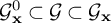 ${\mathcal {G}} {}_{\mathbf {x}}^0\subset {\mathcal {G}} \subset {\mathcal {G}} {}_{\mathbf {x}}$
, with
${\mathcal {G}} {}_{\mathbf {x}}^0\subset {\mathcal {G}} \subset {\mathcal {G}} {}_{\mathbf {x}}$
, with ${\mathcal {G}} {}_{\mathbf {x}}(\breve {\mathbb {Z}} {}_p)$
the stabiliser in
${\mathcal {G}} {}_{\mathbf {x}}(\breve {\mathbb {Z}} {}_p)$
the stabiliser in $G(\breve {\mathbb {Q}} {}_p)$
of a point
$G(\breve {\mathbb {Q}} {}_p)$
of a point $\bf x$
in the extended building
$\bf x$
in the extended building $\mathscr {B} {}^e(G, \mathbb {Q} {}_p)$
of
$\mathscr {B} {}^e(G, \mathbb {Q} {}_p)$
of $G(\mathbb {Q} {}_p)$
. Using Proposition 7.2.1 we construct
$G(\mathbb {Q} {}_p)$
. Using Proposition 7.2.1 we construct $(G_1, b_1,\mu _1)$
of Hodge type with
$(G_1, b_1,\mu _1)$
of Hodge type with ${\mathcal {G}} {}_1$
a stabiliser group scheme of
${\mathcal {G}} {}_1$
a stabiliser group scheme of $G_1$
such that there is a (very good) integral Hodge embedding
$G_1$
such that there is a (very good) integral Hodge embedding
 $$\begin{align*}({\mathcal{G}} {}_1,\mu_1)\hookrightarrow (\mathrm{GL}(\Lambda),\mu_d) \end{align*}$$
satisfying all the conditions of Theorem 7.1.2. By the construction, we have a group scheme homomorphism ${\mathcal {G}} {}_1\to {\mathcal {G}} {}^{\prime }_{\mathrm {ad}}:={\mathcal {G}} {}_{{\mathrm {ad}}, \mathbf {x}^{\prime }_{\mathrm {ad}}}$
extending
${\mathcal {G}} {}_1\to {\mathcal {G}} {}^{\prime }_{\mathrm {ad}}:={\mathcal {G}} {}_{{\mathrm {ad}}, \mathbf {x}^{\prime }_{\mathrm {ad}}}$
extending $ G_1\to G_{\mathrm {ad}}$
. We similarly have
$ G_1\to G_{\mathrm {ad}}$
. We similarly have ${\mathcal {G}} \to {\mathcal {G}} {}_{\mathrm {ad}}:={\mathcal {G}} {}_{{\mathrm {ad}}, \mathbf {x}_{\mathrm {ad}}}$
, giving
${\mathcal {G}} \to {\mathcal {G}} {}_{\mathrm {ad}}:={\mathcal {G}} {}_{{\mathrm {ad}}, \mathbf {x}_{\mathrm {ad}}}$
, giving $G\to G_{\mathrm {ad}}$
. Note
$G\to G_{\mathrm {ad}}$
. Note ${\mathcal {G}} {}^\circ _{{\mathrm {ad}}}={\mathcal {G}} {}^{\prime \circ }_{{\mathrm {ad}}}$
.
${\mathcal {G}} {}^\circ _{{\mathrm {ad}}}={\mathcal {G}} {}^{\prime \circ }_{{\mathrm {ad}}}$
.
First note the natural isomorphisms
 $$ \begin{align} \mathbb{M} {}^{\mathrm{loc}}_{{\mathcal{G}} , \mu}\simeq \mathbb{M} {}^{\mathrm{loc}}_{{\mathcal{G}} {}_{\mathrm{ad}}, \mu_{\mathrm{ad}}} \times_{\operatorname{\mbox{Spec }}(O_{\mathrm{ad}})}\operatorname{\mbox{Spec }}(O)\simeq \mathbb{M} {}^{\mathrm{loc}}_{{\mathcal{G}} {}_1, \mu_1} \times_{\operatorname{\mbox{Spec }}(O_1)}\operatorname{\mbox{Spec }}(O) \end{align} $$
obtained from [Reference Scholze and WeinsteinSW20, Prop. 21.5.1], and $ \mathbb {M} {}^{\mathrm {loc}}_{{\mathcal {G}} {}^\circ _1, \mu _1}\simeq \mathbb {M} {}^{\mathrm {loc}}_{{\mathcal {G}} {}_1, \mu _1}$
,
$ \mathbb {M} {}^{\mathrm {loc}}_{{\mathcal {G}} {}^\circ _1, \mu _1}\simeq \mathbb {M} {}^{\mathrm {loc}}_{{\mathcal {G}} {}_1, \mu _1}$
,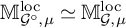 $ \mathbb {M} {}^{\mathrm {loc}}_{{\mathcal {G}} {}^\circ , \mu }\simeq \mathbb {M} {}^{\mathrm {loc}}_{{\mathcal {G}}, \mu }$
, from [Reference Scholze and WeinsteinSW20, Prop. 21.4.3]. These induce isomorphisms of corresponding formal completions.
$ \mathbb {M} {}^{\mathrm {loc}}_{{\mathcal {G}} {}^\circ , \mu }\simeq \mathbb {M} {}^{\mathrm {loc}}_{{\mathcal {G}}, \mu }$
, from [Reference Scholze and WeinsteinSW20, Prop. 21.4.3]. These induce isomorphisms of corresponding formal completions.
We now apply Theorem 7.1.2 to $({\mathcal {G}} {}_1, b_1, \mu _1)$
and obtain, for each
$({\mathcal {G}} {}_1, b_1, \mu _1)$
and obtain, for each $x_1\in \mathcal {M} {}^{\mathrm {int}}_{{\mathcal {G}} {}_1, b_1, \mu _1} (\mathrm{Spd}(k))$
, an isomorphism
$x_1\in \mathcal {M} {}^{\mathrm {int}}_{{\mathcal {G}} {}_1, b_1, \mu _1} (\mathrm{Spd}(k))$
, an isomorphism
 $$\begin{align*}\mathcal{M} {}^{\mathrm{int}}_{{\mathcal{G}} {}_1, b_1, \mu_1 /x_1} \simeq ( \mathbb{M} {}^{\mathrm{loc}}_{{\mathcal{G}} {}_1,\mu_1 /y_1})^{\Diamond}, \end{align*}$$
where $y_1$
is a corresponding point in
$y_1$
is a corresponding point in $\mathbb {M} {}^{\mathrm {loc}}_{{\mathcal {G}} {}_1,\mu _1}(k)\simeq \mathbb {M} {}^{\mathrm {loc}}_{{\mathcal {G}} {}^\circ _1,\mu _1}(k)$
whose
$\mathbb {M} {}^{\mathrm {loc}}_{{\mathcal {G}} {}_1,\mu _1}(k)\simeq \mathbb {M} {}^{\mathrm {loc}}_{{\mathcal {G}} {}^\circ _1,\mu _1}(k)$
whose ${\mathcal {G}} {}_1(k)$
-orbit
${\mathcal {G}} {}_1(k)$
-orbit $\ell (x_1)$
is well-defined and determined by
$\ell (x_1)$
is well-defined and determined by $x_1$
, see (3.4.2). It then follows from Proposition 4.2.1 (b) that, for
$x_1$
, see (3.4.2). It then follows from Proposition 4.2.1 (b) that, for $x_1\in \mathcal {M} {}^{\mathrm {int}}_{{\mathcal {G}} {}^\circ _1, b_1, \mu _1}(\mathrm{Spd}(k))$
, we also have
$x_1\in \mathcal {M} {}^{\mathrm {int}}_{{\mathcal {G}} {}^\circ _1, b_1, \mu _1}(\mathrm{Spd}(k))$
, we also have
 $$\begin{align*}\mathcal{M} {}^{\mathrm{int}}_{{\mathcal{G}} {}^\circ_1, b_1, \mu_1 /x_1} \simeq ( \mathbb{M} {}^{\mathrm{loc}}_{{\mathcal{G}} {}^\circ_1,\mu_1 /y_1})^{\Diamond}. \end{align*}$$
On the other hand, Proposition 5.3.1 applied to the map $({\mathcal {G}} {}^\circ _1, b_1, \mu _1)\to ({\mathcal {G}} {}^{\prime \circ }_{\mathrm {ad}}, b_{\mathrm {ad}}, \mu _{\mathrm {ad}})$
induced by
$({\mathcal {G}} {}^\circ _1, b_1, \mu _1)\to ({\mathcal {G}} {}^{\prime \circ }_{\mathrm {ad}}, b_{\mathrm {ad}}, \mu _{\mathrm {ad}})$
induced by ${\mathcal {G}} {}_1\to {\mathcal {G}} {}^{\prime }_{\mathrm {ad}}$
, gives
${\mathcal {G}} {}_1\to {\mathcal {G}} {}^{\prime }_{\mathrm {ad}}$
, gives
 $$\begin{align*}\mathcal{M} {}^{\mathrm{int}}_{{\mathcal{G}} {}^\circ_1, b_1, \mu_1 /x_1} \xrightarrow{\sim} \mathcal{M} {}^{\mathrm{int}}_{{\mathcal{G}} {}^{\prime\circ}_{\mathrm{ad}}, b_{\mathrm{ad}}, \mu_{\mathrm{ad}} /x^{\prime}_1}= \mathcal{M} {}^{\mathrm{ int}}_{{\mathcal{G}} {}^\circ_{\mathrm{ad}}, b_{\mathrm{ad}}, \mu_{\mathrm{ad}} /x^{\prime}_1}, \end{align*}$$
where $x^{\prime }_1$
is the image of
$x^{\prime }_1$
is the image of $x_1$
. Here, the last equality follows from
$x_1$
. Here, the last equality follows from ${\mathcal {G}} {}^\circ _{{\mathrm {ad}}}={\mathcal {G}} {}^{\prime \circ }_{{\mathrm {ad}}}$
. Combining these we obtain isomorphisms,
${\mathcal {G}} {}^\circ _{{\mathrm {ad}}}={\mathcal {G}} {}^{\prime \circ }_{{\mathrm {ad}}}$
. Combining these we obtain isomorphisms,
 $$ \begin{align} \mathcal{M} {}^{\mathrm{int}}_{{\mathcal{G}} {}^\circ_{\mathrm{ad}}, b_{\mathrm{ad}}, \mu_{\mathrm{ad}} /x^{\prime}_1}\simeq (\mathbb{M} {}^{\mathrm{loc}}_{{\mathcal{G}} , \mu/y^{\prime}_1})^{\Diamond}\simeq (\mathbb{M} {}^{\mathrm{loc}}_{{\mathcal{G}} {}^\circ_{\mathrm{ad}}, \mu_{\mathrm{ad}} /y_{\mathrm{ad}}})^{\Diamond}, \end{align} $$
for all points $x^{\prime }_1$
of
$x^{\prime }_1$
of $\mathcal {M} {}^{\mathrm {int}}_{{\mathcal {G}} {}^\circ _{\mathrm {ad}}, b_{\mathrm {ad}}, \mu _{\mathrm {ad}}}(\mathrm{Spd}(k))$
which are in the image of
$\mathcal {M} {}^{\mathrm {int}}_{{\mathcal {G}} {}^\circ _{\mathrm {ad}}, b_{\mathrm {ad}}, \mu _{\mathrm {ad}}}(\mathrm{Spd}(k))$
which are in the image of $ \mathcal {M} {}^{\mathrm {int}}_{{\mathcal {G}} {}^\circ _1, b_1, \mu _1}(\mathrm{Spd}(k))$
under the natural map induced by
$ \mathcal {M} {}^{\mathrm {int}}_{{\mathcal {G}} {}^\circ _1, b_1, \mu _1}(\mathrm{Spd}(k))$
under the natural map induced by ${\mathcal {G}} {}^\circ _1\to {\mathcal {G}} {}^\circ _{\mathrm {ad}}$
. Here,
${\mathcal {G}} {}^\circ _1\to {\mathcal {G}} {}^\circ _{\mathrm {ad}}$
. Here, $y^{\prime }_1$
and
$y^{\prime }_1$
and $y_{\mathrm {ad}}$
correspond to
$y_{\mathrm {ad}}$
correspond to $y_1$
above under the isomorphisms given by (8.1.1). By §5.4, this set of points of
$y_1$
above under the isomorphisms given by (8.1.1). By §5.4, this set of points of $\mathcal {M} {}^{\mathrm {int}}_{{\mathcal {G}} {}^\circ _{\mathrm {ad}}, b_{\mathrm {ad}}, \mu _{\mathrm {ad}}}(\mathrm{Spd}(k))$
is the set of
$\mathcal {M} {}^{\mathrm {int}}_{{\mathcal {G}} {}^\circ _{\mathrm {ad}}, b_{\mathrm {ad}}, \mu _{\mathrm {ad}}}(\mathrm{Spd}(k))$
is the set of $\mathrm{Spd}(k)$
-points of a union of ‘components’
$\mathrm{Spd}(k)$
-points of a union of ‘components’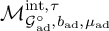 $\mathcal {M} {}^{\mathrm {int,\tau }}_{{\mathcal {G}} {}^\circ _{\mathrm {ad}}, b_{\mathrm {ad}}, \mu _{\mathrm {ad}}}$
, for a certain set of
$\mathcal {M} {}^{\mathrm {int,\tau }}_{{\mathcal {G}} {}^\circ _{\mathrm {ad}}, b_{\mathrm {ad}}, \mu _{\mathrm {ad}}}$
, for a certain set of $\tau $
. Using Proposition 4.4.3 applied to
$\tau $
. Using Proposition 4.4.3 applied to $G_{\mathrm {ad}}$
and the fact that the map
$G_{\mathrm {ad}}$
and the fact that the map $\ell $
of (3.4.2) is constant on each
$\ell $
of (3.4.2) is constant on each $J_b(\mathbb {Q} {}_p)$
-orbit, we see that the same conclusion, i.e., the isomorphism (8.1.2), follows for points in all components of
$J_b(\mathbb {Q} {}_p)$
-orbit, we see that the same conclusion, i.e., the isomorphism (8.1.2), follows for points in all components of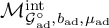 $\mathcal {M} {}^{\mathrm {int}}_{{\mathcal {G}} {}^\circ _{\mathrm {ad}}, b_{\mathrm {ad}}, \mu _{\mathrm {ad}}}$
and, therefore, for all points in
$\mathcal {M} {}^{\mathrm {int}}_{{\mathcal {G}} {}^\circ _{\mathrm {ad}}, b_{\mathrm {ad}}, \mu _{\mathrm {ad}}}$
and, therefore, for all points in $\mathcal {M} {}^{\mathrm {int}}_{{\mathcal {G}} {}^\circ _{\mathrm {ad}}, b_{\mathrm {ad}}, \mu _{\mathrm {ad}}}(\mathrm{Spd}(k))$
. We obtain that Theorem 2.5.5 holds for
$\mathcal {M} {}^{\mathrm {int}}_{{\mathcal {G}} {}^\circ _{\mathrm {ad}}, b_{\mathrm {ad}}, \mu _{\mathrm {ad}}}(\mathrm{Spd}(k))$
. We obtain that Theorem 2.5.5 holds for $(G_{\mathrm {ad}}, b_{\mathrm {ad}},\mu _{\mathrm {ad}})$
and all parahoric subgroups of
$(G_{\mathrm {ad}}, b_{\mathrm {ad}},\mu _{\mathrm {ad}})$
and all parahoric subgroups of $G_{\mathrm {ad}}$
. Therefore, by the argument in the proof of Theorem 4.1.1 (which uses Theorem 4.4.1), the result also holds for
$G_{\mathrm {ad}}$
. Therefore, by the argument in the proof of Theorem 4.1.1 (which uses Theorem 4.4.1), the result also holds for $(G_{\mathrm {ad}}, b_{\mathrm {ad}},\mu _{\mathrm {ad}})$
and all quasi-parahoric subgroups of
$(G_{\mathrm {ad}}, b_{\mathrm {ad}},\mu _{\mathrm {ad}})$
and all quasi-parahoric subgroups of $G_{\mathrm {ad}}$
. In particular, it holds for
$G_{\mathrm {ad}}$
. In particular, it holds for ${\mathcal {G}} {}_{\mathrm {ad}}$
. Theorem 2.5.5 for
${\mathcal {G}} {}_{\mathrm {ad}}$
. Theorem 2.5.5 for $(G,b,\mu )$
,
$(G,b,\mu )$
, ${\mathcal {G}} $
and
${\mathcal {G}} $
and $x\in \mathcal {M} {}^{\mathrm {int}}_{{\mathcal {G}}, b, \mu }(\mathrm{Spd}(k))$
now follows from the above combined with Proposition 5.3.1 applied to
$x\in \mathcal {M} {}^{\mathrm {int}}_{{\mathcal {G}}, b, \mu }(\mathrm{Spd}(k))$
now follows from the above combined with Proposition 5.3.1 applied to $({\mathcal {G}}, b, \mu )\to ({\mathcal {G}} {}_{\mathrm {ad}}, b_{\mathrm {ad}}, \mu _{\mathrm {ad}})$
and (8.1.1).
$({\mathcal {G}}, b, \mu )\to ({\mathcal {G}} {}_{\mathrm {ad}}, b_{\mathrm {ad}}, \mu _{\mathrm {ad}})$
and (8.1.1).
This concludes the proof of Theorem 2.5.5 when the first factor of $(G_{\mathrm {ad}},b_{\mathrm {ad}}, \mu _{\mathrm {ad}})$
is trivial.
$(G_{\mathrm {ad}},b_{\mathrm {ad}}, \mu _{\mathrm {ad}})$
is trivial.
Now let us consider the general adjoint case. Using the compatibility of $\mathcal {M} {}^{\mathrm {int}}_{{\mathcal {G}}, b, \mu }$
and
$\mathcal {M} {}^{\mathrm {int}}_{{\mathcal {G}}, b, \mu }$
and $\mathbb {M} {}^v_{{\mathcal {G}}, \mu }$
with products (cf. §2.4), it suffices to consider each factor separately. The second factor has been treated above. For the first factor the assertion follows from section 6. Now the passage from the adjoint case to the general case follows by the same argument as above.
$\mathbb {M} {}^v_{{\mathcal {G}}, \mu }$
with products (cf. §2.4), it suffices to consider each factor separately. The second factor has been treated above. For the first factor the assertion follows from section 6. Now the passage from the adjoint case to the general case follows by the same argument as above.
8.2 Proof of Theorem 2.5.4 in case (A)
Via the ad-isomorphism $G\to G_{\mathrm {ad}}$
it follows using Theorem 5.1.2 that
$G\to G_{\mathrm {ad}}$
it follows using Theorem 5.1.2 that $\mathcal {M} {}^{\mathrm {int}}_{{\mathcal {G}}, b,\mu }$
is representable by a normal formal scheme locally formally of finite type over
$\mathcal {M} {}^{\mathrm {int}}_{{\mathcal {G}}, b,\mu }$
is representable by a normal formal scheme locally formally of finite type over $\breve O$
, provided this representability holds for the adjoint group. As in the above proof, we may consider separately the case where
$\breve O$
, provided this representability holds for the adjoint group. As in the above proof, we may consider separately the case where $\mu _{\mathrm {ad}}$
is trivial and the case where all components of
$\mu _{\mathrm {ad}}$
is trivial and the case where all components of $\mu _{\mathrm {ad}}$
are non-trivial. The first case follows from section 6. Let us consider the second case.
$\mu _{\mathrm {ad}}$
are non-trivial. The first case follows from section 6. Let us consider the second case.
As in the above proof, using Proposition 7.2.1 we construct $(G_1, b_1,\mu _1)$
of Hodge type with
$(G_1, b_1,\mu _1)$
of Hodge type with ${\mathcal {G}} {}_1$
a stabiliser group scheme such that there is a (very good) integral Hodge embedding
${\mathcal {G}} {}_1$
a stabiliser group scheme such that there is a (very good) integral Hodge embedding
 $$\begin{align*}({\mathcal{G}} {}_1,\mu_1)\hookrightarrow (\mathrm{GL}(\Lambda),\mu_d) \end{align*}$$
satisfying all the conditions of Theorem 7.1.2. Then, using Theorem 7.1.2 we deduce that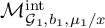 $\mathcal {M} {}^{\mathrm {int}}_{{\mathcal {G}} {}_1, b_1,\mu _1/x}$
is representable by the formal spectrum of a Noetherian normal complete local ring, for any
$\mathcal {M} {}^{\mathrm {int}}_{{\mathcal {G}} {}_1, b_1,\mu _1/x}$
is representable by the formal spectrum of a Noetherian normal complete local ring, for any $x\in \mathcal {M} {}^{\mathrm {int}}_{{\mathcal {G}} {}_1, b_1,\mu _1}(\mathrm{Spd}(k))$
. The proof of [Reference Pappas and RapoportPR24, Thm. 3.7.1] now applies and we obtain that
$x\in \mathcal {M} {}^{\mathrm {int}}_{{\mathcal {G}} {}_1, b_1,\mu _1}(\mathrm{Spd}(k))$
. The proof of [Reference Pappas and RapoportPR24, Thm. 3.7.1] now applies and we obtain that $\mathcal {M} {}^{\mathrm {int}}_{{\mathcal {G}} {}_1, b_1,\mu _1}$
is representable by a formal scheme which is normal and flat locally formally of finite type over
$\mathcal {M} {}^{\mathrm {int}}_{{\mathcal {G}} {}_1, b_1,\mu _1}$
is representable by a formal scheme which is normal and flat locally formally of finite type over $\breve O$
. (Note that [Reference Pappas and RapoportPR24, Thm. 3.7.1] is stated for parahoric
$\breve O$
. (Note that [Reference Pappas and RapoportPR24, Thm. 3.7.1] is stated for parahoric ${\mathcal {G}} $
. However, given the construction of the specialisation map for quasi-parahorics as in §3.4 above, the argument extends in a straightforward fashion to our situation, in which
${\mathcal {G}} $
. However, given the construction of the specialisation map for quasi-parahorics as in §3.4 above, the argument extends in a straightforward fashion to our situation, in which ${\mathcal {G}} {}_1$
is quasi-parahoric. The argument in loc. cit. requires
${\mathcal {G}} {}_1$
is quasi-parahoric. The argument in loc. cit. requires ${\mathcal {G}} {}_1(\breve {\mathbb {Z}} {}_p)=\mathrm {GL}(\Lambda \otimes _{\mathbb {Z} {}_p}\breve {\mathbb {Z}} {}_p)\cap G_1(\breve {\mathbb {Q}} {}_p)$
and this holds here since
${\mathcal {G}} {}_1(\breve {\mathbb {Z}} {}_p)=\mathrm {GL}(\Lambda \otimes _{\mathbb {Z} {}_p}\breve {\mathbb {Z}} {}_p)\cap G_1(\breve {\mathbb {Q}} {}_p)$
and this holds here since ${\mathcal {G}} {}_1\hookrightarrow \mathrm {GL}(\Lambda )$
is a closed immersion.) Since the maps
${\mathcal {G}} {}_1\hookrightarrow \mathrm {GL}(\Lambda )$
is a closed immersion.) Since the maps $G\to G_{\mathrm {ad}}$
and
$G\to G_{\mathrm {ad}}$
and $G_1\to G_{\mathrm {ad}}$
are both ad-isomorphisms, it now follows using Theorem 5.1.2 twice, together with Proposition 4.4.3 applied to
$G_1\to G_{\mathrm {ad}}$
are both ad-isomorphisms, it now follows using Theorem 5.1.2 twice, together with Proposition 4.4.3 applied to $G_{\mathrm {ad}}$
, that
$G_{\mathrm {ad}}$
, that $\mathcal {M} {}^{\mathrm {int, \tau }}_{{\mathcal {G}}, b,\mu }$
, for each
$\mathcal {M} {}^{\mathrm {int, \tau }}_{{\mathcal {G}}, b,\mu }$
, for each $\tau \in \Omega _G$
, is representable by such a formal scheme. It follows that
$\tau \in \Omega _G$
, is representable by such a formal scheme. It follows that $\mathcal {M} {}^{\mathrm {int}}_{{\mathcal {G}}, b,\mu }=\sqcup _\tau \mathcal {M} {}^{\mathrm {int, \tau }}_{{\mathcal {G}}, b,\mu }$
is representable by a formal scheme which is normal and flat locally formally of finite type over
$\mathcal {M} {}^{\mathrm {int}}_{{\mathcal {G}}, b,\mu }=\sqcup _\tau \mathcal {M} {}^{\mathrm {int, \tau }}_{{\mathcal {G}}, b,\mu }$
is representable by a formal scheme which is normal and flat locally formally of finite type over $\breve O$
.
$\breve O$
.
8.3 Proof of Theorems 2.5.5, 2.5.4 in case (B)
Recall that in case (B) we have $p=2$
and
$p=2$
and $G_{\mathrm {ad}}=\prod _{i=1}^m\mathrm {Res}_{F_i/\mathbb {Q} {}_2} H_i$
, with
$G_{\mathrm {ad}}=\prod _{i=1}^m\mathrm {Res}_{F_i/\mathbb {Q} {}_2} H_i$
, with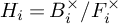 $H_i=B^\times _i/F_i^\times $
, or
$H_i=B^\times _i/F_i^\times $
, or $H_i=\mathrm {PGSp}_{2n_i},$
or
$H_i=\mathrm {PGSp}_{2n_i},$
or $\mu _i$
trivial. As in the proofs of Theorems 2.5.4 and 2.5.5 in the case (A), we can easily reduce to the case that
$\mu _i$
trivial. As in the proofs of Theorems 2.5.4 and 2.5.5 in the case (A), we can easily reduce to the case that $m=1$
and assume
$m=1$
and assume $G_{\mathrm {ad}}= \mathrm {Res}_{F/\mathbb {Q} {}_2} H$
with
$G_{\mathrm {ad}}= \mathrm {Res}_{F/\mathbb {Q} {}_2} H$
with $H=B^\times /F^\times $
, or
$H=B^\times /F^\times $
, or $H=\mathrm {PGSp}_{2n}$
. In the first subcase, we take
$H=\mathrm {PGSp}_{2n}$
. In the first subcase, we take $G_1=\mathrm {Res}_{F/\mathbb {Q} {}_2} B^\times $
. In the second subcase, we first set
$G_1=\mathrm {Res}_{F/\mathbb {Q} {}_2} B^\times $
. In the second subcase, we first set
 $$\begin{align*}\langle v, w\rangle=\mathrm{Tr}_{F/\mathbb{Q} {}_2}(v, w) \end{align*}$$
where $(v, w)$
is the standard perfect alternating F-bilinear form on
$(v, w)$
is the standard perfect alternating F-bilinear form on $F^{2n}$
. Then we take
$F^{2n}$
. Then we take $G_1=J$
, with the group J defined by
$G_1=J$
, with the group J defined by
 $$\begin{align*}J(R)=\{g\in \mathrm{GL}_{2n}(F\otimes_{\mathbb{Q} {}_p}R)\ |\ \langle gv, gw \rangle=c(g) \langle v, w\rangle, \ c(g)\in R^\times\}. \end{align*}$$
In each subcase, we lift $\mu _{\mathrm {ad}}$
to a corresponding minuscule
$\mu _{\mathrm {ad}}$
to a corresponding minuscule $\mu _1$
.
$\mu _1$
.
The quasi-parahoric ${\mathcal {G}} $
gives a corresponding point
${\mathcal {G}} $
gives a corresponding point $\bf x$
in the extended Bruhat-Tits building
$\bf x$
in the extended Bruhat-Tits building $\mathscr {B} {}^e(G, \mathbb {Q} {}_2)$
, so that
$\mathscr {B} {}^e(G, \mathbb {Q} {}_2)$
, so that ${\mathcal {G}} {}^o={\mathcal {G}} {}^o_{\mathbf {x}}(\breve {\mathbb {Z}} {}_2)\subset {\mathcal {G}} (\breve {\mathbb {Z}} {}_2)\subset {\mathcal {G}} {}_{\mathbf {x}}(\breve {\mathbb {Z}} {}_2)$
. Consider the stabiliser group scheme
${\mathcal {G}} {}^o={\mathcal {G}} {}^o_{\mathbf {x}}(\breve {\mathbb {Z}} {}_2)\subset {\mathcal {G}} (\breve {\mathbb {Z}} {}_2)\subset {\mathcal {G}} {}_{\mathbf {x}}(\breve {\mathbb {Z}} {}_2)$
. Consider the stabiliser group scheme ${\mathcal {G}} {}_1:={\mathcal {G}} {}_{1,\mathbf {x}_1}$
of
${\mathcal {G}} {}_1:={\mathcal {G}} {}_{1,\mathbf {x}_1}$
of $G_1$
which corresponds to a point
$G_1$
which corresponds to a point $\mathbf {x}_1$
in
$\mathbf {x}_1$
in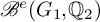 $\mathscr {B} {}^e(G_1,\mathbb {Q} {}_2)$
that lifts the point
$\mathscr {B} {}^e(G_1,\mathbb {Q} {}_2)$
that lifts the point $\mathbf {x}_{\mathrm {ad}}$
in the building
$\mathbf {x}_{\mathrm {ad}}$
in the building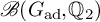 $\mathscr {B} (G_{\mathrm {ad}}, \mathbb {Q} {}_2)$
, as in the argument in the proof for the case (A) above. The devissage results of §4 (Theorem 4.1.1 and its proof), allows us to replace
$\mathscr {B} (G_{\mathrm {ad}}, \mathbb {Q} {}_2)$
, as in the argument in the proof for the case (A) above. The devissage results of §4 (Theorem 4.1.1 and its proof), allows us to replace ${\mathcal {G}} {}_{1,\mathbf {x}_1}$
by the stabiliser group scheme of a point which is generic in the smallest facet that contains it, and still has the same parahoric neutral component. Therefore, we can assume that
${\mathcal {G}} {}_{1,\mathbf {x}_1}$
by the stabiliser group scheme of a point which is generic in the smallest facet that contains it, and still has the same parahoric neutral component. Therefore, we can assume that $\mathbf {x}_1$
already has this ‘genericity’ property. We can now see, using [Reference Rapoport and ZinkRZ96, App. to Chapt. 3] and the standard explicit description of the buildings for these groups ([Reference Bruhat and TitsBT84], [Reference Bruhat and TitsBT87]), that there is a lattice chain
$\mathbf {x}_1$
already has this ‘genericity’ property. We can now see, using [Reference Rapoport and ZinkRZ96, App. to Chapt. 3] and the standard explicit description of the buildings for these groups ([Reference Bruhat and TitsBT84], [Reference Bruhat and TitsBT87]), that there is a lattice chain $(\mathcal {L} )$
, resp. a self-dual lattice chain
$(\mathcal {L} )$
, resp. a self-dual lattice chain $(\mathcal {L} )$
, such that the stabiliser group scheme above is given as a scheme theoretic stabiliser of
$(\mathcal {L} )$
, such that the stabiliser group scheme above is given as a scheme theoretic stabiliser of $(\mathcal {L} )$
in
$(\mathcal {L} )$
in $G_1$
. The data
$G_1$
. The data $(G_1, b_1, \mu _1)$
together with the lattice chain
$(G_1, b_1, \mu _1)$
together with the lattice chain $(\mathcal {L} )$
determine integral EL-, resp. PEL-data
$(\mathcal {L} )$
determine integral EL-, resp. PEL-data $\mathcal {D} $
as in [Reference Rapoport and ZinkRZ96], see also [Reference Scholze and WeinsteinSW20, Def. 24.3.3].
$\mathcal {D} $
as in [Reference Rapoport and ZinkRZ96], see also [Reference Scholze and WeinsteinSW20, Def. 24.3.3].
Consider the corresponding RZ formal scheme ${\mathcal {M}_{\mathcal {D}}^{\mathrm {naive}}}$
(as defined in [Reference Rapoport and ZinkRZ96]; the hypothesis
${\mathcal {M}_{\mathcal {D}}^{\mathrm {naive}}}$
(as defined in [Reference Rapoport and ZinkRZ96]; the hypothesis $p\neq 2$
is not needed in this case). Then
$p\neq 2$
is not needed in this case). Then ${\mathcal{M}_{\mathcal {D}}^{\mathrm{naive}}}$
is a formal scheme locally formally of finite type over
${\mathcal{M}_{\mathcal {D}}^{\mathrm{naive}}}$
is a formal scheme locally formally of finite type over $O_{\breve E}$
. Under our assumptions,
$O_{\breve E}$
. Under our assumptions, $\mathcal {M} {}^{\mathrm {naive}}_{\mathcal {D}} $
has formal completions at closed points which agree with those of the naive local model
$\mathcal {M} {}^{\mathrm {naive}}_{\mathcal {D}} $
has formal completions at closed points which agree with those of the naive local model $\mathbb {M} {}^{\mathrm {naive}}_{\mathcal {D}} $
([Reference Rapoport and ZinkRZ96, Prop. 3.33]); recall that this follows by Grothendieck-Messing deformation theory which applies for
$\mathbb {M} {}^{\mathrm {naive}}_{\mathcal {D}} $
([Reference Rapoport and ZinkRZ96, Prop. 3.33]); recall that this follows by Grothendieck-Messing deformation theory which applies for $p=2$
. Note that in general,
$p=2$
. Note that in general, $\mathbb {M} {}^{\mathrm {naive}}_{\mathcal {D}} $
and
$\mathbb {M} {}^{\mathrm {naive}}_{\mathcal {D}} $
and $\mathcal {M} {}^{\mathrm {naive}}_{\mathcal {D}} $
are not flat over
$\mathcal {M} {}^{\mathrm {naive}}_{\mathcal {D}} $
are not flat over $O_{\breve E}$
(this accounts for the terminology ‘naive’.)
$O_{\breve E}$
(this accounts for the terminology ‘naive’.)
Set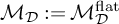 $ \mathcal {M} {}_{\mathcal {D}} :=\mathcal {M}_{\mathcal {D}}^{\mathrm {flat}} $
to be the closed formal subscheme of
$ \mathcal {M} {}_{\mathcal {D}} :=\mathcal {M}_{\mathcal {D}}^{\mathrm {flat}} $
to be the closed formal subscheme of ${\mathcal{M}^{\mathrm {naive}}_{\mathcal{D}}} $
given by chains of
${\mathcal{M}^{\mathrm {naive}}_{\mathcal{D}}} $
given by chains of $2$
-divisible groups which are ‘
$2$
-divisible groups which are ‘ $\mathbb {M} {}^{\mathrm {loc}}_{{\mathcal {G}} {}_1,\mu _1}$
-admissible’ in the sense of [Reference Scholze and WeinsteinSW20, Lect. 24, 25]. Note that under our assumptions,
$\mathbb {M} {}^{\mathrm {loc}}_{{\mathcal {G}} {}_1,\mu _1}$
-admissible’ in the sense of [Reference Scholze and WeinsteinSW20, Lect. 24, 25]. Note that under our assumptions, $\mathbb {M} {}^{\mathrm {loc}}_{{\mathcal {G}} {}_1,\mu _1}$
is a closed subscheme of the ‘naive’ local model
$\mathbb {M} {}^{\mathrm {loc}}_{{\mathcal {G}} {}_1,\mu _1}$
is a closed subscheme of the ‘naive’ local model $\mathbb {M} {}_{\mathcal {D} }^{\mathrm {naive}}$
which is identified with the flat closure of its generic fibre; in particular, this flat closure has reduced special fibre. Indeed, in the case where
$\mathbb {M} {}_{\mathcal {D} }^{\mathrm {naive}}$
which is identified with the flat closure of its generic fibre; in particular, this flat closure has reduced special fibre. Indeed, in the case where $G_1=\mathrm {Res}_{F/\mathbb {Q} {}_2} B^\times $
, this follows from [Reference Pappas and RapoportPR05, Thm. 7.3] (based on Görtz [Reference GörtzG01]). In the case where
$G_1=\mathrm {Res}_{F/\mathbb {Q} {}_2} B^\times $
, this follows from [Reference Pappas and RapoportPR05, Thm. 7.3] (based on Görtz [Reference GörtzG01]). In the case where $G_1=J$
, this follows from [Reference Pappas and RapoportPR05, Thm. 12.4] (based on [Reference GörtzG03, Reference GörtzG05]). (These two results also follow from the proof of the coherence conjecture by Zhu [Reference ZhuZhu14].)
$G_1=J$
, this follows from [Reference Pappas and RapoportPR05, Thm. 12.4] (based on [Reference GörtzG03, Reference GörtzG05]). (These two results also follow from the proof of the coherence conjecture by Zhu [Reference ZhuZhu14].)
By [Reference Scholze and WeinsteinSW20, Cor. 25.1.3], we have
 $$\begin{align*}(\mathcal{M} {}_{\mathcal{D}} )^{\Diamond}\simeq \mathcal{M} {}^{\mathrm{int}}_{{\mathcal{G}} {}_1, b_1, \mu_1} \end{align*}$$
as v-sheaves over $\mathrm{Spd}(O_{\breve E})$
. It follows that
$\mathrm{Spd}(O_{\breve E})$
. It follows that $\mathcal {M} {}^{\mathrm {int}}_{{\mathcal {G}} {}_1, b_1, \mu _1}$
is represented by the formal scheme
$\mathcal {M} {}^{\mathrm {int}}_{{\mathcal {G}} {}_1, b_1, \mu _1}$
is represented by the formal scheme $\mathcal {M} {}_{\mathcal {D}} $
. By its construction and the above discussion, we obtain that the formal scheme
$\mathcal {M} {}_{\mathcal {D}} $
. By its construction and the above discussion, we obtain that the formal scheme $\mathcal {M} {}_{\mathcal {D}} $
has formal completions at closed points which agree with those of
$\mathcal {M} {}_{\mathcal {D}} $
has formal completions at closed points which agree with those of ${\mathbb{M}^{\mathrm{loc}}_{{\mathcal {G}_{1}},\mu_{1}}}$
; in particular,
${\mathbb{M}^{\mathrm{loc}}_{{\mathcal {G}_{1}},\mu_{1}}}$
; in particular, $\mathcal {M} {}_{\mathcal {D}} $
is normal and flat over
$\mathcal {M} {}_{\mathcal {D}} $
is normal and flat over $O_{\breve E}$
since these properties hold for
$O_{\breve E}$
since these properties hold for ${\mathbb{M}^{\mathrm {loc}}_{{\mathcal {G}_{1}},\mu _{1}}}$
. Hence the representability conjecture 2.5.1 holds and
${\mathbb{M}^{\mathrm {loc}}_{{\mathcal {G}_{1}},\mu _{1}}}$
. Hence the representability conjecture 2.5.1 holds and $\mathscr {M} {}_{{\mathcal {G}} {}_1, b_1, \mu _1}=\mathcal {M} {}_{\mathcal {D}} $
. We can now pass from
$\mathscr {M} {}_{{\mathcal {G}} {}_1, b_1, \mu _1}=\mathcal {M} {}_{\mathcal {D}} $
. We can now pass from $(G_1, b_1, \mu _1)$
and
$(G_1, b_1, \mu _1)$
and ${\mathcal {G}} {}_1$
, to
${\mathcal {G}} {}_1$
, to $(G, b, \mu )$
and
$(G, b, \mu )$
and ${\mathcal {G}} $
, by the same devissage as in the proofs in case (A). This completes the proofs of Theorems 2.5.5 and 2.5.4 in case (B).
${\mathcal {G}} $
, by the same devissage as in the proofs in case (A). This completes the proofs of Theorems 2.5.5 and 2.5.4 in case (B).
Remark 8.3.1. Our strategy for the proofs of Theorems 2.5.5 and 2.5.4 in case (B) could be applied to more EL/PEL cases than the ones currently given, provided that in the corresponding cases the results of [Reference Rapoport and ZinkRZ96, App. to Chapt. 3] can be suitably modified for $p=2$
. An example is given by the unramified unitary group, cf. [Reference Rapoport, Smithling and ZhangRSZ21, App. A]. On the other hand, it is also reasonable to expect that the strategy of the proof in case (A) could be extended to
$p=2$
. An example is given by the unramified unitary group, cf. [Reference Rapoport, Smithling and ZhangRSZ21, App. A]. On the other hand, it is also reasonable to expect that the strategy of the proof in case (A) could be extended to $p=2$
(at least assuming that G is essentially tamely ramified), if the constructions of [Reference Kisin and PappasKP18], [Reference Kisin, Pappas and ZhouKPZ24] can be extended to cover
$p=2$
(at least assuming that G is essentially tamely ramified), if the constructions of [Reference Kisin and PappasKP18], [Reference Kisin, Pappas and ZhouKPZ24] can be extended to cover $p=2$
. Such an extension was given in [Reference Kim and Madapusi PeraKMP16] in the hyperspecial case, i.e., when
$p=2$
. Such an extension was given in [Reference Kim and Madapusi PeraKMP16] in the hyperspecial case, i.e., when ${\mathcal {G}} $
is reductive over
${\mathcal {G}} $
is reductive over $\mathbb {Z} {}_2$
, and in [Reference YangYa25] in some parahoric cases.
$\mathbb {Z} {}_2$
, and in [Reference YangYa25] in some parahoric cases.
Competing interests
The authors declare none.
Data availability statement
The authors confirm that all the data supporting the findings of this study are available within the article.


 Open access

