

‘A revolution is not terror. The latter is merely a key instrument in a specific phase of the revolution.’
Benito Mussolini, Reference Mussolini1927 (Gerarchia 1927 in Chiurco Reference Chiurco1929, 7)Introduction
The hundredth anniversary of the March on Rome in 2022 has already led to a reflection in Modern Italy concerning the memory of Fascism in Italy (Bartolini Reference Bartolini2022). This Contexts and Debates historiographical essay takes its cue in part from a number of books which have appeared to coincide with that anniversary (Albanese Reference Albanese2022; Foot Reference Foot2022; Mondini Reference Mondini2022; Lupo and Ventrone Reference Lupo and Ventrone2022; Gentile Reference Gentile2022). But it also draws on tropes and arguments developed in numerous studies of Fascism and the March on Rome itself ever since 1922 (Répaci Reference Répaci1972, Venè Reference Venè1982, Mack Smith Reference Mack Smith1983). The article will argue that, until recently, historical interpretations of the March on Rome have tended to ignore the violence of the March itself, to play down the significance of the role of the squadristi, and above all to take refuge in a reassuring counterfactual – that if the king had signed a state of siege decree, the Italian army would have easily defeated the blackshirts. This counter-factual, which suited all sides of the political spectrum after 1945, was based on flimsy evidence, and on a failure to fully comprehend both the extent of the Fascist ‘insurrection’, and the specific role of political violence in the rise to power of the Fascists. While many of these tropes are beginning to change, as can be seen from publications last year, both local and national, the counter-factual continues to reign supreme. This article will argue that the counter-factual answers the wrong set of questions, and that it is far from clear if the army would have suppressed the Fascists in a generalised clash between the blackshirts and the state. This is not to replace one counter-factual with another, but to argue for a real analysis of what actually happened in 1919–1922 in Italy, on the ground, and for the centrality of the March itself, and the violence which accompanied it, in an understanding of Fascism – and not just from the point of view of a political ‘poker game’. It is not clear where the push for this master narrative came from, but there was certainly considerable consensus around the understanding of the March on Rome.
A photo and an attack
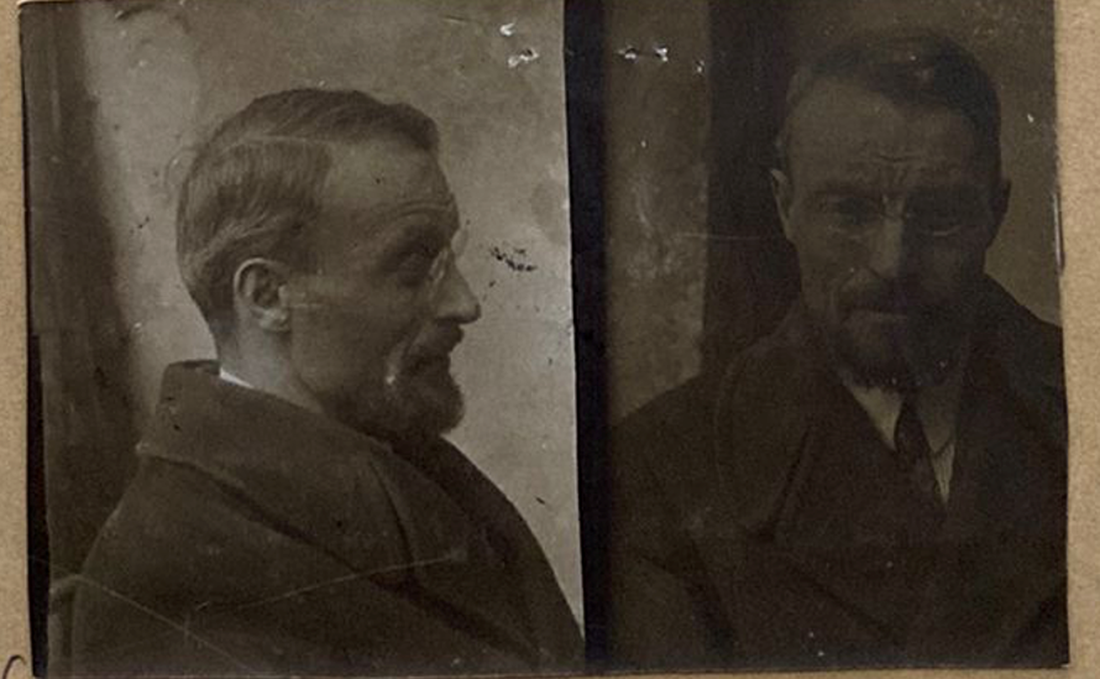
‘At around 2pm the Communist [Giuseppe] Lemmi, secretary of the Honourable [Nicola] Bombacci – was recognised in Via del Tritone and kidnapped by some Fascists. He was taken to the Fascio city headquarters in Palazzo Marignoli in Via del Corso. There, Lemmi had his long beard and very long hair completely shaved off [for a photo of Lemmi from his police file see Figure 1]. He was then forced to drink half a kilo of castor oil. The Fascists, after painting his nape red, white and green, put him on a lorry and paraded him around Via del Tritone and Corso Umberto with a sign around his neck reading: Long live Fascism! He was forced to cry repeatedly Long live Fascism! The lorry passed twice by Caffè Aragno. The second time General De Bono mounted the lorry and told the Fascists to stop. Lemmi was taken to the Interior Ministry where some guards helped the poor man wash himself and he was kept there in order to avoid further incidents.’ (La Stampa, 2 November 1922.)
Giuseppe Lemmi was born in 1884 in Rosignano Marittimo in Tuscany. In autumn 1922 he was a high-ranking Communist in Rome and, in some versions, was also the personal secretary of leading party member Nicola Bombacci. Lemmi was involved in organising armed resistance to fascism, as part of the semi-underground organisation the Arditi del Popolo (Francescangeli Reference Francescangeli2008; Archivio dello Stato, Lemmi). On 1 November 1922, in the middle of the series of events known as the March on Rome, he was kidnapped by black-shirted squadristi and paraded through the streets by hundreds of black-shirted squadristi (and, it was reported, driven on a lorry) wearing various cards round his neck. One read ‘You must serve the Fatherland, and I am a Deserter’, and another said ‘Viva il fascio’. It was also reported that his shaved skull was painted red, white and green (the colours of the Italian flag) and that he was forced to give a Fascist salute, and shout out slogans in favour of Fascism. Newspaper reports claimed that he was ‘saved’ by General De Bono, one of the leaders of the March itself, and taken to the Interior Ministry for his own protection (see Figure 2).
Mugshot of Giuseppe Lemmi from his police file, 1938.
Giuseppe Lemmi, Rome, 1 November 1922. The card around his neck reads ‘Lemmi, Secretary of the Pig Bombacci’. Photograph by Alfredo Porry-Pastorel.
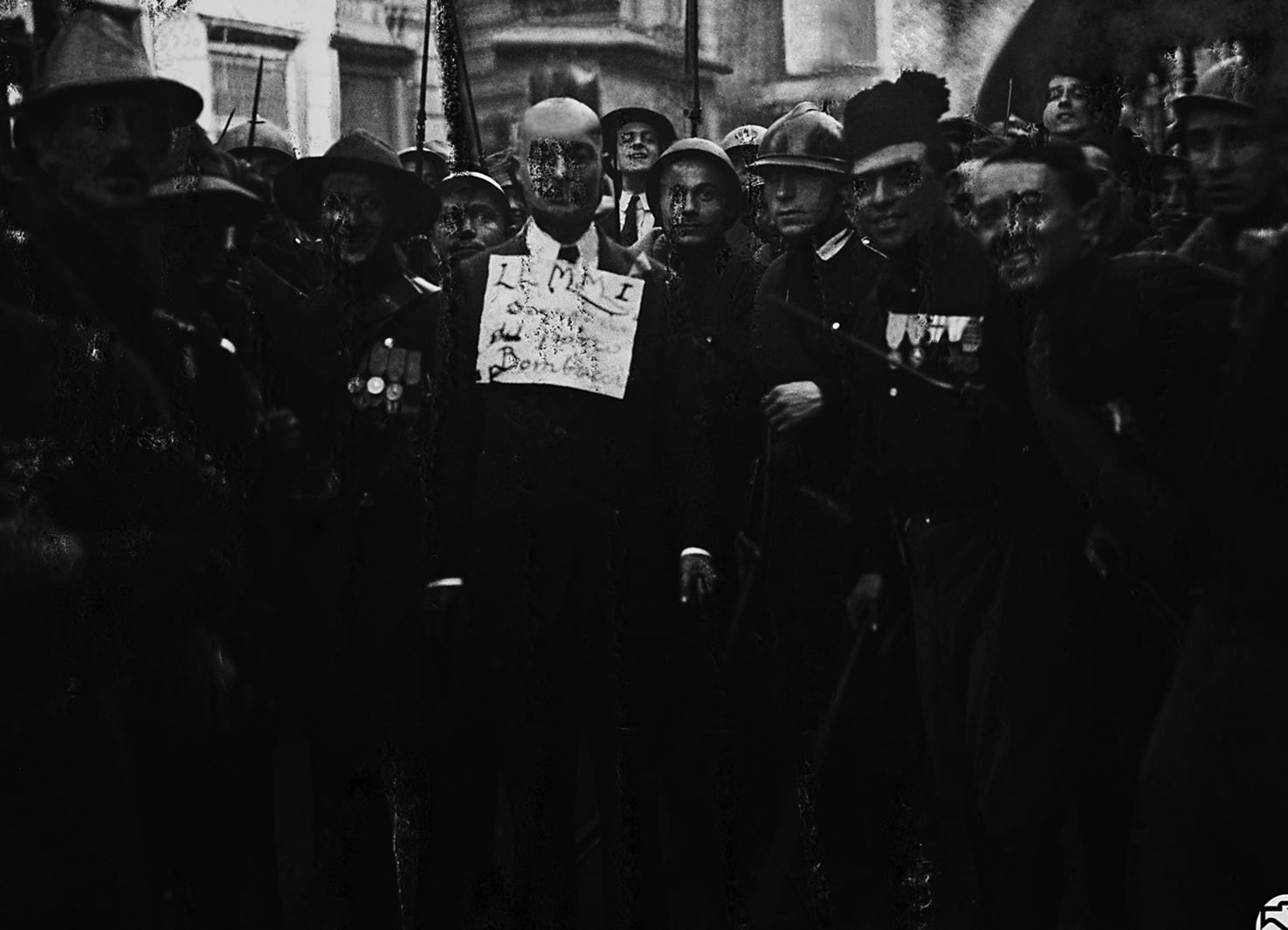
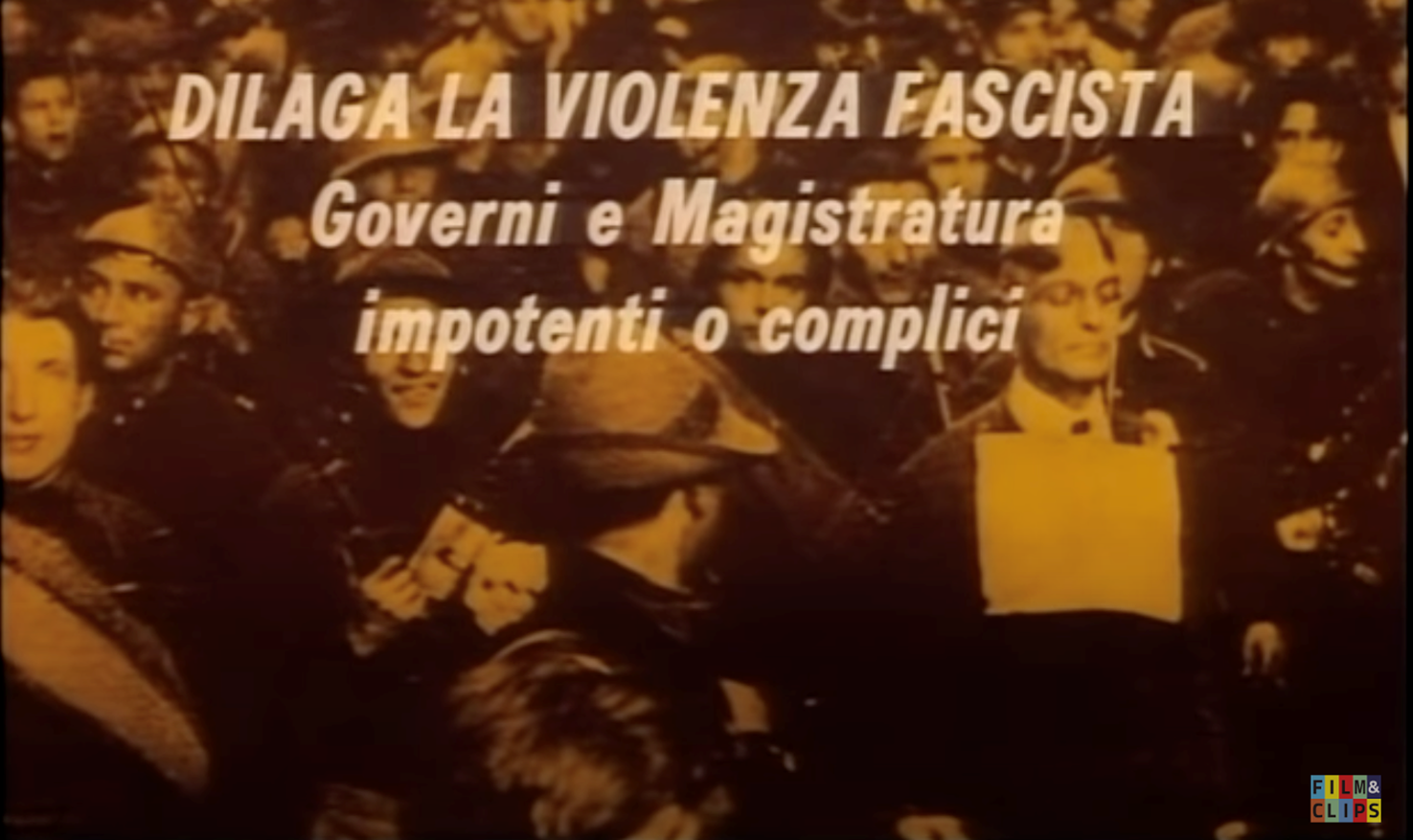
It is not known how long this violent event lasted. Unusually, it was captured in a series of extraordinary photographs (where there is no lorry visible) by pioneering photo-reporter Alfredo Porry-Pastorel. These photos have been used in a number of books, as well as in the credit sequence of Dino Risi's 1962 tragi-comedy La Marcia su Roma (which was released on the 50th anniversary of the March) (see Figure 3). Often, however, including in the first edition of my own book, the figure in the photo is wrongly identified as Francesco Misiano, also a Communist, and the date of the event is transferred, erroneously, to 1921, often to 13 June of that year, when Misiano was thrown out of parliament at gunpoint by Fascists (Foot Reference Foot2022, Forgacs Reference Forgacs2021, 147). This is also true of the Istituto Luce and Alinari photographic archives, although the Istituto Luce has now corrected its captions (but not the date). Risi may well have known Porry-Pastorel personally in postwar Italy and this friendship may have been at the origin of the use of the photo in the film's credits (Menduni Reference Menduni2021).
Still from Dino Risi, La Marcia su Roma, 1962, opening credit sequence.
In many ways, this could be seen as a simple error. Lemmi does bear some resemblance to Misiano, and Misiano was subjected to similar experiences on numerous occasions between 1920 and 1922. However, a close examination of the image clearly places the moment of this violence as taking place during the March on Rome, when thousands of squadristi arrived in the capital, many armed, carrying improvised sleeping bags over their shoulders, as in the photo. Misiano was not reported in Rome at that time, and none of the reports on the 1921 incident mention any such event in Rome. This is confirmed by the text of a further card worn around Lemmi's neck (‘LEMMI: Secretary of that Pig Bombacci’) in another photograph from the series, as well as by the state archives, which state: ‘It was due to his subversive activities that Lemmi was subject to a revenge [sic] attack on 1 November 1922 in Rome and forced to parade around the city in his shirtsleeves [in fact he was still dressed in a jacket and tie] with his face painted in the colours of the national flag’ (ACDS, CPC, 2758).
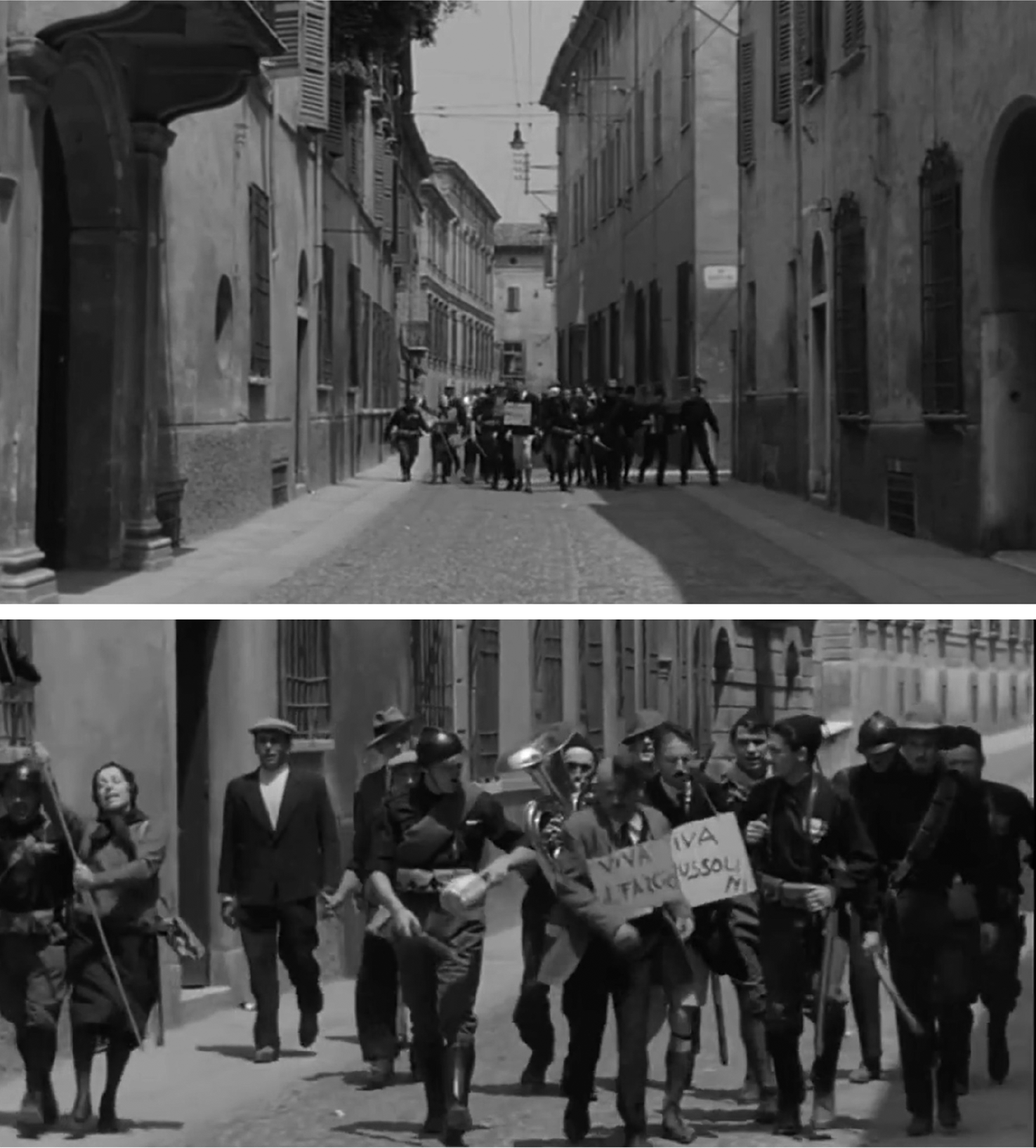
We have no other accounts of the attack on Lemmi that day or of the personal after-effects of that treatment, which must have been painful, humiliating and terrifying. In Dino Risi's The March on Rome, the two black-shirted ‘anti-heroes’ of the film, who are on their way to march on Rome (played by Ugo Tognazzi and Vittorio Gassman) witness two other people being forcibly led through the streets by blackshirts, some of whom are armed, with musical instruments and carrying wine. Both the victims have their hair half-shaved off, and cards around their neck reading Viva il Fascio and Viva Mussolini. It is a brutal scene for a ‘comedy’ (and Tognazzi's character does seem shocked) (see Figures 4 and 5). It seems reasonable to suppose that this scene was inspired by the photos of Lemmi. Yet, Lemmi's fate appears in no accounts of the March on Rome (or other studies of Fascism) beyond an occasional footnote (Gentile Reference Gentile2014, 6995; Albanese Reference Albanese2022, 200; Salvatorelli and Mira Reference Salvatorelli and Mira1964, 246). Giuseppe Lemmi has not become part of historical narratives around the March on Rome. His story is largely absent, both from historical research and public memory, and in the famous series of photos he has been misidentified.
Screenshots from La Marcia su Roma, 1962, Dino Risi.
I would argue that the almost complete removal of the experience of Lemmi and his ordeal from accounts of the March on Rome, or its constant relegation to (at best) a footnote, is symptomatic of wider tendencies amongst the vast majority of historians who have written on this subject – the removal of violence from this event, the playing down of squadrismo and the squadristi in general (who are usually derided or not taken seriously), and a desire to treat the March on Rome as largely symbolic, as a moment managed by elites, and in many accounts as a farce, a bluff, as ‘bloodless’, and as ‘choreography’ (Corner Reference Corner and Lyttleton2002, 43). Yet, those days were marked by violence, murder and death across Italy, and not just in Rome.
This removal of violence and the failure to take the squadristi seriously is usually combined with an omnipresent and powerful counter-factual. Almost all historians agree that the Fascists would have ‘lost’ against the Italian army, if the army had been ordered to attack them. This seemingly unbreakable conviction (a double counter-factual – a hypothesis about two things that didn't happen – the attack or defence by the army and the supposed defeat of the squadristi) is based on somewhat flimsy evidence. This ‘evidence’ consists of the ‘loyalty’ of one general (loyalty that was never actually put to the test); the bare (estimated) numbers of troops and squadristi; and other factors including the organisation of the March, the weapons on either side and – often – the fact that the squadristi were supposedly ‘wet’ and ‘hungry’. We will come to a more detailed analysis of this counter-factual in the final part of this article.
I will argue in this historiographical article that the March on Rome (without forgetting its symbolic aspects) was the end point of a serious and at that point unique insurrectionary project, which followed three intense years of Fascist violence (where the state had rarely if ever taken on the Fascists, and had often colluded passively or actively with them). It was accompanied by violence and constant threats of further violence, in Rome and across Italy. It was in no way a bluff – but also stood as a warning to all those who still imagined that Fascism could be opposed, on the streets, in parliament, or at the ballot box. The violence hit bystanders, but was also targeted at the private homes of Communists, Socialists and hated Liberals like Francesco Saverio Nitti, as well as at leading members of the Arditi del Popolo, a loose antifascist armed grouping, and at centres of urban resistance in Rome itself. I will take each tendency within the historical literature in turn.
Ignoring the March
Despite many large-scale studies of the March on Rome which appeared in postwar Italy and elsewhere (often to coincide with various anniversaries), the pattern in postwar historiography was largely, within histories of Fascism or biographies of Mussolini, to ignore the March, or to see it purely in terms of high-scale negotiation between politicians, Mussolini and the king (studied in detail in Répaci Reference Répaci1972, and outlined in Venè Reference Venè1982). Let us take some examples from mainstream histories of Fascism in terms of the space dedicated to the March itself. In Denis Mack Smith's well-known biography of Mussolini (Reference Mack Smith1983) four pages out of 429 are dedicated to the March on Rome, while Philip Cannistraro's 657-page Historical Dictionary of Fascist Italy has an entry on the March which occupies three pages (Reference Cannistraro and Cannistraro1982, 323–325).
In short, the vast majority of historians until recently either ignored the March, or played it down, or told its story purely through a number of high-level protagonists. That is, they chose not to tell the story of the March itself, but of the machinations around it. It was a ‘poker game’, a negotiation, a discussion between leaders, a ‘bluff’, a ‘farce’, a ‘joke’. Everything that happened in the streets was largely irrelevant (and could thus be safely left out of the story, because it didn't fit the narrative). Only eight pages in Lyttelton's 556-page volume (called The Seizure of Power, 1987) are about the March itself, while in Christopher Seton-Watson's monumental study, ‘power had already been won without resort to force’ (and the page ratio is 6/772) (Reference Seton-Watson1967, 623–629). Bosworth's epic Mussolini biography has three pages on the March, out of 584 (Reference Bosworth2002, 167–169). All of these studies play down the March, remove or ignore the violence of that moment, and analyse the March as a political negotiation.
Downplaying the violence
Ever since the March on Rome, therefore, the tendency on almost all sides has been to ignore, or play down, the violence surrounding that event (with some notable exceptions, such as Malaparte Reference Malaparte1931). In an interview given to The Times during the march itself, Mussolini denied that any violence at all had taken place. Many historians, both past and present, agree. Berezin, for example, refers to the violence during the March as ‘skirmishes’ and the March itself as ‘peaceful’ and even ‘bloodless’ (Reference Berezin1997, 81).Footnote 1 Milza's huge biography of Mussolini cites only the ‘usual violence’ of the blackshirts during the March (Reference Milza2000, 327) without going into detail.
When Fascists, in subsequent years, drew attention to violence during the March, they did so coyly, either in reference to Fascist victims, or to the occasional assassination of unnamed ‘communists’ in unverified circumstances. Mussolini, for example, looking back on the March in 1927, wrote that: ‘We should remember … that the insurrection was bloody. There were dozens of Fascist dead in the period from the 28th to the 31st, many more than fell during the sacking of the Bastille, an event which has been celebrated for 150 years as one of the greatest insurrectionary moments in history’ (Chiurco Reference Chiurco1929, 7).
For many, historians and others, the March on Rome was a closed book. There was nothing more to say or write about it. Pietro Nenni, who was an eye-witness (at least in Milan) wrote in 1972 (on another anniversary, moments which often lead to further reflection): ‘Many years after the “March on Rome” there is very little left to say or discover about the events which brought Fascism to power’ (Reference Nenni1982, 7). ‘Recent work by serious historians’, Nenni continued, ‘has established, definitively, that the end of the constitutional monarchy and the parliamentary system was due to the internal collapse of a political class and a military bureaucracy rather than the external attack of the blackshirts’ (Reference Nenni1982, 7, my emphasis).
Removing/ignoring the violence
Let us look briefly at the violence during the period of the March. Local insurrections began on 27 October, ‘early’ in Pisa and Cremona, quickly spreading to numerous cities across central and northern Italy, and to cities in the south. Prefects’ buildings, the sites of central power in localities, were attacked and occupied. Electricity was cut off. Telegraph and railway stations were occupied. Barracks were attacked and arms seized. Prisons were targeted. In some cases, there was some state resistance, at least at first. In many other places, the authorities stood by and allowed armed militias to peacefully seize government buildings – an extraordinary state of affairs. Alongside this insurrection against the state (something the Fascists were anxious to ignore and forget once Mussolini has been installed in power) there were numerous attacks across Italy on individuals – Communist and Socialist deputies, trade unionists, liberals – who were often surprised at home in their private spaces. In Rome, in particular, members of the Arditi del Popolo (the only serious armed opposition to Fascism) were targeted and singled out for attack – including Lemmi himself, but also Argo Secondari. Many were lucky not to be at home, or had made themselves scarce. They returned to find their houses attacked, their papers and books burnt, their relatives and friends terrified.
These attacks were important in themselves, but were also intended as a warning, as Mussolini underlined and made clear in parliament. The house of the Liberal parliamentarian Francesco Saverio Nitti in Rome was also attacked by dozens of blackshirts. Nonetheless, many Liberals voted in Mussolini's 1922 government. Nitti never returned to Rome, eventually going into exile.
A second series of attacks, in Rome but also across Italy, aimed to destroy the opposition and free press – sacking and destroying offices and printing presses of anarchist, socialist, trade unionist and other newspapers. This was also a sign that the age of relative free speech was over. Some papers never reopened. Journalists were cowed. Many began to toe the party line – that of the Fascists. In addition, there were more random acts of violence across Rome and Italy, with a number of people killed for resisting the Fascists, or just because they were in the wrong place at the wrong time. Finally, in Rome, came the occupation and subjugation of the ‘subversive’ neighbourhood of San Lorenzo, occupied by Bottai's blackshirts in a military operation, during which a number of people died.
Nor did the violence end with the March and Mussolini's investiture. The horrific massacre in Turin in December saw the squadristi off the leash, using lists of subversives to execute individuals in broad daylight. It was the final attack on the last and most important bastion of working-class resistance. It is important to underline the variegated nature of this violence. Some violence was planned, other acts of violence were more spontaneous. Hence, specific houses of deputies and militants were attacked, as were many newspaper offices (for the specific purpose of suppressing news, and as a warning). Blackshirts in Rome appeared to have lists of specific targets, usually Communist militants, some of whom were executed. However, on other occasions attacks on individuals or buildings were more random and in response to shots fired or objects thrown. Insurrectionary violence during the March was planned, and aimed to take over public buildings. These attacks were either accompanied by violence, or the threat of violence, this time against the state itself or its representatives. Finally, there was the military-like occupation of certain neighbourhoods seen as ‘subversive’, specifically the attack on San Lorenzo in Rome, which led to a number of deaths.
Fascism's March was a combination of a revolution or insurrection and a national, large-scale, ‘punitive expedition’. It also prefigured the wider, more extensive repression of the Fascist regime, with attacks not just on Socialists and Communists, but also on liberals. Its ‘dress rehearsals’ had been seen in 1922 in the marches on Ravenna, Bolzano and other cities and regions. During the March on Rome, the squadristi acted as a kind of national armed force for the first time, but they were never an army in the traditional sense, nor should they be treated as such. The squadristi of the March were a loosely connected series of individual squads, with their local leaders, and a somewhat improvised national leadership – divided into military (the four leaders based in Perugia) and local Ras. In Rome itself, locally based Fascists took advantage of the chaos to settle some scores and deal with the local armed resistance.
Finally, there was a feeling that more was to come. Socialist deputy Giacomo Matteotti (who would be murdered by Fascists in 1924) understood this perfectly, writing ironically: ‘There was a strong sense of potential violence … a threat against all those who were generously spared by Fascism during the March on Rome’ (Matteotti Reference Matteotti and Caretti1983). Mussolini himself famously underlined this point in his 16 November speech to parliament: ‘I could have made this drab silent hall into a camp [bivacco] for my squads … I could have barred the doors of parliament and created a government which was only made up of Fascists: but I didn't want to, at least for now’. Fascist violence was a way of ‘striking one in order to educate one hundred’, as the Maoist slogan later put it. Your house, your office could easily be next. Nobody was safe, not even at home. As Albanese has pointed out: ‘Mussolini made clear that the limits to his power were only created by himself’ (Reference Albanese2022, 206).
It is interesting to look, for example, at a series of Fascist murders which took place in Rome (which was at that point full of blackshirts) on 1 November, as reported in La Stampa the following day. Late in the evenning, ‘twenty or so blackshirts, armed with revolvers and muskets, reached via della Croce Bianca, where the Camera del Lavoro was located. The squadristi forced their way through the door, throwing paper and furniture into the street, which was then set on fire … crowds gathered … and it seems that some bricks were thrown at the blackshirts from windows. The Fascists shot back at the buildings, and ordered the windows closed. Accidently, one of the shots killed a poor old man who was on his balcony: Carlo Ferresi, 71, from Carmignano’ (La Stampa 1922).
After that, there was more of the same: ‘A similar event took place in via dei Serpenti, with a similar tragic ending. A group of Fascists marched into via dei Serpenti singing songs. Many people gathered at their windows, and it appears that some insults were exchanged. The squadristi shot 30 or so times, ordering the closure of windows and shops. Panic broke out amongst the passers-by. In a moment via dei Serpenti emptied. A 46-year-old woman, Giacinto Fiorini, was killed instantly by a revolver shot’ (La Stampa 1922). There was a brutal attack on a leading antifascist: ‘The ex-head of the “Arditi del popolo”, Argo Secondari, was beaten by some Fascists … the others killed were the communists Elia Zaina, executed by rifle after having insulted some Fascists, and the war invalid, Attilio Battaglini (35), killed after an argument with Fascists at the station’ (La Stampa 1922).
In some cases, the Fascists appeared to have a list of names and targets: ‘The fascists wanted to play a joke on the communist Giuseppe Bochicchio, a local councillor. He was kidnapped and held hostage for a number of hours, and was only saved by the mayor's intervention’ (La Stampa, 1922). This type of violence, with planned executions and seizures of militants, above all communists, would be repeated in December 1922 in Turin.
A further episode of violence took place connected to the trade delegation of the USSR government: ‘Seven Fascists on a lorry arrived at the commercial offices of the Soviet government in via delle Terme. Two squadristi guarded the door, while the others went upstairs looking for the children of the Member of Parliament Martini. They were also looking for somebody called Gallardi from Imola, who worked in those offices. When he was found five blackshirts took him to the courtyard and killed him. It seems that the murder was due to long-lasting hatred between fascists and communists. One hypothesis is that both the murderers and the murdered were from Imola’ (La Stampa, 1922). These reports of violence and squadrismo were largely removed from the story, played down and above all excised from any account of the final seizure of power.
The issue of violence during the March on Rome was something Mussolini himself used in an ambiguous way, depending on which audience he was addressing. To his internal enemies (the socialists, the trade unionists, the liberals) Mussolini used the March on Rome as an explicit threat, stating that next time more violence would be unleashed. This threat was understood clearly by his contemporaries. But for other audiences (the foreign press, for example), Mussolini played down the violence of the March, emphasising his sense of responsibility and role as a statesman and credible leader. Moreover, the insurrectionary, anti-state aspects of the March were quickly expunged from history, and were seen as embarrassing. Violence had ‘only’ been against the reds and the unions, and even then carried out in a largely defensive way, the Fascists said. Hence, the removal of the violence (or some of it) from history brought together different sides of the political divide.
Mussolini presented (at least) two versions of the March, depending on his audience, and the temporal context. In 1927 he returned to this point, saying that in October 1922 the antifascist opposition, loosely, still had a majority in parliament. He added (citing his own previous speech): ‘That “grey and deaf chamber” included a [non-Fascist] majority which stayed silent, above all when they were beaten to the point of bloodshed. That old parliamentary world of majorities, corridors, intrigue … and parlour games, was over’ (Chiurco Reference Chiurco1929, 5).
It was also politically and emotionally uncomfortable for an antifascist, democratic Italy, to accept that the army had not only been unwilling to attack the Fascists, but had actively colluded with the destruction of democracy. In postwar Italy, a more reassuring story was that the army had essentially remained loyal and the whole debacle was the fault of the king, who had (by then) ‘failed to defend’ Rome on two separate occasions – in 1922 and 1943. This position also served the short-term political aims of the Communists and many antifascists.Footnote 2
Counter-tendencies
Beginning with Mario Isnenghi's entry on the March on Rome in his huge collection on Italian Places and Moments of Memory, in 1996–7 (311–329) a new historiographical trend has emerged. Isnenghi analysed the symbolic aspects of Fascist violence and the March, but also took the violence and the insurrectionary aspects very seriously. In 2006, Giulia Albanese's seminal book La Marcia su Roma (revised in 2022) took this much further. Albanese studied the extent of the Fascist insurrection across Italy during the March and brought the violence back to centre stage. She took both squadristi and their violence very seriously indeed. Emilio Gentile used archival sources to demonstrate the national aspects of the March, and the context of the march within the squadristi violence of 1919–22, although he relegated the violence in Rome largely to footnotes (Reference Gentile2014). Salvatore Lupo has also argued that with the March, ‘Fascismo confirmed its military power’ and that it was ‘far from a bluff’ (Reference Lupo2003, 91).
Albanese's understated research was accompanied by careful conclusions, above all the idea that any concentration on a ‘military’ analysis missed the point. ‘Fascist mobilisation was a significant and important political act, at the same time an insurrection and a coup, which meant that this was a crucial moment for the history of the liberal state in Italy, and not only there’ (Reference Albanese2022, 182). Squadrismo was not an army in the traditional sense: it was a political militia, which used extreme and targeted violence to achieve political (not military) aims. Fascist violence, and the March itself, worked on both symbolic and real levels. The violence really did kill and burn, but it also sent out messages (including the fact that more killing and burning could easily follow).
Downplaying the blackshirts
In parallel with removing or ignoring the violence of the March, many historians, systematically, have downplayed the role of the blackshirts, in particular during the March on Rome. The squadristi are often described in studies as not being a ‘proper army’ (whatever that means), as not having real uniforms, as ‘rag-bag’, as ‘grotesque’, as a ‘parody’, as well as ‘badly-armed’ and ‘ill-equipped’. The numbers of squadristi are seen as ‘too low’. Strangely, this strategy now only really applies to the March itself, because historians have largely accepted the extraordinary originality and effectiveness of Fascist violence before October 1922. But squadrismo was never intended to be an orthodox army, nor were uniforms important. Mondini in his recent work writes of ‘[the] grotesque army of his blackshirts’ (Reference Mondini2022, 283). He also uses a number of tropes from the work of other historians or the post-March accounts of squadristi: ‘soaked, exhausted, angry – the militia of the revolution entered the capital, attacking those popular neighbourhoods for their own satisfaction’ (Reference Mondini2022, 272–273). Emilio Gentile, who has also carried out a detailed study of Fascist violence before and during the March, nonetheless calls the squadristi ‘laughable’ on a military level and adds that ‘it is certain that the “blackshirt army” would not have been able to succeed in a clash with the regular army … [and was] destined to fail’ (Reference Gentile1989, 668). Another 2022 account calls the March ‘an insurrection … which was absolutely resistible on a military level’ (De Bernardi Reference De Bernardi, Lupo and Ventrone2022, 114). Again, what does ‘military level’ mean here, and why should the squadristi be seen in that way? A further, oft repeated detail concerns the rain that marked the days of the March. This appears in almost all accounts, which often draw on the few available published diaries of (often disillusioned) squadristi. Alongside the playing down or removal of the violence of the March, and the denigration of the squadristi, comes the most potent part of the way the story of the March on Rome has often been told – a reassuring and seemingly unbreakable counter-factual.
They could/would have been defeated. What if – the power of the counter-factual
Now, let us come to the counter-factual that has marked every account of the March on Rome. What if, or counter-factual history, became very fashionable in the late twentieth century and early twenty-first century, leading to a number of books and collections, including by those, such as Richard Evans, opposed to the whole trend (for an overview see Rosenfeld Reference Rosenfeld2014, 451–467). It was particularly potent and popular in the field of military history. There is also a long and continuing history of dystopian fiction, especially that imagining the victory of Hitler and/or Mussolini in the Second World War – from Len Deighton to Enrico Brizzi. A further branch lies in science fiction, from Margaret Atwood to Ursula Le Guin to Philip K. Dick, much of it set in proto-fascist futures (Deighton Reference Deighton2009; Brizzi Reference Brizzi2008; Le Guin Reference Le Guin1981; Dick Reference Dick2015).
A counter-factual is something that didn't happen, and in the specific case of the March on Rome, its power has almost taken precedence over what did happen. In this section I will try and understand why this consensus over a counter-factual has been so powerful, before looking at the different counter-factual positions that have been taken, and finally analysing the evidence itself.
In 1988 the oral and cultural historian Alessandro Portelli published a seminal article called ‘Uchronic Dreams’ (Reference Portelli1991). In it, he analysed an interview he carried out with an ex-partisan called Alfredo Filipponi. He argued that his interviewee took refuge in uchronic memories (which contained much that was not true) in order to ‘explain’ missed opportunities and to dream about what might, or should, have happened in the past. This connects to the idea, held by many, that ‘history could have gone differently’ (Reference Portelli1991, 105). Portelli argued that these narratives and memories worked around a conflict between dreams and reality – it was a question of ‘not how history went, but how it could, or should have gone’ about ‘possibility rather than actuality’ (Reference Portelli1991, 105, 100).
Often, this boiled down to having had the ‘wrong’ leaders instead of the ‘right’ leaders. Reality was pitted against desire for a different past and ‘history [was seen as] as a sequence of roads not taken, of revolutionary opportunities missed because of the incompetence, weakness, or treason of the leaders – blended, however, with a self-image of workers as sheer rebellious emotion, as opposed to the conscious rationality of leaders and organizations’ (Portelli Reference Portelli2014, 108). In parallel was an imagination of ‘an alternative present, a sort of parallel universe in which the different unfolding of a historical event had radically altered the universe as we know it’ (Portelli Reference Portelli1991, 100).
In the case of the March on Rome, there is considerable historical consensus around one point, a claim which is made, and repeated (often using the same words) in almost every book on Italian Fascism and Mussolini. The Fascists would have been defeated, the counter-factual claim goes, if the army had decided to repress them, or had been ordered to do so. Thus, in Bosworth: ‘Militarily there can be little doubt that the marchers could have been scattered by the battalions of the national army available in and around the capital’ (Reference Bosworth2005, 181), while for Berezin: ‘Fascist forces were relatively small and no match for the Italian army or the police’ (Reference Berezin1997, 76). Lyttelton wrote that ‘In reality, the March on Rome, in the strict sense, was a colossal bluff’ (Reference Lyttelton1987, 85) For Denis Mack Smith, there was ‘no hope [for the Fascists] if the army was ever ordered into action’ (Reference Mack Smith1983, 61) while Cannistraro saw ‘little chance of success as a strictly military operation’ Reference Cannistraro and Cannistraro1982, 324). The responsibility for the success of the March on Rome did not lie with the Fascists themselves, but almost entirely with the king and the liberal elites. The sudden collapse of state power was thus explained largely through the decisions of individuals, rather than the power of squadrismo. Why has there been so much consensus on this point? Firstly, it is a comforting explanation, which can lay the blame largely at the doors of the king. Fascism wasn't real, or effective, but flawed individuals led to its victory. The army was largely loyal and effective.
But this counter-factual, if you analyse it in detail, does not stand up to scrutiny. The if in the oft-used phrase, ‘If the army had attacked the squadristi, the Fascists would have had no chance’ is doing an enormous amount of work. One key problem is the widespread tendency to see an imaginary clash in purely military terms – with constant references to the ‘loyal’ General Pugliese in Rome; the bare numbers of ‘troops’; the arms themselves; and not politically and in the context of 1920–22 (Michaelis Reference Michaelis1962, 262–283).Footnote 3 But this was never a military clash between two armies, but a situation with deep ambivalence on both sides – with Fascists who claimed to be defending the state and law and order attacking the state and constantly breaking the law, and many military men and representatives who were extremely unsure (at best) about their role vis à vis the Fascists. The squadristi were not an army – but used violence in a very different way: they did not engage in ‘war’ but used organised political violence (which was usually targeted at individuals, buildings or cities). After these ‘actions’ they went back into civil society – their leaders were both ‘military’ and political leaders. It did not matter if their uniforms were irregular, or they were not all armed ‘properly’, or if it was raining.
Moreover, this interpretation of an imaginary defeat served many purposes. On the one hand it fed into a long-running tendency not to take Mussolini and the squadristi too seriously. They would quickly ‘run away’ if attacked, they were ‘grotesque’, a ‘rag-bag’, not serious, a joke – the whole thing was an ‘Italian comedy’. This way of seeing the squadristi brought everyone together – moderates, Communists, antifascists, even the Fascists themselves (Albanese Reference Albanese2012). It tallied with the idea that the main blame for Fascism should be attributed to the Socialists, the liberal state and the king. Fascism only won by default. In addition, this interpretation tied in with the idea of Fascism as essentially a blip in Italian history, and it allowed for a post-1945 rapprochement or pacification with many of those implicated in the Fascist regime, especially within the institutions.
This analysis or counterfactual has dominated many accounts of the March, with the exception of the work of a few historians – Mario Isnenghi and Giulia Albanese, and to some extent the interpretations of Salvatore Lupo, Patrizia Dogliani and Marco Mondini. It is based on a series of problematic conclusions (Isnenghi Reference Isnenghi and Insnenghi1996; Albanese (2006) Reference Albanese2022; Lupo Reference Lupo2003; Dogliani Reference Dogliani1999; Mondini Reference Mondini2022). First, it isolates the March from what happened in 1918–1922. The March is seen as a one-off event, looked at in its own terms, without reference to years of squadristi violence, occupations, local coups and overturnings and vast territorial marches where the blackshirts acted as a new and formidable kind of political militia, and the army made no effort to stop them. Take, for example, the March on Ravenna in July 1922, where thousands of blackshirts took control of an entire region, seized guns, public buildings and vehicles, murdered and attacked people, and burned down other buildings. Historians have often recognised the effectiveness of this modern political tactic and organisation, but have also refused to apply the same analysis to the seizure of power itself.
Moreover, the emphasis on numbers and weapons is rather odd. The squadristi never had an advantage in terms of numbers. They were always a tiny minority. Their advantage in the streets and in the countryside was their willingness and ability to use extreme, targeted violence, backed by mobility and resources (including military weapons), added to the neutrality or active collusion of the state in the form of the police, the army and the judiciary. Often, their aim was not to kill, but to terrorise and injure and humiliate. In this, petrol and castor oil and sticks with nails on were more effective than military arms. By October 1922 they had built up a powerful alternative and flexible armed force, which was capable of overthrowing democratic institutions and destroying organisations such as trade unions across Italy, as well as intimidating vast numbers of people. Numbers alone, in short, tell us almost nothing. Moreover, in 1918–1922 the army almost never fired upon the Fascists, despite numerous attacks on town halls, union offices, private dwellings, individuals and families. Why would October 1922 have been any different?
Even more odd is the ‘lack of organisation’ argument. This point is never or rarely made about squadrismo in 1919–1922, but only seems to apply to the March on Rome itself. Only there is the ragbag, mixed-uniform, badly armed nature of the squadristi noted and seen as decisive. And even more strange is the wet and/or cold point. Many of these blackshirts had fought for years in the trenches, in extreme conditions, hungry, in snow, in mud, in the mountains of Trentino or the rocky terrain of the Carso. Why should a bit of rain make any difference to them? It is another example of the tendency not to take squadrismo seriously, to belittle it, to see it as essentially benign, to ignore the violence itself. It is a comforting myth, but a seriously problematic one. I will now take each of these points in turn, with reference largely to the secondary literature – to the work, in short, of professional historians (but these narratives are often repeated by novelists and journalists).
First, the insurrection across Italy had already taken control of large parts of Italy well before the March on Rome itself. Second, the army had rarely shown itself to be ‘loyal’ to the state, or to the rule of law, in the period 1920–1922, in the face of the Fascists. Attacks on Fascists by the army had been extremely unusual. The norm had been collusion, or at best tolerance. Throughout the 1920–1922 period, the army (and the police, and the Royal Guard) either stood by and allowed the squadristi to act, actively aided them, or mixed with them – hundreds, probably thousands of times across Italy in 1920–1922. This was also true of the events during the March on Rome itself where, despite sporadic resistance, the army/police/authorities allowed an insurrection to take place, together with the seizing of key government buildings, attacks on prisons and so on.
Why should October 1922 have been any different? And if we look at what actually happened in October 1922, it is clear that the Italian army (and state in general) either allowed the Fascists to act with impunity, or aided them in their insurrection, with a few exceptions. As Mondini has recently argued (with the exception of Rome) ‘the army, police and Prefects failed to oppose the fascists, or helped them’ (Reference Mondini2022, 268). The same point is made by Lupo: ‘The March started as an insurrection, and in many ways that is how it continued to play out. Its promoters, however, expected and found support amongst the establishment – in the army and the police – which means we can talk of a coup’ (Reference Lupo and Ventrone2022, 10).
Power had already been won by the Fascists in large parts of the north and centre, as well as in Apulia in the south, and in many major cities – Bologna, Ravenna, Milan, Trieste. Nearly 300 local councils had been overthrown by force. As Dogliani puts it, ‘The March on Rome was tried out many times in the provinces before it aimed towards the capital and the central government’ (Reference Dogliani1999, 20).
The revisionists and the counter-factual
A number of historians have criticised the prevailing consensus around the March on Rome. Salvatore Lupo wrote that the March ‘was very much not a bluff’ and that it ‘underlined the military power of “fascism” (Reference Lupo2003, 91). Gianpasquale Santomassimo has described the March as ‘the most important subversive act in the history of Italy’ (Reference Santomassimo2000, 9, 73) while Isnenghi argued that ‘the armed party, the violence, the attacks, the intimidation, the deaths – these all really happened’ (Reference Isnenghi and Insnenghi1996, 322). All of these historians take squadrism seriously, and do not see the March as a farce, a bluff or a poker game.
But even amongst these historians, the final counterfactual still holds sway – it feels like it cannot be abandoned. Lupo has written that the March was ‘an insurrection which was … absolutely resistable in military terms’ (Lupo and Ventrone Reference Lupo and Ventrone2022, 10). Finally, Portelli himself allows (in a footnote) that ‘there is one event to which the “hypothetic” approach to history might be applicable … one possible narrative expression of the refusal of the existing order of reality’ (Reference Portelli1991, 114). His only exception is the March on Rome, which, he writes, ‘might easily have been stopped “if” the king and the government had used the army against Mussolini’ (Reference Portelli1991, 114). Once again, this ‘if’ is doing a lot of work. Too much work.
So, to fully understand the March on Rome, we need to place violence at its centre. We need to talk about Giuseppe Lemmi and the others who were attacked (and murdered) in Rome and elsewhere, and those who were threatened, and those whose houses were sacked. We need to reintegrate and take seriously the insurrection across Italy, from Pisa to Cremona to Foggia. We need to bring the March itself back into the story, as thousands of insurrectionists descended on the capital once they had secured local power. We need to take the squadristi seriously, not as an alternative to a traditional army, but as a volunteer militia, organised hierarchically, locally and effectively, ready for anything, and with clear aims and tactics. We need to see the March from below, not above, from the point of view of the victims and the ordinary fascists, not from that of the king and Mussolini. We need to understand the fear, the threat, the model which the March represented, on the back of two full years of fascist violence in every corner of the peninsula. Mussolini made it very clear that more violence was possible, and he was well aware of the way violence had helped to silence and marginalise parliament and opposition.
Conclusion: memory and politics
None of the victims of the March on Rome's Fascist violence have become part of Italian national memory, or even local memory. Today, their names are unknown, or ignored. Under Fascism, some of the Fascists who died ‘during the march’ were celebrated as ‘Fascist martyrs’, but few are remembered today, beyond a tiny group of ‘nostalgici’. The names of the victims in San Lorenzo are not mentioned in any study, although the numbers (13 or 14, usually) are often repeated. No local or national monument, or even plaque, remembers any of these victims. It is an extraordinary absence. Why is this? Why isn't the treatment meted out to Giuseppe Lemmi part of the way Italy remembers its past? In many ways, the March on Rome itself is a classic case of forgetting. A narrative emerged around the events and interpretation of the March in postwar Italy, and abroad – and that narrative stuck.
Under the regime, of course, the March was celebrated as a ‘revolution’. The year 1922 was reshaped as year zero. But the military and violent aspects of the March were largely played down, or suppressed. Under the regime, many of the squadristi leaders who had led the March became respectable politicians. In short, in postwar Italy, everything was the fault of the king and Luigi Facta, the prime minister. If resisted by the army (which had no real responsibility) the March had no chance of success/was destined to fail. Moreover, the ‘success’ of the March was a result of high-level negotiations between various elite actors. What was happening on the ground was more or less meaningless – or was ‘only’ a performance, a show, a light opera, a farce.
All of this entailed playing down the March as a whole, barely mentioning it, and ignoring or minimising the insurrectionary aspects of the March at a local level. Traditional historical methodology also fitted a top-down, great men, archive-driven version of history, with Mussolini as puppet master. This approach did not allow for social history or micro history. Meanwhile the overall interpretation fitted the postwar antifascist consensus/vulgata –with Fascism seen as essentially not serious or autonomously powerful, and imposed by elites. It also chimed with the powerful afascist version of Italian history – which saw fascism as another manifestation of the ‘character’ of Italians. Finally, it also worked with foreign stereotypes about Italy – with Mussolini as a buffoon and the country's ‘weak institutions’. In short, this way of seeing the March worked for all sides.
It could be said that 2022 is the first time that the March has been taken seriously, in all its aspects, by historians. Much is changing. Violence is now an essential part of the way Italian Fascism is discussed, and the army's loyalty and actions (outside Rome) have been called into question. The serious insurrectionary project carried out by the squadristi has been recognised.
Competing interests
the author declares none.
John Foot is Professor of Italian at Bristol University. His books include Blood and Power. The Rise and Fall of Italian Fascism (Bloomsbury, 2022).


 Open access

