

Introduction
In the Republic of Ireland, there are between 1100 and 1700 cases of first-episode psychosis diagnosed in a year (Jacinto et al. Reference Jacinto, Ding, Stafford, Baio and Kirkbride2023). The average life expectancy for those with an enduring psychotic illness is ten to twenty years shorter than that of the general population (Hjorthøj et al. Reference Hjorthøj, Stürup, McGrath and Nordentoft2017), with cardiovascular disease being the main contributor (Chang et al. Reference Chang, Chesney, Teng, Hollandt, Pritchard, Shetty, Stewart, McGuire and Patel2023). The prevalence of obesity in these individuals ranges from just under half to nearly 80% (Bradshaw & Mairs, Reference Bradshaw and Mairs2014; Ventriglio et al. Reference Ventriglio, Gentile, Stella and Bellomo2015). Several factors contribute to the increased rate of obesity and cardiovascular disease, such as diet, sedentary behaviour, smoking, and genetics (Balogun-Katung et al. Reference Balogun-Katung, Carswell and Brown2021; Craddock et al. Reference Craddock, O’Donovan and Owen2009; de Leon & Diaz Reference de Leon and Diaz2005). However, antipsychotic medication is a major contributor, and it is well established that most antipsychotic medications increase the risk of metabolic syndrome, with olanzapine and clozapine having the highest weight gain potential (Pillinger et al. Reference Pillinger, McCutcheon, Vano, Mizuno, Arumuham, Hindley, Beck, Natesan, Efthimiou, Cipriani and Howes2020). This higher rate of obesity and metabolic syndrome increases mortality risk and contributes to non-adherence (Rummel-Kluge et al. Reference Rummel-Kluge, Komossa, Schwarz, Hunger, Schmid, Lobos, Kissling, Davis and Leucht2010; Allison et al. Reference Allison, Mentore, Heo, Chandler, Cappelleri, Infante and Weiden1999; Barton et al. Reference Barton, Segger, Fischer, Obermeier and Musil2020). Furthermore, those with rapid weight gain within 12 weeks of commencing antipsychotic medication have a poorer physical health prognosis compared to those with a gradual weight increase, emphasising the need to prevent and treat weight gain as early as possible (Fitzgerald et al. Reference Fitzgerald, Sahm, Byrne, O’Connell, Ensor, Ní Dhubhlaing, O’Dwyer and Crowley2023). Weight gain can also negatively affect self-image, exacerbating negative symptoms such as social withdrawal (Alimoradi et al. Reference Alimoradi, Golboni, Griffiths, Broström, Lin and Pakpour2020), further highlighting the need for not only weight treatment but also prevention. An important consideration is the off-label use of antipsychotic medications in young people. These are often prescribed for indications other than psychosis, such as, behavioural disturbances (Driscoll & McCarthy, Reference Driscoll and McCarthy2024; Rao et al. Reference Rao, Wilson, Mahfouda, Wong, Morandini and Zepf2024; Radojčić et al. Reference Radojčić, Pierce, Hope, Senior, Taxiarchi, Trefan, Swift and Abel2023). Those prescribed antipsychotics from a young age are at higher risk of metabolic side effects than those prescribed antipsychotic medication later in life (Højlund et al. Reference Højlund, Wesselhoeft, Heinrichsen, Pagsberg, Correll and Steinhausen2025).
Mechanism of metabolic side-effects of antipsychotic medications
Several theories exist regarding the mechanisms involved in weight gain associated with antipsychotic medications. Antipsychotic medications, like olanzapine and clozapine, have a high affinity for certain neuroreceptors. Dopaminergic D2, serotonergic 5HT2a and 5HT2c, and histaminergic H1 receptor modulation seem to have the greatest propensity for weight gain (Miron et al. Reference Miron, Baroană, Popescu and Ionică2014). This pattern of receptor interaction appears to affect neuronal signalling pathways, hormones, neuropeptides, and the gut-brain axis, resulting in weight gain (Mukherjee et al. Reference Mukherjee, Skrede, Milbank, Andriantsitohaina, López and Fernø2021).
The interplay between the limbic system and brainstem, evolutionarily older brain regions, controls energy homeostasis and feeding behaviours. Neurons sensitive to anorexigenic and orexigenic hormones in the hypothalamus are important to this system (Mukherjee et al. Reference Mukherjee, Skrede, Milbank, Andriantsitohaina, López and Fernø2021; Jais & Brüning, Reference Jais and Brüning2022). It is here that Leptin, an anorexigenic agent, decreases food intake. Ghrelin, in contrast, triggers a hunger response. These two hormones act together to modulate energy storage and expenditure. Administration of antipsychotic medications alters the plasma levels of these hormones, likely leading to weight gain (Klok et al. Reference Klok, Jakobsdottir and Drent2007). As well as this, central histaminergic activity within the brainstem and hypothalamus ordinarily suppresses appetite. Antipsychotic medications interfere with this by antagonising H1 receptors, increasing appetite (Miron et al. Reference Miron, Baroană, Popescu and Ionică2014).
C-peptide plasma concentration has been found to increase with antipsychotic medication administration. C-peptide is a substituent of proinsulin, which is removed when proinsulin is converted to insulin in vivo. As antipsychotic medications increase the risk of peripheral insulin desensitisation, reduction in C-peptide may contribute to this (Burghardt et al. Reference Burghardt, Mando, Seyoum, Yi and Burghardt2022). Second-generation antipsychotic medications, including olanzapine, clozapine and quetiapine, have been shown to interfere with glucagon-like peptide 1 (GLP-1) receptor agonism in animal models (Mayfield et al. Reference Mayfield, Siskind, Winckel, Russell, Kisely, Smith and Hollingworth2016). Metformin has been associated with increased secretion of GLP-1, which aids in decreasing blood glucose levels (Bahne et al. Reference Bahne, Sun, Young, Hansen, Sonne, Hansen, Rohde, Liou, Jackson, de Fontgalland, Rabbitt, Hollington, Sposato, Due, Wattchow, Rehfeld, Holst, Keating, Vilsbøll and Knop2018).
AMP-dependent kinase (AMPK) is an enzyme that acts both centrally and peripherally to maintain energy homeostasis. AMPK stimulates lipid metabolism and gluconeogenesis, as well as insulin release. Centrally, it appears to play a pivotal role in increasing appetite and food intake, particularly in the hypothalamus (Mukherjee et al. Reference Mukherjee, Skrede, Milbank, Andriantsitohaina, López and Fernø2021). Antipsychotics at high risk of causing weight gain have been found to stimulate AMPK, potentially playing a key role in AIWG (Mukherjee et al. Reference Mukherjee, Skrede, Milbank, Andriantsitohaina, López and Fernø2021; Pozzi et al. Reference Pozzi, Vantaggiato, Brivio, Orso and Bassi2024). There is preliminary evidence to suggest that metformin may inhibit AMPK, potentially limiting AIWG (Chau-Van et al. Reference Chau-Van, Gamba, Salvi, Gaillard and Pralong2007). Neuropeptide Y (NPY) and Pro-opiomelanocortin (POMC) are neuropeptides found in the arcuate nucleus of the hypothalamus which help to control hunger and satiety, respectively. Antipsychotic medications associated with weight gain, including olanzapine and clozapine, alter levels of these molecules in the hypothalamus (Mukherjee et al. Reference Mukherjee, Skrede, Milbank, Andriantsitohaina, López and Fernø2021). This leads to increased food seeking and results in weight gain. Metformin has been found to restabilise NPY and POMC levels in the hypothalamus, addressing the antipsychotic-induced alteration (Chen et al. Reference Chen, Cao, Zhang and Cai2023a).
The bidirectional connectivity between enteric neuronal networks and the central nervous system is often referred to as the gut-brain axis. This system appears to be partially regulated by the intestinal microbiome (Carabotti et al. Reference Carabotti, Scirocco, Maselli and Severi2015), which produces neuromodulators that affect energy homeostasis (Dezfouli et al. Reference Dezfouli, Rashidi, Yazdanfar, Khalili, Goudarzi, Saadi and Kiani Deh Kiani2024). Although there is evidence to show that enteric microbes are altered in those with psychotic illness in the absence of medication intervention, antipsychotics themselves also seem to cause changes, altering lipid metabolism and changing feeding behaviours (Chen et al. Reference Chen, Cao, Zhang and Cai2023a). The lipid-lowering effect of metformin is likely partly due to microbiome alterations. It has been shown to restore microbiota in those treated with olanzapine, likely contributing to weight loss in those with AIWG (Wang et al. Reference Wang, Huang, Zhu, Li, Zhang, Jiang, Xi, Wu, Gao, Fu, Zhang, Chen, Hu and Lai2021).
Lifestyle interventions to prevent the metabolic side-effects of antipsychotic medications
Obesity is the largest risk factor for developing metabolic syndrome and type 2 diabetes mellitus (T2 DM). The National Institute for Health and Care Excellence (NICE, 2022, 2023) guidelines advise offering combined healthy eating and physical activity programmes for all prescribed antipsychotic medications (Kuipers et al. Reference Kuipers, Yesufu-Udechuku, Taylor and Kendall2014). This is intended as the first-line intervention for the management of cardiovascular risk factors in this population. However, there is a lack of evidence to support the effectiveness of these interventions in real-world situations. A systematic review and meta-analysis by Speyer et al. (Reference Speyer, Jakobsen, Westergaard, Nørgaard, Pisinger, Krogh, Hjorthøj, Nordentoft, Gluud, Correll and Jørgensen2019) examining all severe mental illnesses found only marginal decreases in BMI from lifestyle interventions in this cohort. Notably, these improvements were not sustained (Speyer et al. Reference Speyer, Jakobsen, Westergaard, Nørgaard, Pisinger, Krogh, Hjorthøj, Nordentoft, Gluud, Correll and Jørgensen2019). This study suggested that lifestyle interventions alone may not be the most effective method of managing cardiovascular risk factors. However, it should be noted that the studies in the meta-analysis included people already prescribed antipsychotic medications. Therefore the lifestyle interventions targeted reversing weight gain, which is a more challenging task than preventing weight gain. Therefore, this raises the question of whether lifestyle interventions can prevent the onset of weight gain at the time of commencement of antipsychotic medication. It is also important to highlight that exercise programmes have been shown to have positive outcomes in other aspects of psychotic illness, including improvement in clinical symptoms (Vera-Garcia et al. Reference Vera-Garcia, Mayoral-Cleries, Vancampfort, Stubbs and Cuesta-Vargas2015), cognition (Shimada et al. Reference Shimada, Ito, Makabe, Yamanushi, Takenaka, Kawano and Kobayashi2022; Vakhrusheva et al. Reference Vakhrusheva, Marino, Stroup and Kimhy2016) and interpersonal function (Shimada et al. Reference Shimada, Ito, Makabe, Yamanushi, Takenaka, Kawano and Kobayashi2020).
A landmark study was conducted by Curtis et al. (Reference Curtis, Watkins, Rosenbaum, Teasdale, Kalucy, Samaras and Ward2016), which demonstrated that a comprehensive and holistic lifestyle intervention for those with newly diagnosed psychotic disorder (‘Keeping the Body In Mind’) resulted in dramatically significantly lower rates of young people gaining clinically significant weight compared to another early intervention service with similar prescribing patterns (13% v. 75%) (Curtis et al. Reference Curtis, Watkins, Rosenbaum, Teasdale, Kalucy, Samaras and Ward2016; Curtis et al. Reference Curtis, Teasdale, Morell, Wadhwa, Watkins, Lederman, O’Donnell, Fibbins and Ward2024). The ‘Keeping the Body in Mind’ (KBIM) intervention consisted of health coaching, supervised exercise and dietetic support over twelve weeks, and it was introduced within four weeks of starting antipsychotic medication in those diagnosed with first episode psychosis. The KBIM intervention was assessed at a service level, and it has recently been demonstrated to be possible to scale this up within a larger clinical service. However, a randomised controlled trial (RCT) examining the effect of a physical health nurse intervention for young people with a first episode of psychosis did not result in the prevention of clinically significant weight gain (O’Donoghue et al. Reference O’Donoghue, Mifsud, Castagnini, Langstone, Thompson, Killackey and McGorry2022). The physical health nurse coordinated the individual’s physical health, supported them in engaging with a dietician and exercise physiologist, and supervised group exercise programme. While there have been several studies examining the effectiveness of non-pharmacological interventions to reverse AIWG and metabolic dysregulation, there has been a relative lack of research examining the potential of these interventions in preventing these factors (Nyboe et al. Reference Nyboe, Lemcke, Møller and Stubbs2019). Considering the scale of the weight gain and the short period in which it occurs, it is likely that combined lifestyle and pharmacological therapy could work more effectively to address antipsychotic-related weight gain when antipsychotics are initially prescribed.
Pharmacological agents for antipsychotic-induced weight gain
In 2022, a Cochrane review examined the effectiveness of pharmacological treatments for antipsychotic-induced weight gain, and the interventions included were metformin, H2 agonists, monoamine modulators, topiramate, melatonin, and samidorphan across RCTs (Agarwal et al. Reference Agarwal, Stogios, Ahsan, Lockwood, Duncan, Takeuchi, Cohn, Taylor, Remington, Faulkner and Hahn2022). Metformin was the most commonly studied intervention across studies, most of which involved olanzapine. Despite the overall low quality of evidence, the review found that metformin shows promising effects in preventing weight gain (MD − 4.03 kg, 95% CI − 5.78 to − 2.28) and BMI increase (MD − 1.63 kg/m2, 95% CI − 2.96 to − 0.29). There was no evidence for H2 agonists, monoamine modulators or topiramate in preventing weight gain.
Metformin is an off-patent, inexpensive medication licensed as a first-line pharmacological treatment for non-insulin-dependent diabetes mellitus [46]. It is generally well tolerated, with gastrointestinal upset being the main reported side effect (Bolen et al. Reference Bolen, Feldman, Vassy, Wilson, Yeh, Marinopoulos, Wiley, Selvin, Wilson, Bass and Brancati2007). Gastrointestinal side effects are reduced by gradual dose increase and resolve for most with time (Scarpello, Reference Scarpello2001). Metformin has no known interactions with antipsychotic medications and, therefore, has a potentially low risk-to-benefit ratio (Fitzgerald et al. Reference Fitzgerald, O’Connell, Keating, Hynes, McWilliams and Crowley2022). This biguanide antihyperglycaemic agent has several mechanisms of action still under investigation. Metformin acts on mitochondrial receptors in the liver, resulting in a downstream signalling cascade. This appears to decrease both gluconeogenesis and lipogenesis. It has been found to alter intestinal absorption of glucose, which may be due to microbiome alterations (Rena et al. Reference Rena, Hardie and Pearson2017). Metformin’s ability to improve peripheral insulin sensitivity can be attributed to increased expression of GLUT4 (glucose transporter 4) (Herman et al. Reference Herman, Kravos, Jensterle, Janež and Dolžan2022). All these mechanisms seem to be at least partially responsible for improved glycaemic control and weight loss with metformin.
Evidence for concurrent use of metformin and antipsychotic medication
There have been a small number of double-blind placebo trials investigating metformin’s effect on the metabolic complications of antipsychotics in recent years. One study, published in 2021, the CoMET RCT investigated the attenuation of weight gain with co-commencement of clozapine and metformin vs clozapine and placebo over 24 weeks (Siskind et al. Reference Siskind, Russell, Suetani, Flaws, Kisely, Moudgil, Northwood, Robinson, Scott, Stedman, Warren, Winckel, Cosgrove and Baker2021). There were no statistical differences between the groups, and this was likely due to the low numbers in the study. The results are still worth noting, as there was close to zero weight gain (0.09 kg) in those who received metformin compared to 2.88 kg in those who received a placebo. Furthermore, nearly all individuals (80%) who received a placebo gained clinically significant weight (>5%) compared to 12.5% who received metformin.
A 2024 systematic review and meta-analysis by Yu et al. (Reference Yu, Lu, Lai, Hahn, Agarwal, O’Donoghue, Ebdrup and Siskind2024) included 14 studies focused on the concomitant commencement of metformin with an antipsychotic medication in drug naïve individuals and those switching to a new antipsychotic. Metformin was found to attenuate weight gain in those in both groups to a statistically significant extent. The effect was greatest in the antipsychotic naïve group with a weight attenuation of − 3.28 kg (95% CI: −4.76 to − 1.81, p < 0.001) of baseline body weight. Those switching to a new antipsychotic saw improvement to a lesser extent, −3.15 kg (95% CI: −4.86 to − 1.44, p < 0.001) of baseline body weight. This analysis further clarifies the need for early intervention to prevent weight gain in this population. A recent network meta-analysis by Hegde et al. (Reference Hegde, Mishra, Maiti, Mishra, Mohapatra and Srinivasan2024) again found metformin to be an effective pharmacological treatment for AIWG second only to sibutramine, which has now been taken off the market due to serious side effects (Hegde et al. Reference Hegde, Mishra, Maiti, Mishra, Mohapatra and Srinivasan2024). Metformin with lifestyle interventions was more effective than metformin alone.
Another interesting systematic review has reported evidence that metformin may increase life expectancy in the general population. This suggests that it may also increase life expectancy in those prescribed antipsychotic medications (Campbell et al. Reference Campbell, Bellman, Stephenson and Lisy.2017), another avenue worthy of further investigation.
Current guidelines on the use of concurrent metformin
The Healthy Active Lives (HeAL) Declaration set targets aiming to eliminate the differences in life expectancy between those with psychotic illness and the general population (Alvarez-Jimenez, Reference Alvarez-Jimenez2013). It focuses on interventions to protect and maintain physical health. In order to achieve these ambitious targets, resources have been developed in the United Kingdom and Australia (Perry, Reference Perry2023; Curtis et al. Reference Curtis, Newall and Samaras2011) to assist physicians in addressing elevated mortality due to antipsychotic medications. The use of pharmacological agents such as metformin is recommended if rapid or excessive weight gain (> 5% body weight in 4 weeks) occurs. Metformin prescription is also suggested in the Maudsley Guidelines for weight gain if lifestyle interventions or a switch in medications are ineffective (Taylor et al. Reference Taylor, Barnes and Young2021).
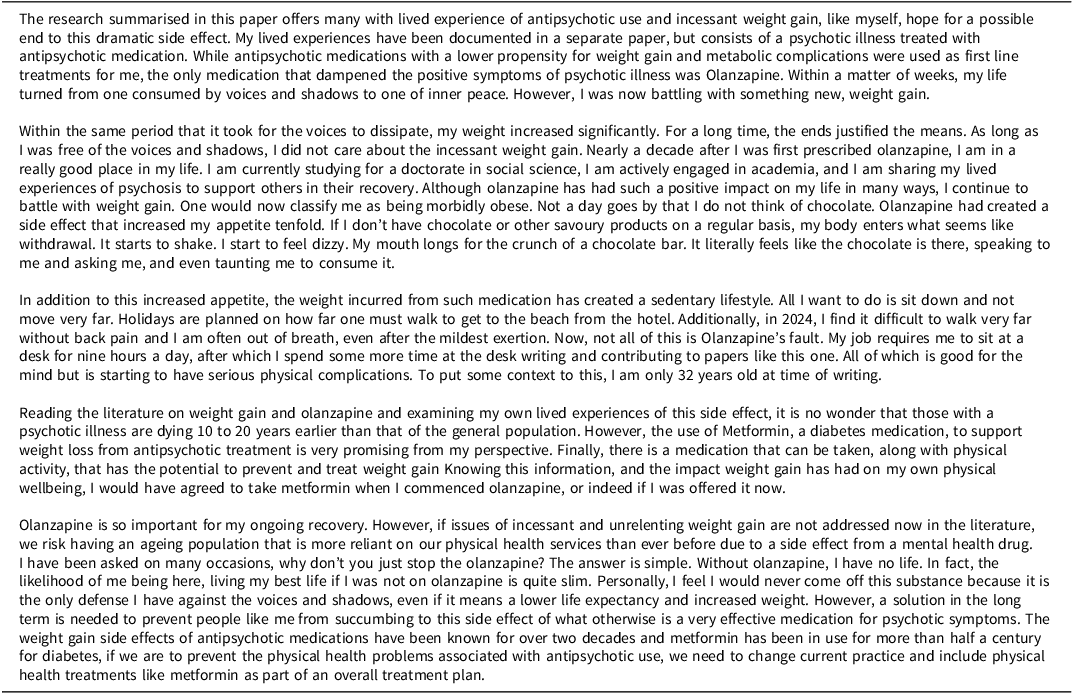
Guidelines developed in Canada for treating and preventing obesity have been adapted for use in many countries (Wharton et al. Reference Wharton, Lau and Vallis2020). The AOSI (The Association for the Study of Obesity on the Island of Ireland) tailored these for the Irish population using the ADAPTE framework, including experts from a wide array of specialities, including psychiatrists and psychologists, and the Irish Coalition for People Living with Obesity (The ADAPTE Process: Resource Toolkit for Guideline Adaptation. Version 2.0. The ADAPTE Collaboration, 2009; O’Dwyer et al. Reference O’Dwyer, Fitzgerald, Moore, Yoder, Taylor, Sockalingam, Hawa and Hahn2022; Breen et al. Reference Breen, O’Connell and Geoghegan2022). A chapter providing guidance for clinicians treating and preventing obesity in individuals with mental illness is included (O’Dwyer et al. Reference O’Dwyer, Fitzgerald, Moore, Yoder, Taylor, Sockalingam, Hawa and Hahn2022). These suggest careful consideration when prescribing psychotropic medication to limit weight gain, monitoring for changes in weight, and consideration for the prescription of metformin as a preventative measure, as well as lifestyle interventions to manage and mitigate weight gain. Recent guidelines with a sole focus on AIWG in people from the age of ten and over have been published recently (Carolan, Reference Carolan, Hynes‐Ryan, Agarwal, Bourke, Cullen, Gaughran, Hahn, Krivoy, Lally, Leucht, Lyne, McCutcheon, Norton, O’Connor, Perry, Pillinger, Shiers, Siskind, Thompson, O’Shea, Keating and O’Donoghue2024). These have been developed in Ireland with input from psychiatrists, endocrinologists, pharmacists, nurses, and service users using the ADAPTE guidance. Antipsychotics are placed in one of three classifications: high risk, medium risk, and low risk for AIWG. Co-commencement of metformin with antipsychotics at high risk of causing weight gain or medium risk with other cardiovascular comorbidities is advised. For the remaining agents, metformin is suggested if there is a > 3% increase in weight from baseline at any time. The use of GLP-1 RA for those with a BMI of 30 kg/m2 or 27 to 30 kg/m2 with cardiovascular comorbidities is recommended in line with current licensing for these drugs. These guidelines utilised GRADE methods (Guyatt et al. Reference Guyatt, Oxman, Vist, Kunz, Falck-Ytter, Alonso-Coello and Schünemann2008) to analyse evidence and the AGREE II (Appraisal of Guidelines for Research Evaluation II) framework (Brouwers et al. Reference Brouwers, Kho, Browman, Burgers, Cluzeau, Feder, Fervers, Graham, Grimshaw, Hanna, Littlejohns, Makarski and Zitzelsberger2010). With these methods, the level of evidence and the strength of recommendation can be considered separately. The potential benefits of metformin use to prevent AIWG outweigh the risks. Metformin is cost-effective and readily available and was found to be an acceptable option for individuals with psychotic illness to generate guidelines for the use of metformin for the prevention of AIWG. The GRADE and AGREE II methods enabled the creation of strong recommendations, incorporating input from multiple stakeholders, including those with lived experience (Carolan, Reference Carolan, Hynes‐Ryan, Agarwal, Bourke, Cullen, Gaughran, Hahn, Krivoy, Lally, Leucht, Lyne, McCutcheon, Norton, O’Connor, Perry, Pillinger, Shiers, Siskind, Thompson, O’Shea, Keating and O’Donoghue2024). One of the authors of this paper has shared his experience of AIWG in Table 1 to provide a first-hand account for the reader.
Lived experience of antipsychotic induced weight gain (by Michael John Norton - An individual with lived experience, and named author of this paper)

Other potential benefits to prescribing metformin
Metformin has been found to cross the blood-brain barrier, having anti-inflammatory effects and aiding the generation of neurotrophic factors (Cao et al. Reference Cao, Gong, Du, Wang, Ge and Liu2022). This led to the hypothesis that metformin may have a beneficial effect in terms of reducing the severity of symptoms for individuals affected by psychotic disorders. A systematic review and meta-analysis by Battini et al. (Reference Battini, Cirnigliaro, Leuzzi, Rissotto, Mosini, Benatti, Pozzi, Nobile, Radice, Carnovale, Dell’Osso and Clementi2023) investigated the potential positive effect of metformin on symptoms of psychosis. From the nineteen studies identified, no positive effects in terms of symptoms or cognition were evident (Battini et al. Reference Battini, Cirnigliaro, Leuzzi, Rissotto, Mosini, Benatti, Pozzi, Nobile, Radice, Carnovale, Dell’Osso and Clementi2023). However, recently, an open-label RCT was published comparing cognition in those prescribed metformin and antipsychotic medication together versus those prescribed antipsychotic alone. Improvements were seen in those prescribed metformin in five out of the eight cognitive domains tested (Shao et al. Reference Shao, Huang, Zhao, Wang, Tian, Hei, Kang, Gao, Liu, Zhao, Liu, Yuan and Wu2023). This also correlated with an improvement in functional connectivity in magnetic resonance imaging. This area of research is in its infancy but could demonstrate another possible benefit of metformin in this cohort.
Barriers to concurrent use of metformin
Determining metformin prescribing practices among psychiatrists is challenging. A recent cohort study examining metformin prescriptions in primary care for those on antipsychotic medication reveals a very low level of co-prescription. The study suggests this may stem from uncertainty about who should take responsibility for the prescription- general practitioners or psychiatrists (Trajano et al. Reference Trajano, Hayes, Launders, Davies and Osborn2024).
A study focused on determining the prescription of metformin by psychiatrists in children and adolescents suggests that it is minimal (Chen et al. Reference Chen, Lyu, Chan, De La Cruz and Calarge2023b). It is possible that psychiatrists are unwilling to prescribe a medication outside of their speciality and would have an expectation that a general practitioner or endocrinologist would prescribe this medication. However, the prescribing of a medication that is typically used in a different speciality other than psychiatry to manage the side effects of psychiatric medications is not a new practice. Anticholinergic drugs, such as biperiden, are widely prescribed by psychiatrists to manage the extrapyramidal side effects of antipsychotic medications. It is not a psychotropic medication, and it would not be considered within the scope of practice for psychiatrists to prescribe anticholinergic medication (Xiang et al. Reference Xiang, Wang, Si, Lee, He, Ungvari, Chiu, Yang, Chong, Tan, Kua, Fujii, Sim, Yong, Trivedi, Chung, Udomratn, Chee, Sartorius and Shinfuku2011; Hori et al. Reference Hori, Yasui-Furukori and Hasegawa2022). As extrapyramidal side effects were common, distressing and disabling for people prescribed first-generation antipsychotic medications, it made sense that psychiatrists took on the practice of prescribing the medications. We argue that the same principle should be applied to the common, distressing and disabling side effects of weight gain and other metabolic disturbances that are associated with second-generation antipsychotic medications. This could be done in consultation and collaboration with general practitioners and endocrinologists, who often manage the later consequences of obesity and cardiovascular disease.
The advent of glucagon-like peptide-1 receptor agonists (GLP-1 RA) has opened another possible avenue for the management of metabolic disorders in those taking antipsychotic pharmacotherapy. A systematic review and meta-analysis by Bak et al. (Reference Bak, Campforts, Domen, van Amelsvoort and Drukker2024) included studies regarding the treatment of those with AIWG with GLP-1RA (Bak et al. Reference Bak, Campforts, Domen, van Amelsvoort and Drukker2024). Primary outcomes of changes in body weight or BMI were analysed. Six studies, including five RCTs and one cohort, were identified. Mean weight loss was − 2.48 kg (95% CI − 5.12 to + 0.64; p = 0.07) for exenatide and − 4.70 kg (95% CI − 4.85 to − 4.56; p < 0.001) for liraglutide. There was no data for other GLP-1 RA. These results are significant and encouraging. However, the author highlights the need for further research for the use of these medications in AIWG. Although these medications appear to treat established weight gain, there is no evidence regarding the prevention of AIWG by GLP-1 RA. The importance of not only the treatment of weight gain but also prevention in those with psychotic illness cannot be overstated. As discussed previously, weight gain can contribute to low self-esteem and non-adherence, exacerbating negative symptoms and increasing the risk of psychotic relapse (Alimoradi et al. Reference Alimoradi, Golboni, Griffiths, Broström, Lin and Pakpour2020)
It is important to state that those prescribed antipsychotic medications may meet criteria for prescription of GLP-1 RA medications by meeting the criteria for obesity and these individuals should have equitable access to these medications (National Institute for Health and Care Excellence (NICE)., 2023).
Conclusions
For the prevention of antipsychotic-induced weight gain, metformin has an evidence base, is readily available, has minimal side effects and is a low-cost medication. For these reasons, metformin should be the first-line pharmacological agent for the prevention of antipsychotic-induced weight gain in individuals who do not meet the criteria for a GLP-1 RA. It should be used proactively with high-risk medications for weight gain, such as olanzapine or clozapine and when there are early signs of weight gain with other antipsychotic medications.
Financial support
This study was funded by an Applied Research Grant from the Health Research Board (APRO-2023-005)
Competing interests
The authors declare none.
Ethical standard
The authors assert that all procedures contributing to this work comply with the ethical standards of the relevant national and institutional committee on human experimentation with the Helsinki Declaration of 1975, as revised in 2008.

 Open access

