





Contributions of paracoprid dung beetles (Coleoptera: Scarabaeidae, Geotrupidae), species that build subterranean nests in soil directly below a dung source, provide important functions across many ecosystems, including improved nutrient cycling, decreased methane emissions, and disrupted parasite transmission (Nichols et al. Reference Nichols, Spector, Louzada, Larsen, Amezquita and Favila2008; Penttilä et al. Reference Penttilä, Slade, Simojoki, Riutta, Minkkinen and Roslin2013). These functions are linked to the quantity of dung displaced and the depth at which the dung is buried (Gregory et al. Reference Gregory, Gómez, Oliveira and Nichols2015). Gaining a better understanding of the beetles’ behaviours and specific nest architecture may provide useful insight into the mechanisms underpinning ecosystem functions of interest.
Using observational chambers to view tunnelling and nest architecture of paracoprid dung beetles is a common methodology (Klemperer Reference Klemperer1978, Reference Klemperer1982; Brussaard Reference Brussaard1983), based heavily on work by Main (Reference Main1917), who designed a narrow wooden frame with two glass windows placed to leave an intervening space slightly wider than the pronotal width of the beetles to be observed. The space between the panes was filled with soil, and beetles and dung were added to the soil surface. Other researchers have poured paraffin wax into beetle tunnels, in both lab and field conditions, preserving the architecture as it solidifies (e.g., Brussaard Reference Brussaard1983; Sowig Reference Sowig1996), although this method fails to capture some early tunnels that are later backfilled. In one attempt to circumvent this challenge, Sowig (Reference Sowig1996) describes placing round filter papers (of equal diameter to a sand-filled bucket) at regular depths within the substrate, creating layers of sand that are several centimetres thick and are separated by filter paper. Tunnelling beetles made holes within the pieces of paper during nest construction. Following the experiment, the filter papers were removed, and the position of the holes in each paper layer was used to construct a 3D model of the tunnel system (Sowig Reference Sowig1996).
To our knowledge, three-dimensional (3D) printing has not yet been employed for building observation chambers for dung beetles, despite the widespread use of 3D printing in ecological research. In entomological research alone, 3D printing has been used to print decoy female emerald ash borers to attract males (Domingue et al. Reference Domingue, Pulsifer, Lakhtakia, Berkebile, Steiner and Lelito2015) and to model flowers with varying morphology for pollinator research (Campos et al. Reference Campos, Bradshaw and Daniel2015). Given that many ecological studies require customised equipment designed for a particular experiment, the implementation of 3D printing can save time and money while ensuring the product is designed precisely to the required specifications of the given study (Behm et al. Reference Behm, Waite, Hsieh and Helmus2018).
We trialled a 3D-printed observation chamber inspired by Main’s (Reference Main1917) design. In this case, the printed structure replaced what has traditionally been a wooden frame. The 3D-printed chambers allowed us to observe the beetles as they constructed tunnels and nests, providing insight into belowground behaviours and interactions.
Observation chamber design
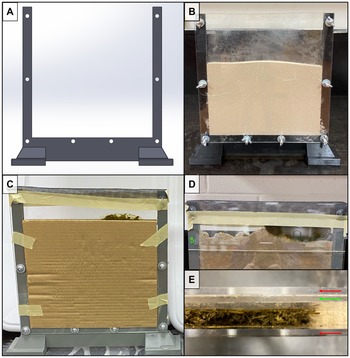
We designed the observation chamber (hereinafter: “chamber”) to have an internal, U-shaped frame sandwiched between two 30-cm × 30-cm acrylic sheets held together with machine screws (Fig. 1). The frame was designed in SolidWorks (Fig. 1A, Dassault Systèmes SolidWorks Corporation, Waltham, Massachusetts, United States of America; https://www.solidworks.com/) and printed in polyethylene terephthalate glycol (PETG; 3D Printing Canada, Hamilton, Ontario, Canada) – a food-safe filament commonly used in 3D printing (Latko-Durałek et al. Reference Latko-Durałek, Dydek and Boczkowska2019; Seno Flores et al. Reference Seno Flores, de Assis Augusto, Lopes Vieira Cunha, Beatrice, Backes and Costa2024) – on a Prusa XL-5T printer (Prusa Research, Prague, Czech Republic), with removable feet to allow the frame to be freestanding (Supplementary material, Videos S1, S2, and S3). Print time for each chamber was approximately 11 hours, including the print time for the feet, and the cost to print the frame was approximately $CAD 40.00. The frame’s thickness (10 mm) determined the width of the interpane space for beetles in the chamber.
Observation chamber: A, digital rendering of design; B, first prototype, printed and assembled; C, prototype with cardboard covers to simulate underground conditions; D, upper portion of chamber showing mesh covering; and E, top–down view into the chamber. Red arrows indicate the outer two panes of plexiglass. The green arrow indicates additional plexiglass added to reduce interior width in trials 2 and 3.

During the experiment, acrylic sheets were covered with corrugated cardboard when the chambers were not actively being observed to simulate underground conditions, and we covered the top opening of each chamber with mesh screening (Fig. 1D) for ventilation and to prevent beetles from escaping. Acrylic sheets were covered with corrugated cardboard (e.g., Fig. 1C) when the chambers were not actively being observed to simulate underground conditions.
Beetle collection
Onthophagus nuchicornis Linnaeus (Coleoptera: Scarabaeidae) beetles were collected by hand from horse dung on 13 June, 5 July, and 26 July 2024 (for trials 1, 2, and 3, respectively) from horse pastures in Salmon River, Nova Scotia, Canada (45.36203°, –63.22610°). Beetles were placed in temporary holding containers with moist paper towels, transported to the lab, and separated by sex (determined by the presence or absence of a cephalic horn).
Trial 1: pilot run
Approximately 860 g of play sand (Shaw Resources, Shubenacadie, Nova Scotia, Canada) were added to each chamber (n = 2), creating a depth of approximately 20 cm of sand. Approximately 165 mL of reverse osmosis water was added to each chamber – sufficient to moisten the sand throughout. We added 30 g of fresh cow dung to each chamber before placing the beetles inside. We randomly selected and added three male and three female beetles to each chamber (14 June 2024). Chambers were observed daily for 12 days, with additional fresh cow dung (40 g) added to each chamber on the fifth day (18 June 2024) because the initial 30 g had been fully used. The chambers were kept indoors at approximately 21 °C.
Trial 2: reduced interpane width for increased visibility
An additional frame was printed to increase replications. The interpane width of each chamber was reduced from 10 mm to 7 mm in all replicates by placing an additional acrylic sheet inside the chamber, resting directly against an exterior sheet (Fig. 1E, green arrow). This width reduction was implemented to improve the visibility of the tunnels and brood balls, which we found to be obscured by sand from both sides in frames with a 10-mm interpane width. To account for less interior chamber space, the amount of sand and water used was reduced to 615 g and 120 mL, respectively. We added 40 g of fresh cow dung before adding the beetles. We added three male and three female beetles to each chamber (5 July 2024) and observed the chambers for 10 days until the initial dung had been fully used and beetle activity had ceased.
Trial 3: tunnelling activity from a single pair of beetles
Maintaining an interpane width of 7 mm, the procedure for trial 2 setup was repeated with only a single pair of beetles (one male and one female) added to each chamber (26 July 2024) to better track the progression of tunnels and brood-ball formation. Chambers were observed for 10 days.
Behavioural observation
Cardboard sheets were removed briefly (< 5 min) each afternoon to allow for observation. Photographs of both sides of each chamber were taken daily using a smartphone, and the number and location of brood balls and tunnels were recorded.
Our initial trial (three mating pairs; 10-mm interpane width; n = 2) demonstrated that O. nuchicornis would be productive inside the chambers. Beetles in both chambers quickly used the initial 30 g of dung and the additional 40 g provided. After 12 days, the beetles produced an average of 20.5 ± 2.5 (mean ± standard deviation) brood balls in each chamber (Supplementary material, File S1).
In trial 2 (three mating pairs; 7-mm interpane width; n = 3), we added an additional chamber and decreased the interpane width to improve the visibility of the tunnels. Onthophagus nuchicornis individuals are typically 6–8 mm long (Floate Reference Floate2023) and 3.6–4.5 mm wide at the pronotum (Manning and Cutler Reference Manning and Cutler2020), and we found that the reduced chamber width still allowed beetles to move and turn freely. The beetles in this trial were fed 40 g of dung, which was fully used within a week. Chambers were dismantled after 10 days when nesting activity had ceased. The average number of brood balls per chamber decreased to 12.3 ± 1.25 (Supplementary material, File S1).
In trial 3 (one mating pair; 7-mm interpane width; n = 3,) we reduced the number of mating pairs to better understand the timing and ordering of nest construction. Only one of the replicates produced brood balls. We suspect the beetles in the other two replicates were teneral adults that require a cold diapause to reach sexual maturity (Floate Reference Floate2023). The pair of dung beetles in the productive chamber produced nine brood balls (Supplementary material, File S1).
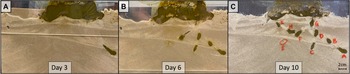
Brood balls located deepest in the sand were formed first. Generally, a mating pair of beetles dug a primary tunnel approximately 16–17 cm long at a downward 45° angle before levelling to create a brood-ball chamber. Horizontal offshoots from the main tunnel were subsequently created, and moving upwards, previous offshoots and lower sections of the main tunnel were backfilled with sand (Fig. 2). Daily observation of underground construction revealed a more complete picture of nesting activities than observation of only the completed nest system.
Chronological progression of brood-ball formation and nest architecture during trial 3 by a single pair of beetles: A, day 3 – the first brood ball is completed; B, day 6 – three tunnel branches and five brood balls are present; dung supply is partially used; and C, day 10 – dung supply is depleted with four tunnel branches and nine brood balls formed; brood ball “E” is visible only from the other side of the chamber.

This tunnel structure is similar to the results of previous studies (Main Reference Main1917; Halffter Reference Halffter1977; Brussaard Reference Brussaard1983), although limitations of the chamber design may not reflect nest architecture in the natural environment. Geotrupes spp. (Coleoptera: Geotrupidae), for example, forms each brood-ball chamber in a radial pattern, linked to the bottom of a single main tunnel (Main Reference Main1917). A useful next step in this present research may be to compare the observation chamber design to a traditional mesocosm to evaluate if the thin width of this chamber limits brood-ball output by the beetles.
Compared to wood, a 3D-printed plastic interior frame has several advantages. From a practical standpoint, plastic does not absorb moisture from the substrate, the frame is simple to assemble and disassemble, and it can be easily cleaned and sanitised. It is cost and time efficient to produce, and the original design can easily be modified. When compared to the construction of a traditional wooden chamber, the 3D-printed design does not require any specialised skills or woodworking equipment – the only equipment and materials required are a 3D printer, 3D modelling software (which can be found free online), and plastic filament. The 11 hours of printing time is an automated process and does not require a person to actively construct the chamber.
The use of 3D printing in entomological research has numerous applications, both in improving existing methods, as we did here in the present study, and in creating improved pathways for data collection. Here, a new method of chamber construction provides further insight into the belowground activities of dung beetles through the facilitation of noninvasive and chronological observation.
Supplementary material
The supplementary material for this article can be found at https://doi.org/10.4039/tce.2025.4.
Acknowledgements
We would like to thank all members of the Insect Biodiversity in Agroecosystems Lab, Dalhousie University, Truro, Nova Scotia, Canada, for support in the field and the lab during this project and Chris Nelson for his assistance with chamber construction. We also thank Robert Stewart and Arbour Ridge Farm, Salmon River, Nova Scotia, for allowing the us to collect beetles from their pastures.
Competing interests
The authors declare they have no competing interests.


 Open access

