


Before Tim Cook stepped foot in the C-suite at Apple Inc., he received a Master of Business Administration degree; prior to John F. Kennedy’s ascension to the Oval Office, he graduated cum laude majoring in government; and, previous to her appointment as Chief Executive Officer of PepsiCo, Indra Nooyi earned multiple advanced degrees in management. These figureheads are among the countless leaders who sharpened their teeth at universities and colleges prior to attaining power. Classrooms often see students at pivotal points in their identity development, shaping future generations of leaders. However, the cultures within Western higher education may have also inadvertently contributed to trends in leadership narcissism witnessed today. Thus, we would like to expand Mitchell and colleagues’ (2026) compelling discussion on leadership narcissism by focusing on a key player in the leadership development space: institutes of higher education (IHEs).
Not only are IHEs influential in developing leaders, but they are also unique environments in which programs and practices can be designed and implemented. Unlike the corporations centered in the focal article, classrooms are not beholden to the same stakes and constraints seen in industry. Indeed, Mitchell and colleagues suggest several innovative human resource practices (e.g., randomly assigning leaders) but acknowledge that companies may be reluctant to enact them, given rigid structures, profitability risks, and other concerns. Alternately, IHEs can offer an area to safely grow and learn; classrooms can become grounds for proving business practices and training responsible leaders. IHEs are thus a proactive avenue through which leadership narcissism can be minimized.
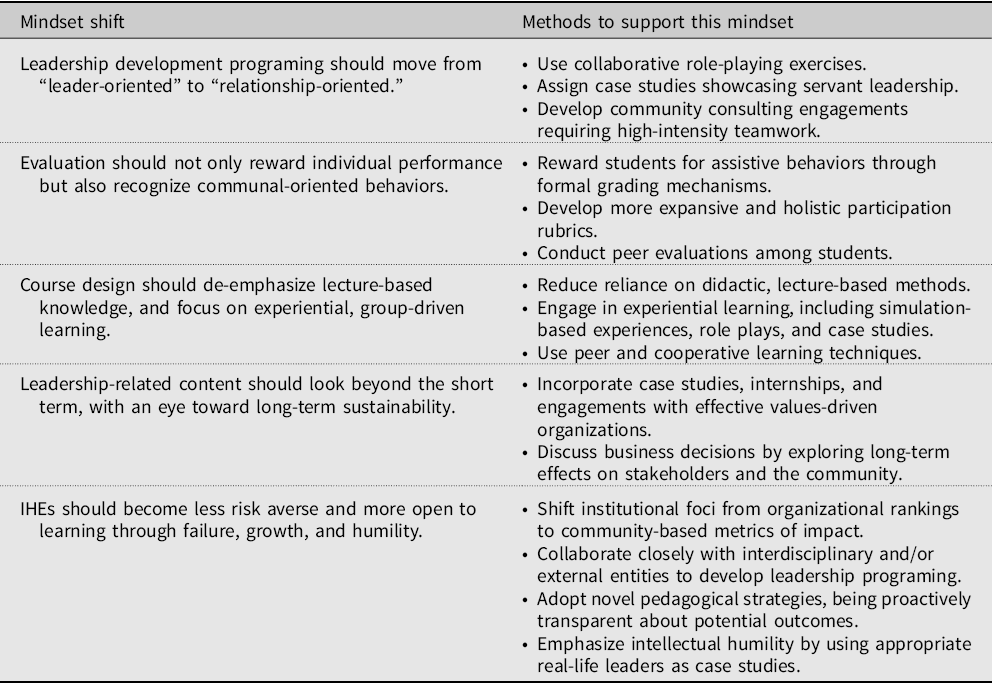
Nonetheless, it is important to note that IHEs are steeped in history, tradition, and, oftentimes, inertia (Jónasson, Reference Jónasson2016). As management professors with industrial-organizational psychology training and experience teaching leadership-related courses and programs, we recognize that core perspectives around leadership development will need to be challenged. We thus advance five “mindset shifts” that may alleviate the development of narcissistic leaders in the classroom. Rather than prescribing narrow practices, we begin by offering overarching approaches that can help address root contributors to leadership narcissism. Table 1 summarizes the mindset shifts, as well as suggestions on how these might be enacted in teaching and education. By reframing and becoming more intentional about the way we structure our classroom cultures, we hope to challenge the status quo of “me-sources” and champion the “we-sources” proposed in the focal article.
Summary and Suggestions

Mindset shift 1: Leadership development programing should move from “leader-oriented” to “relationship-oriented”
Reframing the value of leadership away from one that rewards narcissism and narcissistic behavior requires, first and foremost, reframing leadership itself. Specifically, IHEs should train students through paradigms that move away from a traditional, leader-oriented perspective and toward one that is relationship-oriented and follower-centric. Despite an oft-stated intention to develop ethical and responsible future leaders, the training and reward structures in most IHEs reflect a philosophy of leadership that is individualistic, hierarchical, and focused on maximizing personal achievement. Such training encourages the expression of narcissism and the use of personalized strategies in the pursuit of institutional power.
Shifting to a relationship-oriented view of leadership is not only good in concept but is also aligned with current scholarly thinking on how to lead effectively. Although a relationship- or follower-centric view of leadership is not new (see Van Vugt et al., Reference Van Vugt, Hogan and Kaiser2008), the past 15 years have seen a general consensus develop in the leadership literature as to the outsized importance of competence in relationship-oriented leader behaviors (e.g., Crayne & Hunter, Reference Crayne and Hunter2022; Oc et al., Reference Oc, Chintakananda, Bashshur and Day2023). As a social process, leadership requires the development and maintenance of high-quality relationships built on trust and mutual concern; training paradigms that eschew these important concepts to emphasize personal attainment ironically create future leaders who are worse prepared to lead.
This is not to say that IHEs should abandon managerial training entirely or that those in leadership positions should not use the structural authority that is often granted to them. To the contrary, the shift in mindset from one of “leader” to “leadership” is most useful when those who do achieve status and power are trained and motivated to use them in socially-oriented ways. Classrooms can encourage this way of thinking by designing curricula that emphasize the value of service, relationships, and prosocial action. Collaborative role-playing exercises, case studies exemplifying servant leadership, and community consulting engagements requiring high-intensity teamwork can all be designed to emphasize the value of relationship-focused leadership and incentivize high performance in those areas. Moreover, framing and assessing leadership in this way does not require denigrating a learner’s ambition, desire for achievement, or inherent draw to positions of influence. Instead, IHEs can reframe what success in leadership looks like, emphasizing the empirical reality that those leaders who focus on others tend to have better long-term personal outcomes as well (e.g., Van Dierendonck, Reference Van Dierendonck2011).
Mindset shift 2: Evaluation should not only reward individual performance but also recognize communal-oriented behaviors
The research on training and development—and evidence on human behavior writ large—has long emphasized the importance of aligning incentives and reward systems with desired behavior (e.g., Salas et al., Reference Salas, Tannenbaum, Kraiger and Smith-Jentsch2012). At present, perhaps the most common form of incentive (and, thereby, behavior promotion) used in higher education is grading. Ubiquitous evaluation practices, such as grading class participation and exams, tend to focus on individualized behavioral outcomes, which can potentially encourage narcissistic tendencies. Graded assignments and other performance indicators (e.g., class participation measured by the number of times a student speaks up) often emphasize self-promotion, validation-seeking behaviors, and individual recognition, especially when embedded within a norm-referenced grading structure—often the case in leadership-related classes (Horne et al., Reference Horne, Yuen, Beveridge and McLean2022). To counter this, we recommend instructors implement grading methods and assignments that instead promote altruistic and communal behaviors.
IHEs can learn from the world of basketball, where they have mastered the art of promoting both communal and agentic behaviors by way of tracking assists (i.e., when a player passes the ball to a teammate in a way that leads to a scoring basket) in addition to points or other individual-based behaviors. The question then becomes: How can we incorporate more communal-oriented methods for grading in our classrooms? An answer may lie in abandoning traditional norm-referenced grading systems for alternative structures like competency-based or mastery approaches (Larson, Reference Larson2023), wherein classroom learning objectives include collaborative components. “Assists” in the classroom may take many forms; students may step into the role of teacher by explaining concepts, helping peers with their learning, or asking an expansive or thought-provoking question to the class. Moreover, assists can be observed or self-evaluated using innovative, holistic rubrics; criteria can parse apart participation in small groups as well as with the whole class, and include collaborative behaviors outside the classroom (e.g., working with other students during study periods or office hours, or applying course concepts in the community). Formal peer evaluations can also encourage students to be accountable to one another and provide instructors with insight into helping behaviors. Although this mindset shift may require seemingly disruptive and more time-intensive grading techniques, ultimately, these changes could foster a more altruistic and less self-aggrandizing workforce.
Mindset shift 3: Course design should de-emphasize lecture-based knowledge and focus on experiential, group-driven learning
According to research and best practices in leadership development, programs that combine multiple training delivery methods are the most effective at fostering both cognitive learning and behavioral change (see Lacerenza et al., Reference Lacerenza, Reyes, Marlow, Joseph and Salas2017; Reyes et al., Reference Reyes, Dinh, Lacerenza, Marlow, Joseph and Salas2019). In university settings, however, the most common form of instruction is lecture (Tronchoni et al., Reference Tronchoni, Izquierdo and Anguera2022). Although this passive delivery method can be effective, there has been a steady call for more active and experiential learning approaches (e.g., Burch et al., Reference Burch, Giambatista, Batchelor, Burch, Hoover and Heller2019). We echo this call not only because of the substantial evidence for its effectiveness (see Taylor et al., Reference Taylor, Russ-Eft and Chan2005) but also because the practice of experiential learning may help create environments that minimize narcissistic behaviors.
Experiential learning involves reflecting on an integration of a student’s prior informal learning while incorporating practice or “learning by doing” (Illeris, Reference Illeris2007). Common exercises include simulation-based experiences (consisting of structured scenarios that mimic real-world environments and decision-making), as well as role plays and case studies (which emphasize hands-on and discussion-based learning among students). Thus, experiential methods are centered around the student and the community within which they are embedded, whereas lecture-based learning is centered around the instructor and their competence-driven status (Maner, Reference Maner2017). As a result, reliance on lecturing may unintentionally encourage the very behaviors we aim to prevent—by focusing on learning through a single authority and creating climates that limit student agency, collaboration, and empowerment. Our recommendation, therefore, is to embrace experiential learning methods and reduce the amount of time spent lecturing. Additionally, instructors may incorporate peer and cooperative learning techniques, such as think-pair-share (wherein students think about an idea independently, pair up with a peer to discuss their insights, and then share with the class; Kaddoura, Reference Kaddoura2013) and the jigsaw method (in which students are responsible for teaching different subsections of a topic; Cochon Drouet et al., Reference Cochon Drouet, Lentillon-Kaestner and Margas2023). In the same way that Mitchell and colleagues (in press) propose de-emphasizing the individual and embracing the collective, we advise redirecting the attention of the class—from the instructor as sole arbiter of knowledge to the classroom community as a conduit for cognitive and behavioral change.
Mindset shift 4: Leadership-related content should look beyond the short term with an eye towards long-term sustainability
Another shift that IHEs can undertake to reduce narcissism in future leaders is moving the focus from short-term goals to a longer-term orientation. An education grounded in sustainability and stakeholder considerations can counter narcissistic tendencies by keeping issues such as interdependence and ethical responsibility salient. Conversely, a curriculum focused primarily on short-term issues (such as quarterly profits and stock price fluctuations) emphasizes individual achievement, immediate results, and competition—conditions that may catalyze narcissism. IHEs need to reframe how we discuss success, focusing on stewardship across stakeholders and generations; this will, in turn, increase the likelihood of activating prosocial rather than individualistic traits.
This shift from short- to long-term orientation is consistent with the focal article and has been linked to many organizational benefits. For example, it has been argued that requesting 100% effort from employees consistently leads to burnout, whereas asking for 85% effort helps employees achieve maximum output over the long term (McKeown, Reference McKeown2023). A leadership focus on lasting employee well-being, even at the potential cost of immediate profits, requires a fundamental shift in how managers think and, thus, how we educate students. In the classroom, instructors can identify case studies and internships with successful values-driven organizations, such as Purpose Pledge-affiliated and certified B-corporations. Class activities should explore the long-term effects on all stakeholders of any business decision considered. For example, when looking at factors affecting organizational performance, students could be asked to track how an environmental scandal affected firm value and what the ramifications will be for the company and the affected communities. If a class has a community service component, students should be asked to explain the long-term benefits of their work, not just its immediate outcomes. As an added benefit, this focus on ethical considerations and community-focused leadership is consistent with the missions and values of many IHEs.
Mindset shift 5: IHEs should become less risk averse and more open to learning through failure, growth, and humility
Finally, IHEs should “walk the talk” and enact the values they espouse. There have been many calls for leaders and companies to practice the scientific method and experiment with their decision-making (e.g., Thomke & Loveman, Reference Thomke and Loveman2022); by the same token, IHEs should be willing to take risks in the pursuit of developing more responsible leaders. For example, schools may consider shifting their focus from institutional rankings to community-based metrics of impact (e.g., partnering with nonprofit and other mission-driven organizations). Another practice may be collaborating closely with other entities (e.g., programs across disciplines and/or external to IHEs) to develop leadership programming. Although it can be challenging to incorporate novel perspectives, these steps would potentially challenge the status quo in leadership development spaces and incorporate more collaborative and balanced frameworks.
Indeed, academics often teach the importance of the growth mindset yet are hard-pressed to learn through failure in practice—despite evidence that the teacher’s mindset can be as crucial to the learning process as the students’ (Yeager et al., Reference Yeager, Carroll, Buontempo, Cimpian, Woody, Crosnoe, Muller, Murray, Mhatre, Kersting, Hulleman, Kudym, Murphy, Duckworth, Walton and Dweck2021). The concept of intellectual humility may be helpful in creating space for experimentation, both for students and instructors. Intellectual humility describes when one is appropriately attentive to, and owns, one’s intellectual limitations (Whitcomb et al., Reference Whitcomb, Battaly, Baehr and Howard-Snyder2017). In the classroom, this can look like adopting many of the aforementioned suggestions while being proactively transparent and open about potential outcomes. Additionally, instructors may use real-life leaders as case studies in intellectual humility, moderating discussions about their behaviors and effectiveness. Practicing intellectual humility can emphasize the fact that competent, capable leaders can also be authentic and adaptable, dispelling myths around the necessity of “strong man” or narcissistic leadership.
Overall, we believe that IHEs can and should shift toward perspectives and practices that mitigate leadership narcissism: emphasizing relationship-oriented leadership, restructuring traditional incentive systems, centering experiential and collective learning, applying a long-term orientation, and internalizing a more growth-focused approach. Though focused on IHEs, these mindset shifts can be applied to a variety of leadership development programs, given their overarching scope and general alignment with best practices in training. Additionally, many of Mitchell and colleagues’ (in press) proposed human resource practices can be adapted for IHEs directly (e.g., depersonalizing recruitment and selection practices in leadership development programs). Importantly, our recommendations are only starting points for this important work. Our audience and scope are limited; many leaders may not matriculate through leadership development and related degree programs (e.g., business, psychology) in IHEs. We thus encourage educational professionals to think expansively—not only about how we might develop cultures within the classroom but how we can extend their reach (for example, advocating at the institutional and community levels for innovative and interdisciplinary leadership development).
As in the focal article, we recognize that structural changes take time and intention to implement, but we urge our fellow academics to contemplate our own leadership in the classroom. As educators, we should consider our responsibility (and, arguably, obligation) to respond to the threat of narcissism—helping our students learn as one rather than for one.

 Open access

