

1. Introduction
The Grenville orogen (c. 1090–980 Ma; Rivers, Reference Rivers2008, Reference Rivers2021) is a global-scale collisional orogenic system that terminated the long-lived accretionary growth of Laurentia, leading to the formation of the supercontinent Rodinia (Hoffman, Reference Hoffman1988; Whitmeyer and Karlstrom, Reference Whitmeyer and Karlstrom2007). In the southeastern Canadian shield (Grenville Province; Fig. 1a), c. 1.15 Ga (Shawinigan) and 1.05 Ga (Ottawan) high-grade metamorphism and penetrative deformation concealed the traits of accretionary tectonism, leaving behind gneiss terranes of ambiguous origin. Regional-scale Sm–Nd isotope mapping along the Grenville Province has attempted to untangle the pre-collisional crustal formation history of these large tracts of gneisses (Dickin & McNutt, Reference Dickin and McNutt1989; Dickin, Reference Dickin2000; Dickin et al., Reference Dickin, McNutt, Martin and Guo2009). However, the perspective of detrital zircon on the pre-collisional crustal growth of the Grenville Province remains underexplored despite zircon grains of Laurentian affinity being documented in pre-, syn- and post-collisional metasedimentary sequences (Sager-Kinsman and Parrish, Reference Sager-Kinsman and Parrish1993; Van Breemen and Corriveau, Reference Van Breemen and Corriveau2005; David et al. Reference David, Moukhsil and Dion2010; Kamo et al. Reference Kamo, Heaman and Gower2011; Lasalle et al. Reference Lasalle, Fisher, Indares and Dunning2013; Spencer et al. Reference Spencer, Cawood, Hawkesworth, Prave, Roberts, Horstwood and Whitehouse2015; Groulier et al. Reference Groulier, Indares, Dunning, Moukhsil and Wälle2018; Peck et al. Reference Peck, Quinan and Selleck2019). Together, these studies have documented, through detrital zircon U–Pb geochronology, the presence of 1.4–1.9 Ga sources but, further insights about their crustal production and evolution are missing.
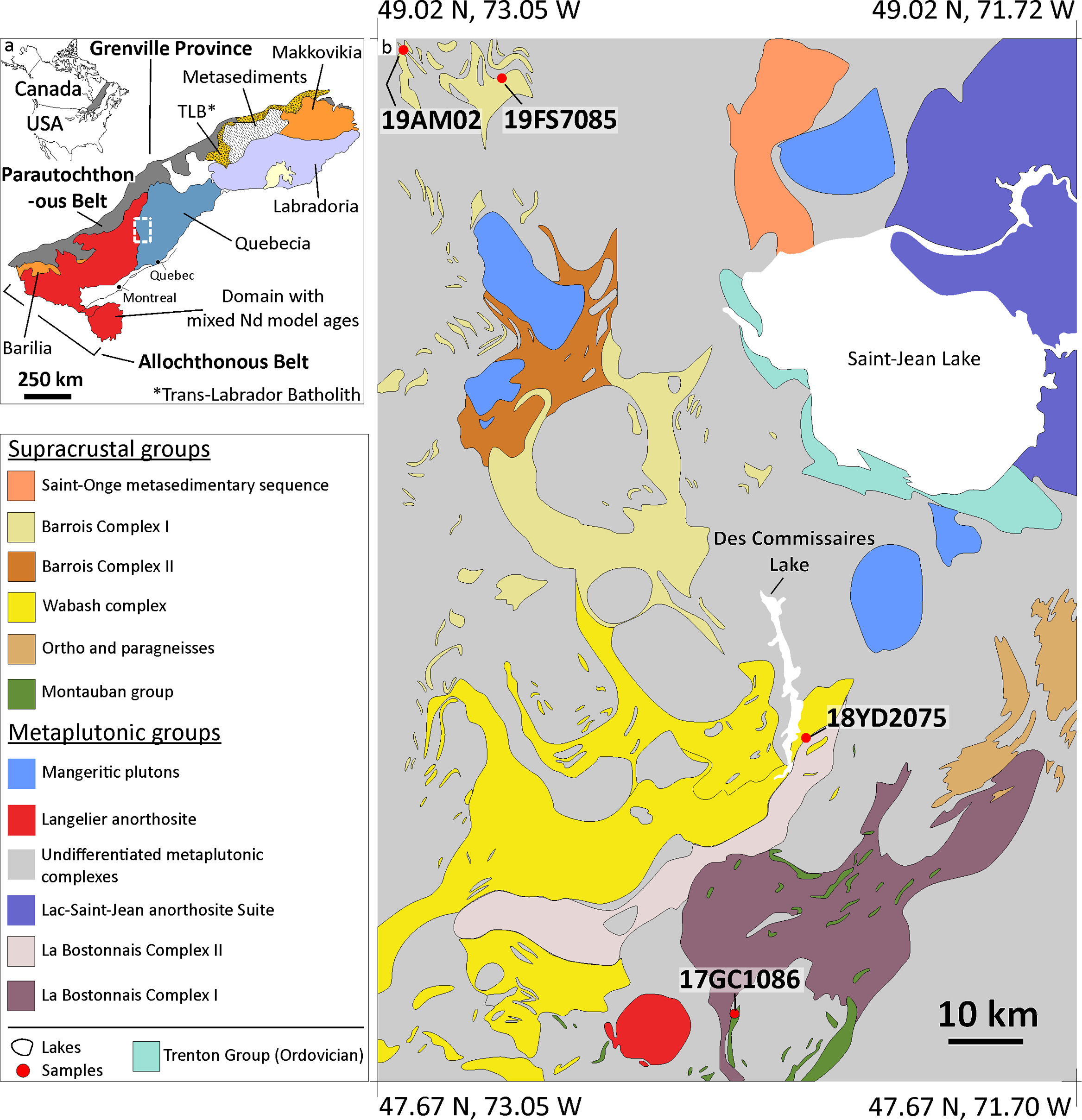
Simplified geological map of the Lac-Saint-Jean region. The inset (a) depicts the crustal terranes of the Grenville Province sensu Dickin, Reference Dickin2000). The white dashed rectangle depicts the study area. The red circles in (b) denote the four sampling sites.
In this regard, the interrogation of the detrital zircon record, from the Hadean to Phanerozoic, using U–Pb–Hf ± O isotope systematics has placed critical new constraints on the secular evolution and growth of the continental crust (Stevenson & Patchett, Reference Stevenson and Patchett1990; Kemp et al. Reference Kemp, Hawkesworth, Paterson and Kinny2006; Belousova et al. Reference Belousova, Kostitsyn, Griffin, Begg, O’Reilly and Pearson2010; Hawkesworth et al. Reference Hawkesworth, Dhuime, Pietranik, Cawood, Kemp and Storey2010; Parman, Reference Parman2015). Crucially, the initial Hf isotopic composition of single zircon grains monitors crust–mantle differentiation events while remaining resistant to high-grade metamorphism and/or hydrothermal fluid flow that can compromise the whole-rock Sm–Nd isotope system (Moorbath et al. Reference Moorbath, Whitehouse and Kamber1997; Vervoort & Blichert-Toft, Reference Vervoort and Blichert-Toft1999; Hoffmann et al., Reference Hoffmann, Münker, Polat, Rosing and Schulz2011). The advantage of the U–Pb and Lu–Hf isotopic couplet has been demonstrated in many crustal evolution studies (e.g. Condie et al., Reference Condie, Beyer, Belousova, Griffin and O’Reilly2005; Kemp et al. Reference Kemp, Hickman, Kirkland and Vervoort2015; Fisher & Vervoort, Reference Fisher and Vervoort2018) but remains underexploited in the metasedimentary sequences of the Grenville Province. The scarcity of zircon U–Pb–Hf isotopic data from these sequences has inhibited our ability to ground-truth crustal evolution models, which are heavily based on whole-rock Sm–Nd isotopic data from felsic orthogneisses, and in some cases interpreted without U–Pb age constraints from the same samples (e.g. Dickin, Reference Dickin2000).
In this contribution we combine, for the first time, detrital zircon U–Pb (n = 623) and Lu–Hf (n = 366) isotopic data from rare outcrops of quartzites in three Mesoproterozoic supracrustal sequences, from the Lac Saint-Jean region in the central part of the Grenville Province (Fig. 1b). The main aims of our study are to: (a) provide new constraints on the pre-collisional geodynamic evolution and crustal growth of the Grenville Province through examination of the U–Pb–Hf detrital zircon record, (b) compare the zircon U–Pb–Hf isotope signatures with the existing whole-rock Nd isotopic record of crustal growth in the central Grenville Province and (c) better constrain the depositional ages and sources of these poorly documented supracrustal sequences.
2. Pre-collisional accretionary terranes of the Grenville Province
The Grenville Province is divided into two major lithotectonic belts, the Parautochthonous and the Allochthonous Belts (Rivers, Reference Rivers1997). The Parautochthonous consists of basement rocks with Laurentian isotopic and age characteristics, whereas the Allochthonous Belt comprises translated nappes of amphibolite to granulite-facies gneisses (Rivers, Reference Rivers2008). Biotite gneisses in the western part of the Parautochthonous belt exhibit depleted-mantle Nd model ages from 2.5 to 2.9 Ga (Guo & Dickin, Reference Guo and Dickin1996) although Archaean zircon U–Pb crystallization ages have rarely been reported from these areas (Krogh, Reference Krogh1994; Jordan et al. Reference Jordan, Indares and Dunning2006).
The Allochthonous Belt has been characterized, through Nd isotope mapping of granitoid orthogneisses, as an amalgamation of Palaeo- to Mesoproterozoic accretionary terranes (Dickin, Reference Dickin2000). These terranes, sensu Dickin, (Reference Dickin2000), are the Makkovikia–Barilia, Labradoria and Quebecia terranes (Fig. 1a) with crustal formation ages (i.e. depleted-mantle model ages) of c. 1.5 Ga, 1.7–1.8 Ga and 1.9 Ga respectively. In more detail, the Makkovikia has been characterized as a terrane of reworked crust located at the easternmost part of the Grenville Province (i.e. Labrador), and the Barilia as a 1.8–2.0 Ga juvenile Palaeoproterozoic arc in Ontario (Dickin et al., Reference Dickin, McNutt, Martin and Guo2009). These terranes are regarded as products of an arc–continent collisional tectonothermal event known as the Penokean–Makkovikian orogeny, which is well documented in the Great Lakes region and took place between c. 1.8 and 1.9 Ga (Van Schmus & Bickford, Reference Van Schmus and Bickford1981; Barovich et al. Reference Barovich, Patchett, Peterman and Sims1989). U–Pb age-peaks in detrital zircon spectra at c. 1.8–1.9 Ga, from different metasedimentary sequences, have been reported along the Grenville Province and are commonly ascribed to Penokean–Makkovikian sources (Kamo et al. Reference Kamo, Heaman and Gower2011; Moukhsil et al. Reference Moukhsil, Solgadi, Clark, Blouin, Indares and Davis2013; Culshaw et al. Reference Culshaw, Foster, Marsh, Slagstad and Gerbi2016; Peck et al. Reference Peck, Quinan and Selleck2019).
Labradoria was formed during the Mazatzalian–Labradorian orogeny between 1.6 and 1.7 Ga (Wasteneys et al. Reference Wasteneys, Kamo, Moser, Krogh, Gower and Owen1997; Papapavlou et al. Reference Papapavlou, Darling, Storey, Lightfoot, Moser and Lasalle2017) and crops out mostly in Labrador, in the eastern part of the Grenville Province (Connelly & Heaman, Reference Connelly and Heaman1993; Gower, Reference Gower2019). Labradorian-age metaplutonic and mafic/ultramafic suites have also been documented in the central and western parts of the province (Dunning & Indares, Reference Dunning and Indares2010, Culshaw et al. Reference Culshaw, Foster, Marsh, Slagstad and Gerbi2016). In eastern Labrador, c. 1.7 Ga tonalitic and granitic rocks exhibit near-chondritic isotope signatures (ϵNd = −0.13 to +0.42; Scharer, Reference Schärer1991). Later studies suggested that the Labradorian crust-forming event was mostly juvenile but also involved magmatic reworking (i.e. remelting) of older Makkovikian crust in the eastern part of the province (Dickin, Reference Dickin2000). As with detrital zircon grains of Penokean age, grains of Labradorian age are ubiquitous in the pre- and syn-Grenvillian metasedimentary record (Corrigan & Van Breemen, Reference Corrigan and Van Breemen1997; Lasalle et al. Reference Lasalle, Fisher, Indares and Dunning2013; Culshaw et al. Reference Culshaw, Foster, Marsh, Slagstad and Gerbi2016; Peck et al. Reference Peck, Quinan and Selleck2019).
The youngest accretionary event in the pre-collisional history of the Grenville Province is the c. 1.46–1.52 Ga Pinwarian orogeny (Tucker & Gower, Reference Tucker and Gower1994; Gower & Krogh, Reference Gower and Krogh2002) that is expressed through titanite U–Pb dating in reactivated mylonitic shear zones in adjacent orogens (e.g. Southern Province; Papapavlou et al. Reference Papapavlou, Darling, Lightfoot, Lasalle, Gibson, Storey and Moser2018). In the eastern part of the Grenville Province, Pinwarian magmatism reworked Labradoria whereas further west it led to the construction of Quebecia (Dickin, Reference Dickin2000). Recent studies focusing on the Pinwarian magmatism suggest that it took place above two subduction zones with opposing polarities: a north-dipping subduction zone below Laurentia and a south-dipping intra-oceanic subduction zone, which led to the construction of a nascent magmatic arc (Martin & Dickin, Reference Martin and Dickin2005; Vautour & Dickin, Reference Vautour and Dickin2019).
The Mid- to Late-Proterozoic Elzevirian (c. 1.2–1.3 Ga) and Shawinigan (c. 1.19–1.14 Ga) orogenic pulses constitute the final accretionary events (Rivers, Reference Rivers2008) before the collisional Grenville orogeny that lasted until c. 960 Ma (Jannin et al. Reference Jannin, Gervais, Moukhsil, Augland and Crowley2018, Turlin et al. Reference Turlin, Vanderhaeghe, Gervais, André-Mayer, Moukhsil and Zeh2019) and was ended by late collisional alkaline magmatism (Groulier et al. Reference Groulier, Turlin, André-Mayer, Ohnenstetter, Crépon, Boulvais, Poujol, Rollion-Bard, Zeh, Moukhsil, Solgadi and El basbas2020b).
3. Regional geology of the Saguenay – Lac Saint-Jean region
The Lac Saint-Jean region is located in the central part of the Grenville Province within the Allochthonous Belt (Fig. 1). The oldest lithostratigraphic unit in the area is the Pinwarian Cap de la Mer amphibolite, with a U–Pb zircon age of 1506 ± 13 Ma, which is included within a group of basement units called the Saguenay Gneiss Complex (Hébert & Van Breemen, Reference Hébert and Van Breemen2004). This area belongs to the Portneuf – St Maurice lithotectonic domain that consists of two main units, the La Bostonnais complex, which is a 1.4–1.37 Ga suite of metamorphosed calc-alkaline plutonic rocks, and the Montauban group, a c. 1.45 Ga metamorphosed volcano-sedimentary sequence commonly observed as enclaves within the La Bostonnais complex (Fig. 1b; L Nadeau et al., unpub. data, 1992; Corrigan & Van Breemen, Reference Corrigan and Van Breemen1997). The area is dominated by anorthosite–mangerite–charnockite–granite (AMCG) magmatic suites and hosts the >20 000 km2 Lac Saint-Jean Anorthositic Suite (Woussen et al. Reference Woussen, Dimroth, Corriveau and Archer1981). U–Pb zircon dating (isotope dilution thermal ionization mass spectrometry (ID-TIMS)) has shown that the Lac Saint-Jean anorthosite suite was emplaced between c. 1160 and 1140 Ma and was followed by two less voluminous AMCG magmatic pulses at c. 1082–1050 Ma and 1020–1010 Ma (Higgins & Van Breemen, Reference Higgins and Van Breemen1996). Regional Grenvillian metamorphism in the area attained granulite facies with P–T conditions of 6.2 kbar and 780 °C followed by a retrograde amphibolite facies event reaching 4.7 kbar and 690 °C , respectively (Hébert & Van Breemen, Reference Hébert and Van Breemen2004).
3.a. Supracrustal lithological complexes
In this study we explore the detrital zircon record from three of the four supracrustal complexes that crop out in the wider area of the Lac Saint-Jean region. These are the Montauban, Wabash, Barrois and Saint-Onge complexes (Fig. 1b). The Montauban complex consists of quartzofeldspathic gneisses interlayered with amphibolite, pillowed tholeiitic metabasalts with boudinage structure, volcanic and volcaniclastic rocks (i.e. lappili tuff), metalliferous calc-silicate rocks, garnetite, and minor quartzite which was sampled in this study (sample 17GC1086; Stamatelopoulou-Seymour & Maclean, Reference Stamatelopoulou-Seymour and MacLean1977; Rondot, Reference Rondot1978). Supracrustal lithologies of the Montauban group are of economic importance since they host metamorphosed exhalative massive sulphide (Zn–Pb–Cu–Au–Ag) and stratiform gold occurrences (Bernier et al. Reference Bernier, Pouliot and MacLean1987). The Wabash group is a metamorphosed volcano-sedimentary sequence that consists of four tectonostratigraphic units that mainly comprise migmatitic paragneisses, calcitic and dolomitic marbles, minor impure quartzite layers (sample 18YD2075), amphibolites and quartzofeldspathic rocks. The Barrois group comprises chiefly Opx-bearing orthogneisses, Bt-bearing paragneisses, charnockitic to enderbitic gneisses, amphibolite and garnetite. The Barrois group is divided into the Barrois I unit that contains metasedimentary lithologies (i.e. paragneisses) and the Barrois II unit that consists of orthogneisses which likely constitute the basement onto which the Barrois I unit was deposited. The biotite-bearing paragneisses consists of interbedded, decimetre- to metre-scale, quartzite horizons, which were sampled here (samples 19AM02 and 19FS7085). Aeromagnetic maps suggest the juxtaposition of the Barrois and Wabash supracrustal packages most likely along a stratigraphic contact. The Saint-Onge group is composed of quartzofeldspathic paragneisses, calc-silicate rocks, marbles and minor quartzite. Lithological members of this group show extensive alteration in outcrop scale and were not sampled in this study. Four quartzite samples from the Lac Saint-Jean region were collected: these samples are the 17GC1086 (Montauban Group), 18YD2075 (Wabash Complex), 19FS7085 and 19AM02 (Barrois Complex). Sample coordinates and petrographic descriptions are provided in supplementary material file 1 (in the Supplementary Material available online at https://doi.org/10.1017/S0016756821001023).
4. Analytical techniques and methodology
Sample processing and microanalytical work were conducted at the facilities of GEOTOP-UQAM (Montreal, QC, CA) using conventional zircon separation procedures involving crushing with a jaw crusher and disc mill followed by Wilfley table, heavy liquid, and magnetic separation using a Franz isodynamic separator. The zircon grains were annealed at 1000 °C for 48 hours and were then mounted in epoxy for imaging and microanalysis. Cathodoluminescence (CL) imaging of the zircon grains was conducted using a Hitachi S-3400N scanning electron microscope (SEM). The U–Pb and Lu–Hf isotopic analyses were performed during separate sessions on overlapping or adjacent analytical spots within the same CL growth domain assuming no differences in the isotopic composition or age of the different volumes. The U–Pb and Lu–Hf analytical sessions were performed using a Photon Machines Analyte G2 excimer laser (193 nm) coupled with either a single-collector high-resolution inductively coupled plasma mass spectrometer (Nu Attom, HR-ICP-MS, for U–Pb microanalysis) or a multicollector ICP-MS (Nu Plasma II, for Hf isotope microanalysis). The ablation took place in a two-volume HELEX II sample cell with He as the carrier gas which was mixed with the Ar make-up gas downstream before entering the ICP torch. Instrument parameters of the analytical sessions and secondary reference material data are provided in supplementary material file 1 (in the supplementary material available online at https://doi.org/10.1017/S0016756821001023). The U–Pb and Lu–Hf time-resolved isotopic data were reduced and processed using iolite 3.63 and IsoplotR (Paton et al. Reference Paton, Hellstrom, Paul, Woodhead and Hergt2011; Vermeesch, Reference Vermeesch2018).
4.a. U–Pb isotopic analysis
The U–Pb isotopic data were collected using a spot size of 25 μm at a repetition rate of 5 Hz and fluence of 3 J cm−2. The 91500 zircon (206Pb/238U age of 1062.4 ± 0.4 Ma; Wiedenbeck et al., Reference Wiedenbeck, Allé, Corfu, Griffin, Meier, Oberli, Von Quadt, Roddick and Spiegel1995) was used as the primary reference material for the correction of laser-induced elemental fractionation and instrument drift. Secondary zircon reference materials were interspersed every 10–15 unknowns and yielded the following weighted mean 207Pb/206Pb ages: BB9 (567 ± 16 Ma, 2s, MSWD = 2, n = 8), Mudtank (713 ± 17 Ma, 2s, MSWD = 1.5, n = 35), GJ-1 (604 ± 11 Ma, 2s, MSWD = 2.7, n = 38), UQZ8 (1119 ± 9 Ma, 2s, MSWD = 5, n = 15) and Pentecote (1367 ± 39 Ma, 2s, MSWD = 3, n = 10). These dates corroborate within uncertainty the published reference values (Martignole et al. Reference Martignole, Machado and Nantel1993; Machado & Gauthier, Reference Machado and Gauthier1996; Jackson et al. Reference Jackson, Pearson, Griffin and Belousova2004; Santos et al. Reference Santos, Lana, Scholz, Buick, Schmitz, Kamo, Gerdes, Corfu, Tapster, Lancaster, Storey, Basei, Tohver, Alkmin, Nalini, Krambrock, Fantini and Wiedenbeck2017; Gain et al. Reference Gain, Gréau, Henry, Belousova, Dainis, Griffin and O’Reilly2019).
The U–Pb isotopic data (see also U–Pb supplementary material available online at https://doi.org/10.1017/S0016756821001023) that are presented from the cores of zircon grains have ≤10% discordance and Th/U > 0.1 following the rationale of previous studies (Papapavlou et al. Reference Papapavlou, Strachan, Storey and Bullen2021). The filtered data are presented as 207Pb/206Pb ages in Kernel Density Estimation (KDE) diagrams with an adaptive bandwidth using the Java application DensityPlotter (Vermeesch, Reference Vermeesch2012). Maximum depositional ages (MDAs) were calculated using the maximum likelihood age (MLA) estimation algorithm of Vermeesch (Reference Vermeesch2021). Grains that do not show igneous zoning in CL were not considered during the calculation of MDAs but are presented in the U–Pb supplementary material (available online at https://doi.org/10.1017/S0016756821001023).
4.b. Lu–Hf isotopic analysis
The Lu–Hf isotopic data were collected using a 50 μm spot with a laser frequency of 15 Hz and fluence of c. 9 Jcm−2. A typical Lu–Hf analysis consisted of 25 s of background measurement and 20 s of data acquisition. The 171Yb, 173Yb, 174Yb, 175Lu, 176(Yb + Lu + Hf), 177Hf, 178Hf, 179Hf, 180Hf, 181Ta and 182W beams were collected using 11 Faraday cups in fixed positions attached to 1011 Ω feedback resistors, with the mass separation being controlled by an optical zoom lens between the magnetic sector and the detectors. The 91500 zircon was used as the primary reference material to correct instrument drift during the analytical session. Mass bias and isobaric interference corrections of 176Yb and 176Lu on 176Hf were made following the rationale and guidelines of previous studies (Woodhead et al., Reference Woodhead, Hergt, Shelley, Eggins and Kemp2004; Fisher et al. Reference Fisher, Vervoort and Hanchar2014). Specifically, the β Yb (Yb mass bias) was determined by measuring the 173Yb/171Yb ratio relative to 173Yb/171Yb = 1.132685 (Chu et al., Reference Chu, Taylor, Chavagnac, Nesbitt, Boella, Milton, German, Bayon and Burton2002). Following the calculation of β Yb, the contribution of 176Yb on 176Hf was subtracted using the intensity of the interference-free 173Yb and a 176Yb/173Yb = 0.79618 (Chu et al., Reference Chu, Taylor, Chavagnac, Nesbitt, Boella, Milton, German, Bayon and Burton2002). The contribution of the 176Lu on the 176Hf signal was estimated assuming that β Lu = β Yb using the intensity of the interference-free 175Lu with a 176Lu/175Lu = 0.02656 (Blichert-Toft et al. Reference Blichert-Toft, Chauvel and Albarède1997). The mass bias correction on the 176Hf/177Hf ratios was estimated using 179Hf/177Hf = 0.7325 (Patchett & Tatsumoto, Reference Patchett and Tatsumoto1981). Mass bias corrections for Yb, Hf and Lu were made using an exponential law. For the Yb mass bias corrections of grains with low Yb/Hf ratios (e.g. Mudtank and Munzirc02a, which have 173Yb beam intensities below 5mV), the β Hf was used instead of the poorly characterized β Yb. For quality control on the mass bias corrections, the 178Hf/177Hf ratio on the analysed reference materials yielded a value of 1.46731 ± 52 (1s), in agreement with the published value of 1.46735 (Thirlwall & Anczkwiewicz, Reference Thirlwall and Anczkiewicz2004).
Secondary zircon reference materials with variable 176Yb/177Hf ratios were analysed during the Lu–Hf session to ensure that our 176Yb correction yielded accurate results (see also Lu–Hf supplementary material file, available online at https://doi.org/10.1017/S0016756821001023). The following weighted mean 176Hf/177Hf values were obtained: BB9 zircon (0.281666 ± 26, MSWD = 1.5, n = 9, 2s, ϵHf value of −27.2 ± 1.2), Maniitsoq (0.280865 ± 15; MSWD = 0.9, n = 10, 2s, ϵHf value of −0.28 ± 0.9), Munzirc12c (0.282129 ± 12; MSWD = 1.3, n = 17, 2s), Munzirc02a (0.282160 ± 8, MSWD = 1.5, n = 18, 2s), Munzirc32c (0.282150 ± 19; MSWD = 2, n = 14, 2s), Munzirc42b (0.282164 ± 14; MSWD = 0.3, n = 11, 2s), Plešovice (0.282475 ± 6; MSWD = 0.6, n = 30, 2s, ϵHf value of −3.5 ± 0.6), SA01 (0.282296 ± 24; MSWD = 1.5, n = 11, 2s, ϵHf value of −5.7 ± 1.5), GJ-1 (0.282006 ± 16; MSWD = 0.6, n = 17, 2s, ϵHf value of −14.3 ± 1.1) and Mudtank (0.282528 ± 11; MSWD = 1.5, n = 16, 2s, ϵHf value of +7.1 ± 1) (Morel et al. Reference Morel, Nebel, Nebel-Jacobsen, Miller and Vroon2008; Sláma et al., Reference Sláma, Košler, Condon, Crowley, Gerdes, Hanchar, Horstwood, Morris, Nasdala, Norberg, Schaltegger, Schoene, Tubrett and Whitehouse2008; Fisher et al. Reference Fisher, Hanchar, Samson, Dhuime, Blichert-Toft, Vervoort and Lam2011; Santos et al. Reference Santos, Lana, Scholz, Buick, Schmitz, Kamo, Gerdes, Corfu, Tapster, Lancaster, Storey, Basei, Tohver, Alkmin, Nalini, Krambrock, Fantini and Wiedenbeck2017; Gain et al. Reference Gain, Gréau, Henry, Belousova, Dainis, Griffin and O’Reilly2019; Marsh et al. Reference Marsh, Jorgensen, Petrus, Hamilton and Mole2019; Huang et al., Reference Huang, Wang, Yang, Ramezani, Yang, Zhang, Yang, Xia, Feng, Lin, Wang, Ma, He, Xie and Wu2020). The reproducibility (2s) of the secondary reference materials varies from 0.004 to 0.029 %. The analytical errors are quadratic additions of the in-run error (2SE) and the reproducibility (2s) of the Plešovice standard and are typically ∼± 2 ϵHf units. The initial 176Hf/177Hf isotope ratios and ϵHf values were calculated using the 176Lu decay constant of 1.867 × 10⁻¹¹ (Söderlund et al. Reference Söderlund, Patchett, Vervoort and Isachsen2004) and the Lu–Hf Chondritic Uniform Reservoir (CHUR) parameters of Bouvier et al. (Reference Bouvier, Vervoort and Patchett2008). The initial 176Hf/177Hf isotope ratios and ϵHf values for each detrital zircon were calculated using the 207Pb/206Pb date of each analytical spot.
5. Results
5.a. Sample 17GC1086 (Montauban Group)
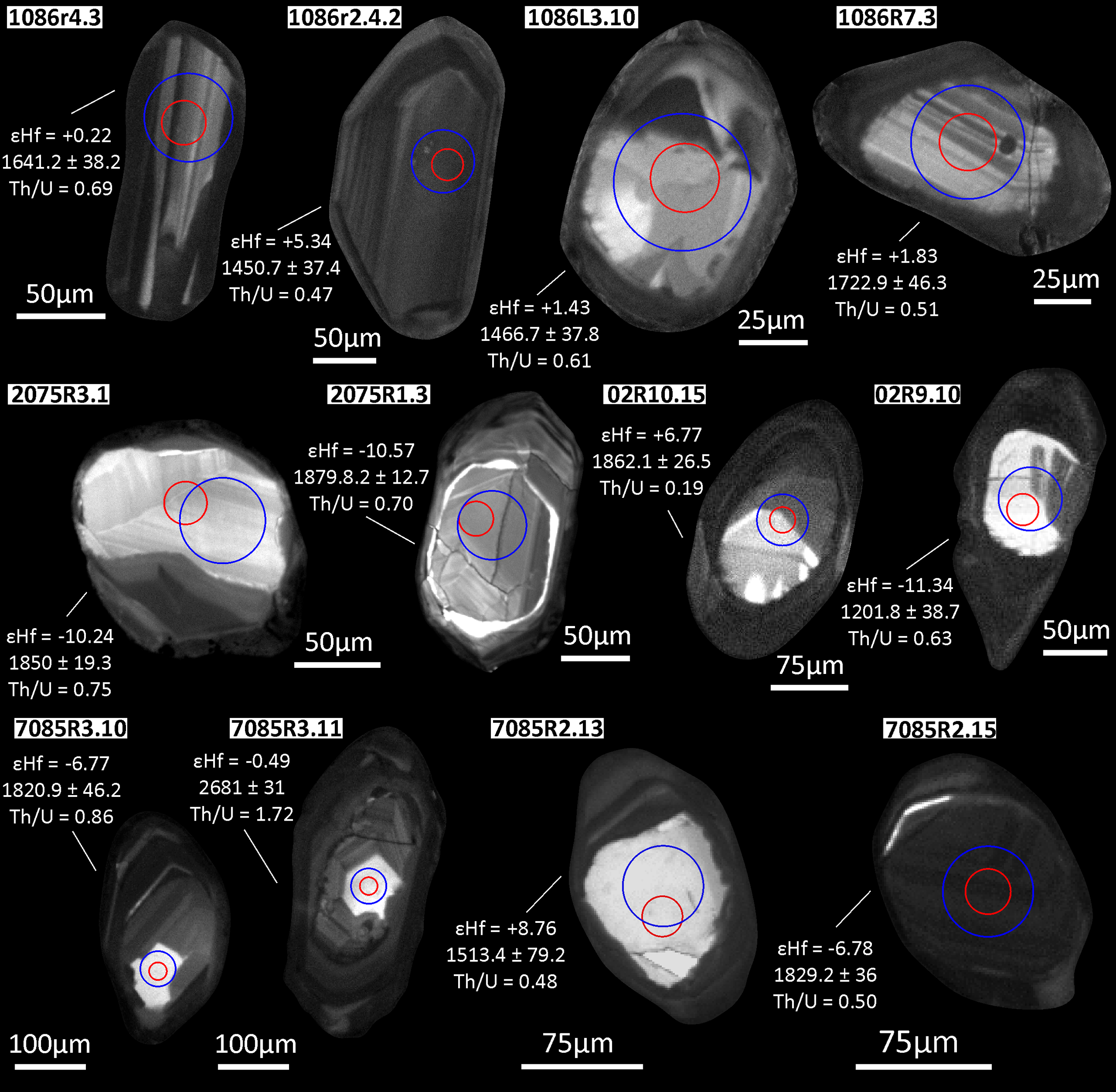
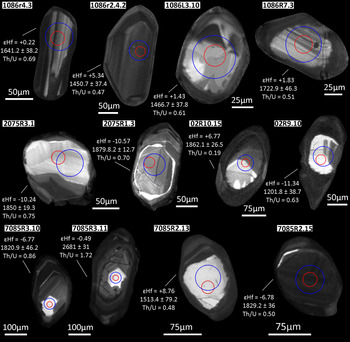
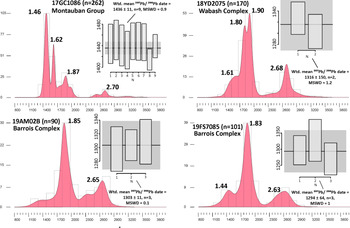
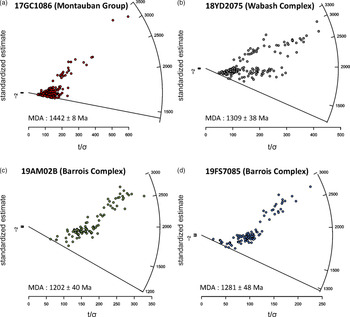
The examined zircon grains are rounded to sub-rounded with aspect ratios 1:1 to 4:1, exhibiting oscillatory, sector-zoned or homogeneous zones in CL with brighter cores commonly overgrown by thin (<15 μm) darker rims (Fig. 2; spot 1086R7.3). Planar banding and domains with faint variations in CL response are also observed. Four dominant age peaks at 1.46 Ga, 1.62 Ga, 1.87 Ga and 2.7 Ga are recorded in this sample (Fig. 3; sample 17GC1086). The dominant age components at c. 1.46 Ga and 1.62 Ga indicate the prevalence of sources with Pinwarian (34 % of the analyses) and Labradorian (29 % of the analyses) affinities, with subordinate amounts of grains with Penokean ages (22 % of the analyses). The MLA algorithm yields a date of 1442 ± 8 Ma (Fig. 4a) that is interpreted as the MDA of the sample. This date agrees with the youngest cluster of nine U–Pb analyses from grains with oscillatory zoning in CL and Th/U values from 0.3 up to 1.1 that yield a weighted mean 207Pb/206Pb date of 1436 ± 11 Ma (n = 9, MSWD = 0.9, 2s). A cluster of younger 207Pb/206Pb dates from 1399 Ma to 1334 Ma is also observed, but the zoning patterns in CL of the grains are not diagnostic of igneous growth and were not considered in the estimation of the MDA (see also Supplementary Material, available online at https://doi.org/10.1017/S0016756821001023).
Representative cathodoluminescence images from detrital zircon grains of the four quartzite samples. Red and blue circles show the location of the 25 μm and 50 μm beam location for U–Pb and Lu–Hf microanalysis, respectively.
Kernel density estimation (KDE) 207Pb/206Pb age diagrams and weighted mean 207Pb/206Pb age diagrams from the youngest zircon grains in the four quartzite samples. The numbers adjacent to the peaks denote the age maxima in Ga. The weighted mean plots next to the KDE diagrams represent MDA estimates based on the youngest acceptable dates for each supracrustal complex.

Radial plots and MDA estimates of the (a) Montauban Group quartzite, (b) Wabash Complex quartzite and (c, d) Barrois Complex quartzites using isoplotR (Vermeesch, Reference Vermeesch2018) and the Maximum Likelihood Age (MLA) algorithm (Vermeesch, Reference Vermeesch2021). The radial plots display heteroscedastic data (i.e. data points with unequal uncertainties) where each data point represents a 207Pb/206Pb date. These plots are scatter plots of standardized estimates (y axis) against precisions (x axis).The angular position of each data point denotes the date, whereas the horizontal distance from the point of origin varies with the precision of the analysis (i.e. imprecise measurements on the left side and more precise on the right side of the plot). For further details on age calculation see Vermeesch (Reference Vermeesch2021) and Galbraith (Reference Galbraith1988).

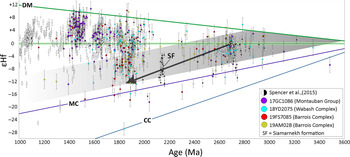
The ϵHf values of the analysed zircon grains vary from −18.4 to +10.7 (Fig. 5). The majority of zircon grains with 207Pb/206Pb ages between c.1.4 and 1.56 Ga (92 % of the analyses) exhibit suprachrondritic ϵHf values (ϵHf > 0) consistent with the juvenile signature of Pinwarian sources. Similarly, 84 % of the analyses from the 1.6–1.7 Ga age population also yield suprachondritic ϵHf values (ϵHf = +0.2 to +5.8) with 16 % recording ϵHf values between −1.1 and −8. The third major age component, with ages between c. 1.8 and 1.9 Ga, shows an increasing contribution from sources that define a vertical mixing array between sub- and suprachondritic components (ϵHf between −1.2 and +7.0). The minor 2.7 Ga age component consists chiefly of grains with ϵHf values that vary from −10.3 to +3.8.
Epsilon Hf versus age with Lu–Hf isotopic data from the detrital zircon grains of the four quartzites reported in this study. Black and white coloured are Lu–Hf data points from the dataset of Spencer et al. (Reference Spencer, Cawood, Hawkesworth, Prave, Roberts, Horstwood and Whitehouse2015). The black-filled data points represent data from the pre-orogenic Siamarnekh Formation (SF). The white-filled data points depict, for comparative purposes, Lu–Hf isotopic data from pre-, syn- and post-orogenic formations from Labrador and Scotland. The lines with different slopes (DM = depleted mantle, MC = mafic crust, CC = continental crust) correspond to different Lu–Hf isotope evolution curves for the depleted mantle (176Lu/177Hf = 0.03976; Vervoort et al. Reference Vervoort, Kemp and Fisher2018), continental crust (176Lu/177Hf = 0.0113; Rudnick & Gao, Reference Rudnick and Gao2003) and mafic crust (176Lu/177Hf = 0.022; Nebel et al. Reference Nebel, Nebel-Jacobsen, Mezger and Berndt2007) reservoirs. The CHUR reference line (ϵHf = 0) involves an uncertainty of ±0.4 ϵHf units (Bouvier et al. Reference Bouvier, Vervoort and Patchett2008). The grey band is drawn parallel to the 176Lu/177Hf = 0.022 line and covers c. 70 % of the 1.8–1.9 Ga zircon grains.

5.b. Sample 18YD2075 (Wabash complex)
Two grain-size populations consisting of euhedral zircon grains with aspect ratios varying from 1:1 up to 3:1 are observed in this sample. The examined grains exhibit bright cores in CL, with oscillatory or sector zoning, overgrown by darker euhedral rims of possible metamorphic origin (Fig. 2). Zircon grains with homogeneous grey to dark grey response in CL are also common. The region between the brighter rounded to sub-rounded cores and the darker rims often has a brighter response in CL, indicating a separate growth event (Fig. 2; 2075R1.3). The four age components recorded in the detrital spectrum are c. 1.61 Ga, 1.80 Ga, 1.90 Ga and 2.68 Ga (Fig. 3; 18YD2075). The MLA algorithm yields a date of 1309 ± 38 Ma (Fig. 4b) that is interpreted as the MDA of the sample, corroborating previous MDA constraints of this complex (Moukhsil et al. Reference Moukhsil, Solgadi, Belkacim, Augland and David2015). In comparison, the two youngest dates with Th/U values of 0.14 and 0.19 agree with the MDA yielding a weighted average 207Pb/206Pb date of 1316 ± 150 (2s).
The ϵHf values from the analysed zircon grains vary from −26.9 to +10.5 (Fig. 5). Specifically, the Lu–Hf analyses from the minor 1.4–1.5 Ga and c.1.6–1.7 Ga age populations have ϵHf values varying from +1.2 to +10.5 and −12.4 to +8.1, respectively. The majority of the analysed grains belong to the 1.7–2.0 Ga age range (56% of the analyses) and exhibit a spread in ϵHf values from −26.9 to +7.2. Zircon grains with ages >2 Ga (30% of the analyses) have ϵHf values that vary from −10.6 to +7.5.
5.c. Sample 19AM02B (Barrois complex)
The zircon grains of the 19AM02 quartzite are rounded to sub-rounded with aspect ratios 1:1 to 2:1. The examined grains exhibit bright cores in CL, commonly with sector zoning, overgrown by rims (≤20 μm thick) that are dark grey in CL (Fig. 2; spot 02R10.15). Two dominant age peaks are recorded in the detrital spectrum at 1.85 Ga and 2.65 Ga (Fig. 3; 19AM02B). The MLA algorithm yields a date of 1202 ± 40 Ma (Fig. 4c) that is interpreted as the MDA of the sample. In comparison, the three youngest dates from zircon grains with Th/U values between 0.4 and 1, that overlap at 2s, yield a weighted average 207Pb/206Pb date of 1303 ± 11 Ma.
The ϵHf values on the examined grains vary from −12.3 to +10. In more detail, two analyses of the youngest age population at c. 1.2 Ga and 1.3 Ga yield ϵHf values of −11.3 and −12, respectively. The Lu–Hf analyses on grains of the c. 1.8–2.0 Ga and 2.3–3.0 Ga age populations exhibit ϵHf values that vary from −12.3 to +10.0 and −8.6 to +7.5 (Fig. 5).
5.d. Sample 19FS7085 (Barrois complex)
The examined zircon grains are rounded to sub-rounded with aspect ratios 1:1 to 3:1. The imaged grains exhibit bright cores in CL overgrown by oscillatory zoned mantle domains (Fig. 2; 7085R3.11); domains with dark grey response in CL that exhibit oscillatory or no zoning are also observed. A dominant age peak is recorded in the sample at 1.83 Ga, with two subordinate peaks at 1.44 Ga and 2.63 Ga (Fig. 3; 19FS7085). The MLA algorithm yields a date of 1281 ± 48 Ma (Fig. 4d) that is interpreted as the MDA of the sample. The three youngest U–Pb dates with Th/U values from 0.47 to 0.84 yield a weighted average 207Pb/206Pb date of 1294 ± 64 (2s) which is consistent with the calculated MDA.
The ϵHf values on the examined grains vary from −17.8 to +10.5 (Fig. 5). Specifically, the Lu–Hf analyses in the 1.7–1.9 Ga age population show the widest spread in ϵHf values from −17.8 to +10.4 with a prevalence of negative ϵHf values (84% of the analyses). Four U–Pb analyses that fall within the 1.6–1.7 Ga age population show a smaller spread in ϵHf values from −3.66 to +5.56. Seven Lu–Hf analyses from grains of the c. 1.4–1.5 Ga population vary from −17.5 to +8.8, with a prevalence of positive ϵHf values (72 % of the analyses), whereas those with ages >2.3 Ga yielded ϵHf values varying from −15.3 to +3.7.
6. Discussion
6.a. Timeline of crustal evolution
6.a.1 Juvenile crustal growth at c. 1.4–1.5 Ga and 1.6–1.7 Ga
The suprachondritic Hf isotopic values in the c. 1.4–1.5 Ga age population support juvenile crustal additions during the accretionary growth of southeastern Laurentia or reworking of a juvenile source with short crustal residence time. In the case of the 1.6–1.7 Ga age population the presence of subchondritic ϵHf values is consistent with an older crustal component assimilated during mantle-derived magmatism. Juvenile whole-rock Nd isotopic compositions of Pinwarian and Labradorian orthogneisses exhibit ϵNd values that vary from +2.2 to +5.8 and +2.3 to +3.6, respectively (Dickin, Reference Dickin2000; Zelek & Dickin, Reference Zelek and Dickin2013). Geochemical and zircon Lu–Hf isotopic data from other Pinwarian metaplutonic suites in the Grenville Province also show juvenile signatures with ϵHf values varying from 6.3 ± 0.5 to 10.7 ± 0.7 (Augland et al., Reference Augland, Moukhsil, Solgadi and Indares2015), supporting the Lu–Hf detrital zircon dataset of this study.
It has been proposed that juvenile plutonic rocks have low preservation potential during supercontinent assembly (Hawkesworth et al. Reference Hawkesworth, Dhuime, Pietranik, Cawood, Kemp and Storey2010; Spencer et al. Reference Spencer, Cawood, Hawkesworth, Prave, Roberts, Horstwood and Whitehouse2015). However, in our study the age peaks at c. 1.45 Ga and 1.65 Ga in the detrital spectra record accretionary orogenesis that survived the effects of the protracted collisional Grenvillian orogenesis. These peri-Laurentian accretionary events are members of the Great Proterozoic Accretionary Orogen of Laurentia that contains the largest fraction of juvenile continental crust produced globally during the Palaeo- and Mesoproterozoic (Condie, Reference Condie2013). Thus, here we show that, in Central Grenville Province, the record of juvenile crust production prior to collision is preserved in vestiges of pre-orogenic basins, supporting the few U–Pb and Lu–Hf zircon studies from pristine meta-igneous lithologies (Augland et al., Reference Augland, Moukhsil, Solgadi and Indares2015).
6.a.2 Crustal reworking at 1.8–1.9 Ga
The vertical mixing array in ϵHf-time space is consistent with the assimilation of mantle-derived magmas with pre-existing crust during the Penokean–Makkovikian orogeny (Fig. 5). Alternatively, the suprachondritic ϵHf values at 1.8–1.9 Ga age could represent a distinct juvenile isotopic source crystallized between 1.8 and 1.9 Ga, with the subchondritic ϵHf data reflecting pure crustal reworking. Neither scenario can be excluded since juvenile intra-oceanic and continental arcs that reworked pre-existing crust were constructed between 1.8 and 1.9 Ga (e.g. Labrador; Culshaw et al. Reference Culshaw, Ketchum and Barr2000) and could have shed detritus into the examined pre-collisional basins.
In our dataset, a 176Lu/177Hf evolution trajectory with slope of 0.011 between a near-chondritic 2.7 Ga reservoir and the end-member ϵHf value of the sub-chondritic source at 1.8–1.9 Ga (arrow line; Fig. 5) is consistent with the reworking of Archaean (i.e. Superior Province) continental crust. The ϵHf-time pattern could alternatively be interpreted as the reworking of variably contaminated mafic sources extracted from a depleted-mantle reservoir between c. 2.8 Ga and 3.6 Ga (176Lu/177Hf = 0.022; grey band in Fig. 5). We lean towards the former scenario, considering the development of an Andean-type convergent margin during the Penokean orogeny at the southern margin of Laurentia (Schulz & Cannon., Reference Schulz and Cannon2007) and the presence of 2.7 Ga chondritic ϵHf detrital zircon values. The only previous Lu–Hf isotopic data from detrital zircon grains of a pre-orogenic formation come from the Siamarnekh formation with MDA at c.1.25 Ga (Spencer et al. Reference Spencer, Cawood, Hawkesworth, Prave, Roberts, Horstwood and Whitehouse2015) that crops out in northern Labrador. The zircon grains of the Siamarnekh formation exhibit two dominant age peaks at 1.9 Ga and 2.15 Ga and show a vertical spread in ϵHf-time space. Interestingly, the 2.15 Ga grains fall along the crustal reworking trajectory (176Lu/177Hf = 0.011; Fig. 5), but further constraints about their origin and provenance have not been reported. Also, the most proximal Penokean-affinity sources, from the Western Grenville Province, that could have shed detritus towards the sequences examined here are gneisses of the Barillia terrane with Nd model ages in the 1.8–2.0 Ga range. These gneisses contain no Nd isotopic evidence of reworked Archaean crustal components and have been characterized as juvenile (Dickin, Reference Dickin2000). However, lead isotopic data from leached feldspar crystals from various lithologies in the western Grenville Province suggest mixing of Archaean crust with 1.8 or 1.5 Ga juvenile magmatic rocks, with the latter preferred in order to be compatible with the 1.8 Ga Nd model ages in the area (DeWolf & Mezger, Reference DeWolf and Mezger1994). More distal terranes, in the Great Lakes region and Eastern Labrador, exhibit stronger evidence for Penokean–Makkovikian reworking of Archaean basement crust. In the Great Lakes region, synorogenic Penokean plutons that intrude the Archaean Marshfield terrane show ϵNd values that vary from −1 to −7 resulting from the contamination of magmas with Archaean crust, supporting previous isotopic studies (Van Schmus & Anderson, Reference Van Schmus and Anderson1977; Van Wyck & Johnson, Reference Van Wyck and Johnson1997). Further eastwards, in the Makkovik Province of eastern Labrador, the Island Harbour Bay Plutonic Suite constitutes a calc-alkaline magmatic arc that reworked Archaean crust between c. 1.89 and 1.87 Ga (Ketchum et al. Reference Ketchum, Culshaw and Barr2002). Similarly, Makkovikian granitoids in this area show negative ϵNd values that range from −7.2 to −2.5 as a result of variable assimilation of granitic magmas with Archaean crust of the Nain Province (Barr et al. Reference Barr, White, Culshaw and Ketchum2001). Taking into consideration that the 1.8–1.9 Ga grains are not first cycle and there is no U–Pb isotopic evidence for 1.8–1.9 Ga magmatism proximally to the study area, we attribute the parental sources of the 1.8–1.9 Ga grains to reworked Archaean basement terranes of the Great Lakes area or Makkovik Province.
6.b. Provenance and tectonic constraints
6.b.1. Montauban quartzite
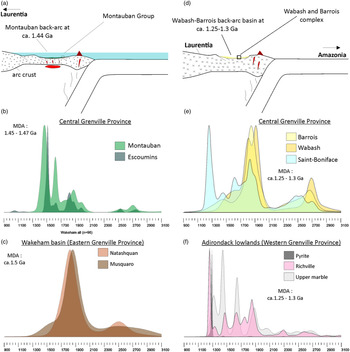
The suprachondritic Hf isotopic compositions in the zircon grains of the c.1.46 Ga age population indicate they were derived from juvenile sources. Potential sources are the c. 1.45 Ga Montauban arc (L Nadeau et al., unpub. data, 1992), an intraoceanic arc that accreted to Laurentia at c. 1.39 Ga (Sappin et al. Reference Sappin, Constantin, Clark and van Breemen2009), and juvenile Pinwarian granitoids (Augland et al., Reference Augland, Moukhsil, Solgadi and Indares2015). The detrital spectrum in Montauban quartzite and the c. 5–10 Ma age gap between the dominant age peak and the MDA would be consistent with deposition in a convergent margin (possibly a back-arc) setting (e.g. Cawood et al. Reference Cawood, Hawkesworth and Dhuime2012). The mingling of clastic, pyroclastic and pillow basalts in the Montauban Group likely records the early stages of back-arc basin formation at c. 1.44 Ga (Fig. 6a). The Escoumins supracrustal belt is a laterally equivalent supracrustal sequence to the Montauban Group, with a similar MDA of 1476 ± 10 Ma (Groulier et al. Reference Groulier, Indares, Dunning, Moukhsil and Wälle2018). The two sequences have age spectra with dominance from Pinwarian sources, but in the Montauban quartzite there is also a significant contribution from Labradorian sources (Fig. 6b). The minor age peak in both sequences between c. 1.8 and 1.9 Ga indicates the limited contribution from Penokean–Makkovikian sources. Comparatively, the detrital signal of Montauban and Escoumins sequences is markedly different from quartzites of the Pinwarian, Wakeham intracontinental rift basin, in eastern Grenville Province (Van Breemen & Corriveau, Reference Van Breemen and Corriveau2005). The unimodal detrital spectra with an age peak at 1.8–1.9 Ga in Wakeham basin quartzites (Fig. 6c) indicate provenance most probably from the Palaeoproterozoic Torngat orogen or the Makkovikian terrane. The disparate detrital age distributions demonstrate the different tectonic setting and catchment areas of the Pinwarian basins along the orogen.
(a) Tectonic setting (not in scale) of the examined quartzite from the supracrustal sequence of the Montauban Group; (b) KDE plots of U–Pb dates from the Montauban and Escoumins supracrustal group (Groulier et al. Reference Groulier, Indares, Dunning, Moukhsil and Wälle2018); (c) KDE plots of U–Pb dates from the Wakeham basin (U–Pb data from Wodicka et al. Reference Wodicka, David, Parent, Gobeil and Verpaelst2003 and Van Breemen & Corriveau., Reference Van Breemen and Corriveau2005); (d) tectonic setting (not in scale) of the Wabash–Barrois supracrustal groups; (e) KDE plots of U–Pb dates from the Wabash–Barrois and Saint-Boniface supracrustal groups (U–Pb data from this study and Peck et al. Reference Peck, Quinan and Selleck2019); (f) KDE plots of U–Pb dates from supracrustal sequences of the Adirondack lowlands (U–Pb data from Chiarenzelli et al. Reference Chiarenzelli, Kratzmann, Selleck and de Lorraine2015; and pers. comm. with J. Chiarenzelli).

6.b.2. Wabash and Barrois quartzites
The age gap between the MDA and the major age peaks at 1.8–1.9 Ga in Barrois and Wabash complexes is more than 500 Ma. Specifically, c. 97 % of the analyses record an age gap of more than 150 Ma between the dominant age peak and the MDA (Fig. 6d), suggesting that both sequences were deposited in intracratonic extensional sedimentary basins (e.g. Cawood et al. Reference Cawood, Hawkesworth and Dhuime2012). In terms of proto-sources, Penokean–Makkovikian (c. 1.8–1.9 Ga) lithologies to our knowledge are not exposed in the study area. Therefore, the 1.8–1.9 Ga detrital zircon grains, hosted in the Wabash and Barrois quartzites, either constitute distal detritus deposited in intermediate sedimentary reservoirs and recycled during Elzevirian rifting (1.2–1.3 Ga) or were transported via orogen-parallel drainage (present coordinates), possibly in large fluvial systems. U–Pb detrital zircon spectra with dominant age peaks between c. 1.8 and 1.9 Ga and MDA at 1.2–1.3 Ga, similarly with the Wabash and Barrois complexes, are observed within different crustal domains of the Grenville Province. Specifically, southwestwards of the study area, in the Morin terrane, the Saint-Boniface metasedimentary sequence (Corrigan & Van Breemen, Reference Corrigan and Van Breemen1997) with MDA at c. 1.25 Ga (Peck et al. Reference Peck, Quinan and Selleck2019) shows dominant age-peaks at c. 1.25 and 1.82 Ga (Fig. 6e). These age peaks also indicate the feeding of these basins dominantly from Penokean and Elzevirian sources. Further west, in the Adirondack region, three quartzites from metasedimentary sequences with MDAs at c. 1.25–1.3 Ga contain a higher proportion of Elzevirian and a lower proportion of Penokean detrital zircon grains than those found in Quebec (Fig. 6f; Chiarenzelli et al. Reference Chiarenzelli, Kratzmann, Selleck, de Lorraine and Lupulescu2017). These 1.2–1.3 Ga basins support inferences from bimodal volcanic and AMCG plutonic suites which indicate that extensional tectonism was occurring during that period in the Grenville Province and on a global scale at the core of Nuna supercontinent (Evans & Mitchell, Reference Evans and Mitchell2011; Indares & Moukhsil, Reference Indares and Moukhsil2013).
7. Conclusions
From the examination of three poorly exposed Mesoproterozoic supracrustal complexes from Precambrian basins of the Central Grenville Province we show that:
-
Detrital zircon U–Pb data from a quartzite hosted within a metavolcanic sequence (Montauban complex) indicates the development of a Pinwarian back-arc basin with maximum depositional age of 1442 ± 8 Ma (2s).
-
The detrital zircon grains of the Montauban quartzite record two dominant age peaks at c. 1.46 Ga and 1.62 Ga that exhibit suprachondritic ϵHf values recording juvenile crust formation during the Pinwarian (c. 1.4–1.5 Ga) and Labradorian (c. 1.6–1.7 Ga) orogenies.
-
The U–Pb detrital zircon spectra from two supracrustal complexes in the Lac Saint-Jean region (Wabash and Barrois complexes) with MDA of c. 1.2–1.3 Ga suggest deposition of 1.8–1.9 Ga recycled or far-travelled detrital zircon grains in an intracontinental extensional basin.
-
The sub- and suprachondritic ϵHf values found in the 1.8–1.9 Ga detrital zircon grains manifest the reworking of a near-chondritic 2.7 Ga continental basement during the Andean-type, Penokean–Makkovikian orogeny.
-
The accretionary stages of supercontinent assembly are retained in the detrital zircon archive of pre-collisional basins in Central Grenville Province even after the terminal Grenvillian collision at c. 1 Ga.
Acknowledgements
KP thanks R Stevenson, and A Indares for comments and suggestions on early versions of the manuscript, and J Gogot for technical assistance. The comments from anonymous reviewers and François Turlin enhanced the manuscript and are appreciated. This is Ministère de l’Energie et des Ressources naturelles publication number 8449-2016-01.
Supplementary material
To view supplementary material for this article, please visit https://doi.org/10.1017/S0016756821001023


 Open access

