Introduction
A conversation that I had with a Nigerian friend in the summer of 2021 provided the initial impetus for this Element. I explore the christological nexus between Jesus Christ’s authorization of his disciples to be his deputation to the world and their enactment of his presence in the world through specific acts. As my friend and I discussed the ubiquitous churches and Christian prayer houses in Nigeria, I asked him if the common belief that Jesus has formidable supernatural powers for countering diabolic forces posing serious threats to his disciples, in his view, had played a significant role in the widespread growth of Christianity in the country. After pausing momentarily to reflect on the question and assemble his thoughts, he responded in this way: Christianity would have less appeal if it were shown that Jesus lacked the powers to defeat diabolic forces that could cause his disciples grave harm.
Although our conversation primarily concerned the expansion and diverse forms of Christianity in Nigeria, my friend’s extemporaneous response evoked significant christological issues. It offered a glimpse into how Nigerian Christians might answer Jesus’ famed question – “But who do you say that I am?” (Mark 8:29, NRSVUE) – and interpret him within the context of their lived experiences. It also indicated their readiness to enact his presence by invoking his powers to address existential needs. Additionally, I observed from my friend’s claim that, if it were demonstrated that Christians could not invoke and deploy the powers of Jesus to counter supernatural forces threatening their discipleship and overall well-being, Christianity might lose its powerful grip on their imagination. This is partly because, in the indigenous worldview of Nigeria, the spiritual and human worlds, otherworldly and this-worldly affairs, and supernatural and natural realms are deeply interwoven, forming a complex and unified cosmos (Imasogie, Reference Imasogie1985; Olupona, Reference Olupọna2014; Acolatse, Reference Acolatse2018). Nigerian Christians expect Jesus to be present and to defend them against diabolic forces that pervade their societies. As Mark Noll (Reference Noll2009) has remarked, these issues “are now taking pride of place among believers worldwide that were once given to debates concerning human free will, the changelessness of God, the subjects and mode of baptism, or the status of papacy” (p. 10).
When in 2022 Yale Divinity School invited me to give a keynote address at the conference to mark the bicentennial of its founding and centennial of Hans Frei’s birth, I pondered how to bring aspects of Frei’s Christology, especially his ideas of the manner in which Jesus Christ shares his presence with his disciples, into the orbits of Nigerian Christianity and the field of African Christology. I was obviously leaning toward my research strengths – that is to say, drawing upon my expertise in the fields of Christology, World Christianity, and contextual theology. In my keynote paper, I sketched out a christological framework for understanding the belief that Jesus is present to the world in his post-earthly life vis-a-vis Nigerian Christians’ invocation of his presence to tackle a range of existential issues.
Since the Yale Divinity School’s conference, I have reflected on the christological content of the Christian practice of invoking Jesus’ presence, which is a staple of devotion and worship in many Christian communities. In Nigerian Christianity, for example, this practice has arisen primarily from Christians’ understanding of the Bible (the words of Jesus and the New Testament representation of him in particular) and their personal or communal experiences of Jesus. This is, of course, not peculiar to Nigerian Christianity; it is commonplace in Christian communities worldwide. Intentionally and customarily, Christians invoke Jesus’ presence during communal worship, individual prayers, in demanding situations, and in the pursuit of a moral and theological compass. They engage in these activities, albeit to varying degrees, as they are being pulled in different directions by social problems, eschatological expectations, political upheavals, religious pluralism, ecumenism, and secularism (Nolan, Reference Nolan1978; Okure, Reference Okure and Bockmuehl2001; Peterson, Reference Peterson2005; Taylor, Reference Taylor2007; Volf, Reference Volf2011; Williams, Reference Williams2012).
A closer look at the Christian practice of invoking Jesus’ presence to accomplish a range of activities, such as tackling existential needs and living the Christian life, reveals a perennial christological belief: Jesus is alive and at work in the world. However, this belief raises important christological issues about how exactly Jesus is present to and actively working in the world in his post-earthly life. I undertake a christological reflection on what constitutes Jesus’ act of being present to the world by means of deputization and what the instrumentality of his disciples in accomplishing this act might entail for Christology. To illuminate these issues I discuss examples of the activities of Christian disciples that indicate their enactment of Jesus’ presence.
The Element proposes the concept of a sphere of deputation, which encompasses the acts that Jesus Christ accomplishes by means of deputization in his post-earthly existence. This is the phenomenon in which his disciples can invoke and use his powers in their capacity as his deputation in the world. Christian activities within this sphere may be motivated by obedience to Jesus and a pursuit of spiritual wellness. The entire community of Jesus’ disciples is both the domain and object of his deputization. Nevertheless, while Jesus deputizes this community, he may elect to act either through individual believers or through the church as a whole.
Although the term “deputation” has been employed in various domains, including in the political, imperial, and law enforcement contexts, I use it here to denote authorized representation. In this Element, the term conveys a specifically religious significance vis-à-vis Jesus Christ’s deputization of his disciples. In essence, Christian disciples’ deputation is the actualizing of Jesus’ deputization, achieved by enacting his presence. By “Jesus’ presence” I mean the totality of his existence – his identity, works, experience, divine authority, and divine powers. As I will show throughout this Element, the sphere of deputation should be understood within the contexts of Jesus’ presence, his worldwide discipleship vision, and the role the Triune God plays in its realization. Surprisingly, the standard works on Christology give little consideration or credence to the sphere of deputation.
Unlike the spheres of ontology, function, and significance, the boundaries and landscape of the sphere of deputation are uncharted. This is not an untethered sphere; rather, it is intrinsically connected to the spheres of ontology, function, and significance, as shown in Section 1. I hope that this Element will aid in drawing theologians’ attention to the sphere of deputation and excavating its rich christological resources. I have a modest task: recognizing its existence, examining its christological resources, and outlining its value to Christology. The Element’s central thesis is that the sphere of deputation contains essential christological resources capable of advancing both academic Christologies and informal, grassroots Christologies of ordinary Christians. This sphere warrants a christological exploration, especially given the renewed attention to complex theological issues, such as the relationship between the spirit and human worlds, emerging in the wake of world Christianity (Walls, Reference Walls, Walls and Stanley2023, pp. 236–242).
This sphere of deputation is an arena of the “miraculous,” that is to say, Jesus, the incarnate God, takes what is merely human (his disciples and their invocation of his presence) and makes them his means to accomplish specific works in the world. Such miraculous works can be ordinary (e.g., becoming good news to the poor by alleviating their suffering) or extraordinary (e.g., protecting Christians against spiritual attacks). These are the works that Jesus forges in and accomplishes through the agency of his willing disciples. A major difficulty that a theologian encounters when discussing the sphere of deputation is how best to approach a christological subject matter whose landscape is yet uncharted. On the one hand, I hope that this Element can give clear expression to this difficulty, and on the other hand, lessen it for future christological explorers of this sphere.
The field of Christology can be enriched by expanding its spheres of exploration to include the sphere of deputation. Given this aim, one might ask: What is christological about the sphere of deputation? It is necessary to keep in mind that Christology, in broad terms, deals with people’s reflections on and portrayals of Jesus. The Gospels indicate that Jesus anticipated such portrayals. The word “say” in the question Jesus posed to his disciples regarding who they believed he really was (Mark 8:29) could generate different meanings. For instance, “say” might mean his followers’ intellectualization and interpretation of Jesus’ kind of being or type of person. “Say” can also mean the range of attitudes of Christian disciples toward Jesus’ life and the nature of his works. Relatedly, “say” may refer to the disciples’ beliefs regarding the meaning and relevancy of Jesus’ life, deeds, and experience for them. It is equally possible to construe “say” as the diverse ways in which the disciples of Jesus enact or embody his presence in specific occasions such as satisfying their spiritual yearning or tackling mundane and existential needs. Although each of these christological meanings of “say” is different, balkanizing them undercuts their interrelatedness. Equally, delegitimizing or privileging one over others is counterproductive. Each can offer a unique window into how Christians across different eras and cultures understand and relate to Jesus.
Returning to the question of what is christological about the sphere of deputation, I examine a deputization-deputation axis that characterizes and shapes how Jesus relates to his disciples, as well as their understanding of his person, work, significance, and their enactment of his presence. A major christological foundation of this sphere is Jesus’ identity as God incarnate, Teacher, Savior, and Lord, to mention a few biblical and theological characterizations of him. The purpose of authorizing his disciples to act as his proxies in the world is to further his cross-cultural discipleship project, while ensuring their wellness. Given this christological ground and purpose, Christians should rely on Jesus’ identity and teachings to identify the appropriate manner in which to undertake their work of deputation. Consequently, the sphere of deputation offers great insights into how Christian communities in diverse cultures conceptualize the relationship between Jesus and his disciples. Also, this sphere can provide a substantive christological framework that gives substance to the Christian understanding of the universal range of Jesus’ ongoing work, which underscores the belief that he is alive and at work in concrete ways in the world.
This Element’s goals are twofold. First, in examining this sphere of deputation for christological purposes, I unpack the unique insights it offers into how Christians interpret and appropriate the life of Jesus of Nazareth from their diverse contexts, revealing their christological habits and imagination. Second, I argue that the phenomenon of Christians’ enactment of Jesus’ presence evokes the sphere of deputation, which constitutes a distinct area of christological exploration that can enrich the venerable areas of the ontology, function, and significance of Jesus. The distinctiveness of the sphere of deputation relative to the other three christological spheres is that Jesus and his disciples are its co-principal creators.
To accomplish the two goals, I begin in Section 1 by discussing the nature and christological foundation of the sphere of deputation. Building on these insights, I examine in Section 2 the roles that Christians’ dyadic acts of invoking and using the powers of Jesus play in the sphere of deputation. In Section 3, I explore an example of a Christian context in which existential needs frame Christians’ deputized enactment of Jesus’ presence. I draw on the data from my ethnographic study of informal, grassroots Christologies of Nigerian Christianity in this section. Finally, in Section 4, I discuss how the sphere of deputation necessitates a methodological shift in the field of Christology. Specifically, I outline how this sphere warrants bridging the gap between the informal, grassroots Christologies of ordinary Christians and the formal, academic Christologies of theologians. Throughout these sections, I converse with ideas from the fields of contextual theology, world Christianity, and systematic theology in my examination of key issues in this Element.
1 Sphere of Deputation: Conceptualizing Its Distinctives and Christological Foundation
When Christians speak of Christ’s presence, they mean that Jesus owns his own presence and yet turns and shares it with us.
You cannot escape from Jesus. If you attempt to run from him, you are running away in vain. He will not attempt to follow but will be with you just the same.
These words of the American theologian Hans Frei and Ghanaian Afua Kuma (a prophet-like figure who had no formal theological education) provide apposite portrayals of Jesus Christ that reflect the common Christian belief about his presence in the world.Footnote 1 Frei’s and Kuma’s words are also relevant to this Element’s general structure – integrating academic christological discourses with informal grassroots Christologies. Their words equally shed light on Christians’ claim about the ubiquitous presence of Jesus, which is pertinent to the central theme I explore in this section – namely, the concept of sphere of deputation. As I noted in the introduction of this Element, this sphere refers to the acts Jesus accomplishes through deputization, empowering his disciples to invoke and use his authority as his representatives in the world.
The bedrock of this sphere is the Christian belief that Jesus is actively working in the world following his earthly life. He does so through his disciples, commissioning them to serve in the role of authorized deputation. Far from being a sphere bereft of theological relevance, deputation constitutes a distinct christological area, albeit intrinsically connected to the venerable spheres of ontology, function, and significance. At the core of the sphere of deputation are two distinguishable yet related acts: (a) Jesus’ deputization of his disciples for a specific purpose and (b) his disciples’ actualization of his deputization through the activities they perform that are subject to his approval. These two acts will function as the frames for my discussions on the distinctive features and christological foundation of the sphere of deputation.
The Sphere of Deputation: Expanding the Venerable Tripartite Staples of Christological Exploration
Broadly, Christology deals with the identity of Jesus of Nazareth, whom Christian Scriptures describe in several ways, for instance: Christ, Son of man, Image of God, Logos, Rabbi, Firstborn of creation, and Lord (Mk 8:29, Jn 1:1, Col 1:15-19, and 1 Cor 8:6). While drawing from the rich biblical representations of Jesus, theologians have focused on three venerable areas of exploration in their Christologies. To highlight one theologian, James Cone (Reference Cone1986), who wrote from the context of African American history and experience, hinted at the traditional three areas of christological exploration when he stated: “Because Jesus Christ is the focal point for everything that is said about the Christian gospel, it is necessary to investigate the meaning of his person and work in light of the black perspective” (p. 116). The three operative terms in Cone’s remarks – person, work, and meaning – roughly correspond to the related christological spheres of ontology, function, and significance. Notably, until recently, theologians working in the field of Christology emphasized two of the three spheres.
These dual emphases are evident in Rosemary Radford Ruether’s (Reference Ruether1981) assertion that the “center of Christian theology is not an idea but a person,” referring to Jesus of Nazareth, his life and work (p.1). Ruether highlights two aspects of Jesus’ identity, which may be termed ontological and functional. Ontological identity refers to the nature of Jesus’ being. By functional identity, I mean Jesus’ deeds (i.e., the range of things he accomplished during his earthly life) and his experiences (e.g., crucifixion, God’s vindication of him by means of resurrection).
Since the heyday of christological debates and controversies in the fifth century CE, intellectualization, perhaps in some cases over-intellectualization, has become a constant companion in Christian discourses on the identity of Jesus (Kelly, Reference Kelly1960, pp. 310–343; Grillmeier, Reference Grillmeier1975, pp. 349–554; McFarland, Reference McFarland2019). For example, theologians have debated the senses in which Jesus was, in the words of the ecumenical Council of Chalcedon (451 CE), “acknowledged in two natures without confusion, without change, without division, without separation – the difference of the natures being by no means taken away by reason of the union.”Footnote 2 This conciliar christological definition was an attempt to describe with precision the boundaries within which to discuss Jesus’ identity. The definition also laid the foundation for how to understand the nature and significance of Jesus’ works. The Council of Chalcedon in effect created two related but distinguishable spheres for christological exploration: ontology (christological discourse on Jesus’ identity, especially what it means to say he is divine and human) and function (christological deliberation on what Jesus accomplished during his earthly ministry in his capacity as God incarnate). On the ontological front, the Council, in agreement with the Council of Nicaea (325 CE), decreed that Jesus was consubstantial with God and consubstantial with humans. The sphere of function concentrates on the salvific work of Jesus. According to the Council of Chalcedon, Jesus, the Son of God, was “begotten before ages of the Father in Godhead, the same in the last days for us; and for our salvation born of Mary the virgin Theotokos in manhood.”Footnote 3
The Council of Chalcedon framed its understanding of Jesus’ work with humanity’s salvation in mind. Understandably, the two arenas of ontology and function, for an extended period, dominated christological conversations, especially among systematic and dogmatic theologians. They adjust, unsurprisingly, or tailor their discussions in these areas to fit their own church traditions (Kärkkäinen, Reference Kärkkäinen2003, pp. 15–16). Sometimes theologians have driven an unwarranted wedge between the person and work of Jesus. For methodological purposes, as Dietrich Bonhoeffer noted, it is helpful to distinguish between Christology and soteriology (Bonhoeffer, Reference Bonhoeffer1960, p. 40). However, Karkkainen’s (Reference Kärkkäinen2003) claim that “it is improper to separate Christology and soteriology because the only way to receive knowledge of something is to observe its effects on us” is misleading insofar as Christian soteriology is not limited to the work of Jesus (p. 13). It is salutary, in the field of Christology, to attend to the specific role that Jesus, the incarnate God, plays in the triune God’s work of salvation (Tanner, Reference Tanner and Gunton1997, pp. 245–246).
A third sphere of christological exploration, which incorporates aspects of ontology and function, addresses the broad significance of Jesus’ identity, including theological, spiritual, ethical, social, and moral derivatives. The uniqueness of the sphere of significance is tied to the meaning and scope of what Christians believe that Jesus has accomplished for his disciples and the world at large – for example, the salvific relevance of his death and resurrection and the ethical implications of his teachings (Haight, Reference Haight1999, p. 16). Paul Tillich’s (Reference Tillich1951) “method of correlation” paved the way for theologians to examine how the significance of the Christ-event constitutes God’s answer to the existential questions deeply rooted in the cultural milieus of human beings (p. 60).Footnote 4
Notably, several African, Asian, Latin American, and Oceanian theologians have developed Christologies in ways that move beyond the dual emphases on ontology and function and are comfortable with undertaking a christological excavation of the sphere of significance (Schreiter, Reference Schreiter1992; Bediako, Reference Bediako2004; Orevillo-Montenegro, Reference Orevillo-Montenegro2006; Te Kaawa, Reference Te Kaawa2020). Contextual theologians, in particular, have taken full advantage of the discourses on the significance of Jesus that are pertinent to the existential and mundane questions of Christian communities. Black liberation theologians (North American and Southern African) and Dalit theologians have developed robust Christologies that draw inspiration from the life of Jesus. These Christologies address the questions that the poor, the oppressed, and the disenfranchised in racialized societies ask of the Christian faith (Boesak, Reference Boesak1984; Cone, Reference Cone1986; Hopkins, Reference Hopkins1989; Phan, Reference Phan2003; Massey, Reference Massey2014).
To sum up the foregoing description of the current state of the field of Christology, three interrelated spheres of exploration have conditioned its development. These are (1) the sphere of ontology, which focuses on the issue of Jesus’ kind of person – who he really was/is; (2) the sphere of function, which deals with Jesus’ work – what he really accomplished during his earthly ministry; and (3) the sphere of significance, which concentrates on the theological, spiritual, ethical, and social derivatives or values that Christians discern in or extrapolate from Jesus’ person and work. These three venerable spheres, in my view, cannot sufficiently account for Jesus’ ongoing work in his post-earthly existence, which he can only accomplish through deputization.
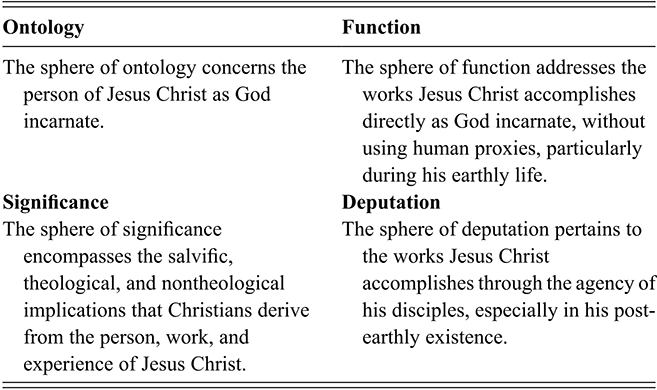
I want to propose and sketch a fourth sphere that I described at the beginning of this section as the sphere of deputation (see Table 1). I argue that this sphere, which centers on Christians’ enactment of the presence and powers of Jesus because of and in response to his deputization, opens a new and noteworthy frontier for christological exploration. The sphere of deputation implies that another viable way to understand how Christians today might understand and explain Jesus’ question “who do you say that I am” (Mark 8:29) is through their embodiment of his presence. The nexus of this sphere is Jesus’ enduring presence, made manifest through deputization – his authorization of his disciples to serve as his proxies. In turn, their act of deputation enables them to invoke and embody his presence within the bounds of his ongoing work among his church and in the world at large. As disciples, Christians can act on behalf of and for the sake of Jesus, albeit temporarily and subject to his freedom to either honor or distance himself from their acts if he chooses to do so. Jesus’ “freedom to initiate and terminate remains unimpaired,” Frei (Reference Frei2013) rightly notes, “yet it is one with his constancy and faithfulness” (p. 38).
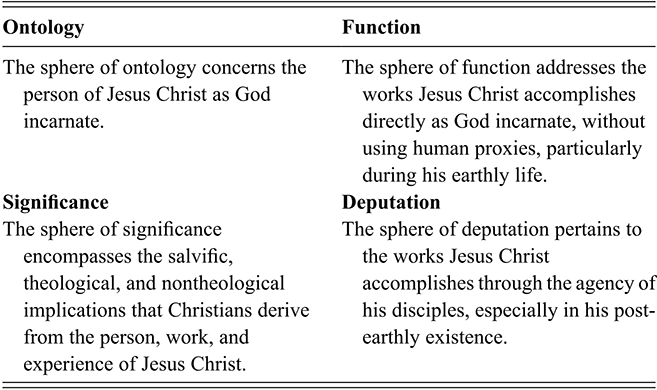
Table 1 Long description
The table reads the following: Ontology: Describes the person of Jesus Christ as God incarnate. Function: Explains the works Jesus Christ accomplishes directly as God incarnate, especially during his earthly life, without human proxies. Significance: Covers the salvific, theological, and non-theological implications Christians derive from Jesus Christ’s person, work, and experience. Deputation: Refers to the works Jesus Christ accomplishes by means of deputization, particularly through his disciples and in his post-earthly existence.
Painting with a broad brush, we might say that the christological disputes of the fifth century CE centered on two key issues: Jesus’ identity and his role in humanity’s salvation. In contrast, one of the crucial questions facing christological conversations in today’s era of world Christianity is how Jesus ensures the continuity of his work in the world through deputization. I argue that it is a grave mistake to defer the exploration of deputation-related themes to fields such as missiology, ecclesiology, pneumatology, or practical theology. While these themes can indeed be studied within those academic disciplines, my focus in this Element is specifically on christological issues, which I examine in detail. Inasmuch as Christians believe that they can become Jesus’ authorized deputation to the world and that he can choose to act through them, the sphere of deputation is worthy of christological exploration. Granted, a shift in methodology, such as training in ethnographic research, is required to study aspects of christological issues within the sphere of deputation. Consequently, theologians need to add this research skill to their academic repertoire.
In christological terms, the sphere of deputation is not identical to the spheres of function and significance, though their similarity is glaring, especially given their closer proximity compared to the sphere of ontology. Despite this similarity, the sphere of deputation has unique characteristics that distinguish it from the other three spheres. For example, unlike the traditional view of the sphere of function, which concentrates on the deeds that Jesus accomplished by himself and during his earthly ministry (e.g., teaching and miraculous works), the sphere of deputation focuses on the works that he can only accomplish indirectly through the instrumentality of his disciples in his post-earthly life. The contents of the spheres of ontology, function, and significance are based on Jesus’ person and deeds, both of which are neither dependent on nor contingent upon the instrumentality of his disciples. Conversely, the sphere of deputation requires the instrumentality of Jesus’ disciples. In other words, this sphere emerges when Christians, as the authorized representatives of Jesus, actively carry out the work of deputation, through specific actions. Although the sphere of deputation derives its initial impetus from Jesus’ act of deputization, it is his disciples that can actualize and embody or concretize it. Put differently, Jesus and his disciples are the co-principal content creators in the sphere of deputation. The continuance of Jesus’ worldwide discipleship visionary work is partly contingent on Christian disciples’ actualization of his deputization.
What about the difference between the spheres of significance and deputation? The sphere of significance, particularly in its traditional configurations, deals with the values that Christians derive from Jesus’ person and deeds. The belief that Christian disciples can act as Jesus’ deputation to the world, in a general sense, could be construed as a form of christological derivative from Jesus’ person and deeds. This might make it seem that the phenomenon of Christian disciples’ deputation belongs to the sphere of significance. But one of the signature characteristics of the sphere of deputation is the uncharted and ongoing works that Jesus brings about only by means of his disciples. The sphere of deputation is the realm of works whose existence is tied to the activities of Jesus and his disciples. In this sphere, Jesus acts in tandem with the other members of the Trinity to generate the need and nature of specific works in the thoughts and hearts of his disciples, enabling them to recognize such works as his. He further empowers them to carry out these works in the world in his name, for his sake, and for their benefit. Jesus does not merely endorse what Christian disciples do in their capacity as his deputation to the world. Rather, he is the one who acts through them. The sphere of deputation, therefore, is closer to the sphere of function than the sphere of significance. To be clear, the sphere of deputation, as I imagine it, is not the product of Christians’ self-proclamation or self-actualization. This means that the sphere of deputation cannot be understood in isolation from the spheres of ontology, function, and significance. These four christological spheres, therefore, ought to be understood as distinguishable, yet integral entities.
As a distinct entity in its own right, the sphere of deputation is rich with untapped christological resources. These resources include the new questions and portrayals of Jesus that arise when Christians reflect on their effectiveness as his representatives in the world, as well as on the effectiveness of his authority as the one who has commissioned them. To identify these christological resources within the sphere of deputation, it is essential to distinguish between how Christians represent or conceptualize Jesus (Christology) and how they seek to emulate his way of life (discipleship). Put simply, Christian discipleship concerns the transformative influence Jesus has on his followers as they commit themselves to him.
Analogously, Christology is about the molding effects Christians have on Jesus – that is, their ability to formulate different images or representations of Jesus based on their understanding and experience of him. The sphere of deputation can pull Christology and Christian discipleship into the same theological orbit. For example, in their varied responses to Jesus’ deputization, Christians can draw upon their perceptions of him, which can be informed by theological materials from scripture, personal experience, church tradition, and reason (Ezigbo, Reference Ezigbo2021). Therefore, Christians’ work of deputation should be understood within the frame of their varied understandings of Jesus. Christian acts of deputation, when carried out within the bounds of Jesus’ deputization, are essential to Christology. This is because this sphere can provide unique resources for Christology that are not available to the christological spheres of ontology, function, and significance. One example is Christians’ construction of images of Jesus as a formidable power for countering the spiritual forces that impede their work of deputation. Also, the sphere of deputation offers a distinct christological pathway for understanding the Christian confession and belief in the continuing presence of Jesus in the world. I will discuss these claims in Sections 2, 3, and 4. I now focus my attention to the christological foundation of the sphere of deputation.
Christological Foundation of the Sphere of Deputation
Christology, as previously noted, deals especially with Christians’ portrayals of Jesus Christ, reflecting their varied understandings of his identity, personhood, experience, beliefs, teaching, claims, deeds, and mission. These portrayals are typically based on Christians’ personal encounters with him, as well as the testimony of scripture and the church. Viewed from this perspective, the focus of the field of Christology should not be limited to issues in metaphysics: the discourses on Jesus’ ontological constitution, especially how he is fully God and fully human. The focus should also include praxis: the deliberations on the practical effects of what Jesus accomplished directly and what he has done (and continues to do) indirectly through his disciples, who serve as his proxies. Equally, the field of Christology should deal with issues in utilization: an exploration of Christians’ formulation and use of their beliefs and understandings of Jesus in their lives of discipleship and other areas of their lives. Metaphysics, praxis, and utilization are pertinent to the act of portraying, which involves the taxing activities of interpretation, representation, and concretization of a reality or one’s belief about that reality – in this instance, the reality of Jesus’ continuing presence and work in the world through deputation.
One effective way to study the reality of Jesus is through the lens of his cross-cultural discipleship vision. This is because Jesus’ discipleship can serve as a framework for interpreting the dynamics of his presence and works within the context of his relationship with his disciples. Therefore, it is appropriate, when discussing the sphere of deputation, to explore the christological nexus between Jesus’ deputization of his disciples and their deputation work in the world within the context of his discipleship project. According to the Gospel of Matthew, Jesus commissioned his followers to disciple (mathēteusate) others, including people of other nations, based on what they have learned from him (Matt 28:19-20).
Another New Testament book states that Jesus instructed his earliest disciples to testify about his life and deeds beyond the geographical boundaries of Jerusalem, Judea, and Samaria. They are to carry on the work of witnessing to “the ends of the earth” (Acts 1:8, NRSVUE). Philip Sheldrake rightly notes that Christian discipleship “implies both metanoia, conversion, and also following a way of life in the pattern of Jesus Christ and as a prolongation of his mission” (Sheldrake, Reference Sheldrake2010, p. 11). The realization as well as the survival of Jesus’ worldwide discipleship project is connected to his authorization (deputization) of his disciples to be his representatives in the world, whereas the works that they carry out on his behalf and in his name signify representation (deputation). Thus, Jesus’ act of deputization and his disciples’ work of deputation constitute the core of the sphere of deputation as used in this Element.
Three main interrelated beliefs constitute the christological foundation of the sphere of deputation. First, Jesus has promised his enduring presence to his disciples. Second, as God incarnate, Jesus possesses divine powers, and he can choose to share aspects of his powers with his disciples. Third, Jesus has commissioned his disciples to be his deputation in the world. In what follows, I will briefly examine each belief, highlighting its relation to the sphere of deputation.
Jesus’ Enduring Presence and the Sphere of Deputation
Jesus’ promise of his presence to his disciples is intrinsically linked to his act of deputization and constitutes a notable christological foundation for the sphere of deputation. The New Testament gives sufficient indications that Jesus has promised his presence to his disciples and authorized them to serve as the representatives of his life and work in the world. He made this promise with unequivocal assurance. Expressions such as “And remember, I am with you always, to the end of the age” (Matt 28:20, NRSVUE) and “For where two or three are gathered in my name, I am there among them” (Matt 18:20, NRSVUE), which the Gospel writers attribute to Jesus, are common knowledge in Christian communities. The author of the epistle to the Colossians reminded his readers about the ubiquitous presence of Jesus among Christians with the phrase “Christ in you” (Col 1:27), signaling Jesus’ indwelling presence in the lives of his disciples. Although Jesus is no longer physically present in the world, Christians have retained the belief that he is still alive, and his presence can be felt and experienced in the world today, albeit in a circumlocutory manner. This belief raises the question of how to discern Jesus’ presence in the world. My interest here is not the resurrection debates – whether Jesus’ resurrection is bodily or nonbodily in nature, but instead the way the risen Jesus, as Christians believe, is present to the world in his post-earthly existence.
What, then, does it mean to say that Jesus is present to the world in his post-death and post-resurrection context? Theologically, this question, along with its cognates, has haunted theologians for centuries. Saying that Jesus is alive and at work in this present world presupposes a form of continuity of existence in his post-earthly life. Below are examples of the diverse ways of construing Jesus’ presence that can be discerned in Christian theological circles. One way to construe Jesus’ presence in the world is through the continuity of narratives. By this I mean that Jesus is present to and in the world through Christian communities’ contextualized retelling and appropriation of the story of his life, experience, and teaching on God-world relations, human-human relations, and gospel-world relations, (Williams, Reference Williams2000, p. 191; McFarland, Reference McFarland2019, p. 189). People can experience Jesus’ presence through such narratives. There is the continuity of memorial. For example, Jesus may be said to be present to the church through its ritual practices and celebrations such as the eucharist and baptism. Michael Budde (Reference Budde2014) describes the role that the eucharist plays in keeping the “memories of Jesus alive” in and through Christian communities in ways that bridge the “barriers between past, present and future” believers. As Budde claims, “Christ becomes present among us today; we become part of his body moving forward toward the exemplification of his completion of history” (p. 285). The continuity of ideation does not require committing to Jesus in an exclusive relationship as a disciple or a Christian believer. Nonbelievers in Jesus, for instance, can form in their “imagination and consciousness” the life and teaching of Jesus without submitting to his lordship (Frei, Reference Frei2013, p. 46). For Christian believers, continuity of ideation entails believing that Jesus is present to his disciples in their minds and individual lives, whether they actualize his presence by means of narration or memorial.
We may also understand Jesus’ enduring presence in the sense of continuity by means of a mystical union. In this sense, Jesus is present today because he dwells in his disciples. Lesslie Newbigin (Reference Newbigin1954) puts it in this way: “We know Christ as our living and present Lord, and our fellowship with Him and with the Father through Him … . We know that He is no remote figure of past history, but that He dwells in us and we in Him” (p. 120). There is also continuity by means of inherent divine powers. In this sense, Jesus, as God incarnate, transcends spatial limitations because of his kind of being. He is inherently, in his divine nature, omnipresent. Dietrich Bonhoeffer’s (Reference Bonhoeffer1960) insistence on understanding Jesus’ presence to the world without violating “the wholeness of his person” is theologically prudent and insightful (p. 45). This can protect Christian theologians against approaching the issue of Jesus’ presence in the manner that diminishes the traditional Christian belief that he is fully divine and human. Bonhoeffer imagined the “wholeness” of Jesus’ person as consisting of his humanity and divinity. He writes, “Only because Jesus Christ is man is he present in time and space. Only because Jesus Christ is God is he eternally present everywhere. The presence of Christ necessitates the statement ‘Jesus is fully man’ – and it necessitates the other statement, ‘Jesus is fully God’” (p. 45).
It is possible to conclude from these five ways of understanding Jesus’ continuing presence that he was once a commanding presence through his impressive works but has now become a theological relic in his post-earthly ministry. People can now view or encounter Jesus’ former commanding presence or what is left of his reputation through the theologies and practices of Christian communities. The sphere of deputation offers a different outlook on Jesus’ continuing presence in the world: not as a relic but as a figure whose presence can be encountered because he is actively at work in the world today by means of deputization.
For the purposes of this Element, I use the phrase “continuing presence” narrowly to designate a deputized way of being. In relation to Jesus, it is his enduring commitment, as one who is fully human and divine, to act through the proxy of his disciples to bring the effects of his identity, life, teaching, and deeds to the world in his post-earthly existence. This description of Jesus’ enduring presence suggests continuity through deputization. From this perspective, Jesus may choose to be present in the world via the agency of the church, which serves as an assembly of his authorized deputies, though always within the bounds of his prerogatives.
A helpful way to understand the raison d’être for Jesus’ promise of his presence to his disciples is to situate it within the contexts in which he articulated it. One such context, as previously indicated, is Jesus’ continuing works in the world through his Christian disciples. Undertaking this project is ambitious given that Jesus made the brevity of his earthly ministry abundantly clear to his earliest disciples. On one occasion, he told them that he was determined to do the work of God “while it is still day” (Jn 9:4), thereby underscoring the limited time available for his in-person ministry. Since Jesus’ time for in-person earthly ministry was limited, a succession plan was necessary to ensure that his cross-cultural discipleship project would not culminate in failure. Thus, by promising his enduring presence, Jesus serves as a guarantor of the continuance of this project, partly through the agency of his disciples. In addition, the promise of enduring presence is a reminder of Jesus’ freedom and ability to empower and recalibrate the disciples’ lives and efforts as they carry out their deputed work in the world. Christians can have confidence in Jesus as a formidable guarantor because of his identity – the divine Logos that became a human being (Jn 1:1-15; Phil 2:5-11).
Jesus’ Identity and the Sphere of Deputation
As God incarnate, Jesus inherently possesses supernatural powers and authority, which he may choose to share or transfer to his disciples, empowering them to accomplish a range of activities as his proxies (Matt 16:15-20; 28:18-19). This claim adopts the mystery-based view, and not the myth-based view, of the Christian doctrine of the incarnation.Footnote 5 However, the divine and human natures interfaced and interacted to constitute Jesus’ being and personhood: He embodied divine life in both ontological and functional senses. The pivotal christological point in the idea of continuity by means of deputization is that it is not about Christians reproducing the teaching, works, authority, powers, or life of Jesus on their own terms and for their own gains. Rather, it is Jesus that acts through his disciples as the means of extending his teaching, authority, powers, and works to the world at large. Thus, Christians may only legitimately fulfill their deputized role under the auspices of Jesus.
Jesus’ sharing or transferring of his powers to his disciples is an ambiguous phenomenon. Andrew Walls’ (Reference Walls2002) remarks about this ambiguity are insightful. He said, “Vital as the church may be as a vehicle of Christ’s influence, it is stultifying to identify its influence with his” (p. 9). Exactly how, where, and when Jesus chooses to share his powers with his disciples and to act through them might not be established beyond a theological doubt. Yet, as I will show in Sections 2 and 3, Jesus encourages his disciples to seek and invoke his powers when undertaking tasks or encountering issues that are pertinent to the role of deputation and life of discipleship. At this point, I want to note that the act of sharing or transferring powers in the context of the sphere of deputation is analogous to a head of state, for instance, a country’s President transferring powers or delegating authority to ambassadors representing the president’s vision, mission, policy, and values in foreign nations. Where the sharing of powers is understood as a kind of deputation, the president can stand behind his ambassadors’ enactment of the powers conferred upon them. The president, of course, reserves the right to revoke such powers for varied reasons.
Nicholas Wolterstorff’s (Reference Wolterstorff1995) formulation of “deputized divine discourse” illuminates my understanding of Jesus’ act of sharing and transferring his powers to his disciples (pp. 42–51).Footnote 6 His conception of deputized discourse gives a useful analogy for how to understand the relationship between deputization and deputation:
Being asked to communicate a message from someone is not the same as being deputized to speak in the name of someone. The deputy has, as it were, the power of attorney; it’s by way of the deputy’s doing one thing and another that the deputizer acquires the rights and responsibilities of having issued such and such a threat, made such and such a promise, and so on … . And just as deputations vary in the degree to which the verbal detail of the message is specified [in the case of head of state-ambassador relations], so also, they vary in the explicitness of the deputation. Thus doubts and controversies can arise both over whether the ambassador really deputized to speak in the name of the head of state, and if he was, over whether he really was deputized to say what he did say in the name of his head of state.
Wolterstorff’s interest is, of course, not Christology but the relationship between God and a sacred text. His cursory reference to Jesus’ disciples and apostles was only to buttress his delineation between conveying someone’s message and being a deputation. He was careful not to equate the New Testament apostles, whom Jesus commissioned to do certain things in his name, with the Hebrew prophets whom God commissioned to speak in his name. According to him, unlike Jesus, the apostles were not prophets, and without substantive clarifications, should not be regarded as speaking in the name of God (Wolterstorff, Reference Wolterstorff1995, p. 51).
Wolterstorff’s cautious effort to distance the apostles from the Old Testament prophets is duly noted. Jesus commissioned his apostles and earliest disciples to speak in his name, rather than in the name of God the Father. Consequently, they de facto speak as God’s representatives only indirectly because of Jesus’ relationship with them. In other words, Jesus, who deputized them, spoke and worked for God the Father, and as such they can indirectly work for God. Only in following Jesus in discipleship, as Rowan Williams (Reference Williams2016) notes, can his disciples ready themselves to let “Christ’s action come through” them as “the Father’s action comes through him” (p. 17).
I should add that the classical Christian understanding of the Trinity points us to the fact that being a disciple of Jesus would involve following him to the perichoretic life that he shares with the Father and the Holy Spirit. Moreover, serving as Jesus’ deputation cannot be accomplished by bracketing off God the Father’s love and deputization of Jesus, or the Holy Spirit’s empowerment of Christian disciples. Jesus made this abundantly clear, as indicated in the Gospel of John: “Jesus said to them again, ‘Peace be with you. As the Father has sent me, so I send you.’ When he had said this, he breathed on them and said to them, ‘Receive the Holy Spirit. If you forgive the sins of any, they are forgiven them; if you retain the sins of any, they are retained’” (Jn 20:21-22, NRSVUE). Christian disciples require the empowerment of the Holy Spirit to effectively serve as Jesus’ commissioned representatives.
Commissioned Witnesses and the Sphere of Deputation
The belief that Jesus possesses divine power and may choose to share it with disciples ought to be understood in the larger context of Jesus’ act of deputization (Jn 14:13, Mk 16:17). There is a correlation between this belief and Christians’ loyalty to Jesus as their Lord, Savior, Defender, Healer, and access to God. This is, of course, no blind loyalty. It is partly based on the belief that God raised Jesus from the dead, a pivotal tenet that may be understood as “the defining and indispensable foundation of the Christian faith” (Bockmuehl, Reference Bockmuehl and Bockmuehl2001, p. 102). It is equally based on their attempts to live up to the enormous task of being Jesus’ authorized deputation to the world. While conceding the centrality of Jesus’ resurrection to the Christian faith, many Christians readily present themselves and communal experiences as “evidence” that Jesus’ deputization of his disciples is integral to his continuing presence and requisite for continuing his worldwide discipleship vision in his post-earthly life. They see themselves as the bearers of Jesus’ good news message intended for the entire world. And they can embark on this task with confidence because of Jesus’ abilities to shore up their spiritual and cultural frailties.
How are Christians to exercise their deputized role while proclaiming Jesus’ gospel cross-culturally? Though the message of Jesus’ gospel is unmistakably Jewish in its cultural flavor, his earliest Jewish disciples, tasked with the demanding work of witnessing to all nations, came to the realization, as Lamin Sanneh (Reference Sanneh2008) argues, that the Christian faith is translatable, “fit for all seasons,” and “fit for all humanity” (p. 14). To effectively put this understanding of the Christian faith into practice, the early Christians relativized “all cultural arrangements” and de-stigmatized “all Gentile or taboo cultures” (p. 53). The early church leaders at the Council of Jerusalem (Acts 15) took the initial steps to create an important framework for the cross-cultural transmission of the faith that the Antioch experiment in missions prompted (Acts 15:1-5). For instance, in ruling against those who required the Jewish custom of circumcision of the Gentile believers, the council made it less likely for one dominant Christian community to impose its culture on others. Yet its robust deliberations set a precedent for future Christian leaders to address competing views on theological matters. In some ways, the goal of the council of Jerusalem was to ascertain theological clarity on a shared Christian identity between Jewish and Gentile Christians without shunning authentic diversity.
In contrast, European Christianity’s project of Christendom sought to suppress diversity among Christian communities elsewhere, particularly in Africa and Asia, aiming to erase unfamiliar and potentially dangerous cultural perceptions of the faith. To accomplish such endeavors, European missionaries fed the new converts to Christianity in foreign lands with European theological diets and prevented them from accessing local materials to formulate their own Christian theologies. For a time, zealous European missionaries attempted to impose their Christologies on foreign lands and converts with limited success. As Muriel Orevillo-Montenegro (Reference Orevillo-Montenegro2006) states, Western missionaries brought to the continent of Asia the “Jesus [who] had a superiority complex and became a stumbling block to the kinship of Asian religions. This Jesus came back to Asia not as a balikbayan, who comes home to reclaim Asian roots. Rather, this Western Jesus was a total stranger to Asia who despised the spirits, gods, and goddesses of Asia” (p. 11).
To bear witness in a cross-cultural setting, a Christian community need not abandon its own culture in favor of ancient Jewish customs, nor superimpose its own culture on other Christians. In the words of Andrew Walls (Reference Walls1996):
There is no such thing as “Christian culture” or “Christian civilization” in the sense that there is an Islamic culture, and an Islamic civilization. There have been several different Christian civilizations already; there may be many more. The reason for this lies in the infinite translatability of the Christian faith … . The Christian scriptures … are open to translation; nay the great Act on which Christian faith rests, the Word becoming flesh and pitching tent among us, is itself an act of translation. And this principle brings Christ to the heart of each culture where he finds acceptance; to burning questions within that culture, to the points of reference within it by which people know themselves.
When understood within the context of the sphere of deputation, Christianity’s translatability raises the issue of how Christians can retain the faith’s core of devotion to Jesus while engaging in the cross-cultural transmission of the faith. A useful way to approach this complex issue is to recognize that having a relationship with Jesus is a precondition for becoming his authorized deputation to the world. One does not become Jesus’ authorized proxy by merely seeing him as a revolutionary or rabbi extraordinaire. In other words, devotion to Jesus in discipleship and submitting to his authority are necessary for participating in the deputized work.
There are christological implications for linking serving as Jesus’ authorized proxy and devoting him. To mention one example, Jesus’ deputization does not, by default, provide blanket immunity to Christians as they undertake the task of deputation. This brings into focus the issue of power differentials between Jesus and his disciples. He is not at the disposal of his disciples. He reserves the right to redirect and discipline his disciples when they act outside the provisions of his discipleship demands (Ezigbo, Reference Ezigbo2021, pp. 194–201). Consequently, when undertaking the work of deputation and proclamation of Jesus across culture, Christians should stay committed to the contents of his gospel message and way of life as represented in Christian scripture.
We might see Jesus’ establishment of a succession plan as a given because of the magnitude of the task of his cross-cultural discipleship vision. Speculating whether Jesus could have deployed his divine powers to bypass the use of human means is theologically fruitless, especially since he commissioned his disciples to serve as his deputation in the world. However, it is intriguing that he, the incarnate God, chose not the divine or supernatural means but human and ordinary means (his disciples) as an essential component of his succession plan. Jesus’ choice of human deputation as the vital component of his worldwide discipleship work showcases his preference for what Eugene Peterson (Reference Peterson2005), in a different context, calls “ordinariness.” Peterson is referring to God’s choice to be among humans through a human being – Jesus Christ. He notes that the “miraculousness” of this divine “miracle is obscured by the familiarity of the setting: the ordinariness of the people involved” (pp. 34–35).
In a similar vein, we might posit that Jesus, who is divine and human, in Christian parlance, opted for the ordinariness of human deputation to continue with his discipleship work. The risks of human frailties, vulnerability to sinful influences, and proclivity to misguided and selfish interests did not deter Jesus. He chose human and ordinary means as the primary agency for the realization and survival of the project of making disciples across the world. Therefore, both Jesus and his disciples inhabit the sphere of deputation and their integral activities within the bounds of the sphere produce insightful christological themes. In the next section, I investigate one such christological theme – Christians’ related acts of invoking and deploying Jesus’ powers.
2 Deputized Enactment: The Role of the Dyadic Acts of Invocation and Use of Jesus Christ’s Powers
Very truly, I tell you, the one who believes in me will also do the works that I do and, in fact, will do greater works than these, because I am going to the Father. I will do whatever you ask in my name, so that the Father may be glorified in the Son. If in my name you ask me for anything, I will do it.
Within the sphere of deputation, Christians engage in activities that center Jesus’ existence as both the source and determiner of their role as proxies, a role to which he commissioned them (Jn 17:17-19).Footnote 7 In this section, I examine two such activities: invoking and exercising Jesus’ powers. This exploration will further illuminate the christological foundation and defining characteristics of this sphere, as previously discussed in Section 1.
The immanence of the belief that Jesus’ life did not end in a grave, but he is alive and is presently at work in the world, permeates the songs, prayers, and devotion that Christians offer to him. What does this belief entail for Christology? This question evokes predictable problems for the theologian. One such problem is that no direct and unequivocal way is accessible to the theologian to independently verify if Jesus is the one at work in each activity that his disciples either perform in his name or ascribe to him. Another problem is that it might be impossible and potentially counterproductive to dissuade Christians from holding the belief that Jesus is alive and at work in the world, especially amidst Christian communities. I suggest that dismissing a christological examination of how Jesus is actively working in the world today because of these issues is shortsighted.
The passage from the Gospel of John cited at the beginning of this section is striking in its implications.Footnote 8 Jesus assured his disciples that they could do the same work he did and even “do greater works” in his name. The passage brings into focus the reality and complexity of Jesus’ deputization of his disciples to be his representatives in the world. I want to further examine a theme I introduced in Section 1: serving as Jesus’ deputation in the world is intrinsically linked to his discipleship project. Two transformation acts by Jesus are foundational to this theme. First, Jesus forges non-disciples into his disciples through his life, relationships, and teaching (Matt 16:24-26; Jn 10:7-18; 15:1-25). Second, he commissions these disciples, regardless of their fallibility, to serve as his authorized deputies.
The work of “forging” is not ephemeral but an ongoing process that is contingent on one’s relationship with Jesus. Christian disciples should continually depend on Jesus’ enablement, redirection, and empowerment to effectively perform the immense task of serving as his deputation in the world. Without Jesus’ deputization and transformation work, the sphere of deputation would not exist, at least not in the form that I have proposed in this Element. These acts of Jesus are equally foundational to the activities that Christians undertake in their deputized role. I will focus attention on two examples of such activities that are integrally related, namely invoking and using (or deploying) Jesus’ powers to carry out their responsibilities as Jesus’ authorized proxies. As I will show, Christian disciples’ acts of invocation and use of Jesus’ powers are indicative of their attempts to enact his presence in the world and to bring him into their struggles to deal with their existential needs, which might be religious, socioeconomic, political, and ethical in nature, to mention a few areas.
By invoking and using Jesus’ powers in their capacity as his proxies, Christians perform a form of deputized enactment of his presence, an essential feature of the sphere of deputation. By “deputized enactment” I refer to Christians’ submitting themselves to Jesus as his authorized deputies through whom he can choose to be present and continue aspects of his work in the world.
Christians’ deputized enactment of Jesus’ presence, christologically speaking, gives a distinct meaning and content to the living Christ, who is not physically present in the world today. As I argued in Section 1, in this form of enactment, Jesus can choose to be present in the world through aspects of Christian communities’ practices, which they undertake in their deputized role. Specifically, I am concerned here with the works that Jesus inspires, forms, and forges in the minds, thoughts, and hearts of his disciples, enabling them to recognize the works as his, and his prerogative to perform the works through the agency of his willing disciples. To be clear, these are the works that Jesus performs in tandem with God the Father and the Holy Spirit as I noted in Section 1. Moreover, these are the works that are done within the context of Jesus’ cross-cultural discipleship project and his disciples’ deputized role.
How exactly Jesus brings about these works in his disciples requires a detailed examination that is beyond the scope of this section. However, I will highlight a few possible ways in which Jesus may accomplish these miraculous works. One such way is through meditating on the teaching and life of Jesus as described in Christian scripture. As Christians deliberate and reflect intently on Jesus’ teaching and life, he can nudge them to recognize specific works that are fitting to their deputation. This is particularly relevant for identifying tangible criteria for assessing the legitimacy of the works that Christians claim to perform in the name and for the sake of Jesus Christ. Two other ways are worth mentioning, one of which is similar to Karl Barth’s conception of how God adopts the human words of the Bible, transforms them, and use them as God’s own words to accomplish remarkable things in the lives of the readers and hearers (Barth, Reference Barth, Torance and Bromiley1956, p. 530). In this sense, Jesus can adopt the works whose initial impetus emanates from his disciples, transform them into his own, and use them to accomplish remarkable things in the world. Another example of how Jesus might form works in his disciples is by inspiring novel ideas for specific acts in his disciples – acts which may not be linked to the words of the Bible. For instance, Jesus might prompt novel works in his disciples, especially in situations that reveal human frailty and require divine intervention.
Jesus’ act of deputization, when set in the context of these three ways of understanding the works he initiates and accomplishes through his disciples, highlights the asymmetric relationship between him and them. Put differently, Christian disciples may only legitimately invoke and use Jesus’ powers in their deputized role by his authority. As a result, they should undertake the task of deputation based on their understanding of his person, work, and significance. Therefore, in addition to scripture, the spheres of ontology, function, and significance can provide essential guardrails for the deputized role of Christians.
Interestingly, serving in the role of Jesus’ deputation in the world is a task his disciples may be unworthy and unprepared to undertake due to their susceptibility to consequential errors. This is because the connection between Jesus’ deputization of his disciples and their work of deputation is neither automatic nor uninterrupted. As Rowan Williams (Reference Williams2000) rightly argues:
Jesus is not the possession of the community … because he is alive, beyond qualification or risk, “he lives to God.” The freedom of Jesus to act, however we unpack that deceptively simple statement, is not exhausted by what the community is doing or thinking – which allows us to say that Jesus’ role for the community continues, virtually, to be that of judge, and that those who are charged with speaking authoritatively for or in the community stand in a very peculiar and paradoxical place.
Blurring the distance between Jesus’ deputization and his disciples’ deputized role undermines the freedom and authority of Jesus over his disciples. He, for instance, can choose to distance himself from his disciples’ acts of deputation on the grounds of their misconceptions of his discipleship. The Gospel of Matthew hinted at this issue: “Not everyone who says to me, ‘Lord, Lord,’ will enter the kingdom of heaven, but only the one who does the will of my Father in heaven. On that day many will say to me, ‘Lord, Lord, did we not prophesy in your name, and cast out demons in your name, and do many mighty works in your name?’ Then I will declare to them, ‘I never knew you; go away from me, you who behave lawlessly’” (Matt 7:21-23, NRSVUE). In Matthew’s representation, Jesus reserves the right to distance himself from those “who behave lawlessly” even though they might have believed that they were acting by Jesus’ authority or successfully invoked and deployed his powers in their acts of prophesying, casting out demons, and other notable works.
Before discussing the roles Christian disciples’ invocation and deployment of Jesus’ powers play in the sphere of deputation, I will describe four preliminary issues that are pertinent to my conception of deputized enactment. First, the concept of deputized enactment requires distinguishing between the spiritual gifts that the Holy Spirit bestows upon Christians and the works that Jesus initiates and accomplishes through them. In the former, his disciples may use their endowed spiritual gifts, which they already possess (Rom 12:6-8; 1 Cor 12). In the latter, the disciples can only ask for Jesus’ empowerment but must rely on him to act through them in specific situations. In the former, Christians have control over how they use or misuse their spiritual gifts. In the latter, they have the freedom to request Jesus’ empowerment (which could be for wrong or right reasons); however, they do not have control over his responses.
While distinguishing between the spiritual gifts of Christians and their deputized work, it is essential to recall that Jesus made it clear that his disciples can only effectively act in his name and on his behalf due to the presence of the Holy Spirit in their lives (Jn 14:15-18; 20:22). McFarland (Reference McFarland2019) is correct in noting that it is only through the Holy Spirit that the church – the assembly of Christian disciples – can become the “locus of Jesus’ ongoing activity of teaching, healing, and forgiving” (p. 197). In a similar vein, it is important to recognize that in the deputized enactment of Christians, Jesus puts them to his service and not the other way around. The work that the disciples perform in Jesus’ name, in the context of deputized enactment, “is rooted in his work and is in fact his work” (Bultmann, Reference Bultmann1971, p. 611). So, Jesus, his disciples, and the Holy Spirit constitute the axis of deputized enactment. Jesus is at work in the world today furthering his discipleship vision through the community of his disciples whom the Holy Spirit empowers to become effective deputations. The axis of deputized enactment offers a breathtaking reintegration of the work that Jesus accomplished directly in the power of the Holy Spirit (Acts 10:38) and the work that he is accomplishing today indirectly through his disciples whom the Holy Spirit indwells.
Second, participating in Jesus’ authorized deputation in the world requires cognitive and relational attachment to him. In other words, for people to become a part of Jesus’ deputation, they must first undergo the process of being forged into his disciples. Becoming Jesus’ disciples, of course, entails abiding with him. As Rowan Williams (Reference Williams2016) puts it, “being in his company; learning stillness, attentiveness, expectancy; being willing to go where Jesus is going and to be in the company of those he is in company with” (p. 17). Those seeking to participate in this aspect of Jesus’ ongoing discipleship endeavor are to show genuine commitment to his mission and work of discipleship. They need to embrace the two related aspects of disciple-making: following and redirecting (Ezigbo, Reference Ezigbo2021, pp. 198–201). Following involves commitment, learning, and purposefulness on the part of Jesus’ disciples. It is Jesus’ duty, however, to redirect his disciples so that they conform to his way of life (Ezigbo, Reference Ezigbo2021, pp. 199–201).
Third, Christians’ deputized enactment is not a potential phenomenon that could be christologically engineered by theologians in the future. On the contrary, it already exists. Christians, individually and collectively, invoke the authority and use the powers of Jesus as his proxies in the world to accomplish a range of activities. They can act in this capacity with confidence and as an expression of “devotion to Jesus as a living agent” (Williams, Reference Williams and Bockmuehl2001, p. 220). In acting as Jesus’ authorized proxies, Christians can mediate his presence to the world and to their own communities. The word “mediate” evokes a sense of instrumentality of an executor or a messenger. In the sphere of deputation, both senses are implied in the claim that Christians can mediate Jesus’ presence to their communities and to the world. Christians’ deputation embodies the instrumentality of an executor in the sense that Jesus uses their work of deputation as a viable means to become present in the world in his post-earthly existence. By submitting themselves to Jesus as his authorized proxies in the world, Christians serve as the primary messengers of his life, teaching, and works. There is an apparent continuum between the initial and subsequent disciples in Jesus’ plan for his continued presence in the world. As recorded in John 17, Jesus prayed to God the Father for the protection of both groups, envisioning all disciples as participants in the ongoing mission, albeit in their deputized role.
Fourth, idolizing one’s status as a member of Jesus’ authorized deputation betrays a key purpose in his deputization – engaging in the world of discipleship without succumbing to self-conceit. It is possible for Christian disciples to slide toward self-conceit in acting as Jesus’ deputation to the world. In this situation, disciples, rather than Jesus, become the center of attraction, the reference point; they replace or confuse their presence with his presence. The christological ode that the Apostle Paul referenced in Philippians 2 admonished his readers to learn from the kenotic act of Jesus who did not use his divine privilege as “something to be grasped” or for his own gains (Phil 2:6, NIV). On the contrary, he humbled himself and deferred his exaltation to God the Father (Phil 2:9-11). In a similar vein, Jesus’ disciples, when serving as his authorized deputation to the world, should shun self-conceit and defer to the one who has commissioned them for exaltation. Therefore, Christians commit a consequential error when they instrumentalize their deputization to achieve selfish gains and personal ends that contradict Jesus’ discipleship demands and his self-giving way of life.
To return to this section’s central issue, Christian disciples’ invocation and use constitute an integral part of the phenomenon of deputized enactment. When Christians invoke Jesus’ powers with the intent to deploy them to accomplish a specific task, they are in essence petitioning him to fulfill the promise of his presence to them. A major motivation for invoking Jesus’ authority is the belief he possesses divine powers that can aid his disciples to address their existential needs as well as in their work of deputation. By “existential needs,” I mean the necessities essential for the survival and flourishing, such as poverty, human trafficking, terrorism, failing healthcare systems, and failed states. The belief that Jesus has authorized his disciples to deputize for him in the world in his absence serves as a christological basis for the invocation and use of his powers. I examined these two beliefs in Section 1. There is another christological basis for Christians’ invocation and use of Jesus’ powers that I want to explore here. This is the belief that the disciples of Jesus can effectively invoke and use Jesus’ powers. My goal is to offer a conceptual framework for understanding this belief and its christological importance. In what follows, I explore the nature and forms of Christians’ acts of invoking and using Jesus’ powers to accomplish a given task.
The Roles of Invocation and Use of Jesus’ Powers within the Sphere of Deputation
The term “invocation” refers to the act by Christian disciples of calling upon Jesus to grant them his powers as his authorized proxies. It is a form of request that shows Christians’ recognition of the authority of Jesus and their reliance on him for the powers needed to confront difficult issues or situations. The term “use,” however, merits clarification because of its paradoxical connotations. This term could suggest either the exploitation of someone or something, or, conversely, the enlisting of someone or something’s service for a beneficial purpose. Specifically, it can refer to subjecting a subordinate to a particular end or invoking the powers of a superior to accomplish a task. For example, an ambassador (a political subordinate) of a nation can invoke the authority of the president (a political superior) to accomplish a duty in a foreign nation. This latter sense of the term “use” is foundational to the christological sphere of deputation explored in this Element.
A survey of Christian practices worldwide reveals that invoking and using the powers attributed to Jesus Christ is a widespread custom among believers. These acts are most prominent among Christian communities in Africa, Asia, and Latin America. Lian Xi (Reference Xi2010) noted that in China “popular Christianity in both its Protestant and Roman Catholic forms often emphasized healing, miracles, and similar abilities to harness the power of the spiritual world to the struggles of common people” (p. 230). Focusing on Latin America, Todd Hartch (Reference Hartch2014) observed that despite the suspicious and sometimes disdainful attitude of some critics, the reality of spiritual warfare, as well as experiencing physical and spiritual healing, permeates Latin American Christianity (p. 92). In the context of Africa, Elizabeth Amoah and Mercy Oduyoye (Reference Amoah, Oduyoye, Fabella and Oduyoye1988) have drawn attention to the powers of Jesus, which Christians invoke to confront both spiritual and physical needs (p. 44).
The common belief that Jesus can choose to honor his disciples’ invocation and use of his powers raises the question of veracity. To pursue this further, one might ask: Can Jesus’ disciples effectively invoke and use his powers – supernatural authority and abilities in particular? The operative word “effectively” requires delineation. If “effectively” means getting Jesus to respond positively to his disciples’ invocation and use of his powers by accomplishing exactly what they are seeking, the answer to the foregoing question should be in the negative. Conversely, if “effectively” is intended to convey Jesus’ ability to respond to his disciples’ imploring him to use his powers in the manner of his choosing, then the answer to the question should be in the affirmative. This is because serving as Jesus’ proxies in the world is no easy endeavor. Jesus made sure his disciples understood that formidable forces, which he described as the “gates of hell” (Matt 16:18), will attempt to impede their lives and deputized work. Aspects of their discipleship work can only be done by relying on divine powers (Matt 17:14-21, Acts 3:1-10). Put differently, there is no true deputation without Jesus granting authority and access to his disciples to act on his behalf.
Jesus’ disciples would need to rely on him to undertake the dyadic acts of invocation and use of his powers. For instance, the feat of miraculous healing, as Emmanuel Milingo (Reference Milingo1984) argued, “is basically a supernatural work, a continuation of the liberating, saving and protecting work of Jesus Christ” (p. 24). Milingo warned Christians against becoming “religious diplomats,” that is, those who appease the world by not taking the supernatural realm seriously and consequently “deny the full powers that Jesus has given them to overcome the world” (p. 52). For Milingo, Satan exists and is at work in the world. However, Jesus has given his followers “the means” to overcome Satan, Milingo insisted, with the caveat that they imitate Jesus’ life and reproduce it within themselves (p. 53). In his commentary on the practices of Christians in the southern hemisphere, especially Pentecostal and indigenous churches, Philip Jenkins (Reference Jenkins2002) remarked that they are not content merely to believe that the biblical stories “are literally correct narratives of events that occurred.” Rather, they go further by believing that the stories “are applicable to the present-day condition” and that Christians can participate in the process of similar events in the world today (p. 128). The acts of invocation and use of Jesus’ powers are central to Christians’ participation in his ongoing work through their agency. These acts, in other words, constitute an exercise in proclamation of Jesus’ powerful presence as a formidable defeater of the forces of darkness whose activities can interfere with his disciples’ work of deputation (Milingo, Reference Milingo1984, pp. 29–30; Wright, Reference Wright1994, pp. 13–23).
To grasp the christological content of Christians’ invocation and use of the powers of Jesus within the sphere of deputation, we need to see these acts as a dyad. Their differences should, of course, not be minimized. However, individually each of these acts exhibits, at best, only partial christological content. Without use, for instance, Christians’ act of invoking the powers of Jesus is simply an exercise in prayer. Relatedly, without invocation, Christians’ use of the powers of Jesus becomes a religious act that is devoid of his authorization. But taken together, invocation and use have christological content: They constitute a deputized enactment of Jesus’ presence by his disciples in their role as his authorized proxies in the world.
Christian disciples’ invocation and use of Jesus’ powers often stem from their attempts to solve mundane existential problems.Footnote 9 These actions also reveal two interrelated activities within Christian practice that carry significant christological implications. The first activity may be described as appropriation – what Christians make of their understandings of Jesus’ powerful presence in the world. Appropriation, here, can be said to have taken place when Christians draw a deep connection between their understandings of Jesus’ powerful presence and their own personal encounters with him. This includes the context of their experience of suffering and joy, emptiness and fulfillment, the state of sinfulness and the state of divine cleansing, powerlessness of human beings, and the formidable powers of Jesus over diabolic forces. Nevertheless, this must preserve Jesus as the principal determiner: He alone determines what and how he operates in Christian communities. A Christian community that makes a claim on Jesus’ securement of God’s salvific blessings cannot determine the nature and the way he accomplishes this considerable feat. In fact, Jesus alone can set the specific goal of securing such salvific blessings on behalf of his own disciples.
The second activity that underlies Christian disciples’ invocation and use of Jesus’ powers is deployment – the diverse ways in which Christians utilize Jesus or bring him into action to accomplish a given task. An example is a Christian community’s choice to deploy Jesus as an extraordinary force to induce certain results, such as countering a hateful aggressor, forming a religious alliance, eliciting political votes, defeating a formidable diabolic force, and securing God’s favor. One might ask: Are the phenomena of Christian disciples invoking and using the powers of Jesus to address mundane existential needs christologically important? I believe so. Several reasons might have hindered their recognition and exploration as essential elements of Christology. I will briefly outline five reasons.
First, the idea of Christians’ use of Jesus’ powers for their own purposes might be viewed as irreverent or blasphemous. Second, there is a real danger of misconstruing Jesus’ presence in the church. As Hans Frei (Reference Frei2013) noted, this may take the form of confusing one’s own presence with the presence of Jesus Christ – that is to say, the projection of one’s own identity onto him (p. 95). Third, the relationship between theology and philosophy, especially in systematic theology, has had a profound impact on the field of Christology. Many theologians, especially in the West, have developed Christologies that are often beholden to the supremacy of rationality, which seek maximum cohesion and dispel christological approximations (Adams, Reference Adams2006). In discussing the ontology and function of Jesus, such theologians rely heavily on metaphysics and logic. However, resources from disciplines such as anthropology and sociology may be better suited for the theological exploration of Christians’ activities of invoking and using Jesus’ powers.Footnote 10 Drawing upon insights from Hans Frei (Reference Frei1992), I suggest that social anthropology is more helpful to Christology than philosophy when studying the beliefs and practices of the church as a cultural community.Footnote 11 It is rare to see courses in ethnographic research, qualitative analysis, and quantitative analysis in theology curricula. This is a major deficiency that is beginning to attract the attention of contextual theologians. Fourth, the invocation and use of the powers of Jesus by Christians are inherently subjective. It is extremely challenging to regulate these practices, given the diversity of human circumstances. In many cases, how Christian communities invoke and use Jesus’ powers often varies according to their specific contexts. Fifth, Christians’ invocation and use of Jesus’ powers can create a quagmire for theologians seeking the so-called “metatheology” – that is to say, theological universals or an “understanding of transcultural truth revealed in Scripture,” which should be accepted by most, if not all, Christians irrespective of their contexts (Hiebert, Reference Hiebert, Ott and Netland2006, p. 306).
Although these are significant reasons, they should not prevent the pursuit of the christological value of Christian deputized enactment. To further discuss the contextual interpretations that characterize Christians’ deputized enactment of Jesus’ presence, I explore the following question: Does Jesus’ deputization de facto provide blanket immunity to Christians’ acts in the context of their deputation? To put the question differently, can Jesus endorse or ignore actions of Christians that violate an aspect of his teaching when undertaken in the context of deputation? The question carries significant christological implications. The uncertainty surrounding how Christian disciples access and exercise Jesus’ powers makes it necessary to differentiate between authorized deputation and unauthorized deputation.
Discerning Authorized Deputized Enactment
Like the other three spheres of ontology, function, and significance, the sphere of deputation is fraught with christological problems. Therefore, theologians who excavate the christological materials within the sphere of deputation need to navigate christological landmines. An example of such a landmine concerns the issue of Jesus’ disciples going rogue while undertaking their deputized role. The issue is, of course, not unique to the sphere of deputation. In the field of theology, for example, theologians have already contended with the fact that human beings can deviate from their responsibilities as God’s stewards in the world. This issue arises in the discourse on divine providence amid the difficulty of distinguishing the relationship between God’s and human beings’ activities in a specific event. Similarly, Jesus’ disciples have the potential to go rogue – deviating from their appointed roles while engaging in their deputized responsibilities. When this occurs, it constitutes an unauthorized deputation, and any actions Christians undertake in this context are, by definition, forbidden. Therefore, Christians who willfully engage in unauthorized deputation are essentially rebellious disciples.
How, then, are Christians to discern and identify authorized deputation? Showing beyond a shadow of doubt, the work that Jesus performs in his post-earthly existence through the proxy of his disciples in specific events is important, but not essential to the sphere of deputation. What is essential is deciding whether a particular work belongs to the category of authorized deputation. To give an analogy from the world of sports, for example, soccer (or football as most of the world describes this sport), it is extremely difficult to determine whose action is the sole reason that a team scores a goal. However, we can know, given available rules, if a given goal is legitimate or unauthorized. When a team scores a goal that is legitimate, we may not know whose action is the sole reason for the outcome. For instance, one may ascribe the reason for the goal to the tactical ingenuity of a coach who sets up a team in a particular formation. Players who affected the phases of play and passes leading to the goal, even by maintaining an advantageous position without touching the ball, also deserve praise. The player who made a final pass leading to the goal deserves praise. The scorer deserves praise as well. The opposition team that failed to prevent the goal contributed, albeit unwillingly, to it. Although we might not be able to precisely state the sole cause or reason for the goal, we can determine whether it is authorized or unauthorized based on the established rules of the game.Footnote 12 If the scorer were in an offside position, the goal would be ruled unauthorized. Analogously, in a given Christian act of deputation, it might not be possible to say with precision what role that Jesus has played in the process. However, it is possible to decide if the act belongs to the category of an authorized enactment of Jesus’ presence based on his teaching and scriptural testimony.Footnote 13
An effective way to determine whether a particular act by Christians constitutes an authorized, deputized enactment of Jesus’ presence is by subjecting it to the test of his gospel. Within the context of the sphere of deputation, Christians must examine their actions against the standard of what Jesus claimed the “Spirit of the Lord” anointed him to accomplish (Lk 4:16-21; cf. Isa 61:1-2; Acts 10:38). As these scriptural passages show, the substance of Jesus’ gospel is to make God’s liberative activity accessible to those whose lives are the embodiment of sad news – both those who reject God’s authority and those “confined to the netherworlds of empire” (Rieger, Reference Rieger2007, p. 16).
Despite humanity’s disruptive and sinful actions, God is committed to the mission of healing and shepherding the broken world to bring about its wellness. Jesus, whom the New Testament presents as the embodiment of this good news, summed up its key components in the following way: the proclamation (through words and actions) of God’s providential care to the poor, the captives, the blind, and the oppressed (Lk 4:18-19; Isa 61:1-2; Lk 7:22-23). In this context, the terms “poor,” “captives,” “blind,” and “oppressed” encompass both spiritual and physical dimensions of the world’s brokenness. People who are spiritually bankrupt do not submit to God’s lordship and sovereign reign over the world. Those who are in a state of physical brokenness (e.g., material poverty, captivity, blindness, and oppression) lack the necessities of life such as liberty, food, shelter, and medication. When people have access to the necessities it is an indication that they are experiencing the physical dimension of the world’s wellness.
Conversely, the terms “freedom,” “recovery of sight,” and “the year of the Lord’s favor” represent both the spiritual and physical dimensions of the restoration of the world to a healthy condition. People who submit to God’s lordship, sovereign reign, and righteousness are in the state of spiritual wellness. These spiritual and physical dimensions of the world’s brokenness and wellness intersect. It is worth noting that this spiritual dimension can lead physical wellness, and physical wellness can foster spiritual health (Prov 30:7-9). Christians need to attend to both dimensions, for it is essential to their deputized role and the life of discipleship as a whole.
I want to further explore a christological question regarding the Christian authorized deputized enactment of Jesus’ presence in the world. For example, who is Jesus when understood within the context of Christians’ deputized role, especially their acts of invoking and using his powers? A christological image that might emerge is that of a figure anointed by God (i.e., divinely authorized), who in turn anoints his disciples as proxies to continue the work assigned to him. In other words, Jesus’ deputization of his disciples signals a connection between his claim of divine anointment and the commission he gives his disciples to further his work in the world. Jesus appropriated the text from Isaiah 61, claiming that God anointed him to bring the good news of liberation to the spiritually and materially poor, imprisoned, and enslaved. From this, we can infer that by commissioning his disciples to deputize for him, he effectively anointed them to proclaim the same liberative message to all those in need – the spiritually and materially poor, the imprisoned, and the enslaved.
One of the key distinguishing teachings of Christianity is that God’s eternal Word became a human being – Jesus of Nazareth (Jn 1:1-14). This teaching, expressed through various christological formulations, affirms the intersection of the supernatural and natural worlds. Notably, both the doctrine of the incarnation and the belief in relations between the spirit and human worlds derive from Christian scripture. While early Christian theologians used Greek and Latin concepts to articulate their understanding of the incarnation, their primary aim was to elucidate scriptural teaching concerning Jesus for their own communities. Christians from societies whose indigenous religious systems similarly conceptualize the relationship between the spirit and human worlds often explore their deputized role by inviting Jesus into these contexts. By invoking and using Jesus’ powers as his proxies in the world, they demonstrate their beliefs in his ability to defeat diabolic human and supernatural powers.
The phenomenon of Christians enacting Jesus’ presence in their deputized role evokes essential christological insights that might be missed when examined only from the spheres of ontology, function, and significance. For instance, one might assert, based on these three spheres, that Jesus, as God incarnate, inherently possessed divine powers with which he performed miraculous works. However, if we extend this christological analysis to include the sphere of deputation, we can further assert that the divine powers of Jesus, or some aspects thereof, are shareable, transferable, and communicable. Indeed, he shares his powers with his disciples, whom he has authorized and commissioned to serve as his deputies in the world.
There is an interesting parallel between the words of Luke in Acts 10:38 and the words that John ascribes to Jesus in John 20:21-22. Both writers noted the role the Holy Spirit played in the process of divinely authorized works. God the Father anointed Jesus “with the Holy Spirit,” empowering him to “do good works” (Acts 10:38, NRSVUE). Similarly, Jesus sent his disciples and “breathed” the Holy Spirit on them (Jn 20:21-22). Here, we can discern another christological insight that emerges from the sphere of deputation. We should not limit the works of Jesus to what he accomplished by himself during his earthly ministry. On the contrary, christological conversations should include the works that Jesus accomplishes through deputization – authorizing his disciples to serve as his proxies in the world. This insight has profound effects on Christian Christologies, particularly the informal, grassroots Christologies of ordinary believers. I will explore this claim in the next section, using Nigerian Christianity as a case study.
3 Jesus as Ọtụmọkpọ: A Case Study of Deputized Enactment in the Grassroots Christologies of Nigerian Christianity
Jisọs bụ ọtụmọkpọ ndị kwere ekwe (Igbo).
Jesus is the believers’ talisman.
For centuries, people have turned to Jesus Christ with reverence, admiration, and worship befitting a deity. They express diverse understandings of him, drawing on their own languages, cultural traditions, and personal experiences. To mention an example from antiquity, the Jews sought signs and wonders as evidence to confirm that Jesus was indeed the expected messiah (1 Cor 1:22-25). To cite a contemporary example, Nigerian Christians, who describe Jesus as “ọtụmọkpọ,” present him as a divine being who possesses divine powers. For them, Jesus’ powers constitute a formidable protection against both supernatural powers and diabolic human forces, which pose a severe threat to their wellness, their deputized role as Jesus’ proxies in the world, and their life of Christian discipleship.
I first heard the term ọtụmọkpọ used analogically to refer to Jesus in 2006 during my extensive ethnographic study of Nigerian Christianity’s grassroots Christologies. A Presbyterian deaconess uttered this term a few minutes into our conversation, in response to my question about her view of Jesus.Footnote 14 She called Jesus “ọtụmọkpọ ndị kwere ekwe” (in Igbo), roughly “the believers’ talisman.” Upon close examination, the deaconess’ words show that interpreting the figure of Jesus requires distinguishing between Jesus-devotion (or Christ-devotion) and christological discourse.Footnote 15 By Jesus-devotion I mean an expression of loyalty and deep reverence for Jesus that could result in worshipping and following him for different reasons, which might be theological and nontheological in nature. Some people might have a deep reverence for Jesus because they believe he was a model for nonviolent resistance to oppressive structures (Gandhi, Reference Gandhi and Hingorani1964, p. 3). Others devote themselves to Jesus and worship him because they believe he is the Savior who reconciles fallen humanity to God. The act of devoting to Jesus, of course, involves showing great reverence for him in words, thoughts, and deeds. Jesus-devotion can be rudimentary, unrefined, and uncharted.
In contrast, Christian christological discourse is characteristically a product of sustained, in-depth, and careful examination of Jesus’ life, identity, and Christians’ depictions of him. All Christians, whether or not they have formal theological training, engage in Jesus-devotion, which is, metaphorically, a gold mine of untapped christological resources. Prayers, songs, testimonies, and sermons provide access to the christological materials that are present in the phenomenon of Jesus-devotion. Describing Jesus as ọtụmọkpọ ndị kwere-ekwe (the believers’ talisman) is an expression of devotion to Jesus. As I will show later in this section, this depiction of Jesus expresses a christological concept and is also relevant to the idea of Christians’ deputized enactment. More broadly, it pertains to the sphere of deputation that I discussed in the preceding sections.
Scholars of world Christianity and contextual theologians have shown that the translatability of the Christian faith has resulted in diverse forms of Jesus-devotion and varied understandings and expressions regarding him. Dana Robert (Reference Robert2000) describes this state of affairs as “the seismic shift in Christian identity” (p. 50). For Robert, “the nature of Christianity itself evolves. The movement of the faith from one culture to another typically has caused a major change in the self-understanding and cultural grounding of the Christian movement” (p. 56). Typically, the translation of the Christian faith in cultural milieus takes place at the grassroots level. It also arises because of the cultural frames of a society in which Christians engage in a life of devotion to Jesus (Jenkins, Reference Jenkins2002; Walls, Reference Walls2002; Robert, Reference Robert2009; Sanneh, Reference Sanneh2008; Stinton & Ezigbo, Reference Stinton, Ezigbo and Bockmuehl2025). Therefore, each translated understanding of the Christian faith reveals the cultural prompts and footprints of a Christian community, particularly its manner of devoting to Jesus Christ and interpreting him.
Let me share an amusing anecdote to illustrate my point. Several years ago, I asked students at my former institution (Bethel University) in a Christianity and Western Civilization (CWC) course what they thought about the reading on the Life of Anthony, about the Egyptian hermit’s recounting of his encounters with demonic forces. Much to my surprise, a student shouted from the back row of the classroom: “He was dehydrated.” The rest of the class suddenly burst into laughter, perhaps suggesting their broad agreement with their classmate’s assessment of Anthony’s experience. As our discussion progressed, I reminded the students that Anthony lived in a culture in which the belief in the supernatural realm (consisting of both benevolent and malevolent forces) and the realm’s impacts on the human world were pervasive and taken for granted. I also noted that the belief in a supernatural realm is pervasive in contemporary Africa. This belief is a staple in the discussions of African indigenous cosmology and its impact on the configurations of the Christian faith in Africa.
In the indigenous African cosmology, which continues to shape the way of life of contemporary African communities, the spirit world and the human world intersect (Mbiti, Reference Mbiti1975, pp. 34–44; Milingo, Reference Milingo1984; Imasogie, Reference Imasogie1985; Haar, Reference Haar1992; Olupọna, Reference Olupọna2014; Acolatse, Reference Acolatse2018). This belief about the intersections of the spirit and human worlds is either minimized or dismissed in the post-Enlightenment Western world. As Charles Taylor (Reference Taylor2007) has put it in his A Secular Age, a noticeable way that the modern West’s “disenchantment” manifests itself is through “the buffered self, for whom it comes to seem axiomatic that all thought, feeling and purpose, all the features we normally can ascribe to agents, must be in minds, which are distinct from the ‘outer’ world. This buffered self begins to find the idea of spirits, moral forces, casual powers with a purposive bent, close to incomprehensible” (p. 539).
Any Christology that disregards the spirit world and Jesus’ supreme authority over the principalities and powers will have little appeal to the majority of Christian communities in contemporary Africa, especially in sub-Saharan Africa. Unlike Africa, many societies in the post-Enlightenment Western world respond to the impact of supernatural forces on human affairs with an incredulous tone (Arnold, Reference Arnold1992, p. 21). Andrew Walls (Reference Walls, Walls and Stanley2023) made an insightful remark regarding the type of theology that is suitable for engaging beliefs about the relationship of the spirit and human worlds in Africa. He wrote:
The trouble is that Enlightenment theology, conservative just as much as liberal, is theology for a small-scale universe, and most people in most of the world live in a larger, more populated universe than the Enlightenment allows for, with a permanently open frontier between the empirical world and the world of spirit, constantly being crossed in either direction. In other words, Western theology, Enlightenment theology, is too small for Africa and Asia.
Walls has here drawn attention to the impasse between the Enlightenment-laden forms of Western theologies, which often dismiss or minimize the impacts of the spirit world on human activities, and African Christians’ emphasis (overemphasis) on the interface between spiritual forces and human beings. Is there a constructive way to go beyond this impasse? I argue that the sphere of deputation offers a viable pathway to overcome the impasse.
This sphere of deputation intertwines the supernatural and natural worlds. The risen Jesus, who now dwells in the spirit world, forges and acts through, upon, with, and within his disciples to accomplish specific works. This sphere encourages Christians to move beyond paying lip service to the belief that Jesus, in his post-earthly ministry, is alive and at work in the world. However, it also establishes important boundaries necessary for guarding against the tendency to indiscriminately attribute all events or unexplainable affairs in the human world to supernatural origins. Therefore, christological interpretations of this sphere should prevent the exoneration of human beings from their responsibilities to confront structural evils that damage God’s creation. Furthermore, the sphere of deputation provides a cogent framework for understanding the scriptural teaching on the principalities and powers, which can be described in broad terms as the diabolic supernatural forces and their natural proxies that seek to derail God’s works in the world through Jesus Christ and his disciples. Focusing on African Christianity, Nigerian Christian communities in particular, I explore a viable way to move beyond an unwarranted impasse between the spirit and human worlds in the context of a christological discourse on Christians’ deputized enactment of Jesus’ presence.
The continent of Africa, which was once a major center for novel theological activities and monastic forms of spirituality during the earlier centuries, has now reemerged as a major center of Christianity in the twenty-first century. This reemergence of African Christianity, after a lengthy period on the margins, has contributed to the transformation of both the demographic and theological landscape of Christianity. Of particular interest here is the role that the dyadic acts of invocation and use of Jesus’ powers have played in the exponential growth of Christianity in sub-Saharan Africa. For many African Christians, Jesus’ supernatural powers make a profound difference in their battle against the forces of darkness in their daily lives. In the words of Elizabeth Amoah and Mercy Amba Oduyoye (Reference Amoah, Oduyoye, Fabella and Oduyoye1988):
The devil is a reality in Africa; witches actually operate to release life-denying forces into the world. Individual people may be possessed and used by negative forces to prevent life-affirming and life-giving environments and activities. Evil is real, and evil is embodied in persons as well as unleashed on people by spiritual forces. Further, the spirit world is a powerful reality in Africa.
Theologians need a cogent explanation for why many Christians in Africa, regardless of ecclesial traditions, readily invoke and use the powers of Jesus to deal with their existential needs. There are two distinguishable explanations. However, I would argue that both share much in common in the context of Nigeria, as in many communities in Africa. The first may be described as nonreligious, and the second as religious. The nonreligious perspective attributes Nigerian Christians’ tendency to seek spiritual help in demanding situations mainly to social and political factors. The presence of large-scale poverty, ineffectiveness of the Nigerian government (both at the federal and local levels) in providing security, and the absence of certain basic necessities such as electricity push people en masse into the spiritual realm for assistance, guidance, and solutions. Nevertheless, Christian disciples’ acts of invoking and using the powers of Jesus can also be explained in terms of the ingrained religiosity of Nigerians (Imasogie, Reference Imasogie1985, pp. 73–78). In Nigeria, the line between religious and nonreligious is not glaringly clear; in fact, these spheres intersect at many points.
Many Nigerian Christians call upon Jesus for various purposes. Broadly, these uses may be classified as warfare, political, humanitarian, worldview, salvific, and theological. The warfare use refers to invoking Jesus as both a defensive and offensive agent, especially in the context of spiritual warfare to counter what are perceived as satanic forces. Christian communities in Nigeria, as in several other African countries, approach their life of faith with the assumption that “the world is … a battleground between born-again Christians and Satanic forces” (Gukurume & Taru, Reference Gukurume and Taru2020, p. 278). The political use involves adapting Jesus’ life and teachings to structure political discourse, organize political agendas, or defend political actions. The humanitarian use refers to enlisting Jesus Christ to promote the welfare of society at large. The worldview use entails utilizing Jesus as a guide for navigating one’s cultures, beliefs about God, and the supernatural world. The salvific use encompasses using Jesus as an instrument or the means to access God’s gift of salvation. Finally, the theological use refers to seeing Jesus as a window into the knowledge of God.
In what follows, I offer a christological explanation of the practice of invoking and using Jesus’ powers within Nigerian Christianity, repositioning these activities in the sphere of deputation. In the remainder of this section, I will discuss these activities from the perspective of the “warfare use” of Jesus. Specifically, I will sketch a constructive christological interpretation of Jesus based on the concept of ọtụmọkpọ – a powerful and fearsome amulet or spiritual agency that can be deployed either defensively or offensively in conflicts and other demanding situations. Although this concept has no Christian origins, I argue that it offers a distinct portrayal of Jesus that reflects the insights of informal, grassroots Christologies of Nigerian Christianity. Such Christologies are grounded in scripture, Christian tradition, and the Nigerian context.
Should Nigerian Christians, analogically, construe Jesus as an ọtụmọkpọ – the believers’ talisman?Footnote 16 In other words, should Jesus be portrayed as a divine being who possesses both offensive and defensive abilities to protect his disciples against attacks from demonic forces?Footnote 17 I do not intend to discuss the effectiveness or ineffectiveness of Jesus when Christians deploy him as an ọtụmọkpọ in a specific situation. Also, I do not intend to examine whether reported instances of deputized enactment or invoking Jesus’ presence are genuine. I pursue a narrower task: an exploration of the value of the concept of ọtụmọkpọ to Christology.
The concepts that Christian theologians employ to describe Jesus usually have ties to a cultural context. Each concept, of course, has limitations. This includes the widely known title “the Messiah,” which is Jewish in origin and orientation. Another term is homoousios (“same substance”), which early Christian theologians adopted to express the belief in Jesus’ consubstantiality with God the Father. Therefore, Christian theologians should undertake the painstaking task of clarifying the useful and unhelpful aspects of the terms they employ to portray Jesus. This need for clarification became personally relevant to me on a sunny afternoon in 2006, when I first heard the term ọtụmọkpọ used in reference to Jesus. I had to resist a strong urge to interrupt the deaconess with a question: “Are you not using an unholy word to describe Jesus, who is a holy person?” In retrospect, I am glad I did not utter the question. By allowing her to explain the reasons for describing Jesus with this term, I gained insights into the significant issues that mattered to her informal Christology.
The deployment of Jesus as an ọtụmọkpọ underscores several important christological themes. The following reflections will focus on three key aspects. First, invoking Jesus as ọtụmọkpọ expresses a basic and unfiltered Christology that acknowledges Jesus’ divine powers. Second, it indicates an act of faith in Jesus. Third, it shows the impact of the cultural contexts on informal, grassroots Christologies of Nigerian Christianity. I will explain each christological theme, highlighting its rich content and potential pitfalls.
Jesus the Ọtụmọkpọ: An Unfiltered Expression of Jesus’ Divine Powers
Christologically, ọtụmọkpọ denotes Jesus’ divinity and spiritual powers. It is possible to explore Jesus’ divinity without dwelling in abstraction. For instance, his divinity – both in ontological and functional senses – may be examined from the perspective of his works and experiences, which demonstrate his powers over diabolic forces. To state this claim differently, Jesus’ works, which can only be accomplished by divine powers, can testify to his divine identity and attributes. Christian scripture shows that it is no easy feat to overcome the works of Satan such as leading people into disbelief about God’s work through Jesus, causing demonic possession that might result in health issues, poverty, and untold human suffering (Jn 8: 39-59, Matt 11:2-6). Yet Jesus not only counters Satan and his demonic agencies but empowers his disciples to act on his behalf.
As his authorized proxies in the world, the earliest disciples of Jesus witnessed the manifestation of his powers over satanic and demonic activities. For example, Luke noted that the seventy-two disciples whom Jesus sent out returned from their ministry with joy, saying: “‘Lord, in your name even the demons submit to us!’ He said to them, ‘I watched Satan fall from heaven like a flash of lightning. Indeed, I have given you authority to tread on snakes and scorpions and over all the power of the enemy, and nothing will hurt you. Nevertheless, do not rejoice at this, that the spirits submit to you, but rejoice that your names are written in heaven’” (Lk 10:17-20, NRSVUE). Many Christian communities today believe that the early disciples’ experience of the formidable powers of Jesus over satanic and demonic activities was not limited to antiquity. On the contrary, this experience is available to all of Jesus’ disciples, albeit subject to his determination and authorization. As Philip Jenkins (Reference Jenkins2002) rightly observes, many Christian communities in Africa and other parts of the southern hemisphere do not see the world of the early Christians described in the New Testament as “a historical account of the ancient Levant, but an ever-present reality open to any modern believer, and that includes the whole culture of signs and wonders” (p. 128).
The tendency among contemporary theologians, especially systematic theologians, to readily appeal to early conciliar statements on Jesus can lead to a lesser appreciation for the contribution of basic, unfiltered, and unstructured portrayals of Jesus to the field of Christology. The author of the epistle to the Philippians provides a vivid example of such a portrayal of Jesus, which was in the form of a christological ode or hymn (Phil 2:6-11). The hymnlike passage portrayed Jesus in dialectical ways: He was in the form of God and yet appeared as a man, he was equal with God and yet a servant, and he was subjected to the horror and shame of death on a cross and yet was exalted by God. These untidy and unfiltered representations of Jesus are emblematic of the informal grassroots Christologies found in the songs, prayers, testimonies, and devotions of Christian communities.
Larry Hurtado (Reference Hurtado2003) described these basic portrayals of Jesus expressed in Philippians 2:6-11 as constituting a “striking innovation for which we simply have no precedent or analogy in the patterns of cultic practices and scruples of Jewish religious circles of the first century” (p. 138). For Hurtado, Jesus-devotion did not amount to “a separate cultus to Jesus as another deity, after the pattern of Roman paganism.” Instead, “Jesus was characteristically reverenced by early Christians as part of their worship of the one God of the biblical tradition” (p. 138). Furthermore, commenting specifically on the content of Phil 2:6-11, Hurtado wrote: “it illustrates this focus on Jesus, lauding his prehistorical status ‘in the form of God’ and his breathtaking self-abnegation even to the point of crucifixion, and then proclaiming God’s exaltation of Jesus to an equal status that entitles him to universal reverence” (p. 148). Christologically, this Philippian passage exemplifies the freedom and creativity of the earliest Christians by employing informal descriptions, whether in prose or poetic form, to express their exalted view of him.
Drawing on themes from Philippians 2, Nigerian Christians’ invocation of Jesus as an ọtụmọkpọ showcases similarly basic, unfiltered, and unrefined portrayals of Jesus in highly exalted terms. This christological act expresses the belief in Jesus’ divine powers. Put differently, confessing that Jesus is, analogously, ọtụmọkpọ to his disciples is to concede that he possesses spiritual and divine powers. Upon close examination, ascribing the title ọtụmọkpọ to Jesus represents an informal christological attempt to display his supreme authority over the formidable powers of unclean spirits and diabolic forces. Jesus is presented as bravely entering the territories of these powers and defeating them on their own grounds on behalf of his disciples.
An evangelistic undertone can also be detected in the christological act of describing Jesus as an ọtụmọkpọ. By using this term for Jesus, Nigerian Christians engage covertly in what David Lindenfeld (Reference Lindenfeld2021) described as “spirituality housecleaning,” designed to purify and “cleanse religion of its superfluous, distracting, or corrupting elements” (pp. 16-17). The deaconess who called Jesus ọtụmọkpọ ndị nsọ (“the believers’ talisman”) intended by her response to show that he possesses supreme authority. Therefore, he can help Nigerians in their spiritual predicaments and quests. She directed her subtle evangelistic outreach to two distinct groups: first, to Christians who engage in the proverbial double-dipping, appealing to both the powers of Jesus and the magical powers of ọtụmọkpọ, and second, to adherents of Nigerian indigenous religion, nudging them to embrace Jesus as the true supreme power.
From the deaconess’ response, Jesus’ divinity is a given – a clear indication of her acceptance of the traditional view that he is God incarnate. Her focus was on what Jesus does with the divine powers that inhere in him as a divine being. In other words, the language of ọtụmọkpọ is not a statement about the ontological or metaphysical status of Jesus’ identity per se. Rather, it is a way of portraying his divine powers concretely in the context of precarious life situations. It is not atypical for Christians who do not have formal theological training to locate discussions on Jesus’ divinity in their personal encounters of his powers in their lives. This is, of course, not peculiar to Nigerian or African Christianity. To bring in an example from the Asian context, Chan (Reference Chan2014) in his Grassroots Asian Theology remarked: “The issue of the divinity of Christ is resolved in different ways. Sometimes, the truth of who Jesus is comes from answered prayer, such as during personal crisis. Many Christians in Asia testify that what convinced them of the truth of the gospel was an experience of divine healing or seeing a relative healed” (p. 91).
When discussing Jesus’ divine powers in the context of spiritual warfare, two extremes, both of which fail the test of scripture, should be avoided. One such extreme is the outright dismissal of diabolic spiritual forces. In this view, the existence of these forces, including their capacity to possess human beings, operate through human agencies, and inflict harm is relegated to the realm of myth and superstition (Bultmann, Reference Bultmann1951, pp. 144–154). This mindset of incredulity and disdain toward the existence of the demonic and forces of darkness fits what Charles Taylor (Reference Taylor2007) has described as a characteristic of the secular age that is operating with an “immanent order,” which brackets off the interference of the transcendent world with humans’ self-sufficiency and autonomy (p. 543). The West’s secular age operates with a form of humanism that provides people with a way to relegate the beliefs in eternity and transcendence without giving up a ‘moral project’ – a vision and task that give significance to [their] survival” (Smith, Reference Smith2014, p. 60). In this secular context, seeking answers from supernatural unseen powers and demonic forces is viewed as constituting the prescientific way of understanding mental health conditions, people’s evil thoughts, and societal evil structures (Arnold, Reference Arnold1992, p. 89).
The other extreme that fails the test of scripture is to explain all human experiences of misfortunes, illness, poverty, and unexplained deaths as the direct consequence of demonic and diabolic forces. The first extreme is commonplace in the Western world’s post-Enlightenment age, and the second extreme is prevalent in Africa. Both extremes are theologically untenable in light of the teachings of Christian scripture, especially regarding the life, ministry, and experience of Jesus. Nuance is warranted when dealing with these two extremes. The pivotal issue is whether to classify, without any exceptions, all psychological illnesses, evil inclinations, and evil societal institutions merely as natural human phenomena without recourse to the supernatural realm. From a theological standpoint, there is no clear and unequivocal criterion to determine when a given malaise is of supernatural origins. Yet the absence of such a yardstick does not provide theological grounds to attribute all maladies to the realm of natural processes or, conversely, to the supernatural realm.
Unlike Western colonialism and cultural imperialism that left indelible marks on Africa, the West’s secularism, which came into contact with Africa primarily through the media and western education, has not made many inroads into African ways of life. Africa’s religiosity and indigenous worldviews, despite the lingering effects of Western colonialism and cultural imperialism, have remained comparatively unscathed. This condition of religiosity in Africa has implications for Christology and all theological discourses undertaken in the continent. The Christology intended for present-day Africa should deal with Jesus’ divine powers in relation to the realms of supernatural and human diabolic agents. If we exclude conversations about how Jesus wielded his powers against the forces that opposed him, we undermine scripture’s attestation of his formidable and liberative powers over the forces of darkness. Relatedly, if we minimize Jesus’ ongoing confrontation with the forces of darkness, we leave his disciples confused at the points where they ought to be decisive in tackling the consequential impacts of the activities of such evil or demonic powers on their lives, communities, and the world at large.
Jesus’ supremacy over supernatural diabolic forces, as well as the potential impacts of these forces on Christians, is attested in the New Testament. Ephesians 6:11-17, for instance, provides a case study of how early Christians, after Jesus’ earthly ministry, expected to confront the realm of principalities and powers (Satan and his demonic agents). They viewed these forces as partly responsible for the presence and persistence of evils in the world (Arnold, Reference Arnold1992, p. 34). Couched in military parlance, the text admonishes the followers of Jesus to arm themselves with the “armor of God” so as to withstand the “wiles of the devil” (Eph 6:12, NRSVUE). They must draw resources from God’s armories (truth, righteousness, faith, salvation, and word of God) to overcome or protect themselves against the ferocious attacks emanating from “the cosmic powers of this present darkness” and “against the spiritual forces of evil in the heavenly places” (Eph 6:11-17, NRSVUE).
Jesus did not commission his disciples to carry out a deputized role in an arena free from difficulties and spiritual warfare (Matt 17:14-21, Jn 15:18-25). It is noteworthy that Jesus instructed his disciples to leave behind their tendency to seek refuge in familiar people and things that might distract them from fixing their eyes on him (Lk 14:25-34). In giving this admonition, Jesus drew his disciples’ attention to two related lessons: He is their deputizer and their protector as they undertake the work of deputation in the world. Interestingly, Jesus’ deputization of his disciples does not insulate them from the adverse effects of the principalities and powers of this world; he himself was not insulated from such powers. His experience of intense temptations and crucifixion, as depicted in the Gospels, testifies to the impact of the principalities and powers of this world on his life and ministry. Interestingly, Jesus did not deploy his powers as a brute force in dealing with the powers of this world. Instead, he disclosed his supernatural powers through humiliation, suffering, and self-sacrifice. This is not an act of capitulation: He did not fail to withstand the formidable powers of this world. Rather, it is an act of self-kenosis: He chose not to use his powers solely for his own advantage and personal gains (Phil 2:6) and focusing on the betterment of humanity, especially its spiritual condition.
There are various types of ọtụmọkpọ, some of which can be worn as a necklace or a wristband. Interestingly, some churches encourage their members to embrace practices such as wearing consecrated wristbands, putting on stickers, and anointing cars and homesteads with oil, among other things, to successfully engage in spiritual warfare (Gukurume & Taru, Reference Gukurume and Taru2020, p. 280). The word “analogous,” which I have used consistently to bring Jesus and ọtụmọkpọ into the same christological space, implies parallel things with both similar and dissimilar traits. The acts of invoking and deploying Jesus as an ọtụmọkpọ signal that he is a formidable power against harmful spiritual forces. This is the sense in which Jesus might be described as an ọtụmọkpọ. However, ọtụmọkpọ is a magical object, an amulet. Conversely, Jesus, even when he is construed as the ọtụmọkpọ par excellence, is not, and should not be used, as such.
In summary, using the powers of Jesus as a magical object is an egregious breach of the covenant relationship that, as 1 Peter puts it, bought with his “precious blood,” clearly invoking his experience on the cross (1 Pet 1:18-19). The divine powers that Jesus possesses, which he has unleashed for the salvation of his disciples and is unleashing for their holistic wellness, are intrinsically connected to the culmination of his earthly ministry on a cross. Therefore, Christians’ acts of invoking and using Jesus’ powers should not be disassociated from his experience on the cross and victory over diabolic forces. Invoking and using Jesus’ powers, as I will show, invariably require expressing faith in him.
Ọtụmọkpọ and Christians’ Expression of Faith in Jesus
This Igbo Christian song evokes memories of my childhood in southeast Nigeria. I often heard it at our home during family prayers and at church services. The song is a heartfelt plea for God’s help when one’s faith is faltering amid turbulence and uncertainties in life. Upon closer examination, the song expresses one’s faith in Jesus Christ. This faith enables a Christian to hope and anticipate being in the presence of the risen Christ, both in this present life and at the end of life. Here, “faith” does not refer to a form of belief that signals “the sort of knowledge one has if sufficient evidence is lacking” (Powell, Reference Powell2005, p. 92). On the contrary, I define faith theologically as human beings’ search for the meaning of human existence beyond the realm of human autonomy and without contempt for God’s authority or bracketing off the belief in God as the maker and sustainer of the world. In other words, faith in this sense evokes a particular way of believing, requiring the use of one’s cognitive capabilities in the pursuit of the purpose, meaning, and telos of human existence. Yet this pursuit requires rejecting a form of self-reliance that closes all doors to the belief in God and God’s interaction with the world.
For Christians, the God in view is the being whom Jesus Christ represented, whose mission he embodied, and on whom he depended for vindication after his crucifixion (Phil 2:5-11). Therefore, in Christian theological parlance, faith in God ought to be understood as a form of believing in which a believer relies on Jesus to reveal and interpret the mystery of God’s relationship with humanity. If faith is human beings’ audacious act of moving beyond the domain of human autonomy in search of the meaning of their existence, then it follows that its main theological challenge is to preserve human autonomy without contempt for God’s authority and relational demands. Metaphorically, we may describe the uncharted frontier between the two disparate arenas of human autonomy and God’s authority as the deep space in which human beings can either discern or miss God’s presence. This “deep space,” to Christians, is approachable precisely because of God’s kenotic act of incarnation, the self-emptying act of concretizing God’s presence in Jesus of Nazareth (Jn 1:1-14; Gal 4:4-7; Phil 2:5-11). The encounter between humans and God can only occur when two related acts are present: first, God’s act of giving Godself to humanity in the mystery of the incarnation (Phil 2:5-7), and second, the self-giving act of human beings, who subject their autonomy to God’s authority.
The christological framework presented here can be summarized as follows: By describing Jesus as an ọtụmọkpọ, Nigerian Christians display their confidence and faith in his spiritual and divine powers. In this context, the central christological implication of the concept of faith is that it can point people to the gravitational grace of God’s kenotic act of incarnation, which pulls them towards God’s presence in Jesus Christ. Thus, without God’s kenotic act of incarnation, Christians’ act of faith can only lead them to wander hopelessly and aimlessly around the deep space frontier between humanity’s autonomy and God’s authority. It is the gravitational pull of God’s kenotic act of incarnation on human beings that can aid Christians in continually heeding the apostle Paul’s admonition to Timothy to avoid promoting “controversial speculations” and to focus on “advancing God’s work – which is by faith” (1 Tim 1:4, NIV). The powers of Jesus, invoked in the act of naming him ọtụmọkpọ, should equally redirect Nigerian Christians towards Jesus as God’s agent for understanding, imagining, and interpreting God’s providential work in the world.
Ọtụmọkpọ and the Repositioning of Jesus as God’s Agent
The notion of ọtụmọkpọ thrusts to the surface Jesus’ agency in God’s providential work in the world. Christians tend to speak confidently about God’s providential mission in the world because of Jesus. They believe the words of Jesus about his oneness with God in relation to his works and life (Jn 10:22-39; 14:5-14). The controversies on the ontological constitution of Jesus, which revolve around the relationship of divine and human natures, might obscure the ways in which Jesus’ life and works reflect God’s providential activities. Despite these christological debates, the scriptural narratives attest to Jesus’ role in God’s work in the world.
Returning to the concept of ọtụmọkpọ, it is an agency that accomplishes (or is believed to accomplish) the tasks set by its maker and owner. When applied analogically, ọtụmọkpọ underscores that Jesus is God’s effective emissary in the world. Jesus engaged in works that God the Father authorized and empowered him to do (Jn 5:18-30). It is essential to rediscover the role that Jesus plays as God’s agent in providential activities. The expression “providential activities” refers to God’s ongoing work of healing the world’s brokenness. This divine work encompasses restoring the sinful world to good health by confronting ungodliness emanating from both supernatural and human spheres. Rediscovering Jesus as God’s agent for providential work would remind Christians that all spheres of human life need divine providential activities. Consequently, God’s providential activities extend to both natural and supernatural arenas. Jesus showed God’s commitment to shepherd and heal the spiritual and physical dimensions of the world’s brokenness. Through his life, experience, and miraculous deeds, Jesus proclaimed God’s good news to the world. In the sphere of deputation, Jesus continues this work through the agency of his disciples, who act as his proxies.
The entrance of Jesus into Nigeria’s indigenous religious worldview has significantly altered the religious landscape of the nation. Christians’ proclamation of Jesus’ life, teaching, and work has extended to all facets of Nigerian society. At times, this has engendered intense friction, as members of these religious communities feel compelled to reassert or reinforce the boundaries and values of their faith traditions (Vaughan, Reference Vaughan2016; Vinson, Reference Vinson2017; Ezigbo, Reference Ezigbo2021).
The primary concern, however, is how the entrance of Jesus into the indigenous world of Nigeria has created theological problems for the Christian theologian. Specifically, it is about dealing with context-driven questions that Nigerian Christians, whose lives are entangled with Nigerian indigenous worldviews, pose to Jesus. For instance, they might ask: How effective are Jesus’ powers against the spiritual and unseen agencies that work against human flourishing? It would not be sufficient to rely on imported foreign Christologies for responses to this question, given that their contextualized christological concepts might be unfit for the Nigerian context. Neither would using a local metaphor to convey or translate the Christologies of foreign origins be sufficient. One might use the notion of ọtụmọkpọ to express the christological belief that Jesus has the divine powers that are superior to diabolic powers with which Nigerian Christians are concerned. However, a much deeper christological issue is at stake. For example, one must delineate how the concept of ọtụmọkpọ constitutes a christological material that can contribute to and expand the Christologies of Nigerian Christianity. One such contribution is recognizing that the question about Jesus’ divinity and divine powers cannot be settled on the metaphysical frontier alone but also, in the context of Nigeria, on a praxis-oriented frontier.
The notion of ọtụmọkpọ challenges Nigerian Christians to concede that the world of supernatural diabolic powers truly exists. This notion also requires that if Jesus serves as a formidable ọtụmọkpọ for his disciples, then it ought to be demonstrated that he can defend them against diabolic threats. The core of the issue arising from the notion of ọtụmọkpọ, which is relevant to this Element’s concept of the sphere of deputation, consists of two aspects. The first aspect is whether it is christologically appropriate, in relation to both Christianity and Nigerian indigenous religion, to say that Jesus is a commanding presence whose divine powers can dwarf and overcome demonic forces that pose serious threats to human flourishing. Since I have previously discussed the appropriateness, as well as the necessary parameters for using ọtụmọkpọ in christological discourse, I will now turn my attention to the second aspect of the christological usage of ọtụmọkpọ: namely, the impacts of Nigerian contexts on the informal, grassroots Christologies of Nigerian Christianity.
Naming, invoking, and portraying Jesus as an ọtụmọkpọ is simultaneously christological and contextual. It is important to highlight the contextual factor that underpins christological materials embedded in some Christians’ declaration of Jesus as ọtụmọkpọ. These Christians use this non-Christian and nonbiblical term, on the one hand, to express their faithfulness to Jesus; on the other, it articulates their confidence in him amid their crises of faith. The pervasiveness of diabolic forces and existential challenges has heightened this crisis. To accomplish these two related yet distinguishable christological activities, these Christians must contend with the contemporary context of Nigeria. As those familiar with the situation in Nigeria can attest, it is a society characterized by the ubiquitous presence of religious worldviews, as well as poverty and violent crime. Additional challenges include religious persecution, particularly in the northern region, kidnapping, ritual killings, an unreliable healthcare system, and chaotic governance in all areas of Nigeria’s political arena. Many Christians believe that the condition of Nigeria requires divine intervention. They see the ubiquitous presence of the forces that constitute existential threats to their lives and practice of the Christian faith.
In the face of seemingly insurmountable social problems, many Nigerian Christians seek supernatural solutions. This is partly because such Christians view these problems as connected to supernatural forces and believe they cannot be solved by human efforts alone. Consequently, they feel the need to invoke and deploy Jesus’ formidable powers. In the Christology of these Christians, Jesus might be construed as the ọtụmọkpọ par excellence: he possesses superior powers that can successfully confront the spiritual sources or sustainers of the menacing societal ills in Nigeria. During communal fellowship, Nigerian Christians’ determination to invoke Jesus for the strength and power to confront health issues, insecurity, and large-scale poverty permeates all communities.
Another notable contextual theme, which is evoked by a christological usage of ọtụmọkpọ, is the freedom to express the reality of Jesus with resources from one’s cultural context. A common thread traversing Sections 1 and 2 is the claim that Jesus encouraged his disciples to articulate their understandings of him from within their own contexts. This is one of the primary thrusts of Jesus’ famed question described in Mark 8:29: “But who do you say that I am?” Each cultural context, however, generates profound and distinct christological tasks. To deal with these tasks, Christians should not pose as foreigners to their own cultural contexts. They should emulate the earliest Jewish believers who accepted the rulings of the Jerusalem Council and did not abandon their Jewish identity for the sake of proclaiming the gospel to the Gentiles (Acts 15). Rather, they resolved, as Lamin Sanneh (Reference Sanneh1989) has noted, to destigmatize the Gentile cultures, making them, like the Jewish ones, the hosts of Jesus’ gospel as well as the instruments for communicating its message (pp. 1–2). A major consequence of this decision by early Christians is that the Gentile world received the gospel of Jesus in a translated form, utilizing local cultural resources such as language and idioms. This precipitated what Andrew Walls termed “the Ephesian moment – the social coming together of people of two cultures [Jewish and Hellenistic] to experience Christ” (Walls, Reference Walls2002, p. 78).
Moving beyond this initial and brief encounter between Jewish and Gentile cultures, the Christian faith has taken on new forms of expression in its encounters with other cultures of the world. Walls observed that in the twentieth century and beyond, another “Ephesian moment” has occurred with notable diversity: “we no longer have two, but innumerable, major cultures in the church” (Walls, Reference Walls2002, p. 78). This diversity is not merely cosmetic. Rather, it permeates and frames the polycentric identity of the Christian faith, defining its expression across cultures, both within formal, academic Christologies and informal, grassroots portrayals of Jesus among ordinary Christians. The implication of this situation for the sphere of deputation and the field of Christology is the main subject matter of the following section.
4 The Sphere of Deputation, Grassroots Christologies, and the Field of Christology: Redrawing the Christological Landscape
We … have a paradox: the very universality of the Gospel, the fact that it is for everyone, leads to a variety of perceptions and applications of it.
One thing is certain: whatever age or place, the most articulate Christology is that silently performed in the drama of everyday living.
Building on the theoretical framework and christological foundation explored in the preceding three sections, I focus on two related themes that shape the central arguments of this section. First, ordinary Christians’ enactment of Jesus’ deputization permeates informal, grassroots Christologies. The Christian activities of deputation, which indicate their attempts to actualize Jesus’ authorization of his followers to represent him in the world, form the core of the sphere of deputation and warrant christological examination. Second, the sphere of deputation can greatly enrich the field of Christology, for it has the capacity to bring both formal and informal portrayals of Jesus within Christianity into the same christological orbit. Both formal academic Christology and its informal, grassroots counterparts can serve as important windows into diverse and contextualized portrayals of Jesus Christ among Christian communities. Andrew Walls (Reference Walls1996), whom I mentioned at the beginning of this section, has rightly noted that the “universality of the Gospel … leads to a variety of perceptions and applications of it” (p. 46). These diverse perceptions and applications are both evident in academic Christological discourses and in informal Christologies of ordinary Christians. However, some of the most adventurous, exciting, unedited yet authentic perceptions of Jesus among Christian communities occur in “the drama of everyday living,” to borrow the words of Elizabeth Amoah and Mercy Oduyoye (Reference Amoah, Oduyoye, Fabella and Oduyoye1988, p. 45).
The christological spheres of ontology, function, and significance will lose their already diminished relevance outside academic circles if they are decoupled from the untidy, unrefined, and unsystematic Christologies of ordinary Christians. Nevertheless, theologians have struggled to embrace these informal portrayals of Jesus as constituting an enduring source within Christological discourse. Put differently, they have treated informal Christologies of ordinary Christians as a determinable, rather than a determinate factor in the field of Christology. The sphere of deputation, however, is uniquely positioned to move informal, grassroots Christologies from a tangential status to a central role in understanding the preeminence of Jesus within Christianity.Footnote 19
Curiously, the academic field of Christology, despite the emergence of the fields of contextual theology and world Christianity, has continued to ignore issues emanating from ordinary Christians’ perceptions and experiences of Jesus at the grassroots. A possible explanation for theologians’ neglect of these Christologies is the difficulty in discerning christological issues that are inherent in the beliefs and practices of ordinary Christians. These issues can be found in Christians’ activities of deputation – the enactment of Jesus’ deputization. Additionally, christological issues can be discerned in different aspects of their devotion to Jesus, including songs, prayers, sermons, and testimonies. Accessing and analyzing these issues would require skills in ethnographic research, which traditionally has not been an integral part of the theological curricula of many seminaries, divinity schools, and Bible colleges (Ward, Reference Ward, Ward and Tveitereid2022).
As I have argued elsewhere, this state of affairs is unhealthy for the Christian faith, for christological matters should not be restricted to and tailored for the quests and interests of people who have theology degrees or formal theological training (Ezigbo, Reference Ezigbo2010; Ezigbo, Reference Ezigbo2021). Since all Christians are expected to conform to the discipleship of Jesus, theologians ought to be equally attentive to the christological quests, ideas, and issues of ordinary Christians.
The need to bring informal Christologies and formal christological discourses into the same orbit has intensified in the wake of the breathtaking influence of the fields of world Christianity and contextual theology. These two fields have cratered the landscapes of Christian theological communities, with novel theological insights coming from different quarters across the globe, especially from Africa, Asia, Latin America, Oceania, and indigenous communities in North America (Lindenfeld, Reference Lindenfeld2021). Scholars of world Christianity have drawn attention to the diverse and, at times, disparate understandings of the Christian faith, which Lamin Sanneh’s Reference Sanneh2003 book, Whose Religion Is Christianity?, accentuates.
There is no consensus on the nature of the phenomenon of world Christianity (the primary object of inquiry in the field of world Christianity), its essential features, and its overall impact on the Christian faith. One might say, for instance, that world Christianity is the cross-cultural transmission and serial movements of Christianity across the globe, with characteristic periods of growth and recession (Walls, Reference Walls2002, pp. 30–34). Another might conclude after reading missiological and historical analyses of the phenomenon that it is the multicultural face of Christian churches (Pachuau, Reference Pachuau2018, p. 2). Still others might conclude that world Christianity is the contextualized theological interpretations of Christian practices and beliefs (Ott & Netland, Reference Ott and Netland2006). These representations of world Christianity all show that Christianity has left its marks on unfamiliar cultural frontiers, and these frontiers have in turn left their marks on Christian communities.
For clarity, I describe the phenomenon of world Christianity as the full-scale irruption of communal Jesus-devotion, which is intrinsically linked to the cross-cultural diffusion and expansion of the Christian faith across the globe. This phenomenon has occurred either by a recalibration of existing ecclesial communities or by the creation of new ones, all while retaining the dynamics of Christianity’s locality and universality. By describing world Christianity in this way, I want to draw attention to its three essential components: core, staples, and outcomes. The core of world Christianity consists of communal devotion to Jesus, commitment to his discipleship vision, and embodiment of his gospel message. Its staples are cross-cultural diffusion, contextuality, indigeneity, identity configuration, and social impacts. Finally, its outcomes are the tectonic changes in the landscape of the Christian faith, including demographic, theological, diasporic, and intercultural shifts. Central to world Christianity is the freedom of each Christian community to translate and embrace the contextualized expressions of Jesus’ identity and his gospel. As an example, African Christians may be comfortable describing Jesus as ancestor par excellence instead of the Messiah (Bujo, Reference Bujo1992, pp. 75–92; Bediako, Reference Bediako2004, pp. 20–33).
Like scholars of world Christianity, contextual theologians recognize the pivotal role that the contexts of Christian communities play in shaping the diverse cultural expressions and manifestations of communal devotion to Jesus. Without the instrumentality of diverse cultures and indigenous agencies, Jesus’ worldwide discipleship vision would not have been realized, at least not in its present form. If the early Christian leaders, who met in Jerusalem to decide on matters of faith and culture (Acts 15), ruled that only the Jewish culture was adequate for expressing the Christian faith, or that the theological questions of the ancient Jewish communities alone defined the Christian faith, or that the Jewish Christian communities’ theological responses and praxis of faith should be imposed on all non-Jewish Christian communities, the face of Christianity today would be decidedly Jewish. Such a monolithic face would have been counterproductive to any attempts to allow the Christian faith and Jesus’ ideas of discipleship to take root outside the Jewish cultures. The Council of Jerusalem’s decision not to burden Gentile believers with certain Jewish cultural practices marked a watershed moment in early Christianity. This pivotal choice catalyzed multicultural and contextually grounded expressions of Christian faith. Unsurprisingly, discussions about Jesus permeate these diverse expressions, given that, as Willie Jennings (Reference Jennings2010) contends, Jesus is God incarnate whose life establishes “the contours, character, and content of Christian theology” (p. 10).
World Christianity and contextual theology provide helpful interpretive frameworks for theologians seeking to identify and interpret christological themes and resources within the sphere of deputation. In an important sense, world Christianity is concerned with the generative capabilities of the Christian faith as a translatable religious tradition (Sanneh, Reference Sanneh2003). Notably, Christianity possesses the ability to assume diverse expressions as a result of the different contexts of Christian communities. Consequently, contextual theological reasoning is important for accessing and evaluating christological themes and resources as they emerge in specific cultural settings.
The sphere of deputation abuts formal, academic Christology and informal, grassroots Christology. Of all its counterparts – the spheres of ontology, function, and significance – deputation is perhaps most attuned to the lived Christologies of many Christians, including the beliefs that shape their lives as authorized representatives of Jesus in the world. However, the christological beliefs that evoke Christian activities of deputation are subject to examination on the basis of insights from Christian doctrines about Jesus Christ, particularly his identity and how he is present in the world by means of deputization – the authorization and empowerment of followers to carry out specific tasks on his behalf.
I will now turn my attention to informal, grassroots Christology, focusing on its nature and challenges, as well as its immense value for the academic field of Christology. I use the phrase “grassroots Christology” here to describe the perception, understanding, and appropriation of Jesus by ordinary Christians, which are typically devoid of formal or technical christological jargon. As Simon Chan (Reference Chan2014) has noted in his reflection on Asian Christianity, academic theologians who do not engage with grassroots Christologies typically produce “elitist Christologies” that focus on “how the doctrine of Christ might serve ‘big’ questions regarding the church’s relation with the sociopolitical and cultural-religious context” and present “the cosmic Christ who liberates the poor and oppressed” as the viable answer. However, Chan continues, it “does not occur to these theologians that the poor might be looking for another kind of liberation: spiritual liberation from fear and fatalism created by centuries of internalizing the law of karma; freedom from the fear of spirits; deliverance from demonic possession, real or perceived; healing for their sickness, and so on” (p. 103).
The introduction of grassroots Christologies into the academic field of Christology is reshaping the landscape of Christian theology. Prior to their arrival, primarily through contextual theologians and scholars of world Christianity, grassroots Christologies were largely excluded from theological deliberations on doctrinal matters. As previously noted, grassroots Christologies have persisted at the margins of academic Christology. While academic theologians have often dismissed the informal, grassroots Christologies articulated by ordinary Christians for their perceived lack of sophistication, many of these Christians, in turn, have disregarded academic christological discussions, viewing them as elitist and potentially irrelevant or even detrimental to their faith. Both attitudes are misguided and warrant constructive engagement for the benefit of the church.
Features of Grassroots Christology
I will discuss the unique contributions that grassroots Christologies of ordinary Christians can offer the academic field of Christology and vice versa. However, before discussing the contributions, it will be helpful to describe the essential features of grassroots Christologies. Among the essential features that characterize grassroots Christologies, indigeneity, orality, informality, and lived experience are noteworthy. I will say brief words about each of these features.
Indigeneity – local contexts are indelibly stamped on all Christologies. Therefore, grassroots Christologies are intrinsically linked to the contexts of Christian communities. Admittedly, theologians are prone to universalizing christological issues in their pursuit of well-refined and universally significant Christologies. Some theologians who are preoccupied with the so-called universal Christian theological identity have become disenchanted with the contextual theologies that draw attention to local theological issues of Christian communities across the globe. Although this disenchantment is understandable, it is misguided and unwarranted. The local provenance of Christology is unmistakable. Both the principal subject of Christology (Jesus of Nazareth) and Christology itself (the diverse reflections and portrayals of him) are shaped by the particularity of a locality. The traditional Christian doctrine of the incarnation holds that the divine Logos became Jesus, a figure of Jewish provenance (Jn 1:1-18, Gal 2:4-6). His teaching and experiences bear the marks of Jewish history, religious aspirations, socioeconomic realities, and political conditions.
Grassroots Christologies are rooted in issues confronting local communities and affecting the masses, many of whom do not have formal theological training. Ordinary Christians bring Jesus into the complexities of daily life – hope and hopelessness, wealth and poverty, peace and conflict, religious freedom and persecution, good health and poor health, to name a few areas. As such, the grassroots Christologies of ordinary Christians are inexorably informal, locally grounded, and oral in nature. In their Christologies, they praise, offer prayer, engage in dialogue, and express their confidence in Jesus, their lord, based on their actual experiences of him.
Orality – although some grassroots Christologies have been catalogued in written form (Kollman, Reference Kollman and Hanciles2021, p. 71), the majority remain in oral forms such as in folk songs, extemporaneous prayers, impromptu sermons, and testimonies. Grassroots Christologies are in constant flux because they arise from ordinary Christians’ encounter with or experience of Jesus. To cite one example, the ecclesial tradition that is classified under African Indigenous or Instituted Churches (AICs) has been instrumental in bringing attention to the role that oral theologies play in African Christianity. Pobee (Reference Pobee1989) argued that the oral theologies of AICs tell the “story of manifestations of the power of God in healing, exorcism and glossolalia, precisely gifts which Christ bequeathed to his church, but which are somehow put in abeyance by established Christianity” (pp. 88–89).
A grassroots Christology offers two important lessons for academic theologians. First, it encourages them to listen not only to well-developed theologies but also to the oral Christologies of ordinary Christians. Second, it urges them to pay close attention to the diversity of the Christian faith, which is the outcome of its genuine encounters with different cultural contexts. In some of these cultural contexts, formal Christologies (local or foreign) have little or no influence on the theological imagination of many ordinary Christians.
Informality – related to orality is the informal nature of grassroots Christologies. Typically produced beyond the walls of academia, the Christologies are primarily for the consumption of ordinary Christians, some of whom may have little interest in, or may even outright resent, academic theologies. These Christologies emerge, sometimes as an impromptu reaction to situations warranting divine help. They can be the product of a literal interpretation of scriptural texts that discuss the life, experience, teaching, and miraculous works of Jesus. They are being worked out in real-life situations, sometimes without much recourse to formal theological systems, sophisticated reading of scripture, and official church teachings
Grassroots Christologies contain relevant raw materials that merit excavating, processing, and utilizing in formulating Christologies that benefit the overall theological health of Christian communities. In a sense, ordinary Christians in their grassroots Christologies intentionally or unintentionally bypass the complexities of academic Christologies, compressing them into terse and unwritten sayings that reflect their daily life experiences and exigencies.
Lived experience – as Kwame Bediako (Reference Bediako2004) rightly argues, theology can be present “where faith lives and must live continually, in the conditions of life of the community of faith” (p. 9). Bediako’s aim is to reposition lived theology, grounded in lived Christian experience, as a distinct and valuable form of theology within broader theological discourses. It is, of course, commonplace for theologians to assess the viability of a particular theological idea or model by subjecting it to the guild’s academic canons. For example, theologians might test their christological ideas at academic conferences, where they are expected to embrace criticisms that could improve the quality of their work. While some might remain beholden to academic and peer-driven conversations, others might attempt to bring their theological ideas from the elitist and specialized arena down to the lived experiences of ordinary Christians.
Conversely, the grassroots Christologies of ordinary Christians are stress-tested in the daily uncertainties and complexities of life, including poor health, excessive wealth, political instability, poverty, wars, terrorism, human trafficking, and other challenges. The common tendency of ordinary Christians is to appeal to their personal experience of Jesus and not to discuss classical ontological statements on his identity. It is likely that when ordinary Christians are pressed to give a reason for holding a particular belief about Jesus, they might respond with the simplicity exemplified by the blind man whose sight was restored. “He put mud on my eyes. Then I washed, and now I see” (Jn 9:15, NRSVUE). In other words, they may simply invoke a lived experience as the warrant for holding specific beliefs about Jesus.
Facilitating mutually beneficial exchanges between the informal, grassroots Christologies of ordinary Christians and academic Christologies is a pivotal challenge in this era of world Christianity and the increasing influence of contextual theology. One of the ways to deal with this issue is to explore the question: What service can informal grassroots Christologies render to the academic field of Christology and vice versa? I propose that academic Christologies should not be done in a manner that is detached from the world of ordinary Christians and the informal Christologies they create. Similarly, ordinary Christians’ informal Christologies can benefit from aspects of the refined and structured christological discourse of academic theologians.
Grassroots Christology and Its Contributions to the Field of Christology
A grassroots Christology presents a particular challenge, especially for theologians unaccustomed to ethnographic research. Contextual theologians with training in ethnographic research may study grassroots Christologies to identify important christological resources that are embedded in the everyday expressions of ordinary Christians. These resources can be found in songs, extemporaneous prayers, varied applications of scripture, and the activities that reflect their work as deputed representatives of Jesus. I now turn to the question: Can grassroots Christologies render any significant service to the academic field of Christology? The answer, in my view, is a resounding yes. I will delineate two contributions: First, grassroots Christologies can generate essential raw christological materials, and second, they can function as a useful compass for regulating the relevance of academic christological discourses to the church at large.
A grassroots Christology is a generator of christological raw materials. It is a locus of raw christological data for the construction of well-refined Christologies and as such constitutes a source of christological knowledge. Such unrefined christological materials could be in the form of beliefs, assumptions, christological questions, and practices that Christians ascribe or direct to Jesus. These materials might reflect an undisciplined act of inculturation in which ordinary Christians freely assimilate the biblical depictions of Jesus into their national ethos (religious and nonreligious) as well into the fabric of their daily Christian lives.
Ordinary Christians tend to experiment with christological ideas and beliefs without engaging in sustained, robust theological reflection. They might knowingly or unknowingly borrow christological ideas from different church traditions. They might also experiment with non-Christian religious ideas or nonreligious ideas in a syncretic way. To cite an example that Philip Jenkins (Reference Jenkins2002) mentioned in The Next Christendom:
Northern Mexico is home to a native people called the Tarahumara, who have adapted elements of Christianity into a traditional mythology. They believe in God and his wife, the Virgin Mary, who correspond to the Sun and Moon, together with their son Jesus. The divine family created all Indians, while non-Indians are the offspring of the Devil and his wife. Holy Week is the centerpiece of ritual year, since that is the one time of year at which the Devil can defeat God … . Throughout the Holy Week, the Tarahumara flock to the churches to defend the dangerously weakened divine couple, and they demonstrate their strength through elaborate processions of Soldiers and Pharisees.
It might be tempting to dismiss certain views of Jesus or expressions of Christianity that arise from uncritical syncretism. While this may appear expedient, such judgments should not be made without first considering the underlying factors that have shaped them.Footnote 20 A dismissive attitude toward the grassroots Christologies of ordinary Christians does a great disservice to the theological health and spiritual wellness of churches. This is because grassroots Christologies are a part of the daily staple that sustains their Christian life. Consequently, theologians ought to devote time to the inner workings of grassroots Christologies and grapple with the impacts of specific contexts on grassroots Christologies.
Extracting and interpreting the raw resources contained in the informal, grassroots Christologies of ordinary Christians will, of course, require knowledge of each community’s context – cultures, history, and contemporary life situations (Ezigbo, Reference Ezigbo2021). To employ these resources within formal christological discourse, in turn, demands proper knowledge of both academic and grassroots theological domains. Therefore, theologians who engage with grassroots Christologies need to demonstrate a thorough grasp of their inherent complexities, while remaining steadfast in assessing and correcting any possible errant perceptions of Jesus.
Understandably, academic theologians face a considerable disadvantage when they enter the nonacademic realm of ordinary Christian communities, particularly if they lack skills or experience in ethnographic research. On the one hand, while this move is brave and commendable, these theologians may soon discover that ordinary Christians are sometimes wary of scholars whose advanced theological ideas risk stifling the joy of knowing or following Jesus without formal theological complexities. On the other hand, the theologians might be tempted to speak for such Christians without learning to listen to them or undertaking the necessary ethnographic study of their understandings of Jesus. In other words, theologians might be too quick to arrogate to themselves the power to speak for ordinary Christians in christological matters, without duly grasping their needs, aspirations, and beliefs. This is a grave theological error.
To avoid imposing overly complex interpretations of Jesus on ordinary Christians, theologians should see informal, grassroots Christologies as a regulator of the relevance of formal Christologies within the church. This is because grassroots Christologies can effectively reveal the felt needs of Christian communities and display the spiritual yearnings of ordinary Christians. These yearnings include the desire to relate to Jesus in an authentic manner and to understand his unique place in their lives. They can signal the quest of ordinary Christians to understand or deepen their relationship with Jesus as his disciples. Put differently, these Christologies can function as a valuable indicator of the condition of a church’s spiritual health, particularly among ordinary Christians. Thus, grassroots Christologies constitute a compass that helps theologians maintain a clear course toward the actual needs of the members of a local church, rather than focusing primarily on the needs of the academic guild.
Christian theologians ought to resist the pressure to prioritize their obligations to the academy above their commitments to the church. One might even say the primary reason that Christian theology exists is not to serve the academy but rather to serve the local church and Christian communities at large (Vanhoozer, Reference Vanhoozer, Ott and Netland2006, p. 99). By listening and attending to the needs that are embedded in grassroots Christologies, theologians can rediscover theology’s perdurable task of naturing – that is to say, its work of clarifying for Christians how they are to conduct themselves in accordance with the teachings of Jesus “as a way of living out their commitment to him” (Ezigbo, Reference Ezigbo2021, p. 36). It should be clear, therefore, when academic theologians develop Christologies that overlook the pressing questions and needs of ordinary Christians, they risk becoming irrelevant to a larger portion of the church and abandoning its vulnerable members needing theological guidance.
Just as the discourses in the academic field of Christology need grassroots Christologies to refocus theologians’ attention on their obligations to the church, grassroots Christologies, in turn, need insights from formal Christologies to address misconceptions about Jesus. Among the many ways that the field of academic Christology can enrich the grassroots Christologies of ordinary Christians, I will single out two areas for discussion: The first concerns christological clarifications, and the second relates to intercultural theologizing.
Academic Christology and Its Contributions to Grassroots Christology
Christians lacking formal theological training often find themselves ill-equipped for the christological reasoning and interpretative frameworks necessary to scrutinize inadequate perceptions of Jesus. Nevertheless, such skills are of paramount importance, as informal, grassroots Christologies are often produced by Christians who may be unwary in complex theological matters. In many cases, through assimilation or syncretism, Christians may integrate their faith with indigenous religious beliefs or blend it with the ethos of their nations. For example, it is now widely recognized that European colonialists, in their plundering and exploitation of the Americas, Africa, and Asia, often acted under the auspices of official ecclesiastical sanction. The colonialists and their collaborators, as Rieger (Reference Rieger2007) has noted, identified “Christ with the purposes of conquest” (p. 182). In the contemporary United States of America, it is quite difficult to separate what Kathryn Tanner (Reference Tanner2019) calls the “new spirit of capitalism” and Christian teachings on wealth and private ownership (Grudem & Asmus, Reference Grudem and Asmus2013).
To cite an example from African Christianity, the relationship between Jesus and individuals who claim to possess supernatural powers often reveals convoluted interpretations of Jesus in informal, grassroots Christologies. Afua Kuma’s oral and grassroots Christology characterizes Jesus as the “Great Magician,” who dispatches his priests to liberate those bound in chains by the devil (Reference Kuma2022, p. 72). As argued in Section 3, a lurking danger exists in employing ọtụmọkpọ as a title for Jesus – namely, equating his powers with magical powers. One respondent, Rev. Nzeako (May 18, 2006), rejected ọtụmọkpọ as an appropriate title for Jesus partly for such reasons. “Ọtụmọkpọ ndị nsọ or Odeshi ndị nsọ; all these [names] are just African traditional religion finding its way into Christianity,” he insisted. “Jesus is not ọtụmọkpọ. Jesus is not odeshi. You should know about odeshi. It is connected to the magical power of the Bakassi boys. Jesus is more than that; he is the Savior of the world.”Footnote 21
The foregoing examples show the need for sound Christologies. Theologians can help in this regard by clarifying for ordinary Christians what constitutes adequate or inadequate understandings of Jesus. They can also assist ordinary Christians in applying christological thinking to their efforts to address existential needs. This should neither be an exercise in gaslighting nor a repudiation of the assumptions, beliefs, and practices of ordinary Christians. Rather, theologians can provide solid and well-refined christological foundations to ordinary Christians’ practical application of the Christian faith and perceptions of Jesus to the context of their life situations. What is required in this situation is a theological scrutiny of the ideas and beliefs that propel grassroots Christologies to reveal whether their adequate or faulty understanding of scriptural teaching on Jesus’ life, work, significance, and Christian deputized enactment of his presence.
I wish to return briefly to an aspect of my discussion on ọtụmọkpọ in Section 3. Any lingering perception of Jesus as possessing a supreme supernatural power, which his disciples can invoke and deploy when and how they choose, should be subjected to christological scrutiny. African Indigenous Churches and Pentecostal movements in Africa have facilitated the spread of this perception of Jesus’ life and work across the continent. This perception, however, could be a product of a poor or literal reading of the biblical teachings on the supernatural world and the attempts to fortify one’s prayers to Jesus, viewing him as a formidable force that can protect his followers against diabolic powers. It could equally be the effect of the pervasiveness of African indigenous religious practices (Mbiti, Reference Mbiti1991, p. 15; Olupona, Reference Olupọna2014, p. 122), particularly the practice of inducing, harnessing, and utilizing supernatural powers for one’s own benefit.
Regardless of the reasons for construing Jesus as a formidable force that his disciples can control, theologians have the responsibility to show that this understanding of Jesus is christologically and biblically deficient and untenable. Jesus is the one who deputizes his disciples and acts through them as his commissioned representatives in the world. He does not function as a magical power. Therefore, since ọtụmọkpọ is a magical object, its use as an analogy for Jesus is permissible only insofar as it does not compromise his identity as God incarnate, his ubiquitous presence, or his supernatural powers. Beyond identifying the faulty underlying beliefs that might be present in specific informal grassroots Christologies of ordinary Christians, theologians should also develop viable corrective measures, which are grounded in sound knowledge of the religious, political, sociocultural, and economic challenges shaping the lives of Christians.
The axis of the sphere of deputation, which embraces an interaction between academic Christologies and informal grassroots Christologies, raises profound questions about the nexus between diversity and unity of Christian theological identity. This issue arises in part because of the growing differences that characterize Christian communities even among those belonging to the same church traditions. However, it is an issue that sheds light on another important way in which the theologians who engage in intercultural theologizing can improve informal, grassroots Christologies. Specifically, such theologians may draw upon the insights they gather from the diverse imagination, perception, and concretization of Jesus that are the result of sustained exchanges between different Christian theological communities. It is now common to find competing theological beliefs among Christian communities that identify themselves as Evangelical, Roman Catholic, Orthodox, Lutheran, and Pentecostal.
The issue of Christian theological unity has also arisen partly because of the viability and nature of theology’s legislative function. Whether this esteemed function is inherent to Christian theology or superimposed on it by Christian communities complicates the issue. Throughout the complex history of Christian theology, the ideas of orthodoxy (a body of sound beliefs) and heresy (inadequate or false beliefs) marked the theological lines between what is acceptable and unacceptable in Christianity. Both the ecumenical and nonecumenical ecclesiastical councils pursued this legislative function of theology with vigor. Anathemas were sometimes pronounced upon the people who defied an ecumenical conciliar theological decree. For instance, those who disagreed with the theological rulings of the Council of Chalcedon (451 CE) were physically assaulted, as exemplified by the experience of the Coptic Monophysite Christians who suffered at the hands of the Melkites (Frend, Reference Frend1972, pp. 272–276; Meinardus, Reference Meinardus1999, pp. 52–55). Christian theology’s legislative function is noteworthy because it is a double-edged sword. It is praised by some and loathed by others. It has the capacity to improve relationships within and across Christian communities; yet it can be very divisive, creating suspicion and rancor both within communities and across the global church.
Contextual theologians, ecumenists, missiologists, and missionaries all concern themselves with Christian theological identity and unity. Many might share Patrick Henry’s (Reference Henry and Bednarowski2010) sentiment that “unity does not require uniformity; indeed, it is allergic to it” (p. 281), thereby emphasizing the value of diversity within Christianity. In their activities of deputation, Christians undertake their tasks from their own contexts. This is partly due to the fact that “new theological questions arise because of the new cultural contexts in which the Christian faith finds a home” (Walls, Reference Walls2006, p. 16). Theologians might also explore the diverse portraits of Jesus that emerge from other Christian communities. I suggest that the sphere of deputation can bring into clearer focus the christological differences that characterize the Christian faith. However, one might ask: Is it possible to maintain christological differences and theological multiculturalism without risking balkanization? Furthermore, how might theologians effectively address what Charles Taylor (Reference Taylor2012) described as a “multiculturalism challenge,” which arrogates the status of “fully normative” to a group of people based on “historical descent” (p. 415)?
Taylor was, of course, not dealing with a theological matter but rather with the usages of multiculturalism and interculturalism in the context of what he describes as “the never-ending Canada-Quebec imbroglio” (p. 413). Interculturalism may be understood as the by-product of effectively harnessing the strengths inherent in multiculturalism. Yet the issue of normative status is important to the diversity-unity discourse. Judith Gruber (Reference Gruber2018) puts it in this way: “A theological accounting of faith thus demands that we relate the normative unity of faith to its plural testimonies and consider the normativity of formulations of Christian identity in relation to their historical and cultural contingency” (p. 11). The possibility of a clash of identity markers and the potential for this clash to result in hostility are always on the horizon whenever people from divergent ecclesial and theological backgrounds convene. The reasons for the clash of identities and the potential for hostility are complex, and might include the quest for power and control, maintaining purity boundaries, asserting a community’s relevance, and pleasing stakeholders. Recognizing grassroots Christologies as a major contributor to the academic field of Christology, as I have proposed in this section, would enable theologians to embrace christological differences and explore constructive ways for handling clashes of theological identities that multiculturalism might generate.
The quest for transcultural and trans-contextual theologies that can perform the legislative duty of governing all contextual theologies of local Christian communities is a lofty ideal (Hiebert, Reference Hiebert, Ott and Netland2006, pp. 305–308). However, how might this lofty ideal be pursued? Two broad pathways represent how theologians can undertake this task. A uniformity pathway necessitates the pruning of theological diversity, fostering a unitary or universally binding theology. This could be achieved through an amalgamation of local theologies into a single entity or an enactment of enforceable ecumenical councils’ theological rulings (e.g., the Council of Chalcedon, 451). Yet theologians ought to resist the erroneous assumption “that difference is threatening, fanatical, harmful, and negative while uniform agreement is sound, inclusive, and enlightened” (Sanneh, Reference Sanneh2003, p. 6). Conversely, an ensemble pathway maintains theological diversity and preserves the equality of all Christian communities, while still pursuing theological integration. This could be achieved through the pursuit of universally shared creeds, confessions of faith, and dogmas. Another preferred means is the creation of a shared theological space with defined boundaries marked by Jesus’ life and devotion to him.
How, then, are we to do Christology in ways that robustly retain the diversity of Christian portrayals of Jesus in local Christian communities without derailing the conversation on the complex and elusive, but valuable issue of theological unity within the worldwide church? Responding to this question would require attending to what constitutes the scope and contents of theological unity, as well as the approaches to achieving it. In dealing with the contents of theological unity, we might ask: What does theological unity look like in practice? Regarding a viable approach to achieving theological unity, we might ask: How exactly are diverse and disparate Christian communities across cultures to pursue the lofty task of a global Christian theological unity? And, of course, theologians need to avoid hiding behind the commendable notion of theological unity while attempting to erase diverse theological understandings that are the hallmarks of Christianity. Or, as Kevin Vanhoozer (Reference Vanhoozer, Ott and Netland2006) says, theologians should avoid using “one rule to rule them all” (pp. 85–126). Vanhoozer’s goal is to call the attention of theologians, systematic theologians in particular, to “the church’s global context and to remind [themselves] that no language or culture has a monopoly on God, the gospel, or theology” (p. 91).
For some theologians, the response to the question about what theological unity looks like is “metatheology,” which means universally binding theologies that transcend local theologies (Hiebert, Reference Hiebert, Ott and Netland2006, p. 306). However, the real issue is, exactly what constitutes this metatheology? Hiebert seems to locate its content within the frame of method: “we need a metatheology, a theological reflection on how local theologies should be done and how to mediate the dialogue among them” (p. 306). This methodological undertaking is complex and requires guardrails such as affirming that “Scripture is divine revelation,” differentiating divine revelation and “human understanding expressed in theologies,” recognizing that theologies are done in human contexts, seeing the “church as a multicultural “hermeneutical community,” and relying on the “guidance of the Holy Spirit” (pp. 306–307). Heibert’s goal is to avoid what he identifies as two dangerous extremes: to “undercontextualize” and “overcontextualize” the Christian gospel message (p. 297).
If we are to speak of a metatheology at all, it should not be about a methodological procedure or a specifically constructed theology, as Heibert has suggested. It would make more sense, in my view, to speak of a metatheology only in the context of an embodied divine life, Jesus Christ, the incarnate God. To put it pointedly, Jesus of Nazareth personifies and embodies the essential content and frame of reference for Christian theology. He should be the determiner and regulator of what Christians believe and say about God. In the words of John Mbiti (Reference Mbiti1971), Christian theology “falls or stands on how it understands, translates, and interprets Jesus Christ, at a given time, place, and human situation” because he is God incarnate (p. 190). Since no Christology or theology can encapsulate or exhaust the mystery of the incarnation, it is misleading to speak of a metatheology in the context of the Christian faith other than Jesus Christ.
I have suggested elsewhere an alternative way to imagine theological unity, namely, a theological space that is commonly shared, albeit with revisable theological principles and goals (Ezigbo, Reference Ezigbo2015). These principles, which include an other-referential mindset and globally shared theological issues, are useful for facilitating communal devotion to Jesus, albeit in ways in tune with the contextual realities of local Christian communities. An example of shared theological goals is to discern and assess insights that will emerge as diverse Christian theological communities converse on how best to understand and embody Jesus’ gospel in their communities. This goal should be explored in a commonly shared theological space that is based on a christological core – Jesus Christ and devotion to him. The animating force propelling and sustaining this christological core comprises both primary and secondary elements, both of which have been preserved by the ancient Jewish church. The primary elements are the actual life experiences of Jesus of Nazareth and his teaching. The secondary elements are theological beliefs, for example, the monotheistic belief that reinforces devotion to Jesus (Sanneh, Reference Sanneh1989, p. 36; Hurtado, Reference Hurtado2003, p. 138). These elements are necessary for maintaining the communal bond between Christian communities across the globe, nudging them toward mutual theological exchanges and dialogues.
Central to my proposal about a shared theological space in which Christians can exchange ideas in the spirit of theological unity is the notion of intercultural theologizing (Hollenweger, Reference Hollenweger1986; Ustorf, Reference Ustorf, Cartledge and Cheetham2011; Ilo, Reference Ilo2017; Moe, Reference Moe2019; Marzouk, Reference Marzouk2019; Lourdunathan, Reference Lourdunathan2022). By “intercultural theologizing” I do not mean the erasure of differences and assimilation of different theologies, resulting in uniformity. On the contrary, it entails robust mutual interactions through the process of “dialogic theologizing” that requires honest and respectful conversations and mutual exchanges between diverse and sometimes disparate Christian theological communities (Ezigbo, Reference Ezigbo2015, pp. 452–472). Intercultural theologizing can be of immense value to ordinary Christians, as it offers opportunities to expand their own Christologies by learning from the Christologies of Christian communities in other cultures.
In summary, the sphere of deputation calls for a vibrant dialogue between academic christological discourses and informal, grassroots Christologies. Through such engagement, academic Christologies can positively shape the understandings of Jesus among ordinary Christians, drawing from the rich diversity of insights that emerge through ongoing interactions among various Christian communities. It may be tempting to ask: What ought not to be a goal of theological unity when measuring the extent of one’s loyalty either to the diverse identities of local Christian communities or to a global Christian identity? This is unfortunately misleading and misguided. The identities of local Christian communities and the worldwide church should not be pitted against each other. In some ways, this is what the apostle Paul warned against in his epistle to the Corinthians (1 Cor 1:10-17). Nevertheless, the pursuit of theological unity should not be a means to exert the influence of dominant theological communities over those with less historical theological status and economic influence. Neither should it be a covert way to erase diversity within Christian theological identities. Approaches, therefore, are as important as the content of theological unity in intercultural theologizing. The miraculous nature of the Christian doctrine of the Incarnation and the mystery that shrouds it should remind Christians that all Christologies and theological interpretations of Jesus are approximations. When different Christologies are brought into dialogic communication within a shared theological space for mutual exchange and critique, a major goal ought to be to draw out sharable insights that theologians can disseminate to their local Christian communities with the aim to improve the quality of grassroots Christologies.
Conclusion
This Element has proposed a christological interpretation of Jesus Christ through the concept of a “sphere of deputation” – a realm that encompasses the works he accomplishes by means of deputization. Within this sphere, his disciples are empowered to invoke and exercise his authority as his authorized proxies in the world. The sphere of deputation offers a unique avenue for understanding the Jesus of the Christian faith, which is unavailable to the three venerable spheres of ontology, function, and significance. Although these four areas of christological exploration are contiguous to each other, they are unique in terms of what they can offer to the field of Christology. To highlight examples of the uniqueness of each, the sphere of ontology deals with the issue of how Jesus possesses divine and human natures. The sphere of function concerns what Jesus truly accomplished through his teaching, miraculous works, and firsthand experiences (e.g., the crucifixion) during his earthly life. The sphere of significance focuses on the derivatives that Christians identify in Jesus’ kind of being and work, which they appropriate in ways that befit their own situations and needs. The sphere of deputation encompasses Christological issues pertaining to belief in Jesus’ enduring presence and work in the world, especially as mediated through his disciples, who serve as his authorized representatives.
The common Christian belief that Jesus Christ is at work in the world in his post-earthly existence has important implications for Christology and requires a new christological outlook – one capable of grasping the depth and intricacies relating to his deputization of his disciples and their activities as his authorized deputation to the world. The new outlook should move beyond the scope of the venerable christological spheres of ontology, function, and significance. I have offered the sphere of deputation as that new christological outlook. I developed this new outlook in a way that is thoroughly grounded in key christological insights from the spheres of ontology, function, and significance. While outlining the distinctiveness of the sphere of deputation, I also showed its integrality and relatedness to the other three christological spheres. However, I discussed the sphere of deputation as a separate area of christological exploration, rather than attempting a conflation of all the spheres.
At the core of the sphere of deputation is the recognition of the distinction between the works that Jesus accomplished by himself during his earthly life and the works he is accomplishing through the agency of his disciples in his post-earthly existence. The former belongs to the traditional christological sphere of function and the latter to the sphere of deputation. The concept of deputation is taken from the reality of Jesus’ deputization of his disciples to act as his authorized witnesses and representatives in the world. As I have argued, the sphere of deputation contains novel christological raw materials or resources – for example, ideas, expressions, questions, beliefs, and practices – that can greatly enrich the academic field of Christology and the Christian understanding of Jesus Christ. Theologians should excavate these materials and use them for reformulating their Christologies or expanding their christological horizons. This sphere would require theologians reimagine the common beliefs about Jesus, for example, the beliefs about his presence in the world and the agency of his disciples in embodying his presence in the world. I used the term “presence” to encapsulate the embodiment or manifestation of Jesus’ identity, authority, powers, and the totality of his life.
Christian Christologies, in both theoretical and practical terms, reflect Christians’ stories of encounters with Jesus Christ through Christian scripture, ecclesial traditions, personal and communal experiences, and context-laden realities and exigencies. They are stories of their dialogues, questions, trust, disobedience, faithfulness, gratitude, and expressions of faith. These stories are Christians’ expressions of their portrayal, perception, and understanding of Jesus’ identity and the meaning of his existence in relation to God, to his disciples, and to the world at large. These christological stories, or some of them, emanate from Christians’ intimate encounters with Jesus and partly their belief that he commissioned them to be his authorized witnesses and deputation to the world. Jesus’ vision of a worldwide discipleship endeavor (see Matt 28:16-20 and Acts 1:6-8) neither dissipated nor defaulted to an infinite hiatus after his short-lived ministry.
We can gather from the New Testament writings that Jesus Christ authorized his disciples to continue with the work in their capacity as his representatives in the world. To put it differently, Jesus instituted a succession plan for continuing with and pursuing his worldwide discipleship project through the instrumentality of his disciples. The act of deputation is an essential aspect of the many activities involved in discipleship. Jesus’ succession plan makes room for his commissioned disciples to enact his presence in the world on his behalf, and they can accomplish this esteemed task through a range of activities such as the invocation and use of his powers.
The christological examination that I have undertaken here departs from the classical philosophical and theological discourses on divine omnipresence. Namely, it moves beyond the focus on the inherent ability of a divine being to be present everywhere by transcending time and space, and by dispensing with the need for deputations. The underlying assumption that I presented in this Element is that Jesus Christ’s presence is foundational to and animates the sphere of deputation. The enactment of Jesus’ presence by his disciples, which is central to this sphere, should be of concern not only to theologians interested in pneumatology, ecclesiology, and missiology but also to those engaged in christological exploration. I argued that the phenomenon of Christians’ deputized enactment of Jesus Christ’s presence is a christological exercise that can move the scope of the field of Christology far beyond the venerable tripartite areas of ontology, function, and significance. In other words, this phenomenon opens a new christological front – namely, the sphere of deputation. In my exploration, I noted the following essential features of the sphere of deputation. First, Jesus’ deputization – his authorizing of his disciples to speak on his behalf in his absence – precipitates the sphere of deputation. Second, the sphere of deputation is characterized by the active response of Christian disciples to Jesus’ deputization. Third, the sphere of deputation is linked to the continuing presence of the risen Christ in the world. And fourth, the sphere of deputation is double-edged: It is characterized by both christological goldmines and landmines.
The overlap between informal and formal Christologies should be vigorously pursued in the new christological front of the sphere of deputation. This front can bring grassroots and academic Christologies into dialogical communication in ways that preserve their value and unique contributions to the Christian understandings of Jesus. As I showed in Section 4, informal, grassroots Christologies of ordinary Christians should not be viewed simply as an inconsequential christological experiment but as part of the church’s perceptions of Jesus that can greatly enrich formal christological discussions. Together, formal and informal, grassroots Christologies can establish a system of checks and balances that serves the broader christological good – such as prohibiting the spread of defective Christologies among ordinary Christians and elitist theologians’ Christologies that are disconnected from the needs of the church as a whole.
Acknowledgments
I trace the conception of this Element back to an invitation I received to deliver a keynote address at a conference organized by Yale Divinity School (YDS) in celebration of Hans Frei’s centenary, which coincided with its bicentenary. The invitation provided a valuable opportunity to engage with Hans Frei’s Christology and to bring it into conversation with an informal Christology present in Nigerian grassroots Christianity. I would like to thank the organizers of the conference, especially the YDS dean, Georgy Sterling, along with Ben Fulford and Drew Collins.
During the conference, Rachel Muers from the University of Edinburgh approached me with a proposal to expand the paper for publication in the Elements in Theology series by Cambridge University Press. I am deeply thankful to Prof. Muers for the initial conversation and the subsequent suggestions, which greatly improved the discussions I undertook in this Element.
Justin Stratis, my colleague at Wycliffe College, University of Toronto, read the drafts and offered helpful comments. Gary Long, as always, forced me to express my ideas clearly for nontheologians.
Last, but by no means least, I wish to express my heartfelt gratitude to my family for their patience with my chaotic writing schedule. Thank you, Ada, Zara, and Ben.
In memory of my mentor, Prof. Andrew F. Walls
Rachel Muers
University of Edinburgh
Rachel Muers is Professor of Divinity at the University of Edinburgh. Her publications include Keeping God’s Silence (2004), Living for the Future (2008), and Testimony: Quakerism and Theological Ethics (2015). She is co-editor of Ford’s The Modern Theologians: An Introduction to Christian Theology Since 1918, 4th edition (2024). She is a former president of the Society for the Study of Theology.
Ashley Cocksworth
University of Roehampton
Ashley Cocksworth is Reader in Theology and Practice at the University of Roehampton, UK. He is the author of Karl Barth on Prayer; Prayer: A Guide for the Perplexed; and (with David F. Ford) Glorification and the Life of Faith. His edited volumes include T&T Clark Handbook of Christian Prayer; Karl Barth: Spiritual Writings; and (with Rachel Muers), Ford’s The Modern Theologians: An Introduction to Christian Theology since 1918.
Simeon Zahl
University of Cambridge
Simeon Zahl is Professor of Christian Theology at the University of Cambridge and a Fellow of Jesus College.
About the Series
Elements in Christian Doctrine brings creative and constructive thinking in the field of Christian doctrine to a global audience within and beyond the academy. The series demonstrates the vitality of Christian doctrine and its capacity to engage with contemporary questions.