




1. INTRODUCTION
Research in music notation has called for open formats that acknowledge the contributions of the performer and the composer (Hope Reference Hope2020). Other studies have explored the multiple relationships between sound and visual communication, how they impact, influence and contribute to each other (Sloboda Reference Sloboda1976; Martin Reference Martin2014; Enström, Dennis, Lynch and Schlei Reference Enström, Dennis, Lynch and Schlei2015; Weekes Reference Weekes2016).
Acid house music makes strong use of repetitive melodies and beats. This repetition of the melodic elements is directly linked to the way in which melodic sequences were programmed into the seminal instrument of acid house music: the Roland TB-303. Repetitive audio technologies have existed since the early ninth century (Levaux Reference Levaux2017). These repetitive musical devices used rotating drums, cylinders and pins to program melodic sequences into instruments such as flutes, organs and church bells (Levaux Reference Levaux2017). With technological advancements came new sequenced instruments such as pianolas programmed with paper and punch cards and the Ariston organette with zinc discs (Levaux Reference Levaux2017). By the 1950s the first electronic music sequencers made use of electro-mechanical components, while others made use of lightbulbs and photo-cells (Brandstätter, Brandstätter and Sommerer Reference Brandstätter, Brandstätter and Sommerer2016). The 1950s also saw the emergence of computers used to create music, while not powerful enough to create music in real time they were able to be programmed to calculate compositions (Geiger Reference Geiger2005). These early computer sequencers were programmed with punch cards. These early languages were only readable by experienced users (Fuchs Reference Fuchs1988). As technology and access to computers improved, computer music languages became more accessible (Fuchs Reference Fuchs1988). In the early 1970s, digital sequencers were developed by EMS, Oberheim, which allowed for the digital recording in real-time, editing and playback of music sequences. In 1977, Roland released the MC-8, a microprocessor-controlled sequencer capable of sequencing 5,200 notes over eight channels that was programmed in real-time via a keyboard or entered via the unit’s calculator keyboard.
The TB-303 launched in 1981 and unlike the MC-8 and other digital sequencers it was programmed directly using the machine’s keyboard. The TB-303 could store 64 patterns each made of up to 16 notes. The accompanying manual showed how to transcribe traditional notation to the TB-303’s sequencer style notation but there was no way to save patterns outside of its memory. Thus, a system of notation was needed to document, archive and facilitate sharing of these patterns outside of the machines limited memory.
Musical notation has an evolutionary lineage with many new notation systems created and discarded (Faia Reference Faia2019). The persistence of traditional notation highlights ‘the flexibility of the music staff to bend to any (ab)use‘ (Faia Reference Faia2019: 44). Instrument-specific notation such as tablature for strings, keyboards, brass, flutes and harmonica has existed alongside traditional notation since the fifteenth century. Percussion notation uses various styles of notation not limited to line, pictographic or text (Vickery, Devenish, James and Hope Reference Vickery, Devenish, James and Hope2017). The development of electronic music brought with it new systems of notation developed by composers seeking to describe their works to performers, as Kobrin stated ‘I think all composers of electronic or experimental music are looking for a better representation of their thoughts’ (Kobrin Reference Kobrin1977: 17). To better describe their works, composers such as Cage, Castillo, Eno, Erickson, Kasemets, Stockhausen and Tudor developed their own notation systems. Cage documented over two hundred different examples from various composers (Cage Reference Cage, Cage and Knowles1969). Developments in screen-based notation systems have allowed for animated, scrolling notation (Fischer Reference Fischer2015; Vickery, Devenish, James and Hope Reference Vickery, Devenish, James and Hope2017; Hope Reference Hope2020). Technological developments have also seen the score and the instrument combine as tangible scores (Tomás and Kaltenbrunner Reference Tomás and Kaltenbrunner2014; Tomás Reference Tomás2016). Some examples of machine-specific notation for electronic music can be seen in Andrzej Dobrowolski’s ‘Music for magnetic tape’ for tape machines, Éliane Radigue’s ‘7th Birth’ for the ARP 2500 (Beautiful Reference Beautiful2021), the Patch and Tweak template system for euro rack synth components (Patch and Tweak 2021) and scratch notation for turntablists (Reinecke Reference Reinecke2009; Thompson Reference Thompson2012; Miyakawa Reference Miyakawa and Perchard2014; Sonnenfeld and Hansen Reference Sonnenfeld and Hansen2016).
This article discusses a machine-specific notation system for the Roland TB-303. This system is an open accessible visual notation system that describes the melodic element of electronic music composition in the acid house music genre: the acid pattern. An acid pattern is a visual representation of the melodic sequence in the acid house music genre. The acid pattern may include information describing the characteristics of the sound, timbre settings, audio effects and tuning, thus allowing the communication of sound-based (Landy Reference Landy2008) and note-based musical information. Comparable to existing visual systems described previously, the acid pattern enables musicians to document, share and archive their work (Gaare Reference Gaare1987; Chesney 2017). In addition, the acid pattern lets others recreate these melodic elements without the need to read music (Myers Reference Myers2012). Acid house music fans can share their favourite acid patterns and recreate those patterns with their music equipment. The acid pattern eschews any temporal data regarding song structure, tempo changes or musical progressions. Much like the newer notation systems for electronic music, acid patterns allows for reinterpretation and improvisation. This may include the addition of rhythmic elements, samples and accompanying tonal or atonal material. This article examines the ways in which these acid patterns are communicated.
The term ‘acid pattern’ comes from the combination of the music genre acid and the terminology used by Roland on the TB-303 to describe each melody’s memory slot, a pattern. Historically, acid house music was created using the Roland TB-303 synthesiser’s built-in sequencer in combination with various accompanying drum elements from drum machines (Raval Reference Raval2020; Sicko Reference Sicko2010). These limited melodic sequences (referred to on the TB-303 as patterns) and the squelchy sound of the TB-303 formed the basis of the acid house sound (Reynolds Reference Reynolds2012). These acid tracks would usually be one pattern repeated for the duration of the song while the various parameters of the TB-303 were modulated resulting in changes to sound’s characteristics but not its pitch.
Furthermore, this research revealed the growth of a community of the third place. The third place is a place outside of work and home that can provide people with a sense of wholeness (Oldenburg and Brisset Reference Oldenburg and Brisset1982; Etzioni Reference Etzioni1996; Rose Reference Rose2010). This development occurred on several web-based acid house communities, some centred around music creation hardware and software, others centred around record collecting and some focused on the nuanced differences in acid house-specific synthesisers. These communities have a shared culture, a measure of commitment to a set of shared values, norms, meanings, history and identity (Etzioni Reference Etzioni1996). The music, the events and the TB-303 are an important part of this culture, and the sharing of the music notation for this instrument was an important aspect of these communities. Aspects of acid pattern creation, sharing and notation occurred within these different websites. This article examines how acid patterns were used in these communities.
1.1. The Roland TB-303
In 1981 Roland released the TB-303, a bass line synthesiser and sequencer. It was an unsuccessful product at the time and by the late 1980s it was considered outdated (Raval Reference Raval2020). Its price plummeted and young and poor musicians were able to purchase them cheaply to create electronic dance music (Barlindhaug Reference Barlindhaug, Skare, Windfeld Lund and Varheim2007; Sicko Reference Sicko2010). Thus, the Roland TB-303’s sound and its sequences became synonymous with acid house music (Sicko Reference Sicko2010; Reynolds Reference Reynolds2012; Brewster and Broughton Reference Brewster and Broughton2014; Raval Reference Raval2020; Tahıroğlu, Magnusson, Parkinson, Garrelfs and Tanaka Reference Tahıroğlu, Magnusson, Parkinson, Garrelfs and Tanaka2020). Owing to the TB-303’s scarcity, only 10,000 units were produced, and its popularity with makers of electronic music, the price of the TB-303 has grown considerably since the late 1980s. Comparable with other vintage synthesisers (Pinch and Reinecke Reference Pinch, Reinecke, Bijsterveld and van Dijck2009) the TB-303 has achieved a legendary status and is now too expensive for the very musicians that used it to create acid house music. The rise in price and popularity has seen many recreations of this synthesiser being brought to market with more accessible prices. These recreations, whether analogue, digital or computer-based, work in a comparable way to the original machine and can use the acid pattern notation to program the sequencer like the original.
Resembling the instrument-specific notation and tablature listed in the introduction, there is a direct relationship between the instrument and the notation (Gaare Reference Gaare1987). Thus, to understand an acid pattern it is necessary to understand the TB-303. To understand the visual and musical data that is needed to be communicated in an acid pattern, it is necessary to understand how to program a sequence on the Roland TB-303 synthesiser.
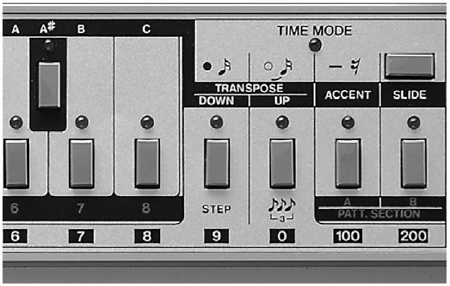
The TB-303 makes use of traditional Western notation and more accessible letters and symbols as shown in Figure 1. Letters are used to describe the pitch and pitch modification of each step. The pitch modifications are slide, accent, transpose down and transpose up. Note, tie and rest are communicated with symbols and notation. As Davis (Reference Davis, Hope, Vickery and Grant2019) describes, to program the TB-303’s sequencer it is necessary to know several variables, pattern length, pitch data, pitch modification and time data.
The TB-303 (2020).
The acid pattern must describe: the pattern’s length, n-16 steps, with the potential to chain up to four patterns; which note on which step; any pitch modifications; and the time data for each step, semibreve (whole note), tie or rest (Davis Reference Davis, Hope, Vickery and Grant2019). This information needs to be communicated using an accessible notation system that does not require traditional music reading skills. The acid pattern sheet is such a notation system.
1.2. The acid pattern sheet
One way in which acid patterns have been communicated is the use of a predefined acid pattern sheet. This sheet is a combination of note-based pattern notation and a synthesiser patch sheet. As illustrated in Figure 2, the pattern sheet describes the pitch data, pitch modifications and time data necessary program a sequence in the TB-303. The synthesiser patch part includes a description of the TB-303 timbre settings to show the sound characteristics of the pattern. The notes section can be used to describe effects used, tempo and any other data that might give more information about recreating the pattern and its sound. The data contained in the sheet are one bar or less in duration. This pattern would then be repeated throughout the duration of the track. This sheet was originally designed by Dan Gendreau (Reference Gendreau2011) and initially distributed online via Peff.com. These blank sheets are now distributed widely via several music community websites and social media platforms.
Blank TB-303 pattern sheet (Dan Gendreau 2011).
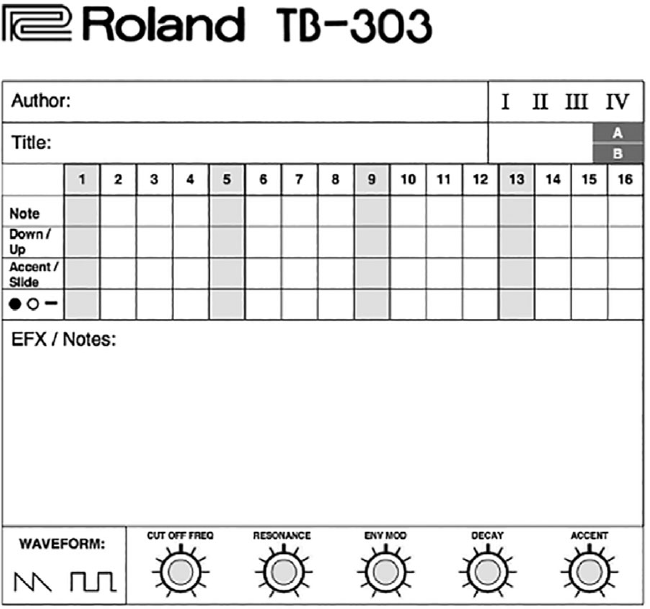
These pattern sheets describe each step of the sequence. They show what note to use, any the pitch modifications that are to be entered, and whether the step is a note, tie or rest. The sheets eschew traditional notation for the time data, instead using only the symbols from the TB-303. The pitch data and time data are entered separately when sequences are programmed into the TB-303. Instructions regarding the pattern can be documented on the sheet. The sheet also shows which memory slot on the TB-303 the pattern is stored (Davis Reference Davis, Hope, Vickery and Grant2019). In common with tablature being based on the appearance of the instrument (Myers Reference Myers2012), Gendreau’s design borrows visual elements from the TB-303. Some of the TB-303’s design elements used are the Roman numerals to show what pattern group the pattern comes from, whether the pattern is from memory bank A or B, and the time data symbols for a tie, a rest and a semibreve. The design of the pattern sheet maintains the TB-303’s taxonomy of up and down to describe transpose modifications and slide and accent to describe the pitch modifications. The patch sheet area of the sheet communicates the various parameter settings of the TB-303 required to get a particular sound. The parameters shown are waveform type, square or triangle, cut off frequency, resonance, envelope modulation, decay and accent level. The one parameter not shown on the sheet is the tuning setting.
2. METHOD
2.1. Data sources
The images were gathered from the community forums and discussion boards of various websites for acid house, record collections, music, synthesiser, music hardware manufacturers and software makers. The images collected consisted of numerous different acid patterns submitted by community members. Alongside the images, contextual text data were collected from these websites that gave additional insights to the collected images.
In addition to the text and image data, the URLs of externally linked audio recordings were gathered to locate any audio recording of the acid patterns. Further information was gathered from users’ feedback and comments on these audio recordings. These data were then analysed using qualitative analysis techniques.
2.2. Analysis
The gathered data was analysed using content analysis. Content analysis is a flexible method of text analysis (Cavanagh Reference Cavanagh1997) that can be used to analyse a range of text data, such as text in audio, print or electronic format. Data sources can include interviews, focus groups, observations, articles, books and manuals (Hsieh and Shannon Reference Hsieh and Shannon2005). There has been a steady increase in the number of studies recording the use of content analysis since 1991 (Hsieh and Shannon Reference Hsieh and Shannon2005) and content analysis is currently used for data analysis in many studies (Elo and Kyngäs Reference Elo and Kyngäs2008).
As stated in the previous section, the data analysed for this research was collated from a range of music websites, instrument websites, links to audio recordings of more famous acid patterns, and text data from the forum posts. The process of data collation assisted in understanding the themes and activities involved in the various communities (Tesch Reference Tesch1990; Elo and Kyngäs Reference Elo and Kyngäs2008). Key themes were identified by immersion in the data, which also helped develop coding schemes. Codes were categorised into areas such as clarity, communication, notation and other variables (Patton Reference Patton2002). A mix of conventional content analysis techniques and direct content analysis techniques were used to categorise variables (Hsieh and Shannon Reference Hsieh and Shannon2005). To maintain reliability the coding process should be undertaken by more than one researcher (Elo, Kääriäinen, Kanste, Pölkki, Utriainen and Kyngäs Reference Elo, Kääriäinen, Kanste, Pölkki, Utriainen and Kyngäs2014). Research peers assisted with reliability by checking and refining of the coding process using Cohen’s kappa (Cohen Reference Cohen1960).
The data were used for three distinct purposes: identifying the different approaches to device-specific musical notation; documenting online co-creation and musical practices of online communities; and how these online communities of acid house fans and musicians shared patterns. Thus, highlighting the appropriateness of the acid pattern as a notation system within these communities.
3. We Call it Acid: Device-Specific Notation
3.1. The printed sheet
The acid pattern sheet is a device-specific notation system and is comparable with Radigue’s notation for the ARP 2500 (Beautiful Reference Beautiful2021) and various forms of instrument tablature. This section discusses how it was used by musicians and community members. Musicians used pattern sheets to communicate with other community members, as shown in Figure 3. The figure shows the pattern’s pitch data for each step, which note and what the pitch modifications are to be used. The patch data and notes section describe the sound and various effects (Martin Reference Martin2014).
Completed acid pattern sheet by Rebecca Goldberg (2020).
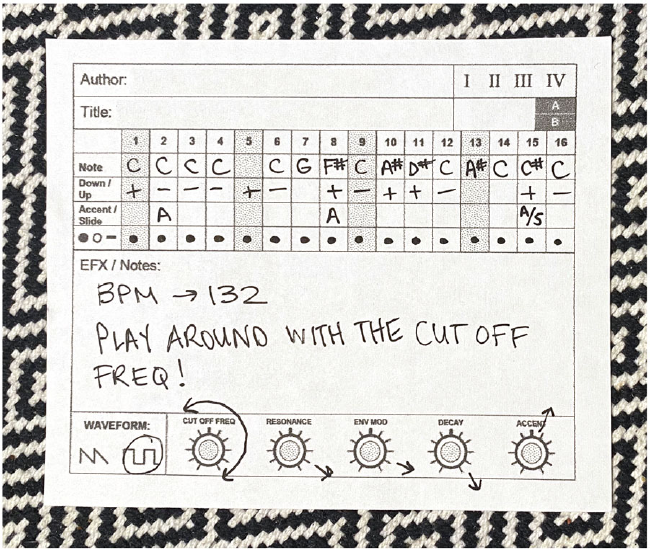
The pattern in Figure 3 uses the pattern sheet to visually communicate the note data and sound parameters. The pitch transposition is denoted with plus and a minus rather than a letter to represent up and down that appear on the TB-303. The A and S are used to denote an accent and a slide. This pattern’s time data are all semiquaver (sixteenth) notes with no ties or rests. The sound-based characteristics of the pattern are described in the synthesiser patch section, which shows the waveform used and the settings of the TB-303’s knobs. The notes section provides additional information about the pattern and performance and the type of sound parameter modulation users found worked well with the pattern.
There are four functions of music notation: allowing the musician to create new music; to create a coordinated performance of a group of individual musicians; to provide the musician with an archive; and to describe the music for analysis (Cole Reference Cole1974). The acid pattern sheet allows: musicians to create new music, either through writing directly onto the pattern sheet or via transcription of patterns created on the TB-303; multiple TB-303s to be programmed with the same pattern and performances to be coordinated; and multiple musicians to spread across the globe to collaborate and work together on electronic music compositions.
In addition, the pattern sheet can be used as an archive and multiple community members and acid house musicians use such sheets for this purpose. The archival requirements of the pattern sheet are highlighted by the TB-303’s limited memory of only 64 slots for saving patterns.
Notation of electronic music can allow for deeper understanding of particular characteristics, or sounds: ‘I didn’t understand what the flare scratch was until I saw it diagrammed’ (Miyakawa Reference Miyakawa and Perchard2014: 79). Similarly, the use of the pattern sheets allows musicians to analyse a particular pattern’s characteristics in terms of pitch, pitch modifications and timing and to understand how to create acid patterns with similar sound or timing characteristics or style. This analysis can extend to quantitative analysis of acid patterns, analysing the occurrences of variables within pitch data, pitch modifications and time data within the acid house and its various subgenres and documenting these variables. This notation system may also be useful when using machine learning or artificial intelligence tools to analyse this music data by providing a formal structure for pattern documentation and analysis.
The acid pattern sheet’s design is related directly to the affordances and functions of the Roland TB-303. The sheets demonstrate a musical notation system that is machine-specific, for the Roland TB-303 and genre-specific to acid house music. In addition, it is an accessible system that is easily understood ‘unlike traditional scores, they could easily be understood, even by those who did not read music’ (Bergstrom-Nielsen Reference Bergstrom-Nielsen2014).
An acid pattern is designed to be programmed into the TB-303’s sequencer, it is not designed to be played live. While it is possible to play the TB-303 live like a synthesiser, it is exceedingly rare, and the focus of these notation systems is primarily for programming a sequence or sequences to be played back. The sequencer has been described as quirky, and difficult to program (Reynolds Reference Reynolds1999; Sicko Reference Sicko2010; Sonicstate 2015), which highlighted the importance of having an accessible notation system outlining the correct pitch and timing information is so important.
It is also noteworthy that a particular compositional technique uses a specific quirk of the TB-303’s memory system. This technique involves removing the batteries, then after a certain time the data in the TB-303’s memory becomes randomly modified and new patterns are created (Sonicstate 2015). The pattern sheets are a useful way to capture and transcribe these randomly generated patterns for future use. The ability to generate random patterns has been incorporated as a feature in many of the TB-303’s clones, such as the Cyclone TT-303, the Behringer TD-3 and the X0X-Box.
3.2. Hand-drawn sheets
Cage (Reference Cage, Cage and Knowles1969) documents many examples of and approaches to hand-drawn notation for experimental music. With acid music, musicians have created pattern sheets using whatever notation tools they had at their disposal. As documented in Figures 4 and 5, the device-specific notation was not limited to the completed acid pattern sheets. These hand-drawn pattern sheets still needed to communicate the required melodic and time information (Davis Reference Davis, Hope, Vickery and Grant2019). The pattern sheet in Figure 4 eschews Gendreau’s pattern sheet for an almost identical DIY version without the TB-303’s patch settings. It communicates a nine-step pattern, showing note data, transposition utilising arrows and accents using the letter A utilised in Figure 3. The notes state that slides may be added anywhere. This pattern incorporated rests as part of the time data. Owing to the way the time data and pitch data are entered separately in the TB-303, the top pattern shows six entries for note data. In this case, the musician decided to leave blanks where the rests fall. They could have placed the three blank spaces at the end of the pitch sequence without altering to time data and the audible result on the TB-303 would have been the same. In this case, it may be that the musician chose spaces to ensure clarity of communication. While the pattern has no sound-based information regarding the TB-303’s patch settings or effects, it does suggest that people use the slide pitch modifier to create their own variations.
Hand-drawn acid pattern sheet by Lauren Flax (2020).

Hand-drawn acid pattern sheet Connor Acid (2020).

Similar to the hand-drawn pattern documented in Figure 4, the musician who created the pattern in Figure 5 eschewed the pattern sheet for a simple tabular version. Here the musician uses letters and words for step data, pitch data, transposition data and accent. The pattern’s timing is 11/16 and each step is a semibreve, with no ties or rests. Once again, the hand-drawn sheet eschews the TB-303’s patch settings and focuses primarily on note data.
In contrast to other studies in the field of graphical notation (Bergstrom-Nielsen Reference Bergstrom-Nielsen2014) and graphic representation in music (Tan and Kelly Reference Tan and Kelly2004), the acid pattern notation system had to adhere to the Roland TB-303’s conventions. This link between notation and instrument is similar to that found with tablature notation for guitar, drums, keyboard and other instruments (Gaare Reference Gaare1987; Miller, Häußler, Kraus, Keim and El-Assady Reference Miller, Häußler, Kraus, Keim and El-Assady2018; Beautiful Reference Beautiful2021). TB-303 is a monophonic synthesiser and thus the pitch data was limited to single notes. These notes are recorded using the letters in keeping with TB-303 design as shown in Figure 1. In maintaining the close connection between the TB-303’s design and the notation, the pitch data modification such as transpose, slide and accent are communicated in an accessible way, ensuring that the pattern is understood by the participating musicians. The entry of the time data and pitch data are separate on the TB-303’s sequencer. Following the pattern sheet, users could enter all the pitches and modification and notes, ties and rests to program the correct pattern. As mentioned earlier, the TB-303 is not played in the traditional sense (Davis Reference Davis, Hope, Vickery and Grant2019), and patterns such as those shown in Figures 3–6 are programmed into it and then the sequencer is started. By programming, the TB-303 from the pattern sheet, musicians do not need to audiate (Gordon Reference Gordon2003) from notation or to transcribe patterns by ear.
Community-transcribed acid pattern (2020).

4. Online Communities of Acid
Members who feel part of a worthwhile community are shown to be more prone to contribute and this can be encouraged by ‘ensuring an atmosphere of loyalty and trust’ (Chesney Reference Chesney2004: 1). The following contributions from various members demonstrate that the members had a sense of loyalty and trust, and they felt the community was worthwhile.
The community forums and discussion boards where these patterns were posted allowed musicians to interact directly with each other. They allowed members to discuss patterns posted, to respond and interact with each other and to ask questions and seek further clarification. Comments were mostly positive and related to various aspects of the pattern and its character. Members posted supportive comments on the music created: ‘Nice track, I like that “Pop-thing” feeling. Nice building and synth sounds’, ‘nice atmosphere, perfect for after rave’, ‘Nice track mate:)’ and ‘Excellent job! It reminds me of Squarepusher’. Also, comments from community members discussed their inspiration, other machines used to accompany the pattern and technical comments or questions such as ‘for a distorted tone exactly like that, it’s very important how the 303 is pre-filtered before the distortion, and its actual harmonic content’. The notes in Figure 5 ‘Have fun make acid’ show the light-hearted nature of these communities. The most asked question related to the timing data, and what the symbols (circles and dashes) represented:
Can anybody tell me what the 0’s and –’s at the bottom mean?
its timing information – I don’t know the Avalon but believe it the same as the 303 i.e. when inputing the timing for that pattern, you are going note, sustain, rest … note is filled in circle, sustain hollow and rest.
Figure 6 shows an example of a community supporting each other. A community member was wondering about how to transcribe the acid part from KLF’s ‘What Time Is Love’. Community members offered a variety of transcriptions, text-based and graphical tablet form, and some even provided screenshots of the midi notes from their digital audio workstation piano roll. The midi transcribed version helped members who used software emulators of the TB-303, modern hardware clones of the TB-303 that accepted midi data, and those who wanted to learn how to transcribe acid patterns. When asked how they achieved the midi transcription, the member responded, ‘Yes, it was trial & error. I’ve loaded 4-bar sample from original track and tried to fit the notes, slides, accents etc. playing software 303 and original audio simultaneously.’ By transcribing the pattern by ear, the same track may have several different interpretations; this phenomenon was also observed on guitar tablature community websites (Myers Reference Myers2012).
Another member pointed out that the acid pattern from ‘What Time Is Love’ is copied directly from Jesus Christ Superstar and provided a link to the snippet on YouTube saying, ‘Bill Drummond mentioned they got [nicked] the riff from Jesus Christ Superstar.’
The success of these online communities may be credited to several factors. First, the acid pattern notation used in these communities is easily accessible to these diverse groups of musicians from around the world and thus allows them to program sequences into their TB-303 successfully. Second, the shared cultural identity of the musicians around acid house music (Hesmondhalgh Reference Hesmondhalgh1998) brings these musicians and music fans together. These communities of the third place, ‘a public setting accessible to its inhabitants and appropriated by them as their own’ (Oldenburg and Brisset Reference Oldenburg and Brisset1982: 270) utilised and appropriated the functionality of web forums, online groups and discussion boards to share their common interests in acid house music and music technology. This functionality allowed globally distributed groups of musicians and music fans to become a community that created, shared, collaborated, commented and advised on existing and original compositions.
These online communities share the characteristics of the third place such as neutral ground, leveller, where conversation is the main activity, that is, accessible, accommodating, with regulars, and where the mood is playful (Quandt and Kröger Reference Quandt and Kröger2013b; Yuen and Johnson Reference Yuen and Johnson2017). The participants were able to come and go as they pleased, with no obligation for forum members to actively participate. There were no requirements for members concerning experience, knowledge or expertise and no roles were ascribed to members. Administration of forum members was usually done by the hosting organisation and would vary from website to website. While there was no discrimination between acid makers using software versus hardware, or original expensive 1980s hardware versus modern replicas, there was some preference towards hardware: ‘Nothing beats programming some hardware acid! It’s the best in terms of knob twiddling and that’s what acid is all about!’ New participants who were unable to understand certain aspects of the pattern notation had their questions answered politely. The members had little in the way of pretensions, the focus was on the music-making rather than the tools used. While the communication within these forums was mostly positive and supportive, playful conversations between group members were also collectively valued:
What would be the easiest way to dump this pattern into my tt303? Bear in mind I’m the laziest person on earth and need instant gratification at all times.
You aren’t the laziest person on earth. You’re the laziest person in the entire multiverse – that’s hilarious.
These online communities can be considered communities of the third place (Oldenburg and Brisset Reference Oldenburg and Brisset1982) bounded by their shared culture and identity (Rose Reference Rose2010). The sharing of these acid patterns over time gathered comments and replies. The conversational aspect of these communities allowed for continued interactions between the various members over this time. These global communities may have never met face to face, but they were connected by interest, activity and a shared purpose (Young Reference Young1986), facilitated through web-based forum functionality.
4.1. Acid house music fans share Phuture’s ‘Acid Tracks’
In the UK in 1988, acid house parties transformed spaces to host large-scale events with ‘exuberance and inventiveness that have characterised the creative practices of youth culture’ (Hill Reference Hill2003: 223). These practices left a lasting mark on those who attended and have impacted the youth cultures that followed (Hill Reference Hill2003). Nostalgia can be ‘manifest in an ambiguous relation to the past and present’ (Pickering and Keightley Reference Pickering and Keightley2006: 936). Attendees have nostalgia for these events, while younger audiences who were too young to attend have a received nostalgia (van der Hoeven 2014). There is also a technonostalgia for the equipment, production techniques and recording practices used to create acid house music (Pinch and Reinecke Reference Pinch, Reinecke, Bijsterveld and van Dijck2009; Williams 2015). Acid patterns enable the recreation and reinterpretation of past acid house music tracks, allowing musicians and fans to ‘mediate between past and present to achieve a particular sound and feel’ (Pinch and Reinecke Reference Pinch, Reinecke, Bijsterveld and van Dijck2009: 153). Acid house music fans used acid patterns to program their favourite acid house tracks on their instruments. In addition, acid patterns allow a wider audience to connect to, practice, perform and create their own personal meanings and experiences (van der Hoeven 2014) of acid house music that are firmly situated in the present.
This section examines these fans’ sharing the acid pattern for what is widely recognised as the first acid house track (McLeod Reference McLeod2001; Sicko Reference Sicko2010; Reynolds 2013), ‘Acid Tracks’ by Phuture released on Trax Records in 1987. The results show several versions of the acid pattern related to this track were available online at various music production websites (Phuture – Acid Tracks 303 pattern 2016; Famous TB 303 Patterns Source 2019). There were various renditions of this pattern, and Figure 7 shows the different representations used in communicating this acid pattern on various websites.
Various notation systems of ‘Acid Tracks’ by Phuture.

This eight-note pattern is repeated throughout the track’s 12-minute duration. The pattern had been communicated using simple text-based annotation showing only the pitch data and pitch modifiers. The initial text-based using vertical axis to demonstrate the time data may be due to the formatting limitations of the web-based forums, though other posts have embedded images that show time in the horizontal axis. These other renditions of the pattern use a more tabular format to demonstrate the pitch data and the time data. This pattern has eight steps, and each step is a semibreve; there are no ties or rests in this pattern. The lack of ties or rests makes it easier for the pattern to be communicated either vertically or horizontally. If a pattern did contain ties or rests, the time data would need to be able to be separated from the pitch data. It is, for instance, possible to have a pattern with only one note but sixteen steps, where the note may have a duration of a sixteenth or up to one bar. This would be difficult to be communicated using the vertical numeric list format but more easily understood using the tabular format. The version transcribed to Gendreau’s pattern sheet has note data but no patch data. Over the track’s 12-minute duration, the sound of the TB-303 is modulated through a wide array of its parameters. Using a longer patch sheet, it would be possible to map these modulations over time. Vickery’s (Reference Vickery2018) documentation of cross-modal correspondence and spectrographic notational approaches may be another way to map the sound-based changes of the entire track. It may be possible to map the TB-303’s modulations in a comparable way to Robert Erickson’s ‘Pacific Sirens’ score (Vickery Reference Vickery2018).
As the first acid house track, this track is also important culturally. Videos and recordings of this track appear on several popular music-sharing websites, including YouTube. The track has an iconic status with acid house music fans sharing the impact of the track on them: ‘let me tell you; when this dropped? MF’s lost they minds, yo. Just the way it come in, it’s perfect. The DJ played this? Everybody was on the floor, JACKIN.’’ The feedback is overwhelmingly positive with comments such as ‘Still sounds like something from the future, pure originality’, ‘This will never age always ahead of its time’ and ‘1987 way ahead of its time, best acid track ever’.
‘Acid Tracks’ evoked strong memories for those that actively participated in the subculture (Hill Reference Hill2003). These memories and the comments for a track released over 30 years ago highlight the impact of acid house music and the subculture it created. These fans memories and recollections travel between past, present and future, as Pickering and Keightley (Reference Pickering and Keightley2006: 936) described: ‘where a sense of loss associated with the past coexists with a sense of longing associated with the future’.
One of the main motivations of these online communities of acid house music enthusiasts is to recreate some of their favourite tracks, and acid patterns enable this to take place. Acidvoice.com is one of several websites set up to share these patterns. There are also numerous posts across various music production, music-making, record collection and music hardware manufacturing websites forums that share and discuss acid patterns.
While music notation sharing has caused copyright issues with other online communities such as guitar tab sharing (Chesney Reference Chesney2004; Butler Reference Butler2007; Kempema Reference Kempema2008), the sharing of these famous acid patterns has not caught the attention of music licensing bodies to date. It is worth noting that the website Acidvoice.com, which hosts many famous acid patterns and audio samples, referred to these tracks by number, Pattern 01 and onwards, rather than their actual name. This naming may be to avoid any undue attention around copyright.
5. Conclusions
Acid house music can be considered as a strong contributor to youth cultural identity, but the mechanisms of production still require further research (Hesmondhalgh Reference Hesmondhalgh1998); in particular, the visual communication of pattern notation data for composition, production, collaboration and archival purposes.
This article has two main contributions to the field. First, the analysis and discussion of a machine specific and genre-specific notation system. Where the machine, the Roland TB-303 is synonymous with the genre acid house music. As an accessible notation system, the acid pattern sheet helps the creation and recreation of acid house music, making sequence programming easier for the Roland TB-303 bassline synthesiser and its many clones. This system can be used for composition, production, collaboration and archival purposes. The patch section of Gendreau’s acid pattern sheet can be used to record settings of sounds from the TB-303 and could be used to document specific parameter modulation over time. This addition extends the pattern sheet from communicating primarily note-based music to include aspects of sound-based music.
Figure 8 shows further potential modifications to the Gendreau’s acid pattern sheet that provide the opportunity for musicians to document and map the parameter modulation of the TB-303’s various settings over time. This modulation notation would demonstrate the changes in sound and timbre over time while the pitch remains the same, thus allowing for communication of both sound-based and note-based information. The modulation mapping would be visually consistent with spectrographic notational approaches (Vickery Reference Vickery2014, Reference Vickery2018), animated notation (Vickery Reference Vickery2014; Hope Reference Hope2020) and automation lanes used in digital audio workstations (DAW) software.
Temporal modulation acid pattern sheet.

The acid pattern sheet is a successful form of notation that provides benefits to musicians from around the world in the composing, collaborating and archiving of electronic music compositions of the acid house genre. In addition to the design of the sheets, there are also strong cultural, community and identity influences that contributed to this success.
Second, while acid house has a strong place-based cultural identity (Rietveld Reference Rietveld1998), this article furthers the understanding of the development of online global communities of musicians and music fans. These musicians and fans came together because of this shared cultural bond, within the online third place (Oldenburg and Brisset, Reference Oldenburg and Brisset1982; Quandt and Kröger Reference Quandt and Kröger2013a), and developed a community of practice around creating and recreating acid house music. This gives weight to Young’s (Reference Young1986) argument that communities are not built solely face to face. The acid pattern enables these fans to mediate past, present and future experiences through the creation, recreation and reinterpretation of Acid House music and its production practices (Pinch and Reinecke Reference Pinch, Reinecke, Bijsterveld and van Dijck2009; van der Hoeven 2014; Williams 2015).
In addition, outside of these online communities, a range of musicians continue to use the acid pattern sheets as a notation system to document, archive, share and write music as part of their professional practice. Future research may determine if these types of systems can be the basis for sharing machine-specific notation in online and offline contexts.
Acknowledgements
The author would like to acknowledge the contribution made by the various website forum members for sharing their acid patterns online and Tadao Kikumoto for designing the Roland TB-303. The author would also like to thank Diego Muñoz and the other members of the Swinburne University Hit Submit Writing Group for their assistance in the writing of this article.


 Open access

