Book contents
- Frontmatter
- Contents
- Acknowledgments
- Introduction
- 1 Explicit Poetics in Greece and China: Points of Divergence and Convergence
- 2 Epic Authorship: The Lives of Homer, Textuality, and Panhellenism
- 3 Lyric Authorship: Poetry, Genre, and the Polis
- 4 Authorship between Epic and Lyric: Stesichorus, the Palinode, and Performance
- 5 Death and Lingerie: Cosmopolitan and Panhuaxia Readings of the Airs of the States
- 6 Summit at Fei: The Poetics of Diplomacy in the Zuozhuan
- 7 The Politics of Dancing: The Great King Wu Dance and the Hymns of Zhou
- Conclusion: Scenes of Authorship and Master-Narratives
- Bibliography
- Index of Passages Cited
- General Index
5 - Death and Lingerie: Cosmopolitan and Panhuaxia Readings of the Airs of the States
Published online by Cambridge University Press: 03 May 2010

Book contents
- Frontmatter
- Contents
- Acknowledgments
- Introduction
- 1 Explicit Poetics in Greece and China: Points of Divergence and Convergence
- 2 Epic Authorship: The Lives of Homer, Textuality, and Panhellenism
- 3 Lyric Authorship: Poetry, Genre, and the Polis
- 4 Authorship between Epic and Lyric: Stesichorus, the Palinode, and Performance
- 5 Death and Lingerie: Cosmopolitan and Panhuaxia Readings of the Airs of the States
- 6 Summit at Fei: The Poetics of Diplomacy in the Zuozhuan
- 7 The Politics of Dancing: The Great King Wu Dance and the Hymns of Zhou
- Conclusion: Scenes of Authorship and Master-Narratives
- Bibliography
- Index of Passages Cited
- General Index
Summary
Indexicality and Interpretation
In the previous chapter's discussion of the Palinode of Stesichorus, we saw how the demonstrative pronoun houtos in the first line of Plato's Palinode fragment had the effect of making the narrative to which it referred vividly present to its audience. This capacity of language to point to objects, individuals, and even narratives, and to indicate the relationship of its referent to the context of discourse, falls under the category of language identified as “indexical” by Charles Peirce; the meaning of such language is always context-dependent. Pronouns, demonstratives, articles, and time words are among the most obvious of indexical linguistic categories; “I,” “you,” and “she” clearly have radically different meanings depending on when, where, and why they are being uttered, as do words such as “this,” “here,” and “now”.
Proper names can also be indexical, because they indicate an individual within a group; outside the group, the name becomes meaningless. Anthropologists identify two distinct goals for naming systems: referring to individuals (that is, working indexically to distinguish one person from another), and addressing individuals (that is, situating that individual within a social system using naming patterns that require cultural knowledge to interpret; in other words, acting as symbolic signs in Peircean terms). As Joel Kuipers in particular has shown with respect to the Weyewa culture of the Indonesian island of Sumba, the disappearance of traditional cultural knowledge can move a naming system from address to reference, from symbolic to indexical.
Information
- Type
- Chapter
- Information
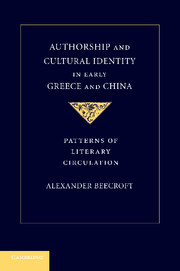
- Authorship and Cultural Identity in Early Greece and ChinaPatterns of Literary Circulation, pp. 171 - 204Publisher: Cambridge University PressPrint publication year: 2010
Accessibility standard: Unknown
Why this information is here
This section outlines the accessibility features of this content - including support for screen readers, full keyboard navigation and high-contrast display options. This may not be relevant for you.Accessibility Information
Accessibility compliance for the PDF of this chapter is currently unknown
and may be updated in the future.