

Before becoming a novelist, H. G. Wells taught evening classes in science to part-time students at London’s University Tutorial College. His first full-length publication, Text-Book of Biology (1893), was a primer adapted from his syllabus and lesson plans, designed for the benefit of the “vast number of solitary workers scattered through the county” without means or access to formal university education.1 Amid Text-Book’s dry, technical material (e.g., “The Alimentary Canal of the Rabbit”) Wells inserted enthusiastic digressions on the wonders of evolutionary theory. His conclusion, for example, flashes with energetic prose:
Our little book is the merest beginning. … In the book of nature there are written, for instance, the triumphs of survival, the tragedy of death and extinction, the tragicomedy of degradation and inheritance, the gruesome lesson of parasitism, and the political satire of colonial organisms. [It] is, indeed, a philosophy and a literature to those who can read its symbols.2
Wells’s “book of nature” metaphor rhetorically links Text-Book to the two most prominent natural history treatises of the nineteenth century: Charles Lyell’s Principles of Geology and Charles Darwin’s Origin of Species.3 It echoes a signature passage from the latter wherein Darwin acknowledges “following out Lyell’s metaphor” by comparing the “natural geological record” to a vast encyclopedia, “a history of the world imperfectly kept, and written in a changing dialect.”4 Darwin explains that this book is now so eroded and fragmentary that “we possess the last volume alone, only here and there a short chapter has been preserved; and of each page, only here and there a few lines.”5 Wells adopts the metaphor by proposing that understanding the natural world involves deciphering its coded “symbols,” that scientific study constitutes a specialized mode of hermeneutics. Yet Wells also takes the metaphor in a new direction, pivoting away from the figure of a tome (Darwin’s “record, history, volume”) and instead proposing nature’s textual kinship with the more romantic ambits of “philosophy” and “literature.” Even more striking is Wells’s description of natural phenomena in terms of curiously specific genres like “tragicomedy” and “political satire.” This focus on genre implies the metaphor’s reversal – from book of nature to nature of books – while also hinting at an exigent literary dilemma: How might the enormous durations involved in emerging scientific paradigms be encompassed within the microcosm of a “little book,” or novel? Whether he realized it or not, Wells’s nonfiction had begun to grapple with the challenges he would soon face in attempting to write fiction at geologic timescales.
Wells’s earliest works of fiction explore the dramatic possibilities suggested to him by the theories of Lyell, Darwin, and Huxley, both in their consistent foregrounding of the scientific experiment as leitmotif and in terms of their efforts to represent the scales involved in “scientific” reality.6 Wells’s secular worldview was grounded in the supposition that the conditions of life in the present could be grasped only by recourse to huge expanses of time and space – on scales that vastly exceeded the limits of subjective experience. However, working at these scales posed serious problems for the novel, whose narrative devices traditionally privileged subjective experience, and whose formal conventions, as I will discuss in this chapter, functioned at least in part as strategies for delimiting the potentially infinite horizons of modern life.
This chapter analyzes The Time Machine (1895), the first of the suite of “fantastic” fictions Wells wrote during his early career, as an experiment in rescaling the novel’s inherited forms to the pressures of his historical moment, a time of unfettered technoscientific acceleration. It proceeds by asking whether representing the immense scales at which biological, social, and political forces become visible in their totality also necessitates breaking with realism, and, if so, which alternative genres might offer a more viable means of narrating them. Because the sheer magnitude of such phenomena renders human perspectives trivial by comparison, including them in narrative forms can obviate the aesthetic complexity that registers at smaller, “human” scales. Accordingly, it is the perceptibly human scale of literary works that emerges as the site of their complexity, which in turn confers upon them a sense of artistic legitimacy. Broadening the scope of a novel to scales beyond the human threatens to flatten this complexity, rendering its formal and aesthetic features “generic.” It is in this sense that genre fiction is preconditioned by its fundamental relation to the nonsubjective or nonunique, the “dehumanizing” consequence of shifting to a wider frame of reference. Generic qualities, including didactic narrative voice, nameless characters, and predictable plots, have consistently earned Wells’s novels a reputation as formulaic or “subliterary” works. However, rather than judging Wells’s flat style a defect of his otherwise innovative texts, this chapter argues that it should be reassessed as a tactical concession for moving radically beyond the realist novel’s human limitations.
Although the famous early works that H. G. Wells called his “scientific romances” have been recognized as formative experiments in literary genre, there has been little discussion about how their formal novelty corresponds directly to the issues they confront.7 Wells’s scientific romances consistently hinge on world-scale events, including global revolution, species change, extinction, and interplanetary war – topics that Wells had already discussed at length in nonfiction essays, such as “The Biological Problem of To-Day,” “On Extinction,” and “The Limits of Individual Plasticity.” But pursuing these topics in novels created new tests for individual experience, since they often involved narrating events that could not be realistically observed within the space of a single human life, or else occurred within the time frame of a human life but overwhelmed the protagonist’s capacity to fully witness or reliably account for them.
Wells retrospectively described his scientific romances as a collection of narratives that shared a common theme: the unprecedented “change of scale in human affairs.”8 While they are concerned with speculating upon the possibilities of a “world set free” by scientific and technological advances, they also explore the sense of disoriented subjectivity that marked the jarring transition into industrial modernity. The degree to which his novels are symptomatic of the shocks associated with literary modernism has been a long-standing subject of debate. Parrinder and Philmus ask “whether his beliefs as to the unprecedented situation of twentieth century man, and the obsolescence of the literary tradition, do not align him – despite appearances – with certain aspects of the modernist movement in literature and the arts.”9 J. R. Hammond argues that Wells’s “work has far more in common with Kafka and Conrad than with Bennett and Galsworthy, and that he can properly be regarded as a transitional figure between realism and modernism.”10 Sarah Cole’s recent, comprehensive reassessment of Wells’s place in literary history makes clear that his “enormous energy took directions quite his own, and these do not line up with the primary aesthetic objectives” that “have been interpreted and amalgamated into literary culture” under the banner of modernist studies.11 Put succinctly, Wells does not neatly fit into received periods. His longevity as a writer made him adjacent to a great number of turn-of-the-century literary projects and creeds, and it would be more accurate to suggest that his work does not so much anticipate literary modernism as diverge from it – that he should be regarded less a protomodernist than an altermodernist.
While his narratives consistently explore how changing historical, social, and environmental conditions fracture and reshape human experience, in general they do not privilege interior subjectivity, nor does their style accord with what, following Eric Kahler, has been celebrated as modernism’s most important movement: the “inward turn.”12 Wells was openly dismissive of art-for-art’s sake projects, which he perceived to be both elitist and unconcerned with public engagement. He considered his own texts “novels of ideas” whose scope was antithetical to the closely worked, cloistered style of both realism and modernism. “Magnification and clarification,” he remarked, “applies in a greater or lesser degree to nearly all the talk in every novel of ideas. It is the exact opposite of that ‘flow of consciousness’ technique with which Virginia Woolf, following in the footsteps of Dorothy Richardson, has experimented more or less successfully.”13 For Wells, a commitment to psychological interiority and stylistic complexity could even be detrimental to fiction’s social responsibility to provide equipment for living with and within modernity.14
Nevertheless, writers who would go on to earn the moniker of “high” modernist respected Wells, or at least his celebrity, enough to seek his endorsement (though they could hardly be surprised when he demurred). When Joyce wrote to ask for his support for Work in Progress (a draft of Finnegan’s Wake), Wells’s refusal was comprehensive:
I’ve an enormous respect for your genius dating from your earliest books and I feel now a great personal liking for you but you and I are set on absolutely different courses. … The frame of my mind is a world wherein a big unifying and concentrating process is possible (increase of power and range by economy and concentration of effort), a progress not inevitable but interesting and possible. That game attracts and holds me. For it, I want language and statement as simple and clear as possible. … Now with regard to this literary experiment of yours. It’s a considerable thing because you are a very considerable man and you have in your crowded composition a mighty genius for expression which has escaped discipline. But I don’t think it gets anywhere. You have turned your back on common men, on their elementary needs and their restricted time and intelligence and you have elaborated. What is the result? Vast riddles.15
In dismissing what he perceived to be Joyce’s aesthetic narcissism, which he felt was of no use to “common men,” Wells was signaling the breadth of his opposing project. The “big unifying and concentrating process” was, in his judgment, both the priority and prerogative for modern fiction, which needed to be made intelligible and accessible to the largest possible audience. Valorizing not just “common men” but also commonality of character, Wells asserted, was necessary for strengthening bonds of collectivity. He therefore insisted, “I have never been able to get away from life in the mass and life in general as distinguished from life in the individual experience, in any book I have ever written. I differ from contemporary criticism in finding them inseparable.”16 For Wells, the challenge was to reintegrate, rather than to merely represent, the fragmentation of the modern subject.
Wells cultivates a kind of extreme exteriority as his novels attempt to encompass multiple levels of subjectivity at once: as individual, as social body, as biological species. These aggregated forms of human life can only be addressed at scales that must interrupt the continuity of individual experience, so whereas Joyce achieves a level of psychological depth by focusing on a single day in Dublin, Wells’s characters are stretched ever thinner as his plots extend over huge temporalities. This helps to explain why his novels, particularly the scientific romances but to some extent his later fiction also, have been criticized as juvenile or artistically derivative. E. M. Forster deserves a certain amount of responsibility for this persistent attitude toward Wells, for although he classes Wells among “good but imperfect novelists,” he offers him up as the prime example in his famous coinage of the term “flat characters”:
Wells’s characters are as flat as a photograph. But the photographs are agitated with such a vigour that we forget their complexities lie on the surface and would disappear if it were scratched or curled up. … It is the deft and powerful hands of their maker that shake them and trick the reader into a sense of depth.17
While Forster takes pains to note the necessity of, and possibilities afforded by, using such characters in novels, the charge that Wells sacrificed three-dimensionality by striving for the grand unifying idea tallies with critiques leveled against him by his contemporaries, especially Virginia Woolf’s complaint in “Mr. Bennett and Mrs. Brown” (1924). “Indeed I do not think,” Woolf writes, “that Mr. Wells, in his passion to make [Mrs. Brown] what she ought to be, would waste a thought upon her as she is.”18 Instead of truly observing Mrs. Brown as a person, Wells would be too busy framing her image against the window of the moving train, reading her life as the accumulation of “symptoms of the unsatisfactory conditions” of the factories, the schools, and the slums rushing behind her silhouetted figure.19 But whereas Woolf caricatured him as rearguard Edwardian, Wells saw himself running against the grain of both Victorian realism and the emerging style of modernist fiction: “Throughout the broad smooth flow of the nineteenth century life in Great Britain,” he argued,
the art of fiction floated on this same assumption of social fixity. The Novel in English was produced in an atmosphere of security for the entertainment of secure people who like to feel established and safe for good. Its standards were established within that apparently permanent frame and the criticism of it began to be irritated and perplexed when, through a new instability, the splintering frame began to get into the picture. I suppose for a time I was the outstanding instance among writers of fiction in English of the frame getting into the picture.20
Thus, while Wells sought to engage with the same social upheavals that are credited with initiating modernism’s inward turn, his own account of his work provides a clear indication that what Wells was interested in was precisely the opposite: an outward turn.21
Romancing the Future: The Time Machine
The Time Machine extends further outward than any of Wells’s subsequent fiction, and it represents a major experimental effort in adapting the form of the novel to the experience of deep time. Although it is now considered an Ur-text of the science fiction genre, Wells’s taxonomy – “scientific romance” – better names its hybrid form. Indeed, “science fiction” loses the specificity that Wells was aiming for in subordinating the adjective, “scientific” to the romance, which was already a viable and widely read literary genre. He explained his method as one of substituting the scientific or technological discovery for the magical or “fantastic” aspect of romance, bringing the “fetish stuff up to date” and making it “as near actual theory as possible.”22
The working title of the novel’s early draft, “The Chronic Argonauts,” alludes directly to its status as a mythic quest narrative that takes the romance as its structural model, and the finished text can be stripped down to a basic generic pattern: the heroic Time Traveller boards a modern-day Argo that transports him to alien shores where he encounters friendly natives, becomes amorously entangled with one of them, and overcomes a hostile tribe of cannibals in order to return home.
Yet Wells expressed ambivalent opinions about this kind of genre fiction, and it is surprising, perhaps, that he adopted the romance as his template for exploring a factually informed world of the future. Though he maintained that “a novel” should be defined broadly as “any sort of honest treatment of human behavior in narrative form,” he also, as Parrinder and Philmus point out, “regarded his ‘scientific romances’ as substitutes for the [realist] novel – and as inadequate substitutes at that.”23 Wells discussed their inadequacy in scalar terms:
[Y]ou can manage with broad generalizations. You can write of mighty embankments thousands of feet high, stupendous aeroplanes, you can hint at greater palaces of crystal and beautiful robes and adornments. It passes muster. But directly you come down to real persons seen close-up, you meet what is the final and conclusive defeat of futuristic imagination and that is – the small material details.24
As we saw in the opening passage of this book’s introduction, those close-up details, the “material” of realist verisimilitude, are lost when the narrative pulls focus so drastically from foreground to background. “The best sort of futurist story,” Wells argued, “should be one that sets out to give you the illusion of reality. It ought to produce the effect of an historical novel, the other way round.”25 But Wells admitted that he had never “succeeded in producing anything like the convincingness of hundreds of historical novels,” because whereas the “historical romancer has a whole mass of history, ruins, old costumes, museum pieces, to work upon … the futurist writer has at most the bare germs of things to come.”26 With this in mind, one can read the preponderance of future/antique set pieces in The Time Machine (the dilapidated Sphinx statue; “suggestions of old Phoenician decorations … badly broken and weather-worn”; the gigantic Palace of Green Porcelain that turns out to be a ruined museum) as more than symbols of cultural decline: they are monumental placeholders for the imagined historicity of a fictional future society.
Though he acknowledged the difficulty of using realist representational strategies in his proleptic fiction, Wells was also keen to maintain certain aspects of a realist style. After all, he was attempting to extrapolate the likely course of actual events from the conditions of the present, and the inclusion of any fantastic device – let alone an adventure plot – threatened to undermine the text’s empiricist foundations. Wells therefore insisted that although his scientific romances proposed improbable conceits (time travel, invisibility, advanced life on Mars), their “living interest” lay in their “non-fantastic elements and not in the invention itself. They are appeals for human sympathy quite as much as any “sympathetic novel,” and the fantastic element, the strange property or the strange world, is used only to throw up and intensify our natural reactions of wonder, fear or perplexity”.27
He stressed that for the reader to feel at home in a strange world, an author must “help him in every possible unobtrusive way to domesticate the impossible hypothesis.”28 These comments make clear the degree to which his scientific romances were designed for reality-testing: the world they represent is identifiably our own, and their conceits serve to alienate us from our familiar view of it by causing a shift of perspective that obliquely exposes underlying structures of lived reality which are otherwise inaccessible to direct experience. Darko Suvin calls this technique “cognitive estrangement,” whereby “the effect of … factual reporting of fictions is one of confronting a set normative system – a Ptolemaic-type closed world picture – with a point of view or glance implying a new set of norms.”29 This attitude of factual reporting is consistent to all of Wells’s novels;30 its effect is to “domesticate” the romance by overlaying a realist tone (in The Time Machine, this is accomplished by means of the frame narrative) – a balancing act that Joseph Conrad insightfully summarized by dubbing Wells the “Realist of the Fantastic.”31
Wells viewed fiction, and the novel in particular, as “a powerful instrument of moral suggestion.”32 In his essay, “The Scope of the Novel,” he described it as “the only medium through which we can discuss the great majority of the problems which are being raised in such bristling multitude by our contemporary social development.”33 Because the novel was able to tackle moral questions that stark statements of fact could not, it remained, for Wells, “an important and necessary thing indeed in that system of uneasy adjustments and readjustments which is modern civilization.”34 If readers could experience deep forms of compassion for realistic but nonexistent characters in a typical “sympathetic novel,” the scientific romances set out to test how far that sympathy could extend. How might a reader feel an emotional engagement with a human descendant born thousands of years in the future? How might a reader identify with the human species as a whole, or with the planet itself?
It is possible that Wells turned to romance because it supplied a ready source of popular motifs with which to engage a broad readership, to better stimulate public discussion and social change. But it is just as likely that the form itself afforded him the scope to narrate topics as expansive as “modernity,” “civilization,” and “planet,” in ways that the realist novel could not. “Romance is characterized,” Particia Parker argues, “primarily as a form which simultaneously quests for and postpones a particular end, objective, or object”; its episodic structure allows for “extension in space and endless deferral of endings.”35 This is clearly a useful feature in a story concerned with representing the expanses of planetary time, on a scale at which the “world” itself emerges as a dominant figure. Fredric Jameson notes the peculiar “centrality of worldness in romance,” observing that unlike the realist novel wherein specific settings like a “landscape or village, forest or mansion” are “mere stopping places on the lumbering coach or express-train itinerary of realistic representation,” in the romance these settings are “somehow transformed into folds in space, into discontinuous pockets of homogeneous time and of heightened symbolic closure, such that they become tangible analoga or perceptual vehicles for world in its phenomenological sense.”36 In other words, world takes on a life of its own in romance: endowed with a “strangely active and pulsating vitality,” it also “tends to absorb many of the act- and event- producing functions normally reserved for characters.”37
This kind of shift, in which the world is transformed from object to “actant” (to borrow Bruno Latour’s term), soaking up narrative agency in the process, is undoubtedly at work in The Time Machine. Consider, for example, the Time Traveller’s first description of being launched into futurity:
I had a dim impression of scaffolding, but I was already going too fast to be conscious of any moving things. … The landscape was misty and vague. I was still on the hill-side upon which this house now stands, and the shoulder rose above me grey and dim. I saw trees growing and changing like puffs of vapour, now brown, now green; they grew, spread, shivered, and passed away. I saw huge buildings rise up faint and fair, and pass like dreams. The whole surface of the earth seemed changed – melting and flowing under my eyes. The little hands upon the dials that registered my speed raced round faster and faster. … The unpleasant sensations of the start were less poignant now. They merged at last into a kind of hysterical exhilaration.
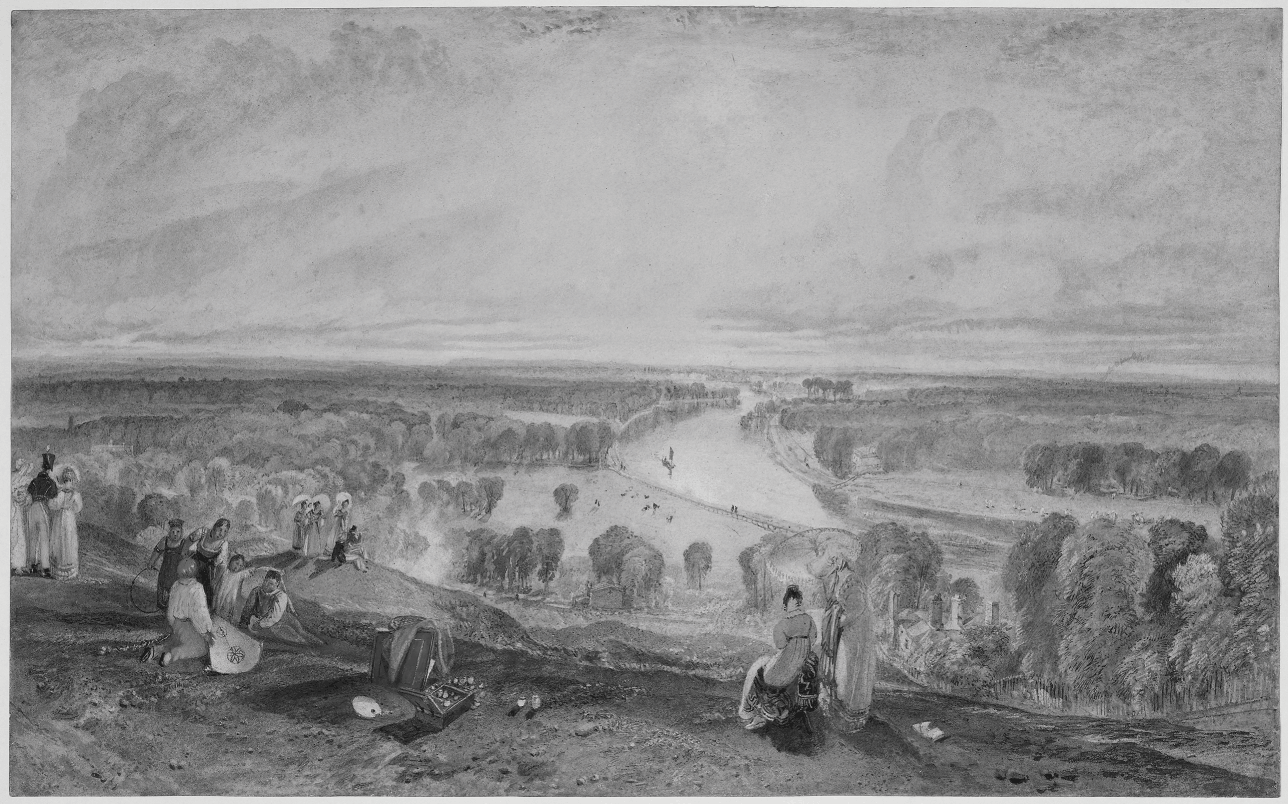
What we might today dub the “special effects” of this passage have to do with imagining the human sensorium overwhelmed by unrelenting acceleration. As the Time Traveller moves faster and faster, the dim marks of human life “pass like dreams” before his eyes and the earth itself seems to liquefy – the whole panorama dissolves into abstraction. It is worth noting that in order to achieve a panoramic view the first-person narrator requires an elevated perspective from which to look down on the changing landscape. We are told that the time machine has been designed to travel only in the fourth dimension, not along any Cartesian spatial axis; and since the device cannot move independently up, down, or sideways, the physical space it occupies becomes a crucial feature of the story. All of the novel’s action is therefore limited to the vicinity of the protagonist’s home on Richmond Hill, a suburb of London commutable by train since 1846. Today this location might seem rather arbitrary, but the commanding view from Richmond Hill was known at the time of the novel’s publication as one the most famous prospects in England, so famous that it was protected by act of Parliament in 1902.38 The vista faces southwest, away from the city; it was and is still renowned for its view of the River Thames and the unspoiled parklands beyond.39 A popular spot for day-trippers, Wells’s contemporary readers might have experienced it themselves while standing atop Richmond Hill, or they might have seen it depicted in one of the many paintings by prominent British artists, including Joseph Turner, paintings which evoke an anachronistic sense of London’s natural idyll, its pastoral, its picturesque.
Richmond Hill’s prominent status in Victorian culture makes its transformation in The Time Machine both poignant and topical, insofar as the scene essentially reverses public efforts to preserve this view from change (see Figure 1.1).This is the celebrated spot from which the Time Traveller witnesses the unmaking of the world. At first the experience produces “unpleasant” sensations, along with a melancholic mood Wells underscored in his manuscript notes by inserting these suggestive lines from Tennyson’s “In Memoriam A.H.H.”:
The personal loss expressed in Tennyson’s poem is rendered at a geologic scale as the ground advances fluidly “from form to form,” a loss extended from the previous stanza in which the speaker apostrophizes the earth itself:
These lines, inspired by the work of Lyell, register the aesthetic range that Victorian geologists had suffused into the literary imagination. However, as Adelene Buckland has persuasively demonstrated, “one of the principal practices of the geologist was, itself, literary”; speculative renderings of lost worlds, emerging from sedimented strata as from a text, drew heavily upon romance and epic, “vital genres that shaped nineteenth-century geological writing.”41 Tropes borrowed from both genres are artfully deployed in Principles of Geology (1830) in passages where Lyell waxes on the “delightful meed” of the geological imagination:
The senses had for ages declared the earth to be at rest, until the astronomer taught that it was carried through space with inconceivable rapidity. In like manner was the surface of this planet regarded as having remained unaltered since its creation, until the geologist proved that it had been the theatre of reiterated change, and was still the subject of slow but never-ending fluctuations. To trace the same system through various transformations – to behold it at successive eras adorned with different hills and valleys, lakes and seas, and peopled with new inhabitants, was the delightful meed of geological research. By the geometer were measured the regions of space, and the relative distances of the heavenly bodies; – by the geologist myriads of ages were reckoned, not by arithmetical computation, but by a train of physical events – a succession of phenomena in the animate and inanimate worlds – signs which convey to our minds more definite ideas than figures can do of the immensity of time.42
This view of the planet as a “theatre of reiterated change” is figured in the similarity between the landscape paintings of Richmond Hill and paintings of prehistoric Britain that were in vogue during the Victorian period. Geologist and illustrator Sir Henry De la Beche, for example, was celebrated for his vivid depictions of extinct animals and plants which lived, epochs ago, in familiar British locales. Duria Antiquior (1830)43 – “a more ancient Dorset” – imagines a scene based on reconstructed fossils collected by Mary Anning in Lyme Regis (Figure 1.2).
Joseph Mallord William Turner, Richmond Hill, c. 1820–5.

Sir Henry De la Beche, Duria Antiquior, 1830.
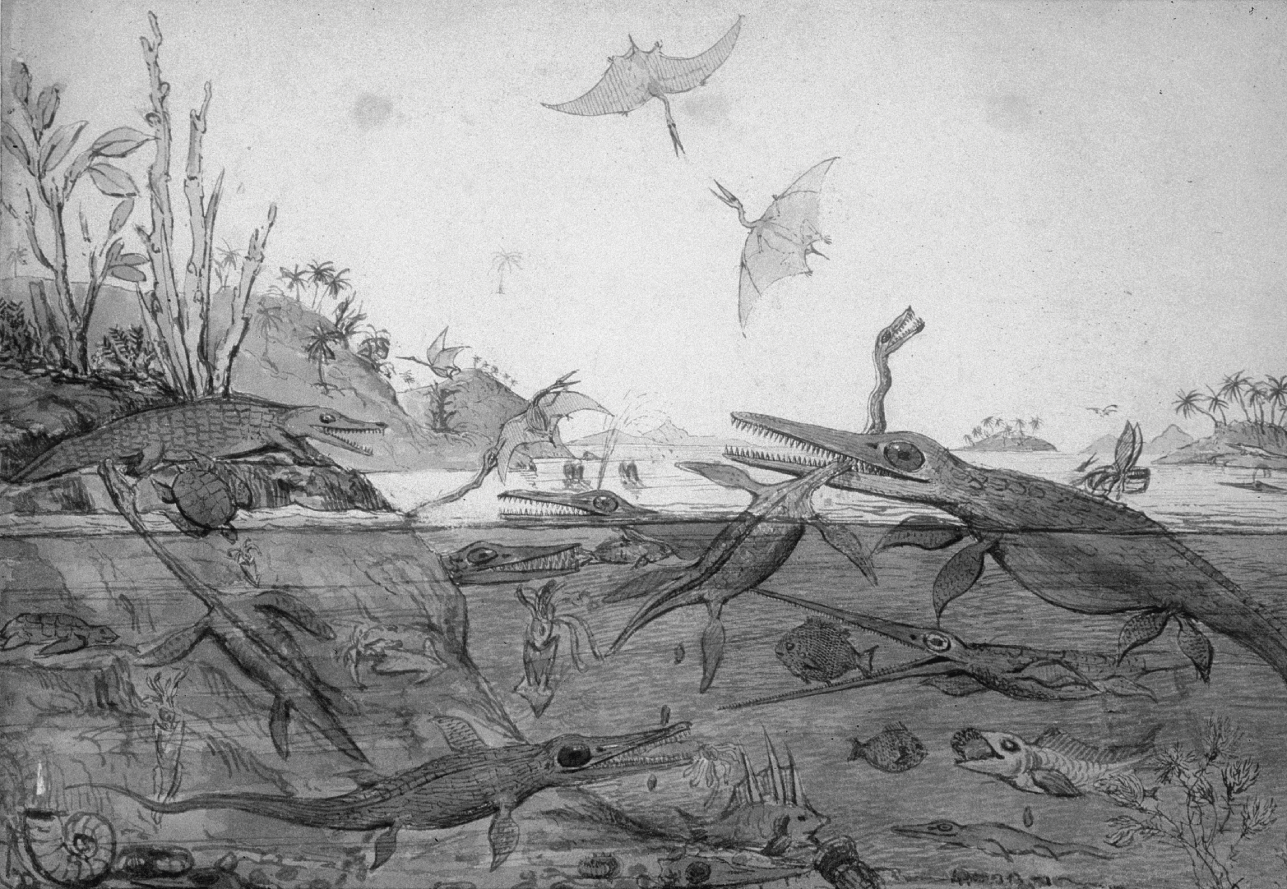
Combining a close range of detail that includes flora and fauna and a receding horizon that encompasses geographical features, both Turner’s and De la Beche’s paintings work in the style of Weltlandschaft – “world landscape.” De la Beche’s substitution of prehistoric forms and a radically altered climate breathes life into Dorset’s fossil record, but in doing so it becomes a memento mori for the human species, whose time on the planet is also marked – a reminder of how alien the present would seem to our successors in deep time. Wells’s scene effectively freights the Victorian pastoral of Richmond Hill with the same brand of pathos. As the Time Traveller later remarks, “I found afterwards that horses, cattle, sheep, dogs, had followed the Ichthyosaurus into extinction” (ch. 4). The narrator voices ideas that Wells developed at length in nonfiction essays such as “On Extinction” and “The Fate of Homo Sapiens,” in which Wells expressed his personal, oft-repeated opinion that “there is no reason whatever to believe that the order of nature has any greater bias in favour of man than it had in favor of the ichthyosaur or pterodactyl.”44 In The Time Machine, we catch a glimpse of that most personal of geological tragedies: human extinction.45
To “provide a glimpse” of a distant future in which humanity had fallen out of “nature’s favour,” Wells could simply have skipped directly to 802701; instead, The Time Machine modernizes the aesthetic tradition of Weltlandschaft by setting its planetary outlook in motion. This causes the narrative to swing frantically between emotional registers; it becomes both a eulogy for what passes away and a vehicle for exploring the thrilling sensations of the passage itself. The vertiginous feeling at the start of the journey eventually gives way to the thrill of the ride; and what Wells’s protagonist describes as the “hysterical exhilaration” of time travel – an overwhelming feeling that vacillates between terror and pleasure – resembles an experience of world proper to the aesthetics of the sublime.46 This scene imagines the vastness of historical progress distilled down to the level of individual experience, exemplifying the novel’s overall strategy for gaining direct access to mechanisms of change that operate on a planetary scale and can be witnessed only from the perspective of continuous movement through deep time. By attenuating “human history on to multiple scales of deep time,” observes Charles Tung, “the stable entities of the nineteenth century, such as a narrativisable history or the category of the human itself, are distended beyond recognition.”47 This derangement can be read as a simulation of the subjective experience of modernity itself, one that prepares the novel to navigate deeper toward the Darwinian and Marxist forces at its core. As the time machine’s velocity turns history into an observable phenomenon, a vast and growing archive of struggle spanning epochs, its breakneck mania recalls the evocative lines from The Communist Manifesto in which technology mobilizes capitalism’s “constant revolutionizing of production, uninterrupted disturbance of all social conditions, everlasting uncertainty and agitation,” a period in which, “all that is solid melts into air.”48 The unmistakable parallel between time travel and train travel points to this sense of social acceleration, and to the emerging appeal of what Enda Duffy calls the “new mass availability of speed as technology’s tangible pleasure” – a sensation which Wells was keen to exploit.49
Wells’s interest in capturing and heightening this new sensation (to “throw up and intensify our natural reactions of wonder, fear or perplexity”) led him, in the year of the novel’s publication, to collaborate with inventor Robert Paul to file British Patent No. 19984. The patent designates a prototype movie theater: “a novel form of exhibition whereby the spectators have presented to their view scenes which are supposed to occur in the future or past while they are given the sensation of voyaging on a machine through time.”50 The extension of the novel’s montage effect was just the start: Paul and Wells planned for “the members of the audience … to be seated on platforms that rocked to and fro, and which moved toward and away from a screen onto which still and motion picture scenes were to be projected.”51 The projectors would also be “mounted on rollers and tracks,” constantly moving and changing the proportions of images on the screen.52 “As a final touch, a current of air was to be directed over the audience to suggest the speed with which they were racing.”53 Even though Wells’s experimental cinema was never built, its intended function – to render the novel’s aesthetic devices in other media – underscores the ways in which the novel, whose full title is The Time Machine: An Invention, is positioned as a textual machine designed to induce scale effects.54
The Time Machine stretches scalar relationships to such extremes that objects under scrutiny appear to shift not only in size and distance but also ontologically. It would surely be a strange experience for a late-Victorian reader, just starting, perhaps, to imagine the possibilities of nascent forms of film and time-lapse photography, to visualize something like a tree growing and decaying in a matter of seconds, a process that would normally take decades or centuries. But the novel pushes far beyond this, multiplying the effect exponentially. As the Time Traveller’s speed escalates relative to the world around him, it gradually becomes impossible for him to observe any particular thing in isolation. When he notices the blurry outline of a tree, he is already seeing thousands of generations of trees living and dying in almost the same moment, and what comes into view as a singular object is in fact a persistent image of shared features, the flickering of countless individual trees seen together all at once. Since this figure comes into focus only when many discrete instances are amalgamated, it expresses the features of no constituent tree in particular; it looks spectral, unstable. The term montage is especially pertinent in this case because the sense of motion achieved by overlapping images is required for the effect (here the Time Traveller’s research expertise – his publication of “seventeen papers on physical optics” – seems particularly relevant [ch. 8]). If the Time Traveller were to pause on his voyage for even an instant, the vision would presumably resolve again into a solid-looking shape, one bearing little resemblance to the “puff of vapour” he had just been observing. What the Time Traveller experiences as a “tree” can be thus recognized as a visual representation of a much wider set – something approaching a biological genus.
It seems plausible, accordingly, to describe this as an essentially generic figure. Since the figure discloses the shared features of many individuals, it appears to confirm the force of genre whereby individual differences are subsumed to observable phenomena that are “general” or “typical.” In other words, as certain speed objects seem to become generic – as they lose their specificity they begin to disclose unsuspected properties that are only visible from a different scalar vantage. However, if pressed to describe what a “generic tree” might look like, it is doubtful that a nebulous plume would be the first image to come to mind. More likely, one would envision a solid figure whose features were unexceptional. It is possible to suggest, then, that two figures of the generic can be discerned from this example: one that involves the overlay of many discrete individuals, yielding an unfamiliar, unstable image of the aggregate; and one that involves imagining a characteristic individual to stand metonymically for the category.
In The Time Machine, this ontological shifting – in which the extension toward the world-scale produces generic figures – is repeated at the level of character. The most obvious example is the novel’s protagonist: his name is never mentioned, and throughout he is simply referred to as the “Time Traveller.” As in many of Wells’s novels, proper names tend to be extraneous to narrative function. In The Time Machine’s frame story, the dinner guests whom the protagonist invites to hear his account are identified only by their profession – the psychologist, the medical man, the journalist, the editor, the provincial mayor – hard-nosed practitioners of empirical discourses. Their various and collective skepticisms about the Time Traveller’s testimony serve as a kind of peer review, a means of incorporating a critical distance within the novel itself and thereby calling into question the reliability of the récit whose fantastic events can also be read as vision of “madness.”
In the future world of 802701, a world teeming with two subhuman populations, the only named character is “Weena,” the child-like Eloi woman with whom the protagonist forms a budding relationship. Clearly the avatar of a love interest sub-plot, she is typologically something of a Pocahontas; her function is to introduce the explorer-hero to the customs of her civilization and to teach him the basics of the rudimentary Eloi language. She forms an immediate and unrelenting attachment to the Time Traveller after he valiantly saves her from drowning in a slow-moving stream:
It will give you an idea, therefore, of the strange deficiency in these creatures, when I tell you that none made the slightest attempt to rescue the weakly crying little thing which was drowning before their eyes. I hurriedly slipped off my clothes, and, wading in at a point lower down, I caught the poor mite and drew her safe to land. A little rubbing of the limbs soon brought her round, and I had the satisfaction of seeing she was all right before I left her. I had got to such a low estimate of her kind that I did not expect any gratitude from her. In that, however, I was wrong.
It is clear that the protagonist rescues Weena only out of a sense of duty; the principal feeling he expresses is of disgust for the decadent Eloi – “humanity on the wane,” a society in the last throes of a millennia-long waning of affect – which the protagonist reads, in a didactic aside, as the “odd consequence of the social effort in which we are at present engaged” (ch. 4). When the Time Traveller’s heroic intervention awakens an inchoate human sympathy in Weena, she starts to follow him around in an obsequious, gently pestering way, as though hoping to enlarge her role in the narrative.
By this point, however, the novel’s romance plot has been severely etiolated by the focal shift to planetary concerns. The protagonist himself notices this effect, remarking, “The problems of the world had to be mastered. I had not, I said to myself, come into the future to carry on a miniature flirtation” (ch. 5). “Miniature flirtation” puns on Weena’s diminutive stature, but it also implies that her narrative function is vestigial, a structural remnant of the heterosexual marriage plot that remains bizarrely present in a novel that has progressed far beyond such matters. Weena seems to be included only in obeisance to the conventions of the genre; a concession for utilizing the romance’s capacity for formal expansiveness. The cost of this expansiveness is paid in character, an exchange that occurs within what we can theorize as the text’s economy of representation.55 Grappling directly with “the problems of the world” leaves little space for developing of the kinds plots that could sustain interpersonal relationships, plots whose intimacy could steer the text back toward the realist mode. As Roland Barthes explains in his discussion of the “reality effect,” maintaining the novel’s narrative texture comes at a price. The apparently unimportant details that “denote what is ordinarily called ‘concrete reality’ (insignificant gestures, transitory attitudes, insignificant objects, redundant words)” are also transactions within the work’s descriptive economy, “increasing the cost of narrative information.”56 Setting a story in 802701 and beyond, as Wells does, increases the cost of realistic details exponentially.
While the temporal scale of The Time Machine forecloses the convincing richness of detail that the realist novel gains through its focus on daily life, Wells’s use of romance need not be considered artistically reactionary. Even the “flat characters” for which Forster panned Wells can be interpreted as formal adaptations to narrative circumstances that do not privilege human development, at least not at the scale of the individual subject. “The essential difference between novel and romance,” Northop Frye argues, “lies in the conception of characterization. The romancer does not attempt to create ‘real people’ so much as stylized figures which expand into psychological archetypes.”57 This freedom from realistic characterization, Frye suggests, endows romance with a “revolutionary form” wherein “something nihilistic and untamable is likely to keep breaking out of [the] pages.”58 And if we regard romance as “revolutionary” in its capacity to move beyond the confines of individual subjectivity and to summon instead figures who represent the “nihilistic and untamable” forces of human collectivity, then we move closer to grasping the manner in which Wells’s futuristic romance dramatizes a confrontation between two figures that emerge visibly from a deep-time perspective: the planet, and the human species in aggregate.
Generic Life
Just as, in the view from Richmond Hill, individual trees were merged into a genus, at the planetary scale human progress is measured in generations, unfolding across a grand narrative of the species as a whole. These two figures, species and world, are aligned in The Time Machine by the cosmic symbol of the sunset:
I surveyed the broad view of our old world under the sunset of that long day. It was as sweet and fair a view as I have ever seen. The sun had already gone below the horizon and the west was flaming gold, touched with some horizontal bars of purple and crimson. Below was the valley of the Thames, in which the river lay like a band of burnished steel. I have already spoken of the great palaces dotted about among the variegated greenery, some in ruins and some still occupied. Here and there rose a white or silvery figure in the waste garden of the earth, here and there came the sharp vertical line of some cupola or obelisk. … The ruddy sunset set me thinking of the sunset of mankind.
The protagonist registers all that he sees in 802701 as evidence of the changes wrought by the vast body of humanity, now fallen into terminal decline. He hypothesizes that the Edenic serenity of this far-off London is the result of scientific advancement: “One triumph of a united humanity over Nature had followed another. Things that are now mere dreams had become projects deliberately put in hand and carried forward” (ch. 4). Mankind’s complete domestication of nature has had profound impacts on the planet, and one of the Time Traveller’s first observations of the future is the warming of the atmosphere (ch. 3). “The balance of animal and vegetable,” he realizes, has been fully readjusted “to suit human needs”:
The air was free from gnats, the earth from weeds or fungi. … The ideal of preventive medicine was attained. Diseases had been stamped out … even the processes of putrefaction and decay had been profoundly affected by these changes.
Social triumphs, too, had been effected. I saw mankind housed in splendid shelters, gloriously clothed, and as yet I had found them engaged in no toil. There were no signs of struggle, neither social nor economical struggle. The shop, the advertisement, traffic, all that commerce which constitutes the body of our world, was gone. … The difficulty of increasing population had been met, I guessed, and population had ceased to increase.
What the Time Traveller does not understand at this point in the narrative is that the population is being actively regulated by more nefarious means – that the docile Eloi are in truth the fatted cattle of the Morlocks, the subterranean race whose machinery sustains the decaying utopia above.
As a parable of the gruesome endgame of class apartheid, The Time Machine raises broad concerns over the imbalance between a globally expanding human population, the resources it requires, and the forces that keep it in check. The novel’s allusions to Thomas Malthus are unmistakable in such passages as, “Where population is balanced and abundant, much childbearing becomes an evil rather than a blessing to the State. … We see some beginnings of this even in our own time, and in this future age it was complete” (ch. 4). Wells himself held that “probably no more shattering book than the Essay on Population has ever been, or ever will be, written,”59 and throughout his life he dedicated considerable attention to the problem of overpopulation, advocating and then renouncing policies for the sterilization of “base and servile types,” before becoming an outspoken proponent of public access to birth control.60 Wells’s early interest in eugenics, including the elimination of degenerate “people of the abyss,” helps to account for both the biological horror of the Morlocks and the perverse delight the Time Traveller takes in dispatching them.61 The Morlocks are consistently represented as an agglomeration of bare life, an undifferentiated mass of limbs and sickly flesh:
[W]hile I stood in the dark, a hand touched mine, lank fingers came feeling over my face, and I was sensible of a peculiar unpleasant odour. I fancied I heard the breathing of a crowd of those dreadful little beings about me. I felt the box of matches in my hand being gently disengaged, and other hands behind me plucking at my clothing. The sense of these unseen creatures examining me was indescribably unpleasant. … They clutched at me more boldly, whispering odd sounds to each other.
The generic indistinctness of the Morlocks, together with their primitive, parasitic nature and mechanized brutality, conjures widespread fin de siècle anxieties about the rise of “mob mentality” in modern crowds. The fear at the time was that the masses could experience a kind of atavistic reversion to animal instincts: “Emile Zola, Scipio Sighele, Gabriel Tarde, and Gustave LeBon suggested that violent modern crowds embodied a savage barbarism associated with unconscious elements of human nature that had survived evolution.”62 Thus the ironic, “odd consequence” of social and technological progress in Wells’s novel involves the atrophy of individual subjectivity on the one hand, and the return of the repressed human animal on the other.
Though it might appear that the problem of overpopulation is finally resolved in this case as a grotesque parody of “A Modest Proposal,” its specter continues to haunt the text in a surprising way. At one crucial point in the novel, the Time Traveller awakens from a fitful sleep and walks alone at twilight, discovering a group of mysterious white creatures (which he will later identify as Morlocks) stalking the landscape.
“They must have been ghosts,” I said; “I wonder whence they dated.” For a queer notion of Grant Allen’s came into my head, and amused me. If each generation die and leave ghosts, he argued, the world at last will get overcrowded with them. On that theory they would have grown innumerable some Eight Hundred Thousand Years hence, and it was no great wonder to see four at once.
The Time Traveller muses that if ghosts represent the spectral remainder of generations of the dead, over enough time their massive presence will result in direct competition for space with the inhabitants of the present. The terrifying prospect that the text raises here is that the posthumous longevity of the dead, given a physical form, may eventually overwhelm the character-space of the living, resulting in a different kind of overpopulation.
To understand how this idea works, it is useful to examine the literary allusion that sets it in motion, Grant Allen’s “Pallinghurst Barrow.”63 Allen’s story, which first appeared in the Christmas 1892 Illustrated London News, concerns the strange experience of a guest at a dinner party who, while strolling the grounds adjacent to an English manor house, stumbles into the ancient ruins of a long barrow.64 Over dinner the conversation turns to ghosts, and one guest speculates, “It is a very odd fact,”
that the only ghosts people ever see are the ghosts of a generation very, very close to them. One hears of lots of ghosts in eighteenth-century costumes, because everybody has a clear idea of wigs and small-clothes from pictures and fancy dresses. One hears of far fewer in Elizabethan dress, because the class most given to beholding ghosts are seldom acquainted with ruff’s and farthingales; and one meets with none at all in Anglo-Saxon or Ancient British or Roman costumes. … Millions of ghosts of remote antiquity must swarm about the world. … But the queer thing about these long-barrow ghosts is that they must be the spirits of men and women who died thousands and thousands of years ago, which is exceptional longevity for a spiritual being.65
This passage goes on to advance a metaphysical dilemma: if ghosts are a manifestation of human history, and “people the universe everywhere, unseen, around us,” why is it that “each of us sees of them those only he himself is adapted to seeing?”66 In Allen’s story, the search for answers leads back to the long barrow, a mass grave that has marked the landscape for millennia, reaching into the Victorian present. The barrow becomes a kind of portal to the ancient world each year on the autumnal equinox, and after some chanting the mesmerized protagonist finds himself slipping into the past: “the age had gone back upon its steps ten thousand years … he stood face to face with a remote antiquity … new ideas, yet very old, undulated centrically towards him from the universal flat time and space and matter and motion.”67 Once inside the barrow, the jumbled bones of the innumerable dead who are buried there come to life, and the protagonist is almost overcome by his savage ancestors. Allen’s Victorian ghost story, whose conceit The Time Machine borrows and reverses, imagines a scenario in which humanity’s fossil record can be resurrected and explored. The romance structure Allen deploys thus becomes an extension of motifs deployed by Victorian scientists, who conjured vivid metaphors to relate individual experience to planetary scales. In The Origin of Species, for example, Darwin writes, “the crust of the earth is a vast museum; but the natural collections have been imperfectly made, and only at long intervals of time.”68
The possibility of bridging these temporal intervals motivates the experimental formal strategies described in this chapter, but the shift to deep-time narrative also entails, for Wells, an odd literary effect. Because the fossil record bears conceptual similarity to an archive (in the broadest, Derridean sense), the unrestrained growth of the archive – generation upon generation – threatens to overwhelm those who would read it.69 This line of thinking runs contrary to more optimistic views like those expressed recently by Wai Chee Dimock, who discusses how geological timescales might upend the boundaries of authorship and biography. “[T]o see the grave as the midpoint rather than the endpoint of human relations,” Dimock argues, is “to call for a new ethics, a new politics, and a new aesthetics, all based on a broader definition of the species as partly virtual, constituted by its unended as by its uncommenced life.”70 This move involves extending literature’s function as a transbiographical remainder or trace to human life in general. Individual finitude is overcome by collective experience, since one can “count on the species as a whole to serve as a … vast, ever-expanding, and ever-receptive archive, compiling and collating all that we have done and all that we would ever want to do. Human beings are the only creatures on the planet who reproduce through archives.”71 The Time Machine forecasts the Malthusian downside of this kind of archival reproduction. By anticipating the degree to which human life will be capable of enduring in virtual forms, the novel imagines the catastrophe of being confronted with too much information, a situation in which the living are overwhelmed by the aggregated population of the persistent dead. Marx’s famous assertion that “the tradition of all the dead generations weighs like a nightmare on the brain of the living” is here carried to its ultimate conclusion: the amorphous, spectral, forms encountered in 802701 are historically inscrutable – a kind of generic life that has surmounted the “processes of putrefaction and decay,” they represent humanity after the end of history.
The Time Machine thus registers how a late-Victorian understanding of geologic time began to synchronize the disparate figures of world and human; ironically, the same scientific knowledge was bridging the ontological rift it had previously widened by displacing older, anthropocentric worldviews. We can begin to see how fin de siècle novels like The Time Machine, which experiment with generic form to address world-scale concerns, initiate what we can identify, in retrospect, as an “Anthropocene imaginary”: a situation in which human agency was beginning to have visible planetary impacts that prior forms were incapable of representing. “The Anthropocene,” argues Jesse Oak Taylor, “demands new – or perhaps old – forms,” a proposition that late-Victorian fiction was already recognizing “at the level of both form and content.”72 This line of analysis helps to account for the problems novelists encountered when attempting to use realist representational strategies at scales that exceeded the measure of individual human life, and why alternative forms were repurposed to suit the needs of more expansive plotlines. As the following chapters will show, including these texts in a wider tradition – perhaps even categorizing them within a new genre – allows us to more fully apprehend the ways in which our present discourse of the Anthropocene is caught up in the same Victorian epistemology that yoked biological, geological, and ecological timescales to the literary romance.

 Open access