

Fortifying food products with probiotics is of increasing interest and they represent 65% of the functional food market (Burgain et al., Reference Burgain, Gaiani, Linder and Scher2011). The main reason why dairy products are known as the principal probiotic products in the functional food market is that the buffering property of milk ensures the viability of probiotics during storage and fermentation (do Espírito Santo et al., Reference do Espírito Santo, Cartolano, Silva, Soares, Gioielli, Perego, Converti and Oliveira2012). Lactic acid bacteria are widely used in the probiotic enrichment of these products (Shori, Reference Shori2015; Kanca et al., Reference Kanca, Bas, Albayrak Delialioglu and Gursoy2023). Yoghurt is considered as a good vehicle for probiotics, whuich may increase the body's tolerance to pathogens by regulating the intestinal microflora if sufficient bacteria can be viable (Fazilah et al., Reference Fazilah, Ariff, Khayat, Rios-Solis and Halim2018). However, lactic acid bacteria, especially commercial yoghurt starter cultures (Streptococcus thermophilus and Lactobacillus delbrueckii subsp. bulgaricus) lack the capability to survive and colonize in the intestinal tract (Fazilah et al., Reference Fazilah, Ariff, Khayat, Rios-Solis and Halim2018). Therefore, the current approach is to add other strains of probiotics to yoghurt as well as using prebiotics such as fruit, fruit fibers and fruit purees in the manufacturing process of yoghurt to preserve the viability of bacteria and induce the probiotic effect. It has been previously determined in various studies that some fruit products such as orange fiber, açai pulp, apple fiber and banana fiber increase the viability of probiotic bacteria (Sendra et al., Reference Sendra, Fayos, Lario, Fernández-López, Sayas-Barberá and Pérez-Alvarez2008; do Espirito Santo et al., Reference do Espírito Santo, Silva, Soares, Anjos, Gioielli and Oliveira2010; do Espirito Santo et al., Reference do Espírito Santo, Cartolano, Silva, Soares, Gioielli, Perego, Converti and Oliveira2012). Fruit products act as a substrate for the growth of probiotic microorganisms, including yoghurt starter bacteria, and contribute to the regulation of microflora by passing directly into the gastrointestinal tract (do Espírito Santo et al., Reference do Espírito Santo, Cartolano, Silva, Soares, Gioielli, Perego, Converti and Oliveira2012; Meybodi et al., Reference Meybodi, Mortazavian, Arab and Nematollahi2020).
The persimmon fruit (Diospyros kaki), which has a potential prebiotic effect, contains approximately 16% carbohydrates (mainly sugars: fructose, glucose and sucrose) and, during the ripening of the fruit, there is an increase in the amount of glucose and fructose due to the activity of the enzyme invertase, which hydrolyzes sucrose (Matheus et al., Reference Matheus, Andrade, Miyahira and Fai2022). Persimmon also contains pectin and mucilages from soluble fibers and a large number of insoluble fibers. Furthermore, persimmon is a significant source of vitamins A and C and contains significant amounts of potassium (Kaur et al., Reference Kaur, Kumari, Agarwal, Sabharwal and Dipti2022).
Given this, our research was conducted to appraise the addition of persimmon powder in different proportions on various physical, chemical, textural and sensorial properties of probiotic yoghurts containing L. casei during refrigerated storage for 21 d. Moreover, the effect of adding persimmon powder on fatty acid profile and probiotic viability in yoghurts was also examined. To our knowledge, this is the first study investigating the effect of persimmon powder used in yoghurt production on the viability of L. casei and the characteristics of the obtained product.
Materials and methods
Persimmon powder production
The persimmons obtained from the local market were washed and peeled, and then kept at 70°C until thoroughly dried. The dried fruits were ground using a grinder at 10 000 rpm (Art Laborteknik, Ankara, Turkey) and the powder was passed through a 0.5 mm sieve. Online Supplementary Fig. S1 shows the steps of persimmon powder production.
Yoghurt manufacture
Raw cow's milk used in stirred yoghurt production was obtained from Agriculture Research and Application Farm of Ankara University Faculty (Ankara, Turkey). Skimmed milk powder (Izi Sut A.S., Turkey) was added to the raw milk in order to increase the total dry matter value to 16%. Following the dry matter standardization, the milk was divided into 5 parts and persimmon powder was added to the milk (A: 0.5%, B: 1.0%, C: 1.5%, D: 2.0%) except for the Control sample. The persimmon powder ratios used in the study were determined through preliminary trials and the ratios with accaptable sensory properties were preferred. All samples were homogenized using ultraturrax for 5 min (DIAX 900, Heidolph, Schwabach, Germany) and the mixtures were heated at 85°C for 15 min and immediately cooled to 43–45°C. Then, 3% (w/v) starter culture (Lactobacillus delbrueckii subsp. bulgaricus and Streptococcus thermophilus, YC-350, Chr. Hansen, Denmark) and 3% (w/v) probiotic culture (Lactobacillus casei, LC, Biochem, Italy) were added. The yoghurt mixtures were incubated at 45°C to a final pH of 4.6–4.7 and immediately cooled. All yogurt samples were then stored at 4°C until the time of analyses. Yoghurt production was done in duplicate and the analysis were carried out on days 1, 7, 14 and 21of storage except for the color characteristics.
Raw material analysis
Total dry matter (gravimetric method), total protein (Kjeldahl method) and ash (gravimetric method) contents of raw milk, skimmed milk powder and persimmon powder were determined according to AOAC (1990). For determination of fat contents, Gerber method was used for raw milk and skimmed milk powder, Soxhlet method was used for persimmon powder (AOAC, 1990). Dietary fiber content of persimmon powder was analyzed according to method 991.43 of the AOAC (2007). The results of raw material analysis are given in online Supplementary Table S1.
Determination of color characteristics
L*, a* and b* values of the yoghurt samples were obtained using a colorimeter (Konica Minolta CR-400, Tokyo, Japan) and software (SpectraMagic NX). Hue angle (h°), total color difference (ΔE*), and chroma (C*) values were determined as shown in Equations 1, 2 and 3, respectively.
 $$\Delta E = \sqrt {L^2 + a^2 + b^2} $$
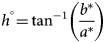 $$h^\circ{ = } \tan ^{{-}1}\left({\displaystyle{{b^\ast } \over {a^\ast }}} \right)$$
 $$C^\ast{ = } \sqrt {a^2 + b^2} $$
Color characteristics of yoghurt samples were determined on the first storage day.
Determination of pH and titratable acidity values
During cold storage, pH changes were evaluated with a calibrated pH-meter (Mettler Toledo, Zurich, Switzerland). The titration method was used for the determination of titratable acidity and the results were expressed as the percentage of lactic acid (AOAC, 1990).
Textural characteristics
A texture analyzer (TA.Xt Plus, Stabel Micro Systems®, Godalming, UK) equipped with a 5 kg head was used for the measurement of the textural characteristics of the yoghurt samples during the storage period. The samples were removed from the refrigerator at +4°C, just before measurement and the analysis was carried out in the original packaging material using a plastic cylindrical probe with 50 mm of diameter, and 5 mm of height. The depth and the speed of the probe were set to 20 mm and 1 mm/s, respectively. Consistency (g.s), index of viscosity (g.s), firmness (g) and cohesiveness (g) parameters were calculated using the software.
Determination of water-holding capacity (WHC)
The water-holding capacity of the samples was examined by the method suggested by Huang et al. (Reference Huang, Yu, Zhou, Sun, Liu and Liang2020) with some modifications. Yoghurt (10 g) was centrifugated at 4°C for 10 min at 2500 rpm (692 g) and the whey was removed. WHC of the samples was analyzed by the following formula:
 $$\eqalign{{\rm WHC\;}( {\rm \% } ) = \displaystyle{{{\rm the}\;{\rm weight}\;{\rm of}\;{\rm the}\;{\rm samples}\;{\rm after}\;{\rm removing}\;{\rm whey}} \over {{\rm the}\;{\rm weight}\;{\rm of}\;{\rm the}\;{\rm original}\;{\rm sample}}} \times \;100}$$
Microbiological analysis
The plate count technique was used for the enumeration of the bacteria and yeasts-molds. Serial dilutions of yoghurt samples were carried out in 9 ml of sterile Ringer's solution (Merck, Darmstadt, Germany). Volumes (0.1 ml) of each dilution were surface plated on the selective media in duplicate. De Man, Rogosa Sharpe agar (MRS, Himedia, Mumbai, India), plate count agar (Himedia, Mumbai, India), M17 agar containing 1% lactose (Himedia, Mumbai, India) and potato-dextrose agar (Merck, Darmstadt, Germany) containing 0.8 ml/l of 10% tartaric acid (Himedia, Mumbai, India) were used for the enumeration of mesophilic aerobic bacteria, Lactobacillus spp., Streptococcus spp. and yeasts-molds, respectively. Lactobacillus casei counts were determined on MRS agar supplemented with 2 ml l−1 of a 0.05% (w/v) vancomycin solution (Himedia, Mumbai, India) (Costa et al., Reference Costa, Paula, Barão, Klososki, Bonafé, Visentainer, Adriano and Pimentel2019). The plates were incubated at 37°C/48–72 h, 37°C/48–72 h and 30°C/3–5 d in aerobic conditions for plate count agar, M17 and potato-dextrose agar, respectively. Anaerobic conditions were carried out for MRS and MRS + vancomycin at 37°C/48–72 h. After the incubation period, colonies were enumerated and the results were given as a log number of colony-forming units per g (log cfu/g).
Determination of fatty acid profiles
Lipids were extracted from yoghurt samples according to Hara and Radin (Reference Hara and Radin1978) and fatty acid methyl esters were prepared by esterification according to the method previously described by Calık et al. (Reference Calik, Yalcin, Küçükersan, Saçaklı, Yıldız, Ramay, Ahlat, Erbay Elibol and Taban2019) and then analyzed in a gas chromatograph (Shimadzu GC-2010, Shimadzu Co., Kyoto, Japan), equipped with a capillary column (HP-FFAP, Agilent Technologies, USA) and a flame ionization detector. The injector temperature was 250°C and the detector was at 280°C. The oven temperature was initially set at 100°C for 5 min, then programmed to increase to 240°C at a rate of 4°C/min, where it was held for 15 min. Helium was used as carrier gas and 1 μl was used as injection volume. Analyses were performed in duplicate.
Sensory evaluation
Approximately 25 g of yoghurt samples were presented to the panelists at refrigerator temperature. A scoring test with 10 experienced panelists from the academic staff of the Department of Dairy Technology and Department of Food Hygiene and Technology of Ankara University was applied. The panelists evaluated the samples on a scale of 1–5 in terms of taste, texture, appearance and general acceptability. The evaluation was carried out in the same session for all of the samples.
Statistical analysis
The data were evaluated using the analysis of variance technique in a factorial design and significant differences were compared using the Duncan test. MINITAB 16 Statistical Software (Minitab Inc., State College, PA, USA) was used for statistical analysis and the results were expressed as mean ± standard error. The concentrations of fatty acids in yoghurts were visualized using a heatmap and hierarchical clustering. The heatmap was plotted using the ‘pheatmap’ R package (version 1.0.12).
Results and discussion
Color characteristics
The yoghurt samples and their color characteristics are given in online Supplementary Fig. S2 and Table 1, respectively. The color parameters of the yoghurts supplemented with persimmon powder showed a significant difference compared to the Control sample (P < 0.05), due to the pigmentation. This change was also visible as shown in online Supplementary Fig. S2. While the Control sample had the highest L*, ΔE (total color difference) and h° (hue angle) values, samples C and D had the highest a*, b* and C* (chroma) values. While a* value was −3.11 and −0.98 in Control and sample A, respectively, it turned to positive (+) in samples B, C and D, indicating that the red color coordinate prevailed over the green one with the successive addition of persimmon powder. In addition, the Control and sample A were characterized with a hue angle of approximately 94–114°, which is in the range between yellow (90°) and green (180°). On the other hand, samples B, C and D had a hue angle of between 0° (red) and 90° (yellow), indicating more reddish color. This is due to the use of ripened persimmon fruits in the study and the fact that the major pigment of these fruits is lycopene (Zhao et al., Reference Zhao, Zhou and Tao2011), which gives a red color. Persimmon fruit also has β-cryptoxanthin, the carotenoid, which is responsible for the yellow- to orange-color (Zhao et al., Reference Zhao, Zhou and Tao2011). Therefore, b* values of the samples were increased proportionally with the addition of persimmon powder. There was also an increase in C* values, which is an indicator of color saturation, with the fruit powder addition, due to the changes in a* and b* values.
Color characteristics of yoghurt samples with added persimmon powder (n = 2)
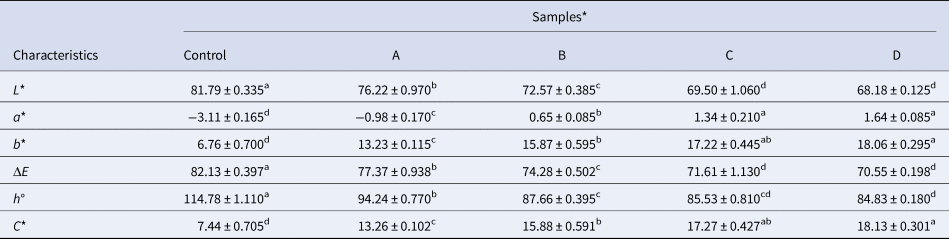
*Control: Without fruit powder addition, A: 0.5% fruit powder addition, B: 1.0% fruit powder addition, C: 1.5% fruit powder addition, D: 2.0% fruit powder addition.
Values with the different lower case letters within the same row are significantly different (P < 0.05).
Changes in pH and titratable acidity of yoghurt samples
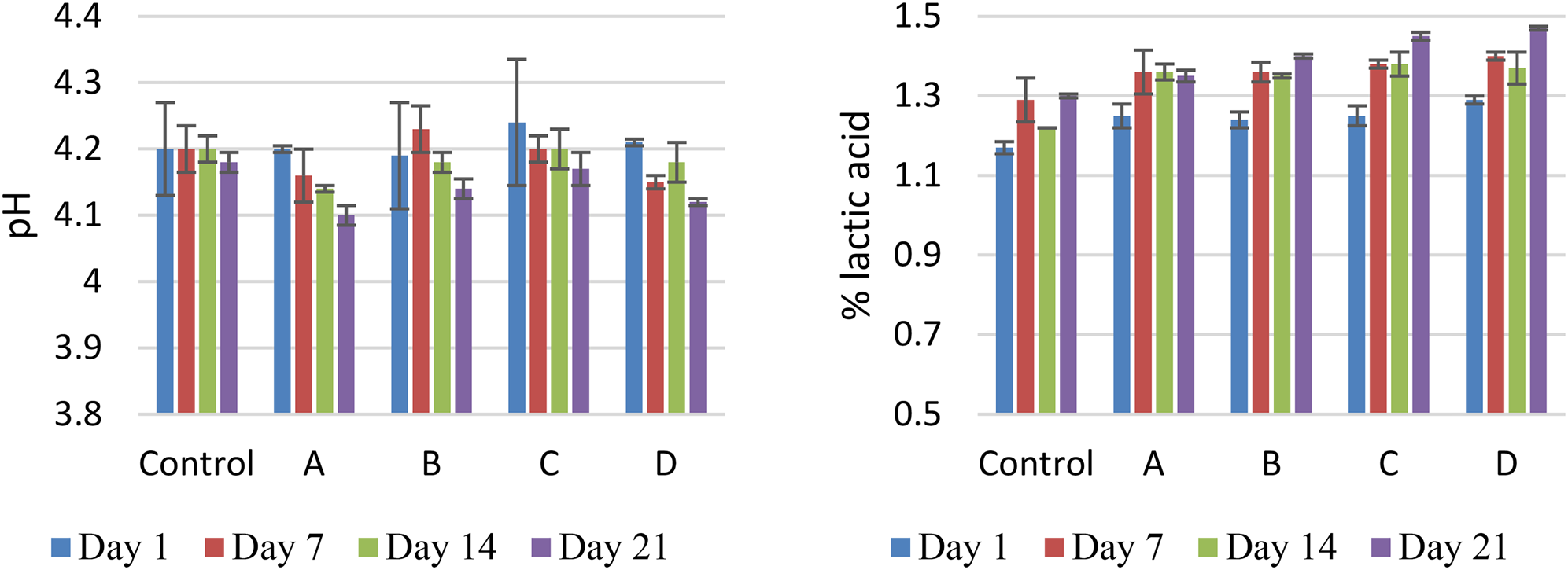
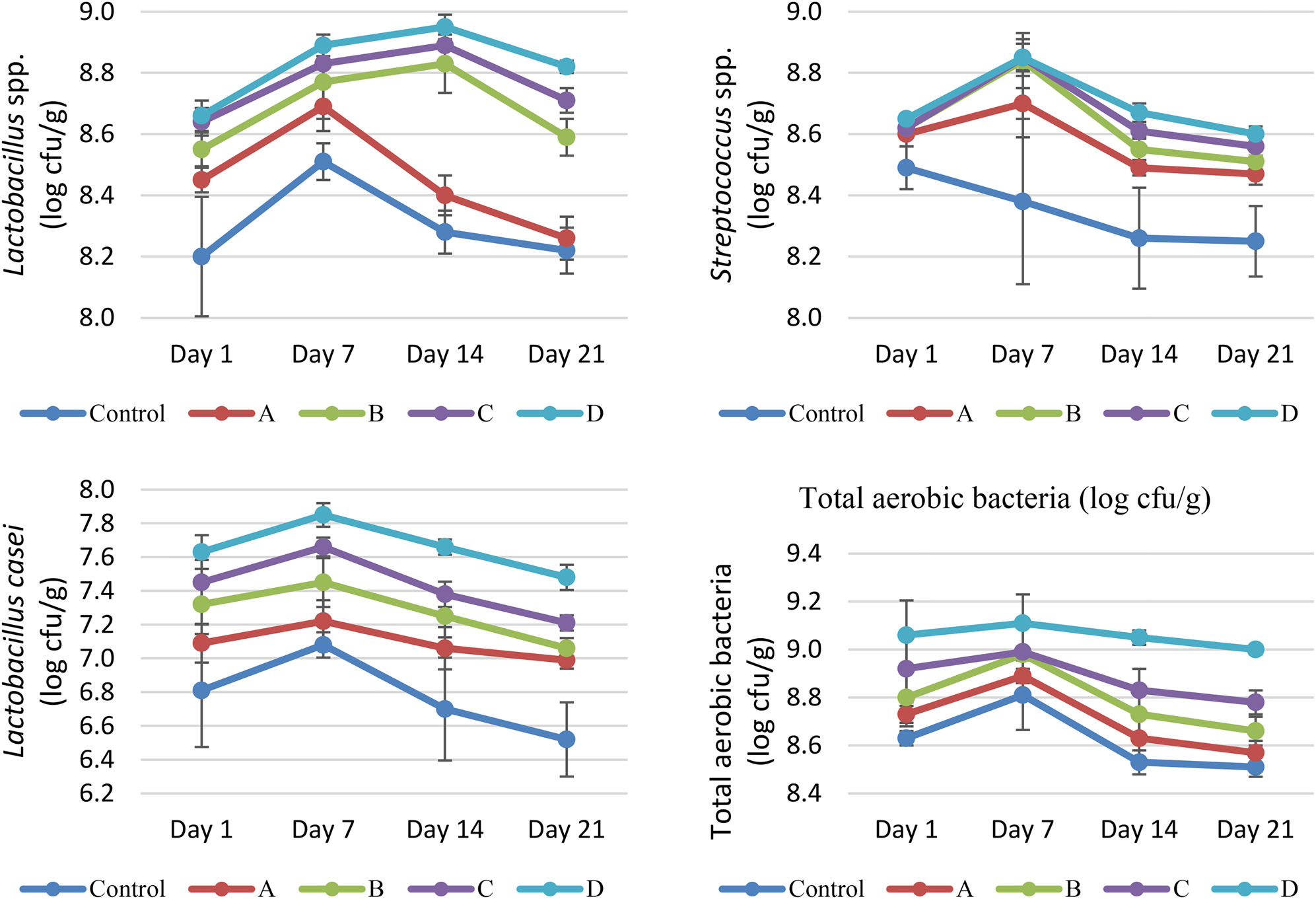
The pH and titratable acidity (lactic acid, %) values of the yoghurts are given in Fig. 1. The storage period and the fruit powder addition did not statistically affect the pH changes of the samples (P > 0.05), but the mean titratable acidity values were affected by both variables (P < 0.05). The higher acidity values were observed in all of the yogurts that contained persimmon powder (samples A, B, C and D) compared to the Control sample. This is due to the fact that fruits with high carbohydrate content increase the metabolic activities of lactic acid bacteria resulting in higher levels of organic acids (Senadeera et al., Reference Senadeera, Prasanna, Jayawardana, Gunasekara, Senadeera and Chandrasekara2018). Findings on the lactic acid bacteria counts in all storage days also support this situation (Fig. 2). It was determined that the viabilities of all examined lactic acid bacteria increased with the addition of fruit powder. do Espirito Santo et al. (Reference do Espírito Santo, Silva, Soares, Anjos, Gioielli and Oliveira2010) and Senadeera et al. (Reference Senadeera, Prasanna, Jayawardana, Gunasekara, Senadeera and Chandrasekara2018) also reported similar titratable acidity changes for the Control yoghurt and yoghurts containing various fruit products.
Changes of pH and titratable acidity (lactic acid, %) during storage (n = 2). Control: Without fruit powder addition, A: 0.5% fruit powder addition, B: 1.0% fruit powder addition, C: 1.5% fruit powder addition, D: 2.0% fruit powder addition Changes of pH and titratable acidity (lactic acid, %) during storage (n = 2).
Microbial counts of yoghurt samples (n = 2). Control: Without fruit powder addition, A: 0.5% fruit powder addition, B: 1.0% fruit powder addition, C: 1.5% fruit powder addition, D: 2.0% fruit powder addition. * Yeast-mold was not detected in any of the samples.
Textural characteristics and WHC values
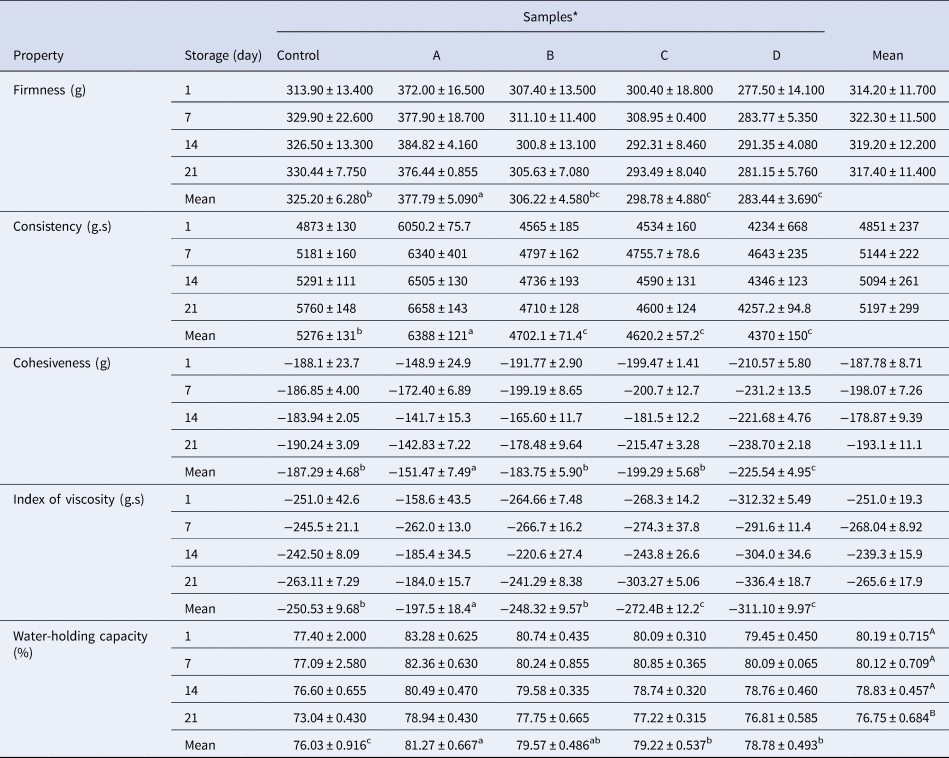
The results of the textural properties (firmness, consistency, cohesiveness and index of viscosity) and WHC values of yoghurts are summarized in Table 2. Although the effects of persimmon powder addition × storage interaction on the textural characteristics and WHC values were not significant (P > 0.05), the fruit powder addition significantly affected the mean values of the above-mentioned properties (P < 0.05). The changes in the textural parameters throughout storage were not significant, while there was a slight decrease in the mean WHC values on the 21st day of storage (P < 0.05).
Textural characteristics and water-holding capacity values of yoghurt samples with added persimmon powder (n = 2)
*Control: Without fruit powder addition, A: 0.5% fruit powder addition, B: 1.0% fruit powder addition, C: 1.5% fruit powder addition, D: 2.0% fruit powder addition.
Values with the different lower case letters within the same row and upper case letters within the same column are significantly different (P < 0.05).
In general, an improvement in the textural properties and WHC of the yoghurts is expected with the addition of persimmon powder, due to the high dietary fiber content of the fruits. However, this phenomenon is closely related to the fortification level of fruit products (Najgebauer-Lejko et al., Reference Najgebauer-Lejko, Liszka, Tabaszewska and Domagała2021). The excessive amount of dietary fiber in the product would cause a disruption or dilution of the protein gel matrix. Dietary fibers compete with protein for water binding and cause a re-arrangement of the three-dimensional protein network in thermal protein gels (Debusca et al., Reference Debusca, Tahergorabi, Beamer, Matak and Jaczynski2014; Zhuang et al., Reference Zhuang, Jiang, Han, Kang, Zhao, Xu and Zhou2016). In this study, although the textural and WHC characteristics of sample A (0.5% persimmon powder) were improved compared to the Control sample, it was noted that increasing the amount of added fruit powder caused the opposite effect. Our observations agree with those reported by Sah et al. (Reference Sah, Vasiljevic, McKechnie and Donkor2016) and Bchir et al. (Reference Bchir, Bouaziz, Blecker and Attia2020) who fortified yoghurts with pineapple peel powder and pomegranate seeds, respectively.
Counts of viable microorganisms
Figure 2 illustrates the viable counts of Lactobacillus spp., Streptococcus spp., L. casei and total aerobic bacteria throughout storage (21 d). Yeast-mold was not detected in any of the samples, therefore it is not shown in the figure. All viable bacterial counts were affected by both the storage period and the persimmon powder addition (P < 0.05). Viable counts increased proportionally with the addition of persimmon powder for all of the storage days. Sendra et al. (Reference Sendra, Fayos, Lario, Fernández-López, Sayas-Barberá and Pérez-Alvarez2008) also reported an increasing number of L. casei with orange and lemon fiber supplementations in fermented milks, and Arslan and Bayrakcı (Reference Arslan and Bayrakci2016) showed that the viable counts of L. delbrueckii subsp. bulgaricus and S. thermophilus were positively affected by the addition of persimmon marmalade and puree to yoghurt. Similarly, Karaca et al. (Reference Karaca, Saydam and Güven2019) stated that the viability of Lactobacillus acidophilus increased in the presence of persimmon and apple fiber in yoghurts. The authors attributed this situation to the prebiotic effect of the fruit powders on the bacteria. Fruits are generally considered to have high amounts of phenolic compounds, which positively affect the viability of probiotics. In addition, the probiotics have the ability to metabolize fibers and other nutrients in fruit and fruit products (Senadeera et al., Reference Senadeera, Prasanna, Jayawardana, Gunasekara, Senadeera and Chandrasekara2018).
The interaction between fruits and probiotic bacteria may differ depending on the fruit and probiotic strain combination. For instance, in a study examining the interaction of açai pulp and different probiotics in yoghurt (do Espirito Santo et al., Reference do Espírito Santo, Silva, Soares, Anjos, Gioielli and Oliveira2010), the viability of L. acidophilus L10 on the 14th day of storage was found to be higher in the control sample without açai compared to the samples containing fruit pulp. However, açai pulp increased the viability of Bifidobacterium animalis ssp. lactis Bl04 and B94 and Bifidobacterium longum Bl05, and the increase was ~2 log cfu/g higher in B. lactis strains. In another study (Kailasapathy et al., Reference Kailasapathy, Harmstorf and Phillips2008), while L. acidophilus L10 count was not affected by the addition of mango and strawberry, it was found to be lower in yoghurts containing mixed berry and passion fruit compared to plain yoghurt. In addition, it was reported that the viability of B. animalis ssp. lactis B94 was not affected by any of these four fruits. We detected a positive relationship between persimmon fruit and L. casei, and to the best of our knowledge, this information has not been reported before.
The effects of persimmon powder addition × storage interaction on the bacteria counts were not significant, whereas the mean viable counts of the microorganisms decreased significantly at the end of the storage (P < 0.05). The same was observed by other researchers (do Espirito Santo et al., Reference do Espírito Santo, Silva, Soares, Anjos, Gioielli and Oliveira2010; Senadeera et al., Reference Senadeera, Prasanna, Jayawardana, Gunasekara, Senadeera and Chandrasekara2018). do Espirito Santo et al. (Reference do Espírito Santo, Silva, Soares, Anjos, Gioielli and Oliveira2010) attributed this situation to the fact that the synergetic behavior between fruit and probiotic bacteria on the 14th day of storage probably changed on the last day of storage. Although Lactobacillus spp., Streptococcus spp., L. casei counts decrease on the last day of storage, they were not observed below 7 log cfu/g throughout storage in all of the persimmon powder added samples, thus preserving their probiotic properties. In the Control sample, on the other hand, L. casei counts below 7 log cfu/g were observed on the 14th (6.70 log cfu/g) and 21st (6.52 log cfu/g) days.
Fatty acid profiles
A total of 33 analytes were analyzed in yoghurt samples including 27 individual and 6 groups of fatty acids (short-chain fatty acids: SCFA, monounsaturated fatty acids: MUFA, saturated fatty acids: SFA, medium chain fatty acids: MCFA, polyunsaturated fatty acids: PUFA and long-chain fatty acids: LCFA). Heat map visualization of fatty acid profiles of yoghurt samples is shown in Fig. 3. The horizontal coordinates show the sample and the storage day, the vertical coordinates show the differential fatty acids. Red and blue colors indicate fatty acid levels that are higher or lower than the mean levels, respectively. Fatty acids, cis-10-pentadecenoic acid (C 15:1), cis-11,14-eicosadienoic acid (C 20:2), erucic acid (C 22:1n9), arachidonic acid (C 20:4), eicosapentaenoic acid (EPA, C 20:5n3), nervonic acid, (C 24:1) and docosahexaenoic acid (DHA, C 22:6n3) were not detected in any of the samples during storage period, therefore they are not shown on the heat map visualization.
Heat map of hierarchal clustering analysis of fatty acids for yoghurt samples (n = 2). Control: Without fruit powder addition, A: 0.5% fruit powder addition, B: 1.0% fruit powder addition, C: 1.5% fruit powder addition, D: 2.0% fruit powder addition; 1, 7, 14 and 21 indicate the storage days.
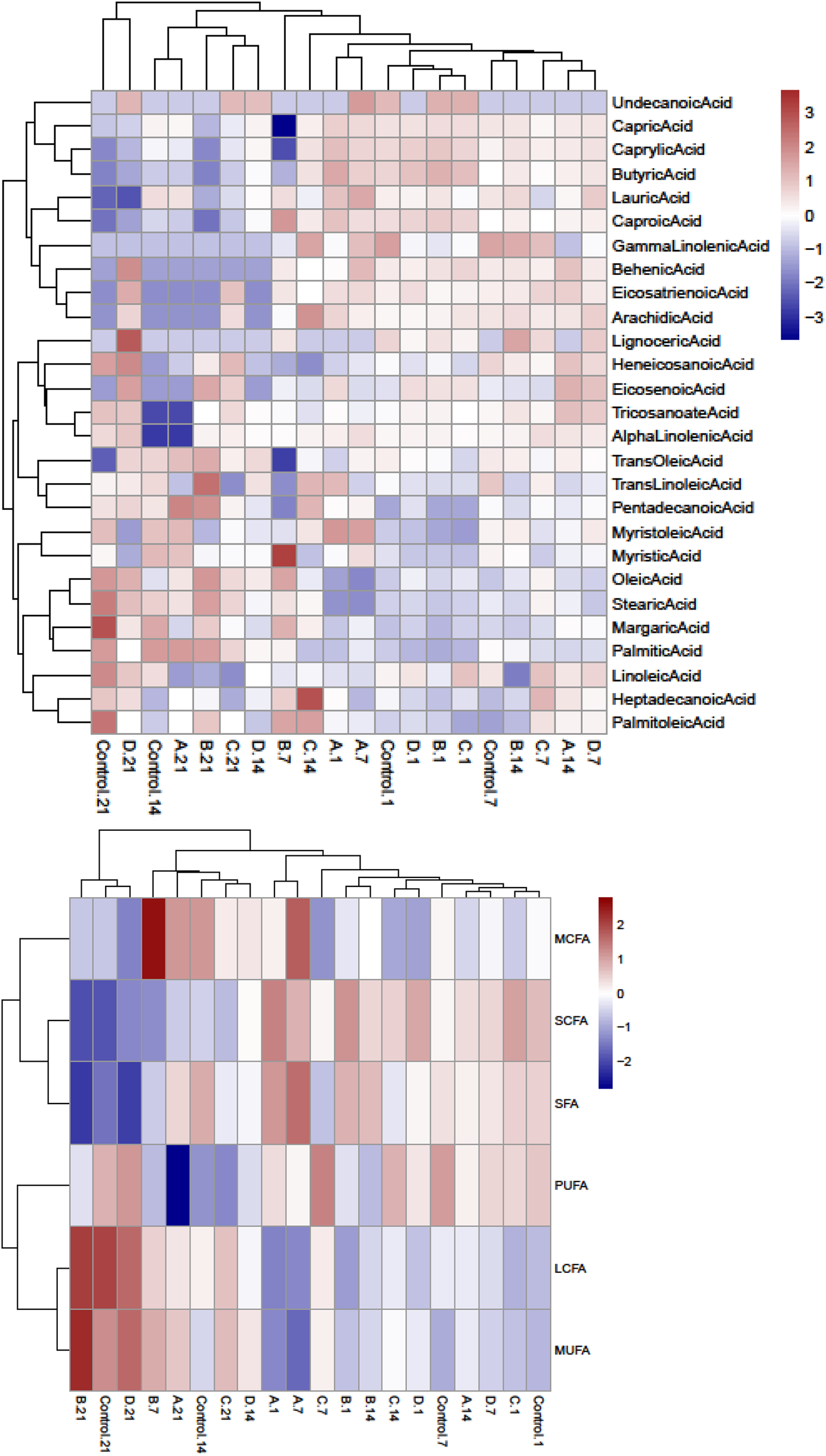
No difference was observed in MCFA and LCFA amounts of the yoghurts throughout the storage (P > 0.05). However, the contents of butyric acid and caproic acid together with SCFA were slightly lower in Control yoghurt compared with the persimmon powder supplemented samples (P < 0.05). Lactobacillus spp. are known to have the ability to produce butyric and caproic acids by their enzyme activity (Zalan et al., Reference Zalan, Hudacek, Stetina, Chumchalova and Halasz2010; Zareba et al., Reference Zareba, Ziarno, Scibisz and Gawron2014). Additionally, Yadav et al. (Reference Yadav, Jain and Sinha2007) declared that butyric and caproic acids were found to be higher in probiotic dahi samples inoculated with L. casei and L. acidophilus. Hashemi et al. (Reference Hashemi, Mousavi Khaneghah, Kontominas, Eş, Sant'Ana, Martinez and Drider2017) also determined that butyric and caproic acids were increased with the fermentation of milk with three different strains of Lactobacillus plantarum. Therefore, the lowest ratio of the above-mentioned fatty acids in the Control sample in this study is probably related to the lactic acid bacteria content of the samples (Fig. 2). It was reported that butyric acid, even at low concentrations, provides benefits for many cancer cell lines in terms of apoptosis and erythroid differentiation, therefore increasing amounts of this fatty acid in foods is beneficial for health (Hashemi et al., Reference Hashemi, Mousavi Khaneghah, Kontominas, Eş, Sant'Ana, Martinez and Drider2017).
In this study, saturated fatty acids formed the major component (64.93–67.13%) of total fatty acids of all samples during the storage period, as expected in ruminant milk (Sharma et al., Reference Sharma, El Rassi, Lathrop, Dobreva, Belem and Ramanathan2021). The persimmon powder addition did not affect SFA and MUFA contents of the yoghurt samples. In all samples, stearic acid (C 18:0), palmitic acid (C 16:0) and myristic acid (C 14:0) dominated the SFA profile, whereas oleic acid (C18:1) was the most abundant MUFA, as previously described in different studies (do Espírito Santo et al., Reference do Espírito Santo, Silva, Soares, Anjos, Gioielli and Oliveira2010, Reference do Espírito Santo, Cartolano, Silva, Soares, Gioielli, Perego, Converti and Oliveira2012). PUFA are frequently used as dietary supplements due to their positive effect on the immune system and their putative protective effect against various diseases (Bomba et al., Reference Bomba, Jonecova, Koscova, Nemcova, Gancarcikova, Mudronova, Scirankova, Buleca, Lazar, Posivak, Kastel and Marekova2006). In this study, the effects of persimmon powder addition × storage interaction on the PUFA profile of the samples were found to be significant (P < 0.05). The difference was observed especially toward the end of the storage period; while the Control sample had the lowest PUFA content on the 14th day, similarly, on the 21st day, the highest PUFA value was detected in sample D. Similar results were obtained in yoghurts enriched with tamarillo fruit powder by Diep et al. (Reference Diep, Yoo and Rush2022), and the authors stated that a synergistic interaction between the probiotic microorganism and fruit may be effective to the increase in PUFA. Considering the probiotic counts (Fig. 2), the sample with the highest value was D, and the sample with the lowest value was the Control sample, which also supports this possibility.
Sensorial properties
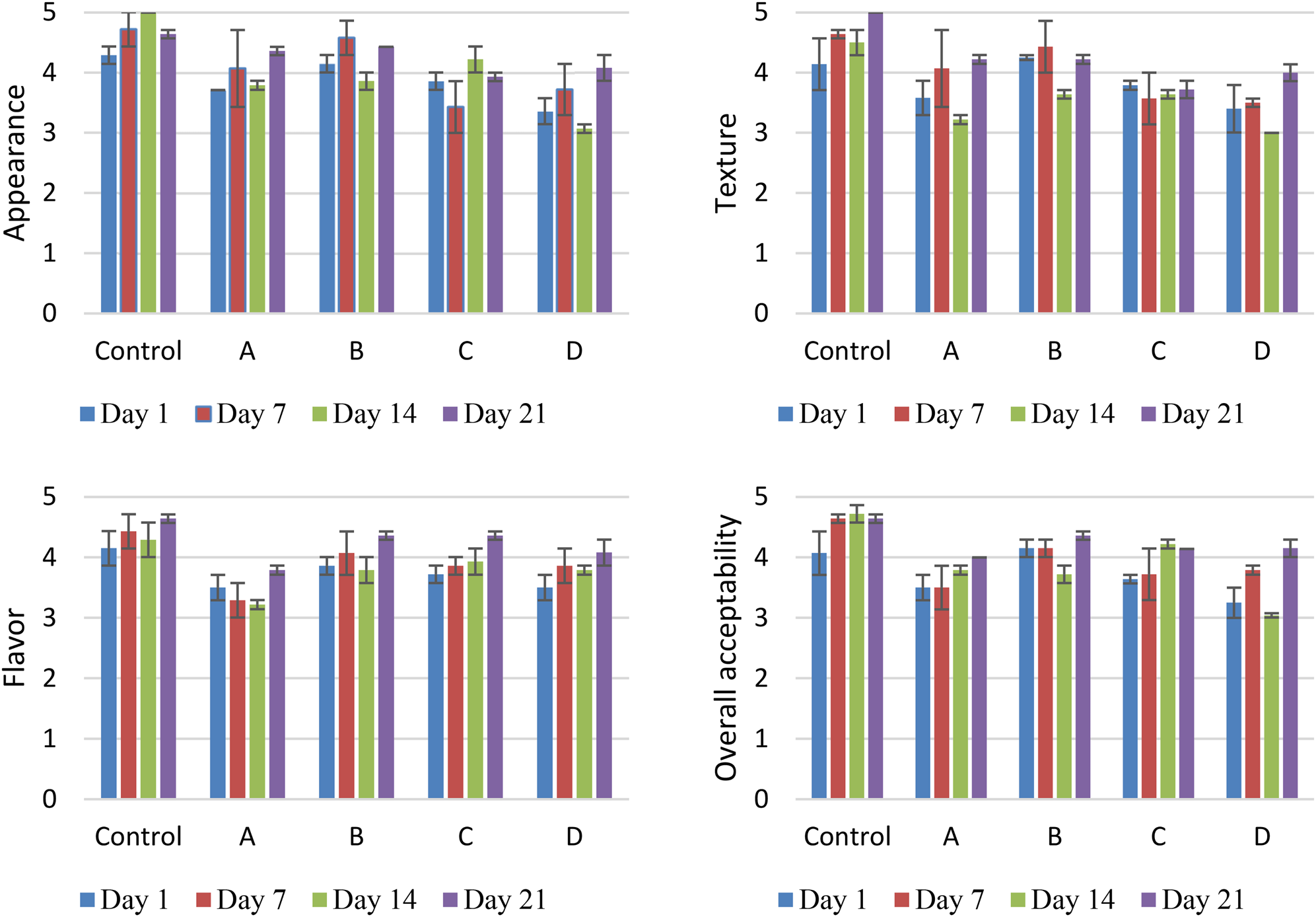
The sensorial scores of the yoghurt samples are presented in Fig. 4. Persimmon powder addition and the storage period affected the mean values of all sensorial properties (P < 0.05). The Control sample achieved the highest score in terms of texture and appearance properties, and sample D with the highest fruit powder got the lowest score. When the flavor characteristics of yoghurts were compared, the most liked samples were the Control sample, and samples B and C. As a result of the sensory analysis, the panelists stated that as the amount of persimmon powder added to yogurt increased, its taste becomes more intense, however, it was pleasing only up to a certain point. The use of persimmon powder of more than 1.5% was evaluated as a negative sensory property that was not appreciated by the panelists in terms of flavor. There was a tendency to increase the flavor perception on the 21st day of storage. Sendra et al. (Reference Sendra, Fayos, Lario, Fernández-López, Sayas-Barberá and Pérez-Alvarez2008) reported similar observations for the yoghurts supplemented with citrus aroma. The authors explained that it was probably due to the diffusion of compounds from the fiber. The Control yoghurt was the most liked sample when compared in terms of overall acceptability. Our observations are in concert with those reported by Karaca et al. (Reference Karaca, Saydam and Güven2019), who fortified yoghurts with persimmon and apple fiber powders. In conclusion, the samples received over 3 points on a five-point scale for all of the sensorial properties throughout the storage and it demonstrates that yoghurt samples were characterized by acceptable sensory attributes.
Sensory properties of yoghurt samples (n = 2). Control: Without fruit powder addition, A: 0.5% fruit powder addition, B: 1.0% fruit powder addition, C: 1.5% fruit powder addition, D: 2.0% fruit powder addition.
In conclusion, we investigated the influence of persimmon powder addition on textural, chemical, physical, microbiological and sensorial properties of probiotic yoghurt. Addition of fruit powder substantially changed the color characteristics of the samples to be visible. While there was no change in pH values, an increase in titratable acidity of yoghurts were observed during 21 d of cold storage which was more pronounced in the samples with persimmon powder. The textural characteristics and WHC value were improved in the sample containing 0.5% persimmon powder, whereas higher amounts of fruit powder had variable effects. Viable counts of Lactobacillus spp., Streptococcus spp., L. casei and total aerobic bacteria increased proportionally with the addition of persimmon powder for all of the storage days, attributable to the prebiotic effect of the fruit powder on the bacteria. The viable bacterial counts were above 7 log cfu/g throughout storage in all of the persimmon powder added samples. However, L. casei counts were observed below 7 log cfu/g in the Control sample on the 14th and 21st days of storage. The fatty acid profiles of the samples significantly changed with the persimmon powder addition. The fruit enrichment did not affect the MCFA, LCFA, SFA and MUFA contents, but the Control sample had the lowest butyric acid and caproic acid contents together with SCFA and PUFA. According to the sensorial analysis, all of the samples received over 3 points on a five-point scale in terms of texture, overall acceptability, appearance and flavor indicating acceptable sensory attributes, although the higher contetns of persimmon adversely affected flavor attributes. Overall, persimmon powder can be successfully used as a prebiotic in L. casei-enriched probiotic yoghurt production.
Supplementary material
The supplementary material for this article can be found at https://doi.org/10.1017/S0022029924000670.
Acknowledgments
This study was granted by the Ankara University Scientific Research Projects (21B0447001, 2022).


 Open access

