





1 Introduction
For an arrangement $\mathcal {A}$
of hyperplanes in
$\mathcal {A}$
of hyperplanes in $\mathbb {P}^N$
, a wonderful compactification is, roughly speaking, a way of replacing
$\mathbb {P}^N$
, a wonderful compactification is, roughly speaking, a way of replacing $\mathbb {P}^N$
by a different ambient variety in such a way that the complement of the hyperplanes is preserved but the arrangement
$\mathbb {P}^N$
by a different ambient variety in such a way that the complement of the hyperplanes is preserved but the arrangement $\mathcal {A}$
itself is replaced by a divisor with normal crossings whose intersection-theoretic structure is encoded in the combinatorics of the arrangement. There are a number of such compactifications, given by blowing up
$\mathcal {A}$
itself is replaced by a divisor with normal crossings whose intersection-theoretic structure is encoded in the combinatorics of the arrangement. There are a number of such compactifications, given by blowing up $\mathbb {P}^N$
(in a prescribed order) along certain sets of subvarieties obtained via intersecting subsets of
$\mathbb {P}^N$
(in a prescribed order) along certain sets of subvarieties obtained via intersecting subsets of $\mathcal {A}$
, known as building sets. The collection of building sets is partially ordered by inclusion, and it has a unique maximal and minimal element.
$\mathcal {A}$
, known as building sets. The collection of building sets is partially ordered by inclusion, and it has a unique maximal and minimal element.
An important special case is when $\mathcal {A}$
is the braid arrangement, which consists of the hyperplanes
$\mathcal {A}$
is the braid arrangement, which consists of the hyperplanes
 $$\begin{align*}H_{ij} = \{[x_1: \cdots: x_n] \; | \; x_i = x_j\} \subseteq \mathbb{P}^{n-1}\end{align*}$$
for all $0 \leq i < j \leq n$
, under the convention that
$0 \leq i < j \leq n$
, under the convention that $x_0 = 0$
. In this case, the wonderful compactification with respect to the minimal building set coincides with the moduli space
$x_0 = 0$
. In this case, the wonderful compactification with respect to the minimal building set coincides with the moduli space $\overline {\mathcal {M}}_{0,n+2}$
of genus-zero stable curves [Reference De Concini and ProcesiDCP95, Section 4.3].
$\overline {\mathcal {M}}_{0,n+2}$
of genus-zero stable curves [Reference De Concini and ProcesiDCP95, Section 4.3].
For any positive integer r, there is a natural generalization of the braid arrangement, which we refer to as the r-braid arrangement, consisting of the hyperplanes
 $$\begin{align*}H_{ij}^k = \{[x_1: \cdots: x_n] \; | \; x_i = \zeta^k x_j\} \subseteq \mathbb{P}^{n-1}\end{align*}$$
for all $1 \leq i \leq j \leq n$
and
$1 \leq i \leq j \leq n$
and $0 \leq k \leq r-1$
, where
$0 \leq k \leq r-1$
, where $\zeta $
denotes a fixed primitive rth root of unity. The primary goal of this paper is to give a modular interpretation of the wonderful compactification of the r-braid arrangement with respect to its minimal building set.
$\zeta $
denotes a fixed primitive rth root of unity. The primary goal of this paper is to give a modular interpretation of the wonderful compactification of the r-braid arrangement with respect to its minimal building set.
Specifically, we construct a moduli space $\overline {\mathcal {M}}^r_n$
parametrizing genus-zero stable curves with an order-r automorphism
$\overline {\mathcal {M}}^r_n$
parametrizing genus-zero stable curves with an order-r automorphism $\sigma $
, equipped with two marked fixed points of
$\sigma $
, equipped with two marked fixed points of $\sigma $
and n marked orbits of
$\sigma $
and n marked orbits of $\sigma $
. Our main theorem is the following.
$\sigma $
. Our main theorem is the following.
Theorem 1. Let $r \geq 2$
and
$r \geq 2$
and $n \geq 1$
. Then the wonderful compactification of the r-braid arrangement in
$n \geq 1$
. Then the wonderful compactification of the r-braid arrangement in $\mathbb {P}^{n-1}$
, with respect to its minimal building set, is the moduli space
$\mathbb {P}^{n-1}$
, with respect to its minimal building set, is the moduli space $\overline {\mathcal {M}}^r_n$
.
$\overline {\mathcal {M}}^r_n$
.
Remark 2. This space is closely related to the moduli space $\overline {\mathcal {L}}^r_n$
constructed and studied in [Reference Clader, Damiolini, Huang, Li and RamadasCDH+22, Reference Clader, Damiolini, Li and RamadasCDLR23, Reference Clader, Damiolini, Eur, Huang and LiCDE+24], which has interesting connections to generalizations of the permutohedron and matroids; see also [Reference Batyrev and BlumeBB11]. More precisely, the marked fixed points and all but one of the marked orbits in
$\overline {\mathcal {L}}^r_n$
constructed and studied in [Reference Clader, Damiolini, Huang, Li and RamadasCDH+22, Reference Clader, Damiolini, Li and RamadasCDLR23, Reference Clader, Damiolini, Eur, Huang and LiCDE+24], which has interesting connections to generalizations of the permutohedron and matroids; see also [Reference Batyrev and BlumeBB11]. More precisely, the marked fixed points and all but one of the marked orbits in $\overline {\mathcal {L}}^r_n$
are “light” in the sense that they are allowed to coincide with one another, whereas the marked points in
$\overline {\mathcal {L}}^r_n$
are “light” in the sense that they are allowed to coincide with one another, whereas the marked points in $\overline {\mathcal {M}}^r_n$
are required to be all distinct. In this way,
$\overline {\mathcal {M}}^r_n$
are required to be all distinct. In this way, $\overline {\mathcal {M}}^r_n$
can be viewed as relating to
$\overline {\mathcal {M}}^r_n$
can be viewed as relating to $\overline {\mathcal {L}}^r_n$
in much the same way that
$\overline {\mathcal {L}}^r_n$
in much the same way that $\overline {\mathcal {M}}_{0,n}$
relates to the Losev–Manin moduli space
$\overline {\mathcal {M}}_{0,n}$
relates to the Losev–Manin moduli space $\overline {\mathcal {L}}_n$
, which parametrizes genus-zero curves with two “heavy” (non-coinciding) marked points and n light marked points.
$\overline {\mathcal {L}}_n$
, which parametrizes genus-zero curves with two “heavy” (non-coinciding) marked points and n light marked points.
Remark 3. For a curve C in $\overline {\mathcal {M}}^r_n$
with order-r automorphism
$\overline {\mathcal {M}}^r_n$
with order-r automorphism $\sigma $
, the quotient map
$\sigma $
, the quotient map $C \rightarrow C/\sigma $
is a degree-r ramified cover of genus-zero curves, so in this way,
$C \rightarrow C/\sigma $
is a degree-r ramified cover of genus-zero curves, so in this way, $\overline {\mathcal {M}}^r_n$
can be viewed as a very special compactified Hurwitz space. The fact that
$\overline {\mathcal {M}}^r_n$
can be viewed as a very special compactified Hurwitz space. The fact that $\overline {\mathcal {M}}^r_n$
is a wonderful compactification—which is not true in general for compactified Hurwitz spaces—makes it more amenable to combinatorial study than is typically the case for Hurwitz spaces; for example, it would be interesting to study whether the associated tropical moduli space is a tropicalization with respect to the torus embedding associated with the r-braid arrangement.
$\overline {\mathcal {M}}^r_n$
is a wonderful compactification—which is not true in general for compactified Hurwitz spaces—makes it more amenable to combinatorial study than is typically the case for Hurwitz spaces; for example, it would be interesting to study whether the associated tropical moduli space is a tropicalization with respect to the torus embedding associated with the r-braid arrangement.
The strategy for the proof of Theorem 1 is as follows. First, we study the combinatorics of the intersection lattice of the r-braid arrangement in $\mathbb {P}^{n-1}$
, relating it to a certain poset of decorated graphs. This allows us to describe the minimal building set explicitly as consisting of all subspaces spanned by a subset of the coordinate points
$\mathbb {P}^{n-1}$
, relating it to a certain poset of decorated graphs. This allows us to describe the minimal building set explicitly as consisting of all subspaces spanned by a subset of the coordinate points
 $$\begin{align*}[1:0: \cdots: 0], \; [0:1:0: \cdots: 0], \; \ldots,\; [0: \cdots : 0:1]\end{align*}$$
and at most one of the $r^{n-1}$
points whose coordinates are all rth roots of unity. In particular, the desired wonderful compactification
$r^{n-1}$
points whose coordinates are all rth roots of unity. In particular, the desired wonderful compactification $\overline {\mathcal {M}}^r_n$
is the blow-up of
$\overline {\mathcal {M}}^r_n$
is the blow-up of $\mathbb {P}^{n-1}$
along all such subspaces, in any inclusion-increasing order.
$\mathbb {P}^{n-1}$
along all such subspaces, in any inclusion-increasing order.
From here, we leverage the known perspective on both the moduli space of curves and the Losev–Manin moduli space $\overline {\mathcal {L}}_n$
as similar iterated blow-ups. A key fact about Losev–Manin space is that, by virtue of its stability condition, the genus-zero curves being parametrized are chains of projective lines, as opposed to the arbitrary trees of projective lines that are parametrized by
$\overline {\mathcal {L}}_n$
as similar iterated blow-ups. A key fact about Losev–Manin space is that, by virtue of its stability condition, the genus-zero curves being parametrized are chains of projective lines, as opposed to the arbitrary trees of projective lines that are parametrized by $\overline {\mathcal {M}}_{0,n+2}$
. This allows us to define an “rth power” map
$\overline {\mathcal {M}}_{0,n+2}$
. This allows us to define an “rth power” map $q: \overline {\mathcal {L}}_n \rightarrow \overline {\mathcal {L}}_n$
given by
$q: \overline {\mathcal {L}}_n \rightarrow \overline {\mathcal {L}}_n$
given by $[x:y] \mapsto [x^r: y^r]$
on each
$[x:y] \mapsto [x^r: y^r]$
on each $\mathbb {P}^1$
in the chain. Using q, together with the above explicit perspective on the wonderful compactification of the r-braid arrangement as an iterated blow-up, we identify the wonderful compactification with a fiber product
$\mathbb {P}^1$
in the chain. Using q, together with the above explicit perspective on the wonderful compactification of the r-braid arrangement as an iterated blow-up, we identify the wonderful compactification with a fiber product

in which c is a weight-reduction morphism. This fiber diagram allows us to construct a universal family over F of the objects parametrized by $\overline {\mathcal {M}}^r_n$
by combining the data of the universal families over
$\overline {\mathcal {M}}^r_n$
by combining the data of the universal families over $\overline {\mathcal {M}}_{0,n+2}$
and
$\overline {\mathcal {M}}_{0,n+2}$
and $\overline {\mathcal {L}}_n$
. From here, the fact that F is the requisite moduli space follows.
$\overline {\mathcal {L}}_n$
. From here, the fact that F is the requisite moduli space follows.
2 Wonderful compactifications
Wonderful compactifications were introduced by De Concini and Procesi [Reference De Concini and ProcesiDCP95] in the context of hyperplane arrangements in projective space and later generalized by Li [Reference LiLi09] to more general arrangements of subvarieties in a smooth ambient variety. We review the necessary background in this section, referring the reader to such references as [Reference De Concini and ProcesiDCP95, Reference Maria Feichtner and YuzvinskyFY04, Reference LiLi09] for further details.
2.1 Basic combinatorics
A hyperplane arrangement in $\mathbb {P}^N$
is a finite collection
$\mathbb {P}^N$
is a finite collection
 $$\begin{align*}\mathcal{A} = \{H_1, \ldots, H_k\} \end{align*}$$
of hyperplanes $H_i \subseteq \mathbb {P}^N$
. The intersection lattice of
$H_i \subseteq \mathbb {P}^N$
. The intersection lattice of $\mathcal {A}$
is the collection
$\mathcal {A}$
is the collection $\mathcal {L}_{\mathcal {A}}$
of all subsets
$\mathcal {L}_{\mathcal {A}}$
of all subsets
 $$\begin{align*}H_I := \bigcap_{i \in I} H_i \subseteq \mathbb{P}^N \end{align*}$$
for $I \subseteq [k] := \{1, \ldots , k\}$
. We consider
$I \subseteq [k] := \{1, \ldots , k\}$
. We consider $\mathcal {L}_{\mathcal {A}}$
as a poset under reverse inclusion, so that the unique minimal element is
$\mathcal {L}_{\mathcal {A}}$
as a poset under reverse inclusion, so that the unique minimal element is $\hat {0} = H_{\emptyset } = \mathbb {P}^N$
.
$\hat {0} = H_{\emptyset } = \mathbb {P}^N$
.
By the complement of an arrangement $\mathcal {A}$
, we mean
$\mathcal {A}$
, we mean
 $$\begin{align*}Y^{\circ} := \mathbb{P}^N \setminus \bigcup_{i=1}^k H_i. \end{align*}$$
One compactification of $Y^{\circ }$
is, of course,
$Y^{\circ }$
is, of course, $\mathbb {P}^N$
itself, and
$\mathbb {P}^N$
itself, and $\mathbb {P}^N \setminus Y^{\circ }$
is (the union of) the original arrangement. The hyperplanes in
$\mathbb {P}^N \setminus Y^{\circ }$
is (the union of) the original arrangement. The hyperplanes in $\mathcal {A}$
may not form a normal crossings divisor, however, and a wonderful compactification is, roughly speaking, a compactification
$\mathcal {A}$
may not form a normal crossings divisor, however, and a wonderful compactification is, roughly speaking, a compactification $\overline {Y}$
of
$\overline {Y}$
of $Y^{\circ }$
in which
$Y^{\circ }$
in which $\mathcal {A}$
is replaced by a divisor
$\mathcal {A}$
is replaced by a divisor $\overline {Y} \setminus Y^{\circ }$
with normal crossings. The way to produce such a compactification is, unsurprisingly, by blowing up
$\overline {Y} \setminus Y^{\circ }$
with normal crossings. The way to produce such a compactification is, unsurprisingly, by blowing up $\mathbb {P}^N$
at subspaces along which unwanted intersections of
$\mathbb {P}^N$
at subspaces along which unwanted intersections of $\mathcal {A}$
occur.
$\mathcal {A}$
occur.
Since some subsets of $\mathcal {A}$
may already intersect in normal crossings, one generally need only blow up at a subset of
$\mathcal {A}$
may already intersect in normal crossings, one generally need only blow up at a subset of $\mathcal {L}_{\mathcal {A}}$
in order to obtain a compactification with the requisite “wonderful” properties (some of which we describe below). In particular, the subsets of
$\mathcal {L}_{\mathcal {A}}$
in order to obtain a compactification with the requisite “wonderful” properties (some of which we describe below). In particular, the subsets of $\mathcal {L}_{\mathcal {A}}$
that give rise to wonderful compactifications are as follows.
$\mathcal {L}_{\mathcal {A}}$
that give rise to wonderful compactifications are as follows.
Definition 4. Let $\mathcal {A}$
be a hyperplane arrangement in
$\mathcal {A}$
be a hyperplane arrangement in $\mathbb {P}^N$
. A building set of
$\mathbb {P}^N$
. A building set of $\mathcal {A}$
is a subset
$\mathcal {A}$
is a subset $\mathcal {G} \subseteq \mathcal {L}_{\mathcal {A}} \setminus \{\hat {0}\}$
such that, for all
$\mathcal {G} \subseteq \mathcal {L}_{\mathcal {A}} \setminus \{\hat {0}\}$
such that, for all $X \in \mathcal {L}_{\mathcal {A}} \setminus \{\hat {0}\}$
, there is an isomorphism of posets
$X \in \mathcal {L}_{\mathcal {A}} \setminus \{\hat {0}\}$
, there is an isomorphism of posets
 $$\begin{align*}[\hat{0}, X] \cong \prod_{\substack{\text{maximal }Y \in \mathcal{G}\\ \text{with }Y \leq X}} [\hat{0},Y]\end{align*}$$
given by the natural map sending a tuple on the right-hand side to its join. Here, $\leq $
denotes the reverse-inclusion order in
$\leq $
denotes the reverse-inclusion order in $\mathcal {L}_{\mathcal {A}}$
, and
$\mathcal {L}_{\mathcal {A}}$
, and $[A,B]$
denotes the interval
$[A,B]$
denotes the interval
 $$\begin{align*}[A,B] := \{C \in \mathcal{L}_{\mathcal{A}} \; | \; A \leq C \leq B\}.\end{align*}$$
The condition of Definition 4 is automatically satisfied when $X \in \mathcal {G}$
, so
$X \in \mathcal {G}$
, so $\mathcal {G} = \mathcal {L}_{\mathcal {A}} \setminus \{\hat {0}\}$
is a building set (the maximal building set); this corresponds to the observation that one can obtain a wonderful compactification by blowing up
$\mathcal {G} = \mathcal {L}_{\mathcal {A}} \setminus \{\hat {0}\}$
is a building set (the maximal building set); this corresponds to the observation that one can obtain a wonderful compactification by blowing up $\mathbb {P}^N$
at every intersection of the hyperplanes in
$\mathbb {P}^N$
at every intersection of the hyperplanes in $\mathcal {A}$
. On the other hand, if the arrangement includes distinct hyperplanes
$\mathcal {A}$
. On the other hand, if the arrangement includes distinct hyperplanes $H_1$
and
$H_1$
and $H_2$
for which
$H_2$
for which $X = H_1 \cap H_2$
and no other hyperplane in the arrangement meets X, then it is straightforward to verify that
$X = H_1 \cap H_2$
and no other hyperplane in the arrangement meets X, then it is straightforward to verify that
 $$\begin{align*}[\hat{0}, X] \cong [\hat{0}, H_1] \times [\hat{0}, H_2].\end{align*}$$
Therefore, a building set can include $H_1$
and
$H_1$
and $H_2$
without including
$H_2$
without including $X = H_1 \cap H_2$
; this corresponds to the observation that
$X = H_1 \cap H_2$
; this corresponds to the observation that $H_1$
and
$H_1$
and $H_2$
already have normal crossings, so no blow-up along their intersection is needed. In Figure 1, we contrast this situation with the situation where there is a third hyperplane
$H_2$
already have normal crossings, so no blow-up along their intersection is needed. In Figure 1, we contrast this situation with the situation where there is a third hyperplane $H_3$
for which
$H_3$
for which $H_1 \cap H_2 = H_1 \cap H_3 = H_2 \cap H_3$
, in which case a building set must contain this (non-transverse) intersection X since
$H_1 \cap H_2 = H_1 \cap H_3 = H_2 \cap H_3$
, in which case a building set must contain this (non-transverse) intersection X since $[\hat {0}, X]$
does not decompose as a product.
$[\hat {0}, X]$
does not decompose as a product.

Figure 1 Hyperplanes $H_1, H_2, H_3$
in three-space that intersect at a common line
$H_1, H_2, H_3$
in three-space that intersect at a common line $X = H_1 \cap H_2 \cap H_3$
, and the corresponding poset
$X = H_1 \cap H_2 \cap H_3$
, and the corresponding poset $[\hat {0}, X]$
, which has rank two but does not decompose as a product of two rank-one posets.
$[\hat {0}, X]$
, which has rank two but does not decompose as a product of two rank-one posets.
Once a building set is chosen, the precise definition of a wonderful compactification is as follows.
Definition 5. Let $\mathcal {A}$
be a hyperplane arrangement in
$\mathcal {A}$
be a hyperplane arrangement in $\mathbb {P}^N$
, and let
$\mathbb {P}^N$
, and let $\mathcal {G} \subseteq \mathcal {L}_{\mathcal {A}} \setminus \{\hat {0}\}$
be a building set. Choose an ordering of the elements of
$\mathcal {G} \subseteq \mathcal {L}_{\mathcal {A}} \setminus \{\hat {0}\}$
be a building set. Choose an ordering of the elements of $\mathcal {G}$
that is compatible with inclusion; that is, let
$\mathcal {G}$
that is compatible with inclusion; that is, let
 $$\begin{align*}\mathcal{G} = \{G_1, \ldots, G_\ell\}\end{align*}$$
in which $i \leq j$
whenever
$i \leq j$
whenever $G_i \subseteq G_j$
. Then the wonderful compactification of
$G_i \subseteq G_j$
. Then the wonderful compactification of $\mathcal {A}$
with respect to
$\mathcal {A}$
with respect to $\mathcal {G}$
is the variety
$\mathcal {G}$
is the variety $\overline {Y}_{\mathcal {G}}$
obtained by blowing up
$\overline {Y}_{\mathcal {G}}$
obtained by blowing up $\mathbb {P}^N$
along
$\mathbb {P}^N$
along $G_1$
, then blowing up the result along the strict transform of
$G_1$
, then blowing up the result along the strict transform of $G_2$
, then blowing up the result along the strict transform of
$G_2$
, then blowing up the result along the strict transform of $G_3$
, and so on.
$G_3$
, and so on.
Remark 6. While there are generally many orderings of $\mathcal {G}$
compatible with inclusion, the results of [Reference LiLi09, Proposition 2.13] imply that the resulting wonderful compactification is independent, up to isomorphism, of this choice.
$\mathcal {G}$
compatible with inclusion, the results of [Reference LiLi09, Proposition 2.13] imply that the resulting wonderful compactification is independent, up to isomorphism, of this choice.
Among the “wonderful” properties of $\overline {Y}_{\mathcal {G}}$
are the following [Reference De Concini and ProcesiDCP95, Section 3]:
$\overline {Y}_{\mathcal {G}}$
are the following [Reference De Concini and ProcesiDCP95, Section 3]:
-
• Because $\overline {Y}_{\mathcal {G}}$
is obtained from
$\mathbb {P}^N$
by blowing up only at subvarieties that do not meet
$Y^{\circ }$
, there is an inclusion as a dense open set; in other words,
$$\begin{align*}Y^{\circ} \hookrightarrow \overline{Y}_{\mathcal{G}}\end{align*}$$
$\overline {Y}_{\mathcal {G}}$
is a compactification of
$Y^{\circ }$
.
$\overline {Y}_{\mathcal {G}}$
is obtained from
$\mathbb {P}^N$
by blowing up only at subvarieties that do not meet
$Y^{\circ }$
, there is an inclusion as a dense open set; in other words,
$$\begin{align*}Y^{\circ} \hookrightarrow \overline{Y}_{\mathcal{G}}\end{align*}$$
$\overline {Y}_{\mathcal {G}}$
is a compactification of
$Y^{\circ }$
.
-
• The boundary
$\overline {Y}_{\mathcal {G}} \setminus Y^{\circ }$
is a divisor with normal crossings. -
• The intersection-theoretic structure of the boundary can be read off combinatorially: namely,
$\overline {Y}_{\mathcal {G}} \setminus Y^{\circ }$
is a union of divisors
$D_G$
for nonempty
$G \in \mathcal {G}$
, and
$D_{G_1} \cap \cdots \cap D_{G_k}$
is nonempty if and only if
$\{G_1, \ldots , G_k\}$
forms a “
$\mathcal {G}$
-nested set.”


The notion of “ $\mathcal {G}$
-nested set” is entirely combinatorial (see [Reference De Concini and ProcesiDCP95, Definition 2.4] or [Reference Maria FeichtnerFei05, Definition 3.2]); for example, when
$\mathcal {G}$
-nested set” is entirely combinatorial (see [Reference De Concini and ProcesiDCP95, Definition 2.4] or [Reference Maria FeichtnerFei05, Definition 3.2]); for example, when $\mathcal {G}$
is the maximal building set,
$\mathcal {G}$
is the maximal building set, $\mathcal {G}$
-nested sets are simply chains in the poset
$\mathcal {G}$
-nested sets are simply chains in the poset $\mathcal {L}_{\mathcal {A}} \setminus \{\hat {0}\}$
.
$\mathcal {L}_{\mathcal {A}} \setminus \{\hat {0}\}$
.
2.2 The minimal building set
In this paper, we will be primarily concerned with the minimal building set. To describe this more explicitly, refer to $X \in \mathcal {L}_{\mathcal {A}} \setminus \{\hat {0}\}$
as decomposable if there is an isomorphism of posets
$X \in \mathcal {L}_{\mathcal {A}} \setminus \{\hat {0}\}$
as decomposable if there is an isomorphism of posets
 $$ \begin{align} \nonumber [\hat{0}, Y_1] \times [\hat{0}, Y_2] &\overset{\cong}{\rightarrow} [\hat{0}, X]\\ \ (H_1, H_2) &\mapsto H_1\lor H_2 = H_1\cap H_2 \end{align} $$
for some $Y_1, Y_2 < X$
, and otherwise, refer to X as indecomposable.
$Y_1, Y_2 < X$
, and otherwise, refer to X as indecomposable.
Note that, for any $X \in \mathcal {L}_{\mathcal {A}} \setminus \{\hat {0}\}$
, one has
$X \in \mathcal {L}_{\mathcal {A}} \setminus \{\hat {0}\}$
, one has
 $$\begin{align*}[\hat{0}, X] \cong \prod_{\substack{\text{maximal}\\ \text{indecomposable }Y \leq X}} [\hat{0}, Y]. \end{align*}$$
This fact follows from two observations:
-
1. Any interval
$[\hat {0}, X]$
can successively be decomposed into products of subintervals until the upper bounds on those subintervals are indecomposable; and -
2. Any element of a product of intervals that is not contained in one of the intervals is decomposable, as it can be decomposed by its factors in the product.

Thus, it follows that the set of indecomposable elements forms a building set. Conversely, it is straightforward from Definition 4 to see that any building set must contain all indecomposable elements, so the minimal building set is the set
 $$\begin{align*}\mathcal{G}_{\text{min}} = \Big\{\text{indecomposable elements of } \mathcal{L}_{\mathcal{A}} \setminus \{\hat{0}\}\Big\}.\end{align*}$$
As an illustrative example, let us determine the minimal building set of the braid arrangement. These results are well-known to experts, but we summarize them here as they provide a helpful template for the setting of the r-braid arrangement to come.
Example 7. Recall from the introduction that the braid arrangement in $\mathbb {P}^{n-1}$
is the arrangement
$\mathbb {P}^{n-1}$
is the arrangement $\mathcal {A}_n$
consisting of all hyperplanes
$\mathcal {A}_n$
consisting of all hyperplanes
 $$\begin{align*}H_{ij} = \{[x_1: \cdots: x_n] \; | \; x_i = x_j\} \subseteq \mathbb{P}^{n-1}\end{align*}$$
for $0 \leq i < j \leq n$
, where we set
$0 \leq i < j \leq n$
, where we set $x_0 = 0$
. Elements of the intersection lattice
$x_0 = 0$
. Elements of the intersection lattice $\mathcal {L}_{\mathcal {A}_n}$
can be naturally identified with set partitions of
$\mathcal {L}_{\mathcal {A}_n}$
can be naturally identified with set partitions of $\{0,1,\ldots , n\}$
, in which the set partition
$\{0,1,\ldots , n\}$
, in which the set partition
 $$\begin{align*}\{0,1, \ldots, n\} = S_1 \sqcup \cdots \sqcup S_\ell\end{align*}$$
corresponds to the linear subspace
 $$ \begin{align} \Big\{[x_1: \cdots: x_n] \; \big| \; x_i = x_j \text{ if } \{i,j\} \subseteq S_k \text{ for some }k\Big\}. \end{align} $$
Let us denote a set partition by $\mathbf {S} = \{S_1, \ldots , S_m\}$
, where we omit any parts of size
$\mathbf {S} = \{S_1, \ldots , S_m\}$
, where we omit any parts of size $1$
from the notation (since they do not contribute to the condition defining (2)), and let us denote the corresponding subspace by
$1$
from the notation (since they do not contribute to the condition defining (2)), and let us denote the corresponding subspace by $X_{\mathbf {S}}$
. If
$X_{\mathbf {S}}$
. If $m \geq 2$
, then
$m \geq 2$
, then
 $$\begin{align*}[\hat{0}, X_{\mathbf{S}}] \cong [\hat{0}, X_{\mathbf{S}_1}] \times [\hat{0}, X_{\mathbf{S}_2}],\end{align*}$$
in which $\mathbf {S}_1$
and
$\mathbf {S}_1$
and $\mathbf {S}_2$
are given by removing
$\mathbf {S}_2$
are given by removing $S_1$
and
$S_1$
and $S_2$
, respectively, from
$S_2$
, respectively, from $\mathbf {S}$
.
$\mathbf {S}$
.
Thus, the indecomposable elements of $\mathcal {L}_{\mathcal {A}_n}$
correspond to set partitions with only one non-singleton part S. As subsets of
$\mathcal {L}_{\mathcal {A}_n}$
correspond to set partitions with only one non-singleton part S. As subsets of $\mathbb {P}^{n-1}$
, these are of the form
$\mathbb {P}^{n-1}$
, these are of the form
 $$\begin{align*}X_S:= X_{\{S\}} = \Big\{[x_1: \cdots: x_n] \; \big| \; x_i = x_j \text{ if } \{i,j\} \subseteq S\Big\} \end{align*}$$
for any nonempty subset $S \subseteq \{0,1,\ldots , n\}$
. Setting
$S \subseteq \{0,1,\ldots , n\}$
. Setting $p_0 = [1:1: \cdots : 1]$
and, for
$p_0 = [1:1: \cdots : 1]$
and, for $1 \leq i \leq n$
,
$1 \leq i \leq n$
,
 $$\begin{align*}p_i = [0: \cdots: 0: 1: 0: \cdots: 0]\end{align*}$$
(with a $1$
in the ith spot), then
$1$
in the ith spot), then $X_S$
can equivalently be expressed as the linear subspace spanned by
$X_S$
can equivalently be expressed as the linear subspace spanned by $p_i$
with
$p_i$
with $i \notin S$
.
$i \notin S$
.
One finds, then, that the wonderful compactification of $\mathcal {A}_n$
with respect to its minimal building set is the iterated blow-up of
$\mathcal {A}_n$
with respect to its minimal building set is the iterated blow-up of $\mathbb {P}^{n-1}$
along all subspaces spanned by subsets of
$\mathbb {P}^{n-1}$
along all subspaces spanned by subsets of $\{p_0, p_1, \ldots , p_n\}$
, in inclusion-increasing order. This precisely coincides with Kapranov’s description [Reference KapranovKap93] of
$\{p_0, p_1, \ldots , p_n\}$
, in inclusion-increasing order. This precisely coincides with Kapranov’s description [Reference KapranovKap93] of $\overline {\mathcal {M}}_{0,n+2}$
.
$\overline {\mathcal {M}}_{0,n+2}$
.
In the next section, we adapt the argument in the above example to give an explicit description of the minimal building set of the r-braid arrangement.
3 The r-braid arrangement and its minimal building set
Fix a primitive rth root of unity $\zeta $
. The
$\zeta $
. The $\boldsymbol {r}$
-braid arrangement in
$\boldsymbol {r}$
-braid arrangement in $\mathbb {P}^{n-1}$
is the arrangement
$\mathbb {P}^{n-1}$
is the arrangement $\mathcal {A}^r_n$
consisting of all hyperplanes of the form
$\mathcal {A}^r_n$
consisting of all hyperplanes of the form
 $$\begin{align*}H^k_{ij} := \{[x_1: \cdots : x_n] \; | \; x_i = \zeta^k x_j\} \subseteq \mathbb{P}^{n-1}\end{align*}$$
for $1 \leq i \leq j \leq n$
and
$1 \leq i \leq j \leq n$
and $0 \leq k \leq r-1$
. Note, in particular, that we allow
$0 \leq k \leq r-1$
. Note, in particular, that we allow $i=j$
, but in this case we must insist that
$i=j$
, but in this case we must insist that $k \neq 0$
(as
$k \neq 0$
(as $H^0_{ii}$
is all of
$H^0_{ii}$
is all of $\mathbb {P}^{n-1}$
, not a hyperplane), and for such k,
$\mathbb {P}^{n-1}$
, not a hyperplane), and for such k,
 $$\begin{align*}H^k_{ii} =\{ [x_1: \cdots: x_n] \; | \; x_i = 0\}.\end{align*}$$
The goal of this section is to give an explicit description of the minimal building set of the r-braid arrangement along the lines of Example 7. Here, as above, we denote by $p_1, \ldots , p_n$
the coordinate points in
$p_1, \ldots , p_n$
the coordinate points in $\mathbb {P}^{n-1}$
. Furthermore, we denote
$\mathbb {P}^{n-1}$
. Furthermore, we denote $\mathbb {Z}_r = \{0,1, \ldots , r-1\}$
, and for any
$\mathbb {Z}_r = \{0,1, \ldots , r-1\}$
, and for any $\mathbf {a} = (a_1, \ldots , a_n) \in \mathbb {Z}_r^n$
, we denote
$\mathbf {a} = (a_1, \ldots , a_n) \in \mathbb {Z}_r^n$
, we denote
 $$\begin{align*}p_{\mathbf{a}} = [\zeta^{a_1}: \zeta^{a_2}: \cdots: \zeta^{a_n}].\end{align*}$$
The description that we aim to prove is the following.
Proposition 8. The minimal building set of the r-braid arrangement in $\mathbb {P}^{n-1}$
consists of all subspaces spanned either by a subset S of the coordinate points
$\mathbb {P}^{n-1}$
consists of all subspaces spanned either by a subset S of the coordinate points $p_1, \ldots , p_n$
, or by
$p_1, \ldots , p_n$
, or by $S \cup \{p_{\mathbf {a}}\}$
for some
$S \cup \{p_{\mathbf {a}}\}$
for some $\mathbf {a} \in \mathbb {Z}_r^n$
.
$\mathbf {a} \in \mathbb {Z}_r^n$
.
To prove this, we first identify the intersection lattice $\mathcal {L}_{\mathcal {A}^r_n}$
with a purely combinatorial lattice, in much the same way that the intersection lattice of the braid arrangement is identified with the lattice of set partitions. The combinatorial objects in this case are somewhat richer; we refer to them as
$\mathcal {L}_{\mathcal {A}^r_n}$
with a purely combinatorial lattice, in much the same way that the intersection lattice of the braid arrangement is identified with the lattice of set partitions. The combinatorial objects in this case are somewhat richer; we refer to them as $\boldsymbol {(r,n)}$
-graphs and introduce them below.
$\boldsymbol {(r,n)}$
-graphs and introduce them below.
3.1 The lattice of
$(r,n)$
-graphs

Fix $r \geq 2$
and
$r \geq 2$
and $n \geq 1$
. In what follows, a complete graph refers (as usual) to a simple graph with an edge between every pair of distinct vertices, and a complete
$n \geq 1$
. In what follows, a complete graph refers (as usual) to a simple graph with an edge between every pair of distinct vertices, and a complete $\boldsymbol {r}$
-flower refers to a non-simple graph with r edges between every pair of distinct vertices and
$\boldsymbol {r}$
-flower refers to a non-simple graph with r edges between every pair of distinct vertices and $r-1$
self-edges at each vertex.
$r-1$
self-edges at each vertex.
Definition 9. An $\boldsymbol {(r,n)}$
-graph is a graph G with vertex set
$\boldsymbol {(r,n)}$
-graph is a graph G with vertex set
 $$\begin{align*}V(G) = [n] = \{1, 2, \ldots, n\}\end{align*}$$
and a fixed edge labeling
 $$ \begin{align*} E(G) &\rightarrow \mathbb{Z}_r\\ \{i,j\} &\mapsto k_{ij} = k_{ji} \end{align*} $$
such that G decomposes as a vertex-disjoint union of connected subgraphs
 $$\begin{align*}G = G_0 \sqcup G_1 \sqcup \cdots \sqcup G_b \end{align*}$$
for some $b \geq 0$
, satisfying the following conditions:
$b \geq 0$
, satisfying the following conditions:
-
1.
$G_1, \ldots , G_b$
are nonempty complete graphs, and their edge labels are compatible in the sense that for any triple of vertices
$i_1 < i_2 < i_3$
, we have
$$\begin{align*}k_{i_1i_3} \equiv (k_{i_1i_2} + k_{i_2i_3})\quad \mod r. \end{align*}$$
-
2.
$G_0$
is a (possibly empty) complete r-flower with the r edges between distinct vertices labeled
$0, 1, \ldots r-1$
and the
$r-1$
self-edges at each vertex labeled
$1, \ldots , r-1$
.


Let $\Gamma ^r_n$
denote the poset of all
$\Gamma ^r_n$
denote the poset of all $(r,n)$
-graphs, where
$(r,n)$
-graphs, where $G \leq H$
if
$G \leq H$
if $E(G) \subseteq E(H)$
and the edge labeling on G agrees with that on H.
$E(G) \subseteq E(H)$
and the edge labeling on G agrees with that on H.
Example 10. An example of a $(3,7)$
-graph is shown below, with vertices labeled in black and edges labeled in blue:
$(3,7)$
-graph is shown below, with vertices labeled in black and edges labeled in blue:

The key point of Definition 9 is that there is an $(r,n)$
-graph associated to each element
$(r,n)$
-graph associated to each element $X \in \mathcal {L}_{\mathcal {A}^r_n}$
; for instance, the graph in Example 10 is the
$X \in \mathcal {L}_{\mathcal {A}^r_n}$
; for instance, the graph in Example 10 is the $(3,7)$
-graph associated to
$(3,7)$
-graph associated to
 $$\begin{align*}X = \{[x_1: \ldots: x_7] \; | \; x_1 = x_3 = 0, \;\; x_2 = \zeta x_4 = \zeta^2 x_6, \; \; x_5 = x_7\},\end{align*}$$
which can be viewed as the intersection of $H_{ij}^k$
for all
$H_{ij}^k$
for all $i \leq j$
such that there exists an edge from i to j labeled by k. More precisely, we have the following result.
$i \leq j$
such that there exists an edge from i to j labeled by k. More precisely, we have the following result.
Lemma 11. There is an isomorphism of posets
 $$ \begin{align*} \mathcal{L}_{\mathcal{A}^r_n} &\rightarrow \Gamma^r_n\\ X &\mapsto G_X, \end{align*} $$
in which $G_X$
is the graph on vertex set
$G_X$
is the graph on vertex set $[n]$
with an edge between vertices
$[n]$
with an edge between vertices $i\leq j$
labeled by
$i\leq j$
labeled by $k \in \mathbb {Z}_r$
if and only if
$k \in \mathbb {Z}_r$
if and only if $X \subseteq H^k_{ij}$
.
$X \subseteq H^k_{ij}$
.
Proof. First, we must check that $G_X$
is indeed an
$G_X$
is indeed an $(r,n)$
-graph. To do so, let
$(r,n)$
-graph. To do so, let
 $$\begin{align*}Z_X = \{ i \in [n] \; | \; x_i = 0 \text{ for all } x \in X\}. \end{align*}$$
Then $X \subseteq H_{ij}^k$
for all
$X \subseteq H_{ij}^k$
for all $i,j \in Z_X$
and all
$i,j \in Z_X$
and all $k \in \mathbb {Z}_r$
, so
$k \in \mathbb {Z}_r$
, so $G_X$
contains the complete r-flower on vertex set
$G_X$
contains the complete r-flower on vertex set $Z_X$
with edge labeling as required by the second condition of Definition 9. From here, let
$Z_X$
with edge labeling as required by the second condition of Definition 9. From here, let $G'$
be any other connected component of
$G'$
be any other connected component of $G_X$
. Then
$G_X$
. Then $G'$
is a simple graph, because if there were multiple edges (meaning
$G'$
is a simple graph, because if there were multiple edges (meaning $X \subseteq H^k_{ij} \cap H^{k'}_{ij}$
for some
$X \subseteq H^k_{ij} \cap H^{k'}_{ij}$
for some $k \neq k'$
) or self-edges (meaning
$k \neq k'$
) or self-edges (meaning $X \subseteq H^k_{ii}$
for some
$X \subseteq H^k_{ii}$
for some $k \neq 0$
), then their vertices would be in
$k \neq 0$
), then their vertices would be in $Z_X$
. Furthermore, we claim that
$Z_X$
. Furthermore, we claim that $G'$
is a complete graph. To see this, first notice that for any vertices
$G'$
is a complete graph. To see this, first notice that for any vertices $i \leq j \in V(G')$
, the fact that
$i \leq j \in V(G')$
, the fact that $G'$
is connected means that there exists a path in
$G'$
is connected means that there exists a path in $G'$
from i to j. Denote the vertices in this path by
$G'$
from i to j. Denote the vertices in this path by
 $$\begin{align*}i=i_1, i_2 \ldots, i_\ell = j. \end{align*}$$
Then, by the definition of the edge labels on $G_X$
, each
$G_X$
, each $x \in X$
satisfies
$x \in X$
satisfies
 $$\begin{align*}x_{i_m} = \zeta^{p_{i_mi_{m+1}}} x_{i_{m+1}} \end{align*}$$
for $m=1, \ldots , \ell -1$
, where
$m=1, \ldots , \ell -1$
, where
 $$\begin{align*}p_{i_mi_{m+1}} := \begin{cases} k_{i_mi_{m+1}} & \text{ if } i_m<i_{m+1} \\ -k_{i_mi_{m+1}} & \text{ if } i_m>i_{m+1}. \end{cases} \end{align*}$$
Adding these equations for all m shows that each $x \in X$
satisfies
$x \in X$
satisfies $x_i = \zeta ^{p_{ij}} x_j$
with
$x_i = \zeta ^{p_{ij}} x_j$
with
 $$\begin{align*}p_{ij} := \sum_{m=1}^{\ell-1} p_{i_mi_{m+1}}. \end{align*}$$
This means that $X \subseteq H_{ij}^{p_{ij}}$
, so
$X \subseteq H_{ij}^{p_{ij}}$
, so $G'$
contains an edge from i to j, proving that
$G'$
contains an edge from i to j, proving that $G'$
is indeed a complete graph. Finally, applying this argument with
$G'$
is indeed a complete graph. Finally, applying this argument with $i = j$
shows that we have
$i = j$
shows that we have
 $$\begin{align*}x_i = \zeta^{p_{ii}} x_i. \end{align*}$$
Since $i \notin Z_X$
, there exists some
$i \notin Z_X$
, there exists some $x \in X$
with
$x \in X$
with $x_i \neq 0$
. Thus, the above equation is only possible if
$x_i \neq 0$
. Thus, the above equation is only possible if $p_{ii} \equiv 0 \mod r$
, and applying this to paths of length
$p_{ii} \equiv 0 \mod r$
, and applying this to paths of length $\ell = 3$
proves that the first condition of Definition 9 is satisfied. This shows that
$\ell = 3$
proves that the first condition of Definition 9 is satisfied. This shows that $G_X$
is an
$G_X$
is an $(r,n)$
-graph, as claimed.
$(r,n)$
-graph, as claimed.
To see that the association $X \mapsto G_X$
is bijective, let G be any
$X \mapsto G_X$
is bijective, let G be any $(r,n)$
-graph, and let
$(r,n)$
-graph, and let
 $$\begin{align*}S_G = \{(i,j,k) \in [n] \times [n] \times \mathbb{Z}_r \; | \; i \leq j \text{ and } \exists \text{ an edge in } G \text{ from } i \text{ to } j \text{ labeled } k\}.\end{align*}$$
Setting
 $$\begin{align*}X_G = \bigcap_{(i,j,k) \in S_G} H_{ij}^k,\end{align*}$$
it is straightforward to see that the associations $X \mapsto G_X$
and
$X \mapsto G_X$
and $G \mapsto X_G$
are inverse.
$G \mapsto X_G$
are inverse.
Finally, to see that this bijection matches up the poset structures in $\mathcal {L}_{\mathcal {A}^r_n}$
and
$\mathcal {L}_{\mathcal {A}^r_n}$
and $\Gamma ^r_n$
, note that by definition,
$\Gamma ^r_n$
, note that by definition, $X \leq Y$
in
$X \leq Y$
in $\mathcal {L}_{\mathcal {A}^r_n}$
if and only if
$\mathcal {L}_{\mathcal {A}^r_n}$
if and only if $X \supseteq Y$
. Thus, if
$X \supseteq Y$
. Thus, if $G_X$
has an edge from i to j labeled k, then
$G_X$
has an edge from i to j labeled k, then $X \subseteq H_{ij}^k$
and hence
$X \subseteq H_{ij}^k$
and hence $Y \subseteq H_{ij}^k$
. This shows that
$Y \subseteq H_{ij}^k$
. This shows that $G_Y$
also has an edge from i to j labeled k, so
$G_Y$
also has an edge from i to j labeled k, so $G_X \leq G_Y$
in
$G_X \leq G_Y$
in $\Gamma ^r_n$
.
$\Gamma ^r_n$
.
In light of Lemma 11, we can determine the minimal building set of the r-braid arrangement by instead determining the indecomposable elements of the poset $\Gamma ^r_n$
. These are characterized by the next lemma. To state the lemma, we refer to a connected component of an
$\Gamma ^r_n$
. These are characterized by the next lemma. To state the lemma, we refer to a connected component of an $(r,n)$
-graph as trivial if it has no edges; in particular, note that if
$(r,n)$
-graph as trivial if it has no edges; in particular, note that if $G_0 \neq \emptyset $
, then it is always nontrivial. The minimal element
$G_0 \neq \emptyset $
, then it is always nontrivial. The minimal element $\hat {0}$
of
$\hat {0}$
of $\Gamma ^r_n$
is the unique
$\Gamma ^r_n$
is the unique $(r,n)$
-graph with no edges, meaning all of its connected components are trivial.
$(r,n)$
-graph with no edges, meaning all of its connected components are trivial.
Lemma 12. An element $G \in \Gamma ^r_n \setminus \{\hat {0}\}$
is indecomposable if and only if G has exactly one nontrivial connected component.
$G \in \Gamma ^r_n \setminus \{\hat {0}\}$
is indecomposable if and only if G has exactly one nontrivial connected component.
Proof. We prove both directions by contrapositive. First, suppose that $G \in \Gamma ^r_n \setminus \{\hat {0}\}$
has multiple nontrivial connected components
$G \in \Gamma ^r_n \setminus \{\hat {0}\}$
has multiple nontrivial connected components $G_{i_1}, \ldots , G_{i_k}$
. These are not themselves
$G_{i_1}, \ldots , G_{i_k}$
. These are not themselves $(r,n)$
-graphs since their vertex set is a proper subset of
$(r,n)$
-graphs since their vertex set is a proper subset of $[n]$
, but for any such graph H, we denote by
$[n]$
, but for any such graph H, we denote by $\widetilde {H}$
the
$\widetilde {H}$
the $(r,n)$
-graph with edges and edge labels as in H, so that any vertices in
$(r,n)$
-graph with edges and edge labels as in H, so that any vertices in $[n] \setminus V(H)$
constitute trivial connected components in
$[n] \setminus V(H)$
constitute trivial connected components in $\widetilde {H}$
. We claim that
$\widetilde {H}$
. We claim that
 $$ \begin{align} [\hat{0}, G] \cong \prod_{j=1}^k [\hat{0}, \widetilde{G_{i_j}}], \end{align} $$
via the isomorphism
 $$\begin{align*}H \mapsto \big( \widetilde{H \cap G_{i_j}} \big)_{j=1}^k\end{align*}$$
with inverse given by
 $$\begin{align*}(H_1, \ldots, H_k) \mapsto H_1 \vee \cdots \vee H_k\end{align*}$$
for $H_j \in [\hat {0}, \widetilde {G_{i_j}}]$
. The fact that these are inverses is straightforward to check: given an element
$H_j \in [\hat {0}, \widetilde {G_{i_j}}]$
. The fact that these are inverses is straightforward to check: given an element $H \in [\hat {0}, G]$
and denoting
$H \in [\hat {0}, G]$
and denoting $H_j:= \widetilde {H \cap G_{i_j}}$
, we have
$H_j:= \widetilde {H \cap G_{i_j}}$
, we have
 $$\begin{align*}E(H) = E(H_1) \cup \cdots \cup E(H_k)\end{align*}$$
(with matching edge labels) and hence $H = H_1 \vee \cdots \vee H_k$
, whereas given an element
$H = H_1 \vee \cdots \vee H_k$
, whereas given an element $(H_1, \ldots , H_k) \in \prod [\hat {0}, \widetilde {G_{i_j}}]$
with
$(H_1, \ldots , H_k) \in \prod [\hat {0}, \widetilde {G_{i_j}}]$
with $H_1 \vee \cdots \vee H_k = H$
, we have
$H_1 \vee \cdots \vee H_k = H$
, we have
 $$\begin{align*}\widetilde{H \cap G_{i_j}} = H_j.\end{align*}$$
This proves (3) and hence verifies that G is decomposable.
Conversely, suppose that G is decomposable, so that
 $$ \begin{align} [\hat{0}, G] \cong [\hat{0}, K_1] \times [\hat{0}, K_2] \end{align} $$
for (possibly disconnected) subgraphs $\hat {0} < K_1, K_2 < G$
. The fact that
$\hat {0} < K_1, K_2 < G$
. The fact that $K_1, K_2 \neq \hat {0}$
means that they contain nontrivial connected components
$K_1, K_2 \neq \hat {0}$
means that they contain nontrivial connected components $H_1, H_2$
, respectively, and we claim that these are contained in disjoint connected components
$H_1, H_2$
, respectively, and we claim that these are contained in disjoint connected components $G_{i_1}, G_{i_2}$
of G. In other words, the claim is that there are no edges of G connecting a vertex in
$G_{i_1}, G_{i_2}$
of G. In other words, the claim is that there are no edges of G connecting a vertex in $H_1$
to a vertex in
$H_1$
to a vertex in $H_2$
, and this is straightforward to see: if e were such an edge, then the subgraph consisting only of the edge e would be in
$H_2$
, and this is straightforward to see: if e were such an edge, then the subgraph consisting only of the edge e would be in $[\hat {0}, G]$
but not the join of a graph in
$[\hat {0}, G]$
but not the join of a graph in $[\hat {0}, K_1]$
and a graph in
$[\hat {0}, K_1]$
and a graph in $[\hat {0}, K_2]$
, which would violate (4).
$[\hat {0}, K_2]$
, which would violate (4).
3.2 Description of the minimal building set
Equipped with these results on $(r,n)$
-graphs, we are prepared to prove the description of the minimal building set of the r-braid arrangement given above.
$(r,n)$
-graphs, we are prepared to prove the description of the minimal building set of the r-braid arrangement given above.
Proof of Proposition 8.
By Lemmas 11 and 12, the indecomposable elements of the lattice $\mathcal {L}_{\mathcal {A}^r_n}$
are
$\mathcal {L}_{\mathcal {A}^r_n}$
are $X \in \mathcal {L}_{\mathcal {A}^r_n}$
such that
$X \in \mathcal {L}_{\mathcal {A}^r_n}$
such that $G_X$
has exactly one nontrivial connected component. These are precisely those X of the form
$G_X$
has exactly one nontrivial connected component. These are precisely those X of the form
 $$ \begin{align} X = \{[x_1: \cdots: x_n] \in \mathbb{P}^{n-1} \; | \; x_{i_1} = \cdots = x_{i_\ell} = 0\} \end{align} $$
for some $i_1, \ldots , i_\ell \in [n]$
(if the nontrivial connected component is the complete r-flower) or
$i_1, \ldots , i_\ell \in [n]$
(if the nontrivial connected component is the complete r-flower) or
 $$ \begin{align} X = \{[x_1: \cdots: x_n] \in \mathbb{P}^{n-1} \; | \; \zeta^{k_1}x_{i_1} = \cdots = \zeta^{k_\ell} x_{i_\ell}\} \end{align} $$
for some distinct $i_1, \ldots , i_\ell \in [n]$
and some
$i_1, \ldots , i_\ell \in [n]$
and some $k_1, \ldots , k_\ell \in \mathbb {Z}_r$
(if the nontrivial connected component is not the complete r-flower). In the first case (5) above, X is equal to the subspace spanned by the coordinate points
$k_1, \ldots , k_\ell \in \mathbb {Z}_r$
(if the nontrivial connected component is not the complete r-flower). In the first case (5) above, X is equal to the subspace spanned by the coordinate points $p_i$
for
$p_i$
for $i \notin \{i_1, \ldots , i_\ell \}$
, and in the second case (6), X is equal to the subspace spanned by these same coordinate points together with the point
$i \notin \{i_1, \ldots , i_\ell \}$
, and in the second case (6), X is equal to the subspace spanned by these same coordinate points together with the point $p_{\mathbf {a}}$
given by
$p_{\mathbf {a}}$
given by
 $$\begin{align*}a_i = \begin{cases} -k_i \quad \mod r & \text{ if } i \in \{i_1, \ldots, i_\ell\}\\ 0 & \text{ if } i \notin \{i_1, \ldots, i_\ell\}.\end{cases}\end{align*}$$
Thus, the indecomposable elements of $\mathcal {L}_{\mathcal {A}^r_n}$
are those subspaces spanned by a subset of the coordinate points
$\mathcal {L}_{\mathcal {A}^r_n}$
are those subspaces spanned by a subset of the coordinate points $\{p_1, \ldots , p_n\}$
and at most one root-of-unity point
$\{p_1, \ldots , p_n\}$
and at most one root-of-unity point $p_{\mathbf {a}} = [\zeta ^{a_1}: \cdots : \zeta ^{a_n}]$
, proving the proposition.
$p_{\mathbf {a}} = [\zeta ^{a_1}: \cdots : \zeta ^{a_n}]$
, proving the proposition.
Proposition 8 implies that the wonderful compactification of $\mathcal {A}^r_n$
with respect to its minimal building set is the iterated blow-up of
$\mathcal {A}^r_n$
with respect to its minimal building set is the iterated blow-up of $\mathbb {P}^{n-1}$
along all subspaces spanned by subsets of
$\mathbb {P}^{n-1}$
along all subspaces spanned by subsets of $\{p_1, \ldots , p_n\}$
and at most one element of
$\{p_1, \ldots , p_n\}$
and at most one element of $\{p_{\mathbf {a}} \; | \; \mathbf {a} \in \mathbb {Z}_r^n\}$
, in any inclusion-increasing order. Toward the ultimate goal of giving this blow-up a modular interpretation, we first devote the next section to reframing it as a fiber product of the usual moduli space of curves
$\{p_{\mathbf {a}} \; | \; \mathbf {a} \in \mathbb {Z}_r^n\}$
, in any inclusion-increasing order. Toward the ultimate goal of giving this blow-up a modular interpretation, we first devote the next section to reframing it as a fiber product of the usual moduli space of curves $\overline {\mathcal {M}}_{0,n+2}$
with the Losev–Manin space
$\overline {\mathcal {M}}_{0,n+2}$
with the Losev–Manin space $\overline {\mathcal {L}}_n$
.
$\overline {\mathcal {L}}_n$
.
4 The wonderful compactification as a fiber product
We begin this section by recalling some preliminaries on Hassett’s moduli spaces of curves with weighted marked points, following [Reference HassettHas03].
4.1 Background on Hassett spaces
For any weight vector $\mathbf {w} = (w_1, \ldots , w_n) \in \mathbb {Q} \cap (0,1]^n$
such that
$\mathbf {w} = (w_1, \ldots , w_n) \in \mathbb {Q} \cap (0,1]^n$
such that $\sum _{i=1}^n w_i> 2$
, the moduli space
$\sum _{i=1}^n w_i> 2$
, the moduli space $\overline {\mathcal {M}}_{0, \mathbf {w}}$
is a smooth scheme that provides an alternative compactification of
$\overline {\mathcal {M}}_{0, \mathbf {w}}$
is a smooth scheme that provides an alternative compactification of $\mathcal {M}_{0,n}$
in which the marked points are allowed to coincide in a controlled way prescribed by
$\mathcal {M}_{0,n}$
in which the marked points are allowed to coincide in a controlled way prescribed by $\mathbf {w}$
. Specifically, elements of
$\mathbf {w}$
. Specifically, elements of $\overline {\mathcal {M}}_{0,\mathbf {w}}$
are tuples
$\overline {\mathcal {M}}_{0,\mathbf {w}}$
are tuples $(C; p_1, \ldots , p_n)$
up to isomorphism, where C is a genus-zero curve with at worst nodal singularities, and
$(C; p_1, \ldots , p_n)$
up to isomorphism, where C is a genus-zero curve with at worst nodal singularities, and $p_1, \ldots , p_n \in C$
are marked points with assigned weights
$p_1, \ldots , p_n \in C$
are marked points with assigned weights $w_1,\ldots , w_n$
, satisfying the following conditions:
$w_1,\ldots , w_n$
, satisfying the following conditions:
-
1. the sum of the weights of any collection of coinciding marked points is
$ \leq 1$
; -
2. the sum of the weights at all special points (i.e. marked points or half-nodes) of any irreducible component is
$>2$
, where half-nodes are given weight
$1$
.


We refer to such curves as $\mathbf {w}$
-stable. Note, in particular, that
$\mathbf {w}$
-stable. Note, in particular, that $\overline {\mathcal {M}}_{0,n}$
is recovered as the special case where
$\overline {\mathcal {M}}_{0,n}$
is recovered as the special case where $w_i = 1$
for all i.
$w_i = 1$
for all i.
Part of what makes Hassett spaces interesting is that certain choices of weight vector give rise to toric moduli spaces. A simple special case is the weight vector
 $$\begin{align*}\mathbf{w}_{\mathbb{P}} = (\underbrace{\epsilon, \ldots, \epsilon}_{n+1 \text{ times}}, 1),\end{align*}$$
where $\epsilon = 1/n$
. In this case, the stability condition ensures that a
$\epsilon = 1/n$
. In this case, the stability condition ensures that a $\mathbf {w}_{\mathbb {P}}$
-stable curve has a single
$\mathbf {w}_{\mathbb {P}}$
-stable curve has a single $\mathbb {P}^1$
component. Choosing coordinates on this
$\mathbb {P}^1$
component. Choosing coordinates on this $\mathbb {P}^1$
in which the last marked point is
$\mathbb {P}^1$
in which the last marked point is $\infty $
and the second-to-last marked point is
$\infty $
and the second-to-last marked point is $0$
, the data of a
$0$
, the data of a $\mathbf {w}_{\mathbb {P}}$
-stable curve is a choice of the remaining n marked points (up to automorphism via scaling), which are complex numbers that do not all coincide with
$\mathbf {w}_{\mathbb {P}}$
-stable curve is a choice of the remaining n marked points (up to automorphism via scaling), which are complex numbers that do not all coincide with $0$
by the choice of
$0$
by the choice of $\epsilon $
. That is:
$\epsilon $
. That is:
 $$\begin{align*}\overline{\mathcal{M}}_{0,\mathbf{w}_{\mathbb{P}}} = \mathbb{P}^{n-1}.\end{align*}$$
A more interesting toric case is given by the weight vector
 $$\begin{align*}\mathbf{w}_{\text{LM}} := (\underbrace{\epsilon, \ldots, \epsilon}_{n \text{ times}},1,1), \end{align*}$$
where again $\epsilon = 1/n$
. The resulting moduli space is denoted
$\epsilon = 1/n$
. The resulting moduli space is denoted
 $$\begin{align*}\overline{\mathcal{L}}_n:= \overline{\mathcal{M}}_{0,\mathbf{w}_{\text{LM}}} \end{align*}$$
and is referred to as Losev–Manin space [Reference Losev and ManinLM00]. The stability condition now forces that $\mathbf {w}_{\text {LM}}$
-stable curves are chains of projective lines with the last two marked points on the two ends:
$\mathbf {w}_{\text {LM}}$
-stable curves are chains of projective lines with the last two marked points on the two ends:

Each component of such a curve has two distinguished special points (the half-nodes or the “heavy” points $p_{n+1}, p_{n+2}$
), and one can choose coordinates so that these distinguished special points are
$p_{n+1}, p_{n+2}$
), and one can choose coordinates so that these distinguished special points are $0$
and
$0$
and $\infty $
, with
$\infty $
, with $0$
being the one closer to the marked point
$0$
being the one closer to the marked point $p_{n+1}$
and
$p_{n+1}$
and $\infty $
being the one closer to the marked point
$\infty $
being the one closer to the marked point $p_{n+2}$
. In these coordinates, we can view
$p_{n+2}$
. In these coordinates, we can view $p_1, \ldots , p_n \in \mathbb {C}$
, and there is an action of
$p_1, \ldots , p_n \in \mathbb {C}$
, and there is an action of $(\mathbb {C}^*)^n$
on
$(\mathbb {C}^*)^n$
on $\overline {\mathcal {L}}_n$
in which
$\overline {\mathcal {L}}_n$
in which $(t_1, \ldots , t_n)$
acts by sending the marked point
$(t_1, \ldots , t_n)$
acts by sending the marked point $p_i$
in each
$p_i$
in each $\mathbb {P}^1$
component to the point
$\mathbb {P}^1$
component to the point $t_ip_i$
in the same component. In fact, this action endows
$t_ip_i$
in the same component. In fact, this action endows $\overline {\mathcal {L}}_n$
with the structure of a smooth toric variety: it is the toric variety associated to the braid fan [Reference Losev and ManinLM00, Section 2].
$\overline {\mathcal {L}}_n$
with the structure of a smooth toric variety: it is the toric variety associated to the braid fan [Reference Losev and ManinLM00, Section 2].
Another perspective on $\overline {\mathcal {L}}_n$
and why it is toric is given in terms of the weight-reduction maps between Hassett spaces. Namely, for any weight vectors
$\overline {\mathcal {L}}_n$
and why it is toric is given in terms of the weight-reduction maps between Hassett spaces. Namely, for any weight vectors $\mathbf {w}$
and
$\mathbf {w}$
and $\mathbf {w}'$
with
$\mathbf {w}'$
with $w_i \geq w_i'$
for all i, there is a birational map
$w_i \geq w_i'$
for all i, there is a birational map
 $$\begin{align*}\overline{\mathcal{M}}_{0,\mathbf{w}} \rightarrow \overline{\mathcal{M}}_{0,\mathbf{w}'} \end{align*}$$
given by iteratively contracting components of a $\mathbf {w}$
-stable curve that fail to be
$\mathbf {w}$
-stable curve that fail to be $\mathbf {w}'$
-stable. Applying this to the weight vectors
$\mathbf {w}'$
-stable. Applying this to the weight vectors $\mathbf {w}_{\text {LM}}$
and
$\mathbf {w}_{\text {LM}}$
and $\mathbf {w}_{\mathbb {P}}$
above, one obtains a map
$\mathbf {w}_{\mathbb {P}}$
above, one obtains a map
 $$\begin{align*}d: \overline{\mathcal{L}}_n \rightarrow \mathbb{P}^{n-1}. \end{align*}$$
Analyzing this map via [Reference HassettHas03, Proposition 4.5], one sees that it is an iterated blow-up of $\mathbb {P}^{n-1}$
along all subspaces spanned by subsets of the coordinate points, in dimension-increasing order. Because such subspaces are all torus-invariant, the fact that
$\mathbb {P}^{n-1}$
along all subspaces spanned by subsets of the coordinate points, in dimension-increasing order. Because such subspaces are all torus-invariant, the fact that $\overline {\mathcal {L}}_n$
is toric follows.
$\overline {\mathcal {L}}_n$
is toric follows.
Along the same lines, there is a weight-reduction map
 $$\begin{align*}c: \overline{\mathcal{M}}_{0,n+2} \rightarrow \overline{\mathcal{L}}_n, \end{align*}$$
which can be viewed as an iterated blow-up of $\overline {\mathcal {L}}_n$
along the strict transforms of all subspaces of
$\overline {\mathcal {L}}_n$
along the strict transforms of all subspaces of $\mathbb {P}^{n-1}$
spanned by
$\mathbb {P}^{n-1}$
spanned by $[1:1: \cdots : 1]$
together with some subset of the coordinate points. The composition of the two reduction maps
$[1:1: \cdots : 1]$
together with some subset of the coordinate points. The composition of the two reduction maps $d \circ c: \overline {\mathcal {M}}_{0,n+2} \rightarrow \mathbb {P}^{n-1}$
recovers the Kapranov description of
$d \circ c: \overline {\mathcal {M}}_{0,n+2} \rightarrow \mathbb {P}^{n-1}$
recovers the Kapranov description of $\overline {\mathcal {M}}_{0,n+2}$
as an iterated blow-up discussed in Example 7. (The crucial difference between this blow-up and the one discussed in the previous paragraph is that, since
$\overline {\mathcal {M}}_{0,n+2}$
as an iterated blow-up discussed in Example 7. (The crucial difference between this blow-up and the one discussed in the previous paragraph is that, since $[1:1: \cdots : 1]$
is not torus-invariant, the resulting blow-up is not toric. In this sense,
$[1:1: \cdots : 1]$
is not torus-invariant, the resulting blow-up is not toric. In this sense, $\overline {\mathcal {L}}_n$
can be viewed as “the last toric blow-up on the way to
$\overline {\mathcal {L}}_n$
can be viewed as “the last toric blow-up on the way to $\overline {\mathcal {M}}_{0,n+2}$
.”)
$\overline {\mathcal {M}}_{0,n+2}$
.”)
4.2 The wonderful compactification as a fiber product
In this section, we realize the wonderful compactification of the r-braid arrangement in $\mathbb {P}^{n-1}$
as a fiber product
$\mathbb {P}^{n-1}$
as a fiber product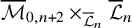 $\overline {\mathcal {M}}_{0,n+2}\times _{\overline {\mathcal {L}}_n}\overline {\mathcal {L}}_n$
. The key insight that we require is that the r-braid arrangement is the preimage of the braid arrangement under the map
$\overline {\mathcal {M}}_{0,n+2}\times _{\overline {\mathcal {L}}_n}\overline {\mathcal {L}}_n$
. The key insight that we require is that the r-braid arrangement is the preimage of the braid arrangement under the map $\mathbb {P}^{n-1}\rightarrow \mathbb {P}^{n-1}$
that takes the rth power of each coordinate. Since blow-ups commute with flat base change, we might then try to conclude that the wonderful compactification of the r-braid arrangement is the fiber product
$\mathbb {P}^{n-1}\rightarrow \mathbb {P}^{n-1}$
that takes the rth power of each coordinate. Since blow-ups commute with flat base change, we might then try to conclude that the wonderful compactification of the r-braid arrangement is the fiber product $\overline {\mathcal {M}}_{0,n+2}\times _{\mathbb {P}^{n-1}}\mathbb {P}^{n-1}$
, where the maps are the iterated blow-up
$\overline {\mathcal {M}}_{0,n+2}\times _{\mathbb {P}^{n-1}}\mathbb {P}^{n-1}$
, where the maps are the iterated blow-up $d \circ c: \overline {\mathcal {M}}_{0,n+2} \rightarrow \mathbb {P}^{n-1}$
and the rth power map. However, this is not quite right: what goes wrong is that the coordinate hyperplanes happen to lie in the ramification locus of the rth power map, so instead of blowing up along these subspaces, the fiber product
$d \circ c: \overline {\mathcal {M}}_{0,n+2} \rightarrow \mathbb {P}^{n-1}$
and the rth power map. However, this is not quite right: what goes wrong is that the coordinate hyperplanes happen to lie in the ramification locus of the rth power map, so instead of blowing up along these subspaces, the fiber product $\overline {\mathcal {M}}_{0,n+2}\times _{\mathbb {P}^{n-1}}\mathbb {P}^{n-1}$
blows up along nonreduced schemes supported on the coordinate subspaces. To remedy this, we first blow up the coordinate spaces, obtaining
$\overline {\mathcal {M}}_{0,n+2}\times _{\mathbb {P}^{n-1}}\mathbb {P}^{n-1}$
blows up along nonreduced schemes supported on the coordinate subspaces. To remedy this, we first blow up the coordinate spaces, obtaining $\overline {\mathcal {L}}_n$
, and then we use the rth power map on
$\overline {\mathcal {L}}_n$
, and then we use the rth power map on $\overline {\mathcal {L}}_n$
instead.
$\overline {\mathcal {L}}_n$
instead.
More precisely, since $\overline {\mathcal {L}}_n$
is a smooth toric variety, there is a natural map
$\overline {\mathcal {L}}_n$
is a smooth toric variety, there is a natural map $q:\overline {\mathcal {L}}_n\rightarrow \overline {\mathcal {L}}_n$
that extends the rth power map on the torus. In the coordinate description of elements of
$q:\overline {\mathcal {L}}_n\rightarrow \overline {\mathcal {L}}_n$
that extends the rth power map on the torus. In the coordinate description of elements of $\overline {\mathcal {L}}_n$
from the previous subsection, q preserves the underlying curve C and the last two marked points, and it acts on the first n marked points by
$\overline {\mathcal {L}}_n$
from the previous subsection, q preserves the underlying curve C and the last two marked points, and it acts on the first n marked points by $[x:y] \mapsto [x^r: y^r]$
. Observe that q is finite locally free of degree
$[x:y] \mapsto [x^r: y^r]$
. Observe that q is finite locally free of degree $(n-1)^r$
: in the affine toric chart of any torus-invariant point of
$(n-1)^r$
: in the affine toric chart of any torus-invariant point of $\overline {\mathcal {L}}_n$
, the pullback
$\overline {\mathcal {L}}_n$
, the pullback $q^*$
can be realized as the inclusion of polynomial rings
$q^*$
can be realized as the inclusion of polynomial rings
 $$ \begin{align*} \mathbb{C}[x_1,\dots,x_{n-1}]&\rightarrow\mathbb{C}[x_1,\dots,x_{n-1}]\\ f(x_1,\dots,x_{n-1})&\mapsto f(x_1^r,\dots,x_{n-1}^r), \end{align*} $$
which exhibits the codomain as a free module of rank $(n-1)^r$
over the domain. Being finite locally free implies, in particular, that q is finite and flat. Note that the ramification locus of q is the toric boundary of
$(n-1)^r$
over the domain. Being finite locally free implies, in particular, that q is finite and flat. Note that the ramification locus of q is the toric boundary of $\overline {\mathcal {L}}_n$
.
$\overline {\mathcal {L}}_n$
.
With this notation in place, the main result of this section is the following.
Proposition 13. The wonderful compactification of $\mathcal {A}^r_n$
with respect to its minimal building set is the fiber product
$\mathcal {A}^r_n$
with respect to its minimal building set is the fiber product $\overline {\mathcal {M}}^r_n$
in the following diagram:
$\overline {\mathcal {M}}^r_n$
in the following diagram:

Proof. We begin by setting up notation. Viewing $\overline {\mathcal {L}}_n$
as the iterated blow-up of
$\overline {\mathcal {L}}_n$
as the iterated blow-up of $\mathbb {P}^{n-1}$
along the coordinate subspaces of
$\mathbb {P}^{n-1}$
along the coordinate subspaces of $\mathbb {P}^{n-1}$
, let
$\mathbb {P}^{n-1}$
, let $\mathcal {Z}$
be the collection of strict transforms of the linear subspaces in
$\mathcal {Z}$
be the collection of strict transforms of the linear subspaces in $\mathbb {P}^{n-1}$
spanned by
$\mathbb {P}^{n-1}$
spanned by $[1:\dots :1]$
together with a set of coordinate points, and let
$[1:\dots :1]$
together with a set of coordinate points, and let $\mathcal {W}$
be the collection of strict transforms of the linear subspaces in
$\mathcal {W}$
be the collection of strict transforms of the linear subspaces in $\mathbb {P}^{n-1}$
spanned by one of the points
$\mathbb {P}^{n-1}$
spanned by one of the points $p_{\mathbf {a}} = [\zeta ^{a_1}: \cdots : \zeta ^{a_n}]$
together with a set of coordinate points. As discussed in the previous subsection,
$p_{\mathbf {a}} = [\zeta ^{a_1}: \cdots : \zeta ^{a_n}]$
together with a set of coordinate points. As discussed in the previous subsection, $c:\overline {\mathcal {M}}_{0,n+2}\rightarrow \overline {\mathcal {L}}_n$
is the iterated blow-up along the elements of
$c:\overline {\mathcal {M}}_{0,n+2}\rightarrow \overline {\mathcal {L}}_n$
is the iterated blow-up along the elements of $\mathcal {Z}$
, in any inclusion-increasing order.
$\mathcal {Z}$
, in any inclusion-increasing order.
We aim to prove that $\overline {\mathcal {M}}_n^r\rightarrow \overline {\mathcal {L}}_n$
is the iterated blow-up along the elements of
$\overline {\mathcal {M}}_n^r\rightarrow \overline {\mathcal {L}}_n$
is the iterated blow-up along the elements of $\mathcal {W}$
. Once we have accomplished this, we can combine it with the fact that
$\mathcal {W}$
. Once we have accomplished this, we can combine it with the fact that $\overline {\mathcal {L}}_n\rightarrow \mathbb {P}^{n-1}$
is the iterated blow-up along the coordinate subspaces of
$\overline {\mathcal {L}}_n\rightarrow \mathbb {P}^{n-1}$
is the iterated blow-up along the coordinate subspaces of $\mathbb {P}^{n-1}$
to see that
$\mathbb {P}^{n-1}$
to see that $\overline {\mathcal {M}}_n^r\rightarrow \mathbb {P}^{n-1}$
is the iterated blow-up along the collection of linear subspaces spanned by a subset of the coordinate points and at most one of the points
$\overline {\mathcal {M}}_n^r\rightarrow \mathbb {P}^{n-1}$
is the iterated blow-up along the collection of linear subspaces spanned by a subset of the coordinate points and at most one of the points $p_{\mathbf {a}}$
. By Proposition 8, this is precisely the minimal building set of
$p_{\mathbf {a}}$
. By Proposition 8, this is precisely the minimal building set of $\mathcal {A}^r_n$
, from which we conclude that
$\mathcal {A}^r_n$
, from which we conclude that $\overline {\mathcal {M}}^r_n$
is the wonderful compactification with respect to this building set, as desired.
$\overline {\mathcal {M}}^r_n$
is the wonderful compactification with respect to this building set, as desired.
To prove that $\overline {\mathcal {M}}_n^r\rightarrow \overline {\mathcal {L}}_n$
is the iterated blow-up along the elements of
$\overline {\mathcal {M}}_n^r\rightarrow \overline {\mathcal {L}}_n$
is the iterated blow-up along the elements of $\mathcal {W}$
, begin by decomposing the map c as follows:
$\mathcal {W}$
, begin by decomposing the map c as follows:
 $$\begin{align*}\overline{\mathcal{M}}_{0,n+2}=Y_{n-2}\stackrel{c_{n-3}}{\longrightarrow} Y_{n-3}\stackrel{c_{n-4}}{\longrightarrow}\cdots\stackrel{c_{1}}{\longrightarrow} Y_1\stackrel{c_{0}}{\longrightarrow} Y_0 =\overline{\mathcal{L}}_n, \end{align*}$$
where the map $c_k$
is the blow-up of
$c_k$
is the blow-up of $Y_k$
along the union of the strict transforms of the k-dimensional elements of
$Y_k$
along the union of the strict transforms of the k-dimensional elements of $\mathcal {Z}$
. Denote the intermediate compositions of these blow-up maps by
$\mathcal {Z}$
. Denote the intermediate compositions of these blow-up maps by $\hat c_k=c_0\circ \dots \circ c_{k-1}:Y_k\rightarrow \overline {\mathcal {L}}_n$
, and let
$\hat c_k=c_0\circ \dots \circ c_{k-1}:Y_k\rightarrow \overline {\mathcal {L}}_n$
, and let $\widetilde Z_k\subseteq Y_k$
denote the union of the strict transforms of the k-dimensional elements of
$\widetilde Z_k\subseteq Y_k$
denote the union of the strict transforms of the k-dimensional elements of $\mathcal {Z}$
:
$\mathcal {Z}$
:
 $$\begin{align*}\widetilde Z_k=\overline{\hat c_k^{-1}(Z_k\setminus Z_{k-1})}, \end{align*}$$
where $Z_k\subseteq \overline {\mathcal {L}}_n$
is the union of the k-dimensional elements of
$Z_k\subseteq \overline {\mathcal {L}}_n$
is the union of the k-dimensional elements of $\mathcal {Z}$
. With this notation, we have
$\mathcal {Z}$
. With this notation, we have $Y_{k+1}=\mathrm {Bl}_{\widetilde Z_k}(Y_k)$
.
$Y_{k+1}=\mathrm {Bl}_{\widetilde Z_k}(Y_k)$
.
Recursively define $X_0=\overline {\mathcal {L}}_n$
and
$X_0=\overline {\mathcal {L}}_n$
and $X_k=Y_k\times _{Y_{k-1}}X_{k-1}$
, so that every square in the following diagram is a pullback:
$X_k=Y_k\times _{Y_{k-1}}X_{k-1}$
, so that every square in the following diagram is a pullback:

We prove inductively that the map $X_k\rightarrow \overline {\mathcal {L}}_n$
is the iterated blow-up along the elements of
$X_k\rightarrow \overline {\mathcal {L}}_n$
is the iterated blow-up along the elements of $\mathcal {W}$
of dimension less than k; the desired result then follows from the
$\mathcal {W}$
of dimension less than k; the desired result then follows from the $k=n-2$
case.
$k=n-2$
case.
To prove the induction step, consider the diagram

Since q is flat and since flatness is preserved by base change, $q_k$
is flat. Furthermore, since blow-ups commute with flat base change (see [Reference VakilVak24, Exercise 24.1.P]) and since
$q_k$
is flat. Furthermore, since blow-ups commute with flat base change (see [Reference VakilVak24, Exercise 24.1.P]) and since $Y_{k+1}=\mathrm {Bl}_{\widetilde Z_k}(Y_k)$
, it follows that
$Y_{k+1}=\mathrm {Bl}_{\widetilde Z_k}(Y_k)$
, it follows that $b_k$
is a blow-up:
$b_k$
is a blow-up:
 $$\begin{align*}X_{k+1}=\mathrm{Bl}_{\widetilde Z_k\times_{Y_k} X_k}(X_k). \end{align*}$$
It remains to study the blow-up locus $\widetilde Z_k\times _{Y_k} X_k\subseteq X_k$
; we must argue that it is equal to the strict transform of the union of the k-dimensional elements of
$\widetilde Z_k\times _{Y_k} X_k\subseteq X_k$
; we must argue that it is equal to the strict transform of the union of the k-dimensional elements of $\mathcal {W}$
. More precisely, after unraveling definitions, we must argue that
$\mathcal {W}$
. More precisely, after unraveling definitions, we must argue that
 $$ \begin{align} \overline{\hat c_k^{-1}(Z_k\setminus Z_{k-1})}\times_{Y_k}X_k=\overline{\hat b_k^{-1}(W_k\setminus W_{k-1})}, \end{align} $$
where $W_k$
is the union of the k-dimensional elements of
$W_k$
is the union of the k-dimensional elements of $\mathcal {W}$
and
$\mathcal {W}$
and $\hat b_k=b_0\circ \cdots \circ b_{k-1}$
. By definition of
$\hat b_k=b_0\circ \cdots \circ b_{k-1}$
. By definition of $\mathcal {Z}$
and
$\mathcal {Z}$
and $\mathcal {W}$
, it is not hard to see that
$\mathcal {W}$
, it is not hard to see that $W_k=q^{-1}(Z_k)$
, and it then follows that
$W_k=q^{-1}(Z_k)$
, and it then follows that $W_k\setminus W_{k-1}=q^{-1}(Z_k\setminus Z_{k-1})$
. Since
$W_k\setminus W_{k-1}=q^{-1}(Z_k\setminus Z_{k-1})$
. Since $W_k\setminus W_{k-1}$
is disjoint from the blow-up locus of
$W_k\setminus W_{k-1}$
is disjoint from the blow-up locus of $\hat b_k$
and
$\hat b_k$
and $Z_k\setminus Z_{k-1}$
is disjoint from the blow-up locus of
$Z_k\setminus Z_{k-1}$
is disjoint from the blow-up locus of $\hat c_k$
, it then follows that
$\hat c_k$
, it then follows that
 $$\begin{align*}\hat b_k^{-1}(W_k\setminus W_{k-1}) = q_{k+1}^{-1}(\hat c_k^{-1}(Z_k\setminus Z_{k-1})). \end{align*}$$
Lastly, since q is finite locally free, which is preserved by base change, so is $q_{k+1}$
, and since none of the components of
$q_{k+1}$
, and since none of the components of $Z_k$
are contained entirely within the ramification locus of
$Z_k$
are contained entirely within the ramification locus of $q_{k+1}$
, the equality (7) is a special case of the lemma below.
$q_{k+1}$
, the equality (7) is a special case of the lemma below.
Lemma 14. Let $q:X\rightarrow Y$
be a finite locally free map of irreducible varieties and let
$q:X\rightarrow Y$
be a finite locally free map of irreducible varieties and let $Z\subseteq Y$
be a subset such that none of the irreducible components of the Zariski closure
$Z\subseteq Y$
be a subset such that none of the irreducible components of the Zariski closure $\overline Z$
lie entirely within the ramification locus of q. Then
$\overline Z$
lie entirely within the ramification locus of q. Then
 $$\begin{align*}\overline Z\times_Y X=\overline{q^{-1}(Z)}. \end{align*}$$
Remark 15. The lemma fails if a component of $\overline Z$
lies within the ramification locus of q. For example, if
$\overline Z$
lies within the ramification locus of q. For example, if $X=Y=\mathbb {A}^1$
,
$X=Y=\mathbb {A}^1$
, $q(x)=x^2$
, and
$q(x)=x^2$
, and $Z=\{0\}$
, then the fiber product is a point of multiplicity two supported at the origin, while the closure of the preimage is a point of multiplicity one supported at the origin.
$Z=\{0\}$
, then the fiber product is a point of multiplicity two supported at the origin, while the closure of the preimage is a point of multiplicity one supported at the origin.
Proof of Lemma 14.
It suffices to prove the lemma when X and Y are affine and $q^*:\mathbb {C}[Y]\rightarrow \mathbb {C}[X]$
is an inclusion that endows
$q^*:\mathbb {C}[Y]\rightarrow \mathbb {C}[X]$
is an inclusion that endows $\mathbb {C}[X]$
with the structure of a free module over
$\mathbb {C}[X]$
with the structure of a free module over $\mathbb {C}[Y]$
, since our hypotheses imply that Y has an affine open cover over which the restriction of q has this form. In this case,
$\mathbb {C}[Y]$
, since our hypotheses imply that Y has an affine open cover over which the restriction of q has this form. In this case,
 $$\begin{align*}\overline Z\times_Y X=\mathrm{Spec}\left(\frac{\mathbb{C}[Y]}{\mathcal{I}(Z)}\otimes_{\mathbb{C}[Y]}\mathbb{C}[X]\right)=\mathrm{Spec}\left(\frac{\mathbb{C}[X]}{\mathcal{I}(Z)\mathbb{C}[X]}\right) \end{align*}$$
and
 $$\begin{align*}\overline{q^{-1}(Z)}=\operatorname{\mathrm{Spec}}\left(\frac{\mathbb{C}[X]}{\mathcal{I}(q^{-1}(Z))}\right). \end{align*}$$
Thus, we must prove that $\mathcal {I}(Z)\mathbb {C}[X]=\mathcal {I}(q^{-1}(Z))$
. The inclusion
$\mathcal {I}(Z)\mathbb {C}[X]=\mathcal {I}(q^{-1}(Z))$
. The inclusion $\mathcal {I}(Z)\mathbb {C}[X]\subseteq \mathcal {I}(q^{-1}(Z))$
simply follows from the fact that the inclusion
$\mathcal {I}(Z)\mathbb {C}[X]\subseteq \mathcal {I}(q^{-1}(Z))$
simply follows from the fact that the inclusion $q^*: \mathbb {C}[Y] \rightarrow \mathbb {C}[X]$
maps
$q^*: \mathbb {C}[Y] \rightarrow \mathbb {C}[X]$
maps $\mathcal {I}(Z)$
into
$\mathcal {I}(Z)$
into $\mathcal {I}(q^{-1}(Z))$
, so the crux of the lemma is proving the other inclusion.
$\mathcal {I}(q^{-1}(Z))$
, so the crux of the lemma is proving the other inclusion.
Let $g\in \mathcal {I}(q^{-1}(Z))$
. Choose a basis
$g\in \mathcal {I}(q^{-1}(Z))$
. Choose a basis $f_1,\dots ,f_m$
of
$f_1,\dots ,f_m$
of $\mathbb {C}[X]$
as a module over
$\mathbb {C}[X]$
as a module over $\mathbb {C}[Y]$
, and write
$\mathbb {C}[Y]$
, and write ${g=g_1f_1+\dots +g_mf_m}$
for some
${g=g_1f_1+\dots +g_mf_m}$
for some $g_1,\dots ,g_m\in \mathbb {C}[Y]$
. Note that m is the degree of the finite map q. Let
$g_1,\dots ,g_m\in \mathbb {C}[Y]$
. Note that m is the degree of the finite map q. Let $z\in Z$
be any point over which q is unramified, and set
$z\in Z$
be any point over which q is unramified, and set $q^{-1}(z)=\{x_1,\dots ,x_m\}$
. Evaluating g at
$q^{-1}(z)=\{x_1,\dots ,x_m\}$
. Evaluating g at $x_1,\dots ,x_m$
and noting that
$x_1,\dots ,x_m$
and noting that $g(x_j)=0$
and
$g(x_j)=0$
and $g_i(x_j)=g_i(z)$
for all
$g_i(x_j)=g_i(z)$
for all $i,j$
, we obtain equations
$i,j$
, we obtain equations
 $$\begin{align*}0=g_1(z)f_1(x_j)+\dots+g_m(z)f_m(x_j)\;\;\;\text{ for }\;\;\;j=1,\dots,m. \end{align*}$$
In other words, the function
 $$\begin{align*}g_1(z)f_1 + \dots + g_m(z)f_m \in \mathbb{C}[X]\end{align*}$$
vanishes at all the preimages $x_1, \ldots , x_m$
of z, which means that it descends to zero in the quotient
$x_1, \ldots , x_m$
of z, which means that it descends to zero in the quotient
 $$\begin{align*}\frac{\mathbb{C}[X]}{\mathcal{I}(z)\mathbb{C}[X]} \cong \left(\frac{\mathbb{C}[Y]}{\mathcal{I}(z)}\right)^m \cong \mathbb{C}^m.\end{align*}$$
Given that the images of $f_1, \ldots , f_m$
in this quotient form a basis as a
$f_1, \ldots , f_m$
in this quotient form a basis as a $\mathbb {C}$
-vector space, we conclude that
$\mathbb {C}$
-vector space, we conclude that $g_1(z) = \cdots = g_m(z) = 0$
. Since this holds for every
$g_1(z) = \cdots = g_m(z) = 0$
. Since this holds for every $z\in Z$
over which q is unramified, and since these points form a dense subset of
$z\in Z$
over which q is unramified, and since these points form a dense subset of $\overline Z$
by our hypotheses on Z, it then follows that
$\overline Z$
by our hypotheses on Z, it then follows that $g_1,\dots ,g_m\in \mathcal {I}(Z)$
. The expression
$g_1,\dots ,g_m\in \mathcal {I}(Z)$
. The expression $g=g_1f_1+\dots +g_mf_m$
then implies that
$g=g_1f_1+\dots +g_mf_m$
then implies that $g \in \mathcal {I}(Z)\mathbb {C}[X]$
, as desired.
$g \in \mathcal {I}(Z)\mathbb {C}[X]$
, as desired.
At this point, we have successfully identified the wonderful compactification of the r-braid arrangement with the fiber product $\overline {\mathcal {M}}^r_n$
of a diagram in which three of the corners are moduli spaces. It likely comes as no surprise, then, that
$\overline {\mathcal {M}}^r_n$
of a diagram in which three of the corners are moduli spaces. It likely comes as no surprise, then, that $\overline {\mathcal {M}}^r_n$
has a modular interpretation, as well. We turn to this interpretation in the next and final section.
$\overline {\mathcal {M}}^r_n$
has a modular interpretation, as well. We turn to this interpretation in the next and final section.
5 The wonderful compactification as a moduli space
We begin this section by describing the moduli problem of interest, and we then prove that the fiber product $\overline {\mathcal {M}}^r_n$
is indeed a fine moduli space for this moduli problem. Throughout, as above, we fix a primitive rth root of unity
$\overline {\mathcal {M}}^r_n$
is indeed a fine moduli space for this moduli problem. Throughout, as above, we fix a primitive rth root of unity $\zeta $
. Furthermore, all schemes are assumed to be finite-type over
$\zeta $
. Furthermore, all schemes are assumed to be finite-type over $\mathbb {C}$
.
$\mathbb {C}$
.
5.1 The moduli problem
Fix $r \geq 2$
and
$r \geq 2$
and $n \geq 1$
. We will refer to the objects in our moduli space as heavy
$n \geq 1$
. We will refer to the objects in our moduli space as heavy $\boldsymbol {(r,n)}$
-curves, to distinguish them from the
$\boldsymbol {(r,n)}$
-curves, to distinguish them from the $(r,n)$
-curves studied in [Reference Clader, Damiolini, Huang, Li and RamadasCDH+22]; their definition is as follows.
$(r,n)$
-curves studied in [Reference Clader, Damiolini, Huang, Li and RamadasCDH+22]; their definition is as follows.
Definition 16. A heavy $\boldsymbol {(r,n)}$
-curve is a geometrically reduced and connected nodal curve C of arithmetic genus zero, equipped with
$\boldsymbol {(r,n)}$
-curve is a geometrically reduced and connected nodal curve C of arithmetic genus zero, equipped with $rn+2$
distinct marked points (denoted by
$rn+2$
distinct marked points (denoted by $x^+$
,
$x^+$
, $x^-$
, and
$x^-$
, and $z_i^j$
for
$z_i^j$
for $i \in [n]$
and
$i \in [n]$
and $j \in \mathbb {Z}_r$
) as well as an order-r automorphism
$j \in \mathbb {Z}_r$
) as well as an order-r automorphism $\sigma : C \rightarrow C$
, subject to the following conditions:
$\sigma : C \rightarrow C$
, subject to the following conditions:
-
•
$\sigma (x^+) = x^+$
and
$\sigma (x^-) = x^-$
; -
•
$\sigma (z_i^j) = z_i^{j+1\ \mod r}$
for each
$i \in [n]$
and
$j \in \mathbb {Z}_r$
; -
•
$\sigma $
is generically free (that is,
$\sigma $
has finite fixed locus); -
• the
$(rn+2)$
-pointed curve
$(C; \{z_i^j\}, x^{\pm })$
is stable (i.e., it is an element of
$\overline {\mathcal {M}}_{0,rn+2}$
).


We also require one further condition, but to state it, we must first observe that the above conditions constrain the geometry of C. Namely, C must consist of a central chain of $\mathbb {P}^1$
’s connecting
$\mathbb {P}^1$
’s connecting $x^+$
to
$x^+$
to $x^-$
, to which the remaining trees of
$x^-$
, to which the remaining trees of $\mathbb {P}^1$
’s are attached with r-fold symmetry (see Figure 2); to see this, note that any component invariant under the order-r automorphism
$\mathbb {P}^1$
’s are attached with r-fold symmetry (see Figure 2); to see this, note that any component invariant under the order-r automorphism $\sigma $
has exactly two
$\sigma $
has exactly two $\sigma $
-fixed points, and it is only at these fixed points that the
$\sigma $
-fixed points, and it is only at these fixed points that the $\sigma $
-invariant components can meet one another. For each component
$\sigma $
-invariant components can meet one another. For each component $P \cong \mathbb {P}^1$
of the central chain, denote by
$P \cong \mathbb {P}^1$
of the central chain, denote by $p^+$
and
$p^+$
and $p^-$
the
$p^-$
the $\sigma $
-fixed points in the directions of
$\sigma $
-fixed points in the directions of $x^+$
and
$x^+$
and $x^-$
, respectively. The final condition we require of a heavy
$x^-$
, respectively. The final condition we require of a heavy $(r,n)$
-curve is that, in coordinates on P in which
$(r,n)$
-curve is that, in coordinates on P in which $p^+ = \infty $
and
$p^+ = \infty $
and $p^- = 0$
, the automorphism
$p^- = 0$
, the automorphism $\sigma $
is given by multiplication by the fixed primitive root of unity
$\sigma $
is given by multiplication by the fixed primitive root of unity $\zeta $
.
$\zeta $
.

Figure 2 A heavy $(r,n)$
-curve with
$(r,n)$
-curve with $r=3$
and
$r=3$
and $n=7$
. The dual graph of the curve is shown, meaning that vertices represent components, edges represent nodes, and half-edges represent marked points. The automorphism
$n=7$
. The dual graph of the curve is shown, meaning that vertices represent components, edges represent nodes, and half-edges represent marked points. The automorphism $\sigma $
can be viewed as a rotation about the horizontal axis connecting the component with
$\sigma $
can be viewed as a rotation about the horizontal axis connecting the component with $x^+$
to the component with
$x^+$
to the component with $x^-$
.
$x^-$
.
Families of such objects are defined as follows.
Definition 17. A family of heavy $\boldsymbol {(r,n)}$
-curves over a base scheme
$\boldsymbol {(r,n)}$
-curves over a base scheme $\boldsymbol {B}$
is a flat morphism
$\boldsymbol {B}$
is a flat morphism $\pi :\mathcal {C} \to B$
of schemes with
$\pi :\mathcal {C} \to B$
of schemes with $rn+2$
sections
$rn+2$
sections $z_i^j,x^+,x^-$
along with an order-r automorphism
$z_i^j,x^+,x^-$
along with an order-r automorphism $\sigma :\mathcal {C} \to \mathcal {C}$
satisfying
$\sigma :\mathcal {C} \to \mathcal {C}$
satisfying $\pi \circ \sigma = \pi $
and such that the tuple
$\pi \circ \sigma = \pi $
and such that the tuple
 $$\begin{align*}\left(\pi^{-1}(b); {\{z_i^j(b)\}}, \; x^{\pm}(b), \; \sigma\vert_{\pi^{-1}(b)}\right) \end{align*}$$
is a heavy $(r,n)$
-curve for every geometric point
$(r,n)$
-curve for every geometric point $b \in B$
. An isomorphism of families
$b \in B$
. An isomorphism of families $\pi :\mathcal {C}\rightarrow B$
and
$\pi :\mathcal {C}\rightarrow B$
and $\pi ':\mathcal {C}'\rightarrow B$
is an isomorphism
$\pi ':\mathcal {C}'\rightarrow B$
is an isomorphism $f:\mathcal {C}\rightarrow \mathcal {C}'$
over B that commutes with the sections and the order-r automorphisms.
$f:\mathcal {C}\rightarrow \mathcal {C}'$
over B that commutes with the sections and the order-r automorphisms.
It is straightforward to see that families of heavy $(r,n)$
-curves can be pulled back along morphisms
$(r,n)$
-curves can be pulled back along morphisms $B' \rightarrow B$
, so the above defines a moduli problem. It remains to show that the fiber product
$B' \rightarrow B$
, so the above defines a moduli problem. It remains to show that the fiber product $\overline {\mathcal {M}}^r_n$
is a fine moduli space for this moduli problem. We accomplish this in several steps, first showing that the points of
$\overline {\mathcal {M}}^r_n$
is a fine moduli space for this moduli problem. We accomplish this in several steps, first showing that the points of $\overline {\mathcal {M}}_n^r$
correspond to heavy
$\overline {\mathcal {M}}_n^r$
correspond to heavy $(r,n)$
-curves, then constructing a tautological family over
$(r,n)$
-curves, then constructing a tautological family over $\overline {\mathcal {M}}_n^r$
, and finally showing that this tautological family is universal.
$\overline {\mathcal {M}}_n^r$
, and finally showing that this tautological family is universal.
5.2 Points of
$\overline {\mathcal {M}}_n^r$
parametrize heavy
$(r,n)$
-curves


That the geometric points of $\overline {\mathcal {M}}_n^r$
parametrize heavy
$\overline {\mathcal {M}}_n^r$
parametrize heavy $(r,n)$
-curves makes sense heuristically: the data of a heavy
$(r,n)$
-curves makes sense heuristically: the data of a heavy $(r,n)$
-curve is dictated by the choice of the quotient
$(r,n)$
-curve is dictated by the choice of the quotient $C/\sigma $
(which is an element of
$C/\sigma $
(which is an element of $\overline {\mathcal {M}}_{0,n+2}$
) together with the choice, for each
$\overline {\mathcal {M}}_{0,n+2}$
) together with the choice, for each $i \in [n]$
, of which of the points
$i \in [n]$
, of which of the points $z_i^j$
is
$z_i^j$
is $z_i^0$
(which is given by an element of
$z_i^0$
(which is given by an element of $\overline {\mathcal {L}}_n$
whose image under the rth power map q is the contraction of
$\overline {\mathcal {L}}_n$
whose image under the rth power map q is the contraction of $C/\sigma $
to its central chain). See Figure 3. The two lemmas of this subsection make this heuristic more precise.
$C/\sigma $
to its central chain). See Figure 3. The two lemmas of this subsection make this heuristic more precise.

Figure 3 An illustration of the interpretation of $\overline {\mathcal {M}}^r_n$
as a fiber product. Note that we have not labeled the points
$\overline {\mathcal {M}}^r_n$
as a fiber product. Note that we have not labeled the points $z_i^j$
for
$z_i^j$
for $j\neq 0$
in the upper-left diagram, but those labels are uniquely determined by
$j\neq 0$
in the upper-left diagram, but those labels are uniquely determined by $z_i^0$
and
$z_i^0$
and $\sigma $
.
$\sigma $
.
Since $\overline {\mathcal {M}}_n^r=\overline {\mathcal {M}}_{0,n+2}\times _{\overline {\mathcal {L}}_n}\overline {\mathcal {L}}_n$
, geometric points of
$\overline {\mathcal {M}}_n^r=\overline {\mathcal {M}}_{0,n+2}\times _{\overline {\mathcal {L}}_n}\overline {\mathcal {L}}_n$
, geometric points of $\overline {\mathcal {M}}_n^r$
correspond to pairs
$\overline {\mathcal {M}}_n^r$
correspond to pairs
 $$ \begin{align*}(\mu,\nu)\in\overline{\mathcal{M}}_{0,n+2}\times\overline{\mathcal{L}}_n\end{align*} $$
such that $c(\mu )=q(\nu )$
. The next lemma describes explicitly how every such point can be viewed as a heavy
$c(\mu )=q(\nu )$
. The next lemma describes explicitly how every such point can be viewed as a heavy $(r,n)$
-curve.
$(r,n)$
-curve.
Lemma 18. Let $\mu =(C_{\mathcal {M}};\{y_i\},y^\pm )\in \overline {\mathcal {M}}_{0,n+2}$
and
$\mu =(C_{\mathcal {M}};\{y_i\},y^\pm )\in \overline {\mathcal {M}}_{0,n+2}$
and $\nu =(C_{\mathcal {L}};\{z_i\},z^\pm )\in \overline {\mathcal {L}}_n$
be such that
$\nu =(C_{\mathcal {L}};\{z_i\},z^\pm )\in \overline {\mathcal {L}}_n$
be such that $c(\mu )=q(\nu )$
. Let
$c(\mu )=q(\nu )$
. Let $\tilde c:C_{\mathcal {M}}\rightarrow C_{\mathcal {L}}$
and
$\tilde c:C_{\mathcal {M}}\rightarrow C_{\mathcal {L}}$
and $\tilde q:C_{\mathcal {L}}\rightarrow C_{\mathcal {L}}$
be the maps on curves induced by c and q. Define
$\tilde q:C_{\mathcal {L}}\rightarrow C_{\mathcal {L}}$
be the maps on curves induced by c and q. Define $\zeta :C_{\mathcal {L}}\rightarrow C_{\mathcal {L}}$
to be multiplication by
$\zeta :C_{\mathcal {L}}\rightarrow C_{\mathcal {L}}$
to be multiplication by $\zeta $
on each component of
$\zeta $
on each component of $C_{\mathcal {L}}$
. Then
$C_{\mathcal {L}}$
. Then
 $$\begin{align*}(C_{\mathcal{M}}\times_{C_{\mathcal{L}}}C_{\mathcal{L}};\;\{(y_i,\zeta^jz_i)\},\;(y^\pm,z^\pm),\;\sigma) \end{align*}$$
is a heavy $(r,n)$
-curve, where
$(r,n)$
-curve, where $\sigma (y,z)=(y,\zeta z)$
.
$\sigma (y,z)=(y,\zeta z)$
.
Proof. For convenience, set $C=C_{\mathcal {M}}\times _{C_{\mathcal {L}}} C_{\mathcal {L}}$
. Since
$C=C_{\mathcal {M}}\times _{C_{\mathcal {L}}} C_{\mathcal {L}}$
. Since $\tilde q:C_{\mathcal {L}}\rightarrow C_{\mathcal {L}}$
is a degree-r cyclic cover of
$\tilde q:C_{\mathcal {L}}\rightarrow C_{\mathcal {L}}$
is a degree-r cyclic cover of $C_{\mathcal {L}}$
that is fully ramified at the nodes and heavy marked points of
$C_{\mathcal {L}}$
that is fully ramified at the nodes and heavy marked points of $C_{\mathcal {L}}$
, it follows that
$C_{\mathcal {L}}$
, it follows that $C\rightarrow C_{\mathcal {M}}$
is a degree-r cyclic cover of
$C\rightarrow C_{\mathcal {M}}$
is a degree-r cyclic cover of $C_{\mathcal {M}}$
that is fully ramified over
$C_{\mathcal {M}}$
that is fully ramified over $y^\pm $
, as well as over all nodes of
$y^\pm $
, as well as over all nodes of $C_{\mathcal {M}}$
that connect components in the chain from
$C_{\mathcal {M}}$
that connect components in the chain from $y^-$
to
$y^-$
to $y^+$
. Up to isomorphism, there is a unique such cyclic cover
$y^+$
. Up to isomorphism, there is a unique such cyclic cover $C\rightarrow C_{\mathcal {M}}$
. More specifically, C is a nodal rational curve containing a central chain that we identify with
$C\rightarrow C_{\mathcal {M}}$
. More specifically, C is a nodal rational curve containing a central chain that we identify with $C_{\mathcal {L}}$
, and for each tree
$C_{\mathcal {L}}$
, and for each tree $T\subseteq C_{\mathcal {M}}$
that is contracted by
$T\subseteq C_{\mathcal {M}}$
that is contracted by $\tilde c$
, the curve C contains r identical such trees attached at simple nodes at the r points of
$\tilde c$
, the curve C contains r identical such trees attached at simple nodes at the r points of $\tilde q^{-1}(\tilde c(T))\subseteq C_{\mathcal {L}}$
.
$\tilde q^{-1}(\tilde c(T))\subseteq C_{\mathcal {L}}$
.
Given this description of C, one sees that it has an order-r automorphism acting by multiplication by $\zeta $
on the central chain
$\zeta $
on the central chain $C_{\mathcal {L}}$
and permuting the trees accordingly. The fiber product map
$C_{\mathcal {L}}$
and permuting the trees accordingly. The fiber product map $\tilde f_{\mathcal {M}}:C\rightarrow C_{\mathcal {M}}$
is the quotient by this automorphism, while the map
$\tilde f_{\mathcal {M}}:C\rightarrow C_{\mathcal {M}}$
is the quotient by this automorphism, while the map $\tilde f_{\mathcal {L}}:C\rightarrow C_{\mathcal {L}}$
contracts the trees to the central chain, so this automorphism is the
$\tilde f_{\mathcal {L}}:C\rightarrow C_{\mathcal {L}}$
contracts the trees to the central chain, so this automorphism is the $\sigma $
in the statement of the lemma.
$\sigma $
in the statement of the lemma.
Set $x^{\pm }$
to be the endpoints of the central chain of C, corresponding to
$x^{\pm }$
to be the endpoints of the central chain of C, corresponding to $z^\pm \in C_{\mathcal {L}}$
. Furthermore, for each
$z^\pm \in C_{\mathcal {L}}$
. Furthermore, for each $i \in [n]$
and
$i \in [n]$
and $j \in \mathbb {Z}_r$
, set
$j \in \mathbb {Z}_r$
, set $z_i^j = \sigma ^j(z_i^0)$
, where
$z_i^j = \sigma ^j(z_i^0)$
, where $z_i^0$
is the unique element of the preimage
$z_i^0$
is the unique element of the preimage $\tilde f_{\mathcal {M}}^{-1}(y_i)$
whose image under
$\tilde f_{\mathcal {M}}^{-1}(y_i)$
whose image under $\tilde f_{\mathcal {L}}$
is
$\tilde f_{\mathcal {L}}$
is $z_i$
. This data makes C into a heavy
$z_i$
. This data makes C into a heavy $(r,n)$
-curve, and because
$(r,n)$
-curve, and because $(\tilde f_{\mathcal {M}}(z_i^j),\tilde f_{\mathcal {L}}(z_i^j))=(y_i,\zeta ^jz_i)$
and
$(\tilde f_{\mathcal {M}}(z_i^j),\tilde f_{\mathcal {L}}(z_i^j))=(y_i,\zeta ^jz_i)$
and $(\tilde f_{\mathcal {M}}(x^\pm ),\tilde f_{\mathcal {L}}(x^\pm ))=(y^\pm ,z^\pm )$
, it agrees with the data in the statement of the lemma.
$(\tilde f_{\mathcal {M}}(x^\pm ),\tilde f_{\mathcal {L}}(x^\pm ))=(y^\pm ,z^\pm )$
, it agrees with the data in the statement of the lemma.
The previous lemma can be viewed as a map from $\overline {\mathcal {M}}^r_n$
to the set of heavy
$\overline {\mathcal {M}}^r_n$
to the set of heavy $(r,n)$
-curves. The next lemma, on the other hand, gives an explicit procedure for going in the other direction.
$(r,n)$
-curves. The next lemma, on the other hand, gives an explicit procedure for going in the other direction.
Lemma 19. Let $(C;\{z_i^j\},x^{\pm },\sigma )$
be a heavy
$(C;\{z_i^j\},x^{\pm },\sigma )$
be a heavy $(r,n)$
-curve.
$(r,n)$
-curve.
-
• Define
$(C_{\mathcal {M}};\{y_i\},y^{\pm })\in \overline {\mathcal {M}}_{0,n+2}$
by setting
$C_{\mathcal {M}} = C/\sigma $
, setting
$y_i$
to be the image of the orbit
$\{z_i^0,\dots ,z_i^{r-1}\}$
, and setting
$y^\pm $
to be the image of
$x^\pm $
. -
• Define
$(C_{\mathcal {L}};\{z_i\},z^\pm )\in \overline {\mathcal {L}}_n$
to be the image of
$(C;\{z_i^j\},x^{\pm })\in \overline {\mathcal {M}}_{0,rn+2}$
under the forgetful and weight-reduction map
$\overline {\mathcal {M}}_{0,rn+2}\rightarrow \overline {\mathcal {L}}_n$
that forgets all but the marked points
$\{z_i^0\}$
.


Then $C=C_{\mathcal {M}}\times _{C_{\mathcal {L}}}C_{\mathcal {L}}$
, and under this identification of curves,
$C=C_{\mathcal {M}}\times _{C_{\mathcal {L}}}C_{\mathcal {L}}$
, and under this identification of curves, $z_i^j=(y_i,\zeta ^jz_i)$
,
$z_i^j=(y_i,\zeta ^jz_i)$
, $x^\pm =(y^\pm ,z^\pm )$
, and
$x^\pm =(y^\pm ,z^\pm )$
, and $\sigma (y,z)=(y,\zeta z)$
.
$\sigma (y,z)=(y,\zeta z)$
.
Proof. Notice that the canonical maps $C\rightarrow C_{\mathcal {M}}$
and
$C\rightarrow C_{\mathcal {M}}$
and $C\rightarrow C_{\mathcal {L}}$
give rise to a canonical map
$C\rightarrow C_{\mathcal {L}}$
give rise to a canonical map $C\rightarrow C_{\mathcal {M}}\times _{C_{\mathcal {L}}} C_{\mathcal {L}}$
, by the universal property of fiber products. Given the explicit description of
$C\rightarrow C_{\mathcal {M}}\times _{C_{\mathcal {L}}} C_{\mathcal {L}}$
, by the universal property of fiber products. Given the explicit description of $C_{\mathcal {M}}\times _{C_{\mathcal {L}}} C_{\mathcal {L}}$
in the proof of Lemma 18, it is not hard to see that this map is an isomorphism of nodal curves, and that it identifies the marked points and automorphism as stated in the lemma.
$C_{\mathcal {M}}\times _{C_{\mathcal {L}}} C_{\mathcal {L}}$
in the proof of Lemma 18, it is not hard to see that this map is an isomorphism of nodal curves, and that it identifies the marked points and automorphism as stated in the lemma.
Because Lemma 18 describes a function from $\overline {\mathcal {M}}_n^r$
to the set of heavy
$\overline {\mathcal {M}}_n^r$
to the set of heavy $(r,n)$
-curves, while Lemma 19 describes its inverse, we conclude the following.
$(r,n)$
-curves, while Lemma 19 describes its inverse, we conclude the following.
Proposition 20. There is a bijection
 $$\begin{align*}\overline{\mathcal{M}}_n^r=\{\mathrm{heavy}\ (r,n)\text{-}\mathrm{curves}\}. \end{align*}$$
Having now described how to view points of $\overline {\mathcal {M}}_n^r$
as heavy
$\overline {\mathcal {M}}_n^r$
as heavy $(r,n)$
-curves, we next describe how to carry out this procedure in families, thereby constructing a tautological family of heavy
$(r,n)$
-curves, we next describe how to carry out this procedure in families, thereby constructing a tautological family of heavy $(r,n)$
-curves over
$(r,n)$
-curves over $\overline {\mathcal {M}}_n^r$
.
$\overline {\mathcal {M}}_n^r$
.
5.3 Constructing a tautological family
Recall that the universal curves over the moduli spaces $\overline {\mathcal {M}}_{0,n+2}$
and
$\overline {\mathcal {M}}_{0,n+2}$
and $\overline {\mathcal {L}}_n$
are given by the forgetful maps from the associated moduli spaces with one additional marked point:
$\overline {\mathcal {L}}_n$
are given by the forgetful maps from the associated moduli spaces with one additional marked point: $\pi _{\mathcal {M}}:\overline {\mathcal {M}}_{0,n+3}\rightarrow \overline {\mathcal {M}}_{0,n+2}$
and
$\pi _{\mathcal {M}}:\overline {\mathcal {M}}_{0,n+3}\rightarrow \overline {\mathcal {M}}_{0,n+2}$
and $\pi _{\mathcal {L}}:\overline {\mathcal {L}}_{n+1}\rightarrow \overline {\mathcal {L}}_n$
. The map
$\pi _{\mathcal {L}}:\overline {\mathcal {L}}_{n+1}\rightarrow \overline {\mathcal {L}}_n$
. The map $\pi _{\mathcal {M}}$
has
$\pi _{\mathcal {M}}$
has $n+2$
sections giving the marked points, which we denote
$n+2$
sections giving the marked points, which we denote $y_1,\dots ,y_n,y^\pm $
, while the map
$y_1,\dots ,y_n,y^\pm $
, while the map $\pi _{\mathcal {L}}$
has
$\pi _{\mathcal {L}}$
has $n+2$
sections that we denote
$n+2$
sections that we denote $z_1,\dots ,z_n,z^\pm $
. Consider the two corresponding fiber squares:
$z_1,\dots ,z_n,z^\pm $
. Consider the two corresponding fiber squares:

Since $q\circ \pi _{\mathcal {L}}\circ \tilde f_{\mathcal {L}}=c\circ \pi _{\mathcal {M}}\circ \tilde f_{\mathcal {M}}$
, the universal property of fiber products yields a canonical map
$q\circ \pi _{\mathcal {L}}\circ \tilde f_{\mathcal {L}}=c\circ \pi _{\mathcal {M}}\circ \tilde f_{\mathcal {M}}$
, the universal property of fiber products yields a canonical map $\pi :\overline {\mathcal {M}}_{n+1}^r\rightarrow \overline {\mathcal {M}}_n^r$
. We will argue that
$\pi :\overline {\mathcal {M}}_{n+1}^r\rightarrow \overline {\mathcal {M}}_n^r$
. We will argue that $\overline {\mathcal {M}}_{n+1}^r$
is a tautological family of heavy
$\overline {\mathcal {M}}_{n+1}^r$
is a tautological family of heavy $(r,n)$
-curves over
$(r,n)$
-curves over $\overline {\mathcal {M}}_n^r$
. In order to do so, we require an automorphism and
$\overline {\mathcal {M}}_n^r$
. In order to do so, we require an automorphism and $rn+2$
sections of this family, which we now define.
$rn+2$
sections of this family, which we now define.
Let $\zeta :\overline {\mathcal {L}}_{n+1}\rightarrow \overline {\mathcal {L}}_{n+1}$
be the map that multiplies the final marked point on each chain by
$\zeta :\overline {\mathcal {L}}_{n+1}\rightarrow \overline {\mathcal {L}}_{n+1}$
be the map that multiplies the final marked point on each chain by $\zeta $
. We define an automorphism
$\zeta $
. We define an automorphism $\sigma :\overline {\mathcal {M}}_{n+1}^r\rightarrow \overline {\mathcal {M}}_{n+1}^r$
by applying the universal property of fiber products to the following diagram:
$\sigma :\overline {\mathcal {M}}_{n+1}^r\rightarrow \overline {\mathcal {M}}_{n+1}^r$
by applying the universal property of fiber products to the following diagram:

Furthermore, we define sections $z_i^j$
of
$z_i^j$
of $\pi :\overline {\mathcal {M}}_{n+1}^r\rightarrow \overline {\mathcal {M}}_n^r$
by another application of the universal property of fiber products to the following diagram:
$\pi :\overline {\mathcal {M}}_{n+1}^r\rightarrow \overline {\mathcal {M}}_n^r$
by another application of the universal property of fiber products to the following diagram:

and we define the sections $x^{\pm }$
similarly. With this notation established, we have the following result.
$x^{\pm }$
similarly. With this notation established, we have the following result.
Proposition 21. The map $\pi :\overline {\mathcal {M}}_{n+1}^r\rightarrow \overline {\mathcal {M}}_n^r$
along with the automorphism
$\pi :\overline {\mathcal {M}}_{n+1}^r\rightarrow \overline {\mathcal {M}}_n^r$
along with the automorphism $\sigma :\overline {\mathcal {M}}_{n+1}^r\rightarrow \overline {\mathcal {M}}_{n+1}^r$
and the
$\sigma :\overline {\mathcal {M}}_{n+1}^r\rightarrow \overline {\mathcal {M}}_{n+1}^r$
and the $rn+2$
sections
$rn+2$
sections $z_i^j,x^+,x^-$
is a family of heavy
$z_i^j,x^+,x^-$
is a family of heavy $(r,n)$
-curves over
$(r,n)$
-curves over $\overline {\mathcal {M}}_n^r$
. Moreover, this family is tautological in the sense that, for any
$\overline {\mathcal {M}}_n^r$
. Moreover, this family is tautological in the sense that, for any $b\in \overline {\mathcal {M}}_n^r$
, the tuple
$b\in \overline {\mathcal {M}}_n^r$
, the tuple
 $$\begin{align*}\left(\pi^{-1}(b); {\{z_i^j(b)\}}, \; x^{\pm}(b), \; \sigma\vert_{\pi^{-1}(b)}\right) \end{align*}$$
is isomorphic to the heavy $(r,n)$
-curve parametrized by b (according to Proposition 20).
$(r,n)$
-curve parametrized by b (according to Proposition 20).
Proof. We first confirm that $\pi $
is flat, which can be proven by covering
$\pi $
is flat, which can be proven by covering $\overline {\mathcal {M}}_{n+1}^r$
by open sets on which
$\overline {\mathcal {M}}_{n+1}^r$
by open sets on which $\pi $
is flat. Consider the following fiber square over
$\pi $
is flat. Consider the following fiber square over $\overline {\mathcal {M}}_n^r$
:
$\overline {\mathcal {M}}_n^r$
:

where $g=c\circ f_{\mathcal {M}}=q\circ f_{\mathcal {L}}$
. Since flatness is preserved by pullback, the pullbacks in this diagram are all flat over
$g=c\circ f_{\mathcal {M}}=q\circ f_{\mathcal {L}}$
. Since flatness is preserved by pullback, the pullbacks in this diagram are all flat over $\overline {\mathcal {M}}_n^r$
. Notice that
$\overline {\mathcal {M}}_n^r$
. Notice that $\tilde {q}$
is étale away from the divisor
$\tilde {q}$
is étale away from the divisor $D \subseteq f_{\mathcal {L}}^*\overline {\mathcal {L}}_{n+1}$
of fixed points of
$D \subseteq f_{\mathcal {L}}^*\overline {\mathcal {L}}_{n+1}$
of fixed points of $\zeta $
. Since étaleness is preserved under base change, it follows that
$\zeta $
. Since étaleness is preserved under base change, it follows that $\tilde {f}_{\mathcal {M}}$
is étale on
$\tilde {f}_{\mathcal {M}}$
is étale on $\overline {\mathcal {M}}_{n+1}^r\setminus \tilde f_{\mathcal {L}}^{-1}(D)$
. In particular, the restriction of
$\overline {\mathcal {M}}_{n+1}^r\setminus \tilde f_{\mathcal {L}}^{-1}(D)$
. In particular, the restriction of $\pi $
to
$\pi $
to $\overline {\mathcal {M}}_{n+1}^r\setminus \tilde f_{\mathcal {L}}^{-1}(D)$
is the composition of an étale morphism and a flat morphism, so it is flat. On the other hand, the map
$\overline {\mathcal {M}}_{n+1}^r\setminus \tilde f_{\mathcal {L}}^{-1}(D)$
is the composition of an étale morphism and a flat morphism, so it is flat. On the other hand, the map $\tilde {c}$
is an isomorphism away from the divisor
$\tilde {c}$
is an isomorphism away from the divisor $D' \subseteq f_{\mathcal {M}}^*\overline {\mathcal {M}}_{0,n+3}$
of contracted trees, so it follows that
$D' \subseteq f_{\mathcal {M}}^*\overline {\mathcal {M}}_{0,n+3}$
of contracted trees, so it follows that $\tilde {f}_{\mathcal {L}}$
is an isomorphism on
$\tilde {f}_{\mathcal {L}}$
is an isomorphism on $\overline {\mathcal {M}}_{n+1}^r \setminus \tilde {f}_{\mathcal {M}}^{-1}(D')$
. Thus, the restriction of
$\overline {\mathcal {M}}_{n+1}^r \setminus \tilde {f}_{\mathcal {M}}^{-1}(D')$
. Thus, the restriction of $\pi $
to this open locus is the composition of an isomorphism with a flat morphism, so it is flat. Because
$\pi $
to this open locus is the composition of an isomorphism with a flat morphism, so it is flat. Because $\widetilde {f}_{\mathcal {L}}^{-1}(D) \cap \widetilde {f}_{\mathcal {M}}^{-1}(D') = \emptyset $
, we have covered
$\widetilde {f}_{\mathcal {L}}^{-1}(D) \cap \widetilde {f}_{\mathcal {M}}^{-1}(D') = \emptyset $
, we have covered $\overline {\mathcal {M}}_{n+1}^r$
by open sets on which
$\overline {\mathcal {M}}_{n+1}^r$
by open sets on which $\pi $
is flat.
$\pi $
is flat.
We next confirm that $\pi \circ \sigma = \pi $
. To do so, first note that
$\pi \circ \sigma = \pi $
. To do so, first note that
 $$\begin{align*}f_{\mathcal{L}} \circ \pi \circ \sigma = \pi_{\mathcal{L}} \circ \zeta \circ \widetilde{f}_{\mathcal{L}} = \pi_{\mathcal{L}} \circ \widetilde{f}_{\mathcal{L}},\end{align*}$$
where the first equality follows from (8) and the second from the definition of $\zeta $
. This implies that the diagram
$\zeta $
. This implies that the diagram

commutes with the dashed arrow equal either to $\pi \circ \sigma $
or to
$\pi \circ \sigma $
or to $\pi $
, so the universal property of fiber products ensures that
$\pi $
, so the universal property of fiber products ensures that $\pi \circ \sigma = \pi $
.
$\pi \circ \sigma = \pi $
.
Finally, note that
 $$\begin{align*}\left(\pi^{-1}(b); {\{z_i^j(b)\}}, \; x^{\pm}(b), \; \sigma\vert_{\pi^{-1}(b)}\right) \end{align*}$$
is isomorphic to the heavy $(r,n)$
-curve parametrized by b; this follows from the observation that, upon restricting to the fiber over
$(r,n)$
-curve parametrized by b; this follows from the observation that, upon restricting to the fiber over $b\in \overline {\mathcal {M}}_n^r$
, the construction of
$b\in \overline {\mathcal {M}}_n^r$
, the construction of $\overline {\mathcal {M}}_{n+1}^r$
,
$\overline {\mathcal {M}}_{n+1}^r$
, $\sigma $
, and
$\sigma $
, and $z_i^j,x^+,x^-$
over
$z_i^j,x^+,x^-$
over $\overline {\mathcal {M}}_n^r$
specializes to the construction of Lemma 18 over b. Thus, the given data indeed defines a tautological family of heavy
$\overline {\mathcal {M}}_n^r$
specializes to the construction of Lemma 18 over b. Thus, the given data indeed defines a tautological family of heavy $(r,n)$
-curves.
$(r,n)$
-curves.
5.4 The tautological family is universal
We are now prepared to conclude with the following culminating result.
Theorem 22. The fiber product $\overline {\mathcal {M}}^r_n$
is a fine moduli space for the moduli problem of heavy
$\overline {\mathcal {M}}^r_n$
is a fine moduli space for the moduli problem of heavy $(r,n)$
-curves. That is, for any base scheme B, pulling back the tautological family gives a bijection
$(r,n)$
-curves. That is, for any base scheme B, pulling back the tautological family gives a bijection
 $$\begin{align*}\Bigg\{ \mathrm{morphisms}\ B \rightarrow \overline{\mathcal{M}}^r_n\Bigg\} \;\; \longrightarrow \;\; \left\{\substack{\textstyle \mathrm{families\ of\ heavy}\\ \textstyle (r,n)\text{-}\mathrm{curves\ over}\ B}\right\}. \end{align*}$$
Proof. To prove surjectivity, let $\mathcal {F}=(\mathcal {C};\{z_i^j\},x^{\pm },\sigma )$
be a family of heavy
$\mathcal {F}=(\mathcal {C};\{z_i^j\},x^{\pm },\sigma )$
be a family of heavy $(r,n)$
-curves over B. Upon taking the quotient of
$(r,n)$
-curves over B. Upon taking the quotient of $\mathcal {C}$
by
$\mathcal {C}$
by $\sigma $
, we obtain a family
$\sigma $
, we obtain a family $\mathcal {F}_{\mathcal {M}}=(\mathcal {C}_{\mathcal {M}};y_i,y^\pm )$
of curves in
$\mathcal {F}_{\mathcal {M}}=(\mathcal {C}_{\mathcal {M}};y_i,y^\pm )$
of curves in $\overline {\mathcal {M}}_{0,n+2}$
, and thus a morphism
$\overline {\mathcal {M}}_{0,n+2}$
, and thus a morphism $f_{\mathcal {M}}:B\rightarrow \overline {\mathcal {M}}_{0,n+2}$
. Similarly, after contracting to the central chain of
$f_{\mathcal {M}}:B\rightarrow \overline {\mathcal {M}}_{0,n+2}$
. Similarly, after contracting to the central chain of $\mathcal {C}$
, we obtain a family
$\mathcal {C}$
, we obtain a family $\mathcal {F}_{\mathcal {L}}=(\mathcal {C}_{\mathcal {L}};z_i,z^\pm )$
of curves in
$\mathcal {F}_{\mathcal {L}}=(\mathcal {C}_{\mathcal {L}};z_i,z^\pm )$
of curves in $\overline {\mathcal {L}}_{n}$
, and thus a morphism
$\overline {\mathcal {L}}_{n}$
, and thus a morphism $f_{\mathcal {L}}:B\rightarrow \overline {\mathcal {L}}_n$
. By the universal property of fiber products,
$f_{\mathcal {L}}:B\rightarrow \overline {\mathcal {L}}_n$
. By the universal property of fiber products, $f_{\mathcal {M}}$
and
$f_{\mathcal {M}}$
and $f_{\mathcal {L}}$
give rise to a morphism
$f_{\mathcal {L}}$
give rise to a morphism $f_{\mathcal {F}}:B\rightarrow \overline {\mathcal {M}}_n^r$
. We claim that
$f_{\mathcal {F}}:B\rightarrow \overline {\mathcal {M}}_n^r$
. We claim that $\mathcal {F}\cong f_{\mathcal {F}}^*(\mathcal {F}^{\mathrm {taut}})$
, where
$\mathcal {F}\cong f_{\mathcal {F}}^*(\mathcal {F}^{\mathrm {taut}})$
, where $\mathcal {F}^{\mathrm {taut}}$
denotes the tautological family over
$\mathcal {F}^{\mathrm {taut}}$
denotes the tautological family over $\overline {\mathcal {M}}_n^r$
.
$\overline {\mathcal {M}}_n^r$
.
By construction of $\mathcal {F}^{\mathrm {taut}}$
as a fiber product, we can construct its pullback
$\mathcal {F}^{\mathrm {taut}}$
as a fiber product, we can construct its pullback $f_{\mathcal {F}}^*(\mathcal {F}^{\mathrm {taut}})$
from the families
$f_{\mathcal {F}}^*(\mathcal {F}^{\mathrm {taut}})$
from the families $\mathcal {F}_{\mathcal {M}}$
and
$\mathcal {F}_{\mathcal {M}}$
and $\mathcal {F}_{\mathcal {L}}$
:
$\mathcal {F}_{\mathcal {L}}$
:
 $$\begin{align*}f_{\mathcal{F}}^*(\mathcal{F}^{\mathrm{taut}})= (\mathcal{C}_{\mathcal{M}}\times_{\mathcal{C}_{\mathcal{L}}}\mathcal{C}_{\mathcal{L}};\;\{(y_i,\zeta^jz_i)_i^j\},\;(y^\pm,z^\pm),\;\sigma). \end{align*}$$
The natural maps $\mathcal {C}\rightarrow \mathcal {C}_{\mathcal {M}}$
and
$\mathcal {C}\rightarrow \mathcal {C}_{\mathcal {M}}$
and $\mathcal {C}\rightarrow \mathcal {C}_{\mathcal {L}}$
give rise to a map
$\mathcal {C}\rightarrow \mathcal {C}_{\mathcal {L}}$
give rise to a map $\mathcal {C}\rightarrow \mathcal {C}_{\mathcal {M}}\times _{\mathcal {C}_{\mathcal {L}}}\mathcal {C}_{\mathcal {L}}$
, and Lemma 19 implies that this map is a fiberwise isomorphism of heavy
$\mathcal {C}\rightarrow \mathcal {C}_{\mathcal {M}}\times _{\mathcal {C}_{\mathcal {L}}}\mathcal {C}_{\mathcal {L}}$
, and Lemma 19 implies that this map is a fiberwise isomorphism of heavy $(r,n)$
-curves over B. Since
$(r,n)$
-curves over B. Since $\mathcal {C}$
is flat over B, the isomorphism on fibers implies that
$\mathcal {C}$
is flat over B, the isomorphism on fibers implies that $\mathcal {C}\rightarrow \mathcal {C}_{\mathcal {M}}\times _{\mathcal {C}_{\mathcal {L}}}\mathcal {C}_{\mathcal {L}}$
is an isomorphism (see, for example, [Sta19, Section Tag 05XD]), and we then conclude that
$\mathcal {C}\rightarrow \mathcal {C}_{\mathcal {M}}\times _{\mathcal {C}_{\mathcal {L}}}\mathcal {C}_{\mathcal {L}}$
is an isomorphism (see, for example, [Sta19, Section Tag 05XD]), and we then conclude that $\mathcal {F}\cong f_{\mathcal {F}}^*(\mathcal {F}^{\mathrm {taut}})$
.
$\mathcal {F}\cong f_{\mathcal {F}}^*(\mathcal {F}^{\mathrm {taut}})$
.
To prove injectivity, suppose that two morphisms $f,g:B\rightarrow \overline {\mathcal {M}}_n^r$
give rise to isomorphic families of heavy
$f,g:B\rightarrow \overline {\mathcal {M}}_n^r$
give rise to isomorphic families of heavy $(r,n)$
-curves
$(r,n)$
-curves $f^*(\mathcal {F}^{\mathrm {taut}}) \cong g^*(\mathcal {F}^{\mathrm {taut}})$
. The description of
$f^*(\mathcal {F}^{\mathrm {taut}}) \cong g^*(\mathcal {F}^{\mathrm {taut}})$
. The description of $\overline {\mathcal {M}}_n^r$
as a fiber product implies that f is equivalent to a pair of maps
$\overline {\mathcal {M}}_n^r$
as a fiber product implies that f is equivalent to a pair of maps $f_{\mathcal {M}}: B \rightarrow \overline {\mathcal {M}}_{0,n+2}$
and
$f_{\mathcal {M}}: B \rightarrow \overline {\mathcal {M}}_{0,n+2}$
and $f_{\mathcal {L}}: B \rightarrow \overline {\mathcal {L}}_n$
, and similarly, g is equivalent to
$f_{\mathcal {L}}: B \rightarrow \overline {\mathcal {L}}_n$
, and similarly, g is equivalent to $g_{\mathcal {M}}$
and
$g_{\mathcal {M}}$
and $g_{\mathcal {L}}$
. Taking the quotient of
$g_{\mathcal {L}}$
. Taking the quotient of $f^*(\mathcal {F}^{\mathrm {taut}}) \cong g^*(\mathcal {F}^{\mathrm {taut}})$
by its order-r automorphism as above, we find that the pullbacks of the tautological family on
$f^*(\mathcal {F}^{\mathrm {taut}}) \cong g^*(\mathcal {F}^{\mathrm {taut}})$
by its order-r automorphism as above, we find that the pullbacks of the tautological family on $\overline {\mathcal {M}}_{0,n+2}$
along
$\overline {\mathcal {M}}_{0,n+2}$
along $f_{\mathcal {M}}$
and
$f_{\mathcal {M}}$
and $g_{\mathcal {M}}$
are isomorphic, and therefore
$g_{\mathcal {M}}$
are isomorphic, and therefore $f_{\mathcal {M}} = g_{\mathcal {M}}$
from the fact that
$f_{\mathcal {M}} = g_{\mathcal {M}}$
from the fact that $\overline {\mathcal {M}}_{0,n+2}$
is a fine moduli space. Similarly, contracting
$\overline {\mathcal {M}}_{0,n+2}$
is a fine moduli space. Similarly, contracting $f^*(\mathcal {F}^{\mathrm {taut}}) \cong g^*(\mathcal {F}^{\mathrm {taut}})$
to its central chain, we find that the pullbacks of the tautological family on
$f^*(\mathcal {F}^{\mathrm {taut}}) \cong g^*(\mathcal {F}^{\mathrm {taut}})$
to its central chain, we find that the pullbacks of the tautological family on $\overline {\mathcal {L}}_n$
along
$\overline {\mathcal {L}}_n$
along $f_{\mathcal {L}}$
and
$f_{\mathcal {L}}$
and $g_{\mathcal {L}}$
are isomorphic, and therefore
$g_{\mathcal {L}}$
are isomorphic, and therefore $f_{\mathcal {L}} = g_{\mathcal {L}}$
from the fact that
$f_{\mathcal {L}} = g_{\mathcal {L}}$
from the fact that $\overline {\mathcal {L}}_n$
is a fine moduli space. Thus, the uniqueness of maps to fiber products implies that
$\overline {\mathcal {L}}_n$
is a fine moduli space. Thus, the uniqueness of maps to fiber products implies that $f=g$
.
$f=g$
.
Because Theorem 22 shows that $\overline {\mathcal {M}}^r_n$
is a fine moduli space for heavy
$\overline {\mathcal {M}}^r_n$
is a fine moduli space for heavy $(r,n)$
-curves and Proposition 13 shows that
$(r,n)$
-curves and Proposition 13 shows that $\overline {\mathcal {M}}^r_n$
is the wonderful compactification of the r-braid arrangement with respect to its minimal building set, the proof of Theorem 1 is complete.
$\overline {\mathcal {M}}^r_n$
is the wonderful compactification of the r-braid arrangement with respect to its minimal building set, the proof of Theorem 1 is complete.
Acknowledgments
The authors wish to thank the organizers of the 2024 workshop “Combinatorics of Moduli of Curves,” and the Banff International Research Station for hosting this workshop, where work on this project began. Thanks are also due to the anonymous referees, particularly for improving the proof of Theorem 22 and for noting the connection to Hurwitz spaces mentioned in Remark 3.
Competing interests
The authors have no competing interest to declare.
Funding statement
E.C. was supported by NSF CAREER grant 2137060. I.H. was supported by NSF DMS–2302664. D.R. was supported by NSF DMS–2302024 and DMS–2001439.
Data availability statement
No data was used in this work.
Ethical standards
The research meets all ethical guidelines, including adherence to the legal requirements of the study country.
Author contributions
E.C. and D.R. suggested the problem, and all authors contributed to the research as well as the writing and revision of the manuscript and approved the final version.


 Open access

