





Introduction
Parliamentary government is predominantly a coalition government, and public policy in parliamentary regimes is predominantly made by coalition governments. Yet, political scientists know surprisingly little about how actual coalitions divide policy payoffs, that is, how coalition parties decide on which policies to pursue and which parties have greater influence on this. Two perspectives predominate: that of proportionality and that of logrolling. The first of these assumes that the resources parties bring to the negotiation table in the form of parliamentary seats are crucial, although they often do so implicitly (Däubler and Debus Reference Däubler and Debus2009; Mansergh Reference Mansergh1999; Warwick Reference Warwick2001). The second argues that the party that prioritises an issue more than the other parties in the negotiation gets to set the policy on that issue (De Marchi and Laver Reference De Marchi and Laver2020; Klüver and Bäck Reference Klüver and Bäck2019). This paper introduces a third perspective: pre-negotiation agreement. Rather than following a logic of proportionality or logrolling, when parties negotiate about a package of policies that they will pursue in the coming parliamentary term, the likelihood of a party’s policy proposal being included in the coalition agreement will increase the greater support it commands among the other parties in the coalition. As participating parties have joint responsibility for the policy outputs implemented based on coalition agreements, as policy choices in one area have effects on other policy areas, and as most voters are subject to the consequences of most public policies, parties will maximise their utility by including policy proposals that command wide support among the negotiating parties, rather than policies which are favoured by only one party.
We test this argument employing a novel dataset directly measuring policy payoffs. The literature on policy payoffs has relied on either the overall policy positions of parties (as established by, for example, expert surveys or manifestos) or on automated text analysis of manifestos and coalition agreements. However, the overall position of a political party tells us little about concrete policy changes, making it difficult to assign policy payoffs to particular parties, and even drawing concrete policy commitments from political texts such as manifestos or coalition agreements is fraught with difficulty. Parties avoid difficult economic questions, they can take ambiguous positions, and they do not concretely specify the policy changes they want to make (Koedam Reference Koedam2021; Otjes Reference Otjes2016). Compromises in coalition agreements are blanketed over by vague formulations, and parties use them to hide the fact that policymaking is at its heart a concrete endeavour, with tangible costs and benefits, with clear winners and losers.
To overcome these problems, we draw on an unusual feature of the Dutch political system. In the Netherlands, election manifestos and coalition agreements are submitted to the Netherlands Bureau of Economic Analysis (Centraal Planbureau, CPB),Footnote 1 which estimates the budgetary impact of every measure parties propose in their election manifestos and of all measures incorporated in the coalition agreement (Bolhuis Reference Bolhuis2018a). This forces parties to be concrete regarding their policy proposals. As the CPB is politically neutral and highly respected both among politicians and the general public, these estimates form the basis of both political campaigning and of coalition negotiations. The CPB estimates thus allow us to obtain an unbiased estimate of the policy payoffs obtained by each party which enters a coalition government. The empirical results support our expectation of overall coalition support driving policy inclusion in the coalition agreement, even while office payoffs are shown to be distributed proportionally. Policy payoffs are thus not driven primarily by individual parties getting what they want, but rather by what governing parties collectively want.
The rest of the paper is structured as follows: we first review the literature on coalition government and payoffs and set out our theoretical framework. We then discuss our data and modelling approach and our case before presenting the results. A final section concludes.
Understanding coalition negotiation outcomes
Political parties spend considerable time negotiating about possible coalitions before forming governments (Ecker and Meyer Reference Ecker and Meyer2020; Martin and Vanberg Reference Martin and Vanberg2003). The end result of these negotiations is not just a new team of ministers but also lengthy coalition agreements and a joint policy programme for the new government (Indriđason and Kristinsson Reference Indriđason and Kristinsson2013). In these agreements, parties lay down which policies the new government will pursue in the upcoming parliamentary term (Strøm Reference Strøm2000). Coalition agreements serve an important function: informal policy compromises are difficult to enforce, as, given ministers’ informational advantages (Laver and Shepsle Reference Laver and Shepsle1990, Reference Laver and Shepsle1996), they have the opportunity to renege on policy compromises. Formal written coalition agreements seek to govern the subsequent behaviour of coalition parties and ministers, ensuring that policy promises are kept, and their widespread use indicates their utility to parties (Müller and Strøm Reference Müller, Strøm, Müller and Strøm2008).Footnote 2 While these agreements are not legally enforceable, they provide a key benchmark against which subsequent policy can be judged. If parties did not believe that coalition agreements had a function, they would be highly unlikely to invest the time and effort into writing such a lengthy and detailed document.
Such agreements have been found to effectively constrain the subsequent behaviour of governing parties (Becher Reference Becher2010; Goodhart Reference Goodhart2013) and to subsequently be translated into changes to public policy (Moury Reference Moury2011; Schermann and Ennser-Jedenastik Reference Schermann and Ennser-Jedenastik2014a; Thomson Reference Thomson2001). Coalition agreements also help manage conflict which emerges between coalition partners during a parliamentary term (Moury and Timmermans Reference Moury and Timmermans2013). Coalition agreements are thus a key part of the management of coalition governments. While the functioning of coalition agreements has been studied in detail, our understanding of what policies are included in them is relatively limited, in particular in terms of what determines parties’ success in terms of getting their coalition partners to include their policy priorities in the coalition agreement.
Two theoretical perspectives have been developed to explain policy payoffs in coalition agreements: one argues that the driver of payoffs is the size of parties’ parliamentary delegations, while the other argues that differences in policy priorities between parties explain which policies get included. We depart from the previous literature by arguing that the crucial factor for policy payoffs is support from other parties for a policy, rather than party size or differences in issue salience. In other words, we argue that a party is more likely to get a policy included in a coalition agreement the more the other parties in the coalition support similar policies, while policy payoffs will neither be driven by party size nor by differences in issue salience.
As we argue in more detail below, we identify three key drivers: the joint responsibility for policy of coalition parties, the inseparability of policy choices, and the fact that as public goods most voters are subject to the consequences of most policies. As we discuss below, both the ‘party size’ and ‘salience’ logics are attractive to parties when it is possible to accurately target the benefits of policies to particular groups of voters, while keeping these voters isolated from the effects of other policies. Yet, many policies are national policies that affect all citizens.Footnote 3
Our paper builds on the theoretical framework proposed by De Marchi and Laver (Reference De Marchi and Laver2020), in particular their key assumption of what they describe as ‘nonstrategic’ behaviour: politicians engaged in coalition negotiations deploy rules of thumb rather than fully strategic analysis (De Marchi and Laver Reference De Marchi and Laver2020: 546). Given the sheer number of possible modalities in a coalition agreement, it cannot be assumed that negotiators consider all possibilities and pick the optimal solution.Footnote 4 Rather, parties rely on relatively simple heuristics when negotiating. Hence, while we expect parties to act rationally during negotiations, we believe that this rationality is bounded.
The negotiation of a comprehensive policy agreement between multiple parties occurs within a high-dimensional political space (see, e.g., De Marchi and Laver Reference De Marchi and Laver2020: 545). On these different issues, negotiating parties have different preferences, which do not always neatly align, and given this complexity, we cannot necessarily reduce the negotiation space to one or two dimensions. In traditional fully strategic models of negotiation that have a policy space with more than one dimension, a policy outcome is nearly always unstable (McKelvey Reference McKelvey1979; McKelvey and Schofield Reference McKelvey and Schofield1987; Schofield Reference Schofield1983): no stable outcome would be possible if negotiators were fully strategic. Given that politicians do come to agreements, such an assumption is empirically untenable. The well-established perspectives of party size and party salience, noted above, are easily understood as such rules of thumb used by parties, as is our argument centring on similar policy preferences.
When it comes to the substance of coalition negotiations, most attention has been spent on how parties distribute offices. Here, the verdict is very clear: the share of ministries a party obtains is proportional to the share of parliamentary seats the party brings to the table. This is evident in both comparative (Browne and Franklin Reference Browne and Franklin1973; Golder and Thomas Reference Golder and Thomas2014; Warwick and Druckman Reference Warwick and Druckman2006) and experimental research (Martin Reference Martin2018).Footnote 5 Proportionality between the resources that parties contribute to a negotiation and the payoffs they receive is a useful rule of thumb that parties use in complex bargaining situations with high levels of uncertainty, where parties are unsure about potential payoffs and about which coalitions are viable and which are not (Browne and Rice Reference Browne and Rice1979; Falcó-Gimeno and Indriđason Reference Falcó-Gimeno and Indriđason2013). That is, the size of a party serves as an entitlement cue: a frame of reference of what negotiators consider a ‘fair’ division of rewards (Polzer, Mannix and Neale Reference Polzer, Mannix, Neale, Kramer and Messick1995: 43–44; Schellenberg Reference Schellenberg1990: 86).
Implicitly, many political scientists analysing coalition negotiations assume that policy payoffs follow party size: the policy position of a government is often understood as a seat-weighted average of the positions of the governing parties in a low-dimensional space (Däubler and Debus Reference Däubler and Debus2009; Ferland Reference Ferland2016; Golder and Stramski Reference Golder and Stramski2010; Indriđason Reference Indriđason2011; Mansergh Reference Mansergh1999; Martin and Vanberg Reference Martin and Vanberg2014; Warwick Reference Warwick2001).Footnote 6 This implies an assumption that the influence a party has on the policy position of a government is equal to its share of either parliamentary seats or ministries.Footnote 7 One mechanism that could underpin this distribution is the argument that due to ministries’ jurisdictional monopolies and significant informational advantages, the party of the minister controlling a portfolio will be able to dictate what policy changes occur in the relevant policy area (Laver and Shepsle Reference Laver and Shepsle1990, Reference Laver and Shepsle1996). As portfolios are distributed proportionally, policy payoffs will therefore also be distributed proportionally as long as ministers can act as unconstrained policy dictators not limited by other ministers.Footnote 8 The only direct test of the relationship between party size and coalition agreements that we are aware of is Klüver and Bäck (Reference Klüver and Bäck2019), who find that the distance between a party’s positions as expressed in their manifesto and the coalition agreement is smaller the larger the seat share of a party is.
The well-established pattern of proportionality in office payoffs would, at first glance, suggest that a similar pattern should be observed in the allocation of policy in coalition governments. However, three assumptions underpin this perspective: that policy outcomes are private goods, that they are separable, and that parties can claim separate responsibility for them. Firstly, the implicit assumption is that the policies pursued by the party who gets to act as policy dictator for an issue or policy do not negatively influence the utility of other parties. Since public policies by their nature are public goods, this is unlikely to always be the case: both the supporters of Party A and of Party B will be subject to the policies desired by Party B. The contrast with portfolio payoffs is instructive: the non-policy payoffs of being a minister (status, salary) are private goods – they only influence the person holding office. Because of this, other parties are willing to accept proportional office payoffs as ‘fair’ without extending such a fairness logic to policy payoffs. Secondly, many public policies are intertwined: a proposal for more healthcare spending would need to be financed by budget cuts elsewhere, tax rises or an increased deficit. One can make one party dictator on health policy, but the costs that their programmes incur will have to be paid by someone. Given these interlinking complexities, it is unattractive for parties to allow other parties to dictate policy. Finally, all the parties in the coalition can be held electorally responsible for the policies they pursue. If Party A allows Party B to act as a policy dictator, this risks Party B pursuing policies which are disliked by Party A’s supporters, who will thus be less likely to support Party A in future elections, as Party A will be on record as having supported these policies in the legislature.
A second argument regarding policy payoffs starts with the observation that negotiations about coalition payoffs need not be a fixed-sum game, where a gain for one party is necessarily a loss for the other (Schermann and Ennser-Jedenastik Reference Schermann and Ennser-Jedenastik2014b), as it is in the proportionality perspective, but rather can be a positive-sum game, where gains for one player can go hand-in-hand with gains for another. The mechanism to create such gains is logrolling (De Marchi and Laver Reference De Marchi and Laver2020). Here, differences in preference intensity determine who gets what: the Green party gets their way on energy policy, while the Social-Democratic party gets what it wants on labour market policy. The Green Party gets a higher utility from realising its energy policy than from realising its labour market policy, and vice versa for the Social Democrats. Such a trade is Pareto-efficient, as both negotiating parties are better off after this exchange than before it.
A practical, testable implication of this kind of logrolling is that parties are more likely to fulfil promises the more salient an issue is to them (Debus Reference Debus2008; Matthieß Reference Matthieß2019; Schermann and Ennser-Jedenastik Reference Schermann and Ennser-Jedenastik2014a; Thomson Reference Thomson2001; Zubek and Klüver Reference Zubek and Klüver2015). What is crucial here is not simply the blunt priority a party attaches to an issue but rather the tangentiality of preferences (Falcó-Gimeno Reference Falcó-Gimeno2014): parties are more likely to get what they want if they care greatly about the issue and their coalition parties do not care (Klüver and Bäck Reference Klüver and Bäck2019: 2003). If two coalition parties care about an issue equally, a logroll is less likely. De Marchi and Laver (Reference De Marchi and Laver2020: 547) note that such logrolling works best in simple bilateral negotiation. The Greens and the Social Democrats can exchange whole policy areas that one of them prioritises for areas that the other prioritises. However, for negotiations between more than two parties, this solution is less straightforward. While relative salience can work as a rule of thumb for policy payoff for three-party coalitions if one party prioritises an issue more than the other two do, it does not offer a solution if two parties emphasise an issue equally and a third attaches less priority to the issue. That said, if saliency is the primary heuristic used in coalition negotiations, we would expect parties to get their way on issues that they prioritise more than other parties.
Notably, as with proportionality, log-rolling is more attractive the more policies exist which Party A can pursue without negatively impacting the voters of Party B to an extent similar to the gains that these voters get from the policies which Party A gets to implement. If this is not the case, the gains from trade disappear. In other words, an assumption of separability of policies is required for logrolling to function well.
As noted above, negotiations about policy, unlike, for instance, negotiations about offices, are by nature not fixed-sum in nature. The policy payoffs included in a coalition agreement are not unique to any party in the coalition. Multiple parties can propose and support the same concrete measure, and public policy changes are, by definition, public goods; that is, payoffs are shared amongst everyone, regardless of whether they supported a change or not (Barry Reference Barry1980: 189). Policy payoffs can form a reward for voters and so ensure that these will continue to support a party in future elections (and, ideally, attract new voters). Since parties share joint responsibility for any policy enacted based on a coalition agreement (or by an unconstrained policy dictator in the Laver and Shepsle (Reference Laver and Shepsle1996) sense), voters obtain some of the policies that they favour, yet they are also exposed to policies which they oppose.
To the extent that parties are vote-maximising, the challenge for coalition parties is to come to an agreement on a set of policies which makes their collective set of voters better off. The most straightforward way to do so in a situation of bounded rationality is to maximise the number of policies in the coalition agreement for which there is widespread agreement among the coalition parties and to limit the number of policies that only a small share of the coalition parties support. As such, we expect that the key factor for policy payoffs will not be complimentary differences in salience (as in traditional log-rolls), but rather the joint responsibility for policies which influence voters from all parties. In the traditional log-roll, the indifference of voters to some policies, driven by the lack of impact of these on them (other than, potentially, through higher overall taxes), is necessary for the trade to occur. Consider how logrolls traditionally occur in the American setting: the farmers in Representative A’s district are not impacted by the spending on the military base in Representative B’s district, and farm subsidies do not directly impact Representative B’s voters. But implicit in this being the case is the existence of clearly identifiable constituency-level interests which differ across constituencies, allowing Representative A to accurately target the median voter in their constituency with some set of policies A1 to Ai, with Representative B targeting a different (but still clearly identifiable) voter in their constituency with policies B1 to Bi, with both sets of policies not significantly negatively impacting the voters in the other district.
The joint responsibility of governing parties who are in coalition government together means that Party A cannot claim credit for policies A1 to Ai while claiming that they had nothing to do with policies B1 to Bi. This also applies for the traditional log-roll, where there equally exists a record of Representative B supporting policies A1 to Ai; hence, the implicit assumption of the possibility of geographical targeting of policies to an extent that Representative B’s voters are indifferent to the support of their representative for those policies. Instead, the most effective way to obtain gains from trade is to focus on those policies where the governing majority’s voters are more or less in agreement, as this prevents voter backlash, as it leads to an increase in the ‘goods’ that their voters want, without also leading to an increase in the ‘bads’ that they oppose.
Pre-negotiation agreement, we argue, is a key rule of thumb: parties are more likely to include proposals in the agreement that several of them have the same policy position on than proposals that they have different policy positions on. To the extent that parties are policy-maximising, including all the policies that they agree on would be Pareto-efficient, and including policies that many of them agree on is a good heuristic to ensure that the coalition agreement is as close as possible to the preferences of the negotiating parties (see Baron and Diermeier Reference Baron and Diermeier2001; Diermeier and Merlo Reference Diermeier and Merlo2000 for formal models which predict that government policy will maximise overall utility).
Experimental evidence supports this theoretical notion: negotiation participants prefer outcomes with joint gains over those outcomes where one or both of the parties suffer losses (Schellenberg Reference Schellenberg1990: 86). As parties can choose which coalition forms in the first place, and those coalitions which share policy preferences are more likely to form, joint policy gains are highly likely (Polzer, Mannix and Neale Reference Polzer, Mannix, Neale, Kramer and Messick1995, Reference Polzer, Mannix and Neale1998).
The combination of shared responsibility and the preference for joint gains means that parties should, when choosing between all the possible policies which could be included in the coalition agreement, seek to maximise the number of policies which have broad support amongst the coalition parties, while minimising the number of policies with more narrow support. As all parties in favour of a specific policy change benefit from the inclusion of such a policy, the overall utility of the governing coalition is increased by including policies which a large part of the coalition has publicly committed to supporting prior to an election and by minimising the number of policies which only a small share of negotiating parties favour. We thus have:
Pre-negotiation Coalition Support Hypothesis: The greater the share of the other coalition parties which already supported a policy before the start of negotiations, the more likely a party’s policy proposal is to be included in the coalition agreement.
Data and model operationalisation
This paper uses the CPB’s analyses of the budgetary impacts of election manifestos and coalition agreements to understand coalition bargaining success. Most of the previous work on substantial coalition bargaining has looked at coalition agreement texts, often approaching it from a spatial politics perspective (Däubler and Debus Reference Däubler and Debus2009; Klüver and Bäck Reference Klüver and Bäck2019). However, as Schermann and Ennser-Jedenastik (Reference Schermann and Ennser-Jedenastik2014b: 792) note, by reducing actual party positions to point estimates, the complexity and detail of the actual policy positions that parties negotiate about are lost.
To avoid such loss of complexity and detail, we compare the budgetary impact calculations of the manifestos with the budgetary impact calculation of the relevant coalition agreement. The advantage of such an approach is that parties commit themselves to concrete changes. Policy changes with budgetary impacts include (nearly) all socio-economic policies (e.g., tax policy or the pension system) but are not limited to such policies. The policies of spending departments like Health, Education, or Transport are also for a large part budgetary. Environmental policy also often relies on subsidies or taxes to achieve its goal. In the realm of foreign policy, an important part of the policy is budgetary (defence spending or spending on development cooperation). One may raise the question of whether policies in the ‘regulatory’ domain, which deal with values that do not directly relate to redistribution, also have financial aspects. Many regulatory policies, however, also have budgetary consequences: legalising marijuana comes with an increase in VAT income; law-and-order parties may propose greater spending on police and often propose a more austere, and therefore cheaper, prison regime; civic integration of foreign residents requires investment in language education either through private payments or government subsidies; political parties that propose to restrict asylum migration also propose budget cuts to the naturalisation service and the organisation housing asylum seekers; and parties that seek to limit migration propose investments in the border guard.Footnote 9 While most policy changes thus have direct revenue implications, some exceptions exist. For example, requiring every child to learn the Dutch national anthem (a promise made by the CDA in 2017) did not have a sufficient budgetary impact to be part of our model. However, control over public spending is one of the key reasons to go into government, so by understanding the determinants of budgetary payoffs of coalition negotiations, we will obtain key insights into the distribution of policy payoffs.
It is important to note that parties propose to make changes in public spending in relation to what is called the ‘basic path’ (basispad). This consists of existing spending commitments by the previous government (from previous budgets and existing legislation). So, if the government and parliament lowered taxes in a previous budget, then this is priced into the ‘basic path’, and the proposals that we are analysing here are those that parties want to make deviating from this ‘basic path’.
As noted above, in the Netherlands, election manifestos and coalition agreements are submitted by political parties to the CPB, which then estimates the budgetary impact of every measure (Bolhuis Reference Bolhuis2018b). The CPB has, since 1986, calculated the cost of Dutch political parties’ election manifestos, as well as of the coalition agreements negotiated after each election. We will focus on the formations in the period 2006–2022, as between the 2006–2007 and the 2021–2022 formations all parties that ended up in government participated in this process.Footnote 10
The CPB is neutral in the sense that during the researched period, political parties from left to right did not contest the outcomes of their models (Otjes Reference Otjes2016). These models have, however, been subject to debate. In the 1970s, the debate about the CPB models was ideological: Keynesians argued that the models were based on neoclassical assumptions (Driehuis and Van der Zwan Reference Driehuis and Van der Zwan1978; Mellink, Oudenampsen and Woltring Reference Mellink, Oudenampsen and Woltring2022). More recently, academic economists considered the CPB models to be less trustworthy than the models of international organisations, such as the IMF (Klamer and Van Dalen Reference Klamer and Van Dalen1996). In order to address criticisms, the CPB has invited regular external academic visitations by, e.g., Hellwig, Andersen, and Boadway (Reference Hellwig, Andersen and Boadway2010). Politicians of both the left and the right have also criticised the models on occasion, in particular when those results did not fit their own agendas, while citing them verbatim when they do (Den Butter Reference Den Butter2010).
When submitting their manifestos to the CPB, parties assign each manifesto promise to one of the options offered by the CPB. After the CPB calculates the effects of these policies, parties have the possibility to revise their input. This creates an opportunity for the parties to game the system, manipulating their input in order to maximise particular output variables (Don Reference Don2002: 109). However, this treatment, and therefore any bias it may lead to, is the same for all parties. The fact that this information is available before the negotiations start is an important factor for the negotiations: it ensures that all negotiating parties have knowledge of the preferences of the other negotiating parties.
Dependent variable
We collected the CPB costing reports and coalition agreements, as well as the manifestos for all participating parties, for the 2006, 2010, 2012, 2017, and 2021 elections.Footnote 11 Each CPB costing report includes an appendix where the budgetary effects of all measures proposed by parties in their manifestos are listed. From these, we can thus directly observe the cost (or benefit) to the public purse, measured in thousands of euros, for each proposal in a party manifesto as well as in the coalition agreement. In the online Appendix A, we discuss the data structure and coding approach in greater detail (see in particular Table A-1 and Table A-2). We include every proposal made by each negotiating party. That is, if two parties make an identical proposal, it is included in our dataset twice, once for each party.Footnote 12
We look at two different independent variables that approach the notion of negotiation success slightly differently. Firstly, we use a binary measure indicating whether a policy proposal of a party which subsequently entered government was included in the relevant coalition agreement (1) or not included (0). This is in line with De Marchi and Laver’s (Reference De Marchi and Laver2020: 546) argument that policy ideal positions can be thought of as binary (either supporting or opposing a specific change).Footnote 13 Secondly, we also use a variable which measures how large a share of a proposal’s spending changes was realised (henceforth: the ratio dependent variable). For example, if a party proposes an increase of spending on healthcare of €500 million in its manifesto, and the coalition agreement includes a policy to increase healthcare spending by €250 million, then the ratio dependent variable will be 0.5. This variable ranges from −1.2 (instead of the proposed measure, a measure in the opposite direction was taken which had a budgetary impact roughly equal to the proposed measure) to 16 (sixteen times more money was spent on the measure than proposed).
Independent variables
To test our pre-negotiation coalition support hypothesis, we look at the extent to which a proposed policy is endorsed by other parties in the coalition. We operationalise this as the share of parties endorsing the policy without counting the party that proposed the measure. As all coalitions we study have a minimal-winning majority, every negotiating party can be considered pivotal. Excluding the proposing party prevents collinearity with the number of governing parties in the coalition. If two parties make an identical proposal, they endorse each other’s proposal; if two parties make a proposal that goes in the same direction (e.g., increasing defence spending by 500 million or 250 million euros), they are both coded as endorsing the other’s proposal. An alternative approach would be to weight this by the seat share of parties negotiating (i.e., the share of parliamentary seats in the coalition, excluding the proposing party, endorsing a measure). We examine this in Appendix B and find similar results.
As we wish to directly compare our theory with the two established theories of policy payoffs, we include variables to test these. To test the ‘party size’ argument, we include a variable equal to the share of the seats of the negotiating parties a party has. Given the overcompensation of small parties found in work on the distribution of offices (see e.g., Warwick Reference Warwick2001), we also investigate the possibility of a non-linear effect of party size.
When it comes to salience, we use the Comparative Agendas Project (CAP) coding of election manifestos (see e.g., Green-Pedersen and Otjes Reference Green-Pedersen and Otjes2019). Each policy proposal in the costing report is assigned to one of the 19 areas in the CAP coding scheme used by the Netherlands Agenda Project; for each party, we then calculate the share of attention the party devoted to that policy area in its manifesto, relative to the average attention of the other coalition parties. In Appendix B, we also analyse the effect of the absolute salience of a proposal to a party, i.e., the share of attention given to it in the party’s manifesto. Table A-3 in the Appendix provides descriptive statistics for all variables.
Our theoretical argument assumes that there are no costs to parties for not getting their policies into the coalition agreement, i.e., that payoffs are either zero (status quo prevails) or positive (parties get (some of) what they want). In particular, for highly salient policies, this can be questioned. For example, Green voters may strongly disapprove of a Green party not being able to get pro-environmental legislation included in a coalition agreement and so be less likely to vote for this party (or at all) in the future. Through the inclusion of policy salience in our models, we also capture any such effect. If parties strongly prioritise getting certain issues included, then we would expect that such policies are, in fact, included, i.e., that policies with higher salience are more likely to be part of the coalition agreement. By controlling for salience, we thus both test the log-rolling argument and control for potential negative payoffs. As shown below, salience plays only a minor role in explaining policy inclusion, whereas prior support is consistently found to drive the likelihood of policy inclusion.
Control variables
While the primary focus here is on the support a policy proposal has among government parties, party size, and salience, we also consider a number of other characteristics related to the nature of a proposal, the support it has, and the characteristics of the proposing party.
Firstly, we consider the role played by the nature of a proposal in its likelihood of being included in a coalition agreement. Any policy change with budgetary implications will either increase revenue to the national exchequer or reduce it. Such increases and decreases in revenue can be achieved in two ways: either by changing levels of public spending or by changing levels of taxation. While fiscal restraint may be popular in the abstract, voters will tend to favour measures that cost money (Bolhuis Reference Bolhuis2018a: 209; Huber, Kocher and Sutter Reference Huber, Kocher and Sutter2003), by either cutting taxes or increasing public spending. Thus, we expect that a policy proposal is more likely to be included in a coalition agreement if it costs money.
As credit-claiming by parties requires that voters are able to accurately observe policy changes, in addition to the effect of the direction of change in revenue for the exchequer, how revenue is raised and spent should also matter for proposal success rates. In particular, we would expect differences between changes in spending and taxation levels, with spending measures being more likely to be included in a coalition agreement than a tax measure, as spending measures are more likely to be focused on a specific group than tax measures. Thomson et al. (Reference Thomson, Royed, Naurin, Artés, Costello, Ennser-Jedenastik, Ferguson, Kostadinova, Moury, Petry and Praprotnik2017) find that promised tax cuts are less likely to be implemented than other measures. Moreover, given the preference of parties for spending measures, they will have to finance these somehow, mainly by not pursuing tax cuts proposed in their manifestos (Bolhuis Reference Bolhuis2018a: 209). These two characteristics are indicated in the CPB documents.
Next, we also control for the absolute size of the proposal: the notion is that it may be that more far-reaching proposals are more difficult to include in a coalition agreement. This variable is simply the absolute amount of money involved in the proposal, whether revenue-raising or decreasing.
Finally, we run both models where we control for proposals endorsed by all coalition parties and models where we do not. While our argument should be understood to apply to all policies covered in coalition negotiations, policies with unanimous support are a special case. As in theories of salience-based log-rolling (see, e.g., De Marchi and Laver Reference De Marchi and Laver2020), one may expect some version of ‘clearing’: i.e., policies everyone agrees on are dealt with early on, and that such policies are highly likely (but not guaranteed) to be included in a coalition agreement,Footnote 14 as their inclusion is Pareto-optimal. Therefore, in a subset of models, we control for policies with unanimous support, as these can be seen as qualitatively different from policies without such support. At the same time, it is worth noting that since parties will always demand some policy payoffs for entering government, we still expect to observe some policies included in a coalition agreement which are only supported by one party in the governing coalition. Our expectation is thus not that no ‘unpopular’ policies will be included in the coalition agreement, but rather that such policies will be significantly less likely to be included than policies supported by a broad range of parties, much like we expect unanimously supported policies to have a very high chance of being included, though their inclusion is not entirely certain. As unanimous support is highly collinear with our variable of interest (the correlation with pre-negotiation agreement is 0.79, significant at the 0.01 level), we also present models without this variable. In the main text, we present the models without this control.
Modelling strategy
As policy proposals are nested in parties in the negotiations, we run multilevel logistic regressions with every proposal made by one of the parties in the negotiations as a case, with party * negotiations at the upper level.
One may argue that this approach is biased towards finding an effect for coalition support, given that the proposals that multiple parties endorse are included in the analysis multiple times. To address this concern, we re-run all the analyses with weights equal to the inverse of the number of coalition parties endorsing the measure (shown in the Appendix). This weighting means that a proposal made by one party counts equally as a proposal made by all negotiating parties.
Our approach, while controlling for the size of policies, otherwise treats all proposals equally: a small tax credit for people who care for a sick or elderly family member is one observation, as is abolishing the highest tax bracket, despite the greater budgetary effects of the latter (both for the government and for taxpayers as a whole). To ensure that our findings are not driven by ‘small’ policy changes, we re-run all the analyses with weights for the amount of money a proposal would shift in the budget. The amount of money involved in a proposal is a reasonable objective proxy for its importance.
In Appendix B, we therefore present twelve groups of models: for both the binary and the ratio dependent variables and both including a control for unanimously supported policies and without such a control, we run three different sets of models: an unweighted model, a model weighted by the number of proposing parties, and a model weighted by the absolute amount of money a proposal shifts on the budget. Each table in the Appendix presents the same set of models. For each group of models in Table B-1 through to Table B-6, we have twelve separate models (discussed in more detail below). Table B-7 through to Table B-12 replicate the models in Table B-1 through to Table B-6 but add to each model a control variable equal to one for all proposals supported by all negotiating parties (‘Unanimous Support’). Each of these tables also has a thirteenth model, which is a replication of the first model in the table, but where we drop all unanimously supported policies and leave out the unanimous support variable. In total, Appendix B thus presents 150 models.
The first model in each table in Appendix B is the same specification as the two models presented below in the main text, with model specification adjustments as indicated by the table title. The next three models in each table operationalise key concepts in slightly different ways to ensure that our findings are not driven by our choices in terms of operationalisation. The first of these models (i.e., models 2/14/26/38/50/62/74/87/100/113/126/139 in Appendix B) adds a control for party size squared to test for any overcompensation of smaller parties for their coalition participation. The second controls for coalition support measured in seat share rather than the number of parties. The third uses absolute rather than relative manifesto attention to operationalise the salience of proposals to parties.
The remaining models used for robustness checks add various control variables to our main model. The first of these (i.e., models 5/17/29/41/53/65/77/90/103/116/129/142) adds a control capturing whether a party supplied the minister responsible for the relevant policy area. This variable is derived from the notion of policy dictators (Laver and Shepsle Reference Laver and Shepsle1990, Reference Laver and Shepsle1996): given ministries’ jurisdictional monopolies and significant informational advantages, the minister controlling a portfolio may be able to dictate what policy changes occur in the relevant policy area. Schermann and Ennser-Jedenastik (Reference Schermann and Ennser-Jedenastik2014b: 793) propose (and find in the Austrian case) that if a party controls a ministry, they are more likely to get their policies on that issue included in the coalition agreement. Thomson (Reference Thomson2001) finds that parties are more likely to see their promises become policy if they control the relevant ministry. In contrast, Klüver and Bäck (Reference Klüver and Bäck2019), looking at a broader range of countries, find that on issues where a party provides the minister, the text agreed on in the coalition agreement is further from their own policy position than for other issues.Footnote 15
The sixth model in each table adds junior ministers in the operationalisation of the variable capturing whether a party supplied the minister responsible for a policy field.
The seventh model in each table controls for whether a party supplied the formateur. A sequential bargaining model would predict that the formateur party, exploiting its ability to make the first offer, would substantially overcompensate itself at the cost of the other governing parties. In every one of our cases, the formateur (appointed either by the monarch (2006–2010) or by the lower chamber (2012–2023)) was the leader of the largest party in parliament. This control variable also allows us to observe whether junior parties, who may have different incentives and demands in terms of policy payoffs, as voters tend to punish them electorally (Hjermitslev Reference Hjermitslev2020), are more or less successful in terms of policy payoffs (as the formateur variable is always equal to one for the biggest party, it is the reverse of a ‘junior’ dummy variable, equal to one for parties that are not the largest party).
In the eighth model in each table, we include a dummy variable equal to one if a party was a support party without cabinet portfolios, to capture whether the policies proposed by a support party which, while having explicitly negotiated policy concessions in return for supporting the government, does not sit in the cabinet or supply ministers, are more or less likely to be included in the coalition agreement.
The ninth model in each table controls for plenary support for each proposal (calculated in the same way as coalition support in seats, but for all parties in parliament). Evidence from the pledge fulfilment literature points to the potential importance of opposition parties: Costello and Thomson (Reference Costello and Thomson2008: 254) show that a policy pledge made by a government party is more likely to be fulfilled if opposition parties made similar pledges. Opposition support for a proposal is likely to improve the bargaining position of the party that holds that position against the other parties (Schermann and Ennser-Jedenastik Reference Schermann and Ennser-Jedenastik2014b).
The tenth model in each table limits our analyses to the subset of policies that are redistributive in nature, dropping those policy areas (specifically civil rights, migration, and justice) that are more regulatory in nature.
In the eleventh model in each table, we employ a different multilevel setup to check whether our results are a function of the model specification choices made. In this alternative setup, we have parties as the upper level and year fixed effects.
The twelfth model in each table drops the variable measuring pre-negotiation support, which allows us to observe whether proportionality and salience are significant in the absence of our main explanatory variable.
In Table B-7 through to Table B-12, the final (thirteenth) model replicates the first model reported in that table (i.e., the first model reported in the main text below, but estimated as per the table title), but drops all unanimously supported proposals.
Case description
While the multi-decade data used in this paper are, to the authors’ knowledge, unique to the Netherlands (Belgium introduced a similar proposal scoring process in 2014), the political and institutional features of the country make it suitable to explore questions regarding coalition governments. All Dutch cabinets since 1918 have been multiparty coalition cabinets. The prevalence of coalition governments is the result of a fractionalised parliament and an elite aversion to minority governments (Andeweg Reference Andeweg, Andeweg, De Winter and Dumont2011).
The coalition agreement plays an important role in Dutch politics, as is evident from their length, level of detail, and the time it takes to write them (Ecker and Meyer Reference Ecker and Meyer2020; Indriđason and Kristinsson Reference Indriđason and Kristinsson2013). The coalition agreement is treated by the coalition parties as ‘the Bible’, from which they cannot deviate (Holzhacker Reference Holzhacker2002; Indriđason and Kristinsson Reference Indriđason and Kristinsson2013; Timmermans Reference Timmermans2006; Timmermans and Andeweg Reference Timmermans, Andeweg, Müller and Strøm2000). The years covered in this paper include the only minority government which the Netherlands experienced, the First Rutte Cabinet (2010–2012), a supported minority cabinet (Otjes and Louwerse Reference Otjes and Louwerse2014). As such, our findings should generally travel well to other countries with experience of coalition governments.
Prima facie, there is good reason to expect that policy outcomes reflect some form of proportionality. Since the 1920s, a number of norms have become engrained in Dutch society and in particular among the Dutch political elite: the principle of proportionality is one of these (Lijphart Reference Lijphart1968). Parties tend to divide things like radio broadcasting time and seats in advisory bodies proportionally between them. The division of ministerial portfolios, or portfolios, follows a proportional distribution very well, as can be seen in Figure 1 (the underlying model is shown in Table A-4 in the Appendix).
Dutch ministerial appointments 1918–2022.
Note: The share of seats in parliament of coalition parties and the share of ministers (left) and the share of cabinet officials, including junior ministers (right). Junior ministers were first allowed by the 1948 constitution. Regression models are shown in Table A-4 in the Appendix. The dotted line is a 45° angle, indicating perfect proportionality.

In this paper, we study the formation of the five coalition cabinets in the period 2006–2022. The first of these is the Balkenende IV cabinet. The Christian-Democratic Appeal (Christen-Democratisch Appèl, CDA), a party with centre-right positions on the economy, migration and moral issues, was joined by the Labour Party (Partij van de Arbeid, PvdA), a party which has centre-left positions on those issues, and by the Christian-social ChristianUnion (ChristenUnie, CU), which has centrist positions on economic issues, progressive positions on migration, and conservative positions on moral issues. The second cabinet is Rutte I, a minority cabinet with an external parliamentary support party. The Liberal Party (Volkspartij voor Vrijheid en Democratie, VVD), a conservative liberal party committed to small government, individual freedom, and limiting migration, supplied ministers, as did the CDA. They signed a confidence and supply agreement with the radical right-wing populist Freedom Party (Partij van de Vrijheid, PVV), which is more conservative than the VVD and CDA on migration but opposes welfare state reform. As our study focuses on the policy details of this confidence and supply agreement, we treat the PVV as a governing party in our analyses (while controlling for its special status as a robustness check). The third cabinet is the Rutte II cabinet. It was formed by the right-wing Liberal Party and the centre-left Labour Party. The fourth and fifth cabinets are the Rutte III and IV cabinets, which both consisted of VVD, CDA, CU, and the social-liberal Democrats 66 (Democraten 66, D66). The latter is left of centre on moral matters and migration but has centrist positions on economic matters.
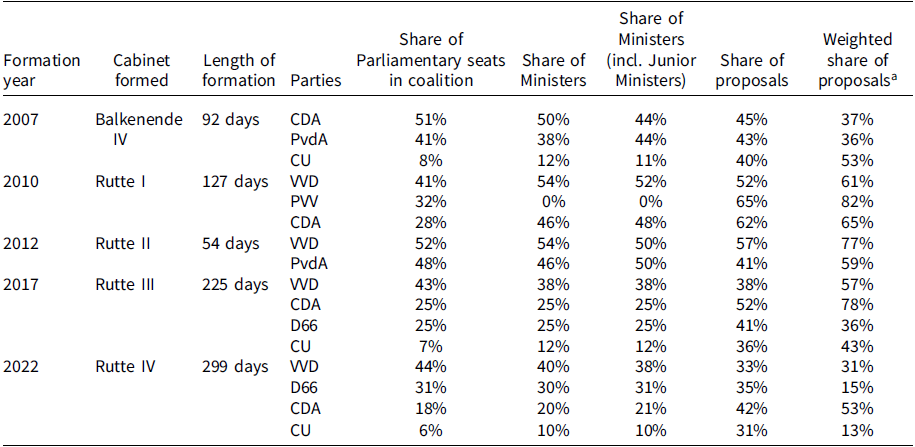
Table 1 shows the distribution of seats and ministries after the four coalition negotiations, as well as what share of their proposals was included in the coalition agreement. As can be seen, the share of ministers is proportional to the share of seats: the correlation between seats and ministries held by governing parties is 0.79 (full ministers only; 0.78 when including junior ministers). The share of proposals included does not conform to this pattern: the correlation with seat share is 0.27 for the share of proposals and 0.22 for the weighted share of proposals for cabinet parties.Footnote 16
Parties involved in coalition negotiations

a Weighted by the absolute budgetary effect of the proposal
Regression analysis results
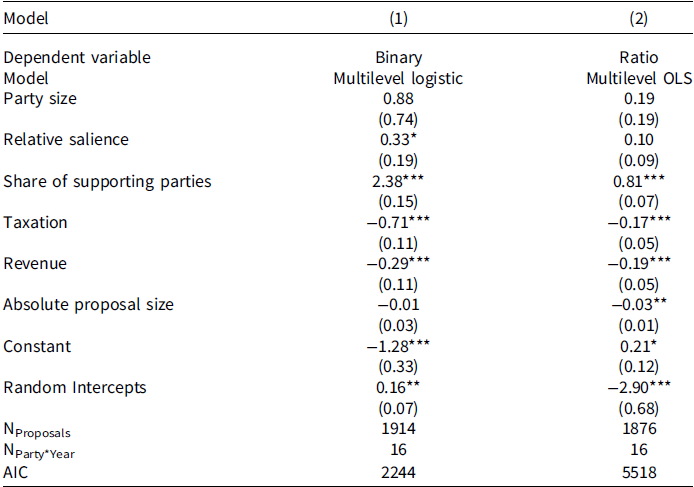
In Table 2, we present two regressions (for a binary inclusion variable and a linear share of the proposal included variable). Figure 2 and Figure 3 show the key results of the first analysis. We find strong support for our pre-negotiation coalition support hypothesis for both the binary and ratio dependent variables. As can be seen in Table 2, the coalition support variable is strongly statistically significant (at the .01 level) in both models 1 and 2. At the same time, as seen in Figure 2, the effect is also substantial in terms of the likelihood of a proposal being included in the coalition agreement. A proposal which is supported by 0% of the other coalition parties (i.e., is only supported by the party proposing it) has a one in four chance of being included in the coalition agreement. In contrast, a proposal which has the support of all other parties in the coalition has a three in four chance of being included in the coalition agreement, a threefold increase in the probability of inclusion.
Models of proposal inclusion in coalition agreement

* < 0.1, ** < .05, *** < .01. Standard errors in parentheses.
Pre-negotiation coalition support and the proposal’s inclusion in the coalition agreement.
Based on model 1, the estimated probability of proposal included, with 95% C.I.

Proposal inclusion in coalition agreement: seat share and relative salience.
Based on model 1, the estimated probability of proposal included, with 95% C.I.

In terms of the share of the budgetary demand of a proposal being realised, the substantial effect is also clear: when calculating the predicted probabilities of inclusion, if no other coalition party supports a policy, a party can expect that about a quarter of the proposal is realised. If all other coalition parties support the proposal, ninety percent of the budgetary demand is met in the agreement.
In contrast, we find little if any support for the ‘Party Size’ argument. This posits that the number of policy proposals a party gets included in the coalition agreement is a function of its size, with larger parties having more proposals included because they contribute more resources to the coalition. However, it is clear from Table 2 that no such effect is present for either dependent variable. The party size variable is not statistically significant, and, as can be seen from the left panel in Figure 3, there is essentially no change in the probability that a proposal gets included as the seat share of the party proposing it increases: a party that contributes half of the seats of a coalition gets the same share of its proposals included as a party that contributes less than 10% of the coalition’s seats.
The results for salience in Table 2 are less clear-cut. While ‘relative salience’ is significant at the 10% level, indicating that salience may matter in coalition negotiation, as shown in the right panel of Figure 3, the effect size is very modest: if a party spends comparatively little attention on an issue, the probability of a proposal entering the coalition agreement is 38%. If they spent a lot of attention on it compared to their partners, that probability only rises to 50%. Moreover, this pattern is not consistently significant: in Model 2 in Table 2 the effect is not significant. This lack of a consistently significant effect can also be seen in the models presented in the Appendix, where the level of significance depends strongly on model specification.
Overall, we thus find clear support for the pre-negotiation coalition support hypothesis, but no support for the party size argument and, at best, weak support for the salience argument.
To test the robustness of these results, we run 148 additional models, in which we control for alternative explanations and operationalisations, as discussed above. The results of these models are shown in Table B-1 through to Table B-12 in the Appendix. As can be seen, our findings are robust to these alternative specifications. The coefficient for share of supporting parties is statistically significant in all of the 126 models where it is included; in 123 of these, it is significant at the 0.01 level. In model 107, it is significant at the 0.1 level, but in that case, the highly collinear plenary support measure was included. The results are also consistent in terms of substantive effects. The alternative operationalisation, where we used the seat share in support of a policy instead of the number of parties endorsing a measure, was included in twelve models.Footnote 17 It performs much the same as the share of coalition measure, both in terms of substantive effect and in terms of the model fit. It is not the case that our findings simply reflect parties including proposals that they all agree on. In half of the models, we control for this: we do this in six models by removing the unanimous casesFootnote 18 and in 60 by controlling for unanimity.Footnote 19 Only when we drop the share of supporting parties is the unanimous support dummy variable consistently significant.Footnote 20 All in all, we find consistent support for the pre-negotiation coalition support hypothesis: the more other parties support a measure, the more likely it will be in the coalition agreement.
In contrast, the party size variable is only significant in six of the 148 additional models. The effect of party size is essentially zero in many models, and it is even negative nine times. There is no indication that there is a non-linear pattern where smaller parties are overcompensated for their participation. We can thus confidently reject the argument that party size drives policy payoffs.
The robustness tests provide slightly more, but not consistent, support for the salience argument. In 56 of the 148 additional analyses, we observe significant results; most of these are models where proposal size is taken into account and using the binary dependent variable. This does not replicate if we look at absolute salience. All in all, we do not find strong support for the notion that the likelihood of inclusion is a function of a party-dependent measure of salience, since it is only significant if we take into account the objective (financial) importance of a proposal.
In summary, the analysis finds strong and consistent support for the role of support from other coalition parties in getting a party’s policy proposals included in the coalition agreement. Simultaneously, we consistently find no evidence for party size mattering for the likelihood of proposal inclusion and weak and inconsistent evidence that relative salience matters. What drives the inclusion of policies in a coalition agreement is the overall support for them among cabinet parties, rather than proportionality or issue salience.
Conclusion
Most research on the question of ‘who gets what’ in coalition negotiations has focused on office payoffs; in contrast, our understanding of the payoffs in coalition agreements in terms of policy is relatively rudimentary. In this paper, we argued that policy payoffs are fundamentally different from office payoffs. While office payoffs are private in nature, policy benefits are not. At the same time, multiple parties can prefer the same policy change over the status quo and regularly do so. Further, the joint responsibility of all government parties for policies implemented on the basis of a coalition agreement means that including policies favoured by one party but which are opposed by most or all of the other parties in a coalition is electorally risky. As such, the distribution of policy payoffs should follow a different pattern than office payoffs.
Analysing a novel dataset of the revenue impacts of proposed policy changes in manifestos and coalition agreements, we found ample evidence that the more parties support a particular policy, the more likely that it will be included in the coalition agreement, using a number of different model specifications, while also finding that party size did not influence the likelihood of policy inclusion, nor did the (relative) salience of a policy to the negotiating parties. Overall, our findings indicate that coalition negotiations are not about forcing a particular distribution of a limited pie on the other negotiating political parties but about maximising utility for the negotiating parties.
While the data analysed in this paper covered a number of governments with very different compositions, a number of future avenues for work remain. In particular, the concrete policy payoffs obtained in coalition bargaining should be analysed in a wider range of countries. As the data covered both minority and majority governments, as well as variation in the number of parties included in the coalition, we would expect our findings to be robust to other institutional settings. It should be noted that, as the norm of proportionality is deeply embedded in the political system of the Netherlands (Lijphart Reference Lijphart1968), this makes the Netherlands a most-likely case for a ‘Gamsonian’ (i.e., proportional) distribution of policy payoffs, which we do not find; therefore, it is unlikely this pattern of policy inclusion in coalition agreements will appear in other countries. At the same time, the long tradition of coalition government in the Netherlands, and the frequency of these including more than two parties, may also influence patterns of coalition policy payoffs. As our data only cover one country, it cannot be explored here, but future (cross-national) work should do so.
While this is, to the best of our knowledge, the first time this kind of data has been used to analyse coalition negotiation payoffs, and these data so far only exist in the Netherlands and Belgium, our findings have a clear message for the comparative literature: because of the multidimensional nature of policymaking, multidimensional data are required to study it. It is thus key for our understanding of coalition policymaking that comparable data on policy payoffs are collected in other countries. In addition to allowing us to learn about policy payoffs in other countries in more detail, such cross-national data will also allow us to explore the effect of institutional factors, something which is rarely possible in a single-country study such as ours. While clearly a substantial endeavour, the insights to be gained from such data at a comparative level will be significant. Comparative and comparable multidimensional data on policy payoffs will allow for the analysis of the effects of key variables which primarily vary at the national level: electoral systems, majority or minority government, positive and negative parliamentarism, and bicameralism all have the potential to influence which policies are included in a coalition agreement, but we know very little about their effects. Cross-national data, when covering multiple coalition agreements for each country, will also allow one to explore how increasing voter volatility and polarisation, which makes it harder for parties to appeal to voters through policy offers (Wenzelburger and Zohlnhöfer Reference Wenzelburger and Zohlnhöfer2021), impacts coalition negotiation payoff patterns.
Overall, the results clearly indicate that different logics are at play when it comes to distributing payoffs for entering a coalition government. For office payoffs, where ministries are controlled by a single party, and where blame and responsibility can therefore be assigned to a single party, proportionality rules the day. However, for policy payoffs, where the responsibility will be shared among all governing parties, the overall utility of a policy to the coalition as a whole is what drives whether a policy proposal will be included in the coalition agreement or not.
Supplementary material
For supplementary material/s referred to in this article, please visit https://doi.org/10.1017/S1475676525100005.
Data availability statement
Please add, and if in a repository, then name and number replication files are available on the Harvard Dataverse: https://doi.org/10.7910/DVN/TB6T0P.
Acknowledgements
A previous version of this paper has been presented at the 2019 ECPR Standing Group on Parliaments Conference and the 2020 Conference of the Swiss Association for Political Science. We would like to thank the attendees, as well as Wimar Bolhuis, the anonymous reviewers, and the editors for their feedback and suggestions, which greatly improved the paper.



 Open access

