


Introduction
Infrastructures resulting from development and global human population growth represent an increasing cause of wildlife mortality. Birds in particular are killed on roads by motor vehicles (Guinard et al. Reference Guinard, Julliard and Barbraud2012), in air strikes with aircraft (Dolbeer and Aviation Reference Dolbeer and Aviation2015), and collision with buildings (Klem Reference Klem1990, Machtans et al. Reference Machtans, Wedeles and Bayne2013, Loss et al. Reference Loss, Will, Loss and Marra2014), with wind energy facilities (De Lucas et al. Reference De Lucas, Janss, Whitfield and Ferrer2008, Smallwood and Thelander Reference Smallwood and Thelander2008, Loss et al. Reference Loss, Will and Marra2013), communication towers (Longcore et al. Reference Longcore, Rich, Mineau, MacDonald, Bert, Sullivan, Mutrie, Gauthreaux, Avery, Crawford, Manville, Travis and Drake2013), and more recently, solar power tower facilities (Diehl et al. Reference Diehl, Valdez, Preston, Wellik, Cryan, Usgs, Rocky and Science2016). Human-made structures and moving objects impacting flying vertebrates are a growing worldwide conservation concern (Lambertucci et al. Reference Lambertucci, Shepard and Wilson2015). For birds of prey, electrocution on power lines is one of the most important mortality factors associated with human-made structures (Van Rooyen and Ledger Reference Van Rooyen, Ledger, Ferrer and Janss1999, APLIC 2006, Lehman et al. Reference Lehman, Kennedy and Savidge2007, Kemper et al. Reference Kemper, Court and Beck2013). Bird of prey mortality by electrocution can wipe out some raptor populations from vast areas (Sergio et al. Reference Sergio, Marchesi, Pedrini, Ferrer and Penteriani2004) and was the main factor behind the decrease of several bird of prey populations across the world, some of them highly endangered (Bevanger and Overskaug Reference Bevanger, Overskaug, Chancellor, Meyburg and Ferrero1998, Real et al. Reference Real, Grande, Mañosa and Sánchez-Zapata2001, Angelov et al. Reference Angelov, Hashim and Oppel2012). Electrocution of birds of prey on power lines results from the interaction of three main components: biology, environment and engineering (APLIC 2006). The biology aspects that bias bird electrocutions are body size, age, behaviour and prey availability. Bird of prey vulnerability to electrocution is mainly driven by their body size as this group has several of the largest species among flying birds. Besides, birds of prey spend a considerable time perched and thus are prone to use power pylons as perching sites, especially in environments where natural perches are scarce (Dwyer et al. Reference Dwyer, Kratz, Harness and Little2015). In North America and South Africa, size is the most important factor explaining bird electrocution risk (APLIC 2006). Thus, large eagles are the most common victims in USA while in South Africa the victims are vultures (Lehman et al. Reference Lehman, Kennedy and Savidge2007). The environmental component includes habitat structure and characteristics of the location of the power lines. Electrocution is more common in open areas where high quality perching sites for birds of prey are scarce (Lehman et al. Reference Lehman, Kennedy and Savidge2007). Within the engineering component, the material with which pylons are built, and their design are key factors that facilitate or prevent bird electrocution incidents. In Europe for example, the size of birds is less important in electrocution events than in the USA, because while in the latter most pylons are made of wood, in Europe most pylons are made of conductive steel or concrete with steel cross-arms (Negro and Ferrer Reference Negro and Ferrer1995) and thus are earthed. When a bird of even small size perches on the pylon it can be electrocuted just by touching any conducted wire while perched (Negro et al. Reference Negro, Ferrer, Santos and Regidor1989). In the case of wooden poles, typically the bird needs to contact at least two wires to be electrocuted, meaning that it has to have a minimum wingspan to be at risk.
Avian electrocution, a recognised threat for birds in North America (Harness and Wilson Reference Harness and Wilson2001, Lehman Reference Lehman2001), Europe (Ferrer et al. Reference Ferrer, Riva and Castroviejo1991, Bevanger Reference Bevanger1994, Negro Reference Negro, Ferrer and Janss1999, Rollan et al. Reference Rollan, Real, Bosch, Tintó and Hernández-Matías2010), South Africa (Ledger and Annegarn Reference Ledger and Annegarn1981, Van Rooyen and Ledger Reference Van Rooyen, Ledger, Ferrer and Janss1999, Kruger et al. Reference Kruger, Maritz, Van Rooyen, Chancellor and Meyerburg2004) and Asia (Lasch et al. Reference Lasch, Zerbe and Lenk2010, Shobrak Reference Shobrak2012, Voronova et al. Reference Voronova, Pulikova, Kim, Andreeva, Bekker and Aitbaev2012, Harness et al. Reference Harness, Juvvadi and Dwyer2013), has been totally ignored in the Neotropics. For southern South America, there are just anecdotal reports referring to casual raptor electrocution events (Jiménez and Jaksic Reference Jiménez and Jaksic1990, Alvarado Orellana and Roa Cornejo 2010, Nolazco and Conde Reference Nolazco and Conde2010, Ibarra and De Lucca Reference Ibarra and De Lucca2015) but no specific standardised assessment of the impact of this mortality factor has been done.
The endangered Crowned Solitary Eagle Buteogallus coronatus is one of the largest birds of prey ranging in South America. It is a long-lived raptor with delayed maturity and low fecundity (no more than one fledgling per pair can be produced each year as they lay a single egg) that inhabits open semi-arid forests in different biomes from southern and central Brazil, Bolivia and Paraguay to northern Patagonia in Argentina (Ferguson-Lees and Christie Reference Ferguson-Lees and Christie2001, authors’ unpubl. data). The species is listed as ‘Endangered’ by IUCN with a global reproductive population estimated at less than 1,000 mature individuals and a decreasing trend (BirdLife International 2016). Although the main factors threatening the species are thought to be high non-natural mortality by human persecution (Sarasola and Maceda Reference Sarasola and Maceda2006, Sarasola et al. Reference Sarasola, Santillán and Galmes2010, Barbar et al. Reference Barbar, Capdevielle and Encabo2016) and habitat loss (Bellocq et al. Reference Bellocq, Ramírez-Llorens and Filloy2002, Fandiño and Pautasso Reference Fandiño and Pautasso2013), there is evidence that they suffer unquantified mortality by other human related factors such as electrocution in power lines (Chebez et al. Reference Chebez, Maceda, Pereyra-Lobos and Chebez2008). Here we quantified susceptibility to electrocution and electrocution rates for birds of prey in arid and semi-arid biomes of central Argentina where we have been studying Crowned Solitary Eagles since 1999. In the area we have identified around 30 breeding territories of the Crowned Solitary Eagle. Our aim was estimate minimum yearly electrocution rates for this endangered species and other birds, as well as to assess some biotic and abiotic factors that may determine electrocution risk for birds in the area.
Material and methods
Study area
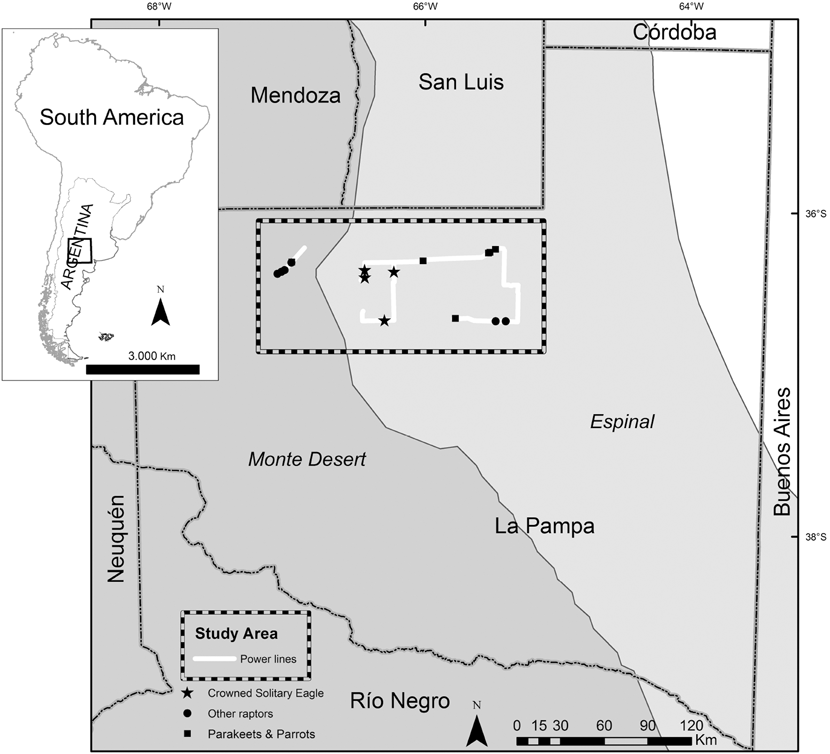
The study area covered approximately 12,000 km2 in mid-western La Pampa province, central Argentina (Figure 1). The study area hold two ecoregions, the Espinal in the eastern portion and the Monte Desert towards the west (Brown et al. Reference Brown, Martinez Ortiz, Acerbi and Corcuera2006). Typical vegetation within the Espinal includes xerophytic deciduous forests characterised by trees of the genus Prosopis. In its southern portion, where our study area is located, the dominant tree is the Caldén Prosopis caldenia. The typical vegetation of the Monte Desert ecoregion is a high shrub steppe, mostly characterised by Larrea sp. communities with isolated Prosopis sp. trees. In both ecoregions, the climate is temperate-arid with very high temperatures in summer (up to 45° C) when most of the scarce rainfall falls (80–300 mm yr-1 for the Monte and 300–550 mm yr-1 for the Espinal region) (Fernandez and Busso Reference Fernandez and Busso1997). In the study area we have been monitoring a variable number of breeding territories of the Crowned Solitary Eagle since 1999. We estimate that there may be around 30 territories although we have not found more than 10 active nests in a single year. Furthermore, genetic data under analysis suggest that some breeding pairs move between what we consider different breeding territories so the actual number of occupied territories could be lower than our estimates.
Power lines surveyed and electrocuted bird records in our study area in La Pampa province, Argentina, from November 2011 to December 2012.
Power line surveys
From November 2011 to December 2012, we surveyed all the available power lines located along paved or dirt public roads on public land within the study area (Figure 1). The monitored power lines were all distribution lines of 13.2 kv voltage with a single or three phase distribution lines (energised conductors). Surveys were performed by an observer driving a motorcycle beneath the power lines and monitoring 3,118 pylons along 355 km. These surveys were repeated six times during the study period at an interval of two months between visits. On each visit we inspected a 10 m radius around each pylon looking for carcasses and searched for birds in the area below the line between pylons when vegetation and topography allowed motorcycle transit (Janss Reference Janss2000, Kemper et al. Reference Kemper, Court and Beck2013). Dead birds beneath pylons were considered electrocuted when we were able to unequivocally identify electrocution signs such as burned beaks, wings or legs. Carcasses without electrocution signs or uncertainty on the cause of death were not considered in the analyses. When possible we also recorded the age and sex of electrocuted birds.
In order to evaluate the electrocution risk for each pylon design present in the study area, we described its structural characteristics, including the type of material used for its construction (wood or concrete), presence/absence and position of jumpers, and type and position of insulators. In order to evaluate the effect of the surrounding vegetation on the electrocution cases, we determined the vegetation physiognomy in a radius of 50 m around each pylon surveyed. Vegetation physiognomy was classified in three main classes as grassland, scrubland or forest.
Abundance of birds of prey
To evaluate electrocution susceptibility of birds of prey in the area, we assessed their relative abundance by conducting raptor road surveys along the same roads where surveyed power lines were located. Road surveys were also carried at the same bi-monthly interval as power lines surveys. Bird of prey surveys were conducted by car at a constant speed of approximately 40 km/h (Fuller and Mosher Reference Fuller and Mosher1987, Andersen Reference Andersen, Bird, Bildstein and Surrey2007). We counted every individual observed along roads and their behaviour (perched on trees/pylons/ground or flying). We also recorded vegetation physiognomy surrounding observed birds. All the information on power lines and road surveys was georeferenced and stored in a tablet device with a built-in GPS (Global Positioning System) using the free software Cybertracker (CyberTracker Software (Pty), http://www.cybertracker.co.za).
Data analysis
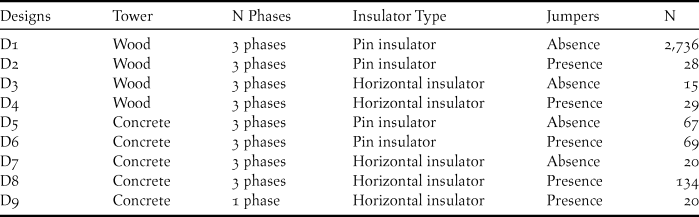
We classified pylon designs in our study area according to all possible combinations of the following variables: the material of which the pylon was built, the number of electric phases, the type of insulators and the presence/absence of jumpers (Table 1, Figure 2). These combinations provided nine possible pylon designs named D1 to D9 (Table 1).Given that electrocution events are relatively rare events given the number of pylons (one approximately per 100 m of power line) our database had a large number of zeros (no event of electrocution detected) and a very small probability of actual electrocution. Therefore, to evaluate the effect of pylon design on bird electrocution probability we used Firth’s penalised-likelihood logistic regression (Firth Reference Firth1993), a modelling approach that allows reduction of small-sample bias in maximum likelihood estimation. The binary response variable took values of 0 (no electrocuted birds recorded in a particular pylon) and 1 (at least one electrocuted bird found below the pylon in at least one of the six bi-monthly surveys). The design of the pylon (categories D1 to D9) and the physiognomy of vegetation around the pylon were included in the models as categorical variables with nine and three levels, respectively.
Models of power pylon designs observed in the study area defined by the type of material of the pylon, the number of phases, the type of insulators and the presence/absence of jumpers.
Typical power line designs in the study area: (A) concrete pylons with presence of jumpers above the cross-arm, horizontal insulators and three-phases (D8 design) or (B) single-phase (D9 design), (C) with pin insulators and jumpers above the cross-arm (D6 design) and (D) the most frequent design, wood pylon with pin insulators and without jumpers (D1 design).

We also built logistic regression models to evaluate which were the most dangerous components for birds in the power pylon design. The response variable was again the absence/presence of electrocuted birds while the explanatory variables were pylon material (concrete or wood), jumpers (presence or absence), type of insulators (pin or horizontal) and all the two-way interactions.
In all the analyses we followed a backward stepwise procedure starting from a full model which included the main effects as well as all the two-way interaction effects of the explanatory variables. Each variable was tested for statistical significance comparing the most general model including the variable with a simplified model without it. Significance was tested using ANOVA and only significant effects (P < 0.05) were retained in the final model. The statistical analyses were performed with the ‘Logistf’ package (Heinze et al. Reference Heinze, Ploner and Beyea2013) in R statistical software version 3.2.3 (R Development Core Team 2016). R Foundation for Statistical Computing, Vienna, Austria, www.R-project.org).
We estimated the bird electrocution rate by species (number of carcasses by species/year), and season (autumn-winter, spring-summer), by type of pylon design (number of carcasses/year) and by vegetation physiognomy. To evaluate whether species electrocution risk was related to the species size, we examined the relationship between species wingspan (i.e. maximum distance between wingtips) and the observed electrocution rate (ratio between species relative field abundance and number of electrocution events in which each of them was involved) using the Spearman correlation test.
Results
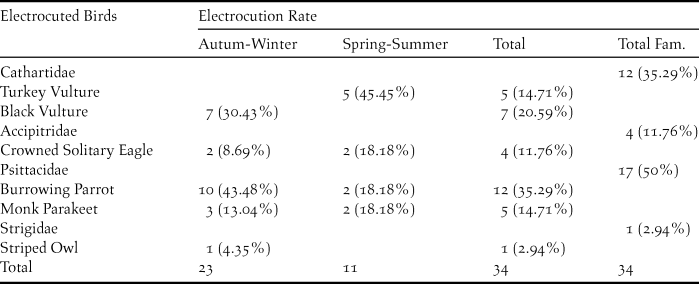
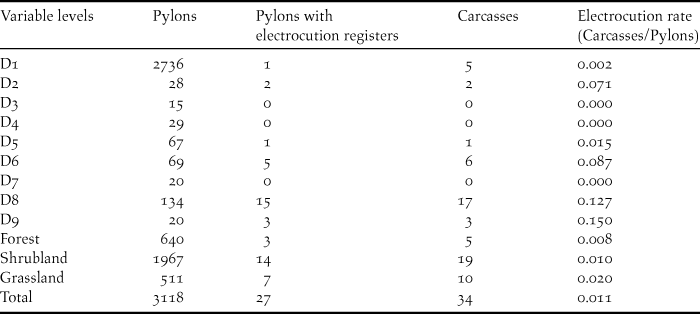
During systematic power line surveys we found 34 dead birds beneath 27 pylons (0.8%) of 3,118 monitored pylons and thus the minimum annual bird electrocution rate was 0.011 bird/pylon/year. Four of the electrocuted birds (11.76%) were Crowned Solitary Eagles (all electrocuted Accipitrids were of this species). Two were juveniles and two were adults. Besides Crowned Solitary Eagles, five additional species corresponding to three additional families were electrocuted: Psittacidae (50%), Cathartidae (35.29%), and Strigidae (2.94%). The species with the highest electrocution rate was the Burrowing Parrot Cyanoliseus patagonus (rate = 12 birds/year) followed by the Black Vulture Coragyps atratus (rate = 7 birds/year) (Table 2). We found more electrocuted birds in autumn-winter (n = 23) than in spring-summer (n = 11). The only species that showed a balanced mortality between seasons was the Crowned Solitary Eagle with two dead eagles in each season (Table 2). Highest electrocution rates were observed in concrete pylons (D5, D6, D8 and D9 designs) with presence of jumpers above the cross-arm (D6, D8 and D9) (Table 3). Electrocution events on wood pylons were recorded in two (D1 and D2) out of three designs of pylons built with this material (Table 3).
Number and percentage of electrocuted birds in our study area from Spring 2011 to Spring 2012, segregated by season (autumn-winter, spring-summer) and by bird species.
Number of electrocuted birds and electrocution rate of birds in the study area, from Spring 2011 to Spring 2012, segregated by pylon designs and vegetation physiognomy.
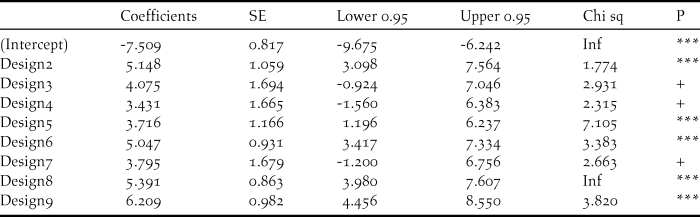
Electrocution probability was determined by pylon design (Table 4). Wood-made pylons with three phases, pin-type insulators and without jumpers (D1) had a lower than expected probability of electrocution while five pylon designs (D2, D5, D6, D8 and D9) had a significantly high probability of bird electrocution. The most dangerous pylons included concrete pylons with jumpers above the cross-arm (three designs), concrete pylons with pin-type insulator and no jumper and wood pylons with pin-type insulator and jumper above the cross-arm (Table 4). Using a binomial approach taking only into account presence/absence of electrocuted birds could underestimate mortality risks associated to certain pylons if multiple individuals get electrocuted in the same pylon. Although multiple electrocuted birds under the same pylon were rarely found in our study (only three cases), we also modelled number of birds electrocuted on each pylon design against a Poisson distribution (Kemper et al. Reference Kemper, Court and Beck2013). The results of these analysis were similar to the ones reported here, except that D5 pylon design, where a bird was found electrocuted and considered as dangerous in the logistic regression, was considered not dangerous (see Appendix S1 and Table S1 in the online supplementary material).
Firth’s penalized-likelihood logistic regression on electrocution probability for birds according to pylon design in La Pampa Province, Argentina. (*** = P-value < 0.01, + = P-value > 0.05).
Electrocution rate on pylons located on grasslands was twice the electrocution rate on those located in scrublands or forests (Table 3). However, neither vegetation physiognomy (χ2 = 0.99, df = 2, P = 0.6) nor the interactions between physiognomy and pylon design were statistically significant (χ2 = 8.74, df = 14, P = 0.85).
The most dangerous components of power pylon designs were the building material and the presence of jumpers, with concrete pylons (coefficient = 1.45 ± 0.77, χ2 = 4.66, df = 1, P = 0.03) and pylons with jumpers (coefficient = 3.54 ± 0.91, χ2 = 19.98, df = 1, P < 0.01). Type of insulator was not selected by the model (χ2 = 0.12, df = 1, P = 0.73) neither their interaction with pylon material (χ2 = 2.17, df = 1, P = 0.14) nor presence of jumpers (χ2 = 0.05, df = 1, P = 0.82). The interaction between pylon material and presence of jumpers was not significant (χ2 = 3.07, df = 1, P = 0.08).
Bird of prey surveys and electrocution susceptibility
Twelve species of birds of prey were recorded in the road surveys conducted at the study area (Table 5). Abundance of birds of prey was higher in Spring-Summer than during Autumn-Winter seasons, with the American Kestrel Falco sparverius being the most abundant species followed by the Crested Caracara Caracara plancus and the Turkey Vulture Cathartes aura. Based on the abundance/mortality ratio, Crowned Solitary Eagles showed disproportionately higher electrocution susceptibility throughout the year than the rest of the species (Table 5).
Birds of prey recorded (N) along road surveys and their relative abundance (RA) (individuals/km travelled) segregated by seasons (autumn-winter = AW, spring-summer = SS). Total number (TN), total relative abundance (TRA) as percentage as well as number of electrocuted birds (E), the ratio electrocuted/observed birds (E/TN) and mean wingspan (MW) expressed in cm. Wingspan data was extracted from Fergusson-Lees and Christie (2001).
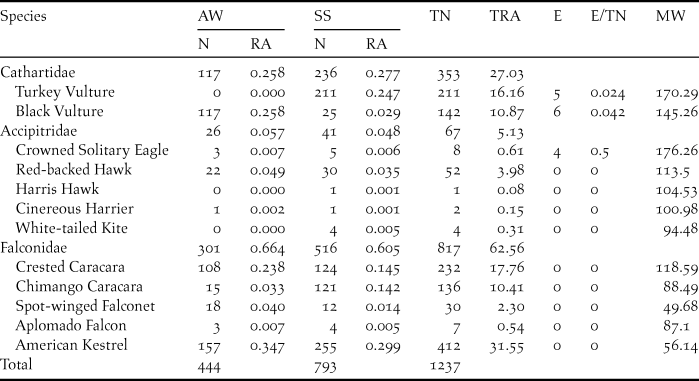
Susceptibility to electrocution was positively and significantly correlated with the species wingspan (rho = 0.75, P < 0.01, n = 12). Larger birds of prey had higher electrocution rate than smaller species, and there were no records of electrocuted raptor species with wingspan values smaller than 120 cm (Table 5). This was more revealing considering not only the low frequency of records of large vs. small birds of prey (27.65% of observations corresponded to species with wingspan > 120 cm) but also comparing the behaviour of these birds. Only 7% of the largest birds of prey were recorded perched on power lines during road surveys in contrast with 58.6% of smaller birds of prey.
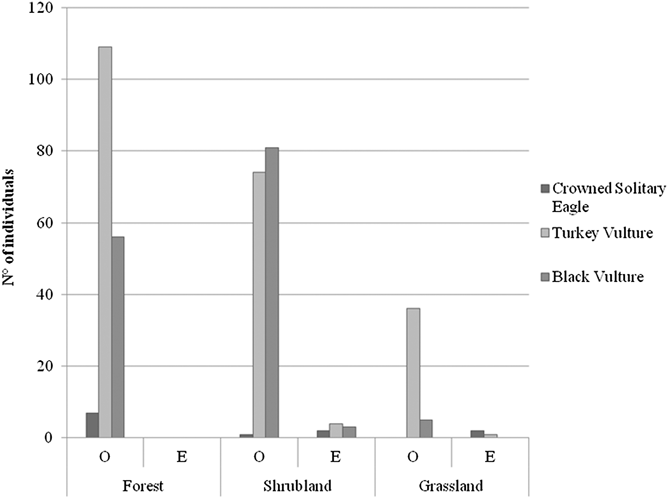
During the censuses, birds of prey were recorded evenly at the three types of vegetation physiognomies. However we did not find electrocuted birds of prey in forests. In contrast, we recorded two electrocution events of Crowned Solitary Eagles on grassland where the species was not observed during road surveys (Figure 3).
Number of Crowned Solitary Eagles, Turkey Vultures and Black Vultures electrocuted (E) and observed along road surveys (O) segregated by vegetation physiognomy (forest, scrubland and grassland).
Discussion
This study represents the first systematic assessment of electrocution risk for birds in South America. The electrocution rate found here, a minimum of 0.011 bird/pylon/year, is within the ranges found in other studies although in some cases well above them (Kemper et al. Reference Kemper, Court and Beck2013). This suggest that at least in some areas, this mortality factor poses a significant risk to South American birds of prey, and particularly to endangered birds such as the Crowned Solitary Eagle but has been completely overlooked over the years.
Previous studies have shown that particular power pylon characteristics may increase or reduce the risk of bird electrocution (Negro Reference Negro1987). Our results indicate that concrete pylons and the presence of jumpers above the cross-arms are the most dangerous characteristics in electric pylons in our study area. These two characteristics were found in the three most dangerous pylon designs identified. The two pylon designs with higher bird electrocution rates corresponded to those made of concrete with jumpers above the cross-arm and having horizontal insulators. The presence of jumpers above the cross-arm seems to be the most impacting factor as was present in four of the five pylon designs with significantly high electrocution rates. As expected, these jumpers above the cross-arms increase the probability of birds touching the electrified jumper and another structure, earthed or electrified, and thus closing the circuit. The building material and particularly those poles made of concrete were also very dangerous (present in four of the dangerous pylon designs) as they provided an earthed structure helping to close electric circuits. However, it should be noted that the four concrete pylons considered to be dangerous had also a structure above the cross-arm that helped to close the circuit like jumpers (3 cases) and pin type insulators. The only design of concrete with no structure on top of the pylon (D7) was safe. This suggests that concrete pylons become a threat when they have electrified structures above the cross-arms but can be safe if the cross-arm design is appropriate. Wooden pylons without jumpers and concrete pylons with horizontal insulators but without jumpers were the most secure pylon designs for birds of prey in our study. Our results once more point to the need to specifically assess the pylon designs used in each area to identify which particular designs are more dangerous so particular correction measures can be applied to already existing power lines.
The Crowned Solitary Eagle was disproportionately affected by this mortality source when compared with its low abundance. It was one of the birds of prey more frequently involved in electrocution events suggesting that this source of mortality is particularly high and worrisome for this endangered species. We estimate the existence of around 30 Crowned Solitary Eagle breeding territories in the area, although probably not all of them simultaneously occupied (we found only a maximum of 10 breeding pairs per year; authors’ unpubl. data). Our data would indicate that a minimum of 3.33 % (considering 10 active breeding pairs per year, it would be 10%) of the breeding adults would die per year. In addition, mean yearly productivity in the area is 0.6 fledglings per pair (authors’ unpubl. data) but our results indicate that 11.11% of the produced fledglings could die per year by electrocution. These high mortality values, and particularly adult mortality, are especially worrisome in the context of long-lived species with delayed maturity and low fecundity such as the Crowned Solitary Eagle that are especially vulnerable to increases in non-natural mortality. Other large eagles formerly threatened by electrocution in Europe have increased their populations after mitigation measures were applied to dangerous power lines (e.g. López-López et al. Reference López-López, Ferrer, Madero, Casado and McGrady2011, Chevallier et al. Reference Chevallier, Hernández-Matías, Real, Vincent-Martin, Ravayrol and Besnard2015). Therefore, besides assessing the impact of this mortality factor in other areas of the country and in other type of pylons, it is critical to take action and start to retrofit dangerous pylons in our study area.
We found a high relative frequency of Psittacids among electrocuted birds. Electrocution of Monk Parakeets Myiopsitta monachus has been recorded in the introduced populations in the United States where their large communal nests can cause outages and fires (APLIC 2006). However, Psittacids are rarely found as victims of electrocution elsewhere. We found electrocuted individuals of two of the three species of Psittacids that regularly occur in the study area, suggesting that power lines can be an important mortality factor for this group of birds in certain circumstances. Given the high rate of endangered species among parrots, we suggest that special attention should be paid to this mortality factor in other areas where endangered parrots occur.
Seasonal changes in species composition and weather may produce variations in bird electrocution rate (Lehman et al. Reference Lehman, Kennedy and Savidge2007). In our study, even when some migratory species like Turkey Vultures were only present in the study area in spring-summer, the highest electrocution rates were found in autumn-winter. This result may be explained by particularities of the two species with higher electrocution rates, Burrowing Parrot and Black Vulture. The Burrowing Parrot Cyanoliseus patagonus makes seasonal movements with some populations going to north and central Argentina from southern locations (Collar Reference Collar, del Hoyo, Elliott and Sargatal1997). High numbers concentrate in some parts of our study area in winter, probably explaining the seasonal electrocution pattern found in this species. The Black Vulture is resident in our study area (Ferguson-Lees and Christie Reference Ferguson-Lees and Christie2001, Narosky and Izurieta Reference Narosky and Izurieta2010). However, raptor surveys indicated that the species was four times more abundant in autumn-winter than in spring-summer, suggesting the arrival of vultures from other areas in the colder season. Higher abundance in autumn-winter as well as its sociality could partially explain the seasonal bias in mortality in this species.
Size of birds of prey was another relevant factor in explaining their probability of electrocution, as the largest, Crowned Solitary Eagles, Black Vultures and Turkey Vultures, were the birds most susceptible to electrocution. Some species-specific traits, such as social behaviour and gregariousness, seem to facilitate electrocution susceptibility in some of them, even in the less dangerous pylon designs. Burrowing Parrots tend to perch in large numbers in wires and poles, usually very close (literally touching each other) increasing the chances of touching two powered or a powered and an earthed element of the pylon, producing a mortality event that can involve more than one bird. Five Black Vultures died together on the same pylon in the largest multiple electrocution event we found. This electrocution event happened in the neighbourhood of a predictable and abundant food source, a slaughterhouse. The pylon was a D1 design pylon, supposedly one of the safest. However, interactions of birds, typical of social species such as Black Vultures may produce electrocutions incidents in otherwise safe places. Aggregations of individuals can create authentic electrocution black spots and therefore particular attention should be paid to power lines in areas where those aggregations are expected to occur.
Our results are worrisome and have highlighted a so far overlooked mortality source for birds in South America. However, we did not perform any analysis of carcass removal by scavengers and we could not estimate the incidence of crippling (Dwyer and Bednarz Reference Dwyer and Bednarz2006) and thus our results should be taken as a minimum estimate of the actual number of electrocuted birds. The removal rate of bird carcasses by scavengers can be very high, up to 70% in some cases (Ferrer et al. Reference Ferrer, Riva and Castroviejo1991) so the absolute number of electrocuted birds is surely underrepresented in this study, especially for smaller electrocuted birds that will probably disappear quicker by scavenger removal.
Besides the unnecessary death of a wild bird, electrocution events can produce cuts or peaks in energy supply affecting the quality of the service provided by electricity companies (Harness and Wilson Reference Harness and Wilson2001), and even wild fires in natural or urban areas when electrocuted birds sometimes fall on fire (Lehman and Barrett Reference Lehman and Barrett2000, APLIC 2006). The implementation of measures to mitigate bird electrocutions is thus relevant not only for conservation biologists, but for electricity companies and entire local communities. Usually electrocution incidents occur in a few pylon designs. In our study area, these pylons were only 10.2 % of the power pylons systematically monitored. Therefore, the change or modification of a small fraction of pylons would severely reduce electrocution incidents. Besides modifying already installed lines, it would be necessary to use safe designs for birds in new lines. Particularly, jumpers above the cross-arm or any electrified structure that could increase electrocution probability for birds should be avoided or modified.
Further studies identifying dangerous power pylon designs across ecosystems and countries in South America are urgently needed, so proper modifications can be applied in each case. Furthermore, new legal dispositions should be established to ensure that from now on, new power lines are designed not only to give a secure and reliable service for humans but also safe for wildlife.
Supplementary Material
To view supplementary material for this article, please visit https://doi.org/10.1017/S0959270917000272
Acknowledgements
This work was supported by The Peregrine Fund and Becas Conservar La Argentina, Aves Argentinas/AOP. M. A. Galmes was supported by a doctoral fellowship from the Agencia Nacional de Promoción Científica y Tecnológica de Argentina (ANPCyT). We thank the local landowners and Jaguel del Monte and La Pastoril schools from La Pampa province for their help in the logistic support. We want to thank Joaquín Cereghetti, Fernando Urquiza and Laura Beinticinco for their strong support and help in the fieldwork.



