





Introduction
Home-based palliative care has gained traction for its demonstrated potential to reduce acute healthcare utilization and futile treatments at the end-of-life (Aldridge and Bradley Reference Aldridge and Bradley2017; Erdtmann Reference Erdtmann2015; US Centers for Medicare & Medicaid Services 2015). Research suggests that the provision of home-based palliative care is associated with enhanced patient quality of life, reduced symptom burden, fewer and shorter hospital visits, and an increased likelihood of dying at home (Gomes et al. Reference Gomes, Calanzani and Curiale2013). The presence of home-based palliative care providers plays a crucial role in delivering essential support to patients within their own homes (Roberts et al. Reference Roberts, Robertson and Ojukwu2021) and empowering family caregivers to provide better care for their loved ones (Gonzalez-Jaramillo et al. Reference Gonzalez-Jaramillo, Fuhrer and Gonzalez-Jaramillo2021). Ultimately, home-based palliative care holds the potential for a lasting impact by enabling patients to receive care and pass away in their homes (Rees-Roberts et al. Reference Rees-Roberts, Williams and Hashem2021; Wang et al. Reference Wang, Aldridge and Gross2016b).
Despite the benefits of home-based palliative care, a notable proportion of patients receiving homecare still experience multiple hospital visits toward the end of their lives. The percentage of individuals who had more than 1 hospitalization in the last 90 days before death ranges from 21% to 53% (Abraham and Menec Reference Abraham and Menec2016; Wang et al. Reference Wang, Aldridge and Gross2016b). Research suggests that various factors contribute to increased healthcare utilization, including age, gender, comorbidity, caregiver burden, the capacity of home-based palliative service, and advance care plans (Abraham and Menec Reference Abraham and Menec2016; Goldenheim et al. Reference Goldenheim, Oates and Parker2014; Nguyen et al. Reference Nguyen, Haupt and Duan2022; Phongtankuel et al. Reference Phongtankuel, Johnson and Reid2017; Salam-White et al. Reference Salam-White, Hirdes and Poss2014; Sundararajan et al. Reference Sundararajan, Bohensky and Moore2014; Tay et al. Reference Tay, Choo and Ong2021; Wang et al. Reference Wang, Aldridge and Gross2016b). Qualitative studies have shed light on the reasons behind heightened healthcare utilization, such as caregivers’ limited ability to provide needed care, uncertainties about disease prognosis and mortality, and concerns regarding patient safety (Evans et al. Reference Evans, Cutson and Steinhauser2006; Mercadante et al. Reference Mercadante, Piccione and Spinnato2022; Phongtankuel et al. Reference Phongtankuel, Scherban and Reid2016). Although these studies provide valuable insights, their focus was exclusively on the frequency of hospitalizations during a cross-sectional period preceding death (such as the last 2 months of life), highlighting it as a negative indicator.
In our longitudinal study involving patients receiving home-based palliative care, we observed that 32% of them had a persistently high trajectory of healthcare utilization, while 44% had a low-stable trajectory (healthcare utilization, here, encompasses emergency department visits, outpatient hospital visits, and hospitalization) (Zhuang et al. Reference Zhuang, Chong and Ong2022). This finding confirms the presence of distinct patterns in acute healthcare utilization among end-of-life patients over time. The study identified various demographic, financial, and baseline clinical factors that distinguished these trajectories. However, it remains unclear which circumstantial elements contribute to differentiating between low and high acute healthcare utilization, as this aspect has yet to be thoroughly explored.
Gaining a fuller understanding of the factors that contribute to variability in healthcare utilization is essential for developing targeted interventions to meet the specific needs of patients receiving home-based palliative care and their family caregivers. Therefore, this study aimed to explore and compare the situational determinants that differentiate patients in the “persistently high” and “low stable” trajectories of healthcare utilization, while both continued to receive palliative care support at home.
Methods
Setting
In Singapore where this study was conducted, patients in the last year of life account for 50% of healthcare cost per capita of $60,000 (US$ 47,000) (Yan et al. Reference Yan, Kwan and Thumboo2019). Cancer is one of the leading causes of mortality, constituting nearly 30% of total deaths. With growing preferences to be cared for and die in the comfort of homes, the need for quality home-based palliative care has been increasingly emphasized over the years (Chiang and Kao Reference Chiang and Kao2021; Ho et al. Reference Ho, Akhileswaran and Pang2017; MOH 2020). Similar to homecare models in the US (US Centers for Medicare & Medicaid Services 2015) and UK (Rees-Roberts et al. Reference Rees-Roberts, Williams and Hashem2021), the model in Singapore offers in-person home visits, loan of equipment, home rehabilitation, and round-the-clock telephone support to patients with a life expectancy of less than 1 year. HCA Hospice Care (HCA) is the largest homecare provider, handling nearly 60% of patients nationally (Goh and Shaw Reference Goh and Shaw1994). Funded by government and charitable organizations, HCA serves more than 3,000 patients per year, of which 80% have cancer diagnoses. HCA’s homecare services are free of charge (Ho et al. Reference Ho, Akhileswaran and Pang2017).
Participants’ recruitment
This study was conducted following a retrospective cohort study investigating longitudinal patterns and predictors of acute healthcare utilization in cancer patients on home-based palliative care (Zhuang et al. Reference Zhuang, Chong and Ong2022). We recruited bereaved family caregivers of patients who belonged to a “persistently high” or a “low stable” trajectory of healthcare utilization based on the results of group-based multi-trajectory modelling (i.e., a form of finite mixture modelling to distinguish trajectories for multiple related outcomes) (Bates et al. Reference Bates, Saria and Ohno-Machado2014; Nagin Reference Nagin2005) (Supplementary Figure S1). Eligibility also included patients with a primary diagnosis of cancer, enrolled and utilized HCA’s homecare for at least 1 month, and died within 9 months from the interview date. Invitation letters containing study background information were sent to purposively selected family caregivers according to utilization trajectories and gender of patients. One week after sending the letter, we initiated the contact with caregivers through telephone calls. A total of 125 family caregivers were approached and 30 caregivers agreed to participate in the interviews. Reasons for the decline included lack of interest and competing priorities. Prior to interviews, written and verbal consent was sought.
Data collection
The interview guide was developed based on study objectives and existing literature (Ellington et al. Reference Ellington, Cloyes and Xu2018b; Liu et al. Reference Liu, Liu and Zheng2021; Salifu et al. Reference Salifu, Almack and Caswell2021). The research team comprised palliative medicine physicians, a social scientist, and public health researchers with extensive experience in end-of-life care and healthcare utilization. Broad areas of interest included overall experiences with home-based palliative care, context and process of decision-making for healthcare utilization (focusing on hospitalization and emergency department visit), factors influencing the use (or non-use) of hospital healthcare services and communication with homecare professionals (Supplementary material). The interview guide was pilot tested with 2 caregivers (data not included) and iterated to refine phrasing as data collection continued. In-depth interviews were conducted virtually by 2 study team members experienced in qualitative research (HG and SY) and audio recorded. Interview durations ranged from 65 minutes to 127 minutes, with an average duration of 75 minutes. The wide difference in interview length can be partially attributed to the caregivers’ reactions to our questions and their emotional states. The caregivers’ experience of supporting loved ones with cancer was profoundly personal and unique. Some caregivers provided more elaborated accounts, while others focused on specific aspects of healthcare utilization. Field notes were taken during the interviews. This study was approved by SingHealth Institutional Review Board (CIRB: 2020/2448).
Data analysis
The interviews were transcribed verbatim. Transcripts were not returned to participants due to time constraints. We analyzed the data using a 6-step guide in reflexive thematic analysis by Braun and Clarke (Braun and Clarke Reference Braun and Clarke2006). Our main analytic approach was to explore experiential aspects of homecare services and how family caregivers narrated their decisions and actions surrounding acute healthcare utilization (emergency department visit, hospitalization, and outpatient visit). Two study team (SY and HG) members read the transcripts and generated initial codes by first exploring the situations of healthcare utilization from the accounts of family caregivers. They reviewed these preliminary codes and developed potential sub-themes and themes, which were then named, discussed, and iteratively refined to arrive at emerging situational determinants. NVivo software was used for data management. The reporting of the qualitative methods was checked against the Consolidated Criteria for Reporting Qualitative Research Guidelines (Tong et al. Reference Tong, Sainsbury and Craig2007).
Results
Characteristics of bereaved family caregivers and their patients
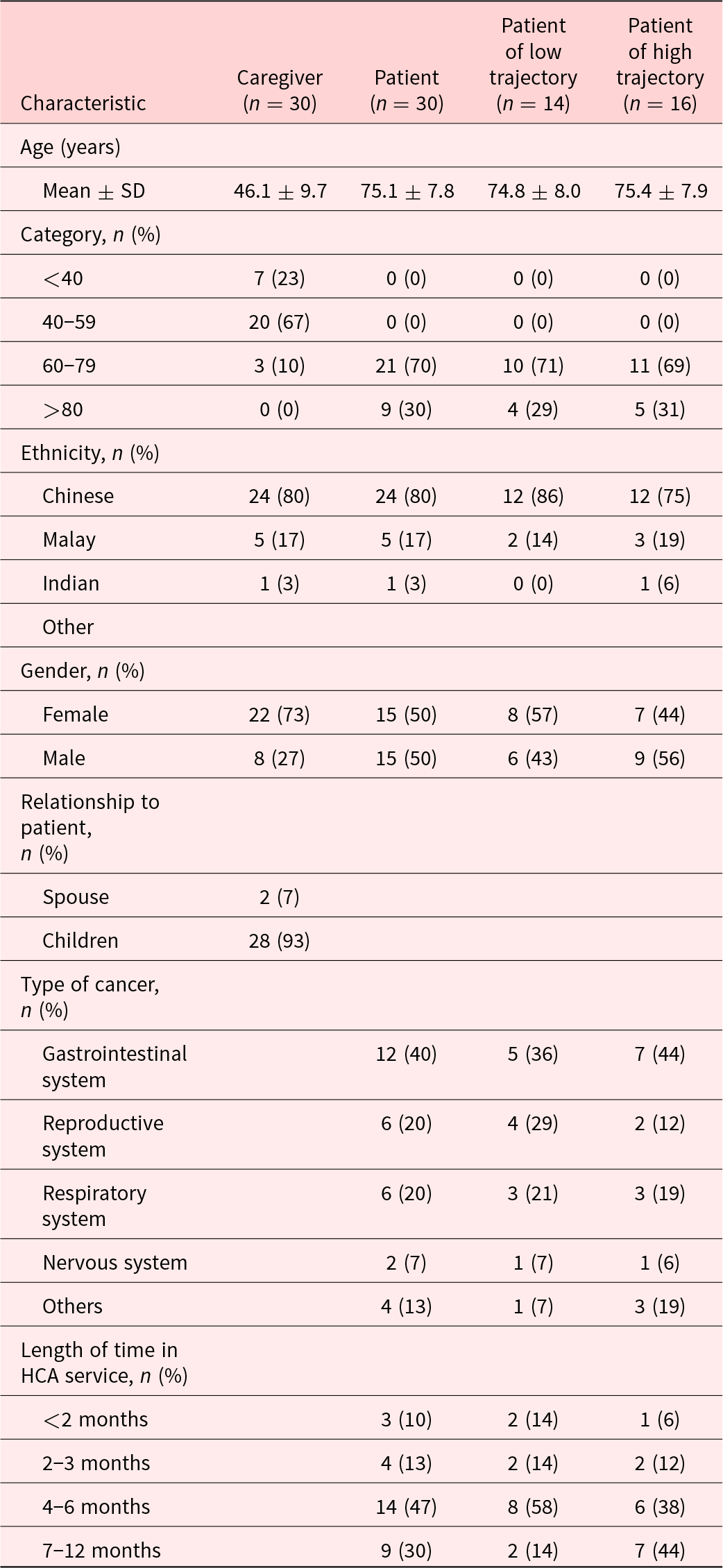
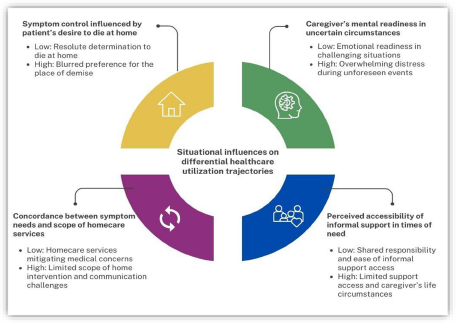
We conducted 30 in-depth interviews with family caregivers. Most caregivers were female (73.3%), Chinese (80.0%), and children of the patients (93.3%). The deceased patients were aged between 60 and 79 years, with the majority being Chinese (80%). Approximately, 46% of the patients utilized the homecare services for a duration ranging from 4 to 6 months. Around 47% of patients had low stable trajectory, while the remaining 53% belonged to persistently high trajectory (Table 1). Through the analysis of the collected data, 4 main themes were identified, serving as distinguishing factors between the 2 trajectories (Fig. 1).
Characteristics of family caregivers and patients

Situational influences on differential healthcare utilization trajectories.

Perceived symptom control influenced by patient’s determination to die at home
The inclination (or lack thereof) of patients to spend remaining moments in the comfort of their own homes appears to have a notable impact on the sense of authority in managing end-of-life symptoms. Caregiver accounts in low stable trajectory reveal that their loved ones frequently exhibited a resolute desire to die in their home. These patients had a profound fear of succumbing to death within a hospital setting, should they require hospital admission. Consequently, these patients often opted to endure discomforting symptoms and declined hospital visits, ultimately influencing their overall pattern of healthcare utilization.
On numerous occasions, my mother declined hospitalization, expressing her desire to pass away in our home. She was experiencing severe swelling and loss of appetite. We contacted the HCA, and the nurse recommended transferring her to a hospital. But my mom refused, enduring the pain until it became unbearable. (P14)
Before her conditions declining, she consistently stressed her desire not to be taken to the hospital under any circumstances. Even when she lost consciousness and eventually passed away, I honored her wishes and refrained from hospitalizing her. (P5)
In contrast to the patients of low trajectory, those of persistently high trajectory generally did not express a specific preference for the place of their eventual demise. Caregiver accounts reflected a pattern of fluctuating health status and the patient’s strong inclination to be admitted to a hospital. Caregivers regarded it as morally unacceptable to not fulfil their loved one’s wish to receive treatment in a hospital. Failing to do so was seen as “giving up” or “neglecting” their responsibilities. These caregivers, thus, saw acute healthcare utilization as unavoidable, thereby increasing the likelihood of recurrent emergency visits and hospitalizations.
… my father did not mind dying in the hospital, and he strongly preferred receiving medical care for his symptoms in the hospital. Given his preference, we could not disregard his requests. One day, he experienced abdominal bloating, prompting me to call the HCA nurse. After assessing, she suggested waiting until the following day for her visit. But my father insisted, so I had to call the ambulance. (P16)
My mother was experiencing intense pain. The prescribed medications didn’t provide much relief. Even when the HCA came, there wasn’t much improvement. She desperately sought relief from the pain and wanted to go to hospital. It was at this point that I made a decision to transfer her to the hospital as I did not want her to feel abandoned or [that] we had given up on her. (P9)
Caregiver’s mental readiness in uncertain circumstances
Another important factor that differentiated the trajectories was the functional competence and mental readiness of the caregivers. Functional competence refers to the caregiver’s ability and knowledge in carrying out daily homecare matters based on their acquired understanding, while mental readiness constitutes the emotional preparedness to cope with intricate and unforeseen situations. In low-stable trajectory, despite occasional feelings of being overwhelmed, caregivers demonstrated readiness to safely provide needed care, ensuring that patients could continue receiving support at home. Many caregivers stated that receiving guidance from homecare teams regarding pain assessment and tailored medication administration equipped them to handle cognitively demanding situations and to remain vigilant to prevent hospitalization.
My mom was on painkiller, often strong morphine doses. They [homecare] taught us how and when to administer the medication. So, when she expressed pain, I assessed the pain, using the pain score, instead of administering the morphine blindly…. This preparation infused a sense of confidence that I could handle things at home even when some situations suddenly occurred. (P3)
… in the initial stage, we were a bit unsure about what to do. There was this incident when my mom experienced some drug reactions. So, we were kind of debating whether we should rush her to the hospital. We were in a bit of a dilemma. So, I got in touch with the [HCA] nurse. They came over the next day to check on her and gave me some guidance about potential issues we might encounter in the future and how to handle them. It was reassuring because it made me to feel less helpless. I knew that whenever I needed assistance or advice, there was someone I could turn to, and my mom didn’t have to end up at the hospital every time. (P12)
In persistently high trajectory, caregivers displayed indications of limited mental readiness to handle uncertainty. Despite caregiving training, the reality often deviated from their expectations. Caregivers found themselves encountering unexpected fluctuations in the functional status of the patient, which often came with little warning. This unpredictability engendered unwarranted fear and distress, compelling them to seek urgent assistance from emergency departments in hopes of addressing the imminent challenges. Notably, many caregivers in this group frequently used the term “suffering” to signify the exigency of emotionally loaded situations.
The moment I saw her suffering, her whole body was shivering, I was afraid as I am not medically trained. The [homecare] nurse informed us to call them anytime in the event of emergency, but when you see your loved one is suffering, you are compelled to take immediate action. You have to arrange for hospital transfer so she could receive prompt medical attention …. (P7)
I think there were certain situations that were really tough for us to manage. Like, there were times when his oxygen levels dropped, he seemed to suffer a lot because he couldn’t breathe properly. Even though the nurses had shown us how to use a nebulizer, we were overwhelmed with panic in that moment, so we made the decision to send him to the hospital. (P24)
Concordance between symptom needs and scope of homecare services
A common perception shared by caregivers from both trajectories was that the presence of homecare team rendered a sense of security and reassurance. However, the critical determinant was the alignment between the specific symptom needs in a given situation and the extent of services offered by the homecare team. In low stable trajectory, caregivers described that the homecare team played a pivotal role in meeting their loved one’s needs such as preventing infections, managing pain, and checking medication regimen, which ultimately mitigated medical concerns and helped avoid hospital visits.
The HCA helped manage quite a fair bit of symptoms, which prevented some of the unnecessary visits [to the hospital]. Throughout the homecare, the HCA regularly monitored her bed sore, assisted with wound cleaning and made adjustments to alleviate pain. My mom remained comfortable and painless especially towards the end-of-life, so she could avoid hospitalization. (P12)
Before we had the HCA services, we used to make frequent trips to the hospital. After we were connected with HCA, their team started coming over regularly to check on everything. They even had their own equipment to help manage his pain and provided me with the necessary prescriptions, which I could easily get filled at the pharmacy. Having them around made a significant difference in how well I could take care of my dad at home. (P4)
In contrast, caregivers of persistently high trajectory consistently reported instances where the homecare team’s capacity to control over the situation was limited. Factors contributing to this included the restricted scope of home-based palliative care interventions, insufficient communication between caregivers and homecare team, and a lack of available homecare professionals. In these circumstances, hospital visits seemed to be inevitable. As a caregiver described,
My dad had leptomeningeal disease, and ensuring pain management became the priority for his homecare. Unfortunately, there were multiple instances when his pain was poorly managed [by the HCA] …. We called the (homecare) nurse and wanted to increase the morphine dosage, but the HCA doctors were reluctant …. We wanted to know why but did not get explanations. In the end, we had no choice but to call ambulances. (P1)
I mean, honestly there wasn’t a whole a lot they could do because they didn’t have the necessary equipment to manage symptoms of lung cancer … there was a period where I think they [HCA nurses] were pretty swamped, so for less urgent cases, they would only come by after a few days. (P24)
Perceived accessibility of informal support in times of need
Perceived accessibility of informal support in uncertain circumstances constitutes an important situational reinforcement. This accessibility represents not only the tangible assistance provided by family members to the primary caregiver or the patient but also the sense of shared responsibility and the ease of obtaining additional support. In low stable trajectory, the perceived accessibility of informal support contributes to the assurance of quality patient care, improving patient comfort and reducing the likelihood of hospital visits.
My wife had very good family support. We bought a hospital bed and installed handrails to prevent falls. Our children paired up, taking turns to care for her needs round-the-clock, sleeping in her room to ensure she received constant care. I believe that this arrangement relieved my anxiety in a sense and helped reduce the risk of unnecessary hospital visits. (P11)
We visited him every day, checking in on his needs. We’d make sure to bring his favorite food, even though he couldn’t eat much of it. We also tried to get him out in a wheelchair for a daily walk …. We hired a [paid] helper to assist with his care, who would engage him in some exercises. Our goal was to ensure that we were creating a comfortable environment at home, one that would help him relax and relieve his stress. (P19)
In contrast, many caregivers in high trajectory felt notable lack of accessibility to informal support in times of need or in response to crises. This lack of accessibility was particularly prominent when the main caregivers were older adults, as limited physical and cognitive capabilities hindered their ability to provide quality care. Thus, families often sought hospital admission as a means to ensure that their loved one would receive appropriate professional care while also affording respite for older caregivers. Consequently, back-and-forth transitions between hospital and home became normalized. Caregivers in this group often expressed a desire for increased access to comprehensive information about external caregiving resources and support.
I think one of the factors that precipitated the frequent hospital admissions was the absence of home support. HCA support did not extend to address this aspect. Given my mom’s advanced age in her 80s, it posed a big challenge to care for my father. When he was unattended, he experienced several falls, so he was readmitted to the hospital … sometimes, I thought hospital admissions would be better because there are professionals who provide the care. (P21)
I wished HCA could’ve provided us with more options to ease the burden of caregiving, like private nurses, home medical services, or even respite care. I think having these would have greatly addressed the challenges we faced in providing homecare. (P17)
Discussion
This study explored situational determinants that differentiate the healthcare utilization in patients on home-based palliative care at the end-of-life. Our findings drew attention to 4 circumstantial elements that contributed to differentiating persistently high versus low stable trajectories of healthcare utilization.
While patients on homecare might be reasonably presumed to prefer remaining at home, it was the patient’s preference for home as a place of death that cognitively prepared the patient, proved to unveil perceived control over symptoms, and differentiated healthcare utilization. This finding has implications for improving documented clarity on a place of death and dying for more tailored interventions (Baik et al. Reference Baik, Russell and Jordan2020). Studies showed that patient’s end-of-life wishes were often not discussed during hospitalization or at the time of referral to homecare, partly due to the lack of unwillingness among patients and caregivers (Hemsley et al. Reference Hemsley, Meredith and Bryant2019; Simon et al. Reference Simon, Porterfield and Bouchal2015). Patients may be more open to communication in the homecare setting, and hence more efforts should be directed to initiate patient’s end-of-life preferences and quality of death early in the enrolment into homecare. Since a patient’s condition and accompanying wishes could be changed over time, it is essential to periodically elicit patient’s expectations for treatments to bolster better decision-making approaches for preventable healthcare utilization.
Caregiver’s mental readiness in unanticipated situations clearly differentiated healthcare utilization. Unlike low trajectory where functional competence enabled caregivers to grapple with difficult-to-manage situations independently at home (Bainbridge et al. Reference Bainbridge, Bryant and Seow2017; Evans et al. Reference Evans, Cutson and Steinhauser2006; Sarmento et al. Reference Sarmento, Gysels and Higginson2017), in high trajectory, functional competence alone did not sustain adequate manageability at home. When caregivers were met with an unforeseen event, overwhelming distress was commonly reported, which drove hospital visit as a default option. This finding underlines that caregiver training requires beyond the empowerment of the hands; understanding the level of emotional readiness and nurturing the mind would be equally important. This finding complements previous literature that caregiver’s preparedness helped them focus on something concrete instead of worrying about something unknown (Milberg et al. Reference Milberg, Wåhlberg and Jakobsson2012). Despite this, research found that conversational focus during palliative homecare visits was predominantly on patient’s symptom management, with only 6% of talk pertaining to caregiver activation (Ellington et al. Reference Ellington, Clayton and Reblin2018a).
Therefore, it is important for homecare teams to actively engage in emphatic listening and address the emotional preparedness of caregivers during their home visits. Furthermore, family caregivers can greatly benefit from personalized and in-home psychoeducation and support programs designed to enhance their psychological resilience and foster positive emotions (Hudson and Aranda Reference Hudson and Aranda2014). These programs should include comprehensive information about symptom management, available treatment options during periods of deterioration, and effective communication with patients and homecare teams as well as addressing psychological issues (Holm et al. Reference Holm, Årestedt and Carlander2016; Norinder et al. Reference Norinder, Årestedt and Axelsson2023). For caregivers experiencing social isolation, structured group sessions, through web or in-person, could be considered to provide opportunities for connecting with others in similar caregiving situations, thereby promoting a sense of cohesion and safety. Such an approach might help alleviate caregiver anxieties and facilitate reasoned judgement on healthcare utilization in emerging complex situations.
In line with literature (Dillen et al. Reference Dillen, Joshi and Krumm2021; Guo et al. Reference Guo, Pinto and Edwards2022), perceived availability of homecare team was found to provide a significant sense of security for family caregivers in both trajectories. However, the key differentiating factor in healthcare utilization trajectories was the degree of alignment between symptom needs in a given situation and the extent of care provided by homecare team that differentiated healthcare utilization trajectories. This study identified communication challenges between caregivers and homecare teams, emphasizing the importance of direct and open communication skills of homecare teams to avoid misunderstandings regarding intervention outcomes. Such communication issues could potentially reduce the likelihood of preventable hospital visits (Bainbridge et al. Reference Bainbridge, Bryant and Seow2017; Dillen et al. Reference Dillen, Joshi and Krumm2021; Evans et al. Reference Evans, Cutson and Steinhauser2006). To achieve goal-concordant care for patients of high trajectory, exploring targeted clinical intervention could be beneficial. Previous research has demonstrated that interventions delivering specialist home palliative care can help prevent hospital admissions and enhance patient choices about the place of death (Casarett et al. Reference Casarett, Harrold and Harris2015; Johnston et al. Reference Johnston, Patterson and Bird2018). Although expanding these services would inevitably entail increased operational costs and a greater manpower need, the potential reduction of hospitalizations and emergency visits may offset the expenses over time (Casarett et al. Reference Casarett, Harrold and Harris2015; Wang et al. Reference Wang, Aldridge and Canavan2016a). Further research is warranted to identify the preferences of high healthcare utilizers regarding extended clinical investigations and interventions (such as tube insertion, dressing change, and blood draws).
Perceived accessibility to informal support also stood out in the narratives. In low trajectory, the caregivers’ perception of having informal support enabled them to effectively address the patient’s care requirements within the home setting. Conversely, in high trajectory, families often resorted to hospitalization as a viable means to access professional care for the patient and to seek temporary respite (McGhan et al. Reference McGhan, Loeb and Baney2013; Schwartz et al. Reference Schwartz, Riedel and LeBlanc2019). Thus, when referring to home-based palliative care, it is crucial to account for caregivers’ life course and find a balance between accommodating patient’s preferences and the caregiver’s ability to provide assistance. Families most at-risk of recurrent hospitalizations may benefit from the development of online caregiver resources and platforms designed to facilitate the navigation of available community services. This approach helps prevent inadvertent misuse of limited healthcare resources (Finucane et al. Reference Finucane, O’Donnell and Lugton2021). Additionally, funding options for temporary in-home respite care should be explored through government grants, tax-credits, and long-term care insurance, especially if the costs can be offset by the subsequent reduction in acute healthcare utilization in the long run (Rose et al. Reference Rose, Noelker and Kagan2015).
This is the first study that explored situational elements influencing differential healthcare utilization in patients on home-based palliative care. This study has a few limitations. The bereaved caregivers were recruited from a retrospective cohort study. Although we conducted interviews within 9 months of the patient’s death, retrospective data collection is prone to recall bias. When exploring situational determinants, we were unable to actively account for the presence of severe symptoms due to the nature of our data collection method that exclusively relied on caregiver’s accounts of healthcare utilization episodes. It is possible that patients of persistently high trajectory had conditions with a higher risk of deterioration and/or harder to be managed at home by the homecare team. Also, definitive conclusions about the respective situational determinants should be viewed cautiously because of the interplay of these situational determinants and each patient’s unique circumstances. Lastly, it is worth noting that the majority of our participants were daughters, with a limited number of spouses and sons represented. While this demographic distribution offers valuable insights into caregiver dynamics and helps illuminate the unique roles family members assume, it may also have affected our ability to capture the complete range of caregiver accounts concerning healthcare utilization at the end of life.
Conclusion
While the nuances of considerations for decisions on acute healthcare utilization varied by specific circumstances, there were certain shared elements that distinguished the low utilization trajectory from the high utilization trajectory. Our findings hold important implications for the provision of homecare services, in particular, the need for comprehensive assessment of end-of-life wishes during homecare enrolment, strengthening the mental readiness of caregivers, implementing home-based clinical interventions, and providing community support and funding for in-home respite care to effectively manage potentially preventable acute healthcare utilization.
Supplementary material
The supplementary material for this article can be found at https://doi.org/10.1017/S1478951524000014.
Data availability statement
The anonymized dataset is available from the corresponding author on reasonable request.
Acknowledgments
The authors are grateful to all caregivers for their participation in the interviews.
Author contributions
All authors participated in the study design. HG conducted the interviews. SY and HG were involved in the analysis of the interviews. Interpretation of the data was discussed among all authors. SY and HG drafted the manuscript. All authors were involved in the critical revision of the manuscript and approved the final version of the manuscript.
Funding
The authors received the following financial support for the research, authorship, and/or publication of this article: SingHealth Duke-NUS Academic Medicine Research Grant [AM/HRT003/2020].
Competing interests
The authors declared no potential conflicts of interest with respect to the research, authorship, and/or publication of this article.


 Open access

