

Recent comparative law scholarship has acknowledged the role of politics in legal transplants,Footnote 1 but the concrete mechanisms are still being explored. By revealing an untold transnational history of the Chinese Communist Party’s (CCP) legal transplant of maternity protection, which initially began as labor welfare imported from Europe and the United States and gradually evolved into a constitutional clause combined with reproductive restrictions in China, this article demonstrates how contingent political challenges and contexts shaped the local adaptation of foreign laws. Moreover, while there is extensive research on the CCP’s laws regarding marriage and revolution, the significant legal role of mothers has been disproportionately overlooked.Footnote 2
The origins of maternity protection can be traced back to Europe, where countries began to enact laws providing special labor protections for female workers during the 19th-century industrialization.Footnote 3 The United States, beginning with Illinois, later adopted these laws as well.Footnote 4 With the International Labor Organization’s (ILO) enactment of the Maternity Protection Convention in 1919, the Weimar Republic became the first country to incorporate maternity protection into its constitution.Footnote 5 Since then, constitutional protections for maternity have been adopted by many other countries worldwide.Footnote 6
The adoption of maternity protection in China occurred within what Duncan Kennedy termed “the second globalization of laws,” in which laws related to social welfare and labor protection spread across the world.Footnote 7 Since its inception in 1921, the CCP has strongly advocated for maternity protection as part of its ideological agenda.Footnote 8 However, after the establishment of the People’s Republic of China (PRC) in 1949, the principle of maternity protection was gradually combined with the Chinese family planning policy. This policy has been widely criticized for its harms to mothers, including forced abortions, sterilization, and surveillance of women of reproductive age.Footnote 9 The current Article 49 of the PRC Constitution, promulgated in 1982, stipulates:
Marriage, families, mothers, and children shall be protected by the state. Both husband and wife shall have the obligation to practice family planning.
In its original countries, the protection of mothers has always come with pronatalism,Footnote 10 but why does it associate with the control of reproductive autonomy and potentially harm mothers after being transplanted to China?
By presenting the first systematic study of the history of the CCP’s adoption and interpretation of maternity protection, I argue that the combination of maternity protection with family planning policies emerged from the malleability of maternity protection within the CCP’s legal framework. This malleability originated from the evolving interplay between political challenges and mothers of diverse backgrounds who were directly affected by this legal framework.
More specifically, this malleability has been historically shaped by the CCP’s transformation from an ideological and political insurgency to a regional revolutionary power and eventually to a dominant regime seeking sociopolitical consolidation. Moving between these paradigms, the CCP’s institutional commitments repeatedly evolved to speak to diverse audiences. Maternity protection proved an effective vehicle for the Party to address challenges across contexts by reconstructing its functionalities.
To unpack its development, this article identifies three distinct approaches in which the CCP interpreted maternity protection to adapt to new contexts and further its political agendas: political movements, public health, and birth control. These interpretations aligned with the political challenges of expanding influence, ensuring wartime survival, and consolidating the socialist regime, as well as with the targeted audiences of urban workers, rural peasants, and socialist nationals.
These shifting political challenges and changing audiences continuously pushed CCP leaders and legislators to reconstruct maternity protection in ways that served its evolving political goals and made the principle comprehensible and acceptable to mothers of diverse backgrounds, even at the expense of policies that would harm mothers.
Limitations of existing literature
From the descriptive level, many works have analyzed the origin and evolution of maternity protection in Europe and the United States.Footnote 11 When it came to China, scholarly efforts on law, gender, and politics largely tackled the field of marriage law,Footnote 12 with minimal attention paid to maternity protection in specific historical periods or only in the realm of labor law,Footnote 13 leaving a systematic examination of the transplant and evolution of Chinese protection law for mothers still unexplored. This study seeks to fill this gap.
At the normative level, existing literature primarily examines inequality, gender stereotypes, and the division of labor that potentially lead to these protective laws.Footnote 14 Some scholars have also noted the complex relationship between motherhood and politics.Footnote 15 Building upon well-established literature, this article aims to highlight various political functions of maternity protection that have not been sufficiently underscored. Advocating for protecting mothers, Julie Suk argues that, even after patriarchy, pregnancy and motherhood can remain oppressive “because the state strenuously neglects mothers’ needs.”Footnote 16 Nonetheless, this research shows that in Socialist China, mothers were further required to serve the varying needs of the State.
Moreover, many historians of China have explored maternal discourses and the construction of the role of the mother within China’s modern state-building.Footnote 17 Their discussions focus on an ideological concept of mothers in the intellectual dimension, as Gilmartin argued that female communists’ “political identities were shaped by a type of household ideology which encouraged their assumption of roles as nurturers, supporters, and organizers-roles that were compatible with their mothering experiences.”Footnote 18 Building on this foundational approach, I seek to place greater emphasis on the legal dimension of the relationship between mothers and the socialist revolution.
One might argue that the CCP’s political use of maternity protection is straightforward to understand. This is because maternity protection was primarily advocated by male intellectuals who were deeply embedded in Confucian patriarchal culture,Footnote 19 as historian Rachael Hsu referred to as “male-oriented maternalism.”Footnote 20 Furthermore, by comparing protective legislation in China and the United States, Margaret Woo reveals that the US emphasizes equality through anti-discrimination laws, while China prioritizes women’s biological roles, particularly reproduction. Woo attributes part of this difference to Confucian philosophy’s view of women’s natural role.Footnote 21
This cultural interpretation could partially explain the political use of maternalism, but falls short in interpreting legal maternity protection for two reasons. First, if there is any basic assumption in Chinese culture regarding maternity, it does not lean toward protecting mothers but rather toward subordinating them. Confucianism emphasizes that women are subordinate to men and can only enjoy weaker filial piety from their children.Footnote 22 In modern China, the so-called “Wise Wives and Good Mothers (xianqi liangmu) or “National Mothers (guomin zhi mu), which intellectuals of the late Qing, such as Liang Qichao, proposed, emphasized mothers’ obligation to strengthen the nation by reproduction, devoting to domestic work and education.Footnote 23 Maternity protection laws emphasize the support and protection of mothers rather than their subordination and obligation.Footnote 24 This difference had also been noted by the CCP co-founder Li Dazhao in 1923.Footnote 25 Second, the later family planning policy clearly contradicted Confucianism’s pronatalist philosophy.Footnote 26 Thus, a cultural approach may not sufficiently explain the development of the CCP’s interpretation of maternity protection across different periods.
The present research
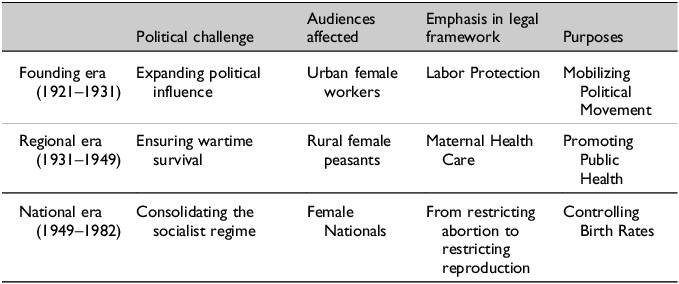
To elaborate on the dynamics across contexts and the malleability of maternity protection, I identify three phases in which the CCP interpreted maternity protection from 1921 to 1982, during which the Party gradually diverged from the original meanings of this legal principle. In each phase, the CCP faced different political challenges and diverse audiences.
The first phase, which I term the “Founding Era,” spanned from 1921 to 1931, from the establishment of the CCP to the promulgation of its first political regime, the Chinese Soviet Republic. The main challenge for the CCP as a new political party was to expand its influence. The primary audience it faced consisted of urban female workers. During this phase, the CCP leveraged maternity protection for mobilizing political movements.
The second phase, which I call the “Regional Era,” extended from 1931 to 1949, the period before the establishment of the PRC. The political challenge for the CCP during this time was to ensure its survival during wartime in rural bases. The main audience shifted from urban female workers to rural peasants. These changes led the CCP to reinterpret maternity protection, originally a clause for the Party’s mobilization efforts, as a tool for promoting public health in harsh environments.
The third phase, termed the “National Era,” spanned from 1949 to 1982, from the establishment of the PRC to the promulgation of the current Constitution that combines maternity protection with the family planning policy. The audience during this phase consisted of female nationals under the socialist regime, and the main challenge was consolidating the socialist state amid both political and economic pressures. Building on the effective use of maternity protection in urban areas since the CCP’s birth and its subsequent relocation to rural areas, the Party came to interpret its national demographic policies as a means of achieving maternity protection.
As Table 1 indicates, across the three phases, the interaction between the CCP’s political agendas and the diverse audiences affected by these laws led the CCP to gradually modify the original emphasis of labor protection on maternity protection. Eventually, it combined this with the obligation for birth control, taking it still further from its earlier focus on the labor welfare of mothers.
The Interpretation of Maternity Protection in Socialist China

To effectively understand the rationales of the Party, the sources for this study will mainly include legislative archives, legal interpretations, official documents, and the writings and speeches of party leaders, legislators, and intellectuals. In other words, due to the limitation, this article will focus primarily on a top-down perspective, while the equally important bottom-up social dimension—how these laws were enforced in practice and how people responded to them—will be left for a separate project.Footnote 27 Moreover, I use “Socialist China” in this article in a broader sense to refer to political regimes under the control of the CCP since its establishment in 1921.
The article’s first section will document the intellectual and legal settings that existed when the CCP introduced maternity protections in China and how the party perceived them. From the second section, I will analyze how maternity protection evolved in different periods. The section on “Conclusion” will summarize the key findings of this article.
The Intellectual and Legal Contexts for Adopting Maternity Protection
After the Republican Revolution, which overthrew the Qing Dynasty in 1911, China did not achieve its goal of establishing a united republic. Factional warlords and Western powers continued to dominate the country. On the one hand, as industrialization, especially conducted by Western forces, advanced in Chinese semi-colonies like Shanghai, labor issues arose with a series of strikes.Footnote 28 On the other hand, the Chinese Enlightenment “May Fourth Movement” took place in 1919.Footnote 29 The urban intellectuals who led this movement sought to modernize China under the slogan of “Democracy and Science.” After the Russian Revolution of 1917, Marxism was also embraced by these intellectuals as a potential solution to save China.Footnote 30 The CCP was founded in this chaotic environment in 1921.
Intellectual context: maternal feminism
The development of feminist thought in late 19th- and early 20th-century China has been extensively explored.Footnote 31 Especially during the May Fourth Movement, the family revolution and the emancipation of women became the most important topics for intellectuals. In this period, one of the most influential thoughts was Swedish feminist Ellen Key’s theory of love, marriage, and motherhood.
Key entered the Chinese intellectual arena with her advocacy of the freedom of love, which resonated with the May Fourth Movement’s call for a “new family and marriage.”Footnote 32 These intellectuals believed that the traditional Chinese family system and the oppression of women were the root causes of China’s backwardness.Footnote 33 More importantly, Key believed that women could be empowered through their roles as mothers, which is “the most precious possession of the nation.”Footnote 34 She argued that women should work full-time at home and be fully supported by society for their maternal function.Footnote 35
One of the intellectuals who popularized Key’s thought was Shen Yanbing, who later worked for the CCP and was also renowned for his realist novels. Shen introduced Key’s ideas on motherhood and motherliness in 1920. He translated “motherhood” as muzhi, which refers to child-rearing, and “motherliness” as muxing, referring to the essential qualities of motherhood. Shen contended that embracing muxing, as Key advocated, represented a distinct path that differed from traditional Chinese conceptions of motherhood as well as from the goals of the suffrage movement and those who sought to dismantle the family.Footnote 36 However, Shen largely overlooked Key’s arguments for broader societal support for mothers. Many other intellectuals also joined Shen in disseminating Key’s theories on motherliness, motherhood, and reproduction. During the 1920s, more than 60 essays about her appeared in Women Magazine (Funü zazhi), one of the most influential feminist magazines in Republican China.Footnote 37
Key’s stance appears vulnerable due to its emphasis on women’s roles within the family and its strong essentialist assumptions about male and female differences. However, according to historian Yung-chen Chiang, this essentialism exactly echoed the discourses of science and eugenics prevalent during the May Fourth era.Footnote 38 The scientific understanding of physiological differences between men and women led many intellectuals to believe that each sex bore different responsibilities.Footnote 39
In a broad sense, although May Fourth intellectuals—mainly male—advocated for liberating women from the Confucian family system, their use of feminist discourses was motivated by the goal of state modernization.Footnote 40 Although these intellectuals promoted freedom to marry and divorce to oppose Confucian patriarchy, they did not challenge the division of domestic roles after marriage.Footnote 41 Their vision for women’s new role was still largely centered on motherhood.Footnote 42 Key’s theory thus provided them with a theoretical framework to support this perspective.
Legal context: protective legislation
With industrialization in the Republic of China, particularly under the influence of Western powers in their colonies, strikes and rebellions by workers demanding shorter working hours and higher wages, especially those of female workers in Shanghai’s silk factories, became more frequent.Footnote 43 Honig’s research demonstrates that women accounted for almost two-thirds of the labor force in Shanghai’s silk and tobacco factories.Footnote 44
Under these circumstances, advocacy for the establishment of modern labor laws emerged. Some newspapers began reporting on European legislation protecting female workers at the beginning of the 20th century. For example, an essay in Shen Bao, one of the most influential newspapers before the establishment of the PRC, discussed labor legislation in the United Kingdom and France. It further emphasized that the purpose of factory laws was to protect children and female workers.Footnote 45 Later, Shen Bao also introduced the British National Insurance Act of 1911 when it was submitted to Parliament, emphasizing that it included the provision of pensions for female workers.Footnote 46
Apart from tracing European legislation, Chinese newspapers also followed the relevant developments in the United States, especially the landmark case of Muller v. Oregon, in which the Supreme Court upheld the Oregon law limiting women’s working hours to ten.Footnote 47 An essay in 1920 directly cited the ruling of this case to demonstrate that even the United States protected its female workers by limiting their working hours.Footnote 48
Moreover, in 1919, after World War I, the ILO passed the Maternity Protection Convention at the first International Labor Conference (ILC) in Washington. This Convention became the first international legal document to justify maternity leave, medical benefits, income during leave, and other related protections.Footnote 49 The Chinese side also designated representatives to attend the conference. Later, this Convention was also well noted by the press and widely disseminated within society.Footnote 50 Specific clauses regarding labor protection for pre- and postnatal female workers were also translated into the public media.Footnote 51 Although China—represented by the Beiyang warlord government—did not ratify the convention immediately, as a participating country at the Washington Conference, it was required to enact a factory law within 18 months.Footnote 52
With legislative resources from abroad, legal reformers and social activists began using these texts as a basis for their advocacy efforts. He Haiming, a revolutionary intellectual, wrote a book on Chinese social policies in 1920, which referenced European, American, and ILO legislation. This work was among the first in modern Chinese history to synthesize these diverse sources in support of protective labor laws, including maternal protection.Footnote 53
Founding Era: Maternity Protection and Political Movement, 1921–1931
Both maternal feminism and protective legislation share the feature that mothers have a special status within society. When early CCP leaders embraced Key and protective legislation, they found the protection of mothers effective in mobilizing female workers, as it resonated with those who were experiencing harsh working conditions: Many female workers had to return to work shortly after giving birth and could only nurse their babies during lunch breaks, with family members bringing the infants to the factory gate.Footnote 54
The adoption of maternity protection
Before the CCP’s establishment in 1921, its founders and early leaders had already expressed their thoughts on European and American protective legislation. In 1919, Li Dazhao, a pioneer of the May Fourth Movement and the co-founder of the CCP, noted that both European countries and the United States protected working-class mothers. He emphasized that in the aftermath of World War I, governments provided allowances to family members and took care of mothers at home. Furthermore, these governments established nurseries and offered additional allowances to support motherhood. These methods allowed mothers to work outside the home.Footnote 55
Chen Duxiu, another pioneer of the May Fourth movement, co-founder of the CCP, and its first General Secretary from 1921 to 1927, wrote extensively on mothers and children. Despite being inspired by the Russian Revolution of 1917,Footnote 56 he looked to European practices for his recommendations on protecting Chinese mothers. In March 1920, Chen referenced the policies of the Deutsche Gesellschaft für Bevölkerungspolitik in Germany, which focused on protecting female workers and pregnant women, to illustrate how these countries tackled the challenges of low birth rates and demographic decline.Footnote 57
Li Da, an essential figure in organizing the CCP’s first National Congress in July 1921, introduced European laws protecting mothers, particularly in labor legislation, through Japanese works. In April 1921, Li Da published his translation of Japanese Marxist Takabatake Motoyuki’s work entitled The Overview of Social Problems, which included protective laws for mothers in various Western countries.Footnote 58 He also translated the work of Japanese feminist Yamakawa Kikue on women’s emancipation, which argued that it was crucial to enact legal protections for female workers so that they could fulfill their maternal duties.Footnote 59 Yamakawa’s argument combined protecting mothers with ensuring their responsibilities within the family. A perspective that clearly stemmed from Ellen Key’s thought.Footnote 60
By highlighting protective legislation for pregnant women in France and Germany, Li Da further integrated these protective laws with the ideas of Ellen Key. He wrote:
Sweden is not a developed industrial country and thus has very few labor issues involving females. There is only one labor organization in Sweden… It is led by Ellen Key and advocates for protective laws for female workers. Footnote 61
In addition to foreign national laws, international legislation also significantly influenced the CCP’s advocacy for the protection of mothers. During the Shanghai silk factory strikes, labor groups supporting female workers invoked the International Labor Convention to bolster their claims. They pointed out that it included clauses about “women who have given birth should be entitled to six weeks of paid maternity leave.”Footnote 62
Regional feminist groups, particularly the Women’s Suffrage Association (Nüquan Yundong Tongmenghui), also began to use the term “protecting muxing.” These groups demanded the enactment of labor laws that protected female workers, in accordance with the principle of protecting maternity (baohu muxing de yuanze).Footnote 63
As we can see, over time, the term muxing became standard propaganda terminology. Initially, it was used to translate Ellen Key’s concept of “motherliness,” but it eventually came to encompass various terms related to “mothers.” For example, muxing was used in the context of maternity protection when advocating for protective labor legislation in the CCP’s political resolutions and legal documents.Footnote 64 Moreover, in 1922, American birth control activist Magret Sanger visited China. On the report of Sanger’s visit, her advocacy for “voluntary motherhood” was translated to “voluntary muxing.”Footnote 65 Hence, in the Chinese context, “muxing” was gradually used interchangeably to refer to “motherliness,” “motherhood,” and “maternity,” depending on different contexts.
Maternity protection and political movements
In the 1920s, there was no formal labor law within the Beiyang Government. On the contrary, existing laws penalize strikes.Footnote 66 As for the CCP, it had not yet established its own political regime. Without a concrete legislative body and political powers, the CCP was limited to conducting strikes and publishing its resolutions and acts to promote legal changes.Footnote 67 Advocacy for labor legislation became a focal point of the CCP’s political rebellions. In particular, the call for labor protections for mothers took the center stage.
The first advocacy related to “mothers” in the CCP’s official documents was the term muxing in The Resolution on Women’s Movement, which the Second National Congress of the CCP passed in June 1922. The Resolution stated:
Women not only become slaves for production manipulated by capitalists for cheaper labor costs, but also bear the burden of family and motherhood (muxing) in capitalist society organization. Footnote 68
While the Resolution did not elaborate on the definition of muxing, it advocated the establishment of labor laws to protect female workers and prevent child labor.Footnote 69
Later that same year, the Chinese Labor Organization Secretariat (zhongguo laodong zuhe shujibu) [hereinafter CLOC], which primarily conducted labor movements under the CCP’s leadership, proposed legislative principles for labor laws to the Beiyang government in July. The labor legislative principles that Deng Zhongxia, the secretary of the CLOC, proposed included granting female workers eight weeks of maternity leave.Footnote 70 Wu Juenong, who also contributed to introducing Ellen Key’s theory of motherhood, co-signed the proposal.Footnote 71
In practice, this legislative proposal was supported by many local unions, which cited its clauses for strikes.Footnote 72 Moreover, during the strikes at the Japanese silk factory in Shanghai in 1922, Wang Huiwu, the co-chief editor of Women’s Voice, Li Da’s wife, and a close friend of Shen Yanbing, addressed women workers, appealing to maternal issues. She contended:
Every morning when you hear the factory alarms, you must jump out of bed and prepare to go to the factory. At that moment, your baby is probably sound asleep in the mother’s arms or crying for the nipple to nurse. As a mother, you must pull the nipple out of the child’s mouth, endure the sound of your child’s crying, and head to the factory. It’s not until six in the evening when you return that you can see your child again and finally feed them…Even though you are pregnant and close to delivery, you still have to perform exhausting work in factories. Footnote 73
By highlighting the difficulties faced by working mothers and the inhumane treatment from the factory, Wang sought to encourage female workers to continue their strikes and struggle for their rights.
With the effort of legislative proposals from the CCP, ongoing strikes, and pressure from the ILO, the Beiyang government finally promulgated the Provisional Factory General Regulation (zanxing gongchang tongze) in 1923.Footnote 74 According to Article 20, female workers are entitled to five weeks of maternity leave and allowances.Footnote 75 This regulation was regarded as the first labor legislation in modern China, and maternity protection was thus institutionalized for the first time.Footnote 76 Nonetheless, this regulation was not implemented effectively due to the chaotic situation and the limited capacity of the Beiyang government.Footnote 77
Later, the Third National Congress of the CCP took place in 1923. One of its most important decisions was to establish cooperation between two revolutionary parties—the CCP and the Nationalist Party, or Guomindang (GMD). The CCP decided to allow its members to join the GMD individually for the purpose of “anti-imperialism and anti-warlords.”Footnote 78 This signaled the establishment of the first alliance between the CCP and the GMD—the First United Front (FUF).
It was during the Third National Congress of the CCP that the slogan “protect muxing” appeared in the CCP’s Resolution on the Women’s Movement. Xiang Jingyu, the only female founder of the CCP, was the primary drafter of the Resolution.Footnote 79 She also collaborated with Shen Yanbing on the women’s movement within the Party.Footnote 80 Other advocates of protective legislation and maternal feminism, like Chen Duxiu, Li Dazhao, and Deng Zhongxia, were also representatives of the Third National Congress.
The Resolution recommended using the slogan “protecting muxing” to mobilize women, along with many others: “gender equality,” “freedom to marry,” and, more importantly, “Anti-Imperialism” and “Anti-Warlords.”Footnote 81 The Programme of the CCP promulgated in this congress further advocated for a six-week maternity leave.Footnote 82
In practice, regarding the “Anti-Imperialism” propaganda, the CCP organized strikes in the industrialized urban areas that were dominated by Western powers. For example, during the celebration of International Women’s Day on March 8, 1924, which the Women’s Department of the GMD (zhongyang funü bu) co-organized with the CCP, the slogans included “liberating China from colonialism” and “liberating women from the oppression of capital,” along with “protecting reproduction (shengyu).”Footnote 83
For the Anti-Warlords campaign, through which the FUF aimed to exclude factional warlords and reunite China, both the CCP and the GMD advocated for the establishment of the National Assembly (guomin huiyi).Footnote 84 In conjunction with this advocacy, Xiang Jingyu asserted that women’s rights, including the right to maternity protection (muxing baohu quan), would only be protected if it included female groups in the National Assembly.Footnote 85 Under Xiang’s suggestion, in 1924, the CCP established Women’s National Assemblies (funü guomin huiyi) across various provinces. Grounded in the broader revolutionary goals of anti-warlords and anti-imperialism, these assemblies also advocated for the protection of mothers’ rights (muquan),Footnote 86 particularly through the establishment of labor laws that safeguarded the rights of female workers.Footnote 87
However, factional power struggles within the GMD and conflicting revolutionary goals between two parties brought an end to the FUF in 1927, with the GMD leader Chiang Kai-shek’s purge of communists.Footnote 88 In April 1927, Chiang violently suppressed the labor movements and established company unions—Yellow Unions (huangse gonghui)—in most factories.Footnote 89 At this moment, the GMD controlled the labor movement and the unions by using gangsters.Footnote 90 In 1928, the GMD reunited China and established the official central government.
With this dramatic political change, the CCP included “anti-GMD” into its main targets of political movements, together with “anti-imperialism” and “anti-warlords.”Footnote 91 It began to use maternity protection to mobilize the labor movement and set its “Red Union (hongse gonghui)” apart from the GMD’s “Yellow Union.” In the Resolution of the Women’s Movement at the CCP’s 6th National Congress in 1928, the Party claimed that it needed to win over members of the Yellow Union and expand the influence of the CCP’s own union. To achieve this purpose, protecting muxing, along with other maternity protection advocacies, again appeared in the CCP’s plan and was regarded as a fundamental principle.Footnote 92
On the GMD’s side, it promulgated the Factory Law (gongchang fa) in 1929. However, the GMD did not implement it immediately. Although Article 37 stipulated that female workers were entitled to eight weeks of maternity leave, due to the delay in its implementation, this benefit was not well received. Employers contended that such maternity leave would create an extreme burden for factories and might lead to the firing of female workers.Footnote 93
The delay in implementing maternity protection led the CCP to denounce the GMD. In a Communique of the Central Committee, the CCP further asserted that one of its strategies to expand the Party’s influence on female workers was to condemn the GMD’s cancellation of maternity leave.Footnote 94
During the CCP’s urban Founding Era, its legal advocacies used the principle of maternity protection as an instrument to attract urban female workers to join the revolutionary movements against imperialism, warlords, and, later, against the GMD. The CCP placed most of its efforts on advocating for maternity protection within the domain of labor law, with an emphasis on safeguarding pregnant, prenatal, and postnatal female workers by publishing legal acts and resolutions.Footnote 95
Regional Era: Maternity Protection and Public Health, 1931–1949
With the GMD’s suppression, the CCP had to abandon urban areas and flee to rural ones. After setting up several regional revolutionary bases, the CCP eventually established its first soviet regime, the Chinese Soviet Republic, in Jiangxi Province in 1931. However, the GMD’s military blockade pushed the CCP to relocate again to Northwest rural China in 1936, where it established the Shaan-Gan-Ning Border Region. Complicating this domestic conflict, the Second Sino-Japanese War broke out in 1937.
As the CCP moved from urban to rural areas, its main audience shifted from urban female workers to female peasants. Regulations such as maternity leave or a ban on nightwork were not effectively applicable to them. Meanwhile, with the formation of the Second United Front—a new coalition between the CCP and the GMD aimed at resisting the Japanese invasion—in 1937, anti-GMD sentiment ceased to dominate the discourses on maternity protection. Under these circumstances, the CCP began to reconstruct its stance on maternity protection, which had been enshrined in the Party’s official documents, to adapt to new conditions—from mobilizing urban industrial female workers to ensuring wartime survival in harsh rural living conditions.
In September 1937, two months after the outbreak of the Second Sino-Japanese War, the CCP issued the Outline of Women-Work (funü gongzuo dagang). This document stated that the current task for women-work (funü gongzuo) was to mobilize women to participate in the war against Japan. The guidelines for different classes included principles pertaining to the protection of mothers.Footnote 96
During this period, the second reconstruction of maternity protection from its original labor welfare meaning occurred: The CCP leveraged maternity protection to promote public health for its revolutionary purpose. On the one hand, the CCP promulgated its own labor laws in the revolutionary bases, following the existing practices of maternity leave, medical allowances, et cetera.Footnote 97 On the other hand, the CCP had interpreted maternity protection beyond the protection for female workers and disseminated it into the daily life of every female peasant.
Public health and wartime survival
When the CCP moved to rural China, it discovered a tremendously harsh living environment in which infant mortality exceeded 60%,Footnote 98 and the mortality of pregnant women reached 3%.Footnote 99 Resolving the high wartime mortality rate was a serious task. As the Central Women’s Committee argued in 1939, the “extremely miserable living conditions were one of the biggest obstacles preventing women from joining the War against Japan.” To change this situation, the Committee suggested establishing nursing houses that could alleviate women’s child-rearing burdens, along with the enactment of laws protecting pregnant women and mothers.Footnote 100
To combine maternity protection and public health, the CCP took two actions: It disseminated modern medical knowledge about childbearing and delivery, and it established nurturing houses for child-rearing.
Regarding modern medical knowledge, in September 1940, the CCP’s Central Committee issued a specific decision about protecting mothers and children. In this decision, the CCP stated that protecting mothers and nurturing children would allow female cadres to focus on revolutionary work. It further forbade abortion and laid out detailed ways to protect mothers and nurture children, with a focus on public health, by encouraging the participation of medical workers.Footnote 101
The CCP also carried out maternal and child health initiatives in the Shaan-Gan-Ning Border Region. Female cadres taught rural women modern methods of childbirth and childcare, including popularizing modern medical knowledge, conducting midwifery training, introducing delivery techniques, and pre- and postnatal care.Footnote 102 Through these efforts, the CCP sought to ensure its revolutionary powers and the health of future generations.Footnote 103 Although the GMD government also started its own public health and hygiene campaign, with a focus on modern midwifery training,Footnote 104 the CCP, as Hershatter observed, “had a far more extensive and effective rural presence,” so its program “affected many more people.”Footnote 105
By establishing nursing and childcare houses, the CCP hoped to free women from domestic responsibilities, facilitating their participation in social production when men joined the army. Based on this rationale, the CCP’s protection of mothers emphasized a narrative of liberating women from their traditional roles in kitchens (chufang) and boudoirs (guifang),Footnote 106 while advancing their participation in public affairs.Footnote 107 A report from the Wartime Child Welfare Protection Association (zhanshi ertong baoyu hui). a collaboration between the GMD and the CCP, indicated that, given the difficult living conditions in the border region, child welfare and the protection of mothers were inseparable issues. In other words, the establishment of child welfare is aimed at protecting mothers in these harsh circumstances.Footnote 108
To achieve this, the Shaan-Gan-Ning government appointed child care committee members (baoyu weiyuan) at the village level of various Women’s Federations (xiang fulian). These committee members were responsible for protecting mothers, childcare, women’s health, and related issues.Footnote 109 At the same time, the Civil Affairs Department (minzheng ting) set up a Child Care Section (baoyu ke) and emphasized that:
The health work of governments at all levels should consider the health education of mothers, the care of mothers and infants, and the health of infants as one of the central tasks. Footnote 110
During this period, there has been a significant debate on the concept of “Neo Wise Wives and Good Mothers (xin xianqi liangmu).” Some intellectuals began to advocate for women to return home and focus on child-rearing during wartime.Footnote 111 This perspective was also shared by some CCP leaders, who encouraged women to care for their families while men fought on the front lines against Japan.Footnote 112
However, Zhou Enlai, who later became the first Premier of the PRC, challenged this notion in his 1942 essay. Zhou criticized the ideology of “wise wives and good mothers,” and associated it with patriarchal societies like Japan and Germany. He argued that motherhood should be promoted and respected by society, which includes providing supportive measures such as nurturing houses and childbirth allowances.Footnote 113 Zhou’s stance again highlighted the distinction between maternity protection and the traditional Chinese emphasis on mothers’ duties.
Embedding maternity protection in the constitution
In 1941, the CCP enshrined the protection of mothers in its constitutional document, the Constitutional Guidelines for the Shaan-Gan-Ning Base Areas (Shaan-Gan-Ning bianqu shizheng gangling) [hereinafter the Constitutional Guidelines]. Article 16 of the Constitutional Guidelines stipulates that:
According to the principle of gender equality, the status of women in society is elevated from political, economic, and cultural perspectives, highlighting the positive role of women in the economy, protecting female workers, postpartum mothers (chanfu), and children…
For the first time, the protection of mothers was formally institutionalized in the CCP’s constitutional document. Following the emphasis on public health, especially on improving the mortality rates of both infants and pregnant women, the Constitutional Guidelines specifically required the protection of postpartum mothers.
On the other hand, in 1947, the GMD also promulgated its constitution, which contained a specific clause on the protection of mothers. Article 156 stipulated: “The State, in order to consolidate the foundation of national existence and development, shall protect motherhood and carry out the policy of promoting the welfare of women and children.”Footnote 114 Compared with the CCP’s legislation, the GMD’s approach emphasized women’s reproductive duty to the country rather than public health issues. This might follow the May Fourth movement’s promotion of women’s natural duty of reproduction.Footnote 115
The transformation from the first to the second phase signals a further departure from the classic, original meaning of maternity protection, from welfare protection, to moblization of political movements, and to a focus on public health to ensure the Party’s survival. This transition also laid the groundwork for constitutionalizing state protection of mothers after the establishment of the PRC.
Later, the PRC’s early constitutional document, the Common Program (gongtong gangling), promulgated in 1949, followed the same concern. As Article 48 stipulated:
Public health and medical work shall be expanded and attention shall be paid to the protection of the health of mothers, infants and children. Footnote 116
National Era: Maternity Protection and Reproduction Control, 1949–1982
During the national era, maternity protection merged with the obligation in the current Constitution of the PRC to require women to practice the family planning policy. Having evolved from a political slogan to a constitutional clause, maternity protection provided a persistent legal resource that the Party could reinterpret to meet new challenges during this period.
The CCP’s demographic policies evolved from the 1950s to the 1980s: a short period of pronatalism in the early 1950s, the promotion of birth control in the 1960s and 1970s, and finally the One-Child Policy in the 1980s.
Pronatalism and protecting mothers
In August 1949, after the CCP defeated the GMD and established sovereignty over mainland China, US Secretary of State Dean Acheson wrote in the China White Paper that the population “played a major role in shaping the destiny of modern China.” He further questioned the CCP’s capacity to resolve the overpopulation issue.Footnote 117
This doubt had challenged the legitimacy of the CCP. To counter this, Mao Zedong published an essay in September 1949, stating:
It is a very good thing that China has a big population… Of all things in the world, people are the most precious. Under the leadership of the Communist Party, as long as there are people, every kind of miracle can be performed. Footnote 118
Under the belief that human power would enhance the foundation of the new socialist China,Footnote 119 like in the regional era, the CCP launched pronatalist policies, including midwifery training, prenatal care, and promotion of new delivery methods, providing women with a relatively safe and easy environment for childbearing.Footnote 120
Furthermore, under the pronatalist policy, the CCP began to interpret maternity protection with restrictions on sterilization and abortion. There were two important regulations. The first was the Measures for Restricting Abortion of Female Cadres in Government Agencies in April 1950, which mainly regulated abortion for the CCP female cadres. This regulation permitted abortion procedures only under specific medical conditions and with the permission of the physician or supervisors (shouzhang) of work units.Footnote 121
The second regulation was the Interim Measures to Restrict Sterilization and Abortion of 1952. This regulation applied not only to CCP members but also to the entire society. In addition to medical conditions, this regulation limited sterilization to females over the age of 35 who had more than six children.Footnote 122 It further criminalized any abortion that violated these standards,Footnote 123 and those who conducted abortions to regulate their fertility would be prosecuted.Footnote 124 Interestingly, both regulations emphasized that their goal was to protect mothers.Footnote 125
In the early 1950s, learning from the Soviet Union, the CCP had also practiced pronatalism by honoring women who had multiple children as “glorious mothers” or “heroic mothers.”Footnote 126 Those with more children could receive larger allowances.Footnote 127
Such pronatalist policies were further reflected in the drafting of the PRC’s first Constitution in 1954. A committee led by Mao first drafted the 1954 Constitution. The original draft included the clause: “Marriage, the family, and the mother and child are protected by the State.”Footnote 128 On the one hand, this clause followed the CCP’s concern for mothers since the 1920s. On the other hand, the legal texts were more closely modeled on the Soviet Union’s constitution.Footnote 129
Later, the legislature invited both representatives and the public to discuss specific clauses.Footnote 130 Under the pronatalist policy, suggestions from the society explicitly indicated that the new Constitution should include special protections for mothers of multiple children, such as labor welfare, medical benefits, nursing homes, et cetera.Footnote 131 Moreover, there were suggestions directly advocating that the constitution should include clauses about “heroic mothers”Footnote 132 and a “ban on abortion.”Footnote 133
Nonetheless, the clause protecting mothers did not change.Footnote 134 It is difficult to know why the final Constitution did not include specific protections. One possible explanation is that China lacked the material capacity to ensure specific protections.Footnote 135 However, this article shows that the absence of detailed protections actually gave the Party more flexibility in interpreting “protection.”
While the focus on protecting mothers has shifted toward pronatalism, labor protection also developed during this period, most notably with the Draft Regulation on Protecting Female Workers. The first clause and subsequent official interpretation of this regulation claimed that it was intended to implement constitutional protections for mothers, thereby enabling their contribution to socialist modernization and improving labor efficiency.Footnote 136
Birth control and protecting mothers
Under these pronatalist policies, the population grew. According to the PRC’s first population census in 1953, the population had reached 600 million, exceeding the predicted range of 450 to 480 million. This unexpected growth raised concerns among the CCP as the state might struggle to provide sufficient resources to support such a large population.Footnote 137
Under the pressure of overpopulation and a potential shortage of supplies,Footnote 138 the principle of maternity protection, which had been used to discourage abortion and sterilization, gradually shifted to encouraging birth control.
One of the most important documents to set the foundation for later family planning policy was the Outline for National Agricultural Construction for the years 1956-1967 (Draft), which Mao drafted in 1957. Section 29 of this Outline stated that the Ministry of Health should promote new childbirth methods while protecting postpartum mothers (chanfu) and infants. It further indicated that “In all densely populated areas, promote and advocate for birth control.”Footnote 139 Zhou Enlai, the first Premier of the PRC, also claimed that, in addition to food supplies, birth control was related to the health of mothers and children.Footnote 140
In the early 1960s, the CCP began to adjust its approach by reinforcing the link between protecting mothers, implementing birth control, and the broader objective of modernizing socialist China. In 1962, the Directive from the CCP Central Committee and the State Council on promoting birth control explicitly stated that:
Seriously and consistently implementing this policy over the long term is beneficial for protecting the health of mothers and children, conducive to the upbringing of future generations, and allows male and female workers to fully utilize their strengths in production, work, and study. It is also advantageous for the health and prosperity of our nation. Footnote 141
In July 1963, Zhou Enlai also changed his narrative to argue that birth control was not only about the health of mothers and infants but also for socialist building.Footnote 142 Since the beginning of the 1970s, the CCP’s official newspaper, The People’s Daily, has emphasized that the goals of family planning were to protect the female labor force and to contribute to the revolution and women’s production.Footnote 143 This linkage was based on the rationale that reducing birth rates would allow mothers more time to recover after childbirth while also relieving them of domestic labor.Footnote 144 This, in turn, would enable them to participate in the workforce and contribute to socialist modernization.Footnote 145
Constitutionalizing birth planning and protecting mothers
After the Great Proletarian Cultural Revolution ended in 1976, establishing a new Constitution was considered a critical task.Footnote 146 During the 5th National People’s Congress, Premier Hua Guofeng wrote in his Report on the Work of the Government:
Family planning is very important, planned control of population growth is beneficial to the planned development of the national economy, is beneficial to the protection of the health of mothers and children. Footnote 147
Hua’s emphasis on protecting mothers by implementing the family planning policy was believed to have an direct influence on its inclusion in the 1978 Constitution,Footnote 148 which stated:
The state protects marriage, the family, and the mother and child. The state advocates and encourages family planning. Footnote 149
Later, China’s family planning policy gradually tightened, ultimately becoming the world’s most stringent birth-control policy, the One-Child Policy, in the 1980s.Footnote 150 In 1982, the CCP combined the constitutional clause for the protection of mothers with the obligation of practicing family planning policy, resulting in the current Article 49.
At the time of promulgation, this article raised specific concers about protecting mothers who have daughters. With the strict requirements of a One-Child Policy, mothers who gave birth to daughters might face discrimination and even physical abuse in families that had a preference for sons over daughters.Footnote 151 Under these circumstances, how to balance the One-Child Policy and the potential threats to mothers of daughters became an important societal issue.
In November 1982, during the fifth session of the 5th National People’s Congress, Premier Zhao Ziyang reported that:
We vigorously break down the feudal custom of giving preference to sons over daughters and emphasize the protection of baby girls and their mothers. Society should firmly condemn the criminal offences of female infanticide and the abuse of mothers of female infants, and the judicial authorities should resolutely crack down on them. Footnote 152
According to Zhao’s report, the combination of family planning policy and protecting mothers now had a more concrete objective: protecting mothers who gave birth to female babies. Li Xiuzhen, the Head of the State Council’s Birth Planning Office, wrote that according to the report of Premier Zhao, the protection of mothers was an aspect of family planning policy for protecting mothers of baby girls.Footnote 153
In addition to the Constitution in 1982, the CCP issued more regulations to ensure such protection. For example, in the Several Issues Concerning the Current Rural Economic Policy from the Central Politburo, it claimed that:
Family planning is crucial to the development of the economy and the prosperity of the nation, and it cannot be relaxed under any pretext… It is essential to strictly prohibit actions that harm baby girls or even their mothers. Footnote 154
Hence, the ultimate inclusion of protecting mothers in the Chinese Constitution has a very practical target: protecting those mothers who might face mistreatment from their families due to the family planning policy. In practice, under the newly promulgated Constitution, local governments have issued specific regulations and resolutions to address female infanticide and the mistreatment of mothers. These documents explicitly cite the Constitution as their legal basis. For instance, a resolution from the Tianjin Municipal People’s Congress called on citizens to report such cases to “safeguard the dignity of the Constitution and ensure its implementation.”Footnote 155
However, it is evident that these laws did not achieve their goal of protecting mothers and female infants due to forced abortions and sterilizations.Footnote 156 The harm of family planning extended not only to mothers’ bodies but also to reproductive autonomy. Although different from the United States, where access to abortion is a contentious issue,Footnote 157 both China and the US share the similarity that women themselves do not entirely control reproductive choices. Without such control, as MacKinnon argues, “preventing a woman from exercising the only choice available to her in an unequal society is an enforcement of sex inequality.”Footnote 158 The protection of mothers under the Chinese family planning policy continues to exacerbate this inequality.Footnote 159
Conclusion
By examining the development of maternity protection within the legal landscape, this article reveals an untold story of how the CCP’s legal regime utilized mothers during its turbulent 20th century. Hershatter argues that the CCP required women to contribute to public labor and revolutions as men but never encouraged their male counterparts to share domestic responsibilities with women.Footnote 160 The unchallenged role of women in the family prevented the CCP from ever questioning whether women should be mothers at all.Footnote 161
This article echoes this argument by demonstrating that mothers continued to be kept under the Party’s surveillance and embedded in its legal framework for various purposes. In the three main interpretations of maternity protection, each was associated with a change in the audience affected by these laws and political challenges that might further undermine the CCP’s governance.
On the one hand, the CCP consistently preserved the special role assigned to mothers since its inception; on the other hand, in practice, the transplanted legal discourse of maternity protection proved effective in mobilizing urban women workers and ensuring wartime survival during the Party’s rise to power. Grounded in these ideological presumptions about mothers’ public and domestic roles and the institutional momentum of maternity protection accumulated over the revolutionary years, the CCP became primarily concerned with layering new meanings onto this clause rather than questioning whether it should be abolished or fundamentally revised. As a result, legislators repeatedly reconstructed the functions of this clause, which is as old as the Party itself, ultimately combining it with the family planning policy.
Acknowledgments
Early versions of this article have been presented at the American Society for Legal History 2024 Annual Meeting in San Francisco, CA, the HKU-PKU 2024 Annual Conference in Beijing, and the 5th Asian Legal History Conference in Kyoto, Japan. For their comments and suggestions, I thank Taisu Zhang, Xiaoping Cong, Mara Yue Du, Sida Liu, Michelle McKinley, Michael Ng, Jedidiah Kroncke, John Fabian Witt, and all participants in the 13th Hurst Summer Institute at the University of Wisconsin Law School. Special thanks to the anonymous reviewers who helped me clarify and sharpen my arguments. All errors are my own.

 Open access

