Hostname: page-component-68c7f8b79f-8spss Total loading time: 0 Render date: 2026-01-16T16:37:36.973Z Has data issue: false hasContentIssue false

Sedimentation fields as a method of saltmarsh restoration: Continuity of human influence on natural processes

Published online by Cambridge University Press:  19 December 2025

Jonathan Dale*
Affiliation:
University of Reading, UK
Michelle Farrell
Affiliation:
Coventry University, UK
*
Corresponding author: Jonathan Dale; Email: j.j.dale@reading.ac.uk
Rights & Permissions [Opens in a new window]

Abstract

Saltmarsh habitat provides important ecosystem services, such as water quality regulation, carbon sequestration and flood defence, but is experiencing losses globally. Historically, this has been caused by land claim, and more recently by rising sea levels. Several methods have been implemented to compensate for saltmarsh habitat loss, including realigning defences, transplanting vegetation, and building structures such as sedimentation fields to enclose areas of mudflat and encourage sediment deposition. It has been suggested that sedimentation fields may offer saltmarsh restoration without the limitations identified in other restoration approaches, such as poor drainage and anoxia caused by changes to the sediment structure due to prior human activity. In this article, we argue that restoration through sedimentation fields should be viewed as a continuation of human activity influencing natural processes, rather than a method that overcomes the influence of prior human activity on saltmarsh ecosystem functioning. This opinion is evidenced by a critical review of the (pre-)historic human activity and saltmarsh restoration attempts at Rumney Great Wharf, Severn Estuary, Wales, where sedimentation fields were constructed between 1989 and 2005 and extended in 2024. We then evaluate the research requirements that need to be addressed to ensure the successful implementation of future schemes, including further understanding of the interactions between physical and biological processes, to enhance ecosystem functioning in sites restored using sedimentation fields.

Information

Type
Perspective
Creative Commons
Creative Common License - CCCreative Common License - BY
This is an Open Access article, distributed under the terms of the Creative Commons Attribution licence (http://creativecommons.org/licenses/by/4.0), which permits unrestricted re-use, distribution and reproduction, provided the original article is properly cited.
Copyright
© The Author(s), 2025. Published by Cambridge University Press

Impact statement

Sedimentation fields are used to restore or create saltmarsh habitat by enclosing areas of mudflat, often using brushwood fencing, with the intention of dampening waves and reducing current velocities to encourage sediment deposition and saltmarsh colonisation. This approach to saltmarsh restoration can be implemented where it is not possible to use other methods, such as managed realignment – the breaching, lowering or removal of flood defences to allow tidal inundation of the coastal hinterland. For example, sedimentation fields do not require the purchase of terrestrial (typically agricultural) land and conversion through engineering works to make it suitable to support intertidal habitat, which can be costly and socially sensitive. It has also been proposed that sedimentation fields might provide saltmarsh restoration without the limitations associated with prior human activity found in other restoration approaches. However, in this article, we argue that sedimentation fields should be seen as an extension of human influence on natural processes, rather than reversing the impact of human activity on saltmarsh ecosystem functioning. Evolution of sites restored using sedimentation fields can still be affected by site history, including both natural and anthropogenic influences. Depending on the targeted outcome of the scheme, it is important that sedimentation field construction results in the formation of a saltmarsh that provides the required ecosystem functioning and service provision. This could, for example, include increased flood protection, carbon storage or the creation of a diverse saltmarsh habitat. Further research is needed into the physical processes, ecological development and biogeomorphic evolution of sedimentation fields to inform the design and implementation of future schemes.

Compensating for saltmarsh habitat loss

Saltmarsh habitat occupies ~5.1 Mha of the Earth’s surface (Pendleton et al., Reference Pendleton, Donato, Murray, Crooks, Jenkins, Sifleet, Craft, Fourqurean, Kauffman, Marba, Megonigal, Pidgeon, Herr, Gordon and Baldera2012) and provides important ecosystem services, such as carbon sequestration and flood defence through wave attenuation (e.g., Costanza et al., Reference Costanza, d’Arge, deGroot, Farber, Grasso, Hannon, Limburg, Naeem, O’Neill, Paruelo, Raskin, Sutton and van den Belt1997). Globally, 46.6% of saltmarsh has been lost or degraded (Brook et al., Reference Brook, Millington-Drake, Garbutt, McGarrigle, Rodriguez and du Plessis2025) due to historic land claim (e.g., Allen and Fulford, Reference Allen and Fulford1986) and modern sea level rise resulting in erosion and coastal squeeze (e.g., Doody, Reference Doody2004). However, during the mid-twentieth century, the approach to saltmarsh management shifted from reclamation to protection, and then in the twenty-first century to restoring and increasing saltmarsh extent (Ladd, Reference Ladd2021).

Several approaches have been adopted to restore and (re)create saltmarsh (Pontee et al., Reference Pontee, Mossman, Burgess, Schuerch, Charman, Hudson, Dale, Austin, Burden and Balke2021). These include allowing tidal inundation of terrestrial, often (re)claimed, land through either regulated tidal exchange (e.g., Masselink et al., Reference Masselink, Hanley, Halwyn, Blake, Kingston, Newton and Williams2017) or breaching and lowering of defences via managed realignment (e.g., Schuerch et al., Reference Schuerch, Mossman, Moore, Christie and Kiesel2022). However, purchasing land and landscaping sites so they can support the targeted habitat types can be costly, socially unacceptable and culturally sensitive (e.g., Ledoux et al., Reference Ledoux, Cornell, O’Riordan, Harvey and Banyard2005; Yamashita et al., Reference Yamashita, Mikami, McInnes and Everard2019). Alternatively, in situ restoration methods that do not require the purchase and conversion of terrestrial land, such as transplanting vegetation (Taylor et al., Reference Taylor, Paterson and Baxter2019), are available. Sediment accumulation can also be encouraged using revetments and other structures, such as coir rolls, sandbags, silt fences and sedimentation fields to trap sediment and enhance sedimentation rates (e.g., Henry et al., Reference Henry, Walsh and Morin1999; Siemes et al., Reference Siemes, Borsje, Daggenvoorde and Hulscher2020; Vona et al., Reference Vona, Gray and Nardin2020; Reeder et al., Reference Reeder, Coulet, Miko, Thomas and Hopkins2021; Cox et al., Reference Cox, Paauw, Nienhuis, Dunn, van der Deijl, Esposito, Goichot, Leuven, van Maren, Middelkoop, Naffaa, Rahman, Schwarz, Sieben, Triyanti and Yuill2022; Gonçalves et al., Reference Gonçalves, Verdelhos, Caçador, Oliveira, Marques and Veríssimo2025), or can take place artificially through the deposition of dredge material (e.g., Baptist et al., Reference Baptist, Gerkema, van Prooijen, van Maren, van Regteren, Schulz, Colosimo, Vroom, van Kessel, Grasmeijer, Willemsen, Elschot, de Groot, Cleveringa, van Eekelen, Schuurman, de Lange and van Puijenbroek2019).

These methods have proven to be relatively successful, with 1,279.84 km2 of saltmarsh gained globally through restoration between 2000 and 2019, although this is not yet equivalent to the 2,733.33 km2 lost (Campbell et al., Reference Campbell, Fatoyinbo, Goldberg and Lagomasino2022). Of the various saltmarsh restoration methods, the most common, and therefore the most researched, has been managed realignment. Managed realignment sites have been shown to offer benefits such as carbon storage and habitat for fish (e.g., Burgess et al., Reference Burgess, Nelson, Colclough and Dale2020; Mossman et al., Reference Mossman, Pontee, Born, Hill, Lawrence, Rae, Scott, Serato, Sparkes, Sullivan and Dunk2022; McMahon et al., Reference McMahon, Ladd, Burden, Garrett, Redeker, Lawrence and Gehrels2023). However, they have a lower diversity and abundance of key plant species, and increased amounts of unvegetated ground, in comparison to pre-existing reference marshes (e.g., Mossman et al., Reference Mossman, Davy and Grant2012). It has been argued that these differences result from the sites’ former land use, which is typically agricultural, causing irreversible alterations to the (re)claimed sediment (e.g., Spencer and Harvey, Reference Spencer and Harvey2012). This leads to reduced hydrological connectivity following site breaching (Tempest et al., Reference Tempest, Harvey and Spencer2015), reduced aeration of the sediment and anoxia (e.g., Spencer et al., Reference Spencer, Carr, Diggens, Tempest, Morris and Harvey2017; Van Putte et al., Reference Van Putte, Temmerman, Seuntjens, Verreydt, De Kleyn, Van Pelt and Meire2025). Managed realignment sites also have reduced topographic complexity and fewer elevational niches (e.g., Lawrence et al., Reference Lawrence, Smith, Sullivan and Mossman2018), resulting in lower plant diversity (e.g., Morzaria-Luna et al., Reference Morzaria-Luna, Callaway, Sullivan and Zedler2004).

There is a need for increased large-scale saltmarsh restoration and creation efforts that mitigate the issues related to prior human activity and site history identified in managed realignment. One potential solution is the construction of sedimentation fields, which have been used historically in the Wadden Sea (Dijkema et al., Reference Dijkema, Ad, de Vlas, Smit, Jongerius and Nauta2001; Esselink et al., Reference Esselink, Bos, Oost, Dijkema, Bakker and De Jong2011), more recently in locations such as Venice Lagoon, the Ems-Dollard estuary and the North Sea (Scarton et al., Reference Scarton, Day, Rismondo, Cecconi and Are2000; Reeder et al., Reference Reeder, Coulet, Miko, Thomas and Hopkins2021; Siegersma et al., Reference Siegersma, Willemsen, Horstman, Hu and Borsje2023), and for mangrove restoration (Winterwerp et al., Reference Winterwerp, Albers, Anthony, Friess, Mancheño, Moseley, Muhari, Naipal, Noordermeer, Oost, Saengsupavanich, Tas, Tonneijck, Wilms, Van Bijsterveldt, Van Eijk, Van Lavieren and Van Wesenbeeck2020). This involves (partially) enclosing an area of intertidal mudflat with the intention of trapping sediment by reducing tidal currents and wave energy, increasing sediment deposition and facilitating saltmarsh creation (Pontee et al., Reference Pontee, Mossman, Burgess, Schuerch, Charman, Hudson, Dale, Austin, Burden and Balke2021). Consequently, costly site purchases and landscaping works are not required, and the evolution of the marsh should not be affected by site history, the trade-off being a loss of mudflat habitat. In this article, we argue that this perception is a false distinction, and the construction of sedimentation fields is, in fact, the continuation of human activity influencing natural processes.

We argue this using the case of Rumney Great Wharf, Severn Estuary, Wales (Figure 1), where sedimentation fields were constructed between 1989 and 2005, and extended in 2024. Rumney Great Wharf allows for temporal comparisons of recent restoration efforts in the context of current shoreline management policies and approaches. We then evaluate the future evidence needs that should be considered to ensure the effective implementation and success of future restoration and creation attempts through sedimentation field construction.

Figure 1. Aerial imagery of Rumney Great Wharf sedimentation fields, collected by the authors using an uncrewed aerial system, showing the locations of the originally installed and new sedimentation fields. The most easterly of the original sedimentation fields was installed in 1989, with the remaining four installed in 2005. The new sedimentation fields were installed in 2024. The regional (upper insert) and national (lower insert) settings are also indicated.

Human activity and landscape evolution at Rumney Great Wharf

Holocene evolution

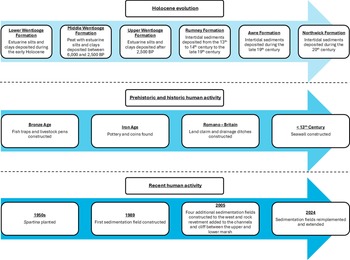
Rumney Great Wharf’s modern-day landforms and landscape features result from the intrinsic and long-term relationship between human activity and landscape evolution (Figure 2). Bell et al. (Reference Bell, Caseldine and Neumann2000) described the general Holocene sedimentary sequence of the Severn Estuary, which comprises a series of layers of estuarine sediments and peats. The uppermost of these layers is exposed at low tide, and more recent deposits have often been eroded. The oldest layer is known as the Wentlooge Formation (Allen and Rae, Reference Allen and Rae1987) and comprises three subdivisions: the lower, middle and upper Wentlooge formations. The lower Wentlooge Formation consists of estuarine clays and silts and formed during a period of rapid sea level rise during the early Holocene (Bell and Neumann, Reference Bell and Neumann1997). Analysis of pollen and foraminifera contained within these sediments indicates that the site supported mudflats with some localised areas of saltmarsh (Green, Reference Green1989).

Figure 2. Schematic representation of the landform evolution (top), prehistoric and historic human activity (middle) and recent human activity (bottom) at Rumney Great Wharf.

The middle Wentlooge Formation was deposited following the deceleration in the rate of sea level rise around 6,000 BP. The formation consists of peat intercalated with estuarine clays and silts, and continued to form until 2,500 BP (Allen, Reference Allen1997) when the upper Wentlooge Formation was laid down following a widespread marine transgression. The upper Wentlooge Formation consists of marine silts and clays and can be up to 4.5 m in depth (Bell et al., Reference Bell, Caseldine and Neumann2000). There have been subsequent periods of erosion and deposition, with three intertidal formations being deposited since the medieval period. The earliest of these is the Rumney Formation, dating to the thirteenth to fourteenth centuries (Allen, Reference Allen1987). The second deposit, the Awre Formation, was laid down in the late nineteenth century, with the Northwick Formation being deposited during the twentieth century (e.g., Allen, Reference Allen1997).

Prehistoric and historic (4150–800 BP) human activity

The earliest evidence of human activity at Rumney Great Wharf includes the construction of fish traps and livestock pens (Nayling, Reference Nayling1991) during the Bronze Age (4150 to 2750 BP). However, the first evidence of large-scale landscape change due to human activity occurs alongside evidence of Iron Age and Roman activity, including pottery and coins (e.g., Fulford et al., Reference Fulford, Allen, Rippon, Wild, Aldhouse-Green, Hamilton-Dyer, Keith-Lucas, Robinson and Gale1994). Specifically, Allen and Fulford (Reference Allen and Fulford1986) propose that a series of drainage ditches containing Romano-British pottery is indicative of the first planned reclamation attempts at the site.

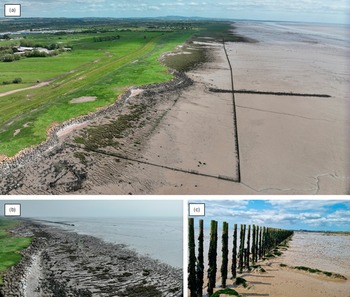
Subsequent phases of reclamation and landscape change occurred, including the construction of an earth embankment seawall before the thirteenth century AD, which prevented deposition of the more recent Rumney, Awre and Northwick formations on the landwards side (e.g., Fulford et al., Reference Fulford, Allen, Rippon, Wild, Aldhouse-Green, Hamilton-Dyer, Keith-Lucas, Robinson and Gale1994). The resulting modern-day intertidal landscape (Figure 3) consists of areas of saltmarsh formed on the Rumney, Awre and Northwick formations, with the peats of the middle Wentlooge Formation exposed to the west of the saltmarsh due to erosion (Figure 3b). In isolated areas, saltmarsh has colonised the exposed peat. Behind the modern seawall is the Gwent Levels, a reen and ditch habitat formed through intertidal land claim. This area is a Site of Special Scientific Interest and supports rare and endangered insect species such as Odontomyia ornata and Hydaticus transversalis.

Figure 3. Imagery taken by the authors in May 2023 of (a) the western end (looking eastwards) of the Rumney Great Wharf sedimentation fields, including the remaining posts from the original brushwood fencing and the seawall with the Gwent Levels behind to the left of the image, (b) the exposed peats of the middle Wentlooge Formation to the west of the sedimentation fields and (c) the in situ posts remaining from the original brushwood fencing construction.

Recent (mid-twentieth century to present) human activity

Since the mid-twentieth Century, there has been a trend of erosion and saltmarsh loss at Rumney Great Wharf. It is estimated that the foreshore has lowered at a rate of 0.01–0.04 mm per year since 1965 (Armstrong et al., Reference Armstrong, Whitehead, Scott and Hull2021). There have been several attempts to prevent and reverse these losses. In the 1950s, a Spartina planting campaign took place to try and stabilise the saltmarsh (ABPmer, 2009) – the success of which remains unknown, as no subsequent monitoring work was undertaken. Between 1989 and 2005, brushwood sedimentation fields were constructed (Figure 1). Initially, in 1989, a single sedimentation field was constructed in an area of mudflat to the west of, and fronted by, a pre-existing saltmarsh. The fencing was subsequently extended westwards in 2005, creating five sedimentation fields. Rock revetment was also added in 2005 to stabilise the channels and cliff between the upper and lower marsh, which in some places is 3 m high. Since construction, saltmarsh has developed in the eastern part of the sedimentation fields, where elevation has increased by over 0.5 m (Armstrong et al., Reference Armstrong, Whitehead, Scott and Hull2021). However, the fencing was not maintained or routinely monitored since 2010 and has subsequently been eroded, leaving just the support posts in situ (Figure 3c).

Due to concerns over the continued flood defence capabilities of the seawall, in addition to habitat loss, Natural Resources Wales reviewed the management of the site and the possibilities for saltmarsh restoration (Armstrong et al., Reference Armstrong, Whitehead, Scott and Hull2021). Re-implementing and extending new sedimentation fields was identified as the most suitable option, with the new fencing constructed between July and September 2024.

Human activity continues to influence natural processes

The requirement to defend former saltmarsh, which has been drained for terrestrial use, through further saltmarsh creation within mudflat habitat presents an intriguing paradox. This is enhanced by the ecological significance and statutory designations of the drained saltmarsh behind the seawall, driving the need to reinforce flood defences and maintain a “Hold the Line” approach to coastal management. Restoring and compensating for saltmarsh loss is required legally, and to prevent and mitigate the impacts of climate change through carbon sequestration and flood defence (e.g., Kiesel et al., Reference Kiesel, MacPherson, Schuerch and Vafeidis2022; Mossman et al., Reference Mossman, Pontee, Born, Hill, Lawrence, Rae, Scott, Serato, Sparkes, Sullivan and Dunk2022; McMahon et al., Reference McMahon, Ladd, Burden, Garrett, Redeker, Lawrence and Gehrels2023). Sedimentation fields provide an opportunity to do this in locations where other methods, such as managed realignment, are not possible. This is usually due to a need to maintain defences to protect designated habitats or infrastructure, cost or negative public opinion (e.g., Ledoux et al., Reference Ledoux, Cornell, O’Riordan, Harvey and Banyard2005; Esteves, Reference Esteves2014) and may help to reduce the net loss of saltmarsh (e.g., Campbell et al., Reference Campbell, Fatoyinbo, Goldberg and Lagomasino2022). In addition, sedimentation fields do not have the same limitations on saltmarsh ecosystem functioning imposed by former agricultural land-use at managed realignment sites.

Past human activity is still, however, likely to have influenced site formation processes, and hence the modern-day landscape, and should be accounted for when setting restoration targets, such as the intended saltmarsh extent or habitat type. For example, at Rumney Great Wharf, if restoration were to target similar habitats to those present before any human activity took place at the site during the Bronze Age, then it would likely be targeting a similar environment to either the lower or middle Wentlooge formations. This would result in the restoration of either the mudflat with some areas of saltmarsh (lower Wentlooge), and an environment not too dissimilar to the modern-day landscape or peats with some intertidal areas (middle Wentlooge). If the habitats before Romano-British reclamation attempts were targeted, then the marine silts and clays of the upper Wentlooge Formation could be recreated. Under both scenarios, the subsequent site evolution alongside the influence of later human activity, including the deposition and (in places) erosion of the Rumney, Awre and Northwick formations on the seaward side of the seawall (Allen, Reference Allen1987; Allen, Reference Allen1997; Bell et al., Reference Bell, Caseldine and Neumann2000), would not be accounted for. Restoration to a defined (pre)historic baseline is likely to be impossible given current and future projected sea level rise, and restoration targets should rather consider the most appropriate habitat types needed to meet the objectives of the scheme.

Future sedimentation fields: Evidence requirements

As demonstrated for Rumney Great Wharf, restoration using sedimentation fields is not necessarily without the influence of previous human activity and can arguably be viewed as the continuation of human manipulation, albeit with a step-change towards encouraging saltmarsh growth. Therefore, it should be recognised that the use of sedimentation fields represents the management of hydrological functioning and sedimentation processes to artificially encourage saltmarsh creation rather than restoring natural functioning or processes and allowing the saltmarsh to develop. It also remains unclear whether saltmarsh created using this method can be self-sustaining, or whether continued maintenance is required. However, it remains important that the required and/or targeted ecosystem functioning and services, such as wave attenuation, carbon storage, habitat extent and species diversity, are provided.

To date, the limited number of studies assessing sedimentation fields have focused on predicting site evolution using numerical models (e.g., Dao et al., Reference Dao, Stive, Hofland and Mai2018; Siemes et al., Reference Siemes, Borsje, Daggenvoorde and Hulscher2020), rather than empirical observations. Those studies that have presented field-based evaluations of sedimentation fields have tended to focus on mangroves (e.g., Winterwerp et al., Reference Winterwerp, Albers, Anthony, Friess, Mancheño, Moseley, Muhari, Naipal, Noordermeer, Oost, Saengsupavanich, Tas, Tonneijck, Wilms, Van Bijsterveldt, Van Eijk, Van Lavieren and Van Wesenbeeck2020), relatively small-scale structures built within or as an extension of pre-existing marsh (e.g., Scarton et al., Reference Scarton, Day, Rismondo, Cecconi and Are2000; Gonçalves et al. Reference Gonçalves, Verdelhos, Caçador, Oliveira, Marques and Veríssimo2025) or the establishment of pioneer vegetation (Siegersma et al., Reference Siegersma, Willemsen, Horstman, Hu and Borsje2023). Our evaluation of Rumney Great Wharf has demonstrated that using sedimentation fields for saltmarsh restoration may not result in the development of the equivalent habitat the site used to support or would support without human influence. Consequently, it is essential that the baseline habitat creation requirements are established before site implementations. While this is also true of other methods of restoration, including managed realignment, many managed realignment sites are designed and landscaped to deliver a particular habitat type or function (e.g., Pearce et al., Reference Pearce, Khan and Lewis2011; Burgess et al., Reference Burgess, Pontee, Wilson, Lee and Cox2014). Provision of a particular target, service or deliverable is often used as the mechanism to justify and fund saltmarsh restoration schemes, and this approach is likely to continue given the move towards funding restoration through carbon finance mechanisms (Mason et al., Reference Mason, Wood, Jupe, Burden and Skov2022; Burden et al., Reference Burden, Austin, Carter, Fitton, Garbutt, Gupta, Hipkiss, Mahon, McGrath and Pontee2023).

Regardless of the specific drivers, restoration is likely to have multiple benefits, and it is important that sites support a functioning ecosystem (Billah et al., Reference Billah, Bhuiyan, Islam, Das and Hoque2022). Consequently, it is crucial that sedimentation fields are monitored to evaluate ecosystem functioning, including empirical assessments of the biogeomorphic processes. Specifically, sedimentation fields might provide benefits, such as the trapping of suspended contaminants, as demonstrated for silt fences used to retain toxic particles from dredge spoil (Henry et al., Reference Henry, Walsh and Morin1999). The formation of morphological features, the supply of sediment, ecological succession and the role of stochastic events such as storms (Scarton et al., Reference Scarton, Day, Rismondo, Cecconi and Are2000) also require further evaluation to fully understand site development. For example, studies into the relationship between sediment accretion and plant colonisation (Brückner et al., Reference Brückner, Braat, Schwarz and Kleinhans2020) will inform assessments of saltmarsh establishment and development. In addition, topographic complexity and the formation of a range of elevational niches are known to play an important role in increasing plant diversity (e.g., Morzaria-Luna et al., Reference Morzaria-Luna, Callaway, Sullivan and Zedler2004; Kim et al., Reference Kim, Cairns and Bartholdy2013). Understanding if (and when) topographic variability develops as sediment accretes will help inform evaluations of saltmarsh development and functioning, including the level of flood defence provided by the scheme (e.g., Rupprecht et al., Reference Rupprecht, Moller, Paul, Kudella, Spencer, van Wesenbeeck, Wolters, Jensen, Bouma, Miranda-Lange and Schimmels2017). These data can then be used to inform the management and maintenance of sedimentation fields following construction, informing the design of future restoration schemes to maximise ecosystem service delivery.

In addition to assessments of the site itself, the benefits of sedimentation field construction on pre-existing coastal flood defences, management approaches and the wider ecosystem should also be considered. Sedimentation fields may provide opportunities to restore saltmarsh in locations where coastal flood defences cannot be breached and flood defence standards need maintaining (Pontee et al., Reference Pontee, Mossman, Burgess, Schuerch, Charman, Hudson, Dale, Austin, Burden and Balke2021). This includes locations where there is a need to protect infrastructure or areas of rare and important habitat, but without necessarily upgrading or investing in seawalls and hard defences. Consequently, the use of sedimentation fields for both flood defence and saltmarsh restoration is likely to increase. However, the required size and rate of marsh development needed to deliver the necessary attenuation in wave energy requires further investigation.

Alongside uncertainty relating to the level of flood defence provided, it is unknown if or when restored marshes in sedimentation fields become self-sustaining or whether there needs to be a continued commitment to maintaining the fencing and structures. Without continued maintenance, there is potential for the restored marsh to start eroding and be lost unless a certain vegetation cover threshold is reached (e.g., D’Alpaos, Reference D’Alpaos2011). It also remains unclear who is responsible for funding this maintenance, and what the public perception will be. Encouraging saltmarsh growth at the expense of mudflat habitat may, in some locations, have considerable implications and require strong justification. Nonetheless, at locations where the mudflat is eroding, the need to stabilise the mudflat is becoming more pressing. For example, at Rumney Great Wharf, as further erosion of the Rumney, Awre and Northwick formations occurs, more of the middle Wentlooge peat deposits are exposed and subject to erosion (Armstrong et al., Reference Armstrong, Whitehead, Scott and Hull2021). These peats likely contain a relatively high organic carbon stock (e.g., Chmura et al., Reference Chmura, Anisfeld, Cahoon and Lynch2003) and their erosion could cause the release of carbon sequestered within the peats up to 6,000 years ago.

Creating saltmarsh on mudflats will not only help stabilise eroding mudflats but could help to protect the pre-existing marsh and, in doing so, protect the organic carbon already stored within it (Smeaton et al., Reference Smeaton, Garrett, Koot, Ladd, Miller, McMahon, Foster, Barlow, Blake, Gehrels, Skov and Austin2024), providing further justification for future site implementation. The construction of sedimentation fields may also help meet the saltmarsh extent increases targeted by coastal managers. For example, in England, the Environment Agency’s Restoring Meadow, Marsh and Reef (ReMeMaRe, https://ecsa.international/rememare/restoring-meadow-marsh-and-reef-rememare) initiative is targeting a 15% increase in saltmarsh by 2043. Likewise, since the early 1990s, saltmarsh restoration in the United Kingdom through tidal inundation and depositing dredged sediment has resulted in the delivery of nearly 3,000 ha of new intertidal habitat (Ladd, Reference Ladd2021). However, this does not deliver enough habitat to offset the reduction in saltmarsh extent that is known to have occurred historically (Phelan et al., Reference Phelan, Shaw and Baylis2011), which must first be addressed before a net gain can be achieved.

Conclusion

Sedimentation fields may mitigate some of the issues observed in other saltmarsh restoration or creation approaches (e.g., poor drainage, reduced plant abundance and diversity). However, we argue that they are not without human influence and remain shaped by both historic and ongoing human activity. The Rumney Great Wharf example demonstrates that such schemes should not be considered a “return to nature” but a managed evolution of coastal landscapes. There remains an expectation that restoration efforts provide a particular ecosystem service or deliverable, and it is still important to ensure that sites deliver additional benefits and that a functioning ecosystem is restored. It is also necessary to protect the pre-existing saltmarsh habitat and reduce erosion rates. Further understanding of the physical functioning of sedimentation fields is clearly needed. This includes empirical data on the supply and delivery of sediment, and the influence of these factors on the establishment of saltmarsh habitat. The need for these datasets will become more pressing as coastal managers and decision-makers look to develop more sustainable approaches to coastal flood defence, coupled with the increased pressures of sea level rise and increased storm magnitude and frequency. This is particularly the case in locations where approaches such as managed realignment are not possible, and there is a need to increase wave attenuation to reduce pressures on flood defences and/or compensate for saltmarsh habitat loss.

Open peer review

To view the open peer review materials for this article, please visit http://doi.org/10.1017/cft.2025.10020.

Data availability statement

Data availability is not applicable to this article as no new data were created or analysed in this study.

Acknowledgements

The authors would like to thank two anonymous reviewers for their supportive and insightful comments, which have helped us to improve the manuscript. We also thank Martin Bell (University of Reading) for a useful discussion of the concept for this article.

Author contribution

Both authors contributed to the development, writing and organisation of the article.

Financial support

This research received no specific grant from any funding agency, commercial or not-for-profit sectors.

Competing interests

The authors declare none.

References

ABPmer (2009) PART a: Severn Estuary SMP2: Baseline Understanding of Coastal Behaviour and Dynamics. Southampton: ABPmer.Google Scholar
Allen, JRL (1987) Late Flandrian shoreline oscillations in the Severn estuary: The Rumney formation at its typesite (Cardiff area). Philosophical Transactions of the Royal Society of London. B, Biological Sciences 315(1171), 157184.Google Scholar
Allen, JR (1997) Subfossil mammalian tracks (Flandrian) in the Severn estuary, SW Britain: Mechanics of formation, preservation and distribution. Philosophical Transactions of the Royal Society of London. Series B: Biological Sciences 352(1352), 481518.Google Scholar
Allen, J and Fulford, M (1986) The Wentlooge level: A Romano-British saltmarsh reclamation in Southeast Wales. Britannia 17, 91117.Google Scholar
Allen, JRL and Rae, J (1987) Late Flandrian shoreline oscillations in the Severn estuary: A geomorphological and stratigraphical reconnaissance. Philosophical Transactions of the Royal Society of London. B, Biological Sciences 315(1171), 185230.Google Scholar
Armstrong, S, Whitehead, P, Scott, C and Hull, S (2021) Rumney Great Wharf Saltmarsh Restoration / Enhancement Feasibility and Preferred Option Studies, Vol. 528, UK: Natural Resources Wales.Google Scholar
Baptist, MJ, Gerkema, T, van Prooijen, BC, van Maren, DS, van Regteren, M, Schulz, K, Colosimo, I, Vroom, J, van Kessel, T, Grasmeijer, B, Willemsen, P, Elschot, K, de Groot, AV, Cleveringa, J, van Eekelen, EMM, Schuurman, F, de Lange, HJ and van Puijenbroek, MEB (2019) Beneficial use of dredged sediment to enhance salt marsh development by applying a ‘Mud Motor’. Ecological Engineering 127, 312323. https://doi.org/10.1016/j.ecoleng.2018.11.019.Google Scholar
Bell, M, Caseldine, A and Neumann, H (2000) Prehistoric Intertidal Archaeology in the Welsh Severn Estuary. UK: Council for British Archaeology.Google Scholar
Bell, M and Neumann, H (1997) Prehistoric intertidal archaeology and environments in the Severn estuary, Wales. World Archaeology 29(1), 95113.Google Scholar
Billah, MM, Bhuiyan, MKA, Islam, MA, Das, J and Hoque, ATMR (2022) Salt marsh restoration: An overview of techniques and success indicators. Environmental Science and Pollution Research 29(11), 1534715363. https://doi.org/10.1007/s11356-021-18305-5.Google Scholar
Brook, T, Millington-Drake, M, Garbutt, A, McGarrigle, A, Rodriguez, K and du Plessis, N (2025) The State of the Worlds Saltmarshes 2025: A Global Call to Action for Coastal Resilience and Adaptation, Gland, Switzerland: The World Wildlife Fund.Google Scholar
Brückner, MZ, Braat, L, Schwarz, C and Kleinhans, MG (2020) What came first, mud or biostabilizers? Elucidating interacting effects in a coupled model of mud, saltmarsh, microphytobenthos, and estuarine morphology. Water Resources Research 56(9), e2019WR026945.Google Scholar
Burden, A, Austin, W, Carter, S, Fitton, R, Garbutt, A, Gupta, S, Hipkiss, A, Mahon, C, McGrath, T and Pontee, N (2023) Recommendations for Development of a UK Domestic Saltmarsh Code. Bailrigg, England: UK Centre For Ecology & Hydrology.Google Scholar
Burgess, H, Nelson, K, Colclough, S and Dale, J (2020) The impact that geomorphological development of managed realignment sites has on fish habitat. Coastal Management 2019, 375389.Google Scholar
Burgess, K, Pontee, N, Wilson, T, Lee, SC and Cox, R (2014) Steart coastal management project: Engineering challenges in a hyper-tidal environment. In: From Sea to Shore–Meeting the Challenges of the Sea: (Coasts, Marine Structures and Breakwaters 2013). One Great George Street, London: ICE Publishing.Google Scholar
Campbell, AD, Fatoyinbo, L, Goldberg, L and Lagomasino, D (2022) Global hotspots of salt marsh change and carbon emissions. Nature 612(7941), 701706. https://doi.org/10.1038/s41586-022-05355-z.Google Scholar
Chmura, GL, Anisfeld, SC, Cahoon, DR and Lynch, JC (2003) Global carbon sequestration in tidal, saline wetland soils. Global Biogeochemical Cycles 17(4). https://doi.org/10.1029/2002GB001917.Google Scholar
Costanza, R, d’Arge, R, deGroot, R, Farber, S, Grasso, M, Hannon, B, Limburg, K, Naeem, S, O’Neill, RV, Paruelo, J, Raskin, RG, Sutton, P and van den Belt, M (1997) The value of the world’s ecosystem services and natural capital. Nature 387(6630), 253260. https://doi.org/10.1038/387253a0.Google Scholar
Cox, JR, Paauw, M, Nienhuis, JH, Dunn, FE, van der Deijl, E, Esposito, C, Goichot, M, Leuven, JRFW, van Maren, DS, Middelkoop, H, Naffaa, S, Rahman, M, Schwarz, C, Sieben, E, Triyanti, A and Yuill, B (2022) A global synthesis of the effectiveness of sedimentation-enhancing strategies for river deltas and estuaries. Global and Planetary Change 214, 103796. https://doi.org/10.1016/j.gloplacha.2022.103796.Google Scholar
D’Alpaos, A (2011) The mutual influence of biotic and abiotic components on the long-term ecomorphodynamic evolution of salt-marsh ecosystems. Geomorphology 126(3), 269278. https://doi.org/10.1016/j.geomorph.2010.04.027.Google Scholar
Dao, T, Stive, MJ, Hofland, B and Mai, T (2018) Wave damping due to wooden fences along mangrove coasts. Journal of Coastal Research 34(6), 13171327.Google Scholar
Dijkema, K, Ad, N, de Vlas, J, Smit, C, Jongerius, H and Nauta, H (2001) Van Landaanwinning Naar Kwelderwerken. Netherlands: Rijkswaterstaat Publicatie Platform.Google Scholar
Doody, JP (2004) Coastal squeeze’ - an historical perspective. Journal of Coastal Conservation 10(1–2), 129138. https://doi.org/10.1007/bf02818949.Google Scholar
Esselink, P, Bos, D, Oost, A, Dijkema, K, Bakker, R and De Jong, R (2011) Verkenning Afslag Eems-Dollardkwelders, Vries: PUCCIMAR Ecologisch Onderzoek en Advies, Altenburg &Wymenga ecologisch onderzoek.Google Scholar
Esteves, LS (2014) Managed Realignment: A Viable Long-Term Coastal Management Strategy? Netherlands: Springer.Google Scholar
Fulford, MG, Allen, J, Rippon, S, Wild, JP, Aldhouse-Green, SHR, Hamilton-Dyer, S, Keith-Lucas, M, Robinson, M and Gale, R (1994) The settlement and drainage of the Wentlooge level, Gwent: Excavation and survey at Rumney great wharf 1992. Britannia 25, 175211.Google Scholar
Gonçalves, C, Verdelhos, T, Caçador, I, Oliveira, PJV, Marques, D and Veríssimo, H (2025) Effectiveness of eco-engineering structures to promote sediment particles retention in estuarine salt marshes. Water. 17, 678. https://doi.org/10.3390/w17050678 https://www.mdpi.com/2073-4441/17/5/678.Google Scholar
Green, S (1989) Some recent archaeological and faunal discoveries from the Severn estuary levels. Bwletin y Bwrdd Gwybodau Celtaidd 36, 187199.Google Scholar
Henry, K, Walsh, M and Morin, S (1999) Selection of silt fence filter to retain suspended toxic particles. Geotextiles and Geomembranes 17(5), 371387. https://doi.org/10.1016/S0266-1144(99)00009-6.Google Scholar
Kiesel, J, MacPherson, LR, Schuerch, M and Vafeidis, AT (2022) Can managed realignment buffer extreme surges? The relationship between marsh width, vegetation cover and surge attenuation. Estuaries and Coasts 45(2), 345362. https://doi.org/10.1007/s12237-021-00984-5.Google Scholar
Kim, D, Cairns, DM and Bartholdy, J (2013) Tidal Creek morphology and sediment type influence spatial trends in salt marsh vegetation. The Professional Geographer 65(4), 544560. https://doi.org/10.1080/00330124.2013.820617.Google Scholar
Ladd, CJT (2021) Review on processes and management of saltmarshes across Great Britain. Proceedings of the Geologists’ Association 132(3), 269283. https://doi.org/10.1016/j.pgeola.2021.02.005.Google Scholar
Lawrence, PJ, Smith, GR, Sullivan, MJP and Mossman, HL (2018) Restored saltmarshes lack the topographic diversity found in natural habitat. Ecological Engineering 115, 5866. https://doi.org/10.1016/j.ecoleng.2018.02.007.Google Scholar
Ledoux, L, Cornell, S, O’Riordan, T, Harvey, R and Banyard, L (2005) Towards sustainable flood and coastal management: Identifying drivers of, and obstacles to, managed realignment. Land Use Policy 22(2), 129144. https://doi.org/10.1016/j.landusepol.2004.03.001.Google Scholar
Mason, GV, Wood, KA, Jupe, LL, Burden, A and Skov, MW (2022) Saltmarsh Blue Carbon in UK and NW Europe-Evidence Synthesis for a UK Saltmarsh Carbon Code, Bailrigg, England: UK Centre For Ecology & Hydrology.Google Scholar
Masselink, G, Hanley, ME, Halwyn, AC, Blake, W, Kingston, K, Newton, T and Williams, M (2017) Evaluation of salt marsh restoration by means of self-regulating tidal gate – Avon estuary, South Devon, UK. Ecological Engineering 106, Part A, 174190. https://doi.org/10.1016/j.ecoleng.2017.05.038.Google Scholar
McMahon, L, Ladd, CJT, Burden, A, Garrett, E, Redeker, KR, Lawrence, P and Gehrels, R (2023) Maximizing blue carbon stocks through saltmarsh restoration. Frontiers in Marine Science 10. https://doi.org/10.3389/fmars.2023.1106607.Google Scholar
Morzaria-Luna, L, Callaway, JC, Sullivan, G and Zedler, JB (2004) Relationship between topographic heterogeneity and vegetation patterns in a Californian salt marsh. Journal of Vegetation Science 15(4), 523530. https://doi.org/10.1111/j.1654-1103.2004.tb02291.x.Google Scholar
Mossman, HL, Davy, AJ and Grant, A (2012) Does managed coastal realignment create saltmarshes with ’equivalent biological characteristics’ to natural reference sites? Journal of Applied Ecology 49(6), 14461456. https://doi.org/10.1111/j.1365-2664.2012.02198.x.Google Scholar
Mossman, HL, Pontee, N, Born, K, Hill, C, Lawrence, PJ, Rae, S, Scott, J, Serato, B, Sparkes, RB, Sullivan, MJP and Dunk, RM (2022) Rapid carbon accumulation at a saltmarsh restored by managed realignment exceeded carbon emitted in direct site construction. PLoS One 17(11), e0259033. https://doi.org/10.1371/journal.pone.0259033.Google Scholar
Nayling, N (1991) Further bronze age structures at Rumney great wharf, Wentlooge level. Archaeology in the Severn Estuary 10, 3951.Google Scholar
Pearce, J, Khan, S and Lewis, P (2011) Medmerry Managed Realignment–Sustainable Coastal Management to Gain Multiple Benefits. Belfast: UK.Google Scholar
Pendleton, L, Donato, DC, Murray, BC, Crooks, S, Jenkins, WA, Sifleet, S, Craft, C, Fourqurean, JW, Kauffman, JB, Marba, N, Megonigal, P, Pidgeon, E, Herr, D, Gordon, D and Baldera, A (2012) Estimating global “blue carbon. Emissions from Conversion and Degradation of Vegetated Coastal Ecosystems. Plos One 7(9). https://doi.org/10.1371/journal.pone.0043542.Google Scholar
Phelan, N, Shaw, A and Baylis, A (2011) The Extent of Saltmarsh in England and Wales: 2006–2009. Bristol, UK: Environment Agency, pp. 157.Google Scholar
Pontee, N, Mossman, H, Burgess, H, Schuerch, M, Charman, R, Hudson, R, Dale, J, Austin, W, Burden, A and Balke, T (2021) Saltmarsh restoration methods. In Saltmarsh Restoration Handbook: UK & Ireland. UK: Environment Agency, pp. 65102.Google Scholar
Reeder, I, Coulet, W, Miko, D, Thomas, J and Hopkins, G (2021) Advances in saltmarsh restoration. Iranica Journal of Energy & Environment 12(1), 4551. https://doi.org/10.5829/ijee.2021.12.01.06.Google Scholar
Rupprecht, F, Moller, I, Paul, M, Kudella, M, Spencer, T, van Wesenbeeck, BK, Wolters, G, Jensen, K, Bouma, TJ, Miranda-Lange, M and Schimmels, S (2017) Vegetation-wave interactions in salt marshes under storm surge conditions. Ecological Engineering 100, 301315. https://doi.org/10.1016/j.ecoleng.2016.12.030.Google Scholar
Scarton, F, Day, JW, Rismondo, A, Cecconi, G and Are, D (2000) Effects of an intertidal sediment fence on sediment elevation and vegetation distribution in a Venice (Italy) lagoon salt marsh. Ecological Engineering 16(2), 223233. https://doi.org/10.1016/S0925-8574(00)00045-8.Google Scholar
Schuerch, M, Mossman, HL, Moore, HE, Christie, E and Kiesel, J (2022) Invited perspectives: Managed realignment as a solution to mitigate coastal flood risks – Optimizing success through knowledge co-production. Natural Hazards and Earth System Sciences 22(9), 28792890. https://doi.org/10.5194/nhess-22-2879-2022.Google Scholar
Siegersma, TR, Willemsen, PWJM, Horstman, EM, Hu, Z and Borsje, BW (2023) Protective structures as adaptive management strategy in nature-based solutions to mitigate sea level rise effects. Ecological Engineering 196, 107079. https://doi.org/10.1016/j.ecoleng.2023.107079.Google Scholar
Siemes, RW, Borsje, BW, Daggenvoorde, RJ and Hulscher, SJ (2020) Artificial structures steer morphological development of salt marshes: A model study. Journal of Marine Science and Engineering 8(5), 326.Google Scholar
Smeaton, C, Garrett, E, Koot, MB, Ladd, CJT, Miller, LC, McMahon, L, Foster, B, Barlow, NLM, Blake, W, Gehrels, WR, Skov, MW and Austin, WEN (2024) Organic carbon accumulation in British saltmarshes. Science of the Total Environment 926, 172104. https://doi.org/10.1016/j.scitotenv.2024.172104.Google Scholar
Spencer, KL, Carr, SJ, Diggens, LM, Tempest, JA, Morris, MA and Harvey, GL (2017) The impact of pre-restoration land-use and disturbance on sediment structure, hydrology and the sediment geochemical environment in restored saltmarshes. Science of the Total Environment 587–588, 4758. https://doi.org/10.1016/j.scitotenv.2016.11.032.Google Scholar
Spencer, KL and Harvey, GL (2012) Understanding system disturbance and ecosystem services in restored saltmarshes: Integrating physical and biogeochemical processes. Estuarine Coastal and Shelf Science 106, 2332. https://doi.org/10.1016/j.ecss.2012.04.020.Google Scholar
Taylor, BW, Paterson, DM and Baxter, JM (2019) Sediment dynamics of natural and restored Bolboschoenus maritimus saltmarsh. Frontiers in Ecology and Evolution 7. https://doi.org/10.3389/fevo.2019.00237.Google Scholar
Tempest, JA, Harvey, GL and Spencer, KL (2015) Modified sediments and subsurface hydrology in natural and recreated salt marshes and implications for delivery of ecosystem services. Hydrological Processes 29(10), 23462357. https://doi.org/10.1002/hyp.10368.Google Scholar
Van Putte, N, Temmerman, S, Seuntjens, P, Verreydt, G, De Kleyn, T, Van Pelt, D and Meire, P (2025) Historical soil compaction impairs biogeochemical cycling in restored tidal marshes through reduced groundwater dynamics. Science of the Total Environment 958, 178001. https://doi.org/10.1016/j.scitotenv.2024.178001.Google Scholar
Vona, I, Gray, MW and Nardin, W (2020) The impact of submerged breakwaters on sediment distribution along marsh boundaries. Water 12(4), 1016.Google Scholar
Winterwerp, JC, Albers, T, Anthony, EJ, Friess, DA, Mancheño, AG, Moseley, K, Muhari, A, Naipal, S, Noordermeer, J, Oost, A, Saengsupavanich, C, Tas, SAJ, Tonneijck, FH, Wilms, T, Van Bijsterveldt, C, Van Eijk, P, Van Lavieren, E and Van Wesenbeeck, BK (2020) Managing erosion of mangrove-mud coasts with permeable dams – Lessons learned. Ecological Engineering 158, 106078. https://doi.org/10.1016/j.ecoleng.2020.106078.Google Scholar
Yamashita, H, Mikami, N, McInnes, R and Everard, M (2019) Community Perceptions towards Risks and Benefits of a Saltmarsh Restoration Project: Learning from a Case Study in the UK. Milton Park, Abingdon: Taylor & Francis.Google Scholar
Figure 0

Figure 1. Aerial imagery of Rumney Great Wharf sedimentation fields, collected by the authors using an uncrewed aerial system, showing the locations of the originally installed and new sedimentation fields. The most easterly of the original sedimentation fields was installed in 1989, with the remaining four installed in 2005. The new sedimentation fields were installed in 2024. The regional (upper insert) and national (lower insert) settings are also indicated.

Figure 1

Figure 2. Schematic representation of the landform evolution (top), prehistoric and historic human activity (middle) and recent human activity (bottom) at Rumney Great Wharf.

Figure 2

Figure 3. Imagery taken by the authors in May 2023 of (a) the western end (looking eastwards) of the Rumney Great Wharf sedimentation fields, including the remaining posts from the original brushwood fencing and the seawall with the Gwent Levels behind to the left of the image, (b) the exposed peats of the middle Wentlooge Formation to the west of the sedimentation fields and (c) the in situ posts remaining from the original brushwood fencing construction.

Author comment: Sedimentation fields as a method of saltmarsh restoration: Continuity of human influence on natural processes — R0/PR1

Comments

Dear Editor,

Please find attached a manuscript by Dale and Farrell, titled Sedimentation fields as a method of saltmarsh restoration: continued human influence on natural processes.

This paper presents a new perspective on the relationship between humans and natural processes when using sedimentation fields to restore saltmarshes. Sedimentation fields are a method of encouraging saltmarsh growth that uses brushwood fencing to trap sediment and increase accretion, which to date has received limited attention or investigation. It has, however, been suggested that using sedimentation fields to restore saltmarshes might mitigate some of the limitations associated with other methods of saltmarsh restoration such as managed realignment, including poor drainage resulting in anoxia and a lower abundance and diversity of key plant species. We argue that restoration using sedimentation fields is not necessarily without the influence of previous human activity and, in some cases, should be considered a continuation of human activity influencing natural processes.

We evidence our argument using a sedimentation scheme implemented between 1989 and 2005, and extended in 2024, at Rumney Great Wharf, Wales. We selected this site to allow discussion of use of sedimentation fields in the context of modern-day shoreline management and as most other sedimentation fields, including those in the Wadden Sea, were constructed in the mid-1900s and have subsequently infilled completely. To examine the influence of human activity, we critically review the (pre-)historic changes that have occurred at the site and the more recent coastal management strategies, including sedimentation field construction. We then evaluate the evidence needs to be addressed to ensure human activity does not limit the biogeomorphic and ecological evolution of future sedimentation schemes, concluding that further research into the physical functioning through the collection of empirical data is needed.

The paper provides a novel viewpoint on the topic of saltmarsh restoration, exploring the interactions between human activity and the coast. The content of this manuscript is new and has not been published elsewhere. The opinion presented in the manuscript is of importance to those researching and working in the field of coastal and estuarine restoration, with implications for those interested in the current and future interactions between management, ecology, hydrology and morphology, and therefore fitting the aims and scope of Coastal Futures. We also feel that this paper will be of benefit and interest to international readers working in coastal systems and management more widely. We have no competing interests to declare, and hope that you will consider this manuscript for publication in Coastal Futures.

Yours faithfully

Jonathan Dale

Review: Sedimentation fields as a method of saltmarsh restoration: Continuity of human influence on natural processes — R0/PR2

Conflict of interest statement

I declare no competing interests.

Comments

Comments to the author

Overall, I think this is a key and important piece of work that the community urgently needs. As we continue to debate the pros and cons of NbS, we often pay little attention to the history and heritage of sites – a point brought forward excellently in this work. I commend the authors on the clarity of the text. Sentences are concise, clear and terms are explained very well. This paper has broad interest to both the scientific community and policy makers.

Some more recent global literature on the state of the art should be included in the introduction. A short visual timeline of changes in the area would also strengthen the paper. I also provide some other minor points for improvement below.

Impact statement

The impact statement could be tailored a little bit more to policymakers (as this is a good intended audience for such an interesting paper). Good to compare with managed realignment but I think it would be key to state here that it does not require an investment in conversion of land use type (which is generally socially or culturally unacceptable). The term ‘the required ecosystem functioning’ is also potentially a bit vague – perhaps a statement on the saltmarsh quality (e.g. it is diverse in species and can provide habitats for all normal salt marsh fauna).

Abstract

Experiencing losses globally point here to a key cause (urbanization or embankment mostly).

Add a one sentence description of sedimentation fields at L37.

L47 – it feels strange to shift tense here after the previous sentence in the past tense.

Introduction

Generally this section is clear and reads well. It would be useful to make a clear distinction here on what you define as a sedimentation field. This can be interpreted in three key ways: 1) an area where sedimentation happens, 2) an area where you force sedimentation to happen using e.g. structures – make it clear whether structures are used for sediment trapping or not or 3) an area where sediment is laid out to settle and dry (e.g. the Ems Dollard sedimentation fields). Hence, it is important to make your definition very clear up front. L84-85 hints at this but needs more detail.

L87-88 – consider rephrasing this is not quite clear. It does not necessarily follow logically that you are dealing with only created sedimentation fields on sites which are now no longer salt marsh.

L89-90 – this is a key new hypothesis of this paper – very nice!

L91 – in general ‘we evidence our argument’ reads a bit GenAI-ish – I would replace it with we argue this using the case of…

Additional literature to include:

It would be useful to include some of the recent Campbell paper (https://www.nature.com/articles/s41586-022-05355-z#:~:text=Globally%2C%20an%20area%20of%20salt,2%2C172.07)%20km2%20(Fig.) in your introduction. This can highlight the global state of the art and reemphasize the scale of the issue.

You can also consider including some other literature on the sedimentation problem including: Cox et al. 2022 which looks at sedimentation structures https://www.sciencedirect.com/science/article/pii/S0921818122000637

Also interesting to consider the tidal replicate gates as an alternative method (https://www.nature.com/articles/s41598-021-80977-3)

And include Wolters reflection on land use types to strengthen that argument https://besjournals.onlinelibrary.wiley.com/doi/full/10.1111/j.1365-2664.2008.01453.x

Human activity

Very nice photographs, text is clear. A graphical timeline of changes would be really useful.

L173 – do you know if this was native spartina? In China there is the case of spartina planting in the 1950s which was invasive and there have been recent drastic effects (see https://www.sciencedirect.com/science/article/pii/S0034425725002172?ssrnid=4982154&dgcid=SSRN_redirect_SD)

L178 – extent extended

L203 – something goes wrong with the reference here.

L206-206 – this is a key statement of your hypothesis and needs extending. Where and why is managed realignment not suitable everywhere? And is it ever likely that a choice must be made between the two options? If they essentially operate in different locations – then the comparison is not needed.

L211-225 – I understand what you aim for here, but give it a bit more context in terms of the broader field e.g. the rewilding discussion.

Future sedimentation fields

L230 – be clear here and everywhere what you mean by restoration. Is it land raising/stopping erosion, is it restoration of former marsh extent (then what do you take as ‘former’) or some form of ecological restoration goal e.g. species diversity

L235 – this is quite a bold statement. I agree in a sense that you are ‘helping nature do its job’ – and it would not happen otherwise, but you are capturing an ongoing natural process. Maybe consider rephrasing in a more subtle way. Or argue that because you need to keep doing maintenance, it can never self sustain and be truly natural.

L237 – if you open this door of ecosystem services, better go through it fully and discuss species diversity, resilience for wave action etc.

L244 – see Cox et al. 2022 and references therein of the Indonesian case with field sites and monitoring. Also ongoing work of Iris Moller (https://www.sciencedirect.com/science/article/pii/S0272771423002421). Maybe also that of Andreas d’Alpaos and his group. Either remove this statement or place in the context of such studies.

L274 – after this very nice section on ecosystems – it would be good to see something on social and cultural acceptance of such measures. These are typically well accepted measures. But one of their downfalls is their poor maintenance (money runs out, governance structures lack accountability etc.) – add something about this to bring some societal relevance to the forefront and beyond the case level.

Review: Sedimentation fields as a method of saltmarsh restoration: Continuity of human influence on natural processes — R0/PR3

Conflict of interest statement

Reviewer declares none.

Comments

General comments:

I found this manuscript to be a very interesting and clearly written perspective. The authors challenge a common assumption in restoration ecology by arguing that sedimentation fields are not really a return to “natural” conditions but another way that people shape coastal ecosystems. I think it makes a meaningful contribution to the debate in restoration ecology whether to use historic ecosystem states and if so, which one.

I also think the paper’s outcome is strongly tied to semantics, but that doesn’t diminish its importance. Personally, I prefer using the term ‘(re)creation’ rather than ‘restoration’, to avoid discussion about the ecosystem state being targeted. In most situations a return to natural and thus pristine state has become impossible. A brief discussion whether “(re)creation” would be a more accurate description of sedimentation fields, and more broadly how terminology shapes management and policy perceptions, could sharpen the conceptual contribution of the paper.

The use of Rumney Great Wharf as a case study strengthens this discussion, situating sedimentation field implementation within a broader and detailed historical and geomorphological context, and made the argument more concrete. Adding additional case studies could further strengthen the discussion, although I recognize these are difficult to find, as sedimentation fields have not received much attention in general.

The manuscript is particularly relevant in light of the increasing policy emphasis on “nature-based solutions” and coastal adaptation triggered by climate change. Clear links to “Hold the Line,” habitat compensation, and carbon markets ensure the paper speaks directly to current management debates.

With minor adjustments, I believe the paper will be well suited for publication.

Specific comments:

Lines 55-69:

Only managed or unmanaged realignment are mentioned as ways to restore tidal inundation. However, there are more ways to (re)introduce the tide: Regulated Tidal Exchange systems that have been applied in the UK, Belgium, USA and probably more countries. Addition of the RTE technique and associated references would make the list more complete.

Lines 67-69:

“The manuscript lists several techniques for restoring intertidal habitat. However, since this paper focuses on sedimentation fields, I would expect references to studies where sedimentation fields have actually been applied or examined. This would help demonstrate how frequently and widely they have been used, and why they are relevant for tidal marsh restoration worldwide. Only in line 96 some other places (Wadden Sea) are mentioned (but not specifically). Indeed there are quite some sedimentation fields in the Waddensea, but also North Sea (Weser; Michaelis et al. 2024). Are there more? Providing more context on where sedimentation fields occur could situate the technique in a clearer international perspective.”

Lines 71-80:

This paragraph focuses on the deviations found after restoration efforts when compared to reference sites. It risks giving a skewed impression by only highlighting failures. However, I believe there have also been success stories following tidal restoration, which are not mentioned here. As written, the text gives the impression that such successes do not exist at all.

Lines 71-80:

Reduced hydrological connectivity seems to be a problem in more restoration sites (both MR and RTE) indeed (also Spencer et al. 2017 and Van Putte et al., 2020), but I don’t read about the effects on the biogeochemical cycle. In both abstract and conclusion anoxia is mentioned, but this is not described in the rest of the manuscript. Concerning biogeochemical effects the paper of Van Putte et al. 2025 (https://doi.org/10.1016/j.scitotenv.2024.178001) may also interest you.

Lines 176-186 – Figure 1:

It would be helpful when the figure included dates (and possibly color coding) to make the chronology clearer in space. For example: the first sedimentation field of 1989 could have the year shown inside, or be highlighted with a different color. In addition, the tems ‘previous fencing’ and ‘new fencing’ are a bit confusing as they stand. Adding the relevant years alongside these labels would make the figure easier to interpret.

Lines 317-318:

‘In some cases’ points out there are other cases. However, these were not mentioned in this paper.

Textual comments:

The writing is clear and well-structured. I found some little typos in the text:

Line 140:

‘Provide’ should be ‘provides’.

Please check the reference list.

The DOI of the references of Chmure et al, 2003, Dale & Arnall 2024, Ladd 2021, Smeaton et al. 2024, Spencer et al. 2017, Williams & Dale 2023 are not in the correct format (https://doi.org/https://doi.org/.....).

I think some sentences are a little long and could be broken up for readability/more clarity, but this is more about style than typos. The same applies to the placement of the words “however” and “therefore” in a sentence; while stylistic, small adjustments would make text easier to read.

Lines 155-158:

Original

“Behind the modern seawall, the reen and ditch habitat of the Gwent Levels, formed because of intertidal reclamation, is designated as a Site of Special Scientific Interest, supporting rare and endangered insect species such as Odontomyia ornata and Hydaticus transversalis.”

Suggestions

“Behind the modern seawall lies the reen and ditch habitat of the Gwent Levels, which was created through intertidal reclamation. This area is designated as a Site of Special Scientific Interest and supports rare and endangered insect species such as Odontomyia ornata and Hydaticus transversalis.”

or

“Behind the modern seawall, the Gwent Levels’ reen and ditch habitat—formed through intertidal reclamation—is designated as a Site of Special Scientific Interest and supports rare and endangered insects, including Odontomyia ornata and Hydaticus transversalis.”

Lines 314-320:

This paragraph can be written more to the point:

Suggestion:

Sedimentation fields may mitigate some issues observed in other restoration approaches (e.g., poor drainage, reduced plant abundance and biodiversity). However, in some cases they remain shaped by both historic and ongoing human activity. The Rumney Great Wharf example demonstrates that such schemes should not be considered a “return to nature” but a managed evolution of coastal landscapes.

Lines 322-326:

Very long and dense sentence.

I would suggest splitting this sentence into two parts or streamline it.

Streamlined suggestion:

“Although human activity may confound saltmarsh restoration through sedimentation fields, restoration projects are still expected to deliver ecosystem services and additional benefits while ensuring the recovery of a functioning ecosystem.”

I noticed that the words “however” and “therefore” are often placed in the middle of a sentence, which make the text read a little heavily. Below some examples, but there are more in whole manuscript.

Lines 211-213:

Original

Past human activity is still, however, likely to have influenced site formation processes, and hence the modern-day landscape, and should be accounted for when setting restoration targets.

Suggestion

“However, past human activity is still likely to have influenced site formation processes and, hence, the modern-day landscape, and should be accounted for when setting restoration targets.”

Lines 259-261:

Original

“It is, therefore, crucial that sedimentation fields are monitored to evaluate ecosystem functioning, including empirical assessments of the biogeomorphic processes.”

Suggestions

“Therefore, it is crucial that sedimentation fields are monitored to evaluate ecosystem functioning, including empirical assessments of biogeomorphic processes.”

or

“Sedimentation fields must therefore be monitored to evaluate ecosystem functioning, including empirical assessments of biogeomorphic processes.”

Recommendation: Sedimentation fields as a method of saltmarsh restoration: Continuity of human influence on natural processes — R0/PR4

Comments

This paper is well written and addresses an important topic. The reviewers provide good comments and suggested edits. I only have one main comment -

My editorial comments relate to making the manuscript understandable to a wide global audience. For example I suggest for the Impact Statement and Abstract to include information on what is a “sediment field” as this is a regional approach/name that may not be familiar to our international journal audience. Also using terms like “managed realignment” is important to the manuscript, but please provide a definition in the Introduction. Globally that term can mean very different things. Please consider adding to the manuscript other examples to support your work, for example in the US features like this are called “silt fences” and are used to prevent erosion and the construction of sediment islands to trap sediment for accretion.

Decision: Sedimentation fields as a method of saltmarsh restoration: Continuity of human influence on natural processes — R0/PR5

Comments

No accompanying comment.

Author comment: Sedimentation fields as a method of saltmarsh restoration: Continuity of human influence on natural processes — R1/PR6

Comments

Dear Editor

We are very pleased to submit a revised version of our manuscript CFT-2025-0042 having addressed all comments and suggestions made by the reviewers. We have also made a small amendment to our title based on the reviewer’s comments. In the Response to Reviewers, we respond to the reviewer’s comments in turn and adjustments have been highlighted in yellow in the marked revised manuscript. We note that because of the amendments made to manuscript following the suggestions made by the reviewers the word count has increased and is now slightly above the 3,000-word limit.

We believe that the revised manuscript addresses the comments made by the editor and the two reviewers and should be of significant interest to those working in coastal restoration, and the wider community of coastal researchers.

Yours faithfully,

Jonathan Dale

Review: Sedimentation fields as a method of saltmarsh restoration: Continuity of human influence on natural processes — R1/PR7

Conflict of interest statement

Reviewer declares none.

Comments

Dear authors,

I believe you have addressed my comments thoroughly and clearly. All revisions made have improved the clarity and quality of the manuscript, and all concerns have been appropriately resolved. I am satisfied with the changes and and I am pleased to recommend acceptance.

Recommendation: Sedimentation fields as a method of saltmarsh restoration: Continuity of human influence on natural processes — R1/PR8

Comments

No accompanying comment.

Decision: Sedimentation fields as a method of saltmarsh restoration: Continuity of human influence on natural processes — R1/PR9

Comments

No accompanying comment.