





1 Introduction
Overview and main results.
Let F be a non-archimedean local field and G a connected reductive algebraic group over F. Let $G^{\vee }$
be the group of
$G^{\vee }$
be the group of ${\mathbb {C}}$
-points of the reductive group whose root datum is dual to that of G. Let
${\mathbb {C}}$
-points of the reductive group whose root datum is dual to that of G. Let $\mathbf W_F$
be the Weil group of F. As a vast generalization of local class field theory, the classical explicit local Langlands conjecture, first proposed in the 1960s [Reference BorelBor], predicts a surjective map from the “group side”, which consists of irreducible smooth representations of
$\mathbf W_F$
be the Weil group of F. As a vast generalization of local class field theory, the classical explicit local Langlands conjecture, first proposed in the 1960s [Reference BorelBor], predicts a surjective map from the “group side”, which consists of irreducible smooth representations of $G(F)$
up to isomorphism, to the “Galois side”, which consists of “L-parameters”, that is, continuous homomorphisms
$G(F)$
up to isomorphism, to the “Galois side”, which consists of “L-parameters”, that is, continuous homomorphisms $\varphi \colon \mathbf W_F\times {\mathrm {SL}}_2({\mathbb {C}}) \to G^{\vee }\rtimes \mathbf W_F$
. This conjectural surjective map oftentimes has non-singleton fibres, called L-packets, which are expected to be always finite. When G is a torus, the local Langlands conjecture recovers local class field theory. Both tori and
$\varphi \colon \mathbf W_F\times {\mathrm {SL}}_2({\mathbb {C}}) \to G^{\vee }\rtimes \mathbf W_F$
. This conjectural surjective map oftentimes has non-singleton fibres, called L-packets, which are expected to be always finite. When G is a torus, the local Langlands conjecture recovers local class field theory. Both tori and ${\mathrm {GL}}_n$
famously have singleton L-packets.
${\mathrm {GL}}_n$
famously have singleton L-packets.
In order to formulate a conjectural bijection (or an equivalence of categories) for more general reductive groups, partially driven by aesthetics, many mathematicians such as Deligne, Vogan, Lusztig and others proposed a refined form of the local Langlands conjecture (see for example [Reference VoganVog] and [Reference Aubert, Baum, Plymen and SolleveldABPS] for a more detailed exposition), which takes into account the non-singleton nature of L-packets, and probes further into the internal structure of the L-packets, parametrized by enhancements of the L-parameters. The refined local Langlands conjecture considers enhanced L-parameters on the Galois side, which consist of L-parameters $\varphi $
together with an irreducible representation of a certain component group attached to
$\varphi $
together with an irreducible representation of a certain component group attached to $\varphi $
(see §3.1 for more details).
$\varphi $
(see §3.1 for more details).
In this article, we establish the explicit refined local Langlands conjecture for a large class of representations. In this overview, we first survey some known results in the literature, then highlight the new advancements to the field added by our current article.
On the group side, that is, in the smooth complex representation theory of p-adic groups, depth-zero representations play a pivotal role. On the one hand, it is expected that most representations of higher depth can be reduced in some sense to depth-zero representations; on the other hand, experts have long postulated that almost all possible technical difficulties (and new phenomena!) already arise at depth zero. In the groundbreaking work [Reference DeBacker and ReederDeRe], DeBacker and Reeder constructed depth-zero regular supercuspidal L-packets, where the condition of “regularity” on a supercuspidal representation can be very roughly (and perhaps rather inaccurately) thought of as the character $\theta $
(in Deligne–Lusztig’s
$\theta $
(in Deligne–Lusztig’s $R_T^{\theta }$
) being “in general position”, a notion which goes all the way back to [Reference Deligne and LusztigDeLu]. The results of [Reference DeBacker and ReederDeRe] were later generalized from depth-zero to arbitrary depth in [Reference KalethaKal2], and the assumption of regularity was later relaxed to non-singularity in [Reference KalethaKal3]. To venture beyond the realm of non-singular supercuspidals, one necessarily needs to enlist the theory of Hecke algebras: (i) either one would like to consider singular supercuspidals–terminology first due to [Reference Aubert and XuAuXu2], which are supercuspidals whose L-packets mix supercuspidals and non-supercuspidals and whose study necessarily require a careful analysis of their Bernstein block Hecke algebras; (ii) or one would like to consider non-singular non-supercuspidals, which are G-representations whose supercuspidal supports are non-singular.
$R_T^{\theta }$
) being “in general position”, a notion which goes all the way back to [Reference Deligne and LusztigDeLu]. The results of [Reference DeBacker and ReederDeRe] were later generalized from depth-zero to arbitrary depth in [Reference KalethaKal2], and the assumption of regularity was later relaxed to non-singularity in [Reference KalethaKal3]. To venture beyond the realm of non-singular supercuspidals, one necessarily needs to enlist the theory of Hecke algebras: (i) either one would like to consider singular supercuspidals–terminology first due to [Reference Aubert and XuAuXu2], which are supercuspidals whose L-packets mix supercuspidals and non-supercuspidals and whose study necessarily require a careful analysis of their Bernstein block Hecke algebras; (ii) or one would like to consider non-singular non-supercuspidals, which are G-representations whose supercuspidal supports are non-singular.
Hecke algebra techniques have proven particularly powerful in attacking the local Langlands conjecture, as can be seen in [Reference Aubert and XuAuXu1, Reference Aubert and XuAuXu2, Reference SolleveldSol6, Reference SolleveldSol10]. This is in part due to the fact that Hecke algebras naturally show up on the Galois side of the conjectural local Langlands correspondence (LLC). More precisely, as shown in [Reference Aubert, Moussaoui and SolleveldAMS1] (see also §8.1) the enhanced L-parameters admit a natural decomposition, à la Bernstein, according to their cuspidal supports, and each such Bernstein component on the Galois side is parametrized by the irreducible representations of a certain Hecke algebra [Reference Aubert, Moussaoui and SolleveldAMS3] (see also §8.1).
In this article, we generalize the aforementioned literature and construct a local Langlands correspondence for all depth-zero G-representations with non-singular supercuspidal supportFootnote 1 . In [Reference Aubert and XuAuXu1], an axiomatic setup for constructing a bijective local Langlands correspondence was proposed, which can be combined with an analysis of Hecke algebras to obtain stronger results. In this article, we verify these requirements for all non-singular depth-zero Bernstein blocks.
Our first main result is a bijection between
-
• the set $\mathrm {Irr}^0(G)_{ns}$
of irreducible non-singular depth-zero G-representations (up to isomorphism); and
$\mathrm {Irr}^0(G)_{ns}$
of irreducible non-singular depth-zero G-representations (up to isomorphism); and -
• the set
$\Phi ^0_e (G)_{ns}$
of non-singular enhanced L-parameters for G which are trivial on the wild inertia subgroup of the Weil group
$\mathbf W_F$
.


Here (and throughout the paper) G should be viewed as a rigid inner twist of a quasi-split F-group.
Theorem 1 (all results in §10).
There exists a bijection

such that:
-
(a) The map
$\mathrm {Irr}^0 (G)_{ns} \mapsto \Phi (G) : \pi \mapsto \varphi _\pi $
is canonical. -
(b) The bijection is equivariant for the natural actions of the depth-zero subgroup of
$H^1 (\mathbf W_F,Z(G^\vee ))$
and the associated group of depth-zero characters of G. -
(c) The central character of
$\pi $
is equal to the character of
$Z(G)$
canonically determined by
$\varphi _\pi $
. -
(d)
$\pi $
is tempered if and only if
$\varphi _\pi $
is bounded. -
(e)
$\pi $
is essentially square-integrable if and only if
$\varphi _\pi $
is discrete. -
(f) Our LLC (1.1), its version for supercuspidal representations of Levi subgroups of G and the cuspidal support maps form a commutative diagram
Here
$$\begin{align*}\begin{array}{ccc} \mathrm{Irr}^0 (G)_{ns} & \longleftrightarrow & \Phi_e^0 (G)_{ns} \\ \downarrow \mathrm{Sc} & & \downarrow \mathrm{Sc} \\ \bigsqcup\nolimits_L \, \mathrm{Irr}^0_{\mathrm{cusp}} (L)_{ns} / W(G,L) & \longleftrightarrow & \bigsqcup\nolimits_L \, \Phi^0_{\mathrm{cusp}} (L)_{ns} / W(G^\vee,L^\vee)^{\mathbf W_F} \end{array}. \end{align*}$$
$W(G,L) = N_G (L) / L,\; W(G^\vee ,L^\vee ) = N_{G^\vee }(L^\vee ) / L^\vee $
and L runs through a set of representatives for the G-conjugacy classes of Levi subgroups of G.
-
(g) Our LLC (1.1) is compatible with parabolic induction. Suppose that
$P = M U$
is a parabolic subgroup of G, with Levi factor M. Let
$(\varphi ,\rho ^M) \in \Phi ^0_e (M)_{ns}$
be bounded. Let
$\pi _0 (S_\varphi ^{+})$
and
$\pi _0 (S_\varphi ^{M+})$
be the component groups for
$\varphi $
as object of, respectively,
$\Phi (G)$
and
$\Phi (M)$
. Then where the sum runs through all
$$\begin{align*}\operatorname{I}_P^G \big( \pi^M (\varphi,\rho^M)\big) \cong \bigoplus\nolimits_\rho \, \mathrm{Hom}_{S_\varphi^{M+}} (\rho, \rho^M) \otimes \pi (\varphi, \rho) , \end{align*}$$
$\rho \in \mathrm {Irr} \big ( \pi _0 (S_\varphi ^+) \big )$
such that Sc
$(\varphi ,\rho )$
is
$G^\vee $
-conjugate to Sc
$(\varphi ,\rho ^M)$
.
-
(h) Our LLC (1.1) is compatible with the Langlands classification. Suppose that
$(\varphi , \rho ) \in \varphi _e^0 (G)_{ns}$
and
$\varphi = z \varphi _b$
with
$\varphi _b \in \Phi (M)$
bounded and
$z \in \mathrm {Hom} (M,{\mathbb {R}}_{>0})$
strictly positive with respect to
$P = MU$
. Then
$\operatorname {I}_P^G (z \otimes \pi ^M (\varphi _b,\rho ))$
is a standard G-representation and
$\pi (\varphi ,\rho )$
is its unique irreducible quotient. -
(i) The p-adic Kazhdan–Lusztig conjecture holds for
$\mathrm {Rep}^0 (G)_{ns}$
.


For any progenerator $\Pi _{\mathfrak s}$
(e.g., from a type), the category
$\Pi _{\mathfrak s}$
(e.g., from a type), the category $\mathrm {Rep} (G)_{\mathfrak s}$
is naturally equivalent to the category of right modules for
$\mathrm {Rep} (G)_{\mathfrak s}$
is naturally equivalent to the category of right modules for $\mathrm {End}_G (\Pi _{\mathfrak s})$
. By [Reference MorrisMor1, Reference MorrisMor2],
$\mathrm {End}_G (\Pi _{\mathfrak s})$
. By [Reference MorrisMor1, Reference MorrisMor2], $\mathrm {End}_G (\Pi _{\mathfrak s})$
is rather close to an affine Hecke algebra, while its irreducible modules have been studied extensively in [Reference SolleveldSol5]. The Bernstein blocks
$\mathrm {End}_G (\Pi _{\mathfrak s})$
is rather close to an affine Hecke algebra, while its irreducible modules have been studied extensively in [Reference SolleveldSol5]. The Bernstein blocks $\mathrm {Rep} (G)_{\mathfrak s}$
altogether make up the category of non-singular depth-zero G-representations
$\mathrm {Rep} (G)_{\mathfrak s}$
altogether make up the category of non-singular depth-zero G-representations $\mathrm {Rep}^0 (G)_{ns}$
. We indicate its full subcategory of finite-length representations by a subscript “fl”.
$\mathrm {Rep}^0 (G)_{ns}$
. We indicate its full subcategory of finite-length representations by a subscript “fl”.
On the Galois side, the set $\Phi ^0_e (G)_{ns}$
decomposes naturally as a disjoint union of Bernstein components
$\Phi ^0_e (G)_{ns}$
decomposes naturally as a disjoint union of Bernstein components $\Phi _e (G)^{\mathfrak s^\vee }$
[Reference Aubert, Moussaoui and SolleveldAMS1], indexed by a finite set
$\Phi _e (G)^{\mathfrak s^\vee }$
[Reference Aubert, Moussaoui and SolleveldAMS1], indexed by a finite set $\mathfrak B^\vee (G)^0_{ns}$
. To every such Bernstein component
$\mathfrak B^\vee (G)^0_{ns}$
. To every such Bernstein component $\Phi _e (G)^{\mathfrak s^\vee }$
, one can associate a certain twisted affine Hecke algebra
$\Phi _e (G)^{\mathfrak s^\vee }$
, one can associate a certain twisted affine Hecke algebra ${\mathcal H} (\mathfrak s^\vee , q_F^{1/2})$
(see [Reference Aubert, Moussaoui and SolleveldAMS3]Footnote
2
), which is constructed in terms of the geometry of the complex variety of Langlands parameters underlying
${\mathcal H} (\mathfrak s^\vee , q_F^{1/2})$
(see [Reference Aubert, Moussaoui and SolleveldAMS3]Footnote
2
), which is constructed in terms of the geometry of the complex variety of Langlands parameters underlying $\Phi _e (G)^{\mathfrak s^\vee }$
, and whose irreducible modulesFootnote
3
are parametrized canonically by
$\Phi _e (G)^{\mathfrak s^\vee }$
, and whose irreducible modulesFootnote
3
are parametrized canonically by $\Phi _e (G)^{\mathfrak s^\vee }$
. Such an algebra
$\Phi _e (G)^{\mathfrak s^\vee }$
. Such an algebra ${\mathcal H} (\mathfrak s^\vee ,q_F^{1/2})$
can be compared with
${\mathcal H} (\mathfrak s^\vee ,q_F^{1/2})$
can be compared with $\mathrm {End}_G (\Pi _{\mathfrak s})$
for an appropriate inertial equivalence class
$\mathrm {End}_G (\Pi _{\mathfrak s})$
for an appropriate inertial equivalence class $\mathfrak s$
for
$\mathfrak s$
for $\mathrm {Rep} (G)$
. Our second main result is the following.
$\mathrm {Rep} (G)$
. Our second main result is the following.
Theorem 2 Theorem 9.6.
There exists an equivalence of categories
 $$\begin{align*}\mathrm{Rep}^0_{\mathrm{fl}} (G)_{ns} \; \cong \; \bigoplus\nolimits_{\mathfrak s^\vee \in \mathfrak B^\vee (G)^0_{ns}} \, \mathrm{Mod}_{\mathrm{fl}} \text{ - }{\mathcal H} (\mathfrak s^\vee, q_F^{1/2}) , \end{align*}$$
which is compatible with parabolic induction and restriction and with twists by depth-zero characters.
There seem to be obstructions to generalizing this equivalence to categories of representations of arbitrary length, due to certain 2-cocycles in the Hecke algebras from [Reference MorrisMor1] on the cuspidal level. On the other hand, for some special cases of groups and representations, an equivalence of categories of the form
 $$\begin{align*}\mathrm{Rep} (G)_{\mathfrak s} \; \cong \; \mathrm{Mod} \text{ - }\mathcal H (\mathfrak s^\vee,q_F^{1/2}) \end{align*}$$
is known. See [Reference Aubert, Moussaoui and SolleveldAMS3] for inner forms of ${\mathrm {GL}}_n (F)$
, [Reference Aubert, Moussaoui and SolleveldAMS4] for pure inner forms of quasi-split classical groups, [Reference SolleveldSol6, Reference SolleveldSol7] for unipotent representations, [Reference Aubert and XuAuXu2] for
${\mathrm {GL}}_n (F)$
, [Reference Aubert, Moussaoui and SolleveldAMS4] for pure inner forms of quasi-split classical groups, [Reference SolleveldSol6, Reference SolleveldSol7] for unipotent representations, [Reference Aubert and XuAuXu2] for $\mathrm {G}_2 (F)$
, [Reference Suzuki and XuSuXu] for
$\mathrm {G}_2 (F)$
, [Reference Suzuki and XuSuXu] for $\mathrm {GSp}_4(F)$
, and [Reference SolleveldSol10] for principal series representations.
$\mathrm {GSp}_4(F)$
, and [Reference SolleveldSol10] for principal series representations.
Theorem 2 is in the spirit of recent geometric and categorical versions of a local Langlands correspondence [Reference HellmannHel, Reference ZhuZhu, Reference Ben-Zvi, Chen, Helm and NadlerBCHN, Reference Fargues and ScholzeFaSc], where the objects on the Galois side are equivariant coherent sheaves on stacks of Langlands parameters, and one must pass to derived categories on both sides of the (conjectural) correspondence to formulate the conjecture. The construction of ${\mathcal H} (\mathfrak s^\vee ,q_F^{1/2})$
in [Reference Aubert, Moussaoui and SolleveldAMS3] strongly suggests that its modules are related to such equivariant coherent sheaves, but it has proven difficult to make that precise.
${\mathcal H} (\mathfrak s^\vee ,q_F^{1/2})$
in [Reference Aubert, Moussaoui and SolleveldAMS3] strongly suggests that its modules are related to such equivariant coherent sheaves, but it has proven difficult to make that precise.
In Section 2, we prove new results on Deligne–Lusztig packets of supercuspidal L-representations, which in the end show that they behave well with respect to conjugation by $N_G (L)$
. In §3, we conduct a closer analysis on the representations of the component groups of supercuspidal L-parameters for L, related to conjugation by
$N_G (L)$
. In §3, we conduct a closer analysis on the representations of the component groups of supercuspidal L-parameters for L, related to conjugation by $N_{G^\vee }(L^\vee )$
. On both sides of the LLC, it involves checking that certain extensions of groups split equivariantly (see §2.1 and §3.2 for details). Using this, we are able to (in §4) even prove new results about the LLC on the cuspidal level from [Reference KalethaKal3].
$N_{G^\vee }(L^\vee )$
. On both sides of the LLC, it involves checking that certain extensions of groups split equivariantly (see §2.1 and §3.2 for details). Using this, we are able to (in §4) even prove new results about the LLC on the cuspidal level from [Reference KalethaKal3].
Theorem 3 See Theorem 4.8.
Identify $\big ( Z(L^\vee )^{\mathbf I_F} \big )_{\mathbf W_F}^{\; \circ }$
with the set of Langlands parameters for the group of unramified characters
$\big ( Z(L^\vee )^{\mathbf I_F} \big )_{\mathbf W_F}^{\; \circ }$
with the set of Langlands parameters for the group of unramified characters $\mathfrak {X}_{\mathrm {nr}} (L)$
. In the LLC for non-singular supercuspidal L-representations, the choices can be made so that the bijection
$\mathfrak {X}_{\mathrm {nr}} (L)$
. In the LLC for non-singular supercuspidal L-representations, the choices can be made so that the bijection
 $$\begin{align*}\mathrm{Irr}^0_{\mathrm{cusp}} (L)_{ns} \longleftrightarrow \Phi^0_{\mathrm{cusp}} (L)_{ns} \end{align*}$$
is equivariant for the natural actions of
 $$\begin{align*}W(G,L) \ltimes \mathfrak{X}_{\mathrm{nr}} (L) \cong W(G^\vee,L^\vee )^{\mathbf W_F} \ltimes \big( Z(L^\vee)^{\mathbf I_F} \big)_{\mathbf W_F}^{\; \circ}. \end{align*}$$
Outline and remarks of strategy.
Theorem 3 provides in particular a bijection between:
-
• the set of inertial equivalence classes
$\mathfrak s = [L,\tau ]_G$
for
$\mathrm {Rep} (G)$
, such that
$\tau \in \mathrm {Irr}^0_{\mathrm {cusp}} (L)_{ns}$
for some Levi subgroup
$L \subset G$
, -
• the set of inertial equivalence classes
$\mathfrak s^\vee = \big ( Z(L^\vee )^{\mathbf I_F} \big )_{\mathbf W_F}^{\; \circ } \cdot (\varphi _L,\rho _L)$
for
$\Phi _e (G)$
, such that
$(\varphi _L,\rho _L) \in \Phi ^0_{\mathrm {cusp}} (L)_{ns}$
.


We will denote this bijection simply by
 $$ \begin{align} \mathfrak s \longleftrightarrow \mathfrak s^\vee. \end{align} $$
It allows us to pass freely between the set of Bernstein components $\mathrm {Irr} (G)_{\mathfrak s}$
of
$\mathrm {Irr} (G)_{\mathfrak s}$
of $\mathrm {Irr}^0 (G)_{ns}$
and the set of Bernstein components
$\mathrm {Irr}^0 (G)_{ns}$
and the set of Bernstein components $\Phi _e (G)^{\mathfrak s^\vee }$
of
$\Phi _e (G)^{\mathfrak s^\vee }$
of $\Phi _e^0 (G)_{ns}$
.
$\Phi _e^0 (G)_{ns}$
.
Sections 5–7 study Hecke algebras for p-adic groups. These sections are logically independent from Sections 2–4. For a non-singular depth-zero Bernstein block $\mathrm {Rep} (G)_{\mathfrak s}$
, the work of Morris [Reference MorrisMor1, Reference MorrisMor2] provides us with a type
$\mathrm {Rep} (G)_{\mathfrak s}$
, the work of Morris [Reference MorrisMor1, Reference MorrisMor2] provides us with a type $(\hat P_{\mathfrak {f}}, \hat \sigma )$
, where
$(\hat P_{\mathfrak {f}}, \hat \sigma )$
, where $\hat P_{\mathfrak {f}}$
denotes the pointwise stabilizer of a facet
$\hat P_{\mathfrak {f}}$
denotes the pointwise stabilizer of a facet $\mathfrak {f}$
in the Bruhat–Tits building of G.
$\mathfrak {f}$
in the Bruhat–Tits building of G.
Extending results of Morris, we show that ${\mathcal H} (G,\hat P_{\mathfrak {f}}, \hat \sigma )$
is a crossed product of an affine Hecke algebra and a twisted group algebra (see Theorem 7.2). Since we already understand the set of cuspidal supports for
${\mathcal H} (G,\hat P_{\mathfrak {f}}, \hat \sigma )$
is a crossed product of an affine Hecke algebra and a twisted group algebra (see Theorem 7.2). Since we already understand the set of cuspidal supports for $\mathrm {Rep} (G)_{\mathfrak s}$
, we only need to further consider two aspects of
$\mathrm {Rep} (G)_{\mathfrak s}$
, we only need to further consider two aspects of ${\mathcal H} (G,\hat P_{\mathfrak {f}}, \hat \sigma )$
: the q-parameters of the simple reflections from the associated finite root system
${\mathcal H} (G,\hat P_{\mathfrak {f}}, \hat \sigma )$
: the q-parameters of the simple reflections from the associated finite root system $R_{\hat \sigma }$
, and the 2-cocycle by which the group algebra has been twisted.
$R_{\hat \sigma }$
, and the 2-cocycle by which the group algebra has been twisted.
Let $\Pi (L,T,\theta )$
be a Deligne–Lusztig packet (see (2.5)) containing a representation in the set of cuspidal supports for
$\Pi (L,T,\theta )$
be a Deligne–Lusztig packet (see (2.5)) containing a representation in the set of cuspidal supports for $\mathrm {Rep} (G)_{\mathfrak s}$
. We show in Proposition 6.10 that the q-parameters of
$\mathrm {Rep} (G)_{\mathfrak s}$
. We show in Proposition 6.10 that the q-parameters of ${\mathcal H} (G,\hat P_{\mathfrak {f}}, \hat \sigma )$
are equal to the q-parameters of a Hecke algebra for suitable principal series representations of a quasi-split reductive subgroup
${\mathcal H} (G,\hat P_{\mathfrak {f}}, \hat \sigma )$
are equal to the q-parameters of a Hecke algebra for suitable principal series representations of a quasi-split reductive subgroup $G_{\hat \sigma } \subset G$
(see (6.14)) with T as minimal Levi subgroup. The argument runs mainly via similar Hecke algebras for finite reductive groups. These q-parameters for
$G_{\hat \sigma } \subset G$
(see (6.14)) with T as minimal Levi subgroup. The argument runs mainly via similar Hecke algebras for finite reductive groups. These q-parameters for $G_{\hat \sigma }$
can be computed explicitly from
$G_{\hat \sigma }$
can be computed explicitly from $(T,\theta )$
[Reference SolleveldSol8].
$(T,\theta )$
[Reference SolleveldSol8].
The comparison between Hecke algebras on the p-adic side and on the Galois side of the Langlands correspondence is done in Sections 8–9. On the Galois side, the twisted affine Hecke algebra ${\mathcal H} (\mathfrak s^\vee , q_F^{1/2})$
involves a finite root system
${\mathcal H} (\mathfrak s^\vee , q_F^{1/2})$
involves a finite root system $R_{\mathfrak s^\vee }$
and q-parameters, defined in completely different terms from complex algebraic geometry. Fortunately, these parameters can also be reduced to the case of
$R_{\mathfrak s^\vee }$
and q-parameters, defined in completely different terms from complex algebraic geometry. Fortunately, these parameters can also be reduced to the case of $(G_{\hat \sigma },T,\theta )$
, already studied in [Reference SolleveldSol10]. In (8.18), we establish a canonical isomorphism of root systems
$(G_{\hat \sigma },T,\theta )$
, already studied in [Reference SolleveldSol10]. In (8.18), we establish a canonical isomorphism of root systems
 $$ \begin{align} R_{\hat \sigma} \cong R_{\mathfrak s^\vee} , \end{align} $$
and we show that the q-parameters on both sides agree. The further comparison of the Hecke algebras is more difficult. Recall that Bernstein associated a finite group
 $$ \begin{align} W_{\mathfrak s} := \mathrm{Stab}_{W(G,L)} (\mathrm{Rep} (L)_{\mathfrak s}) \end{align} $$
to $\mathrm {Rep} (G)_{\mathfrak s}$
. Similarly, one can associate a finite group
$\mathrm {Rep} (G)_{\mathfrak s}$
. Similarly, one can associate a finite group
 $$\begin{align*}W_{\mathfrak s^\vee} := \mathrm{Stab}_{W(G^\vee,L^\vee)^{\mathbf W_F}} \big( \Phi_e (L)^{\mathfrak s^\vee} \big) \end{align*}$$
to $\Phi _e (G)^{\mathfrak s^\vee }$
. By Theorem 3 there is a canonical isomorphism (see also [Reference Aubert and XuAuXu1])
$\Phi _e (G)^{\mathfrak s^\vee }$
. By Theorem 3 there is a canonical isomorphism (see also [Reference Aubert and XuAuXu1])
 $$ \begin{align} W_{\mathfrak s} \, \cong \, W_{\mathfrak s^\vee}. \end{align} $$
Let $\Gamma _{\mathfrak s}$
be the stabilizer in
$\Gamma _{\mathfrak s}$
be the stabilizer in $W_{\mathfrak s}$
of the set of positive roots in
$W_{\mathfrak s}$
of the set of positive roots in $R_{\hat \sigma }$
, and define
$R_{\hat \sigma }$
, and define $\Gamma _{\mathfrak s^\vee } \subset W_{\mathfrak s^\vee }$
analogously. Using (1.3), we can decompose (1.5) as
$\Gamma _{\mathfrak s^\vee } \subset W_{\mathfrak s^\vee }$
analogously. Using (1.3), we can decompose (1.5) as
 $$ \begin{align} W_{\mathfrak s} = W(R_{\hat \sigma}) \rtimes \Gamma_{\mathfrak s} ,\; W_{\mathfrak s^\vee} = W(R_{\mathfrak s^\vee}) \rtimes \Gamma_{\mathfrak s^\vee} ,\; W(R_{\hat \sigma}) \cong W(R_{\mathfrak s^\vee}) ,\; \text{and}\; \Gamma_{\mathfrak s} \cong \Gamma_{\mathfrak s^\vee}. \end{align} $$
The algebra ${\mathcal H} (\mathfrak s^\vee , q_F^{1/2})$
can be written as
${\mathcal H} (\mathfrak s^\vee , q_F^{1/2})$
can be written as
 $$\begin{align*}{\mathcal H} (\mathfrak s^\vee, q_F^{1/2})^\circ \rtimes {\mathbb{C}} [\Gamma_{\mathfrak s^\vee}, \natural_{\mathfrak s^\vee}] , \end{align*}$$
where ${\mathcal H} (\mathfrak s^\vee , q_F^{1/2})^\circ $
is an affine Hecke algebra and
${\mathcal H} (\mathfrak s^\vee , q_F^{1/2})^\circ $
is an affine Hecke algebra and $\natural _{\mathfrak s^\vee }$
is a 2-cocycle of
$\natural _{\mathfrak s^\vee }$
is a 2-cocycle of $\Gamma _{\mathfrak s^\vee }$
. While
$\Gamma _{\mathfrak s^\vee }$
. While ${\mathcal H} (\mathfrak s^\vee , q_F^{1/2})^\circ $
is canonically isomorphic to a subalgebra of
${\mathcal H} (\mathfrak s^\vee , q_F^{1/2})^\circ $
is canonically isomorphic to a subalgebra of ${\mathcal H} (G,\hat P_{\mathfrak {f}} ,\hat \sigma )$
(see Lemma 7.8 and Proposition 8.5),
${\mathcal H} (G,\hat P_{\mathfrak {f}} ,\hat \sigma )$
(see Lemma 7.8 and Proposition 8.5), $\Gamma _{\mathfrak s}$
appears only indirectly in
$\Gamma _{\mathfrak s}$
appears only indirectly in ${\mathcal H} (G,\hat P_{\mathfrak {f}} ,\hat \sigma )$
. One can instead replace
${\mathcal H} (G,\hat P_{\mathfrak {f}} ,\hat \sigma )$
. One can instead replace ${\mathcal H} (G,\hat P_{\mathfrak {f}} ,\hat \sigma )$
with
${\mathcal H} (G,\hat P_{\mathfrak {f}} ,\hat \sigma )$
with $\mathrm {End}_G (\Pi _{\mathfrak s})$
, where
$\mathrm {End}_G (\Pi _{\mathfrak s})$
, where $\Pi _{\mathfrak s}$
is a canonical progenerator of
$\Pi _{\mathfrak s}$
is a canonical progenerator of $\mathrm {Rep} (G)_{\mathfrak s}$
constructed by Bernstein. The algebras
$\mathrm {Rep} (G)_{\mathfrak s}$
constructed by Bernstein. The algebras ${\mathcal H} (G,\hat P_{\mathfrak {f}} ,\hat \sigma )$
and
${\mathcal H} (G,\hat P_{\mathfrak {f}} ,\hat \sigma )$
and $\mathrm {End}_G (\Pi _{\mathfrak s})$
are Morita equivalent, but for various reasons it is easier to work with the latter [Reference SolleveldSol5]. In general, however,
$\mathrm {End}_G (\Pi _{\mathfrak s})$
are Morita equivalent, but for various reasons it is easier to work with the latter [Reference SolleveldSol5]. In general, however, $\mathrm {End}_G (\Pi _{\mathfrak s})$
still does not contain a twisted group algebra of
$\mathrm {End}_G (\Pi _{\mathfrak s})$
still does not contain a twisted group algebra of $\Gamma _{\mathfrak s}$
. To introduce at least a subgroup of
$\Gamma _{\mathfrak s}$
. To introduce at least a subgroup of $\Gamma _{\mathfrak s}$
into the picture, we localize
$\Gamma _{\mathfrak s}$
into the picture, we localize $\mathrm {End}_G (\Pi _{\mathfrak s})$
with respect to suitable sets of characters of its center. Theorem 3 provides an isomorphism
$\mathrm {End}_G (\Pi _{\mathfrak s})$
with respect to suitable sets of characters of its center. Theorem 3 provides an isomorphism
 $$ \begin{align} Z \big( \mathrm{End}_G (\Pi_{\mathfrak s}) \big) \cong \mathcal O \big( \mathrm{Irr} (L)_{\mathfrak s} \big)^{W_{\mathfrak s}} \cong \mathcal O \big( \Phi_e (L)^{\mathfrak s^\vee} \big)^{W_{\mathfrak s^\vee}} \cong Z \big( {\mathcal H} (\mathfrak s^\vee, q_F^{1/2}) \big), \end{align} $$
so we can localize ${\mathcal H} (\mathfrak s^\vee , q_F^{1/2})$
with respect to the corresponding set of central characters. (This localization technique does not work well for representations of infinite length, so from here on we restrict to finite length modules.) In Proposition 8.8, we show that Theorem 3 and (1.6) induce an algebra isomorphism of the form
${\mathcal H} (\mathfrak s^\vee , q_F^{1/2})$
with respect to the corresponding set of central characters. (This localization technique does not work well for representations of infinite length, so from here on we restrict to finite length modules.) In Proposition 8.8, we show that Theorem 3 and (1.6) induce an algebra isomorphism of the form
 $$ \begin{align} \text{localized version of } \mathrm{End}_G (\Pi_{\mathfrak s}) \; \cong \; \text{localized version of } {\mathcal H} (\mathfrak s^\vee, q_F^{1/2}). \end{align} $$
In fact, both sides of (1.8) can be described in terms of twisted graded Hecke algebras. On the right-hand side of (1.8), the twist is given by the restriction of $\natural _{\mathfrak s^\vee }$
to a subgroup of
$\natural _{\mathfrak s^\vee }$
to a subgroup of $W_{\mathfrak s^\vee }$
. The twisted graded Hecke algebra on the left-hand side of (1.8) involves a 2-cocycle of a subgroup of
$W_{\mathfrak s^\vee }$
. The twisted graded Hecke algebra on the left-hand side of (1.8) involves a 2-cocycle of a subgroup of $W_{\mathfrak s}$
as in [Reference SolleveldSol5, Proposition 7.3]. The comparison of the 2-cocycles on both sides of (1.8) is indeed the most difficult step of the paper. It is finally achieved in Theorem 8.7, using the technical ingredients we established in Appendices A and B. Combining cases of (1.8) gives equivalences of categories
$W_{\mathfrak s}$
as in [Reference SolleveldSol5, Proposition 7.3]. The comparison of the 2-cocycles on both sides of (1.8) is indeed the most difficult step of the paper. It is finally achieved in Theorem 8.7, using the technical ingredients we established in Appendices A and B. Combining cases of (1.8) gives equivalences of categories
 $$ \begin{align} \mathrm{Rep}_{\mathrm{fl}} (G)_{\mathfrak s} \;\cong\; \mathrm{Mod}_{\mathrm{fl}} \text{ - }\mathrm{End}_G (\Pi_{\mathfrak s}) \;\cong\; \mathrm{Mod}_{\mathrm{fl}} \text{ - }{\mathcal H} (\mathfrak s^\vee, q_F^{1/2}); \end{align} $$
see Theorem 9.4. Using (1.2), one deduces Theorem 2. We then obtain our bijective LLC using the parametrization of $\mathrm {Irr} \text {-}{\mathcal H} (\mathfrak s^\vee , q_F^{1/2})$
from [Reference Aubert, Moussaoui and SolleveldAMS3, Theorem 3.18], which concerns left
$\mathrm {Irr} \text {-}{\mathcal H} (\mathfrak s^\vee , q_F^{1/2})$
from [Reference Aubert, Moussaoui and SolleveldAMS3, Theorem 3.18], which concerns left ${\mathcal H} (\mathfrak s^\vee , q_F^{1/2})$
-modules whereas in Theorem 10.2 we translate to right modules of (1.9). Finally, we prove the list of properties of our LLC in §10.2.
${\mathcal H} (\mathfrak s^\vee , q_F^{1/2})$
-modules whereas in Theorem 10.2 we translate to right modules of (1.9). Finally, we prove the list of properties of our LLC in §10.2.
Open problems and outlook.
Clearly it would be desirable to make our LLC for non-singular depth-zero representations canonical (including the enhancements). To this end, the input would have to include a Whittaker datum for the quasi-split inner form of G. However, this is not enough, even at the cuspidal level. At the moment, our LLC, or that from [Reference KalethaKal2, Reference KalethaKal3], is not specified uniquely by a Whittaker datum; more requirements would be needed. This would possibly involve character formulas and endoscopy, as in [Reference Fintzen, Kaletha and SpiceFKS], in combination with a better understanding of the traces of the representations in question.
In another direction, one could try to make our LLC functorial with respect to homomorphisms $f : \mathcal H \to \mathcal G$
of reductive F-groups such that both ker f and coker f are commutative. The desired outcome was already conjectured in [Reference BorelBor, Reference SolleveldSol3], and has been proven in the cuspidal cases in [Reference Bourgeois and MezoBoMe]. This would require some alignment between the local Langlands correspondences for
$f : \mathcal H \to \mathcal G$
of reductive F-groups such that both ker f and coker f are commutative. The desired outcome was already conjectured in [Reference BorelBor, Reference SolleveldSol3], and has been proven in the cuspidal cases in [Reference Bourgeois and MezoBoMe]. This would require some alignment between the local Langlands correspondences for $\mathrm {Irr}^0 (G)_{ns}$
and
$\mathrm {Irr}^0 (G)_{ns}$
and $\mathrm {Irr}^0 (H)_{ns}$
, which would render them more canonical.
$\mathrm {Irr}^0 (H)_{ns}$
, which would render them more canonical.
A local Langlands correspondence for non-singular supercuspidal representations of positive depth was established simultaneously with the one in depth zero [Reference KalethaKal2, Reference KalethaKal3], for groups G that split over a tamely ramified extension of F. Types for Bernstein blocks of non-singular representations of such groups are known from [Reference Kim and YuKiYu]. Recently it was shown [Reference Adler, Fintzen, Mishra and OharaAFMO1, Reference Adler, Fintzen, Mishra and OharaAFMO2] that the Hecke algebras from these Kim–Yu types are isomorphic to Hecke algebras from depth zero types, as in [Reference MorrisMor1, Reference MorrisMor2]. In view of these developments, it is reasonable to expect that our LLC can be generalized to non-singular representations of arbitrary depth.
In a similar manner, one expects that the methods developed in this paper will be useful for the study of arbitrary depth-zero representations.
2 Deligne–Lusztig packets for p-adic groups
Let F be a non-archimedean local field with residue field $k_F$
. Let
$k_F$
. Let ${\mathcal {L}}$
be an F-Levi subgroup of a larger connected reductive F-group
${\mathcal {L}}$
be an F-Levi subgroup of a larger connected reductive F-group $\mathcal G$
. We write
$\mathcal G$
. We write $G = \mathcal G (F), L = {\mathcal {L}} (F)$
etc. Let
$G = \mathcal G (F), L = {\mathcal {L}} (F)$
etc. Let ${\mathcal {L}}_{\mathrm {ad}}$
be the adjoint group of
${\mathcal {L}}_{\mathrm {ad}}$
be the adjoint group of ${\mathcal {L}}$
, and let
${\mathcal {L}}$
, and let ${\mathcal {B}} ({\mathcal {L}}_{\mathrm {ad}},F) = {\mathcal {B}} (L_{\mathrm {ad}} )$
be the semisimple Bruhat–Tits building of L. Let
${\mathcal {B}} ({\mathcal {L}}_{\mathrm {ad}},F) = {\mathcal {B}} (L_{\mathrm {ad}} )$
be the semisimple Bruhat–Tits building of L. Let $Z({\mathcal {L}})$
be the center of
$Z({\mathcal {L}})$
be the center of ${\mathcal {L}}$
, and
${\mathcal {L}}$
, and $Z^\circ ({\mathcal {L}})$
its neutral component. We write
$Z^\circ ({\mathcal {L}})$
its neutral component. We write $Z^\circ (L) = Z^\circ ({\mathcal {L}})(F)$
, and let
$Z^\circ (L) = Z^\circ ({\mathcal {L}})(F)$
, and let $X_* (Z^\circ (L))$
be its lattice of F-rational cocharacters. Recall that the Bruhat–Tits building
$X_* (Z^\circ (L))$
be its lattice of F-rational cocharacters. Recall that the Bruhat–Tits building ${\mathcal {B}} ({\mathcal {L}},F) = {\mathcal {B}} (L)$
is the Cartesian product of
${\mathcal {B}} ({\mathcal {L}},F) = {\mathcal {B}} (L)$
is the Cartesian product of ${\mathcal {B}} (L_{\mathrm {ad}})$
and
${\mathcal {B}} (L_{\mathrm {ad}})$
and $X_* (Z^\circ (L)) \otimes _{\mathbb {Z}} {\mathbb {R}}$
. Similarly, every facet of
$X_* (Z^\circ (L)) \otimes _{\mathbb {Z}} {\mathbb {R}}$
. Similarly, every facet of ${\mathcal {B}} ({\mathcal {L}},F)$
is the Cartesian product of a facet in
${\mathcal {B}} ({\mathcal {L}},F)$
is the Cartesian product of a facet in ${\mathcal {B}} ({\mathcal {L}}_{\mathrm {ad}},F)$
and
${\mathcal {B}} ({\mathcal {L}}_{\mathrm {ad}},F)$
and $X_* (Z^\circ (L)) \otimes _{\mathbb {Z}} {\mathbb {R}}$
.
$X_* (Z^\circ (L)) \otimes _{\mathbb {Z}} {\mathbb {R}}$
.
Let ${\mathcal {T}}$
be an elliptic maximal F-torus in
${\mathcal {T}}$
be an elliptic maximal F-torus in ${\mathcal {L}}$
which contains a maximal unramified F-torus of
${\mathcal {L}}$
which contains a maximal unramified F-torus of ${\mathcal {L}}$
. Let
${\mathcal {L}}$
. Let $\mathfrak {f}_L$
be the facet of
$\mathfrak {f}_L$
be the facet of ${\mathcal {B}} ({\mathcal {L}},F)$
corresponding to
${\mathcal {B}} ({\mathcal {L}},F)$
corresponding to ${\mathcal {T}} (F)$
, that is, the unique facet whose component in
${\mathcal {T}} (F)$
, that is, the unique facet whose component in ${\mathcal {B}} ({\mathcal {L}}_{\mathrm {ad}},F)$
is the vertex fixed by
${\mathcal {B}} ({\mathcal {L}}_{\mathrm {ad}},F)$
is the vertex fixed by ${\mathcal {T}} (F)$
. We fix an embedding
${\mathcal {T}} (F)$
. We fix an embedding ${\mathcal {B}} ({\mathcal {L}},F) \hookrightarrow {\mathcal {B}} (\mathcal G,F)$
that is admissible in the sense of [Reference Kaletha and PrasadKaPr, Chapter 14]. We choose a facet
${\mathcal {B}} ({\mathcal {L}},F) \hookrightarrow {\mathcal {B}} (\mathcal G,F)$
that is admissible in the sense of [Reference Kaletha and PrasadKaPr, Chapter 14]. We choose a facet $\mathfrak {f}$
of
$\mathfrak {f}$
of ${\mathcal {B}} (\mathcal G,F)$
that is open in
${\mathcal {B}} (\mathcal G,F)$
that is open in $\mathfrak {f}_L$
.
$\mathfrak {f}_L$
.
Let $P_{\mathfrak {f}} = G_{\mathfrak {f},0} \subset G$
be the parahoric subgroup associated to
$P_{\mathfrak {f}} = G_{\mathfrak {f},0} \subset G$
be the parahoric subgroup associated to $\mathfrak {f}$
, with pro-unipotent radical denoted by
$\mathfrak {f}$
, with pro-unipotent radical denoted by $G_{\mathfrak {f},0+}$
. Then
$G_{\mathfrak {f},0+}$
. Then $P_{\mathfrak {f}} / G_{\mathfrak {f},0+}$
can be viewed as the
$P_{\mathfrak {f}} / G_{\mathfrak {f},0+}$
can be viewed as the $k_F$
-points of a connected reductive group. More precisely, by [Reference Bruhat and TitsBrTi, §5.2], there is a model
$k_F$
-points of a connected reductive group. More precisely, by [Reference Bruhat and TitsBrTi, §5.2], there is a model $\mathcal P_{\mathfrak {f}}^\circ $
of
$\mathcal P_{\mathfrak {f}}^\circ $
of $\mathcal G$
over the ring of integers
$\mathcal G$
over the ring of integers $\mathfrak o_F$
, such that
$\mathfrak o_F$
, such that $P_{\mathfrak {f}} = \mathcal P_{\mathfrak {f}}^\circ (\mathfrak o_F)$
. Then
$P_{\mathfrak {f}} = \mathcal P_{\mathfrak {f}}^\circ (\mathfrak o_F)$
. Then $\mathcal G^\circ _{\mathfrak {f}} (k_F) := P_{\mathfrak {f}} / G_{\mathfrak {f},0+}$
is the maximal reductive quotient of
$\mathcal G^\circ _{\mathfrak {f}} (k_F) := P_{\mathfrak {f}} / G_{\mathfrak {f},0+}$
is the maximal reductive quotient of $\mathcal P_{\mathfrak {f}}^\circ (k_F)$
. Let
$\mathcal P_{\mathfrak {f}}^\circ (k_F)$
. Let $\hat P_{\mathfrak {f}}$
be the pointwise stabilizer of
$\hat P_{\mathfrak {f}}$
be the pointwise stabilizer of $\mathfrak {f}$
in G, it contains
$\mathfrak {f}$
in G, it contains $P_{\mathfrak {f}}$
with finite index. Since
$P_{\mathfrak {f}}$
with finite index. Since $P_{\mathfrak {f}}$
is a characteristic subgroup of
$P_{\mathfrak {f}}$
is a characteristic subgroup of $\hat P_{\mathfrak {f}}$
, these two have the same normalizer in G, that is, we have
$\hat P_{\mathfrak {f}}$
, these two have the same normalizer in G, that is, we have
 $$ \begin{align} G_{\mathfrak{f}}:=\mathrm{Stab}_G (\mathfrak{f})=N_G (P_{\mathfrak{f}}) = N_G (\hat P_{\mathfrak{f}}). \end{align} $$
By [Reference Kaletha and PrasadKaPr, Remark 8.3.4 and §9.2.5], there exists an $\mathfrak o_F$
-group scheme
$\mathfrak o_F$
-group scheme $\mathcal P_{\mathfrak {f}}$
, which is locally of finite type but not always affine, such that
$\mathcal P_{\mathfrak {f}}$
, which is locally of finite type but not always affine, such that $\mathcal P_{\mathfrak {f}} (\mathfrak o_F) = G_{\mathfrak {f}}$
. It gives rise to a
$\mathcal P_{\mathfrak {f}} (\mathfrak o_F) = G_{\mathfrak {f}}$
. It gives rise to a $k_F$
-group scheme
$k_F$
-group scheme $\mathcal G_{\mathfrak {f}}$
satisfying
$\mathcal G_{\mathfrak {f}}$
satisfying $\mathcal G_{\mathfrak {f}} (k_F) = G_{\mathfrak {f}} / G_{\mathfrak {f},0+}$
. This contains
$\mathcal G_{\mathfrak {f}} (k_F) = G_{\mathfrak {f}} / G_{\mathfrak {f},0+}$
. This contains $\hat P_{\mathfrak {f}} / G_{\mathfrak {f},0+}$
as the group of
$\hat P_{\mathfrak {f}} / G_{\mathfrak {f},0+}$
as the group of $k_F$
-rational points of a (possibly disconnected) reductive subgroup
$k_F$
-rational points of a (possibly disconnected) reductive subgroup $\hat {\mathcal G}_{\mathfrak {f}} \subset \mathcal G_{\mathfrak {f}}$
. Similar notations will be used for
$\hat {\mathcal G}_{\mathfrak {f}} \subset \mathcal G_{\mathfrak {f}}$
. Similar notations will be used for ${\mathcal {L}}$
, but they only depend on the larger facet
${\mathcal {L}}$
, but they only depend on the larger facet $\mathfrak {f}_L$
. We shall write
$\mathfrak {f}_L$
. We shall write $P_{L,\mathfrak {f}} := L \cap P_{\mathfrak {f}}$
instead of
$P_{L,\mathfrak {f}} := L \cap P_{\mathfrak {f}}$
instead of $P_{\mathfrak {f}_L}$
.
$P_{\mathfrak {f}_L}$
.
In $G_{\mathfrak {f}} = \mathcal P_{\mathfrak {f}} (\mathfrak o_F)$
we also have
$G_{\mathfrak {f}} = \mathcal P_{\mathfrak {f}} (\mathfrak o_F)$
we also have $T = {\mathcal {T}} (F)$
as the
$T = {\mathcal {T}} (F)$
as the $\mathfrak o_F$
-points of a subgroup scheme of
$\mathfrak o_F$
-points of a subgroup scheme of $\mathcal P_{\mathfrak {f}}$
. In this way
$\mathcal P_{\mathfrak {f}}$
. In this way ${\mathcal {T}}$
can be viewed as an
${\mathcal {T}}$
can be viewed as an $\mathfrak o_F$
-group scheme. The
$\mathfrak o_F$
-group scheme. The $\mathfrak o_F$
-torus
$\mathfrak o_F$
-torus ${\mathcal {T}}_{\mathfrak {f}} := {\mathcal {T}} \cap \mathcal P_{\mathfrak {f}}^\circ $
is (considered over F) a maximal unramified torus in
${\mathcal {T}}_{\mathfrak {f}} := {\mathcal {T}} \cap \mathcal P_{\mathfrak {f}}^\circ $
is (considered over F) a maximal unramified torus in ${\mathcal {L}}$
and in
${\mathcal {L}}$
and in $\mathcal G$
.Footnote
4
Since
$\mathcal G$
.Footnote
4
Since $\mathcal G$
becomes quasi-split over an unramified extension of F,
$\mathcal G$
becomes quasi-split over an unramified extension of F, $Z_{\mathcal G}({\mathcal {T}}_{\mathfrak {f}})$
is a maximal torus of
$Z_{\mathcal G}({\mathcal {T}}_{\mathfrak {f}})$
is a maximal torus of $\mathcal G$
, and thus it must be
$\mathcal G$
, and thus it must be ${\mathcal {T}}$
. By the ellipticity of
${\mathcal {T}}$
. By the ellipticity of ${\mathcal {T}}$
, the maximal F-split subtorus
${\mathcal {T}}$
, the maximal F-split subtorus ${\mathcal {T}}_s$
of
${\mathcal {T}}_s$
of ${\mathcal {T}}$
is contained in
${\mathcal {T}}$
is contained in $Z({\mathcal {L}})^\circ $
, thus we have
$Z({\mathcal {L}})^\circ $
, thus we have
 $$ \begin{align} {\mathcal{L}} = Z_{\mathcal G}(Z({\mathcal{L}})^\circ) = Z_{\mathcal G}({\mathcal{T}}_s). \end{align} $$
A character of $T = {\mathcal {T}} (F)$
is said to have depth zero if it is trivial on
$T = {\mathcal {T}} (F)$
is said to have depth zero if it is trivial on $\ker ({\mathcal {T}}_{\mathfrak {f}} (\mathfrak o_F) \to {\mathcal {T}}_{\mathfrak {f}} (k_F))$
. By the construction of
$\ker ({\mathcal {T}}_{\mathfrak {f}} (\mathfrak o_F) \to {\mathcal {T}}_{\mathfrak {f}} (k_F))$
. By the construction of $\mathcal P_{\mathfrak {f}}$
, this kernel equals
$\mathcal P_{\mathfrak {f}}$
, this kernel equals $\ker ({\mathcal {T}} (\mathfrak o_F) \to {\mathcal {T}} (k_F))$
. Consider a depth-zero character
$\ker ({\mathcal {T}} (\mathfrak o_F) \to {\mathcal {T}} (k_F))$
. Consider a depth-zero character $\theta $
of T, or equivalently a character
$\theta $
of T, or equivalently a character $\theta $
of
$\theta $
of ${\mathcal {T}} (k_F)$
. Throughout this section, we assume that
${\mathcal {T}} (k_F)$
. Throughout this section, we assume that $\theta $
is F-non-singular for
$\theta $
is F-non-singular for $({\mathcal {T}},{\mathcal {L}})$
in the sense of [Reference KalethaKal3, Definition 3.1.1]. It means that, for any unramified extension
$({\mathcal {T}},{\mathcal {L}})$
in the sense of [Reference KalethaKal3, Definition 3.1.1]. It means that, for any unramified extension $E/F$
and any coroot
$E/F$
and any coroot $\alpha ^\vee $
of
$\alpha ^\vee $
of $({\mathcal {L}} (E),{\mathcal {T}} (E))$
, the character
$({\mathcal {L}} (E),{\mathcal {T}} (E))$
, the character
 $$\begin{align*}\theta \circ (\text{norm map for } E/F \text{ on } {\mathcal{T}} ) \circ \alpha^\vee : E^\times \to {\mathbb{C}}^\times \end{align*}$$
is nontrivial on $\mathfrak o_E^\times $
. As mentioned in [Reference KalethaKal3, 3.1.4],
$\mathfrak o_E^\times $
. As mentioned in [Reference KalethaKal3, 3.1.4], $\theta _{\mathfrak {f}} := \theta |_{{\mathcal {T}}_{\mathfrak {f}} (k_F)}$
is non-singular for
$\theta _{\mathfrak {f}} := \theta |_{{\mathcal {T}}_{\mathfrak {f}} (k_F)}$
is non-singular for $({\mathcal {T}}_{\mathfrak {f}} (k_F), {\mathcal {L}}_{\mathfrak {f}}^\circ (k_F))$
in the sense of [Reference Deligne and LusztigDeLu, Definition 5.15], that is,
$({\mathcal {T}}_{\mathfrak {f}} (k_F), {\mathcal {L}}_{\mathfrak {f}}^\circ (k_F))$
in the sense of [Reference Deligne and LusztigDeLu, Definition 5.15], that is, $\theta _{\mathfrak {f}}$
is not orthogonal to any coroot of
$\theta _{\mathfrak {f}}$
is not orthogonal to any coroot of $({\mathcal {L}}_{\mathfrak {f}}^\circ , {\mathcal {T}}_{\mathfrak {f}})$
. Compared to [Reference KalethaKal2, Reference KalethaKal3], we do not require that
$({\mathcal {L}}_{\mathfrak {f}}^\circ , {\mathcal {T}}_{\mathfrak {f}})$
. Compared to [Reference KalethaKal2, Reference KalethaKal3], we do not require that ${\mathcal {T}}$
splits over a tamely ramified extension of F.
${\mathcal {T}}$
splits over a tamely ramified extension of F.
From the data $({\mathcal {L}}_{\mathfrak {f}}, {\mathcal {T}}, \theta )$
, one can build a Deligne–Lusztig representation
$({\mathcal {L}}_{\mathfrak {f}}, {\mathcal {T}}, \theta )$
, one can build a Deligne–Lusztig representation ${\mathcal {R}}_{{\mathcal {T}} (k_F)}^{{\mathcal {L}}_{\mathfrak {f}} (k_F)} (\theta )$
of
${\mathcal {R}}_{{\mathcal {T}} (k_F)}^{{\mathcal {L}}_{\mathfrak {f}} (k_F)} (\theta )$
of ${\mathcal {L}}_{\mathfrak {f}} (k_F)$
(see for example [Reference Deligne and LusztigDeLu] and [Reference KalethaKal3, §2]), in the same way as for the connected group
${\mathcal {L}}_{\mathfrak {f}} (k_F)$
(see for example [Reference Deligne and LusztigDeLu] and [Reference KalethaKal3, §2]), in the same way as for the connected group ${\mathcal {L}}_{\mathfrak {f}}^\circ (k_F)$
. It is a virtual representation of
${\mathcal {L}}_{\mathfrak {f}}^\circ (k_F)$
. It is a virtual representation of ${\mathcal {L}}_{\mathfrak {f}} (k_F)$
, but
${\mathcal {L}}_{\mathfrak {f}} (k_F)$
, but $\pm {\mathcal {R}}_{{\mathcal {T}} (k_F)}^{ {\mathcal {L}}_{\mathfrak {f}} (k_F)} (\theta )$
is an actual representation for a suitable sign
$\pm {\mathcal {R}}_{{\mathcal {T}} (k_F)}^{ {\mathcal {L}}_{\mathfrak {f}} (k_F)} (\theta )$
is an actual representation for a suitable sign $\pm $
. By [Reference KalethaKal3, Corollary 2.6.2],
$\pm $
. By [Reference KalethaKal3, Corollary 2.6.2], $\pm {\mathcal {R}}_{{\mathcal {T}} (k_F)}^{ {\mathcal {L}}_{\mathfrak {f}} (k_F)} (\theta )$
is a quotient of
$\pm {\mathcal {R}}_{{\mathcal {T}} (k_F)}^{ {\mathcal {L}}_{\mathfrak {f}} (k_F)} (\theta )$
is a quotient of
 $$\begin{align*}\mathrm{ind}_{{\mathcal{L}}_{\mathfrak{f}}^\circ (k_F)}^{{\mathcal{L}}_{\mathfrak{f}} (k_F)} \big( \pm {\mathcal{R}}_{{\mathcal{T}}_{\mathfrak{f}} (k_F)}^{ {\mathcal{L}}_{\mathfrak{f}}^\circ (k_F)} \theta_{\mathfrak{f}} \big) \cong \pm {\mathcal{R}}_{{\mathcal{T}} (k_F)}^{{\mathcal{L}}_{\mathfrak{f}} (k_F)} \big( \mathrm{ind}_{{\mathcal{T}}_{\mathfrak{f}} (k_F)}^{{\mathcal{T}} (k_F)} \theta_{\mathfrak{f}} \big). \end{align*}$$
Moreover $\pm {\mathcal {R}}_{{\mathcal {T}} (k_F)}^{ {\mathcal {L}}_{\mathfrak {f}} (k_F)} (\theta )$
is a representation of
$\pm {\mathcal {R}}_{{\mathcal {T}} (k_F)}^{ {\mathcal {L}}_{\mathfrak {f}} (k_F)} (\theta )$
is a representation of ${\mathcal {L}}_{\mathfrak {f}} (k_F) \times {\mathcal {T}} (k_F)$
, where
${\mathcal {L}}_{\mathfrak {f}} (k_F) \times {\mathcal {T}} (k_F)$
, where ${\mathcal {L}}_{\mathfrak {f}} (k_F)$
acts from the left and
${\mathcal {L}}_{\mathfrak {f}} (k_F)$
acts from the left and ${\mathcal {T}} (k_F)$
acts from the right via the character
${\mathcal {T}} (k_F)$
acts from the right via the character $\theta $
. The action of
$\theta $
. The action of $Z({\mathcal {L}}_{\mathfrak {f}})(k_F) \subset {\mathcal {T}} (k_F)$
is the same from the left and from the right, therefore,
$Z({\mathcal {L}}_{\mathfrak {f}})(k_F) \subset {\mathcal {T}} (k_F)$
is the same from the left and from the right, therefore,
 $$ \begin{align} Z({\mathcal{L}}_{\mathfrak{f}})(k_F) \text{ acts on } \pm {\mathcal{R}}_{{\mathcal{T}} (k_F)}^{{\mathcal{L}}_{\mathfrak{f}} (k_F)} (\theta) \text{ via } \theta |_{Z({\mathcal{L}}_{\mathfrak{f}})(k_F)}. \end{align} $$
We define the Deligne–Lusztig packet
 $$\begin{align*}\Pi \big({\mathcal{L}}_{\mathfrak{f}} (k_F), {\mathcal{T}} (k_F), \theta\big) \subset \mathrm{Irr} ({\mathcal{L}}_{\mathfrak{f}} (k_F)) \end{align*}$$
as the set of irreducible constituents of $\pm {\mathcal {R}}_{{\mathcal {T}} (k_F)}^{{\mathcal {L}}_{\mathfrak {f}} (k_F)} (\theta )$
. Let
$\pm {\mathcal {R}}_{{\mathcal {T}} (k_F)}^{{\mathcal {L}}_{\mathfrak {f}} (k_F)} (\theta )$
. Let $N_{{\mathcal {L}}_{\mathfrak {f}} (k_F)} ({\mathcal {T}})_\theta $
be the stabilizer of
$N_{{\mathcal {L}}_{\mathfrak {f}} (k_F)} ({\mathcal {T}})_\theta $
be the stabilizer of $\theta $
in
$\theta $
in $N_{{\mathcal {L}}_{\mathfrak {f}} (k_F)} ({\mathcal {T}})$
. Let
$N_{{\mathcal {L}}_{\mathfrak {f}} (k_F)} ({\mathcal {T}})$
. Let $\mathrm {Irr} (N_{{\mathcal {L}}_{\mathfrak {f}} (k_F)} ({\mathcal {T}})_\theta , \theta )$
be the set of irreducible representations of
$\mathrm {Irr} (N_{{\mathcal {L}}_{\mathfrak {f}} (k_F)} ({\mathcal {T}})_\theta , \theta )$
be the set of irreducible representations of $N_{{\mathcal {L}}_{\mathfrak {f}} (k_F)} ({\mathcal {T}})_\theta $
whose restriction to
$N_{{\mathcal {L}}_{\mathfrak {f}} (k_F)} ({\mathcal {T}})_\theta $
whose restriction to ${\mathcal {T}} (k_F)$
contains
${\mathcal {T}} (k_F)$
contains $\theta $
. The group
$\theta $
. The group $N_{{\mathcal {L}}_{\mathfrak {f}} (k_F)} ({\mathcal {T}})_\theta $
acts on
$N_{{\mathcal {L}}_{\mathfrak {f}} (k_F)} ({\mathcal {T}})_\theta $
acts on $\pm {\mathcal {R}}_{{\mathcal {T}} (k_F)}^{{\mathcal {L}}_{\mathfrak {f}} (k_F)} (\theta )$
by
$\pm {\mathcal {R}}_{{\mathcal {T}} (k_F)}^{{\mathcal {L}}_{\mathfrak {f}} (k_F)} (\theta )$
by ${\mathcal {L}}_{\mathfrak {f}} (k_F)$
-intertwiners, constructed in [Reference KalethaKal3, (2.18)]. First, canonical
${\mathcal {L}}_{\mathfrak {f}} (k_F)$
-intertwiners, constructed in [Reference KalethaKal3, (2.18)]. First, canonical ${\mathcal {L}}_{\mathfrak {f}} (k_F)$
-intertwining operators are exhibited, by geometric means. These respect the multiplication in
${\mathcal {L}}_{\mathfrak {f}} (k_F)$
-intertwining operators are exhibited, by geometric means. These respect the multiplication in $N_{{\mathcal {L}}_{\mathfrak {f}} (k_F)} ({\mathcal {T}})_\theta $
only up to a scalars, and to combine them into an actual representation the geometric intertwining operators are normalized by the choice of a “coherent splitting” [Reference KalethaKal3, Definition 2.4.9] which we indicate by
$N_{{\mathcal {L}}_{\mathfrak {f}} (k_F)} ({\mathcal {T}})_\theta $
only up to a scalars, and to combine them into an actual representation the geometric intertwining operators are normalized by the choice of a “coherent splitting” [Reference KalethaKal3, Definition 2.4.9] which we indicate by $\epsilon $
. By [Reference KalethaKal3, Theorem 2.7.7.1], there is a bijection
$\epsilon $
. By [Reference KalethaKal3, Theorem 2.7.7.1], there is a bijection
 $$ \begin{align} \begin{array}{ccl} \mathrm{Irr} \big(N_{{\mathcal{L}}_{\mathfrak{f}} (k_F)} ({\mathcal{T}})_\theta, \theta\big) & \to & \Pi \big({\mathcal{L}}_{\mathfrak{f}} (k_F), {\mathcal{T}} (k_F), \theta\big) \\ \rho & \mapsto & \big( \rho \otimes \pm {\mathcal{R}}_{{\mathcal{T}} (k_F)}^{{\mathcal{L}}_{\mathfrak{f}} (k_F)} (\theta)^\epsilon \big)^{N_{{\mathcal{L}}_{\mathfrak{f}} (k_F)} ({\mathcal{T}})_\theta} \end{array}. \end{align} $$
Let $\mathrm {Rep} (L)$
be the category of smooth L-representations on complex vector spaces. We recall that a L-representation
$\mathrm {Rep} (L)$
be the category of smooth L-representations on complex vector spaces. We recall that a L-representation $(\pi ,V)$
has depth zero if it is generated by the union, over all facets
$(\pi ,V)$
has depth zero if it is generated by the union, over all facets $\mathfrak {f}$
of
$\mathfrak {f}$
of ${\mathcal {B}} ({\mathcal {L}},F)$
, of the subspaces
${\mathcal {B}} ({\mathcal {L}},F)$
, of the subspaces $V^{\pi (L_{\mathfrak {f},0+})}$
. We denote the full subcategory of
$V^{\pi (L_{\mathfrak {f},0+})}$
. We denote the full subcategory of $\mathrm {Rep} (L)$
formed by depth-zero representations by
$\mathrm {Rep} (L)$
formed by depth-zero representations by $\mathrm {Rep}^0 (L)$
. Let
$\mathrm {Rep}^0 (L)$
. Let $\mathrm {Irr} (L)$
be the set of irreducible L-representations in
$\mathrm {Irr} (L)$
be the set of irreducible L-representations in $\mathrm {Rep} (L)$
(up to isomorphism). For the p-adic group L, we define the Deligne–Lusztig packet
$\mathrm {Rep} (L)$
(up to isomorphism). For the p-adic group L, we define the Deligne–Lusztig packet
 $$ \begin{align} \Pi (L,T,\theta) := \big\{ \mathrm{ind}_{L_{\mathfrak{f}}}^L (\sigma') : \sigma' \text{ is a constituent of } \mathrm{inf}_{{\mathcal{L}}_f (k_F)}^{L_{\mathfrak{f}}} \big( \pm {\mathcal{R}}_{{\mathcal{T}} (k_F)}^{{\mathcal{L}}_{\mathfrak{f}} (k_F)} (\theta) \big) \big\} \end{align} $$
in $\mathrm {Irr} (L)$
. More precisely,
$\mathrm {Irr} (L)$
. More precisely,
 $$\begin{align*}\Pi (L,T,\theta) \; \subset \;\mathrm{Irr}^0 (L):= \{ \pi \in \mathrm{Irr} (L) : \pi \text{ has depth zero} \}. \end{align*}$$
By definition, a supercuspidal L-representation of depth zero is non-singular if and only if it belongs to one of the packets $\Pi (L,T,\theta )$
. By (2.3), we know that
$\Pi (L,T,\theta )$
. By (2.3), we know that
 $$ \begin{align} \text{every } \pi \in \Pi (L,T,\theta) \text{ admits the central character } \theta|_{Z(L)}. \end{align} $$
By [Reference Moy and PrasadMoPr2, Proposition 6.6], we have a bijection
 $$\begin{align*}\mathrm{ind}_{L_{\mathfrak{f}}}^L \mathrm{inf}_{{\mathcal{L}}_f (k_F)}^{L_{\mathfrak{f}}} : \Pi ({\mathcal{L}}_{\mathfrak{f}} (k_F), {\mathcal{T}} (k_F), \theta) \to \Pi (L,T,\theta). \end{align*}$$
Let $\mathrm {Irr} \big (N_L (T)_\theta ,\theta \big )$
be the set of irreducible representations of
$\mathrm {Irr} \big (N_L (T)_\theta ,\theta \big )$
be the set of irreducible representations of $N_L (T)$
whose restriction to T contains
$N_L (T)$
whose restriction to T contains $\theta $
(or equivalently, on which T acts via the character
$\theta $
(or equivalently, on which T acts via the character $\theta $
). As explained in [Reference KalethaKal3, §2.7 and §3.3], there is a bijection
$\theta $
). As explained in [Reference KalethaKal3, §2.7 and §3.3], there is a bijection
 $$ \begin{align} \mathrm{Irr} (N_L (T)_\theta,\theta) \to \Pi (L,T,\theta),\quad \rho \mapsto \big( \rho \otimes \kappa_{(T,\theta)}^{L,\epsilon} \big)^{N_L (T)_\theta} =: \kappa_{T,\theta,\rho}^{L,\epsilon}, \end{align} $$
where $\kappa _{(T,\theta )}^{L,\epsilon }:=\mathrm {ind}_{L_{\mathfrak {f}}}^L \mathrm {inf}^{L_{\mathfrak {f}}}_{{\mathcal {L}}_{\mathfrak {f}} (k_F)} \big ( \pm {\mathcal {R}}_{{\mathcal {T}} (k_F)}^{{\mathcal {L}}_{\mathfrak {f}} (k_F)} (\theta )^\epsilon \big )$
is an
$\kappa _{(T,\theta )}^{L,\epsilon }:=\mathrm {ind}_{L_{\mathfrak {f}}}^L \mathrm {inf}^{L_{\mathfrak {f}}}_{{\mathcal {L}}_{\mathfrak {f}} (k_F)} \big ( \pm {\mathcal {R}}_{{\mathcal {T}} (k_F)}^{{\mathcal {L}}_{\mathfrak {f}} (k_F)} (\theta )^\epsilon \big )$
is an $L \times N_L (T)_\theta $
-representation. The action of
$L \times N_L (T)_\theta $
-representation. The action of $N_L (T)_\theta $
factors through
$N_L (T)_\theta $
factors through $N_{{\mathcal {L}}_{\mathfrak {f}} (k_F)}({\mathcal {T}})_\theta $
and is induced from the action on
$N_{{\mathcal {L}}_{\mathfrak {f}} (k_F)}({\mathcal {T}})_\theta $
and is induced from the action on $\pm {\mathcal {R}}_{{\mathcal {T}} (k_F)}^{{\mathcal {L}}_{\mathfrak {f}} (k_F)} (\theta )^\epsilon $
in (2.4).
$\pm {\mathcal {R}}_{{\mathcal {T}} (k_F)}^{{\mathcal {L}}_{\mathfrak {f}} (k_F)} (\theta )^\epsilon $
in (2.4).
Lemma 2.1. The supercuspidal L-representation $\kappa _{T,\theta ,\rho }^{L,\epsilon }$
, as defined in (2.7), is tempered if and only if
$\kappa _{T,\theta ,\rho }^{L,\epsilon }$
, as defined in (2.7), is tempered if and only if $\theta $
is unitary.
$\theta $
is unitary.
Proof. Any irreducible supercuspidal representation is tempered if and only if its central character is unitary. Since T is a maximal torus of L, it contains $Z(L)$
. We denote the maximal compact subgroup of a torus over F by a subscript cpt. Since T is elliptic,
$Z(L)$
. We denote the maximal compact subgroup of a torus over F by a subscript cpt. Since T is elliptic, $Z^\circ (L) / Z^\circ (L)_{\mathrm {cpt}}$
is a finite-index subgroup of
$Z^\circ (L) / Z^\circ (L)_{\mathrm {cpt}}$
is a finite-index subgroup of $T / T_{\mathrm {cpt}}$
. Hence
$T / T_{\mathrm {cpt}}$
. Hence $\theta $
is unitary if and only if
$\theta $
is unitary if and only if $\theta |_{Z(L)}$
is unitary. The constructions of
$\theta |_{Z(L)}$
is unitary. The constructions of $\pm {\mathcal {R}}_{{\mathcal {T}} (k_F)}^{{\mathcal {L}}_{\mathfrak {f}} (k_F)} (\theta )$
and
$\pm {\mathcal {R}}_{{\mathcal {T}} (k_F)}^{{\mathcal {L}}_{\mathfrak {f}} (k_F)} (\theta )$
and $\kappa _{(T,\theta )}^{L,\epsilon }$
show that they admit central character
$\kappa _{(T,\theta )}^{L,\epsilon }$
show that they admit central character $\theta |_{Z(L)}$
. Hence so does
$\theta |_{Z(L)}$
. Hence so does $\kappa _{T,\theta ,\rho }^{L,\epsilon }$
.
$\kappa _{T,\theta ,\rho }^{L,\epsilon }$
.
If X is any set with an $N_G (L)$
-action, then the group
$N_G (L)$
-action, then the group $W(G,L) := N_G (L) / L$
acts naturally on the set of L-orbits in X. Let
$W(G,L) := N_G (L) / L$
acts naturally on the set of L-orbits in X. Let $N_G (L,T)$
be the largest subgroup of G that normalizes both L and T. The
$N_G (L,T)$
be the largest subgroup of G that normalizes both L and T. The $W(G,L)$
-stabilizer of the L-conjugacy class of
$W(G,L)$
-stabilizer of the L-conjugacy class of $(T,\theta )$
can be expressed as
$(T,\theta )$
can be expressed as
 $$ \begin{align} W(G,L)_{(T,\theta)} \cong N_G (L,T)_\theta / N_L (T)_\theta. \end{align} $$
The actions of $N_G (L,T)_\theta $
on the sets in (2.7) are trivial on
$N_G (L,T)_\theta $
on the sets in (2.7) are trivial on $N_L (T)_\theta $
, thus by (2.8), they factor through
$N_L (T)_\theta $
, thus by (2.8), they factor through $W(G,L)_{(T,\theta )}$
. We note that
$W(G,L)_{(T,\theta )}$
. We note that $W(G,L)_{(T,\theta )}$
is a quotient of the stabilizer of
$W(G,L)_{(T,\theta )}$
is a quotient of the stabilizer of $\theta $
in
$\theta $
in $W(N_G (L),T) = N_G (L,T) / T$
.
$W(N_G (L),T) = N_G (L,T) / T$
.
For characters of L, there are several reasonable notions of “depth-zero”. It is not a priori obvious which one is the most appropriate, but fortunately they all coincide by [Reference Solleveld and XuSoXu, Theorem 1.4]. Let $L_{\mathrm {sc}} = {\mathcal {L}}_{\mathrm {sc}} (F)$
be the simply connected cover of the derived group
$L_{\mathrm {sc}} = {\mathcal {L}}_{\mathrm {sc}} (F)$
be the simply connected cover of the derived group $L_{\mathrm {der}} = {\mathcal {L}}_{\mathrm {der}} (F)$
. We abbreviate the cokernel of the canonical map
$L_{\mathrm {der}} = {\mathcal {L}}_{\mathrm {der}} (F)$
. We abbreviate the cokernel of the canonical map $L_{\mathrm {sc}} \to L$
as
$L_{\mathrm {sc}} \to L$
as $L / L_{\mathrm {sc}}$
, and we consider the following group of characters:
$L / L_{\mathrm {sc}}$
, and we consider the following group of characters:
 $$\begin{align*}\mathfrak{X}^0 (L) = \{ \chi : L / L_{\mathrm{sc}} \to {\mathbb{C}}^\times \mid \chi |_T \text{ has depth zero for all maximal tori } T \subset L \}. \end{align*}$$
We showed in [Reference Solleveld and XuSoXu, Theorem 3.4] that $\mathfrak {X}^0 (L)$
is equal to the group of characters of L that are trivial on the image of
$\mathfrak {X}^0 (L)$
is equal to the group of characters of L that are trivial on the image of $L_{\mathrm {sc}} \to L$
and on
$L_{\mathrm {sc}} \to L$
and on $L_{\mathfrak {f}_L,0+}$
for every facet
$L_{\mathfrak {f}_L,0+}$
for every facet $\mathfrak {f}_L$
of
$\mathfrak {f}_L$
of ${\mathcal {B}} ({\mathcal {L}},F)$
. An advantage of this notion of “depth-zero” for characters is that tensoring representations by elements of
${\mathcal {B}} ({\mathcal {L}},F)$
. An advantage of this notion of “depth-zero” for characters is that tensoring representations by elements of $\mathfrak {X}^0 (L)$
stabilizes
$\mathfrak {X}^0 (L)$
stabilizes $\mathrm {Rep}^0 (L)$
.
$\mathrm {Rep}^0 (L)$
.
Recall that a character $L \to {\mathbb {C}}^\times $
is called unramified if it is trivial on every compact subgroup of L. The group of unramified characters
$L \to {\mathbb {C}}^\times $
is called unramified if it is trivial on every compact subgroup of L. The group of unramified characters $\mathfrak {X}_{\mathrm {nr}} (L)$
is essential for defining Bernstein blocks in
$\mathfrak {X}_{\mathrm {nr}} (L)$
is essential for defining Bernstein blocks in $\mathrm {Rep} (L)$
. For any maximal torus
$\mathrm {Rep} (L)$
. For any maximal torus $T \subset L$
, the pro-p radical
$T \subset L$
, the pro-p radical $T_{0+}$
of the unique parahoric subgroup of T is compact. Hence every unramified character
$T_{0+}$
of the unique parahoric subgroup of T is compact. Hence every unramified character $\chi : L \to {\mathbb {C}}^\times $
has
$\chi : L \to {\mathbb {C}}^\times $
has $T_{0+}$
in its kernel, so
$T_{0+}$
in its kernel, so $\chi |_T$
has depth zero and
$\chi |_T$
has depth zero and $\chi \in \mathfrak {X}^0 (L)$
.
$\chi \in \mathfrak {X}^0 (L)$
.
More precisely, $\mathfrak {X}_{\mathrm {nr}} (L)$
is a connected component of
$\mathfrak {X}_{\mathrm {nr}} (L)$
is a connected component of $\mathfrak {X}^0 (L)$
. Via the Langlands correspondence for characters (see [Reference Labesse and LapidLaLa] or (4.5)), every character of
$\mathfrak {X}^0 (L)$
. Via the Langlands correspondence for characters (see [Reference Labesse and LapidLaLa] or (4.5)), every character of $L / L_{\mathrm {sc}}$
also defines a character of any inner form
$L / L_{\mathrm {sc}}$
also defines a character of any inner form $L'$
of L. In this way, the groups
$L'$
of L. In this way, the groups $\mathfrak {X}_{\mathrm {nr}} (L)$
and
$\mathfrak {X}_{\mathrm {nr}} (L)$
and $\mathfrak {X}^0 (L)$
can be identified with their versions for
$\mathfrak {X}^0 (L)$
can be identified with their versions for $L'$
.
$L'$
.
The group $\mathfrak {X}^0 (L)$
acts on
$\mathfrak {X}^0 (L)$
acts on $\mathrm {Irr} (L)$
by tensoring, and this action preserves the set
$\mathrm {Irr} (L)$
by tensoring, and this action preserves the set $\mathrm {Irr}^0 (L)$
of irreducible depth-zero representations of L. For
$\mathrm {Irr}^0 (L)$
of irreducible depth-zero representations of L. For $\chi \in \mathfrak {X}^0 (L)$
, we have
$\chi \in \mathfrak {X}^0 (L)$
, we have
 $$\begin{align*}N_L (T)_{\chi \otimes \theta} = N_L (T)_\theta \quad \text{and} \quad W(L,T)_{\chi \otimes \theta} = W (L,T)_\theta; \end{align*}$$
similarly for other analogous sub-quotients of L. We define $N_L (T)_{\mathfrak {X}^0 (L) \theta }$
(resp.
$N_L (T)_{\mathfrak {X}^0 (L) \theta }$
(resp. $N_G (L,T)_{\mathfrak {X}^0 (L) \theta }$
) to be the stabilizer of
$N_G (L,T)_{\mathfrak {X}^0 (L) \theta }$
) to be the stabilizer of $\mathfrak {X}^0 (L) \otimes \theta $
in
$\mathfrak {X}^0 (L) \otimes \theta $
in $N_L (T)$
(resp.
$N_L (T)$
(resp. $N_G (L,T)$
). Set
$N_G (L,T)$
). Set
 $$ \begin{align*} W(L,T)_{\mathfrak{X}^0 (L) \theta} = N_L (T)_{\mathfrak{X}^0 (L) \theta} / T\; \text{and}\; W(N_G (L),T)_{\mathfrak{X}^0 (L) \theta} = N_G (L,T)_{\mathfrak{X}^0 (L) \theta} / T. \end{align*} $$
Likewise, let $W(G,L)_{(T,\mathfrak {X}^0 (L) \theta )}$
be the stabilizer of
$W(G,L)_{(T,\mathfrak {X}^0 (L) \theta )}$
be the stabilizer of $L \cdot (T,\mathfrak {X}^0 (L) \theta )$
in
$L \cdot (T,\mathfrak {X}^0 (L) \theta )$
in $W(G,L)$
, which is isomorphic to
$W(G,L)$
, which is isomorphic to $W(N_G (L),T)_{\mathfrak {X}^0 (L) \theta } / W(L,T)_{\mathfrak {X}^0 (L) \theta }$
. Notice that
$W(N_G (L),T)_{\mathfrak {X}^0 (L) \theta } / W(L,T)_{\mathfrak {X}^0 (L) \theta }$
. Notice that $N_G (L,T)_{\mathfrak {X}^0 (L) \theta }$
normalizes
$N_G (L,T)_{\mathfrak {X}^0 (L) \theta }$
normalizes $N_L (T)_\theta $
and that
$N_L (T)_\theta $
and that
 $$\begin{align*}n \cdot \mathrm{Irr} \big(N_L (T)_\theta, \theta\big) = \mathrm{Irr} \big(N_L (T)_\theta, n \cdot \theta\big) \quad \text{for any } n \in N_G (L,T)_{\mathfrak{X}^0 (L) \theta}. \end{align*}$$
Tensoring a representation with a character does not change its space of self-intertwiners, so in (2.7) we can
 $$ \begin{align} \text{pick the same coherent splitting } \epsilon \text{ for all } \theta' \in \mathfrak{X}^0 (L) \theta. \end{align} $$
Proposition 2.2. Under (2.9), the collection of bijections (2.7) for all $\theta ' \in \mathfrak {X}^0 (L) \theta $
is
$\theta ' \in \mathfrak {X}^0 (L) \theta $
is $W(G,L)_{(T,\mathfrak {X}^0 (L) \theta )}$
-equivariant. In particular, the bijection (2.7) is
$W(G,L)_{(T,\mathfrak {X}^0 (L) \theta )}$
-equivariant. In particular, the bijection (2.7) is $W(G,L)_{(T,\theta )}$
-equivariant.
$W(G,L)_{(T,\theta )}$
-equivariant.
Proof. Let $\mathcal {U}$
be the unipotent radical of a Borel subgroup of
$\mathcal {U}$
be the unipotent radical of a Borel subgroup of ${\mathcal {L}}_{\mathfrak {f}}^\circ $
containing
${\mathcal {L}}_{\mathfrak {f}}^\circ $
containing ${\mathcal {T}}_{\mathfrak {f}}$
. The representation
${\mathcal {T}}_{\mathfrak {f}}$
. The representation $\pm {\mathcal {R}}_{{\mathcal {T}} (k_F)}^{{\mathcal {L}}_{\mathfrak {f}} (k_F)} (\theta )^\epsilon $
is defined on the vector space
$\pm {\mathcal {R}}_{{\mathcal {T}} (k_F)}^{{\mathcal {L}}_{\mathfrak {f}} (k_F)} (\theta )^\epsilon $
is defined on the vector space $H^{d_{\mathcal {U}}}_c (Y_{\mathcal {U}}^{{\mathcal {L}}_{\mathfrak {f}}}, \overline {\mathbb {Q}}_\ell )_{\theta }$
, which arises from the variety
$H^{d_{\mathcal {U}}}_c (Y_{\mathcal {U}}^{{\mathcal {L}}_{\mathfrak {f}}}, \overline {\mathbb {Q}}_\ell )_{\theta }$
, which arises from the variety
 $$\begin{align*}Y_{\mathcal{U}}^{{\mathcal{L}}_{\mathfrak{f}}} := \{ l \mathcal{U} \in {\mathcal{L}}_{\mathfrak{f}} / \mathcal{U} : l^{-1} \mathrm{Frob} (l) \in \mathcal{U} \cdot \mathrm{Frob} \mathcal{U} \}, \end{align*}$$
see [Reference KalethaKal3, §2.6]. It is viewed as a complex representation via a fixed field isomorphism $\overline {\mathbb Q}_\ell \cong {\mathbb {C}}$
. For
$\overline {\mathbb Q}_\ell \cong {\mathbb {C}}$
. For $g \in N_G (L,T)_{\mathfrak {X}^0 (L) \theta }$
, the map
$g \in N_G (L,T)_{\mathfrak {X}^0 (L) \theta }$
, the map $l \mathcal {U} \mapsto g l \mathcal {U} g^{-1}$
induces a linear bijection
$l \mathcal {U} \mapsto g l \mathcal {U} g^{-1}$
induces a linear bijection
 $$ \begin{align} H^{d_{\mathcal{U}}}_c (Y_{\mathcal{U}}^{{\mathcal{L}}_{\mathfrak{f}}}, \overline{\mathbb Q}_\ell )_\theta \xrightarrow{\sim} H^{d_{\mathcal{U}}}_c (Y_{g \mathcal{U} g^{-1}}^{{\mathcal{L}}_{\mathfrak{f}}}, \overline{\mathbb Q}_\ell )_{g \cdot \theta}. \end{align} $$
As in [Reference KalethaKal3, (2.18)], we compose this with $\epsilon \Psi ^{{\mathcal {L}}_{\mathfrak {f}}}_{\mathcal {U},g \mathcal {U} g^{-1}}$
to land in
$\epsilon \Psi ^{{\mathcal {L}}_{\mathfrak {f}}}_{\mathcal {U},g \mathcal {U} g^{-1}}$
to land in $H^{d_{\mathcal {U}}}_c (Y_{\mathcal {U}}^{{\mathcal {L}}_{\mathfrak {f}}}, \overline {\mathbb Q}_\ell )_{g \cdot \theta }$
. Here
$H^{d_{\mathcal {U}}}_c (Y_{\mathcal {U}}^{{\mathcal {L}}_{\mathfrak {f}}}, \overline {\mathbb Q}_\ell )_{g \cdot \theta }$
. Here $\Psi ^{{\mathcal {L}}_{\mathfrak {f}}}_{\mathcal {U},g \mathcal {U} g^{-1}}$
is obtained from a canonical geometric construction [Reference KalethaKal3, (2.17)] and it is normalized by means of a “coherent splitting”
$\Psi ^{{\mathcal {L}}_{\mathfrak {f}}}_{\mathcal {U},g \mathcal {U} g^{-1}}$
is obtained from a canonical geometric construction [Reference KalethaKal3, (2.17)] and it is normalized by means of a “coherent splitting” $\epsilon $
. In the process, the
$\epsilon $
. In the process, the $N_{{\mathcal {L}}_{\mathfrak {f}} (k_F)} ({\mathcal {T}})_\theta $
-action from [Reference KalethaKal3, (2.18)] is precomposed with conjugation by g, which we indicate by a superscript
$N_{{\mathcal {L}}_{\mathfrak {f}} (k_F)} ({\mathcal {T}})_\theta $
-action from [Reference KalethaKal3, (2.18)] is precomposed with conjugation by g, which we indicate by a superscript $\epsilon \circ g^{-1}$
. This allows us to define an isomorphism of
$\epsilon \circ g^{-1}$
. This allows us to define an isomorphism of ${\mathcal {L}}_{\mathfrak {f}} (k_F) \times N_{{\mathcal {L}}_{\mathfrak {f}} (k_F)} ({\mathcal {T}})_\theta $
-representations
${\mathcal {L}}_{\mathfrak {f}} (k_F) \times N_{{\mathcal {L}}_{\mathfrak {f}} (k_F)} ({\mathcal {T}})_\theta $
-representations
 $$ \begin{align} g \cdot \pm {\mathcal{R}}_{{\mathcal{T}} (k_F)}^{{\mathcal{L}}_{\mathfrak{f}} (k_F)} (\theta)^\epsilon \; \xrightarrow{\,\sim\,} \; \pm {\mathcal{R}}_{{\mathcal{T}} (k_F)}^{{\mathcal{L}}_{\mathfrak{f}} (k_F)} (g \cdot \theta)^{\epsilon \circ g^{-1}}, \end{align} $$
which is canonical once $\epsilon $
has been chosen. Now by (2.7), we have
$\epsilon $
has been chosen. Now by (2.7), we have
 $$ \begin{align} g \cdot \kappa_{(T,\theta,\rho)}^{L,\epsilon} \cong \big( \rho \otimes \kappa_{(T, g \cdot \theta)}^{L,\epsilon \circ g^{-1}} \big)^{N_L (T)_\theta} = \big( g \cdot \rho \otimes \kappa_{(T,g \cdot \theta)}^{L,\epsilon} \big)^{N_L (T)_\theta} = \kappa_{(T,g \cdot \theta,g \cdot \rho)}^{L,\epsilon}. here \end{align} $$
The collection of bijections considered in Proposition 2.2 is also $\mathfrak {X}^0 (L)$
-equivariant. Namely, by [Reference KalethaKal3, Theorem 2.7.7]
$\mathfrak {X}^0 (L)$
-equivariant. Namely, by [Reference KalethaKal3, Theorem 2.7.7]
 $$ \begin{align} \chi \otimes \kappa_{(T,\theta,\rho)}^{L,\epsilon} \cong \kappa_{(T,\chi \otimes \theta,\chi \otimes \rho)}^{L,\epsilon} \qquad \chi \in \mathfrak{X}^0 (L). \end{align} $$
Let $\sigma $
be a constituent of the Deligne–Lusztig representation
$\sigma $
be a constituent of the Deligne–Lusztig representation $\pm R_{{\mathcal {T}}_{\mathfrak {f}} (k_F)}^{{\mathcal {L}}_{\mathfrak {f}}^\circ (k_F)} (\theta _{\mathfrak {f}})$
, which decomposes into mutually inequivalent subrepresentations:
$\pm R_{{\mathcal {T}}_{\mathfrak {f}} (k_F)}^{{\mathcal {L}}_{\mathfrak {f}}^\circ (k_F)} (\theta _{\mathfrak {f}})$
, which decomposes into mutually inequivalent subrepresentations:
 $$\begin{align*}\pm R_{{\mathcal{T}}_{\mathfrak{f}} (k_F)}^{{\mathcal{L}}_{\mathfrak{f}}^\circ (k_F)} (\theta_{\mathfrak{f}}) = \bigoplus\nolimits_{\chi \in \mathrm{Irr} (\Omega_{\theta_{\mathfrak{f}}})} \sigma_\chi \qquad \Omega_{\theta_{\mathfrak{f}}} = W({\mathcal{L}}_{\mathfrak{f}}^\circ ,{\mathcal{T}}_{\mathfrak{f}})(k_F)_{\theta_{\mathfrak{f}}}. \end{align*}$$
By definition, these representations $\sigma _\chi $
form a Deligne–Lusztig packet for
$\sigma _\chi $
form a Deligne–Lusztig packet for ${\mathcal {L}}_{\mathfrak {f}}^\circ (k_F)$
. By inflation, we can also regard
${\mathcal {L}}_{\mathfrak {f}}^\circ (k_F)$
. By inflation, we can also regard $\sigma $
and the
$\sigma $
and the $\sigma _\chi $
as representations of
$\sigma _\chi $
as representations of $P_{L,\mathfrak {f}}$
. Via the types
$P_{L,\mathfrak {f}}$
. Via the types $(P_{L,\mathfrak {f}},\sigma _\chi )$
, they give rise to the category
$(P_{L,\mathfrak {f}},\sigma _\chi )$
, they give rise to the category
 $$ \begin{align} \mathrm{Rep} (L)_{({\mathcal{T}}_{\mathfrak{f}},\theta_{\mathfrak{f}})} = \bigoplus\nolimits_{\chi \in \mathrm{Irr} (\Omega_{\theta_{\mathfrak{f}}})} \mathrm{Rep} (L)_{(P_{L,\mathfrak{f}},\sigma_\chi)}. \end{align} $$
Consider the set $W(G,L)_{({\mathcal {T}}_{\mathfrak {f}},\theta _{\mathfrak {f}})} := \big \{ w \in W(G,L) : w \cdot \mathrm {Rep} (L)_{(P_{L,\mathfrak {f}},\sigma )} \subset \mathrm {Rep} (L)_{({\mathcal {T}}_{\mathfrak {f}},\theta _{\mathfrak {f}})} \big \}$
.
$W(G,L)_{({\mathcal {T}}_{\mathfrak {f}},\theta _{\mathfrak {f}})} := \big \{ w \in W(G,L) : w \cdot \mathrm {Rep} (L)_{(P_{L,\mathfrak {f}},\sigma )} \subset \mathrm {Rep} (L)_{({\mathcal {T}}_{\mathfrak {f}},\theta _{\mathfrak {f}})} \big \}$
.
Lemma 2.3. $W(G,L)_{({\mathcal {T}}_{\mathfrak {f}},\theta _{\mathfrak {f}})}$
is a group, isomorphic to
$W(G,L)_{({\mathcal {T}}_{\mathfrak {f}},\theta _{\mathfrak {f}})}$
is a group, isomorphic to $N_G (P_{L,\mathfrak {f}},{\mathcal {T}}_{\mathfrak {f}})_{\theta _{\mathfrak {f}}} / N_{L_{\mathfrak {f}}} ({\mathcal {T}}_{\mathfrak {f}})_{\theta _{\mathfrak {f}}}$
.
$N_G (P_{L,\mathfrak {f}},{\mathcal {T}}_{\mathfrak {f}})_{\theta _{\mathfrak {f}}} / N_{L_{\mathfrak {f}}} ({\mathcal {T}}_{\mathfrak {f}})_{\theta _{\mathfrak {f}}}$
.
Proof. The irreducible representations in $\mathrm {Rep} (L)_{({\mathcal {T}}_{\mathfrak {f}},\theta _{\mathfrak {f}})}$
are
$\mathrm {Rep} (L)_{({\mathcal {T}}_{\mathfrak {f}},\theta _{\mathfrak {f}})}$
are $\mathrm {ind}_{L_{\mathfrak {f}}}^L (\tilde \sigma _\chi )$
, where
$\mathrm {ind}_{L_{\mathfrak {f}}}^L (\tilde \sigma _\chi )$
, where $\tilde \sigma _\chi $
is an extension of
$\tilde \sigma _\chi $
is an extension of $\sigma _\chi $
to
$\sigma _\chi $
to $L_{\mathfrak {f}}$
and
$L_{\mathfrak {f}}$
and $\chi \in \mathrm {Irr} (\Omega _{\theta _{\mathfrak {f}}})$
. More precisely:
$\chi \in \mathrm {Irr} (\Omega _{\theta _{\mathfrak {f}}})$
. More precisely:
 $$ \begin{align} \mathrm{Irr} (L)_{({\mathcal{T}}_{\mathfrak{f}},\theta_{\mathfrak{f}})} = \bigcup\nolimits_{\chi \in \mathrm{Irr} (\Omega_{\theta_{\mathfrak{f}}})} \mathrm{Irr} (L)_{(P_{L,\mathfrak{f}},\sigma_\chi)}. \end{align} $$
The set $W(G,L)_{({\mathcal {T}}_{\mathfrak {f}},\theta _{\mathfrak {f}})}$
sends
$W(G,L)_{({\mathcal {T}}_{\mathfrak {f}},\theta _{\mathfrak {f}})}$
sends $\mathrm {Irr} (L)_{(P_{L,\mathfrak {f}},\sigma )}$
to
$\mathrm {Irr} (L)_{(P_{L,\mathfrak {f}},\sigma )}$
to $\mathrm {Irr} (L)_{({\mathcal {T}}_{\mathfrak {f}},\theta _{\mathfrak {f}})}$
and
$\mathrm {Irr} (L)_{({\mathcal {T}}_{\mathfrak {f}},\theta _{\mathfrak {f}})}$
and
 $$\begin{align*}w \cdot (P_{L,\mathfrak{f}},\sigma) = (w P_{L,\mathfrak{f}} w^{-1}, w \cdot \sigma). \end{align*}$$
By the essential uniqueness of depth-zero types for supercuspidal representations [Reference Moy and PrasadMoPr1, Theorem 5.2], $(P_{L,\mathfrak {f}},\sigma )$
is uniquely determined up to L-conjugacy. Hence we can find a representative for w in
$(P_{L,\mathfrak {f}},\sigma )$
is uniquely determined up to L-conjugacy. Hence we can find a representative for w in $N_G (P_{L,\mathfrak {f}})$
. Then
$N_G (P_{L,\mathfrak {f}})$
. Then $w \cdot \sigma $
must be one of the
$w \cdot \sigma $
must be one of the $\sigma _\chi $
, thus w stabilizes the Deligne–Lusztig series associated to
$\sigma _\chi $
, thus w stabilizes the Deligne–Lusztig series associated to $({\mathcal {T}}_{\mathfrak {f}},\theta _{\mathfrak {f}})$
. Here
$({\mathcal {T}}_{\mathfrak {f}},\theta _{\mathfrak {f}})$
. Here $({\mathcal {T}}_{\mathfrak {f}},\theta _{\mathfrak {f}})$
is unique up to
$({\mathcal {T}}_{\mathfrak {f}},\theta _{\mathfrak {f}})$
is unique up to ${\mathcal {L}}_{\mathfrak {f}}^\circ (k_F)$
-conjugacy, so we can even represent w by an element of
${\mathcal {L}}_{\mathfrak {f}}^\circ (k_F)$
-conjugacy, so we can even represent w by an element of $N_G (P_{L,\mathfrak {f}}, {\mathcal {T}}_{\mathfrak {f}})_{\theta _{\mathfrak {f}}}$
. Conversely, every element of
$N_G (P_{L,\mathfrak {f}}, {\mathcal {T}}_{\mathfrak {f}})_{\theta _{\mathfrak {f}}}$
. Conversely, every element of $N_G (P_{L,\mathfrak {f}}, {\mathcal {T}}_{\mathfrak {f}})_{\theta _{\mathfrak {f}}}$
represents a class in
$N_G (P_{L,\mathfrak {f}}, {\mathcal {T}}_{\mathfrak {f}})_{\theta _{\mathfrak {f}}}$
represents a class in $W(G,L)_{({\mathcal {T}}_{\mathfrak {f}},\theta _{\mathfrak {f}})}$
. Thus the natural group homomorphism
$W(G,L)_{({\mathcal {T}}_{\mathfrak {f}},\theta _{\mathfrak {f}})}$
. Thus the natural group homomorphism $N_G (P_{L,\mathfrak {f}}, {\mathcal {T}}_{\mathfrak {f}})_{\theta _{\mathfrak {f}}} \to W(G,L)$
has image
$N_G (P_{L,\mathfrak {f}}, {\mathcal {T}}_{\mathfrak {f}})_{\theta _{\mathfrak {f}}} \to W(G,L)$
has image $W(G,L)_{({\mathcal {T}}_{\mathfrak {f}},\theta _{\mathfrak {f}})}$
and kernel
$W(G,L)_{({\mathcal {T}}_{\mathfrak {f}},\theta _{\mathfrak {f}})}$
and kernel $L \cap N_G (P_{L,\mathfrak {f}}, {\mathcal {T}}_{\mathfrak {f}})_{\theta _{\mathfrak {f}}} = N_{L_{\mathfrak {f}}} ({\mathcal {T}}_{\mathfrak {f}})_{\theta _{\mathfrak {f}}}$
.
$L \cap N_G (P_{L,\mathfrak {f}}, {\mathcal {T}}_{\mathfrak {f}})_{\theta _{\mathfrak {f}}} = N_{L_{\mathfrak {f}}} ({\mathcal {T}}_{\mathfrak {f}})_{\theta _{\mathfrak {f}}}$
.
Lemma 2.4.
-
(a) The stabilizer of
$\Pi (L,T,\theta )$
inside
$W(G,L)$
equals
$W(G,L)_{(T,\theta )}$
. It is a subgroup of
$W(G,L)_{({\mathcal {T}}_{\mathfrak {f}},\theta _{\mathfrak {f}})}$
, where
$\theta _{\mathfrak {f}} = \theta |_{{\mathcal {T}}_{\mathfrak {f}} (k_F)}$
. -
(b) If
$\Pi (L,T,\theta )$
contains a representation fixed by
$W(G,L)_{({\mathcal {T}}_{\mathfrak {f}}, \theta _{\mathfrak {f}})}$
, then
$W(G,L)_{(T,\theta )}$
equals
$W(G,L)_{({\mathcal {T}}_{\mathfrak {f}},\theta _{\mathfrak {f}})}$
.


Proof. (a) The construction of $\Pi (L,T,\theta )$
implies that any element of
$\Pi (L,T,\theta )$
implies that any element of $W(G,L)$
that stabilizes the L-conjugacy class of
$W(G,L)$
that stabilizes the L-conjugacy class of $(T,\theta )$
also stabilizes
$(T,\theta )$
also stabilizes $\Pi (L,T,\theta )$
. For an arbitrary Deligne–Lusztig packet
$\Pi (L,T,\theta )$
. For an arbitrary Deligne–Lusztig packet $\Pi (L,\tilde T, \tilde \theta )$
, we claim that
$\Pi (L,\tilde T, \tilde \theta )$
, we claim that
-
(i)
$\Pi (L,\tilde T, \tilde \theta )=\Pi (L,T,\theta )$
if
$(T,\theta )$
and
$(\tilde T, \tilde \theta )$
are L-conjugate; -
(ii)
$\Pi (L,\tilde T, \tilde \theta )$
is disjoint from
$\Pi (L,T,\theta )$
if
$(T,\theta )$
and
$(\tilde T, \tilde \theta )$
are not L-conjugate.


Indeed, by [Reference KalethaKal3, Proposition 2.6.11], this holds for the group ${\mathcal {L}}_{\mathfrak {f}} (k_F)$
instead of for L. This statement transfers to
${\mathcal {L}}_{\mathfrak {f}} (k_F)$
instead of for L. This statement transfers to $L_{\mathfrak {f}}$
by inflation of representations. Consider any
$L_{\mathfrak {f}}$
by inflation of representations. Consider any $\pi = \mathrm {ind}_{L_{\mathfrak {f}}}^L (\sigma ') \in \Pi (L,T,\theta )$
as in (2.5). By [Reference Moy and PrasadMoPr2 §6],
$\pi = \mathrm {ind}_{L_{\mathfrak {f}}}^L (\sigma ') \in \Pi (L,T,\theta )$
as in (2.5). By [Reference Moy and PrasadMoPr2 §6], $\pi $
determines the L-conjugacy class of
$\pi $
determines the L-conjugacy class of $(L_{\mathfrak {f}},\sigma ')$
. Hence the validity of (i) and (ii) extends from
$(L_{\mathfrak {f}},\sigma ')$
. Hence the validity of (i) and (ii) extends from $L_{\mathfrak {f}}$
to L.
$L_{\mathfrak {f}}$
to L.
Consequently, any element of $W(G,L)$
that sends a member of
$W(G,L)$
that sends a member of $\Pi (L,T,\theta )$
into
$\Pi (L,T,\theta )$
into $\Pi (L,T,\theta )$
must stabilize the L-conjugacy class of
$\Pi (L,T,\theta )$
must stabilize the L-conjugacy class of $(T,\theta )$
. Then it also stabilizes the L-conjugacy class of
$(T,\theta )$
. Then it also stabilizes the L-conjugacy class of $({\mathcal {T}}_{\mathfrak {f}}, \theta _{\mathfrak {f}})$
, and thus it belongs to
$({\mathcal {T}}_{\mathfrak {f}}, \theta _{\mathfrak {f}})$
, and thus it belongs to $W(G,L)_{({\mathcal {T}}_{\mathfrak {f}},\theta _{\mathfrak {f}})}$
.
$W(G,L)_{({\mathcal {T}}_{\mathfrak {f}},\theta _{\mathfrak {f}})}$
.
(b) For any $w \in W(G,L)_{({\mathcal {T}}_{\mathfrak {f}},\theta _{\mathfrak {f}})}$
, by the definition of these Deligne–Lusztig packets, we have
$w \in W(G,L)_{({\mathcal {T}}_{\mathfrak {f}},\theta _{\mathfrak {f}})}$
, by the definition of these Deligne–Lusztig packets, we have $w \cdot \Pi (L,T,\theta ) = \Pi (L,w T w^{-1}, w \cdot \theta )$
, which contains an element of
$w \cdot \Pi (L,T,\theta ) = \Pi (L,w T w^{-1}, w \cdot \theta )$
, which contains an element of $\Pi (L,T,\theta )$
by assumption. By (i), we know that
$\Pi (L,T,\theta )$
by assumption. By (i), we know that $(w T w^{-1}, w \cdot \theta )$
is L-conjugate to
$(w T w^{-1}, w \cdot \theta )$
is L-conjugate to $(T,\theta )$
, which implies that
$(T,\theta )$
, which implies that $\Pi (L,w T w^{-1}, w \cdot \theta )$
equals
$\Pi (L,w T w^{-1}, w \cdot \theta )$
equals $\Pi (L,T,\theta )$
.
$\Pi (L,T,\theta )$
.
The Weyl group $W({\mathcal {L}}, {\mathcal {T}})$
has the structure of a finite F-group, such that
$W({\mathcal {L}}, {\mathcal {T}})$
has the structure of a finite F-group, such that $N_L (T) / T$
is a subgroup of
$N_L (T) / T$
is a subgroup of $W({\mathcal {L}}, {\mathcal {T}})(F)$
. Recall from [Reference KalethaKal3, Lemma 3.2.1] that
$W({\mathcal {L}}, {\mathcal {T}})(F)$
. Recall from [Reference KalethaKal3, Lemma 3.2.1] that $W({\mathcal {L}},{\mathcal {T}})(F)_\theta $
is abelian.
$W({\mathcal {L}},{\mathcal {T}})(F)_\theta $
is abelian.
Lemma 2.5. The subgroup $W({\mathcal {L}},{\mathcal {T}})(F)_\theta $
of
$W({\mathcal {L}},{\mathcal {T}})(F)_\theta $
of $W(N_{\mathcal G}({\mathcal {L}}),{\mathcal {T}})(F)_\theta $
is central.
$W(N_{\mathcal G}({\mathcal {L}}),{\mathcal {T}})(F)_\theta $
is central.
Proof. Recall that ${\mathcal {T}}_{\mathfrak {f}} = {\mathcal {T}} \cap \mathcal P_{\mathfrak {f}}^\circ $
. Let
${\mathcal {T}}_{\mathfrak {f}} = {\mathcal {T}} \cap \mathcal P_{\mathfrak {f}}^\circ $
. Let ${\mathcal {T}}_{\mathfrak {f},\mathrm {ad}}$
be the image of
${\mathcal {T}}_{\mathfrak {f},\mathrm {ad}}$
be the image of ${\mathcal {T}}_{\mathfrak {f}}$
in
${\mathcal {T}}_{\mathfrak {f}}$
in ${\mathcal {L}}^\circ _{\mathfrak {f},\mathrm {ad}}$
. By the proofs of [Reference KalethaKal3, Lemmas 2.2.1 and 3.2.1], we have an embedding
${\mathcal {L}}^\circ _{\mathfrak {f},\mathrm {ad}}$
. By the proofs of [Reference KalethaKal3, Lemmas 2.2.1 and 3.2.1], we have an embedding
 $$ \begin{align} W({\mathcal{L}},{\mathcal{T}})(F)_\theta\hookrightarrow \mathrm{Irr} \big( \mathrm{coker} ( {\mathcal{T}}_{\mathfrak{f}} (k_F) \to {\mathcal{T}}_{\mathfrak{f},\mathrm{ad}} (k_F) )\big). \end{align} $$
This embedding is natural, and is in particular $W(\mathcal G_{\mathfrak {f}} ,{\mathcal {T}}_{\mathfrak {f}}) (k_F)_{\theta _{\mathfrak {f}}} $
-equivariant. Let
$W(\mathcal G_{\mathfrak {f}} ,{\mathcal {T}}_{\mathfrak {f}}) (k_F)_{\theta _{\mathfrak {f}}} $
-equivariant. Let $R( \mathcal G,{\mathcal {T}})$
be the root system of
$R( \mathcal G,{\mathcal {T}})$
be the root system of $(\mathcal G,{\mathcal {T}})$
and let
$(\mathcal G,{\mathcal {T}})$
and let $R( \mathcal G,{\mathcal {T}})^\vee $
be the dual root system. One can easily see that the action of
$R( \mathcal G,{\mathcal {T}})^\vee $
be the dual root system. One can easily see that the action of $W(\mathcal G_{\mathfrak {f}} ,{\mathcal {T}}_{\mathfrak {f}}) (k_F)_{\theta _{\mathfrak {f}}}$
on
$W(\mathcal G_{\mathfrak {f}} ,{\mathcal {T}}_{\mathfrak {f}}) (k_F)_{\theta _{\mathfrak {f}}}$
on ${\mathcal {T}}_{\mathfrak {f}}$
lifts to the action of
${\mathcal {T}}_{\mathfrak {f}}$
lifts to the action of $W(\mathcal G,{\mathcal {T}})$
on
$W(\mathcal G,{\mathcal {T}})$
on ${\mathcal {T}}$
, which adjusts
${\mathcal {T}}$
, which adjusts ${\mathcal {T}}$
by elements of
${\mathcal {T}}$
by elements of ${\mathbb {Z}} R (\mathcal G,{\mathcal {T}})^\vee \otimes _{\mathbb {Z}} F_s^\times $
for a separable closure
${\mathbb {Z}} R (\mathcal G,{\mathcal {T}})^\vee \otimes _{\mathbb {Z}} F_s^\times $
for a separable closure $F_s$
of F. Thus the action of
$F_s$
of F. Thus the action of $W(\mathcal G_{\mathfrak {f}} ,{\mathcal {T}}_{\mathfrak {f}}) (k_F)_{\theta _{\mathfrak {f}}}$
on
$W(\mathcal G_{\mathfrak {f}} ,{\mathcal {T}}_{\mathfrak {f}}) (k_F)_{\theta _{\mathfrak {f}}}$
on ${\mathcal {T}}_{\mathfrak {f},\mathrm {ad}}$
only adjusts
${\mathcal {T}}_{\mathfrak {f},\mathrm {ad}}$
only adjusts ${\mathcal {T}}_{\mathfrak {f},\mathrm {ad}}(k_F)$
by elements of
${\mathcal {T}}_{\mathfrak {f},\mathrm {ad}}(k_F)$
by elements of
 $$ \begin{align} \big( {\mathbb{Z}} R (\mathcal G,{\mathcal{T}})^\vee \cap X_* ({\mathcal{T}}_{\mathfrak{f},\mathrm{ad}}) \otimes_{\mathbb{Z}} \overline{k}_F \big)^{\mathrm{Frob}}, \end{align} $$
where $\mathrm {Frob}$
denotes the Frobenius automorphism of
$\mathrm {Frob}$
denotes the Frobenius automorphism of $\overline {k_F}/k_F$
. Since
$\overline {k_F}/k_F$
. Since ${\mathbb {Z}} R (\mathcal G,{\mathcal {T}})^\vee \cap X_* ({\mathcal {T}}_{\mathfrak {f},\mathrm {ad}})$
is contained in
${\mathbb {Z}} R (\mathcal G,{\mathcal {T}})^\vee \cap X_* ({\mathcal {T}}_{\mathfrak {f},\mathrm {ad}})$
is contained in $X_* ({\mathcal {T}}_{\mathfrak {f}})$
, all elements of (2.17) come from
$X_* ({\mathcal {T}}_{\mathfrak {f}})$
, all elements of (2.17) come from ${\mathcal {T}}_{\mathfrak {f}} (k_F)$
. Hence
${\mathcal {T}}_{\mathfrak {f}} (k_F)$
. Hence $W(\mathcal G_{\mathfrak {f}} ,{\mathcal {T}}_{\mathfrak {f}}) (k_F)_{\theta _{\mathfrak {f}}}$
acts trivially on
$W(\mathcal G_{\mathfrak {f}} ,{\mathcal {T}}_{\mathfrak {f}}) (k_F)_{\theta _{\mathfrak {f}}}$
acts trivially on $\mathrm {coker}({\mathcal {T}}_{\mathfrak {f}} (k_F) \to {\mathcal {T}}_{\mathfrak {f},\mathrm {ad}} (k_F))$
. Via the embedding (2.16), the conjugation action of
$\mathrm {coker}({\mathcal {T}}_{\mathfrak {f}} (k_F) \to {\mathcal {T}}_{\mathfrak {f},\mathrm {ad}} (k_F))$
. Via the embedding (2.16), the conjugation action of $W(\mathcal G_{\mathfrak {f}} ,{\mathcal {T}}_{\mathfrak {f}}) (k_F)_{\theta _{\mathfrak {f}}}$
on
$W(\mathcal G_{\mathfrak {f}} ,{\mathcal {T}}_{\mathfrak {f}}) (k_F)_{\theta _{\mathfrak {f}}}$
on $W({\mathcal {L}}_{\mathfrak {f}}^\circ , {\mathcal {T}}_{\mathfrak {f}}) (k_F)_{\theta _{\mathfrak {f}}}$
is trivial.
$W({\mathcal {L}}_{\mathfrak {f}}^\circ , {\mathcal {T}}_{\mathfrak {f}}) (k_F)_{\theta _{\mathfrak {f}}}$
is trivial.
Now we study the structure of $W(\mathcal G,{\mathcal {T}})(F)$
in greater detail. Recall that a vertex y of
$W(\mathcal G,{\mathcal {T}})(F)$
in greater detail. Recall that a vertex y of ${\mathcal {B}} (\mathcal G_{\mathrm {ad}},F)$
is called superspecial if, for every finite unramified extension
${\mathcal {B}} (\mathcal G_{\mathrm {ad}},F)$
is called superspecial if, for every finite unramified extension $F'$
of F, y is a special vertex of
$F'$
of F, y is a special vertex of ${\mathcal {B}} (\mathcal G,F')$
.
${\mathcal {B}} (\mathcal G,F')$
.
Lemma 2.6.
-
(a) We have
$W(\mathcal G,{\mathcal {T}})(F) = W(N_{\mathcal G}({\mathcal {L}}),{\mathcal {T}})(F)$
.

In the following, assume moreover that $\mathcal G (F)$
is quasi-split. Recall that
$\mathcal G (F)$
is quasi-split. Recall that $\mathfrak {f}_L$
is the facet in
$\mathfrak {f}_L$
is the facet in ${\mathcal {B}} ({\mathcal {L}},F)$
containing
${\mathcal {B}} ({\mathcal {L}},F)$
containing $\mathfrak {f}$
.
$\mathfrak {f}$
.
-
(b) By replacing
${\mathcal {T}}$
within its stable conjugacy class for
${\mathcal {L}}$
, we can achieve that there exists a point
$y \in \mathfrak {f}_L$
whose image in
${\mathcal {B}} (\mathcal G_{\mathrm {ad}}, F)$
is a superspecial vertex. -
(c) Let
$\mathcal G_y^\circ $
be the connected reductive
$k_F$
-group associated to the facet y of
${\mathcal {B}} (\mathcal G_{\mathrm {ad}},F)$
, and define
${\mathcal {L}}_y^\circ $
analogously. We have
$$\begin{align*}W(\mathcal G,{\mathcal{T}})(F) \cong W(\mathcal G_y^\circ, {\mathcal{T}}_{\mathfrak{f}})(k_F) \cong W(N_{\mathcal G_y^\circ}({\mathcal{L}}_y^\circ), {\mathcal{T}}_{\mathfrak{f}})(k_F). \end{align*}$$


Proof. (a) As already noted in (2.2), we have ${\mathcal {L}} = Z_{\mathcal G}({\mathcal {T}}_s)$
, where
${\mathcal {L}} = Z_{\mathcal G}({\mathcal {T}}_s)$
, where ${\mathcal {T}}_s$
denotes the maximal F-split subtorus of
${\mathcal {T}}_s$
denotes the maximal F-split subtorus of ${\mathcal {T}}$
. Every element
${\mathcal {T}}$
. Every element $w \in W (\mathcal G,{\mathcal {T}})(F)$
normalizes
$w \in W (\mathcal G,{\mathcal {T}})(F)$
normalizes ${\mathcal {T}}_s$
, thus also normalizes
${\mathcal {T}}_s$
, thus also normalizes ${\mathcal {L}}$
. Hence
${\mathcal {L}}$
. Hence ${w \in W(N_{\mathcal G}({\mathcal {L}}),{\mathcal {T}})(F)}$
.
${w \in W(N_{\mathcal G}({\mathcal {L}}),{\mathcal {T}})(F)}$
.
(b) By [Reference KalethaKal2, Lemma 3.4.12], we can achieve (by changing ${\mathcal {T}}$
within its stable conjugacy class) that the image of
${\mathcal {T}}$
within its stable conjugacy class) that the image of $\mathfrak {f}_L$
in
$\mathfrak {f}_L$
in ${\mathcal {B}} ({\mathcal {L}}_{\mathrm {ad}} ,F)$
is a superspecial vertex. Thus for every
${\mathcal {B}} ({\mathcal {L}}_{\mathrm {ad}} ,F)$
is a superspecial vertex. Thus for every $y_L \in \mathfrak {f}_L$
, the root system
$y_L \in \mathfrak {f}_L$
, the root system $R({\mathcal {L}}_{y_L}^\circ (k_F), {\mathcal {T}}_{\mathfrak {f}} (k_F))$
equals
$R({\mathcal {L}}_{y_L}^\circ (k_F), {\mathcal {T}}_{\mathfrak {f}} (k_F))$
equals $R({\mathcal {L}}(F), {\mathcal {T}}_{\mathfrak {f}} (F))$
. Take a basis
$R({\mathcal {L}}(F), {\mathcal {T}}_{\mathfrak {f}} (F))$
. Take a basis $\Delta _{{\mathcal {L}}}$
of
$\Delta _{{\mathcal {L}}}$
of $R({\mathcal {L}}(F), {\mathcal {T}}_{\mathfrak {f}} (F))$
, and extend it to a basis
$R({\mathcal {L}}(F), {\mathcal {T}}_{\mathfrak {f}} (F))$
, and extend it to a basis $\Delta $
of
$\Delta $
of $R(\mathcal G (F), {\mathcal {T}}_{\mathfrak {f}} (F))$
. Since
$R(\mathcal G (F), {\mathcal {T}}_{\mathfrak {f}} (F))$
. Since $\mathcal G$
and
$\mathcal G$
and ${\mathcal {L}}$
are F-quasi-split, we can arrange that
${\mathcal {L}}$
are F-quasi-split, we can arrange that $\Delta $
and
$\Delta $
and $\Delta _{{\mathcal {L}}}$
are
$\Delta _{{\mathcal {L}}}$
are $\mathbf W_F$
-stable.
$\mathbf W_F$
-stable.
There is a natural bilinear pairing
 $$\begin{align*}\big( X_* (Z ({\mathcal{L}})^\circ) \otimes_{\mathbb{Z}} {\mathbb{R}} \big)^{\mathbf W_F} \times \big( X^* (Z({\mathcal{L}})^\circ) \otimes_{\mathbb{Z}} {\mathbb{R}} \big) / \mathbf W_F \to {\mathbb{R}} \end{align*}$$
and $(\Delta \setminus \Delta _{{\mathcal {L}}}) / \mathbf W_F$
is a linearly independent subset of
$(\Delta \setminus \Delta _{{\mathcal {L}}}) / \mathbf W_F$
is a linearly independent subset of $(X^* (Z({\mathcal {L}})^\circ ) \otimes _{\mathbb {Z}} {\mathbb {R}}) / \mathbf W_F$
. Hence we can translate
$(X^* (Z({\mathcal {L}})^\circ ) \otimes _{\mathbb {Z}} {\mathbb {R}}) / \mathbf W_F$
. Hence we can translate $y_L$
by an element
$y_L$
by an element $t \in (X_* (Z ({\mathcal {L}})^\circ ) \otimes _{\mathbb {Z}} {\mathbb {R}} )^{\mathbf W_F}$
, such that
$t \in (X_* (Z ({\mathcal {L}})^\circ ) \otimes _{\mathbb {Z}} {\mathbb {R}} )^{\mathbf W_F}$
, such that $y := y_L + t$
lies on a wall of
$y := y_L + t$
lies on a wall of ${\mathcal {B}} (\mathcal G,F)$
in the direction of
${\mathcal {B}} (\mathcal G,F)$
in the direction of $\alpha $
for every
$\alpha $
for every $\alpha \in (\Delta \setminus \Delta _{{\mathcal {L}}}) / \mathbf W_F$
. More precisely, let
$\alpha \in (\Delta \setminus \Delta _{{\mathcal {L}}}) / \mathbf W_F$
. More precisely, let $U_{\alpha ,y'}$
be the stabilizer of
$U_{\alpha ,y'}$
be the stabilizer of $y'$
in the root subgroup
$y'$
in the root subgroup $U_\alpha \subset \mathcal G (F)$
. Using the above procedure, we can choose y such that
$U_\alpha \subset \mathcal G (F)$
. Using the above procedure, we can choose y such that $U_{\alpha ,y'} U_{2 \alpha } / U_{2 \alpha }$
jumps at
$U_{\alpha ,y'} U_{2 \alpha } / U_{2 \alpha }$
jumps at $y' = y$
, for each
$y' = y$
, for each $\alpha \in (\Delta \setminus \Delta _{{\mathcal {L}}}) / \mathbf W_F$
.
$\alpha \in (\Delta \setminus \Delta _{{\mathcal {L}}}) / \mathbf W_F$
.
When we replace F by an unramified extension $F'$
,
$F'$
, $\alpha $
may split into several elements
$\alpha $
may split into several elements $\alpha ' \in (\Delta \setminus \Delta _{{\mathcal {L}}}) / \mathbf W_{F'}$
, all in the same
$\alpha ' \in (\Delta \setminus \Delta _{{\mathcal {L}}}) / \mathbf W_{F'}$
, all in the same $\mathbf W_F$
-orbit. Let
$\mathbf W_F$
-orbit. Let $U_{\alpha '} \subset \mathcal G (F')$
be the corresponding root subgroup and as before
$U_{\alpha '} \subset \mathcal G (F')$
be the corresponding root subgroup and as before $U_{\alpha ',y'}$
the stabilizer of
$U_{\alpha ',y'}$
the stabilizer of $y'$
inside
$y'$
inside $U_{\alpha '}$
, then the groups
$U_{\alpha '}$
, then the groups $U_{\alpha ',y'} U_{2 \alpha '} / U_{2 \alpha '}$
jump at
$U_{\alpha ',y'} U_{2 \alpha '} / U_{2 \alpha '}$
jump at $y' = y$
. In other words, y lies on a wall in the direction of each such
$y' = y$
. In other words, y lies on a wall in the direction of each such $\alpha '$
. Therefore the image of y in
$\alpha '$
. Therefore the image of y in ${\mathcal {B}} (\mathcal G_{\mathrm {ad}},F)$
is superspecial.
${\mathcal {B}} (\mathcal G_{\mathrm {ad}},F)$
is superspecial.
(c) Part (b) implies the first isomorphism of Weyl groups. The second isomorphism follows from this and part (a). One could also rephrase the proof of part (a) so that it applies to the $k_F$
-group
$k_F$
-group $\mathcal G_y^\circ $
.
$\mathcal G_y^\circ $
.
We warn the reader that the $k_F$
-group
$k_F$
-group $\mathcal G_y^\circ $
from Lemma 2.6 is in general bigger than
$\mathcal G_y^\circ $
from Lemma 2.6 is in general bigger than $\mathcal G_{\mathfrak {f}}^\circ $
. Via the isomorphism
$\mathcal G_{\mathfrak {f}}^\circ $
. Via the isomorphism ${\mathcal {T}}_{\mathfrak {f}} (k_F) \cong X_* ({\mathcal {T}}_{\mathfrak {f}} )_{\mathrm {Frob}_F}$
from [Reference Deligne and LusztigDeLu, (5.2.3)], we can view
${\mathcal {T}}_{\mathfrak {f}} (k_F) \cong X_* ({\mathcal {T}}_{\mathfrak {f}} )_{\mathrm {Frob}_F}$
from [Reference Deligne and LusztigDeLu, (5.2.3)], we can view $\theta _{\mathfrak {f}}$
as a character of
$\theta _{\mathfrak {f}}$
as a character of $X_* ({\mathcal {T}}_{\mathfrak {f}})$
. The values of
$X_* ({\mathcal {T}}_{\mathfrak {f}})$
. The values of $\theta _{\mathfrak {f}}$
belong to group of roots of unity in
$\theta _{\mathfrak {f}}$
belong to group of roots of unity in ${\mathbb {C}}^\times $
, which is isomorphic to
${\mathbb {C}}^\times $
, which is isomorphic to $\mathbb Q / {\mathbb {Z}}$
. Hence
$\mathbb Q / {\mathbb {Z}}$
. Hence $\theta _{\mathfrak {f}}$
can also be viewed as an element of
$\theta _{\mathfrak {f}}$
can also be viewed as an element of $X^* ({\mathcal {T}}_{\mathfrak {f}}) \otimes _{\mathbb {Z}} \mathbb Q / {\mathbb {Z}}$
, where
$X^* ({\mathcal {T}}_{\mathfrak {f}}) \otimes _{\mathbb {Z}} \mathbb Q / {\mathbb {Z}}$
, where $X^* ({\mathcal {T}}_{\mathfrak {f}})$
denotes the character lattice of
$X^* ({\mathcal {T}}_{\mathfrak {f}})$
denotes the character lattice of ${\mathcal {T}}_{\mathfrak {f}}$
. Then the action of
${\mathcal {T}}_{\mathfrak {f}}$
. Then the action of $W(\mathcal G_y^\circ ,{\mathcal {T}}_{\mathfrak {f}})$
on
$W(\mathcal G_y^\circ ,{\mathcal {T}}_{\mathfrak {f}})$
on $X_* ({\mathcal {T}}_{\mathfrak {f}})$
(or the action on
$X_* ({\mathcal {T}}_{\mathfrak {f}})$
(or the action on $X^* ({\mathcal {T}}_{\mathfrak {f}})$
) gives rise to a
$X^* ({\mathcal {T}}_{\mathfrak {f}})$
) gives rise to a $k_F$
-group
$k_F$
-group $W(\mathcal G_y^\circ , {\mathcal {T}}_{\mathfrak {f}})_{\theta _{\mathfrak {f}}}$
, satisfying
$W(\mathcal G_y^\circ , {\mathcal {T}}_{\mathfrak {f}})_{\theta _{\mathfrak {f}}}$
, satisfying $W(\mathcal G_y^\circ , {\mathcal {T}}_{\mathfrak {f}})_{\theta _{\mathfrak {f}}}(k_F) = W(\mathcal G_y^\circ , {\mathcal {T}}_{\mathfrak {f}})(k_F)_{\theta _{\mathfrak {f}}}$
. From [Reference Deligne and LusztigDeLu, p. 131], one can deduce the following about the structure of
$W(\mathcal G_y^\circ , {\mathcal {T}}_{\mathfrak {f}})_{\theta _{\mathfrak {f}}}(k_F) = W(\mathcal G_y^\circ , {\mathcal {T}}_{\mathfrak {f}})(k_F)_{\theta _{\mathfrak {f}}}$
. From [Reference Deligne and LusztigDeLu, p. 131], one can deduce the following about the structure of $W(\mathcal G_y^\circ , {\mathcal {T}}_{\mathfrak {f}})_{\theta _{\mathfrak {f}}}$
:
$W(\mathcal G_y^\circ , {\mathcal {T}}_{\mathfrak {f}})_{\theta _{\mathfrak {f}}}$
:
-
(i) It has a normal subgroup
$W(\mathcal G_y^\circ ,{\mathcal {T}}_{\mathfrak {f}})^\circ _{\theta _{\mathfrak {f}}}$
, generated by the reflections whose coroot in
$X_* ({\mathcal {T}}_{\mathfrak {f}})$
is orthogonal to
$\theta _{\mathfrak {f}}$
. It is equal to the
$W(\mathcal G_y^\circ , {\mathcal {T}}_{\mathfrak {f}})$
-stabilizer of an extension of
$\theta _{\mathfrak {f}}$
to a group in which
$\mathcal G_y^\circ (k_F)$
is “regularly embedded” in the sense of [Reference Geck and MalleGeMa, §1.7]. -
(ii) It admits a decomposition
$W(\mathcal G_y^\circ ,{\mathcal {T}}_{\mathfrak {f}})_{\theta _{\mathfrak {f}}} = W(\mathcal G_y^\circ ,{\mathcal {T}}_{\mathfrak {f}})^\circ _{\theta _{\mathfrak {f}}} \rtimes \Gamma $
, where
$\Gamma $
is the stabilizer of a set of positive roots for the Weyl group
$W(\mathcal G_y^\circ ,{\mathcal {T}}_{\mathfrak {f}})^\circ _{\theta _{\mathfrak {f}}}$
. -
(iii) There exists a point
$\tilde \theta _{\mathfrak {f}}$
in the fundamental alcove for the action of the affine Weyl group of
$R(\mathcal G_y^\circ ,{\mathcal {T}}_{\mathfrak {f}})$
on
$X^* ({\mathcal {T}}_{\mathfrak {f}}) \otimes _{\mathbb {Z}} \mathbb Q$
, such that (2.18)
$$ \begin{align} W(\mathcal G_y^\circ,{\mathcal{T}}_{\mathfrak{f}})_{\theta_{\mathfrak{f}}} \cong \big( W(\mathcal G_y^\circ,{\mathcal{T}}_{\mathfrak{f}}) \ltimes X^* ({\mathcal{T}}_{\mathfrak{f}}) \big)_{\tilde \theta_{\mathfrak{f}}}. \end{align} $$
-
(iv) The previous item implies that
$\Gamma \cong W(\mathcal G_y^\circ ,{\mathcal {T}}_{\mathfrak {f}})_{\theta _{\mathfrak {f}}} / W(\mathcal G_y^\circ ,{\mathcal {T}}_{\mathfrak {f}})^\circ _{\theta _{\mathfrak {f}}}$
is isomorphic to a subgroup of
$X^* ({\mathcal {T}}_{\mathfrak {f}}) / {\mathbb {Z}} R (\mathcal G_y^\circ ,{\mathcal {T}}_{\mathfrak {f}})$
.


By part (iv) the group $\Gamma $
tends to be very small, provided that
$\Gamma $
tends to be very small, provided that $\mathcal G_y^\circ $
is semisimple. We will use that later, to analyze
$\mathcal G_y^\circ $
is semisimple. We will use that later, to analyze $W(\mathcal G_y^\circ , {\mathcal {T}}_{\mathfrak {f}})_{\theta _{\mathfrak {f}}}$
. We also have a version of Lemma 2.5 in this context.
$W(\mathcal G_y^\circ , {\mathcal {T}}_{\mathfrak {f}})_{\theta _{\mathfrak {f}}}$
. We also have a version of Lemma 2.5 in this context.
Lemma 2.7. Assume that we are in the setting of Lemma 2.6.b–c. The group $W({\mathcal {L}}_y^\circ ,{\mathcal {T}}_{\mathfrak {f}})_{\theta _{\mathfrak {f}}}$
is central in
$W({\mathcal {L}}_y^\circ ,{\mathcal {T}}_{\mathfrak {f}})_{\theta _{\mathfrak {f}}}$
is central in $W(N_{\mathcal G_y^\circ }({\mathcal {L}}_y^\circ ),{\mathcal {T}}_{\mathfrak {f}})_{\theta _{\mathfrak {f}}}$
.
$W(N_{\mathcal G_y^\circ }({\mathcal {L}}_y^\circ ),{\mathcal {T}}_{\mathfrak {f}})_{\theta _{\mathfrak {f}}}$
.
Proof. By the non-singularity of $\theta _{\mathfrak {f}}$
, the intersection of
$\theta _{\mathfrak {f}}$
, the intersection of $W({\mathcal {L}}_y^\circ ,{\mathcal {T}}_{\mathfrak {f}})_{\theta _{\mathfrak {f}}}$
and
$W({\mathcal {L}}_y^\circ ,{\mathcal {T}}_{\mathfrak {f}})_{\theta _{\mathfrak {f}}}$
and $W(\mathcal G_y^\circ ,{\mathcal {T}}_{\mathfrak {f}})^\circ _{\theta _{\mathfrak {f}}}$
is trivial. Thus (iv) above provides an embedding
$W(\mathcal G_y^\circ ,{\mathcal {T}}_{\mathfrak {f}})^\circ _{\theta _{\mathfrak {f}}}$
is trivial. Thus (iv) above provides an embedding
 $$ \begin{align} W({\mathcal{L}}_y^\circ,{\mathcal{T}}_{\mathfrak{f}})_{\theta_{\mathfrak{f}}} \hookrightarrow X^* ({\mathcal{T}}_{\mathfrak{f}}) / {\mathbb{Z}} R (\mathcal G_y^\circ,{\mathcal{T}}_{\mathfrak{f}}). \end{align} $$
The construction of this embedding via (iii) shows that it is $W(N_{\mathcal G_y^\circ }({\mathcal {L}}_y^\circ ),{\mathcal {T}}_{\mathfrak {f}})_{\theta _{\mathfrak {f}}}$
-equivariant. Since a reflection
$W(N_{\mathcal G_y^\circ }({\mathcal {L}}_y^\circ ),{\mathcal {T}}_{\mathfrak {f}})_{\theta _{\mathfrak {f}}}$
-equivariant. Since a reflection $s_\alpha \in W(\mathcal G_y^\circ ,{\mathcal {T}}_{\mathfrak {f}})$
translates every element of
$s_\alpha \in W(\mathcal G_y^\circ ,{\mathcal {T}}_{\mathfrak {f}})$
translates every element of $X^* ({\mathcal {T}}_{\mathfrak {f}})$
by a multiple of
$X^* ({\mathcal {T}}_{\mathfrak {f}})$
by a multiple of $\alpha $
, the action of
$\alpha $
, the action of $W(\mathcal G_y^\circ ,{\mathcal {T}}_{\mathfrak {f}})$
on
$W(\mathcal G_y^\circ ,{\mathcal {T}}_{\mathfrak {f}})$
on $X^* ({\mathcal {T}}_{\mathfrak {f}})$
only adjusts the latter by elements of
$X^* ({\mathcal {T}}_{\mathfrak {f}})$
only adjusts the latter by elements of ${\mathbb {Z}} R (\mathcal G_y^\circ ,{\mathcal {T}}_{\mathfrak {f}})$
. In particular, the action of
${\mathbb {Z}} R (\mathcal G_y^\circ ,{\mathcal {T}}_{\mathfrak {f}})$
. In particular, the action of $W(\mathcal G_y^\circ ,{\mathcal {T}}_{\mathfrak {f}})_{\theta _{\mathfrak {f}}}$
on (2.19) is trivial.
$W(\mathcal G_y^\circ ,{\mathcal {T}}_{\mathfrak {f}})_{\theta _{\mathfrak {f}}}$
on (2.19) is trivial.
2.1 Embeddings of tori and extensions
Given the F-torus ${\mathcal {T}}$
, there are various ways to embed it in a rigid inner twist of
${\mathcal {T}}$
, there are various ways to embed it in a rigid inner twist of ${\mathcal {L}}$
. Starting from one embedding one obtains first a stable conjugacy class of embeddings, and next by composition with inner twists a larger collection of embeddings, which are then called admissible. We fix a finite central F-subgroup
${\mathcal {L}}$
. Starting from one embedding one obtains first a stable conjugacy class of embeddings, and next by composition with inner twists a larger collection of embeddings, which are then called admissible. We fix a finite central F-subgroup $\mathcal Z$
of
$\mathcal Z$
of ${\mathcal {L}}$
. The equivalence classes of such admissible embeddings j can be parametrized by a cohomology set
${\mathcal {L}}$
. The equivalence classes of such admissible embeddings j can be parametrized by a cohomology set $H^1 (\mathcal E, \mathcal Z \to {\mathcal {T}})$
[Reference KalethaKal3, §4.4] and [Reference DilleryDil, §3]. Here the symbol
$H^1 (\mathcal E, \mathcal Z \to {\mathcal {T}})$
[Reference KalethaKal3, §4.4] and [Reference DilleryDil, §3]. Here the symbol $\mathcal E$
denotes a certain gerbe whose precise definition is not important to us. This parametrization requires the choice of a standard admissible embedding of F-groups
$\mathcal E$
denotes a certain gerbe whose precise definition is not important to us. This parametrization requires the choice of a standard admissible embedding of F-groups $j_0 : {\mathcal {T}} \to {\mathcal {L}}^\flat $
, such that
$j_0 : {\mathcal {T}} \to {\mathcal {L}}^\flat $
, such that ${\mathcal {L}}^\flat $
is a quasi-split rigid inner twist of
${\mathcal {L}}^\flat $
is a quasi-split rigid inner twist of ${\mathcal {L}}$
and
${\mathcal {L}}$
and $j_0 {\mathcal {T}} (F)$
fixes an absolutely special point in the reduced Bruhat–Tits building of
$j_0 {\mathcal {T}} (F)$
fixes an absolutely special point in the reduced Bruhat–Tits building of ${\mathcal {L}}^\flat $
over F.
${\mathcal {L}}^\flat $
over F.
We now compare Weyl groups associated to different admissible embeddings. Any two such admissible embeddings, say $j : {\mathcal {T}} \to {\mathcal {L}}$
and
$j : {\mathcal {T}} \to {\mathcal {L}}$
and $j' : {\mathcal {T}} \to {\mathcal {L}}'$
, correspond to the same conjugacy class of embeddings of Langlands dual groups. In fact that is another characterization of our class of admissible embeddings [Reference KalethaKal2]. Hence
$j' : {\mathcal {T}} \to {\mathcal {L}}'$
, correspond to the same conjugacy class of embeddings of Langlands dual groups. In fact that is another characterization of our class of admissible embeddings [Reference KalethaKal2]. Hence
 $$ \begin{align} W ({\mathcal{L}}, j {\mathcal{T}})(F) \cong W({\mathcal{L}}', j' {\mathcal{T}})(F). \end{align} $$
Let $\mathcal G'$
be a rigid inner twist of
$\mathcal G'$
be a rigid inner twist of $\mathcal G$
containing
$\mathcal G$
containing ${\mathcal {L}}'$
as an F-Levi subgroup. By [Reference Aubert, Baum, Plymen and SolleveldABPS, Proposition 3.1],
${\mathcal {L}}'$
as an F-Levi subgroup. By [Reference Aubert, Baum, Plymen and SolleveldABPS, Proposition 3.1], $W(G,L)$
is naturally isomorphic to
$W(G,L)$
is naturally isomorphic to $W(G',L')$
. Similar to (2.20),
$W(G',L')$
. Similar to (2.20),
 $$\begin{align*}W(G,L)_{(jT,\theta)} \cong W(\mathcal G,{\mathcal{L}})(F)_{(j T,\theta)} \cong W(\mathcal G',{\mathcal{L}}')(F)_{(j' T,\theta)} \cong W(G',L')_{(j' T,\theta)}. \end{align*}$$
We fix $j_0$
as above, and we abbreviate
$j_0$
as above, and we abbreviate $j_0 {\mathcal {T}} = {\mathcal {T}}^\flat , j_0 T = T^\flat $
. The character
$j_0 {\mathcal {T}} = {\mathcal {T}}^\flat , j_0 T = T^\flat $
. The character $\theta \circ j_0^{-1}$
of
$\theta \circ j_0^{-1}$
of $T^\flat $
will still be denoted
$T^\flat $
will still be denoted $\theta $
. By [Reference KalethaKal3, §4.5], there is an isomorphism
$\theta $
. By [Reference KalethaKal3, §4.5], there is an isomorphism
 $$ \begin{align} W (L^\flat,T^\flat) \cong W ({\mathcal{L}}^\flat, {\mathcal{T}}^\flat)(F). \end{align} $$
We warn the reader that this need not hold for another embedding j. It turns out that (2.21) can be generalized to a setting with $\mathcal G$
. Let
$\mathcal G$
. Let $\mathcal G^\flat $
be a rigid inner twist of
$\mathcal G^\flat $
be a rigid inner twist of $\mathcal G$
containing
$\mathcal G$
containing ${\mathcal {L}}^\flat $
as an F-Levi subgroup, thus in particular
${\mathcal {L}}^\flat $
as an F-Levi subgroup, thus in particular $G^\flat $
is quasi-split.
$G^\flat $
is quasi-split.
Lemma 2.8. There is a natural isomorphism $W( N_{G^\flat }(L^\flat ), T^\flat ) \cong W( N_{\mathcal G^\flat }({\mathcal {L}}^\flat ), {\mathcal {T}}^\flat )(F)$
.
$W( N_{G^\flat }(L^\flat ), T^\flat ) \cong W( N_{\mathcal G^\flat }({\mathcal {L}}^\flat ), {\mathcal {T}}^\flat )(F)$
.
Proof. First we note the following isomorphisms
 $$ \begin{align} W( N_{G^\flat}(L^\flat), T^\flat) / W(L^\flat, T^\flat) \cong N_{G^\flat}(L^\flat, T^\flat) / N_{L^\flat} (T^\flat) \cong W(G^\flat,L^\flat)_{T^\flat}, \end{align} $$
where the subscript $T^\flat $
means that the
$T^\flat $
means that the $L^\flat $
-conjugacy class of
$L^\flat $
-conjugacy class of $T^\flat $
is stabilized. Let
$T^\flat $
is stabilized. Let $\mathcal S'$
be a maximal F-torus in
$\mathcal S'$
be a maximal F-torus in ${\mathcal {L}}$
which contains a maximal F-split torus
${\mathcal {L}}$
which contains a maximal F-split torus $\mathcal S$
of
$\mathcal S$
of ${\mathcal {L}}$
. Since
${\mathcal {L}}$
. Since $G^\flat $
is quasi-split, the
$G^\flat $
is quasi-split, the $\mathbf W_F$
-action on
$\mathbf W_F$
-action on $\mathcal G^\flat $
comes from a diagam automorphism of
$\mathcal G^\flat $
comes from a diagam automorphism of $R(\mathcal G^\flat , \mathcal S^{\prime \flat })$
, and there are natural isomorphisms
$R(\mathcal G^\flat , \mathcal S^{\prime \flat })$
, and there are natural isomorphisms
 $$ \begin{align*} W(G^\flat,L^\flat) & \cong N_{W(G^\flat, S^\flat)} \big( W(L^\flat,S^\flat) \big) / W(L^\flat,S^\flat) \\ & \cong N_{W(\mathcal G^\flat, \mathcal S^{\prime\flat})^{\mathbf W_F}} \big( W({\mathcal{L}}^\flat,\mathcal S^{\prime\flat})^{\mathbf W_F} \big) \big/ W({\mathcal{L}}^\flat,\mathcal S^{\prime\flat})^{\mathbf W_F} \cong W(\mathcal G^\flat, {\mathcal{L}}^\flat )^{\mathbf W_F}. \end{align*} $$
It follows that the natural maps
 $$ \begin{align} N_{G^\flat}(L^\flat) \to W(G^\flat,L^\flat) \to (N_{\mathcal G^\flat}({\mathcal{L}}^\flat)/ {\mathcal{L}}^\flat)(F) = W(\mathcal G^\flat,{\mathcal{L}}^\flat)^{\mathbf W_F} \end{align} $$
are surjective. Hence (2.22) is equal to $W(\mathcal G^\flat , {\mathcal {L}}^\flat )(F)_{T^\flat }$
. Clearly, any element of this group also stabilizes the
$W(\mathcal G^\flat , {\mathcal {L}}^\flat )(F)_{T^\flat }$
. Clearly, any element of this group also stabilizes the ${\mathcal {L}}^\flat $
-conjugacy class of
${\mathcal {L}}^\flat $
-conjugacy class of ${\mathcal {T}}^\flat $
. On the other hand, if an element of
${\mathcal {T}}^\flat $
. On the other hand, if an element of $W(\mathcal G^\flat , {\mathcal {L}}^\flat )$
stabilizes the
$W(\mathcal G^\flat , {\mathcal {L}}^\flat )$
stabilizes the ${\mathcal {L}}^\flat $
-conjugacy class of
${\mathcal {L}}^\flat $
-conjugacy class of ${\mathcal {T}}^\flat $
, then a suitable representative of that element normalizes
${\mathcal {T}}^\flat $
, then a suitable representative of that element normalizes $T^\flat $
. Therefore (2.22) is naturally isomorphic to
$T^\flat $
. Therefore (2.22) is naturally isomorphic to
 $$ \begin{align} W(\mathcal G^\flat, {\mathcal{L}}^\flat)_{{\mathcal{T}}^\flat}(F) \cong \big( W(N_{\mathcal G^\flat}({\mathcal{L}}^\flat), {\mathcal{T}}^\flat) / W({\mathcal{L}}^\flat, {\mathcal{T}}^\flat) \big) (F), \end{align} $$
which has a subgroup $W(N_{\mathcal G^\flat }({\mathcal {L}}^\flat ), {\mathcal {T}}^\flat )(F) / W({\mathcal {L}}^\flat , {\mathcal {T}}^\flat ) (F)$
. The natural isomorphism from the left hand side of (2.22) to the right hand side of (2.24) factors through (2.24), thus this subgroup is equal to (2.24). Combined with (2.21), it implies that the natural map
$W(N_{\mathcal G^\flat }({\mathcal {L}}^\flat ), {\mathcal {T}}^\flat )(F) / W({\mathcal {L}}^\flat , {\mathcal {T}}^\flat ) (F)$
. The natural isomorphism from the left hand side of (2.22) to the right hand side of (2.24) factors through (2.24), thus this subgroup is equal to (2.24). Combined with (2.21), it implies that the natural map $W(N_{G^\flat }(L^\flat ), T^\flat ) \to W(N_{\mathcal G^\flat }({\mathcal {L}}^\flat ), {\mathcal {T}}^\flat )(F)$
is an isomorphism.
$W(N_{G^\flat }(L^\flat ), T^\flat ) \to W(N_{\mathcal G^\flat }({\mathcal {L}}^\flat ), {\mathcal {T}}^\flat )(F)$
is an isomorphism.
We now consider the case of an embedding $j : {\mathcal {T}} \to {\mathcal {L}}$
admissible in the sense of [Reference KalethaKal3, §4.4], such that
$j : {\mathcal {T}} \to {\mathcal {L}}$
admissible in the sense of [Reference KalethaKal3, §4.4], such that ${\mathcal {L}}$
is not necessarily quasi-split. Suppose j corresponds to
${\mathcal {L}}$
is not necessarily quasi-split. Suppose j corresponds to
 $$ \begin{align} [x] = \mathrm{inv}(j,j_0) \in H^1 (\mathcal E, \mathcal Z \to {\mathcal{T}}). \end{align} $$
Then x defines a form of $N_{{\mathcal {L}}^\flat }({\mathcal {T}}^\flat )$
, with the property that
$N_{{\mathcal {L}}^\flat }({\mathcal {T}}^\flat )$
, with the property that
 $$ \begin{align} W(L,jT) \cong W({\mathcal{L}}^\flat, {\mathcal{T}}^\flat)_x (F) = W({\mathcal{L}}^\flat, {\mathcal{T}}^\flat)(F)_{[x]}. \end{align} $$
Similar to [Reference KalethaKal3, §4.5], we construct the extension
 $$ \begin{align} 1 \to T \to N_L (j T)_\theta = N_{{\mathcal{L}}^\flat}({\mathcal{T}}^\flat)_{x}(F) \to W(L,jT)_\theta \to 1. \end{align} $$
By (2.26) and pushout along $\theta $
, we obtain a central extension
$\theta $
, we obtain a central extension
 $$ \begin{align} 1 \to {\mathbb{C}}^\times \to \mathcal E_\theta^{[x]} \to W({\mathcal{L}}^\flat, {\mathcal{T}}^\flat)(F)_{[x],\theta} \to 1. \end{align} $$
The set $\mathrm {Irr} (\mathcal E_\theta ^{[x]},\mathrm {id})$
of irreducible representations of
$\mathrm {Irr} (\mathcal E_\theta ^{[x]},\mathrm {id})$
of irreducible representations of $\mathcal E_\theta ^{[x]}$
on which
$\mathcal E_\theta ^{[x]}$
on which ${\mathbb {C}}^\times $
acts as
${\mathbb {C}}^\times $
acts as $z \mapsto z$
is naturally in bijection with
$z \mapsto z$
is naturally in bijection with $\mathrm {Irr} ( N_L (j T)_\theta ,\theta )$
. Via (2.20) and Proposition 2.2, it matches with
$\mathrm {Irr} ( N_L (j T)_\theta ,\theta )$
. Via (2.20) and Proposition 2.2, it matches with $\Pi (L,jT,\theta )$
. We can rephrase (2.28) as
$\Pi (L,jT,\theta )$
. We can rephrase (2.28) as $\mathcal E_\theta ^{[x]} = N_L (jT)_\theta \times _{jT,\theta } {\mathbb {C}}^\times $
. For
$\mathcal E_\theta ^{[x]} = N_L (jT)_\theta \times _{jT,\theta } {\mathbb {C}}^\times $
. For $\chi \in \mathfrak {X}^0 (L)$
, the bijection
$\chi \in \mathfrak {X}^0 (L)$
, the bijection
 $$\begin{align*}N_L (jT)_{\chi \otimes \theta} \times_{jT,\chi \otimes \theta} {\mathbb{C}}^\times \to N_L (jT)_\theta \times_{jT,\theta} {\mathbb{C}}^\times : (n,c) \mapsto (n,\chi (n) c) \end{align*}$$
induces an isomorphism of extensions

In this way the extensions $\mathcal E_{\theta '}^{[x]}$
for varying
$\mathcal E_{\theta '}^{[x]}$
for varying $\theta ' \in \mathfrak {X}^0 (L) \otimes \theta $
are isomorphic. The group
$\theta ' \in \mathfrak {X}^0 (L) \otimes \theta $
are isomorphic. The group $N_G (L,jT)_{\mathfrak {X}^0 (L) \theta }$
acts by conjugation on the family of extensions (2.27) with
$N_G (L,jT)_{\mathfrak {X}^0 (L) \theta }$
acts by conjugation on the family of extensions (2.27) with $\theta '$
instead of
$\theta '$
instead of $\theta $
. This induces an action on the family of extensions (2.28), with
$\theta $
. This induces an action on the family of extensions (2.28), with $g \in N_G (L,jT)_{\mathfrak {X}^0 (L) \theta }$
sending
$g \in N_G (L,jT)_{\mathfrak {X}^0 (L) \theta }$
sending $\mathcal E_\theta ^{[x]}$
to
$\mathcal E_\theta ^{[x]}$
to $\mathcal E_{g \cdot \theta }^{[x]}$
. Here
$\mathcal E_{g \cdot \theta }^{[x]}$
. Here $j T$
acts trivially, so it factors through an action of the quotient
$j T$
acts trivially, so it factors through an action of the quotient
 $$ \begin{align} N_G (L,jT)_{\mathfrak{X}^0 (L) \theta} / jT = W & (N_G (L), jT)_{\mathfrak{X}^0 (L) \theta} \cong \nonumber\\ & W(N_{\mathcal G^\flat}({\mathcal{L}}^\flat), {\mathcal{T}}^\flat)_x (F)_{\mathfrak{X}^0 (L) \theta} \cong W(N_{\mathcal G^\flat}({\mathcal{L}}^\flat), {\mathcal{T}}^\flat) (F)_{[x],\mathfrak{X}^0 (L) \theta} \end{align} $$
on the family of extensions (2.28). Only the subgroup
 $$\begin{align*}W(N_G (L), jT)_\theta \cong W(N_{\mathcal G^\flat}({\mathcal{L}}^\flat), {\mathcal{T}}^\flat) (F)_{[x],\theta} \end{align*}$$
stabilizes $\mathcal E_\theta ^{[x]}$
and
$\mathcal E_\theta ^{[x]}$
and $\mathrm {Irr} ( N_L (j T)_\theta ,\theta ) \cong \mathrm {Irr} (\mathcal E_\theta ^{[x]},\mathrm {id})$
. Consider now the extension
$\mathrm {Irr} ( N_L (j T)_\theta ,\theta ) \cong \mathrm {Irr} (\mathcal E_\theta ^{[x]},\mathrm {id})$
. Consider now the extension
 $$ \begin{align} 1 \to T \to N_{L^\flat} (T^\flat)_\theta \to W(L^\flat, T^\flat)_\theta = W({\mathcal{L}}^\flat, {\mathcal{T}}^\flat)(F)_\theta \to 1, \end{align} $$
which gives the following central extension via pushout along $\theta $
:
$\theta $
:
 $$ \begin{align} 1 \to {\mathbb{C}}^\times \to \mathcal E_\theta^0 \to W({\mathcal{L}}^\flat, {\mathcal{T}}^\flat)(F)_\theta \to 1. \end{align} $$
The extensions $\mathcal E_{\theta '}^0$
, for varying
$\mathcal E_{\theta '}^0$
, for varying $\theta ' \in \mathfrak {X}^0 (L) \otimes \theta $
, are isomorphic via a variation on (2.29). The group
$\theta ' \in \mathfrak {X}^0 (L) \otimes \theta $
, are isomorphic via a variation on (2.29). The group $N_{G^\flat }(L^\flat , T^\flat )_{\mathfrak {X}^0 (L) \theta }$
acts on the family of extensions (2.31) for such
$N_{G^\flat }(L^\flat , T^\flat )_{\mathfrak {X}^0 (L) \theta }$
acts on the family of extensions (2.31) for such $\theta '$
. Its subgroup
$\theta '$
. Its subgroup $N_{G^\flat }(L^\flat , T^\flat )_\theta $
acts on (2.31) and (2.32), and the latter action factors through
$N_{G^\flat }(L^\flat , T^\flat )_\theta $
acts on (2.31) and (2.32), and the latter action factors through $W (N_{G^\flat }(L^\flat ), T^\flat )_{\theta }$
. This gives an action of
$W (N_{G^\flat }(L^\flat ), T^\flat )_{\theta }$
. This gives an action of $N_{G^\flat }(L^\flat , T^\flat )_\theta $
on
$N_{G^\flat }(L^\flat , T^\flat )_\theta $
on
 $$\begin{align*}\mathrm{Irr} \big( N_{L^\flat}(T^\flat)_\theta ,\theta \big) \cong \mathrm{Irr} \big( \mathcal E_\theta^0, \mathrm{id} \big), \end{align*}$$
which by Lemma 2.4 (a) factors through $N_{G^\flat }(L^\flat , T^\flat )_\theta / N_{L^\flat }(T^\flat )_\theta \cong W(G^\flat ,L^\flat )_{(T^\flat , \theta )}$
. Pulling back (2.31) and (2.32) along
$N_{G^\flat }(L^\flat , T^\flat )_\theta / N_{L^\flat }(T^\flat )_\theta \cong W(G^\flat ,L^\flat )_{(T^\flat , \theta )}$
. Pulling back (2.31) and (2.32) along $W({\mathcal {L}}^\flat ,{\mathcal {T}}^\flat )(F)_{[x],\theta } \to W({\mathcal {L}}^\flat , {\mathcal {T}}^\flat )(F)_\theta $
gives
$W({\mathcal {L}}^\flat ,{\mathcal {T}}^\flat )(F)_{[x],\theta } \to W({\mathcal {L}}^\flat , {\mathcal {T}}^\flat )(F)_\theta $
gives
 $$ \begin{align} & 1 \to T \to N_{L^\flat} (T^\flat)_{[x],\theta} \to W({\mathcal{L}}^\flat, {\mathcal{T}}^\flat)(F)_{[x],\theta} \to 1 \end{align} $$
 $$ \begin{align} & 1 \to {\mathbb{C}}^\times \to \mathcal E_\theta^{0,[x]} \to W({\mathcal{L}}^\flat, {\mathcal{T}}^\flat)(F)_{[x],\theta} \to 1. \end{align} $$
In general, $\mathcal E_\theta ^{0,[x]}$
is not isomorphic to
$\mathcal E_\theta ^{0,[x]}$
is not isomorphic to $\mathcal E_\theta ^{[x]}$
, and the difference can be measured by yet another extension, that is, similar to [Reference KalethaKal4, §8.1], we consider
$\mathcal E_\theta ^{[x]}$
, and the difference can be measured by yet another extension, that is, similar to [Reference KalethaKal4, §8.1], we consider
 $$ \begin{align} 1 \to T \to ({\mathcal{T}}^\flat \rtimes W({\mathcal{L}}^\flat,{\mathcal{T}}^\flat))_x (F)_\theta \to W({\mathcal{L}}^\flat, {\mathcal{T}}^\flat)(F)_{[x],\theta} \to 1 , \end{align} $$
where x determines a form of the algebraic group ${\mathcal {T}}^\flat \rtimes W({\mathcal {L}}^\flat ,{\mathcal {T}}^\flat )$
. By pushout along
${\mathcal {T}}^\flat \rtimes W({\mathcal {L}}^\flat ,{\mathcal {T}}^\flat )$
. By pushout along $\theta $
, we produce a central extension
$\theta $
, we produce a central extension
 $$ \begin{align} 1 \to {\mathbb{C}}^\times \to \mathcal E_\theta^{\ltimes [x]} \to W({\mathcal{L}}^\flat, {\mathcal{T}}^\flat)(F)_{[x],\theta} \to 1. \end{align} $$
Reasoning as in (2.28) and (2.32), the extensions $\mathcal E_{\theta '}^{\ltimes [x]}$
with
$\mathcal E_{\theta '}^{\ltimes [x]}$
with $\theta ' \in \mathfrak {X}^0 (L) \otimes \theta $
are naturally identified, and this family of extensions is endowed with a conjugation action of
$\theta ' \in \mathfrak {X}^0 (L) \otimes \theta $
are naturally identified, and this family of extensions is endowed with a conjugation action of $W(N_{\mathcal G^\flat }({\mathcal {L}}^\flat ), {\mathcal {T}}^\flat )(F)_{[x],\mathfrak {X}^0 (L) \theta }$
.
$W(N_{\mathcal G^\flat }({\mathcal {L}}^\flat ), {\mathcal {T}}^\flat )(F)_{[x],\mathfrak {X}^0 (L) \theta }$
.
Lemma 2.9.

Proof. (a) In the proof of [Reference KalethaKal4, Proposition 8.2], setwise splittings of (2.33) and (2.35) are chosen. A setwise splitting of (2.27) can then be obtained essentially as the product of these two splittings. It follows that the 2-cocycle classifying (2.27) is the sum of the 2-cocycles classifying (2.33) and (2.35), which means that (2.27) is isomorphic to the Baer sum of the other two extensions.
(b) As the difference between the extensions in part (a) and those in part (b) is given by pushout along $\theta $
in all three cases, the isomorphism here is a direct consequence of part (a). The construction of this Baer sum takes place in the category of groups with an action of
$\theta $
in all three cases, the isomorphism here is a direct consequence of part (a). The construction of this Baer sum takes place in the category of groups with an action of $W(N_{\mathcal G^\flat }({\mathcal {L}}^\flat ), {\mathcal {T}}^\flat )(F)_{[x],\theta }$
, with the actions given above of this lemma.
$W(N_{\mathcal G^\flat }({\mathcal {L}}^\flat ), {\mathcal {T}}^\flat )(F)_{[x],\theta }$
, with the actions given above of this lemma.
Lemma 2.9, combined with the next proposition, shows that $\mathcal E_\theta ^{[x]}$
is isomorphic to
$\mathcal E_\theta ^{[x]}$
is isomorphic to $\mathcal E_\theta ^{\ltimes [x]}$
as
$\mathcal E_\theta ^{\ltimes [x]}$
as $W(N_{\mathcal G^\flat }({\mathcal {L}}^\flat ), {\mathcal {T}}^\flat )(F)_{[x],\mathfrak {X}^0 (L) \theta }$
-groups.
$W(N_{\mathcal G^\flat }({\mathcal {L}}^\flat ), {\mathcal {T}}^\flat )(F)_{[x],\mathfrak {X}^0 (L) \theta }$
-groups.
Proposition 2.10. The family of extensions $\mathcal E_{\theta '}^0$
, with
$\mathcal E_{\theta '}^0$
, with $\theta ' \in \mathfrak {X}^0 (L) \otimes \theta $
, admits an
$\theta ' \in \mathfrak {X}^0 (L) \otimes \theta $
, admits an $N_{G^\flat }(L^\flat ,T^\flat )_{\mathfrak {X}^0 (L) \theta }$
-equivariant splitting. In particular,
$N_{G^\flat }(L^\flat ,T^\flat )_{\mathfrak {X}^0 (L) \theta }$
-equivariant splitting. In particular, $\theta \in \mathrm {Irr} (T^\flat )$
extends to a
$\theta \in \mathrm {Irr} (T^\flat )$
extends to a $W(G^\flat ,L^\flat )_{(T^\flat ,\theta )}$
-stable character of
$W(G^\flat ,L^\flat )_{(T^\flat ,\theta )}$
-stable character of $N_{L^\flat }(T^\flat )_\theta $
.
$N_{L^\flat }(T^\flat )_\theta $
.
Proof. First we reduce to the case of finite reductive groups. Let $P_y^\flat \subset G^\flat $
be the parahoric subgroup associated to the special vertex y from Lemma 2.6 (b). Similar to the extension (2.31), we consider the extension
$P_y^\flat \subset G^\flat $
be the parahoric subgroup associated to the special vertex y from Lemma 2.6 (b). Similar to the extension (2.31), we consider the extension
 $$ \begin{align} 1 \to P_y^\flat \cap T^\flat \to P_y^\flat \cap N_{G^\flat}(L^\flat,T^\flat)_{\theta_{\mathfrak{f}}} \to W(N_{G^\flat}(L^\flat), T^\flat)_{\theta_{\mathfrak{f}}} \to 1. \end{align} $$
By Lemma 2.6 (c), pullback of (2.37) along $W(L^\flat , T^\flat )_{\theta } \to W(N_{G^\flat }(L^\flat ), T^\flat )_{\theta _{\mathfrak {f}}}$
, followed by pushout along
$W(L^\flat , T^\flat )_{\theta } \to W(N_{G^\flat }(L^\flat ), T^\flat )_{\theta _{\mathfrak {f}}}$
, followed by pushout along $\theta _{\mathfrak {f}} : P_y \cap T^\flat \to {\mathbb {C}}^\times $
, recovers the extension (2.32). Since
$\theta _{\mathfrak {f}} : P_y \cap T^\flat \to {\mathbb {C}}^\times $
, recovers the extension (2.32). Since $\theta _{\mathfrak {f}}$
has depth zero, the pushout of (2.37) along
$\theta _{\mathfrak {f}}$
has depth zero, the pushout of (2.37) along $\theta _{\mathfrak {f}}$
can also be obtained from
$\theta _{\mathfrak {f}}$
can also be obtained from
 $$ \begin{align} 1 \to {\mathcal{T}}_{\mathfrak{f}} (k_F) \to N_{\mathcal G_y^\circ}({\mathcal{L}}_y^\circ,{\mathcal{T}}_{\mathfrak{f}})(k_F)_{\theta_{\mathfrak{f}}} \to W(N_{\mathcal G_y^\circ}({\mathcal{L}}_y^\circ), {\mathcal{T}}_{\mathfrak{f}})(k_F)_{\theta_{\mathfrak{f}}} \to 1. \end{align} $$
The image of $W(N_{G^\flat }(L^\flat ), T^\flat )_{\theta _{\mathfrak {f}}}$
in
$W(N_{G^\flat }(L^\flat ), T^\flat )_{\theta _{\mathfrak {f}}}$
in $W(\mathcal G_y^\circ , {\mathcal {T}}_{\mathfrak {f}})(k_F)$
is contained in
$W(\mathcal G_y^\circ , {\mathcal {T}}_{\mathfrak {f}})(k_F)$
is contained in $W(N_{\mathcal G_y^\circ }({\mathcal {L}}_y^\circ ), {\mathcal {T}}_{\mathfrak {f}})(k_F)_{\theta _{\mathfrak {f}}}$
. If we can establish a
$W(N_{\mathcal G_y^\circ }({\mathcal {L}}_y^\circ ), {\mathcal {T}}_{\mathfrak {f}})(k_F)_{\theta _{\mathfrak {f}}}$
. If we can establish a $W(\mathcal G_y^\circ , {\mathcal {T}}_{\mathfrak {f}})(k_F)$
-equivariant splitting of (2.38), then we can extend it
$W(\mathcal G_y^\circ , {\mathcal {T}}_{\mathfrak {f}})(k_F)$
-equivariant splitting of (2.38), then we can extend it $W(N_{G^\flat }(L^\flat ), T^\flat )_{\mathfrak {X}^0 (L) \theta _{\mathfrak {f}}}$
-equivariantly to the versions of (2.38) for other
$W(N_{G^\flat }(L^\flat ), T^\flat )_{\mathfrak {X}^0 (L) \theta _{\mathfrak {f}}}$
-equivariantly to the versions of (2.38) for other $\theta _{\mathfrak {f}}$
.
$\theta _{\mathfrak {f}}$
.
Thus it suffices to construct an $N_{\mathcal G_y^\circ }({\mathcal {L}}_y^\circ ,{\mathcal {T}}_{\mathfrak {f}})(k_F)_{\theta _{\mathfrak {f}}}$
-equivariant setwise splitting of
$N_{\mathcal G_y^\circ }({\mathcal {L}}_y^\circ ,{\mathcal {T}}_{\mathfrak {f}})(k_F)_{\theta _{\mathfrak {f}}}$
-equivariant setwise splitting of
 $$ \begin{align} 1 \to {\mathcal{T}}_{\mathfrak{f}} (k_F) \to N_{{\mathcal{L}}_y^\circ}({\mathcal{T}}_{\mathfrak{f}})(k_F)_{\theta_{\mathfrak{f}}} \to W({\mathcal{L}}_y^\circ, {\mathcal{T}}_{\mathfrak{f}})(k_F)_{\theta_{\mathfrak{f}}} \to 1, \end{align} $$
which becomes a group homomorphism in the following pushout along $\theta _{\mathfrak {f}}$
:
$\theta _{\mathfrak {f}}$
:
 $$ \begin{align} 1 \to {\mathbb{C}}^\times \to \mathcal E_{\theta_{\mathfrak{f}}}^0 \to W({\mathcal{L}}_y^\circ, {\mathcal{T}}_{\mathfrak{f}})(k_F)_{\theta_{\mathfrak{f}}} \to 1. \end{align} $$
The existence of such a splitting was shown in [Reference KalethaKal3, Lemma 4.5.6 and Corollary 4.5.7]; it remains to prove its $N_{\mathcal G_y^\circ }({\mathcal {L}}_y^\circ ,{\mathcal {T}}_{\mathfrak {f}})(k_F)_{\theta _{\mathfrak {f}}}$
-equivariance.
$N_{\mathcal G_y^\circ }({\mathcal {L}}_y^\circ ,{\mathcal {T}}_{\mathfrak {f}})(k_F)_{\theta _{\mathfrak {f}}}$
-equivariance.
We denote the derived group of $\mathcal G$
by
$\mathcal G$
by $\mathcal G_{\mathrm {der}}$
, and its simply connected cover by
$\mathcal G_{\mathrm {der}}$
, and its simply connected cover by $\mathcal G_{\mathrm {sc}}$
. For disconnected algebraic groups, we define the derived and simply connected analogues by first passing to the neutral component of the group. Let
$\mathcal G_{\mathrm {sc}}$
. For disconnected algebraic groups, we define the derived and simply connected analogues by first passing to the neutral component of the group. Let ${\mathcal {T}}_{\mathfrak {f},c}$
be the preimage of
${\mathcal {T}}_{\mathfrak {f},c}$
be the preimage of ${\mathcal {T}}_{\mathfrak {f}}$
in
${\mathcal {T}}_{\mathfrak {f}}$
in $\mathcal G_{y,\mathrm {sc}}$
. Then
$\mathcal G_{y,\mathrm {sc}}$
. Then $\theta _{\mathfrak {f}}$
can be pulled back to a character
$\theta _{\mathfrak {f}}$
can be pulled back to a character $\theta _{\mathfrak {f},c}$
of
$\theta _{\mathfrak {f},c}$
of ${\mathcal {T}}_{\mathfrak {f},c}(k_F)$
. The preimage
${\mathcal {T}}_{\mathfrak {f},c}(k_F)$
. The preimage ${\mathcal {L}}_{y,c}$
of
${\mathcal {L}}_{y,c}$
of ${\mathcal {L}}_y^\circ $
in
${\mathcal {L}}_y^\circ $
in $\mathcal G_{y,\mathrm {sc}}$
is a Levi subgroup of the latter, so the derived subgroup of
$\mathcal G_{y,\mathrm {sc}}$
is a Levi subgroup of the latter, so the derived subgroup of ${\mathcal {L}}_{y,c}$
is simply connected and we denote it by
${\mathcal {L}}_{y,c}$
is simply connected and we denote it by ${\mathcal {L}}_{y,\mathrm {sc}}$
. We write
${\mathcal {L}}_{y,\mathrm {sc}}$
. We write ${\mathcal {T}}_{\mathfrak {f},\mathrm {sc}} = {\mathcal {T}}_{\mathfrak {f},c} \cap {\mathcal {L}}_{\mathfrak {f},\mathrm {sc}}$
. By pushout along
${\mathcal {T}}_{\mathfrak {f},\mathrm {sc}} = {\mathcal {T}}_{\mathfrak {f},c} \cap {\mathcal {L}}_{\mathfrak {f},\mathrm {sc}}$
. By pushout along $\theta _{\mathfrak {f},c} : {\mathcal {T}}_{\mathfrak {f},c} (k_F) \to {\mathbb {C}}^\times $
and pullback along
$\theta _{\mathfrak {f},c} : {\mathcal {T}}_{\mathfrak {f},c} (k_F) \to {\mathbb {C}}^\times $
and pullback along $W({\mathcal {L}}_y^\circ , {\mathcal {T}}_{\mathfrak {f}})(k_F)_{\theta _{\mathfrak {f}}} \to W({\mathcal {L}}_{y,c}, {\mathcal {T}}_{\mathfrak {f},c})(k_F)_{\theta _{\mathfrak {f},c}}$
of the extension
$W({\mathcal {L}}_y^\circ , {\mathcal {T}}_{\mathfrak {f}})(k_F)_{\theta _{\mathfrak {f}}} \to W({\mathcal {L}}_{y,c}, {\mathcal {T}}_{\mathfrak {f},c})(k_F)_{\theta _{\mathfrak {f},c}}$
of the extension
 $$ \begin{align} 1 \to {\mathcal{T}}_{\mathfrak{f},c}(k_F) \to N_{{\mathcal{L}}_{y,c}}({\mathcal{T}}_{\mathfrak{f},c})(k_F)_{\theta_{\mathfrak{f},c}} \to W({\mathcal{L}}_{y,c}, {\mathcal{T}}_{\mathfrak{f},c})_{\theta_{\mathfrak{f},c}} \to 1, \end{align} $$
one can obtain (2.40). The group $N_{\mathcal G_y^\circ }({\mathcal {L}}_y^\circ ,{\mathcal {T}}_{\mathfrak {f}})(k_F)_{\theta _{\mathfrak {f}}}$
still acts by conjugation on (2.41), and we need to keep track of equivariance for that action. This may be replaced by the conjugation action of
$N_{\mathcal G_y^\circ }({\mathcal {L}}_y^\circ ,{\mathcal {T}}_{\mathfrak {f}})(k_F)_{\theta _{\mathfrak {f}}}$
still acts by conjugation on (2.41), and we need to keep track of equivariance for that action. This may be replaced by the conjugation action of $N_{\mathcal G_{y,\mathrm {sc}}}({\mathcal {L}}_{\mathfrak {f},c},{\mathcal {T}}_{\mathfrak {f},c})(k_F)_{\theta _{\mathfrak {f},c}}$
, because the latter group has a larger image in
$N_{\mathcal G_{y,\mathrm {sc}}}({\mathcal {L}}_{\mathfrak {f},c},{\mathcal {T}}_{\mathfrak {f},c})(k_F)_{\theta _{\mathfrak {f},c}}$
, because the latter group has a larger image in $\mathcal G_{y,\mathrm {der}}(k_F)$
. Therefore we may assume without loss of generality that
$\mathcal G_{y,\mathrm {der}}(k_F)$
. Therefore we may assume without loss of generality that $\mathcal G_y^\circ $
is simply connected. Then (2.38) decomposes as a direct product of the analogous extensions for the
$\mathcal G_y^\circ $
is simply connected. Then (2.38) decomposes as a direct product of the analogous extensions for the $k_F$
-simple factors of
$k_F$
-simple factors of $\mathcal G_y^\circ $
, thus we may assume without loss of generality that
$\mathcal G_y^\circ $
, thus we may assume without loss of generality that $\mathcal G_y^\circ $
is in addition
$\mathcal G_y^\circ $
is in addition $k_F$
-simple. By passing to a finite field extension of
$k_F$
-simple. By passing to a finite field extension of $k_F$
, we can make
$k_F$
, we can make $\mathcal G_y^\circ $
absolutely simple.
$\mathcal G_y^\circ $
absolutely simple.
From now on, we assume that $\mathcal G_y^\circ $
is absolutely simple and simply connected.
$\mathcal G_y^\circ $
is absolutely simple and simply connected.
By Lemma 2.5, $W({\mathcal {L}}_y^\circ ,{\mathcal {T}}_{\mathfrak {f}})(k_F)_{\theta _{\mathfrak {f}}}$
commutes with
$W({\mathcal {L}}_y^\circ ,{\mathcal {T}}_{\mathfrak {f}})(k_F)_{\theta _{\mathfrak {f}}}$
commutes with $N_{\mathcal G_y^\circ } ({\mathcal {L}}_y^\circ ,{\mathcal {T}}_{\mathfrak {f}})(k_F)_{\theta _{\mathfrak {f}}} / {\mathcal {T}}_{\mathfrak {f}} (k_F)$
in the group
$N_{\mathcal G_y^\circ } ({\mathcal {L}}_y^\circ ,{\mathcal {T}}_{\mathfrak {f}})(k_F)_{\theta _{\mathfrak {f}}} / {\mathcal {T}}_{\mathfrak {f}} (k_F)$
in the group $W (\mathcal G_y^\circ , {\mathcal {T}}_{\mathfrak {f}})(k_F)$
. Choose a pinning of
$W (\mathcal G_y^\circ , {\mathcal {T}}_{\mathfrak {f}})(k_F)$
. Choose a pinning of $\mathcal G_y^\circ $
, associated to a maximal torus of
$\mathcal G_y^\circ $
, associated to a maximal torus of ${\mathcal {L}}_y^\circ $
and stable under the action of
${\mathcal {L}}_y^\circ $
and stable under the action of $\mathrm {Frob}$
used to define
$\mathrm {Frob}$
used to define $\mathcal G_y^\circ $
as
$\mathcal G_y^\circ $
as $k_F$
-group. Then the Levi subgroup
$k_F$
-group. Then the Levi subgroup ${\mathcal {L}}_y^\circ $
is
${\mathcal {L}}_y^\circ $
is $\mathrm {Frob}$
-stable, and
$\mathrm {Frob}$
-stable, and $\mathrm {Frob}$
stabilizes the pinning of
$\mathrm {Frob}$
stabilizes the pinning of ${\mathcal {L}}_y^\circ $
obtained by restriction from
${\mathcal {L}}_y^\circ $
obtained by restriction from $\mathcal G_y^\circ $
. We can write
$\mathcal G_y^\circ $
. We can write $N_{\mathcal G_y^\circ }({\mathcal {L}}_y^\circ ) = {\mathcal {L}}_y^\circ \rtimes \Gamma $
, where
$N_{\mathcal G_y^\circ }({\mathcal {L}}_y^\circ ) = {\mathcal {L}}_y^\circ \rtimes \Gamma $
, where $\Gamma $
is a finite group of pinning-preserving automorphisms of
$\Gamma $
is a finite group of pinning-preserving automorphisms of ${\mathcal {L}}_y^\circ $
. For
${\mathcal {L}}_y^\circ $
. For $\gamma \in \Gamma \subset N_{\mathcal G_y^\circ }({\mathcal {L}}_y^\circ )$
, the element
$\gamma \in \Gamma \subset N_{\mathcal G_y^\circ }({\mathcal {L}}_y^\circ )$
, the element $\mathrm {Frob} \gamma \mathrm {Frob}^{-1}$
preserves the pinning and thus again lies in
$\mathrm {Frob} \gamma \mathrm {Frob}^{-1}$
preserves the pinning and thus again lies in $\Gamma $
. In other words,
$\Gamma $
. In other words, $\mathrm {Frob}$
acts on the subgroup
$\mathrm {Frob}$
acts on the subgroup $\Gamma $
of
$\Gamma $
of $N_{\mathcal G_y^\circ }({\mathcal {L}}_y^\circ )$
, and that action coincides with the
$N_{\mathcal G_y^\circ }({\mathcal {L}}_y^\circ )$
, and that action coincides with the $\mathrm {Frob}$
-action on
$\mathrm {Frob}$
-action on $N_{\mathcal G_y^\circ }({\mathcal {L}}_y^\circ ) / {\mathcal {L}}_y^\circ \cong \Gamma $
. This implies
$N_{\mathcal G_y^\circ }({\mathcal {L}}_y^\circ ) / {\mathcal {L}}_y^\circ \cong \Gamma $
. This implies
 $$\begin{align*}N_{\mathcal G_y^\circ}({\mathcal{L}}_y^\circ)(k_F) = N_{\mathcal G_y^\circ}({\mathcal{L}}_y^\circ)^{\mathrm{Frob}} = ({\mathcal{L}}_y^\circ \rtimes \Gamma)^{\mathrm{Frob}} = {\mathcal{L}}_y^{\circ,\mathrm{Frob}} \rtimes \Gamma^{\mathrm{Frob}} = {\mathcal{L}}_y^\circ (k_F) \rtimes \Gamma^{\mathrm{Frob}}. \end{align*}$$
Let ${\mathcal {L}}_{y,i}$
be an almost direct factor of
${\mathcal {L}}_{y,i}$
be an almost direct factor of ${\mathcal {L}}_y^\circ $
, coming from one
${\mathcal {L}}_y^\circ $
, coming from one $N_{\mathcal G_y^\circ }({\mathcal {L}}_y^\circ )(k_F) \times \langle \mathrm {Frob} \rangle $
-orbit of simple factors of
$N_{\mathcal G_y^\circ }({\mathcal {L}}_y^\circ )(k_F) \times \langle \mathrm {Frob} \rangle $
-orbit of simple factors of ${\mathcal {L}}_y^\circ $
. The group
${\mathcal {L}}_y^\circ $
. The group ${\mathcal {L}}_{y,\mathrm {der}}^\circ = {\mathcal {L}}_{y,\mathrm {sc}}$
is simply connected, thus is equal to the direct product of these
${\mathcal {L}}_{y,\mathrm {der}}^\circ = {\mathcal {L}}_{y,\mathrm {sc}}$
is simply connected, thus is equal to the direct product of these ${\mathcal {L}}_{y,i}$
’s. The group
${\mathcal {L}}_{y,i}$
’s. The group ${\mathcal {L}}_y^\circ $
is an almost direct product of
${\mathcal {L}}_y^\circ $
is an almost direct product of ${\mathcal {L}}_{y,\mathrm {der}}^\circ $
and
${\mathcal {L}}_{y,\mathrm {der}}^\circ $
and $Z({\mathcal {L}}_y^\circ )^\circ $
. For each i, let
$Z({\mathcal {L}}_y^\circ )^\circ $
. For each i, let $\Gamma _i$
be the image of
$\Gamma _i$
be the image of $\Gamma $
in the automorphism group of
$\Gamma $
in the automorphism group of ${\mathcal {L}}_{y,i}$
. We write
${\mathcal {L}}_{y,i}$
. We write ${\mathcal {L}}_{y,i}^+ := {\mathcal {L}}_{y,i} \rtimes \Gamma _i$
. Similarly, we can define
${\mathcal {L}}_{y,i}^+ := {\mathcal {L}}_{y,i} \rtimes \Gamma _i$
. Similarly, we can define $\Gamma _Z \subset \mathrm {Aut}(Z_{\mathcal G_y^\circ }({\mathcal {L}}_{y,\mathrm {der}}^\circ )^\circ )$
and write
$\Gamma _Z \subset \mathrm {Aut}(Z_{\mathcal G_y^\circ }({\mathcal {L}}_{y,\mathrm {der}}^\circ )^\circ )$
and write
 $$\begin{align*}Z_{\mathcal G_y^\circ}({\mathcal{L}}_{y,\mathrm{der}}^\circ)^+ := Z_{\mathcal G_y^\circ}({\mathcal{L}}_{y,\mathrm{der}}^\circ)^\circ \rtimes \Gamma_Z. \end{align*}$$
Then there is a natural embedding
 $$ \begin{align} W(N_{\mathcal G_y^\circ}({\mathcal{L}}_y^\circ), {\mathcal{T}}_{\mathfrak{f}}) \hookrightarrow W \big( Z_{\mathcal G_y^\circ}({\mathcal{L}}_{y,\mathrm{der}}^\circ)^+, Z({\mathcal{L}}_y^\circ)^\circ \big) \times \prod\nolimits_i \, W ({\mathcal{L}}_{y,i}^+, {\mathcal{T}}_{\mathfrak{f},i}) , \end{align} $$
where ${\mathcal {T}}_{\mathfrak {f},i} := {\mathcal {T}}_{\mathfrak {f}} \cap {\mathcal {L}}_{y,i}$
. We define
${\mathcal {T}}_{\mathfrak {f},i} := {\mathcal {T}}_{\mathfrak {f}} \cap {\mathcal {L}}_{y,i}$
. We define $W ({\mathcal {L}}_{y,i}^+, {\mathcal {T}}_{\mathfrak {f},i})_{\theta _{\mathfrak {f}}}$
as the image of
$W ({\mathcal {L}}_{y,i}^+, {\mathcal {T}}_{\mathfrak {f},i})_{\theta _{\mathfrak {f}}}$
as the image of $W(N_{\mathcal G_y^\circ }({\mathcal {L}}_y^\circ ), {\mathcal {T}}_{\mathfrak {f}})_{\theta _{\mathfrak {f}}}$
under (2.42) followed by projection onto the i-th coordinate. This group satisfies
$W(N_{\mathcal G_y^\circ }({\mathcal {L}}_y^\circ ), {\mathcal {T}}_{\mathfrak {f}})_{\theta _{\mathfrak {f}}}$
under (2.42) followed by projection onto the i-th coordinate. This group satisfies
 $$ \begin{align} W({\mathcal{T}}_{\mathfrak{f}} {\mathcal{L}}_{y,i}, {\mathcal{T}}_{\mathfrak{f}})_{\theta_{\mathfrak{f}}} \; \subset \; W ({\mathcal{L}}_{y,i}^+, {\mathcal{T}}_{\mathfrak{f},i})_{\theta_{\mathfrak{f}}} \; \subset \; W ({\mathcal{L}}_{y,i}^+, {\mathcal{T}}_{\mathfrak{f},i})_{\theta_{\mathfrak{f},i}} , \end{align} $$
where $\theta _{\mathfrak {f},i} := \theta _{\mathfrak {f}} |_{{\mathcal {T}}_{\mathfrak {f},i} (k_F)}$
. In general, both of the above inclusions can be proper. The upshot of the construction is that Lemma 2.7 still applies. For every i, we can construct an extension similar to (2.38) as follows:
$\theta _{\mathfrak {f},i} := \theta _{\mathfrak {f}} |_{{\mathcal {T}}_{\mathfrak {f},i} (k_F)}$
. In general, both of the above inclusions can be proper. The upshot of the construction is that Lemma 2.7 still applies. For every i, we can construct an extension similar to (2.38) as follows:
 $$ \begin{align} 1 \to {\mathcal{T}}_{\mathfrak{f},i}(k_F) \to N_{{\mathcal{L}}_{y,i}^+}({\mathcal{T}}_{\mathfrak{f},i})(k_F)_{\theta_{\mathfrak{f}}} \to W ({\mathcal{L}}_{y,i}^+, {\mathcal{T}}_{\mathfrak{f},i})(k_F)_{\theta_{\mathfrak{f}}} \to 1, \end{align} $$
where the subscript $\theta _{\mathfrak {f}}$
is defined as above and it guarantees the exactness of the above sequence (2.44). The extension (2.40) can be recovered from the extensions (2.44) for all i. Since the action of
$\theta _{\mathfrak {f}}$
is defined as above and it guarantees the exactness of the above sequence (2.44). The extension (2.40) can be recovered from the extensions (2.44) for all i. Since the action of $N_{\mathcal G_y^\circ } ({\mathcal {L}}_y^\circ ,{\mathcal {T}}_{\mathfrak {f}})(k_F)_{\theta _{\mathfrak {f}}}$
still shows up in (2.40), it suffices to construct splittings of
$N_{\mathcal G_y^\circ } ({\mathcal {L}}_y^\circ ,{\mathcal {T}}_{\mathfrak {f}})(k_F)_{\theta _{\mathfrak {f}}}$
still shows up in (2.40), it suffices to construct splittings of
 $$ \begin{align} 1 \to {\mathcal{T}}_{\mathfrak{f},i}(k_F) \to N_{{\mathcal{L}}_{y,i}}({\mathcal{T}}_{\mathfrak{f},i})(k_F)_{\theta_{\mathfrak{f}}} \to W ({\mathcal{L}}_{y,i}, {\mathcal{T}}_{\mathfrak{f},i})(k_F)_{\theta_{\mathfrak{f}}} \to 1, \end{align} $$
which are invariant for the conjugation action of $W ({\mathcal {L}}_{y,i}^+, {\mathcal {T}}_{\mathfrak {f},i})(k_F)_{\theta _{\mathfrak {f}}}$
and become group homomorphisms in the following pushout along
$W ({\mathcal {L}}_{y,i}^+, {\mathcal {T}}_{\mathfrak {f},i})(k_F)_{\theta _{\mathfrak {f}}}$
and become group homomorphisms in the following pushout along $\theta _{\mathfrak {f},i}$
:
$\theta _{\mathfrak {f},i}$
:
 $$ \begin{align} 1 \to {\mathbb{C}}^\times \to \mathcal E_{\theta_{\mathfrak{f},i}}^0 \to W ({\mathcal{L}}_{y,i}, {\mathcal{T}}_{\mathfrak{f},i})(k_F)_{\theta_{\mathfrak{f}}} \to 1. \end{align} $$
The existence of such a splitting was shown in [Reference KalethaKal3, Lemma 4.5.6 and Corollary 4.5.7]; it remains to show the invariance. The $N_{{\mathcal {L}}_{y,i}^+}({\mathcal {T}}_{\mathfrak {f},i})(k_F)_{\theta _{\mathfrak {f}}}$
-invariants in the pushout of (2.45) are canonically isomorphic to the invariants in the version of (2.45) for one
$N_{{\mathcal {L}}_{y,i}^+}({\mathcal {T}}_{\mathfrak {f},i})(k_F)_{\theta _{\mathfrak {f}}}$
-invariants in the pushout of (2.45) are canonically isomorphic to the invariants in the version of (2.45) for one $k_F$
-simple factor of
$k_F$
-simple factor of ${\mathcal {L}}_{y,i}$
except with invariants under a subgroup of
${\mathcal {L}}_{y,i}$
except with invariants under a subgroup of $N_{{\mathcal {L}}_{y,i}^+}({\mathcal {T}}_{\mathfrak {f},i})(k_F)_{\theta _{\mathfrak {f}}}$
. Therefore we may assume without loss of generality that in (2.45),
$N_{{\mathcal {L}}_{y,i}^+}({\mathcal {T}}_{\mathfrak {f},i})(k_F)_{\theta _{\mathfrak {f}}}$
. Therefore we may assume without loss of generality that in (2.45), ${\mathcal {L}}_{y,i}$
is
${\mathcal {L}}_{y,i}$
is $k_F$
-simple and simply connected.
$k_F$
-simple and simply connected.
Furthermore, ${\mathcal {L}}_{y,i}$
is the scalar restriction of a simple group
${\mathcal {L}}_{y,i}$
is the scalar restriction of a simple group ${\mathcal {L}}^{\prime }_{y,i}$
over a field extension
${\mathcal {L}}^{\prime }_{y,i}$
over a field extension $k'$
of
$k'$
of $k_F$
. We may replace without loss of generality
$k_F$
. We may replace without loss of generality $k_F$
by
$k_F$
by $k'$
and
$k'$
and $L_{y,i}$
by
$L_{y,i}$
by ${\mathcal {L}}^{\prime }_{y,i}$
. Thus we can reduce to the case where
${\mathcal {L}}^{\prime }_{y,i}$
. Thus we can reduce to the case where ${\mathcal {L}}_{y,i}$
is absolutely simple and simply connected. Lemma 2.7 still applies, and shows that
${\mathcal {L}}_{y,i}$
is absolutely simple and simply connected. Lemma 2.7 still applies, and shows that
 $$ \begin{align} W ({\mathcal{L}}_{y,i}, {\mathcal{T}}_{\mathfrak{f},i})(k_F)_{\theta_{\mathfrak{f}}} \text{ is central in } W ({\mathcal{L}}_{y,i}^+, {\mathcal{T}}_{\mathfrak{f},i})(k_F)_{\theta_{\mathfrak{f}}}. \end{align} $$
Since $W(\mathcal G_y^\circ ,{\mathcal {T}}_{\mathfrak {f}})$
is a Weyl group containing
$W(\mathcal G_y^\circ ,{\mathcal {T}}_{\mathfrak {f}})$
is a Weyl group containing $W({\mathcal {L}}_y^\circ ,{\mathcal {T}}_{\mathfrak {f}})$
, and
$W({\mathcal {L}}_y^\circ ,{\mathcal {T}}_{\mathfrak {f}})$
, and $N_{\mathcal G_y^\circ } ({\mathcal {L}}_y^\circ ,{\mathcal {T}}_{\mathfrak {f}})(k_F)_{\theta _{\mathfrak {f}}} / {\mathcal {T}}_{\mathfrak {f}} (k_F)$
normalizes
$N_{\mathcal G_y^\circ } ({\mathcal {L}}_y^\circ ,{\mathcal {T}}_{\mathfrak {f}})(k_F)_{\theta _{\mathfrak {f}}} / {\mathcal {T}}_{\mathfrak {f}} (k_F)$
normalizes $W({\mathcal {L}}_y^\circ ,{\mathcal {T}}_{\mathfrak {f}})$
, the actions of
$W({\mathcal {L}}_y^\circ ,{\mathcal {T}}_{\mathfrak {f}})$
, the actions of $N_{{\mathcal {L}}_{y,i}^+}({\mathcal {T}}_{\mathfrak {f},i})(k_F)_{\theta _{\mathfrak {f}}}$
on (2.45) and (2.46) are constructed from:
$N_{{\mathcal {L}}_{y,i}^+}({\mathcal {T}}_{\mathfrak {f},i})(k_F)_{\theta _{\mathfrak {f}}}$
on (2.45) and (2.46) are constructed from:
-
• conjugation by elements of
$N_{{\mathcal {L}}_{y,i}}({\mathcal {T}}_{\mathfrak {f},i})(k_F)$
; -
• for each Dynkin diagram automorphism
$W({\mathcal {L}}_{y,i},{\mathcal {T}}_{\mathfrak {f},i})$
, at most one coset of
$N_{{\mathcal {L}}_{y,i}}({\mathcal {T}}_{\mathfrak {f},i})(k_F)$
.


We now check case-by-case.
Case I. $N_{{\mathcal {L}}_{y,i}^+}({\mathcal {T}}_{\mathfrak {f},i})(k_F)_{\theta _{\mathfrak {f}}}$
acts on
$N_{{\mathcal {L}}_{y,i}^+}({\mathcal {T}}_{\mathfrak {f},i})(k_F)_{\theta _{\mathfrak {f}}}$
acts on ${\mathcal {T}}_{\mathfrak {f},i}$
as conjugation by elements of
${\mathcal {T}}_{\mathfrak {f},i}$
as conjugation by elements of $W({\mathcal {L}}_{y,i},{\mathcal {T}}_{\mathfrak {f},i})$
.
$W({\mathcal {L}}_{y,i},{\mathcal {T}}_{\mathfrak {f},i})$
.
This holds whenever $W({\mathcal {L}}_y^\circ ,{\mathcal {T}}_{\mathfrak {f}})$
has type
$W({\mathcal {L}}_y^\circ ,{\mathcal {T}}_{\mathfrak {f}})$
has type $A_1, B_n, C_n, E_7, E_8, F_4$
or
$A_1, B_n, C_n, E_7, E_8, F_4$
or $G_2$
, because then the only Dynkin diagram automorphism is the identity. Then the action of
$G_2$
, because then the only Dynkin diagram automorphism is the identity. Then the action of $N_{{\mathcal {L}}_{y,i}^+}({\mathcal {T}}_{\mathfrak {f},i})(k_F)_{\theta _{\mathfrak {f}}}$
can be viewed as coming from elements of
$N_{{\mathcal {L}}_{y,i}^+}({\mathcal {T}}_{\mathfrak {f},i})(k_F)_{\theta _{\mathfrak {f}}}$
can be viewed as coming from elements of $N_{{\mathcal {L}}_{y,i}}({\mathcal {T}}_{\mathfrak {f},i})(k_F)_{\theta _{\mathfrak {f}}}$
. Hence any splitting of (2.46), as in [Reference KalethaKal3, §4.5], is
$N_{{\mathcal {L}}_{y,i}}({\mathcal {T}}_{\mathfrak {f},i})(k_F)_{\theta _{\mathfrak {f}}}$
. Hence any splitting of (2.46), as in [Reference KalethaKal3, §4.5], is $N_{{\mathcal {L}}_{y,i}^+}({\mathcal {T}}_{\mathfrak {f},i})(k_F)_{\theta _{\mathfrak {f}}}$
-invariant.
$N_{{\mathcal {L}}_{y,i}^+}({\mathcal {T}}_{\mathfrak {f},i})(k_F)_{\theta _{\mathfrak {f}}}$
-invariant.
Case II. $W({\mathcal {L}}_{y,i},{\mathcal {T}}_{\mathfrak {f},i})$
has type
$W({\mathcal {L}}_{y,i},{\mathcal {T}}_{\mathfrak {f},i})$
has type $E_6$
.
$E_6$
.
If $W ({\mathcal {L}}_{y,i},{\mathcal {T}}_{\mathfrak {f},i})(k_F)_{\theta _{\mathfrak {f}}}$
is trivial, there is nothing to prove. Otherwise, we have
$W ({\mathcal {L}}_{y,i},{\mathcal {T}}_{\mathfrak {f},i})(k_F)_{\theta _{\mathfrak {f}}}$
is trivial, there is nothing to prove. Otherwise, we have $W ({\mathcal {L}}_{y,i},{\mathcal {T}}_{\mathfrak {f},i})(k_F)_{\theta _{\mathfrak {f}}} \cong {\mathbb {Z}} / 3 {\mathbb {Z}}$
. However, its image in the automorphism group of the affine Dynkin diagram of
$W ({\mathcal {L}}_{y,i},{\mathcal {T}}_{\mathfrak {f},i})(k_F)_{\theta _{\mathfrak {f}}} \cong {\mathbb {Z}} / 3 {\mathbb {Z}}$
. However, its image in the automorphism group of the affine Dynkin diagram of $W ({\mathcal {L}}_{y,i},{\mathcal {T}}_{\mathfrak {f},i})$
does not commute with the nontrivial diagram automorphism
$W ({\mathcal {L}}_{y,i},{\mathcal {T}}_{\mathfrak {f},i})$
does not commute with the nontrivial diagram automorphism $\tau $
of
$\tau $
of $E_6$
, thus by (2.47),
$E_6$
, thus by (2.47), $\tau $
does not play a role in the picture. We conclude as in Case I.
$\tau $
does not play a role in the picture. We conclude as in Case I.
Case III. $W({\mathcal {L}}_{y,i},{\mathcal {T}}_{\mathfrak {f},i})$
has type
$W({\mathcal {L}}_{y,i},{\mathcal {T}}_{\mathfrak {f},i})$
has type $A_{n-1}$
with
$A_{n-1}$
with $n> 2$
.
$n> 2$
.
If ${\mathcal {L}}_{y,i}$
is an outer form of a split group, then
${\mathcal {L}}_{y,i}$
is an outer form of a split group, then $W({\mathcal {L}}_{y,i},{\mathcal {T}}_{\mathfrak {f},i})^{\mathrm {Frob}}$
becomes a Weyl group of type
$W({\mathcal {L}}_{y,i},{\mathcal {T}}_{\mathfrak {f},i})^{\mathrm {Frob}}$
becomes a Weyl group of type $B_{n-1}$
or
$B_{n-1}$
or $C_{n-1}$
. The associated root system does not admit nontrivial diagram automorphisms, thus we reduce back to case I. Therefore we may assume without loss of generality that
$C_{n-1}$
. The associated root system does not admit nontrivial diagram automorphisms, thus we reduce back to case I. Therefore we may assume without loss of generality that ${\mathcal {L}}_{y,i}$
is split, and thus it is isomorphic to
${\mathcal {L}}_{y,i}$
is split, and thus it is isomorphic to ${\mathrm {SL}}_n$
. By a change of coordinates for
${\mathrm {SL}}_n$
. By a change of coordinates for ${\mathrm {SL}}_n$
, we may assume without loss of generality that
${\mathrm {SL}}_n$
, we may assume without loss of generality that ${\mathcal {T}}_{\mathfrak {f},i}$
is the diagonal torus in
${\mathcal {T}}_{\mathfrak {f},i}$
is the diagonal torus in ${\mathcal {L}}_{y,i}$
, with
${\mathcal {L}}_{y,i}$
, with $\mathrm {Frob}$
-action given by the
$\mathrm {Frob}$
-action given by the $q_F$
-th power map composed with conjugation by an elliptic element
$q_F$
-th power map composed with conjugation by an elliptic element $F_A \in W({\mathcal {L}}_{y,i},{\mathcal {T}}_{\mathfrak {f},i})$
. With respect to these coordinates, this is also how
$F_A \in W({\mathcal {L}}_{y,i},{\mathcal {T}}_{\mathfrak {f},i})$
. With respect to these coordinates, this is also how $\mathrm {Frob}$
acts on
$\mathrm {Frob}$
acts on ${\mathrm {SL}}_n$
. Since elliptic elements in
${\mathrm {SL}}_n$
. Since elliptic elements in $S_n$
are n-cycles, we may assume that
$S_n$
are n-cycles, we may assume that $F_A = (1 \, 2 \ldots n)$
. Note that
$F_A = (1 \, 2 \ldots n)$
. Note that ${\mathcal {T}}_{\mathfrak {f},i}$
splits over the degree n extension
${\mathcal {T}}_{\mathfrak {f},i}$
splits over the degree n extension $k'$
of
$k'$
of $k_F$
$k_F$
By (2.18), one can classify the possibilities for $\theta _{\mathfrak {f},i}$
in terms of points of a fundamental alcove. The non-singularity of
$\theta _{\mathfrak {f},i}$
in terms of points of a fundamental alcove. The non-singularity of $\theta _{\mathfrak {f}}$
and (2.18) force that
$\theta _{\mathfrak {f}}$
and (2.18) force that $W ({\mathcal {L}}_{y,i},{\mathcal {T}}_{\mathfrak {f},i})_{\theta _{\mathfrak {f}}}$
is either trivial or comes from the barycenter of an alcove, in which case we have
$W ({\mathcal {L}}_{y,i},{\mathcal {T}}_{\mathfrak {f},i})_{\theta _{\mathfrak {f}}}$
is either trivial or comes from the barycenter of an alcove, in which case we have
 $$\begin{align*}W ({\mathcal{L}}_{y,i},{\mathcal{T}}_{\mathfrak{f},i})_{\theta_{\mathfrak{f},i}} = \langle (1\,2 \ldots n) \rangle. \end{align*}$$
More precisely, ${\mathrm {GL}}_1 (k')$
admits an order n character represented by
${\mathrm {GL}}_1 (k')$
admits an order n character represented by $\zeta _n \in k'$
, and
$\zeta _n \in k'$
, and $\theta _{\mathfrak {f},i}$
can be represented by
$\theta _{\mathfrak {f},i}$
can be represented by $\mathrm {diag}(1,\zeta _n,\ldots , \zeta _n^{-1}) \in {\mathrm {PGL}}_n (k')$
. However,
$\mathrm {diag}(1,\zeta _n,\ldots , \zeta _n^{-1}) \in {\mathrm {PGL}}_n (k')$
. However, $W ({\mathcal {L}}_{y,i},{\mathcal {T}}_{\mathfrak {f},i})_{\theta _{\mathfrak {f},i}}$
does not commute with the nontrivial diagram automorphism
$W ({\mathcal {L}}_{y,i},{\mathcal {T}}_{\mathfrak {f},i})_{\theta _{\mathfrak {f},i}}$
does not commute with the nontrivial diagram automorphism $\tau $
of
$\tau $
of $S_n$
; from their actions on the affine Dynkin diagram of type
$S_n$
; from their actions on the affine Dynkin diagram of type $A_{n-1}$
, we see that
$A_{n-1}$
, we see that $\tau $
acts by inversion. By (2.47),
$\tau $
acts by inversion. By (2.47), $W ({\mathcal {L}}_{y,i},{\mathcal {T}}_{\mathfrak {f},i})_{\theta _{\mathfrak {f}}}$
can only contain elements of
$W ({\mathcal {L}}_{y,i},{\mathcal {T}}_{\mathfrak {f},i})_{\theta _{\mathfrak {f}}}$
can only contain elements of $W ({\mathcal {L}}_{y,i},{\mathcal {T}}_{\mathfrak {f},i})_{\theta _{\mathfrak {f},i}}$
of order
$W ({\mathcal {L}}_{y,i},{\mathcal {T}}_{\mathfrak {f},i})_{\theta _{\mathfrak {f},i}}$
of order $\leq 2$
. If
$\leq 2$
. If $W ({\mathcal {L}}_{y,i},{\mathcal {T}}_{\mathfrak {f},i})_{\theta _{\mathfrak {f}}}$
is trivial, then there is nothing to show; thus we may assume that n is even and that
$W ({\mathcal {L}}_{y,i},{\mathcal {T}}_{\mathfrak {f},i})_{\theta _{\mathfrak {f}}}$
is trivial, then there is nothing to show; thus we may assume that n is even and that $W ({\mathcal {L}}_{y,i},{\mathcal {T}}_{\mathfrak {f},i})_{\theta _{\mathfrak {f}}} = \langle (1 \, 2 \ldots n)^{n/2} \rangle $
. The group
$W ({\mathcal {L}}_{y,i},{\mathcal {T}}_{\mathfrak {f},i})_{\theta _{\mathfrak {f}}} = \langle (1 \, 2 \ldots n)^{n/2} \rangle $
. The group ${\mathcal {L}}_{y,i}^+ := {\mathcal {L}}_{y,i} \rtimes \Gamma $
is equal to
${\mathcal {L}}_{y,i}^+ := {\mathcal {L}}_{y,i} \rtimes \Gamma $
is equal to ${\mathrm {SL}}_n \rtimes \langle -\top \rangle $
, where
${\mathrm {SL}}_n \rtimes \langle -\top \rangle $
, where $-\top $
denotes the inverse transpose automorphism, because the nontrivial element of
$-\top $
denotes the inverse transpose automorphism, because the nontrivial element of $\Gamma $
acts by
$\Gamma $
acts by $-\top $
composed with conjugation by an element of
$-\top $
composed with conjugation by an element of ${\mathrm {SL}}_n$
(because n is even). One can check that
${\mathrm {SL}}_n$
(because n is even). One can check that $W ({\mathcal {L}}_{y,i}^+,{\mathcal {T}}_{\mathfrak {f},i})_{\theta _{\mathfrak {f}}} = \langle w_1, w_2 \rangle \cong ({\mathbb {Z}} / 2 {\mathbb {Z}})^2$
, where
$W ({\mathcal {L}}_{y,i}^+,{\mathcal {T}}_{\mathfrak {f},i})_{\theta _{\mathfrak {f}}} = \langle w_1, w_2 \rangle \cong ({\mathbb {Z}} / 2 {\mathbb {Z}})^2$
, where $w_1 = (1 \, 2 \ldots n)^{n/2}$
and
$w_1 = (1 \, 2 \ldots n)^{n/2}$
and $w_2 = -\top \circ (2 \, n) (3 \, n\text { - }1) \cdots (n/2 \, n/2 \!+\! 2)$
. However, the element
$w_2 = -\top \circ (2 \, n) (3 \, n\text { - }1) \cdots (n/2 \, n/2 \!+\! 2)$
. However, the element $w_2$
does not commute with
$w_2$
does not commute with $\mathrm {Frob}$
in
$\mathrm {Frob}$
in $W({\mathcal {L}}_{y,i}^+,{\mathcal {T}}_{\mathfrak {f},i})$
. Hence we have
$W({\mathcal {L}}_{y,i}^+,{\mathcal {T}}_{\mathfrak {f},i})$
. Hence we have
 $$\begin{align*}N_{{\mathcal{L}}_{y,i}^+}({\mathcal{T}}_{\mathfrak{f},i})(k_F)_{\theta_{\mathfrak{f}}} = N_{{\mathcal{L}}_{y,i}}({\mathcal{T}}_{\mathfrak{f},i})(k_F)_{\theta_{\mathfrak{f}}}. \end{align*}$$
Case IV. $W({\mathcal {L}}_{y,i},{\mathcal {T}}_{\mathfrak {f},i})$
has type
$W({\mathcal {L}}_{y,i},{\mathcal {T}}_{\mathfrak {f},i})$
has type $D_n$
with
$D_n$
with $n>4$
.
$n>4$
.
Now $W({\mathcal {L}}_{y,i},{\mathcal {T}}_{\mathfrak {f},i})_{\theta _{\mathfrak {f},i}}$
embeds in
$W({\mathcal {L}}_{y,i},{\mathcal {T}}_{\mathfrak {f},i})_{\theta _{\mathfrak {f},i}}$
embeds in ${\mathbb {Z}} / 4{\mathbb {Z}}$
(for n odd) or in
${\mathbb {Z}} / 4{\mathbb {Z}}$
(for n odd) or in ${\mathbb {Z}} / 2 {\mathbb {Z}} \times {\mathbb {Z}} / 2{\mathbb {Z}}$
(for n even). If we are not in Case I, the action of
${\mathbb {Z}} / 2 {\mathbb {Z}} \times {\mathbb {Z}} / 2{\mathbb {Z}}$
(for n even). If we are not in Case I, the action of $N_{{\mathcal {L}}_{y,i}^+}({\mathcal {T}}_{\mathfrak {f},i})_{\theta _{\mathfrak {f},i}}$
on the Dynkin diagram
$N_{{\mathcal {L}}_{y,i}^+}({\mathcal {T}}_{\mathfrak {f},i})_{\theta _{\mathfrak {f},i}}$
on the Dynkin diagram $D_n$
uses the nontrivial automorphism
$D_n$
uses the nontrivial automorphism $\epsilon _n$
. We realize
$\epsilon _n$
. We realize ${\mathcal {L}}_{y,i}$
as a spin group on a vector space of dimension
${\mathcal {L}}_{y,i}$
as a spin group on a vector space of dimension $2n$
, and
$2n$
, and ${\mathcal {T}}_{\mathfrak {f},i}$
as the diagonal torus. Then
${\mathcal {T}}_{\mathfrak {f},i}$
as the diagonal torus. Then $\epsilon _n$
becomes the reflection in the n-th coordinate of
$\epsilon _n$
becomes the reflection in the n-th coordinate of ${\mathcal {T}}_{\mathfrak {f},i}$
. It only fixes one nontrivial element of
${\mathcal {T}}_{\mathfrak {f},i}$
. It only fixes one nontrivial element of $X^* ({\mathcal {T}}_{\mathfrak {f},i}) / {\mathbb {Z}} R ({\mathcal {L}}_{y,i},{\mathcal {T}}_{\mathfrak {f},i})$
, thus
$X^* ({\mathcal {T}}_{\mathfrak {f},i}) / {\mathbb {Z}} R ({\mathcal {L}}_{y,i},{\mathcal {T}}_{\mathfrak {f},i})$
, thus $W({\mathcal {L}}_{y,i},{\mathcal {T}}_{\mathfrak {f},i})_{\theta _{\mathfrak {f},i}}$
has order two.
$W({\mathcal {L}}_{y,i},{\mathcal {T}}_{\mathfrak {f},i})_{\theta _{\mathfrak {f},i}}$
has order two.
Again by (2.18), we have a classification of the possible $\theta _{\mathfrak {f},i}$
via points in a fundamental alcove. Via conjugation, we can reduce to the following situation: the character
$\theta _{\mathfrak {f},i}$
via points in a fundamental alcove. Via conjugation, we can reduce to the following situation: the character $\theta _{\mathfrak {f},i}$
of
$\theta _{\mathfrak {f},i}$
of ${\mathcal {T}}_{\mathfrak {f},i} (k_F)$
has trivial restriction to the first coordinate and quadratic restriction to the n-th coordinate, while the restrictions to the other coordinates (as well as their inverses) differ and have higher order. Then
${\mathcal {T}}_{\mathfrak {f},i} (k_F)$
has trivial restriction to the first coordinate and quadratic restriction to the n-th coordinate, while the restrictions to the other coordinates (as well as their inverses) differ and have higher order. Then $W({\mathcal {L}}_{y,i}^+,{\mathcal {T}}_{\mathfrak {f},i})_{\theta _{\mathfrak {f},i}} = \langle \epsilon _1 , \epsilon _n \rangle $
and
$W({\mathcal {L}}_{y,i}^+,{\mathcal {T}}_{\mathfrak {f},i})_{\theta _{\mathfrak {f},i}} = \langle \epsilon _1 , \epsilon _n \rangle $
and $W({\mathcal {L}}_{y,i},{\mathcal {T}}_{\mathfrak {f},i})_{\theta _{\mathfrak {f},i}} = \langle \epsilon _1 \epsilon _n \rangle $
. Recall that (2.45) has a splitting, say it sends
$W({\mathcal {L}}_{y,i},{\mathcal {T}}_{\mathfrak {f},i})_{\theta _{\mathfrak {f},i}} = \langle \epsilon _1 \epsilon _n \rangle $
. Recall that (2.45) has a splitting, say it sends $\epsilon _1 \epsilon _n$
to
$\epsilon _1 \epsilon _n$
to $s_1 s_n$
with
$s_1 s_n$
with $s_1, s_n \in {\mathcal {L}}_{y,i}(k_F)$
representing reflections in these coordinates and
$s_1, s_n \in {\mathcal {L}}_{y,i}(k_F)$
representing reflections in these coordinates and $s_1^2 = s_n^{-2} \in Z({\mathcal {L}}_{y,i})(k_F)$
. Then
$s_1^2 = s_n^{-2} \in Z({\mathcal {L}}_{y,i})(k_F)$
. Then $\epsilon _n$
acts as conjugation by
$\epsilon _n$
acts as conjugation by $s_n$
on
$s_n$
on ${\mathcal {L}}_y^\circ $
, and fixes
${\mathcal {L}}_y^\circ $
, and fixes $s_1 s_n$
.
$s_1 s_n$
.
Case V. $W({\mathcal {L}}_{y,i},{\mathcal {T}}_{\mathfrak {f},i})$
has type
$W({\mathcal {L}}_{y,i},{\mathcal {T}}_{\mathfrak {f},i})$
has type $D_4$
.
$D_4$
.
In the automorphism group of the affine Dynkin diagram of $D_4$
, the order-three automorphisms of
$D_4$
, the order-three automorphisms of $D_4$
do not commute with (the image of) any nontrivial element of
$D_4$
do not commute with (the image of) any nontrivial element of $W({\mathcal {L}}_{y,i},{\mathcal {T}}_{\mathfrak {f},i})_{\theta _{\mathfrak {f},i}} \subset {\mathbb {Z}} / 2 {\mathbb {Z}} \times {\mathbb {Z}} / 2{\mathbb {Z}}$
. If the action of
$W({\mathcal {L}}_{y,i},{\mathcal {T}}_{\mathfrak {f},i})_{\theta _{\mathfrak {f},i}} \subset {\mathbb {Z}} / 2 {\mathbb {Z}} \times {\mathbb {Z}} / 2{\mathbb {Z}}$
. If the action of $N_{{\mathcal {L}}_{y,i}^+} ({\mathcal {T}}_{\mathfrak {f},i})(k_F)_{\theta _{\mathfrak {f},i}}$
on the Dynkin diagram
$N_{{\mathcal {L}}_{y,i}^+} ({\mathcal {T}}_{\mathfrak {f},i})(k_F)_{\theta _{\mathfrak {f},i}}$
on the Dynkin diagram $D_4$
includes such exceptional automorphism, then
$D_4$
includes such exceptional automorphism, then $W({\mathcal {L}}_y^\circ ,{\mathcal {T}}_{\mathfrak {f}})_{\theta _{\mathfrak {f}}}$
is trivial and there is nothing to show. Otherwise either we are in Case I, or the action of
$W({\mathcal {L}}_y^\circ ,{\mathcal {T}}_{\mathfrak {f}})_{\theta _{\mathfrak {f}}}$
is trivial and there is nothing to show. Otherwise either we are in Case I, or the action of $N_{{\mathcal {L}}_{y,i}^+} ({\mathcal {T}}_{\mathfrak {f},i})(k_F)_{\theta _{\mathfrak {f},i}}$
uses exactly one nontrivial diagram automorphism
$N_{{\mathcal {L}}_{y,i}^+} ({\mathcal {T}}_{\mathfrak {f},i})(k_F)_{\theta _{\mathfrak {f},i}}$
uses exactly one nontrivial diagram automorphism $\psi $
, of order two. But
$\psi $
, of order two. But $\psi $
is conjugate to the standard Dynkin diagram automorphism
$\psi $
is conjugate to the standard Dynkin diagram automorphism $\epsilon _n$
by another diagram automorphism
$\epsilon _n$
by another diagram automorphism $\tau $
of
$\tau $
of $D_4$
. Conjugating everything by this
$D_4$
. Conjugating everything by this $\tau $
brings us back to Case IV, which works just as well for
$\tau $
brings us back to Case IV, which works just as well for $n = 4$
with these simplifications.
$n = 4$
with these simplifications.
3 Supercuspidal L-parameters of depth zero
3.1 Preliminaries
Let $G^\vee = \mathcal G^\vee ({\mathbb {C}})$
be the complex dual group of G, endowed with an action of the Weil group
$G^\vee = \mathcal G^\vee ({\mathbb {C}})$
be the complex dual group of G, endowed with an action of the Weil group $\mathbf W_F \subset \mathrm {Gal}(F_s/F)$
that stabilizes a pinning. The Langlands dual group of G is
$\mathbf W_F \subset \mathrm {Gal}(F_s/F)$
that stabilizes a pinning. The Langlands dual group of G is ${}^L G = {}^L \mathcal G := G^\vee \rtimes \mathbf W_F$
. Consider Langlands parameters
${}^L G = {}^L \mathcal G := G^\vee \rtimes \mathbf W_F$
. Consider Langlands parameters
 $$\begin{align*}\varphi : \mathbf W_F \times {\mathrm{SL}}_2 ({\mathbb{C}}) \to {}^L G = G^\vee \rtimes \mathbf W_F, \end{align*}$$
such that $\varphi |_{{\mathrm {SL}}_2 ({\mathbb {C}})} : {\mathrm {SL}}_2 ({\mathbb {C}}) \to G^\vee $
is an algebraic homomorphism,
$\varphi |_{{\mathrm {SL}}_2 ({\mathbb {C}})} : {\mathrm {SL}}_2 ({\mathbb {C}}) \to G^\vee $
is an algebraic homomorphism, $\varphi |_{\mathbf W_F}$
is a continuous homomorphism preserving the projections onto
$\varphi |_{\mathbf W_F}$
is a continuous homomorphism preserving the projections onto $\mathbf W_F$
, and
$\mathbf W_F$
, and $\varphi (\mathbf W_F)$
consists of semisimple elements. Let
$\varphi (\mathbf W_F)$
consists of semisimple elements. Let $\mathbf P_F \subset \mathbf I_F \subset \mathbf W_F$
be the wild inertia and inertia subgroups of
$\mathbf P_F \subset \mathbf I_F \subset \mathbf W_F$
be the wild inertia and inertia subgroups of $\mathbf W_F$
. Let
$\mathbf W_F$
. Let $\mathrm {Frob}_F$
be a geometric Frobenius element of
$\mathrm {Frob}_F$
be a geometric Frobenius element of $\mathbf W_F$
. A Langlands parameter has depth zero if
$\mathbf W_F$
. A Langlands parameter has depth zero if $\varphi (w) = w$
for all
$\varphi (w) = w$
for all $w \in \mathbf P_F$
. For any
$w \in \mathbf P_F$
. For any $w \in \mathbf W_F$
and
$w \in \mathbf W_F$
and $x \in {\mathrm {SL}}_2 ({\mathbb {C}})$
, we write
$x \in {\mathrm {SL}}_2 ({\mathbb {C}})$
, we write $\varphi (w,x) = \varphi (x) \varphi _0 (w) w$
, where
$\varphi (w,x) = \varphi (x) \varphi _0 (w) w$
, where $\varphi _0 : \mathbf W_F \to G^\vee $
is a 1-cocycle. Since
$\varphi _0 : \mathbf W_F \to G^\vee $
is a 1-cocycle. Since $\mathbf P_F$
is normal in
$\mathbf P_F$
is normal in $\mathbf W_F$
, we have
$\mathbf W_F$
, we have
 $$\begin{align*}w p w^{-1} = \varphi (w p w^{-1}) = \varphi (w) \varphi (p) \varphi (w)^{-1} = \varphi_0 (w) w p w^{-1} \varphi_0 (w)^{-1} \end{align*}$$
for any depth-zero L-parameter $\varphi $
. Since
$\varphi $
. Since $w p w^{-1}$
runs through all of
$w p w^{-1}$
runs through all of $\mathbf P_F$
, we have
$\mathbf P_F$
, we have $\varphi _0 (w) \in Z_{G^\vee }(\mathbf P_F)$
for all
$\varphi _0 (w) \in Z_{G^\vee }(\mathbf P_F)$
for all $w \in \mathbf W_F$
. Since
$w \in \mathbf W_F$
. Since $\varphi ({\mathrm {SL}}_2 ({\mathbb {C}}))$
commutes with
$\varphi ({\mathrm {SL}}_2 ({\mathbb {C}}))$
commutes with $\varphi (\mathbf P_F) = \mathbf P_F$
, it lies in
$\varphi (\mathbf P_F) = \mathbf P_F$
, it lies in $Z_{G^\vee }(\mathbf P_F)$
as well. Therefore, any depth-zero Langlands parameter
$Z_{G^\vee }(\mathbf P_F)$
as well. Therefore, any depth-zero Langlands parameter $\varphi $
gives rise to a 1-cocycle.
$\varphi $
gives rise to a 1-cocycle. $\varphi _0 : \mathbf W_F / \mathbf P_F \times {\mathrm {SL}}_2 ({\mathbb {C}}) \to Z_{G^\vee }(\mathbf P_F)$
.
$\varphi _0 : \mathbf W_F / \mathbf P_F \times {\mathrm {SL}}_2 ({\mathbb {C}}) \to Z_{G^\vee }(\mathbf P_F)$
.
We abbreviate $M^\vee := Z_{G^\vee }(\mathbf P_F)$
. This group is reductive (because
$M^\vee := Z_{G^\vee }(\mathbf P_F)$
. This group is reductive (because $\mathbf P_F$
acts on
$\mathbf P_F$
acts on $G^\vee $
via a finite quotient) but not necessarily connected. Although L-parameters are usually considered up to
$G^\vee $
via a finite quotient) but not necessarily connected. Although L-parameters are usually considered up to $G^\vee $
-conjugacy, our depth-zero condition is not preserved under
$G^\vee $
-conjugacy, our depth-zero condition is not preserved under $G^\vee $
-conjugation, therefore we need to make some adjustments. We denote the set of
$G^\vee $
-conjugation, therefore we need to make some adjustments. We denote the set of $M^\vee $
-conjugacy classes of depth-zero L-parameters for G by
$M^\vee $
-conjugacy classes of depth-zero L-parameters for G by $\Phi ^0 (G)$
, which injects into the set
$\Phi ^0 (G)$
, which injects into the set $\varphi (G)$
of
$\varphi (G)$
of $G^\vee $
-conjugacy classes of L-parameters for G.
$G^\vee $
-conjugacy classes of L-parameters for G.
Consider G as a rigid inner twist of its quasi-split inner form $G^\flat $
, with respect to a chosen finite subgroup
$G^\flat $
, with respect to a chosen finite subgroup $\mathcal Z \subset Z(\mathcal G)$
as in [Reference KalethaKal1, Reference DilleryDil]. More precisely, this means that G is equipped with more information, which can be packaged into a character
$\mathcal Z \subset Z(\mathcal G)$
as in [Reference KalethaKal1, Reference DilleryDil]. More precisely, this means that G is equipped with more information, which can be packaged into a character $\zeta _G$
of a certain group
$\zeta _G$
of a certain group $\pi _0 (Z (\bar G^\vee )^+ )$
. Here
$\pi _0 (Z (\bar G^\vee )^+ )$
. Here $\bar {\mathcal G} := \mathcal G / \mathcal Z$
has complex dual group
$\bar {\mathcal G} := \mathcal G / \mathcal Z$
has complex dual group $\bar G^\vee $
, and
$\bar G^\vee $
, and $Z(\bar G^\vee )^+$
is the preimage of
$Z(\bar G^\vee )^+$
is the preimage of $Z(G^\vee )^{\mathbf W_F}$
in
$Z(G^\vee )^{\mathbf W_F}$
in $Z(\bar G^\vee )$
. The group
$Z(\bar G^\vee )$
. The group $\bar G^\vee $
is a central extension of
$\bar G^\vee $
is a central extension of $G^\vee $
, which gives rise to a conjugation action on
$G^\vee $
, which gives rise to a conjugation action on $G^\vee \rtimes \mathbf W_F$
. Its associated version of the centralizer of
$G^\vee \rtimes \mathbf W_F$
. Its associated version of the centralizer of $\varphi $
is
$\varphi $
is
 $$\begin{align*}S_\varphi^+ := Z_{{\bar G}^\vee} \big(\varphi (\mathbf W_F \times {\mathrm{SL}}_2 ({\mathbb{C}})) \big) = \text{ preimage of } Z_{G^\vee}(\varphi) \text{ in } \bar G^\vee. \end{align*}$$
An enhancement of $\varphi $
is an irreducible representation
$\varphi $
is an irreducible representation $\rho $
of
$\rho $
of $\pi _0 (S_\varphi ^+)$
, and it is called G-relevant if
$\pi _0 (S_\varphi ^+)$
, and it is called G-relevant if $\rho |_{Z(\bar G^\vee )^+}$
is
$\rho |_{Z(\bar G^\vee )^+}$
is $\zeta _G$
-isotypic. The group
$\zeta _G$
-isotypic. The group $\bar G^\vee $
acts naturally on the set of enhanced L-parameters for G, and this action factors through
$\bar G^\vee $
acts naturally on the set of enhanced L-parameters for G, and this action factors through $G^\vee $
. The group
$G^\vee $
. The group $M^\vee := Z_{G^\vee }(\mathbf P_F)$
does the same if we restrict to depth-zero enhanced L-parameters. Let
$M^\vee := Z_{G^\vee }(\mathbf P_F)$
does the same if we restrict to depth-zero enhanced L-parameters. Let $\Phi ^0_e (G)$
be the set of
$\Phi ^0_e (G)$
be the set of $M^\vee $
-orbits of G-relevant enhanced depth-zero L-parameters. It is a subset of the set
$M^\vee $
-orbits of G-relevant enhanced depth-zero L-parameters. It is a subset of the set $\Phi _e (G)$
of
$\Phi _e (G)$
of $G^\vee $
-orbits of G-relevant enhanced L-parameters.
$G^\vee $
-orbits of G-relevant enhanced L-parameters.
A Langlands parameter $\varphi $
is called supercuspidal if it is discrete and trivial on
$\varphi $
is called supercuspidal if it is discrete and trivial on ${\mathrm {SL}}_2 ({\mathbb {C}})$
. It is expected that this condition should be equivalent to the L-packet
${\mathrm {SL}}_2 ({\mathbb {C}})$
. It is expected that this condition should be equivalent to the L-packet $\Pi _\varphi $
consisting entirely of supercuspidal representations (of various inner twists of
$\Pi _\varphi $
consisting entirely of supercuspidal representations (of various inner twists of $G)$
. This expectation is a special case of [Reference Aubert, Moussaoui and SolleveldAMS1, Conjecture 7.8].
$G)$
. This expectation is a special case of [Reference Aubert, Moussaoui and SolleveldAMS1, Conjecture 7.8].
Lemma 3.1. Every supercuspidal depth-zero L-parameter for G gives rise to the following objects, which are canonical up to $M^\vee $
-conjugacy:
$M^\vee $
-conjugacy:
-
• an L-group
${}^L T$
with an embedding
${}^L j : {}^L T \to {}^L G$
, such that
${}^L j (T^\vee )$
is a maximal torus of
$G^\vee $
and
${}^L j (\mathbf P_F)$
equals
$\mathbf P_F \subset {}^L G$
; -
• an F-torus
${\mathcal {T}}$
and a non-singular depth-zero character
$\theta $
of T, such that
${\mathcal {T}} / Z(\mathcal G)$
is elliptic and
$\varphi $
is equal to the composition of
${}^L j$
with the L-parameter of
$\theta $
.


Proof. Consider a depth-zero supercuspidal L-parameter $\varphi $
for G. By [Reference KalethaKal3, Lemma 4.1.3.2],
$\varphi $
for G. By [Reference KalethaKal3, Lemma 4.1.3.2], $Z_{G^\vee }(\varphi (\mathbf I_F))^\circ $
is a torus. (The torally wild assumption in [Reference KalethaKal3] is not needed in the proof.) Note that
$Z_{G^\vee }(\varphi (\mathbf I_F))^\circ $
is a torus. (The torally wild assumption in [Reference KalethaKal3] is not needed in the proof.) Note that $Z_{G^\vee }(\varphi (\mathbf I_F)) \subset M^\vee $
because
$Z_{G^\vee }(\varphi (\mathbf I_F)) \subset M^\vee $
because $\varphi (\mathbf P_F) = \mathbf P_F$
. By the proof of [Reference KalethaKal2, Lemma 5.2.2.2], we have that
$\varphi (\mathbf P_F) = \mathbf P_F$
. By the proof of [Reference KalethaKal2, Lemma 5.2.2.2], we have that $T_M^\vee := Z_{M^{\vee ,\circ }}\big ( Z_{G^\vee } (\varphi (\mathbf I_F))^\circ \big )$
is a maximal torus of
$T_M^\vee := Z_{M^{\vee ,\circ }}\big ( Z_{G^\vee } (\varphi (\mathbf I_F))^\circ \big )$
is a maximal torus of $M^\vee $
, normalized by
$M^\vee $
, normalized by $\varphi (\mathbf W_F)$
and contained in a Borel subgroup of
$\varphi (\mathbf W_F)$
and contained in a Borel subgroup of $M^\vee $
normalized by
$M^\vee $
normalized by $\varphi (\mathbf I_F)$
. Upon conjugating
$\varphi (\mathbf I_F)$
. Upon conjugating $\varphi $
by a suitable element of
$\varphi $
by a suitable element of $M^\vee $
, we may assume without loss of generality that
$M^\vee $
, we may assume without loss of generality that $T_M^\vee $
is contained in a
$T_M^\vee $
is contained in a $\mathbf W_F$
-stable Borel subgroup of
$\mathbf W_F$
-stable Borel subgroup of $M^\vee $
, s.t.
$M^\vee $
, s.t.
 $$ \begin{align} \varphi (\mathbf W_F) \subset N_{M^\vee}(T_M^\vee) \rtimes \mathbf W_F. \end{align} $$
Now, Ad $(\varphi )$
gives an action of
$(\varphi )$
gives an action of $\mathbf W_F / \mathbf P_F$
on
$\mathbf W_F / \mathbf P_F$
on $T_M^\vee $
, and the F-torus
$T_M^\vee $
, and the F-torus ${\mathcal {T}}_M$
dual to
${\mathcal {T}}_M$
dual to $T_M^\vee $
(with this
$T_M^\vee $
(with this $\mathbf W_F$
-action) is tamely ramified. Since
$\mathbf W_F$
-action) is tamely ramified. Since $\varphi $
is discrete,
$\varphi $
is discrete, $Z_{T_M^\vee }(\varphi (\mathbf W_F)) / Z(G^\vee )^{\mathbf W_F}$
is finite and
$Z_{T_M^\vee }(\varphi (\mathbf W_F)) / Z(G^\vee )^{\mathbf W_F}$
is finite and ${\mathcal {T}}_M / Z(\mathcal G)$
is elliptic. By [Reference KalethaKal3, Remark 4.1.5], there exist canonical tamely ramified
${\mathcal {T}}_M / Z(\mathcal G)$
is elliptic. By [Reference KalethaKal3, Remark 4.1.5], there exist canonical tamely ramified $\chi $
-data for
$\chi $
-data for $R(M^\vee ,T_M^\vee )$
. As in [Reference Langlands and ShelstadLaSh] and [Reference KalethaKal4, §6.1], these
$R(M^\vee ,T_M^\vee )$
. As in [Reference Langlands and ShelstadLaSh] and [Reference KalethaKal4, §6.1], these $\chi $
-data yield an embedding
$\chi $
-data yield an embedding ${}^L T_M / \mathbf P_F \hookrightarrow M^\vee \rtimes \mathbf W_F / \mathbf P_F$
, whose
${}^L T_M / \mathbf P_F \hookrightarrow M^\vee \rtimes \mathbf W_F / \mathbf P_F$
, whose $M^\vee $
-conjugacy class is canonical. It inflates to an L-embedding
$M^\vee $
-conjugacy class is canonical. It inflates to an L-embedding
 $$ \begin{align} {}^L j_M : {}^L T_M \hookrightarrow M^\vee \rtimes \mathbf W_F \: \subset \: {}^L G, \end{align} $$
such that ${}^L j_M (\mathbf W_F)$
stabilizes a pinning of
${}^L j_M (\mathbf W_F)$
stabilizes a pinning of $M^\vee $
. By [Reference KalethaKal3, Lemma 4.1.11], we may assume that
$M^\vee $
. By [Reference KalethaKal3, Lemma 4.1.11], we may assume that
 $$ \begin{align} {}^L j_M (1,x) = (1,x) \text{ for all } x \in \mathbf I_F. \end{align} $$
For any embedding $j_M : {\mathcal {T}}_M \to \mathcal G$
whose dual L-homomorphism is (
$j_M : {\mathcal {T}}_M \to \mathcal G$
whose dual L-homomorphism is ( $G^\vee $
-conjugate to)
$G^\vee $
-conjugate to) ${}^L j_M$
, we have
${}^L j_M$
, we have
 $$ \begin{align} j_M (T_M) \text{ is a maximal tamely ramified torus of } G. \end{align} $$
In particular, $Z_{\mathcal G}(j_M ({\mathcal {T}}_M))$
is a maximal F-torus of
$Z_{\mathcal G}(j_M ({\mathcal {T}}_M))$
is a maximal F-torus of $\mathcal G$
. Hence
$\mathcal G$
. Hence $T^\vee := Z_{G^\vee }(T_M^\vee )$
is a maximal torus of
$T^\vee := Z_{G^\vee }(T_M^\vee )$
is a maximal torus of $G^\vee $
, and it is stable under Ad
$G^\vee $
, and it is stable under Ad $({}^L j_M ({}^L T_M))$
-action because
$({}^L j_M ({}^L T_M))$
-action because $T_M^\vee $
is. We denote
$T_M^\vee $
is. We denote ${}^L j_M$
with target
${}^L j_M$
with target ${}^L G$
by
${}^L G$
by ${}^L j$
. Then
${}^L j$
. Then
 $$\begin{align*}{}^L T := T^\vee \rtimes {}^L j (\mathbf W_F) \end{align*}$$
is the L-group of an F-torus ${\mathcal {T}}$
. Since
${\mathcal {T}}$
. Since $\varphi $
is discrete,
$\varphi $
is discrete, $Z_{T^\vee }(\varphi (\mathbf W_F)) / Z(G^\vee )^{\mathbf W_F}$
is finite and
$Z_{T^\vee }(\varphi (\mathbf W_F)) / Z(G^\vee )^{\mathbf W_F}$
is finite and ${\mathcal {T}} / Z(\mathcal G)$
is elliptic.
${\mathcal {T}} / Z(\mathcal G)$
is elliptic.
Note that ${}^L j (\mathbf W_F)$
normalizes a Borel subgroup of
${}^L j (\mathbf W_F)$
normalizes a Borel subgroup of $G^\vee $
, that is, the group generated by
$G^\vee $
, that is, the group generated by $T^\vee = Z_{G^\vee }(T_M^\vee )$
and the root subgroups
$T^\vee = Z_{G^\vee }(T_M^\vee )$
and the root subgroups $U_{\alpha ^\vee }$
for
$U_{\alpha ^\vee }$
for $\alpha ^\vee \in R (G^\vee ,T^\vee )$
such that
$\alpha ^\vee \in R (G^\vee ,T^\vee )$
such that $\alpha ^\vee |_{T_M^\vee }$
is positive with respect to the
$\alpha ^\vee |_{T_M^\vee }$
is positive with respect to the ${}^L j_M (\mathbf W_F)$
-stable Borel subgroup of
${}^L j_M (\mathbf W_F)$
-stable Borel subgroup of $M^\vee $
from (3.1). The same arguments as for
$M^\vee $
from (3.1). The same arguments as for ${}^L j_M$
ensure that
${}^L j_M$
ensure that ${}^L j (\mathbf W_F)$
stabilizes a pinning of
${}^L j (\mathbf W_F)$
stabilizes a pinning of $G^\vee $
.
$G^\vee $
.
By construction, $\varphi $
factors as
$\varphi $
factors as ${}^L j_M \circ \varphi _{T_M}$
, where
${}^L j_M \circ \varphi _{T_M}$
, where $\varphi _{T_M} : \mathbf W_F \to {}^L T_M$
. Via the LLC for tori [Reference LanglandsLan2, Reference YuYu],
$\varphi _{T_M} : \mathbf W_F \to {}^L T_M$
. Via the LLC for tori [Reference LanglandsLan2, Reference YuYu], $\varphi _{T_M}$
yields a character
$\varphi _{T_M}$
yields a character $\theta _{T_M}$
of
$\theta _{T_M}$
of $T_M$
. The LLC for tori preserves depth zero [Reference Solleveld and XuSoXu, Proposition 1.3], so
$T_M$
. The LLC for tori preserves depth zero [Reference Solleveld and XuSoXu, Proposition 1.3], so $\theta _{T_M}$
has depth zero. We can also write that
$\theta _{T_M}$
has depth zero. We can also write that $\varphi $
factors as
$\varphi $
factors as ${}^L j \circ \varphi _T$
, where
${}^L j \circ \varphi _T$
, where $\varphi _T \in \Phi ^0 (T)$
. Then
$\varphi _T \in \Phi ^0 (T)$
. Then $\varphi _T$
determines a depth-zero character
$\varphi _T$
determines a depth-zero character $\theta $
of T that extends
$\theta $
of T that extends $\theta _{T_M}$
. Since
$\theta _{T_M}$
. Since $Z_{G^\vee }(\varphi (\mathbf I_F))^\circ $
is a torus, by [Reference KalethaKal3, Lemma 4.1.10],
$Z_{G^\vee }(\varphi (\mathbf I_F))^\circ $
is a torus, by [Reference KalethaKal3, Lemma 4.1.10], $\theta _{T_M}$
is F-nonsingular. By (3.4), this implies that
$\theta _{T_M}$
is F-nonsingular. By (3.4), this implies that $\theta $
is F-nonsingular as well. More precisely, for any embedding
$\theta $
is F-nonsingular as well. More precisely, for any embedding $j : T \to G$
associated to
$j : T \to G$
associated to ${}^L j$
, we see that
${}^L j$
, we see that $\theta $
determines a non-singular depth-zero character
$\theta $
determines a non-singular depth-zero character $j_* \theta $
of
$j_* \theta $
of $j(T)$
.
$j(T)$
.
Note that from the data $(T,{}^L j,\theta )$
in Lemma 3.1, we can recover
$(T,{}^L j,\theta )$
in Lemma 3.1, we can recover $\varphi = {}^L j \circ \varphi _T$
. The following result was established in arbitrary depth by Kaletha, we formulate it explicitly here because in depth zero fewer assumptions are necessary.
$\varphi = {}^L j \circ \varphi _T$
. The following result was established in arbitrary depth by Kaletha, we formulate it explicitly here because in depth zero fewer assumptions are necessary.
Lemma 3.2. There is a canonical bijection between the supercuspidal part of $\Phi ^0 (G)$
and
$\Phi ^0 (G)$
and $M^\vee $
-conjugacy classes of data
$M^\vee $
-conjugacy classes of data $(T,{}^L j,\theta )$
as in Lemma 3.1.
$(T,{}^L j,\theta )$
as in Lemma 3.1.
Proof. The argument for bijectivity is given in [Reference KalethaKal1, Proposition 5.2.7] and [Reference KalethaKal3, Proposition 4.1.8]. With Lemma 3.1 at hand can apply these proofs in the special case of depth-zero L-parameters, then the tame ramification assumption on T and G in [Reference KalethaKal1, Reference KalethaKal3] is not needed.
3.2 Extensions related to enhancements of L-parameters
We now fix a Levi subgroup L of G and consider depth-zero supercuspidal L-parameters for L. To view L as a rigid inner twist of its quasi-split inner form, we use the same $\mathcal Z$
as for G. In this setup, we obtain the set of supercuspidal parameters in
$\mathcal Z$
as for G. In this setup, we obtain the set of supercuspidal parameters in $\Phi _e^0 (L)$
, which carries a natural action of a group analogous to
$\Phi _e^0 (L)$
, which carries a natural action of a group analogous to $W(G,L) = N_G (L)/L$
, that is, by [Reference Aubert, Baum, Plymen and SolleveldABPS, Proposition 3.1], there is a canonical isomorphism
$W(G,L) = N_G (L)/L$
, that is, by [Reference Aubert, Baum, Plymen and SolleveldABPS, Proposition 3.1], there is a canonical isomorphism
 $$ \begin{align} N_G (L)/L \cong N_{G^\vee}(L^\vee \rtimes \mathbf W_F) / L^\vee. \end{align} $$
We write $W(G^\vee ,L^\vee ) := N_{G^\vee }(L^\vee ) / L^\vee $
. It is easy to see there is a natural isomorphism
$W(G^\vee ,L^\vee ) := N_{G^\vee }(L^\vee ) / L^\vee $
. It is easy to see there is a natural isomorphism
 $$ \begin{align} N_{G^\vee}(L^\vee \rtimes \mathbf W_F) / L^\vee \cong W(G^\vee,L^\vee)^{\mathbf W_F}. \end{align} $$
The subgroup $W (M^\vee ,L^\vee )^{\mathbf W_F} = N_{M^\vee }(L^\vee \rtimes \mathbf W_F) / (M^\vee \cap L^\vee )$
acts by conjugation on
$W (M^\vee ,L^\vee )^{\mathbf W_F} = N_{M^\vee }(L^\vee \rtimes \mathbf W_F) / (M^\vee \cap L^\vee )$
acts by conjugation on $\Phi ^0 (L)$
. This action extends to
$\Phi ^0 (L)$
. This action extends to $\Phi ^0_e (L)$
in the following way. Let
$\Phi ^0_e (L)$
in the following way. Let $(\varphi ,\rho )$
represent an element of
$(\varphi ,\rho )$
represent an element of $\Phi ^0_e (L)$
, and let
$\Phi ^0_e (L)$
, and let $m \in M^\vee $
represent an element of
$m \in M^\vee $
represent an element of $W (M^\vee ,L^\vee )^{\mathbf W_F}$
. Then
$W (M^\vee ,L^\vee )^{\mathbf W_F}$
. Then
 $$ \begin{align} m \cdot (\varphi,\rho) = \left(m \varphi m^{-1}, \rho \circ \mathrm{Ad}(m)^{-1}\right). \end{align} $$
If we allow arbitrary (enhanced) Langlands parameters for L, then the entire group $W(G^\vee ,L^\vee )^{\mathbf W_F}$
acts in this way. Denote the stabilizer of
$W(G^\vee ,L^\vee )^{\mathbf W_F}$
acts in this way. Denote the stabilizer of $\varphi \in \Phi ^0 (L)$
in
$\varphi \in \Phi ^0 (L)$
in $W (G^\vee ,L^\vee )^{\mathbf W_F}$
, or equivalently in
$W (G^\vee ,L^\vee )^{\mathbf W_F}$
, or equivalently in $W (M^\vee ,L^\vee )^{\mathbf W_F}$
, by
$W (M^\vee ,L^\vee )^{\mathbf W_F}$
, by $W (G^\vee ,L^\vee )^{\mathbf W_F}_\varphi $
. It acts naturally on
$W (G^\vee ,L^\vee )^{\mathbf W_F}_\varphi $
. It acts naturally on $\mathrm {Irr} (\pi _0 (S_\varphi ^+))$
and we have
$\mathrm {Irr} (\pi _0 (S_\varphi ^+))$
and we have
 $$ \begin{align} W(G^\vee,L^\vee)^{\mathbf W_F}_\varphi \cong \big( N_{G^\vee}(L^\vee \rtimes \mathbf W_F) \cap Z_{G^\vee}(\varphi) \big) \big/ Z_{L^\vee}(\varphi). \end{align} $$
We write
 $$\begin{align*}W(N_{G^\vee}(L^\vee),T^\vee )^{\mathbf W_F} = \big( N_{G^\vee}(L^\vee,T^\vee) /T^\vee \big)^{\mathbf W_F} \cong N_{G^\vee} (L^\vee, T^\vee \rtimes \mathbf W_F) / T^\vee. \end{align*}$$
Since ${}^L T$
is determined by
${}^L T$
is determined by $\varphi $
and is contained in
$\varphi $
and is contained in ${}^L L$
, (3.8) is equal to
${}^L L$
, (3.8) is equal to
 $$ \begin{align} \big( N_{G^\vee}(L^\vee, {}^L T) \cap Z_{G^\vee}(\varphi) \big) \big/ Z_{L^\vee}(\varphi) \cong W(N_{G^\vee}(L^\vee),T^\vee )^{\mathbf W_F}_{\varphi_T} / W(L^\vee,T^\vee )^{\mathbf W_F}_{\varphi_T}. \end{align} $$
Here $\mathbf W_F$
acts via
$\mathbf W_F$
acts via ${}^L j$
, and the group
${}^L j$
, and the group $W(L^\vee ,T^\vee )^{\mathbf W_F}$
acts naturally on
$W(L^\vee ,T^\vee )^{\mathbf W_F}$
acts naturally on $\Phi ^0 (T)$
. By the functoriality of the LLC for tori [Reference YuYu], this action satisfies
$\Phi ^0 (T)$
. By the functoriality of the LLC for tori [Reference YuYu], this action satisfies
 $$ \begin{align} W (L^\vee,T^\vee)^{\mathbf W_F}_{\varphi_T} \cong W({\mathcal{L}},{\mathcal{T}})(F)_\theta. \end{align} $$
By [Reference KalethaKal3, Lemma 3.2.1], the group $W (L^\vee ,T^\vee )^{\mathbf W_F}_{\varphi _T}$
is abelian. Hence the conjugation action of
$W (L^\vee ,T^\vee )^{\mathbf W_F}_{\varphi _T}$
is abelian. Hence the conjugation action of $W(N_{G^\vee } (L^\vee ), T^\vee )^{\mathbf W_F}_{\varphi _T}$
on
$W(N_{G^\vee } (L^\vee ), T^\vee )^{\mathbf W_F}_{\varphi _T}$
on $W(L^\vee ,T^\vee )^{\mathbf W_F}_{\varphi _T}$
descends via (3.9) to an action of
$W(L^\vee ,T^\vee )^{\mathbf W_F}_{\varphi _T}$
descends via (3.9) to an action of $W(G^\vee ,L^\vee )^{\mathbf W_F}_\varphi $
.
$W(G^\vee ,L^\vee )^{\mathbf W_F}_\varphi $
.
Lemma 3.3. The subgroup $W (L^\vee ,T^\vee )^{\mathbf W_F}_{\varphi _T}$
of
$W (L^\vee ,T^\vee )^{\mathbf W_F}_{\varphi _T}$
of $W(N_{G^\vee } (L^\vee ), T^\vee )^{\mathbf W_F}_{\varphi _T}$
is central.
$W(N_{G^\vee } (L^\vee ), T^\vee )^{\mathbf W_F}_{\varphi _T}$
is central.
Proof. Via (3.10) and the similar isomorphism
 $$ \begin{align} W (N_{G^\vee}(L^\vee),T^\vee )^{\mathbf W_F}_{\varphi_T} \cong W(N_{\mathcal G} ({\mathcal{L}}),{\mathcal{T}}) (F)_\theta , \end{align} $$
the desired statement is equivalent to Lemma 2.5.
Write $\overline {{\mathcal {L}}} := {\mathcal {L}} / \mathcal Z$
and
$\overline {{\mathcal {L}}} := {\mathcal {L}} / \mathcal Z$
and $\overline {{\mathcal {T}}} := {\mathcal {T}} / \mathcal Z$
. Let
$\overline {{\mathcal {T}}} := {\mathcal {T}} / \mathcal Z$
. Let $\overline {T}^{\vee ,+} = Z_{{\overline T}^\vee } (\varphi _T)$
be the preimage of
$\overline {T}^{\vee ,+} = Z_{{\overline T}^\vee } (\varphi _T)$
be the preimage of $T^{\vee ,\mathbf W_F}$
in
$T^{\vee ,\mathbf W_F}$
in ${\overline T}^\vee $
. By [Reference KalethaKal3, Corollary 4.3.4] and (3.10), there is a functorial exact sequence
${\overline T}^\vee $
. By [Reference KalethaKal3, Corollary 4.3.4] and (3.10), there is a functorial exact sequence
 $$ \begin{align} 1 \to \overline T^{\vee,+} \to S_\varphi^+ \to W (L^\vee,T^\vee)^{\mathbf W_F}_{\varphi_T} \to 1. \end{align} $$
We note that the group $N_{G^\vee }(L^\vee \rtimes \mathbf W_F, T^\vee ) \cap Z_{G^\vee }(\varphi )$
from (3.9) acts naturally on (3.12). Moreover, (3.12) implies that
$N_{G^\vee }(L^\vee \rtimes \mathbf W_F, T^\vee ) \cap Z_{G^\vee }(\varphi )$
from (3.9) acts naturally on (3.12). Moreover, (3.12) implies that $\overline T^{\vee ,+}$
is an abelian normal subgroup of
$\overline T^{\vee ,+}$
is an abelian normal subgroup of $S_\varphi ^+$
, such that
$S_\varphi ^+$
, such that $W (L^\vee ,T^\vee )^{\mathbf W_F}_{\varphi _T}$
acts naturally on
$W (L^\vee ,T^\vee )^{\mathbf W_F}_{\varphi _T}$
acts naturally on $\mathrm {Irr} (\overline T^{\vee ,+})$
. For
$\mathrm {Irr} (\overline T^{\vee ,+})$
. For $\eta \in \mathrm {Irr} \big ( \pi _0 (\overline T^{\vee ,+}) \big )$
, let
$\eta \in \mathrm {Irr} \big ( \pi _0 (\overline T^{\vee ,+}) \big )$
, let $\mathrm {Irr} (S_\varphi ^+,\eta )$
be the set of irreducible representations
$\mathrm {Irr} (S_\varphi ^+,\eta )$
be the set of irreducible representations $\rho $
of
$\rho $
of $S_\varphi ^+$
whose restriction to
$S_\varphi ^+$
whose restriction to $\overline T^{\vee ,+}$
contains
$\overline T^{\vee ,+}$
contains $\eta $
. In fact, any such
$\eta $
. In fact, any such $\rho $
contains the entire
$\rho $
contains the entire $W (L^\vee ,T^\vee )^{\mathbf W_F}_{\varphi _T}$
-orbit
$W (L^\vee ,T^\vee )^{\mathbf W_F}_{\varphi _T}$
-orbit $[\eta ]$
of
$[\eta ]$
of $\eta $
. By (3.9),
$\eta $
. By (3.9), $W (G^\vee ,L^\vee )^{\mathbf W_F}_\varphi $
acts naturally on the set of
$W (G^\vee ,L^\vee )^{\mathbf W_F}_\varphi $
acts naturally on the set of $W (L^\vee ,T^\vee )^{\mathbf W_F}_{\varphi _T}$
-orbits in
$W (L^\vee ,T^\vee )^{\mathbf W_F}_{\varphi _T}$
-orbits in $\mathrm {Irr} \big ( \pi _0 (\overline {T}^{\vee ,+}) \big )$
. In particular, the stabilizer
$\mathrm {Irr} \big ( \pi _0 (\overline {T}^{\vee ,+}) \big )$
. In particular, the stabilizer $W (G^\vee ,L^\vee )^{\mathbf W_F}_{\varphi ,[\eta ]}$
of
$W (G^\vee ,L^\vee )^{\mathbf W_F}_{\varphi ,[\eta ]}$
of $[\eta ]$
is well-defined. Similar to (3.8) and (3.9), set
$[\eta ]$
is well-defined. Similar to (3.8) and (3.9), set
 $$ \begin{align} \begin{array}{lll} W(G^\vee,L^\vee)^{\mathbf W_F}_{\varphi,\eta} & := & \big( N_{G^\vee}(L^\vee,{}^L T)_\eta \cap Z_{G^\vee}(\varphi) \big) / Z_{L^\vee}(\varphi)_\eta,\\ W(N_{G^\vee}(L^\vee), T^\vee )^{\mathbf W_F}_{\varphi_T,\eta} & := & \big( N_{G^\vee}(L^\vee,{}^L T)_\eta \cap Z_{G^\vee}(\varphi) \big) / T^{\vee,\mathbf W_F}. \end{array} \end{align} $$
The group $W(G^\vee ,L^\vee )^{\mathbf W_F}_{\varphi ,\eta }$
embeds naturally in
$W(G^\vee ,L^\vee )^{\mathbf W_F}_{\varphi ,\eta }$
embeds naturally in $W (G^\vee ,L^\vee )^{\mathbf W_F}_\varphi $
, which gives an isomorphism
$W (G^\vee ,L^\vee )^{\mathbf W_F}_\varphi $
, which gives an isomorphism $W(G^\vee ,L^\vee )^{\mathbf W_F}_{\varphi ,\eta } \cong W (G^\vee ,L^\vee )^{\mathbf W_F}_{\varphi ,[\eta ]}$
.
$W(G^\vee ,L^\vee )^{\mathbf W_F}_{\varphi ,\eta } \cong W (G^\vee ,L^\vee )^{\mathbf W_F}_{\varphi ,[\eta ]}$
.
Similar to $\mathfrak {X}^0 (L)$
, we consider
$\mathfrak {X}^0 (L)$
, we consider
 $$ \begin{align} \mathfrak{X}^0 (L^\vee) := \begin{Bmatrix}\psi \in H^1 ( \mathbf W_F, Z(L^\vee)) : \psi \text{ has depth zero in } H^1 (\mathbf W_F,T^\vee) \\ \text{for every maximal torus } T \subset L \end{Bmatrix}. \end{align} $$
The groups $\mathfrak {X}^0 (L^\vee )$
and
$\mathfrak {X}^0 (L^\vee )$
and $H^1 ( \mathbf W_F, Z(L^\vee ))$
act naturally on
$H^1 ( \mathbf W_F, Z(L^\vee ))$
act naturally on $\Phi (L)$
as
$\Phi (L)$
as
 $$ \begin{align} (z \cdot \varphi)( \gamma, A) = z (\gamma) \varphi (\gamma,A) \text{ for } \varphi \in \Phi (L), z \in \mathfrak{X}^0 (L^\vee), \gamma \in \mathbf W_F, A \in SL_2 ({\mathbb{C}}). \end{align} $$
This action (3.15) stabilizes $\Phi ^0 (L)$
and we have
$\Phi ^0 (L)$
and we have $S_{z \varphi }^+ = S_\varphi ^+$
. Moreover, it extends to an action on
$S_{z \varphi }^+ = S_\varphi ^+$
. Moreover, it extends to an action on $\Phi _e (L)$
and on
$\Phi _e (L)$
and on $\Phi _e^0 (L)$
that acts trivially on enhancements. The group
$\Phi _e^0 (L)$
that acts trivially on enhancements. The group
 $$ \begin{align} \tilde N_\varphi := N_{G^\vee}(L^\vee,{}^L T) \cap \mathrm{Stab}_{G^\vee} ( \mathfrak{X}^0 (L^\vee) \varphi) \end{align} $$
acts naturally on all terms of (3.12). Restricting (3.12) to the stabilizers of $\eta $
gives the following extension of
$\eta $
gives the following extension of $\tilde N_{\varphi ,\eta }$
-groups
$\tilde N_{\varphi ,\eta }$
-groups
 $$ \begin{align} 1 \to \overline T^{\vee,+} \to (S_\varphi^+)_\eta \to W (L^\vee,T^\vee)^{\mathbf W_F}_{\varphi_T,\eta} \to 1. \end{align} $$
Pushout of (3.17) along $\eta $
gives a central extension
$\eta $
gives a central extension
 $$ \begin{align} 1 \to {\mathbb{C}}^\times \to \mathcal E_\eta^{\varphi_T} \to W (L^\vee,T^\vee)^{\mathbf W_F}_{\varphi_T,\eta} \to 1, \end{align} $$
where the $\tilde N_{\varphi ,\eta }$
-action from (3.17) factors via
$\tilde N_{\varphi ,\eta }$
-action from (3.17) factors via
 $$ \begin{align} W (N_{G^\vee} (L^\vee), T^\vee)^{\mathbf W_F}_{\eta, \mathfrak{X}^0 (L^\vee) \varphi_T} := \tilde N_{\varphi,\eta} / T^{\vee,\mathbf W_F}. \end{align} $$
The significance of (3.18) is that $\mathrm {Irr} (\mathcal E_\eta ^{\varphi _T},\mathrm {id})$
is naturally in bijection with
$\mathrm {Irr} (\mathcal E_\eta ^{\varphi _T},\mathrm {id})$
is naturally in bijection with $\mathrm {Irr} (S_\varphi ^+,\eta )$
, which will parametrize a part of an L-packet (in Proposition 4.5). Next we express (3.17) and (3.18) as Baer sums of simpler extensions. Firstly, consider the following split extension
$\mathrm {Irr} (S_\varphi ^+,\eta )$
, which will parametrize a part of an L-packet (in Proposition 4.5). Next we express (3.17) and (3.18) as Baer sums of simpler extensions. Firstly, consider the following split extension
 $$ \begin{align} 1 \to T^\vee \to T^\vee \rtimes W (L^\vee,T^\vee)^{\mathbf W_F}_\eta \to W (L^\vee,T^\vee )^{\mathbf W_F}_\eta \to 1. \end{align} $$
Restricting to $\varphi _T (\mathbf W_F)$
-invariants and then taking preimages in
$\varphi _T (\mathbf W_F)$
-invariants and then taking preimages in ${\overline T}^\vee \rtimes W (L^\vee ,T^\vee )^{\mathbf W_F}_\eta $
gives a central extension
${\overline T}^\vee \rtimes W (L^\vee ,T^\vee )^{\mathbf W_F}_\eta $
gives a central extension
 $$ \begin{align} 1 \to \overline T^{\vee,+} \to \big( {\overline T}^\vee \rtimes W (L^\vee,T^\vee)^{\mathbf W_F}_\eta \big)^{\varphi_T (\mathbf W_F)} \to W (L^\vee,T^\vee )^{\mathbf W_F}_{\eta,\varphi_T} \to 1, \end{align} $$
whose push out along $\eta $
gives us an extension
$\eta $
gives us an extension
 $$ \begin{align} 1 \to {\mathbb{C}}^\times \to \mathcal E_\eta^{\rtimes \varphi_T} \to W (L^\vee,T^\vee )^{\mathbf W_F}_{\eta,\varphi_T} \to 1. \end{align} $$
For any $z \in \mathfrak {X}^0 (L^\vee )$
, the groups
$z \in \mathfrak {X}^0 (L^\vee )$
, the groups $\varphi _T (\mathbf W_F)$
and
$\varphi _T (\mathbf W_F)$
and $z \varphi _T (\mathbf W_F)$
centralize the same elements of
$z \varphi _T (\mathbf W_F)$
centralize the same elements of $L^\vee $
. Hence
$L^\vee $
. Hence $\tilde N_{\varphi ,\eta }$
acts on (3.21) via its quotient
$\tilde N_{\varphi ,\eta }$
acts on (3.21) via its quotient $W ( N_{G^\vee }(L^\vee ),T^\vee )^{\mathbf W_F}_{\eta ,\mathfrak {X}^0 (L^\vee ) \varphi _T}$
, and that descends to an action on (3.22).
$W ( N_{G^\vee }(L^\vee ),T^\vee )^{\mathbf W_F}_{\eta ,\mathfrak {X}^0 (L^\vee ) \varphi _T}$
, and that descends to an action on (3.22).
Secondly, consider the extension
 $$ \begin{align} 1 \to T^\vee \to N_{L^\vee} (T^\vee) \to W(L^\vee,T^\vee) \to 1 , \end{align} $$
endowed with the $\mathbf W_F$
-action from
$\mathbf W_F$
-action from ${}^L j |_{\mathbf W_F} : \mathbf W_F \to {}^L L$
. By [Reference KalethaKal3, Lemma 4.5.3], it remains exact upon taking
${}^L j |_{\mathbf W_F} : \mathbf W_F \to {}^L L$
. By [Reference KalethaKal3, Lemma 4.5.3], it remains exact upon taking $\mathbf W_F$
-invariants. (For use in Appendix B we remark that this still works if we replace
$\mathbf W_F$
-invariants. (For use in Appendix B we remark that this still works if we replace $N_{L^\vee }(T^\vee )$
by
$N_{L^\vee }(T^\vee )$
by $N_{G^\vee }(L^\vee ,T^\vee )$
in (3.23), by the same argument.) Next taking preimages in
$N_{G^\vee }(L^\vee ,T^\vee )$
in (3.23), by the same argument.) Next taking preimages in ${\overline G}^\vee $
and pullback along
${\overline G}^\vee $
and pullback along $W (L^\vee ,T^\vee )^{\mathbf W_F}_{\varphi _T} \to W(L^\vee ,T^\vee )^{\mathbf W_F}$
give
$W (L^\vee ,T^\vee )^{\mathbf W_F}_{\varphi _T} \to W(L^\vee ,T^\vee )^{\mathbf W_F}$
give
 $$ \begin{align} 1 \to \overline T^{\vee,+} \to N_{{\overline L}^\vee}({\overline T}^\vee)^+_{\varphi_T} \to W (L^\vee,T^\vee)^{\mathbf W_F}_{\varphi_T} \to 1. \end{align} $$
Then we pull back along $W (L^\vee ,T^\vee )^{\mathbf W_F}_{\eta ,\varphi _T} \to W(L^\vee ,T^\vee )^{\mathbf W_F}_{\varphi _T}$
to obtain the extension
$W (L^\vee ,T^\vee )^{\mathbf W_F}_{\eta ,\varphi _T} \to W(L^\vee ,T^\vee )^{\mathbf W_F}_{\varphi _T}$
to obtain the extension
 $$ \begin{align} 1 \to \overline T^{\vee,+} \to (N_{{\overline L}^\vee}({\overline T}^\vee)^+)_{\varphi_T,\eta} \to W (L^\vee,T^\vee)^{\mathbf W_F}_{\eta,\varphi_T} \to 1. \end{align} $$
Pushout along $\eta $
gives a central extension
$\eta $
gives a central extension
 $$ \begin{align} 1 \to {\mathbb{C}}^\times \to \mathcal E_\eta^{0,\varphi_T} \to W (L^\vee,T^\vee )^{\mathbf W_F}_{\eta,\varphi_T} \to 1. \end{align} $$
Again the group $\tilde N_{\varphi ,\eta }$
from (3.16) acts naturally on (3.23)–(3.26), which induces an action of
$\tilde N_{\varphi ,\eta }$
from (3.16) acts naturally on (3.23)–(3.26), which induces an action of $W (N_{G^\vee }(L^\vee ),T^\vee )^{\mathbf W_F}_{\eta , \mathfrak {X}^0 (L^\vee ) \varphi _T}$
on (3.26).
$W (N_{G^\vee }(L^\vee ),T^\vee )^{\mathbf W_F}_{\eta , \mathfrak {X}^0 (L^\vee ) \varphi _T}$
on (3.26).
Lemma 3.4.
-
(a) The extension (3.17) is isomorphic to the Baer sum of (3.21) and (3.25), as extensions of
$\tilde N_{\varphi ,\eta }$
-groups. -
(b) The extension (3.18) is isomorphic to the Baer sum of (3.22) and (3.26), as extensions of
$W (N_{G^\vee }(L^\vee ),T^\vee )^{\mathbf W_F}_{\eta , \mathfrak {X}^0 (L^\vee ) \varphi _T}$
-groups.


Proof. (a) The following is shown in the proof of [Reference KalethaKal4, Proposition 8.2]. One has setwise splittings of (3.21) and (3.25), from which one constructs 2-cocycles in $Z^2 (W(L^\vee ,T^\vee )^{\mathbf W_F}_{\eta ,\phi _T})$
that classify these two extensions. Then the product of these 2-cocycles classifies the extension (3.17). Translating back from 2-cocycles to extensions establishes the desired isomorphism. To these arguments we only have to add that they all take place in the category of
$Z^2 (W(L^\vee ,T^\vee )^{\mathbf W_F}_{\eta ,\phi _T})$
that classify these two extensions. Then the product of these 2-cocycles classifies the extension (3.17). Translating back from 2-cocycles to extensions establishes the desired isomorphism. To these arguments we only have to add that they all take place in the category of $\tilde N_{\varphi ,\eta }$
-groups.
$\tilde N_{\varphi ,\eta }$
-groups.
(b) This is a direct consequence of part (a) and the earlier observations that, upon pushout along $\eta $
, the
$\eta $
, the $\tilde N_{\varphi ,\eta }$
-actions on the said extensions factor through (3.19).
$\tilde N_{\varphi ,\eta }$
-actions on the said extensions factor through (3.19).
We shall also need the following technical result similar to Proposition 2.10. Although all the extensions $\mathcal E_\eta ^{0,\varphi ^{\prime }_T}$
with
$\mathcal E_\eta ^{0,\varphi ^{\prime }_T}$
with $\varphi ^{\prime }_T \in \mathfrak {X}^0 (L^\vee ) \varphi _T$
are naturally isomorphic, we need to distinguish them for this purpose.
$\varphi ^{\prime }_T \in \mathfrak {X}^0 (L^\vee ) \varphi _T$
are naturally isomorphic, we need to distinguish them for this purpose.
Proposition 3.5. The family of extensions $\mathcal E_\eta ^{0,\varphi ^{\prime }_T}$
with
$\mathcal E_\eta ^{0,\varphi ^{\prime }_T}$
with $\varphi ^{\prime }_T \in \mathfrak {X}^0 (L^\vee ) \varphi _T$
admits a
$\varphi ^{\prime }_T \in \mathfrak {X}^0 (L^\vee ) \varphi _T$
admits a $W (N_{G^\vee }(L^\vee ),T^\vee )^{\mathbf W_F}_{\eta , \mathfrak {X}^0 (L^\vee ) \varphi _T}$
-equivariant splitting.
$W (N_{G^\vee }(L^\vee ),T^\vee )^{\mathbf W_F}_{\eta , \mathfrak {X}^0 (L^\vee ) \varphi _T}$
-equivariant splitting.
Proof. It suffices to show that (3.26) admits a $W (N_{G^\vee }(L^\vee ),T^\vee )^{\mathbf W_F}_{\eta ,\varphi _T}$
-equivariant splitting, for then the other required splittings are obtained by conjugating with elements of
$W (N_{G^\vee }(L^\vee ),T^\vee )^{\mathbf W_F}_{\eta ,\varphi _T}$
-equivariant splitting, for then the other required splittings are obtained by conjugating with elements of $W (N_{G^\vee }(L^\vee ),T^\vee )^{\mathbf W_F}_{\eta , \mathfrak {X}^0 (L^\vee ) \varphi _T}$
. By Lemma 2.6 (c), we have
$W (N_{G^\vee }(L^\vee ),T^\vee )^{\mathbf W_F}_{\eta , \mathfrak {X}^0 (L^\vee ) \varphi _T}$
. By Lemma 2.6 (c), we have
 $$ \begin{align} W(G^\vee,T^\vee)^{\mathbf W_F} \cong W(\mathcal G,{\mathcal{T}})(F) \cong W(\mathcal G_y^\circ,{\mathcal{T}}_{\mathfrak{f}})(k_F). \end{align} $$
Since the group $\mathcal G_y^\circ $
and its maximal torus
$\mathcal G_y^\circ $
and its maximal torus ${\mathcal {T}}_{\mathfrak {f}}$
split over an unramified extension of F, (3.27) shows that we can realize
${\mathcal {T}}_{\mathfrak {f}}$
split over an unramified extension of F, (3.27) shows that we can realize $W(G^\vee ,T^\vee )^{\mathbf W_F}$
in
$W(G^\vee ,T^\vee )^{\mathbf W_F}$
in $W(G^{\vee ,\mathbf I_F,\circ }, T^{\vee ,\mathbf I_F,\circ })^{\mathbf W_F}$
. (Recall from (3.3) that
$W(G^{\vee ,\mathbf I_F,\circ }, T^{\vee ,\mathbf I_F,\circ })^{\mathbf W_F}$
. (Recall from (3.3) that $\mathbf I_F$
acts in the same way on
$\mathbf I_F$
acts in the same way on $T^\vee $
and on
$T^\vee $
and on $G^\vee $
.) Furthermore, as in the proof of Proposition 2.10, we may replace
$G^\vee $
.) Furthermore, as in the proof of Proposition 2.10, we may replace $\theta $
by its restriction
$\theta $
by its restriction $\theta _{\mathfrak {f}}$
to
$\theta _{\mathfrak {f}}$
to ${\mathcal {T}}_{\mathfrak {f}} (\mathfrak o_F)$
, which factors via
${\mathcal {T}}_{\mathfrak {f}} (\mathfrak o_F)$
, which factors via ${\mathcal {T}}_{\mathfrak {f}} (k_F)$
. This makes the stabilizer of
${\mathcal {T}}_{\mathfrak {f}} (k_F)$
. This makes the stabilizer of $\theta $
bigger but preserves the non-singularity. On the dual side, it means that we may replace
$\theta $
bigger but preserves the non-singularity. On the dual side, it means that we may replace $\varphi $
by
$\varphi $
by $\varphi |_{\mathbf I_F}$
, which has image in
$\varphi |_{\mathbf I_F}$
, which has image in $T^{\vee ,\mathbf I_F,\circ } \times \mathbf I_F$
. If
$T^{\vee ,\mathbf I_F,\circ } \times \mathbf I_F$
. If $\imath _F \in \mathbf I_F$
is a topological generator of
$\imath _F \in \mathbf I_F$
is a topological generator of $\mathbf I_F / \mathbf P_F$
, then
$\mathbf I_F / \mathbf P_F$
, then $\varphi (\imath _F)$
, that is, the semisimple parameter of
$\varphi (\imath _F)$
, that is, the semisimple parameter of $\theta _{\mathfrak {f}}$
, and
$\theta _{\mathfrak {f}}$
, and $\varphi (\mathbf I_F)$
have the same centralizer in
$\varphi (\mathbf I_F)$
have the same centralizer in $G^{\vee ,\mathbf I_F,\circ }$
. These replacements for
$G^{\vee ,\mathbf I_F,\circ }$
. These replacements for $G^\vee , T^\vee $
and
$G^\vee , T^\vee $
and $\varphi $
tell us that it suffices to prove the proposition assuming
$\varphi $
tell us that it suffices to prove the proposition assuming $\mathbf I_F$
acts trivially on
$\mathbf I_F$
acts trivially on $G^\vee $
, and with the centralizer of
$G^\vee $
, and with the centralizer of $\varphi (\imath _F) \in T^\vee $
instead of the centralizer of
$\varphi (\imath _F) \in T^\vee $
instead of the centralizer of $\varphi $
.
$\varphi $
.
Let $T_{\mathrm {sc}}$
be the preimage of T in
$T_{\mathrm {sc}}$
be the preimage of T in $L_{\mathrm {sc}}$
. The element
$L_{\mathrm {sc}}$
. The element
 $$\begin{align*}\eta \in \mathrm{Irr} \big( \pi_0 (\overline T^{\vee,+}) \big) \cong H^1 (\mathcal E, \mathcal Z \to {\mathcal{T}}) \end{align*}$$
can be constructed as an invariant of $(j,j_0)$
as in [Reference KalethaKal3, §4.4]. Since the embeddings
$(j,j_0)$
as in [Reference KalethaKal3, §4.4]. Since the embeddings $j,j_0 : {\mathcal {T}} \to {\mathcal {L}}$
lift to
$j,j_0 : {\mathcal {T}} \to {\mathcal {L}}$
lift to ${\mathcal {T}}_{\mathrm {sc}} \to {\mathcal {L}}_{\mathrm {sc}}$
, the element
${\mathcal {T}}_{\mathrm {sc}} \to {\mathcal {L}}_{\mathrm {sc}}$
, the element $\eta $
lifts to
$\eta $
lifts to
 $$\begin{align*}\eta_{\mathrm{sc}} \in H^1 (F, T_{\mathrm{sc}}) \cong \mathrm{Irr} \big( \pi_0 (T_{\mathrm{sc}}^{\vee,\mathbf W_F}) \big). \end{align*}$$
This means that
 $$ \begin{align} \eta : \pi_0 (\overline T^{\vee,+}) \to {\mathbb{C}}^\times \quad \text{factors through} \quad \eta_{\mathrm{sc}} : \pi_0 (T_{\mathrm{sc}}^{\vee,\mathbf W_F}) \to {\mathbb{C}}^\times. \end{align} $$
As in [Reference KalethaKal3, Corollary 4.5.5], (3.26) can be obtained from
 $$ \begin{align} 1 \to T_{\mathrm{sc}}^{\vee,\mathbf W_F} \to N_{L_{\mathrm{sc}}^\vee} (T_{\mathrm{sc}}^\vee)^{\mathbf W_F}_{\varphi_T} \to W (L_{\mathrm{sc}}^\vee,T_{\mathrm{sc}}^\vee)^{\mathbf W_F}_{\varphi_T} \to 1 \end{align} $$
via pullback along $W (L^\vee ,T^\vee )^{\mathbf W_F}_{\varphi _T,\eta } \to W (L_{\mathrm {sc}}^\vee , T_{\mathrm {sc}}^\vee )^{\mathbf W_F}_{\varphi _T}$
and pushout along
$W (L^\vee ,T^\vee )^{\mathbf W_F}_{\varphi _T,\eta } \to W (L_{\mathrm {sc}}^\vee , T_{\mathrm {sc}}^\vee )^{\mathbf W_F}_{\varphi _T}$
and pushout along $\eta _{\mathrm {sc}}$
. Since
$\eta _{\mathrm {sc}}$
. Since ${L_{\mathrm {sc}}}^\vee = {L^{\vee }}_{\mathrm {ad}} = L^\vee / Z(L^\vee )$
, we may replace all relevant subgroups of
${L_{\mathrm {sc}}}^\vee = {L^{\vee }}_{\mathrm {ad}} = L^\vee / Z(L^\vee )$
, we may replace all relevant subgroups of $N_{G^\vee }(L^\vee )$
by their image in
$N_{G^\vee }(L^\vee )$
by their image in $N_{G^\vee }(L^\vee ) / Z(L^\vee )$
. Then it suffices to find an
$N_{G^\vee }(L^\vee ) / Z(L^\vee )$
. Then it suffices to find an $\tilde N_\varphi $
-equivariant setwise splitting of (3.29), which becomes a group homomorphism upon pushout along
$\tilde N_\varphi $
-equivariant setwise splitting of (3.29), which becomes a group homomorphism upon pushout along $\eta _{\mathrm {sc}}$
. The existence of such a splitting was shown in [Reference KalethaKal3, Lemma 4.5.4]; it remains to show
$\eta _{\mathrm {sc}}$
. The existence of such a splitting was shown in [Reference KalethaKal3, Lemma 4.5.4]; it remains to show $N_{G^\vee }(L^\vee , {}^L T)_\varphi $
-equivariance.
$N_{G^\vee }(L^\vee , {}^L T)_\varphi $
-equivariance.
As an intermediate step in this reduction process, we can divide out $Z(G^\vee )$
, such that
$Z(G^\vee )$
, such that $G^\vee $
is of adjoint type. Then
$G^\vee $
is of adjoint type. Then $G^\vee $
is a direct product of simple groups, permuted by
$G^\vee $
is a direct product of simple groups, permuted by $\mathbf W_F$
, and the extension (3.25) decomposes accordingly. Therefore we may (and will) assume the
$\mathbf W_F$
, and the extension (3.25) decomposes accordingly. Therefore we may (and will) assume the $G^\vee $
is simple and of adjoint type.
$G^\vee $
is simple and of adjoint type.
Let $L_i^\vee $
be a direct factor of
$L_i^\vee $
be a direct factor of $L_{\mathrm {sc}}^\vee $
, which is the product of all simple factors of
$L_{\mathrm {sc}}^\vee $
, which is the product of all simple factors of $L_{\mathrm {sc}}^\vee $
in one
$L_{\mathrm {sc}}^\vee $
in one $\tilde N_\varphi \rtimes \mathbf W_F$
-orbit, and write
$\tilde N_\varphi \rtimes \mathbf W_F$
-orbit, and write $T_i^\vee := T_{\mathrm {sc}}^\vee \cap L_i^\vee $
. Then the decomposition
$T_i^\vee := T_{\mathrm {sc}}^\vee \cap L_i^\vee $
. Then the decomposition
 $$ \begin{align} W(L_{\mathrm{sc}}^\vee, T_{\mathrm{sc}}^\vee) = \prod\nolimits_i \, W(L_i^\vee, T_i^\vee) \end{align} $$
is preserved by $N_{G^\vee }(L^\vee , {}^L T)_\varphi \rtimes \mathbf W_F$
. Let
$N_{G^\vee }(L^\vee , {}^L T)_\varphi \rtimes \mathbf W_F$
. Let $W(L_i^\vee , T_i^\vee )_{\varphi _T}$
be the image of
$W(L_i^\vee , T_i^\vee )_{\varphi _T}$
be the image of $W(L_{\mathrm {sc}}^\vee , T_{\mathrm {sc}}^\vee )_{\varphi _T}$
in
$W(L_{\mathrm {sc}}^\vee , T_{\mathrm {sc}}^\vee )_{\varphi _T}$
in $W(L_i^\vee , T_i^\vee )$
via projection onto the i-th coordinate in (3.30). Similar to (2.43), there are inclusions
$W(L_i^\vee , T_i^\vee )$
via projection onto the i-th coordinate in (3.30). Similar to (2.43), there are inclusions
 $$\begin{align*}W ({T_{\mathrm{sc}}}^\vee L_i^\vee, {T_{\mathrm{sc}}}^\vee)_{\varphi_T} \; \subset \; W(L_i^\vee, T_i^\vee)_{\varphi_T} \; \subset \; W(L_i^\vee, T_i^\vee)_{Z({L_{\mathrm{sc}}}^\vee) \varphi_T}. \end{align*}$$
The extension (3.29) embeds in a direct product of analogous extensions
 $$ \begin{align} 1 \to (T_i^\vee)^{\mathbf W_F} \to N_{L_i^\vee} (T_i^\vee)^{\mathbf W_F}_{\varphi_T} \to W (L_i^\vee,T_i^\vee)^{\mathbf W_F}_{\varphi_T} \to 1 \end{align} $$
for the various i. Hence it suffices to consider one such extension. The $N_{G^\vee }(L^\vee , {}^L T)_\varphi $
-invariants in the pushout of (3.31) along
$N_{G^\vee }(L^\vee , {}^L T)_\varphi $
-invariants in the pushout of (3.31) along $\eta _{\mathrm {sc}}$
are canonically isomorphic to the invariants in the analogue for one F-simple factor of L except for invariants with respect to a subgroup of
$\eta _{\mathrm {sc}}$
are canonically isomorphic to the invariants in the analogue for one F-simple factor of L except for invariants with respect to a subgroup of $\tilde N_\varphi $
. Therefore, it suffices to prove the proposition when L is F-simple and simply connected.
$\tilde N_\varphi $
. Therefore, it suffices to prove the proposition when L is F-simple and simply connected.
Now $L^\vee $
is a direct product of simple factors, and
$L^\vee $
is a direct product of simple factors, and $\mathbf W_F$
permutes these factors transitively. We may replace
$\mathbf W_F$
permutes these factors transitively. We may replace $L^\vee $
by one of its simple factors and
$L^\vee $
by one of its simple factors and $\mathbf W_F$
by the stabilizer of that simple factor, because this replacement preserves the group of
$\mathbf W_F$
by the stabilizer of that simple factor, because this replacement preserves the group of $\mathbf W_F$
-invariants. Hence we may assume without loss of generality that
$\mathbf W_F$
-invariants. Hence we may assume without loss of generality that $L^\vee $
is simple and adjoint. Recall that by the simplifications at the start of the proof we are in a setting where
$L^\vee $
is simple and adjoint. Recall that by the simplifications at the start of the proof we are in a setting where $G^\vee \rtimes \langle \mathrm {Frob}_F \rangle $
is dual to a connected finite reductive group.
$G^\vee \rtimes \langle \mathrm {Frob}_F \rangle $
is dual to a connected finite reductive group.
By the proof of [Reference KalethaKal3, Lemma 4.5.4], we know that $W (L^\vee ,T^\vee )^{\mathbf W_F}_{\varphi _T}$
is cyclic or isomorphic to the Klein four group, and by Lemma 3.3 we know that
$W (L^\vee ,T^\vee )^{\mathbf W_F}_{\varphi _T}$
is cyclic or isomorphic to the Klein four group, and by Lemma 3.3 we know that $W (L^\vee ,T^\vee )^{\mathbf W_F}_{\varphi _T}$
commutes with
$W (L^\vee ,T^\vee )^{\mathbf W_F}_{\varphi _T}$
commutes with $N_{G^\vee }(L^\vee , {}^L T)_\varphi $
in
$N_{G^\vee }(L^\vee , {}^L T)_\varphi $
in $W (G^\vee ,T^\vee )^{\mathbf W_F}$
.
$W (G^\vee ,T^\vee )^{\mathbf W_F}$
.
Since $W(G^\vee ,T^\vee )$
is a Weyl group containing the Weyl group
$W(G^\vee ,T^\vee )$
is a Weyl group containing the Weyl group $W(L^\vee ,T^\vee )$
and
$W(L^\vee ,T^\vee )$
and $N_{G^\vee }(L^\vee , {}^L T)_\varphi $
normalizes
$N_{G^\vee }(L^\vee , {}^L T)_\varphi $
normalizes $W(L^\vee ,T^\vee )$
, the action of
$W(L^\vee ,T^\vee )$
, the action of $N_{G^\vee }(L^\vee , {}^L T)_\varphi $
on (3.26) comes from conjugation by elements of
$N_{G^\vee }(L^\vee , {}^L T)_\varphi $
on (3.26) comes from conjugation by elements of $W(L^\vee ,T^\vee )$
and Dynkin diagram automorphisms of
$W(L^\vee ,T^\vee )$
and Dynkin diagram automorphisms of $W(L^\vee ,T^\vee )$
. Thus we can conclude with a case-by-case check. This is entirely analogous to the cases I–V in the proof of Proposition 2.10.
$W(L^\vee ,T^\vee )$
. Thus we can conclude with a case-by-case check. This is entirely analogous to the cases I–V in the proof of Proposition 2.10.
4 An LLC for non-singular depth-zero supercuspidal representations
In this section, we first recall the LLC for depth-zero supercuspidal L-parameters from [Reference DeBacker and ReederDeRe, Reference KalethaKal3]; then we prove further functorial properties of this LLC.
Consider a supercuspidal L-parameter $\varphi \in \Phi ^0 (L)$
, and factor it as
$\varphi \in \Phi ^0 (L)$
, and factor it as ${}^L j \circ \varphi _T$
as in Lemma 3.1. Fix a Whittaker datum for the quasi-split inner twist
${}^L j \circ \varphi _T$
as in Lemma 3.1. Fix a Whittaker datum for the quasi-split inner twist $L^\flat $
of L, which by [Reference KalethaKal3, Lemma 4.2.1] determines an embedding
$L^\flat $
of L, which by [Reference KalethaKal3, Lemma 4.2.1] determines an embedding $j_0 : {\mathcal {T}} \to {\mathcal {L}}^\flat $
. We also fix
$j_0 : {\mathcal {T}} \to {\mathcal {L}}^\flat $
. We also fix $\eta \in \mathrm {Irr} \big ( \pi _0 (\bar {T}^{\vee ,+}) \big )$
. Recall the natural isomorphism
$\eta \in \mathrm {Irr} \big ( \pi _0 (\bar {T}^{\vee ,+}) \big )$
. Recall the natural isomorphism
 $$ \begin{align} \mathrm{Irr} \big( \pi_0 (\bar{T}^{\vee,+}) \big) \cong H^1 (\mathcal E, \mathcal Z \to {\mathcal{T}}) \end{align} $$
from [Reference DilleryDil, Corollary 7.11]. As in [Reference KalethaKal3, §4.2], these data determine a rigid inner twist ${\mathcal {L}}'$
of
${\mathcal {L}}'$
of ${\mathcal {L}}$
and an embedding
${\mathcal {L}}$
and an embedding $j : {\mathcal {T}} \to {\mathcal {L}}'$
of F-groups, such that the invariant
$j : {\mathcal {T}} \to {\mathcal {L}}'$
of F-groups, such that the invariant $(j,j_0)$
equals
$(j,j_0)$
equals $\eta $
. Then
$\eta $
. Then $j(T)$
is a maximal torus of
$j(T)$
is a maximal torus of $L'$
and
$L'$
and $j(T) / Z(L')$
is elliptic. By Lemma 3.1,
$j(T) / Z(L')$
is elliptic. By Lemma 3.1, $\varphi _T$
corresponds to a character
$\varphi _T$
corresponds to a character $\theta $
of T, which can also be viewed as a character of
$\theta $
of T, which can also be viewed as a character of $j(T)$
.
$j(T)$
.
The torus $j(T)$
determines a unique vertex in the Bruhat–Tits building
$j(T)$
determines a unique vertex in the Bruhat–Tits building ${\mathcal {B}} ({\mathcal {L}}^{\prime }_{\mathrm {ad}},F)$
, as follows. By(3.4),
${\mathcal {B}} ({\mathcal {L}}^{\prime }_{\mathrm {ad}},F)$
, as follows. By(3.4), $j({\mathcal {T}})$
contains a unique maximal tamely ramified torus
$j({\mathcal {T}})$
contains a unique maximal tamely ramified torus $j({\mathcal {T}}_M)$
of
$j({\mathcal {T}}_M)$
of ${\mathcal {L}}'$
. Let E denote a finite tamely ramified extension of F inside
${\mathcal {L}}'$
. Let E denote a finite tamely ramified extension of F inside $F_s$
such that
$F_s$
such that ${\mathcal {T}}_M$
splits. Then
${\mathcal {T}}_M$
splits. Then $j({\mathcal {T}}_M (E))$
is a maximal E-split torus in
$j({\mathcal {T}}_M (E))$
is a maximal E-split torus in ${\mathcal {L}}' (E)$
, so it determines an apartment
${\mathcal {L}}' (E)$
, so it determines an apartment $\mathbb A_{j ({\mathcal {T}} (E))} = \mathbb A_{{\mathcal {T}}_M (E)}$
of
$\mathbb A_{j ({\mathcal {T}} (E))} = \mathbb A_{{\mathcal {T}}_M (E)}$
of ${\mathcal {B}} ({\mathcal {L}}^{\prime }_{\mathrm {ad}},E)$
. Since
${\mathcal {B}} ({\mathcal {L}}^{\prime }_{\mathrm {ad}},E)$
. Since ${\mathcal {T}}$
is F-elliptic,
${\mathcal {T}}$
is F-elliptic, $\mathbb A_{{\mathcal {T}}_M (E)}^{\mathrm {Gal}(E/F)}$
consists of just one point. By [Reference KalethaKal2, Lemma 3.4.3], it is also a vertex of
$\mathbb A_{{\mathcal {T}}_M (E)}^{\mathrm {Gal}(E/F)}$
consists of just one point. By [Reference KalethaKal2, Lemma 3.4.3], it is also a vertex of ${\mathcal {B}} ({\mathcal {L}}^{\prime }_{\mathrm {ad}},F)$
. In other words, we can associate the same vertex of
${\mathcal {B}} ({\mathcal {L}}^{\prime }_{\mathrm {ad}},F)$
. In other words, we can associate the same vertex of ${\mathcal {B}} ({\mathcal {L}}^{\prime }_{\mathrm {ad}}, F)$
to
${\mathcal {B}} ({\mathcal {L}}^{\prime }_{\mathrm {ad}}, F)$
to $j(T)$
as to
$j(T)$
as to $j(T_M)$
.
$j(T_M)$
.
This vertex gives a unique minimal facet $\mathfrak {f}$
in
$\mathfrak {f}$
in ${\mathcal {B}} ({\mathcal {L}}', F)$
, stabilized by
${\mathcal {B}} ({\mathcal {L}}', F)$
, stabilized by $j({\mathcal {T}})$
. In particular,
$j({\mathcal {T}})$
. In particular, $j(T) \subset L^{\prime }_{\mathfrak {f}}$
, and moreover
$j(T) \subset L^{\prime }_{\mathfrak {f}}$
, and moreover $j(T)$
gives rise to a subgroup scheme of
$j(T)$
gives rise to a subgroup scheme of ${\mathcal {L}}^{\prime }_{\mathfrak {f}}$
. In fact,
${\mathcal {L}}^{\prime }_{\mathfrak {f}}$
. In fact, $j({\mathcal {T}})$
and
$j({\mathcal {T}})$
and $j({\mathcal {T}}_M)$
determine the same subgroup scheme of
$j({\mathcal {T}}_M)$
determine the same subgroup scheme of ${\mathcal {L}}^{\prime }_{\mathfrak {f}} (k_F)$
, because
${\mathcal {L}}^{\prime }_{\mathfrak {f}} (k_F)$
, because ${\mathcal {T}}_M$
contains the maximal unramified subtorus of
${\mathcal {T}}_M$
contains the maximal unramified subtorus of ${\mathcal {T}}$
. Therefore the discussions from [Reference KalethaKal3, §3] about maximal tamely ramified tori and their images in
${\mathcal {T}}$
. Therefore the discussions from [Reference KalethaKal3, §3] about maximal tamely ramified tori and their images in ${\mathcal {L}}^{\prime }_{\mathfrak {f}}$
apply to
${\mathcal {L}}^{\prime }_{\mathfrak {f}}$
apply to ${\mathcal {T}}_M$
and carry over to
${\mathcal {T}}_M$
and carry over to ${\mathcal {T}}$
. We define, in the notation from (2.5),
${\mathcal {T}}$
. We define, in the notation from (2.5),
 $$ \begin{align} \Pi_{\varphi,\eta} := \Pi (L', j(T), \theta) \subset \mathrm{Irr} (L'). \end{align} $$
We emphasize that, given $\varphi , \eta $
and a Whittaker datum for
$\varphi , \eta $
and a Whittaker datum for $L^\flat $
, the construction of the Deligne–Lusztig packet
$L^\flat $
, the construction of the Deligne–Lusztig packet $\Pi _{\varphi ,\eta }$
is natural, and in particular independent of the choice of
$\Pi _{\varphi ,\eta }$
is natural, and in particular independent of the choice of $\varphi $
in its equivalence class. Let
$\varphi $
in its equivalence class. Let $\eta $
run through
$\eta $
run through $H^1 (\mathcal E, \mathcal Z \to {\mathcal {T}}) / W({\mathcal {L}},{\mathcal {T}})(F)_\theta $
. Then j runs through all
$H^1 (\mathcal E, \mathcal Z \to {\mathcal {T}}) / W({\mathcal {L}},{\mathcal {T}})(F)_\theta $
. Then j runs through all $W({\mathcal {L}},{\mathcal {T}})(F)_\theta $
-equivalence classes of embeddings
$W({\mathcal {L}},{\mathcal {T}})(F)_\theta $
-equivalence classes of embeddings ${\mathcal {T}} \to {\mathcal {L}}$
. We define the compound L-packet of
${\mathcal {T}} \to {\mathcal {L}}$
. We define the compound L-packet of $\varphi $
as
$\varphi $
as $\Pi _\varphi := \bigsqcup \nolimits _\eta \, \Pi _{\varphi ,\eta }$
. Compared to
$\Pi _\varphi := \bigsqcup \nolimits _\eta \, \Pi _{\varphi ,\eta }$
. Compared to $\Pi _{\phi ,\eta }$
the dependence on
$\Pi _{\phi ,\eta }$
the dependence on $\eta $
and
$\eta $
and $j_0$
has disappeared, so
$j_0$
has disappeared, so $\Pi _\varphi $
depends naturally on
$\Pi _\varphi $
depends naturally on $\varphi \in \Phi ^0 (L)$
. It is a set of irreducible representations of various rigid inner twists
$\varphi \in \Phi ^0 (L)$
. It is a set of irreducible representations of various rigid inner twists $L'$
of L, that is,
$L'$
of L, that is,
 $$\begin{align*}\Pi_\varphi = \bigsqcup\nolimits_{L'} \, \Pi_\varphi (L') ,\quad\text{where } \Pi_\varphi (L') = \Pi_\varphi \cap \mathrm{Irr} (L'). \end{align*}$$
Recall that the local Langlands correspondence for tori from [Reference YuYu] matches unitary characters with bounded L-parameters. Together with Lemma 2.1, this implies that
 $$ \begin{align} \text{if } \varphi \text{ is bounded, then } \Pi_\varphi \text{ consists entirely of tempered representations.} \end{align} $$
Conversely, if $\varphi $
is not bounded, then
$\varphi $
is not bounded, then $\theta $
is not unitary, and thus by Lemma 2.1,
$\theta $
is not unitary, and thus by Lemma 2.1, $\Pi _\varphi $
does not contain any tempered representation.
$\Pi _\varphi $
does not contain any tempered representation.
To make the naturality of $\Pi _\varphi $
more concrete, consider an F-automorphism
$\Pi _\varphi $
more concrete, consider an F-automorphism $\gamma $
of
$\gamma $
of ${\mathcal {L}}$
. Let
${\mathcal {L}}$
. Let ${}^L \gamma := \gamma ^\vee \rtimes \mathrm {id}_{\mathbf W_F}$
be an associated L-automorphism of
${}^L \gamma := \gamma ^\vee \rtimes \mathrm {id}_{\mathbf W_F}$
be an associated L-automorphism of ${}^L L$
(which means that the actions of
${}^L L$
(which means that the actions of $\gamma $
and
$\gamma $
and $\gamma ^\vee $
on the absolute root datum of
$\gamma ^\vee $
on the absolute root datum of ${\mathcal {L}}$
are dual).
${\mathcal {L}}$
are dual).
Lemma 4.1. The assignments $\varphi \mapsto \Pi _\varphi $
and
$\varphi \mapsto \Pi _\varphi $
and $(\varphi ,\eta ) \mapsto \Pi _{\varphi ,\eta }$
intertwine the action of
$(\varphi ,\eta ) \mapsto \Pi _{\varphi ,\eta }$
intertwine the action of ${}^L \gamma $
with the action of
${}^L \gamma $
with the action of $\gamma $
, that is, we have
$\gamma $
, that is, we have $\gamma \cdot \Pi _\varphi = \Pi _{{}^L \gamma \circ \varphi }$
and
$\gamma \cdot \Pi _\varphi = \Pi _{{}^L \gamma \circ \varphi }$
and $\gamma \cdot \Pi _{\varphi ,\eta } = \Pi _{{}^L \gamma \circ \varphi , {}^L \gamma \cdot \eta }$
.
$\gamma \cdot \Pi _{\varphi ,\eta } = \Pi _{{}^L \gamma \circ \varphi , {}^L \gamma \cdot \eta }$
.
Proof. The set of rigid inner twists of L is parametrized by
 $$\begin{align*}\mathrm{Irr} \big( \pi_0 (Z(\bar L^\vee)^+) \big) \cong H^1 (\mathcal E, \mathcal Z \to {\mathcal{L}}). \end{align*}$$
This natural isomorphism intertwines the actions of ${}^L \gamma $
and
${}^L \gamma $
and $\gamma $
, thus the parametrization of rigid inner twists is also equivariant under these actions. It is clear from definition (2.5) that
$\gamma $
, thus the parametrization of rigid inner twists is also equivariant under these actions. It is clear from definition (2.5) that
 $$ \begin{align} \gamma \cdot \Pi_{\varphi,\eta} = \gamma \cdot \Pi (L', j(T), \theta) = \Pi ( \gamma (L'), \gamma j (T), \gamma \cdot \theta). \end{align} $$
The LLC for tori is functorial [Reference YuYu], so intertwines the actions of $\gamma $
and
$\gamma $
and ${}^L \gamma $
. Hence the L-parameter of
${}^L \gamma $
. Hence the L-parameter of $(\gamma j (T), \gamma \cdot \theta )$
is
$(\gamma j (T), \gamma \cdot \theta )$
is ${}^L \gamma \circ j^L \circ \varphi _T = {}^L \gamma \circ \varphi $
, and the right-hand side of (4.4) equals
${}^L \gamma \circ j^L \circ \varphi _T = {}^L \gamma \circ \varphi $
, and the right-hand side of (4.4) equals $\Pi _{{}^L \gamma \circ \varphi , {}^L \gamma \cdot \eta }$
. Now we combine (4.4) for all possible
$\Pi _{{}^L \gamma \circ \varphi , {}^L \gamma \cdot \eta }$
. Now we combine (4.4) for all possible $j : {\mathcal {T}} \to {\mathcal {L}}$
, or equivalently for all
$j : {\mathcal {T}} \to {\mathcal {L}}$
, or equivalently for all $\eta \in H^1 (\mathcal E, \mathcal Z \to {\mathcal {T}})$
, and obtain the desired
$\eta \in H^1 (\mathcal E, \mathcal Z \to {\mathcal {T}})$
, and obtain the desired $\gamma \cdot \Pi _\varphi = \Pi _{{}^L \gamma \circ \varphi }$
.
$\gamma \cdot \Pi _\varphi = \Pi _{{}^L \gamma \circ \varphi }$
.
Recall that Langlands [Reference LanglandsLan2] defined a natural homomorphism
 $$ \begin{align} H^1 (\mathbf W_F, Z(G^\vee)) \to \mathrm{Hom} (G/G_{\mathrm{sc}} ,{\mathbb{C}}^\times) :\: \psi \mapsto \chi_\psi. \end{align} $$
In [Reference Solleveld and XuSoXu, Theorem 3.1], we showed that (4.5) is an isomorphism of topological groups. In (4.5), the left hand side acts naturally on $\Phi _e (G)$
by (3.15), while the right hand side acts naturally on
$\Phi _e (G)$
by (3.15), while the right hand side acts naturally on $\mathrm {Rep} (G)$
by tensoring. In general, it is expected that a local Langlands correspondence is equivariant with respect to these actions of the groups in (4.5). By [Reference Solleveld and XuSoXu, Lemma 3.2], (4.5) restricts to an isomorphism
$\mathrm {Rep} (G)$
by tensoring. In general, it is expected that a local Langlands correspondence is equivariant with respect to these actions of the groups in (4.5). By [Reference Solleveld and XuSoXu, Lemma 3.2], (4.5) restricts to an isomorphism
 $$ \begin{align} \mathfrak{X}^0 (G^\vee) \xrightarrow{\,\sim\,} \mathfrak{X}^0 (G). \end{align} $$
As we noted before, it is clear from the definitions that the actions of $\mathfrak {X}^0 (G^\vee )$
and
$\mathfrak {X}^0 (G^\vee )$
and $\mathfrak {X}^0 (G)$
stabilize the depth-zero parts of
$\mathfrak {X}^0 (G)$
stabilize the depth-zero parts of $\Phi _e (G)$
and
$\Phi _e (G)$
and $\mathrm {Rep} (G)$
. Similar to Lemma 4.1, it follows immediately from (2.13) that
$\mathrm {Rep} (G)$
. Similar to Lemma 4.1, it follows immediately from (2.13) that
 $$ \begin{align} \Pi_{\psi \cdot \varphi,\eta} = \chi_\psi \otimes \Pi_{\varphi, \eta} := \{ \chi_\psi \otimes \pi : \pi \in \Pi_{\varphi,\eta} \} \qquad \psi \in \mathfrak{X}^0 (G^\vee). \end{align} $$
We now analyze the parametrization of $\Pi _\varphi $
in more detail. For reasons that will become clear in later paragraphs, we assume that
$\Pi _\varphi $
in more detail. For reasons that will become clear in later paragraphs, we assume that ${\mathcal {L}}$
is an F-Levi subgroup of a larger reductive F-group
${\mathcal {L}}$
is an F-Levi subgroup of a larger reductive F-group $\mathcal G$
. For the sake of compatibility, we require that the component groups for
$\mathcal G$
. For the sake of compatibility, we require that the component groups for $\Phi (G)$
and
$\Phi (G)$
and $\Phi (L)$
are constructed with respect to the same finite central subgroup
$\Phi (L)$
are constructed with respect to the same finite central subgroup $\mathcal Z \subset Z(\mathcal G)$
. This implies that our rigid inner twists of G and of L are parametrized by
$\mathcal Z \subset Z(\mathcal G)$
. This implies that our rigid inner twists of G and of L are parametrized by $\mathrm {Irr} (Z(\bar G^\vee )^+)$
and
$\mathrm {Irr} (Z(\bar G^\vee )^+)$
and $\mathrm {Irr} (Z(\bar L^\vee )^+)$
, respectively. By [Reference ArthurArt1, Lemma 1.1],
$\mathrm {Irr} (Z(\bar L^\vee )^+)$
, respectively. By [Reference ArthurArt1, Lemma 1.1],
 $$\begin{align*}Z(L^\vee)^{\mathbf W_F} = Z(G^\vee)^{\mathbf W_F} Z(L^\vee)^{\mathbf W_F,\circ}. \end{align*}$$
Via the coverings of complex reductive groups dual to $\mathcal G \to \mathcal G / \mathcal Z$
and
$\mathcal G \to \mathcal G / \mathcal Z$
and ${\mathcal {L}} \to {\mathcal {L}} / \mathcal Z$
, this becomes
${\mathcal {L}} \to {\mathcal {L}} / \mathcal Z$
, this becomes $Z(\bar L^\vee )^+ = Z(\bar G^\vee )^+ Z(\bar L^\vee )^{+,\circ }$
. This gives a short exact sequence
$Z(\bar L^\vee )^+ = Z(\bar G^\vee )^+ Z(\bar L^\vee )^{+,\circ }$
. This gives a short exact sequence
 $$ \begin{align} 1 \to \big( Z(\bar G^\vee)^+ \cap Z(\bar L^\vee)^{+,\circ} \big) / Z(\bar G^\vee)^+ \to \pi_0 (Z(\bar G^\vee)^+) \to \pi_0 (Z(\bar L^\vee)^+) \to 1. \end{align} $$
A similar argument as [Reference Kaletha, Minguez, Shin and WhiteKMSW, Lemma 0.4.9] and [Reference Aubert, Moussaoui and SolleveldAMS1, Lemma 6.6] shows:
Lemma 4.2.
-
(a) The character
$\zeta _G$
of
$\mathrm {Irr} (Z(\bar G^\vee )^+)$
is equal to the pullback of
$\zeta _L \in \mathrm {Irr} (Z(\bar L^\vee )^+)$
along (4.8). -
(b) An F-Levi subgroup
${\mathcal {L}}$
of
$\mathcal G$
is relevant for a rigid inner twist
$G'$
of G if and only if
$\ker (\zeta _{G'})$
contains
$\big ( Z(\bar G^\vee )^+ \cap Z(\bar L^\vee )^{+,\circ } \big ) / Z(\bar G^\vee )^+$
.


Recall that the group $W(G,L) = N_G (L) / L$
acts naturally on
$W(G,L) = N_G (L) / L$
acts naturally on $\mathrm {Irr} (L)$
, stabilizing the subset of non-singular depth-zero supercuspidal representations of L. In (3.7), we specified how
$\mathrm {Irr} (L)$
, stabilizing the subset of non-singular depth-zero supercuspidal representations of L. In (3.7), we specified how
 $$\begin{align*}W(G,L) \cong N_{G^\vee}(L^\vee \rtimes \mathbf W_F) / L^\vee = W(G^\vee,L^\vee)^{\mathbf W_F} \end{align*}$$
acts naturally on $\Phi ^0_e (L)$
. By Lemma 4.2,
$\Phi ^0_e (L)$
. By Lemma 4.2, $W(G^\vee ,L^\vee )^{\mathbf W_F}$
fixes the characters
$W(G^\vee ,L^\vee )^{\mathbf W_F}$
fixes the characters $\zeta _G$
and
$\zeta _G$
and $\zeta _L$
. Recall from (2.7) and Proposition 2.2 that there is a
$\zeta _L$
. Recall from (2.7) and Proposition 2.2 that there is a $W(G,L)_{(jT,\theta )}$
-equivariant bijection
$W(G,L)_{(jT,\theta )}$
-equivariant bijection
 $$ \begin{align} \mathrm{Irr} (N_L (jT)_\theta, \theta) \to \Pi (L,T,\theta). \end{align} $$
Furthermore, by (2.27)–(2.28), we obtain a canonical bijection
 $$ \begin{align} \mathrm{Irr} (N_{G'}(jT)_\theta, \theta) \longleftrightarrow \mathrm{Irr} (\mathcal E_\theta^{[x]},\mathrm{id}). \end{align} $$
On the other hand, the enhanced L-parameters for $\Pi _{\varphi ,\eta }$
are given by
$\Pi _{\varphi ,\eta }$
are given by $\varphi $
enhanced with elements of
$\varphi $
enhanced with elements of $\mathrm {Irr} (S_\varphi ^+, \eta )$
. By Clifford theory, the canonical map
$\mathrm {Irr} (S_\varphi ^+, \eta )$
. By Clifford theory, the canonical map
 $$ \begin{align} \mathrm{ind}_{(S_\varphi^+)_\eta}^{S_\varphi^+} : \mathrm{Irr} ( (S_\varphi^+)_\eta, \eta) \rightarrow \mathrm{Irr} (S_\varphi^+, \eta) \end{align} $$
is bijective. By (3.17)–(3.18), we obtained a natural bijection
 $$ \begin{align} \mathrm{Irr} \big( (S_\varphi^+)_\eta, \eta \big) \longleftrightarrow \mathrm{Irr} (\mathcal E_\eta^{\varphi_T},\mathrm{id}). \end{align} $$
Thus a desired internal parametrization of $\Pi _\varphi $
by
$\Pi _\varphi $
by $\mathrm {Irr} (S_\varphi ^+)$
should include a comparison between
$\mathrm {Irr} (S_\varphi ^+)$
should include a comparison between $\mathcal E_\theta ^{[x]}$
and
$\mathcal E_\theta ^{[x]}$
and $\mathcal E_\eta ^{\varphi _T}$
. Now, consider the extensions from (2.28), (2.34), (2.36), (3.18), (3.22) and (3.26):
$\mathcal E_\eta ^{\varphi _T}$
. Now, consider the extensions from (2.28), (2.34), (2.36), (3.18), (3.22) and (3.26):
 $$ \begin{align} \begin{array}{lllll@{\qquad}lllll} {\mathbb{C}}^\times & \hookrightarrow & \mathcal E_\theta^{0,[x]} & \twoheadrightarrow & W({\mathcal{L}}^\flat,{\mathcal{T}}^\flat) (F)_{[x],\theta} & {\mathbb{C}}^\times & \hookrightarrow & \mathcal E_\eta^{0,\varphi_T} & \twoheadrightarrow & W({\mathcal{L}}^\vee,T^\vee)^{\mathbf W_F}_{\eta,\varphi_T} \\ {\mathbb{C}}^\times & \hookrightarrow & \mathcal E_\theta^{[x]} & \twoheadrightarrow & W({\mathcal{L}}^\flat,{\mathcal{T}}^\flat) (F)_{[x],\theta} & {\mathbb{C}}^\times & \hookrightarrow & \mathcal E_\eta^{\varphi_T} & \twoheadrightarrow & W({\mathcal{L}}^\vee,T^\vee)^{\mathbf W_F}_{\eta,\varphi_T} \\ {\mathbb{C}}^\times & \hookrightarrow & \mathcal E_\theta^{\rtimes [x]} & \twoheadrightarrow & W({\mathcal{L}}^\flat,{\mathcal{T}}^\flat) (F)_{[x],\theta} & {\mathbb{C}}^\times & \hookrightarrow & \mathcal E_\eta^{\rtimes \varphi_T} & \twoheadrightarrow & W({\mathcal{L}}^\vee,T^\vee)^{\mathbf W_F}_{\eta,\varphi_T} \end{array} \end{align} $$
Recall from Lemmas 3.4 and 2.9 that the extensions in the middle rows of (4.13) are the Baer sums of those above and below them. By (3.5) and (3.6), there is a natural isomorphism $W({\mathcal {L}}^\flat , {\mathcal {T}}^\flat )(F) \cong W(L^\vee ,T^\vee )^{\mathbf W_F}$
, which restricts to an isomorphism
$W({\mathcal {L}}^\flat , {\mathcal {T}}^\flat )(F) \cong W(L^\vee ,T^\vee )^{\mathbf W_F}$
, which restricts to an isomorphism
 $$ \begin{align} W({\mathcal{L}}^\flat, {\mathcal{T}}^\flat)(F)_{[x],\theta} \cong W(L^\vee,T^\vee)^{\mathbf W_F}_{\eta,\varphi_T}. \end{align} $$
From the left-hand side of (4.13) we obtain three families of extensions, by letting $\theta $
vary over
$\theta $
vary over $\mathfrak {X}^0 (L) \theta '$
for some
$\mathfrak {X}^0 (L) \theta '$
for some $\theta '$
. We showed in §2 that the group
$\theta '$
. We showed in §2 that the group
 $$\begin{align*}W(N_{\mathcal G^\flat}({\mathcal{L}}^\flat), {\mathcal{T}}^\flat) (F)_{[x],\mathfrak{X}^0 (L) \theta} \cong W(N_G (L), jT)_{\mathfrak{X}^0 (L) \theta} \end{align*}$$
acts naturally on these three families of extensions on the left-hand side of (4.13). On the other hand, from the right-hand side of (4.13) we obtain three families of extensions, by letting $\varphi _T$
run over
$\varphi _T$
run over $\mathfrak {X}^0 (L^\vee ) \varphi ^{\prime }_T$
for some
$\mathfrak {X}^0 (L^\vee ) \varphi ^{\prime }_T$
for some $\varphi ^{\prime }_T$
. We showed in §3 that
$\varphi ^{\prime }_T$
. We showed in §3 that $W(N_{G^\vee }(L^\vee ),T^\vee )^{\mathbf W_F}_{\eta ,\mathfrak {X}^0 (L^\vee ) \varphi _T}$
acts canonically on these three families extensions on the right-hand side of (4.13). From (3.8), (4.14) and the natural isomorphism
$W(N_{G^\vee }(L^\vee ),T^\vee )^{\mathbf W_F}_{\eta ,\mathfrak {X}^0 (L^\vee ) \varphi _T}$
acts canonically on these three families extensions on the right-hand side of (4.13). From (3.8), (4.14) and the natural isomorphism $\mathfrak {X}^0 (L) \cong \mathfrak {X}^0 (L^\vee )$
from (4.6), we obtain a natural isomorphism
$\mathfrak {X}^0 (L) \cong \mathfrak {X}^0 (L^\vee )$
from (4.6), we obtain a natural isomorphism
 $$ \begin{align} W(N_{\mathcal G^\flat}({\mathcal{L}}^\flat), {\mathcal{T}}^\flat) (F)_{[x],\mathfrak{X}^0 (L) \theta} \cong W(N_{G^\vee}(L^\vee),T^\vee )^{\mathbf W_F}_{\eta,\mathfrak{X}^0 (L^\vee) \varphi_T}. \end{align} $$
Thus it makes sense to say that (4.15) acts canonically on all extensions in (4.13). Recall that we constructed $\mathcal E_\theta ^{0,[x]}$
in (2.34), and
$\mathcal E_\theta ^{0,[x]}$
in (2.34), and $\mathcal E_\eta ^{0,\varphi _T}$
in (3.26).
$\mathcal E_\eta ^{0,\varphi _T}$
in (3.26).
Lemma 4.3. There exists a $W(N_{G^\vee }(L^\vee ),T^\vee )^{\mathbf W_F}_{\eta ,\mathfrak {X}^0 (L^\vee ) \varphi _T} $
-equivariant family of group isomorphisms
$W(N_{G^\vee }(L^\vee ),T^\vee )^{\mathbf W_F}_{\eta ,\mathfrak {X}^0 (L^\vee ) \varphi _T} $
-equivariant family of group isomorphisms
 $$ \begin{align} \zeta^0 : \mathcal E_{\chi \otimes \theta}^{0,[x]} \xrightarrow{\sim} \mathcal E_\eta^{0,\chi \varphi_T} \qquad \chi \in \mathfrak{X}^0 (L) \cong \mathfrak{X}^0 (L^\vee) \end{align} $$
By [Reference KalethaKal4, Proposition 8.1], there exists a canonical isomorphism of extensions

Canonicity ensures that it is equivariant for the natural actions of (4.15). Combined with the Baer sum expressions for the extensions in (4.13), we have the following.
Lemma 4.4. Every choice of a $\zeta ^0$
in (4.16) gives rise to a family of isomorphisms
$\zeta ^0$
in (4.16) gives rise to a family of isomorphisms
 $$\begin{align*}B(\zeta^0, \zeta^\rtimes) : \mathcal E_{\chi \otimes \theta}^{[x]} \xrightarrow{\sim} \mathcal E_\eta^{\chi \varphi_T} \qquad \chi \in \mathfrak{X}^0 (L) \cong \mathfrak{X}^0 (L^\vee), \end{align*}$$
which is the Baer sum of $\zeta ^0$
and
$\zeta ^0$
and $\zeta ^\rtimes $
(hence our notation
$\zeta ^\rtimes $
(hence our notation $B(\zeta ^0, \zeta ^\rtimes )$
). This family of isomorphisms is
$B(\zeta ^0, \zeta ^\rtimes )$
). This family of isomorphisms is $W(N_{G^\vee }(L^\vee ),T^\vee )^{\mathbf W_F}_{\eta ,\mathfrak {X}^0 (L^\vee ) \varphi _T}$
-equivariant.
$W(N_{G^\vee }(L^\vee ),T^\vee )^{\mathbf W_F}_{\eta ,\mathfrak {X}^0 (L^\vee ) \varphi _T}$
-equivariant.
By (4.9)–(4.12) and Lemma 4.4, we get $W(N_{G^\vee }(L^\vee ),T^\vee )^{\mathbf W_F}_{\eta ,\varphi _T}$
-equivariant bijections
$W(N_{G^\vee }(L^\vee ),T^\vee )^{\mathbf W_F}_{\eta ,\varphi _T}$
-equivariant bijections
 $$ \begin{align} \mathrm{Irr} (S_\varphi^+,\eta) \longrightarrow \mathrm{Irr} (\mathcal E_\eta^{\varphi_T},\mathrm{id}) \underset{B(\zeta^0,\zeta^\rtimes)}{\longrightarrow} \mathrm{Irr} (\mathcal E_\theta^{[x]}, \mathrm{id}) \longrightarrow \Pi (L,T,\theta). \end{align} $$
They combine to the following $W(N_{G^\vee }(L^\vee ),T^\vee )^{\mathbf W_F}_{\eta ,\mathfrak {X}^0 (L^\vee ) \varphi _T}$
-equivariant bijection
$W(N_{G^\vee }(L^\vee ),T^\vee )^{\mathbf W_F}_{\eta ,\mathfrak {X}^0 (L^\vee ) \varphi _T}$
-equivariant bijection
 $$ \begin{align} \bigcup_{\varphi' \in \mathfrak{X}^0 (L^\vee) \varphi_T} \mathrm{Irr} (S_{\varphi'}^+,\eta) \longleftrightarrow \bigcup_{\theta' \in \mathfrak{X}^0 (L) \theta} \Pi (L,T,\theta' ). \end{align} $$
Proposition 4.5. For all $\eta , [x]$
as above, fix
$\eta , [x]$
as above, fix $W(N_{G^\vee }(L^\vee ),T^\vee )^{\mathbf W_F}_{\mathfrak {X}^0 (L^\vee ) \varphi _T}$
-equivariant choices of
$W(N_{G^\vee }(L^\vee ),T^\vee )^{\mathbf W_F}_{\mathfrak {X}^0 (L^\vee ) \varphi _T}$
-equivariant choices of $\zeta ^0$
in Lemma 4.4 and of coherent splittings
$\zeta ^0$
in Lemma 4.4 and of coherent splittings $\epsilon $
as in (2.7). Then (4.18) and (4.19) for these
$\epsilon $
as in (2.7). Then (4.18) and (4.19) for these $\eta , [x]$
combine to a
$\eta , [x]$
combine to a $W(N_{G^\vee }(L^\vee ),T^\vee )^{\mathbf W_F}_{\varphi _T}$
-equivariant bijection
$W(N_{G^\vee }(L^\vee ),T^\vee )^{\mathbf W_F}_{\varphi _T}$
-equivariant bijection $\Pi _\varphi \longleftrightarrow \mathrm {Irr} (S_\varphi ^+)$
, and a
$\Pi _\varphi \longleftrightarrow \mathrm {Irr} (S_\varphi ^+)$
, and a $W(N_{G^\vee }(L^\vee ),T^\vee )^{\mathbf W_F}_{\mathfrak {X}^0 (L^\vee ) \varphi _T}$
-equivariant bijection
$W(N_{G^\vee }(L^\vee ),T^\vee )^{\mathbf W_F}_{\mathfrak {X}^0 (L^\vee ) \varphi _T}$
-equivariant bijection
 $$ \begin{align} \bigcup_{\varphi' \in \mathfrak{X}^0 (L^\vee) \varphi_T} \Pi_{\varphi'} \longleftrightarrow \bigcup_{\varphi' \in \mathfrak{X}^0 (L^\vee) \varphi_T} \mathrm{Irr} (S_{\varphi'}^+). \end{align} $$
Under this bijection, tempered representations correspond to bounded enhanced L-parameters.
Proof. By the construction of $\mathcal E_\eta ^{\varphi _T}$
in (3.17) and (3.18),
$\mathcal E_\eta ^{\varphi _T}$
in (3.17) and (3.18), $\mathrm {Irr} (S_\varphi ^+)$
is the union of the sets
$\mathrm {Irr} (S_\varphi ^+)$
is the union of the sets $\mathrm {Irr} (S_\varphi ^+,\eta )$
, where
$\mathrm {Irr} (S_\varphi ^+,\eta )$
, where $\eta $
runs through
$\eta $
runs through $W(L^\vee ,T^\vee )^{\mathbf W_F}_{\varphi _T}$
-equivalence classes. By definition,
$W(L^\vee ,T^\vee )^{\mathbf W_F}_{\varphi _T}$
-equivalence classes. By definition, $\Pi _\varphi $
is the union of the corresponding packets
$\Pi _\varphi $
is the union of the corresponding packets $\Pi _{\varphi ,\eta } = \Pi (L,T,\theta )$
. Thus (4.18) and (4.19) combine to give the desired bijections. Recall from earlier that every single bijection (4.18) is
$\Pi _{\varphi ,\eta } = \Pi (L,T,\theta )$
. Thus (4.18) and (4.19) combine to give the desired bijections. Recall from earlier that every single bijection (4.18) is $W(N_{G^\vee }(L^\vee ),T^\vee )^{\mathbf W_F}_{\eta ,\varphi _T}$
-equivariant. The
$W(N_{G^\vee }(L^\vee ),T^\vee )^{\mathbf W_F}_{\eta ,\varphi _T}$
-equivariant. The $W(N_{G^\vee }(L^\vee ),T^\vee )^{\mathbf W_F}_{\mathfrak {X}^0 (L^\vee ) \varphi _T}$
-equivariance of the choices in the construction ensures that the collection of bijections
$W(N_{G^\vee }(L^\vee ),T^\vee )^{\mathbf W_F}_{\mathfrak {X}^0 (L^\vee ) \varphi _T}$
-equivariance of the choices in the construction ensures that the collection of bijections $\Pi _\varphi \longleftrightarrow \mathrm {Irr} (S_\varphi ^+)$
is also
$\Pi _\varphi \longleftrightarrow \mathrm {Irr} (S_\varphi ^+)$
is also $W(N_{G^\vee }(L^\vee ),T^\vee )^{\mathbf W_F}_{\mathfrak {X}^0 (L^\vee ) \varphi _T}$
-equivariant, and does not depend on the choices of
$W(N_{G^\vee }(L^\vee ),T^\vee )^{\mathbf W_F}_{\mathfrak {X}^0 (L^\vee ) \varphi _T}$
-equivariant, and does not depend on the choices of $\eta , [x]$
within their
$\eta , [x]$
within their $W(N_{G^\vee }(L^\vee ),T^\vee )^{\mathbf W_F}_{\mathfrak {X}^0 (L^\vee ) \varphi _T}$
-equivalence classes.
$W(N_{G^\vee }(L^\vee ),T^\vee )^{\mathbf W_F}_{\mathfrak {X}^0 (L^\vee ) \varphi _T}$
-equivalence classes.
The correspondence between temperedness and boundedness follows from (4.3).
Since $\mathfrak {X}_{\mathrm {nr}} (L) \cong \big ( Z (L^\vee )^{\mathbf I_F} \big )_{\mathbf W_F}^{\; \circ }$
is contained in
$\mathfrak {X}_{\mathrm {nr}} (L) \cong \big ( Z (L^\vee )^{\mathbf I_F} \big )_{\mathbf W_F}^{\; \circ }$
is contained in $\mathfrak {X}^0 (L) \cong \mathfrak {X}^0 (L^\vee )$
, the union of the L-packets in (4.20) forms a collection of Bernstein components in
$\mathfrak {X}^0 (L) \cong \mathfrak {X}^0 (L^\vee )$
, the union of the L-packets in (4.20) forms a collection of Bernstein components in $\mathrm {Irr}^0 (L')$
, for rigid inner twists
$\mathrm {Irr}^0 (L')$
, for rigid inner twists $L'$
of L. Similarly, the collection of enhanced L-parameters for (4.20) forms a union of Bernstein components in
$L'$
of L. Similarly, the collection of enhanced L-parameters for (4.20) forms a union of Bernstein components in $\Phi _e^0 (L')$
for the same
$\Phi _e^0 (L')$
for the same $L'$
. Proposition 4.5, combined with the main result of [Reference KalethaKal3], gives a bijection
$L'$
. Proposition 4.5, combined with the main result of [Reference KalethaKal3], gives a bijection
 $$ \begin{align} \Phi^0_{\mathrm{cusp}} (L)_{ns} := \begin{Bmatrix} (\varphi,\rho) \in \Phi^0_e (L): \\ \varphi \text{ supercuspidal} \end{Bmatrix} \longleftrightarrow \begin{Bmatrix} \pi \in \mathrm{Irr}^0 (L): \pi \text{ is non-}\\ \text{singular supercuspidal}\end{Bmatrix}=:\mathrm{Irr}^0_{\mathrm{cusp}} (L)_{ns}. \end{align} $$
We will write instances of (4.21) as
 $$\begin{align*}(\varphi,\rho) \mapsto \pi (\varphi,\rho) \qquad \text{or} \qquad \pi \mapsto (\varphi_\pi, \rho_\pi). \end{align*}$$
Recall from [Reference LanglandsLan1, p.20–23] and [Reference BorelBor, §10.1] that every $\varphi \in \Phi (L)$
determines a character
$\varphi \in \Phi (L)$
determines a character $\chi _\varphi $
of
$\chi _\varphi $
of $Z(L)$
constructed as follows. One first embeds
$Z(L)$
constructed as follows. One first embeds ${\mathcal {L}}$
into a connected reductive F-group
${\mathcal {L}}$
into a connected reductive F-group $\tilde {{\mathcal {L}}}$
satisfying
$\tilde {{\mathcal {L}}}$
satisfying ${\mathcal {L}}_{\mathrm {der}} = \tilde {{\mathcal {L}}}_{\mathrm {der}}$
, such that
${\mathcal {L}}_{\mathrm {der}} = \tilde {{\mathcal {L}}}_{\mathrm {der}}$
, such that $Z(\tilde {{\mathcal {L}}})$
is connected. Then one lifts
$Z(\tilde {{\mathcal {L}}})$
is connected. Then one lifts $\varphi $
to an L-parameter
$\varphi $
to an L-parameter $\tilde \varphi $
for
$\tilde \varphi $
for $\tilde L = \tilde {{\mathcal {L}}}(F)$
. The natural projection
$\tilde L = \tilde {{\mathcal {L}}}(F)$
. The natural projection ${}^L \tilde {{\mathcal {L}}} \to {}^L Z(\tilde {{\mathcal {L}}})$
produces an L-parameter
${}^L \tilde {{\mathcal {L}}} \to {}^L Z(\tilde {{\mathcal {L}}})$
produces an L-parameter $\tilde {\varphi }_z$
for
$\tilde {\varphi }_z$
for $Z(\tilde L) = Z(\tilde {{\mathcal {L}}})(F)$
, and via the local Langlands correspondence for tori,
$Z(\tilde L) = Z(\tilde {{\mathcal {L}}})(F)$
, and via the local Langlands correspondence for tori, $\tilde {\varphi }_z$
uniquely determines a character
$\tilde {\varphi }_z$
uniquely determines a character $\chi _{\tilde \varphi }$
of
$\chi _{\tilde \varphi }$
of $Z (\tilde L)$
. Then
$Z (\tilde L)$
. Then $\chi _\varphi $
is given by restricting
$\chi _\varphi $
is given by restricting $\chi _{\tilde \varphi }$
to
$\chi _{\tilde \varphi }$
to $Z(L)$
. By [Reference LanglandsLan1, p. 23],
$Z(L)$
. By [Reference LanglandsLan1, p. 23], $\chi _\varphi $
does not depend on the choices made above.
$\chi _\varphi $
does not depend on the choices made above.
Lemma 4.6. In (4.21), the $Z(L)$
-character of
$Z(L)$
-character of $\pi (\varphi ,\rho )$
is precisely
$\pi (\varphi ,\rho )$
is precisely $\chi _\varphi $
.
$\chi _\varphi $
.
Proof. Since all the admissible embeddings $j : {\mathcal {T}} \to {\mathcal {L}}$
are
$j : {\mathcal {T}} \to {\mathcal {L}}$
are ${\mathcal {L}}$
-conjugate, the preimage of
${\mathcal {L}}$
-conjugate, the preimage of $Z({\mathcal {L}})$
under j does not depend on the choice of j. We may denote it by
$Z({\mathcal {L}})$
under j does not depend on the choice of j. We may denote it by $Z_{{\mathcal {T}}}({\mathcal {L}})$
. Then any j restricts to the same bijective embedding
$Z_{{\mathcal {T}}}({\mathcal {L}})$
. Then any j restricts to the same bijective embedding $j : Z_{{\mathcal {T}}}({\mathcal {L}}) \to Z({\mathcal {L}})$
. By (2.6), every
$j : Z_{{\mathcal {T}}}({\mathcal {L}}) \to Z({\mathcal {L}})$
. By (2.6), every $\pi \in \Pi (L,jT,\theta ) \subset \Pi _\varphi (L)$
admits the central character
$\pi \in \Pi (L,jT,\theta ) \subset \Pi _\varphi (L)$
admits the central character $\theta |_{Z(L)} = \theta |_{Z_{{\mathcal {T}}}({\mathcal {L}})(F)}$
, and by construction
$\theta |_{Z(L)} = \theta |_{Z_{{\mathcal {T}}}({\mathcal {L}})(F)}$
, and by construction $\varphi _T$
is the L-parameter of
$\varphi _T$
is the L-parameter of $\theta $
.
$\theta $
.
Now we follow the procedure in [Reference LanglandsLan1] recalled above. There is a unique maximal torus $\widetilde {j {\mathcal {T}}}$
of
$\widetilde {j {\mathcal {T}}}$
of $\tilde {{\mathcal {L}}}$
containing
$\tilde {{\mathcal {L}}}$
containing $j {\mathcal {T}}$
. By functoriality of the LLC for tori [Reference YuYu],
$j {\mathcal {T}}$
. By functoriality of the LLC for tori [Reference YuYu], $\tilde \varphi $
determines a character of
$\tilde \varphi $
determines a character of $\widetilde {j {\mathcal {T}}}(F)$
that extends
$\widetilde {j {\mathcal {T}}}(F)$
that extends $\theta $
. Hence
$\theta $
. Hence $\tilde \varphi _z$
corresponds to a character of
$\tilde \varphi _z$
corresponds to a character of $Z(\tilde L)$
that extends
$Z(\tilde L)$
that extends $\theta _{Z(L)}$
, and
$\theta _{Z(L)}$
, and $\chi _\varphi = \theta _{Z(L)}$
.
$\chi _\varphi = \theta _{Z(L)}$
.
However, the bijections in (4.18), Proposition 4.5 and (4.21) are not entirely canonical, because they depend on choices of isomorphisms between two extensions in [Reference KalethaKal3, §4.5]. In (4.18), one can adjust the bijection by tensoring one side with a character of $W({\mathcal {L}},{\mathcal {T}})(F)_{[x],\theta } \cong W(L^\vee ,T^\vee )^{\mathbf W_F}_{\varphi _T,\eta }$
. This corresponds to changing the coherent splitting
$W({\mathcal {L}},{\mathcal {T}})(F)_{[x],\theta } \cong W(L^\vee ,T^\vee )^{\mathbf W_F}_{\varphi _T,\eta }$
. This corresponds to changing the coherent splitting $\epsilon $
; see [Reference KalethaKal3, Definition 2.7.6]. Proposition 4.5 shows that there are many ways to make the choices for (4.21) so that the LLC becomes
$\epsilon $
; see [Reference KalethaKal3, Definition 2.7.6]. Proposition 4.5 shows that there are many ways to make the choices for (4.21) so that the LLC becomes $W(N_{G^\vee }(L^\vee ),T^\vee )^{\mathbf W_F}_{\mathfrak {X}^0 (L^\vee ) \varphi _T}$
-equivariant. If one is willing to work with more L-packets (in one
$W(N_{G^\vee }(L^\vee ),T^\vee )^{\mathbf W_F}_{\mathfrak {X}^0 (L^\vee ) \varphi _T}$
-equivariant. If one is willing to work with more L-packets (in one $W(G^\vee ,L^\vee )^{\mathbf W_F}$
-orbit) at once, then one can even make (4.21)
$W(G^\vee ,L^\vee )^{\mathbf W_F}$
-orbit) at once, then one can even make (4.21) $W(G^\vee ,L^\vee )^{\mathbf W_F}$
-equivariant. In principle, the choices for
$W(G^\vee ,L^\vee )^{\mathbf W_F}$
-equivariant. In principle, the choices for $\varphi $
’s in different
$\varphi $
’s in different $W(G^\vee ,L^\vee )^{\mathbf W_F}$
-orbits are independent. But, of course, we want to align them in a nice way.
$W(G^\vee ,L^\vee )^{\mathbf W_F}$
-orbits are independent. But, of course, we want to align them in a nice way.
Theorem 4.7. Suppose that on every $\mathfrak {X}^0 (L)$
-orbit of the datum
$\mathfrak {X}^0 (L)$
-orbit of the datum $(jT,\theta )$
, we choose the same
$(jT,\theta )$
, we choose the same $\zeta ^0$
from Lemma 4.4 and the same
$\zeta ^0$
from Lemma 4.4 and the same $\epsilon $
from (2.7) and (2.8). The LLC from Proposition 4.5 is equivariant with respect to
$\epsilon $
from (2.7) and (2.8). The LLC from Proposition 4.5 is equivariant with respect to $\mathfrak {X}^0 (L)$
and
$\mathfrak {X}^0 (L)$
and $W(N_{G^\vee }(L^\vee ),T^\vee )^{\mathbf W_F}_{\mathfrak {X}^0 (L^\vee ) \varphi _T}$
.
$W(N_{G^\vee }(L^\vee ),T^\vee )^{\mathbf W_F}_{\mathfrak {X}^0 (L^\vee ) \varphi _T}$
.
Proof. In [Reference KalethaKal3, start of §2.7 and Fact 2.7.2], we can take $N_G (L,jT)_{\mathfrak {X}^0 (L) \theta } / L_{\mathfrak {f},0+}$
in the role of
$N_G (L,jT)_{\mathfrak {X}^0 (L) \theta } / L_{\mathfrak {f},0+}$
in the role of $\Gamma $
and
$\Gamma $
and $W(N_{G^\vee }(L^\vee ),T^\vee )^{\mathbf W_F}_{\mathfrak {X}^0 (L^\vee ) \varphi _T}$
in the role of
$W(N_{G^\vee }(L^\vee ),T^\vee )^{\mathbf W_F}_{\mathfrak {X}^0 (L^\vee ) \varphi _T}$
in the role of $\overline \Gamma $
, and the proof goes through. Thus this collection of
$\overline \Gamma $
, and the proof goes through. Thus this collection of $\epsilon $
’s (or rather the ensuing actions of
$\epsilon $
’s (or rather the ensuing actions of $N_L (jT)_\theta $
on
$N_L (jT)_\theta $
on $\kappa _{T,\theta }^{L,\epsilon }$
) are equivariant for
$\kappa _{T,\theta }^{L,\epsilon }$
) are equivariant for $W(N_{G^\vee }(L^\vee ),T^\vee )^{\mathbf W_F}_{\mathfrak {X}^0 (L^\vee ) \varphi _T}$
. By Lemma 4.4, the chosen
$W(N_{G^\vee }(L^\vee ),T^\vee )^{\mathbf W_F}_{\mathfrak {X}^0 (L^\vee ) \varphi _T}$
. By Lemma 4.4, the chosen $\zeta ^0$
’s form a
$\zeta ^0$
’s form a $W(N_{G^\vee }(L^\vee ),T^\vee )^{\mathbf W_F}_{\mathfrak {X}^0 (L^\vee ) \varphi _T}$
-equivariant family. Hence Proposition 4.5 applies.
$W(N_{G^\vee }(L^\vee ),T^\vee )^{\mathbf W_F}_{\mathfrak {X}^0 (L^\vee ) \varphi _T}$
-equivariant family. Hence Proposition 4.5 applies.
Suppose that $(\varphi ,\rho ') \in \Phi _e (L)$
corresponds to
$(\varphi ,\rho ') \in \Phi _e (L)$
corresponds to $\kappa _{(jT,\theta ,\rho )}^{L,\epsilon }$
via Proposition 4.5. Take
$\kappa _{(jT,\theta ,\rho )}^{L,\epsilon }$
via Proposition 4.5. Take $z \in \mathfrak {X}^0 (L^\vee )$
with image
$z \in \mathfrak {X}^0 (L^\vee )$
with image $\chi \in \mathfrak {X}^0 (L)$
(4.6). Then
$\chi \in \mathfrak {X}^0 (L)$
(4.6). Then
 $$\begin{align*}S_{z \varphi}^+ = S_\varphi^+ ,\quad (S_{z \varphi}^+)_\eta = (S_\varphi^+)_\eta \quad \text{and} \quad \mathcal E_\eta^{z \varphi_T} = \mathcal E_\eta^{\varphi_T}. \end{align*}$$
This gives a family $\{ (z \phi ,\rho ') : z \in \mathfrak {X}^0 (L^\vee ) \}$
in
$\{ (z \phi ,\rho ') : z \in \mathfrak {X}^0 (L^\vee ) \}$
in $\Phi _e (L)$
. We need to figure out the corresponding family of L-representations. Via Lemma 4.4,
$\Phi _e (L)$
. We need to figure out the corresponding family of L-representations. Via Lemma 4.4, $\rho '$
is translated into
$\rho '$
is translated into $\rho \in \mathrm {Irr} (\mathcal E_\theta ^{[x]},\mathrm {id})$
. Since
$\rho \in \mathrm {Irr} (\mathcal E_\theta ^{[x]},\mathrm {id})$
. Since $\chi $
is a character of the entire group L, we have
$\chi $
is a character of the entire group L, we have
 $$ \begin{align} \begin{aligned} & N_{{\mathcal{L}}_{\mathfrak{f}} (k_F)} (j {\mathcal{T}})_\theta = N_{{\mathcal{L}}_{\mathfrak{f}} (k_F)} (j {\mathcal{T}})_{\chi \otimes \theta} ,\text{ and }\\ & \mathrm{Irr} (N_{{\mathcal{L}}_{\mathfrak{f}} (k_F)} (j {\mathcal{T}})_\theta, \chi \otimes \theta) = \{ \chi \otimes \rho : \rho \in \mathrm{Irr} (N_{{\mathcal{L}}_{\mathfrak{f}} (k_F)} (j {\mathcal{T}})_\theta, \theta) \}. \end{aligned} \end{align} $$
The condition on $\zeta ^0$
in the theorem means that
$\zeta ^0$
in the theorem means that $(z\phi ,\rho ')$
corresponds to
$(z\phi ,\rho ')$
corresponds to $\chi \otimes \theta \in \mathrm {Irr} (jT)$
and to the representation
$\chi \otimes \theta \in \mathrm {Irr} (jT)$
and to the representation $\chi \otimes \rho \in \mathrm {Irr} \big ( \mathcal E_{\chi \otimes \theta }^{[x]}, \mathrm {id} \big )$
obtained from
$\chi \otimes \rho \in \mathrm {Irr} \big ( \mathcal E_{\chi \otimes \theta }^{[x]}, \mathrm {id} \big )$
obtained from $\rho $
via the isomorphism
$\rho $
via the isomorphism $\mathcal E^{[x]}_{\chi \otimes \theta } \cong \mathcal E^{[x]}_\theta $
from (2.29). We can also view
$\mathcal E^{[x]}_{\chi \otimes \theta } \cong \mathcal E^{[x]}_\theta $
from (2.29). We can also view $\chi \otimes \rho $
as an element of
$\chi \otimes \rho $
as an element of $\mathrm {Irr} (N_L (jT)_{\chi \otimes \theta }, \chi \otimes \theta )$
, then it is obtained from
$\mathrm {Irr} (N_L (jT)_{\chi \otimes \theta }, \chi \otimes \theta )$
, then it is obtained from $\rho \in \mathrm {Irr} (N_L (jT)_\theta $
by tensoring with
$\rho \in \mathrm {Irr} (N_L (jT)_\theta $
by tensoring with $\chi $
. By [Reference KalethaKal3, Theorem 2.7.7.3] (which uses the condition on
$\chi $
. By [Reference KalethaKal3, Theorem 2.7.7.3] (which uses the condition on $\epsilon $
), we have
$\epsilon $
), we have
 $$ \begin{align} \chi \otimes \kappa_{(jT,\theta,\rho)}^{L,\epsilon} \cong \kappa_{(jT,\chi \otimes \theta,\chi \otimes \rho)}^{L,\epsilon}. \end{align} $$
Thus $(z\phi ,\rho ')$
corresponds to
$(z\phi ,\rho ')$
corresponds to $\chi \otimes \kappa _{(jT,\theta ,\rho )}^{L,\epsilon }$
in Proposition 4.5.
$\chi \otimes \kappa _{(jT,\theta ,\rho )}^{L,\epsilon }$
in Proposition 4.5.
The equivariance in Theorem 4.7 can be upgraded when we consider all non-singular depth-zero supercuspidal representations and all enhanced supercuspidal L-parameters in Proposition 4.5, as follows.
Theorem 4.8. The choices in the LLC (4.21) can be made such that, for all non-singular supercuspidal depth-zero representations of L, (4.21) is equivariant with respect to
 $$\begin{align*}W(G,L) \ltimes \mathfrak{X}^0 (L) \cong W(G^\vee, L^\vee)^{\mathbf W_F} \ltimes \mathfrak{X}^0 (L^\vee). \end{align*}$$
Proof. For a given supercuspidal parameter $\varphi \in \Phi ^0 (L)$
, consider the set
$\varphi \in \Phi ^0 (L)$
, consider the set
 $$ \begin{align} \big\{ (\varphi',\rho) \in \Phi_e^0 (L) : \varphi' \in \mathfrak{X}^0 (L^\vee) \varphi, \rho \in \mathrm{Irr} (S_{\varphi'}^+) \big\} \end{align} $$
from Proposition 4.5. The $W(G^\vee ,L^\vee )^{\mathbf W_F}$
-stabilizer
$W(G^\vee ,L^\vee )^{\mathbf W_F}$
-stabilizer $W(G^\vee ,L^\vee )^{\mathbf W_F}_{\mathfrak {X}^0 (L^\vee ) \varphi }$
of (4.24) consists precisely of the elements that come from
$W(G^\vee ,L^\vee )^{\mathbf W_F}_{\mathfrak {X}^0 (L^\vee ) \varphi }$
of (4.24) consists precisely of the elements that come from $W(N_{G^\vee }(L^\vee ),T^\vee )^{\mathbf W_F}_{\mathfrak {X}^0 (L^\vee ) \varphi _T}$
. By construction, other elements of
$W(N_{G^\vee }(L^\vee ),T^\vee )^{\mathbf W_F}_{\mathfrak {X}^0 (L^\vee ) \varphi _T}$
. By construction, other elements of $W(G^\vee ,L^\vee )^{\mathbf W_F}$
do not map any element of (4.24) to an element of (4.24). We apply the
$W(G^\vee ,L^\vee )^{\mathbf W_F}$
do not map any element of (4.24) to an element of (4.24). We apply the $W(G^\vee ,L^\vee )^{\mathbf W_F}_{\mathfrak {X}^0 (L^\vee ) \varphi } \ltimes \mathfrak {X}^0 (L^\vee ) $
-equivariant LLC from Theorem 4.7 to (4.24), and we extend it
$W(G^\vee ,L^\vee )^{\mathbf W_F}_{\mathfrak {X}^0 (L^\vee ) \varphi } \ltimes \mathfrak {X}^0 (L^\vee ) $
-equivariant LLC from Theorem 4.7 to (4.24), and we extend it $W(G^\vee ,L^\vee )^{\mathbf W_F} \ltimes \mathfrak {X}^0 (L^\vee )$
-equivariantly to the
$W(G^\vee ,L^\vee )^{\mathbf W_F} \ltimes \mathfrak {X}^0 (L^\vee )$
-equivariantly to the $W(G^\vee ,L^\vee )^{\mathbf W_F}$
-orbit of (4.24) and to
$W(G^\vee ,L^\vee )^{\mathbf W_F}$
-orbit of (4.24) and to $\bigcup \limits _{\varphi ' \in \mathfrak {X}^0 (L^\vee ) \varphi } W(G,L) \cdot \Pi _{\varphi '}(L)$
. Next, we let
$\bigcup \limits _{\varphi ' \in \mathfrak {X}^0 (L^\vee ) \varphi } W(G,L) \cdot \Pi _{\varphi '}(L)$
. Next, we let $\varphi $
run through a set of representatives for
$\varphi $
run through a set of representatives for
 $$\begin{align*}\{ \varphi' \in \Phi^0 (L) : \varphi' \text{ supercuspidal} \} \big/ W(G^\vee, L^\vee)^{\mathbf W_F} \ltimes \mathfrak{X}^0 (L^\vee), \end{align*}$$
and we carry out the above steps for all those $\varphi $
.
$\varphi $
.
Remark 4.9. The group of unramified characters of L is contained in $\mathfrak {X}^0 (L)$
, so Theorem 4.8 also holds with
$\mathfrak {X}^0 (L)$
, so Theorem 4.8 also holds with $\mathfrak {X}_{\mathrm {nr}} (L)$
instead of
$\mathfrak {X}_{\mathrm {nr}} (L)$
instead of $\mathfrak {X}^0 (L)$
.
$\mathfrak {X}^0 (L)$
.
Ideally, the LLC from Theorem 4.8 should be equivariant with respect to all F-automorphisms of ${\mathcal {L}}$
, as conjectured in [Reference SolleveldSol3, Conjecture 2] and [Reference KalethaKal5, Conjecture 2.12]. Unfortunately, this seems to be out of reach at the time of writing.
${\mathcal {L}}$
, as conjectured in [Reference SolleveldSol3, Conjecture 2] and [Reference KalethaKal5, Conjecture 2.12]. Unfortunately, this seems to be out of reach at the time of writing.
5 Some subquotients of the Iwahori–Weyl group
The following sections §6–§8 treat Hecke algebras for non-supercuspidal representations of G, and do not rely on the previous sections. We now slightly adjust the earlier setup. Let $\mathcal S$
be a maximal F-split torus in
$\mathcal S$
be a maximal F-split torus in $\mathcal G$
. Let
$\mathcal G$
. Let $R(G,S)$
be the root system of
$R(G,S)$
be the root system of $(G,S)$
. Let
$(G,S)$
. Let $\mathbb A_S := X_* (\mathcal S) \otimes _{\mathbb {Z}} {\mathbb {R}}$
be the apartment of
$\mathbb A_S := X_* (\mathcal S) \otimes _{\mathbb {Z}} {\mathbb {R}}$
be the apartment of ${\mathcal {B}} (\mathcal G,F)$
associated to
${\mathcal {B}} (\mathcal G,F)$
associated to $\mathcal S$
. The walls of
$\mathcal S$
. The walls of $\mathbb A_S$
determine an affine root system
$\mathbb A_S$
determine an affine root system $\Sigma $
, and the map that sends an affine root to its linear part is a canonical surjection
$\Sigma $
, and the map that sends an affine root to its linear part is a canonical surjection $D : \Sigma \to R(G,S)$
.
$D : \Sigma \to R(G,S)$
.
Let $C_0$
be a chamber in
$C_0$
be a chamber in $\mathbb A_S$
and fix a special vertex
$\mathbb A_S$
and fix a special vertex $x_0$
of
$x_0$
of $C_0$
. Let
$C_0$
. Let $\Delta _{\mathrm {aff}}$
be the set of simple affine roots in
$\Delta _{\mathrm {aff}}$
be the set of simple affine roots in $\Sigma $
determined by
$\Sigma $
determined by $C_0$
. The associated set of simple affine reflections
$C_0$
. The associated set of simple affine reflections $S_{\mathrm {aff}}$
generates an affine Weyl group
$S_{\mathrm {aff}}$
generates an affine Weyl group $W_{\mathrm {aff}}$
. The standard Iwahori subgroup of G is
$W_{\mathrm {aff}}$
. The standard Iwahori subgroup of G is $P_{C_0}$
, and the Iwahori–Weyl group of
$P_{C_0}$
, and the Iwahori–Weyl group of $(G,S)$
is
$(G,S)$
is
 $$ \begin{align} W := N_G (S) / (N_G (S) \cap P_{C_0}) \cong Z_G (S) / (Z_G (S) \cap P_{C_0}) \rtimes W(G,S) , \end{align} $$
where the isomorphism is determined by $x_0$
. Note that W acts on
$x_0$
. Note that W acts on
 $$\begin{align*}\mathbb A_S = X_* (S) \otimes_{\mathbb{Z}} {\mathbb{R}} = X_* (Z_G (S)) \otimes_{\mathbb{Z}} {\mathbb{R}} \cong Z_G (S) / Z_G (S)_{\mathrm{cpt}} \otimes_{\mathbb{Z}} {\mathbb{R}} , \end{align*}$$
with $Z_G (S) / (Z_G (S) \cap P_{C_0})$
acting by translations, and
$Z_G (S) / (Z_G (S) \cap P_{C_0})$
acting by translations, and $W(G,S)$
as the stabilizer of
$W(G,S)$
as the stabilizer of $x_0$
. The kernel of this action is the finite subgroup
$x_0$
. The kernel of this action is the finite subgroup $Z_G (S)_{\mathrm {cpt}} / Z_{P_{C_0}}(S)$
, where the subscript cpt denotes the (unique) maximal compact subgroup. Furthermore, W contains
$Z_G (S)_{\mathrm {cpt}} / Z_{P_{C_0}}(S)$
, where the subscript cpt denotes the (unique) maximal compact subgroup. Furthermore, W contains $W_{\mathrm {aff}}$
as the subgroup supported on the kernel of the Kottwitz homomorphism for G. The group
$W_{\mathrm {aff}}$
as the subgroup supported on the kernel of the Kottwitz homomorphism for G. The group $\Omega := \{ w \in W : w (C_0) = C_0\}$
forms a complement to
$\Omega := \{ w \in W : w (C_0) = C_0\}$
forms a complement to $W_{\mathrm {aff}}$
, and we have
$W_{\mathrm {aff}}$
, and we have
 $$ \begin{align} W = W_{\mathrm{aff}} \rtimes \Omega. \end{align} $$
Let $\mathfrak {f}$
be a facet in
$\mathfrak {f}$
be a facet in ${\mathcal {B}} (\mathcal G,F)$
. Since G acts transitively on the set of chambers of
${\mathcal {B}} (\mathcal G,F)$
. Since G acts transitively on the set of chambers of ${\mathcal {B}} (\mathcal G,F)$
, we may assume without loss of generality that
${\mathcal {B}} (\mathcal G,F)$
, we may assume without loss of generality that $\mathfrak {f}$
is contained in the closure of
$\mathfrak {f}$
is contained in the closure of $C_0$
. Let
$C_0$
. Let $\Sigma _{\mathfrak {f}}$
be the set of affine roots that vanish on
$\Sigma _{\mathfrak {f}}$
be the set of affine roots that vanish on $\mathfrak {f}$
, and let
$\mathfrak {f}$
, and let $J := \Delta _{\mathrm {aff}} \cap \Sigma _{\mathfrak {f}}$
be its subset of simple affine roots. Its associated set of affine reflections
$J := \Delta _{\mathrm {aff}} \cap \Sigma _{\mathfrak {f}}$
be its subset of simple affine roots. Its associated set of affine reflections $\{ s_j : j \in J\}$
generates a finite Weyl group
$\{ s_j : j \in J\}$
generates a finite Weyl group $W_J$
, which can be identified with the Weyl group of the
$W_J$
, which can be identified with the Weyl group of the $k_F$
-group
$k_F$
-group $\mathcal G_{\mathfrak {f}}^\circ (k_F)$
with respect to the torus
$\mathcal G_{\mathfrak {f}}^\circ (k_F)$
with respect to the torus $\mathcal S (k_F)$
.
$\mathcal S (k_F)$
.
Let $R^c_{\mathfrak {f}}$
be the set of roots for
$R^c_{\mathfrak {f}}$
be the set of roots for $(G,S)$
that are constant on
$(G,S)$
that are constant on $\mathfrak {f}$
, a parabolic root subsystem of
$\mathfrak {f}$
, a parabolic root subsystem of $R(G,S)$
. Let
$R(G,S)$
. Let ${\mathcal {L}}$
be the Levi F-subgroup of
${\mathcal {L}}$
be the Levi F-subgroup of $\mathcal G$
determined by
$\mathcal G$
determined by $\mathcal S$
and
$\mathcal S$
and $R^c_{\mathfrak {f}}$
. By [Reference MorrisMor2, Theorem 2.1],
$R^c_{\mathfrak {f}}$
. By [Reference MorrisMor2, Theorem 2.1], $P_{L,\mathfrak {f}} := P_{\mathfrak {f}} \cap L$
is a maximal parahoric subgroup of L (associated to a facet
$P_{L,\mathfrak {f}} := P_{\mathfrak {f}} \cap L$
is a maximal parahoric subgroup of L (associated to a facet $\mathfrak f_L \supset \mathfrak {f}$
) and we have
$\mathfrak f_L \supset \mathfrak {f}$
) and we have
 $$ \begin{align} \begin{array}{ccccc} \hat P_{L,\mathfrak{f}} / P_{L,\mathfrak{f}} & = & (\hat{P}_{\mathfrak{f}} \cap L) / (P_{\mathfrak{f}} \cap L) & \cong & \hat P_{\mathfrak{f}} / P_{\mathfrak{f}} ,\\ P_{L,\mathfrak{f}} / L_{\mathfrak{f},0+} & = & (P_{\mathfrak{f}} \cap L) / (G_{\mathfrak{f},0+} \cap L) & \cong & P_{\mathfrak{f}} / G_{\mathfrak{f},0+}. \end{array} \end{align} $$
Let $R_{\mathfrak {f}}$
be the image of
$R_{\mathfrak {f}}$
be the image of $\Sigma _{\mathfrak {f}}$
in
$\Sigma _{\mathfrak {f}}$
in $R (G,S)$
. Its closure
$R (G,S)$
. Its closure $(\mathbb Q R_{\mathfrak {f}}) \cap R (G,S)$
is precisely
$(\mathbb Q R_{\mathfrak {f}}) \cap R (G,S)$
is precisely $R^c_{\mathfrak {f}}$
. Although
$R^c_{\mathfrak {f}}$
. Although $R^c_{\mathfrak {f}}$
and
$R^c_{\mathfrak {f}}$
and $R_{\mathfrak {f}}$
have the same rank, it is quite possible that they have different Weyl groups. We write
$R_{\mathfrak {f}}$
have the same rank, it is quite possible that they have different Weyl groups. We write
 $$ \begin{align} \Omega_{\mathfrak{f}} = \{ \omega \in \Omega : \omega (\mathfrak{f}) = \mathfrak{f} \} = \{ \omega \in \Omega : P_{\mathfrak{f}} \omega P_{\mathfrak{f}} \subset G_{\mathfrak{f}} \} \cong G_{\mathfrak{f}} / P_{\mathfrak{f}}. \end{align} $$
Since $P_{\mathfrak {f}}$
and
$P_{\mathfrak {f}}$
and $\hat P_{\mathfrak {f}}$
depend only on
$\hat P_{\mathfrak {f}}$
depend only on $\mathfrak {f}$
, they have the same normalizer in G, that is, the set-theoretic stabilizer
$\mathfrak {f}$
, they have the same normalizer in G, that is, the set-theoretic stabilizer $G_{\mathfrak {f}}$
of
$G_{\mathfrak {f}}$
of $\mathfrak {f}$
. Let
$\mathfrak {f}$
. Let $\Omega _{\mathfrak {f}}^0 \cong \hat P_{L,\mathfrak {f}} / P_{L,\mathfrak {f}} = \hat P_{\mathfrak {f}} / P_{\mathfrak {f}}$
be the point-wise stabilizer of
$\Omega _{\mathfrak {f}}^0 \cong \hat P_{L,\mathfrak {f}} / P_{L,\mathfrak {f}} = \hat P_{\mathfrak {f}} / P_{\mathfrak {f}}$
be the point-wise stabilizer of $\mathfrak {f}$
in
$\mathfrak {f}$
in $\Omega _{\mathfrak {f}}$
. By (5.4), we have
$\Omega _{\mathfrak {f}}$
. By (5.4), we have
 $$ \begin{align} G_{\mathfrak{f}} / P_{\mathfrak{f}} \cong \Omega_{\mathfrak{f}} \quad \text{and} \quad G_{\mathfrak{f}} / \hat P_{\mathfrak{f}} \cong \Omega_{\mathfrak{f}} / \Omega_{\mathfrak{f}}^\circ. \end{align} $$
Lemma 5.1.
-
(a) The group
$\Omega _{\mathfrak {f}} = G_{\mathfrak {f}} / P_{\mathfrak {f}}$
is abelian and finitely generated. -
(b) Suppose moreover that
$\mathfrak {f}$
is a minimal facet in
${\mathcal {B}} (\mathcal G,F)$
, or equivalently that
$P_{\mathfrak {f}}$
is maximal parahoric subgroup of G. The group
$G_{\mathfrak {f}} / \hat P_{\mathfrak {f}}$
is abelian and isomorphic to a lattice in
$X_* (Z^\circ (G)) \otimes _{\mathbb {Z}} {\mathbb {R}}$
. In particular, it is free of the same rank as
$X_* (Z^\circ (G))$
.


Proof. (a) Recall the Kottwitz homomorphism $\kappa $
for G, which takes values in a subquotient of the algebraic character group of
$\kappa $
for G, which takes values in a subquotient of the algebraic character group of $Z(G^\vee )$
. Since
$Z(G^\vee )$
. Since $\ker \kappa \cap G_{\mathfrak {f}}=P_{\mathfrak {f}}$
(see for example [Reference Kaletha and PrasadKaPr, Propositions 7.6.4 and 11.5.4]), we have
$\ker \kappa \cap G_{\mathfrak {f}}=P_{\mathfrak {f}}$
(see for example [Reference Kaletha and PrasadKaPr, Propositions 7.6.4 and 11.5.4]), we have $G_{\mathfrak {f}} / P_{\mathfrak {f}} \cong \kappa (G_{\mathfrak {f}})$
. This is a subquotient of
$G_{\mathfrak {f}} / P_{\mathfrak {f}} \cong \kappa (G_{\mathfrak {f}})$
. This is a subquotient of $X^* (Z(G^\vee ))$
, hence is abelian and finitely generated.
$X^* (Z(G^\vee ))$
, hence is abelian and finitely generated.
(b) The group under consideration is a quotient of $G_{\mathfrak {f}} / P_{\mathfrak {f}}$
, thus by part (a) it is abelian and finitely generated. Note that
$G_{\mathfrak {f}} / P_{\mathfrak {f}}$
, thus by part (a) it is abelian and finitely generated. Note that $L = G$
by the minimality of
$L = G$
by the minimality of $\mathfrak {f}$
, thus
$\mathfrak {f}$
, thus $\hat P_{L,\mathfrak {f}} = \hat P_{\mathfrak {f}}$
. For any
$\hat P_{L,\mathfrak {f}} = \hat P_{\mathfrak {f}}$
. For any $x \in \mathfrak {f}$
, the
$x \in \mathfrak {f}$
, the $X_* (Z^\circ (G)) \otimes _{\mathbb {Z}} {\mathbb {R}}$
-orbit of x equals
$X_* (Z^\circ (G)) \otimes _{\mathbb {Z}} {\mathbb {R}}$
-orbit of x equals $\mathfrak {f}$
, and
$\mathfrak {f}$
, and $\hat P_{\mathfrak {f}}$
equals the stabilizer of x in G. We define a map
$\hat P_{\mathfrak {f}}$
equals the stabilizer of x in G. We define a map $t : G_{\mathfrak {f}} / \hat P_{\mathfrak {f}} \to X_* (Z(G)) \otimes _{\mathbb {Z}} {\mathbb {R}}$
by
$t : G_{\mathfrak {f}} / \hat P_{\mathfrak {f}} \to X_* (Z(G)) \otimes _{\mathbb {Z}} {\mathbb {R}}$
by $g \cdot x = x + t(g)$
, where the addition takes place in
$g \cdot x = x + t(g)$
, where the addition takes place in $\mathbb A_S$
. Since translations by
$\mathbb A_S$
. Since translations by $X_* (Z^\circ (G)) \otimes _{\mathbb {Z}} {\mathbb {R}}$
commute with the action of G on
$X_* (Z^\circ (G)) \otimes _{\mathbb {Z}} {\mathbb {R}}$
commute with the action of G on ${\mathcal {B}} (\mathcal G,F)$
, we can compute
${\mathcal {B}} (\mathcal G,F)$
, we can compute
 $$\begin{align*}x + t(gg') = g g' \cdot x = g \cdot (x + t(g')) = x + t(g) + t (g'). \end{align*}$$
This shows that t is a group homomorphism, and by definition its kernel is trivial. Hence t provides an isomorphism between $G_{\mathfrak {f}} / \hat P_{\mathfrak {f}}$
and a subgroup of
$G_{\mathfrak {f}} / \hat P_{\mathfrak {f}}$
and a subgroup of $X_* (Z(G)) \otimes _{\mathbb {Z}} {\mathbb {R}}$
. The latter is a real vector space, so all its subgroups are torsion-free. On
$X_* (Z(G)) \otimes _{\mathbb {Z}} {\mathbb {R}}$
. The latter is a real vector space, so all its subgroups are torsion-free. On $Z(G) \subset G_{\mathfrak {f}}$
, the map t boils down to the quotient map
$Z(G) \subset G_{\mathfrak {f}}$
, the map t boils down to the quotient map
 $$\begin{align*}Z^\circ (G) \to Z^\circ (G) / Z^\circ (G)_{\mathrm{cpt}} \cong X_* (Z^\circ (G)). \end{align*}$$
On the other hand, the group of translations $t(G)$
of
$t(G)$
of $X_* (Z^\circ (G)) \otimes _{\mathbb {Z}} {\mathbb {R}}$
, which arises from the action of G, contains
$X_* (Z^\circ (G)) \otimes _{\mathbb {Z}} {\mathbb {R}}$
, which arises from the action of G, contains $X_* (Z^\circ (G))$
with finite index, thus it is a lattice in
$X_* (Z^\circ (G))$
with finite index, thus it is a lattice in $X_* (Z^\circ (G)) \otimes _{\mathbb {Z}} {\mathbb {R}}$
. Now we have inclusions
$X_* (Z^\circ (G)) \otimes _{\mathbb {Z}} {\mathbb {R}}$
. Now we have inclusions $X_* (Z^\circ (G)) \subset t(G_{\mathfrak {f}}) \subset t(G)$
, where the outer sides are lattices in
$X_* (Z^\circ (G)) \subset t(G_{\mathfrak {f}}) \subset t(G)$
, where the outer sides are lattices in $X_* (Z^\circ (G)) \otimes _{\mathbb {Z}} {\mathbb {R}}$
, thus the group in the middle is as well.
$X_* (Z^\circ (G)) \otimes _{\mathbb {Z}} {\mathbb {R}}$
, thus the group in the middle is as well.
The group $N_W (W_J) / W_J$
is isomorphic to
$N_W (W_J) / W_J$
is isomorphic to
 $$ \begin{align} N_W (J) := \{ w \in N_W (W_J) : w (J) = J \}. \end{align} $$
Note that $\Omega _{\mathfrak {f}} \subset N_W (J)$
. The group
$\Omega _{\mathfrak {f}} \subset N_W (J)$
. The group $N_W (J)$
naturally contains an affine Weyl group
$N_W (J)$
naturally contains an affine Weyl group $W_{\mathrm {aff}} (J)$
, obtained in the following way. For
$W_{\mathrm {aff}} (J)$
, obtained in the following way. For $\alpha \in \Delta _{\mathrm {aff}} \setminus J$
, the reflections in the roots
$\alpha \in \Delta _{\mathrm {aff}} \setminus J$
, the reflections in the roots $J \cup \{\alpha \}$
generate a finite Weyl group
$J \cup \{\alpha \}$
generate a finite Weyl group $W_{J \cup \alpha } \subset W$
. Its longest element
$W_{J \cup \alpha } \subset W$
. Its longest element $w_{J \cup \alpha }$
satisfies
$w_{J \cup \alpha }$
satisfies
 $$\begin{align*}w_{J \cup \alpha} (J) \; \subset \; w_{J \cup \alpha} (J \cup \{\alpha\}) = -J \cup \{-\alpha\}. \end{align*}$$
Suppose that $w_{J \cup \alpha } (J) = -J$
and let
$w_{J \cup \alpha } (J) = -J$
and let $w_J$
be the longest element of
$w_J$
be the longest element of $W_J$
. Then
$W_J$
. Then
 $$ \begin{align} v (\alpha,J) := w_{J \cup \alpha} w_J = w_J w_{J \cup \alpha} \end{align} $$
has order two. Such involutions are called an R-elements in [Reference MorrisMor1, §2.6]. Let $\Delta _{\mathfrak {f},\mathrm {aff}}$
be the set of
$\Delta _{\mathfrak {f},\mathrm {aff}}$
be the set of $\alpha \in \Delta _{\mathrm {aff}} \setminus J$
for which there exists an
$\alpha \in \Delta _{\mathrm {aff}} \setminus J$
for which there exists an $\alpha ' \neq \alpha $
from the same simple factor of G, such that both
$\alpha ' \neq \alpha $
from the same simple factor of G, such that both $v(\alpha ,J)$
and
$v(\alpha ,J)$
and $v(\alpha ',J)$
are R-elements. The group
$v(\alpha ',J)$
are R-elements. The group
 $$ \begin{align} \Omega (J) = \{ w \in N_W (J) : w (\Delta_{\mathfrak{f},\mathrm{aff}}) = \Delta_{\mathfrak{f},\mathrm{aff}} \} \end{align} $$
contains $\Omega _{\mathfrak {f}}$
. By [Reference MorrisMor1, Corollary 2.8 and §7], the set
$\Omega _{\mathfrak {f}}$
. By [Reference MorrisMor1, Corollary 2.8 and §7], the set $S_{\mathfrak {f},\mathrm {aff}} := \{ v(\alpha ,J) : \alpha \in \Delta _{\mathfrak {f}, \mathrm {aff}} \}$
generates an affine Weyl group
$S_{\mathfrak {f},\mathrm {aff}} := \{ v(\alpha ,J) : \alpha \in \Delta _{\mathfrak {f}, \mathrm {aff}} \}$
generates an affine Weyl group $W_{\mathrm {aff}} (J)$
in
$W_{\mathrm {aff}} (J)$
in $N_W (J)$
and we have
$N_W (J)$
and we have
 $$ \begin{align} N_W (J) = W_{\mathrm{aff}} (J) \rtimes \Omega (J). \end{align} $$
The inverse image of $N_W (J)$
in
$N_W (J)$
in $N_G (S)$
stabilizes the facet of
$N_G (S)$
stabilizes the facet of ${\mathcal {B}} ({\mathcal {L}},F)$
containing
${\mathcal {B}} ({\mathcal {L}},F)$
containing $\mathfrak {f}$
, and it normalizes L and
$\mathfrak {f}$
, and it normalizes L and $P_{L,\mathfrak {f}}$
. By (5.3), this induces an action of
$P_{L,\mathfrak {f}}$
. By (5.3), this induces an action of $N_W (J)$
on
$N_W (J)$
on
 $$\begin{align*}\mathcal G^\circ_{\mathfrak{f}} (k_F) \cong P_{L,\mathfrak{f}} / L_{\mathfrak{f},0+} \cong P_{\mathfrak{f}} / G_{\mathfrak{f},0+}. \end{align*}$$
Let $\sigma $
be an irreducible cuspidal representation of
$\sigma $
be an irreducible cuspidal representation of $\mathcal G_{\mathfrak {f}}^\circ (k_F)$
, also viewed as a representation of
$\mathcal G_{\mathfrak {f}}^\circ (k_F)$
, also viewed as a representation of $P_{\mathfrak {f}}$
by inflation. As in [Reference MorrisMor1, §4.16], we define
$P_{\mathfrak {f}}$
by inflation. As in [Reference MorrisMor1, §4.16], we define
 $$ \begin{align} W(J,\sigma) = \{ w \in N_W (J) : w \cdot \sigma \cong \sigma \}. \end{align} $$
For any of the groups $G_{\mathfrak {f}}, \hat P_{\mathfrak {f}}, \Omega _{\mathfrak {f}}, \Omega _{\mathfrak {f}}^0$
, we add a subscript
$G_{\mathfrak {f}}, \hat P_{\mathfrak {f}}, \Omega _{\mathfrak {f}}, \Omega _{\mathfrak {f}}^0$
, we add a subscript $\sigma $
to indicate the subgroup that stabilizes
$\sigma $
to indicate the subgroup that stabilizes $\sigma $
. Then, by (5.5), we have
$\sigma $
. Then, by (5.5), we have
 $$ \begin{align} G_{\mathfrak{f},\sigma} / P_{\mathfrak{f}} \cong \Omega_{\mathfrak{f},\sigma} \quad \text{and} \quad G_{\mathfrak{f},\sigma} / \hat P_{\mathfrak{f},\sigma} \cong \Omega_{\mathfrak{f},\sigma} / \Omega_{\mathfrak{f},\sigma}^0 \cong G_{\mathfrak{f},\sigma} \hat P_{\mathfrak{f}} / \hat P_{\mathfrak{f}}. \end{align} $$
If moreover $\mathfrak {f}$
is a minimal facet, then Lemma 5.1 (b) applies equally well to
$\mathfrak {f}$
is a minimal facet, then Lemma 5.1 (b) applies equally well to $G_{\mathfrak {f},\sigma } / \hat P_{\mathfrak {f},\sigma }$
.
$G_{\mathfrak {f},\sigma } / \hat P_{\mathfrak {f},\sigma }$
.
Recall that $\Omega _{\mathfrak {f}}^0$
is the point-wise stabilizer of
$\Omega _{\mathfrak {f}}^0$
is the point-wise stabilizer of $\mathfrak {f}$
in
$\mathfrak {f}$
in $\Omega _{\mathfrak {f}}$
.
$\Omega _{\mathfrak {f}}$
.
Lemma 5.2. $\Omega _{\mathfrak {f}}^0$
is a central subgroup of
$\Omega _{\mathfrak {f}}^0$
is a central subgroup of $N_W (J)$
, which intersects the commutator subgroup of
$N_W (J)$
, which intersects the commutator subgroup of $N_W (J)$
only in
$N_W (J)$
only in $\{1\}$
. The same holds with
$\{1\}$
. The same holds with $W (J,\sigma )$
instead of
$W (J,\sigma )$
instead of $N_W (J)$
.
$N_W (J)$
.
Proof. The first claim is shown in [Reference SolleveldSol6, (38)–(39)]. By (5.2) and the commutativity of $\Omega _{\mathfrak {f}}$
as in Lemma 5.1 (a), the commutator subgroup of
$\Omega _{\mathfrak {f}}$
as in Lemma 5.1 (a), the commutator subgroup of $N_W (J)$
is contained in
$N_W (J)$
is contained in $W_{\mathrm {aff}}$
. By (5.2),
$W_{\mathrm {aff}}$
. By (5.2), $\Omega _{\mathfrak {f}} \subset \Omega $
intersects
$\Omega _{\mathfrak {f}} \subset \Omega $
intersects $W_{\mathrm {aff}}$
trivially. Hence the intersection of
$W_{\mathrm {aff}}$
trivially. Hence the intersection of $\Omega _{\mathfrak {f}}$
with the commutator subgroup of
$\Omega _{\mathfrak {f}}$
with the commutator subgroup of $N_W (J)$
or of
$N_W (J)$
or of $W (J,\sigma )$
is just the identity.
$W (J,\sigma )$
is just the identity.
For $\alpha $
such that
$\alpha $
such that $v (\alpha ,J) \in S_{\mathfrak {f},\mathrm {aff}} \cap W(J,\sigma )$
, by [Reference MorrisMor1, Proposition 6.9], one obtains a number
$v (\alpha ,J) \in S_{\mathfrak {f},\mathrm {aff}} \cap W(J,\sigma )$
, by [Reference MorrisMor1, Proposition 6.9], one obtains a number $p_\alpha \in {\mathbb {Z}}_{\geq 1}$
, which we will denote instead by
$p_\alpha \in {\mathbb {Z}}_{\geq 1}$
, which we will denote instead by $q_{\sigma ,\alpha }$
. We set
$q_{\sigma ,\alpha }$
. We set
 $$ \begin{align} \nonumber & S_{\mathfrak{f},\mathrm{aff}, \sigma} := \{ v(\alpha,J) \in S_{\mathfrak{f},\mathrm{aff}} \cap W(J,\sigma) : q_{\sigma,\alpha}> 1 \} ,\\ & \Delta_{\mathfrak{f},\mathrm{aff},\sigma} := \{ \alpha \in \Delta_{\mathfrak{f},\mathrm{aff}} : s_\alpha \in S_{\mathfrak{f},\mathrm{aff},\sigma} \} ,\\ \nonumber & \Omega (J,\sigma) := \{ w \in W(J,\sigma) : w (\Delta_{\mathfrak{f},\mathrm{aff},\sigma}) = \Delta_{\mathfrak{f},\mathrm{aff},\sigma} \}. \end{align} $$
Here $S_{\mathfrak {f},\mathrm {aff},\sigma }$
is the set of simple reflections in an affine Coxeter group
$S_{\mathfrak {f},\mathrm {aff},\sigma }$
is the set of simple reflections in an affine Coxeter group $W_{\mathrm {aff}} (J,\sigma )$
. It is known from [Reference MorrisMor1, §7] that
$W_{\mathrm {aff}} (J,\sigma )$
. It is known from [Reference MorrisMor1, §7] that
 $$ \begin{align} W(J,\sigma) = W_{\mathrm{aff}} (J,\sigma) \rtimes \Omega (J,\sigma). \end{align} $$
We warn the reader that $\Omega (J,\sigma )$
need not be contained in
$\Omega (J,\sigma )$
need not be contained in $\Omega (J)$
. For any of the above groups, a subscript L means that they are constructed from L instead of G. In particular we have the Iwahori–Weyl group
$\Omega (J)$
. For any of the above groups, a subscript L means that they are constructed from L instead of G. In particular we have the Iwahori–Weyl group $W_L$
of L and likewise
$W_L$
of L and likewise $W_L (J,\sigma )$
.
$W_L (J,\sigma )$
.
By [Reference Moy and PrasadMoPr2, Theorem 6.11] or [Reference MorrisMor2, Theorem 4.5], $(P_{\mathfrak {f}}, \sigma )$
is a type in the sense of Bushnell–Kutzko, for a sum of finitely many Bernstein blocks in
$(P_{\mathfrak {f}}, \sigma )$
is a type in the sense of Bushnell–Kutzko, for a sum of finitely many Bernstein blocks in $\mathrm {Rep} (G)$
, say
$\mathrm {Rep} (G)$
, say $\mathrm {Rep} (G)_{(P_{\mathfrak {f}},\sigma )}$
Moreover every Bernstein block consisting of depth-zero representations arises in this way.
$\mathrm {Rep} (G)_{(P_{\mathfrak {f}},\sigma )}$
Moreover every Bernstein block consisting of depth-zero representations arises in this way.
Lemma 5.3.
-
(a) The category
$\mathrm {Rep} (L)_{(P_{L,\mathfrak {f}},\sigma )}$
determines
$(P_{L,\mathfrak {f}},\sigma )$
up to L-conjugacy. -
(b) Let
$W(G,L)_\sigma $
be the stabilizer of
$\mathrm {Rep} (L)_{(P_{L,\mathfrak {f}},\sigma )}$
in
$N_G (L) / L$
. The natural map
$W(J,\sigma ) / W_L (J,\sigma ) \to W(G,L)_\sigma $
is an isomorphism.


Proof. (a) Let $\mathrm {Irr} (L)_{(P_{L,\mathfrak {f}},\sigma )}$
be the set of irreducible objects in
$\mathrm {Irr} (L)_{(P_{L,\mathfrak {f}},\sigma )}$
be the set of irreducible objects in $\mathrm {Rep} (L)_{(P_{L,\mathfrak {f}},\sigma )}$
. Since
$\mathrm {Rep} (L)_{(P_{L,\mathfrak {f}},\sigma )}$
. Since $\mathfrak {f}$
becomes a vertex in
$\mathfrak {f}$
becomes a vertex in ${\mathcal {B}} ({\mathcal {L}}_{\mathrm {ad}}, F)$
, all these irreducible L-representations
${\mathcal {B}} ({\mathcal {L}}_{\mathrm {ad}}, F)$
, all these irreducible L-representations $\omega $
are supercuspidal and have depth zero [Reference Moy and PrasadMoPr2, §6]. Each such
$\omega $
are supercuspidal and have depth zero [Reference Moy and PrasadMoPr2, §6]. Each such $\omega $
has
$\omega $
has $(P_{L,\mathfrak {f}},\sigma )$
as unrefined minimal K-type in the sense of [Reference Moy and PrasadMoPr1, Reference Moy and PrasadMoPr2]. By [Reference Moy and PrasadMoPr2, Theorem 5.2],
$(P_{L,\mathfrak {f}},\sigma )$
as unrefined minimal K-type in the sense of [Reference Moy and PrasadMoPr1, Reference Moy and PrasadMoPr2]. By [Reference Moy and PrasadMoPr2, Theorem 5.2], $\omega $
determines
$\omega $
determines $(P_{L,\mathfrak {f}},\sigma )$
up to L-conjugacy.
$(P_{L,\mathfrak {f}},\sigma )$
up to L-conjugacy.
(b) Since J and S determine L and $Z_G (S) \subset L$
, every element of
$Z_G (S) \subset L$
, every element of
 $$\begin{align*}N_W (J) \subset N_G (S) / (Z_G (S) \cap P_{C_0}) \end{align*}$$
normalizes L. The natural map $W(J,\sigma ) \to N_G (L) / L$
has kernel
$W(J,\sigma ) \to N_G (L) / L$
has kernel
 $$\begin{align*}W_L (J,\sigma) = (W(J,\sigma) \cap N_L (S)) / (Z_G (S) \cap P_{C_0}). \end{align*}$$
By definition, $W(J,\sigma )$
stabilizes
$W(J,\sigma )$
stabilizes $(P_{L,\mathfrak {f}},\sigma )$
, so it stabilizes
$(P_{L,\mathfrak {f}},\sigma )$
, so it stabilizes $\mathrm {Rep} (L)_{(P_{L,\mathfrak {f}},\sigma )}$
. Thus we obtain an injection
$\mathrm {Rep} (L)_{(P_{L,\mathfrak {f}},\sigma )}$
. Thus we obtain an injection
 $$ \begin{align} W(J,\sigma) / W_L (J,\sigma) \hookrightarrow W(G,L)_\sigma. \end{align} $$
Conversely, let $w \in W(G,L)_\sigma $
. By part (a), w stabilizes the L-conjugacy class of
$w \in W(G,L)_\sigma $
. By part (a), w stabilizes the L-conjugacy class of $(P_{L,\mathfrak {f}},\sigma )$
. Hence we can represent w by an element
$(P_{L,\mathfrak {f}},\sigma )$
. Hence we can represent w by an element $n \in N_G (L, P_{L,\mathfrak {f}})$
that stabilizes
$n \in N_G (L, P_{L,\mathfrak {f}})$
that stabilizes $\sigma $
. Then
$\sigma $
. Then $n (Z_G (S) \cap P_{C_0}) \in W(J,\sigma )$
, thus w lies in the image of (5.14).
$n (Z_G (S) \cap P_{C_0}) \in W(J,\sigma )$
, thus w lies in the image of (5.14).
6 q-parameters for Hecke algebras
Consider the Hecke algebra
 $$\begin{align*}{\mathcal H} (G,P_{\mathfrak{f}},\sigma) = \{ f : G \to \mathrm{End}_{\mathbb{C}} (V_\sigma) \mid f (kg k') = \sigma (k) f(g) \sigma (k') \; \forall g \in G, k,k' \in P_{\mathfrak{f}} \}. \end{align*}$$
We note that this algebra is sometimes called ${\mathcal H} (G,\sigma ^\vee )$
, for instance in [Reference Bushnell and KutzkoBuKu]. By [Reference MorrisMor2] and [Reference Bushnell and KutzkoBuKu, Theorem 4.3], its category of right modules is equivalent to
${\mathcal H} (G,\sigma ^\vee )$
, for instance in [Reference Bushnell and KutzkoBuKu]. By [Reference MorrisMor2] and [Reference Bushnell and KutzkoBuKu, Theorem 4.3], its category of right modules is equivalent to $\mathrm {Rep} (G)_{(P_{\mathfrak {f}},\sigma )}$
.
$\mathrm {Rep} (G)_{(P_{\mathfrak {f}},\sigma )}$
.
Theorem 6.1 ([Reference MorrisMor1], Theorem 7.12).
The algebra $\mathcal H (G,P_{\mathfrak {f}},\sigma )$
has a basis
$\mathcal H (G,P_{\mathfrak {f}},\sigma )$
has a basis $\{ T_w : w \in W(J,\sigma ) \}$
with
$\{ T_w : w \in W(J,\sigma ) \}$
with $T_w$
supported on
$T_w$
supported on $P_{\mathfrak {f}} w P_{\mathfrak {f}}$
. There exist a parameter function
$P_{\mathfrak {f}} w P_{\mathfrak {f}}$
. There exist a parameter function $q_\sigma : S_{\mathfrak {f},\mathrm {aff},\sigma } \to {\mathbb {Z}}_{>1}$
, and a 2-cocycle
$q_\sigma : S_{\mathfrak {f},\mathrm {aff},\sigma } \to {\mathbb {Z}}_{>1}$
, and a 2-cocycle $\mu _\sigma $
of
$\mu _\sigma $
of $W(J,\sigma )$
which factors through
$W(J,\sigma )$
which factors through $\Omega (J,\sigma ) \cong W(J,\sigma ) / W_{\mathrm {aff}} (J,\sigma )$
, such that
$\Omega (J,\sigma ) \cong W(J,\sigma ) / W_{\mathrm {aff}} (J,\sigma )$
, such that
 $$ \begin{align} \mathcal H (G,P_{\mathfrak{f}}, \sigma) \cong \mathcal H (W_{\mathrm{aff}} (J,\sigma), q_\sigma) \rtimes {\mathbb{C}} [\Omega (J,\sigma), \mu_\sigma ]. \end{align} $$
Here $\mathcal H (W_{\mathrm {aff}} (J,\sigma ), q_\sigma )$
denotes an Iwahori–Hecke algebra,
$\mathcal H (W_{\mathrm {aff}} (J,\sigma ), q_\sigma )$
denotes an Iwahori–Hecke algebra, ${\mathbb {C}} [\Omega (J,\sigma ), \mu _\sigma ]$
is a twisted group algebra and
${\mathbb {C}} [\Omega (J,\sigma ), \mu _\sigma ]$
is a twisted group algebra and $T_\omega T_{s_\alpha } T_\omega ^{-1} = T_{\omega s_\alpha \omega ^{-1}}$
, where
$T_\omega T_{s_\alpha } T_\omega ^{-1} = T_{\omega s_\alpha \omega ^{-1}}$
, where $s_\alpha \in S_{\mathfrak {f},\mathrm {aff},\sigma }$
and
$s_\alpha \in S_{\mathfrak {f},\mathrm {aff},\sigma }$
and $\omega \in \Omega (J,\sigma )$
.
$\omega \in \Omega (J,\sigma )$
.
For background on Iwahori–Hecke algebras and affine Hecke algebras we refer to [Reference SolleveldSol4]. It is known that $\mu _\sigma $
is sometimes nontrivial, see [Reference Henniart and VignérasHeVi, Proposition 4.4]. All the parameters
$\mu _\sigma $
is sometimes nontrivial, see [Reference Henniart and VignérasHeVi, Proposition 4.4]. All the parameters $q_\sigma (s)$
are powers of the cardinality
$q_\sigma (s)$
are powers of the cardinality $q_F$
of
$q_F$
of $k_F$
.
$k_F$
.
From now on, let $\sigma $
be a non-singular cuspidal representation of
$\sigma $
be a non-singular cuspidal representation of $P_{\mathfrak {f}}/G_{\mathfrak {f},0+} = \mathcal G_{\mathfrak {f}}^\circ (k_F)$
. Thus, by definition,
$P_{\mathfrak {f}}/G_{\mathfrak {f},0+} = \mathcal G_{\mathfrak {f}}^\circ (k_F)$
. Thus, by definition, $\sigma $
is an irreducible constituent of a Deligne–Lusztig representation
$\sigma $
is an irreducible constituent of a Deligne–Lusztig representation $R_{{\mathcal {T}}_{\mathfrak {f}} (k_F)}^{\mathcal G_{\mathfrak {f}}^\circ (k_F)}(\theta _{\mathfrak {f}})$
, where
$R_{{\mathcal {T}}_{\mathfrak {f}} (k_F)}^{\mathcal G_{\mathfrak {f}}^\circ (k_F)}(\theta _{\mathfrak {f}})$
, where ${\mathcal {T}}_{\mathfrak {f}}$
is an elliptic maximal
${\mathcal {T}}_{\mathfrak {f}}$
is an elliptic maximal $k_F$
-torus in
$k_F$
-torus in $\mathcal G_{\mathfrak {f}}^\circ $
, and
$\mathcal G_{\mathfrak {f}}^\circ $
, and $\theta _{\mathfrak {f}}$
is a non-singular character of
$\theta _{\mathfrak {f}}$
is a non-singular character of ${\mathcal {T}}_{\mathfrak {f}} (k_F)$
. (This is slightly more general than in Section 2, because
${\mathcal {T}}_{\mathfrak {f}} (k_F)$
. (This is slightly more general than in Section 2, because $\theta _{\mathfrak {f}}$
is
$\theta _{\mathfrak {f}}$
is $k_F$
-non-singular but we do not require F-non-singularity.) Since we are dealing with smooth complex G-representations, the values of
$k_F$
-non-singular but we do not require F-non-singularity.) Since we are dealing with smooth complex G-representations, the values of $\theta _{\mathfrak {f}}$
must lie in
$\theta _{\mathfrak {f}}$
must lie in ${\mathbb {C}}$
. On the other hand, the techniques used in Deligne–Lusztig theory apply to representations of
${\mathbb {C}}$
. On the other hand, the techniques used in Deligne–Lusztig theory apply to representations of $\overline {\mathbb Q}_\ell $
-vector spaces, where
$\overline {\mathbb Q}_\ell $
-vector spaces, where $\ell $
is a prime number different from p. We fix an isomorphism
$\ell $
is a prime number different from p. We fix an isomorphism ${\mathbb {C}} \cong \overline {\mathbb Q}_\ell $
, so that we can regard
${\mathbb {C}} \cong \overline {\mathbb Q}_\ell $
, so that we can regard $\theta _{\mathfrak {f}}$
as taking values in both fields. Let
$\theta _{\mathfrak {f}}$
as taking values in both fields. Let $\mathcal G_{\mathfrak {f}}^\vee $
be the dual group of
$\mathcal G_{\mathfrak {f}}^\vee $
be the dual group of $\mathcal G_{\mathfrak {f}}^\circ $
and let
$\mathcal G_{\mathfrak {f}}^\circ $
and let $s \in \mathcal G_{\mathfrak {f}}^\vee (\overline {\mathbb F}_p)$
be an element in the semisimple conjugacy class corresponding to
$s \in \mathcal G_{\mathfrak {f}}^\vee (\overline {\mathbb F}_p)$
be an element in the semisimple conjugacy class corresponding to $\theta _{\mathfrak {f}}$
. The non-singularity of
$\theta _{\mathfrak {f}}$
. The non-singularity of $\theta _{\mathfrak {f}}$
means that
$\theta _{\mathfrak {f}}$
means that $Z_{\mathcal G_{\mathfrak {f}}^\vee }(s)^\circ $
is a torus. Recall that
$Z_{\mathcal G_{\mathfrak {f}}^\vee }(s)^\circ $
is a torus. Recall that $\Omega _s := \pi _0 \big (Z_{\mathcal G_{\mathfrak {f}}^\vee }(s) \big )$
is a finite abelian group.
$\Omega _s := \pi _0 \big (Z_{\mathcal G_{\mathfrak {f}}^\vee }(s) \big )$
is a finite abelian group.
In general, a Deligne–Lusztig representation is a virtual representation, but in our setting, by [Reference Deligne and LusztigDeLu, Theorem 8.3], $\pm R_{{\mathcal {T}}_{\mathfrak {f}} (k_F)}^{\mathcal G_{\mathfrak {f}}^\circ (k_F)}(\theta _{\mathfrak {f}})$
is an actual representation for a suitable sign
$\pm R_{{\mathcal {T}}_{\mathfrak {f}} (k_F)}^{\mathcal G_{\mathfrak {f}}^\circ (k_F)}(\theta _{\mathfrak {f}})$
is an actual representation for a suitable sign $\pm $
. Moreover, Lusztig [Reference LusztigLus2, Proposition 5.1] showed that
$\pm $
. Moreover, Lusztig [Reference LusztigLus2, Proposition 5.1] showed that $\pm R_{{\mathcal {T}}_{\mathfrak {f}} (k_F)}^{\mathcal G_{\mathfrak {f}}^\circ (k_F)}(\theta _{\mathfrak {f}})$
is a direct sum of mutually inequivalent irreducible cuspidal representations, which can be parametrized as
$\pm R_{{\mathcal {T}}_{\mathfrak {f}} (k_F)}^{\mathcal G_{\mathfrak {f}}^\circ (k_F)}(\theta _{\mathfrak {f}})$
is a direct sum of mutually inequivalent irreducible cuspidal representations, which can be parametrized as $\sigma _\chi $
, where
$\sigma _\chi $
, where $\sigma _1 = \sigma $
and
$\sigma _1 = \sigma $
and $\chi $
runs through the characters of
$\chi $
runs through the characters of
 $$ \begin{align} \Omega_{\theta_{\mathfrak{f}}} := W(\mathcal G_{\mathfrak{f}}^\circ, {\mathcal{T}}_{\mathfrak{f}}) (k_F)_{\theta_{\mathfrak{f}}}. \end{align} $$
Proposition 6.2. The full subcategory of $\mathrm {Rep} (\mathcal G_{\mathfrak {f}}^\circ (k_F))$
generated by
$\mathrm {Rep} (\mathcal G_{\mathfrak {f}}^\circ (k_F))$
generated by $\pm R_{{\mathcal {T}}_{\mathfrak {f}} (k_F)}^{\mathcal G_{\mathfrak {f}}^\circ (k_F)}(\theta _{\mathfrak {f}})$
is equivalent to
$\pm R_{{\mathcal {T}}_{\mathfrak {f}} (k_F)}^{\mathcal G_{\mathfrak {f}}^\circ (k_F)}(\theta _{\mathfrak {f}})$
is equivalent to $\mathrm {Rep} (\Omega _{\theta _{\mathfrak {f}}})$
.
$\mathrm {Rep} (\Omega _{\theta _{\mathfrak {f}}})$
.
Proof. Let $\mathrm {Rep}_s (\mathcal G_{\mathfrak {f}}^\circ (k_F))$
be the category of
$\mathrm {Rep}_s (\mathcal G_{\mathfrak {f}}^\circ (k_F))$
be the category of $\mathcal G_{\mathfrak {f}}^\circ (k_F)$
-representations generated by the objects in the geometric Deligne–Lusztig series determined by
$\mathcal G_{\mathfrak {f}}^\circ (k_F)$
-representations generated by the objects in the geometric Deligne–Lusztig series determined by $s \in \mathcal G_{\mathfrak {f}}^\vee (\overline {\mathbb F}_p)$
. Let
$s \in \mathcal G_{\mathfrak {f}}^\vee (\overline {\mathbb F}_p)$
. Let $\mathcal H$
be the split reductive
$\mathcal H$
be the split reductive $\overline {\mathbb F}_p$
-group dual to
$\overline {\mathbb F}_p$
-group dual to $\mathcal H^\vee := Z_{\mathcal G_{\mathfrak {f}}^{\vee }}(s)^\circ $
. By the nonsingularity of
$\mathcal H^\vee := Z_{\mathcal G_{\mathfrak {f}}^{\vee }}(s)^\circ $
. By the nonsingularity of $\theta _{\mathfrak {f}}$
and s, both
$\theta _{\mathfrak {f}}$
and s, both $\mathcal H$
and
$\mathcal H$
and $\mathcal H^{\vee }$
are tori. By [Reference Lusztig and YunLuYu, Corollary 12.7]Footnote
5
, there exists a canonical equivalence of categories
$\mathcal H^{\vee }$
are tori. By [Reference Lusztig and YunLuYu, Corollary 12.7]Footnote
5
, there exists a canonical equivalence of categories
 $$ \begin{align} \mathrm{Rep}_s (\mathcal G_{\mathfrak{f}}^\circ (k_F)) \cong \bigoplus\nolimits_\beta \, \mathrm{Rep}_1 \big( \mathcal H (\overline{\mathbb F}_p)^{\mathrm{Frob}_\beta} \big)^{\Omega_{s,\beta}}. \end{align} $$
Here $\beta $
runs through a finite set that parametrizes certain
$\beta $
runs through a finite set that parametrizes certain $k_F$
-forms of
$k_F$
-forms of $\mathcal H$
, which appear in the notation via a Frobenius action
$\mathcal H$
, which appear in the notation via a Frobenius action $\mathrm {Frob}_\beta $
. They correspond to various rational Deligne–Lusztig series associated to s. The superscript
$\mathrm {Frob}_\beta $
. They correspond to various rational Deligne–Lusztig series associated to s. The superscript $\Omega _{s,\beta }$
means equivariant objects, with respect to a (canonical up to canonical isomorphisms) action of the subgroup
$\Omega _{s,\beta }$
means equivariant objects, with respect to a (canonical up to canonical isomorphisms) action of the subgroup $\Omega _{s,\beta } \subset \Omega _s$
that stabilizes
$\Omega _{s,\beta } \subset \Omega _s$
that stabilizes $\beta $
. Since
$\beta $
. Since $\mathcal H$
is a torus, the category
$\mathcal H$
is a torus, the category $\mathrm {Rep}_1 \big ( \mathcal H (\overline {\mathbb F}_p)^{\mathrm {Frob}_\beta } \big )$
consists precisely of all multiples
$\mathrm {Rep}_1 \big ( \mathcal H (\overline {\mathbb F}_p)^{\mathrm {Frob}_\beta } \big )$
consists precisely of all multiples $\tau $
of the trivial representation of
$\tau $
of the trivial representation of $\mathcal H (\overline {\mathbb F}_p)^{\mathrm {Frob}_\beta }$
. An
$\mathcal H (\overline {\mathbb F}_p)^{\mathrm {Frob}_\beta }$
. An $\Omega _{s,\beta }$
-equivariant structure on such a representation
$\Omega _{s,\beta }$
-equivariant structure on such a representation $\tau $
consists of a collection of morphisms
$\tau $
consists of a collection of morphisms $\tau \to \omega \cdot \tau $
for
$\tau \to \omega \cdot \tau $
for $\omega $
running through the appropriate extension of
$\omega $
running through the appropriate extension of $\Omega _{s,\beta }$
by
$\Omega _{s,\beta }$
by $\mathcal H (\overline {\mathbb F}_p)^{\mathrm {Frob}_\beta }$
, compatible with the group structure of that extension. However, since
$\mathcal H (\overline {\mathbb F}_p)^{\mathrm {Frob}_\beta }$
, compatible with the group structure of that extension. However, since $\tau \big ( \mathcal H (\overline {\mathbb F}_p)^{\mathrm {Frob}_\beta } \big ) = \mathrm {id}$
, the extension can be ignored and we only need morphisms
$\tau \big ( \mathcal H (\overline {\mathbb F}_p)^{\mathrm {Frob}_\beta } \big ) = \mathrm {id}$
, the extension can be ignored and we only need morphisms $\tau \to \omega \cdot \tau $
for
$\tau \to \omega \cdot \tau $
for $\omega \in \Omega _{s,\beta }$
. In other words, An
$\omega \in \Omega _{s,\beta }$
. In other words, An $\Omega _{s,\beta }$
-equivariant structure on
$\Omega _{s,\beta }$
-equivariant structure on $\tau $
just means that it is upgraded to an
$\tau $
just means that it is upgraded to an $\Omega _{s,\beta }$
-representation. Thus (6.3) simplifies to an equivalence of categories
$\Omega _{s,\beta }$
-representation. Thus (6.3) simplifies to an equivalence of categories
 $$ \begin{align} \mathrm{Rep}_s (\mathcal G_{\mathfrak{f}}^\circ (k_F)) \cong \bigoplus\nolimits_\beta \, \mathrm{Rep} (\Omega_{s,\beta}). \end{align} $$
The representation $\pm R_{{\mathcal {T}}_{\mathfrak {f}} (k_F)}^{\mathcal G_{\mathfrak {f}}^\circ (k_F)}(\theta _{\mathfrak {f}})$
generates a unique rational Deligne–Lusztig series in (6.4), and the associated
$\pm R_{{\mathcal {T}}_{\mathfrak {f}} (k_F)}^{\mathcal G_{\mathfrak {f}}^\circ (k_F)}(\theta _{\mathfrak {f}})$
generates a unique rational Deligne–Lusztig series in (6.4), and the associated $\beta $
satisfies
$\beta $
satisfies $\Omega _{s,\beta } \cong \Omega _{\theta _{\mathfrak {f}}}$
.
$\Omega _{s,\beta } \cong \Omega _{\theta _{\mathfrak {f}}}$
.
We now analyze the q-parameters in Theorem 6.1, and express them more explicitly. Consider $\alpha \in \Delta _{\mathrm {aff}} \setminus J$
. By the observations in [Reference MorrisMor1, §3],
$\alpha \in \Delta _{\mathrm {aff}} \setminus J$
. By the observations in [Reference MorrisMor1, §3], $\alpha \in X^* (\mathcal S)$
is defined over
$\alpha \in X^* (\mathcal S)$
is defined over $\mathfrak o_F$
and there exists a unique facet
$\mathfrak o_F$
and there exists a unique facet $\mathfrak f_\alpha $
of
$\mathfrak f_\alpha $
of $\mathfrak {f}$
such that the associated parahoric subgroup
$\mathfrak {f}$
such that the associated parahoric subgroup $P_{\mathfrak f_\alpha }$
has set of simple affine roots
$P_{\mathfrak f_\alpha }$
has set of simple affine roots $J \cup \{\alpha \}$
. The group
$J \cup \{\alpha \}$
. The group $\mathcal G_{\mathfrak f_\alpha }^\circ (k_F) = P_{\mathfrak f_\alpha } / U_{\mathfrak f_\alpha }$
contains
$\mathcal G_{\mathfrak f_\alpha }^\circ (k_F) = P_{\mathfrak f_\alpha } / U_{\mathfrak f_\alpha }$
contains $P_{\mathfrak {f}} / U_{\mathfrak f_\alpha }$
as a maximal parabolic subgroup
$P_{\mathfrak {f}} / U_{\mathfrak f_\alpha }$
as a maximal parabolic subgroup $\mathcal Q_{\mathfrak {f},\alpha } (k_F)$
with Levi factor
$\mathcal Q_{\mathfrak {f},\alpha } (k_F)$
with Levi factor $\mathcal G_{\mathfrak {f}}^\circ (k_F) = P_{\mathfrak {f}} / G_{\mathfrak {f},0+}$
. The quotient
$\mathcal G_{\mathfrak {f}}^\circ (k_F) = P_{\mathfrak {f}} / G_{\mathfrak {f},0+}$
. The quotient $G_{\mathfrak {f},0+} / G_{\mathfrak f_\alpha ,0+}$
is isomorphic to
$G_{\mathfrak {f},0+} / G_{\mathfrak f_\alpha ,0+}$
is isomorphic to $\mathcal {U}_\alpha (k_F)$
, where
$\mathcal {U}_\alpha (k_F)$
, where $\mathcal {U}_\alpha $
denotes the root subgroup of
$\mathcal {U}_\alpha $
denotes the root subgroup of $\mathcal G_{\mathfrak f_\alpha }^\circ $
associated to
$\mathcal G_{\mathfrak f_\alpha }^\circ $
associated to $\alpha $
. By [Reference MorrisMor1, §6.7–6.9], the number
$\alpha $
. By [Reference MorrisMor1, §6.7–6.9], the number $q_{\sigma ,\alpha }$
from (5.12) can be computed (whenever defined) from
$q_{\sigma ,\alpha }$
from (5.12) can be computed (whenever defined) from $\mathrm {ind}_{\mathcal Q_{\mathfrak {f},\alpha } (k_F)}^{\mathcal G_{\mathfrak f_\alpha }^\circ (k_F)} (\sigma )$
, thus entirely in terms of connected algebraic groups over finite fields.
$\mathrm {ind}_{\mathcal Q_{\mathfrak {f},\alpha } (k_F)}^{\mathcal G_{\mathfrak f_\alpha }^\circ (k_F)} (\sigma )$
, thus entirely in terms of connected algebraic groups over finite fields.
Recall from §5 that $\mathcal S$
defines a maximal
$\mathcal S$
defines a maximal $k_F$
-split torus in
$k_F$
-split torus in $\mathcal G_{\mathfrak {f}}^\circ $
, and that
$\mathcal G_{\mathfrak {f}}^\circ $
, and that ${\mathcal {T}}_{\mathfrak {f}}$
is a maximal
${\mathcal {T}}_{\mathfrak {f}}$
is a maximal $k_F$
-torus in
$k_F$
-torus in $\mathcal G_{\mathfrak {f}}^\circ $
. By [Reference Bruhat and TitsBrTi, Proposition 5.1.10.b] and [Reference DeBackerDeB, Lemma 2.3.1],
$\mathcal G_{\mathfrak {f}}^\circ $
. By [Reference Bruhat and TitsBrTi, Proposition 5.1.10.b] and [Reference DeBackerDeB, Lemma 2.3.1], ${\mathcal {T}}_{\mathfrak {f}}$
can be lifted to an
${\mathcal {T}}_{\mathfrak {f}}$
can be lifted to an $\mathfrak o_F$
-torus in
$\mathfrak o_F$
-torus in $\mathcal P_{\mathfrak {f}}^\circ $
. We fix one such lift, so that we can view
$\mathcal P_{\mathfrak {f}}^\circ $
. We fix one such lift, so that we can view ${\mathcal {T}}_{\mathfrak {f}}$
as an
${\mathcal {T}}_{\mathfrak {f}}$
as an $\mathfrak o_F$
-torus which splits over an unramified extension of F. Since
$\mathfrak o_F$
-torus which splits over an unramified extension of F. Since ${\mathcal {T}}_{\mathfrak {f}} (\mathfrak o_F) \subset P_{\mathfrak {f}}$
normalizes
${\mathcal {T}}_{\mathfrak {f}} (\mathfrak o_F) \subset P_{\mathfrak {f}}$
normalizes $P_{\mathfrak {f}}$
and
$P_{\mathfrak {f}}$
and $P_{\mathfrak f_\alpha }$
, it normalizes their pro-unipotent radicals
$P_{\mathfrak f_\alpha }$
, it normalizes their pro-unipotent radicals $G_{\mathfrak {f},0+}$
and
$G_{\mathfrak {f},0+}$
and $G_{\mathfrak f_\alpha ,0+}$
. Thus
$G_{\mathfrak f_\alpha ,0+}$
. Thus ${\mathcal {T}}_{\mathfrak {f}} (\mathfrak o_F)$
normalizes
${\mathcal {T}}_{\mathfrak {f}} (\mathfrak o_F)$
normalizes $\mathcal Q_{\mathfrak {f},\alpha }(k_F) = P_{\mathfrak {f}} / G_{\mathfrak f_\alpha ,0+}$
and its unipotent radical
$\mathcal Q_{\mathfrak {f},\alpha }(k_F) = P_{\mathfrak {f}} / G_{\mathfrak f_\alpha ,0+}$
and its unipotent radical $\mathcal {U}_\alpha (k_F) = G_{\mathfrak {f},0+} / G_{\mathfrak f_\alpha ,0+}$
. As
$\mathcal {U}_\alpha (k_F) = G_{\mathfrak {f},0+} / G_{\mathfrak f_\alpha ,0+}$
. As $\mathcal {U}_\alpha $
is defined over
$\mathcal {U}_\alpha $
is defined over $\mathfrak o_F$
, this implies that
$\mathfrak o_F$
, this implies that
 $$ \begin{align} {\mathcal{T}}_{\mathfrak{f}} (k_F) \text{ normalizes } \mathcal{U}_\alpha (k_F) \text{ and } {\mathcal{T}}_{\mathfrak{f}} (\mathfrak o_F) \text{ normalizes } \mathcal{U}_\alpha (\mathfrak o_F). \end{align} $$
Lemma 6.3. The adjoint action of ${\mathcal {T}}_{\mathfrak {f}} (k_F)$
on
${\mathcal {T}}_{\mathfrak {f}} (k_F)$
on $\mathrm {Lie} \; \mathcal {U}_\alpha (k_F)$
is either by one root
$\mathrm {Lie} \; \mathcal {U}_\alpha (k_F)$
is either by one root $\alpha _{\mathfrak {f}}$
, or by a pair of roots
$\alpha _{\mathfrak {f}}$
, or by a pair of roots $\alpha _{\mathfrak {f}}$
and
$\alpha _{\mathfrak {f}}$
and $2 \alpha _{\mathfrak {f}}$
. The element
$2 \alpha _{\mathfrak {f}}$
. The element $s_\alpha $
can be represented in
$s_\alpha $
can be represented in $N_{\mathcal G_{\mathfrak {f}_\alpha }^\circ (k_F)}({\mathcal {T}}_{\mathfrak {f}})$
.
$N_{\mathcal G_{\mathfrak {f}_\alpha }^\circ (k_F)}({\mathcal {T}}_{\mathfrak {f}})$
.
Proof. The reductive group $\mathcal G_{\mathfrak {f}_\alpha }^\circ (k_F)$
is quasi-split, because
$\mathcal G_{\mathfrak {f}_\alpha }^\circ (k_F)$
is quasi-split, because $k_F$
is a finite field. Since
$k_F$
is a finite field. Since $\alpha $
is a root of the maximal
$\alpha $
is a root of the maximal $k_F$
-split torus
$k_F$
-split torus $\mathcal S$
, it lives in only one
$\mathcal S$
, it lives in only one $k_F$
-simple almost direct factor
$k_F$
-simple almost direct factor $\mathcal G_{\mathfrak {f}_\alpha }^i$
of
$\mathcal G_{\mathfrak {f}_\alpha }^i$
of $\mathcal G_{\mathfrak {f}_\alpha }^\circ $
. We can write
$\mathcal G_{\mathfrak {f}_\alpha }^\circ $
. We can write $\mathcal G_{\mathfrak {f}_\alpha }^i = \mathrm {Res}^k_{k_F} \mathcal H$
, where
$\mathcal G_{\mathfrak {f}_\alpha }^i = \mathrm {Res}^k_{k_F} \mathcal H$
, where $k / k_F$
is a finite field extension and
$k / k_F$
is a finite field extension and $\mathcal H$
is an absolutely simple k-group. Then
$\mathcal H$
is an absolutely simple k-group. Then $\mathcal S_{\mathcal H} := \mathrm {Res}^k_{k_F} (\mathcal S \cap \mathcal G_{\mathfrak {f}_\alpha }^i)$
and
$\mathcal S_{\mathcal H} := \mathrm {Res}^k_{k_F} (\mathcal S \cap \mathcal G_{\mathfrak {f}_\alpha }^i)$
and $\alpha $
can be regarded as a root
$\alpha $
can be regarded as a root $\alpha _{\mathcal H}$
of
$\alpha _{\mathcal H}$
of $(\mathcal H (k), \mathcal S_{\mathcal H}(k))$
.
$(\mathcal H (k), \mathcal S_{\mathcal H}(k))$
.
We note that $Z_{\mathcal H}(\mathcal S_{\mathcal H})$
is a maximal k-torus in
$Z_{\mathcal H}(\mathcal S_{\mathcal H})$
is a maximal k-torus in $\mathcal H$
, and we write
$\mathcal H$
, and we write
 $$ \begin{align} \{ \beta \in \Phi (\mathcal H, Z_{\mathcal H} (\mathcal S_{\mathcal H})) : \beta |_{\mathcal S_{\mathcal H}} = \alpha_{\mathcal H} \} = \{ \beta_j \}_j. \end{align} $$
From the classification of absolutely simple quasi-split groups and their roots, we know that (6.6) forms one Gal $(\overline k / k)$
-orbit and that there are two kinds of roots
$(\overline k / k)$
-orbit and that there are two kinds of roots $\alpha _{\mathcal H}$
.
$\alpha _{\mathcal H}$
.
Case I. We suppose that all the $\beta _i$
’s are orthogonal. Then
$\beta _i$
’s are orthogonal. Then $\mathcal {U}_\alpha (k_F) = \mathcal {U}_{\alpha _{\mathcal H}} (k)$
is isomorphic to the additive group of the splitting field
$\mathcal {U}_\alpha (k_F) = \mathcal {U}_{\alpha _{\mathcal H}} (k)$
is isomorphic to the additive group of the splitting field $k_\alpha $
of
$k_\alpha $
of $\alpha $
. Hence
$\alpha $
. Hence ${\mathcal {T}}_{\mathfrak {f}} (k_F)$
acts on Lie
${\mathcal {T}}_{\mathfrak {f}} (k_F)$
acts on Lie $\mathcal {U}_\alpha (k_F)$
by a single character
$\mathcal {U}_\alpha (k_F)$
by a single character $\alpha _{\mathfrak {f}} : {\mathcal {T}}_{\mathfrak {f}} (k_F) \to k_\alpha ^\times $
.
$\alpha _{\mathfrak {f}} : {\mathcal {T}}_{\mathfrak {f}} (k_F) \to k_\alpha ^\times $
.
Consider $\mathcal H$
and
$\mathcal H$
and ${\mathcal {T}}_{\mathfrak {f}}$
as
${\mathcal {T}}_{\mathfrak {f}}$
as $k_\alpha $
-groups. Then
$k_\alpha $
-groups. Then $\mathcal {U}_{\alpha _{\mathcal H}}(k_\alpha )$
decomposes as
$\mathcal {U}_{\alpha _{\mathcal H}}(k_\alpha )$
decomposes as $\prod _j \mathcal {U}_{\beta _j} (k_\alpha )$
, and
$\prod _j \mathcal {U}_{\beta _j} (k_\alpha )$
, and ${\mathcal {T}}_{\mathfrak {f}} (k_\alpha )$
acts on Lie
${\mathcal {T}}_{\mathfrak {f}} (k_\alpha )$
acts on Lie $\mathcal {U}_{\beta _j}(k_\alpha )$
by a character
$\mathcal {U}_{\beta _j}(k_\alpha )$
by a character $\beta _{\mathfrak {f},j}$
. Consider the
$\beta _{\mathfrak {f},j}$
. Consider the $k_\alpha $
-group
$k_\alpha $
-group $\mathcal H_\beta $
generated by
$\mathcal H_\beta $
generated by ${\mathcal {T}}_{\mathfrak {f}} \cap \mathcal H$
, the
${\mathcal {T}}_{\mathfrak {f}} \cap \mathcal H$
, the $\mathcal {U}_{\beta _j}$
and the
$\mathcal {U}_{\beta _j}$
and the $\mathcal {U}_{-\beta _j}$
. Since the
$\mathcal {U}_{-\beta _j}$
. Since the $\beta _j$
are mutually orthogonal and in one Gal
$\beta _j$
are mutually orthogonal and in one Gal $(\overline k / k)$
-orbit,
$(\overline k / k)$
-orbit, $\mathcal H_{\beta ,\mathrm {der}}$
is isomorphic to
$\mathcal H_{\beta ,\mathrm {der}}$
is isomorphic to $\prod _j {\mathrm {SL}}_2$
or
$\prod _j {\mathrm {SL}}_2$
or $\prod _j {\mathrm {PGL}}_2$
. We choose a representative for
$\prod _j {\mathrm {PGL}}_2$
. We choose a representative for $s_{\beta _{\mathfrak {f},1}} \in W (\mathcal H_\beta , {\mathcal {T}}_{\mathfrak {f}} \cap \mathcal H)$
in
$s_{\beta _{\mathfrak {f},1}} \in W (\mathcal H_\beta , {\mathcal {T}}_{\mathfrak {f}} \cap \mathcal H)$
in $\mathcal H_\beta (k_\alpha )$
, and we define the other
$\mathcal H_\beta (k_\alpha )$
, and we define the other $s_{\beta _{\mathfrak {f},j}}$
so that
$s_{\beta _{\mathfrak {f},j}}$
so that $\{ s_{\beta _{\mathfrak {f},j}} \}_j$
forms one Gal(
$\{ s_{\beta _{\mathfrak {f},j}} \}_j$
forms one Gal( $\overline k / k$
)-orbit. Then
$\overline k / k$
)-orbit. Then $s_\alpha := \prod _j s_{\beta _{\mathfrak {f},j}}$
normalizes
$s_\alpha := \prod _j s_{\beta _{\mathfrak {f},j}}$
normalizes ${\mathcal {T}}_{\mathfrak {f}} \cap \mathcal H$
and normalizes
${\mathcal {T}}_{\mathfrak {f}} \cap \mathcal H$
and normalizes ${\mathcal {T}}_{\mathfrak {f}}$
because
${\mathcal {T}}_{\mathfrak {f}}$
because $\mathcal G_{\mathfrak {f}_\alpha }^i$
commutes with the other
$\mathcal G_{\mathfrak {f}_\alpha }^i$
commutes with the other $k_F$
-simple almost direct factors of
$k_F$
-simple almost direct factors of $\mathcal G_{\mathfrak {f}_\alpha }^\circ $
. Moreover,
$\mathcal G_{\mathfrak {f}_\alpha }^\circ $
. Moreover, $s_\alpha $
is invariant under Gal
$s_\alpha $
is invariant under Gal $(\overline k / k)$
, thus
$(\overline k / k)$
, thus
 $$\begin{align*}s_\alpha \in \mathcal H (k) = \mathcal G_{\mathfrak{f}_\alpha}^i (k_F) \subset \mathcal G_{\mathfrak{f},\alpha}^\circ (k_F). \end{align*}$$
Case II. The remaining cases occur only for root systems of type $A_{2n}$
, with a nontrivial action of Gal
$A_{2n}$
, with a nontrivial action of Gal $(\overline k / k)$
. It may happen that
$(\overline k / k)$
. It may happen that $\alpha _{\mathcal H}$
extends to exactly two roots
$\alpha _{\mathcal H}$
extends to exactly two roots $\beta _1, \beta _2$
of
$\beta _1, \beta _2$
of $Z_{\mathcal H}(\mathcal S_{\mathcal H})$
, such that
$Z_{\mathcal H}(\mathcal S_{\mathcal H})$
, such that $\beta _1 + \beta _2$
is also a root. Then
$\beta _1 + \beta _2$
is also a root. Then $\mathcal {U}_\alpha (k_F) / \mathcal {U}_{2 \alpha }(k_F) \cong k_\alpha $
, and
$\mathcal {U}_\alpha (k_F) / \mathcal {U}_{2 \alpha }(k_F) \cong k_\alpha $
, and ${\mathcal {T}}_{\mathfrak {f}} (k_F)$
acts on its Lie algebra by a character
${\mathcal {T}}_{\mathfrak {f}} (k_F)$
acts on its Lie algebra by a character $\alpha _{\mathfrak {f}}$
as in Case I, whereas
$\alpha _{\mathfrak {f}}$
as in Case I, whereas ${\mathcal {T}}_{\mathfrak {f}} (k_F)$
acts on the Lie algebra of
${\mathcal {T}}_{\mathfrak {f}} (k_F)$
acts on the Lie algebra of $\mathcal {U}_{2 \alpha }(k_F) \cong k$
by
$\mathcal {U}_{2 \alpha }(k_F) \cong k$
by $2 \alpha _{\mathfrak {f}} : {\mathcal {T}}_{\mathfrak {f}} (k_F) \to k^\times $
.
$2 \alpha _{\mathfrak {f}} : {\mathcal {T}}_{\mathfrak {f}} (k_F) \to k^\times $
.
The k-group $\mathcal H_{2 \beta }$
generated by
$\mathcal H_{2 \beta }$
generated by $({\mathcal {T}}_{\mathfrak {f}} \cap \mathcal H) \cup \mathcal {U}_{2 \alpha } \cup \mathcal {U}_{-2\alpha }$
has derived group isomorphic to
$({\mathcal {T}}_{\mathfrak {f}} \cap \mathcal H) \cup \mathcal {U}_{2 \alpha } \cup \mathcal {U}_{-2\alpha }$
has derived group isomorphic to ${\mathrm {SL}}_2$
or
${\mathrm {SL}}_2$
or ${\mathrm {PGL}}_2$
. Choose a representative of
${\mathrm {PGL}}_2$
. Choose a representative of $s_\alpha = s_{\beta _1 + \beta _2} \in W(\mathcal H_{2\beta }, {\mathcal {T}}_{\mathfrak {f}} \cap \mathcal H)$
in
$s_\alpha = s_{\beta _1 + \beta _2} \in W(\mathcal H_{2\beta }, {\mathcal {T}}_{\mathfrak {f}} \cap \mathcal H)$
in $\mathcal H_{2 \beta ,\mathrm {der}}(k) \subset \mathcal G_{\mathfrak {f}_\alpha }^\circ (k_F)$
, then
$\mathcal H_{2 \beta ,\mathrm {der}}(k) \subset \mathcal G_{\mathfrak {f}_\alpha }^\circ (k_F)$
, then $s_\alpha $
normalizes
$s_\alpha $
normalizes ${\mathcal {T}}_{\mathfrak {f}} \cap \mathcal H$
and
${\mathcal {T}}_{\mathfrak {f}} \cap \mathcal H$
and ${\mathcal {T}}_{\mathfrak {f}}$
.
${\mathcal {T}}_{\mathfrak {f}}$
.
We remark that it is not clear whether ${\mathcal {T}}_{\mathfrak {f}} (\mathfrak o_F)$
acts on Lie
${\mathcal {T}}_{\mathfrak {f}} (\mathfrak o_F)$
acts on Lie $\mathcal {U}_\alpha (\mathfrak o_F)$
by a single character (and maybe the square of that character), because reduction from
$\mathcal {U}_\alpha (\mathfrak o_F)$
by a single character (and maybe the square of that character), because reduction from $P_{\mathfrak {f}} = \mathcal P_{\mathfrak {f}}^\circ (\mathfrak o_F)$
to
$P_{\mathfrak {f}} = \mathcal P_{\mathfrak {f}}^\circ (\mathfrak o_F)$
to $\mathcal G_{\mathfrak {f}}^\circ (k_F)$
may decrease the dimensions of the relevant group schemes.
$\mathcal G_{\mathfrak {f}}^\circ (k_F)$
may decrease the dimensions of the relevant group schemes.
Lemma 6.4.
-
(a)
$s_\alpha $
commutes with
$\Omega _{\theta _{\mathfrak {f}}}$
and acts trivially on
$\mathrm {Rep} (\Omega _{\theta _{\mathfrak {f}}})$
. -
(b)
$\pm R_{{\mathcal {T}}_{\mathfrak {f}} (k_F)}^{\mathcal G_{\mathfrak f_\alpha }^\circ (k_F)} (\theta _{\mathfrak {f}})= \bigoplus \limits _{\chi \in \mathrm {Irr} (\Omega _{\theta _{\mathfrak {f}}})} \mathrm {ind}_{\mathcal Q_{\mathfrak {f},\alpha } (k_F)}^{\mathcal G_{\mathfrak f_\alpha }^\circ (k_F)} (\sigma _\chi )$
. -
(c) The representations
$\mathrm {ind}_{\mathcal Q_{\mathfrak {f},\alpha } (k_F)}^{\mathcal G_{\mathfrak f_\alpha }^\circ (k_F)} (\sigma _\chi )$
and
$\mathrm {ind}_{\mathcal Q_{\mathfrak {f},\alpha } (k_F)}^{\mathcal G_{\mathfrak f_\alpha }^\circ (k_F)} (\sigma _{\chi '})$
with
$\chi \neq \chi ' \in \mathrm {Irr} (\Omega _{\theta _{\mathfrak {f}}})$
do not have any irreducible subquotients in common.


Proof. (a) For $\omega \in \Omega _{\theta _{\mathfrak {f}}}$
,
$\omega \in \Omega _{\theta _{\mathfrak {f}}}$
, $\omega s_\alpha \omega ^{-1} \in W(\mathcal G_{\mathfrak f_\alpha }^\circ , {\mathcal {T}}_{\mathfrak {f}})$
is a reflection associated to a root defined over
$\omega s_\alpha \omega ^{-1} \in W(\mathcal G_{\mathfrak f_\alpha }^\circ , {\mathcal {T}}_{\mathfrak {f}})$
is a reflection associated to a root defined over $k_F$
. By ellipticity of
$k_F$
. By ellipticity of ${\mathcal {T}}_{\mathfrak {f}}$
in
${\mathcal {T}}_{\mathfrak {f}}$
in $\mathcal G_{\mathfrak {f}}^\circ $
,
$\mathcal G_{\mathfrak {f}}^\circ $
, $\omega s_\alpha \omega ^{-1}$
must be equal to
$\omega s_\alpha \omega ^{-1}$
must be equal to $s_\alpha $
. Hence
$s_\alpha $
. Hence $s_\alpha $
commutes with
$s_\alpha $
commutes with $\Omega _{\theta _{\mathfrak {f}}}$
, and conjugation by
$\Omega _{\theta _{\mathfrak {f}}}$
, and conjugation by $s_\alpha $
gives a trivial action on
$s_\alpha $
gives a trivial action on $\mathrm {Rep} (\Omega _{\theta _{\mathfrak {f}}})$
.
$\mathrm {Rep} (\Omega _{\theta _{\mathfrak {f}}})$
.
(b) This follows from the description of $\pm R_{{\mathcal {T}}_{\mathfrak {f}} (k_F)}^{\mathcal G_{\mathfrak {f}}^\circ (k_F)}(\theta _{\mathfrak {f}})$
above (6.2), combined with the transitivity of Deligne–Lusztig induction as in [Reference Digne and MichelDiMi, §11.5].
$\pm R_{{\mathcal {T}}_{\mathfrak {f}} (k_F)}^{\mathcal G_{\mathfrak {f}}^\circ (k_F)}(\theta _{\mathfrak {f}})$
above (6.2), combined with the transitivity of Deligne–Lusztig induction as in [Reference Digne and MichelDiMi, §11.5].
(c) By Frobenius reciprocity and the Mackey formula, $\mathrm {ind}_{\mathcal Q_{\mathfrak {f},\alpha } (k_F)}^{\mathcal G_{\mathfrak f_\alpha }^\circ (k_F)} (\sigma _\chi )$
and
$\mathrm {ind}_{\mathcal Q_{\mathfrak {f},\alpha } (k_F)}^{\mathcal G_{\mathfrak f_\alpha }^\circ (k_F)} (\sigma _\chi )$
and $\mathrm {ind}_{\mathcal Q_{\mathfrak {f},\alpha } (k_F)}^{\mathcal G_{\mathfrak f_\alpha }^\circ (k_F)} (\sigma _{\chi '})$
can only have common irreducible constituents if
$\mathrm {ind}_{\mathcal Q_{\mathfrak {f},\alpha } (k_F)}^{\mathcal G_{\mathfrak f_\alpha }^\circ (k_F)} (\sigma _{\chi '})$
can only have common irreducible constituents if $\sigma _{\chi '}$
is isomorphic to
$\sigma _{\chi '}$
is isomorphic to $\sigma _\chi $
or to
$\sigma _\chi $
or to $s_\alpha \cdot \sigma _\chi $
. We already noted in the paragraph above (6.2) that, by [Reference LusztigLus2, Proposition 5.1],
$s_\alpha \cdot \sigma _\chi $
. We already noted in the paragraph above (6.2) that, by [Reference LusztigLus2, Proposition 5.1], $\sigma _\chi \not \cong \sigma _{\chi '}$
. Thus the only remaining possibility is if
$\sigma _\chi \not \cong \sigma _{\chi '}$
. Thus the only remaining possibility is if $\sigma _{\chi '}$
is isomorphic to
$\sigma _{\chi '}$
is isomorphic to $s_{\alpha }\cdot \sigma _{\chi }$
.
$s_{\alpha }\cdot \sigma _{\chi }$
.
By Proposition 6.2, $\pm R_{{\mathcal {T}}_{\mathfrak {f}} (k_F)}^{\mathcal G_{\mathfrak {f}}^\circ (k_F)} (\theta _{\mathfrak {f}})$
generates a full subcategory
$\pm R_{{\mathcal {T}}_{\mathfrak {f}} (k_F)}^{\mathcal G_{\mathfrak {f}}^\circ (k_F)} (\theta _{\mathfrak {f}})$
generates a full subcategory $\mathcal C$
of
$\mathcal C$
of $\mathrm {Rep} (\mathcal G_{\mathfrak {f}}^\circ (k_F))$
that is equivalent to
$\mathrm {Rep} (\mathcal G_{\mathfrak {f}}^\circ (k_F))$
that is equivalent to $\mathrm {Rep} (\Omega _{\theta _{\mathfrak {f}}})$
. Suppose
$\mathrm {Rep} (\Omega _{\theta _{\mathfrak {f}}})$
. Suppose $s_\alpha $
maps some element of
$s_\alpha $
maps some element of $\mathcal C$
into
$\mathcal C$
into $\mathcal C$
. Then
$\mathcal C$
. Then $s_\alpha \in N_{\mathcal G_{\mathfrak {f}}^\circ (k_F)}({\mathcal {T}}_{\mathfrak {f}})$
must fix
$s_\alpha \in N_{\mathcal G_{\mathfrak {f}}^\circ (k_F)}({\mathcal {T}}_{\mathfrak {f}})$
must fix $\theta _{\mathfrak {f}}$
, and
$\theta _{\mathfrak {f}}$
, and $s_\alpha $
stabilizes
$s_\alpha $
stabilizes $\mathcal C$
. By part (a),
$\mathcal C$
. By part (a), $s_\alpha $
acts trivially on
$s_\alpha $
acts trivially on $\mathcal C \cong \mathrm {Rep} (\Omega _{\theta _{\mathfrak {f}}})$
. In particular,
$\mathcal C \cong \mathrm {Rep} (\Omega _{\theta _{\mathfrak {f}}})$
. In particular, $s_\alpha \cdot \sigma _\chi \cong \sigma _\chi $
, which is not isomorphic to
$s_\alpha \cdot \sigma _\chi \cong \sigma _\chi $
, which is not isomorphic to $\sigma _{\chi '}$
.
$\sigma _{\chi '}$
.
Let ${\mathcal {B}}$
be a Borel subgroup (not necessarily defined over
${\mathcal {B}}$
be a Borel subgroup (not necessarily defined over $k_F$
) of
$k_F$
) of $\mathcal G_{\mathfrak f_\alpha }^\circ $
, such that
$\mathcal G_{\mathfrak f_\alpha }^\circ $
, such that ${\mathcal {T}}_{\mathfrak {f}} \, \mathcal {U}_\alpha \subset {\mathcal {B}} \subset \mathcal Q_{\mathfrak {f},\alpha }$
. Let
${\mathcal {T}}_{\mathfrak {f}} \, \mathcal {U}_\alpha \subset {\mathcal {B}} \subset \mathcal Q_{\mathfrak {f},\alpha }$
. Let ${\mathcal {L}}_\alpha $
be the
${\mathcal {L}}_\alpha $
be the $k_F$
-subgroup of
$k_F$
-subgroup of $\mathcal G_{\mathfrak f_\alpha }^\circ $
generated by
$\mathcal G_{\mathfrak f_\alpha }^\circ $
generated by ${\mathcal {T}}_{\mathfrak {f}} \cup \mathcal {U}_\alpha \cup \mathcal {U}_{-\alpha }$
. The proof of Lemma 6.3 shows that it is a twisted Levi subgroup of
${\mathcal {T}}_{\mathfrak {f}} \cup \mathcal {U}_\alpha \cup \mathcal {U}_{-\alpha }$
. The proof of Lemma 6.3 shows that it is a twisted Levi subgroup of $\mathcal G_{\mathfrak f_\alpha }^\circ $
. Let
$\mathcal G_{\mathfrak f_\alpha }^\circ $
. Let
 $$ \begin{align} R_{{\mathcal{T}}_{\mathfrak{f}} \subset {\mathcal{B}}}^{\mathcal G_{\mathfrak f_\alpha}^\circ} : \mathrm{Rep} ({\mathcal{T}}_{\mathfrak{f}} (k_F)) \to \mathrm{Rep} (\mathcal G_{\mathfrak f_\alpha}^\circ (k_F)) \end{align} $$
denote the Deligne–Lusztig induction functor. By transitivity of Deligne–Lusztig induction [Reference Digne and MichelDiMi, §11.5], there are natural isomorphisms
 $$ \begin{align} \begin{aligned} \mathrm{ind}_{\mathcal Q_{\mathfrak{f},\alpha}(k_F)}^{\mathcal G_{\mathfrak f_\alpha}^\circ (k_F)} R_{{\mathcal{T}}_{\mathfrak{f}} (k_F)}^{\mathcal G_{\mathfrak{f}}^\circ (k_F)} (\theta_{\mathfrak{f}}) & = R_{\mathcal G_{\mathfrak{f}}^\circ \subset \mathcal Q_{\mathfrak{f},\alpha}}^{\mathcal G_{\mathfrak f_\alpha}^\circ} R_{{\mathcal{T}}_{\mathfrak{f}} \subset {\mathcal{B}} \cap \mathcal G_{\mathfrak{f}}^\circ}^{\mathcal G_{\mathfrak{f}}^\circ} (\theta_{\mathfrak{f}}) \\ & \cong R_{{\mathcal{T}}_{\mathfrak{f}} \subset {\mathcal{B}}}^{\mathcal G_{\mathfrak f_\alpha}^\circ} (\theta_{\mathfrak{f}}) \cong R_{{\mathcal{L}}_\alpha \subset \mathcal Q_{\mathfrak{f},\alpha} {\mathcal{L}}_\alpha}^{\mathcal G_{\mathfrak f_\alpha}^\circ} R_{{\mathcal{T}}_{\mathfrak{f}} \subset {\mathcal{L}}_\alpha \cap {\mathcal{B}}}^{{\mathcal{L}}_\alpha} (\theta_{\mathfrak{f}}) \\ & = R_{{\mathcal{L}}_\alpha \subset \mathcal Q_{\mathfrak{f},\alpha} {\mathcal{L}}_\alpha}^{\mathcal G_{\mathfrak f_\alpha}^\circ} \mathrm{ind}_{({\mathcal{L}}_\alpha \cap {\mathcal{B}})(k_F)}^{{\mathcal{L}}_\alpha (k_F)} (\theta_{\mathfrak{f}}). \end{aligned} \end{align} $$
Notice that ${\mathcal {L}}_\alpha \cap {\mathcal {B}} = {\mathcal {T}}_{\mathfrak {f}} \ltimes \mathcal {U}_\alpha $
is defined over
${\mathcal {L}}_\alpha \cap {\mathcal {B}} = {\mathcal {T}}_{\mathfrak {f}} \ltimes \mathcal {U}_\alpha $
is defined over $k_F$
.
$k_F$
.
Lemma 6.5. There are canonical algebra isomorphisms
 $$ \begin{align*} \mathrm{End}_{\mathcal G_{\mathfrak f_\alpha}^\circ (k_F)} \big( R_{{\mathcal{T}}_{\mathfrak{f}} \subset {\mathcal{B}}}^{\mathcal G_{\mathfrak f_\alpha}^\circ} \theta_{\mathfrak{f}} \big) & \cong \bigoplus\nolimits_{\chi \in \mathrm{Irr} (\Omega_{\theta_{\mathfrak{f}}})} \mathrm{End}_{\mathcal G_{\mathfrak f_\alpha}^\circ (k_F)} \big( \mathrm{ind}_{\mathcal Q_{\mathfrak{f},\alpha}(k_F)}^{\mathcal G_{\mathfrak f_\alpha}^\circ (k_F)} \sigma_\chi \big) \\ & \cong \bigoplus\nolimits_{\chi \in \mathrm{Irr} (\Omega_{\theta_{\mathfrak{f}}})} \mathrm{End}_{{\mathcal{L}}_\alpha (k_F)} \big( \mathrm{ind}_{({\mathcal{L}}_\alpha \cap {\mathcal{B}})(k_F)}^{{\mathcal{L}}_\alpha (k_F)} \theta_{\mathfrak{f}} \big). \end{align*} $$
Proof. The first isomorphism follows from Lemma 6.4. By (6.8), we obtain
 $$\begin{align*}\mathrm{End}_{\mathcal G_{\mathfrak f_\alpha}^\circ (k_F)} \big( R_{{\mathcal{T}}_{\mathfrak{f}} \subset {\mathcal{B}}}^{\mathcal G_{\mathfrak f_\alpha}^\circ} \theta_{\mathfrak{f}} \big) \cong \mathrm{End}_{\mathcal G_{\mathfrak f_\alpha}^\circ (k_F)} \big( R_{{\mathcal{L}}_\alpha \subset \mathcal Q_{\mathfrak{f},\alpha} {\mathcal{L}}_\alpha}^{\mathcal G_{\mathfrak f_\alpha}^\circ} \mathrm{ind}_{({\mathcal{L}}_\alpha \cap {\mathcal{B}})(k_F)}^{{\mathcal{L}}_\alpha (k_F)} (\theta_{\mathfrak{f}}) \big). \end{align*}$$
By functoriality of $R_{{\mathcal {L}}_\alpha \subset \mathcal Q_{\mathfrak {f},\alpha } {\mathcal {L}}_\alpha }^{ \mathcal G_{\mathfrak f_\alpha }^\circ }$
, the algebra
$R_{{\mathcal {L}}_\alpha \subset \mathcal Q_{\mathfrak {f},\alpha } {\mathcal {L}}_\alpha }^{ \mathcal G_{\mathfrak f_\alpha }^\circ }$
, the algebra $\mathrm {End}_{{\mathcal {L}}_\alpha (k_F)} \big ( \mathrm {ind}_{({\mathcal {L}}_\alpha \cap {\mathcal {B}})(k_F)}^{{\mathcal {L}}_\alpha (k_F)} \theta _{\mathfrak {f}} \big )$
embeds in
$\mathrm {End}_{{\mathcal {L}}_\alpha (k_F)} \big ( \mathrm {ind}_{({\mathcal {L}}_\alpha \cap {\mathcal {B}})(k_F)}^{{\mathcal {L}}_\alpha (k_F)} \theta _{\mathfrak {f}} \big )$
embeds in $\mathrm {End}_{\mathcal G_{\mathfrak f_\alpha }^\circ (k_F)} \big ( R_{{\mathcal {T}}_{\mathfrak {f}} \subset {\mathcal {B}}}^{\mathcal G_{\mathfrak f_\alpha }^\circ } \theta _{\mathfrak {f}} \big )$
. Let
$\mathrm {End}_{\mathcal G_{\mathfrak f_\alpha }^\circ (k_F)} \big ( R_{{\mathcal {T}}_{\mathfrak {f}} \subset {\mathcal {B}}}^{\mathcal G_{\mathfrak f_\alpha }^\circ } \theta _{\mathfrak {f}} \big )$
. Let $\mathrm {pr}_\chi $
denote the projection
$\mathrm {pr}_\chi $
denote the projection
 $$\begin{align*}\mathrm{End}_{\mathcal G_{\mathfrak f_\alpha}^\circ (k_F)} \big( R_{{\mathcal{T}}_{\mathfrak{f}} \subset {\mathcal{B}}}^{\mathcal G_{\mathfrak f_\alpha}^\circ} \theta_{\mathfrak{f}} \big) \to \mathrm{End}_{\mathcal G_{\mathfrak f_\alpha}^\circ (k_F)} \big( \mathrm{ind}_{\mathcal Q_{\mathfrak{f},\alpha}(k_F)}^{\mathcal G_{\mathfrak f_\alpha}^\circ (k_F)} \sigma_\chi \big) \end{align*}$$
obtained from the first isomorphism in the statement. We have
 $$\begin{align*}\mathrm{pr}_\chi R_{{\mathcal{L}}_\alpha \subset \mathcal Q_{\mathfrak{f},\alpha} {\mathcal{L}}_\alpha}^{\mathcal G_{\mathfrak f_\alpha}^\circ} (A) \in \mathrm{End}_{\mathcal G_{\mathfrak f_\alpha}^\circ (k_F)} \big( \mathrm{ind}_{\mathcal P_{\mathfrak{f}, \alpha}(k_F)}^{\mathcal G_{\mathfrak f_\alpha}^\circ (k_F)} \sigma_\chi \big) \text{ for } A \in \mathrm{End}_{{\mathcal{L}}_\alpha (k_F)} \big( \mathrm{ind}_{({\mathcal{L}}_\alpha \cap {\mathcal{B}})(k_F)}^{{\mathcal{L}}_\alpha (k_F)} \theta_{\mathfrak{f}} \big). \end{align*}$$
By construction, we have
 $$\begin{align*}R_{{\mathcal{L}}_\alpha \subset \mathcal Q_{\mathfrak{f},\alpha} {\mathcal{L}}_\alpha}^{\mathcal G_{\mathfrak f_\alpha}^\circ} (A) = \sum\nolimits_{\chi \in \mathrm{Irr} (\Omega_{\theta_{\mathfrak{f}}})} \mathrm{pr}_\chi R_{{\mathcal{L}}_\alpha \subset \mathcal Q_{\mathfrak{f},\alpha} {\mathcal{L}}_\alpha}^{\mathcal G_{\mathfrak f_\alpha}^\circ} (A), \end{align*}$$
and $\mathrm {pr}_\chi R_{{\mathcal {L}}_\alpha \subset \mathcal Q_{\mathfrak {f},\alpha } {\mathcal {L}}_\alpha }^{\mathcal G_{\mathfrak f_\alpha }^\circ } (A)$
is invertible if A is so. By Lemma 6.4(a),
$\mathrm {pr}_\chi R_{{\mathcal {L}}_\alpha \subset \mathcal Q_{\mathfrak {f},\alpha } {\mathcal {L}}_\alpha }^{\mathcal G_{\mathfrak f_\alpha }^\circ } (A)$
is invertible if A is so. By Lemma 6.4(a), $s_\alpha $
stabilizes
$s_\alpha $
stabilizes $\sigma _\chi $
. Furthermore,
$\sigma _\chi $
. Furthermore, $\mathcal G_{\mathfrak {f}}^\circ $
is a maximal Levi subgroup of
$\mathcal G_{\mathfrak {f}}^\circ $
is a maximal Levi subgroup of $\mathcal G_{\mathfrak f_\alpha }^\circ $
, so
$\mathcal G_{\mathfrak f_\alpha }^\circ $
, so $\mathrm {End}_{\mathcal G_{\mathfrak f_\alpha }^\circ (k_F)} \big ( \mathrm {ind}_{\mathcal Q_{\mathfrak {f},\alpha }(k_F)}^{ \mathcal G_{\mathfrak f_\alpha }^\circ (k_F)} \sigma _\chi \big )$
has dimension 2. Comparing dimensions, we see that
$\mathrm {End}_{\mathcal G_{\mathfrak f_\alpha }^\circ (k_F)} \big ( \mathrm {ind}_{\mathcal Q_{\mathfrak {f},\alpha }(k_F)}^{ \mathcal G_{\mathfrak f_\alpha }^\circ (k_F)} \sigma _\chi \big )$
has dimension 2. Comparing dimensions, we see that $\bigoplus _{\chi \in \mathrm {Irr} (\Omega _{\theta _{\mathfrak {f}}})} \mathrm {pr}_\chi R_{{\mathcal {L}}_\alpha \subset \mathcal Q_{\mathfrak {f},\alpha } {\mathcal {L}}_\alpha }^{\mathcal G_{\mathfrak f_\alpha }^\circ }$
is an algebra isomorphism
$\bigoplus _{\chi \in \mathrm {Irr} (\Omega _{\theta _{\mathfrak {f}}})} \mathrm {pr}_\chi R_{{\mathcal {L}}_\alpha \subset \mathcal Q_{\mathfrak {f},\alpha } {\mathcal {L}}_\alpha }^{\mathcal G_{\mathfrak f_\alpha }^\circ }$
is an algebra isomorphism
 $$ \begin{align} \bigoplus\limits_{\chi \in \mathrm{Irr} (\Omega_{\theta_{\mathfrak{f}}})} \hspace{-2mm} \mathrm{End}_{{\mathcal{L}}_\alpha (k_F)} \big( \mathrm{ind}_{({\mathcal{L}}_\alpha \cap {\mathcal{B}})(k_F)}^{{\mathcal{L}}_\alpha (k_F)} \theta_{\mathfrak{f}} \big) \to \bigoplus\limits_{\chi \in \mathrm{Irr} (\Omega_{\theta_{\mathfrak{f}}})} \hspace{-2mm} \mathrm{End}_{\mathcal G_{\mathfrak f_\alpha}^\circ (k_F)} \big( \mathrm{ind}_{\mathcal Q_{\mathfrak{f},\alpha}(k_F)}^{ \mathcal G_{\mathfrak f_\alpha}^\circ (k_F)} \sigma_\chi \big). \end{align} $$
Using Lemma 6.5, we can simplify the computation of the parameter function $q_\sigma $
from Theorem 6.1. Recall the notations
$q_\sigma $
from Theorem 6.1. Recall the notations $w_{J\cup \alpha }$
and
$w_{J\cup \alpha }$
and $v(\alpha ,J)$
from (5.7).
$v(\alpha ,J)$
from (5.7).
Lemma 6.6. Let $\alpha \in \Delta _{\mathrm {aff}} \setminus J$
be such that
$\alpha \in \Delta _{\mathrm {aff}} \setminus J$
be such that $w_{J \cup \alpha }(J) = -J$
. Then:
$w_{J \cup \alpha }(J) = -J$
. Then:
-
(a)
$s_\alpha \cdot \theta _{\mathfrak {f}} = \theta _{\mathfrak {f}}$
if and only if
$v(\alpha ,J) \cdot \sigma \cong \sigma $
. -
(b) Suppose that
$v(\alpha ,J) \in W(J,\sigma )$
. The parameter
$q_{\sigma ,\alpha } := q_\sigma (v (\alpha ,J))$
equals the parameter
${q_{\theta ,\alpha } := q_\theta (s_\alpha )}$
computed from
${\mathcal {T}}_{\mathfrak {f}} (k_F)$
,
$\theta _{\mathfrak {f}}$
and
${\mathcal {L}}_\alpha (k_F)$
.






Proof. (a) By [Reference Howlett and LehrerHoLe, Corollary 2.3 and Proposition 3.9], $\mathrm {End}_{\mathcal G_{\mathfrak f_\alpha }^\circ (k_F)} \big ( \mathrm {ind}_{\mathcal Q_{\mathfrak {f},\alpha }(k_F)}^{\mathcal G_{\mathfrak f_\alpha }^\circ (k_F)} \sigma \big )$
has dimension two if
$\mathrm {End}_{\mathcal G_{\mathfrak f_\alpha }^\circ (k_F)} \big ( \mathrm {ind}_{\mathcal Q_{\mathfrak {f},\alpha }(k_F)}^{\mathcal G_{\mathfrak f_\alpha }^\circ (k_F)} \sigma \big )$
has dimension two if $v(\alpha ,J) \cdot \sigma \cong \sigma $
and has dimension one otherwise. By Lemma 6.5,
$v(\alpha ,J) \cdot \sigma \cong \sigma $
and has dimension one otherwise. By Lemma 6.5, $\mathrm {End}_{\mathcal G_{\mathfrak f_\alpha }^\circ (k_F)} \big (\mathrm {ind}_{\mathcal Q_{\mathfrak {f},\alpha }(k_F)}^{ \mathcal G_{\mathfrak f_\alpha }^\circ (k_F)} \sigma \big )$
is naturally isomorphic to
$\mathrm {End}_{\mathcal G_{\mathfrak f_\alpha }^\circ (k_F)} \big (\mathrm {ind}_{\mathcal Q_{\mathfrak {f},\alpha }(k_F)}^{ \mathcal G_{\mathfrak f_\alpha }^\circ (k_F)} \sigma \big )$
is naturally isomorphic to $\mathrm {End}_{{\mathcal {L}}_\alpha (k_F)} \big ( \mathrm {ind}_{({\mathcal {L}}_\alpha \cap {\mathcal {B}})(k_F)}^{{\mathcal {L}}_\alpha (k_F)} \theta _{\mathfrak {f}} \big )$
. Again by [Reference Howlett and LehrerHoLe], the latter algebra has dimension two if
$\mathrm {End}_{{\mathcal {L}}_\alpha (k_F)} \big ( \mathrm {ind}_{({\mathcal {L}}_\alpha \cap {\mathcal {B}})(k_F)}^{{\mathcal {L}}_\alpha (k_F)} \theta _{\mathfrak {f}} \big )$
. Again by [Reference Howlett and LehrerHoLe], the latter algebra has dimension two if $s_\alpha \cdot \theta _{\mathfrak {f}} = \theta _{\mathfrak {f}}$
and has dimension one otherwise.
$s_\alpha \cdot \theta _{\mathfrak {f}} = \theta _{\mathfrak {f}}$
and has dimension one otherwise.
(b) By the construction of $\mathcal H (W_{\mathrm {aff}} (J,\sigma ), q_\sigma )$
,
$\mathcal H (W_{\mathrm {aff}} (J,\sigma ), q_\sigma )$
, $T_{v(\alpha ,J)}$
satisfies a quadratic relation
$T_{v(\alpha ,J)}$
satisfies a quadratic relation
 $$ \begin{align} (T_{v(\alpha,J)} + 1)(T_{v(\alpha,J)} - q_{\sigma,\alpha}) \text{ with } q_{\sigma,\alpha} \in {\mathbb{Z}}_{\geq 1}. \end{align} $$
We can view $T_{v(\alpha ,J)}$
as an element of
$T_{v(\alpha ,J)}$
as an element of
 $$\begin{align*}\mathcal H (P_{\mathfrak f_\alpha} / G_{\mathfrak f_\alpha,0+}, P_{\mathfrak{f}}/G_{\mathfrak f_\alpha,0+}, \sigma) = \mathcal H (\mathcal G_{\mathfrak f_\alpha}^\circ (k_F), \mathcal Q_{\mathfrak{f},\alpha}(k_F), \sigma) \cong \mathrm{End}_{\mathcal G_{\mathfrak f_\alpha}^\circ (k_F)} \big( \mathrm{ind}_{\mathcal Q_{\mathfrak{f},\alpha}(k_F)}^{\mathcal G_{\mathfrak f_\alpha}^\circ (k_F)} \sigma \big) \end{align*}$$
supported on
 $$\begin{align*}(P_{\mathfrak f_\alpha} \setminus P_{\mathfrak{f}}) / G_{\mathfrak f_\alpha,0+} = P_{\mathfrak{f}} s_\alpha P_{\mathfrak{f}} / G_{\mathfrak f_\alpha,0+} = \mathcal Q_{\mathfrak{f},\alpha}(k_F) s_\alpha \mathcal Q_{\mathfrak{f},\alpha}(k_F) = \mathcal G_{\mathfrak f_\alpha}^\circ (k_F) \setminus \mathcal Q_{\mathfrak{f},\alpha}(k_F). \end{align*}$$
Via Lemma 6.5, $T_{v(\alpha ,J)}$
corresponds to an element
$T_{v(\alpha ,J)}$
corresponds to an element $\mathrm {pr}_1 R_{{\mathcal {L}}_\alpha \subset \mathcal Q_{\mathfrak {f},\alpha } {\mathcal {L}}_\alpha }^{\mathcal G_{\mathfrak f_\alpha }^\circ } (N_{s_\alpha })$
, where
$\mathrm {pr}_1 R_{{\mathcal {L}}_\alpha \subset \mathcal Q_{\mathfrak {f},\alpha } {\mathcal {L}}_\alpha }^{\mathcal G_{\mathfrak f_\alpha }^\circ } (N_{s_\alpha })$
, where $N_{s_\alpha } \in \mathrm {End}_{{\mathcal {L}}_\alpha (k_F)} \big ( \mathrm {ind}_{({\mathcal {L}}_\alpha \cap {\mathcal {B}})(k_F)}^{{\mathcal {L}}_\alpha (k_F)} \theta _{\mathfrak {f}} \big )$
. The support condition on
$N_{s_\alpha } \in \mathrm {End}_{{\mathcal {L}}_\alpha (k_F)} \big ( \mathrm {ind}_{({\mathcal {L}}_\alpha \cap {\mathcal {B}})(k_F)}^{{\mathcal {L}}_\alpha (k_F)} \theta _{\mathfrak {f}} \big )$
. The support condition on $T_{v(\alpha ,J)}$
translates via (6.9) to
$T_{v(\alpha ,J)}$
translates via (6.9) to
 $$\begin{align*}\mathrm{supp}\, N_{s_\alpha} \subset {\mathcal{L}}_\alpha (k_F) \setminus ({\mathcal{L}}_\alpha \cap {\mathcal{B}})(k_F) = \mathcal{U}_\alpha (k_F) {\mathcal{T}}_{\mathfrak{f}} (k_F) s_\alpha \mathcal{U}_\alpha (k_F). \end{align*}$$
The standard basis element $T_{s_\alpha }$
of
$T_{s_\alpha }$
of $\mathcal H ({\mathcal {L}}_\alpha (k_F), ({\mathcal {L}}_\alpha \cap {\mathcal {B}}) (k_F), \theta _{\mathfrak {f}})$
also has support
$\mathcal H ({\mathcal {L}}_\alpha (k_F), ({\mathcal {L}}_\alpha \cap {\mathcal {B}}) (k_F), \theta _{\mathfrak {f}})$
also has support $\mathcal {U}_\alpha (k_F) {\mathcal {T}}_{\mathfrak {f}} (k_F) s_\alpha \mathcal {U}_\alpha (k_F)$
, and satisfies a quadratic relation
$\mathcal {U}_\alpha (k_F) {\mathcal {T}}_{\mathfrak {f}} (k_F) s_\alpha \mathcal {U}_\alpha (k_F)$
, and satisfies a quadratic relation
 $$ \begin{align} (T_{s_\alpha} + 1)(T_{s_\alpha} - q_{\theta,\alpha}) = 0 \text{ with } q_{\theta,\alpha} \in {\mathbb{R}}_{\geq 1}. \end{align} $$
The elements of $\mathcal H ({\mathcal {L}}_\alpha (k_F), ({\mathcal {L}}_\alpha \cap {\mathcal {B}})(k_F), \theta _{\mathfrak {f}})$
with support
$\mathcal H ({\mathcal {L}}_\alpha (k_F), ({\mathcal {L}}_\alpha \cap {\mathcal {B}})(k_F), \theta _{\mathfrak {f}})$
with support $\mathcal {U}_\alpha (k_F) {\mathcal {T}}_{\mathfrak {f}} (k_F) s_\alpha \mathcal {U}_\alpha (k_F)$
form a one-dimensional space, so
$\mathcal {U}_\alpha (k_F) {\mathcal {T}}_{\mathfrak {f}} (k_F) s_\alpha \mathcal {U}_\alpha (k_F)$
form a one-dimensional space, so $N_{s_\alpha } = \lambda T_{s_\alpha }$
for some
$N_{s_\alpha } = \lambda T_{s_\alpha }$
for some $\lambda \in {\mathbb {C}}^\times $
. Comparing (6.10) and (6.11), we deduce that
$\lambda \in {\mathbb {C}}^\times $
. Comparing (6.10) and (6.11), we deduce that $\lambda = 1$
and
$\lambda = 1$
and $q_{\sigma ,\alpha } = q_{\theta ,\alpha } \geq 1$
or
$q_{\sigma ,\alpha } = q_{\theta ,\alpha } \geq 1$
or $\lambda = -1$
and
$\lambda = -1$
and $q_{\sigma ,\alpha } = q_{\theta ,\alpha } = 1$
.
$q_{\sigma ,\alpha } = q_{\theta ,\alpha } = 1$
.
In some cases, the parameters $q_{\sigma ,\alpha } = q_{\theta ,\alpha }$
automatically reduce to 1. The next result must have been well-known to experts for a long time, but we could not find a reference, so we record it here for later use.
$q_{\sigma ,\alpha } = q_{\theta ,\alpha }$
automatically reduce to 1. The next result must have been well-known to experts for a long time, but we could not find a reference, so we record it here for later use.
Proposition 6.7. In the setting of Lemma 6.6, let $k_\alpha / k_F$
be a finite field extension over which
$k_\alpha / k_F$
be a finite field extension over which $\alpha $
splits, and let
$\alpha $
splits, and let $N_{k_\alpha /k_F} : {\mathcal {T}}_{\mathfrak {f}} (k_\alpha ) \to {\mathcal {T}}_{\mathfrak {f}} (k_F)$
be the norm map. Suppose that
$N_{k_\alpha /k_F} : {\mathcal {T}}_{\mathfrak {f}} (k_\alpha ) \to {\mathcal {T}}_{\mathfrak {f}} (k_F)$
be the norm map. Suppose that $s_\alpha (\theta _{\mathfrak {f}}) = \theta _{\mathfrak {f}}$
but
$s_\alpha (\theta _{\mathfrak {f}}) = \theta _{\mathfrak {f}}$
but $\theta _{\mathfrak {f}} \circ N_{k_\alpha /k_F} \circ \alpha ^\vee \neq 1$
. Then
$\theta _{\mathfrak {f}} \circ N_{k_\alpha /k_F} \circ \alpha ^\vee \neq 1$
. Then $q_{\theta ,\alpha } = 1$
.
$q_{\theta ,\alpha } = 1$
.
Proof. This is a statement about the reductive $k_F$
-group
$k_F$
-group ${\mathcal {L}}_\alpha $
. To compute
${\mathcal {L}}_\alpha $
. To compute $q_{\theta ,\alpha }$
, for instance as in [Reference Howlett and LehrerHoLe], we only need the derived group
$q_{\theta ,\alpha }$
, for instance as in [Reference Howlett and LehrerHoLe], we only need the derived group ${\mathcal {L}}_{\alpha ,\mathrm {der}}(k_F)$
. By the classification of quasi-split rank one semisimple groups,
${\mathcal {L}}_{\alpha ,\mathrm {der}}(k_F)$
. By the classification of quasi-split rank one semisimple groups, ${\mathcal {L}}_{\alpha ,\mathrm {der}}$
is obtained by restriction of scalars from one of the groups:
${\mathcal {L}}_{\alpha ,\mathrm {der}}$
is obtained by restriction of scalars from one of the groups: ${\mathrm {SL}}_2, \mathrm {PGL}_2, {\mathrm {SU}}_3, \mathrm {PU}_3$
. Hence it suffices to consider these four groups, over an arbitrary finite field that we still call
${\mathrm {SL}}_2, \mathrm {PGL}_2, {\mathrm {SU}}_3, \mathrm {PU}_3$
. Hence it suffices to consider these four groups, over an arbitrary finite field that we still call $k_F$
.
$k_F$
.
First we look at ${\mathrm {SU}}_3 (k_\alpha / k_F)$
, for a quadratic extension
${\mathrm {SU}}_3 (k_\alpha / k_F)$
, for a quadratic extension $k_\alpha / k_F$
with non-trivial field automorphism denoted by
$k_\alpha / k_F$
with non-trivial field automorphism denoted by $x \mapsto \bar x$
. In this case,
$x \mapsto \bar x$
. In this case,
 $$\begin{align*}{\mathcal{T}}_{\mathfrak{f}} (k_F) = \{ x \in (k_\alpha^\times)^3 : x_3 = \bar{x_1}^{-1}, x_2 = \bar{x_1} x_1^{-1} \} , \end{align*}$$
and $s_\alpha $
exchanges
$s_\alpha $
exchanges $x_1$
with
$x_1$
with $x_3$
. Projection to the first coordinate gives an isomorphism
$x_3$
. Projection to the first coordinate gives an isomorphism ${\mathcal {T}}_{\mathfrak {f}} (k_F) \xrightarrow {\sim } k_\alpha ^\times $
. Let
${\mathcal {T}}_{\mathfrak {f}} (k_F) \xrightarrow {\sim } k_\alpha ^\times $
. Let $\chi \in \mathrm {Irr} (k_\alpha ^\times )$
be the character corresponding to
$\chi \in \mathrm {Irr} (k_\alpha ^\times )$
be the character corresponding to $\theta _{\mathfrak {f}}$
via this isomorphism. The condition
$\theta _{\mathfrak {f}}$
via this isomorphism. The condition $s_\alpha \theta _{\mathfrak {f}} = \theta _{\mathfrak {f}}$
translates to
$s_\alpha \theta _{\mathfrak {f}} = \theta _{\mathfrak {f}}$
translates to $1 = \chi (x_1) \chi (\bar {x_1})^{_1} = \chi (x_1 \bar {x_1})$
. On the other hand,
$1 = \chi (x_1) \chi (\bar {x_1})^{_1} = \chi (x_1 \bar {x_1})$
. On the other hand,
 $$\begin{align*}N_{k_\alpha / k_F} \circ \alpha^\vee (x_1) = N_{k_\alpha / k_F} ( (x_1,1,x_1^{-1}) ) = (x_1 \bar{x}_1 , 1, (x_1 \bar{x}_1)^{-1}). \end{align*}$$
Thus $\theta _{\mathfrak {f}} \circ N_{k_\alpha /k_F} \circ \alpha ^\vee = 1$
, and the assumptions of the lemma are not fulfilled.
$\theta _{\mathfrak {f}} \circ N_{k_\alpha /k_F} \circ \alpha ^\vee = 1$
, and the assumptions of the lemma are not fulfilled.
For $\mathrm {PU}_3 (k_\alpha /k_F)$
, the maximal torus
$\mathrm {PU}_3 (k_\alpha /k_F)$
, the maximal torus ${\mathcal {T}}_{\mathfrak {f}} (k_F)$
is isomorphic to
${\mathcal {T}}_{\mathfrak {f}} (k_F)$
is isomorphic to $k_\alpha ^\times $
via
$k_\alpha ^\times $
via $(x_1,x_2,x_3) \mapsto x_1 x_2^{-1}$
. The same arguments as for
$(x_1,x_2,x_3) \mapsto x_1 x_2^{-1}$
. The same arguments as for $\mathrm {SU}_3 (k_\alpha / k_F)$
apply.
$\mathrm {SU}_3 (k_\alpha / k_F)$
apply.
Next we consider the split group $\mathrm {PGL}_2 (k_F)$
. We may identify
$\mathrm {PGL}_2 (k_F)$
. We may identify ${\mathcal {T}}_{\mathfrak {f}} (k_F)$
with
${\mathcal {T}}_{\mathfrak {f}} (k_F)$
with $\{ \left (\begin {smallmatrix} x & 0 \\ 0 & 1 \end {smallmatrix}\right ) : x \in k_F^\times \}$
. The calculation
$\{ \left (\begin {smallmatrix} x & 0 \\ 0 & 1 \end {smallmatrix}\right ) : x \in k_F^\times \}$
. The calculation
 $$\begin{align*}1 = \theta_{\mathfrak{f}} (\left(\begin{smallmatrix} x & 0 \\ 0 & 1 \end{smallmatrix}\right) ) \theta_{\mathfrak{f}} ( s_\alpha \left(\begin{smallmatrix} x & 0 \\ 0 & 1 \end{smallmatrix}\right)^{-1} ) = \theta_{\mathfrak{f}} ( \left(\begin{smallmatrix} x & 0 \\ 0 & x^{-1} \end{smallmatrix}\right) ) = \theta_{\mathfrak{f}} (\alpha^\vee (x)) \end{align*}$$
shows that again the assumption of the lemma cannot be fulfilled.
Finally we study ${\mathrm {SL}}_2 (k_F)$
, with its maximal torus
${\mathrm {SL}}_2 (k_F)$
, with its maximal torus
 $$\begin{align*}{\mathcal{T}}_{\mathfrak{f}} (k_F) = \{ \left(\begin{smallmatrix} x & 0 \\ 0 & x^{-1} \end{smallmatrix}\right) : x \in k_F^\times \} \cong k_F^\times. \end{align*}$$
Writing $\theta _{\mathfrak {f}} ( \left (\begin {smallmatrix} x & 0 \\ 0 & x^{-1} \end {smallmatrix}\right ) ) = \chi (x)$
, we have
$\theta _{\mathfrak {f}} ( \left (\begin {smallmatrix} x & 0 \\ 0 & x^{-1} \end {smallmatrix}\right ) ) = \chi (x)$
, we have
 $$\begin{align*}1 = \theta_{\mathfrak{f}} ( \left(\begin{smallmatrix} x & 0 \\ 0 & x^{-1} \end{smallmatrix}\right) ) \theta_{\mathfrak{f}} ( s_\alpha \left(\begin{smallmatrix} x & 0 \\ 0 & x^{-1} \end{smallmatrix}\right) )^{-1} = \theta_{\mathfrak{f}} ( \left(\begin{smallmatrix} x^2 & 0 \\ 0 & x^{-2} \end{smallmatrix}\right) ) = \chi (x^2). \end{align*}$$
Since $1 \neq \theta _{\mathfrak {f}} \circ \alpha ^\vee = \chi $
,
$1 \neq \theta _{\mathfrak {f}} \circ \alpha ^\vee = \chi $
, $\chi $
must be the Legendre symbol of
$\chi $
must be the Legendre symbol of $k_F^\times $
, its unique order two character. Now we really have to compute in
$k_F^\times $
, its unique order two character. Now we really have to compute in ${\mathbb {C}} [{\mathrm {SL}}_2 (k_F)]$
. To do so, we introduce the following idempotents:
${\mathbb {C}} [{\mathrm {SL}}_2 (k_F)]$
. To do so, we introduce the following idempotents:
 $$\begin{align*}\begin{array}{lll@{\qquad}lll} \langle U_\alpha \rangle & = & |k_F|^{-1} \sum\nolimits_{x \in k_F} \, \left(\begin{smallmatrix} 1 & x \\ 0 & 1 \end{smallmatrix}\right), & p_\chi & = & |k_F^\times|^{-1} \sum\nolimits_{x \in k_F^\times} \, \chi (x) \left(\begin{smallmatrix} x & 0 \\ 0 & x^{-1} \end{smallmatrix}\right) \\ \langle U_{-\alpha} \rangle & = & |k_F|^{-1} \sum\nolimits_{x \in k_F} \, \left(\begin{smallmatrix} 1 & 0 \\ x & 1 \end{smallmatrix}\right), & T_e & = & p_\chi \langle U_\alpha \rangle. \end{array} \end{align*}$$
Note that $p_\chi $
commutes with
$p_\chi $
commutes with $\langle U_\alpha \rangle ,\langle U_{-\alpha } \rangle $
and
$\langle U_\alpha \rangle ,\langle U_{-\alpha } \rangle $
and $s_\alpha $
, because
$s_\alpha $
, because $\chi ^2 = 1$
. The operator
$\chi ^2 = 1$
. The operator $T_{s_\alpha }$
is a scalar multiple of
$T_{s_\alpha }$
is a scalar multiple of $T^{\prime }_{s_\alpha } = \langle U_\alpha \rangle s_\alpha p_\chi \langle U_\alpha \rangle $
. We compute:
$T^{\prime }_{s_\alpha } = \langle U_\alpha \rangle s_\alpha p_\chi \langle U_\alpha \rangle $
. We compute:
 $$ \begin{align*} T_{s_\alpha}^{'2} & = \langle U_\alpha \rangle s_\alpha p_\chi \langle U_\alpha \rangle \langle U_\alpha \rangle p_\chi s_\alpha \langle U_\alpha \rangle = \langle U_\alpha \rangle s_\alpha p_\chi \langle U_\alpha \rangle s_\alpha \langle U_\alpha \rangle = \langle U_\alpha \rangle p_\chi \langle U_{-\alpha} \rangle \langle U_\alpha \rangle \\ & = \langle U_\alpha \rangle p_\chi |k_F|^{-1} \langle U_\alpha \rangle + \sum\nolimits_{x \in k_F^\times} \, \langle U_\alpha \rangle p_\chi |k_F|^{-1} \left(\begin{smallmatrix} 1 & 0 \\ x & 1 \end{smallmatrix}\right) \langle U_\alpha \rangle \\ & = |k_F|^{-1} \langle U_\alpha \rangle p_\chi + |k_F|^{-1} \sum\nolimits_{x \in k_F^\times} \, p_\chi \langle U_\alpha \rangle \left(\begin{smallmatrix} 1 & -x^{-1} \\ 0 & 1 \end{smallmatrix}\right) \left(\begin{smallmatrix} 1 & 0 \\ x & 1 \end{smallmatrix}\right) \left(\begin{smallmatrix} 1 & -x^{-1} \\ 0 & 1 \end{smallmatrix}\right) \langle U_\alpha \rangle \\ & = |k_F|^{-1} T_e + |k_F|^{-1} \sum\nolimits_{x \in k_F^\times} \, \langle U_\alpha \rangle p_\chi \left(\begin{smallmatrix} x^{-1} & 0 \\ 0 & x \end{smallmatrix}\right) s_\alpha \langle U_\alpha \rangle \;=\; |k_F|^{-1} T_e. \end{align*} $$
Hence $T_{s\alpha }^2 \in {\mathbb {C}} T_e$
, and the quadratic equation (6.11) simplifies to
$T_{s\alpha }^2 \in {\mathbb {C}} T_e$
, and the quadratic equation (6.11) simplifies to
 $$\begin{align*}0 = (T_{s_\alpha} + 1)(T_{s_\alpha} - 1). \end{align*}$$
That means precisely that $q_{\theta ,\alpha } = 1$
.
$q_{\theta ,\alpha } = 1$
.
We denote the linear part of an affine root $\alpha $
by
$\alpha $
by $D \alpha $
, and write
$D \alpha $
, and write
 $$ \begin{align} \Delta_{\mathfrak{f},\sigma} := \{ D \alpha : \alpha \in \Delta_{\mathfrak{f},\mathrm{aff}},\, v(\alpha,J) \in W(J,\sigma) \}. \end{align} $$
Note that $D (\Delta _{\mathfrak {f},\mathrm {aff},\sigma }) \subset \Delta _{\mathfrak {f},\sigma } \subset D (\Delta _{\mathfrak {f},\mathrm {aff}})$
. By (6.5),
$D (\Delta _{\mathfrak {f},\mathrm {aff},\sigma }) \subset \Delta _{\mathfrak {f},\sigma } \subset D (\Delta _{\mathfrak {f},\mathrm {aff}})$
. By (6.5), ${\mathcal {T}}_{\mathfrak {f}} (\mathfrak o_F)$
normalizes the corresponding root subgroups (over
${\mathcal {T}}_{\mathfrak {f}} (\mathfrak o_F)$
normalizes the corresponding root subgroups (over $\mathfrak o_F$
). Let
$\mathfrak o_F$
). Let $\Delta ^{\prime }_{\mathfrak f,\sigma }$
be the set of
$\Delta ^{\prime }_{\mathfrak f,\sigma }$
be the set of $\mathfrak o_F$
-rational roots of
$\mathfrak o_F$
-rational roots of $(\mathcal G,{\mathcal {T}}_{\mathfrak {f}})$
which occur in Lie
$(\mathcal G,{\mathcal {T}}_{\mathfrak {f}})$
which occur in Lie $\mathcal {U}_\alpha (\mathfrak o_F)$
for some
$\mathcal {U}_\alpha (\mathfrak o_F)$
for some $\alpha \in \Delta _{\mathfrak {f},\sigma }$
. We define the
$\alpha \in \Delta _{\mathfrak {f},\sigma }$
. We define the $\mathfrak o_F$
-torus
$\mathfrak o_F$
-torus
 $$ \begin{align} {\mathcal{T}}_\sigma = \big( \bigcap\nolimits_{\beta \in \Delta^{\prime}_{\mathfrak{f},\sigma}} \, \ker \beta \big)^\circ = \big( \bigcap\nolimits_{\alpha \in \Delta_{\mathfrak{f},\sigma}} Z_{{\mathcal{T}}_{\mathfrak{f}}} (\mathcal{U}_\alpha) \big)^\circ \quad \subset {\mathcal{T}}_{\mathfrak{f}}. \end{align} $$
In many cases (but not always), ${\mathcal {T}}_\sigma $
is F-anisotropic. Now
${\mathcal {T}}_\sigma $
is F-anisotropic. Now
 $$ \begin{align} \mathcal G_\sigma := Z_{\mathcal G}({\mathcal{T}}_\sigma) \end{align} $$
is a reductive F-subgroup of $\mathcal G$
. More precisely, it is a twisted Levi subgroup that becomes an actual Levi subgroup over every field extension of F that splits
$\mathcal G$
. More precisely, it is a twisted Levi subgroup that becomes an actual Levi subgroup over every field extension of F that splits ${\mathcal {T}}_\sigma $
.
${\mathcal {T}}_\sigma $
.
Lemma 6.8. The group $\mathcal G_\sigma $
is F-quasisplit and contains the torus
$\mathcal G_\sigma $
is F-quasisplit and contains the torus ${\mathcal {T}} := Z_{\mathcal G}({\mathcal {T}}_{\mathfrak {f}})$
as a minimal F-Levi subgroup.
${\mathcal {T}} := Z_{\mathcal G}({\mathcal {T}}_{\mathfrak {f}})$
as a minimal F-Levi subgroup.
Proof. By the maximality of ${\mathcal {T}}_{\mathfrak {f}}$
in
${\mathcal {T}}_{\mathfrak {f}}$
in $\mathcal G_{\mathfrak {f}}^\circ $
,
$\mathcal G_{\mathfrak {f}}^\circ $
, ${\mathcal {T}}_{\mathfrak {f}}$
is a maximal unramified torus in
${\mathcal {T}}_{\mathfrak {f}}$
is a maximal unramified torus in $\mathcal G$
. Since
$\mathcal G$
. Since $\mathcal G$
becomes quasi-split over a maximal unramified extension of F,
$\mathcal G$
becomes quasi-split over a maximal unramified extension of F, ${\mathcal {T}}$
is a maximal F-torus in
${\mathcal {T}}$
is a maximal F-torus in $\mathcal G$
. The maximal F-split subtorus
$\mathcal G$
. The maximal F-split subtorus ${\mathcal {T}}_s$
of
${\mathcal {T}}_s$
of ${\mathcal {T}}_{\mathfrak {f}}$
is generated by
${\mathcal {T}}_{\mathfrak {f}}$
is generated by $Z(\mathcal G) \cap {\mathcal {T}}_s$
and the images of the coroots
$Z(\mathcal G) \cap {\mathcal {T}}_s$
and the images of the coroots $\alpha ^\vee $
with
$\alpha ^\vee $
with $\alpha \in \Delta _{\mathfrak {f},\sigma }$
(which are defined over F), so is contained in
$\alpha \in \Delta _{\mathfrak {f},\sigma }$
(which are defined over F), so is contained in $\mathcal S$
. Since
$\mathcal S$
. Since ${\mathcal {T}}_{\mathfrak {f}}$
is the maximal unramified torus in
${\mathcal {T}}_{\mathfrak {f}}$
is the maximal unramified torus in ${\mathcal {T}}$
,
${\mathcal {T}}$
, ${\mathcal {T}}_s$
is also the maximal F-split subtorus of
${\mathcal {T}}_s$
is also the maximal F-split subtorus of ${\mathcal {T}}$
. Furthermore,
${\mathcal {T}}$
. Furthermore, ${\mathcal {T}}_{\mathfrak {f}}$
is generated by
${\mathcal {T}}_{\mathfrak {f}}$
is generated by ${\mathcal {T}}_s \cup {\mathcal {T}}_\sigma $
, so
${\mathcal {T}}_s \cup {\mathcal {T}}_\sigma $
, so ${\mathcal {T}} = Z_{\mathcal G} ({\mathcal {T}}_\sigma {\mathcal {T}}_s) = Z_{\mathcal G_\sigma }({\mathcal {T}}_s)$
. Hence the centralizer in
${\mathcal {T}} = Z_{\mathcal G} ({\mathcal {T}}_\sigma {\mathcal {T}}_s) = Z_{\mathcal G_\sigma }({\mathcal {T}}_s)$
. Hence the centralizer in $\mathcal G_\sigma $
of a maximal F-split torus containing
$\mathcal G_\sigma $
of a maximal F-split torus containing ${\mathcal {T}}_s$
is contained in the torus
${\mathcal {T}}_s$
is contained in the torus ${\mathcal {T}}$
, and is itself a torus. At the same time, that centralizer is a Levi subgroup of
${\mathcal {T}}$
, and is itself a torus. At the same time, that centralizer is a Levi subgroup of $\mathcal G_\sigma $
, so it is a minimal Levi subgroup and a maximal torus. We conclude that the torus
$\mathcal G_\sigma $
, so it is a minimal Levi subgroup and a maximal torus. We conclude that the torus ${\mathcal {T}}$
is a minimal F-Levi subgroup of
${\mathcal {T}}$
is a minimal F-Levi subgroup of $\mathcal G_\sigma $
.
$\mathcal G_\sigma $
.
Since ${\mathcal {T}}_{\mathfrak {f}}$
is elliptic in
${\mathcal {T}}_{\mathfrak {f}}$
is elliptic in $\mathcal G_{\mathfrak {f}}^\circ $
, and
$\mathcal G_{\mathfrak {f}}^\circ $
, and ${\mathcal {L}}$
is an F-Levi subgroup of
${\mathcal {L}}$
is an F-Levi subgroup of $\mathcal G$
minimal for the property
$\mathcal G$
minimal for the property ${\mathcal {L}}_{\mathfrak {f}}^\circ = \mathcal G_{\mathfrak {f}}^\circ $
, the torus
${\mathcal {L}}_{\mathfrak {f}}^\circ = \mathcal G_{\mathfrak {f}}^\circ $
, the torus ${\mathcal {T}}_{\mathfrak {f}}$
is elliptic in
${\mathcal {T}}_{\mathfrak {f}}$
is elliptic in ${\mathcal {L}}$
. Since
${\mathcal {L}}$
. Since ${\mathcal {T}}_{\mathfrak {f}}$
is the maximal unramified subtorus of
${\mathcal {T}}_{\mathfrak {f}}$
is the maximal unramified subtorus of ${\mathcal {T}}$
, Lemma 6.8 implies that
${\mathcal {T}}$
, Lemma 6.8 implies that ${\mathcal {T}}$
is an elliptic maximal torus in
${\mathcal {T}}$
is an elliptic maximal torus in ${\mathcal {L}}$
(so we are back in the setting from §2). In other words,
${\mathcal {L}}$
(so we are back in the setting from §2). In other words, ${\mathcal {T}} / Z({\mathcal {L}})^\circ $
is F-anistropic. Then
${\mathcal {T}} / Z({\mathcal {L}})^\circ $
is F-anistropic. Then ${\mathcal {T}}_s$
equals the maximal F-split subtorus of
${\mathcal {T}}_s$
equals the maximal F-split subtorus of $Z({\mathcal {L}})^\circ $
.
$Z({\mathcal {L}})^\circ $
.
By Lemma 6.8, there is a unique apartment of ${\mathcal {B}} (\mathcal G_\sigma ,F$
) associated to
${\mathcal {B}} (\mathcal G_\sigma ,F$
) associated to ${\mathcal {T}}$
and its maximal F-split subtorus
${\mathcal {T}}$
and its maximal F-split subtorus ${\mathcal {T}}_s \subset \mathcal S$
. We call that apartment
${\mathcal {T}}_s \subset \mathcal S$
. We call that apartment $\mathbb A_T$
. From the inclusion
$\mathbb A_T$
. From the inclusion
 $$ \begin{align} \mathbb A_T = X_* ({\mathcal{T}}_s) \otimes_{\mathbb{Z}} {\mathbb{R}} \; \subset \; X_* (\mathcal S) \otimes_{\mathbb{Z}} {\mathbb{R}} =: \mathbb A_S \end{align} $$
and the W-invariant metric on $\mathbb A_S$
, we obtain a projection
$\mathbb A_S$
, we obtain a projection
 $$ \begin{align} \mathbb A_S \to \mathbb A_T \subset {\mathcal{B}} (\mathcal G_\sigma,F). \end{align} $$
Lemma 6.9. The intersection $\mathcal G_\sigma \cap {\mathcal {L}}$
equals
$\mathcal G_\sigma \cap {\mathcal {L}}$
equals ${\mathcal {T}} = Z_{{\mathcal {L}}}({\mathcal {T}}_{\mathfrak {f}})$
.
${\mathcal {T}} = Z_{{\mathcal {L}}}({\mathcal {T}}_{\mathfrak {f}})$
.
Proof. Since $\sigma $
lies in the series in
$\sigma $
lies in the series in $\mathrm {Irr} (\mathcal G_{\mathfrak {f}}^\circ (k_F))$
parametrized by
$\mathrm {Irr} (\mathcal G_{\mathfrak {f}}^\circ (k_F))$
parametrized by $({\mathcal {T}}_{\mathfrak {f}} (k_F),\theta _{\mathfrak {f}})$
, and
$({\mathcal {T}}_{\mathfrak {f}} (k_F),\theta _{\mathfrak {f}})$
, and $\mathcal G_{\mathfrak {f}}^\circ (k_F)$
equals
$\mathcal G_{\mathfrak {f}}^\circ (k_F)$
equals $P_{L,\mathfrak {f}} / L_{\mathfrak {f},0+}$
, the
$P_{L,\mathfrak {f}} / L_{\mathfrak {f},0+}$
, the $\mathfrak o_F$
-group
$\mathfrak o_F$
-group ${\mathcal {T}}_{\mathfrak {f}}$
can be realized in
${\mathcal {T}}_{\mathfrak {f}}$
can be realized in ${\mathcal {L}}$
. Then
${\mathcal {L}}$
. Then ${\mathcal {T}}_{\mathfrak {f}}$
is a maximal unramified torus of
${\mathcal {T}}_{\mathfrak {f}}$
is a maximal unramified torus of ${\mathcal {L}}$
, and
${\mathcal {L}}$
, and ${\mathcal {T}}_{\mathfrak {f}} Z({\mathcal {L}})^\circ $
is an F-torus in
${\mathcal {T}}_{\mathfrak {f}} Z({\mathcal {L}})^\circ $
is an F-torus in ${\mathcal {L}}$
. Hence
${\mathcal {L}}$
. Hence
 $$ \begin{align} Z({\mathcal{L}})^\circ \subset Z_{\mathcal G} ({\mathcal{T}}_{\mathfrak{f}}) = {\mathcal{T}} \subset Z_{\mathcal G}({\mathcal{T}}_\sigma) \cap Z_{\mathcal G}(Z({\mathcal{L}})^\circ) = \mathcal G_\sigma \cap {\mathcal{L}}. \end{align} $$
Consequently, $\mathcal G_\sigma \cap {\mathcal {L}} = Z_{\mathcal G_\sigma }(Z({\mathcal {L}})^\circ )$
is an F-Levi subgroup of
$\mathcal G_\sigma \cap {\mathcal {L}} = Z_{\mathcal G_\sigma }(Z({\mathcal {L}})^\circ )$
is an F-Levi subgroup of $\mathcal G_\sigma $
. By definition,
$\mathcal G_\sigma $
. By definition, $R(L,S)$
consists of the roots in
$R(L,S)$
consists of the roots in $R(G,S)$
that are constant on
$R(G,S)$
that are constant on $\mathfrak {f}$
. Hence
$\mathfrak {f}$
. Hence $R({\mathcal {L}},{\mathcal {T}}_{\mathfrak {f}})$
consists of roots that are constant on the image of
$R({\mathcal {L}},{\mathcal {T}}_{\mathfrak {f}})$
consists of roots that are constant on the image of $\mathfrak {f}$
in
$\mathfrak {f}$
in $\mathbb A_T$
via (6.16).
$\mathbb A_T$
via (6.16).
For any $\alpha = D \alpha ' \in \Delta _{\mathfrak {f}, \sigma }$
, the reflection
$\alpha = D \alpha ' \in \Delta _{\mathfrak {f}, \sigma }$
, the reflection $s_{\alpha '}$
of
$s_{\alpha '}$
of $\mathbb A_S$
stabilizes
$\mathbb A_S$
stabilizes $\mathbb Q J$
and the span of
$\mathbb Q J$
and the span of $\mathfrak {f}$
. Hence it also stabilizes the orthogonal complement
$\mathfrak {f}$
. Hence it also stabilizes the orthogonal complement $\mathfrak {f}^\perp $
of the span of
$\mathfrak {f}^\perp $
of the span of $\mathfrak {f}$
in
$\mathfrak {f}$
in $\mathbb A_S$
. As
$\mathbb A_S$
. As $\alpha '$
is not constant on
$\alpha '$
is not constant on $\mathfrak {f}$
, this is only possible if
$\mathfrak {f}$
, this is only possible if $\alpha |_{\mathfrak {f}^\perp } = 0$
. Thus
$\alpha |_{\mathfrak {f}^\perp } = 0$
. Thus $R({\mathcal {L}},\mathcal S)$
and
$R({\mathcal {L}},\mathcal S)$
and $\Delta _{\mathfrak {f},\sigma }$
are orthogonal: the roots in
$\Delta _{\mathfrak {f},\sigma }$
are orthogonal: the roots in $R({\mathcal {L}},\mathcal S)$
are constant on the span of
$R({\mathcal {L}},\mathcal S)$
are constant on the span of $\mathfrak {f}$
while the roots in
$\mathfrak {f}$
while the roots in $\Delta _{\mathfrak {f},\sigma }$
have
$\Delta _{\mathfrak {f},\sigma }$
have $\mathfrak {f}^\perp $
in their kernel. Likewise,
$\mathfrak {f}^\perp $
in their kernel. Likewise, $R({\mathcal {L}},{\mathcal {T}}_{\mathfrak {f}})$
and
$R({\mathcal {L}},{\mathcal {T}}_{\mathfrak {f}})$
and $\Delta ^{\prime }_{\mathfrak {f},\sigma }$
are orthogonal, and
$\Delta ^{\prime }_{\mathfrak {f},\sigma }$
are orthogonal, and
 $$\begin{align*}{\mathcal{T}}_\sigma Z({\mathcal{L}})^\circ = \big( \bigcap\nolimits_{\beta \in \Delta^{\prime}_{\mathfrak{f},\sigma}} \, \ker \beta \big)^\circ \: \big( \bigcap\nolimits_{\beta \in R({\mathcal{L}},{\mathcal{T}}_{\mathfrak{f}})} \, \ker \beta \big)^\circ \end{align*}$$
equals ${\mathcal {T}}_{\mathfrak {f}} Z({\mathcal {L}})^\circ $
. From this and (6.17) we deduce that
${\mathcal {T}}_{\mathfrak {f}} Z({\mathcal {L}})^\circ $
. From this and (6.17) we deduce that
 $$\begin{align*}\mathcal G_\sigma \cap {\mathcal{L}} = Z_{\mathcal G} ({\mathcal{T}}_\sigma) \cap Z_{\mathcal G}(Z({\mathcal{L}})^\circ) = Z_{\mathcal G}({\mathcal{T}}_\sigma Z({\mathcal{L}})^\circ) \end{align*}$$
equals $Z_{\mathcal G}({\mathcal {T}}_{\mathfrak {f}} Z({\mathcal {L}})^\circ ) = Z_{\mathcal G}({\mathcal {T}}_{\mathfrak {f}}) \cap {\mathcal {L}} = {\mathcal {T}}$
.
$Z_{\mathcal G}({\mathcal {T}}_{\mathfrak {f}} Z({\mathcal {L}})^\circ ) = Z_{\mathcal G}({\mathcal {T}}_{\mathfrak {f}}) \cap {\mathcal {L}} = {\mathcal {T}}$
.
By the definition of ${\mathcal {T}}_\sigma $
, we have
${\mathcal {T}}_\sigma $
, we have $R(\mathcal G_\sigma ,{\mathcal {T}}_{\mathfrak {f}}) = \mathbb Q \Delta ^{\prime }_{\mathfrak f,\sigma } \cap X^* ({\mathcal {T}}_{\mathfrak {f}})$
. Since
$R(\mathcal G_\sigma ,{\mathcal {T}}_{\mathfrak {f}}) = \mathbb Q \Delta ^{\prime }_{\mathfrak f,\sigma } \cap X^* ({\mathcal {T}}_{\mathfrak {f}})$
. Since $\mathcal G_\sigma $
is quasi-split and
$\mathcal G_\sigma $
is quasi-split and ${Z_{\mathcal G_\sigma }({\mathcal {T}}_{\mathfrak {f}}) = {\mathcal {T}}}$
, this gives
${Z_{\mathcal G_\sigma }({\mathcal {T}}_{\mathfrak {f}}) = {\mathcal {T}}}$
, this gives
 $$\begin{align*}R(\mathcal G_\sigma,{\mathcal{T}}) = \{ \alpha \in {\mathcal{R}} (\mathcal G,{\mathcal{T}}) : \alpha |_{{\mathcal{T}}_{\mathfrak{f}}} \in \mathbb Q \Delta^{\prime}_{\mathfrak f,\sigma} \}. \end{align*}$$
Let $P_{G_\sigma ,\mathfrak {f}} = G_\sigma \cap P_{\mathfrak {f}}$
be the parahoric subgroup of
$P_{G_\sigma ,\mathfrak {f}} = G_\sigma \cap P_{\mathfrak {f}}$
be the parahoric subgroup of $G_\sigma $
associated to the image of
$G_\sigma $
associated to the image of $\mathfrak {f}$
in
$\mathfrak {f}$
in $\mathbb A_T$
. Then, similar to (5.3), we have
$\mathbb A_T$
. Then, similar to (5.3), we have
 $$\begin{align*}P_{G_\sigma,\mathfrak{f}} / G_{\sigma,\mathfrak{f},0+} \cong P_{T,\mathfrak{f}} / T_{\mathfrak{f},0+} \cong {\mathcal{T}}_{\mathfrak{f}} (k_F). \end{align*}$$
In particular, $\theta _{\mathfrak {f}}$
can be inflated to an irreducible representation of
$\theta _{\mathfrak {f}}$
can be inflated to an irreducible representation of $P_{G_\sigma ,\mathfrak {f}}$
, and we can consider the Hecke algebra
$P_{G_\sigma ,\mathfrak {f}}$
, and we can consider the Hecke algebra $\mathcal H (G_\sigma , P_{G_\sigma ,\mathfrak {f}},\theta _{\mathfrak {f}})$
. The cuspidal support of the Bernstein component
$\mathcal H (G_\sigma , P_{G_\sigma ,\mathfrak {f}},\theta _{\mathfrak {f}})$
. The cuspidal support of the Bernstein component $\mathrm {Irr} (G_\sigma )_{(P_{G_\sigma ,\mathfrak {f}},\theta _{\mathfrak {f}})}$
is
$\mathrm {Irr} (G_\sigma )_{(P_{G_\sigma ,\mathfrak {f}},\theta _{\mathfrak {f}})}$
is $\mathrm {Irr} (T)_{(P_{T,\mathfrak {f}},\theta _{\mathfrak {f}})}$
, so
$\mathrm {Irr} (T)_{(P_{T,\mathfrak {f}},\theta _{\mathfrak {f}})}$
, so $\mathrm {Rep} (G_\sigma )_{(P_{G_\sigma ,\mathfrak {f}}, \theta _{\mathfrak {f}})}$
is a Bernstein block in the principal series of the quasi-split group
$\mathrm {Rep} (G_\sigma )_{(P_{G_\sigma ,\mathfrak {f}}, \theta _{\mathfrak {f}})}$
is a Bernstein block in the principal series of the quasi-split group $G_\sigma $
.
$G_\sigma $
.
Proposition 6.10.
-
(a) There exists a canonical bijection between
$W(J,\sigma ) \cap S_{\mathfrak {f},\mathrm {aff}}$
and
$W(\emptyset , \theta _{\mathfrak {f}}) \cap (S_{\mathfrak {f},\mathrm {aff}}$
for
$G_\sigma )$
, which preserves the q-parameters in
${\mathbb {Z}}_{\geq 1}$
. -
(b) Part (a) induces an isomorphism between the affine root systems of
$\mathcal H (G,P_{\mathfrak {f}},\sigma )$
and
$\mathcal H (G_\sigma ,P_{G_\sigma ,\mathfrak {f}}, \theta _{\mathfrak {f}})$
, such that the parameter functions on both sides agree. -
(c) Part (b) induces an algebra isomorphism
$\mathcal H (W_{\mathrm {aff}} (J,\sigma ),q_\sigma ) \cong \mathcal H (W_{\mathrm {aff}} (\emptyset , \theta _{\mathfrak {f}}), q_\theta )$
.


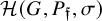


Proof. (a) It is clear from the definitions of ${\mathcal {T}}_\sigma $
and
${\mathcal {T}}_\sigma $
and $\mathcal G_\sigma $
that
$\mathcal G_\sigma $
that $\Delta _{\mathfrak {f},\mathrm {aff}}$
for
$\Delta _{\mathfrak {f},\mathrm {aff}}$
for $G_\sigma $
is contained in
$G_\sigma $
is contained in $\Delta _{\mathfrak {f},\mathrm {aff}}$
for G. By construction,
$\Delta _{\mathfrak {f},\mathrm {aff}}$
for G. By construction, $R(L,S) = R(G,S) \cap \mathbb Q D(J)$
, and by Lemma 6.9,
$R(L,S) = R(G,S) \cap \mathbb Q D(J)$
, and by Lemma 6.9,
 $$\begin{align*}R(L,S) \cap R(G_\sigma,S) = R(T,S) = \emptyset. \end{align*}$$
Hence $\mathbb Q D(J) \cap R(G_\sigma ,S)=\varnothing $
, and the elements of J are constant functions on
$\mathbb Q D(J) \cap R(G_\sigma ,S)=\varnothing $
, and the elements of J are constant functions on $\mathbb A_T \cap {\mathcal {B}} (\mathcal G_{\sigma ,\mathrm {der}},F)$
. In particular,
$\mathbb A_T \cap {\mathcal {B}} (\mathcal G_{\sigma ,\mathrm {der}},F)$
. In particular, $\Delta _{\mathrm {aff}}$
for
$\Delta _{\mathrm {aff}}$
for $G_\sigma $
is contained in
$G_\sigma $
is contained in $\Delta _{\mathrm {aff}} \setminus J$
for G.
$\Delta _{\mathrm {aff}} \setminus J$
for G.
For $\alpha \in \Delta _{\mathfrak {f},\mathrm {aff}}$
such that
$\alpha \in \Delta _{\mathfrak {f},\mathrm {aff}}$
such that $w_{J \cup \alpha } (J) \neq -J$
,
$w_{J \cup \alpha } (J) \neq -J$
, $s_{\alpha }$
does not stabilize
$s_{\alpha }$
does not stabilize $\mathbb Q J$
, and hence does not stabilize the span of
$\mathbb Q J$
, and hence does not stabilize the span of $\mathfrak {f}$
in
$\mathfrak {f}$
in $\mathbb A_S$
. It follows that
$\mathbb A_S$
. It follows that $s_{\alpha }$
cannot stabilize the image of
$s_{\alpha }$
cannot stabilize the image of $\mathfrak {f}$
in
$\mathfrak {f}$
in $\mathbb A_T$
, and hence cannot define an element of
$\mathbb A_T$
, and hence cannot define an element of $S_{\mathfrak {f},\mathrm {aff}}$
for
$S_{\mathfrak {f},\mathrm {aff}}$
for $G_\sigma $
.
$G_\sigma $
.
For $\alpha \in \Delta _{\mathfrak {f},\mathrm {aff}}$
such that
$\alpha \in \Delta _{\mathfrak {f},\mathrm {aff}}$
such that $W_{J \cup \alpha } (J) = -J$
, the proof of Lemma 6.4 shows that
$W_{J \cup \alpha } (J) = -J$
, the proof of Lemma 6.4 shows that
 $$ \begin{align*} s_\alpha \cdot \theta_{\mathfrak{f}} = \theta_{\mathfrak{f}} & \Longleftrightarrow s_\alpha \cdot R_{{\mathcal{T}}_{\mathfrak{f}} (k_F)}^{\mathcal G_{\mathfrak{f}}^\circ (k_F)} (\theta_{\mathfrak{f}}) \cong R_{{\mathcal{T}}_{\mathfrak{f}} (k_F)}^{\mathcal G_{\mathfrak{f}}^\circ (k_F)} (\theta_{\mathfrak{f}})\\ & \Longleftrightarrow v(J,\alpha) \cdot R_{{\mathcal{T}}_{\mathfrak{f}} (k_F)}^{\mathcal G_{\mathfrak{f}}^\circ (k_F)} (\theta_{\mathfrak{f}}) \cong R_{{\mathcal{T}}_{\mathfrak{f}} (k_F)}^{\mathcal G_{\mathfrak{f}}^\circ (k_F)} (\theta_{\mathfrak{f}}) \Longleftrightarrow v(J,\alpha) \cdot \sigma \cong \sigma. \end{align*} $$
This provides the required bijection.
(b) The group $W_{\mathrm {aff}} (J) = \langle S_{\mathfrak {f},\mathrm {aff}} \rangle $
is realized in [Reference MorrisMor1, Theorem 2.7] as an affine Weyl group via its action on
$W_{\mathrm {aff}} (J) = \langle S_{\mathfrak {f},\mathrm {aff}} \rangle $
is realized in [Reference MorrisMor1, Theorem 2.7] as an affine Weyl group via its action on $D(J)^\perp \subset \mathbb A_S$
. On
$D(J)^\perp \subset \mathbb A_S$
. On $D(J)^\perp $
,
$D(J)^\perp $
, $v(\alpha ,J)$
coincides with
$v(\alpha ,J)$
coincides with $s_\alpha $
, so the bijection from part (a) extends to a group isomorphism
$s_\alpha $
, so the bijection from part (a) extends to a group isomorphism
 $$ \begin{align} \langle W(J,\sigma) \cap S_{\mathfrak{f},\mathrm{aff}} \rangle \cong \langle W(\emptyset,\theta_{\mathfrak{f}}) \cap (S_{\mathfrak{f},\mathrm{aff}} \text{ for } G_\sigma) \rangle. \end{align} $$
The data ${\mathcal {T}}_{\mathfrak {f}} (k_F)$
,
${\mathcal {T}}_{\mathfrak {f}} (k_F)$
, $\theta _{\mathfrak {f}}$
and
$\theta _{\mathfrak {f}}$
and ${\mathcal {L}}_\alpha (k_F)$
used in Lemma 6.6 (b) are the same for
${\mathcal {L}}_\alpha (k_F)$
used in Lemma 6.6 (b) are the same for $\mathcal G$
and for
$\mathcal G$
and for $\mathcal G_\sigma $
. Hence that lemma implies that
$\mathcal G_\sigma $
. Hence that lemma implies that $q_\sigma (v(\alpha ,J))$
equals
$q_\sigma (v(\alpha ,J))$
equals $q_\theta (s_\alpha )$
, where the latter is computed from
$q_\theta (s_\alpha )$
, where the latter is computed from $(G_\sigma ,P_{G_\sigma ,\mathfrak {f}},\theta _{\mathfrak {f}})$
.
$(G_\sigma ,P_{G_\sigma ,\mathfrak {f}},\theta _{\mathfrak {f}})$
.
(c) This is a direct consequence of part (b).
Remark 6.11. Proposition 6.10 says that $\mathcal H (W_{\mathrm {aff}} (J,\sigma ),q_\sigma )$
is naturally isomorphic to the Iwahori–Hecke algebra from a Bernstein block of principal series representations of a quasi-split reductive p-adic group. Hecke algebras and the local Langlands correspondence for such representations were analyzed in detail in [Reference SolleveldSol10]. For the more explicit computation of the q-parameters for principal series Bernstein blocks we refer to [Reference SolleveldSol8, §4.2], where it is shown that the same q-parameters also arise from some Bernstein block of unipotent representations (of yet another group).
$\mathcal H (W_{\mathrm {aff}} (J,\sigma ),q_\sigma )$
is naturally isomorphic to the Iwahori–Hecke algebra from a Bernstein block of principal series representations of a quasi-split reductive p-adic group. Hecke algebras and the local Langlands correspondence for such representations were analyzed in detail in [Reference SolleveldSol10]. For the more explicit computation of the q-parameters for principal series Bernstein blocks we refer to [Reference SolleveldSol8, §4.2], where it is shown that the same q-parameters also arise from some Bernstein block of unipotent representations (of yet another group).
For $\alpha \in \Delta _{\mathfrak {f},\sigma }$
, we write
$\alpha \in \Delta _{\mathfrak {f},\sigma }$
, we write
 $$\begin{align*}{\mathcal{T}}_\alpha := (Z_{{\mathcal{T}}_{\mathfrak{f}}} (\mathcal{U}_\alpha) )^\circ \subset {\mathcal{T}}_{\mathfrak{f}} \quad \text{and} \quad \mathcal G_\alpha := Z_{\mathcal G}({\mathcal{T}}_\alpha). \end{align*}$$
Then $\mathcal G_\alpha $
is a Levi subgroup of
$\mathcal G_\alpha $
is a Levi subgroup of $\mathcal G_\sigma $
containing
$\mathcal G_\sigma $
containing ${\mathcal {T}}$
, so in particular
${\mathcal {T}}$
, so in particular $G_\alpha = \mathcal G_\alpha (F)$
is quasi-split. Furthermore, since
$G_\alpha = \mathcal G_\alpha (F)$
is quasi-split. Furthermore, since $\alpha $
is defined over F, we have
$\alpha $
is defined over F, we have
 $$ \begin{align} R(\mathcal G_\alpha,{\mathcal{T}}) = \{ \beta \in R(\mathcal G,{\mathcal{T}}) : \beta |_{{\mathcal{T}}_{\mathfrak{f}}} \in {\mathbb{R}}^\times \alpha \} = \{ \beta \in R(\mathcal G,{\mathcal{T}}) : \beta |_{{\mathcal{T}}_s} \in {\mathbb{R}}^\times \alpha \}. \end{align} $$
The data ${\mathcal {T}}_{\mathfrak {f}} (k_F)$
,
${\mathcal {T}}_{\mathfrak {f}} (k_F)$
, $\theta _{\mathfrak {f}}$
and
$\theta _{\mathfrak {f}}$
and ${\mathcal {L}}_\alpha (k_F)$
figuring in Lemma 6.6 can be constructed from
${\mathcal {L}}_\alpha (k_F)$
figuring in Lemma 6.6 can be constructed from $G_\alpha $
equally well as from
$G_\alpha $
equally well as from $G_\sigma $
or G. Analogous to Proposition 6.10, this gives:
$G_\sigma $
or G. Analogous to Proposition 6.10, this gives:
Corollary 6.12. The parameter $q_\sigma (v(\alpha ,J)) = q_\theta (s_\alpha )$
equals the q-parameter for
$q_\sigma (v(\alpha ,J)) = q_\theta (s_\alpha )$
equals the q-parameter for $s_\alpha $
in
$s_\alpha $
in $\mathcal H (G_\alpha , P_{G_\alpha ,\mathfrak {f}}, \theta _{\mathfrak {f}})$
.
$\mathcal H (G_\alpha , P_{G_\alpha ,\mathfrak {f}}, \theta _{\mathfrak {f}})$
.
7 The Hecke algebra of a non-singular depth-zero Bernstein block
We continue the conventions from Section 6, in particular, $\sigma $
is a non-singular cuspidal representation of
$\sigma $
is a non-singular cuspidal representation of $\mathcal G_{\mathfrak {f}}^\circ (k_F) = P_{\mathfrak {f}} / G_{\mathfrak {f},0+}$
. Let
$\mathcal G_{\mathfrak {f}}^\circ (k_F) = P_{\mathfrak {f}} / G_{\mathfrak {f},0+}$
. Let $\hat \sigma $
be an irreducible representation of
$\hat \sigma $
be an irreducible representation of $\mathcal G_{\mathfrak {f}}(k_F) = \hat P_{\mathfrak {f}} / G_{\mathfrak {f},0+}$
whose restriction to
$\mathcal G_{\mathfrak {f}}(k_F) = \hat P_{\mathfrak {f}} / G_{\mathfrak {f},0+}$
whose restriction to $\mathcal G_{\mathfrak {f}}^\circ (k_F)$
contains
$\mathcal G_{\mathfrak {f}}^\circ (k_F)$
contains $\sigma $
.
$\sigma $
.
Theorem 7.1 [Reference Moy and PrasadMoPr2, Reference MorrisMor2].
The pair $(\hat P_{\mathfrak {f}}, \hat \sigma )$
is a type for a single Bernstein block
$(\hat P_{\mathfrak {f}}, \hat \sigma )$
is a type for a single Bernstein block $\mathrm {Rep} (G)_{(\hat P_{\mathfrak {f}},\hat \sigma )} \subset \mathrm {Rep} (G)$
. Moreover
$\mathrm {Rep} (G)_{(\hat P_{\mathfrak {f}},\hat \sigma )} \subset \mathrm {Rep} (G)$
. Moreover $(\hat P_{\mathfrak {f}}, \hat \sigma )$
is a cover of the type
$(\hat P_{\mathfrak {f}}, \hat \sigma )$
is a cover of the type $(\hat P_{L,\mathfrak {f}},\hat \sigma )$
.
$(\hat P_{L,\mathfrak {f}},\hat \sigma )$
.
For general results about types and their G-covers, we refer the reader to [Reference Bushnell and KutzkoBuKu]. For our use, here we record in particular an equivalence of categories
 $$ \begin{align} \mathrm{Rep} (G)_{(\hat P_{\mathfrak{f}},\hat \sigma)} \; \cong \; \mathrm{Mod} \text{ - } {\mathcal H} (G,\hat P_{\mathfrak{f}}, \hat \sigma), \end{align} $$
where $\mathrm {Mod}\text { - }\mathcal {R}$
denotes the category of right
$\mathrm {Mod}\text { - }\mathcal {R}$
denotes the category of right $\mathcal {R}$
-modules.
$\mathcal {R}$
-modules.
Since $\hat P_{\mathfrak {f}} / P_{\mathfrak {f}}$
is abelian by Lemma 5.1 (a), every alternative
$\hat P_{\mathfrak {f}} / P_{\mathfrak {f}}$
is abelian by Lemma 5.1 (a), every alternative $\hat \sigma '$
is isomorphic to
$\hat \sigma '$
is isomorphic to $\chi \otimes \hat \sigma $
for some (not necessarily unique) character
$\chi \otimes \hat \sigma $
for some (not necessarily unique) character $\chi $
of
$\chi $
of $\Omega _{\mathfrak {f}}^\circ $
. In particular, the multiplicity
$\Omega _{\mathfrak {f}}^\circ $
. In particular, the multiplicity $m(\hat \sigma ,\sigma )$
of
$m(\hat \sigma ,\sigma )$
of $\hat \sigma $
in
$\hat \sigma $
in $\mathrm {ind}_{P_{\mathfrak {f}}}^{\hat P_{\mathfrak {f}}} (\sigma )$
, which equals the multiplicity of
$\mathrm {ind}_{P_{\mathfrak {f}}}^{\hat P_{\mathfrak {f}}} (\sigma )$
, which equals the multiplicity of $\sigma $
in
$\sigma $
in $\hat \sigma $
, is independent of the choice of
$\hat \sigma $
, is independent of the choice of $\hat \sigma $
. Therefore, we have
$\hat \sigma $
. Therefore, we have
 $$ \begin{align} \mathrm{ind}_{P_{\mathfrak{f}}}^{\hat P_{\mathfrak{f}}} (\sigma) \cong {\mathbb{C}}^{m(\hat \sigma,\sigma)} \otimes \bigoplus\limits_{\hat \sigma \text{ contains } \sigma} \hat \sigma \quad \text{and} \end{align} $$
 $$ \begin{align} \mathcal H (\hat P_{\mathfrak{f}}, P_{\mathfrak{f}}, \sigma) = \mathrm{End}_{\hat P_{\mathfrak{f}}} \big( \mathrm{ind}_{P_{\mathfrak{f}}}^{\hat P_{\mathfrak{f}}} (\sigma) \big) \cong M_{m(\hat \sigma,\sigma)}({\mathbb{C}}) \otimes \bigoplus\limits_{\hat \sigma \text{ contains } \sigma} {\mathbb{C}} \, \mathrm{id}_{V_{\hat \sigma}}. \end{align} $$
Recall moreover from [Reference Bushnell and KutzkoBuKu] that there are natural algebra isomorphisms
 $$ \begin{align} \begin{aligned} & \mathcal H (G,P_{\mathfrak{f}},\sigma) \cong \mathrm{End}_G \big( \mathrm{ind}_{P_{\mathfrak{f}}}^G (\sigma) \big) = \mathrm{End}_G \big( \mathrm{ind}_{\hat P_{\mathfrak{f}}}^G \mathrm{ind}_{P_{\mathfrak{f}}}^{\hat P_{\mathfrak{f}}} (\sigma) \big) \quad \text{and}\\ & \mathcal H (G,\hat P_{\mathfrak{f}},\hat \sigma) \cong \mathrm{End}_G \big( \mathrm{ind}_{\hat P_{\mathfrak{f}}}^G (\hat \sigma) \big). \end{aligned} \end{align} $$
We choose a decomposition of $\hat P_{\mathfrak {f}}$
-representations
$\hat P_{\mathfrak {f}}$
-representations
 $$ \begin{align} \mathrm{ind}_{P_{\mathfrak{f}}}^{\hat P_{\mathfrak{f}}} (\sigma) = \hat \sigma \oplus \hat \pi. \end{align} $$
By (7.2) and (7.4), we see that (7.5) induces an algebra embedding
 $$ \begin{align} \mathcal H (G,\hat P_{\mathfrak{f}},\hat \sigma) \hookrightarrow \mathcal H (G,P_{\mathfrak{f}},\sigma), \end{align} $$
as already noted in [Reference MorrisMor2, p. 150]. The unit element $T_e$
of
$T_e$
of $\mathcal H (G,P_{\mathfrak {f}},\sigma )$
can be identified with
$\mathcal H (G,P_{\mathfrak {f}},\sigma )$
can be identified with $\sigma : P_{\mathfrak {f}} \to \mathrm {End}_{\mathbb {C}} (V_\sigma )$
. Let
$\sigma : P_{\mathfrak {f}} \to \mathrm {End}_{\mathbb {C}} (V_\sigma )$
. Let $\hat T_e \in \mathcal H (\hat P_{\mathfrak {f}}, P_{\mathfrak {f}}, \sigma )$
be the minimal idempotent whose kernel is
$\hat T_e \in \mathcal H (\hat P_{\mathfrak {f}}, P_{\mathfrak {f}}, \sigma )$
be the minimal idempotent whose kernel is $\hat \pi $
and whose image equals
$\hat \pi $
and whose image equals $\hat \sigma $
as in (7.5). Then
$\hat \sigma $
as in (7.5). Then $\hat T_e \in \mathcal H (G,P_{\mathfrak {f}},\sigma )$
is the image of the unit element of
$\hat T_e \in \mathcal H (G,P_{\mathfrak {f}},\sigma )$
is the image of the unit element of $\mathcal H (G,\hat P_{\mathfrak {f}},\hat \sigma )$
via (7.6).
$\mathcal H (G,\hat P_{\mathfrak {f}},\hat \sigma )$
via (7.6).
Let $G_{\mathfrak {f},\hat \sigma }$
be the stabilizer of
$G_{\mathfrak {f},\hat \sigma }$
be the stabilizer of $\hat \sigma \in \mathrm {Irr} (\hat P_{\mathfrak {f}})$
in
$\hat \sigma \in \mathrm {Irr} (\hat P_{\mathfrak {f}})$
in $G_{\mathfrak {f}}$
, and let
$G_{\mathfrak {f}}$
, and let $\Omega (J,\hat \sigma )$
denote its image in
$\Omega (J,\hat \sigma )$
denote its image in
 $$ \begin{align} \Omega (J,\sigma) \hat P_{\mathfrak{f}} / \hat P_{\mathfrak{f}} \cong \Omega (J,\sigma) \Omega_{\mathfrak{f}}^0 / \Omega_{\mathfrak{f}}^0 \cong \Omega (J,\sigma) / \Omega_{\mathfrak{f},\sigma}^0. \end{align} $$
Note that by Lemma 5.1 (b), $\Omega (J, \hat \sigma )$
is isomorphic to a lattice in
$\Omega (J, \hat \sigma )$
is isomorphic to a lattice in $X_* (Z(G)) \otimes _{\mathbb {Z}} {\mathbb {R}}$
. The following result is based on and generalizes [Reference LusztigLus4, §1.20].
$X_* (Z(G)) \otimes _{\mathbb {Z}} {\mathbb {R}}$
. The following result is based on and generalizes [Reference LusztigLus4, §1.20].
Theorem 7.2. There are algebra isomorphisms
 $$\begin{align*}{\mathcal H} (G,\hat P_{\mathfrak{f}},\hat \sigma) \cong \hat T_e \mathcal H (G,P_{\mathfrak{f}},\sigma) \hat T_e \cong \mathcal H (W_{\mathrm{aff}} (J,\sigma),q_\sigma) \rtimes {\mathbb{C}}[ \Omega (J,\hat \sigma) ,\mu_{\hat \sigma}]. \end{align*}$$
The support of ${\mathcal H} (G,\hat P_{\mathfrak {f}},\hat \sigma )$
is
${\mathcal H} (G,\hat P_{\mathfrak {f}},\hat \sigma )$
is $\hat P_{\mathfrak {f}} (W_{\mathrm {aff}} (J,\sigma ) \rtimes \Omega (J,\hat \sigma )) \hat P_{\mathfrak {f}}$
, and this algebra has a basis indexed by
$\hat P_{\mathfrak {f}} (W_{\mathrm {aff}} (J,\sigma ) \rtimes \Omega (J,\hat \sigma )) \hat P_{\mathfrak {f}}$
, and this algebra has a basis indexed by $W_{\mathrm {aff}} (J,\sigma ) \rtimes \Omega (J,\hat \sigma )$
.
$W_{\mathrm {aff}} (J,\sigma ) \rtimes \Omega (J,\hat \sigma )$
.
Proof. The first isomorphism follows from (7.5) and the construction of $\hat T_e$
. The support of
$\hat T_e$
. The support of ${\hat T_e \in \mathcal H (G,P_{\mathfrak {f}}, \sigma )}$
is
${\hat T_e \in \mathcal H (G,P_{\mathfrak {f}}, \sigma )}$
is $\hat P_{\mathfrak {f},\sigma } / P_{\mathfrak {f}} = \Omega _{\mathfrak {f},\sigma }^0$
, which by Lemma 5.2 is central in
$\hat P_{\mathfrak {f},\sigma } / P_{\mathfrak {f}} = \Omega _{\mathfrak {f},\sigma }^0$
, which by Lemma 5.2 is central in $W(J,\sigma )$
. By the multiplication relations in Theorem 6.1,
$W(J,\sigma )$
. By the multiplication relations in Theorem 6.1, $\hat T_e$
commutes with each
$\hat T_e$
commutes with each $T_{s_\alpha }$
and hence with
$T_{s_\alpha }$
and hence with $\mathcal H (W_{\mathrm {aff}} (J,\sigma ),q_\sigma )$
. By Theorem 6.1, we deduce
$\mathcal H (W_{\mathrm {aff}} (J,\sigma ),q_\sigma )$
. By Theorem 6.1, we deduce
 $$ \begin{align} \hat T_e \mathcal H (G,P_{\mathfrak{f}},\sigma) \hat T_e \cong \mathcal H (W_{\mathrm{aff}} (J,\sigma),q_\sigma) \rtimes \hat T_e {\mathbb{C}}[ \Omega (J,\sigma) ,\mu_\sigma] \hat T_e. \end{align} $$
Here $\hat T_e {\mathbb {C}}[ \Omega (J,\sigma ) ,\mu _\sigma ] \hat T_e$
is isomorphic to the subalgebra of
$\hat T_e {\mathbb {C}}[ \Omega (J,\sigma ) ,\mu _\sigma ] \hat T_e$
is isomorphic to the subalgebra of $\mathcal H (G,\hat P_{\mathfrak {f}}, \hat \sigma )$
supported on
$\mathcal H (G,\hat P_{\mathfrak {f}}, \hat \sigma )$
supported on $\hat P_{\mathfrak {f}} \Omega (J,\hat \sigma ) \hat P_{\mathfrak {f}} = \Omega (J,\hat \sigma ) \hat P_{\mathfrak {f}}$
, so it equals
$\hat P_{\mathfrak {f}} \Omega (J,\hat \sigma ) \hat P_{\mathfrak {f}} = \Omega (J,\hat \sigma ) \hat P_{\mathfrak {f}}$
, so it equals $\mathcal H (\Omega (J,\hat \sigma ) \hat P_{\mathfrak {f}}, \hat P_{\mathfrak {f}},\hat \sigma )$
and has a basis indexed by
$\mathcal H (\Omega (J,\hat \sigma ) \hat P_{\mathfrak {f}}, \hat P_{\mathfrak {f}},\hat \sigma )$
and has a basis indexed by $\Omega (J,\hat \sigma ) \hat P_{\mathfrak {f}} / \hat P_{\mathfrak {f}} = \Omega (J,\hat \sigma )$
. This shows the claims about the support and a basis of
$\Omega (J,\hat \sigma ) \hat P_{\mathfrak {f}} / \hat P_{\mathfrak {f}} = \Omega (J,\hat \sigma )$
. This shows the claims about the support and a basis of ${\mathcal H} (G,\hat P_{\mathfrak {f}},\hat \sigma )$
. For any
${\mathcal H} (G,\hat P_{\mathfrak {f}},\hat \sigma )$
. For any $g \in \Omega (J,\hat \sigma ) \hat P_{\mathfrak {f}} \subset G_{\mathfrak {f}}$
, an element
$g \in \Omega (J,\hat \sigma ) \hat P_{\mathfrak {f}} \subset G_{\mathfrak {f}}$
, an element $\hat T_g \in \mathcal H (\Omega (J,\sigma ) \hat P_{\mathfrak {f}}, \hat P_{\mathfrak {f}},\hat \sigma )$
with support
$\hat T_g \in \mathcal H (\Omega (J,\sigma ) \hat P_{\mathfrak {f}}, \hat P_{\mathfrak {f}},\hat \sigma )$
with support $\hat P_{\mathfrak {f}} g \hat P_{\mathfrak {f}}$
is determined by a nonzero element
$\hat P_{\mathfrak {f}} g \hat P_{\mathfrak {f}}$
is determined by a nonzero element
 $$ \begin{align} \hat T_g (g) \in \mathrm{Hom}_{\hat P_{L,\mathfrak{f}}}(\hat \sigma, g \cdot \hat \sigma) \end{align} $$
unique up to scalars, and $\hat T_g (g)^{-1} \in \mathrm {Hom}_{\hat P_{L,\mathfrak {f}}}(\hat \sigma , g^{-1} \cdot \hat \sigma )$
determines an element
$\hat T_g (g)^{-1} \in \mathrm {Hom}_{\hat P_{L,\mathfrak {f}}}(\hat \sigma , g^{-1} \cdot \hat \sigma )$
determines an element $\hat T_{g^{-1}}$
which is the inverse of
$\hat T_{g^{-1}}$
which is the inverse of $\hat T_g$
. Furthermore,
$\hat T_g$
. Furthermore, $\hat T_g \hat T_h \in {\mathbb {C}}^\times \hat T_{g h}$
by uniqueness up to scalars. We do this for g running through a set of representatives
$\hat T_g \hat T_h \in {\mathbb {C}}^\times \hat T_{g h}$
by uniqueness up to scalars. We do this for g running through a set of representatives $\dot g$
for
$\dot g$
for $\Omega (J,\hat \sigma )$
. The formula
$\Omega (J,\hat \sigma )$
. The formula
 $$ \begin{align} \hat T_{\dot g} \hat T_{\dot h} = \mu_{\hat \sigma} (\dot g,\dot h) \hat T_{\dot{gh}} \end{align} $$
defines a 2-cocycle $\mu _{\hat \sigma }$
on
$\mu _{\hat \sigma }$
on $\Omega (J,\hat \sigma )$
. The cocycle relation follows from the associativity of
$\Omega (J,\hat \sigma )$
. The cocycle relation follows from the associativity of $\mathcal H (\Omega (J,\sigma ) \hat P_{\mathfrak {f}}, \hat P_{\mathfrak {f}},\hat \sigma )$
.
$\mathcal H (\Omega (J,\sigma ) \hat P_{\mathfrak {f}}, \hat P_{\mathfrak {f}},\hat \sigma )$
.
Theorem 7.2 also tells us that the stabilizer of $\hat \sigma \in \mathrm {Irr} (\hat P_{L,\mathfrak {f}})$
in
$\hat \sigma \in \mathrm {Irr} (\hat P_{L,\mathfrak {f}})$
in $W(J,\sigma ) \Omega _{\mathfrak {f}}^0 / \Omega _{\mathfrak {f}}^0$
is
$W(J,\sigma ) \Omega _{\mathfrak {f}}^0 / \Omega _{\mathfrak {f}}^0$
is
 $$ \begin{align} W(J,\hat \sigma) := W_{\mathrm{aff}} (J,\sigma) \rtimes \Omega (J,\hat \sigma). \end{align} $$
7.1 The supercuspidal case
To better understand the isomorphisms in Theorem 7.2, we first assume that the associated Bernstein block of G consists only of supercuspidal representations. This happens if and only if $\mathfrak {f}$
is a minimal facet of
$\mathfrak {f}$
is a minimal facet of ${\mathcal {B}} (\mathcal G,F)$
. In this case
${\mathcal {B}} (\mathcal G,F)$
. In this case ${\mathcal {L}} = \mathcal G$
and
${\mathcal {L}} = \mathcal G$
and $W_{\mathrm {aff}} (J,\sigma )$
is trivial. We will treat the general case in §7.2.
$W_{\mathrm {aff}} (J,\sigma )$
is trivial. We will treat the general case in §7.2.
Corollary 7.3. Suppose that $\mathfrak {f}$
is a minimal facet of
$\mathfrak {f}$
is a minimal facet of ${\mathcal {B}} (\mathcal G,F)$
. Then
${\mathcal {B}} (\mathcal G,F)$
. Then
 $$\begin{align*}\mathcal H (G,\hat P_{\mathfrak{f}}, \hat \sigma) \cong {\mathbb{C}} \big[ W(J,\hat \sigma) , \mu_{\hat \sigma} \big]. \end{align*}$$
Proof. The minimality of $\mathfrak {f}$
implies that
$\mathfrak {f}$
implies that $\Delta _{\mathrm {aff}} \setminus J$
contains at most one element from each F-simple factor of G. Hence
$\Delta _{\mathrm {aff}} \setminus J$
contains at most one element from each F-simple factor of G. Hence $\Delta _{\mathfrak {f},\mathrm {aff}}$
is empty and
$\Delta _{\mathfrak {f},\mathrm {aff}}$
is empty and $|W_{\mathrm {aff}} (J,\sigma )| = 1$
. By (7.11),
$|W_{\mathrm {aff}} (J,\sigma )| = 1$
. By (7.11), $\Omega (J,\hat \sigma )$
equals
$\Omega (J,\hat \sigma )$
equals $W(J,\hat \sigma )$
. Now the isomorphism is clear by Theorem 7.2.
$W(J,\hat \sigma )$
. Now the isomorphism is clear by Theorem 7.2.
Note that in the special case where $\sigma $
is moreover regular, a more precise version of Corollary 7.3 was already known in [Reference OharaOha1, Corollary 5.5].
$\sigma $
is moreover regular, a more precise version of Corollary 7.3 was already known in [Reference OharaOha1, Corollary 5.5].
We now make the supercuspidal G-representations arising from $(\hat P_{\mathfrak {f}},\hat \sigma )$
more explicit. Let
$(\hat P_{\mathfrak {f}},\hat \sigma )$
more explicit. Let $\sigma '$
be an irreducible representation of
$\sigma '$
be an irreducible representation of $G_{\mathfrak {f}}$
whose restriction to
$G_{\mathfrak {f}}$
whose restriction to $\hat P_{\mathfrak {f}}$
contains
$\hat P_{\mathfrak {f}}$
contains $\hat \sigma $
. By [Reference Moy and PrasadMoPr2, Propositions 6.6 and 6.8], we know that
$\hat \sigma $
. By [Reference Moy and PrasadMoPr2, Propositions 6.6 and 6.8], we know that
 $$ \begin{align} \tau := \mathrm{ind}_{G_{\mathfrak{f}}}^G (\sigma') \end{align} $$
is an irreducible supercuspidal G-representation, and that every object of $\mathrm {Irr} (G)_{(\hat P_{\mathfrak {f}},\hat \sigma )}$
is of this form for some extension
$\mathrm {Irr} (G)_{(\hat P_{\mathfrak {f}},\hat \sigma )}$
is of this form for some extension $\sigma '$
as above.
$\sigma '$
as above.
Let $G^1$
be the group generated by all compact subgroups of G, or equivalently the intersection of the kernels of all the unramified characters of G.
$G^1$
be the group generated by all compact subgroups of G, or equivalently the intersection of the kernels of all the unramified characters of G.
Lemma 7.4. Suppose that $\mathfrak {f}$
is a minimal facet of
$\mathfrak {f}$
is a minimal facet of ${\mathcal {B}} (\mathcal G,F)$
. Let
${\mathcal {B}} (\mathcal G,F)$
. Let $\tau _1$
be an irreducible subrepresentation of
$\tau _1$
be an irreducible subrepresentation of $\mathrm {Res}^G_{G^1} (\tau )$
. Then
$\mathrm {Res}^G_{G^1} (\tau )$
. Then $\mathrm {ind}_{G^1}^G (\tau _1) \cong \mathrm {ind}_{\hat P_{\mathfrak {f}}}^G (\hat \sigma )$
.
$\mathrm {ind}_{G^1}^G (\tau _1) \cong \mathrm {ind}_{\hat P_{\mathfrak {f}}}^G (\hat \sigma )$
.
Proof. By assumption, the image of $\mathfrak {f}$
in
$\mathfrak {f}$
in ${\mathcal {B}} (\mathcal G_{\mathrm {ad}},F)$
is just one point, and by construction
${\mathcal {B}} (\mathcal G_{\mathrm {ad}},F)$
is just one point, and by construction $G^1$
acts trivially on
$G^1$
acts trivially on $X_* (Z(G)) \otimes _{\mathbb {Z}} {\mathbb {R}}$
. Thus
$X_* (Z(G)) \otimes _{\mathbb {Z}} {\mathbb {R}}$
. Thus $G_{\mathfrak {f}} \cap G^1 = \hat P_{\mathfrak {f}}$
. We claim that
$G_{\mathfrak {f}} \cap G^1 = \hat P_{\mathfrak {f}}$
. We claim that
 $$ \begin{align} \tau_1 := \mathrm{ind}_{\hat P_{\mathfrak{f}}}^{G^1} (\hat \sigma) \end{align} $$
is irreducible. The intertwining set of $\hat \sigma \in \mathrm {Irr} (\hat P_{\mathfrak {f}})$
is defined as
$\hat \sigma \in \mathrm {Irr} (\hat P_{\mathfrak {f}})$
is defined as
 $$\begin{align*}\{ g \in G : \mathrm{Hom}_{\hat P_{\mathfrak{f}} \cap g \hat P_{\mathfrak{f}} g^{-1}} (\hat \sigma, g \cdot \hat \sigma) \neq 0 \}. \end{align*}$$
It equals the support of $\mathcal H (G,\hat P_{\mathfrak {f}},\hat \sigma )$
, which by Theorem 6.1 is
$\mathcal H (G,\hat P_{\mathfrak {f}},\hat \sigma )$
, which by Theorem 6.1 is $G_{\mathfrak {f},\hat \sigma }$
. Since
$G_{\mathfrak {f},\hat \sigma }$
. Since $\hat P_{\mathfrak {f}}$
equals
$\hat P_{\mathfrak {f}}$
equals $G_{\mathfrak {f}, \hat \sigma } \cap G^1$
, the intertwining of
$G_{\mathfrak {f}, \hat \sigma } \cap G^1$
, the intertwining of $\hat \sigma \in \mathrm {Irr} ( \hat P_{\mathfrak {f}})$
in
$\hat \sigma \in \mathrm {Irr} ( \hat P_{\mathfrak {f}})$
in $G^1$
equals
$G^1$
equals $\hat P_{\mathfrak {f}}$
. This implies the claimed irreducibility of
$\hat P_{\mathfrak {f}}$
. This implies the claimed irreducibility of $\tau _1$
. By the transitivity of induction, we have
$\tau _1$
. By the transitivity of induction, we have
 $$ \begin{align} \mathrm{ind}_{G^1}^G (\tau_1) = \mathrm{ind}_{G^1}^G \mathrm{ind}_{\hat P_{\mathfrak{f}}}^{G^1} (\hat \sigma) = \mathrm{ind}_{\hat P_{\mathfrak{f}}}^G (\hat \sigma). \end{align} $$
By Frobenius reciprocity, $\mathrm {Hom}_{G^1} (\tau _1, \tau ) \cong \mathrm {Hom}_{\hat P_{\mathfrak {f}}}(\hat \sigma , \mathrm {ind}_{G_{\mathfrak {f}}}^G (\sigma ') ) \subset \mathrm {Hom}_{\hat P_{\mathfrak {f}}}(\hat \sigma , \sigma ' ) \neq 0$
. Hence this
$\mathrm {Hom}_{G^1} (\tau _1, \tau ) \cong \mathrm {Hom}_{\hat P_{\mathfrak {f}}}(\hat \sigma , \mathrm {ind}_{G_{\mathfrak {f}}}^G (\sigma ') ) \subset \mathrm {Hom}_{\hat P_{\mathfrak {f}}}(\hat \sigma , \sigma ' ) \neq 0$
. Hence this $\tau _1$
is indeed a subrepresentation of
$\tau _1$
is indeed a subrepresentation of $\mathrm {Res}^G_{G^1} (\tau )$
. By the irreducibility of
$\mathrm {Res}^G_{G^1} (\tau )$
. By the irreducibility of $\tau $
, every alternative
$\tau $
, every alternative $\tau _2$
for
$\tau _2$
for $\tau _1$
is isomorphic to
$\tau _1$
is isomorphic to $g \cdot \tau _1$
for some
$g \cdot \tau _1$
for some $g \in G$
. In particular the choice of
$g \in G$
. In particular the choice of $\tau _1$
does not affect
$\tau _1$
does not affect $\mathrm {ind}_{G^1}^G (\tau _1)$
.
$\mathrm {ind}_{G^1}^G (\tau _1)$
.
Since the supercuspidal Bernstein component $\mathrm {Irr} (G)_{(\hat P_{\mathfrak {f}},\hat \sigma )} \cong \mathrm {Irr} \text { - } \mathcal H (G,\hat P_{\mathfrak {f}}, \hat \sigma )$
has the structure of a complex torus, it is isomorphic to the space of irreducible representations of a lattice. This suggests that it is possible to get rid of the 2-cocycle
$\mathrm {Irr} (G)_{(\hat P_{\mathfrak {f}},\hat \sigma )} \cong \mathrm {Irr} \text { - } \mathcal H (G,\hat P_{\mathfrak {f}}, \hat \sigma )$
has the structure of a complex torus, it is isomorphic to the space of irreducible representations of a lattice. This suggests that it is possible to get rid of the 2-cocycle $\mu _{\hat \sigma }$
in Corollary 7.3. It turns out that is indeed the case, at the cost of passing to a smaller lattice. We write
$\mu _{\hat \sigma }$
in Corollary 7.3. It turns out that is indeed the case, at the cost of passing to a smaller lattice. We write
 $$ \begin{align} ZW (J,\hat \sigma) := \{ w \in W(J,\hat \sigma) : T_v T_w = T_w T_v \text{ for all } v \in W( J,\hat \sigma) \}. \end{align} $$
As a subgroup of a lattice, $ZW (J,\hat \sigma )$
is again a lattice. We choose a basis
$ZW (J,\hat \sigma )$
is again a lattice. We choose a basis $\mathfrak B$
, and for
$\mathfrak B$
, and for $z = \sum \limits _{b \in \mathfrak B} n_b b \in ZW (J,\hat \sigma )$
, we rescale
$z = \sum \limits _{b \in \mathfrak B} n_b b \in ZW (J,\hat \sigma )$
, we rescale $T_z$
to
$T_z$
to $\prod \limits _{b \in \mathfrak B} T_b^{n_b}$
. By (7.15), this is well-defined. Next we choose a set of representatives
$\prod \limits _{b \in \mathfrak B} T_b^{n_b}$
. By (7.15), this is well-defined. Next we choose a set of representatives $\dot w$
for
$\dot w$
for $W(J,\hat \sigma ) / ZW (J,\hat \sigma )$
, and we rescale
$W(J,\hat \sigma ) / ZW (J,\hat \sigma )$
, and we rescale $T_{\dot w z} = T_{\dot w} T_z = T_z T_{\dot w}$
. This allows us to make
$T_{\dot w z} = T_{\dot w} T_z = T_z T_{\dot w}$
. This allows us to make $\mu _{\hat \sigma }$
factor through
$\mu _{\hat \sigma }$
factor through $\big ( W(J,\hat \sigma ) / ZW (J,\hat \sigma ) \big )^2$
. Together with the commutativity of
$\big ( W(J,\hat \sigma ) / ZW (J,\hat \sigma ) \big )^2$
. Together with the commutativity of $W(J,\hat \sigma ) = \Omega (J,\hat \sigma )$
, we obtain
$W(J,\hat \sigma ) = \Omega (J,\hat \sigma )$
, we obtain
 $$ \begin{align} Z \big( {\mathbb{C}} [W(J,\hat \sigma) , \mu_{\hat \sigma} ] \big) = {\mathbb{C}} [ZW (J,\hat \sigma)]. \end{align} $$
By [Reference MorrisMor1, §7.13], it is easy to see that $ZW (J,\hat \sigma )$
contains the image in
$ZW (J,\hat \sigma )$
contains the image in $W(J,\hat \sigma )$
of the maximal central F-split torus of G. This image has finite index in the lattice
$W(J,\hat \sigma )$
of the maximal central F-split torus of G. This image has finite index in the lattice $W(J,\hat \sigma )$
, because it has the same rank by Lemma 5.1(b). Thus
$W(J,\hat \sigma )$
, because it has the same rank by Lemma 5.1(b). Thus $[W(J,\hat \sigma ) : ZW (J,\hat \sigma )]$
is finite.
$[W(J,\hat \sigma ) : ZW (J,\hat \sigma )]$
is finite.
Let $\mathfrak {X}_{\mathrm {nr}} (G,\tau )$
be the stabilizer of
$\mathfrak {X}_{\mathrm {nr}} (G,\tau )$
be the stabilizer of $\tau \in \mathrm {Irr} (G)_{(\hat P_{\mathfrak {f}},\hat \sigma )}$
in
$\tau \in \mathrm {Irr} (G)_{(\hat P_{\mathfrak {f}},\hat \sigma )}$
in $\mathfrak {X}_{\mathrm {nr}} (G)$
. There is a bijection
$\mathfrak {X}_{\mathrm {nr}} (G)$
. There is a bijection
 $$ \begin{align} \mathfrak{X}_{\mathrm{nr}} (G) / \mathfrak{X}_{\mathrm{nr}} (G,\tau) \xrightarrow{\,\sim\,} \mathrm{Irr} (G)_{[G,\tau]} : \chi \mapsto \chi \otimes \tau \end{align} $$
Recall from (7.13) that $\big ( \mathrm {ind}_{\hat P_{\mathfrak {f}}}^{G^1}(\hat \sigma ), \mathrm {ind}_{\hat P_{\mathfrak {f}}}^{G^1}(V_{\hat \sigma }) \big )$
is an irreducible
$\big ( \mathrm {ind}_{\hat P_{\mathfrak {f}}}^{G^1}(\hat \sigma ), \mathrm {ind}_{\hat P_{\mathfrak {f}}}^{G^1}(V_{\hat \sigma }) \big )$
is an irreducible $G^1$
-subrepresentation of
$G^1$
-subrepresentation of $\tau $
. As in [Reference SolleveldSol5, §2], we define
$\tau $
. As in [Reference SolleveldSol5, §2], we define
 $$ \begin{align*} & G_\tau^2 := \bigcap\nolimits_{\chi \in \mathfrak{X}_{\mathrm{nr}} (G,\tau)} \, \ker \chi ,\\ & G_\tau^3 := \{ g \in G : g \cdot \mathrm{ind}_{\hat P_{\mathfrak{f}}}^{G^1}(V_{\hat \sigma}) = \mathrm{ind}_{\hat P_{\mathfrak{f}}}^{G^1}(V_{\hat \sigma}) \} ,\\ & G_\tau^4 := \{ g \in G : g \cdot \mathrm{ind}_{\hat P_{\mathfrak{f}}}^{G^1}(\hat \sigma) \cong \mathrm{ind}_{\hat P_{\mathfrak{f}}}^{G^1}(\hat \sigma) \}. \end{align*} $$
With these notations, [Reference SolleveldSol5, Lemma 10.1.b] says that
 $$ \begin{align} W(J,\hat \sigma) = G_\tau^4 / G^1 ,\qquad ZW(J,\hat \sigma) = G_\tau^2 / G^1 \end{align} $$
and ${\mathbb {C}} [G_\tau ^3 / G^1]$
is a maximal commutative subalgebra of
${\mathbb {C}} [G_\tau ^3 / G^1]$
is a maximal commutative subalgebra of ${\mathbb {C}} [W(J,\hat \sigma ),\mu _{\hat \sigma }]$
. Let
${\mathbb {C}} [W(J,\hat \sigma ),\mu _{\hat \sigma }]$
. Let $\mathcal O (\mathfrak {X}_{\mathrm {nr}} (G)$
be the ring of regular functions on the complex algebraic variety
$\mathcal O (\mathfrak {X}_{\mathrm {nr}} (G)$
be the ring of regular functions on the complex algebraic variety $\mathfrak X_{\mathrm {nr}} (G)$
. By (7.17), we obtain algebra isomorphisms
$\mathfrak X_{\mathrm {nr}} (G)$
. By (7.17), we obtain algebra isomorphisms
 $$ \begin{align} {\mathbb{C}} [ZW(J,\hat \sigma) \cong {\mathbb{C}} [G^2_\tau / G^1] \cong \mathcal O (\mathfrak{X}_{\mathrm{nr}} (G) / \mathfrak{X}_{\mathrm{nr}} (G,\tau)) \cong \mathcal O (\mathrm{Irr} (G)_{[G,\tau]}) , \end{align} $$
determined entirely by the choice of $\tau $
. We write
$\tau $
. We write $CW (J,\hat \sigma ) := G_\tau ^3 / G^1$
, such that there are finite index inclusions of lattices
$CW (J,\hat \sigma ) := G_\tau ^3 / G^1$
, such that there are finite index inclusions of lattices
 $$ \begin{align} ZW (J,\hat \sigma) \subset CW (J,\hat \sigma) \subset W(J,\hat \sigma). \end{align} $$
By [Reference RocheRoc, Lemma 1.6.3.1], we know that
 $$\begin{align*}[W(J,\hat \sigma) : CW (J,\hat \sigma)] = [CW (J,\hat \sigma) : ZW (J,\hat \sigma)] \end{align*}$$
equals the multiplicity of $\tau _1$
in
$\tau _1$
in $\mathrm {Res}^G_{G^1}(\tau )$
. For an open subset
$\mathrm {Res}^G_{G^1}(\tau )$
. For an open subset $U \subset \mathrm {Irr} (ZW(J,\hat \sigma ))$
, let
$U \subset \mathrm {Irr} (ZW(J,\hat \sigma ))$
, let $C^{an}(U)$
be the algebra of analytic functions on U. The analytic localization of
$C^{an}(U)$
be the algebra of analytic functions on U. The analytic localization of ${\mathbb {C}}[W(J,\hat \sigma ),\mu _{\hat \sigma }]$
at U is defined as
${\mathbb {C}}[W(J,\hat \sigma ),\mu _{\hat \sigma }]$
at U is defined as
 $$ \begin{align} {\mathbb{C}}[W(J,\hat \sigma),\mu_{\hat \sigma}]^{an}_U := {\mathbb{C}}[W(J,\hat \sigma),\mu_{\hat \sigma}] \otimes_{{\mathbb{C}} [ZW(J,\hat \sigma)]} C^{an}(U). \end{align} $$
The finite-length modules of this algebra are precisely those finite-length modules of ${\mathbb {C}}[W(J,\hat \sigma ),\mu _{\hat \sigma }]$
, all whose
${\mathbb {C}}[W(J,\hat \sigma ),\mu _{\hat \sigma }]$
, all whose ${\mathbb {C}}[ZW(J,\hat \sigma )]$
-weights belong to U, cf. [Reference OpdamOpd, Proposition 4.3]. Similarly, we can define the analytic localization of
${\mathbb {C}}[ZW(J,\hat \sigma )]$
-weights belong to U, cf. [Reference OpdamOpd, Proposition 4.3]. Similarly, we can define the analytic localization of ${\mathbb {C}}[W(J,\hat \sigma ),\mu _{\hat \sigma }]$
with respect to an open subset
${\mathbb {C}}[W(J,\hat \sigma ),\mu _{\hat \sigma }]$
with respect to an open subset $\tilde U$
of
$\tilde U$
of $\mathrm {Irr} (CW (J,\hat \sigma ))$
. We denote this module by
$\mathrm {Irr} (CW (J,\hat \sigma ))$
. We denote this module by ${\mathbb {C}}[W(J,\hat \sigma ),\mu _{\hat \sigma }]^{an}_{\tilde U}$
. If
${\mathbb {C}}[W(J,\hat \sigma ),\mu _{\hat \sigma }]^{an}_{\tilde U}$
. If $\tilde U$
is the full preimage of a subset
$\tilde U$
is the full preimage of a subset $U \subset \mathrm {Irr} (ZW(J,\hat \sigma ))$
, then it acquires an algebra structure via the natural isomorphism
$U \subset \mathrm {Irr} (ZW(J,\hat \sigma ))$
, then it acquires an algebra structure via the natural isomorphism
 $$ \begin{align} {\mathbb{C}}[W(J,\hat \sigma),\mu_{\hat \sigma}]^{an}_{\tilde U} \cong {\mathbb{C}}[W(J,\hat \sigma),\mu_{\hat \sigma}]^{an}_U \end{align} $$
Proposition 7.5. Assume that $L = G$
.
$L = G$
.
-
(a) Suppose that the inverse image of U in
$\mathrm {Irr} (CW (J,\hat \sigma ))$
is homeomorphic to a disjoint union of
$d = [CW (J,\hat \sigma ) : ZW(J,\hat \sigma )]$
copies of U. Then the algebras
${\mathbb {C}} [W(J,\hat \sigma ) , \mu _{\hat \sigma } ]^{an}_U$
and
$C^{an}(U)$
are Morita equivalent. -
(b) The algebras
${\mathbb {C}} [W(J,\hat \sigma ),\mu _{\hat \sigma }]$
and
${\mathbb {C}} [ZW(J,\hat \sigma )]$
have equivalent categories of finite-length modules. The equivalence sends any irreducible
${\mathbb {C}} [W(J,\hat \sigma ),\mu _{\hat \sigma }]$
-module to its central character.


Proof. (a) Write the inverse image of U in $\mathrm {Irr} (CW (J,\hat \sigma ))$
as
$\mathrm {Irr} (CW (J,\hat \sigma ))$
as $U_1 \sqcup \cdots \sqcup U_d$
, where each
$U_1 \sqcup \cdots \sqcup U_d$
, where each $U_i$
projects homeomorphically onto U. Then we have
$U_i$
projects homeomorphically onto U. Then we have
 $$\begin{align*}{\mathbb{C}} [CW (J,\hat \sigma)] \underset{{\mathbb{C}} [ZW(J,\hat \sigma)]}{\otimes} C^{an}(U) \cong C^{an}(U_1) \oplus \cdots \oplus C^{an}(U_d) , \end{align*}$$
and this is a subalgebra of ${\mathbb {C}} [W(J,\hat \sigma ) , \mu _{\hat \sigma } ]^{an}_U$
. Then we have
${\mathbb {C}} [W(J,\hat \sigma ) , \mu _{\hat \sigma } ]^{an}_U$
. Then we have
 $$ \begin{align} {\mathbb{C}} [W(J,\hat \sigma) , \mu_{\hat \sigma} ]^{an}_U = \bigoplus\nolimits_{i,j=1}^d \, 1_{U_i} {\mathbb{C}} [W(J,\hat \sigma) , \mu_{\hat \sigma} ]^{an}_U 1_{U_j}, \end{align} $$
where $1_{U_i}$
denotes the indicator function of
$1_{U_i}$
denotes the indicator function of $U_i$
. The commutator map
$U_i$
. The commutator map
 $$\begin{align*}(w,v) \mapsto T_w T_v T_w^{-1} T_v^{-1} \in {\mathbb{C}}^\times \end{align*}$$
induces a non-degenerate skew-symmetric bicharacter on $W(J,\hat \sigma ) / ZW (J,\hat \sigma )$
. It is trivial on
$W(J,\hat \sigma ) / ZW (J,\hat \sigma )$
. It is trivial on $(CW (J,\hat \sigma ) / ZW(J,\hat \sigma ))^2$
, so it induces an isomorphism
$(CW (J,\hat \sigma ) / ZW(J,\hat \sigma ))^2$
, so it induces an isomorphism
 $$ \begin{align} W(J,\hat \sigma) / CW (J,\hat \sigma) \xrightarrow{\,\sim\,} \mathrm{Irr} (CW (J,\hat \sigma) / ZW(J,\hat \sigma)). \end{align} $$
For each $i,j$
, there is a unique character
$i,j$
, there is a unique character $\chi _{ij} \in \mathrm {Irr} (CW (J,\hat \sigma ) / ZW(J,\hat \sigma ))$
such that
$\chi _{ij} \in \mathrm {Irr} (CW (J,\hat \sigma ) / ZW(J,\hat \sigma ))$
such that $U_i = \chi _{ij} \otimes U_j$
. Hence there exists a
$U_i = \chi _{ij} \otimes U_j$
. Hence there exists a $w_{ij} \in W(J,\hat \sigma )$
, unique up to
$w_{ij} \in W(J,\hat \sigma )$
, unique up to $CW (J,\hat \sigma )$
, such that
$CW (J,\hat \sigma )$
, such that $T_{w_{ij}} 1_{U_j} T_{w_{ij}}^{-1} \in {\mathbb {C}} 1_{U_i}$
. Now (7.23) simplifies to
$T_{w_{ij}} 1_{U_j} T_{w_{ij}}^{-1} \in {\mathbb {C}} 1_{U_i}$
. Now (7.23) simplifies to
 $$\begin{align*}{\mathbb{C}} [W(J,\hat \sigma) , \mu_{\hat \sigma} ]^{an}_U = \bigoplus\nolimits_{i,j=1}^d \, 1_{U_i} T_{w_{ij}} C^{an}(U_j) 1_{U_j}. \end{align*}$$
This algebra is isomorphic to $M_d ({\mathbb {C}}) \otimes _{\mathbb {C}} C^{an}(U_1)$
, hence Morita equivalent to
$M_d ({\mathbb {C}}) \otimes _{\mathbb {C}} C^{an}(U_1)$
, hence Morita equivalent to $C^{an}(U_1)$
, which is isomorphic to
$C^{an}(U_1)$
, which is isomorphic to $C^{an}(U)$
.
$C^{an}(U)$
.
(b) By part (a) and [Reference OpdamOpd, Proposition 4.3], the category of those finite-length ${\mathbb {C}}[W(J,\hat \sigma ),\mu _{\hat \sigma }]$
-modules all whose
${\mathbb {C}}[W(J,\hat \sigma ),\mu _{\hat \sigma }]$
-modules all whose ${\mathbb {C}}[ZW(J,\hat \sigma )]$
-weights belong to U, is equivalent to the analogous category for
${\mathbb {C}}[ZW(J,\hat \sigma )]$
-weights belong to U, is equivalent to the analogous category for ${\mathbb {C}}[ZW(J,\hat \sigma )]$
.
${\mathbb {C}}[ZW(J,\hat \sigma )]$
.
We cover $\mathrm {Irr} (ZW(J,\hat \sigma ))$
by a collection of open sets U that satisfy the condition of part (a). This is possible because every sufficiently small open ball in
$\mathrm {Irr} (ZW(J,\hat \sigma ))$
by a collection of open sets U that satisfy the condition of part (a). This is possible because every sufficiently small open ball in $\mathrm {Irr} (ZW(J,\hat \sigma ))$
has the required property. Combining the previous observations for all such U, we find the desired statement for all finite-length modules.
$\mathrm {Irr} (ZW(J,\hat \sigma ))$
has the required property. Combining the previous observations for all such U, we find the desired statement for all finite-length modules.
The explicit description of the map on irreducible modules follows from the construction in part (a), that is, that preserves $C^{an}(U)$
-weights and hence preserves
$C^{an}(U)$
-weights and hence preserves ${\mathbb {C}}[ZW(J,\hat \sigma )]$
-weights.
${\mathbb {C}}[ZW(J,\hat \sigma )]$
-weights.
We indicate a full subcategory of finite-length objects by a subscript fl. By (7.1), Corollary 7.3 and Proposition 7.5, the categories
 $$ \begin{align} \mathrm{Rep}_{\mathrm{fl}} (G)_{(\hat P_{\mathfrak{f}}, \hat \sigma)} , \quad \mathrm{Mod}_{\mathrm{fl}} \text{ - }\mathcal H (G,\hat P_{\mathfrak{f}}, \hat \sigma) \quad \text{and} \quad \mathrm{Rep}_{\mathrm{fl}} (ZW (J,\hat \sigma)) \end{align} $$
are equivalent. However, if $ZW(J,\hat \sigma ) \neq W(J,\hat \sigma )$
, then it seems that (7.25) does not extend to representations of arbitrary length, because
$ZW(J,\hat \sigma ) \neq W(J,\hat \sigma )$
, then it seems that (7.25) does not extend to representations of arbitrary length, because ${\mathbb {C}}[ZW (J,\hat \sigma )]$
and
${\mathbb {C}}[ZW (J,\hat \sigma )]$
and ${\mathbb {C}} [W(J,\hat \sigma ), \mu _{\hat \sigma }]$
are not Morita equivalent.
${\mathbb {C}} [W(J,\hat \sigma ), \mu _{\hat \sigma }]$
are not Morita equivalent.
7.2 The non-supercuspidal case
We return to the case where the facet $\mathfrak {f}$
is not necessarily minimal. Recall that the group
$\mathfrak {f}$
is not necessarily minimal. Recall that the group $W(G,L) = N_G (L) / L$
acts on
$W(G,L) = N_G (L) / L$
acts on $\mathrm {Irr} (L)$
and on the isomorphism classes in
$\mathrm {Irr} (L)$
and on the isomorphism classes in $\mathrm {Rep} (L)$
. Let
$\mathrm {Rep} (L)$
. Let $W(G,L)_{\hat \sigma }$
be the stabilizer of
$W(G,L)_{\hat \sigma }$
be the stabilizer of $\mathrm {Rep} (L)_{(P_{L,\mathfrak {f}},\hat \sigma )}$
(as in Theorem 7.1) in
$\mathrm {Rep} (L)_{(P_{L,\mathfrak {f}},\hat \sigma )}$
(as in Theorem 7.1) in $W(G,L)$
. In other words,
$W(G,L)$
. In other words, $W(G,L)_{\hat \sigma }$
is the finite group attached to the Bernstein component
$W(G,L)_{\hat \sigma }$
is the finite group attached to the Bernstein component $\mathrm {Irr} (L)_{(P_{L,\mathfrak {f}},\hat \sigma )}$
as in (1.4).
$\mathrm {Irr} (L)_{(P_{L,\mathfrak {f}},\hat \sigma )}$
as in (1.4).
Lemma 7.6.
-
(a) The category
$\mathrm {Rep} (L)_{(\hat P_{L,\mathfrak {f}}, \hat \sigma )}$
determines
$(\hat P_{L,\mathfrak {f}}, \hat \sigma )$
up to L-conjugacy. -
(b) The natural map
$W(J,\hat \sigma ) / W_L (J,\hat \sigma ) \to W(G,L)_{\hat \sigma }$
is an isomorphism.


Proof. (a) By Lemma 5.3 (a), $\mathrm {Rep} (L)_{(\hat P_{L,\mathfrak {f}}, \hat \sigma )}$
determines the L-conjugacy class of
$\mathrm {Rep} (L)_{(\hat P_{L,\mathfrak {f}}, \hat \sigma )}$
determines the L-conjugacy class of $(P_{L,\mathfrak {f}},\sigma )$
. The irreducible representations
$(P_{L,\mathfrak {f}},\sigma )$
. The irreducible representations $\pi $
of
$\pi $
of $\hat P_{L,\mathfrak {f}}$
such that
$\hat P_{L,\mathfrak {f}}$
such that $(\hat P_{L,\mathfrak {f}}, \pi )$
is a type for
$(\hat P_{L,\mathfrak {f}}, \pi )$
is a type for $\mathrm {Rep} (L)_{(\hat P_{L,\mathfrak {f}}, \hat \sigma )}$
are precisely those for which
$\mathrm {Rep} (L)_{(\hat P_{L,\mathfrak {f}}, \hat \sigma )}$
are precisely those for which $\mathrm {ind}_{\hat P_{L,\mathfrak {f}}}^L \pi $
contains
$\mathrm {ind}_{\hat P_{L,\mathfrak {f}}}^L \pi $
contains $\hat \sigma $
. This happens if and only if
$\hat \sigma $
. This happens if and only if $g \cdot \pi \cong \hat \sigma $
for some
$g \cdot \pi \cong \hat \sigma $
for some $g \in L_{\mathfrak {f}}$
, and in which case
$g \in L_{\mathfrak {f}}$
, and in which case $g \cdot (\hat P_{L,\mathfrak {f}},\pi ) \cong (\hat P_{L,\mathfrak {f}}, \hat \sigma )$
. Hence
$g \cdot (\hat P_{L,\mathfrak {f}},\pi ) \cong (\hat P_{L,\mathfrak {f}}, \hat \sigma )$
. Hence $L \cdot (\hat P_{L,\mathfrak {f}}, \hat \sigma )$
is uniquely determined by
$L \cdot (\hat P_{L,\mathfrak {f}}, \hat \sigma )$
is uniquely determined by $\mathrm {Rep} (L)_{(\hat P_{L,\mathfrak {f}}, \hat \sigma )}$
.
$\mathrm {Rep} (L)_{(\hat P_{L,\mathfrak {f}}, \hat \sigma )}$
.
(b) Using part (a), this can be shown in the same way as Lemma 5.3 (b).
For L as in (5.3), Lemma 5.1 and Corollary 7.3 hold with L instead of G. Let $W_L$
be the Iwahori–Weyl group of
$W_L$
be the Iwahori–Weyl group of $(L,S)$
and abbreviate
$(L,S)$
and abbreviate $CW_L (J,\hat \sigma ) := L_\tau ^3 / L^1$
. By Lemma 5.1 (b),
$CW_L (J,\hat \sigma ) := L_\tau ^3 / L^1$
. By Lemma 5.1 (b), $CW_L (J,\hat \sigma )$
is canonically isomorphic to a lattice in
$CW_L (J,\hat \sigma )$
is canonically isomorphic to a lattice in $X_* (Z(L)) \otimes _{\mathbb {Z}} {\mathbb {R}}$
.
$X_* (Z(L)) \otimes _{\mathbb {Z}} {\mathbb {R}}$
.
Lemma 7.7.
-
(a) The affine Weyl group
$W_{\mathrm {aff}} (J,\sigma )$
is the semidirect product of a finite Weyl group
$W(R_\sigma )$
with the normal subgroup
$T(J,\sigma )$
of translations. -
(b) The group
$W_L (J,\sigma ) \cap W_{\mathrm {aff}}$
is equal to
$T(J,\sigma )$
, and can be represented by elements of
$Z^\circ (L)$
.


Proof. (a) This is an aspect of the general structure of affine Weyl groups, see for example [Reference BourbakiBou, Chapitre VI.2]. The reference also shows that the group of translations $T(J,\sigma )$
is generated by the finite root system from this setup.
$T(J,\sigma )$
is generated by the finite root system from this setup.
(b) By Lemma 5.1 (b) and (5.2), $W_L (J,\sigma ) \cap W_{\mathrm {aff}}$
is a group of translations. By part (a) for
$W_L (J,\sigma ) \cap W_{\mathrm {aff}}$
is a group of translations. By part (a) for $W_{\mathrm {aff}}$
, the lattice
$W_{\mathrm {aff}}$
, the lattice $T(J,\sigma )$
of translations in
$T(J,\sigma )$
of translations in $W_{\mathrm {aff}}$
is generated by the elements
$W_{\mathrm {aff}}$
is generated by the elements $\alpha ^\vee (\varpi _F^{-1})$
with
$\alpha ^\vee (\varpi _F^{-1})$
with $\alpha $
in a finite root system
$\alpha $
in a finite root system $R_\sigma $
. As
$R_\sigma $
. As $\alpha ^\vee $
takes values in S, all translations in
$\alpha ^\vee $
takes values in S, all translations in $W_{\mathrm {aff}}$
can be represented by elements of S. We can also represent them in
$W_{\mathrm {aff}}$
can be represented by elements of S. We can also represent them in $X_* (S)$
, if we identify it with
$X_* (S)$
, if we identify it with $\{ t (\varpi _F^{-1}) : t \in X_* (S) \}$
. Here it is convenient to use the inverse of a uniformizing element
$\{ t (\varpi _F^{-1}) : t \in X_* (S) \}$
. Here it is convenient to use the inverse of a uniformizing element $\varpi _F$
of
$\varpi _F$
of $\mathfrak o_F$
: this is compatible with [Reference SolleveldSol5, Appendix A] because
$\mathfrak o_F$
: this is compatible with [Reference SolleveldSol5, Appendix A] because $|\varpi _F^{-1}|_F> 1$
. If such an element
$|\varpi _F^{-1}|_F> 1$
. If such an element $t(\varpi _F^{-1})$
belongs to
$t(\varpi _F^{-1})$
belongs to $W_L (J,\sigma )$
, then it translates
$W_L (J,\sigma )$
, then it translates $\mathbb A_S$
in a direction in
$\mathbb A_S$
in a direction in $X_* (Z(L)) \otimes _{\mathbb {Z}} {\mathbb {R}}$
. Hence it is orthogonal to
$X_* (Z(L)) \otimes _{\mathbb {Z}} {\mathbb {R}}$
. Hence it is orthogonal to $R (L,S)$
, which means that
$R (L,S)$
, which means that $t(\varpi _F^{-1}) \in Z^\circ (L)$
.
$t(\varpi _F^{-1}) \in Z^\circ (L)$
.
Conversely, the constructions of $S_{\mathfrak {f},\mathrm {aff},\sigma }$
and
$S_{\mathfrak {f},\mathrm {aff},\sigma }$
and $\Delta _{\mathfrak {f},\mathrm {aff},\sigma }$
show that
$\Delta _{\mathfrak {f},\mathrm {aff},\sigma }$
show that $R_\sigma $
consists of roots of
$R_\sigma $
consists of roots of $(G,Z(L)^\circ )$
. There
$(G,Z(L)^\circ )$
. There $\alpha ^\vee (\varpi _F^{-1}) \in Z(L)^\circ $
for all
$\alpha ^\vee (\varpi _F^{-1}) \in Z(L)^\circ $
for all $\alpha \in R_\sigma $
, and
$\alpha \in R_\sigma $
, and $T(J,\sigma ) \subset W_L (J,\sigma )$
.
$T(J,\sigma ) \subset W_L (J,\sigma )$
.
By Theorem 7.1 and [Reference Bushnell and KutzkoBuKu, §8], $\mathcal H (L,\hat P_{L,\mathfrak {f}},\hat \sigma )$
embeds in
$\mathcal H (L,\hat P_{L,\mathfrak {f}},\hat \sigma )$
embeds in $\mathcal H (G,\hat P_{\mathfrak {f}},\hat \sigma )$
. We prefer to use the renormalized version
$\mathcal H (G,\hat P_{\mathfrak {f}},\hat \sigma )$
. We prefer to use the renormalized version
 $$ \begin{align} \mathcal H (L,\hat P_{L,\mathfrak{f}},\hat \sigma) \hookrightarrow \mathcal H (G,\hat P_{\mathfrak{f}},\hat \sigma) \end{align} $$
that respects parabolic induction, as in [Reference Solleveld, Aubert, Mishra, Roche and SpalloneSol2, Condition 4.1 and Lemma 5.1]. The image of (7.26), however, does not depend on such a normalization.
Lemma 7.8.
-
(a) Via (7.26), we have
$$\begin{align*}\mathcal H (L,\hat P_{L,\mathfrak{f}},\hat \sigma) \cap \mathcal H (W_{\mathrm{aff}} (J,\sigma),q_\sigma) = {\mathbb{C}} [T(J,\sigma)] = {\mathbb{C}}[ZW_L (J,\hat \sigma)] \cap \mathcal H (W_{\mathrm{aff}} (J,\sigma),q_\sigma). \end{align*}$$
-
(b) The conjugation action of
$\Omega (J,\hat \sigma )$
on
$\mathcal H (G,\hat P_{\mathfrak {f}},\hat \sigma )$
, from Theorems 6.1 and 7.2, stabilizes
$\mathcal H (L,\hat P_{L,\mathfrak {f}},\hat \sigma )$
and
${\mathbb {C}} [ZW_L (J,\hat \sigma )]$
.


Proof. (a) By Lemma 7.7, the first intersection is precisely the maximal commutative subalgebra ${\mathbb {C}} [T (J,\sigma )]$
of the Bernstein presentation of
${\mathbb {C}} [T (J,\sigma )]$
of the Bernstein presentation of $\mathcal H (W_{\mathrm {aff}} (J,\sigma ),q_\sigma )$
. By Theorem 7.2, the 2-cocycle
$\mathcal H (W_{\mathrm {aff}} (J,\sigma ),q_\sigma )$
. By Theorem 7.2, the 2-cocycle $\mu _{\hat \sigma }$
is trivial on
$\mu _{\hat \sigma }$
is trivial on ${\mathbb {C}}[T(J,\sigma )]$
, thus
${\mathbb {C}}[T(J,\sigma )]$
, thus ${\mathbb {C}}[T(J,\sigma )]$
commutes with
${\mathbb {C}}[T(J,\sigma )]$
commutes with $\mathcal H (L,\hat P_{L,\mathfrak {f}},\hat \sigma )$
by Corollary 7.3 and Lemma 5.3. Then by Proposition 7.5, it is already contained in the image of
$\mathcal H (L,\hat P_{L,\mathfrak {f}},\hat \sigma )$
by Corollary 7.3 and Lemma 5.3. Then by Proposition 7.5, it is already contained in the image of ${\mathbb {C}} [ZW_L (J,\sigma )]$
.
${\mathbb {C}} [ZW_L (J,\sigma )]$
.
(b) By the remark after (5.9), the inverse image of $N_W (W_J)$
in
$N_W (W_J)$
in $N_G (S)$
normalizes L. Therefore, conjugation by elements of
$N_G (S)$
normalizes L. Therefore, conjugation by elements of $\Omega (J,\hat \sigma )$
(which is well-defined by Theorem 7.2) stabilizes the image of (7.26). Hence conjugation by such elements also stabilizes the center of
$\Omega (J,\hat \sigma )$
(which is well-defined by Theorem 7.2) stabilizes the image of (7.26). Hence conjugation by such elements also stabilizes the center of $\mathcal H (L,\hat P_{L,\mathfrak {f}},\hat \sigma )$
, which by (7.16) is precisely
$\mathcal H (L,\hat P_{L,\mathfrak {f}},\hat \sigma )$
, which by (7.16) is precisely ${\mathbb {C}} [ZW_L (J,\hat \sigma )]$
.
${\mathbb {C}} [ZW_L (J,\hat \sigma )]$
.
By Lemma 7.8 (a), $\mathcal H (G,\hat P_{\mathfrak {f}}, \hat \sigma )$
contains the affine Hecke algebra
$\mathcal H (G,\hat P_{\mathfrak {f}}, \hat \sigma )$
contains the affine Hecke algebra
 $$ \begin{align} \begin{aligned} \mathcal H (G,\hat P_{\mathfrak{f}}, \hat \sigma)^\circ & := \mathcal H (W_{\mathrm{aff}} (J,\sigma), q_\sigma) {\mathbb{C}} [ZW_L (J,\hat \sigma)] \\ & \: = \mathcal H (W_{\mathrm{aff}} (J,\sigma),q_\sigma) \underset{{\mathbb{C}} [T (J,\sigma)]}{\otimes} {\mathbb{C}} [ZW_L (J,\hat \sigma)] \\ & \: = \mathcal H (W (R_\sigma),q_\sigma) \otimes_{\mathbb{C}} {\mathbb{C}} [ZW_L (J,\hat \sigma)]. \end{aligned} \end{align} $$
By Lemma 7.8 (b), the action of $\Omega (J,\hat \sigma )$
on
$\Omega (J,\hat \sigma )$
on $\mathcal H (G,\hat P_{\mathfrak {f}}, \hat \sigma )$
stabilizes
$\mathcal H (G,\hat P_{\mathfrak {f}}, \hat \sigma )$
stabilizes $\mathcal H (G,\hat P_{\mathfrak {f}}, \hat \sigma )^\circ $
.
$\mathcal H (G,\hat P_{\mathfrak {f}}, \hat \sigma )^\circ $
.
We now introduce a new facet $\mathfrak f_\sigma \subset \mathfrak {f} \cap {\mathcal {B}} (\mathcal G_{\mathrm {ad}}, F)$
as follows. We use the notation
$\mathfrak f_\sigma \subset \mathfrak {f} \cap {\mathcal {B}} (\mathcal G_{\mathrm {ad}}, F)$
as follows. We use the notation $\mathfrak {f} = \prod _i \mathfrak {f}^i$
, where i runs through an indexing set for the simple factors of G. For each simple factor
$\mathfrak {f} = \prod _i \mathfrak {f}^i$
, where i runs through an indexing set for the simple factors of G. For each simple factor $G^i$
of G such that
$G^i$
of G such that $\Delta _{\mathfrak {f},\mathrm {aff},\sigma }$
contains elements from
$\Delta _{\mathfrak {f},\mathrm {aff},\sigma }$
contains elements from $G^i$
, we denote by
$G^i$
, we denote by $\mathfrak {f}_\sigma ^i$
the facet of
$\mathfrak {f}_\sigma ^i$
the facet of ${\mathcal {B}} (G^i)$
that is contained in
${\mathcal {B}} (G^i)$
that is contained in $C_0$
and lies in the zero set of
$C_0$
and lies in the zero set of $\Delta _{\mathrm {aff}} \setminus \Delta _{\mathfrak {f},\mathrm {aff}, \sigma }$
. For each simple factor
$\Delta _{\mathrm {aff}} \setminus \Delta _{\mathfrak {f},\mathrm {aff}, \sigma }$
. For each simple factor $G^i$
of G such that
$G^i$
of G such that $\Delta _{\mathfrak {f},\mathrm {aff},\sigma }$
contains no elements from
$\Delta _{\mathfrak {f},\mathrm {aff},\sigma }$
contains no elements from $G^i$
, we set
$G^i$
, we set $\mathfrak f_\sigma ^i := \mathfrak {f}^i$
. Finally, we define
$\mathfrak f_\sigma ^i := \mathfrak {f}^i$
. Finally, we define $\mathfrak f_\sigma := \prod _i \mathfrak f_\sigma ^i$
.
$\mathfrak f_\sigma := \prod _i \mathfrak f_\sigma ^i$
.
The finite Weyl group from Lemma 7.7(a) arises as the $W_{\mathrm {aff}} (J,\sigma )$
-stabilizer of a special vertex of
$W_{\mathrm {aff}} (J,\sigma )$
-stabilizer of a special vertex of $\mathfrak f_\sigma $
. For the simple factors
$\mathfrak f_\sigma $
. For the simple factors $G^i$
that do not contribute to
$G^i$
that do not contribute to $W_{\mathrm {aff}} (J,\sigma )$
, this does not pose any condition on the vertex, so we make it more explicit. If
$W_{\mathrm {aff}} (J,\sigma )$
, this does not pose any condition on the vertex, so we make it more explicit. If $G^i$
contributes to
$G^i$
contributes to $W_{\mathrm {aff}} (J,\sigma )$
, let
$W_{\mathrm {aff}} (J,\sigma )$
, let $y_\sigma ^i$
be a special vertex of
$y_\sigma ^i$
be a special vertex of $\mathfrak {f}_\sigma ^i$
; otherwise, let
$\mathfrak {f}_\sigma ^i$
; otherwise, let $y_\sigma ^i$
be the barycenter of
$y_\sigma ^i$
be the barycenter of $\mathfrak {f}^i$
. Then
$\mathfrak {f}^i$
. Then $y_\sigma = \prod _i y_\sigma ^i$
is a point of the building
$y_\sigma = \prod _i y_\sigma ^i$
is a point of the building ${\mathcal {B}} (\mathcal G_{\mathrm {ad}},F)$
. The set
${\mathcal {B}} (\mathcal G_{\mathrm {ad}},F)$
. The set
 $$\begin{align*}\Delta_{\mathrm{aff},\sigma,y_\sigma} = \{ \alpha \in \Delta_{\mathfrak{f},\mathrm{aff},\sigma} : \alpha (y_\sigma) = 0 \} \end{align*}$$
is a basis of a finite root system whose Weyl group $W_{\mathrm {aff}} (J,\sigma )_{y_\sigma }$
is isomorphic to
$W_{\mathrm {aff}} (J,\sigma )_{y_\sigma }$
is isomorphic to $W_{\mathrm {aff}} (J,\sigma ) / T(J,\sigma )$
. It follows that
$W_{\mathrm {aff}} (J,\sigma ) / T(J,\sigma )$
. It follows that $\Delta _{\sigma ,y_\sigma } := D (\Delta _{\mathrm {aff},\sigma ,y_\sigma })$
is a basis for a root subsystem
$\Delta _{\sigma ,y_\sigma } := D (\Delta _{\mathrm {aff},\sigma ,y_\sigma })$
is a basis for a root subsystem $R_\sigma \subset R(G,S)$
with Weyl group
$R_\sigma \subset R(G,S)$
with Weyl group $W (R_\sigma ) \cong W_{\mathrm {aff}} (J,\sigma )_{y_\sigma }$
. This
$W (R_\sigma ) \cong W_{\mathrm {aff}} (J,\sigma )_{y_\sigma }$
. This $R_\sigma $
can be identified with the root system from the proof of Lemma 7.7. Let
$R_\sigma $
can be identified with the root system from the proof of Lemma 7.7. Let $R(G,S)^+$
be a positive system in
$R(G,S)^+$
be a positive system in $R(G,S)$
containing
$R(G,S)$
containing $\Delta _{\sigma ,y_\sigma }$
. Using
$\Delta _{\sigma ,y_\sigma }$
. Using $R(G,S)^+$
, we can define standard parabolic subgroups of
$R(G,S)^+$
, we can define standard parabolic subgroups of $\mathcal G$
containing
$\mathcal G$
containing $Z_{\mathcal G}(\mathcal S)$
. Indeed, let
$Z_{\mathcal G}(\mathcal S)$
. Indeed, let $\mathcal Q \subset \mathcal G$
be the parabolic F-subgroup with Levi factor
$\mathcal Q \subset \mathcal G$
be the parabolic F-subgroup with Levi factor ${\mathcal {L}}$
and
${\mathcal {L}}$
and $R(G,S)^+ \subset R(Q,S)$
. By Lemma 7.4 and [Reference OharaOha2, Lemma 3.2 and Proposition 3.3], there are canonical isomorphisms
$R(G,S)^+ \subset R(Q,S)$
. By Lemma 7.4 and [Reference OharaOha2, Lemma 3.2 and Proposition 3.3], there are canonical isomorphisms
 $$ \begin{align} \operatorname{I}_Q^G \big( \mathrm{ind}_{L^1}^L (\tau_1) \big) \cong \operatorname{I}_Q^G \big( \mathrm{ind}_{\hat P_{L,\mathfrak{f}}}^L (\hat \sigma) \big) \cong \mathrm{ind}_{\hat P_{\mathfrak{f}}}^G (\hat \sigma), \end{align} $$
which induce canonical algebra isomorphisms
 $$ \begin{align} \mathcal H (G,\hat P_{\mathfrak{f}},\hat \sigma) \cong \mathrm{End}_G \big( \mathrm{ind}_{\hat P_{\mathfrak{f}}}^G (\hat \sigma) \big) \cong \mathrm{End}_G \big( \operatorname{I}_Q^G (\mathrm{ind}_{L^1}^L (\tau_1)) \big). \end{align} $$
The algebra $\mathrm {End}_G \big ( \operatorname {I}_Q^G (\mathrm {ind}_{L^1}^L \tau _1) \big )$
in (7.29) was studied in [Reference Solleveld, Aubert, Mishra, Roche and SpalloneSol2], and later compared with
$\mathrm {End}_G \big ( \operatorname {I}_Q^G (\mathrm {ind}_{L^1}^L \tau _1) \big )$
in (7.29) was studied in [Reference Solleveld, Aubert, Mishra, Roche and SpalloneSol2], and later compared with $\mathcal H (G,P_{\mathfrak {f}}, \sigma )$
and with
$\mathcal H (G,P_{\mathfrak {f}}, \sigma )$
and with $\mathcal H (G,\hat P_{\mathfrak {f}}, \hat \sigma )$
in [Reference OharaOha2]. Recall from Theorem 7.2 that
$\mathcal H (G,\hat P_{\mathfrak {f}}, \hat \sigma )$
in [Reference OharaOha2]. Recall from Theorem 7.2 that $\mathcal H (G,P_{\mathfrak {f}}, \sigma )$
and
$\mathcal H (G,P_{\mathfrak {f}}, \sigma )$
and $\mathcal H (G,\hat P_{\mathfrak {f}},\hat \sigma )$
have the same underlying affine Weyl group and the same q-parameters. The group
$\mathcal H (G,\hat P_{\mathfrak {f}},\hat \sigma )$
have the same underlying affine Weyl group and the same q-parameters. The group $W(J,\sigma ) / \Omega _{\mathfrak {f}}^0$
acts naturally on the finite root system
$W(J,\sigma ) / \Omega _{\mathfrak {f}}^0$
acts naturally on the finite root system $R_\sigma $
underlying the affine root system with basis
$R_\sigma $
underlying the affine root system with basis $\Delta _{\mathfrak {f},\mathrm {aff},\sigma }$
, with the subgroup of translations
$\Delta _{\mathfrak {f},\mathrm {aff},\sigma }$
, with the subgroup of translations $X_\sigma $
acting trivially. The group
$X_\sigma $
acting trivially. The group
 $$ \begin{align} W(G,L)_{\hat \sigma} \cong W(J,\hat \sigma) / W_L (J,\hat \sigma) \end{align} $$
from Lemma 7.6 (b) acts naturally on $R_\sigma $
, and this action comes from the action of
$R_\sigma $
, and this action comes from the action of $W(\mathcal G,\mathcal S)$
on
$W(\mathcal G,\mathcal S)$
on $R(G,S)$
. The Weyl group
$R(G,S)$
. The Weyl group $W(R_\sigma ) \cong W_{\mathrm {aff}} (J,\sigma )_{y_\sigma }$
acts simply transitively on the collection of positive systems in
$W(R_\sigma ) \cong W_{\mathrm {aff}} (J,\sigma )_{y_\sigma }$
acts simply transitively on the collection of positive systems in $R_\sigma $
. Let
$R_\sigma $
. Let $H_{\Delta ,\hat \sigma }$
be the stabilizer of
$H_{\Delta ,\hat \sigma }$
be the stabilizer of $\Delta _{\sigma ,y_\sigma }$
in
$\Delta _{\sigma ,y_\sigma }$
in $W(J,\hat \sigma )$
and let
$W(J,\hat \sigma )$
and let $\Gamma _{\hat \sigma } := H_{\Delta ,\hat \sigma } / W_L (J,\hat \sigma )$
be the stabilizer of
$\Gamma _{\hat \sigma } := H_{\Delta ,\hat \sigma } / W_L (J,\hat \sigma )$
be the stabilizer of $\Delta _{\sigma ,y_\sigma }$
in (7.30). Then
$\Delta _{\sigma ,y_\sigma }$
in (7.30). Then $H_{\Delta ,\hat \sigma }$
is complementary to
$H_{\Delta ,\hat \sigma }$
is complementary to $W_{\mathrm {aff}} (J,\sigma )_{y_\sigma }$
in
$W_{\mathrm {aff}} (J,\sigma )_{y_\sigma }$
in $W(J,\hat \sigma )$
, and by [Reference SolleveldSol5, (3.2)] we have
$W(J,\hat \sigma )$
, and by [Reference SolleveldSol5, (3.2)] we have
 $$ \begin{align} W(G,L)_{\hat \sigma} \cong W(R_\sigma) \rtimes \Gamma_{\hat \sigma}. \end{align} $$
Here $\Gamma _{\hat \sigma }$
is the stabilizer of the positive system
$\Gamma _{\hat \sigma }$
is the stabilizer of the positive system $R_\sigma ^+ = R(G,S)^+ \cap R_\sigma $
or equivalently of the basis
$R_\sigma ^+ = R(G,S)^+ \cap R_\sigma $
or equivalently of the basis $\Delta _\sigma = D (\Delta _{\sigma ,y_\sigma })$
of
$\Delta _\sigma = D (\Delta _{\sigma ,y_\sigma })$
of $R_\sigma $
.
$R_\sigma $
.
Let $\mathfrak s$
denote the inertial equivalence class of
$\mathfrak s$
denote the inertial equivalence class of $[L,\tau ]$
for
$[L,\tau ]$
for $\mathrm {Rep} (G)$
. Like
$\mathrm {Rep} (G)$
. Like $\mathrm {ind}_{\hat {P}_{\mathfrak {f}}}^G (\hat \sigma )$
, the G-representation
$\mathrm {ind}_{\hat {P}_{\mathfrak {f}}}^G (\hat \sigma )$
, the G-representation $\Pi _{\mathfrak s} := \operatorname {I}_Q^G (\mathrm {ind}_{L^1}^L (\tau ))$
is a projective generator of
$\Pi _{\mathfrak s} := \operatorname {I}_Q^G (\mathrm {ind}_{L^1}^L (\tau ))$
is a projective generator of $\mathrm {Rep} (G)_{[L,\tau ]}$
(see for example [Reference RenardRen]). In fact it is isomorphic to a finite direct sum of copies of
$\mathrm {Rep} (G)_{[L,\tau ]}$
(see for example [Reference RenardRen]). In fact it is isomorphic to a finite direct sum of copies of $\operatorname {I}_Q^G (\mathrm {ind}_{L^1}^L (\tau _1)) \cong \mathrm {ind}_{\hat P_{\mathfrak {f}}}^G (\hat \sigma )$
. Such an isomorphism can be constructed as follows. Write
$\operatorname {I}_Q^G (\mathrm {ind}_{L^1}^L (\tau _1)) \cong \mathrm {ind}_{\hat P_{\mathfrak {f}}}^G (\hat \sigma )$
. Such an isomorphism can be constructed as follows. Write
 $$\begin{align*}\tau = \bigoplus\nolimits_{l \in L / L_\tau^3} \, l \cdot \tau_1 , \end{align*}$$
where $L_\tau ^3$
is the stabilizer of
$L_\tau ^3$
is the stabilizer of $V_{\tau _1} \subset V_\tau $
in L, and l runs through a set of representatives for
$V_{\tau _1} \subset V_\tau $
in L, and l runs through a set of representatives for $L / L^\tau $
. Translation by l gives an isomorphism
$L / L^\tau $
. Translation by l gives an isomorphism $\mathrm {ind}_{L^1}^L (l \cdot \tau _1) \xrightarrow {\,\sim \,} \mathrm {ind}_{L^1}^L (\tau _1)$
, which induces to an isomorphism
$\mathrm {ind}_{L^1}^L (l \cdot \tau _1) \xrightarrow {\,\sim \,} \mathrm {ind}_{L^1}^L (\tau _1)$
, which induces to an isomorphism
 $$ \begin{align} \Pi_{\mathfrak s} \cong \bigoplus\nolimits_{l \in L / L_\tau^3} \, \operatorname{I}_Q^G (\mathrm{ind}_{L^1}^L (\tau_1)). \end{align} $$
Via (7.32) and (7.29), we embed $\mathcal H (G,\hat P_{\mathfrak {f}},\hat \sigma )$
diagonally in
$\mathcal H (G,\hat P_{\mathfrak {f}},\hat \sigma )$
diagonally in $\mathrm {End}_G (\Pi _{\mathfrak s})$
. In [Reference SolleveldSol5], it is shown how
$\mathrm {End}_G (\Pi _{\mathfrak s})$
. In [Reference SolleveldSol5], it is shown how ${\mathbb {C}} [\mathfrak {X}_{\mathrm {nr}} (L,\tau ), \natural ]$
embeds in
${\mathbb {C}} [\mathfrak {X}_{\mathrm {nr}} (L,\tau ), \natural ]$
embeds in $\mathrm {End}_G (\Pi _{\mathfrak s})$
for a certain 2-cocycle
$\mathrm {End}_G (\Pi _{\mathfrak s})$
for a certain 2-cocycle $\natural $
. Combined with [Reference SolleveldSol5, Lemma 2.1], one deduces that
$\natural $
. Combined with [Reference SolleveldSol5, Lemma 2.1], one deduces that $\mathrm {Irr} (L/L_\tau ^3)$
is a subgroup of
$\mathrm {Irr} (L/L_\tau ^3)$
is a subgroup of $\mathfrak {X}_{\mathrm {nr}} (L,\tau )$
, maximal for the property that its group algebra embeds naturally in
$\mathfrak {X}_{\mathrm {nr}} (L,\tau )$
, maximal for the property that its group algebra embeds naturally in ${\mathbb {C}} [\mathfrak {X}_{\mathrm {nr}} (L,\tau ), \natural ]$
. By (7.32), we have
${\mathbb {C}} [\mathfrak {X}_{\mathrm {nr}} (L,\tau ), \natural ]$
. By (7.32), we have
 $$ \begin{align} \Pi_{\mathfrak s}^{\mathrm{Irr} (L/L_\tau^3)} \cong \operatorname{I}_Q^G (\mathrm{ind}_{L^1}^L (\tau_1)). \end{align} $$
On the other hand, the multiplication action of $\mathcal O (\mathfrak {X}_{\mathrm {nr}} (L)) \cong {\mathbb {C}} [L / L^1]$
on
$\mathcal O (\mathfrak {X}_{\mathrm {nr}} (L)) \cong {\mathbb {C}} [L / L^1]$
on $\mathrm {ind}_{L^1}^L (\tau )$
gives embeddings
$\mathrm {ind}_{L^1}^L (\tau )$
gives embeddings
 $$\begin{align*}{\mathbb{C}} [L/L^1] \hookrightarrow \mathrm{End}_L (\mathrm{ind}_{L^1}^L (\tau)) \hookrightarrow \mathrm{End}_G (\Pi_{\mathfrak s}). \end{align*}$$
The Weyl group of the root system
 $$ \begin{align} R_{\sigma, \tau} = \{ \alpha \in R_\sigma : s_\alpha (\tau) \cong \tau \} \end{align} $$
stabilizes $\tau $
. The stabilizer of
$\tau $
. The stabilizer of $\tau $
in
$\tau $
in $W(R_\sigma ) \rtimes \Gamma _{\hat \sigma }$
acts on
$W(R_\sigma ) \rtimes \Gamma _{\hat \sigma }$
acts on $R_{\sigma ,\tau }$
, and can be written as
$R_{\sigma ,\tau }$
, and can be written as
 $$ \begin{align} \big( W(R_\sigma) \rtimes \Gamma_{\hat \sigma} \big)_\tau = W (R_{\sigma,\tau}) \rtimes \Gamma_{\hat \sigma,\tau} , \end{align} $$
where $\Gamma _{\hat \sigma ,\tau }$
is the stabilizer of the set of positive roots in
$\Gamma _{\hat \sigma ,\tau }$
is the stabilizer of the set of positive roots in $R_{\sigma ,\tau }$
. Along the covering
$R_{\sigma ,\tau }$
. Along the covering
 $$ \begin{align} \mathfrak{X}_{\mathrm{nr}} (L) \to \mathrm{Irr} (L)_{(\hat P_{L,\mathfrak{f}},\hat \sigma)} : \chi \mapsto \chi \otimes \tau , \end{align} $$
every element of $W (R_\sigma ) \rtimes \Gamma _{\hat \sigma }$
can be lifted to a diffeomorphism of
$W (R_\sigma ) \rtimes \Gamma _{\hat \sigma }$
can be lifted to a diffeomorphism of $\mathfrak {X}_{\mathrm {nr}} (L)$
, and the elements that stabilize
$\mathfrak {X}_{\mathrm {nr}} (L)$
, and the elements that stabilize $\tau $
can be lifted to Lie group automorphisms of
$\tau $
can be lifted to Lie group automorphisms of $\mathfrak {X}_{\mathrm {nr}} (L)$
. This gives rise to a finite group
$\mathfrak {X}_{\mathrm {nr}} (L)$
. This gives rise to a finite group $W(L,\tau ,\mathfrak {X}_{\mathrm {nr}} (L))$
of diffeomorphisms of
$W(L,\tau ,\mathfrak {X}_{\mathrm {nr}} (L))$
of diffeomorphisms of $\mathfrak {X}_{\mathrm {nr}} (L)$
; see [Reference SolleveldSol5, §3]. It fits into a short exact sequence
$\mathfrak {X}_{\mathrm {nr}} (L)$
; see [Reference SolleveldSol5, §3]. It fits into a short exact sequence
 $$ \begin{align} 1 \to \mathfrak{X}_{\mathrm{nr}} (L,\tau) \to W(L,\tau,\mathfrak{X}_{\mathrm{nr}} (L)) \to W(R_\sigma) \rtimes \Gamma_{\hat \sigma} \to 1 \end{align} $$
and contains a subgroup canonically isomorphic to $\big ( W(R_\sigma ) \rtimes \Gamma _{\hat \sigma } \big )_\tau $
.
$\big ( W(R_\sigma ) \rtimes \Gamma _{\hat \sigma } \big )_\tau $
.
Proposition 7.9.
-
(a) We have the following identifications as vector spaces
$$ \begin{align*} \mathrm{End}_G (\Pi_{\mathfrak s}) &= \bigoplus\nolimits_{l \in L / L_\tau^3} \, {\mathbb{C}} \{l\} \otimes \mathcal H (G,\hat P_{\mathfrak{f}}, \hat \sigma) \otimes {\mathbb{C}} [\mathrm{Irr} (L/L_\tau^3)] \\& = \mathcal O (\mathfrak{X}_{\mathrm{nr}} (L)) \otimes \mathcal H (W(R_\sigma), q_\sigma) \otimes \bigoplus\limits_{\gamma \in H_{\Delta,\hat \sigma} / W_L (J,\hat \sigma)} {\mathbb{C}} T_\gamma \otimes {\mathbb{C}} [\mathfrak{X}_{\mathrm{nr}} (L,\tau), \natural]. \end{align*} $$
-
(b) The linear subspace
$\mathcal O (\mathfrak {X}_{\mathrm {nr}} (L)) \otimes \mathcal H (W(R_\sigma ), q_\sigma )$
is an affine Hecke algebra, and the conjugation action of
$\mathfrak {X}_{\mathrm {nr}} (L,\tau ) \subset {\mathbb {C}} [\mathfrak {X}_{\mathrm {nr}} (L,\tau ),\natural ]^\times / {\mathbb {C}}^\times $
on it is given by translations on
$\mathcal O (\mathfrak {X}_{\mathrm {nr}} (L))$
.


Proof. (a) By (7.32), we have $\mathrm {End}_G (\Pi _{\mathfrak s}) \cong M_{[L : L_\tau ^3]} ({\mathbb {C}}) \otimes _{\mathbb {C}} \mathcal H (G,\hat P_{\mathfrak {f}},\hat \sigma )$
. The elements
$\mathrm {End}_G (\Pi _{\mathfrak s}) \cong M_{[L : L_\tau ^3]} ({\mathbb {C}}) \otimes _{\mathbb {C}} \mathcal H (G,\hat P_{\mathfrak {f}},\hat \sigma )$
. The elements $l \in L / L_\tau ^3$
permute the different copies in (7.32), and by [Reference SolleveldSol5, §2] so do the elements of
$l \in L / L_\tau ^3$
permute the different copies in (7.32), and by [Reference SolleveldSol5, §2] so do the elements of $\mathrm {Irr} (L/L_\tau ^3)$
. Furthermore, by [Reference SolleveldSol5, §5.1],
$\mathrm {Irr} (L/L_\tau ^3)$
. Furthermore, by [Reference SolleveldSol5, §5.1],
 $$\begin{align*}\bigoplus\nolimits_{l \in L / L_\tau^3} \, {\mathbb{C}} \{l\} \otimes {\mathbb{C}} [\mathfrak{X}_{\mathrm{nr}} (L,\tau),\natural] \; \subset \; \mathcal O (\mathfrak{X}_{\mathrm{nr}} (L)) \otimes {\mathbb{C}} [\mathfrak{X}_{\mathrm{nr}} (L,\tau),\natural] \end{align*}$$
embeds in $\mathrm {End}_G (\Pi _{\mathfrak s})$
. This establishes the first equality of vector spaces. By (7.30), (7.31) and Theorem 7.2, we deduce that (as vector spaces)
$\mathrm {End}_G (\Pi _{\mathfrak s})$
. This establishes the first equality of vector spaces. By (7.30), (7.31) and Theorem 7.2, we deduce that (as vector spaces)
 $$\begin{align*}\mathcal H (G,\hat P_{\mathfrak{f}},\hat \sigma) = {\mathbb{C}} [W_L (J,\hat \sigma)] \otimes \mathcal H (W(R_\sigma),q_\sigma) \otimes \bigoplus\nolimits_{\gamma \in H_{\Delta,\hat \sigma} / W_L (J,\hat \sigma)} {\mathbb{C}} T_\gamma. \end{align*}$$
We also note that
 $$\begin{align*}\bigoplus\limits_{l \in L / L_\tau^3} {\mathbb{C}} \{l\} \otimes {\mathbb{C}} [CW_L (J,\hat \sigma)] \cong \bigoplus\limits_{l \in L / L_\tau^3} {\mathbb{C}} \{l\} \otimes {\mathbb{C}} [L_\tau^3 / L^1] \cong {\mathbb{C}} [L / L^1] = \mathcal O (\mathfrak{X}_{\mathrm{nr}} (L)). \end{align*}$$
It follows from (7.24) that, also as vector spaces,
 $$ \begin{align*} {\mathbb{C}} [ W_L (J,\hat \sigma) / CW_L (J,\hat \sigma) ] \otimes {\mathbb{C}} [\mathrm{Irr} (L/L_\tau^3)] & \cong {\mathbb{C}} [ \mathrm{Irr} (L_\tau^3 / L_\tau^2)] \otimes {\mathbb{C}} [\mathrm{Irr} (L / L_\tau^3)] \\ & \cong {\mathbb{C}} [\mathrm{Irr} (L / L_\tau^2)] \cong {\mathbb{C}} [\mathfrak{X}_{\mathrm{nr}} (L,\tau)]. \end{align*} $$
These observations imply the second equality of vector spaces.
(b) The cross relations between $\mathcal O (\mathfrak {X}_{\mathrm {nr}} (L) / \mathfrak {X}_{\mathrm {nr}} (L,\tau ))$
and
$\mathcal O (\mathfrak {X}_{\mathrm {nr}} (L) / \mathfrak {X}_{\mathrm {nr}} (L,\tau ))$
and $T_{s_\alpha }$
can be found for instance in [Reference SolleveldSol5, Definition 1.11]. These are also multiplication relations in
$T_{s_\alpha }$
can be found for instance in [Reference SolleveldSol5, Definition 1.11]. These are also multiplication relations in
 $$\begin{align*}\mathcal H (W_{\mathrm{aff}} (J,\sigma),q_\sigma) \mathcal O (\mathfrak{X}_{\mathrm{nr}} (L) / \mathfrak{X}_{\mathrm{nr}} (L,\tau)), \end{align*}$$
and they show that $T_{s_\alpha }$
(for
$T_{s_\alpha }$
(for $\alpha \in R_\sigma $
) commutes with
$\alpha \in R_\sigma $
) commutes with $\mathcal O (\mathfrak {X}_{\mathrm {nr}} (L) / \mathfrak {X}_{\mathrm {nr}} (L,\tau ))^{s_\alpha }$
. Comparing these with the multiplication relations in
$\mathcal O (\mathfrak {X}_{\mathrm {nr}} (L) / \mathfrak {X}_{\mathrm {nr}} (L,\tau ))^{s_\alpha }$
. Comparing these with the multiplication relations in $\mathrm {End}_G (\Pi _{\mathfrak s})$
from [Reference SolleveldSol5, Corollary 5.8], we deduce that the image of
$\mathrm {End}_G (\Pi _{\mathfrak s})$
from [Reference SolleveldSol5, Corollary 5.8], we deduce that the image of $T_{s_\alpha }$
in
$T_{s_\alpha }$
in ${\mathbb {C}} (\mathfrak {X}_{\mathrm {nr}} (L)) \otimes _{\mathcal O (\mathfrak {X}_{\mathrm {nr}} (L))} \mathrm {End}_G (\Pi _{\mathfrak s})$
lies in
${\mathbb {C}} (\mathfrak {X}_{\mathrm {nr}} (L)) \otimes _{\mathcal O (\mathfrak {X}_{\mathrm {nr}} (L))} \mathrm {End}_G (\Pi _{\mathfrak s})$
lies in ${\mathbb {C}} (\mathfrak {X}_{\mathrm {nr}} (L)) \oplus {\mathbb {C}} (\mathfrak {X}_{\mathrm {nr}} (L)) {\mathcal {T}}_{s_\alpha }$
, where
${\mathbb {C}} (\mathfrak {X}_{\mathrm {nr}} (L)) \oplus {\mathbb {C}} (\mathfrak {X}_{\mathrm {nr}} (L)) {\mathcal {T}}_{s_\alpha }$
, where ${\mathcal {T}}_{s_\alpha }$
is as in [Reference SolleveldSol5, §5], and it acts on
${\mathcal {T}}_{s_\alpha }$
is as in [Reference SolleveldSol5, §5], and it acts on $\mathcal O (\mathfrak {X}_{\mathrm {nr}} (L))$
just like
$\mathcal O (\mathfrak {X}_{\mathrm {nr}} (L))$
just like $s_\alpha $
. The cross relations for
$s_\alpha $
. The cross relations for $T_{s_\alpha }$
can be deduced from the expression of
$T_{s_\alpha }$
can be deduced from the expression of $T_{s_\alpha }$
in terms of
$T_{s_\alpha }$
in terms of ${\mathcal {T}}_{s_\alpha }$
(see [Reference SolleveldSol5, (6.25)]).
${\mathcal {T}}_{s_\alpha }$
(see [Reference SolleveldSol5, (6.25)]).
Since the action of $W(R_\sigma )$
on
$W(R_\sigma )$
on $\mathfrak {X}_{\mathrm {nr}} (L) / \mathfrak {X}_{\mathrm {nr}} (L,\tau )$
lifts canonically to
$\mathfrak {X}_{\mathrm {nr}} (L) / \mathfrak {X}_{\mathrm {nr}} (L,\tau )$
lifts canonically to $\mathfrak {X}_{\mathrm {nr}} (L)$
, the cross relations for
$\mathfrak {X}_{\mathrm {nr}} (L)$
, the cross relations for $T_{s_\alpha }$
lift to
$T_{s_\alpha }$
lift to $\mathcal O (\mathfrak {X}_{\mathrm {nr}} (L))$
. Hence
$\mathcal O (\mathfrak {X}_{\mathrm {nr}} (L))$
. Hence $\mathcal O(\mathfrak {X}_{\mathrm {nr}} (L))$
and the
$\mathcal O(\mathfrak {X}_{\mathrm {nr}} (L))$
and the $T_{s_\alpha }$
generate an affine Hecke algebra in the sense of [Reference SolleveldSol4, Definition 1.11]. The conjugation action of
$T_{s_\alpha }$
generate an affine Hecke algebra in the sense of [Reference SolleveldSol4, Definition 1.11]. The conjugation action of $\mathfrak {X}_{\mathrm {nr}} (L,\tau )$
is given by [Reference SolleveldSol5, (5.16) and Corollary 5.18].
$\mathfrak {X}_{\mathrm {nr}} (L,\tau )$
is given by [Reference SolleveldSol5, (5.16) and Corollary 5.18].
The group $\mathrm {Irr} (L / L_\tau ^3)$
is embedded in
$\mathrm {Irr} (L / L_\tau ^3)$
is embedded in $\mathrm {End}_G (\Pi _{\mathfrak s})$
, hence has two commuting actions on that algebra: by left and right multiplications. It follows from (7.33) that
$\mathrm {End}_G (\Pi _{\mathfrak s})$
, hence has two commuting actions on that algebra: by left and right multiplications. It follows from (7.33) that
 $$ \begin{align} \mathcal H (G,\hat P_{\mathfrak{f}},\hat \sigma) = \mathrm{End}_G \big( \operatorname{I}_Q^G (\mathrm{ind}_{L^1}^L (\tau_1)) \big) = \mathrm{End}_G (\Pi_{\mathfrak s})^{\mathrm{Irr} (L/L_\tau^3) \times \mathrm{Irr} (L/L_\tau^3)}. \end{align} $$
Since $\mathcal O (\mathfrak {X}_{\mathrm {nr}} (L) / \mathrm {Irr} (L/L_\tau ^3)) \cong {\mathbb {C}} [L_\tau ^3 / L^1]$
, this is consistent with Proposition 7.9.
$\mathcal O (\mathfrak {X}_{\mathrm {nr}} (L) / \mathrm {Irr} (L/L_\tau ^3)) \cong {\mathbb {C}} [L_\tau ^3 / L^1]$
, this is consistent with Proposition 7.9.
For an open subset $U \subset \mathfrak {X}_{\mathrm {nr}} (L)$
, we define
$U \subset \mathfrak {X}_{\mathrm {nr}} (L)$
, we define
 $$ \begin{align} \mathrm{End}_G(\Pi_{\mathfrak s})^{an}_U := \mathrm{End}_G (\Pi_{\mathfrak s}) \otimes_{\mathcal O(\mathfrak{X}_{\mathrm{nr}} (L))} C^{an}(U). \end{align} $$
If U is $W(L,\tau ,\mathfrak {X}_{\mathrm {nr}} (L))$
-stable, then this is an algebra, because it can be realized as
$W(L,\tau ,\mathfrak {X}_{\mathrm {nr}} (L))$
-stable, then this is an algebra, because it can be realized as
 $$ \begin{align} \mathrm{End}_G(\Pi_{\mathfrak s})^{an}_U = \mathrm{End}_G (\Pi_{\mathfrak s}) \otimes_{\mathcal O(\mathfrak{X}_{\mathrm{nr}} (L))^{ W(L,\tau,\mathfrak{X}_{\mathrm{nr}} (L))}} C^{an}(U)^{W(L,\tau,\mathfrak{X}_{\mathrm{nr}} (L))}, \end{align} $$
and $\mathcal O(\mathfrak {X}_{\mathrm {nr}} (L))^{W(L,\tau ,\mathfrak {X}_{\mathrm {nr}} (L))}$
is central in
$\mathcal O(\mathfrak {X}_{\mathrm {nr}} (L))^{W(L,\tau ,\mathfrak {X}_{\mathrm {nr}} (L))}$
is central in $\mathrm {End}_G(\Pi _{\mathfrak s})$
.
$\mathrm {End}_G(\Pi _{\mathfrak s})$
.
Recall that ${\mathbb {C}} [L_\tau ^3 / L^1] = {\mathbb {C}} [CW_L (J,\hat \sigma )]$
is a maximal commutative subalgebra of
${\mathbb {C}} [L_\tau ^3 / L^1] = {\mathbb {C}} [CW_L (J,\hat \sigma )]$
is a maximal commutative subalgebra of $\mathcal H (G,\hat P_{\mathfrak {f}}, \hat \sigma )$
. For
$\mathcal H (G,\hat P_{\mathfrak {f}}, \hat \sigma )$
. For ${\mathcal H} (G,\hat P_{\mathfrak {f}}, \hat \sigma )$
, analytic localization can be defined similarly as in (7.21), and there is a variant with
${\mathcal H} (G,\hat P_{\mathfrak {f}}, \hat \sigma )$
, analytic localization can be defined similarly as in (7.21), and there is a variant with $\mathrm {Irr} (CW_L (J,\hat \sigma )) = \mathrm {Irr} (L^3_\tau / L^1)$
instead of
$\mathrm {Irr} (CW_L (J,\hat \sigma )) = \mathrm {Irr} (L^3_\tau / L^1)$
instead of $\mathrm {Irr} (ZW_L (J,\hat \sigma )) = \mathrm {Irr} (L^2_\tau / L^1)$
. In the situation where we have a
$\mathrm {Irr} (ZW_L (J,\hat \sigma )) = \mathrm {Irr} (L^2_\tau / L^1)$
. In the situation where we have a $W(L,\tau ,\mathfrak {X}_{\mathrm {nr}} (L))$
-stable U, these two versions of analytic localization agree by (7.22), that is, we have
$W(L,\tau ,\mathfrak {X}_{\mathrm {nr}} (L))$
-stable U, these two versions of analytic localization agree by (7.22), that is, we have
 $$\begin{align*}{\mathcal H} (G,\hat P_{\mathfrak{f}}, \hat \sigma)^{an}_{U |_{L^3_\tau}} \cong {\mathcal H} (G,\hat P_{\mathfrak{f}}, \hat \sigma)^{an}_{U |_{L^2_\tau}}. \end{align*}$$
Let $U_\tau $
be a neighborhood of 1 in
$U_\tau $
be a neighborhood of 1 in $\mathfrak {X}_{\mathrm {nr}} (L)$
, which covers
$\mathfrak {X}_{\mathrm {nr}} (L)$
, which covers $\mathrm {Irr} (L)_{\mathfrak s_L}$
via the operation
$\mathrm {Irr} (L)_{\mathfrak s_L}$
via the operation $\otimes \tau $
from (7.36). (In [Reference SolleveldSol5], this
$\otimes \tau $
from (7.36). (In [Reference SolleveldSol5], this $U_\tau $
is called
$U_\tau $
is called $U_u$
.) We assume that
$U_u$
.) We assume that $U_\tau $
satisfies [Reference SolleveldSol5, Condition 6.3], which means that
$U_\tau $
satisfies [Reference SolleveldSol5, Condition 6.3], which means that $U_\tau $
is sufficiently small and
$U_\tau $
is sufficiently small and $w U_\tau \cap U_\tau =\varnothing $
whenever
$w U_\tau \cap U_\tau =\varnothing $
whenever $w \in W(L,\tau ,\mathfrak {X}_{\mathrm {nr}} (L))$
and
$w \in W(L,\tau ,\mathfrak {X}_{\mathrm {nr}} (L))$
and $w 1 \neq 1$
. We write
$w 1 \neq 1$
. We write $U = W(L,\tau ,\mathfrak {X}_{\mathrm {nr}} (L)) U_\tau $
, such that
$U = W(L,\tau ,\mathfrak {X}_{\mathrm {nr}} (L)) U_\tau $
, such that
 $$\begin{align*}C^{an}(U) = \bigoplus\limits_{w \in W(L,\tau,\mathfrak{X}_{\mathrm{nr}} (L)) / (L,\tau,\mathfrak{X}_{\mathrm{nr}} (L))_1} 1_{w U_\tau} C^{an}(U) , \end{align*}$$
where $1_X$
denotes the indicator function of a set X.
$1_X$
denotes the indicator function of a set X.
Lemma 7.10. For $w_1, w_2 \in W(L,\tau ,\mathfrak {X}_{\mathrm {nr}} (L))$
, there is a canonical isomorphism of vector spaces
$w_1, w_2 \in W(L,\tau ,\mathfrak {X}_{\mathrm {nr}} (L))$
, there is a canonical isomorphism of vector spaces $1_{w_1 U_\tau } \mathrm {End}_G (\Pi _{[L,\tau ]})_{U}^{an} 1_{w_2 U_\tau } \cong 1_{w_1 U_\tau |_{L^3_\tau }} \mathcal H (G,\hat P_{\mathfrak {f}}, \hat \sigma )_{U |_{L_\tau ^3}}^{an} 1_{w_2 U_\tau |_{L^3_\tau }}$
.
$1_{w_1 U_\tau } \mathrm {End}_G (\Pi _{[L,\tau ]})_{U}^{an} 1_{w_2 U_\tau } \cong 1_{w_1 U_\tau |_{L^3_\tau }} \mathcal H (G,\hat P_{\mathfrak {f}}, \hat \sigma )_{U |_{L_\tau ^3}}^{an} 1_{w_2 U_\tau |_{L^3_\tau }}$
.
Proof. Since $w U_\tau \cap U_\tau =\varnothing $
for
$w U_\tau \cap U_\tau =\varnothing $
for $w \in W(L,\tau ,\mathfrak {X}_{\mathrm {nr}} (L)) \setminus W(L,\tau ,\mathfrak {X}_{\mathrm {nr}} (L))_1$
, we have
$w \in W(L,\tau ,\mathfrak {X}_{\mathrm {nr}} (L)) \setminus W(L,\tau ,\mathfrak {X}_{\mathrm {nr}} (L))_1$
, we have
 $$\begin{align*}1_{\mathrm{Irr} (L/L_\tau^3) w_1 U_\tau} \mathrm{End}_G (\Pi_{\mathfrak s})_U^{an} 1_{\mathrm{Irr} (L/L_\tau^3) w_2 U_\tau} = \bigoplus\limits_{\chi_1,\chi_2 \in \mathrm{Irr} (L/L_\tau^3)} \hspace{-1mm} 1_{\chi_1 w_1 U_\tau} \mathrm{End}_G (\Pi_{\mathfrak s})_U^{an} 1_{\chi_2 w_2 U_\tau}. \end{align*}$$
Here $\mathrm {Irr} (L/L_\tau ^3)^2$
acts freely, so this space contains
$\mathrm {Irr} (L/L_\tau ^3)^2$
acts freely, so this space contains
 $$\begin{align*}1_{w_1 U_\tau} \mathrm{End}_G (\Pi_{\mathfrak s})_U^{an} 1_{w_2 U_\tau} \cong \big( 1_{\mathrm{Irr} (L/L_\tau^3) w_1 U_\tau} \mathrm{End}_G (\Pi_{\mathfrak s})_U^{an} 1_{\mathrm{Irr} (L/L_\tau^3) w_2 U_\tau} \big)^{\mathrm{Irr} (L/L_\tau^3)^2}. \end{align*}$$
By (7.40) and (7.38), we can rewrite the right hand side as
 $$ \begin{align*} \!\! 1_{\mathrm{Irr} (L/L_\tau^3) w_1 U_\tau} & \big( \mathrm{End}_G (\Pi_{\mathfrak s})^{\mathrm{Irr} (L/L_\tau^3)^2} \hspace{-7mm} \underset{\mathcal O (\mathfrak{X}_{\mathrm{nr}} (L)) / W(L,\tau,\mathfrak{X}_{\mathrm{nr}} (L))}{\otimes} \hspace{-7mm} C^{an} (U)^{W(L,\tau,\mathfrak{X}_{\mathrm{nr}} (L))} \big) 1_{\mathrm{Irr} (L/L_\tau^3) w_2 U_\tau} \\ & = 1_{\mathrm{Irr} (L/L_\tau^3) w_1 U_\tau} \mathcal H (G,\hat P_{\mathfrak{f}}, \hat \sigma)_{U |_{L_\tau^3}}^{an} 1_{\mathrm{Irr} (L/L_\tau^3) w_2 U_\tau} \\ & = 1_{w_1 U_\tau |_{L^3_\tau}} \mathcal H (G,\hat P_{\mathfrak{f}}, \hat \sigma)_{U |_{L_\tau^3}}^{an} 1_{w_2 U_\tau |_{L^3_\tau}}.\\[-41pt] \end{align*} $$
8 Hecke algebras for non-singular depth-zero Langlands parameters
8.1 Preliminaries
Consider an enhanced supercuspidal L-parameter $(\varphi ,\rho )$
for a Levi subgroup L of G. Via (3.15) and the natural isomorphism
$(\varphi ,\rho )$
for a Levi subgroup L of G. Via (3.15) and the natural isomorphism
 $$\begin{align*}\mathfrak X_{\mathrm{nr}} (L) \cong ((Z(L^\vee)^{\mathbf I_F})_{\mathbf W_F} )^\circ \end{align*}$$
from [Reference HainesHai, §3.3.1], $\mathfrak X_{\mathrm {nr}} (L)$
acts on
$\mathfrak X_{\mathrm {nr}} (L)$
acts on $\Phi _e (L)$
.
$\Phi _e (L)$
.
The Bernstein component of $\Phi _e (L)$
containing
$\Phi _e (L)$
containing $(\varphi ,\rho )$
will be denoted
$(\varphi ,\rho )$
will be denoted
 $$ \begin{align} \mathfrak s_L^\vee := \mathfrak{X}_{\mathrm{nr}} (L) \cdot (\varphi,\rho) = \big\{ (z \varphi, \rho) : z \in ((Z(L^\vee)^{\mathbf I_F})_{\mathbf W_F} )^\circ \big\}. \end{align} $$
By $\mathfrak s^\vee $
, we are referring to
$\mathfrak s^\vee $
, we are referring to $\mathfrak s_L^\vee $
considered as an inertial equivalence class for
$\mathfrak s_L^\vee $
considered as an inertial equivalence class for $\Phi _e (G)$
. Recall the cuspidal support map Sc for enhanced Langlands parameters from [Reference Aubert, Moussaoui and SolleveldAMS1, §7], extended to the setting with rigid inner twists in [Reference Dillery and SchweinDiSc]. It associates, to every enhanced L-parameter
$\Phi _e (G)$
. Recall the cuspidal support map Sc for enhanced Langlands parameters from [Reference Aubert, Moussaoui and SolleveldAMS1, §7], extended to the setting with rigid inner twists in [Reference Dillery and SchweinDiSc]. It associates, to every enhanced L-parameter $(\psi ,\epsilon )$
for G, a triple
$(\psi ,\epsilon )$
for G, a triple $\mathrm {Sc}(\psi ,\epsilon ) = (L',\psi ',\epsilon ')$
, where
$\mathrm {Sc}(\psi ,\epsilon ) = (L',\psi ',\epsilon ')$
, where $L' \subset G$
is a Levi subgroup and
$L' \subset G$
is a Levi subgroup and $(\psi ',\epsilon ')$
is a cuspidal enhanced L-parameter for
$(\psi ',\epsilon ')$
is a cuspidal enhanced L-parameter for $L'$
. The map Sc preserves
$L'$
. The map Sc preserves $\psi |_{\mathbf I_F}$
, so in particular sends the depth-zero parameters to depth-zero parameters (but maybe of other groups). We write
$\psi |_{\mathbf I_F}$
, so in particular sends the depth-zero parameters to depth-zero parameters (but maybe of other groups). We write
 $$ \begin{align} \Phi_e (G)^{\mathfrak s^\vee} := \mathrm{Sc}^{-1} (\{L\} \times \mathfrak s_L^\vee ). \end{align} $$
By definition, this is a Bernstein component of $\Phi _e (G)$
. If
$\Phi _e (G)$
. If $\mathfrak s_L^\vee $
consists of depth-zero enhanced L-parameters, then
$\mathfrak s_L^\vee $
consists of depth-zero enhanced L-parameters, then $\Phi _e (G)^{\mathfrak s^\vee } \subset \Phi _e^0 (G)$
. To
$\Phi _e (G)^{\mathfrak s^\vee } \subset \Phi _e^0 (G)$
. To $\Phi _e (G)^{\mathfrak s^\vee }$
, [Reference Aubert, Moussaoui and SolleveldAMS3, §3] associates a twisted affine Hecke algebra
$\Phi _e (G)^{\mathfrak s^\vee }$
, [Reference Aubert, Moussaoui and SolleveldAMS3, §3] associates a twisted affine Hecke algebra $\mathcal H (\mathfrak s^\vee , q_F^{1/2})$
, which is a specialization of an algebra
$\mathcal H (\mathfrak s^\vee , q_F^{1/2})$
, which is a specialization of an algebra ${\mathcal H} (\mathfrak s^\vee , \mathbf z)$
with an invertible formal variable
${\mathcal H} (\mathfrak s^\vee , \mathbf z)$
with an invertible formal variable $\mathbf z$
. However, [Reference Aubert, Moussaoui and SolleveldAMS3] works for (normal, non-rigid) inner twists of G and for enhancements of L-parameters based on the component groups introduced in [Reference ArthurArt2]. We need to check that [Reference Aubert, Moussaoui and SolleveldAMS3] also applies in the current setting.
$\mathbf z$
. However, [Reference Aubert, Moussaoui and SolleveldAMS3] works for (normal, non-rigid) inner twists of G and for enhancements of L-parameters based on the component groups introduced in [Reference ArthurArt2]. We need to check that [Reference Aubert, Moussaoui and SolleveldAMS3] also applies in the current setting.
Lemma 8.1. The construction of ${\mathcal H} (\mathfrak s^\vee , \mathbf z)$
in [Reference Aubert, Moussaoui and SolleveldAMS3, §3] (for an arbitrary Bernstein component
${\mathcal H} (\mathfrak s^\vee , \mathbf z)$
in [Reference Aubert, Moussaoui and SolleveldAMS3, §3] (for an arbitrary Bernstein component $\Phi _e (G)^{\mathfrak s^\vee }$
) can be adapted so that it also works in our setting with rigid inner twists of reductive F-groups and component groups
$\Phi _e (G)^{\mathfrak s^\vee }$
) can be adapted so that it also works in our setting with rigid inner twists of reductive F-groups and component groups $\pi _0 (S_\varphi ^+)$
for Langlands parameters
$\pi _0 (S_\varphi ^+)$
for Langlands parameters $\varphi $
. All the results in [Reference Aubert, Moussaoui and SolleveldAMS3, §3] remain valid for the adapted version of the twisted affine Hecke algebra
$\varphi $
. All the results in [Reference Aubert, Moussaoui and SolleveldAMS3, §3] remain valid for the adapted version of the twisted affine Hecke algebra ${\mathcal H} (\mathfrak s^\vee , \mathbf z)$
.
${\mathcal H} (\mathfrak s^\vee , \mathbf z)$
.
Proof. Essentially, all the arguments in [Reference Aubert, Moussaoui and SolleveldAMS3 §3] rely on [Reference Aubert, Moussaoui and SolleveldAMS1, §1–5], [Reference Aubert, Moussaoui, Solleveld, Müller, Shin and TemplierAMS2, §2–4] and [Reference Aubert, Moussaoui and SolleveldAMS3, §1–2], which apply to arbitrary (possibly disconnected) complex reductive groups. The specific setup involving enhanced L-parameters from [Reference ArthurArt2] and the associate groups only appear in the later sections of [Reference Aubert, Moussaoui and SolleveldAMS1, Reference Aubert, Moussaoui and SolleveldAMS3]. A setting with slightly different enhanced L-parameters works equally well in [Reference Aubert, Moussaoui and SolleveldAMS1, Reference Aubert, Moussaoui, Solleveld, Müller, Shin and TemplierAMS2, Reference Aubert, Moussaoui and SolleveldAMS3], because the arguments with complex reductive groups hardly change. Therefore it suffices to describe how the complex reductive groups in [Reference Aubert, Moussaoui and SolleveldAMS3, §3] must be adapted.
Firstly, consider Arthur’s group $S_\varphi = Z^1_{\mathcal G_{\mathrm {sc}}^\vee }(\varphi )$
, which is obtained by first taking the image of
$S_\varphi = Z^1_{\mathcal G_{\mathrm {sc}}^\vee }(\varphi )$
, which is obtained by first taking the image of $Z_{G^\vee }(\varphi )$
in
$Z_{G^\vee }(\varphi )$
in ${G^\vee }_{\mathrm {ad}}$
and then the preimage of that in
${G^\vee }_{\mathrm {ad}}$
and then the preimage of that in ${G^\vee }_{\mathrm {sc}}$
. In [Reference ArthurArt1, Reference Aubert, Moussaoui and SolleveldAMS1, Reference Aubert, Moussaoui and SolleveldAMS3], an enhancement of
${G^\vee }_{\mathrm {sc}}$
. In [Reference ArthurArt1, Reference Aubert, Moussaoui and SolleveldAMS1, Reference Aubert, Moussaoui and SolleveldAMS3], an enhancement of $\varphi $
is an irreducible representation of
$\varphi $
is an irreducible representation of $\pi _0 (S_\varphi )$
. Secondly, the group
$\pi _0 (S_\varphi )$
. Secondly, the group $G_\varphi := Z^1_{\mathcal G^\vee _{\mathrm {sc}}}(\varphi |_{\mathbf W_F})$
has the property
$G_\varphi := Z^1_{\mathcal G^\vee _{\mathrm {sc}}}(\varphi |_{\mathbf W_F})$
has the property $S_\varphi = Z_{G_\varphi }\big ( \varphi ({\mathrm {SL}}_2 ({\mathbb {C}})) \big )$
and is contained in the group
$S_\varphi = Z_{G_\varphi }\big ( \varphi ({\mathrm {SL}}_2 ({\mathbb {C}})) \big )$
and is contained in the group $J := Z^1_{\mathcal G^\vee _{\mathrm {sc}}}(\varphi |_{\mathbf I_F})$
. We make the following substitutions:
$J := Z^1_{\mathcal G^\vee _{\mathrm {sc}}}(\varphi |_{\mathbf I_F})$
. We make the following substitutions:
 $$ \begin{align} \begin{array}{c|c} \text{setting from}\ [{AMS3},\ \text{\S3]} & \text{setting with rigid inner twists} \\ \hline&\\[-9pt]S_\varphi = Z^1_{\mathcal G_{\mathrm{sc}}^\vee}(\varphi) & S_\varphi^+ = Z_{\bar{G}^\vee}(\varphi) \\ G_\varphi = Z^1_{\mathcal G^\vee_{\mathrm{sc}}}(\varphi |_{\mathbf W_F}) & Z_{\bar{G}^\vee}(\varphi (\mathbf W_F)) \\ J = Z^1_{\mathcal G^\vee_{\mathrm{sc}}}(\varphi |_{\mathbf I_F}) & Z_{\bar{G}^\vee}(\varphi (\mathbf I_F)) \\ {G^\vee}_{\mathrm{sc}} & \bar{G}^\vee \\ L^\vee_c = \text{preimage of } L^\vee \text{ in } {G^\vee}_{\mathrm{sc}} & \bar{L}^\vee \end{array} \end{align} $$
With these substitutions, [Reference Aubert, Moussaoui and SolleveldAMS3, Proposition 3.4 and Theorem 3.6] (which come directly from [Reference Aubert, Moussaoui and SolleveldAMS1]) hold, as also noted in [Reference Dillery and SchweinDiSc]. The groups M and T in [Reference Aubert, Moussaoui and SolleveldAMS3, §3] can be defined in essentially the same way, that is, $M := Z_{L^\vee }(\varphi (\mathbf W_F))$
and
$M := Z_{L^\vee }(\varphi (\mathbf W_F))$
and $T := Z(M)^\circ $
. Then
$T := Z(M)^\circ $
. Then $Z(G^\vee )^{\mathbf W_F} \subset T$
and hence [Reference Aubert, Moussaoui and SolleveldAMS3, Lemma 3.7] amounts to:
$Z(G^\vee )^{\mathbf W_F} \subset T$
and hence [Reference Aubert, Moussaoui and SolleveldAMS3, Lemma 3.7] amounts to:
 $$\begin{align*}\text{there is a finite covering } T \to \mathfrak X_{\mathrm{nr}} ({}^L \mathcal G) = \mathfrak X_{\mathrm{nr}} (G^\vee). \end{align*}$$
Therefore, we need to replace the group $G_{\varphi _b} \times \mathfrak X_{\mathrm {nr}} (G^\vee ) = Z^1_{\mathcal G_{\mathrm {sc}}^\vee }(\varphi _b |_{\mathbf W_F}) \times \mathfrak X_{\mathrm {nr}} ({}^L \mathcal G)$
from [Reference Aubert, Moussaoui and SolleveldAMS3, (3.9)] by
$G_{\varphi _b} \times \mathfrak X_{\mathrm {nr}} (G^\vee ) = Z^1_{\mathcal G_{\mathrm {sc}}^\vee }(\varphi _b |_{\mathbf W_F}) \times \mathfrak X_{\mathrm {nr}} ({}^L \mathcal G)$
from [Reference Aubert, Moussaoui and SolleveldAMS3, (3.9)] by $Z_{\bar {G}^\vee }(\varphi _b (\mathbf W_F))$
. Now all the remaining results in [Reference Aubert, Moussaoui and SolleveldAMS3, §3] hold in this new setting with the same proofs.
$Z_{\bar {G}^\vee }(\varphi _b (\mathbf W_F))$
. Now all the remaining results in [Reference Aubert, Moussaoui and SolleveldAMS3, §3] hold in this new setting with the same proofs.
We summarize the structure of ${\mathcal H} (\mathfrak s^\vee , q_F^{1/2})$
below:
${\mathcal H} (\mathfrak s^\vee , q_F^{1/2})$
below:
-
• Since
$\mathfrak s_L^\vee $
carries a transitive action of torus
$(Z(L^\vee )^{\mathbf I_F})^\circ _{\mathbf W_F}$
with finite stabilizers, the choice of a base point makes
$\mathfrak s_L^\vee $
into a complex algebraic torus. -
• The ring
$\mathcal O (\mathfrak s_L^\vee )$
, of regular functions on the complex algebraic variety
$\mathfrak s_L^\vee $
, is by definition a commutative subalgebra of
$\mathcal H (\mathfrak s^\vee ,q_F^{1/2})$
.


-
• The group
$W(G,L) \cong W(G^\vee ,L^\vee )^{\mathbf W_F}$
acts on
$\Phi _e (L)$
and on the set of Bernstein components of
$\Phi _e (L)$
. Let
$W_{\mathfrak s^\vee }$
denote the stabilizer of
$\Phi _e (G)^{\mathfrak s^\vee }$
. -
• There exists a root system
$R_{\mathfrak s^\vee } \subset X^* (\mathfrak s_L^\vee )$
on which
$W_{\mathfrak s^\vee }$
acts. The choice of a positive system
$R_{\mathfrak s^\vee }^+$
leads to a decomposition
$W_{\mathfrak s^\vee } = W(R_{\mathfrak s^\vee }) \rtimes \Gamma _{\mathfrak s^\vee }$
, where (8.4)
$$ \begin{align}\Gamma_{\mathfrak s^\vee} = \{ w \in W(G,L)^{\mathfrak s^\vee} : w (R_{\mathfrak s^\vee}^+) = R_{\mathfrak s^\vee}^+ \}. \end{align} $$


-
• As vector spaces, we have
(8.5)where
$$ \begin{align} \mathcal H (\mathfrak s^\vee, q_F^{1/2}) = \mathcal O (\mathfrak s_L^\vee) \otimes {\mathbb{C}} [W(R_{\mathfrak s^\vee})] \otimes {\mathbb{C}} [\Gamma_{\mathfrak s^\vee}] , \end{align} $$
$\mathfrak s_L^\vee $
is made into a complex algebraic torus by the choice of a basepoint.


-
• The subspace
$\mathcal O (\mathfrak s_L^\vee ) \otimes {\mathbb {C}} [W(R_{\mathfrak s^\vee })]$
is an affine Hecke algebra
$\mathcal H (\mathfrak s^\vee , q_F^{1/2})^\circ $
as in [Reference SolleveldSol4, Definition 1.11], with complex torus
$\mathfrak s_L^\vee $
, root system
$R_{\mathfrak s^\vee }$
and certain q-parameters
$q_{\alpha ^\vee }$
,
$q^*_{\alpha ^\vee }$
for
$\alpha ^\vee \in R_{\mathfrak s^\vee }$
. We take
$q_F^{1/2}$
as the q-base (so that all the
$\mathbf z_j$
’s from [Reference Aubert, Moussaoui and SolleveldAMS3, §3.3] are specialized to
$q_F^{1/2}$
). -
• The group
$\Gamma _{\mathfrak s^\vee }$
acts naturally on
$\mathcal H (\mathfrak s^\vee , q_F^{1/2})^\circ $
, and
$\mathcal H (\mathfrak s^\vee ,q_F^{1/2})$
is a twisted crossed product of
$\mathcal H (\mathfrak s^\vee , q_F^{1/2})^\circ $
and
$\Gamma _{\mathfrak s^\vee }$
. In particular
${\mathbb {C}} [\Gamma _{\mathfrak s^\vee }]$
is embedded in
$\mathcal H (\mathfrak s^\vee , q_F^{1/2})$
as a twisted group algebra
${\mathbb {C}} [\Gamma _{\mathfrak s^\vee }, \natural _{\mathfrak s^\vee }]$
, for a certain 2-cocycle (8.6)
$$ \begin{align} \natural_{\mathfrak s^\vee} : \Gamma_{\mathfrak s^\vee}^2 \to {\mathbb{C}}^\times. \end{align} $$


Note that $\mathcal H (\mathfrak s^\vee ,q_F^{1/2})$
is not exactly an instance of the twisted affine Hecke algebras in [Reference Aubert, Moussaoui and SolleveldAMS3]: those have formal variables as q-parameters, whereas our q-parameters are real numbers. The quintessential property of
$\mathcal H (\mathfrak s^\vee ,q_F^{1/2})$
is not exactly an instance of the twisted affine Hecke algebras in [Reference Aubert, Moussaoui and SolleveldAMS3]: those have formal variables as q-parameters, whereas our q-parameters are real numbers. The quintessential property of $\mathcal H (\mathfrak s^\vee , q_F^{1/2})$
is that its irreducible (left) modules are parametrized canonically by
$\mathcal H (\mathfrak s^\vee , q_F^{1/2})$
is that its irreducible (left) modules are parametrized canonically by $\Phi _e (G)^{\mathfrak s^\vee }$
; see [Reference Aubert, Moussaoui and SolleveldAMS3, Theorem 3.18.a].
$\Phi _e (G)^{\mathfrak s^\vee }$
; see [Reference Aubert, Moussaoui and SolleveldAMS3, Theorem 3.18.a].
Recall from (4.21) and Theorem 4.8 that we have an LLC for non-singular supercuspidal representations of L, and that it is a bijection onto the appropriate set of enhanced L-parameters. By Theorem 4.7, this LLC is $\mathfrak {X}_{\mathrm {nr}} (L)$
-equivariant. Hence it induces a bijection
$\mathfrak {X}_{\mathrm {nr}} (L)$
-equivariant. Hence it induces a bijection
 $$ \begin{align} \begin{Bmatrix}\text{non-singular supercuspidal}\\ \text{Bernstein components in } \mathrm{Irr}^0 (L)\end{Bmatrix}\:\leftrightarrow\: \begin{Bmatrix}\text{supercuspidal } \\ \text{Bernstein components in } \Phi_e^0 (L)\end{Bmatrix}. \end{align} $$
We write this bijection as $\mathfrak s_L \mapsto \mathfrak s_L^\vee $
.
$\mathfrak s_L \mapsto \mathfrak s_L^\vee $
.
Let $\mathfrak s$
be
$\mathfrak s$
be $\mathfrak s_L$
viewed as an inertial equivalence class for G, and let
$\mathfrak s_L$
viewed as an inertial equivalence class for G, and let $\mathrm {Rep} (G)_{\mathfrak s}$
be its corresponding Bernstein block of
$\mathrm {Rep} (G)_{\mathfrak s}$
be its corresponding Bernstein block of $\mathrm {Rep} (G)$
. The associated Bernstein component of
$\mathrm {Rep} (G)$
. The associated Bernstein component of $\mathrm {Irr} (G)$
will be denoted
$\mathrm {Irr} (G)$
will be denoted $\mathrm {Irr} (G)_{\mathfrak s}$
, and the associated Bernstein component of
$\mathrm {Irr} (G)_{\mathfrak s}$
, and the associated Bernstein component of $\Phi _e (G)$
will be denoted
$\Phi _e (G)$
will be denoted $\Phi _e (G)^{\mathfrak s^\vee }$
. Recall the group
$\Phi _e (G)^{\mathfrak s^\vee }$
. Recall the group ${W_{\mathfrak s} := W(G,L)_{\hat \sigma }}$
from Lemma 7.6. By a similar argument as in Lemma 2.4 (a), replacing the stabilizer of
${W_{\mathfrak s} := W(G,L)_{\hat \sigma }}$
from Lemma 7.6. By a similar argument as in Lemma 2.4 (a), replacing the stabilizer of $\theta $
by the stabilizer of
$\theta $
by the stabilizer of $\mathfrak {X}^0 (L) \theta $
and
$\mathfrak {X}^0 (L) \theta $
and $\rho $
, it can be expressed as
$\rho $
, it can be expressed as
 $$ \begin{align} W_{\mathfrak s} = W(G,L)_{jT,\mathfrak{X}_{\mathrm{nr}} (L) \theta, \rho} \cong W(N_G (L), jT)_{\mathfrak{X}_{\mathrm{nr}} (L) \theta,\rho} \big/ W(L,jT)_{\mathfrak{X}_{\mathrm{nr}} (L) \theta, \rho}. \end{align} $$
Lemma 8.2. The stabilizer $W_{\mathfrak s}$
of
$W_{\mathfrak s}$
of $\mathrm {Rep}(L)_{\mathfrak s_L}$
equals
$\mathrm {Rep}(L)_{\mathfrak s_L}$
equals $W_{\mathfrak s^\vee } = W(G^\vee ,L^\vee )^{\mathbf W_F}_{\mathfrak s^\vee }$
.
$W_{\mathfrak s^\vee } = W(G^\vee ,L^\vee )^{\mathbf W_F}_{\mathfrak s^\vee }$
.
Proof. As observed before Lemma 7.6, $W(G,L)_{\hat \sigma } = W_{\mathfrak s}$
equals the stabilizer of
$W(G,L)_{\hat \sigma } = W_{\mathfrak s}$
equals the stabilizer of $\mathrm {Rep}(L)_{\mathfrak s_L}$
in
$\mathrm {Rep}(L)_{\mathfrak s_L}$
in $W(G,L)$
. The equality
$W(G,L)$
. The equality $W_{\mathfrak s} = W_{\mathfrak s^\vee }$
follows directly from the
$W_{\mathfrak s} = W_{\mathfrak s^\vee }$
follows directly from the $W(G,L)$
-equivariance of the LLC in Theorem 4.8.
$W(G,L)$
-equivariance of the LLC in Theorem 4.8.
Restricting the LLC from Theorem 4.8 to $\mathfrak s_L^\vee $
and
$\mathfrak s_L^\vee $
and $\mathfrak s_L$
, we obtain a bijection
$\mathfrak s_L$
, we obtain a bijection
 $$ \begin{align} \mathrm{Irr} (L)_{\mathfrak s_L} = \mathrm{Irr} (L)_{(\hat P_{L,\mathfrak{f}}, \hat \sigma)} \longrightarrow \Phi_e (L)^{\mathfrak s_L^\vee}. \end{align} $$
Lemma 8.3. The bijection (8.9) induces an isomorphism of vector spaces
 $$\begin{align*}\mathcal H (\mathfrak s^\vee, q_F^{1/2}) \longrightarrow \mathcal H (G,\hat P_{\mathfrak{f}}, \hat \sigma)^\circ \otimes {\mathbb{C}} [\Gamma_{\hat \sigma}]. \end{align*}$$
Proof. Firstly, pullback along (8.9) defines an algebra isomorphism
 $$ \begin{align} \mathcal O (\mathfrak s_L^\vee) \, \xrightarrow{\sim} \, \mathcal O \big( \mathrm{Irr} (L)_{(\hat P_{L,\mathfrak{f}}, \hat \sigma)} \big) = \mathcal O (\mathrm{Irr} (L)_{\mathfrak s_L}). \end{align} $$
By Corollary 7.3 and Proposition 7.5, the right hand side is
 $$ \begin{align} \mathcal O \big (\mathrm{Irr} (ZW_L (J,\hat \sigma)) \big) \cong {\mathbb{C}} [ZW_L (J,\hat \sigma)]. \end{align} $$
Thus (8.10) and (8.11) give an isomorphism between the maximal commutative subalgebras of $\mathcal H (\mathfrak s^\vee , q_F^{1/2})$
and
$\mathcal H (\mathfrak s^\vee , q_F^{1/2})$
and $\mathcal H (G, \hat P_{\mathfrak {f}}, \hat \sigma )^\circ $
. By Theorem 4.8 and Lemma 8.2, this isomorphism intertwines the actions of
$\mathcal H (G, \hat P_{\mathfrak {f}}, \hat \sigma )^\circ $
. By Theorem 4.8 and Lemma 8.2, this isomorphism intertwines the actions of $W_{\mathfrak s} \cong W_{\mathfrak s^\vee }$
, so it extends to an algebra isomorphism
$W_{\mathfrak s} \cong W_{\mathfrak s^\vee }$
, so it extends to an algebra isomorphism
 $$ \begin{align} \mathcal O (\mathfrak s_L^\vee) \rtimes W_{\mathfrak s^\vee} \overset{\sim}{\longrightarrow} {\mathbb{C}} [ZW_L (J,\hat \sigma)] \rtimes W_{\mathfrak s}. \end{align} $$
By (7.27), the basis elements $T_w$
, for
$T_w$
, for $w \in W_{\mathfrak s} = W(R_\sigma ) \rtimes \Gamma _{\hat \sigma }$
, provide the following linear bijection (it is usually not an algebra homomorphism)
$w \in W_{\mathfrak s} = W(R_\sigma ) \rtimes \Gamma _{\hat \sigma }$
, provide the following linear bijection (it is usually not an algebra homomorphism)
 $$ \begin{align} {\mathbb{C}} [ZW_L (J,\hat \sigma)] \rtimes W_{\mathfrak s} = {\mathbb{C}}[ZW_L (J,\hat \sigma)] \otimes {\mathbb{C}}[W(R_\sigma)] \rtimes \Gamma_{\hat \sigma} \rightarrow \mathcal H (G, \hat P_{\mathfrak{f}}, \hat \sigma)^\circ \rtimes \Gamma_{\hat \sigma}. \end{align} $$
Similarly, by the construction (8.5), there is a linear bijection
 $$ \begin{align} \mathcal O (\mathfrak s_L^\vee) \rtimes W_{\mathfrak s^\vee} = (\mathcal O (\mathfrak s_L^\vee) \rtimes W (R_{\mathfrak s^\vee})) \rtimes \Gamma_{\mathfrak s^\vee} \rightarrow \mathcal H (\mathfrak s^\vee,q_F^{1/2}) = \mathcal H (\mathfrak s^\vee,q_F^{1/2})^\circ \rtimes {\mathbb{C}} [\Gamma_{\mathfrak s^\vee},\natural_{\mathfrak s^\vee}]. \end{align} $$
To conclude, we compose the inverse of (8.14) first with (8.12), then with (8.13).
8.2 Comparison of q-parameters
Despite the similarities between (8.13) and (8.14), Lemmas 8.2 and 8.3 do not yet establish isomorphisms
 $$ \begin{align} W(R_\sigma) \cong W(R_{\mathfrak s^\vee}) \quad \text{and} \quad \Gamma_{\hat \sigma} \cong \Gamma_{\mathfrak s^\vee}. \end{align} $$
To achieve (8.15), we need to compare the q-parameters of reflections in $W_{\mathfrak s}$
and
$W_{\mathfrak s}$
and $W_{\mathfrak s^\vee }$
. More precisely, for (8.15) we need to know which q-parameters are 1 and which are bigger than 1. By definition, a reflection in
$W_{\mathfrak s^\vee }$
. More precisely, for (8.15) we need to know which q-parameters are 1 and which are bigger than 1. By definition, a reflection in $\Gamma _{\hat \sigma }$
or
$\Gamma _{\hat \sigma }$
or $\Gamma _{\mathfrak s^\vee }$
has q-parameter 1. We write
$\Gamma _{\mathfrak s^\vee }$
has q-parameter 1. We write
 $$ \begin{align*} & \Omega' (\emptyset,\theta_{\mathfrak{f}}) := \Omega (\emptyset,\theta_{\mathfrak{f}}) \cap \langle W(\emptyset,\theta_{\mathfrak{f}}) \cap S_{\mathfrak{f},\mathrm{aff}} \text{ for } G_\sigma \rangle ,\text{ and }\\ & \langle W(\emptyset,\theta_{\mathfrak{f}}) \cap S_{\mathfrak{f},\mathrm{aff}} \text{ for } G_\sigma \rangle = W_{\mathrm{aff}} (\emptyset, \theta_{\mathrm{aff}}) \rtimes \Omega' (\emptyset,\theta_{\mathfrak{f}}). \end{align*} $$
With these notations, Proposition 6.10 says that all information about the q-parameters for $\mathcal H (G,\hat P_{\mathfrak {f}}, \hat \sigma )$
is contained in the extended affine Hecke algebra
$\mathcal H (G,\hat P_{\mathfrak {f}}, \hat \sigma )$
is contained in the extended affine Hecke algebra
 $$ \begin{align} \mathcal H (W_{\mathrm{aff}} (\emptyset,\theta_{\mathfrak{f}}), q_\theta) \rtimes \Omega' (\emptyset, \theta_{\mathfrak{f}}) \; \subset \; \mathcal H (G_\sigma, P_{G_\sigma,\mathfrak{f}}, \theta_{\mathfrak{f}}). \end{align} $$
Even better, Corollary 6.12 says that we only need $\mathcal H (G_\alpha , P_{G_\alpha ,\mathfrak {f}}, \theta _{\mathfrak {f}})$
to determine
$\mathcal H (G_\alpha , P_{G_\alpha ,\mathfrak {f}}, \theta _{\mathfrak {f}})$
to determine $q_{\theta ,\alpha }$
for
$q_{\theta ,\alpha }$
for $\alpha \in \Delta _{\mathfrak {f},\sigma }$
. The complex dual group of
$\alpha \in \Delta _{\mathfrak {f},\sigma }$
. The complex dual group of $G_\alpha $
has maximal torus
$G_\alpha $
has maximal torus $T^\vee $
.
$T^\vee $
.
The maximal F-split subtorus ${\mathcal {T}}_s$
of
${\mathcal {T}}_s$
of ${\mathcal {T}}_{\mathfrak {f}}$
and of
${\mathcal {T}}_{\mathfrak {f}}$
and of ${\mathcal {T}}$
corresponds to
${\mathcal {T}}$
corresponds to $T^\vee _{\mathbf W_F}$
, which admits a finite covering from
$T^\vee _{\mathbf W_F}$
, which admits a finite covering from $T^{\vee ,\mathbf W_F,\circ }$
. By (6.19), the root system of
$T^{\vee ,\mathbf W_F,\circ }$
. By (6.19), the root system of $(G_\alpha ^\vee ,T^\vee )$
can be expressed as
$(G_\alpha ^\vee ,T^\vee )$
can be expressed as $R(\mathcal G_\alpha , {\mathcal {T}})^\vee = \{ \beta ^\vee \in R(G^\vee ,{\mathcal {T}}^\vee ) : \beta ^\vee |_{T^{\vee ,\mathbf W_F,\circ }} \in {\mathbb {R}}^\times \alpha ^\vee \}$
. By construction [Reference Aubert, Moussaoui and SolleveldAMS3, Lemma 3.12],
$R(\mathcal G_\alpha , {\mathcal {T}})^\vee = \{ \beta ^\vee \in R(G^\vee ,{\mathcal {T}}^\vee ) : \beta ^\vee |_{T^{\vee ,\mathbf W_F,\circ }} \in {\mathbb {R}}^\times \alpha ^\vee \}$
. By construction [Reference Aubert, Moussaoui and SolleveldAMS3, Lemma 3.12], $R_{\mathfrak s^\vee }$
consists of certain integral multiples
$R_{\mathfrak s^\vee }$
consists of certain integral multiples $m_\alpha \alpha ^\vee $
of elements
$m_\alpha \alpha ^\vee $
of elements $\alpha ^\vee \in R(\mathcal G_\alpha , {\mathcal {T}})^\vee = R (G_\alpha ^\vee , T^\vee )$
. Furthermore,
$\alpha ^\vee \in R(\mathcal G_\alpha , {\mathcal {T}})^\vee = R (G_\alpha ^\vee , T^\vee )$
. Furthermore, ${}^L G_\alpha = {}^L T G_\alpha ^\vee = G_\alpha ^\vee \rtimes {}^L j (\mathbf W_F)$
. The algebra
${}^L G_\alpha = {}^L T G_\alpha ^\vee = G_\alpha ^\vee \rtimes {}^L j (\mathbf W_F)$
. The algebra $\mathcal H (W_{\mathrm {aff}} (\emptyset ,\theta _{\mathfrak {f}}),q_\theta ) \rtimes \Omega ' (\emptyset ,\theta _{\mathfrak {f}})$
, which is given in terms of the Iwahori–Matsumoto presentation, can also be written in terms of the Bernstein presentation, as in [Reference LusztigLus3, §3] or [Reference SolleveldSol4, §1]. This gives q-parameters
$\mathcal H (W_{\mathrm {aff}} (\emptyset ,\theta _{\mathfrak {f}}),q_\theta ) \rtimes \Omega ' (\emptyset ,\theta _{\mathfrak {f}})$
, which is given in terms of the Iwahori–Matsumoto presentation, can also be written in terms of the Bernstein presentation, as in [Reference LusztigLus3, §3] or [Reference SolleveldSol4, §1]. This gives q-parameters $q^*_{\theta ,\alpha }$
for all
$q^*_{\theta ,\alpha }$
for all $\alpha \in \Delta _{\mathfrak {f},\sigma }$
.
$\alpha \in \Delta _{\mathfrak {f},\sigma }$
.
Proposition 8.4. Let $\alpha \in \Delta _{\mathfrak {f},\sigma }$
. The parameter
$\alpha \in \Delta _{\mathfrak {f},\sigma }$
. The parameter $q_{m_\alpha \alpha ^\vee }$
for
$q_{m_\alpha \alpha ^\vee }$
for $s_{\alpha ^\vee }$
in
$s_{\alpha ^\vee }$
in $\mathcal H (\mathfrak s^\vee ,q_F^{1/2})$
is equal to
$\mathcal H (\mathfrak s^\vee ,q_F^{1/2})$
is equal to $q_{\theta ,\alpha }$
. Furthermore,
$q_{\theta ,\alpha }$
. Furthermore, $q^*_{m_\alpha \alpha ^\vee }$
is equal to
$q^*_{m_\alpha \alpha ^\vee }$
is equal to $q^*_{\theta ,\alpha }$
.
$q^*_{\theta ,\alpha }$
.
Proof. For the construction of $q_{m_\alpha \alpha ^\vee }$
[Reference Aubert, Moussaoui and SolleveldAMS3, Proposition 3.14], one first passes to the complex reductive group
$q_{m_\alpha \alpha ^\vee }$
[Reference Aubert, Moussaoui and SolleveldAMS3, Proposition 3.14], one first passes to the complex reductive group $J_\varphi := Z^1_{{G^\vee }_{\mathrm {sc}}} (\varphi |_{\mathbf I_F})$
. Next, for each
$J_\varphi := Z^1_{{G^\vee }_{\mathrm {sc}}} (\varphi |_{\mathbf I_F})$
. Next, for each $z \in \mathfrak {X}_{\mathrm {nr}} (L)$
, as in [Reference Aubert, Moussaoui and SolleveldAMS3, §3.1], one constructs a graded Hecke algebra from
$z \in \mathfrak {X}_{\mathrm {nr}} (L)$
, as in [Reference Aubert, Moussaoui and SolleveldAMS3, §3.1], one constructs a graded Hecke algebra from $z \varphi $
,
$z \varphi $
, $\rho $
and
$\rho $
and $G_{z\varphi } := Z^1_{{G^\vee }_{\mathrm {sc}}}(z \varphi |_{\mathbf W_F})$
. This gives a family of parameters
$G_{z\varphi } := Z^1_{{G^\vee }_{\mathrm {sc}}}(z \varphi |_{\mathbf W_F})$
. This gives a family of parameters $\mathbf k_{\alpha ^\vee , z \varphi }$
, from which
$\mathbf k_{\alpha ^\vee , z \varphi }$
, from which $q_{m_\alpha \alpha ^\vee }$
and
$q_{m_\alpha \alpha ^\vee }$
and $q^*_{m_\alpha \alpha ^\vee }$
are obtained (see [Reference Aubert, Moussaoui and SolleveldAMS3, §3.2]). One does not need the full
$q^*_{m_\alpha \alpha ^\vee }$
are obtained (see [Reference Aubert, Moussaoui and SolleveldAMS3, §3.2]). One does not need the full $J_\varphi $
, it suffices to consider a Levi subgroup of
$J_\varphi $
, it suffices to consider a Levi subgroup of $J_\varphi ^\circ $
containing
$J_\varphi ^\circ $
containing $\varphi ({\mathrm {SL}}_2 ({\mathbb {C}}))$
and all the root subgroups from
$\varphi ({\mathrm {SL}}_2 ({\mathbb {C}}))$
and all the root subgroups from ${\mathbb {R}}^\times \alpha ^\vee $
.
${\mathbb {R}}^\times \alpha ^\vee $
.
Let $k_\alpha $
be as in Proposition 6.7. Suppose that
$k_\alpha $
be as in Proposition 6.7. Suppose that
 $$ \begin{align} \theta_{\mathfrak{f}} \circ N_{k_\alpha / k_F} \circ \alpha^\vee \neq 1. \end{align} $$
By Proposition 6.7, $q_{\theta ,\alpha } = 1$
, which means that
$q_{\theta ,\alpha } = 1$
, which means that $q^*_{\theta ,\alpha } = 1$
as well because
$q^*_{\theta ,\alpha } = 1$
as well because $q^*_{\theta ,\alpha } \in [1,q_{\theta ,\alpha }]$
. Let
$q^*_{\theta ,\alpha } \in [1,q_{\theta ,\alpha }]$
. Let $F_\alpha / F$
be the unramified extension of F with residue field
$F_\alpha / F$
be the unramified extension of F with residue field $k_\alpha $
. Via the local Langlands correspondence for tori,
$k_\alpha $
. Via the local Langlands correspondence for tori, $(\theta _{\mathfrak {f}}, {\mathcal {T}}_{\mathfrak {f}})$
corresponds to
$(\theta _{\mathfrak {f}}, {\mathcal {T}}_{\mathfrak {f}})$
corresponds to $\varphi |_{\mathbf I_F}$
, because
$\varphi |_{\mathbf I_F}$
, because ${\mathcal {T}}_{\mathfrak {f}} (F)$
is the maximal compact subtorus of
${\mathcal {T}}_{\mathfrak {f}} (F)$
is the maximal compact subtorus of ${\mathcal {T}} (F)$
. The condition (8.17) is equivalent to
${\mathcal {T}} (F)$
. The condition (8.17) is equivalent to $\alpha ^\vee (\varphi (\mathbf I_{F_\alpha })) \neq 1$
. By construction,
$\alpha ^\vee (\varphi (\mathbf I_{F_\alpha })) \neq 1$
. By construction, $\mathbf I_{F_\alpha }$
stabilizes every root subgroup of
$\mathbf I_{F_\alpha }$
stabilizes every root subgroup of $G^\vee $
associated to a root in
$G^\vee $
associated to a root in ${\mathbb {R}}^\times \alpha ^\vee $
. By the description of centralizers of semisimple elements (here of
${\mathbb {R}}^\times \alpha ^\vee $
. By the description of centralizers of semisimple elements (here of $\varphi (\mathbf I_{F_\alpha })$
, a finite set) from [Reference SteinbergSte],
$\varphi (\mathbf I_{F_\alpha })$
, a finite set) from [Reference SteinbergSte], $\alpha ^\vee (\varphi (\mathbf I_{F_\alpha })) \neq 1$
implies that
$\alpha ^\vee (\varphi (\mathbf I_{F_\alpha })) \neq 1$
implies that $J_\varphi ^\circ $
does not contain any representatives for
$J_\varphi ^\circ $
does not contain any representatives for $s_{\alpha ^\vee }$
. But then
$s_{\alpha ^\vee }$
. But then $\alpha ^\vee $
does not correspond to a root for the graded Hecke algebras from [Reference Aubert, Moussaoui and SolleveldAMS3, §3.1]. Thus
$\alpha ^\vee $
does not correspond to a root for the graded Hecke algebras from [Reference Aubert, Moussaoui and SolleveldAMS3, §3.1]. Thus $s_{\alpha ^\vee }$
only occurs in the R-groups/
$s_{\alpha ^\vee }$
only occurs in the R-groups/ $\Gamma $
-groups for those graded Hecke algebras. This implies that
$\Gamma $
-groups for those graded Hecke algebras. This implies that $\mathbf k_{\alpha ,z \varphi } = 0$
for all
$\mathbf k_{\alpha ,z \varphi } = 0$
for all $\chi \in \mathfrak {X}_{\mathrm {nr}} (L)$
, and thus by [Reference Aubert, Moussaoui and SolleveldAMS3, Proposition 3.14], we have
$\chi \in \mathfrak {X}_{\mathrm {nr}} (L)$
, and thus by [Reference Aubert, Moussaoui and SolleveldAMS3, Proposition 3.14], we have $q_{\alpha ^\vee } = q^*_{\alpha ^\vee } = 1$
.
$q_{\alpha ^\vee } = q^*_{\alpha ^\vee } = 1$
.
Suppose now that, in contrast to (8.17), $\theta _{\mathfrak {f}} \circ N_{k_\alpha / k_F} \circ \alpha ^\vee = 1$
. For any lift
$\theta _{\mathfrak {f}} \circ N_{k_\alpha / k_F} \circ \alpha ^\vee = 1$
. For any lift $\beta ^\vee \in R(G_\alpha ^\vee ,T^\vee )$
, we have
$\beta ^\vee \in R(G_\alpha ^\vee ,T^\vee )$
, we have $\beta ^\vee (\varphi (\mathbf I_{F,\beta ^\vee })) = 1$
. Set
$\beta ^\vee (\varphi (\mathbf I_{F,\beta ^\vee })) = 1$
. Set $U_{\mathbf I_F \beta ^\vee } := \prod \nolimits _{\gamma \in \mathbf I_F / \mathbf I_{F,\beta ^\vee }} \, U_{\gamma \beta ^\vee }$
. The
$U_{\mathbf I_F \beta ^\vee } := \prod \nolimits _{\gamma \in \mathbf I_F / \mathbf I_{F,\beta ^\vee }} \, U_{\gamma \beta ^\vee }$
. The $\varphi (\mathbf I_F)$
-invariants in this group can be identified with
$\varphi (\mathbf I_F)$
-invariants in this group can be identified with
 $$\begin{align*}Z_{U_{\mathbf I_F \beta^\vee}} (\varphi (\mathbf I_F)) \cong Z_{U_{\beta^\vee}} (\varphi (\mathbf I_{F,\beta^\vee})) = U_{\beta^\vee}. \end{align*}$$
Together with $Z_{U_{-\mathbf I_F \beta ^\vee }} (\varphi (\mathbf I_F)) \cong U_{-\beta ^\vee }$
, this allows us to construct a representative for
$Z_{U_{-\mathbf I_F \beta ^\vee }} (\varphi (\mathbf I_F)) \cong U_{-\beta ^\vee }$
, this allows us to construct a representative for $s_{\alpha ^\vee }$
in
$s_{\alpha ^\vee }$
in $J_\varphi ^\circ $
. Starting with
$J_\varphi ^\circ $
. Starting with $G_\alpha ^\vee $
instead of
$G_\alpha ^\vee $
instead of $G^\vee $
gives a Levi subgroup
$G^\vee $
gives a Levi subgroup $J_{\varphi ,\alpha }^\circ $
of
$J_{\varphi ,\alpha }^\circ $
of $J_\varphi ^\circ $
containing
$J_\varphi ^\circ $
containing $U_{\mathbf I_F ,\beta ^\vee } \cap J_\varphi ^\circ $
. As explained at the start of the proof, this means that the parameters
$U_{\mathbf I_F ,\beta ^\vee } \cap J_\varphi ^\circ $
. As explained at the start of the proof, this means that the parameters $q_{m_\alpha \alpha ^\vee }$
and
$q_{m_\alpha \alpha ^\vee }$
and $q^*_{m_\alpha \alpha ^\vee }$
can be computed just as well from
$q^*_{m_\alpha \alpha ^\vee }$
can be computed just as well from ${}^L G_\alpha $
.
${}^L G_\alpha $
.
In summary, on the p-adic side, Proposition 6.10 and Corollary 6.12 reduce the computations of $q_{\theta ,\alpha }$
and
$q_{\theta ,\alpha }$
and $q^*_{\theta ,\alpha }$
to the Hecke algebra
$q^*_{\theta ,\alpha }$
to the Hecke algebra $\mathcal H (G_\alpha , P_{G_\alpha ,\mathfrak {f}}, \theta _{\mathfrak {f}})$
for a Bernstein block in the principal series of a quasi-split reductive group
$\mathcal H (G_\alpha , P_{G_\alpha ,\mathfrak {f}}, \theta _{\mathfrak {f}})$
for a Bernstein block in the principal series of a quasi-split reductive group $G_\alpha $
. On the Galois side, we reduced
$G_\alpha $
. On the Galois side, we reduced $q_{m_\alpha \alpha ^\vee }$
and
$q_{m_\alpha \alpha ^\vee }$
and $q^*_{m_\alpha \alpha ^\vee }$
to parameters for a Hecke algebra of the form
$q^*_{m_\alpha \alpha ^\vee }$
to parameters for a Hecke algebra of the form $\mathcal H (\mathfrak s^\vee ,q_F^{1/2})$
, computed from
$\mathcal H (\mathfrak s^\vee ,q_F^{1/2})$
, computed from ${}^L G_\alpha $
instead of
${}^L G_\alpha $
instead of ${}^L G$
. Thus we may apply the known results about principal series representations of quasi-split groups, where the desired equality of q-parameters follows from [Reference SolleveldSol10, Lemma 5.2].
${}^L G$
. Thus we may apply the known results about principal series representations of quasi-split groups, where the desired equality of q-parameters follows from [Reference SolleveldSol10, Lemma 5.2].
Recall from [Reference MorrisMor1, Proposition 6.9] that $R_\sigma = \{ \alpha \in \Delta _{\mathfrak {f},\sigma } : q_\sigma (v(\alpha ,J)) = q_{\theta ,\alpha }> 1 \}$
. Similarly, by [Reference Aubert, Moussaoui and SolleveldAMS3, Proposition 3.14],
$R_\sigma = \{ \alpha \in \Delta _{\mathfrak {f},\sigma } : q_\sigma (v(\alpha ,J)) = q_{\theta ,\alpha }> 1 \}$
. Similarly, by [Reference Aubert, Moussaoui and SolleveldAMS3, Proposition 3.14], $R_{\mathfrak s^\vee } = \{ m_\alpha \alpha ^\vee : \alpha ^\vee \in \Delta _{\mathfrak {f},\sigma }^\vee , q_{m_\alpha \alpha ^\vee }> 1 \}$
. Thus Proposition 8.4 produces a canonical bijection
$R_{\mathfrak s^\vee } = \{ m_\alpha \alpha ^\vee : \alpha ^\vee \in \Delta _{\mathfrak {f},\sigma }^\vee , q_{m_\alpha \alpha ^\vee }> 1 \}$
. Thus Proposition 8.4 produces a canonical bijection
 $$ \begin{align} R_\sigma \longleftrightarrow R_{\mathfrak s^\vee}, \end{align} $$
which gives a group isomorphism
 $$ \begin{align} W(R_\sigma) \cong W (R_{\mathfrak s^\vee}). \end{align} $$
Let $R_{\mathfrak s^\vee }^+$
denote the image of
$R_{\mathfrak s^\vee }^+$
denote the image of $R_\sigma ^+$
under (8.18), then it induces a group isomorphism
$R_\sigma ^+$
under (8.18), then it induces a group isomorphism
 $$ \begin{align} W_{\mathfrak s} / W(R_\sigma) \cong \Gamma_{\hat \sigma} \cong \Gamma_{\mathfrak s^\vee} \cong W_{\mathfrak s^\vee} / W(R_{\mathfrak s^\vee}). \end{align} $$
Recall the affine Hecke algebra $\mathcal H (G, \hat P_{\mathfrak {f}}, \hat \sigma )^\circ $
from (7.27).
$\mathcal H (G, \hat P_{\mathfrak {f}}, \hat \sigma )^\circ $
from (7.27).
Proposition 8.5. Lemma 8.3 and Proposition 8.4 induce an algebra isomorphism
 $$\begin{align*}\mathcal H (\mathfrak s^\vee, q_F^{1/2})^\circ \overset{\sim}{\longrightarrow} \mathcal H (G, \hat P_{\mathfrak{f}}, \hat \sigma )^\circ. \end{align*}$$
It is canonical up to:
-
• inner automorphisms that fix
${\mathbb {C}} [ZW_L (J,\hat \sigma )]$
pointwise; -
• for each short simple root
$\alpha \in R_\sigma $
satisfying
$q^*_{\theta ,\alpha } = 1$
,
$T_{s_\alpha }$
can be replaced with
$h_\alpha ^\vee \, T_{s_\alpha }$
where
$h_\alpha ^\vee \in R_\sigma ^\vee \subset ZW_L (J,\hat \sigma )$
.


Proof. On the maximal commutative subalgebras, this isomorphism is given by (8.10) and (8.11), which are canonical. By construction, the bijection from Lemma 8.3 sends $T_{s_\alpha }$
to
$T_{s_\alpha }$
to $T_{s_{\alpha ^\vee }}$
whenever simple roots
$T_{s_{\alpha ^\vee }}$
whenever simple roots $\alpha $
and
$\alpha $
and $\alpha ^\vee $
match via Lemma 8.2 and (8.18). By Proposition 8.4 and the multiplication rules in Iwahori–Hecke algebras, the linear map
$\alpha ^\vee $
match via Lemma 8.2 and (8.18). By Proposition 8.4 and the multiplication rules in Iwahori–Hecke algebras, the linear map $\mathcal H (\mathfrak s^\vee , q_F^{1/2})^\circ \rightarrow \mathcal H (G,\hat P_{\mathfrak {f}}, \hat \sigma )^\circ $
from Lemma 8.3 is in fact an algebra isomorphism. The non-canonicity of this isomorphism is limited to automorphisms of
$\mathcal H (\mathfrak s^\vee , q_F^{1/2})^\circ \rightarrow \mathcal H (G,\hat P_{\mathfrak {f}}, \hat \sigma )^\circ $
from Lemma 8.3 is in fact an algebra isomorphism. The non-canonicity of this isomorphism is limited to automorphisms of $\mathcal H (G,\hat P_{\mathfrak {f}}, \hat \sigma )^\circ $
(or equivalently of
$\mathcal H (G,\hat P_{\mathfrak {f}}, \hat \sigma )^\circ $
(or equivalently of $\mathcal H (\mathfrak s^\vee , q_F^{1/2})^\circ $
) that respect the properties used in the above construction, that is, automorphisms of
$\mathcal H (\mathfrak s^\vee , q_F^{1/2})^\circ $
) that respect the properties used in the above construction, that is, automorphisms of $\mathcal H (G,\hat P_{\mathfrak {f}}, \hat \sigma )^\circ $
which are the identity on
$\mathcal H (G,\hat P_{\mathfrak {f}}, \hat \sigma )^\circ $
which are the identity on $\mathcal O (\mathrm {Irr} (ZW_L (J,\hat \sigma ))) = {\mathbb {C}} [ZW_L (J,\hat \sigma )]$
. Such automorphisms were classified in [Reference Aubert, Moussaoui and SolleveldAMS4, Theorem 3.3 and its proof]. Indeed, conjugation by any element of
$\mathcal O (\mathrm {Irr} (ZW_L (J,\hat \sigma ))) = {\mathbb {C}} [ZW_L (J,\hat \sigma )]$
. Such automorphisms were classified in [Reference Aubert, Moussaoui and SolleveldAMS4, Theorem 3.3 and its proof]. Indeed, conjugation by any element of
 $$\begin{align*}{\mathbb{C}} [ZW_L (J,\hat \sigma)]^\times = {\mathbb{C}}^\times \times ZW_L (J,\hat \sigma) \end{align*}$$
is possible, these are the relevant inner automorphisms of $\mathcal H (G,\hat P_{\mathfrak {f}}, \hat \sigma )^\circ $
. Apart from this, there is at most one nontrivial possibility for each irreducible component
$\mathcal H (G,\hat P_{\mathfrak {f}}, \hat \sigma )^\circ $
. Apart from this, there is at most one nontrivial possibility for each irreducible component $R_{\sigma ,i}$
of the root system
$R_{\sigma ,i}$
of the root system $R_\sigma $
. This occurs only when
$R_\sigma $
. This occurs only when $R_{\sigma ,i}$
has type
$R_{\sigma ,i}$
has type $B_n$
and
$B_n$
and $q_{\theta ,\alpha }^* = 1$
for the unique short simple root
$q_{\theta ,\alpha }^* = 1$
for the unique short simple root $\alpha \in R_{\sigma ,i}$
. Then there is an automorphism such that: (1)
$\alpha \in R_{\sigma ,i}$
. Then there is an automorphism such that: (1) $T_{s_\alpha }$
is mapped to
$T_{s_\alpha }$
is mapped to $h_\alpha ^\vee T_{s_\alpha }$
; and (2)
$h_\alpha ^\vee T_{s_\alpha }$
; and (2) $T_{s_\beta }$
is fixed for all other simple roots
$T_{s_\beta }$
is fixed for all other simple roots $\beta \in R_\sigma $
. We remark that this automorphism could be inner, for example, when
$\beta \in R_\sigma $
. We remark that this automorphism could be inner, for example, when $h_\alpha ^\vee / 2 \in ZW_L (J,\hat \sigma )$
.
$h_\alpha ^\vee / 2 \in ZW_L (J,\hat \sigma )$
.
8.3 Comparison of 2-cocycles
We now study how the 2-cocycle $\natural _{\mathfrak s^\vee }$
of
$\natural _{\mathfrak s^\vee }$
of $\Gamma _{\mathfrak s^\vee }$
corresponds, via the isomorphism (8.20), to a 2-cocycle of
$\Gamma _{\mathfrak s^\vee }$
corresponds, via the isomorphism (8.20), to a 2-cocycle of $\Gamma _{\hat \sigma }$
coming from
$\Gamma _{\hat \sigma }$
coming from $\mathrm {End}_G (\Pi _{\mathfrak s})$
.
$\mathrm {End}_G (\Pi _{\mathfrak s})$
.
Since it is quite difficult to analyze $\natural _{\mathfrak s^\vee }$
(inflated to
$\natural _{\mathfrak s^\vee }$
(inflated to $W_{\mathfrak s^\vee }$
) for elements that do not fix points of
$W_{\mathfrak s^\vee }$
) for elements that do not fix points of $\mathfrak s_L^\vee $
, we shall fix
$\mathfrak s_L^\vee $
, we shall fix $(\varphi _b,\rho _b) \in \mathfrak s_L^\vee $
, and we restrict our attention to
$(\varphi _b,\rho _b) \in \mathfrak s_L^\vee $
, and we restrict our attention to $W_{\mathfrak s^\vee ,\varphi _b}$
(the stabilizer of
$W_{\mathfrak s^\vee ,\varphi _b}$
(the stabilizer of $(\varphi _b,\rho _b)$
in
$(\varphi _b,\rho _b)$
in $W(G^\vee ,L^\vee )^{\mathbf W_F}$
). To classify all irreducible representations of
$W(G^\vee ,L^\vee )^{\mathbf W_F}$
). To classify all irreducible representations of $\mathcal H (\mathfrak s^\vee , q_F^{1/2})$
, it suffices to consider the cases with
$\mathcal H (\mathfrak s^\vee , q_F^{1/2})$
, it suffices to consider the cases with $\varphi _b$
bounded; see [Reference Aubert, Moussaoui and SolleveldAMS3 §2].
$\varphi _b$
bounded; see [Reference Aubert, Moussaoui and SolleveldAMS3 §2].
Recall from [Reference HainesHai, §3.3.1] that there is a natural isomorphism
 $$ \begin{align} \mathfrak{X}_{\mathrm{nr}} (L) \cong H^1 \big( \mathbf W_F / \mathbf I_F, Z(L^\vee)^{\mathbf I_F} \big)^\circ \cong \big( Z(L^\vee)^{\mathbf I_F} \big)_{\mathbf W_F}^{\; \circ} \end{align} $$
We write
 $$\begin{align*}\mathfrak{X}_{\mathrm{nr}} (L)^+ := \mathrm{Hom} (L,{\mathbb{R}}_{>0}) \; \subset \; \mathfrak{X}_{\mathrm{nr}} (L) \; \subset \; \mathfrak{X}^0 (L) \end{align*}$$
and we let $\mathfrak {X}_{\mathrm {nr}} (L^\vee )^+$
be its image in
$\mathfrak {X}_{\mathrm {nr}} (L^\vee )^+$
be its image in $(Z(L^\vee )^{\mathbf I_F})_{\mathbf W_F}^{\;\circ } \subset \mathfrak {X}^0 (L^\vee )$
under (8.21). To analyze representations of
$(Z(L^\vee )^{\mathbf I_F})_{\mathbf W_F}^{\;\circ } \subset \mathfrak {X}^0 (L^\vee )$
under (8.21). To analyze representations of $\mathcal H (\mathfrak s^\vee , q_F^{1/2})$
with a central character in
$\mathcal H (\mathfrak s^\vee , q_F^{1/2})$
with a central character in $W_{\mathfrak s^\vee } \mathfrak {X}_{\mathrm {nr}} (L^\vee )^+ \varphi _b$
, one can localize the algebra with respect to
$W_{\mathfrak s^\vee } \mathfrak {X}_{\mathrm {nr}} (L^\vee )^+ \varphi _b$
, one can localize the algebra with respect to $\mathfrak {X}_{\mathrm {nr}} (L^\vee )^+ \varphi _b$
. The proof of [Reference Aubert, Moussaoui and SolleveldAMS3, Theorem 3.18] shows that this localization can be described by a twisted graded Hecke algebra
$\mathfrak {X}_{\mathrm {nr}} (L^\vee )^+ \varphi _b$
. The proof of [Reference Aubert, Moussaoui and SolleveldAMS3, Theorem 3.18] shows that this localization can be described by a twisted graded Hecke algebra $\mathbb H (\varphi _b, v=1, \rho _b, \vec {\mathbf r})$
, as in [Reference Aubert, Moussaoui, Solleveld, Müller, Shin and TemplierAMS2, §4] and [Reference Aubert, Moussaoui and SolleveldAMS3, (3.9)]. This algebra contains a twisted group algebra
$\mathbb H (\varphi _b, v=1, \rho _b, \vec {\mathbf r})$
, as in [Reference Aubert, Moussaoui, Solleveld, Müller, Shin and TemplierAMS2, §4] and [Reference Aubert, Moussaoui and SolleveldAMS3, (3.9)]. This algebra contains a twisted group algebra ${\mathbb {C}} [W_{\mathfrak s^\vee , \varphi _b}, \natural _{\mathfrak s^\vee }]$
, which enables us to study
${\mathbb {C}} [W_{\mathfrak s^\vee , \varphi _b}, \natural _{\mathfrak s^\vee }]$
, which enables us to study $\natural _{\mathfrak s^\vee } |_{(W_{\mathfrak s^\vee ,\varphi _b})^2}$
via the description in [Reference Aubert, Moussaoui and SolleveldAMS1, Lemma 5.4] and [Reference Aubert, Moussaoui, Solleveld, Müller, Shin and TemplierAMS2, (89)], where
$\natural _{\mathfrak s^\vee } |_{(W_{\mathfrak s^\vee ,\varphi _b})^2}$
via the description in [Reference Aubert, Moussaoui and SolleveldAMS1, Lemma 5.4] and [Reference Aubert, Moussaoui, Solleveld, Müller, Shin and TemplierAMS2, (89)], where ${\mathbb {C}} [W_{\mathfrak s^\vee , \varphi _b}, \natural _{\mathfrak s^\vee }]$
is obtained as the endomorphism algebra of a certain equivariant local system determined by
${\mathbb {C}} [W_{\mathfrak s^\vee , \varphi _b}, \natural _{\mathfrak s^\vee }]$
is obtained as the endomorphism algebra of a certain equivariant local system determined by $(\varphi _b,\rho _b)$
.
$(\varphi _b,\rho _b)$
.
We need to modify the setup in [Reference Aubert, Moussaoui and SolleveldAMS1, Reference Aubert, Moussaoui, Solleveld, Müller, Shin and TemplierAMS2, Reference Aubert, Moussaoui and SolleveldAMS3] from inner twists of p-adic groups to rigid inner twists. The definition of the cuspidal support map for enhanced L-parameters in this setting can be found in [Reference SolleveldSol7, §7] and [Reference Dillery and SchweinDiSc]; for the other parts of [Reference Aubert, Moussaoui and SolleveldAMS1, Reference Aubert, Moussaoui, Solleveld, Müller, Shin and TemplierAMS2, Reference Aubert, Moussaoui and SolleveldAMS3], there is hardly any difference. Let us work out the aforementioned local systems in our case. The enhancement $\rho _b$
can be viewed as a
$\rho _b$
can be viewed as a $S_{\varphi _b}^+$
-equivariant local system on
$S_{\varphi _b}^+$
-equivariant local system on $\{0\}$
and (by pullback) on
$\{0\}$
and (by pullback) on
 $$\begin{align*}\mathrm{Lie} \big( Z(L^\vee)^{\mathbf W_F} \big) = \mathrm{Lie}(Z_{L^\vee}(\varphi_b)) = \mathrm{Lie}(S_{\varphi_b}^+). \end{align*}$$
Let $G_{\varphi _b}^{\vee ,+}$
be
$G_{\varphi _b}^{\vee ,+}$
be $S_{\varphi _b}^+$
for
$S_{\varphi _b}^+$
for $\varphi _b$
viewed as element of
$\varphi _b$
viewed as element of $\Phi (G)$
. Then
$\Phi (G)$
. Then $S_{\varphi _b}^+$
is a quasi-Levi subgroup (i.e., the centralizer of the connected center of a Levi subgroup) of
$S_{\varphi _b}^+$
is a quasi-Levi subgroup (i.e., the centralizer of the connected center of a Levi subgroup) of $G_{\varphi _b}^{\vee ,+}$
. We choose a parabolic subgroup
$G_{\varphi _b}^{\vee ,+}$
. We choose a parabolic subgroup $P^{\vee ,\circ }$
of
$P^{\vee ,\circ }$
of $(G_{\varphi _b}^{\vee ,+})^\circ $
with Levi factor
$(G_{\varphi _b}^{\vee ,+})^\circ $
with Levi factor $(S_{\varphi _b}^+)^\circ $
, and we write
$(S_{\varphi _b}^+)^\circ $
, and we write $P^\vee := P^{\vee ,\circ } S_{\varphi _b}^+$
. Consider the maps
$P^\vee := P^{\vee ,\circ } S_{\varphi _b}^+$
. Consider the maps
 $$ \begin{align} \{0\} \xleftarrow{f_1} \big\{ (x,g) \in & \mathrm{Lie}(G_{\varphi_b}^{\vee,+}) \times G_{\varphi_b}^{\vee,+} : \mathrm{Ad} (g^{-1}) x \in \mathrm{Lie}(P^\vee) \big\} \xrightarrow{f_2} \nonumber\\ & \big\{ (x,g P^\vee) \in \mathrm{Lie}(G_{\varphi_b}^{\vee,+}) \times G_{\varphi_b}^{\vee,+} / P^\vee : \mathrm{Ad} (g^{-1}) x \in \mathrm{Lie}(P^\vee) \big\} \xrightarrow{f_3} \mathrm{Lie}(G_{\varphi_b}^{\vee,+}) \end{align} $$
where $f_2 (x,g) = (x,gP^\vee )$
and
$f_2 (x,g) = (x,gP^\vee )$
and $f_3 (x, gP^\vee ) = x$
. Let
$f_3 (x, gP^\vee ) = x$
. Let $\dot {\rho _b}$
be the unique
$\dot {\rho _b}$
be the unique $G_{\varphi _b}^{\vee ,+} $
-equivariant local system on
$G_{\varphi _b}^{\vee ,+} $
-equivariant local system on
 $$\begin{align*}\big\{ (x,g P^\vee) \in \mathrm{Lie}(G_{\varphi_b}^{\vee,+}) \times G_{\varphi_b}^{\vee,+} / P^\vee : \mathrm{Ad} (g^{-1}) x \in \mathrm{Lie}(P^\vee) \big\} \end{align*}$$
such that $f_2^* \dot {\rho _b} = f_1^* \rho _b$
. The map
$f_2^* \dot {\rho _b} = f_1^* \rho _b$
. The map
 $$\begin{align*}f_3 : \big\{ (x,g P^\vee) \in \mathrm{Lie}(G_{\varphi_b}^{\vee,+})_{\mathrm{rss}} \times G_{\varphi_b}^{\vee,+} / P^\vee : \mathrm{Ad} (g^{-1}) x \in \mathrm{Lie}(P^\vee) \big \} \to \mathrm{Lie}(G_{\varphi_b}^{\vee,+})_{\mathrm{rss}} \end{align*}$$
restricted to regular semisimple elementsFootnote
6
is a fibration with fibre $N_{G_{\varphi _b}^{\vee ,+}} (S_{\varphi _b}^+) / S_{\varphi _b}^+$
. If
$N_{G_{\varphi _b}^{\vee ,+}} (S_{\varphi _b}^+) / S_{\varphi _b}^+$
. If $(\dot {\rho _b})_{\mathrm {rss}}$
denotes the restriction of
$(\dot {\rho _b})_{\mathrm {rss}}$
denotes the restriction of $\dot {\rho _b}$
to the regular semisimple locus, then
$\dot {\rho _b}$
to the regular semisimple locus, then $f_{3,!} (\dot {\rho _b})_{\mathrm {rss}}$
is a local system on
$f_{3,!} (\dot {\rho _b})_{\mathrm {rss}}$
is a local system on $\mathrm {Lie}(G_{\varphi _b}^{\vee ,+})_{\mathrm {rss}}$
. By [Reference Aubert, Moussaoui and SolleveldAMS1, Lemma 5.4], we have
$\mathrm {Lie}(G_{\varphi _b}^{\vee ,+})_{\mathrm {rss}}$
. By [Reference Aubert, Moussaoui and SolleveldAMS1, Lemma 5.4], we have
 $$ \begin{align} {\mathbb{C}} [W_{\mathfrak s^\vee,\varphi_b}, \natural_{\mathfrak s^\vee}] \cong \mathrm{End} (f_{3,!} (\dot{\rho_b})_{\mathrm{rss}}), \end{align} $$
where the endomorphisms are taken in the category of $G_{\varphi _b}^{\vee ,+}$
-equivariant local systems on
$G_{\varphi _b}^{\vee ,+}$
-equivariant local systems on $\mathrm {Lie}(G_{\varphi _b}^{\vee ,+})_{\mathrm {rss}}$
. The proof of [Reference Aubert, Moussaoui and SolleveldAMS1, Lemma 5.4] uses that of [Reference Aubert, Moussaoui and SolleveldAMS1, Proposition 4.5] and [Reference LusztigLus1, §2]. There it is shown that
$\mathrm {Lie}(G_{\varphi _b}^{\vee ,+})_{\mathrm {rss}}$
. The proof of [Reference Aubert, Moussaoui and SolleveldAMS1, Lemma 5.4] uses that of [Reference Aubert, Moussaoui and SolleveldAMS1, Proposition 4.5] and [Reference LusztigLus1, §2]. There it is shown that $\mathrm {End} (f_{3,!} (\dot {\rho _b})_{\mathrm {rss}})$
is canonically a direct sum of one-dimensional linear subspaces
$\mathrm {End} (f_{3,!} (\dot {\rho _b})_{\mathrm {rss}})$
is canonically a direct sum of one-dimensional linear subspaces $\mathcal A_w$
, indexed by
$\mathcal A_w$
, indexed by $w \in W_{\mathfrak s^\vee ,\varphi _b}$
. By [Reference Aubert, Moussaoui and SolleveldAMS1, (45)], an element of
$w \in W_{\mathfrak s^\vee ,\varphi _b}$
. By [Reference Aubert, Moussaoui and SolleveldAMS1, (45)], an element of $\mathcal A_w$
corresponds to a family
$\mathcal A_w$
corresponds to a family $\mathcal A_{\tilde w}$
of morphisms of
$\mathcal A_{\tilde w}$
of morphisms of $S_{\varphi _b}^+$
-equivariant local systems on
$S_{\varphi _b}^+$
-equivariant local systems on $\mathrm {Lie}(S_{\varphi _b}^+)_{\mathrm {rss}}$
as follows:
$\mathrm {Lie}(S_{\varphi _b}^+)_{\mathrm {rss}}$
as follows:
 $$ \begin{align} \mathcal A_{\tilde w} : \rho_b \to \tilde w^{-1} \cdot \rho_b \text{ for all } \tilde w \in N_{G_{\varphi_b}^{\vee,+}} (S_{\varphi_b}^+) \text{ representing } w \in W_{\mathfrak s^\vee,\varphi_b}, \end{align} $$
related by $\mathcal A_{\tilde w n} = \mathcal A_{\tilde w} \circ \text {(action of } n)$
for all
$\mathcal A_{\tilde w n} = \mathcal A_{\tilde w} \circ \text {(action of } n)$
for all $n \in S_{\varphi _b}^+$
. The multiplication in
$n \in S_{\varphi _b}^+$
. The multiplication in $\mathrm {End} (f_{3,!} (\dot {\rho _b})_{\mathrm {rss}})$
satisfies
$\mathrm {End} (f_{3,!} (\dot {\rho _b})_{\mathrm {rss}})$
satisfies $\mathcal A_{w_1} \cdot \mathcal A_{w_2} = \mathcal A_{w_1 w_2}$
, so any choice of a nonzero element
$\mathcal A_{w_1} \cdot \mathcal A_{w_2} = \mathcal A_{w_1 w_2}$
, so any choice of a nonzero element $A_w$
in each
$A_w$
in each $\mathcal A_w$
determines a 2-cocycle
$\mathcal A_w$
determines a 2-cocycle $\natural _{\mathfrak s^\vee }$
and an isomorphism (8.23) by the relation
$\natural _{\mathfrak s^\vee }$
and an isomorphism (8.23) by the relation
 $$ \begin{align} A_{w_1} A_{w_2} = \natural_{\mathfrak s^\vee} (w_1,w_2) A_{w_1 w_2}. \end{align} $$
Multiplying $\varphi _b$
by
$\varphi _b$
by $z \in \mathfrak {X}^0 (G^\vee )$
, as in (3.15), is a symmetry of the entire setup; in particular, one keeps the same
$z \in \mathfrak {X}^0 (G^\vee )$
, as in (3.15), is a symmetry of the entire setup; in particular, one keeps the same $\rho _b$
and the same
$\rho _b$
and the same $A_w$
. Then (8.25) shows that
$A_w$
. Then (8.25) shows that
 $$ \begin{align} \natural_{z \mathfrak s^\vee} \text{ can be chosen to be equal to } \natural_{\mathfrak s^\vee} \text{ for } z \in \mathfrak{X}^0 (G^\vee). \end{align} $$
Recall from (3.9) that
 $$ \begin{align} W_{\mathfrak s^\vee,\varphi_b} \cong W(G^\vee,L^\vee)^{\mathbf W_F}_{\varphi_b,\rho_b} \cong W(N_{G^\vee}(L^\vee),T^\vee)^{\mathbf W_F}_{\varphi_b,\rho_b} \big/ W(L^\vee,T^\vee)^{\mathbf W_F}_{\varphi_b,\rho_b}. \end{align} $$
Via the canonical bijection $\mathrm {Irr} (\mathcal E_\eta ^{\varphi _T}, \mathrm {id}) \to \mathrm {Irr} (S_{\varphi _b}^+, \eta )$
from (3.17)–(3.18), we can replace
$\mathrm {Irr} (\mathcal E_\eta ^{\varphi _T}, \mathrm {id}) \to \mathrm {Irr} (S_{\varphi _b}^+, \eta )$
from (3.17)–(3.18), we can replace $\rho _b$
by a representation
$\rho _b$
by a representation $\rho _\eta $
of
$\rho _\eta $
of $\mathcal E_\eta ^{\varphi _T}$
. The conjugation action of
$\mathcal E_\eta ^{\varphi _T}$
. The conjugation action of $N_{G^\vee } (L^\vee ),T^\vee )^{\mathbf W_F}_{\varphi _T,\eta }$
on
$N_{G^\vee } (L^\vee ),T^\vee )^{\mathbf W_F}_{\varphi _T,\eta }$
on $\mathcal E_\eta ^{\varphi _T}$
is trivial on
$\mathcal E_\eta ^{\varphi _T}$
is trivial on $T^{\vee ,\mathbf W_F}$
. Thus
$T^{\vee ,\mathbf W_F}$
. Thus $w^{-1} \rho _\eta $
and
$w^{-1} \rho _\eta $
and $w^{-1} \rho _b$
are well-defined representations for
$w^{-1} \rho _b$
are well-defined representations for $w \in W(N_{G^\vee }(L^\vee ),T^\vee )^{\mathbf W_F}_{\varphi _b,\rho _b}$
.
$w \in W(N_{G^\vee }(L^\vee ),T^\vee )^{\mathbf W_F}_{\varphi _b,\rho _b}$
.
We now vary on (8.24) by choosing representatives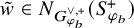 $\tilde w \in N_{G_{\varphi _b}^{\vee ,+}} (S_{\varphi _b}^+)$
and fixing
$\tilde w \in N_{G_{\varphi _b}^{\vee ,+}} (S_{\varphi _b}^+)$
and fixing
 $$ \begin{align} A_{\eta,\tilde w} : \rho_\eta \to \tilde w^{-1} \cdot \rho_\eta \end{align} $$
for each $w \in W(N_{G^\vee }(L^\vee ),T^\vee )^{\mathbf W_F}_{\varphi _b,\rho _b}$
. We impose
$w \in W(N_{G^\vee }(L^\vee ),T^\vee )^{\mathbf W_F}_{\varphi _b,\rho _b}$
. We impose $A_{\eta , \tilde w t} = \mathcal A_{\eta , \tilde w} \rho _\eta (t) = A_{\eta , \tilde w} \eta (t)$
for all
$A_{\eta , \tilde w t} = \mathcal A_{\eta , \tilde w} \rho _\eta (t) = A_{\eta , \tilde w} \eta (t)$
for all $t \in \bar T^{\vee ,+}$
. In these terms, (8.25) can be rewritten as
$t \in \bar T^{\vee ,+}$
. In these terms, (8.25) can be rewritten as
 $$ \begin{align} A_{\eta,\tilde w_1} A_{\eta,\tilde w_2} = \natural_{\mathfrak s^\vee} (w_1,w_2) A_{\eta,\tilde w_1 \tilde w_2} = \natural_{\mathfrak s^\vee} (w_1,w_2) A_{\eta, \widetilde{w_1 w_2}} \eta (\widetilde{w_1 w_2}^{-1} \tilde w_1 \tilde w_2). \end{align} $$
Note that $w_1, w_2 \in W(N_{G^\vee }(L^\vee ),T^\vee )^{\mathbf W_F}_{\varphi _b,\rho _b}$
in (8.29), in contrast to (8.24) and (8.25). For suitable choices of the
$w_1, w_2 \in W(N_{G^\vee }(L^\vee ),T^\vee )^{\mathbf W_F}_{\varphi _b,\rho _b}$
in (8.29), in contrast to (8.24) and (8.25). For suitable choices of the $A_{\eta , \tilde w}$
, the 2-cocycles
$A_{\eta , \tilde w}$
, the 2-cocycles $\natural _{\mathfrak s^{\vee }}$
in (8.25) and (8.29) coincide, while in general they are only cohomologous. For book-keeping purposes, we introduce two further 2-cocycles of
$\natural _{\mathfrak s^{\vee }}$
in (8.25) and (8.29) coincide, while in general they are only cohomologous. For book-keeping purposes, we introduce two further 2-cocycles of $W(N_{G^\vee }(L^\vee ),T^\vee )^{\mathbf W_F}_{\varphi _b,\rho _b}$
:
$W(N_{G^\vee }(L^\vee ),T^\vee )^{\mathbf W_F}_{\varphi _b,\rho _b}$
:
 $$ \begin{align*} \natural_{\mathfrak s^\vee,\rho_\eta}(w_1,w_2) := A_{\eta,\tilde w_1} A_{\eta,\tilde w_2} A_{\eta, \widetilde{w_1 w_2}}^{-1} \quad\text{and}\quad \natural_\eta (w_1,w_2) := \eta (\widetilde{w_1 w_2}^{-1} \tilde w_1 \tilde w_2). \end{align*} $$
We record that $\natural _\eta $
is the 2-cocycle associated to the extension obtained from
$\natural _\eta $
is the 2-cocycle associated to the extension obtained from
 $$\begin{align*}1 \to \bar T^{\vee,+} \to N_{\bar G^\vee} (L^\vee,T^\vee)^+_{\eta,\varphi_b} \to W(G^\vee,T^\vee)^{\mathbf W_F}_{\eta,\varphi_b} \to 1 \end{align*}$$
by pushout along $\eta : \bar T^{\vee ,+} \to {\mathbb {C}}^\times $
. Thus (8.29) means
$\eta : \bar T^{\vee ,+} \to {\mathbb {C}}^\times $
. Thus (8.29) means $\natural _{\mathfrak s^\vee ,\rho _\eta } = \natural _{\mathfrak s^\vee } \natural _\eta $
, or equivalently,
$\natural _{\mathfrak s^\vee ,\rho _\eta } = \natural _{\mathfrak s^\vee } \natural _\eta $
, or equivalently,
 $$ \begin{align} \natural_{\mathfrak s^\vee} = \natural_{\mathfrak s^\vee,\rho_\eta} \natural_\eta^{-1}. \end{align} $$
Although, indeed, all these 2-cocycles depend on various choices of representatives, their cohomology classes are uniquely determined.
Next we analyze the relevant 2-cocycles of $\Gamma _{\hat \sigma }$
, which is hard to do for elements of
$\Gamma _{\hat \sigma }$
, which is hard to do for elements of $\Gamma _{\hat \sigma }$
that do not fix any object of
$\Gamma _{\hat \sigma }$
that do not fix any object of $\mathrm {Irr} (L)_{\mathfrak s_L}$
; however, for the classification of irreducible representations, it suffices to perform this analysis for the subgroups of
$\mathrm {Irr} (L)_{\mathfrak s_L}$
; however, for the classification of irreducible representations, it suffices to perform this analysis for the subgroups of $\Gamma _{\hat \sigma }$
fixing such an object. Thus we focus on
$\Gamma _{\hat \sigma }$
fixing such an object. Thus we focus on $\tau \in \mathrm {Irr} (L)_{\mathfrak s_L}$
corresponding to the above
$\tau \in \mathrm {Irr} (L)_{\mathfrak s_L}$
corresponding to the above $(\varphi _b,\rho _b)$
via Theorem 4.8. By Proposition 4.5, it is tempered and unitary. By Theorem 4.8 and Lemma 8.2, we obtain a canonical isomorphism
$(\varphi _b,\rho _b)$
via Theorem 4.8. By Proposition 4.5, it is tempered and unitary. By Theorem 4.8 and Lemma 8.2, we obtain a canonical isomorphism
 $$ \begin{align} W_{\mathfrak s,\tau} \cong W_{\mathfrak s^\vee, \varphi_b}. \end{align} $$
Recall from [Reference SolleveldSol5, Theorem 6.11] that a suitably localized version of $\mathrm {End}_G (\Pi _{\mathfrak s})$
contains a twisted group algebra
$\mathrm {End}_G (\Pi _{\mathfrak s})$
contains a twisted group algebra
 $$ \begin{align} {\mathbb{C}} [\Gamma_{\hat \sigma, \tau}, \natural_\tau]. \end{align} $$
We may inflate $\natural _\tau $
from
$\natural _\tau $
from $\Gamma _{\hat \sigma , \tau } \cong W_{\mathfrak s,\tau } / W(R_{\sigma ,\tau })$
to a 2-cocycle of
$\Gamma _{\hat \sigma , \tau } \cong W_{\mathfrak s,\tau } / W(R_{\sigma ,\tau })$
to a 2-cocycle of $W_{\mathfrak s,\tau }$
. By [Reference SolleveldSol5 (4.13) and proof of Proposition 5.12.a],
$W_{\mathfrak s,\tau }$
. By [Reference SolleveldSol5 (4.13) and proof of Proposition 5.12.a], $\natural _\tau $
can be constructed via intertwiners of L-representations
$\natural _\tau $
can be constructed via intertwiners of L-representations
 $$ \begin{align} \dot w \cdot \tau \to \tau \text{ for } \dot w \in N_G (L) \text{ representing } w \in W_{\mathfrak s,\tau}. \end{align} $$
This is quite similar to how $\mu _{\hat \sigma }$
is defined in (7.9)–(7.10). Unfortunately, in general (i.e., when
$\mu _{\hat \sigma }$
is defined in (7.9)–(7.10). Unfortunately, in general (i.e., when $L^2_\tau \neq L^3_\tau \neq L^4_\tau $
), it is difficult to formulate the link between
$L^2_\tau \neq L^3_\tau \neq L^4_\tau $
), it is difficult to formulate the link between $\natural _\tau $
and
$\natural _\tau $
and $\mu _{\hat \sigma }$
precisely. The 2-cocycle
$\mu _{\hat \sigma }$
precisely. The 2-cocycle $\natural _\tau $
can be described further with the construction of
$\natural _\tau $
can be described further with the construction of $\tau $
à la Deligne–Lusztig. Let
$\tau $
à la Deligne–Lusztig. Let $(jT,\theta ,\rho )$
be the datum corresponding to
$(jT,\theta ,\rho )$
be the datum corresponding to $(\varphi _b,\rho _b)$
via Theorem 4.8. Recall from (2.7) that
$(\varphi _b,\rho _b)$
via Theorem 4.8. Recall from (2.7) that $\tau = \kappa _{jT, \theta , \rho }^{L,\epsilon } = \big ( \rho \otimes \mathrm {ind}_{L_{\mathfrak {f}}}^L \mathrm {inf}_{{\mathcal {L}}_{\mathfrak {f}} (k_F)}^{L_{\mathfrak {f}}} (\pm {\mathcal {R}}_{j {\mathcal {T}} (k_F)}^{{\mathcal {L}}_{\mathfrak {f}} (k_F)} (\theta ))^\epsilon \big )^{N_L (jT)_\theta }$
. We also recall from (8.8) that
$\tau = \kappa _{jT, \theta , \rho }^{L,\epsilon } = \big ( \rho \otimes \mathrm {ind}_{L_{\mathfrak {f}}}^L \mathrm {inf}_{{\mathcal {L}}_{\mathfrak {f}} (k_F)}^{L_{\mathfrak {f}}} (\pm {\mathcal {R}}_{j {\mathcal {T}} (k_F)}^{{\mathcal {L}}_{\mathfrak {f}} (k_F)} (\theta ))^\epsilon \big )^{N_L (jT)_\theta }$
. We also recall from (8.8) that
 $$ \begin{align} W_{\mathfrak s,\tau} \cong W(N_G (L),jT)_{\theta,\rho} / W(L,jT)_{\theta,\rho}. \end{align} $$
For $g \in N_G (L,jT)_{\theta ,\rho } \subset G_{\mathfrak {f}}$
representing a
$g \in N_G (L,jT)_{\theta ,\rho } \subset G_{\mathfrak {f}}$
representing a $w \in W_{\mathfrak s,\tau }$
, we recall the isomorphism
$w \in W_{\mathfrak s,\tau }$
, we recall the isomorphism $g \cdot \kappa _{jT, \theta , \rho }^{L,\epsilon } \cong \kappa _{jT, \theta , g \cdot \rho }^{L,\epsilon }$
from (2.11)–(2.12). It was canonical up to the choice of
$g \cdot \kappa _{jT, \theta , \rho }^{L,\epsilon } \cong \kappa _{jT, \theta , g \cdot \rho }^{L,\epsilon }$
from (2.11)–(2.12). It was canonical up to the choice of $\epsilon $
, but meanwhile
$\epsilon $
, but meanwhile $\epsilon $
has been fixed in Theorem 4.8. Thus the choice of an isomorphism as in (8.33) boils down to the choice of an isomorphism of
$\epsilon $
has been fixed in Theorem 4.8. Thus the choice of an isomorphism as in (8.33) boils down to the choice of an isomorphism of $N_L (jT)_\theta $
-representations
$N_L (jT)_\theta $
-representations
 $$ \begin{align} g \cdot \rho \to \rho. \end{align} $$
Recall the canonical bijection $\mathrm {Irr} (\mathcal E_\theta ^{[x]},\mathrm {id}) \to \mathrm {Irr} (N_L (jT)_\theta , \theta )$
from (2.27)–(2.28). We denote the preimage of
$\mathrm {Irr} (\mathcal E_\theta ^{[x]},\mathrm {id}) \to \mathrm {Irr} (N_L (jT)_\theta , \theta )$
from (2.27)–(2.28). We denote the preimage of $\rho $
by
$\rho $
by $\rho ^{[x]} \in \mathrm {Irr} (\mathcal E_\theta ^{[x]})$
. Then (8.35) is equivalent to the choice of an isomorphism
$\rho ^{[x]} \in \mathrm {Irr} (\mathcal E_\theta ^{[x]})$
. Then (8.35) is equivalent to the choice of an isomorphism ${B_g : g \cdot \rho ^{[x]} \to \rho ^{[x]}}$
of
${B_g : g \cdot \rho ^{[x]} \to \rho ^{[x]}}$
of $\mathcal E_\theta ^{[x]}$
-representations, for
$\mathcal E_\theta ^{[x]}$
-representations, for $g \in N_G (L,jT)_{\theta ,\rho }$
. We may assume that
$g \in N_G (L,jT)_{\theta ,\rho }$
. We may assume that
 $$ \begin{align} B_{gl} = B_g \circ \rho^{[x]}(l) \text{ for all } l \in N_L (jT)_\theta. \end{align} $$
In these terms, $\natural _\tau $
is given by
$\natural _\tau $
is given by
 $$ \begin{align} B_{g_1} B_{g_2} = \natural_\tau (w_1,w_2) B_{g_1 g_2} \end{align} $$
for $g_i$
representing
$g_i$
representing $w_i \in W_{\mathfrak s,\tau }$
. For any
$w_i \in W_{\mathfrak s,\tau }$
. For any $\chi \in \mathfrak {X}^0 (G)$
, we have
$\chi \in \mathfrak {X}^0 (G)$
, we have
 $$\begin{align*}\mathrm{Hom}_{N_L (jT)_{\chi \otimes \theta}} (g \cdot (\chi \otimes \rho), \chi \otimes \rho) = \mathrm{Hom}_{N_L (jT)_\theta} (\chi \otimes g \cdot \rho, \chi \otimes \rho) = \mathrm{Hom}_{N_L (jT)_\theta} (g \cdot \rho, \rho). \end{align*}$$
Hence we can use the same $B_g$
for
$B_g$
for $\chi \otimes \theta $
and for
$\chi \otimes \theta $
and for $\theta $
. Knowing this, (8.37) shows that
$\theta $
. Knowing this, (8.37) shows that
 $$ \begin{align} \natural_{\chi \otimes \tau} \text{ can be chosen to be equal to } \natural_\tau \text{ for } \chi \in \mathfrak{X}^0 (G). \end{align} $$
Since the conjugation action of $jT$
on
$jT$
on $\mathcal E_\theta ^{[x]}$
is trivial,
$\mathcal E_\theta ^{[x]}$
is trivial, $g \cdot \rho ^{[x]}$
is a well-defined
$g \cdot \rho ^{[x]}$
is a well-defined $\mathcal E_\theta ^{[x]}$
-representation for
$\mathcal E_\theta ^{[x]}$
-representation for $g \in W(N_G (L),jT)_{\theta ,\rho }$
. We choose a set of representatives
$g \in W(N_G (L),jT)_{\theta ,\rho }$
. We choose a set of representatives $\tilde w \in N_G (L,jT)_{\theta ,\rho }$
for
$\tilde w \in N_G (L,jT)_{\theta ,\rho }$
for $W(N_G (L),jT)_{\theta ,\rho }$
, and we assume (8.36) only for
$W(N_G (L),jT)_{\theta ,\rho }$
, and we assume (8.36) only for $l \in jT$
. (Thus we are implicitly inflating
$l \in jT$
. (Thus we are implicitly inflating $\natural _\tau $
to
$\natural _\tau $
to $W(N_G (L),jT)_{\theta ,\rho }$
, and we allow it to be replaced by a cohomologous 2-cocycle.) Then for
$W(N_G (L),jT)_{\theta ,\rho }$
, and we allow it to be replaced by a cohomologous 2-cocycle.) Then for $w_1,w_2 \in W(N_G (L),jT)_{\theta ,\rho }$
, (8.37) becomes
$w_1,w_2 \in W(N_G (L),jT)_{\theta ,\rho }$
, (8.37) becomes
 $$ \begin{align} \begin{aligned} B_{\tilde{w_1}} B_{\tilde{w_2}} = \natural_\tau (w_1,w_2) B_{\tilde{w_1} \tilde{w_2}} & = \natural_\tau (w_1,w_2) B_{\widetilde{w_1 w_2}} \rho^{[x]} (\widetilde{w_1 w_2}^{-1} \tilde{w_1} \tilde{w_2}) \\ & = \natural_\tau (w_1,w_2) B_{\widetilde{w_1 w_2}} \theta (\widetilde{w_1 w_2}^{-1} \tilde{w_1} \tilde{w_2}). \end{aligned} \end{align} $$
Let us define two 2-cocycles of $W(N_G (L),jT)_{\theta ,\rho }$
by
$W(N_G (L),jT)_{\theta ,\rho }$
by
 $$ \begin{align*} \natural_{\mathfrak s, \rho^{[x]}} (w_1,w_2) := B_{\tilde{w_1}} B_{\tilde{w_2}} B_{\widetilde{w_1 w_2}}^{-1} \quad\text{and}\quad \natural_\theta (w_1, w_2) := \theta (\widetilde{w_1 w_2}^{-1} \tilde{w_1} \tilde{w_2}). \end{align*} $$
Note that $\natural _\theta $
is the 2-cocycle associated to the extension
$\natural _\theta $
is the 2-cocycle associated to the extension $\mathcal E_{\theta ,G}^{[x]}$
from (A.1)–(A.2). Now (8.39) gives
$\mathcal E_{\theta ,G}^{[x]}$
from (A.1)–(A.2). Now (8.39) gives $\natural _{\mathfrak s, \rho ^{[x]}} = \natural _\tau \natural _\theta $
, or equivalently,
$\natural _{\mathfrak s, \rho ^{[x]}} = \natural _\tau \natural _\theta $
, or equivalently,
 $$ \begin{align} \natural_\tau = \natural_{\mathfrak s, \rho^{[x]}} \natural_\theta^{-1}. \end{align} $$
The natural isomorphism (4.15) restricts to
 $$ \begin{align} W(N_{\mathcal G^\flat}({\mathcal{L}}^\flat), {\mathcal{T}}^\flat)(F)_{[x],\theta} \cong W(N_{G^\vee}(L^\vee), T^\vee )^{\mathbf W_F}_{\eta,\varphi_T}. \end{align} $$
This enables us to compare (A.2) with (B.2).
Proposition 8.6. There exist isomorphisms of extensions of (8.41) by ${\mathbb {C}}^\times $
:
${\mathbb {C}}^\times $
:
 $$ \begin{align*} \zeta_G^\rtimes : \mathcal E_{\theta,G}^{\rtimes [x]} \xrightarrow{\sim} \mathcal E_{\eta,G}^{\rtimes \varphi_T},\quad \zeta_G^0 : \mathcal E_{\theta,G}^{0,[x]} \xrightarrow{\sim} \mathcal E_{\eta,G}^{0,\varphi_T} \quad \text{and} \quad B(\zeta_G^0, \zeta_G^\rtimes) : \mathcal E_{\theta,G}^{[x]} \xrightarrow{\sim} \mathcal E_{\eta,G}^{\varphi_T}, \end{align*} $$
which contain the similar isomorphisms without subscripts G from (4.13). These isomorphisms do not change if we adjust both $\theta $
and
$\theta $
and $\varphi _T$
by an element of
$\varphi _T$
by an element of $\mathfrak {X}^0 (G)$
.
$\mathfrak {X}^0 (G)$
.
Proof. For $\zeta _G^\rtimes $
, this follows from [Reference KalethaKal4, Proposition 8.1], as in (4.17). The isomorphism
$\zeta _G^\rtimes $
, this follows from [Reference KalethaKal4, Proposition 8.1], as in (4.17). The isomorphism $\zeta _G^0$
exists because both source and target are split by Propositions A.2 and B.2. By Lemmas A.1 and B.1, the Baer sum of
$\zeta _G^0$
exists because both source and target are split by Propositions A.2 and B.2. By Lemmas A.1 and B.1, the Baer sum of $\zeta _G^0$
and
$\zeta _G^0$
and $\zeta _G^\rtimes $
is the required isomorphism
$\zeta _G^\rtimes $
is the required isomorphism $B(\zeta _G^0, \zeta _G^\rtimes )$
. By (8.26) and (8.38), we can make all the choices invariant under twisting by
$B(\zeta _G^0, \zeta _G^\rtimes )$
. By (8.26) and (8.38), we can make all the choices invariant under twisting by $\mathfrak {X}^0 (G) \cong \mathfrak {X}^0 (G^\vee )$
.
$\mathfrak {X}^0 (G) \cong \mathfrak {X}^0 (G^\vee )$
.
We are ready to complete the comparison of the 2-cocycles $\natural _{\mathfrak s^\vee }$
and
$\natural _{\mathfrak s^\vee }$
and $\natural _\tau $
on
$\natural _\tau $
on $W_{\mathfrak s^\vee , \varphi _b} \cong W_{\mathfrak s,\tau }$
. Recall that in the above process we have already inflated these 2-cocycles to
$W_{\mathfrak s^\vee , \varphi _b} \cong W_{\mathfrak s,\tau }$
. Recall that in the above process we have already inflated these 2-cocycles to
 $$ \begin{align} W( N_{G^\vee}(L^\vee), T^\vee )^{\mathbf W_F}_{\eta,\varphi_b,\rho_b} \cong W( N_{\mathcal G^\flat}({\mathcal{L}}^\flat), {\mathcal{T}}^\flat) (F)_{[x],\theta,\rho} , \end{align} $$
Theorem 8.7.
-
(a) The following equalities hold in
$H^2 \big ( W( N_{G^\vee }(L^\vee ), T^\vee )^{\mathbf W_F}_{\eta ,\varphi _b,\rho _b}, {\mathbb {C}}^\times \big )$
:
$$\begin{align*}\natural_{\mathfrak s^\vee, \rho_\eta} = \natural_{\mathfrak s,\rho^{[x]}} ,\quad \natural_\eta = \natural_\theta ,\quad\text{and}\quad \natural_{\mathfrak s^\vee} = \natural_\tau. \end{align*}$$
-
(b) The 2-cocycles
$\natural _{\mathfrak s^\vee }$
and
$\natural _\tau $
of
$W_{\mathfrak s^\vee , \varphi _b} \cong W_{\mathfrak s,\tau }$
are cohomologous.


Proof. (a) The isomorphism $B(\zeta _G^0, \zeta _G^\rtimes ) : \mathcal E_{\theta ,G}^{[x]} \xrightarrow {\sim } \mathcal E_{\eta ,G}^{\varphi _T}$
from Lemma 4.4, translates
$B(\zeta _G^0, \zeta _G^\rtimes ) : \mathcal E_{\theta ,G}^{[x]} \xrightarrow {\sim } \mathcal E_{\eta ,G}^{\varphi _T}$
from Lemma 4.4, translates $\rho _\eta $
into
$\rho _\eta $
into $\rho ^{[x]}$
, because
$\rho ^{[x]}$
, because $\pi (\varphi _b,\rho _b) = \tau = \pi _{jT,\theta ,\rho }^{L,\epsilon }$
. By the
$\pi (\varphi _b,\rho _b) = \tau = \pi _{jT,\theta ,\rho }^{L,\epsilon }$
. By the $W( N_{G^\vee }(L^\vee ), T^\vee )^{\mathbf W_F}_{\eta ,\varphi _T}$
-equivariance of
$W( N_{G^\vee }(L^\vee ), T^\vee )^{\mathbf W_F}_{\eta ,\varphi _T}$
-equivariance of $B(\zeta _G^0, \zeta _G^\rtimes )$
, the data for computing
$B(\zeta _G^0, \zeta _G^\rtimes )$
, the data for computing $\natural _{\mathfrak s, \rho ^{[x]}}$
match exactly with the data for computing
$\natural _{\mathfrak s, \rho ^{[x]}}$
match exactly with the data for computing $\natural _{\mathfrak s^\vee , \rho _\eta }$
. Hence any choice of the
$\natural _{\mathfrak s^\vee , \rho _\eta }$
. Hence any choice of the $A_{\eta ,\tilde w}$
in (8.28) corresponds to a choice of the
$A_{\eta ,\tilde w}$
in (8.28) corresponds to a choice of the $B_{\tilde w}$
in (8.39), and with these choices the 2-cocycles
$B_{\tilde w}$
in (8.39), and with these choices the 2-cocycles $\natural _{\mathfrak s^\vee , \rho _\eta }$
and
$\natural _{\mathfrak s^\vee , \rho _\eta }$
and $\natural _{\mathfrak s, \rho ^{[x]}}$
coincide.
$\natural _{\mathfrak s, \rho ^{[x]}}$
coincide.
The isomorphism $\mathcal E_{\eta ,G}^{[x]} \xrightarrow {\sim } \mathcal E_{\eta ,G}^{\varphi _T}$
from Proposition 8.6 shows that
$\mathcal E_{\eta ,G}^{[x]} \xrightarrow {\sim } \mathcal E_{\eta ,G}^{\varphi _T}$
from Proposition 8.6 shows that $\natural _\theta $
and
$\natural _\theta $
and $\natural _\eta $
are cohomologous. By (8.40) and (8.30), we compute in
$\natural _\eta $
are cohomologous. By (8.40) and (8.30), we compute in $H^2 \big ( W( N_{G^\vee }(L^\vee ), T^\vee )^{\mathbf W_F}_{\eta ,\varphi _b,\rho _b}, {\mathbb {C}}^\times \big )$
:
$H^2 \big ( W( N_{G^\vee }(L^\vee ), T^\vee )^{\mathbf W_F}_{\eta ,\varphi _b,\rho _b}, {\mathbb {C}}^\times \big )$
:
 $$\begin{align*}\natural_{\mathfrak s^\vee} = \natural_{\mathfrak s^\vee, \rho_\eta} \natural_\eta^{-1} = \natural_{\mathfrak s, \rho^{[x]}} \natural_\theta^{-1} = \natural_\tau. \end{align*}$$
(b) By part (a), $\natural _{\mathfrak s^\vee }$
and
$\natural _{\mathfrak s^\vee }$
and $\natural _\tau $
are cohomologous 2-cocycles of (8.42). By construction,
$\natural _\tau $
are cohomologous 2-cocycles of (8.42). By construction, $\natural _{\mathfrak s^\vee } \in H^2 \big ( W( N_{G^\vee }(L^\vee ), T^\vee )^{\mathbf W_F}_{\eta ,\varphi _b,\rho _b}, {\mathbb {C}}^\times \big )$
arises by inflation from
$\natural _{\mathfrak s^\vee } \in H^2 \big ( W( N_{G^\vee }(L^\vee ), T^\vee )^{\mathbf W_F}_{\eta ,\varphi _b,\rho _b}, {\mathbb {C}}^\times \big )$
arises by inflation from $\natural _{\mathfrak s^\vee } \in H^2 (W_{\mathfrak s^\vee ,\varphi _b},{\mathbb {C}}^\times )$
, and
$\natural _{\mathfrak s^\vee } \in H^2 (W_{\mathfrak s^\vee ,\varphi _b},{\mathbb {C}}^\times )$
, and $\natural _\tau \in H^2 \big ( W( N_{\mathcal G^\flat }({\mathcal {L}}^\flat ), {\mathcal {T}}^\flat ) (F)_{[x],\theta ,\rho } ,{\mathbb {C}}^\times \big )$
is inflated from
$\natural _\tau \in H^2 \big ( W( N_{\mathcal G^\flat }({\mathcal {L}}^\flat ), {\mathcal {T}}^\flat ) (F)_{[x],\theta ,\rho } ,{\mathbb {C}}^\times \big )$
is inflated from $\natural _\tau \in H^2 (W_{\mathfrak s,\tau }, {\mathbb {C}}^\times )$
. Hence
$\natural _\tau \in H^2 (W_{\mathfrak s,\tau }, {\mathbb {C}}^\times )$
. Hence $\natural _{\mathfrak s^\vee }$
and
$\natural _{\mathfrak s^\vee }$
and $\natural _\tau $
are cohomologous 2-cocycles, via the isomorphism (8.31).
$\natural _\tau $
are cohomologous 2-cocycles, via the isomorphism (8.31).
Recall that the root system $R_{\sigma ,\tau }$
from (7.34) consists of roots
$R_{\sigma ,\tau }$
from (7.34) consists of roots $\alpha \in R_\sigma $
satisfying
$\alpha \in R_\sigma $
satisfying $s_\alpha (\tau ) = \tau $
. Via (8.18),
$s_\alpha (\tau ) = \tau $
. Via (8.18), $R_{\sigma ,\tau }$
corresponds to the root system
$R_{\sigma ,\tau }$
corresponds to the root system
 $$\begin{align*}R_{\mathfrak s^\vee,\varphi_b} := \{ \beta \in R_{\mathfrak s^\vee} : s_\beta (\varphi_b) = \varphi_b \}. \end{align*}$$
The set of positive roots $R_{\mathfrak s^\vee ,\varphi _b}^+ = R_{\mathfrak s^\vee ,\varphi _b} \cap R_{\mathfrak s^\vee }^+$
gives rise to a decomposition
$R_{\mathfrak s^\vee ,\varphi _b}^+ = R_{\mathfrak s^\vee ,\varphi _b} \cap R_{\mathfrak s^\vee }^+$
gives rise to a decomposition
 $$ \begin{align} W_{\mathfrak s^\vee, \varphi_b} = W(R_{\mathfrak s^\vee}, \varphi_b) \rtimes \Gamma_{\mathfrak s^\vee,\varphi_b}, \quad\text{where}\quad\Gamma_{\mathfrak s^\vee,\varphi_b} = \mathrm{Stab}_{W_{\mathfrak s^\vee, \varphi_b}} (R_{\mathfrak s^\vee,\varphi_b}^+). \end{align} $$
This is compatible with (7.35), thus (8.31) decomposes into isomorphisms
 $$ \begin{align} W(R_{\sigma,\tau}) \cong W(R_{\mathfrak s^\vee,\varphi_b}) \quad \text{and} \quad \Gamma_{\hat \sigma,\tau} \cong \Gamma_{\mathfrak s^\vee, \varphi_b}. \end{align} $$
Similar to (8.32), the 2-cocycle $\natural _{\mathfrak s^\vee }$
is trivial on
$\natural _{\mathfrak s^\vee }$
is trivial on $W(R_{\mathfrak s^\vee ,\varphi _b}) \subset W(R_{\mathfrak s^\vee })$
, so
$W(R_{\mathfrak s^\vee ,\varphi _b}) \subset W(R_{\mathfrak s^\vee })$
, so $\natural _{\mathfrak s^\vee } |_{(W_{\mathfrak s^\vee ,\varphi _b})^2}$
factors through
$\natural _{\mathfrak s^\vee } |_{(W_{\mathfrak s^\vee ,\varphi _b})^2}$
factors through $(W_{\mathfrak s^\vee ,\varphi _b} / W(R_{\mathfrak s^\vee ,\varphi _b}) )^2 \cong (\Gamma _{\mathfrak s^\vee ,\varphi _b} )^2$
. As a direct consequence of Theorem 8.7 (b), the group isomorphisms (8.44) can be lifted to algebra isomorphisms
$(W_{\mathfrak s^\vee ,\varphi _b} / W(R_{\mathfrak s^\vee ,\varphi _b}) )^2 \cong (\Gamma _{\mathfrak s^\vee ,\varphi _b} )^2$
. As a direct consequence of Theorem 8.7 (b), the group isomorphisms (8.44) can be lifted to algebra isomorphisms
 $$ \begin{align} {\mathbb{C}} [W_{\mathfrak s^\vee,\varphi_b}, \natural_{\mathfrak s^\vee}] \cong {\mathbb{C}} [W_{\mathfrak s,\tau}, \natural_\tau] \quad \text{and} \quad {\mathbb{C}} [\Gamma_{\mathfrak s^\vee,\varphi_b}, \natural_{\mathfrak s^\vee}] \cong {\mathbb{C}} [\Gamma_{\hat \sigma,\tau}, \natural_\tau]. \end{align} $$
To a suitable localization of $\mathrm {End}_G (\Pi _{\mathfrak s})$
, in some sense centering on
$\mathrm {End}_G (\Pi _{\mathfrak s})$
, in some sense centering on $\tau $
, one can associate a twisted graded Hecke algebra as in [Reference SolleveldSol5, §7], say
$\tau $
, one can associate a twisted graded Hecke algebra as in [Reference SolleveldSol5, §7], say $\mathbb H (\tilde {{\mathcal {R}}}_\tau , W_{\mathfrak s,\tau }, k^\tau ,\natural _\tau )$
. Here
$\mathbb H (\tilde {{\mathcal {R}}}_\tau , W_{\mathfrak s,\tau }, k^\tau ,\natural _\tau )$
. Here $\tilde {{\mathcal {R}}}$
is a degenerate root datum involving the root system
$\tilde {{\mathcal {R}}}$
is a degenerate root datum involving the root system $R_{\sigma ,\tau }$
and the vector space
$R_{\sigma ,\tau }$
and the vector space
 $$\begin{align*}\mathfrak t := \mathrm{Lie}(\mathfrak{X}_{\mathrm{nr}} (L)) = X^* (Z^\circ(L)) \otimes_{\mathbb{Z}} {\mathbb{C}}. \end{align*}$$
By definition, $\mathcal O (\mathfrak t)$
is a maximal commutative subalgebra,
$\mathcal O (\mathfrak t)$
is a maximal commutative subalgebra, ${\mathbb {C}} [W_{\mathfrak s,\tau }, \natural _\tau ]$
is a subalgebra and the multiplication map
${\mathbb {C}} [W_{\mathfrak s,\tau }, \natural _\tau ]$
is a subalgebra and the multiplication map
 $$ \begin{align} \mathcal O (\mathfrak t) \otimes {\mathbb{C}} [W_{\mathfrak s,\tau}, \natural_\tau] \to \mathbb H (\tilde{{\mathcal{R}}}_\tau, W_{\mathfrak s,\tau}, k^\tau,\natural_\tau) \end{align} $$
is a linear bijection. Let $\mathbb H \big ( \mathfrak s^\vee , \varphi _b, \log (q_F^{1/2}) \big )$
be the twisted graded Hecke algebra obtained from
$\mathbb H \big ( \mathfrak s^\vee , \varphi _b, \log (q_F^{1/2}) \big )$
be the twisted graded Hecke algebra obtained from $\mathcal H (\mathfrak s^\vee , q_F^{1/2})$
via the reduction procedure from [Reference LusztigLus3] and [Reference SolleveldSol1, §2.1], centered at
$\mathcal H (\mathfrak s^\vee , q_F^{1/2})$
via the reduction procedure from [Reference LusztigLus3] and [Reference SolleveldSol1, §2.1], centered at $\varphi _b$
. In the terminology of [Reference Aubert, Moussaoui and SolleveldAMS3, §3.1], it can be written as
$\varphi _b$
. In the terminology of [Reference Aubert, Moussaoui and SolleveldAMS3, §3.1], it can be written as
 $$ \begin{align} \mathbb H \big( \mathfrak s^\vee, \varphi_b, \log (q_F^{1/2}) \big) = \mathbb H (\varphi_b, \rho_b, \mathbf r) / (\mathbf r - \log (q_F^{1/2})). \end{align} $$
Let $\mathfrak l^\vee $
be the Lie algebra of
$\mathfrak l^\vee $
be the Lie algebra of $L^\vee $
, so that
$L^\vee $
, so that
 $$\begin{align*}\mathrm{Lie} \big( {(Z(L^\vee)^{\mathbf I_F})_{\mathbf W_F}\!}^\circ \big) \cong Z(\mathfrak l^\vee)^{\mathbf W_F} = \big( X_* (Z^\circ (L^\vee)) \otimes_{\mathbb{Z}} {\mathbb{C}} \big)^{\mathbf W_F}. \end{align*}$$
By construction, $\mathcal O \big ( Z(\mathfrak l^\vee )^{\mathbf W_F} \big )$
is a maximal commutative subalgebra of (8.47),
$\mathcal O \big ( Z(\mathfrak l^\vee )^{\mathbf W_F} \big )$
is a maximal commutative subalgebra of (8.47), ${\mathbb {C}} [W_{\mathfrak s^\vee ,\varphi _b}, \natural _{\mathfrak s^\vee }]$
is a subalgebra and the multiplication map
${\mathbb {C}} [W_{\mathfrak s^\vee ,\varphi _b}, \natural _{\mathfrak s^\vee }]$
is a subalgebra and the multiplication map
 $$ \begin{align} \mathcal O \big( Z(\mathfrak l^\vee)^{\mathbf W_F} \big) \otimes {\mathbb{C}} [W_{\mathfrak s^\vee,\varphi_b}, \natural_{\mathfrak s^\vee}] \to \mathbb H \big( \mathfrak s^\vee, \varphi_b, \log (q_F^{1/2}) \big) \end{align} $$
is a linear bijection.
Proposition 8.8. Proposition 8.5 and (8.45) induce an algebra isomorphism
 $$\begin{align*}\mathbb H \big( \mathfrak s^\vee, \varphi_b, \log (q_F^{1/2}) \big) \overset{\sim}{\longrightarrow} \mathbb H (\tilde{{\mathcal{R}}}_\tau, W_{\mathfrak s,\tau}, k^\tau,\natural_\tau). \end{align*}$$
It is canonical up to:
-
• inner automorphisms that fix
$\mathcal O (\mathfrak t)$
pointwise; -
• twisting by characters of
$W_{\mathfrak s,\tau }$
that are trivial on the subgroup generated by the reflections
$s_\alpha $
with
$\alpha \in R_{\sigma ,\tau }$
and
$k^\tau _\alpha \neq 0$
.


Proof. Recall from (7.36) and (8.1) that there are finite coverings
 $$\begin{align*}\begin{array}{lllllll} \mathfrak{X}_{\mathrm{nr}} (L) & \to & \mathrm{Irr} (L)_{[L,\tau]} & : & \chi & \mapsto & \chi \otimes \tau ,\\ \big( Z(L^\vee)^{\mathbf I_F} \big)_{\mathbf W_F}^{\; \circ} & \to & \mathfrak s_L^\vee & : & z & \mapsto & (z \varphi_b , \rho_b). \end{array} \end{align*}$$
It follows that the tangent map of (8.9) is a linear bijection
 $$ \begin{align} \mathfrak t \to Z(\mathfrak l^\vee)^{\mathbf W_F} , \end{align} $$
which by Theorem 4.8 and Lemma 8.2 is equivariant for $W_{\mathfrak s,\tau } \cong W_{\mathfrak s^\vee ,\varphi _b}$
. In fact it comes from the isomorphisms
$W_{\mathfrak s,\tau } \cong W_{\mathfrak s^\vee ,\varphi _b}$
. In fact it comes from the isomorphisms
 $$\begin{align*}X^* (Z(L)^\circ) \cong X^* (Z^\circ ({\mathcal{L}}))^{\mathbf W_F} \cong X_* (Z^\circ (L^\vee))^{\mathbf W_F}. \end{align*}$$
The map (8.49) induces an algebra isomorphism
 $$ \begin{align} \mathcal O \big( Z(\mathfrak l^\vee)^{\mathbf W_F} \big) \xrightarrow{\sim} \mathcal O (\mathfrak t). \end{align} $$
The map (8.50) is induced just as well by (8.10), which is a part of Proposition 8.5. For the twisted group algebras in (8.46) and (8.48), we take the first isomorphism in (8.45). Note that the restricted isomorphism ${\mathbb {C}} [W(R_{\mathfrak s^\vee ,\varphi _b})] \cong {\mathbb {C}} [W(R_{\sigma ,\tau })]$
is also induced by Proposition 8.5, via [Reference LusztigLus3] and [Reference SolleveldSol1, §2.1]. By (8.50), (8.45), (8.46) and (8.48), we obtain a linear bijection
${\mathbb {C}} [W(R_{\mathfrak s^\vee ,\varphi _b})] \cong {\mathbb {C}} [W(R_{\sigma ,\tau })]$
is also induced by Proposition 8.5, via [Reference LusztigLus3] and [Reference SolleveldSol1, §2.1]. By (8.50), (8.45), (8.46) and (8.48), we obtain a linear bijection
 $$ \begin{align} \mathbb H \big( \mathfrak s^\vee, \varphi_b, \log (q_F^{1/2}) \big) \longrightarrow \mathbb H (\tilde{{\mathcal{R}}}_\tau, W_{\mathfrak s,\tau}, k^\tau,\natural_\tau). \end{align} $$
To guarantee that this is an algebra isomorphism, it remains to check that the parameters for the roots on both sides agree under the bijection $R_{\sigma ,\tau } \leftrightarrow R_{\mathfrak s^\vee , \varphi _b}$
from (8.18). By [Reference Aubert, Moussaoui and SolleveldAMS3, Proposition 3.14.a], the parameters of
$R_{\sigma ,\tau } \leftrightarrow R_{\mathfrak s^\vee , \varphi _b}$
from (8.18). By [Reference Aubert, Moussaoui and SolleveldAMS3, Proposition 3.14.a], the parameters of $\mathbb H \big ( \mathfrak s^\vee , \varphi _b, \log (q_F^{1/2}) \big )$
are obtained from the parameters of
$\mathbb H \big ( \mathfrak s^\vee , \varphi _b, \log (q_F^{1/2}) \big )$
are obtained from the parameters of $\mathcal H (\mathfrak s^\vee , q_F^{1/2})^\circ $
via the method of [Reference Aubert, Moussaoui and SolleveldAMS3, Theorems 2.5 and 2.11 and (2.19)], or equivalently via [Reference LusztigLus3, Theorems 8.6 and 9.3]. In Proposition 8.4, we showed that the parameters of
$\mathcal H (\mathfrak s^\vee , q_F^{1/2})^\circ $
via the method of [Reference Aubert, Moussaoui and SolleveldAMS3, Theorems 2.5 and 2.11 and (2.19)], or equivalently via [Reference LusztigLus3, Theorems 8.6 and 9.3]. In Proposition 8.4, we showed that the parameters of $\mathcal H (\mathfrak s^\vee , q_F^{1/2})^\circ $
match with those of
$\mathcal H (\mathfrak s^\vee , q_F^{1/2})^\circ $
match with those of $\mathcal H (G,\hat P_{\mathfrak {f}},\hat \sigma )^\circ $
. Since
$\mathcal H (G,\hat P_{\mathfrak {f}},\hat \sigma )^\circ $
. Since $\mathcal H (G,\hat P_{\mathfrak {f}},\hat \sigma )^\circ \subset \mathrm {End}_G (\Pi _{\mathfrak s})$
by (7.38), all simple reflections in
$\mathcal H (G,\hat P_{\mathfrak {f}},\hat \sigma )^\circ \subset \mathrm {End}_G (\Pi _{\mathfrak s})$
by (7.38), all simple reflections in $W(R_\sigma )$
have the same parameters (q and
$W(R_\sigma )$
have the same parameters (q and $q^*$
) in each of these three algebras. The parameters
$q^*$
) in each of these three algebras. The parameters $k^\tau $
for the roots in
$k^\tau $
for the roots in $\mathbb H (\tilde {{\mathcal {R}}}_\tau , W_{\mathfrak s,\tau }, k^\tau ,\natural _\tau )$
are defined in terms of the parameters for
$\mathbb H (\tilde {{\mathcal {R}}}_\tau , W_{\mathfrak s,\tau }, k^\tau ,\natural _\tau )$
are defined in terms of the parameters for $\mathrm {End}_G (\Pi _{\mathfrak s})$
in [Reference SolleveldSol5, §7 and (35)]:
$\mathrm {End}_G (\Pi _{\mathfrak s})$
in [Reference SolleveldSol5, §7 and (35)]:
 $$ \begin{align} k^\tau_\alpha = \left\{ \begin{array}{cl} \log (q_{\theta,\alpha}) & \text{if } X_\alpha (\tau) = 1 \\ \log (q_{\theta,\alpha}^*) & \text{if } X_\alpha (\tau) = -1 \end{array} \right.. \end{align} $$
By [Reference SolleveldSol5, (95)], $q_{\theta ,\alpha } q_{\theta ,\alpha }^* = q_F^{\lambda (\alpha )}$
and
$q_{\theta ,\alpha } q_{\theta ,\alpha }^* = q_F^{\lambda (\alpha )}$
and $q_{\theta ,\alpha } (q_{\theta ,\alpha }^*)^{-1} = q_F^{\lambda ^* (\alpha )}$
. Thus (8.52) gives
$q_{\theta ,\alpha } (q_{\theta ,\alpha }^*)^{-1} = q_F^{\lambda ^* (\alpha )}$
. Thus (8.52) gives
 $$ \begin{align} k^\tau_\alpha = \log (q_F^{1/2}) \big( \lambda (\alpha) + X_\alpha (\tau) \lambda^* (\alpha) \big). \end{align} $$
If we set $\mathbf r = \log (q_F^{1/2})$
and replace
$\mathbf r = \log (q_F^{1/2})$
and replace $X_\alpha $
by
$X_\alpha $
by $m_\alpha \alpha $
as prescribed in [Reference Aubert, Moussaoui and SolleveldAMS3, Proposition 3.14], then (8.53) becomes [Reference Aubert, Moussaoui and SolleveldAMS3, (2.19)]. Hence
$m_\alpha \alpha $
as prescribed in [Reference Aubert, Moussaoui and SolleveldAMS3, Proposition 3.14], then (8.53) becomes [Reference Aubert, Moussaoui and SolleveldAMS3, (2.19)]. Hence $k^\tau _\alpha $
is also the parameter of
$k^\tau _\alpha $
is also the parameter of $\alpha $
in
$\alpha $
in $\mathbb H \big ( \mathfrak s^\vee , \varphi _b, \log (q_F^{1/2}) \big )$
. The non-canonicity in (8.51) comes from three sources:
$\mathbb H \big ( \mathfrak s^\vee , \varphi _b, \log (q_F^{1/2}) \big )$
. The non-canonicity in (8.51) comes from three sources:
(1) Algebra automorphisms of ${\mathbb {C}} [\Gamma _{\hat \sigma ,\tau },\natural _\tau ]$
that stabilize each line
${\mathbb {C}} [\Gamma _{\hat \sigma ,\tau },\natural _\tau ]$
that stabilize each line ${\mathbb {C}} \gamma $
for
${\mathbb {C}} \gamma $
for $\gamma \in \Gamma _{\hat \sigma ,\tau }$
. These are precisely the maps
$\gamma \in \Gamma _{\hat \sigma ,\tau }$
. These are precisely the maps $\gamma \mapsto \chi (\gamma ) \gamma $
where
$\gamma \mapsto \chi (\gamma ) \gamma $
where $\chi : \Gamma _{\hat \sigma ,\tau } \to {\mathbb {C}}^\times $
is a character. On
$\chi : \Gamma _{\hat \sigma ,\tau } \to {\mathbb {C}}^\times $
is a character. On $\mathbb H (\tilde {{\mathcal {R}}}_\tau , W_{\mathfrak s,\tau }, k^\tau ,\natural _\tau )$
, this means twisting by a character of
$\mathbb H (\tilde {{\mathcal {R}}}_\tau , W_{\mathfrak s,\tau }, k^\tau ,\natural _\tau )$
, this means twisting by a character of $W_{\mathfrak s,\tau } / W(R_{\sigma ,\tau })$
.
$W_{\mathfrak s,\tau } / W(R_{\sigma ,\tau })$
.
(2) The non-canonicity in Proposition 8.5, in particular with respect to inner automorphisms of $\mathcal H (G, \hat P_{\mathfrak {f}}, \hat \sigma )$
that restrict to the identity on
$\mathcal H (G, \hat P_{\mathfrak {f}}, \hat \sigma )$
that restrict to the identity on ${\mathbb {C}} [ZW_L (J,\hat \sigma )]$
. These account for inner automorphisms of
${\mathbb {C}} [ZW_L (J,\hat \sigma )]$
. These account for inner automorphisms of $\mathbb H (\tilde {{\mathcal {R}}}_\tau , W_{\mathfrak s,\tau }, k^\tau ,\natural _\tau )$
that are the identity on
$\mathbb H (\tilde {{\mathcal {R}}}_\tau , W_{\mathfrak s,\tau }, k^\tau ,\natural _\tau )$
that are the identity on $\mathcal O (\mathfrak t)$
.
$\mathcal O (\mathfrak t)$
.
(3) Proposition 8.5 also allows for some adjustments for short simple roots $\alpha \in R_{\sigma ,\tau }$
satisfying
$\alpha \in R_{\sigma ,\tau }$
satisfying $q_{\theta ,\alpha }^* = 1$
, that is,
$q_{\theta ,\alpha }^* = 1$
, that is, $T_{s_\alpha }$
may be replaced by
$T_{s_\alpha }$
may be replaced by $T_{s_\alpha } h_\alpha ^\vee $
in
$T_{s_\alpha } h_\alpha ^\vee $
in $\mathcal H (G, \hat P_{\mathfrak {f}}, \hat \sigma )^\circ $
. By [Reference SolleveldSol5, (35)], this
$\mathcal H (G, \hat P_{\mathfrak {f}}, \hat \sigma )^\circ $
. By [Reference SolleveldSol5, (35)], this $h_\alpha ^\vee $
corresponds to
$h_\alpha ^\vee $
corresponds to $X_\alpha $
in (8.52). By [Reference SolleveldSol5, Proposition 7.3 and its proof], we see that
$X_\alpha $
in (8.52). By [Reference SolleveldSol5, Proposition 7.3 and its proof], we see that $T_{s_\alpha } \mapsto T_{s_\alpha } h_\alpha ^\vee $
translates to
$T_{s_\alpha } \mapsto T_{s_\alpha } h_\alpha ^\vee $
translates to
 $$ \begin{align} N_{s_\alpha} \mapsto X_\alpha (\tau) N_{s_\alpha} \text{ in } \mathbb H (\tilde{{\mathcal{R}}}_\tau, W_{\mathfrak s,\tau}, k^\tau,\natural_\tau). \end{align} $$
If $X_\alpha (\tau ) = 1$
, then this does nothing. On the other hand, if
$X_\alpha (\tau ) = 1$
, then this does nothing. On the other hand, if $X_\alpha (\tau ) = -1$
, then (8.52) implies that
$X_\alpha (\tau ) = -1$
, then (8.52) implies that $k^\tau _\alpha = 0$
. As mentioned in the proof of Proposition 8.5, the operation
$k^\tau _\alpha = 0$
. As mentioned in the proof of Proposition 8.5, the operation $T_{s_\alpha } \mapsto T_{s_\alpha } h_\alpha ^\vee $
fixes all generators
$T_{s_\alpha } \mapsto T_{s_\alpha } h_\alpha ^\vee $
fixes all generators $T_{s_\beta }$
where
$T_{s_\beta }$
where $s_\beta $
is not
$s_\beta $
is not $W(R_\sigma )$
-conjugate to
$W(R_\sigma )$
-conjugate to $s_\alpha $
. Hence (8.54) fixes all
$s_\alpha $
. Hence (8.54) fixes all $N_{s_\beta }$
where
$N_{s_\beta }$
where $\beta \in R_{\sigma ,\tau }$
and
$\beta \in R_{\sigma ,\tau }$
and $k^\tau _\beta \neq 0$
. Consequently, (8.54) gives rise to a character
$k^\tau _\beta \neq 0$
. Consequently, (8.54) gives rise to a character $\chi $
of
$\chi $
of $W_{\mathfrak s,\tau }$
that is trivial on
$W_{\mathfrak s,\tau }$
that is trivial on $\Gamma _{\hat \sigma ,\tau }$
and on all such
$\Gamma _{\hat \sigma ,\tau }$
and on all such $s_\beta $
, and the algebra automorphism induced by (8.54) is given by twisting by this
$s_\beta $
, and the algebra automorphism induced by (8.54) is given by twisting by this $\chi $
. here
$\chi $
. here
Let $R^{\prime }_{\sigma ,\tau }$
be the subset of
$R^{\prime }_{\sigma ,\tau }$
be the subset of $R_{\sigma ,\tau }$
consisting of the roots
$R_{\sigma ,\tau }$
consisting of the roots $\alpha $
with
$\alpha $
with $k^\tau _\alpha \neq 0$
. It is again a root system, with positive roots
$k^\tau _\alpha \neq 0$
. It is again a root system, with positive roots $R^{'+}_{\sigma ,\tau }$
. This gives a decomposition
$R^{'+}_{\sigma ,\tau }$
. This gives a decomposition
 $$\begin{align*}W_{\mathfrak s,\tau} = W(R^{\prime}_{\sigma,\tau}) \rtimes \Gamma^{\prime}_{\hat \sigma,\tau}, \end{align*}$$
where $\Gamma ^{\prime }_{\sigma ,\tau }$
is the stabilizer of
$\Gamma ^{\prime }_{\sigma ,\tau }$
is the stabilizer of $R^{'+}_{\sigma ,\tau }$
. The presentation of twisted graded Hecke algebras, as in [Reference Aubert, Moussaoui, Solleveld, Müller, Shin and TemplierAMS2, Proposition 2.2], shows that we can write
$R^{'+}_{\sigma ,\tau }$
. The presentation of twisted graded Hecke algebras, as in [Reference Aubert, Moussaoui, Solleveld, Müller, Shin and TemplierAMS2, Proposition 2.2], shows that we can write
 $$ \begin{align} \mathbb H (\tilde{{\mathcal{R}}}_\tau, W_{\mathfrak s,\tau}, k^\tau,\natural_\tau) = \mathbb H (\tilde{{\mathcal{R}}}_\tau, W (R^{\prime}_{\sigma,\tau}), k^\tau) \rtimes {\mathbb{C}} [ \Gamma^{\prime}_{\hat \sigma,\tau},\natural_\tau]. \end{align} $$
Proposition 8.8 allows us to transfer this decomposition to $\mathbb H \big ( \mathfrak s^\vee , \varphi _b, \log (q_F^{1/2}) \big )$
. More precisely, let
$\mathbb H \big ( \mathfrak s^\vee , \varphi _b, \log (q_F^{1/2}) \big )$
. More precisely, let $R^{\prime }_{\mathfrak s^\vee ,\varphi _b}$
be the subsystem of roots with nonzero parameters and write
$R^{\prime }_{\mathfrak s^\vee ,\varphi _b}$
be the subsystem of roots with nonzero parameters and write
 $$\begin{align*}W_{\mathfrak s^\vee,\varphi_b} = W(R^{\prime}_{\mathfrak s^\vee,\varphi_b}) \rtimes \Gamma^{\prime}_{\mathfrak s^\vee,\varphi_b}. \end{align*}$$
Let $\mathbb H \big ( \mathfrak s^\vee , \varphi _b, \log (q_F^{1/2}) \big )^\circ $
be the graded Hecke algebra built from
$\mathbb H \big ( \mathfrak s^\vee , \varphi _b, \log (q_F^{1/2}) \big )^\circ $
be the graded Hecke algebra built from $Z(\mathfrak l^\vee )^{\mathbf W_F}$
,
$Z(\mathfrak l^\vee )^{\mathbf W_F}$
, $R^{\prime }_{\mathfrak s^\vee ,\varphi _b}$
and the parameters for those roots in
$R^{\prime }_{\mathfrak s^\vee ,\varphi _b}$
and the parameters for those roots in $\mathbb H \big ( \mathfrak s^\vee , \varphi _b, \log (q_F^{1/2}) \big )$
. Then
$\mathbb H \big ( \mathfrak s^\vee , \varphi _b, \log (q_F^{1/2}) \big )$
. Then
 $$ \begin{align} \mathbb H \big( \mathfrak s^\vee, \varphi_b, \log (q_F^{1/2}) \big) = \mathbb H \big( \mathfrak s^\vee, \varphi_b, \log (q_F^{1/2}) \big)^\circ \rtimes {\mathbb{C}}[ \Gamma^{\prime}_{\mathfrak s^\vee,\varphi_b}, \natural_{\mathfrak s^\vee}], \end{align} $$
and Proposition 8.8 respects the decompositions (8.55) and (8.56).
9 Equivalences between module categories of Hecke algebras
Consider a type $(\hat P_{\mathfrak {f}}, \hat \sigma )$
for G as in Theorem 7.1, and recall that it covers the type
$(\hat P_{\mathfrak {f}}, \hat \sigma )$
for G as in Theorem 7.1, and recall that it covers the type $(\hat P_{L,\mathfrak {f}}, \hat \sigma )$
for L. Let
$(\hat P_{L,\mathfrak {f}}, \hat \sigma )$
for L. Let $\mathfrak s$
be the associated inertial equivalence class for G. By [Reference Bushnell and KutzkoBuKu], there is an equivalence of categories
$\mathfrak s$
be the associated inertial equivalence class for G. By [Reference Bushnell and KutzkoBuKu], there is an equivalence of categories
 $$ \begin{align} \mathrm{Rep} (G)_{\mathfrak s} = \mathrm{Rep} (G)_{(\hat P_{\mathfrak{f}}, \hat \sigma)} \xrightarrow{\sim} \mathrm{Mod} \text{ - }{\mathcal H} (G,\hat P_{\mathfrak{f}}, \hat \sigma) \; \text{given by} \; \pi \mapsto \mathrm{Hom}_{\hat P_{\mathfrak{f}}} (\hat \sigma, \pi), \end{align} $$
and likewise $\mathrm {Rep} (L)_{(\hat P_{L,\mathfrak {f}}, \hat \sigma )} \xrightarrow {\sim } \mathrm {Mod} \text { - }{\mathcal H} (L,\hat P_{L,\mathfrak {f}}, \hat \sigma )$
given by
$\mathrm {Rep} (L)_{(\hat P_{L,\mathfrak {f}}, \hat \sigma )} \xrightarrow {\sim } \mathrm {Mod} \text { - }{\mathcal H} (L,\hat P_{L,\mathfrak {f}}, \hat \sigma )$
given by $\pi _L \mapsto \mathrm {Hom}_{\hat P_{L,\mathfrak {f}}} (\hat \sigma , \pi _L)$
. Here Mod
$\pi _L \mapsto \mathrm {Hom}_{\hat P_{L,\mathfrak {f}}} (\hat \sigma , \pi _L)$
. Here Mod $\text { - } {\mathcal H}$
denotes the category of right
$\text { - } {\mathcal H}$
denotes the category of right $\mathcal H$
-modules. Recall from (7.26) that
$\mathcal H$
-modules. Recall from (7.26) that ${\mathcal H} (L,\hat P_{L,\mathfrak {f}}, \hat \sigma )$
embeds canonically in
${\mathcal H} (L,\hat P_{L,\mathfrak {f}}, \hat \sigma )$
embeds canonically in ${\mathcal H} (G,\hat P_{\mathfrak {f}}, \hat \sigma )$
. By [Reference Solleveld, Aubert, Mishra, Roche and SpalloneSol2, Lemma 4.1], the supercuspidal support map
${\mathcal H} (G,\hat P_{\mathfrak {f}}, \hat \sigma )$
. By [Reference Solleveld, Aubert, Mishra, Roche and SpalloneSol2, Lemma 4.1], the supercuspidal support map $\mathrm {Irr} (G)_{\mathfrak s} = \mathrm {Irr} (G)_{\hat P_{\mathfrak {f}},\hat \sigma } \to \mathrm {Irr} (L)_{(\hat P_{L,\mathfrak {f}},\hat \sigma )} / W(G,L)_{\hat \sigma }$
translates via (9.1) to the map
$\mathrm {Irr} (G)_{\mathfrak s} = \mathrm {Irr} (G)_{\hat P_{\mathfrak {f}},\hat \sigma } \to \mathrm {Irr} (L)_{(\hat P_{L,\mathfrak {f}},\hat \sigma )} / W(G,L)_{\hat \sigma }$
translates via (9.1) to the map
 $$ \begin{align} \mathrm{Irr} \text{ - }{\mathcal H} (G,\hat P_{\mathfrak{f}}, \hat \sigma) \longrightarrow \mathrm{Irr} \text{ - }{\mathcal H} (L,\hat P_{L,\mathfrak{f}}, \hat \sigma) / W(G,L)_{\hat \sigma}, \end{align} $$
which sends an irreducible ${\mathcal H} (G,\hat P_{\mathfrak {f}}, \hat \sigma )$
-module M to any irreducible
${\mathcal H} (G,\hat P_{\mathfrak {f}}, \hat \sigma )$
-module M to any irreducible ${\mathcal H} (L,\hat P_{L,\mathfrak {f}}, \hat \sigma )$
-subquotient of M. By Lemma 7.8 and (7.30), the map (9.2) is well-defined. The Bernstein presentation of
${\mathcal H} (L,\hat P_{L,\mathfrak {f}}, \hat \sigma )$
-subquotient of M. By Lemma 7.8 and (7.30), the map (9.2) is well-defined. The Bernstein presentation of ${\mathcal H} (G,\hat P_{\mathfrak {f}}, \hat \sigma )^\circ $
shows that (9.2) is essentially the central character map for
${\mathcal H} (G,\hat P_{\mathfrak {f}}, \hat \sigma )^\circ $
shows that (9.2) is essentially the central character map for ${\mathcal H} (G,\hat P_{\mathfrak {f}}, \hat \sigma )$
.
${\mathcal H} (G,\hat P_{\mathfrak {f}}, \hat \sigma )$
.
Let $\tau \in \mathrm {Irr} (L)_{\mathfrak s_L} = \mathrm {Irr} (L)_{(\hat P_{L,\mathfrak {f}},\hat \sigma )}$
be a unitary non-singular supercuspidal representation of depth zero. Here we mean non-singularity as in Section 2, based on a F-non-singular character of a torus and slightly more restrictive than requiring
$\tau \in \mathrm {Irr} (L)_{\mathfrak s_L} = \mathrm {Irr} (L)_{(\hat P_{L,\mathfrak {f}},\hat \sigma )}$
be a unitary non-singular supercuspidal representation of depth zero. Here we mean non-singularity as in Section 2, based on a F-non-singular character of a torus and slightly more restrictive than requiring $\sigma $
to be non-singular. Recall the group
$\sigma $
to be non-singular. Recall the group $\mathfrak {X}_{\mathrm {nr}}^+ (L) = \mathrm {Hom} (L, {\mathbb {R}}_{>0})$
of positive unramified characters of L. Our LLC will run through the category
$\mathfrak {X}_{\mathrm {nr}}^+ (L) = \mathrm {Hom} (L, {\mathbb {R}}_{>0})$
of positive unramified characters of L. Our LLC will run through the category $\mathrm {Rep}_{\mathrm {fl}} (G)_{\mathfrak {X}_{\mathrm {nr}}^+ (L) \tau }$
, whose objects are all finite-length G-representations
$\mathrm {Rep}_{\mathrm {fl}} (G)_{\mathfrak {X}_{\mathrm {nr}}^+ (L) \tau }$
, whose objects are all finite-length G-representations $\pi $
such that every irreducible subquotient
$\pi $
such that every irreducible subquotient $\pi '$
of
$\pi '$
of $\pi $
has supercuspidal supportFootnote
7
in
$\pi $
has supercuspidal supportFootnote
7
in $(L,\mathfrak {X}_{\mathrm {nr}}^+ (L) \tau )$
. By convention, all our subcategories of
$(L,\mathfrak {X}_{\mathrm {nr}}^+ (L) \tau )$
. By convention, all our subcategories of $\mathrm {Rep} (G)$
will be full.
$\mathrm {Rep} (G)$
will be full.
Let $(\mathfrak {X}_{\mathrm {nr}}^+ (L) \tau )_{\mathcal H}$
be the subset of
$(\mathfrak {X}_{\mathrm {nr}}^+ (L) \tau )_{\mathcal H}$
be the subset of $\mathrm {Irr} \text { - }{\mathcal H} (L, \hat P_{L,\mathfrak {f}},\hat \sigma )$
corresponding to
$\mathrm {Irr} \text { - }{\mathcal H} (L, \hat P_{L,\mathfrak {f}},\hat \sigma )$
corresponding to $\mathfrak {X}_{\mathrm {nr}}^+ (L) \tau $
via (9.1) for L. Define
$\mathfrak {X}_{\mathrm {nr}}^+ (L) \tau $
via (9.1) for L. Define $\mathrm {Mod}_{\mathrm {fl}, (\mathfrak {X}_{\mathrm {nr}}^+ (L) \tau )_{\mathcal H}} \text { - }\mathcal H (G,\hat P_{\mathfrak {f}}, \hat \sigma )$
similarly (as
$\mathrm {Mod}_{\mathrm {fl}, (\mathfrak {X}_{\mathrm {nr}}^+ (L) \tau )_{\mathcal H}} \text { - }\mathcal H (G,\hat P_{\mathfrak {f}}, \hat \sigma )$
similarly (as $\mathrm {Rep}_{\mathrm {fl}} (G)_{\mathfrak {X}_{\mathrm {nr}}^+ (L) \tau }$
), that is, its objects are the finite-length modules M such that every irreducible subquotient of M maps to
$\mathrm {Rep}_{\mathrm {fl}} (G)_{\mathfrak {X}_{\mathrm {nr}}^+ (L) \tau }$
), that is, its objects are the finite-length modules M such that every irreducible subquotient of M maps to $W(G,L)_{\hat \sigma } (\mathfrak {X}_{\mathrm {nr}}^+ (L) \tau )_{\mathcal H}$
by (9.2). There is an equivalence of categories
$W(G,L)_{\hat \sigma } (\mathfrak {X}_{\mathrm {nr}}^+ (L) \tau )_{\mathcal H}$
by (9.2). There is an equivalence of categories
 $$ \begin{align} \mathrm{Rep} (G)_{\mathfrak s} \xrightarrow{\sim} \mathrm{Mod} \text{ - } \mathrm{End}_G (\Pi_{\mathfrak s}),\quad \pi \mapsto \mathrm{Hom}_G (\Pi_{\mathfrak s}, \pi). \end{align} $$
Here $\Pi _{\mathfrak s} = \operatorname {I}_Q^G (\Pi _{\mathfrak s}^L)$
for a progenerator
$\Pi _{\mathfrak s} = \operatorname {I}_Q^G (\Pi _{\mathfrak s}^L)$
for a progenerator $\Pi _{\mathfrak s}^L$
of
$\Pi _{\mathfrak s}^L$
of $\mathrm {Rep} (L)_{\mathfrak s_L}$
, which gives the analogue of (9.3) for L. Now
$\mathrm {Rep} (L)_{\mathfrak s_L}$
, which gives the analogue of (9.3) for L. Now $\mathfrak {X}_{\mathrm {nr}}^+ (L) \tau $
corresponds to a set of irreducible representations of
$\mathfrak {X}_{\mathrm {nr}}^+ (L) \tau $
corresponds to a set of irreducible representations of $\mathrm {End}_L (\Pi _{\mathfrak s}^L)$
that we denote
$\mathrm {End}_L (\Pi _{\mathfrak s}^L)$
that we denote $\mathfrak {X}_{\mathrm {nr}}^+ (L) \otimes \tau $
. We define
$\mathfrak {X}_{\mathrm {nr}}^+ (L) \otimes \tau $
. We define
 $$ \begin{align} \mathrm{Mod}_{\mathrm{fl}, \mathfrak{X}_{\mathrm{nr}}^+ (L) \otimes \tau} \text{ - }\mathrm{End}_G (\Pi_{\mathfrak s}) = \mathrm{Mod}_{\mathrm{fl}, W(G,L)_{\hat \sigma}(\mathfrak{X}_{\mathrm{nr}}^+ (L) \otimes \tau)} \text{ - }\mathrm{End}_G (\Pi_{\mathfrak s}) \end{align} $$
to be the category consisting of the finite-length modules M such that every irreducible $\mathrm {End}_L (\Pi _{\mathfrak s}^L)$
-subquotient of M belongs to
$\mathrm {End}_L (\Pi _{\mathfrak s}^L)$
-subquotient of M belongs to $W(G,L)_{\hat \sigma } (\mathfrak {X}_{\mathrm {nr}}^+ (L) \otimes \tau )$
.
$W(G,L)_{\hat \sigma } (\mathfrak {X}_{\mathrm {nr}}^+ (L) \otimes \tau )$
.
Recall the graded Hecke algebra $\mathbb H (\tilde {{\mathcal {R}}}_\tau , W_{\mathfrak s,\tau }, k^\tau ,\natural _\tau )$
from (8.46). We write
$\mathbb H (\tilde {{\mathcal {R}}}_\tau , W_{\mathfrak s,\tau }, k^\tau ,\natural _\tau )$
from (8.46). We write
 $$\begin{align*}\mathfrak t_{\mathbb{R}} = \mathrm{Lie}(\mathfrak{X}_{\mathrm{nr}}^+ (L)) = X^* (Z^\circ (L)) \otimes_{\mathbb{Z}} {\mathbb{R}} \end{align*}$$
and let $\mathrm {Mod}_{\mathrm {fl}, \mathfrak t_{\mathbb {R}}} \text { - }\mathbb H (\tilde {{\mathcal {R}}}_\tau , W_{\mathfrak s,\tau }, k^\tau ,\natural _\tau )$
be the category whose objects are the finite-length modules M such that, as an
$\mathrm {Mod}_{\mathrm {fl}, \mathfrak t_{\mathbb {R}}} \text { - }\mathbb H (\tilde {{\mathcal {R}}}_\tau , W_{\mathfrak s,\tau }, k^\tau ,\natural _\tau )$
be the category whose objects are the finite-length modules M such that, as an $\mathcal O(\mathfrak t)$
-module, M has all its irreducible subquotients in
$\mathcal O(\mathfrak t)$
-module, M has all its irreducible subquotients in $\mathfrak t_{\mathbb {R}}$
.
$\mathfrak t_{\mathbb {R}}$
.
Proposition 9.1. The following categories are canonically equivalent:
-
(i)
$\mathrm {Rep}_{\mathrm {fl}} (G)_{\mathfrak {X}_{\mathrm {nr}}^+ (L) \tau }$
; -
(ii)
$\mathrm {Mod}_{\mathrm {fl}, (\mathfrak {X}_{\mathrm {nr}}^+ (L) \tau )_{\mathcal H}} \text { - }{\mathcal H} (G,\hat P_{\mathfrak {f}}, \hat \sigma )$
; -
(iii)
$\mathrm {Mod}_{\mathrm {fl}, \mathfrak {X}_{\mathrm {nr}}^+ (L) \otimes \tau } \text { - }\mathrm {End}_G (\Pi _{\mathfrak s})$
; -
(iv)
$\mathrm {Mod}_{\mathrm {fl}, \mathfrak t_{\mathbb {R}}} \text { - }\mathbb H (\tilde {{\mathcal {R}}}_\tau , W_{\mathfrak s,\tau }, k^\tau ,\natural _\tau )$
.


These equivalences are compatible with parabolic induction and restriction.
Remark 9.2. Here parabolic restriction from $\mathrm {Rep} (G)_{\mathfrak s}$
to
$\mathrm {Rep} (G)_{\mathfrak s}$
to $\mathrm {Rep} (L)_{\mathfrak s_L}$
means: Jacquet restriction with respect to the parabolic subgroup of G opposite to
$\mathrm {Rep} (L)_{\mathfrak s_L}$
means: Jacquet restriction with respect to the parabolic subgroup of G opposite to $(Q,L)$
, followed by projection from
$(Q,L)$
, followed by projection from $\mathrm {Rep} (L)$
to the Bernstein block
$\mathrm {Rep} (L)$
to the Bernstein block $\mathrm {Rep} (L)_{\mathfrak s_L}$
.
$\mathrm {Rep} (L)_{\mathfrak s_L}$
.
Proof. The equivalence between (i) and (ii) follows directly from (9.1), (9.2) and the definitions. It is compatible with parabolic induction and restriction by [Reference Solleveld, Aubert, Mishra, Roche and SpalloneSol2, Lemma 4.1]. The equivalences between (i), (iii) and (iv), as well as the compatibility with parabolic induction and restriction, follow from [Reference SolleveldSol5, Corollary 8.1].
In (8.49), the ${\mathbb {R}}$
-linear subspace
${\mathbb {R}}$
-linear subspace $\mathfrak t_{\mathbb {R}} \subset \mathfrak t$
corresponds to
$\mathfrak t_{\mathbb {R}} \subset \mathfrak t$
corresponds to
 $$\begin{align*}Z(\mathfrak l^\vee)^{\mathbf W_F}_{\mathbb{R}} := (X_* (Z^\circ (L^\vee)) \otimes_{\mathbb{Z}} {\mathbb{R}} )^{\mathbf W_F} \; \subset Z(\mathfrak l^\vee)^{\mathbf W_F}. \end{align*}$$
We put
 $$ \begin{align} \mathfrak{X}_{\mathrm{nr}}^+ (L^\vee) := \exp \big( Z(\mathfrak l^\vee)^{\mathbf W_F}_{\mathbb{R}} \big) \subset \big( {\big( (Z(L^\vee)^{\mathbf I_F} \big)_{\mathbf W_F}} \big)^{\!\circ}. \end{align} $$
Proposition 8.8 induces an equivalence of categories
 $$ \begin{align} \mathrm{Mod}_{\mathrm{fl}, \mathfrak t_{\mathbb{R}}}\text{ - }\mathbb H (\tilde{{\mathcal{R}}}_\tau, W_{\mathfrak s,\tau}, k^\tau,\natural_\tau) \cong \mathrm{Mod}_{\mathrm{fl}, Z(\mathfrak l^\vee)^{\mathbf W_F}_{\mathbb{R}}}\text{ - } \mathbb H \big( \mathfrak s^\vee, \varphi_b, \log (q_F^{1/2}) \big). \end{align} $$
By (8.45) and (8.50), the isomorphism in Proposition 8.8 precisely matches the parabolic subalgebras on both sides, so (9.6) commutes with parabolic induction and restriction. Composing (9.6) with (i) $\to $
(iv) in Proposition 9.1, we obtain an equivalence of categories
$\to $
(iv) in Proposition 9.1, we obtain an equivalence of categories
 $$ \begin{align} \mathrm{Rep}_{\mathrm{fl}} (G)_{\mathfrak{X}_{\mathrm{nr}}^+ (L) \tau} \cong \mathrm{Mod}_{\mathrm{fl}, Z(\mathfrak l^\vee)^{\mathbf W_F}_{\mathbb{R}}}\text{ - } \mathbb H \big( \mathfrak s^\vee, \varphi_b, \log (q_F^{1/2}) \big) , \end{align} $$
which is again compatible with parabolic induction and restriction. Given the algebras, the equivalences (9.6) and (9.7) are canonical up to twisting by characters of $W_{\mathfrak s,\tau }$
, as described in Proposition 8.8. For the algebras in question, the only further choices are those of systems of positive roots, which are innocent.
$W_{\mathfrak s,\tau }$
, as described in Proposition 8.8. For the algebras in question, the only further choices are those of systems of positive roots, which are innocent.
However, there is another source of ambiguity: $\tau $
may be replaced by an
$\tau $
may be replaced by an $N_G (L)$
-conjugate representation of L. Composing
$N_G (L)$
-conjugate representation of L. Composing $\tau $
with conjugation by elements of L does not matter, so we are looking at
$\tau $
with conjugation by elements of L does not matter, so we are looking at $\bar w \cdot \tau $
with
$\bar w \cdot \tau $
with $\bar w \in N_G (L)$
representing
$\bar w \in N_G (L)$
representing $w \in W(G,L)$
. Since the supercuspidal support of an irreducible G-representation is only defined up to G-conjugacy,
$w \in W(G,L)$
. Since the supercuspidal support of an irreducible G-representation is only defined up to G-conjugacy, $\mathrm {Rep}_{\mathrm {fl}} (G)_{\mathfrak {X}_{\mathrm {nr}}^+ (L) \tau }$
is equal to
$\mathrm {Rep}_{\mathrm {fl}} (G)_{\mathfrak {X}_{\mathrm {nr}}^+ (L) \tau }$
is equal to $\mathrm {Rep}_{\mathrm {fl}} (G)_{\mathfrak {X}_{\mathrm {nr}}^+ (L) \bar w \tau }$
.
$\mathrm {Rep}_{\mathrm {fl}} (G)_{\mathfrak {X}_{\mathrm {nr}}^+ (L) \bar w \tau }$
.
For elements of $W_{\mathfrak s,\tau }$
, this does not do anything. Therefore we may adjust w by an element of
$W_{\mathfrak s,\tau }$
, this does not do anything. Therefore we may adjust w by an element of $W_{\mathfrak s,\tau }$
, and we may assume that
$W_{\mathfrak s,\tau }$
, and we may assume that
 $$ \begin{align} w (R_{\sigma,\tau}^+) = R_{\bar w \sigma,\bar w \tau}^+. \end{align} $$
Proposition 9.3. Let $w \in W(G,L)$
be represented by
$w \in W(G,L)$
be represented by $\bar w \in N_G (L)$
and satisfy (9.8). Let
$\bar w \in N_G (L)$
and satisfy (9.8). Let $w^\vee $
be the corresponding element of
$w^\vee $
be the corresponding element of $W(G^\vee ,L^\vee )^{\mathbf W_F}$
. The diagram
$W(G^\vee ,L^\vee )^{\mathbf W_F}$
. The diagram

commutes, up to isomorphisms of representations of one algebra (resp. group). Here Ad $(w^\vee )$
is induced by the algebra isomorphism: for
$(w^\vee )$
is induced by the algebra isomorphism: for $f \in \mathcal O \big ( Z(\mathfrak l^\vee )^{\mathbf W_F} \big )$
and
$f \in \mathcal O \big ( Z(\mathfrak l^\vee )^{\mathbf W_F} \big )$
and $v \in W_{\mathfrak s^\vee ,\varphi _b}$
,
$v \in W_{\mathfrak s^\vee ,\varphi _b}$
,
 $$ \begin{align} \mathbb H \big( \mathfrak s^\vee, \varphi_b, \log (q_F^{1/2}) \big) \to \mathbb H \big( w^\vee \mathfrak s^\vee, w^\vee \varphi_b, \log (q_F^{1/2}) \big),\; f N_v \mapsto (f \circ w^{\vee -1}) N_{w^\vee v w^{\vee -1}}. \end{align} $$
Proof. Since we only have to consider G-representations up to isomorphism, the left hand side of the diagram reduces to the identity map. Condition (9.8) implies that
 $$ \begin{align} w^\vee (R^+_{\mathfrak s^\vee, \varphi_b}) = R^+_{w^\vee \mathfrak s^\vee, w^\vee \varphi_b} \end{align} $$
via (8.19). Therefore, (9.10) is an algebra homomorphism (while bijectivity is clear).
First we treat the case $w \in W (G,L)_{\hat \sigma }$
. By (8.8), we can represent
$w \in W (G,L)_{\hat \sigma }$
. By (8.8), we can represent $W(G,L)_{\hat \sigma }$
in
$W(G,L)_{\hat \sigma }$
in $N_G (L,T)_{\hat \sigma }$
, thus we may assume that
$N_G (L,T)_{\hat \sigma }$
, thus we may assume that $\bar w \in N_G (L,T)_{\hat \sigma }$
. We will use the notations for analytic localization as discussed around (7.40). In Proposition 9.1.(iv), the identity Ad
$\bar w \in N_G (L,T)_{\hat \sigma }$
. We will use the notations for analytic localization as discussed around (7.40). In Proposition 9.1.(iv), the identity Ad $(\bar w)$
on
$(\bar w)$
on $\mathrm {Rep}_{\mathrm {fl}} (G)_{\mathfrak {X}_{\mathrm {nr}}^+ (L) \tau }$
corresponds to the composition of the canonical bijections
$\mathrm {Rep}_{\mathrm {fl}} (G)_{\mathfrak {X}_{\mathrm {nr}}^+ (L) \tau }$
corresponds to the composition of the canonical bijections
 $$ \begin{align} \begin{aligned} \mathrm{Mod}_{\mathrm{fl}, \mathfrak t_{\mathbb{R}}}\text{ - }\mathbb H (\tilde{{\mathcal{R}}}_\tau, W_{\mathfrak s,\tau}, k^\tau,\natural_\tau) & \to \mathrm{Mod}_{\mathrm{fl}, \mathfrak{X}_{\mathrm{nr}}^+ (L)} 1_{U_\tau} \text{ - } \mathrm{End}_G (\Pi_{\mathfrak s})^{an}_U 1_{U_\tau} \\ & \to \mathrm{Mod}_{\mathrm{fl}, W (L,\tau,\mathfrak{X}_{\mathrm{nr}} (L)) \mathfrak{X}_{\mathrm{nr}}^+ (L)}\text{ - } \mathrm{End}_G (\Pi_{\mathfrak s})^{an}_U \\ & \to \mathrm{Mod}_{\mathrm{fl}, w \mathfrak{X}_{\mathrm{nr}}^+ (L)}\text{ - }1_{w U_\tau} \mathrm{End}_G (\Pi_{\mathfrak s})^{an}_U 1_{w U_\tau} \\ & \to \mathrm{Mod}_{\mathrm{fl}, \mathfrak t_{\mathbb{R}}}\text{ - }\mathbb H (\tilde{{\mathcal{R}}}_{w \tau}, W_{w \mathfrak s,w \tau}, k^{w\tau},\natural_{w\tau}). \end{aligned} \end{align} $$
The first and last maps in (9.12) are induced by analytic localization, see [Reference SolleveldSol5, Lemma 7.2 and Proposition 7.3], so they do not change anything on the level of modules up to isomorphism. The second and third maps in (9.12) follow from [Reference SolleveldSol5, Lemmas 6.4 and 6.5]. By the proof of [Reference SolleveldSol5, Lemma 6.4], their composition
 $$\begin{align*}\mathrm{Mod}_{\mathrm{fl}, \mathfrak{X}_{\mathrm{nr}}^+ (L)} 1_{U_\tau} \mathrm{End}_G (\Pi_{\mathfrak s})^{an}_U 1_{U_\tau} \to \mathrm{Mod}_{\mathrm{fl}, w \mathfrak{X}_{\mathrm{nr}}^+ (L)} 1_{w U_\tau} \mathrm{End}_G (\Pi_{\mathfrak s})^{an}_U 1_{w U_\tau} \end{align*}$$
is given by $M \mapsto \mathrm {Ad}({\mathcal {T}}_w) M$
with
$M \mapsto \mathrm {Ad}({\mathcal {T}}_w) M$
with ${\mathcal {T}}_w$
as in [Reference SolleveldSol5, §5.2]. By [Reference SolleveldSol5, Proposition 7.3] and the definition of the elements
${\mathcal {T}}_w$
as in [Reference SolleveldSol5, §5.2]. By [Reference SolleveldSol5, Proposition 7.3] and the definition of the elements $A_r^\tau , A_v^\tau $
[Reference SolleveldSol5, §6.1] and
$A_r^\tau , A_v^\tau $
[Reference SolleveldSol5, §6.1] and ${\mathcal {T}}_v^\tau $
[Reference SolleveldSol5, Lemma 6.10],
${\mathcal {T}}_v^\tau $
[Reference SolleveldSol5, Lemma 6.10],
 $$\begin{align*}{\mathcal{T}}_w N_r^\tau N_v^\tau {\mathcal{T}}_w^{-1} = N_{w r w^{-1}}^{w \tau} N_{w v w^{-1}}^{w \tau} \in \mathbb H (\tilde{{\mathcal{R}}}_{w \tau}, W_{\mathfrak s, w \tau}, k^{w \tau}, \natural_{w \tau}) \end{align*}$$
for all standard basis elements $N_r^\tau \in {\mathbb {C}} [\Gamma _{\mathfrak s,\tau }, \natural _\tau ]$
and
$N_r^\tau \in {\mathbb {C}} [\Gamma _{\mathfrak s,\tau }, \natural _\tau ]$
and $N_v^\tau \in {\mathbb {C}} [W(R_{\sigma ,\tau })]$
.Footnote
8
We conclude that the composition of the maps in (9.12) is given by push forward along the algebra isomorphism: for
$N_v^\tau \in {\mathbb {C}} [W(R_{\sigma ,\tau })]$
.Footnote
8
We conclude that the composition of the maps in (9.12) is given by push forward along the algebra isomorphism: for $f \in \mathcal O (\mathfrak t)$
and
$f \in \mathcal O (\mathfrak t)$
and $r v \in W_{\sigma ,\tau }$
,
$r v \in W_{\sigma ,\tau }$
,
 $$ \begin{align} \mathbb H (\tilde{{\mathcal{R}}}_\tau, W_{\mathfrak s,\tau}, k^\tau,\natural_\tau) \to \mathbb H (\tilde{{\mathcal{R}}}_{w\tau}, W_{\mathfrak s,w \tau}, k^{w\tau},\natural_{w\tau}),\; f N_r N_v \mapsto (f \circ w^{-1}) N_{w r w^{-1}} N_{w v w^{-1}}. \end{align} $$
Next we need to transfer this along (9.7) to the right-hand side of the diagram. Proposition 8.8 translates (9.13) into the algebra isomorphism (9.10), thus indeed the right-hand side of the diagram is given by push-forward along (9.13).
Let $w \in W(G,L) \setminus W(G,L)_{\hat \sigma }$
. Conjugation by
$w \in W(G,L) \setminus W(G,L)_{\hat \sigma }$
. Conjugation by $\bar w$
induces an algebra isomorphism
$\bar w$
induces an algebra isomorphism
 $$ \begin{align} \mathrm{Ad}(\bar w) : {\mathcal H} (G,\hat P_{\mathfrak{f}}, \hat \sigma) \to {\mathcal H} (G, \hat P_{\bar w \mathfrak{f}}, \bar w \hat \sigma),\; f \mapsto f \circ \mathrm{Ad}(\bar w)^{-1} = [g \mapsto f ({\bar w}^{-1} g \bar w)]. \end{align} $$
It interacts with the left column of diagram (9.9) as

In terms of Theorem 7.2, for a simple reflection $s_\alpha $
, (9.14) sends
$s_\alpha $
, (9.14) sends $T_{s_\alpha } \in {\mathcal H} (G,\hat P_{\mathfrak {f}}, \hat \sigma )$
to
$T_{s_\alpha } \in {\mathcal H} (G,\hat P_{\mathfrak {f}}, \hat \sigma )$
to $T_{s_{w (\alpha )}}$
, where
$T_{s_{w (\alpha )}}$
, where $s_{w(\alpha )}$
is a simple reflection in
$s_{w(\alpha )}$
is a simple reflection in $W(w J, \bar w \hat \sigma )$
by (9.8). Similarly, Ad
$W(w J, \bar w \hat \sigma )$
by (9.8). Similarly, Ad $(\bar w)$
sends a standard basis element
$(\bar w)$
sends a standard basis element $T_\gamma \in {\mathcal H} (G,\hat P_{\mathfrak {f}}, \hat \sigma )$
, where
$T_\gamma \in {\mathcal H} (G,\hat P_{\mathfrak {f}}, \hat \sigma )$
, where $\gamma \in \Omega (J,\hat \sigma )$
, to
$\gamma \in \Omega (J,\hat \sigma )$
, to $T_{w \gamma w^{-1}} \in {\mathcal H} (G, \hat P_{\bar w \mathfrak {f}}, \bar w \hat \sigma )$
. (Note that this imposes a normalization on
$T_{w \gamma w^{-1}} \in {\mathcal H} (G, \hat P_{\bar w \mathfrak {f}}, \bar w \hat \sigma )$
. (Note that this imposes a normalization on $T_{w \gamma w^{-1}}$
, just as we chose a normalization of
$T_{w \gamma w^{-1}}$
, just as we chose a normalization of $T_\gamma $
in the proof of Theorem 7.2.) It follows that on
$T_\gamma $
in the proof of Theorem 7.2.) It follows that on ${\mathbb {C}} [ L^3_\tau / L^1] \cong \mathcal O \big ( \mathrm {Irr} (CW_L (J,\hat \sigma )) \big )$
, embedded in
${\mathbb {C}} [ L^3_\tau / L^1] \cong \mathcal O \big ( \mathrm {Irr} (CW_L (J,\hat \sigma )) \big )$
, embedded in ${\mathcal H} (G,\hat P_{\mathfrak {f}}, \hat \sigma )$
via (7.26), Ad
${\mathcal H} (G,\hat P_{\mathfrak {f}}, \hat \sigma )$
via (7.26), Ad $(\bar w)$
restricts to
$(\bar w)$
restricts to
 $$ \begin{align} \mathcal O \big( \mathrm{Irr} (CW_L (J,\hat \sigma)) \big) \to \mathcal O \big( \mathrm{Irr} (CW_L (J,\bar w \hat \sigma)) \big) : f \mapsto f \circ w^{-1}. \end{align} $$
Recall from (7.32) that $\Pi _{\mathfrak s} \cong \mathrm {ind}_{\hat P_{\mathfrak {f}}}^G (\hat \sigma )^{[L :L^3_\tau ]}$
and from (7.29) that
$\Pi _{\mathfrak s} \cong \mathrm {ind}_{\hat P_{\mathfrak {f}}}^G (\hat \sigma )^{[L :L^3_\tau ]}$
and from (7.29) that $\mathrm {End}_G (\Pi _{\mathfrak s}) \cong M_{[L:L^3_\tau ]}({\mathbb {C}}) \otimes {\mathcal H} (G,\hat P_{\mathfrak {f}}, \hat \sigma )$
. In this way, (9.14) induces an algebra isomorphism
$\mathrm {End}_G (\Pi _{\mathfrak s}) \cong M_{[L:L^3_\tau ]}({\mathbb {C}}) \otimes {\mathcal H} (G,\hat P_{\mathfrak {f}}, \hat \sigma )$
. In this way, (9.14) induces an algebra isomorphism
 $$ \begin{align} \mathrm{Ad}(\bar w) : \mathrm{End}_G (\Pi_{\mathfrak s}) \to \mathrm{End}_G (\Pi_{w \mathfrak s}). \end{align} $$
Proposition 7.9 gives a more precise description of how ${\mathcal H} (G,\hat P_{\mathfrak {f}}, \hat \sigma )$
is embedded in
${\mathcal H} (G,\hat P_{\mathfrak {f}}, \hat \sigma )$
is embedded in $\mathrm {End}_G (\Pi _{\mathfrak s})$
. Thus the property Ad
$\mathrm {End}_G (\Pi _{\mathfrak s})$
. Thus the property Ad $(\bar w) T_v = T_{w v w^{-1}}$
for
$(\bar w) T_v = T_{w v w^{-1}}$
for $w \in W(J,\hat \sigma )$
remains valid in (9.16). Upon analytic localization as in (7.40), Lemma 7.10 shows that (9.16) is already given by a localized version of (9.14). Therefore, (9.15) shows that the localized version of (9.16) agrees with the algebra isomorphism (9.13), only with
$w \in W(J,\hat \sigma )$
remains valid in (9.16). Upon analytic localization as in (7.40), Lemma 7.10 shows that (9.16) is already given by a localized version of (9.14). Therefore, (9.15) shows that the localized version of (9.16) agrees with the algebra isomorphism (9.13), only with $w \mathfrak s$
instead of
$w \mathfrak s$
instead of $\mathfrak s$
on the right-hand side. We conclude as in the case
$\mathfrak s$
on the right-hand side. We conclude as in the case $w \in W(G,L)_{\hat \sigma }$
, with the same argument as following (9.13).
$w \in W(G,L)_{\hat \sigma }$
, with the same argument as following (9.13).
Proposition 9.3 allows us to combine the equivalences of categories from (9.6) and (9.7) into the following cleaner statement.
Theorem 9.4. There exist the following equivalences of categories
 $$ \begin{align} \mathrm{Rep}_{\mathrm{fl}} (G)_{\mathfrak s} \; \cong \; \mathrm{Mod}_{\mathrm{fl}}\text{ - }\mathrm{End}_G (\Pi_{\mathfrak s}) \; \cong \; \mathrm{Mod}_{\mathrm{fl}}\text{ - }{\mathcal H} (\mathfrak s^\vee, q_F^{1/2}) , \end{align} $$
induced by Propositions 9.1 and 8.8. These equivalences are compatible with parabolic induction and restrictionFootnote 9 .
Proof. The first equivalence is just (9.3) restricted to objects of finite length. By [Reference SolleveldSol5, Corollary 8.1], this induces the equivalence between (i) and (iv) in Proposition 9.1. From another viewpoint, the first equivalence in this theorem is obtained from (i) $\to $
(iv) in Proposition 9.1 by taking the direct sum over all unitary representations
$\to $
(iv) in Proposition 9.1 by taking the direct sum over all unitary representations $\tau $
in
$\tau $
in $\mathrm {Irr} (L)_{\mathfrak s_L} / W(G,L)_{\hat \sigma }$
.
$\mathrm {Irr} (L)_{\mathfrak s_L} / W(G,L)_{\hat \sigma }$
.
In (9.7), we can take the direct sum over all unitary representations $\tau $
in
$\tau $
in $\mathrm {Irr} (L)_{\mathfrak s_L}$
, or equivalently over all bounded
$\mathrm {Irr} (L)_{\mathfrak s_L}$
, or equivalently over all bounded $(\varphi _b,\rho _b) \in \Phi _e (L)^{\mathfrak s_L}$
. The summands indexed by
$(\varphi _b,\rho _b) \in \Phi _e (L)^{\mathfrak s_L}$
. The summands indexed by $\tau $
and
$\tau $
and $\tau '$
that differ by an element
$\tau '$
that differ by an element $w \in W(G,L)_{\hat \sigma } = W_{\mathfrak s}$
are identified via Proposition 9.3, and dividing out those relations recovers
$w \in W(G,L)_{\hat \sigma } = W_{\mathfrak s}$
are identified via Proposition 9.3, and dividing out those relations recovers $\mathrm {Rep}_{\mathrm {fl}} (G)_{\mathfrak s}$
from the left-hand side of (9.7). On the right-hand side of (9.7), we can reduce to a direct sum over
$\mathrm {Rep}_{\mathrm {fl}} (G)_{\mathfrak s}$
from the left-hand side of (9.7). On the right-hand side of (9.7), we can reduce to a direct sum over $(\varphi _b,\rho _b)$
up to conjugation under
$(\varphi _b,\rho _b)$
up to conjugation under $W(G^\vee ,L^\vee )^{\mathbf W_F}_{\mathfrak s^\vee } = W_{\mathfrak s^\vee }$
, which brings us to
$W(G^\vee ,L^\vee )^{\mathbf W_F}_{\mathfrak s^\vee } = W_{\mathfrak s^\vee }$
, which brings us to
 $$ \begin{align} \bigoplus\nolimits_{(\varphi_b,\rho_b) \in \Phi_{e,bdd}^{\mathfrak s_L}} \, \mathrm{Mod}_{\mathrm{fl}, Z(\mathfrak l^\vee)^{\mathbf W_F}_{\mathbb{R}}}\text{ - }\mathbb H \big( \mathfrak s^\vee, \varphi_b, \log (q_F^{1/2}) \big) \; \big/ W_{\mathfrak s^\vee} , \end{align} $$
where the subscript bdd stands for bounded. It was already shown in Proposition 9.1 and (9.6) that all steps so far respect parabolic induction and restriction.
We claim that (9.18) is equivalent to $\mathrm {Mod}_{\mathrm {fl}}\text { - }{\mathcal H} ( \mathfrak s^\vee , q_F^{1/2})$
via an equivalence that respects parabolic induction and restriction. Finite-length modules M for any algebra can be decomposed along central characters: for each central character
$\mathrm {Mod}_{\mathrm {fl}}\text { - }{\mathcal H} ( \mathfrak s^\vee , q_F^{1/2})$
via an equivalence that respects parabolic induction and restriction. Finite-length modules M for any algebra can be decomposed along central characters: for each central character $\chi $
, one takes
$\chi $
, one takes $M_\chi $
to be the maximal submodule of M such that all irreducible subquotients of
$M_\chi $
to be the maximal submodule of M such that all irreducible subquotients of $M_\chi $
admit central character
$M_\chi $
admit central character $\chi $
. In particular we have, in the notation of (9.5),
$\chi $
. In particular we have, in the notation of (9.5),
 $$\begin{align*}\mathrm{Mod}_{\mathrm{fl}}\text{ - }{\mathcal H} (\mathfrak s^\vee,q_F^{1/2}) \; \cong \; \bigoplus\nolimits_{(\varphi_b,\rho_b) \in \Phi_{e,bdd}^{\mathfrak s_L} / W_{\mathfrak s^\vee}} \, \mathrm{Mod}_{\mathrm{fl}, \mathfrak{X}_{\mathrm{nr}}^+ (L^\vee) (\varphi_b,\rho_b)}\text{ - }{\mathcal H} (\mathfrak s^\vee, q_F^{1/2}). \end{align*}$$
For a suitable action of $W_{\mathfrak s^\vee }$
, the right-hand side can be rewritten as
$W_{\mathfrak s^\vee }$
, the right-hand side can be rewritten as
 $$ \begin{align} \bigoplus\nolimits_{(\varphi_b,\rho_b) \in \Phi_{e,bdd}^{\mathfrak s_L}} \, \mathrm{Mod}_{\mathrm{fl}, \mathfrak{X}_{\mathrm{nr}}^+ (L^\vee) (\varphi_b,\rho_b)}\text{ - }{\mathcal H} (\mathfrak s^\vee, q_F^{1/2}) \; \big/ W_{\mathfrak s^\vee}. \end{align} $$
By construction $w^\vee \in W_{\mathfrak s^\vee }$
acts trivially on summands indexed by
$w^\vee \in W_{\mathfrak s^\vee }$
acts trivially on summands indexed by $w^\vee $
-fixed
$w^\vee $
-fixed $(\varphi ^{\prime }_b,\rho _b)$
. By [Reference Aubert, Moussaoui and SolleveldAMS3, Proposition 3.14.a, Theorem 3.18.a], there is a canonical equivalence
$(\varphi ^{\prime }_b,\rho _b)$
. By [Reference Aubert, Moussaoui and SolleveldAMS3, Proposition 3.14.a, Theorem 3.18.a], there is a canonical equivalence
 $$ \begin{align} \mathrm{Mod}_{\mathrm{fl}, \mathfrak{X}_{\mathrm{nr}}^+ (L^\vee) (\varphi_b,\rho_b)}\text{ - }{\mathcal H} (\mathfrak s^\vee, q_F^{1/2}) \; \cong \; \mathrm{Mod}_{\mathrm{fl}, Z(\mathfrak l^\vee)^{\mathbf W_F}_{\mathbb{R}}}\text{ - } \mathbb H \big( \mathfrak s^\vee, \varphi_b, \log (q_F^{1/2}) \big). \end{align} $$
By [Reference Aubert, Moussaoui and SolleveldAMS3, Theorems 2.5.b and 2.11.b], this equivalence commutes with parabolic induction and restriction. For Hecke algebras, parabolic restriction is right adjoint to parabolic induction (which is just Frobenius reciprocity for algebras). By the uniqueness of adjoint functors, (9.20) also commutes with parabolic restriction.
 $$ \begin{align} \bigoplus\nolimits_{(\varphi_b,\rho_b) \in \Phi_{e,bdd}^{\mathfrak s_L}} \, \mathrm{Mod}_{\mathrm{fl}, Z(\mathfrak l^\vee)^{\mathbf W_F}_{\mathbb{R}}}\text{ - }\mathbb H \big( \mathfrak s^\vee, \varphi_b, \log (q_F^{1/2}) \big) \; \big/ W_{\mathfrak s^\vee}. \end{align} $$
By [Reference LusztigLus3, §7], or by an argument analogous to the analysis of (9.12) in the proof of Proposition 9.3, we deduce that the action of $W_{\mathfrak s^\vee }$
in (9.21) reduces to the cases for which (9.11) holds, where it is none other then Ad
$W_{\mathfrak s^\vee }$
in (9.21) reduces to the cases for which (9.11) holds, where it is none other then Ad $(w^\vee )$
from Proposition 9.3. This proves the claim we made after (9.18).
$(w^\vee )$
from Proposition 9.3. This proves the claim we made after (9.18).
Remark 9.5. We warn the reader that Theorem 9.4 does not imply that $\mathrm {End}_G (\Pi _{\mathfrak s})$
and
$\mathrm {End}_G (\Pi _{\mathfrak s})$
and ${\mathcal H} (\mathfrak s^\vee , q_F^{1/2})$
are Morita equivalent. We really need the restriction to finite-length modules, because those can be decomposed along central characters. In the supercuspidal cases, the difficulties (or even obstructions) to extend such equivalences of categories to representations of arbitrary lengths stem from (7.25). However, even when things do work well on the supercuspidal level, there is no guarantee that Theorem 9.4 holds for an entire Bernstein block of parabolically induced representations. An issue here is that the group
${\mathcal H} (\mathfrak s^\vee , q_F^{1/2})$
are Morita equivalent. We really need the restriction to finite-length modules, because those can be decomposed along central characters. In the supercuspidal cases, the difficulties (or even obstructions) to extend such equivalences of categories to representations of arbitrary lengths stem from (7.25). However, even when things do work well on the supercuspidal level, there is no guarantee that Theorem 9.4 holds for an entire Bernstein block of parabolically induced representations. An issue here is that the group $\Gamma _{\hat \sigma }$
from (7.31) may not occur as a subgroup of
$\Gamma _{\hat \sigma }$
from (7.31) may not occur as a subgroup of $W_{\mathrm {aff}} (J,\sigma ) \rtimes \Omega (J, \hat \sigma )$
, but only as a subquotient. Even when
$W_{\mathrm {aff}} (J,\sigma ) \rtimes \Omega (J, \hat \sigma )$
, but only as a subquotient. Even when $\Gamma _{\hat \sigma }$
arises as a subgroup in this way, we do not know whether the 2-cocycles
$\Gamma _{\hat \sigma }$
arises as a subgroup in this way, we do not know whether the 2-cocycles $\mu _{\hat \sigma }$
on
$\mu _{\hat \sigma }$
on $W_{\mathfrak s}$
and
$W_{\mathfrak s}$
and $\natural _{\mathfrak s^\vee }$
on
$\natural _{\mathfrak s^\vee }$
on $W_{\mathfrak s^\vee }$
are cohomologous (we proved that only on smaller groups in Theorem 8.7).
$W_{\mathfrak s^\vee }$
are cohomologous (we proved that only on smaller groups in Theorem 8.7).
Let $\mathfrak B (G)_{ns}$
be the collection of inertial equivalence classes for G whose supercuspidal representations are non-singular, and define the subset
$\mathfrak B (G)_{ns}$
be the collection of inertial equivalence classes for G whose supercuspidal representations are non-singular, and define the subset $\mathfrak B (G)^0_{ns}$
by the additional condition that the supercuspidal representations have depth zero. This
$\mathfrak B (G)^0_{ns}$
by the additional condition that the supercuspidal representations have depth zero. This $\mathfrak B (G)^0_{ns}$
is a finite set because: G has only finitely many conjugacy classes of Levi subgroups L; each such L has only finitely many orbits of facets
$\mathfrak B (G)^0_{ns}$
is a finite set because: G has only finitely many conjugacy classes of Levi subgroups L; each such L has only finitely many orbits of facets $\mathfrak {f}_L$
in its Bruhat–Tits building; and each of the groups
$\mathfrak {f}_L$
in its Bruhat–Tits building; and each of the groups $\hat P_{L,\mathfrak {f}}$
has only finitely many irreducible representations that come from its finite reductive quotient. We write
$\hat P_{L,\mathfrak {f}}$
has only finitely many irreducible representations that come from its finite reductive quotient. We write
 $$ \begin{align*} \mathrm{Rep}^0 (G)_{ns} := \prod\nolimits_{\mathfrak s \in \mathfrak B (G)^0_{ns}} \, \mathrm{Rep} (G)_{\mathfrak s} \end{align*} $$
for the category of G-representations whose cuspidal support consists of non-singular depth-zero representations. Since the index set is finite, the direct product is also a direct sum. We recall that $\mathfrak {X}^0 (G)$
acts on
$\mathfrak {X}^0 (G)$
acts on $\mathrm {Rep}^0 (G)_{ns}$
by tensoring.
$\mathrm {Rep}^0 (G)_{ns}$
by tensoring.
Theorem 9.6. The equivalences (9.17) induce equivalences of categories
 $$ \begin{align} \mathrm{Rep}^0_{\mathrm{fl}} (G)_{ns} \cong \bigoplus\limits_{\mathfrak s \in \mathfrak B (G)^0_{ns}} \mathrm{Mod}_{\mathrm{fl}} \text{ - }\mathrm{End}_G (\Pi_{\mathfrak s}) \cong \bigoplus\limits_{\mathfrak s \in \mathfrak B (G)^0_{ns}} \mathrm{Mod}_{\mathrm{fl}} \text{ - } {\mathcal H} (\mathfrak s^\vee, q_F^{1/2}) , \end{align} $$
which are compatible with parabolic induction and restriction.
The group $\mathfrak {X}^0 (G) \cong \mathfrak {X}^0 (G^\vee )$
acts canonically on all three terms, and the equivalences are equivariant for these actions.
$\mathfrak {X}^0 (G) \cong \mathfrak {X}^0 (G^\vee )$
acts canonically on all three terms, and the equivalences are equivariant for these actions.
Proof. The equivalences of categories follow directly from Theorem 9.4. Next we decompose $\mathrm {Rep}^0 (G)_{ns}$
into
$\mathrm {Rep}^0 (G)_{ns}$
into $\mathfrak {X}^0 (G)$
-stable pieces. Let
$\mathfrak {X}^0 (G)$
-stable pieces. Let $\mathrm {Rep} (G)_{\mathfrak {f}}$
be the sum of the categories
$\mathrm {Rep} (G)_{\mathfrak {f}}$
be the sum of the categories $\mathrm {Rep} (G)_{(\hat P_{\mathfrak {f}},\hat \sigma )}$
, where
$\mathrm {Rep} (G)_{(\hat P_{\mathfrak {f}},\hat \sigma )}$
, where $\hat \sigma $
runs over all F-non-singular representations of
$\hat \sigma $
runs over all F-non-singular representations of $\hat P_{\mathfrak {f}}$
. This category is stable under twisting by
$\hat P_{\mathfrak {f}}$
. This category is stable under twisting by $\mathfrak {X}^0 (G)$
, because every
$\mathfrak {X}^0 (G)$
, because every $\chi \in \mathfrak {X}^0 (L)$
is trivial on
$\chi \in \mathfrak {X}^0 (L)$
is trivial on $G_{\mathfrak {f},0+} = \ker (P_{\mathfrak {f}} \to \mathcal G^\circ _{\mathfrak {f}} (k_F))$
. For an inertial equivalence class
$G_{\mathfrak {f},0+} = \ker (P_{\mathfrak {f}} \to \mathcal G^\circ _{\mathfrak {f}} (k_F))$
. For an inertial equivalence class $\mathfrak s = [L,\tau ]_G$
, we write
$\mathfrak s = [L,\tau ]_G$
, we write $\mathfrak s \prec \mathfrak {f}$
if
$\mathfrak s \prec \mathfrak {f}$
if $\mathrm {Rep} (G)_{\mathfrak s}$
has the form
$\mathrm {Rep} (G)_{\mathfrak s}$
has the form $\mathrm {Rep} (G)_{(\hat P_{\mathfrak {f}}, \hat \sigma )}$
as in Theorem 7.1, so that
$\mathrm {Rep} (G)_{(\hat P_{\mathfrak {f}}, \hat \sigma )}$
as in Theorem 7.1, so that $\mathrm {Rep} (G)_{\mathfrak {f}} = \bigoplus \nolimits _{\mathfrak s \prec \mathfrak {f}} \mathrm {Rep} (G)_{\mathfrak s}$
. In this context, Theorem 9.4 gives equivalences of categories
$\mathrm {Rep} (G)_{\mathfrak {f}} = \bigoplus \nolimits _{\mathfrak s \prec \mathfrak {f}} \mathrm {Rep} (G)_{\mathfrak s}$
. In this context, Theorem 9.4 gives equivalences of categories
 $$ \begin{align} \mathrm{Rep}_{\mathrm{fl}} (G)_{(P_{\mathfrak{f}},\sigma)} \xrightarrow{\sim} \bigoplus\nolimits_{\mathfrak s \prec \mathfrak{f}} \mathrm{Mod}_{\mathrm{fl}}\text{ - }\mathrm{End}_G (\Pi_{\mathfrak s}) \xrightarrow{\sim} \bigoplus\nolimits_{\mathfrak s \prec \mathfrak{f}} \mathrm{Mod}_{\mathrm{fl}}\text{ - }{\mathcal H} (\mathfrak s^\vee, q_F^{1/2}). \end{align} $$
Take $\chi \in \mathfrak {X}^0 (G)$
. Let
$\chi \in \mathfrak {X}^0 (G)$
. Let $\chi _u |\chi |$
be its polar decomposition, where
$\chi _u |\chi |$
be its polar decomposition, where $|\chi | \in \mathfrak {X}_{\mathrm {nr}}^+ (G) = \mathrm {Hom} (G,{\mathbb {R}}_{>0})$
and
$|\chi | \in \mathfrak {X}_{\mathrm {nr}}^+ (G) = \mathrm {Hom} (G,{\mathbb {R}}_{>0})$
and $\chi _u \in \mathfrak {X}^0 (G)$
has image in
$\chi _u \in \mathfrak {X}^0 (G)$
has image in $S^1 \subset {\mathbb {C}}^\times $
. Then
$S^1 \subset {\mathbb {C}}^\times $
. Then $[L, \chi _u \otimes \tau ]_G = \chi _u \mathfrak s = \chi \mathfrak s$
, and the construction of
$[L, \chi _u \otimes \tau ]_G = \chi _u \mathfrak s = \chi \mathfrak s$
, and the construction of $\Pi _{\mathfrak s} = \operatorname {I}_Q^G (\Pi _{\mathfrak s}^L) = \operatorname {I}_Q^G (\mathrm {ind}_{L^1}^L \tau )$
shows that
$\Pi _{\mathfrak s} = \operatorname {I}_Q^G (\Pi _{\mathfrak s}^L) = \operatorname {I}_Q^G (\mathrm {ind}_{L^1}^L \tau )$
shows that $\Pi _{\chi _u \mathfrak s}$
is equal to
$\Pi _{\chi _u \mathfrak s}$
is equal to $\chi \otimes \Pi _{\mathfrak s} = \chi _u \otimes \Pi _{\mathfrak s}$
. The relation between
$\chi \otimes \Pi _{\mathfrak s} = \chi _u \otimes \Pi _{\mathfrak s}$
. The relation between $\mathrm {End}_G (\Pi _{\mathfrak s})$
and
$\mathrm {End}_G (\Pi _{\mathfrak s})$
and $\mathrm {End}_G (\Pi _{\chi _u \mathfrak s})$
is best described with the following isomorphism from [Reference SolleveldSol5, Corollary 5.8]:
$\mathrm {End}_G (\Pi _{\chi _u \mathfrak s})$
is best described with the following isomorphism from [Reference SolleveldSol5, Corollary 5.8]:
 $$ \begin{align} \mathrm{End}_G (\Pi_{\mathfrak s}) \otimes_{\mathcal O (\mathfrak{X}_{\mathrm{nr}} (L))} {\mathbb{C}} (\mathfrak{X}_{\mathrm{nr}} (L)) \cong {\mathbb{C}} (\mathfrak{X}_{\mathrm{nr}} (L)) \rtimes {\mathbb{C}} [W(L,\tau,\mathfrak{X}_{\mathrm{nr}} (L)), \natural_\tau], \end{align} $$
where ${\mathbb {C}} (\mathfrak {X}_{\mathrm {nr}} (L))$
denotes the field of rational functions on
${\mathbb {C}} (\mathfrak {X}_{\mathrm {nr}} (L))$
denotes the field of rational functions on $\mathfrak {X}_{\mathrm {nr}} (L)$
, and
$\mathfrak {X}_{\mathrm {nr}} (L)$
, and $\mathfrak {X}_{\mathrm {nr}} (L)$
is identified with the family of L-representation
$\mathfrak {X}_{\mathrm {nr}} (L)$
is identified with the family of L-representation $\{ z \otimes \tau : z \in \mathfrak {X}_{\mathrm {nr}} (L) \}$
. The twisted group algebra
$\{ z \otimes \tau : z \in \mathfrak {X}_{\mathrm {nr}} (L) \}$
. The twisted group algebra ${\mathbb {C}} [W(L,\tau ,\mathfrak {X}_{\mathrm {nr}} (L)), \natural _\tau ]$
is spanned by operators
${\mathbb {C}} [W(L,\tau ,\mathfrak {X}_{\mathrm {nr}} (L)), \natural _\tau ]$
is spanned by operators $N_w$
, which may have poles on
$N_w$
, which may have poles on $\mathfrak {X}_{\mathrm {nr}} (L)$
. Since tensoring with
$\mathfrak {X}_{\mathrm {nr}} (L)$
. Since tensoring with $\chi $
is a symmetry of the entire setup, these operators
$\chi $
is a symmetry of the entire setup, these operators $N_w$
can be constructed in exactly the same way for
$N_w$
can be constructed in exactly the same way for $\chi _u \mathfrak s$
. Then there is a canonical algebra isomorphism
$\chi _u \mathfrak s$
. Then there is a canonical algebra isomorphism
 $$ \begin{align} \begin{aligned} \mathrm{End}_G (\Pi_{\chi_u \mathfrak s}) \otimes_{\mathcal O (\mathfrak{X}_{\mathrm{nr}} (L))} {\mathbb{C}} (\mathfrak{X}_{\mathrm{nr}} (L)) & \xrightarrow{\sim} \mathrm{End}_G (\Pi_{\mathfrak s}) \otimes_{\mathcal O (\mathfrak{X}_{\mathrm{nr}} (L))} {\mathbb{C}} (\mathfrak{X}_{\mathrm{nr}} (L)) \\ f N_w & \mapsto (f \circ \otimes \chi) N_w, \end{aligned} \end{align} $$
where $f \in {\mathbb {C}} (\mathfrak {X}_{\mathrm {nr}} (L))$
,
$f \in {\mathbb {C}} (\mathfrak {X}_{\mathrm {nr}} (L))$
, $w \in W(L,\tau ,\mathfrak {X}_{\mathrm {nr}} (L)) = W(L,\chi _u \otimes \tau ,\mathfrak {X}_{\mathrm {nr}} (L))$
and
$w \in W(L,\tau ,\mathfrak {X}_{\mathrm {nr}} (L)) = W(L,\chi _u \otimes \tau ,\mathfrak {X}_{\mathrm {nr}} (L))$
and $\otimes \chi $
is to be interpreted as the family
$\otimes \chi $
is to be interpreted as the family $z \otimes \tau \mapsto |\chi | z \otimes \chi _u \tau $
for
$z \otimes \tau \mapsto |\chi | z \otimes \chi _u \tau $
for $z \in \mathfrak {X}_{\mathrm {nr}} (L)$
. The poles of
$z \in \mathfrak {X}_{\mathrm {nr}} (L)$
. The poles of $N_w$
’s on both sides match, thus (9.25) restricts to an algebra isomorphism
$N_w$
’s on both sides match, thus (9.25) restricts to an algebra isomorphism
 $$ \begin{align} \mathrm{End}_G (\Pi_{\chi_u \mathfrak s}) \xrightarrow{\sim} \mathrm{End}_G (\Pi_{\mathfrak s}). \end{align} $$
Pullback along (9.26) is thought of as tensoring modules with $\chi $
, and this gives the action of
$\chi $
, and this gives the action of $\mathfrak {X}^0 (G)$
on the middle term in (9.23). For
$\mathfrak {X}^0 (G)$
on the middle term in (9.23). For $\pi \in \mathrm {Rep} (G)_{\mathfrak s}$
, by (9.3), the first arrow in (9.23) sends
$\pi \in \mathrm {Rep} (G)_{\mathfrak s}$
, by (9.3), the first arrow in (9.23) sends $\chi \otimes \tau $
to
$\chi \otimes \tau $
to
 $$\begin{align*}\mathrm{Hom}_G (\Pi_{\chi_u \mathfrak s}, \chi \otimes \pi) = \mathrm{Hom}_G (\chi_u \otimes \Pi_{\mathfrak s}, \chi \otimes \pi) = \mathrm{Hom}_G (\chi \otimes \Pi_{\mathfrak s}, \chi \otimes \pi). \end{align*}$$
The right-hand side is the vector space $\mathrm {Hom}_G (\Pi _{\mathfrak s}, \pi )$
with the
$\mathrm {Hom}_G (\Pi _{\mathfrak s}, \pi )$
with the $\mathrm {End}_G (\Pi _{\mathfrak s})$
-module structure adjusted by (9.25), thus it is equal to
$\mathrm {End}_G (\Pi _{\mathfrak s})$
-module structure adjusted by (9.25), thus it is equal to $\chi \otimes \mathrm {Hom}_G (\Pi _{\mathfrak s},\pi ) \in \mathrm {Mod} \text {-} \mathrm {End}_G (\Pi _{\chi _u \mathfrak s})$
. This shows that the first equivalence in (9.23) is
$\chi \otimes \mathrm {Hom}_G (\Pi _{\mathfrak s},\pi ) \in \mathrm {Mod} \text {-} \mathrm {End}_G (\Pi _{\chi _u \mathfrak s})$
. This shows that the first equivalence in (9.23) is $\mathfrak {X}^0 (G)$
-equivariant.
$\mathfrak {X}^0 (G)$
-equivariant.
The second arrow in (9.23) will be treated in three steps. First we pass to $\mathrm {Mod}_{\mathrm {fl},\mathfrak t_{\mathbb {R}}}\text { - }\mathbb H (\tilde {{\mathcal {R}}}^\tau , W_{\mathfrak s,\tau }, k^\tau , \natural _\tau )$
, as in Proposition 9.1. More precisely, we take a direct sum of such categories, first over
$\mathrm {Mod}_{\mathrm {fl},\mathfrak t_{\mathbb {R}}}\text { - }\mathbb H (\tilde {{\mathcal {R}}}^\tau , W_{\mathfrak s,\tau }, k^\tau , \natural _\tau )$
, as in Proposition 9.1. More precisely, we take a direct sum of such categories, first over $\mathfrak s \prec \mathfrak {f}$
and then over unitary
$\mathfrak s \prec \mathfrak {f}$
and then over unitary $\tau \in \mathrm {Irr} (L)_{\mathfrak s_L}$
modulo
$\tau \in \mathrm {Irr} (L)_{\mathfrak s_L}$
modulo $W_{\mathfrak s}$
. The equivalence
$W_{\mathfrak s}$
. The equivalence
 $$ \begin{align} \bigoplus\nolimits_{\mathfrak s} \, \mathrm{Mod}_{\mathrm{fl}}\text{ - }\mathrm{End}_G (\Pi_{\mathfrak s}) \xrightarrow{\sim} \bigoplus\nolimits_{\mathfrak s,\tau} \, \mathrm{Mod}_{\mathrm{fl},\mathfrak t_{\mathbb{R}}}\text{ - } \mathbb H (\tilde{{\mathcal{R}}}^\tau, W_{\mathfrak s,\tau}, k^\tau, \natural_\tau) \end{align} $$
is described in the first two lines of (9.12); see [Reference SolleveldSol5, (8.1)]. Here the steps involving analytic localization are innocent, and it boils down to the algebra isomorphism
 $$ \begin{align} \mathbb H (\tilde{{\mathcal{R}}}_\tau, W_{\mathfrak s,\tau}, k^\tau,\natural_\tau )^{an}_{\log_\tau (U_\tau)} \xrightarrow{\sim} 1_{U_\tau} \mathrm{End}_G (\Pi_{\mathfrak s})^{an}_U 1_{U_\tau} \end{align} $$
from [Reference SolleveldSol5, Proposition 7.3], written in the notation of (9.12). On ${\mathbb {C}} [W_{\mathfrak s,\tau }, \natural _\tau ]$
, this isomorphism is given by the same formula (independent of twisting by
${\mathbb {C}} [W_{\mathfrak s,\tau }, \natural _\tau ]$
, this isomorphism is given by the same formula (independent of twisting by $\chi $
) for any
$\chi $
) for any $\tau $
, and it sends any
$\tau $
, and it sends any $f \in \mathcal O (\mathfrak t)$
to
$f \in \mathcal O (\mathfrak t)$
to $f \circ \log _\tau $
, where
$f \circ \log _\tau $
, where $\log _\tau (z \otimes \tau ) := \log (z)$
. Similar to
$\log _\tau (z \otimes \tau ) := \log (z)$
. Similar to $\otimes \chi $
, we have the map
$\otimes \chi $
, we have the map
 $$\begin{align*}\otimes \log |\chi| : \log_\tau (U_\tau) \to \log_{\chi_u \tau} (\chi_u U_\tau) = \log_\tau (U_\tau). \end{align*}$$
We claim that there is a commutative diagram of algebra isomorphisms

where the upper horizontal map is given by
 $$ \begin{align} f N_w \mapsto (f \circ \otimes \log |\chi|) N_w \text{ for } f \in C^{an} (\log_{\chi_u \tau} (\chi_u U_\tau)),\;w \in W_{\mathfrak s,\tau} = W_{\chi_u \mathfrak s, \chi_u \tau}. \hspace{-3mm} \end{align} $$
Indeed, the only thing left to show is that the 2-cocycles $\natural _\tau $
and
$\natural _\tau $
and $\natural _{\chi _u \tau }$
match, which is guaranteed by (8.38) and Proposition 8.6. We define the
$\natural _{\chi _u \tau }$
match, which is guaranteed by (8.38) and Proposition 8.6. We define the $\mathfrak {X}^0 (G)$
-action as pullback along (9.30), and thus (9.27) is
$\mathfrak {X}^0 (G)$
-action as pullback along (9.30), and thus (9.27) is $\mathfrak {X}^0 (G)$
-equivariant.
$\mathfrak {X}^0 (G)$
-equivariant.
Next we consider the equivalence of categories
 $$ \begin{align} \bigoplus\nolimits_{\mathfrak s,\tau} \, \mathrm{Mod}_{\mathrm{fl},\mathfrak t_{\mathbb{R}}}\text{ - }\mathbb H (\tilde{{\mathcal{R}}}^\tau, W_{\mathfrak s,\tau}, k^\tau, \natural_\tau) \xrightarrow{\sim} \bigoplus\nolimits_{\mathfrak s, \tau} \, \mathrm{Mod}_{\mathrm{fl}}\text{ - }\mathbb H \big( \mathfrak s^\vee, \varphi_b ,\log (q_F^{1/2}) \big) , \end{align} $$
where $\mathfrak s$
and
$\mathfrak s$
and $\tau $
run through the same set as in (9.30), and
$\tau $
run through the same set as in (9.30), and $(\varphi _b,\rho _b)$
corresponds to
$(\varphi _b,\rho _b)$
corresponds to $\tau $
via Theorem 4.8. This follows from Proposition 8.8. We claim that there is a commutative diagram of algebra isomorphisms
$\tau $
via Theorem 4.8. This follows from Proposition 8.8. We claim that there is a commutative diagram of algebra isomorphisms

where the second row is given by
 $$ \begin{align} f N_{w^\vee} \mapsto (f \circ \otimes \log |\chi| ) N_{w^\vee} \;\text{for}\; f \in \mathcal O (Z(\mathfrak l^\vee)^{\mathbf W_F})\;\text{and}\; w^\vee \in W_{\mathfrak s^\vee, \varphi_b}. \end{align} $$
Theorem 4.8 guarantees that $\chi _u \varphi _b$
and
$\chi _u \varphi _b$
and $\chi _u \mathfrak s^\vee $
correspond to
$\chi _u \mathfrak s^\vee $
correspond to $\chi _u \tau $
and
$\chi _u \tau $
and $\chi _u \mathfrak s$
, respectively, as desired. By
$\chi _u \mathfrak s$
, respectively, as desired. By $\chi _u, |\chi | \in \mathfrak {X}^0 (G^\vee )$
and (8.26), we have that (9.33) is an algebra isomorphism. Commutativity of the diagram is clear from the formulas for the maps in question. This proves that (9.31) is equivariant for
$\chi _u, |\chi | \in \mathfrak {X}^0 (G^\vee )$
and (8.26), we have that (9.33) is an algebra isomorphism. Commutativity of the diagram is clear from the formulas for the maps in question. This proves that (9.31) is equivariant for $\mathfrak {X}^0 (G) \cong \mathfrak {X}^0 (G^\vee )$
, where on the right we let
$\mathfrak {X}^0 (G) \cong \mathfrak {X}^0 (G^\vee )$
, where on the right we let $\mathfrak {X}^0 (G^\vee )$
act via pullback along (9.33). The equivalence of categories
$\mathfrak {X}^0 (G^\vee )$
act via pullback along (9.33). The equivalence of categories
 $$ \begin{align} \bigoplus\nolimits_{\mathfrak s,\tau} \, \mathrm{Mod}_{\mathrm{fl}}\text{ - }\mathbb H \big( \mathfrak s^\vee, \varphi_b , \log (q_F^{1/2}) \big) \cong \bigoplus\nolimits_{\mathfrak s \prec \mathfrak{f}} \, \mathrm{Mod}_{\mathrm{fl}}\text{ - }{\mathcal H} (\mathfrak s^\vee, q_F^{1/2}) \end{align} $$
was shown in the proof of Theorem 9.4; see (9.18). It then boils down to several applications of the following equivalence of categories
 $$ \begin{align} \mathrm{Mod}_{\mathrm{fl},Z(\mathfrak l^\vee)^{\mathbf W_F}_{\mathbb{R}}}\text{ - }\mathbb H \big( \mathfrak s^\vee, \varphi_b , \log (q_F^{1/2}) \big) \cong \mathrm{Mod}_{\mathrm{fl}, \mathfrak{X}_{\mathrm{nr}}^+ (L^\vee) (\varphi_b,\rho_b)}\text{ - }{\mathcal H} (\mathfrak s^\vee, q_F^{1/2}) \end{align} $$
from [Reference Aubert, Moussaoui and SolleveldAMS3, Proposition 3.14.a and Theorem 3.18.a]. This is analogous to the equivalence of categories in (9.27). Using analytic localizations as in (9.29), one can show that there is a commutative diagram

where the right vertical arrow is pullback along the following algebra isomorphism from [Reference SolleveldSol6, (19)]: for $f \in \mathcal O (\chi _u \mathfrak s_L^\vee )$
and
$f \in \mathcal O (\chi _u \mathfrak s_L^\vee )$
and $w \in W_{\mathfrak s^\vee } = W_{\chi _u \mathfrak s^\vee }$
,
$w \in W_{\mathfrak s^\vee } = W_{\chi _u \mathfrak s^\vee }$
,
 $$ \begin{align} {\mathcal H} (\chi_u \mathfrak s^\vee, q_F^{1/2}) \to {\mathcal H} (\mathfrak s^\vee, q_F^{1/2})\;\text{is given by } f N_{w^\vee} \mapsto (f \circ \otimes \chi) N_{w^\vee}. \end{align} $$
Let $\chi \in \mathfrak {X}^0 (G^\vee )$
act on the right-hand side by pullback along (9.37), and thus (9.34) is
$\chi \in \mathfrak {X}^0 (G^\vee )$
act on the right-hand side by pullback along (9.37), and thus (9.34) is $\mathfrak {X}^0 (G^\vee )$
-equivariant.
$\mathfrak {X}^0 (G^\vee )$
-equivariant.
10 An LLC for non-singular depth-zero representations
10.1 Construction
The right-hand sides of Proposition 9.3, Theorems 9.4 and 9.6 concern Langlands parameters, but only cuspidal L-parameters for Levi subgroups of rigid inner twists of G. We also need to consider non-cuspidal enhanced L-parameters (see for example [Reference Aubert, Moussaoui and SolleveldAMS3]) when parametrizing the irreducible modules (or the standard modules) of the relevant Hecke algebras. Note that [Reference Aubert, Moussaoui and SolleveldAMS3] considers only left modules, in this article we will need to consider right modules at some point. In preparation for this, we study how the cuspidal support map from [Reference Aubert, Moussaoui and SolleveldAMS1] behaves with respect to taking contragredients of enhancements of L-parameters.
Lemma 10.1. Let $(\varphi ,\rho ) \in \Phi _e (G)$
. Suppose that
$(\varphi ,\rho ) \in \Phi _e (G)$
. Suppose that $\mathrm {Sc}(\varphi ,\rho )$
is represented by
$\mathrm {Sc}(\varphi ,\rho )$
is represented by $(L,\varphi _L,\rho _L)$
.
$(L,\varphi _L,\rho _L)$
.
-
(a)
$\mathrm {Sc}(\varphi ,\rho ^\vee )$
is represented by
$(L,\varphi _L,\rho _L^\vee )$
. -
(b) Consider inertial classes
$\mathfrak s_L^\vee = \mathfrak {X}_{\mathrm {nr}} (L) (\varphi _L,\rho _L)$
and
$\mathfrak s_L^{\vee op} = \mathfrak {X}_{\mathrm {nr}} (L) (\varphi _L,\rho _L^\vee )$
for
$\Phi _e (L)$
. Let
$\mathfrak s^\vee $
and
$\mathfrak s^{\vee op}$
be the corresponding inertial classes for
$\Phi _e (G)$
. Then
$$\begin{align*}\Phi_e (G)^{\mathfrak s^{\vee op}}= \big\{ (\varphi, \rho^\vee) : (\varphi,\rho) \in \Phi_e (G)^{\mathfrak s^\vee} \big\}. \end{align*}$$


Proof. (a) By [Reference Aubert, Moussaoui and SolleveldAMS1, Definition 7.7], the construction of Sc boils downs to cuspidal supports for local systems supported on unipotent orbits in complex reductive groups, for which the compatibility with contragredients follows from the characterization in [Reference Aubert, Moussaoui and SolleveldAMS1] (see also [Reference Dillery and SchweinDiSc, Theorem 5.5.a]).
(b) This follows from part (a).
We now parametrize irreducible modules in Theorem 9.4 by enhanced L-parameters.
Theorem 10.2. There is a canonical bijection
 $$ \begin{align} \mathrm{Irr}\;\text{-}\;{\mathcal H} (\mathfrak s^\vee,q_F^{1/2}) \;\cong\; \Phi_e (G)^{\mathfrak s^\vee}. \end{align} $$
Proof. We need to modify the bijection from [Reference Aubert, Moussaoui and SolleveldAMS3, Theorem 3.18.a], which only concerns left modules, and adapt it for irreducible right modules. The equivalence between $\mathrm {Mod}_{\mathrm {fl}} \text { - } {\mathcal H} (\mathfrak s^\vee , q_F^{1/2})$
and (9.18) established in the proof of Theorem 9.6 works both for left and for right modules. Hence it suffices to modify [Reference Aubert, Moussaoui and SolleveldAMS3, Theorem 3.18.a] for
$\mathrm {Mod}_{\mathrm {fl}} \text { - } {\mathcal H} (\mathfrak s^\vee , q_F^{1/2})$
and (9.18) established in the proof of Theorem 9.6 works both for left and for right modules. Hence it suffices to modify [Reference Aubert, Moussaoui and SolleveldAMS3, Theorem 3.18.a] for
 $$\begin{align*}\mathrm{Irr}_{Z(\mathfrak l^\vee)^{\mathbf W_F}_{\mathbb{R}}}\text{ - }\mathbb H \big( \mathfrak s^\vee, \varphi_b, \log (q_F^{1/2}) \big) \; \subset \; \mathrm{Mod}_{\mathrm{fl}, Z(\mathfrak l^\vee)^{\mathbf W_F}_{\mathbb{R}}}\text{ - } \mathbb H \big( \mathfrak s^\vee, \varphi_b, \log (q_F^{1/2}) \big). \end{align*}$$
Then [Reference Aubert, Moussaoui and SolleveldAMS3, Theorem 3.18] reduces to [Reference Aubert, Moussaoui and SolleveldAMS3, Theorem 3.8], and the set of enhanced Langlands parameters $\Phi _e (G)^{\mathfrak s^\vee }$
reduces to those with cuspidal support in
$\Phi _e (G)^{\mathfrak s^\vee }$
reduces to those with cuspidal support in $(L^\vee , \mathfrak {X}_{\mathrm {nr}}^+(L^\vee ) (\varphi _b,\rho _b))$
, denoted
$(L^\vee , \mathfrak {X}_{\mathrm {nr}}^+(L^\vee ) (\varphi _b,\rho _b))$
, denoted $\Phi _e (G)^{[\mathfrak {X}_{\mathrm {nr}}^+(L^\vee ) (\varphi _b,\rho _b) ]}$
.
$\Phi _e (G)^{[\mathfrak {X}_{\mathrm {nr}}^+(L^\vee ) (\varphi _b,\rho _b) ]}$
.
For any $(\varphi ,\rho ) \in \Phi _e (G)^{[\mathfrak {X}_{\mathrm {nr}}^+(L^\vee ) (\varphi _b,\rho _b) ]}$
, there is a unique
$(\varphi ,\rho ) \in \Phi _e (G)^{[\mathfrak {X}_{\mathrm {nr}}^+(L^\vee ) (\varphi _b,\rho _b) ]}$
, there is a unique $z \in \mathfrak {X}_{\mathrm {nr}}^+ (L^\vee )$
such that
$z \in \mathfrak {X}_{\mathrm {nr}}^+ (L^\vee )$
such that $\varphi |_{\mathbf W_F} = z \varphi _b |_{\mathbf W_F}$
. This z has a unique logarithm
$\varphi |_{\mathbf W_F} = z \varphi _b |_{\mathbf W_F}$
. This z has a unique logarithm
 $$ \begin{align} t_\varphi := \log (z) = \log (\varphi (\mathrm{Frob}_F) \varphi_b (\mathrm{Frob}_F)^{-1}) \in Z(\mathfrak l^\vee)^{\mathbf W_F}_{\mathbb{R}}. \end{align} $$
Let d $\varphi : \mathfrak {sl}_2 ({\mathbb {C}}) \to \mathrm {Lie}(G^\vee )$
be the tangent map of
$\varphi : \mathfrak {sl}_2 ({\mathbb {C}}) \to \mathrm {Lie}(G^\vee )$
be the tangent map of $\varphi |_{{\mathrm {SL}}_2 ({\mathbb {C}})}$
. Write
$\varphi |_{{\mathrm {SL}}_2 ({\mathbb {C}})}$
. Write $N_\varphi := \text {d}\varphi (\left (\begin {smallmatrix} 0 & 1 \\ 0 & 0 \end {smallmatrix}\right ))$
. By [Reference Aubert, Moussaoui and SolleveldAMS3, Theorem 3.8], we can associate to
$N_\varphi := \text {d}\varphi (\left (\begin {smallmatrix} 0 & 1 \\ 0 & 0 \end {smallmatrix}\right ))$
. By [Reference Aubert, Moussaoui and SolleveldAMS3, Theorem 3.8], we can associate to $(\varphi ,\rho )$
a left
$(\varphi ,\rho )$
a left $\mathbb H \big ( \mathfrak s^\vee , \varphi _b, \log (q_F^{1/2}) \big )$
-module
$\mathbb H \big ( \mathfrak s^\vee , \varphi _b, \log (q_F^{1/2}) \big )$
-module $M \big ( \varphi ,\rho ,\log (q_F^{1/2}) \big )$
. By [Reference SolleveldSol9, Proposition 3.3], it can be expressed as
$M \big ( \varphi ,\rho ,\log (q_F^{1/2}) \big )$
. By [Reference SolleveldSol9, Proposition 3.3], it can be expressed as
 $$ \begin{align} M \big( \varphi,\rho,\log(q_F^{1/2}) \big) \cong \mathrm{sgn}^* M_{N_\varphi, t_\varphi, -\log (q_F)/2,\rho}, \end{align} $$
where sgn denotes the sign automorphism of the algebra $\mathbb H (\mathfrak s^\vee , \varphi _b, \mathbf r)$
, with an indeterminate
$\mathbb H (\mathfrak s^\vee , \varphi _b, \mathbf r)$
, with an indeterminate $\mathbf r$
instead of
$\mathbf r$
instead of $\log (q_F^{1/2})$
. We will modify this left module in several steps. By definition,
$\log (q_F^{1/2})$
. We will modify this left module in several steps. By definition, $\mathbb H(\mathfrak s^\vee , \varphi _b, \mathbf r) = \mathcal O (Z(\mathfrak l^\vee )^{\mathbf W_F}) \otimes {\mathbb {C}} [W_{\mathfrak s^\vee , \varphi _b}, \natural _{\mathfrak s^\vee }] \otimes {\mathbb {C}} [\mathbf r]$
as vector spaces; moreover,
$\mathbb H(\mathfrak s^\vee , \varphi _b, \mathbf r) = \mathcal O (Z(\mathfrak l^\vee )^{\mathbf W_F}) \otimes {\mathbb {C}} [W_{\mathfrak s^\vee , \varphi _b}, \natural _{\mathfrak s^\vee }] \otimes {\mathbb {C}} [\mathbf r]$
as vector spaces; moreover, $\mathrm {sgn}|_{\mathcal O (Z(\mathfrak l^\vee )^{\mathbf W_F})} = \mathrm {id}|_{\mathcal O (Z(\mathfrak l^\vee )^{\mathbf W_F})}$
,
$\mathrm {sgn}|_{\mathcal O (Z(\mathfrak l^\vee )^{\mathbf W_F})} = \mathrm {id}|_{\mathcal O (Z(\mathfrak l^\vee )^{\mathbf W_F})}$
, $\mathrm {sgn}(\mathbf r) = -\mathbf r$
, and
$\mathrm {sgn}(\mathbf r) = -\mathbf r$
, and $\mathrm {sgn}(N_w) = \mathrm {sgn}(w) N_w$
for
$\mathrm {sgn}(N_w) = \mathrm {sgn}(w) N_w$
for $w \in W_{\mathfrak s^\vee ,\varphi _b}$
. The sign character of
$w \in W_{\mathfrak s^\vee ,\varphi _b}$
. The sign character of $W_{\mathfrak s^\vee ,\varphi _b}$
is defined as
$W_{\mathfrak s^\vee ,\varphi _b}$
is defined as $\det |_{X_* (Z(\mathfrak l^\vee )^{\mathbf W_F})}$
, which extends the sign character of the Weyl group
$\det |_{X_* (Z(\mathfrak l^\vee )^{\mathbf W_F})}$
, which extends the sign character of the Weyl group $W(R_{\mathfrak s^\vee ,\varphi _b})$
. This constitutes a slight improvement, already used in [Reference SolleveldSol10, §6.2], on an alternative sign character from [Reference Aubert, Moussaoui, Solleveld, Müller, Shin and TemplierAMS2, Reference Aubert, Moussaoui and SolleveldAMS3, Reference SolleveldSol9]. As shown in [Reference SolleveldSol10, after (6.16) and §7], this minor modification does not affect any of the good properties established in [Reference Aubert, Moussaoui, Solleveld, Müller, Shin and TemplierAMS2, Reference Aubert, Moussaoui and SolleveldAMS3, Reference SolleveldSol9]. By [Reference Aubert, Moussaoui, Solleveld, Müller, Shin and TemplierAMS2, Theorem 3.11] and [Reference Aubert, Moussaoui and SolleveldAMS3 Theorem 3.6],
$W(R_{\mathfrak s^\vee ,\varphi _b})$
. This constitutes a slight improvement, already used in [Reference SolleveldSol10, §6.2], on an alternative sign character from [Reference Aubert, Moussaoui, Solleveld, Müller, Shin and TemplierAMS2, Reference Aubert, Moussaoui and SolleveldAMS3, Reference SolleveldSol9]. As shown in [Reference SolleveldSol10, after (6.16) and §7], this minor modification does not affect any of the good properties established in [Reference Aubert, Moussaoui, Solleveld, Müller, Shin and TemplierAMS2, Reference Aubert, Moussaoui and SolleveldAMS3, Reference SolleveldSol9]. By [Reference Aubert, Moussaoui, Solleveld, Müller, Shin and TemplierAMS2, Theorem 3.11] and [Reference Aubert, Moussaoui and SolleveldAMS3 Theorem 3.6], $M \big ( \varphi ,\rho ,\log (q_F^{1/2}) \big )$
is the unique irreducible quotient of the standard module
$M \big ( \varphi ,\rho ,\log (q_F^{1/2}) \big )$
is the unique irreducible quotient of the standard module
 $$ \begin{align} E \big( \varphi,\rho,\log(q_F^{1/2}) \big) \cong \mathrm{sgn}^* E_{N_\varphi, t_\varphi, -\log (q_F)/2,\rho}. \end{align} $$
By [Reference Aubert, Moussaoui, Solleveld, Müller, Shin and TemplierAMS2, Lemma 3.6.a] and [Reference Aubert, Moussaoui and SolleveldAMS3, (1.17)], we can write
 $$ \begin{align} E \big( \varphi,\rho,\log(q_F^{1/2}) \big) \cong \mathrm{Hom}_{\pi_0 (S_\varphi)} \big( \rho, \mathrm{sgn}^* E_{N_\varphi, t_\varphi, -\log (q_F)/2} \big). \end{align} $$
Since we have used a sign character different from previous literature, we hereby specify that we use the right-hand side formulas of (10.3), (10.4) and (10.5) to define the respective left-hand sides. These are still left modules, to obtain an analogue for right modules, we recall from [Reference Aubert, Moussaoui, Solleveld, Müller, Shin and TemplierAMS2(5), (14)] the following canonical isomorphism for the opposite algebra of $\mathbb H (\mathfrak s^\vee , \varphi _b, \mathbf r )$
: for
$\mathbb H (\mathfrak s^\vee , \varphi _b, \mathbf r )$
: for $f \in \mathcal O ( Z(\mathfrak l^\vee )^{\mathbf W_F}) \otimes {\mathbb {C}} [\mathbf r]$
and
$f \in \mathcal O ( Z(\mathfrak l^\vee )^{\mathbf W_F}) \otimes {\mathbb {C}} [\mathbf r]$
and $w \in W_{\mathfrak s^\vee ,\varphi _b}$
,
$w \in W_{\mathfrak s^\vee ,\varphi _b}$
,
 $$ \begin{align} \mathbb H (\mathfrak s^\vee, \varphi_b, \mathbf r )^{op} \to \mathbb H (\mathfrak s^{\vee op}, \varphi_b, \mathbf r) \;\text{ is given by } f N_w \mapsto N_w^{-1} f. \end{align} $$
Here $\mathfrak s^{\vee op}$
comes from
$\mathfrak s^{\vee op}$
comes from $\mathfrak s_L^{\vee op}$
Footnote
10
as in Lemma 10.1. Applying the above discussions to
$\mathfrak s_L^{\vee op}$
Footnote
10
as in Lemma 10.1. Applying the above discussions to $\mathfrak s^{\vee op}$
instead of
$\mathfrak s^{\vee op}$
instead of $\mathfrak s^\vee $
, we obtain the standard left
$\mathfrak s^\vee $
, we obtain the standard left $\mathbb H (\mathfrak s^{\vee op}, \varphi _b, \mathbf r)$
-module
$\mathbb H (\mathfrak s^{\vee op}, \varphi _b, \mathbf r)$
-module
 $$ \begin{align} \begin{aligned} E \big( \varphi,\rho^\vee,\log(q_F^{1/2}) \big) &= \mathrm{Hom}_{\pi_0 (S_\varphi^+)} \big( \rho^\vee, \mathrm{sgn}^* E_{N_\varphi, t_\varphi, -\log (q_F)/2} \big) \\ & = \big( \rho \otimes \mathrm{sgn}^* E_{N_\varphi, t_\varphi, -\log (q_F)/2} \big)^{\pi_0 (S_\varphi^+)}. \end{aligned} \end{align} $$
It has a unique irreducible quotient $M \big ( \varphi ,\rho ^\vee ,\log (q_F^{1/2}) \big )$
. Via (10.6), we can also view
$M \big ( \varphi ,\rho ^\vee ,\log (q_F^{1/2}) \big )$
. Via (10.6), we can also view $E \big ( \varphi ,\rho ^\vee ,\log (q_F^{1/2}) \big )$
and
$E \big ( \varphi ,\rho ^\vee ,\log (q_F^{1/2}) \big )$
and $M \big ( \varphi ,\rho ^\vee ,\log (q_F^{1/2}) \big )$
as right modules for
$M \big ( \varphi ,\rho ^\vee ,\log (q_F^{1/2}) \big )$
as right modules for $\mathbb H (\mathfrak s^\vee , \varphi _b, \mathbf r )$
or
$\mathbb H (\mathfrak s^\vee , \varphi _b, \mathbf r )$
or $\mathbb H \big ( \mathfrak s^\vee , \varphi _b, \log (q_F^{1/2}) \big )$
. To emphasize this point of view, we shall add a superscript op and we replace
$\mathbb H \big ( \mathfrak s^\vee , \varphi _b, \log (q_F^{1/2}) \big )$
. To emphasize this point of view, we shall add a superscript op and we replace $\rho ^\vee $
by
$\rho ^\vee $
by $\rho $
(in the notation only, so it remains (10.7) as a vector space). This procedure does not change the
$\rho $
(in the notation only, so it remains (10.7) as a vector space). This procedure does not change the $\mathcal O (Z(\mathfrak l^\vee )^{\mathbf W_F})$
-weights of
$\mathcal O (Z(\mathfrak l^\vee )^{\mathbf W_F})$
-weights of $E \big ( \varphi ,\rho ^\vee ,\log (q_F^{1/2}) \big )$
, so
$E \big ( \varphi ,\rho ^\vee ,\log (q_F^{1/2}) \big )$
, so
 $$\begin{align*}E \big( \varphi,\rho,\log(q_F^{1/2}) \big)^{op},\; M \big( \varphi,\rho,\log(q_F^{1/2}) \big)^{op} \in \mathrm{Mod}_{\mathrm{fl}, Z(\mathfrak l^\vee)^{\mathbf W_F}_{\mathbb{R}}}\text{ - } \mathbb H \big( \mathfrak s^\vee, \varphi_b, \log (q_F^{1/2}) \big). \end{align*}$$
By [Reference Aubert, Moussaoui and SolleveldAMS3, Theorem 3.8], $(\varphi ,\rho ) \mapsto M \big ( \varphi ,\rho ,\log (q_F^{1/2}) \big )^{op}$
gives the desired bijection
$(\varphi ,\rho ) \mapsto M \big ( \varphi ,\rho ,\log (q_F^{1/2}) \big )^{op}$
gives the desired bijection
 $$ \begin{align} \Phi_e (G)^{[\mathfrak{X}_{\mathrm{nr}}^+(L^\vee) \varphi_b,\rho_b ]} \longrightarrow \mathrm{Irr}_{Z(\mathfrak l^\vee)^{\mathbf W_F}_{\mathbb{R}}}\text{ - }\mathbb H \big( \mathfrak s^\vee, \varphi_b, \log (q_F^{1/2}) \big). \end{align} $$
Let $\bar E (\varphi ,\rho ,q_F^{1/2})^{op}$
and
$\bar E (\varphi ,\rho ,q_F^{1/2})^{op}$
and $\bar M (\varphi ,\rho ,q_F^{1/2})^{op}$
be the corresponding modules obtained from the equivalence of (9.18) with
$\bar M (\varphi ,\rho ,q_F^{1/2})^{op}$
be the corresponding modules obtained from the equivalence of (9.18) with $\mathrm {Mod}_{\mathrm {fl}}\text { - }{\mathcal H} (\mathfrak s^\vee ,q_F^{1/2})$
. Thus by (10.8), we obtain a map
$\mathrm {Mod}_{\mathrm {fl}}\text { - }{\mathcal H} (\mathfrak s^\vee ,q_F^{1/2})$
. Thus by (10.8), we obtain a map
 $$ \begin{align} \Phi_e (G)^{\mathfrak s^\vee} \rightarrow \mathrm{Irr}\text{ - }{\mathcal H} (\mathfrak s^\vee,q_F^{1/2})\;\text{ given by }\; (\varphi,\rho) \longmapsto \bar M(\varphi,\rho,q_F^{1/2})^{op}. \end{align} $$
Again, by [Reference Aubert, Moussaoui and SolleveldAMS3, Theorem 3.18.a], (10.9) inherits the bijectivity of (10.8).
We remark that in (10.7), the second line fits better with the parametrization of Deligne–Lusztig packets in (2.7). By Theorems 9.4 and 10.2, we obtain bijections
 $$ \begin{align} \mathrm{Irr} (G)_{\mathfrak s} \longrightarrow \mathrm{Irr} \text{ - } \mathrm{End}_G (\Pi_{\mathfrak s}) \longrightarrow \mathrm{Irr} \text{ - } {\mathcal H} (\mathfrak s^\vee,q_F^{1/2}) \longleftarrow \Phi_e (G)^{\mathfrak s^\vee}. \end{align} $$
On the appropriate subsets, we can describe these bijections more precisely using Propositions 9.1 and 8.8, that is, we have
 $$ \begin{align} \mathrm{Irr} & (G)_{\mathfrak{X}_{\mathrm{nr}}^+ (L) \tau} \rightarrow \mathrm{Irr}_{\mathfrak{X}_{\mathrm{nr}}^+ (L) \otimes \tau} \text{ - } \mathrm{End}_G (\Pi_{\mathfrak s}) \rightarrow \mathrm{Irr}_{\mathfrak t_{\mathbb{R}}} \text{ - } \mathbb H (\tilde{{\mathcal{R}}}_\tau, W_{\mathfrak s,\tau}, k^\tau,\natural_\tau) \rightarrow \nonumber\\& \quad \mathrm{Irr}_{Z(\mathfrak l^\vee)^{\mathbf W_F}_{\mathbb{R}}} \text{ - } \mathbb H \big( \mathfrak s^\vee, \varphi_b, \log (q_F^{1/2}) \big) \leftarrow \mathrm{Irr}_{\mathfrak{X}_{\mathrm{nr}}^+ (L^\vee)} \text{ - } {\mathcal H} (\mathfrak s^\vee,q_F^{1/2}) \leftarrow \Phi_e (G)^{[\mathfrak{X}_{\mathrm{nr}}^+ (L^\vee) (\varphi_b,\rho_b) ]}. \end{align} $$
We abbreviate the bijection between the outer sides of (10.10) or (10.11) as

In the proof of Theorem 10.2, we constructed a standard module
 $$ \begin{align} \bar E (\varphi,\rho,q_F^{1/2})^{op} \in \mathrm{Mod}_{\mathrm{fl}}\text{ - }{\mathcal H} (\mathfrak s^\vee,q_F^{1/2}). \end{align} $$
Let $\pi ^{st}(\varphi ,\rho ) \in \mathrm {Rep}_{\mathrm {fl}}^0 (G)_{ns}$
be its image via Theorem 9.4.
$\pi ^{st}(\varphi ,\rho ) \in \mathrm {Rep}_{\mathrm {fl}}^0 (G)_{ns}$
be its image via Theorem 9.4.
Lemma 10.3. In (10.12), the map $\pi \mapsto \varphi _\pi $
is canonical.
$\pi \mapsto \varphi _\pi $
is canonical.
Proof. The remarks after (9.7) and Proposition 9.3 show that the non-canonicity in the construction of (10.12) comes from four sources:
(i) On the supercuspidal level, that is, for $\mathrm {Irr} (L)_{\mathfrak s_L}$
, where the non-canonicity only comes from the enhancements.
$\mathrm {Irr} (L)_{\mathfrak s_L}$
, where the non-canonicity only comes from the enhancements.
(ii) Choices of systems of positive roots in the construction of the various algebras. But since all positive systems in a finite root system are associate under the Weyl group, these choices do not affect the L-parameters up to conjugacy.
(iii) Twisting by characters of $W_{\mathfrak s,\tau }$
that are trivial on the subgroup generated by the reflections
$W_{\mathfrak s,\tau }$
that are trivial on the subgroup generated by the reflections $s_\alpha $
where
$s_\alpha $
where $\alpha \in R_{\sigma ,\tau }$
and
$\alpha \in R_{\sigma ,\tau }$
and $k^\tau _\alpha \neq 0$
, as in Proposition 8.8. By (8.55) and (8.56), this can be translated to a character twist of the twisted group algebra part of
$k^\tau _\alpha \neq 0$
, as in Proposition 8.8. By (8.55) and (8.56), this can be translated to a character twist of the twisted group algebra part of $\mathbb H \big ( \mathfrak s^\vee , \varphi _b, \log (q_F^{1/2}) \big )$
. By the construction of
$\mathbb H \big ( \mathfrak s^\vee , \varphi _b, \log (q_F^{1/2}) \big )$
. By the construction of $E \big ( \varphi ,\rho ,\log (q_F^{1/2}) \big )$
(as in the proof of Theorem 10.2) and [Reference Aubert, Moussaoui, Solleveld, Müller, Shin and TemplierAMS2, Lemma 3.18], the twisted group algebra in a twisted graded Hecke algebra only affects the enhancements of the parameters for the irreducible or standard modules. Hence these character twists only affect
$E \big ( \varphi ,\rho ,\log (q_F^{1/2}) \big )$
(as in the proof of Theorem 10.2) and [Reference Aubert, Moussaoui, Solleveld, Müller, Shin and TemplierAMS2, Lemma 3.18], the twisted group algebra in a twisted graded Hecke algebra only affects the enhancements of the parameters for the irreducible or standard modules. Hence these character twists only affect $\rho $
, not
$\rho $
, not $\varphi $
.
$\varphi $
.
(iv) Normalizations of the various 2-cocycles. Choices have to be made both on the supercuspidal level (see especially Lemmas 4.3 and 4.4) and on the non-supercuspidal level (namely in Proposition 8.6). Often we do not know a natural choice. For the same reason as in point (iii), this affects the enhancements $\rho _\pi $
but not the L-parameters
$\rho _\pi $
but not the L-parameters $\varphi _\pi $
. here
$\varphi _\pi $
. here
Combining (10.12) over blocks gives the following.
Theorem 10.4. The equivalences (9.22) and (10.1) induce a bijection between
-
• the set
$\mathrm {Irr}^0 (G)_{ns}$
of irreducible depth-zero G-representations with non-singular cuspidal support; and -
• the set
$\Phi ^0_e (G)_{ns}$
of depth-zero parameters in
$\Phi _e (G)$
, whose cuspidal support is supercuspidal, that is, trivial on
${\mathrm {SL}}_2 ({\mathbb {C}})$
.


For any L-parameter $\varphi \in \Phi (G)$
, the set of non-singular depth-zero representations in the L-packet
$\varphi \in \Phi (G)$
, the set of non-singular depth-zero representations in the L-packet $\Pi _\varphi (G) = \{ \pi \in \mathrm {Irr} (G) : \varphi _\pi = \varphi \}$
is determined canonically.
$\Pi _\varphi (G) = \{ \pi \in \mathrm {Irr} (G) : \varphi _\pi = \varphi \}$
is determined canonically.
Proof. By (8.7), if we take the union over all Bernstein blocks $\mathrm {Rep} (G)_{\mathfrak s}$
of the indicated kind, then
$\mathrm {Rep} (G)_{\mathfrak s}$
of the indicated kind, then $\mathfrak s^\vee $
runs precisely once through all inertial equivalence classes of the indicated kind for
$\mathfrak s^\vee $
runs precisely once through all inertial equivalence classes of the indicated kind for $\Phi _e (G)$
. Hence the union of (10.12) gives the required bijection. The statement about the L-packets follows from Lemma 10.3.
$\Phi _e (G)$
. Hence the union of (10.12) gives the required bijection. The statement about the L-packets follows from Lemma 10.3.
Remark 10.5. We warn the reader that, for $(\varphi ,\rho ) \in \Phi _e^0 (G)_{ns}$
, maybe not all enhancements
$(\varphi ,\rho ) \in \Phi _e^0 (G)_{ns}$
, maybe not all enhancements $\rho '$
of
$\rho '$
of $\varphi $
lead to cuspidal supports that are trivial on
$\varphi $
lead to cuspidal supports that are trivial on ${\mathrm {SL}}_2 ({\mathbb {C}})$
. Hence the L-packet
${\mathrm {SL}}_2 ({\mathbb {C}})$
. Hence the L-packet $\Pi _\varphi (G)$
need not consist entirely of non-singular depth-zero representations; its other members fall outside the scope of this paper.
$\Pi _\varphi (G)$
need not consist entirely of non-singular depth-zero representations; its other members fall outside the scope of this paper.
10.2 Properties
We now show that our local Langlands correspondence for non-singular depth-zero representations enjoys several nice properties, including those desired by Borel [Reference BorelBor §10]. Recall from (3.15) that $\mathfrak {X}^0 (G^\vee )$
acts naturally on
$\mathfrak {X}^0 (G^\vee )$
acts naturally on $\Phi _e^0 (G)_{ns}$
. In the following, we label the bijection in Theorem 10.4 as
$\Phi _e^0 (G)_{ns}$
. In the following, we label the bijection in Theorem 10.4 as
 $$ \begin{align} \mathrm{Irr}^0 (G)_{ns}\longleftrightarrow \Phi^0_e (G)_{ns} \end{align} $$
Lemma 10.6. The map (10.14) is equivariant for the canonical actions of $\mathfrak {X}^0 (G) \cong \mathfrak {X}^0 (G^\vee )$
. Similarly, the map
$\mathfrak {X}^0 (G) \cong \mathfrak {X}^0 (G^\vee )$
. Similarly, the map $(\varphi ,\rho ) \mapsto \pi ^{st}(\varphi ,\rho )$
from (10.13) is
$(\varphi ,\rho ) \mapsto \pi ^{st}(\varphi ,\rho )$
from (10.13) is $\mathfrak {X}^0 (G)$
-equivariant.
$\mathfrak {X}^0 (G)$
-equivariant.
Proof. By Theorem 9.6, it suffices to prove that the maps
 $$\begin{align*}\Phi_e^0 (G)_{ns} \rightarrow \bigsqcup\nolimits_{\mathfrak s \in \mathfrak B (G)^0_{ns}} \mathrm{Rep}_{\mathrm{fl}}\text{ - }{\mathcal H} (\mathfrak s^\vee, q_F^{1/2})\end{align*}$$
given by $(\varphi ,\rho ) \mapsto \bar M (\varphi ,\rho ,q_F^{1/2})^{op}$
and
$(\varphi ,\rho ) \mapsto \bar M (\varphi ,\rho ,q_F^{1/2})^{op}$
and $(\varphi ,\rho ) \mapsto \bar E (\varphi ,\rho ,q_F^{1/2})^{op}$
are equivariant for the
$(\varphi ,\rho ) \mapsto \bar E (\varphi ,\rho ,q_F^{1/2})^{op}$
are equivariant for the $\mathfrak {X}^0 (G^\vee )$
-actions from (3.15), (9.36), (9.37). This follows from [Reference SolleveldSol6, Lemma 2.2].
$\mathfrak {X}^0 (G^\vee )$
-actions from (3.15), (9.36), (9.37). This follows from [Reference SolleveldSol6, Lemma 2.2].
Cuspidality for enhanced L-parameters was introduced in [Reference Aubert, Moussaoui and SolleveldAMS1, §6], generalizing earlier works of Lusztig.
Proposition 10.7. In (10.14), $\pi $
is supercuspidal if and only if
$\pi $
is supercuspidal if and only if $(\varphi _\pi , \rho _\pi )$
is cuspidal. In this case, (10.14) coincides with (8.14) and with [Reference KalethaKal2, Reference KalethaKal3].
$(\varphi _\pi , \rho _\pi )$
is cuspidal. In this case, (10.14) coincides with (8.14) and with [Reference KalethaKal2, Reference KalethaKal3].
Proof. Since $\pi \in \mathrm {Rep} (G)_{(\hat P_{\mathfrak {f}}, \hat \sigma )}$
arises via parabolic induction from
$\pi \in \mathrm {Rep} (G)_{(\hat P_{\mathfrak {f}}, \hat \sigma )}$
arises via parabolic induction from $\mathrm {Rep} (L)_{(\hat P_{L,\mathfrak {f}}, \hat \sigma )}$
, we know that
$\mathrm {Rep} (L)_{(\hat P_{L,\mathfrak {f}}, \hat \sigma )}$
, we know that $\pi $
is supercuspidal if and only if
$\pi $
is supercuspidal if and only if $L = G$
. On the other hand, any
$L = G$
. On the other hand, any $(\varphi , \rho )$
in Theorem 10.4 has cuspidal support in
$(\varphi , \rho )$
in Theorem 10.4 has cuspidal support in $\Phi _e (L)$
, for some Levi subgroup
$\Phi _e (L)$
, for some Levi subgroup $L \subset G$
, so it is cuspidal if and only if
$L \subset G$
, so it is cuspidal if and only if $L = G$
.
$L = G$
.
Suppose now that $L=G$
. Then
$L=G$
. Then ${\mathcal H} (\mathfrak s^\vee , q_F^{1/2})$
reduces to
${\mathcal H} (\mathfrak s^\vee , q_F^{1/2})$
reduces to $\mathcal O (\mathfrak s_L^\vee )$
, while the isomorphism of twisted graded Hecke algebras in Proposition 8.8 reduces to
$\mathcal O (\mathfrak s_L^\vee )$
, while the isomorphism of twisted graded Hecke algebras in Proposition 8.8 reduces to
 $$\begin{align*}\mathbb H \big( \mathfrak s^\vee, \varphi_b , \log (q_F^{1/2}) \big) = \mathcal O \big( Z(\mathfrak l^\vee)^{\mathbf W_F} \big) \longrightarrow \mathbb H (\tilde{{\mathcal{R}}}_\tau, W_{\mathfrak s,\tau}, k^\tau, \natural_\tau) = \mathcal O (\mathfrak t). \end{align*}$$
This isomorphism is simply (8.50), which is induced by the tangent map of $\mathrm {Irr} (L)_{\mathfrak s_L} \! \to \Phi _e (L)^{\mathfrak s_L^\vee }$
at
$\mathrm {Irr} (L)_{\mathfrak s_L} \! \to \Phi _e (L)^{\mathfrak s_L^\vee }$
at $\tau $
. By [Reference SolleveldSol5, (2.25)], we have
$\tau $
. By [Reference SolleveldSol5, (2.25)], we have $\mathrm {End}_L (\Pi _{\mathfrak s}^L) \cong \mathcal O(\mathfrak {X}_{\mathrm {nr}} (L)) \rtimes {\mathbb {C}} [\mathfrak {X}_{\mathrm {nr}} (L,\tau ),\natural _\tau ]$
. Consider the sequence from (10.11):
$\mathrm {End}_L (\Pi _{\mathfrak s}^L) \cong \mathcal O(\mathfrak {X}_{\mathrm {nr}} (L)) \rtimes {\mathbb {C}} [\mathfrak {X}_{\mathrm {nr}} (L,\tau ),\natural _\tau ]$
. Consider the sequence from (10.11):
 $$ \begin{align} \mathrm{Irr} (L)_{\mathfrak{X}_{\mathrm{nr}}^+ (L) \tau} \rightarrow & \mathrm{Irr}_{\mathfrak{X}_{\mathrm{nr}}^+ (L) \otimes \tau} \text{-} \mathrm{End}_L (\Pi_{\mathfrak s}^L) \rightarrow \mathrm{Irr}_{\mathfrak t_{\mathbb{R}}} \text{-} \mathcal O(\mathfrak t) \rightarrow \nonumber\\ & \mathrm{Irr}_{Z(\mathfrak l^\vee)^{\mathbf W_F}_{\mathbb{R}}} \text{-} \mathcal O \big( Z(\mathfrak l^\vee)^{\mathbf W_F}\big) \rightarrow \mathrm{Irr}_{\mathfrak{X}_{\mathrm{nr}}^+(L^\vee) \varphi_b} \text{-} \mathcal O (\mathfrak s_L^\vee) \rightarrow \Phi_e (L)^{[\mathfrak{X}_{\mathrm{nr}}^+ (L^\vee) \varphi_b,\rho_b ]} \end{align} $$
We start on the right-hand side with $(z \varphi _b,\rho _b)$
for any
$(z \varphi _b,\rho _b)$
for any $z \in \mathfrak {X}_{\mathrm {nr}}^+ (L^\vee ) \cong \mathfrak {X}_{\mathrm {nr}} (L)$
. Its image in
$z \in \mathfrak {X}_{\mathrm {nr}}^+ (L^\vee ) \cong \mathfrak {X}_{\mathrm {nr}} (L)$
. Its image in $\mathrm {Irr}_{\mathfrak {X}_{\mathrm {nr}}^+(L^\vee ) \varphi _b} \text {-} \mathcal O (\mathfrak s_L^\vee )$
is again
$\mathrm {Irr}_{\mathfrak {X}_{\mathrm {nr}}^+(L^\vee ) \varphi _b} \text {-} \mathcal O (\mathfrak s_L^\vee )$
is again $(z \varphi _b,\rho _b)$
. In
$(z \varphi _b,\rho _b)$
. In $\mathrm {Irr}_{Z(\mathfrak l^\vee )^{\mathbf W_F}_{\mathbb {R}}} \text {-} \mathcal O \big ( Z(\mathfrak l^\vee )^{\mathbf W_F}\big ) \cong Z(\mathfrak l^\vee )^{\mathbf W_F}_{\mathbb {R}}$
, this becomes
$\mathrm {Irr}_{Z(\mathfrak l^\vee )^{\mathbf W_F}_{\mathbb {R}}} \text {-} \mathcal O \big ( Z(\mathfrak l^\vee )^{\mathbf W_F}\big ) \cong Z(\mathfrak l^\vee )^{\mathbf W_F}_{\mathbb {R}}$
, this becomes $\log (z)$
and in
$\log (z)$
and in $\mathrm {Irr}_{\mathfrak t_{\mathbb {R}}} \text {-} \mathcal O(\mathfrak t) \cong \mathfrak t_{\mathbb {R}}$
, it also maps to
$\mathrm {Irr}_{\mathfrak t_{\mathbb {R}}} \text {-} \mathcal O(\mathfrak t) \cong \mathfrak t_{\mathbb {R}}$
, it also maps to $\log (z)$
. From there to
$\log (z)$
. From there to
 $$\begin{align*}\mathrm{Irr}_{\mathfrak{X}_{\mathrm{nr}}^+ (L) \otimes \tau} \text{-} \mathrm{End}_L (\Pi_{\mathfrak s}^L) = \mathrm{Irr}_{\mathfrak{X}_{\mathrm{nr}}^+ (L) \otimes \tau} \text{-} \mathcal O(\mathfrak{X}_{\mathrm{nr}} (L)) \rtimes {\mathbb{C}} [\mathfrak{X}_{\mathrm{nr}} (L,\tau),\natural_\tau], \end{align*}$$
we apply [Reference SolleveldSol5, (8.1) and Corollary 8.1]. By [Reference SolleveldSol5, Lemmas 6.4 and 6.5 and Proposition 7.3], $\log (z)$
is mapped to
$\log (z)$
is mapped to $\mathrm {ind}_{\mathcal O(\mathfrak {X}_{\mathrm {nr}} (L))}^{\mathrm {End}_L (\Pi _{\mathfrak s}^L)} (z)$
. Since
$\mathrm {ind}_{\mathcal O(\mathfrak {X}_{\mathrm {nr}} (L))}^{\mathrm {End}_L (\Pi _{\mathfrak s}^L)} (z)$
. Since $\tau $
is our basepoint, this irreducible module corresponds to
$\tau $
is our basepoint, this irreducible module corresponds to $z \otimes \tau \in \mathrm {Irr} (\mathrm {End}_L (\Pi _{\mathfrak s}^L))$
in the notation of (9.4). In the conventions of Proposition 9.1, the leftmost bijection in (10.15) sends
$z \otimes \tau \in \mathrm {Irr} (\mathrm {End}_L (\Pi _{\mathfrak s}^L))$
in the notation of (9.4). In the conventions of Proposition 9.1, the leftmost bijection in (10.15) sends $z \otimes \tau $
to
$z \otimes \tau $
to $z \otimes \tau $
, but now as an element of
$z \otimes \tau $
, but now as an element of $\mathrm {Irr}(L)_{\mathfrak s_L}$
. Thus (10.15) is just
$\mathrm {Irr}(L)_{\mathfrak s_L}$
. Thus (10.15) is just $z \otimes \tau \mapsto (z \varphi _b ,\rho _b)$
, which by Theorem 4.8 agrees with (8.14).
$z \otimes \tau \mapsto (z \varphi _b ,\rho _b)$
, which by Theorem 4.8 agrees with (8.14).
Let $\mathfrak {Lev}(G)$
be a set of representatives for the Levi subgroups of G (i.e., the F-Levi subgroups of
$\mathfrak {Lev}(G)$
be a set of representatives for the Levi subgroups of G (i.e., the F-Levi subgroups of $\mathcal G$
) modulo G-conjugation. Then
$\mathcal G$
) modulo G-conjugation. Then $\mathfrak {Lev}(G)$
also represents the
$\mathfrak {Lev}(G)$
also represents the $G^\vee $
-conjugacy classes of G-relevant L-Levi subgroups of
$G^\vee $
-conjugacy classes of G-relevant L-Levi subgroups of ${}^L G$
by [Reference SolleveldSol6, Corollary 1.3].
${}^L G$
by [Reference SolleveldSol6, Corollary 1.3].
Lemma 10.8. The cuspidal support maps and (10.14) form a commutative diagram
 $$\begin{align*}\begin{array}{ccc} \mathrm{Irr}^0 (G)_{ns} & \longleftrightarrow & \Phi_e^0 (G)_{ns} \\ \downarrow \mathrm{Sc} & & \downarrow \mathrm{Sc} \\ \bigsqcup_{L \in \mathfrak{Lev}(G)} \mathrm{Irr}^0_{\mathrm{cusp}} (L)_{ns} / W(G,L) & \longleftrightarrow & \bigsqcup_{L \in \mathfrak{Lev}(G)} \Phi^0_{\mathrm{cusp}} (L)_{ns} / W(G^\vee,L^\vee)^{\mathbf W_F} \end{array}. \end{align*}$$
Proof. By Proposition 10.7 and Theorem 4.8, the maps from Theorem 10.4 on the cuspidal level are equivariant for $W(G,L) \cong W(G^\vee ,L^\vee )^{\mathbf W_F}$
. In particular, the bottom line of the diagram is well-defined and bijective.
$W(G,L) \cong W(G^\vee ,L^\vee )^{\mathbf W_F}$
. In particular, the bottom line of the diagram is well-defined and bijective.
Suppose that $(\varphi ,\rho ) \in \Phi _e (G)^{\mathfrak s^\vee } \subset \Phi _e^0 (G)_{ns}$
has cuspidal support
$(\varphi ,\rho ) \in \Phi _e (G)^{\mathfrak s^\vee } \subset \Phi _e^0 (G)_{ns}$
has cuspidal support $(L,\varphi _L ,\rho _L)$
. Recall from [Reference Aubert, Moussaoui and SolleveldAMS3, Lemma 2.3] that
$(L,\varphi _L ,\rho _L)$
. Recall from [Reference Aubert, Moussaoui and SolleveldAMS3, Lemma 2.3] that
 $$ \begin{align} Z \big( {\mathcal H} (\mathfrak s^\vee, q_F^{1/2}) \big) = \mathcal O (\mathfrak s_L^\vee / W_{\mathfrak s^\vee}) = \mathcal O (\mathfrak s_L^\vee)^{W_{\mathfrak s^\vee}} = {\mathcal H} (\mathfrak s_L^\vee, q_F^{1/2})^{W_{\mathfrak s^\vee}}. \end{align} $$
By [Reference Aubert, Moussaoui and SolleveldAMS3], the left ${\mathcal H} (\mathfrak s^{\vee op}, q_F^{1/2})$
-module
${\mathcal H} (\mathfrak s^{\vee op}, q_F^{1/2})$
-module $M(\varphi ,\rho ^\vee ,q_F^{1/2})$
admits central character
$M(\varphi ,\rho ^\vee ,q_F^{1/2})$
admits central character $W_{\mathfrak s^{\vee op}} (\varphi _L,\rho ^\vee )$
. Then the construction of
$W_{\mathfrak s^{\vee op}} (\varphi _L,\rho ^\vee )$
. Then the construction of $M(\varphi ,\rho ,q_F^{1/2})^{op}$
in the proof of Theorem 10.2 shows that it admits the same central character
$M(\varphi ,\rho ,q_F^{1/2})^{op}$
in the proof of Theorem 10.2 shows that it admits the same central character $W_{\mathfrak s^{\vee op}} (\varphi _L,\rho ^\vee )$
. Changing the notation from
$W_{\mathfrak s^{\vee op}} (\varphi _L,\rho ^\vee )$
. Changing the notation from $(\mathfrak s^{\vee op}, \rho ^\vee )$
to
$(\mathfrak s^{\vee op}, \rho ^\vee )$
to $(\mathfrak s^\vee ,\rho )$
means that this central character must now be written as
$(\mathfrak s^\vee ,\rho )$
means that this central character must now be written as $W_{\mathfrak s^\vee } (\varphi _L,\rho _L)$
. This and (10.16) imply that
$W_{\mathfrak s^\vee } (\varphi _L,\rho _L)$
. This and (10.16) imply that $M(\varphi ,\rho ,q_F^{1/2})^{op}$
is a constituent of
$M(\varphi ,\rho ,q_F^{1/2})^{op}$
is a constituent of
 $$\begin{align*}\mathrm{ind}_{{\mathcal H} (\mathfrak s_L^\vee, q_F^{1/2})}^{{\mathcal H} (\mathfrak s^\vee, q_F^{1/2})} (\varphi_L,\rho_L) = \mathrm{ind}_{{\mathcal H} (\mathfrak s_L^\vee, q_F^{1/2})}^{ {\mathcal H} (\mathfrak s^\vee, q_F^{1/2})} M (\varphi_L,\rho_L, q_F^{1/2})^{op}. \end{align*}$$
By the compatibility with parabolic induction in Theorem 9.4, we know that $\pi (\varphi ,\rho )$
is a constituent of
$\pi (\varphi ,\rho )$
is a constituent of $\operatorname {I}_Q^G \pi (\varphi _L,\rho _L)$
. By Proposition 10.7,
$\operatorname {I}_Q^G \pi (\varphi _L,\rho _L)$
. By Proposition 10.7, $\pi (\varphi _L,\rho _L) \in \mathrm {Irr} (L)$
is supercuspidal, thus it represents the cuspidal support of
$\pi (\varphi _L,\rho _L) \in \mathrm {Irr} (L)$
is supercuspidal, thus it represents the cuspidal support of $\pi (\varphi ,\rho )$
.
$\pi (\varphi ,\rho )$
.
In the following, we shall use the notion of temperedness for modules of twisted graded Hecke algebras as in [Reference SolleveldSol5, Definition 9.2].
Lemma 10.9. In (10.14), $\pi \in \mathrm {Irr}^0 (G)_{ns}$
is tempered if and only if
$\pi \in \mathrm {Irr}^0 (G)_{ns}$
is tempered if and only if $\varphi _\pi \in \Phi ^0 (G)$
is bounded.
$\varphi _\pi \in \Phi ^0 (G)$
is bounded.
Proof. We keep track of what happens to temperedness in (10.11), starting with $\pi (\varphi ,\rho ) \in \mathrm {Irr} (G)_{\mathfrak s}$
on the left. By [Reference SolleveldSol5, Proposition 9.5.a],
$\pi (\varphi ,\rho ) \in \mathrm {Irr} (G)_{\mathfrak s}$
on the left. By [Reference SolleveldSol5, Proposition 9.5.a], $\pi (\varphi ,\rho )$
is tempered if and only if
$\pi (\varphi ,\rho )$
is tempered if and only if $\bar M (\varphi ,\rho ) \in \mathrm {Irr}_{\mathfrak t_{\mathbb {R}}} \text {-} \mathbb H ({\mathcal {R}}^\tau , W_{\mathfrak s,\tau }, k^\tau , \natural _\tau )$
is tempered. The isomorphism from Proposition 8.8 respects the maximal commutative subalgebras and the sets of positive roots for these twisted graded Hecke algebras, so it preserves temperedness. By [Reference Aubert, Moussaoui and SolleveldAMS3, Theorem 3.8.b and 3.18.b], the last two maps in (10.11) match tempered irreducible modules with bounded enhanced L-parameters.
$\bar M (\varphi ,\rho ) \in \mathrm {Irr}_{\mathfrak t_{\mathbb {R}}} \text {-} \mathbb H ({\mathcal {R}}^\tau , W_{\mathfrak s,\tau }, k^\tau , \natural _\tau )$
is tempered. The isomorphism from Proposition 8.8 respects the maximal commutative subalgebras and the sets of positive roots for these twisted graded Hecke algebras, so it preserves temperedness. By [Reference Aubert, Moussaoui and SolleveldAMS3, Theorem 3.8.b and 3.18.b], the last two maps in (10.11) match tempered irreducible modules with bounded enhanced L-parameters.
Recall that a G-representation is called essentially square-integrable if its restriction to $G_{\mathrm {der}}$
is square-integrable. The corresponding notion for modules of Hecke algebras is essentially discrete series; see for example [Reference SolleveldSol5, Definition 9.2].
$G_{\mathrm {der}}$
is square-integrable. The corresponding notion for modules of Hecke algebras is essentially discrete series; see for example [Reference SolleveldSol5, Definition 9.2].
Lemma 10.10. In (10.14), $\pi \in \mathrm {Irr}^0 (G)_{ns}$
is essentially square-integrable if and only if
$\pi \in \mathrm {Irr}^0 (G)_{ns}$
is essentially square-integrable if and only if $\varphi _\pi \in \Phi ^0 (G)$
is discrete.
$\varphi _\pi \in \Phi ^0 (G)$
is discrete.
Proof. Again we trace through (10.11), starting with $\pi (\varphi ,\rho ) \in \mathrm {Irr} (G)_{\mathfrak {X}_{\mathrm {nr}}^+ (L)\tau }$
. By [Reference SolleveldSol5, Proposition 9.5.b,c],
$\pi (\varphi ,\rho ) \in \mathrm {Irr} (G)_{\mathfrak {X}_{\mathrm {nr}}^+ (L)\tau }$
. By [Reference SolleveldSol5, Proposition 9.5.b,c], $\pi (\varphi ,\rho )$
is essentially square-integrable if and only if
$\pi (\varphi ,\rho )$
is essentially square-integrable if and only if
 $$ \begin{align} \text{rk } R_{\sigma,\tau} =\;\text{rk }\Sigma (G,L), \end{align} $$
where $\Sigma (G,L)$
denotes the set of nonzero weights of the maximal F-split subtorus of
$\Sigma (G,L)$
denotes the set of nonzero weights of the maximal F-split subtorus of $Z^\circ (L)$
acting on Lie(G). As with temperedness, the algebra isomorphism from Proposition 8.8 preserves “essentially discrete series.” Condition (10.17) is equivalent to the condition that
$Z^\circ (L)$
acting on Lie(G). As with temperedness, the algebra isomorphism from Proposition 8.8 preserves “essentially discrete series.” Condition (10.17) is equivalent to the condition that
 $$\begin{align*}\text{rk } R_{\sigma,\tau} = \dim_{\mathbb{C}} \mathfrak{X}_{\mathrm{nr}} (L) - \dim_{\mathbb{C}} \mathfrak{X}_{\mathrm{nr}} (G) = \dim \mathfrak t - \text{rk } X^* (Z^0 (G)), \end{align*}$$
which is then equivalent to the condition that
 $$ \begin{align} \text{rk } R_{\mathfrak s^\vee,\varphi_b} = \dim_{\mathbb{C}} Z(\mathfrak l^\vee)^{\mathbf W_F} - \dim_{\mathbb{C}} Z(\mathfrak g^\vee)^{\mathbf W_F}. \end{align} $$
By [Reference Aubert, Moussaoui and SolleveldAMS3, Lemma 3.7], we can express the right-hand side of (10.18) as $\dim _{\mathbb {C}} (T)$
, where T is as in [Reference Aubert, Moussaoui and SolleveldAMS3, §3.1]. Thus
$\dim _{\mathbb {C}} (T)$
, where T is as in [Reference Aubert, Moussaoui and SolleveldAMS3, §3.1]. Thus $\pi (\varphi ,\rho )$
is essentially square-integrable if and only if
$\pi (\varphi ,\rho )$
is essentially square-integrable if and only if $M \big ( \varphi ,\rho ,\log (q_F^{1/2}) \big ) \in \mathrm {Irr} \text {-} \mathbb H \big ( \mathfrak s^\vee , \varphi _b, \log (q_F^{1/2}) \big )$
is essentially discrete series and rk
$M \big ( \varphi ,\rho ,\log (q_F^{1/2}) \big ) \in \mathrm {Irr} \text {-} \mathbb H \big ( \mathfrak s^\vee , \varphi _b, \log (q_F^{1/2}) \big )$
is essentially discrete series and rk $R_{\mathfrak s^\vee ,\varphi _b}=\dim _{\mathbb {C}} (T)$
. By [Reference Aubert, Moussaoui and SolleveldAMS3, Theorem 3.18.c], the combination of the latter two conditions is equivalent to the discreteness of
$R_{\mathfrak s^\vee ,\varphi _b}=\dim _{\mathbb {C}} (T)$
. By [Reference Aubert, Moussaoui and SolleveldAMS3, Theorem 3.18.c], the combination of the latter two conditions is equivalent to the discreteness of $\varphi $
.
$\varphi $
.
Recall from [Lan1, Reference BorelBor] that every $\varphi \in \Phi (G)$
canonically determines a character
$\varphi \in \Phi (G)$
canonically determines a character $\chi _\varphi $
of
$\chi _\varphi $
of $Z(G)$
. To better utilize the cuspidal support map for enhanced L-parameters in the proof of the following Proposition 10.11, we will also need the perspective of L-parameters as Weil–Deligne morphisms
$Z(G)$
. To better utilize the cuspidal support map for enhanced L-parameters in the proof of the following Proposition 10.11, we will also need the perspective of L-parameters as Weil–Deligne morphisms
 $$ \begin{align} \psi :\mathbf W_F \ltimes {\mathbb{C}} \to {}^L G. \end{align} $$
More explicitly, given $\varphi : \mathbf W_F \times {\mathrm {SL}}_2 ({\mathbb {C}}) \to {}^L G$
, we define
$\varphi : \mathbf W_F \times {\mathrm {SL}}_2 ({\mathbb {C}}) \to {}^L G$
, we define $\psi $
by
$\psi $
by
 $$ \begin{align} \psi (w,z) := \varphi \big( w, \left(\begin{smallmatrix} \|w\|^{1/2} & 0 \\ 0 & \|w\|^{-1/2} \end{smallmatrix}\right) \left(\begin{smallmatrix} 1 & z \\ 0 & 1 \end{smallmatrix}\right) \big). \end{align} $$
It is well-known that $\psi $
determines
$\psi $
determines $\varphi $
up to
$\varphi $
up to $G^\vee $
-conjugacy, see for instance [Reference ReederGrRe, Proposition 2.2].
$G^\vee $
-conjugacy, see for instance [Reference ReederGrRe, Proposition 2.2].
Proposition 10.11. In (10.14), the central character of $\pi $
is
$\pi $
is $\chi _{\varphi _\pi }$
.
$\chi _{\varphi _\pi }$
.
Proof. Let $(\varphi ,\rho ) \in \Phi ^0_e (G)_{ns}$
and let
$(\varphi ,\rho ) \in \Phi ^0_e (G)_{ns}$
and let $(L,\varphi _L,\rho _L)$
be (a representative of) its cuspidal support. By Lemma 10.8,
$(L,\varphi _L,\rho _L)$
be (a representative of) its cuspidal support. By Lemma 10.8, $\pi (\varphi _L,\rho _L) \in \mathrm {Irr}^0_{\mathrm {cusp}} (L)$
represents the cuspidal support of
$\pi (\varphi _L,\rho _L) \in \mathrm {Irr}^0_{\mathrm {cusp}} (L)$
represents the cuspidal support of $\pi = \pi (\varphi ,\rho )$
. Then
$\pi = \pi (\varphi ,\rho )$
. Then $\pi (\varphi ,\rho )$
is a subquotient of
$\pi (\varphi ,\rho )$
is a subquotient of $\operatorname {I}_Q^G \pi (\varphi _L,\rho _L)$
; moreover,
$\operatorname {I}_Q^G \pi (\varphi _L,\rho _L)$
; moreover, $\pi (\varphi ,\rho )$
and
$\pi (\varphi ,\rho )$
and $\pi (\varphi _L,\rho _L)$
admit the same
$\pi (\varphi _L,\rho _L)$
admit the same $Z(G)$
-character, that is, the restriction to
$Z(G)$
-character, that is, the restriction to $Z(G)$
of the
$Z(G)$
of the $Z(L)$
-character of
$Z(L)$
-character of $\pi (\varphi _L,\rho _L)$
, which by Lemma 4.6 is equal to
$\pi (\varphi _L,\rho _L)$
, which by Lemma 4.6 is equal to
 $$ \begin{align} \chi_{\varphi_L} |_{Z(G)} = \theta |_{Z(G)}. \end{align} $$
The construction of $\chi _\varphi $
from [Lan1, Reference BorelBor] is recalled just above Lemma 4.6. Let
$\chi _\varphi $
from [Lan1, Reference BorelBor] is recalled just above Lemma 4.6. Let $\mathcal G \to \tilde {\mathcal G}$
be an embedding such that
$\mathcal G \to \tilde {\mathcal G}$
be an embedding such that $\mathcal G_{\mathrm {der}} = \tilde {\mathcal G}_{\mathrm {der}}$
and
$\mathcal G_{\mathrm {der}} = \tilde {\mathcal G}_{\mathrm {der}}$
and $Z(\tilde {\mathcal G})$
is connected. Let
$Z(\tilde {\mathcal G})$
is connected. Let $\tilde \varphi \in \Phi (\tilde G)$
be a lift of
$\tilde \varphi \in \Phi (\tilde G)$
be a lift of $\varphi $
. The image
$\varphi $
. The image $\tilde \varphi _z \in \varphi (Z(\tilde G))$
of
$\tilde \varphi _z \in \varphi (Z(\tilde G))$
of $\tilde \varphi $
determines a character
$\tilde \varphi $
determines a character $\chi _{\tilde \varphi }$
of
$\chi _{\tilde \varphi }$
of $Z(\tilde G)$
, and by definition
$Z(\tilde G)$
, and by definition $\chi _\varphi = \chi _{\tilde \varphi } |_{Z(G)}$
.
$\chi _\varphi = \chi _{\tilde \varphi } |_{Z(G)}$
.
We now consider $\psi $
as in (10.19). Similarly, we define
$\psi $
as in (10.19). Similarly, we define $\psi _L$
and
$\psi _L$
and $\tilde \psi $
, in terms of
$\tilde \psi $
, in terms of $\varphi _L$
and
$\varphi _L$
and $\tilde \varphi $
. By [Reference Aubert, Moussaoui and SolleveldAMS1, Definition 7.7 and (108)],
$\tilde \varphi $
. By [Reference Aubert, Moussaoui and SolleveldAMS1, Definition 7.7 and (108)], $\psi |_{\mathbf W_F} = \psi _L |_{\mathbf W_F}$
, thus
$\psi |_{\mathbf W_F} = \psi _L |_{\mathbf W_F}$
, thus $\psi $
and
$\psi $
and $\psi _L$
differ only on the unipotent elements
$\psi _L$
differ only on the unipotent elements $u_\varphi := \psi (1,1)$
and
$u_\varphi := \psi (1,1)$
and $u_{\varphi _L} := \psi _L (1,1)$
. The lift
$u_{\varphi _L} := \psi _L (1,1)$
. The lift $\tilde \psi $
of
$\tilde \psi $
of $\psi $
gives rise to a lift
$\psi $
gives rise to a lift $\tilde {\psi }_L : \mathbf W_F \ltimes {\mathbb {C}} \to {}^L G$
of
$\tilde {\psi }_L : \mathbf W_F \ltimes {\mathbb {C}} \to {}^L G$
of $\psi _L$
, defined by
$\psi _L$
, defined by
 $$\begin{align*}\tilde{\psi}_L |_{\mathbf W_F} = \tilde \psi |_{\mathbf W_F} \quad\text{and}\quad \tilde{\psi}_L |_{\mathbb{C}} = \psi_L |_{\mathbb{C}}. \end{align*}$$
The map ${}^L \tilde G \to {}^L Z(\tilde G)$
dual to
${}^L \tilde G \to {}^L Z(\tilde G)$
dual to $Z(\tilde {\mathcal G}) \to \tilde {\mathcal G}$
divides
$Z(\tilde {\mathcal G}) \to \tilde {\mathcal G}$
divides ${\tilde {G}^\vee }_{\mathrm {der}}$
out, in particular
${\tilde {G}^\vee }_{\mathrm {der}}$
out, in particular $\tilde \psi ({\mathbb {C}})$
and
$\tilde \psi ({\mathbb {C}})$
and $\tilde {\psi }_L ({\mathbb {C}})$
belong to its kernel. Hence
$\tilde {\psi }_L ({\mathbb {C}})$
belong to its kernel. Hence $\tilde {\psi }_z \in \varphi (Z(\tilde G))$
is equal to the image
$\tilde {\psi }_z \in \varphi (Z(\tilde G))$
is equal to the image $\tilde {\psi }_{L,z}$
of
$\tilde {\psi }_{L,z}$
of $\tilde {\psi }_L$
in
$\tilde {\psi }_L$
in $\varphi (Z(\tilde G))$
. In other words,
$\varphi (Z(\tilde G))$
. In other words, $\tilde {\psi }_z$
and
$\tilde {\psi }_z$
and $\tilde {\psi }_{L,z}$
determine the same character of
$\tilde {\psi }_{L,z}$
determine the same character of $Z(\tilde G)$
.
$Z(\tilde G)$
.
Consider the maximal torus $\tilde {{\mathcal {T}}} = {\mathcal {T}} Z(\tilde G)$
of
$\tilde {{\mathcal {T}}} = {\mathcal {T}} Z(\tilde G)$
of $\tilde G$
. Since
$\tilde G$
. Since $\varphi _L$
and
$\varphi _L$
and $\psi _L$
have image in
$\psi _L$
have image in ${}^L T$
,
${}^L T$
, $\tilde {\psi }_L$
has image in
$\tilde {\psi }_L$
has image in ${}^L \tilde T$
. By the functoriality of the LLC for tori [Reference YuYu],
${}^L \tilde T$
. By the functoriality of the LLC for tori [Reference YuYu], $\tilde {\psi }_L$
determines a character of
$\tilde {\psi }_L$
determines a character of $\tilde T$
that extends the character
$\tilde T$
that extends the character $\theta $
of T determined by
$\theta $
of T determined by $\psi _L$
or
$\psi _L$
or $\varphi _L$
. Hence the character
$\varphi _L$
. Hence the character $\chi _{\tilde \varphi }$
of
$\chi _{\tilde \varphi }$
of $Z(\tilde G)$
determined by
$Z(\tilde G)$
determined by $\tilde {\psi }_z = \tilde {\psi }_{L,z}$
(or equivalently by
$\tilde {\psi }_z = \tilde {\psi }_{L,z}$
(or equivalently by $\tilde {\varphi }_z$
) extends
$\tilde {\varphi }_z$
) extends $\theta |_{Z(G))}$
. We conclude that
$\theta |_{Z(G))}$
. We conclude that $\chi _\varphi $
is equal to
$\chi _\varphi $
is equal to $\theta |_{Z(G)}$
, which by (10.21) is also the
$\theta |_{Z(G)}$
, which by (10.21) is also the $Z(G)$
-character of
$Z(G)$
-character of $\pi (\varphi ,\rho )$
.
$\pi (\varphi ,\rho )$
.
Next we investigate the compatibility between our LLC and parabolic induction. Let $\mathcal P = \mathcal M \mathcal {U}$
be a parabolic F-subgroup of
$\mathcal P = \mathcal M \mathcal {U}$
be a parabolic F-subgroup of $\mathcal G$
, with unipotent radical
$\mathcal G$
, with unipotent radical $\mathcal {U}$
and Levi factor
$\mathcal {U}$
and Levi factor $\mathcal M$
. Suppose that
$\mathcal M$
. Suppose that $\varphi \in \Phi ^0 (G)$
factors through
$\varphi \in \Phi ^0 (G)$
factors through ${}^L M$
. Then we can compare representations of G and of M associated to enhancements of
${}^L M$
. Then we can compare representations of G and of M associated to enhancements of $\varphi $
, via normalized parabolic induction. However, there is an obstruction to doing this nicely, given by a function
$\varphi $
, via normalized parabolic induction. However, there is an obstruction to doing this nicely, given by a function $\epsilon $
from [Reference LusztigLus5, §1.16] in a setting with graded Hecke algebras. As in the discussion before [Reference Aubert, Moussaoui and SolleveldAMS3, Lemma 3.19],
$\epsilon $
from [Reference LusztigLus5, §1.16] in a setting with graded Hecke algebras. As in the discussion before [Reference Aubert, Moussaoui and SolleveldAMS3, Lemma 3.19], $\epsilon $
can be interpreted as a function
$\epsilon $
can be interpreted as a function
 $$\begin{align*}\epsilon (\varphi,q_F^{1/2}) := \epsilon (t_\varphi,-\log (q_F)/2), \end{align*}$$
where $t_\varphi $
is as in (10.2), computed in a setting from
$t_\varphi $
is as in (10.2), computed in a setting from $\mathbb H (\mathfrak s^\vee , \varphi _b, \mathbf r)$
.
$\mathbb H (\mathfrak s^\vee , \varphi _b, \mathbf r)$
.
Lemma 10.12. Let $(\varphi ,\rho ^M) \in \Phi _e^0 (M)_{ns}$
and let
$(\varphi ,\rho ^M) \in \Phi _e^0 (M)_{ns}$
and let $\pi ^M (\varphi ,\rho ^M) \in \mathrm {Irr} (M)$
be its image under (10.14) for M.
$\pi ^M (\varphi ,\rho ^M) \in \mathrm {Irr} (M)$
be its image under (10.14) for M.
-
(a) Suppose that
$\epsilon (\varphi , q_F^{1/2}) \neq 0$
. There is a canonical isomorphism where the sum runs through all
$$\begin{align*}\operatorname{I}_P^G \pi^{M,st}(\varphi,\rho^M) \cong \bigoplus\nolimits_\rho \, \mathrm{Hom}_{S_\varphi^{M+}} (\rho, \rho^M) \otimes \pi^{st}(\varphi,\rho) , \end{align*}$$
$\rho \in \mathrm {Irr} \big ( \pi _0 (S_\varphi ^+) \big )$
such that Sc
$(\varphi ,\rho )$
and Sc
$(\varphi ,\rho ^M)$
are
$G^\vee $
-conjugate.
The multiplicity of
$\pi (\varphi ,\rho )$
in
$\operatorname {I}_P^G \pi ^{M,st}(\varphi ,\rho ^M)$
is
$\dim \mathrm {Hom}_{S_\varphi ^{M+}} (\rho , \rho ^M)$
, and
$\pi (\varphi ,\rho )$
already appears this many times as a quotient of
$\operatorname {I}_P^G \pi ^M (\varphi ,\rho ^M)$
. -
(b) Suppose that
$\varphi $
is bounded. Then
$\epsilon (\varphi ,q_F^{1/2}) \neq 0$
,
$\pi ^M (\varphi ,\rho ^M) = \pi ^{M,st}(\varphi ,\rho ^M)$
and
$\pi (\varphi ,\rho ) = \pi ^{st}(\varphi ,\rho )$
, thus
$$\begin{align*}\operatorname{I}_P^G \pi^M (\varphi,\rho^M) \cong \bigoplus\nolimits_\rho \, \mathrm{Hom}_{S_\varphi^{M+}} (\rho, \rho^M) \otimes \pi (\varphi,\rho). \end{align*}$$


Proof. (a) [Reference Aubert, Moussaoui and SolleveldAMS3, Lemma 3.19] gives this for left ${\mathcal H} (\mathfrak s^\vee , q_F^{1/2})$
-modules, only with
${\mathcal H} (\mathfrak s^\vee , q_F^{1/2})$
-modules, only with $\mathrm {Hom}_{S_\varphi ^{M+}}(\rho ^M, \rho )$
instead of
$\mathrm {Hom}_{S_\varphi ^{M+}}(\rho ^M, \rho )$
instead of $\mathrm {Hom}_{S_\varphi ^{M+}}(\rho , \rho ^M)$
. The constructions in Theorem 10.2 translate this to our right
$\mathrm {Hom}_{S_\varphi ^{M+}}(\rho , \rho ^M)$
. The constructions in Theorem 10.2 translate this to our right ${\mathcal H} (\mathfrak s^\vee , q_F^{1/2})$
-modules. Then the isomorphism becomes
${\mathcal H} (\mathfrak s^\vee , q_F^{1/2})$
-modules. Then the isomorphism becomes
 $$ \begin{align*} \mathrm{ind}_{{\mathcal H} (\mathfrak s_M^\vee, q_F^{1/2})}^{{\mathcal H} (\mathfrak s^\vee, q_F^{1/2})} \bar E_M (\varphi,\rho^M ,q_F^{1/2})^{op} & \cong \bigoplus\nolimits_\rho \, \mathrm{Hom}_{S_\varphi^{M+}} ( \rho^{M\vee}, \rho^\vee) \otimes \bar E (\varphi,\rho ,q_F^{1/2})^{op} \\ & \cong \bigoplus\nolimits_\rho \, \mathrm{Hom}_{S_\varphi^{M+}} ( \rho, \rho^M) \otimes \bar E (\varphi,\rho ,q_F^{1/2})^{op}. \end{align*} $$
Theorem 9.4 allows us to transfer statements from $\mathrm {Mod}_{\mathrm {fl}}\text {-}{\mathcal H} (\mathfrak s^\vee , q_F^{1/2})$
to
$\mathrm {Mod}_{\mathrm {fl}}\text {-}{\mathcal H} (\mathfrak s^\vee , q_F^{1/2})$
to $\mathrm {Rep}_{\mathrm {fl}}^0 (G)_{ns}$
.
$\mathrm {Rep}_{\mathrm {fl}}^0 (G)_{ns}$
.
(b) The boundedness of $\varphi $
implies that
$\varphi $
implies that $t_\varphi = 0$
. By [Reference SolleveldSol9, Lemma B.3]Footnote
11
, we know that
$t_\varphi = 0$
. By [Reference SolleveldSol9, Lemma B.3]Footnote
11
, we know that $\epsilon (t_\varphi ,-\log (q_F)/2) \neq 0$
. The equalities between irreducible and standard
$\epsilon (t_\varphi ,-\log (q_F)/2) \neq 0$
. The equalities between irreducible and standard $\mathbb H (\mathfrak s^\vee ,\varphi _b,q_F^{1/2})$
-modules come from [Reference SolleveldSol9, Proposition B.4.a], and via Theorem 9.4 they can be carried over to the corresponding results about G-representations.
$\mathbb H (\mathfrak s^\vee ,\varphi _b,q_F^{1/2})$
-modules come from [Reference SolleveldSol9, Proposition B.4.a], and via Theorem 9.4 they can be carried over to the corresponding results about G-representations.
Next we verify compatibility of Theorem 10.4 with the Langlands classification for p-adic groups as in [Reference KonnoKon, Reference RenardRen]. We briefly recall the statement. For every $\pi \in \mathrm {Irr} (G)$
, there exists a triple
$\pi \in \mathrm {Irr} (G)$
, there exists a triple $(P,\tau ,\nu )$
, unique up to G-conjugation, such that:
$(P,\tau ,\nu )$
, unique up to G-conjugation, such that:
-
•
$P = MU$
is a parabolic subgroup of G; -
•
$\tau \in \mathrm {Irr} (M)$
is tempered; -
• the unramified character
$\nu \in \mathfrak {X}_{\mathrm {nr}}^+ (M)$
is strictly positive with respect to P; -
•
$\pi $
is the unique irreducible quotient of the standard representation
$\operatorname {I}_P^G (\tau \otimes \nu )$
.


These constructions provide bijections between:
-
• the set of triples
$(P,\tau ,\nu )$
as above, up to G-conjugation, -
• the set of standard G-representations, up to isomorphism,
-
•
$\mathrm {Irr} (G)$
.


Note that in the above setting, $\pi $
,
$\pi $
, $\operatorname {I}_P^G (\tau \otimes \nu )$
and
$\operatorname {I}_P^G (\tau \otimes \nu )$
and $\tau \otimes \nu $
have the same cuspidal support. Hence
$\tau \otimes \nu $
have the same cuspidal support. Hence $\pi $
lies in
$\pi $
lies in $\mathrm {Irr}^0 (G)_{ns}$
if and only if
$\mathrm {Irr}^0 (G)_{ns}$
if and only if $\tau \otimes \nu $
lie in
$\tau \otimes \nu $
lie in $\mathrm {Irr}^0 (M)_{ns}$
.
$\mathrm {Irr}^0 (M)_{ns}$
.
Similarly, there is a Langlands classification for L-parameters in [Reference Silberger and ZinkSiZi]. For every $\varphi \in \Phi (G)$
, there exists a parabolic subgroup
$\varphi \in \Phi (G)$
, there exists a parabolic subgroup $P = M U$
of G, such that
$P = M U$
of G, such that $\varphi $
factors through
$\varphi $
factors through ${}^L M$
and can be written as
${}^L M$
and can be written as $\varphi = z \varphi _b$
, where
$\varphi = z \varphi _b$
, where $\varphi _b \in \Phi (M)$
is bounded and
$\varphi _b \in \Phi (M)$
is bounded and $z \in \mathfrak {X}_{\mathrm {nr}}^+ (M)$
is strictly positive with respect to P. This gives a bijection between
$z \in \mathfrak {X}_{\mathrm {nr}}^+ (M)$
is strictly positive with respect to P. This gives a bijection between $\Phi (G)$
and such triples
$\Phi (G)$
and such triples $(P,\varphi _b,z)$
, up to
$(P,\varphi _b,z)$
, up to $G^\vee $
-conjugacy (see [Reference Silberger and ZinkSiZi, Theorem 4.6]). The strict positivity of z implies that
$G^\vee $
-conjugacy (see [Reference Silberger and ZinkSiZi, Theorem 4.6]). The strict positivity of z implies that
 $$ \begin{align} Z_{G^\vee}(\varphi (\mathbf W_F)) = Z_{M^\vee}(\varphi (\mathbf W_F)) \text{ and } S_\varphi^+ = S_\varphi^{M+}. \end{align} $$
For any enhancement $\rho \in \mathrm {Irr} \big ( \pi _0 (S_\varphi ^+) \big )$
, the construction of the cuspidal support of
$\rho \in \mathrm {Irr} \big ( \pi _0 (S_\varphi ^+) \big )$
, the construction of the cuspidal support of $(\varphi ,\rho )$
reduces to a construction in
$(\varphi ,\rho )$
reduces to a construction in $Z_{G^\vee }(\varphi (\mathbf W_F))$
, with
$Z_{G^\vee }(\varphi (\mathbf W_F))$
, with $\varphi |_{{\mathrm {SL}}_2 ({\mathbb {C}})}$
and
$\varphi |_{{\mathrm {SL}}_2 ({\mathbb {C}})}$
and $\rho $
as input (see for example [Reference Aubert, Moussaoui and SolleveldAMS1, §7]). Therefore,
$\rho $
as input (see for example [Reference Aubert, Moussaoui and SolleveldAMS1, §7]). Therefore, $(\varphi ,\rho ) \in \Phi _e (M)$
has the same cuspidal support as
$(\varphi ,\rho ) \in \Phi _e (M)$
has the same cuspidal support as $(\varphi ,\rho ) \in \Phi _e (G)$
. In particular,
$(\varphi ,\rho ) \in \Phi _e (G)$
. In particular, $(\varphi ,\rho ) \in \Phi ^0_e (G)_{ns}$
if and only if
$(\varphi ,\rho ) \in \Phi ^0_e (G)_{ns}$
if and only if $(\varphi ,\rho ) \in \Phi ^0_e (M)_{ns}$
.
$(\varphi ,\rho ) \in \Phi ^0_e (M)_{ns}$
.
Now, let $(\varphi ,\rho ) \in \Phi ^0_e (G)_{ns}$
and write
$(\varphi ,\rho ) \in \Phi ^0_e (G)_{ns}$
and write $\varphi = z \varphi _b \in \Phi (M)$
as in [Reference Silberger and ZinkSiZi, Theorem 4.6].
$\varphi = z \varphi _b \in \Phi (M)$
as in [Reference Silberger and ZinkSiZi, Theorem 4.6].
Proposition 10.13.
-
(a)
$\pi ^{st}(\varphi ,\rho )$
is isomorphic to
$\operatorname {I}_P^G \pi ^M (\varphi ,\rho ) = \operatorname {I}_P^G \big ( z \otimes \pi ^M (\varphi _b,\rho ) \big )$
. -
(b)
$\pi ^{st}(\varphi ,\rho )$
is a standard G-representation in the sense of Langlands, and
$\pi (\varphi ,\rho )$
is its unique irreducible quotient. -
(c) Every standard representation in
$\mathrm {Rep}^0 (G)_{ns}$
arises in this way.


Proof. (a) Since $z \in (Z(M^\vee )^{\mathbf I_F})_{\mathbf W_F}$
, we have
$z \in (Z(M^\vee )^{\mathbf I_F})_{\mathbf W_F}$
, we have $S_\varphi ^+=S_{\varphi _b}^+$
and
$S_\varphi ^+=S_{\varphi _b}^+$
and $\rho $
can be viewed as an enhancement of
$\rho $
can be viewed as an enhancement of $\varphi _b \in \Phi (M)$
. By Lemmas 10.6 and 10.12 (b), we have
$\varphi _b \in \Phi (M)$
. By Lemmas 10.6 and 10.12 (b), we have
 $$\begin{align*}\pi^M (\varphi,\rho) = z \otimes \pi^M (\varphi_b, \rho) = z \otimes \pi^{M,st} (\varphi_b,\rho) = \pi^{M,st} (\varphi,\rho). \end{align*}$$
By [Reference SolleveldSol9, Lemma B.3], $\epsilon (\varphi ,q_F^{1/2}) = \epsilon (t_\varphi , -\log (q_F)/2)$
is nonzero. By (10.22) and Lemma 10.12 (a), we have
$\epsilon (\varphi ,q_F^{1/2}) = \epsilon (t_\varphi , -\log (q_F)/2)$
is nonzero. By (10.22) and Lemma 10.12 (a), we have $\pi ^{st}(\varphi ,\rho ) \cong \operatorname {I}_P^G \pi ^M (\varphi ,\rho ) = \operatorname {I}_P^G \pi (\varphi ,\rho )$
.
$\pi ^{st}(\varphi ,\rho ) \cong \operatorname {I}_P^G \pi ^M (\varphi ,\rho ) = \operatorname {I}_P^G \pi (\varphi ,\rho )$
.
(b) By Lemma 10.9, $\pi ^M (\varphi _b,\rho ) \in \mathrm {Irr} (M)$
is tempered, and by construction,
$\pi ^M (\varphi _b,\rho ) \in \mathrm {Irr} (M)$
is tempered, and by construction, $z \in \mathfrak {X}_{\mathrm {nr}}^+ (M)$
is strictly positive with respect to P. Hence
$z \in \mathfrak {X}_{\mathrm {nr}}^+ (M)$
is strictly positive with respect to P. Hence $\pi ^{st}(\varphi ,\rho ) \cong \operatorname {I}_P^G (z \otimes \pi ^M (\varphi _b,\rho ))$
is a standard G-representation. By [Reference SolleveldSol9, Proposition B.4.c],
$\pi ^{st}(\varphi ,\rho ) \cong \operatorname {I}_P^G (z \otimes \pi ^M (\varphi _b,\rho ))$
is a standard G-representation. By [Reference SolleveldSol9, Proposition B.4.c], $M \big ( \varphi ,\rho ^\vee ,\log (q_F^{1/2}) \big )$
is the unique irreducible quotient of
$M \big ( \varphi ,\rho ^\vee ,\log (q_F^{1/2}) \big )$
is the unique irreducible quotient of $E \big ( \varphi ,\rho ^\vee , \log (q_F^{1/2}) \big )$
, in the category of left modules for
$E \big ( \varphi ,\rho ^\vee , \log (q_F^{1/2}) \big )$
, in the category of left modules for $\mathbb H \big ( \mathfrak s^{\vee op},\varphi _b, \log (q_F^{1/2}) \big )$
. By (10.6), (10.7) and (10.9), the same holds for
$\mathbb H \big ( \mathfrak s^{\vee op},\varphi _b, \log (q_F^{1/2}) \big )$
. By (10.6), (10.7) and (10.9), the same holds for
 $$\begin{align*}M(\varphi,\rho,q_F^{1/2})^{op} \text{ and } E (\varphi,\rho,q_F^{1/2})^{op} \in \mathrm{Mod}_{\mathrm{fl}}\text{ - }{\mathcal H} (\mathfrak s^\vee,q_F^{1/2}). \end{align*}$$
Then by Theorem 9.4, $\pi (\varphi ,\rho )$
is the unique irreducible quotient of
$\pi (\varphi ,\rho )$
is the unique irreducible quotient of $\pi ^{st} (\varphi ,\rho )$
.
$\pi ^{st} (\varphi ,\rho )$
.
(c) Let $\operatorname {I}_P^G (\tau \otimes \nu )$
be a standard representation in
$\operatorname {I}_P^G (\tau \otimes \nu )$
be a standard representation in $\mathrm {Rep}^0 (G)_{ns}$
. Then
$\mathrm {Rep}^0 (G)_{ns}$
. Then $\tau \in \mathrm {Irr}^0 (M)_{ns}$
is tempered, thus by Lemma 10.9,
$\tau \in \mathrm {Irr}^0 (M)_{ns}$
is tempered, thus by Lemma 10.9, $\varphi _\tau \in \Phi (M)$
is bounded. The strict positivity of
$\varphi _\tau \in \Phi (M)$
is bounded. The strict positivity of $\nu $
agrees with the notion in [Reference Silberger and ZinkSiZi], because the same parabolic subgroup
$\nu $
agrees with the notion in [Reference Silberger and ZinkSiZi], because the same parabolic subgroup $P \subset G$
is used on both sides. Hence
$P \subset G$
is used on both sides. Hence $(P,\varphi _\tau ,\nu )$
is a triple as in [Reference Silberger and ZinkSiZi, Theorem 4.6]. By part (a), we have
$(P,\varphi _\tau ,\nu )$
is a triple as in [Reference Silberger and ZinkSiZi, Theorem 4.6]. By part (a), we have $\pi ^{st} (\nu \varphi _\tau ,\rho _\tau ) \cong \operatorname {I}_P^G \big ( \nu \otimes \pi (\varphi _\tau ,\rho _\tau )\big ) = \operatorname {I}_P^G (\nu \otimes \tau )$
. here
$\pi ^{st} (\nu \varphi _\tau ,\rho _\tau ) \cong \operatorname {I}_P^G \big ( \nu \otimes \pi (\varphi _\tau ,\rho _\tau )\big ) = \operatorname {I}_P^G (\nu \otimes \tau )$
. here
Finally, we deduce a corollary of our results on the p-adic Kazhdan–Lusztig conjecture from [Reference VoganVog, Conjecture 8.11]. It expresses the multiplicity of an irreducible representation in a standard representation as the multiplicity of a local system in a perverse sheaf, both arising from enhanced L-parameters.
Corollary 10.14. The p-adic Kazhdan–Lusztig conjecture holds for $\mathrm {Rep}^0 (G)_{ns}$
.
$\mathrm {Rep}^0 (G)_{ns}$
.
Proof. This follows from Theorems 9.6 and 10.4 in combination with [Reference SolleveldSol9, §5] (in particular the proof of [Reference SolleveldSol9, Theorem 5.4]).
A Splittings of some extensions on the p-adic side
In §8.3, we will need generalizations of some results in §2.1. The extensions (2.33), (2.27) and (2.35) can also be constructed with $N_G (L)$
instead of L, giving
$N_G (L)$
instead of L, giving
 $$ \begin{align} \begin{aligned} &1 \to T \to N_{G^\flat}(L^\flat, T^\flat)_{\theta,[x]} \to W (N_{\mathcal G^\flat}({\mathcal{L}}^\flat), {\mathcal{T}}^\flat) (F)_{\theta,[x]} \to 1 , \\ &1 \to T \to N_G (L, j T)_\theta \to W (N_{\mathcal G^\flat}({\mathcal{L}}^\flat), {\mathcal{T}}^\flat) (F)_{\theta,[x]} \to 1 , \\ &1 \to T \to ({\mathcal{T}}^\flat \! \rtimes \! W (N_{\mathcal G^\flat}({\mathcal{L}}^\flat),{\mathcal{T}}^\flat))_x (F)_\theta \to W (N_{\mathcal G^\flat}({\mathcal{L}}^\flat), {\mathcal{T}}^\flat) (F)_{\theta,[x]} \to 1. \end{aligned} \end{align} $$
Pushout along $\theta : T \to {\mathbb {C}}^\times $
gives extensions containing (2.34), (2.28) and (2.36) resp.
$\theta : T \to {\mathbb {C}}^\times $
gives extensions containing (2.34), (2.28) and (2.36) resp.
 $$ \begin{align} \begin{array}{ccccccccc} 1 & \to & {\mathbb{C}}^\times & \to & \mathcal E_{\theta,G}^{0,[x]} & \to & W (N_{\mathcal G^\flat}({\mathcal{L}}^\flat), {\mathcal{T}}^\flat) (F)_{\theta,[x]} & \to & 1 , \\ 1 & \to & {\mathbb{C}}^\times & \to & \mathcal E_{\theta,G}^{[x]} & \to & W (N_{\mathcal G^\flat}({\mathcal{L}}^\flat), {\mathcal{T}}^\flat) (F)_{\theta,[x]} & \to & 1 , \\ 1 & \to & {\mathbb{C}}^\times & \to & \mathcal E_{\theta,G}^{\rtimes [x]} & \to & W (N_{\mathcal G^\flat}({\mathcal{L}}^\flat), {\mathcal{T}}^\flat) (F)_{\theta,[x]} & \to & 1. \end{array} \end{align} $$
Arguments in [Reference KalethaKal4, §8] are written for extensions of finite groups by tori, they also apply to (A.1) and (A.2). Thus, similar as in Lemma 2.9, we conclude:
The first extensions in (A.1) and (A.2) have the following analogues without restricting to the stabilizer of $[x] \in H^1 (\mathcal E, \mathcal Z \to {\mathcal {T}})$
:
$[x] \in H^1 (\mathcal E, \mathcal Z \to {\mathcal {T}})$
:
 $$ \begin{align} \begin{aligned} &1 \to T \to N_{G^\flat}(L^\flat, T^\flat)_\theta \to W (N_{\mathcal G^\flat}({\mathcal{L}}^\flat), {\mathcal{T}}^\flat) (F)_\theta \to 1 , \\ &1 \to {\mathbb{C}}^\times \to \mathcal E_{\theta,G}^0 \to W (N_{\mathcal G^\flat}({\mathcal{L}}^\flat), {\mathcal{T}}^\flat) (F)_\theta \to 1. \end{aligned} \end{align} $$
We have the following analogue of Proposition 2.10.
Proposition A.2. The extension $\mathcal E_{\theta ,G}^0$
from (A.3) splits.
$\mathcal E_{\theta ,G}^0$
from (A.3) splits.
Proof. As in Proposition 2.10, it suffices to construct a setwise splitting of (2.38), which upon pushout along $\theta _{\mathfrak {f}} : {\mathcal {T}}_{\mathfrak {f}} (k_F) \to {\mathbb {C}}^\times $
becomes a groupwise splitting of
$\theta _{\mathfrak {f}} : {\mathcal {T}}_{\mathfrak {f}} (k_F) \to {\mathbb {C}}^\times $
becomes a groupwise splitting of
 $$ \begin{align} 1 \to {\mathbb{C}}^\times \to \mathcal E_{\theta_{\mathfrak{f}}, \mathcal G_y^\circ}^0 \to W(N_{\mathcal G_y^\circ}({\mathcal{L}}_y^\circ), {\mathcal{T}}_{\mathfrak{f}}) (k_F)_{\theta_{\mathfrak{f}}} \to 1. \end{align} $$
As the notation $\mathcal E_{\theta _{\mathfrak {f}}, \mathcal G_y^\circ }^0$
suggests, this extension is the analogue of
$\mathcal E_{\theta _{\mathfrak {f}}, \mathcal G_y^\circ }^0$
suggests, this extension is the analogue of $\mathcal E_{\theta ,G}^0$
for the finite reductive groups
$\mathcal E_{\theta ,G}^0$
for the finite reductive groups $\mathcal G_y^\circ (k_F)$
,
$\mathcal G_y^\circ (k_F)$
, ${\mathcal {L}}_y^\circ (k_F)$
and
${\mathcal {L}}_y^\circ (k_F)$
and ${\mathcal {T}}_{\mathfrak {f}} (k_F)$
. By a standard argument analogous to that in the proof of Proposition 2.10, one reduces further to the cases where
${\mathcal {T}}_{\mathfrak {f}} (k_F)$
. By a standard argument analogous to that in the proof of Proposition 2.10, one reduces further to the cases where $\mathcal G_y^\circ $
is simply connected and absolutely simple. From the proof of Proposition 2.10 we recall the groups
$\mathcal G_y^\circ $
is simply connected and absolutely simple. From the proof of Proposition 2.10 we recall the groups ${\mathcal {L}}_{y,i} \subset {\mathcal {L}}_{y,i}^+$
and
${\mathcal {L}}_{y,i} \subset {\mathcal {L}}_{y,i}^+$
and $Z_{\mathcal G_y^\circ }({\mathcal {L}}_{y,\mathrm {der}}^\circ )^\circ \subset Z_{\mathcal G_y^\circ }({\mathcal {L}}_{y,\mathrm {der}}^\circ )^+$
, the embedding (2.42) and the extension
$Z_{\mathcal G_y^\circ }({\mathcal {L}}_{y,\mathrm {der}}^\circ )^\circ \subset Z_{\mathcal G_y^\circ }({\mathcal {L}}_{y,\mathrm {der}}^\circ )^+$
, the embedding (2.42) and the extension
 $$ \begin{align} 1 \to {\mathcal{T}}_{\mathfrak{f},i}(k_F) \to N_{{\mathcal{L}}_{y,i}^+}({\mathcal{T}}_{\mathfrak{f},i})(k_F)_{\theta_{\mathfrak{f}}} \to W ({\mathcal{L}}_{y,i}^+, {\mathcal{T}}_{\mathfrak{f},i})(k_F)_{\theta_{\mathfrak{f}}} \to 1, \end{align} $$
We write the pushout of the extension (A.5) along $\theta _{\mathfrak {f}}$
as
$\theta _{\mathfrak {f}}$
as
 $$ \begin{align} 1 \to {\mathbb{C}}^\times \to \mathcal E_{\theta_{\mathfrak{f}}, {\mathcal{L}}_{y,i}^+}^0 \to W({\mathcal{L}}_{y,i}^+, {\mathcal{T}}_{\mathfrak{f},i})(k_F)_{\theta_{\mathfrak{f}}} \to 1. \end{align} $$
Let $W(Z_{\mathcal G_y^\circ }({\mathcal {L}}_{y,\mathrm {der}}^\circ )^+, Z({\mathcal {L}}_y^\circ )^\circ )_{\theta _{\mathfrak {f}}}$
be the image of
$W(Z_{\mathcal G_y^\circ }({\mathcal {L}}_{y,\mathrm {der}}^\circ )^+, Z({\mathcal {L}}_y^\circ )^\circ )_{\theta _{\mathfrak {f}}}$
be the image of $W(N_{\mathcal G_y^\circ } ({\mathcal {L}}_y^\circ ), {\mathcal {T}}_{\mathfrak {f}})_{\theta _{\mathfrak {f}}}$
under (2.42) followed by projection onto the first factor. Similar to (2.38) and (A.5), we construct
$W(N_{\mathcal G_y^\circ } ({\mathcal {L}}_y^\circ ), {\mathcal {T}}_{\mathfrak {f}})_{\theta _{\mathfrak {f}}}$
under (2.42) followed by projection onto the first factor. Similar to (2.38) and (A.5), we construct
 $$ \begin{align} 1 \to Z({\mathcal{L}}_y^\circ)^\circ (k_F) \to N_{Z_{\mathcal G_y^\circ}({\mathcal{L}}_{y,\mathrm{der}}^\circ)^+}(\mathcal Z ({\mathcal{L}}_y^\circ)^\circ) (k_F)_{\theta_{\mathfrak{f}}} \to W(Z_{\mathcal G_y^\circ}({\mathcal{L}}_{y,\mathrm{der}}^\circ)^+, Z({\mathcal{L}}_y^\circ)^\circ)_{\theta_{\mathfrak{f}}} \to 1, \end{align} $$
whose pushout along $\theta _{\mathfrak {f}}$
gives
$\theta _{\mathfrak {f}}$
gives
 $$ \begin{align} 1 \to {\mathbb{C}}^\times \to \mathcal E_{\theta_{\mathfrak{f}}, Z_{\mathcal G_y^\circ}({\mathcal{L}}_{y,\mathrm{der}}^\circ)^+}^0 \to W(Z_{\mathcal G_y^\circ}({\mathcal{L}}_{y,\mathrm{der}}^\circ)^+, {\mathcal{T}}_{\mathfrak{f},i})(k_F)_{\theta_{\mathfrak{f}}} \to 1. \end{align} $$
We claim that it suffices to construct setwise splittings of (A.5) (for each i) and of (A.7), such that upon pushout along $\theta _{\mathfrak {f}}$
they become groupwise splittings of (A.6) and (A.8). More precisely, in this case
$\theta _{\mathfrak {f}}$
they become groupwise splittings of (A.6) and (A.8). More precisely, in this case $\theta _{\mathfrak {f},i}$
extends to
$\theta _{\mathfrak {f},i}$
extends to $N_{{\mathcal {L}}_{y,i}^+}({\mathcal {T}}_{\mathfrak {f}})(k_F)_{\theta _{\mathfrak {f}}}$
and hence to
$N_{{\mathcal {L}}_{y,i}^+}({\mathcal {T}}_{\mathfrak {f}})(k_F)_{\theta _{\mathfrak {f}}}$
and hence to $N_{{\mathcal {L}}_{y,i} \rtimes \Gamma }({\mathcal {T}}_{\mathfrak {f},i})(k_F)_{\theta _{\mathfrak {f}}}$
. Doing this for all i gives us an extension of
$N_{{\mathcal {L}}_{y,i} \rtimes \Gamma }({\mathcal {T}}_{\mathfrak {f},i})(k_F)_{\theta _{\mathfrak {f}}}$
. Doing this for all i gives us an extension of $\theta _{\mathfrak {f}}$
from
$\theta _{\mathfrak {f}}$
from $({\mathcal {T}}_{\mathfrak {f}} \cap {\mathcal {L}}_{y,\mathrm {der}}^\circ )(k_F)$
to
$({\mathcal {T}}_{\mathfrak {f}} \cap {\mathcal {L}}_{y,\mathrm {der}}^\circ )(k_F)$
to $\prod \nolimits _i \, N_{{\mathcal {L}}_{y,i} \rtimes \Gamma }({\mathcal {T}}_{\mathfrak {f},i})(k_F)_{\theta _{\mathfrak {f}}}$
. Similarly,
$\prod \nolimits _i \, N_{{\mathcal {L}}_{y,i} \rtimes \Gamma }({\mathcal {T}}_{\mathfrak {f},i})(k_F)_{\theta _{\mathfrak {f}}}$
. Similarly, $\theta _{\mathfrak {f},Z} := \theta _{\mathfrak {f}} |_{Z({\mathcal {L}}_y^\circ )^\circ (k_F)}$
extends to
$\theta _{\mathfrak {f},Z} := \theta _{\mathfrak {f}} |_{Z({\mathcal {L}}_y^\circ )^\circ (k_F)}$
extends to $N_{Z_{\mathcal G_y^\circ }({\mathcal {L}}_{y,\mathrm {der}}^\circ ) \rtimes \Gamma } (\mathcal Z ({\mathcal {L}}_y^\circ )^\circ ) (k_F)_{\theta _{\mathfrak {f}}}$
. These extensions combine to a character
$N_{Z_{\mathcal G_y^\circ }({\mathcal {L}}_{y,\mathrm {der}}^\circ ) \rtimes \Gamma } (\mathcal Z ({\mathcal {L}}_y^\circ )^\circ ) (k_F)_{\theta _{\mathfrak {f}}}$
. These extensions combine to a character $\theta _{\mathfrak {f}}^+$
of
$\theta _{\mathfrak {f}}^+$
of
 $$ \begin{align} \frac{N_{Z_{\mathcal G_y^\circ}({\mathcal{L}}_{y,\mathrm{der}}^\circ) \rtimes \Gamma} (\mathcal Z ({\mathcal{L}}_y^\circ)^\circ) (k_F)_{\theta_{\mathfrak{f}}} \times \prod\nolimits_i \, N_{{\mathcal{L}}_{y,i} \rtimes \Gamma}({\mathcal{T}}_{\mathfrak{f},i})(k_F)_{\theta_{\mathfrak{f}}}}{\{ (z,z^{-1}) : z \in (Z({\mathcal{L}}_y^\circ)^\circ \cap {\mathcal{L}}_{y,\mathrm{der}}^\circ)(k_F)\}}, \end{align} $$
which extends $\theta _{\mathfrak {f}}$
. Since
$\theta _{\mathfrak {f}}$
. Since $N_{\mathcal G_y^\circ } ({\mathcal {L}}_y^\circ , {\mathcal {T}}_{\mathfrak {f}}) (k_F)_{\theta _{\mathfrak {f}}}$
embeds in (A.9), we obtain an extension of
$N_{\mathcal G_y^\circ } ({\mathcal {L}}_y^\circ , {\mathcal {T}}_{\mathfrak {f}}) (k_F)_{\theta _{\mathfrak {f}}}$
embeds in (A.9), we obtain an extension of $\theta _{\mathfrak {f}}$
in (2.38). This gives a groupwise splitting of (A.4) and hence our claim.
$\theta _{\mathfrak {f}}$
in (2.38). This gives a groupwise splitting of (A.4) and hence our claim.
By (2.18), $W(\mathcal G_y^\circ ,{\mathcal {T}}_{\mathfrak {f}})_{\theta _{\mathfrak {f}}}$
is a semidirect product of a normal subgroup and a complementary part that embeds in
$W(\mathcal G_y^\circ ,{\mathcal {T}}_{\mathfrak {f}})_{\theta _{\mathfrak {f}}}$
is a semidirect product of a normal subgroup and a complementary part that embeds in $X^* ({\mathcal {T}}_{\mathfrak {f}}) / {\mathbb {Z}} R (\mathcal G_y^\circ ,{\mathcal {T}}_{\mathfrak {f}})$
. By the simplicity of
$X^* ({\mathcal {T}}_{\mathfrak {f}}) / {\mathbb {Z}} R (\mathcal G_y^\circ ,{\mathcal {T}}_{\mathfrak {f}})$
. By the simplicity of $\mathcal G_y^\circ $
, that complement is cyclic or isomorphic to the Klein four group. The group
$\mathcal G_y^\circ $
, that complement is cyclic or isomorphic to the Klein four group. The group $W({\mathcal {L}}_y^\circ ,T_{\mathfrak {f}} )_{\theta _{\mathfrak {f}}}$
embeds in
$W({\mathcal {L}}_y^\circ ,T_{\mathfrak {f}} )_{\theta _{\mathfrak {f}}}$
embeds in $W(\mathcal G_y^\circ ,T_{\mathfrak {f}})_{\theta _{\mathfrak {f}}}$
. By the non-singularity of
$W(\mathcal G_y^\circ ,T_{\mathfrak {f}})_{\theta _{\mathfrak {f}}}$
. By the non-singularity of $\theta _{\mathfrak {f}}$
, we know that
$\theta _{\mathfrak {f}}$
, we know that $W({\mathcal {L}}_y^\circ ,T_{\mathfrak {f}} )_{\theta _{\mathfrak {f}}}$
intersects the reflection subgroup of
$W({\mathcal {L}}_y^\circ ,T_{\mathfrak {f}} )_{\theta _{\mathfrak {f}}}$
intersects the reflection subgroup of $W(\mathcal G_y^\circ ,T_{\mathfrak {f}})_{\theta _{\mathfrak {f}}}$
trivially. Hence
$W(\mathcal G_y^\circ ,T_{\mathfrak {f}})_{\theta _{\mathfrak {f}}}$
trivially. Hence
 $$ \begin{align} W({\mathcal{L}}_{y,i},T_{\mathfrak{f},i} )_{\theta_{\mathfrak{f}}} \text{ embeds in } X^* ({\mathcal{T}}_{\mathfrak{f}}) / Z R (\mathcal G_y^\circ,T_{\mathfrak{f}}). \end{align} $$
By the simplicity of $\mathcal G_y^\circ $
, the right hand side of (A.10) is either cyclic or isomorphic to the Klein four group.
$\mathcal G_y^\circ $
, the right hand side of (A.10) is either cyclic or isomorphic to the Klein four group.
By the classification of irreducible root systems and parabolic subsystems, one deduces that each ${\mathcal {L}}_{y,i}$
is either simple or a direct product of simply connected groups of type
${\mathcal {L}}_{y,i}$
is either simple or a direct product of simply connected groups of type $A_{n-1}$
. This leads to three cases of (A.5) and (A.6), treated below.
$A_{n-1}$
. This leads to three cases of (A.5) and (A.6), treated below.
Case A. ${\mathcal {L}}_{y,i}$
is a product of
${\mathcal {L}}_{y,i}$
is a product of $d> 1$
simple factors
$d> 1$
simple factors $\mathcal M_i$
of type
$\mathcal M_i$
of type $A_{n-1}$
, permuted transitively by
$A_{n-1}$
, permuted transitively by $N_{\mathcal G_y^\circ }({\mathcal {L}}_y^\circ ) (k_F)_{\theta _{\mathfrak {f}}} \times \mathbf W_F$
.
$N_{\mathcal G_y^\circ }({\mathcal {L}}_y^\circ ) (k_F)_{\theta _{\mathfrak {f}}} \times \mathbf W_F$
.
All these $\mathcal M_i$
’s are isomorphic to
$\mathcal M_i$
’s are isomorphic to ${\mathrm {SL}}_n$
. Let
${\mathrm {SL}}_n$
. Let $\mathrm {Frob}^{d'}$
be the smallest power of
$\mathrm {Frob}^{d'}$
be the smallest power of $\mathrm {Frob}$
that stabilizes all the
$\mathrm {Frob}$
that stabilizes all the $\mathcal M_i$
’s (or equivalently one of them). Then
$\mathcal M_i$
’s (or equivalently one of them). Then $\mathrm {Frob}^{d'}$
acts on
$\mathrm {Frob}^{d'}$
acts on $\mathcal M_i$
as raising to the
$\mathcal M_i$
as raising to the $q_F^{d'}$
-th power composed with an elliptic element
$q_F^{d'}$
-th power composed with an elliptic element $F_A$
of
$F_A$
of $W(A_{n-1}) \cong S_n$
(by classification and by the ellipticity of
$W(A_{n-1}) \cong S_n$
(by classification and by the ellipticity of ${\mathcal {T}}_{\mathfrak {f}}$
). Every elliptic element of
${\mathcal {T}}_{\mathfrak {f}}$
). Every elliptic element of $S_n$
is an n-cycle, and by adjusting the coordinates in
$S_n$
is an n-cycle, and by adjusting the coordinates in $\mathcal M_i \cong {\mathrm {SL}}_n$
we can achieve that
$\mathcal M_i \cong {\mathrm {SL}}_n$
we can achieve that $F_A \in {\mathrm {GL}}_n$
is the product of the matrix of the permutation
$F_A \in {\mathrm {GL}}_n$
is the product of the matrix of the permutation $(1 \, 2 \ldots n)$
with a scalar matrix.
$(1 \, 2 \ldots n)$
with a scalar matrix.
By (A.10), the group $W({\mathcal {L}}_{y,i}, {\mathcal {T}}_{\mathfrak {f},i})_{\theta _{\mathfrak {f}}}$
comes from at most two simple factors
$W({\mathcal {L}}_{y,i}, {\mathcal {T}}_{\mathfrak {f},i})_{\theta _{\mathfrak {f}}}$
comes from at most two simple factors $\mathcal M_i$
of
$\mathcal M_i$
of ${\mathcal {L}}_{y,i}$
. By the transitive action on the set of simple factors of
${\mathcal {L}}_{y,i}$
. By the transitive action on the set of simple factors of ${\mathcal {L}}_{y,i}$
, each such
${\mathcal {L}}_{y,i}$
, each such $\mathcal M_i$
contributes the same number of elements to
$\mathcal M_i$
contributes the same number of elements to $W({\mathcal {L}}_{y,i}, {\mathcal {T}}_{\mathfrak {f},i})_{\theta _{\mathfrak {f}}}$
. If
$W({\mathcal {L}}_{y,i}, {\mathcal {T}}_{\mathfrak {f},i})_{\theta _{\mathfrak {f}}}$
. If ${\mathcal {L}}_{y,i}$
has two simple factors which both contribute, then (A.10) is not cyclic, which implies that
${\mathcal {L}}_{y,i}$
has two simple factors which both contribute, then (A.10) is not cyclic, which implies that $\mathcal G_y^\circ $
has type
$\mathcal G_y^\circ $
has type $D_{2n}$
. But in this case, the elements of
$D_{2n}$
. But in this case, the elements of $W(\mathcal G_y^\circ ,{\mathcal {T}}_{\mathfrak {f}})_{\theta _{\mathfrak {f}}}$
outside its reflection subgroup do not come from any type-A Levi subgroup of
$W(\mathcal G_y^\circ ,{\mathcal {T}}_{\mathfrak {f}})_{\theta _{\mathfrak {f}}}$
outside its reflection subgroup do not come from any type-A Levi subgroup of $\mathcal G_y^\circ $
. Indeed, the Weyl group of a maximal type-A Levi subgroup of
$\mathcal G_y^\circ $
. Indeed, the Weyl group of a maximal type-A Levi subgroup of $\mathcal G_y^\circ $
is
$\mathcal G_y^\circ $
is $S_{2n}$
, but any expression of an element of
$S_{2n}$
, but any expression of an element of $W(\mathcal G_y^\circ ,{\mathcal {T}}_{\mathfrak {f}})_{\theta _{\mathfrak {f}}}$
outside its reflection subgroup contains some of the sign reflections in
$W(\mathcal G_y^\circ ,{\mathcal {T}}_{\mathfrak {f}})_{\theta _{\mathfrak {f}}}$
outside its reflection subgroup contains some of the sign reflections in $W(D_{2n}) \cong S_{2n} \ltimes \{\pm 1\}^{2n}$
. This shows that
$W(D_{2n}) \cong S_{2n} \ltimes \{\pm 1\}^{2n}$
. This shows that $W({\mathcal {L}}_{y,i}, {\mathcal {T}}_{\mathfrak {f},i})_{\theta _{\mathfrak {f}}}$
is trivial.
$W({\mathcal {L}}_{y,i}, {\mathcal {T}}_{\mathfrak {f},i})_{\theta _{\mathfrak {f}}}$
is trivial.
Consider two simple factors $\mathcal M_1, \mathcal M_2$
of
$\mathcal M_1, \mathcal M_2$
of ${\mathcal {L}}_{y,i}$
. The Dynkin diagram of
${\mathcal {L}}_{y,i}$
. The Dynkin diagram of $\mathcal M_1 \times \mathcal M_2$
embeds into a connected type-A sub-diagram J of the Dynkin diagram of
$\mathcal M_1 \times \mathcal M_2$
embeds into a connected type-A sub-diagram J of the Dynkin diagram of $\mathcal G_y^\circ $
. In the Weyl group generated by J, we can find an element of
$\mathcal G_y^\circ $
. In the Weyl group generated by J, we can find an element of $N_{\mathcal G_y^\circ }({\mathcal {L}}_{y,i})$
that exchanges
$N_{\mathcal G_y^\circ }({\mathcal {L}}_{y,i})$
that exchanges $\mathcal M_1$
with
$\mathcal M_1$
with $\mathcal M_2$
and stabilizes the other
$\mathcal M_2$
and stabilizes the other $\mathcal M_i$
’s. Hence
$\mathcal M_i$
’s. Hence $W ({\mathcal {L}}_{y,i}^+,{\mathcal {T}}_{\mathfrak {f},i})_{\theta _{\mathfrak {f}}}$
surjects onto
$W ({\mathcal {L}}_{y,i}^+,{\mathcal {T}}_{\mathfrak {f},i})_{\theta _{\mathfrak {f}}}$
surjects onto $S_d$
(viewed as the permutation group of the set of simple factors
$S_d$
(viewed as the permutation group of the set of simple factors $\mathcal M_i$
).
$\mathcal M_i$
).
We take a closer look at the reflections in this $S_d$
. It suffices to consider the transposition
$S_d$
. It suffices to consider the transposition $s_{12}$
that exchanges
$s_{12}$
that exchanges $\mathcal M_1$
and
$\mathcal M_1$
and $\mathcal M_2$
. The Levi subgroup of
$\mathcal M_2$
. The Levi subgroup of $\mathcal G_y^\circ $
generated by J is simple of type A, and it contains finite covers of
$\mathcal G_y^\circ $
generated by J is simple of type A, and it contains finite covers of $\mathcal M_1$
and
$\mathcal M_1$
and $\mathcal M_2$
as Levi subgroups. In terms of the coordinates of
$\mathcal M_2$
as Levi subgroups. In terms of the coordinates of $\mathcal M_i \cong {\mathrm {SL}}_n$
,
$\mathcal M_i \cong {\mathrm {SL}}_n$
, $s_{12}$
is the product of n commuting reflections
$s_{12}$
is the product of n commuting reflections $s_\alpha $
, permuted cyclically by
$s_\alpha $
, permuted cyclically by $F_A$
and each sending one coordinate for
$F_A$
and each sending one coordinate for $\mathcal M_1$
to one coordinate for
$\mathcal M_1$
to one coordinate for $\mathcal M_2$
. Since
$\mathcal M_2$
. Since $s_\alpha $
fixes
$s_\alpha $
fixes $\theta _{\mathfrak {f}}$
and the two coordinates exchanged by
$\theta _{\mathfrak {f}}$
and the two coordinates exchanged by $\alpha $
have no relations (like they would in
$\alpha $
have no relations (like they would in ${\mathrm {SL}}_2$
), we have
${\mathrm {SL}}_2$
), we have $\langle \alpha ^\vee , \theta _{\mathfrak {f}} \rangle = 0$
. Let
$\langle \alpha ^\vee , \theta _{\mathfrak {f}} \rangle = 0$
. Let $\tilde s_\alpha $
be a Tits lift of
$\tilde s_\alpha $
be a Tits lift of $s_\alpha $
with respect to some pinning [Reference TitsTits, §4]. This element is canonical up to the image of
$s_\alpha $
with respect to some pinning [Reference TitsTits, §4]. This element is canonical up to the image of $\alpha ^\vee $
, and
$\alpha ^\vee $
, and $\langle \alpha ^\vee , \theta _{\mathfrak {f}} \rangle = 0$
implies that
$\langle \alpha ^\vee , \theta _{\mathfrak {f}} \rangle = 0$
implies that $\tilde s_\alpha $
becomes canonical after pushout along
$\tilde s_\alpha $
becomes canonical after pushout along $\theta _{\mathfrak {f}}$
. Set
$\theta _{\mathfrak {f}}$
. Set
 $$\begin{align*}\tilde s_{\mathrm{Frob}^{d'm} (\alpha)} := \mathrm{Frob}^{d'm} \tilde s_\alpha \mathrm{Frob}^{-d'm} \quad \text{and} \quad \tilde s_{12} := \prod\nolimits_{m=0}^{n-1} \, \tilde s_{\mathrm{Frob}^{d'm} (\alpha)}. \end{align*}$$
Then $\tilde s_{12}$
is fixed by
$\tilde s_{12}$
is fixed by $\mathrm {Frob}^{d'}$
and
$\mathrm {Frob}^{d'}$
and
 $$ \begin{align} {\tilde s_{12}}^2 = \prod\nolimits_{m=0}^{n-1} \, \mathrm{Frob}^{d'm} (\alpha^\vee (-1)) \; \in \; \ker (\theta_{\mathfrak{f}}) \cap Z({\mathcal{L}}_{y,i})^{\mathrm{Frob}^{d'}}, \end{align} $$
so ${\tilde s_{12}}^2$
becomes trivial upon pushout along
${\tilde s_{12}}^2$
becomes trivial upon pushout along $\theta _{\mathfrak {f}}$
. The same construction can be carried out for any simple reflection
$\theta _{\mathfrak {f}}$
. The same construction can be carried out for any simple reflection $s_{i, \,i+1}$
in
$s_{i, \,i+1}$
in $S_d$
. By the length-multiplicativity of Tits lifts [Reference SpringerSpr, Proposition 9.3.2] these
$S_d$
. By the length-multiplicativity of Tits lifts [Reference SpringerSpr, Proposition 9.3.2] these $\tilde s_{i, \, i+1}$
give rise to a map
$\tilde s_{i, \, i+1}$
give rise to a map
 $$ \begin{align} S_d \to \big( {\mathcal{L}}_{y,i}^+ \big)^{\mathrm{Frob}^{d'}} , \end{align} $$
which by (A.11) yields a homomorphism $S_d \to \mathcal E^0_{\theta _{\mathfrak {f}}, {\mathcal {L}}_{y,i}^+}$
.
$S_d \to \mathcal E^0_{\theta _{\mathfrak {f}}, {\mathcal {L}}_{y,i}^+}$
.
Recall that $d'$
is at most the order of the action of
$d'$
is at most the order of the action of $\mathrm {Frob}$
on
$\mathrm {Frob}$
on $\mathcal G_y^\circ $
, so it is at most 3. By the assumptions of case A, every simple factor of
$\mathcal G_y^\circ $
, so it is at most 3. By the assumptions of case A, every simple factor of ${\mathcal {L}}_{y,i}$
lies in a
${\mathcal {L}}_{y,i}$
lies in a $\mathrm {Frob}$
-orbit consisting of precisely
$\mathrm {Frob}$
-orbit consisting of precisely $d'$
many of the
$d'$
many of the $\mathcal M_i$
’s. The centralizer of
$\mathcal M_i$
’s. The centralizer of $\mathrm {Frob}$
in
$\mathrm {Frob}$
in $S_d$
is a semidirect product of two subgroups:
$S_d$
is a semidirect product of two subgroups:
-
(i) the normal subgroup
$N (S_d,\mathrm {Frob})$
generated by the cycles of
$\mathrm {Frob}$
, for example,
$\langle (123), (456) \rangle $
if
$\mathrm {Frob}$
acts by
$(123)(456)$
; -
(ii) a subgroup
$\Gamma (S_d,\mathrm {Frob}) \cong S_{d/d'}$
that permutes the various
$\mathrm {Frob}$
-orbits of
$\mathcal M_i$
’s (where the coordinates of each
$\mathcal M_i$
are ordered in a cycle given by
$F_A$
), for example,
$(14)(25)(36)$
if
$\mathrm {Frob}$
acts by
$(123)(456)$
.


We order the $\mathcal M_i$
’s so that each
$\mathcal M_i$
’s so that each $\mathrm {Frob}$
-orbit forms one string of consecutive entries. Then the set of those
$\mathrm {Frob}$
-orbit forms one string of consecutive entries. Then the set of those $\tilde s_\alpha $
(as above) such that
$\tilde s_\alpha $
(as above) such that $s_\alpha $
only permutes one
$s_\alpha $
only permutes one $\mathrm {Frob}$
-orbit, can be constructed in a
$\mathrm {Frob}$
-orbit, can be constructed in a $\mathrm {Frob}$
-equivariant way. This allows us to make the image of
$\mathrm {Frob}$
-equivariant way. This allows us to make the image of $N(S_d,\mathrm {Frob})$
under (A.12)
$N(S_d,\mathrm {Frob})$
under (A.12) $\mathrm {Frob}$
-invariant.
$\mathrm {Frob}$
-invariant.
A transposition h in $\Gamma (S_d,\mathrm {Frob})$
is formed of a product of
$\Gamma (S_d,\mathrm {Frob})$
is formed of a product of $d' n$
commuting reflections, each of the form
$d' n$
commuting reflections, each of the form $\mathrm {Frob}^m s_\alpha \mathrm {Frob}^{-m} = s_{\mathrm {Frob}^m (\alpha )}$
. Analogous to the construction of
$\mathrm {Frob}^m s_\alpha \mathrm {Frob}^{-m} = s_{\mathrm {Frob}^m (\alpha )}$
. Analogous to the construction of $\tilde s_\alpha $
above, we can construct a
$\tilde s_\alpha $
above, we can construct a $\mathrm {Frob}$
-invariant lifting
$\mathrm {Frob}$
-invariant lifting $\tilde h$
of h. Using these
$\tilde h$
of h. Using these $\tilde h$
, we can make the image of
$\tilde h$
, we can make the image of $\Gamma (S_d,\mathrm {Frob})$
under (A.12)
$\Gamma (S_d,\mathrm {Frob})$
under (A.12) $\mathrm {Frob}$
-invariant.
$\mathrm {Frob}$
-invariant.
This provides the desired lift of $S_d^{\mathrm {Frob}}$
, which gives a splitting of (A.6).
$S_d^{\mathrm {Frob}}$
, which gives a splitting of (A.6).
Case B. ${\mathcal {L}}_{y,i}$
is
${\mathcal {L}}_{y,i}$
is $\mathrm {Frob}$
-stable and
$\mathrm {Frob}$
-stable and $W({\mathcal {L}}_{y,i}, T_{\mathfrak {f},i})_{\theta _{\mathfrak {f}}} = \{1\}$
.
$W({\mathcal {L}}_{y,i}, T_{\mathfrak {f},i})_{\theta _{\mathfrak {f}}} = \{1\}$
.
Now $W ({\mathcal {L}}_{y,i}^+, {\mathcal {T}}_{\mathfrak {f},i})_{\theta _{\mathfrak {f}}}$
injects into the group of diagram automorphisms of
$W ({\mathcal {L}}_{y,i}^+, {\mathcal {T}}_{\mathfrak {f},i})_{\theta _{\mathfrak {f}}}$
injects into the group of diagram automorphisms of ${\mathcal {L}}_{y,i}$
. If
${\mathcal {L}}_{y,i}$
. If $W ({\mathcal {L}}_{y,i}^+, {\mathcal {T}}_{\mathfrak {f},i})_{\theta _{\mathfrak {f}}}$
is cyclic, then there exists a splitting of (A.6). This group can only be non-cyclic if
$W ({\mathcal {L}}_{y,i}^+, {\mathcal {T}}_{\mathfrak {f},i})_{\theta _{\mathfrak {f}}}$
is cyclic, then there exists a splitting of (A.6). This group can only be non-cyclic if ${\mathcal {L}}_{y,i}$
has type
${\mathcal {L}}_{y,i}$
has type $D_4$
and
$D_4$
and $W(N_{\mathcal G_y^\circ }({\mathcal {L}}_{y,i}),T_{\mathfrak {f}})_{\theta _{\mathfrak {f}}}$
surjects onto the group of outer automorphisms Out
$W(N_{\mathcal G_y^\circ }({\mathcal {L}}_{y,i}),T_{\mathfrak {f}})_{\theta _{\mathfrak {f}}}$
surjects onto the group of outer automorphisms Out $(D_4) \cong S_3$
.
$(D_4) \cong S_3$
.
We represent $\theta _{\mathfrak {f},i}$
by an element
$\theta _{\mathfrak {f},i}$
by an element $\tilde \theta _{\mathfrak {f},i}$
of the fundamental alcove for
$\tilde \theta _{\mathfrak {f},i}$
of the fundamental alcove for $W_{\mathrm {aff}} (D_4)$
in
$W_{\mathrm {aff}} (D_4)$
in $X^* ({\mathcal {T}}_{\mathfrak {f},i}) \otimes _{\mathbb {Z}} {\mathbb {R}}$
. Then the stabilizer of
$X^* ({\mathcal {T}}_{\mathfrak {f},i}) \otimes _{\mathbb {Z}} {\mathbb {R}}$
. Then the stabilizer of $\tilde \theta _{\mathfrak {f},i}$
in
$\tilde \theta _{\mathfrak {f},i}$
in $W(D_4) \rtimes \mathrm {Out}(D_4)$
is isomorphic to the stabilizer of
$W(D_4) \rtimes \mathrm {Out}(D_4)$
is isomorphic to the stabilizer of $\tilde \theta _{\mathfrak {f},i}$
in
$\tilde \theta _{\mathfrak {f},i}$
in $X^* ({\mathcal {T}}_{\mathfrak {f},i}) \rtimes \mathrm {Aut}(W(D_4))$
. The aforementioned shape of
$X^* ({\mathcal {T}}_{\mathfrak {f},i}) \rtimes \mathrm {Aut}(W(D_4))$
. The aforementioned shape of $W ({\mathcal {L}}_{y,i}^+, {\mathcal {T}}_{\mathfrak {f},i})_{\theta _{\mathfrak {f}}}$
implies that it is generated by elements that stabilize the fundamental alcove. The regularity of
$W ({\mathcal {L}}_{y,i}^+, {\mathcal {T}}_{\mathfrak {f},i})_{\theta _{\mathfrak {f}}}$
implies that it is generated by elements that stabilize the fundamental alcove. The regularity of $\theta _{\mathfrak {f},i}$
gives the regularity of
$\theta _{\mathfrak {f},i}$
gives the regularity of $\tilde \theta _{\mathfrak {f},i}$
, in the sense that it does not lie on any hyperplane in the affine Coxeter complex. Thus
$\tilde \theta _{\mathfrak {f},i}$
, in the sense that it does not lie on any hyperplane in the affine Coxeter complex. Thus $W ({\mathcal {L}}_{y,i}^+, {\mathcal {T}}_{\mathfrak {f},i})_{\theta _{\mathfrak {f}}}$
is isomorphic to the group Out
$W ({\mathcal {L}}_{y,i}^+, {\mathcal {T}}_{\mathfrak {f},i})_{\theta _{\mathfrak {f}}}$
is isomorphic to the group Out $(D_4)$
of diagram automorphisms, which we view as a subgroup of
$(D_4)$
of diagram automorphisms, which we view as a subgroup of $W(D_4) \rtimes \mathrm {Out}(D_4)$
.
$W(D_4) \rtimes \mathrm {Out}(D_4)$
.
Next we show that $W ({\mathcal {L}}_{y,i}^+, {\mathcal {T}}_{\mathfrak {f},i})(k_F)_{\theta _{\mathfrak {f}}}$
is cyclic or that (A.6) splits. If
$W ({\mathcal {L}}_{y,i}^+, {\mathcal {T}}_{\mathfrak {f},i})(k_F)_{\theta _{\mathfrak {f}}}$
is cyclic or that (A.6) splits. If $\mathrm {Frob}$
acts on
$\mathrm {Frob}$
acts on ${\mathcal {L}}_{y,i}$
by an outer automorphism, then Out
${\mathcal {L}}_{y,i}$
by an outer automorphism, then Out $(D_4)^{\mathrm {Frob}}$
is cyclic of order 2 or 3. Suppose
$(D_4)^{\mathrm {Frob}}$
is cyclic of order 2 or 3. Suppose $\mathrm {Frob}$
acts on
$\mathrm {Frob}$
acts on ${\mathcal {L}}_{y,i}$
by an inner automorphism. Its image in
${\mathcal {L}}_{y,i}$
by an inner automorphism. Its image in $W(D_4)$
is elliptic because
$W(D_4)$
is elliptic because ${\mathcal {T}}_{\mathfrak {f},i}$
is elliptic. The elliptic elements in
${\mathcal {T}}_{\mathfrak {f},i}$
is elliptic. The elliptic elements in $W(D_4) \cong S_4 \ltimes \{\pm 1\}^4$
are easily classified:
$W(D_4) \cong S_4 \ltimes \{\pm 1\}^4$
are easily classified:
-
(i) a product of two disjoint 2-cycles in
$S_4$
times one sign change in both cycles, for example,
$(12)(34) \epsilon _1 \epsilon _4$
, -
(ii) a 3-cycle in
$S_4$
times two sign changes, of which one outside the 3-cycle, for example,
$(123) \epsilon _1 \epsilon _4$
, -
(iii) the central element
$-1 = \epsilon _1 \epsilon _2 \epsilon _3 \epsilon _4$
.


Elliptic elements of the first two kinds do not commute with the whole group Out $(D_4)$
. For such
$(D_4)$
. For such $\mathrm {Frob}$
,
$\mathrm {Frob}$
, $W ({\mathcal {L}}_{y,i}^+, {\mathcal {T}}_{\mathfrak {f},i})(k_F)_{\theta _{\mathfrak {f}}}$
is a proper subgroup of Out
$W ({\mathcal {L}}_{y,i}^+, {\mathcal {T}}_{\mathfrak {f},i})(k_F)_{\theta _{\mathfrak {f}}}$
is a proper subgroup of Out $(D_4)$
, and hence cyclic. Suppose that
$(D_4)$
, and hence cyclic. Suppose that $\mathrm {Frob}$
acts via a lift of
$\mathrm {Frob}$
acts via a lift of $-1 \in W(D_4)$
to
$-1 \in W(D_4)$
to ${\mathcal {L}}_{y,i}^+$
. The character lattice
${\mathcal {L}}_{y,i}^+$
. The character lattice
 $$\begin{align*}X_* ({\mathcal{T}}_{\mathfrak{f},i}) = \{ x \in {\mathbb{Z}}^4 : x_1 + x_2 + x_3 + x_4 \text{ is even} \} \end{align*}$$
is spanned by the standard basis $\{e_1 - e_2, e_2 - e_3, e_3 - e_4, e_3 + e_4\}$
of the root system
$\{e_1 - e_2, e_2 - e_3, e_3 - e_4, e_3 + e_4\}$
of the root system $D_4$
. Here
$D_4$
. Here $e_2 - e_3$
is the central node in the Dynkin diagram of type
$e_2 - e_3$
is the central node in the Dynkin diagram of type $D_4$
. The given
$D_4$
. The given $\mathrm {Frob}$
-action implies that
$\mathrm {Frob}$
-action implies that ${\mathcal {T}}_{\mathfrak {f},i}(k_F)$
is a direct product of 4 copies of the unitary group
${\mathcal {T}}_{\mathfrak {f},i}(k_F)$
is a direct product of 4 copies of the unitary group $U_1 (k_F)$
, where the cocharacter lattice of each copy is spanned by one of the simple roots. Accordingly, the character
$U_1 (k_F)$
, where the cocharacter lattice of each copy is spanned by one of the simple roots. Accordingly, the character $\theta _{\mathfrak {f},i}$
has four coordinates, each a character of
$\theta _{\mathfrak {f},i}$
has four coordinates, each a character of $U_1 (k_F)$
. Since
$U_1 (k_F)$
. Since $\theta _{\mathfrak {f},i}$
is stable under Out
$\theta _{\mathfrak {f},i}$
is stable under Out $(D_4)$
, its coordinates associated to the simple roots
$(D_4)$
, its coordinates associated to the simple roots $e_1 - e_2$
,
$e_1 - e_2$
, $e_3 - e_4$
and
$e_3 - e_4$
and $e_3 + e_4$
are equal. The cocharacters
$e_3 + e_4$
are equal. The cocharacters ${\mathbb {Z}} (e_2 - e_3)$
are fixed by Out
${\mathbb {Z}} (e_2 - e_3)$
are fixed by Out $(D_4)$
, so we may ignore them in our analysis. Then we are in a situation like Case A, with three simply connected groups of type
$(D_4)$
, so we may ignore them in our analysis. Then we are in a situation like Case A, with three simply connected groups of type $A_1$
permuted transitively by
$A_1$
permuted transitively by $W({\mathcal {L}}_{y,i}^+, {\mathcal {T}}_{\mathfrak {f},i})_{\theta _{\mathfrak {f}}}$
. Same as in Case A, we produce liftings
$W({\mathcal {L}}_{y,i}^+, {\mathcal {T}}_{\mathfrak {f},i})_{\theta _{\mathfrak {f}}}$
. Same as in Case A, we produce liftings $\tilde s_\alpha $
and
$\tilde s_\alpha $
and $\tilde s_{12}$
, which combine to a splitting of (A.5).
$\tilde s_{12}$
, which combine to a splitting of (A.5).
Case C. ${\mathcal {L}}_{y,i}$
is
${\mathcal {L}}_{y,i}$
is $\mathbf W_F$
-stable and
$\mathbf W_F$
-stable and $W({\mathcal {L}}_{y,i}, {\mathcal {T}}_{\mathfrak {f},i})_{\theta _{\mathfrak {f}}} \neq \{1\}$
.
$W({\mathcal {L}}_{y,i}, {\mathcal {T}}_{\mathfrak {f},i})_{\theta _{\mathfrak {f}}} \neq \{1\}$
.
Cases I–V in the proof of Proposition 2.10 show that
 $$\begin{align*}W ({\mathcal{L}}_{y,i}^+, {\mathcal{T}}_{\mathfrak{f},i})_{\theta_{\mathfrak{f}}} \cong W({\mathcal{L}}_{y,i}, {\mathcal{T}}_{\mathfrak{f},i})_{\theta_{\mathfrak{f}}} \times N, \end{align*}$$
where $N = \{1\}$
unless
$N = \{1\}$
unless ${\mathcal {L}}_{\mathfrak {f},i}$
has type
${\mathcal {L}}_{\mathfrak {f},i}$
has type $D_n$
(case IV) in which case N may have two elements. In case IV, the proof of Proposition 2.10 already gives a
$D_n$
(case IV) in which case N may have two elements. In case IV, the proof of Proposition 2.10 already gives a $W({\mathcal {L}}_{y,i}^+,{\mathcal {T}}_{\mathfrak {f},i})_{\theta _{\mathfrak {f}}}$
-equivariant splitting on
$W({\mathcal {L}}_{y,i}^+,{\mathcal {T}}_{\mathfrak {f},i})_{\theta _{\mathfrak {f}}}$
-equivariant splitting on $W({\mathcal {L}}_{y,i}, {\mathcal {T}}_{\mathfrak {f},i})(k_F)_{\theta _{\mathfrak {f}}}$
in (A.5). It remains to find a splitting for N, when its
$W({\mathcal {L}}_{y,i}, {\mathcal {T}}_{\mathfrak {f},i})(k_F)_{\theta _{\mathfrak {f}}}$
in (A.5). It remains to find a splitting for N, when its $k_F$
-points have order two. Since N is cyclic, its generator
$k_F$
-points have order two. Since N is cyclic, its generator $\epsilon _n$
can always be represented by an element of
$\epsilon _n$
can always be represented by an element of $N_{{\mathcal {L}}_{y,i}^+}({\mathcal {T}}_{\mathfrak {f},i})(k_F)_{\theta _{\mathfrak {f}}}$
whose order reduces to two upon pushout along
$N_{{\mathcal {L}}_{y,i}^+}({\mathcal {T}}_{\mathfrak {f},i})(k_F)_{\theta _{\mathfrak {f}}}$
whose order reduces to two upon pushout along $\theta _{\mathfrak {f}}$
.
$\theta _{\mathfrak {f}}$
.
Now that we have treated the case of (A.5), we next treat (A.7) and (A.8). Since the $\mathrm {Frob}$
-action on
$\mathrm {Frob}$
-action on ${\mathcal {T}}_{\mathfrak {f}}$
came from
${\mathcal {T}}_{\mathfrak {f}}$
came from $\mathrm {Aut}({\mathcal {L}}_y^\circ )$
,
$\mathrm {Aut}({\mathcal {L}}_y^\circ )$
, $\mathrm {Frob}$
acts on
$\mathrm {Frob}$
acts on $Z ({\mathcal {L}}_y^\circ )$
and on
$Z ({\mathcal {L}}_y^\circ )$
and on $Z_{\mathcal G_y^\circ } ({\mathcal {L}}_{y,\mathrm {der}}^\circ )^+$
just via the automorphism used to define
$Z_{\mathcal G_y^\circ } ({\mathcal {L}}_{y,\mathrm {der}}^\circ )^+$
just via the automorphism used to define $\mathcal G_y^\circ $
as a
$\mathcal G_y^\circ $
as a $k_F$
-group. In particular,
$k_F$
-group. In particular, $Z({\mathcal {L}}_y^\circ )^\circ $
is a maximal, maximally
$Z({\mathcal {L}}_y^\circ )^\circ $
is a maximal, maximally $k_F$
-split torus of
$k_F$
-split torus of $Z_{\mathcal G_y^\circ } ({\mathcal {L}}_{y,\mathrm {der}}^\circ )^\circ $
. Let
$Z_{\mathcal G_y^\circ } ({\mathcal {L}}_{y,\mathrm {der}}^\circ )^\circ $
. Let ${\mathcal H}$
be the simply connected cover of
${\mathcal H}$
be the simply connected cover of $Z_{\mathcal G_y^\circ } ({\mathcal {L}}_{y,\mathrm {der}}^\circ )^\circ $
and set
$Z_{\mathcal G_y^\circ } ({\mathcal {L}}_{y,\mathrm {der}}^\circ )^\circ $
and set ${\mathcal H}^+ := {\mathcal H} \rtimes \Gamma _Z$
. The
${\mathcal H}^+ := {\mathcal H} \rtimes \Gamma _Z$
. The $\mathrm {Frob}$
-action on
$\mathrm {Frob}$
-action on $Z_{\mathcal G_y^\circ } ({\mathcal {L}}_{y,\mathrm {der}}^\circ )^+$
lifts canonically to
$Z_{\mathcal G_y^\circ } ({\mathcal {L}}_{y,\mathrm {der}}^\circ )^+$
lifts canonically to ${\mathcal H}^+$
, making it a
${\mathcal H}^+$
, making it a $k_F$
-group. Let
$k_F$
-group. Let ${\mathcal {T}}_{\mathcal H}$
be the inverse image of
${\mathcal {T}}_{\mathcal H}$
be the inverse image of $Z({\mathcal {L}}_y^\circ )^\circ $
in
$Z({\mathcal {L}}_y^\circ )^\circ $
in ${\mathcal H}$
. We choose a
${\mathcal H}$
. We choose a $\mathrm {Frob}$
-stable Borel subgroup
$\mathrm {Frob}$
-stable Borel subgroup ${\mathcal {B}} = {\mathcal {T}}_{\mathcal H} \mathcal {U}_{\mathcal H}$
of
${\mathcal {B}} = {\mathcal {T}}_{\mathcal H} \mathcal {U}_{\mathcal H}$
of ${\mathcal H}$
and enhance
${\mathcal H}$
and enhance $({\mathcal {T}}_{\mathcal H}, {\mathcal {B}})$
to a
$({\mathcal {T}}_{\mathcal H}, {\mathcal {B}})$
to a $\mathrm {Frob}$
-stable pinning of
$\mathrm {Frob}$
-stable pinning of ${\mathcal H}$
. Without changing the group
${\mathcal H}$
. Without changing the group ${\mathcal H}^+ (k_F)$
, we may replace
${\mathcal H}^+ (k_F)$
, we may replace $\Gamma _Z$
by the isomorphic (
$\Gamma _Z$
by the isomorphic ( $\mathrm {Frob}$
-stable) subgroup of
$\mathrm {Frob}$
-stable) subgroup of $\mathrm {Aut}({\mathcal H})$
that stabilizes the chosen pinning. Via the canonical map
$\mathrm {Aut}({\mathcal H})$
that stabilizes the chosen pinning. Via the canonical map ${\mathcal H} \to Z_{\mathcal G_y^\circ } ({\mathcal {L}}_{y,\mathrm {der}}^\circ )^\circ $
, we may pull back
${\mathcal H} \to Z_{\mathcal G_y^\circ } ({\mathcal {L}}_{y,\mathrm {der}}^\circ )^\circ $
, we may pull back $\theta _{\mathfrak {f}}$
to a character
$\theta _{\mathfrak {f}}$
to a character $\theta _{\mathcal H}$
of
$\theta _{\mathcal H}$
of ${\mathcal {T}}_{\mathcal H}$
. We can obtain (A.8) from the extension
${\mathcal {T}}_{\mathcal H}$
. We can obtain (A.8) from the extension
 $$ \begin{align} 1 \to {\mathcal{T}}_{\mathcal H} (k_F) \to N_{{\mathcal H}^+} ({\mathcal{T}}_{\mathcal H}) (k_F)_{\theta_{\mathcal H}} \to W({\mathcal H}^+, {\mathcal{T}}_{\mathcal H})(k_F)_{\theta_{\mathcal H}} \to 1 \end{align} $$
in two steps, that is, first we push out along $\theta _{\mathcal H}$
to produce the extension
$\theta _{\mathcal H}$
to produce the extension
 $$ \begin{align} 1 \to {\mathbb{C}}^\times \to \mathcal E_{\theta_{\mathcal H}, {\mathcal H}^+}^0 \to W({\mathcal H}^+, {\mathcal{T}}_{\mathcal H})(k_F)_{\theta_{\mathcal H}} \to 1 , \end{align} $$
which we then pull back along
 $$\begin{align*}W(Z_{\mathcal G_y^\circ} ({\mathcal{L}}_{y,\mathrm{der}}^\circ)^+, Z({\mathcal{L}}_y^\circ)^\circ) (k_F)_{\theta_{\mathfrak{f}}} \to W({\mathcal H}^+, {\mathcal{T}}^{\mathcal H})(k_F)_{\theta_{\mathcal H}}. \end{align*}$$
Hence we may replace (A.7) by (A.13), and we need to find a splitting of (A.14). Note that $\theta _{\mathcal H}$
can be an arbitrary character of
$\theta _{\mathcal H}$
can be an arbitrary character of ${\mathcal {T}}_{\mathcal H} (k_F)$
, the non-singularity of
${\mathcal {T}}_{\mathcal H} (k_F)$
, the non-singularity of $\theta _{\mathfrak {f}}$
for
$\theta _{\mathfrak {f}}$
for ${\mathcal {L}}_y^\circ $
does not impose restrictions on
${\mathcal {L}}_y^\circ $
does not impose restrictions on $\theta _{\mathfrak {f}}$
for
$\theta _{\mathfrak {f}}$
for $Z({\mathcal {L}}_y^\circ )^\circ $
.
$Z({\mathcal {L}}_y^\circ )^\circ $
.
By [Reference KalethaKal3, §2.7], the ${\mathcal H} (k_F)$
-endomorphism algebra of
${\mathcal H} (k_F)$
-endomorphism algebra of $\mathrm {ind}_{{\mathcal {B}} (k_F)}^{{\mathcal H} (k_F)} (\theta _{\mathcal H})$
is the twisted group algebra
$\mathrm {ind}_{{\mathcal {B}} (k_F)}^{{\mathcal H} (k_F)} (\theta _{\mathcal H})$
is the twisted group algebra ${\mathbb {C}} [W({\mathcal H}, {\mathcal {T}}_{\mathcal H})(k_F)_{\theta _{\mathcal H}}, \natural _{\mathcal H}]$
associated to the extension
${\mathbb {C}} [W({\mathcal H}, {\mathcal {T}}_{\mathcal H})(k_F)_{\theta _{\mathcal H}}, \natural _{\mathcal H}]$
associated to the extension $\mathcal E_{\theta _{\mathcal H},{\mathcal H}}^0$
. Let
$\mathcal E_{\theta _{\mathcal H},{\mathcal H}}^0$
. Let $\xi _{\mathcal H} : \mathcal {U} (k_F) \to {\mathbb {C}}^\times $
be a non-degenerate character. By adjointness of parabolic induction and restriction for finite reductive groups [Reference Geck and MalleGeMa, Proposition 3.1.10], we compute
$\xi _{\mathcal H} : \mathcal {U} (k_F) \to {\mathbb {C}}^\times $
be a non-degenerate character. By adjointness of parabolic induction and restriction for finite reductive groups [Reference Geck and MalleGeMa, Proposition 3.1.10], we compute
 $$ \begin{align} \begin{aligned} \mathrm{Hom}_{\mathcal{U} (k_F)} \big( \xi_{\mathcal H}, \mathrm{ind}_{{\mathcal{B}} (k_F)}^{{\mathcal H} (k_F)} (\theta_{\mathcal H}) \big) & \cong \mathrm{Hom}_{{\mathcal H} (k_F)} (\mathrm{ind}_{\mathcal{U} (k_F)}^{{\mathcal H} (k_F)}(\xi_{\mathcal H}), \mathrm{ind}_{{\mathcal{B}} (k_F)}^{{\mathcal H} (k_F)} (\theta_{\mathcal H}) \big) \\ & \cong \mathrm{Hom}_{{\mathcal{T}}_{\mathcal H} (k_F)} \big( *\!R_{{\mathcal{B}}}^{\mathcal H} \mathrm{ind}_{\mathcal{U} (k_F)}^{{\mathcal H} (k_F)}(\xi_{\mathcal H}), \theta_{\mathcal H} \big). \end{aligned} \end{align} $$
By [Reference Digne, Lehrer and MichelDLM, Theorem 2.9], the right hand side of (A.15) simplifies to
 $$\begin{align*}\mathrm{Hom}_{{\mathcal{T}}_{\mathcal H} (k_F)} \big( \mathrm{ind}_{\{e\}}^{{\mathcal{T}}_{\mathcal H} (k_F)}(\xi_{\mathcal H}), \theta_{\mathcal H} \big) \cong \mathrm{Hom}_{\{e\}} (\xi_{\mathcal H}, \theta_{\mathcal H}) \cong {\mathbb{C}}. \end{align*}$$
Therefore, $\xi _{\mathcal H}$
appears in
$\xi _{\mathcal H}$
appears in $\mathrm {ind}_{{\mathcal {B}} (k_F)}^{{\mathcal H} (k_F)} (\theta _{\mathcal H})$
with multiplicity one. We fix a nonzero vector
$\mathrm {ind}_{{\mathcal {B}} (k_F)}^{{\mathcal H} (k_F)} (\theta _{\mathcal H})$
with multiplicity one. We fix a nonzero vector $v_\xi \in \mathrm {ind}_{{\mathcal {B}} (k_F)}^{{\mathcal H} (k_F)} (\theta _{\mathcal H})$
on which
$v_\xi \in \mathrm {ind}_{{\mathcal {B}} (k_F)}^{{\mathcal H} (k_F)} (\theta _{\mathcal H})$
on which $\mathcal {U} (k_F)$
acts via the character
$\mathcal {U} (k_F)$
acts via the character $\xi _{\mathcal H}$
. Every element of
$\xi _{\mathcal H}$
. Every element of
 $$\begin{align*}\mathrm{End}_{{\mathcal H} (k_F)} (\mathrm{ind}_{{\mathcal{B}} (k_F)}^{{\mathcal H} (k_F)} (\theta_{\mathcal H})) \cong {\mathbb{C}} [W({\mathcal H}, {\mathcal{T}}_{\mathcal H})(k_F)_{\theta_{\mathcal H}}, \natural_{\mathcal H}] \end{align*}$$
sends $v_\xi $
to the
$v_\xi $
to the $\xi _{\mathcal H}$
-weight space of
$\xi _{\mathcal H}$
-weight space of $\mathcal {U} (k_F)$
, which is
$\mathcal {U} (k_F)$
, which is ${\mathbb {C}} v_\xi $
. Thus for every
${\mathbb {C}} v_\xi $
. Thus for every $w \in W(\mathcal H, {\mathcal {T}}_{\mathcal H})(k_F)_{\theta _{\mathcal H}}$
, there exists a unique lift
$w \in W(\mathcal H, {\mathcal {T}}_{\mathcal H})(k_F)_{\theta _{\mathcal H}}$
, there exists a unique lift $\tilde w \in \mathcal E_{\theta _{\mathcal H}, {\mathcal H}}^0 \subset \mathrm {End}_{{\mathcal H} (k_F)} (\mathrm {ind}_{{\mathcal {B}} (k_F)}^{{\mathcal H} (k_F)} (\theta _{\mathcal H}))$
that fixes
$\tilde w \in \mathcal E_{\theta _{\mathcal H}, {\mathcal H}}^0 \subset \mathrm {End}_{{\mathcal H} (k_F)} (\mathrm {ind}_{{\mathcal {B}} (k_F)}^{{\mathcal H} (k_F)} (\theta _{\mathcal H}))$
that fixes $v_\xi $
. The collection of these
$v_\xi $
. The collection of these $\tilde w$
gives a group homomorphism
$\tilde w$
gives a group homomorphism
 $$\begin{align*}W(\mathcal H, {\mathcal{T}}_{\mathcal H})(k_F)_{\theta_{\mathcal H}} \to \mathcal E_{\theta_{\mathcal H}, {\mathcal H}}^0 \subset \mathcal E_{\theta_{\mathcal H}, {\mathcal H}^+}^0 \end{align*}$$
that splits a part of (A.14). The only elements of $\Gamma _Z$
that appear in (A.13) are those that stabilize the orbit
$\Gamma _Z$
that appear in (A.13) are those that stabilize the orbit $W({\mathcal H}, {\mathcal {T}}_{\mathcal H})(k_F) \theta _{\mathcal H}$
and are fixed by
$W({\mathcal H}, {\mathcal {T}}_{\mathcal H})(k_F) \theta _{\mathcal H}$
and are fixed by $\mathrm {Frob}$
. Therefore, we may assume without loss of generality that
$\mathrm {Frob}$
. Therefore, we may assume without loss of generality that $\Gamma _Z = \Gamma ^{\mathrm {Frob}}_{Z,W({\mathcal H}, {\mathcal {T}}_{\mathcal H})(k_F) \theta _{\mathcal H}}$
.
$\Gamma _Z = \Gamma ^{\mathrm {Frob}}_{Z,W({\mathcal H}, {\mathcal {T}}_{\mathcal H})(k_F) \theta _{\mathcal H}}$
.
Since $\Gamma _Z$
stabilizes the pinning, the Whittaker datum
$\Gamma _Z$
stabilizes the pinning, the Whittaker datum $(\mathcal {U} (k_F),\xi _{\mathcal H})$
can be chosen so that it is fixed by
$(\mathcal {U} (k_F),\xi _{\mathcal H})$
can be chosen so that it is fixed by $\Gamma _Z$
. For example, if the pinning gives isomorphisms
$\Gamma _Z$
. For example, if the pinning gives isomorphisms $\mathcal {U}_\alpha \cong \mathcal G_a$
for simple roots
$\mathcal {U}_\alpha \cong \mathcal G_a$
for simple roots $\alpha $
, defined over a finite field extension
$\alpha $
, defined over a finite field extension $k'$
of
$k'$
of $k_F$
, then we can take
$k_F$
, then we can take $\xi _{\mathcal H} ((x_\alpha )_\alpha ) = \xi ' \big ( \sum \nolimits _\alpha \, x_\alpha \big )$
where
$\xi _{\mathcal H} ((x_\alpha )_\alpha ) = \xi ' \big ( \sum \nolimits _\alpha \, x_\alpha \big )$
where $x_\alpha \in k'$
, for a nontrivial additive character
$x_\alpha \in k'$
, for a nontrivial additive character $\xi ' : k' \to {\mathbb {C}}^\times $
. Then
$\xi ' : k' \to {\mathbb {C}}^\times $
. Then $v_\xi $
is also an element of
$v_\xi $
is also an element of $\gamma \cdot \mathrm {ind}_{{\mathcal {B}} (k_F)}^{{\mathcal H} (k_F)} (\theta _{\mathcal H})$
on which
$\gamma \cdot \mathrm {ind}_{{\mathcal {B}} (k_F)}^{{\mathcal H} (k_F)} (\theta _{\mathcal H})$
on which $\mathcal {U} (k_F)$
acts by the character
$\mathcal {U} (k_F)$
acts by the character $\xi _{\mathcal H}$
.
$\xi _{\mathcal H}$
.
By [Reference KalethaKal3, §2.7], the ${\mathcal H}^+ (k_F)$
-endomorphism algebra of
${\mathcal H}^+ (k_F)$
-endomorphism algebra of $\pi _{{\mathcal H}^+} := \mathrm {ind}_{{\mathcal {B}} (k_F)}^{{\mathcal H}^+ (k_F)} (\theta _{\mathcal H})$
is isomorphic to the twisted group algebra
$\pi _{{\mathcal H}^+} := \mathrm {ind}_{{\mathcal {B}} (k_F)}^{{\mathcal H}^+ (k_F)} (\theta _{\mathcal H})$
is isomorphic to the twisted group algebra ${\mathbb {C}} [W({\mathcal H}^+, {\mathcal {T}}_{\mathcal H})(k_F)_{\theta _{\mathcal H}}, \natural _{\mathcal H}]$
associated to the extension (A.14). Moreover
${\mathbb {C}} [W({\mathcal H}^+, {\mathcal {T}}_{\mathcal H})(k_F)_{\theta _{\mathcal H}}, \natural _{\mathcal H}]$
associated to the extension (A.14). Moreover
 $$ \begin{align} \pi_{{\mathcal H}^+} \cong \bigoplus\nolimits_{\gamma \in \Gamma_Z} \, \gamma \cdot \mathrm{ind}_{ {\mathcal{B}} (k_F)}^{{\mathcal H} (k_F)} (\theta_{\mathcal H}) \text{ as representations of } {\mathcal H} (k_F) , \end{align} $$
where $\gamma \cdot \mathrm {ind}_{{\mathcal {B}} (k_F)}^{{\mathcal H} (k_F)} (\theta _{\mathcal H})$
is identified with the subset of
$\gamma \cdot \mathrm {ind}_{{\mathcal {B}} (k_F)}^{{\mathcal H} (k_F)} (\theta _{\mathcal H})$
is identified with the subset of $\pi _{{\mathcal H}^+}$
consisting of functions supported on
$\pi _{{\mathcal H}^+}$
consisting of functions supported on $\gamma {\mathcal H} (k_F)$
. Hence the
$\gamma {\mathcal H} (k_F)$
. Hence the $\xi _{\mathcal H}$
-weight space of
$\xi _{\mathcal H}$
-weight space of $\mathcal {U} (k_F)$
in
$\mathcal {U} (k_F)$
in $\pi _{{\mathcal H}^+}$
is
$\pi _{{\mathcal H}^+}$
is $\bigoplus \nolimits _{\gamma \in \Gamma _Z} \, \pi _{{\mathcal H}^+}(\gamma ) {\mathbb {C}} v_\xi $
. The elements of
$\bigoplus \nolimits _{\gamma \in \Gamma _Z} \, \pi _{{\mathcal H}^+}(\gamma ) {\mathbb {C}} v_\xi $
. The elements of $\mathcal E_{\theta _{\mathcal H}, {\mathcal H}^+}^0 \subset {\mathbb {C}} [W({\mathcal H}^+, {\mathcal {T}}_{\mathcal H})(k_F)_{\theta _{\mathcal H}}, \natural _{\mathcal H}] \cong \mathrm {End}_{{\mathcal H}^+ (k_F)} (\pi _{{\mathcal H}^+})$
permute the terms in the decomposition (A.16), according to their images in
$\mathcal E_{\theta _{\mathcal H}, {\mathcal H}^+}^0 \subset {\mathbb {C}} [W({\mathcal H}^+, {\mathcal {T}}_{\mathcal H})(k_F)_{\theta _{\mathcal H}}, \natural _{\mathcal H}] \cong \mathrm {End}_{{\mathcal H}^+ (k_F)} (\pi _{{\mathcal H}^+})$
permute the terms in the decomposition (A.16), according to their images in $\Gamma _Z$
. Take
$\Gamma _Z$
. Take $w \in W(\mathcal H^+, {\mathcal {T}}_{\mathcal H})(k_F)_{\theta _{\mathcal H}}$
and write it as
$w \in W(\mathcal H^+, {\mathcal {T}}_{\mathcal H})(k_F)_{\theta _{\mathcal H}}$
and write it as $w = \gamma w_0 \text { with } \gamma \in \Gamma _Z \text { and } w_0 \in W(\mathcal H, {\mathcal {T}}_{\mathcal H})(k_F)_{\theta _{\mathcal H}}$
. Let
$w = \gamma w_0 \text { with } \gamma \in \Gamma _Z \text { and } w_0 \in W(\mathcal H, {\mathcal {T}}_{\mathcal H})(k_F)_{\theta _{\mathcal H}}$
. Let $\tilde w \in \mathcal E_{\theta _{\mathcal H}, {\mathcal H}^+}^0$
be the unique lift of w that sends
$\tilde w \in \mathcal E_{\theta _{\mathcal H}, {\mathcal H}^+}^0$
be the unique lift of w that sends $v_\xi \in \mathrm {ind}_{{\mathcal {B}} (k_F)}^{{\mathcal H} (k_F)} (\theta _{\mathcal H})$
to
$v_\xi \in \mathrm {ind}_{{\mathcal {B}} (k_F)}^{{\mathcal H} (k_F)} (\theta _{\mathcal H})$
to $v_\xi $
as an element of
$v_\xi $
as an element of $\gamma \cdot \mathrm {ind}_{{\mathcal {B}} (k_F)}^{{\mathcal H} (k_F)} (\theta _{\mathcal H})$
in (A.16). Consider
$\gamma \cdot \mathrm {ind}_{{\mathcal {B}} (k_F)}^{{\mathcal H} (k_F)} (\theta _{\mathcal H})$
in (A.16). Consider
 $$\begin{align*}\pi_{{\mathcal H}^+}(\gamma^{-1}) \tilde w \in \mathrm{Hom}_{{\mathcal H} (k_F)} \big( \mathrm{ind}_{{\mathcal{B}} (k_F)}^{{\mathcal H} (k_F)} (\theta_{\mathcal H}), \gamma^{-1} \cdot \mathrm{ind}_{{\mathcal{B}} (k_F)}^{{\mathcal H} (k_F)} (\theta_{\mathcal H}) \big). \end{align*}$$
All maps of this form fix $v_\xi $
, thus the composition of two such maps also fixes
$v_\xi $
, thus the composition of two such maps also fixes $v_\xi $
. This implies that
$v_\xi $
. This implies that $\tilde w \tilde v = \widetilde {w v}$
for all
$\tilde w \tilde v = \widetilde {w v}$
for all $w ,v \in W(\mathcal H^+, {\mathcal {T}}_{\mathcal H})(k_F)_{\theta _{\mathcal H}}$
, thus providing the required splitting of (A.14).
$w ,v \in W(\mathcal H^+, {\mathcal {T}}_{\mathcal H})(k_F)_{\theta _{\mathcal H}}$
, thus providing the required splitting of (A.14).
B Splittings of some extensions on the Galois side
For applications in §8.3, some parts of §3.2 need to be generalized to larger groups. In the extensions (3.25), (3.17) and (3.22), we can replace $L^\vee $
by
$L^\vee $
by $N_{G^\vee }(L^\vee )$
, giving
$N_{G^\vee }(L^\vee )$
, giving
 $$ \begin{align} \begin{array}{c@{\;\to\;}c@{\;\to\;}c@{\;\to\;}c@{\;\to\;}c} 1 & \bar T^{\vee,+} & (N_{G^\vee}(L^\vee, T^\vee)^+)_{\varphi_T,\eta} & W (N_{G^\vee}(L^\vee), T^\vee)^{\mathbf W_F}_{\varphi_T, \eta} & 1 , \\ 1 & \bar T^{\vee,+} & \text{preimage of } Z_{N_{G^\vee}(L^\vee)}(\varphi )_\eta \text { in } \bar G^\vee & W (N_{G^\vee}(L^\vee), T^\vee)^{\mathbf W_F}_{\varphi_T, \eta} & 1 , \\ 1 & \bar T^{\vee,+} & \big( \bar T^{\vee,+} \rtimes W (N_{G^\vee}(L^\vee),T^\vee )^{\mathbf W_F}_\eta \big)^{\varphi_T (\mathbf W_F)} & W (N_{G^\vee}(L^\vee), T^\vee)^{\mathbf W_F}_{\varphi_T, \eta} & 1. \end{array} \end{align} $$
Analogous to (A.1)–(A.2), pushout along $\eta : \bar T^{\vee ,+} \to {\mathbb {C}}^\times $
gives three new extensions, which contain (3.26), (3.18) and (3.22), respectively:
$\eta : \bar T^{\vee ,+} \to {\mathbb {C}}^\times $
gives three new extensions, which contain (3.26), (3.18) and (3.22), respectively:
 $$ \begin{align} \begin{array}{ccccccccc} 1 & \to & {\mathbb{C}}^\times & \to & \mathcal E_{\eta,G}^{0,\varphi_T} & \to & W (N_{G^\vee}(L^\vee), T^\vee)^{\mathbf W_F}_{\varphi_T, \eta} & \to & 1 , \\ 1 & \to & {\mathbb{C}}^\times & \to & \mathcal E_{\eta,G}^{\varphi_T} & \to & W (N_{G^\vee}(L^\vee), T^\vee)^{\mathbf W_F}_{\varphi_T, \eta} & \to & 1 , \\ 1 & \to & {\mathbb{C}}^\times & \to & \mathcal E_{\eta,G}^{\rtimes \varphi_T} & \to & W (N_{G^\vee}(L^\vee), T^\vee)^{\mathbf W_F}_{\varphi_T, \eta} & \to & 1. \end{array} \end{align} $$
As in Lemmas 2.9 and A.1, the proof of Lemma 3.4 only uses [Reference KalethaKal4, §8] and hence applies to the above extensions as well. Therefore we have the following.
Lemma B.1. In (B.1) and (B.2), the middle extension is the Baer sum of the other two, in the category of $\tilde N_{\varphi ,\eta }$
-groups.
$\tilde N_{\varphi ,\eta }$
-groups.
The analogue of Proposition 3.5 for these extensions is the following.
Proposition B.2. The extension $\mathcal E_{\eta ,G}^{0,\varphi _T}$
splits.
$\mathcal E_{\eta ,G}^{0,\varphi _T}$
splits.
Proof. The first part of the (long) proof consists of several simplifying steps, which allow us to reduce certain concrete cases to the case of simple groups, which will be treated by explicit arguments. As at the start of the proof of Proposition 3.5, we can reduce to the case where $\mathbf I_F$
acts trivially on
$\mathbf I_F$
acts trivially on $G^\vee $
, and thus we may replace
$G^\vee $
, and thus we may replace $\varphi $
by the single element
$\varphi $
by the single element $\varphi (\imath _F)$
. Since
$\varphi (\imath _F)$
. Since
 $$\begin{align*}W(N_{G^\vee}(L^\vee),T^\vee)_{\varphi_T} \subset W(N_{G^\vee}(L^\vee),T^\vee)_{\varphi (\imath_F)}, \end{align*}$$
the required equivariance is automatic once we have constructed a splitting in this simplified setting.
As before, $\eta $
factors through
$\eta $
factors through $(T^\vee / Z(G^\vee ))^{\mathbf W_F}$
, and the first extension in (B.1) can be obtained by push out the following along
$(T^\vee / Z(G^\vee ))^{\mathbf W_F}$
, and the first extension in (B.1) can be obtained by push out the following along $\eta $
 $$ \begin{align} 1 \to (T^\vee / Z(G^\vee))^{\mathbf W_F} \!\to (N_{G^\vee}(L^\vee,T^\vee) / Z(G^\vee) )^{\mathbf W_F}_{\varphi (\imath_F),\eta} \!\to W(N_{G^\vee}(L^\vee),T^\vee)^{\mathbf W_F}_{\varphi (\imath_F), \eta} \!\to 1. \end{align} $$
The extension (B.3) is the direct product of analogous extensions for the F-simple factors of G. Therefore we may assume that G is F-simple and simply connected.
Now $G^\vee $
is the direct product of its simple factors, and they are permuted transitively by
$G^\vee $
is the direct product of its simple factors, and they are permuted transitively by $\mathbf W_F$
. Hence we can replace
$\mathbf W_F$
. Hence we can replace $G^\vee $
by one of its simple factors and
$G^\vee $
by one of its simple factors and $\mathbf W_F$
by the subgroup stabilizing that factor, without changing (B.3). This allows us to reduce further to the cases where
$\mathbf W_F$
by the subgroup stabilizing that factor, without changing (B.3). This allows us to reduce further to the cases where $G^\vee $
is simple.
$G^\vee $
is simple.
By [Reference SteinbergSte], similar to the discussion for finite reductive groups near (2.18), we know that $W(G^\vee ,T^\vee )_{\varphi (\imath _F)}$
is a semidirect product of a normal subgroup and a complementary part that embeds into
$W(G^\vee ,T^\vee )_{\varphi (\imath _F)}$
is a semidirect product of a normal subgroup and a complementary part that embeds into $X_* (T^\vee ) / Z R (G^\vee ,T^\vee )$
. By the simplicity of
$X_* (T^\vee ) / Z R (G^\vee ,T^\vee )$
. By the simplicity of $G^\vee $
, this complement is either cyclic or isomorphic to the Klein four-group. The group
$G^\vee $
, this complement is either cyclic or isomorphic to the Klein four-group. The group $W(L^\vee ,T^\vee )_{\varphi (\imath _F)}$
embeds into
$W(L^\vee ,T^\vee )_{\varphi (\imath _F)}$
embeds into $W(G^\vee ,T^\vee )_{\varphi (\imath _F)}$
. By the non-singularity of
$W(G^\vee ,T^\vee )_{\varphi (\imath _F)}$
. By the non-singularity of $\theta _{\mathfrak {f}}$
,
$\theta _{\mathfrak {f}}$
, $W(L^\vee ,T^\vee )_{\varphi (\imath _F)}$
intersects the reflection subgroup of
$W(L^\vee ,T^\vee )_{\varphi (\imath _F)}$
intersects the reflection subgroup of $W(G^\vee ,T^\vee )_{\varphi (\imath _F)}$
trivially. Hence
$W(G^\vee ,T^\vee )_{\varphi (\imath _F)}$
trivially. Hence
 $$ \begin{align} W(L_i^\vee,T^\vee )_{\varphi (\imath_F)} \quad \text{embeds in} \quad X_* (T^\vee) / {\mathbb{Z}} R^\vee (G^\vee,T^\vee). \end{align} $$
By the simplicity of $G^\vee $
, the right-hand side of (B.4) is either cyclic or isomorphic to the Klein four-group. Recall from (3.28) that
$G^\vee $
, the right-hand side of (B.4) is either cyclic or isomorphic to the Klein four-group. Recall from (3.28) that $\eta $
factors through
$\eta $
factors through $(T^\vee / Z(L^\vee ))^{\mathbf W_F}$
. Hence (B.3) can be replaced by
$(T^\vee / Z(L^\vee ))^{\mathbf W_F}$
. Hence (B.3) can be replaced by
 $$ \begin{align} 1 \to (T^\vee / Z(L^\vee))^{\mathbf W_F} \!\to (N_{G^\vee}(L^\vee,T^\vee) / Z(L^\vee) )^{\mathbf W_F}_{\varphi (\imath_F),\eta} \!\to W(N_{G^\vee}(L^\vee),T^\vee)^{\mathbf W_F}_{\varphi (\imath_F),\eta} \!\to 1 , \end{align} $$
and we need to show that this extension splits upon pushout along $\eta $
. We decompose
$\eta $
. We decompose
 $$ \begin{align} X_* (T^\vee) \otimes_{\mathbb{Z}} {\mathbb{R}} = X_* (Z(L^\vee)^\circ) \otimes_{\mathbb{Z}} {\mathbb{R}} \: \oplus \: \bigoplus\nolimits_i \, X_* (L_i^\vee \cap T^\vee) \otimes_{\mathbb{Z}} {\mathbb{R}} , \end{align} $$
where $L_i^\vee $
runs through the
$L_i^\vee $
runs through the $W(N_{G^\vee }(L^\vee ),T^\vee )^{\mathbf W_F}_{\varphi (\imath _F),\eta } \times \mathbf W_F$
-orbits of simple factors of
$W(N_{G^\vee }(L^\vee ),T^\vee )^{\mathbf W_F}_{\varphi (\imath _F),\eta } \times \mathbf W_F$
-orbits of simple factors of $L^\vee $
. Accordingly, the character
$L^\vee $
. Accordingly, the character $\eta $
decomposes as a product of characters
$\eta $
decomposes as a product of characters $\eta _i$
. Let P denote the image of
$\eta _i$
. Let P denote the image of $W(N_{G^\vee } (L^\vee ),T^\vee )^{\mathbf W_F}_{\varphi (\imath _F),\eta }$
in the orthogonal group of
$W(N_{G^\vee } (L^\vee ),T^\vee )^{\mathbf W_F}_{\varphi (\imath _F),\eta }$
in the orthogonal group of $X_* (Z(L^\vee )^\circ ) \otimes _{\mathbb {Z}} {\mathbb {R}}$
, and write
$X_* (Z(L^\vee )^\circ ) \otimes _{\mathbb {Z}} {\mathbb {R}}$
, and write $T_i^\vee :=T^\vee \cap L_i^\vee $
. The decomposition (B.6) gives rise to an embedding of (B.5) in the product of the extensions
$T_i^\vee :=T^\vee \cap L_i^\vee $
. The decomposition (B.6) gives rise to an embedding of (B.5) in the product of the extensions $1 \to 1 \to P \to P \to 1$
and
$1 \to 1 \to P \to P \to 1$
and
 $$ \begin{align} 1 \to (T_i^\vee / Z(L_i^\vee))^{\mathbf W_F} \to \big(N_{G^\vee}(L^\vee,T^\vee) \big/ Z_{G^\vee}(L_i^\vee) \cap N_{G^\vee} (L^\vee,T^\vee) \big)^{\mathbf W_F}_{\varphi (\imath_F),\eta_i} \to W^{\mathbf W_F}_{i,\eta_i} \to 1 , \end{align} $$
where i runs through the same index set as in (B.6), and
 $$\begin{align*}W_i := W(N_{G^\vee}(L^\vee),T^\vee)_{\varphi (\imath_F)} / W ( Z_{G^\vee}(L_i^\vee) \cap N_{G^\vee}(L^\vee), T^\vee)_{\varphi (\imath_F)}. \end{align*}$$
It suffices to construct, for each i, a splitting of (B.7) which becomes a group homomorphism upon pushout along $\eta _i$
:
$\eta _i$
:
 $$ \begin{align} 1 \to {\mathbb{C}}^\times \to \mathcal E_{i,\eta,G}^{0,\varphi_T} \to W_{i,\eta_i}^{\mathbf W_F} \to 1. \end{align} $$
Alternatively, we may directly construct a groupwise splitting of (B.8), that is, in this case $\eta _i$
extends to
$\eta _i$
extends to $(N_{G^\vee }(L_i^\vee ,T_i^\vee ) / Z(L_i^\vee ) )^{\mathbf W_F}_{\varphi (\imath _F),\eta }$
, and hence to
$(N_{G^\vee }(L_i^\vee ,T_i^\vee ) / Z(L_i^\vee ) )^{\mathbf W_F}_{\varphi (\imath _F),\eta }$
, and hence to $(N_{G^\vee }(L_i^\vee ,T_i^\vee ) )^{\mathbf W_F}_{\varphi (\imath _F),\eta }$
. Thus
$(N_{G^\vee }(L_i^\vee ,T_i^\vee ) )^{\mathbf W_F}_{\varphi (\imath _F),\eta }$
. Thus $\eta = \prod _i \eta _i$
extends to
$\eta = \prod _i \eta _i$
extends to $(N_{G^\vee }(L^\vee ,T^\vee ) )^{\mathbf W_F}_{\varphi (\imath _F),\eta }$
and we are done.
$(N_{G^\vee }(L^\vee ,T^\vee ) )^{\mathbf W_F}_{\varphi (\imath _F),\eta }$
and we are done.
By classification of irreducible root systems and parabolic subsystems, $L_i^\vee / Z(L_i^\vee )$
is simple or is a product of adjoint groups of type A. This leads to three cases (A,B,C), treated separately below, in which we construct such a splitting (B.7).
$L_i^\vee / Z(L_i^\vee )$
is simple or is a product of adjoint groups of type A. This leads to three cases (A,B,C), treated separately below, in which we construct such a splitting (B.7).
Case A. $L_i^\vee $
is a product of
$L_i^\vee $
is a product of $d> 1$
type
$d> 1$
type $A_{n-1}$
simple factors
$A_{n-1}$
simple factors $M_i$
, which are permuted transitively by
$M_i$
, which are permuted transitively by $N_{G^\vee }(L^\vee )^{\mathbf W_F}_{\varphi (\imath _F)} \times \mathbf W_F$
.
$N_{G^\vee }(L^\vee )^{\mathbf W_F}_{\varphi (\imath _F)} \times \mathbf W_F$
.
All $M_i$
’s are isomorphic to
$M_i$
’s are isomorphic to ${\mathrm {PGL}}_n ({\mathbb {C}})$
. Recall that the
${\mathrm {PGL}}_n ({\mathbb {C}})$
. Recall that the $\mathbf W_F$
-action is given via elements of
$\mathbf W_F$
-action is given via elements of $N_{L^\vee } (T^\vee ) \rtimes \mathbf W_F$
and that
$N_{L^\vee } (T^\vee ) \rtimes \mathbf W_F$
and that $\mathbf I_F$
acts trivially. Let
$\mathbf I_F$
acts trivially. Let $\mathrm {Frob}_F^{d'}$
be the smallest power of
$\mathrm {Frob}_F^{d'}$
be the smallest power of $\mathrm {Frob}_F$
that stabilizes any (or equivalently all) of the
$\mathrm {Frob}_F$
that stabilizes any (or equivalently all) of the $M_i$
’s. Then
$M_i$
’s. Then $\mathrm {Frob}_F^{d'}$
acts as an elliptic element
$\mathrm {Frob}_F^{d'}$
acts as an elliptic element $F_A$
on each
$F_A$
on each $M_i$
. Every elliptic element in
$M_i$
. Every elliptic element in $S_n$
is an n-cycle. By adjusting the coordinates in each
$S_n$
is an n-cycle. By adjusting the coordinates in each $M_i \cong {\mathrm {PGL}}_n ({\mathbb {C}})$
, we can make
$M_i \cong {\mathrm {PGL}}_n ({\mathbb {C}})$
, we can make $F_A$
the product of the matrix of permutation
$F_A$
the product of the matrix of permutation $(1\,2\ldots n)$
with a scalar matrix.
$(1\,2\ldots n)$
with a scalar matrix.
By (B.4), the group $W(L_i^\vee , T_i^\vee )_{\varphi (\imath _F)}$
arises from at most two simple factors
$W(L_i^\vee , T_i^\vee )_{\varphi (\imath _F)}$
arises from at most two simple factors $M_i$
of
$M_i$
of $L_i^\vee $
. By the transitive action on the set of simple factors of
$L_i^\vee $
. By the transitive action on the set of simple factors of $L_i^\vee $
, each such
$L_i^\vee $
, each such $M_i$
contributes the same number of elements to
$M_i$
contributes the same number of elements to $W(L_i^\vee , T_i^\vee )_{\varphi (\imath _F)}$
. If
$W(L_i^\vee , T_i^\vee )_{\varphi (\imath _F)}$
. If $L_i^\vee $
has two simple factors that both contribute, then (B.4) is not cyclic, thus
$L_i^\vee $
has two simple factors that both contribute, then (B.4) is not cyclic, thus $G^\vee $
has type
$G^\vee $
has type $D_{2n}$
. But in this case, the elements of
$D_{2n}$
. But in this case, the elements of $W(G^\vee ,T^\vee )_{\varphi (\imath _F)}$
modulo its reflection subgroup do not come from any type-A Levi subgroup of
$W(G^\vee ,T^\vee )_{\varphi (\imath _F)}$
modulo its reflection subgroup do not come from any type-A Levi subgroup of $G^\vee $
. More precisely, when one expresses elements of
$G^\vee $
. More precisely, when one expresses elements of $W(G^\vee ,T^\vee )_{\varphi (\imath _F)}$
outside its reflection subgroup in terms of simple reflections, one must use some of the sign reflections in
$W(G^\vee ,T^\vee )_{\varphi (\imath _F)}$
outside its reflection subgroup in terms of simple reflections, one must use some of the sign reflections in $W(D_{2n}) \cong S_{2n} \ltimes \{\pm 1\}^{2n}$
. However, the Weyl group of a maximal type-A Levi subgroup of
$W(D_{2n}) \cong S_{2n} \ltimes \{\pm 1\}^{2n}$
. However, the Weyl group of a maximal type-A Levi subgroup of $G^\vee $
is
$G^\vee $
is $S_{2n}$
. This shows that
$S_{2n}$
. This shows that $W(L_i^\vee , T_i^\vee )_{\varphi (\imath _F)}$
is trivial.
$W(L_i^\vee , T_i^\vee )_{\varphi (\imath _F)}$
is trivial.
Consider two simple factors $M_1, M_2$
of
$M_1, M_2$
of $L_i^\vee $
. The Dynkin diagram of
$L_i^\vee $
. The Dynkin diagram of $M_1 \times M_2$
embeds into a connected type-A subdiagram J of the Dynkin diagram of
$M_1 \times M_2$
embeds into a connected type-A subdiagram J of the Dynkin diagram of $G^\vee $
. In the Weyl group generated by J, we can find an element of
$G^\vee $
. In the Weyl group generated by J, we can find an element of $N_{G^\vee }(L^\vee )$
that exchanges
$N_{G^\vee }(L^\vee )$
that exchanges $M_1$
and
$M_1$
and $M_2$
and stabilizes the other
$M_2$
and stabilizes the other $M_i$
’s. Hence
$M_i$
’s. Hence $W (N_{G^\vee }(L^\vee ),T^\vee )_{\varphi (\imath _F)}$
surjects onto
$W (N_{G^\vee }(L^\vee ),T^\vee )_{\varphi (\imath _F)}$
surjects onto $S_d$
, the latter viewed as the permutation group on the set of simple factors
$S_d$
, the latter viewed as the permutation group on the set of simple factors $M_i$
. We now take a closer look at the reflections in this
$M_i$
. We now take a closer look at the reflections in this $S_d$
. It suffices to consider the transposition
$S_d$
. It suffices to consider the transposition $s_{12}$
that exchanges
$s_{12}$
that exchanges $M_1$
and
$M_1$
and $M_2$
. The Levi subgroup of
$M_2$
. The Levi subgroup of $G^\vee $
generated by J is simple of type A, and it contains finite covers of
$G^\vee $
generated by J is simple of type A, and it contains finite covers of $M_1$
and
$M_1$
and $M_2$
as Levi subgroups. In terms of the coordinates of
$M_2$
as Levi subgroups. In terms of the coordinates of $M_i \cong {\mathrm {PGL}}_n ({\mathbb {C}})$
,
$M_i \cong {\mathrm {PGL}}_n ({\mathbb {C}})$
, $s_{12}$
is the product of n commuting reflections
$s_{12}$
is the product of n commuting reflections $s_\alpha $
, permuted cyclically by
$s_\alpha $
, permuted cyclically by $F_A$
and each sending one coordinate for
$F_A$
and each sending one coordinate for $M_1$
to one coordinate for
$M_1$
to one coordinate for $M_2$
. Since
$M_2$
. Since $s_\alpha $
fixes
$s_\alpha $
fixes $\varphi (\imath _F)$
and the two coordinates exchanged by
$\varphi (\imath _F)$
and the two coordinates exchanged by $\alpha $
have no relations (like they would in
$\alpha $
have no relations (like they would in ${\mathrm {PGL}}_2 ({\mathbb {C}})$
), we have
${\mathrm {PGL}}_2 ({\mathbb {C}})$
), we have $\alpha ^\vee (\varphi (\imath _F)) = 1$
and
$\alpha ^\vee (\varphi (\imath _F)) = 1$
and $\alpha ^\vee ({\mathbb {C}}^\times ) \subset Z_{G^\vee }(\varphi (\imath _F))$
. Let
$\alpha ^\vee ({\mathbb {C}}^\times ) \subset Z_{G^\vee }(\varphi (\imath _F))$
. Let $\tilde s_\alpha $
be a Tits lift of
$\tilde s_\alpha $
be a Tits lift of $s_\alpha $
with respect to some pinning [Reference TitsTits]. We set
$s_\alpha $
with respect to some pinning [Reference TitsTits]. We set
 $$\begin{align*}\tilde s_{F_A^m (\alpha)} := F_A^m \tilde s_\alpha F_A^{-m} \quad \text{and} \quad \tilde s_{12} := \prod\nolimits_{m=0}^{n-1} \, \tilde s_{F_A^m (\alpha)}. \end{align*}$$
Then $\tilde s_{12}$
is fixed by
$\tilde s_{12}$
is fixed by $F_A$
and
$F_A$
and
 $$\begin{align*}\tilde s_{12}^2 = \prod\nolimits_{m=0}^{n-1} \, (F_A^m \alpha)^\vee (-1) \in Z(L^\vee)^{F_A}. \end{align*}$$
The same construction can be carried out for any simple reflection $s_{i, i+1}$
in
$s_{i, i+1}$
in $S_d$
. By the length multiplicativity of Tits lifts [Reference SpringerSpr, Proposition 9.3.2], this extends to a group homomorphism
$S_d$
. By the length multiplicativity of Tits lifts [Reference SpringerSpr, Proposition 9.3.2], this extends to a group homomorphism
 $$ \begin{align} S_d \to \big( N_{G^\vee}(L^\vee,T^\vee) / Z_{G^\vee}(L_i^\vee) \big)^{F_A}. \end{align} $$
Recall that $F_A = \mathrm {Frob}_F^{d'}$
for some
$F_A = \mathrm {Frob}_F^{d'}$
for some $d' \geq 1$
. This
$d' \geq 1$
. This $d'$
is at most the order of the action of
$d'$
is at most the order of the action of $\mathrm {Frob}_F$
on
$\mathrm {Frob}_F$
on $G^\vee $
, thus it is at most 3. By the assumptions in case A, every simple factor of
$G^\vee $
, thus it is at most 3. By the assumptions in case A, every simple factor of $L_i^\vee $
lies in a
$L_i^\vee $
lies in a $\mathrm {Frob}_F$
-orbit consisting of precisely
$\mathrm {Frob}_F$
-orbit consisting of precisely $d'$
of the
$d'$
of the $M_i$
’s. The centralizer of
$M_i$
’s. The centralizer of $\mathrm {Frob}_F$
in
$\mathrm {Frob}_F$
in $S_d$
is a semidirect product of two subgroups:
$S_d$
is a semidirect product of two subgroups:
-
(i) the normal subgroup
$N (S_d,\mathrm {Frob}_F)$
generated by the cycles of
$\mathrm {Frob}_F$
, and -
(ii) a subgroup
$\Gamma (S_d,\mathrm {Frob}_F) \cong S_{d/d'}$
that permutes the various
$\mathrm {Frob}_F$
-orbits of
$M_i$
’s (where the coordinates of each
$M_i$
are ordered in a cycle given by
$F_A$
).


We order the $M_i$
’s so that each
$M_i$
’s so that each $\mathrm {Frob}_F$
-orbit forms one string of consecutive entries. Then the set of those
$\mathrm {Frob}_F$
-orbit forms one string of consecutive entries. Then the set of those $\tilde s_\alpha $
(as above) such that
$\tilde s_\alpha $
(as above) such that $s_\alpha $
only permutes one
$s_\alpha $
only permutes one $\mathrm {Frob}_F$
-orbit, can be constructed in a
$\mathrm {Frob}_F$
-orbit, can be constructed in a $\mathrm {Frob}_F$
-equivariant way. This allows us to make the image of
$\mathrm {Frob}_F$
-equivariant way. This allows us to make the image of $N(S_d,\mathrm {Frob}_F)$
under (B.9)
$N(S_d,\mathrm {Frob}_F)$
under (B.9) $\mathrm {Frob}_F$
-invariant.
$\mathrm {Frob}_F$
-invariant.
A transposition $\gamma $
in
$\gamma $
in $\Gamma (S_d,\mathrm {Frob}_F)$
is given by a product of
$\Gamma (S_d,\mathrm {Frob}_F)$
is given by a product of $d' n$
commuting reflections, each of the form
$d' n$
commuting reflections, each of the form $\mathrm {Frob}_F^m s_\alpha \mathrm {Frob}_F^{-m} = s_{\mathrm {Frob}_F^m (\alpha )}$
. Analogous to the construction of
$\mathrm {Frob}_F^m s_\alpha \mathrm {Frob}_F^{-m} = s_{\mathrm {Frob}_F^m (\alpha )}$
. Analogous to the construction of $\tilde s_\alpha $
above, we can construct a
$\tilde s_\alpha $
above, we can construct a $\mathrm {Frob}_F$
-invariant lifting
$\mathrm {Frob}_F$
-invariant lifting $\tilde \gamma $
of
$\tilde \gamma $
of $\gamma $
. Using these
$\gamma $
. Using these $\tilde \gamma $
, we can make the image of
$\tilde \gamma $
, we can make the image of $\Gamma (S_d,\mathrm {Frob}_F)$
under (B.9)
$\Gamma (S_d,\mathrm {Frob}_F)$
under (B.9) $\mathrm {Frob}_F$
-invariant. This provides the desired lift of
$\mathrm {Frob}_F$
-invariant. This provides the desired lift of $S_d^{\mathrm {Frob}_F}$
, which gives a desired splitting of (B.7).
$S_d^{\mathrm {Frob}_F}$
, which gives a desired splitting of (B.7).
Case B. $L_i^\vee $
is
$L_i^\vee $
is $\mathbf W_F$
-stable and
$\mathbf W_F$
-stable and $W(L_i^\vee , T_i^\vee )_{\varphi (\imath _F)} = \{1\}$
.
$W(L_i^\vee , T_i^\vee )_{\varphi (\imath _F)} = \{1\}$
. $W_i$
injects into the group of diagram automorphisms of
$W_i$
injects into the group of diagram automorphisms of $L_i^\vee $
. If
$L_i^\vee $
. If $W_i$
is cyclic, then there exists a splitting of (B.8) along
$W_i$
is cyclic, then there exists a splitting of (B.8) along $\eta _i$
; and
$\eta _i$
; and $W_i$
can only be non-cyclic if
$W_i$
can only be non-cyclic if $L_i^\vee $
has type
$L_i^\vee $
has type $D_4$
and
$D_4$
and $W(N_{G^\vee }(L^\vee ),T^\vee )_{\varphi (\imath _F)}$
surjects onto the group of outer automorphisms Out
$W(N_{G^\vee }(L^\vee ),T^\vee )_{\varphi (\imath _F)}$
surjects onto the group of outer automorphisms Out $(D_4) \cong S_3$
.
$(D_4) \cong S_3$
.
We represent $\varphi (\imath _F)$
by an element
$\varphi (\imath _F)$
by an element $\varphi _a$
of the fundamental alcove for
$\varphi _a$
of the fundamental alcove for $W_{\mathrm {aff}} (D_4)$
in
$W_{\mathrm {aff}} (D_4)$
in $X_* (T^\vee ) \otimes _{\mathbb {Z}} {\mathbb {R}}$
. Then the stabilizer of
$X_* (T^\vee ) \otimes _{\mathbb {Z}} {\mathbb {R}}$
. Then the stabilizer of $\varphi (\imath _F)$
in
$\varphi (\imath _F)$
in $W(D_4) \rtimes \mathrm {Out}(D_4)$
is isomorphic to the stabilizer of
$W(D_4) \rtimes \mathrm {Out}(D_4)$
is isomorphic to the stabilizer of $\varphi _a$
in
$\varphi _a$
in $X_* (T^\vee ) \rtimes \mathrm {Aut}(W(D_4))$
. The structure of
$X_* (T^\vee ) \rtimes \mathrm {Aut}(W(D_4))$
. The structure of $W_i$
implies that it is generated by elements that stabilize the fundamental alcove. The regularity of
$W_i$
implies that it is generated by elements that stabilize the fundamental alcove. The regularity of $\theta _{\mathfrak {f}}$
gives the regularity of
$\theta _{\mathfrak {f}}$
gives the regularity of $\varphi _a$
, in the sense that it does not lie on any hyperplane of the affine Coxeter complex. Thus
$\varphi _a$
, in the sense that it does not lie on any hyperplane of the affine Coxeter complex. Thus $W_i$
is isomorphic to the group Out
$W_i$
is isomorphic to the group Out $(D_4)$
of diagram automorphisms, which we view as a subgroup of
$(D_4)$
of diagram automorphisms, which we view as a subgroup of $W(D_4) \rtimes \mathrm {Out}(D_4)$
.
$W(D_4) \rtimes \mathrm {Out}(D_4)$
.
We next show that $W_i^{\mathrm {Frob}_F}$
is cyclic or that (B.8) splits. If
$W_i^{\mathrm {Frob}_F}$
is cyclic or that (B.8) splits. If $\mathrm {Frob}_F$
acts on
$\mathrm {Frob}_F$
acts on $L_i^\vee $
by an outer automorphism, then Out
$L_i^\vee $
by an outer automorphism, then Out $(D_4)^{\mathrm {Frob}_F}$
is cyclic of order 2 or 3. Since
$(D_4)^{\mathrm {Frob}_F}$
is cyclic of order 2 or 3. Since $\mathrm {Frob}_F$
acts on
$\mathrm {Frob}_F$
acts on $L^\vee $
by an inner automorphism, its image in
$L^\vee $
by an inner automorphism, its image in $W(D_4)$
is elliptic because
$W(D_4)$
is elliptic because $T^\vee $
is elliptic. The elliptic elements in
$T^\vee $
is elliptic. The elliptic elements in $W(D_4) \cong S_4 \ltimes \{\pm 1\}^4$
are easily classified:
$W(D_4) \cong S_4 \ltimes \{\pm 1\}^4$
are easily classified:
-
(i) a product of two disjoint 2-cycles in
$S_4$
times one sign change in both cycles, for example,
$(12)(34) \epsilon _1 \epsilon _4$
; -
(ii) a 3-cycle in
$S_4$
times two sign changes, of which one outside the 3-cycle, for example,
$(123) \epsilon _1 \epsilon _4$
; -
(iii) the central element
$-1 = \epsilon _1 \epsilon _2 \epsilon _3 \epsilon _4$
.


Elliptic elements of the first two kinds do not commute with the whole group Out $(D_4)$
. For such
$(D_4)$
. For such $\mathrm {Frob}_F$
,
$\mathrm {Frob}_F$
, $W_i^{\mathrm {Frob}_F}$
is a proper subgroup of Out
$W_i^{\mathrm {Frob}_F}$
is a proper subgroup of Out $(D_4)$
and hence cyclic.
$(D_4)$
and hence cyclic.
Suppose now that $\mathrm {Frob}_F$
acts via a lift of
$\mathrm {Frob}_F$
acts via a lift of $-1 \in W(D_4)$
to
$-1 \in W(D_4)$
to $N_{L^\vee }(T^\vee )$
. In this case, we need to use
$N_{L^\vee }(T^\vee )$
. In this case, we need to use $\eta _i$
. The group
$\eta _i$
. The group $T_i^{\vee ,\mathrm {Frob}_F}$
consists of the elements of order
$T_i^{\vee ,\mathrm {Frob}_F}$
consists of the elements of order $\leq 2$
in
$\leq 2$
in $T_i^\vee $
. Since we divided out
$T_i^\vee $
. Since we divided out $Z(L^\vee )$
, we may take
$Z(L^\vee )$
, we may take $L_i^\vee = \mathrm {PSO}_8 ({\mathbb {C}})$
with
$L_i^\vee = \mathrm {PSO}_8 ({\mathbb {C}})$
with $T_i^\vee $
being the maximal torus on the diagonal, that is,
$T_i^\vee $
being the maximal torus on the diagonal, that is,
 $$\begin{align*}T_i^\vee = \{ \mathrm{diag}(t_1,t_2,t_3,t_4,t_4^{-1}, t_3^{-1}, t_2^{-1}, t_1^{-1}) : t_i \in {\mathbb{C}}^\times \}. \end{align*}$$
We write an arbitrary $t \in T_i^\vee $
as
$t \in T_i^\vee $
as $t=(t_1,t_2,t_3,t_4)$
. In this notation,
$t=(t_1,t_2,t_3,t_4)$
. In this notation,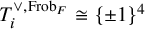 $T_i^{\vee ,\mathrm {Frob}_F} \cong \{ \pm 1\}^4$
is generated by
$T_i^{\vee ,\mathrm {Frob}_F} \cong \{ \pm 1\}^4$
is generated by
 $$\begin{align*}(-1,1,1,1), (1,-1,1,1), (1,1,-1,1), (1,1,1,-1) \text{ and } (\sqrt{-1},\sqrt{-1},\sqrt{-1},\sqrt{-1}). \end{align*}$$
The element $\epsilon _4 \in \mathrm {Out}(D_4)$
stabilizes the character
$\epsilon _4 \in \mathrm {Out}(D_4)$
stabilizes the character $\eta _i$
of
$\eta _i$
of $T_i^{\vee ,\mathrm {Frob}_F}$
if and only if
$T_i^{\vee ,\mathrm {Frob}_F}$
if and only if
 $$ \begin{align*} \eta_i \big( \epsilon_4 (\sqrt{-1},\sqrt{-1},\sqrt{-1},\sqrt{-1}) \big) & = \eta_i (\sqrt{-1},\sqrt{-1},\sqrt{-1},-\sqrt{-1}) \\ & = \eta_i (\sqrt{-1},\sqrt{-1},\sqrt{-1},\sqrt{-1}) \: \eta_i (1,1,1,-1) \end{align*} $$
equals $\eta _i (\sqrt {-1},\sqrt {-1},\sqrt {-1},\sqrt {-1})$
, or equivalently
$\eta _i (\sqrt {-1},\sqrt {-1},\sqrt {-1},\sqrt {-1})$
, or equivalently $\eta _i (1,1,1,-1) = 1$
. The element
$\eta _i (1,1,1,-1) = 1$
. The element $\epsilon _4$
can be lifted to an element of the subgroup of
$\epsilon _4$
can be lifted to an element of the subgroup of $\mathrm {PO}_8 ({\mathbb {C}})$
that changes only the fourth and fifth coordinates (corresponding to only the fourth coordinate of
$\mathrm {PO}_8 ({\mathbb {C}})$
that changes only the fourth and fifth coordinates (corresponding to only the fourth coordinate of $T_i^\vee $
). Since
$T_i^\vee $
). Since $-1 \in W(D_4)$
acts on the coordinates of
$-1 \in W(D_4)$
acts on the coordinates of $T^\vee _i$
separately, this lift of
$T^\vee _i$
separately, this lift of $\epsilon _4$
can be adjusted by some element
$\epsilon _4$
can be adjusted by some element $(1,1,1,t_4) \in T_i^\vee $
to make it into a
$(1,1,1,t_4) \in T_i^\vee $
to make it into a $\mathrm {Frob}_F$
-invariant lift, say
$\mathrm {Frob}_F$
-invariant lift, say $a_4$
. Then
$a_4$
. Then
 $$\begin{align*}a_4^2 \in \{ (1,1,1,t_4) : t_4 \in {\mathbb{C}}^\times \}^{\mathrm{Frob}_F} = \langle (1,1,1,-1) \rangle \subset \ker \eta_i. \end{align*}$$
By construction, $a_4$
is canonical up to
$a_4$
is canonical up to $\{ (1,1,1,t_4) : t_4 \in {\mathbb {C}}^\times \}^{\mathrm {Frob}_F}$
, thus upon pushout along
$\{ (1,1,1,t_4) : t_4 \in {\mathbb {C}}^\times \}^{\mathrm {Frob}_F}$
, thus upon pushout along $\eta _i$
it becomes unique. Via conjugation by order 3 elements of Out
$\eta _i$
it becomes unique. Via conjugation by order 3 elements of Out $(D_4)$
, we also obtain canonical lifts of the other order 2 elements of Out
$(D_4)$
, we also obtain canonical lifts of the other order 2 elements of Out $(D_4)$
. By their canonicity, these lifts combine to a splitting of (B.8).
$(D_4)$
. By their canonicity, these lifts combine to a splitting of (B.8).
Case C. $L_i^\vee $
is
$L_i^\vee $
is $\mathbf W_F$
-stable and
$\mathbf W_F$
-stable and $W(L_i^\vee , T_i^\vee )_{\varphi (\imath _F)} \neq \{1\}$
.
$W(L_i^\vee , T_i^\vee )_{\varphi (\imath _F)} \neq \{1\}$
.
Cases I–V in the proof of Proposition 2.10 show that
 $$\begin{align*}W_i \cong W(L_i^\vee, T_i^\vee)_{\varphi (\imath_F)} \times N, \end{align*}$$
where $N = \{1\}$
unless
$N = \{1\}$
unless $L_i^\vee $
has type
$L_i^\vee $
has type $D_n$
(case IV), in which case N may have two elements. In case IV, the proof of Proposition 2.10 provides a
$D_n$
(case IV), in which case N may have two elements. In case IV, the proof of Proposition 2.10 provides a $W(N_{G^\vee }(L^\vee ),T^\vee )_{\varphi (\imath _F)}$
-equivariant splitting on
$W(N_{G^\vee }(L^\vee ),T^\vee )_{\varphi (\imath _F)}$
-equivariant splitting on $W(L_i^\vee , T^\vee \cap L_i^\vee )_{\varphi (\imath _F)}$
in (B.8). It remains to construct a splitting for N, which has order two. Since it is cyclic, its generator
$W(L_i^\vee , T^\vee \cap L_i^\vee )_{\varphi (\imath _F)}$
in (B.8). It remains to construct a splitting for N, which has order two. Since it is cyclic, its generator $\epsilon _n$
can be represented by an element of
$\epsilon _n$
can be represented by an element of
 $$\begin{align*}\big( N_{G^\vee}(L^\vee,T^\vee) \big/ Z_{G^\vee}(L_i^\vee) \cap N_{G^\vee} (L^\vee,T^\vee) \big)^{\mathbf W_F}_{\varphi (\imath_F)}, \end{align*}$$
whose order reduces to two upon pushout along $\eta $
.
$\eta $
.
Acknowledgments
We thank Anne-Marie Aubert for some helpful comments. We thank the referee for the precise report and comments.
Competing interests
The authors have no competing interests to declare.
Financial support
Y.X. was partially supported by the U.S. National Science Foundation under Award No. 2202677. Open access funding provided by Radboud University Nijmegen.


 Open access

